Congressional Budget Office
11th Annual Meeting of the OECD Network of Parliamentary
Budget Officials and Independent Fiscal Institutions
February 5, 2019
Robert Sunshine
Senior Advisor
CBO’s Use of Outside Experts
1
CBO
In conducting analyses and in preparing cost estimates and
studies, CBO consults with numerous outside experts—
mostly informally.
Those experts include professors, analysts at think tanks,
representatives of industry groups, other private-sector
experts, and people working for federal agencies and for
state and local governments.
They are selected to represent a variety of areas of
expertise and perspectives.
Most of the agency’s analytic reports are reviewed by
outside experts who specialize in the issue at hand.
2
CBO
Many hundreds of outside experts are consulted informally
each year as CBO prepares cost estimates for legislation
and multiyear budget projections.
In 2018, CBO convened five formal meetings with its official
panels of experts.
Also in 2018, CBO received written feedback during the
preparation of 22 reports or working papers, with an average
of three reviewers per document.
When obtaining written feedback, CBO acknowledges that
assistance in a section called “About This Document” at the
end of a report or on the cover page of a working paper.
3
CBO
CBO currently has three official panels of experts:
 Panel of Economic Advisers
 Panel of Health Advisers
 Technical Review Panel for CBO’s Health Insurance Simulation
Model (HISIM)
4
CBO
In selecting the members of its panels, CBO:
 Looks for widely recognized experts on the topic of the panel
 Asks for suggestions from Congressional staff and from people
whose work CBO uses in its analyses
 Seeks a variety of backgrounds, areas of expertise, and
experience
Members serve two- or three-year terms and can be
reappointed.
5
CBO
Outside experts help establish the credibility of CBO and its
work.
The relationship between CBO and its outside advisers is
mutually beneficial: CBO benefits from the advisers’
participation and expert advice, and the advisers benefit
from interacting with each other and with CBO’s staff.
Having established relationships with experts helps ensure
high-quality and timely responses.
6
CBO
CBO’s Panel of Economic Advisers
7
CBO
The panel generally meets twice a year, while CBO is
preparing its economic forecasts.
Advisers are sent a preliminary version of each forecast and
have an opportunity to comment on it at (and after) the
meeting.
CBO usually makes changes to the preliminary forecast to
reflect input from members of the panel.
Staff members of key Congressional committees are invited
to attend the meetings.
8
CBO
Panel meetings include presentations by experts on various
economic issues—for example:
 The effects of new tariffs on the U.S. economy
 The international economic outlook
 Quantifying uncertainty in CBO’s 10-year economic projections
 Understanding low productivity growth
 CBO’s model for projecting labor force participation
 Connections among interest rates, debt, capital flows, and
exchange rates
9
CBO
The panel consists of 22 widely recognized experts who:
 Represent a variety of perspectives
 Have varying areas of expertise, including macroeconomics
and forecasting, international economics, public finance, labor
economics, economic growth, and financial markets
 Have experience working in academia, the private sector, the
executive branch, the Federal Reserve System, and think
tanks
The panel has included several Nobel Prize winners.
10
CBO
CBO’s Panel of Health Advisers
11
CBO
The panel usually meets once a year, and CBO solicits
advisers’ views between meetings.
CBO learns from the advisers about cutting-edge research
and the latest developments in health care delivery and
financing.
Staff members of key Congressional committees are invited
to attend the meetings.
12
CBO
Topics discussed at past meetings include:
 Veterans’ health care
 Spending on prescription drugs
 Modeling health insurance coverage
 Quality measurement and performance assessment in health
care
 Hospital and insurer consolidation
13
CBO
The panel consists of about 20 widely recognized experts
with a variety of backgrounds, areas of expertise, and
experience. They include:
 Academic economists
 Representatives of key health care providers, including
hospitals and physicians’ groups
 Representatives of large employers that offer insurance to their
workers
 Actuaries and others from the health insurance industry
 Physicians, pharmaceutical experts, and medical experts
 State government officials
 Legal and public health experts
14
CBO
The Technical Review Panel for CBO’s
Health Insurance Simulation Model
15
CBO
The panel was established to provide feedback as CBO
develops the next generation of HISIM.
At two virtual meetings with the panel, members of CBO’s
staff gave presentations on several topics, including:
 The role of HISIM at CBO
 Data underlying the new model
 Modeling decisions by consumers
 Modeling decisions by firms
Feedback from panel members was incorporated into the
new model.
16
CBO
An in-person meeting will take place in 2019 to inform future
improvements to the model. (Such improvements are made
annually.)
The panel will continue to assist CBO during the next two
years; after that, such assistance will be provided by CBO’s
regular Panel of Health Advisers.
17
CBO
The panel includes 10 experts with experience in developing
theoretical models of economic behavior that affects health
insurance coverage. Most of the experts work in universities,
but one is at a think tank and another is an actuary.
The advisers were selected to provide a variety of technical
perspectives, as well as diverse views about how
consumers behave, how they evaluate health insurance,
how smoothly insurance markets work, how government
regulations affect those markets, and other topics.
18
CBO
Precautions That CBO Takes in
Selecting Panel Members
19
CBO
Panelists and people being considered for the panels must
disclose any substantial political activity and any significant
financial interests—such as those related to health or health
care for people advising on those issues.
Political activity and financial interests are not necessarily
disqualifying. Instead of disqualifying an adviser, CBO may
choose to disclose such information to CBO staff members
who are in contact with the adviser or exclude the adviser
from discussions of particular issues.
If a panelist has accepted a political appointment or joined a
political campaign, he or she is generally asked to leave the
panel.
20
CBO
Participation in political activity is considered “substantial” if
it would be reasonably viewed as establishing a significant
connection between CBO and a campaign, a political
candidate, an officeholder, or a cause.
Specific positions taken are irrelevant; rather, the potential
harm to CBO’s reputation for objectivity comes from
association with political activity or public advocacy.
Examples of substantial political activity include employment
with a political campaign, acting as a surrogate for a
campaign, and sustained involvement in forming an
officeholder’s policy positions.
Financial interests are “significant” if they exceed certain
dollar thresholds.
21
CBO
Resources
22
CBO
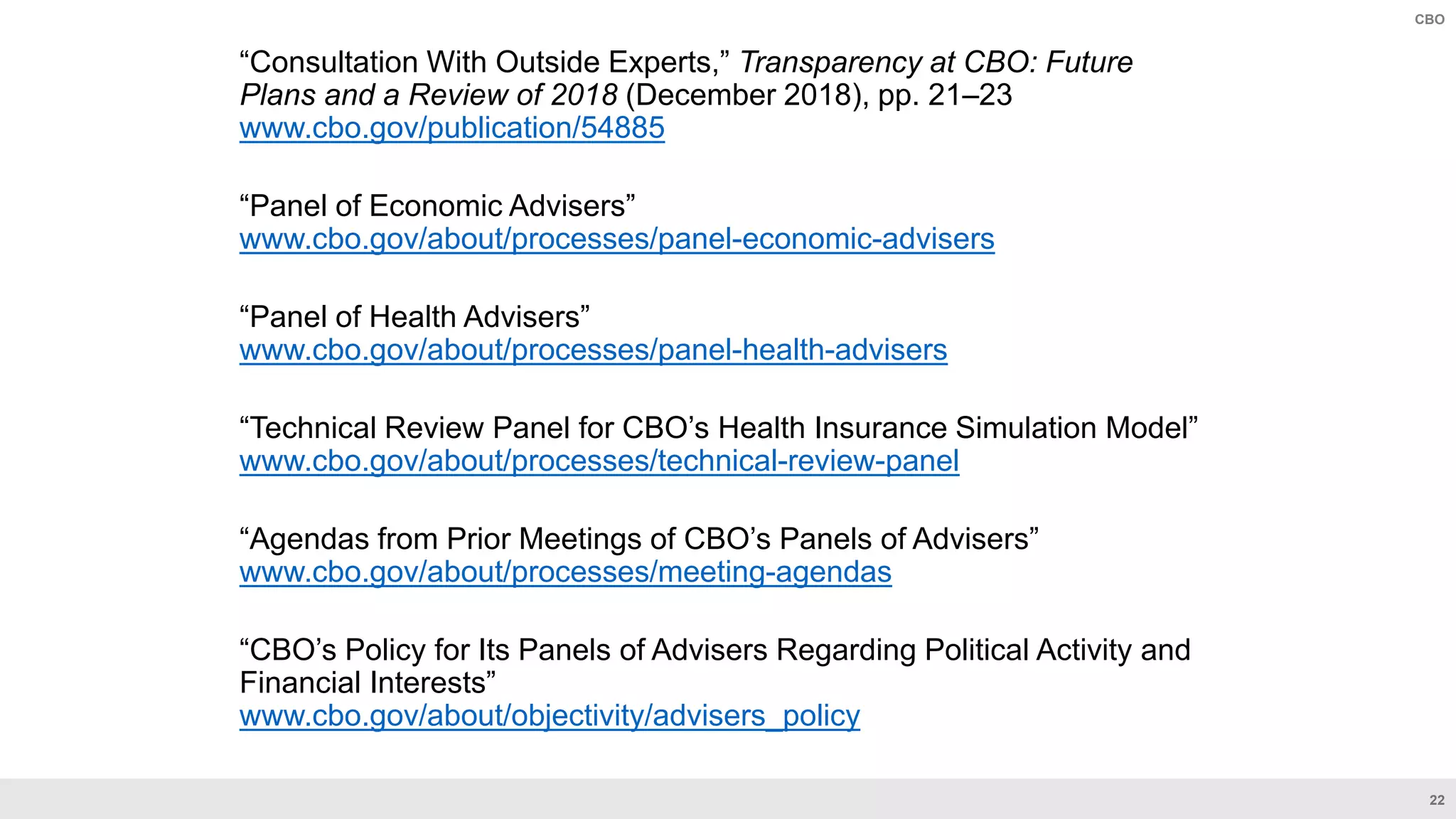
“Consultation With Outside Experts,” Transparency at CBO: Future
Plans and a Review of 2018 (December 2018), pp. 21–23
www.cbo.gov/publication/54885
“Panel of Economic Advisers”
www.cbo.gov/about/processes/panel-economic-advisers
“Panel of Health Advisers”
www.cbo.gov/about/processes/panel-health-advisers
“Technical Review Panel for CBO’s Health Insurance Simulation Model”
www.cbo.gov/about/processes/technical-review-panel
“Agendas from Prior Meetings of CBO’s Panels of Advisers”
www.cbo.gov/about/processes/meeting-agendas
“CBO’s Policy for Its Panels of Advisers Regarding Political Activity and
Financial Interests”
www.cbo.gov/about/objectivity/advisers_policy

CBO’s Use of Outside Experts

  • 1.
    Congressional Budget Office 11thAnnual Meeting of the OECD Network of Parliamentary Budget Officials and Independent Fiscal Institutions February 5, 2019 Robert Sunshine Senior Advisor CBO’s Use of Outside Experts
  • 2.
    1 CBO In conducting analysesand in preparing cost estimates and studies, CBO consults with numerous outside experts— mostly informally. Those experts include professors, analysts at think tanks, representatives of industry groups, other private-sector experts, and people working for federal agencies and for state and local governments. They are selected to represent a variety of areas of expertise and perspectives. Most of the agency’s analytic reports are reviewed by outside experts who specialize in the issue at hand.
  • 3.
    2 CBO Many hundreds ofoutside experts are consulted informally each year as CBO prepares cost estimates for legislation and multiyear budget projections. In 2018, CBO convened five formal meetings with its official panels of experts. Also in 2018, CBO received written feedback during the preparation of 22 reports or working papers, with an average of three reviewers per document. When obtaining written feedback, CBO acknowledges that assistance in a section called “About This Document” at the end of a report or on the cover page of a working paper.
  • 4.
    3 CBO CBO currently hasthree official panels of experts:  Panel of Economic Advisers  Panel of Health Advisers  Technical Review Panel for CBO’s Health Insurance Simulation Model (HISIM)
  • 5.
    4 CBO In selecting themembers of its panels, CBO:  Looks for widely recognized experts on the topic of the panel  Asks for suggestions from Congressional staff and from people whose work CBO uses in its analyses  Seeks a variety of backgrounds, areas of expertise, and experience Members serve two- or three-year terms and can be reappointed.
  • 6.
    5 CBO Outside experts helpestablish the credibility of CBO and its work. The relationship between CBO and its outside advisers is mutually beneficial: CBO benefits from the advisers’ participation and expert advice, and the advisers benefit from interacting with each other and with CBO’s staff. Having established relationships with experts helps ensure high-quality and timely responses.
  • 7.
    6 CBO CBO’s Panel ofEconomic Advisers
  • 8.
    7 CBO The panel generallymeets twice a year, while CBO is preparing its economic forecasts. Advisers are sent a preliminary version of each forecast and have an opportunity to comment on it at (and after) the meeting. CBO usually makes changes to the preliminary forecast to reflect input from members of the panel. Staff members of key Congressional committees are invited to attend the meetings.
  • 9.
    8 CBO Panel meetings includepresentations by experts on various economic issues—for example:  The effects of new tariffs on the U.S. economy  The international economic outlook  Quantifying uncertainty in CBO’s 10-year economic projections  Understanding low productivity growth  CBO’s model for projecting labor force participation  Connections among interest rates, debt, capital flows, and exchange rates
  • 10.
    9 CBO The panel consistsof 22 widely recognized experts who:  Represent a variety of perspectives  Have varying areas of expertise, including macroeconomics and forecasting, international economics, public finance, labor economics, economic growth, and financial markets  Have experience working in academia, the private sector, the executive branch, the Federal Reserve System, and think tanks The panel has included several Nobel Prize winners.
  • 11.
    10 CBO CBO’s Panel ofHealth Advisers
  • 12.
    11 CBO The panel usuallymeets once a year, and CBO solicits advisers’ views between meetings. CBO learns from the advisers about cutting-edge research and the latest developments in health care delivery and financing. Staff members of key Congressional committees are invited to attend the meetings.
  • 13.
    12 CBO Topics discussed atpast meetings include:  Veterans’ health care  Spending on prescription drugs  Modeling health insurance coverage  Quality measurement and performance assessment in health care  Hospital and insurer consolidation
  • 14.
    13 CBO The panel consistsof about 20 widely recognized experts with a variety of backgrounds, areas of expertise, and experience. They include:  Academic economists  Representatives of key health care providers, including hospitals and physicians’ groups  Representatives of large employers that offer insurance to their workers  Actuaries and others from the health insurance industry  Physicians, pharmaceutical experts, and medical experts  State government officials  Legal and public health experts
  • 15.
    14 CBO The Technical ReviewPanel for CBO’s Health Insurance Simulation Model
  • 16.
    15 CBO The panel wasestablished to provide feedback as CBO develops the next generation of HISIM. At two virtual meetings with the panel, members of CBO’s staff gave presentations on several topics, including:  The role of HISIM at CBO  Data underlying the new model  Modeling decisions by consumers  Modeling decisions by firms Feedback from panel members was incorporated into the new model.
  • 17.
    16 CBO An in-person meetingwill take place in 2019 to inform future improvements to the model. (Such improvements are made annually.) The panel will continue to assist CBO during the next two years; after that, such assistance will be provided by CBO’s regular Panel of Health Advisers.
  • 18.
    17 CBO The panel includes10 experts with experience in developing theoretical models of economic behavior that affects health insurance coverage. Most of the experts work in universities, but one is at a think tank and another is an actuary. The advisers were selected to provide a variety of technical perspectives, as well as diverse views about how consumers behave, how they evaluate health insurance, how smoothly insurance markets work, how government regulations affect those markets, and other topics.
  • 19.
    18 CBO Precautions That CBOTakes in Selecting Panel Members
  • 20.
    19 CBO Panelists and peoplebeing considered for the panels must disclose any substantial political activity and any significant financial interests—such as those related to health or health care for people advising on those issues. Political activity and financial interests are not necessarily disqualifying. Instead of disqualifying an adviser, CBO may choose to disclose such information to CBO staff members who are in contact with the adviser or exclude the adviser from discussions of particular issues. If a panelist has accepted a political appointment or joined a political campaign, he or she is generally asked to leave the panel.
  • 21.
    20 CBO Participation in politicalactivity is considered “substantial” if it would be reasonably viewed as establishing a significant connection between CBO and a campaign, a political candidate, an officeholder, or a cause. Specific positions taken are irrelevant; rather, the potential harm to CBO’s reputation for objectivity comes from association with political activity or public advocacy. Examples of substantial political activity include employment with a political campaign, acting as a surrogate for a campaign, and sustained involvement in forming an officeholder’s policy positions. Financial interests are “significant” if they exceed certain dollar thresholds.
  • 22.
  • 23.
    22 CBO “Consultation With OutsideExperts,” Transparency at CBO: Future Plans and a Review of 2018 (December 2018), pp. 21–23 www.cbo.gov/publication/54885 “Panel of Economic Advisers” www.cbo.gov/about/processes/panel-economic-advisers “Panel of Health Advisers” www.cbo.gov/about/processes/panel-health-advisers “Technical Review Panel for CBO’s Health Insurance Simulation Model” www.cbo.gov/about/processes/technical-review-panel “Agendas from Prior Meetings of CBO’s Panels of Advisers” www.cbo.gov/about/processes/meeting-agendas “CBO’s Policy for Its Panels of Advisers Regarding Political Activity and Financial Interests” www.cbo.gov/about/objectivity/advisers_policy