Enhancing Independence and
Person Centred Practice –
A Pathway to Implementing
Consumer Directed Care
Better Practice Conference
Australian Aged Care Quality Agency
Carrie Hayter,
Managing Director
Carrie Hayter Consulting
12 November 2015
Brisbane, Australia
1
Nothing about me without me www.carriehayter.com
Introduction
• ‘Personalisation’ of Aged Care
– Narratives and Research
– Perspectives of different stakeholders and actors
• Challenges & Opportunities
– Seven Key Steps
• Adaptive Leadership Framework
11/11/2015 © Carrie Hayter Consulting 2
Nothing about me without me www.carriehayter.com
About Carrie Hayter Consulting
11 November 2015
Transforming Social Care
– Public Speaking
– Research & Evaluation
– A Handbook for community care services, Empowering People, enhancing
independence, enriching lives with Alt Beatty Consulting for NSW Government
– Education & Training
– Service Providers
– Implementing Wellness and Reablement in Community Aged Care (managers
and support workers)
– Implementing Consumer Directed Care (Managers and Support Workers)
– Ageing and Sexuality (managers and front-line workers)
– Service Users
– Living Life my Way (Service Users)
3
Nothing about me without me www.carriehayter.com
11/11/2015 © Carrie Hayter Consulting 4
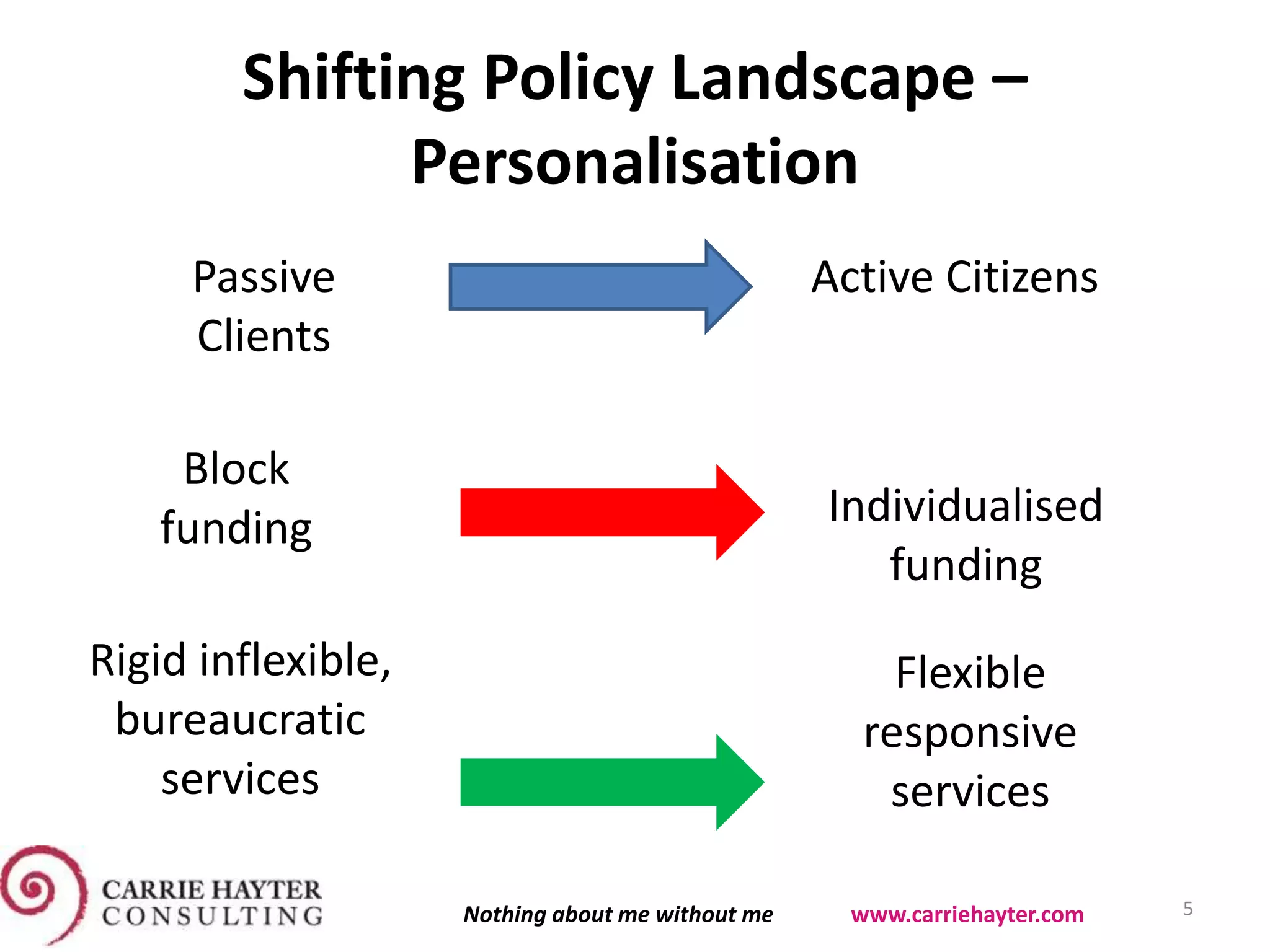
Shifting Policy Landscape –
Personalisation
Passive
Clients
Active Citizens
Block
funding Individualised
funding
Rigid inflexible,
bureaucratic
services
Flexible
responsive
services
11/11/2015 5Nothing about me without me www.carriehayter.com
611/11/2015
© Carrie Hayter Consulting
Personhood
‘Consumer’ as
Purchaser
Citizen
Social and
political rightsEconomic
purchasing power
Relationship
between client and
professional
Client Citizen –
Consumer
Agency
Mechanisms for enacting ‘choice’ and ‘voice’
Market mechanisms
via competition
(LeGrand, 2007)
Managing self
interest
(LeGrand, 2007) and
voice mechanisms
Enable ‘choice’
through ‘voice’
mechanisms
(Simmons et al 2011)
Hybrid
Choice and
voice
mechanisms
Step One –
Start a conversation and get everyone
on the same page
8
Nothing about me without me www.carriehayter.com
9
Wellness Reablement Restorative Consumer
Directed Care
Building on the
strengths
• Right balance
between ‘doing
with’ rather than
‘doing for’
• Builds
community
connections
• Identifies what a
person can do
and wants to do
in the future
• Time –limited
targeted
interventions to
regain function,
confidence or
capacity
• Evidence-based
interventions led
by allied health
workers that
allow a person
to make a
functional gain
or improvement
after a setback,
or in order to
avoid a
preventable
injury.
• Giving more
power to people
to determine the
who, what, why
and how
supports are
provided
Nothing about me without me www.carriehayter.com
Source: Adapted from Australian Government Department of Social Services
(2015) Living Well at Home: CHSP Good Practice Guide,
Step Two –
Critically read research and practice
guides and share it with your team
10
Nothing about me without me www.carriehayter.com
Why reablement and wellness?
• Research - UK, Australia and New Zealand
– Improved health and welling for older people (Lewin at al, 2013,
Parsons et al, 2013, Parsons et al, 2014)
– Reduces people’s dependence on paid supports (King & Parsons,
et al 2012, Lewin & Alfonso 2013, Lewin & De San Miguel, 2013)
– Role of assessment is critical (Department of Family and
Community Services, Ageing, Disability and Home Care, 2012)
• Further research
– People with dementia (Alzheimer’s Australia NSW, 2014)
– Engaging carers and service users in their reablement and
wellness (Wilde & Glendenning, 2012)
• Australian changes
– Outcomes and benefits
11
Nothing about me without me www.carriehayter.com
Personalisation Narratives
• Personalisation works, transforming people’s
lives for the better.
• Personalisation saves money.
• Person- centred approaches reflect the way
that people live their lives.
• Personalisation is applicable to everyone.
• People are the experts in their own lives
(Needham, 2011: pg 7).
12
Nothing about me without me www.carriehayter.com
Step Three –
Engage Older People - Nothing about
me without me
13
Nothing about me without me www.carriehayter.com
14
Nothing about me without me www.carriehayter.com
15
Important to Important for
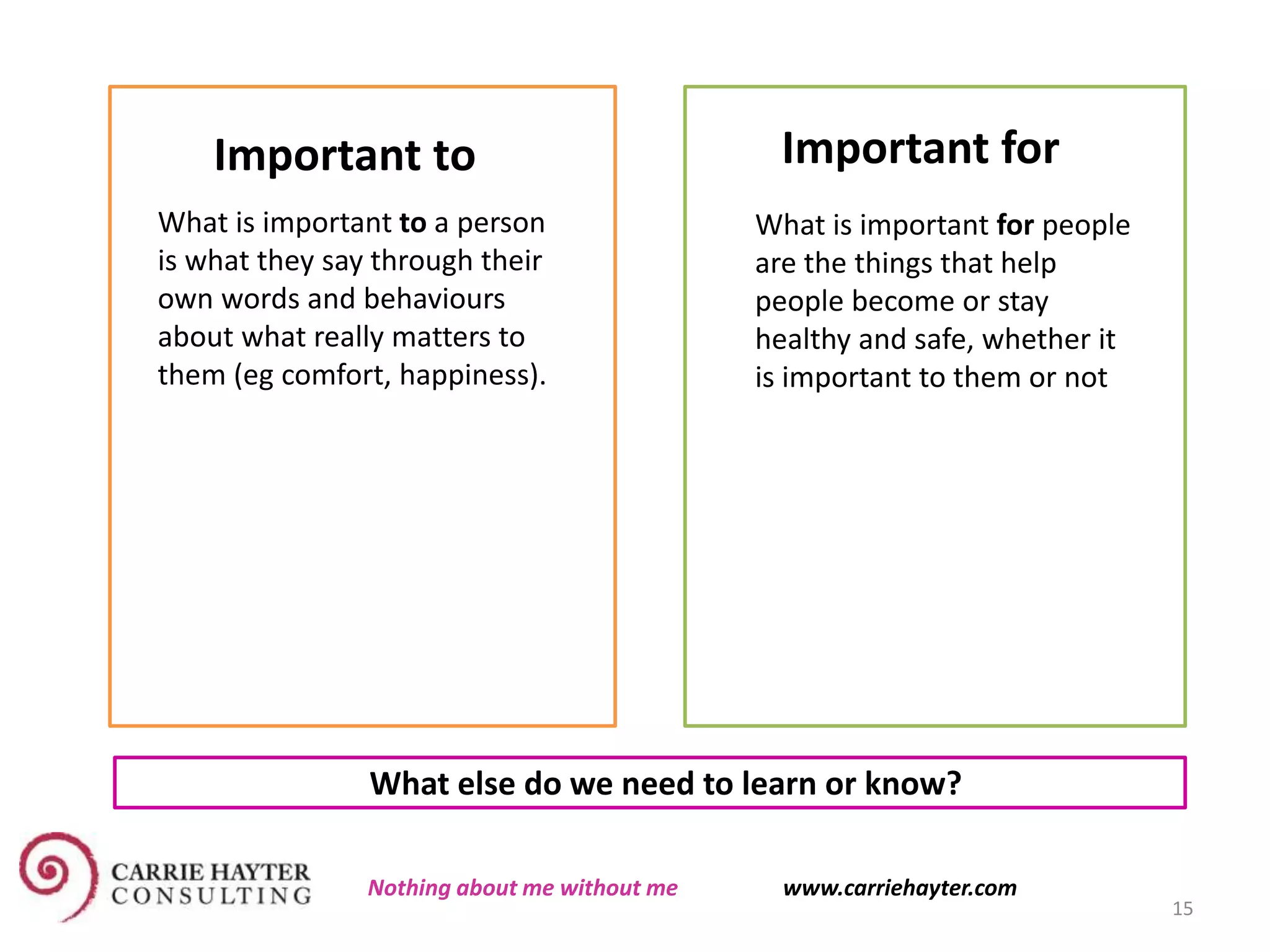
WWhat else do we need to learn or know?
What is important to a person
is what they say through their
own words and behaviours
about what really matters to
them (eg comfort, happiness).
What is important for people
are the things that help
people become or stay
healthy and safe, whether it
is important to them or not
Nothing about me without me www.carriehayter.com
11/11/2015 © Carrie Hayter Consulting 16
11 November 2015 17
Coercing
Educating
Informing
Consulting
Engaging
Co-designing
Co-Producing
Co-delivery
Co-Ownership
Ladder of Participation –
Choice and Voice?
Doing
for
Doing
to
Doing
With
Doing for
themselves
Adapted form
Think Public, 2015
User Rights
Strategies for older
people in the mid
1990’s
Consumer
Directed Care?
Nothing about me without me www.carriehayter.com
18
www.wavertonhub.com.au
www.mychoicematters.org.au
Co-Ownership and Co-Delivery in Australia
Nothing about me without me www.carriehayter.com
19
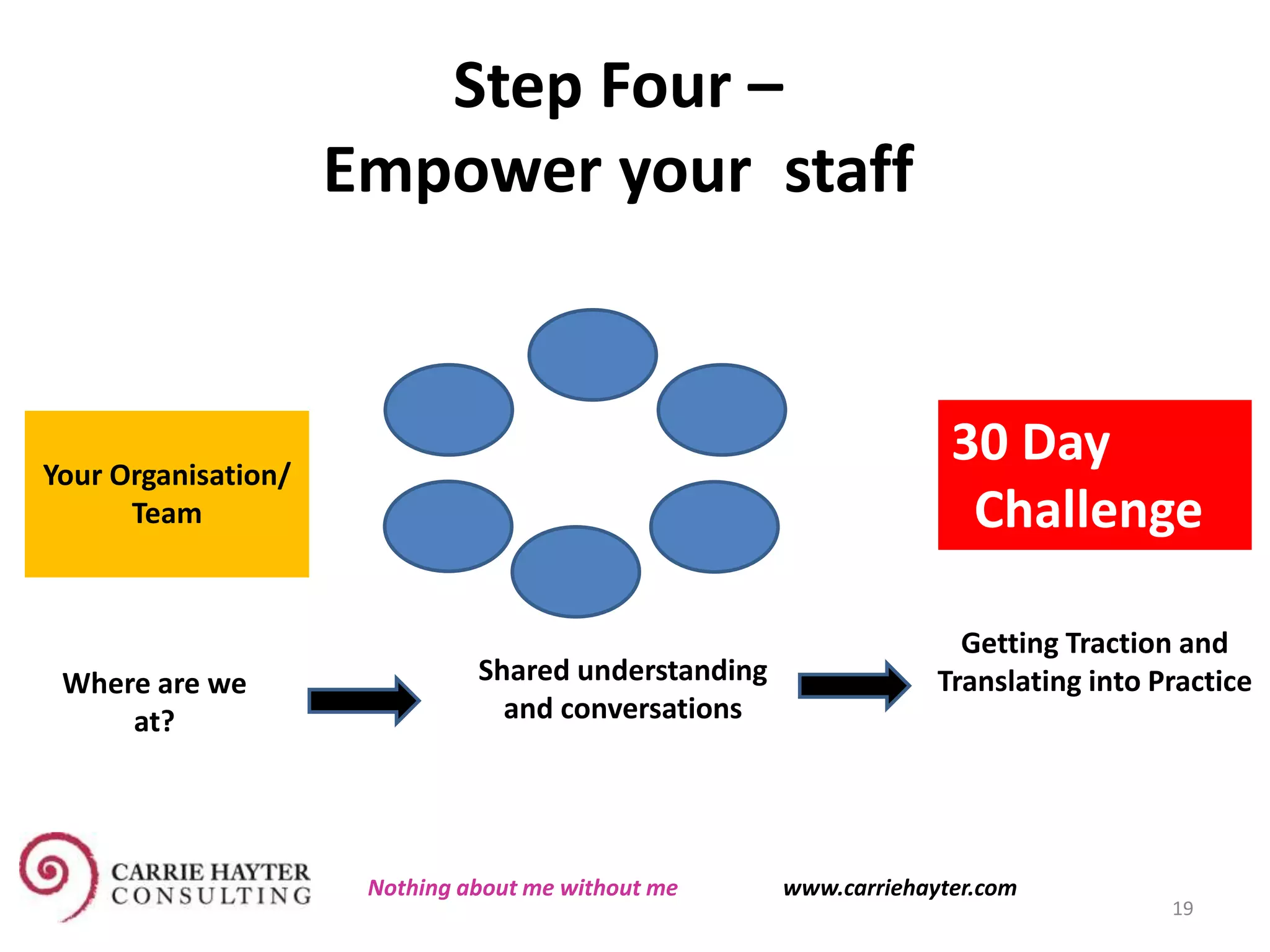
30 Day
Challenge
Getting Traction and
Translating into Practice
Your Organisation/
Team
Shared understanding
and conversations
Where are we
at?
Nothing about me without me www.carriehayter.com
Step Four –
Empower your staff
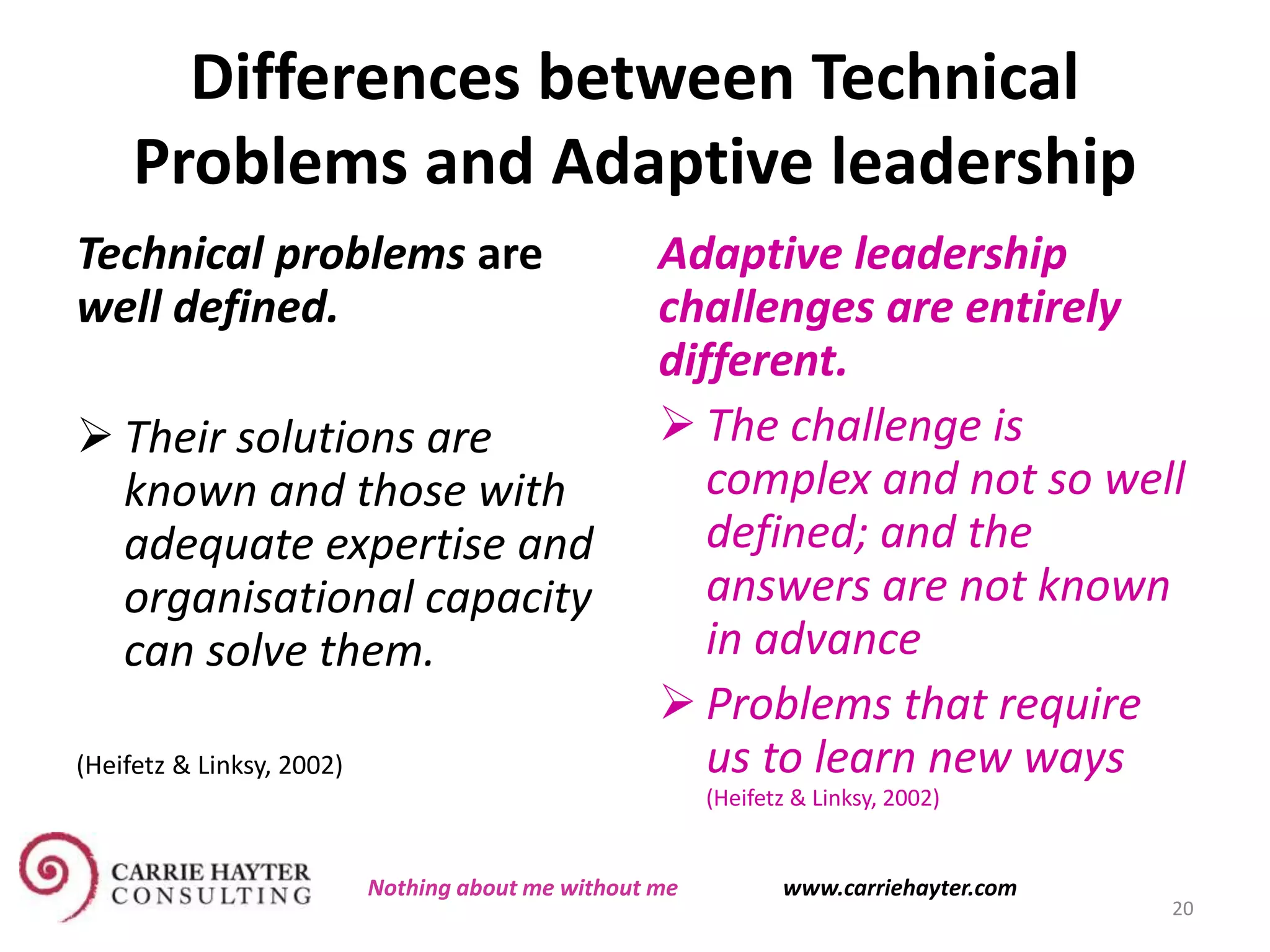
Differences between Technical
Problems and Adaptive leadership
Technical problems are
well defined.
 Their solutions are
known and those with
adequate expertise and
organisational capacity
can solve them.
(Heifetz & Linksy, 2002)
Adaptive leadership
challenges are entirely
different.
 The challenge is
complex and not so well
defined; and the
answers are not known
in advance
 Problems that require
us to learn new ways
(Heifetz & Linksy, 2002)
20
Nothing about me without me www.carriehayter.com
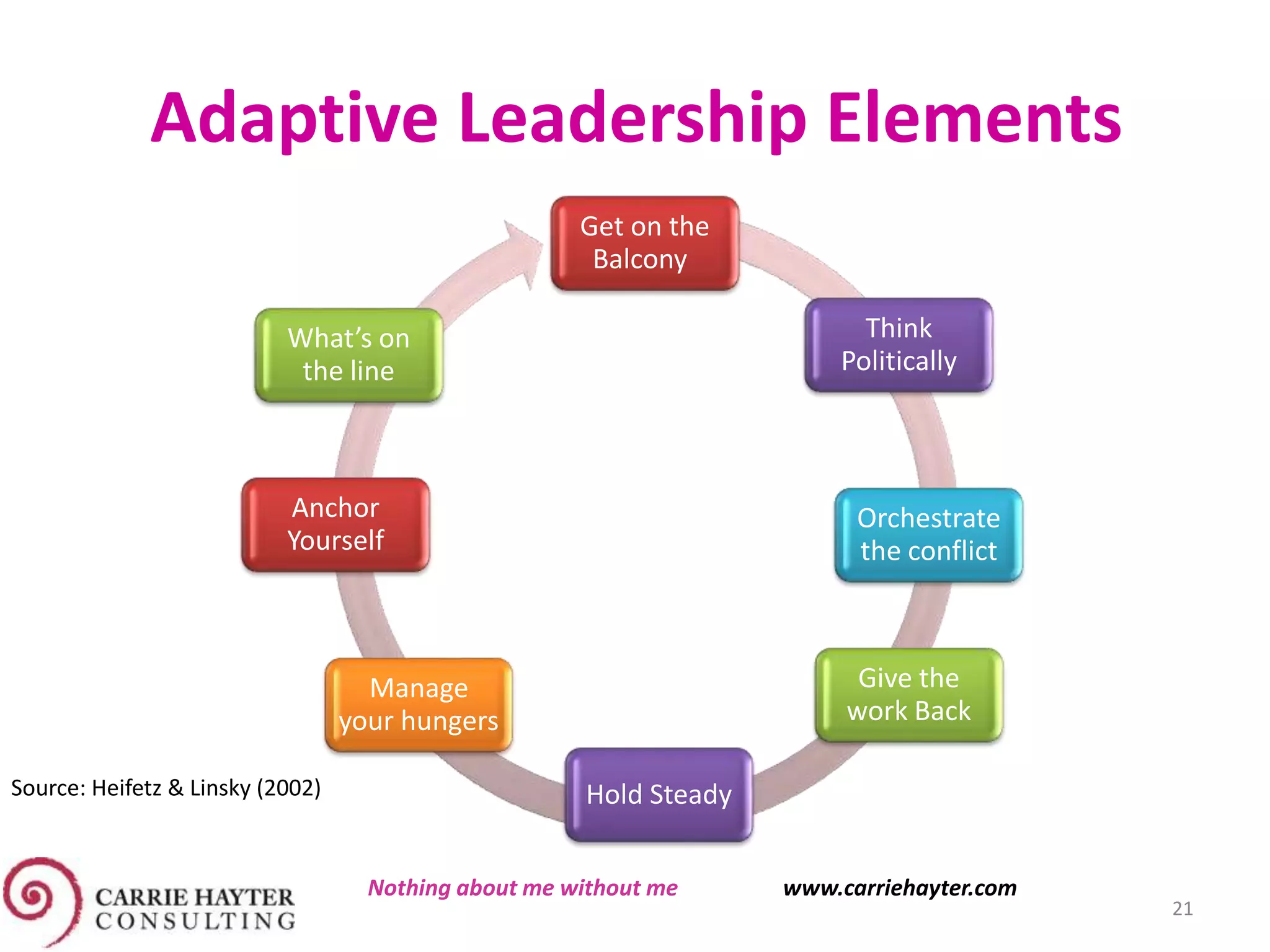
Get on the
Balcony
Give the
work Back
Think
Politically
Orchestrate
the conflict
Manage
your hungers
Anchor
Yourself
What’s on
the line
Hold Steady
Adaptive Leadership Elements
Source: Heifetz & Linsky (2002)
21
Nothing about me without me www.carriehayter.com
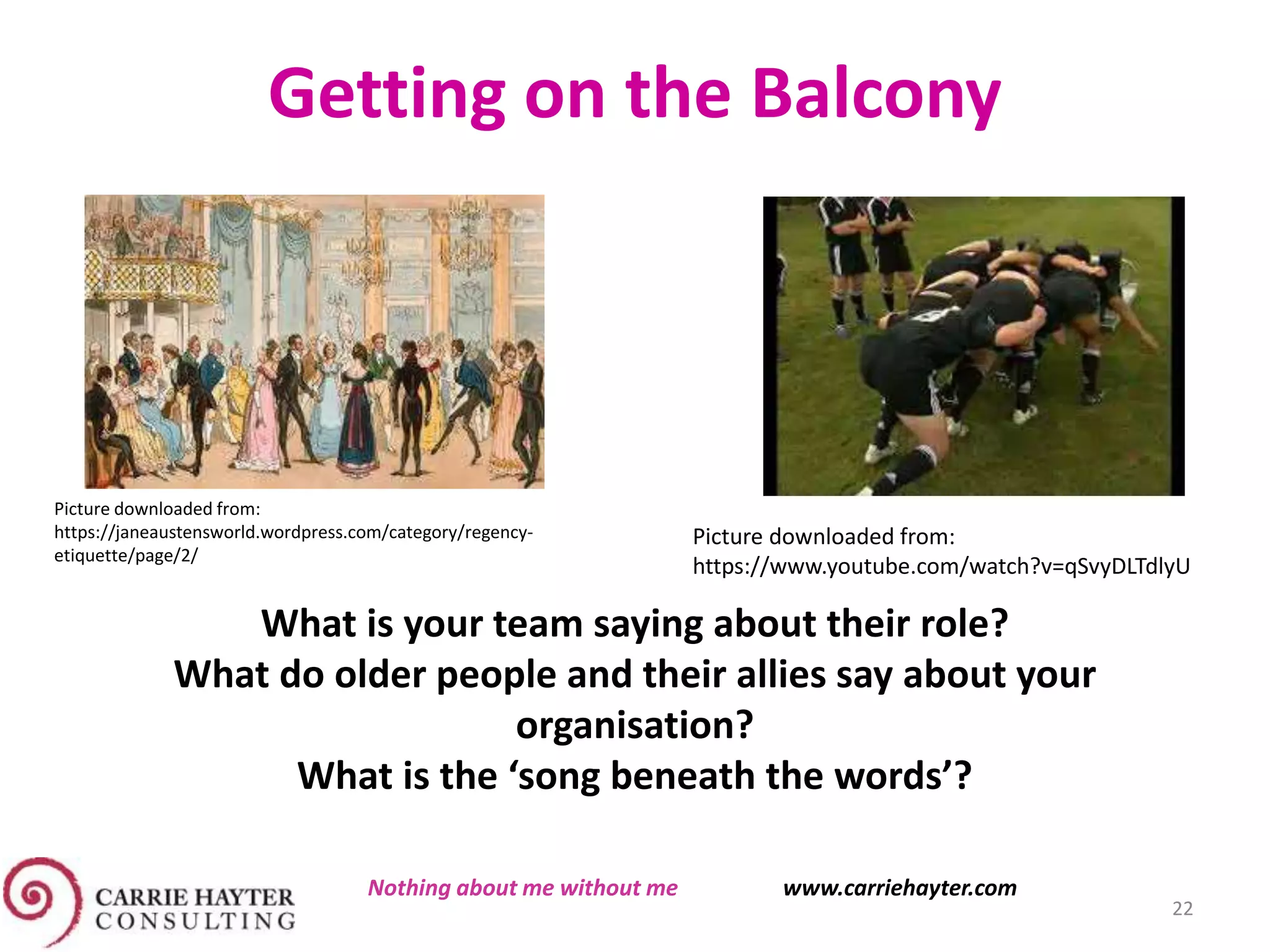
Picture downloaded from:
https://janeaustensworld.wordpress.com/category/regency-
etiquette/page/2/
Getting on the Balcony
Picture downloaded from:
https://www.youtube.com/watch?v=qSvyDLTdlyU
What is your team saying about their role?
What do older people and their allies say about your
organisation?
What is the ‘song beneath the words’?
22
Nothing about me without me www.carriehayter.com
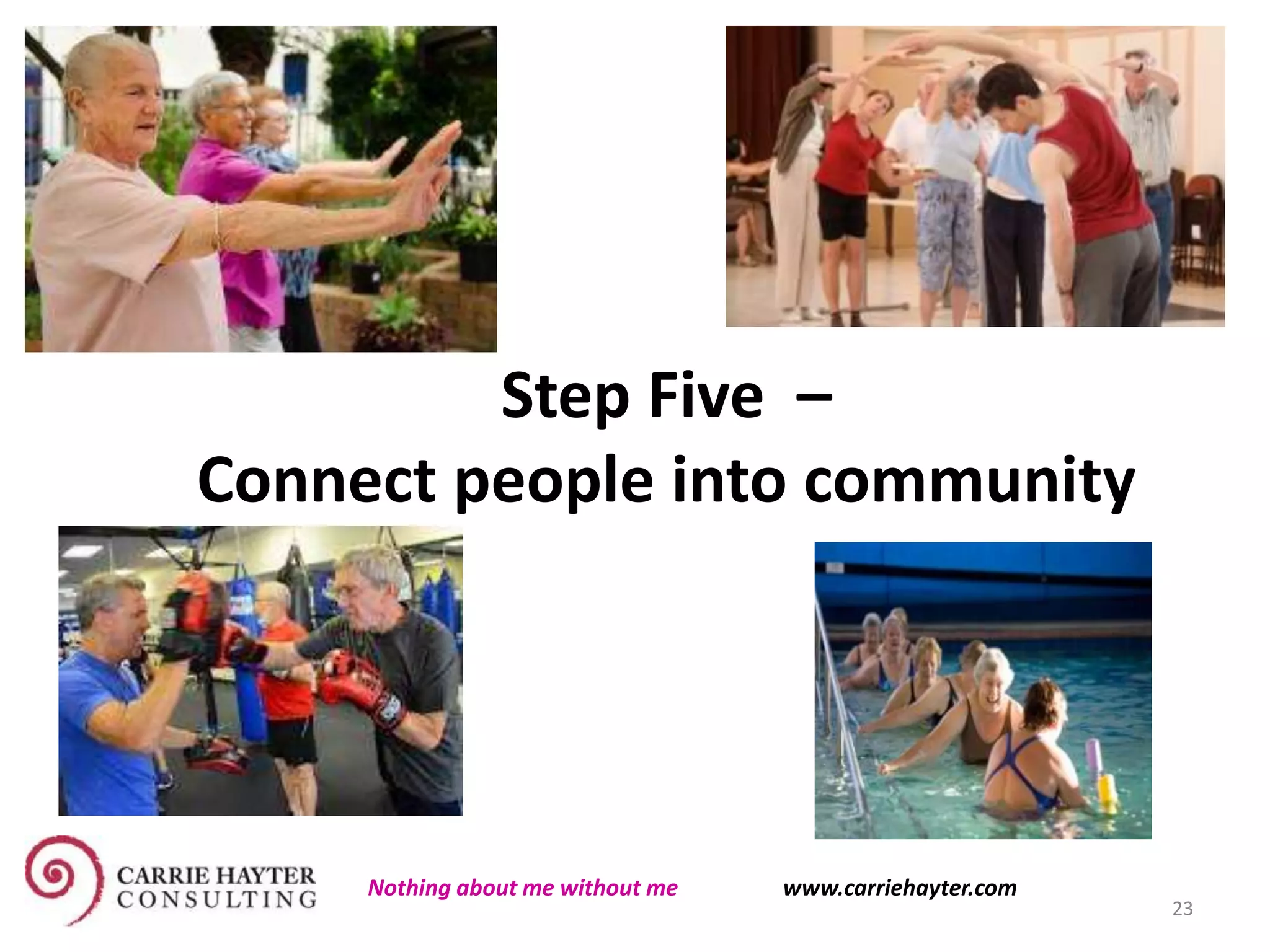
Step Five –
Connect people into community
23
Nothing about me without me www.carriehayter.com
24
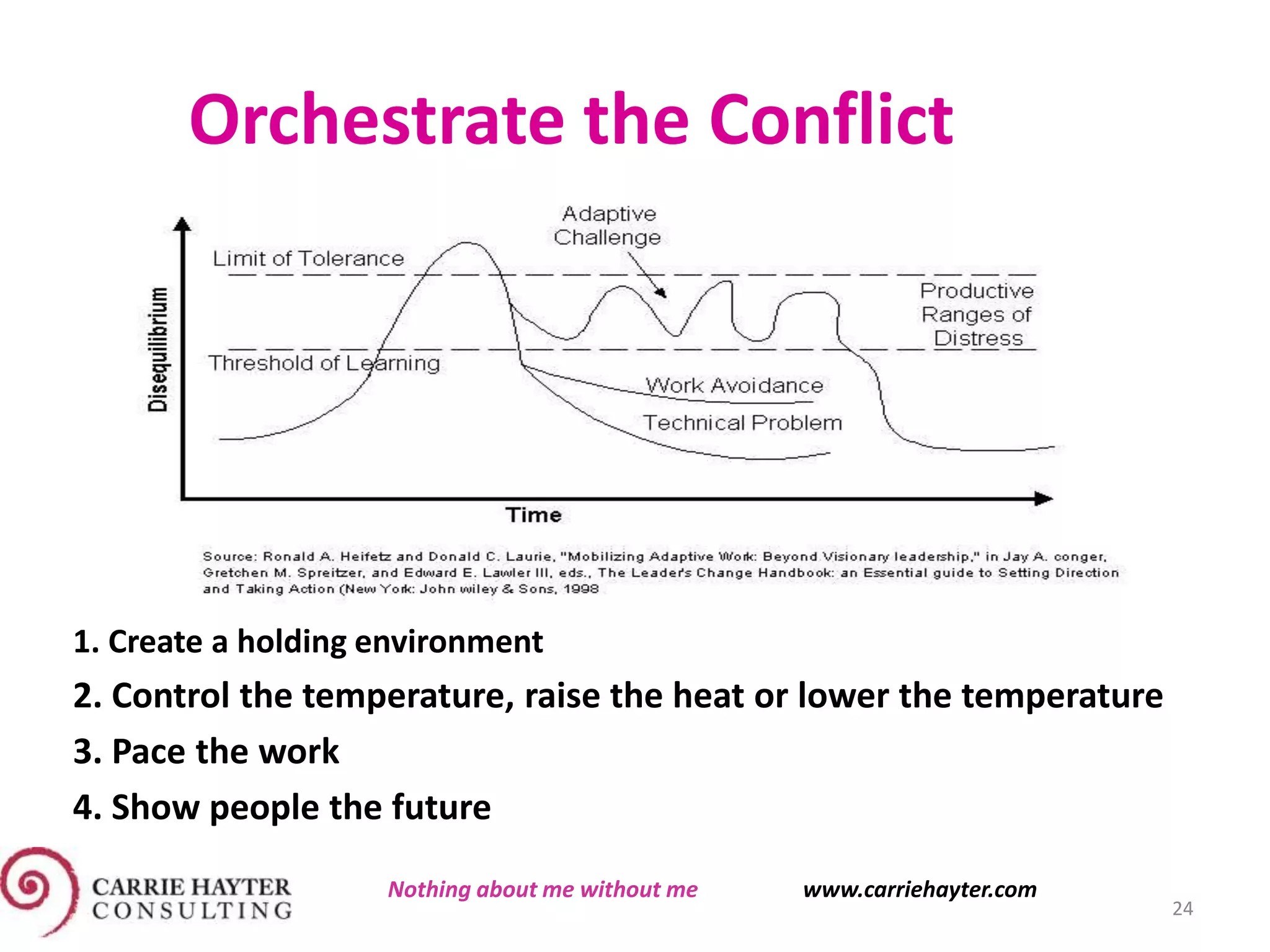
Orchestrate the Conflict
1. Create a holding environment
2. Control the temperature, raise the heat or lower the temperature
3. Pace the work
4. Show people the future
Nothing about me without me www.carriehayter.com
Think Politically
1. Find Partners
2. Keep the Opposition Close
3. Accept Responsibility for
your piece of the mess
4. Acknowledge their losses
and accept casualties
5. Model the behaviour
(Heifetz & Linksy, 2002)Picture downloaded from: www.twitter.com
What can we learn from other people or organisations on
their journey?
What might be the losses or casualties?
11/11/2015 © Carrie Hayter Consulting 25
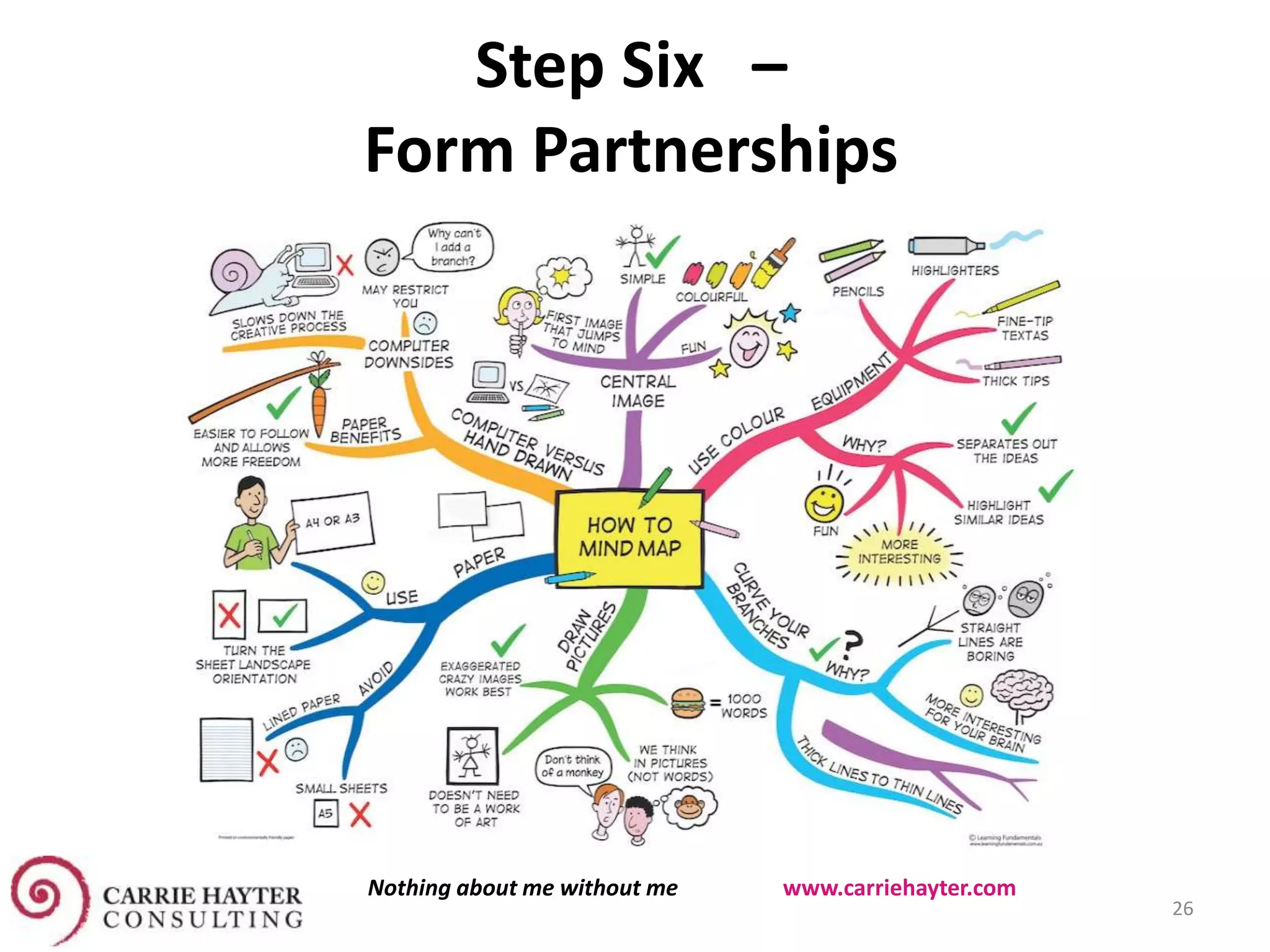
Step Six –
Form Partnerships
26
Nothing about me without me www.carriehayter.com
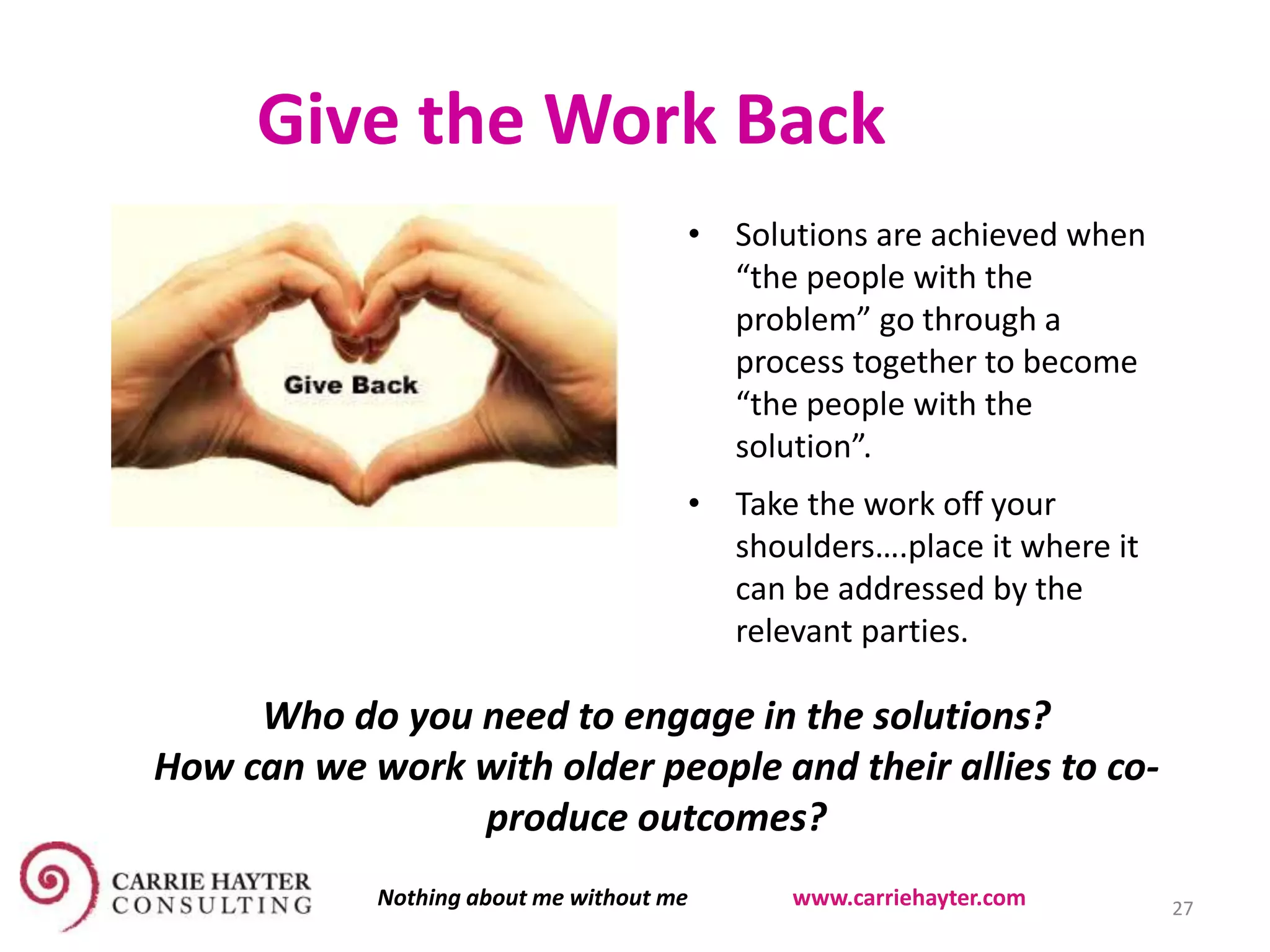
Give the Work Back
• Solutions are achieved when
“the people with the
problem” go through a
process together to become
“the people with the
solution”.
• Take the work off your
shoulders….place it where it
can be addressed by the
relevant parties.
Who do you need to engage in the solutions?
How can we work with older people and their allies to co-
produce outcomes?
27Nothing about me without me www.carriehayter.com
Anchor Yourself
• Don’t confuse one’s self
with one’s professional
role
• Identify a truly trustworthy
confidant who can really
tell you what you NEED to
hear
• Find a sanctuary for
retreat, rejuvenation and
personal reflection
28
Who are your confidants?
How can they support you?
How do you look after yourself?
Nothing about me without me www.carriehayter.com
29
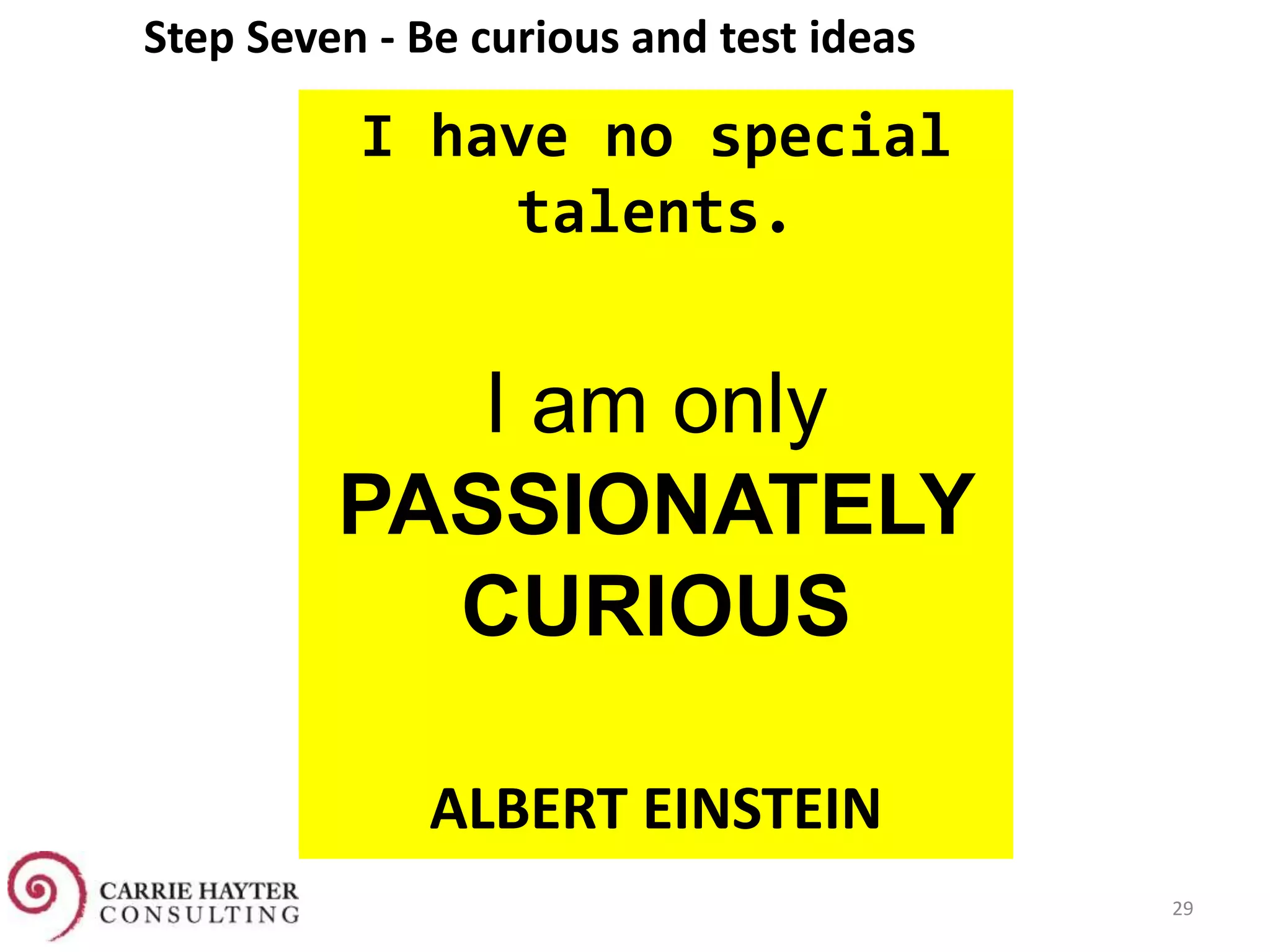
Step Seven - Be curious and test ideas Be Curious
I have no special
talents.
I am only
PASSIONATELY
CURIOUS
ALBERT EINSTEIN
Conclusion
11/11/2015 30
Nothing about me without me www.carriehayter.com
References and Resources
Leadership
• Heifetz, R., & Linksy, M., (2002) Leadership on the Line: Staying Alive through the
Dangers of Leading, Harvard Business Review Press, Boston Massachusetts
• Heifetz, R., Grashow, A., & Linksy, M., (2009) The Practice of Adaptive Leadership –
Tools and Tactics for Changing your Organisation and the World, Harvard Business
Review Press, Boston Massachusetts
• Goleman, D. (1998). Working with Emotional Intelligence London Bloomsbury.
• Covey, R., (1996) The 7 Habits of Highly Effective People, Simon and Shuster, New
York
– https://www.stephencovey.com/7habits/7habits.php
• Cambridge Leadership Associates
– http://cambridge-leadership.com/
11/11/2015 © Carrie Hayter Consulting 31
References and Resources
Reablement and Wellness
Alzheimer's Australia NSW. (2014) The Benefits of Physical Activity for People living with Dementia, Sydney , Alzheimer's Australia
NSW downloaded from https://nsw.fightdementia.org.au/nsw/news/the-benefits-of-physical-activity-and-exercise-for-people-
living-with-dementia
Australian Government Department of Social Services (2015) Living Well at Home: CHSP Good Practice Guide, pg 11-13,
downloaded from
https://www.dss.gov.au/sites/default/files/documents/06_2015/good_practice_guide_version_web_accessible_pdf.pdf
Glendinning, C. (2012). Home care in England: markets in the context of under-funding. Health & Social Care in the Community,
20(3), 292-299. doi: 10.1111/j.1365-2524.2012.01059.x
King, A., M. Parsons, et al. (2012). "Assessing the impact of a restorative home care service in New Zealand: A cluster randomised
controlled trial." Health and Social Care in the Community 20(4): 365-374.
Lewin, G., & Vandermeulen, S. (2010). A non-randomised controlled trial of the Home Independence Program (HIP): an Australian
restorative programme for older home-care clients. Health & Social Care in the Community, 18(1), 91-99. doi: 10.1111/j.1365-
2524.2009.00878.x
Lewin, G. F., H. S. Alfonso, et al. (2013). "Evidence for the long term cost effectiveness of home care reablement programs."
Clinical interventions in Aging 8: 1273-1281.
Lewin, G., K. De San Miguel, et al. (2013). "A randomised controlled trial of the Home Independence Program, an Australian
restorative home-care programme for older adults." Health & Social Care in the Community 21(1): 69-78.
11/11/2015 © Carrie Hayter Consulting 32
Reablement and Wellness (Cont)
Parsons, J. G. M., N. Sheridan, et al. (2013). "A Randomized Controlled Trial to Determine the Effect of a
Model of Restorative Home Care on Physical Function and Social Support Among Older People."
Archives of Physical Medicine and Rehabilitation 94(6): 1015-1022.
Ryburn, B., Wells, Y., & Foreman, P., (2009) Enabling Independence: Restorative Approaches to Home
Care Provision for Frail Older Adults, Health and Social Care in the Community, Volume 17 (3), pp 225-
234, see pg 22
Senior, H. E. J., M. Parsons, et al. (2014). "Promoting independence in frail older people: A randomised
controlled trial of a restorative care service in New Zealand." Age and Ageing 43(3): 418-424.
Wilde, A., & Glendinning, C. (2012). ‘If they’re helping me then how can I be independent?’ The
perceptions and experience of users of home-care re-ablement services. Health & Social Care in the
Community, no-no. doi: 10.1111/j.1365-2524.2012.01072.x
References and Resources
11/11/2015 © Carrie Hayter Consulting 33
Reablement and Wellness (Cont)
Parsons, J. G. M., N. Sheridan, et al. (2013). "A Randomized Controlled Trial to Determine the Effect of a
Model of Restorative Home Care on Physical Function and Social Support Among Older People."
Archives of Physical Medicine and Rehabilitation 94(6): 1015-1022.
Ryburn, B., Wells, Y., & Foreman, P., (2009) Enabling Independence: Restorative Approaches to Home
Care Provision for Frail Older Adults, Health and Social Care in the Community, Volume 17 (3), pp 225-
234, see pg 22
Senior, H. E. J., M. Parsons, et al. (2014). "Promoting independence in frail older people: A randomised
controlled trial of a restorative care service in New Zealand." Age and Ageing 43(3): 418-424.
Wilde, A., & Glendinning, C. (2012). ‘If they’re helping me then how can I be independent?’ The
perceptions and experience of users of home-care re-ablement services. Health & Social Care in the
Community, no-no. doi: 10.1111/j.1365-2524.2012.01072.x
References and Resources
11/11/2015 © Carrie Hayter Consulting 34
Needham, C. (2011). Personalising Public Services Understanding the Personalisation Narrative Bristol, UK Policy Press
Simmons, R. (2011). Leadership and Listening: The Reception of User Voice in Today's Public Services. Social Policy &
Administration, 45(5), 539-568. doi: 10.1111/j.1467-9515.2011.00790.x
Moran, N., Glendinning, C., Wilberforce, M., Stevens, M., Nettens, N., Jones, K., Manthorpe, J., Knapp, M., Fernandez,
J., Challis, D., & Jacobs, S. (2013) Older people’s experience of cash-for-care schemes: evidence from the English
Individual Budget pilot projects, Ageing and Society 33, pp 826-851
Needham, C. (2011). Personalising Public Services Understanding the Personalisation Narrative Bristol, UK Policy Press
Simmons, R. (2011). Leadership and Listening: The Reception of User Voice in Today's Public Services. Social Policy &
Administration, 45(5), 539-568. doi: 10.1111/j.1467-9515.2011.00790.x
Simmons, R., Birchall, J., & Prout, A. (2011). User Involvement in Public Services: ‘Choice about Voice’. Public Policy and
Administration, 27(1), 3-29. doi: 10.1177/0952076710384903
Williams, R., & Sanderson, H., (2005) What are we learning about person centred organisations?, downloaded from
Home Care today www.homecaretoday.org.au
References and Resources
11/11/2015 © Carrie Hayter Consulting 35
More Information
Download the seven key steps to implement
wellness, restorative and enablement
approaches
www.carriehayter.com
Start a conversation
@carriehayter
36
Nothing about me without me www.carriehayter.com

Enhancing Independence and Person Centred Practice – A Pathway to Implementing Consumer Directed Care

  • 1.
    Enhancing Independence and PersonCentred Practice – A Pathway to Implementing Consumer Directed Care Better Practice Conference Australian Aged Care Quality Agency Carrie Hayter, Managing Director Carrie Hayter Consulting 12 November 2015 Brisbane, Australia 1 Nothing about me without me www.carriehayter.com
  • 2.
    Introduction • ‘Personalisation’ ofAged Care – Narratives and Research – Perspectives of different stakeholders and actors • Challenges & Opportunities – Seven Key Steps • Adaptive Leadership Framework 11/11/2015 © Carrie Hayter Consulting 2 Nothing about me without me www.carriehayter.com
  • 3.
    About Carrie HayterConsulting 11 November 2015 Transforming Social Care – Public Speaking – Research & Evaluation – A Handbook for community care services, Empowering People, enhancing independence, enriching lives with Alt Beatty Consulting for NSW Government – Education & Training – Service Providers – Implementing Wellness and Reablement in Community Aged Care (managers and support workers) – Implementing Consumer Directed Care (Managers and Support Workers) – Ageing and Sexuality (managers and front-line workers) – Service Users – Living Life my Way (Service Users) 3 Nothing about me without me www.carriehayter.com
  • 4.
    11/11/2015 © CarrieHayter Consulting 4
  • 5.
    Shifting Policy Landscape– Personalisation Passive Clients Active Citizens Block funding Individualised funding Rigid inflexible, bureaucratic services Flexible responsive services 11/11/2015 5Nothing about me without me www.carriehayter.com
  • 6.
  • 7.
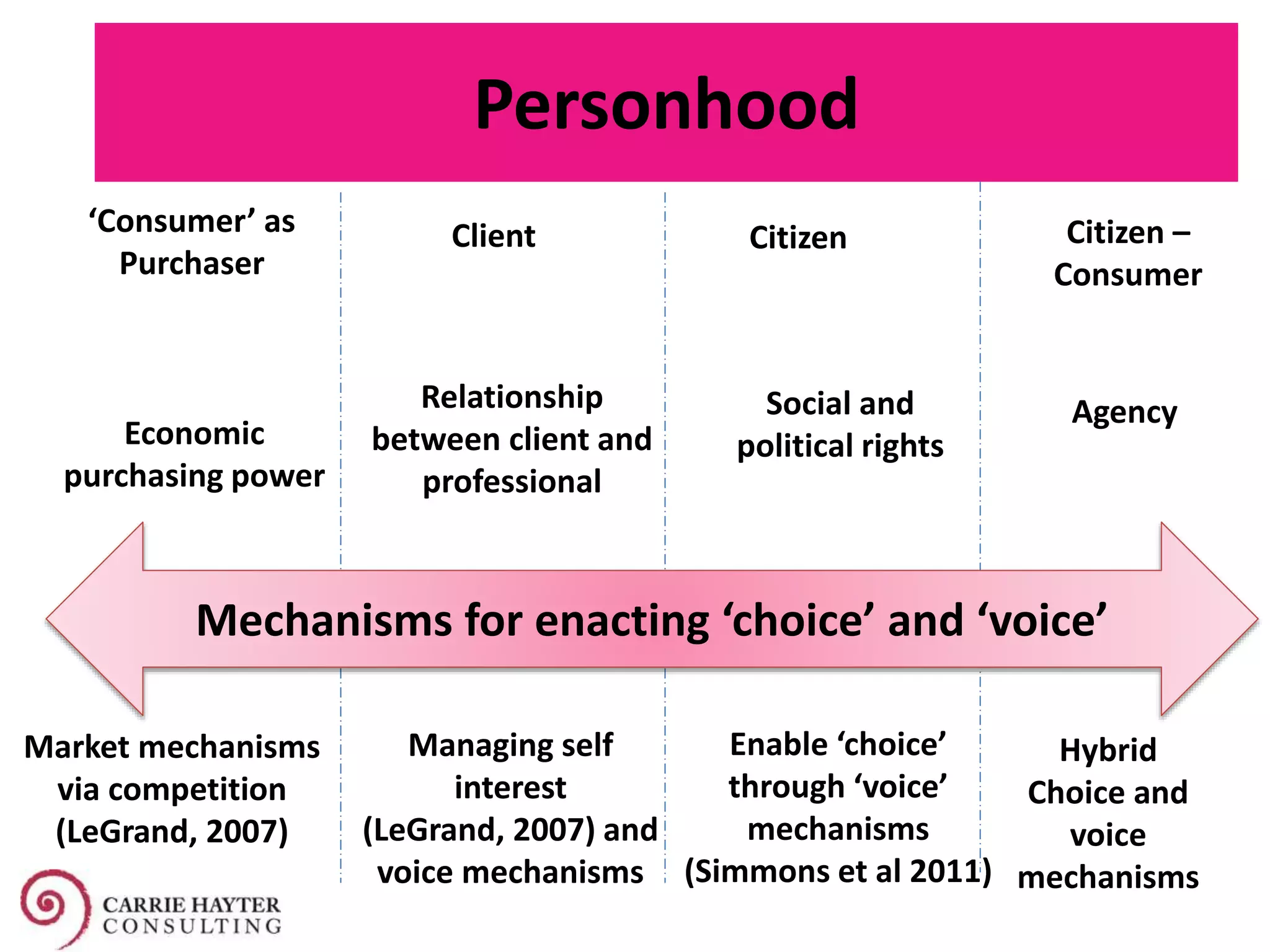
    Personhood ‘Consumer’ as Purchaser Citizen Social and politicalrightsEconomic purchasing power Relationship between client and professional Client Citizen – Consumer Agency Mechanisms for enacting ‘choice’ and ‘voice’ Market mechanisms via competition (LeGrand, 2007) Managing self interest (LeGrand, 2007) and voice mechanisms Enable ‘choice’ through ‘voice’ mechanisms (Simmons et al 2011) Hybrid Choice and voice mechanisms
  • 8.
    Step One – Starta conversation and get everyone on the same page 8 Nothing about me without me www.carriehayter.com
  • 9.
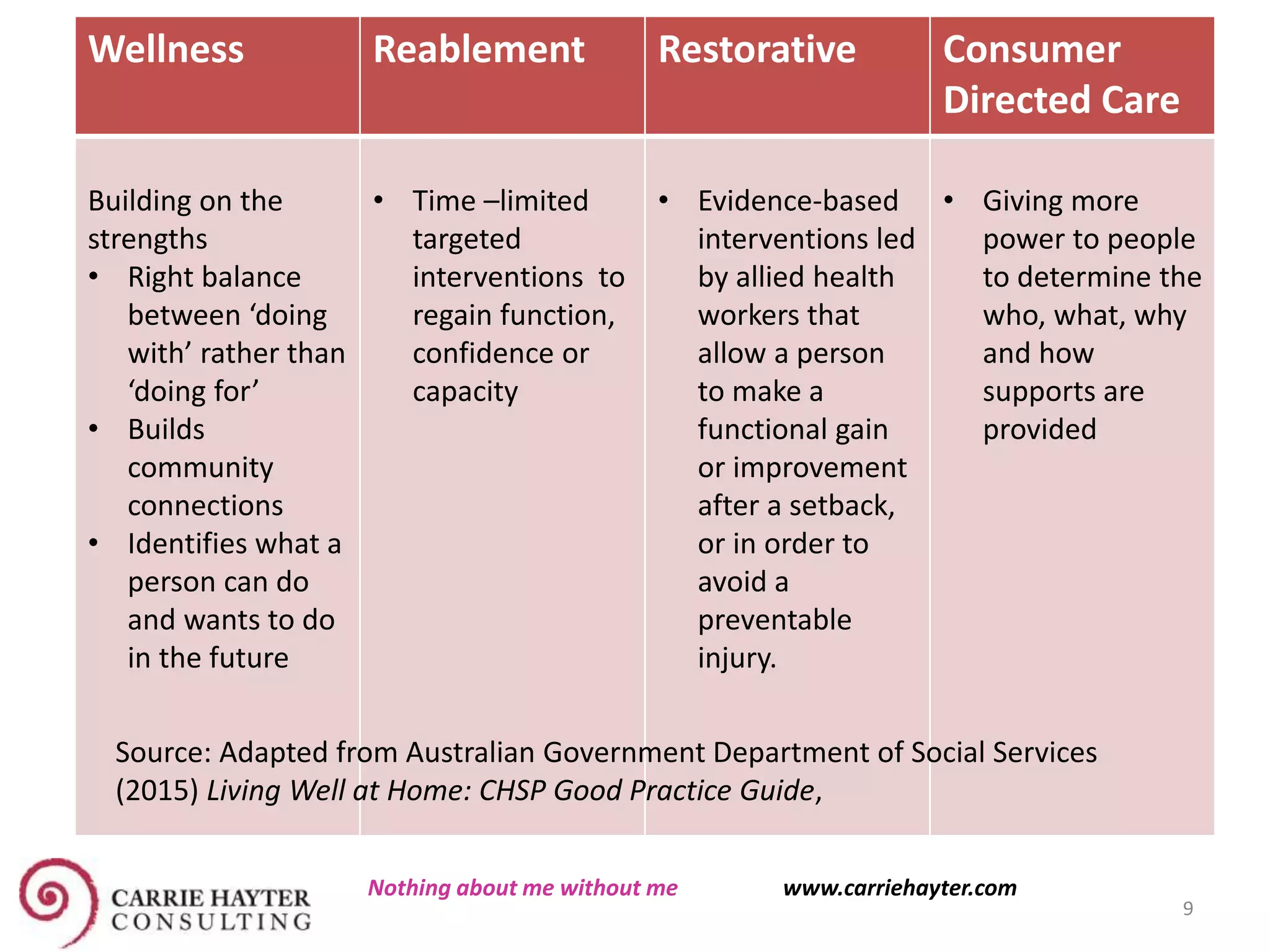
    9 Wellness Reablement RestorativeConsumer Directed Care Building on the strengths • Right balance between ‘doing with’ rather than ‘doing for’ • Builds community connections • Identifies what a person can do and wants to do in the future • Time –limited targeted interventions to regain function, confidence or capacity • Evidence-based interventions led by allied health workers that allow a person to make a functional gain or improvement after a setback, or in order to avoid a preventable injury. • Giving more power to people to determine the who, what, why and how supports are provided Nothing about me without me www.carriehayter.com Source: Adapted from Australian Government Department of Social Services (2015) Living Well at Home: CHSP Good Practice Guide,
  • 10.
    Step Two – Criticallyread research and practice guides and share it with your team 10 Nothing about me without me www.carriehayter.com
  • 11.
    Why reablement andwellness? • Research - UK, Australia and New Zealand – Improved health and welling for older people (Lewin at al, 2013, Parsons et al, 2013, Parsons et al, 2014) – Reduces people’s dependence on paid supports (King & Parsons, et al 2012, Lewin & Alfonso 2013, Lewin & De San Miguel, 2013) – Role of assessment is critical (Department of Family and Community Services, Ageing, Disability and Home Care, 2012) • Further research – People with dementia (Alzheimer’s Australia NSW, 2014) – Engaging carers and service users in their reablement and wellness (Wilde & Glendenning, 2012) • Australian changes – Outcomes and benefits 11 Nothing about me without me www.carriehayter.com
  • 12.
    Personalisation Narratives • Personalisationworks, transforming people’s lives for the better. • Personalisation saves money. • Person- centred approaches reflect the way that people live their lives. • Personalisation is applicable to everyone. • People are the experts in their own lives (Needham, 2011: pg 7). 12 Nothing about me without me www.carriehayter.com
  • 13.
    Step Three – EngageOlder People - Nothing about me without me 13 Nothing about me without me www.carriehayter.com
  • 14.
    14 Nothing about mewithout me www.carriehayter.com
  • 15.
    15 Important to Importantfor WWhat else do we need to learn or know? What is important to a person is what they say through their own words and behaviours about what really matters to them (eg comfort, happiness). What is important for people are the things that help people become or stay healthy and safe, whether it is important to them or not Nothing about me without me www.carriehayter.com
  • 16.
    11/11/2015 © CarrieHayter Consulting 16
  • 17.
    11 November 201517 Coercing Educating Informing Consulting Engaging Co-designing Co-Producing Co-delivery Co-Ownership Ladder of Participation – Choice and Voice? Doing for Doing to Doing With Doing for themselves Adapted form Think Public, 2015 User Rights Strategies for older people in the mid 1990’s Consumer Directed Care? Nothing about me without me www.carriehayter.com
  • 18.
    18 www.wavertonhub.com.au www.mychoicematters.org.au Co-Ownership and Co-Deliveryin Australia Nothing about me without me www.carriehayter.com
  • 19.
    19 30 Day Challenge Getting Tractionand Translating into Practice Your Organisation/ Team Shared understanding and conversations Where are we at? Nothing about me without me www.carriehayter.com Step Four – Empower your staff
  • 20.
    Differences between Technical Problemsand Adaptive leadership Technical problems are well defined.  Their solutions are known and those with adequate expertise and organisational capacity can solve them. (Heifetz & Linksy, 2002) Adaptive leadership challenges are entirely different.  The challenge is complex and not so well defined; and the answers are not known in advance  Problems that require us to learn new ways (Heifetz & Linksy, 2002) 20 Nothing about me without me www.carriehayter.com
  • 21.
    Get on the Balcony Givethe work Back Think Politically Orchestrate the conflict Manage your hungers Anchor Yourself What’s on the line Hold Steady Adaptive Leadership Elements Source: Heifetz & Linsky (2002) 21 Nothing about me without me www.carriehayter.com
  • 22.
    Picture downloaded from: https://janeaustensworld.wordpress.com/category/regency- etiquette/page/2/ Gettingon the Balcony Picture downloaded from: https://www.youtube.com/watch?v=qSvyDLTdlyU What is your team saying about their role? What do older people and their allies say about your organisation? What is the ‘song beneath the words’? 22 Nothing about me without me www.carriehayter.com
  • 23.
    Step Five – Connectpeople into community 23 Nothing about me without me www.carriehayter.com
  • 24.
    24 Orchestrate the Conflict 1.Create a holding environment 2. Control the temperature, raise the heat or lower the temperature 3. Pace the work 4. Show people the future Nothing about me without me www.carriehayter.com
  • 25.
    Think Politically 1. FindPartners 2. Keep the Opposition Close 3. Accept Responsibility for your piece of the mess 4. Acknowledge their losses and accept casualties 5. Model the behaviour (Heifetz & Linksy, 2002)Picture downloaded from: www.twitter.com What can we learn from other people or organisations on their journey? What might be the losses or casualties? 11/11/2015 © Carrie Hayter Consulting 25
  • 26.
    Step Six – FormPartnerships 26 Nothing about me without me www.carriehayter.com
  • 27.
    Give the WorkBack • Solutions are achieved when “the people with the problem” go through a process together to become “the people with the solution”. • Take the work off your shoulders….place it where it can be addressed by the relevant parties. Who do you need to engage in the solutions? How can we work with older people and their allies to co- produce outcomes? 27Nothing about me without me www.carriehayter.com
  • 28.
    Anchor Yourself • Don’tconfuse one’s self with one’s professional role • Identify a truly trustworthy confidant who can really tell you what you NEED to hear • Find a sanctuary for retreat, rejuvenation and personal reflection 28 Who are your confidants? How can they support you? How do you look after yourself? Nothing about me without me www.carriehayter.com
  • 29.
    29 Step Seven -Be curious and test ideas Be Curious I have no special talents. I am only PASSIONATELY CURIOUS ALBERT EINSTEIN
  • 30.
    Conclusion 11/11/2015 30 Nothing aboutme without me www.carriehayter.com
  • 31.
    References and Resources Leadership •Heifetz, R., & Linksy, M., (2002) Leadership on the Line: Staying Alive through the Dangers of Leading, Harvard Business Review Press, Boston Massachusetts • Heifetz, R., Grashow, A., & Linksy, M., (2009) The Practice of Adaptive Leadership – Tools and Tactics for Changing your Organisation and the World, Harvard Business Review Press, Boston Massachusetts • Goleman, D. (1998). Working with Emotional Intelligence London Bloomsbury. • Covey, R., (1996) The 7 Habits of Highly Effective People, Simon and Shuster, New York – https://www.stephencovey.com/7habits/7habits.php • Cambridge Leadership Associates – http://cambridge-leadership.com/ 11/11/2015 © Carrie Hayter Consulting 31
  • 32.
    References and Resources Reablementand Wellness Alzheimer's Australia NSW. (2014) The Benefits of Physical Activity for People living with Dementia, Sydney , Alzheimer's Australia NSW downloaded from https://nsw.fightdementia.org.au/nsw/news/the-benefits-of-physical-activity-and-exercise-for-people- living-with-dementia Australian Government Department of Social Services (2015) Living Well at Home: CHSP Good Practice Guide, pg 11-13, downloaded from https://www.dss.gov.au/sites/default/files/documents/06_2015/good_practice_guide_version_web_accessible_pdf.pdf Glendinning, C. (2012). Home care in England: markets in the context of under-funding. Health & Social Care in the Community, 20(3), 292-299. doi: 10.1111/j.1365-2524.2012.01059.x King, A., M. Parsons, et al. (2012). "Assessing the impact of a restorative home care service in New Zealand: A cluster randomised controlled trial." Health and Social Care in the Community 20(4): 365-374. Lewin, G., & Vandermeulen, S. (2010). A non-randomised controlled trial of the Home Independence Program (HIP): an Australian restorative programme for older home-care clients. Health & Social Care in the Community, 18(1), 91-99. doi: 10.1111/j.1365- 2524.2009.00878.x Lewin, G. F., H. S. Alfonso, et al. (2013). "Evidence for the long term cost effectiveness of home care reablement programs." Clinical interventions in Aging 8: 1273-1281. Lewin, G., K. De San Miguel, et al. (2013). "A randomised controlled trial of the Home Independence Program, an Australian restorative home-care programme for older adults." Health & Social Care in the Community 21(1): 69-78. 11/11/2015 © Carrie Hayter Consulting 32
  • 33.
    Reablement and Wellness(Cont) Parsons, J. G. M., N. Sheridan, et al. (2013). "A Randomized Controlled Trial to Determine the Effect of a Model of Restorative Home Care on Physical Function and Social Support Among Older People." Archives of Physical Medicine and Rehabilitation 94(6): 1015-1022. Ryburn, B., Wells, Y., & Foreman, P., (2009) Enabling Independence: Restorative Approaches to Home Care Provision for Frail Older Adults, Health and Social Care in the Community, Volume 17 (3), pp 225- 234, see pg 22 Senior, H. E. J., M. Parsons, et al. (2014). "Promoting independence in frail older people: A randomised controlled trial of a restorative care service in New Zealand." Age and Ageing 43(3): 418-424. Wilde, A., & Glendinning, C. (2012). ‘If they’re helping me then how can I be independent?’ The perceptions and experience of users of home-care re-ablement services. Health & Social Care in the Community, no-no. doi: 10.1111/j.1365-2524.2012.01072.x References and Resources 11/11/2015 © Carrie Hayter Consulting 33
  • 34.
    Reablement and Wellness(Cont) Parsons, J. G. M., N. Sheridan, et al. (2013). "A Randomized Controlled Trial to Determine the Effect of a Model of Restorative Home Care on Physical Function and Social Support Among Older People." Archives of Physical Medicine and Rehabilitation 94(6): 1015-1022. Ryburn, B., Wells, Y., & Foreman, P., (2009) Enabling Independence: Restorative Approaches to Home Care Provision for Frail Older Adults, Health and Social Care in the Community, Volume 17 (3), pp 225- 234, see pg 22 Senior, H. E. J., M. Parsons, et al. (2014). "Promoting independence in frail older people: A randomised controlled trial of a restorative care service in New Zealand." Age and Ageing 43(3): 418-424. Wilde, A., & Glendinning, C. (2012). ‘If they’re helping me then how can I be independent?’ The perceptions and experience of users of home-care re-ablement services. Health & Social Care in the Community, no-no. doi: 10.1111/j.1365-2524.2012.01072.x References and Resources 11/11/2015 © Carrie Hayter Consulting 34
  • 35.
    Needham, C. (2011).Personalising Public Services Understanding the Personalisation Narrative Bristol, UK Policy Press Simmons, R. (2011). Leadership and Listening: The Reception of User Voice in Today's Public Services. Social Policy & Administration, 45(5), 539-568. doi: 10.1111/j.1467-9515.2011.00790.x Moran, N., Glendinning, C., Wilberforce, M., Stevens, M., Nettens, N., Jones, K., Manthorpe, J., Knapp, M., Fernandez, J., Challis, D., & Jacobs, S. (2013) Older people’s experience of cash-for-care schemes: evidence from the English Individual Budget pilot projects, Ageing and Society 33, pp 826-851 Needham, C. (2011). Personalising Public Services Understanding the Personalisation Narrative Bristol, UK Policy Press Simmons, R. (2011). Leadership and Listening: The Reception of User Voice in Today's Public Services. Social Policy & Administration, 45(5), 539-568. doi: 10.1111/j.1467-9515.2011.00790.x Simmons, R., Birchall, J., & Prout, A. (2011). User Involvement in Public Services: ‘Choice about Voice’. Public Policy and Administration, 27(1), 3-29. doi: 10.1177/0952076710384903 Williams, R., & Sanderson, H., (2005) What are we learning about person centred organisations?, downloaded from Home Care today www.homecaretoday.org.au References and Resources 11/11/2015 © Carrie Hayter Consulting 35
  • 36.
    More Information Download theseven key steps to implement wellness, restorative and enablement approaches www.carriehayter.com Start a conversation @carriehayter 36 Nothing about me without me www.carriehayter.com

Editor's Notes

  • #2 I would like to acknowledge the traditional owners of the land and pay my respects to Elders past and present. It is a privilidge to be here today to present at the Better Practice Conference and to share some of my thinking both from my academic research, as a consumer of aged care services having supported both my father and grandfather through the aged care system in the last two years, and also reflecting on my last decade of work working with over 250 organisations in transforming them to be more personalised in how they work and think about older people.
  • #3 Today I am going to start a conversation with you why everyone in this room needs to start to think about what personalising aged care means? In particular what does it mean for the different actors in the aged care system. We talk about being person centred or consumer directed but what does that actually mean? How do you balance the interests of the older person and their family. What does person centred mean for staff who just want to get their job done or completed? It is already happening, it is here and whether we work in community or in a more cluster group accommodation setting we need to think about how do we move from being person centred to consumer directed? Using an adaptive leadership framework, I will explore some of the challenges and opportunities and argue there are seven key steps towards implementing consumer directed care
  • #4 I am the Managing Director of Carrie Hayter Consulting that works will all actors in the social care system to put people at the centre of their supports and funding. I work in research, evaluation, education and training and design ways of supporting people to implement what they learn in my workshops into practice
  • #5 I have just spent 10 days in Northern Territory hearing some amazing stories of people working in remote communities with Aboriginal people. I also heard about the challenges for people of ageing well in remote communities particularly with the discussion about the need to reframe the discussion about closing remote communities. I also had the opportunity to travel to Uluru, Kata Tjuta and the Wartarrka National Park - as I was sitting marvelling these extroadinary landscapes I was reflecting on how we really honour and respect people who are elders, hear their voices and empower them to age well in community. This includes all people and how do we as service providers honour and support the diversity of voices and life experiences of people who are ageing in Australia I keep thinking about how do we create an aged care system that fosters and encourages this and how does that personal story get translated into the front-line practice. Why do things need to change for people just because they enter the aged care system?
  • #6 There are significant changes happening in the policy landscape in age care and disability policy in Australia as part of the agenda of personalisation. The assumptions that underpin these shifts include the changing role of people who use public services shifting from being ‘passive’ clients to ‘active consumers’. It is assumed that people who use disability services or aged care services will become active ‘consumers’. Rather than being passive clients relying on professionals for support and advice people are assumed to be active engaged ‘consumers’ who will make informed choices about their care. Flowing from this assumption is the need for changes in the how agencies are funded from block funded to individually funded. It is assumed that individualised funding will provide more mechanisms for service users to get their needs met. We are seeing this funding system emerging as part of the launch sites of the NDIS as well as the emergence of the concept of ‘consumer directed care’ in packaged care in aged care in Australia. As part of this changing landscape there are significant challenges for small, medium to large organisations in being able to thrive and survive in this changing landscape? As well as considering the structures that are in place to enable the participation and engagement of service users in your service.
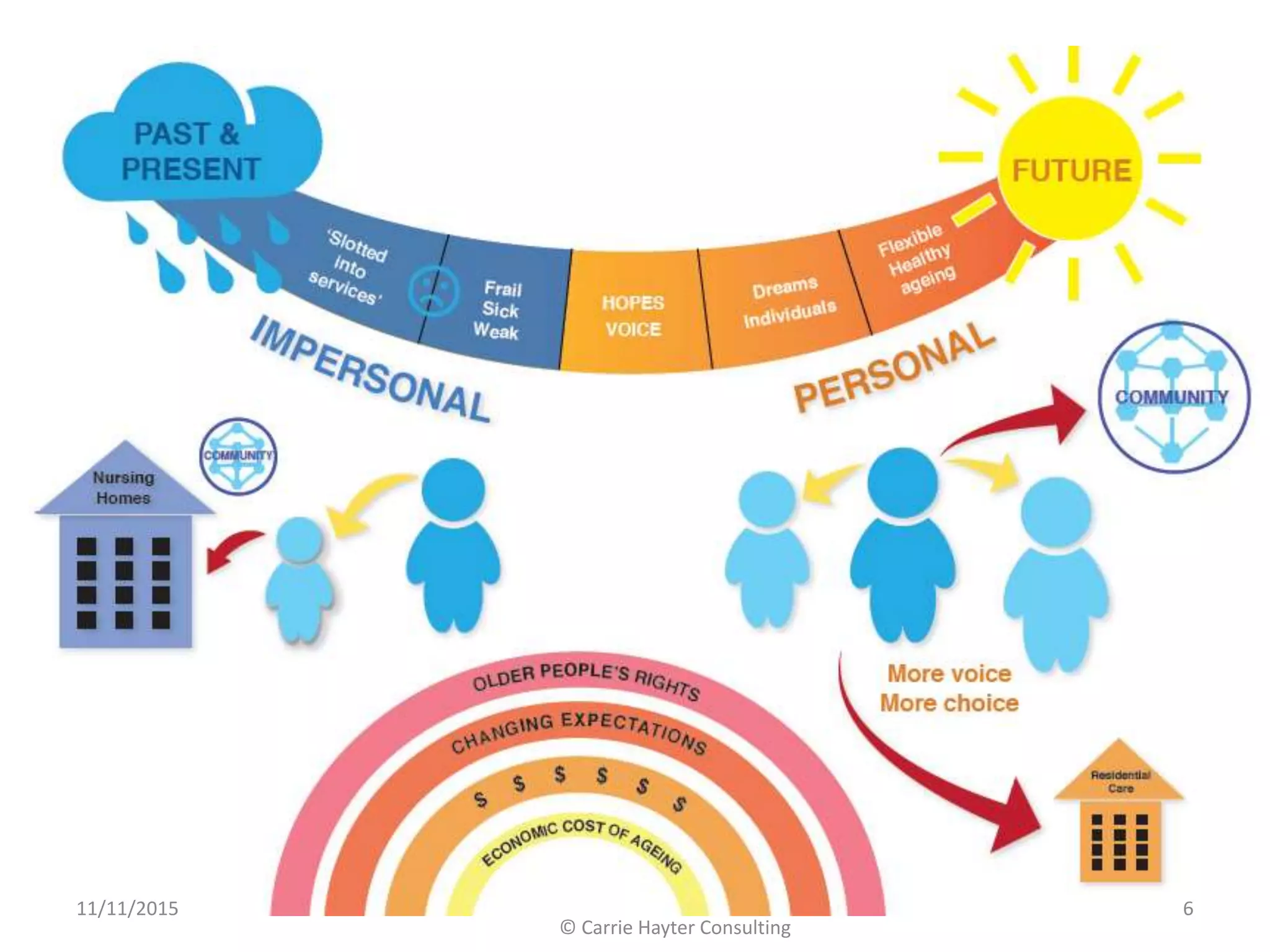
  • #7 One of the challenges of personalisation is to appreciate and understand the historical forces or structures that have created the different service systems in this country. If you look at history we have come a long way, however, we are in the process of dismantling a whole service infrastructure and moving from a block funded to individualised funding system with different stages occurring for older people, people with disabilities and their carers. This picture shows some of the drivers of personalisation for older people in Australia. It contends that for older people they were largely invisible and the system was created in the interests of professionals, providers and with older people institutionalised. However, with the economic costs of ageing combined with the changing expectations and the emergence of the concept of active ageing we are seeing changing models. However, moving from the Old to New system takes time is a complex process of dismantling and transitioning not only funding but the practices, values of people in your organisations. It also requires people to lead organisations through significant changes – It is an adaptive leadership challenge.
  • #8 The policy mechanisms for enacting the issue of ‘choice’ are framed by how we view people who use services. For those who argue that people who use public services are ‘consumers’ the policy mechanisms tend to favour the creation of markets through the introduction of competition to drive efficiency and effectiveness and services to be more responsive to the needs of consumers. Similarly they introduce mechanisms that promote choice for service users reflecting an assumption that people are both able and willing to navigate a market of care. For those that describe people who use public services as clients. The policy mechanisms are about managing the perceived self interest of the bureaucracy and challenging the paternalism of the welfare state. This can be achieved through competition and the creation of markets but also through voice mechanisms For those who conceptualise service users as citizens the focus moves away from purchasing power to notions of social and political rights and for people to have choice about the voice mechanisms that are introduced. For example, this could include mechanisms that empower people to organise their own supports or to be politically active in this process. There is also the hybrid citizen –consumer whose relationship with public services can change over time. People can be both active and passive subjects and there needs to be a diversity of policy mechanisms not just those that shift the user of public services to be a ‘consumer’. In this space it is very much about how older people see themselves as actors in the social care system . In this space it is about the policy mechanisms that can reflect the diversity of the perspectives of service users.
  • #9 So how do we shift this – how do we get people talking about different things. We need to make sure that everyone knows what you are talking about when we use the words of consumer directed care or reablement, wellness . Many people say they know what these terms mean but they don’t always know what it means for them in terms of their practice.
  • #10 It is great to read the guide produced by the Department of Social Services which is long over due, however these concepts need to come alive through talking about people and their stories. There are tag lines for example; “doing with” rather than “doing for” “watch, wait and listen” What does the person need to have a good life? Whoever you talk to in your organisation you need to break it down into simple language and explain it on a case by case example. I put the Consumer Directed Care definition there because the recent evaluation by KPMG identified the lack of focus of on reablement and wellness in packaged care. I think this is because we have not brought older people and their allies along on their journey. We will also see the development of a restorative program in the Home Support Program currently being considered How can people choose some restorative support that empowers and enables them to have a good life?
  • #11 In the last week, how many people read a research article? Leave your hand up if you talked about what it meant for your practice? The research and evidence base in this area but across all of community care is shifting rapidly. If we don’t engage with the research or the research community then we may be doing things that actively cause harm to people.
  • #12  Talk about gaps in the research Identify the potential gaps in the research Research paper by Caroline Glendinning ‘If they’re helping me then how can I be independent?’ The perceptions and experience of users of home-care re-ablement services identified how carers and some users of home care are not aware of these concepts of re-ablement. I would like to see some research on the experience of regional assessment services and how they approach wellness and reablement, what stops them? Is the system supporting them to implement this approach? How does reablement work for people with cognitive impairment? What does it mean for people from different cultural backgrounds or for Aboriginal and Torres Strait Islander people.
  • #13 People have described some of the challenges of what personalisation means for their organisations some of which are on the spectrum of the lucky country to fear and somewhere in between. Needham (2011) who has researched the narratives that have influenced policy debates in the personalisation of social care in the UK contends that are five key narratives that have emerged as part of the policy landscape in the UK. These include the following: Personalisation works , transforming people’s lives for the better Personalisation saves money Person – centred approaches reflect the way that people live their lives Personalisation is applicable to everyone People are the experts in their own lives One of the interesting things is that we are seeing these narratives emerging in debates in Australia particularly with the actual implementation of the NDIS which had a much more grass roots campaign. For older people it appears that it has been more driven by professionals and some advocacy groups rather than older people themselves. These narratives can influence how organisations think about personalisation and what it means in your organisation. Some people and organisations will see the possibilities of personalisation but others are fearful.
  • #14 We need to put older people and their allies in the driving seat. This includes educating and involving them in how they can age well right until the end of their life. It is more than person centre thinking it is actually about really seeing the potential of people that we work with to engage them and really play to their strengths.
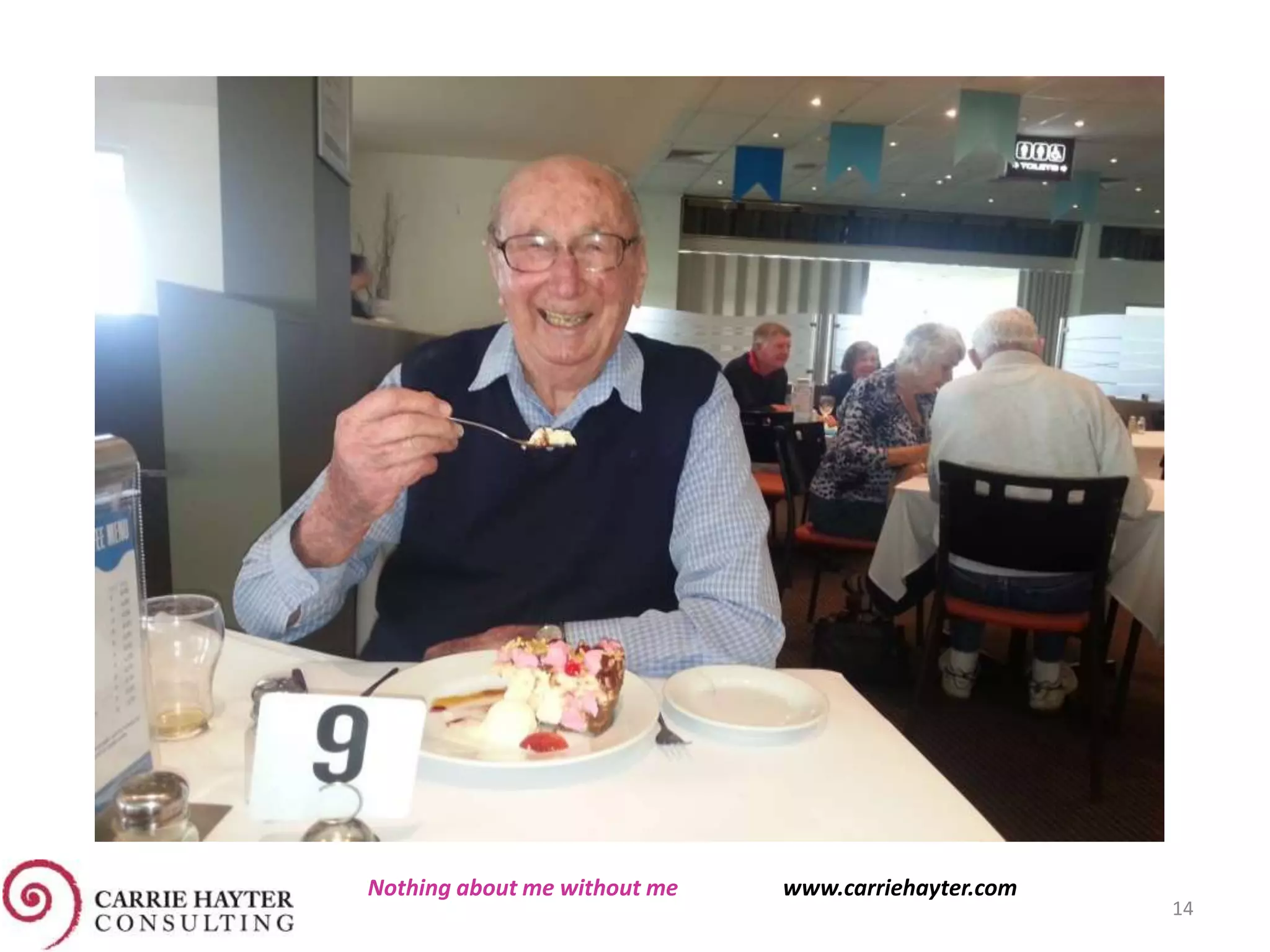
  • #15 Here is an example of what is possible as we age. This is my grandfather who at this stage was at 97 living at home with some support. He was not a social being but really loved going to the club and eating his Rocky Road cheesecake. The club was the place he loved to hang because it had good food, it was cheap and he could have a beat and play the pokies. He died this year a day before his 99th birthday on his second wedding anniversary was pretty happy up until he passed away.
  • #16 What is important to people is what they say through their own words and their own behaviour. What is important for people are things that help people become or stay healthy or safe regardless of whether it is important to them or not. Sometimes a professionals we get stuck in what is important for people rather than what is important to them. For example, a person living with diabetes might say it is important for them to have sweet coffee and cake everday but what is important for them is not to eat chocolate and have really sweet coffee
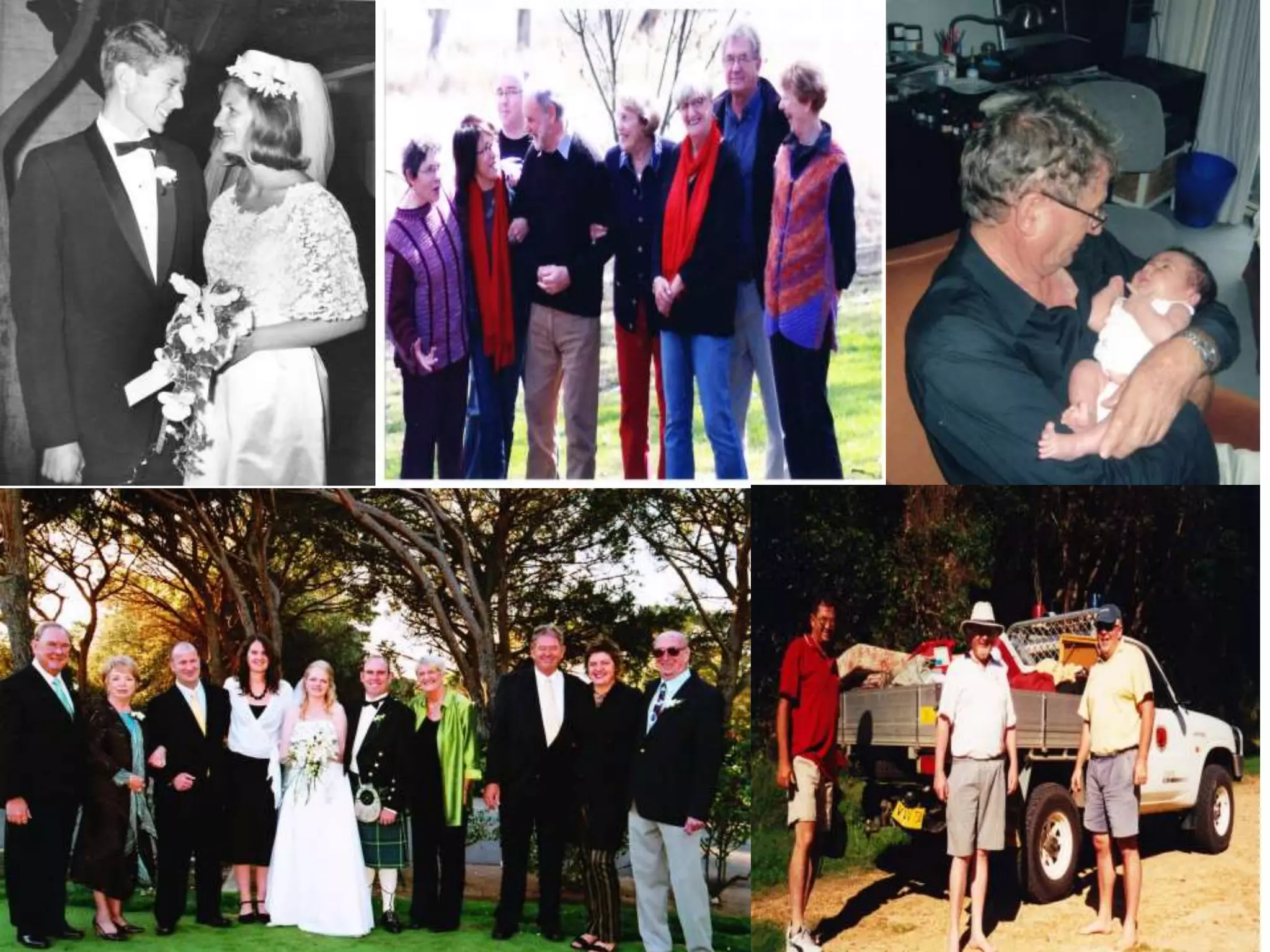
  • #17 Who is the ‘consumer’ – it takes a community, a lifetime of friends and relationships to age well. These are pictures of my father who died last year from an very aggressive form of Parkison’s disease Multiple System Atrophy. His life was filled with love, family and friendships a 49 year partnership with my mother, he had three children a wonderful grand-daughter and had so many wonderful friendships. When we talk about the consumer directed care or person centred perhaps we are using the wrong language. Is it about community centred supports with the person directing in partnership with their family, friends and the people they love.
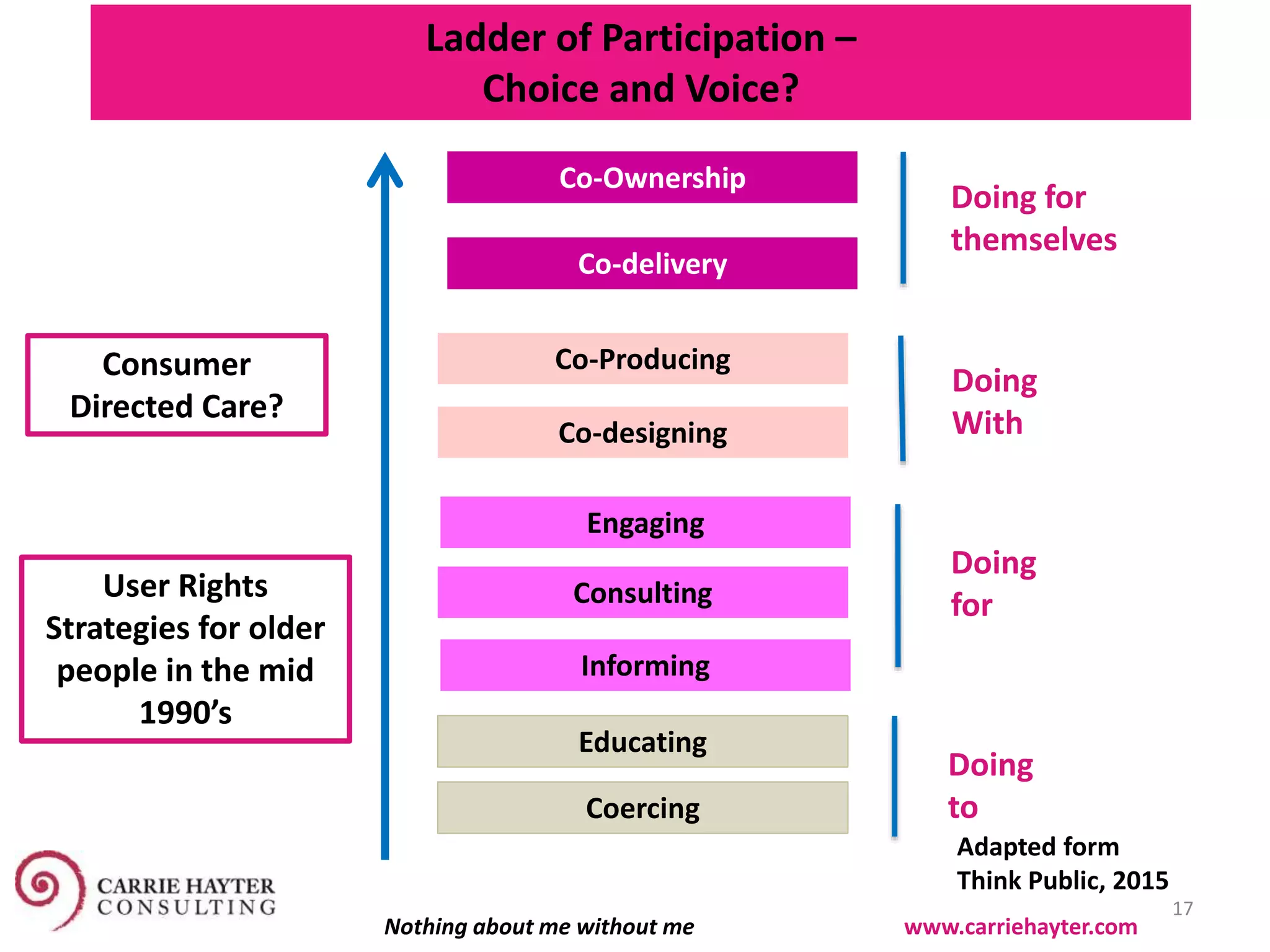
  • #18 If we think about voice as participation then we can conceptualise the mechanisms that promote the voices of older people on a ladder of participation. But perhaps they can also promote the choice of older people. Historically, the aged care system in Australia was based on ‘doing to’ older people. Older people and their allies were coerced into accepting whatever the system offered them includin g the limited option of primarily residential care rather than community care. In the mid 1990s the government introduced the principles of user rights for older people which meant that providers were forced to engage and consult and inform older people about who they work with older people. In 2013 we saw the introduction of Consumer Directed Care in Community Aged Care which is supposedly shifting the way that providers are thinking and engaging with older people. The degree to which this is happening is contested because of the skills and abilities and knowledge of older people. We are also seeing the emergence of co –ownership and co-delivery with older people setting up their own organisations ( for example the Waverton Hub) to promote self –help between older people.
  • #19 We are seeing some models of co-ownership emerging in Australia. The waverton Hub is the first co-ownership model for older people by older people that aims to connect people into the community in Waverton. My choice matters has been funded by the NSW Government to run projects and education with people who use disability services and has successfully run a number of leadership programs and projects for people.
  • #20 I have run over 1500 workshops on enablement and rather than just doing education I have designed a program that includes education but then taking this into a 30 day challenge. If you don’t look at how your organisation needs to adapt to translate some of the ideas into practice then nothing will change.
  • #21 So how do we know if something is a technical problem or an adaptive leadership challenge? Technical problems have solutions that are known.
  • #27 You cannot do everything on your own. Maybe you want to design an exercise program in the local community hall. Engage your partners to make this happen
  • #30 All you need is a curiousity to see how things work and experiment and take small steps to get things working.
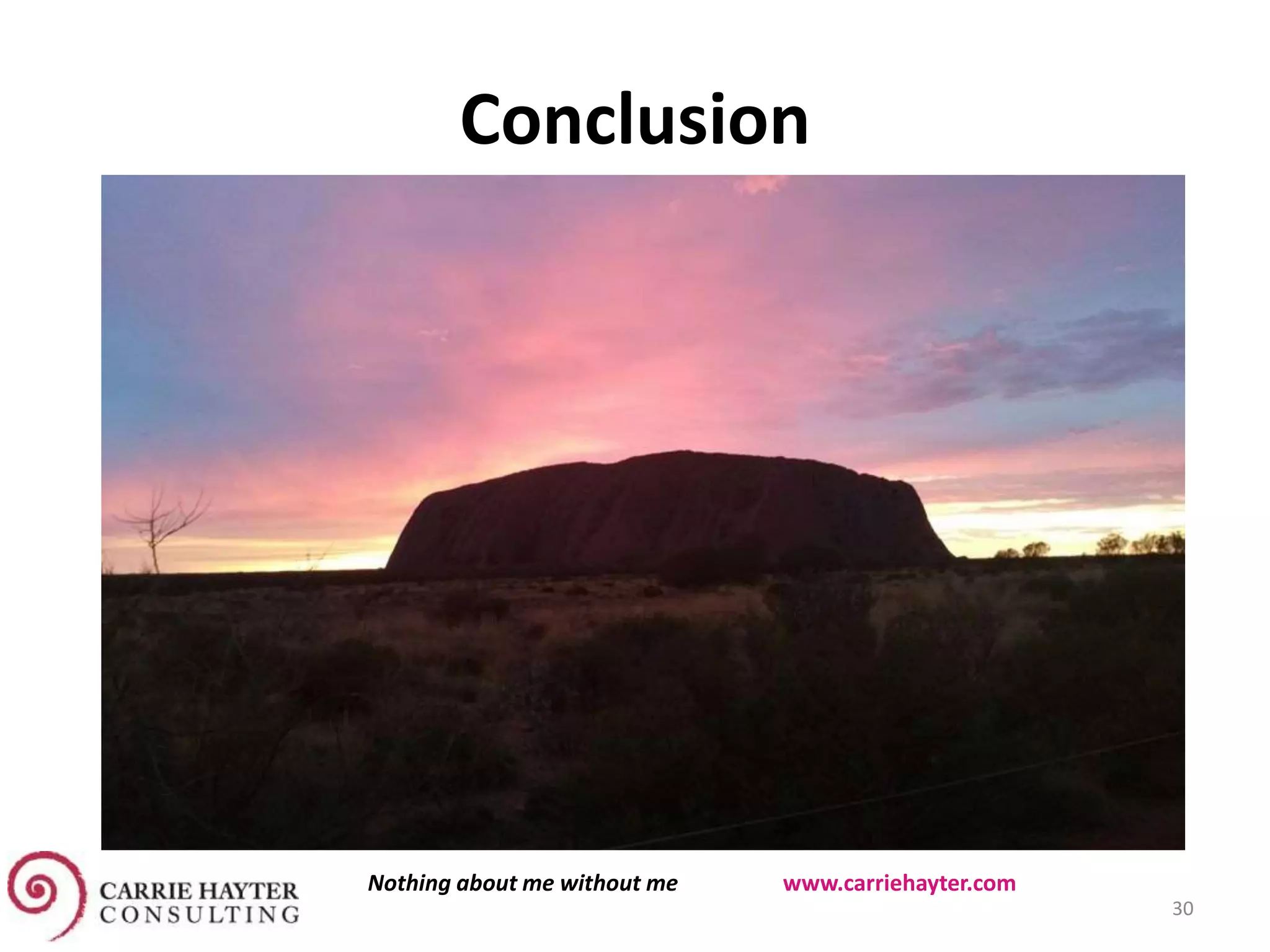
  • #31 Uluru changes colour everytime you see it. My hope is that older people’s experience of their support changes colour as it is needed, depending on the social environment that people are in and what they need.
  • #37 Promote my workshops.