Mathematics Department: Accountability Report
Name: A. Jorge García Date:4/25/2009
1) Peer Coaching:
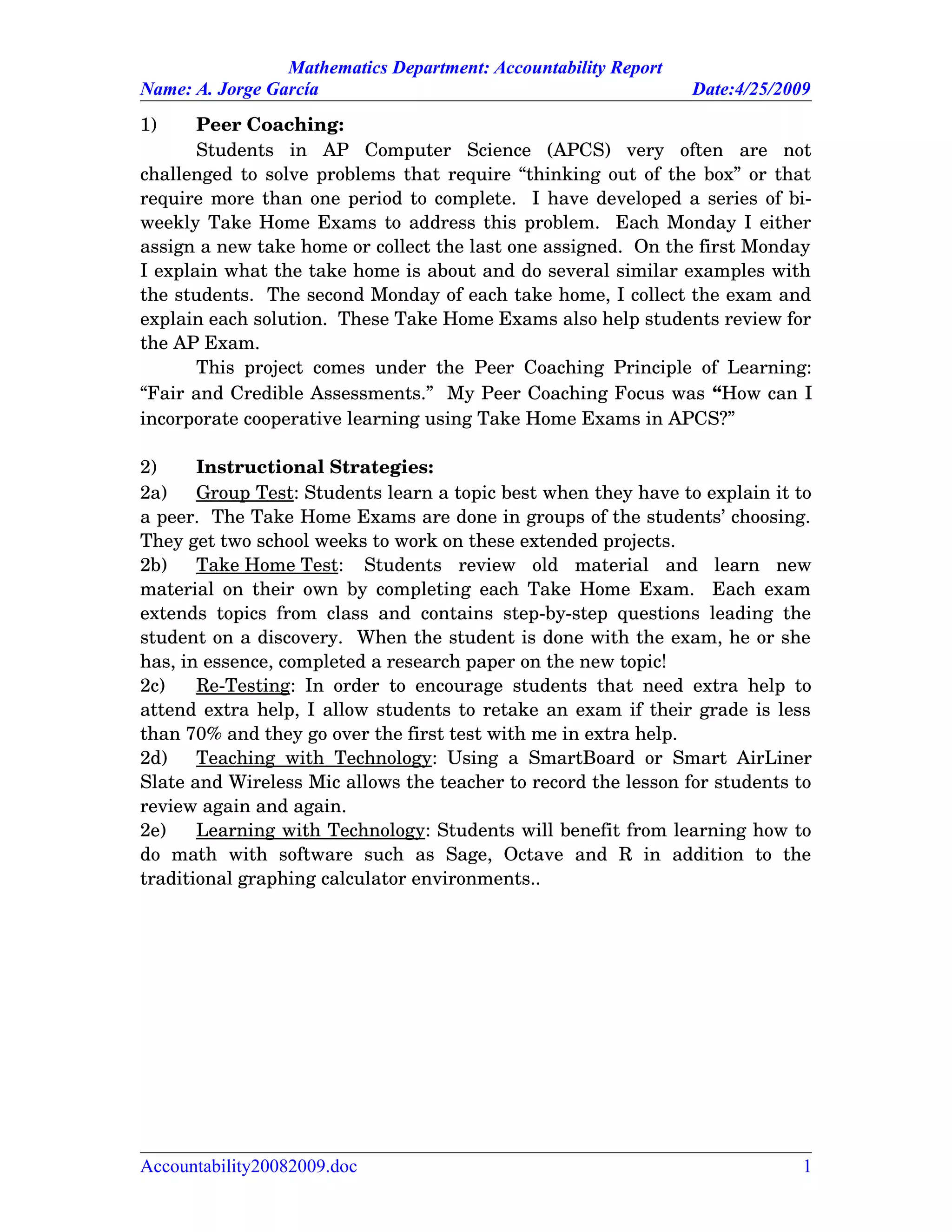
Students   in   AP   Computer   Science   (APCS)   very   often   are   not
challenged to solve problems that require “thinking out of the box” or that
require more than one period to complete.  I have developed a series of bi­
weekly Take Home Exams to address this problem.  Each Monday I either
assign a new take home or collect the last one assigned.  On the first Monday
I explain what the take home is about and do several similar examples with
the students.  The second Monday of each take home, I collect the exam and
explain each solution.  These Take Home Exams also help students review for
the AP Exam.  
This project comes under the  Peer Coaching Principle of Learning:
“Fair and Credible Assessments.”  My Peer Coaching Focus was “How can I
incorporate cooperative learning using Take Home Exams in APCS?”
 
2) Instructional Strategies:
2a)  Group Test: Students learn a topic best when they have to explain it to
a peer.  The Take Home Exams are done in groups of the students’ choosing.
They get two school weeks to work on these extended projects.  
2b) Take Home Test:  Students   review   old   material   and   learn   new
material on their own by completing each Take Home Exam.   Each exam
extends topics from class and contains step­by­step questions leading the
student on a discovery.  When the student is done with the exam, he or she
has, in essence, completed a research paper on the new topic!
2c) Re­Testing: In order to encourage students that need extra help to
attend extra help, I allow students to retake an exam if their grade is less
than 70% and they go over the first test with me in extra help.
2d) Teaching with Technology: Using a SmartBoard or Smart AirLiner
Slate and Wireless Mic allows the teacher to record the lesson for students to
review again and again.
2e) Learning with Technology: Students will benefit from learning how to
do   math   with   software   such   as   Sage,   Octave   and   R   in   addition   to   the
traditional graphing calculator environments..
Accountability20082009.doc 1
Mathematics Department: Accountability Report
Name: A. Jorge García Date:4/25/2009
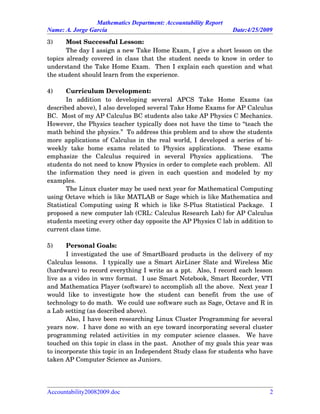
3) Most Successful Lesson:
The day I assign a new Take Home Exam, I give a short lesson on the
topics already covered in class that the student needs to know in order to
understand the Take Home Exam.  Then I explain each question and what
the student should learn from the experience.
4) Curriculum Development:
In   addition   to   developing   several   APCS   Take   Home   Exams   (as
described above), I also developed several Take Home Exams for AP Calculus
BC.  Most of my AP Calculus BC students also take AP Physics C Mechanics.
However, the Physics teacher typically does not have the time to “teach the
math behind the physics.”  To address this problem and to show the students
more applications of Calculus in the real world, I developed a series of bi­
weekly   take   home   exams   related   to   Physics   applications.     These   exams
emphasize   the   Calculus   required   in   several   Physics   applications.     The
students do not need to know Physics in order to complete each problem.  All
the information they need is given in each question and modeled by my
examples.  
The Linux cluster may be used next year for Mathematical Computing
using Octave which is like MATLAB or Sage which is like Mathematica and
Statistical Computing using R which is like S­Plus Statistical Package.   I
proposed a new computer lab (CRL: Calculus Research Lab) for AP Calculus
students meeting every other day opposite the AP Physics C lab in addition to
current class time.
5) Personal Goals:
I investigated the use of SmartBoard products in the delivery of my
Calculus lessons.  I typically use a Smart AirLiner Slate and Wireless Mic
(hardware) to record everything I write as a ppt.  Also, I record each lesson
live as a video in wmv format.  I use Smart Notebook, Smart Recorder, VTI
and Mathematica Player (software) to accomplish all the above.  Next year I
would   like   to   investigate   how   the   student   can   benefit   from   the   use   of
technology to do math.  We could use software such as Sage, Octave and R in
a Lab setting (as described above).
Also, I have been researching Linux Cluster Programming for several
years now.  I have done so with an eye toward incorporating several cluster
programming related activities in my computer science classes.   We have
touched on this topic in class in the past.  Another of my goals this year was
to incorporate this topic in an Independent Study class for students who have
taken AP Computer Science as Juniors.
Accountability20082009.doc 2
Mathematics Department: Accountability Report
Name: A. Jorge García Date:4/25/2009
6) Staff Development:
I   attended   the   LIMACON   Conference   at   SUNY   Old   Westbury   on
04/03/09.     LIMACON   stands   for   “Long   Island   Math   Conference”   and   is
sponsored by Nassau County Association of Math Supervisors.   The use of
technology   to   enhance   mathematics   instruction   was   the   focus   of   this
conference.
I also attended the BioMath Conference at SUNY Farmingdale on
04/17/09.  Many interesting topics were discussed involving the improvement
of student understanding and retention of new topics using more Biology
applications in Math class as well as more Math topics in Biology class.
7a) Department activities and initiatives
I   help   teachers   and   students   with   problems   relating   to   Graphing
Calculators and Personal Computers.
I develop and promote the computer curricula.
I am continually researching new curricula and teaching methods for
teaching computer programming.
I maintain two Linux ssh servers and one Linux ftp server for the
computer programming students to use on campus and at home.
I make sure that the LAN in room 429 is up and running every day for
the APCS classes and the Computer Math/Advanced Computer Math classes.
I maintain a Linux Cluster in Room 429 for the Computer Science
IndependentStudy (CSI) class.
7b) Describe your role in school activities:
co­curricular ­
I am the advisor for the Continental Mathematics League (CML) in
Calculus.  We have 4 meets in class each year.  We are currently 2nd
 in New
York State!
My   Computer   Science   IndependentStudy   students   are   working   to
make the new dual­core 64­bit cluster operational using a gigabit switched
ethernet network.
extra­curricular ­
I advise the Baldwin High Chess Club.  I am a rated member of the US
Chess Federation (USCF).   I am a USCF Certified Scholastic Chess Coach
and a Permanently Certified Local Tournament Director (LTD).   We hold
USCF rated tournaments every other Wednesday after school (3PM – 4PM).  
Accountability20082009.doc 3
Mathematics Department: Accountability Report
Name: A. Jorge García Date:4/25/2009
8) Field Trips: NA
9) Professional Organizations:
http://www.ams.org American Mathematical Society
http://www.maa.org Mathematics Association of America
http://www.nctm.org National Council of Teachers of Mathematics
http://www.acm.org Association for Computing Machinery
http://www.amnh.org American Museum of Natural History
http://www.knoppix.net KNOPPIX Linux CD Beta Tester
http://www.yabasic.de yaBASIC for Linux Beta Tester
http://www.realbasic.com REALBasic for Linux Beta Tester
http://gcc.gnu.org g++ for Linux Beta Tester
http://bccd.cs.uni.edu Bootable Cluster Linux CD Beta Tester
http://www.cs.rit.edu/~ark/pj.shtml parallelJava Beta Tester
http://www.quantian.net QUANTIAN Cluster Beta Tester
http://www.uschess.org US Chess Federation
Nationally Rated Member/Player
Certified Scholastic Chess Coach
Certified Local Tournament Director
10) Contests/Competitions:
US Chess Federation Rated Tournaments
Continental Mathematics League: Calculus
11) Additional:
I have been involved, for several years now, as a Beta Tester for the
KNOPPIX Linux live CD/DVD in the Computer Science Classroom.  I install
and maintain the latest updates of the Linux Kernel in Lab 429 and on the
Linux Servers.  I am also a Beta Tester for REALBasic, yaBASIC, g++ and
parallelJava for Linux which I use in Computer Math, Advanced Computer
Math, APCS and CSI.  
I have developed the curriculae for both Computer Math and Advanced
Computer   Math   and   taught   both   courses   for   many   years.     I   help   the
Computer Math and Advanced Computer Math teachers as needed.
Accountability20082009.doc 4
Mathematics Department: Accountability Report
Name: A. Jorge García Date:4/25/2009
12) Most Proud of:
The Take Home Exams I give bi­weekly   in APCS and Calculus as
group tests have proven to be a creative and interesting extension of class
work.
Using Linux in Computer Math, Advanced Computer Math and AP
Computer Science has made my students very productive.  Teaching students
about Free Open Source Software (FOSS) and the GNU Public License has
opened many doors for them.  My Computer Science students are very excited
about using Linux at home as a replacement for the Windows Desktop and to
be able complete classroom assignments.  
My Computer Science IndependentStudy students were enthusiastic
about learning how to build and program a Linux Cluster.  They learned how
to program the cluster for use on very complex number crunching problems
as well as for rendering very sophisticated computer generated art!
Finally, as I have recorded every single one of my Calculus lessons this
year, my students can make up a class they miss or review a topic they
forgot!   I set up an ftpsite (ftp://65.254.7.10/apcalc) where I upload all my
recordings.  This way, my students can access these recording on campus and
at home!
Accountability20082009.doc 5

2008 Accountability Memo

  • 1.
    Mathematics Department: AccountabilityReport Name: A. Jorge García Date:4/25/2009 1) Peer Coaching: Students   in   AP   Computer   Science   (APCS)   very   often   are   not challenged to solve problems that require “thinking out of the box” or that require more than one period to complete.  I have developed a series of bi­ weekly Take Home Exams to address this problem.  Each Monday I either assign a new take home or collect the last one assigned.  On the first Monday I explain what the take home is about and do several similar examples with the students.  The second Monday of each take home, I collect the exam and explain each solution.  These Take Home Exams also help students review for the AP Exam.   This project comes under the  Peer Coaching Principle of Learning: “Fair and Credible Assessments.”  My Peer Coaching Focus was “How can I incorporate cooperative learning using Take Home Exams in APCS?”   2) Instructional Strategies: 2a)  Group Test: Students learn a topic best when they have to explain it to a peer.  The Take Home Exams are done in groups of the students’ choosing. They get two school weeks to work on these extended projects.   2b) Take Home Test:  Students   review   old   material   and   learn   new material on their own by completing each Take Home Exam.   Each exam extends topics from class and contains step­by­step questions leading the student on a discovery.  When the student is done with the exam, he or she has, in essence, completed a research paper on the new topic! 2c) Re­Testing: In order to encourage students that need extra help to attend extra help, I allow students to retake an exam if their grade is less than 70% and they go over the first test with me in extra help. 2d) Teaching with Technology: Using a SmartBoard or Smart AirLiner Slate and Wireless Mic allows the teacher to record the lesson for students to review again and again. 2e) Learning with Technology: Students will benefit from learning how to do   math   with   software   such   as   Sage,   Octave   and   R   in   addition   to   the traditional graphing calculator environments.. Accountability20082009.doc 1
  • 2.
    Mathematics Department: AccountabilityReport Name: A. Jorge García Date:4/25/2009 3) Most Successful Lesson: The day I assign a new Take Home Exam, I give a short lesson on the topics already covered in class that the student needs to know in order to understand the Take Home Exam.  Then I explain each question and what the student should learn from the experience. 4) Curriculum Development: In   addition   to   developing   several   APCS   Take   Home   Exams   (as described above), I also developed several Take Home Exams for AP Calculus BC.  Most of my AP Calculus BC students also take AP Physics C Mechanics. However, the Physics teacher typically does not have the time to “teach the math behind the physics.”  To address this problem and to show the students more applications of Calculus in the real world, I developed a series of bi­ weekly   take   home   exams   related   to   Physics   applications.     These   exams emphasize   the   Calculus   required   in   several   Physics   applications.     The students do not need to know Physics in order to complete each problem.  All the information they need is given in each question and modeled by my examples.   The Linux cluster may be used next year for Mathematical Computing using Octave which is like MATLAB or Sage which is like Mathematica and Statistical Computing using R which is like S­Plus Statistical Package.   I proposed a new computer lab (CRL: Calculus Research Lab) for AP Calculus students meeting every other day opposite the AP Physics C lab in addition to current class time. 5) Personal Goals: I investigated the use of SmartBoard products in the delivery of my Calculus lessons.  I typically use a Smart AirLiner Slate and Wireless Mic (hardware) to record everything I write as a ppt.  Also, I record each lesson live as a video in wmv format.  I use Smart Notebook, Smart Recorder, VTI and Mathematica Player (software) to accomplish all the above.  Next year I would   like   to   investigate   how   the   student   can   benefit   from   the   use   of technology to do math.  We could use software such as Sage, Octave and R in a Lab setting (as described above). Also, I have been researching Linux Cluster Programming for several years now.  I have done so with an eye toward incorporating several cluster programming related activities in my computer science classes.   We have touched on this topic in class in the past.  Another of my goals this year was to incorporate this topic in an Independent Study class for students who have taken AP Computer Science as Juniors. Accountability20082009.doc 2
  • 3.
    Mathematics Department: AccountabilityReport Name: A. Jorge García Date:4/25/2009 6) Staff Development: I   attended   the   LIMACON   Conference   at   SUNY   Old   Westbury   on 04/03/09.     LIMACON   stands   for   “Long   Island   Math   Conference”   and   is sponsored by Nassau County Association of Math Supervisors.   The use of technology   to   enhance   mathematics   instruction   was   the   focus   of   this conference. I also attended the BioMath Conference at SUNY Farmingdale on 04/17/09.  Many interesting topics were discussed involving the improvement of student understanding and retention of new topics using more Biology applications in Math class as well as more Math topics in Biology class. 7a) Department activities and initiatives I   help   teachers   and   students   with   problems   relating   to   Graphing Calculators and Personal Computers. I develop and promote the computer curricula. I am continually researching new curricula and teaching methods for teaching computer programming. I maintain two Linux ssh servers and one Linux ftp server for the computer programming students to use on campus and at home. I make sure that the LAN in room 429 is up and running every day for the APCS classes and the Computer Math/Advanced Computer Math classes. I maintain a Linux Cluster in Room 429 for the Computer Science IndependentStudy (CSI) class. 7b) Describe your role in school activities: co­curricular ­ I am the advisor for the Continental Mathematics League (CML) in Calculus.  We have 4 meets in class each year.  We are currently 2nd  in New York State! My   Computer   Science   IndependentStudy   students   are   working   to make the new dual­core 64­bit cluster operational using a gigabit switched ethernet network. extra­curricular ­ I advise the Baldwin High Chess Club.  I am a rated member of the US Chess Federation (USCF).   I am a USCF Certified Scholastic Chess Coach and a Permanently Certified Local Tournament Director (LTD).   We hold USCF rated tournaments every other Wednesday after school (3PM – 4PM).   Accountability20082009.doc 3
  • 4.
    Mathematics Department: AccountabilityReport Name: A. Jorge García Date:4/25/2009 8) Field Trips: NA 9) Professional Organizations: http://www.ams.org American Mathematical Society http://www.maa.org Mathematics Association of America http://www.nctm.org National Council of Teachers of Mathematics http://www.acm.org Association for Computing Machinery http://www.amnh.org American Museum of Natural History http://www.knoppix.net KNOPPIX Linux CD Beta Tester http://www.yabasic.de yaBASIC for Linux Beta Tester http://www.realbasic.com REALBasic for Linux Beta Tester http://gcc.gnu.org g++ for Linux Beta Tester http://bccd.cs.uni.edu Bootable Cluster Linux CD Beta Tester http://www.cs.rit.edu/~ark/pj.shtml parallelJava Beta Tester http://www.quantian.net QUANTIAN Cluster Beta Tester http://www.uschess.org US Chess Federation Nationally Rated Member/Player Certified Scholastic Chess Coach Certified Local Tournament Director 10) Contests/Competitions: US Chess Federation Rated Tournaments Continental Mathematics League: Calculus 11) Additional: I have been involved, for several years now, as a Beta Tester for the KNOPPIX Linux live CD/DVD in the Computer Science Classroom.  I install and maintain the latest updates of the Linux Kernel in Lab 429 and on the Linux Servers.  I am also a Beta Tester for REALBasic, yaBASIC, g++ and parallelJava for Linux which I use in Computer Math, Advanced Computer Math, APCS and CSI.   I have developed the curriculae for both Computer Math and Advanced Computer   Math   and   taught   both   courses   for   many   years.     I   help   the Computer Math and Advanced Computer Math teachers as needed. Accountability20082009.doc 4
  • 5.
    Mathematics Department: AccountabilityReport Name: A. Jorge García Date:4/25/2009 12) Most Proud of: The Take Home Exams I give bi­weekly   in APCS and Calculus as group tests have proven to be a creative and interesting extension of class work. Using Linux in Computer Math, Advanced Computer Math and AP Computer Science has made my students very productive.  Teaching students about Free Open Source Software (FOSS) and the GNU Public License has opened many doors for them.  My Computer Science students are very excited about using Linux at home as a replacement for the Windows Desktop and to be able complete classroom assignments.   My Computer Science IndependentStudy students were enthusiastic about learning how to build and program a Linux Cluster.  They learned how to program the cluster for use on very complex number crunching problems as well as for rendering very sophisticated computer generated art! Finally, as I have recorded every single one of my Calculus lessons this year, my students can make up a class they miss or review a topic they forgot!   I set up an ftpsite (ftp://65.254.7.10/apcalc) where I upload all my recordings.  This way, my students can access these recording on campus and at home! Accountability20082009.doc 5