Makerere University Business School
Strategic Management Course
MANAGEMENT LEVELS, DECISIONS &
SKILLS
24/09/13 13:22 A.N.S- nsserwanga@yahoo.com 1
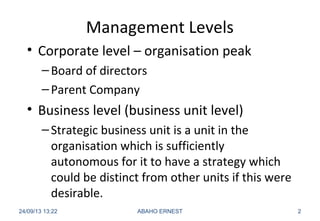
Management Levels
• Corporate level – organisation peak
–Board of directors
–Parent Company
• Business level (business unit level)
–Strategic business unit is a unit in the
organisation which is sufficiently
autonomous for it to have a strategy which
could be distinct from other units if this were
desirable.
24/09/13 13:22 ABAHO ERNEST 2
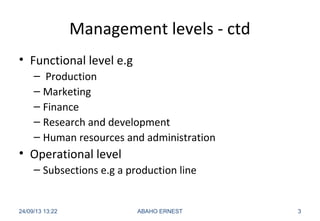
Management levels - ctd
• Functional level e.g
– Production
– Marketing
– Finance
– Research and development
– Human resources and administration
• Operational level
– Subsections e.g a production line
24/09/13 13:22 ABAHO ERNEST 3
Board of Directors
• Has ultimate legal authority
• Responsible to shareholders for:
• Ensuring management continuity
• Protecting resources
• Prudent actions in relation to corporate
objectives
• Approving major Financial and operational
decisions of managers.
• Maintaining, revising and enforcing corporate
charter and by-laws.
24/09/13 13:22 ABAHO ERNEST 4
Board membership
• Membership requirements
– Knowledge of some functions e.g operations
– Business acumen
– Industry perspective
• “Inside board” – comprised of top managers
– Traditional
– Risk of ratifying their own decisions
• “Outside board members”
– Stakeholders in shareholders interests
– Represent minority group
24/09/13 13:22 ABAHO ERNEST 5
Board membership - ctd
• Now increasingly active due to:
• Increasing charges on directors for failure
• Legislation in some countries
• Increase in audit requirements
• Director jobs are increasingly becoming un-
attractive because of accountability.
24/09/13 13:22 ABAHO ERNEST 6
The General Manager
• GMs are key players in strategic management
• Executives at enterprise pinnacle or SBUs
• Responsible for survival and success
• Common titles:
– Chairman (of the board)
– President (or Senior VP, Exec. VP, VP)
– Managing Director
– Chief Executive Officer
– General manager
24/09/13 13:22 ABAHO ERNEST 7
GMs Skill requirements
• More conceptual skills
• Organisational skills
• Analytical skills
• Design & planning skills
• Critical thinking skills
• Human relations & interpersonal skills
• General skills rather than specialised skills
• Less need for technical abilities
24/09/13 13:22 ABAHO ERNEST 8
GM Roles – Mintzberg’s List
Interpersonal roles
• Symbolic figure head of the organisation
• Ceremonial duties – legal or social
• Staffing, training and motivating
Informational roles
• Disseminator to outsiders & insiders
• Spokesperson
• Monotor – reads reports, makes tours, observes meetings
seeking information
24/09/13 13:22 ABAHO ERNEST 9
Roles Continued
Decision roles:
• Entrepreneur – strategic functions to start projects
• Disturbance handler
– Correct problems
– Solve crises
• Resource “allocator”
– Authorise budgets
– Approve allocation requests for
• Human resources, Monetary resources, Material resources
• Negotiator- signs contracts with
– Trade unions
– Big suppliers
– Big customers24/09/13 13:22 ABAHO ERNEST 10
GM roles – non strategic
• Have other work, day to day
• Tend to get trapped in these jobs
– Because of short term results
• Less emphasis on strategic roles leads to lack of
innovation
24/09/13 13:22 ABAHO ERNEST 11
Business Level
• Strategic business unit managers
• Corporate planners
• Consultants
Roles
• SBU executives may set strategies for their
units / businesses
• Roles are generally similar to top level
managers but for their units
• Create multiple strategies on a contingency
basis
24/09/13 13:22 ABAHO ERNEST 12
SBU Executive skills
• Entrepreneurial skills
– Develop new ventures
• Detailed planning skills
• Expertise in strategic planning
• They share skill requirements with top level
managers
24/09/13 13:22 ABAHO ERNEST 13
Middle / Tactical/ Functional level
Roles
• Receive from top – policies, goals
• Interpret for subordinates for action
• Policy implementers
• Take un-structured tactical decisions
• Structure them, guide lower levels for implementation
• Examples of tactical decisions
– Customers (in general) to be given credit
– Products / services for specific markets
24/09/13 13:22 ABAHO ERNEST 14
Functional level skill requirements
More inter-personal skills such as
• Assertiveness
• Conflict management
• Facilitation and meeting
• Negotiation
• Motivation & influencing skills
• Mentoring / coaching
• Networking
24/09/13 13:22 ABAHO ERNEST 15
Supervisory / Operational Level
• Doers, managers who actually supervise the work
• Direct, control the work
• Provide main contact between management and
workers
• Take structured / programmed decisions
• Decisions at this level
24/09/13 13:22 ABAHO ERNEST 16
Operational decisions - examples
• Assigning operational tasks
• Allocating equipment, tools for use
• Deciding which suppliers to be on the approved
list
• Scheduling reporting time
• Approving leave
• Determining inventory re-order levels
24/09/13 13:22 ABAHO ERNEST 17
Operational level skills requirements
• Technical skills
• Inter-personal skills
• Skills of other (higher levels) but of less
importance
24/09/13 13:22 ABAHO ERNEST 18

5 management levels

  • 1.
    Makerere University BusinessSchool Strategic Management Course MANAGEMENT LEVELS, DECISIONS & SKILLS 24/09/13 13:22 A.N.S- nsserwanga@yahoo.com 1
  • 2.
    Management Levels • Corporatelevel – organisation peak –Board of directors –Parent Company • Business level (business unit level) –Strategic business unit is a unit in the organisation which is sufficiently autonomous for it to have a strategy which could be distinct from other units if this were desirable. 24/09/13 13:22 ABAHO ERNEST 2
  • 3.
    Management levels -ctd • Functional level e.g – Production – Marketing – Finance – Research and development – Human resources and administration • Operational level – Subsections e.g a production line 24/09/13 13:22 ABAHO ERNEST 3
  • 4.
    Board of Directors •Has ultimate legal authority • Responsible to shareholders for: • Ensuring management continuity • Protecting resources • Prudent actions in relation to corporate objectives • Approving major Financial and operational decisions of managers. • Maintaining, revising and enforcing corporate charter and by-laws. 24/09/13 13:22 ABAHO ERNEST 4
  • 5.
    Board membership • Membershiprequirements – Knowledge of some functions e.g operations – Business acumen – Industry perspective • “Inside board” – comprised of top managers – Traditional – Risk of ratifying their own decisions • “Outside board members” – Stakeholders in shareholders interests – Represent minority group 24/09/13 13:22 ABAHO ERNEST 5
  • 6.
    Board membership -ctd • Now increasingly active due to: • Increasing charges on directors for failure • Legislation in some countries • Increase in audit requirements • Director jobs are increasingly becoming un- attractive because of accountability. 24/09/13 13:22 ABAHO ERNEST 6
  • 7.
    The General Manager •GMs are key players in strategic management • Executives at enterprise pinnacle or SBUs • Responsible for survival and success • Common titles: – Chairman (of the board) – President (or Senior VP, Exec. VP, VP) – Managing Director – Chief Executive Officer – General manager 24/09/13 13:22 ABAHO ERNEST 7
  • 8.
    GMs Skill requirements •More conceptual skills • Organisational skills • Analytical skills • Design & planning skills • Critical thinking skills • Human relations & interpersonal skills • General skills rather than specialised skills • Less need for technical abilities 24/09/13 13:22 ABAHO ERNEST 8
  • 9.
    GM Roles –Mintzberg’s List Interpersonal roles • Symbolic figure head of the organisation • Ceremonial duties – legal or social • Staffing, training and motivating Informational roles • Disseminator to outsiders & insiders • Spokesperson • Monotor – reads reports, makes tours, observes meetings seeking information 24/09/13 13:22 ABAHO ERNEST 9
  • 10.
    Roles Continued Decision roles: •Entrepreneur – strategic functions to start projects • Disturbance handler – Correct problems – Solve crises • Resource “allocator” – Authorise budgets – Approve allocation requests for • Human resources, Monetary resources, Material resources • Negotiator- signs contracts with – Trade unions – Big suppliers – Big customers24/09/13 13:22 ABAHO ERNEST 10
  • 11.
    GM roles –non strategic • Have other work, day to day • Tend to get trapped in these jobs – Because of short term results • Less emphasis on strategic roles leads to lack of innovation 24/09/13 13:22 ABAHO ERNEST 11
  • 12.
    Business Level • Strategicbusiness unit managers • Corporate planners • Consultants Roles • SBU executives may set strategies for their units / businesses • Roles are generally similar to top level managers but for their units • Create multiple strategies on a contingency basis 24/09/13 13:22 ABAHO ERNEST 12
  • 13.
    SBU Executive skills •Entrepreneurial skills – Develop new ventures • Detailed planning skills • Expertise in strategic planning • They share skill requirements with top level managers 24/09/13 13:22 ABAHO ERNEST 13
  • 14.
    Middle / Tactical/Functional level Roles • Receive from top – policies, goals • Interpret for subordinates for action • Policy implementers • Take un-structured tactical decisions • Structure them, guide lower levels for implementation • Examples of tactical decisions – Customers (in general) to be given credit – Products / services for specific markets 24/09/13 13:22 ABAHO ERNEST 14
  • 15.
    Functional level skillrequirements More inter-personal skills such as • Assertiveness • Conflict management • Facilitation and meeting • Negotiation • Motivation & influencing skills • Mentoring / coaching • Networking 24/09/13 13:22 ABAHO ERNEST 15
  • 16.
    Supervisory / OperationalLevel • Doers, managers who actually supervise the work • Direct, control the work • Provide main contact between management and workers • Take structured / programmed decisions • Decisions at this level 24/09/13 13:22 ABAHO ERNEST 16
  • 17.
    Operational decisions -examples • Assigning operational tasks • Allocating equipment, tools for use • Deciding which suppliers to be on the approved list • Scheduling reporting time • Approving leave • Determining inventory re-order levels 24/09/13 13:22 ABAHO ERNEST 17
  • 18.
    Operational level skillsrequirements • Technical skills • Inter-personal skills • Skills of other (higher levels) but of less importance 24/09/13 13:22 ABAHO ERNEST 18