
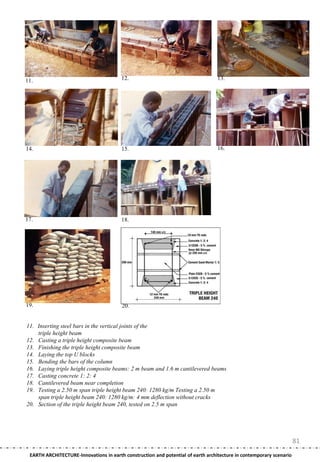

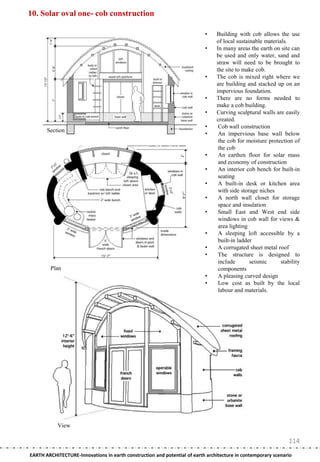
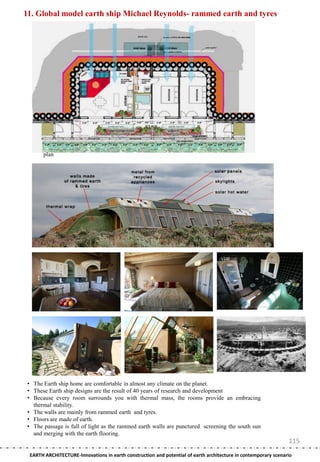
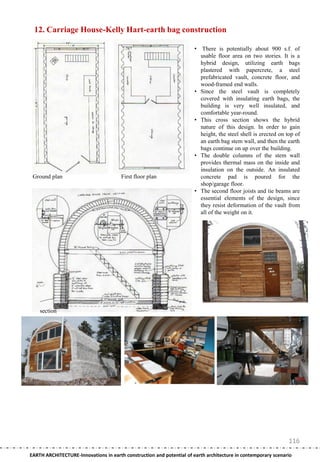
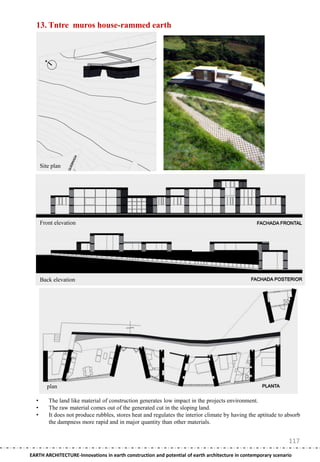
EARTH ARCHITECTURE
Innovations in earth construction and potential of earth architecture in
                        contemporary scenario
Approval


                     Undergraduate Research Thesis
                       Vyavasayi Vidya Pratisthan’s
               Indubhai Parekh School of Architecture
                                   Rajkot, India


The following study is hereby approved as creditable work on the approved subject,
carried out and presented in a manner sufficiently satisfactory to warrant its acceptance as
a prerequisite to the degree for which it has been submitted.

It is understood that by this approval, the undersigned does not necessarily endorse or
approve of any statement made, opinion expressed or conclusion drawn there in, and
approves the study only for the above purpose, and satisfies him as to the requirements
laid down by the thesis committee.


Thesis Title: EARTH ARCHITECTURE
               Innovations in earth construction and potential of earth architecture in
               contemporary scenario


Name: Bhavi Vador                      Guide: Vishwanath Kashikar
Roll No: 3805                          Signature:
                                      Date:
The dissertation is dedicated to my parents and to every individual who inspired me, guided me and
                                    helped me in my endeavours.
Acknowledgement
Inspirations and critique makes individual to do better. Ultimately, an individual grows through such individuals.

I would to acknowledge a number of individuals who have played a pivotal role in the actualisation of this thesis.

Firstly, i would like to thank my parents and whole family for supporting me throughout my life till now, they have given me
this wonderful life by supporting me and making me an individual to stand out and face every difficulty that comes along the
way of progress.
I am very much thankful to my guide - Vishwanath Kashikar for guiding me, providing me sufficient and timely discussions
and valuable inputs and broadening my concepts and ideas about earth architecture.

All my people who helped me in one way or the other, who questioned, criticised and discussed factors related to the topic and
thereby create a formwork for the dissertation. I would like to acknowledge not only those who directly contributed to this
dissertation, but also those whose moral support and confidence in me, whose companionship and discussions I have always
valued.

Ar. Nirav Vador and Ar. Kartik Bijlani for being a guide throughout, Dr.Tejal Gajra, Dhaval Vador and Jill Vador for asking
me thousand times ‘when will you complete your thesis?’ .Nikitasha Vador for accompanying to auroville and making the trip
memorable and helping with the work there.

Jimmy katira,Sweta Amin, Krishma Shah, Rutvik Agnihotri,Chandni Parekh,Tejas Bhatt,Pranav Meghani,Mitul Shah,
Dhruvansh Hirani,Ronak patel,Ankit Mehta and Siddharth Chauhan for discussing the work, for being there in happy and low
times and for being the best persons in my life.

Anand Dave, Kanupriya Raniwala, Saumil Mewada, Bhaumik Modi, Pratik zaveri, Sridevi, Rosy for valuable inputs and
discussions.

Prabhulal Vora, Savita Vora, Pallavi aunty, Shailesh uncle, Parth Amin and the ‘shailvi’ home...for supporting and giving
every facility to get a working environment.

IPSA for being a wonderful platform for providing knowledge and all the faculties, students, administration people,
maintenance people for sharing knowledge.

IPSA library, CEPT library for providing with books and internet access.

Prof Bakul Jani, Ar. Devang Parekh, Ar. Hitesh Changela, Mr. Kiran Vaghela, Ar. Satprem Maini, Ar. Dharmesh Jadeja for
their valuable inputs and discussions related to the topic.

I was able to proceed in my topic because of the valuable time given by the Architects, engineers, labourers and contractors
with whom i had discussions related to my questionnaire.

Thanks to owners of earth buildings in auroville and Kutch who co-ordinated well and helped to study and measure draw their
respective buildings.

To batch 2005-this consists of all my friends who have experienced architecture academics with me, sharing all their fun and
knowledge and for being together in a new city away from the family.

I would also like to thank all those who in some way or the other helped me in every stage of my life till now and finally to the
person who is reading this and (hopefully going to read) further. I hope the study become useful and serve the purpose for
which it is been read.
Contents

     PREFACE                                                                     1

1.   INTRODUCTION                                                                2-7

     1.1 Aim/objectives

     1.2 Methodology

     1.3 Necessity of research on earth construction

     1.4 Scope and limitations


2.   EARTH CONSTRUCTION TECHNIQUES                                               8-22

     2.1 Earth architecture of world

     2.2 Earth as a building material

     2.3 Traditional earth construction techniques

     2.4 Contemporary earth construction techniques (illustrated with figures)   23-32

         2.4(a) Cob

         2.4(b) Adobe

         2.4(c) compressed stabilised earth blocks

         2.4(d) Wattle and daub

         2.4(e) Rammed earth


3.   INNOVATIONS IN EARTH CONSTRUCTION                                           33-62

     3.1 Introduction

     3.2 Analytical charts showing solutions through:

         3.2(a) Primary case studies

         3.2(b) Designing

         3.3(c) Construction

         3.4(d) Maintenance

         3.5(e) Demolition/Reuse
4.   CONCLUSIONS                                          63-64


     APPENDIX                                             65-118

     1. Interviews and discussions with subject experts   65-70

     2. Analysis of soil type                             71-72

     3. Traditional construction drawings                 73-75

     4. CSEB and stabilized rammed earth                  76-93

     5. Built examples                                    94-118


     Afterword-the future                                 119

     Glossary                                             120

     Image credits                                        121

     Bibliography                                         122
Preface

Currently it is estimated that one half of the world's population, approximately three billion people on six
continents live or work in buildings constructed of earth. It is evaluated that about 1.7 billion people of the world‟s
population live in earthen houses: About 50 % of the population in developing countries, and at least 20% of urban
and suburban populations. And while the vast legacy of traditional and vernacular earthen construction has been
widely discussed, little attention has been paid to the contemporary tradition of earth architecture.

    -   Ronal Rael-Earth Architecture


This paper is focusing particularly on the innovations done in last few years in the field of earth construction that
can lead to its better use as a building material. This thesis deals with earth as a building material, and provides a
survey of all of its applications and construction techniques while explaining its specific qualities and the
possibilities of optimising them. It provides the new, creative uses of the oldest building material on the planet.
Many assume that it's only used for housing in poor rural areas—but there are examples of bungalows, offices,
apartments and institutions that are made of earth. It's also assumed that earth is a fragile, ephemeral material, while
in reality some of the oldest extant buildings on the planet are made of earth. Earth buildings are often thought of as
pre-modern or backward. With help of discussions with the subject experts, drawings and images, this paper
showcases the beauty and simplicity of one of humankind's most evolved and sophisticated building technologies.

         Mud (wet, soft earth) is a natural material which after exploration can be used just the way other
contemporary materials are used. A person, who started using glass, would not have made a skyscraper at first go.
After years of experiments designers and engineers might have used it as skin for skyscrapers. If there are
advantages about a certain material then there are limitations and disadvantages too, that can be solved by studies,
experiments and application of that material in different ways. Just because mud was used traditionally doesn‘t
mean it cannot be used today in contemporary architecture, it has risen from those mud toys to mud huts and now
to institutions, bungalows and multi-storeys. Mud is no more a material known for construction of ‗kuccha‘ houses
.While shrinkage, erosion and mechanical damage can affect earth construction like any other building material,
preventative measures can be taken for innovating the material itself rather than constructing with high cost,
imported materials.

       Appendix 1 is the basis of development of this paper. The introductory chapter provides with a short survey
on the history of earth architecture. In other following chapters it describes the contemporary and future roles of
earth as a building material, and lists all of the significant characteristics that distinguish earth from common
industrialised building materials. The thesis final appendices titled ‗built examples‘ are earth buildings from
various regions of the world. These constructions demonstrate the impressive versatility of earth architecture and
the many different uses of the building material earth.


                                                                                                                      1

EARTH ARCHITECTURE-Innovations in earth construction and potential of earth architecture in contemporary scenario
Introduction

“Here, for years, for centuries, the peasant had wisely and quietly exploited the obvious building material, while we, with our
modern school-learned ideas, never dreamed of using such a ludicrous substance as mud for so serious a creation as a house.
But why not? Certainly, the peasant‟s houses might be cramped, dark, dirty, and inconvenient, but this is no fault of the mud
brick. There was nothing that could not be put right by good design and a broom.”

-Hassan Fathy (1973: 4)


AIM

       The aim is to study the traditional earth construction techniques and earth construction techniques of contemporary
        architecture, stating problems with the techniques as why they make earth architecture undesirable for present client
        and stating solutions from the case studies of contemporary earth buildings that show innovations made in traditional
        techniques and show potentials and possibilities of earth construction so that the present man desires it just like other
        contemporary architectural styles and materials.


OBJECTIVES

       To understand ideology of earth materials.
       To study the various earth construction techniques.
       To analyse the contemporary earth architecture in respect to its construction.
       To review the possible innovative earth construction methods and study the minor details that can help improve its
        use.
       To review the appropriateness of the earth as building material in present scenario.


METHODOLOGY

       Understanding traditional earth construction techniques(internet, books, people)
       Gathering secondary data(internet, books, previous thesis done by others)
       Preparing research questionnaire
       Conducting interviews with the experts(architects, contractors/engineers, skilled labourers) of the subject
       Identifying problems with the designing, methods, construction techniques and maintenance related to earth
        architecture through those interviews and related case studies.
       Doing case studies to understand the contemporary explorations and innovations to overcome those problems and
        show potentials of earth architecture.
       Compilation of data, chapter writing and deriving conclusions


                                                                                                                               2

 EARTH ARCHITECTURE-Innovations in earth construction and potential of earth architecture in contemporary scenario
NECESSITY OF RESEARCH ON EARTH CONSTRUCTION

         To get knowledge about the material and promote earth construction
         To create awareness about earth construction
         To learn the potentials of earth building process (designing, construction, maintenance, demolition/ re-use)


SCOPE AND LIMITATIONS


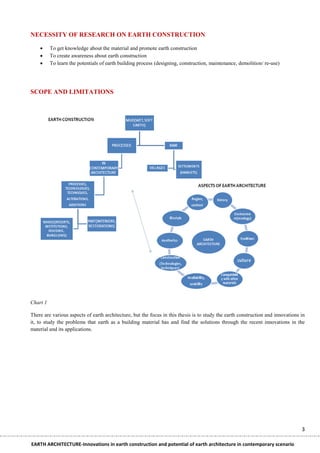
Chart 1

There are various aspects of earth architecture, but the focus in this thesis is to study the earth construction and innovations in
it, to study the problems that earth as a building material has and find the solutions through the recent innovations in the
material and its applications.


                                                                                                                                 3

EARTH ARCHITECTURE-Innovations in earth construction and potential of earth architecture in contemporary scenario
Earth construction techniques

“Our modern, advanced scientific minds should know how to assess the merits and demerits of historic and factual evidence of
the way people who have lived in a particular setting and climate, have coped with the problems which are still inevitably ours
today. To brush aside all this demonstration and evidence as old-fashioned and therefore useless is extremely foolish. Having
made our assessment we would show ourselves capable of adopting the lessons we have learned (negative or positive, they are
of equal importance) to our current living habits and the currently available building materials at our disposal. Along with this
we should remind ourselves that it is not „advancement‟ or „development‟ or „progress‟ to indulge in modern building
materials and techniques at tremendous expenses and to no good effect when there is no justification or reason for their use,
instead of older, simpler, inexpensive methods. ”

- Laurie Baker (life, work and writings), page 23

EARTH ARCHITECTURE OF WORLD

A MILLENNIA OLD TRADITION
Down through the ages, people have been using raw earth for building their living spaces. Every single continent, and nearly
every country, possesses a rich heritage of earthen buildings. From the roof of the world in Tibet, or the Andes Mountains in
Peru, to the Nile‘s shore in Egypt or the fertile valleys of China, many are the examples of earth as a building material.
          Earth construction techniques have been known for over 9000 years. Mud brick (adobe) houses dating from 8000 to
6000 BC have been discovered in Russian Turkestan (Pumpelly, 1908). Rammed earth foundations dating from ca. 5000 BC
have been discovered in Assyria. Earth was used as the building material in all ancient cultures, not only for homes, but for
religious buildings as well. Vaults in the Temple of Ramses II at Gourna, Egypt, built from mud bricks 3200 years ago. The
citadel of Bam in Iran, parts of which are ca. 2500 years old; a fortified city in the Draa valley in Morocco, which is around
250 years old. The 4000-year-old Great Wall of China was originally built solely of rammed earth; only a later covering of
stones and bricks gave it the appearance of a stone wall. The core of the Sun Pyramid in Teotihuacan, Mexico, built between
the 300 and 900 AD, consists of approximately 2 million tons of rammed earth.
          The world‘s oldest earthen building still standing is about 3,300 years old. In India, the oldest earthen building is Tabo
Monastery, in Spiti valley –Himachal Pradesh. It was also built with adobe and has withstood Himalayan winters since 996
AD.


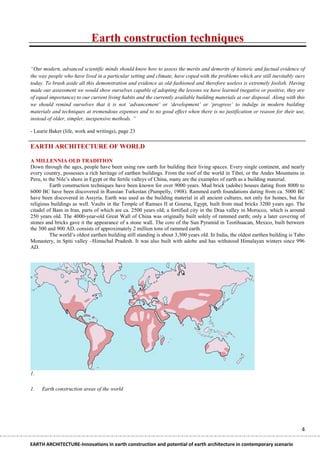
1.

1.   Earth construction areas of the world


                                                                                                                                  4

EARTH ARCHITECTURE-Innovations in earth construction and potential of earth architecture in contemporary scenario
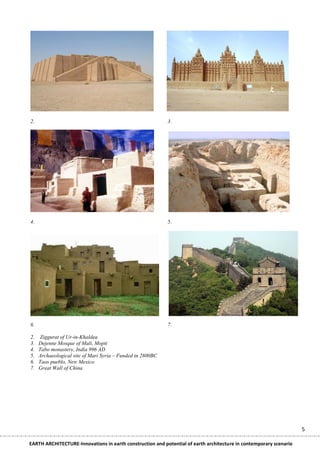
2.                                                          3.


4.                                                          5.


6.                                                          7.

2.   Ziggurat of Ur-in-Khaldea
3.   Dejenne Mosque of Mali, Mopti
4.   Tabo monastery, India 996 AD
5.   Archaeological site of Mari Syria – Funded in 2800BC
6.   Taos pueblo, New Mexico
7.   Great Wall of China


                                                                                                                    5

EARTH ARCHITECTURE-Innovations in earth construction and potential of earth architecture in contemporary scenario
8.


9.                                                              10.


11.                                                             12.


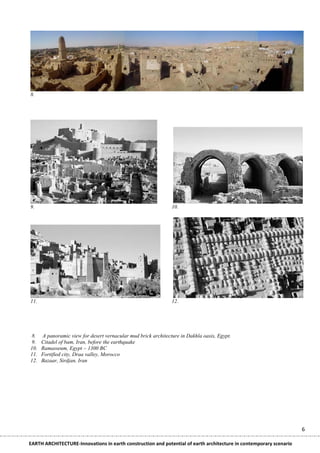
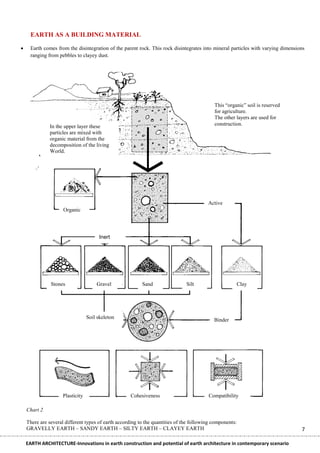
 8.   A panoramic view for desert vernacular mud brick architecture in Dakhla oasis, Egypt.
 9.   Citadel of bam, Iran, before the earthquake
10.   Ramasseum, Egypt ~ 1300 BC
11.   Fortified city, Draa valley, Morocco
12.   Bazaar, Sirdjan, Iran


                                                                                                                    6

EARTH ARCHITECTURE-Innovations in earth construction and potential of earth architecture in contemporary scenario
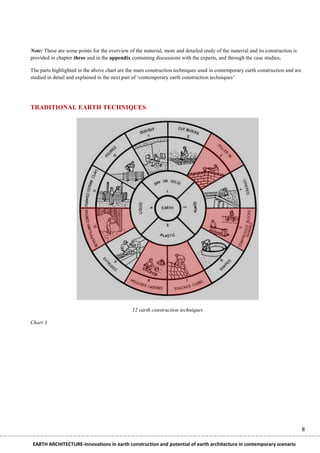
EARTH AS A BUILDING MATERIAL

    Earth comes from the disintegration of the parent rock. This rock disintegrates into mineral particles with varying dimensions
     ranging from pebbles to clayey dust.


                                                                                            This ―organic‖ soil is reserved
                                                                                            for agriculture.
                                                                                            The other layers are used for
               In the upper layer these                                                     construction.
               particles are mixed with
               organic material from the
               decomposition of the living
               World.


                                                                                         Active
                     Organic
                     material


                                        Inert


               Stones                 Gravel              Sand                 Silt                       Clay


                                  Soil skeleton
                                                                                            Binder


                     Plasticity                      Cohesiveness                        Compatibility

    Chart 2

    There are several different types of earth according to the quantities of the following components:
    GRAVELLY EARTH – SANDY EARTH – SILTY EARTH – CLAYEY EARTH                                                                    7

    EARTH ARCHITECTURE-Innovations in earth construction and potential of earth architecture in contemporary scenario
Note: These are some points for the overview of the material, more and detailed study of the material and its construction is
provided in chapter three and in the appendix containing discussions with the experts, and through the case studies.

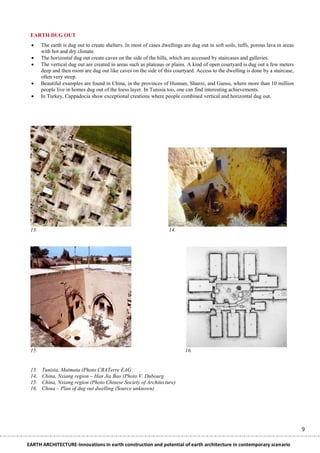
The parts highlighted in the above chart are the main construction techniques used in contemporary earth construction and are
studied in detail and explained in the next part of ‗contemporary earth construction techniques‘


TRADITIONAL EARTH TECHNIQUES


                                               12 earth construction techniques

Chart 3


                                                                                                                                8

 EARTH ARCHITECTURE-Innovations in earth construction and potential of earth architecture in contemporary scenario
EARTH DUG OUT
      The earth is dug out to create shelters. In most of cases dwellings are dug out in soft soils, tuffs, porous lava in areas
       with hot and dry climate.
      The horizontal dug out create caves on the side of the hills, which are accessed by staircases and galleries.
      The vertical dug out are created in areas such as plateaus or plains. A kind of open courtyard is dug out a few meters
       deep and then room are dug out like caves on the side of this courtyard. Access to the dwelling is done by a staircase,
       often very steep.
      Beautiful examples are found in China, in the provinces of Hunnan, Shanxi, and Gansu, where more than 10 million
       people live in homes dug out of the loess layer. In Tunisia too, one can find interesting achievements.
      In Turkey, Cappadocia show exceptional creations where people combined vertical and horizontal dug out.


 13.                                                                14.


 15.                                                                        16.


 13.   Tunisia, Matmata (Photo CRATerre EAG
 14.   China, Nxiang region – Han Jia Bao (Photo V. Dubourg
 15.   China, Nxiang region (Photo Chinese Society of Architecture)
 16.   China – Plan of dug out dwelling (Source unknown)


                                                                                                                                    9

EARTH ARCHITECTURE-Innovations in earth construction and potential of earth architecture in contemporary scenario
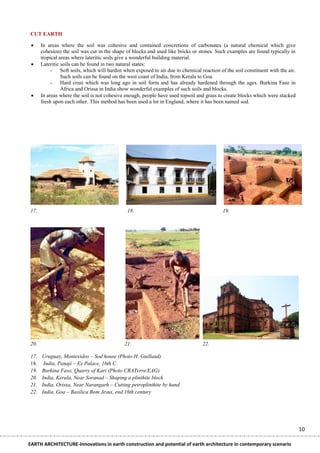
CUT EARTH

     In areas where the soil was cohesive and contained concretions of carbonates (a natural chemical which give
      cohesion) the soil was cut in the shape of blocks and used like bricks or stones. Such examples are found typically in
      tropical areas where lateritic soils give a wonderful building material.
     Lateritic soils can be found in two natural states:
           - Soft soils, which will harden when exposed to air due to chemical reaction of the soil constituent with the air.
                Such soils can be found on the west coast of India, from Kerala to Goa.
           - Hard crust which was long ago in soil form and has already hardened through the ages. Burkina Faso in
                Africa and Orissa in India show wonderful examples of such soils and blocks.
     In areas where the soil is not cohesive enough, people have used topsoil and grass to create blocks which were stacked
      fresh upon each other. This method has been used a lot in England, where it has been named sod.


                                                                                                                                 .
17.                                           18.                                         19.


20.                                          21.                                 22.

17.   Uruguay, Montevideo – Sod house (Photo H. Guillaud)
18.    India, Panaji – Ex Palace, 16th C.
19.   Burkina Faso, Quarry of Kari (Photo CRATerre/EAG)
20.   India, Kerala, Near Soranad – Shaping a plinthite block
21.   India, Orissa, Near Narangarh – Cutting petroplinthite by hand
22.   India, Goa – Basilica Bom Jesus, end 16th century


                                                                                                                                10

EARTH ARCHITECTURE-Innovations in earth construction and potential of earth architecture in contemporary scenario
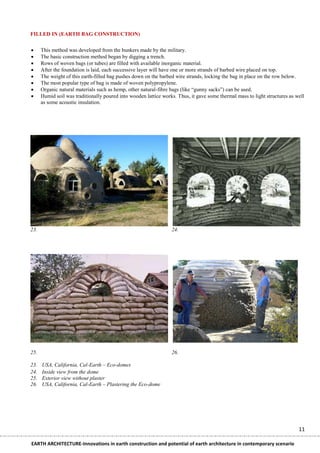
FILLED IN (EARTH BAG CONSTRUCTION)


     This method was developed from the bunkers made by the military.
     The basic construction method began by digging a trench.
     Rows of woven bags (or tubes) are filled with available inorganic material.
     After the foundation is laid, each successive layer will have one or more strands of barbed wire placed on top.
     The weight of this earth-filled bag pushes down on the barbed wire strands, locking the bag in place on the row below.
     The most popular type of bag is made of woven polypropylene.
     Organic natural materials such as hemp, other natural-fibre bags (like ―gunny sacks‖) can be used.
     Humid soil was traditionally poured into wooden lattice works. Thus, it gave some thermal mass to light structures as well
      as some acoustic insulation.


23.                                                               24.


25.                                                               26.

23.   USA, California, Cal-Earth – Eco-domes
24.   Inside view from the dome
25.   Exterior view without plaster
26.   USA, California, Cal-Earth – Plastering the Eco-dome


                                                                                                                             11

EARTH ARCHITECTURE-Innovations in earth construction and potential of earth architecture in contemporary scenario
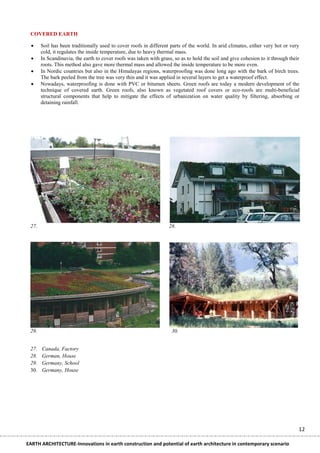
COVERED EARTH

      Soil has been traditionally used to cover roofs in different parts of the world. In arid climates, either very hot or very
       cold, it regulates the inside temperature, due to heavy thermal mass.
      In Scandinavia, the earth to cover roofs was taken with grass, so as to hold the soil and give cohesion to it through their
       roots. This method also gave more thermal mass and allowed the inside temperature to be more even.
      In Nordic countries but also in the Himalayas regions, waterproofing was done long ago with the bark of birch trees.
       The bark peeled from the tree was very thin and it was applied in several layers to get a waterproof effect.
      Nowadays, waterproofing is done with PVC or bitumen sheets. Green roofs are today a modern development of the
       technique of covered earth. Green roofs, also known as vegetated roof covers or eco-roofs are multi-beneficial
       structural components that help to mitigate the effects of urbanization on water quality by filtering, absorbing or
       detaining rainfall.


 27.                                                               28.


 29.                                                                 30.


 27.   Canada, Factory
 28.   German, House
 29.   Germany, School
 30.   Germany, House


                                                                                                                                 12

EARTH ARCHITECTURE-Innovations in earth construction and potential of earth architecture in contemporary scenario
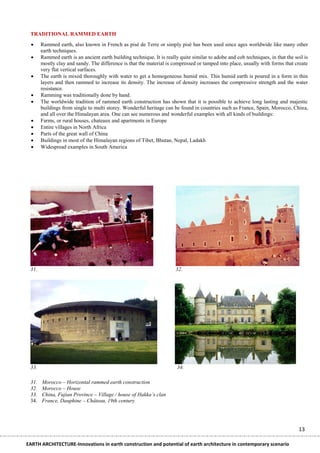
TRADITIONAL RAMMED EARTH
      Rammed earth, also known in French as pisé de Terre or simply pisé has been used since ages worldwide like many other
       earth techniques.
      Rammed earth is an ancient earth building technique. It is really quite similar to adobe and cob techniques, in that the soil is
       mostly clay and sandy. The difference is that the material is compressed or tamped into place, usually with forms that create
       very flat vertical surfaces.
      The earth is mixed thoroughly with water to get a homogeneous humid mix. This humid earth is poured in a form in thin
       layers and then rammed to increase its density. The increase of density increases the compressive strength and the water
       resistance.
      Ramming was traditionally done by hand.
      The worldwide tradition of rammed earth construction has shown that it is possible to achieve long lasting and majestic
       buildings from single to multi storey. Wonderful heritage can be found in countries such as France, Spain, Morocco, China,
       and all over the Himalayan area. One can see numerous and wonderful examples with all kinds of buildings:
      Farms, or rural houses, chateaux and apartments in Europe
      Entire villages in North Africa
      Parts of the great wall of China
      Buildings in most of the Himalayan regions of Tibet, Bhutan, Nepal, Ladakh
      Widespread examples in South America


 31.                                                                   32.


 33.                                                                    34.

 31.   Morocco – Horizontal rammed earth construction
 32.   Morocco – House
 33.   China, Fujian Province – Village / house of Hakka‟s clan
 34.   France, Dauphine – Château, 19th century


                                                                                                                                  13

EARTH ARCHITECTURE-Innovations in earth construction and potential of earth architecture in contemporary scenario
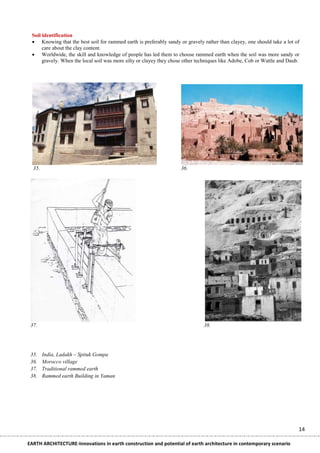
Soil identification
  Knowing that the best soil for rammed earth is preferably sandy or gravely rather than clayey, one should take a lot of
      care about the clay content.
  Worldwide, the skill and knowledge of people has led them to choose rammed earth when the soil was more sandy or
      gravely. When the local soil was more silty or clayey they chose other techniques like Adobe, Cob or Wattle and Daub.


  35.                                                                36.


 37.                                                                           38.


 35.    India, Ladakh – Spituk Gompa
 36.    Morocco village
 37.    Traditional rammed earth
 38.    Rammed earth Building in Yaman


                                                                                                                          14

EARTH ARCHITECTURE-Innovations in earth construction and potential of earth architecture in contemporary scenario
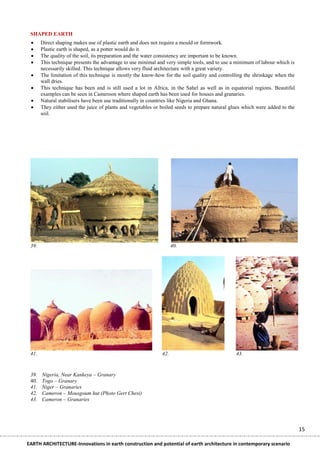
SHAPED EARTH
      Direct shaping makes use of plastic earth and does not require a mould or formwork.
      Plastic earth is shaped, as a potter would do it.
      The quality of the soil, its preparation and the water consistency are important to be known.
      This technique presents the advantage to use minimal and very simple tools, and to use a minimum of labour which is
       necessarily skilled. This technique allows very fluid architecture with a great variety.
      The limitation of this technique is mostly the know-how for the soil quality and controlling the shrinkage when the
       wall dries.
      This technique has been and is still used a lot in Africa, in the Sahel as well as in equatorial regions. Beautiful
       examples can be seen in Cameroon where shaped earth has been used for houses and granaries.
      Natural stabilisers have been use traditionally in countries like Nigeria and Ghana.
      They either used the juice of plants and vegetables or boiled seeds to prepare natural glues which were added to the
       soil.


 39.                                                                40.


 41.                                                          42.                               43.


 39.   Nigeria, Near Kankeya – Granary
 40.   Togo – Granary
 41.   Niger – Granaries
 42.   Cameron – Mousgoum hut (Photo Gert Chesi)
 43.   Cameron – Granaries


                                                                                                                              15

EARTH ARCHITECTURE-Innovations in earth construction and potential of earth architecture in contemporary scenario
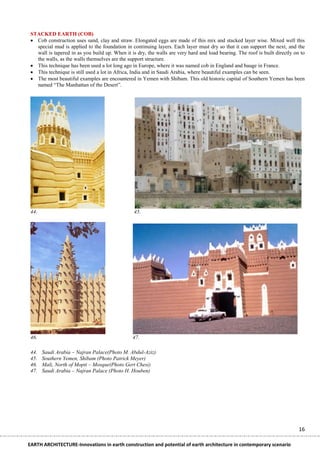
STACKED EARTH (COB)
  Cob construction uses sand, clay and straw. Elongated eggs are made of this mix and stacked layer wise. Mixed well this
   special mud is applied to the foundation in continuing layers. Each layer must dry so that it can support the next, and the
   wall is tapered in as you build up. When it is dry, the walls are very hard and load bearing. The roof is built directly on to
   the walls, as the walls themselves are the support structure.
  This technique has been used a lot long ago in Europe, where it was named cob in England and bauge in France.
  This technique is still used a lot in Africa, India and in Saudi Arabia, where beautiful examples can be seen.
  The most beautiful examples are encountered in Yemen with Shibam. This old historic capital of Southern Yemen has been
   named ―The Manhattan of the Desert‖.


 44.                                             45.


 46.                                            47.

 44.   Saudi Arabia – Najran Palace(Photo M. Abdul-Aziz)
 45.   Southern Yemen, Shibam (Photo Patrick Meyer)
 46.   Mali, North of Mopti – Mosque(Photo Gert Chesi)
 47.   Saudi Arabia – Najran Palace (Photo H. Houben)


                                                                                                                              16

EARTH ARCHITECTURE-Innovations in earth construction and potential of earth architecture in contemporary scenario
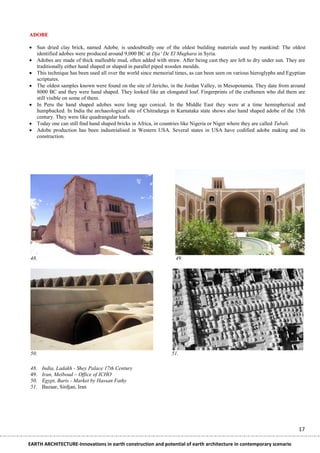
ADOBE

 Sun dried clay brick, named Adobe, is undoubtedly one of the oldest building materials used by mankind: The oldest
  identified adobes were produced around 9,000 BC at Dja‟ De El Mughara in Syria.
 Adobes are made of thick malleable mud, often added with straw. After being cast they are left to dry under sun. They are
  traditionally either hand shaped or shaped in parallel piped wooden moulds.
 This technique has been used all over the world since memorial times, as can been seen on various hieroglyphs and Egyptian
  scriptures.
 The oldest samples known were found on the site of Jericho, in the Jordan Valley, in Mesopotamia. They date from around
  8000 BC and they were hand shaped. They looked like an elongated loaf. Fingerprints of the craftsmen who did them are
  still visible on some of them.
 In Peru the hand shaped adobes were long ago conical. In the Middle East they were at a time hemispherical and
  humpbacked. In India the archaeological site of Chitradurga in Karnataka state shows also hand shaped adobe of the 15th
  century. They were like quadrangular loafs.
 Today one can still find hand shaped bricks in Africa, in countries like Nigeria or Niger where they are called Tubali.
 Adobe production has been industrialised in Western USA. Several states in USA have codified adobe making and its
  construction.


48.                                                              49.


50.                                                            51.

48.   India, Ladakh - Shey Palace 17th Century
49.   Iran, Meiboud – Office of ICHO
50.   Egypt, Baris - Market by Hassan Fathy
51.   Bazaar, Sirdjan, Iran


                                                                                                                        17

EARTH ARCHITECTURE-Innovations in earth construction and potential of earth architecture in contemporary scenario
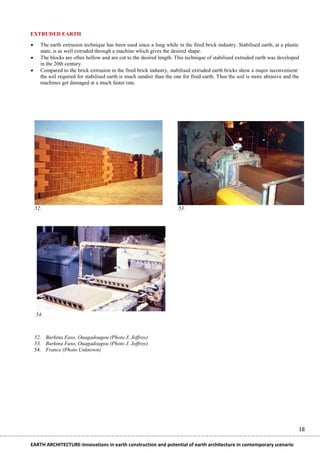
EXTRUDED EARTH

     The earth extrusion technique has been used since a long while in the fired brick industry. Stabilised earth, at a plastic
      state, is as well extruded through a machine which gives the desired shape.
     The blocks are often hollow and are cut to the desired length. This technique of stabilised extruded earth was developed
      in the 20th century.
     Compared to the brick extrusion in the fired brick industry, stabilised extruded earth bricks show a major inconvenient:
      the soil required for stabilised earth is much sandier than the one for fired earth. Thus the soil is more abrasive and the
      machines get damaged at a much faster rate.


    52.                                                                53.


    54.


    52. Burkina Faso, Ouagadougou (Photo J. Joffroy)
    53. Burkina Faso, Ouagadougou (Photo J. Joffroy)
    54. France (Photo Unknown)


                                                                                                                                18

EARTH ARCHITECTURE-Innovations in earth construction and potential of earth architecture in contemporary scenario
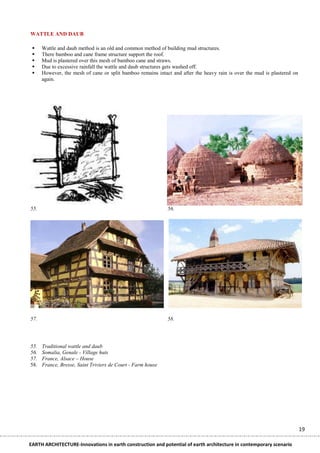
WATTLE AND DAUB

     Wattle and daub method is an old and common method of building mud structures.
     There bamboo and cane frame structure support the roof.
     Mud is plastered over this mesh of bamboo cane and straws.
     Due to excessive rainfall the wattle and daub structures gets washed off.
     However, the mesh of cane or split bamboo remains intact and after the heavy rain is over the mud is plastered on
      again.


55.                                                          56.


57.                                                          58.


55.   Traditional wattle and daub
56.   Somalia, Genale - Village huts
57.   France, Alsace – House
58.   France, Bresse, Saint Triviers de Court - Farm house


                                                                                                                          19

EARTH ARCHITECTURE-Innovations in earth construction and potential of earth architecture in contemporary scenario
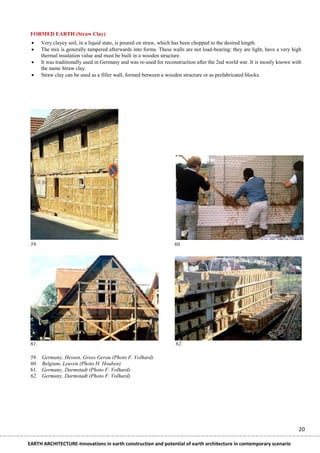
FORMED EARTH (Straw Clay)
      Very clayey soil, in a liquid state, is poured on straw, which has been chopped to the desired length.
      The mix is generally tampered afterwards into forms. These walls are not load-bearing: they are light, have a very high
       thermal insulation value and must be built in a wooden structure.
      It was traditionally used in Germany and was re-used for reconstruction after the 2nd world war. It is mostly known with
       the name Straw clay.
      Straw clay can be used as a filler wall, formed between a wooden structure or as prefabricated blocks.


 59.                                                                60.


 61.                                                                 62.

 59.   Germany, Hessen, Gross Gerau (Photo F. Volhard)
 60.   Belgium, Leuven (Photo H. Houben)
 61.   Germany, Darmstadt (Photo F. Volhard)
 62.   Germany, Darmstadt (Photo F. Volhard)


                                                                                                                             20

EARTH ARCHITECTURE-Innovations in earth construction and potential of earth architecture in contemporary scenario
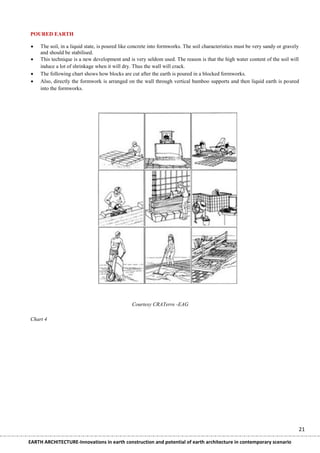
POURED EARTH

    The soil, in a liquid state, is poured like concrete into formworks. The soil characteristics must be very sandy or gravely
     and should be stabilised.
    This technique is a new development and is very seldom used. The reason is that the high water content of the soil will
     induce a lot of shrinkage when it will dry. Thus the wall will crack.
    The following chart shows how blocks are cut after the earth is poured in a blocked formworks.
    Also, directly the formwork is arranged on the wall through vertical bamboo supports and then liquid earth is poured
     into the formworks.


                                                Courtesy CRATerre -EAG

Chart 4


                                                                                                                               21

EARTH ARCHITECTURE-Innovations in earth construction and potential of earth architecture in contemporary scenario
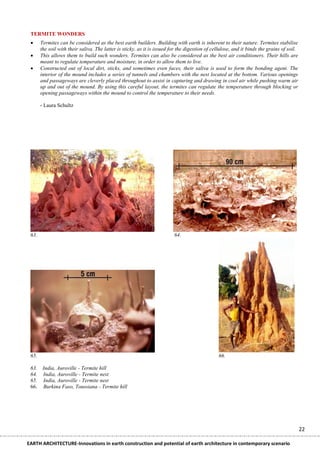
TERMITE WONDERS
      Termites can be considered as the best earth builders. Building with earth is inherent to their nature. Termites stabilise
       the soil with their saliva. The latter is sticky, as it is issued for the digestion of cellulose, and it binds the grains of soil.
      This allows them to build such wonders. Termites can also be considered as the best air conditioners. Their hills are
       meant to regulate temperature and moisture, in order to allow them to live.
      Constructed out of local dirt, sticks, and sometimes even faces, their saliva is used to form the bonding agent. The
       interior of the mound includes a series of tunnels and chambers with the nest located at the bottom. Various openings
       and passageways are cleverly placed throughout to assist in capturing and drawing in cool air while pushing warm air
       up and out of the mound. By using this careful layout, the termites can regulate the temperature through blocking or
       opening passageways within the mound to control the temperature to their needs.

       - Laura Schultz


 63.                                                                      64.


 65.                                                                                            66.

 63.    India, Auroville - Termite hill
 64.    India, Auroville - Termite nest
 65.    India, Auroville - Termite nest
 66.    Burkina Faso, Toussiana - Termite hill


                                                                                                                                            22

EARTH ARCHITECTURE-Innovations in earth construction and potential of earth architecture in contemporary scenario
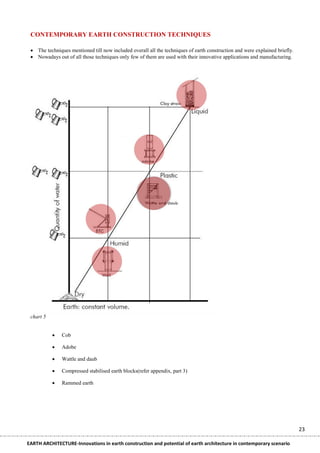
CONTEMPORARY EARTH CONSTRUCTION TECHNIQUES

  The techniques mentioned till now included overall all the techniques of earth construction and were explained briefly.
  Nowadays out of all those techniques only few of them are used with their innovative applications and manufacturing.


 chart 5


              Cob

              Adobe

              Wattle and daub

              Compressed stabilised earth blocks(refer appendix, part 3)

              Rammed earth


                                                                                                                             23

EARTH ARCHITECTURE-Innovations in earth construction and potential of earth architecture in contemporary scenario
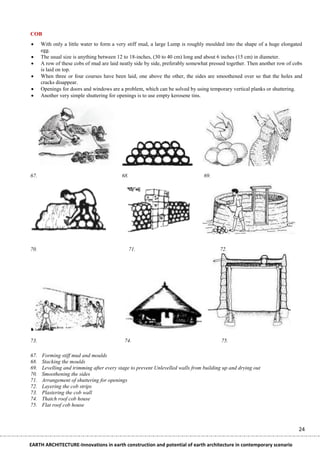
COB
     With only a little water to form a very stiff mud, a large Lump is roughly moulded into the shape of a huge elongated
      egg.
     The usual size is anything between 12 to 18-inches, (30 to 40 cm) long and about 6 inches (15 cm) in diameter.
     A row of these cobs of mud are laid neatly side by side, preferably somewhat pressed together. Then another row of cobs
      is laid on top.
     When three or four courses have been laid, one above the other, the sides are smoothened over so that the holes and
      cracks disappear.
     Openings for doors and windows are a problem, which can be solved by using temporary vertical planks or shuttering.
     Another very simple shuttering for openings is to use empty kerosene tins.


67.                                       68.                                   69.


70.                                             71.                                    72.


73.                                         74.                                         75.

67.   Forming stiff mud and moulds
68.   Stacking the moulds
69.   Levelling and trimming after every stage to prevent Unlevelled walls from building up and drying out
70.   Smoothening the sides
71.   Arrangement of shuttering for openings
72.   Layering the cob strips
73.   Plastering the cob wall
74.   Thatch roof cob house
75.   Flat roof cob house


                                                                                                                           24

EARTH ARCHITECTURE-Innovations in earth construction and potential of earth architecture in contemporary scenario
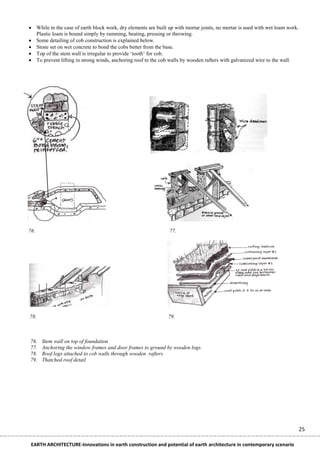
 While in the case of earth block work, dry elements are built up with mortar joints, no mortar is used with wet loam work.
  Plastic loam is bound simply by ramming, beating, pressing or throwing.
 Some detailing of cob construction is explained below.
 Stone set on wet concrete to bond the cobs better from the base.
 Top of the stem wall is irregular to provide „tooth‟ for cob.
 To prevent lifting in strong winds, anchoring roof to the cob walls by wooden rafters with galvanized wire to the wall.


76.                                                             77.


78.                                                             79.


                                  Adobes are made of thick malleable mud, often added with straw.
76.   Stem wall on top of foundation
77.   Anchoring the window frames and door frames to ground by wooden logs.
78.   Roof logs attached to cob walls through wooden rafters
79.   Thatched roof detail


                                                                                                                               25

 EARTH ARCHITECTURE-Innovations in earth construction and potential of earth architecture in contemporary scenario
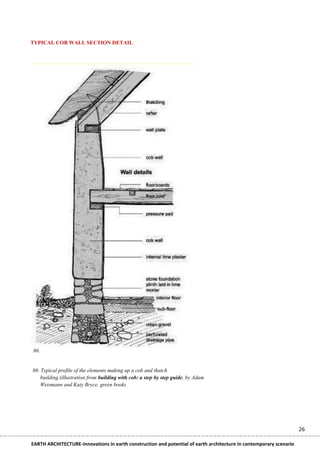
TYPICAL COB WALL SECTION DETAIL


 80.


 80. Typical profile of the elements making up a cob and thatch
     building.(illustration from building with cob: a step by step guide, by Adam
ADOBEWeismann and Katy Bryce, green books


                                                                                                                    26

EARTH ARCHITECTURE-Innovations in earth construction and potential of earth architecture in contemporary scenario
ADOBE

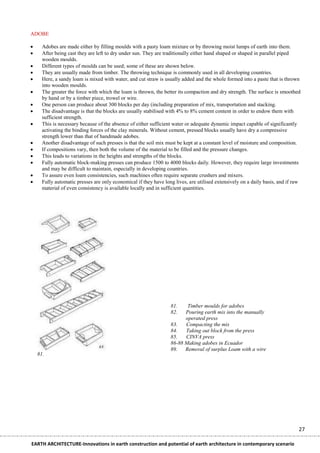
     Adobes are made either by filling moulds with a pasty loam mixture or by throwing moist lumps of earth into them.
     After being cast they are left to dry under sun. They are traditionally either hand shaped or shaped in parallel piped
      wooden moulds.
     Different types of moulds can be used; some of these are shown below.
     They are usually made from timber. The throwing technique is commonly used in all developing countries.
     Here, a sandy loam is mixed with water, and cut straw is usually added and the whole formed into a paste that is thrown
      into wooden moulds.
     The greater the force with which the loam is thrown, the better its compaction and dry strength. The surface is smoothed
      by hand or by a timber piece, trowel or wire.
     One person can produce about 300 blocks per day (including preparation of mix, transportation and stacking.
     The disadvantage is that the blocks are usually stabilised with 4% to 8% cement content in order to endow them with
      sufficient strength.
     This is necessary because of the absence of either sufficient water or adequate dynamic impact capable of significantly
      activating the binding forces of the clay minerals. Without cement, pressed blocks usually have dry a compressive
      strength lower than that of handmade adobes.
     Another disadvantage of such presses is that the soil mix must be kept at a constant level of moisture and composition.
     If compositions vary, then both the volume of the material to be filled and the pressure changes.
     This leads to variations in the heights and strengths of the blocks.
     Fully automatic block-making presses can produce 1500 to 4000 blocks daily. However, they require large investments
      and may be difficult to maintain, especially in developing countries.
     To assure even loam consistencies, such machines often require separate crushers and mixers.
     Fully automatic presses are only economical if they have long lives, are utilised extensively on a daily basis, and if raw
      material of even consistency is available locally and in sufficient quantities.


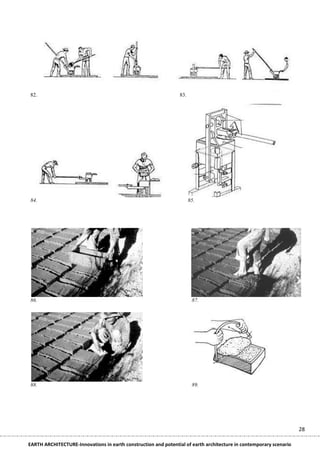
                                                                  81.    Timber moulds for adobes
                                                                  82.   Pouring earth mix into the manually
                                                                        operated press
                                                                  83.   Compacting the mix
                                                                  84.   Taking out block from the press
                                                                  85.   CINVA press
                                                                  86-88 Making adobes in Ecuador
                                                                  89.   Removal of surplus Loam with a wire
    81.


                                                                                                                               27

EARTH ARCHITECTURE-Innovations in earth construction and potential of earth architecture in contemporary scenario
82.                                                              83.


84.                                                                    85.


86.                                                                     87.


88.                                                                     89.


                                                                                                                    28

EARTH ARCHITECTURE-Innovations in earth construction and potential of earth architecture in contemporary scenario
WATTLE AND DAUB

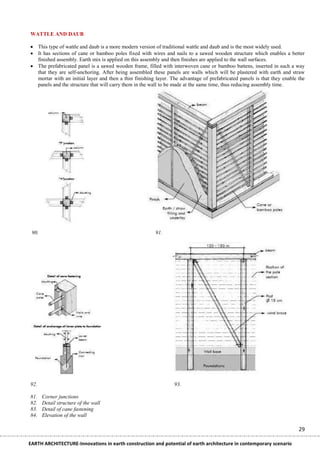
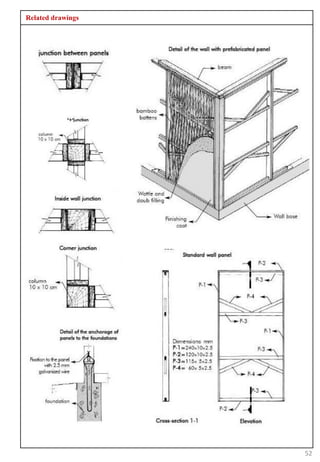
 This type of wattle and daub is a more modern version of traditional wattle and daub and is the most widely used.
 It has sections of cane or bamboo poles fixed with wires and nails to a sawed wooden structure which enables a better
  finished assembly. Earth mix is applied on this assembly and then finishes are applied to the wall surfaces.
 The prefabricated panel is a sawed wooden frame, filled with interwoven cane or bamboo battens, inserted in such a way
  that they are self-anchoring. After being assembled these panels are walls which will be plastered with earth and straw
  mortar with an initial layer and then a thin finishing layer. The advantage of prefabricated panels is that they enable the
  panels and the structure that will carry them in the wall to be made at the same time, thus reducing assembly time.


 90.                                                     91.


92.                                                              93.

81.    Corner junctions
82.    Detail structure of the wall
83.    Detail of cane fastening
84.    Elevation of the wall

                                                                                                                          29

EARTH ARCHITECTURE-Innovations in earth construction and potential of earth architecture in contemporary scenario
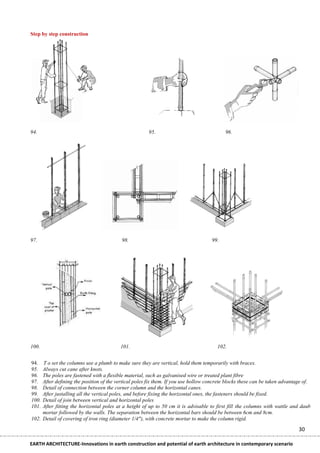
Step by step construction


94.                                                   95.                                 96.


97.                                       98.                                       99.


100.                                     101.                                         102.


94. T o set the columns use a plumb to make sure they are vertical, hold them temporarily with braces.
95. Always cut cane after knots.
96. The poles are fastened with a flexible material, such as galvanised wire or treated plant fibre
97. After defining the position of the vertical poles fix them. If you use hollow concrete blocks these can be taken advantage of.
98. Detail of connection between the corner column and the horizontal canes.
99. After justalling all the vertical poles, and before fixing the horizontal ones, the fasteners should be fixed.
100. Detail of join between vertical and horizontal poles
AOBE
101. After fitting the horizontal poles at a height of up to 50 cm it is advisable to first fill the columns with wattle and daub
     mortar followed by the walls. The separation between the horizontal bars should be between 6cm and 8cm.
102. Detail of covering of iron ring (diameter 1/4"), with concrete mortar to make the column rigid.

                                                                                                                            30

EARTH ARCHITECTURE-Innovations in earth construction and potential of earth architecture in contemporary scenario
RAMMED EARTH

      After being excavated, the soil is thoroughly sieved, to break the lumps and make it lighter. Big rocks should be removed
       but some stones could be kept. If the natural soil is too dry, it should moistened and mixed so as to get a uniform humid
       mix.
      This method has developed from the cob wall so as to standardize or regularize the thickness of the wall.
      It is also an attempt to increase the strength of the wall by ramming it.
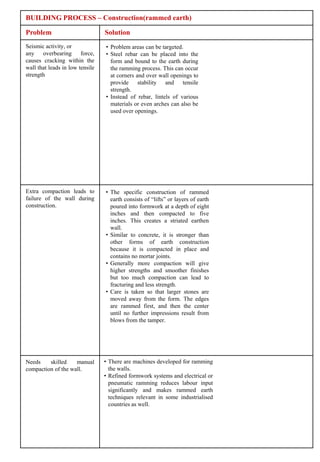
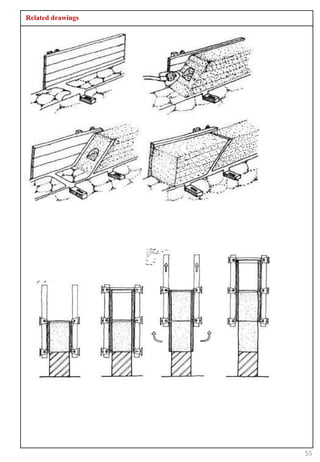
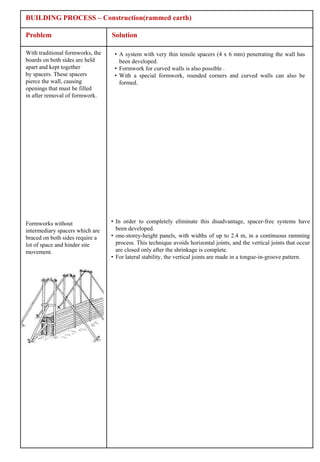
      Two parallel planks are held firmly apart by metal rods and clips or bolts, or by small crosspieces of wood.
      Stiff mud is thrown in between these two planks and rammed down with either a wooden or metal ramrod.
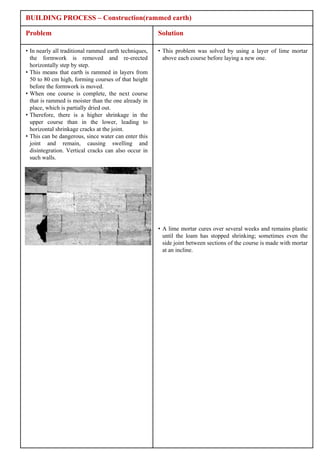
      When one section is completed and hard, the two boards are moved along and the process is repeated.
      The two planks are then raised up and a second course of rammed earth is repeated over the first.
      Two techniques have traditionally been developed. They used either horizontal or vertical formworks.
      The horizontal technique was used in many parts of the world. Strips of walls were built horizontally and their height
       varied from 30 to 90 cm.
      The formwork consisted of 2 wooden panels held together with wooden clamps and keys, which were tightened with
       ropes. Once one portion of a wall was completed, the formwork is immediately dismantled and moved further along.
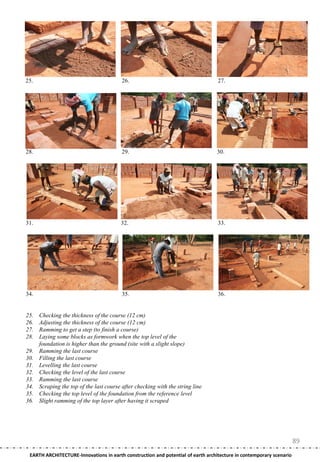
      Humid soil was evenly poured into the formwork to get a regular course of about 12-15 cm thickness. Ramming was
       traditionally done by hand.
      The soil is first rammed along the sides of the panels and the central portion of the wall is rammed immediately after
       that.
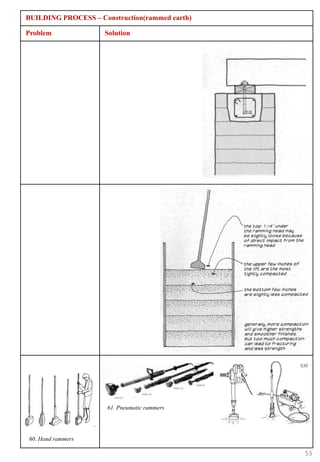
      Every course is rammed till the rammer hitting the soil gives a clear sharp sound and the rammer is not doing anymore
       marks on the course.
      Unstabilised soil is concentrated horizontally, and alignment is from layer to layer of wall.
      Stabilized soil is concentrated vertically, and alignment is between forms.
      Openings for doors and windows within the wall are created with block outs.
      Corners are made stronger if created as one piece as opposed to solely having a joint between two.
      The specific construction of rammed earth consists of “lifts” or layers of earth poured into formwork at a depth of eight
       inches and then compacted to five inches. This creates a striated earthen wall.
      After the wall completely goes up and is cured (twenty eight to fifty-six day period) any fixtures may be added. The roof
       is tied into the wall, and window and doorframes are added. Fixings are buried deep within the wall to retain structural
       integrity. In addition, utilities and systems, determined before construction, may pass within the wall to a certain degree.
       The final part of the construction process is to apply a wall finish, if desired or required.


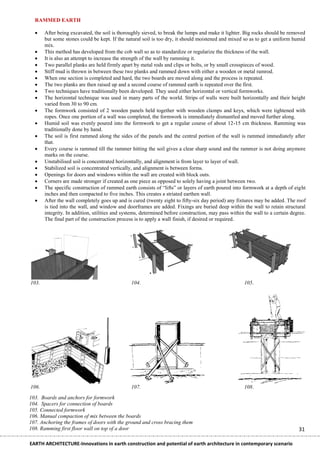
103.                                            104.                                                 105.


106.                                            107.                                                 108.
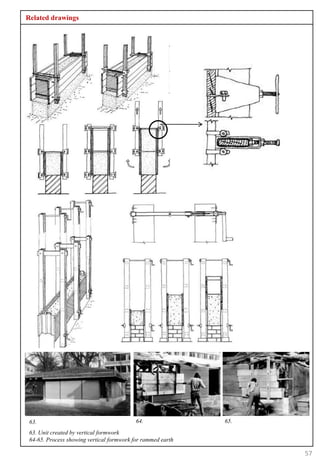
103. Boards and anchors for formwork
104. Spacers for connection of boards
105. Connected formwork
106. Manual compaction of mix between the boards
107. Anchoring the frames of doors with the ground and cross bracing them
108. Ramming first floor wall on top of a door                                                                                 31

EARTH ARCHITECTURE-Innovations in earth construction and potential of earth architecture in contemporary scenario
     The approximate proportion of subsoil is thirty percent clay/silt to seventy percent sand/gravel. Water has a direct impact on
      the strength of finished walls, and depending on the soil mix, is eight to sixteen percent of the mix.
     An optional stabilizer may be added – four to twelve percent depending on conditions such as bonding strength of the clay,
      seismic activity, desired construction process, or desired wall proportions.
     Stabilizers include cement, lime, or pozzolan added to the mix.
     There are numerous field and laboratory tests to be run at all stages of the material gathering process, each to determine the
      specific mix peculiar to the site. These include density, compressive strength, bond strength, and erosion and wear resistance
      tests.
     Soil stabilization gave a great input to rammed earth as well as mechanization.
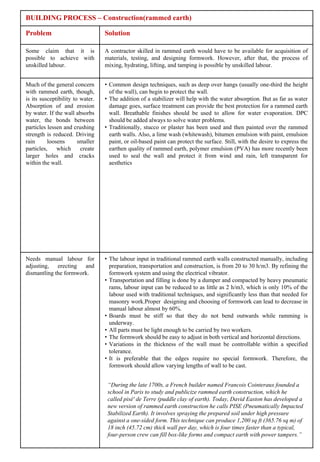
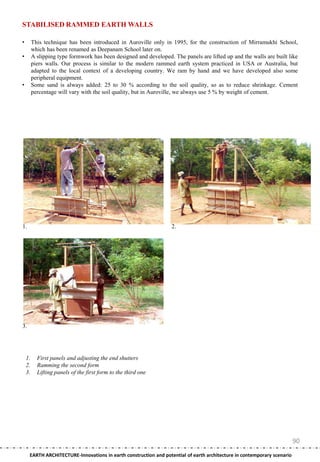
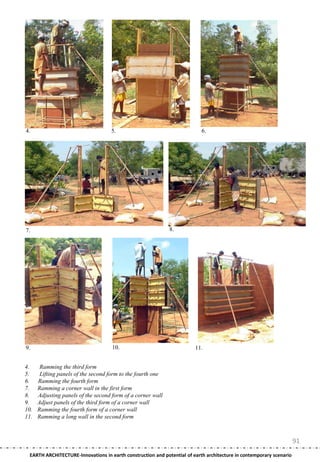
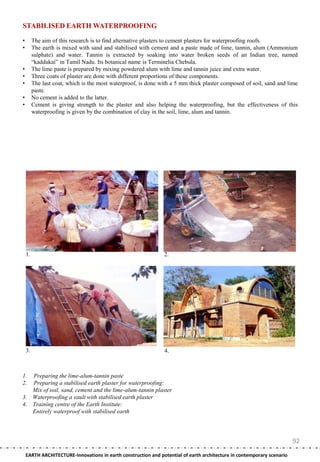
     The traditional wooden rammer has been replaced by pneumatic rammers.
     Heavy wooden formworks evolved into light composite ones, made of plywood, wood and steel or sometimes aluminium.
     Pneumatic rammers, dumpy loaders, mixers, ban conveyors, etc. allowed to build faster and get a better quality finish.
     Structures are most of the time built with pier walls, meaning that walls are built up to their full height at once. This way of
      building changed totally the design pattern of structures.


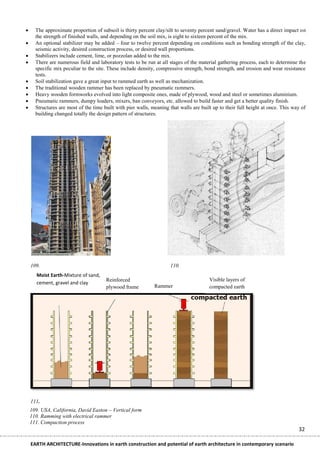
    109.                                                             110.
       Moist Earth-Mixture of sand,
                                       Reinforced                                       Visible layers of
       cement, gravel and clay
                                       plywood frame          Rammer                    compacted earth


    111.
    109. USA, California, David Easton – Vertical form
    110. Ramming with electrical rammer
    111. Compaction process
                                                                                                                                  32

    EARTH ARCHITECTURE-Innovations in earth construction and potential of earth architecture in contemporary scenario
Innovations in earth construction

 “CONTEXT- The necessity for speed was one of the big factors that contribute to that break with tradition. It probably took a
 thousand years for us to find out by trial and error how to make a mud wall impervious to rain and wind, another thousand
 years to learn how to keep termites out of it, and another two or three thousand to learn how to build multi-storied mud
 buildings.”

 -Laurie Baker (life, work and writings), Page 19


 “On the one hand, raw earth is still used … as basic shelter on a massive scale by hundreds of millions of people throughout
 the world. On the other hand, a new generation of architects and engineers, fascinated by the qualities of this highly ecological
 resource, is finally rediscovering and reasserting its value, modernising its technology and adapting raw earth construction to
 a broad range of modern applications:...” (2002:9).

 -The series of articles by Detheir and Eaton appeared in the September 2003 issue of ByggKunst


         This chapter mainly tells about the problems associated with earth architecture and is divided into four parts according
          to the various stages of a building process:

         1.        Designing
         2.        Construction
         3.        Maintenance
         4.        Demolition/reuse

         Now, there are innovations, detailing and some necessary precautions that can overcome those problems, limitations
          and make earth construction as a viable system for building.

         Primary case studies include buildings seen and measure drawn (the required details) in Kutch and Auroville.
         According to the problems identified through the questionnaire and secondary case studies, there are solutions that are
          mentioned in the charts through primary case studies.


                                                                                                                               33

EARTH ARCHITECTURE-Innovations in earth construction and potential of earth architecture in contemporary scenario
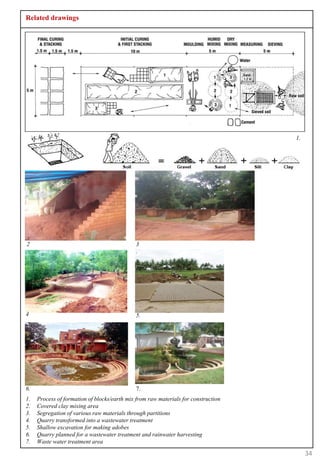
PRIMARY CASE STUDIES


Problem         Solution

Management of   • When building with earth, one should pay a lot of attention of the management of resources
earth     raw     and raw materials. Topsoil should be scraped away, so as to be re-used for agriculture or
materials and     gardens. Sieve the soil preferably in the quarry: the waste soil can be re-used on the spot to
mixing is a       finalize the landscaping.
complex         • One should always plan how the excavation would be used afterward. Design the quarry (area
process.          and depth) according to the future use of the hole. Dig according to the design requirements:
                  steps or slope, deep holes or shallow excavation, etc.
                • A proper management of the earth resources can create a new and harmonious balance
                  between nature and the buildings.
                • Auroville shows various possibilities for the use of quarries: as water harvesting ponds, waste
                  water treatment ponds, pools, basement floors or shallow Biological wastewater treatment
                  depressions which are used for landscape design, work or play areas, gardens, etc.
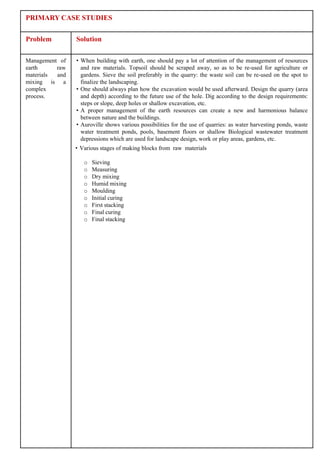
                • Various stages of making blocks from raw materials

                   o   Sieving
                   o   Measuring
                   o   Dry mixing
                   o   Humid mixing
                   o   Moulding
                   o   Initial curing
                   o   First stacking
                   o   Final curing
                   o   Final stacking
Related drawings


                                                                                    1.


2                                             3
.                                             .


4                                             5.
.


6.                                            7.
1.   Process of formation of blocks/earth mix from raw materials for construction
2.   Covered clay mixing area
3.   Segregation of various raw materials through partitions
4.   Quarry transformed into a wastewater treatment
5.   Shallow excavation for making adobes
6.   Quarry planned for a wastewater treatment and rainwater harvesting
7.   Waste water treatment area

                                                                                         34
PRIMARY CASE STUDIES

Problem                  Solution

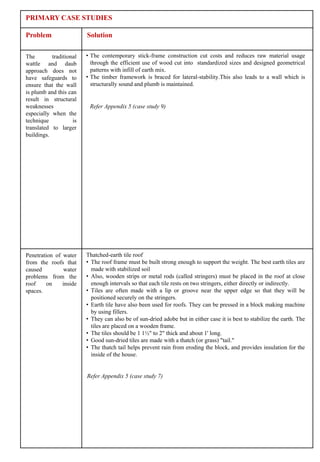
The        traditional   • The contemporary stick-frame construction cut costs and reduces raw material usage
wattle and daub            through the efficient use of wood cut into standardized sizes and designed geometrical
approach does not          patterns with infill of earth mix.
have safeguards to       • The timber framework is braced for lateral-stability.This also leads to a wall which is
ensure that the wall       structurally sound and plumb is maintained.
is plumb and this can
result in structural
weaknesses                Refer Appendix 5 (case study 9)
especially when the
technique           is
translated to larger
buildings.


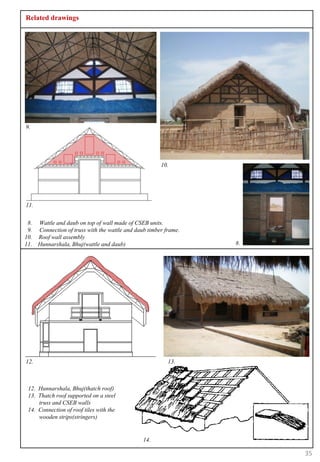
Penetration of water     Thatched-earth tile roof
from the roofs that      • The roof frame must be built strong enough to support the weight. The best earth tiles are
caused          water      made with stabilized soil
problems from the        • Also, wooden strips or metal rods (called stringers) must be placed in the roof at close
roof     on    inside      enough intervals so that each tile rests on two stringers, either directly or indirectly.
spaces.                  • Tiles are often made with a lip or groove near the upper edge so that they will be
                           positioned securely on the stringers.
                         • Earth tile have also been used for roofs. They can be pressed in a block making machine
                           by using fillers.
                         • They can also be of sun-dried adobe but in either case it is best to stabilize the earth. The
                           tiles are placed on a wooden frame.
                         • The tiles should be 1 1½" to 2" thick and about 1' long.
                         • Good sun-dried tiles are made with a thatch (or grass) "tail."
                         • The thatch tail helps prevent rain from eroding the block, and provides insulation for the
                           inside of the house.


                         Refer Appendix 5 (case study 7)
Related drawings


9.


                                                      10.


11.

 8. Wattle and daub on top of wall made of CSEB units.
 9. Connection of truss with the wattle and daub timber frame.
10. Roof wall assembly
11. Hunnarshala, Bhuj(wattle and daub)                           8.


12.                                                      13.


 12. Hunnarshala, Bhuj(thatch roof)
 13. Thatch roof supported on a steel
     truss and CSEB walls
 14. Connection of roof tiles with the
     wooden strips(stringers)


                                               14.

                                                                      35
PRIMARY CASE STUDIES

Problem                 Solution

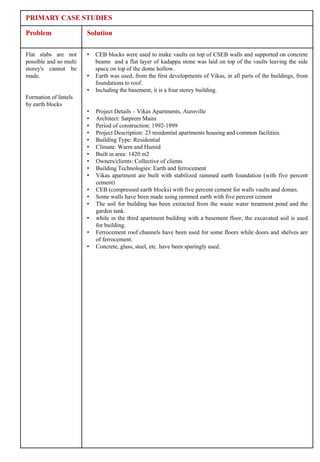
Flat slabs are not      •   CEB blocks were used to make vaults on top of CSEB walls and supported on concrete
possible and so multi       beams and a flat layer of kadappa stone was laid on top of the vaults leaving the side
storey's cannot be          space on top of the dome hollow.
made.                   •   Earth was used, from the first developments of Vikas, in all parts of the buildings, from
                            foundations to roof.
                        •   Including the basement, it is a four storey building.
Formation of lintels
by earth blocks
                        •   Project Details – Vikas Apartments, Auroville
                        •   Architect: Satprem Maini
                        •   Period of construction: 1992-1999
                        •   Project Description: 23 residential apartments housing and common facilities.
                        •   Building Type: Residential
                        •   Climate: Warm and Humid
                        •   Built in area: 1420 m2
                        •   Owners/clients: Collective of clients
                        •   Building Technologies: Earth and ferrocement
                        •   Vikas apartment are built with stabilized rammed earth foundation (with five percent
                            cement)
                        •   CEB (compressed earth blocks) with five percent cement for walls vaults and domes.
                        •   Some walls have been made using rammed earth with five percent cement
                        •   The soil for building has been extracted from the waste water treatment pond and the
                            garden tank.
                        •   while in the third apartment building with a basement floor, the excavated soil is used
                            for building.
                        •   Ferrocement roof channels have been used for some floors while doors and shelves are
                            of ferrocement.
                        •   Concrete, glass, steel, etc. have been sparingly used.
Related drawings


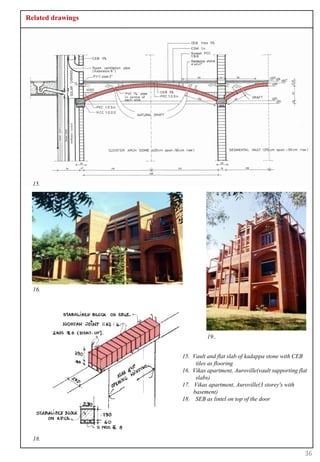
  15.


  16.


                             19..


                   15. Vault and flat slab of kadappa stone with CEB
                        tiles as flooring
                   16. Vikas apartment, Auroville(vault supporting flat
                        slabs)
                   17. Vikas apartment, Auroville(3 storey's with
                       basement)
                   18. SEB as lintel on top of the door


  18.

                                                                      36
PRIMARY CASE STUDIES

Problem                 Solution

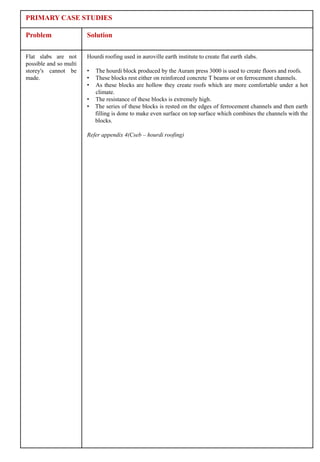
Flat slabs are not      Hourdi roofing used in auroville earth institute to create flat earth slabs.
possible and so multi
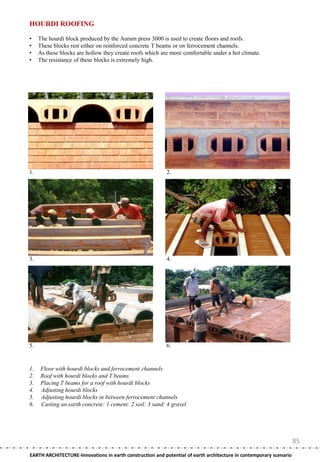
storey's cannot be      •   The hourdi block produced by the Auram press 3000 is used to create floors and roofs.
made.                   •   These blocks rest either on reinforced concrete T beams or on ferrocement channels.
                        •   As these blocks are hollow they create roofs which are more comfortable under a hot
                            climate.
                        •   The resistance of these blocks is extremely high.
                        •   The series of these blocks is rested on the edges of ferrocement channels and then earth
                            filling is done to make even surface on top surface which combines the channels with the
                            blocks.

                        Refer appendix 4(Cseb – hourdi roofing)
Related drawings


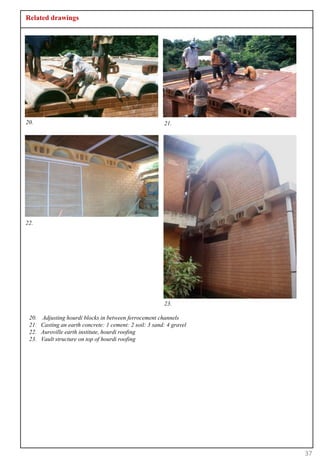
20.                                                       21.


22.


                                                          23.

 20.   Adjusting hourdi blocks in between ferrocement channels
 21.   Casting an earth concrete: 1 cement: 2 soil: 3 sand: 4 gravel
 22.   Auroville earth institute, hourdi roofing
 23.   Vault structure on top of hourdi roofing


                                                                       37
PRIMARY CASE STUDIES

Problem            Solution

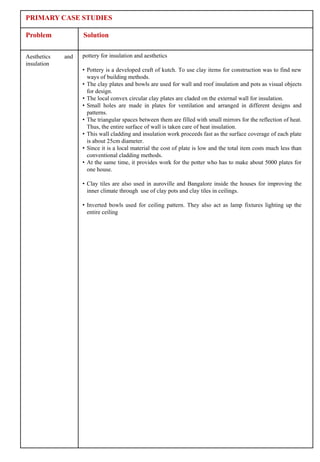
Aesthetics   and   pottery for insulation and aesthetics
insulation
                   • Pottery is a developed craft of kutch. To use clay items for construction was to find new
                     ways of building methods.
                   • The clay plates and bowls are used for wall and roof insulation and pots as visual objects
                     for design.
                   • The local convex circular clay plates are claded on the external wall for insulation.
                   • Small holes are made in plates for ventilation and arranged in different designs and
                     patterns.
                   • The triangular spaces between them are filled with small mirrors for the reflection of heat.
                     Thus, the entire surface of wall is taken care of heat insulation.
                   • This wall cladding and insulation work proceeds fast as the surface coverage of each plate
                     is about 25cm diameter.
                   • Since it is a local material the cost of plate is low and the total item costs much less than
                     conventional cladding methods.
                   • At the same time, it provides work for the potter who has to make about 5000 plates for
                     one house.

                   • Clay tiles are also used in auroville and Bangalore inside the houses for improving the
                     inner climate through use of clay pots and clay tiles in ceilings.

                   • Inverted bowls used for ceiling pattern. They also act as lamp fixtures lighting up the
                     entire ceiling
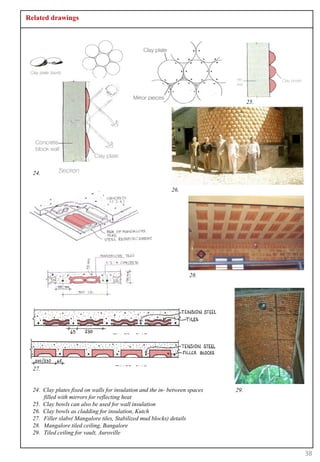
Related drawings


                                                                                   25.


  24.

                                                            26.


                                                                    28.


  27.


  24. Clay plates fixed on walls for insulation and the in- between spaces   29.
      filled with mirrors for reflecting heat
  25. Clay bowls can also be used for wall insulation
  26. Clay bowls as cladding for insulation, Kutch
  27. Filler slabs( Mangalore tiles, Stabilized mud blocks) details
  28. Mangalore tiled ceiling, Bangalore
  29. Tiled ceiling for vault, Auroville


                                                                                         38
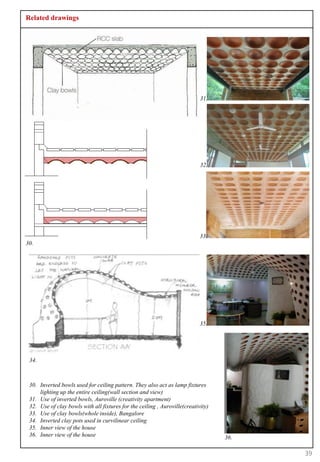
Related drawings


                                                                            31.


                                                                            32.


                                                                            33.
30.


                                                                            35.


 34.


 30. Inverted bowls used for ceiling pattern. They also act as lamp fixtures
     lighting up the entire ceiling(wall section and view)
 31. Use of inverted bowls, Auroville (creativity apartment)
 32. Use of clay bowls with all fixtures for the ceiling , Auroville(creativity)
 33. Use of clay bowls(whole inside), Bangalore
 34. Inverted clay pots used in curvilinear ceiling
 35. Inner view of the house
 36. Inner view of the house                                                       36.

                                                                                         39
PRIMARY CASE STUDIES

Problem               Solution

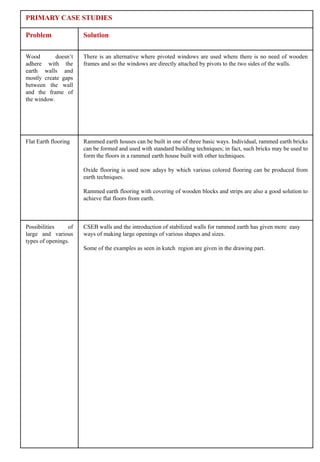
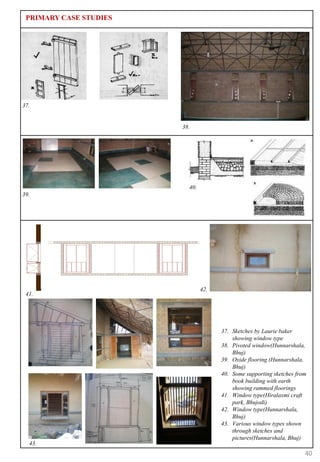
Wood        doesn‟t   There is an alternative where pivoted windows are used where there is no need of wooden
adhere with the       frames and so the windows are directly attached by pivots to the two sides of the walls.
earth walls and
mostly create gaps
between the wall
and the frame of
the window.


Flat Earth flooring   Rammed earth houses can be built in one of three basic ways. Individual, rammed earth bricks
                      can be formed and used with standard building techniques; in fact, such bricks may be used to
                      form the floors in a rammed earth house built with other techniques.

                      Oxide flooring is used now adays by which various colored flooring can be produced from
                      earth techniques.

                      Rammed earth flooring with covering of wooden blocks and strips are also a good solution to
                      achieve flat floors from earth.


Possibilities    of   CSEB walls and the introduction of stabilized walls for rammed earth has given more easy
large and various     ways of making large openings of various shapes and sizes.
types of openings.
                      Some of the examples as seen in kutch region are given in the drawing part.
PRIMARY CASE STUDIES


37.


                        38.


                          40.
39.


                                42.
 41.


                                      37. Sketches by Laurie baker
                                          showing window type
                                      38. Pivoted window(Hunnarshala,
                                          Bhuj)
                                      39. Oxide flooring (Hunnarshala,
                                          Bhuj)
                                      40. Some supporting sketches from
                                          book building with earth
                                          showing rammed floorings
                                      41. Window type(Hiralaxmi craft
                                          park, Bhujodi)
                                      42. Window type(Hunnarshala,
                                          Bhuj)
                                      43. Various window types shown
                                          through sketches and
                                          pictures(Hunnarshala, Bhuj)
  43.
                                                                      40
PRIMARY CASE STUDIES

Problem                        Solution

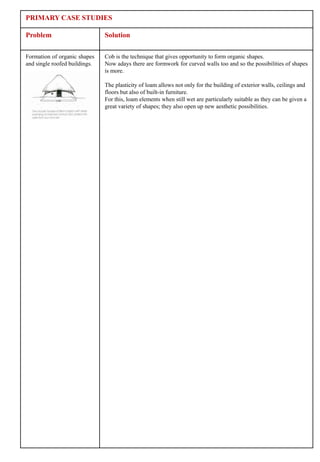
Formation of organic shapes    Cob is the technique that gives opportunity to form organic shapes.
and single roofed buildings.   Now adays there are formwork for curved walls too and so the possibilities of shapes
                               is more.

                               The plasticity of loam allows not only for the building of exterior walls, ceilings and
                               floors but also of built-in furniture.
                               For this, loam elements when still wet are particularly suitable as they can be given a
                               great variety of shapes; they also open up new aesthetic possibilities.
Related drawings


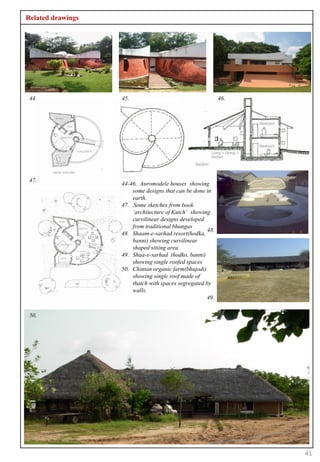
 44                45.                                      46.


 47.
                   44-46. Auromodele houses showing
                       some designs that can be done in
                       earth.
                   47. Some sketches from book
                       „architecture of Kutch‟ showing
                       curvilinear designs developed
                       from traditional bhungas
                                                      48.
                   48. Shaam-e-sarhad resort(hodka,
                       banni) showing curvilinear
                       shaped sitiing area
                   49. Shaa-e-sarhad (hodko, banni)
                       showing single roofed spaces
                   50. Chintan organic farm(bhujodi)
                       showing single roof made of
                       thatch with spaces segregated by
                       walls.
                                                     49.

 50.


                                                                  41
PRIMARY CASE STUDIES

Problem                      Solution

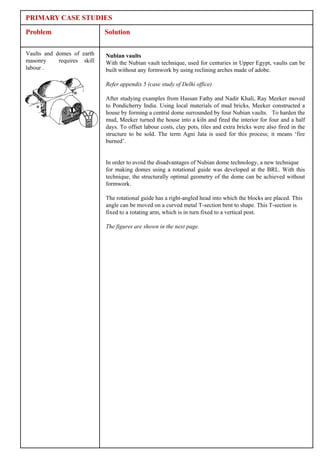
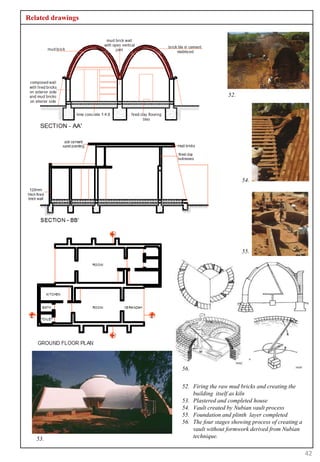
Vaults and domes of earth    Nubian vaults
masonry     requires skill   With the Nubian vault technique, used for centuries in Upper Egypt, vaults can be
labour .                     built without any formwork by using reclining arches made of adobe.

                             Refer appendix 5 (case study of Delhi office)

                             After studying examples from Hassan Fathy and Nadir Khali, Ray Meeker moved
                             to Pondicherry India. Using local materials of mud bricks, Meeker constructed a
                             house by forming a central dome surrounded by four Nubian vaults. To harden the
                             mud, Meeker turned the house into a kiln and fired the interior for four and a half
                             days. To offset labour costs, clay pots, tiles and extra bricks were also fired in the
                             structure to be sold. The term Agni Jata is used for this process; it means „fire
                             burned‟.


                             In order to avoid the disadvantages of Nubian dome technology, a new technique
                             for making domes using a rotational guide was developed at the BRL. With this
                             technique, the structurally optimal geometry of the dome can be achieved without
                             formwork.

                             The rotational guide has a right-angled head into which the blocks are placed. This
                             angle can be moved on a curved metal T-section bent to shape. This T-section is
                             fixed to a rotating arm, which is in turn fixed to a vertical post.

                             The figures are shown in the next page.
Related drawings


                                     52.


                                           54.


                                           55.


                   56.

                   52. Firing the raw mud bricks and creating the
                       building itself as kiln
                   53. Plastered and completed house
                   54. Vault created by Nubian vault process
                   55. Foundation and plinth layer completed
                   56. The four stages showing process of creating a
                       vault without formwork derived from Nubian
   53.                 technique.

                                                                       42
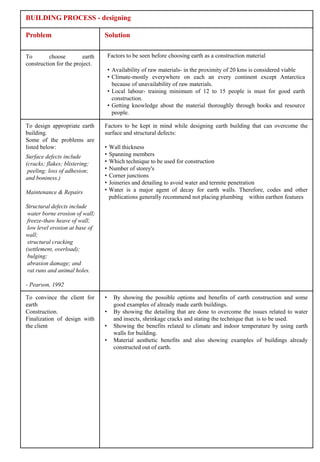
BUILDING PROCESS - designing

Problem                         Solution

To        choose        earth       Factors to be seen before choosing earth as a construction material
construction for the project.
                                    • Availability of raw materials- in the proximity of 20 kms is considered viable
                                    • Climate-mostly everywhere on each an every continent except Antarctica
                                      because of unavailability of raw materials.
                                    • Local labour- training minimum of 12 to 15 people is must for good earth
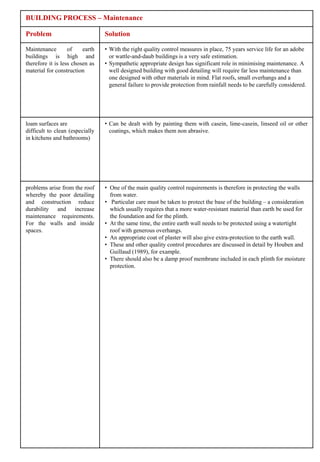
                                      construction.
                                    • Getting knowledge about the material thoroughly through books and resource
                                      people.

To design appropriate earth     Factors to be kept in mind while designing earth building that can overcome the
building.                       surface and structural defects:
Some of the problems are
listed below:                   •   Wall thickness
Surface defects include         •   Spanning members
(cracks; flakes; blistering;    •   Which technique to be used for construction
 peeling; loss of adhesion;     •   Number of storey's
and boniness.)                  •   Corner junctions
                                •   Joineries and detailing to avoid water and termite penetration
Maintenance & Repairs           •   Water is a major agent of decay for earth walls. Therefore, codes and other
                                    publications generally recommend not placing plumbing within earthen features
Structural defects include
 water borne erosion of wall;
 freeze-thaw heave of wall;
 low level erosion at base of
wall;
 structural cracking
(settlement, overload);
 bulging;
 abrasion damage; and
 rat runs and animal holes.

- Pearson, 1992

To convince the client for      •     By showing the possible options and benefits of earth construction and some
earth                                 good examples of already made earth buildings.
Construction.                   •     By showing the detailing that are done to overcome the issues related to water
Finalization of design with           and insects, shrinkage cracks and stating the technique that is to be used.
the client                      •     Showing the benefits related to climate and indoor temperature by using earth
                                      walls for building.
                                •     Material aesthetic benefits and also showing examples of buildings already
                                      constructed out of earth.
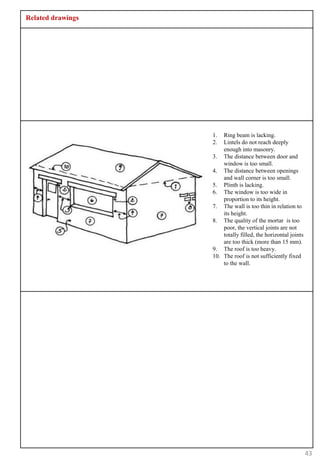
Related drawings


                   1.  Ring beam is lacking.
                   2.  Lintels do not reach deeply
                       enough into masonry.
                   3. The distance between door and
                       window is too small.
                   4. The distance between openings
                       and wall corner is too small.
                   5. Plinth is lacking.
                   6. The window is too wide in
                       proportion to its height.
                   7. The wall is too thin in relation to
                       its height.
                   8. The quality of the mortar is too
                       poor, the vertical joints are not
                       totally filled, the horizontal joints
                       are too thick (more than 15 mm).
                   9. The roof is too heavy.
                   10. The roof is not sufficiently fixed
                       to the wall.


                                                               43
BUILDING PROCESS - designing

Problem                         Solution

Less     durable as     a       • It is mostly because of the less thought given to the construction details at the
construction     material         initial stages of the design process.
compared to conventional        • The joint of the wall with the plinth has to be carefully designed so that the
materials.                        rainwater can flow down unhindered without entering the joint between wall and
                                  plinth.
Water problems
Termite      and      rodents
penetrating the walls
Roof connections with the
wall base


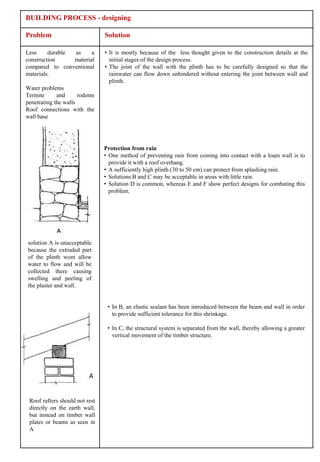
                                Protection from rain
                                • One method of preventing rain from coming into contact with a loam wall is to
                                  provide it with a roof overhang.
                                • A sufficiently high plinth (30 to 50 cm) can protect from splashing rain.
                                • Solutions B and C may be acceptable in areas with little rain.
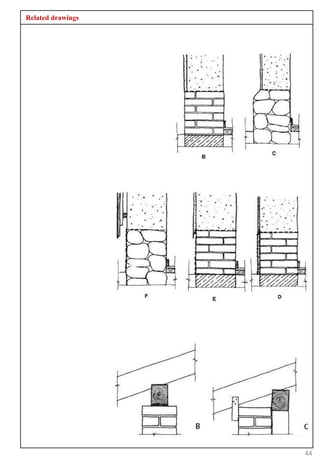
                                • Solution D is common, whereas E and F show perfect designs for combating this
                                  problem.


solution A is unacceptable
because the extruded part
of the plinth wont allow
water to flow and will be
collected there causing
swelling and peeling of
the plaster and wall.


                                 • In B, an elastic sealant has been introduced between the beam and wall in order
                                   to provide sufficient tolerance for this shrinkage.

                                 • In C, the structural system is separated from the wall, thereby allowing a greater
                                   vertical movement of the timber structure.


 Roof rafters should not rest
 directly on the earth wall,
 but instead on timber wall
 plates or beams as seen in
 A
Related drawings


                   44
BUILDING PROCESS – designing

Problem                           Solution

Loam is not a standardised        • Depending on the site where the loam is dug out, it will be composed of differing
building material                   amounts and types of clay, silt, sand and aggregates.
                                  • Its characteristics, therefore, may differ from site to site, and the preparation
                                  • of the correct mix for a specific application may also differ.
                                  • In order to judge its characteristics and alter these, when necessary, by applying
                                    additives, one needs to know the specific composition of the loam involved.


Professionals make less           • If the earth construction techniques and construction become widespread , all the
money from earth building           prejudices and hesitations for its use as a construction material get removed
projects.                           gradually by proper training sessions and classes then it will lead to improvement
                                    in the construction industry in developing countries and indirectly to the
                                    professionals in money matters.


• The traditional hut is          • Now adays various techniques have developed which can produce good spanning
  limited to a single round         members and structural members and so it becomes easy to cater various facilities
  or square room of about           in a single roof with inner divisions of spaces by walls.
  3m diameter with conical        • Various shapes are possible other than those round huts with thatch roofs with the
  roof.                             innovation of loam walls and prefabricated panels of loam.
• This limited size and
  shape means a single hut
  usually               cannot
  accommodate           several
  functions under one roof.
  Traditionally      therefore,
  several huts are required
  to cater for the diverse
  requirements in a Single
  home.
• With      the     traditional
  approach to building, all
  rooms (such as kitchen,
  sitting,         bathrooms,
  bedrooms etc) cannot be
  contained under the same
  roof.
• This results in functional
  inconveniences which is
  one cause of the social
  undesirability             of
  traditional buildings.
• Refer appendix, part 3 for
  drawings


                                                                                                                    45
BUILDING PROCESS – Construction(adobe)

Problem                        Solution
Load bearing floor slabs are   • Loam elements which act as infill between floor joints also provide sound and
not possible.                    thermal insulation.
                               • In Hungary in 1987, Gernot Minke developed load-bearing infill elements with
                                 cement-stabilised lightweight loam. various designs for load-bearing floor panels
                                 were developed at that time.
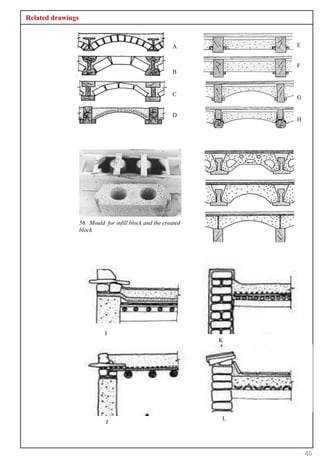
                               • various designs for vaulted loam floors. Designs E, F, G, H are load bearing and
                                 use heavy elements made of earth.
                               • A, B and C use earthen blocks, which transfer slab loads to the beams by vault-
                                 action under compression.
                               • Design D shows a non-load bearing loam vault made by pouring lightweight loam
                                 over a curved reed mat.
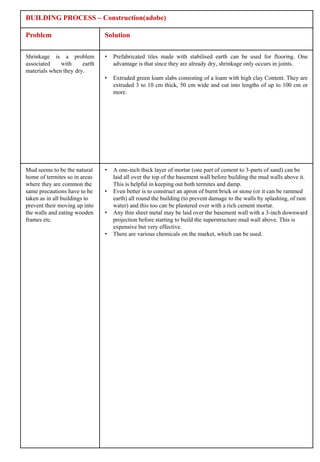
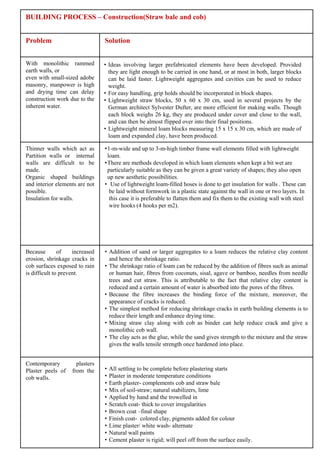
                               • When making loam-covered flat roofs, it should be kept in mind that roof edges
                                 are susceptible to mechanical damage, especially by wind and water erosion. This
                                 can be prevented by solutions of the type shown in
                               • I,, j, k, l. If the surface of the roof is to be walked upon, then tiles are
                                 recommended as shown in l.
Related drawings


                                                         A          E


                                                                    F
                                                         B


                                                         C
                                                                    G

                                                         D
                                                                    H


                   56. Mould for infill block and the created
                   block


                             I
                                                                K


                                                                L
                              J


                                                                        46
BUILDING PROCESS – Construction(adobe)

Problem                        Solution

Fixing fasteners to walls      • Nails can be driven into an earth block walls more easily than into those
leads to cracking of the         constructed of baked bricks.
blocks.                        • The more porous and humid the material, the easier one can drive a nail through it.
                                 Green bricks tend to split more easily than soil blocks and adobes.
                               • If very thick nails are used, it is advisable to drill a hole into the block.
                               • Heavy shelves or wall hung cabinets can be fixed to the wall easily using screws
                                 and dowels. Dowel holes, however, should be drilled large enough to
                               • prevent blocks from cracking.


With monolithic rammed         • Different sections for larger wall panels made of lightweight mineral loam, are
earth walls, or even with        developed now adays.
small-sized adobe masonry,
manpower is high and           • These can be used either in internal walls, or to increase the thermal insulation of
drying time can delay            exterior walls from the outside. Cavities reduce weight and increase thermal
construction work due to the     insulation, while simultaneously providing grip holds for easy handling.
inherent water.
                               • Similar elements that can be used for making vaults.
Related drawings


                   57. Interior wall of pre fabricated loam
                   blocks


                                                              47
BUILDING PROCESS – Construction(adobe)

Problem                         Solution


Due to mechanical impacts,      As loam plaster is susceptible to mechanical impact, corners should preferably be
corners often                   covered by wooden profiles, baked bricks or similar lippings.
break during the handling of
mud bricks.The corners of
the walls get spoiled and
deteriorated.


Surface treatment for adobe     • If sufficiently moistened with a tool like a felt trowel, exposed earth block masonry
walls                             with uneven surfaces or joints can be easily smoothened. Plastering is not
Protection against rising         advisable, since it interferes with the capacity of loam walls to balance internal air
damp                              humidity .
• Exterior loam walls have      • However, exposed earth block masonry can, if not aesthetically acceptable, be
  to be protected from rising     given a wash of loam slurry stabilised with, for example, lime, lime casein etc. This
  damp in the same way as         wash also impacts the wall‟s surface stability .
  baked brick or stone
  masonry walls.
• A damp-proof course, a 3
  to 4-cm-thick rich cement
  concrete layer is often
  used as an alternative.
• This       should        be
  impregnated with bitumen
  or waste Mobil oil.
Related drawings


                                                    Bricks


                                                 Mud bricks


                                             Timber sections

                                                 Earth wall


  58. Wall plastered with lime, casein and
  loam


                                                               48
BUILDING PROCESS – Construction(adobe)

Problem                        Solution

Shrinkage is a problem         •   Prefabricated tiles made with stabilised earth can be used for flooring. One
associated    with     earth       advantage is that since they are already dry, shrinkage only occurs in joints.
materials when they dry.
                               •   Extruded green loam slabs consisting of a loam with high clay Content. They are
                                   extruded 3 to 10 cm thick, 50 cm wide and cut into lengths of up to 100 cm or
                                   more.


Mud seems to be the natural    •   A one-inch thick layer of mortar (one part of cement to 3-parts of sand) can be
home of termites so in areas       laid all over the top of the basement wall before building the mud walls above it.
where they are common the          This is helpful in keeping out both termites and damp.
same precautions have to be    •   Even better is to construct an apron of burnt brick or stone (or it can be rammed
taken as in all buildings to       earth) all round the building (to prevent damage to the walls by splashing, of rain
prevent their moving up into       water) and this too can be plastered over with a rich cement mortar.
the walls and eating wooden    •   Any thin sheet metal may be laid over the basement wall with a 3-inch downward
frames etc.                        projection before starting to build the superstructure mud wall above. This is
                                   expensive but very effective.
                               •   There are various chemicals on the market, which can be used.
Related drawings


59. Extruded loam slabs, Germany


                                   Rich cement mortar


                                                        49
BUILDING PROCESS – Construction(wattle and daub)

Problem                         Solution

From a technical viewpoint,     • The minimum width of the foundations will be 40cm.It is advisable to use a ratio
it is clear the traditional       1.5 times the width of the wall. The minimum height of the base between ground
wattle-and-daub           has     and the wall base will be 20cm.
problems that reduce its
durability to about 30 years.

One of the main problems is
lack of a waterproof base
such that the wooden poles
and earth are in direct
contact with the ground
thereby getting exposed to
moisture and termite attack.

the wall absorbs humidity
when it rains and the daub is
washed off from the wattle.


Flooding occurs if the level    • In kitchens and bathrooms, the plinth should have a waterproof skirting of tiles,
of the inside floor is lower      slates, rich cement plaster etc.
than outside. If the above      • The skirting design should prevent water from leaking or broken pipes, which
occurs the wall will be           could flood floors, from reaching the loam wall.
weakened and will easily
collapse in the event of any
natural disaster.
Related Drawings
Problem                        Solution

                                                      Wood
                                                      column


                                    Outside           inside
                       rain          2%
                                                                          Foundations: column embedded in
                                                                          the concrete.
inside               outside
                                                         3" nails for
                                                         adherence


                                      inside       Outside
 Absorption of humidity
                                                         2%
                                                                        Foundation continued till the base of
                                                                        the wall extending from the ground
                                                                        level


                                      Outside           inside
                                          2%


outside               inside                                                Wall base with concrete blocks
                                                                            (39x19x14cm) or similar material
                                                                            and concrete filling.


                                                   wooden support


                                          inside    Outside
          Flooding
                                                      2%


                                                                          Foundation with wooden column
                                                        3/8"              fixed to the concrete wall base.
                                                        iron
                                                        anchor

                                                                                                                50
BUILDING PROCESS – Construction(wattle and daub)

Problem                         Solution

Another technical problem       PLASTERING
is in regard to finishes. The
walls and floors are finished   Treatment applied to the surface of the wall with the aim of protecting it against the
with earth and painted with     weather and use.
dung-stabilised soil.
                                Also used to make the house more aesthetic.

To get a more hardwearing       A wall protected by facing will be in better conditions in the event of an earthquake
and aesthetically pleasing
plaster, some people try to
                                 1. Preparation:
use sand-cement plaster on
                                 Clean the wall in order to eliminate any loose soil or
the earth walls. But this
                                 sand, to guarantee the adherence of the plastering to
creates an extra problem
                                 the wall section. If the wall is wet, you should wait a
because sand-cement plaster
                                 while so that any water inside the wall can evaporate
does not stick to earth walls
                                 and be absorbed
(hence the plaster peels off
                                 2. The underlay:
after a short time).
                                 Used to level out the wall's imperfections and so it can
                                 receive this finishing layer. The thickness of this layer
                                 will be between 8mm and 20mm. The mortar must
                                 have the following proportions:
                                 1 part of earth at 5mm diameter.
                                 2 parts of sand (which go through the 5 mm mesh)
                                 1/3 of straw cut into 3cms strips.
                                 3. “Incisions”
                                 Before the first layer, dries, "incisions" are made
                                 using a metal brush or nails. This improves the
                                 adhesion of the second layer onto the first.
Special skills needed for        4. The second layer: "the finish". An aesthetic thin
plastering.                      seal or protective layer, added once the first layer is
                                 completely dry.
                                 The thickness is between 1 and 2mm.
                                 The mortar will approximately be:
                                 1 part of earth (which goes through the 2mm mesh)
                                 3 or 4 of fine sand.
                                 When making the plaster it is important to test
                                 different mixes, changing the proportions until the
                                 right mix which does not crack and which is resistant
                                 is achieved.
                                 5. Sealing
                                 Use a sponge making circular movements then wait
                                 for
                                 between 15 and 20 minutes before using a dry paint
                                 brush in straight movements, the aim is to seal the
                                 surface.
                                 Alternatives: there are other alternatives and
                                 combinations.
                                 Lime and sand,
                                 Lime, sand, earth,
                                 Chalk and sand,
                                 Chalk, lime and sand

                                 For anchoring plaster to smooth compressed blocks at
                                 ground splash level, use chicken wire mesh.
Related drawings


                   51
BUILDING PROCESS – Construction(wattle and daub)

Problem                          Solution

From a technical viewpoint,      •   The timber framework is braced for lateral-stability. The pre fabricated wooden
it is clear the traditional          panels can create walls that are structurally sound and can maintain the plumb.
wattle-and-daub           has
problems that reduce its         •   Also the problem of in situ construction is solved by such panels.
durability to about 30 years.
                                 •   The prefabricated panel is a sawed wooden frame, filled with interwoven cane or
The traditional approach             bamboo battens, inserted in such a way that they are self-anchoring.
does not have safeguards to      •    After being assembled these panels are walls which will be plastered with earth
ensure that the wall is plumb        and straw mortar with an initial layer and then a thin finishing layer.
and this can result in           •   The advantage of prefabricated panels is that they enable the panels and the
structural       weaknesses          structure that will carry them in the wall to be made at the same time, thus
especially      when       the       reducing assembly time.
technique is translated to
larger buildings

lack of diagonal bracing
means that the walls do not
always have lateral stability
– especially after the
building base has been
weakened by moisture and
termite attack.
Related drawings


                   52
BUILDING PROCESS – Construction(rammed earth)

Problem                          Solution
Seismic activity, or             • Problem areas can be targeted.
any overbearing         force,   • Steel rebar can be placed into the
causes cracking within the         form and bound to the earth during
wall that leads in low tensile     the ramming process. This can occur
strength                           at corners and over wall openings to
                                   provide stability and tensile
                                   strength.
                                 • Instead of rebar, lintels of various
                                   materials or even arches can also be
                                   used over openings.


Extra compaction leads to        • The specific construction of rammed
failure of the wall during         earth consists of “lifts” or layers of earth
construction.                      poured into formwork at a depth of eight
                                   inches and then compacted to five
                                   inches. This creates a striated earthen
                                   wall.
                                 • Similar to concrete, it is stronger than
                                   other forms of earth construction
                                   because it is compacted in place and
                                   contains no mortar joints.
                                 • Generally more compaction will give
                                   higher strengths and smoother finishes
                                   but too much compaction can lead to
                                   fracturing and less strength.
                                 • Care is taken so that larger stones are
                                   moved away from the form. The edges
                                   are rammed first, and then the center
                                   until no further impressions result from
                                   blows from the tamper.


Needs    skilled    manual       • There are machines developed for ramming
compaction of the wall.            the walls.
                                 • Refined formwork systems and electrical or
                                   pneumatic ramming reduces labour input
                                   significantly and makes rammed earth
                                   techniques relevant in some industrialised
                                   countries as well.
BUILDING PROCESS – Construction(rammed earth)

Problem              Solution


                      61. Pneumatic rammers


60. Hand rammers

                                                53
BUILDING PROCESS – Construction(rammed earth)

Problem                           Solution

Some claim that it is             A contractor skilled in rammed earth would have to be available for acquisition of
possible to achieve with          materials, testing, and designing formwork. However, after that, the process of
unskilled labour.                 mixing, hydrating, lifting, and tamping is possible by unskilled labour.


Much of the general concern       • Common design techniques, such as deep over hangs (usually one-third the height
with rammed earth, though,          of the wall), can begin to protect the wall.
is its susceptibility to water.   • The addition of a stabilizer will help with the water absorption. But as far as water
Absorption of and erosion           damage goes, surface treatment can provide the best protection for a rammed earth
by water. If the wall absorbs       wall. Breathable finishes should be used to allow for water evaporation. DPC
water, the bonds between            should be added always to solve water problems.
particles lessen and crushing     • Traditionally, stucco or plaster has been used and then painted over the rammed
strength is reduced. Driving        earth walls. Also, a lime wash (whitewash), bitumen emulsion with paint, emulsion
rain      loosens       smaller     paint, or oil-based paint can protect the surface. Still, with the desire to express the
particles,    which      create     earthen quality of rammed earth, polymer emulsion (PVA) has more recently been
larger holes and cracks             used to seal the wall and protect it from wind and rain, left transparent for
within the wall.                    aesthetics


Needs manual labour for           • The labour input in traditional rammed earth walls constructed manually, including
adjusting, erecting and             preparation, transportation and construction, is from 20 to 30 h/m3. By refining the
dismantling the formwork.           formwork system and using the electrical vibrator.
                                  • Transportation and filling is done by a dumper and compacted by heavy pneumatic
                                    rams, labour input can be reduced to as little as 2 h/m3, which is only 10% of the
                                    labour used with traditional techniques, and significantly less than that needed for
                                    masonry work.Proper designing and choosing of formwork can lead to decrease in
                                    manual labour almost by 60%.
                                  • Boards must be stiff so that they do not bend outwards while ramming is
                                    underway.
                                  • All parts must be light enough to be carried by two workers.
                                  • The formwork should be easy to adjust in both vertical and horizontal directions.
                                  • Variations in the thickness of the wall must be controllable within a specified
                                    tolerance.
                                  • It is preferable that the edges require no special formwork. Therefore, the
                                    formwork should allow varying lengths of wall to be cast.


                                   “During the late 1700s, a French builder named Francois Cointeraux founded a
                                   school in Paris to study and publicize rammed earth construction, which he
                                   called pisé' de Terre (puddle clay of earth). Today, David Easton has developed a
                                   new version of rammed earth construction he calls PISE (Pneumatically Impacted
                                   Stabilized Earth). It involves spraying the prepared soil under high pressure
                                   against a one-sided form. This technique can produce 1,200 sq ft (365.76 sq m) of
                                   18 inch (45.72 cm) thick wall per day, which is four times faster than a typical,
                                   four-person crew can fill box-like forms and compact earth with power tampers.”
BUILDING PROCESS – Construction(rammed earth)


                                      62. Earth projected on one side wooden planks to create
                                      a wall


                                                                                                54
BUILDING PROCESS – Construction(rammed earth)

Problem                                                Solution

• In nearly all traditional rammed earth techniques,   • This problem was solved by using a layer of lime mortar
  the formwork is removed and re-erected                 above each course before laying a new one.
  horizontally step by step.
• This means that earth is rammed in layers from
  50 to 80 cm high, forming courses of that height
  before the formwork is moved.
• When one course is complete, the next course
  that is rammed is moister than the one already in
  place, which is partially dried out.
• Therefore, there is a higher shrinkage in the
  upper course than in the lower, leading to
  horizontal shrinkage cracks at the joint.
• This can be dangerous, since water can enter this
  joint and remain, causing swelling and
  disintegration. Vertical cracks can also occur in
  such walls.


                                                       • A lime mortar cures over several weeks and remains plastic
                                                         until the loam has stopped shrinking; sometimes even the
                                                         side joint between sections of the course is made with mortar
                                                         at an incline.
Related drawings


                   55
BUILDING PROCESS – Construction(rammed earth)

Problem                    Solution

As with rammed earth       • In some cases, it is preferable to use a thin masonry wall or stiff thermal insulation
techniques, the cost         elements made of wooden materials as lost formwork, so that either no formwork or
of the formwork is quite     only one-sided formwork is required.
high.                      • It is also advantageous if this formwork can contribute to a substantial increase in
                             thermal insulation. The stiffness of this lost formwork has to be sufficient to take care
                             of the lateral impacts created by ramming.


                           • The inner leaf can be made from adobes or soil blocks, larger pre-fabricated loam
                             elements, or stiff plywood boards, fibre-reinforced gypsum boards, or wood
                             particleboard. Protection of the wall surface against the elements can be achieved by
                             plaster, masonry or timber panelling with air cavity.


                           • The first two cases show an inner leaf built of adobes or soil blocks and an outer
                             rammed earth layer made with lightweight mineral loam which is directly plastered. In
                             this case the formwork is only required for the outer face.
                           • In the second case, a somewhat better stiffness of the inner adobe or soil block leaf is
                             attained due to the bonding pattern in the components.
                           • In the section shown on the right, the lost formwork is on the outside and is made from
                             stabilised lightweight soil blocks.
Related drawings


                   56
BUILDING PROCESS – Construction(rammed earth)

Problem                           Solution

With traditional formworks, the    • A system with very thin tensile spacers (4 x 6 mm) penetrating the wall has
boards on both sides are held        been developed.
apart and kept together            • Formwork for curved walls is also possible .
by spacers. These spacers          • With a special formwork, rounded corners and curved walls can also be
pierce the wall, causing             formed.
openings that must be filled
in after removal of formwork.


Formworks without                 • In order to completely eliminate this disadvantage, spacer-free systems have
intermediary spacers which are      been developed.
braced on both sides require a    • one-storey-height panels, with widths of up to 2.4 m, in a continuous ramming
lot of space and hinder site        process. This technique avoids horizontal joints, and the vertical joints that occur
movement.                           are closed only after the shrinkage is complete.
                                  • For lateral stability, the vertical joints are made in a tongue-in-groove pattern.
Related drawings


 63.                                       64.               65.
 63. Unit created by vertical formwork
 64-65. Process showing vertical formwork for rammed earth

                                                                   57
BUILDING PROCESS – Construction(rammed earth)

Problem                          Solution

Curved walls are not             Some potential methods for making loam walls with improved thermal insulations
possible.                        are being developed.

Corner junctions are
difficult to be made.

Insulation for climatic
variations.

Patterns on walls


with a stabilizer, the process   • Reasons for adding a stabilizer far outweigh not, as it speeds the construction
is a bit more complicated          process, improves durability, allows thinner walls, and requires less of a surface
and expensive                      treatment.
                                 • If a stabilizer has been added (especially cement), lifting the wall must begin
                                   immediately thereafter.

Plastering a rammed earth        • A rammed earth wall requires less labour and material inputs for surface treatment
wall                               compared to walls made using other earth construction techniques.
                                 • As a rule, it is neither necessary nor advisable to plaster a rammed earth wall. If
                                   the surface is sponged with a moist felt trowel immediately after dismantling the
                                   formwork, then a smooth surface is easily produced, one that may be painted or
                                   wallpapered (in cases involving interior wall surfaces).
                                 • If exterior surfaces thus treated are sheltered from rain by roof overhangs and
                                   against splashing by a plinth, a coating of paint is sufficient to protect them against
                                   the elements. Care should be taken that coatings neither peel nor crack.
Related drawings


                   68.


                   69.


                   70.


66.


                    71.

                    66. insulated rammed earth wall section and view
                    67. Imprints on rammed earth wall made while
                         creating formwork
67.                 68. Formwork for curved walls
                    69. Formwork for circular unit
                    70. Insulated rammed earth wall detail
                    71. Corner junctions and columns of rammed earth
                                                                       58
BUILDING PROCESS – Construction(Straw bale and cob)


Problem                          Solution


With monolithic rammed           • Ideas involving larger prefabricated elements have been developed. Provided
earth walls, or                    they are light enough to be carried in one hand, or at most in both, larger blocks
even with small-sized adobe        can be laid faster. Lightweight aggregates and cavities can be used to reduce
masonry, manpower is high          weight.
and drying time can delay        • For easy handling, grip holds should be incorporated in block shapes.
construction work due to the     • Lightweight straw blocks, 50 x 60 x 30 cm, used in several projects by the
inherent water.                    German architect Sylvester Dufter, are more efficient for making walls. Though
                                   each block weighs 26 kg, they are produced under cover and close to the wall,
                                   and can then be almost flipped over into their final positions.
                                 • Lightweight mineral loam blocks measuring 15 x 15 x 30 cm, which are made of
                                   loam and expanded clay, have been produced.

Thinner walls which act as       •1-m-wide and up to 3-m-high timber frame wall elements filled with lightweight
Partition walls or internal       loam.
walls are difficult to be        •There are methods developed in which loam elements when kept a bit wet are
made.                             particularly suitable as they can be given a great variety of shapes; they also open
Organic shaped buildings          up new aesthetic possibilities.
and interior elements are not    • Use of lightweight loam-filled hoses is done to get insulation for walls . These can
possible.                          be laid without formwork in a plastic state against the wall in one or two layers. In
Insulation for walls.              this case it is preferable to flatten them and fix them to the existing wall with steel
                                   wire hooks (4 hooks per m2).


Because        of    increased   • Addition of sand or larger aggregates to a loam reduces the relative clay content
erosion, shrinkage cracks in       and hence the shrinkage ratio.
cob surfaces exposed to rain     • The shrinkage ratio of loam can be reduced by the addition of fibres such as animal
is difficult to prevent.           or human hair, fibres from coconuts, sisal, agave or bamboo, needles from needle
                                   trees and cut straw. This is attributable to the fact that relative clay content is
                                   reduced and a certain amount of water is absorbed into the pores of the fibres.
                                 • Because the fibre increases the binding force of the mixture, moreover, the
                                   appearance of cracks is reduced.
                                 • The simplest method for reducing shrinkage cracks in earth building elements is to
                                   reduce their length and enhance drying time.
                                 • Mixing straw clay along with cob as binder can help reduce crack and give a
                                   monolithic cob wall.
                                 • The clay acts as the glue, while the sand gives strength to the mixture and the straw
                                   gives the walls tensile strength once hardened into place.


Contemporary          plasters
Plaster peels of    from the     •   All settling to be complete before plastering starts
cob walls.                       •   Plaster in moderate temperature conditions
                                 •   Earth plaster- complements cob and straw bale
                                 •   Mix of soil-straw; natural stabilizers, lime
                                 •   Applied by hand and the trowelled in
                                 •   Scratch coat- thick to cover irregularities
                                 •   Brown coat –final shape
                                 •   Finish coat- colored clay, pigments added for colour
                                 •   Lime plaster/ white wash- alternate
                                 •   Natural wall paints
                                 •   Cement plaster is rigid; will peel off from the surface easily.
Related drawings


                                     72. Straw clay for walls


                                          73.                   75.


                                                         76.


                              73. Bathroom, private residence in Kassel, Germany
                              74. Bedroom, private residence in Kassel, Germany
                   74.        75. Loam walls as partitions
                              76. Additional insulation using hoses filled with lightweight loam


                    77. Plastering loam walls

                                                                                                   59
BUILDING PROCESS – Construction(cob)

Problem                        Solution

Wood doesn‟t adhere to         Possible joint designs of loam filled hoses, adobes and lightweight loam with posts
loam surfaces because of       of timber or brickwork, or with door and window frames of timber. (horizontal
shrinkage issues when the      sections)
loam is wet and even after
drying, so one has to detail
out the fenestrations with
care.


Earth flooring produces an     •   Compact sub-soil to flat level; slope to out to drain
uneven surface and cannot      •   Minimum 4” layer of gravel; screen out fine particles
form flat floorings.           •   Base layer of coarse gravel, sand, clay, full length straw
                               •   Second layer- smoother/finer mix- chopped straw
                               •   Wait until complete plastering before the final layer
                               •   Smooth mix- shredded straw
                               •   Boiled linseed oil finish –durability; waterproofing
Related drawings


                   78-79. Creating flat floors
                   from earth mix


                                                 60
BUILDING PROCESS – Maintenance

Problem                          Solution

Maintenance        of    earth   • With the right quality control measures in place, 75 years service life for an adobe
buildings is high and              or wattle-and-daub buildings is a very safe estimation.
therefore it is less chosen as   • Sympathetic appropriate design has significant role in minimising maintenance. A
material for construction          well designed building with good detailing will require far less maintenance than
                                   one designed with other materials in mind. Flat roofs, small overhangs and a
                                   general failure to provide protection from rainfall needs to be carefully considered.


loam surfaces are                • Can be dealt with by painting them with casein, lime-casein, linseed oil or other
difficult to clean (especially     coatings, which makes them non abrasive.
in kitchens and bathrooms)


problems arise from the roof     • One of the main quality control requirements is therefore in protecting the walls
whereby the poor detailing         from water.
and construction reduce          • Particular care must be taken to protect the base of the building – a consideration
durability and increase            which usually requires that a more water-resistant material than earth be used for
maintenance requirements.          the foundation and for the plinth.
For the walls and inside         • At the same time, the entire earth wall needs to be protected using a watertight
spaces.                            roof with generous overhangs.
                                 • An appropriate coat of plaster will also give extra-protection to the earth wall.
                                 • These and other quality control procedures are discussed in detail by Houben and
                                   Guillaud (1989), for example.
                                 • There should also be a damp proof membrane included in each plinth for moisture
                                   protection.
BUILDING PROCESS – Maintenance


There are no generally adopted guidelines on the routine maintenance of earth structures. Obviously these depend
very much on the nature and complexity of the structure, but for simple one- to two-storey buildings, some guidance
is provided in the Australian earth building handbook (Standards Australia, 2002) and summarised in Table 9.1 below.


 Item               Check
 Control joints     Conduction of sealants, cleanliness of joints, vegetation
 Damp               Integrity of damp proofing and flashing along base course door/window frames
 proof/flashing
 Door/window        Loosening of door and window frame anchorage; evidence of moisture penetration; conduction
 frames             of sealant; difficulty opening(evidence of building settlement)
 Drainage           Leaking drains, downpipes, guttering, blockage of drains and evidence of overflow, ponding of
                    rainwater, integrity of splash-back courses
 Earth floors       Wearing of surfaces, damage to protective coating, damp
 Footings           Damp, settlement(cracking of footing/ground slab),foundation material, undermining foundation
 Metallic           Integrity of fixing connection, evidence of corrosion of metallic fittings, cracking or spalling of
 fixtures           wall
 Roof/verandas      Structural integrity, tighten holding down bolts, leaks
 Surface            Abrasive damage, cracking, erosion, peeling, spalling, separation
 coatings
 Termites           Evidence of termite and other harmful insect activity, integrity of barrier
 Vegetation         Cut-back over growth near building, avoid planting large tress close to the buildings
 Walls              Cracking(shrinkage, settlement, thermal, overload, lintel bearings, services); structural integrity,
                    erosion, damp, weep-holes/ventilation ducts clean
Chart 6


                                                                                                                           61
BUILDING PROCESS – Demolition/Re-use

Problem                        Solution

If the earth building          Loam is always reusable :
demolishes then what are its   Unbaked loam can be recycled an indefinite number of times over an extremely long
reusability criteria's?        period. Old dry loam can be reused after soaking in water, so loam never becomes a
                               waste material that harms the environment.
                               According to Lal (1995, p122), the major advantage of the stabilised soil block
                               versus the burnt brick is the significant saving in energy (about70%) and such blocks
                               are cheaper by 20 to 40% compared to burnt bricks and after the building is
                               demolished can be reused and the broken blocks merge with the existing ground soil.


                                                                                                                  62
Conclusion
“Defects of earth buildings can assume two main forms: deficiencies of surface coatings; and, structural defects. In the context
of this review structural defects are taken as defects to the wall as separate from defects to surface coatings and finishes.
Problems to other elements of the building not formed from earth, such as roof or windows, are not considered in this review.
If not suitably treated, deficiencies to surface coatings can result in more significant structural deficiencies. It is clearly
important to understand the causes of any defects before attempting its repair. If the causes of the defect are not correctly
addressed it is most likely that the same problem will reoccur.”

    -      Pearson, 1992


“People in traditional vernacular desert cultures knew how to make the buildings they need. Inhabitants integrate materials,
climate, other physical constraints and cultural practice into architectural forms that meet the needs of individuals and groups.
“

    -      Crouch, 2001


       Earth is one of the most ancient construction materials and is still proved appropriate and viable in the contemporary
        construction. The continued and widespread use earth across the world is testimony to its success as a building material.
       There is a wide range of structures made out of earth. There are single storey, multi storey, temporary structures,
        permanent structures, monumental and heritage structures, being made from earth since ages. The range lies from toys to
        dwellings, resorts to institutions, palaces, and forts.
       Nowadays there is a wide scope of working with earth materials because there are various techniques developed and
        innovated. There are many alterations and additions done in the traditional methods that improve the earth construction
        and widen its use.
       The contemporary use is very neat and different as compared to traditional use of earth for construction. The need of
        maintaining earth buildings has reduced almost to nil because precautions are taken in every process of building i.e.
        designing, maintenance of raw materials on site, construction and even after the building is demolished earth can degrade
        easily into the existing ground and the other dead materials like wood can be used for new construction.
       The basic composition of raw materials for earth (clay, soil, sand, silt, gravel) remains same in every earth technique, the
        proportion changes. This gives advantage of experimenting with the material, techniques and methods of construction.
       It is used with glass, steel, fabric, concrete and mostly can combine with any material for construction.
       The combination of technical, functional and aesthetic problems of the earth buildings make it socially undesirable. This
        social undesirable situation is a key motivation for this study.
       It is not always easy to produce building material out of a clayey soil, and experience is required. The right preparation
        depends on the type of earth, its consistency and its expected applications.
       The principles of mud housing can be replicated in any environment where mud can be obtained. Special architectural
        skills are not necessary for construction of single dwelling homes. Multi-storeyed projects may require the assistance of
        architects or engineers.
       The principles of construction are simple to explain and the techniques equally easy to work with.
       Developments and innovations prove that earth construction is still a viable economic and environmentally conscious
        technique.


Techniques:

       Cob is good for curved or round walls, interior furniture, partition walls and curvilinear designs
       Pise or rammed earth is strong and ideal for solid, squat, single to double storey building and for buildings needing
        insulation and protection from outer harsh climate.
       Adobe or sundried bricks can easily cope with two storey houses.
       Pressed bricks are smooth and very strong and can build three storeys.
       Wattle and daub is elegant and fine for seismic zones.
       Earthbag technique is used mainly for temporary structures.


                                                                                                                                 63

EARTH ARCHITECTURE-Innovations in earth construction and potential of earth architecture in contemporary scenario
Construction:

   Many new stabilizers have been introduced in techniques like CSEB (compressed stabilized earth blocks), rammed earth,
    adobe that help change the weak properties and characteristics of raw earth and make its use more flexible. Even thinner
    walls are possible now adays because of new techniques tools and machines. Even if stabilizers are added then its energy
    consumption is less compared to other conventional construction materials.
   Mud has very different characteristics while it is wet and dry because while it is wet it is very heavy and has clayey
    property which helps to bind the wattles. And while it is wet it shrinks and loses its plasticity and also reduces the weight.
   If we take care of the minor details like roof joints, corner junctions and all what are discussed in this thesis, we can come
    up with a very affordable, practical earth building that can serve without any maintenance.
   Design and detailing of these buildings has evolved and developed in recognition of the material’s low strength, relatively
    high drying shrinkage, poor water resistance and low thermal resistance. Thick walls required to provide sufficient
    mechanical resistance also offer high thermal mass and improved insulation.
   Good detailing inhibits deterioration and minimises maintenance costs.
   Extended eaves and raised footings protect walls from rainfall. Though services are readily incorporated into walls during
    construction they are often fixed externally for ease of construction and maintenance.
   Door and window openings of varying spans are provided using a variety of techniques, including lintels and arches as
    well as leaving gaps between panels. Non-structural fixings, such as shelving, may also be readily accommodated.
   Soil homogeneity is important in earth construction in order to ensure minimum localised failure. The procedures that are
    required in order to reduce the variations in soil quality depend on the type of soil used.
   Several types of formwork exist. The selection of the right type of formwork for the right application is important in order
    to increase the efficiency during the construction phase of an earth project.
   The right type of formwork for a given application depends on the level of mechanisation available, the relative labour
    cost and the type of structure. For simple structures more traditional formwork might be appropriate.
   Architectural forms with non-linear surfaces are more time consuming and expensive to build.

GENERAL POINTS DERIVED FROM THE THESIS

   Earth construction is regarded as a local job creation opportunity with very less embodied energy required compared to
    other materials.
   Earth construction is economically beneficial.
   It requires simple tools and local labour.
   Suitable for very strong and secured structures.
   It saves energy and is an environmental friendly material.
   It balances and improves indoor air humidity and temperature which ensures thermal comfort.
   Earth is very good in fire resistance.
   Loam preserves timber and other organic materials.
   Earth wall (loam) absorbs pollutants.
   Earth building provides noise control.
   Earth is readily available in large quantities in most regions.
   As much durable as other conventional construction materials.
   Special skills not needed for construction, can be easily taught to local public.
   Loam is not a standardised building material.

   Can produce various shaped buildings that are aesthetically appealing.


                                                                                                                               64

EARTH ARCHITECTURE-Innovations in earth construction and potential of earth architecture in contemporary scenario
Appendix 1

INTERVIEWS AND DISCUSSIONS WITH SUBJECT EXPERTS


QUESTIONNAIRE

ARCHITECTS:

    1.    How does earth construction contribute to the contemporary architecture?
    2.    Which are the critical issues in various earth construction techniques?
    3.    How do you convince a client for this kind of architecture? Are they positive about your this attempt at first go?
    4.    How can we establish the study and implementation of earthen traditional construction techniques as viable methods
          for contemporary design?
    5.    What points you keep in mind while designing an earth structure?
    6.    Is designing with earth materials different than designing with any other materials like brick, concrete? What are the
          positive and negative points about it?
    7.    What are the limitations of earth materials?
    8.    What are the advantages of earthen buildings?
    9.    Is it like that mud is not as strong as cement and steel? Are multi storey building possible out of mud?
    10.   What are the key contributions that earthen architecture can make to the field of sustainable development?
    11.   How different construction techniques performed and evolved through time?
    12.   What about the operating energy and energy used during construction of earthen buildings to be able to compare it
          with other building materials?
    13.   Why mud isn’t considered modern?
    14.   Is earth architecture cheap, strong and ecologically sound compared to other materials?
    15.   How do earthen constructions perform in disasters?
    16.   Is earth architecture possible anywhere in the world or the region matters for such type of architecture?
    17.   What are the innovations and experiments that you have done in your projects when compared to traditional earth
          construction?

CONTRACTORS/ENGINEERS:

    1.  Have you trained labourers and made your own construction team?
    2.  For how many weeks you trained your team?
    3.  Which are the details you watch out and are important to be taken care of while earth construction is going on?
    4.  According to you, what are the critical areas that have to be detailed out while working with earthy materials like
        mud, thatch, lime?
    5. As per your knowledge, how working with earth is different than other materials like steel, concrete, etc..?
    6. Is it that earth buildings take more time compared to other building materials for construction?
    7. Is it any special technique that you and your team work with or you train them for every technique related to mud?
    8. What are the measures you take in the buildings you make out of earth materials to protect them from water and
        termites?
    9. Do you use cement for stabilisation and strengthening? If yes than how much percentage of cement is used maximum
        in an earth building?
    10. How more strength and life can be achieved for an earth structure? What are the methods or alterations you have
        worked out till now in your projects to achieve them?
    11. Is there any special detailing or joinery that you have come up with to solve the problems related to these earth
        construction or to improve it?
    12. Do you experiment with materials before you use them for construction for their stability or strength?


                                                                                                                             65

EARTH ARCHITECTURE-Innovations in earth construction and potential of earth architecture in contemporary scenario
LABOURERS:

   1.   Are you trained by anyone for this kind of construction? For how much time were you trained?
   2.   Have you worked with other materials like bricks, stone, and concrete earlier?
   3.   Is working with mud a tough job compared to other materials or it is easier than them? Have you worked with mud
        before you were trained?
   4.   Is learning this type of construction harder compared to other construction?
   5.   Does this take more labour and time compared to other construction techniques?


CLIENTS:

   1.   Where you convinced at first attempt by your architect about making a mud building for you?
   2.   What were the points or factors you thought of when you were given choice between mud and other modern
        materials?
   3.   Why did you opt for this kind of material and construction finally?
   4.   What was the house or structure made up of in which you lived/worked earlier? Do you find it different than this earth
        building you living/working in? How?
   5.   Do you find this type of structure climatically sounder than others or you find it the same?
   6.   Do you require more maintenance of this structure compared to your earlier one?
   7.   Do you take mud as a modern material? Would you recommend other people to use this material for their architecture
        or not?
   8.   What are the negative and positive points about earth construction as you have experienced being a user of it?
   9.   What are the things that according to you are still not possible in earth architecture/interior when you compare it to
        other architecture/interior?

PEOPLE INTERVIEWED IN KUTCH:

       Architects:
                       o Pratik zaveri
                       o Siddharth
       Contractors:
                   o Hemant dudhiya
                   o Keshavji bhai
    Skilled labourers:
                   o Raja
    Clients:
                   o Prashant (khamir)
                   o Manager (chintan farm house)
                   o
PEOPLE INTERVIEWED IN AUROVILLE:
    Architects:
                   o Satprem Maini
                   o Rosy
                   o Sri devi
    Technician, trainer, draftsmen, researcher :
                   o T. Ayyappan
    Skilled labourers and landscape designer:
                   o karthik


                                                                                                                           66

EARTH ARCHITECTURE-Innovations in earth construction and potential of earth architecture in contemporary scenario
Architect Satprem maini
Problems:-

        Water logging
        Fungus on the wall surfaces because of the rain
        Connection with the ground is direct and so termite problem.
        If not taken care of the overhangs and the proportions while designing it can lead to major problems of the walls
         cracking up and water percolation and penetration inside the living areas.
        Tensile strength is very less and so roofs are difficult from mud.
        Wood does not adhere to mud walls and so often gaps are seen between walls and openings.
        On site management of raw materials.
        Maintenance

Solution:-

        Design and organization, structural order, openings, spanning needs to be worked out properly before construction
         starts.
        New methods for block making for adobe construction
        Introduction of CSEB
        Two types of stabilisation process according to type of soil are available for the production of CSEB blocks so
         choosing them wisely by conducting soil tests can give blocks with great compressive strength and multi storey can
         be possible out of those blocks.
        High plinths
        Large overhangs
        Various types of new machines for making blocks-aurum press of various types.
        Variations in the shape, size and joinery of the CSEB blocks according to the need. For eg. Corner junction blocks,
         column blocks, beam blocks, wall blocks, flooring blocks are designed differently and manufactured.
        New ways of rammed earth giving more strength when compared to the brick walls.
        New resolved detailing and techniques for making mud roofs and giving a possibility to construct multi storey
         apartments from the same material.
        Well and proportionate mixture of the ingredients can give strong and finished blocks and walls.
        Trained and knowledgeable labour and teamwork with community participation.

Advantages:-

        Cheap compared to other modern materials
        Locally available and local labour
        No transportation because all the processes are on site
        Lowest embodied energy compared to other materials
        Passive and active cooling possible
        Materials from adobe construction can be reused and from other techniques the materials directly can merge with the
         ground soil after the structure is collapsed and hence no wastage of the materials.
        Any shape is possible and choice of various techniques is available for construction and designing.

Points for decision:-

        Raw earth or stabilised?
        Which technique?
        Clay amount and content?
        Region?
        Labour trained or local?


                                                                                                                         67

EARTH ARCHITECTURE-Innovations in earth construction and potential of earth architecture in contemporary scenario
Region:-

          World

           Almost everywhere eg. Auroville, Saudi Arabia, Shibam, Mali, Oman, Iran, Kutch, not possible everywhere because
           of the following reasons:

    o      Temperature
    o      Seasonal changes
    o      Lack of materials and knowledge of earth construction
    o      Range of climate
    o      Winter to summer cycles
    o      Very difficult in forest regions because of the clay content and so wattle and daub is the most favourable technique
           for earth construction in forest areas.
    o      Also in snow covered areas where earth its not possible because of unavailability of material and if done then
           transportation costs increases.

Kutch:-

          Very hot
          Not much rain
          For economy of construction
          Cheap labour
          Availability of materials and knowledge of earth construction
          Climatically favourable
          Can give up to 10 degrees temperature difference in the inside outside temperature.

Auroville-Vikas apartment:-

          Auroville climate range is 20-40 oC and is almost same the year.
          First apartment in auroville done by the architect with community participation and co-ordination
          Tallest earth construction in auroville
          Parapets for prevention of water and structural supports
          Fungus due to water logging on wall surfaces because of low overhangs


                                                                                                                            68

EARTH ARCHITECTURE-Innovations in earth construction and potential of earth architecture in contemporary scenario
Rosy (architect in earth institute), auroville

       Designing is almost same with all materials but what matters with mud is we have to check the availability of the
        materials on site and the labour has to be trained.

       Detailing needs to be proper because cracks, abrasion by water, termite attack are the common problems in such
        buildings.

       If we are talking about innovations then there are a lot more new techniques and methods which are being developed
        to overcome the limitations of earth as a building material.

       Methods like hourdi roofing; flat slabs through arches, composite staircase, cseb beams, and columns all are the new
        innovations that help make flat slabs possible, clear spanning inside the structures.

       Also this material is such that it lasts forever, it has lasted for ages if you study the history of earth buildings all over
        the world. Also, such buildings are aesthetically and climatically pleasant and much effort is not to be made to
        beautify them.

       It is available from the site itself, and is more of an in-situ construction but now adays cast earth is also possible, the
        same way like ready mix concrete.


Sketches done by the architect to explain
various new methods developed in auroville

                                                                                                                                  69

EARTH ARCHITECTURE-Innovations in earth construction and potential of earth architecture in contemporary scenario
Ar. Pratik and Ar. Siddharth (hunnarshala, bhuj)
Concepts based on technology are being developed now adays. Traditional and scientific way both go hand in hand. Because
of that more strength and life can be achieved for the structures made of earth materials.

Factors of design decisions

         Sun

        Form
        Fenestrations
        Space planning
        Building materials
        Construction techniques

         Wind

        Space planning
        Form
        Fenestrations

         Water

        Plinths
        Form
        Building materials

Design

        Wall thickness
        Overhangs
        Spanning
        Openings
        Corner junctions

Construction

        Water proofing
        Stabilizers
        CSEB (more finished, less energy consumed for manufacturing, on site production as per required, different blocks
         type possible as per detailing and junctions, thickness of wall) -bricks (comparison)


                                                                                                                       70

EARTH ARCHITECTURE-Innovations in earth construction and potential of earth architecture in contemporary scenario
Appendix 2

ANALYSIS OF SOIL

         To check its components or granulometry: handling – smell,
         its plasticity: the “cigar”
         Its cohesion: the “patch”.

The results of these tests show us the quality of the earth.


     1.   HANDLING – SMELL


             o    With our senses water enables us to identify the main components of earth.

         ORGANIC earth – Gives off a smell.
         SANDY earth - Rough, crumbly, not very sticky
         SILTY earth - Fine, easy to reduce to dust, sticky.
         CLAYEY earth – Difficult to break; slow to dissolve in water, very sticky and fine.


     -    THE BEST IS TO FIND BOTH SANDY AND CLAYEY EARTH FROM THE MIX.
     -    TAKE CARE WITH SILTY EARTH BECAUSE ONCE DRY IT DOES NOT RESIST WATER.


     2.   THE CIGAR


              o   Remove the gravel from the sample.
              o   Moisten, mix and allow the earth to settle for half an hour until the clay can react with the water.
              o   The earth should not dirty your hands.
              o   On a board, mould a cigar with a 3 cm diameter and
              o   20 cm long.
              o   Slowly push the cigar onto one edge.
              o   Measure the length of the piece which comes away.
              o   Carry out this operation 3 times then calculate the average length.

     -    BETWEEN 7 AND 15 CM OF GOOD EARTH.
     -    LESS THAN 5 CM. TOO SANDY
     -    MORE THAN 20 CM. TOO CLAYEY


                                                                                                                         71

EARTH ARCHITECTURE-Innovations in earth construction and potential of earth architecture in contemporary scenario
3.   THE PATCH


           o   Re-use the earth from the previous test in its plastic state.
           o   Mould 2 patches using a plastic tube or similar object.
           o   After drying: Observe any retraction that occurred.
           o   Assess the resistance of the earth by breaking and crushing between the thumb and the index finger


     SANDY earth- No retraction, easy to convert to dust:


     SILTY earth- Retraction, easy to convert into dust:


     CLAYEY earth- Significant retraction, very difficult to reduce to dust:

  -   LESS THAN 1 MM RETRACTION, DIFFICULT TO REDUCE TO DUST IS
      GOOD EARTH.


                                                                                                                    72

EARTH ARCHITECTURE-Innovations in earth construction and potential of earth architecture in contemporary scenario
Appendix 3

TRADITIONAL CONSTRUCTION DRAWINGS


1.


1.                                                               3.


1.   House in ludia(banni desert)
2.   The semi open space with thatch roof
3.   The raised plinth of the unit
                                                                                                                    73

EARTH ARCHITECTURE-Innovations in earth construction and potential of earth architecture in contemporary scenario
CONSTRUCTION

         A bhunga enclosed by a mud wall is the most typical construction for dwelling purposes.
         Its diameter may vary from 3 to 5 meters.
         The wall is constructed in two ways depending upon its location-ADOBE and WATTLE AND DAUB


                                                                                  5.


                                                                                  6.


     4.


                                                                                  7.


     4.   Typical wall section of a bhunga
     5.   The main vertical support connection with the roof center
     6.   Lipan done in semi open spaces that matches with the existing ground
     7.   Connection of wooden members
     8.   Finished and more structurally stable support structure
                                                                                  8.
                                                                                                                    74

EARTH ARCHITECTURE-Innovations in earth construction and potential of earth architecture in contemporary scenario
9.                                                                  10.


11.                                        12.                                    13.


9.    Wattle and daub section
10.   Adobe section
11.   Wooden members beneath the thatch
12.   Use of clay tiles for roof
13.   Horizontal main support connection with other members


                                                                                                                    75

EARTH ARCHITECTURE-Innovations in earth construction and potential of earth architecture in contemporary scenario
Appendix 4

CSEB and stabilized rammed earth
COMPOSITE BEAMS

•   This technique is extensively used in Auroville since 1993. U-shaped CSEB are reinforced with reinforced
    cement concrete.
•   Reinforcements vary with the span, but the rod diameter cannot exceed ∅ 12 mm for the Auram blocks 290 &
    295 and ∅ 16 mm for the Auram blocks 240 & 245.
•   The U blocks are used as lost shuttering, but they also help the compressive strength of the beam. Hence it
    becomes a composite technique as the reinforced concrete work in tension and the U block works in
    compression.
•   The concrete cast in the U shape is normally 1 cement: 2 sand: 4 gravel ½‘. The vertical mortar in between the
    U blocks is cement sand mortar CSM 1: 3 of 1 cm thickness.
•   Three types of beams have been developed:
    1.   Single height
    2.   Double height
    3.   Triple height

Single height beams (only 1 U block)

•    The U block is laid on a bed of sand of 1 cm and the concrete in cast in the U shape.
•    After 1 month curing the beam is returned and laid on the wall.
•    The maximum span for a single height beam will be limited to 1.5 m with 2 steel bars Ø 12 mm. ∅ 6 mm
    stirrups are laid at 25 cm c/c.


    1.                                                          2.


    3.

    1.   Casting a single height beam on the ground
    2.   Single height beam reversed on the wall
    3.   Single height beam section


                                                                                                                    77
EARTH ARCHITECTURE-Innovations in earth construction and potential of earth architecture in contemporary scenario
Double height beams (2 u blocks in opposite directions)

 •        The bottom part of the beam is cast first in a reversed position and after 1 month it is returned:
 •        Either on the ground and the top part is precast in other U blocks or the incomplete beam is lifted with care
          and the concrete is cast in situ into other U blocks.
 •        The maximum span for a double height beam will be limited to 2.25 m with 2 steel bars Ø 12 mm on the
          top and 2 steel bars Ø 12 mm on the bottom.
 •        ∅ 6 mm stirrups are laid in the thickness of the vertical mortar to link the tensile and compressive bars of
          the beam.
 •        The horizontal mortar joint is with cement sand mortar CSM 1: 3


     4.                                                           5.


     6.
                                                                  7.


     4.     Casting a double height beam on the ground
     5.     Lifting a double height beam
     6.     Double height beam reversed and cast on the wall
     7.     Double height beam section


                                                                                                                    78
EARTH ARCHITECTURE-Innovations in earth construction and potential of earth architecture in contemporary scenario
Triple height beams (1 U blocks downwards, 1 plain block in the middle, 1 U block
upwards)

•         The bottom part of the beam is cast first in a reversed position.
•         After 1 month it is returned and the incomplete beam is lifted with a lot of care and the rest of the beam
         (plain block in the middle and U block on top) is done in situ in.
•         The maximum span for a triple height beam will be limited to 3 m with 2 steel bars Ø 12 mm on the top
         and 2 steel bars Ø 12 mm on the bottom.
•         ∅ 6 mm stirrups are laid in the thickness of the vertical mortar to link the tensile and compressive bars of
         the beam. Note that this triple height beam is rarely precast fully on site as it is too heavy to lift.
•         The horizontal mortar joint is with cement sand mortar CSM 1: 3


    8.                                                     9.


    10.                                                    11.


 8. Casting a triple height beam on the ground
 9. Lifting a triple height beam
10. Triple height beam reversed and cast on the wall
11. Triple height beam section


                                                                                                                     79
EARTH ARCHITECTURE-Innovations in earth construction and potential of earth architecture in contemporary scenario
1.                                          2.                                      3.


4.                                          5.                                      6.


7.                                          8.


9.                                               10.


1.    Adjusting the U blocks on a bed of sand
2.    Casting cement sand mortar CSM 1: 3 in the vertical joints
3.    Casting concrete 1: 2: 4 in the U blocks
4.    Laying the U blocks on a bed of sand, above the plain blocks
5.    Adjusting U blocks
6.    Inserting steel bars in the vertical joints of the double height beam
7.    Casting concrete 1: 2: 4 in the U blocks
8.    Smoothening the top of the beam with mortar CSM 1: 3
9.    Testing a 2 m span double height beam 298: 1750 kg/m
10.   Section of the double height beam 298, tested on 2m span


                                                                                                                    80
EARTH ARCHITECTURE-Innovations in earth construction and potential of earth architecture in contemporary scenario
11.                                     12.                                      13.


14.                                     15.                                      16.


17.                                     18.


19.                                     20.


11. Inserting steel bars in the vertical joints of the
    triple height beam
12. Casting a triple height composite beam
13. Finishing the triple height composite beam
14. Laying the top U blocks
15. Bending the bars of the column
16. Laying triple height composite beams: 2 m beam and 1.6 m cantilevered beams
17. Casting concrete 1: 2: 4
18. Cantilevered beam near completion
19. Testing a 2.50 m span triple height beam 240: 1280 kg/m Testing a 2.50 m
    span triple height beam 240: 1280 kg/m: 4 mm deflection without cracks
20. Section of the triple height beam 240, tested on 2.5 m span


                                                                                                                     81
 EARTH ARCHITECTURE-Innovations in earth construction and potential of earth architecture in contemporary scenario
COMPOSITE COLUMNS

•    This technique is extensively used in Auroville since 1995.
•    Two types of round hollow CSEB have been designed: the round block 240 and the round block 290. These
     blocks are reinforced with reinforced with cement concrete. Both types of blocks are laid with a cement sand
     mortar CSM 1: 3 of 1 cm thickness.
•    stabilised earth mortar cannot be used for this composite technique for the reason that the stabilised earth mortar
     will shrink and will not adhere on the steel rods.
•    The steel rods do not exceed 1.5 m high, as it is difficult to slide down the blocks if the steel bars are the entire
     height of the column. Therefore some extension rods are regularly placed with an overlap of 50 time the bar
     diameter.

Block 240 (240 mm diameter) Block 290 (290 mm diameter)

Block 240
• Vertical reinforcements should be ∅12 mm for the blocks 240.
• Stirrups must be ∅ 6 mm and placed every 20 cm c/c.
• The holes where the reinforcement are inserted are cast with concrete 1
   cement: 2 sand: 4 (1/2‖ gravel)
• The columns 240 must be linked on 2 sides of the building (through a beam or
• ring beam). It cannot be left free standing (without any link through a beam to
   the building).
• Note that this block should not be used for seismic zones.

Block 290
• Vertical reinforcements should be ∅10 mm for the blocks 290, as the holes
   are not large enough to accept a bigger diameter.
• Stirrups must be ∅ 6 mm and placed every 20 cm c/c. Note that for seismic
   zones, stirrups should be ∅8 TS and placed at 10 cm c/c
• The holes, where are inserted the reinforcement, are cast with concrete 1
   cement: 2 sand: 4 (chips gravel)
• The columns 290 can be linked only on 1 sides of the building (through a
   beam or ring beam). It cannot be left free standing (without any link through a
   beam to the building).
• Note that this block can be used for seismic zones.


                                                                             Block 290
                      Block 240


                                                                                                                        82
    EARTH ARCHITECTURE-Innovations in earth construction and potential of earth architecture in contemporary scenario
Section of a composite column 290


EARTH ARCHITECTURE-Innovations in earth construction and potential of earth architecture in contemporary scenario   83
Composite staircase 290


EARTH ARCHITECTURE-Innovations in earth construction and potential of earth architecture in contemporary scenario   84
HOURDI ROOFING

•    The hourdi block produced by the Auram press 3000 is used to create floors and roofs.
•    These blocks rest either on reinforced concrete T beams or on ferrocement channels.
•    As these blocks are hollow they create roofs which are more comfortable under a hot climate.
•    The resistance of these blocks is extremely high.


1.                                                         2.


3.                                                         4.


5.                                                         6.


1.    Floor with hourdi blocks and ferrocement channels
2.    Roof with hourdi blocks and T beams
3.    Placing T beams for a roof with hourdi blocks
4.    Adjusting hourdi blocks
5.    Adjusting hourdi blocks in between ferrocement channels
6.    Casting an earth concrete: 1 cement: 2 soil: 3 sand: 4 gravel


                                                                                                                    85
EARTH ARCHITECTURE-Innovations in earth construction and potential of earth architecture in contemporary scenario
STABILISED RAMMED EARTH FOUNDATIONS


             STABILISED RAMMED EARTH FOUNDATION AND COMPOSITE PLINTH BEAM
                                      dimensions in cm


• This type of foundations is used in Auroville since 1990 for all kinds of buildings, up to 4 floors high.
• The soil is excavated from the trench foundation. It is sieved and then measured at the same time on the side of the
  trench. Sand always needs to be added. In Auroville, use always 5 % by weight of cement and the mix is as follow:
  500 litres soil + 200 litres sand = 1 bag cement (50 Kg). This mix is only for Auroville soil and it has to be adapted
  to every situation regarding the soil quality and the local requirements. The principle is that the mix should be
  calculated for 1 bag of cement per mix.
• A team is composed of 4 workers who dig, sieve and measure the soil, add the various components, mix and ram.
• This team of 4 people can do about 2 m3 per day of stabilized rammed earth foundation rammed in situ (including
  measuring the components, mixing and ramming).
• Usually the top level of the foundation is at the level of the original ground. The section of the foundation should
  normally be square. It is essential that it is not wider than deeper, as the load of the wall will create a pointed load
  and the foundation could not bear it. On the opposite side, it is not a problem to go deeper and to obtain a foundation
  deeper than wider. This is the case when the ground does not have the proper load bearing capacity at the required
  depth and one has to dig deeper.
• As a thumb rule, these sections can be used according to the building type:
  o One-floor building: 50 x 50 cm
  o Two-floor building: 60 x 60 cm
  o Three-floor building: 75 x 75 cm
  o Four-floor building: 90 x 90 cm


                                                                                                                       86
   EARTH ARCHITECTURE-Innovations in earth construction and potential of earth architecture in contemporary scenario
1.                                        2.                                      3.


4.                                       5.                                       6.


7.                                       8.                                       9.


10.                                      11.                                      12.


1.    Digging the trench and sieving the soil in the frame
2.    Levelling the soil in the frame to get 500 litres
3.    Lifting the frame
4.    500 litres of soil sieved from the trench
5.    Marking the top level of the foundation with a water level
6.    Mark for the top level of the foundation
7.    Adding 200 litres of sand on the pile of soil
8.    Adding 1 bag of cement (50 Kg)
9.    Mixing first dry (minimum 2 times)
10.   Adding water and mixing 2 or 3 times wet
11.   Sprinkling water on the previous course
12.   Pouring the stabilised earth mix in the trench


                                                                                                                    87
EARTH ARCHITECTURE-Innovations in earth construction and potential of earth architecture in contemporary scenario
13.                          14.                           15.                          16.


17.                          18.                           19.                           20.


21.                          22.                           23.                          24.

13.   Pouring the stabilised earth mix in the trench
14.   Checking the thickness of the course (12 cm)
15.   Adjusting the thickness of the course (12 cm)
16.   Ramming first with a large rammer (200 cm2)
17.   Ramming with a smaller rammer (100 cm2)
18.   Ramming the foundation
19.   Checking the quality with the pocket penetrometer
20.   Penetrometer should not go in more than 6 mm
21.   Sprinkling water on the previous course
22.   Ramming to get a step (to finish a course)
23.   Ramming to get a step (to finish a course)
24.   Steps as wide as long for overlapping the courses


                                                                                                                    88
EARTH ARCHITECTURE-Innovations in earth construction and potential of earth architecture in contemporary scenario
25.                                       26.                                     27.


28.                                       29.                                    30.


31.                                      32.                                      33.


34.                                       35.                                     36.


25.   Checking the thickness of the course (12 cm)
26.   Adjusting the thickness of the course (12 cm)
27.   Ramming to get a step (to finish a course)
28.   Laying some blocks as formwork when the top level of the
      foundation is higher than the ground (site with a slight slope)
29.   Ramming the last course
30.   Filling the last course
31.   Levelling the last course
32.   Checking the level of the last course
33.   Ramming the last course
34.   Scraping the top of the last course after checking with the string line
35.   Checking the top level of the foundation from the reference level
36.   Slight ramming of the top layer after having it scraped


                                                                                                                     89
 EARTH ARCHITECTURE-Innovations in earth construction and potential of earth architecture in contemporary scenario
STABILISED RAMMED EARTH WALLS

•        This technique has been introduced in Auroville only in 1995, for the construction of Mirramukhi School,
         which has been renamed as Deepanam School later on.
•        A slipping type formwork has been designed and developed. The panels are lifted up and the walls are built like
         piers walls. Our process is similar to the modern rammed earth system practiced in USA or Australia, but
         adapted to the local context of a developing country. We ram by hand and we have developed also some
         peripheral equipment.
•        Some sand is always added: 25 to 30 % according to the soil quality, so as to reduce shrinkage. Cement
         percentage will vary with the soil quality, but in Auroville, we always use 5 % by weight of cement.


1.                                                                 2.


3.


    1.     First panels and adjusting the end shutters
    2.     Ramming the second form
    3.     Lifting panels of the first form to the third one


                                                                                                                         90
     EARTH ARCHITECTURE-Innovations in earth construction and potential of earth architecture in contemporary scenario
4.                                  5.                                     6.


7.                                                           8.


9.                                   10.                                11.


4.     Ramming the third form
5.     Lifting panels of the second form to the fourth one
6.    Ramming the fourth form
7.    Ramming a corner wall in the first form
8.    Adjusting panels of the second form of a corner wall
9.    Adjust panels of the third form of a corner wall
10.   Ramming the fourth form of a corner wall
11.   Ramming a long wall in the second form


                                                                                                                     91
 EARTH ARCHITECTURE-Innovations in earth construction and potential of earth architecture in contemporary scenario
STABILISED EARTH WATERPROOFING

•        The aim of this research is to find alternative plasters to cement plasters for waterproofing roofs.
•        The earth is mixed with sand and stabilised with cement and a paste made of lime, tannin, alum (Ammonium
         sulphate) and water. Tannin is extracted by soaking into water broken seeds of an Indian tree, named
         ―kaddukai‖ in Tamil Nadu. Its botanical name is Terminelia Chebula.
•        The lime paste is prepared by mixing powdered alum with lime and tannin juice and extra water.
•        Three coats of plaster are done with different proportions of these components.
•        The last coat, which is the most waterproof, is done with a 5 mm thick plaster composed of soil, sand and lime
         paste.
•        No cement is added to the latter.
•        Cement is giving strength to the plaster and also helping the waterproofing, but the effectiveness of this
         waterproofing is given by the combination of clay in the soil, lime, alum and tannin.


    1.                                                         2.


    3.                                                         4.


1. Preparing the lime-alum-tannin paste
2. Preparing a stabilised earth plaster for waterproofing:
   Mix of soil, sand, cement and the lime-alum-tannin plaster
3. Waterproofing a vault with stabilised earth plaster
4. Training centre of the Earth Institute:
   Entirely waterproof with stabilised earth


                                                                                                                        92
    EARTH ARCHITECTURE-Innovations in earth construction and potential of earth architecture in contemporary scenario
ALTERNATIVE TO COMMON BRICK
• The winner of the 2010 Metropolis Next Generation Design Competition proposes a radical alternative to the
  common brick: don‘t bake the brick; grow it.
• In a lab at the American University of Sharjah, in the United Arab Emirates, Ginger Krieg Dosier, an assistant
  architecture professor, sprouts building blocks from sand, common bacteria, calcium chloride, and urea.
• The process, known as microbial-induced calcite precipitation, or MICP, uses the microbes on sand to bind the
  grains together like glue with a chain of chemical reactions.
• The resulting mass resembles sandstone but, depending on how it‘s made, can reproduce the strength of fired-clay
  brick or even marble.
• If Dosier‘s bio manufactured masonry replaced each new brick on the planet, it would reduce carbon-dioxide
  emissions by at least 800 million tons a year.
• ―We‘re running out of all of our energy sources, Four hundred trees are burned to make 25,000 bricks. It‘s a
  consumption issue.‖ she said in March in a phone interview .

• Categorized in Middle East – Technology


Chart 7


                                                                                                                     93
 EARTH ARCHITECTURE-Innovations in earth construction and potential of earth architecture in contemporary scenario
Appendix 5

Built Examples
1.House buried in the ground in Seoul, Korea-rammed earth construction


 section


                                       • Earth House would be a
                                         house where we can reflect
                                         on ‗ourselves‘ while living
                                         in the present era.
                                       • The           concrete-lined
                                         residence       has      two
                                         courtyards     with    earth
                                         floors, to which all rooms
                                         are connected.
                                       • Rammed        Earth    walls
                                         provide all the interior
                                         spatial divisions and the
                                         walls       facing      both
                                         courtyards.
                                       • Rammed-earth walls make
                                         use of the excavated earth
                                         while wood from a pine
                                         tree from the site is
                                         embedded in the concrete
                                         courtyard walls.
                               N


   Site plan                                                                                                        95
EARTH ARCHITECTURE-Innovations in earth construction and potential of earth architecture in contemporary scenario
N


                         plan


                         section


                                          •     The 14m x 17m concrete box is buried in the ground and contains
                                                6 rooms and two earth filled courtyards.
                                          •     The rooms are all adjacent to each other and open directly to the
                                                earth filled courtyard. Connecting rooms can be joined to create a
                                                bigger room.
                                          •     Even though the viscosity of the existing earth was low, only
                                                minimal white cement and lime was used so the earth walls can
                                                return to the soil later.
                                          •     Rammed Earth walls provide all the interior spatial divisions and
                                                the walls facing both courtyards.
                                          •     Four gutters are placed in the corners of the courtyard for
                                                drainage. The house uses a geothermal cooling system with a
                                                radiant floor heating system under the rammed clay and concrete
                                                floor The lateral pressure from the earth on four sides is resisted
                                                by thick concrete retaining wall and a flat roof and base plate.


                                                                                                                    96
EARTH ARCHITECTURE-Innovations in earth construction and potential of earth architecture in contemporary scenario
2. Office building, New Delhi, India-adobe


     •   Architect and supervisor: Gernot Minke, Kassel, Germany
     •   Collaborator: R. Muthu Kumar, New Delhi, India
     •   Energy concept: N.K. Bansal, New Delhi, India
     •   Completion: 1991
     •   Area: 115 m2
                                                                                                                    97
EARTH ARCHITECTURE-Innovations in earth construction and potential of earth architecture in contemporary scenario
•    This office building was constructed in order to prove that domed and vaulted rooms built of earth blocks are
     conducive to a better indoor climate and can be more economical than traditional buildings with flat concrete
     roofs.
•    The project was built as part of a research and development project sponsored by the German agency
     Gate/GTZ.
•    The building provides office and laboratory space for a research group with a usable area of 115 m2.
•    The central hall acts as a multi-purpose room for seminars, meetings and exhibitions.
•    The three domes were built of soil blocks, utilising a rotational slip form that was developed by the Building
     Research Laboratory, University of Kassel, Germany (see p. 127).
•    The soil blocks were produced by a manually operated press.
•    For heating and cooling, an earth tunnel system was installed. Climate conditions require that the rooms are
     cooled from April to September and heated from December to February. For this purpose, a 100-m-long
     stoneware pipe system was installed in a depth of 3.50 m, through which ambient air is blown by two fans.
     The blown air receives the nearly constant earth temperature of about 25°C, which corresponds to the annual
     mean temperature. This air cools the building in the hot season and heats it in the cold season.
•    The energy saving results in nearly 38,000 kWh per year, about 2/3 of the total amount.
•    The saving in building costs in comparison with a conventional building with flat concrete roof was 22%.


                                                                                                                        98
    EARTH ARCHITECTURE-Innovations in earth construction and potential of earth architecture in contemporary scenario
3. Chapel of Reconciliation, Berlin, Germany- Rammed Earth
•   The chapel stands at the border formerly separating West from
    East Berlin, on the site of the former neo-Gothic Church of
    Reconciliation, which was demolished by the then East
    German government.
•   The interior is of oval shape, and is delimited by a rammed
    earth wall 7.2 m in height and 0.6 m in thickness. The roof and
    outer shell, formed by vertical wooden strips, represents a
    second oval that is eccentrically configured in relation to the
    first.
•   The rammed earth wall contains large fragments of broken
    brick from the former church, as well as gravel, which
    together constitutes 55% of the material.
•   The clay content is only 4%. This coarse-grained mixture, with
    a minimal moisture content of 8.1%, reduces material
    shrinkage to only 0.15 %. With a humidity level of 50 % and a
    temperature of 20°C, the equilibrium moisture content of the
    loam is 0.7 %.
•   The admixture of flax fibres and intensive compaction with a
    tamping roller was able to produce a compressive strength of
    3.2 N/mm2 (measured with 20 x 20 x 20 cm cubes). The
    constantly changing radius of curvature required the use of an
    intricate special formwork.

    Chapel of Reconciliation, Berlin,
    Germany
    Architects: Reitermann + Sassenroth, Berlin, Germany
    Completed: 2000
    Area: 315 m2


                                                                                                                         99
     EARTH ARCHITECTURE-Innovations in earth construction and potential of earth architecture in contemporary scenario
4. Oaxaca School of Plastic Arts in Mexico-rammed earth


     Site plan


      sections


                                                  •   A beautiful example of modern earthen architecture is the
                                                      Oaxaca School of Plastic Arts in Mexico
                                                  •   Architect - Mauricio Rocha

EARTH ARCHITECTURE-Innovations in earth construction and potential of earth architecture in contemporary scenario   100
•   The architect decided to use the earth left behind
                                                              from several other campus construction projects for
                                                              the typography of his construction site.
                                                          •   This brought about the idea of building the whole
                                                              school of rammed earth.
                                                          •   Rammed earth is not only the perfect material for the
                                                              extreme climatic conditions of Oaxaca, because it
                                                              creates an optimal microclimate.
                                                          •   It also offers the adequate acoustic insulation a school
                                                              needs.
                                                          •   At the same time, works on the campus were
                                                              producing enormous amounts of earth. This
                                                              contingency led to the idea of creating a talus that
                                                              would create both a garden and the isolation required
                                                              for a school of art.
                                                          •   The second type of buildings are quite separate from
                                                              the taluses, all north-facing except the gallery and
                                                              main hall (north-south), built on compacted earth.
                                                          •   This not only helps the character of the building —an
                                                              organic system with uneven land that enhances the
                                                              richness of walls and courtyards— but also
                                                              constitutes an excellent building system that creates
                                                              an optimal microclimate for the extreme climatic
Ground plan                                                   conditions


EARTH ARCHITECTURE-Innovations in earth construction and potential of earth architecture in contemporary scenario    101
5.Brittlebush experimental house-rammed earth construction


                                                                              •   A steel structure was designed to
                                                                                  frame three-inch rammed earth
                                                                                  walls surrounding a patio,
                                                                                  fireplace, and bed. The masts and
                                                                                  anchors on the structure can
                                                                                  adaptively accommodate a 150
                                                                                  square-foot roof membrane of
                                                                                  either shade-cloth or vinyl.
                                                                              •   Approximately 90% of the steel in
                                                                                  the project was salvaged from the
                                                                                  school scrap yard; 100% of the
                                                                                  rammed earth for the walls was
                                                                                  from the school property; 100% of
                                                                                  the wood used for the formwork
                                                                                  was     salvaged     from    onsite
                                                                                  renovation waste.


                                                                                                               102
EARTH ARCHITECTURE-Innovations in earth construction and potential of earth architecture in contemporary scenario
•        The design is an experimental desert dwelling for winter residents at Taliesin, the Frank Lloyd Wright
          School of Architecture. The architect envisioned the design to be an open-air living space with protective
          roof and walls for the sleeping area.
 •        Here the rammed earth walls are angled and not straight according to the anchoring point of the cloth.
 •        The formwork needed to be designed for making such angled rammed earth walls.


 1.                                               2.


     3.


     1. Rammed earth walls and earth flooring
     2. Shade-cloth anchored to the steel framing and earth walls
     3. Space formed by the angled walls


                                                                                                                103
EARTH ARCHITECTURE-Innovations in earth construction and potential of earth architecture in contemporary scenario
6. Handmade school- straw bale-adobe and cob
    Location: Rudrapur, Dinajpur, Bangladesh
    Bauherr: Shanti Bangladesh e.V.
    Architects: Anna Heringer, Eike Roswag
    Engineers: Ziegert Roswag Seiler, Berlin
    Construction: Dec 2005 -Feb/March 2006


 North south Elevations


 East west Elevations

                                                                                                               104
EARTH ARCHITECTURE-Innovations in earth construction and potential of earth architecture in contemporary scenario
Floor area: 325 m²
Building costs: 30,000 €
Building costs/m²: 92 €/m²
Thermal performance: no heating


     Section                                                    Organically formed “cave space”


                  Cave space                                   Cave space               Cave space


                    Classroom                                 Classroom                 Classroom


               Covered Veranda


     Plan

 •       On the ground floor with its thick earth walls, three classrooms are located each with their own access
         opening to an organically shaped system of ‗caves‘ to the rear of the classroom.
 •       The soft interiors of theses spaces are for touching, for nestling up against, for retreating into for exploration
         or concentration, on one‘s own or in a group.
 •       Light and shadows from the bamboo strips play across the earth floor and contrast with the colourful
         materials of the saris on the ceiling.
 •       The exterior surface of the earth walls remains visible and the window jambs are rendered with a lime
         plaster.
 •       The interior surfaces are plastered with a clay plaster and painted with a lime-based paint.
 •       The ‗cave‘s are made of a straw-earth daub applied to a supporting structure of bamboo canes and plastered
         with a red earth plaster. The upper storey façades are clad with window frames covered with bamboo strips
         and coupling elements hung onto the columns of the frame construction.
 •       A fifth layer of cob walling provides a parapet around the upper storey forming a bench running around the
         perimeter of the building and anchoring the upper storey frame construction and roof against wind from
         beneath.


                                                                                                                     105
 EARTH ARCHITECTURE-Innovations in earth construction and potential of earth architecture in contemporary scenario
Building construction and techniques

•     The building rests on a 50cm deep brick masonry
      foundation rendered with a facing cement plaster.
•     Aside from the foundation, the damp proof course was the
      other most fundamental addition to local earthen building
      skills. The damp proof course is a double layer of locally
      available PE-film.
•     The ground floor is realised as load-bearing walls using a
      technique similar to cob walling. A straw-earth mixture
      with a low straw content was manufactured with help of
      cows and buffaloes and then heaped on top of the
      foundation wall to a height of 65cm per layer. Excess
      material extending beyond the width of the wall is trimmed
      off using sharp spades after a few days.
•     After a drying period of about a week the next layer of cob
      can be applied.
•     In the third and fourth layers the door and window lintels
      and jambs were integrated as well as a ring beam made of
      thick bamboo canes as a wall plate for the ceiling.
•     The ceiling of the ground floor is a triple layer of bamboo
      canes with the central layer arranged perpendicular to the
      layers above and beneath to provide lateral stabilization
      and a connection between the supporting beams. A layer of         Corner detail showing earthen
      planking made of split bamboo canes was laid on the               and bamboo construction
      central layer and filled with the earthen mixture analogue
      to the technique often used in the ceilings of European
      timber-frame constructions.


                                                                        Classroom with internal clay plaster


    Cows help mix the earth, water and rice-straw mixture       Cob walling built on top of a brick foundation and damp
                                                                proof course. The wall surfaces are later trimmed flat
                                                                using sharp flat spades.
                                                                                                                    106
     EARTH ARCHITECTURE-Innovations in earth construction and potential of earth architecture in contemporary scenario
7. Suoi re village-adobe, rammed earth


First floor plan                                  Elevation

                                                    •   Structure idea is simple, economical, utilizing the
                                                        availability of local materials.
                                                    •   The villagers build their own homes. They will enjoy the
                                                        efficiency of space and the utility of each element: stone,
                                                        earth, bamboo, leaves, air, wind, sun, jungle sounds.
                                                    •   Ground floor is designed to fit the concave slopes,
                                                        utilizing geothermal. It can avoid east northern monsoon
                                                        (which is very dry and cold in the winter) and collect east-
                                                        southern monsoon. The use of earth for construction
                                                        makes the house warm in winter and cool in summer.


Ground plan


 section
                                                                                                                107
 EARTH ARCHITECTURE-Innovations in earth construction and potential of earth architecture in contemporary scenario
•   Ground floor is made of
    rugged-stone wall, bamboo
    doors, fine-bamboo ceiling
    those make people feel warm
    and balance in the house.
•   Upstairs is made of brown
    and smooth rammed-soil wall
    with heavy stones beneath,
    bamboo frames, palm leaves
    roof.


                                                                                                               108
EARTH ARCHITECTURE-Innovations in earth construction and potential of earth architecture in contemporary scenario
109
EARTH ARCHITECTURE-Innovations in earth construction and potential of earth architecture in contemporary scenario
8. Earth House is a 465 sq m, 4 bedroom residence-rammed earth


 Site plan


 • With integrated landscaped garden on a 97-acre property in coastal Victoria, this holistic architectural project
   blurs the line between architecture, interior, landscape and furniture design.
 • Careful consideration is made to site and context to ensure the house contributes to the rural characteristics of
   the area from all exterior and interior vantage points.
 • Rammed earth construction is used here to create shaded walls that merge with the surroundings.


                                                                                                                110
 EARTH ARCHITECTURE-Innovations in earth construction and potential of earth architecture in contemporary scenario
Ground plan

• Constructed primarily in rammed earth using local Dromana crushed rock.
• The western elevation consists of solid rammed earth walls without penetrations, designed as thermal banks
  capturing the afternoon sun.
• Designed around a large enclosed courtyard that provides protection from the strong winds.
• The eastern façade is where the rammed earth walls are punctured with glass windows to capture the scenic
  surroundings.


                                                                                                                 111
  EARTH ARCHITECTURE-Innovations in earth construction and potential of earth architecture in contemporary scenario
9. The Old Water Mill, Rubdorf – Wattle and Daub, Straw clay


  Location: D-08451 Blankenhain
  Planning: Eckhard Beuchel, Crimmitschau
  Earth building: self-build / Lehmbau Beuchel
  Construction: 1992-1995
  Usable floor area: 280 m²

  The building has been completely renovated. The half-timbered
  construction was repaired and previously made inappropriate
  changes were corrected. The original infill panels were repaired or
  replaced using traditional techniques (vertical stakes without
  willow weave).
  To improve the thermal properties of the external walls a second
  inner layer of straw-clay reels (straw-clay wrapped around
  horizontal battens to form elongated reels) was applied from the
  inside.
  All ceilings, sloped roof surfaces and internal walls were plastered
  using earthen plasters in a variety of different techniques in order
  to improve the indoor air climate.
  The terracotta and flagstone floor at ground level is also laid in a
  compacted earth bed.
  The half-timbering was left visible on the outside with the infill
  panels finished with an earthen render mixed with a proportion of          Earth oven
  horse manure.
  Eight years on the infill panels do not show any signs of wear and
  tear. Using a large wooden fork or comb a pattern was pricked into
  the still wet plaster. This is an old traditional technique and serves
  three purposes: it increases the moisture absorbent surface area, it
  helps to reduce stresses which form in the surface of the plaster as
  it dries (the same principle used when cutting into bread before
  baking), and it also serves as an attractive decoration giving the
  building a unique identity.


                                                                                                                112
 EARTH ARCHITECTURE-Innovations in earth construction and potential of earth architecture in contemporary scenario
Rear elevation


 Former living room with original wooden ceiling         Wood-fired stove and hot air heated bench


                                                          The building is heated using a wood-pellet-fired central
                                                          heating using integrated wall and floor heating as well as long
                                                          radiation convectors at skirting board level.
                                                          A wood-fired stove in the upper floor heats a large bench
                                                          formed out of earth providing pleasant radiative warmth in the
                                                          living rooms. It can also be used as an auxiliary heating
                                                          source. An earth oven for baking bread was also reconstructed
                                                          with a roofed covering.
                                                          All earthen material was sourced from the site or nearby
                                                          surroundings. A large proportion of all earthen building works
                                                          were carried out by the client and friends as self-build.
 External render with prick patterning


                                                                                                               113
EARTH ARCHITECTURE-Innovations in earth construction and potential of earth architecture in contemporary scenario
10. Solar oval one- cob construction

                                                                           •    Building with cob allows the use
                                                                                of local sustainable materials.
                                                                           •    In many areas the earth on site can
                                                                                be used and only water, sand and
                                                                                straw will need to be brought to
                                                                                the site to make cob.
                                                                           •    The cob is mixed right where we
                                                                                are building and stacked up on an
                                                                                impervious foundation.
                                                                           •    There are no forms needed to
                                                                                make a cob building.
                                                                           •    Curving sculptural walls are easily
                                                                                created.
                                                                           •     Cob wall construction
       Section
                                                                           •     An impervious base wall below
                                                                                 the cob for moisture protection of
                                                                                 the cob
                                                                           •     An earthen floor for solar mass
                                                                                 and economy of construction
                                                                           •     An interior cob bench for built-in
                                                                                 seating
                                                                           •     A built-in desk or kitchen area
                                                                                 with side storage niches
                                                                           •     A north wall closet for storage
                                                                                 space and insulation
                                                                           •     Small East and West end side
                                                                                 windows in cob wall for views &
                                                                                 area lighting
                                                                           •     A sleeping loft accessible by a
                                                                                 built-in ladder
                                                                           •     A corrugated sheet metal roof
                                                                           •     The structure is designed to
                                                                                 include       seismic      stability
        Plan                                                                     components
                                                                           •     A pleasing curved design
                                                                           •     Low cost as built by the local
                                                                                 labour and materials.


            View

                                                                                                                114
EARTH ARCHITECTURE-Innovations in earth construction and potential of earth architecture in contemporary scenario
11. Global model earth ship Michael Reynolds- rammed earth and tyres


       plan


 • The Earth ship home are comfortable in almost any climate on the planet.
 • These Earth ship designs are the result of 40 years of research and development
 • Because every room surrounds you with thermal mass, the rooms provide an embracing
   thermal stability.
 • The walls are mainly from rammed earth and tyres.
 • Floors are made of earth.
 • The passage is full of light as the rammed earth walls are punctured screening the south sun
   and merging with the earth flooring.
                                                                                                                115
 EARTH ARCHITECTURE-Innovations in earth construction and potential of earth architecture in contemporary scenario
12. Carriage House-Kelly Hart-earth bag construction

                                                                       • There is potentially about 900 s.f. of
                                                                         usable floor area on two stories. It is a
                                                                         hybrid design, utilizing earth bags
                                                                         plastered with papercrete, a steel
                                                                         prefabricated vault, concrete floor, and
                                                                         wood-framed end walls.
                                                                       • Since the steel vault is completely
                                                                         covered with insulating earth bags, the
                                                                         building is very well insulated, and
                                                                         comfortable year-round.
                                                                       • This cross section shows the hybrid
                                                                         nature of this design. In order to gain
                                                                         height, the steel shell is erected on top of
                                                                         an earth bag stem wall, and then the earth
                                                                         bags continue on up over the building.
                                                                       • The double columns of the stem wall
                                                                         provides thermal mass on the inside and
                                                                         insulation on the outside. An insulated
 Ground plan                           First floor plan                  concrete pad is poured for the
                                                                         shop/garage floor.
                                                                       • The second floor joists and tie beams are
                                                                         essential elements of the design, since
                                                                         they resist deformation of the vault from
                                                                         all of the weight on it.


    section


                                                                                                                116
EARTH ARCHITECTURE-Innovations in earth construction and potential of earth architecture in contemporary scenario
13. Tntre muros house-rammed earth


      Site plan


      Front elevation


      Back elevation


         plan

  •      The land like material of construction generates low impact in the projects environment.
  •      The raw material comes out of the generated cut in the sloping land.
  •      It does not produce rubbles, stores heat and regulates the interior climate by having the aptitude to absorb
         the dampness more rapid and in major quantity than other materials.


                                                                                                                117
EARTH ARCHITECTURE-Innovations in earth construction and potential of earth architecture in contemporary scenario
•     This architecture aims to highlight the nature of the material elements that compose it, promoting the aesthetic,
      formal, functional and structural qualities as well as the maximum respect of the environment.
•      ―There is always another way of doing things and another way for living‖
•     A cut in the sloping land helps to generate a platform for the project and also to get enough raw material to
      build the gravity walls.
•     The waving form as a result of this cut in the land, defines the position and order of every wall.
•     The succession of these adobe walls and the different heights of the roof caused the division of the house even
      for the activity or the user.
•     In order to get rid off the domino effect, the gravity walls break their parallelism solving the structure and
      strengthening the character (spirit) of every ―refuge‖.
•     The furniture is worked inside the thick adobe walls. The long corridor is used as an element that isolates the
      project from their immediate neighbours and reinforces the autonomy of every space.
•     No two earth walls are parallel to each other.
•     The roof, walls and floor merge with each other creating an earthy space in the passage and rooms.


                                                                                                                   118
    EARTH ARCHITECTURE-Innovations in earth construction and potential of earth architecture in contemporary scenario
Glossary
Note: The definitions and the meanings of the terms used in dissertation are through general understanding from dictionaries-
The Oxford Dictionary, the Webster dictionary and from the Encyclopaedia- Microsoft Encarta 2006 and the online resource
www.wikipedia.com


Ideology: beliefs, philosophy

Gravel: small pieces of stone varying from the size of a pea to an egg.

Sand: Similar small pieces of stone(usually quartz), which are small but each grain is visible to the eye.

Soil: The same as sand except that it is so fine that individual grains are not see.

Clay: Soils that stick when wet – but very hard when completely dry.

Organic Soil: Soil mainly composed of rotting, decomposing organic matters such as leaves, plants and vegetable matter. It is
spongy when wet, usually smells of decaying matter, is dark in colour and usually damp.

Lime probably is the most used stabiliser. It is made by burning shells and lime stones in a mud kiln.

Loam: soil composed of sand, silt, and clay in relatively even concentration (about 40-40-20% concentration respectively)
Blocks of earth produced manually by throwing wet earth into a formwork are called “adobes” or “mud bricks” or “sundried
earth blocks.”

When moist earth is compacted in a manual or powered press, the compressed elements so formed are called “soil blocks.”

In their unbaked state, bricks produced by an extruder in a brick plant are called “green bricks.”

Larger blocks, compacted in a formwork by ramming and, are called “rammed earth blocks.”

Rammed earth – a process by which a soil mixture is “lifted” into formwork and compacted to make a strong, monolithic
wall.

Plasticity: property of a material by which it can be moulded into shape while soft and then set into a hard or slightly flexible
form.
Cohesion: The action of holding together or forming a whole.

Compatibility: Closely and neatly packed together.


                                                                                                                            119

EARTH ARCHITECTURE-Innovations in earth construction and potential of earth architecture in contemporary scenario
Image Credits
Charts

Chart 1                                                   By the student
Chart 2; chart 5                                          Anti seismic construction handbook- Wilfred
                                                          Carazas Aedo Alba River Olmos
Chart 3; chart 4                                          Earthen architecture in the world – Auroville earth institute
Chart 6                                                   Australian earth building handbook (Standards Australia, 2002)
Chart 7                                                   www.earth architecture.org

Cover page                                                Khamir craft park, Kutch, (photo by student)


Chapter 2:

1 – 66, 109                                               Earthen architecture in the world – Auroville earth institute
67, 68, 70, 71, 73, 74                                    mud- Laurie baker
76-79                                                     Cob and straw bale, by Anupama Mohan ram
80                                                        Building with cob: a step by step guide, by Adam Weismann
                                                          and Katy Bryce, green books
81-89, 69, 72, 75,                                        Building with earth- Gernot Minke
90-102                                                    Anti seismic construction handbook- Wilfred
                                                          Carazas Aedo Alba River Olmos
103-108                                                   The rammed earth house, by David Easton
110                                                       Resurrection: rammed earth construction
                                                           Michael Padavic
111                                                       www.Rammed earth construction.com

Chapter 3:

1                                                         Earthen architecture for sustainable habitat, by Satprem Maini
2-13, 16, 19-23, 28, 29-33, 38, 39, 41-46, 48-50,         by the student
53
14                                                        Drawings from Auroville Earth architecture handbook
Page 43-49, page 55-57, and page 59-60                    figures from Building with earth, by Gernot Minke
Page 53                                                   figures from Resurrection: rammed earth construction,
                                                          Michael Padavic
Page 54                                                   Earthen architecture in the world – Auroville earth institute
Page 50-52                                                Anti seismic construction handbook- Wilfred
                                                          Carazas Aedo Alba River Olmos
Page 58                                                   Earth architecture, by Ronald Rael

Appendix 2                                                Anti seismic construction handbook- Wilfred
                                                          Carazas Aedo Alba River Olmos
Appendix 3

1, 4,9,10                                                  Mud architecture of Indian deserts, by K B Jain
2, 3, 5-8, 11-13                                          Banni hamlets (photos by student)
Appendix 4                                                 www.auroville earth institute.com (Sub part- earth
                                                          technologies)

Appendix 5                                                Case studies studied from

                                                          1.   Building with earth by Gernot Minke.
                                                          2.   Earth architecture by Ronald Rael,
                                                          3.   www.eartharchitecture.org


                                                                                                                      120
EARTH ARCHITECTURE-Innovations in earth construction and potential of earth architecture in contemporary scenario
Bibliography
BOOKS
  Rael, Ronald. Earth architecture .New York: Princeton architectural press, 2008.
   Minke, Gernot. Building with earth: design and technology of a sustainable architecture. Basel: Birkhauser, 2006.
   Carazas Aedo, Wilfred; River Olmos, Alba. Anti seismic construction handbook. France: Villefontaine Cedex.
   Fisher, Nora. Mud, mirror and thread
   P. Crouch, Dora; G. Johnson, June. Traditions in architecture
   Rudofsky, Bernard. Architecture without Architects
   Jain, K B; Jain Minakshi. Mud architecture of the Indian desert
   Bhatia, Gautam. Laurie Baker Life, work, writings. New Delhi: Raj press, 1991.
   Baker, Laurie. Houses: how to reduce building costs. Center for science and technology for rural development
     (COSTFORD), July 1986
   Majumdar, Mili. Energy Efficient Buildings in India
   K. S., Jagadish. Building with stabilized mud
   Stein, Mathew. When technology fails
   Udamale, Sanjay. Architecture for Kutch
   Maini, Satprem. Vikas community in Auroville. Auroville earth institute, June 2000
   Maini, Satprem. Building with arches, vaults and domes. Auroville earth institute, May 2003
   Maini, Satprem. Building with earth in auroville. Auroville earth institute, November 2002
   Maini, Satprem. Earthen architecture for sustainable habitat. Auroville earth institute, November 2002
   Weismann, Adam; Bryce, Katy. Building with cob: a step by step guide, green books.

PAPERS
  University of Arizona. “Earth blocks manufacturing and construction techniques.” Tucson March 26-28, 1982, Arizona.
   Indian institute of Science. “Alternative building technologies.” Bangalore
   Yaser khaled Abdurrahman al-sakkaf. “Durability properties of stabilized earth blocks” Malaysia January 2009.
   “Rehabilitating indigenous technologies for mud construction”
   Vasilios Maniatidis & Peter Walker. “A Review of Rammed Earth Construction” United Kingdom may 2003.
   “Use of cost-effective construction technologies in India to mitigate climate change.”
   Architecture Design Magazine. “Remembering Laurie baker – the unseen side.” August 2007
   Mohammad Sharif Zami & Dr. Angela Lee. “Contemporary earth construction in urban housing – stabilised or
           unstabilised? “United Kingdom 2008
   “The building arts - Chapter 3.”
   Michael Padavic. “Resurrection: Rammed Earth Construction” Arizona January 11, 2002.
   Mohan ram Anupama. “Cob and Straw Bale: My experience with sculpting A building by hand.” Chicago.
   Deepa Mehta. “On Conservation and Development: The Role of Traditional Mud Brick Firms in Southern Yemen.” USA
   2007

UNPUBLISHED THESIS
  Tom, Sanya. “Living in earth” Uganda 1996
  Dave, Anand. “Exploration of mud construction in contemporary architecture” Gujarat 2006
   Unknown. “Project report on mud architecture.”


                                                                                                                       121

 EARTH ARCHITECTURE-Innovations in earth construction and potential of earth architecture in contemporary scenario
Future


“The standard of living and culture among the world’s desperately poor peasants can be raised through cooperative building,
which involves a new approach to rural mass housing. There is much more in this approach than the purely technical matters
that concern the architect. There are social and cultural questions of great complexity and delicacy, there is the economic
question, and there is the question of the project’s relation with government, and so on. None of these questions can be left out
of consideration, for each has a bearing on others, and the total picture would be distorted by any omission.”

-Fathy, 1973: xv in Preface


Man has been endowed with reason, with the power to create, so that he can add to what he's been given. Perhaps he has
always been the biggest scavenger ignorant towards nature. Forests keep disappearing, rivers dry up, wild lives become extinct,
the climates ruined and the land grows poorer and uglier. When we start seeing land as a community to which we belong, we
may begin to use it with love and respect.

Use of conventional materials alone for construction, can drain the available energy resources and cause environmental
degradation/pollution. Also such materials require large amount of embodied energy and are expensive. This clearly indicates
the need for alternative building technologies like the ones mentioned in this paper.

If we look at the history of earth construction then there is versatility in its application methods, construction techniques, and
aesthetics.
Its monumentality is seen in many structures from ancient times till today, some of them as seen in chapter 1.
There are economic, social and environmental aspects related to the use of every material anywhere. Nowadays, everyone is
becoming aware about the problems related to pollution, deforestation, demolition waste, depletion of resources, and climatic
variations but no one is aware about the solutions. According to me, the use of earth as a building material is one of the
solution. The knowledge about the material is abundant but because of some wrong notions about the material and degradation
about its use only for non permanent/temporary structures has led to its decreasing use. The use of earth for construction has
always created amazing and everlasting structures. It has a promising future with respect to every aspect attached with it.

Demand for new buildings as well as the cost of the building construction is growing at a steady place. Construction techniques
are evolved through time, also the method of working have advanced with newer type of machinery and tools that can speed up
the construction process, also decrease manual labour and produce maintenance free earth buildings.

If all the minor and important detailing and application methods of earth material are studied thoroughly and experienced
practically then it becomes easy to produce everlasting buildings from earth. Taking the ground soil on which we walk and
play, analysing it and mixing some other components with it to strengthen it for building and following the techniques that
have evolved through times is all what we have to do for getting a environmentally and ecologically beneficial structures. Only
then, perhaps, it will be possible again to have new buildings that reflect the identities of their local environment and culture.


                                                                                                                             122

EARTH ARCHITECTURE-Innovations in earth construction and potential of earth architecture in contemporary scenario

Thesis on earth architecture

  • 1.
    EARTH ARCHITECTURE Innovations inearth construction and potential of earth architecture in contemporary scenario
  • 2.
    Approval Undergraduate Research Thesis Vyavasayi Vidya Pratisthan’s Indubhai Parekh School of Architecture Rajkot, India The following study is hereby approved as creditable work on the approved subject, carried out and presented in a manner sufficiently satisfactory to warrant its acceptance as a prerequisite to the degree for which it has been submitted. It is understood that by this approval, the undersigned does not necessarily endorse or approve of any statement made, opinion expressed or conclusion drawn there in, and approves the study only for the above purpose, and satisfies him as to the requirements laid down by the thesis committee. Thesis Title: EARTH ARCHITECTURE Innovations in earth construction and potential of earth architecture in contemporary scenario Name: Bhavi Vador Guide: Vishwanath Kashikar Roll No: 3805 Signature: Date:
  • 3.
    The dissertation isdedicated to my parents and to every individual who inspired me, guided me and helped me in my endeavours.
  • 4.
    Acknowledgement Inspirations and critiquemakes individual to do better. Ultimately, an individual grows through such individuals. I would to acknowledge a number of individuals who have played a pivotal role in the actualisation of this thesis. Firstly, i would like to thank my parents and whole family for supporting me throughout my life till now, they have given me this wonderful life by supporting me and making me an individual to stand out and face every difficulty that comes along the way of progress. I am very much thankful to my guide - Vishwanath Kashikar for guiding me, providing me sufficient and timely discussions and valuable inputs and broadening my concepts and ideas about earth architecture. All my people who helped me in one way or the other, who questioned, criticised and discussed factors related to the topic and thereby create a formwork for the dissertation. I would like to acknowledge not only those who directly contributed to this dissertation, but also those whose moral support and confidence in me, whose companionship and discussions I have always valued. Ar. Nirav Vador and Ar. Kartik Bijlani for being a guide throughout, Dr.Tejal Gajra, Dhaval Vador and Jill Vador for asking me thousand times ‘when will you complete your thesis?’ .Nikitasha Vador for accompanying to auroville and making the trip memorable and helping with the work there. Jimmy katira,Sweta Amin, Krishma Shah, Rutvik Agnihotri,Chandni Parekh,Tejas Bhatt,Pranav Meghani,Mitul Shah, Dhruvansh Hirani,Ronak patel,Ankit Mehta and Siddharth Chauhan for discussing the work, for being there in happy and low times and for being the best persons in my life. Anand Dave, Kanupriya Raniwala, Saumil Mewada, Bhaumik Modi, Pratik zaveri, Sridevi, Rosy for valuable inputs and discussions. Prabhulal Vora, Savita Vora, Pallavi aunty, Shailesh uncle, Parth Amin and the ‘shailvi’ home...for supporting and giving every facility to get a working environment. IPSA for being a wonderful platform for providing knowledge and all the faculties, students, administration people, maintenance people for sharing knowledge. IPSA library, CEPT library for providing with books and internet access. Prof Bakul Jani, Ar. Devang Parekh, Ar. Hitesh Changela, Mr. Kiran Vaghela, Ar. Satprem Maini, Ar. Dharmesh Jadeja for their valuable inputs and discussions related to the topic. I was able to proceed in my topic because of the valuable time given by the Architects, engineers, labourers and contractors with whom i had discussions related to my questionnaire. Thanks to owners of earth buildings in auroville and Kutch who co-ordinated well and helped to study and measure draw their respective buildings. To batch 2005-this consists of all my friends who have experienced architecture academics with me, sharing all their fun and knowledge and for being together in a new city away from the family. I would also like to thank all those who in some way or the other helped me in every stage of my life till now and finally to the person who is reading this and (hopefully going to read) further. I hope the study become useful and serve the purpose for which it is been read.
  • 5.
    Contents PREFACE 1 1. INTRODUCTION 2-7 1.1 Aim/objectives 1.2 Methodology 1.3 Necessity of research on earth construction 1.4 Scope and limitations 2. EARTH CONSTRUCTION TECHNIQUES 8-22 2.1 Earth architecture of world 2.2 Earth as a building material 2.3 Traditional earth construction techniques 2.4 Contemporary earth construction techniques (illustrated with figures) 23-32 2.4(a) Cob 2.4(b) Adobe 2.4(c) compressed stabilised earth blocks 2.4(d) Wattle and daub 2.4(e) Rammed earth 3. INNOVATIONS IN EARTH CONSTRUCTION 33-62 3.1 Introduction 3.2 Analytical charts showing solutions through: 3.2(a) Primary case studies 3.2(b) Designing 3.3(c) Construction 3.4(d) Maintenance 3.5(e) Demolition/Reuse
  • 6.
    4. CONCLUSIONS 63-64 APPENDIX 65-118 1. Interviews and discussions with subject experts 65-70 2. Analysis of soil type 71-72 3. Traditional construction drawings 73-75 4. CSEB and stabilized rammed earth 76-93 5. Built examples 94-118 Afterword-the future 119 Glossary 120 Image credits 121 Bibliography 122
  • 7.
    Preface Currently it isestimated that one half of the world's population, approximately three billion people on six continents live or work in buildings constructed of earth. It is evaluated that about 1.7 billion people of the world‟s population live in earthen houses: About 50 % of the population in developing countries, and at least 20% of urban and suburban populations. And while the vast legacy of traditional and vernacular earthen construction has been widely discussed, little attention has been paid to the contemporary tradition of earth architecture. - Ronal Rael-Earth Architecture This paper is focusing particularly on the innovations done in last few years in the field of earth construction that can lead to its better use as a building material. This thesis deals with earth as a building material, and provides a survey of all of its applications and construction techniques while explaining its specific qualities and the possibilities of optimising them. It provides the new, creative uses of the oldest building material on the planet. Many assume that it's only used for housing in poor rural areas—but there are examples of bungalows, offices, apartments and institutions that are made of earth. It's also assumed that earth is a fragile, ephemeral material, while in reality some of the oldest extant buildings on the planet are made of earth. Earth buildings are often thought of as pre-modern or backward. With help of discussions with the subject experts, drawings and images, this paper showcases the beauty and simplicity of one of humankind's most evolved and sophisticated building technologies. Mud (wet, soft earth) is a natural material which after exploration can be used just the way other contemporary materials are used. A person, who started using glass, would not have made a skyscraper at first go. After years of experiments designers and engineers might have used it as skin for skyscrapers. If there are advantages about a certain material then there are limitations and disadvantages too, that can be solved by studies, experiments and application of that material in different ways. Just because mud was used traditionally doesn‘t mean it cannot be used today in contemporary architecture, it has risen from those mud toys to mud huts and now to institutions, bungalows and multi-storeys. Mud is no more a material known for construction of ‗kuccha‘ houses .While shrinkage, erosion and mechanical damage can affect earth construction like any other building material, preventative measures can be taken for innovating the material itself rather than constructing with high cost, imported materials. Appendix 1 is the basis of development of this paper. The introductory chapter provides with a short survey on the history of earth architecture. In other following chapters it describes the contemporary and future roles of earth as a building material, and lists all of the significant characteristics that distinguish earth from common industrialised building materials. The thesis final appendices titled ‗built examples‘ are earth buildings from various regions of the world. These constructions demonstrate the impressive versatility of earth architecture and the many different uses of the building material earth. 1 EARTH ARCHITECTURE-Innovations in earth construction and potential of earth architecture in contemporary scenario
  • 8.
    Introduction “Here, for years,for centuries, the peasant had wisely and quietly exploited the obvious building material, while we, with our modern school-learned ideas, never dreamed of using such a ludicrous substance as mud for so serious a creation as a house. But why not? Certainly, the peasant‟s houses might be cramped, dark, dirty, and inconvenient, but this is no fault of the mud brick. There was nothing that could not be put right by good design and a broom.” -Hassan Fathy (1973: 4) AIM  The aim is to study the traditional earth construction techniques and earth construction techniques of contemporary architecture, stating problems with the techniques as why they make earth architecture undesirable for present client and stating solutions from the case studies of contemporary earth buildings that show innovations made in traditional techniques and show potentials and possibilities of earth construction so that the present man desires it just like other contemporary architectural styles and materials. OBJECTIVES  To understand ideology of earth materials.  To study the various earth construction techniques.  To analyse the contemporary earth architecture in respect to its construction.  To review the possible innovative earth construction methods and study the minor details that can help improve its use.  To review the appropriateness of the earth as building material in present scenario. METHODOLOGY  Understanding traditional earth construction techniques(internet, books, people)  Gathering secondary data(internet, books, previous thesis done by others)  Preparing research questionnaire  Conducting interviews with the experts(architects, contractors/engineers, skilled labourers) of the subject  Identifying problems with the designing, methods, construction techniques and maintenance related to earth architecture through those interviews and related case studies.  Doing case studies to understand the contemporary explorations and innovations to overcome those problems and show potentials of earth architecture.  Compilation of data, chapter writing and deriving conclusions 2 EARTH ARCHITECTURE-Innovations in earth construction and potential of earth architecture in contemporary scenario
  • 9.
    NECESSITY OF RESEARCHON EARTH CONSTRUCTION  To get knowledge about the material and promote earth construction  To create awareness about earth construction  To learn the potentials of earth building process (designing, construction, maintenance, demolition/ re-use) SCOPE AND LIMITATIONS Chart 1 There are various aspects of earth architecture, but the focus in this thesis is to study the earth construction and innovations in it, to study the problems that earth as a building material has and find the solutions through the recent innovations in the material and its applications. 3 EARTH ARCHITECTURE-Innovations in earth construction and potential of earth architecture in contemporary scenario
  • 10.
    Earth construction techniques “Ourmodern, advanced scientific minds should know how to assess the merits and demerits of historic and factual evidence of the way people who have lived in a particular setting and climate, have coped with the problems which are still inevitably ours today. To brush aside all this demonstration and evidence as old-fashioned and therefore useless is extremely foolish. Having made our assessment we would show ourselves capable of adopting the lessons we have learned (negative or positive, they are of equal importance) to our current living habits and the currently available building materials at our disposal. Along with this we should remind ourselves that it is not „advancement‟ or „development‟ or „progress‟ to indulge in modern building materials and techniques at tremendous expenses and to no good effect when there is no justification or reason for their use, instead of older, simpler, inexpensive methods. ” - Laurie Baker (life, work and writings), page 23 EARTH ARCHITECTURE OF WORLD A MILLENNIA OLD TRADITION Down through the ages, people have been using raw earth for building their living spaces. Every single continent, and nearly every country, possesses a rich heritage of earthen buildings. From the roof of the world in Tibet, or the Andes Mountains in Peru, to the Nile‘s shore in Egypt or the fertile valleys of China, many are the examples of earth as a building material. Earth construction techniques have been known for over 9000 years. Mud brick (adobe) houses dating from 8000 to 6000 BC have been discovered in Russian Turkestan (Pumpelly, 1908). Rammed earth foundations dating from ca. 5000 BC have been discovered in Assyria. Earth was used as the building material in all ancient cultures, not only for homes, but for religious buildings as well. Vaults in the Temple of Ramses II at Gourna, Egypt, built from mud bricks 3200 years ago. The citadel of Bam in Iran, parts of which are ca. 2500 years old; a fortified city in the Draa valley in Morocco, which is around 250 years old. The 4000-year-old Great Wall of China was originally built solely of rammed earth; only a later covering of stones and bricks gave it the appearance of a stone wall. The core of the Sun Pyramid in Teotihuacan, Mexico, built between the 300 and 900 AD, consists of approximately 2 million tons of rammed earth. The world‘s oldest earthen building still standing is about 3,300 years old. In India, the oldest earthen building is Tabo Monastery, in Spiti valley –Himachal Pradesh. It was also built with adobe and has withstood Himalayan winters since 996 AD. 1. 1. Earth construction areas of the world 4 EARTH ARCHITECTURE-Innovations in earth construction and potential of earth architecture in contemporary scenario
  • 11.
    2. 3. 4. 5. 6. 7. 2. Ziggurat of Ur-in-Khaldea 3. Dejenne Mosque of Mali, Mopti 4. Tabo monastery, India 996 AD 5. Archaeological site of Mari Syria – Funded in 2800BC 6. Taos pueblo, New Mexico 7. Great Wall of China 5 EARTH ARCHITECTURE-Innovations in earth construction and potential of earth architecture in contemporary scenario
  • 12.
    8. 9. 10. 11. 12. 8. A panoramic view for desert vernacular mud brick architecture in Dakhla oasis, Egypt. 9. Citadel of bam, Iran, before the earthquake 10. Ramasseum, Egypt ~ 1300 BC 11. Fortified city, Draa valley, Morocco 12. Bazaar, Sirdjan, Iran 6 EARTH ARCHITECTURE-Innovations in earth construction and potential of earth architecture in contemporary scenario
  • 13.
    EARTH AS ABUILDING MATERIAL  Earth comes from the disintegration of the parent rock. This rock disintegrates into mineral particles with varying dimensions ranging from pebbles to clayey dust. This ―organic‖ soil is reserved for agriculture. The other layers are used for In the upper layer these construction. particles are mixed with organic material from the decomposition of the living World. Active Organic material Inert Stones Gravel Sand Silt Clay Soil skeleton Binder Plasticity Cohesiveness Compatibility Chart 2 There are several different types of earth according to the quantities of the following components: GRAVELLY EARTH – SANDY EARTH – SILTY EARTH – CLAYEY EARTH 7 EARTH ARCHITECTURE-Innovations in earth construction and potential of earth architecture in contemporary scenario
  • 14.
    Note: These aresome points for the overview of the material, more and detailed study of the material and its construction is provided in chapter three and in the appendix containing discussions with the experts, and through the case studies. The parts highlighted in the above chart are the main construction techniques used in contemporary earth construction and are studied in detail and explained in the next part of ‗contemporary earth construction techniques‘ TRADITIONAL EARTH TECHNIQUES 12 earth construction techniques Chart 3 8 EARTH ARCHITECTURE-Innovations in earth construction and potential of earth architecture in contemporary scenario
  • 15.
    EARTH DUG OUT  The earth is dug out to create shelters. In most of cases dwellings are dug out in soft soils, tuffs, porous lava in areas with hot and dry climate.  The horizontal dug out create caves on the side of the hills, which are accessed by staircases and galleries.  The vertical dug out are created in areas such as plateaus or plains. A kind of open courtyard is dug out a few meters deep and then room are dug out like caves on the side of this courtyard. Access to the dwelling is done by a staircase, often very steep.  Beautiful examples are found in China, in the provinces of Hunnan, Shanxi, and Gansu, where more than 10 million people live in homes dug out of the loess layer. In Tunisia too, one can find interesting achievements.  In Turkey, Cappadocia show exceptional creations where people combined vertical and horizontal dug out. 13. 14. 15. 16. 13. Tunisia, Matmata (Photo CRATerre EAG 14. China, Nxiang region – Han Jia Bao (Photo V. Dubourg 15. China, Nxiang region (Photo Chinese Society of Architecture) 16. China – Plan of dug out dwelling (Source unknown) 9 EARTH ARCHITECTURE-Innovations in earth construction and potential of earth architecture in contemporary scenario
  • 16.
    CUT EARTH  In areas where the soil was cohesive and contained concretions of carbonates (a natural chemical which give cohesion) the soil was cut in the shape of blocks and used like bricks or stones. Such examples are found typically in tropical areas where lateritic soils give a wonderful building material.  Lateritic soils can be found in two natural states: - Soft soils, which will harden when exposed to air due to chemical reaction of the soil constituent with the air. Such soils can be found on the west coast of India, from Kerala to Goa. - Hard crust which was long ago in soil form and has already hardened through the ages. Burkina Faso in Africa and Orissa in India show wonderful examples of such soils and blocks.  In areas where the soil is not cohesive enough, people have used topsoil and grass to create blocks which were stacked fresh upon each other. This method has been used a lot in England, where it has been named sod. . 17. 18. 19. 20. 21. 22. 17. Uruguay, Montevideo – Sod house (Photo H. Guillaud) 18. India, Panaji – Ex Palace, 16th C. 19. Burkina Faso, Quarry of Kari (Photo CRATerre/EAG) 20. India, Kerala, Near Soranad – Shaping a plinthite block 21. India, Orissa, Near Narangarh – Cutting petroplinthite by hand 22. India, Goa – Basilica Bom Jesus, end 16th century 10 EARTH ARCHITECTURE-Innovations in earth construction and potential of earth architecture in contemporary scenario
  • 17.
    FILLED IN (EARTHBAG CONSTRUCTION)  This method was developed from the bunkers made by the military.  The basic construction method began by digging a trench.  Rows of woven bags (or tubes) are filled with available inorganic material.  After the foundation is laid, each successive layer will have one or more strands of barbed wire placed on top.  The weight of this earth-filled bag pushes down on the barbed wire strands, locking the bag in place on the row below.  The most popular type of bag is made of woven polypropylene.  Organic natural materials such as hemp, other natural-fibre bags (like ―gunny sacks‖) can be used.  Humid soil was traditionally poured into wooden lattice works. Thus, it gave some thermal mass to light structures as well as some acoustic insulation. 23. 24. 25. 26. 23. USA, California, Cal-Earth – Eco-domes 24. Inside view from the dome 25. Exterior view without plaster 26. USA, California, Cal-Earth – Plastering the Eco-dome 11 EARTH ARCHITECTURE-Innovations in earth construction and potential of earth architecture in contemporary scenario
  • 18.
    COVERED EARTH  Soil has been traditionally used to cover roofs in different parts of the world. In arid climates, either very hot or very cold, it regulates the inside temperature, due to heavy thermal mass.  In Scandinavia, the earth to cover roofs was taken with grass, so as to hold the soil and give cohesion to it through their roots. This method also gave more thermal mass and allowed the inside temperature to be more even.  In Nordic countries but also in the Himalayas regions, waterproofing was done long ago with the bark of birch trees. The bark peeled from the tree was very thin and it was applied in several layers to get a waterproof effect.  Nowadays, waterproofing is done with PVC or bitumen sheets. Green roofs are today a modern development of the technique of covered earth. Green roofs, also known as vegetated roof covers or eco-roofs are multi-beneficial structural components that help to mitigate the effects of urbanization on water quality by filtering, absorbing or detaining rainfall. 27. 28. 29. 30. 27. Canada, Factory 28. German, House 29. Germany, School 30. Germany, House 12 EARTH ARCHITECTURE-Innovations in earth construction and potential of earth architecture in contemporary scenario
  • 19.
    TRADITIONAL RAMMED EARTH  Rammed earth, also known in French as pisé de Terre or simply pisé has been used since ages worldwide like many other earth techniques.  Rammed earth is an ancient earth building technique. It is really quite similar to adobe and cob techniques, in that the soil is mostly clay and sandy. The difference is that the material is compressed or tamped into place, usually with forms that create very flat vertical surfaces.  The earth is mixed thoroughly with water to get a homogeneous humid mix. This humid earth is poured in a form in thin layers and then rammed to increase its density. The increase of density increases the compressive strength and the water resistance.  Ramming was traditionally done by hand.  The worldwide tradition of rammed earth construction has shown that it is possible to achieve long lasting and majestic buildings from single to multi storey. Wonderful heritage can be found in countries such as France, Spain, Morocco, China, and all over the Himalayan area. One can see numerous and wonderful examples with all kinds of buildings:  Farms, or rural houses, chateaux and apartments in Europe  Entire villages in North Africa  Parts of the great wall of China  Buildings in most of the Himalayan regions of Tibet, Bhutan, Nepal, Ladakh  Widespread examples in South America 31. 32. 33. 34. 31. Morocco – Horizontal rammed earth construction 32. Morocco – House 33. China, Fujian Province – Village / house of Hakka‟s clan 34. France, Dauphine – Château, 19th century 13 EARTH ARCHITECTURE-Innovations in earth construction and potential of earth architecture in contemporary scenario
  • 20.
    Soil identification Knowing that the best soil for rammed earth is preferably sandy or gravely rather than clayey, one should take a lot of care about the clay content.  Worldwide, the skill and knowledge of people has led them to choose rammed earth when the soil was more sandy or gravely. When the local soil was more silty or clayey they chose other techniques like Adobe, Cob or Wattle and Daub. 35. 36. 37. 38. 35. India, Ladakh – Spituk Gompa 36. Morocco village 37. Traditional rammed earth 38. Rammed earth Building in Yaman 14 EARTH ARCHITECTURE-Innovations in earth construction and potential of earth architecture in contemporary scenario
  • 21.
    SHAPED EARTH  Direct shaping makes use of plastic earth and does not require a mould or formwork.  Plastic earth is shaped, as a potter would do it.  The quality of the soil, its preparation and the water consistency are important to be known.  This technique presents the advantage to use minimal and very simple tools, and to use a minimum of labour which is necessarily skilled. This technique allows very fluid architecture with a great variety.  The limitation of this technique is mostly the know-how for the soil quality and controlling the shrinkage when the wall dries.  This technique has been and is still used a lot in Africa, in the Sahel as well as in equatorial regions. Beautiful examples can be seen in Cameroon where shaped earth has been used for houses and granaries.  Natural stabilisers have been use traditionally in countries like Nigeria and Ghana.  They either used the juice of plants and vegetables or boiled seeds to prepare natural glues which were added to the soil. 39. 40. 41. 42. 43. 39. Nigeria, Near Kankeya – Granary 40. Togo – Granary 41. Niger – Granaries 42. Cameron – Mousgoum hut (Photo Gert Chesi) 43. Cameron – Granaries 15 EARTH ARCHITECTURE-Innovations in earth construction and potential of earth architecture in contemporary scenario
  • 22.
    STACKED EARTH (COB)  Cob construction uses sand, clay and straw. Elongated eggs are made of this mix and stacked layer wise. Mixed well this special mud is applied to the foundation in continuing layers. Each layer must dry so that it can support the next, and the wall is tapered in as you build up. When it is dry, the walls are very hard and load bearing. The roof is built directly on to the walls, as the walls themselves are the support structure.  This technique has been used a lot long ago in Europe, where it was named cob in England and bauge in France.  This technique is still used a lot in Africa, India and in Saudi Arabia, where beautiful examples can be seen.  The most beautiful examples are encountered in Yemen with Shibam. This old historic capital of Southern Yemen has been named ―The Manhattan of the Desert‖. 44. 45. 46. 47. 44. Saudi Arabia – Najran Palace(Photo M. Abdul-Aziz) 45. Southern Yemen, Shibam (Photo Patrick Meyer) 46. Mali, North of Mopti – Mosque(Photo Gert Chesi) 47. Saudi Arabia – Najran Palace (Photo H. Houben) 16 EARTH ARCHITECTURE-Innovations in earth construction and potential of earth architecture in contemporary scenario
  • 23.
    ADOBE  Sun driedclay brick, named Adobe, is undoubtedly one of the oldest building materials used by mankind: The oldest identified adobes were produced around 9,000 BC at Dja‟ De El Mughara in Syria.  Adobes are made of thick malleable mud, often added with straw. After being cast they are left to dry under sun. They are traditionally either hand shaped or shaped in parallel piped wooden moulds.  This technique has been used all over the world since memorial times, as can been seen on various hieroglyphs and Egyptian scriptures.  The oldest samples known were found on the site of Jericho, in the Jordan Valley, in Mesopotamia. They date from around 8000 BC and they were hand shaped. They looked like an elongated loaf. Fingerprints of the craftsmen who did them are still visible on some of them.  In Peru the hand shaped adobes were long ago conical. In the Middle East they were at a time hemispherical and humpbacked. In India the archaeological site of Chitradurga in Karnataka state shows also hand shaped adobe of the 15th century. They were like quadrangular loafs.  Today one can still find hand shaped bricks in Africa, in countries like Nigeria or Niger where they are called Tubali.  Adobe production has been industrialised in Western USA. Several states in USA have codified adobe making and its construction. 48. 49. 50. 51. 48. India, Ladakh - Shey Palace 17th Century 49. Iran, Meiboud – Office of ICHO 50. Egypt, Baris - Market by Hassan Fathy 51. Bazaar, Sirdjan, Iran 17 EARTH ARCHITECTURE-Innovations in earth construction and potential of earth architecture in contemporary scenario
  • 24.
    EXTRUDED EARTH  The earth extrusion technique has been used since a long while in the fired brick industry. Stabilised earth, at a plastic state, is as well extruded through a machine which gives the desired shape.  The blocks are often hollow and are cut to the desired length. This technique of stabilised extruded earth was developed in the 20th century.  Compared to the brick extrusion in the fired brick industry, stabilised extruded earth bricks show a major inconvenient: the soil required for stabilised earth is much sandier than the one for fired earth. Thus the soil is more abrasive and the machines get damaged at a much faster rate. 52. 53. 54. 52. Burkina Faso, Ouagadougou (Photo J. Joffroy) 53. Burkina Faso, Ouagadougou (Photo J. Joffroy) 54. France (Photo Unknown) 18 EARTH ARCHITECTURE-Innovations in earth construction and potential of earth architecture in contemporary scenario
  • 25.
    WATTLE AND DAUB  Wattle and daub method is an old and common method of building mud structures.  There bamboo and cane frame structure support the roof.  Mud is plastered over this mesh of bamboo cane and straws.  Due to excessive rainfall the wattle and daub structures gets washed off.  However, the mesh of cane or split bamboo remains intact and after the heavy rain is over the mud is plastered on again. 55. 56. 57. 58. 55. Traditional wattle and daub 56. Somalia, Genale - Village huts 57. France, Alsace – House 58. France, Bresse, Saint Triviers de Court - Farm house 19 EARTH ARCHITECTURE-Innovations in earth construction and potential of earth architecture in contemporary scenario
  • 26.
    FORMED EARTH (StrawClay)  Very clayey soil, in a liquid state, is poured on straw, which has been chopped to the desired length.  The mix is generally tampered afterwards into forms. These walls are not load-bearing: they are light, have a very high thermal insulation value and must be built in a wooden structure.  It was traditionally used in Germany and was re-used for reconstruction after the 2nd world war. It is mostly known with the name Straw clay.  Straw clay can be used as a filler wall, formed between a wooden structure or as prefabricated blocks. 59. 60. 61. 62. 59. Germany, Hessen, Gross Gerau (Photo F. Volhard) 60. Belgium, Leuven (Photo H. Houben) 61. Germany, Darmstadt (Photo F. Volhard) 62. Germany, Darmstadt (Photo F. Volhard) 20 EARTH ARCHITECTURE-Innovations in earth construction and potential of earth architecture in contemporary scenario
  • 27.
    POURED EARTH  The soil, in a liquid state, is poured like concrete into formworks. The soil characteristics must be very sandy or gravely and should be stabilised.  This technique is a new development and is very seldom used. The reason is that the high water content of the soil will induce a lot of shrinkage when it will dry. Thus the wall will crack.  The following chart shows how blocks are cut after the earth is poured in a blocked formworks.  Also, directly the formwork is arranged on the wall through vertical bamboo supports and then liquid earth is poured into the formworks. Courtesy CRATerre -EAG Chart 4 21 EARTH ARCHITECTURE-Innovations in earth construction and potential of earth architecture in contemporary scenario
  • 28.
    TERMITE WONDERS  Termites can be considered as the best earth builders. Building with earth is inherent to their nature. Termites stabilise the soil with their saliva. The latter is sticky, as it is issued for the digestion of cellulose, and it binds the grains of soil.  This allows them to build such wonders. Termites can also be considered as the best air conditioners. Their hills are meant to regulate temperature and moisture, in order to allow them to live.  Constructed out of local dirt, sticks, and sometimes even faces, their saliva is used to form the bonding agent. The interior of the mound includes a series of tunnels and chambers with the nest located at the bottom. Various openings and passageways are cleverly placed throughout to assist in capturing and drawing in cool air while pushing warm air up and out of the mound. By using this careful layout, the termites can regulate the temperature through blocking or opening passageways within the mound to control the temperature to their needs. - Laura Schultz 63. 64. 65. 66. 63. India, Auroville - Termite hill 64. India, Auroville - Termite nest 65. India, Auroville - Termite nest 66. Burkina Faso, Toussiana - Termite hill 22 EARTH ARCHITECTURE-Innovations in earth construction and potential of earth architecture in contemporary scenario
  • 29.
    CONTEMPORARY EARTH CONSTRUCTIONTECHNIQUES  The techniques mentioned till now included overall all the techniques of earth construction and were explained briefly.  Nowadays out of all those techniques only few of them are used with their innovative applications and manufacturing. chart 5  Cob  Adobe  Wattle and daub  Compressed stabilised earth blocks(refer appendix, part 3)  Rammed earth 23 EARTH ARCHITECTURE-Innovations in earth construction and potential of earth architecture in contemporary scenario
  • 30.
    COB  With only a little water to form a very stiff mud, a large Lump is roughly moulded into the shape of a huge elongated egg.  The usual size is anything between 12 to 18-inches, (30 to 40 cm) long and about 6 inches (15 cm) in diameter.  A row of these cobs of mud are laid neatly side by side, preferably somewhat pressed together. Then another row of cobs is laid on top.  When three or four courses have been laid, one above the other, the sides are smoothened over so that the holes and cracks disappear.  Openings for doors and windows are a problem, which can be solved by using temporary vertical planks or shuttering.  Another very simple shuttering for openings is to use empty kerosene tins. 67. 68. 69. 70. 71. 72. 73. 74. 75. 67. Forming stiff mud and moulds 68. Stacking the moulds 69. Levelling and trimming after every stage to prevent Unlevelled walls from building up and drying out 70. Smoothening the sides 71. Arrangement of shuttering for openings 72. Layering the cob strips 73. Plastering the cob wall 74. Thatch roof cob house 75. Flat roof cob house 24 EARTH ARCHITECTURE-Innovations in earth construction and potential of earth architecture in contemporary scenario
  • 31.
     While inthe case of earth block work, dry elements are built up with mortar joints, no mortar is used with wet loam work. Plastic loam is bound simply by ramming, beating, pressing or throwing.  Some detailing of cob construction is explained below.  Stone set on wet concrete to bond the cobs better from the base.  Top of the stem wall is irregular to provide „tooth‟ for cob.  To prevent lifting in strong winds, anchoring roof to the cob walls by wooden rafters with galvanized wire to the wall. 76. 77. 78. 79. Adobes are made of thick malleable mud, often added with straw. 76. Stem wall on top of foundation 77. Anchoring the window frames and door frames to ground by wooden logs. 78. Roof logs attached to cob walls through wooden rafters 79. Thatched roof detail 25 EARTH ARCHITECTURE-Innovations in earth construction and potential of earth architecture in contemporary scenario
  • 32.
    TYPICAL COB WALLSECTION DETAIL 80. 80. Typical profile of the elements making up a cob and thatch building.(illustration from building with cob: a step by step guide, by Adam ADOBEWeismann and Katy Bryce, green books 26 EARTH ARCHITECTURE-Innovations in earth construction and potential of earth architecture in contemporary scenario
  • 33.
    ADOBE  Adobes are made either by filling moulds with a pasty loam mixture or by throwing moist lumps of earth into them.  After being cast they are left to dry under sun. They are traditionally either hand shaped or shaped in parallel piped wooden moulds.  Different types of moulds can be used; some of these are shown below.  They are usually made from timber. The throwing technique is commonly used in all developing countries.  Here, a sandy loam is mixed with water, and cut straw is usually added and the whole formed into a paste that is thrown into wooden moulds.  The greater the force with which the loam is thrown, the better its compaction and dry strength. The surface is smoothed by hand or by a timber piece, trowel or wire.  One person can produce about 300 blocks per day (including preparation of mix, transportation and stacking.  The disadvantage is that the blocks are usually stabilised with 4% to 8% cement content in order to endow them with sufficient strength.  This is necessary because of the absence of either sufficient water or adequate dynamic impact capable of significantly activating the binding forces of the clay minerals. Without cement, pressed blocks usually have dry a compressive strength lower than that of handmade adobes.  Another disadvantage of such presses is that the soil mix must be kept at a constant level of moisture and composition.  If compositions vary, then both the volume of the material to be filled and the pressure changes.  This leads to variations in the heights and strengths of the blocks.  Fully automatic block-making presses can produce 1500 to 4000 blocks daily. However, they require large investments and may be difficult to maintain, especially in developing countries.  To assure even loam consistencies, such machines often require separate crushers and mixers.  Fully automatic presses are only economical if they have long lives, are utilised extensively on a daily basis, and if raw material of even consistency is available locally and in sufficient quantities. 81. Timber moulds for adobes 82. Pouring earth mix into the manually operated press 83. Compacting the mix 84. Taking out block from the press 85. CINVA press 86-88 Making adobes in Ecuador 89. Removal of surplus Loam with a wire 81. 27 EARTH ARCHITECTURE-Innovations in earth construction and potential of earth architecture in contemporary scenario
  • 34.
    82. 83. 84. 85. 86. 87. 88. 89. 28 EARTH ARCHITECTURE-Innovations in earth construction and potential of earth architecture in contemporary scenario
  • 35.
    WATTLE AND DAUB This type of wattle and daub is a more modern version of traditional wattle and daub and is the most widely used.  It has sections of cane or bamboo poles fixed with wires and nails to a sawed wooden structure which enables a better finished assembly. Earth mix is applied on this assembly and then finishes are applied to the wall surfaces.  The prefabricated panel is a sawed wooden frame, filled with interwoven cane or bamboo battens, inserted in such a way that they are self-anchoring. After being assembled these panels are walls which will be plastered with earth and straw mortar with an initial layer and then a thin finishing layer. The advantage of prefabricated panels is that they enable the panels and the structure that will carry them in the wall to be made at the same time, thus reducing assembly time. 90. 91. 92. 93. 81. Corner junctions 82. Detail structure of the wall 83. Detail of cane fastening 84. Elevation of the wall 29 EARTH ARCHITECTURE-Innovations in earth construction and potential of earth architecture in contemporary scenario
  • 36.
    Step by stepconstruction 94. 95. 96. 97. 98. 99. 100. 101. 102. 94. T o set the columns use a plumb to make sure they are vertical, hold them temporarily with braces. 95. Always cut cane after knots. 96. The poles are fastened with a flexible material, such as galvanised wire or treated plant fibre 97. After defining the position of the vertical poles fix them. If you use hollow concrete blocks these can be taken advantage of. 98. Detail of connection between the corner column and the horizontal canes. 99. After justalling all the vertical poles, and before fixing the horizontal ones, the fasteners should be fixed. 100. Detail of join between vertical and horizontal poles AOBE 101. After fitting the horizontal poles at a height of up to 50 cm it is advisable to first fill the columns with wattle and daub mortar followed by the walls. The separation between the horizontal bars should be between 6cm and 8cm. 102. Detail of covering of iron ring (diameter 1/4"), with concrete mortar to make the column rigid. 30 EARTH ARCHITECTURE-Innovations in earth construction and potential of earth architecture in contemporary scenario
  • 37.
    RAMMED EARTH  After being excavated, the soil is thoroughly sieved, to break the lumps and make it lighter. Big rocks should be removed but some stones could be kept. If the natural soil is too dry, it should moistened and mixed so as to get a uniform humid mix.  This method has developed from the cob wall so as to standardize or regularize the thickness of the wall.  It is also an attempt to increase the strength of the wall by ramming it.  Two parallel planks are held firmly apart by metal rods and clips or bolts, or by small crosspieces of wood.  Stiff mud is thrown in between these two planks and rammed down with either a wooden or metal ramrod.  When one section is completed and hard, the two boards are moved along and the process is repeated.  The two planks are then raised up and a second course of rammed earth is repeated over the first.  Two techniques have traditionally been developed. They used either horizontal or vertical formworks.  The horizontal technique was used in many parts of the world. Strips of walls were built horizontally and their height varied from 30 to 90 cm.  The formwork consisted of 2 wooden panels held together with wooden clamps and keys, which were tightened with ropes. Once one portion of a wall was completed, the formwork is immediately dismantled and moved further along.  Humid soil was evenly poured into the formwork to get a regular course of about 12-15 cm thickness. Ramming was traditionally done by hand.  The soil is first rammed along the sides of the panels and the central portion of the wall is rammed immediately after that.  Every course is rammed till the rammer hitting the soil gives a clear sharp sound and the rammer is not doing anymore marks on the course.  Unstabilised soil is concentrated horizontally, and alignment is from layer to layer of wall.  Stabilized soil is concentrated vertically, and alignment is between forms.  Openings for doors and windows within the wall are created with block outs.  Corners are made stronger if created as one piece as opposed to solely having a joint between two.  The specific construction of rammed earth consists of “lifts” or layers of earth poured into formwork at a depth of eight inches and then compacted to five inches. This creates a striated earthen wall.  After the wall completely goes up and is cured (twenty eight to fifty-six day period) any fixtures may be added. The roof is tied into the wall, and window and doorframes are added. Fixings are buried deep within the wall to retain structural integrity. In addition, utilities and systems, determined before construction, may pass within the wall to a certain degree. The final part of the construction process is to apply a wall finish, if desired or required. 103. 104. 105. 106. 107. 108. 103. Boards and anchors for formwork 104. Spacers for connection of boards 105. Connected formwork 106. Manual compaction of mix between the boards 107. Anchoring the frames of doors with the ground and cross bracing them 108. Ramming first floor wall on top of a door 31 EARTH ARCHITECTURE-Innovations in earth construction and potential of earth architecture in contemporary scenario
  • 38.
    The approximate proportion of subsoil is thirty percent clay/silt to seventy percent sand/gravel. Water has a direct impact on the strength of finished walls, and depending on the soil mix, is eight to sixteen percent of the mix.  An optional stabilizer may be added – four to twelve percent depending on conditions such as bonding strength of the clay, seismic activity, desired construction process, or desired wall proportions.  Stabilizers include cement, lime, or pozzolan added to the mix.  There are numerous field and laboratory tests to be run at all stages of the material gathering process, each to determine the specific mix peculiar to the site. These include density, compressive strength, bond strength, and erosion and wear resistance tests.  Soil stabilization gave a great input to rammed earth as well as mechanization.  The traditional wooden rammer has been replaced by pneumatic rammers.  Heavy wooden formworks evolved into light composite ones, made of plywood, wood and steel or sometimes aluminium.  Pneumatic rammers, dumpy loaders, mixers, ban conveyors, etc. allowed to build faster and get a better quality finish.  Structures are most of the time built with pier walls, meaning that walls are built up to their full height at once. This way of building changed totally the design pattern of structures. 109. 110. Moist Earth-Mixture of sand, Reinforced Visible layers of cement, gravel and clay plywood frame Rammer compacted earth 111. 109. USA, California, David Easton – Vertical form 110. Ramming with electrical rammer 111. Compaction process 32 EARTH ARCHITECTURE-Innovations in earth construction and potential of earth architecture in contemporary scenario
  • 39.
    Innovations in earthconstruction “CONTEXT- The necessity for speed was one of the big factors that contribute to that break with tradition. It probably took a thousand years for us to find out by trial and error how to make a mud wall impervious to rain and wind, another thousand years to learn how to keep termites out of it, and another two or three thousand to learn how to build multi-storied mud buildings.” -Laurie Baker (life, work and writings), Page 19 “On the one hand, raw earth is still used … as basic shelter on a massive scale by hundreds of millions of people throughout the world. On the other hand, a new generation of architects and engineers, fascinated by the qualities of this highly ecological resource, is finally rediscovering and reasserting its value, modernising its technology and adapting raw earth construction to a broad range of modern applications:...” (2002:9). -The series of articles by Detheir and Eaton appeared in the September 2003 issue of ByggKunst  This chapter mainly tells about the problems associated with earth architecture and is divided into four parts according to the various stages of a building process: 1. Designing 2. Construction 3. Maintenance 4. Demolition/reuse  Now, there are innovations, detailing and some necessary precautions that can overcome those problems, limitations and make earth construction as a viable system for building.  Primary case studies include buildings seen and measure drawn (the required details) in Kutch and Auroville.  According to the problems identified through the questionnaire and secondary case studies, there are solutions that are mentioned in the charts through primary case studies. 33 EARTH ARCHITECTURE-Innovations in earth construction and potential of earth architecture in contemporary scenario
  • 40.
    PRIMARY CASE STUDIES Problem Solution Management of • When building with earth, one should pay a lot of attention of the management of resources earth raw and raw materials. Topsoil should be scraped away, so as to be re-used for agriculture or materials and gardens. Sieve the soil preferably in the quarry: the waste soil can be re-used on the spot to mixing is a finalize the landscaping. complex • One should always plan how the excavation would be used afterward. Design the quarry (area process. and depth) according to the future use of the hole. Dig according to the design requirements: steps or slope, deep holes or shallow excavation, etc. • A proper management of the earth resources can create a new and harmonious balance between nature and the buildings. • Auroville shows various possibilities for the use of quarries: as water harvesting ponds, waste water treatment ponds, pools, basement floors or shallow Biological wastewater treatment depressions which are used for landscape design, work or play areas, gardens, etc. • Various stages of making blocks from raw materials o Sieving o Measuring o Dry mixing o Humid mixing o Moulding o Initial curing o First stacking o Final curing o Final stacking
  • 41.
    Related drawings 1. 2 3 . . 4 5. . 6. 7. 1. Process of formation of blocks/earth mix from raw materials for construction 2. Covered clay mixing area 3. Segregation of various raw materials through partitions 4. Quarry transformed into a wastewater treatment 5. Shallow excavation for making adobes 6. Quarry planned for a wastewater treatment and rainwater harvesting 7. Waste water treatment area 34
  • 42.
    PRIMARY CASE STUDIES Problem Solution The traditional • The contemporary stick-frame construction cut costs and reduces raw material usage wattle and daub through the efficient use of wood cut into standardized sizes and designed geometrical approach does not patterns with infill of earth mix. have safeguards to • The timber framework is braced for lateral-stability.This also leads to a wall which is ensure that the wall structurally sound and plumb is maintained. is plumb and this can result in structural weaknesses Refer Appendix 5 (case study 9) especially when the technique is translated to larger buildings. Penetration of water Thatched-earth tile roof from the roofs that • The roof frame must be built strong enough to support the weight. The best earth tiles are caused water made with stabilized soil problems from the • Also, wooden strips or metal rods (called stringers) must be placed in the roof at close roof on inside enough intervals so that each tile rests on two stringers, either directly or indirectly. spaces. • Tiles are often made with a lip or groove near the upper edge so that they will be positioned securely on the stringers. • Earth tile have also been used for roofs. They can be pressed in a block making machine by using fillers. • They can also be of sun-dried adobe but in either case it is best to stabilize the earth. The tiles are placed on a wooden frame. • The tiles should be 1 1½" to 2" thick and about 1' long. • Good sun-dried tiles are made with a thatch (or grass) "tail." • The thatch tail helps prevent rain from eroding the block, and provides insulation for the inside of the house. Refer Appendix 5 (case study 7)
  • 43.
    Related drawings 9. 10. 11. 8. Wattle and daub on top of wall made of CSEB units. 9. Connection of truss with the wattle and daub timber frame. 10. Roof wall assembly 11. Hunnarshala, Bhuj(wattle and daub) 8. 12. 13. 12. Hunnarshala, Bhuj(thatch roof) 13. Thatch roof supported on a steel truss and CSEB walls 14. Connection of roof tiles with the wooden strips(stringers) 14. 35
  • 44.
    PRIMARY CASE STUDIES Problem Solution Flat slabs are not • CEB blocks were used to make vaults on top of CSEB walls and supported on concrete possible and so multi beams and a flat layer of kadappa stone was laid on top of the vaults leaving the side storey's cannot be space on top of the dome hollow. made. • Earth was used, from the first developments of Vikas, in all parts of the buildings, from foundations to roof. • Including the basement, it is a four storey building. Formation of lintels by earth blocks • Project Details – Vikas Apartments, Auroville • Architect: Satprem Maini • Period of construction: 1992-1999 • Project Description: 23 residential apartments housing and common facilities. • Building Type: Residential • Climate: Warm and Humid • Built in area: 1420 m2 • Owners/clients: Collective of clients • Building Technologies: Earth and ferrocement • Vikas apartment are built with stabilized rammed earth foundation (with five percent cement) • CEB (compressed earth blocks) with five percent cement for walls vaults and domes. • Some walls have been made using rammed earth with five percent cement • The soil for building has been extracted from the waste water treatment pond and the garden tank. • while in the third apartment building with a basement floor, the excavated soil is used for building. • Ferrocement roof channels have been used for some floors while doors and shelves are of ferrocement. • Concrete, glass, steel, etc. have been sparingly used.
  • 45.
    Related drawings 15. 16. 19.. 15. Vault and flat slab of kadappa stone with CEB tiles as flooring 16. Vikas apartment, Auroville(vault supporting flat slabs) 17. Vikas apartment, Auroville(3 storey's with basement) 18. SEB as lintel on top of the door 18. 36
  • 46.
    PRIMARY CASE STUDIES Problem Solution Flat slabs are not Hourdi roofing used in auroville earth institute to create flat earth slabs. possible and so multi storey's cannot be • The hourdi block produced by the Auram press 3000 is used to create floors and roofs. made. • These blocks rest either on reinforced concrete T beams or on ferrocement channels. • As these blocks are hollow they create roofs which are more comfortable under a hot climate. • The resistance of these blocks is extremely high. • The series of these blocks is rested on the edges of ferrocement channels and then earth filling is done to make even surface on top surface which combines the channels with the blocks. Refer appendix 4(Cseb – hourdi roofing)
  • 47.
    Related drawings 20. 21. 22. 23. 20. Adjusting hourdi blocks in between ferrocement channels 21. Casting an earth concrete: 1 cement: 2 soil: 3 sand: 4 gravel 22. Auroville earth institute, hourdi roofing 23. Vault structure on top of hourdi roofing 37
  • 48.
    PRIMARY CASE STUDIES Problem Solution Aesthetics and pottery for insulation and aesthetics insulation • Pottery is a developed craft of kutch. To use clay items for construction was to find new ways of building methods. • The clay plates and bowls are used for wall and roof insulation and pots as visual objects for design. • The local convex circular clay plates are claded on the external wall for insulation. • Small holes are made in plates for ventilation and arranged in different designs and patterns. • The triangular spaces between them are filled with small mirrors for the reflection of heat. Thus, the entire surface of wall is taken care of heat insulation. • This wall cladding and insulation work proceeds fast as the surface coverage of each plate is about 25cm diameter. • Since it is a local material the cost of plate is low and the total item costs much less than conventional cladding methods. • At the same time, it provides work for the potter who has to make about 5000 plates for one house. • Clay tiles are also used in auroville and Bangalore inside the houses for improving the inner climate through use of clay pots and clay tiles in ceilings. • Inverted bowls used for ceiling pattern. They also act as lamp fixtures lighting up the entire ceiling
  • 49.
    Related drawings 25. 24. 26. 28. 27. 24. Clay plates fixed on walls for insulation and the in- between spaces 29. filled with mirrors for reflecting heat 25. Clay bowls can also be used for wall insulation 26. Clay bowls as cladding for insulation, Kutch 27. Filler slabs( Mangalore tiles, Stabilized mud blocks) details 28. Mangalore tiled ceiling, Bangalore 29. Tiled ceiling for vault, Auroville 38
  • 50.
    Related drawings 31. 32. 33. 30. 35. 34. 30. Inverted bowls used for ceiling pattern. They also act as lamp fixtures lighting up the entire ceiling(wall section and view) 31. Use of inverted bowls, Auroville (creativity apartment) 32. Use of clay bowls with all fixtures for the ceiling , Auroville(creativity) 33. Use of clay bowls(whole inside), Bangalore 34. Inverted clay pots used in curvilinear ceiling 35. Inner view of the house 36. Inner view of the house 36. 39
  • 51.
    PRIMARY CASE STUDIES Problem Solution Wood doesn‟t There is an alternative where pivoted windows are used where there is no need of wooden adhere with the frames and so the windows are directly attached by pivots to the two sides of the walls. earth walls and mostly create gaps between the wall and the frame of the window. Flat Earth flooring Rammed earth houses can be built in one of three basic ways. Individual, rammed earth bricks can be formed and used with standard building techniques; in fact, such bricks may be used to form the floors in a rammed earth house built with other techniques. Oxide flooring is used now adays by which various colored flooring can be produced from earth techniques. Rammed earth flooring with covering of wooden blocks and strips are also a good solution to achieve flat floors from earth. Possibilities of CSEB walls and the introduction of stabilized walls for rammed earth has given more easy large and various ways of making large openings of various shapes and sizes. types of openings. Some of the examples as seen in kutch region are given in the drawing part.
  • 52.
    PRIMARY CASE STUDIES 37. 38. 40. 39. 42. 41. 37. Sketches by Laurie baker showing window type 38. Pivoted window(Hunnarshala, Bhuj) 39. Oxide flooring (Hunnarshala, Bhuj) 40. Some supporting sketches from book building with earth showing rammed floorings 41. Window type(Hiralaxmi craft park, Bhujodi) 42. Window type(Hunnarshala, Bhuj) 43. Various window types shown through sketches and pictures(Hunnarshala, Bhuj) 43. 40
  • 53.
    PRIMARY CASE STUDIES Problem Solution Formation of organic shapes Cob is the technique that gives opportunity to form organic shapes. and single roofed buildings. Now adays there are formwork for curved walls too and so the possibilities of shapes is more. The plasticity of loam allows not only for the building of exterior walls, ceilings and floors but also of built-in furniture. For this, loam elements when still wet are particularly suitable as they can be given a great variety of shapes; they also open up new aesthetic possibilities.
  • 54.
    Related drawings 44 45. 46. 47. 44-46. Auromodele houses showing some designs that can be done in earth. 47. Some sketches from book „architecture of Kutch‟ showing curvilinear designs developed from traditional bhungas 48. 48. Shaam-e-sarhad resort(hodka, banni) showing curvilinear shaped sitiing area 49. Shaa-e-sarhad (hodko, banni) showing single roofed spaces 50. Chintan organic farm(bhujodi) showing single roof made of thatch with spaces segregated by walls. 49. 50. 41
  • 55.
    PRIMARY CASE STUDIES Problem Solution Vaults and domes of earth Nubian vaults masonry requires skill With the Nubian vault technique, used for centuries in Upper Egypt, vaults can be labour . built without any formwork by using reclining arches made of adobe. Refer appendix 5 (case study of Delhi office) After studying examples from Hassan Fathy and Nadir Khali, Ray Meeker moved to Pondicherry India. Using local materials of mud bricks, Meeker constructed a house by forming a central dome surrounded by four Nubian vaults. To harden the mud, Meeker turned the house into a kiln and fired the interior for four and a half days. To offset labour costs, clay pots, tiles and extra bricks were also fired in the structure to be sold. The term Agni Jata is used for this process; it means „fire burned‟. In order to avoid the disadvantages of Nubian dome technology, a new technique for making domes using a rotational guide was developed at the BRL. With this technique, the structurally optimal geometry of the dome can be achieved without formwork. The rotational guide has a right-angled head into which the blocks are placed. This angle can be moved on a curved metal T-section bent to shape. This T-section is fixed to a rotating arm, which is in turn fixed to a vertical post. The figures are shown in the next page.
  • 56.
    Related drawings 52. 54. 55. 56. 52. Firing the raw mud bricks and creating the building itself as kiln 53. Plastered and completed house 54. Vault created by Nubian vault process 55. Foundation and plinth layer completed 56. The four stages showing process of creating a vault without formwork derived from Nubian 53. technique. 42
  • 57.
    BUILDING PROCESS -designing Problem Solution To choose earth Factors to be seen before choosing earth as a construction material construction for the project. • Availability of raw materials- in the proximity of 20 kms is considered viable • Climate-mostly everywhere on each an every continent except Antarctica because of unavailability of raw materials. • Local labour- training minimum of 12 to 15 people is must for good earth construction. • Getting knowledge about the material thoroughly through books and resource people. To design appropriate earth Factors to be kept in mind while designing earth building that can overcome the building. surface and structural defects: Some of the problems are listed below: • Wall thickness Surface defects include • Spanning members (cracks; flakes; blistering; • Which technique to be used for construction peeling; loss of adhesion; • Number of storey's and boniness.) • Corner junctions • Joineries and detailing to avoid water and termite penetration Maintenance & Repairs • Water is a major agent of decay for earth walls. Therefore, codes and other publications generally recommend not placing plumbing within earthen features Structural defects include water borne erosion of wall; freeze-thaw heave of wall; low level erosion at base of wall; structural cracking (settlement, overload); bulging; abrasion damage; and rat runs and animal holes. - Pearson, 1992 To convince the client for • By showing the possible options and benefits of earth construction and some earth good examples of already made earth buildings. Construction. • By showing the detailing that are done to overcome the issues related to water Finalization of design with and insects, shrinkage cracks and stating the technique that is to be used. the client • Showing the benefits related to climate and indoor temperature by using earth walls for building. • Material aesthetic benefits and also showing examples of buildings already constructed out of earth.
  • 58.
    Related drawings 1. Ring beam is lacking. 2. Lintels do not reach deeply enough into masonry. 3. The distance between door and window is too small. 4. The distance between openings and wall corner is too small. 5. Plinth is lacking. 6. The window is too wide in proportion to its height. 7. The wall is too thin in relation to its height. 8. The quality of the mortar is too poor, the vertical joints are not totally filled, the horizontal joints are too thick (more than 15 mm). 9. The roof is too heavy. 10. The roof is not sufficiently fixed to the wall. 43
  • 59.
    BUILDING PROCESS -designing Problem Solution Less durable as a • It is mostly because of the less thought given to the construction details at the construction material initial stages of the design process. compared to conventional • The joint of the wall with the plinth has to be carefully designed so that the materials. rainwater can flow down unhindered without entering the joint between wall and plinth. Water problems Termite and rodents penetrating the walls Roof connections with the wall base Protection from rain • One method of preventing rain from coming into contact with a loam wall is to provide it with a roof overhang. • A sufficiently high plinth (30 to 50 cm) can protect from splashing rain. • Solutions B and C may be acceptable in areas with little rain. • Solution D is common, whereas E and F show perfect designs for combating this problem. solution A is unacceptable because the extruded part of the plinth wont allow water to flow and will be collected there causing swelling and peeling of the plaster and wall. • In B, an elastic sealant has been introduced between the beam and wall in order to provide sufficient tolerance for this shrinkage. • In C, the structural system is separated from the wall, thereby allowing a greater vertical movement of the timber structure. Roof rafters should not rest directly on the earth wall, but instead on timber wall plates or beams as seen in A
  • 60.
  • 61.
    BUILDING PROCESS –designing Problem Solution Loam is not a standardised • Depending on the site where the loam is dug out, it will be composed of differing building material amounts and types of clay, silt, sand and aggregates. • Its characteristics, therefore, may differ from site to site, and the preparation • of the correct mix for a specific application may also differ. • In order to judge its characteristics and alter these, when necessary, by applying additives, one needs to know the specific composition of the loam involved. Professionals make less • If the earth construction techniques and construction become widespread , all the money from earth building prejudices and hesitations for its use as a construction material get removed projects. gradually by proper training sessions and classes then it will lead to improvement in the construction industry in developing countries and indirectly to the professionals in money matters. • The traditional hut is • Now adays various techniques have developed which can produce good spanning limited to a single round members and structural members and so it becomes easy to cater various facilities or square room of about in a single roof with inner divisions of spaces by walls. 3m diameter with conical • Various shapes are possible other than those round huts with thatch roofs with the roof. innovation of loam walls and prefabricated panels of loam. • This limited size and shape means a single hut usually cannot accommodate several functions under one roof. Traditionally therefore, several huts are required to cater for the diverse requirements in a Single home. • With the traditional approach to building, all rooms (such as kitchen, sitting, bathrooms, bedrooms etc) cannot be contained under the same roof. • This results in functional inconveniences which is one cause of the social undesirability of traditional buildings. • Refer appendix, part 3 for drawings 45
  • 62.
    BUILDING PROCESS –Construction(adobe) Problem Solution Load bearing floor slabs are • Loam elements which act as infill between floor joints also provide sound and not possible. thermal insulation. • In Hungary in 1987, Gernot Minke developed load-bearing infill elements with cement-stabilised lightweight loam. various designs for load-bearing floor panels were developed at that time. • various designs for vaulted loam floors. Designs E, F, G, H are load bearing and use heavy elements made of earth. • A, B and C use earthen blocks, which transfer slab loads to the beams by vault- action under compression. • Design D shows a non-load bearing loam vault made by pouring lightweight loam over a curved reed mat. • When making loam-covered flat roofs, it should be kept in mind that roof edges are susceptible to mechanical damage, especially by wind and water erosion. This can be prevented by solutions of the type shown in • I,, j, k, l. If the surface of the roof is to be walked upon, then tiles are recommended as shown in l.
  • 63.
    Related drawings A E F B C G D H 56. Mould for infill block and the created block I K L J 46
  • 64.
    BUILDING PROCESS –Construction(adobe) Problem Solution Fixing fasteners to walls • Nails can be driven into an earth block walls more easily than into those leads to cracking of the constructed of baked bricks. blocks. • The more porous and humid the material, the easier one can drive a nail through it. Green bricks tend to split more easily than soil blocks and adobes. • If very thick nails are used, it is advisable to drill a hole into the block. • Heavy shelves or wall hung cabinets can be fixed to the wall easily using screws and dowels. Dowel holes, however, should be drilled large enough to • prevent blocks from cracking. With monolithic rammed • Different sections for larger wall panels made of lightweight mineral loam, are earth walls, or even with developed now adays. small-sized adobe masonry, manpower is high and • These can be used either in internal walls, or to increase the thermal insulation of drying time can delay exterior walls from the outside. Cavities reduce weight and increase thermal construction work due to the insulation, while simultaneously providing grip holds for easy handling. inherent water. • Similar elements that can be used for making vaults.
  • 65.
    Related drawings 57. Interior wall of pre fabricated loam blocks 47
  • 66.
    BUILDING PROCESS –Construction(adobe) Problem Solution Due to mechanical impacts, As loam plaster is susceptible to mechanical impact, corners should preferably be corners often covered by wooden profiles, baked bricks or similar lippings. break during the handling of mud bricks.The corners of the walls get spoiled and deteriorated. Surface treatment for adobe • If sufficiently moistened with a tool like a felt trowel, exposed earth block masonry walls with uneven surfaces or joints can be easily smoothened. Plastering is not Protection against rising advisable, since it interferes with the capacity of loam walls to balance internal air damp humidity . • Exterior loam walls have • However, exposed earth block masonry can, if not aesthetically acceptable, be to be protected from rising given a wash of loam slurry stabilised with, for example, lime, lime casein etc. This damp in the same way as wash also impacts the wall‟s surface stability . baked brick or stone masonry walls. • A damp-proof course, a 3 to 4-cm-thick rich cement concrete layer is often used as an alternative. • This should be impregnated with bitumen or waste Mobil oil.
  • 67.
    Related drawings Bricks Mud bricks Timber sections Earth wall 58. Wall plastered with lime, casein and loam 48
  • 68.
    BUILDING PROCESS –Construction(adobe) Problem Solution Shrinkage is a problem • Prefabricated tiles made with stabilised earth can be used for flooring. One associated with earth advantage is that since they are already dry, shrinkage only occurs in joints. materials when they dry. • Extruded green loam slabs consisting of a loam with high clay Content. They are extruded 3 to 10 cm thick, 50 cm wide and cut into lengths of up to 100 cm or more. Mud seems to be the natural • A one-inch thick layer of mortar (one part of cement to 3-parts of sand) can be home of termites so in areas laid all over the top of the basement wall before building the mud walls above it. where they are common the This is helpful in keeping out both termites and damp. same precautions have to be • Even better is to construct an apron of burnt brick or stone (or it can be rammed taken as in all buildings to earth) all round the building (to prevent damage to the walls by splashing, of rain prevent their moving up into water) and this too can be plastered over with a rich cement mortar. the walls and eating wooden • Any thin sheet metal may be laid over the basement wall with a 3-inch downward frames etc. projection before starting to build the superstructure mud wall above. This is expensive but very effective. • There are various chemicals on the market, which can be used.
  • 69.
    Related drawings 59. Extrudedloam slabs, Germany Rich cement mortar 49
  • 70.
    BUILDING PROCESS –Construction(wattle and daub) Problem Solution From a technical viewpoint, • The minimum width of the foundations will be 40cm.It is advisable to use a ratio it is clear the traditional 1.5 times the width of the wall. The minimum height of the base between ground wattle-and-daub has and the wall base will be 20cm. problems that reduce its durability to about 30 years. One of the main problems is lack of a waterproof base such that the wooden poles and earth are in direct contact with the ground thereby getting exposed to moisture and termite attack. the wall absorbs humidity when it rains and the daub is washed off from the wattle. Flooding occurs if the level • In kitchens and bathrooms, the plinth should have a waterproof skirting of tiles, of the inside floor is lower slates, rich cement plaster etc. than outside. If the above • The skirting design should prevent water from leaking or broken pipes, which occurs the wall will be could flood floors, from reaching the loam wall. weakened and will easily collapse in the event of any natural disaster.
  • 71.
    Related Drawings Problem Solution Wood column Outside inside rain 2% Foundations: column embedded in the concrete. inside outside 3" nails for adherence inside Outside Absorption of humidity 2% Foundation continued till the base of the wall extending from the ground level Outside inside 2% outside inside Wall base with concrete blocks (39x19x14cm) or similar material and concrete filling. wooden support inside Outside Flooding 2% Foundation with wooden column 3/8" fixed to the concrete wall base. iron anchor 50
  • 72.
    BUILDING PROCESS –Construction(wattle and daub) Problem Solution Another technical problem PLASTERING is in regard to finishes. The walls and floors are finished Treatment applied to the surface of the wall with the aim of protecting it against the with earth and painted with weather and use. dung-stabilised soil. Also used to make the house more aesthetic. To get a more hardwearing A wall protected by facing will be in better conditions in the event of an earthquake and aesthetically pleasing plaster, some people try to 1. Preparation: use sand-cement plaster on Clean the wall in order to eliminate any loose soil or the earth walls. But this sand, to guarantee the adherence of the plastering to creates an extra problem the wall section. If the wall is wet, you should wait a because sand-cement plaster while so that any water inside the wall can evaporate does not stick to earth walls and be absorbed (hence the plaster peels off 2. The underlay: after a short time). Used to level out the wall's imperfections and so it can receive this finishing layer. The thickness of this layer will be between 8mm and 20mm. The mortar must have the following proportions: 1 part of earth at 5mm diameter. 2 parts of sand (which go through the 5 mm mesh) 1/3 of straw cut into 3cms strips. 3. “Incisions” Before the first layer, dries, "incisions" are made using a metal brush or nails. This improves the adhesion of the second layer onto the first. Special skills needed for 4. The second layer: "the finish". An aesthetic thin plastering. seal or protective layer, added once the first layer is completely dry. The thickness is between 1 and 2mm. The mortar will approximately be: 1 part of earth (which goes through the 2mm mesh) 3 or 4 of fine sand. When making the plaster it is important to test different mixes, changing the proportions until the right mix which does not crack and which is resistant is achieved. 5. Sealing Use a sponge making circular movements then wait for between 15 and 20 minutes before using a dry paint brush in straight movements, the aim is to seal the surface. Alternatives: there are other alternatives and combinations. Lime and sand, Lime, sand, earth, Chalk and sand, Chalk, lime and sand For anchoring plaster to smooth compressed blocks at ground splash level, use chicken wire mesh.
  • 73.
  • 74.
    BUILDING PROCESS –Construction(wattle and daub) Problem Solution From a technical viewpoint, • The timber framework is braced for lateral-stability. The pre fabricated wooden it is clear the traditional panels can create walls that are structurally sound and can maintain the plumb. wattle-and-daub has problems that reduce its • Also the problem of in situ construction is solved by such panels. durability to about 30 years. • The prefabricated panel is a sawed wooden frame, filled with interwoven cane or The traditional approach bamboo battens, inserted in such a way that they are self-anchoring. does not have safeguards to • After being assembled these panels are walls which will be plastered with earth ensure that the wall is plumb and straw mortar with an initial layer and then a thin finishing layer. and this can result in • The advantage of prefabricated panels is that they enable the panels and the structural weaknesses structure that will carry them in the wall to be made at the same time, thus especially when the reducing assembly time. technique is translated to larger buildings lack of diagonal bracing means that the walls do not always have lateral stability – especially after the building base has been weakened by moisture and termite attack.
  • 75.
  • 76.
    BUILDING PROCESS –Construction(rammed earth) Problem Solution Seismic activity, or • Problem areas can be targeted. any overbearing force, • Steel rebar can be placed into the causes cracking within the form and bound to the earth during wall that leads in low tensile the ramming process. This can occur strength at corners and over wall openings to provide stability and tensile strength. • Instead of rebar, lintels of various materials or even arches can also be used over openings. Extra compaction leads to • The specific construction of rammed failure of the wall during earth consists of “lifts” or layers of earth construction. poured into formwork at a depth of eight inches and then compacted to five inches. This creates a striated earthen wall. • Similar to concrete, it is stronger than other forms of earth construction because it is compacted in place and contains no mortar joints. • Generally more compaction will give higher strengths and smoother finishes but too much compaction can lead to fracturing and less strength. • Care is taken so that larger stones are moved away from the form. The edges are rammed first, and then the center until no further impressions result from blows from the tamper. Needs skilled manual • There are machines developed for ramming compaction of the wall. the walls. • Refined formwork systems and electrical or pneumatic ramming reduces labour input significantly and makes rammed earth techniques relevant in some industrialised countries as well.
  • 77.
    BUILDING PROCESS –Construction(rammed earth) Problem Solution 61. Pneumatic rammers 60. Hand rammers 53
  • 78.
    BUILDING PROCESS –Construction(rammed earth) Problem Solution Some claim that it is A contractor skilled in rammed earth would have to be available for acquisition of possible to achieve with materials, testing, and designing formwork. However, after that, the process of unskilled labour. mixing, hydrating, lifting, and tamping is possible by unskilled labour. Much of the general concern • Common design techniques, such as deep over hangs (usually one-third the height with rammed earth, though, of the wall), can begin to protect the wall. is its susceptibility to water. • The addition of a stabilizer will help with the water absorption. But as far as water Absorption of and erosion damage goes, surface treatment can provide the best protection for a rammed earth by water. If the wall absorbs wall. Breathable finishes should be used to allow for water evaporation. DPC water, the bonds between should be added always to solve water problems. particles lessen and crushing • Traditionally, stucco or plaster has been used and then painted over the rammed strength is reduced. Driving earth walls. Also, a lime wash (whitewash), bitumen emulsion with paint, emulsion rain loosens smaller paint, or oil-based paint can protect the surface. Still, with the desire to express the particles, which create earthen quality of rammed earth, polymer emulsion (PVA) has more recently been larger holes and cracks used to seal the wall and protect it from wind and rain, left transparent for within the wall. aesthetics Needs manual labour for • The labour input in traditional rammed earth walls constructed manually, including adjusting, erecting and preparation, transportation and construction, is from 20 to 30 h/m3. By refining the dismantling the formwork. formwork system and using the electrical vibrator. • Transportation and filling is done by a dumper and compacted by heavy pneumatic rams, labour input can be reduced to as little as 2 h/m3, which is only 10% of the labour used with traditional techniques, and significantly less than that needed for masonry work.Proper designing and choosing of formwork can lead to decrease in manual labour almost by 60%. • Boards must be stiff so that they do not bend outwards while ramming is underway. • All parts must be light enough to be carried by two workers. • The formwork should be easy to adjust in both vertical and horizontal directions. • Variations in the thickness of the wall must be controllable within a specified tolerance. • It is preferable that the edges require no special formwork. Therefore, the formwork should allow varying lengths of wall to be cast. “During the late 1700s, a French builder named Francois Cointeraux founded a school in Paris to study and publicize rammed earth construction, which he called pisé' de Terre (puddle clay of earth). Today, David Easton has developed a new version of rammed earth construction he calls PISE (Pneumatically Impacted Stabilized Earth). It involves spraying the prepared soil under high pressure against a one-sided form. This technique can produce 1,200 sq ft (365.76 sq m) of 18 inch (45.72 cm) thick wall per day, which is four times faster than a typical, four-person crew can fill box-like forms and compact earth with power tampers.”
  • 79.
    BUILDING PROCESS –Construction(rammed earth) 62. Earth projected on one side wooden planks to create a wall 54
  • 80.
    BUILDING PROCESS –Construction(rammed earth) Problem Solution • In nearly all traditional rammed earth techniques, • This problem was solved by using a layer of lime mortar the formwork is removed and re-erected above each course before laying a new one. horizontally step by step. • This means that earth is rammed in layers from 50 to 80 cm high, forming courses of that height before the formwork is moved. • When one course is complete, the next course that is rammed is moister than the one already in place, which is partially dried out. • Therefore, there is a higher shrinkage in the upper course than in the lower, leading to horizontal shrinkage cracks at the joint. • This can be dangerous, since water can enter this joint and remain, causing swelling and disintegration. Vertical cracks can also occur in such walls. • A lime mortar cures over several weeks and remains plastic until the loam has stopped shrinking; sometimes even the side joint between sections of the course is made with mortar at an incline.
  • 81.
  • 82.
    BUILDING PROCESS –Construction(rammed earth) Problem Solution As with rammed earth • In some cases, it is preferable to use a thin masonry wall or stiff thermal insulation techniques, the cost elements made of wooden materials as lost formwork, so that either no formwork or of the formwork is quite only one-sided formwork is required. high. • It is also advantageous if this formwork can contribute to a substantial increase in thermal insulation. The stiffness of this lost formwork has to be sufficient to take care of the lateral impacts created by ramming. • The inner leaf can be made from adobes or soil blocks, larger pre-fabricated loam elements, or stiff plywood boards, fibre-reinforced gypsum boards, or wood particleboard. Protection of the wall surface against the elements can be achieved by plaster, masonry or timber panelling with air cavity. • The first two cases show an inner leaf built of adobes or soil blocks and an outer rammed earth layer made with lightweight mineral loam which is directly plastered. In this case the formwork is only required for the outer face. • In the second case, a somewhat better stiffness of the inner adobe or soil block leaf is attained due to the bonding pattern in the components. • In the section shown on the right, the lost formwork is on the outside and is made from stabilised lightweight soil blocks.
  • 83.
  • 84.
    BUILDING PROCESS –Construction(rammed earth) Problem Solution With traditional formworks, the • A system with very thin tensile spacers (4 x 6 mm) penetrating the wall has boards on both sides are held been developed. apart and kept together • Formwork for curved walls is also possible . by spacers. These spacers • With a special formwork, rounded corners and curved walls can also be pierce the wall, causing formed. openings that must be filled in after removal of formwork. Formworks without • In order to completely eliminate this disadvantage, spacer-free systems have intermediary spacers which are been developed. braced on both sides require a • one-storey-height panels, with widths of up to 2.4 m, in a continuous ramming lot of space and hinder site process. This technique avoids horizontal joints, and the vertical joints that occur movement. are closed only after the shrinkage is complete. • For lateral stability, the vertical joints are made in a tongue-in-groove pattern.
  • 85.
    Related drawings 63. 64. 65. 63. Unit created by vertical formwork 64-65. Process showing vertical formwork for rammed earth 57
  • 86.
    BUILDING PROCESS –Construction(rammed earth) Problem Solution Curved walls are not Some potential methods for making loam walls with improved thermal insulations possible. are being developed. Corner junctions are difficult to be made. Insulation for climatic variations. Patterns on walls with a stabilizer, the process • Reasons for adding a stabilizer far outweigh not, as it speeds the construction is a bit more complicated process, improves durability, allows thinner walls, and requires less of a surface and expensive treatment. • If a stabilizer has been added (especially cement), lifting the wall must begin immediately thereafter. Plastering a rammed earth • A rammed earth wall requires less labour and material inputs for surface treatment wall compared to walls made using other earth construction techniques. • As a rule, it is neither necessary nor advisable to plaster a rammed earth wall. If the surface is sponged with a moist felt trowel immediately after dismantling the formwork, then a smooth surface is easily produced, one that may be painted or wallpapered (in cases involving interior wall surfaces). • If exterior surfaces thus treated are sheltered from rain by roof overhangs and against splashing by a plinth, a coating of paint is sufficient to protect them against the elements. Care should be taken that coatings neither peel nor crack.
  • 87.
    Related drawings 68. 69. 70. 66. 71. 66. insulated rammed earth wall section and view 67. Imprints on rammed earth wall made while creating formwork 67. 68. Formwork for curved walls 69. Formwork for circular unit 70. Insulated rammed earth wall detail 71. Corner junctions and columns of rammed earth 58
  • 88.
    BUILDING PROCESS –Construction(Straw bale and cob) Problem Solution With monolithic rammed • Ideas involving larger prefabricated elements have been developed. Provided earth walls, or they are light enough to be carried in one hand, or at most in both, larger blocks even with small-sized adobe can be laid faster. Lightweight aggregates and cavities can be used to reduce masonry, manpower is high weight. and drying time can delay • For easy handling, grip holds should be incorporated in block shapes. construction work due to the • Lightweight straw blocks, 50 x 60 x 30 cm, used in several projects by the inherent water. German architect Sylvester Dufter, are more efficient for making walls. Though each block weighs 26 kg, they are produced under cover and close to the wall, and can then be almost flipped over into their final positions. • Lightweight mineral loam blocks measuring 15 x 15 x 30 cm, which are made of loam and expanded clay, have been produced. Thinner walls which act as •1-m-wide and up to 3-m-high timber frame wall elements filled with lightweight Partition walls or internal loam. walls are difficult to be •There are methods developed in which loam elements when kept a bit wet are made. particularly suitable as they can be given a great variety of shapes; they also open Organic shaped buildings up new aesthetic possibilities. and interior elements are not • Use of lightweight loam-filled hoses is done to get insulation for walls . These can possible. be laid without formwork in a plastic state against the wall in one or two layers. In Insulation for walls. this case it is preferable to flatten them and fix them to the existing wall with steel wire hooks (4 hooks per m2). Because of increased • Addition of sand or larger aggregates to a loam reduces the relative clay content erosion, shrinkage cracks in and hence the shrinkage ratio. cob surfaces exposed to rain • The shrinkage ratio of loam can be reduced by the addition of fibres such as animal is difficult to prevent. or human hair, fibres from coconuts, sisal, agave or bamboo, needles from needle trees and cut straw. This is attributable to the fact that relative clay content is reduced and a certain amount of water is absorbed into the pores of the fibres. • Because the fibre increases the binding force of the mixture, moreover, the appearance of cracks is reduced. • The simplest method for reducing shrinkage cracks in earth building elements is to reduce their length and enhance drying time. • Mixing straw clay along with cob as binder can help reduce crack and give a monolithic cob wall. • The clay acts as the glue, while the sand gives strength to the mixture and the straw gives the walls tensile strength once hardened into place. Contemporary plasters Plaster peels of from the • All settling to be complete before plastering starts cob walls. • Plaster in moderate temperature conditions • Earth plaster- complements cob and straw bale • Mix of soil-straw; natural stabilizers, lime • Applied by hand and the trowelled in • Scratch coat- thick to cover irregularities • Brown coat –final shape • Finish coat- colored clay, pigments added for colour • Lime plaster/ white wash- alternate • Natural wall paints • Cement plaster is rigid; will peel off from the surface easily.
  • 89.
    Related drawings 72. Straw clay for walls 73. 75. 76. 73. Bathroom, private residence in Kassel, Germany 74. Bedroom, private residence in Kassel, Germany 74. 75. Loam walls as partitions 76. Additional insulation using hoses filled with lightweight loam 77. Plastering loam walls 59
  • 90.
    BUILDING PROCESS –Construction(cob) Problem Solution Wood doesn‟t adhere to Possible joint designs of loam filled hoses, adobes and lightweight loam with posts loam surfaces because of of timber or brickwork, or with door and window frames of timber. (horizontal shrinkage issues when the sections) loam is wet and even after drying, so one has to detail out the fenestrations with care. Earth flooring produces an • Compact sub-soil to flat level; slope to out to drain uneven surface and cannot • Minimum 4” layer of gravel; screen out fine particles form flat floorings. • Base layer of coarse gravel, sand, clay, full length straw • Second layer- smoother/finer mix- chopped straw • Wait until complete plastering before the final layer • Smooth mix- shredded straw • Boiled linseed oil finish –durability; waterproofing
  • 91.
    Related drawings 78-79. Creating flat floors from earth mix 60
  • 92.
    BUILDING PROCESS –Maintenance Problem Solution Maintenance of earth • With the right quality control measures in place, 75 years service life for an adobe buildings is high and or wattle-and-daub buildings is a very safe estimation. therefore it is less chosen as • Sympathetic appropriate design has significant role in minimising maintenance. A material for construction well designed building with good detailing will require far less maintenance than one designed with other materials in mind. Flat roofs, small overhangs and a general failure to provide protection from rainfall needs to be carefully considered. loam surfaces are • Can be dealt with by painting them with casein, lime-casein, linseed oil or other difficult to clean (especially coatings, which makes them non abrasive. in kitchens and bathrooms) problems arise from the roof • One of the main quality control requirements is therefore in protecting the walls whereby the poor detailing from water. and construction reduce • Particular care must be taken to protect the base of the building – a consideration durability and increase which usually requires that a more water-resistant material than earth be used for maintenance requirements. the foundation and for the plinth. For the walls and inside • At the same time, the entire earth wall needs to be protected using a watertight spaces. roof with generous overhangs. • An appropriate coat of plaster will also give extra-protection to the earth wall. • These and other quality control procedures are discussed in detail by Houben and Guillaud (1989), for example. • There should also be a damp proof membrane included in each plinth for moisture protection.
  • 93.
    BUILDING PROCESS –Maintenance There are no generally adopted guidelines on the routine maintenance of earth structures. Obviously these depend very much on the nature and complexity of the structure, but for simple one- to two-storey buildings, some guidance is provided in the Australian earth building handbook (Standards Australia, 2002) and summarised in Table 9.1 below. Item Check Control joints Conduction of sealants, cleanliness of joints, vegetation Damp Integrity of damp proofing and flashing along base course door/window frames proof/flashing Door/window Loosening of door and window frame anchorage; evidence of moisture penetration; conduction frames of sealant; difficulty opening(evidence of building settlement) Drainage Leaking drains, downpipes, guttering, blockage of drains and evidence of overflow, ponding of rainwater, integrity of splash-back courses Earth floors Wearing of surfaces, damage to protective coating, damp Footings Damp, settlement(cracking of footing/ground slab),foundation material, undermining foundation Metallic Integrity of fixing connection, evidence of corrosion of metallic fittings, cracking or spalling of fixtures wall Roof/verandas Structural integrity, tighten holding down bolts, leaks Surface Abrasive damage, cracking, erosion, peeling, spalling, separation coatings Termites Evidence of termite and other harmful insect activity, integrity of barrier Vegetation Cut-back over growth near building, avoid planting large tress close to the buildings Walls Cracking(shrinkage, settlement, thermal, overload, lintel bearings, services); structural integrity, erosion, damp, weep-holes/ventilation ducts clean Chart 6 61
  • 94.
    BUILDING PROCESS –Demolition/Re-use Problem Solution If the earth building Loam is always reusable : demolishes then what are its Unbaked loam can be recycled an indefinite number of times over an extremely long reusability criteria's? period. Old dry loam can be reused after soaking in water, so loam never becomes a waste material that harms the environment. According to Lal (1995, p122), the major advantage of the stabilised soil block versus the burnt brick is the significant saving in energy (about70%) and such blocks are cheaper by 20 to 40% compared to burnt bricks and after the building is demolished can be reused and the broken blocks merge with the existing ground soil. 62
  • 95.
    Conclusion “Defects of earthbuildings can assume two main forms: deficiencies of surface coatings; and, structural defects. In the context of this review structural defects are taken as defects to the wall as separate from defects to surface coatings and finishes. Problems to other elements of the building not formed from earth, such as roof or windows, are not considered in this review. If not suitably treated, deficiencies to surface coatings can result in more significant structural deficiencies. It is clearly important to understand the causes of any defects before attempting its repair. If the causes of the defect are not correctly addressed it is most likely that the same problem will reoccur.” - Pearson, 1992 “People in traditional vernacular desert cultures knew how to make the buildings they need. Inhabitants integrate materials, climate, other physical constraints and cultural practice into architectural forms that meet the needs of individuals and groups. “ - Crouch, 2001  Earth is one of the most ancient construction materials and is still proved appropriate and viable in the contemporary construction. The continued and widespread use earth across the world is testimony to its success as a building material.  There is a wide range of structures made out of earth. There are single storey, multi storey, temporary structures, permanent structures, monumental and heritage structures, being made from earth since ages. The range lies from toys to dwellings, resorts to institutions, palaces, and forts.  Nowadays there is a wide scope of working with earth materials because there are various techniques developed and innovated. There are many alterations and additions done in the traditional methods that improve the earth construction and widen its use.  The contemporary use is very neat and different as compared to traditional use of earth for construction. The need of maintaining earth buildings has reduced almost to nil because precautions are taken in every process of building i.e. designing, maintenance of raw materials on site, construction and even after the building is demolished earth can degrade easily into the existing ground and the other dead materials like wood can be used for new construction.  The basic composition of raw materials for earth (clay, soil, sand, silt, gravel) remains same in every earth technique, the proportion changes. This gives advantage of experimenting with the material, techniques and methods of construction.  It is used with glass, steel, fabric, concrete and mostly can combine with any material for construction.  The combination of technical, functional and aesthetic problems of the earth buildings make it socially undesirable. This social undesirable situation is a key motivation for this study.  It is not always easy to produce building material out of a clayey soil, and experience is required. The right preparation depends on the type of earth, its consistency and its expected applications.  The principles of mud housing can be replicated in any environment where mud can be obtained. Special architectural skills are not necessary for construction of single dwelling homes. Multi-storeyed projects may require the assistance of architects or engineers.  The principles of construction are simple to explain and the techniques equally easy to work with.  Developments and innovations prove that earth construction is still a viable economic and environmentally conscious technique. Techniques:  Cob is good for curved or round walls, interior furniture, partition walls and curvilinear designs  Pise or rammed earth is strong and ideal for solid, squat, single to double storey building and for buildings needing insulation and protection from outer harsh climate.  Adobe or sundried bricks can easily cope with two storey houses.  Pressed bricks are smooth and very strong and can build three storeys.  Wattle and daub is elegant and fine for seismic zones.  Earthbag technique is used mainly for temporary structures. 63 EARTH ARCHITECTURE-Innovations in earth construction and potential of earth architecture in contemporary scenario
  • 96.
    Construction:  Many new stabilizers have been introduced in techniques like CSEB (compressed stabilized earth blocks), rammed earth, adobe that help change the weak properties and characteristics of raw earth and make its use more flexible. Even thinner walls are possible now adays because of new techniques tools and machines. Even if stabilizers are added then its energy consumption is less compared to other conventional construction materials.  Mud has very different characteristics while it is wet and dry because while it is wet it is very heavy and has clayey property which helps to bind the wattles. And while it is wet it shrinks and loses its plasticity and also reduces the weight.  If we take care of the minor details like roof joints, corner junctions and all what are discussed in this thesis, we can come up with a very affordable, practical earth building that can serve without any maintenance.  Design and detailing of these buildings has evolved and developed in recognition of the material’s low strength, relatively high drying shrinkage, poor water resistance and low thermal resistance. Thick walls required to provide sufficient mechanical resistance also offer high thermal mass and improved insulation.  Good detailing inhibits deterioration and minimises maintenance costs.  Extended eaves and raised footings protect walls from rainfall. Though services are readily incorporated into walls during construction they are often fixed externally for ease of construction and maintenance.  Door and window openings of varying spans are provided using a variety of techniques, including lintels and arches as well as leaving gaps between panels. Non-structural fixings, such as shelving, may also be readily accommodated.  Soil homogeneity is important in earth construction in order to ensure minimum localised failure. The procedures that are required in order to reduce the variations in soil quality depend on the type of soil used.  Several types of formwork exist. The selection of the right type of formwork for the right application is important in order to increase the efficiency during the construction phase of an earth project.  The right type of formwork for a given application depends on the level of mechanisation available, the relative labour cost and the type of structure. For simple structures more traditional formwork might be appropriate.  Architectural forms with non-linear surfaces are more time consuming and expensive to build. GENERAL POINTS DERIVED FROM THE THESIS  Earth construction is regarded as a local job creation opportunity with very less embodied energy required compared to other materials.  Earth construction is economically beneficial.  It requires simple tools and local labour.  Suitable for very strong and secured structures.  It saves energy and is an environmental friendly material.  It balances and improves indoor air humidity and temperature which ensures thermal comfort.  Earth is very good in fire resistance.  Loam preserves timber and other organic materials.  Earth wall (loam) absorbs pollutants.  Earth building provides noise control.  Earth is readily available in large quantities in most regions.  As much durable as other conventional construction materials.  Special skills not needed for construction, can be easily taught to local public.  Loam is not a standardised building material.  Can produce various shaped buildings that are aesthetically appealing. 64 EARTH ARCHITECTURE-Innovations in earth construction and potential of earth architecture in contemporary scenario
  • 97.
    Appendix 1 INTERVIEWS ANDDISCUSSIONS WITH SUBJECT EXPERTS QUESTIONNAIRE ARCHITECTS: 1. How does earth construction contribute to the contemporary architecture? 2. Which are the critical issues in various earth construction techniques? 3. How do you convince a client for this kind of architecture? Are they positive about your this attempt at first go? 4. How can we establish the study and implementation of earthen traditional construction techniques as viable methods for contemporary design? 5. What points you keep in mind while designing an earth structure? 6. Is designing with earth materials different than designing with any other materials like brick, concrete? What are the positive and negative points about it? 7. What are the limitations of earth materials? 8. What are the advantages of earthen buildings? 9. Is it like that mud is not as strong as cement and steel? Are multi storey building possible out of mud? 10. What are the key contributions that earthen architecture can make to the field of sustainable development? 11. How different construction techniques performed and evolved through time? 12. What about the operating energy and energy used during construction of earthen buildings to be able to compare it with other building materials? 13. Why mud isn’t considered modern? 14. Is earth architecture cheap, strong and ecologically sound compared to other materials? 15. How do earthen constructions perform in disasters? 16. Is earth architecture possible anywhere in the world or the region matters for such type of architecture? 17. What are the innovations and experiments that you have done in your projects when compared to traditional earth construction? CONTRACTORS/ENGINEERS: 1. Have you trained labourers and made your own construction team? 2. For how many weeks you trained your team? 3. Which are the details you watch out and are important to be taken care of while earth construction is going on? 4. According to you, what are the critical areas that have to be detailed out while working with earthy materials like mud, thatch, lime? 5. As per your knowledge, how working with earth is different than other materials like steel, concrete, etc..? 6. Is it that earth buildings take more time compared to other building materials for construction? 7. Is it any special technique that you and your team work with or you train them for every technique related to mud? 8. What are the measures you take in the buildings you make out of earth materials to protect them from water and termites? 9. Do you use cement for stabilisation and strengthening? If yes than how much percentage of cement is used maximum in an earth building? 10. How more strength and life can be achieved for an earth structure? What are the methods or alterations you have worked out till now in your projects to achieve them? 11. Is there any special detailing or joinery that you have come up with to solve the problems related to these earth construction or to improve it? 12. Do you experiment with materials before you use them for construction for their stability or strength? 65 EARTH ARCHITECTURE-Innovations in earth construction and potential of earth architecture in contemporary scenario
  • 98.
    LABOURERS: 1. Are you trained by anyone for this kind of construction? For how much time were you trained? 2. Have you worked with other materials like bricks, stone, and concrete earlier? 3. Is working with mud a tough job compared to other materials or it is easier than them? Have you worked with mud before you were trained? 4. Is learning this type of construction harder compared to other construction? 5. Does this take more labour and time compared to other construction techniques? CLIENTS: 1. Where you convinced at first attempt by your architect about making a mud building for you? 2. What were the points or factors you thought of when you were given choice between mud and other modern materials? 3. Why did you opt for this kind of material and construction finally? 4. What was the house or structure made up of in which you lived/worked earlier? Do you find it different than this earth building you living/working in? How? 5. Do you find this type of structure climatically sounder than others or you find it the same? 6. Do you require more maintenance of this structure compared to your earlier one? 7. Do you take mud as a modern material? Would you recommend other people to use this material for their architecture or not? 8. What are the negative and positive points about earth construction as you have experienced being a user of it? 9. What are the things that according to you are still not possible in earth architecture/interior when you compare it to other architecture/interior? PEOPLE INTERVIEWED IN KUTCH:  Architects: o Pratik zaveri o Siddharth  Contractors: o Hemant dudhiya o Keshavji bhai  Skilled labourers: o Raja  Clients: o Prashant (khamir) o Manager (chintan farm house) o PEOPLE INTERVIEWED IN AUROVILLE:  Architects: o Satprem Maini o Rosy o Sri devi  Technician, trainer, draftsmen, researcher : o T. Ayyappan  Skilled labourers and landscape designer: o karthik 66 EARTH ARCHITECTURE-Innovations in earth construction and potential of earth architecture in contemporary scenario
  • 99.
    Architect Satprem maini Problems:-  Water logging  Fungus on the wall surfaces because of the rain  Connection with the ground is direct and so termite problem.  If not taken care of the overhangs and the proportions while designing it can lead to major problems of the walls cracking up and water percolation and penetration inside the living areas.  Tensile strength is very less and so roofs are difficult from mud.  Wood does not adhere to mud walls and so often gaps are seen between walls and openings.  On site management of raw materials.  Maintenance Solution:-  Design and organization, structural order, openings, spanning needs to be worked out properly before construction starts.  New methods for block making for adobe construction  Introduction of CSEB  Two types of stabilisation process according to type of soil are available for the production of CSEB blocks so choosing them wisely by conducting soil tests can give blocks with great compressive strength and multi storey can be possible out of those blocks.  High plinths  Large overhangs  Various types of new machines for making blocks-aurum press of various types.  Variations in the shape, size and joinery of the CSEB blocks according to the need. For eg. Corner junction blocks, column blocks, beam blocks, wall blocks, flooring blocks are designed differently and manufactured.  New ways of rammed earth giving more strength when compared to the brick walls.  New resolved detailing and techniques for making mud roofs and giving a possibility to construct multi storey apartments from the same material.  Well and proportionate mixture of the ingredients can give strong and finished blocks and walls.  Trained and knowledgeable labour and teamwork with community participation. Advantages:-  Cheap compared to other modern materials  Locally available and local labour  No transportation because all the processes are on site  Lowest embodied energy compared to other materials  Passive and active cooling possible  Materials from adobe construction can be reused and from other techniques the materials directly can merge with the ground soil after the structure is collapsed and hence no wastage of the materials.  Any shape is possible and choice of various techniques is available for construction and designing. Points for decision:-  Raw earth or stabilised?  Which technique?  Clay amount and content?  Region?  Labour trained or local? 67 EARTH ARCHITECTURE-Innovations in earth construction and potential of earth architecture in contemporary scenario
  • 100.
    Region:-  World Almost everywhere eg. Auroville, Saudi Arabia, Shibam, Mali, Oman, Iran, Kutch, not possible everywhere because of the following reasons: o Temperature o Seasonal changes o Lack of materials and knowledge of earth construction o Range of climate o Winter to summer cycles o Very difficult in forest regions because of the clay content and so wattle and daub is the most favourable technique for earth construction in forest areas. o Also in snow covered areas where earth its not possible because of unavailability of material and if done then transportation costs increases. Kutch:-  Very hot  Not much rain  For economy of construction  Cheap labour  Availability of materials and knowledge of earth construction  Climatically favourable  Can give up to 10 degrees temperature difference in the inside outside temperature. Auroville-Vikas apartment:-  Auroville climate range is 20-40 oC and is almost same the year.  First apartment in auroville done by the architect with community participation and co-ordination  Tallest earth construction in auroville  Parapets for prevention of water and structural supports  Fungus due to water logging on wall surfaces because of low overhangs 68 EARTH ARCHITECTURE-Innovations in earth construction and potential of earth architecture in contemporary scenario
  • 101.
    Rosy (architect inearth institute), auroville  Designing is almost same with all materials but what matters with mud is we have to check the availability of the materials on site and the labour has to be trained.  Detailing needs to be proper because cracks, abrasion by water, termite attack are the common problems in such buildings.  If we are talking about innovations then there are a lot more new techniques and methods which are being developed to overcome the limitations of earth as a building material.  Methods like hourdi roofing; flat slabs through arches, composite staircase, cseb beams, and columns all are the new innovations that help make flat slabs possible, clear spanning inside the structures.  Also this material is such that it lasts forever, it has lasted for ages if you study the history of earth buildings all over the world. Also, such buildings are aesthetically and climatically pleasant and much effort is not to be made to beautify them.  It is available from the site itself, and is more of an in-situ construction but now adays cast earth is also possible, the same way like ready mix concrete. Sketches done by the architect to explain various new methods developed in auroville 69 EARTH ARCHITECTURE-Innovations in earth construction and potential of earth architecture in contemporary scenario
  • 102.
    Ar. Pratik andAr. Siddharth (hunnarshala, bhuj) Concepts based on technology are being developed now adays. Traditional and scientific way both go hand in hand. Because of that more strength and life can be achieved for the structures made of earth materials. Factors of design decisions Sun  Form  Fenestrations  Space planning  Building materials  Construction techniques Wind  Space planning  Form  Fenestrations Water  Plinths  Form  Building materials Design  Wall thickness  Overhangs  Spanning  Openings  Corner junctions Construction  Water proofing  Stabilizers  CSEB (more finished, less energy consumed for manufacturing, on site production as per required, different blocks type possible as per detailing and junctions, thickness of wall) -bricks (comparison) 70 EARTH ARCHITECTURE-Innovations in earth construction and potential of earth architecture in contemporary scenario
  • 103.
    Appendix 2 ANALYSIS OFSOIL  To check its components or granulometry: handling – smell,  its plasticity: the “cigar”  Its cohesion: the “patch”. The results of these tests show us the quality of the earth. 1. HANDLING – SMELL o With our senses water enables us to identify the main components of earth.  ORGANIC earth – Gives off a smell.  SANDY earth - Rough, crumbly, not very sticky  SILTY earth - Fine, easy to reduce to dust, sticky.  CLAYEY earth – Difficult to break; slow to dissolve in water, very sticky and fine. - THE BEST IS TO FIND BOTH SANDY AND CLAYEY EARTH FROM THE MIX. - TAKE CARE WITH SILTY EARTH BECAUSE ONCE DRY IT DOES NOT RESIST WATER. 2. THE CIGAR o Remove the gravel from the sample. o Moisten, mix and allow the earth to settle for half an hour until the clay can react with the water. o The earth should not dirty your hands. o On a board, mould a cigar with a 3 cm diameter and o 20 cm long. o Slowly push the cigar onto one edge. o Measure the length of the piece which comes away. o Carry out this operation 3 times then calculate the average length. - BETWEEN 7 AND 15 CM OF GOOD EARTH. - LESS THAN 5 CM. TOO SANDY - MORE THAN 20 CM. TOO CLAYEY 71 EARTH ARCHITECTURE-Innovations in earth construction and potential of earth architecture in contemporary scenario
  • 104.
    3. THE PATCH o Re-use the earth from the previous test in its plastic state. o Mould 2 patches using a plastic tube or similar object. o After drying: Observe any retraction that occurred. o Assess the resistance of the earth by breaking and crushing between the thumb and the index finger  SANDY earth- No retraction, easy to convert to dust:  SILTY earth- Retraction, easy to convert into dust:  CLAYEY earth- Significant retraction, very difficult to reduce to dust: - LESS THAN 1 MM RETRACTION, DIFFICULT TO REDUCE TO DUST IS GOOD EARTH. 72 EARTH ARCHITECTURE-Innovations in earth construction and potential of earth architecture in contemporary scenario
  • 105.
    Appendix 3 TRADITIONAL CONSTRUCTIONDRAWINGS 1. 1. 3. 1. House in ludia(banni desert) 2. The semi open space with thatch roof 3. The raised plinth of the unit 73 EARTH ARCHITECTURE-Innovations in earth construction and potential of earth architecture in contemporary scenario
  • 106.
    CONSTRUCTION  A bhunga enclosed by a mud wall is the most typical construction for dwelling purposes.  Its diameter may vary from 3 to 5 meters.  The wall is constructed in two ways depending upon its location-ADOBE and WATTLE AND DAUB 5. 6. 4. 7. 4. Typical wall section of a bhunga 5. The main vertical support connection with the roof center 6. Lipan done in semi open spaces that matches with the existing ground 7. Connection of wooden members 8. Finished and more structurally stable support structure 8. 74 EARTH ARCHITECTURE-Innovations in earth construction and potential of earth architecture in contemporary scenario
  • 107.
    9. 10. 11. 12. 13. 9. Wattle and daub section 10. Adobe section 11. Wooden members beneath the thatch 12. Use of clay tiles for roof 13. Horizontal main support connection with other members 75 EARTH ARCHITECTURE-Innovations in earth construction and potential of earth architecture in contemporary scenario
  • 108.
    Appendix 4 CSEB andstabilized rammed earth
  • 109.
    COMPOSITE BEAMS • This technique is extensively used in Auroville since 1993. U-shaped CSEB are reinforced with reinforced cement concrete. • Reinforcements vary with the span, but the rod diameter cannot exceed ∅ 12 mm for the Auram blocks 290 & 295 and ∅ 16 mm for the Auram blocks 240 & 245. • The U blocks are used as lost shuttering, but they also help the compressive strength of the beam. Hence it becomes a composite technique as the reinforced concrete work in tension and the U block works in compression. • The concrete cast in the U shape is normally 1 cement: 2 sand: 4 gravel ½‘. The vertical mortar in between the U blocks is cement sand mortar CSM 1: 3 of 1 cm thickness. • Three types of beams have been developed: 1. Single height 2. Double height 3. Triple height Single height beams (only 1 U block) • The U block is laid on a bed of sand of 1 cm and the concrete in cast in the U shape. • After 1 month curing the beam is returned and laid on the wall. • The maximum span for a single height beam will be limited to 1.5 m with 2 steel bars Ø 12 mm. ∅ 6 mm stirrups are laid at 25 cm c/c. 1. 2. 3. 1. Casting a single height beam on the ground 2. Single height beam reversed on the wall 3. Single height beam section 77 EARTH ARCHITECTURE-Innovations in earth construction and potential of earth architecture in contemporary scenario
  • 110.
    Double height beams(2 u blocks in opposite directions) • The bottom part of the beam is cast first in a reversed position and after 1 month it is returned: • Either on the ground and the top part is precast in other U blocks or the incomplete beam is lifted with care and the concrete is cast in situ into other U blocks. • The maximum span for a double height beam will be limited to 2.25 m with 2 steel bars Ø 12 mm on the top and 2 steel bars Ø 12 mm on the bottom. • ∅ 6 mm stirrups are laid in the thickness of the vertical mortar to link the tensile and compressive bars of the beam. • The horizontal mortar joint is with cement sand mortar CSM 1: 3 4. 5. 6. 7. 4. Casting a double height beam on the ground 5. Lifting a double height beam 6. Double height beam reversed and cast on the wall 7. Double height beam section 78 EARTH ARCHITECTURE-Innovations in earth construction and potential of earth architecture in contemporary scenario
  • 111.
    Triple height beams(1 U blocks downwards, 1 plain block in the middle, 1 U block upwards) • The bottom part of the beam is cast first in a reversed position. • After 1 month it is returned and the incomplete beam is lifted with a lot of care and the rest of the beam (plain block in the middle and U block on top) is done in situ in. • The maximum span for a triple height beam will be limited to 3 m with 2 steel bars Ø 12 mm on the top and 2 steel bars Ø 12 mm on the bottom. • ∅ 6 mm stirrups are laid in the thickness of the vertical mortar to link the tensile and compressive bars of the beam. Note that this triple height beam is rarely precast fully on site as it is too heavy to lift. • The horizontal mortar joint is with cement sand mortar CSM 1: 3 8. 9. 10. 11. 8. Casting a triple height beam on the ground 9. Lifting a triple height beam 10. Triple height beam reversed and cast on the wall 11. Triple height beam section 79 EARTH ARCHITECTURE-Innovations in earth construction and potential of earth architecture in contemporary scenario
  • 112.
    1. 2. 3. 4. 5. 6. 7. 8. 9. 10. 1. Adjusting the U blocks on a bed of sand 2. Casting cement sand mortar CSM 1: 3 in the vertical joints 3. Casting concrete 1: 2: 4 in the U blocks 4. Laying the U blocks on a bed of sand, above the plain blocks 5. Adjusting U blocks 6. Inserting steel bars in the vertical joints of the double height beam 7. Casting concrete 1: 2: 4 in the U blocks 8. Smoothening the top of the beam with mortar CSM 1: 3 9. Testing a 2 m span double height beam 298: 1750 kg/m 10. Section of the double height beam 298, tested on 2m span 80 EARTH ARCHITECTURE-Innovations in earth construction and potential of earth architecture in contemporary scenario
  • 113.
    11. 12. 13. 14. 15. 16. 17. 18. 19. 20. 11. Inserting steel bars in the vertical joints of the triple height beam 12. Casting a triple height composite beam 13. Finishing the triple height composite beam 14. Laying the top U blocks 15. Bending the bars of the column 16. Laying triple height composite beams: 2 m beam and 1.6 m cantilevered beams 17. Casting concrete 1: 2: 4 18. Cantilevered beam near completion 19. Testing a 2.50 m span triple height beam 240: 1280 kg/m Testing a 2.50 m span triple height beam 240: 1280 kg/m: 4 mm deflection without cracks 20. Section of the triple height beam 240, tested on 2.5 m span 81 EARTH ARCHITECTURE-Innovations in earth construction and potential of earth architecture in contemporary scenario
  • 114.
    COMPOSITE COLUMNS • This technique is extensively used in Auroville since 1995. • Two types of round hollow CSEB have been designed: the round block 240 and the round block 290. These blocks are reinforced with reinforced with cement concrete. Both types of blocks are laid with a cement sand mortar CSM 1: 3 of 1 cm thickness. • stabilised earth mortar cannot be used for this composite technique for the reason that the stabilised earth mortar will shrink and will not adhere on the steel rods. • The steel rods do not exceed 1.5 m high, as it is difficult to slide down the blocks if the steel bars are the entire height of the column. Therefore some extension rods are regularly placed with an overlap of 50 time the bar diameter. Block 240 (240 mm diameter) Block 290 (290 mm diameter) Block 240 • Vertical reinforcements should be ∅12 mm for the blocks 240. • Stirrups must be ∅ 6 mm and placed every 20 cm c/c. • The holes where the reinforcement are inserted are cast with concrete 1 cement: 2 sand: 4 (1/2‖ gravel) • The columns 240 must be linked on 2 sides of the building (through a beam or • ring beam). It cannot be left free standing (without any link through a beam to the building). • Note that this block should not be used for seismic zones. Block 290 • Vertical reinforcements should be ∅10 mm for the blocks 290, as the holes are not large enough to accept a bigger diameter. • Stirrups must be ∅ 6 mm and placed every 20 cm c/c. Note that for seismic zones, stirrups should be ∅8 TS and placed at 10 cm c/c • The holes, where are inserted the reinforcement, are cast with concrete 1 cement: 2 sand: 4 (chips gravel) • The columns 290 can be linked only on 1 sides of the building (through a beam or ring beam). It cannot be left free standing (without any link through a beam to the building). • Note that this block can be used for seismic zones. Block 290 Block 240 82 EARTH ARCHITECTURE-Innovations in earth construction and potential of earth architecture in contemporary scenario
  • 115.
    Section of acomposite column 290 EARTH ARCHITECTURE-Innovations in earth construction and potential of earth architecture in contemporary scenario 83
  • 116.
    Composite staircase 290 EARTHARCHITECTURE-Innovations in earth construction and potential of earth architecture in contemporary scenario 84
  • 117.
    HOURDI ROOFING • The hourdi block produced by the Auram press 3000 is used to create floors and roofs. • These blocks rest either on reinforced concrete T beams or on ferrocement channels. • As these blocks are hollow they create roofs which are more comfortable under a hot climate. • The resistance of these blocks is extremely high. 1. 2. 3. 4. 5. 6. 1. Floor with hourdi blocks and ferrocement channels 2. Roof with hourdi blocks and T beams 3. Placing T beams for a roof with hourdi blocks 4. Adjusting hourdi blocks 5. Adjusting hourdi blocks in between ferrocement channels 6. Casting an earth concrete: 1 cement: 2 soil: 3 sand: 4 gravel 85 EARTH ARCHITECTURE-Innovations in earth construction and potential of earth architecture in contemporary scenario
  • 118.
    STABILISED RAMMED EARTHFOUNDATIONS STABILISED RAMMED EARTH FOUNDATION AND COMPOSITE PLINTH BEAM dimensions in cm • This type of foundations is used in Auroville since 1990 for all kinds of buildings, up to 4 floors high. • The soil is excavated from the trench foundation. It is sieved and then measured at the same time on the side of the trench. Sand always needs to be added. In Auroville, use always 5 % by weight of cement and the mix is as follow: 500 litres soil + 200 litres sand = 1 bag cement (50 Kg). This mix is only for Auroville soil and it has to be adapted to every situation regarding the soil quality and the local requirements. The principle is that the mix should be calculated for 1 bag of cement per mix. • A team is composed of 4 workers who dig, sieve and measure the soil, add the various components, mix and ram. • This team of 4 people can do about 2 m3 per day of stabilized rammed earth foundation rammed in situ (including measuring the components, mixing and ramming). • Usually the top level of the foundation is at the level of the original ground. The section of the foundation should normally be square. It is essential that it is not wider than deeper, as the load of the wall will create a pointed load and the foundation could not bear it. On the opposite side, it is not a problem to go deeper and to obtain a foundation deeper than wider. This is the case when the ground does not have the proper load bearing capacity at the required depth and one has to dig deeper. • As a thumb rule, these sections can be used according to the building type: o One-floor building: 50 x 50 cm o Two-floor building: 60 x 60 cm o Three-floor building: 75 x 75 cm o Four-floor building: 90 x 90 cm 86 EARTH ARCHITECTURE-Innovations in earth construction and potential of earth architecture in contemporary scenario
  • 119.
    1. 2. 3. 4. 5. 6. 7. 8. 9. 10. 11. 12. 1. Digging the trench and sieving the soil in the frame 2. Levelling the soil in the frame to get 500 litres 3. Lifting the frame 4. 500 litres of soil sieved from the trench 5. Marking the top level of the foundation with a water level 6. Mark for the top level of the foundation 7. Adding 200 litres of sand on the pile of soil 8. Adding 1 bag of cement (50 Kg) 9. Mixing first dry (minimum 2 times) 10. Adding water and mixing 2 or 3 times wet 11. Sprinkling water on the previous course 12. Pouring the stabilised earth mix in the trench 87 EARTH ARCHITECTURE-Innovations in earth construction and potential of earth architecture in contemporary scenario
  • 120.
    13. 14. 15. 16. 17. 18. 19. 20. 21. 22. 23. 24. 13. Pouring the stabilised earth mix in the trench 14. Checking the thickness of the course (12 cm) 15. Adjusting the thickness of the course (12 cm) 16. Ramming first with a large rammer (200 cm2) 17. Ramming with a smaller rammer (100 cm2) 18. Ramming the foundation 19. Checking the quality with the pocket penetrometer 20. Penetrometer should not go in more than 6 mm 21. Sprinkling water on the previous course 22. Ramming to get a step (to finish a course) 23. Ramming to get a step (to finish a course) 24. Steps as wide as long for overlapping the courses 88 EARTH ARCHITECTURE-Innovations in earth construction and potential of earth architecture in contemporary scenario
  • 121.
    25. 26. 27. 28. 29. 30. 31. 32. 33. 34. 35. 36. 25. Checking the thickness of the course (12 cm) 26. Adjusting the thickness of the course (12 cm) 27. Ramming to get a step (to finish a course) 28. Laying some blocks as formwork when the top level of the foundation is higher than the ground (site with a slight slope) 29. Ramming the last course 30. Filling the last course 31. Levelling the last course 32. Checking the level of the last course 33. Ramming the last course 34. Scraping the top of the last course after checking with the string line 35. Checking the top level of the foundation from the reference level 36. Slight ramming of the top layer after having it scraped 89 EARTH ARCHITECTURE-Innovations in earth construction and potential of earth architecture in contemporary scenario
  • 122.
    STABILISED RAMMED EARTHWALLS • This technique has been introduced in Auroville only in 1995, for the construction of Mirramukhi School, which has been renamed as Deepanam School later on. • A slipping type formwork has been designed and developed. The panels are lifted up and the walls are built like piers walls. Our process is similar to the modern rammed earth system practiced in USA or Australia, but adapted to the local context of a developing country. We ram by hand and we have developed also some peripheral equipment. • Some sand is always added: 25 to 30 % according to the soil quality, so as to reduce shrinkage. Cement percentage will vary with the soil quality, but in Auroville, we always use 5 % by weight of cement. 1. 2. 3. 1. First panels and adjusting the end shutters 2. Ramming the second form 3. Lifting panels of the first form to the third one 90 EARTH ARCHITECTURE-Innovations in earth construction and potential of earth architecture in contemporary scenario
  • 123.
    4. 5. 6. 7. 8. 9. 10. 11. 4. Ramming the third form 5. Lifting panels of the second form to the fourth one 6. Ramming the fourth form 7. Ramming a corner wall in the first form 8. Adjusting panels of the second form of a corner wall 9. Adjust panels of the third form of a corner wall 10. Ramming the fourth form of a corner wall 11. Ramming a long wall in the second form 91 EARTH ARCHITECTURE-Innovations in earth construction and potential of earth architecture in contemporary scenario
  • 124.
    STABILISED EARTH WATERPROOFING • The aim of this research is to find alternative plasters to cement plasters for waterproofing roofs. • The earth is mixed with sand and stabilised with cement and a paste made of lime, tannin, alum (Ammonium sulphate) and water. Tannin is extracted by soaking into water broken seeds of an Indian tree, named ―kaddukai‖ in Tamil Nadu. Its botanical name is Terminelia Chebula. • The lime paste is prepared by mixing powdered alum with lime and tannin juice and extra water. • Three coats of plaster are done with different proportions of these components. • The last coat, which is the most waterproof, is done with a 5 mm thick plaster composed of soil, sand and lime paste. • No cement is added to the latter. • Cement is giving strength to the plaster and also helping the waterproofing, but the effectiveness of this waterproofing is given by the combination of clay in the soil, lime, alum and tannin. 1. 2. 3. 4. 1. Preparing the lime-alum-tannin paste 2. Preparing a stabilised earth plaster for waterproofing: Mix of soil, sand, cement and the lime-alum-tannin plaster 3. Waterproofing a vault with stabilised earth plaster 4. Training centre of the Earth Institute: Entirely waterproof with stabilised earth 92 EARTH ARCHITECTURE-Innovations in earth construction and potential of earth architecture in contemporary scenario
  • 125.
    ALTERNATIVE TO COMMONBRICK • The winner of the 2010 Metropolis Next Generation Design Competition proposes a radical alternative to the common brick: don‘t bake the brick; grow it. • In a lab at the American University of Sharjah, in the United Arab Emirates, Ginger Krieg Dosier, an assistant architecture professor, sprouts building blocks from sand, common bacteria, calcium chloride, and urea. • The process, known as microbial-induced calcite precipitation, or MICP, uses the microbes on sand to bind the grains together like glue with a chain of chemical reactions. • The resulting mass resembles sandstone but, depending on how it‘s made, can reproduce the strength of fired-clay brick or even marble. • If Dosier‘s bio manufactured masonry replaced each new brick on the planet, it would reduce carbon-dioxide emissions by at least 800 million tons a year. • ―We‘re running out of all of our energy sources, Four hundred trees are burned to make 25,000 bricks. It‘s a consumption issue.‖ she said in March in a phone interview . • Categorized in Middle East – Technology Chart 7 93 EARTH ARCHITECTURE-Innovations in earth construction and potential of earth architecture in contemporary scenario
  • 126.
  • 127.
    1.House buried inthe ground in Seoul, Korea-rammed earth construction section • Earth House would be a house where we can reflect on ‗ourselves‘ while living in the present era. • The concrete-lined residence has two courtyards with earth floors, to which all rooms are connected. • Rammed Earth walls provide all the interior spatial divisions and the walls facing both courtyards. • Rammed-earth walls make use of the excavated earth while wood from a pine tree from the site is embedded in the concrete courtyard walls. N Site plan 95 EARTH ARCHITECTURE-Innovations in earth construction and potential of earth architecture in contemporary scenario
  • 128.
    N plan section • The 14m x 17m concrete box is buried in the ground and contains 6 rooms and two earth filled courtyards. • The rooms are all adjacent to each other and open directly to the earth filled courtyard. Connecting rooms can be joined to create a bigger room. • Even though the viscosity of the existing earth was low, only minimal white cement and lime was used so the earth walls can return to the soil later. • Rammed Earth walls provide all the interior spatial divisions and the walls facing both courtyards. • Four gutters are placed in the corners of the courtyard for drainage. The house uses a geothermal cooling system with a radiant floor heating system under the rammed clay and concrete floor The lateral pressure from the earth on four sides is resisted by thick concrete retaining wall and a flat roof and base plate. 96 EARTH ARCHITECTURE-Innovations in earth construction and potential of earth architecture in contemporary scenario
  • 129.
    2. Office building,New Delhi, India-adobe • Architect and supervisor: Gernot Minke, Kassel, Germany • Collaborator: R. Muthu Kumar, New Delhi, India • Energy concept: N.K. Bansal, New Delhi, India • Completion: 1991 • Area: 115 m2 97 EARTH ARCHITECTURE-Innovations in earth construction and potential of earth architecture in contemporary scenario
  • 130.
    This office building was constructed in order to prove that domed and vaulted rooms built of earth blocks are conducive to a better indoor climate and can be more economical than traditional buildings with flat concrete roofs. • The project was built as part of a research and development project sponsored by the German agency Gate/GTZ. • The building provides office and laboratory space for a research group with a usable area of 115 m2. • The central hall acts as a multi-purpose room for seminars, meetings and exhibitions. • The three domes were built of soil blocks, utilising a rotational slip form that was developed by the Building Research Laboratory, University of Kassel, Germany (see p. 127). • The soil blocks were produced by a manually operated press. • For heating and cooling, an earth tunnel system was installed. Climate conditions require that the rooms are cooled from April to September and heated from December to February. For this purpose, a 100-m-long stoneware pipe system was installed in a depth of 3.50 m, through which ambient air is blown by two fans. The blown air receives the nearly constant earth temperature of about 25°C, which corresponds to the annual mean temperature. This air cools the building in the hot season and heats it in the cold season. • The energy saving results in nearly 38,000 kWh per year, about 2/3 of the total amount. • The saving in building costs in comparison with a conventional building with flat concrete roof was 22%. 98 EARTH ARCHITECTURE-Innovations in earth construction and potential of earth architecture in contemporary scenario
  • 131.
    3. Chapel ofReconciliation, Berlin, Germany- Rammed Earth • The chapel stands at the border formerly separating West from East Berlin, on the site of the former neo-Gothic Church of Reconciliation, which was demolished by the then East German government. • The interior is of oval shape, and is delimited by a rammed earth wall 7.2 m in height and 0.6 m in thickness. The roof and outer shell, formed by vertical wooden strips, represents a second oval that is eccentrically configured in relation to the first. • The rammed earth wall contains large fragments of broken brick from the former church, as well as gravel, which together constitutes 55% of the material. • The clay content is only 4%. This coarse-grained mixture, with a minimal moisture content of 8.1%, reduces material shrinkage to only 0.15 %. With a humidity level of 50 % and a temperature of 20°C, the equilibrium moisture content of the loam is 0.7 %. • The admixture of flax fibres and intensive compaction with a tamping roller was able to produce a compressive strength of 3.2 N/mm2 (measured with 20 x 20 x 20 cm cubes). The constantly changing radius of curvature required the use of an intricate special formwork. Chapel of Reconciliation, Berlin, Germany Architects: Reitermann + Sassenroth, Berlin, Germany Completed: 2000 Area: 315 m2 99 EARTH ARCHITECTURE-Innovations in earth construction and potential of earth architecture in contemporary scenario
  • 132.
    4. Oaxaca Schoolof Plastic Arts in Mexico-rammed earth Site plan sections • A beautiful example of modern earthen architecture is the Oaxaca School of Plastic Arts in Mexico • Architect - Mauricio Rocha EARTH ARCHITECTURE-Innovations in earth construction and potential of earth architecture in contemporary scenario 100
  • 133.
    The architect decided to use the earth left behind from several other campus construction projects for the typography of his construction site. • This brought about the idea of building the whole school of rammed earth. • Rammed earth is not only the perfect material for the extreme climatic conditions of Oaxaca, because it creates an optimal microclimate. • It also offers the adequate acoustic insulation a school needs. • At the same time, works on the campus were producing enormous amounts of earth. This contingency led to the idea of creating a talus that would create both a garden and the isolation required for a school of art. • The second type of buildings are quite separate from the taluses, all north-facing except the gallery and main hall (north-south), built on compacted earth. • This not only helps the character of the building —an organic system with uneven land that enhances the richness of walls and courtyards— but also constitutes an excellent building system that creates an optimal microclimate for the extreme climatic Ground plan conditions EARTH ARCHITECTURE-Innovations in earth construction and potential of earth architecture in contemporary scenario 101
  • 134.
    5.Brittlebush experimental house-rammedearth construction • A steel structure was designed to frame three-inch rammed earth walls surrounding a patio, fireplace, and bed. The masts and anchors on the structure can adaptively accommodate a 150 square-foot roof membrane of either shade-cloth or vinyl. • Approximately 90% of the steel in the project was salvaged from the school scrap yard; 100% of the rammed earth for the walls was from the school property; 100% of the wood used for the formwork was salvaged from onsite renovation waste. 102 EARTH ARCHITECTURE-Innovations in earth construction and potential of earth architecture in contemporary scenario
  • 135.
    The design is an experimental desert dwelling for winter residents at Taliesin, the Frank Lloyd Wright School of Architecture. The architect envisioned the design to be an open-air living space with protective roof and walls for the sleeping area. • Here the rammed earth walls are angled and not straight according to the anchoring point of the cloth. • The formwork needed to be designed for making such angled rammed earth walls. 1. 2. 3. 1. Rammed earth walls and earth flooring 2. Shade-cloth anchored to the steel framing and earth walls 3. Space formed by the angled walls 103 EARTH ARCHITECTURE-Innovations in earth construction and potential of earth architecture in contemporary scenario
  • 136.
    6. Handmade school-straw bale-adobe and cob Location: Rudrapur, Dinajpur, Bangladesh Bauherr: Shanti Bangladesh e.V. Architects: Anna Heringer, Eike Roswag Engineers: Ziegert Roswag Seiler, Berlin Construction: Dec 2005 -Feb/March 2006 North south Elevations East west Elevations 104 EARTH ARCHITECTURE-Innovations in earth construction and potential of earth architecture in contemporary scenario
  • 137.
    Floor area: 325m² Building costs: 30,000 € Building costs/m²: 92 €/m² Thermal performance: no heating Section Organically formed “cave space” Cave space Cave space Cave space Classroom Classroom Classroom Covered Veranda Plan • On the ground floor with its thick earth walls, three classrooms are located each with their own access opening to an organically shaped system of ‗caves‘ to the rear of the classroom. • The soft interiors of theses spaces are for touching, for nestling up against, for retreating into for exploration or concentration, on one‘s own or in a group. • Light and shadows from the bamboo strips play across the earth floor and contrast with the colourful materials of the saris on the ceiling. • The exterior surface of the earth walls remains visible and the window jambs are rendered with a lime plaster. • The interior surfaces are plastered with a clay plaster and painted with a lime-based paint. • The ‗cave‘s are made of a straw-earth daub applied to a supporting structure of bamboo canes and plastered with a red earth plaster. The upper storey façades are clad with window frames covered with bamboo strips and coupling elements hung onto the columns of the frame construction. • A fifth layer of cob walling provides a parapet around the upper storey forming a bench running around the perimeter of the building and anchoring the upper storey frame construction and roof against wind from beneath. 105 EARTH ARCHITECTURE-Innovations in earth construction and potential of earth architecture in contemporary scenario
  • 138.
    Building construction andtechniques • The building rests on a 50cm deep brick masonry foundation rendered with a facing cement plaster. • Aside from the foundation, the damp proof course was the other most fundamental addition to local earthen building skills. The damp proof course is a double layer of locally available PE-film. • The ground floor is realised as load-bearing walls using a technique similar to cob walling. A straw-earth mixture with a low straw content was manufactured with help of cows and buffaloes and then heaped on top of the foundation wall to a height of 65cm per layer. Excess material extending beyond the width of the wall is trimmed off using sharp spades after a few days. • After a drying period of about a week the next layer of cob can be applied. • In the third and fourth layers the door and window lintels and jambs were integrated as well as a ring beam made of thick bamboo canes as a wall plate for the ceiling. • The ceiling of the ground floor is a triple layer of bamboo canes with the central layer arranged perpendicular to the layers above and beneath to provide lateral stabilization and a connection between the supporting beams. A layer of Corner detail showing earthen planking made of split bamboo canes was laid on the and bamboo construction central layer and filled with the earthen mixture analogue to the technique often used in the ceilings of European timber-frame constructions. Classroom with internal clay plaster Cows help mix the earth, water and rice-straw mixture Cob walling built on top of a brick foundation and damp proof course. The wall surfaces are later trimmed flat using sharp flat spades. 106 EARTH ARCHITECTURE-Innovations in earth construction and potential of earth architecture in contemporary scenario
  • 139.
    7. Suoi revillage-adobe, rammed earth First floor plan Elevation • Structure idea is simple, economical, utilizing the availability of local materials. • The villagers build their own homes. They will enjoy the efficiency of space and the utility of each element: stone, earth, bamboo, leaves, air, wind, sun, jungle sounds. • Ground floor is designed to fit the concave slopes, utilizing geothermal. It can avoid east northern monsoon (which is very dry and cold in the winter) and collect east- southern monsoon. The use of earth for construction makes the house warm in winter and cool in summer. Ground plan section 107 EARTH ARCHITECTURE-Innovations in earth construction and potential of earth architecture in contemporary scenario
  • 140.
    Ground floor is made of rugged-stone wall, bamboo doors, fine-bamboo ceiling those make people feel warm and balance in the house. • Upstairs is made of brown and smooth rammed-soil wall with heavy stones beneath, bamboo frames, palm leaves roof. 108 EARTH ARCHITECTURE-Innovations in earth construction and potential of earth architecture in contemporary scenario
  • 141.
    109 EARTH ARCHITECTURE-Innovations inearth construction and potential of earth architecture in contemporary scenario
  • 142.
    8. Earth Houseis a 465 sq m, 4 bedroom residence-rammed earth Site plan • With integrated landscaped garden on a 97-acre property in coastal Victoria, this holistic architectural project blurs the line between architecture, interior, landscape and furniture design. • Careful consideration is made to site and context to ensure the house contributes to the rural characteristics of the area from all exterior and interior vantage points. • Rammed earth construction is used here to create shaded walls that merge with the surroundings. 110 EARTH ARCHITECTURE-Innovations in earth construction and potential of earth architecture in contemporary scenario
  • 143.
    Ground plan • Constructedprimarily in rammed earth using local Dromana crushed rock. • The western elevation consists of solid rammed earth walls without penetrations, designed as thermal banks capturing the afternoon sun. • Designed around a large enclosed courtyard that provides protection from the strong winds. • The eastern façade is where the rammed earth walls are punctured with glass windows to capture the scenic surroundings. 111 EARTH ARCHITECTURE-Innovations in earth construction and potential of earth architecture in contemporary scenario
  • 144.
    9. The OldWater Mill, Rubdorf – Wattle and Daub, Straw clay Location: D-08451 Blankenhain Planning: Eckhard Beuchel, Crimmitschau Earth building: self-build / Lehmbau Beuchel Construction: 1992-1995 Usable floor area: 280 m² The building has been completely renovated. The half-timbered construction was repaired and previously made inappropriate changes were corrected. The original infill panels were repaired or replaced using traditional techniques (vertical stakes without willow weave). To improve the thermal properties of the external walls a second inner layer of straw-clay reels (straw-clay wrapped around horizontal battens to form elongated reels) was applied from the inside. All ceilings, sloped roof surfaces and internal walls were plastered using earthen plasters in a variety of different techniques in order to improve the indoor air climate. The terracotta and flagstone floor at ground level is also laid in a compacted earth bed. The half-timbering was left visible on the outside with the infill panels finished with an earthen render mixed with a proportion of Earth oven horse manure. Eight years on the infill panels do not show any signs of wear and tear. Using a large wooden fork or comb a pattern was pricked into the still wet plaster. This is an old traditional technique and serves three purposes: it increases the moisture absorbent surface area, it helps to reduce stresses which form in the surface of the plaster as it dries (the same principle used when cutting into bread before baking), and it also serves as an attractive decoration giving the building a unique identity. 112 EARTH ARCHITECTURE-Innovations in earth construction and potential of earth architecture in contemporary scenario
  • 145.
    Rear elevation Formerliving room with original wooden ceiling Wood-fired stove and hot air heated bench The building is heated using a wood-pellet-fired central heating using integrated wall and floor heating as well as long radiation convectors at skirting board level. A wood-fired stove in the upper floor heats a large bench formed out of earth providing pleasant radiative warmth in the living rooms. It can also be used as an auxiliary heating source. An earth oven for baking bread was also reconstructed with a roofed covering. All earthen material was sourced from the site or nearby surroundings. A large proportion of all earthen building works were carried out by the client and friends as self-build. External render with prick patterning 113 EARTH ARCHITECTURE-Innovations in earth construction and potential of earth architecture in contemporary scenario
  • 146.
    10. Solar ovalone- cob construction • Building with cob allows the use of local sustainable materials. • In many areas the earth on site can be used and only water, sand and straw will need to be brought to the site to make cob. • The cob is mixed right where we are building and stacked up on an impervious foundation. • There are no forms needed to make a cob building. • Curving sculptural walls are easily created. • Cob wall construction Section • An impervious base wall below the cob for moisture protection of the cob • An earthen floor for solar mass and economy of construction • An interior cob bench for built-in seating • A built-in desk or kitchen area with side storage niches • A north wall closet for storage space and insulation • Small East and West end side windows in cob wall for views & area lighting • A sleeping loft accessible by a built-in ladder • A corrugated sheet metal roof • The structure is designed to include seismic stability Plan components • A pleasing curved design • Low cost as built by the local labour and materials. View 114 EARTH ARCHITECTURE-Innovations in earth construction and potential of earth architecture in contemporary scenario
  • 147.
    11. Global modelearth ship Michael Reynolds- rammed earth and tyres plan • The Earth ship home are comfortable in almost any climate on the planet. • These Earth ship designs are the result of 40 years of research and development • Because every room surrounds you with thermal mass, the rooms provide an embracing thermal stability. • The walls are mainly from rammed earth and tyres. • Floors are made of earth. • The passage is full of light as the rammed earth walls are punctured screening the south sun and merging with the earth flooring. 115 EARTH ARCHITECTURE-Innovations in earth construction and potential of earth architecture in contemporary scenario
  • 148.
    12. Carriage House-KellyHart-earth bag construction • There is potentially about 900 s.f. of usable floor area on two stories. It is a hybrid design, utilizing earth bags plastered with papercrete, a steel prefabricated vault, concrete floor, and wood-framed end walls. • Since the steel vault is completely covered with insulating earth bags, the building is very well insulated, and comfortable year-round. • This cross section shows the hybrid nature of this design. In order to gain height, the steel shell is erected on top of an earth bag stem wall, and then the earth bags continue on up over the building. • The double columns of the stem wall provides thermal mass on the inside and insulation on the outside. An insulated Ground plan First floor plan concrete pad is poured for the shop/garage floor. • The second floor joists and tie beams are essential elements of the design, since they resist deformation of the vault from all of the weight on it. section 116 EARTH ARCHITECTURE-Innovations in earth construction and potential of earth architecture in contemporary scenario
  • 149.
    13. Tntre muroshouse-rammed earth Site plan Front elevation Back elevation plan • The land like material of construction generates low impact in the projects environment. • The raw material comes out of the generated cut in the sloping land. • It does not produce rubbles, stores heat and regulates the interior climate by having the aptitude to absorb the dampness more rapid and in major quantity than other materials. 117 EARTH ARCHITECTURE-Innovations in earth construction and potential of earth architecture in contemporary scenario
  • 150.
    This architecture aims to highlight the nature of the material elements that compose it, promoting the aesthetic, formal, functional and structural qualities as well as the maximum respect of the environment. • ―There is always another way of doing things and another way for living‖ • A cut in the sloping land helps to generate a platform for the project and also to get enough raw material to build the gravity walls. • The waving form as a result of this cut in the land, defines the position and order of every wall. • The succession of these adobe walls and the different heights of the roof caused the division of the house even for the activity or the user. • In order to get rid off the domino effect, the gravity walls break their parallelism solving the structure and strengthening the character (spirit) of every ―refuge‖. • The furniture is worked inside the thick adobe walls. The long corridor is used as an element that isolates the project from their immediate neighbours and reinforces the autonomy of every space. • No two earth walls are parallel to each other. • The roof, walls and floor merge with each other creating an earthy space in the passage and rooms. 118 EARTH ARCHITECTURE-Innovations in earth construction and potential of earth architecture in contemporary scenario
  • 151.
    Glossary Note: The definitionsand the meanings of the terms used in dissertation are through general understanding from dictionaries- The Oxford Dictionary, the Webster dictionary and from the Encyclopaedia- Microsoft Encarta 2006 and the online resource www.wikipedia.com Ideology: beliefs, philosophy Gravel: small pieces of stone varying from the size of a pea to an egg. Sand: Similar small pieces of stone(usually quartz), which are small but each grain is visible to the eye. Soil: The same as sand except that it is so fine that individual grains are not see. Clay: Soils that stick when wet – but very hard when completely dry. Organic Soil: Soil mainly composed of rotting, decomposing organic matters such as leaves, plants and vegetable matter. It is spongy when wet, usually smells of decaying matter, is dark in colour and usually damp. Lime probably is the most used stabiliser. It is made by burning shells and lime stones in a mud kiln. Loam: soil composed of sand, silt, and clay in relatively even concentration (about 40-40-20% concentration respectively) Blocks of earth produced manually by throwing wet earth into a formwork are called “adobes” or “mud bricks” or “sundried earth blocks.” When moist earth is compacted in a manual or powered press, the compressed elements so formed are called “soil blocks.” In their unbaked state, bricks produced by an extruder in a brick plant are called “green bricks.” Larger blocks, compacted in a formwork by ramming and, are called “rammed earth blocks.” Rammed earth – a process by which a soil mixture is “lifted” into formwork and compacted to make a strong, monolithic wall. Plasticity: property of a material by which it can be moulded into shape while soft and then set into a hard or slightly flexible form. Cohesion: The action of holding together or forming a whole. Compatibility: Closely and neatly packed together. 119 EARTH ARCHITECTURE-Innovations in earth construction and potential of earth architecture in contemporary scenario
  • 152.
    Image Credits Charts Chart 1 By the student Chart 2; chart 5 Anti seismic construction handbook- Wilfred Carazas Aedo Alba River Olmos Chart 3; chart 4 Earthen architecture in the world – Auroville earth institute Chart 6 Australian earth building handbook (Standards Australia, 2002) Chart 7 www.earth architecture.org Cover page Khamir craft park, Kutch, (photo by student) Chapter 2: 1 – 66, 109 Earthen architecture in the world – Auroville earth institute 67, 68, 70, 71, 73, 74 mud- Laurie baker 76-79 Cob and straw bale, by Anupama Mohan ram 80 Building with cob: a step by step guide, by Adam Weismann and Katy Bryce, green books 81-89, 69, 72, 75, Building with earth- Gernot Minke 90-102 Anti seismic construction handbook- Wilfred Carazas Aedo Alba River Olmos 103-108 The rammed earth house, by David Easton 110 Resurrection: rammed earth construction Michael Padavic 111 www.Rammed earth construction.com Chapter 3: 1 Earthen architecture for sustainable habitat, by Satprem Maini 2-13, 16, 19-23, 28, 29-33, 38, 39, 41-46, 48-50, by the student 53 14 Drawings from Auroville Earth architecture handbook Page 43-49, page 55-57, and page 59-60 figures from Building with earth, by Gernot Minke Page 53 figures from Resurrection: rammed earth construction, Michael Padavic Page 54 Earthen architecture in the world – Auroville earth institute Page 50-52 Anti seismic construction handbook- Wilfred Carazas Aedo Alba River Olmos Page 58 Earth architecture, by Ronald Rael Appendix 2 Anti seismic construction handbook- Wilfred Carazas Aedo Alba River Olmos Appendix 3 1, 4,9,10 Mud architecture of Indian deserts, by K B Jain 2, 3, 5-8, 11-13 Banni hamlets (photos by student) Appendix 4 www.auroville earth institute.com (Sub part- earth technologies) Appendix 5 Case studies studied from 1. Building with earth by Gernot Minke. 2. Earth architecture by Ronald Rael, 3. www.eartharchitecture.org 120 EARTH ARCHITECTURE-Innovations in earth construction and potential of earth architecture in contemporary scenario
  • 153.
    Bibliography BOOKS Rael,Ronald. Earth architecture .New York: Princeton architectural press, 2008. Minke, Gernot. Building with earth: design and technology of a sustainable architecture. Basel: Birkhauser, 2006. Carazas Aedo, Wilfred; River Olmos, Alba. Anti seismic construction handbook. France: Villefontaine Cedex. Fisher, Nora. Mud, mirror and thread P. Crouch, Dora; G. Johnson, June. Traditions in architecture Rudofsky, Bernard. Architecture without Architects Jain, K B; Jain Minakshi. Mud architecture of the Indian desert Bhatia, Gautam. Laurie Baker Life, work, writings. New Delhi: Raj press, 1991. Baker, Laurie. Houses: how to reduce building costs. Center for science and technology for rural development (COSTFORD), July 1986 Majumdar, Mili. Energy Efficient Buildings in India K. S., Jagadish. Building with stabilized mud Stein, Mathew. When technology fails Udamale, Sanjay. Architecture for Kutch Maini, Satprem. Vikas community in Auroville. Auroville earth institute, June 2000 Maini, Satprem. Building with arches, vaults and domes. Auroville earth institute, May 2003 Maini, Satprem. Building with earth in auroville. Auroville earth institute, November 2002 Maini, Satprem. Earthen architecture for sustainable habitat. Auroville earth institute, November 2002 Weismann, Adam; Bryce, Katy. Building with cob: a step by step guide, green books. PAPERS University of Arizona. “Earth blocks manufacturing and construction techniques.” Tucson March 26-28, 1982, Arizona. Indian institute of Science. “Alternative building technologies.” Bangalore Yaser khaled Abdurrahman al-sakkaf. “Durability properties of stabilized earth blocks” Malaysia January 2009. “Rehabilitating indigenous technologies for mud construction” Vasilios Maniatidis & Peter Walker. “A Review of Rammed Earth Construction” United Kingdom may 2003. “Use of cost-effective construction technologies in India to mitigate climate change.” Architecture Design Magazine. “Remembering Laurie baker – the unseen side.” August 2007 Mohammad Sharif Zami & Dr. Angela Lee. “Contemporary earth construction in urban housing – stabilised or unstabilised? “United Kingdom 2008 “The building arts - Chapter 3.” Michael Padavic. “Resurrection: Rammed Earth Construction” Arizona January 11, 2002. Mohan ram Anupama. “Cob and Straw Bale: My experience with sculpting A building by hand.” Chicago. Deepa Mehta. “On Conservation and Development: The Role of Traditional Mud Brick Firms in Southern Yemen.” USA 2007 UNPUBLISHED THESIS Tom, Sanya. “Living in earth” Uganda 1996 Dave, Anand. “Exploration of mud construction in contemporary architecture” Gujarat 2006 Unknown. “Project report on mud architecture.” 121 EARTH ARCHITECTURE-Innovations in earth construction and potential of earth architecture in contemporary scenario
  • 154.
    Future “The standard ofliving and culture among the world’s desperately poor peasants can be raised through cooperative building, which involves a new approach to rural mass housing. There is much more in this approach than the purely technical matters that concern the architect. There are social and cultural questions of great complexity and delicacy, there is the economic question, and there is the question of the project’s relation with government, and so on. None of these questions can be left out of consideration, for each has a bearing on others, and the total picture would be distorted by any omission.” -Fathy, 1973: xv in Preface Man has been endowed with reason, with the power to create, so that he can add to what he's been given. Perhaps he has always been the biggest scavenger ignorant towards nature. Forests keep disappearing, rivers dry up, wild lives become extinct, the climates ruined and the land grows poorer and uglier. When we start seeing land as a community to which we belong, we may begin to use it with love and respect. Use of conventional materials alone for construction, can drain the available energy resources and cause environmental degradation/pollution. Also such materials require large amount of embodied energy and are expensive. This clearly indicates the need for alternative building technologies like the ones mentioned in this paper. If we look at the history of earth construction then there is versatility in its application methods, construction techniques, and aesthetics. Its monumentality is seen in many structures from ancient times till today, some of them as seen in chapter 1. There are economic, social and environmental aspects related to the use of every material anywhere. Nowadays, everyone is becoming aware about the problems related to pollution, deforestation, demolition waste, depletion of resources, and climatic variations but no one is aware about the solutions. According to me, the use of earth as a building material is one of the solution. The knowledge about the material is abundant but because of some wrong notions about the material and degradation about its use only for non permanent/temporary structures has led to its decreasing use. The use of earth for construction has always created amazing and everlasting structures. It has a promising future with respect to every aspect attached with it. Demand for new buildings as well as the cost of the building construction is growing at a steady place. Construction techniques are evolved through time, also the method of working have advanced with newer type of machinery and tools that can speed up the construction process, also decrease manual labour and produce maintenance free earth buildings. If all the minor and important detailing and application methods of earth material are studied thoroughly and experienced practically then it becomes easy to produce everlasting buildings from earth. Taking the ground soil on which we walk and play, analysing it and mixing some other components with it to strengthen it for building and following the techniques that have evolved through times is all what we have to do for getting a environmentally and ecologically beneficial structures. Only then, perhaps, it will be possible again to have new buildings that reflect the identities of their local environment and culture. 122 EARTH ARCHITECTURE-Innovations in earth construction and potential of earth architecture in contemporary scenario