GAME DEVELOPMENT
Bayu Sembada
Agenda
• Game development based on
Experience
Expert
FROM EXPERIENCE
Bayu Sembada
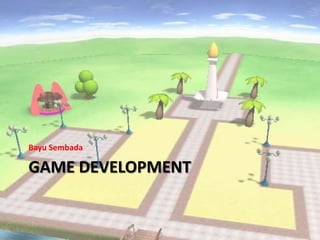
SMS CHAT 3D
Game Concept and Idea (1 of 6)
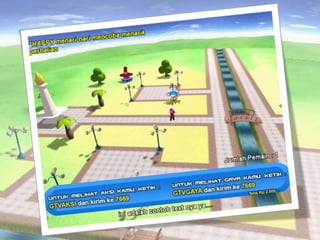
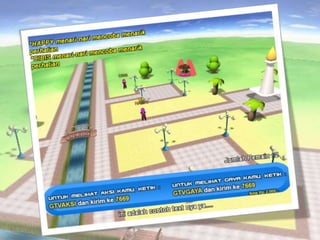
• Game used SMS as a tools to play
• User can chat and interact to each other by
sending their SMS
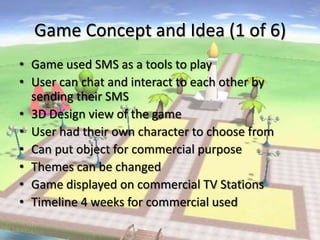
• 3D Design view of the game
• User had their own character to choose from
• Can put object for commercial purpose
• Themes can be changed
• Game displayed on commercial TV Stations
• Timeline 4 weeks for commercial used
Development Team Assembled (2 of 6)
• Team
 2 Programmers
 1 3D Animator
 1 Project Manager
 1 Design Artist
Setup Engine & Development Tools (3
of 6)
• Engine
 Using “true-vision” 3D game engine
• Tools
 .NET Framework and SQL Server
 3D-Max Software and Adobe
Define Modules (4 of 6)
• Programmer
 Desktop User Interfaces
 3D World programming
 Object Behaviors
 Object Attributes
 3D Actor programming
 Actor Behaviors
 Actor Attributes
 Artificial Intelligence (interaction between object)
 Anti collision between object
 Shortest Path
 SMS Systems
Define Modules (4 of 6)
 Receiver
 Transmitter
 Controller
 3D Max Animator
 Actor
 Actor 3D Design
 Actor Animation
 Object
 Object 3D Design
 Design Artist
 Banner design
 Texture design
Testing (5 of 6)
• Deployment and Testing on Global TV station
• Run on-air for 1 hours every-day at 2 am for 2
months
Production and Distribution (6 of
6)
• Distribute to all over Jatis local TV stations
client
• Themes are created based on local interest
• Create manual documents for TV operators to
teach them how to operate the game
Summary
Concept Development
Game
World
Game Play Character
Timeline and Propose Team
Budget
Production and Distribution
Assembled
Team
Engine
and Tools
Testing
Modules / Phase
Setup
Package
Distribute to Clients
Themes
Document
ation
FROM EXPERT
Mark Claypool
Director of Interactive Media and Game Development in Worcester
Polytechnic Institute
The Idea (1 of 8)
• Concept for a new game
• Clearly described
 3-10 pages
 Outlining the game world, characters, challenges
 Lose-or-win scenarios, basic mechanics
• Becomes the pitch document
 Gets the game accepted or rejected by the
publisher
The Pitch (2 of 8)
• Idea presented to publisher (maybe
manager, depending on game author)
• If idea captures interest, usually includes
suggested revisions
• Idea is finally accepted
Proof of Concept (3 of 8)
• Designer gets budget to build a prototype
 Will be thrown away before game done
• Game design expanded to larger document
 Focusing on details of gameplay (play mechanics)
 Avoid focusing too much on user interface
• Budget proposed
 Including time and money
• Game will be developed using the prototype and the design
document as guidance
• Not guaranteed to go to development yet
 That determined by success of this stage
Start of Development (4 of 8)
• Development team assembled
 Uses design document that is 90% done
• Process broken into milestones
 Milestones for measuring progress
 Game is tested for gameplay and quality
• How many milestones are there?
 Number depends on the size of the project
• Typically fixed from the beginning
 Need to avoid urge to add features (creep) during milestone
cycles!
Stages of Game Development (5 of 8)
Milestone 1
• Most critical milestone
• Game should have functional (not complete)
art, sound and code
• Can assess feasibility and budget
 Make changes, as appropriate
• Then, rushes headlong into development!
Stages of Game Development (6 of 8)
Alpha
• Lot of variation as to what is an Alpha
• Complete with Art, Sound and Code
• Not fully tested
• Some tuning, last minute additions and
changes can still be done
Stages of Game Development (7 of 8)
Beta
• Finished game, all features tested and tuned
• External testing to check compatibility issues
• Users play free of charge in exchange for
reporting bugs
• (Hopefully) no changes to any art, sound or
code
 Only bug fixes
Stages of Game Development (8 of 8)
Gold Master
• Accepted as complete
• Includes known bugs
Distribution
• Game is mass produced
• Put into boxes, shrink-wrapped and shipped to
retailers
Summary
• The Idea
• The Pitch
• Proof of Concept
• Start of Development
– Milestone 1
– Alpha
– Beta
– Gold
• Distribution
THANK YOU
Game Development Step by Step

Game Development Step by Step

  • 1.
  • 2.
    Agenda • Game developmentbased on Experience Expert
  • 3.
  • 4.
  • 5.
    Game Concept andIdea (1 of 6) • Game used SMS as a tools to play • User can chat and interact to each other by sending their SMS • 3D Design view of the game • User had their own character to choose from • Can put object for commercial purpose • Themes can be changed • Game displayed on commercial TV Stations • Timeline 4 weeks for commercial used
  • 6.
    Development Team Assembled(2 of 6) • Team  2 Programmers  1 3D Animator  1 Project Manager  1 Design Artist
  • 7.
    Setup Engine &Development Tools (3 of 6) • Engine  Using “true-vision” 3D game engine • Tools  .NET Framework and SQL Server  3D-Max Software and Adobe
  • 8.
    Define Modules (4of 6) • Programmer  Desktop User Interfaces  3D World programming  Object Behaviors  Object Attributes  3D Actor programming  Actor Behaviors  Actor Attributes  Artificial Intelligence (interaction between object)  Anti collision between object  Shortest Path  SMS Systems
  • 9.
    Define Modules (4of 6)  Receiver  Transmitter  Controller  3D Max Animator  Actor  Actor 3D Design  Actor Animation  Object  Object 3D Design  Design Artist  Banner design  Texture design
  • 10.
    Testing (5 of6) • Deployment and Testing on Global TV station • Run on-air for 1 hours every-day at 2 am for 2 months
  • 11.
    Production and Distribution(6 of 6) • Distribute to all over Jatis local TV stations client • Themes are created based on local interest • Create manual documents for TV operators to teach them how to operate the game
  • 12.
    Summary Concept Development Game World Game PlayCharacter Timeline and Propose Team Budget Production and Distribution Assembled Team Engine and Tools Testing Modules / Phase Setup Package Distribute to Clients Themes Document ation
  • 13.
    FROM EXPERT Mark Claypool Directorof Interactive Media and Game Development in Worcester Polytechnic Institute
  • 14.
    The Idea (1of 8) • Concept for a new game • Clearly described  3-10 pages  Outlining the game world, characters, challenges  Lose-or-win scenarios, basic mechanics • Becomes the pitch document  Gets the game accepted or rejected by the publisher
  • 15.
    The Pitch (2of 8) • Idea presented to publisher (maybe manager, depending on game author) • If idea captures interest, usually includes suggested revisions • Idea is finally accepted
  • 16.
    Proof of Concept(3 of 8) • Designer gets budget to build a prototype  Will be thrown away before game done • Game design expanded to larger document  Focusing on details of gameplay (play mechanics)  Avoid focusing too much on user interface • Budget proposed  Including time and money • Game will be developed using the prototype and the design document as guidance • Not guaranteed to go to development yet  That determined by success of this stage
  • 17.
    Start of Development(4 of 8) • Development team assembled  Uses design document that is 90% done • Process broken into milestones  Milestones for measuring progress  Game is tested for gameplay and quality • How many milestones are there?  Number depends on the size of the project • Typically fixed from the beginning  Need to avoid urge to add features (creep) during milestone cycles!
  • 18.
    Stages of GameDevelopment (5 of 8) Milestone 1 • Most critical milestone • Game should have functional (not complete) art, sound and code • Can assess feasibility and budget  Make changes, as appropriate • Then, rushes headlong into development!
  • 19.
    Stages of GameDevelopment (6 of 8) Alpha • Lot of variation as to what is an Alpha • Complete with Art, Sound and Code • Not fully tested • Some tuning, last minute additions and changes can still be done
  • 20.
    Stages of GameDevelopment (7 of 8) Beta • Finished game, all features tested and tuned • External testing to check compatibility issues • Users play free of charge in exchange for reporting bugs • (Hopefully) no changes to any art, sound or code  Only bug fixes
  • 21.
    Stages of GameDevelopment (8 of 8) Gold Master • Accepted as complete • Includes known bugs Distribution • Game is mass produced • Put into boxes, shrink-wrapped and shipped to retailers
  • 22.
    Summary • The Idea •The Pitch • Proof of Concept • Start of Development – Milestone 1 – Alpha – Beta – Gold • Distribution
  • 23.