© 2016, Amazon Web Services, Inc. or its Affiliates. All rights reserved.
Sun Yong
Developer Specialist Solutions Architect
ASEAN
윈도 닷넷 개발자를 위한
솔루션 클라우드
인증/데브옵스 솔루션
Paradigm Shift
What is Paradigm?
Universally recognized scientific achievements that, for a time,
provide model problems and solutions for a community of
practitioners
- Thomas Kuhn, the historian of science, in his book ”The Structure of Scientific Revolutions”
“Common concepts accepted in some area and period”
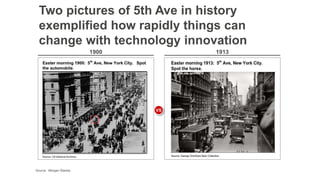
Two pictures of 5th Ave in history
exemplified how rapidly things can
change with technology innovation
1900 1913
VS
Source: Morgan Stanley
SDK overview
v
Programming in AWS ?
vv
What is programmable?
Cloud Computing can be controlled with APIs
• In the case of AWS, almost all services have APIs
• From the network to the platform itself, every layer are
programmable – you can control it.
• Use service transparently based on abstract framework of
each service
v
As you want
vv
AWS SDK
• Control all AWS services programably
• Wrapped APIs provided by AWS services
• Communication : HTTP / HTTPS
- communication destination depends on the endpoint for each service
- http://docs.aws.amazon.com/general/latest/gr/rande.html
• SDK for various languages
vv
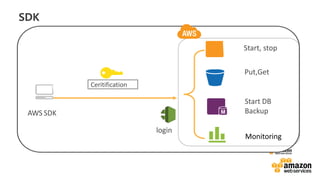
SDK
Start, stop
Put,Get
Start DB
BackupAWS SDK
Ceritification
login
Monitoring
vv
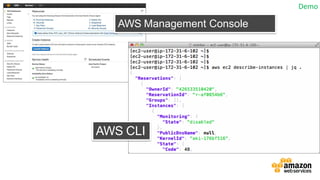
AWS Management Console
AWS CLI
Demo
vv
It means…
• An API is defined for all operation of each service
• Execute through AWS Management Console and CLI
It is able to record operations on the Management Console as API
logs with AWS CloudTrail
vv
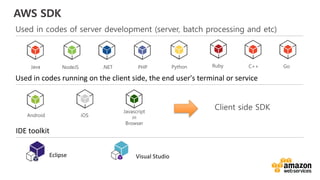
AWS SDK
Used in codes of server development (server, batch processing and etc)
Android iOS
Java NodeJS .NET PHP Python Ruby
Javascript
in
Browser
Used in codes running on the client side, the end user's terminal or service
Client side SDK
C++ Go
IDE toolkit
Eclipse Visual Studio
vv
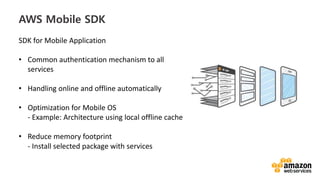
AWS Mobile SDK
SDK for Mobile Application
• Common authentication mechanism to all
services
• Handling online and offline automatically
• Optimization for Mobile OS
- Example: Architecture using local offline cache
• Reduce memory footprint
- Install selected package with services
vv
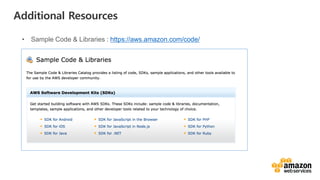
Additional Resources
• Sample Code & Libraries : https://aws.amazon.com/code/
vv
AWS Mobile SDK for Unity
vv
AWS Mobile SDK for Xamarin
vv
AWS SDK Usage
• Control of AWS resources
Automation of infrastructure construction / operation
Manipulate AWS resources such as EC2 and RDS by programs
Each SDK not exactly same - supporting services and operations
• Use of AWS service
• Include service’s operation as part of the application
• Save data to S3, input/output data to DynamoDB, SQS and etc.
vv
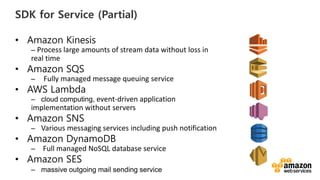
SDK for Service (Partial)
• Amazon Kinesis
– Process large amounts of stream data without loss in
real time
• Amazon SQS
– Fully managed message queuing service
• AWS Lambda
– cloud computing, event-driven application
implementation without servers
• Amazon SNS
– Various messaging services including push notification
• Amazon DynamoDB
– Full managed NoSQL database service
• Amazon SES
– massive outgoing mail sending service
vv
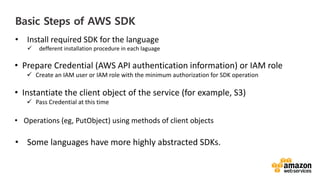
Basic Steps of AWS SDK
• Install required SDK for the language
defferent installation procedure in each laguage
• Prepare Credential (AWS API authentication information) or IAM role
Create an IAM user or IAM role with the minimum authorization for SDK operation
• Instantiate the client object of the service (for example, S3)
Pass Credential at this time
• Operations (eg, PutObject) using methods of client objects
• Some languages have more highly abstracted SDKs.
vv
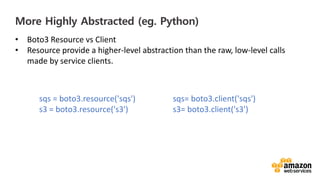
More Highly Abstracted (eg. Python)
• Boto3 Resource vs Client
• Resource provide a higher-level abstraction than the raw, low-level calls
made by service clients.
sqs = boto3.resource('sqs')
s3 = boto3.resource('s3')
sqs= boto3.client('sqs')
s3= boto3.client('s3')
vv
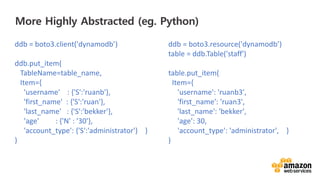
More Highly Abstracted (eg. Python)
ddb = boto3.client('dynamodb’)
ddb.put_item(
TableName=table_name,
Item={
'username' : {'S':'ruanb'},
'first_name' : {'S':'ruan'},
'last_name' : {'S':'bekker'},
'age' : {'N' : '30'},
'account_type': {'S':'administrator'} }
)
ddb = boto3.resource('dynamodb’)
table = ddb.Table('staff')
table.put_item(
Item={
'username': 'ruanb3',
'first_name': 'ruan3',
'last_name': 'bekker',
'age': 30,
'account_type': 'administrator', }
)
vv
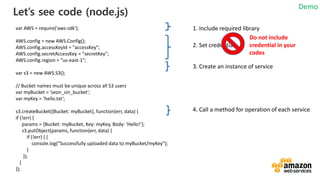
Let’s see code (node.js)
var AWS = require('aws-sdk');
AWS.config = new AWS.Config();
AWS.config.accessKeyId = "accessKey";
AWS.config.secretAccessKey = "secretKey";
AWS.config.region = "us-east-1";
var s3 = new AWS.S3();
// Bucket names must be unique across all S3 users
var myBucket = ’seon_sin_bucket';
var myKey = ’hello.txt';
s3.createBucket({Bucket: myBucket}, function(err, data) {
if (!err) {
params = {Bucket: myBucket, Key: myKey, Body: 'Hello!'};
s3.putObject(params, function(err, data) {
if (!err) { {
console.log("Successfully uploaded data to myBucket/myKey");
}
});
}
});
1. Include required library
2. Set credential
3. Create an instance of service
4. Call a method for operation of each service
Do not include
credential in your
codes
Demo
vv
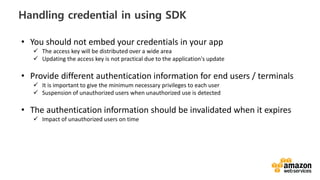
Handling credential in using SDK
• You should not embed your credentials in your app
The access key will be distributed over a wide area
Updating the access key is not practical due to the application's update
• Provide different authentication information for end users / terminals
It is important to give the minimum necessary privileges to each user
Suspension of unauthorized users when unauthorized use is detected
• The authentication information should be invalidated when it expires
Impact of unauthorized users on time
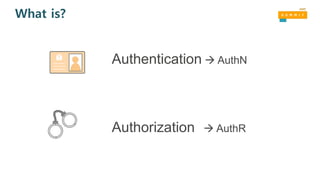
Authentication AuthN
Authorization AuthR
What is?
vv
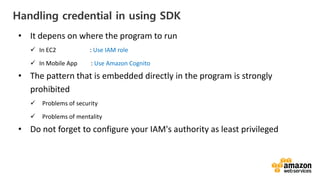
Handling credential in using SDK
• It depens on where the program to run
In EC2 : Use IAM role
In Mobile App : Use Amazon Cognito
• The pattern that is embedded directly in the program is strongly
prohibited
Problems of security
Problems of mentality
• Do not forget to configure your IAM's authority as least privileged
vv
Handling credential in using SDK
• Most SDKs will automatically read the following cases
Loaded from the shared credentials file
Loaded from environment variables (AWS_ACCESS_KEY_ID and AWS_SECRET_ACCESS_KEY as
environment variables)
Use IAM Roll (only when running on AWS)
However, there are differences in behavior such as the order which SDK will look for
vv
Loaded from Shared credentials
[default]
aws_access_key_id = XXXXXXXXXXXXXXXXXXXX
aws_secret_access_key = XXXXXXXXXXXXXXXXXXXXXXXXXXXXXXXXXXXXXX
• Prepare a file containing the authentication information in advance
• location
Linux/Mac users: ~/.aws/credentials
Windows users: C:UsersUSER_NAME.awscredentials
• example
vv
Handling credential in using .Net SDK
• Using SDK Store
The Toolkit for Visual Studio includes a graphical user interface for managing profiles
You can manage your profiles from the command line by using the AWS Tools for Windows PowerShell
You can manage your profiles programmatically using the Amazon.Util.ProfileManager class.
• Using a Credential File
if your user name is awsuser, the credentials file would be C:usersawsuser.awscredentials.
• Using Credential in an Application
Access key and secret key values that are stored in the application's App.config or Web.config file
Specify the location by adding a profilesLocation attribute value to the <aws> element.
vv
IAM Role
• A mechanism for granting AWS operational rights to
entities, such as AWS services and applications
For example, by granting a roll to an application, this application
can manupulate AWS Services
• Not tied to IAM users or groups
• EC2, Beanstalk, Datapipeline and etc
vv
IAM Role
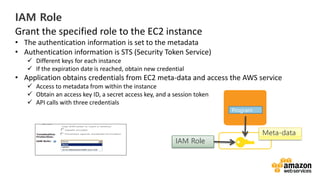
Grant the specified role to the EC2 instance
• The authentication information is set to the metadata
• Authentication information is STS (Security Token Service)
Different keys for each instance
If the expiration date is reached, obtain new credential
• Application obtains credentials from EC2 meta-data and access the AWS service
Access to metadata from within the instance
Obtain an access key ID, a secret access key, and a session token
API calls with three credentials
Program
IAM Role
Meta-data
v
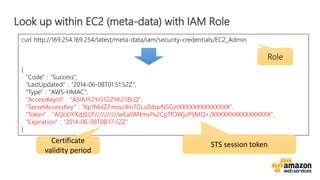
Look up within EC2 (meta-data) with IAM Role
curl http://169.254.169.254/latest/meta-data/iam/security-credentials/EC2_Admin
{
"Code" : "Success",
"LastUpdated" : "2014-06-08T01:51:52Z",
"Type" : "AWS-HMAC",
"AccessKeyId" : "ASIAJY2YJ5S2ZYK25BLQ",
"SecretAccessKey" : "Kp1NblZ7mov/4ln7GLu8dqvN5GztXXXXXXXXXXXXXX",
"Token" : "AQoDYXdzELP//////////wEa0ANmvPx2CpTfOWjuPSMQ+/XXXXXXXXXXXXXXXX",
"Expiration" : "2014-06-08T08:17:52Z"
}
Role
STS session tokenCertificate
validity period
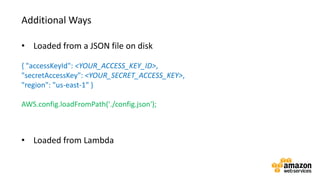
v• Loaded from a JSON file on disk
{ "accessKeyId": <YOUR_ACCESS_KEY_ID>,
"secretAccessKey": <YOUR_SECRET_ACCESS_KEY>,
"region": "us-east-1" }
AWS.config.loadFromPath('./config.json');
• Loaded from Lambda
Additional Ways
vv
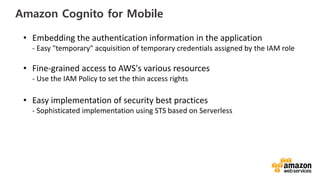
Amazon Cognito for Mobile
• Embedding the authentication information in the application
- Easy "temporary" acquisition of temporary credentials assigned by the IAM role
• Fine-grained access to AWS's various resources
- Use the IAM Policy to set the thin access rights
• Easy implementation of security best practices
- Sophisticated implementation using STS based on Serverless
v
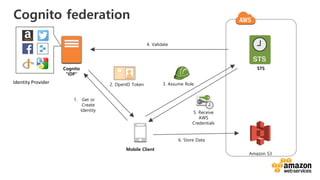
Cognito federation
STS
5. Receive
AWS
Credentials
3. Assume Role2. OpenID Token
Mobile Client
Cognito
“IDP”
1. Get or
Create
Identity
4. Validate
Amazon S3
6. Store Data
Identity Provider
vv
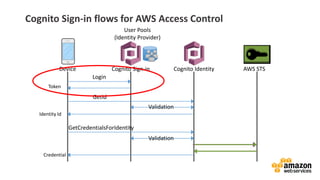
Cognito Sign-in flows for AWS Access Control
Device Cognito Identity AWS STS
Login
GetId
Validation
Validation
GetCredentialsForIdentity
Cognito Sign-in
Token
Identity Id
Credential
User Pools
(Identity Provider)
vv
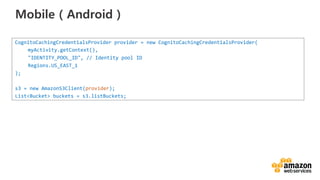
Mobile(Android)
CognitoCachingCredentialsProvider provider = new CognitoCachingCredentialsProvider(
myActivity.getContext(),
"IDENTITY_POOL_ID", // Identity pool ID
Regions.US_EAST_1
);
s3 = new AmazonS3Client(provider);
List<Bucket> buckets = s3.listBuckets;
vv
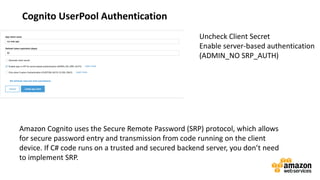
Cognito UserPool Authentication
Uncheck Client Secret
Enable server-based authentication
(ADMIN_NO SRP_AUTH)
Amazon Cognito uses the Secure Remote Password (SRP) protocol, which allows
for secure password entry and transmission from code running on the client
device. If C# code runs on a trusted and secured backend server, you don’t need
to implement SRP.
vv
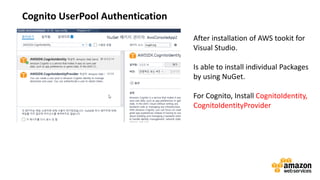
Cognito UserPool Authentication
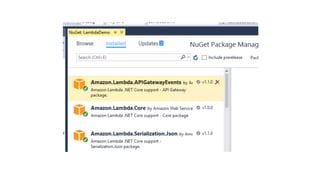
After installation of AWS tookit for
Visual Studio.
Is able to install individual Packages
by using NuGet.
For Cognito, Install CognitoIdentity,
CognitoIdentityProvider
vv
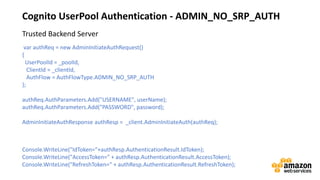
Cognito UserPool Authentication - ADMIN_NO_SRP_AUTH
var authReq = new AdminInitiateAuthRequest()
{
UserPoolId = _poolId,
ClientId = _clientId,
AuthFlow = AuthFlowType.ADMIN_NO_SRP_AUTH
};
authReq.AuthParameters.Add("USERNAME", userName);
authReq.AuthParameters.Add("PASSWORD", password);
AdminInitiateAuthResponse authResp = _client.AdminInitiateAuth(authReq);
Console.WriteLine("IdToken="+authResp.AuthenticationResult.IdToken);
Console.WriteLine("AccessToken=" + authResp.AuthenticationResult.AccessToken);
Console.WriteLine("RefreshToken=" + authResp.AuthenticationResult.RefreshToken);
Trusted Backend Server
vv
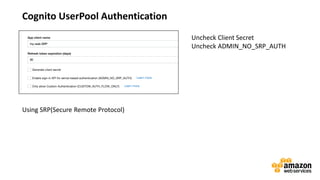
Cognito UserPool Authentication
Uncheck Client Secret
Uncheck ADMIN_NO_SRP_AUTH
Using SRP(Secure Remote Protocol)
vv
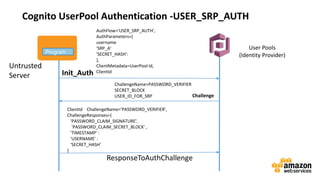
Cognito UserPool Authentication -USER_SRP_AUTH
User Pools
(Identity Provider)
Program
Untrusted
Server
AuthFlow='USER_SRP_AUTH',
AuthParameters={
username
'SRP_A'
'SECRET_HASH':
},
ClientMetadata=UserPool Id,
ClientId
Challenge
ChallengeName=PASSWORD_VERIFIER
SECRET_BLOCK
USER_ID_FOR_SRP
Init_Auth
ResponseToAuthChallenge
ClientId ChallengeName='PASSWORD_VERIFIER',
ChallengeResponses={
'PASSWORD_CLAIM_SIGNATURE',
'PASSWORD_CLAIM_SECRET_BLOCK' ,
'TIMESTAMP' :
'USERNAME' :
'SECRET_HASH'
}
vv
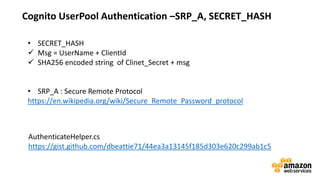
Cognito UserPool Authentication –SRP_A, SECRET_HASH
• SECRET_HASH
Msg = UserName + ClientId
SHA256 encoded string of Clinet_Secret + msg
• SRP_A : Secure Remote Protocol
https://en.wikipedia.org/wiki/Secure_Remote_Password_protocol
AuthenticateHelper.cs
https://gist.github.com/dbeattie71/44ea3a13145f185d303e620c299ab1c5
Why DevOps
DevOps
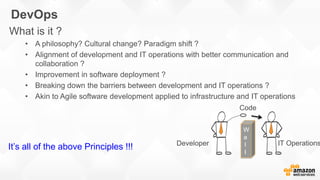
What is it ?
• A philosophy? Cultural change? Paradigm shift ?
• Alignment of development and IT operations with better communication and
collaboration ?
• Improvement in software deployment ?
• Breaking down the barriers between development and IT operations ?
• Akin to Agile software development applied to infrastructure and IT operations
Code
W
a
l
l
Developer IT Operations
It’s all of the above Principles !!!
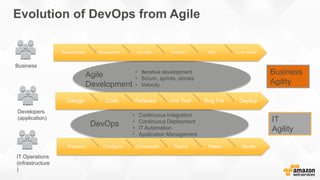
Provision Configure Orchestrate Deploy Report Monitor
DevOps
• Continuous Integration
• Continuous Deployment
• IT Automation
• Application Management
Evolution of DevOps from Agile
Business Case Requirements Use Case Features Plan Go to market
Business
Design Code Refactor Unit Test Bug Fix Deploy
Developers
(application)
IT Operations
(infrastructure
)
Agile
Development
• Iterative development
• Scrum, sprints, stories
• Velocity
Business
Agility
IT
Agility
DevOps 5 pillar
Microservices
Infrastructure as a code
Automation and Configuration Management
Continuous Integration and Continuous Delivery
Logging and Monitoring
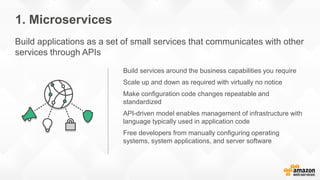
Build services around the business capabilities you require
Scale up and down as required with virtually no notice
Make configuration code changes repeatable and
standardized
API-driven model enables management of infrastructure with
language typically used in application code
Free developers from manually configuring operating
systems, system applications, and server software
1. Microservices
Build applications as a set of small services that communicates with other
services through APIs
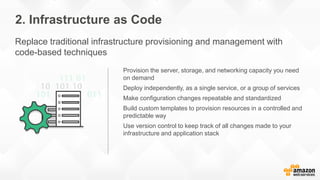
Provision the server, storage, and networking capacity you need
on demand
Deploy independently, as a single service, or a group of services
Make configuration changes repeatable and standardized
Build custom templates to provision resources in a controlled and
predictable way
Use version control to keep track of all changes made to your
infrastructure and application stack
2. Infrastructure as Code
Replace traditional infrastructure provisioning and management with
code-based techniques
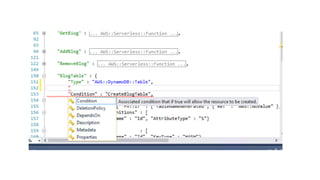
Here’s some infrastructure as Code
"WebServer": {
"Type": "AWS::EC2::Instance",
"Metadata" : {
"AWS::CloudFormation::Init" : {
"config" : {
"packages" : {
"yum" : {
"httpd" : [],
"php" : [],
"php-mysql" : [],
"php-gd" : [],
"php-xml" : [],
"php-mbstring" : [],
"mysql" : []
}
},
"sources" : {
"/var/www/html" : "http://ftp.drupal.org/files/projects/drupal-7.8.tar.gz",
"/home/ec2-user" : "http://ftp.drupal.org/files/projects/drush-7.x-4.5.tar.gz"
},
AWS
CloudFormation
template
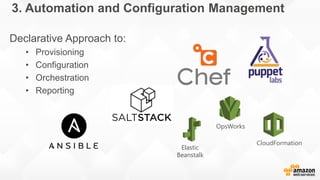
3. Automation and Configuration Management
Declarative Approach to:
• Provisioning
• Configuration
• Orchestration
• Reporting
Elastic
Beanstalk
CloudFormation
OpsWorks
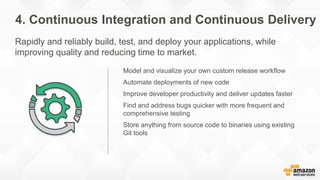
Model and visualize your own custom release workflow
Automate deployments of new code
Improve developer productivity and deliver updates faster
Find and address bugs quicker with more frequent and
comprehensive testing
Store anything from source code to binaries using existing
Git tools
4. Continuous Integration and Continuous Delivery
Rapidly and reliably build, test, and deploy your applications, while
improving quality and reducing time to market.
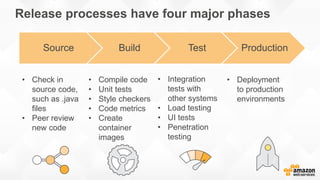
• Integration
tests with
other systems
• Load testing
• UI tests
• Penetration
testing
Release processes have four major phases
Source Build Test Production
• Check in
source code,
such as .java
files
• Peer review
new code
• Compile code
• Unit tests
• Style checkers
• Code metrics
• Create
container
images
• Deployment
to production
environments
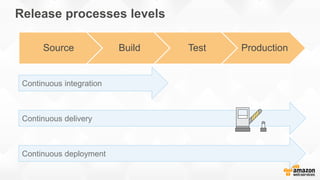
Release processes levels
Source Build Test Production
Continuous integration
Continuous delivery
Continuous deployment
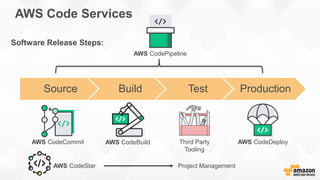
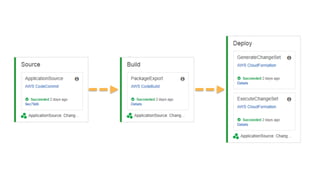
AWS Code Services
Source Build Test Production
Third Party
Tooling
Software Release Steps:
AWS CodeCommit AWS CodeBuild AWS CodeDeploy
AWS CodePipeline
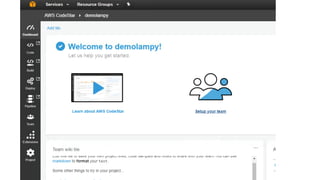
AWS CodeStar Project Management
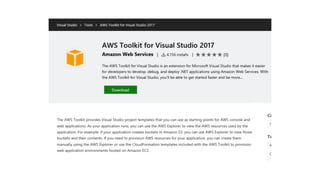
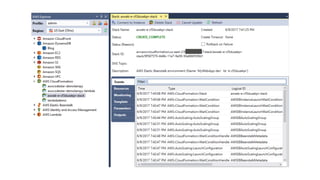
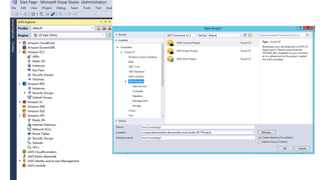
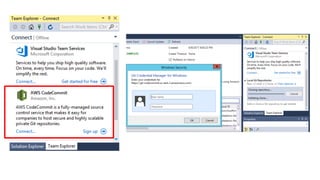
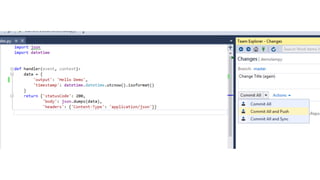
.NET Visual Studio toolkit
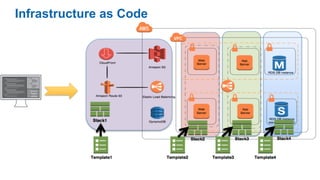
Infrastructure as Code
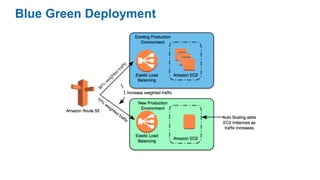
Blue Green Deployment
ENTERPRISE
APPS
DEVELOPMENT & OPERATIONSMOBILE SERVICESAPP SERVICESANALYTICS
Data
Warehousing
Hadoop/
Spark
Streaming Data
Collection
Machine
Learning
Elastic
Search
Virtual
Desktops
Sharing &
Collaboration
Corporate
Email
Backup
Queuing &
Notifications
Workflow
Search
Email
Transcoding
One-click App
Deployment
Identity
Sync
Single Integrated
Console
Push
Notifications
DevOps Resource
Management
Application Lifecycle
Management
Containers
Triggers
Resource
Templates
TECHNICAL &
BUSINESS
SUPPORT
Account
Management
Support
Professional
Services
Training &
Certification
Security
& Pricing
Reports
Partner
Ecosystem
Solutions
Architects
MARKETPLACE
Business
Apps
Business
Intelligence
Databases
DevOps
Tools
NetworkingSecurity Storage
Regions
Availability
Zones
Points of
Presence
INFRASTRUCTURE
CORE SERVICES
Compute
VMs, Auto-scaling,
& Load Balancing
Storage
Object, Blocks,
Archival, Import/Export
Databases
Relational, NoSQL,
Caching, Migration
Networking
VPC, DX, DNS
CDN
Access
Control
Identity
Management
Key
Management
& Storage
Monitoring
& Logs
Assessment
and reporting
Resource &
Usage Auditing
SECURITY & COMPLIANCE
Configuration
Compliance
Web application
firewall
HYBRID
ARCHITECTURE
Data
Backups
Integrated
App
Deployments
Direct
Connect
Identity
Federation
Integrated
Resource
Management
Integrated
Networking
API
Gateway
IoT
Rules
Engine
Device
Shadows
Device
SDKs
Registry
Device
Gateway
Streaming Data
Analysis
Business
Intelligence
Mobile
Analytics
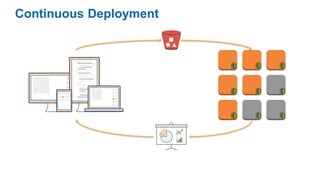
Continuous Deployment
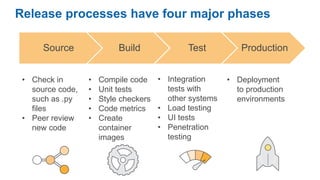
• Integration
tests with
other systems
• Load testing
• UI tests
• Penetration
testing
Release processes have four major phases
Source Build Test Production
• Check in
source code,
such as .py
files
• Peer review
new code
• Compile code
• Unit tests
• Style checkers
• Code metrics
• Create
container
images
• Deployment
to production
environments
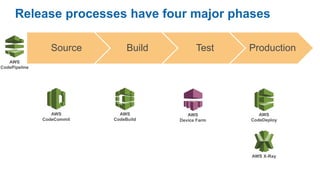
Release processes have four major phases
Source Build Test Production
AWS
CodeCommit
AWS
CodeDeploy
AWS
CodePipeline
AWS
CodeBuild
AWS X-Ray
AWS
Device Farm
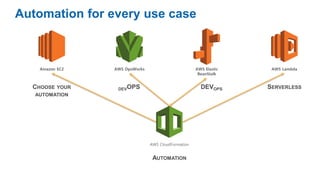
Automation for every use case
CHOOSE YOUR
AUTOMATION
Amazon EC2
AWS CloudFormation
AWS OpsWorks AWS Elastic
BeanStalk
AWS Lambda
SERVERLESSDEVOPS DEVOPS
AUTOMATION
”
“
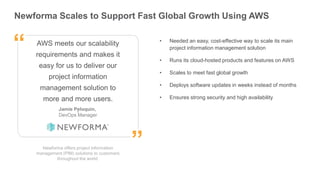
Newforma Scales to Support Fast Global Growth Using AWS
Newforma offers project information
management (PIM) solutions to customers
throughout the world.
AWS meets our scalability
requirements and makes it
easy for us to deliver our
project information
management solution to
more and more users.
.
• Needed an easy, cost-effective way to scale its main
project information management solution
• Runs its cloud-hosted products and features on AWS
• Scales to meet fast global growth
• Deploys software updates in weeks instead of months
• Ensures strong security and high availability
Jamie Peloquin,
DevOps Manager
”
“
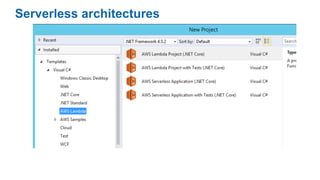
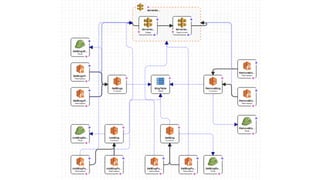
Serverless architectures
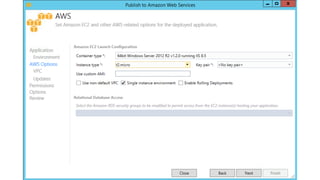
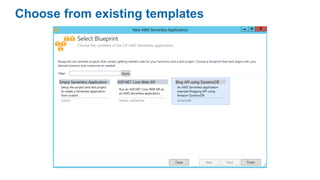
Choose from existing templates
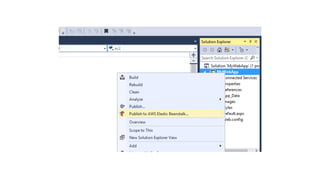
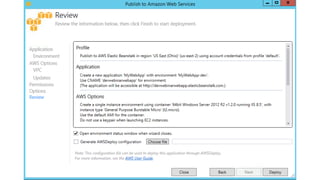
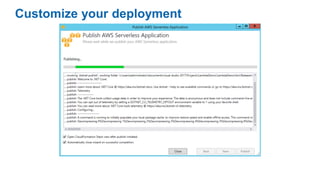
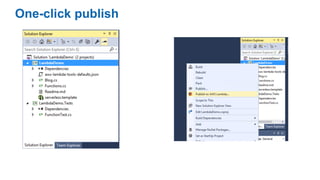
One-click publish
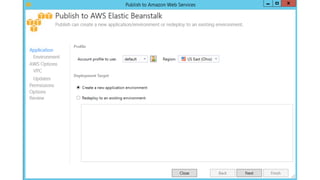
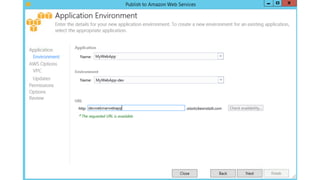
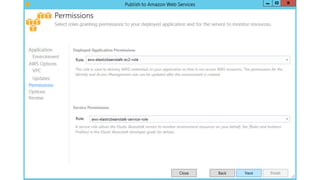
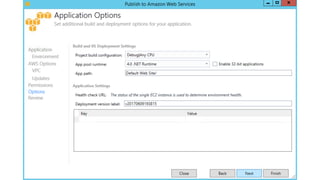
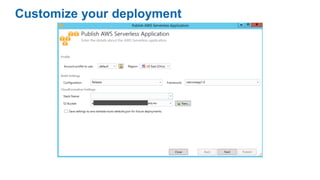
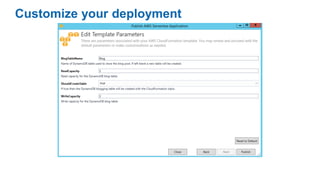
Customize your deployment
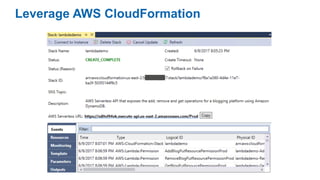
Leverage AWS CloudFormation
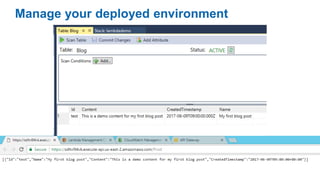
Manage your deployed environment
www.awsdevday.co.kr
Dev Day 모바일 웹을 통해
지금 세션 평가에 참여하시면,
행사 후 기념 티셔츠를 드립니다.
• 발표 자료 및 녹화 동영상은 AWS Korea 공식
소셜 채널로 공유될 예정입니다.
• #AWSDevDay 해시 태그로 의견을 남겨주세요!
What we covered
A view on DevOps
DevOps practices
AWS and Microsoft Visual Studio
New architectures
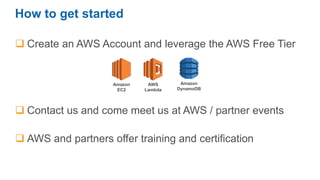
How to get started
Create an AWS Account and leverage the AWS Free Tier
Contact us and come meet us at AWS / partner events
AWS and partners offer training and certification
Amazon
EC2
AWS
Lambda
Amazon
DynamoDB

윈도 닷넷 개발자를 위한 솔루션 클라우드 데브옵스 솔루션

  • 1.
    © 2016, AmazonWeb Services, Inc. or its Affiliates. All rights reserved. Sun Yong Developer Specialist Solutions Architect ASEAN 윈도 닷넷 개발자를 위한 솔루션 클라우드 인증/데브옵스 솔루션
  • 2.
  • 3.
    What is Paradigm? Universallyrecognized scientific achievements that, for a time, provide model problems and solutions for a community of practitioners - Thomas Kuhn, the historian of science, in his book ”The Structure of Scientific Revolutions” “Common concepts accepted in some area and period”
  • 4.
    Two pictures of5th Ave in history exemplified how rapidly things can change with technology innovation 1900 1913 VS Source: Morgan Stanley
  • 5.
  • 6.
  • 7.
    vv What is programmable? CloudComputing can be controlled with APIs • In the case of AWS, almost all services have APIs • From the network to the platform itself, every layer are programmable – you can control it. • Use service transparently based on abstract framework of each service
  • 8.
  • 9.
    vv AWS SDK • Controlall AWS services programably • Wrapped APIs provided by AWS services • Communication : HTTP / HTTPS - communication destination depends on the endpoint for each service - http://docs.aws.amazon.com/general/latest/gr/rande.html • SDK for various languages
  • 10.
    vv SDK Start, stop Put,Get Start DB BackupAWSSDK Ceritification login Monitoring
  • 11.
  • 12.
    vv It means… • AnAPI is defined for all operation of each service • Execute through AWS Management Console and CLI It is able to record operations on the Management Console as API logs with AWS CloudTrail
  • 13.
    vv AWS SDK Used incodes of server development (server, batch processing and etc) Android iOS Java NodeJS .NET PHP Python Ruby Javascript in Browser Used in codes running on the client side, the end user's terminal or service Client side SDK C++ Go IDE toolkit Eclipse Visual Studio
  • 14.
    vv AWS Mobile SDK SDKfor Mobile Application • Common authentication mechanism to all services • Handling online and offline automatically • Optimization for Mobile OS - Example: Architecture using local offline cache • Reduce memory footprint - Install selected package with services
  • 15.
    vv Additional Resources • SampleCode & Libraries : https://aws.amazon.com/code/
  • 16.
  • 17.
    vv AWS Mobile SDKfor Xamarin
  • 18.
    vv AWS SDK Usage •Control of AWS resources Automation of infrastructure construction / operation Manipulate AWS resources such as EC2 and RDS by programs Each SDK not exactly same - supporting services and operations • Use of AWS service • Include service’s operation as part of the application • Save data to S3, input/output data to DynamoDB, SQS and etc.
  • 19.
    vv SDK for Service(Partial) • Amazon Kinesis – Process large amounts of stream data without loss in real time • Amazon SQS – Fully managed message queuing service • AWS Lambda – cloud computing, event-driven application implementation without servers • Amazon SNS – Various messaging services including push notification • Amazon DynamoDB – Full managed NoSQL database service • Amazon SES – massive outgoing mail sending service
  • 20.
    vv Basic Steps ofAWS SDK • Install required SDK for the language defferent installation procedure in each laguage • Prepare Credential (AWS API authentication information) or IAM role Create an IAM user or IAM role with the minimum authorization for SDK operation • Instantiate the client object of the service (for example, S3) Pass Credential at this time • Operations (eg, PutObject) using methods of client objects • Some languages have more highly abstracted SDKs.
  • 21.
    vv More Highly Abstracted(eg. Python) • Boto3 Resource vs Client • Resource provide a higher-level abstraction than the raw, low-level calls made by service clients. sqs = boto3.resource('sqs') s3 = boto3.resource('s3') sqs= boto3.client('sqs') s3= boto3.client('s3')
  • 22.
    vv More Highly Abstracted(eg. Python) ddb = boto3.client('dynamodb’) ddb.put_item( TableName=table_name, Item={ 'username' : {'S':'ruanb'}, 'first_name' : {'S':'ruan'}, 'last_name' : {'S':'bekker'}, 'age' : {'N' : '30'}, 'account_type': {'S':'administrator'} } ) ddb = boto3.resource('dynamodb’) table = ddb.Table('staff') table.put_item( Item={ 'username': 'ruanb3', 'first_name': 'ruan3', 'last_name': 'bekker', 'age': 30, 'account_type': 'administrator', } )
  • 23.
    vv Let’s see code(node.js) var AWS = require('aws-sdk'); AWS.config = new AWS.Config(); AWS.config.accessKeyId = "accessKey"; AWS.config.secretAccessKey = "secretKey"; AWS.config.region = "us-east-1"; var s3 = new AWS.S3(); // Bucket names must be unique across all S3 users var myBucket = ’seon_sin_bucket'; var myKey = ’hello.txt'; s3.createBucket({Bucket: myBucket}, function(err, data) { if (!err) { params = {Bucket: myBucket, Key: myKey, Body: 'Hello!'}; s3.putObject(params, function(err, data) { if (!err) { { console.log("Successfully uploaded data to myBucket/myKey"); } }); } }); 1. Include required library 2. Set credential 3. Create an instance of service 4. Call a method for operation of each service Do not include credential in your codes Demo
  • 24.
    vv Handling credential inusing SDK • You should not embed your credentials in your app The access key will be distributed over a wide area Updating the access key is not practical due to the application's update • Provide different authentication information for end users / terminals It is important to give the minimum necessary privileges to each user Suspension of unauthorized users when unauthorized use is detected • The authentication information should be invalidated when it expires Impact of unauthorized users on time
  • 25.
  • 26.
    vv Handling credential inusing SDK • It depens on where the program to run In EC2 : Use IAM role In Mobile App : Use Amazon Cognito • The pattern that is embedded directly in the program is strongly prohibited Problems of security Problems of mentality • Do not forget to configure your IAM's authority as least privileged
  • 27.
    vv Handling credential inusing SDK • Most SDKs will automatically read the following cases Loaded from the shared credentials file Loaded from environment variables (AWS_ACCESS_KEY_ID and AWS_SECRET_ACCESS_KEY as environment variables) Use IAM Roll (only when running on AWS) However, there are differences in behavior such as the order which SDK will look for
  • 28.
    vv Loaded from Sharedcredentials [default] aws_access_key_id = XXXXXXXXXXXXXXXXXXXX aws_secret_access_key = XXXXXXXXXXXXXXXXXXXXXXXXXXXXXXXXXXXXXX • Prepare a file containing the authentication information in advance • location Linux/Mac users: ~/.aws/credentials Windows users: C:UsersUSER_NAME.awscredentials • example
  • 29.
    vv Handling credential inusing .Net SDK • Using SDK Store The Toolkit for Visual Studio includes a graphical user interface for managing profiles You can manage your profiles from the command line by using the AWS Tools for Windows PowerShell You can manage your profiles programmatically using the Amazon.Util.ProfileManager class. • Using a Credential File if your user name is awsuser, the credentials file would be C:usersawsuser.awscredentials. • Using Credential in an Application Access key and secret key values that are stored in the application's App.config or Web.config file Specify the location by adding a profilesLocation attribute value to the <aws> element.
  • 30.
    vv IAM Role • Amechanism for granting AWS operational rights to entities, such as AWS services and applications For example, by granting a roll to an application, this application can manupulate AWS Services • Not tied to IAM users or groups • EC2, Beanstalk, Datapipeline and etc
  • 31.
    vv IAM Role Grant thespecified role to the EC2 instance • The authentication information is set to the metadata • Authentication information is STS (Security Token Service) Different keys for each instance If the expiration date is reached, obtain new credential • Application obtains credentials from EC2 meta-data and access the AWS service Access to metadata from within the instance Obtain an access key ID, a secret access key, and a session token API calls with three credentials Program IAM Role Meta-data
  • 32.
    v Look up withinEC2 (meta-data) with IAM Role curl http://169.254.169.254/latest/meta-data/iam/security-credentials/EC2_Admin { "Code" : "Success", "LastUpdated" : "2014-06-08T01:51:52Z", "Type" : "AWS-HMAC", "AccessKeyId" : "ASIAJY2YJ5S2ZYK25BLQ", "SecretAccessKey" : "Kp1NblZ7mov/4ln7GLu8dqvN5GztXXXXXXXXXXXXXX", "Token" : "AQoDYXdzELP//////////wEa0ANmvPx2CpTfOWjuPSMQ+/XXXXXXXXXXXXXXXX", "Expiration" : "2014-06-08T08:17:52Z" } Role STS session tokenCertificate validity period
  • 33.
    v• Loaded froma JSON file on disk { "accessKeyId": <YOUR_ACCESS_KEY_ID>, "secretAccessKey": <YOUR_SECRET_ACCESS_KEY>, "region": "us-east-1" } AWS.config.loadFromPath('./config.json'); • Loaded from Lambda Additional Ways
  • 34.
    vv Amazon Cognito forMobile • Embedding the authentication information in the application - Easy "temporary" acquisition of temporary credentials assigned by the IAM role • Fine-grained access to AWS's various resources - Use the IAM Policy to set the thin access rights • Easy implementation of security best practices - Sophisticated implementation using STS based on Serverless
  • 35.
    v Cognito federation STS 5. Receive AWS Credentials 3.Assume Role2. OpenID Token Mobile Client Cognito “IDP” 1. Get or Create Identity 4. Validate Amazon S3 6. Store Data Identity Provider
  • 36.
    vv Cognito Sign-in flowsfor AWS Access Control Device Cognito Identity AWS STS Login GetId Validation Validation GetCredentialsForIdentity Cognito Sign-in Token Identity Id Credential User Pools (Identity Provider)
  • 37.
    vv Mobile(Android) CognitoCachingCredentialsProvider provider =new CognitoCachingCredentialsProvider( myActivity.getContext(), "IDENTITY_POOL_ID", // Identity pool ID Regions.US_EAST_1 ); s3 = new AmazonS3Client(provider); List<Bucket> buckets = s3.listBuckets;
  • 38.
    vv Cognito UserPool Authentication UncheckClient Secret Enable server-based authentication (ADMIN_NO SRP_AUTH) Amazon Cognito uses the Secure Remote Password (SRP) protocol, which allows for secure password entry and transmission from code running on the client device. If C# code runs on a trusted and secured backend server, you don’t need to implement SRP.
  • 39.
    vv Cognito UserPool Authentication Afterinstallation of AWS tookit for Visual Studio. Is able to install individual Packages by using NuGet. For Cognito, Install CognitoIdentity, CognitoIdentityProvider
  • 40.
    vv Cognito UserPool Authentication- ADMIN_NO_SRP_AUTH var authReq = new AdminInitiateAuthRequest() { UserPoolId = _poolId, ClientId = _clientId, AuthFlow = AuthFlowType.ADMIN_NO_SRP_AUTH }; authReq.AuthParameters.Add("USERNAME", userName); authReq.AuthParameters.Add("PASSWORD", password); AdminInitiateAuthResponse authResp = _client.AdminInitiateAuth(authReq); Console.WriteLine("IdToken="+authResp.AuthenticationResult.IdToken); Console.WriteLine("AccessToken=" + authResp.AuthenticationResult.AccessToken); Console.WriteLine("RefreshToken=" + authResp.AuthenticationResult.RefreshToken); Trusted Backend Server
  • 41.
    vv Cognito UserPool Authentication UncheckClient Secret Uncheck ADMIN_NO_SRP_AUTH Using SRP(Secure Remote Protocol)
  • 42.
    vv Cognito UserPool Authentication-USER_SRP_AUTH User Pools (Identity Provider) Program Untrusted Server AuthFlow='USER_SRP_AUTH', AuthParameters={ username 'SRP_A' 'SECRET_HASH': }, ClientMetadata=UserPool Id, ClientId Challenge ChallengeName=PASSWORD_VERIFIER SECRET_BLOCK USER_ID_FOR_SRP Init_Auth ResponseToAuthChallenge ClientId ChallengeName='PASSWORD_VERIFIER', ChallengeResponses={ 'PASSWORD_CLAIM_SIGNATURE', 'PASSWORD_CLAIM_SECRET_BLOCK' , 'TIMESTAMP' : 'USERNAME' : 'SECRET_HASH' }
  • 43.
    vv Cognito UserPool Authentication–SRP_A, SECRET_HASH • SECRET_HASH Msg = UserName + ClientId SHA256 encoded string of Clinet_Secret + msg • SRP_A : Secure Remote Protocol https://en.wikipedia.org/wiki/Secure_Remote_Password_protocol AuthenticateHelper.cs https://gist.github.com/dbeattie71/44ea3a13145f185d303e620c299ab1c5
  • 44.
  • 45.
    DevOps What is it? • A philosophy? Cultural change? Paradigm shift ? • Alignment of development and IT operations with better communication and collaboration ? • Improvement in software deployment ? • Breaking down the barriers between development and IT operations ? • Akin to Agile software development applied to infrastructure and IT operations Code W a l l Developer IT Operations It’s all of the above Principles !!!
  • 47.
    Provision Configure OrchestrateDeploy Report Monitor DevOps • Continuous Integration • Continuous Deployment • IT Automation • Application Management Evolution of DevOps from Agile Business Case Requirements Use Case Features Plan Go to market Business Design Code Refactor Unit Test Bug Fix Deploy Developers (application) IT Operations (infrastructure ) Agile Development • Iterative development • Scrum, sprints, stories • Velocity Business Agility IT Agility
  • 48.
    DevOps 5 pillar Microservices Infrastructureas a code Automation and Configuration Management Continuous Integration and Continuous Delivery Logging and Monitoring
  • 49.
    Build services aroundthe business capabilities you require Scale up and down as required with virtually no notice Make configuration code changes repeatable and standardized API-driven model enables management of infrastructure with language typically used in application code Free developers from manually configuring operating systems, system applications, and server software 1. Microservices Build applications as a set of small services that communicates with other services through APIs
  • 50.
    Provision the server,storage, and networking capacity you need on demand Deploy independently, as a single service, or a group of services Make configuration changes repeatable and standardized Build custom templates to provision resources in a controlled and predictable way Use version control to keep track of all changes made to your infrastructure and application stack 2. Infrastructure as Code Replace traditional infrastructure provisioning and management with code-based techniques
  • 51.
    Here’s some infrastructureas Code "WebServer": { "Type": "AWS::EC2::Instance", "Metadata" : { "AWS::CloudFormation::Init" : { "config" : { "packages" : { "yum" : { "httpd" : [], "php" : [], "php-mysql" : [], "php-gd" : [], "php-xml" : [], "php-mbstring" : [], "mysql" : [] } }, "sources" : { "/var/www/html" : "http://ftp.drupal.org/files/projects/drupal-7.8.tar.gz", "/home/ec2-user" : "http://ftp.drupal.org/files/projects/drush-7.x-4.5.tar.gz" }, AWS CloudFormation template
  • 52.
    3. Automation andConfiguration Management Declarative Approach to: • Provisioning • Configuration • Orchestration • Reporting Elastic Beanstalk CloudFormation OpsWorks
  • 53.
    Model and visualizeyour own custom release workflow Automate deployments of new code Improve developer productivity and deliver updates faster Find and address bugs quicker with more frequent and comprehensive testing Store anything from source code to binaries using existing Git tools 4. Continuous Integration and Continuous Delivery Rapidly and reliably build, test, and deploy your applications, while improving quality and reducing time to market.
  • 54.
    • Integration tests with othersystems • Load testing • UI tests • Penetration testing Release processes have four major phases Source Build Test Production • Check in source code, such as .java files • Peer review new code • Compile code • Unit tests • Style checkers • Code metrics • Create container images • Deployment to production environments
  • 55.
    Release processes levels SourceBuild Test Production Continuous integration Continuous delivery Continuous deployment
  • 56.
    AWS Code Services SourceBuild Test Production Third Party Tooling Software Release Steps: AWS CodeCommit AWS CodeBuild AWS CodeDeploy AWS CodePipeline AWS CodeStar Project Management
  • 57.
  • 59.
  • 62.
  • 63.
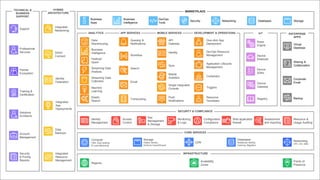
    ENTERPRISE APPS DEVELOPMENT & OPERATIONSMOBILESERVICESAPP SERVICESANALYTICS Data Warehousing Hadoop/ Spark Streaming Data Collection Machine Learning Elastic Search Virtual Desktops Sharing & Collaboration Corporate Email Backup Queuing & Notifications Workflow Search Email Transcoding One-click App Deployment Identity Sync Single Integrated Console Push Notifications DevOps Resource Management Application Lifecycle Management Containers Triggers Resource Templates TECHNICAL & BUSINESS SUPPORT Account Management Support Professional Services Training & Certification Security & Pricing Reports Partner Ecosystem Solutions Architects MARKETPLACE Business Apps Business Intelligence Databases DevOps Tools NetworkingSecurity Storage Regions Availability Zones Points of Presence INFRASTRUCTURE CORE SERVICES Compute VMs, Auto-scaling, & Load Balancing Storage Object, Blocks, Archival, Import/Export Databases Relational, NoSQL, Caching, Migration Networking VPC, DX, DNS CDN Access Control Identity Management Key Management & Storage Monitoring & Logs Assessment and reporting Resource & Usage Auditing SECURITY & COMPLIANCE Configuration Compliance Web application firewall HYBRID ARCHITECTURE Data Backups Integrated App Deployments Direct Connect Identity Federation Integrated Resource Management Integrated Networking API Gateway IoT Rules Engine Device Shadows Device SDKs Registry Device Gateway Streaming Data Analysis Business Intelligence Mobile Analytics
  • 74.
  • 75.
    • Integration tests with othersystems • Load testing • UI tests • Penetration testing Release processes have four major phases Source Build Test Production • Check in source code, such as .py files • Peer review new code • Compile code • Unit tests • Style checkers • Code metrics • Create container images • Deployment to production environments
  • 76.
    Release processes havefour major phases Source Build Test Production AWS CodeCommit AWS CodeDeploy AWS CodePipeline AWS CodeBuild AWS X-Ray AWS Device Farm
  • 86.
    Automation for everyuse case CHOOSE YOUR AUTOMATION Amazon EC2 AWS CloudFormation AWS OpsWorks AWS Elastic BeanStalk AWS Lambda SERVERLESSDEVOPS DEVOPS AUTOMATION
  • 87.
    ” “ Newforma Scales toSupport Fast Global Growth Using AWS Newforma offers project information management (PIM) solutions to customers throughout the world. AWS meets our scalability requirements and makes it easy for us to deliver our project information management solution to more and more users. . • Needed an easy, cost-effective way to scale its main project information management solution • Runs its cloud-hosted products and features on AWS • Scales to meet fast global growth • Deploys software updates in weeks instead of months • Ensures strong security and high availability Jamie Peloquin, DevOps Manager ” “
  • 88.
  • 89.
  • 90.
  • 91.
  • 92.
  • 93.
  • 94.
  • 95.
  • 97.
    www.awsdevday.co.kr Dev Day 모바일웹을 통해 지금 세션 평가에 참여하시면, 행사 후 기념 티셔츠를 드립니다. • 발표 자료 및 녹화 동영상은 AWS Korea 공식 소셜 채널로 공유될 예정입니다. • #AWSDevDay 해시 태그로 의견을 남겨주세요!
  • 98.
    What we covered Aview on DevOps DevOps practices AWS and Microsoft Visual Studio New architectures
  • 99.
    How to getstarted Create an AWS Account and leverage the AWS Free Tier Contact us and come meet us at AWS / partner events AWS and partners offer training and certification Amazon EC2 AWS Lambda Amazon DynamoDB