Engaging Autism: Considerations for underserved,
    under-represented and under-resourced	


                     Connie	
  Kasari,	
  PhD	
  
             University	
  of	
  California,	
  Los	
  Angeles	
  

                ASF Science and Sandwiches
                        December 6, 2012
                                                                     AIR-B --Autism Intervention
                                                                       Research Network for
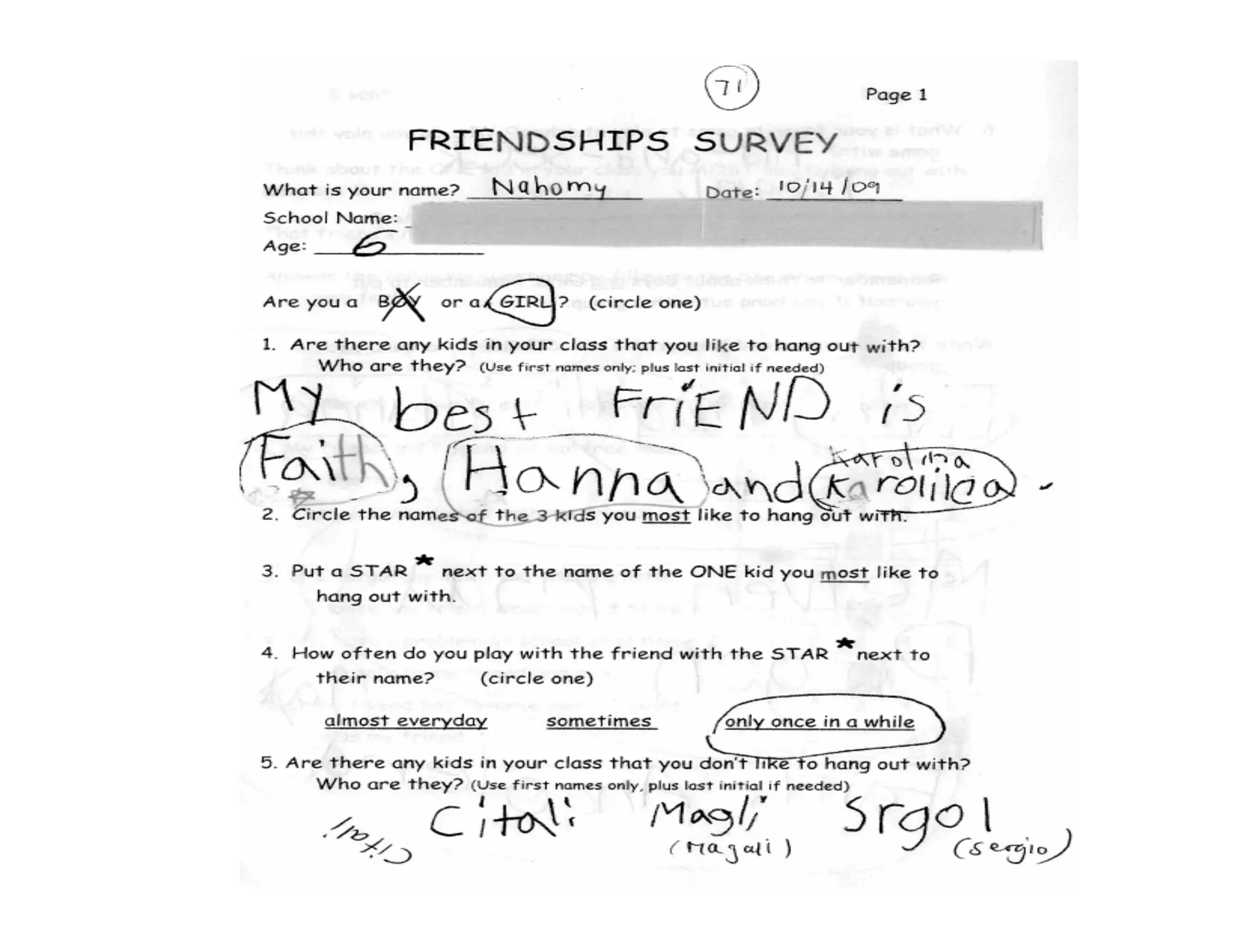
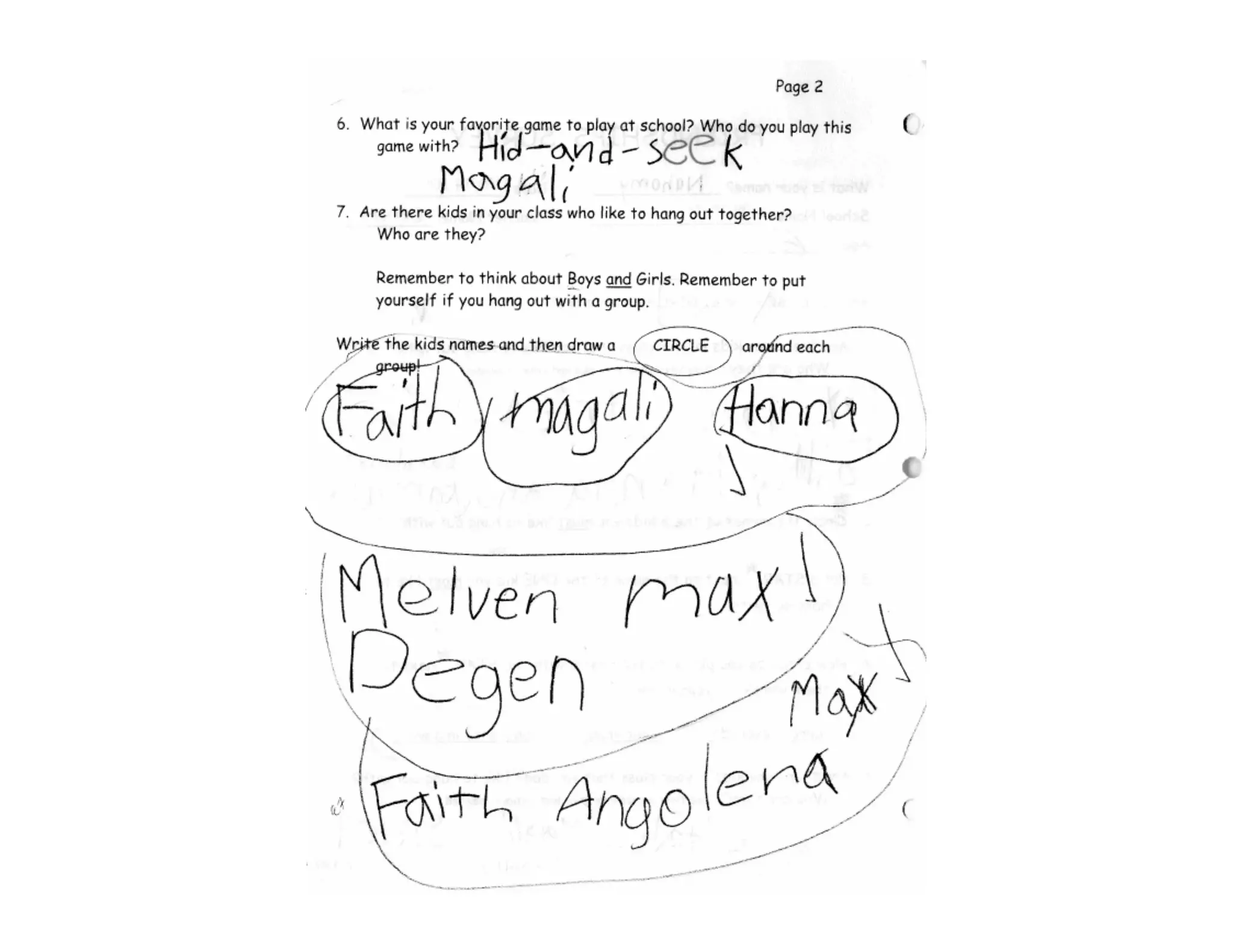
                                                                         Behavioral Health
UCLA Kasari Lab Intervention Studies


    Targeted	
  Interventions	
  
       Core	
  deficits	
  (beyond	
  dose	
  and	
  approach)	
  

    Underserved,	
  under-­‐represented	
  
          Infants,	
  toddlers	
  
          Minimally	
  verbal	
  
          School	
  aged,	
  included	
  in	
  general	
  education	
  
          Under-­‐resourced	
  

    Community	
  based	
  
       Schools	
  are	
  where	
  all	
  children	
  can	
  be	
  found	
  
Engagement	
  as	
  Critical	
  Intervention	
  Target	
  

    Young	
  children:	
  focus	
  on	
  joint	
  attention,	
  play,	
  
     engagement	
  with	
  parents	
  (the	
  core	
  de?icits)	
  
    Look	
  to	
  behavioral	
  signs	
  of	
  engagement	
  
         Shared	
  attention	
  and	
  affect	
  
         Joint	
  attention	
  
         Social	
  play	
  with	
  others	
  
         Conversation	
  
Targeted	
  Intervention	
  Approach	
  to	
  Address	
  
Problems	
  of	
  Engagement	
  
    To	
  affect	
  engagement,	
  
     intervention	
  needs	
  to	
  be	
  
     targeted,	
  dense	
  and	
  long	
  term	
  

    The	
  targets	
  of	
  intervention	
  
     change	
  with	
  development,	
  and	
  
     with	
  amount	
  of	
  impairment	
  in	
  
     individual	
  children	
  

    Debate	
  in	
  the	
  field	
  as	
  to	
  how	
  
     much	
  direct	
  teaching	
  versus	
  
     naturalistic	
  methods	
  should	
  be	
  
     used	
  
JASPER	
  	
  
Joint	
  Attention,	
  Symbolic	
  Play,	
  Engagement,	
  Regulation	


                       Joint Attention Initiations:

                       -Point to share

                       -Show #

                       -Symbolic Play
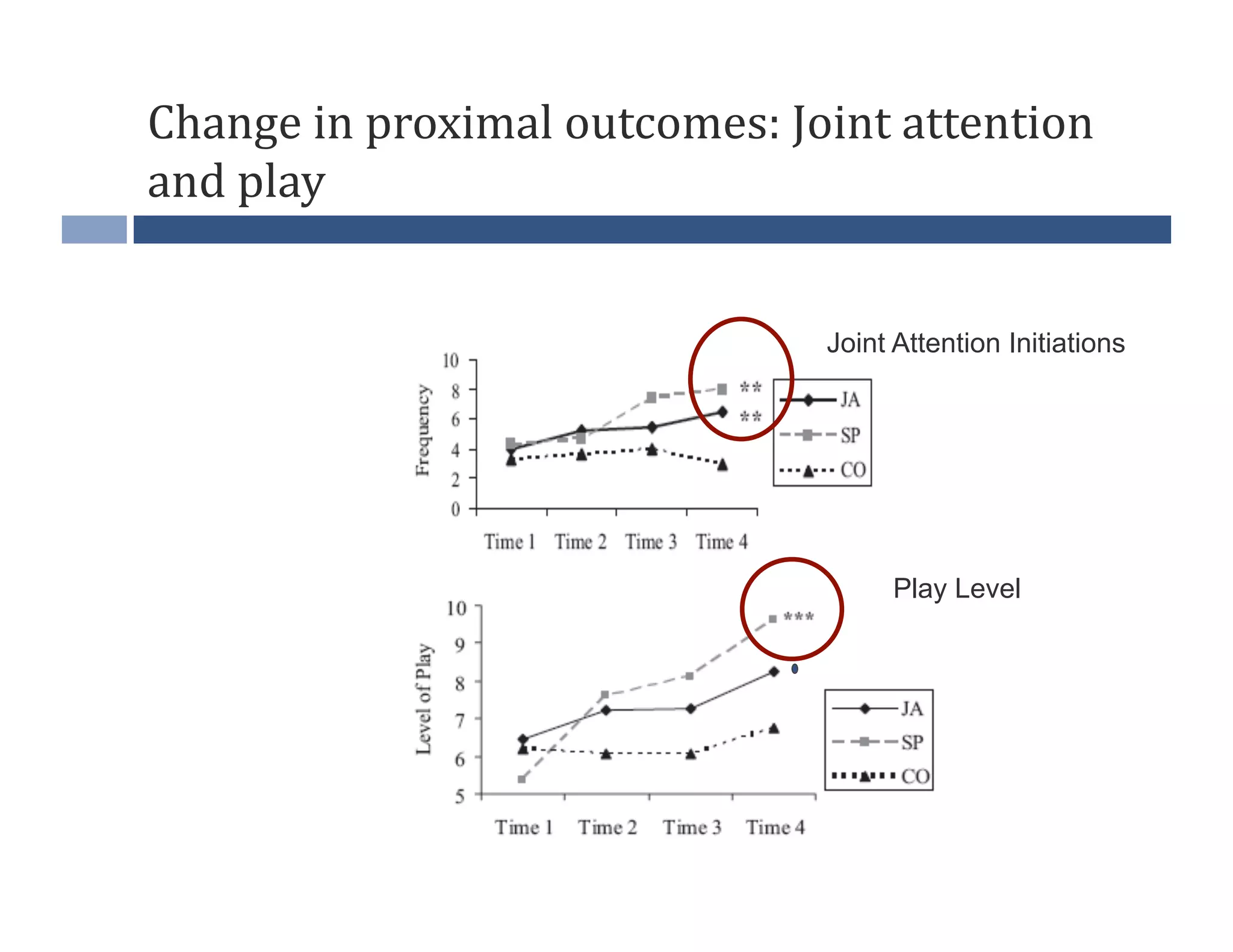
Change	
  in	
  proximal	
  outcomes:	
  Joint	
  attention	
  
and	
  play	


                                            Joint Attention Initiations


                                                  Play Level
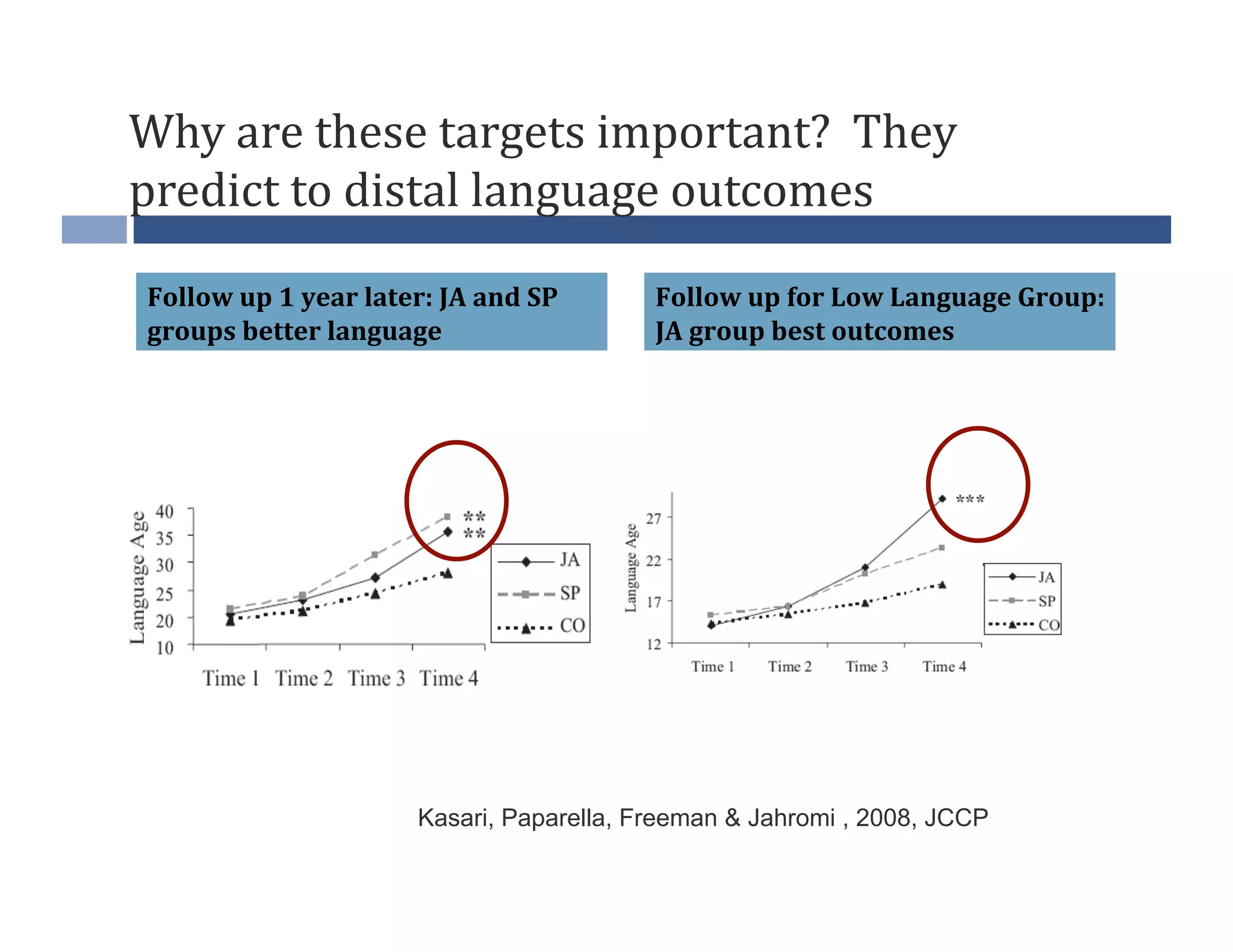
Why	
  are	
  these	
  targets	
  important?	
  	
  They	
  
predict	
  to	
  distal	
  language	
  outcomes	
  

 Follow	
  up	
  1	
  year	
  later:	
  JA	
  and	
  SP	
     Follow	
  up	
  for	
  Low	
  Language	
  Group:
                                                                                                             	
  
 groups	
  better	
  language	
                               JA	
  group	
  best	
  outcomes	


                                      Kasari, Paparella, Freeman & Jahromi , 2008, JCCP
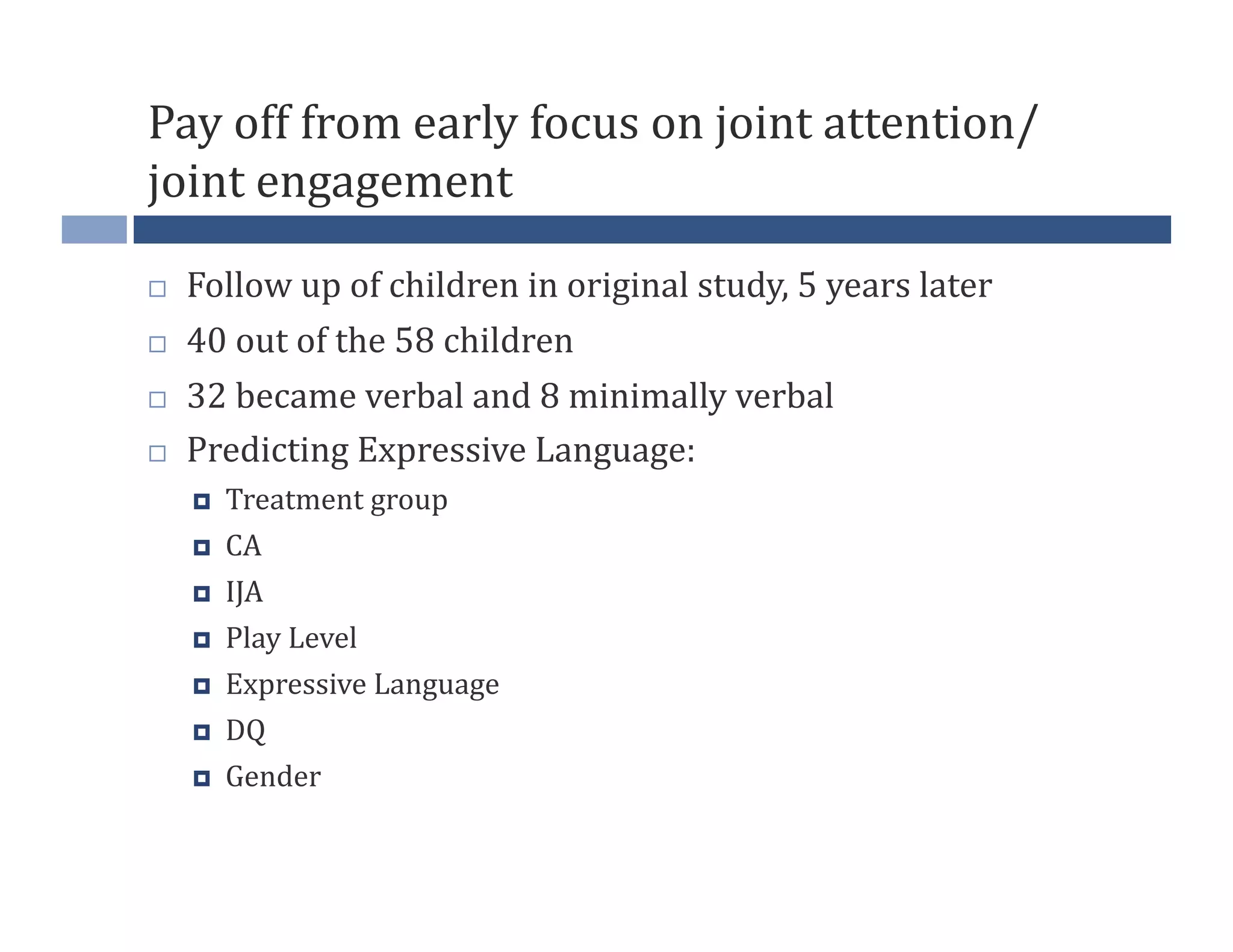
Pay	
  off	
  from	
  early	
  focus	
  on	
  joint	
  attention/
joint	
  engagement	
  

    Follow	
  up	
  of	
  children	
  in	
  original	
  study,	
  5	
  years	
  later	
  
    40	
  out	
  of	
  the	
  58	
  children	
  
    32	
  became	
  verbal	
  and	
  8	
  minimally	
  verbal	
  
    Predicting	
  Expressive	
  Language:	
  
         Treatment	
  group	
  
         CA	
  
         IJA	
  
         Play	
  Level	
  
         Expressive	
  Language	
  
         DQ	
  
         Gender	
  
Pay	
  off	
  from	
  early	
  focus	
  on	
  joint	
  attention/
    joint	
  engagement	
  
9


        Follow	
  up	
  of	
  children	
  in	
  original	
  study,	
  5	
  years	
  later	
  
        40	
  out	
  of	
  the	
  58	
  children	
  
        32	
  became	
  verbal	
  and	
  8	
  minimally	
  verbal	
  
        Predicting	
  Expressive	
  Language:	
  
             Treatment	
  group	
  
             CA	
  
             Initiates	
  joint	
  attention	
  
             Play	
  Level	
  
             Expressive	
  Language	
  
             DQ	
  
             Gender	
                                              Kasari, Gulsrud, Freeman, Paparella,
                                                                    Hellemann, 2012, JAACAP
What	
  did	
  we	
  learn	
  from	
  this	
  study?	
  

    Active	
  ingredient	
  to	
  early	
  intervention	
  is	
  a	
  focus	
  on	
  early	
  
     developing	
  core	
  de?icits	
  
         Joint	
  attention	
  
         Play	
  
    Results	
  suggest	
  the	
  mechanism	
  is	
  likely	
  engagement	
  as	
  JA	
  
     and	
  SP	
  interventions	
  led	
  to	
  similar	
  outcome	
  
    Suggestion	
  that	
  APPROACH	
  also	
  matters-­‐-­‐-­‐the	
  fusion	
  of	
  
     developmental	
  and	
  behavioral	
  approaches	


                                                                                   JASPER
Difference	
  between	
  preverbal	
  and	
  nonverbal	
  
children	
  

    Most	
  young	
  children	
  are	
  preverbal…..we	
  can	
  get	
  them	
  to	
  
     talk	
  

    Concern	
  is	
  for	
  the	
  children	
  who	
  remain	
  nonverbal	
  at	
  age	
  
     5-­‐-­‐-­‐entering	
  kindergarten	
  (about	
  30%	
  of	
  all	
  children)	
  

    Best	
  social	
  and	
  adaptive	
  outcomes	
  are	
  often	
  found	
  for	
  
     children	
  who	
  are	
  verbal	
  by	
  school	
  age	
  

    Children	
  who	
  are	
  nonverbal	
  (minimally	
  verbal)	
  at	
  school	
  
     age	
  are	
  UNDERSERVED,	
  UNDER-­‐STUDIED	
  
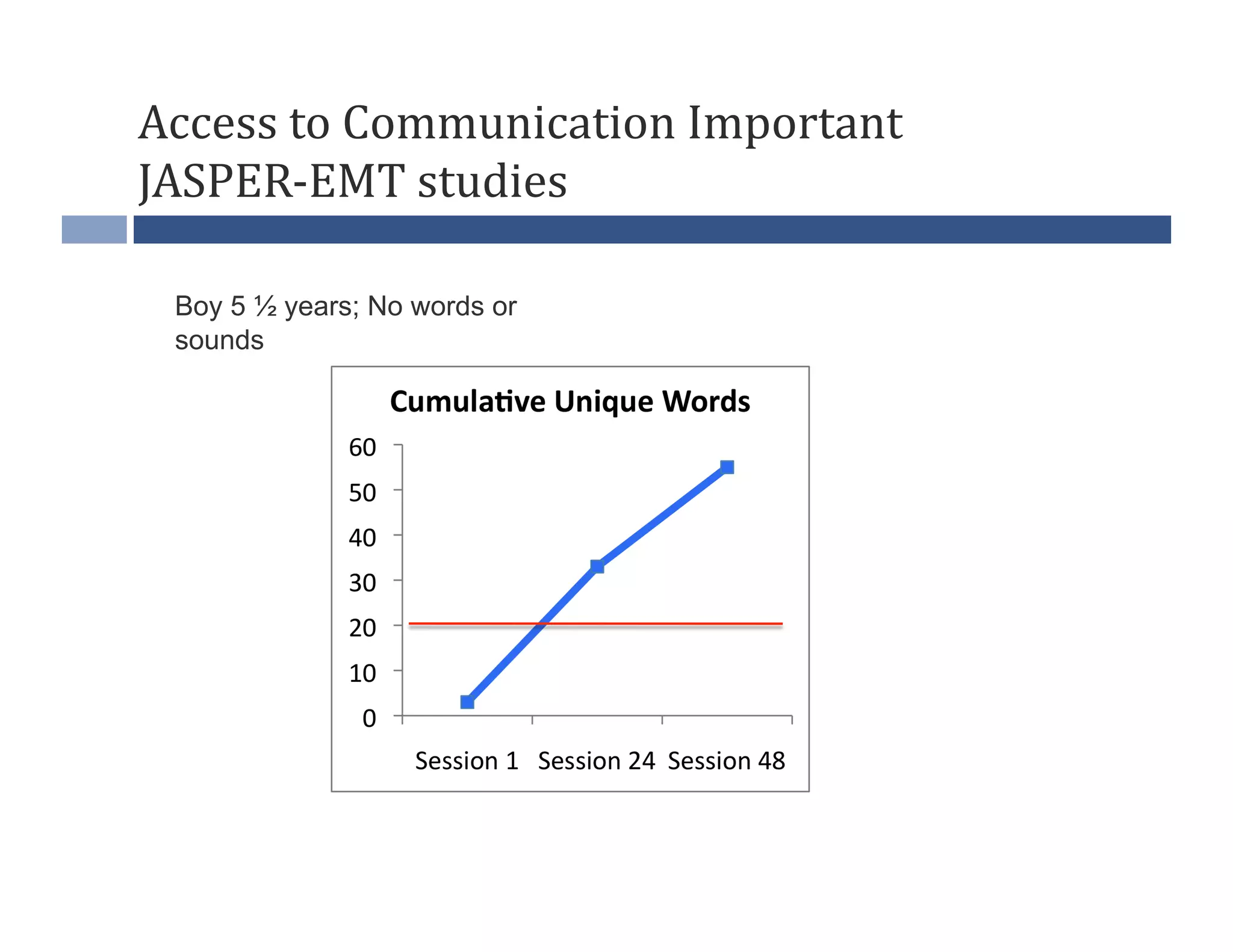
Access	
  to	
  Communication	
  Important	
  
JASPER-­‐EMT	
  studies	
  

  Boy 5 ½ years; No words or
  sounds
School	
  aged	
  Studies:	
  What	
  is	
  the	
  Issue?	
  

    For children with ASD:
       More issues about social inclusion/acceptance than academic
        support for some children
       Others---issues about intervention in general—minimally
        verbal, low verbal, learning
    Level of support needed (or if it is needed)
         1:1 assistant?
    Concerns mostly about feeling connected, belonging for
     ASD
         Intervention for ASD---or for those around ASD?
UCLA	
  School	
  aged	
  Studies:	
  Children	
  have	
  
different	
  views	
  about	
  friends,	
  relationships	
  

    Important to ask children

    Gives you window into their world

    Provides clues as to what is needed for intervention, and
     if intervention is needed
Information	
  gained	
  from	
  asking	
  
    How	
  connected	
  child	
  is	
  to	
  other	
  children	
  in	
  the	
  
     class	
  
       How	
  popular	
  (salient)	
  the	
  peer	
  group	
  is	
  

  If	
  children	
  they	
  nominate	
  as	
  best	
  friends	
  nominate	
  
   them	
  back	
  (reciprocity)	
  
  How	
  many	
  children	
  they	
  nominate	
  as	
  friends	


  How	
  many	
  children	
  nominate	
  them	
  as	
  a	
  friend	
  
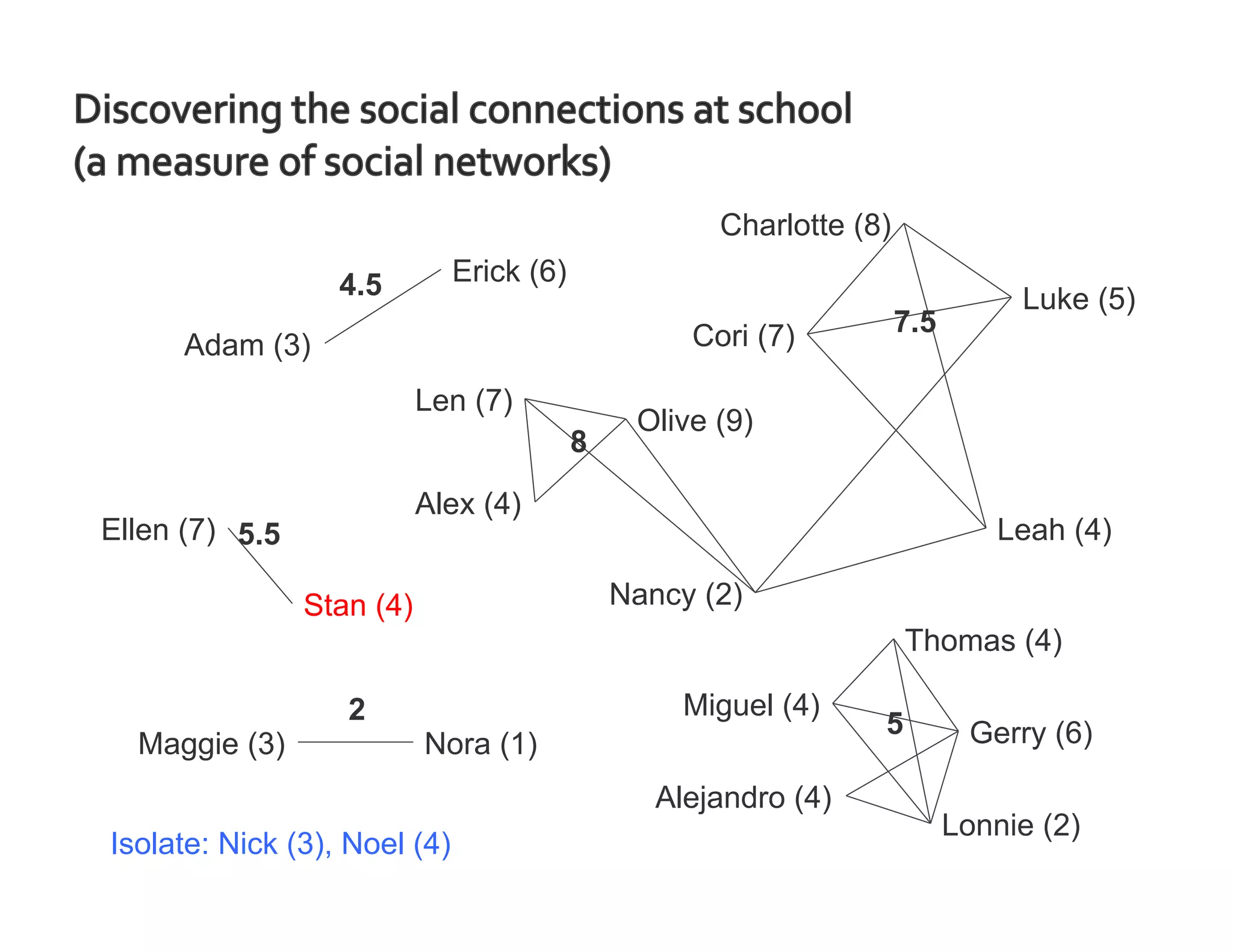
Charlotte (8)
                  4.5         Erick (6)
                                                                                Luke (5)
                                                   Cori (7)          7.5
      Adam (3)
                           Len (7)
                                               Olive (9)
                                          8

                           Alex (4)
Ellen (7) 5.5                                                                 Leah (4)

                Stan (4)                      Nancy (2)
                                                                     Thomas (4)

                   2                               Miguel (4)
                                                                 5          Gerry (6)
  Maggie (3)               Nora (1)
                                                 Alejandro (4)
                                                                           Lonnie (2)
Isolate: Nick (3), Noel (4)
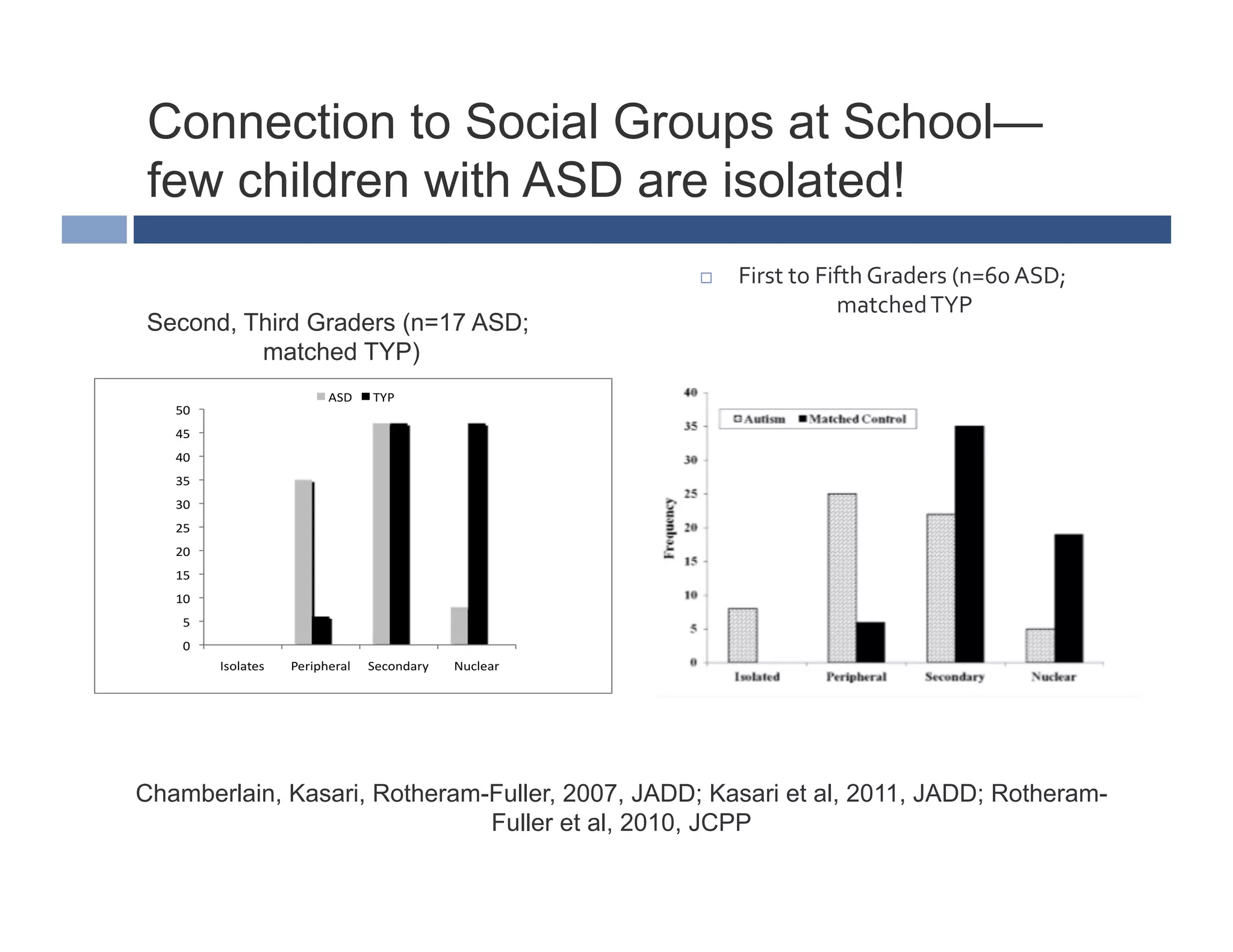
Connection to Social Groups at School—
 few children with ASD are isolated!
                                                     First	
  to	
  Fifth	
  Graders	
  (n=60	
  ASD;	
  
                                                                       matched	
  TYP      	
  
Second, Third Graders (n=17 ASD;
         matched TYP)


Chamberlain, Kasari, Rotheram-Fuller, 2007, JADD; Kasari et al, 2011, JADD; Rotheram-
                              Fuller et al, 2010, JCPP
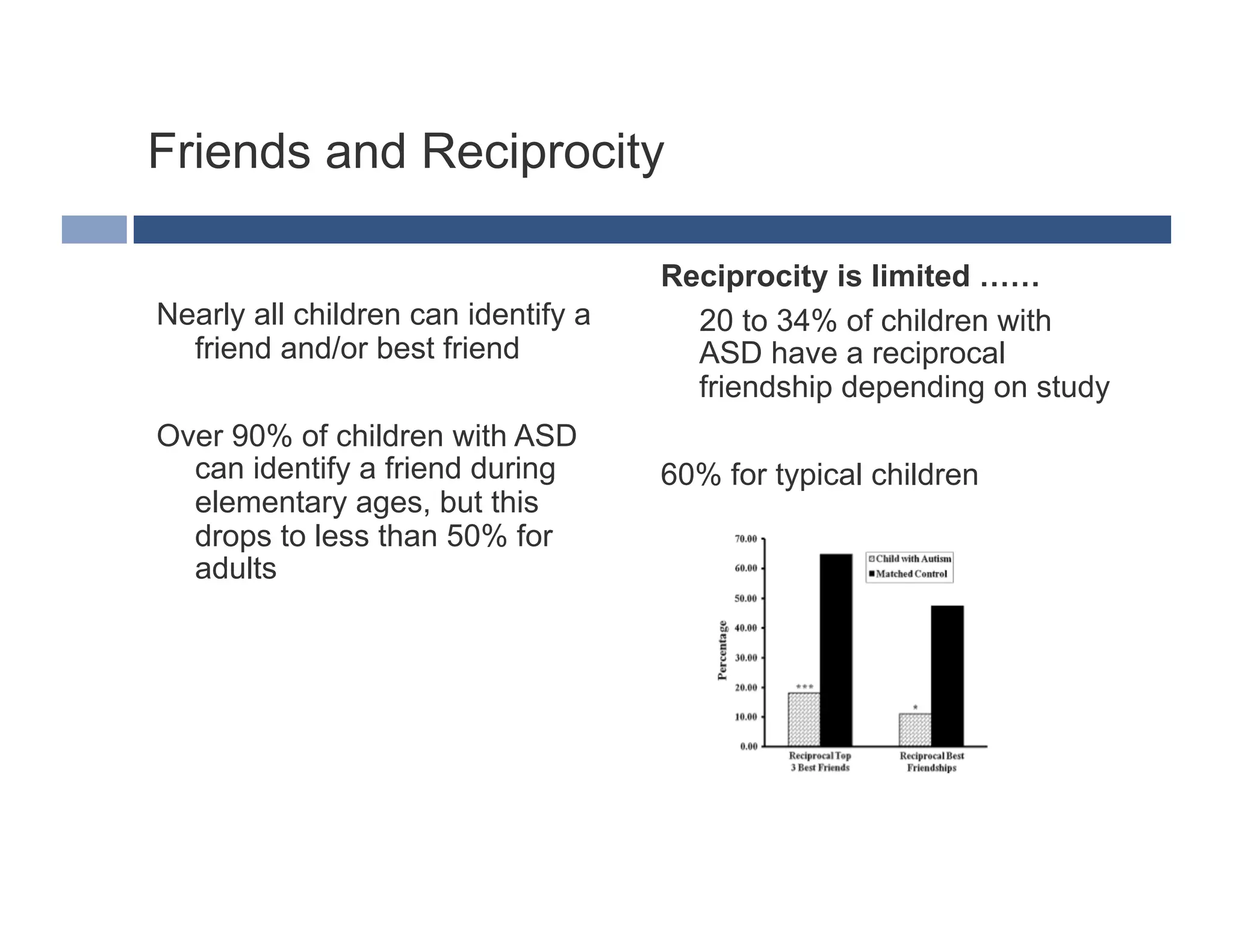
Friends and Reciprocity

                                     Reciprocity is limited ……
Nearly all children can identify a     20 to 34% of children with
  friend and/or best friend            ASD have a reciprocal
                                       friendship depending on study
Over 90% of children with ASD
  can identify a friend during       60% for typical children
  elementary ages, but this
  drops to less than 50% for
  adults
What	
  about	
  children	
  who	
  are	
  doing	
  well	
  
(socially	
  connected)?	
  

    20%	
  of	
  children	
  had	
  a	
  reciprocal	
  friendship	
  (best	
  or	
  top	
  3)	
  

    These	
  same	
  children	
  had	
  higher	
  social	
  network	
  status	
  

    Were	
  they	
  also	
  more	
  engaged	
  on	
  the	
  playground?	
  

    NO…..playground	
  may	
  be	
  just	
  too	
  difficult	
  an	
  environment	
  
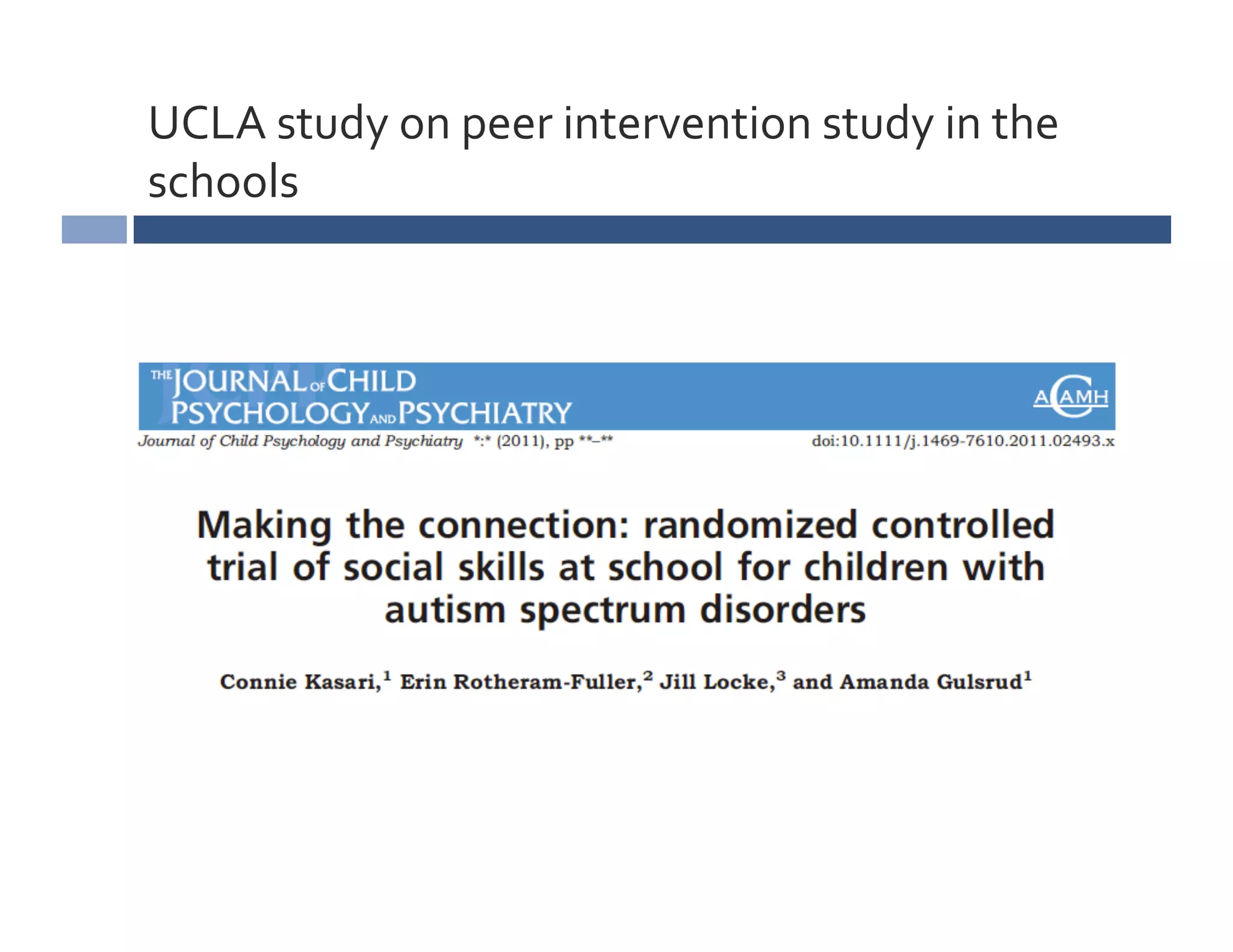
UCLA	
  study	
  on	
  peer	
  intervention	
  study	
  in	
  the	
  
schools	
  
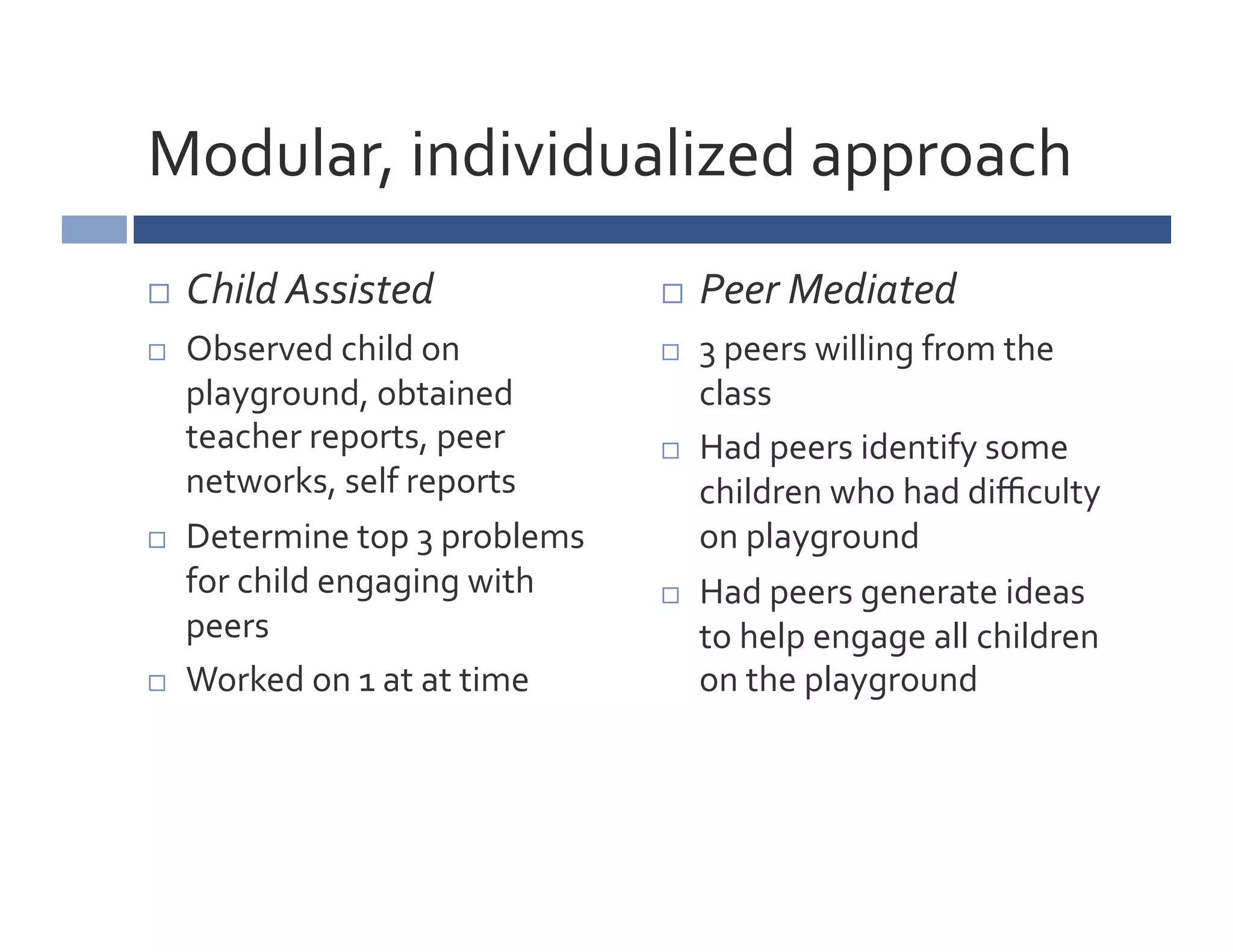
Modular,	
  individualized	
  approach	
  
    Child	
  Assisted	
                             Peer	
  Mediated	
  
    Observed	
  child	
  on	
                       3	
  peers	
  willing	
  from	
  the	
  
     playground,	
  obtained	
                        class	
  
     teacher	
  reports,	
  peer	
                   Had	
  peers	
  identify	
  some	
  
     networks,	
  self	
  reports	
                   children	
  who	
  had	
  difficulty	
  
    Determine	
  top	
  3	
  problems	
              on	
  playground	
  
     for	
  child	
  engaging	
  with	
              Had	
  peers	
  generate	
  ideas	
  
     peers	
                                          to	
  help	
  engage	
  all	
  children	
  
    Worked	
  on	
  1	
  at	
  at	
  time	
          on	
  the	
  playground	
  
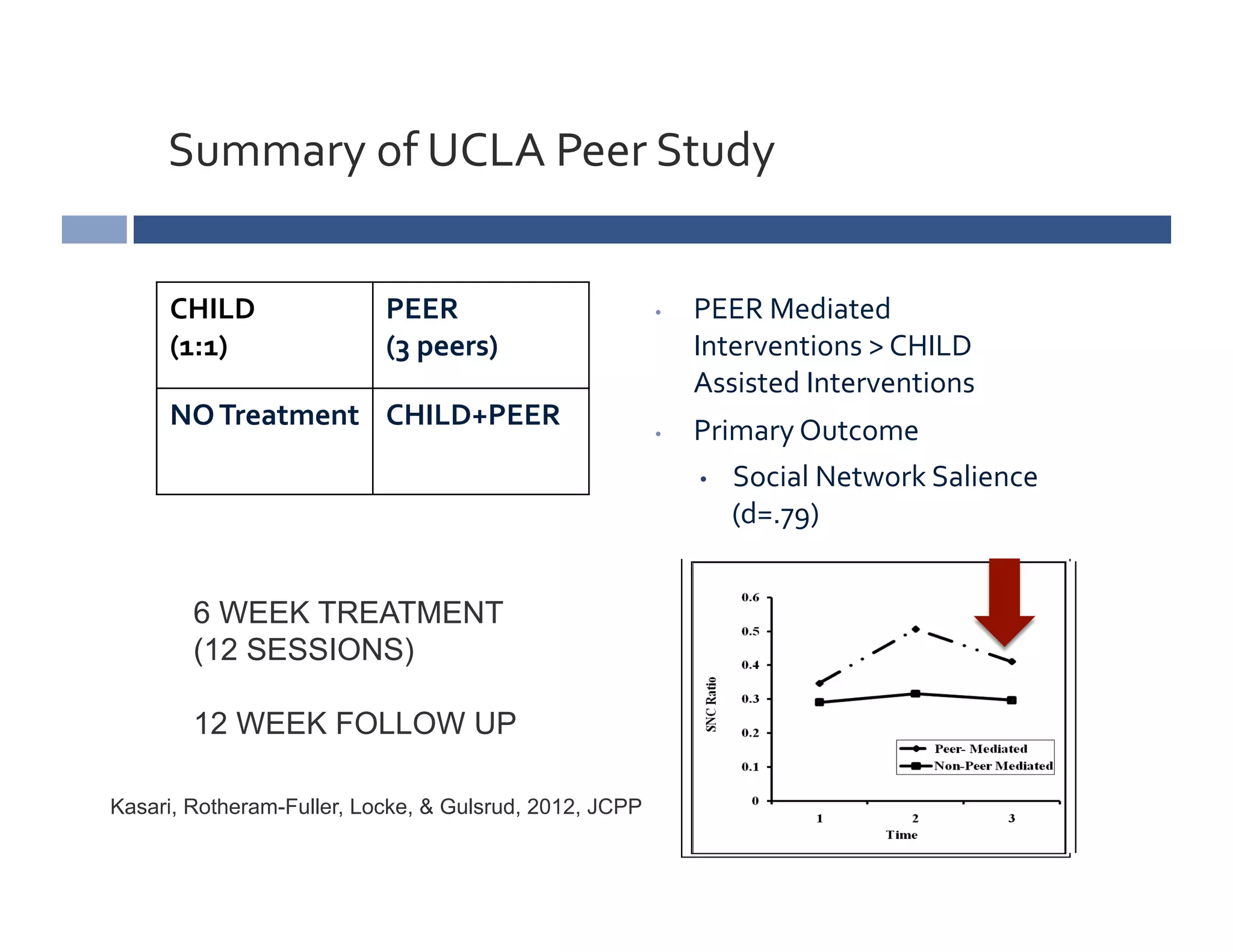
Summary	
  of	
  UCLA	
  Peer	
  Study	


     CHILD	
               PEER	
                       •    PEER	
  Mediated	
  
     (1:1)	
               (3	
  peers)	
                    Interventions	
  >	
  CHILD	
  
                                                             Assisted	
  Interventions	
  
     NO	
  Treatment	
   CHILD+PEER	
  
                                                        •    Primary	
  Outcome	
  
                                                             •  Social	
  Network	
  Salience	
  
                                                                (d=.79)	


        6 WEEK TREATMENT
        (12 SESSIONS)

        12 WEEK FOLLOW UP

Kasari, Rotheram-Fuller, Locke, & Gulsrud, 2012, JCPP
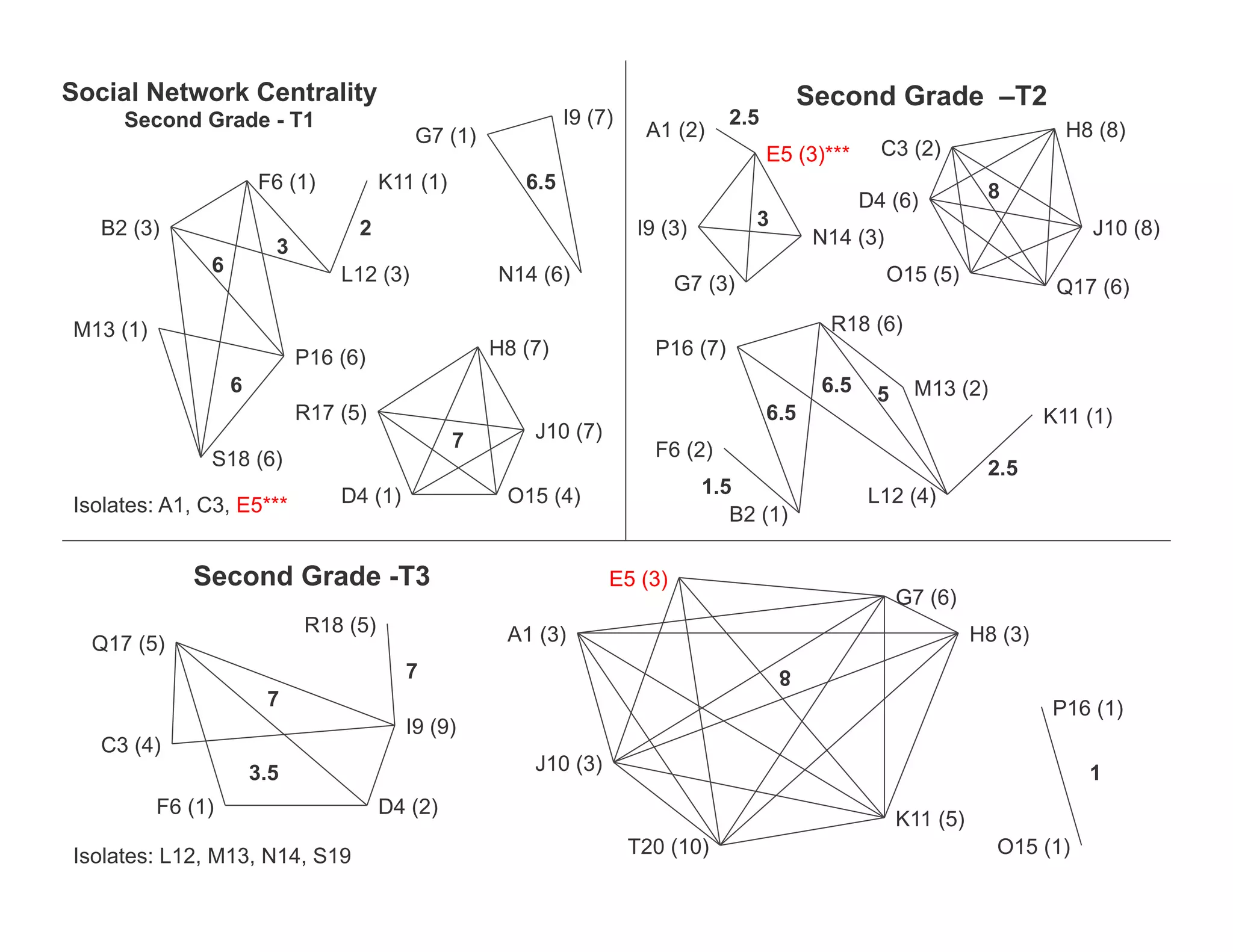
Social Network Centrality                                                                      Second Grade –T2
     Second Grade - T1                                        I9 (7)               2.5
                                           G7 (1)                       A1 (2)                                                  H8 (8)
                                                                                         E5 (3)***      C3 (2)
                       F6 (1)          K11 (1)          6.5                                                           8
                                                                                                      D4 (6)
   B2 (3)                          2                                   I9 (3)        3                                             J10 (8)
                         3                                                                      N14 (3)
               6                 L12 (3)             N14 (6)                                              O15 (5)
                                                                            G7 (3)                                             Q17 (6)
M13 (1)                                                                                          R18 (6)
                             P16 (6)                 H8 (7)              P16 (7)
                   6                                                                            6.5    5    M13 (2)
                             R17 (5)                                                     6.5                                  K11 (1)
                                                 7       J10 (7)
               S18 (6)                                                   F6 (2)
                                                                                                                      2.5
                                 D4 (1)               O15 (4)                   1.5                   L12 (4)
Isolates: A1, C3, E5***                                                            B2 (1)

             Second Grade -T3                                      E5 (3)
                                                                                                           G7 (6)
                             R18 (5)                  A1 (3)                                                         H8 (3)
  Q17 (5)
                                          7                                               8
                        7                                                                                                     P16 (1)
                                          I9 (9)
   C3 (4)
                       3.5                               J10 (3)                                                                  1
          F6 (1)                       D4 (2)
                                                                                                           K11 (5)
Isolates: L12, M13, N14, S19                                           T20 (10)                                        O15 (1)
Summary	
  of	
  UCLA	
  Peer	
  Study	


CHILD	
           PEER	
             •    Other	
  Findings	
  favoring	
  Peer	
  
(1:1)	
           (3	
  peers)	
          Mediated	
  Interventions:	
  

NO	
  Treatment	
   CHILD+PEER	
  
                                          •    Number	
  of	
  Received	
  
                                               Friend	
  Nominations	
  
                                               (d=74)	
  
                                          •    Less	
  isolated	
  on	
  
                                               playground	
  (growth	
  
  6 WEEK TREATMENT
                                               curves	
  over	
  tx)	
  
  (12 SESSIONS)
                                          •    Improved	
  rating	
  of	
  social	
  
  12 WEEK FOLLOW UP                            skills	
  (by	
  Teachers)	
  (d=.44)	
  
Other	
  Findings	


    Effect	
  of	
  the	
  1:1	
  assistant	
  
         About	
  half	
  of	
  the	
  children	
  had	
  a	
  1:1	
  assistant	
  
    They	
  were	
  the	
  least	
  engaged	
  on	
  the	
  playground	
  (with	
  peers	
  
     or	
  with	
  the	
  aide)	
  
    Need	
  to	
  think	
  about	
  how	
  to	
  train	
  aides	
  better	
  
         Just	
  completed	
  para-­‐educator	
  intervention	
  on	
  the	
  playground	
  
         Can	
  change	
  adult	
  behavior	
  and	
  improve	
  child	
  engagement	
  
What	
  Needs	
  to	
  Happen	
  to	
  deploy	
  evidence	
  
based	
  interventions	
  into	
  schools	
  

    Researchers	
  need	
  to	
  conduct	
  research	
  in	
  school	
  settings;	
  
     effectiveness	
  research	
  from	
  beginning	
  not	
  last	
  step	
  
    Distillation	
  and	
  matching	
  approaches	
  to	
  intervention	
  
         Isolating	
  active	
  ingredients	
  of	
  intervention	
  
         Matching	
  to	
  needs	
  of	
  child	
  in	
  context	
  
    New	
  approaches:	
  	
  Researchers	
  and	
  school	
  staff	
  need	
  to	
  work	
  
     together….community	
  partnered	
  research	
  (balance	
  of	
  
     power)	
  
         NEW:	
  	
  partnered	
  research	
  with	
  LAUSD	
  for	
  low	
  resourced	
  schools	
  
              Testing	
  playground	
  intervention	
  
              Functional	
  routines	
  in	
  special	
  education	
  classrooms	
  
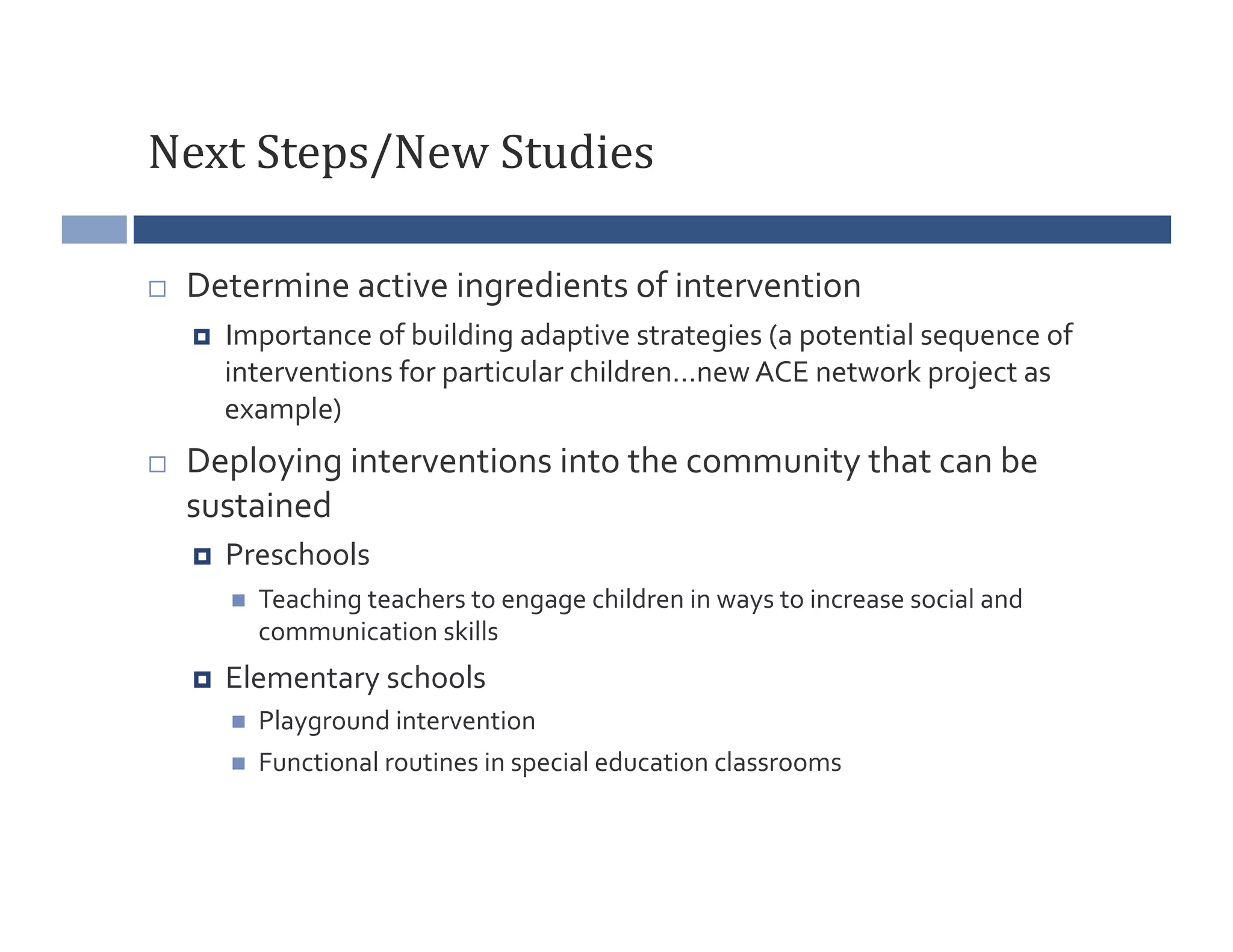
Next	
  Steps/New	
  Studies	
  

    Determine	
  active	
  ingredients	
  of	
  intervention	
  
         Importance	
  of	
  building	
  adaptive	
  strategies	
  (a	
  potential	
  sequence	
  of	
  
          interventions	
  for	
  particular	
  children…new	
  ACE	
  network	
  project	
  as	
  
          example)	
  
    Deploying	
  interventions	
  into	
  the	
  community	
  that	
  can	
  be	
  
     sustained	
  
         Preschools	
  
              Teaching	
  teachers	
  to	
  engage	
  children	
  in	
  ways	
  to	
  increase	
  social	
  and	
  
               communication	
  skills	
  
         Elementary	
  schools	
  
              Playground	
  intervention	
  
              Functional	
  routines	
  in	
  special	
  education	
  classrooms	
  
Acknowledgements	
  
Funding!	
  	
  NIH,	
  HRSA,	
  Autism	
  Speaks,	
  Private	
  donors	
  

                                            Jason	
  Lee	
  
Current	
                                   Caity	
  McCracken	
  
Gail	
  Fox	
  Adams	
                      Charlotte	
  Mucchetti	
  
Kathleen	
  Berry	
                         Chris	
  Osborn	
  
Ya-­‐Chih	
  Chang,	
  PhD	
                Jonathan	
  Panganaban	
  
Michelle	
  Dean	
                          Stephanie	
  Patterson	
  
Amy	
  Fuller	
                             Wendy	
  Shih	
  
Lizzy	
  Fuller	
  
                                            Shawna	
  Ueyama	
  
Jordan	
  Gibson	
  
Hilary	
  Gould	
                           •    Community	
  
Kelly	
  Stickles	
  Goods,	
  PhD	
  
                                            Sonia	
  Dickson-­‐Bracks,	
  MBUSD	
  
Amanda	
  Gulsrud,	
  Phd	
  
                                            Carolyn	
  Gelfand,	
  LAUSD	
  
Alison	
  Holbrook	
  
Nancy	
  Huynh,	
  PhD	
  
Eric	
  Ishijima,	
  PhD	
  
Dahlia	
  Kabab	
  
Mark	
  Kretzmann,	
  PhD	
  
Kelley	
  Krueger	
  

Connie Kasari 2012 Science and Sandwiches

  • 1.
    Engaging Autism: Considerationsfor underserved, under-represented and under-resourced   Connie  Kasari,  PhD   University  of  California,  Los  Angeles   ASF Science and Sandwiches December 6, 2012 AIR-B --Autism Intervention Research Network for Behavioral Health
  • 2.
    UCLA Kasari LabIntervention Studies   Targeted  Interventions     Core  deficits  (beyond  dose  and  approach)     Underserved,  under-­‐represented     Infants,  toddlers     Minimally  verbal     School  aged,  included  in  general  education     Under-­‐resourced     Community  based     Schools  are  where  all  children  can  be  found  
  • 3.
    Engagement  as  Critical  Intervention  Target     Young  children:  focus  on  joint  attention,  play,   engagement  with  parents  (the  core  de?icits)     Look  to  behavioral  signs  of  engagement     Shared  attention  and  affect     Joint  attention     Social  play  with  others     Conversation  
  • 4.
    Targeted  Intervention  Approach  to  Address   Problems  of  Engagement     To  affect  engagement,   intervention  needs  to  be   targeted,  dense  and  long  term     The  targets  of  intervention   change  with  development,  and   with  amount  of  impairment  in   individual  children     Debate  in  the  field  as  to  how   much  direct  teaching  versus   naturalistic  methods  should  be   used  
  • 5.
    JASPER     Joint  Attention,  Symbolic  Play,  Engagement,  Regulation   Joint Attention Initiations: -Point to share -Show # -Symbolic Play
  • 6.
    Change  in  proximal  outcomes:  Joint  attention   and  play   Joint Attention Initiations Play Level
  • 7.
    Why  are  these  targets  important?    They   predict  to  distal  language  outcomes   Follow  up  1  year  later:  JA  and  SP   Follow  up  for  Low  Language  Group:   groups  better  language   JA  group  best  outcomes   Kasari, Paparella, Freeman & Jahromi , 2008, JCCP
  • 8.
    Pay  off  from  early  focus  on  joint  attention/ joint  engagement     Follow  up  of  children  in  original  study,  5  years  later     40  out  of  the  58  children     32  became  verbal  and  8  minimally  verbal     Predicting  Expressive  Language:     Treatment  group     CA     IJA     Play  Level     Expressive  Language     DQ     Gender  
  • 9.
    Pay  off  from  early  focus  on  joint  attention/ joint  engagement   9   Follow  up  of  children  in  original  study,  5  years  later     40  out  of  the  58  children     32  became  verbal  and  8  minimally  verbal     Predicting  Expressive  Language:     Treatment  group     CA     Initiates  joint  attention     Play  Level     Expressive  Language     DQ     Gender   Kasari, Gulsrud, Freeman, Paparella, Hellemann, 2012, JAACAP
  • 10.
    What  did  we  learn  from  this  study?     Active  ingredient  to  early  intervention  is  a  focus  on  early   developing  core  de?icits     Joint  attention     Play     Results  suggest  the  mechanism  is  likely  engagement  as  JA   and  SP  interventions  led  to  similar  outcome     Suggestion  that  APPROACH  also  matters-­‐-­‐-­‐the  fusion  of   developmental  and  behavioral  approaches   JASPER
  • 11.
    Difference  between  preverbal  and  nonverbal   children     Most  young  children  are  preverbal…..we  can  get  them  to   talk     Concern  is  for  the  children  who  remain  nonverbal  at  age   5-­‐-­‐-­‐entering  kindergarten  (about  30%  of  all  children)     Best  social  and  adaptive  outcomes  are  often  found  for   children  who  are  verbal  by  school  age     Children  who  are  nonverbal  (minimally  verbal)  at  school   age  are  UNDERSERVED,  UNDER-­‐STUDIED  
  • 12.
    Access  to  Communication  Important   JASPER-­‐EMT  studies   Boy 5 ½ years; No words or sounds
  • 13.
    School  aged  Studies:  What  is  the  Issue?     For children with ASD:   More issues about social inclusion/acceptance than academic support for some children   Others---issues about intervention in general—minimally verbal, low verbal, learning   Level of support needed (or if it is needed)   1:1 assistant?   Concerns mostly about feeling connected, belonging for ASD   Intervention for ASD---or for those around ASD?
  • 14.
    UCLA  School  aged  Studies:  Children  have   different  views  about  friends,  relationships     Important to ask children   Gives you window into their world   Provides clues as to what is needed for intervention, and if intervention is needed
  • 17.
    Information  gained  from  asking     How  connected  child  is  to  other  children  in  the   class     How  popular  (salient)  the  peer  group  is     If  children  they  nominate  as  best  friends  nominate   them  back  (reciprocity)     How  many  children  they  nominate  as  friends       How  many  children  nominate  them  as  a  friend  
  • 18.
    Charlotte (8) 4.5 Erick (6) Luke (5) Cori (7) 7.5 Adam (3) Len (7) Olive (9) 8 Alex (4) Ellen (7) 5.5 Leah (4) Stan (4) Nancy (2) Thomas (4) 2 Miguel (4) 5 Gerry (6) Maggie (3) Nora (1) Alejandro (4) Lonnie (2) Isolate: Nick (3), Noel (4)
  • 19.
    Connection to SocialGroups at School— few children with ASD are isolated!   First  to  Fifth  Graders  (n=60  ASD;   matched  TYP   Second, Third Graders (n=17 ASD; matched TYP) Chamberlain, Kasari, Rotheram-Fuller, 2007, JADD; Kasari et al, 2011, JADD; Rotheram- Fuller et al, 2010, JCPP
  • 20.
    Friends and Reciprocity Reciprocity is limited …… Nearly all children can identify a 20 to 34% of children with friend and/or best friend ASD have a reciprocal friendship depending on study Over 90% of children with ASD can identify a friend during 60% for typical children elementary ages, but this drops to less than 50% for adults
  • 21.
    What  about  children  who  are  doing  well   (socially  connected)?     20%  of  children  had  a  reciprocal  friendship  (best  or  top  3)     These  same  children  had  higher  social  network  status     Were  they  also  more  engaged  on  the  playground?     NO…..playground  may  be  just  too  difficult  an  environment  
  • 22.
    UCLA  study  on  peer  intervention  study  in  the   schools  
  • 23.
    Modular,  individualized  approach     Child  Assisted     Peer  Mediated     Observed  child  on     3  peers  willing  from  the   playground,  obtained   class   teacher  reports,  peer     Had  peers  identify  some   networks,  self  reports   children  who  had  difficulty     Determine  top  3  problems   on  playground   for  child  engaging  with     Had  peers  generate  ideas   peers   to  help  engage  all  children     Worked  on  1  at  at  time   on  the  playground  
  • 24.
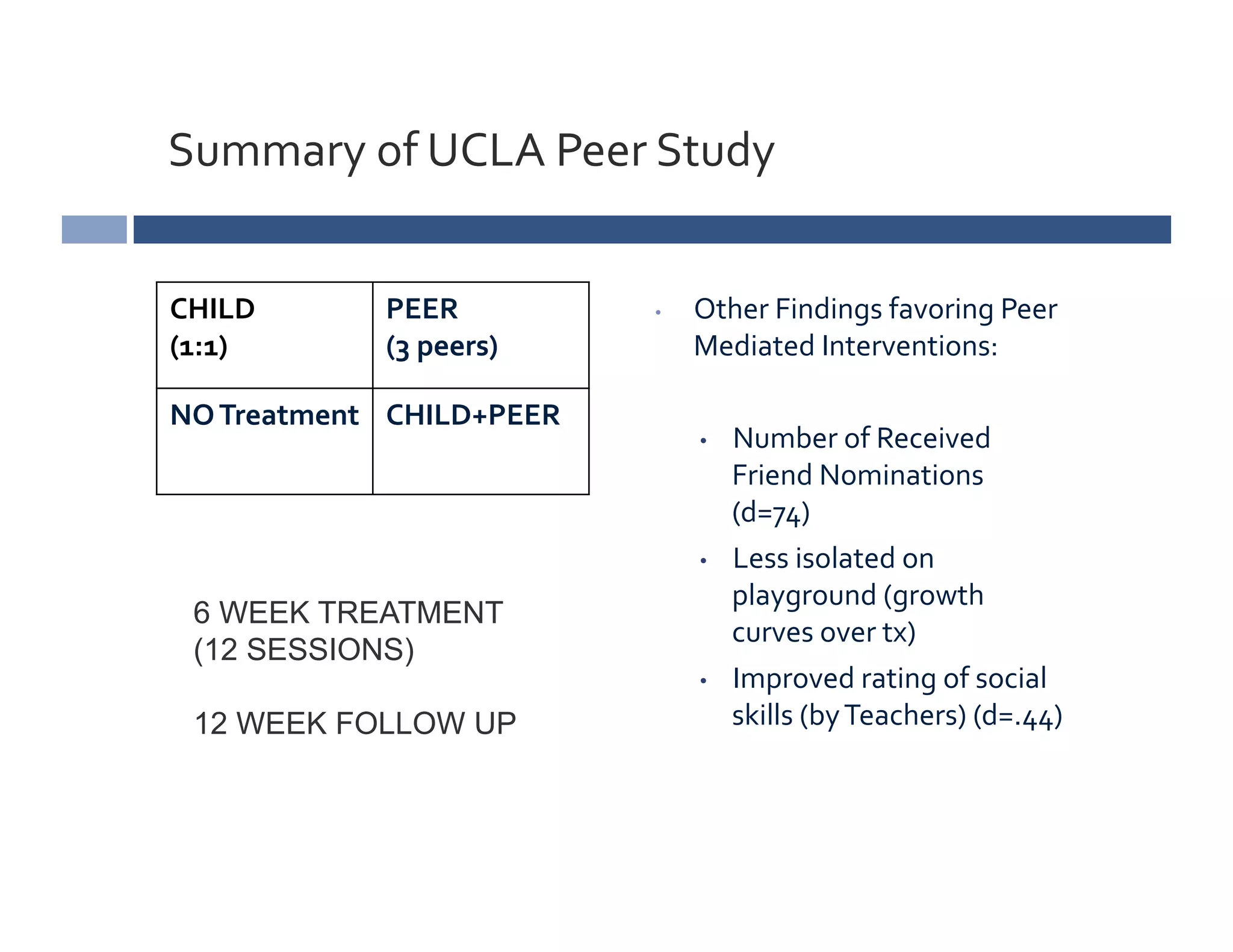
    Summary  of  UCLA  Peer  Study   CHILD   PEER   •  PEER  Mediated   (1:1)   (3  peers)   Interventions  >  CHILD   Assisted  Interventions   NO  Treatment   CHILD+PEER   •  Primary  Outcome   •  Social  Network  Salience   (d=.79)   6 WEEK TREATMENT (12 SESSIONS) 12 WEEK FOLLOW UP Kasari, Rotheram-Fuller, Locke, & Gulsrud, 2012, JCPP
  • 25.
    Social Network Centrality Second Grade –T2 Second Grade - T1 I9 (7) 2.5 G7 (1) A1 (2) H8 (8) E5 (3)*** C3 (2) F6 (1) K11 (1) 6.5 8 D4 (6) B2 (3) 2 I9 (3) 3 J10 (8) 3 N14 (3) 6 L12 (3) N14 (6) O15 (5) G7 (3) Q17 (6) M13 (1) R18 (6) P16 (6) H8 (7) P16 (7) 6 6.5 5 M13 (2) R17 (5) 6.5 K11 (1) 7 J10 (7) S18 (6) F6 (2) 2.5 D4 (1) O15 (4) 1.5 L12 (4) Isolates: A1, C3, E5*** B2 (1) Second Grade -T3 E5 (3) G7 (6) R18 (5) A1 (3) H8 (3) Q17 (5) 7 8 7 P16 (1) I9 (9) C3 (4) 3.5 J10 (3) 1 F6 (1) D4 (2) K11 (5) Isolates: L12, M13, N14, S19 T20 (10) O15 (1)
  • 26.
    Summary  of  UCLA  Peer  Study   CHILD   PEER   •  Other  Findings  favoring  Peer   (1:1)   (3  peers)   Mediated  Interventions:   NO  Treatment   CHILD+PEER   •  Number  of  Received   Friend  Nominations   (d=74)   •  Less  isolated  on   playground  (growth   6 WEEK TREATMENT curves  over  tx)   (12 SESSIONS) •  Improved  rating  of  social   12 WEEK FOLLOW UP skills  (by  Teachers)  (d=.44)  
  • 27.
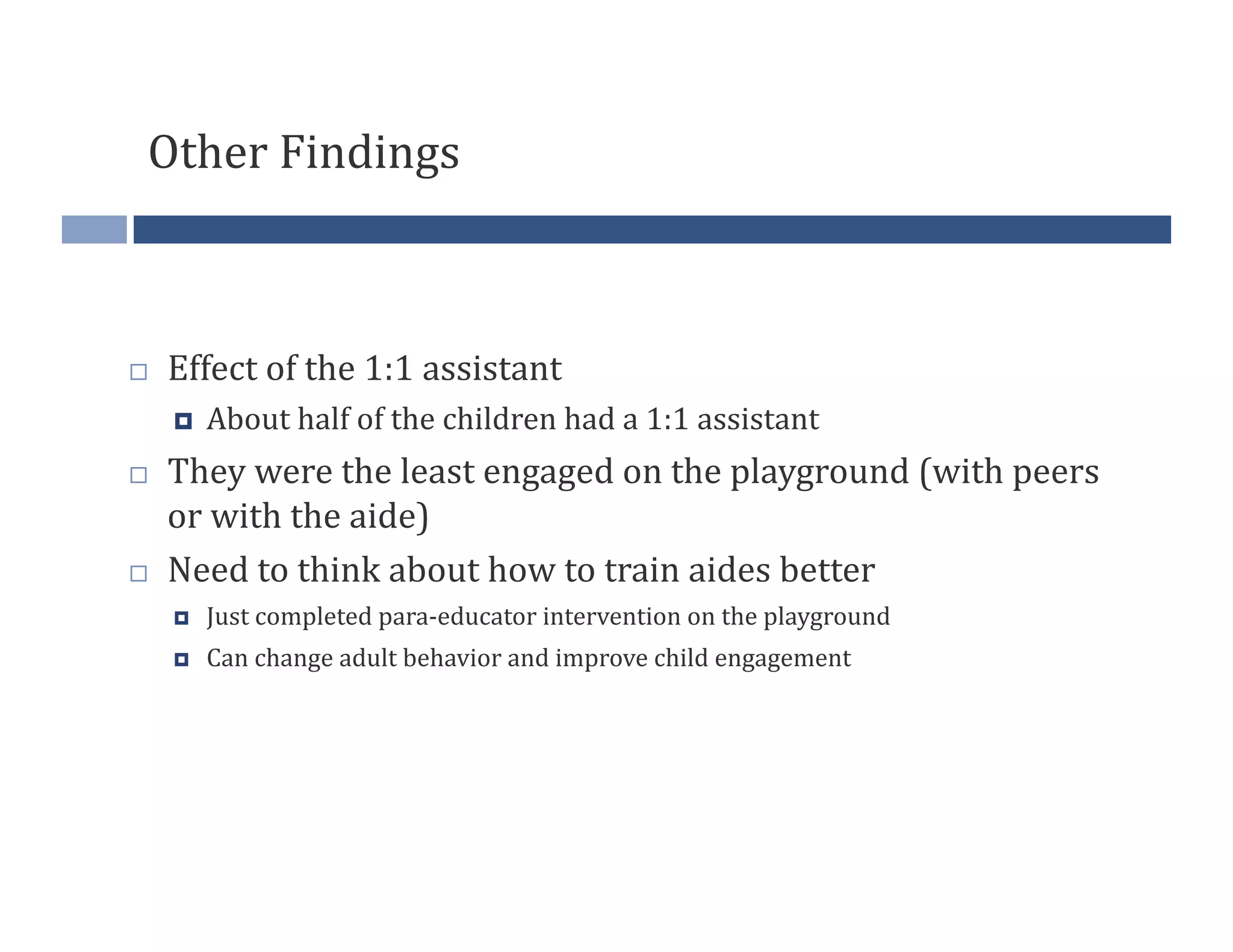
    Other  Findings     Effect  of  the  1:1  assistant     About  half  of  the  children  had  a  1:1  assistant     They  were  the  least  engaged  on  the  playground  (with  peers   or  with  the  aide)     Need  to  think  about  how  to  train  aides  better     Just  completed  para-­‐educator  intervention  on  the  playground     Can  change  adult  behavior  and  improve  child  engagement  
  • 28.
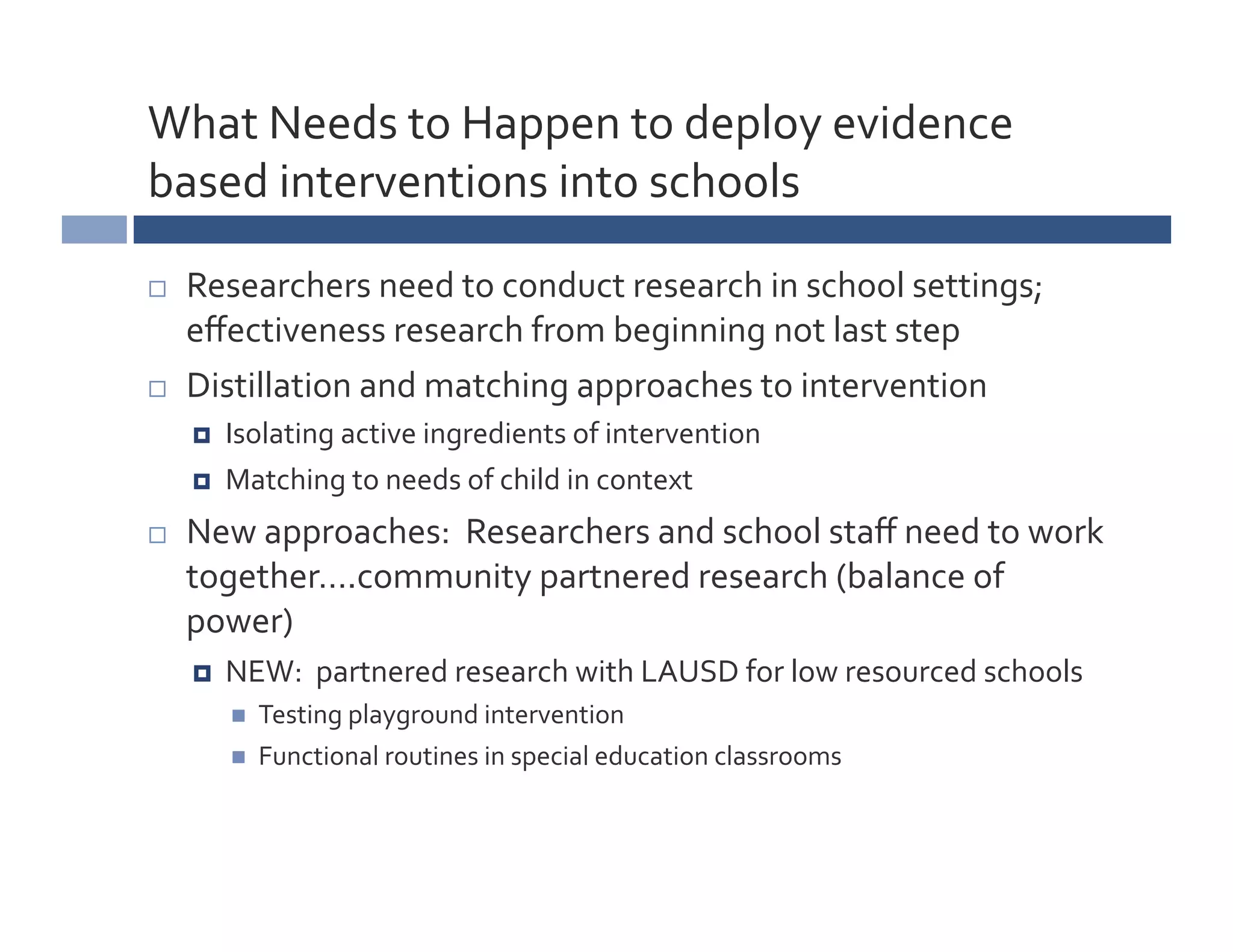
    What  Needs  to  Happen  to  deploy  evidence   based  interventions  into  schools     Researchers  need  to  conduct  research  in  school  settings;   effectiveness  research  from  beginning  not  last  step     Distillation  and  matching  approaches  to  intervention     Isolating  active  ingredients  of  intervention     Matching  to  needs  of  child  in  context     New  approaches:    Researchers  and  school  staff  need  to  work   together….community  partnered  research  (balance  of   power)     NEW:    partnered  research  with  LAUSD  for  low  resourced  schools     Testing  playground  intervention     Functional  routines  in  special  education  classrooms  
  • 29.
    Next  Steps/New  Studies     Determine  active  ingredients  of  intervention     Importance  of  building  adaptive  strategies  (a  potential  sequence  of   interventions  for  particular  children…new  ACE  network  project  as   example)     Deploying  interventions  into  the  community  that  can  be   sustained     Preschools     Teaching  teachers  to  engage  children  in  ways  to  increase  social  and   communication  skills     Elementary  schools     Playground  intervention     Functional  routines  in  special  education  classrooms  
  • 30.
    Acknowledgements   Funding!    NIH,  HRSA,  Autism  Speaks,  Private  donors   Jason  Lee   Current   Caity  McCracken   Gail  Fox  Adams   Charlotte  Mucchetti   Kathleen  Berry   Chris  Osborn   Ya-­‐Chih  Chang,  PhD   Jonathan  Panganaban   Michelle  Dean   Stephanie  Patterson   Amy  Fuller   Wendy  Shih   Lizzy  Fuller   Shawna  Ueyama   Jordan  Gibson   Hilary  Gould   •  Community   Kelly  Stickles  Goods,  PhD   Sonia  Dickson-­‐Bracks,  MBUSD   Amanda  Gulsrud,  Phd   Carolyn  Gelfand,  LAUSD   Alison  Holbrook   Nancy  Huynh,  PhD   Eric  Ishijima,  PhD   Dahlia  Kabab   Mark  Kretzmann,  PhD   Kelley  Krueger