Particles

                             Constituents of the atom
                             Rutherford’s experiment


Thursday, 10 November 2011
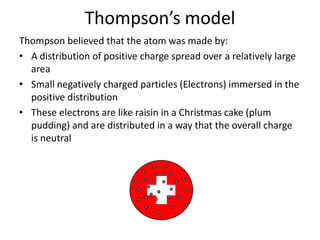
Thompson’s model
Thompson believed that the atom was made by:
• A distribution of positive charge spread over a relatively large
  area
• Small negatively charged particles (Electrons) immersed in the
  positive distribution
• These electrons are like raisin in a Christmas cake (plum
  pudding) and are distributed in a way that the overall charge
  is neutral
Rutherford’s Experiment
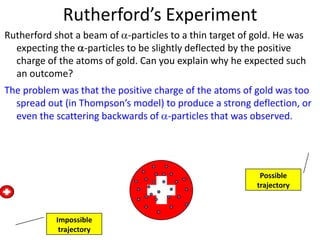
Rutherford shot a beam of -particles to a thin target of gold. He was
  expecting the -particles to be slightly deflected by the positive
  charge of the atoms of gold. Can you explain why he expected such
  an outcome?
The problem was that the positive charge of the atoms of gold was too
  spread out (in Thompson’s model) to produce a strong deflection, or
  even the scattering backwards of -particles that was observed.


                                                          Possible
                                                         trajectory


           Impossible
            trajectory
Rutherford’s Model of the Atom
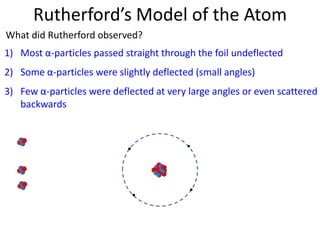
What did Rutherford observed?
1) Most α-particles passed straight through the foil undeflected
2) Some α-particles were slightly deflected (small angles)
3) Few α-particles were deflected at very large angles or even scattered
   backwards
Rutherford’s Model of the Atom
What were the implications of Rutherford’s observations?
1) The atom is mainly made of empty space
2) The positive charge of an atom is concentrated inside a very small
   nucleus in the centre of the atom.
3) The atom has a nucleus in its centre in which the positive charge and
   most of the mass is concentrated
The Structure of the Atom
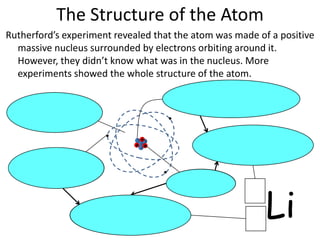
Rutherford’s experiment revealed that the atom was made of a positive
  massive nucleus surrounded by electrons orbiting around it.
  However, they didn’t know what was in the nucleus. More
  experiments showed the whole structure of the atom.
                                                                              Neutron: neutral particle inside the nucleus of
                                                                              mass slightly bigger than a proton. Different no of
  There is empty space between                                                neutrons for the same element make different
  nucleus and electrons. In scale the                                         ISOTOPES of that element
  nucleus is a pea at the centre of a
  football field.

                                                                                          Nucleon no: given by the sum of no of
                                                         +                                protons and no of neutrons. Using this no
                                                        + +                               you can identify the different isotopes of
                                                                                          the same element.
   Electron: atomic particle orbiting
   around the nucleus with same and
   opposite charge as the proton and
   mass 1/1800 of a proton                                                Proton: a +ve particle in


                                                                                                              7
                                                                                                                 Li
                                                                          the nucleus with mass
                                                                          similar to neutron

                                 Proton no: it tells the no of protons (and


                                                                                                               3
                                 also electrons) in the atom. This no is a
                                 property of the element, so the atomic no
                                 identifies what element the atom is.
Sub-atomic particles properties
            Mass        Relative Charge Relative
Particle
            (kg)         Mass      (C)  Charge

Proton     1.67x10⁻²⁷      1      +1.6x10⁻¹⁹   +1

Neutron    1.68x10⁻²⁷   About 1       0        0

Electron   9.11x10⁻³¹   1/2000    -1.6x10⁻¹⁹   -1
Isotopes
Thanks to the mass spectrometer Physicists were able to measure
  the mass of the atoms of elements. In this way they made the
  remarkable discovery that the atoms of a particular element do
  not always have the same mass. What they all have in common
  is their positive charge!
Isotopes
In other words, isotopes are atoms with the same atomic number,
   but different mass numbers. This lead to the search for an
   additional subatomic particle that would be responsible for the
   extra mass, but have no charge. This additional particle is the
   NEUTRON.
Match the terms with the correct definitions.
                                    The number of protons in the nucleus.
     Nuclide                        Tells what element the nuclide is.

 Mass Number                        An atom of a particular nuclear structure.


Atomic Number                       A nuclear particle


     Nucleon                        Total number of nucleons in the nucleus
Isotopes
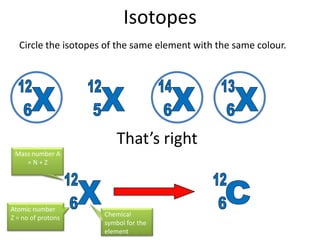
  Circle the isotopes of the same element with the same colour.


                         That’s right
 Mass number A
    =N+Z


Atomic number
Z = no of protons    Chemical
                     symbol for the
                     element
Isotopes
Some elements have a large number of isotopes. Some isotopes
  are unstable, which means that they will decay spontaneously
  into more stable nuclei by the emission of particles and energy.
However, the percentage of isotopes of a particular element
  mined on the Earth is remarkably constant no matter what part
  of the World it has been extracted from.

The atom and rutherford experiment

  • 1.
    Particles Constituents of the atom Rutherford’s experiment Thursday, 10 November 2011
  • 2.
    Thompson’s model Thompson believedthat the atom was made by: • A distribution of positive charge spread over a relatively large area • Small negatively charged particles (Electrons) immersed in the positive distribution • These electrons are like raisin in a Christmas cake (plum pudding) and are distributed in a way that the overall charge is neutral
  • 3.
    Rutherford’s Experiment Rutherford shota beam of -particles to a thin target of gold. He was expecting the -particles to be slightly deflected by the positive charge of the atoms of gold. Can you explain why he expected such an outcome? The problem was that the positive charge of the atoms of gold was too spread out (in Thompson’s model) to produce a strong deflection, or even the scattering backwards of -particles that was observed. Possible trajectory Impossible trajectory
  • 4.
    Rutherford’s Model ofthe Atom What did Rutherford observed? 1) Most α-particles passed straight through the foil undeflected 2) Some α-particles were slightly deflected (small angles) 3) Few α-particles were deflected at very large angles or even scattered backwards
  • 5.
    Rutherford’s Model ofthe Atom What were the implications of Rutherford’s observations? 1) The atom is mainly made of empty space 2) The positive charge of an atom is concentrated inside a very small nucleus in the centre of the atom. 3) The atom has a nucleus in its centre in which the positive charge and most of the mass is concentrated
  • 6.
    The Structure ofthe Atom Rutherford’s experiment revealed that the atom was made of a positive massive nucleus surrounded by electrons orbiting around it. However, they didn’t know what was in the nucleus. More experiments showed the whole structure of the atom. Neutron: neutral particle inside the nucleus of mass slightly bigger than a proton. Different no of There is empty space between neutrons for the same element make different nucleus and electrons. In scale the ISOTOPES of that element nucleus is a pea at the centre of a football field. Nucleon no: given by the sum of no of + protons and no of neutrons. Using this no + + you can identify the different isotopes of the same element. Electron: atomic particle orbiting around the nucleus with same and opposite charge as the proton and mass 1/1800 of a proton Proton: a +ve particle in 7 Li the nucleus with mass similar to neutron Proton no: it tells the no of protons (and 3 also electrons) in the atom. This no is a property of the element, so the atomic no identifies what element the atom is.
  • 7.
    Sub-atomic particles properties Mass Relative Charge Relative Particle (kg) Mass (C) Charge Proton 1.67x10⁻²⁷ 1 +1.6x10⁻¹⁹ +1 Neutron 1.68x10⁻²⁷ About 1 0 0 Electron 9.11x10⁻³¹ 1/2000 -1.6x10⁻¹⁹ -1
  • 8.
    Isotopes Thanks to themass spectrometer Physicists were able to measure the mass of the atoms of elements. In this way they made the remarkable discovery that the atoms of a particular element do not always have the same mass. What they all have in common is their positive charge!
  • 9.
    Isotopes In other words,isotopes are atoms with the same atomic number, but different mass numbers. This lead to the search for an additional subatomic particle that would be responsible for the extra mass, but have no charge. This additional particle is the NEUTRON. Match the terms with the correct definitions. The number of protons in the nucleus. Nuclide Tells what element the nuclide is. Mass Number An atom of a particular nuclear structure. Atomic Number A nuclear particle Nucleon Total number of nucleons in the nucleus
  • 10.
    Isotopes Circlethe isotopes of the same element with the same colour. That’s right Mass number A =N+Z Atomic number Z = no of protons Chemical symbol for the element
  • 11.
    Isotopes Some elements havea large number of isotopes. Some isotopes are unstable, which means that they will decay spontaneously into more stable nuclei by the emission of particles and energy. However, the percentage of isotopes of a particular element mined on the Earth is remarkably constant no matter what part of the World it has been extracted from.