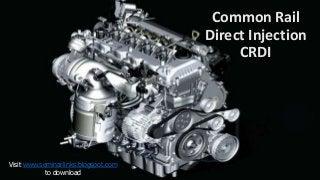
Common Rail
Direct Injection
CRDI
Visit www.seminarlinks.blogspot.com
to download
What is CRDI ?
CRDI stands for Common Rail Direct Injection.
Direct injection of the fuel into the cylinders of an engine via a single,
common line, called the common rail which is connected to all the fuel
injectors.
Instead of providing separate piston pumps for fuel supply, the
common rail alone supplies high pressure fuel to each cylinder.
The Technology
Whereas ordinary diesel direct fuel-injection systems have to build up pressure anew for
each and every injection cycle, CRDI engines maintain constant pressure regardless of the
injection sequence.
This pressure then remains permanently available throughout the fuel line.
The electronic control unit (ECU) modifies injection pressure precisely as needed, based
on data obtained from sensors on the cam and crankshafts. ie compression and injection
occur independently of each other.
This technique allows fuel to be injected as needed, saving fuel and lowering emissions.
PRINCIPLE OF CRDi IN DIESEL ENGINES
• is named as GDI( Gasoline Direct Injection)
• Introduced to remove the drawbacks of carbureted and MPFI systems
• Main advantage is that even petrol engines can be run under the very lean mixture
ratio of 50:1.
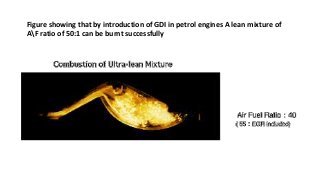
Figure showing that by introduction of GDI in petrol engines A lean mixture of
AF ratio of 50:1 can be burnt successfully
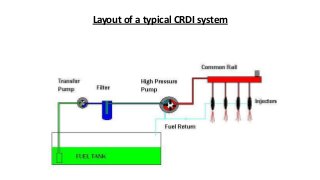
Layout of a typical CRDI system
Differences between DI and
CRD
• Constant pressure regardless of the injection sequence.
• Fuel is supplied directly to a common rail from where it is injected
directly onto the cylinder head
• High Pressure of about (1600 bar) , Improved pulverization
• Electronic engine management system continually adjusts the peak fuel
pressure according to engine speed and throttle position
• Compression and injection occur independently of each other
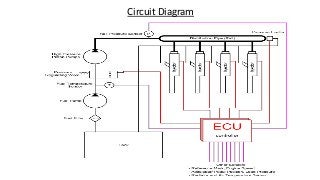
Circuit Diagram
Electronic Control Unit
• ECU monitors Engine variables such as
• Temperature
• intake pressure
• RPM
• air mass intake
• demand for power (from accelerator)
• provides real time control
• modifies injection pressure precisely as needed , based on data
obtained from cam and crankshaft.
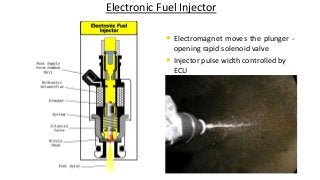
Electronic Fuel Injector
• Electromagnet moves the plunger -
opening rapid solenoid valve
• Injector pulse width controlled by
ECU
CHARACTERISTICS
• Spiral shaped Intake port for optimum swirl of air entering cylinder
– spiral port induces optimum swirl in the intake air leading to more
efficient mixing and combustion of fuel inside cylinder
• Integrated port at cylinder head for exhaust gas recycling – building
up input air temperature, reducing vibrations and cooler exhaust
• Air-flow meter located in front of the turbocharger's compressor
permitting an exact analysis of the air-mass that is being taken in.
• Air mass alters depending on temperature or atmospheric pressure.
• The microcomputer that controls engine timing receives precise data.
• It is thus able to regulate exhaust-gas recycling according to engine load
and speed in the interest of lowering nitrous oxide and particle emissions.
Precise Air Flow Metering
Multiple Pilot And Post Injection
• Leading to smoother compression and expansion-- reducing noise
levels
• More efficient combustion and burning up of fuel leading to quieter
engine cycles
• Reduces unburnt HC , NOx and CO and particles in exhaust
Visit www.seminarlinks.blogspot.com to download
CRDI - Future Trends
• Ultra-high pressure common-rail injection (1800 bar) generating ideal swirl in
the combustion chamber allowing the air/fuel mixture to form a perfect
vertical vortex - uniform combustion and greatly reduced NOx emissions
• CRDi and Particle Filter - To reduce particle emissions from exhaust
• CRDi and closed-loop control injection - Using ion sensor to provide real-time
combustion data for each cylinder such as temperature and pressure.
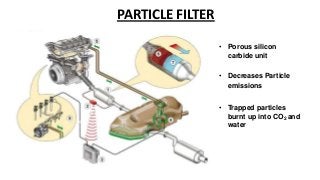
PARTICLE FILTER
• Porous silicon
carbide unit
• Decreases Particle
emissions
• Trapped particles
burnt up into CO2 and
water
ADVANTAGES OF CRDI
• Reduced noise and vibration
• Reduced smoke , particulates and exhaust
• Increased fuel economy
• Higher power output even at lower rpm
DISADVANTAGES
• Increased Cost due to high pressure pump and electronic control unit
• Technology cannot be employed in present engines
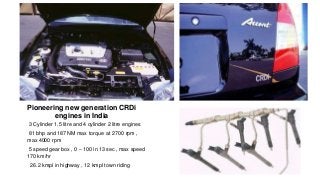
Hyundai Accent CRDi
Pioneering new generation CRDi
engines in India
•3 Cylinder 1.5 litre and 4 cylinder 2 litre engines
•81 bhp and 187 NM max torque at 2700 rpm ,
max 4000 rpm
•5 speed gear box , 0 – 100 in 13 sec , max speed
170 km/hr
• 26.2 kmpl in highway , 12 kmpl town riding
CONCLUSI
ON
• Cuts fuel consumption by 20%
• Doubles torque at low engine speeds
• Increases power by 25%.
• It also brings a significant reduction in the noise and vibrations of
conventional diesel engines.
• In emission, greenhouse gases (CO2) is reduced by 20%. At a constant level of NOx,
carbon monoxide (CO) emissions are reduced by 40%, unburnt hydrocarbons (HC)
by 50%, and particle emissions by 60%.
• CRDI principle not only lowers fuel consumption and emissions possible; it also
offers improved comfort and is quieter than modern pre-combustion engines.
Common-rail engines are thus clearly superior to ordinary motors using either
direct or indirect fuel-injection systems.
CRDI ppt

  • 1.
    Common Rail Direct Injection CRDI Visitwww.seminarlinks.blogspot.com to download
  • 2.
    What is CRDI? CRDI stands for Common Rail Direct Injection. Direct injection of the fuel into the cylinders of an engine via a single, common line, called the common rail which is connected to all the fuel injectors. Instead of providing separate piston pumps for fuel supply, the common rail alone supplies high pressure fuel to each cylinder.
  • 3.
    The Technology Whereas ordinarydiesel direct fuel-injection systems have to build up pressure anew for each and every injection cycle, CRDI engines maintain constant pressure regardless of the injection sequence. This pressure then remains permanently available throughout the fuel line. The electronic control unit (ECU) modifies injection pressure precisely as needed, based on data obtained from sensors on the cam and crankshafts. ie compression and injection occur independently of each other. This technique allows fuel to be injected as needed, saving fuel and lowering emissions.
  • 4.
    PRINCIPLE OF CRDiIN DIESEL ENGINES • is named as GDI( Gasoline Direct Injection) • Introduced to remove the drawbacks of carbureted and MPFI systems • Main advantage is that even petrol engines can be run under the very lean mixture ratio of 50:1.
  • 5.
    Figure showing thatby introduction of GDI in petrol engines A lean mixture of AF ratio of 50:1 can be burnt successfully
  • 6.
    Layout of atypical CRDI system
  • 7.
    Differences between DIand CRD • Constant pressure regardless of the injection sequence. • Fuel is supplied directly to a common rail from where it is injected directly onto the cylinder head • High Pressure of about (1600 bar) , Improved pulverization • Electronic engine management system continually adjusts the peak fuel pressure according to engine speed and throttle position • Compression and injection occur independently of each other
  • 8.
  • 9.
    Electronic Control Unit •ECU monitors Engine variables such as • Temperature • intake pressure • RPM • air mass intake • demand for power (from accelerator) • provides real time control • modifies injection pressure precisely as needed , based on data obtained from cam and crankshaft.
  • 10.
    Electronic Fuel Injector •Electromagnet moves the plunger - opening rapid solenoid valve • Injector pulse width controlled by ECU
  • 11.
    CHARACTERISTICS • Spiral shapedIntake port for optimum swirl of air entering cylinder – spiral port induces optimum swirl in the intake air leading to more efficient mixing and combustion of fuel inside cylinder • Integrated port at cylinder head for exhaust gas recycling – building up input air temperature, reducing vibrations and cooler exhaust
  • 12.
    • Air-flow meterlocated in front of the turbocharger's compressor permitting an exact analysis of the air-mass that is being taken in. • Air mass alters depending on temperature or atmospheric pressure. • The microcomputer that controls engine timing receives precise data. • It is thus able to regulate exhaust-gas recycling according to engine load and speed in the interest of lowering nitrous oxide and particle emissions. Precise Air Flow Metering
  • 13.
    Multiple Pilot AndPost Injection • Leading to smoother compression and expansion-- reducing noise levels • More efficient combustion and burning up of fuel leading to quieter engine cycles • Reduces unburnt HC , NOx and CO and particles in exhaust Visit www.seminarlinks.blogspot.com to download
  • 14.
    CRDI - FutureTrends • Ultra-high pressure common-rail injection (1800 bar) generating ideal swirl in the combustion chamber allowing the air/fuel mixture to form a perfect vertical vortex - uniform combustion and greatly reduced NOx emissions • CRDi and Particle Filter - To reduce particle emissions from exhaust • CRDi and closed-loop control injection - Using ion sensor to provide real-time combustion data for each cylinder such as temperature and pressure.
  • 15.
    PARTICLE FILTER • Poroussilicon carbide unit • Decreases Particle emissions • Trapped particles burnt up into CO2 and water
  • 16.
    ADVANTAGES OF CRDI •Reduced noise and vibration • Reduced smoke , particulates and exhaust • Increased fuel economy • Higher power output even at lower rpm DISADVANTAGES • Increased Cost due to high pressure pump and electronic control unit • Technology cannot be employed in present engines
  • 17.
    Hyundai Accent CRDi Pioneeringnew generation CRDi engines in India •3 Cylinder 1.5 litre and 4 cylinder 2 litre engines •81 bhp and 187 NM max torque at 2700 rpm , max 4000 rpm •5 speed gear box , 0 – 100 in 13 sec , max speed 170 km/hr • 26.2 kmpl in highway , 12 kmpl town riding
  • 18.
    CONCLUSI ON • Cuts fuelconsumption by 20% • Doubles torque at low engine speeds • Increases power by 25%. • It also brings a significant reduction in the noise and vibrations of conventional diesel engines. • In emission, greenhouse gases (CO2) is reduced by 20%. At a constant level of NOx, carbon monoxide (CO) emissions are reduced by 40%, unburnt hydrocarbons (HC) by 50%, and particle emissions by 60%. • CRDI principle not only lowers fuel consumption and emissions possible; it also offers improved comfort and is quieter than modern pre-combustion engines. Common-rail engines are thus clearly superior to ordinary motors using either direct or indirect fuel-injection systems.