7.1 Reflexive verbs
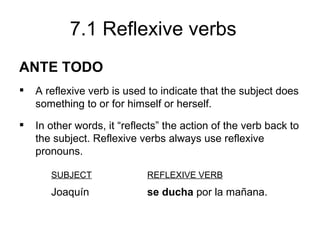
ANTE TODO
   A reflexive verb is used to indicate that the subject does
    something to or for himself or herself.
   In other words, it “reflects” the action of the verb back to
    the subject. Reflexive verbs always use reflexive
    pronouns.

       SUBJECT               REFLEXIVE VERB
       Joaquín               se ducha por la mañana.
7.1 Reflexive verbs
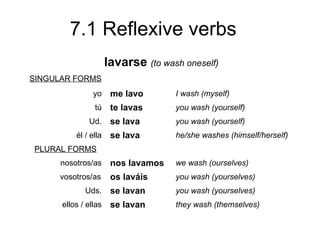
                      lavarse (to wash oneself)
SINGULAR FORMS
                yo     me lavo       I wash (myself)
                tú     te lavas      you wash (yourself)
              Ud.      se lava       you wash (yourself)
          él / ella    se lava       he/she washes (himself/herself)
PLURAL FORMS
      nosotros/as      nos lavamos   we wash (ourselves)
     vosotros/as       os laváis     you wash (yourselves)
             Uds.      se lavan      you wash (yourselves)
      ellos / ellas    se lavan      they wash (themselves)
7.1 Reflexive verbs
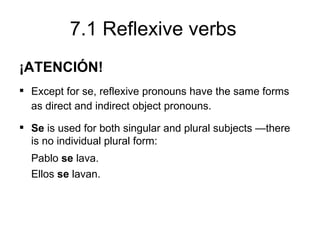
¡ATENCIÓN!
 Except for se, reflexive pronouns have the same forms
  as direct and indirect object pronouns.

 Se is used for both singular and plural subjects —there
  is no individual plural form:
  Pablo se lava.
  Ellos se lavan.
7.1 Reflexive verbs
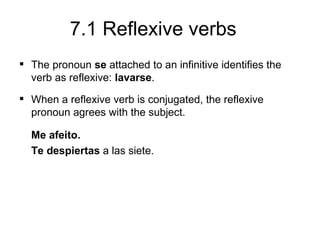
 The pronoun se attached to an infinitive identifies the
  verb as reflexive: lavarse.
 When a reflexive verb is conjugated, the reflexive
  pronoun agrees with the subject.

  Me afeito.
  Te despiertas a las siete.
7.1 Reflexive verbs
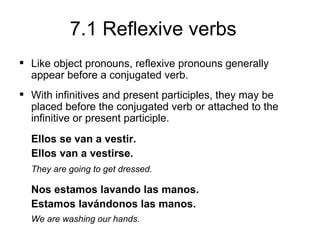
 Like object pronouns, reflexive pronouns generally
  appear before a conjugated verb.
 With infinitives and present participles, they may be
  placed before the conjugated verb or attached to the
  infinitive or present participle.
  Ellos se van a vestir.
  Ellos van a vestirse.
  They are going to get dressed.

  Nos estamos lavando las manos.
  Estamos lavándonos las manos.
  We are washing our hands.
7.1 Reflexive verbs
¡ATENCIÓN!
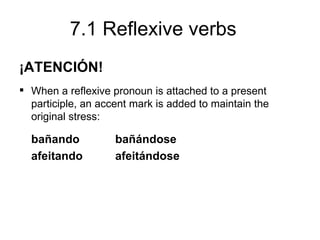
 When a reflexive pronoun is attached to a present
  participle, an accent mark is added to maintain the
  original stress:

  bañando           bañándose
  afeitando         afeitándose
7.1 Reflexive verbs
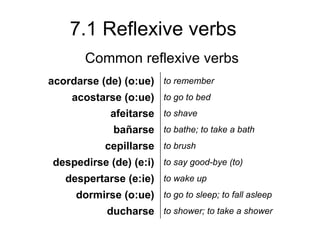
       Common reflexive verbs
acordarse (de) (o:ue) to remember
    acostarse (o:ue) to go to bed
             afeitarse to shave
             bañarse to bathe; to take a bath
           cepillarse to brush
despedirse (de) (e:i) to say good-bye (to)
   despertarse (e:ie) to wake up
     dormirse (o:ue) to go to sleep; to fall asleep
            ducharse to shower; to take a shower
7.1 Reflexive verbs
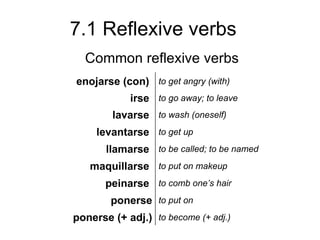
  Common reflexive verbs
enojarse (con) to get angry (with)
            irse to go away; to leave
        lavarse to wash (oneself)
     levantarse to get up
       llamarse to be called; to be named
   maquillarse to put on makeup
       peinarse to comb one’s hair
        ponerse to put on
ponerse (+ adj.) to become (+ adj.)
7.1 Reflexive verbs
    Common reflexive verbs
preocuparse (por) to worry (about)
  probarse (o:ue) to try on
         quedarse to stay; to remain
          quitarse to take off
          secarse to dry (oneself)
   sentarse (e:ie) to sit down
    sentirse (e:ie) to feel
     vestirse (e:i) to get dressed
7.1 Reflexive verbs
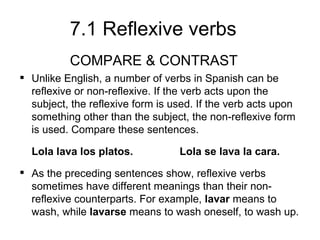
          COMPARE & CONTRAST
 Unlike English, a number of verbs in Spanish can be
  reflexive or non-reflexive. If the verb acts upon the
  subject, the reflexive form is used. If the verb acts upon
  something other than the subject, the non-reflexive form
  is used. Compare these sentences.

  Lola lava los platos.           Lola se lava la cara.
 As the preceding sentences show, reflexive verbs
  sometimes have different meanings than their non-
  reflexive counterparts. For example, lavar means to
  wash, while lavarse means to wash oneself, to wash up.
7.1 Reflexive verbs
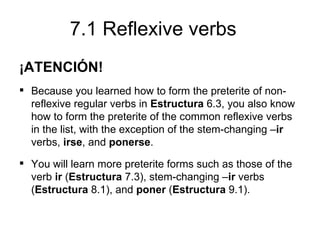
¡ATENCIÓN!
 Because you learned how to form the preterite of non-
  reflexive regular verbs in Estructura 6.3, you also know
  how to form the preterite of the common reflexive verbs
  in the list, with the exception of the stem-changing –ir
  verbs, irse, and ponerse.
 You will learn more preterite forms such as those of the
  verb ir (Estructura 7.3), stem-changing –ir verbs
  (Estructura 8.1), and poner (Estructura 9.1).
7.1 Reflexive verbs
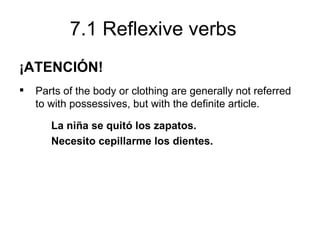
¡ATENCIÓN!
   Parts of the body or clothing are generally not referred
    to with possessives, but with the definite article.

       La niña se quitó los zapatos.
       Necesito cepillarme los dientes.
7.1 Reflexive verbs
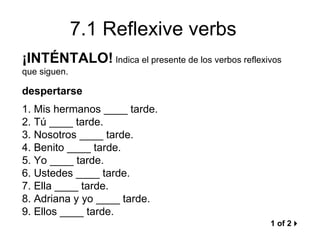
¡INTÉNTALO! Indica el presente de los verbos reflexivos
que siguen.

despertarse
1. Mis hermanos ____ tarde.
2. Tú ____ tarde.
3. Nosotros ____ tarde.
4. Benito ____ tarde.
5. Yo ____ tarde.
6. Ustedes ____ tarde.
7. Ella ____ tarde.
8. Adriana y yo ____ tarde.
9. Ellos ____ tarde.
                                                    1 of 2
7.1 Reflexive verbs
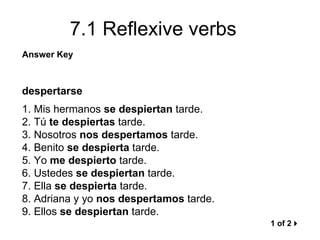
Answer Key


despertarse
1. Mis hermanos se despiertan tarde.
2. Tú te despiertas tarde.
3. Nosotros nos despertamos tarde.
4. Benito se despierta tarde.
5. Yo me despierto tarde.
6. Ustedes se despiertan tarde.
7. Ella se despierta tarde.
8. Adriana y yo nos despertamos tarde.
9. Ellos se despiertan tarde.
                                         1 of 2
7.1 Reflexive verbs
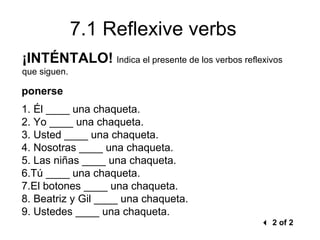
¡INTÉNTALO! Indica el presente de los verbos reflexivos
que siguen.

ponerse
1. Él ____ una chaqueta.
2. Yo ____ una chaqueta.
3. Usted ____ una chaqueta.
4. Nosotras ____ una chaqueta.
5. Las niñas ____ una chaqueta.
6.Tú ____ una chaqueta.
7.El botones ____ una chaqueta.
8. Beatriz y Gil ____ una chaqueta.
9. Ustedes ____ una chaqueta.
                                                   2 of 2
7.1 Reflexive verbs
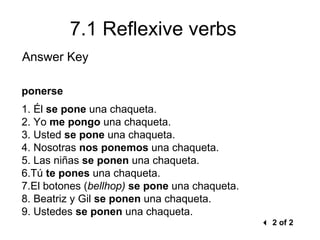
Answer Key

ponerse
1. Él se pone una chaqueta.
2. Yo me pongo una chaqueta.
3. Usted se pone una chaqueta.
4. Nosotras nos ponemos una chaqueta.
5. Las niñas se ponen una chaqueta.
6.Tú te pones una chaqueta.
7.El botones (bellhop) se pone una chaqueta.
8. Beatriz y Gil se ponen una chaqueta.
9. Ustedes se ponen una chaqueta.
                                                2 of 2

7.1 Reflexive verbs

  • 1.
    7.1 Reflexive verbs ANTETODO  A reflexive verb is used to indicate that the subject does something to or for himself or herself.  In other words, it “reflects” the action of the verb back to the subject. Reflexive verbs always use reflexive pronouns. SUBJECT REFLEXIVE VERB Joaquín se ducha por la mañana.
  • 2.
    7.1 Reflexive verbs lavarse (to wash oneself) SINGULAR FORMS yo me lavo I wash (myself) tú te lavas you wash (yourself) Ud. se lava you wash (yourself) él / ella se lava he/she washes (himself/herself) PLURAL FORMS nosotros/as nos lavamos we wash (ourselves) vosotros/as os laváis you wash (yourselves) Uds. se lavan you wash (yourselves) ellos / ellas se lavan they wash (themselves)
  • 3.
    7.1 Reflexive verbs ¡ATENCIÓN! Except for se, reflexive pronouns have the same forms as direct and indirect object pronouns.  Se is used for both singular and plural subjects —there is no individual plural form: Pablo se lava. Ellos se lavan.
  • 4.
    7.1 Reflexive verbs The pronoun se attached to an infinitive identifies the verb as reflexive: lavarse.  When a reflexive verb is conjugated, the reflexive pronoun agrees with the subject. Me afeito. Te despiertas a las siete.
  • 5.
    7.1 Reflexive verbs Like object pronouns, reflexive pronouns generally appear before a conjugated verb.  With infinitives and present participles, they may be placed before the conjugated verb or attached to the infinitive or present participle. Ellos se van a vestir. Ellos van a vestirse. They are going to get dressed. Nos estamos lavando las manos. Estamos lavándonos las manos. We are washing our hands.
  • 6.
    7.1 Reflexive verbs ¡ATENCIÓN! When a reflexive pronoun is attached to a present participle, an accent mark is added to maintain the original stress: bañando bañándose afeitando afeitándose
  • 7.
    7.1 Reflexive verbs Common reflexive verbs acordarse (de) (o:ue) to remember acostarse (o:ue) to go to bed afeitarse to shave bañarse to bathe; to take a bath cepillarse to brush despedirse (de) (e:i) to say good-bye (to) despertarse (e:ie) to wake up dormirse (o:ue) to go to sleep; to fall asleep ducharse to shower; to take a shower
  • 8.
    7.1 Reflexive verbs Common reflexive verbs enojarse (con) to get angry (with) irse to go away; to leave lavarse to wash (oneself) levantarse to get up llamarse to be called; to be named maquillarse to put on makeup peinarse to comb one’s hair ponerse to put on ponerse (+ adj.) to become (+ adj.)
  • 9.
    7.1 Reflexive verbs Common reflexive verbs preocuparse (por) to worry (about) probarse (o:ue) to try on quedarse to stay; to remain quitarse to take off secarse to dry (oneself) sentarse (e:ie) to sit down sentirse (e:ie) to feel vestirse (e:i) to get dressed
  • 10.
    7.1 Reflexive verbs COMPARE & CONTRAST  Unlike English, a number of verbs in Spanish can be reflexive or non-reflexive. If the verb acts upon the subject, the reflexive form is used. If the verb acts upon something other than the subject, the non-reflexive form is used. Compare these sentences. Lola lava los platos. Lola se lava la cara.  As the preceding sentences show, reflexive verbs sometimes have different meanings than their non- reflexive counterparts. For example, lavar means to wash, while lavarse means to wash oneself, to wash up.
  • 11.
    7.1 Reflexive verbs ¡ATENCIÓN! Because you learned how to form the preterite of non- reflexive regular verbs in Estructura 6.3, you also know how to form the preterite of the common reflexive verbs in the list, with the exception of the stem-changing –ir verbs, irse, and ponerse.  You will learn more preterite forms such as those of the verb ir (Estructura 7.3), stem-changing –ir verbs (Estructura 8.1), and poner (Estructura 9.1).
  • 12.
    7.1 Reflexive verbs ¡ATENCIÓN!  Parts of the body or clothing are generally not referred to with possessives, but with the definite article. La niña se quitó los zapatos. Necesito cepillarme los dientes.
  • 13.
    7.1 Reflexive verbs ¡INTÉNTALO!Indica el presente de los verbos reflexivos que siguen. despertarse 1. Mis hermanos ____ tarde. 2. Tú ____ tarde. 3. Nosotros ____ tarde. 4. Benito ____ tarde. 5. Yo ____ tarde. 6. Ustedes ____ tarde. 7. Ella ____ tarde. 8. Adriana y yo ____ tarde. 9. Ellos ____ tarde. 1 of 2
  • 14.
    7.1 Reflexive verbs AnswerKey despertarse 1. Mis hermanos se despiertan tarde. 2. Tú te despiertas tarde. 3. Nosotros nos despertamos tarde. 4. Benito se despierta tarde. 5. Yo me despierto tarde. 6. Ustedes se despiertan tarde. 7. Ella se despierta tarde. 8. Adriana y yo nos despertamos tarde. 9. Ellos se despiertan tarde. 1 of 2
  • 15.
    7.1 Reflexive verbs ¡INTÉNTALO!Indica el presente de los verbos reflexivos que siguen. ponerse 1. Él ____ una chaqueta. 2. Yo ____ una chaqueta. 3. Usted ____ una chaqueta. 4. Nosotras ____ una chaqueta. 5. Las niñas ____ una chaqueta. 6.Tú ____ una chaqueta. 7.El botones ____ una chaqueta. 8. Beatriz y Gil ____ una chaqueta. 9. Ustedes ____ una chaqueta.  2 of 2
  • 16.
    7.1 Reflexive verbs AnswerKey ponerse 1. Él se pone una chaqueta. 2. Yo me pongo una chaqueta. 3. Usted se pone una chaqueta. 4. Nosotras nos ponemos una chaqueta. 5. Las niñas se ponen una chaqueta. 6.Tú te pones una chaqueta. 7.El botones (bellhop) se pone una chaqueta. 8. Beatriz y Gil se ponen una chaqueta. 9. Ustedes se ponen una chaqueta.  2 of 2