AWS MXNet Applications
OCR with MXNet Gluon
Work of Jonathan Chung (& Thomas Delteil)
Presented by Thom Lane
16th
August 2018
Problem
Optical Character Recognition
Dataset
IAM Handwriting Database
Dataset
IAM Handwriting Database:
657 writers
1,539 pages of scanned text
5,685 isolated and labeled sentences
13,353 isolated and labeled text lines
115,320 isolated and labeled words
http://www.fki.inf.unibe.ch/databases/iam-handwriting-database
(Register for username and password)
Solution
Handwriting Recognition Pipeline
Pipeline
1) Page Segmentation
Page Segmentation
Input: Image with handwritten text region
Output: Bounding box of handwritten text
Problem: Single object detection
Solutions:
1) Using MSERs
2) Using CNNs
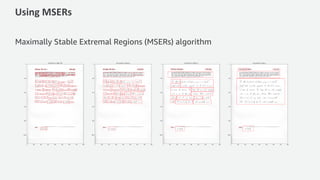
Using MSERs
Maximally Stable Extremal Regions (MSERs) algorithm
Using CNN
CNN: Data Augmentation
CNN: Training
Start by optimizing Mean Square Error.
When consistent overlap, then fine-tune IOU.
CNN: Results
2) Line Segmentation
Line Segmentation
Input: Image containing only handwritten text
Output: Bounding boxes for each handwritten line
Problem: Multiple object detection
Solutions:
1) Using SSD for lines
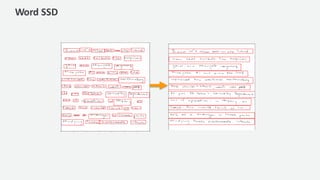
2) Using SSD for words
Using SSD
SSD: Single Shot Multi-box Detector
Customized:
1. Data augmentation
2. Anchor boxes
3. Network architecture
4. Non-maximum suppression
Line SSD: Data Augmentation
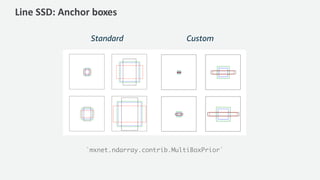
Line SSD: Anchor boxes
Standard Custom
`mxnet.ndarray.contrib.MultiBoxPrior`
Line SSD: Anchor boxes
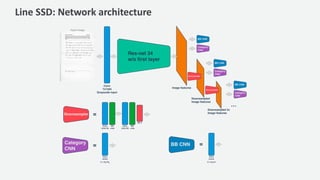
Line SSD: Network architecture
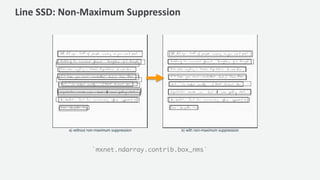
Line SSD: Non-Maximum Suppression
`mxnet.ndarray.contrib.box_nms`
Line SSD: Training
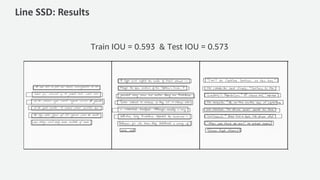
Line SSD: Results
Train IOU = 0.593 & Test IOU = 0.573
Line SSD: Results
Word SSD
3) Handwriting Recognition
Handwriting Recognition
Input: Image of single line of handwritten text
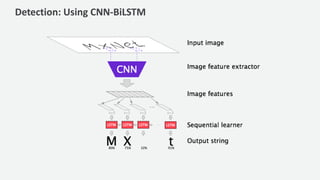
Output: Probabilities of each character for each time step.
i.e. an array of shape (sequence_length × vocab. of characters)
Inference Output: String of recognized text
Detection: Using CNN-BiLSTM
Detection: Adding down-sampling
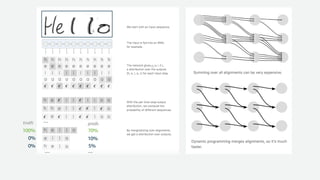
Detection: With CTC loss
Problem:
• Must have label for each time step.
• Or must model alignment.
• Must compress final sequence.
Solution:
• Connectionist Temporal Classification loss.
• Defines a collapsing function.
• Assumes monotonic and many-to-one.
`mxnet.ndarray.contrib.CTCLoss`
70%
10%
5%
… …
…
100%
0%
0%
truth preds
Inference: Best Path vs Correct decoding
!"#$ %&$ℎ = −, −
!"#$ %&$ℎ +,$-,$ = . −, − = “”
% “&” = % “ − &” + % “& − ” + % “&&”
= 0.6 ∗ 0.4 + 0.4 ∗ 0.6 + 0.4 ∗ 0.4
= 0.64
.788"9$ +,$-,$ = “&”
% ”” = %(−, −) = 0.36
Can’t check all paths though.
&=-ℎ&>"$_="@A$ℎBCDECFGC_HCFIJK paths.
i.e. 81NO paths!
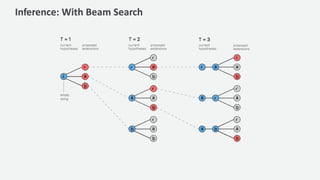
Inference: With Beam Search
Inference: With CTC Beam Search
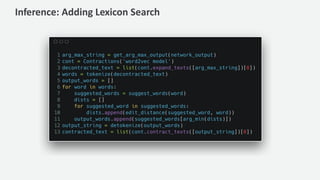
Inference: Adding Lexicon Search
Inference: Adding Language Model
And evaluate ‘perplexity’ of of each candidate and
take the one with lowest value as final prediction.
Inference: Results
Mean Character Error Rate (CER)
Greedy = 21.170.
Greedy + Lexicon Search: 21.152.
Beam Search + Lexicon Search: CER = 21.058.
Thanks!
And don’t forget to check out:
https://medium.com/apache-mxnet
https://github.com/ThomasDelteil/Gluon_OCR_LSTM_CTC

OCR with MXNet Gluon