CREATING A
DICTIONARY
USING BST
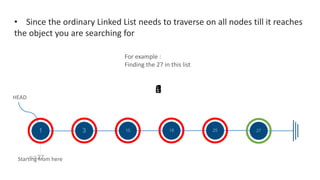
• Since the ordinary Linked List needs to traverse on all nodes till it reaches
the object you are searching for
1
For example :
Finding the 27 in this list
3 15 18 25 27
HEAD
Starting from here==27
123456
6
We see that in Linked List it needs to traverse on
all nodes to reach the specific data [27] because
It exists at the last node.
Which means that Linked List
would traverse on (n) of nodes
for the worst case of running time.
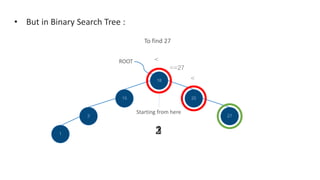
• But in Binary Search Tree :
18
To find 27
2515
273
1
ROOT
Starting from here
==27
123
<
<
3
In Binary Search Tree it only traverse on
specific nodes that leads to the specific data [27]
by doing a comparison at each node to determine
the next node.
The Binary Search Tree
would approximately traverse on (log(n)) of nodes
for the worst case of running time.
CODE
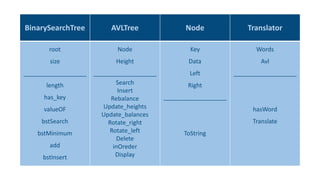
BinarySearchTree AVLTree Node Translator
root
size
___________________
length
has_key
valueOF
bstSearch
bstMinimum
add
bstInsert
Node
Height
___________________
Search
Insert
Rebalance
Update_heights
Update_balances
Rotate_right
Rotate_left
Delete
inOreder
Display
Key
Data
Left
Right
___________________
ToString
Words
Avl
___________________
hasWord
Translate
BinarySearchTree
class BinarySearchTree:
def __init__(self):
self.root = None
self.size = 0
# Returns the number of nodes in the BST.
def length(self):
return self.size
# Determines if the BST contains the given key.
def has_key(self, key):
return self.bstSearch(self.root, key) is not None
# Returns the value associated with the key.
def ValueOf(self, key):
node = self.bstSearch(self.root, key)
# The search process starts from the root.
assert node is not None, "Invalid key." # if node=None, the function stops and message
is printed.
return node.data
BinarySearchTree
(1)
BinarySearchTree
(2)
# This method recursively searches the tree for a target key.
# This method returns the address of node or None when:
# (1) the BST is empty or (2) target doesn't exist.
def bstSearch(self, subtree, target):
if subtree is None: # base case
return None
elif target < subtree.key: # target is left of the subtree root.
return self.bstSearch(subtree.left, target)
elif target > subtree.key: # target is right of the subtree root.
return self.bstSearch(subtree.right, target)
else: # base case
return subtree
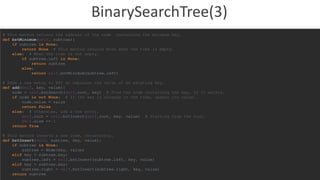
BinarySearchTree(3)
# This method returns the address of the node containing the minimum key.
def bstMinimum(self, subtree):
if subtree is None:
return None # This method returns None when the tree is empty.
else: # When the tree is not empty.
if subtree.left is None:
return subtree
else:
return self.bstMinimum(subtree.left)
# Adds a new entry to BST or replaces the value of an existing key.
def add(self, key, value):
node = self.bstSearch(self.root, key) # Find the node containing the key, if it exists.
if node is not None: # If the key is already in the tree, update its value.
node.value = value
return False
else: # Otherwise, add a new entry.
self.root = self.bstInsert(self.root, key, value) # Starting from the root.
self.size += 1
return True
# This method inserts a new item, recursively.
def bstInsert(self, subtree, key, value):
if subtree is None:
subtree = Node(key, value)
elif key < subtree.key:
subtree.left = self.bstInsert(subtree.left, key, value)
elif key > subtree.key:
subtree.right = self.bstInsert(subtree.right, key, value)
return subtree
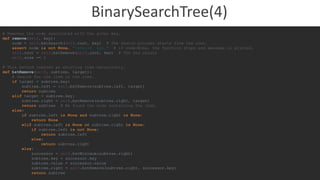
BinarySearchTree(4)
# Removes the node associated with the given key.
def remove(self, key):
node = self.bstSearch(self.root, key) # The search process starts from the root.
assert node is not None, "Invalid key." # if node=None, the function stops and message is printed.
self.root = self.bstRemove(self.root, key) # The key exists
self.size -= 1
# This method removes an existing item recursively.
def bstRemove(self, subtree, target):
# Search for the item in the tree.
if target < subtree.key:
subtree.left = self.bstRemove(subtree.left, target)
return subtree
elif target > subtree.key:
subtree.right = self.bstRemove(subtree.right, target)
return subtree # We found the node containing the item.
else:
if subtree.left is None and subtree.right is None:
return None
elif subtree.left is None or subtree.right is None:
if subtree.left is not None:
return subtree.left
else:
return subtree.right
else:
successor = self.bstMinimum(subtree.right)
subtree.key = successor.key
subtree.value = successor.value
subtree.right = self.bstRemove(subtree.right, successor.key)
return subtree
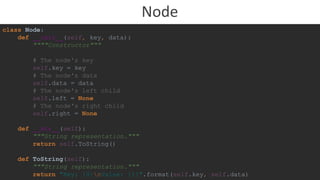
Node
class Node:
def __init__(self, key, data):
""""Constructor"""
# The node's key
self.key = key
# The node's data
self.data = data
# The node's left child
self.left = None
# The node's right child
self.right = None
def __str__(self):
"""String representation."""
return self.ToString()
def ToString(self):
"""String representation."""
return "Key: {0}nValue: {1}".format(self.key, self.data)
Node
Translator
Translator(1)
class Translator:
"""AVLTree Implementation"""
def __init__(self):
time1 = datetime.now()
print("Loading Database...")
self.__tree = self.__getDictionary()
self.SpellChecker = self.__makeSpellChecker()
time2 = datetime.now()
print("Loaded in {0}rn".format(time2 - time1))
@staticmethod
def __getDictionary():
words = [line.rstrip('rn') for line in open("UltimateZeroDict.txt", "r", encoding='utf-8')]
avl = AVLTree()
for word in words:
temp = word.lower().split(':')
avl.insert(temp[0], temp[1])
return avl
@staticmethod
def __makeSpellChecker():
words = [line.rstrip('rn') for line in open("UltimateZeroDict.txt", "r", encoding='utf-8')]
english = []
for word in words:
temp = word.lower().split(':')
english.append(temp[0])
return SpellChecker(english)
def hasWord(self, englishWord):
return self.__tree.has_key(englishWord.lower())
Translator(2)
def Translate(self, englishWord):
englishWord = englishWord.lower()
trans = self.__tree.ValueOf(englishWord)
result = Result()
if trans is not None:
result.Value = trans
else:
result.Suggesions = self.SpellChecker.GetSuggestions(englishWord)
return result
def TranslateSentense(self, sentense):
words = sentense.split(' ')
FinalOut = ""
output = []
wrong = "Unable to recognize these words, Here are some Suggestions:rn"
w = False
for word in words:
trans = self.Translate(word)
if not trans.Translated():
wrong += word + " => " + str(trans.Suggesions) + "rn"
w = True
output.append(trans.Value if trans.Translated() else word)
FinalOut += " ".join(output) + "rn"
FinalOut += wrong if w else ""
return FinalOut
SpellChecker
SpellChecker(1)
import math
class SpellChecker:
def __init__(self, tree):
self.wordlist = tree
@staticmethod
def __areInRange(num1, num2, Range=1):
for i in range(Range + 1):
if math.fabs(num1 - num2) == i:
return True
return False
@staticmethod
def __LettersInplace(word, Input):
lettersInplace = 0
for i in range(len(Input)):
if (len(word) > i) and (word[i] == Input[i]):
lettersInplace += 1
return lettersInplace
@staticmethod
def __CommonLetters(word, Input):
commonLetters = 0
Inputs = {}
for i in range(len(Input)):
if (Inputs.get(Input[i], False)):
Inputs[Input[i]] += 1
else:
Inputs[Input[i]] = 1
for key, value in Inputs.items():
if word.count(key) == value:
commonLetters += 1
if (Input[len(Input) - 1] == word[len(word) - 1]):
commonLetters += 1
if (len(Input) == len(word)):
commonLetters += 1
if word[0] == Input[0]:
commonLetters += 1
SpellChecker(2)
@staticmethod
def __LettersInRange(word, Input):
lettersInRange = 0
for i in range(len(Input)):
if (len(word) > i) and (Input[i] in word) and SpellChecker.__areInRange(i, Input.index(word[i]) if (word[i] in Input) else -1):
lettersInRange += 1
return lettersInRange
def IsValid(self, Input):
return Input in self.__tree
def GetSuggestions(self, Input, NumOfSuggestions = 5):
arr = []
for word in self.wordlist:
if SpellChecker.__areInRange(len(word), len(Input), 1):
arr.append(word)
dic = {}
for word in arr:
NumOfSimilarities = 0
NumOfSimilarities += SpellChecker.__CommonLetters(str(word), Input)
NumOfSimilarities += SpellChecker.__LettersInplace(str(word), Input)
NumOfSimilarities += SpellChecker.__LettersInRange(str(word), Input)
dic[str(word)] = NumOfSimilarities
Maxes = []
for i in range(NumOfSuggestions):
if len(dic) > 0:
Max = list(dic.keys())[list(dic.values()).index(max(dic.values()))]
Maxes.append(Max)
del dic[str(Max)]
return Maxes
OUR TEAM

Python Spell Checker

  • 2.
  • 3.
    • Since theordinary Linked List needs to traverse on all nodes till it reaches the object you are searching for 1 For example : Finding the 27 in this list 3 15 18 25 27 HEAD Starting from here==27 123456
  • 4.
    6 We see thatin Linked List it needs to traverse on all nodes to reach the specific data [27] because It exists at the last node. Which means that Linked List would traverse on (n) of nodes for the worst case of running time.
  • 5.
    • But inBinary Search Tree : 18 To find 27 2515 273 1 ROOT Starting from here ==27 123 < <
  • 6.
    3 In Binary SearchTree it only traverse on specific nodes that leads to the specific data [27] by doing a comparison at each node to determine the next node. The Binary Search Tree would approximately traverse on (log(n)) of nodes for the worst case of running time.
  • 7.
  • 8.
    BinarySearchTree AVLTree NodeTranslator root size ___________________ length has_key valueOF bstSearch bstMinimum add bstInsert Node Height ___________________ Search Insert Rebalance Update_heights Update_balances Rotate_right Rotate_left Delete inOreder Display Key Data Left Right ___________________ ToString Words Avl ___________________ hasWord Translate
  • 9.
  • 10.
    class BinarySearchTree: def __init__(self): self.root= None self.size = 0 # Returns the number of nodes in the BST. def length(self): return self.size # Determines if the BST contains the given key. def has_key(self, key): return self.bstSearch(self.root, key) is not None # Returns the value associated with the key. def ValueOf(self, key): node = self.bstSearch(self.root, key) # The search process starts from the root. assert node is not None, "Invalid key." # if node=None, the function stops and message is printed. return node.data BinarySearchTree (1)
  • 11.
    BinarySearchTree (2) # This methodrecursively searches the tree for a target key. # This method returns the address of node or None when: # (1) the BST is empty or (2) target doesn't exist. def bstSearch(self, subtree, target): if subtree is None: # base case return None elif target < subtree.key: # target is left of the subtree root. return self.bstSearch(subtree.left, target) elif target > subtree.key: # target is right of the subtree root. return self.bstSearch(subtree.right, target) else: # base case return subtree
  • 12.
    BinarySearchTree(3) # This methodreturns the address of the node containing the minimum key. def bstMinimum(self, subtree): if subtree is None: return None # This method returns None when the tree is empty. else: # When the tree is not empty. if subtree.left is None: return subtree else: return self.bstMinimum(subtree.left) # Adds a new entry to BST or replaces the value of an existing key. def add(self, key, value): node = self.bstSearch(self.root, key) # Find the node containing the key, if it exists. if node is not None: # If the key is already in the tree, update its value. node.value = value return False else: # Otherwise, add a new entry. self.root = self.bstInsert(self.root, key, value) # Starting from the root. self.size += 1 return True # This method inserts a new item, recursively. def bstInsert(self, subtree, key, value): if subtree is None: subtree = Node(key, value) elif key < subtree.key: subtree.left = self.bstInsert(subtree.left, key, value) elif key > subtree.key: subtree.right = self.bstInsert(subtree.right, key, value) return subtree
  • 13.
    BinarySearchTree(4) # Removes thenode associated with the given key. def remove(self, key): node = self.bstSearch(self.root, key) # The search process starts from the root. assert node is not None, "Invalid key." # if node=None, the function stops and message is printed. self.root = self.bstRemove(self.root, key) # The key exists self.size -= 1 # This method removes an existing item recursively. def bstRemove(self, subtree, target): # Search for the item in the tree. if target < subtree.key: subtree.left = self.bstRemove(subtree.left, target) return subtree elif target > subtree.key: subtree.right = self.bstRemove(subtree.right, target) return subtree # We found the node containing the item. else: if subtree.left is None and subtree.right is None: return None elif subtree.left is None or subtree.right is None: if subtree.left is not None: return subtree.left else: return subtree.right else: successor = self.bstMinimum(subtree.right) subtree.key = successor.key subtree.value = successor.value subtree.right = self.bstRemove(subtree.right, successor.key) return subtree
  • 14.
  • 15.
    class Node: def __init__(self,key, data): """"Constructor""" # The node's key self.key = key # The node's data self.data = data # The node's left child self.left = None # The node's right child self.right = None def __str__(self): """String representation.""" return self.ToString() def ToString(self): """String representation.""" return "Key: {0}nValue: {1}".format(self.key, self.data) Node
  • 16.
  • 17.
    Translator(1) class Translator: """AVLTree Implementation""" def__init__(self): time1 = datetime.now() print("Loading Database...") self.__tree = self.__getDictionary() self.SpellChecker = self.__makeSpellChecker() time2 = datetime.now() print("Loaded in {0}rn".format(time2 - time1)) @staticmethod def __getDictionary(): words = [line.rstrip('rn') for line in open("UltimateZeroDict.txt", "r", encoding='utf-8')] avl = AVLTree() for word in words: temp = word.lower().split(':') avl.insert(temp[0], temp[1]) return avl @staticmethod def __makeSpellChecker(): words = [line.rstrip('rn') for line in open("UltimateZeroDict.txt", "r", encoding='utf-8')] english = [] for word in words: temp = word.lower().split(':') english.append(temp[0]) return SpellChecker(english) def hasWord(self, englishWord): return self.__tree.has_key(englishWord.lower())
  • 18.
    Translator(2) def Translate(self, englishWord): englishWord= englishWord.lower() trans = self.__tree.ValueOf(englishWord) result = Result() if trans is not None: result.Value = trans else: result.Suggesions = self.SpellChecker.GetSuggestions(englishWord) return result def TranslateSentense(self, sentense): words = sentense.split(' ') FinalOut = "" output = [] wrong = "Unable to recognize these words, Here are some Suggestions:rn" w = False for word in words: trans = self.Translate(word) if not trans.Translated(): wrong += word + " => " + str(trans.Suggesions) + "rn" w = True output.append(trans.Value if trans.Translated() else word) FinalOut += " ".join(output) + "rn" FinalOut += wrong if w else "" return FinalOut
  • 19.
  • 20.
    SpellChecker(1) import math class SpellChecker: def__init__(self, tree): self.wordlist = tree @staticmethod def __areInRange(num1, num2, Range=1): for i in range(Range + 1): if math.fabs(num1 - num2) == i: return True return False @staticmethod def __LettersInplace(word, Input): lettersInplace = 0 for i in range(len(Input)): if (len(word) > i) and (word[i] == Input[i]): lettersInplace += 1 return lettersInplace @staticmethod def __CommonLetters(word, Input): commonLetters = 0 Inputs = {} for i in range(len(Input)): if (Inputs.get(Input[i], False)): Inputs[Input[i]] += 1 else: Inputs[Input[i]] = 1 for key, value in Inputs.items(): if word.count(key) == value: commonLetters += 1 if (Input[len(Input) - 1] == word[len(word) - 1]): commonLetters += 1 if (len(Input) == len(word)): commonLetters += 1 if word[0] == Input[0]: commonLetters += 1
  • 21.
    SpellChecker(2) @staticmethod def __LettersInRange(word, Input): lettersInRange= 0 for i in range(len(Input)): if (len(word) > i) and (Input[i] in word) and SpellChecker.__areInRange(i, Input.index(word[i]) if (word[i] in Input) else -1): lettersInRange += 1 return lettersInRange def IsValid(self, Input): return Input in self.__tree def GetSuggestions(self, Input, NumOfSuggestions = 5): arr = [] for word in self.wordlist: if SpellChecker.__areInRange(len(word), len(Input), 1): arr.append(word) dic = {} for word in arr: NumOfSimilarities = 0 NumOfSimilarities += SpellChecker.__CommonLetters(str(word), Input) NumOfSimilarities += SpellChecker.__LettersInplace(str(word), Input) NumOfSimilarities += SpellChecker.__LettersInRange(str(word), Input) dic[str(word)] = NumOfSimilarities Maxes = [] for i in range(NumOfSuggestions): if len(dic) > 0: Max = list(dic.keys())[list(dic.values()).index(max(dic.values()))] Maxes.append(Max) del dic[str(Max)] return Maxes
  • 22.