Binary Search Trees (10.1)
CSE 2011
Winter 2011
1
13 December 2022
Dictionary ADT (9.5.1)
• The dictionary ADT models a
searchable collection of key-
element items
• The main operations of a
dictionary are searching,
inserting, and deleting items
• Multiple items with the same key
are allowed
• Applications:
– address book
– credit card authorization
– SIN database
– student database
Dictionary ADT methods:
• get(k): if the dictionary has an
item with key k, returns its
element, else, returns NULL
• getAll(k): returns an iterator of
entries with key k
• put(k, o): inserts item (k, o)
into the dictionary
• remove(k): if the dictionary
has an item with key k,
removes it from the dictionary
and returns its element, else
returns NULL
• removeAll(k): remove all
entries with key k; return an
iterator of these entries.
• size(), isEmpty()
2
Binary Search Trees
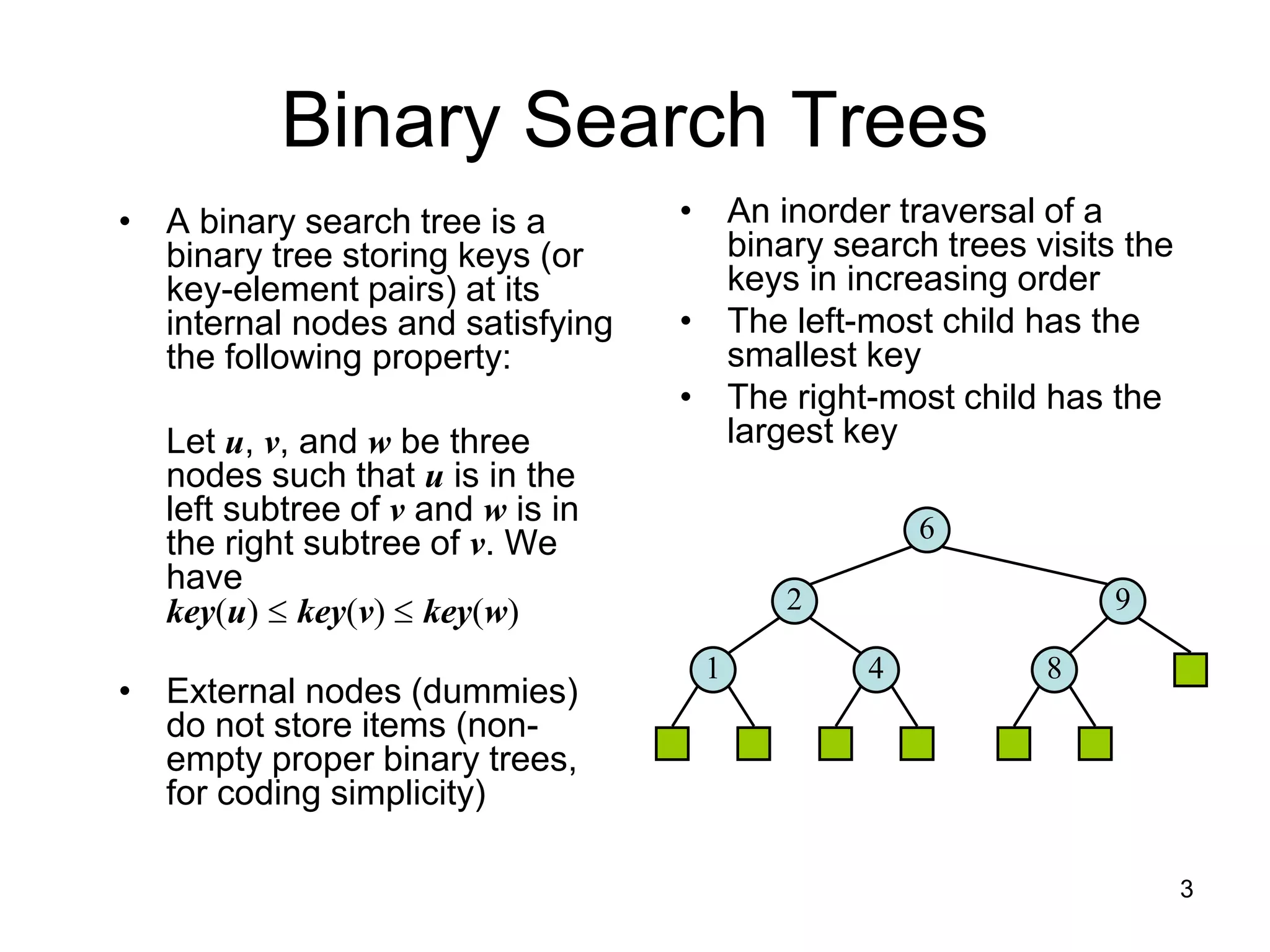
• A binary search tree is a
binary tree storing keys (or
key-element pairs) at its
internal nodes and satisfying
the following property:
Let u, v, and w be three
nodes such that u is in the
left subtree of v and w is in
the right subtree of v. We
have
key(u)  key(v)  key(w)
• External nodes (dummies)
do not store items (non-
empty proper binary trees,
for coding simplicity)
• An inorder traversal of a
binary search trees visits the
keys in increasing order
• The left-most child has the
smallest key
• The right-most child has the
largest key
6
9
2
4
1 8
3
4
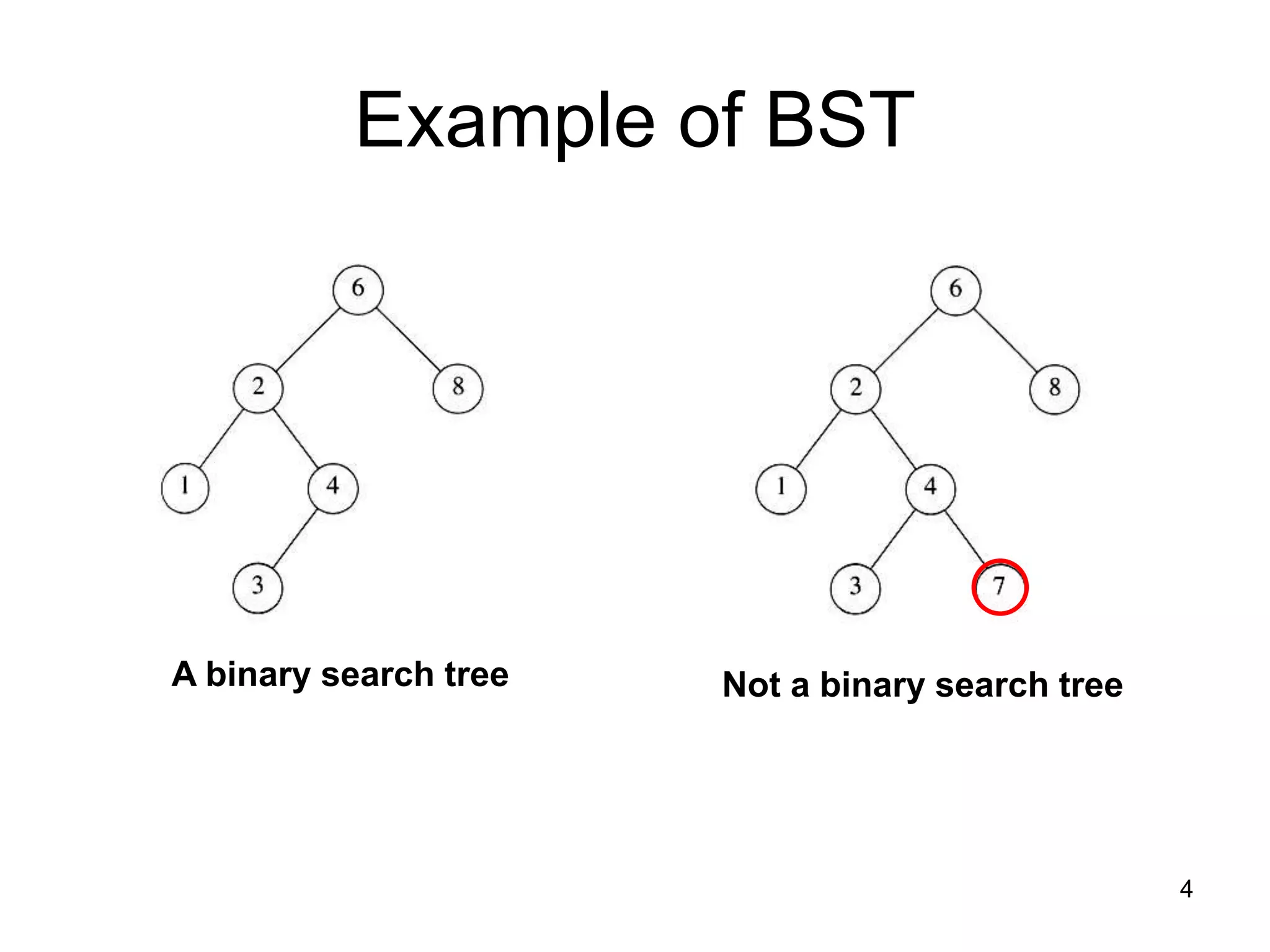
Example of BST
A binary search tree Not a binary search tree
5
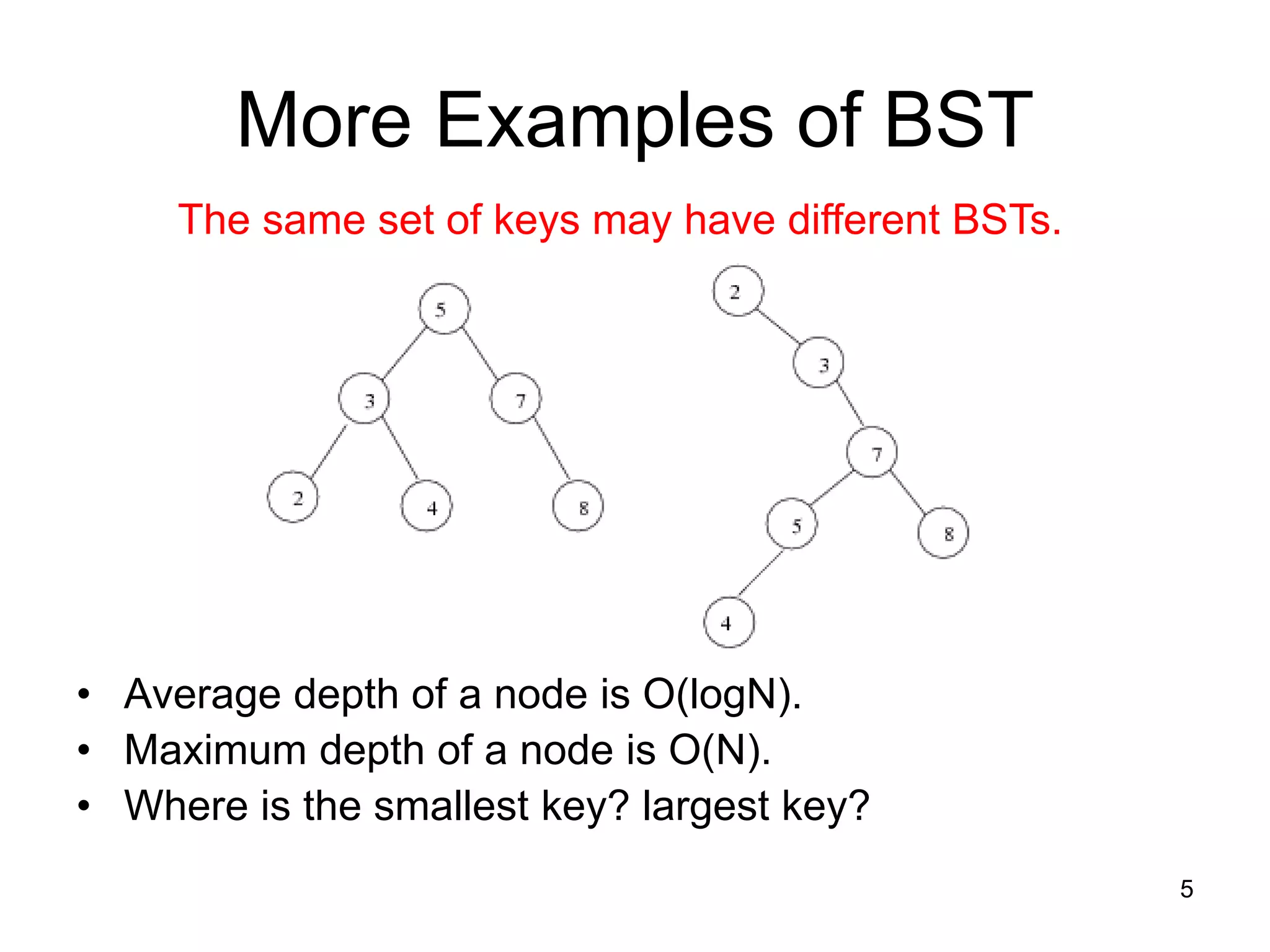
More Examples of BST
• Average depth of a node is O(logN).
• Maximum depth of a node is O(N).
• Where is the smallest key? largest key?
The same set of keys may have different BSTs.
6
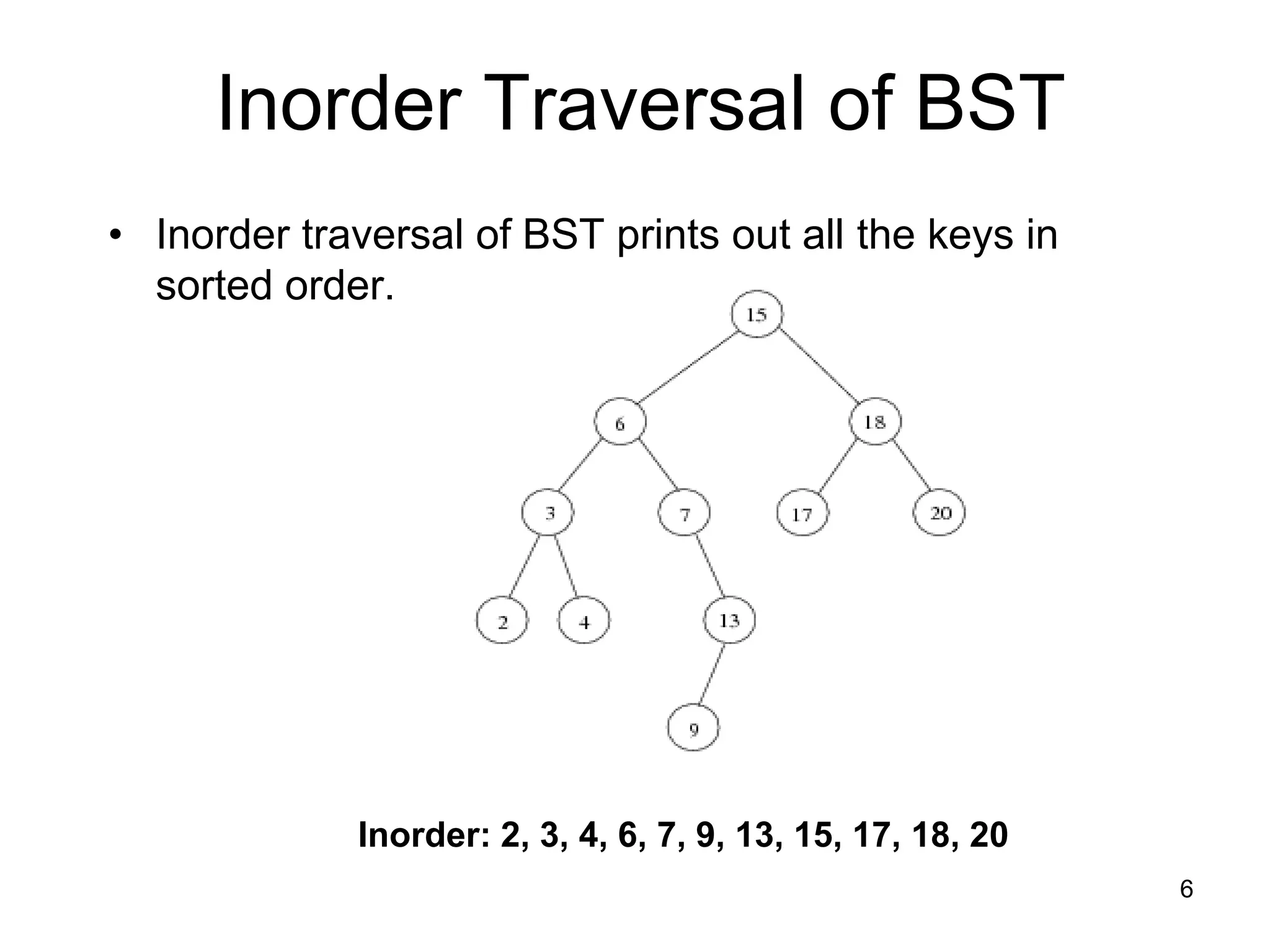
Inorder Traversal of BST
• Inorder traversal of BST prints out all the keys in
sorted order.
Inorder: 2, 3, 4, 6, 7, 9, 13, 15, 17, 18, 20
7
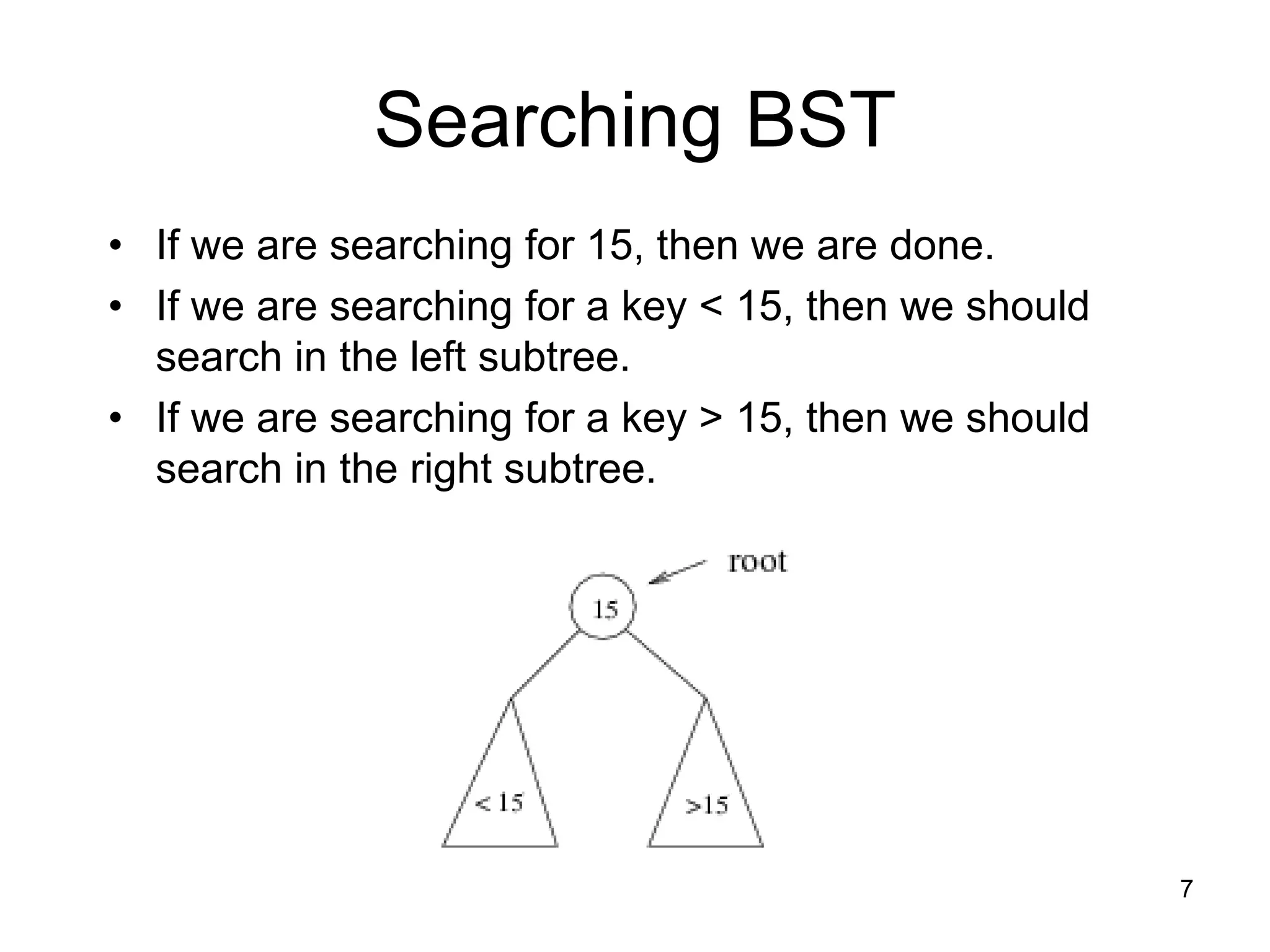
Searching BST
• If we are searching for 15, then we are done.
• If we are searching for a key < 15, then we should
search in the left subtree.
• If we are searching for a key > 15, then we should
search in the right subtree.
8
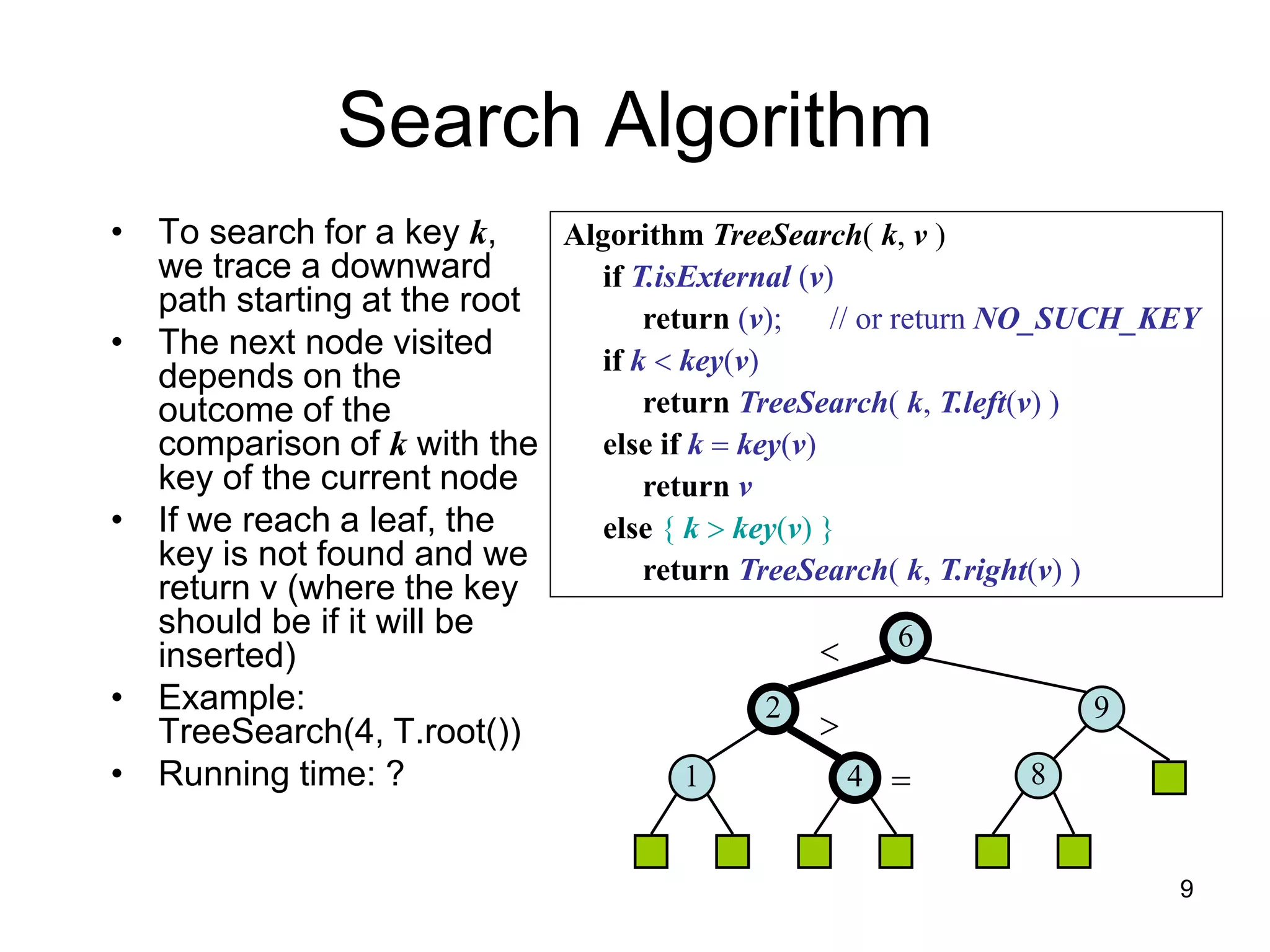
Search Algorithm
• To search for a key k,
we trace a downward
path starting at the root
• The next node visited
depends on the
outcome of the
comparison of k with the
key of the current node
• If we reach a leaf, the
key is not found and we
return v (where the key
should be if it will be
inserted)
• Example:
TreeSearch(4, T.root())
• Running time: ?
Algorithm TreeSearch( k, v )
if T.isExternal (v)
return (v); // or return NO_SUCH_KEY
if k < key(v)
return TreeSearch( k, T.left(v) )
else if k = key(v)
return v
else { k > key(v) }
return TreeSearch( k, T.right(v) )
6
9
2
4
1 8
<
>
=
9
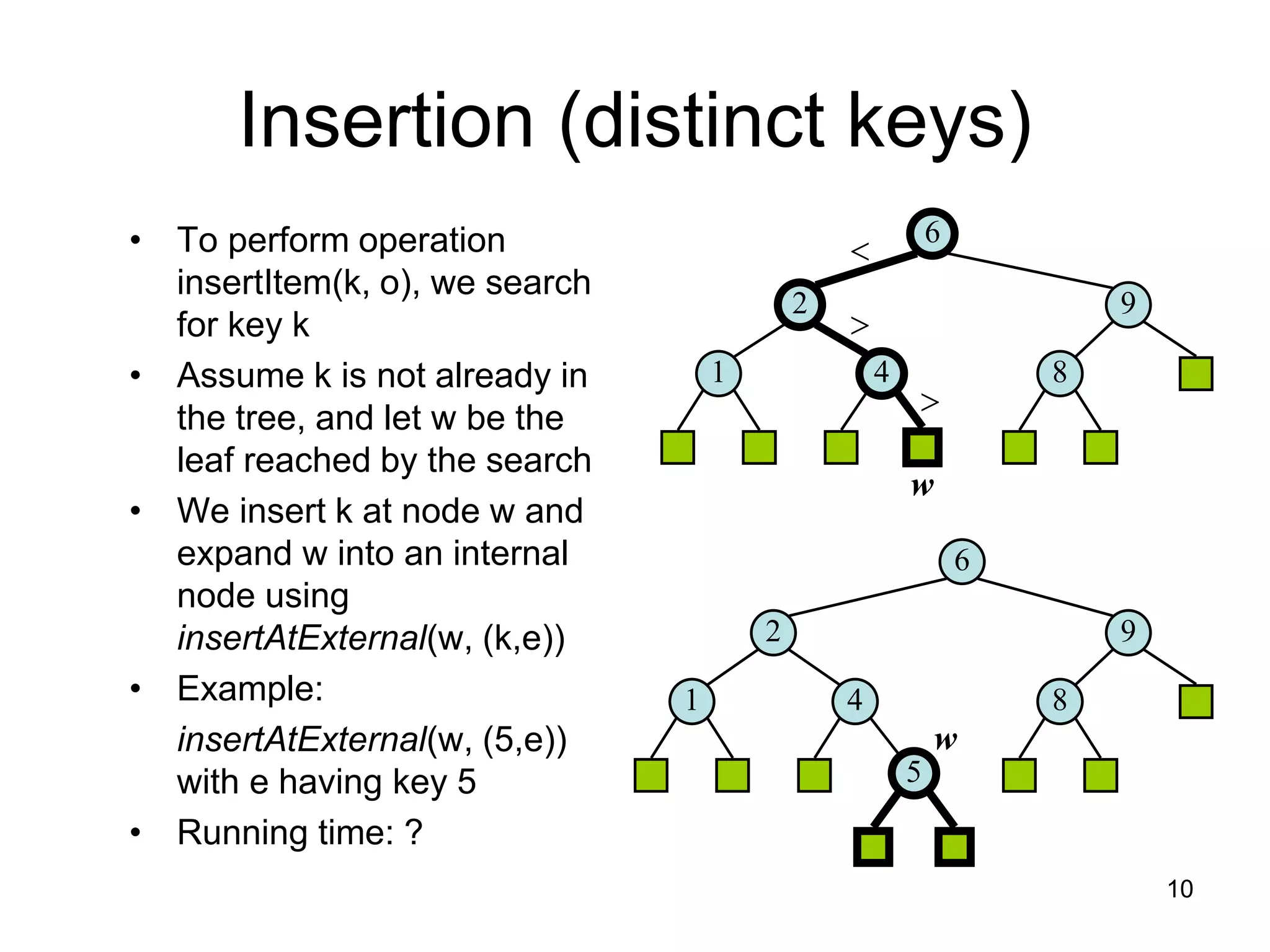
Insertion (distinct keys)
• To perform operation
insertItem(k, o), we search
for key k
• Assume k is not already in
the tree, and let w be the
leaf reached by the search
• We insert k at node w and
expand w into an internal
node using
insertAtExternal(w, (k,e))
• Example:
insertAtExternal(w, (5,e))
with e having key 5
• Running time: ?
6
9
2
4
1 8
6
9
2
4
1 8
5
<
>
>
w
w
10
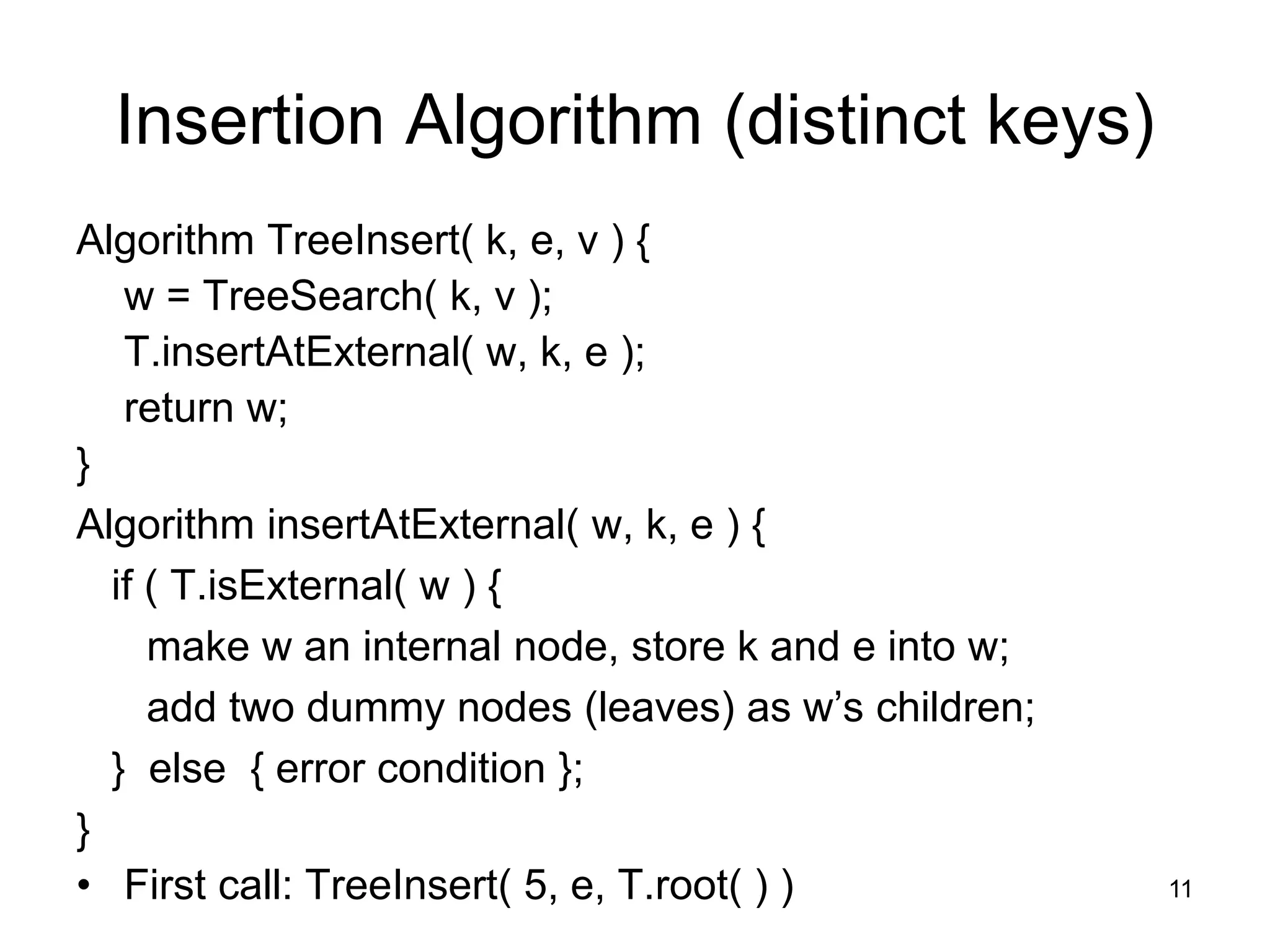
Insertion Algorithm (distinct keys)
Algorithm TreeInsert( k, e, v ) {
w = TreeSearch( k, v );
T.insertAtExternal( w, k, e );
return w;
}
Algorithm insertAtExternal( w, k, e ) {
if ( T.isExternal( w ) {
make w an internal node, store k and e into w;
add two dummy nodes (leaves) as w’s children;
} else { error condition };
}
• First call: TreeInsert( 5, e, T.root( ) ) 11
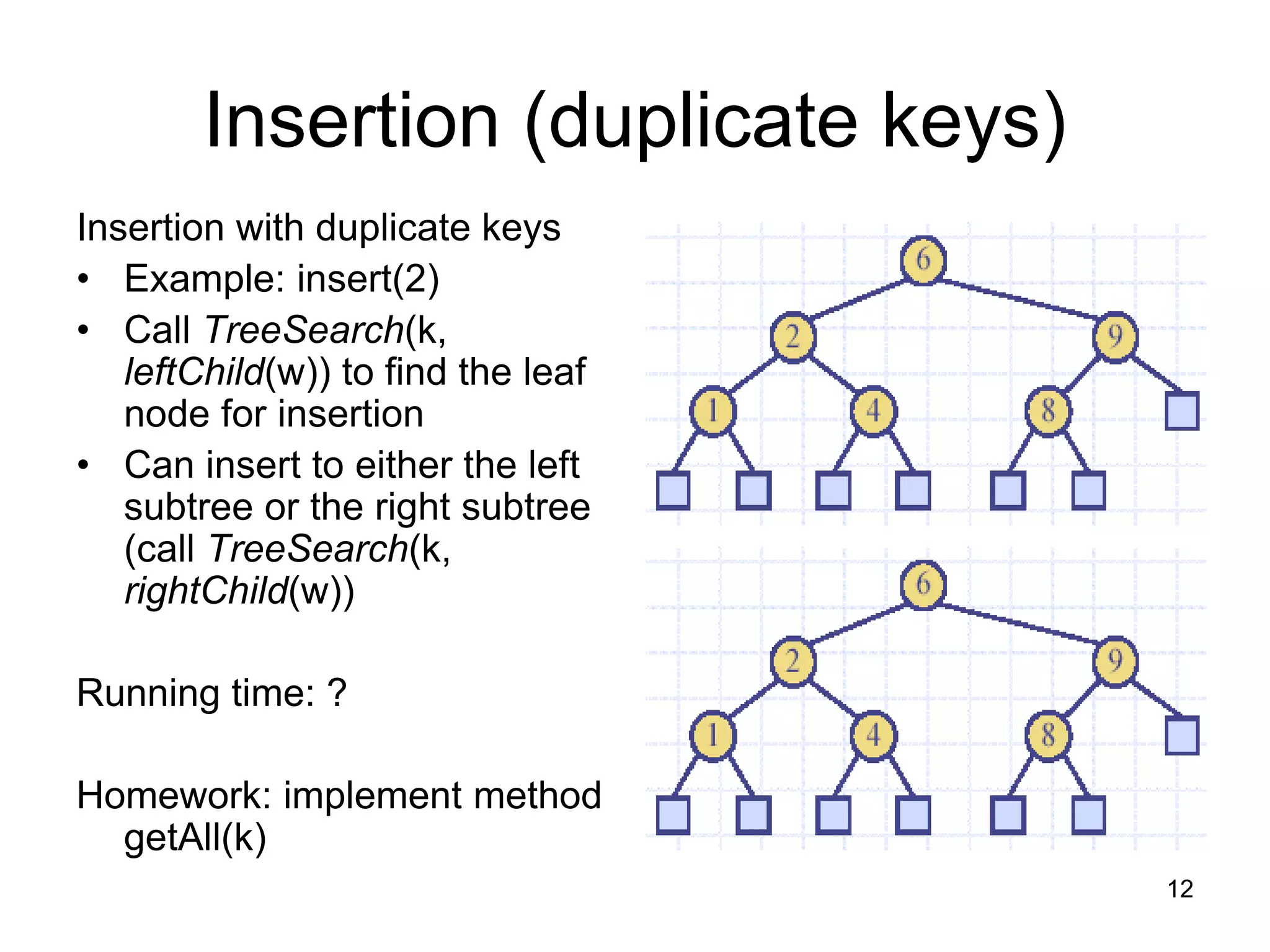
Insertion (duplicate keys)
Insertion with duplicate keys
• Example: insert(2)
• Call TreeSearch(k,
leftChild(w)) to find the leaf
node for insertion
• Can insert to either the left
subtree or the right subtree
(call TreeSearch(k,
rightChild(w))
Running time: ?
Homework: implement method
getAll(k)
12
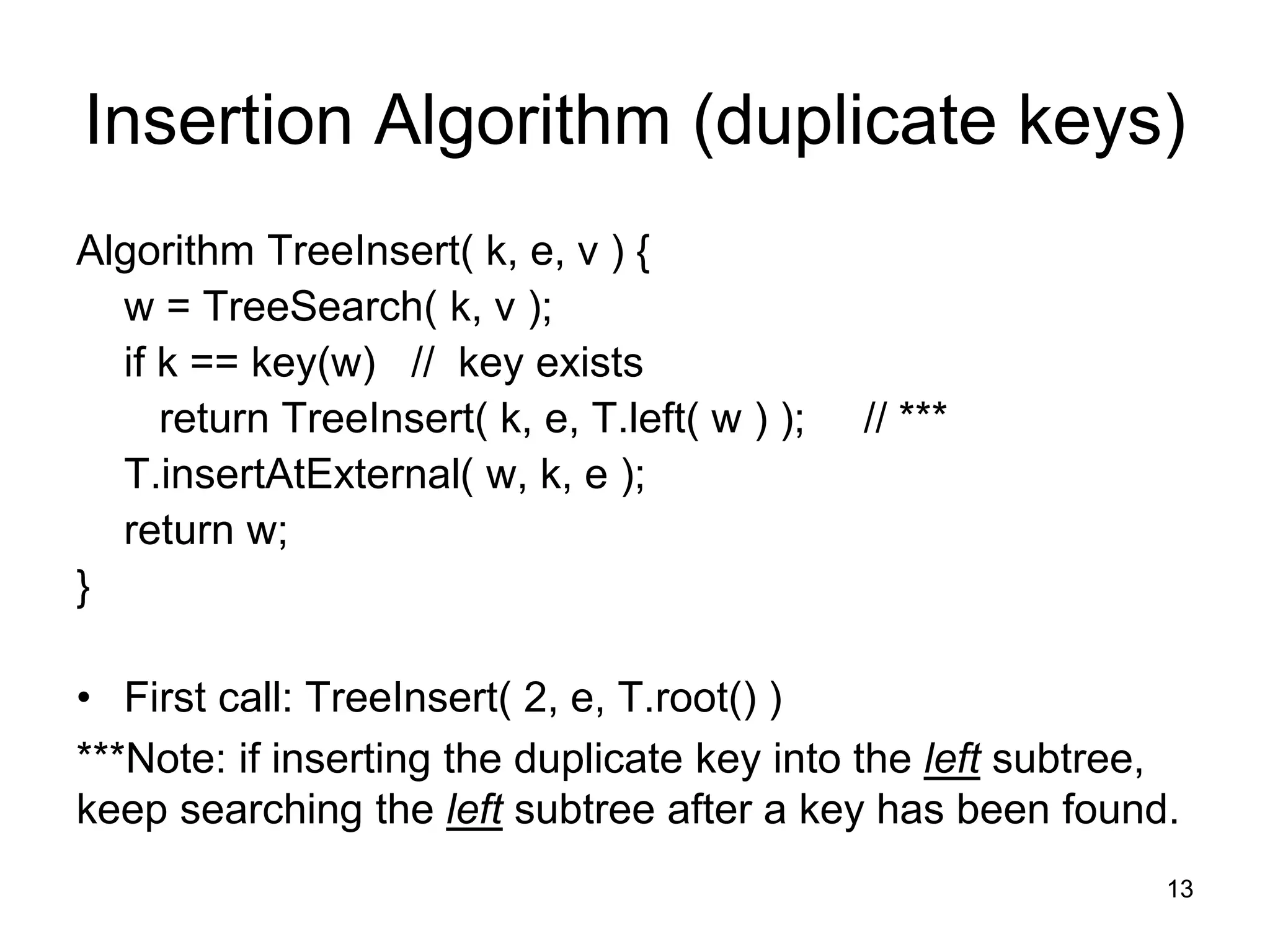
Insertion Algorithm (duplicate keys)
Algorithm TreeInsert( k, e, v ) {
w = TreeSearch( k, v );
if k == key(w) // key exists
return TreeInsert( k, e, T.left( w ) ); // ***
T.insertAtExternal( w, k, e );
return w;
}
• First call: TreeInsert( 2, e, T.root() )
***Note: if inserting the duplicate key into the left subtree,
keep searching the left subtree after a key has been found.
13
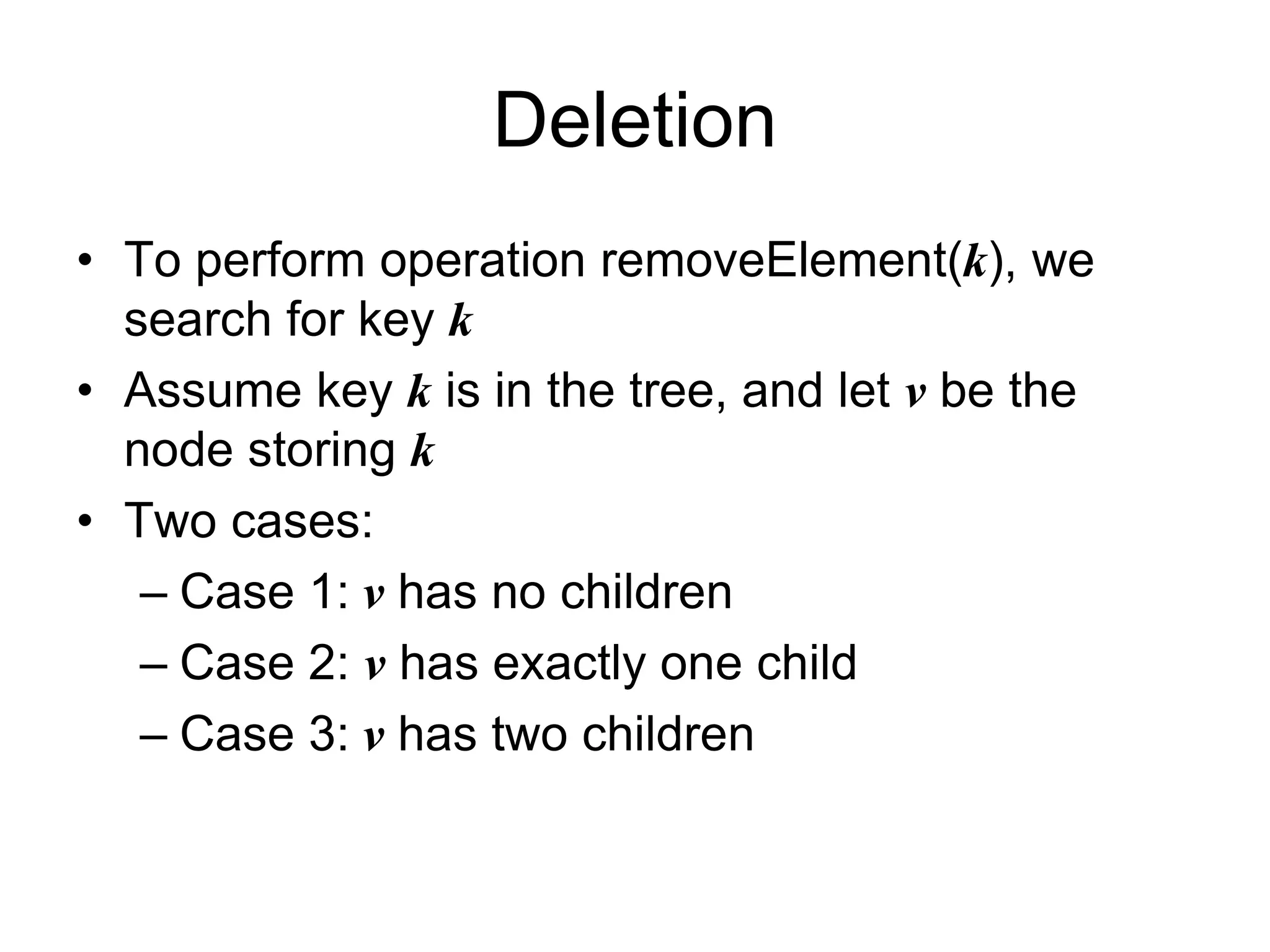
Deletion
• To perform operation removeElement(k), we
search for key k
• Assume key k is in the tree, and let v be the
node storing k
• Two cases:
– Case 1: v has no children
– Case 2: v has exactly one child
– Case 3: v has two children
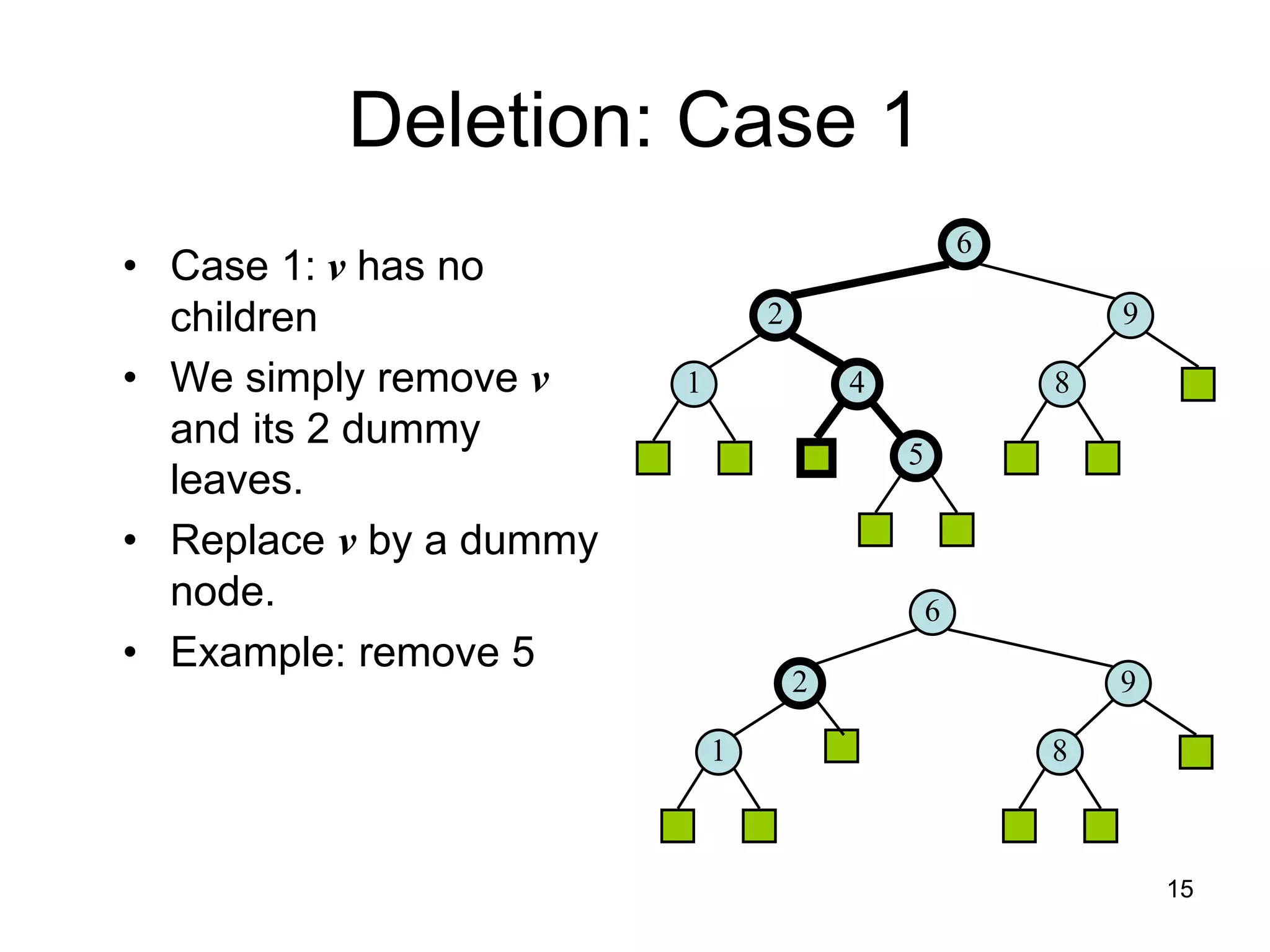
Deletion: Case 1
• Case 1: v has no
children
• We simply remove v
and its 2 dummy
leaves.
• Replace v by a dummy
node.
• Example: remove 5
6
9
2
4
1 8
5
6
9
2
1 8
15
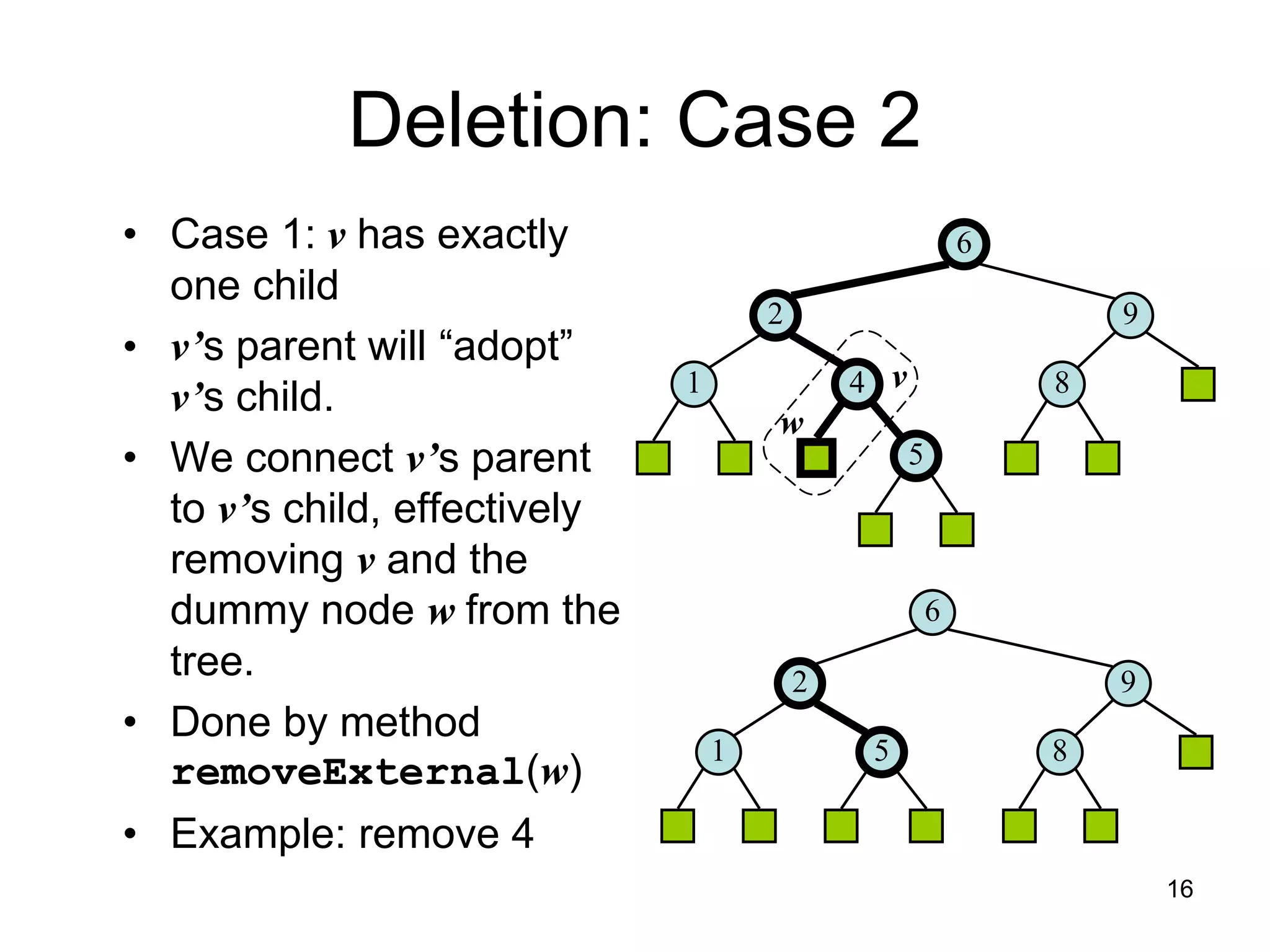
Deletion: Case 2
• Case 1: v has exactly
one child
• v’s parent will “adopt”
v’s child.
• We connect v’s parent
to v’s child, effectively
removing v and the
dummy node w from the
tree.
• Done by method
removeExternal(w)
• Example: remove 4
6
9
2
4
1 8
5
v
w
6
9
2
5
1 8
16
Deletion: Case 3
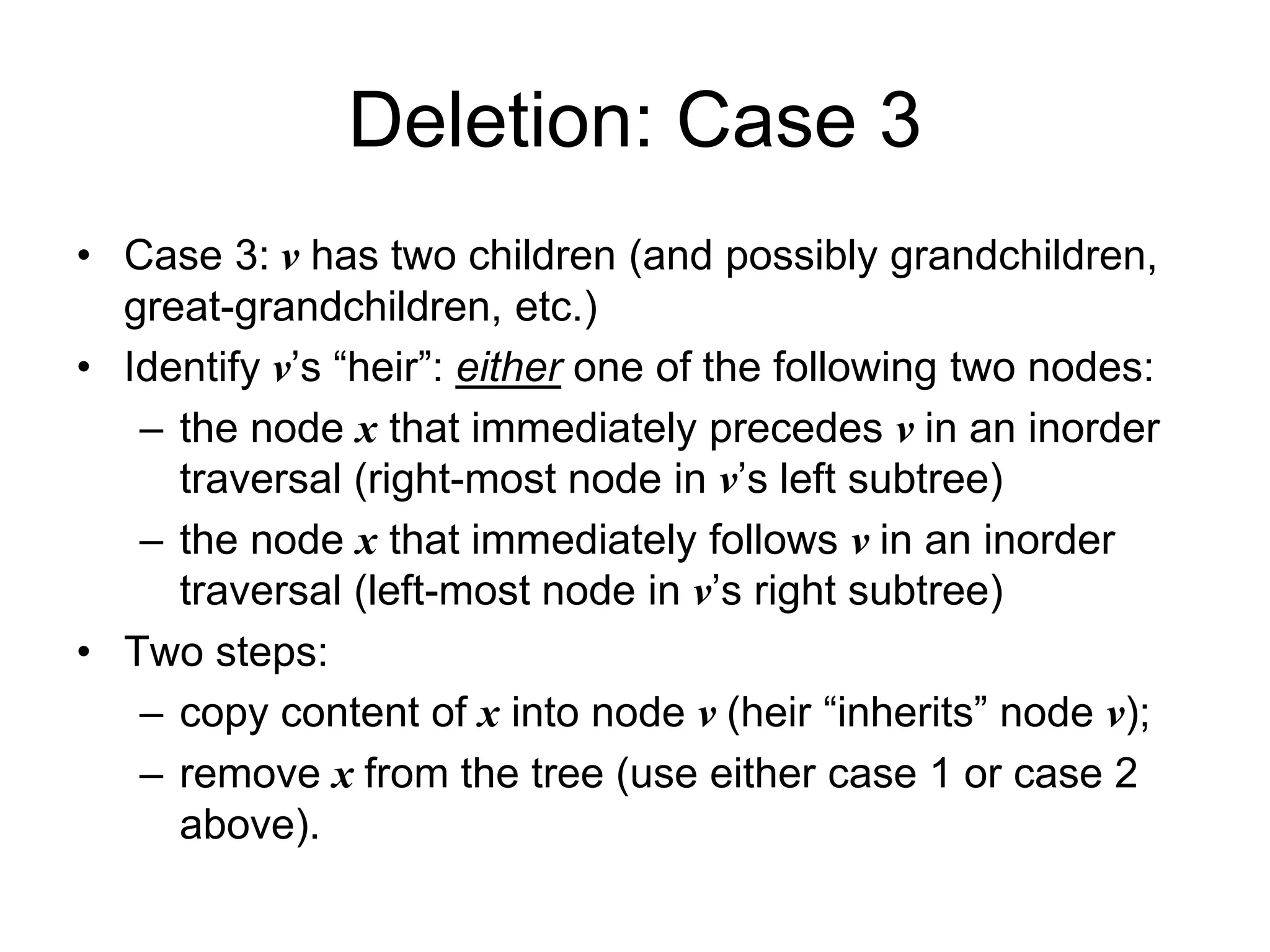
• Case 3: v has two children (and possibly grandchildren,
great-grandchildren, etc.)
• Identify v’s “heir”: either one of the following two nodes:
– the node x that immediately precedes v in an inorder
traversal (right-most node in v’s left subtree)
– the node x that immediately follows v in an inorder
traversal (left-most node in v’s right subtree)
• Two steps:
– copy content of x into node v (heir “inherits” node v);
– remove x from the tree (use either case 1 or case 2
above).
Deletion: Case 3 Example
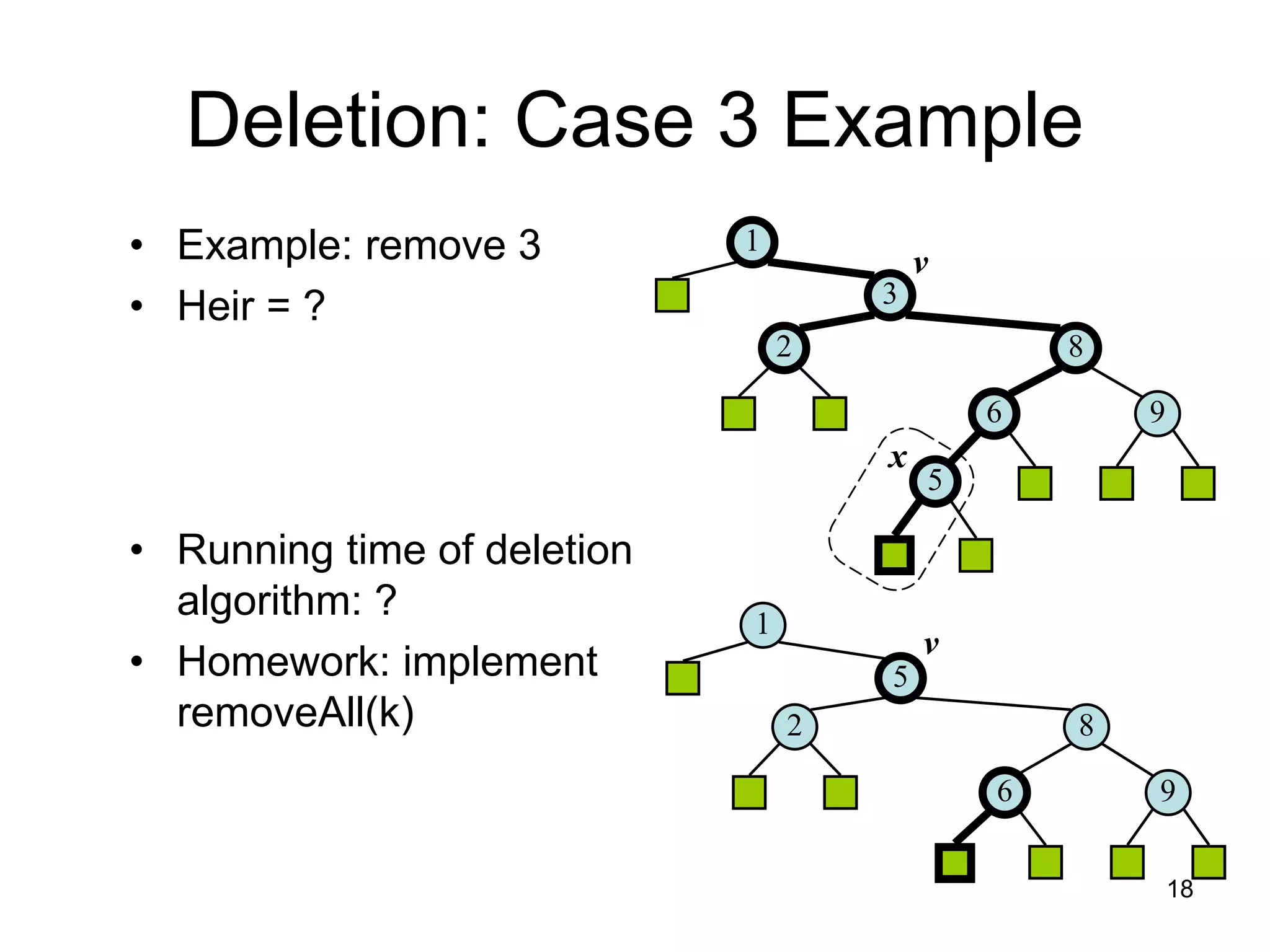
• Example: remove 3
• Heir = ?
• Running time of deletion
algorithm: ?
• Homework: implement
removeAll(k)
3
1
8
6 9
5
v
x
2
5
1
8
6 9
v
2
18
Notes
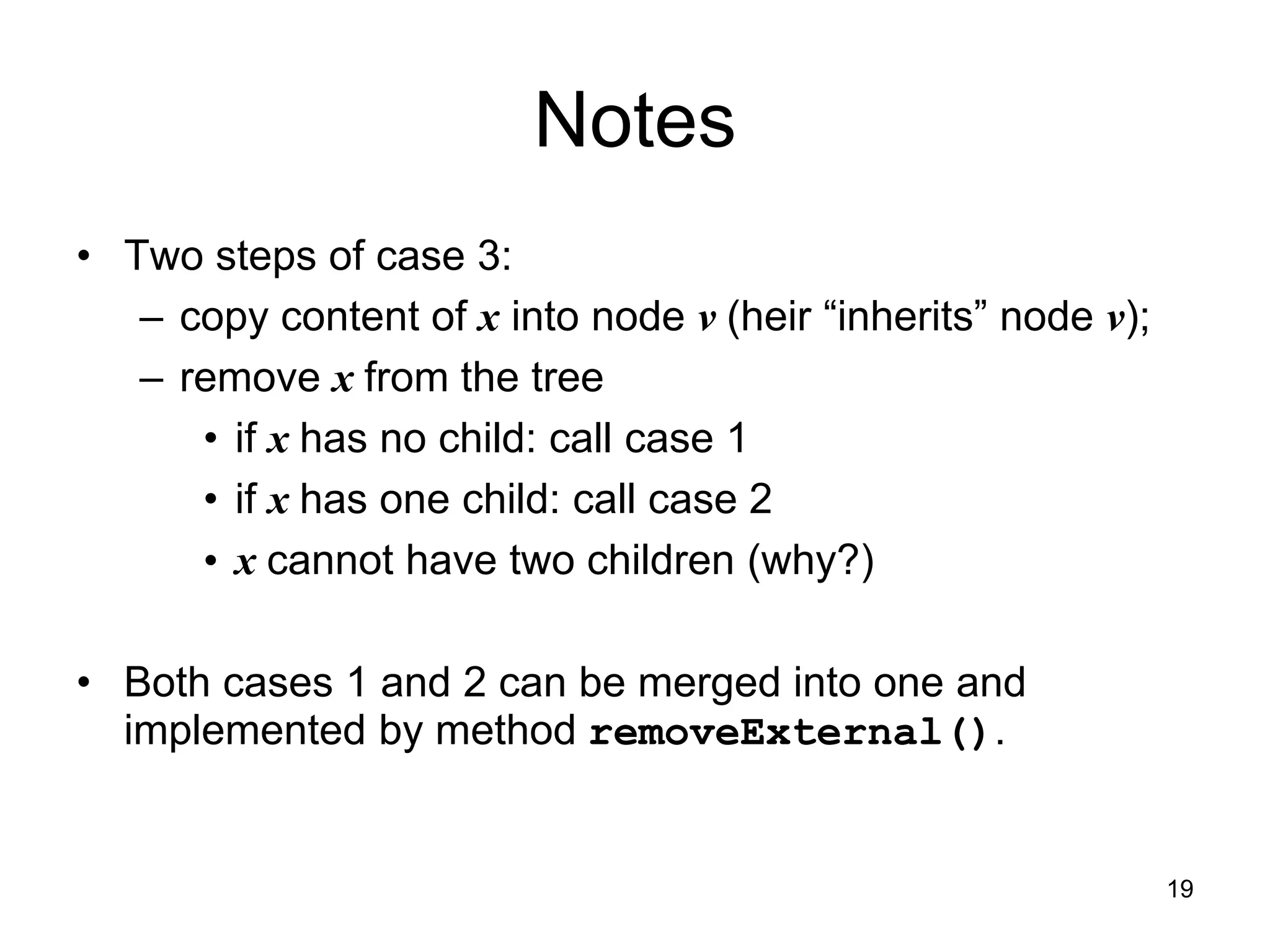
• Two steps of case 3:
– copy content of x into node v (heir “inherits” node v);
– remove x from the tree
• if x has no child: call case 1
• if x has one child: call case 2
• x cannot have two children (why?)
• Both cases 1 and 2 can be merged into one and
implemented by method removeExternal().
19
Performance
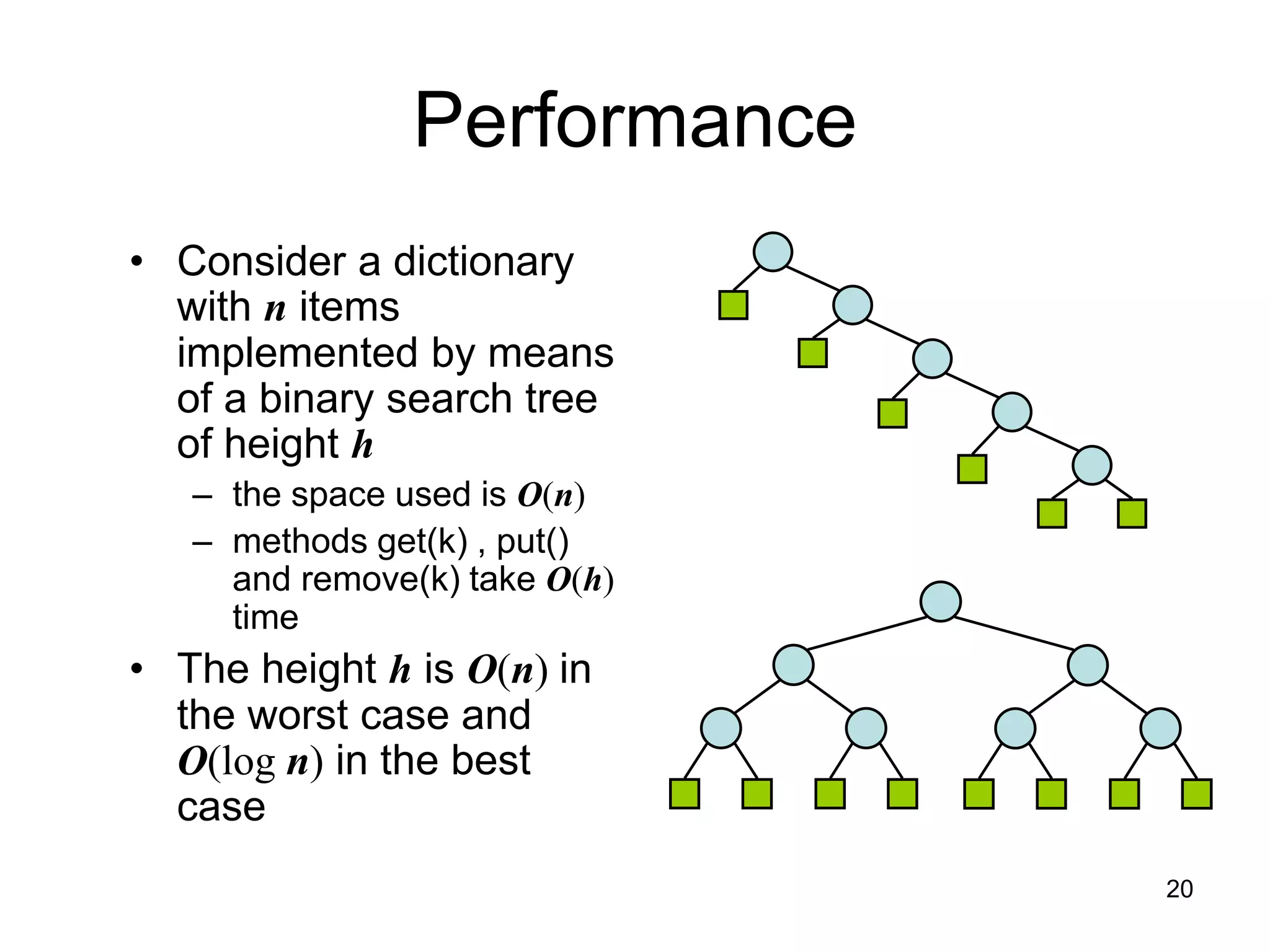
• Consider a dictionary
with n items
implemented by means
of a binary search tree
of height h
– the space used is O(n)
– methods get(k) , put()
and remove(k) take O(h)
time
• The height h is O(n) in
the worst case and
O(log n) in the best
case
20
Next time …
• AVL trees (10.2)
• BST Java code: section 10.1.3
21

s11_bin_search_trees.ppt

  • 1.
    Binary Search Trees(10.1) CSE 2011 Winter 2011 1 13 December 2022
  • 2.
    Dictionary ADT (9.5.1) •The dictionary ADT models a searchable collection of key- element items • The main operations of a dictionary are searching, inserting, and deleting items • Multiple items with the same key are allowed • Applications: – address book – credit card authorization – SIN database – student database Dictionary ADT methods: • get(k): if the dictionary has an item with key k, returns its element, else, returns NULL • getAll(k): returns an iterator of entries with key k • put(k, o): inserts item (k, o) into the dictionary • remove(k): if the dictionary has an item with key k, removes it from the dictionary and returns its element, else returns NULL • removeAll(k): remove all entries with key k; return an iterator of these entries. • size(), isEmpty() 2
  • 3.
    Binary Search Trees •A binary search tree is a binary tree storing keys (or key-element pairs) at its internal nodes and satisfying the following property: Let u, v, and w be three nodes such that u is in the left subtree of v and w is in the right subtree of v. We have key(u)  key(v)  key(w) • External nodes (dummies) do not store items (non- empty proper binary trees, for coding simplicity) • An inorder traversal of a binary search trees visits the keys in increasing order • The left-most child has the smallest key • The right-most child has the largest key 6 9 2 4 1 8 3
  • 4.
    4 Example of BST Abinary search tree Not a binary search tree
  • 5.
    5 More Examples ofBST • Average depth of a node is O(logN). • Maximum depth of a node is O(N). • Where is the smallest key? largest key? The same set of keys may have different BSTs.
  • 6.
    6 Inorder Traversal ofBST • Inorder traversal of BST prints out all the keys in sorted order. Inorder: 2, 3, 4, 6, 7, 9, 13, 15, 17, 18, 20
  • 7.
    7 Searching BST • Ifwe are searching for 15, then we are done. • If we are searching for a key < 15, then we should search in the left subtree. • If we are searching for a key > 15, then we should search in the right subtree.
  • 8.
  • 9.
    Search Algorithm • Tosearch for a key k, we trace a downward path starting at the root • The next node visited depends on the outcome of the comparison of k with the key of the current node • If we reach a leaf, the key is not found and we return v (where the key should be if it will be inserted) • Example: TreeSearch(4, T.root()) • Running time: ? Algorithm TreeSearch( k, v ) if T.isExternal (v) return (v); // or return NO_SUCH_KEY if k < key(v) return TreeSearch( k, T.left(v) ) else if k = key(v) return v else { k > key(v) } return TreeSearch( k, T.right(v) ) 6 9 2 4 1 8 < > = 9
  • 10.
    Insertion (distinct keys) •To perform operation insertItem(k, o), we search for key k • Assume k is not already in the tree, and let w be the leaf reached by the search • We insert k at node w and expand w into an internal node using insertAtExternal(w, (k,e)) • Example: insertAtExternal(w, (5,e)) with e having key 5 • Running time: ? 6 9 2 4 1 8 6 9 2 4 1 8 5 < > > w w 10
  • 11.
    Insertion Algorithm (distinctkeys) Algorithm TreeInsert( k, e, v ) { w = TreeSearch( k, v ); T.insertAtExternal( w, k, e ); return w; } Algorithm insertAtExternal( w, k, e ) { if ( T.isExternal( w ) { make w an internal node, store k and e into w; add two dummy nodes (leaves) as w’s children; } else { error condition }; } • First call: TreeInsert( 5, e, T.root( ) ) 11
  • 12.
    Insertion (duplicate keys) Insertionwith duplicate keys • Example: insert(2) • Call TreeSearch(k, leftChild(w)) to find the leaf node for insertion • Can insert to either the left subtree or the right subtree (call TreeSearch(k, rightChild(w)) Running time: ? Homework: implement method getAll(k) 12
  • 13.
    Insertion Algorithm (duplicatekeys) Algorithm TreeInsert( k, e, v ) { w = TreeSearch( k, v ); if k == key(w) // key exists return TreeInsert( k, e, T.left( w ) ); // *** T.insertAtExternal( w, k, e ); return w; } • First call: TreeInsert( 2, e, T.root() ) ***Note: if inserting the duplicate key into the left subtree, keep searching the left subtree after a key has been found. 13
  • 14.
    Deletion • To performoperation removeElement(k), we search for key k • Assume key k is in the tree, and let v be the node storing k • Two cases: – Case 1: v has no children – Case 2: v has exactly one child – Case 3: v has two children
  • 15.
    Deletion: Case 1 •Case 1: v has no children • We simply remove v and its 2 dummy leaves. • Replace v by a dummy node. • Example: remove 5 6 9 2 4 1 8 5 6 9 2 1 8 15
  • 16.
    Deletion: Case 2 •Case 1: v has exactly one child • v’s parent will “adopt” v’s child. • We connect v’s parent to v’s child, effectively removing v and the dummy node w from the tree. • Done by method removeExternal(w) • Example: remove 4 6 9 2 4 1 8 5 v w 6 9 2 5 1 8 16
  • 17.
    Deletion: Case 3 •Case 3: v has two children (and possibly grandchildren, great-grandchildren, etc.) • Identify v’s “heir”: either one of the following two nodes: – the node x that immediately precedes v in an inorder traversal (right-most node in v’s left subtree) – the node x that immediately follows v in an inorder traversal (left-most node in v’s right subtree) • Two steps: – copy content of x into node v (heir “inherits” node v); – remove x from the tree (use either case 1 or case 2 above).
  • 18.
    Deletion: Case 3Example • Example: remove 3 • Heir = ? • Running time of deletion algorithm: ? • Homework: implement removeAll(k) 3 1 8 6 9 5 v x 2 5 1 8 6 9 v 2 18
  • 19.
    Notes • Two stepsof case 3: – copy content of x into node v (heir “inherits” node v); – remove x from the tree • if x has no child: call case 1 • if x has one child: call case 2 • x cannot have two children (why?) • Both cases 1 and 2 can be merged into one and implemented by method removeExternal(). 19
  • 20.
    Performance • Consider adictionary with n items implemented by means of a binary search tree of height h – the space used is O(n) – methods get(k) , put() and remove(k) take O(h) time • The height h is O(n) in the worst case and O(log n) in the best case 20
  • 21.
    Next time … •AVL trees (10.2) • BST Java code: section 10.1.3 21