About this document
The report contains statistics and analysis of the UK communications sector and is a
reference for industry, stakeholders and consumers. It also provides context to the work
Ofcom undertakes in furthering the interests of consumers and citizens in the markets we
regulate.
The report contains data and analysis on broadcast television and radio, fixed and mobile
telephony, internet take-up and consumption and post.
We publish this report to support Ofcom’s regulatory goal to research markets constantly
and to remain at the forefront of technological understanding. It also fulfils the requirements
on Ofcom under Section 358 of the Communications Act 2003 to publish an annual factual
and statistical report. It also addresses the requirement to undertake and make public our
consumer research (as set out in Sections 14 and 15 of the same Act).
Contents
Introduction 1
Key points 3
1 The market in context 19
2 Television and audio-visual 143
3 Radio and audio 209
4 Telecoms and networks 253
5 Internet and online content 325
6 Post 379
7 Glossary and Table of Figures 409
Introduction
The UK communications market is changing rapidly. In recent years, with the roll-out of new
technologies and services, increasing numbers of people have gained access to superfast
broadband and 4G mobile network services.
Today, 83% of UK premises are able to receive a superfast broadband service. Almost one
in three fixed broadband lines are now ‘superfast’ (providing speeds of 30Mbit/s or higher),
compared to 0.2% in 2009. In the six years to November 2014 average actual fixed
broadband speeds increased at an average annual rate of 36% per year, from 3.6Mbit/s in
November 2008 to 22.8Mbit/s in November 2014 (although they are still lower in rural areas).
Almost eight in ten households (78%) now have a fixed broadband connection.
During the past year we have also seen an increase in the availability and take-up of 4G
services. As at May 2015, 89.5% of premises had outdoor coverage from at least one 4G
mobile network, an increase of 17.7 percentage points since June 2014. During 2014, total
UK 4G mobile subscriber numbers increased from 2.7 million to 23.6 million, taking the
proportion of total mobile subscriptions that were 4G to 28% at the end of 2014, compared to
3% at the end of 2013.
Alongside the roll-out of 4G, take-up of smartphones has continued to increase - they are
now the most widely-owned internet-enabled device, alongside laptops. In Q1 2015
smartphones were present in two-thirds of households (66%), on a par with laptops (65%).
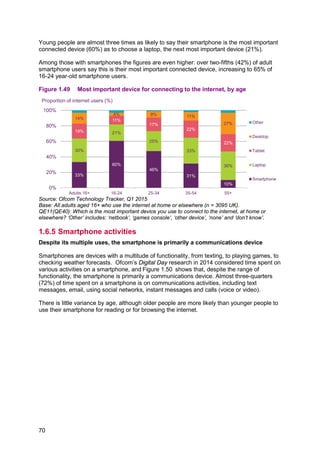
For the first time, the smartphone has overtaken the laptop as the device internet users say
is the most important for connecting to the internet. Thirty-three per cent of internet users
say their smartphone is the most important device for getting online, compared to 30% who
cite their laptop. This marks a clear shift since 2014, when 23% cited their phone and 40%
preferred their laptop.
Overall, smartphone users now spend nearly two hours (114 minutes) using the internet on
their mobile phone, nearly twice as much time as the average adult spends going online via
a PC or laptop (69 minutes). Our research shows that smartphones are used for a range of
non-communication based activities, including watching short video clips (42%), streaming
television programmes or films (21%); making purchases online (45%), and online banking
(44%).Take-up and use of smartphones is explored in detail in the first chapter of this year’s
report (page 67).
Other areas covered in the first chapter include the decline in watching traditional TV (page
40) and developments in non-traditional viewing (catch-up and subscription services) (page
51), changes in the use of social media (page 95), the prevalence of digital music and
photograph collections (page 105), shifts in attitudes to and understanding of the online
environment over the past decade (page 115), and a summary of the nations’
communications markets (page 126).
The remainder of the report covers television and audio-visual content (page 139), radio and
audio content (page 203), telecoms and networks (page 246), internet and online content
(page 317), and post (page 372). In each chapter, we set out in detail an analysis of industry
and consumer data.
To make this report and its resources more useful to stakeholders, we are publishing all of
the data and charts in a searchable resource. This can be found at
www.ofcom.org.uk/cmruk. Companion reports for each of the UK’s nations are once again
published alongside this report; these can be found at www.ofcom.org.uk/cmr.
The information set out in this report does not represent any proposal or conclusion by
Ofcom in respect of the current or future definition of markets. Nor does it represent any
proposal or conclusion about the assessment of significant market power for the purpose of
the Communications Act 2003, the Competition Act 1998 or any other relevant legislation.
1
Methodological note
A variety of data sources were used in compiling this report: Ofcom’s technology tracker
survey, its residential consumer postal tracking survey, its business postal tracking survey
and its media tracking survey, as well as a range of ad-hoc research. The following is a brief
outline of the tracking surveys used, any methodological changes and an explanation of the
significance testing.
Ofcom Technology Tracker
The technology tracker survey is run twice a year. It provides Ofcom with continuous
understanding of consumer behaviour in the UK communications markets, helping us to
monitor change and assess the degree and success of competition. The data collected is
weighted to the profile of UK adults, so the data are representative of adults aged 16+. The
weighting profile was updated for the 2015 data to reflect updated Census and NRS data.
Ofcom Residential Postal Tracker
The residential postal tracker survey is run throughout the course of the year and reported
on a quarterly basis. The main objective is to help Ofcom to keep abreast of the UK postal
market and to help us to quickly identify and react to any changes in attitudes and behaviour
among residential postal consumers.
Ofcom Business Postal Tracker
The business postal tracker survey is run throughout the course of the year on a sample of
1600 SMEs (businesses with 0-249 employees) and reported annually. The main objective is
to help Ofcom to keep abreast of the UK postal market and to help us to quickly identify and
react to any changes in attitudes and behaviours among SME postal consumers.
Ofcom Media Tracker
The media tracker survey is run throughout the course of the year to counter potential
seasonality issues, and is reported on an annual basis. The research provides Ofcom with a
valuable source of information on consumers’ attitudes, and helps inform Ofcom’s work on
broadcasting standards.
Significance testing
In statistics, a ‘significant’ result is one that is unlikely to have occurred by chance. All of the
differences (e.g. year on year) that are commented on in the text of this report will be
significantly different to one another. Where percentages are described as being the same or
similar, despite there being a difference in number, this is because the difference is not
statistically significant. Ofcom conducts all significance testing to a 95% confidence level,
which means that we are 95% certain that there has been a ‘real’ change and that the
difference has not occurred by chance. Significance is tested using the effective sample
size, where available, and the unweighted base, where not.
2
Key points
Key points: the market in context
Key market trends
• Total UK communications revenues stood at £56.1bn in 2014. Total UK
communications revenues generated by telecoms, TV, radio and postal services
decreased in 2014, falling by £0.3bn (0.5%) to £56.1bn. This overall decrease in
revenues was due to a decline in total telecoms revenue, which fell by £0.8bn (2.0%)
to £37.4bn during the year, continuing the trend for the past five years.
• Average monthly household spend on communication services has decreased
in real terms over the past five years. Although stable compared to 2013, average
monthly household spend on communication services has decreased in real terms
over the past five years (i.e. adjusted for inflation); from £122.07 in 2009 to £117.71
in 2014, representing a monthly decrease of £4.36, or £52.32 per year.
• By May 2015 83% of UK premises were able to receive superfast broadband.
Eighty-two per cent of UK premises were able to receive fibre broadband over
Openreach and 44% via Virgin Media’s cable broadband service by May 2015. The
availability of next-generation access (NGA) networks (calculated by combining
Openreach, Kcom and Virgin Media’s network coverage data) increased by 12
percentage points to 90%. However, these are not all capable of providing superfast
services; the availability of superfast broadband is 83% of premises.
• Three in ten of all broadband connections are now superfast. By the end of 2014
there were an estimated 7.1 million UK superfast broadband connections, an
increase of 1.8 million compared to the previous year. The proportion of all UK
broadband connections that were classed as superfast increased accordingly over
the same period, from 23.2% to 30.0%.
• Four in five households now have fixed broadband and three in five adults
access the internet through their mobile phone. The proportion of households
with access to the internet has increased, driven by a boost in fixed broadband
connections. Fixed broadband connections were reported in 78% of households in
2015. In addition, accessing the internet through a mobile phone continues to
increase; six in ten respondents (61%) said they personally used their mobile phone
to access the internet in 2015 (up from 57% in Q1 2014).
• Increase in take-up of tablets and smartphones continues. Take-up of
smartphones has continued to increase over the past year, with two-thirds of adults
(66%) now owning one. Over half of households (54%) had a tablet computer in early
2015, increasing from 44% in Q1 2014.
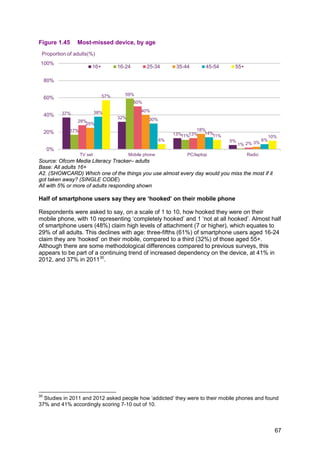
• Television sets are the most-missed media device among all adults, but the
mobile phone is much more important to 16-24 year olds. Among adults as a
whole, the TV set is the device people say they would miss the most, cited by close
to four in ten (37%). This differs significantly by age; from 17% of 16-24 year olds to
68% of those aged 75+. Those aged 16-24 are much more likely to cite the mobile
phone, at 59%, compared to just 2% of those aged 75+.
• Almost a quarter of consumers claimed to have sent no items of mail in the
past month. Adults in the UK claim to receive an average of 8.5 items of post –
including letters, cards and parcels – in an average week. This compares to an
3
average of approximately 6.0 letters, cards or parcels sent in an average month.
Almost a quarter of consumers (23%) in 2015 reported having sent no items of mail
in the past month, a significant increase compared to 2014 (20%).
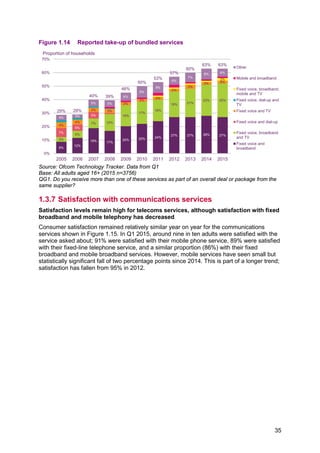
• Reported use of bundled services remained stable from 2014 to 2015. Just over
six in ten consumers (63%) reported that they had bought at least two of their
communications services together in a bundle in Q1 2015, the same as the previous
year’s figure (60%). Dual-play packages of landline and broadband, and triple-play
packages of landline, broadband and TV were the most popular (reported to be taken
up by 27% and 25% of households respectively).
• Satisfaction levels remain high for telecoms services, although satisfaction
with fixed broadband and mobile telephony has decreased. In Q1 2015, around
nine in ten adults were satisfied with the service asked about. However, both mobile
services and fixed broadband services have seen small but statistically significant
falls in satisfaction since 2014, each falling by two percentage points. For mobile this
is part of a longer trend, falling from 95% in 2012.
Changes in TV viewing habits
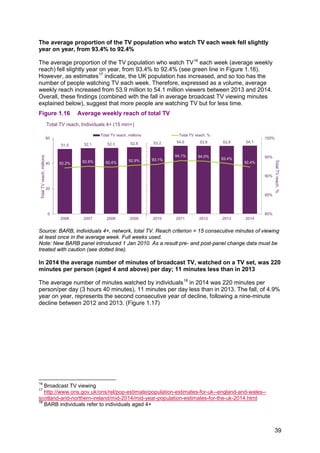
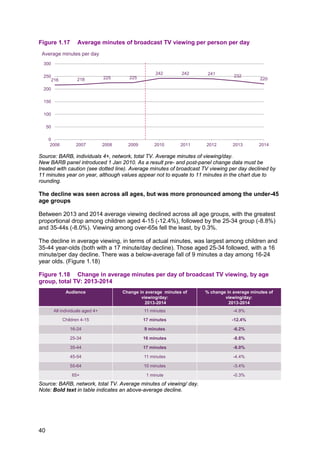
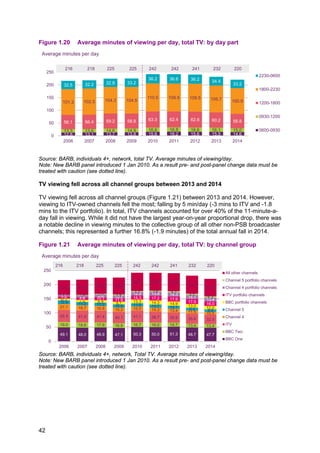
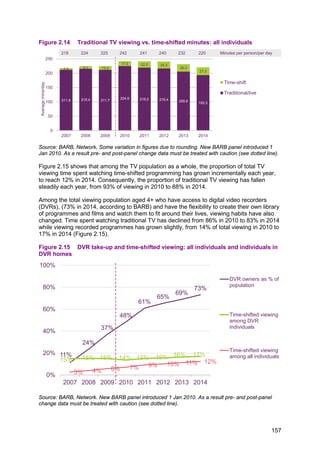
• In 2014 the average number of minutes of broadcast TV, watched on a TV set,
was 220 minutes per person (aged 4 and above) per day; 11 minutes less than
in 2013. The fall, of 4.9% year on year, represents the second consecutive year of
decline.
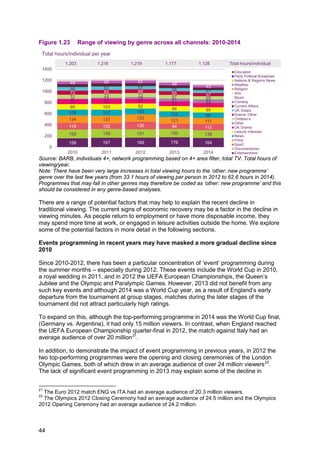
• The entire year-on-year drop in viewing can be attributed to a decline in
viewing of traditional TV (watching programmes at the time of broadcast).
Despite an increase in time-shifted viewing (+1 minute) this was not enough to
compensate for the 12-minute decline in traditional TV viewing, resulting in an 11-
minute decline in broadcast TV viewing overall.
• The average proportion of the TV population who watch TV each week fell
slightly year on year, from 93.4% to 92.4%. However, in terms of volume, the
number of people watching TV each week increased from 53.9 million to 54.1 million
viewers between 2013 and 2014.
• The decline was seen across all ages, but was more pronounced among the
under-45 age groups, with the greatest proportional drop among children aged 4-15
(-12.4%), followed by the 25-34 group (-8.8%) and 35-44s (-8.0%). Viewing among
the over-65s fell the least; by 0.3%.
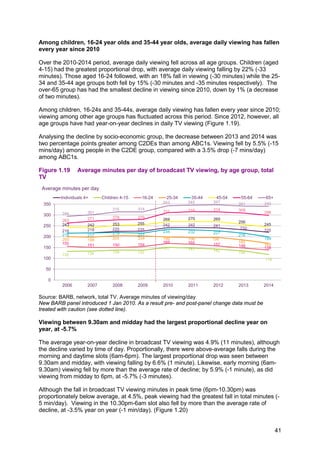
• Among children, 16-24 year olds and 35-44 year olds, average daily viewing
has fallen every year since 2010, while viewing among other age groups has
fluctuated across this period. Since 2012, however, all age groups have had year-on-
year declines in daily TV viewing.
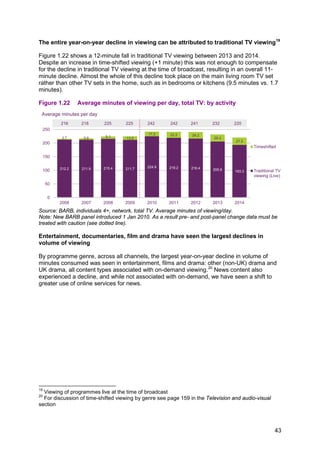
• TV viewing fell across all channel groups between 2013 and 2014. Viewing to
ITV-owned channels fell the most; falling by 5 mins/ day (-3 mins to ITV and -1.8
mins to the ITV portfolio). In total, declines in viewing to ITV channels accounted for
over 40% of the total fall in viewing.
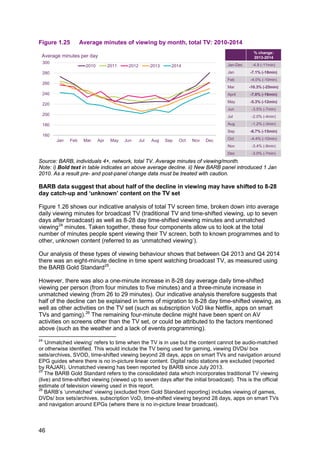
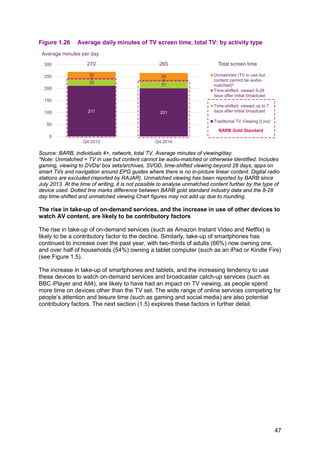
• BARB data suggest that about half of the decline in viewing may have shifted
to 8-28 day catch-up and other (unknown) content on the TV set. Analysis of
viewing on the TV set shows that there was a one-minute increase in 8-28 day
average daily time-shifted viewing per person (from four minutes to five minutes) and
4
a three-minute increase in ‘unmatched’ viewing (this includes apps on smart TVs,
gaming and subscription video-on-demand services such as Netflix), from 26 to 29
minutes. 1
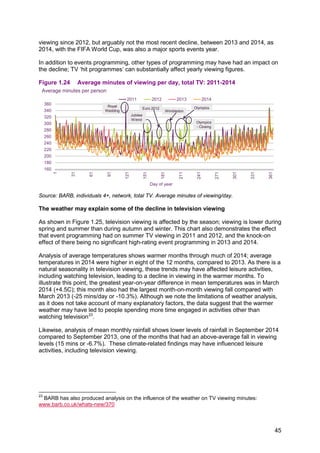
• A number of other factors may also explain the decline in traditional TV
viewing. These include rising employment, a lack of events programming as seen in
2011 and 2012, the weather, increase in take-up of non-broadcast on-demand
services and increase in use of other devices to watch AV content.
Developments in viewing beyond traditional television
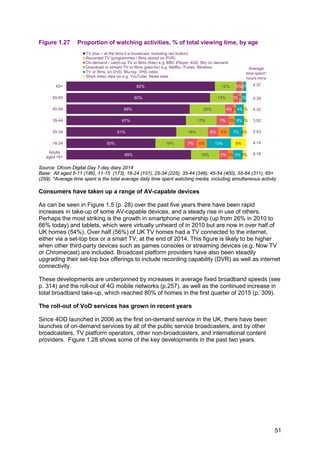
• Just under 70% of total time spent watching audio-visual content is to
traditional (live) television, with marked differences between age groups. Adults
aged 16 to 24 spend 50% of their viewing time watching traditional television. This
figure increases with age; over-65s spend 82% of their viewing time watching
traditional TV. Viewing to VoD services represented 8% of total viewing among UK
adults aged 16+, rising to 13% of viewing time among 16-24s.
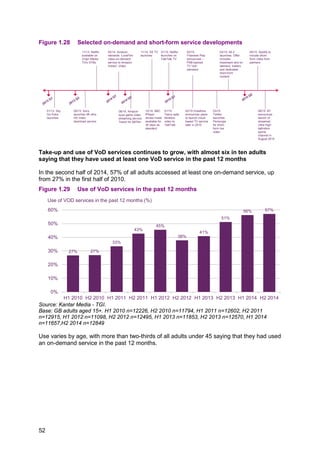
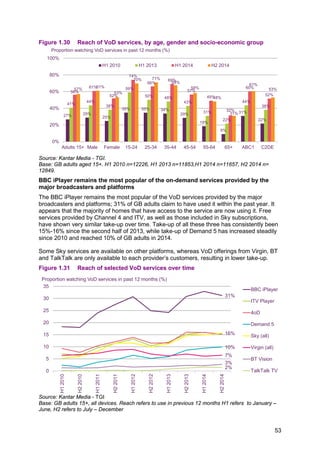
• Take-up and use of VoD services continues to grow, with almost six in ten
adults saying that they have used at least one VoD service in the past 12
months. BBC iPlayer remains the most popular of the VoD services provided by the
major broadcasters and platforms, with around three in ten (31%) adults using it in
the past year.
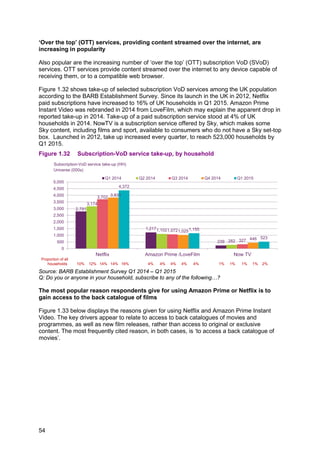
• ‘Over the top’ (OTT) services, providing content streamed over the internet, are
increasing in popularity. Since its launch in the UK in 2012, Netflix has increased
its subscriptions to 4.4 million households, while 1.2 million households now have a
subscription to Amazon Prime Instant (formerly LoveFilm). The most popular reason
cited for using either of these subscription VoD services was to access the back
catalogue of movies.
• Viewing of short-form video is popular with many age groups. Seventy-two per
cent of people claimed to watch short-form video (such as clips and music videos on
services such as YouTube), with 32% saying they watched either daily or at least
weekly. This is now viewed by many as an important source of information as well as
entertainment. Forty-seven per cent of internet users said they had used YouTube as
a source when looking for information online, rising to 57% of 16 to 24 year-olds.
• Ofcom’s consumer research reported increases in non-traditional viewing; 33%
of respondents claimed that they were using free catch-up and VoD services
more than they did a year ago. This compared to 7% saying they were doing this
less, and resulted in net gains of +26% for watching non-subscription catch-up
services such as the BBC iPlayer, ITV Player and All4 (formerly 4oD).
• Ofcom’s research also showed that 15% of respondents were using
subscription on-demand services such as Netflix and Amazon Prime Instant
Video more than they did last year, and that 7% of respondents were doing it less,
resulting in a net gain of +8%.
• Twenty-six per cent of respondents said that they were using a digital video
recorder (DVR) more than in the previous year, and 13% said they were doing
1
This analysis compares Q4 2013 vs Q4 2014 data as unmatched viewing has only been reported by
BARB since July 2013
5
this less. This equates to +13% net gain in watching content personally recorded
from live television.
• Computers and smartphones are more popular than set-top boxes among 16-
24 year olds for accessing on-demand and catch-up services. Thirty-five per
cent of the online population claimed to use a set-top box for some form of on-
demand or catch-up service at least once a month – the highest for any of our
measured devices. In the 16-24 age group, however, respondents were more likely
to claim use of a desktop/ laptop computer (57%) or a smartphone (45%) than a set-
top box (40%) for viewing on-demand and catch-up services on a monthly basis.
A smartphone society
• Two-thirds of adults have a smartphone. Ninety-three per cent of UK adults said
they had a mobile phone in the first quarter of 2015. Of these, 71% said they had a
smartphone; 66% of the adult population. This has increased by 27 percentage
points since 2012.
• Young people are ten times as likely as older people to say their mobile phone
is the device they would miss the most. Three in five (59%) 16-24 year olds
named their mobile phone as the device they would miss the most if it were taken
away, compared to less than a fifth (17%) who cited a TV set. In comparison, just 6%
of those aged 55 and over said they would miss their phone the most, while 57% of
this age group said they would most miss the TV set.
• For the first time, the smartphone has overtaken the laptop as the device
internet users say is the most important for connecting to the internet; in 2015
33% chose their smartphone, and 30% chose their laptop, compared with 23% and
40% respectively in 2014. Furthermore, smartphones are now the most widely-
owned internet-enabled device (66%), on a par with laptops (65% of households)
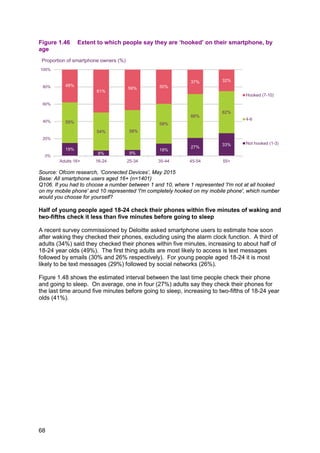
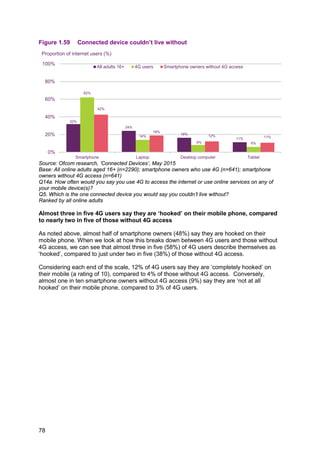
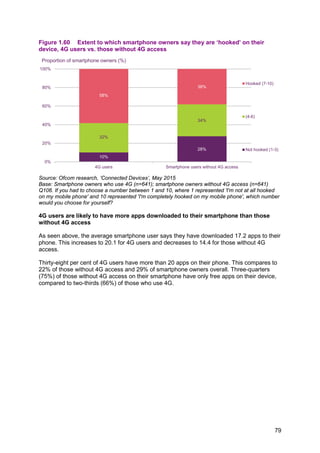
• Half of smartphone users say they are ‘hooked’ on their mobile phone. About
half of smartphone users (48%) score themselves at 7 or above when asked to
describe how hooked they are on their mobile phone on a scale of 1-10, rising to
three-fifths (61%) of young people aged 16-24.
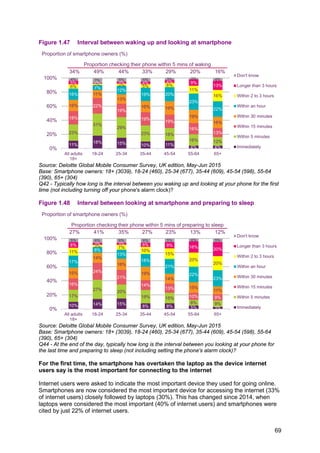
• Half of young people aged 18-24 check their phones within five minutes of
waking and two-fifths check it less than five minutes before going to sleep.
Three in ten adults (29%) said they checked their phones within five minutes of
waking up, increasing to about half of 18-24 year olds (48%). The first thing people
are most likely to access is text messages (35% of adults, 38% of 18-24 year olds).
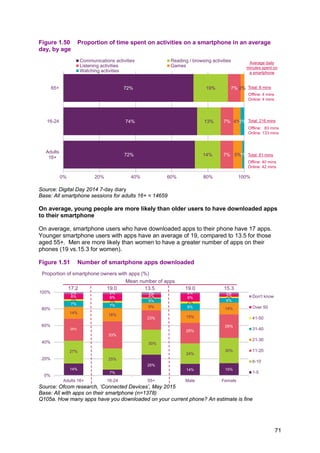
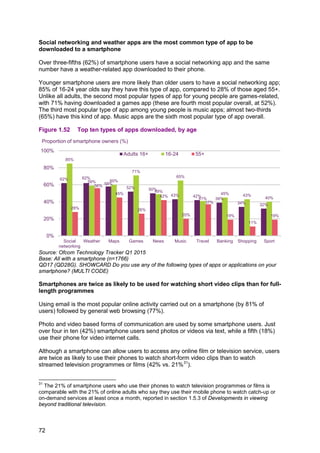
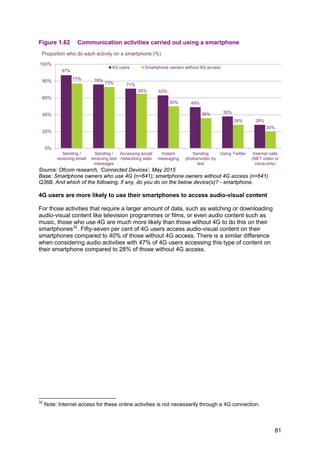
• Despite its multiple uses, the smartphone remains primarily a communications
device. Almost three-quarters (72%) of the time spent on a smartphone is on
communications activities, including text messages, email, using social networks,
instant messages and calls (voice or video).
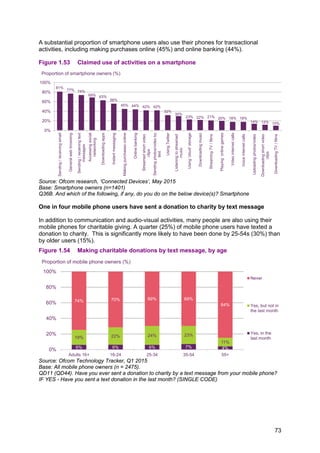
• While emailing is the most popular form of communications undertaken on a
smartphone (81% of users), photo and video based forms of communication are
used by some smartphone owners. Just over four in ten (42%) smartphone users
send photos or videos via text, while18% use their phone for video internet calls.
• Smartphones are twice as likely to be used for watching short video clips than
for full-length programmes. Although a smartphone can allow users to access any
online film or television service, users are twice as likely to use their phones to watch
6
short-form video clips than for streaming television programmes or films (42% vs.
21%).
• A substantial proportion of smartphone owners use their phones for
transactional activities, including making purchases online (45%) and online
banking (44%).
• A fifth of smartphone users admit to having used their phones in a cinema or
theatre. About three-fifths of smartphone users think it is unacceptable to use a
mobile in cinemas or theatres (60%) or in restaurants with others (59%). Despite
this, 45% of smartphone users admit to having used their device in a restaurant and
a fifth (22%) admit to having used it when in a cinema or theatre.
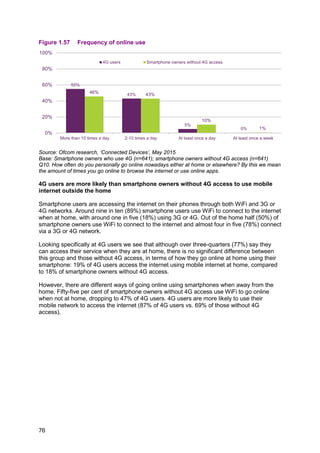
• One in four mobile phone users have donated to charity by text message. A
quarter (25%) of mobile phone users have texted a donation to charity. This is more
likely to be done by those aged 25-54 (30%) than by older users (15%).
With reference to 4G users:
• Nearly a third (30%) of UK adults say they now have access to 4G. 4G stands for
4th
generation, and relates to the 4th
generation mobile communications standard,
which allows internet access at higher speeds than previous standards. This equates
to 45% of UK smartphone users, an increase of 28 percentage points since 2014.
• 4G users show significantly different online behaviour compared to
smartphone owners without 4G access. 4G users are more likely to go online
more often, be more attached to their smartphones, do more ‘data-heavy’ activities
online and do them more often.
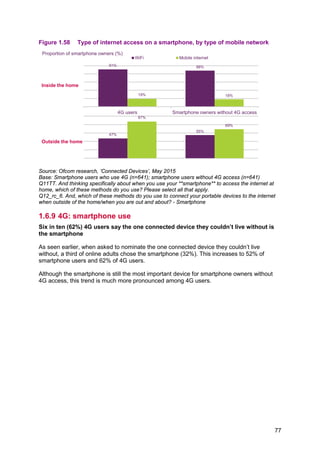
• 4G users are more likely than smartphone owners without 4G access to use
mobile internet outside the home. Fifty-five per cent of smartphone users without
4G say they use WiFi to go online when they are away from home. However, this
drops to 47% of 4G users, who are more likely to use their mobile network to go
online (87% vs. 69% of those without access).
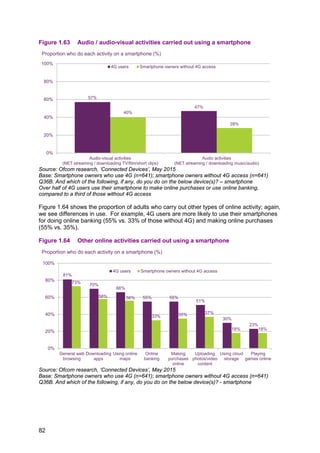
• 4G users are more likely to use their smartphones to access audio-visual
content. Fifty-seven per cent of 4G users access audio-visual content on their
smartphones compared to 40% of those without 4G access. There is a similar
difference when considering audio activities with 47% of 4G users accessing this
type of content on their smartphone, compared to 28% of those without 4G access.
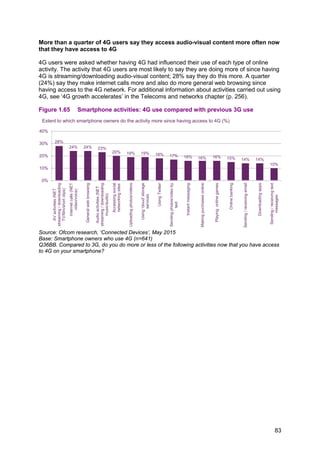
• Over half of 4G users use their smartphone to make online purchases or use
online banking, compared to a third of those without 4G access. 4G users are
more likely to use their smartphones for doing online banking (55% vs. 33% of those
without 4G) and making online purchases (55% vs. 35%).
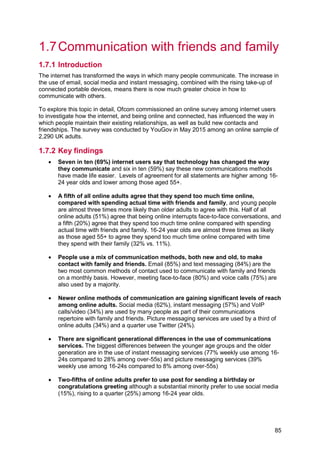
• More than a quarter of 4G users say they access audio-visual content more
often now that they have access to 4G. The activity that 4G users are most likely
to say they are doing more of, since they have had access to this network, is viewing
/downloading audio-visual content, with 28% saying they do this more. A quarter
(24%) also say they make internet calls more, and also do more general web
browsing since having access to the 4G network.
7
Communication with friends and family
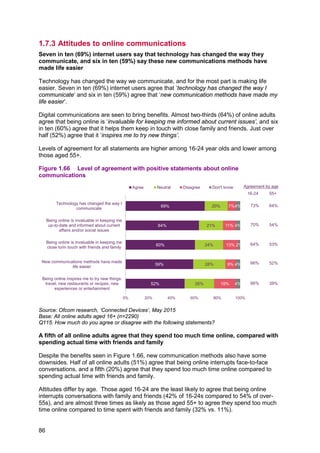
• Seven in ten (69%) internet users say that technology has changed the way
they communicate and six in ten (59%) say these new communications
methods have made life easier. Levels of agreement for all statements are higher
among 16-24 year olds and lower among those aged 55+.
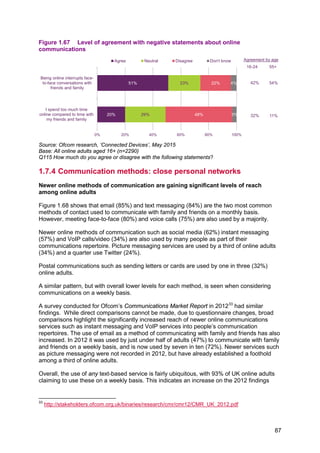
• A fifth of all online adults agree that they spend too much time online,
compared with spending actual time with friends and family. Half of all online
adults (51%) agree that being online interrupts face-to-face conversations, and a fifth
(20%) agree that they spend too much time online compared with spending actual
time with friends and family. 16-24 year olds are almost three times as likely as those
aged 55+ to agree they spend too much time online compared with time they spend
with their family (32% vs. 11%).
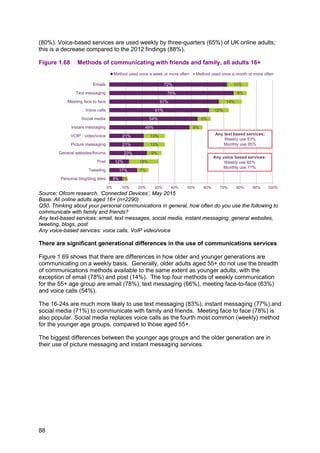
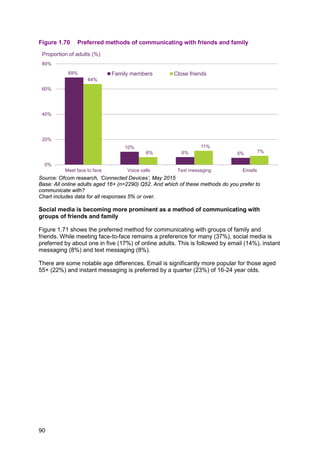
• People use a mix of communication methods, both new and old, to make
contact with family and friends. Email (85%) and text messaging (84%) are the
two most common methods of contact used to communicate with family and friends
on a monthly basis. However, meeting face-to-face (80%) and voice calls (75%) are
also used by a majority.
• Newer online methods of communication are gaining significant levels of reach
among online adults. Social media (62%), instant messaging (57%) and VoIP
calls/video (34%) are used by many people as part of their communications
repertoire with family and friends. Picture messaging services are used by a third of
online adults (34%) and a quarter use Twitter (24%).
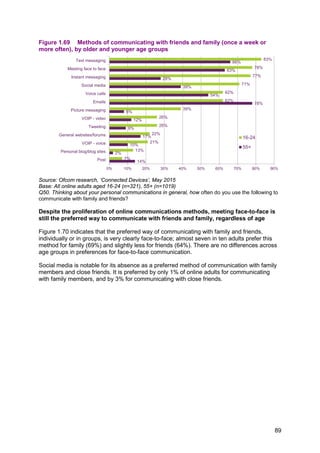
• There are significant generational differences in the use of communications
services. The biggest differences between the younger age groups and the older
generation are in the use of instant messaging services (77% weekly use among 16-
24s compared to 28% among over-55s) and picture messaging services (39% weekly
use among 16-24s compared to 8% among over-55s)
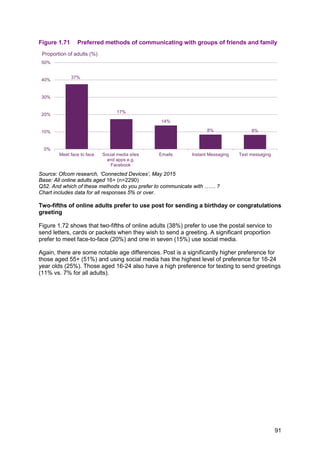
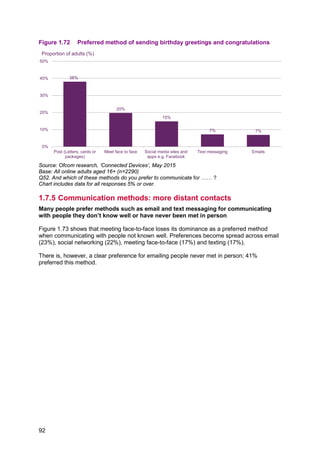
• Two-fifths of online adults prefer to use post for sending a birthday or
congratulations greeting although a substantial minority prefer to use social media
(15%), rising to a quarter (25%) among 16-24 year olds.
Social media developments
• More than seven in ten adult internet users (72%) have a social media profile,
and social media use is correlated to age. A majority of internet users aged 16-24
(93%), 25-34 (90%), 35-44 (80%) and 45-54 (68%) have a social media profile, such
as a Facebook or Twitter account. This compares to half of 55-64s (49%) and three
in ten aged 65+ (28%).
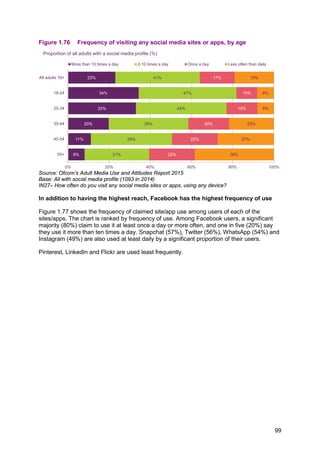
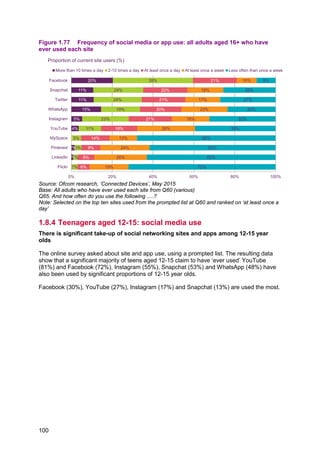
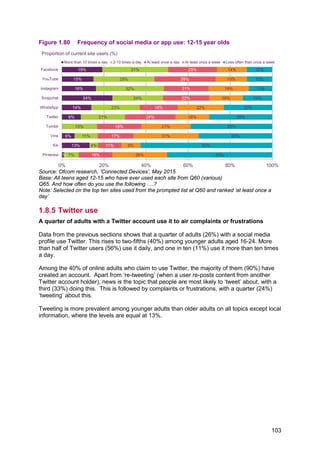
• In addition to having the highest reach, Facebook has the highest frequency of
use. A fifth of Facebook users (19%) claim to go on the site more than ten times a
day. Over 10% of Snapchat, Twitter and WhatsApp users also claim to use these
sites more than ten times a day.
• Young adults aged 16-24 have a more extensive breadth of use of social media
and are adopting newer sites and services such as Twitter (40%), WhatsApp (37%),
YouTube (32%), Instagram (35%), Snapchat (26%), Tumblr (8%) and Vine (4%).
However, the majority (97%) of all adults aged 16+ with a social media profile say
8
they use Facebook, and close to half (48%) of those with a profile say they have one
only on Facebook.
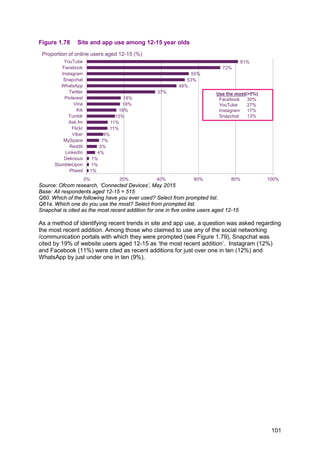
• There is significant take-up of social networking sites and apps among 12-15
year olds. A significant proportion of teens aged 12-15 have 'ever used' YouTube
(81%), Facebook (72%), Instagram (55%), Snapchat (53%) and WhatsApp (48%).
When asked which they used the most, Facebook (30%), YouTube (27%), Instagram
(17%) and Snapchat (13%) were the most commonly cited.
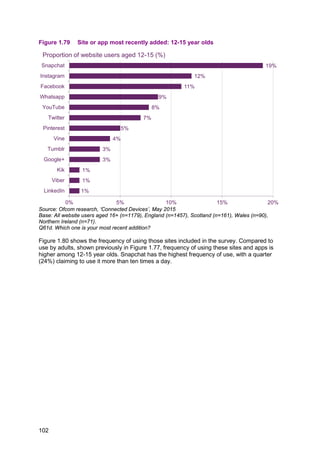
• Snapchat was cited by 19% of website users aged 12-15 as ‘their most recent
addition’. Instagram (12%) and Facebook (11%) were cited as recent additions for
just over one in ten (12%).
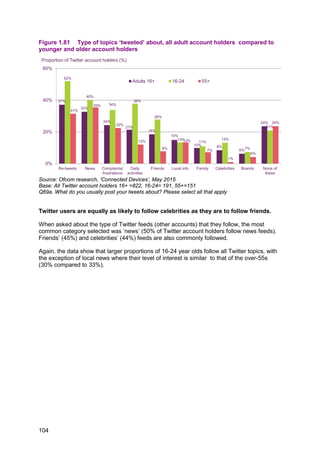
• A quarter of adults with a Twitter account use it to air complaints or
frustrations. Aside from ‘re-tweeting’, ‘news’ is the topic that people are most likely
to ‘tweet’ about, with a third (33%) doing this. This is followed by complaints or
frustrations, with almost a quarter (24%) tweeting in this way. Tweeting information
on celebrities is most likely to be by 12-15 year old account holders, with 30% doing
so, almost four times as many as among all adult account holders (8%).
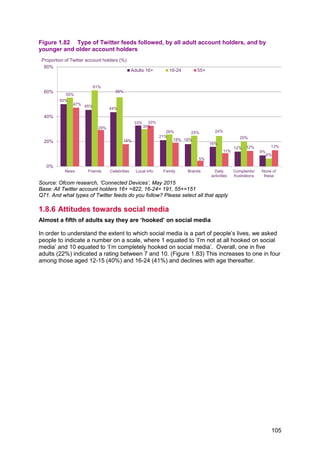
• Twitter users are equally as likely to follow celebrities as they are to follow
friends. When asked about the type of Twitter feed that they followed, the most
popular type was ‘news’, at 50% of account holders. A similar proportion of people
followed ‘friends’ (45%) as followed ‘celebrities’ (44%).
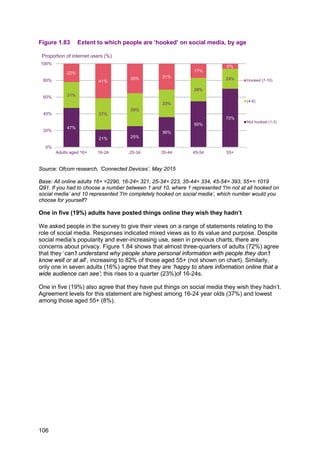
• Almost a fifth of adults say they are ‘hooked’ on social media. Overall, one in
five online adults (22%) indicated a rating of between 7 and 10 on a 10-point scale
(where 1 equated to ‘I’m not at all hooked on social media’ up to 10 ‘I’m completely
hooked on social media’). Dependency on social media is correlated to age, with two
in five (41%) 16-24 year olds giving a 7-10 ‘hooked on’ rating, falling to 6% among
over-55s.
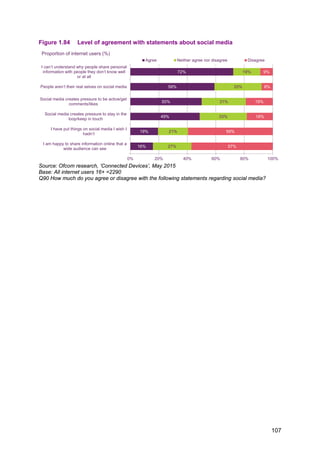
• One in five adults (19%) have posted things online they wish they hadn’t. In
contrast, almost three-quarters of adults (72%) agreed that they ‘can’t understand
why people share personal information with people they don’t know well or at all’,
increasing to 82% of those aged 55 and over. Similarly, almost six in ten online adults
(57%) disagree about being ‘happy to share information online that a wide audience
can see’.
Digital music and photo collections
• There is heavy use of digital formats for both music and photos, particularly
among young people although some people are retaining physical formats. There is
no clear preference as to the type of digital music (stored or streamed) or where to
store digital photos (cloud, device).
With reference to music formats:
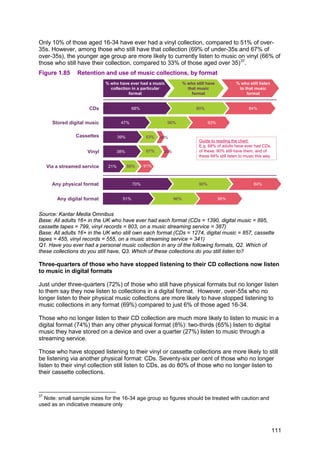
• Just over half of all adults have ever had a music collection in a digital format,
and they are more likely than those with music in physical formats to still listen
to it. Fifty-one per cent of adults have ever had a digital music collection, and they
are significantly more likely to still listen to it than the 70% who hold their collection in
physical formats (96% of those who have music in a digital format still listen to it
compared to 84% of those who have music in a physical format).
9
• Three-quarters of those who have stopped listening to their CD collections
now listen to music in digital formats. Those who no longer listen to their CD
collection are much more likely to listen to music in a digital format (74%) than in an
alternative physical format (8%): two-thirds (65%) listen to digital music they have
stored on a device, and over a quarter (27%) listen to music through a streaming
service.
• Half of those with music in digital formats appreciate its portability and
perceive it to be better value for money. The portability of digital music formats is
valued by many; 50% agree that they like being able to carry their music with them,
enabled by the convenience of smartphones or MP3 players. Similarly, 49% agree
that these types of music format are more convenient.
With reference to photo formats:
• 16-24 year olds are more likely than those aged 65 and over to have digital
photo collections and older adults are twice as likely to have photo albums.
Those aged 16-24 are significantly more likely than those aged 65 and over to have
digital photos or videos, stored either on a personal device (75% vs. 39%), in online
storage (40% vs. 10%) or shared on photo-sharing sites (29% vs. 5%). In contrast,
over-65s are significantly more likely to have framed photos on display (74% vs.
49%) and to have boxes or albums of printed photos (65% vs. 33%).
• Young people are six times as likely as older people to mainly use a mobile
phone to take photos. Seven in ten (70%) adults say they ‘ever’ use a use a mobile
phone to take photos. This is the device most likely to be used to take photos; 60%
of UK adults say they use it most often, followed by one in five (22%) who say they
mainly use a digital camera. Eighty-nine per cent of 16-24 year olds mainly use a
mobile phone, compared to 22% of over-55s.
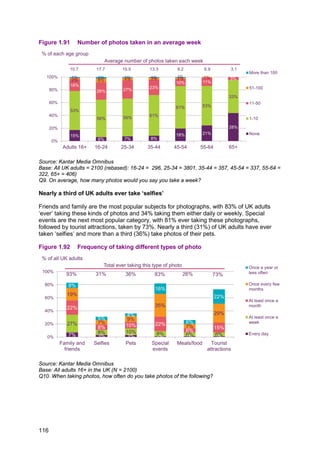
• More than a third of 16-24 year olds take more than ten photos each week and
8% take more than 50. Just over half (53%) of adults take between one and ten
photos each week, with almost one in five taking more than this (19%). Younger
adults are more likely than older adults to take more photographs each week: 34% of
those aged 16-24 say they take more than ten photos each week, with 8% claiming
to take more than 50.
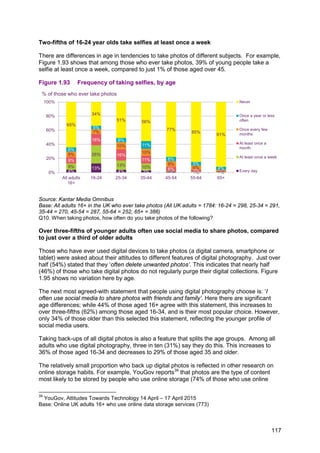
• Nearly a third of UK adults ever take ‘selfies’. Friends and family are the most
popular subjects for photographs, with 83% of UK adults ever taking these kinds of
photos and 34% taking them either daily or weekly. Nearly a third (31%) of UK adults
ever take ‘selfies’ while over a third (36%) take photos of their pets.
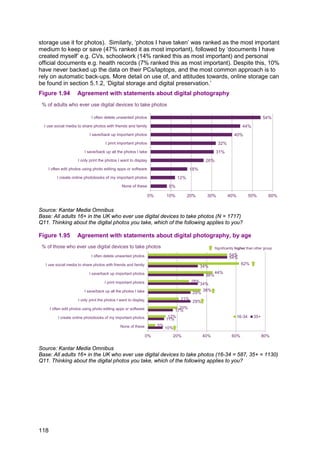
• Over three-fifths of younger adults often use social media to share photos,
compared to just over a third of older adults. More than two in five adults (44%)
agree that ‘I often use social media to share photos with friends and family’, and
there are significant age differences; 62% of those aged 16-34 agree compared to
only 34% of those aged 35 and older.
Media literacy: the past decade
• Over the past ten years the time adults spend using the internet has increased
substantially, both at home and elsewhere. The estimated number of hours spent
online per week has more than doubled since 2005, from around ten to over 20
hours.
10
• Take-up of most online activities has increased since 2005. For example, there
has been a noticeable increase in the use of the internet at least weekly for news
(25% to 42%), and for banking and paying bills (31% to 42%).
• There is less concern about online content than ten years ago, but concerns
remain more evident than for other media, and apps are posing a new
challenge. The proportion of internet users citing internet-related concerns has
decreased from seven in ten (70%) in 2005 to half (51%). However, concerns with
apps have increased from 20% in 2013 to 28%, mainly driven by security/fraud or
privacy issues (20% from 14%).
• Internet users under the age of 65 are more inclined to care about who owns
websites, or how they are funded, than they were in 20072
: 35% disagree with
the statement ‘As long as the internet provides good websites it doesn't really matter
who owns the websites or how they're funded’ compared to 23% in 2007.
• A majority of internet users claim confidence in finding information on the
internet, and understand how search engines operate. The proportion of internet
users who agree that they are confident at finding things online has remained the
same since 2007 (91% vs. 92%). Six in ten (60%) adults believe that some websites
will be accurate and unbiased, while others won’t be, close to the 2009 figure (54%).
• Although overall agreement that internet users must be protected from
inappropriate or offensive content is similar to 2005, opinions are stronger
than in 2013. Six in ten (60%) internet users strongly believe this, compared to 51%
in 2013.
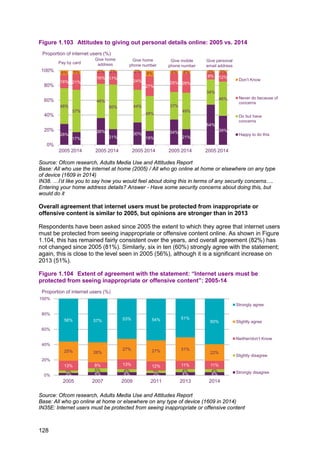
• The majority of internet users say they would share personal information
online, but there is evidence of added caution in doing this over the ten years
of tracking. For example, six in ten (60%) internet users say they would give out
their home address online but have concerns about doing so, compared to 46% in
2005.
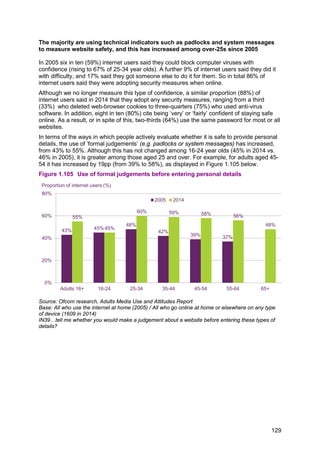
• The majority of internet users are using technical indicators such as padlocks
and system messages to measure website safety, and this has increased among
over-25s since 2005. Use of these indicators has increased among all internet users;
from 43% in 2005 to 55% in 2014. The change has been driven by those aged 25
and over. For example, the figure for adults aged 45-54 has increased by 15
percentage points (from 43% to 58%).
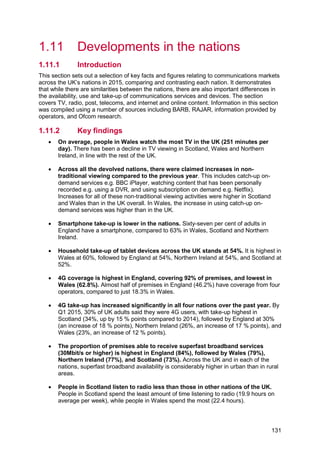
Developments in the nations
• On average, people in Wales watch the most TV in the UK (251 minutes per
day). There has been a decline in TV viewing in Scotland, Wales and Northern
Ireland, in line with the rest of the UK.
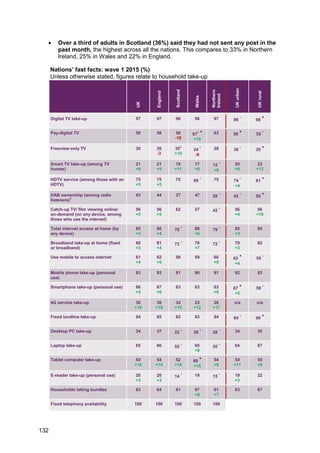
• Across all the devolved nations, there were claimed increases in non-
traditional viewing compared to the previous year. This includes catch-up on-
demand services e.g. BBC iPlayer, watching content that has been personally
recorded e.g. using a DVR, and using subscription on demand e.g. Netflix).
2
It is important to note that there has been a large increase in the number of internet users aged 65+
since 2005 (See 2015 report as per link above). As this question is asked of internet users, the base
of the question is more robust in 2014 than it was in 2007.
11
Increases for all of these non-traditional viewing activities were higher in Scotland
and Wales than in the UK overall. In Wales, the increase in using catch-up on-
demand services was higher than in the UK.
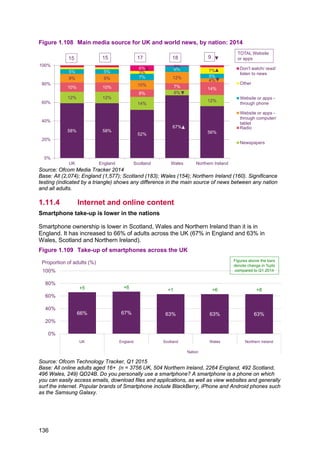
• Smartphone take-up is lower in the nations. Sixty-seven per cent of adults in
England have a smartphone, compared to 63% in Wales, Scotland and Northern
Ireland.
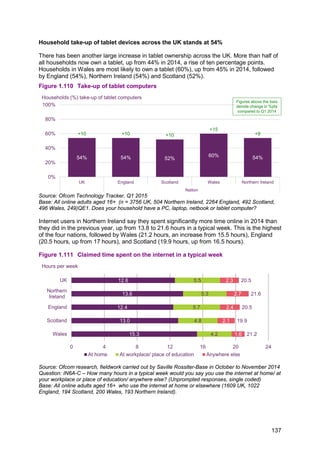
• Household take-up of tablet devices across the UK stands at 54%. It is highest in
Wales at 60%, followed by England at 54%, Northern Ireland at 54%, and Scotland at
52%.
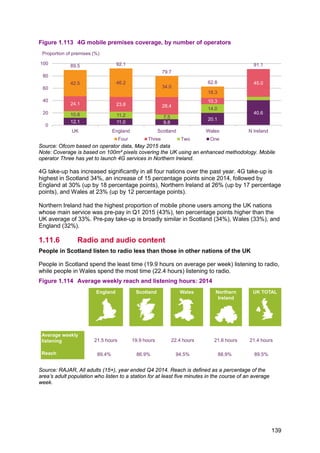
• 4G coverage is highest in England, covering 92% of premises, and lowest in
Wales (62.8%). Almost half of premises in England (46.2%) have coverage from four
operators, compared to just 18.3% in Wales.
• 4G take-up has increased significantly in all four nations over the past year. By
Q1 2015, 30% of UK adults said they were 4G users, with take-up highest in
Scotland (34%, up by 15 % points compared to 2014), followed by England at 30%
(an increase of 18 % points), Northern Ireland (26%, an increase of 17 % points), and
Wales (23%, an increase of 12 % points).
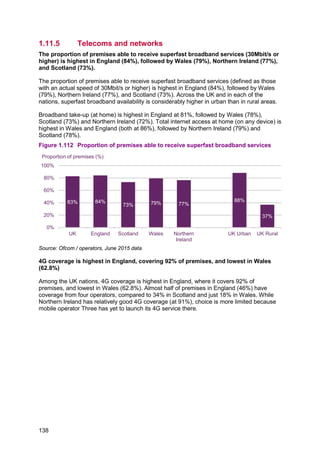
• The proportion of premises able to receive superfast broadband services
(30Mbit/s or higher) is highest in England (84%), followed by Wales (79%),
Northern Ireland (77%), and Scotland (73%). Across the UK and in each of the
nations, superfast broadband availability is considerably higher in urban than in rural
areas.
• People in Scotland listen to radio less than those in other nations of the UK.
People in Scotland spend the least amount of time listening to radio (19.9 hours on
average per week), while people in Wales spend the most (22.4 hours).
• Over a third of adults in Scotland (36%) said they had not sent any post in the
past month, the highest across all the nations. This compares to 33% in Northern
Ireland, 25% in Wales and 22% in England.
12
Key points: TV and audio-visual
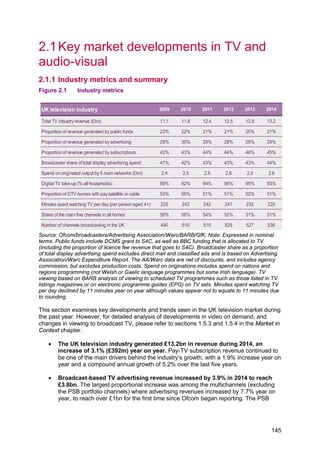
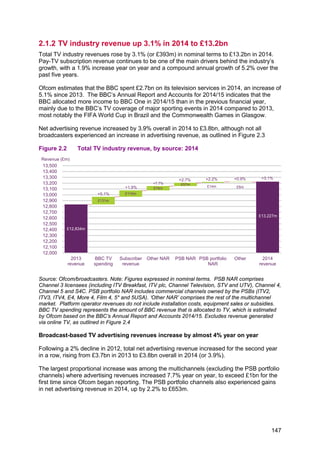
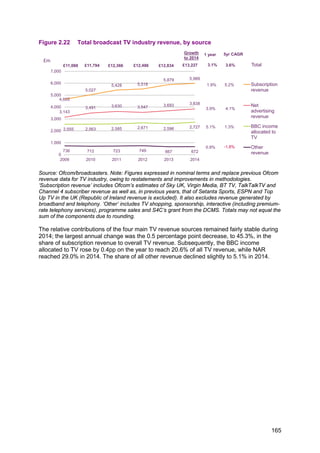
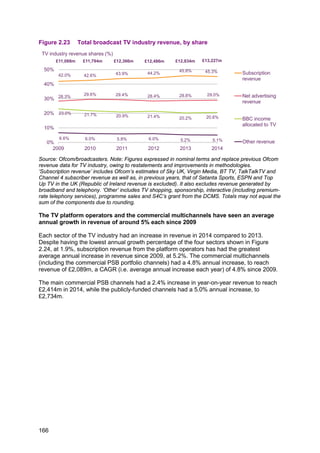
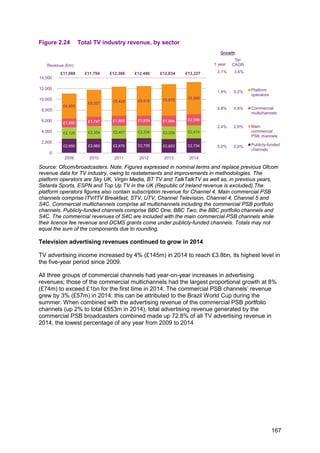
• The UK television industry generated £13.2bn in revenue during 2014, an
increase of 3.1% year on year. Pay-TV subscription revenue continues to be the
main driver behind the industry’s growth, with a 1.9% increase since 2013 and a
compound annual growth of 5.2% over the last five years, to £6bn.
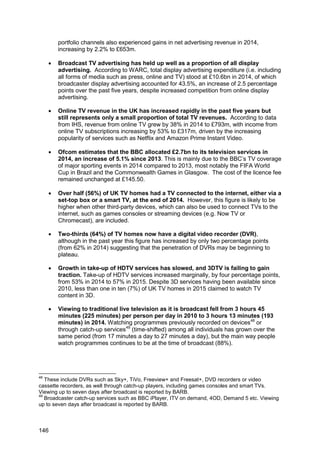
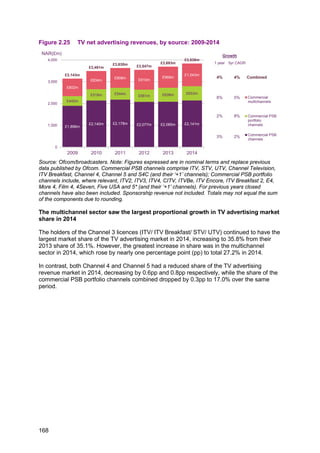
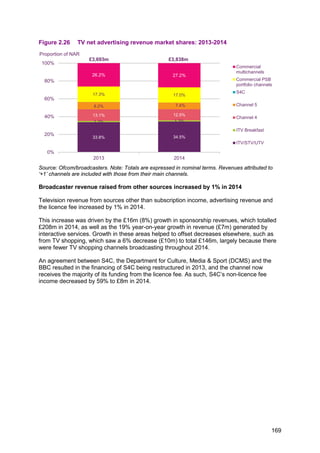
• Broadcast-based TV advertising revenue increased by 3.9% overall in 2014 to
£3.8bn. The largest proportional increase was among the mutichannels, where ad
revenues increased by 7.7% year on year, passing £1bn for the first time.
• Online TV revenue in the UK has increased rapidly in the past five years but
still represents only a small proportion of total TV revenues. According to data
from IHS, revenue from online TV grew by 38% in 2014 to £793m, with income from
online TV subscriptions increasing by 53% to £317m, driven by the increasing
popularity of services such as Netflix and Amazon Prime Instant Video.
• Broadcast TV advertising has held up well as a proportion of total display
advertising. According to WARC, total display advertising expenditure stood at
£10.6bn in 2014, of which broadcaster display advertising accounted for 43.5%, an
increase of 2.5 percentage points over the last five years, despite increased
competition from other media such as online advertising.
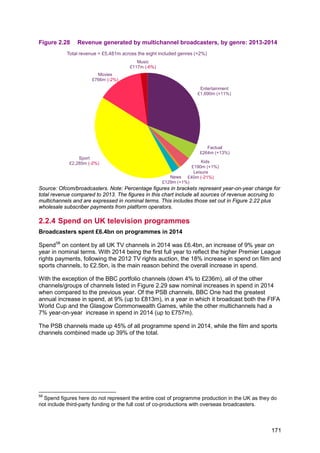
• Spend on content by all UK TV channels in 2014 rose by 9.4% to £6.4bn in
nominal terms. Spend on sports content by the commercial multichannels3
exceeded £2bn in 2014, following a 21% annual increase. This was the first full year
of the current English Premier League rights deal; this contributed to sports spend
making up 62% of multichannel content spend across the eight mainstream genres.
• Spend on first-run UK originated programming by the main five PSB channels
increased by 5%; from £2,451m in 2013 to £2,585m in 2014, in nominal terms,
driven mainly by the Brazil World Cup and the Glasgow Commonwealth Games.4
• Over half (56%) of UK TV homes had a TV connected to the internet, either via a
set-top box or a smart TV, at the end of 2014. However, this figure is likely to be
higher when other devices such as games consoles are included.
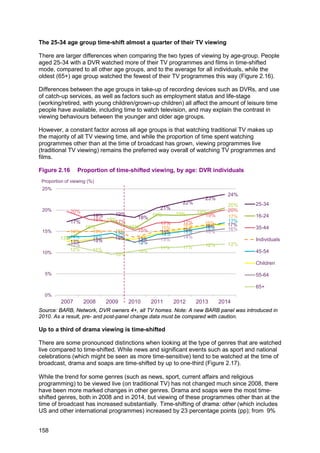
• Two-thirds (64%) of TV homes have a digital video recorder (DVR), although in
the past year this figure has increased by only 2pp, suggesting that growth in take-up
is beginning to slow. Take-up of HDTV services also increased marginally, from 53%
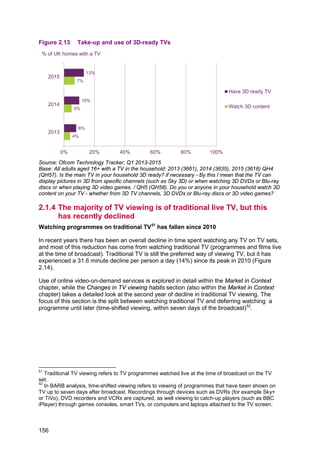
in 2014 to 57% in 2015. Just 7% of UK TV homes claim to watch 3DTV.
• The average number of minutes of broadcast TV watched on a TV set in 2014
fell for the second consecutive year. On average, people watched 220 minutes of
television per day in 2014, 11 minutes/day less than in 2013. TV viewing varies
greatly by age, and between 2013 and 2014 it fell by varying degrees among all age
groups. The largest decline was among children aged 4-15, with a 17 min/day (-
12.4%) fall, compared to a 1 min/day (-0.3%) decline among viewers aged 65 or
over.
3
This includes the commercial PSB portfolio channels.
4
Further information on content spend by the PSBs can be found in Ofcom’s PSB Review where
figures are adjusted for inflation; http://stakeholders.ofcom.org.uk/consultations/psb-review-3/
13
Key points: radio and audio
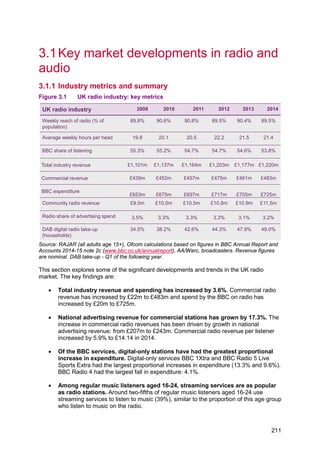
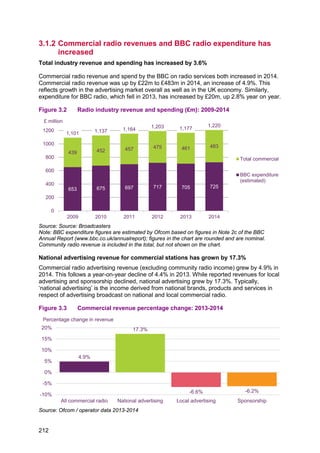
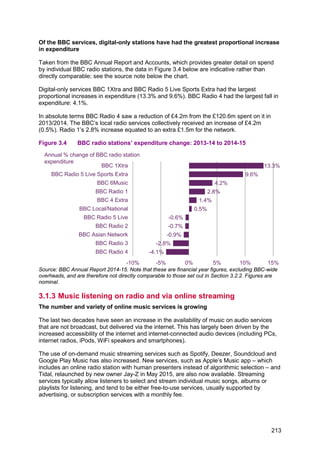
• Total industry revenue and spending has increased by 3.6% to £1.2bn.
Commercial radio revenue has increased by £22m to £483m, and spend by the BBC
on radio has increased by £20m to £725m.
• National advertising revenue for commercial stations has grown by 17.3% to
£483m. The increase in commercial radio revenues has been driven by growth in
national advertising revenue; from £207m to £243m. Commercial radio revenue per
listener increased by 5.9% to £14.14 in 2014.
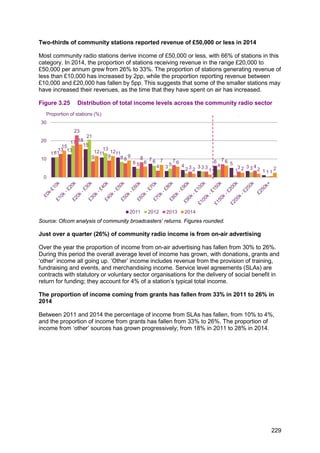
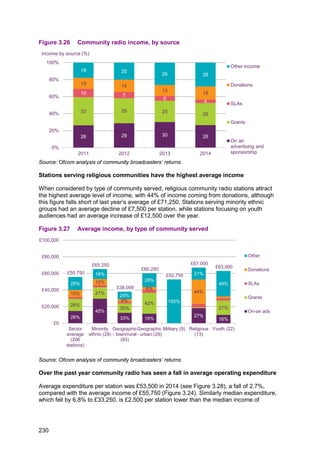
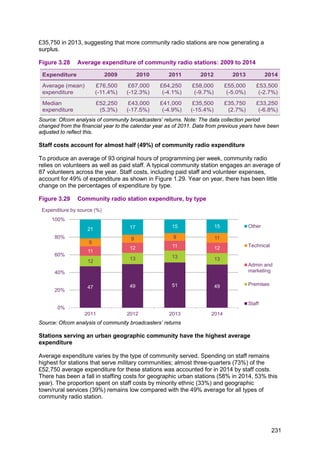
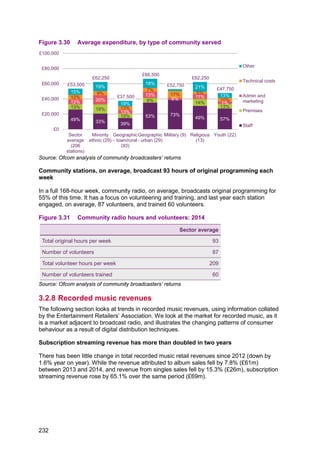
• Community radio revenue has increased year on year for the first time. Average
(mean) income is up by 0.8%, and median income has grown by 6.9% since last
year. The average community radio station income is £55,750, while median income
is £35,750 (an increase of £2,500 on the year).
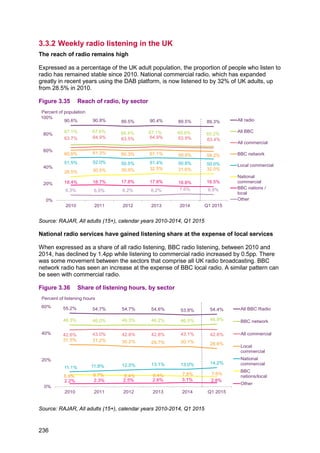
• The reach of radio remains high. Nine in ten (89.5%) UK adults listen to the radio
each week, tuning in for 21.4 hours (an average of 183.4 minutes of listening per
day, per listener). This is down by six minutes per week (average) year on year.
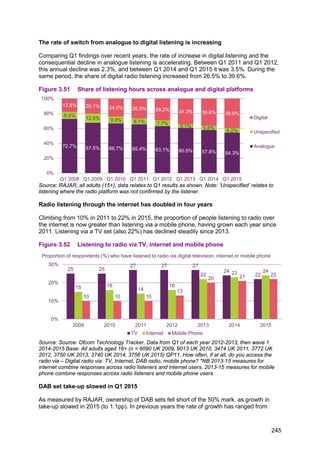
• Digital’s share of radio listening hours is 39.6%. The rate of increase in digital
listening, and the consequential decline in analogue listening, are both accelerating.
Between Q1 2011 and Q1 2012 the annual analogue decline was 2.3pp: between Q1
2014 and Q1 2015 it is 3.5pp. Digital listening grew by 2.8 percentage points year on
year, to account for 39.6% of all radio listening.
• A third of all radio listening is to local radio, and 56.2% of UK adults tune in on
a weekly basis. Among local radio listeners, local radio is still regarded as
important. Two-thirds (66%) of local radio listeners rate local radio as ‘important’
while 65% believe it is important that local radio services should be based locally.
Between 24% and 36% of local radio listeners depend on the bespoke speech
content which features in commercial and BBC local radio broadcasts.
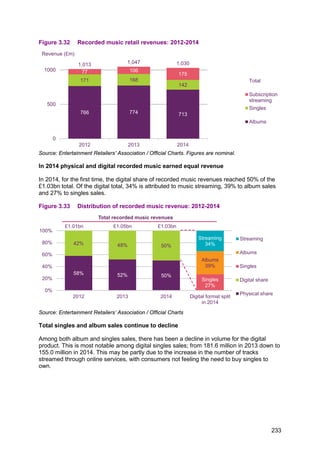
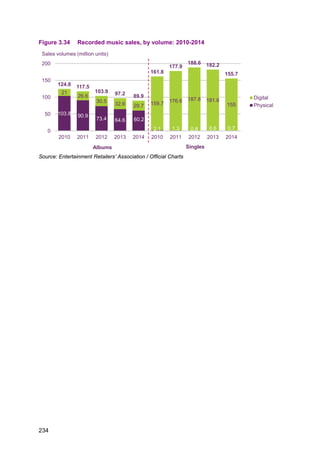
• Subscription streaming revenue has more than doubled in two years; it has
grown from £77m in 2012 to £175m in 2014. Almost 15 billion tracks were streamed
through subscription and ad-funded streaming services in 2014.
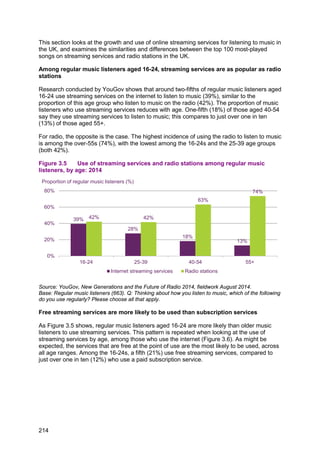
• Among regular music listeners aged 16-24, streaming services are as popular
as radio stations. Around two-fifths of regular music listeners aged 16-24 use
streaming services to listen to music (39%), similar to the proportion of this age group
who listen to music on the radio.
• For the first time the proportion of recorded music revenue is distributed
equally between physical and digital formats. Total recorded music revenues
were £1.03bn in 2014. Of the digital share, one-third is attributed to music streaming,
39% to albums and 27% to singles.
14
Key points: telecoms and networks
• Total telecoms revenues fell by 2.0% to £37.4bn in 2014. This was a £0.8bn fall
compared to 2013 and a £3.9bn (9.5%) decline compared to 2009, largely the result
of falling wholesale service revenues. The decline in telecoms revenues was partially
offset by a £0.8bn increase in fixed internet revenues in 2014.
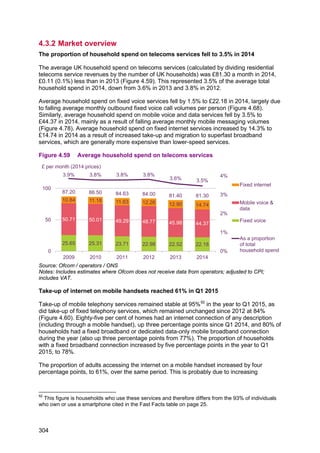
• The proportion of household spend on telecoms services fell to 3.5% in 2014.
The average UK household spend on telecoms services (calculated by dividing
residential telecoms service revenues by the number of UK households) was £81.30
a month in 2014, £0.11 (0.1%) less than in 2013.
• Fixed voice prices continued to increase in real terms in 2014. The price of a
basket of residential fixed voice services (including line rental and outgoing voice call
volumes, based on average use in 2014) increased by 1.2% to £21.19 during the
year, in line with the average increase over the previous five-year period.
• Fixed internet revenue growth has accelerated as a result of increased fibre
take-up. Non-corporate internet revenues totalled £4.9bn in 2014, a £0.8bn (18.5%)
increase compared to 2013, driven by the continuing migration of UK consumers
onto superfast services.
• Almost one in three fixed broadband lines are now ‘superfast’. The 7.1 million
fixed broadband lines providing speeds of 30Mbit/s or higher in the UK today account
for 30% of all fixed broadband lines, compared to 0.2% (41k) in 2009.
• In the six years to November 2014 average actual fixed broadband speeds have
increased at an average annual rate of 36% per year. The average actual fixed
broadband download speed in the UK was 22.8Mbit/s in November 2014, up from
3.6Mbit/s in November 2008.
• Total 4G subscriptions jumped to 23.6 million in Q4 2014. Data from operators
showed that 4G subscriptions made up 28% of total subscriptions in Q4 2014,
compared with 3% in Q4 2013.
• The total number of mobile data connections5
increased by 13.6%. The total
number of UK mobile data connections (including internet on a mobile handset,
dedicated mobile broadband and M2M6
connections) increased by 7.5 million
connections to 62.6 million in the year to December 2014.
• SMS use fell for the second consecutive year. The total volume of outgoing SMS
and MMS messages fell by 20 billion messages (15.3%) to 110 billion messages in
2014, due to increasing smartphone take-up and use of internet-based
communications methods.
5
Including internet on a mobile handset, dedicated mobile broadband and M2M connections.
6
Machine-to-machine, a connection, often wireless, in which human input is not necessarily required.
15
Key points: internet and online content
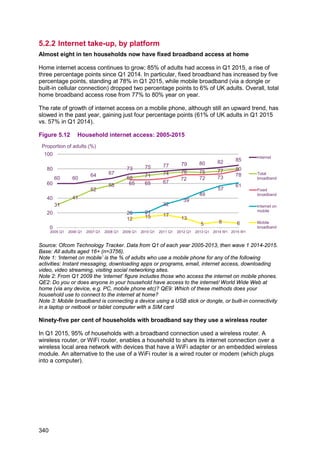
• Almost eight in ten households now have fixed broadband access at home.
Home internet access continues to grow, with 85% of adults having access in Q1
2015, a rise of three percentage points since Q1 2014. In particular, fixed broadband
has increased by five percentage points, standing at 78% in Q1 2015.
• Smartphones have become the most widely owned internet-enabled devices,
alongside laptops. In Q1 2015 smartphones were present in two-thirds of
households (66%), on a par with laptops at 65%.
• The largest increase in internet-enabled device ownership is for tablet
computers. Over half (54%) of households now own at least one tablet, an increase
of ten percentage points since last year.
• The average amount of time spent online per user on smartphones exceeds
that spent browsing on desktops and laptops. In March 2015 users spent an
average of 58 hours 39 minutes browsing or using apps on smartphones, compared
to an average of 31 hours 19 minutes on laptops and desktop computers.
• Google’s services were the most-visited by the digital audience, with 46 million
visitors in March 2015, but people spent more time on Facebook’s properties than
Google’s (51 billion minutes compared to 34 billion minutes).
• More people visited YouTube on an Android or iOS smartphone/tablet (27.1
million) than on a desktop or laptop (24.9 million) in March 2015.
• Overall use of mobile phones to make a purchase was around one in four
(26%) mobile internet users in March 2015, consistent with 2014, but only 6%
had used their handset to make a payment at physical point of sale.
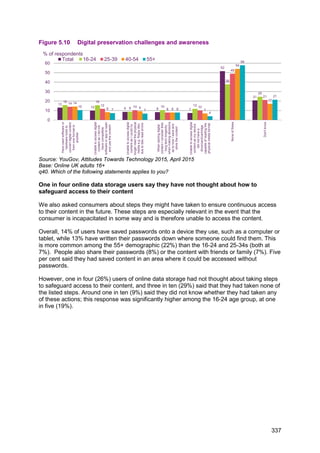
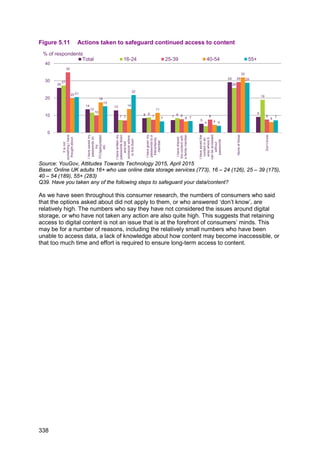
• Over a third (36%) of online adults say that they use an online (cloud) storage
service, but four in ten of these say they would not use them to store confidential
documents. A quarter of online storage users say they have not thought about taking
steps such as leaving instructions with friends or family to ensure that content can be
accessed in future.
• UK digital advertising rose by 15% to £7.2bn in 2014 and accounted for 39% of
estimated UK advertising expenditure. Key drivers of this growth were increases
in mobile advertising, broadcaster VoD advertising and national and regional digital
print advertising.
16
Key points: post
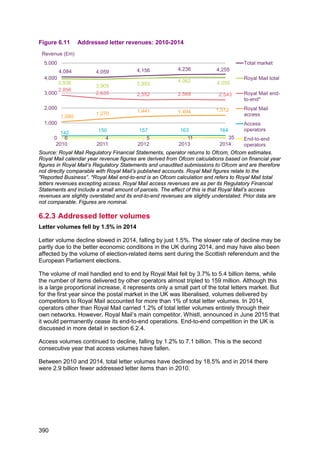
• Letter revenues grew slightly (by 0.4%) in 2014. Addressed letter revenues
increased by £18.5m to £4.3bn in 2014 (0.4%). Revenue from Royal Mail accounted
for the majority of letter revenues, although the proportion of revenues taken by other
operators, both access and end to end, has risen from 3.6% in 2010 to 4.7% in 2014.
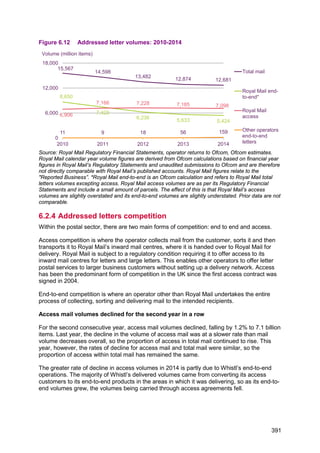
• Letter volumes fell by 1.5% in 2014. Letter volume decline slowed in 2014, falling
by just 1.5%. The volume of mail handled end to end by Royal Mail fell by 3.7% to
5.4 billion items. Access volumes continued to decline, falling by 1.2% to 7.1 billion.
This is the second consecutive year that access volumes have fallen.
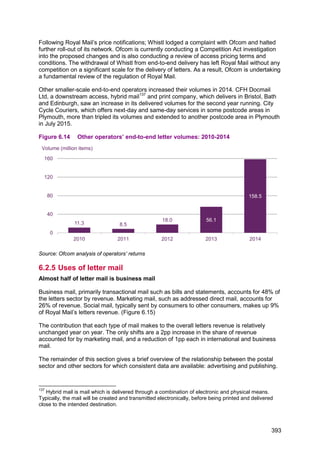
• Operators other than Royal Mail delivered 158.5 million items in 2014. Although
this is a large proportional increase, it represents a small part of the total letters
market. For the first year since the postal market in the UK was liberalised, volumes
delivered by competitors to Royal Mail accounted for more than 1% of total letter
volumes. However, in June 2015, Royal Mail’s main end-to-end competitor, Whistl,
announced that it was permanently ceasing its end-to-end operations.
• The parcels market is growing, and is more competitive than the letters sector.
Figures published in Royal Mail’s latest annual report estimate total parcel volume
growth at approximately 4%. By volume, Royal Mail considers that it has a 52%
share. In terms of estimated revenue, Royal Mail considers that it accounts for the
largest share, with 38%. This compares to Royal Mail’s near-99% share of the letters
sector by volume, and 95% share by revenue.
• Only one in ten consumers consider that the operator that delivers their parcel
is an important factor in choosing a retailer. A majority of consumers like to have
notifications and/or tracking in place for their e-retail deliveries, but six in ten are
unwilling to pay an additional fee for these features.
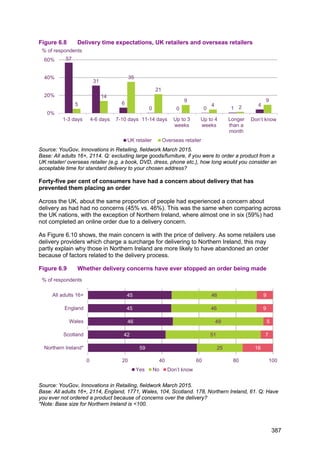
• More than half expect to receive their orders within three days. The majority of
people (57%) expect that a UK retailer will be able to provide goods ordered online
within three days, with a further 31% expecting their order to arrive within six days.
The expectation of delivery time from a retailer based overseas is lower. One-fifth
(19%) of people would expect an overseas retailer to get their orders to them within
six days.
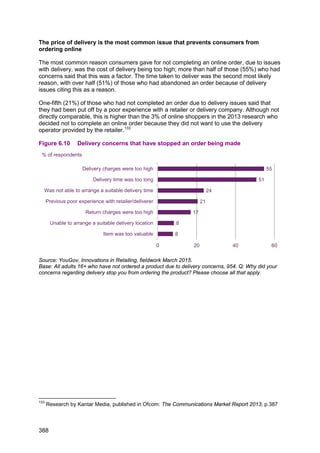
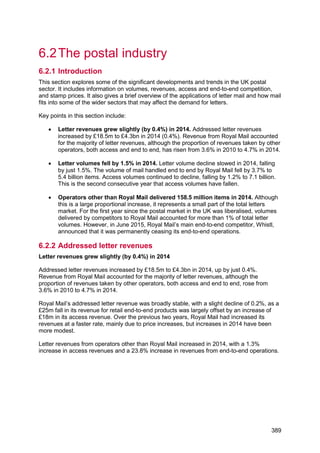
• Forty-five per cent of consumers have not ordered on a specific occasion
because of a concern over delivery. The price of delivery is the most common
issue that prevents ordering. Over half of those (55%) who had had a concern said
that cost was a factor.
• Email is the most common replacement for post across all age groups. Almost
eight in ten (77%) 16-34s who are sending less post than two years ago claim to
have replaced post with email. This age group is also more likely to be using a range
of alternative electronic communication methods as a replacement for post.
17
The Communications Market
2015
1
1 The market in context
19
Contents
1.1 Introduction and structure 21
1.2 Fast facts 23
1.3 Key market trends 25
1.4 Changes in TV viewing habits 37
1.5 Developments in viewing beyond traditional television 49
1.6 A smartphone society 63
1.7 Communication with friends and family 85
1.8 Social media developments 95
1.9 Digital music and photograph collections 109
1.10 Media literacy: the past decade 119
1.11 Developments in the nations 131
20
1.1Introduction and structure
1.1.1 Introduction
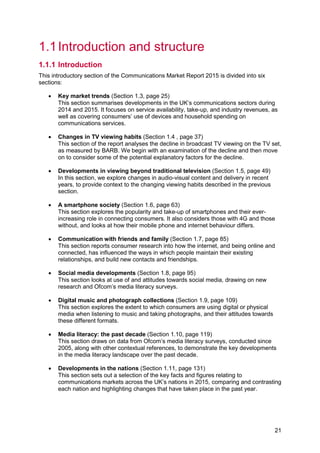
This introductory section of the Communications Market Report 2015 is divided into six
sections:
• Key market trends (Section 1.3, page 25)
This section summarises developments in the UK’s communications sectors during
2014 and 2015. It focuses on service availability, take-up, and industry revenues, as
well as covering consumers’ use of devices and household spending on
communications services.
• Changes in TV viewing habits (Section 1.4 , page 37)
This section of the report analyses the decline in broadcast TV viewing on the TV set,
as measured by BARB. We begin with an examination of the decline and then move
on to consider some of the potential explanatory factors for the decline.
• Developments in viewing beyond traditional television (Section 1.5, page 49)
In this section, we explore changes in audio-visual content and delivery in recent
years, to provide context to the changing viewing habits described in the previous
section.
• A smartphone society (Section 1.6, page 63)
This section explores the popularity and take-up of smartphones and their ever-
increasing role in connecting consumers. It also considers those with 4G and those
without, and looks at how their mobile phone and internet behaviour differs.
• Communication with friends and family (Section 1.7, page 85)
This section reports consumer research into how the internet, and being online and
connected, has influenced the ways in which people maintain their existing
relationships, and build new contacts and friendships.
• Social media developments (Section 1.8, page 95)
This section looks at use of and attitudes towards social media, drawing on new
research and Ofcom’s media literacy surveys.
• Digital music and photograph collections (Section 1.9, page 109)
This section explores the extent to which consumers are using digital or physical
media when listening to music and taking photographs, and their attitudes towards
these different formats.
• Media literacy: the past decade (Section 1.10, page 119)
This section draws on data from Ofcom’s media literacy surveys, conducted since
2005, along with other contextual references, to demonstrate the key developments
in the media literacy landscape over the past decade.
• Developments in the nations (Section 1.11, page 131)
This section sets out a selection of the key facts and figures relating to
communications markets across the UK’s nations in 2015, comparing and contrasting
each nation and highlighting changes that have taken place in the past year.
21
1.2Fast facts
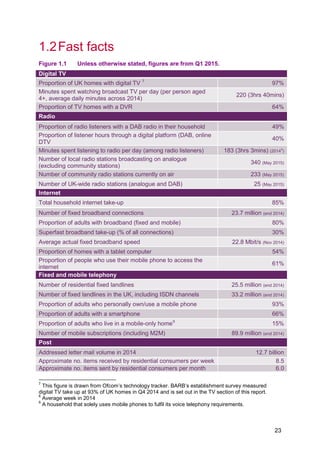
Figure 1.1 Unless otherwise stated, figures are from Q1 2015.
Digital TV
Proportion of UK homes with digital TV 7
97%
Minutes spent watching broadcast TV per day (per person aged
4+, average daily minutes across 2014)
220 (3hrs 40mins)
Proportion of TV homes with a DVR 64%
Radio
Proportion of radio listeners with a DAB radio in their household 49%
Proportion of listener hours through a digital platform (DAB, online
DTV
40%
Minutes spent listening to radio per day (among radio listeners) 183 (3hrs 3mins) (20148
)
Number of local radio stations broadcasting on analogue
(excluding community stations)
340 (May 2015)
Number of community radio stations currently on air 233 (May 2015)
Number of UK-wide radio stations (analogue and DAB) 25 (May 2015)
Internet
Total household internet take-up 85%
Number of fixed broadband connections 23.7 million (end 2014)
Proportion of adults with broadband (fixed and mobile) 80%
Superfast broadband take-up (% of all connections) 30%
Average actual fixed broadband speed 22.8 Mbit/s (Nov 2014)
Proportion of homes with a tablet computer 54%
Proportion of people who use their mobile phone to access the
internet
61%
Fixed and mobile telephony
Number of residential fixed landlines 25.5 million (end 2014)
Number of fixed landlines in the UK, including ISDN channels 33.2 million (end 2014)
Proportion of adults who personally own/use a mobile phone 93%
Proportion of adults with a smartphone 66%
Proportion of adults who live in a mobile-only home9
15%
Number of mobile subscriptions (including M2M) 89.9 million (end 2014)
Post
Addressed letter mail volume in 2014 12.7 billion
Approximate no. items received by residential consumers per week 8.5
Approximate no. items sent by residential consumers per month 6.0
7
This figure is drawn from Ofcom’s technology tracker. BARB’s establishment survey measured
digital TV take up at 93% of UK homes in Q4 2014 and is set out in the TV section of this report.
8
Average week in 2014
9
A household that solely uses mobile phones to fulfil its voice telephony requirements.
23
1.3Key market trends
1.3.1 UK communications market revenue
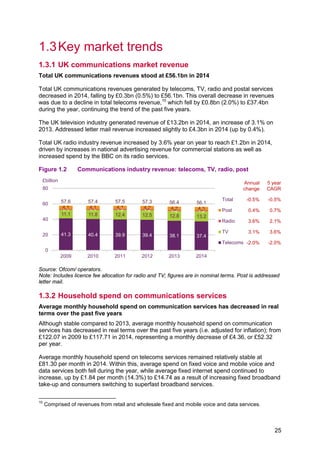
Total UK communications revenues stood at £56.1bn in 2014
Total UK communications revenues generated by telecoms, TV, radio and postal services
decreased in 2014, falling by £0.3bn (0.5%) to £56.1bn. This overall decrease in revenues
was due to a decline in total telecoms revenue,10
which fell by £0.8bn (2.0%) to £37.4bn
during the year, continuing the trend of the past five years.
The UK television industry generated revenue of £13.2bn in 2014, an increase of 3.1% on
2013. Addressed letter mail revenue increased slightly to £4.3bn in 2014 (up by 0.4%).
Total UK radio industry revenue increased by 3.6% year on year to reach £1.2bn in 2014,
driven by increases in national advertising revenue for commercial stations as well as
increased spend by the BBC on its radio services.
Figure 1.2 Communications industry revenue: telecoms, TV, radio, post
Source: Ofcom/ operators.
Note: Includes licence fee allocation for radio and TV; figures are in nominal terms. Post is addressed
letter mail.
1.3.2 Household spend on communications services
Average monthly household spend on communication services has decreased in real
terms over the past five years
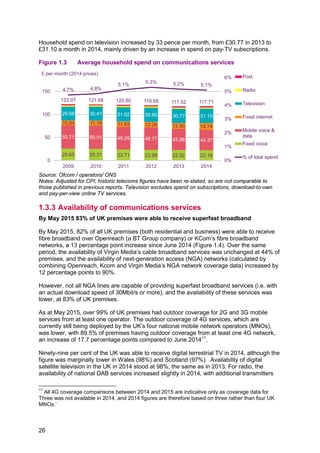
Although stable compared to 2013, average monthly household spend on communication
services has decreased in real terms over the past five years (i.e. adjusted for inflation); from
£122.07 in 2009 to £117.71 in 2014, representing a monthly decrease of £4.36, or £52.32
per year.
Average monthly household spend on telecoms services remained relatively stable at
£81.30 per month in 2014. Within this, average spend on fixed voice and mobile voice and
data services both fell during the year, while average fixed internet spend continued to
increase, up by £1.84 per month (14.3%) to £14.74 as a result of increasing fixed broadband
take-up and consumers switching to superfast broadband services.
10
Comprised of revenues from retail and wholesale fixed and mobile voice and data services.
41.3 40.4 39.9 39.4 38.1 37.4
11.1 11.8 12.4 12.5 12.8 13.2
1.1 1.1 1.2 1.2 1.2 1.2
4.1 4.1 4.1 4.2 4.2 4.3
57.6 57.4 57.5 57.3 56.4 56.1
0
20
40
60
80
2009 2010 2011 2012 2013 2014
Total
Post
Radio
TV
Telecoms
£billion Annual
change
5 year
CAGR
-0.5% -0.5%
0.4% 0.7%
3.6% 2.1%
3.1% 3.6%
-2.0% -2.0%
25
Household spend on television increased by 33 pence per month, from £30.77 in 2013 to
£31.10 a month in 2014, mainly driven by an increase in spend on pay-TV subscriptions.
Figure 1.3 Average household spend on communications services
Source: Ofcom / operators/ ONS
Notes: Adjusted for CPI; historic telecoms figures have been re-stated, so are not comparable to
those published in previous reports. Television excludes spend on subscriptions, download-to-own
and pay-per-view online TV services.
1.3.3 Availability of communications services
By May 2015 83% of UK premises were able to receive superfast broadband
By May 2015, 82% of all UK premises (both residential and business) were able to receive
fibre broadband over Openreach (a BT Group company) or KCom’s fibre broadband
networks, a 13 percentage point increase since June 2014 (Figure 1.4). Over the same
period, the availability of Virgin Media’s cable broadband services was unchanged at 44% of
premises, and the availability of next-generation access (NGA) networks (calculated by
combining Openreach, Kcom and Virgin Media’s NGA network coverage data) increased by
12 percentage points to 90%.
However, not all NGA lines are capable of providing superfast broadband services (i.e. with
an actual download speed of 30Mbit/s or more), and the availability of these services was
lower, at 83% of UK premises.
As at May 2015, over 99% of UK premises had outdoor coverage for 2G and 3G mobile
services from at least one operator. The outdoor coverage of 4G services, which are
currently still being deployed by the UK’s four national mobile network operators (MNOs),
was lower, with 89.5% of premises having outdoor coverage from at least one 4G network,
an increase of 17.7 percentage points compared to June 201411
.
Ninety-nine per cent of the UK was able to receive digital terrestrial TV in 2014, although the
figure was marginally lower in Wales (98%) and Scotland (97%). Availability of digital
satellite television in the UK in 2014 stood at 98%, the same as in 2013. For radio, the
availability of national DAB services increased slightly in 2014, with additional transmitters
11
All 4G coverage comparisons between 2014 and 2015 are indicative only as coverage data for
Three was not available in 2014, and 2014 figures are therefore based on three rather than four UK
MNOs.’
25.65 25.31 23.71 22.98 22.52 22.18
50.71 50.01 49.29 48.77 45.98 44.37
10.84 11.18 11.63 12.26 12.90 14.74
29.58 30.41 31.02 30.60 30.77 31.10
122.07 121.68 120.80 119.68 117.52 117.71
4.7% 4.8%
5.1% 5.3% 5.2% 5.1%
0%
1%
2%
3%
4%
5%
6%
0
50
100
150
2009 2010 2011 2012 2013 2014
Post
Radio
Television
Fixed internet
Mobile voice &
data
Fixed voice
% of total spend
£ per month (2014 prices)
26
being added to the BBC’s national DAB multiplex and the Digital One commercial DAB
multiplex. The BBC’s DAB broadcasts are now available to 95.4% of UK households, and
Digital One is available to 89.8% of UK households.
Figure 1.4 Digital communications services: availability
Sources: Ofcom and operators:
1. Proportion of premises that have outdoor 2G mobile coverage from at least one operator, May
2015; 2. Proportion of premises that have outdoor 3G mobile coverage from at least one operator,
May 2015; 3. Proportion of premises that have outdoor 4G mobile coverage from at least one
operator, May 2015 (comparison with 2014 indicative only as Three data was not available in 2014);
4. Proportion of premises connected to an LLU-enabled BT local exchange area, December 2014; 5.
Proportion of premises able to receive Virgin Media cable broadband services, May 2015; 6.
Proportion of premises able to receive Openreach/Kcom fibre broadband services, May 2015; 7.
Proportion of premises able to receive NGA broadband services, May 2015; 8. Proportion of premises
able to receive superfast broadband services, May 2015; 9. Relates only to the ability to achieve a
necessary line-of-sight path to the satellite and does not include other factors that can affect coverage
including: access in multi-dwelling units where is not feasible to install a dedicated household satellite
dish and there is no internal wired distribution system for satellite, and the need for planning
permission in some locations.10. Estimated proportion of homes that can receive the PSB channels
through DTT (3PSB Mux coverage). DTT Frequency Planning Group (Arqiva, BBC, Ofcom); Relates
to an assumption that consumers will install, if needed, a good quality terrestrial TV aerial at a height
of 10m to achieve reception.11. BBC National DAB network coverage as of end of 2014 12. Digital
One coverage Note: Cable, fibre and NGA broadband availability figures have been calculated using
a different methodology than in previous years
1.3.4 Take-up of services and devices
Increase in take-up of tablets and smartphones continues
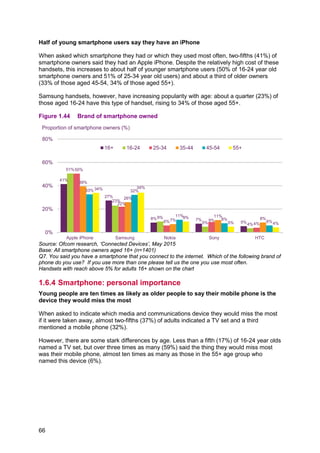
Figure 1.5 shows take-up of a range of communications and audio-visual devices since
2003. Take-up of smartphones has continued to increase over the past year, with two-thirds
of adults (66%) now owning one. Over half of households (54%) had a tablet computer (such
as the Apple iPad or Amazon Kindle Fire) in early 2015, increasing from 44% in Q1 2014.
Use of e-readers has also seen a significant increase, with 28% of individuals now owning
one, compared to 24% in 2014.
Six in ten households (62%) owned a digital video recorder (DVR) in early 2015, and this
has remained relatively stable since 2014. However, the decline in ownership of DVD
players continues, with 70% of households owning one, compared to 75% in 2014.
Platform
UK
2014
UK
2013
UK
change
England Scotland Wales N Ireland
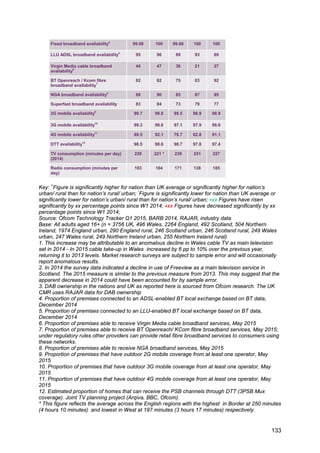
Fixed line 100% 100% 0pp 100% 100% 100% 100%
2G mobile1
99.7% 99.7% 0pp 99.8% 99.5% 98.9% 98.9%
3G mobile2
99.3% 99.2% 0.1pp 99.6% 97.1% 97.9% 98.6%
4G mobile3
89.5% 71.8% 17.7pp 92.1% 79.7% 62.8% 91.1%
LLU ADSL broadband4
95% 95% 0pp 96% 89% 93% 89%
Virgin Media cable broadband5
44% 44% 0pp 47% 36% 21% 27%
BT Openreach/Kcom fibre broadband6
82% 69% 13pp 82% 75% 83% 92%
NGA broadband7
90% 78% 12pp 90% 85% 87% 95%
Superfast broadband8
83% - n/a 84% 73% 79% 77%
Digital satellite TV9
98% 98% 0pp No data No data No data No data
Digital terrestrial TV10
99% 99% 0pp 99% 99% 98% 97%
DAB BBC Network11
95.4% 94.0% 1.4pp 96.5% 92.3% 89.2% 85.4%
DAB commercial network (Digital
One)12 89.8% 89.5% 0.3pp 91.3% 76.4% 64.1% 76.1%
27
Smart TV ownership continued to increase; 20% of homes are now reported to have a TV
with an integrated internet connection.
Figure 1.5 Household take-up of digital communications/ AV devices: 2003-2015
Source: Ofcom Technology Tracker. Data from Q1
Base: All adults aged 16+ (2015 n=3756)
Note: The question wording for DVD player and DVR was changed in Q1 2009 so data are not
directly comparable with previous years
Four in five households now have fixed broadband and three in five adults access the
internet through their mobile phone
The proportion of households with access to the internet has increased, driven by a boost in
fixed broadband connections. Fixed broadband connections were reported in 78% of
households in 2015, compared to 73% in 2014.
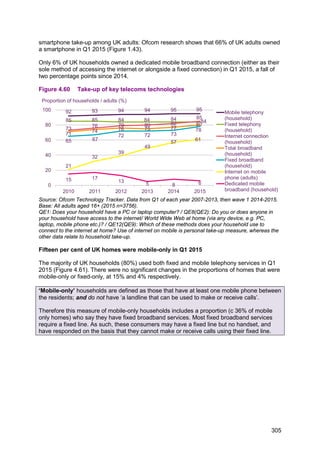
In addition, accessing the internet through a mobile phone continues to increase: three in
five respondents (61% in Q1 2015) said they personally used their mobile phone to access
the internet in 2015 (up from 57% in Q1 2014).
The proportion of households with fixed telephony and mobile telephony remained stable, at
84% and 95% respectively in 2015.
Proportion of individuals (%)
97%
70%
49%
35%
36%
62%
66%
28%
20%
12%
54%
3%
2%0%
20%
40%
60%
80%
100%
2003 2004 2005 2006 2007 2008 2009 2010 2011 2012 2013 2014 2015
Digital television
DVD player
Games console
MP3 player
DAB digital radio
DVR
Smartphone
E-reader
Smart TV
3D ready TV
Tablet
Smart Watch
USB TV device
28
Figure 1.6 Take-up of communications services
Source: Ofcom Technology Tracker. Data from Q1
Base: All adults aged 16+ (2015 n=3756)
QC1: Is there a landline phone in your home that can be used to make and receive calls? QE1: Does
your household have a PC or laptop computer? / QE8 (QE2): Do you or does anyone in your
household have access to the internet/ World Wide Web at home (on any device, e.g. PC, laptop,
mobile phone etc.)? / QE12 (QE9): Which of these methods does your household use to connect to
the internet at home? Use of internet on mobile is personal take-up measure, whereas the other data
relate to household take-up.
Three in ten of all broadband connections are now superfast
By the end of 2014 there were an estimated 7.1 million UK superfast broadband
connections12
, an increase of 1.8 million compared to the previous year. The proportion of all
UK broadband connections that were classed as superfast increased accordingly over the
same period, from 23.2% to 30.0%.
Figure 1.7 Take-up of superfast broadband services
Source: Ofcom / operator data
Note: Includes estimates where Ofcom does not receive data from operators; includes Ofcom
adjustment to exclude FTTC connections delivering less than 30Mbit/s
12
Defined as connections with an actual speed of 30Mbit/s or higher
Proportion of households / adults (%)
93 93 92 92 93 94 94 95
95
64
67
70
73
76
79 80 82
8590 88 87 85 85 84 84 84 84
52
58
68
71
74 76 75 77
80
65 65 67
72 72 73 78
20 21
32
39
49
57
61
12
15 17
13
5
8 6
0
20
40
60
80
100
2007 2008 2009 2010 2011 2012 2013 2014 2015
Mobile telephony
Internet connection
Fixed telephony
Total broadband
Fixed broadband
Internet on mobile
(personal)
Mobile broadband
dongle or datacard
0.2
1.0
3.1
5.3
7.1
0.2 0.9
5.0
14.3
23.2
30.0
0
10
20
30
0
2
4
6
8
10
2009 2010 2011 2012 2013 2014
Connections
≥30Mbit/s
As a proportion
of all
connections
Connections (millions) As a proportion of all connections (%)
29
Smartphones overtake laptops as the most important device to connect to the internet
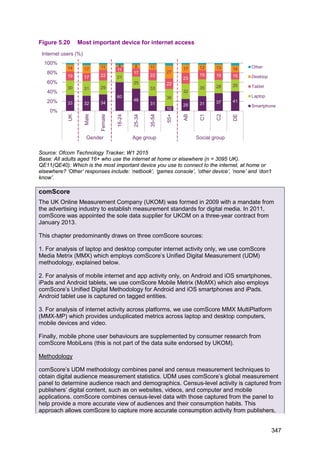
When respondents were asked which was their most important device for connecting to the
internet (at home or elsewhere), 33% of internet users mentioned their smartphone, and
30% mentioned their laptop.
Among smartphone users this change was more pronounced; 42% cited this as their most
important device for connecting to the internet, compared with 26% who cited a laptop. This
is a change since 2014, when smartphone users were more likely to cite a laptop than a
smartphone. Among tablet users, this device was the most important for connecting to the
internet (cited by 38%). Among those who had all the devices (laptop, desktop, tablet and
smartphone) in their household, smartphones and tablets were the most popular responses
(at 31% and 30% respectively).
Figure 1.8 Most important device for connecting to the internet
Source: Ofcom Technology Tracker, Q1 2015
Base: Devices used by those who use the internet at home or elsewhere: Tablet (1528), smartphone
& tablet (1276), desktop & laptop & smartphone & tablet (389), smartphone (2277), laptop (2214), All
internet users (3095 UK).
QE11(QE40): Which is the most important device you use to connect to the internet, at home or
elsewhere? ‘Other’ includes: ‘netbook’, ‘games console’, ‘other device’, ‘none’ and ‘don’t know’.
Figure 1.9 shows how internet users’ perceptions, as to which is their most important
connected device, have changed over the past two years. In 2013, 46% of internet users
said a laptop was the most important, compared to just 15% who cited the smartphone. Two
years later, in 2015, the laptop has dropped by 16 percentage points as the most important
connected device, while the smartphone has risen by18 percentage points.
30
40
26
20
18
19
14
9
9
16
8
9
33
31
42
31
37
32
19
18
20
30
35
38
0% 20% 40% 60% 80% 100%
All internet users
Of those with a laptop
Of those with a smartphone
Of those with a desktop and laptop in the household, and
who personally use a smartphone and tablet
Of those with a smartphone and who personally use a
tablet
Of those who personally use a tablet
Laptop Desktop Smartphone Tablet Other
Device owners (%)
30
Figure 1.9 Most important device for connecting to the internet: 2013-2015
Source: Ofcom Technology Tracker, Data from Q1
Base: All adults aged 16+ who use the internet at home or elsewhere
QE11(QE40): Which is the most important device you use to connect to the internet, at home or
elsewhere? ‘Other’ includes: ‘netbook’, ‘games console’, ‘other device’, ‘none’ and ‘don’t know’.
Ranked by 2015
Television sets are the most-missed media device among all adults, but the mobile
phone is much more important to 16-24 year olds
As part of our media literacy research we asked research participants to indicate which
single media device they would miss the most if it were taken away. Among adults as a
whole, the TV set is the device people say they would miss the most, cited by close to four in
ten (37%). This differs significantly by age; from 17% of 16-24 year olds to 68% of those
aged 75+. Those aged 16-24 are much more likely to cite the mobile phone, at 59%,
compared to just 2% of those aged 75+. The youngest age group has the highest proportion
citing games consoles, at 7%, although this is their fourth preference, behind the mobile
phone (59%), TV set (17%), and PC/laptop (11%).
One in ten adults said they would miss either radio or books/ magazines/ newspapers (both
at 5%). But these figures are at least twice as high for those aged 75+, at 14% and 10%
respectively.
15%
46%
8%
28%
3%
23%
40%
15%
20%
2%
33% 30%
19%
14%
3%
0%
20%
40%
60%
80%
100%
Smartphone Laptop Tablet Desktop Other
2013 2014 2015
Proportion of internet users (%)
31
Figure 1.10 Most-missed media device, by age
Source: Ofcom research, fieldwork carried out by Saville Rossiter-Base
Base: All adults aged 16+ (1890 in 2014, 254 aged 16-24, 288 aged 25-34, 327 aged 35-44, 284
aged 45-54, 276 aged 55-64, 221 aged 65-74, 240 aged 75+).
A2 – Which one of these things you use almost every day would you miss the most if it got taken
away?
Figure 1.11 shows how attitudes towards different media devices have changed over the
past two years. In 2013, 43% of adults said they would miss the TV most, compared to just
20% who chose the mobile phone, a difference of 23 percentage points. Two years later, in
2015 that difference stands at just five percentage points.
Figure 1.11 Most-missed media device: 2013-2015
Source: Ofcom research, fieldwork carried out by Saville Rossiter-Base
Base: All adults aged 16+
A2 – Which one of these things you use almost every day would you miss the most if it got taken
away?
Almost a quarter of consumers claimed to have sent no items of mail in the past
month
Ofcom’s residential postal tracking survey shows that adults in the UK claim to receive an
average of 8.5 items of post – including letters, cards and parcels – in an average week
(Figure 1.12). This compares to an average of approximately 6.0 letters, cards or parcels
37%
17%
28% 25%
38%
48%
63% 68%
32%
59%
50%
40%
30% 11%
3%
2%
13%
11%
13%
18% 14%
17%
9% 3%
5% 1%
2%
3% 6%
9% 8% 14%
5%
1%
2%
2%
2% 8% 12% 10%4%
4%
2% 9% 6% 4% 2% 1%2%
7%
2%
0%
20%
40%
60%
80%
100% Games console
Tablet
Books/magazines/
newspapers
Radio
PC/laptop
computer
Mobile phone
TV set
Proportion of each age group (%)
Adults 16+ 16-24 25-34 35-44 45-54 55-64 65-74 75+
43%
20%
16%
8%
42%
22%
15%
7%
37%
32%
13%
5%
0%
20%
40%
60%
80%
100%
TV Mobile phone PC/laptop Radio
2013 2014 2015
Proportion of UK adults (%)
32
sent in an average month; slightly less than the reported average of 6.7 items sent per
month in the previous year.
The difference between the volume of mail sent and received is due to the fact that the
majority of UK mail is sent by businesses to households. Almost a quarter of consumers
(23%) in 2015 reported having sent no items of mail in the past month. This appears to be
part of a continuing trend; 20% of consumers claimed not to have sent any mail in the past
month in 2014 (vs. 18% in 2013), both significantly lower than the figure for 2015.
Figure 1.12 Approximate number of items sent and received by post
Source: Ofcom Residential Postal Tracker, Q2 2014-Q1 2015
Base: All respondents (n = 3557 adults 16+)
QC1. Approximately how many items of post – including letters, cards and parcels – have you
personally sent in the last month?/ QD1. Approximately how many items of post – including letters,
cards and parcels – have you personally received in the last week?
1.3.5 Time spent on communications services
Figure 1.13 shows how much time people spend consuming different types of media in a
typical day.
On average, UK adults (16+) spend 239 minutes (3 hours, 59 minutes) each day watching
broadcast TV13
. Television has the highest consumption level of the communications
services measured, although, as the television and audio-visual chapter shows, this has
declined, and varies significantly by age.
Time spent listening to the radio accounted for 183 minutes (3 hours, 3 minutes) per day in
2014 among radio listeners aged 15 and over, although, as the radio and music chapter
shows, this too has been declining and also varies by age; older people listen to
considerably more radio than younger people.
Using a PC or laptop to access the internet at home and at work is the next most-used
communications activity, with a daily average of 65 minutes. However, this does not account
13
Average time spent watching TV for children and adults (individuals aged 4+) is 220 minutes. This
is the main demographic used in references to television consumption in this report.
23%
21%
19%
23%
8%
5%
0% 10% 20% 30%
None
1 or 2 items
3 or 4 items
5 to 10 items
11 to 20 items
21+
% of consumers
Claimed volume of items sent in the
past month
6%
14%
17%
39%
18%
6%
0% 10% 20% 30% 40%
None
1 or 2 items
3 or 4 items
5 to 10 items
11 to 20 items
21+
% of consumers
Claimed volume of items received in the
past week
Estimated
average no.
items sent per
month: 6.0
Estimated
average no.
items received
per week: 8.5
33
for the total amount of time spent online, as consumers are increasingly using devices other
than a PC or laptop to access the internet.
Adults aged 15+ in the UK spend an average of almost an hour and a half (87 minutes)
using their mobile phones each day, with about half of this (43 minutes) spent on activities
that require internet access. Forty-four minutes are spent on activities that do not
necessarily require an internet connection (e.g. phone calls, listening to stored music,
playing games).
Among smartphone users this increases to just over 2 hours (126 minutes) on their mobile
phone, with again, just over half of this (65 minutes) spent on internet-based activities14
.
Figure 1.13 Average time per day spent using communications services: 2014
Source: BARB 2014 / RAJAR 2014 / comScore MMX, Home & work panel 2014 / Ofcom’s Digital Day
2014
Base: BARB: Average minutes per individual aged 16+ in TV households; RAJAR: All radio listeners
aged 15+; comScore: individuals online in month on desktop/laptop aged 15+; Digital Day: mobile
phone / fixed phone: Total summed relevant activity minutes (weighted) / weighted base / 7, aged 15+
Note: BARB data throughout the rest of the CMR refers to individuals aged 4+
Note: comScore data throughout the rest of the CMR refers to individuals aged 6+
1.3.6 Purchasing communications services in a bundle
Reported use of bundled services remained stable from 2014 to 2015
Just over six in ten consumers (63%) reported that they had bought at least two of their
communications services together in a bundle in Q1 2015, the same as the previous year’s
figure (60%). Dual-play packages of landline and broadband, and triple-play packages of
landline, broadband and TV, were the most popular (reported to be taken up by 27% and
25% of households respectively).
14
Data in this chart are from 2014 to allow comparison across communications services. 2015 data
on using the internet via a desktop or laptop and via a smartphone are available in chapter 5, Internet
and online content.
239
183
87
65
19
0
50
100
150
200
250
TV Radio Mobile phone Internet on
PC/laptop
Fixed phone
Average minutes per day
34
Figure 1.14 Reported take-up of bundled services
Source: Ofcom Technology Tracker. Data from Q1
Base: All adults aged 16+ (2015 n=3756)
QG1. Do you receive more than one of these services as part of an overall deal or package from the
same supplier?
1.3.7 Satisfaction with communications services
Satisfaction levels remain high for telecoms services, although satisfaction with fixed
broadband and mobile telephony has decreased
Consumer satisfaction remained relatively similar year on year for the communications
services shown in Figure 1.15. In Q1 2015, around nine in ten adults were satisfied with the
service asked about; 91% were satisfied with their mobile phone service, 89% were satisfied
with their fixed-line telephone service, and a similar proportion (86%) with their fixed
broadband and mobile broadband services. However, mobile services have seen small but
statistically significant fall of two percentage points since 2014. This is part of a longer trend;
satisfaction has fallen from 95% in 2012.
9%
12%
19% 17%
20% 22% 24%
27% 27% 28% 27%
3%
5%
7% 12%
16%
17%
16%
19% 21%
23% 25%
7%
5%
5%
4%
4%
3% 3%
2%
2%
2%
2%
3%
2% 2%
2%
4% 3%
5% 5%
6%
9%
8%
6%
7%
8% 6%
29% 29%
40% 39%
46%
50%
53%
57%
60%
63% 63%
0%
10%
20%
30%
40%
50%
60%
70%
2005 2006 2007 2008 2009 2010 2011 2012 2013 2014 2015
Other
Mobile and broadband
Fixed voice, broadband,
mobile and TV
Fixed voice, dial-up and
TV
Fixed voice and TV
Fixed voice and dial-up
Fixed voice, broadband
and TV
Fixed voice and
broadband
Proportion of households
35
Figure 1.15 Overall satisfaction with communications services
Source: Ofcom Technology Tracker. Data from Q1
Base: All adults aged 16+
Q: Thinking about your home phone/ mobile phone/ fixed broadband internet/ mobile broadband
internet service only, please say how satisfied you are with the overall service provided by [main
supplier]
Note: Shows the proportion of users with each service, includes only those who expressed an
opinion.
57%57% 56%56%59% 57% 61%61% 58%60% 60%58%
50% 46% 43% 48% 49%45%
39% 42%40%
33%
42%38%
34% 32% 34% 34% 30% 32%
33% 32% 37% 35% 33% 33%
40%
41% 44%
40% 39%
41%
44%
46%
44% 57%
46%
48%
91% 89% 89% 90% 89% 89%
94% 93% 95% 94% 93% 91% 90%
86% 87% 88% 88% 86%
83%
88%
83%
90% 88% 86%
0%
20%
40%
60%
80%
100%
2010
2011
2012
2013
2014
2015
2010
2011
2012
2013
2014
2015
2010
2011
2012
2013
2014
2015
2010
2011
2012
2013
2014
2015
Very satisfied Satisfied
Fixed
telephony
Mobile
telephony
Fixed
broadband
Mobile
Broadband
Proportion of users of service (%)
36
1.4Changes in TV viewing habits
1.4.1 Introduction
Average daily viewing on the TV set fell by 11 minutes in 2014 compared to 2013. This is the
second consecutive year of decline, following a nine-minute decline in 2013 compared to
2012. This section of the report analyses the decline in traditional TV viewing on the TV set,
as measured by BARB. We begin with an examination of the decline, and then move on to
consider some of the potential explanatory factors. For discussion of audio-visual (AV)
viewing on other devices see section 1.5: Developments in viewing beyond traditional
television.
1.4.2 Key findings
• In 2014 the average number of minutes of broadcast TV, watched on a TV set,
was 220 minutes per person (aged 4 and above) per day; 11 minutes less than
in 2013. The fall, of 4.9% year on year, represents the second consecutive year of
decline.
• The entire year-on-year drop in viewing can be attributed to a decline in
viewing of traditional TV (watching programmes at the time of broadcast).
Despite an increase in time-shifted viewing (+1 minute) this was not enough to
compensate for the 12-minute decline in traditional TV viewing, resulting in an 11-
minute decline in broadcast TV viewing overall.
• The average proportion of the TV population who watch TV each week fell
slightly year on year, from 93.4% to 92.4%. However, in terms of volume, the
number of people watching TV each week increased from 53.9 million to 54.1 million
viewers between 2013 and 2014.
• The decline was seen across all ages, but was more pronounced among the
under-45 age groups, with the greatest proportional drop among children aged 4-15
(-12.4%), followed by the 25-34 group (-8.8%) and 35-44s (-8.0%). Viewing among
the over-65s fell the least; by 0.3%.
• Among children, 16-24 year olds and 35-44 year olds, average daily viewing
has fallen every year since 2010, while viewing among other age groups has
fluctuated across this period. Since 2012, however, all age groups have had year-on-
year declines in daily TV viewing.
• TV viewing fell across all channel groups between 2013 and 2014. Viewing to
ITV-owned channels fell the most; falling by 5 mins/ day (-3 mins to ITV and -1.8
mins to the ITV portfolio). In total, declines in viewing to ITV channels accounted for
over 40% of the total fall in viewing.
• BARB data suggest that about half of the decline in viewing may have shifted
to 8-28 day catch-up and other (unknown) content on the TV set. Analysis of
viewing on the TV set shows that there was a one-minute increase in 8-28 day
average daily time-shifted viewing per person (from four minutes to five minutes) and
a three-minute increase in ‘unmatched’ viewing (this includes apps on smart TVs,
37
gaming and subscription video on-demand services such as Netflix), from 26 to 29
minutes. 15
• A number of other factors may also explain the decline in traditional TV
viewing. These include rising employment, a lack of high-rating events programming
as seen in 2011 and 2012, the weather, increase in take-up of non-broadcast on-
demand services and increase in use of other devices to watch AV content.
Broadcast TV viewing
BARB analysis is based on viewing to scheduled TV programmes such as those listed in TV
listings magazines or on electronic programme guides (EPG)on TV sets. ‘Broadcast TV
viewing’ refers to TV programmes watched on the TV set live at the time of broadcast
(traditional TV viewing), recordings of these programmes or viewing of these programmes
through catch-up player services (referred to as time-shifted) up to seven days after they
were televised.
Traditional TV viewing
‘Traditional TV viewing’ refers to TV programmes watched live at the time of broadcast on
the TV set.
Time-shifted viewing
‘Time-shifted viewing’ is defined by BARB as viewing of programmes recorded and
subsequently played back on a television set within seven days of live broadcast, as well as
viewing after pausing or rewinding live TV. Recording devices included in BARB analysis
include video cassette recorders (VCR); DVD recorders (which store programmes on
writable DVDs); digital video recorders (DVRs) which use a hard disk to store programmes
chosen from an electronic programme guide, and combination devices (which use a
combination of internal hard disk and removable DVDs to store programmes).
Viewing any catch-up TV player services through the television set is also captured if the
content has been broadcast live in the last seven days. This includes catch-up player
services accessed through apps on smart TVs and games consoles, and any viewing on a
laptop or personal computer connected to the television set. Viewing outside the seven-day
window, viewing catch-up services on devices that are not connected to the TV set, and
video on-demand (VOD) services (such as Amazon Instant Video and Netflix) which have
not been scheduled on a television channel, are not reported as time-shifted viewing.
BARB Gold Standard
The BARB Gold Standard refers to the consolidated data which incorporates traditional TV
viewing (live) and time-shift viewing (viewed up to seven days after the initial broadcast).
This is the official estimate of television viewing used in this report. It does not include time-
shifted viewing between 8 and 28 days after the initial broadcast, or ‘unmatched’ viewing.
Unmatched viewing
‘Unmatched viewing’ refers to activities when the TV set is in use but the content cannot be
audio-matched or otherwise identified. This would include the TV being used for gaming,
viewing DVDs/ box-sets/ archives, subscription video-on-demand (SVOD), time-shifted
viewing beyond 28 days, apps on smart TVs and navigation around EPG guides where there
is no in-picture linear content. Digital radio stations are excluded (these are reported by
RAJAR). Unmatched viewing has been reported by BARB since July 2013.
15
This analysis compares Q4 2013 vs Q4 2014 data as unmatched viewing has only been reported
by BARB since July 2013
38
The average proportion of the TV population who watch TV each week fell slightly
year on year, from 93.4% to 92.4%
The average proportion of the TV population who watch TV16
each week (average weekly
reach) fell slightly year on year, from 93.4% to 92.4% (see green line in Figure 1.16).
However, as estimates17
indicate, the UK population has increased, and so too has the
number of people watching TV each week. Therefore, expressed as a volume, average
weekly reach increased from 53.9 million to 54.1 million viewers between 2013 and 2014.
Overall, these findings (combined with the fall in average broadcast TV viewing minutes
explained below), suggest that more people are watching TV but for less time.
Figure 1.16 Average weekly reach of total TV
Source: BARB, individuals 4+, network, total TV. Reach criterion = 15 consecutive minutes of viewing
at least once in the average week. Full weeks used.
Note: New BARB panel introduced 1 Jan 2010. As a result pre- and post-panel change data must be
treated with caution (see dotted line).
In 2014 the average number of minutes of broadcast TV, watched on a TV set, was 220
minutes per person (aged 4 and above) per day; 11 minutes less than in 2013
The average number of minutes watched by individuals18
in 2014 was 220 minutes per
person/per day (3 hours 40 minutes), 11 minutes per day less than in 2013. The fall, of 4.9%
year on year, represents the second consecutive year of decline, following a nine-minute
decline between 2012 and 2013. (Figure 1.17)
16
Broadcast TV viewing
17
http://www.ons.gov.uk/ons/rel/pop-estimate/population-estimates-for-uk--england-and-wales--
scotland-and-northern-ireland/mid-2014/mid-year-population-estimates-for-the-uk-2014.html
18
BARB individuals refer to individuals aged 4+
Total TV reach, Individuals 4+ (15 min+)
51.5 52.1 52.3 52.8 53.2 54.0 53.9 53.9 54.1
92.2% 92.6% 92.4% 92.9% 93.1%
94.1% 94.0%
93.4%
92.4%
80%
85%
90%
95%
100%
0
20
40
60
2006 2007 2008 2009 2010 2011 2012 2013 2014
Total TV reach, millions Total TV reach, %
TotalTVreach,%
TotalTVreach,millions
39
Figure 1.17 Average minutes of broadcast TV viewing per person per day
Source: BARB, individuals 4+, network, total TV. Average minutes of viewing/day.
New BARB panel introduced 1 Jan 2010. As a result pre- and post-panel change data must be
treated with caution (see dotted line). Average minutes of broadcast TV viewing per day declined by
11 minutes year on year, although values appear not to equate to 11 minutes in the chart due to
rounding.
The decline was seen across all ages, but was more pronounced among the under-45
age groups
Between 2013 and 2014 average viewing declined across all age groups, with the greatest
proportional drop among children aged 4-15 (-12.4%), followed by the 25-34 group (-8.8%)
and 35-44s (-8.0%). Viewing among over-65s fell the least, by 0.3%.
The decline in average viewing, in terms of actual minutes, was largest among children and
35-44 year-olds (both with a 17 minute/day decline). Those aged 25-34 followed, with a 16
minute/per day decline. There was a below-average fall of 9 minutes a day among 16-24
year olds. (Figure 1.18)
Figure 1.18 Change in average minutes per day of broadcast TV viewing, by age
group, total TV: 2013-2014
Source: BARB, network, total TV. Average minutes of viewing/ day.
Note: Bold text in table indicates an above-average decline.
Average minutes per day
216 218 225 225
242 242 241
232
220
0
50
100
150
200
250
300
2006 2007 2008 2009 2010 2011 2012 2013 2014
Audience Change in average minutes of
viewing/day:
2013-2014
% change in average minutes of
viewing/day:
2013-2014
All individuals aged 4+ 11 minutes -4.9%
Children 4-15 17 minutes -12.4%
16-24 9 minutes -6.2%
25-34 16 minutes -8.8%
35-44 17 minutes -8.0%
45-54 11 minutes -4.4%
55-64 10 minutes -3.4%
65+ 1 minute -0.3%
40
Among children, 16-24 year olds and 35-44 year olds, average daily viewing has fallen
every year since 2010
Over the 2010-2014 period, average daily viewing fell across all age groups. Children (aged
4-15) had the greatest proportional drop, with average daily viewing falling by 22% (-33
minutes). Those aged 16-24 followed, with an 18% fall in viewing (-30 minutes) while the 25-
34 and 35-44 age groups both fell by 15% (-30 minutes and -35 minutes respectively). The
over-65 group has had the smallest decline in viewing since 2010, down by 1% (a decrease
of two minutes).
Among children, 16-24s and 35-44s, average daily viewing has fallen every year since 2010;
viewing among other age groups has fluctuated across this period. Since 2012, however, all
age groups have had year-on-year declines in daily TV viewing (Figure 1.19).
Analysing the decline by socio-economic group, the decrease between 2013 and 2014 was
two percentage points greater among C2DEs than among ABC1s. Viewing fell by 5.5% (-15
mins/day) among people in the C2DE group, compared with a 3.5% drop (-7 mins/day)
among ABC1s.
Figure 1.19 Average minutes per day of broadcast TV viewing, by age group, total
TV
Source: BARB, network, total TV. Average minutes of viewing/day
New BARB panel introduced 1 Jan 2010. As a result pre- and post-panel change data must be
treated with caution (see dotted line).
Viewing between 9.30am and midday had the largest proportional decline year on
year, at -5.7%
The average year-on-year decline in broadcast TV viewing was 4.9% (11 minutes), although
the decline varied by time of day. Proportionally, there were above-average falls during the
morning and daytime slots (6am-6pm). The largest proportional drop was seen between
9.30am and midday, with viewing falling by 6.6% (1 minute). Likewise, early morning (6am-
9.30am) viewing fell by more than the average rate of decline; by 5.9% (-1 minute), as did
viewing from midday to 6pm, at -5.7% (-3 minutes).
Although the fall in broadcast TV viewing minutes in peak time (6pm-10.30pm) was
proportionately below average, at 4.5%, peak viewing had the greatest fall in total minutes (-
5 min/day). Viewing in the 10.30pm-6am slot also fell by more than the average rate of
decline, at -3.5% year on year (-1 min/day). (Figure 1.20)
Average minutes per day
216 218 225 225
242 242 241
232
220
132 134 139 137
151 147 142
134
118
155 151 150 154
169 165 157 148
138
200 198 205 204 199 196 196
185
169
216 217
219 217
234 232 227
216
199
243 242 253 255
269 270 269
256
245
263 271 278 279
311 316 314 309
298294 301
315 314
343 345 347 341 340
0
50
100
150
200
250
300
350
2006 2007 2008 2009 2010 2011 2012 2013 2014
Individuals 4+ Children 4-15 16-24 25-34 35-44 45-54 55-64 65+
41
Figure 1.20 Average minutes of viewing per day, total TV: by day part
Source: BARB, individuals 4+, network, total TV. Average minutes of viewing/day.
Note: New BARB panel introduced 1 Jan 2010. As a result pre- and post-panel change data must be
treated with caution (see dotted line).
TV viewing fell across all channel groups between 2013 and 2014
TV viewing fell across all channel groups (Figure 1.21) between 2013 and 2014. However,
viewing to ITV-owned channels fell the most; falling by 5 min/day (-3 mins to ITV and -1.8
mins to the ITV portfolio). In total, ITV channels accounted for over 40% of the 11-minute-a-
day fall in viewing. While it did not have the largest year-on-year proportional drop, there was
a notable decline in viewing minutes to the collective group of all other non-PSB broadcaster
channels; this represented a further 16.8% (-1.9 minutes) of the total annual fall in 2014.
Figure 1.21 Average minutes of viewing per day, total TV: by channel group
Source: BARB, individuals 4+, network, Total TV. Average minutes of viewing/day.
Note: New BARB panel introduced 1 Jan 2010. As a result pre- and post-panel change data must be
treated with caution (see dotted line).
Average minutes per day
12.8 13.1 13.7 13.8 15.6 16.2 15.6 15.5 14.6
13.3 13.6 14.6 14.9 16.6 16.8 16.6 16.1 15.0
56.1 56.4 59.2 58.8 63.3 62.4 62.8 60.2 56.8
101.3 102.5 104.3 104.5
110.5 109.9 109.5 105.7 100.9
32.5 32.2 32.8 33.2
36.2 36.6 36.2 34.4
33.2
0
50
100
150
200
250
2006 2007 2008 2009 2010 2011 2012 2013 2014
2230-0600
1800-2230
1200-1800
0930-1200
0600-0930
216 218 225 225 242 242 241 232 220
Average minutes per day
49.1 48.0 48.9 47.1 50.3 50.0 51.3 48.7 47.7
19.0 18.6 17.6 16.8 16.7 16.0 14.7 13.4 13.4
42.4 41.9 41.4 40.1 41.1 38.7 35.9 35.6 32.5
21.1 18.7 16.8 15.3 15.0 14.3 13.4 11.5 10.5
12.4 11.2 11.2 10.9 11.0 10.7 10.1 9.4 8.8
6.3 7.6 8.9 9.7 13.3 14.3 14.9
13.0 12.0
7.5 8.6 10.7 11.9
14.3 17.2 17.9
17.9
16.0
5.5 7.5 9.8 10.7
12.5 13.8 14.3
14.1
13.4
0.3 1.8 2.4 2.9
3.3 3.6 4.3
4.5
4.3
52.4 54.0 56.8 59.8
64.6 63.5 63.9
63.9
61.9
0
50
100
150
200
250
2006 2007 2008 2009 2010 2011 2012 2013 2014
All other channels
Channel 5 portfolio channels
Channel 4 portfolio channels
ITV portfolio channels
BBC portfolio channels
Channel 5
Channel 4
ITV
BBC Two
BBC One
216 218 225 225 242 242 241 232 220
42
The entire year-on-year decline in viewing can be attributed to traditional TV viewing19
Figure 1.22 shows a 12-minute fall in traditional TV viewing between 2013 and 2014.
Despite an increase in time-shifted viewing (+1 minute) this was not enough to compensate
for the decline in traditional TV viewing at the time of broadcast, resulting in an overall 11-
minute decline. Almost the whole of this decline took place on the main living room TV set
rather than other TV sets in the home, such as in bedrooms or kitchens (9.5 minutes vs. 1.7
minutes).
Figure 1.22 Average minutes of viewing per day, total TV: by activity
Source: BARB, individuals 4+, network, total TV. Average minutes of viewing/day.
Note: New BARB panel introduced 1 Jan 2010. As a result pre- and post-panel change data must be
treated with caution (see dotted line).
Entertainment, documentaries, film and drama have seen the largest declines in
volume of viewing
By programme genre, across all channels, the largest year-on-year decline in volume of
minutes consumed was seen in entertainment, films and drama: other (non-UK) drama and
UK drama, all content types associated with on-demand viewing.20
News content also
experienced a decline, and while not associated with on-demand, we have seen a shift to
greater use of online services for news.
19
Viewing of programmes live at the time of broadcast
20
For discussion of time-shifted viewing by genre see page 159 in the Television and audio-visual
section
Average minutes per day
212.2 211.9 215.4 211.7
224.9 219.2 216.4 205.6 193.3
3.7 5.8 9.1 13.2
17.2 22.2 24.2
26.2
27.2
0
50
100
150
200
250
2006 2007 2008 2009 2010 2011 2012 2013 2014
Timeshifted
Traditional TV
viewing (Live)
216 218 225 225 242 242 241 232 220
43
Figure 1.23 Range of viewing by genre across all channels: 2010-2014
Source: BARB, individuals 4+, network programming based on 4+ area filter, total TV. Total hours of
viewing/year.
Note: There have been very large increases in total viewing hours to the ‘other: new programme’
genre over the last few years (from 33.1 hours of viewing per person in 2012 to 62.6 hours in 2014).
Programmes that may fall in other genres may therefore be coded as ‘other: new programme’ and this
should be considered in any genre-based analyses.
There are a range of potential factors that may help to explain the recent decline in
traditional viewing. The current signs of economic recovery may be a factor in the decline in
viewing minutes. As people return to employment or have more disposable income, they
may spend more time at work, or engaged in leisure activities outside the home. We explore
some of the potential factors in more detail in the following sections.
Events programming in recent years may have masked a more gradual decline since
2010
Since 2010-2012, there has been a particular concentration of ‘event’ programming during
the summer months – especially during 2012. These events include the World Cup in 2010,
a royal wedding in 2011, and in 2012 the UEFA European Championships, the Queen’s
Jubilee and the Olympic and Paralympic Games. However, 2013 did not benefit from any
such key events and although 2014 was a World Cup year, as a result of England’s early
departure from the tournament at group stages, matches during the later stages of the
tournament did not attract particularly high ratings.
To expand on this, although the top-performing programme in 2014 was the World Cup final,
(Germany vs. Argentina), it had only 15 million viewers. In contrast, when England reached
the UEFA European Championship quarter-final in 2012, the match against Italy had an
average audience of over 20 million21
.
In addition, to demonstrate the impact of event programming in previous years, in 2012 the
two top-performing programmes were the opening and closing ceremonies of the London
Olympic Games, both of which drew in an average audience of over 24 million viewers22
.
The lack of significant event programming in 2013 may explain some of the decline in
21
The Euro 2012 match ENG vs ITA had an average audience of 20.3 million viewers.
22
The Olympics 2012 Closing Ceremony had an average audience of 24.5 million and the Olympics
2012 Opening Ceremony had an average audience of 24.2 million.
Total hours/individual per year
1,203 1,216 1,219 1,177 1,128 Total hours/individual
158 167 169 176 164
158 158 151 150 138
118 102 136 94 112
134 137 133
121 111
106 107 102
102 96
99 103 92
94 95
90 92 81
84 77
8 21 33 51 63
71 73 72 67 59
72 65 68 65 57
66 62 57 56 51
49 50 51 49
43
0
200
400
600
800
1000
1200
1400
2010 2011 2012 2013 2014
Education
Party Political Broadcast
Nations & Regions News
Weather
Religion
Arts
Music
Comedy
Current Affairs
UK Soaps
Drama: Other
Children’s
Other
UK Drama
Leisure Interests
News
Films
Sport
Documentaries
Entertainment
44
viewing since 2012, but arguably not the most recent decline, between 2013 and 2014, as
2014, with the FIFA World Cup, was also a major sports events year.
In addition to events programming, other types of programming may have had an impact on
the decline; TV ‘hit programmes’ can substantially affect yearly viewing figures.
Figure 1.24 Average minutes of viewing per day, total TV: 2011-2014
Source: BARB, individuals 4+, network, total TV. Average minutes of viewing/day.
The weather may explain some of the decline in television viewing
As shown in Figure 1.25, television viewing is affected by the season; viewing is lower during
spring and summer than during autumn and winter. This chart also demonstrates the effect
that event programming had on summer TV viewing in 2011 and 2012, and the knock-on
effect of there being no significant high-rating event programming in 2013 and 2014.
Analysis of average temperatures shows warmer months through much of 2014; average
temperatures in 2014 were higher in eight of the 12 months, compared to 2013. As there is a
natural seasonality in television viewing, these trends may have affected leisure activities,
including watching television, leading to a decline in viewing in the warmer months. To
illustrate this point, the greatest year-on-year difference in mean temperatures was in March
2014 (+4.5C); this month also had the largest month-on-month viewing fall compared with
March 2013 (-25 mins/day or -10.3%). Although we note the limitations of weather analysis,
as it does not take account of many explanatory factors, the data suggest that the warmer
weather may have led to people spending more time engaged in activities other than
watching television23
.
Likewise, analysis of mean monthly rainfall shows lower levels of rainfall in September 2014
compared to September 2013, one of the months that had an above-average fall in viewing
levels (15 mins or -6.7%). These climate-related findings may have influenced leisure
activities, including television viewing.
23
BARB has also produced analysis on the influence of the weather on TV viewing minutes:
www.barb.co.uk/whats-new/370
Average minutes per person
160
180
200
220
240
260
280
300
320
340
360
1
31
61
91
121
151
181
211
241
271
301
331
361
2011 2012 2013 2014
Royal
Wedding
Jubilee
W/end
Olympics
Olympics
- Closing
Wimbledon
Euro 2012
Day of year
45
Figure 1.25 Average minutes of viewing by month, total TV: 2010-2014
Source: BARB, individuals 4+, network, total TV. Average minutes of viewing/month.
Note: i) Bold text in table indicates an above average decline. ii) New BARB panel introduced 1 Jan
2010. As a result pre- and post-panel change data must be treated with caution.
BARB data suggest that about half of the decline in viewing may have shifted to 8-28
day catch-up and ‘unknown’ content on the TV set
Figure 1.26 shows our indicative analysis of total TV screen time, broken down into average
daily viewing minutes for broadcast TV (traditional TV and time-shifted viewing, up to seven
days after broadcast) as well as 8-28 day time-shifted viewing minutes and unmatched
viewing24
minutes. Taken together, these four components allow us to look at the total
number of minutes people spent viewing their TV screen, both to known programmes and to
other, unknown content (referred to as ‘unmatched viewing’).
Our analysis of these types of viewing behaviour shows that between Q4 2013 and Q4 2014
there was an eight-minute decline in time spent watching broadcast TV, as measured using
the BARB Gold Standard25
.
However, there was also a one-minute increase in 8-28 day average daily time-shifted
viewing per person (from four minutes to five minutes) and a three-minute increase in
unmatched viewing (from 26 to 29 minutes). Our indicative analysis therefore suggests that
half of the decline can be explained in terms of migration to 8-28 day time-shifted viewing, as
well as other activities on the TV set (such as subscription VoD like Netflix, apps on smart
TVs and gaming).26
The remaining four-minute decline might have been spent on AV
activities on screens other than the TV set, or could be attributed to the factors mentioned
above (such as the weather and a lack of events programming).
24
‘Unmatched viewing’ refers to time when the TV is in use but the content cannot be audio-matched
or otherwise identified. This would include the TV being used for gaming, viewing DVDs/ box
sets/archives, SVOD, time-shifted viewing beyond 28 days, apps on smart TVs and navigation around
EPG guides where there is no in-picture linear content. Digital radio stations are excluded (reported
by RAJAR). Unmatched viewing has been reported by BARB since July 2013.
25
The BARB Gold Standard refers to the consolidated data which incorporates traditional TV viewing
(live) and time-shifted viewing (viewed up to seven days after the initial broadcast). This is the official
estimate of television viewing used in this report.
26
BARB’s ‘unmatched’ viewing (excluded from Gold Standard reporting) includes viewing of games,
DVDs/ box sets/archives, subscription VoD, time-shifted viewing beyond 28 days, apps on smart TVs
and navigation around EPGs (where there is no in-picture linear broadcast).
Average minutes per day
160
180
200
220
240
260
280
300
Jan Feb Mar Apr May Jun Jul Aug Sep Oct Nov Dec
2010 2011 2012 2013 2014
% change:
2013-2014
Jan-Dec -4.9 (-11min)
Jan -7.1% (-18min)
Feb -4.0% (-10min)
Mar -10.3% (-25min)
April -7.0% (-16min)
May -5.3% (-12min)
Jun -3.5% (-7min)
Jul -2.0% (-4min)
Aug -1.2% (-3min)
Sep -6.7% (-15min)
Oct -4.4% (-10min)
Nov -3.4% (-8min)
Dec -3.0% (-7min)
46
Figure 1.26 Average daily minutes of TV screen time, total TV: by activity type
Source: BARB, individuals 4+, network, total TV. Average minutes of viewing/day.
*Note: Unmatched = TV in use but content cannot be audio-matched or otherwise identified. Includes
gaming, viewing to DVDs/ box sets/archives, SVOD, time-shifted viewing beyond 28 days, apps on
smart TVs and navigation around EPG guides where there is no in-picture linear content. Digital radio
stations are excluded (reported by RAJAR). Unmatched viewing has been reported by BARB since
July 2013. At the time of writing, it is not possible to analyse unmatched content further by the type of
device used. Dotted line marks difference between BARB gold standard industry data and the 8-28
day time-shifted and unmatched viewing.Chart figures may not add up due to rounding.
The rise in take-up of on-demand services, and the increase in use of other devices to
watch AV content, are likely to be contributory factors
The rise in take-up of on-demand services (such as Amazon Instant Video and Netflix) is
likely to be a contributory factor to the decline. Similarly, take-up of smartphones has
continued to increase over the past year, with two-thirds of adults (66%) now owning one,
and over half of households (54%) owning a tablet computer (such as an iPad or Kindle Fire)
(see Figure 1.5).
The increase in take-up of smartphones and tablets, and the increasing tendency to use
these devices to watch on-demand services and broadcaster catch-up services (such as
BBC iPlayer and All4), are likely to have had an impact on TV viewing, as people spend
more time on devices other than the TV set. The wide range of online services competing for
people’s attention and leisure time (such as gaming and social media) are also potential
contributory factors. The next section (1.5) explores these factors in further detail.
Average minutes per day
211 201
29
31
4 5
26 29
0
50
100
150
200
250
300
Q4 2013 Q4 2014
Unmatched (TV in use but
content cannot be audio-
matched)*
Time-shifted: viewed 8-28
days after initial broadcast
Time-shifted: viewed up to 7
days after initial broadcast
Traditional TV Viewing (Live)
BARB Gold Standard
Total screen time265270
47
1.5Developments in viewing beyond
traditional television
1.5.1 Introduction
As we have seen in the previous section, traditional TV viewing has declined in recent years.
Changes in audio-visual content and delivery in recent years mean that we now have access
to a large amount of content almost anywhere we choose, both inside and outside the home.
The viewing experience is now multi-faceted: viewers can access anything from big-budget
drama productions to dedicated live sports broadcasts to video bloggers across a range of
screens and in a range of locations.
In this section we draw on consumer research and other sources to demonstrate changing
audio-visual viewing habits and the drivers behind them.
1.5.2 Key findings
• Just under 70% of total time spent watching audio-visual content is to
traditional (live) television, with marked differences between age groups. Adults
aged 16 to 24 spend 50% of their viewing time watching traditional television. This
figure increases with age; over-65s spend 82% of their viewing time watching
traditional TV. Viewing to VoD services represented 8% of total viewing among UK
adults aged 16+, rising to 13% of viewing time among 16-24s.
• Take-up and use of VoD services continues to grow, with almost six in ten
adults saying that they have used at least one VoD service in the past 12
months. BBC iPlayer remains the most popular of the VoD services provided by the
major broadcasters and platforms, with around three in ten (31%) adults using it in
the past year.
• ‘Over the top’ (OTT) services, providing content streamed over the internet, are
increasing in popularity. Since its launch in the UK in 2012, Netflix has increased
its subscriptions to 4.4 million households, while 1.2 million households now have a
subscription to Amazon Prime Instant (formerly LoveFilm). The most popular reason
cited for using either of these subscription VoD services was to access the back
catalogue of movies.
• Viewing of short-form video is popular with many age groups. Seventy-two per
cent of people claimed to watch short-form video (such as clips and music videos on
services such as YouTube), with 32% saying they watched either daily or at least
weekly. This is now viewed by many as an important source of information as well as
entertainment. Forty-seven per cent of internet users said they had used YouTube as
a source when looking for information online, rising to 57% of 16 to 24 year-olds.
• Ofcom’s consumer research reported increases in non-traditional viewing; 33%
of respondents claimed that they were using free catch-up and VoD services
more than they did a year ago. This compared to 7% saying they were doing this
less, and resulted in net gains of +26% for watching non-subscription catch-up
services such as the BBC iPlayer, ITV Player and All4 (formerly 4oD).
• Ofcom’s research also showed that 15% of respondents were using
subscription on-demand services such as Netflix and Amazon Prime Instant
49
Video more than they did last year, and that 7% of respondents were doing it less,
resulting in a net gain of +8%.
• Twenty-six per cent of respondents said that they were using a digital video
recorder (DVR) more than in the previous year, and 13% said they were doing
this less. This equates to +13% net gain in watching content personally recorded
from live television.
• Computers and smartphones are more popular than set-top boxes among 16-
24 year olds for accessing on-demand and catch-up services. Thirty-five per
cent of the online population claimed to use a set-top box for some form of on-
demand or catch-up service at least once a month – the highest for any of our
measured devices. In the 16-24 age group, however, respondents were more likely
to claim use of a desktop/ laptop computer (57%) or a smartphone (45%) than a set-
top box (40%) for viewing on-demand and catch-up services on a monthly basis.
1.5.3 Changes in the viewing landscape
Just under 70% of total time spent watching audio-visual content is to traditional (live)
television, but with marked differences between age groups
A look at our 2014 Digital Day research published in the Communications Market Report
2014 reveals the changing ways in which audiences are accessing audio-visual content (i.e.
recorded, catch-up, on-demand services, DVDs and short-form content). The average UK
adult spent 4 hours 18 minutes watching these types of content in 2014, but the variation
between media sources across age groups is remarkable.
Among all UK adults aged 16+, 69% of their total time using audio-visual content was spent
watching traditional television on a TV set, while for 16-24 year olds, half of this consumption
was traditional television via a TV set. This figure increases with age; over-65s spend 82% of
their viewing time watching traditional TV.
But although most viewing is still to traditional television, audiences are increasingly using
many other forms of video. Recorded and on-demand viewing has gained traction across all
age groups.
Recording broadcast television was most popular among the 45-54 year old age group (20%
of their viewing time, compared to 16% of UK adults aged 16+). This might represent their
loyalty to broadcast television, but with busy working lives, and perhaps children to care for,
they are likely to be catching up with the traditional television schedule in their leisure time.
On-demand viewing represents 8% of total viewing among UK adults aged 16+, rising to
13% of viewing time among 16-24s and then decreasing with age.
Where the youngest adult age group differs the most from other groups is in DVD viewing
(13% of total viewing time compared to an average of 5% across all UK adults) and watching
short video clips (8% compared to an average of 2% across all UK adults). As we will see
later, the devices used for viewing activities vary with age, and it may be that laptops, with
their DVD functionality, and smartphones, which are more popular among younger age
groups, are more suited to these types of viewing activities.
50
Figure 1.27 Proportion of watching activities, % of total viewing time, by age
Source: Ofcom Digital Day 7-day diary 2014
Base: All aged 6-11 (186), 11-15 (173), 16-24 (101), 25-34 (225), 35-44 (348), 45-54 (400), 55-64 (311), 65+
(259). *Average time spent is the total average daily time spent watching media, including simultaneous activity
Consumers have taken up a range of AV-capable devices
As can be seen in Figure 1.5 (p. 28) over the past five years there have been rapid
increases in take-up of some AV-capable devices, and a steady rise in use of others.
Perhaps the most striking is the growth in smartphone ownership (up from 26% in 2010 to
66% today) and tablets, which were virtually unheard of in 2010 but are now in over half of
UK homes (54%). Over half (56%) of UK TV homes had a TV connected to the internet,
either via a set-top box or a smart TV, at the end of 2014. This figure is likely to be higher
when other third-party devices such as games consoles or streaming devices (e.g. Now TV
or Chromecast) are included. Broadcast platform providers have also been steadily
upgrading their set-top box offerings to include recording capability (DVR) as well as internet
connectivity.
These developments are underpinned by increases in average fixed broadband speeds (see
p. 314) and the roll-out of 4G mobile networks (p.257), as well as the continued increase in
total broadband take-up, which reached 80% of homes in the first quarter of 2015 (p. 309).
The roll-out of VoD services has grown in recent years
Since 4OD launched in 2006 as the first on-demand service in the UK, there have been
launches of on-demand services by all of the public service broadcasters, and by other
broadcasters, TV platform operators, other non-broadcasters, and international content
providers. Figure 1.28 shows some of the key developments in the past two years.
69%
50%
61%
67%
69%
80%
82%
16%
16%
18%
17%
20%
13%
12%
5%
7%
6%
7%
4%
3%
3%
3%
6%
6%
3%
2%
2%
5%
13%
7%
5%
4%
2%
2%
2%
8%
2%
1%
1%
Adults
aged 16+
16-24
25-34
35-44
45-54
55-64
65+
TV (live – at the time it is broadcast, including red button)
Recorded TV (programmes / films stored on PVR)
On-demand / catch-up TV or films (free) e.g. BBC iPlayer, 4oD, Sky on demand
Download or stream TV or films (paid-for) e.g. Netflix, iTunes, Blinkbox
TV or films  on DVD, Blu-ray, VHS video
Short video clips on e.g. YouTube, News sites
Average
time spent*
hours:mins
4:37
4:39
4:32
3:52
3:53
4:14
4:18
51
Figure 1.28 Selected on-demand and short-form service developments
Take-up and use of VoD services continues to grow, with almost six in ten adults
saying that they have used at least one VoD service in the past 12 months
In the second half of 2014, 57% of all adults accessed at least one on-demand service, up
from 27% in the first half of 2010.
Figure 1.29 Use of VoD services in the past 12 months
Source: Kantar Media - TGI.
Base: GB adults aged 15+. H1 2010 n=12226, H2 2010 n=11794, H1 2011 n=12602, H2 2011
n=12915, H1 2012 n=11098, H2 2012 n=12495, H1 2013 n=11853, H2 2013 n=12570, H1 2014
n=11657,H2 2014 n=12849
Use varies by age, with more than two-thirds of all adults under 45 saying that they had used
an on-demand service in the past 12 months.
11/13: Netflix
available on
Virgin Media
TiVo STBs
01/13: Sky
Go Extra
launches
02/14: Amazon
rebrands LoveFilm
video-on-demand
service to Amazon
Instant Video
10/14: BBC
iPlayer
shows made
available for
30 days as
standard
02/15:
Freeview Play
announced –
PSB backed
TV VoD
standard
01/15: Netflix
launches on
TalkTalk TV
09/13: Sony
launches 4K ultra
HD video
download service
03/15: All 4
launches. Offer
includes
livestream and on
demand, trailers
and dedicated
short-form
content.
03/15:
Twitter
launches
Periscope
for short-
form live
video
01/15:
Tesco sells
blinkbox
video to
TalkTalk
08/14: Amazon
buys game video
streaming service
Twitch for $970m
11/14: EE TV
launches
05/15: Spotify to
include short-
form video from
partners
06/15: BT
announces
launch of
streamed
Ultra High
definition
sports
channel in
August 2015
02/15:Vodafone
announces plans
to launch cloud-
based TV service
later in 2015
Use of VOD services in the past 12 months (%)
27% 27%
33%
43%
45%
38%
41%
51%
56% 57%
0%
10%
20%
30%
40%
50%
60%
H1 2010 H2 2010 H1 2011 H2 2011 H1 2012 H2 2012 H1 2013 H2 2013 H1 2014 H2 2014
52
Figure 1.30 Reach of VoD services, by age, gender and socio-economic group
Source: Kantar Media - TGI.
Base: GB adults aged 15+. H1 2010 n=12226, H1 2013 n=11853,H1 2014 n=11657, H2 2014 n=
12849.
BBC iPlayer remains the most popular of the on-demand services provided by the
major broadcasters and platforms
The BBC iPlayer remains the most popular of the VoD services provided by the major
broadcasters and platforms; 31% of GB adults claim to have used it within the past year. It
appears that the majority of homes that have access to the service are now using it. Free
services provided by Channel 4 and ITV, as well as those included in Sky subscriptions,
have shown very similar take-up over time. Take-up of all these three has consistently been
15%-16% since the second half of 2013, while take-up of Demand 5 has increased steadily
since 2010 and reached 10% of GB adults in 2014.
Some Sky services are available on other platforms, whereas VoD offerings from Virgin, BT
and TalkTalk are only available to each provider’s customers, resulting in lower take-up.
Figure 1.31 Reach of selected VoD services over time
Source: Kantar Media - TGI
Base: GB adults 15+, all devices. Reach refers to use in previous 12 months H1 refers to January –
June, H2 refers to July – December
27% 29%
25%
35% 35% 34%
29%
19%
9%
31%
22%
41%
44%
38%
59%
50% 48%
43%
31%
22%
44%
38%
56%
61%
52%
74%
66%
69%
57%
49%
32%
60%
52%
57%
61%
53%
70% 71%
68%
58%
48%
31%
61%
53%
0%
20%
40%
60%
80%
100%
Adults 15+ Male Female 15-24 25-34 35-44 45-54 55-64 65+ ABC1 C2DE
H1 2010 H1 2013 H1 2014 H2 2014
Proportion watching VoD services in past 12 months (%)
31%
10%
16%
7%
3%
2%
0
5
10
15
20
25
30
35
H12010
H22010
H12011
H22011
H12012
H22012
H12013
H22013
H12014
H22014
BBC iPlayer
ITV Player
4oD
Demand 5
Sky (all)
Virgin (all)
BT Vision
TalkTalk TV
Proportion watching VoD services in past 12 months (%)
53
‘Over the top’ (OTT) services, providing content streamed over the internet, are
increasing in popularity
Also popular are the increasing number of ‘over the top’ (OTT) subscription VoD (SVoD)
services. OTT services provide content streamed over the internet to any device capable of
receiving them, or to a compatible web browser.
Figure 1.32 shows take-up of selected subscription VoD services among the UK population
according to the BARB Establishment Survey. Since its launch in the UK in 2012, Netflix
paid subscriptions have increased to 16% of UK households in Q1 2015. Amazon Prime
Instant Video was rebranded in 2014 from LoveFilm, which may explain the apparent drop in
reported take-up in 2014. Take-up of a paid subscription service stood at 4% of UK
households in 2014. NowTV is a subscription service offered by Sky, which makes some
Sky content, including films and sport, available to consumers who do not have a Sky set-top
box. Launched in 2012, take up increased every quarter, to reach 523,000 households by
Q1 2015.
Figure 1.32 Subscription-VoD service take-up, by household
Source: BARB Establishment Survey Q1 2014 – Q1 2015
Q: Do you or anyone in your household, subscribe to any of the following…?
The most popular reason respondents give for using Amazon Prime or Netflix is to
gain access to the back catalogue of films
Figure 1.33 below displays the reasons given for using Netflix and Amazon Prime Instant
Video. The key drivers appear to relate to access to back catalogues of movies and
programmes, as well as new film releases, rather than access to original or exclusive
content. The most frequently cited reason, in both cases, is ‘to access a back catalogue of
movies’.
2,791
1,217
239
3,174
1,102
282
3,702
1,072
327
3,831
1,025
446
4,372
1,155
523
0
500
1,000
1,500
2,000
2,500
3,000
3,500
4,000
4,500
5,000
Netflix Amazon Prime /LoveFilm Now TV
Q1 2014 Q2 2014 Q3 2014 Q4 2014 Q1 2015
Universe (000s)
Proportion of all
households 10% 12% 14% 14% 16% 4% 4% 4% 4% 4% 1% 1% 1% 1% 2%
Subscription-VoD service take-up (HH)
54
Figure 1.33 Reasons for using Amazon Prime Instant Video / Netflix
Source: GfK SVoD Tracker, Pilot Wave, Q1 2014
Base: All Amazon Prime Instant Video / Netflix users
Figure 1.34 shows the types of content that subscribers said they watched, led by films
(75%) and US programmes/series (49%). In addition, 37% said they watched UK
programmes/series, while 31% said they watched the original programming from the
subscription service itself. Children’s content was watched in 23% of all subscription on-
demand households, increasing to 40% among those with children at home.
Figure 1.34 Programmes watched, among subscribers to on-demand services with a
monthly subscription
Source: GfK NOP omnibus, April 2015. Base: All who have subscription to services (402) QH, Which
of these types of programmes do you or your family watch through (name/s of on-demand
subscription services). Viewing habits now involve a range of services beyond traditional broadcasting
14%
14%
20%
22%
15%
24%
23%
28%
27%
25%
35%
45%
42%
60%
18%
20%
21%
23%
24%
24%
27%
28%
28%
30%
37%
42%
47%
63%
0% 10% 20% 30% 40% 50% 60% 70%
To watch content suitable for children
To watch exclusive content not available elsewhere
To watch a specific programme
Cheaper than pay TV subscription
To watch original series made by provider
To watch something different to content on main TV
To watch programmes wanted to see again
To watch programmes missed when initially broadcast
Cheaper than renting/buying DVDs/Blu-ray discs
To watch multiple episodes in a row
To watch at a time that suits
To access catalogue of new film releases
To access back-catalogue of TV programmes
To access back-catalogue of films
Netflix users
Amazon Prime
Instant Video
users
4%
6%
23%
31%
37%
49%
75%
0% 20% 40% 60% 80% 100%
Don't know
Other
Children's programmes
Original programming from the
subscription service e.g. 'House of Cards'
UK/British programmes/series
US/American programmes/series
Films
Proportion of subscribers (%)
55
Computers and smartphones are more popular than set-top boxes among 16-24 year
olds for accessing on-demand and catch-up services
Figure 1.35 shows the proportion of the UK online population who use any of the various
devices now available to access video-on-demand and catch-up services on a monthly
basis. A set-top box, such as those supplied by Sky or Virgin, is the most popular method,
with 35% of the online population claiming to use one of these for on-demand or catch-up
services at least once a month.
More men than women claimed to use each device, with the greatest difference being in
smart TVs and internet-connected Blu-ray players. For these devices, 19% of men and 12%
of women claimed to use them; this equates to 61% more men than women. The only group
in which women claimed greater use than men was among the 16-24s who used desktop
and laptop computers. Fifty-nine per cent of women aged 16 to 24 claimed to use either of
these devices for on-demand or catch-up, compared to 54% of men.
The 16 to 24 age group was the only one for whom the set-top box was not the most
frequently-cited device. Both men and women in this age group were more likely to claim
use of both smartphones and desktop / laptop computers than set-top boxes for viewing on-
demand and catch-up services.
Figure 1.35 Device used to watch catch-up and video on-demand services at least
monthly
Source: Decipher MediaBug – Wave 6 Report. Base: UK online population Wave 6 (n=3088), March
2015
VOD / DTO refers to the following services: BBC iPlayer, ITV Player, 4oD, Demand 5, Sky Go, Netflix,
Amazon Instant Video, Blinkbox.com, Now TV, Virgin TV Anywhere, Picturebox Films, Viewster,
Channel Films, iTunes, Virgin Media Online Movies, Xbox Video, Playstation Video Store, Film 4oD,
MUBI, Sainsbury’s Entertainment, UKTV Play, Google Play, Curzon Home Cinema, Wuaki.tv, Sky
Store and any other video on demand service accessed through a set-top box.
Viewing of short-form video is popular with many age groups
Figure 1.36 demonstrates the reach and claimed frequency of viewing short-form video such
as clips and music videos on services such as YouTube. The reach of these services is high;
overall, 72% of people claim to watch short-form video, and 32% of respondents claim to
watch either daily or at least once a week. Young adults have adopted this activity most
35 38 32 42 39
56
42 45 39 44 35
22 20
33 36 31
54 59 51 44 44
28
41
28
17 14 15 19 12
23 16
29
19 23 15 19 14 11 40
20
40
60
ALL
M
F
M
F
M
F
M
F
M
F
M
F
ALL
M
F
M
F
M
F
M
F
M
F
M
F
ALL
M
F
M
F
M
F
M
F
M
F
M
F
NET 16-24 25-34 35-44 45-54 55+ NET 16-24 25-34 35-44 45-54 55+ NET 16-24 25-34 35-44 45-54 55+
Set-Top Box Desktop computer / Laptop computer Smart TV / internet connected Blu-Ray player
21 24 18
51
40
49
38 32
20 17 11 3 2
23 26 20
34 34 39 36 33
24 26
15 13 8 13 15 11
37
26 32
23 21 12 8 5 1 10
20
40
60
ALL
M
F
M
F
M
F
M
F
M
F
M
F
ALL
M
F
M
F
M
F
M
F
M
F
M
F
ALL
M
F
M
F
M
F
M
F
M
F
M
F
NET 16-24 25-34 35-44 45-54 55+ NET 16-24 25-34 35-44 45-54 55+ NET 16-24 25-34 35-44 45-54 55+
Smartphone Tablet Games Console
% of online population
56
widely; over half of 16-24s (55%) claim to view short-form video either daily or at least once
a week, and overall, 84% of this age group claim to have viewed short-form video at least
once. These figures drop in successive age groups up to the over-55s; in this group, 16%
claim to view daily or weekly, and 58% claim ever to view short-form video.
Figure 1.36 Viewing to short-form video clips
Source: YouGov Attitudes Towards Technology Survey 2015
Base: All adults aged 16+ (2,147); Age 16-24 (317), 25-39 (522), 40-54 (561), 55+(747)
Q20_13 - Thinking of what you do online for your personal use, how often do you do the following? -
Watch online or download short video clips such as music videos or comedy clips (such as on
YouTube)
Our Digital Day research in 2014 revealed that, on average, adults aged 16+ were spending
five minutes per day watching short-form content. This is the mean average, including those
who reported zero use (i.e. did not watch short clips at all during the research). This figure
increases to 25 minutes per day if we exclude those who reported zero use. There was a
clear difference between male and female participants; men averaged seven minutes per
day compared to three minutes by women. Among adults (including those who reported zero
use), those in the 16-24 age group reported the highest use by a considerable margin (21
minutes per day), followed by the 25-34 age group (5 minutes per day).
11%
28%
14%
7% 4%
21%
27%
29%
21%
12%
13%
13%
14%
15%
10%
12%
10%
14%
14%
11%
16%
6%
13%
17%
21%
28%
16% 16%
26%
42%
0%
10%
20%
30%
40%
50%
60%
70%
80%
90%
100%
All 16-24 25-39 40-54 55+
Never/would rather not say
Less often
At least once a month
At least once a fortnight
At least once a week
At least every day
57
Figure 1.37 Daily minutes of viewing to short online video clips on sites such as
YouTube, and news and social media sites
Source: Ofcom Digital Day research, 2014
Short-form is now viewed by many as an important source of information, as well as
entertainment
In addition to offering entertainment, short-form videos are increasingly being used as
information sources. The increase in the use of ‘vlogging’ (using video as the medium for an
online blog or diary) in recent years has resulted in some ‘vloggers’ on YouTube now
reaching audiences in the millions. In our most recent Adult Media Literacy Survey 47% of
internet users said they had used YouTube as an information source when looking for
information online, rising to 57% of 16 to 24 year olds. Of the 47%, three in ten (30%)
classed it as a very important source of information and 38% classed it as a fairly important
source.
Figure 1.38 Sources ever used when looking for information online, by age
Source: Ofcom Media Literacy Tracker (Fieldwork carried out by Saville Rossiter-Base, Oct-Nov
2014) IN46 Please think about when you want to look for information about something online? Which,
if any, of these sources have you ever used to look for information online (prompted responses, multi-
coded)
Base: Adults aged 16+ who go online at home or elsewhere (1609)
5 7
3
12
33
20 21
5 3 4
1 0
25
29
19
51
74
64
49
14 16
22
8 7
0
10
20
30
40
50
60
70
80
Adults 16+ Male Female 6-11
(primary
school)
11-15
(secondary
school)
Aged 6-15 16-24 25-34 35-44 45-54 55-64 65+
Average daily minutes amongst all respondents Average daily minutes amongst all respondents who do this activity
Average daily minutes
All internet users 16-24 25-34 35-44 45-54 55-64 65-74 75+
Base 1609 240 277 319 265 228 150 130
Search engines 95% 97% 96% 95% 95% 92% 96% 88%
Wikipedia 54% 60% 57% 58% 48% 52% 45% 30%
YouTube 47% 57% 54% 55% 43% 34% 32% 12%
Online recommendations from friends 40% 46% 41% 49% 35% 32% 26% 26%
Websites with user reviews 39% 37% 42% 44% 36% 41% 33% 22%
Reviews by critics/ journalists in
articles in the wider media
30% 35% 29% 35% 27% 30% 20% 19%
Twitter 19% 30% 27% 22% 11% 10% 6% 4%
58
1.5.4 Consumer research on changes in viewing habits
In order to better understand the decline in traditional TV viewing on the TV set, identified
through the BARB analysis (see previous section 1.4 , page 37), Ofcom commissioned
omnibus research in April 2015. The research was carried out by GfK NOP among 1,878 UK
adults aged 16+.
The research asked consumers to identify which audio-visual activities they were doing more
or less of, compared to a year ago27
. The purpose of this was to provide a view of changes
in behaviour across different features; e.g. screen used (TV vs. other), location of viewing (in
home vs. out and about), traditional or non-traditional viewing (e.g. at time of broadcast vs.
catch-up, personally recorded, subscription on-demand or pay-per-view), and content
viewed (e.g. public service broadcasting, short clips, box sets/series, films).
As well as the percentages of respondents who said they did each activity more or less in
April 2015 compared to the previous year, we report the ‘net gain’ or ‘net loss’ for an activity.
For example, if 20% of respondents said they did an activity more and 5% said they did it
less, the net gain would be +15% doing the activity more.
Ofcom’s consumer research reported increases in non-traditional viewing; 33% of
respondents claimed that they were using free catch-up and VoD services more than
they did a year ago
Figure 1.39 shows claimed changes in audio-visual and related activities among the UK
population. The activities with the biggest net gains (where a higher proportion of
respondents said they did the activity more rather than said they did it less) were: watching
any catch-up or on-demand TV (+26%), watching TV that they had personally recorded
(+13%), using other screens (+13%), using social media e.g. Facebook (+13% ), watching
short clips e.g. YouTube, (+10%), watching series or box sets in any way (+10%), watching
on-demand services that they had a monthly subscription for (+8%), and watching films in
any way (+5%).
The activities with the biggest net losses (i.e. where a higher proportion of respondents said
they did the activity less than said they did it more) were: watching DVDs (-29%), going to
the cinema to watch films (-26%), traditional TV viewing (watching TV programmes as they
are broadcast on TV) (-19%), going out and socialising (-8%), using a TV set to watch any
content (-7%) and watching BBC, ITV/ STV/ UTV, Channel 4 or Channel Five programmes (-
6%).
27
The research identified respondents’ own views on changes in their viewing and related
behaviours. It should be noted that the data are self-reported and a retrospective view. The research
does not indicate any magnitude of change.
59
Figure 1.39 Claimed changes in viewing method and content over the past year
Source: GfK NOP omnibus, April 2015
Base: All adults (1878)
QA: For each of the following activities please say if you are doing this more, the same amount or less
now compared to a year ago?
Decline in viewing ‘at time of broadcast’ was highest among 35-44 year olds and
ABC1s
The data for viewing traditional versus non-traditional broadcast indicate that those in the 35-
44 and 45-54 age groups were the most likely to claim that they were viewing less television
at the time of broadcast than at the same time last year. As we saw previously, (Figure 1.27)
these are the same age groups who reported the highest amount of recording live broadcast
television to watch later. The subgroups who were least likely to claim to have decreased
their viewing at the time of broadcast tended to be older (e.g. over 65), and in the C2DE
socio-economic groups. Those aged over 75 actually reported that they felt they were
viewing more traditional broadcast compared to a year ago – a net result of +2%.
24%
10%
15%
35%
37%
4%
6%
12%
12%
10%
-
18%
9%
7%
7%
13%
28%
12%
14%
9%
21%
16%
23%
12%
9%
8%
2%
3%
17%
19%
20%
12%
6%
15%
33%
26%
9%
8%
14%
22%
14%
Going out/socialising
Social media
Games on computers/phones etc
Cinema
DVDs
International online
International satellite
Films
Series or boxsets
Short clips
BBC/ITV/C4/Five programmes
Pay-per-view
Subscription on demand e.g. Netfix
Catch-up/on-demand
Personally recorded
At time of broadcast
Out of home
In home
Via other screens
Via TV set
Doing less Doing more
Screen
Location
Linear or
other
Other activities
Content types
International
Viewing methods
Content/activities
PSB
Net
change
0
+13
-4
-19
+13
+26
+8
-3
-3
+5
-2
-29
-26
-3
+13
-8
-6
+10
+7
-7
Proportion of UK adults (%)
60
Figure 1.40 Changes in viewing ‘at time of broadcast’
Source: GfK NOP omnibus, April 2015
Base: All adults 16+ (n=1878), 16-24 (236), 25-34 (318), 35-44 (293), 45-54 (282), 55-64 (244), 65+
(505), 75+ (226), ABC1 (739), C2DE (1,139)
Figure 1.41 shows that those who claim to be watching less TV at the time of broadcast now
than a year ago were also likely to claim to do the following more: using catch-up (+42%),
using other screens (+27%), watching content they had personally recorded (+20%) and
using subscription on-demand services (+18%).
When asked directly why they watched less TV at the time of broadcast, the top
spontaneous reasons given were: ‘No time/ too busy/ doing other things when the
programmes are shown live’ (17%); ‘I work on shifts/ work pattern/ I am at work/ working
longer hours’ (14%); ‘More convenient/ easier/ can watch programmes when I want to watch
them/ at a more suitable time’ (14%) and ‘I record programmes’ (13%).
Figure 1.41 Claimed changes in viewing devices, location and means of viewing,
among those watching less TV at the time of broadcast compared to a year ago
Source: GfK NOP omnibus, April 2015
Base: All adults who claim to watch less TV at the time of broadcast (475)
QA: For each of the following activities please say if you are doing this more, the same amount or less
now compared to a year ago?
-19%
-22% -23%
-28%
-26%
-16%
-4%
-24%
-14%
+2%
-30%
-20%
-10%
0%
10% Net decrease Net increase
All adults
16+
16-24 25-34 35-44 45-54 55-64 65+ 75+ ABC1 C2DE
12%
8%
11%
18%
18%
28%
11%
39%
9%
26%
53%
38%
12%
17%
38%
14%
Pay-per-view
Subscription on demand e.g. Netflix
Catch-up/on-demand
Personally recorded
Out of home
In home
Via other screens
Via TV set
Doing less Doing more
Screen
Location
Linear  other
-25
-11
+27
-6
+20
+42
+18
-3
Net change
Proportion of UK adults who watch less TV at the time of broadcast (%)
61
Those watching less PSB claimed to have increased other activities, e.g. short clips,
social media and box sets/series
Looking at the claimed changes in viewing of BBC, ITV/ UTV/ STV, Channel 4 and Five
programmes shows that the subgroups who were the least likely to have decreased their
viewing of programmes on the PSB channels tended to be older (e.g. over 55).
Those who were watching less television on the PSB channels now, in comparison to a year
ago, also claimed to be doing the following more: using social media (+21%); watching short
clips (+13%) and watching series or box sets via any device (+21%) (Figure 1.42)
Figure 1.42 Claimed changes in viewing over the past year, among those watching
PSB programmes less
Source: GfK NOP omnibus, April 2015
Base: All adults who say they are watching less BBC, ITV/ UTV/ STV, Channel 4, Channel Five
programmes (334)
QA: For each of the following activities please say if you are doing this more, the same amount or less
now compared to a year ago?
When asked why they had decreased their viewing of programmes on the PSB channels,
the top reasons given spontaneously were: ‘More variety of programmes on other channels’
(22%), ‘Quality of programmes (programmes are boring/ not good/ a lot of repeats etc.)’
(21%), ‘I work on shifts/ work pattern/ I am at work/ working longer hours’ (11%) and ‘No
time / too busy/ doing other things (when programmes are shown live)’ (11%).
The consumer research set out in this section has explored some reasons for the decline in
viewing to traditional television. There are other factors which have affected the amount of
time consumers now spend with traditional television. For example, social networking and
online gaming have both increased in popularity in recent years. For a closer look at
consumer habits in these areas, please refer to the section 5.3 in the Internet and online
content chapter on page 355.
4431%
13%
21%
42%
52%
9%
10%
23%
19%
17%
20%
34%
21%
11%
9%
1%
4%
24%
30%
30%
Going out/socialising
Social media
Games on computers/phones etc
Cinema
DVDs
International online
International satellite
Films
Series or box sets
Short clips
Doing less Doing more
Other activities
Content types
International
Net change
-6
+21
-8
+21
0
+1
-43
-31
-11
+13
Proportion of UK adults who watch PSB programmes less (%)
62
1.6A smartphone society
1.6.1 Section overview
Smartphones are now prevalent in everyday life and provide consumers with access to a
wide range of activities at their convenience. This section explores the increase in the take-
up of this device and its ever-increasing role in connecting consumers.
In addition, drawing on new quantitative research28
, we also focus specifically on 4G users.
‘4G’ is the fourth generation of mobile phone technology, following 2G and 3G, and is
capable of providing faster connection speeds on mobile devices. Developments in
technology, and improvements in availability and affordability have made it easier for people
to go online whenever they wish. These enhancements also have the potential to make the
online experience more enjoyable for consumers, as internet connection speeds improve,
particularly while on the move as the 4G network becomes more widespread. This chapter
sets out the extent to which those consumers with access to 4G use their smartphones for
more activities, and more frequently, than those who do not have 4G access.
1.6.2 Key findings
• Two-thirds of adults have a smartphone. Ninety-three per cent of UK adults said
they had a mobile phone in the first quarter of 2015. Of these, 71% said they had a
smartphone; 66% of the adult population. This has increased by 27 percentage
points since 2012.
• Young people are ten times as likely as older people to say their mobile phone
is the device they would miss the most. Three in five (59%) 16-24 year olds
named their mobile phone as the device they would miss the most if it were taken
away, compared to less than a fifth (17%) who cited a TV set. In comparison, just 6%
of those aged 55 and over said they would miss their phone the most, while 57% of
this age group said they would most miss the TV set.
• For the first time, the smartphone has overtaken the laptop as the device
internet users say is the most important for connecting to the internet; in 2015
33% chose their smartphone, and 30% chose their laptop, compared with 23% and
40% respectively in 2014. Furthermore, smartphones are now the most widely-
owned internet-enabled device (66%), on a par with laptops (65% of households).
• Half of smartphone users say they are ‘hooked’ on their mobile phone. About
half of smartphone users (48%) score themselves at 7 or above when asked to
describe how hooked they are on their mobile phone on a scale of 1-10, rising to
three-fifths (61%) of young people aged 16-24.
• Half of young people aged 18-24 check their phones within five minutes of
waking and two-fifths check it less than five minutes before going to sleep.
Three in ten adults (29%) said they checked their phones within five minutes of
waking up, increasing to about half of 18-24 year olds (48%). The first thing people
are most likely to access is text messages (35% of adults, 38% of 18-24 year olds).
• Despite its multiple uses, the smartphone remains primarily a communications
device. Almost three-quarters (72%) of the time spent on a smartphone is on
28
The survey was conducted by YouGov in May 2015 using an online sample of 2,290 UK adults.
63
communications activities, including text messages, email, using social networks,
instant messages and calls (voice or video).
• While emailing is the most popular form of communications undertaken on a
smartphone (81% of users), photo and video based forms of communication are
used by some smartphone owners. Just over four in ten (42%) smartphone users
send photos or videos via text, while18% use their phone for video internet calls.
• Smartphones are twice as likely to be used for watching short video clips than
for full-length programmes. Although a smartphone can allow users to access any
online film or television service, users are twice as likely to use their phones to watch
short-form video clips than for streaming television programmes or films (42% vs.
21%).
• A substantial proportion of smartphone owners also use their phones for
transactional activities, including making purchases online (45%) and online
banking (44%).
• A fifth of smartphone users admit to having used their phones in a cinema or
theatre. About three-fifths of smartphone users think it is unacceptable to use a
mobile in cinemas or theatres (60%) or in restaurants with others (59%). Despite
this, 45% of smartphone users admit to having used their device in a restaurant and
a fifth (22%) admit to having used it when in a cinema or theatre.
• One in four mobile phone users have donated to charity by text message. A
quarter (25%) of mobile phone users have texted a donation to charity. This is more
likely to be done by those aged 25-54 (30%) than by older users (15%).
With reference to 4G users:
• Nearly a third (30%) of UK adults say they now have access to 4G. 4G stands for
4th
generation, and relates to the 4th
generation mobile communications standard,
which allows internet access at higher speeds than previous standards. This equates
to 45% of UK smartphone users, an increase of 28 percentage points since 2014.
• 4G users show significantly different online behaviour compared to
smartphone owners without 4G access. 4G users are more likely to go online
more often, be more attached to their smartphones, do more ‘data-heavy’ activities
online and do them more often.
• 4G users are more likely than smartphone owners without 4G access to use
mobile internet outside the home. Fifty-five per cent of smartphone users without
4G say they use WiFi to go online when they are away from home. However, this
drops to 47% of 4G users, who are more likely to use their mobile network to go
online (87% vs. 69% of those without access).
• 4G users are more likely to use their smartphones to access audio-visual
content29
. Fifty-seven per cent of 4G users access audio-visual content on their
smartphones compared to 40% of those without 4G access. There is a similar
29
Audio-visual content probed in the survey includes watching streamed or downloading TV
programmes or full-length films (e.g. Netflix, BBC iPlayer) and watching streamed or downloading
short video clips (e.g. YouTube)
64
difference when considering audio activities with 47% of 4G users accessing this
type of content on their smartphone compared to 28% of those without 4G access.
• Over half of 4G users use their smartphone to make online purchases or use
online banking, compared to a third of those without 4G access. 4G users are more
likely to use their smartphones for doing online banking (55% vs. 33% of those
without 4G) and making online purchases (55% vs. 35%).
• More than a quarter of 4G users say they access audio-visual content more
often now that they have access to 4G. The activity that 4G users are most likely
to say they are doing more of, since they have had access to this network, is viewing
/ downloading audio-visual content, with 28% saying they do this more. A quarter
(24%) also say they make internet calls more, and also do more general web
browsing since having access to the 4G network.
1.6.3 Smartphone take-up
A smartphone is a mobile phone with advanced features: it has WiFi connectivity, web-
browsing capabilities, a high-resolution touchscreen display and the ability to use apps.
The majority use one of the following mobile operating systems: Android, Symbian, iOS,
BlackBerry OS and Windows Mobile.
Two-thirds of adults have a smartphone
According to Ofcom’s Technology Tracker, 93% of UK adults claimed to have a mobile
phone in the first quarter of 2015. Of these, 71% said they had a smartphone, which
equates to 66% of the adult population. This has increased by 27 percentage points in the
past three years.
Younger age groups are the most likely to have a smartphone; 90% of 16-24 year olds and
87% of 25-34 year olds claim to have one. Although older people are less likely to have a
smartphone, the largest increase in take-up over the past three years has been among those
aged 55-64, where it has more than doubled (19% in 2012 to 50% in 2015), and among
those older than 65, where it has more than trebled (5% in 2012 to 18% in 2015).
Figure 1.43 Smartphone ownership, by age: 2012-2015
Source: Ofcom Technology Tracker. Data from Q1
Base: All adults aged 16+ (2015 n=3756)
QD4(QD24B): Do you personally use a smartphone?
39%
66%
60%
43%
19%
5%
51%
77%
73%
60%
32%
8%
61%
88%
84%
72%
39%
14%
66%
90%
87%
80%
50%
18%
0%
20%
40%
60%
80%
100%
Adults 16+ 16-24 25-34 35-54 55-64 65+
2012 2013 2014 2015
Proportion of adults(%)
65
Half of young smartphone users say they have an iPhone
When asked which smartphone they had or which they used most often, two-fifths (41%) of
smartphone owners said they had an Apple iPhone. Despite the relatively high cost of these
handsets, this increases to about half of younger smartphone users (50% of 16-24 year old
smartphone owners and 51% of 25-34 year old users) and about a third of older owners
(33% of those aged 45-54, 34% of those aged 55+).
Samsung handsets, however, have increasing popularity with age: about a quarter (23%) of
those aged 16-24 have this type of handset, rising to 34% of those aged 55+.
Figure 1.44 Brand of smartphone owned
Source: Ofcom research, ‘Connected Devices’, May 2015
Base: All smartphone owners aged 16+ (n=1401)
Q7. You said you have a smartphone that you connect to the internet. Which of the following brand of
phone do you use? If you use more than one please tell us the one you use most often.
Handsets with reach above 5% for adults 16+ shown on the chart
1.6.4 Smartphone: personal importance
Young people are ten times as likely as older people to say their mobile phone is the
device they would miss the most
When asked to indicate which media and communications device they would miss the most
if it were taken away, almost two-fifths (37%) of adults indicated a TV set and a third
mentioned a mobile phone (32%).
However, there are some stark differences by age. Less than a fifth (17%) of 16-24 year olds
named a TV set, but over three times as many (59%) said the thing they would miss most
was their mobile phone, almost ten times as many as those in the 55+ age group who
named this device (6%).
41%
27%
8% 7%
5%
51%
23%
9%
5% 4%
50%
22%
6% 9%
4%
39%
26%
7%
11%
8%
33% 32%
11%
8%
6%
34% 34%
9%
5% 4%
0%
20%
40%
60%
80%
Apple iPhone Samsung Nokia Sony HTC
16+ 16-24 25-34 35-44 45-54 55+
Proportion of smartphone owners (%)
66
Figure 1.45 Most-missed device, by age
Source: Ofcom Media Literacy Tracker– adults
Base: All adults 16+
A2. (SHOWCARD) Which one of the things you use almost every day would you miss the most if it
got taken away? (SINGLE CODE)
All with 5% or more of adults responding shown
Half of smartphone users say they are ‘hooked’ on their mobile phone
Respondents were asked to say, on a scale of 1 to 10, how hooked they were on their
mobile phone, with 10 representing ‘completely hooked’ and 1 ‘not at all hooked’. Almost half
of smartphone users (48%) claim high levels of attachment (7 or higher), which equates to
29% of all adults. This declines with age: three-fifths (61%) of smartphone users aged 16-24
claim they are ‘hooked’ on their mobile, compared to a third (32%) of those aged 55+.
Although there are some methodological differences compared to previous surveys, this
appears to be part of a continuing trend of increased dependency on the device, at 41% in
2012, and 37% in 201130
.
30
Studies in 2011 and 2012 asked people how ‘addicted’ they were to their mobile phones and found
37% and 41% accordingly scoring 7-10 out of 10.
37%
32%
13%
5%
17%
59%
11%
1%
28%
50%
13%
2%
25%
40%
18%
3%
38%
30%
14%
6%
57%
6%
11% 10%
0%
20%
40%
60%
80%
100%
TV set Mobile phone PC/laptop Radio
16+ 16-24 25-34 35-44 45-54 55+
Proportion of adults(%)
67
Figure 1.46 Extent to which people say they are ‘hooked’ on their smartphone, by
age
Source: Ofcom research, ‘Connected Devices’, May 2015
Base: All smartphone users aged 16+ (n=1401)
Q106. If you had to choose a number between 1 and 10, where 1 represented 'I'm not at all hooked
on my mobile phone' and 10 represented 'I'm completely hooked on my mobile phone', which number
would you choose for yourself?
Half of young people aged 18-24 check their phones within five minutes of waking and
two-fifths check it less than five minutes before going to sleep
A recent survey commissioned by Deloitte asked smartphone users to estimate how soon
after waking they checked their phones, excluding using the alarm clock function. A third of
adults (34%) said they checked their phones within five minutes, increasing to about half of
18-24 year olds (49%). The first thing adults are most likely to access is text messages
followed by emails (30% and 26% respectively). For young people aged 18-24 it is most
likely to be text messages (29%) followed by social networks (26%).
Figure 1.48 shows the estimated interval between the last time people check their phone
and going to sleep. On average, one in four (27%) adults say they check their phones for
the last time around five minutes before going to sleep, increasing to two-fifths of 18-24 year
olds (41%).
19%
8% 9%
18%
27%
33%
59%
54% 58%
58%
66%
62%
48%
61%
59% 50%
37% 32%
0%
20%
40%
60%
80%
100%
Adults 16+ 16-24 25-34 35-44 45-54 55+
Hooked (7-10)
4-6
Not hooked (1-3)
Proportion of smartphone owners (%)
68
Figure 1.47 Interval between waking up and looking at smartphone
Source: Deloitte Global Mobile Consumer Survey, UK edition, May-Jun 2015
Base: Smartphone owners: 18+ (3039), 18-24 (460), 25-34 (677), 35-44 (609), 45-54 (598), 55-64
(390), 65+ (304)
Q42 - Typically how long is the interval between you waking up and looking at your phone for the first
time (not including turning off your phone's alarm clock)?
Figure 1.48 Interval between looking at smartphone and preparing to sleep
Source: Deloitte Global Mobile Consumer Survey, UK edition, May-Jun 2015
Base: Smartphone owners: 18+ (3039), 18-24 (460), 25-34 (677), 35-44 (609), 45-54 (598), 55-64
(390), 65+ (304)
Q44 - At the end of the day, typically how long is the interval between you looking at your phone for
the last time and preparing to sleep (not including setting the phone's alarm clock)?
For the first time, the smartphone has overtaken the laptop as the device internet
users say is the most important for connecting to the internet
Internet users were asked to indicate the most important device they used for going online.
Smartphones are now considered the most important device for accessing the internet (33%
of internet users) closely followed by laptops (30%). This has changed since 2014, when
laptops were considered the most important (40% of internet users) and smartphones were
cited by just 22% of internet users.
11%
18% 15% 10% 11%
4% 4%
23%
31%
29%
23% 18%
16% 12%
19%
22%
19%
19%
19%
16%
13%
16%
11%
13%
16% 19%
19%
16%
16%
7%
12%
19% 20%
23%
22%
6% 2% 3% 5% 6%
11%
16%
5% 1% 3% 4% 4% 9%
13%
4% 7% 5% 5% 3% 2% 4%
0%
20%
40%
60%
80%
100%
All adults
18+
18-24 25-34 35-44 45-54 55-64 65+
Don't know
Longer than 3 hours
Within 2 to 3 hours
Within an hour
Within 30 minutes
Within 15 minutes
Within 5 minutes
Immediately
Proportion of smartphone owners (%)
34%
Proportion checking their phone within 5 mins of waking
49% 33% 29% 16%44% 20%
10% 14% 15%
8% 8% 5% 3%
17%
27% 20%
19% 15%
8% 9%
16%
24%
21%
14%
13%
10% 9%
15%
14%
16%
19%
14%
15%
11%
17%
8%
13%
18%
21%
22%
23%
11%
3% 7%
10%
15%
20%
20%
8% 3% 3% 6% 9% 16% 20%
5% 6% 6% 6% 5% 4% 5%
0%
20%
40%
60%
80%
100%
All adults
18+
18-24 25-34 35-44 45-54 55-64 65+
Don't know
Longer than 3 hours
Within 2 to 3 hours
Within an hour
Within 30 minutes
Within 15 minutes
Within 5 minutes
Immediately
Proportion of smartphone owners (%)
27%
Proportion checking their phone within 5 mins of preparing to sleep
41% 27% 23% 12%35% 13%
69
Young people are almost three times as likely to say their smartphone is the most important
connected device (60%) as to choose a laptop, the next most important device (21%).
Among those with smartphones the figures are even higher: over two-fifths (42%) of adult
smartphone users say this is their most important connected device, increasing to 65% of
16-24 year-old smartphone users.
Figure 1.49 Most important device for connecting to the internet, by age
Source: Ofcom Technology Tracker, Q1 2015
Base: All adults aged 16+ who use the internet at home or elsewhere (n = 3095 UK).
QE11(QE40): Which is the most important device you use to connect to the internet, at home or
elsewhere? ‘Other’ includes: ‘netbook’, ‘games console’, ‘other device’, ‘none’ and ‘don’t know’.
1.6.5 Smartphone activities
Despite its multiple uses, the smartphone is primarily a communications device
Smartphones are devices with a multitude of functionality, from texting, to playing games, to
checking weather forecasts. Ofcom’s Digital Day research in 2014 considered time spent on
various activities on a smartphone, and Figure 1.50 shows that, despite the range of
functionality, the smartphone is primarily a communications device. Almost three-quarters
(72%) of time spent on a smartphone is on communications activities, including text
messages, email, using social networks, instant messages and calls (voice or video).
There is little variance by age, although older people are more likely than younger people to
use their smartphone for reading or for browsing the internet.
33%
60%
46%
31%
10%
30%
21%
25%
33%
36%
19%
11%
17%
22%
22%
14%
4% 8% 11%
27%
0%
20%
40%
60%
80%
100%
Adults 16+ 16-24 25-34 35-54 55+
Other
Desktop
Tablet
Laptop
Smartphone
Proportion of internet users (%)
70
Figure 1.50 Proportion of time spent on activities on a smartphone in an average
day, by age
Source: Digital Day 2014 7-day diary
Base: All smartphone sessions for adults 16+ = 14659
On average, young people are more likely than older users to have downloaded apps
to their smartphone
On average, smartphone users who have downloaded apps to their phone have 17 apps.
Younger smartphone users with apps have an average of 19, compared to 13.5 for those
aged 55+. Men are more likely than women to have a greater number of apps on their
phones (19 vs.15.3 for women).
Figure 1.51 Number of smartphone apps downloaded
Source: Ofcom research, ‘Connected Devices’, May 2015
Base: All with apps on their smartphone (n=1378)
Q105a. How many apps have you downloaded on your current phone? An estimate is fine
72%
74%
72%
14%
13%
19%
7%
7%
7%
5%
4%
2%
1%
2%
0% 20% 40% 60% 80% 100%
Adults
16+
16-24
65+
Communications activities Reading / browsing activities
Listening activities Games
Watching activities
Total: 8 mins
Offline: 4 mins
Online: 4 mins
Total: 216 mins
Offline: 83 mins
Online: 133 mins
Total: 81 mins
Offline: 40 mins
Online: 42 mins
Average daily
minutes spent on
a smartphone
14%
7%
25%
14% 15%
27%
25%
30%
24%
30%
26%
33%
23%
25%
28%
14% 16%
9%
15%
14%
7% 7%
5%
9%
6%2% 2%
1%
2%
2%6% 9% 4% 9%
3%
2% 2% 3% 2% 2%
0%
20%
40%
60%
80%
100%
Adults 16+ 16-24 55+ Male Female
Don't know
Over 50
41-50
31-40
21-30
11-20
6-10
1-5
Proportion of smartphone owners with apps (%)
17.2
Mean number of apps
19.0 13.5 19.0 15.3
71
Social networking and weather apps are the most common type of app to be
downloaded to a smartphone
Over three-fifths (62%) of smartphone users have a social networking app and the same
number have a weather-related app downloaded to their phone.
Younger smartphone users are more likely than older users to have a social networking app;
85% of 16-24 year olds say they have this type of app, compared to 28% of those aged 55+.
Unlike all adults, the second most popular types of app for young people are games-related,
with 71% having downloaded a games app (these are fourth most popular overall, at 52%).
The third most popular type of app among young people is music apps; almost two-thirds
(65%) have this kind of app. Music apps are the sixth most popular type of app overall.
Figure 1.52 Top ten types of apps downloaded, by age
Source: Ofcom Technology Tracker Q1 2015
Base: All with a smartphone (n=1766)
QD17 (QD28G). SHOWCARD Do you use any of the following types of apps or applications on your
smartphone? (MULTI CODE)
Smartphones are twice as likely to be used for watching short video clips than for full-
length programmes
Using email is the most popular online activity carried out on a smartphone (by 81% of
users) followed by general web browsing (77%).
Photo and video based forms of communication are used by some smartphone users. Just
over four in ten (42%) smartphone users send photos or videos via text, while a fifth (18%)
use their phone for video internet calls.
Although a smartphone can allow users to access any online film or television service, users
are twice as likely to use their phones to watch short-form video clips than to watch
streamed television programmes or films (42% vs. 21%31
).
31
The 21% of smartphone users who use their phones to watch television programmes or films is
comparable with the 21% of online adults who say they use their mobile phone to watch catch-up or
on-demand services at least once a month, reported in section 1.5.3 of Developments in viewing
beyond traditional television.
62% 62%
58%
52% 50%
43% 42%
39%
34% 32%
85%
59% 60%
71%
49%
65%
41%
45% 43%
40%
28%
56%
45%
26%
42%
20%
37%
19%
11%
19%
0%
20%
40%
60%
80%
100%
Social
networking
Weather Maps Games News Music Travel Banking Shopping Sport
Adults 16+ 16-24 55+
Proportion of smartphone owners (%)
72
A substantial proportion of smartphone users also use their phones for transactional
activities, including making purchases online (45%) and online banking (44%).
Figure 1.53 Claimed use of activities on a smartphone
Source: Ofcom research, ‘Connected Devices’, May 2015
Base: Smartphone owners (n=1401)
Q36B. And which of the following, if any, do you do on the below device(s)? Smartphone
One in four mobile phone users have sent a donation to charity by text message
In addition to communication and audio-visual activities, many people are also using their
mobile phones for charitable giving. A quarter (25%) of mobile phone users have texted a
donation to charity. This is significantly more likely to have been done by 25-54s (30%) than
by older users (15%).
Figure 1.54 Making charitable donations by text message, by age
Source: Ofcom Technology Tracker, Q1 2015
Base: All mobile phone owners (n = 2475).
QD11 (QD44). Have you ever sent a donation to charity by a text message from your mobile phone?
IF YES - Have you sent a text donation in the last month? (SINGLE CODE)
Proportion of smartphone owners (%)
81%
77% 74%
69% 63%
56%
45% 44% 42% 42%
32%
30%
23% 22% 21% 20% 18% 18%
14% 12% 10%
0%
20%
40%
60%
80%
100%
Sending/receivingemail
Generalwebbrowsing
Sending/receivingtext
messages
Accessingsocial
networking
Downloadingapps
Instantmessaging
Makingpurchasesonline
Onlinebanking
Streamedshortvideo
clips
Sendingphotos/videoby
text
UsingTwitter
Listeningtostreamed
music
Using'cloud'storage
Downloadingmusic
StreamingTV/films
Playingonlinegames
Videointernetcalls
Voiceinternetcalls
Uploadingphotos/video
Downloadingshortvideo
clips
DownloadingTV/films
6% 6% 6% 7% 4%
19% 22% 24% 23%
11%
74% 70% 69% 69%
84%
0%
20%
40%
60%
80%
100%
Adults 16+ 16-24 25-34 35-54 55+
Never
Yes, but not in
the last month
Yes, in the
last month
Proportion of mobile phone owners (%)
73
1.6.6 Smartphone etiquette
A fifth of smartphone users admit to having used their phones in a cinema or theatre
Although mobile phones seem to be a permanent fixture in people’s daily lives, in some
social situations many people feel that using a mobile phone is unacceptable. About three-
fifths of smartphone users think it is unacceptable to use a mobile in cinemas or theatres
(60%) or in restaurants with others (59%). Despite this, 45% of smartphone users admit to
having used their device in a restaurant and a fifth (22%) admit to having used it when in a
cinema or theatre.
Using a mobile phone on public transport is seen as the most acceptable social situation,
with only 5% believing this to be unacceptable. Almost four-fifths (78%) of smartphone
users say they have used their mobile in this situation.
Figure 1.55 Level of acceptability of mobile phone use in social situations
Source: Ofcom research ‘Connected Devices’, May 2015
Base: All smartphone owners aged 16+ (n=1401)
Q110. Thinking about the use of mobile connected devices in general, such as smartphones or tablet
computers. For each of the following occasions, please indicate if you have personally used a mobile
connected device at this time and/or have been with others when they have used a device on this
occasion
Q111. And for each occasion, could you indicate the extent to which you think using a mobile device
at this time is acceptable?
1.6.7 4G: summary of coverage and take-up
This section considers in more detail smartphone users who use 4G. ‘4G’ is the fourth
generation of mobile phone technology, following 2G and 3G, and is capable of providing
faster connection speeds on mobile devices. It is therefore better suited for services which
demand more capacity, like video/music streaming or uploading files.
As set out in the ‘Telecoms and Networks’ chapter, the mobile market is changing rapidly,
with 4G coverage increasing across the UK. All four mobile network providers operate 4G
networks; the most widely available 4G service is from EE, which in March 2015 covered
81% of premises outdoors. As at March 2015, Vodafone covered 65% of premises, O2 64%
and the recent roll-out from Three covered 53% of premises. The most recent available data
showed that in May 2015, 89.5% of UK premises were in a 4G coverage area of at least one
operator.
60% 59% 55%
26%
11% 9% 5%
25% 25% 25%
34%
30%
25%
16%
11% 13% 18%
38%
56% 64%
78%
0%
20%
40%
60%
80%
100%
In cinemas /
theatres
In
restaurants
with others
Having
meals with
others at
home
Out
socialising
with friends
Watching TV
with others
Walking
along the
street
Travelling on
public
transport
Don't know
Acceptable
Neutral
Unacceptable
Proportion of smartphone owners(%)
22%
Amount who have used their device in this situation
45% 42% 68% 75% 67% 78%
74
For the majority of this analysis, we define 4G users as those who say they have 4G on their
smartphones and who use it to access the internet. The comparative group are those who
have a smartphone but who say they do not have access to 4G on this device.
Nearly a third (30%) of UK adults say they now have access to 4G
According to Ofcom’s Technology Tracker, 66% of the UK population are smartphone users
(see Figure 1.43 in ‘A smartphone society’). The Technology Tracker also shows that 30% of
UK adults have access to the 4G network, while 45% of smartphone users say they have
4G.
Comparing age profiles, 4G users tend to be younger than non-4G smartphone users, and
our latest survey shows that 71% of smartphone users with access to the 4G network are
aged between 16 and 44, compared to 56% of smartphone users without 4G access.
However, not all of those with 4G access use that network, so for the purposes of the
remainder of this analysis, and in order to understand whether those who use 4G behave
differently to those who do not use it, we will focus on those with access to 4G and who use
4G services (‘4G users’) and on smartphone owners without 4G access.
Figure 1.56 Age profiles of smartphone users with and without 4G access
Source: Ofcom research, ‘Connected Devices’, May 2015
Base: All smartphone owners aged 16+ (n=1401)
Q101: 4G is the fourth generation of mobile phone technology and follows on from 2G and 3G. It
should make it much quicker to access the internet on mobile devices. Can you access the 4G
network service on any of your devices?
1.6.8 4G: online access
4G users show significantly different online behaviour compared to smartphone
owners without 4G access
Those who claim to use 4G access the internet (including both fixed and mobile) significantly
more often than the average online user, and also more often than smartphone users who
do not have access to 4G: just over half of 4G users (55%) go online more than ten times a
day, compared to 46% of those without 4G access.
21% 19%
23%
16%
27%
21%
15%
20%
16%
28%
0%
20%
40%
60%
80%
100%
Smartphone owners with 4G access Smartphone owners without 4G access
55+
45-54
35-44
25-34
16-24
Proportion of smartphone owners (%)
75
Figure 1.57 Frequency of online use
Source: Ofcom research, ‘Connected Devices’, May 2015
Base: Smartphone owners who use 4G (n=641); smartphone owners without 4G access (n=641)
Q10. How often do you personally go online nowadays either at home or elsewhere? By this we mean
the amount of times you go online to browse the internet or use online apps.
4G users are more likely than smartphone owners without 4G access to use mobile
internet outside the home
Smartphone users are accessing the internet on their phones through both WiFi and 3G or
4G networks. Around nine in ten (89%) smartphone users use WiFi to connect to the internet
when at home, with around one in five (18%) using 3G or 4G. Out of the home half (50%) of
smartphone owners use WiFi to connect to the internet and almost four in five (78%) connect
via a 3G or 4G network.
Looking specifically at 4G users we see that although over three-quarters (77%) say they
can access their service when they are at home, there is no significant difference between
this group and those without 4G access, in terms of how they go online at home using their
smartphone: 19% of 4G users access the internet using mobile internet at home, compared
to 18% of smartphone owners without 4G access.
However, there are different ways of going online using smartphones when away from the
home. Fifty-five per cent of smartphone owners without 4G access use WiFi to go online
when not at home, dropping to 47% of 4G users. 4G users are more likely to use their
mobile network to access the internet (87% of 4G users vs. 69% of those without 4G
access).
55%
43%
5%
0%
46% 43%
10%
1%
0%
20%
40%
60%
80%
100%
More than 10 times a day 2-10 times a day At least once a day At least once a week
4G users Smartphone owners without 4G access
76
Figure 1.58 Type of internet access on a smartphone, by type of mobile network
Source: Ofcom research, ‘Connected Devices’, May 2015
Base: Smartphone users who use 4G (n=641); smartphone users without 4G access (n=641)
Q11TT. And thinking specifically about when you use your **smartphone** to access the internet at
home, which of these methods do you use? Please select all that apply.
Q12_rc_6. And, which of these methods do you use to connect your portable devices to the internet
when outside of the home/when you are out and about? - Smartphone
1.6.9 4G: smartphone use
Six in ten (62%) 4G users say the one connected device they couldn’t live without is
the smartphone
As seen earlier, when asked to nominate the one connected device they couldn’t live
without, a third of online adults chose the smartphone (32%). This increases to 52% of
smartphone users and 62% of 4G users.
Although the smartphone is still the most important device for smartphone owners without
4G access, this trend is much more pronounced among 4G users.
Proportion of smartphone owners (%)
91% 88%
19% 18%
4G users Smartphone owners without 4G access
WiFi Mobile internet
47%
55%
87%
69%
Inside the home
Outside the home
77
Figure 1.59 Connected device couldn’t live without
Source: Ofcom research, ‘Connected Devices’, May 2015
Base: All online adults aged 16+ (n=2290); smartphone owners who use 4G (n=641); smartphone
owners without 4G access (n=641)
Q14a. How often would you say you use 4G to access the internet or use online services on any of
your mobile device(s)?
Q5. Which is the one connected device you would say you couldn’t live without?
Ranked by all online adults
Almost three in five 4G users say they are ‘hooked’ on their mobile phone, compared
to nearly two in five of those without 4G access
As noted above, almost half of smartphone owners (48%) say they are hooked on their
mobile phone. When we look at how this breaks down between 4G users and those without
4G access, we can see that almost three in five (58%) of 4G users describe themselves as
‘hooked’, compared to just under two in five (38%) of those without 4G access.
Considering each end of the scale, 12% of 4G users say they are ‘completely hooked’ on
their mobile (a rating of 10), compared to 4% of those without 4G access. Conversely,
almost one in ten smartphone owners without 4G access (9%) say they are ‘not at all
hooked’ on their mobile phone, compared to 3% of 4G users.
32%
24%
16%
11%
62%
14%
8% 6%
42%
19%
12% 11%
0%
20%
40%
60%
80%
100%
Smartphone Laptop Desktop computer Tablet
All adults 16+ 4G users Smartphone owners without 4G access
Proportion of internet users (%)
78
Figure 1.60 Extent to which smartphone owners say they are ‘hooked’ on their
device, 4G users vs. those without 4G access
Source: Ofcom research, ‘Connected Devices’, May 2015
Base: Smartphone owners who use 4G (n=641); smartphone owners without 4G access (n=641)
Q106. If you had to choose a number between 1 and 10, where 1 represented 'I'm not at all hooked
on my mobile phone' and 10 represented 'I'm completely hooked on my mobile phone', which number
would you choose for yourself?
4G users are likely to have more apps downloaded to their smartphone than those
without 4G access
As seen above, the average smartphone user says they have downloaded 17.2 apps to their
phone. This increases to 20.1 for 4G users and decreases to 14.4 for those without 4G
access.
Thirty-eight per cent of 4G users have more than 20 apps on their phone. This compares to
22% of those without 4G access and 29% of smartphone owners overall. Three-quarters
(75%) of those without 4G access on their smartphone have only free apps on their device,
compared to two-thirds (66%) of those who use 4G.
10%
28%
32%
34%
58%
38%
0%
20%
40%
60%
80%
100%
4G users Smartphone users without 4G access
Hooked (7-10)
(4-6)
Not hooked (1-3)
Proportion of smartphone owners (%)
79
Figure 1.61 Number of apps downloaded to a smartphone
Source: Ofcom research, ‘Connected Devices’, May 2015
Base: All with apps on their smartphone (n=1378); 4G users with apps (n=636); smartphone owners
without 4G access and who have apps on their phone (623)
Q105. Which of these type of app have you downloaded on your smartphone?
1.6.10 4G: online activity
4G users are more likely to use their smartphones for sending photos or videos by
text and for instant messaging
Considering the various online communication activities that can be carried out on a
smartphone, Figure 1.62 shows that those who use 4G are more likely to use a smartphone
for communicating via email compared to those without 4G access (87% vs. 77%). The
greatest differences between 4G users and those without 4G access when considering the
use of communications activities on a smartphone are for instant messaging (63% vs. 50%)
and sending photos or videos by text (49% vs. 36%). Other significant variations are in using
Twitter (38% vs. 28%) and making internet calls (28% vs. 20%).
14%
9%
19%
27%
24%
30%
26%
27%
27%
14%
16%
12%
7%
9%
5%2%
3%
2%6% 10%
3%
2% 2% 2%
0%
20%
40%
60%
80%
100%
All those with apps 4G users with apps Those without 4G access who
have apps
Don't know
Over 50
41-50
31-40
21-30
11-20
6-10
1-5
Proportion of smartphone owners (%)
17.2
Mean number of apps downloaded
20.1 14.4
80
Figure 1.62 Communication activities carried out using a smartphone
Source: Ofcom research, ‘Connected Devices’, May 2015
Base: Smartphone owners who use 4G (n=641); smartphone owners without 4G access (n=641)
Q36B. And which of the following, if any, do you do on the below device(s)? - smartphone.
4G users are more likely to use their smartphones to access audio-visual content
For those activities that require a larger amount of data, such as watching or downloading
audio-visual content like television programmes or films, or even audio content such as
music, those who use 4G are much more likely than those without 4G to do this on their
smartphones32
. Fifty-seven per cent of 4G users access audio-visual content on their
smartphones compared to 40% of those without 4G access. There is a similar difference
when considering audio activities with 47% of 4G users accessing this type of content on
their smartphone compared to 28% of those without 4G access.
32
Note: Internet access for these online activities is not necessarily through a 4G connection.
Proportion who do each activity on a smartphone (%)
87%
76%
71%
63%
49%
38%
28%
77%
73%
65%
50%
36%
28%
20%
0%
20%
40%
60%
80%
100%
Sending /
receiving email
Sending /
receiving text
messages
Accessing social
networking sites
Instant
messaging
Sending
photos/video by
text
Using Twitter Internet calls
(NET video or
voice-only)
4G users Smartphone owners without 4G access
81
Figure 1.63 Audio / audio-visual activities carried out using a smartphone
Source: Ofcom research, ‘Connected Devices’, May 2015
Base: Smartphone owners who use 4G (n=641); smartphone owners without 4G access (n=641)
Q36B. And which of the following, if any, do you do on the below device(s)? – smartphone
Over half of 4G users use their smartphone to make online purchases or use online banking,
compared to a third of those without 4G access
Figure 1.64 shows the proportion of adults who carry out other types of online activity; again,
we see differences in use. For example, 4G users are more likely to use their smartphones
for doing online banking (55% vs. 33% of those without 4G) and making online purchases
(55% vs. 35%).
Figure 1.64 Other online activities carried out using a smartphone
Source: Ofcom research, ‘Connected Devices’, May 2015
Base: Smartphone owners who use 4G (n=641); smartphone owners without 4G access (n=641)
Q36B. And which of the following, if any, do you do on the below device(s)? - smartphone
Proportion who do each activity on a smartphone (%)
57%
47%
40%
28%
0%
20%
40%
60%
80%
100%
Audio-visual activities
(NET streaming / downloading TV/film/short clips)
Audio activities
(NET streaming / downloading music/audio)
4G users Smartphone owners without 4G access
Proportion who do each activity on a smartphone (%)
81%
70%
66%
55% 55%
51%
30%
23%
73%
58% 56%
33% 35% 37%
18% 18%
0%
20%
40%
60%
80%
100%
General web
browsing
Downloading
apps
Using online
maps
Online
banking
Making
purchases
online
Uploading
photos/video
content
Using cloud
storage
Playing
games online
4G users Smartphone owners without 4G access
82
More than a quarter of 4G users say they access audio-visual content more often now
that they have access to 4G
4G users were asked whether having 4G had influenced their use of each type of online
activity. The activity that 4G users are most likely to say they are doing more of since having
4G is streaming/downloading audio-visual content; 28% say they do this more. A quarter
(24%) say they make internet calls more and also do more general web browsing since
having access to the 4G network. For additional information about activities carried out using
4G, see ‘4G growth accelerates’ in the Telecoms and networks chapter (p. 256).
Figure 1.65 Smartphone activities: 4G use compared with previous 3G use
Source: Ofcom research, ‘Connected Devices’, May 2015
Base: Smartphone owners who use 4G (n=641)
Q36BB. Compared to 3G, do you do more or less of the following activities now that you have access
to 4G on your smartphone?
Extent to which smartphone owners do the activity more since having access to 4G (%)
28%
24% 24% 23%
20% 19% 19% 18% 17% 16% 16% 16% 15% 14% 14%
10%
0%
10%
20%
30%
40%
AVactivities(NET
streaming/downloading
TV/film/shortclips)
Internetcalls(NET
video/voice)
Generalwebbrowsing
Audioactivities(NET
streaming/downloading
music/audio)
Accessingsocial
networkingsites
Uploadingphotos/videos
Using'cloud'storage
services
UsingTwitter
Sendingphotos/videoby
text
Instantmessaging
Makingpurchasesonline
Playingonlinegames
Onlinebanking
Sending/receivingemail
Downloadingapps
Sending/receivingtext
messages
83
1.7Communication with friends and family
1.7.1 Introduction
The internet has transformed the ways in which many people communicate. The increase in
the use of email, social media and instant messaging, combined with the rising take-up of
connected portable devices, means there is now much greater choice in how to
communicate with others.
To explore this topic in detail, Ofcom commissioned an online survey among internet users
to investigate how the internet, and being online and connected, has influenced the way in
which people maintain their existing relationships, as well as build new contacts and
friendships. The survey was conducted by YouGov in May 2015 among an online sample of
2,290 UK adults.
1.7.2 Key findings
• Seven in ten (69%) internet users say that technology has changed the way
they communicate and six in ten (59%) say these new communications methods
have made life easier. Levels of agreement for all statements are higher among 16-
24 year olds and lower among those aged 55+.
• A fifth of all online adults agree that they spend too much time online,
compared with spending actual time with friends and family, and young people
are almost three times more likely than older adults to agree with this. Half of all
online adults (51%) agree that being online interrupts face-to-face conversations, and
a fifth (20%) agree that they spend too much time online compared with spending
actual time with friends and family. 16-24 year olds are almost three times as likely
as those aged 55+ to agree they spend too much time online compared with time
they spend with their family (32% vs. 11%).
• People use a mix of communication methods, both new and old, to make
contact with family and friends. Email (85%) and text messaging (84%) are the
two most common methods of contact used to communicate with family and friends
on a monthly basis. However, meeting face-to-face (80%) and voice calls (75%) are
also used by a majority.
• Newer online methods of communication are gaining significant levels of reach
among online adults. Social media (62%), instant messaging (57%) and VoIP
calls/video (34%) are used by many people as part of their communications
repertoire with family and friends. Picture messaging services are used by a third of
online adults (34%) and a quarter use Twitter (24%).
• There are significant generational differences in the use of communications
services. The biggest differences between the younger age groups and the older
generation are in the use of instant messaging services (77% weekly use among 16-
24s compared to 28% among over-55s) and picture messaging services (39%
weekly use among 16-24s compared to 8% among over-55s)
• Two-fifths of online adults prefer to use post for sending a birthday or
congratulations greeting although a substantial minority prefer to use social media
(15%), rising to a quarter (25%) among 16-24 year olds.
85
1.7.3 Attitudes to online communications
Seven in ten (69%) internet users say that technology has changed the way they
communicate, and six in ten (59%) say these new communications methods have
made life easier
Technology has changed the way we communicate, and for the most part is making life
easier. Seven in ten (69%) internet users agree that ‘technology has changed the way I
communicate’ and six in ten (59%) agree that ‘new communication methods have made my
life easier’.
Digital communications are seen to bring benefits. Almost two-thirds (64%) of online adults
agree that being online is ‘invaluable for keeping me informed about current issues’, and six
in ten (60%) agree that it helps them keep in touch with close family and friends. Just over
half (52%) agree that it ‘inspires me to try new things’.
Levels of agreement for all statements are higher among 16-24 year olds and lower among
those aged 55+.
Figure 1.66 Level of agreement with positive statements about online
communications
Source: Ofcom research, ‘Connected Devices’, May 2015
Base: All online adults aged 16+ (n=2290)
Q115. How much do you agree or disagree with the following statements?
A fifth of all online adults agree that they spend too much time online, compared with
spending actual time with friends and family
Despite the benefits seen in Figure 1.66, new communication methods also have some
downsides. Half of all online adults (51%) agree that being online interrupts face-to-face
conversations, and a fifth (20%) agree that they spend too much time online compared to
spending actual time with friends and family.
Attitudes differ by age. Those aged 16-24 are the least likely to agree that being online
interrupts conversations with family and friends (42% of 16-24s compared to 54% of over-
55s), and are almost three times as likely as those aged 55+ to agree they spend too much
time online compared to time spent with friends and family (32% vs. 11%).
69%
64%
60%
59%
52%
20%
21%
24%
28%
26%
7%
11%
13%
9%
19%
4%
4%
2%
4%
4%
0% 20% 40% 60% 80% 100%
Technology has changed the way I
communicate
Being online is invaluable in keeping me
up-to-date and informed about current
affairs and/or social issues
Being online is invaluable in keeping me
close to/in touch with friends and family
New communications methods have made
life easier
Being online inspires me to try new things:
travel, new restaurants or recipes, new
experiences or entertainment
Agree Neutral Disagree Don't know
16-24
73%
70%
66%
66%
64%
55+
64%
54%
52%
39%
53%
Agreement by age
86
Figure 1.67 Level of agreement with negative statements about online
communications
Source: Ofcom research, ‘Connected Devices’, May 2015
Base: All online adults aged 16+ (n=2290)
Q115 How much do you agree or disagree with the following statements?
1.7.4 Communication methods: close personal networks
Newer online methods of communication are gaining significant levels of reach
among online adults
Figure 1.68 shows that email (85%) and text messaging (84%) are the two most common
methods of contact used to communicate with family and friends on a monthly basis.
However, meeting face-to-face (80%) and voice calls (75%) are also used by a majority.
Newer online methods of communication such as social media (62%) instant messaging
(57%) and VoIP calls/video (34%) are also used by many people as part of their
communications repertoire. Picture messaging services are used by a third of online adults
(34%) and a quarter use Twitter (24%).
Postal communications such as sending letters or cards are used by one in three (32%)
online adults.
A similar pattern, but with overall lower levels for each method, is seen when considering
communications on a weekly basis.
A survey conducted for Ofcom’s Communications Market Report in 201233
had similar
findings. While direct comparisons cannot be made, due to questionnaire changes, broad
comparisons highlight the significantly increased reach of newer online communications
services such as instant messaging and VoIP services into people’s communication
repertoires. The use of email as a method of communicating with family and friends has also
increased. In 2012 it was used by just under half of adults (47%) to communicate with family
and friends on a weekly basis, and is now used by seven in ten (72%). Newer services such
as picture messaging were not recorded in 2012, but have already established a foothold
among a third of online adults.
Overall, the use of any text-based service is fairly ubiquitous, with 93% of UK online adults
claiming to use these on a weekly basis. This indicates an increase on the 2012 findings
33
http://stakeholders.ofcom.org.uk/binaries/research/cmr/cmr12/CMR_UK_2012.pdf
51%
20%
23%
29%
22%
48%
4%
3%
0% 20% 40% 60% 80% 100%
Being online interrupts face-
to-face conversations with
friends and family
I spend too much time
online compared to time with
my friends and family
Agree Neutral Disagree Don't know
16-24
42%
32%
55+
54%
11%
Agreement by age
87
(80%). Voice-based services are used weekly by three-quarters (65%) of UK online adults;
this is a decrease compared to the 2012 findings (88%).
Figure 1.68 Methods of communicating with friends and family, all adults 16+
Source: Ofcom research, ‘Connected Devices’, May 2015
Base: All online adults aged 16+ (n=2290)
Q50. Thinking about your personal communications in general, how often do you use the following to
communicate with family and friends?
Any text-based services: email, text messages, social media, instant messaging, general websites,
tweeting, blogs, post
Any voice-based services: voice calls, VoIP video/voice
There are significant generational differences in the use of communications services
Figure 1.69 shows that there are differences in how older and younger generations are
communicating on a weekly basis. Generally, older adults aged 55+ do not use the breadth
of communications methods available to the same extent as younger adults, with the
exception of email (78%) and post (14%). The top four methods of weekly communication
for the 55+ age group are email (78%), text messaging (66%), meeting face-to-face (63%)
and voice calls (54%).
The 16-24s are much more likely to use text messaging (83%), instant messaging (77%) and
social media (71%) to communicate with family and friends. Meeting face to face (78%) is
also popular. Social media replaces voice calls as the fourth most common (weekly) method
for the younger age groups, compared to those aged 55+.
The biggest differences between the younger age groups and the older generation are in
their use of picture messaging and instant messaging services.
8%
17%
12%
23%
21%
21%
49%
54%
61%
67%
76%
72%
3%
7%
18%
9%
13%
13%
8%
8%
12%
14%
8%
13%
0% 10% 20% 30% 40% 50% 60% 70% 80% 90% 100%
Personal blog/blog sites
Tweeting
Post
General websites/forums
Picture messaging
VOIP - video/voice
Instant messaging
Social media
Voice calls
Meeting face to face
Text messaging
Emails
Method used once a week or more often Method used once a month or more often
Any text based services:
Weekly use 93%
Monthly use 95%
Any voice based services:
Weekly use 65%
Monthly use 77%
88
Figure 1.69 Methods of communicating with friends and family (once a week or
more often), by older and younger age groups
Source: Ofcom research, ‘Connected Devices’, May 2015
Base: All online adults aged 16-24 (n=321), 55+ (n=1019)
Q50. Thinking about your personal communications in general, how often do you use the following to
communicate with family and friends?
Despite the proliferation of online communications methods, meeting face-to-face is
still the preferred way to communicate with friends and family, regardless of age
Figure 1.70 indicates that the preferred way of communicating with family and friends,
individually or in groups, is very clearly face-to-face; almost seven in ten adults prefer this
method for family (69%) and slightly less for friends (64%). There are no differences across
age groups in preferences for face-to-face communication.
Social media is notable for its absence as a preferred method of communication with family
members and close friends. It is preferred by only 1% of online adults for communicating
with family members, and by 3% for communicating with close friends.
14%
2%
10%
17%
9%
12%
8%
78%
54%
39%
28%
63%
66%
7%
13%
21%
22%
26%
26%
39%
62%
62%
71%
77%
78%
83%
0% 10% 20% 30% 40% 50% 60% 70% 80% 90%
Post
Personal blog/blog sites
VOIP - voice
General websites/forums
Tweeting
VOIP - video
Picture messaging
Emails
Voice calls
Social media
Instant messaging
Meeting face to face
Text messaging
16-24
55+
89
Figure 1.70 Preferred methods of communicating with friends and family
Source: Ofcom research, ‘Connected Devices’, May 2015
Base: All online adults aged 16+ (n=2290) Q52. And which of these methods do you prefer to
communicate with?
Chart includes data for all responses 5% or over.
Social media is becoming more prominent as a method of communicating with
groups of friends and family
Figure 1.71 shows the preferred method for communicating with groups of family and
friends. While meeting face-to-face remains a preference for many (37%), social media is
preferred by about one in five (17%) of online adults. This is followed by email (14%), instant
messaging (8%) and text messaging (8%).
There are some notable age differences. Email is significantly more popular for those aged
55+ (22%) and instant messaging is preferred by a quarter (23%) of 16-24 year olds.
69%
10%
6% 5%
64%
6%
11%
7%
0%
20%
40%
60%
80%
Meet face to face Voice calls Text messaging Emails
Family members Close friends
Proportion of adults (%)
90
Figure 1.71 Preferred methods of communicating with groups of friends and family
Source: Ofcom research, ‘Connected Devices’, May 2015
Base: All online adults aged 16+ (n=2290)
Q52. And which of these methods do you prefer to communicate with …… ?
Chart includes data for all responses 5% or over.
Two-fifths of online adults prefer to use post for sending a birthday or congratulations
greeting
Figure 1.72 shows that two-fifths of online adults (38%) prefer to use the postal service to
send letters, cards or packets when they wish to send a greeting. A significant proportion
prefer to meet face-to-face (20%) and one in seven (15%) use social media.
Again, there are some notable age differences. Post is a significantly higher preference for
those aged 55+ (51%) and using social media has the highest level of preference for 16-24
year olds (25%). Those aged 16-24 also have a high preference for texting to send greetings
(11% vs. 7% for all adults).
37%
17%
14%
8% 8%
0%
10%
20%
30%
40%
50%
Meet face to face Social media sites
and apps e.g.
Facebook
Emails Instant Messaging Text messaging
Proportion of adults (%)
91
Figure 1.72 Preferred method of sending birthday greetings and congratulations
Source: Ofcom research, ‘Connected Devices’, May 2015
Base: All online adults aged 16+ (n=2290)
Q52. And which of these methods do you prefer to communicate for …… ?
Chart includes data for all responses 5% or over.
1.7.5 Communication methods: more distant contacts
Many people prefer methods such as email and text messaging for communicating
with people they don’t know well or have never been met in person
Figure 1.73 shows that meeting face-to-face loses its dominance as a preferred method
when communicating with people not known well. Preferences become spread across email
(23%), social networking (22%), meeting face-to-face (17%) and texting (17%).
There is, however, a clear preference for emailing people never met in person; 41%
preferred this method.
38%
20%
15%
7% 7%
0%
10%
20%
30%
40%
50%
Post (Letters, cards or
packages)
Meet face to face Social media sites and
apps e.g. Facebook
Text messaging Emails
Proportion of adults (%)
92
Figure 1.73 Preferred method of communicating with more distant acquaintances
Source: Ofcom research, ‘Connected Devices’, May 2015
Base: All online adults aged 16+ (n=2290)
Q52. And which of these methods do you prefer to communicate with …… ?
23% 22%
17% 17%
6% 5%
41%
14%
7% 6%
3%
7%
0%
10%
20%
30%
40%
50%
Emails Social media sites
and apps e.g.
Facebook
Meet face to face Text messaging Instant messaging Voice calls
Friends don’t know well Never met in person
Proportion of adults (%)
93
1.8Social media developments
1.8.1 Introduction
Ofcom conducted a survey in May 2015 among internet users to investigate their use of
social media and their attitudes towards it. The data are sourced from the same
questionnaire that was used in the previous section on personal communication networks.
The survey was conducted by YouGov among an online sample of 2,290 UK adults, with an
additional sample of 500 teenagers aged 12-15. This section also contains data from
Ofcom’s Adults’ Media Use and Attitudes Report 2015 as context to some of the findings34
.
1.8.2 Key findings:
• More than seven in ten adult internet users (72%) have a social media profile,
and social media use is correlated to age. A majority of internet users aged 16-24
(93%), 25-34 (90%), 35-44 (80%) and 45-54 (68%) have a social media profile, such
as a Facebook or Twitter account. This compares to half of 55-64s (49%) and three
in ten aged 65+ (28%).
• In addition to having the highest reach, Facebook has the highest frequency of
use. A fifth of Facebook users (19%) claim to go on the site more than ten times a
day. Over 10% of Snapchat, Twitter and WhatsApp users also claim to use these
sites more than ten times a day.
• Young adults aged 16-24 have a more extensive breadth of use of social media
and are adopting newer sites and services such as Twitter (40%), WhatsApp (37%),
YouTube (32%), Instagram (35%), Snapchat (26%), Tumblr (8%) and Vine (4%).
However, the majority (97%) of all adults aged 16+ with a social media profile say
they use Facebook, and close to half (48%) of those with a profile say they have one
only on Facebook.
• There is significant take-up of social networking sites and apps among 12-15
year olds. A significant proportion of teens aged 12-15 have 'ever used' YouTube
(81%), Facebook (72%), Instagram (55%), Snapchat (53%) and WhatsApp (48%).
When asked which they used the most, Facebook (30%), YouTube (27%), Instagram
(17%) and Snapchat (13%) were the most commonly cited.
• Snapchat was cited by 19% of website users aged 12-15 as ‘their most recent
addition’. Instagram (12%) and Facebook (11%) were cited as recent additions for
just over one in ten (12%).
• A quarter of adults with a Twitter account use it to air complaints or
frustrations. Aside from ‘re-tweeting’, ‘news’ is the topic that people are most likely
to ‘tweet’ about, with a third (33%) doing this. This is followed by complaints or
frustrations, with almost a quarter (24%) tweeting in this way. Tweeting information
on celebrities is most likely to be by 12-15 year old account holders, with 30% doing
so, almost four times as many as among all adult account holders (8%).
• Twitter users are equally as likely to follow celebrities as they are to follow
friends. When asked about the type of Twitter feed that they followed, the most
34
http://stakeholders.ofcom.org.uk/market-data-research/other/research-publications/adults/media-lit-
10years/
95
popular type was ‘news’ at 50% of account holders. A similar proportion of people
followed ‘friends’ (45%) as followed ‘celebrities’ (44%).
• Almost a fifth of adults say they are ‘hooked’ on social media. Overall, one in
five online adults (22%) indicated a rating of between 7 and 10 on a 10-point scale
(where 1 equated to ‘I’m not at all hooked on social media’ up to 10 ‘I’m completely
hooked on social media’). Dependency on social media is correlated to age, with two
in five (41%) 16-24 year olds giving a 7-10 ‘hooked on’ rating, falling to 6% among
over-55s.
• One in five adults (19%) have posted things online they wish they hadn’t. In
contrast, almost three-quarters of adults (72%) agreed that they ‘can’t understand
why people share personal information with people they don’t know well or at all’,
increasing to 82% of those aged 55 and over. Similarly, almost six in ten online
adults (57%) disagree about being ‘happy to share information online that a wide
audience can see’.
1.8.3 Adult social media use
More than seven in ten adult internet users (72%) have a social media profile, and
social media use is correlated to age
Ofcom’s Adult Media Use and Attitudes Report35
reports that more than seven in ten adults
in the UK who go online (72%) have a social media profile, such as a Facebook or Twitter
account. (Figure 1.74)
Age is a core discriminator, and social media use is correlated to age. A majority of internet
users aged 16-24 (93%), 25-34 (90%), 35-44 (80%) and 45-54 (68%) have a social media
profile, compared to half of 55-64s (49%) and three in ten over-65s (28%).
When looking at changes over time, the proportion of UK adults who have a social media
profile has increased dramatically, rising by 50 percentage points (from 22%) since 2007. In
terms of recent growth, internet users aged 55-64 are significantly more likely to have a
profile in 2014 than they were in 2013 (49% vs. 33%).
35
http://stakeholders.ofcom.org.uk/market-data-research/other/research-publications/adults/media-lit-
10years/
96
Figure 1.74 Incidence of having a social media profile, by age: 2007-2014
Source: Ofcom’s Adult Media Use and Attitudes Report 2015
Base: All adults aged 16+ who go online at home or elsewhere (1609 in 2014)
IN24. I’d now like to ask you some questions about social media (description of social media). Do you
have a social media profile or account on any sites or apps
Facebook continues to be the most popular social media site
As shown in Figure 1.75, almost all (97%) adults with a social media profile say they use
Facebook. No other site/service is used by a majority of those with a social media profile.
Close to half (48%) of those with a profile say they have one only on Facebook.
A quarter of those with a social media profile have one on Twitter (26%) or WhatsApp (24%),
with lower proportions for YouTube (17%), Instagram (16%), LinkedIn (14%), Google+ (12%)
and Snapchat (10%). All other prompted social media sites were used by less than one in
ten.
There is only one significant change since 2013: adults with a social media profile are more
likely to say they use Pinterest (5% vs. 2%).
Although not featured in the chart below, there are differences by age. Compared to all
adults with a profile, 16-24 year olds are more likely to have a profile on Twitter (40%),
WhatsApp (37%), YouTube (32%), Instagram (35%), Snapchat (26%), Tumblr (8%) and
Vine (4%). This age group are less likely to have a profile on LinkedIn (8% vs. 14%),
whereas 35-44 year olds are more likely (22%).
Those aged 55 and over are less likely than all adults using social media to have a profile on
Facebook (93%), Twitter (13%), WhatsApp (7%), YouTube (9%), Instagram (3%), LinkedIn
(8%) and Snapchat (0%).
2007
2009
2011
2013
2014
22%
54%
27%
12%
7% 8%
3%
44%
77%
65%
40%
30%
11%
7%
59%
90%
81%
58%
48%
24%
19%
66%
92%
82%
73%
59%
33%
21%
72%
93%
90%
80%
68%
49%
28%
0%
20%
40%
60%
80%
100%
Adults 16+ 16-24 25-34 35-44 45-54 55-64 65+
2007
2009
2011
2013
2014
2007
2009
2011
2013
2014
2007
2009
2011
2013
2014
2007
2009
2011
2013
2014
2007
2009
2011
2013
2014
2007
2009
2011
2013
2014
Proportion of online adults (%)
97
Figure 1.75 Social media sites used by those with a social media profile: 2013 and
2014
Source: Ofcom’s Adult Media Use and Attitudes Report 2015
Base: All adults aged 16+ with a social media profile (1093 in 2014).
IN25 – Which sites or apps do you have a page or profile on?
Responses of 3% or more shown
Arrows show significant changes (99% level) between 2013 and 2014
Two-thirds of adults with a profile use social media more than once a day
Ofcom’s Media Literacy data show that close to one in four (23%) say they visit social media
sites more than ten times a day, higher than in 2013. Eight in ten (81%) do so at least daily
(Figure 1.76)
A third of those aged 16-24 (34%) and 25-34 (33%) with a social media profile claim to visit
more than ten times a day; this is higher than the average (23%). Those aged 45-54 (11%)
and 55+ (8%) are less likely.
43%
96%
28%
20% 22%
12% 12%
16%
7%
2%
5% 6%
48%
97%
26% 24%
17% 16% 14% 12%
9%
5% 4% 4%
0%
20%
40%
60%
80%
100%
Facebook
only
Facebook Twitter Whats
App
YouTube Instagram LinkedIn Google+ SnapChat Pinterest Flickr MySpace
2013 2014
98
Figure 1.76 Frequency of visiting any social media sites or apps, by age
Source: Ofcom’s Adult Media Use and Attitudes Report 2015
Base: All with social media profile (1093 in 2014)
IN27– How often do you visit any social media sites or apps, using any device?
In addition to having the highest reach, Facebook has the highest frequency of use
Figure 1.77 shows the frequency of claimed site/app use among users of each of the
sites/apps. The chart is ranked by frequency of use. Among Facebook users, a significant
majority (80%) claim to use it at least once a day or more often, and one in five (20%) say
they use it more than ten times a day. Snapchat (57%), Twitter (56%), WhatsApp (54%) and
Instagram (49%) are also used at least daily by a significant proportion of their users.
Pinterest, LinkedIn and Flickr are used least frequently.
8%
11%
20%
33%
34%
23%
31%
39%
39%
44%
47%
41%
22%
22%
20%
15%
10%
17%
38%
27%
22%
8%
8%
19%
0% 20% 40% 60% 80% 100%
55+
45-54
35-44
25-34
16-24
All adults 16+
More than 10 times a day 2-10 times a day Once a day Less often than daily
Proportion of all adults with a social media profile (%)
99
Figure 1.77 Frequency of social media or app use: all adults aged 16+ who have
ever used each site
Source: Ofcom research, ‘Connected Devices’, May 2015
Base: All adults who have ever used each site from Q60 (various)
Q65. And how often do you use the following ….?
Note: Selected on the top ten sites used from the prompted list at Q60 and ranked on ‘at least once a
day’
1.8.4 Teenagers aged 12-15: social media use
There is significant take-up of social networking sites and apps among 12-15 year
olds
The online survey asked about site and app use, using a prompted list. The resulting data
show that a significant majority of teens aged 12-15 claim to have ‘ever used’ YouTube
(81%) and Facebook (72%). Instagram (55%), Snapchat (53%) and WhatsApp (48%) have
also been used by significant proportions of 12-15 year olds.
Facebook (30%), YouTube (27%), Instagram (17%) and Snapchat (13%) are used the most.
0%
1%
2%
0
4%
5%
15%
11%
11%
20%
3%
2%
3%
5%
11%
23%
19%
24%
24%
39%
6%
8%
9%
14%
18%
21%
20%
21%
22%
21%
19%
26%
24%
13%
28%
18%
23%
17%
18%
10%
72%
63%
62%
68%
39%
32%
24%
27%
26%
9%
0% 20% 40% 60% 80% 100%
Flickr
LinkedIn
Pinterest
MySpace
YouTube
Instagram
WhatsApp
Twitter
Snapchat
Facebook
More than 10 times a day 2-10 times a day At least once a day At least once a week Less often than once a week
Proportion of current site users (%)
100
Figure 1.78 Site and app use among 12-15 year olds
Source: Ofcom research, ‘Connected Devices’, May 2015
Base: All respondents aged 12-15 = 515
Q60. Which of the following have you ever used? Select from prompted list.
Q61a. Which one do you use the most? Select from prompted list.
Snapchat is cited as the most recent addition for one in five online users aged 12-15
As a method of identifying recent trends in site and app use, a question was asked regarding
the most recent addition. Among those who claimed to use any of the social networking
/communication portals with which they were prompted (see Figure 1.79), Snapchat was
cited by 19% of website users aged 12-15 as ‘the most recent addition’. Instagram (12%)
and Facebook (11%) were cited as recent additions for just over one in ten (12%) and
WhatsApp by just under one in ten (9%).
Proportion of online users aged 12-15 (%)
1%
1%
1%
4%
5%
7%
9%
11%
11%
15%
16%
18%
18%
37%
48%
53%
55%
72%
81%
0% 20% 40% 60% 80% 100%
Pheed
StumbleUpon
Delicious
LinkedIn
Reddit
MySpace
Viber
Flickr
Ask.fm
Tumblr
Kik
Vine
Pinterest
Twitter
WhatsApp
Snapchat
Instagram
Facebook
YouTube
Use the most(>5%):
Facebook 30%
YouTube 27%
Instagram 17%
Snapchat 13%
101
Figure 1.79 Site or app most recently added: 12-15 year olds
Source: Ofcom research, ‘Connected Devices’, May 2015
Base: All website users aged 16+ (n=1179), England (n=1457), Scotland (n=161), Wales (n=90),
Northern Ireland (n=71).
Q61d. Which one is your most recent addition?
Figure 1.80 shows the frequency of using those sites included in the survey. Compared to
use by adults, shown previously in Figure 1.77, frequency of using these sites and apps is
higher among 12-15 year olds. Snapchat has the highest frequency of use, with a quarter
(24%) claiming to use it more than ten times a day.
1%
1%
1%
3%
3%
4%
5%
7%
8%
9%
11%
12%
19%
0% 5% 10% 15% 20%
LinkedIn
Viber
Kik
Google+
Tumblr
Vine
Pinterest
Twitter
YouTube
Whatsapp
Facebook
Instagram
Snapchat
Proportion of website users aged 12-15 (%)
102
Figure 1.80 Frequency of social media or app use: 12-15 year olds
Source: Ofcom research, ‘Connected Devices’, May 2015
Base: All teens aged 12-15 who have ever used each site from Q60 (various)
Q65. And how often do you use the following ….?
Note: Selected on the top ten sites used from the prompted list at Q60 and ranked ‘at least once a
day’
1.8.5 Twitter use
A quarter of adults with a Twitter account use it to air complaints or frustrations
Data from the previous sections shows that a quarter of adults (26%) with a social media
profile use Twitter. This rises to two-fifths (40%) among younger adults aged 16-24. More
than half of Twitter users (56%) use it daily, and one in ten (11%) use it more than ten times
a day.
Among the 40% of online adults who claim to use Twitter, the majority of them (90%) have
created an account. Apart from ‘re-tweeting’ (when a user re-posts content from another
Twitter account holder), news is the topic that people are most likely to ‘tweet’ about, with a
third (33%) doing this. This is followed by complaints or frustrations, with a quarter (24%)
‘tweeting’ about this.
Tweeting is more prevalent among younger adults than older adults on all topics except local
information, where the levels are equal at 13%.
1%
13%
6%
9%
14%
24%
16%
15%
19%
7%
4%
11%
15%
21%
23%
24%
32%
29%
31%
16%
11%
17%
19%
24%
18%
22%
21%
29%
23%
26%
9%
31%
21%
16%
22%
16%
19%
15%
14%
50%
62%
35%
35%
30%
23%
14%
11%
12%
12%
0% 20% 40% 60% 80% 100%
Pinterest
Kik
Vine
Tumblr
Twitter
WhatsApp
Snapchat
Instagram
YouTube
Facebook
More than 10 times a day 2-10 times a day At least once a day At least once a week Less often than once a week
Proportion of current site users (%)
103
Figure 1.81 Type of topics ‘tweeted’ about, all adult account holders compared to
younger and older account holders
Source: Ofcom research, ‘Connected Devices’, May 2015
Base: All Twitter account holders 16+ =822, 16-24= 191, 55+=151
Q69a. What do you usually post your tweets about? Please select all that apply
Twitter users are equally as likely to follow celebrities as they are to follow friends.
When asked about the type of Twitter feeds (other accounts) that they follow, the most
common category selected was ‘news’ (50% of Twitter account holders follow news feeds).
Friends’ (45%) and celebrities’ (44%) feeds are also commonly followed.
Again, the data show that larger proportions of 16-24 year olds follow all Twitter topics, with
the exception of local news where their level of interest is similar to that of the over-55s
(30% compared to 33%).
37%
33%
24%
21%
18%
15%
10% 8%
6%
24%
52%
40%
34%
38%
28%
13%
11%
13%
7%
21%
31%
35%
22%
12%
8%
13%
7%
1%
4%
24%
0%
20%
40%
60%
Re-tweets News Complaints/
frustrations
Daily
activities
Friends Local info Family Celebrities Brands None of
these
Adults 16+ 16-24 55+
Proportion of Twitter account holders (%)
104
Figure 1.82 Type of Twitter feeds followed, by all adult account holders, and by
younger and older account holders
Source: Ofcom research, ‘Connected Devices’, May 2015
Base: All Twitter account holders 16+ =822, 16-24= 191, 55+=151
Q71. And what types of Twitter feeds do you follow? Please select all that apply
1.8.6 Attitudes towards social media
Almost a fifth of adults say they are ‘hooked’ on social media
In order to understand the extent to which social media is a part of people’s lives, we asked
people to indicate a number on a scale, where 1 equated to ‘I’m not at all hooked on social
media’ and 10 equated to ‘I’m completely hooked on social media’. Overall, one in five
adults (22%) indicated a rating between 7 and 10. (Figure 1.83) This increases to one in four
among those aged 12-15 (40%) and 16-24 (41%) and declines with age thereafter.
50%
45%
44%
33%
21%
18%
16%
12%
9%
55%
61%
56%
30%
26% 25% 24%
20%
6%
47%
29%
18%
33%
19%
5%
11%
12% 13%
0%
20%
40%
60%
80%
News Friends Celebrities Local info Family Brands Daily
activities
Complaints/
frustrations
None of
these
Adults 16+ 16-24 55+
Proportion of Twitter account holders (%)
105
Figure 1.83 Extent to which people are ‘hooked’ on social media, by age
Source: Ofcom research, ‘Connected Devices’, May 2015
Base: All online adults 16+ =2290, 16-24= 321, 25-34= 223, 35-44= 334, 45-54= 393, 55+= 1019
Q91. If you had to choose a number between 1 and 10, where 1 represented 'I'm not at all hooked on
social media’ and 10 represented 'I'm completely hooked on social media’, which number would you
choose for yourself?
One in five (19%) adults have posted things online they wish they hadn’t
We asked people in the survey to give their views on a range of statements relating to the
role of social media. Responses indicated mixed views as to its value and purpose. Despite
social media’s popularity and ever-increasing use, seen in previous charts, there are
concerns about privacy. Figure 1.84 shows that almost three-quarters of adults (72%) agree
that they ‘can’t understand why people share personal information with people they don’t
know well or at all’, increasing to 82% of those aged 55+ (not shown on chart). Similarly,
only one in seven adults (16%) agree that they are ‘happy to share information online that a
wide audience can see’; this rises to a quarter (23%)of 16-24s.
One in five (19%) also agree that they have put things on social media they wish they hadn’t.
Agreement levels for this statement are highest among 16-24 year olds (37%) and lowest
among those aged 55+ (8%).
47%
21% 25%
36%
55%
70%
31%
37%
39%
33%
28%
24%
22%
41%
35% 31%
17%
6%
0%
20%
40%
60%
80%
100%
Adults aged 16+ 16-24 25-34 35-44 45-54 55+
Hooked (7-10)
(4-6)
Not hooked (1-3)
Proportion of internet users (%)
106
Figure 1.84 Level of agreement with statements about social media
Source: Ofcom research, ‘Connected Devices’, May 2015
Base: All internet users 16+ =2290
Q90 How much do you agree or disagree with the following statements regarding social media?
16%
19%
49%
50%
59%
72%
27%
21%
33%
31%
33%
19%
57%
59%
18%
19%
8%
9%
0% 20% 40% 60% 80% 100%
I am happy to share information online that a
wide audience can see
I have put things on social media I wish I
hadn’t
Social media creates pressure to stay in the
loop/keep in touch
Social media creates pressure to be active/get
comments/likes
People aren’t their real selves on social media
I can’t understand why people share personal
information with people they don’t know well
or at all
Agree Neither agree nor disagree Disagree
Proportion of internet users (%)
107
1.9Digital music and photograph
collections
1.9.1 Introduction
The increasing use of digital media formats is changing the way in which we use and interact
with media. This is particularly evident in the ways in which different groups of consumers
engage with listening to music and taking photographs. This section will explore the extent to
which consumers are using digital media to engage with these pursuits, and their attitudes
towards these different formats. It will also look at how many of those who use digital formats
are concerned about storage, and are taking action to back up or preserve their material.
1.9.2 Key findings
• There is heavy use of digital formats for both music and photos, particularly
among young people, although some people are retaining physical formats. There
is no clear preference as to the type of digital music used (stored or streamed) or
where to store digital photos (cloud, device, etc).
With reference to music formats:
• Just over half of all adults have ever had a music collection in a digital format,
and they are more likely than those with music in physical formats to still listen
to it. Fifty-one per cent of adults have ever had a digital music collection, and they
are significantly more likely to still listen to it than the 70% who hold their collection in
physical formats (96% of those who have music in a digital format still listen to it
compared to 84% of those who have music in a physical format).
• Three-quarters of those who have stopped listening to their CD collections
now listen to music in digital formats. Those who no longer listen to their CD
collection are much more likely to listen to music in a digital format (74%) than in an
alternative physical format (8%): two-thirds (65%) listen to digital music they have
stored on a device, and over a quarter (27%) listen to music through a streaming
service.
• Half of those with music in digital formats appreciate its portability and
perceive it to be better value for money. The portability of digital music formats is
valued by many; 50% agree that they like being able to carry their music with them,
enabled by the convenience of smartphones or MP3 players. Similarly, 49% agree
that these types of music format are more convenient.
With reference to photo formats:
• 16-24 year olds are more likely than those aged 65 and over to have digital
photo collections and older adults are twice as likely to have photo albums.
Those aged 16-24 are significantly more likely than those aged 65 and over to have
digital photos or videos, stored either on a personal device (75% vs. 39%), in online
storage (40% vs. 10%) or shared on photo-sharing sites (29% vs. 5%). In contrast,
those aged 65 and over are significantly more likely to have framed photos on display
(74% vs. 49%) and to have boxes or albums of printed photos (65% vs. 33%).
• Young people are six times as likely as older people to mainly use a mobile
phone to take photos. Seven in ten (70%) adults say they ‘ever’ use a use a mobile
109
phone to take photos. This is the device most likely to be used to take photos; 60%
of UK adults say they use it most often, followed by one in five (22%) who say they
mainly use a digital camera. Eighty-nine per cent of 16-24 year olds mainly use a
mobile phone, compared to 22% of over-55s.
• More than a third of 16-24 year olds take more than ten photos each week and
8% take more than 50. Just over half (53%) of adults take between one and ten
photos each week, with almost one in five taking more than this (19%). Younger
adults are more likely than older adults to take more photographs each week: 34% of
those aged 16-24 say they take more than ten photos each week with 8% claiming to
take more than 50.
• Nearly a third of UK adults ever take ‘selfies’. Friends and family are the most
popular subjects for photographs, with 83% of UK adults ever taking these kinds of
photos and 34% taking them either daily or weekly. Nearly a third (31%) of UK adults
ever take selfies while over a third (36%) take photos of their pets.
• Over three-fifths of younger adults often use social media to share photos,
compared to just over a third of older adults. More than two in five adults (44%)
agree that ‘I often use social media to share photos with friends and family’, and
there are significant age differences; 62% of those aged 16-34 agree compared to
only 34% of those aged 35 and older.
1.9.3 Take-up of digital and physical formats: music
Just over half of adults have ever had a music collection in a digital format, and they
are more likely than those with music in physical formats to still listen to it
Figure 1.85 shows the extent to which people have ever had music collections in a particular
format, the likelihood of their still having music in that format, and whether they still listen to
that music. Just over half of adults (51%) have ever had music in a digital format and they
are significantly more likely to be still listening to it than the 70% who have music in physical
formats (96% of those who have music in a digital format still listen to it, compared to 84% of
those who have music in a physical format).
In particular, just under half of adults (47%) have ever had a personal collection of stored
digital music (e.g. stored on a PC, laptop or MP3 player) and the majority of these (96%)
continue to have a music collection in this format. Of these, 93% still listen to their music
this way. In contrast, almost two-fifths of adults (38%) say they have ever owned vinyl. Of
these, two-thirds (67%) still have this collection, but only 36% of those who still have their
collection still listen to it in its original format.
There are some differences by age: while 54% of those aged 16-24 have ever had music in
a physical format, the proportion is highest, at 81%, among those aged 45-54. And while
78% of 16-24 year olds have ever had music in a digital format, this compares to just 14% of
over-65s.
Broadening the age groups to enable us to look at specific formats36
, 72% of those aged
over 35 have ever had a CD collection, compared to 60% of 16-34 year olds. And over-35s
are more likely than the younger age group to still have music in that format (94% vs. 80%)
and to still be listening to it (86% of over 35s who still have CDs vs. 79% of those under 35).
36
Sample sizes are too small to examine specific formats by smaller age bands
110
Only 10% of those aged 16-34 have ever had a vinyl collection, compared to 51% of over-
35s. However, among those who still have that collection (69% of under-35s and 67% of
over-35s), the younger age group are more likely to currently listen to music on vinyl (66% of
those who still have their collection, compared to 33% of those aged over 35)37
.
Figure 1.85 Retention and use of music collections, by format
Source: Kantar Media Omnibus
Base: All adults 16+ in the UK who have ever had each format (CDs = 1390, digital music = 895,
cassette tapes = 799, vinyl records = 803, on a music streaming service = 387)
Base: All adults 16+ in the UK who still own each format (CDs = 1274, digital music = 857, cassette
tapes = 455, vinyl records = 555, on a music streaming service = 341)
Q1. Have you ever had a personal music collection in any of the following formats, Q2. Which of
these collections do you still have, Q3. Which of these collections do you still listen to?
Three-quarters of those who have stopped listening to their CD collections now listen
to music in digital formats
Just under three-quarters (72%) of those who still have physical formats but no longer listen
to them say they now listen to collections in a digital format. However, over-55s who no
longer listen to their physical music collections are more likely to have stopped listening to
music collections in any format (69%) compared to just 6% of those aged 16-34.
Those who no longer listen to their CD collection are much more likely to listen to music in a
digital format (74%) than any other physical format (8%): two-thirds (65%) listen to digital
music they have stored on a device and over a quarter (27%) listen to music through a
streaming service.
Those who have stopped listening to their vinyl or cassette collections are more likely to still
be listening via another physical format: CDs. Seventy-six per cent of those who no longer
listen to their vinyl collection still listen to CDs, as do 80% of those who no longer listen to
their cassette collections.
37
Note: small sample sizes for the 16-34 age group so figures should be treated with caution and
used as an indicative measure only
% who have ever had a music
collection in a particular
format
% who still have
that music
format
% who still listen
to that music
format
CDs
Stored digital music
68% 90% 84%
47% 96% 93%
39%
38%
21%
Cassettes
Vinyl
Via a streamed service
53% 40%
67% 36%
88% 91%
Any physical format 70% 90% 84%
Any digital format 51% 96% 96%
Guide to reading the chart:
E.g. 68% of adults have ever had CDs,
of these, 90% still have them, and of
these 84% still listen to music this way
111
Figure 1.86 Music formats listened to instead of physical formats
Source: Kantar Media Omnibus
Base: All adults 16+ in the UK who ever owned a personal music collection but no longer listen to it
(Vinyl records = 340, cassette tapes = 258, CDs = 207)
Q3. Which of these collections do you still listen to?
Nearly a third of those who no longer have, or listen to, their music collections say
they no longer have the equipment to play them on
Those who said they no longer had, or no longer listened to, a music collection in a particular
format were prompted for a reason. The most common reason given was that their ‘digital
music collection is more flexible’ (30%). A similar number (28%) said they did not have the
right equipment, citing a lack of a working CD player, record player or cassette player as the
reason for getting rid of, or not listening to, that particular format. Downloading or streaming
music is replacing physical formats for some, with nearly one in five (18%) citing this as a
reason for them not using older formats.
Figure 1.87 Reasons no longer have / listen to particular music collections
Source: Kantar Media Omnibus
Base: All adults 16+ in the UK who ever owned a personal music collection. Data re-based to exclude
those who answer ‘I still own/listen to my music collection’ (N = 569)
Q4. If you no longer own or listen to your music collection, can you please tell me?
Vinyl Cassette CD
Vinyl - 11% 7%
Cassette 9% - 3%
CD 76% 80% -
Stored digital music 51% 53% 65%
Streamed music service 17% 18% 27%
Any physical format 77% 81% 8%
Any digital format 54% 57% 74%
Physical music format owned but no longer listened to
that way
Musicformatstilllistenedto
% of those who still own each physical format but no longer listen to it
22%
3%
3%
8%
13%
18%
28%
30%
0% 10% 20% 30% 40%
Other reason
I sold it to make some extra cash
It is too expensive/difficult to buy new music in…
The quality is not as good as on digital formats
It took up too much space
I download music or use online streaming services
I don't have a working CD/record/cassette player
My digital music collection is more flexible
% of those who ever had particular music formats and no longer have / or no longer listen to music that way
112
1.9.4 Attitudes to digital and physical formats: music
Half of those with music in digital formats appreciate its portability and perceive it to
be better value for money
To gauge attitudes towards different kinds of formats, we asked respondents whether they
agreed with a range of statements about digital and physical music formats. The portability
of digital music is valued by many of those who have this type of collection, with 50%
agreeing that they liked being able to carry their music with them, enabled by the
convenience of smartphones or MP3 players. Similarly, 49% agreed that these types of
music format are more convenient.
Among those with physical collections, many valued the tangible nature of this type of
format; a third (33%) agreed that they liked to collect physical copies, increasing to 39% of
over-55s with this kind of music.
Figure 1.88 Level of agreement with statements about music formats, by age
Source: Kantar Media Omnibus
Base: All adults in the UK who still own a physical music collection (16+ = 1321, 16-24 = 133, 55+
=620 )
Base: All adults in the UK who still own a digital music collection (16+ = 925, 16-24 = 229, 55+ = 190)
Q5. Thinking about different ways of listening to music, which of the following do you agree with?
1.9.5 Take-up of digital and physical formats: photos
16-24 year olds are more likely than those aged 65 and over to have digital photo
collections and older adults are twice as likely to have photo albums
Eighty-six per cent of adults have photos/videos in some format: 71% have them in a
physical format, such as photo albums; 68% have them in digital formats. Framed photos
(64%), followed by digital photos stored on a device (63%), are the two most popular ways
for adults to store their photos.
Those aged 16-24 are significantly more likely than those aged 65 and over to have photos
or video in a digital format (82% vs. 42%). In particular, young people are more likely than
the older age group to have digital photos or videos stored either on a personal device (75%
vs. 39%), in online storage (40% vs. 10%) or shared on photo sharing sites (29% vs. 5%).
33%
19%
14%
10%
50% 49%
41%
27%
22%
15%
11% 7%
58% 55%
49%
32%
39%
22%
13% 11%
30%
34%
27%
20%
0%
20%
40%
60%
80%
100%
Iliketocollectphysical
copies
Iliketohavethe
artwork/information/booklet
thatcomeswithphysical
formats
Itiseasiertolenda
physicalmusicformattoa
friend
Analoguesoundqualityis
betterthandigital
Ilikebeingabletocarry
mymusiccollectionaround
withme
Onlinemusiccollections
aremoreconvenient
Accessingmusiconline
makesiteasiertofind
new/accessawiderrange
ofmusic
Onlinemusiccollections
arecheaper/bettervalue
formoney
16+ 16-24 55+
% of those who still have physical / digital music formats
Agreement with statements about
physical formats among those with
physical formats
Agreement with statements about
digital formats among those with
digital formats
113
Those aged 65 and over are significantly more likely to have framed photos on display (74%
vs. 49%) and to have boxes or albums of printed photos (65% vs. 33%)38
.
Figure 1.89 Use of different photo formats
Source: Kantar Media Omnibus
Base: All adults 16+ in the UK (N = 2100)
Q6. Do you have any of the following?
Young people are six times as likely as older people to mainly use a mobile phone to
take photos
Seven in ten (70%) adults say they ‘ever’ use a mobile phone to take photos. As shown in
Figure 1.90, this is the device most likely to be used to take photos; 60% of UK adults say
they use their phone most often. This is followed by one in five (22%) who say they mainly
use a digital camera.
There is a stark contrast, however, by the age of those taking the photos; 89% of 16-24 year
olds mainly use a mobile phone, compared to 22% of over-55s. The older age group are
more likely to say they mainly use a digital camera to take photos (35%).
38
Among those aged 35 and over, 70% have photos on display
64% 63%
54%
30%
16% 16%
11%
14%
49%
75%
33%
40%
8%
29%
9%
12%
74%
39%
65%
10%
16%
5% 7%
15%
0%
20%
40%
60%
80%
Framed photos
on display
Digital photos
or videos
stored on
device
Boxes or
albums of
printed photos
Digital photos
or videos
stored in online
storage
services
Analogue video
footage
Digital photos
or videos on
photo sharing
sites
Photo film not
yet developed
None of these
16+ 16-24 65+
% of each age group
16+ 16-24 65+
Any photo 86% 88% 85%
Any physical format 71% 57% 82%
Any digital format 68% 82% 42%
114
Figure 1.90 Device most often used to take photos
Source: Kantar Media Omnibus
Base: All adults in the UK who ever take photos: 16+ = 1841, 16-24 = 287, 65+ = 262
Q8. And which do you use most often?
1.9.6 Frequency of taking photos
More than a third of 16-24 year olds take more than ten photos each week and 8% take
more than 50
The average number of photos taken by UK adults in a week is 10.7. Just over half (53%) of
adults take between one and ten photos each week, with almost one in five taking more than
this (19%).
There is considerable variation by age, with younger adults taking more photographs each
week than older adults. Thirty-four per cent of those aged 16-24 say they take more than ten
photos each week, with 8% claiming to take more than 50. On average, 16-24 year olds take
about 18 photos each week, six times as many as those aged 65 and over (3.1).
60%
22%
3% 2% 1%
89%
6%
2% 0% 0%
14%
35%
4%
9%
2%
0%
20%
40%
60%
80%
100%
Mobile phone Digital camera Tablet computer Film (analogue) camera Polaroid/instant camera
16+ 16-24 65+
% of each age group
115
Figure 1.91 Number of photos taken in an average week
Source: Kantar Media Omnibus
Base: All UK adults = 2100 (rebased): 16-24 = 296, 25-34 = 3801, 35-44 = 357, 45-54 = 337, 55-64 =
322, 65+ = 406)
Q9. On average, how many photos would you say you take a week?
Nearly a third of UK adults ever take ‘selfies’
Friends and family are the most popular subjects for photographs, with 83% of UK adults
‘ever’ taking these kinds of photos and 34% taking them either daily or weekly. Special
events are the next most popular category, with 81% ever taking these photographs,
followed by tourist attractions, taken by 73%. Nearly a third (31%) of UK adults have ever
taken ‘selfies’ and more than a third (36%) take photos of their pets.
Figure 1.92 Frequency of taking different types of photo
Source: Kantar Media Omnibus
Base: All adults 16+ in the UK (N = 2100)
Q10. When taking photos, how often do you take photos of the following?
% of each age group
15%
6% 7% 8%
18% 21%
28%
53%
56% 56% 61%
61% 53%
33%
16%
26% 27% 23%
10% 11%
3%2% 6% 4% 3% 2% 1%1% 2% 1% 1% 1%
0%
20%
40%
60%
80%
100%
Adults 16+ 16-24 25-34 35-44 45-54 55-64 65+
More than 100
51-100
11-50
1-10
None
10.7 17.7 15.5 13.3 9.2 6.9 3.1
Average number of photos taken each week
% of all UK adults
7% 3% 3% 1% 1% 1%
27%
8% 10% 8% 6% 6%
22%
8% 10% 22%
6%
15%
19%
7%
9%
35%
7%
29%
8%
5%
4%
16%
6%
22%
0%
20%
40%
60%
80%
100%
Family and
friends
Selfies Pets Special
events
Meals/food Tourist
attractions
Once a year or
less often
Once every few
months
At least once a
month
At least once a
week
Every day
93%
Total ever taking this type of photo
31% 36% 83% 26% 73%
116
Two-fifths of 16-24 year olds take selfies at least once a week
There are differences in age in tendencies to take photos of different subjects. For example,
Figure 1.93 shows that among those who ever take photos, 39% of young people take a
selfie at least once a week, compared to just 1% of those aged over 45.
Figure 1.93 Frequency of taking selfies, by age
Source: Kantar Media Omnibus
Base: All adults 16+ in the UK who ever take photos (All UK adults = 1784: 16-24 = 298, 25-34 = 291,
35-44 = 270, 45-54 = 287, 55-64 = 252, 65+ = 386)
Q10. When taking photos, how often do you take photos of the following?
Over three-fifths of younger adults often use social media to share photos, compared
to just over a third of older adults
Those who have ever used digital devices to take photos (a digital camera, smartphone or
tablet) were asked about their attitudes to different features of digital photography. Just over
half (54%) stated that they ‘often delete unwanted photos’. This indicates that nearly half
(46%) of those who take digital photos do not regularly purge their digital collections. Figure
1.95 shows no variation here by age.
The next most agreed-with statement that people using digital photography choose is: ‘I
often use social media to share photos with friends and family’. Here there are significant
age differences; while 44% of those aged 16+ agree with this statement, this increases to
over three-fifths (62%) among those aged 16-34, and is their most popular choice. However,
only 34% of those older than this selected this statement, reflecting the younger profile of
social media users.
Taking back-ups of all digital photos is also a feature that splits the age groups. Among all
adults who use digital photography, three in ten (31%) say they do this. This increases to
36% of those aged 16-34 and decreases to 29% of those aged 35 and older.
The relatively small proportion who back up digital photos is reflected in other research on
online storage habits. For example, YouGov reports39
that photos are the type of content
most likely to be stored by people who use online storage (74% of those who use online
39
YouGov, Attitudes Towards Technology 14 April – 17 April 2015
Base: Online UK adults 16+ who use online data storage services (773)
% of those who ever take photos
4%
13%
4% 3% 1%
9%
26%
13% 10%
1% 1% 1%
9%
16%
16%
11%
6% 3% 1%
8%
7%
10%
10%
8%
6%
2%
6%
5%
6%
11%
6%
5%
4%
65%
34%
51% 56%
77%
85%
91%
0%
20%
40%
60%
80%
100%
All adults
16+
16-24 25-34 35-44 45-54 55-64 65+
Never
Once a year or less
often
Once every few
months
At least once a
month
At least once a week
Every day
117
storage use it for photos). Similarly, ‘photos I have taken’ was ranked as the most important
medium to keep or save (47% ranked it as most important), followed by ‘documents I have
created myself’ e.g. CVs, schoolwork (14% ranked this as most important) and personal
official documents e.g. health records (7% ranked this as most important). Despite this, 10%
have never backed up the data on their PCs/laptops, and the most common approach is to
rely on automatic back-ups. More detail on use of, and attitudes towards, online storage can
be found in section 5.1.2, ‘Digital storage and digital preservation.’
Figure 1.94 Agreement with statements about digital photography
Source: Kantar Media Omnibus
Base: All adults 16+ in the UK who ever use digital devices to take photos (N = 1717)
Q11. Thinking about the digital photos you take, which of the following applies to you?
Figure 1.95 Agreement with statements about digital photography, by age
Source: Kantar Media Omnibus
Base: All adults 16+ in the UK who ever use digital devices to take photos (16-34 = 587, 35+ = 1130)
Q11. Thinking about the digital photos you take, which of the following applies to you?
8%
12%
18%
26%
31%
32%
40%
44%
54%
0% 10% 20% 30% 40% 50% 60%
None of these
I create online photobooks of my important photos
I often edit photos using photo editing apps or software
I only print the photos I want to display
I save/back up all the photos I take
I print important photos
I save/back up important photos
I use social media to share photos with friends and family
I often delete unwanted photos
% of adults who ever use digital devices to take photos
10%
11%
17%
29%
29%
34%
38%
34%
54%
5%
12%
20%
21%
36%
28%
44%
62%
54%
0% 20% 40% 60% 80%
None of these
I create online photobooks of my important photos
I often edit photos using photo editing apps or software
I only print the photos I want to display
I save/back up all the photos I take
I print important photos
I save/back up important photos
I use social media to share photos with friends and family
I often delete unwanted photos
16-34 35+
% of those who ever use digital devices to take photos Significantly higher than other group
118
1.10 Media literacy: the past decade
1.10.1 Introduction
This section draws on data from our adults’ media literacy surveys40
conducted since 2005,
along with other contextual references, to draw out some of the key observations over the
past decade. In particular, it focuses on attitudes to, and understanding of the online
environment, rather than consumption and take-up, which are covered in the relevant
chapters throughout the report.41
1.10.2 Key findings
• Over the past ten years the time adults spend using the internet has increased
substantially, both at home and elsewhere. The estimated number of hours spent
online per week has more than doubled since 2005, from about ten to over 20 hours.
• Take-up of most online activities has increased since 2005. For example, there
has been a noticeable increase in the use of the internet at least weekly for news
(25% to 42%), and for banking and paying bills (31% to 42%).
• There is less concern about online content than ten years ago, but concerns
remain more evident than for other media, and apps are posing a new
challenge. The proportion of internet users citing internet-related concerns has
decreased from seven in ten (70%) in 2005 to half (51%). However, concerns with
apps have increased from 20% in 2013 to 28%, mainly driven by security/fraud or
privacy issues (20% from 14%).
• Internet users under the age of 65 are more inclined to care about who owns
websites, or how they are funded, than they were in 200742
: 35% disagree with
the statement ‘As long as the internet provides good websites it doesn't really matter
who owns the websites or how they're funded’ compared to 23% in 2007.
• A majority of internet users claim confidence in finding information on the
internet, and understand how search engines operate. The proportion of internet
users who agree that they are confident at finding things online has remained the
same since 2007 (91% vs. 92%). Six in ten (60%) adults believe that some websites
will be accurate and unbiased, while others won’t be, close to the 2009 figure (54%).
• Although overall agreement that internet users must be protected from
inappropriate or offensive content is similar to 2005, opinions are stronger
than in 2013. Six in ten (60%) internet users strongly believe this, compared to 51%
in 2013.
• The majority of internet users say they would share personal information
online, but there is evidence of added caution in doing this over the ten years
of tracking. For example, six in ten (60%) internet users say they would give out
40
http://stakeholders.ofcom.org.uk/market-data-research/media-literacy-pubs/
41
In addition, commentary on long term trends in digital media take-up can be found in the most
recent Media Use and Attitudes Report 2015 http://stakeholders.ofcom.org.uk/market-data-
research/other/research-publications/adults/media-lit-10years/
42
It is important to note that there has been a large increase in the number of internet users aged 65+
since 2005 (See 2015 report as per link above). As this question is asked of internet users, the base
of the question is more robust in 2014 than it was in 2007.
119
their home address online but have concerns about doing so, compared to 46% in
2005.
• The majority of internet users are using technical indicators such as padlocks
and system messages to measure website safety, and this has increased among
over-25s since 2005. Use of these indicators has increased among all internet users;
from 43% in 2005 to 55% in 2014. The change has been driven by those aged 25
and over. For example, the figure for adults aged 45-54 has increased by 15
percentage points (from 43% to 58%).
1.10.3 The media landscape in 2005
In 2005, many of the types of media and technology service that are widespread today:
smartphones, VoD catch-up TV services and social media had yet to become established.
Every year since 2005, there have been high-profile launches of products or services geared
towards internet-based delivery, and all playing a part in the current media and
communications landscape:
2006 2007 2008 2009 2010 2011 2012 2013/14
Twitter
Blu-ray
BT Vision
iPlayer
iPhone
Kindle
Virgin Media
Android
Sky+ HD
Spotify
Chrome
WhatsApp
Angry Birds
Windows 7
iPad
Instagram
3D TV
Kinect
Google +
Raspberry Pi
Netflix UK
Smart TV
4G
YouView
Xbox One
PS4
Chromecast
Source: Ofcom analysis
In 2005 television was the dominant medium
In 2005 nearly all adults (95%) watched TV regularly, and 44% (52% of those aged 65+)
cited it as the media activity they would miss the most, compared to about one in ten for
other activities, including listening to music on hi-fi/CD or tape (13%), listening to the radio
(12%), using a mobile phone (10%), and using the internet (8%). This was consistent across
all age groups except for the youngest (16-24s); for them, the mobile phone was most
important, at 28%, compared to 22% for TV.
The majority (85%) of adults still had a video cassette recorder (VCR) attached to a TV set,
with a lower proportion (80%) owning a DVD player. Just one in ten had a digital video
recorder (DVR).These types of device were the prominent methods of time-shifting TV, and
were all reliant on planning and manual recording by the user (on-demand was in its
infancy). When asked how they found what to watch on TV, half said they used the guide in
newspapers, followed by 19% using an electronic programme guide (EPG).
Just over half of adults had internet access, with over a third using dial-up. It was
used mainly for email and browsing information
In 2005 the internet was being used at home by 51% of UK adults, ranging from 21% of 65+
year olds to 70% of 35-44s. Close to two-thirds (64%) of adults with home internet access
had broadband, with the remaining 36% still using dial-up; a fifth (19%) used a wireless
(WiFi) connection. Outside the home, 36% of adults accessed the internet.
The main reason for getting the internet was to access information, cited by 46% of those
who already had it, and 43% of those who were planning to get it in the future.
Communication was the second highest reason (28% and 20% respectively), while
entertainment was cited by just 16% and 13%. This was reflected in the popularity of
120
activities that people used the internet for at least once a week; the highest response was
70% for email, followed by finding information for work/ study (52%), and finding information
for leisure time or holidays (34%).
The majority of adults regularly used a mobile phone, but they were mainly used for
calls and texts
Nearly three-quarters (73%) of UK adults said they regularly used a mobile phone in 2005.
While this figure was close to universal among 16-24s (92%), it decreased by age, to 33% of
those aged 65+. Just 7% and 5% of mobile users said they used their device for the internet
and email respectively.
The most popular motivation for getting a mobile phone in the first place was reported to be
‘for emergencies’ (56%, rising to 82% among those aged 65+).
The landline phone was still a very prominent part of social communication, but the
mobile phone was already taking precedence for younger adults
When asked about their preferred contact method when arranging to meet, exactly half
nominated the landline, compared to 27% text messaging, and 19% a mobile phone call.
However, again highlighting the increased importance of the mobile phone among 16-24
year olds, 57% of this age group cited text messaging, and 29% a mobile phone call,
compared to 13% for landline. This contrasted with those aged 65+; the landline was cited
by 89%, the mobile phone by 5% and text messages by 2%.
1.10.4 Changes since 2005
As well as more people accessing the internet, the time they spend online has more
than doubled since 2005
One of the most noticeable changes over the past ten years has been the way in which
people access the internet and consume online content, driven by several inter-related
factors including evolution in technology, infrastructure, cost/price, attitudes, etc. Alongside
this, internet take-up has continued to increase, and these increases have been particularly
prevalent among older age groups43
.
As shown in Figure 1.96, the claimed weekly hours of internet use among all adults has
increased year on year since 2005; from 9 hours 54 minutes to 20 hours 30 minutes on
average. Time spent online at home (12 hours 36 minutes) and at work/ place of study (5
hours 30 minutes) have both nearly doubled, from 6 hours 36 minutes and 3 hours
respectively; out-of-home use has increased five-fold from half an hour in 2005 to 2 hours
and 18 minutes in 2014. The total among 16-24 year olds has increased substantially from
10 hours 24 minutes to 27 hours 36 minutes, while the increase has been much lower
among 65+ year olds44
(6 hours 30 minutes to 9 hours).
43
See section 5.2.4, Figure 5.22, ‘The internet audience and time spent online’
44
Note: the base for online users aged 65+ was fairly low in 2005 (78) so should be treated with some
caution
121
Figure 1.96 Hours spent online in a typical week, by location: 2005-14
Source: Ofcom research, Adults Media Use and Attitudes Report
Base: All adults who go online in any location on any device (1609 in 2014)
IN6A/IN6B/IN6C: How many hours in a typical week would you say you go online at <location>?
Popular offline activities are increasingly being done online
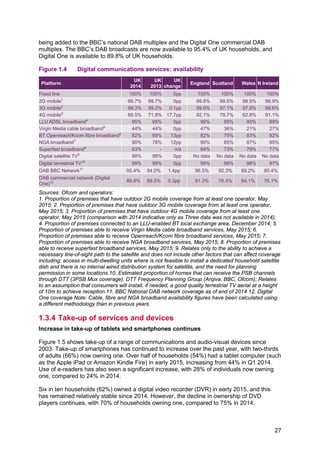
Consumption of news on any online platform has seen a large increase since 2005, from
25% to 42%. Figure 1.97 breaks this down further by age, and demonstrates that it is most
prevalent at either end of the age scale; the figures for 16-24 year olds (20% to 42%) and
over-55s (17% and 36%) have more than doubled.
Banking and paying bills online has also increased since 2005, from 31% to 42% in 2014.
As shown in Figure 1.97, the most substantial increase has been among 16-24 year olds,
where the weekly figure has doubled from 17% to 34%. For over-55s it has increased from
21% to 32%45
.
45
Note: we don’t break it out further to include 65+ year olds, as the base of internet users was too
low in 2005 for this age group.
6.6
8.2 8.4 9.4 10.5 10.9 11.2
12.6
3.0
3.3 3.1
3.8
3.4
4.1 4.0
5.5
0.5
0.6 0.7
0.9
1.2
1.8 1.7
2.3
0
5
10
15
20
25
2005 2007 2009 2010 2011 2012 2013 2014
Elsewhere
Work
Home
Hours spent online on average each week
122
Figure 1.97 Weekly internet activities: 2005 vs. 2014
Source: Ofcom research, Adults Media Use and Attitudes Report
Base: All adults who go online in any location on any device (1609 in 2014)
IN15L/M: How often do you use the internet to <activity>. Answer – at least once a week
Public/civic activities are also increasingly being done online. Two individual activities in this
category have been included in the survey since 2005, and both have increased in terms of
weekly use: finding out about public services has increased from 12% to 18%, and looking at
political or campaigning issues websites from 4% to 11%.
However, since this category of activity is generally less likely to be done regularly, it is also
useful to assess to what extent it is done at all. As shown in Figure 1.98, both activities have
increased substantially: finding out about public services from 49% to 78%, and looking at
political or campaigning issues websites from 19% to 44%. In addition to this (not shown in
the chart), seven in ten (69%) internet users now say that they complete government
processes online.
25%
20%
30%
31%
23%
17%
42%
42%
47%
45%
38%
36%
0% 10% 20% 30% 40% 50%
Adults 16+
16-24
25-34
35-44
45-54
55+
2005
2014
Looking at news websites or apps
31%
17%
45%
38%
30%
21%
42%
34%
49%
43%
32%
0% 10% 20% 30% 40% 50%
Adults 16+
16-24
25-34
35-44
45-54
55+
Banking and paying bills online
Proportion of internet users (%)
123
Figure 1.98 Use of the internet for public/civic activities: 2005 vs. 2014
Source: Ofcom research, Adults Media Use and Attitudes Report
Base: All adults who go online in any location on any device (1609 in 2014)
IN15L/M: How often do you use the internet to <activity>. Answer – daily, weekly or less often
There is less concern about online content than ten years ago, but concerns remain
more prominent than for other media, and apps are posing a new challenge
Since 2005 the internet has had the highest levels of stated concern across the types of
media measured (including TV, radio, mobile phones and gaming), as shown in Figure 1.99.
The most-cited concerns regarding internet content are currently ‘offensive/ illegal content’
(38%) and ‘risk to others/society (28%). The former was also the prime concern in 2005
when 54% cited a concern relating to ‘offensive content’; the latter has increased from 15%
in 2013. Despite this, the proportion citing any concerns with online content has decreased
since 2005; from seven in ten (70%) to half (51%) of internet users, and the decrease has
been particularly substantial among 35-44s (from 80% to 54%).
However, the recent surge in app use appears to be accompanied by increased concern
about apps. In 2013 we asked app users46
if they had any concerns about apps, and one in
five (20%) indicated some form of concern. In 2014 this increased to 28%, primarily driven
by issues relating to security/ fraud or privacy (up to 20% from 14% 2013) and offensive
content (up to 9% from 4% in 2013).
46
Defined as those who go online on either a smartphone, tablet or smart TV and say they use apps
on any of these devices
49%
40%
54%
51%
57%
44%
78%
69%
83%
88%
81%
70%
0% 20% 40% 60% 80% 100%
Adults 16+
16-24
25-34
35-44
45-54
55+
2005
2014
19%
24%
18%
20%
18%
11%
44%
40%
50%
51%
44%
33%
0% 20% 40% 60% 80% 100%
Adults 16+
16-24
25-34
35-44
45-54
55+
Finding out about public services Looking at political or campaigning issues
websites
Proportion of internet users (%)
124
Figure 1.99 Proportion of adults who have any concerns about media: 2005-14
Source: Ofcom research, Adults Media Use and Attitudes Report
Base: Adults aged 16+ who use each platform (variable base).
IN34/ T5/ R3/ G3/ M3/ IN23 – Can you tell me if you have any concerns about what is on the internet/
TV/ radio. Do you have any concerns about gaming/ mobile phones/ apps?
Internet users under the age of 65 are more inclined to care about who owns
websites, or how they are funded, than they were in 2007
In 2007 we started gauging the extent to which adults agreed with the statement: ‘As long as
the internet provides good websites it doesn't really matter who owns the websites or how
they're funded’. As shown in Figure 1.100, more than half agreed (52% either strongly or
slightly agreed), a quarter had a neutral view (24% neither/don’t know), and the same
proportion (24%) disagreed strongly or slightly. In 2014, when we asked the same question,
36% either strongly or slightly agreed and 35% either strongly or slightly disagreed, with
more neutrality evident. Among those aged 55-64, the proportion who said they strongly or
slightly disagreed with this statement has almost doubled, from 24% to 42%.
Figure 1.100 Agreement with statement: “As long as the internet provides good
websites it doesn't really matter who owns the websites or how they're funded”: 2007
vs. 2014
Source: Ofcom research, Adults Media Use and Attitudes Report
Base: All who go online at home or elsewhere on any device (1609)
IN35F. As long as the internet provides good websites it doesn't really matter who owns the websites
or how they're funded?
46%
55%
39% 40% 39% 37% 36%
40%
11%
14%
11% 9% 8% 7% 9% 9%
70%
73%
61%
54%
50% 52% 51% 51%
42%
34%
26% 24%
20% 21% 20%
24%
0%
10%
20%
30%
40%
50%
60%
70%
80%
2005 2007 2009 2010 2011 2012 2013 2014
TV Radio Internet Mobile phones
Proportion of adults (%)
16%
23%
20%
29%
29%
24%
18%
14%
17%
9%
0% 20% 40% 60% 80% 100%
2014
2007
Strongly agree Slightly agree Neither/don't know Slightly disagree Strongly disagree
% of internet users
125
A majority of internet users claim confidence in finding information on the internet,
but the levels have changed little over the years
We started to notice signs of confidence in using the internet among a majority of users in
2007. Our research that year showed that about six in ten considered themselves very
confident in finding things online (58%), with nine in ten (91%) at all confident (i.e. they were
‘confident’ or ‘fairly confident’). As shown in Figure 1.101 , this figure has remained similar
over time and across all ages.
Figure 1.101 Proportion of adults confident of finding the content or information they
want when they go online: 2007 vs. 2014
Source: Ofcom research, Adults Media Use and Attitudes Report
Base: All internet users (1609 in 2014)
IN13B: How confident are you that you can find the content or information you want when you go
online
Opinions about the potential for inaccuracy or bias of search engine results have
remained similar over time, with little variation by age
Since 2009 we have measured opinions on the potential for inaccuracy or bias in the results
that users get from search engines. These results have also changed little over time, as
displayed in Figure 1.102; six in ten (60%) search engine users believe that some results will
be accurate and unbiased, while others won’t be. This is not significantly different to the
2009 level (54%). In contrast to most of the measurements assessed so far in this section,
this is consistent across younger and older demographics (e.g. 56% of 16-24s and 62% of
over-65s).
91%
95%
90% 93% 91%
85%
92%
96% 93% 95% 92%
86%
0%
20%
40%
60%
80%
100%
Adults 16+ 16-24 25-34 35-44 45-54 55+
2007 2014
Proportion of internet users (%)
126
Figure 1.102 Opinions on the accuracy of search engine results: 2009-14
Source: Ofcom research, Adults Media Use and Attitudes Report
Base: All online adults aged 16+ who ever use search engines (1516 in 2014).
IN45. Which one of these is closest to your opinion about the level of accuracy or bias of the
information detailed in the websites that appear in the results pages?
The majority of internet users say they would share personal information online, but
there is evidence of added caution in doing this over the ten years of tracking
Since 2005 we have asked adults if they ever provide different types of personal information
online (paying by credit or debit card online, giving home address details, home number,
mobile number and personal email address), and if so, whether they do so with or without
concerns.
The majority of online users say they do provide the information. For example, in 2014 81%
of adults said they gave out their home address details online; this has remained virtually
unchanged since 2005 (82%). However, the proportion who are happy to give out their
information has fallen since 2005 for all of the types of personal information. Thirty-three per
cent were happy to give out their home address details in 2005, and this figure is now 21%.
Consequently, it appears that more caution has crept in over time, highlighted by the fact
that 60% of internet users have concerns about giving out their home address details online,
compared to 46% in 2005. As shown in Figure 1.103, steady (but not significant in all cases)
increases are spread across all ages, and this trend is mirrored for all other types of
personal information we asked about. Despite this, four in ten (43%) of internet users say
they only skim-read website terms and conditions / privacy statements.
54% 50%
57% 60% 59% 60%
20% 26%
24% 21% 22% 23%
18% 18%
14% 16% 13% 14%
8% 7% 5% 3% 5% 4%
0%
20%
40%
60%
80%
100%
2009 2010 2011 2012 2013 2014
Don't know
I don't really think about whether
or not they have accurate or
unbiased information, I just use
the sites I like the look of
I think that if they have been
listed by the search engine,
these websites will have
accurate and unbiased
information
I think that some websites will
be accurate or unbiased and
some won't be
Proportion of search engine users (%)
127
Figure 1.103 Attitudes to giving out personal details online: 2005 vs. 2014
Source: Ofcom research, Adults Media Use and Attitudes Report
Base: All who use the internet at home (2005) / All who go online at home or elsewhere on any type
of device (1609 in 2014)
IN38. …I’d like you to say how you would feel about doing this in terms of any security concerns….
Entering your home address details? Answer - Have some security concerns about doing this, but
would do it
Overall agreement that internet users must be protected from inappropriate or
offensive content is similar to 2005, but opinions are stronger than in 2013
Respondents have been asked since 2005 the extent to which they agree that internet users
must be protected from seeing inappropriate or offensive content online. As shown in Figure
1.104, this has remained fairly consistent over the years, and overall agreement (82%) has
not changed since 2005 (81%). Similarly, six in ten (60%) strongly agree with the statement;
again, this is close to the level seen in 2005 (56%), although it is a significant increase on
2013 (51%).
Figure 1.104 Extent of agreement with the statement: “Internet users must be
protected from seeing inappropriate or offensive content”: 2005-14
Source: Ofcom research, Adults Media Use and Attitudes Report
Base: All who go online at home or elsewhere on any type of device (1609 in 2014)
IN35E: Internet users must be protected from seeing inappropriate or offensive content
28%
17%
36%
21%
30%
19%
0%
34%
21%
54%
39%
48%
57%
46%
60% 44%
48%
37%
49%
34%
46%
18% 21%
0%
16% 17%
0%
24%
27%
0%
25% 26%
0%
9% 12%
6% 5% 2% 2% 2%
8% 4% 4% 3% 3%
0%
20%
40%
60%
80%
100%
2005 2014 2005 2014 2005 2014 2005 2014 2005 2014
Don’t Know
Never do because of
concerns
Do but have
concerns
Happy to do this
Pay by card
Give home
address
Give home
phone number
Give mobile
phone number
Give personal
email address
Proportion of internet users (%)
3% 4% 4% 3% 4% 4%3% 5% 4% 3% 4% 4%
13% 8% 13% 12% 11% 11%
25% 26%
27% 27% 31%
22%
56% 57% 53% 54% 51%
60%
0%
20%
40%
60%
80%
100%
2005 2007 2009 2011 2013 2014
Strongly agree
Slightly agree
Neither/don’t Know
Slightly disagree
Strongly disagree
Proportion of internet users (%)
128
The majority are using technical indicators such as padlocks and system messages
to measure website safety, and this has increased among over-25s since 2005
In 2005 six in ten (59%) internet users said they could block computer viruses with
confidence (rising to 67% of 25-34 year olds). A further 9% of internet users said they did it
with difficulty, and 17% said they got someone else to do it for them. So in total 86% of
internet users said they were adopting security measures when online.
Although we no longer measure this type of confidence, a similar proportion (88%) of
internet users said in 2014 that they adopt any security measures, ranging from a third
(33%) who deleted web-browser cookies to three-quarters (75%) who used anti-virus
software. In addition, eight in ten (80%) cite being ‘very’ or ‘fairly’ confident of staying safe
online. As a result, or in spite of this, two-thirds (64%) use the same password for most or all
websites.
In terms of the ways in which people actively evaluate whether it is safe to provide personal
details, the use of ‘formal judgements’ (e.g. padlocks or system messages) has increased,
from 43% to 55%. Although this has not changed among 16-24 year olds (45% in 2014 vs.
46% in 2005), it is greater among those aged 25 and over. For example, for adults aged 45-
54 it has increased by 19pp (from 39% to 58%), as displayed in Figure 1.105 below.
Figure 1.105 Use of formal judgements before entering personal details
Source: Ofcom research, Adults Media Use and Attitudes Report
Base: All who use the internet at home (2005) / All who go online at home or elsewhere on any type
of device (1609 in 2014)
IN39…tell me whether you would make a judgement about a website before entering these types of
details?
43% 45%
48%
42%
39% 37%
55%
45%
60% 59% 58% 56%
48%
0%
20%
40%
60%
80%
Adults 16+ 16-24 25-34 35-44 45-54 55-64 65+
2005 2014
Proportion of internet users (%)
129
1.11 Developments in the nations
1.11.1 Introduction
This section sets out a selection of key facts and figures relating to communications markets
across the UK’s nations in 2015, comparing and contrasting each nation. It demonstrates
that while there are similarities between the nations, there are also important differences in
the availability, use and take-up of communications services and devices. The section
covers TV, radio, post, telecoms, and internet and online content. Information in this section
was compiled using a number of sources including BARB, RAJAR, information provided by
operators, and Ofcom research.
1.11.2 Key findings
• On average, people in Wales watch the most TV in the UK (251 minutes per
day). There has been a decline in TV viewing in Scotland, Wales and Northern
Ireland, in line with the rest of the UK.
• Across all the devolved nations, there were claimed increases in non-
traditional viewing compared to the previous year. This includes catch-up on-
demand services e.g. BBC iPlayer, watching content that has been personally
recorded e.g. using a DVR, and using subscription on demand e.g. Netflix).
Increases for all of these non-traditional viewing activities were higher in Scotland
and Wales than in the UK overall. In Wales, the increase in using catch-up on-
demand services was higher than in the UK.
• Smartphone take-up is lower in the nations. Sixty-seven per cent of adults in
England have a smartphone, compared to 63% in Wales, Scotland and Northern
Ireland.
• Household take-up of tablet devices across the UK stands at 54%. It is highest in
Wales at 60%, followed by England at 54%, Northern Ireland at 54%, and Scotland at
52%.
• 4G coverage is highest in England, covering 92% of premises, and lowest in
Wales (62.8%). Almost half of premises in England (46.2%) have coverage from four
operators, compared to just 18.3% in Wales.
• 4G take-up has increased significantly in all four nations over the past year. By
Q1 2015, 30% of UK adults said they were 4G users, with take-up highest in
Scotland (34%, up by 15 % points compared to 2014), followed by England at 30%
(an increase of 18 % points), Northern Ireland (26%, an increase of 17 % points), and
Wales (23%, an increase of 12 % points).
• The proportion of premises able to receive superfast broadband services
(30Mbit/s or higher) is highest in England (84%), followed by Wales (79%),
Northern Ireland (77%), and Scotland (73%). Across the UK and in each of the
nations, superfast broadband availability is considerably higher in urban than in rural
areas.
• People in Scotland listen to radio less than those in other nations of the UK.
People in Scotland spend the least amount of time listening to radio (19.9 hours on
average per week), while people in Wales spend the most (22.4 hours).
131
• Over a third of adults in Scotland (36%) said they had not sent any post in the
past month, the highest across all the nations. This compares to 33% in Northern
Ireland, 25% in Wales and 22% in England.
Nations’ fast facts: wave 1 2015 (%)
Unless otherwise stated, figures relate to household take-up
UK
England
Scotland
Wales
Northern
Ireland
UKurban
UKrural
Digital TV take-up 97 97 96 98 97 96
-
98
+
Pay-digital TV 59 58 58
-10
671 +
+10
63 59
+
55
-
Freeview-only TV 30 30
-3
352
+10
24
-
-9
28 30
-
35
+
Smart TV take-up (among TV
homes)
21
+9
21
+9
19
+11
17
+8
15
-
+8
20
+8
23
+12
HDTV service (among those with an
HDTV)
75
+5
75
+5
75 69
- 75 74
-
+4
81
+
DAB ownership (among radio
listeners)3
43 44 37 47 29
-
42
-
50
+
Catch-up TV/ film viewing online/
on-demand (on any device, among
those who use the internet)
56
+5
56
+5
62 57 42
- 56
+4
56
+10
Total internet access at home (by
any device)
85
+3
86
+4
78
- 86
+6
79
- 85
+3
85
Broadband take-up at home (fixed
or broadband)
80
+3
81
+4
73
- 78
+7
72
- 79
+3
82
Use mobile to access internet 61
+4
62
+5
59 59 60
+9
62
+
+4
55
-
Mobile phone take-up (personal
use)
93 93 91 90 91 92 93
Smartphone take-up (personal use) 66
+5
67
+6
63 63 63
+8
67
+
+5
59
-
4G service take-up 30
+18
30
+18
34
+15
23
+12
26
+17
n/a n/a
Fixed landline take-up 84 85 82 83 84 84
-
90
+
Desktop PC take-up 34 37 22
-
26
-
28
- 34 35
Laptop take-up 65 66 55
- 65
+8
55
- 64 67
Tablet computer take-up 54
+10
54
+10
52
+10
60
+
+15
54
+9
54
+11
55
+8
E-reader take-up (personal use) 20
+3
20
+3
14
- 19 15
- 19
+3
22
Households taking bundles 63 64 61 67
+8
61
+7
63 67
Fixed telephony availability 100 100 100 100 100
132
Fixed broadband availability4
99.98 100 99.86 100 100
LLU ADSL broadband availability5
95 96 89 93 89
Virgin Media cable broadband
availability6
44 47 36 21 27
BT Openreach / Kcom fibre
broadband availability7
82 82 75 83 92
NGA broadband availability8
89 90 85 87 95
Superfast broadband availability 83 84 73 79 77
2G mobile availability9
99.7 99.8 99.5 98.9 98.9
3G mobile availability10
99.3 99.6 97.1 97.9 98.6
4G mobile availability11
89.5 92.1 79.7 62.8 91.1
DTT availability12
98.5 98.6 98.7 97.8 97.4
TV consumption (minutes per day)
(2014)
220 221 * 239 251 227
Radio consumption (minutes per
day)
183 184 171 138 185
Key:
+
Figure is significantly higher for nation than UK average or significantly higher for nation’s
urban/ rural than for nation’s rural/ urban;
-
Figure is significantly lower for nation than UK average or
significantly lower for nation’s urban/ rural than for nation’s rural/ urban; +xx Figures have risen
significantly by xx percentage points since W1 2014; +xx Figures have decreased significantly by xx
percentage points since W1 2014;
Source: Ofcom Technology Tracker Q1 2015, BARB 2014, RAJAR, industry data
Base: All adults aged 16+ (n = 3756 UK, 496 Wales, 2264 England, 492 Scotland, 504 Northern
Ireland, 1974 England urban, 290 England rural, 246 Scotland urban, 246 Scotland rural, 249 Wales
urban, 247 Wales rural, 249 Northern Ireland urban, 255 Northern Ireland rural)
1. This increase may be attributable to an anomalous decline in Wales cable TV as main television
set in 2014 - In 2015 cable take-up in Wales increased by 6 pp to 10% over the previous year,
returning it to 2013 levels. Market research surveys are subject to sample error and will occasionally
report anomalous results.
2. In 2014 the survey data indicated a decline in use of Freeview as a main television service in
Scotland. The 2015 measure is similar to the previous measure from 2013. This may suggest that the
apparent decrease in 2014 could have been accounted for by sample error.
3. DAB ownership in the nations and UK as reported here is sourced from Ofcom research. The UK
CMR uses RAJAR data for DAB ownership
4. Proportion of premises connected to an ADSL-enabled BT local exchange based on BT data,
December 2014
5. Proportion of premises connected to an LLU-enabled BT local exchange based on BT data,
December 2014
6. Proportion of premises able to receive Virgin Media cable broadband services, May 2015
7. Proportion of premises able to receive BT Openreach/ KCom fibre broadband services, May 2015;
under regulatory rules other providers can provide retail fibre broadband services to consumers using
these networks.
8. Proportion of premises able to receive NGA broadband services, May 2015
9. Proportion of premises that have outdoor 2G mobile coverage from at least one operator, May
2015
10. Proportion of premises that have outdoor 3G mobile coverage from at least one operator, May
2015
11. Proportion of premises that have outdoor 4G mobile coverage from at least one operator, May
2015
12. Estimated proportion of homes that can receive the PSB channels through DTT (3PSB Mux
coverage). Joint TV planning project (Arqiva, BBC, Ofcom).
* This figure reflects the average across the English regions with the highest in Border at 250 minutes
(4 hours 10 minutes) and lowest in West at 197 minutes (3 hours 17 minutes) respectively.
133
1.11.3 Television and audio-visual content
On average, people in Wales watch the most TV in the UK (251 minutes per day)
On average, people in Wales watch the most traditional TV (live content, viewed at the time
of broadcast) in the UK (at 251 minutes per day) while people in England watch the least
(221 minutes per day). The biggest decline was in Northern Ireland (-6.1%), followed by
Wales (-4.7%), and Scotland (-2.7%).
Figure 1.106 Average minutes of television viewing per day, by nation: 2014
Source: BARB, individuals (4+). main five PSB channels = BBC One, BBC Two, ITV, Channel 4 and
Channel 5, including HD variants but excluding +1s. *Note: This figure reflects the average across the
English regions with the highest in Border (250) and lowest in West (197) respectively.
Across all the devolved nations, there were claimed increases in non-traditional
viewing compared to the previous year
To better understand the decline in traditional TV viewing, Ofcom commissioned omnibus
research47
in April 2015. Consumers in each nation were asked how their viewing activities
had changed over the previous year. Across all of the devolved nations, there were claimed
increases in non-traditional viewing (using catch-up on-demand services e.g. BBC iPlayer,
watching content that had been personally recorded e.g. using a DVR, or using subscription
on demand e.g. Netflix).
Viewers in Wales were the most likely to say that they were watching more catch-up/on-
demand services, with 46% claiming they had used them more and only 6% claiming they
had used them less, resulting in a net increase of 40%. Northern Ireland and Scotland had
similar net increases of 39% and 36% respectively.
Claimed viewing of personally recorded content increased over this period, with Northern
Ireland seeing a net increase of 32%, Scotland 24%, and Wales up by 18%. In addition,
claimed viewing of subscription services increased, with Northern Ireland up by 22% and
Scotland and Wales up by 15% and 13% respectively.
47
Source: GfK NOP omnibus, July 2015. Base: All adults 16+, Northern Ireland (110), Scotland (163),
Wales (99)
113 117 125 131
113
46 45
49
52
46
62 59
66
68
69
0
50
100
150
200
250
300
UK England* Scotland Wales N. Ireland
All other
channels
PSB portfolio
channels
Main five PSB
channels
Averageminutesofviewing,perpersonperday
220 221*
(see note)
239 251 227 Average
minutes per
person per day
134
Increases for all of these non-traditional viewing activities were higher in Scotland and Wales
than in the UK overall. In Wales, the increase in using catch-up on-demand services was
higher than in the UK.
As we saw in section 1.5.3, over half (56%) of UK TV homes had a TV connected to the
internet, either via a set-top box or a smart TV, at the end of 2014, and smart TV take-up has
increased across the UK. Take-up is highest in England; 21% of households in England
have a smart TV, followed by Scotland at 19%, Wales 17% and Northern Ireland 15%.
Figure 1.107 Smart TV take-up across the UK
Source: Ofcom Technology Tracker, Q1 2015
Base: All online adults aged 16+ with a TV in the household (n = 3616 UK, 462 Northern Ireland, 2197
England, 472 Scotland, 485 Wales, 230)
QH18. Are any of your TV sets ‘smart TVs’? These are new types of TV that are connected to the
internet and can stream video directly onto your television screen, without the need for a computer,
set-top box or games console.
TV remains the most important source for news across the UK
Despite the decline in viewing to traditional TV, TV remains the most important source of
news for adults across the UK. It is most important in Wales, where 67% of adults said it was
their main media source, followed by England (58%), Northern Ireland (56%), and Scotland
(52%). Adults in Wales are the least likely to use newspapers.
Proportion of homes with a TV (%)
21% 21% 19% 17% 15%
0%
10%
20%
30%
40%
UK England Scotland Wales Northern Ireland
+9 +8+9 +8+11
Figures above the bars
denote change in %pts
compared to Q1 2014
135
Figure 1.108 Main media source for UK and world news, by nation: 2014
Source: Ofcom Media Tracker 2014
Base: All (2,074); England (1,577); Scotland (183); Wales (154); Northern Ireland (160). Significance
testing (indicated by a triangle) shows any difference in the main source of news between any nation
and all adults.
1.11.4 Internet and online content
Smartphone take-up is lower in the nations
Smartphone ownership is lower in Scotland, Wales and Northern Ireland than it is in
England. It has increased to 66% of adults across the UK (67% in England and 63% in
Wales, Scotland and Northern Ireland).
Figure 1.109 Take-up of smartphones across the UK
Source: Ofcom Technology Tracker, Q1 2015
Base: All online adults aged 16+ (n = 3756 UK, 504 Northern Ireland, 2264 England, 492 Scotland,
496 Wales, 249) QD24B. Do you personally use a smartphone? A smartphone is a phone on which
you can easily access emails, download files and applications, as well as view websites and generally
surf the internet. Popular brands of Smartphone include BlackBerry, iPhone and Android phones such
as the Samsung Galaxy.
58% 58%
52%
67%
56%
12% 12%
14%
6%
12%
10% 10%
8%
7% 14%
9% 9%
10%
12%
4%
5% 5%
7%
6%
5%
3%
0%
7%
6%
0%
20%
40%
60%
80%
100%
UK England Scotland Wales Northern Ireland
Don't watch/ read/
listen to news
Other
Website or apps -
through phone
Website or apps -
through computer/
tablet
Radio
Newspapers
15 15 17 18 9
TOTAL Website
or apps
Proportion of adults (%)
66% 67% 63% 63% 63%
+5 +6
+1 +6 +8
0%
20%
40%
60%
80%
100%
UK England Scotland Wales Northern Ireland
Nation
Figures above the bars
denote change in %pts
compared to Q1 2014
136
Household take-up of tablet devices across the UK stands at 54%
There has been another large increase in tablet ownership across the UK. More than half of
all households now own a tablet, up from 44% in 2014, a rise of ten percentage points.
Households in Wales are most likely to own a tablet (60%), up from 45% in 2014, followed
by England (54%), Northern Ireland (54%) and Scotland (52%).
Figure 1.110 Take-up of tablet computers
Source: Ofcom Technology Tracker, Q1 2015
Base: All online adults aged 16+ (n = 3756 UK, 504 Northern Ireland, 2264 England, 492 Scotland,
496 Wales, 249)QE1. Does your household have a PC, laptop, netbook or tablet computer?
Internet users in Northern Ireland say they spent significantly more time online in 2014 than
they did in the previous year, up from 13.8 to 21.6 hours in a typical week. This is the highest
of the four nations, followed by Wales (21.2 hours, an increase from 15.5 hours), England
(20.5 hours, up from 17 hours), and Scotland (19.9 hours, up from 16.5 hours).
Figure 1.111 Claimed time spent on the internet in a typical week
Source: Ofcom research, fieldwork carried out by Saville Rossiter-Base in October to November 2014
Question: IN6A-C – How many hours in a typical week would you say you use the internet at home/ at
your workplace or place of education/ anywhere else? (Unprompted responses, single coded)
Base: All online adults aged 16+ who use the internet at home or elsewhere (1609 UK, 1022
England, 194 Scotland, 200 Wales, 193 Northern Ireland).
Households (%) take-up of tablet computers
54% 54% 52%
60% 54%
+10 +10 +10
+15
+9
0%
20%
40%
60%
80%
100%
UK England Scotland Wales Northern Ireland
Nation
Figures above the bars
denote change in %pts
compared to Q1 2014
Hours per week
15.3
13.0
12.4
13.6
12.6
4.2
4.8
5.7
5.3
5.5
1.6
2.1
2.4
2.7
2.3
21.2
19.9
20.5
21.6
20.5
0 4 8 12 16 20 24
Wales
Scotland
England
Northern
Ireland
UK
At home At workplace/ place of education Anywhere else
137
1.11.5 Telecoms and networks
The proportion of premises able to receive superfast broadband services (30Mbit/s or
higher) is highest in England (84%), followed by Wales (79%), Northern Ireland (77%),
and Scotland (73%).
The proportion of premises able to receive superfast broadband services (defined as those
with an actual speed of 30Mbit/s or higher) is highest in England (84%), followed by Wales
(79%), Northern Ireland (77%), and Scotland (73%). Across the UK and in each of the
nations, superfast broadband availability is considerably higher in urban than in rural areas.
Broadband take-up (at home) is highest in England at 81%, followed by Wales (78%),
Scotland (73%) and Northern Ireland (72%). Total internet access at home (on any device) is
highest in Wales and England (both at 86%), followed by Northern Ireland (79%) and
Scotland (78%).
Figure 1.112 Proportion of premises able to receive superfast broadband services
Source: Ofcom / operators, June 2015 data
4G coverage is highest in England, covering 92% of premises, and lowest in Wales
(62.8%)
Among the UK nations, 4G coverage is highest in England, where it covers 92% of
premises, and lowest in Wales (62.8%). Almost half of premises in England (46%) have
coverage from four operators, compared to 34% in Scotland and just 18% in Wales. While
Northern Ireland has relatively good 4G coverage (at 91%), choice is more limited because
mobile operator Three has yet to launch its 4G service there.
Proportion of premises (%)
83% 84%
73% 79% 77%
0%
88%
37%
0%
20%
40%
60%
80%
100%
UK England Scotland Wales Northern
Ireland
UK Urban UK Rural
138
Figure 1.113 4G mobile premises coverage, by number of operators
Source: Ofcom based on operator data, May 2015 data
Note: Coverage is based on 100m² pixels covering the UK using an enhanced methodology. Mobile
operator Three has yet to launch 4G services in Northern Ireland.
4G take-up has increased significantly in all four nations over the past year. 4G take-up is
highest in Scotland 34%, an increase of 15 percentage points since 2014, followed by
England at 30% (up by 18 percentage points), Northern Ireland at 26% (up by 17 percentage
points), and Wales at 23% (up by 12 percentage points).
Northern Ireland had the highest proportion of mobile phone users among the UK nations
whose main service was pre-pay in Q1 2015 (43%), ten percentage points higher than the
UK average of 33%. Pre-pay take-up is broadly similar in Scotland (34%), Wales (33%), and
England (32%).
1.11.6 Radio and audio content
People in Scotland listen to radio less than those in other nations of the UK
People in Scotland spend the least time (19.9 hours on average per week) listening to radio,
while people in Wales spend the most time (22.4 hours) listening to radio.
Figure 1.114 Average weekly reach and listening hours: 2014
Source: RAJAR, All adults (15+), year ended Q4 2014. Reach is defined as a percentage of the
area’s adult population who listen to a station for at least five minutes in the course of an average
week.
12.1 11.0 9.8
20.1
40.610.8 11.2 7.5
14.0
24.1 23.8 28.4
10.3
45.042.5 46.2
34.0
18.3
89.5 92.1
79.7
62.8
91.1
0
20
40
60
80
100
UK England Scotland Wales N Ireland
Four Three Two One
Proportion of premises (%)
Reach
Average weekly
listening
UK TOTALNorthern
Ireland
WalesScotlandEngland
89.5%88.9%94.5%86.9%89.4%
21.4 hours21.6 hours22.4 hours19.9 hours21.5 hours
139
People in Northern Ireland listen to the most local radio
The share of listening hours to local and nations’ services in Northern Ireland is higher than
in any other part of the UK. Local commercial and BBC local and nations’ services together
accounted for 55% of total listening hours in 2014. The majority of this listening was to local
commercial stations, with a 35% share of total listening hours. This is 5pp above the UK
average and higher than in any other nation.
Wales has the highest share of listening to BBC network services. BBC network radio
stations represented almost half (49%) of all listening hours in Wales in 2014. This was the
highest share of listening for this sector compared to the other nations.
People in Scotland spend more time with commercial stations than in the other nations.
Commercial stations accounted for almost half (48%) of listening hours in Scotland in 2014.
This is the highest share for commercial radio across the UK nations.
DAB ownership is highest in Wales
DAB ownership (among radio listeners) remains below 50% across all four nations of the
UK. It is lowest in Northern Ireland (29%) and Scotland (37%), and highest in Wales (47%).
Figure 1.115 Ownership of DAB digital radios
Source: Ofcom Technology Tracker, Q1 2015
QP9. How many DAB sets do you have in your household?
Base: Adults aged 16+ who listen to radio (n = 2934 UK, 406 Wales, 1735 England, 386 Scotland,
407 Northern Ireland, 205)
1.11.7 Post
Over a third of adults in Scotland (36%) said they had not sent any post in the past
month, the highest across all the nations
Adults in Wales send more items of post than those in other UK nations. They claim to send
6.5 items of post per month, on average, compared to 4.5 in Northern Ireland. More than a
third of adults in Scotland (36%) had not sent any post in the past month, the highest among
the UK nations.
Percentage of respondents
43%
29%
44%
37%
47%
0%
10%
20%
30%
40%
50%
UK Northern Ireland England Scotland Wales
140
Figure 1.116 Approximate number of items of post sent each month (residential)
Source: Ofcom Residential Postal Tracker, Q2 2014-Q1 2015
Base: All respondents (n = 3557 UK, 2123 England, 580 Scotland, 418 Wales, 436 Northern Ireland)
QC1. Approximately how many items of post - including letters, cards and parcels - have you
personally sent in the last month?
Adults in Wales also receive more post than those in other nations of the UK. They claim to
receive 8.7 items of post (including letters, cards and parcels) on average every week. This
compares to 8.6 in England, 8.0 in Scotland and 5.9 in Northern Ireland.
Figure 1.117 Approximate number of items of post received in the past week
Source: Ofcom Residential Postal Tracker, Q2 2014-Q1 2015
Base: All respondents (n = 3557 UK, 2123 England, 580 Scotland, 418 Wales, 436 Northern Ireland)
QD1. Approximately how many items of post – including letters, cards and parcels – have you
personally received in the past week?
Businesses in Northern Ireland are most likely to have switched from post to other
communications methods
Across the UK, 63% of businesses have switched some mail to other communications
methods in the past 12 months. The figure is highest in Northern Ireland (70%), followed by
England (63%), Wales (62%) and Scotland (59%).
23% 22%
36%
25%
33%
21% 21%
17%
14%
20%
19% 19%
17%
19%
18%
23% 23%
22%
28%
19%
8% 9% 3%
8% 5%
5% 5% 5% 6% 6%
0%
20%
40%
60%
80%
100%
UK England Scotland Wales Northern Ireland
Don't know
21+ items
11-20 items
5-10 items
3 or 4 items
1 or 2 items
None
Items of post sent per month (% of respondents)
6.0
Mean number of items sent per month
5.0 6.5 4.56.1
Items of post received per week (% of respondents)
6% 6% 6% 5% 11%
14% 14% 17% 15%
21%
17% 17%
19%
17%
19%
39% 39%
38%
36%
30%
18% 18% 16%
19%
15%
6% 6% 4% 8% 2%
0%
20%
40%
60%
80%
100%
UK England Scotland Wales Northern Ireland
Don't know
21+ items
11-20 items
5-10 items
3 or 4 items
1 or 2 items
None
8.5
Mean number of items received per week
8.0 8.7 5.98.6
141
Figure 1.118 Proportion who have switched some post to other communications
methods in the past 12 months
Source: Ofcom Business Postal Tracker, Q2 2014-Q1 2015
Base: All respondents (n = 1591 UK, 973 England, 217 Scotland, 198 Wales, 203 N Ireland)
QF4. Over the last 12 months has your organisation moved some mail to other communications
methods?
63% 63% 59% 62%
70%
37% 37% 41% 38%
30%
0%
20%
40%
60%
80%
100%
UK England Scotland Wales N Ireland
No
Yes
Proportion of respondents (%)
142
The Communications Market
2015
2
2 Television and audio-
visual
143
Contents
2.1 Key market developments in TV and audio-visual 145
2.1.1 Industry metrics and summary 145
2.1.2 TV industry revenue up 3.1% in 2014 to £13.2bn 147
2.1.3 Internet-connected TVs on the rise while HD growth slows and 3D falters 151
2.1.4 The majority of TV viewing is of traditional live TV, but this has recently
declined 156
2.2 The TV and audio-visual industries 163
2.2.1 Summary 163
2.2.2 Television industry revenue 164
2.2.3 TV revenue among multichannel genres 170
2.2.4 Spend on UK television programmes 171
2.2.5 UK independent sector 172
2.2.6 Spend on first-run UK-originated content by the main five PSB channels 174
2.2.7 Television output on the PSB channels 175
2.2.8 Television output and spend in the multichannel sector 181
2.3 The TV and audio-visual viewer 185
2.3.1 Summary 185
2.3.2 Platform take-up 187
2.3.3 Consumer attitudes towards television 205
144
2.1Key market developments in TV and
audio-visual
2.1.1 Industry metrics and summary
Figure 2.1 Industry metrics
Source: Ofcom/broadcasters/Advertising Association/Warc/BARB/GfK. Note: Expressed in nominal
terms. Public funds include DCMS grant to S4C, as well as BBC funding that is allocated to TV
(including the proportion of licence fee revenue that goes to S4C). Broadcaster share as a proportion
of total display advertising spend excludes direct mail and classified ads and is based on Advertising
Association/Warc Expenditure Report. The AA/Warc data are net of discounts, and includes agency
commission, but excludes production costs. Spend on originations includes spend on nations and
regions programming (not Welsh or Gaelic language programmes but some Irish language). TV
viewing based on BARB analysis of viewing to scheduled TV programmes such as those listed in TV
listings magazines or on electronic programme guides (EPG) on TV sets. Minutes spent watching TV
per day declined by 11 minutes year on year although values appear not to equate to 11 minutes due
to rounding.
This section examines key developments and trends seen in the UK television market during
the past year. However, for detailed analysis of developments in video on demand, and
changes in viewing to broadcast TV, please refer to sections 1.5.3 and 1.5.4 in the Market in
Context chapter.
• The UK television industry generated £13.2bn in revenue during 2014, an
increase of 3.1% (£392m) year on year. Pay-TV subscription revenue continued to
be one of the main drivers behind the industry’s growth, with a 1.9% increase year on
year and a compound annual growth of 5.2% over the last five years.
• Broadcast-based TV advertising revenue increased by 3.9% in 2014 to reach
£3.8bn. The largest proportional increase was among the multichannels (excluding
the PSB portfolio channels) where advertising revenues increased by 7.7% year on
year, to reach over £1bn for the first time since Ofcom began reporting. The PSB
UK television industry 2009 2010 2011 2012 2013 2014
Total TV industry revenue (£bn) 11.1 11.8 12.4 12.5 12.8 13.2
Proportion of revenue generated by public funds 23% 22% 21% 21% 20% 21%
Proportion of revenue generated by advertising 28% 30% 29% 28% 29% 29%
Proportion of revenue generated by subscriptions 42% 43% 44% 44% 46% 45%
Broadcaster share of total display advertising spend 41% 42% 43% 43% 43% 44%
Spend on originated output by 5 main networks (£bn) 2.4 2.5 2.5 2.6 2.5 2.6
Digital TV take-up (% all households) 88% 92% 94% 96% 95% 93%
Proportion of DTV homes with pay satellite or cable 53% 56% 51% 51% 52% 51%
Minutes spent watching TV per day (per person aged 4+) 225 242 242 241 232 220
Share of the main five channels in all homes 58% 56% 54% 52% 51% 51%
Number of channels broadcasting in the UK 490 510 515 529 527 536
145
portfolio channels also experienced gains in net advertising revenue in 2014,
increasing by 2.2% to £653m.
• Broadcast TV advertising has held up well as a proportion of all display
advertising. According to WARC, total display advertising expenditure (i.e. including
all forms of media such as press, online and TV) stood at £10.6bn in 2014, of which
broadcaster display advertising accounted for 43.5%, an increase of 2.5 percentage
points over the past five years, despite increased competition from online display
advertising.
• Online TV revenue in the UK has increased rapidly in the past five years but
still represents only a small proportion of total TV revenues. According to data
from IHS, revenue from online TV grew by 38% in 2014 to £793m, with income from
online TV subscriptions increasing by 53% to £317m, driven by the increasing
popularity of services such as Netflix and Amazon Prime Instant Video.
• Ofcom estimates that the BBC allocated £2.7bn to its television services in
2014, an increase of 5.1% since 2013. This is mainly due to the BBC’s TV coverage
of major sporting events in 2014 compared to 2013, most notably the FIFA World
Cup in Brazil and the Commonwealth Games in Glasgow. The cost of the licence fee
remained unchanged at £145.50.
• Over half (56%) of UK TV homes had a TV connected to the internet, either via a
set-top box or a smart TV, at the end of 2014. However, this figure is likely to be
higher when other third-party devices, which can also be used to connect TVs to the
internet, such as games consoles or streaming devices (e.g. Now TV or
Chromecast), are included.
• Two-thirds (64%) of TV homes now have a digital video recorder (DVR),
although in the past year this figure has increased by only two percentage points
(from 62% in 2014) suggesting that the penetration of DVRs may be beginning to
plateau.
• Growth in take-up of HDTV services has slowed, and 3DTV is failing to gain
traction. Take-up of HDTV services increased marginally, by four percentage points,
from 53% in 2014 to 57% in 2015. Despite 3D services having been available since
2010, less than one in ten (7%) of UK TV homes in 2015 claimed to watch TV
content in 3D.
• Viewing to traditional live television as it is broadcast fell from 3 hours 45
minutes (225 minutes) per person per day in 2010 to 3 hours 13 minutes (193
minutes) in 2014. Watching programmes previously recorded on devices48
or
through catch-up services49
(time-shifted) among all individuals has grown over the
same period (from 17 minutes a day to 27 minutes a day), but the main way people
watch programmes continues to be at the time of broadcast (88%).
48
These include DVRs such as Sky+, TiVo, Freeview+ and Freesat+, DVD recorders or video
cassette recorders, as well through catch-up players, including games consoles and smart TVs.
Viewing up to seven days after broadcast is reported by BARB.
49
Broadcaster catch-up services such as BBC iPlayer, ITV on demand, 4OD, Demand 5 etc. Viewing
up to seven days after broadcast is reported by BARB.
146
2.1.2 TV industry revenue up 3.1% in 2014 to £13.2bn
Total TV industry revenues rose by 3.1% (or £393m) in nominal terms to £13.2bn in 2014.
Pay-TV subscription revenue continues to be one of the main drivers behind the industry’s
growth, with a 1.9% increase year on year and a compound annual growth of 5.2% over the
past five years.
Ofcom estimates that the BBC spent £2.7bn on its television services in 2014, an increase of
5.1% since 2013. The BBC’s Annual Report and Accounts for 2014/15 indicates that the
BBC allocated more income to BBC One in 2014/15 than in the previous financial year,
mainly due to the BBC’s TV coverage of major sporting events in 2014 compared to 2013,
most notably the FIFA World Cup in Brazil and the Commonwealth Games in Glasgow.
Net advertising revenue increased by 3.9% overall in 2014 to £3.8bn, although not all
broadcasters experienced an increase in advertising revenue, as outlined in Figure 2.3
Figure 2.2 Total TV industry revenue, by source: 2014
Source: Ofcom/broadcasters. Note: Figures expressed in nominal terms. PSB NAR comprises
Channel 3 licensees (including ITV Breakfast, ITV plc, Channel Television, STV and UTV), Channel 4,
Channel 5 and S4C. PSB portfolio NAR includes commercial channels owned by the PSBs (ITV2,
ITV3, ITV4, E4, More 4, Film 4, 5* and 5USA). ‘Other NAR’ comprises the rest of the multichannel
market. Platform operator revenues do not include installation costs, equipment sales or subsidies.
BBC TV spending represents the amount of BBC revenue that is allocated to TV, which is estimated
by Ofcom based on the BBC’s Annual Report and Accounts 2014/15. Excludes revenue generated
via online TV, as outlined in Figure 2.4
Broadcast-based TV advertising revenues increase by almost 4% year on year
Following a 2% decline in 2012, total net advertising revenue increased for the second year
in a row, rising from £3.7bn in 2013 to £3.8bn overall in 2014 (or 3.9%).
The largest proportional increase was among the multichannels (excluding the PSB portfolio
channels) where advertising revenues increased 7.7% year on year, to exceed £1bn for the
first time since Ofcom began reporting. The PSB portfolio channels also experienced gains
in net advertising revenue in 2014, up by 2.2% to £653m.
£12,834m
£13,227m
£131m
£110m
£74m
£57m
£14m £6m
12,000
12,100
12,200
12,300
12,400
12,500
12,600
12,700
12,800
12,900
13,000
13,100
13,200
13,300
13,400
13,500
2013
revenue
BBC TV
spending
Subscriber
revenue
Other NAR PSB NAR PSB portfolio
NAR
Other 2014
revenue
Revenue (£m)
+7.7%
+5.1%
+2.7% +2.2% +0.9%
+1.9%
+3.1%
147
Income obtained by advertising among the commercial PSBs varied by broadcaster. ITV/
STV/ UTV had the largest increase, with advertising revenues increasing by 6.1% to £1.3bn,
while Channel 4 and Channel 5 had year-on-year declines of 0.6% and 5.7% respectively.
Figure 2.3 Advertising revenue, by share: 2013-2014
Source: Ofcom/broadcasters. Note: TV advertising includes revenues that broadcasters receive from
the sale of advertisements on screen (net of agency fees) and excludes video on demand. Totals may
not equal the sum of the components due to rounding. ITV1/Channel 3 includes ITV Plc, STV, UTV
and Channel Television.
Online TV revenue continues to increase steeply but still represents only a small
proportion of total TV revenue
Ofcom’s calculation of TV revenue includes the traditional revenue sources of subscription
fees, advertising revenue and public funding. However, online TV revenue in the UK has
increased rapidly in the past five years, from £95m in 2009 to £793m in 2014, according to
data from IHS. Although still small relative to the overall TV market in terms of revenue,
income from online TV grew by 38% year on year.
The subscription model for online audio-visual content access saw continued growth in
2014, as its revenue grew by 53% to reach £317m, driven predominantly by the increased
popularity of services such as Netflix and Amazon Prime Instant Video. The subscription
model now represents the principal contributor to overall online TV revenues, accounting for
40% of the total.
The free-to-view (FTV) business model represents the second largest segment, contributing
£240m in 2014. The principal driver of this revenue stream is advertising, and catch-up
services such as ITV Player, All 4 and Demand 5 are all funded wholly or in part by this
business model.
The download-to-own business model (DTO) experienced further growth in 2014, up by 28%
year on year to £155m, while pay-per-view increased 42% to £81m in 2014.
£m
£1,247m £1,323m
£485m £483m
£303m £285m
£968m £1,043m
£639m
£653m
£50m
£51m
0
1,000
2,000
3,000
4,000
2013 2014
ITV Breakfast
PSB portfolio
channels
Other multichannels
Channel 5
Channel 4/S4C
ITV1/STV/UTV
£ 3,838m£3,693m 1-year change (%)3.9%
6.1%
-5.7%
1.4%
-0.6%
2.2%
7.7%
148
Figure 2.4 Online TV revenues
Source: IHS. Note: FTV (free to view) refers to services delivering online video free to the consumer.
Number of FTV streams includes both ad-supported services and services funded through other
means (such as BBC iPlayer). FTV revenues include advertising revenues only. PPV (pay-per-view)
refers to a method of renting digital content whereby customers commonly choose content on ‘a la
carte’ basis and pay to watch it for a limited period. The category includes all content consumed on an
on-demand basis, including traditional PPV (such as live sports) and VoD. DTO (download-to-own)
refers to a method of obtaining content that gives the customer ownership over the files they have
downloaded, allowing them to use the content as many times as they like. Includes only revenue from
long form video content and excludes revenues generated from online usergenerated content.
Figure 2.5 compares advertising and sponsorship income obtained via traditional broadcast
TV with advertising revenue generated via free-to-view online TV services such as ITV
Player and All 4.
The chart illustrates that although online TV advertising revenues have grown significantly in
the past five years; to £240m in 2014, they still represent only a very small proportion (5.6%)
of the total TV advertising and sponsorship market; and the vast majority of TV advertising
income is still generated via traditional broadcast television.
Figure 2.5 Total cross-platform advertising and sponsorship revenue
Source: Ofcom/broadcasters/IHS. All figures are nominal
Annual
Growth
38%
26%
53%
42%
28%£33m £66m £75m £92m £121m £155m£25m
£38m
£57m
£81m
£23m £25m
£104m
£207m
£317m
£32m
£74m
£113m
£145m
£190m
£240m
£95m
£180m
£238m
£379m
£574m
£793m
0
100
200
300
400
500
600
700
800
900
2009 2010 2011 2012 2013 2014
FTV Ad Revenues
Subscriptions
PPV transactions
DTO transactions
£m
£3,143m
£3,491m £3,630m £3,547m £3,693m £3,838m
£189m
£179m
£176m £184m
£192m
£208m
£74m
£113m £145m
£190m
£240m
£3,364m
£3,745m
£3,919m £3,876m
£4,075m
£4,285m
0
1,000
2,000
3,000
4,000
5,000
2009 2010 2011 2012 2013 2014
FTV Online Ad
Revenues
All Broadcaster
Sponsorship
All Broadcaster
NAR
Annual
Growth
5.2%
26.2%
8.2%
3.9%
£m
149
Broadcast TV advertising has held up well as a proportion of all display advertising
According to WARC, total display advertising expenditure (i.e. including all forms of media
such as press, online and TV) stood at £10.6bn in 2014, of which broadcaster display
advertising spend accounted for 43.5%.
Despite the increase of online advertising, broadcaster advertising revenue as a proportion
of all display advertising has proved resilient, increasing by 2.5 percentage points over the
past five years.
Figure 2.6 Broadcaster percentage share of all display advertising expenditure
Source: AA/Warc Expenditure Report. Note: Total display advertising expenditure includes television
ads, TV sponsorship, TV VoD, radio, out of home, cinema, national and regional press display,
internet and consumer magazines but does not include response advertising such as direct mail or
classified ads. Broadcaster display ads include broadcast-based TV advertising, sponsorship and
online VoD ad revenue. Figures are nominal.
£bn
41.0% 41.6% 42.6% 43.2% 43.1% 43.5%
59.0%
58.4% 57.4% 56.8% 56.9%
56.5%
£8.5bn
£9.6bn £9.8bn £9.8bn £10.0bn
£10.6bn
0
2
4
6
8
10
12
2009 2010 2011 2012 2013 2014
All other display
advertising
Broadcaster
display ad spend
150
2.1.3 Internet-connected TVs on the rise while HD growth slows
and 3D falters
Smart TV:
‘Smart TV’ refers to a stand-alone television set with inbuilt internet functionality. Users
connect to the internet via a broadband router or modem. Smart TVs are produced by
consumer electronics manufacturers including Samsung, Sony, Panasonic and LG. The
definition does not include television sets connected to the internet via a third-party device
such as a set-top box, a games console or a laptop/PC.
TV connected via other device:
Internet-enabled set-top boxes are third-party devices which enable reception of digital
television broadcasts via an existing aerial, satellite dish or cable to a television, in addition
to connecting the television set to the internet via a router. Internet-enabled set-top boxes
include Virgin TiVo, Sky+, YouView and Freesat receivers. It is also possible to connect
television sets to the internet via a third-party device other than a set-top box, such as via a
games console, tablet, laptop/PC or Blu-ray/DVD player.
Over-the-top content:
Over-the-top content refers to video, audio, and other media content delivered over the
internet rather than via a service provider’s network. The consumer accesses this content via
an internet connection independently of his or her contract with a network operator.
Over half (56%) of adults had a connected TV at the end of 2014
Ofcom’s TechnologyTracker indicates that take-up of smart TVs (with in-built internet
connectivity) among UK TV homes stood at 21% at the start of 2015, a figure which has
almost doubled over the past year (from 12% in 2014).
However, the most popular method for connecting a TV to the internet is via a set-top box
(such as a Sky+, Virgin TiVo or YouView box). Research from media consultancy 3
Reasons estimates that 56% of UK TV homes had a TV connected to the internet, either via
a set-top box or a smart TV, at the end of 2014. However, this figure is likely to be higher
when other third-party devices which can also be used to connect TVs to the internet, such
as games consoles or streaming devices (e.g. Chromecast) are included.
Figure 2.7 Take-up of smart TVs among UK TV households
Source: Ofcom Technology Tracker, W1 2015. Base: All adults aged 16+ with a TV in the household
(n = 3616). QH15(QH62): Are any of your TV sets 'smart TVs'?
7
12
21
0
5
10
15
20
25
2013 2014 2015
Smart TV
ownership
% of UK TV homes
151
Smart TVs have increased their market share to 54% of all TV sales
Smart TV sales, as a proportion of all TV sales, have almost doubled in the past two years,
increasing from 28% in Q1 2013 to 54.2% in Q1 2015. However, the rate of growth has
slowed in 2014, with smart TVs as a proportion of all TV sales increasing by only nine
percentage points, compared to a 17 percentage point increase in 2013.
Sales units peaked at almost 1.2 million in Q4 2014 (the Christmas period), before dropping
to around 800,000 in Q1 2015.
Figure 2.8 Smart TV sales and market share
Source: GfK
Connected-TV owners watch audio-visual content from a wide range of sources
Figure 2.9 shows the activities most commonly undertaken by adults using the internet
connection on their TV set, and shows that connected-TV users are watching audio-visual
content from a range of different sources. Around a third (34%) of connected-TV users watch
TV programmes or films via a free catch-up service from the public service broadcasters
(e.g. BBC iPlayer, ITV Player, All4, or Demand5). This figure rises to 45% among adults
aged 35 to 44 years.
Other common online activities carried out by connected-TV owners are: watching short
video clips (21%), watching free video-on-demand (VoD) content as part of a TV
subscription service (e.g. Sky, Virgin Media) and general surfing/browsing (20%).
Although the most popular use of the internet on a connected TV is to watch free
broadcaster catch-up services, watching content provided via a subscription to an over-the-
top VOD service such as Netflix and Amazon Prime Instant is becoming increasingly
popular, with 15% of all adults using their connected TV to access these services, rising to
around a quarter (23%) among 35 to 44 year olds.
28 29 31
38
45 44.2
48.4
51.3
54.2
0
10
20
30
40
50
60
0
200
400
600
800
1,000
1,200
1,400
Q1 2013 Q2 2013 Q3 2013 Q4 2013 Q1 2014 Q2 2014 Q3 2014 Q4 2014 Q1 2015
Market Share (%) Sales Units (000s)
Sales units (000s) %
152
Figure 2.9 Activities undertaken on a connected TV, by age
Source: Ofcom Media Tracker 2014. Base: All respondents (2074); 16-24 (297); 25-34 (331); 35-44
(333); 45-54 (333) 55-64 (318); 65+ (462). Only responses >3% labelled. Prompted, multicode. Q7/
Q9C/ Q10C/ Q11C/ Q13 - And which, if any of these devices have been connected to your home
broadband service as well as a TV set in the home in the last 12 months to view something on the TV
screen?
As illustrated in Figure 2.10, the most common reason among connected-TV users for
watching free catch-up services is to watch programmes that they missed at the time of
broadcast (78%), although around a third (32%) also turn to catch-up services if there is
nothing they want to watch on scheduled TV when they want to watch television.
Figure 2.10 Reason for using catch-up TV via a connected TV, by age
Source: Ofcom Media Tracker. Base: Those using broadcaster catch-up services through connected
TV (659); 16-34 (252); 35+ (407). Unprompted, multicode. Showing responses of 5% or more among
all adults. Significance testing shows any difference between age groups. Q16 - You said that you use
broadcaster catch-up services. What would you say are the reasons that you use the broadcaster?
34 42 42 45 37 30
13
21
29 26 28
27
11
3
20
24 25
30
25
11
5
20
24 23
26
28
12
5
15
22 21
23
17
7
12
13 18
17
18
7
9
11 12
12
11
7
All 16-24 25-34 35-44 45-54 55-64 65+
Online PPV or download to own
(e.g. iTunes)
Paid VOD content through TV
service
Online subscription services
(e.g. Netflix)
Browse online
Free VOD content through TV
service
Clips through websites (e.g.
YouTube)
Broadcaster catch-up services
Any of These44% 54% 51% 56% 60% 36% 17%
78
32 31
13 11 10 7
80
34
30
13 12 10 10
76
31 32
12 10 10
6
0%
20%
40%
60%
80%
100%
I missed the
programme/ film
when it was on
TV and I use it to
catch up
I use it when
there is nothing
on 'normal' TV
that I want to
watch
I want to watch
the programme/
film at a time that
suits me
Somebody was
watching
something else
on the TV at the
time it was on so
I used it to catch
up
Just to pass
some time/ relax
The programme/
film was
recommended to
me by someone I
know
There is a good
choice
of programmes/
films
All Adults
(16+)
16-34
35+
% of catch-up TV users
153
Two-thirds of TV homes have a DVR, but growth has slowed in the past year
Data from Ofcom’s Technology Tracker indicates that around two-thirds (64%) of adults with
a television in the household now own a digital video recorder (DVR)50
. However, in the past
year this figure has increased by only two percentage points, from 62% in 2014, suggesting
that penetration of DVRs may be beginning to slow. Sky+ is the most prevalent DVR among
owners of these devices, at 33%, followed by Virgin’s TiVo (or older V+ box) at 13%, and
Freeview at 12%.
Figure 2.11 Take-up of DVRs, by platform
Source: Ofcom Technology Tracker, Q1 2013-2015
Base: All adults aged 16+ with a TV in the household: 2013 (3661), 2014 (3635), 2015 (3616) Q:
Does your household have Sky+? Q: Does your (Sky+,Virgin TiVo,YouView etc.) set-top box allow
you to record and store TV programmes, and also pause and rewind live TV programmes?
There is a similar picture when looking at take-up of high-definition (HD) TVs and HDTV
services. Over the past three years penetration of HD-ready TVs has remained almost
unchanged; three-quarters (76%) of TV homes owned these devices in 2015. While take-up
of HDTV services has increased, from 50% to 57% over the three-year period, growth
appears to be slowing, with only a four percentage point increase year on year, from 53% in
2014 to 57% in 2015.
50
This figure differs from the 73.2% for 2014 quoted in Figure 2.15, which is based on BARB data and
is the total television viewing audience aged 4+ who have access to a DVR.
% of UK homes with a TV
54%
31%
11%
9%
7%
2%
62%
34%
12%
13%
6%
4%
64%
33%
13%
12%
7%
5%
0%
20%
40%
60%
80%
100%
Total DVR take-
up
Sky+ Virgin TiVo or V+ Freeview DVR YouView Broadband TV
(BT Vision or
TalkTalk TV)
2013
2014
2015
154
Figure 2.12 Take-up of HD-ready TVs and HDTV services
Source: Ofcom Technology Tracker, Q1 2013-2015
Base: All adults aged 16+ with a TV in the household: 2013 (3661), 2014 (3635), 2015 (3616)
QH3(QH53): Is the MAIN TV in your household an HDTV set or HD ready? QH4 (QH54) Although you
have an HDTV ready set, to actually watch TV channels and programmes that are broadcast in high
definition, you need an HD set-top box or a TV with built-in HDTV receiver. For the main TV set, does
your household have an HDTV service - from either Sky, Virgin Media, Freesat or Freeview?
3DTV has yet to gain traction
Figure 2.13 shows ownership among UK TV homes of televisions capable of receiving
broadcasts in 3D, as well as the proportion of TV homes who watch TV programmes or
movies in 3D via these devices. 3D services have been available since 2010. However, less
than one in ten (7%) UK TV homes in 2015 claimed to watch TV content in 3D, a figure
which has risen only slightly since Ofcom began tracking it in 2013 (4%).
3DTV
The popularity of 3D in cinema has risen and fallen over the past 10 years, but it reached a
peak in 2009 when James Cameron’s Avatar became the highest-grossing film of all time.
The following year saw the launch of the UK’s first 3D channel, Sky 3D, and the first 3DTVs
went on sale to the public. The BBC joined the 3D trend in 2011, broadcasting the finals of
Wimbledon on its HD channel live in 3D.
However, the BBC announced that it would halt its development of 3D programming in 2013
and Sky 3D moved to an on-demand-only service in June this year. The disappointing take-
up of 3DTV may be due in part to the inconvenience of the viewing experience. Most
consumer 3DTVs use active shutter technology to achieve a 3D effect which requires
viewers to wear glasses. This may be a drawback at a time when more and more consumers
are ‘multi-tasking’ their media and communications activities.
% of UK homes with a TV
50%
53%
57%
75%
75%
76%
0% 20% 40% 60% 80% 100%
2013
2014
2015
Have HD ready
TV
Have HDTV
service
155
Figure 2.13 Take-up and use of 3D-ready TVs
Source: Ofcom Technology Tracker, Q1 2013-2015
Base: All adults aged 16+ with a TV in the household: 2013 (3661), 2014 (3635), 2015 (3616) QH4
(QH57). Is the main TV in your household 3D ready? if necessary - By this I mean that the TV can
display pictures in 3D from specific channels (such as Sky 3D) or when watching 3D DVDs or Blu-ray
discs or when playing 3D video games. / QH5 (QH58). Do you or anyone in your household watch 3D
content on your TV - whether from 3D TV channels, 3D DVDs or Blu-ray discs or 3D video games?
2.1.4 The majority of TV viewing is of traditional live TV, but this
has recently declined
Watching programmes on traditional TV51
has fallen since 2010
In recent years there has been an overall decline in time spent watching any TV on TV sets,
and most of this reduction has come from watching traditional TV (programmes and films live
at the time of broadcast). Traditional TV is still the preferred way of viewing TV, but it has
experienced a 31.6 minute decline per person a day (14%) since its peak in 2010 (Figure
2.14).
Use of online video-on-demand services is explored in detail within the Market in Context
chapter, while the Changes in TV viewing habits section (also within the Market in Context
chapter) takes a detailed look at the second year of decline in traditional TV viewing. The
focus of this section is the split between watching traditional TV and deferring watching a
programme until later (time-shifted viewing, within seven days of the broadcast)52
.
51
Traditional TV viewing refers to TV programmes watched live at the time of broadcast on the TV
set.
52
In BARB analysis, time-shifted viewing refers to viewing of programmes that have been shown on
TV up to seven days after broadcast. Recordings through devices such as DVRs (for example Sky+
or TiVo), DVD recorders and VCRs are captured, as well viewing to catch-up players (such as BBC
iPlayer) through games consoles, smart TVs, or computers and laptops attached to the TV screen.
% of UK homes with a TV
4%
5%
7%
8%
10%
13%
0% 20% 40% 60% 80% 100%
2013
2014
2015
Have 3D ready TV
Watch 3D content
156
Figure 2.14 Traditional TV viewing vs. time-shifted minutes: all individuals
Source: BARB, Network, Some variation in figures due to rounding. New BARB panel introduced 1
Jan 2010. As a result pre- and post-panel change data must be treated with caution (see dotted line).
Figure 2.15 shows that among the TV population as a whole, the proportion of total TV
viewing time spent watching time-shifted programming has grown incrementally each year,
to reach 12% in 2014. Consequently, the proportion of traditional TV viewing has fallen
steadily each year, from 93% of viewing in 2010 to 88% in 2014.
Among the total viewing population aged 4+ who have access to digital video recorders
(DVRs), (73% in 2014, according to BARB) and have the flexibility to create their own library
of programmes and films and watch them to fit around their lives, viewing habits have also
changed. Time spent watching traditional TV has declined from 86% in 2010 to 83% in 2014
while viewing recorded programmes has grown slightly, from 14% of total viewing in 2010 to
17% in 2014 (Figure 2.15).
Figure 2.15 DVR take-up and time-shifted viewing: all individuals and individuals in
DVR homes
Source: BARB, Network. New BARB panel introduced 1 Jan 2010. As a result pre- and post-panel
change data must be treated with caution (see dotted line).
211.9 215.4 211.7
224.9 219.2 216.4 205.6 193.3
5.8 9.1 13.2
17.2 22.2 24.2
26.2
27.2
0
50
100
150
200
250
2007 2008 2009 2010 2011 2012 2013 2014
Time-shift
Traditional/live
218 224 225 242 241 240 232 220 Minutes per person/per day
Averagemins/day
11%
24%
37%
48%
61%
65%
69%
73%
15% 15% 15% 14% 15% 16% 16% 17%
3% 4% 6% 7% 9% 10% 11% 12%
0%
20%
40%
60%
80%
100%
2007 2008 2009 2010 2011 2012 2013 2014
DVR owners as % of
population
Time-shifted viewing
among DVR
individuals
Time-shifted viewing
among all individuals
157
The 25-34 age group time-shift almost a quarter of their TV viewing
There are larger differences when comparing the two types of viewing by age-group. People
aged 25-34 with a DVR watched more of their TV programmes and films in time-shifted
mode, compared to all other age groups, and to the average for all individuals, while the
oldest (65+) age group watched the fewest of their TV programmes this way (Figure 2.16).
Differences between the age groups in take-up of recording devices such as DVRs, and use
of catch-up services, as well as factors such as employment status and life-stage
(working/retired, with young children/grown-up children) all affect the amount of leisure time
people have available, including time to watch television, and may explain the contrast in
viewing behaviours between the younger and older age groups.
However, a constant factor across all age groups is that watching traditional TV makes up
the majority of all TV viewing time, and while the proportion of time spent watching
programmes other than at the time of broadcast has grown, viewing programmes live
(traditional TV viewing) remains the preferred way overall of watching TV programmes and
films.
Figure 2.16 Proportion of time-shifted viewing, by age: DVR individuals
Source: BARB, Network, DVR owners 4+, all TV homes. Note: A new BARB panel was introduced in
2010. As a result, pre- and post-panel change data must be compared with caution.
Up to a third of drama viewing is time-shifted
There are some pronounced distinctions when looking at the type of genres that are watched
live compared to time-shifted. While news and significant events such as sport and national
celebrations (which might be seen as more time-sensitive) tend to be watched at the time of
broadcast, drama and soaps are time-shifted by up to one-third (Figure 2.17).
While the trend for some genres (such as news, sport, current affairs and religious
programming) to be viewed live (on traditional TV) has not changed much since 2008, there
have been more marked changes in other genres. Drama and soaps were the most time-
shifted genres, both in 2008 and in 2014, but viewing of these programmes other than at the
time of broadcast has increased substantially. Time-shifting of drama: other (which includes
US and other international programmes) increased by 23 percentage points (pp); from 9%
17%
19% 19%
18%
21%
22%
23%
24%
13%
16%
18%
16%
19% 19% 19%
20%
20%
18% 17%
15%
17% 17%
19%
20%
15% 15% 15%
14%
15%
16% 16%
17%
14% 14%
15%
12%
14%
15%
16%
17%
13% 13% 13% 13%
15% 15%
16% 17%
12%
13%
14%
13%
13%
14%
15%
16%
12% 11%
10%
10%
11% 11% 12% 12%
0%
5%
10%
15%
20%
25%
2007 2008 2009 2010 2011 2012 2013 2014
25-34
16-24
35-44
Individuals
45-54
Children
55-64
65+
Proportion of viewing (%)
158
in 2008 to 32% in 2014. Recorded and catch-up viewing of UK soaps grew by 18pp; from
6% to 23%, across the same period, while time-shifted viewing of UK drama programming
was up by 15pp from 7% to 22% in 2014. As time-shifting becomes more prevalent
generally, most other genres have seen an increased proportion of viewing after the initial
time of broadcast.
Figure 2.17 Proportion of time-shifted viewing, by genre: all individuals
Source: BARB, individuals 4+, Network Plus 2008, Network 2014. Network programming
based on 4+ area filter. Ranked on proportion of programme genre watched time-shifted,
descending. Genre groupings are based on BARB genre codings, categorised by Ofcom.
Sports events featured in four of the top five programmes in 2014
Research from Thinkbox53
looked at how and why viewers choose between watching TV live
or on demand (VOD) and why they watch different types of online video. It identified six
need-states that drive the different forms of TV viewing. The research found that traditional
live TV fulfils each of the need states, but particularly comfort (such as shared family time),
indulgence (in personal favourites) and relaxation. It was also found to be a key provider of
shared experiences and social connection. VOD was found to satisfy personal need states,
specifically indulging and escaping, more than the social needs.
These types of factors may influence the kind of programmes which are most watched live.
Of the top five most watched programmes overall (live plus time-shifted) in 2014, sports
events attracted not only the largest viewing numbers but were almost entirely watched live
at the time of broadcast, and were also mainly watched with other people (Figure 2.18).
The top five most-watched programmes among those who own a DVR were the same as for
the general population overall (albeit with a slightly different ranking), with DVR-owning
viewers also tending to watch the World Cup and the Great British Bake-Off final live as
opposed to time-shifted. Those who did not watch the Great British Bake-Off final at the time
of broadcast chose to watch the concluding episode as soon as possible after transmission.
53
Thinkbox’s Screen Life: TV in Demand research was conducted in 2013 and looked at the six
reasons that people watch TV http://www.thinkbox.tv/research/screen-life-tv-in-demand-summary/
0%
5%
10%
15%
20%
25%
30%
35%
Total time-shifted 2008 Pp increase in time-shift 2008-2014
Time-shifted viewing as % of total viewing to genre, 2008 vs 2014
32% 23% 22% 17% 16% 15% 15% 14% 14% 12% 11% 11% 11% 11% 10% 9% 8% 8% 7% 5% 4% 2% 2% 2% 0% 0%
159
This might be to gratify the need to know the winner or to avoid spoilers from friends and
family.
Figure 2.18 Top five programmes in 2014, live vs. time-shifted: all individuals and
DVR individuals
Source: BARB. All individuals. Network programming based on 4+ area filter. Data are based on the
top five most-watched programmes overall (live/traditional TV + time-shifted) based on the best single
performing episode 000s, with proportion of live vs. time-shifted and co-viewing % added for detail.
Figure 2.19 shows the top 20 most-watched programmes viewed live in 2014, excluding
sports programming. Not only did these attract substantial audience numbers, they were
almost entirely all in peak time.
Programmes during the Christmas and New Year season featured highly in the list; the
most-watched programme overall was the New Year’s Eve Fireworks. Other popular
entertainment shows included Britain’s Got Talent, Strictly Come Dancing, I’m A Celebrity
Get Me Out of Here, The X Factor and The Voice UK, and soaps such as Coronation Street
and Eastenders. UK-made drama such as Call The Midwife, Sherlock and Downton Abbey
also performed well, as did fundraising programmes like Children In Need and Sport Relief.
All individuals
Rank Programme Channel Date Day Start time
Total
Average
audience
000s
%
Live
% watched on
the same day
as live
% watched up
to 7 days after
broadcast
% of live
viewing
watched with
other people
1 WORLD CUP 2014: GER V ARG BBC One 13/07/2014 Sunday 20:00:09 14,965 96% 4% 0% 68%
2
FIFA WORLD CUP 2014:
URUGUAY V ENGLAND
ITV 19/06/2014 Thursday 18:59:00 13,875 95% 4% 0% 64%
3
THE GREAT BRITISH BAKE
OFF
BBC One 08/10/2014 Wednesday 20:00:14 13,510 68% 23% 9% 64%
4 WORLD CUP 2014: BRA V GER BBC One 08/07/2014 Tuesday 21:00:08 13,486 96% 3% 0% 61%
5 WORLD CUP 2014: ENG V ITA BBC One 14/06/2014 Saturday 23:13:28 13,343 96% 2% 2% 67%
DVR individuals
Rank Programme Channel Date Day Start time
Total
Average
audience
000s
%
Live
% watched on
the same day
as live
% watched up
to 7 days after
broadcast
% of live
viewing
watched with
other people
1 WORLD CUP 2014: GER V ARG BBC One 13/07/2014 Sunday 20:00:09 11,252 95% 5% 0% 72%
2
THE GREAT BRITISH BAKE
OFF
BBC One 08/10/2014 Wednesday 20:00:14 10,383 60% 30% 10% 64%
3 WORLD CUP 2014: ENG V ITA BBC One 14/06/2014 Saturday 23:13:28 10,318 95% 3% 2% 70%
4 WORLD CUP 2014: BRA V GER BBC One 08/07/2014 Tuesday 21:00:08 10,049 95% 5% 0% 64%
5
FIFA WORLD CUP 2014:
URUGUAY V ENGLAND
ITV 19/06/2014 Thursday 18:59:00 9,993 94% 6% 0% 66%
160
The most-watched live programmes in 2014 included Christmas and New Year
celebrations as well as peak-time entertainment and UK drama
Figure 2.19 The top 20 most-watched programmes live (excl. sports): 2014
Source: BARB. All individuals. Network programming based on 4+ area filter. Programmes with a
minimum duration of 10 minutes. Excludes sports programming. Data are based on the top 20 most-
watched programmes (best episode) based on live audience in 000s with proportions of time-shifted
viewing added for detail.
Exploring the shared TV experience a little further, when people who live with other people
watch TV, they tend to watch with someone else during the afternoons and evenings, and
families still gather to watch TV together in the evening. This has not changed much since
2007, before owning a DVR became mainstream (see Figure 2.20).
# Programme Channel Date Day
Start
time
Total live
average
audience
000s
%
Live
% watched
on the same
day as live
% watched up to
7 days after
broadcast
1 NEW YEAR'S EVE FIREWORKS BBC One 31/12/2014 Wednesday 23:59:01 11,426 91% 2% 6%
2 THE GREAT BRITISH BAKE OFF BBC One 08/10/2014 Wednesday 20:00:14 9,176 68% 23% 9%
3 BRITAIN'S GOT TALENT (SERIES 8) ITV 12/04/2014 Saturday 19:59:12 8,936 75% 14% 7%
4 STRICTLY COME DANCING BBC One 20/12/2014 Saturday 18:29:55 8,831 76% 16% 8%
5 QUEEN AND ADAM LAMBERT ROCK BIG BEN LIVE BBC One 31/12/2014 Wednesday 00:10:01 8,792 93% 4% 4%
6 STRICTLY COME DANCING: THE RESULTS BBC One 20/12/2014 Saturday 20:50:10 8,784 76% 12% 12%
7 I'M A CELEBRITY GET ME OUT OF HERE! (SER ITV 16/11/2014 Sunday 21:02:05 8,636 74% 14% 8%
8 CORONATION STREET ITV 20/01/2014 Monday 20:29:00 8,477 80% 12% 6%
9 CALL THE MIDWIFE BBC One 19/01/2014 Sunday 20:00:29 8,250 73% 12% 15%
10 THE EUROVISION SONG CONTEST BBC One 10/05/2014 Saturday 20:00:02 8,034 90% 8% 2%
11 THE X FACTOR RESULTS (SERIES 11) ITV 14/12/2014 Sunday 20:02:35 7,969 81% 13% 3%
12 CHILDREN IN NEED BBC One 14/11/2014 Friday 19:30:03 7,567 89% 9% 3%
13 THE X FACTOR (SERIES 11) ITV 30/08/2014 Saturday 20:04:55 7,277 72% 18% 6%
14 SPORT RELIEF BBC One 21/03/2014 Friday 18:59:00 7,236 90% 7% 3%
15 DOWNTON ABBEY ITV 02/11/2014 Sunday 21:02:42 7,176 70% 10% 16%
16 BRITAIN'S GOT TALENT RESULT (SERIES 8) ITV 26/05/2014 Monday 21:34:10 6,991 82% 11% 6%
17 THE VOICE UK BBC One 08/02/2014 Saturday 19:12:17 6,940 74% 16% 10%
18 EASTENDERS BBC One 21/04/2014 Monday 19:59:23 6,869 76% 16% 9%
19 SIX O'CLOCK NEWS BBC One 14/02/2014 Friday 18:00:06 6,856 97% 3% 0%
20 SHERLOCK BBC One 01/01/2014 Wednesday 20:59:48 6,843 54% 18% 28%
161
Figure 2.20 Proportion of traditional TV viewing that is co-viewed, by day part: 2007
and 2014
Source: BARB. Individuals in 2+ households, Network. Based on co-viewing during live/traditional
broadcast, split by half-hour time bands.
Traditional TV viewing accounted for 85% of audio-visual viewing of programmes, but
is falling
Connectivity continues to spread and more people own a portable device that enables them
to watch programmes and films more flexibly, away from the TV screen. Take-up and use of
video-on-demand (VoD) services, such as Netflix, NowTV and Amazon Prime Instant Video,
have increased. Despite this, traditional live TV viewing continues to be the main way of
watching content across all screens. But as the popularity of time-shifted (recorded) viewing
and watching VoD has grown, we estimate that its share of all viewing across all devices is
beginning to decline (from 92% in the first half of 2010 to 85% in the first half of 2014),
whereas recorded content represented 10% of total viewing, and VoD 6% (Figure 2.21).
Figure 2.21 Proportion of all AV viewing: traditional TV viewing vs. DVR and VoD
Source: 3 Reasons’ estimates (including BARB data). Base: All devices, long-form professional AV
content. Live includes simulcast. Excludes physical consumption (e.g. DVDs), and short-form
0%
10%
20%
30%
40%
50%
60%
70%
80%
90%
100%
2007
2014
Peak time
Proportion of co-viewed live viewing across the day by half-hour – individuals in 2+ households, Total TV, 2007 and 2014
85%
86%
87%
88%
88%
89%
90%
91%
92%
10%
10%
9%
9%
9%
9%
8%
7%
6%
6%
4%
4%
3%
3%
2%
2%
2%
2%
0% 50% 100%
H1 2014
H2 2013
H1 2013
H2 2012
H1 2012
H2 2011
H1 2011
H2 2010
H1 2010
Proportion of viewing minutes across all devices
Live Recorded VOD
162
2.2The TV and audio-visual industries
2.2.1 Summary
This section examines some of the characteristics of the UK’s audio-visual sector in 2014. It
focuses on a range of metrics from the broadcast television industry, with key points
including:
• The UK television industry generated £13.2bn in revenue during 2014, an
increase of £392m (3.1%) on 2013. All income streams saw annual increases, with
net advertising revenue increasing by the largest absolute figure (£145m) and BBC
income allocated to the licence fee increasing by the greatest proportion (5.1%) since
2013.
• Pay-TV subscription revenue reached £6.0bn in 2014. Subscription revenue
continued to contribute the most to the UK television industry in 2014, accounting for
45.3% of total revenue.
• Broadcast-based TV advertising income continued to grow in 2014. There was a
4% (£145m) increase since 2013 in net advertising revenue (NAR), to £3.8bn. All
channel groups had annual increases; the commercial multichannels’ NAR was up by
8% (£74m) to exceed £1.0bn for the first time in 2014.
• Spend on content by all UK TV channels in 2014 rose by 9.4% to reach £6.4bn
in nominal terms. All channel groups increased their content spend in 2014, with the
exception of the BBC portfolio channels, which had a 4% year-on-year decrease. The
film and sport channels of the multichannel sector saw the greatest annual increase
in spend (18%) to total £2.5bn in 2014.
• Spend on first-run UK-originated programming (network, and nations and
regions) by the main five PSB channels increased by 5%, from £2,451m in 2013
to £2,585m in 2014 in nominal terms. Key factors in this increase were the Brazil
World Cup and the Glasgow Commonwealth Games.54
• Total broadcast hours of first-run UK-originated programming on the five main
channels increased by 1% in 2014. There was a 2.1% increase in original UK
content broadcast during non-peak hours in 2014, to give the greatest number of
such hours since 2009.
• Entertainment and comedy output continues to displace drama and soaps
output on the main five PSB channels during peak hours. The 1,579 hours of
entertainment and comedy output broadcast across the main five PSB channels
during peak hours in 2014 was higher than at any point since 2009. The
corresponding 1,346 hours of drama and soaps output was the lowest figure over the
same period.
• Spend on sports content by the commercial multichannel broadcasters55
exceeded £2bn in 2014, following a 21% annual increase in nominal terms. This
was the first full year of the current English Premier League rights deal, which
54
Further information on content spend by the PSBs can be found in Ofcom’s PSB Review where
figures are adjusted for inflation; http://stakeholders.ofcom.org.uk/consultations/psb-review-3/
55
This includes the commercial PSB portfolio channels.
163
contributed to sports spend making up 62% of multichannel content spend across the
eight mainstream genres.
2.2.2 Television industry revenue
The UK TV industry grew by 3.1% year on year and was worth over £13bn in 2014
The UK television industry generated £13.2bn in revenue during 2014, an increase of £392m
(or 3.1%) on 2013 in nominal terms. The market grew as a result of increases across all
revenue sources: a 5.1% increase in BBC income allocated to TV, a 3.9% increase in net
advertising revenue, a 1.9% increase in subscription revenue and a 0.9% increase in all
other revenue.
Pay-TV subscription revenue reached £6.0bn in 2014, although the 1.9% year-on-year
increase on 2013 was down on the 6.5% annual increase in revenue seen between 2012
and 2013.56
Ofcom estimates that the BBC spent £2.7bn on television services57
in 2014. This is due
primarily to the BBC’s TV coverage of major sporting events in 2014, compared to 2013,
most notably the FIFA World Cup in Brazil and the Commonwealth Games in Glasgow.
Other revenue has seen a 1.8% annual average decline since 2009, in large part due to the
new funding agreement for S4C, which has led to most of its funding coming from licence
fee revenue rather than from DCMS. Further analysis of other revenue can be found in
Figure 2.27.
56
This was the first year in which Sky included NowTV revenue in its subscription revenues.
57
Based on BBC Annual Report 2014/15 and includes the proportion of licence fee revenue that goes
to S4C.
164
Figure 2.22 Total broadcast TV industry revenue, by source
Source: Ofcom/broadcasters. Note: Figures expressed in nominal terms and replace previous Ofcom
revenue data for TV industry, owing to restatements and improvements in methodologies.
‘Subscription revenue’ includes Ofcom’s estimates of Sky UK, Virgin Media, BT TV, TalkTalkTV and
Channel 4 subscriber revenue as well as, in previous years, that of Setanta Sports, ESPN and Top
Up TV in the UK (Republic of Ireland revenue is excluded). It also excludes revenue generated by
broadband and telephony. ‘Other’ includes TV shopping, sponsorship, interactive (including premium-
rate telephony services), programme sales and S4C’s grant from the DCMS. Totals may not equal the
sum of the components due to rounding.
The relative contributions of the four main TV revenue sources remained fairly stable during
2014; the largest annual change was the 0.5 percentage point decrease, to 45.3%, in the
share of subscription revenue to overall TV revenue. Subsequently, the BBC income
allocated to TV rose by 0.4pp on the year to reach 20.6% of all TV revenue, while NAR
reached 29.0% in 2014. The share of all other revenue declined slightly to 5.1% in 2014.
4,655
5,027
5,428 5,518
5,879 5,989
3,143
3,491 3,630 3,547 3,693 3,838
2,555 2,563 2,585 2,671 2,596 2,727
736 712 723 749 667 672
0
1,000
2,000
3,000
4,000
5,000
6,000
7,000
2009 2010 2011 2012 2013 2014
Subscription
revenue
Net
advertising
revenue
BBC income
allocated to
TV
Other
revenue
£11,794£11,088
1.9%
3.9%
5.2%
4.1%
0.9% -1.8%
£m
1 year 5yr CAGRGrowth
to 2014
£12,366 £12,486 3.1% 3.6%
5.1% 1.3%
£12,834 Total£13,227
165
Figure 2.23 Total broadcast TV industry revenue, by share
Source: Ofcom/broadcasters. Note: Figures expressed in nominal terms and replace previous Ofcom
revenue data for TV industry, owing to restatements and improvements in methodologies.
‘Subscription revenue’ includes Ofcom’s estimates of Sky UK, Virgin Media, BT TV, TalkTalkTV and
Channel 4 subscriber revenue as well as, in previous years, that of Setanta Sports, ESPN and Top
Up TV in the UK (Republic of Ireland revenue is excluded). It also excludes revenue generated by
broadband and telephony. ‘Other’ includes TV shopping, sponsorship, interactive (including premium-
rate telephony services), programme sales and S4C’s grant from the DCMS. Totals may not equal the
sum of the components due to rounding.
The TV platform operators and the commercial multichannels have seen an average
annual growth in revenue of around 5% each since 2009
Each sector of the TV industry had an increase in revenue in 2014 compared to 2013.
Despite having the lowest annual growth percentage of the four sectors shown in Figure
2.24, at 1.9%, subscription revenue from the platform operators has had the greatest
average annual increase in revenue since 2009, at 5.2%. The commercial multichannels
(including the commercial PSB portfolio channels) had a 4.8% annual increase, to reach
revenue of £2,089m, a CAGR (i.e. average annual increase each year) of 4.8% since 2009.
The main commercial PSB channels had a 2.4% increase in year-on-year revenue to reach
£2,414m in 2014, while the publicly-funded channels had a 5.0% annual increase, to
£2,734m.
42.0% 42.6% 43.9% 44.2%
45.8% 45.3%
28.3%
29.6% 29.4% 28.4% 28.8% 29.0%
23.0% 21.7% 20.9% 21.4% 20.2% 20.6%
6.6% 6.0% 5.8% 6.0% 5.2% 5.1%
0%
10%
20%
30%
40%
50%
2009 2010 2011 2012 2013 2014
Subscription
revenue
Net advertising
revenue
BBC income
allocated to TV
Other revenue
TV industry revenue shares (%)
£11,088m £12,366m£11,794m £12,486m £12,834m £13,227m
166
Figure 2.24 Total TV industry revenue, by sector
Source: Ofcom/broadcasters. Note: Figures expressed in nominal terms and replace previous Ofcom
revenue data for TV industry, owing to restatements and improvements in methodologies. The
platform operators are Sky UK, Virgin Media, BT TV and TalkTalkTV as well as, in previous years,
Setanta Sports, ESPN and Top Up TV in the UK (Republic of Ireland revenue is excluded).The
platform operators figures also contain subscription revenue for Channel 4. Main commercial PSB
channels comprise ITV/ITV Breakfast, STV, UTV, Channel Television, Channel 4, Channel 5 and
S4C. Commercial multichannels comprise all multichannels including the commercial PSB portfolio
channels. Publicly-funded channels comprise BBC One, BBC Two, the BBC portfolio channels and
S4C. The commercial revenues of S4C are included with the main commercial PSB channels while
their licence fee revenue and DCMS grants come under publicly-funded channels. Totals may not
equal the sum of the components due to rounding.
Television advertising revenues continued to grow in 2014
TV advertising income increased by 4% (£145m) in 2014 to reach £3.8bn, its highest level in
the five-year period since 2009.
All three groups of commercial channels had year-on-year increases in advertising
revenues; those of the commercial multichannels had the largest proportional growth at 8%
(£74m) to exceed £1bn for the first time in 2014. The commercial PSB channels’ revenue
grew by 3% (£57m) in 2014; this can be attributed to the Brazil World Cup during the
summer. When combined with the advertising revenue of the commercial PSB portfolio
channels (up 2% to total £653m in 2014), total advertising revenue generated by the
commercial PSB broadcasters combined made up 72.8% of all TV advertising revenue in
2014, the lowest percentage of any year from 2009 to 2014
Revenue (£m)
£2,656 £2,665 £2,676 £2,755 £2,603 £2,734
£2,126 £2,354 £2,407 £2,334 £2,359 £2,414
£1,650 £1,747 £1,855 £1,879 £1,994 £2,089
£4,655
£5,027
£5,428 £5,518 £5,879 £5,989
0
2,000
4,000
6,000
8,000
10,000
12,000
14,000
2009 2010 2011 2012 2013 2014
Platform
operators
Commercial
multichannels
Main
commercial
PSB channels
Publicly-funded
channels
1.9%
2.4%
5.2%
2.6%
4.8%
1 year
5yr
CAGR
Growth
4.8%
£11,794£11,088 £12,366 £12,486 £12,834 3.1% 3.6%
0.6%5.0%
£13,227
167
Figure 2.25 TV net advertising revenues, by source: 2009-2014
Source: Ofcom/broadcasters. Note: Figures expressed are in nominal terms and replace previous
data published by Ofcom. Commercial PSB channels comprise ITV, STV, UTV, Channel Television,
ITV Breakfast, Channel 4, Channel 5 and S4C (and their ‘+1’ channels); Commercial PSB portfolio
channels include, where relevant, ITV2, ITV3, ITV4, CITV, ITVBe, ITV Encore, ITV Breakfast 2, E4,
More 4, Film 4, 4Seven, Five USA and 5* (and their ‘+1’ channels). For previous years closed
channels have also been included. Sponsorship revenue not included. Totals may not equal the sum
of the components due to rounding.
The multichannel sector saw the largest proportional growth in TV advertising market
share in 2014
The holders of the Channel 3 licences (ITV/ ITV Breakfast/ STV/ UTV) continued to have the
largest market share of the TV advertising market in 2014, increasing to 35.8% from their
2013 share of 35.1%. However, the greatest increase in share was in the multichannel
sector in 2014, which rose by nearly one percentage point (pp) to total 27.2% in 2014.
In contrast, both Channel 4 and Channel 5 had a reduced share of the TV advertising
revenue market in 2014, decreasing by 0.6pp and 0.8pp respectively, while the share of the
commercial PSB portfolio channels combined dropped by 0.3pp to 17.0% over the same
period.
£1,896m
£2,140m £2,178m £2,077m £2,085m £2,141m
£445m
£518m £544m
£561m £639m £653m
£802m
£834m
£908m £910m
£968m
£1,043m£3,143m
£3,491m
£3,630m £3,547m
£3,693m
£3,838m
0
1,000
2,000
3,000
4,000
2009 2010 2011 2012 2013 2014
Commercial
multichannels
Commercial PSB
portfolio
channels
Commercial PSB
channels
NAR(£m)
3%
1 year 5yr CAGR
Growth
2%
4% 4%
8% 5%
2% 8%
Combined
168
Figure 2.26 TV net advertising revenue market shares: 2013-2014
Source: Ofcom/broadcasters. Note: Totals are expressed in nominal terms. Revenues attributed to
‘+1’ channels are included with those from their main channels.
Broadcaster revenue raised from other sources increased by 1% in 2014
Television revenue from sources other than subscription income, advertising revenue and
the licence fee increased by 1% in 2014.
This increase was driven by the £16m (8%) growth in sponsorship revenues, which totalled
£208m in 2014, as well as the 19% year-on-year growth in revenue (£7m) generated by
interactive services. Growth in these areas helped to offset decreases elsewhere, such as
from TV shopping, which saw a 6% decrease (£10m) to total £146m, largely because there
were fewer TV shopping channels broadcasting throughout 2014.
An agreement between S4C, the Department for Culture, Media & Sport (DCMS) and the
BBC resulted in the financing of S4C being restructured in 2013, and the channel now
receives the majority of its funding from the licence fee. As such, S4C’s non-licence fee
income decreased by 59% to £8m in 2014.
33.8% 34.5%
1.3% 1.3%
13.1% 12.5%
8.2% 7.4%
17.3% 17.0%
26.2% 27.2%
0%
20%
40%
60%
80%
100%
2013 2014
Commercial
multichannels
Commercial PSB
portfolio channels
S4C
Channel 5
Channel 4
ITV Breakfast
ITV/STV/UTV
Proportion of NAR
£3,693m £3,838m
169
Figure 2.27 Breakdown of other commercial TV channel revenue: 2013-2014
Source: Ofcom/broadcasters. Note: Percentage figures in brackets represent year-on-year change for
total non-broadcast revenue versus 2014. TV shopping represents aggregate operating margin of
products sold via television. A funding agreement which was reached in April 2013 meant that the
majority of S4C funding now comes out of the BBC’s licence fee income. Totals may not equal the
sum of the components due to rounding. Owing to the nature of these revenue components, annual
changes may be a function of a higher number of broadcaster returns being made by the time of
writing, rather than material changes in the contributions that these revenue components are making
to total industry income.
2.2.3 TV revenue among multichannel genres
Revenue generated by the multichannel sector continued to grow in 2014, driven by
entertainment and factual channels
Across the main eight genres of programming broadcast by the multichannel sector, total
revenue increased by 2% year on year to £5,481m in 2014. This overall increase was driven
by the growing revenues attributed to entertainment (up 11% to £1,690m) and factual (up
13% to £264m) programming.
While sport remained the genre that generated the most TV revenue for the multichannel
sector in 2014, total revenue decreased by 2% to £2,285m, following the high of £2,329m
generated in 2013.
The greatest proportional decreases in revenue came from leisure (down 21% to £40m) and
music (down 6% to £117m) programming.
Total ‘other’ revenue = £672m (+1%)
Sponsorship
£208m (+8%)
Programme
Sales £48m
(+8%)
Interactive
£40m (+19%)
PPV £34m
(+10%)
S4C £8m
(-59%)
TV Shopping
£146m (-6%)
Other £189m
(-1%)
170
Figure 2.28 Revenue generated by multichannel broadcasters, by genre: 2013-2014
Source: Ofcom/broadcasters. Note: Percentage figures in brackets represent year-on-year change for
total revenue compared to 2013. The figures in this chart include all sources of revenue accruing to
multichannels and are expressed in nominal terms. This includes those set out in Figure 2.22 plus
wholesale subscriber payments from platform operators.
2.2.4 Spend on UK television programmes
Broadcasters spent £6.4bn on programmes in 2014
Spend58
on content by all UK TV channels in 2014 was £6.4bn, an increase of 9% year on
year in nominal terms. With 2014 being the first full year to reflect the higher Premier League
rights payments, following the 2012 TV rights auction, the 18% increase in spend on film and
sports channels, to £2.5bn, is the main reason behind the overall increase in spend.
With the exception of the BBC portfolio channels (down 4% to £236m), all of the other
channels/groups of channels listed in Figure 2.29 saw nominal increases in spend in 2014
when compared to the previous year. Of the PSB channels, BBC One had the greatest
annual increase in spend, at 9% (up to £813m), in a year in which it broadcast both the FIFA
World Cup and the Glasgow Commonwealth Games, while the other multichannels had a
7% year-on-year increase in spend in 2014 (up to £757m).
The PSB channels made up 45% of all programme spend in 2014, while the film and sports
channels combined made up 39% of the total.
58
Spend figures here do not represent the entire cost of programme production in the UK as they do
not include third-party funding or the full cost of co-productions with overseas broadcasters.
Entertainment
£1,690m (+11%)
Factual
£264m (+13%)
Kids
£190m (+1%)
Leisure
£40m (-21%)News
£129m (+1%)
Sport
£2,285m (-2%)
Movies
£766m (-2%)
Music
£117m (-6%)
Total revenue = £5,481m across the eight included genres (+2%)
171
Figure 2.29 Spend on network TV programmes: 2013-2014
Source: Ofcom/broadcasters. Note: Figures expressed in nominal prices. Figures do not include
spend on nations’ and regions’ output. BBC portfolio channels includes BBC Three, BBC Four, BBC
News, BBC Parliament, CBBC and CBeebies (but not BBC HD). ‘Other multichannels’ include all
genres (excluding sports and films). Programme spend comprises in-house productions, commissions
from independents, acquired programmes and repeats (originations and acquisitions).
2.2.5 UK independent sector
Independent producers’ TV revenue declined in 2014 following the record high
reported in 2013
According to PACT’s annual census of independent production companies in the UK, in
2014 TV revenues within the independent sector decreased by 2.5% to £2.71bn, following
nearly a decade of growth.59
This decrease was primarily driven by drops in primary UK
commissions (down by 4.9% to £1.59bn) and ‘other’ international income (i.e. primary
commissions and co-productions from non-UK broadcasters, as well as revenue from
companies’ overseas operations) which was down 8.1% year on year to £0.69bn in 2014.
However, it is worth noting that the five-year compound annual growth rate remains positive
for each revenue source, as shown in Figure 2.30.
59
A change in sampling from 2013 to 2014 slightly overstates the decline.
£2,093m
£2,477m
£747m
£813m
£794m
£818m
£708m
£757m£486m
£492m£298m
£311m
£246m
£236m
£260m
£269m
£179m
£181m
0
1,000
2,000
3,000
4,000
5,000
6,000
7,000
2013 2014
Channel 5
Other PSB portfolio channels
BBC portfolio channels
BBC Two
Channel 4
Other multichannels
ITV/ITV Breakfast
BBC One
Film/Sport channels
+9.4%
£m
1 yr change
£5,811m £6,355m
+3%
+1%
+7%
+9%
+18%
+3%
-4%
+4%
+1%
172
Figure 2.30 Independent producer TV-related revenues
Source: PACT Independent Production Sector Financial Census and Survey 2015. Note: ‘Other
international income’ refers to revenue from companies overseas operations and any primary
commissions received from non-UK broadcasters; ‘International sales of UK finished programmes’:
sales of first-run UK programming sold as finished product abroad ; ‘UK rights income’: UK secondary
sales, publishing, formats, DVD sales etc.
The proportion of spend on first-run UK originations by the PSB channels that went to
independent producers decreased between 2009 and 2014
Across all genres, 44% of spend on first-run UK-originated content by the PSB channels in
2014 (excluding nations’ and regions’ spend) was spent externally, a slight decrease on the
46% external spend recorded in 2009.
Looking at the genres that make up most of the PSB channel spend, independent producers
continue to make up the majority of spend for entertainment and comedy (72%) and factual
originations (64%), while their share of original drama and soaps spend decreased from 52%
in 2009 to 48% in 2014.
On the other hand, news and current affairs and sports programming continue to be
predominantly in-house commissions, with 24% and 7% of the total first-run UK originated
spend figures respectively being by independent producers in 2014. Indeed, due to the
cyclical nature of major sporting events, the decrease in the overall proportion of first-run
spend that went on external productions in 2014 can be attributed to the big year for sport.
Excluding sports spend, 54% of PSB channel spend on first-run UK originations went to
independent producers in both 2009 and 2014.
£1,395m £1,356m £1,247m
£1,539m £1,668m £1,586m
£115m £154m
£165m
£185m
£147m £184m
£70m £87m
£119m
£152m
£156m £180m
£369m
£495m £652m
£670m
£755m £694m
£32m
£26m
£25m
£41m
£40m
£39m
£17m
£27m
£18m
£2m
£14m
£25m
£1,999m
£2,145m £2,227m
£2,588m
£2,779m
£2,708m
0
500
1,000
1,500
2,000
2,500
3,000
2009 2010 2011 2012 2013 2014
Total
Other UK
Pre-production
Other international
income
International sales of UK
finished programmes
UK rights income
Primary UK
commissions
-2.0%
15.7%
4.1%
20.7%
13.5%-8.1%
84.0% 7.4%
9.9%24.8%
-2.5% 6.3%
2.6%-4.9%
1 year
5 year
CAGR
Growth
£m
173
Figure 2.31 Relative share of spend on first-run UK-originated content, by genre, in-
house vs. independent producers: 2009 and 2014
Source: Ofcom/broadcasters. Note: Figures are expressed in nominal terms. Includes spend by the
five main PSB channels and BBC portfolio channels on first-run originated content broadcast all day,
and excludes nations’/regions’ output.
2.2.6 Spend on first-run UK-originated content by the main five PSB
channels
There was a 5% increase in first-run UK-originated content spend by the main five
PSB channels on network and nations’ and regions’ programming in 201460
Spend on first-run UK-originated programming by the main five PSB channels (including
spend by the nations’ and regions’ channels and ITV Breakfast) increased by 5%, from
£2,451m in 2013 to £2,585m in 2014 in nominal terms. Spend on first-run UK originations in
peak time also increased year on year, to £1,515m (a 3% increase).
After falling in 2013, first-run spend in 2014 was nearly at the same level as in 2012. This
fluctuation can be attributed to major sporting events; 2012 had the London Olympics and
the European football championships, while 2014 featured the Brazil World Cup and the
Glasgow Commonwealth games.
Overall, there is a compound annual growth rate of 1% in nominal terms across the five-year
period from 2009 to 2014.
60
Further information on content spend across the PSB channels can be found in Ofcom’s PSB
Review, in which figures are adjusted for inflation: http://stakeholders.ofcom.org.uk/consultations/psb-
review-3/
£47
£41
£91
£88
£292
£304
£569
£516
£26 £420
£20£7 £504
£15£451
£13£482
£414£17
£545
£2,342
£2,521
Total spend on first-run originations (£m)
60%
53% 56% 60%
78% 76%
48% 52%
22%
79%
30% 28%
34% 36%
55%
77%
91% 93%
54% 56%
40%
47% 44% 40%
22% 24%
52% 48%
78%
21%
70% 72%
66% 64%
100% 100%
45%
23%
9% 7%
46% 44%
2009
2014
2009
2014
2009
2014
2009
2014
2009
2014
2009
2014
2009
2014
2009
2014
2009
2014
2009
2014
2009
2014
Arts &
Classical
Music
Childrens News &
Current Affairs
Drama &
Soaps
Education Entertainment
& Comedy
Factual Feature Films Religion &
Ethics
Sports Grand Total
Internal External
174
Figure 2.32 Spend on first-run UK originated output on the five main networks
Source: Ofcom/broadcasters. Note: Figures are expressed in nominal terms. They include ITV
Breakfast, spending in the nations and regions on English-language programming (and a small
amount of Irish-language programmes) but do not include the BBC’s portfolio channels, BBC Alba or
S4C
2.2.7 Television output on the PSB channels
PSB output in context
There were 87,087 hours of content broadcast by the PSB channels (including programmes
for the nations and regions) in 2014, with just over half (43,401 hours) being first-run UK
originations, produced either in-house or commissioned from external producers.
Looking at the breakdown shown in Figure 2.33, of the 42,238 hours broadcast by the main
five PSB channels in 2014, 45% were first-run UK originations. This compares to 40%
(13,284 hours) of output on the BBC portfolio channels, while the vast majority of nations’
and regions’ output (94%) was first-run in 2014.
£1,357m £1,419m £1,429m £1,502m £1,476m £1,515m
£611m £624m £563m
£564m
£484m
£549m
£189m
£212m £247m
£257m
£229m
£244m
£256m
£261m £267m
£266m
£263m
£277m
£2,413m
£2,516m £2,506m
£2,588m
£2,451m
£2,585m
0
1,000
2,000
3,000
2009 2010 2011 2012 2013 2014
Nations &
Regions
Late night
Day time
Peak time
£m
2%
1%
-2%
5%
5yr CAGR
6%
5%
14%
6%
1 year
Growth
3% 2%
175
Figure 2.33 Total and first-run UK-originated hours of output on the PSB channels:
2014
Source: Ofcom/broadcasters. Note: The first-run figures include in-house productions and external
commissions, but not first-run acquisitions. ITV Breakfast is included within the figures for the five
main channels. Regional hours exclude Welsh and Gaelic-language programming but include a small
proportion of Irish-language programmes.
Hours of first-run UK originations remain steady year on year
Total broadcast hours of first-run UK-originated programming among the main five PSB
channels increased by 314 hours in 2014 to 30,406 hours.
The slight decrease in originations broadcast on the nations’ and regions’ channels (down by
0.3%) was offset by the 283-hour increase in non-peak first-run UK originations (a 2.1%
increase) and the 64-hour increase in peak-time originations (a 1.0% increase) year on year.
Looking at the five-year picture, overall first-run UK originations have decreased by an
average of 0.1% a year since 2009, with the same rate of reduction in peak-time hours of
originations over the same period; these tend to have larger budgets and larger audiences.
Hours of non-peak originations decreased by an average of 1.7% a year between 2009 and
2014, while those of the nations and regions increased by an average of 1.4% a year over
the same period.
42,328 19,207
32,833
13,284
11,926
11,199
0%
20%
40%
60%
80%
100%
Total Hours Total First-run UK originated hours
Programmes for
Nations & Regions
BBC Portfolio
Channels
Five Main PSB
Channels (network)
87,087 43,690Proportion of hours
YOY change (%)
2.4% -0.3%
0.4% -0.2%
0.1% 1.8%
Total
hours
First-run UK
originations
176
Figure 2.34 Hours of first-run UK-originated output on the five main PSB channels
Source: Ofcom/broadcasters. Note: Figures include ITV Breakfast but do not include the BBC’s
portfolio channels. Regional hours exclude Welsh and Gaelic-language programming but include a
small proportion of Irish-language programmes.
All of the PSB groups increased their percentage of spend on new commissions in
2014
Of the commissions from the independent sector made by the PSBs, the majority continued
to be on returning series in 2014; 85% of ITV’s spend was on such programming, according
to the latest figures from PACT. However, each PSB group had a year-on-year increase in
the proportion of spend on new commissions in 2014: Channel 5 by 23pp, to 38% of spend
on producers, the BBC and Channel 4/S4C by 12pp, to 46% and 33% of spend respectively,
and ITV by 7pp to 15% in 2014.
Figure 2.35 Proportion of spend on new commissions vs. returning series: PSB
groups
Source: PACT Independent Production Sector Financial Census and Survey 2015. Note: Figures
include commissions by the PSB portfolio channels.
5,414 5,665 5,696 5,685 5,680 5,744
14,632 13,316 13,338 13,365 13,180 13,463
10,439 11,060 11,647 11,002 11,232 11,199
30,485 30,041 30,681 30,052 30,092 30,406
0
5,000
10,000
15,000
20,000
25,000
30,000
35,000
2009 2010 2011 2012 2013 2014
Nations &
Regions
Non-peak
network
Peak-time
network
Growth
5 yr CAGR
-0.1%
+1.4%
-1.7%
-0.1%
1 Year
+1.0%
-0.3%
2.1%
1.0%
hours
35%
29%
27%
34%
34%
46%
10%
21%
19%
24%
8%
15%
19%
27%
35%
34%
21%
33%
43%
18%
41%
22%
15%
38%
65%
71%
73%
66%
66%
54%
90%
79%
81%
76%
92%
85%
81%
73%
65%
66%
79%
67%
57%
82%
59%
78%
85%
62%
0%
20%
40%
60%
80%
100%
2009 2010 2011 2012 2013 2014 2009 2010 2011 2012 2013 2014 2009 2010 2011 2012 2013 2014 2009 2010 2011 2012 2013 2014
New Commission Returning Series
% of spend
BBC ITV/STV/UTV Channel 4/S4C Channel 5
63 27 47 57 41 52298 303 287 346 402 380374 398 313 388 367 486498 498 437 508 476 474
Estimated primary rights spend (£m)
177
The average number of first-run UK-originated hours broadcast per week on the PSB
channels reached its highest level since 2009 in 2014
In 2014, the PSB channels broadcast an average of 624 hours of first-run UK-originated
content per week, up from 619 hours in 2013, the highest average since the 629 hours per
week broadcast in 2009. There were an average of 170 hours of peak-time first-run UK
originations broadcast on the PSB channels in 2014, a three-hour decrease from the 173
hours per week average in 2013.
Looking at the main five PSB channels, ITV/ITV Breakfast was the only channel to decrease
its average hours of first-run UK originations year on year, down by four hours to an average
of 94 hours a week in 2014. The BBC portfolio channels combined also saw a slight
decrease in average hours of originations, down by one hour to 255 hours in 2014.
Channel 5 broadcast an average of 14 hours of first-run UK originated content per week
during peak time in 2014; this was its joint-highest average over the 2009-2014 period. BBC
One and BBC Two also had five-year high averages in 2014 (at 27 hours and 23 hours per
week respectively) while ITV/ ITV Breakfast and Channel 4 were both down by one hour (to
25 hours and 21 hours per week respectively) in 2014.
Figure 2.36 First-run UK-originated output by the PSB channels per week: all day
and peak time
Source: Ofcom/broadcasters.
Note: Figures do not include nations’ and regions’ output. BBC portfolio channels include BBC Three,
BBC Four, BBC News, BBC Parliament, CBBC and CBeebies
There was a 6% increase in entertainment and comedy output during peak hours on
the main five PSB channels in 2014
Looking at total programming, more hours of factual programming than of any other genre of
programming were broadcast on the main five PSB channels during peak hours in 2014,
although there was a 3% decrease (70 hours) to 2,559 hours from the 2013 figure.
There was a 6% (88-hour) increase in the number of entertainment and comedy hours
broadcast on the main five PSB channels during peak hours since 2013, to total 1,579 hours
in 2014. Over the same period, drama and soaps output decreased by 140 hours, to total
1,346 hours in 2014, continuing the decline seen since 2009, as shown in Figure 2.37.
26 26 26 27 26 27
20 22 21 22 22 23
26 26 26 26 26 25
22 22 23 23 22 21
11
12 14 12 12 14
63
64 65 65 63 60
0
50
100
150
200
2009 2010 2011 2012 2013 2014
Hoursperweek
BBC portfolio
channels
Channel 5
Channel 4
ITV/ITV
Breakfast
BBC Two
BBC One
167 173 175 175 173 170
Peak-Time
104 106 105 107 124 128
70 73 66 66 54 57
101 101 101 99 98 94
57 58 59 64 57 57
54 27 35 31 30 33
243
248 253 256 256 255
0
200
400
600
800
2009 2010 2011 2012 2013 2014
Hoursperweek
BBC portfolio
channels
Channel 5
Channel 4
ITV/ITV
Breakfast
BBC Two
BBC One
All Day
629 613 619 622 619 624
178
Figure 2.37 Genre mix on the five main PSB channels: peak time
Source: Ofcom/broadcasters. Note: Includes five main channels including ITV Breakfast, figures do
not include hours of nations’ and regions’ output.
Across the main five PSB channels, factual programming continued to be the genre
with the most hours of output during daytime in 2014
There were 358 more hours of factual content broadcast on the main five PSB channels
during daytime in 2014 than in 2013, a 5% increase. There was also a 246 hour (7%)
increase in the number of entertainment and comedy hours broadcast in 2014 compared to
the previous year, while current affairs output increased by 5% over the same period, to 695
hours, the largest number of hours of output in the period since 2009.
These increases occupy the space in the schedules created by the continuing decline in
both children’s programming and drama and soaps output across these channels during the
day, as can be seen in Figure 2.38 below.
Proportion of total hours
878 879 857 882 923 927
308 328 298 324 333 308
197 190 163 168 142 166
2,656 2,512 2,501 2,446 2,629 2,559
1,746
1,648 1,559 1,543
1,486 1,346
1,144
1,225 1,520 1,469 1,491
1,579
611 675 661 545 533 515
357 483 334 514 359 493
0%
20%
40%
60%
80%
100%
2009 2010 2011 2012 2013 2014
Children's
Sport
Films
Entertainment & Comedy
Drama & Soaps
Factual
Education
Religious
Arts & Classical Music
Current Affairs
News
7,954 7,9307,964 8,009 7,961 7,964
179
Figure 2.38 Genre mix on the five main PSB channels: daytime
Source: Ofcom/broadcasters. Note: Includes five main channels plus ITV Breakfast. Figures do not
include hours of nations’ and regions’ output.
Output on the BBC portfolio channels remains dominated by the single-genre
channels
As four of the six BBC portfolio channels are single-genre (BBC News, BBC Parliament,
CBBC and CBeebies), there has been very little movement in the genre mix among these
channels since 2009.
There was a 15% increase (300 hours) in the number of factual hours broadcast across
these channels in 2014, while with a 2% decrease (down by 32 hours to 1,970 hours),
entertainment and comedy output declined across the BBC portfolio channels in 2014
following four years of growth.
2,881 2,793 2,679 2,536 2,750 2,632
438 440 549 594 661 695
4,775 5,232 5,777 6,045
7,400 7,758
2,590 2,719 2,375 1,862
1,734 1,367
2,814 2,596 2,627 2,877
3,716 3,962
1,645 1,557 1,721 1,753
1,645 1,415
1,505 1,650 1,488 1,624
1,608 2,029
4,137 4,214 4,204 4,213
1,946 1,668
0%
20%
40%
60%
80%
100%
2009 2010 2011 2012 2013 2014
Children's
Sport
Films
Entertainment & Comedy
Drama & Soaps
Factual
Education
Religious
Arts & Classical Music
Current Affairs
News
Proportion of total hours
21,74821,65421,597 21,610 21,665 21,680
180
Figure 2.39 Genre mix on the BBC portfolio channels: all day
Source: Ofcom/broadcasters. All figures are nominal. Note: BBC portfolio channels include BBC
Three, BBC Four, BBC News, BBC Parliament, CBBC and CBeebies. Investment figures are nominal.
‘Other’ includes: education, drama, film, religion and sports
2.2.8 Television output and spend in the multichannel sector
First-run originations/acquisitions made up 15% of all hours broadcast on the non-
PSB channels in 2014
The multichannel sector consists of all TV channels that broadcast to the UK and are
licensed by Ofcom, with the exception of the PSB channels. Of the 1.72 million hours
broadcast by these channels in 2014, 15% were first-run originations/acquisitions.
Entertainment programming made up 28% of the output across the multichannel sector in
2014, with the large annual increase in both total and first-run output being due to the
addition of new channels in 2014 (such as ITVBe and ITV Encore). Music programming was
the second biggest genre among these channels, with 17% of all output in 2014.
Looking at first-run output, sports and news hours combined made up 57% of all original
content across the non-PSB channels in 2014. Twelve per cent of all entertainment output
across these channels in 2014 was first-run (58,584 hours).
16,546 16,460 16,555 16,710 16,566 16,517
1,339 1,472 1,421 1,204 1,256 1,323
8,406 8,213 8,178 8,306 8,362 8,409
2,629 2,405 2,648 2,703 1,999 2,229
1,077 1,296 1,151 890 1,277 1,136
1,532 1,768 1,908 1,988 2,002 1,970
1,622 1,588 1,369 1,561 1,243 1,249
0%
20%
40%
60%
80%
100%
2009 2010 2011 2012 2013 2014
Other
Entertainment &
Comedy
Arts & Classical Music
Factual
Children's
Current Affairs
News
33,202
Proportion of total hours
32,83333,151 33,230 33,362 32,705
181
Figure 2.40 Total multichannel hours and first-run originations/acquisitions: 2014
Source: Ofcom/broadcasters. Note: Broadcast hours exclude Sky Box Office and ‘barker’ channels,
which promote TV content, and replace previous data published by Ofcom. First-run hours include
first-run in-house, commissioned and acquired content.
Spend on sports programming by the multichannel sector exceeded £2bn in 2014
There was a 21% increase in spend on sports programming across the multichannel sector
in 2014, to reach £2,186m in nominal terms. This was predominantly because 2014 was the
first full year to reflect the higher Premier League rights payments, following the 2012 TV
rights auction.
Apart from this increase, spend on news output across this sector increased by 12% to total
£89m in 2014, and there was a £52m (7%) increase in spend on entertainment
programming, to total £772m. Spend on children’s content across these channels decreased
by 11% (£5m) year on year, to total £38m in 2014.
Proportion of hours by channel genre (%)
485,639 58,584
208,050
6,453
138,761
1,633
58,139
1,589
127,112
59,020
180,386 85,236
229,738
7,930
298,332 34,075
0%
20%
40%
60%
80%
100%
1 2
Music
Movies
Sport
News
Leisure
Children's
Factual
Entertainment
Total = 1,726,157
Total (2013 = 1,457,138)
Total = 254,520
(Total 2013 = 199,880)
1 year change %
Total First Run
-8% 52%
17% 1%
5% 5%
20% 7%
16% -4%
2% -41%
6% 17%
77% 153%
All Hours First-Run Hours
182
Figure 2.41 Multichannel content spend in key genres: 2013-2014
Source: Ofcom/broadcasters. Note: Spend expressed in nominal terms. Excludes BBC portfolio
channels.
Multichannel spend on sports rights alone will be over £2bn by 2017
On 10 February 2015, the Premier League announced its latest live TV rights deal for the
three seasons from 2016/17, with Sky and BT paying £5,136m combined for 168 matches
per year. This followed the announcement that BT would pay £897m for exclusive rights to
broadcast live UEFA Champions League and Europa League matches for the three seasons
from 2015/16. This means that from August 2016, these two broadcasters will be spending
£2,011m a year on the rights to live coverage from these competitions alone.
Increases in the amounts paid for TV rights to other sporting events will further increase
multichannel spend on sports programming over the next few years. Earlier this year Sky
announced that it had purchased exclusive rights to live coverage of the Open
Championship golf tournament from 201761
, while BT recently announced an extension to its
deal for English Premiership rugby rights from the 2017/18 season, which is reported to be
on increased terms.62
61
http://www1.skysports.com/golf/news/12176/9698005/the-open-championship-to-be-broadcast-
exclusively-live-on-sky-sports-from-2017
62
http://www.bbc.co.uk/sport/0/rugby-union/31902745
£1,808m
£2,186m
£721m
£772m
£285m
£292m
£77m
£81m
£80m
£89m
£43m
£38m
0
500
1,000
1,500
2,000
2,500
3,000
3,500
4,000
2013 2014
Leisure
Music
Children's
News
Factual
Movies
Entertainment
Sport
£m
1 year
change %
14%
-9%
-5%
-11%
12%
5%
2%
7%
21%
£3,062m £3,503m
183
2.3The TV and audio-visual viewer
2.3.1 Summary
This section examines the availability and take-up of digital TV platforms and trends in
television consumption, including some categories of non-broadcast TV viewing. It also
analyses viewers’ attitudes to television. The key points include:
• The average number of minutes of broadcast TV watched on a TV set in 2014
fell for the second consecutive year. On average, people watched 220 minutes of
broadcast television per day in 2014, 11 minutes per day less than in 2013. TV
viewing varies greatly by age, and between 2013 and 2014 fell by varying degrees
among all age groups. The largest decline was among children aged 4-15 with a 17
mins/day (-12.4%) fall, compared to a 1 min/day (-0.3%) decline among viewers aged
65+. The ‘Changes in TV viewing habits’ (section 1.4) explores the fall in viewing in
further detail.
• The proportion of homes with a TV with a multi-channel signal has declined for
the second consecutive period, to 92.9% of all homes (compared to 94.7% of all
homes in 2013 and 95.5% in 2012). The decline may be attributable to households
who watch audio-visual content using an internet connection only, those who do not
use a television, and those who use a television set that does not receive any
broadcast signal.
• The digital terrestrial platform remains the most popular method of viewing
television, accounting for the highest proportion (44.3%) of total TV viewing hours.
The digital satellite platform followed just 3.9 percentage points behind, accounting
for the second largest proportion of total TV viewing hours (40.5%). The proportion of
total hours of TV watched on the digital cable platform was 14.6%.
• Collectively, the main five PSBs accounted for 54.3% of audience share on the
digital terrestrial platform, compared to 51.1% on digital cable and 45.9% on
digital satellite. The greater choice of ‘other’ subscription channels in digital cable
and satellite homes is likely to explain why their combined share (48.9% and 54.1%
respectively) is higher than in digital terrestrial homes (45.7%).
• The combined share of the main five PSB channels accounted for over half
(51.2%) of all viewing in 2014, up by 0.1 percentage point on the previous year.
Taking the main five PSBs and their portfolio channels together, the combined family
share was 71.9% in 2014. The share of viewing to all ‘other’ digital channels
remained stable at 28.1% in 2014.
• Of the top 20 channels ranked by audience share in 2014, 17 were PSB main
channel services or PSB-owned. Two Sky-owned channels and one UKTV-owned
channel made up the remaining three of the top 20.
• About half of adult viewers say that the quality of TV programmes has ‘stayed
the same’ over the past 12 months, while three in ten feel they have ‘got worse’
and 16% feel they have improved. Among those who thought programmes had got
worse, the top four reasons were ‘more repeats’ (57%), ‘lack of variety’ (43%),
‘general lack of quality’ (32%) and ‘too many reality shows’ (30%).
185
Broadcast TV viewing
BARB analysis is based on viewing to scheduled TV programmes such as those listed in TV
listings magazines or on electronic programme guides (EPG) on TV sets. ‘Broadcast TV
viewing’ refers to TV programmes watched on the TV set live at the time of broadcast
(traditional TV viewing), or recordings of these programmes or viewing of these programmes
through catch-up player services (referred to as time-shifted), up to seven days after they
are televised.
Traditional TV viewing
‘Traditional TV viewing’ refers to TV programmes watched live at the time of broadcast on
the TV set.
Time-shifted viewing
‘Time-shifted viewing’ is defined by BARB as viewing of programmes recorded and
subsequently played back on a television set within seven days of live broadcast, as well as
viewing after pausing or rewinding live TV. Recording devices included in BARB analysis
include video cassette recorders (VCR); DVD recorders (which store programmes on
writable DVDs); digital video recorders (DVRs) which use a hard disk to store programmes
chosen from an electronic programme guide, and combination devices (which use a
combination of internal hard disk and removable DVDs to store programmes).
Viewing any catch-up TV player services through the television set is also captured if the
content has been broadcast live in the past seven days. This includes catch-up player
services accessed through apps on smart TVs and games consoles, and any viewing on a
laptop or personal computer connected to the television set. Viewing outside the seven-day
window, viewing catch-up services on devices that are not connected to the TV set, and
video on demand (VoD) services (such as Amazon Prime Instant Video and Netflix) that are
not scheduled on a television channel, are not reported as time-shifted viewing.
Broadcaster family
‘Broadcaster family’ refers to all channels belonging to a particular channel group. For
example, the Channel 5 family includes Channel 5, Channel 5 +1, 5*, 5 USA and Channel
5+24.
Digital terrestrial
Digital terrestrial is a type of platform signal. It includes all televisions that receive their
broadcast TV signal through an aerial. This includes services provided by Freeview, BT
Vision and YouView.
Digital satellite
Digital satellite is a type of platform signal. It includes all televisions that receive their
broadcast TV signal through a satellite dish. This includes services provided by Sky and
Freesat.
Digital cable
Digital cable is a type of platform signal. It includes all televisions that receive their broadcast
TV signal through a cable network. This includes services provided by Virgin Media.
186
2.3.2 Platform take-up
Take-up of multichannel declined by 1.8 percentage points to 92.9% of all homes in Q4
2014. Figure 2.42 shows the proportion of UK households with a multichannel TV signal and
the split by platform. Since completion of digital switchover in October 2012, multichannel is
now the only form of broadcast signal available in the UK. Between 2001 and 2012
multichannel take-up increased year on year, but has declined since 2013.
Comparing 2014 to 2013, there has been a decline in the proportion of households that
receive a multichannel signal, from 94.7% to 92.9%, so 7.1% of UK households now do not
have any means of receiving broadcast television on a TV set. The decline may be
attributable to households who watch audio-visual content using an internet connection only,
households who do not use a television, or households who use a television set that does
not receive any broadcast signal.
Figure 2.42 Platform take-up: 2001-2014
Source: BARB Establishment Survey. Note: Data points are based on household level data for Q4 of
each year.
Platform demographics
Figure 2.43 shows the age and socio-economic mix of use of TV platforms in 2014, together
with average television viewing hours per day by platform. Digital terrestrial only (DTT-only)
households had a higher proportion of older viewers (over-65s) than households with digital
cable and digital satellite platforms; these had a higher proportion of younger viewers (25-
44s).
Digital satellite attracted the highest proportion of AB individuals (27%), followed by digital
cable (26%), while DTT-only households had the largest proportion of DE individuals (33%).
Across each of the platforms, individuals in DTT-only homes watched the most television
(231 minutes/day), probably due to the older demographic skew in DTT-only homes.
Individuals in digital cable homes watched the least amount of TV on average (207
minutes/day).
TV households (m)
0
2
4
6
8
10
12
14
16
18
20
22
24
26
28
2001 2002 2003 2004 2005 2006 2007 2008 2009 2010 2011 2012 2013 2014
Analogue Terrestrial
Only
Digital Terrestrial only
Analogue cable
Digital cable
Free to view digital
satellite
Pay digital satellite
Multichannel take-up
(% all households)38.5% 39.4% 45.3% 52.9% 61.8% 69.4% 77.3% 84.3% 88.2% 91.5% 94.4% 95.5% 94.7% 92.9%
187
Figure 2.43 Platform demographics by age, socio-economic group and viewing
minutes
Source: Platform profile – Ofcom Technology Tracker 2014. Average minutes – BARB 2014 data
The average number of minutes of broadcast TV watched on a TV set in 2014 fell for
the second consecutive year, to 220 minutes.
According to BARB, the average number of minutes of broadcast television watched per
person in the UK has fluctuated over the last 11 years. Viewing in 2014 (220 minutes, or 3
hours 40 minutes per day) was in line with viewing a decade ago, in 2004 (222 minutes, or 3
hours 42 minutes per day). Comparing 2014 to 2013, the data show a decline of 1163
minutes per day among all individuals, continuing the nine-minutes-per-day fall between
2012 and 2013. For a more in-depth discussion of the year-on-year decline in TV viewing
minutes see ‘Changes in TV viewing habits’ (Section 1.4).
TV viewing varies greatly by age: children watched the least television (118 minutes a day)
and adults aged 65 and over watched the most (340 minutes a day). Between 2013 and
2014, viewing among all age groups fell by varying degrees. The largest decline was among
children aged 4-15, with a 17 minutes per day (-12.4%) fall, compared to a one minute per
day (-0.3%) decline among viewers aged 65 or over.
63
Minutes spent watching TV per day declined by 11 minutes year on year, although values appear in
the chart to not equate to 11 minutes due to rounding.
25% 22% 27% 26%
30%
28%
31% 32%
18%
17%
19% 19%
27% 33%
23% 23%
16-24 25-44 45-64 65+ AB C1 C2 DE
15% 12% 17% 15%
37%
31%
41% 39%
31%
29%
31%
32%
18% 27%
11% 14%
0%
20%
40%
60%
80%
100%
220
231
219
207
0
50
100
150
200
250
Average minutes per day% platform profile
188
Figure 2.44 Average minutes of broadcast television viewing per day, by age: all
homes
Source: BARB, Network, individuals 4+. Note: A new BARB panel was introduced in 2010. As a
result, pre- and post-panel change data must be compared with caution.
TV audiences continue to peak between 9pm and 10pm
Figure 2.45 shows the size and distribution of viewing audiences throughout the day on
weekdays compared to weekends.
The size of the audience tends to be larger at weekends; the exception to this is between
5am to 8am, when the weekday audience is higher.
The distribution of audiences throughout the day is broadly similar at weekends and on
weekdays. At weekends viewing audiences gradually rise throughout the day, with viewing
peaking between 9pm and 10pm. Similarly, weekday viewing increases throughout the day
but audiences also spike at breakfast and lunchtime. On weekdays and at the weekend
audiences average over 25 million viewers in the 9-10pm slot.
Figure 2.45 Average 2014 audiences, weekdays/weekends, by day part: all homes
Source: BARB, individuals 4+
Figure 2.46 shows when different age groups are watching TV on a weekday. Throughout
the day adults aged 65+ are the largest audience group watching. Their viewing rises during
breakfast and lunchtime hours, dipping in between, and peaking at almost 7 million viewers
306 301 294 301
315 314
343 345 347 341 340
268 264 263
271 278 279
311 316 314 309
298
241 242 243 242
253 255
269 270 269
256
245
222 219 216 218 225 225
242 242 241
232
220222 220 216 217 219 217
234 232 227
216
199
211 208
200 198 205 204 199 196 196
185
169
156 157 155 151 150 154
169 165 157
148
138144
135 132 134 139 137
151 147 142 134
118
0
50
100
150
200
250
300
350
2004 2005 2006 2007 2008 2009 2010 2011 2012 2013 2014
Adults 65+
Adults 55-64
Adults 45-54
Individuals
Adults 35-44
Adults 25-34
Adults 16-24
Children
Average minutes per day
0
4
8
12
16
20
24
28
06:00 -
07:00
09:00 -
10:00
12:00 -
13:00
15:00 -
16:00
18:00 -
19:00
21:00 -
22:00
24:00 -
01:00
03:00 -
04:00
Weekend
Weekday
Average audience (millions)
189
between 9pm and 10pm. The volume of viewing across all adult age groups increases from
4pm onwards, reaching a peak between 9pm and 10pm. In contrast, children’s viewing
climbs at a steeper rate and reaches a peak earlier in the evening, between 7pm and 8pm.
Figure 2.46 Average 2014 weekday audiences, by day part and age: all homes
Source: BARB, Individuals 4+
At weekends, the 65+ age group are again the largest audience group, watching throughout
the day (Figure 2.47). The average number of viewers increases between 6am and 9am
(except among 16-24s), levelling off in the late morning and rising at a steeper rate after
5pm, peaking between 9pm and 10pm. Among 16-24 year olds, however, the TV viewing
audience rises at a slower and more consistent rate and peaks between 9pm and 10pm at
just 1.78 million viewers. Among children, the average number of viewers peaks in the
morning between 10am and 11am, and then again in the evening between 7pm and 8pm (2
million viewers).
Figure 2.47 Average 2014 weekend audiences, by day part and age: all homes
Source: BARB, individuals 4+
0
1
2
3
4
5
6
7
06:00 -
07:00
09:00 -
10:00
12:00 -
13:00
15:00 -
16:00
18:00 -
19:00
21:00 -
22:00
00:00 -
01:00
03:00 -
04:00
Children
Adults 16-24
Adults 25-34
Adults 35-44
Adults 45-54
Adults 55-64
Adults 65+
Average audience (millions)
0
1
2
3
4
5
6
7
06:00 -
07:00
09:00 -
10:00
12:00 -
13:00
15:00 -
16:00
18:00 -
19:00
21:00 -
22:00
00:00 -
01:00
03:00 -
04:00
Children
Adults 16-24
Adults 25-34
Adults 35-44
Adults 45-54
Adults 55-64
Adults 65+
Average audience (millions)
190
The collective reach of other64
channels is greater than each of the main five PSB
channels
Since 2004, the average weekly reach of all of the main five PSB channels has declined.
Channel 4 and ITV’s reach has fallen by the greatest amount (16.9 and 16.6 percentage
points respectively), followed by BBC Two, down by 14.6 percentage points. BBC One’s
reach fell by less (8.7 percentage points) and, at 73.6% in 2014, it maintains the highest
average weekly reach of all the channels. Channel 5 had the smallest decline in reach (7.7
percentage points) of the main five PSB channels.
In contrast to the main five PSB channels, the impact of digital switchover and the increased
channel choice for consumers has seen the combined average weekly reach to the
remaining ‘other’ channels (which include the PSB portfolio channels) rise from 50.2% in
2004 to 86.9% in 2014.
Comparing the average weekly reach figures for 2014 against 2013, Channel 4 and ITV’s
reach had the greatest decline, both by 2.5 percentage points. BBC One (-1.9 percentage
points) and BBC Two (-1.8 percentage points) declined by almost two percentage points
each, while Channel 5’s reach remained the most resilient year on year (-1.0pp). For the
second consecutive year the average weekly reach of the remaining ‘other’ channels also
fell, by 1.3 percentage points.
Figure 2.48 Average weekly TV reach in all homes, by channel
Source: BARB, individuals 4+. Note: A new BARB panel was introduced in 2010. As a result, pre- and
post-panel change data must be compared with caution. Note: Following digital switchover in Wales in
2010 S4C ceased to carry Channel 4 content. S4C is therefore included in the Channel 4 figure in and
prior to 2009 but not from 2010 onwards. S4C weekly reach in 2014 was 0.5% (all homes). The main
five PSB channels include viewing to their HD channel variants but exclude viewing to their +1
channels.
Around half of viewing is to the main five PSB channels
Over the past 20 years, the audience shares for each of the main five PSB channels have
declined, as the number of ‘other’ channels (i.e. channels excluding the main five PSB
channels) has increased. This has particularly affected ITV and BBC One. In 2004 the
combined share of the ‘other’ channels overtook all of the individual main five PSB channels.
Since then, share of viewing to ‘other’ channels has continued to increase at the expense of
the main five PSBs, particularly during digital switchover (DSO) between 2008 and 2012, as
64
Not one of the main five PSB channels
15 minute consecutive weekly reach - full weeks
82.3% 80.3% 78.6% 78.3%
77.8% 77.3% 78.6% 79.0%
77.8% 75.5% 73.6%
62.7%
59.6%
57.0% 57.9%
57.9%
55.9% 55.2% 54.6%
51.8% 49.9%
48.1%
76.8%
73.7%
71.0% 70.0% 69.1% 68.0% 68.0% 66.7%
63.8% 62.7%
60.2%
62.4%
62.5%
60.6% 58.8%
56.7% 54.1% 53.7% 53.3%
50.6% 48.0% 45.5%
43.6% 43.8% 41.8% 39.5% 41.1% 39.6% 40.3% 40.3% 39.0% 36.9% 35.9%
50.2% 56.9%
63.5% 68.8%
74.5%
78.8%
83.4% 87.1% 88.7%
88.2% 86.9%
0%
20%
40%
60%
80%
100%
2004 2005 2006 2007 2008 2009 2010 2011 2012 2013 2014
BBC One
BBC Two
ITV
Channel 4 (incl
S4C - 2009)
Channel 5
Others
191
more homes gained access to an increasing number of channels. In 2014 the ‘other’
channels had an audience share of 48.8%.
The main five PSB channels have a number of additional portfolio channels that sit
alongside their core services. Some of these services have operated since as early as the
late 1990s (Film4 and ITV2 launched in 1998, and BBC News in 1999), and other channel
launches took place a few years before DSO (ITV3 in 2004, More4 in 2005 and 5* and 5
USA in 2006). These services, along with ‘+1’ channels for the main five PSB channels and
the rest of their families of channels, are included in the ‘other’ channel group shown in
Figure 2.49 below.
Figure 2.55 details the contribution of these portfolio channels since 2004, which has
continued to increase to date. The share of viewing to these portfolio channels over the long
term has reduced viewing to all ‘other’ non-PSB family channel shares, and has kept the
share of ‘other’ channels broadly static in more recent years.
Figure 2.49 Channel shares in all homes: 1988 to 2014
Source: BARB, TAM JICTAR and Ofcom estimates, individuals 4+. Notes: a new BARB panel was
introduced in 2010, as a result, pre- and post-panel change data must be compared with caution (see
dotted line); following digital switchover in Wales in 2010 S4C ceased to carry Channel 4 content,
S4C is therefore included in the Channel 4 figure in and prior to 2009 but not from 2010 onwards;
S4C share in 2014 was 0.1% (all homes); the main five PSB channels include viewing to their HD
channel variants but exclude viewing to their +1 channels.
Combined share of the main five PSB channels remained steady year on year for the
first time across the analysis period since 2004, at 51.2% in 2014
The combined share of the main five PSB channels accounted for over half (51.2%) of all
viewing in 2014 (Figure 2.50). Despite a pattern of continued decline since 2004, when
combined audience share stood at 73.8%, between 2013 and 2014 the main five PSBs
increased their share by 0.1 percentage points.
The increase in the main five PSB channels’ combined viewing share was driven by BBC
One and BBC Two; both channels increased their share compared to 2013, by 0.7 and 0.3
percentage points respectively. However, the shares of viewing for ITV, Channel 4 and
Channel 5 all declined (by -0.6 percentage points, -0.2 percentage points and -0.1
percentage points respectively).
Since 2004, however, the share of each of the main five PSB channels has declined. ITV’s
share has decreased the most, from 22.8% to 14.7%, followed by Channel 4 which has
almost halved its share from 9.7 to 4.8%. BBC Two’s share fell by -3.9 percentage points
Audience share
38%
39%
37%
36%
34%
33%
32%
32%
33%
31%
29%
28%
27%
27%
26%
26%
25%
23%
23%
22%
22%
21%
21%
21%
21%
21%
22%
11%
11%
10%
11%
11%
10%
11%
11%
12%
12%
11%
11%
11%
11%
11%
11.0%
10%
9%
9%
9%
8%
7%
7%
7%
6%
6%
6%
42%
42%
44%
43%
41%
40%
40%
37%
35%
33%
32%
31%
29%
27%
24%
24%
23%
22%
20%
19%
18%
18%
17%
16%
15%
15%
15%
9%
8%
9%
10%
10%
11%
11%
11%
11%
11%
10%
10%
11%
10%
10%
10%
10%
10%
10%
9%
8%
7%
6%
6%
6%
5%
5%
2% 4% 5%
6%
6% 6% 6%
7%
6%
6%
5%
5%
5% 5% 4% 4% 4% 4%
5%
6%
7%
9%
10%
12%
13%
14%
17%
20%
22%
24%
26%
30%
33%
36%
40%
42%
45%
46%
48%
49%
49%
0%
20%
40%
60%
80%
100%
198819891990199119921993199419951996199719981999200020012002200320042005200620072008200920102011201220132014
All other
channels
Channel 5
Channel
4(incl S4C
- 2009)
ITV
BBC Two
BBC One
192
between 2004 and 2014; from 10.0% to 6.1%, and BBC One’s share fell from 24.7% to
21.7% (-3.0 percentage points). Channel 5’s share declined by 2.6 percentage points since
2004; from 6.6% to 4.0%.
Figure 2.50 Main five PSB channels’ audience share, all homes
Source: BARB, individuals 4+. Note: A new BARB panel was introduced in 2010. As a result, pre- and
post-panel change data must be compared with caution. Note: Following digital switchover in Wales in
2010 S4C ceased to carry Channel 4 content. S4C is therefore included in the Channel 4 figure in and
prior to 2009 but not from 2010 onwards. S4C 2014 channel share = 0.1%. The main five PSB
channels include viewing to their HD channel variants but exclude viewing to their +1 channels.
The combined share of the main five PSB channels is highest in digital terrestrial
homes
Figure 2.51 shows how the main five PSB channels as a group have performed across
homes with different television platforms. The total share of the main five PSB channels has
remained stronger in digital terrestrial homes than in cable or satellite homes, but the share
of the main PSB channels has fallen in all types of homes.
Audience share
24.7% 23.3% 22.8% 22.0% 21.8% 20.9% 20.8% 20.7% 21.3% 21.0% 21.7%
10.0% 9.4% 8.8% 8.5% 7.8% 7.5% 6.9% 6.6% 6.1% 5.8% 6.1%
22.8%
21.5% 19.6% 19.2% 18.4% 17.8% 17.0% 16.0% 14.9% 15.3% 14.7%
9.7%
9.7%
9.8% 8.6% 7.5% 6.8% 6.2% 5.9% 5.6% 4.9% 4.8%
6.6%
6.4%
5.7%
5.1%
5.0%
4.9% 4.5% 4.4% 4.2% 4.1% 4.0%
0%
20%
40%
60%
80%
100%
2004 2005 2006 2007 2008 2009 2010 2011 2012 2013 2014
Channel 5
Channel 4
(incl S4C -
2009)
ITV
BBC Two
BBC One
73.8% 70.4% 66.7% 63.5% 60.5% 57.8% 55.4% 53.6% 52.1% 51.1% 51.2%
193
Figure 2.51 Main five PSB channels’ audience shares, by platform
Source: BARB, individuals 4+ in platform homes, based on share %.
Note: A new BARB panel was introduced in 2010. As a result, pre- and post-panel change data must
be compared with caution. Note: Following digital switchover in Wales in 2010 S4C ceased to carry
Channel 4 content. S4C is therefore included in the Channel 4 figure in and prior to 2009 but not from
2010 onwards. S4C 2014 channel share = 0.1%. The main five PSB channels include viewing to their
HD channel variants but exclude viewing to their +1 channels.
Each of the main five PSB channels gained a higher share in digital terrestrial homes,
except Channel 4
Figure 2.52 compares the audience share in 2014 for each of the main five PSB channels
and the remaining ‘other’ channels in digital terrestrial, digital cable and digital satellite
homes. The chart shows that the share of each of the main five PSB channels, except
Channel 4, was highest on the digital terrestrial platform. Channel 4 gained a higher
audience share on digital cable (5.2% vs. 4.9% on digital terrestrial and 4.3% on digital
satellite).
Collectively, the main five PSB channels accounted for 54.3% of audience share on the
digital terrestrial platform, compared to 51.1% on digital cable and 45.9% on digital satellite.
The greater choice of ‘other’ subscription channels in digital cable and satellite homes is
likely to explain why their combined share (48.9% and 54.1% respectively) was higher than
in digital terrestrial homes (45.7%).
0%
20%
40%
60%
80%
100%
Dec
04
Dec
05
Dec
06
Dec
07
Dec
08
Dec
09
Dec
10
Dec
11
Dec
12
Dec
13
Dec
14
Digital
terrestrial
homes
All homes
Cable or
satellite
homes
Audience share
194
Figure 2.52 Channel share, by platform: 2014
Source: BARB, individuals 4+ in platform homes, based on share %.
Note: A new BARB panel was introduced in 2010. As a result, pre- and post-panel change data must
be compared with caution. Note: Following digital switchover in Wales in 2010 S4C ceased to carry
Channel 4 content. S4C is therefore included in the Channel 4 figure in and prior to 2009 but not from
2010 onwards. S4C 2014 channel share = 0.1%. The main five PSB channels include viewing to their
HD channel variants but exclude viewing to their +1 channels.
The digital terrestrial platform accounts for the highest proportion of TV viewing
hours, but digital satellite is close behind
Figure 2.53 shows the split of total viewing hours by platform, as a proportion of total viewing
across all television sets. Viewing on each of the platforms remained stable year on year,
and the digital terrestrial platform remained the most popular method of consuming television
(44.3% of total viewing hours). Just 3.9 percentage points behind, viewing on the digital
satellite platform accounted for the second largest proportion of total TV viewing hours
(40.5%). The proportion of total hours of TV watched on the digital cable platform was much
lower, at 14.6%.
Figure 2.53 Proportion of total TV viewing hours, by platform signal
Source: BARB, individuals 4+, all homes, total hours. Based on viewing through the reception mode
present in home as a proportion of all viewing through all platforms on all TV sets in home. Note: New
BARB panel introduced in 2010. As a result, pre- and post-panel change data must be compared with
caution.
Audience share
21.7% 23.2% 19.3% 21.1%
6.1% 6.5%
5.2% 5.5%
14.7% 15.5%
13.6%
15.2%
4.8%
4.9%
4.3%
5.2%
4.0%
4.2%
3.4%
4.1%
48.8% 45.7%
54.1% 48.9%
0%
20%
40%
60%
80%
100%
All homes Digital terrestrial
individuals
Digital satellite
individuals
Digital cable individuals
Other
Channel 5
Channel 4
ITV
BBC Two
BBC One
Share of hours
47.4%
39.3%
32.1%
23.7%
16.6%
8.2% 3.3% 0.6% 0.0% 0.0%
2.2%
1.2%
0.5%
0.3%
0.2%
0.1%
0.0%
0.0% 0.0% 0.0%
10.0%
15.5%
20.9%
27.8%
31.8%
37.7% 42.6% 44.8% 44.3% 44.3%
28.4% 32.6% 35.3% 36.3% 38.7% 40.4% 40.3% 40.9% 40.9% 40.5%
11.9% 11.4% 11.1% 11.8% 12.6% 13.6% 13.7% 13.6% 14.5% 14.6%
0%
20%
40%
60%
80%
100%
2005 2006 2007 2008 2009 2010 2011 2012 2013 2014
Other
Platforms
Digital cable
Digital satellite
Digital
terrestrial
Analogue
satellite,Analog
ue cable
195
Over half of all viewing hours to the main five PSB channels combined are on digital
terrestrial sets
In 2014, the digital terrestrial platform accounted for more than half of all viewing hours to
the main PSB channels. This figure has fallen since 2013 (52.2% in 2013 vs. 50.7% in 2014)
as the proportion of viewing hours on the digital satellite platform (+0.7pp) and the digital
cable platform (+0.6pp) have grown.
Figure 2.54 Proportion of main five PSB channels’ viewing hours, by platform signal
Source: BARB, individuals 4+, total hours. Based on viewing through the reception mode present in
home as a proportion of all viewing through all platforms through all TV sets in home. Note: New
BARB panel introduced in 2010. As a result, pre- and post-panel change data must be compared with
caution.
The main five PSBs and their portfolio channels together attracted 71.9% of total
viewing in multichannel homes
The following charts and analysis are based on multichannel homes in order to capture long-
term viewing trends spanning the analysis period up to the completion of digital switchover in
October 2012 and for 2013 and 2014. 2013 and 2014 data reflect viewing from homes with
100% digital reception.
Since 2004 the share of the portfolio channels has increased from 7.6% to 20.7%, offsetting
some of the decline in share of viewing to the main five PSB channels. Taking the main five
PSBs and their portfolio channels together, their combined family share in multichannel
homes has increased from 65.1% in 2004 to 71.9% in 2014. The share of viewing to all
‘other’ digital channels has fallen from 34.9% share to 28.1% share in 2014, although, year
on year, the ‘other’ channels have collectively increased their share by 0.5 percentage
points.
67.2%
58.6%
50.3%
39.0%
28.4%
14.6%
6.0% 1.1% 0.0% 0.0%
1.4%
0.8%
0.3%
0.1%
0.0%
0.1%
0.0%
0.0% 0.0% 0.0%
8.6%
13.7%
19.3%
27.4%
33.9%
42.0%
49.4%
53.1% 52.2% 50.7%
15.6% 19.5% 22.6% 25.0% 28.3%
31.5% 32.4% 33.1% 33.7% 34.4%
7.2% 7.3% 7.5% 8.5% 9.2% 11.8% 12.2% 12.6% 14.0% 14.6%
0.0% 0.0% 0.0% 0.0% 0.0% 0.0% 0.1% 0.1% 0.2% 0.3%
0%
20%
40%
60%
80%
100%
2005 2006 2007 2008 2009 2010 2011 2012 2013 2014
Other Platforms
Digital cable
Digital satellite
Digital terrestrial
Analogue cable
and satellite
Analogue
terrestrial
Share of hours
196
Figure 2.55 Main five PSB, PSB portfolio, and other channels’ shares in
multichannel homes
Source: BARB. 2004-2009: individuals 4+, multichannel network. 2010-2012: Individuals in
multichannel homes, Network. 2013+: individuals 4+, Network. Following digital switchover in 2012,
from 2013 onwards all homes are multichannel homes. Note: A new BARB panel was introduced in
2010. As a result, pre- and post-panel change data must be compared with caution. The main five
PSB channels include viewing to their HD channel variants but exclude viewing to their +1 channels.
The BBC channels combined have the largest share of viewing in multichannel homes
Driven by the growing contribution of their portfolio channels, all of the PSB broadcasters’
families of channels have increased their overall share of viewing since 2004. The BBC
family of channels had the largest share of viewing in 2014, at 33.1%, up from 29.5% in
2004, and from 32.4% in 2013. ITV followed, with over a fifth (22.0%) of viewing share, an
increase on 22.0% in 2004 but a decrease since 2013 (23.0%).
57.5% 57.7% 57.5% 56.7% 56.0% 54.8% 53.9% 53.1% 52.0% 51.1% 51.2%
7.6% 9.4% 11.6% 13.9% 15.7% 16.7% 18.6% 20.4% 21.3% 21.4% 20.7%
34.9% 32.9% 30.9% 29.4% 28.3% 28.5% 27.5% 26.5% 26.6% 27.6% 28.1%
0%
20%
40%
60%
80%
100%
2004 2005 2006 2007 2008 2009 2010 2011 2012 2013 2014
Others
PSB portfolio
channels
Main five PSB
channels
Audience share
197
Figure 2.56 Broadcaster family shares in multichannel homes
Source: BARB. 2004-2009: individuals 4+, multichannel network. 2010-2012: individuals 4+ in
multichannel homes, network. 2013+: individuals 4+, network. Following digital switchover in 2012,
from 2013 onwards all homes are multichannel homes. Note: A new BARB panel was introduced in
2010. As a result, pre- and post-panel change data must be compared with caution. BSkyB took
ownership of VMTV in June 2010; Virgin Media TV portfolio shares are included in the BSkyB figure
for the whole of 2010. These include Sky Living, Sky Livingit, Sky Living Loves, Challenge TV,
including +1 variants. ITV includes all ITV network channels, not just those owned by ITV plc.
BBC One remained the most-watched BBC channel in 2014
The overall share of the BBC’s family of channels increased slightly, from 32.4% in 2013 to
33.1% in 2014. BBC One’s share increased from 21.0% in 2013 to 21.7% in 2014 and this
channel accounted for the largest share of the BBC’s overall audience. BBC Two also
increased its share in 2014; from 5.8% to 6.1%, bouncing back to 2012 levels of viewing.
Looking at the 11-year period since 2004, BBC One (+2.1pp), BBC Three (+0.7pp), BBC
Four (+0.7pp) and BBC News 24 (+0.5pp) have all increased their share, while BBC Two’s
share has decreased (-0.7pp) and the BBC children’s channels have stayed the same (1.3%
and 0.5% respectively).
29.5% 29.8% 30.6% 31.2% 31.8% 31.5% 32.5% 33.0% 33.4% 32.4% 33.1%
22.0% 22.4% 22.2% 22.6% 22.7% 22.7% 22.7% 23.1% 22.3% 23.0% 22.0%
8.6% 9.6% 11.2% 11.2% 11.7% 11.5% 11.5% 11.6% 11.6% 11.1% 10.9%5.0% 5.3% 5.1% 5.6% 5.9% 6.0% 5.9% 5.9% 6.0% 6.0% 5.9%10.6% 9.4% 8.7% 7.6% 6.8% 7.4% 8.1% 8.8% 8.3% 8.4% 8.2%4.2% 4.0% 4.0% 3.9% 3.9% 4.0% 4.0% 4.0% 4.3% 4.5% 4.9%3.5% 3.2% 3.0% 2.8% 2.7% 2.7% 2.3% 2.4% 2.4% 2.5% 2.3%2.8% 2.8% 2.6% 2.7% 2.6% 2.6% 0.0% 0.0% 0.0% 0.0% 0.0%
14.0% 13.8% 12.9% 12.8% 12.2% 11.6% 13.1% 11.2% 11.7% 12.1% 12.6%
0%
20%
40%
60%
80%
100%
2004 2005 2006 2007 2008 2009 2010 2011 2012 2013 2014
Other
Virgin Media
Viacom
UKTV
BSkyB*
Channel 5
Channel 4
ITV
BBC
Audience share
198
Figure 2.57 BBC family shares in multichannel homes
Source: BARB. 2004-2009: individuals 4+, multichannel network. 2010-2012: individuals 4+ in
multichannel homes, network. 2013+: individuals 4+, network. Following digital switchover in 2012,
from 2013 onwards all homes are multichannel homes. Source: BARB. Note: ‘Other BBC’ includes
BBC Parliament, BBC red button channels, BBC Olympics channels in 2012, BBC Choice, BBC HD
and BBC Knowledge. The 24 BBC Olympics channels accounted for 0.21% share in 2012. A new
BARB panel was introduced in 2010. As a result, pre- and post-panel change data must be compared
with caution. HD and SD viewing included.
Over a fifth (22.0%) of viewing was to ITV channels in 2014
While ITV’s combined share for its family of channels has increased since 2004, viewing
share fell year on year by one percentage point, and individual channel contributions have
varied over time. With the exception of ITV Encore and ITVBe which both launched in
201465
, ITV4 was the only ITV channel to increase its share in 2014 (by +0.04 percentage
points). ITV’s main channel’s viewing share decreased the most, falling 0.6 percentage
points to 15.6%, followed by ITV2 which fell by 0.3 percentage points.
65
ITV Encore launched on 9 June 2014 and is exclusive to Sky’s satellite platform as well as Sky+
HD, Sky Go, Now TV and SkyStore. ITVBe launched on 8 October 2014 and is available free-to-air on
all major broadcasting platforms.
19.5% 19.3% 20.0% 19.9% 20.4% 20.0% 20.2% 20.5% 21.3% 21.0% 21.7%
6.7% 6.8% 6.9% 7.1% 7.0% 6.9% 6.6% 6.5% 6.1% 5.8%
6.1%
0.7% 0.9% 1.0% 1.1% 1.2% 1.3% 1.4% 1.5% 1.7% 1.5%
1.4%0.6% 0.6%
0.6% 0.8% 0.8% 0.8% 1.1% 1.2% 1.0% 1.1%
1.0%
1.3% 1.3%
1.2% 1.3% 1.3% 1.3% 1.3% 1.3% 1.2% 1.3% 1.3%
0%
5%
10%
15%
20%
25%
30%
35%
2004 2005 2006 2007 2008 2009 2010 2011 2012 2013 2014
Other BBC
CBeebies
CBBC
BBC News 24
BBC Four
BBC Three
BBC Two
BBC One
32.5% 33.0% 33.4% 32.4% 33.1%29.5% 29.8% 30.6% 31.2%
Audience share
31.8% 31.5%
199
Figure 2.58 ITV family shares in multichannel homes
Source: BARB. 2004-2009: individuals 4+, multichannel network. 2010-2012: individuals 4+ in
multichannel homes, network. 2013+: individuals 4+, network. Following digital switchover in 2012,
from 2013 onwards all homes are multichannel homes. Note: ITV, ITV2, ITV3 and ITV4 include their
+1 services. HD variants are included with all channels where applicable. ‘Other’ includes (when
relevant) ITV Play, ITV News, Men & Motors and Plus. ITV Encore and +1 commenced reporting
09.06.14, ITVBe started reporting 08.10.14 and ITVBe+1 on 19.11.14. 14 Note: A new BARB panel
was introduced in 2010. As a result, pre- and post-panel change data must be compared with caution.
Channel 4’s family of channels gained a 10.9% share in 2014
The overall share of the Channel 4 family of channels in multichannel homes has increased
from 8.6% in 2004 to 10.9% in 2014, peaking in 2008 at 11.7%. Since 2004, the main
channel has accounted for the largest share of viewing, although after peaking at 8.2% in
2006 its share has declined each year. In 2014, the flagship channel’s share was 4.8%
(5.6% with the inclusion of Channel 4 +1). The total share66
for E4, Film4 and More4 made
up most (4.7%) of the remaining 5.3% share of the Channel 4 family.
E4 was the only channel in the Channel 4 family to increase its year-on-year share of
viewing, up by 0.1 percentage points. Between 2013 and 2014, Channel 4’s main channel’s
total share67
declined, while the remaining channels’ stayed the same. This resulted in a 0.2
percentage point fall in the overall share for the Channel 4 suite of channels.
66
including +1 variants
67
Channel 4 and Channel 4 +1
18.8% 18.4% 17.5% 17.6% 17.2% 16.9% 16.6% 16.5% 15.7% 16.2% 15.6%
2.0% 2.4% 2.3% 2.6% 2.4% 2.6% 2.6% 2.7% 2.7% 2.8%
2.4%
1.2% 1.4% 1.4% 1.6% 1.8% 2.2% 2.4% 2.5% 2.6%
2.3%
0.5% 0.6% 1.0% 1.1% 1.0% 1.1% 1.1% 1.1%
1.2%
0%
5%
10%
15%
20%
25%
30%
35%
2004 2005 2006 2007 2008 2009 2010 2011 2012 2013 2014
Other ITV
ITVBe
ITV Encore
CITV
ITV4
ITV3
ITV2
ITV
22.0% 22.4% 22.2% 22.6% 22.7%
Audience share
22.7% 23.1% 22.3%22.7% 23.0% 22.0%
200
Figure 2.59 Channel 4 family shares in multichannel homes
Source: BARB. 2004-2009: individuals 4+, multichannel network. 2010-2012: individuals 4+ in
multichannel homes, network. 2013+: individuals 4+, network. Following digital switchover in 2012,
from 2013 onwards all homes are multichannel homes. Note: A new BARB panel was introduced in
2010. As a result, pre- and post-panel change data must be compared with caution. E4, More4 and
Film 4 respective +1 channel shares are included. 4seven launched 4 July 2012. Note: Following
digital switchover in Wales in 2010 S4C ceased to carry Channel 4 content. S4C is therefore included
in the Channel 4 figure in and prior to 2009 but not from 2010 onwards. S4C 2014 channel share =
0.1%. HD and SD viewing included.
Channel 5 share remains stable at 4.4%
Like the other PSB broadcasters, the addition of Channel 5’s digital channels has helped
increase its overall share from 5.0% in 2004 to 5.9% in 2014. Nonetheless, the main
channel’s share has declined since 2004, from 5.0% to 4.4%, while its year-on-year share
has remained stable. Following initial growth between 2006 and 2009, 5*’ and 5 USA’s
shares have shown resilience, consistently achieving a 0.5% and a 1.0% share respectively.
On 4 February 2014, Channel 5+24 was launched, and in 2014 its share was 0.1%.
7.3% 7.9% 8.2%
7.4%
6.8% 6.4% 6.1% 5.9% 5.6% 5.0% 4.8%
0.8%
0.8% 0.8% 0.9% 0.9%
0.9% 0.8%
1.2%
1.6%
1.9%
1.8% 1.8%
1.8% 1.9% 1.8% 1.8%
1.9% 2.0%
0.5%
0.9% 1.0%
1.0% 1.2% 1.4% 1.5%
1.5% 1.5%
0.6% 0.8% 1.0% 1.2% 1.1% 1.2% 1.2%
1.2% 1.2%
0%
2%
4%
6%
8%
10%
12%
14%
2004 2005 2006 2007 2008 2009 2010 2011 2012 2013 2014
4seven
4Music
More4 Total
Film4 Total
E4 Total
Channel 4 +1
Channel4 (incl
S4C - 2009)
8.6% 9.6% 11.2% 11.2% 11.5%11.7%
Audience share
11.5% 11.6% 11.5% 11.1% 10.9%
201
Figure 2.60 Channel 5 family shares in multichannel homes
Source: BARB. 2004-2009: individuals 4+, multichannel network. 2010-2012: individuals 4+ in
multichannel homes, network. 2013+: individuals 4+, network. Following digital switchover in 2012,
from 2013 onwards all homes are multichannel homes. Note: A new BARB panel was introduced in
2010. As a result, pre- and post-panel change data must be compared with caution. Channel 5+24
launched 4 February 2014. Channels include their +1 service and HD viewing shares.
Sky’s viewing share remained stable at 8.2% in multichannel homes in 2014
Sky’s viewing share was 8.2% in multichannel homes in 2014, 0.2 percentage points less
than the previous year. Overall, the broadcaster’s share has declined from 10.6% in 2004 to
8.2% in 2014.
Figure 2.61 Sky family shares in multichannel homes
Source: BARB. 2004-2009: individuals 4+, multichannel network. 2010-2012: individuals 4+ in
multichannel homes, network. 2013+: individuals 4+, network. Following digital switchover in 2012,
from 2013 onwards all homes are multichannel homes. Note: A new BARB panel was introduced in
2010. As a result, pre- and post-panel change data must be compared with caution. *Sky took
ownership of VMTV in June 2010; Virgin Media TV portfolio shares are included in the Sky figure for
the whole of 2010 onwards. These include Sky Living, Sky Livingit, Sky Living Loves, Challenge TV,
including +1 variants. HD and SD viewing included.
Audience share
5.0% 5.3% 4.9% 4.6% 4.7% 4.7% 4.5% 4.4% 4.5% 4.4% 4.4%
0.6% 0.7% 0.8% 0.9% 1.0% 1.0% 1.0% 1.0%
0%
2%
4%
6%
8%
10%
12%
14%
2004 2005 2006 2007 2008 2009 2010 2011 2012 2013 2014
Channel 5+24
5 USA
5*
Channel 5
5.3% 5.1% 5.6%5.0% 5.9% 6.0% 5.9%5.9% 5.9% 6.0% 6.0%
Audience share
3.7% 3.5% 3.2% 3.2% 2.7% 2.9% 2.7% 2.7% 2.7% 2.7% 2.6%
3.2%
2.5%
2.2% 1.6%
1.4% 1.4% 1.2% 1.2% 1.2% 1.2% 1.3%
2.9%
2.4% 2.7%
2.2%
2.1% 2.4%
2.2% 2.3% 2.2% 2.2% 2.1%
0.6%
0.6% 0.5%
0.5%
0.5%
0.6%
0.6% 0.7% 0.6% 0.7% 0.7%
1.2% 1.6% 1.3% 1.3% 1.2%
0%
2%
4%
6%
8%
10%
12%
14%
2004 2005 2006 2007 2008 2009 2010 2011 2012 2013 2014
Sky Atlantic
Former Virgin TV
channels*
Sky Arts/Real Lives
Sky Travel
Sky News
Sky One/Two/Three
(Pick TV)
Sky Movies channels
Sky Sports channels
10.6% 9.4% 8.7% 7.6% 6.8% 7.4% 8.1% 8.8% 8.3% 8.4% 8.2%
202
UKTV’s aggregate share in multichannel homes continues to increase
While the performance of Dave, G.O.L.D., Watch and Yesterday are key to the UKTV family
maintaining its share, the increase between 2013 and 2014 was driven by Drama. Since its
launch in mid-2013, Drama’s share has increased to 0.7%. Dave contributed the largest
proportion to the UKTV total share at 1.3%, followed by Yesterday (0.7), G.O.L.D. (0.5%)
and Watch (0.5%). The only other channel to increase its share in 2014 was Really, up by
0.1 percentage point.
Figure 2.62 UKTV family shares in multichannel homes
Source: BARB. 2004-2009: individuals 4+, multichannel network. 2010-2012: individuals 4+ in
multichannel homes, network. 2013+: individuals 4+, network. Following digital switchover in 2012,
from 2013 onwards all homes are multichannel homes. Note: In 2008 figures, new channel names
and shares have been matched to old channels. Dave went live in Oct 2007. Drama launched in July
2013 and is included in ‘Other’ Note: A new BARB panel was introduced in 2010. As a result, pre-
and post-panel change data must be compared with caution. HD and SD viewing included.
The main five PSB channels remain the top five most-viewed channels
The main five PSBs continued to occupy the top five positions for the most-viewed channels,
with no change to last year’s order. The main five PSB channels and their families of
channels made up 17 of the top 20, with Dave, Sky Sports 1 and Sky 1 comprising the other
three. Of the top ten, the top seven channels remained the same. Both E4 and CBeebies
climbed the ranking scale (from 9th
to 8th
and from 11th
to 10th
respectively) between 2013
and 2014, while BBC Three and Film4 slipped down the rankings (from 8th
to 9th
and from
10th
to 12th
respectively). ITV+1 was the only +1 channel variant in the top 20, rising up the
ranking from 21st
most-viewed channel in 2013 to 20th
in 2014.
Audience share
1.9% 1.6% 1.4% 1.2% 0.9% 0.7% 0.7% 0.6% 0.6% 0.5% 0.5%
0.0%
0.0% 0.0% 0.0% 0.1% 0.5% 0.5% 0.5% 0.5% 0.5% 0.5%
0.8%
0.6% 0.4% 0.3% 0.3% 0.2% 0.2% 0.1% 0.1% 0.1% 0.1%
0.4%
0.4%
0.6% 0.6%
0.4% 0.4% 0.6% 0.8% 1.0% 0.8% 0.7%
0.3%
0.3% 0.2%
0.2%
0.3% 0.2% 0.1% 0.1% 0.1%
0.1% 0.1%
0.2%
0.2%
0.1%
0.1%
0.1% 0.1% 0.1% 0.1% 0.1%
0.1% 0.1%
0.1%
0.2% 0.5%
0.6%
0.5% 0.4% 0.4% 0.4% 0.4%
0.4% 0.4%
0.2%
0.2% 0.4% 0.7% 1.2% 1.3% 1.2% 1.1% 1.1% 1.3% 1.3%
0.0% 0.0% 0.0% 0.0% 0.3% 0.7%0.2% 0.4% 0.3% 0.2% 0.1% 0.1% 0.1% 0.0%
0.0% 0.0%
0.0%
0%
2%
4%
6%
8%
10%
12%
14%
2004 2005 2006 2007 2008 2009 2010 2011 2012 2013 2014
Other UKTV
Really
Drama
UKTV G2/Dave
Alibi
Eden
Good Food
Yesterday
Home
UKTV Watch
UKTV Gold/G.O.L.D
4.2% 4.0% 4.0% 3.9% 3.9% 4.0% 4.0% 4.0% 4.3% 4.5% 4.9%
203
Figure 2.63 Top channels by share, all homes: 2013-2014
Source: BARB, individuals 4+. Note: Includes viewing to HD variants but excludes viewing to
channels’ +1 services.
Figure 2.64 plots the age and gender distribution of the 30 most-viewed channels in 2014.
This is calculated relative to the TV population average (which includes children). Of the
main five PSB channels, the audiences of BBC One, BBC Two and ITV were skewed slightly
older than the average UK TV population, while Channel 5’s audience was in line with the
average and Channel 4 skewed slightly younger.
ITV2 is the only channel in the ITV family of channels in the top 30 that skews younger than
the average TV population. ITV, ITV3 and ITV4 all skew older than the average TV
population, while ITV+1’s audience is in line with the average. And while ITV, ITV+1, ITV2
and ITV3 skew towards female, ITV4 skews strongly male, and all four of the Sky channels
in the top 30 skew male (Sky Sports News, Sky Sports 1, Sky News and Sky 1).
As might be expected, the dedicated children’s channels, CBeebies and CBBC, attract a
younger audience than the average viewer. E4, E4+1, BBC Three and Sky 1 also have a
younger viewer profile.
Share Rank Share Rank
Channel 2014 2014 2013 Channel 2014 2014 2013
BBC One 21.7% 1 1 Dave 1.2% 11 12
ITV 14.7% 2 2 Film4 1.2% 12 10
BBC Two 6.1% 3 3 ITV4 1.1% 13 16
Channel 4 4.8% 4 4 BBC News 1.0% 14 15
Channel 5 4.0% 5 5 More4 1.0% 15 14
ITV3 2.1% 6 6 Sky Sports 1 1.0% 16 13
ITV2 1.9% 7 7 Sky 1 1.0% 17 18
E4 1.4% 8 9 BBC4 0.9% 18 19
BBC Three 1.4% 9 8 5 USA 0.9% 19 20
CBeebies 1.3% 10 11 ITV +1 0.8% 20 21
204
Figure 2.64 Age and gender profile of the 30 most-viewed channels, all homes: 2014
Source: BARB Note: The profile of a channel is calculated relative to the television population in all
homes. Includes viewing to HD variants but excludes viewing to channels’ +1 services
2.3.3 Consumer attitudes towards television
About half of adult viewers say that the quality of TV programmes has ‘stayed the
same’ over the past 12 months
According to Ofcom’s 2014 Media Tracker research68
, about half of adult television viewers
felt that the quality of TV programmes had stayed the same, as opposed to getting any
worse or better, over the past 12 months. When asked whether TV programmes had
improved, stayed the same or got worse in the past 12 months, half (49%) of adult viewers
said they had ‘stayed the same’. Three in ten (30%) felt programmes had ‘got worse’, while
around half this number (16%) felt programmes had ‘improved’.
As shown in Figure 2.65, older adults aged 55-64 and aged 65 and over are more likely than
all adults to feel that programmes have ‘got worse’ (40% and 52% vs. 30%), and those in
C2DE socio-economic groups are more likely than those in ABC1 socio-economic groups
(34% vs. 27%) to feel this.
68
For more information see: http://stakeholders.ofcom.org.uk/binaries/research/tv-research/attitudes-
to-media/UK_audience_attitudes_towards_broadcast_media_2014.pdf
Younger (% under 45 years old)
CBeebies
ITV2
% Female
More 4
Channel 5
% Male
Older (% over 45 years old)
BBC1
Sky Sports
News
Sky Sports 1
ITV4
Dave
BBC
News Yesterday
BBC
Four Sky News
Film4
Sky 1
E4+1
CBBC
BBC2
Pick TV
ITV3
5 USA
Channel 4+1
ITV
E4
Quest
BBC Three
Channel 4 5*
ITV+1
205
Figure 2.65 Opinion on the quality of programmes over the past 12 months (% of
adults with a TV)
Source: Ofcom Media Tracker 2014. ‘Don't know’ responses not charted. Q20 - Do you feel that over
the past year television programmes have improved, got worse or stayed about the same? Base: All
with any TV sets (2,016); 16-24 (285), 25-34 (316); 35-44 (324) 45-54 (325); 55-64 (312); 65+ (454);
ABC1 (1,045), C2DE (970). Prompted, single code. Significance testing shows any difference
between any age group and all adults and any difference between socio-economic groups.
Over half of those who say TV programmes have ‘got worse’ blame repeats
Among those who said programmes had got worse, the top four reasons given were ‘more
repeats’ (57%), ‘lack of variety’ (43%), ‘general lack of quality’ (32%) and ‘too many reality
shows’ (30%). These responses did not vary between younger (16-34) and older (35+)
adults who felt that programmes had got worse (0). Among those who thought programmes
had improved, the top four reasons given were ‘wider range of programmes’ (50%),
‘improved quality’ (48%), ‘more interesting/ entertaining’ (37%) and ‘more/ better dramas’
(33%).
30
18 18
28 24
40
52
27
34
16
20 21
18
18
13
8
18
14
49
54 57
48 54
45
39
50 49
All 16-24 25-34 35-44 45-65 55-64 65+ ABC1 C2DE
Stayed the same
Improved
Gotworse
206
Figure 2.66 Top reasons given for programmes getting worse in past 12 months
Source: Ofcom Media Tracker 2014. Q22 - In what ways do you think that the television programmes
have got worse over the past year? Base: All saying programmes ‘got worse’ over past year (639);
16-34 (114); 35+ (525). Unprompted, multimode. Only top individual responses are charted.
Significance testing shows any difference between age groups.
Four in ten adult viewers feel there is ‘too much’ violence and swearing on television
Figure 2.67 shows that around four in ten adult viewers felt there was ‘too much’ violence
(43%) and swearing (40%) on television, while around three in ten (28%) felt there was ‘too
much’ sex on television. Adults were most likely to feel there was ‘an acceptable amount’ of
sex, violence or swearing on television, and very few felt there was ‘too little’ of each type of
content.
Figure 2.67 Opinion on the amount of sex, violence and swearing on TV (% of adults
with a TV)
Source: Ofcom Media Tracker 2014. Q46 - Do you think, in general, that there is too much, too little or
an acceptable amount of each of the following on television: a) sex? b) violence? c) swearing? Base:
All with any TV sets (2,016). Prompted, single code.
57
43
32 30
12 12 10 9 8
55
47
26
19
6 5 9 6 8
58
42
34 32
14 13 11 9 9
0%
10%
20%
30%
40%
50%
60%
70%
80%
More
repeats
Lack of
variety
General
lack of
quality
Too many
reality
shows
More bad
language
More
violence
More sex More
antisocial
behaviour
Other
Adults (16+) 16-34 35+
Base: All those who said programmes had got worse (30% of adults with a TV)
28
43 40
57
47 52
2
3 113
7 6
Sex Violence Swearing
Don't know
Too little
An acceptable amount
Too much
207
The Communications Market
2015
3
3 Radio and audio
209
Contents
3.1 Key market developments in radio and audio 211
3.1.1 Industry metrics and summary 211
3.1.2 Commercial radio revenues and BBC radio expenditure has increased 212
3.1.3 Music listening on radio and via online streaming 213
3.2 The radio and audio industry 221
3.2.1 Introduction 221
3.2.2 Radio sector revenue and expenditure 221
3.2.3 Commercial radio revenue in 2014 223
3.2.4 Radio sector market shares in 2014 224
3.2.5 BBC radio services 225
3.2.6 Radio licences 227
3.2.7 Community radio 228
3.2.8 Recorded music revenues 232
3.3 The radio and audio listener 235
3.3.1 Introduction 235
3.3.2 Weekly radio listening in the UK 236
3.3.3 Radio: provider of localness and music 239
3.3.4 Digital radio listening trends 244
3.3.5 Radio set sales 248
3.3.6 Online music streaming services 249
3.3.7 Listening patterns, by nation 251
210
3.1Key market developments in radio and
audio
3.1.1 Industry metrics and summary
Figure 3.1 UK radio industry: key metrics
Source: RAJAR (all adults age 15+), Ofcom calculations based on figures in BBC Annual Report and
Accounts 2014-15 note 2c (www.bbc.co.uk/annualreport), AA/Warc, broadcasters. Revenue figures
are nominal. DAB take-up - Q1 of the following year.
This section explores some of the significant developments and trends in the UK radio
market. The key findings are:
• Total industry revenue and spending has increased by 3.6%. Commercial radio
revenue has increased by £22m to £483m and spend by the BBC on radio has
increased by £20m to £725m.
• National advertising revenue for commercial stations has grown by 17.3%. The
increase in commercial radio revenues has been driven by growth in national
advertising revenue: from £207m to £243m. Commercial radio revenue per listener
increased by 5.9% to £14.14 in 2014.
• Of the BBC services, digital-only stations have had the greatest proportional
increase in expenditure. Digital-only services BBC 1Xtra and BBC Radio 5 Live
Sports Extra had the largest proportional increases in expenditure (13.3% and 9.6%).
BBC Radio 4 had the largest fall in expenditure: 4.1%.
• Among regular music listeners aged 16-24, streaming services are as popular
as radio stations. Around two-fifths of regular music listeners aged 16-24 use
streaming services to listen to music (39%), similar to the proportion of this age group
who listen to music on the radio.
UK radio industry 2009 2010 2011 2012 2013 2014
Weekly reach of radio (% of
population)
89.8% 90.6% 90.8% 89.5% 90.4% 89.5%
Average weekly hours per head 19.8 20.1 20.5 22.2 21.5 21.4
BBC share of listening 55.3% 55.2% 54.7% 54.7% 54.6% 53.8%
Total industry revenue £1,101m £1,137m £1,164m £1,203m £1,177m £1,220m
Commercial revenue £439m £452m £457m £475m £461m £483m
BBC expenditure
£653m £675m £697m £717m £705m £725m
Community radio revenue £9.0m £10.0m £10.5m £10.8m £10.9m £11.5m
Radio share of advertising spend 3.5% 3.3% 3.3% 3.3% 3.1% 3.2%
DAB digital radio take-up
(households)
34.5% 38.2% 42.6% 44.3% 47.9% 49.0%
211
3.1.2 Commercial radio revenues and BBC radio expenditure has
increased
Total industry revenue and spending has increased by 3.6%
Commercial radio revenue and spend by the BBC on radio services both increased in 2014.
Commercial radio revenue was up by £22m to £483m in 2014, an increase of 4.9%. This
reflects growth in the advertising market overall as well as in the UK economy. Similarly,
expenditure for BBC radio, which fell in 2013, has increased by £20m, up 2.8% year on year.
Figure 3.2 Radio industry revenue and spending (£m): 2009-2014
Source: Source: Broadcasters
Note: BBC expenditure figures are estimated by Ofcom based on figures in Note 2c of the BBC
Annual Report (www.bbc.co.uk/annualreport); figures in the chart are rounded and are nominal.
Community radio revenue is included in the total, but not shown on the chart.
National advertising revenue for commercial stations has grown by 17.3%
Commercial radio advertising revenue (excluding community radio income) grew by 4.9% in
2014. This follows a year-on-year decline of 4.4% in 2013. While reported revenues for local
advertising and sponsorship declined, national advertising grew by 17.3%. Typically,
‘national advertising’ is the income derived from national brands, products and services in
respect of advertising broadcast on national and local commercial radio.
Figure 3.3 Commercial revenue percentage change: 2013-2014
Source: Ofcom / operator data 2013-2014
653 675 697 717 705 725
439 452 457 475 461 483
1,101 1,137 1,164
1,203 1,177
1,220
0
200
400
600
800
1000
1200
2009 2010 2011 2012 2013 2014
Total commercial
BBC expenditure
(estimated)
£ million
4.9%
17.3%
-6.6% -6.2%
-10%
-5%
0%
5%
10%
15%
20%
All commercial radio National advertising Local advertising Sponsorship
Percentage change in revenue
212
Of the BBC services, digital-only stations have had the greatest proportional increase
in expenditure
Taken from the BBC Annual Report and Accounts, which provides greater detail on spend
by individual BBC radio stations, the data in Figure 3.4 below are indicative rather than
directly comparable; see the source note below the chart.
Digital-only services BBC 1Xtra and BBC Radio 5 Live Sports Extra had the largest
proportional increases in expenditure (13.3% and 9.6%). BBC Radio 4 had the largest fall in
expenditure: 4.1%.
In absolute terms BBC Radio 4 saw a reduction of £4.2m from the £120.6m spent on it in
2013/2014. The BBC’s local radio services collectively received an increase of £4.2m
(0.5%). Radio 1’s 2.8% increase equated to an extra £1.5m for the network.
Figure 3.4 BBC radio stations’ expenditure change: 2013-14 to 2014-15
Source: BBC Annual Report 2014-15. Note that these are financial year figures, excluding BBC-wide
overheads, and are therefore not directly comparable to those set out in Section 3.2.2. Figures are
nominal.
3.1.3 Music listening on radio and via online streaming
The number and variety of online music services is growing
The last two decades have seen an increase in the availability of music on audio services
that are not broadcast, but delivered via the internet. This has largely been driven by the
increased accessibility of the internet and internet-connected audio devices (including PCs,
internet radios, iPods, WiFi speakers and smartphones).
The use of on-demand music streaming services such as Spotify, Deezer, Soundcloud and
Google Play Music has also increased. New services, such as Apple’s Music app – which
includes an online radio station with human presenters instead of algorithmic selection – and
Tidal, relaunched by new owner Jay-Z in May 2015, are also now available. Streaming
services typically allow listeners to select and stream individual music songs, albums or
playlists for listening, and tend to be either free-to-use services, usually supported by
advertising, or subscription services with a monthly fee.
13.3%
9.6%
4.2%
2.8%
1.4%
0.5%
-0.6%
-0.7%
-0.9%
-2.8%
-4.1%
-10% -5% 0% 5% 10% 15%
BBC 1Xtra
BBC Radio 5 Live Sports Extra
BBC 6Music
BBC Radio 1
BBC 4 Extra
BBC Local/National
BBC Radio 5 Live
BBC Radio 2
BBC Asian Network
BBC Radio 3
BBC Radio 4
Annual % change of BBC radio station
expenditure
213
This section looks at the growth and use of online streaming services for listening to music in
the UK, and examines the similarities and differences between the top 100 most-played
songs on streaming services and radio stations in the UK.
Among regular music listeners aged 16-24, streaming services are as popular as radio
stations
Research conducted by YouGov shows that around two-fifths of regular music listeners aged
16-24 use streaming services on the internet to listen to music (39%), similar to the
proportion of this age group who listen to music on the radio (42%). The proportion of music
listeners who use streaming services reduces with age. One-fifth (18%) of those aged 40-54
say they use streaming services to listen to music; this compares to just over one in ten
(13%) of those aged 55+.
For radio, the opposite is the case. The highest incidence of using the radio to listen to music
is among the over-55s (74%), with the lowest among the 16-24s and the 25-39 age groups
(both 42%).
Figure 3.5 Use of streaming services and radio stations among regular music
listeners, by age: 2014
Source: YouGov, New Generations and the Future of Radio 2014, fieldwork August 2014.
Base: Regular music listeners (663). Q: Thinking about how you listen to music, which of the following
do you use regularly? Please choose all that apply.
Free streaming services are more likely to be used than subscription services
As Figure 3.5 shows, regular music listeners aged 16-24 are more likely than older music
listeners to use streaming services. This pattern is repeated when looking at the use of
streaming services by age, among those who use the internet (Figure 3.6). As might be
expected, the services that are free at the point of use are the most likely to be used, across
all age ranges. Among the 16-24s, a fifth (21%) use free streaming services, compared to
just over one in ten (12%) who use a paid subscription service.
39%
28%
18%
13%
42% 42%
63%
74%
0%
20%
40%
60%
80%
16-24 25-39 40-54 55+
Internet streaming services Radio stations
Proportion of regular music listeners (%)
214
Figure 3.6 Use of streamed audio services among internet users, by age: Q1 2015
Source: Ofcom research, Q1 2015
Base: All internet users (2298). Q: Which, if any, of these do you use the internet for?
Among those who pay for music services, subscription is the most likely method
In addition to subscription streaming services, on-demand and pay-per-use music services
are available. Among those who pay for a streaming service, the subscription model is the
most likely way to do this; almost half (48%) of those who pay for a streaming service do so
through a subscription. Over a third (37%) pay for music on a per-use basis, and just under
one in ten (8%) have a paid-for streaming service bundled with an existing contract, such as
those offered by mobile phone providers.
Figure 3.7 Methods of paying for music services: 2014
Source: YouGov, Audiovisual Consumption 2015, fieldwork May 2014.
Base: those who pay for a music service (266) Q. How do you pay for your music, […] service?
Those aged 16-24 spend more time with streaming services than with radio
Ofcom’s Digital Day research, published in the 2014 edition of this report,69
used a diary
survey to determine the amount of time that listeners spent with different sources of audio.
69
Ofcom, The Communications Market Report 2014, August 2014, http://www.ofcom.org.uk/cmr
13
24
16 13 10 7 5
11
21
14
12
9
6
4
6
12
8
6
5
2
3
0
10
20
30
40
50
60
All adults 16-24 25-34 35-44 45-54 55-64 65+
Any service Free services Subscription services
Proportion of each age group (%)
48 8 37 11
0 25 50 75 100
Type of payment
Subscription Part of a contract Per use Other/don't know
Proportion of respondents (%)
215
This was expressed as a proportion of total listening time, or ‘share of ear’, for each source
of audio. For all adults, radio occupied the greatest share of listening time (71%), with
streamed online music, whether subscription or free, accounting for 11%. Among the age
ranges 25 and over, radio accounted for the greatest share of listening time, but for the 16-
24s, listening to radio had a 24% share of ear. For this younger demographic, streamed
online sources accounted for 30% of listening time, as did listening to personally-owned
digital music.
Figure 3.8 Proportion of listening time spent with each activity
Source: Ofcom Digital Day 7-Day Diary, Q1 2014
Base: All listening activity records for adults 16+, (17290), 16-24 (999), 25-34 (2342), 35-44 (4113),
45-54 (4334), 55-64 (3284), 65+ (2218)
The number of tracks streamed has grown significantly year on year
In 2014 the total number of tracks streamed on ad-funded and subscription services
combined was 14.7 billion. Growth in the number of tracks streamed has been rapid in the
past two years. The number of tracks streamed in 2014 was almost twice that of the
previous year and almost four times as many as in 2012.
Revenue from subscription services has also increased, growing by 37% between 2012 and
2013 and by 65% in 2014. Revenue from subscription services is now estimated to be
£175m.
71
24
65
74
80 83 86
11
30
14 11 8 5 66
30
4 4 2 2 1
0
20
40
60
80
100
All adults 16-24 25-34 35-44 45-54 55-64 65+
Radio Own digital music Streaming
Proportion of listening time (%)
216
Figure 3.9 Number of tracks streamed online and revenue from subscription
streaming: 2012-2014
Source: Entertainment Retailers’ Association / Official Charts
Note: Subscription revenue is a BPI estimate. The number of tracks streamed includes subscription
and ad-funded streams and excludes video streams.
How similar is the most popular music on streaming services and the most-played
music on radio?
To gain a better understanding of how the music content that people choose to listen to on
streaming services might differ from the music content available on broadcast radio, the
remainder of this section investigates the most popular songs on UK radio and streaming
services over the last three months of 2014. Using the top 100 radio airplay chart from
Radiomonitor, and the top 100 streaming chart from the Official Charts Company, this
analysis looks at the level of similarity between the most-played music on radio and the
songs that people who use streaming services actively chose to listen to over this period,
and on which of the two platforms the most popular songs on radio and streaming services
were played first.
It should be noted that this analysis is based on the songs that appeared in the top 100
charts for each platform, and does not represent the entirety of the music selection that is
available on streaming platforms or is played across radio stations in the UK.
Almost one-third of the songs in each chart were shared by the radio airplay and
streaming charts
Looking at the similarity between the most-played songs on each platform, almost a third
(32%) of the songs appeared on both the radio top 100 and the streaming top 100 at some
point in Q4 2014. A quarter of the songs made it into the streaming charts only, and were not
featured in the radio airplay charts. Some of these were album tracks, which in the past
users would have listened to in a physical format as opposed to streaming, and which are
not typically played often enough on broadcast radio to feature in the airplay charts.
Despite the vast array of music available on streaming services, the amount of duplication
between the most popular songs on both the radio and the streaming charts indicates that
there is common ground between what is played on broadcast radio and what people are
choosing to listen to on streaming services.
3,700
7,471
14,763
£77m
£106m
£175m
£0m
£50m
£100m
£150m
£200m
0
5000
10000
15000
20000
2012 2013 2014
Number of tracks streamed Revenue from subscription streaming
Number of tracks streamed (million) Revenue from subscription streaming (£m)
97.6% 65.0%Year on year growth:
217
Figure 3.10 Number of different songs in the top 100 on each platform: Q4 2014
Source: Ofcom analysis of Radiomonitor and Official Charts Company data, Q4 2014.
Twice as many songs featured in the radio airplay top 100 before reaching the
streaming top 100 than started in the streaming chart
Looking at the songs that are shared between the charts on the two platforms suggests that
radio airplay may influence people’s choice of what to listen to on streaming services. Of the
127 songs that were shared between the two charts, 80 of these were played often enough
on radio to enter the top 100 chart before they were played enough times to feature in the
top 100 streaming chart. Just less than half this number (41) made it into the streaming chart
before getting into the radio airplay chart.
Only six songs were played enough times on both platforms to enter both charts at the same
time.
Figure 3.11 Origin of songs in the top 100 on each platform: Q4 2014
Source: Ofcom analysis of Radiomonitor and Official Charts Company data, Q4 2014
170 105 127 402
0 100 200 300 400
Radio only Streaming only Shared songs
Number of songs
42% 26% 32%
Percentage of different
songs on each platform:
170 80 105 41 6
0% 20% 40% 60% 80% 100%
Radio only Radio first Streaming only Streaming first Entered both together
Number of songs
218
Radio is a popular source for discovering new music, even for the 16-24s
Just over two-thirds (65%) of adults who try to discover new music use radio as a source for
finding it. Across all the age ranges (Figure 3.12), more than half use radio to find new
music. This is highest among over-55s (at 75%) and lowest among the 16-24s (52%), who
are more likely to use word-of-mouth recommendations (61%).
Music discovery among 16-24s differs most from the other age groups; 44% of 16-24s use
online streaming to find new music, and 38% take recommendations from social media.
About one in five adults use streaming sites and the same proportion use social media as a
source of new music.
Figure 3.12 Most popular sources for the discovery of new music: 2014
Source: YouGov, Music Consumption, 2014, fieldwork August 2014.
Base: Those that strive to discover new music, all adults (684), 16-24 (118), 25-39 (198), 40-54
((185), 55+ (183) Q. How do you typically discover music you have not heard previously? Please
choose all that apply.
65
49
21 21 21 20 19
52
61
20
23
44
10
38
60
48
24
27
18 19 18
69
43
20 24
16
23
16
75
49
19
11 15
25
11
0
20
40
60
80
Radio Word of
mouth
Seeing live
music
Music TV Online
streaming
sites
Music TV
shows
Social media
All adults 16-24 25-39 40-54 55+
Proportion of respondents (%)
219
3.2The radio and audio industry
3.2.1 Introduction
In this section we examine the characteristics of the UK radio and audio industries, focusing
on commercial and community radio station revenue and BBC expenditure, together with the
audience shares of the main players.
Key points in this section include:
• Commercial radio revenue per listener has increased. Commercial radio revenue
per listener now stands at £14.14, an increase of 5.9% year on year.
• Growth in commercial revenue has been driven by national advertising.
Revenue from advertising national products, brands and services on local and
national commercial radio stations has grown from £207m to £243m, up 17.3% over
the year.
• BBC’s share of all radio listening has fallen slightly. Commercial radio has
increased its share of listening, albeit slowly over the past three years, from 41.9% to
42.4% (the year to Q1 2015). The BBC’s share of radio listening has fallen from
54.3% to 53.1% over the same period.
• Global and Bauer reach 37 million listeners every week. Commercial radio’s two
largest radio groups, Global and Bauer, together reach 37.3 million listeners.
Through acquisition and development of its branded radio stations, Bauer has seen
its share of the listening market increase from 10.8% (Q1 2011) to 14.0% (Q1 2015).
• Community radio revenue has increased year on year for the first time. Average
(mean) income is up by 0.8% and median income has grown by 6.9% since last year.
The average community radio station income is £55,750, while median income is
£35,750 (an increase of £2,500 on the year).
3.2.2 Radio sector revenue and expenditure
Total sector revenue increased by £43m to £1.2bn in 2014
BBC radio expenditure and commercial radio revenue both grew in 2014. After a decline in
2013, spend by the BBC on radio increased by £20m to £725m. Commercial revenues grew
by £22m to £483m, a 4.9% increase.
The growth in commercial radio revenue was driven by gains in national advertising revenue,
up by £36m (17.3%). Local advertising revenues fell by £9m (- 6.6%) and sponsorship also
declined (by 6.2% to £89m), but these were more than offset by the growth in national
advertising. Income from national advertising is the largest single source of revenue for UK
commercial radio, at £250m. Local advertising revenue in 2009 stood at £133m (2014:
£132m).
221
Figure 3.13 Radio sector revenue: 2009-2014
Source: Ofcom / operator data / BBC Annual Report 2008-2015 Note: BBC expenditure figures are
estimated by Ofcom based on figures in Note 2c of the BBC Annual Report
(www.bbc.co.uk/annualreport); figures in the chart are rounded and are nominal. Total includes
community radio, but community radio is not shown on the chart. Total commercial includes all
sources of revenue - national, local, sponsorship and ‘other’, but ‘other’ is not shown on the chart.
Radio advertising revenue returns to growth
Figures from the Advertising Association / WARC show that the share of total advertising
expenditure accounted for by radio advertising has increased slightly over the year to 3.2%.
At £575.4m, this is the highest level of radio advertising spend since 2007 (£598.2m).
Please note that the data set out in Figure 3.14, representing advertising expenditure, are
sourced from AA/Warc, whereas the advertising revenue data presented in Figure 3.13 are
collected by Ofcom and are net of any agency or production fees.
Figure 3.14 UK radio advertising spend and share of display advertising: 2009-2014
Source: AA/Warc Advertising Expenditure report. Figures are nominal
Commercial radio revenue per listener has grown
Commercial radio revenue per listener increased by 5.9% in 2014 to reach £14.14. This is
the second highest level in the last five years. Figure 3.15 is calculated by dividing the net
revenue of the commercial broadcasters by average weekly reach to commercial radio.
Reach to commercial radio fell by 1pp year on year, and, coupled with the increase in
Revenue (£m)
1,101 1,137 1,164 1,203 1,177
1,220
653 675 697 717 705 725
439 452 457 475 461 483
206 211 220 222 207 243
133 136 130 139 141 132
90 92 92 98 95 89
0
200
400
600
800
1000
1200
2009 2010 2011 2012 2013 2014
Total
BBC expenditure
(estimated)
Total commercial
National
commercial
Local commercial
Commercial
sponsorship
505.5 523.0 532.5 552.7 536.8 575.4
3.5%
3.3% 3.3% 3.3%
3.1% 3.2%
0%
1%
2%
3%
4%
0
200
400
600
800
2009 2010 2011 2012 2013 2014
Radio advertising expenditure Share of total advertising expenditure
Revenue (£m) Share of total advertising revenue
222
commercial revenues, this means that the rate of increase for revenue per listener is larger
than for total commercial revenue.
Figure 3.15 Commercial radio revenue per listener
Source: Broadcasters and RAJAR, 2010-2014. Figures are nominal.
3.2.3 Commercial radio revenue in 2014
Increasing numbers of radio services are broadcast on DAB. These can be simultaneous
broadcasts of existing analogue services (simulcast) or digital-only services, and may be
transmitted on a local or national basis. In 2014, the revenue information collected by Ofcom
included, for the first time, the revenues generated from all commercial digital broadcast
services. The data in Figure 3.16 therefore show the total value of the commercial radio
sector in the UK.
Previous years’ data have not included all commercial digital services, so the analysis below
is not comparable with the data shown in sections 3.1.2 and 3.2.2. In those sections,
commercial revenues for 2014 have been presented on the same basis as in previous years,
on a like-for-like basis to enable analysis of trends.
Ofcom will continue to collect and publish total commercial revenues from all commercial
analogue and digital radio services in the coming years.
The total revenue gained by the commercial radio sector in the UK in 2014 was £495m
Of the £495m total commercial radio revenue, over half (£250m) was from national
advertising, and just over a quarter (£133m) was from local advertising.
As many of the stations broadcasting on local digital multiplexes are simulcasts of analogue
services, segmenting revenue by type shows that the majority (61%) of this revenue is from
these simulcast services (£303m). Those stations broadcasting only on analogue accounted
for one-third of total revenue, with the remainder (£28m) coming from digital-only
broadcasts.
£13.74 £13.55 £14.29 £13.35 £14.14
0
5
10
15
2010 2011 2012 2013 2014
£ per listener
223
Figure 3.16 Commercial radio revenue, by source and type
Source: Broadcasters
3.2.4 Radio sector market shares in 2014
There have been no significant radio station acquisitions or changes in ownership in the past
12 months, so the proportion of licences held by the UK’s radio groups remains broadly
unchanged. Global Radio and Bauer Radio are still the largest two radio groups, accounting
for nearly 40% of all analogue licences held. Together they account for 31.5% of all UK radio
listening.
Figure 3.17 Proportion of analogue commercial radio licences, by group
Source: Ofcom, May 2015
The BBC’s share of all radio listening has fallen slightly
Commercial radio has increased its share of listening slowly but steadily over the last three
years, from 41.9% to 42.4% (the year to Q1 2015). This is at the expense of a decline in
market share for BBC radio, whose share of all radio listening, averaged over 12 months to
Q1 2015, was down from 54.3% to 53.1%.
250 133 91 21
164 303 28 495
495
0 100 200 300 400 500
Type of
revenue
Source of
revenue
National advertising Local advertising Sponsorship Other
Analogue only Simulcast Digital only
£ million
6-10 stations in
group
21.2%
2-5 stations in group
4.1%
Independent
15.8%
Global Radio
24.7%
Bauer Radio
14.7%
UKRD
6.5%
UTV
6.2%
Celador Radio
6.9%
224
Figure 3.18 Share of all radio listening hours: Q1 2015
Source: RAJAR, all adults (15+), twelve months to Q1 2015. Base: National Total Survey Area
Global and Bauer reach 37 million listeners every week
Commercial radio’s two largest radio groups, Global and Bauer, reached 37.3 million
listeners in an average week in Q1 2015. Through acquisition and development of its
branded radio stations, Bauer has increased its share of total listening hours (measured
quarterly) from 10.8% (Q1 2011) to 14.0% (Q1 2015).
Figure 3.19 Commercial radio, by weekly audience reach: Q1 2015
Source: RAJAR, all adults (15+), Q1 2015. Base: National Total Survey Area * Q1 ‘14 and Q1 ’15.
UKRD figures include The Local Radio Company.
3.2.5 BBC radio services
BBC spend on radio content has fallen by £6.7m
BBC spending on radio content (as opposed to radio expenditure overall) has declined by
£6.7m (1.39%) in the past year, following a fall of 1.5% in the previous year. Over the period
between 2014 and 2015, £200,000 was added to the total of BBC local radio content spend
BBC network, 46.0%
BBC local/regional, 7.1%
Global, 18.2%
Bauer, 13.3%
Communicorp
UK, 2.4
UTV, 3.4%
Orion, 0.9%
Other, 8.7%
Percentage share of listening hours
20,902
16,360
4,636 3,274
1,233 1,077 840
0%
5%
10%
15%
20%
25%
30%
35%
40%
45%
0
5,000
10,000
15,000
20,000
Global Bauer UTV Communicorp Orion UKRD Celador
Weeklyreach(thousands)
Annual change
in reach*
Weekly UK
audience reach
39.1% 30.6% 8.7% 6.1% 2.3% 2.0% 1.6%
-0.7pp +0.7pp +0.1pp +0.1pp +0.1pp 0 +0.3pp
225
and £300,000 to Radio 1’s content spend. Radio 4 and Radio 2 were cut back by £4.0m and
£1.6m respectively. Non-content expenditure, which increased between 2013 and 2014 (see
Figure 3.4), includes overheads and transmission costs.
Figure 3.20 BBC radio stations’ spend on radio content: 2014-15
Source: BBC Annual Report 2014-15. Year-on-year change shown in red text to the right of the
absolute value
Digital-only stations 6 Music and 4 Extra were the only BBC network stations to
increase their audiences in 2014
Among all BBC radio services available in the UK, most stations lost listeners over the past
year. BBC local radio services, taken as a whole, saw listener reach fall by 2.2pp (from
17.6% to 15.4%) while Radio 1’s reach fell below the 20% mark; from 20.3% to 19.4%. Two
stations, BBC 6 Music and BBC Radio 4 Extra, increased listenership by 0.3pp and 0.2pp
respectively. BBC 6 Music now has more listeners than BBC Radio 3.
Figure 3.21 Weekly reach of BBC stations: Q1 2015
Source: RAJAR, all adults (15+), year ending Q1 2015
2.5
3.7
3.9
6.2
6.2
8.0
12.8
14.1
17.3
21.7
38.4
40.5
46.2
49.1
87.8
115.6
0123456789101112131415161718192021222324252627282930313233343536373839404142434445464748495051525354555657585960616263646566676869707172737475767778798081828384858687888990919293949596979899100101102103104105106107108109110111112113114115116117118119120121122123124125126127128129130131132133134135136137138139140141142143144145146147148149150
BBC Radio 5 Live Sports Extra
BBC Radio nan Gàidhael
BBC 4 Extra
BBC 1Xtra
BBC Asian Network
BBC 6Music
BBC Radio Cymru
BBC Radio Wales
BBC Radio Ulster/BBC Radio Foyle
BBC Radio Scotland
BBC Radio 3
BBC Radio 1
BBC Radio 2
BBC Radio 5 Live
BBC Radio 4
BBC Local Radio
Cost (£m)
0.2%
-4.4%
-0.2%
-3.3%
0.7%
-5.9%
-4.0%
-0.6%
5.2%
9.4%
1.3%
-6.1%
10.7%
-4.9%
-2.6%
4.2%
1.1%
1.9%
1.9%
2.6%
3.3%
3.7%
3.8%
10.9%
15.4%
19.4%
20.1%
28.4%
0% 10% 20% 30%
BBC Asian Network UK
BBC 5 live Sports Extra
1Xtra from the BBC
BBC World Service
BBC Radio 4 Extra
BBC Radio 3
BBC 6 Music
BBC Radio 5 live
BBC Local/Regional
BBC Radio 1
BBC Radio 4
BBC Radio 2
Average weekly listening (% UK adults), and year on year change
Year on year
percentage
point change
-0.5
-0.7
-0.9
-2.2
-0.7
-0.1
+0.3
+0.2
0
-0.2
0
0
226
3.2.6 Radio licences
Broadcasting a commercial radio service requires two types of licence from Ofcom: a
Broadcasting Act licence and a Wireless Telegraphy Act licence. The Broadcasting Act
licence has regard to the content broadcast by the licensee and the area that the service
must cover, and the other authorises the use of spectrum. BBC services are licensed by
Ofcom under a Wireless Telegraphy Act licence but not a Broadcasting Act licence.
In total, 289 analogue local commercial radio licences are on issue; 237 on FM and 52 on
AM. Changes in regulation have allowed individual licensed services to share programming
between licences, excepting key times such as breakfast and afternoon drive-time slots. This
has led to the development of common brands, allowing quasi-networks to emerge, such as
Global’s Capital and Heart services. The Kiss FM brand is also able to network all its content
across licences in multiple local areas in return for simulcasting the same service UK-wide
on DAB.
For the services which share the same content between licences serving different areas,
these stations are still required to deliver local news stories and other locally-relevant
content. Each licence remains separate administratively, and those whose holders do not
broadcast on a ‘relevant’ DAB multiplex periodically fall due for re-advertisement. Over the
last 12 months, Ofcom has re-advertised local commercial radio licences in Weston-Super-
Mare, Portsmouth, Greater London and Wolverhampton.
The sector has three national analogue commercial radio stations: Classic FM, and on AM,
talkSPORT and Absolute Radio. These stations also broadcast across most of the UK on
DAB using the Digital One multiplex, which also carries 11 other services.
The process of licensing DAB radio differs from analogue radio, because of the way this type
of digital radio is transmitted. A multiplex is licensed by Ofcom, and these multiplexes, (one
national and 54 local), can each carry about ten individual programme services. In March
2015, Ofcom licensed a second national (UK-wide) digital multiplex to Sound Digital Limited.
This provider proposes to broadcast 15 digital radio stations to much of the UK from March
2016. The number and type of multiplexes, along with the number of services they carry, is
set out in Figure 3.22
Figure 3.22 Digital audio broadcasting UK radio services: May 2015
Source: Ofcom, May 2015
Ofcom remains active in awarding and issuing community radio licences. These services are
small-scale and operate on a not-for-profit basis, targeting specific communities and
delivering ‘social gain’ to the people they serve. The third round of community radio licence
awards continues on a region-by-region basis. We have recently awarded licences in the
Midlands and in the East of England.
Commercial
UK-wide
BBC
UK-wide
Local
Commercial
Total
Multiplexes 1 1 54 56
Services 14 11 401* 425*
* Includes simulcast services (201 unique services). Excludes BBC local radio services
227
The BBC Trust issues service licences to its radio stations at the national, regional and local
level; these set out the characteristics of the service along with its objectives and the
station’s contribution to public value. The station’s performance is measured against the
service licence by the BBC Trust.
Figure 3.23 Analogue UK radio stations broadcasting: May 2015
Source: Ofcom, May 2015
Note: the conditions of each licence will determine the amount of programming that may be shared
between these licensed services. Here we have taken the view that a service providing at least four
hours a day of separate programming (even if the same brand has other services) equals one service.
* Includes simulcasts
3.2.7 Community radio
Community radio revenue has increased year on year for the first time
For the first time since 2008, when Ofcom started collecting data from the community radio
sector, community radio revenues have increased. While average (mean) income is up by
0.8%, median income has increased by 6.9% since a year ago. The average community
radio station income is £55,750, while median income is £35,750, up £2,500 on 2013.
Data presented here come from returns submitted by licensees that have been broadcasting
for at least one year. These figures therefore represent the totals for 206 stations, not the
227 stations that are currently on air.
Figure 3.24 Average income for community radio stations: 2009 to 2014
Source: Ofcom analysis of community broadcasters’ returns
Note: The data collection period changed from the financial year to the calendar year as of 2011. Data
from previous years have been adjusted to reflect this
Type of station AM FM AM/FM
total
Local commercial 52 237 289
UK-wide commercial 2 1 3
BBC UK-wide networks 1 4 5
BBC local and nations* 35 43 43
Community radio 6 221 227
TOTAL 96 506 567
Income 2009 2010 2011 2012 2013 2014
Average (mean)
income
£75,500
(-10.2%)
£65,750
(-12.9%)
£60,250
(-8.3%)
£57,000
(-5.4%)
£55,500
(-2.7%)
£55,750
(+0.8%)
Median income £46,750
(-15.0%)
£42,500
(-7.14%)
£40,500
(-4.8%)
£35,250
(-13.1%)
£33,250
(-5.6%)
£35,750
(+6.9%)
228
Two-thirds of community stations reported revenue of £50,000 or less in 2014
Most community radio stations derive income of £50,000 or less, with 66% of stations in this
category. In 2014, the proportion of stations receiving revenue in the range £20,000 to
£50,000 per annum grew from 26% to 33%. The proportion of stations generating revenue of
less than £10,000 has increased by 2pp, while the proportion reporting revenue between
£10,000 and £20,000 has fallen by 5pp. This suggests that some of the smaller stations may
have increased their revenues, as the time that they have spent on air has increased.
Figure 3.25 Distribution of total income levels across the community radio sector
Source: Ofcom analysis of community broadcasters’ returns. Figures rounded.
Just over a quarter (26%) of community radio income is from on-air advertising
Over the year the proportion of income from on-air advertising has fallen from 30% to 26%.
During this period the overall average level of income has grown, with donations, grants and
‘other’ income all going up. ‘Other’ income includes revenue from the provision of training,
fundraising and events, and merchandising income. Service level agreements (SLAs) are
contracts with statutory or voluntary sector organisations for the delivery of social benefit in
return for funding; they account for 4% of a station’s typical total income.
The proportion of income coming from grants has fallen from 33% in 2011 to 26% in
2014
Between 2011 and 2014 the percentage of income from SLAs has fallen, from 10% to 4%,
and the proportion of income from grants has fallen from 33% to 26%. The proportion of
income from ‘other’ sources has grown progressively; from 18% in 2011 to 28% in 2014.
Proportion of stations (%)
11
13
15
11 11
6
7
3 4 3
6 5
3
1
11
17
21
13
8
5
6
5
2 3 4
3
1
13
23
9 9
8 8
4
7
3 3
7
3 4
1
15
18
12 12
9
6 7 6
2 1
6
2 2 2
0
10
20
30
2011 2012 2013 2014
1
229
Figure 3.26 Community radio income, by source
Source: Ofcom analysis of community broadcasters’ returns
Stations serving religious communities have the highest average income
When considered by type of community served, religious community radio stations attract
the highest average level of income, with 44% of income coming from donations, although
this figure falls short of last year’s average of £71,250. Stations serving minority ethnic
groups had an average decline of £7,500 per station, while stations focusing on youth
audiences had an average increase of £12,500 over the year.
Figure 3.27 Average income, by type of community served
Source: Ofcom analysis of community broadcasters’ returns
Over the past year community radio has seen a fall in average operating expenditure
Average expenditure per station was £53,500 in 2014 (see Figure 3.28), a fall of 2.7%,
compared with the average income of £55,750 (Figure 3.24). Similarly median expenditure,
which fell by 6.8% to £33,250, is £2,500 per station lower than the median income of
Income by source (%)
26 29 30 26
33 29 25
26
10 7
6
4
13 14
13
15
18 20
26 28
0%
20%
40%
60%
80%
100%
2011 2012 2013 2014
Other income
Donations
SLAs
Grants
On air
advertising and
sponsorship
26%
45%
33% 19%
0
27%
16%
26%
21%
30%
42%
27%
15%
12%
9%
6%
44%
28%
18%
24%
28%
100%
21%
49%
£55,750
£65,250
£38,000
£60,250
£52,750
£67,000
£63,000
£0
£20,000
£40,000
£60,000
£80,000
£100,000
Sector
average
(206
stations)
Minority
ethnic (29)
Geographic
- town/rural
(93)
Geographic
- urban (29)
Military (9) Religious
(13)
Youth (22)
Other
Donations
SLAs
Grants
On-air ads
230
£35,750 in 2013, suggesting that more community radio stations are now generating a
surplus.
Figure 3.28 Average expenditure of community radio stations: 2009 to 2014
Source: Ofcom analysis of community broadcasters’ returns. Note: The data collection period
changed from the financial year to the calendar year as of 2011. Data from previous years have been
adjusted to reflect this.
Staff costs account for almost half (49%) of community radio expenditure
To produce an average of 93 original hours of programming per week, community radio
relies on volunteers as well as paid staff. A typical community station engages an average of
87 volunteers across the year. Staff costs, including paid staff and volunteer expenses,
account for 49% of expenditure as shown in Figure 1.29. Year on year, there has been little
change on the percentages of expenditure by type.
Figure 3.29 Community radio station expenditure, by type
Source: Ofcom analysis of community broadcasters’ returns
Stations serving an urban geographic community have the highest average
expenditure
Average expenditure varies by the type of community served. Spending on staff remains
highest for stations that serve military communities; almost three-quarters (73%) of the
£52,750 average expenditure for these stations was accounted for in 2014 by staff costs.
There has been a fall in staffing costs for geographic urban stations (58% in 2014, 53% this
year). The proportion spent on staff costs by minority ethnic (33%) and geographic
town/rural services (39%) remains low compared with the 49% average for all types of
community radio station.
Expenditure 2009 2010 2011 2012 2013 2014
Average (mean)
expenditure
£76,500
(-11.4%)
£67,000
(-12.3%)
£64,250
(-4.1%)
£58,000
(-9.7%)
£55,000
(-5.0%)
£53,500
(-2.7%)
Median
expenditure
£52,250
(5.3%)
£43,000
(-17.5%)
£41,000
(-4.9%)
£35,500
(-15.4%)
£35,750
(2.7%)
£33,250
(-6.8%)
Expenditure by source (%)
47 49 51 49
12 13 13 13
11
12 11 12
9
9 9 11
21 17 15 15
0%
20%
40%
60%
80%
100%
2011 2012 2013 2014
Other
Technical
Admin and
marketing
Premises
Staff
231
Figure 3.30 Average expenditure, by type of community served
Source: Ofcom analysis of community broadcasters’ returns
Community stations, on average, broadcast 93 hours of original programming each
week
In a full 168-hour week, community radio, on average, broadcasts original programming for
55% of this time. It has a focus on volunteering and training, and last year each station
engaged, on average, 87 volunteers, and trained 60 volunteers.
Figure 3.31 Community radio hours and volunteers: 2014
Source: Ofcom analysis of community broadcasters’ returns
3.2.8 Recorded music revenues
The following section looks at trends in recorded music revenues, using information collated
by the Entertainment Retailers’ Association. We look at the market for recorded music, as it
is a market adjacent to broadcast radio, and illustrates the changing patterns of consumer
behaviour as a result of digital distribution techniques.
Subscription streaming revenue has more than doubled in two years
There has been little change in total recorded music retail revenues since 2012 (down by
1.6% year on year). While the revenue attributed to album sales fell by 7.8% (£61m)
between 2013 and 2014, and revenue from singles sales fell by 15.3% (£26m), subscription
streaming revenue rose by 65.1% over the same period (£69m).
49% 33% 39%
53% 73%
49% 57%
13% 19%
15%
9% 0
14%
13%
12% 20%
13%
13%
6% 11%
7%
12%
9%
13%
7%
17% 5%
10%
15%
19%
19%
18%
21%
13%
£53,500
£62,250
£37,500
£66,500
£52,750
£62,250
£47,750
£0
£20,000
£40,000
£60,000
£80,000
£100,000
Sector
average
(206
stations)
Minority
ethnic (29)
Geographic
- town/rural
(93)
Geographic
- urban (29)
Military (9) Religious
(13)
Youth (22)
Other
Technical costs
Admin and
marketing
Premises
Staff
Sector average
Total original hours per week 93
Number of volunteers 87
Total volunteer hours per week 209
Number of volunteers trained 60
232
Figure 3.32 Recorded music retail revenues: 2012-2014
Source: Entertainment Retailers’ Association / Official Charts. Figures are nominal.
In 2014 physical and digital recorded music earned equal revenue
In 2014, for the first time, the digital share of recorded music revenues reached 50% of the
£1.03bn total. Of the digital total, 34% is attributed to music streaming, 39% to album sales
and 27% to singles sales.
Figure 3.33 Distribution of recorded music revenue: 2012-2014
Source: Entertainment Retailers’ Association / Official Charts
Total singles and album sales continue to decline
Among both album and singles sales, there has been a decline in volume for the digital
product. This is most notable among digital singles sales; from 181.6 million in 2013 down to
155.0 million in 2014. This may be partly due to the increase in the number of tracks
streamed through online services, with consumers not feeling the need to buy singles to
own.
766 774 713
171 168
142
77 106
175
1,013 1,047 1,030
0
500
1000
2012 2013 2014
Total
Subscription
streaming
Singles
Albums
Revenue (£m)
Total recorded music revenues
£1.01bn £1.05bn £1.03bn
58% 52% 50%
42% 48% 50%
Singles
27%
Albums
39%
Streaming
34%
0%
20%
40%
60%
80%
100%
2012 2013 2014 Digital format split
in 2014
Streaming
Albums
Singles
Digital share
Physical share
233
Figure 3.34 Recorded music sales, by volume: 2010-2014
Source: Entertainment Retailers’ Association / Official Charts
103.8 90.9
73.4 64.6 60.2
2.1 1.3 0.8 0.6 0.7
21
26.6
30.5 32.6 29.7 159.7 176.6 187.8 181.6
155
124.8 117.5
103.9 97.2 89.9
161.8
177.9
188.6 182.2
155.7
0
50
100
150
200
2010 2011 2012 2013 2014 2010 2011 2012 2013 2014
Digital
Physical
Sales volumes (million units)
Albums Singles
234
3.3The radio and audio listener
3.3.1 Introduction
The following section examines how patterns of radio and audio listening have changed in
the UK, both in the past year and over the longer term. It uses audience data to analyse
listening by sector and by age group, as well as drawing on consumer research.
Key points in this section include:
• The reach of radio remains high. Nine in ten (89.5%) UK adults listen to the radio
each week, tuning in for 21.4 hours (an average of 183.4 minutes of listening per
day, per listener).
• Younger listeners continue to listen to less radio. Currently, listeners aged 65 or
over tune in for 25.5 hours per week (26.2 hours in 2005) whereas listeners aged 15-
24 years tune in for an average of 15 hours per week (20.1 hours in 2005).
• Digital’s share of radio listening hours is 39.6%. The rate of increase in digital
listening, and the consequential decline in analogue listening, are both accelerating.
Between Q1 2011 and Q1 2012 the annual analogue decline was 2.3pp: between Q1
2014 and Q1 2015 it is 3.5pp. Digital listening grew by 2.8 percentage points year on
year, to account for 39.6% of all radio listening.
• Local radio speech elements are relied upon by many listeners. Between 24%
and 36% of local radio listeners say they depend on the bespoke speech content that
features in commercial and BBC local broadcasts; 65% believe it is important that
local radio services should be based locally.
• Two-thirds (66%) of local radio listeners rate local radio as important. Of the
sector’s 35.6 million listeners, 66% of those surveyed considered local radio to be
either ‘very important’ or ‘fairly important’.
• Radio plays a significant role in delivering information about new music and
concerts. As a source of knowledge about new music or concerts, radio’s ability to
curate this information and deliver it to a relevant audience remains strong, with 42%
of respondents aged 16+ choosing radio to obtain this information.
Listening figures
Listening figures included in this report are sourced from Radio Joint Audience Research (RAJAR), the
official body in charge of measuring radio audiences in the UK. RAJAR uses an annual sample of
approximately 110,000 respondents aged 15+ and is a diary-based survey. Participants keep a record of
their radio listening for one week.
Only Ofcom-licensed stations can request to be measured on RAJAR. Over 300 individual stations
broadcasting in the UK are currently surveyed. Radio listening on any platform is included in the survey,
whether through an analogue receiver, a DAB set, a digital television or through a radio station’s online
stream.
RAJAR measures listening to individual stations, using a representative sample within the area in which the
station is broadcasting. Where we have presented figures for radio as a whole, or for individual sectors,
these are the aggregated results for the relevant stations.
Further information about RAJAR, and the quarterly results and market trends within the data, can be found
on the RAJAR website: http://www.rajar.co.uk/
235
3.3.2 Weekly radio listening in the UK
The reach of radio remains high
Expressed as a percentage of the UK adult population, the proportion of people who listen to
radio has remained stable since 2010. National commercial radio, which has expanded
greatly in recent years using the DAB platform, is now listened to by 32% of UK adults, up
from 28.5% in 2010.
Figure 3.35 Reach of radio, by sector
Source: RAJAR, All adults (15+), calendar years 2010-2014, Q1 2015
National radio services have gained listening share at the expense of local services
When expressed as a share of all radio listening, BBC radio listening, between 2010 and
2014, has declined by 1.4pp while listening to commercial radio increased by 0.5pp. There
was some movement between the sectors that comprise all UK radio broadcasting. BBC
network radio has seen an increase at the expense of BBC local radio. A similar pattern can
be seen with commercial radio.
Figure 3.36 Share of listening hours, by sector
Source: RAJAR, All adults (15+), calendar years 2010-2014, Q1 2015
90.6% 90.8% 89.5% 90.4% 89.5% 89.3%
67.1% 67.6% 66.4% 67.1% 65.6% 65.2%
63.7% 64.9% 63.5% 64.9% 63.9% 63.4%
60.6% 61.3% 60.3% 61.1% 59.9% 59.2%
51.5% 52.0% 50.5% 51.4% 50.8% 50.0%
28.5% 30.5% 30.9% 32.5% 31.6% 32.0%
18.4% 18.7% 17.8% 17.8% 16.8% 16.5%
6.3% 6.0% 6.2% 6.2% 7.6% 6.9%
0%
20%
40%
60%
80%
100%
2010 2011 2012 2013 2014 Q1 2015
All radio
All BBC
All commercial
BBC network
Local commercial
National
commercial
BBC nations /
local
Other
Percent of population
55.2% 54.7% 54.7% 54.6% 53.8% 54.4%
46.3% 46.0% 46.3% 46.2% 46.0% 46.9%
42.6% 43.0% 42.8% 42.8% 43.1% 42.8%
31.5% 31.2% 30.2% 29.7% 30.1% 28.6%
11.1% 11.8% 12.5% 13.1% 13.0% 14.2%
8.9% 8.7% 8.4% 8.4% 7.8% 7.6%
2.2% 2.3% 2.5% 2.6% 3.1% 2.8%
0%
20%
40%
60%
2010 2011 2012 2013 2014 Q1 2015
All BBC Radio
BBC network
All commercial
Local
commercial
National
commercial
BBC
nations/local
Other
Percent of listening hours
236
Listeners aged 15-34 are listening less
According to RAJAR, the average listener tunes in to radio for 21.4 hours per week. Over the
calendar years 2010 to 2014, this has declined by 42 minutes. The length of time spent
listening in a typical week has always varied by the age of the listener (younger listeners
tend to listen less than older listeners).
Figure 3.37 Average hours per listener: 2005 to 2014
Source: RAJAR, average weekly listening per listener, calendar years 2005-2014
Average listening hours have reduced over recent years
Currently, listeners aged 65+ tune in for 25.5 hours per week, whereas listeners aged 15-24
do so for an average of 15 hours per week. The percentage levels of decline in Figure 3.38
relate to the change in average time spent listening by each demographic group. For
example, among those aged between 25-34, the decline in time spent listening is -7.8%; this
equates to an ‘average hours’ decrease of 90 minutes. A greater decline of 8% can be seen
among 15-24s, equating to a 78-minute decrease in the past five years.
Figure 3.38 Percentage change in time spent listening, by age group: 2010-2014
Source: RAJAR, all adults 15+. Calendar years 2010 and 2014 average hours difference, by age
group
26.2
26.1
25.4 25.2 25.0 25.6 25.8 25.9 25.8 25.5
24.0
23.6 22.9 22.4
22.0
22.1 22.5 22.2 21.5 21.4
20.1
19.7
18.7
17.8
17.2
16.3 17.0
16.3 15.5 15.0
10
15
20
25
30
2005 2006 2007 2008 2009 2010 2011 2012 2013 2014
55-64
45-54
35-44
25-34
65+
All adults
15-24
Average hours listened per week
-3.2%
-8.0% -7.8%
-5.0%
-0.8%
-5.0%
-0.4%
-9.0%
-7.0%
-5.0%
-3.0%
-1.0%
1.0%
3.0%
15+ 15-24 25-34 35-44 45-54 55-64 65+
Minutes difference: 42min 78min 90min 66min 12min 78min 6min
Percentage change in average weekly listening hours
237
National commercial is the only sector in which listening increased between 2010 and
2014
Breaking down the overall decline of 3.2% for all radio between the years 2010 and 2014,
listening to BBC local and nations’ services declined by 8.3%’ and local commercial radio by
8.1%. To put this into context, between the years in question, local radio retained 91.7%
(BBC) and 91.9% (commercial) of its average listening hours in the face of competition for
listeners’ time from new media and devices. The sectors still command average listening
levels of 16 hours 48 minutes per week and 11 hours 30 minutes per week respectively.
Figure 3.39 Percentage time spent listening, by sector: 2010-2014
Source: RAJAR, all adults 15+. Calendar years 2010 and 2014 average hours difference, by sector
Time spent listening varies by demographic
The profile of radio listening by age, gender and socio-economic group remains broadly
unchanged year on year, although there is a suggestion that the rate of decline between
each full year is slowing. For certain demographics (adult women and C2DE adults)
listening is staying flat, while those aged 45-64 are increasing their time spent listening in a
typical week.
Figure 3.40 Average weekly listening, by demographic: year ending Q1 2015
Source: RAJAR, all adults (15+), year ending Q1 2015, average weekly listening hours per listener
-3.2%
-4.9% -3.9%
-8.3%
-3.7%
1.3%
-8.1%
-10.0%
-5.0%
0.0%
5.0%
All radio All BBC BBC network BBC local/nations All commercial National commercial Local commercial
Percentage change in average listening hours
Minutes difference: 18min 48min 36min 48min 30min 6min 60min
(Actual)
14.9
17.7
20.6
23.3
24.5 25.3
22.4
20.3 20.1
22.8
0
5
10
15
20
25
30
15-24 25-34 35-44 45-54 55-64 65-74 Adult
Men
Adult
Women
ABC1
Adults
C2DE
Adults
Average listening per week
21.3 hours
Weekly listening hours
238
3.3.3 Radio: provider of localness and music
Around the home there has been a shift in the choice of listening devices
YouGov research has found that a car radio is the most popular device for radio listening,
but there are signs of a shift in the way that radio is listened to around the home, because of
the increasing popularity of comparatively new devices. Listening through portable radio sets
and fixed devices such as television sets, desktop/laptop computers and hi-fi systems
appears to be in decline, while smartphones, WiFi internet radio and tablets are showing
significant increases.
Figure 3.41 Popularity of devices used to listen to radio
Source: YouGov, YouGov SixthSense New Generations and the Future of Radio surveys (3-9 May
2013) and YouGov New Generations and the Future of Radio Survey (29 August 2014-8 September
2014). Base: 863 UK radio listeners aged 16+ (2013) and 868 UK radio listeners aged 16+ (2014).
Q15. Which of the following devices do you currently listen to the radio on?
Between 2011 and 2015 the share of radio listening on the move has increased
Against steady levels of total audience, between 2011 and 2015 there has been a trend for a
greater proportion of listening to take place on the move i.e. in a vehicle. Between Q1 2011
and Q2 2015, the share of total listening hours that took place in the home has declined by
3pp to 62%, while the proportion of listening in a vehicle has increased from 20% to 22%.
Figure 3.42 Location of listening, year ending Q1: 2011-2015
Source: RAJAR, year ending Q1 2011-2015 all adults 15+
% of respondents
1%
4%
1%
1%
7%
7%
5%
14%
29%
29%
24%
31%
43%
68%
1%
2%
3%
4%
5%
5%
12%
12%
19%
22%
23%
24%
29%
36%
65%
0% 20% 40% 60% 80%
Don't know
Games console
Mobile phone (not smartphone)
Other
A ‘whole home audio’ system
MP3 player (e.g. iPod)
Tablet computer
WiFi/Internet radio
Smartphone
Radio as part of hi-fi equipment
Desktop or laptop computer
Clock radio
Television
Portable radio set
Car radio
2014
2013
65
64
64
63
62
20
20
21
21
22
15
15
15
16
16
0.4
0.4
0.3
0.2
0.2
0 20 40 60 80 100
Q1 2011
Q1 2012
Q1 2013
Q1 2014
Q1 2015
At home
Car/van/lorry
Work/elsewhere
Not stated
% share of listening hours
239
Non-music content has a value to listeners
The music played, whether by quantity and/or breadth of choice, forms the main basis by
which many radio stations attract listeners. Music, as a favoured type of content, is a
common theme in radio research. However, other forms of content remain well regarded by
respondents. As shown below, UK/international news (37%) and local news (30%) are
widely listened to. Other speech elements such as weather, sport and travel (transport) news
are also widely consumed by listeners.
Figure 3.43 Types of content listened to
Source: YouGov New Generations and the Future of Radio Survey (29 August 2014-8 September
2014). Base: 868 UK radio listeners aged 16+. Q23. What type of content do you listen to on the
radio? Please choose all that apply.
Two-thirds (66%) of local radio listeners rate local radio as important
A third of all radio listening is to local radio70
. Each week local commercial radio services
reach 26.6 million listeners, and BBC local radio services in England reach 6.2 million
listeners. These local services feature many, if not all, of the ten types of content set out in
Figure 3.43. The majority of listeners regard these local services as important. Sixty-six per
cent of a sample of these listeners considered local radio to be either ‘very important’ or
‘fairly important’. While there are some differences in proportion between the ‘very important’
and ‘fairly important’ categories by demographic, the combined ‘importance’ rating for local
radio ranges between 72% (aged 65+) and 62% (among those aged 16-24).
70
Local commercial radio licensed services and BBC local radio (England).
% of respondents
14%
14%
15%
17%
18%
25%
29%
30%
37%
69%
0% 20% 40% 60% 80%
Local affairs
Other current affairs programmes
Phone-ins
Transport news
Comedy (incl. comedy quizzes)
Sport
Weather
Local news headlines
UK/ international news headlines
Music
240
Figure 3.44 Importance of a local radio service
Source: Ofcom Media Tracker 2014. Base: All who listen to a local radio station (769); 16-24 (105);
25-34 (124); 35-44 (130); 45-54 (136); 55-64 (109); 65+ (165); ABC1 (419); C2DE (349); male (383);
female (386). Prompted, single code. Q59 – How important to you is the service that local radio
stations provide?
Local radio listeners’ reliance on key speech elements ranges from 24% to 36%
Local radio is still ‘relied on’ for the key speech elements it provides. As the term ‘rely’ tends
to be associated with dependency and/or trust, this term suggests a fairly high threshold.
Despite the comprehensive array of information now available over the internet, and the
widespread proliferation of devices to access this information, the speech content on local
radio is still relied on by between a quarter and a third of local radio listeners.
Figure 3.45 Reliance on BBC local/local commercial radio stations for local issues
and events
Source: Source: Ofcom Media tracker 2014. Base: All who listen to BBC local radio stations (551); All
who listen to local commercial radio stations (562). Note: Mean scores. Prompted, single code. Q55/
Q56 - To what extent do you personally rely on BBC local / local commercial radio stations for
coverage of the following local issues and events?
Six in ten local radio listeners consider it important that local radio stations are based
locally
Sixty-six per cent of respondents consider local radio to be ‘very’ or ‘fairly’ important (Figure
3.44). It is also important to many listeners that local radio stations are based locally; two-
thirds (65%) considered that it was ‘very’ or ‘fairly’ important that a local radio service should
30 27 21
34 32 27
38
27
34 30 30
36
35 41
31 37 42
34
36
36
36 37
20
22 26 22 18 14 14
21
18
18
21
14 17 12 12 13 17 14 16 12 17 11
All 16-24 25-34 35-44 45-54 55-64 65+ ABC1 C2DE Male Female
Not important
Neither/ don't
know
Fairly
important
Very important
28
33
36
25
28
35
30
24
0%
10%
20%
30%
40%
Local news Local travel/weather Local emergencies (e.g.
snow, floods)
Info about local
events/the community
BBC local radio listeners Local commercial radio listeners
241
be based locally, while only 13% of local radio listeners responding to this question
considered the location of a local radio station to be ‘not important’. The proportion of
respondents considering it important that a local radio station is based locally ranged from
57% among 16-24s to over 70% among those aged 55+.
Figure 3.46 Importance that local radio station is based locally
Source: Ofcom Media Tracker 2014. Base: All who listen to a local radio station (769); 16-24 (105);
25-34 (124); 35-44 (130); 45-54 (136); 55-64 (109); 65+ (165); ABC1 (419); C2DE (349); male (383);
female (386). Prompted, single code. Significance testing shows any difference between any age
group and all adults and any difference between socio-economic groups and by gender. Q60 – How
important is to you that your local radio station is based in your local area?
Three-quarters of local radio listeners are satisfied
Historically, radio has commanded a position of trust from its listeners. Ranging from 74% to
84% across all key demographics, the average degree of satisfaction overall with local radio
is 78%.
Figure 3.47 Satisfaction with local radio station
Source: Ofcom Media Tracker 2014. Base: All who listen to a local radio station (769); 16-24 (105);
25-34 (124); 35-44 (130); 45-54 (136); 55-64 (109); 65+ (165); ABC1 (419); C2DE (349); male (383);
female (386). Prompted, single code. Significance testing shows any difference between any age
group and all adults and any difference between socio-economic groups and by gender. Q58 – How
satisfied are you with what you hear on your local radio station?
32
21
29
39
26
37 41
30
36 33 31
33
36
32
24
37
36
35
33
32
32 34
22
30 24 22 25
17 12
22
21
21 22
13 13 15 15 12 10 13 15 11 14 13
All 16-24 25-34 35-44 45-54 55-64 65+ ABC1 C2DE Male Female
Not important
Neither/ don't
know
Fairly important
Very important
78 79 82 77 81 76 75 74
84
76 81
19 21 17 21 16 21 21 23
15 21 18
2 2 2 3 3 3 3 1 3 1
All 16-24 25-34 35-44 45-54 55-64 65+ ABC1 C2DE Male Female
Dissatisfied
Neither/ don't
know
Satisfied
242
Fewer people are listening to music through radio, hi-fi systems and MP3 players
When asked which platforms they listened to music on, 56% said they used radio to listen to
music on a regular basis (down 9pp from the previous year). The proportion listening
regularly through an MP3 player has also fallen over the period (-11pp) as well as listening
through a hi-fi system (down 6pp to 33%). Regular listening through internet streaming
services grew by 4pp; from 19% to 23%.
Figure 3.48 Listening to music: 2013-2014
Source: YouGov, YouGov SixthSense New Generations and the Future of Radio surveys (3-9 May
2013) and YouGov New Generations and the Future of Radio Survey (29 August 2014 - 8 September
2014). Base: 863 UK radio listeners aged 16+ (2013) and 868 UK radio listeners aged 16+ (2014).
Q36. Thinking about how you listen to music, which of the following do you use regularly?
Radio plays a significant role in delivering information about new music and concerts
As a source of knowledge about new music or concerts, radio’s ability to curate this
information and deliver it to a relevant audience remains strong. While 43% of respondents
aged 16+ accessed artist/band websites directly for this information, a similar proportion
(42%) chose radio. While radio still remains a popular source for finding out about new
music or concerts, fewer people said that they used radio for this purpose in 2014 when
compared to 2013 when 54% of people used radio to do this.
% of respondents
4%
2%
23%
19%
29%
39%
34%
49%
65%
4%
3%
21%
23%
29%
33%
34%
38%
56%
0% 20% 40% 60% 80%
Other
Online ‘personalised radio’ services
TV music channels/programmes
Internet streaming services (e.g. Spotify)
Personal music installed on a mobile
phone/smartphone
Personal music via a Hi-Fi system
Online video (e.g. YouTube)
Personal music installed on an MP3 player
Radio stations
2014
2013
243
Figure 3.49 Sources used for finding out about new music or concerts
Source: YouGov, YouGov SixthSense New Generations and the Future of Radio surveys (3-9 May
2013) and YouGov New Generations and the Future of Radio Survey (29 August 2014 - 8 September
2014). Base: 863 UK radio listeners aged 16+ (2013) and 868 UK radio listeners aged 16+ (2014).
Q38. In terms of how you find out about the new music you buy or concerts you attend, which of the
following sources do you regularly use?
3.3.4 Digital radio listening trends
Over a quarter of total listening hours are now through DAB sets
DAB remains the most popular digital platform, with 2.2pp growth in its share of total
listening hours year on year. Digital’s share is now just under 40% (39.6%) up 1.8pp on the
quarter. Digital listening via TV remains flat, while radio listening via the internet grew by
0.4pp over the last 12 months.
Figure 3.50 Digital radio’s share of radio listening: Q1 2015
Source: RAJAR. Quarterly wave of radio listening. Note: ‘Digital unspecified’ relates to listening to
digital-only stations where the survey respondent has not specified the listening platform used.
‘Internet’ is classified as ‘online/apps’
% of respondents
6%
12%
13%
19%
24%
22%
29%
39%
31%
36%
46%
54%
35%
9%
12%
17%
18%
19%
19%
22%
26%
31%
33%
41%
42%
43%
0% 10% 20% 30% 40% 50% 60%
Other
Reviews in music magazines
Email/text alert system/newsfeed
Internet streaming services
Online reviews on music websites
TV music channels/programmes
Reviews in newspapers
Online video (e.g. YouTube)
Online shopping sites (e.g. Amazon)
Social networking sites
Recommendations from friends/family
Radio stations
Artist/band websites
2014
2013
20.1 20.4 21.1 22.5 23.9 23.0 23.4 23.7 24.1 24.5 25.2 25.9
4.7 4.8 5.1 5.0 5.3 5.2 5.2 5.0 4.8 5.0 4.7 4.8
2.1 1.9 1.9 1.8
1.5 1.7 1.7 1.6 1.7 1.8 1.8 2.1
4.6 4.2 4.9 5.0 6.0 5.7 5.8 6.4 6.2 6.4 6.1 6.831.5 31.3 33.0 34.3
36.7 35.6 36.1 36.7 36.8 37.7 37.8
39.6
0%
10%
20%
30%
40%
50%
Q2
2012
Q3
2012
Q4
2012
Q1
2013
Q2
2013
Q3
2013
Q4
2013
Q1
2014
Q2
2014
Q3
2014
Q4
2014
Q1
2015
Internet
Digital
unspecified
TV
DAB
Digital radio platforms’ share of all radio hours
244
The rate of switch from analogue to digital listening is increasing
Comparing Q1 findings over recent years, the rate of increase in digital listening and the
consequential decline in analogue listening is accelerating. Between Q1 2011 and Q1 2012,
this annual decline was 2.3%, and between Q1 2014 and Q1 2015 it was 3.5%. During the
same period, the share of digital radio listening increased from 26.5% to 39.6%.
Figure 3.51 Share of listening hours across analogue and digital platforms
Source: RAJAR, all adults (15+), data relates to Q1 results as shown. Note: ‘Unspecified‘ relates to
listening where the radio platform was not confirmed by the listener.
Radio listening through the internet has doubled in four years
Climbing from 10% in 2011 to 22% in 2015, the proportion of people listening to radio over
the internet is now greater than listening via a mobile phone, having grown each year since
2011. Listening via a TV set (also 22%) has declined steadily since 2013.
Figure 3.52 Listening to radio via TV, internet and mobile phone
Source: Source: Ofcom Technology Tracker. Data from Q1 of each year 2012-2013, then wave 1
2014-2015 Base: All adults aged 16+ (n = 6090 UK 2009, 9013 UK 2010, 3474 UK 2011, 3772 UK
2012, 3750 UK 2013, 3740 UK 2014, 3756 UK 2015) QP11. How often, if at all, do you access the
radio via – Digital radio via: TV, Internet, DAB radio, mobile phone? *NB 2013-15 measures for
internet combine responses across radio listeners and internet users, 2013-15 measures for mobile
phone combine responses across radio listeners and mobile phone users
DAB set take-up slowed in Q1 2015
As measured by RAJAR, ownership of DAB sets fell short of the 50% mark, as growth in
take-up slowed in 2015 (to 1.1pp). In previous years the rate of growth has ranged from
72.7% 67.5% 66.7% 65.4% 63.1% 60.5% 57.8% 54.3%
9.5%
12.5% 9.3% 8.1% 7.7%
5.1% 5.6% 6.2%
17.8% 20.1% 24.0% 26.5% 29.2% 34.3% 36.6% 39.6%
0%
20%
40%
60%
80%
100%
Q1 2008 Q1 2009 Q1 2010 Q1 2011 Q1 2012 Q1 2013 Q1 2014 Q1 2015
Digital
Unspecified
Analogue
Proportion of respondents (%) who have listened to radio via digital television, internet or mobile phone
25 25
27 27 27
24
22
15 16
14
16
22 23 24
10 10 10
13
20 21 22
0%
10%
20%
30%
2009 2010 2011 2012 2013 2014 2015
TV Internet Mobile Phone
245
4.8pp to 1.7pp. The growth in listening to radio via the internet and/or on a mobile phone
(see Figure 3.53), together with the numbers of those who were previously inclined to buy a
DAB receiver and have now done so, may account for this slow growth.
With 22% of all radio listening occurring in a motor vehicle, the take-up of DAB receivers in
cars has increased year on year. Today, 65% of new cars have a DAB radio fitted as
standard.71
Figure 3.53 Ownership of DAB sets: Q1 2015
Source: RAJAR / Ipsos MORI / RSMB Q1 2008-2015
Tablet take-up continues to rise steeply while smartphone take-up growth continues
Take-up of tablets, smartphones and internet access are the three growth areas to consider
regarding access to radio programmes. Tablet take-up has risen from 44% to 54% over the
last 12 months; smartphone take-up is up by 5pp to 66% and internet access has increased
by 3pp to 85%. DAB radio take-up remains fairly flat; up 1pp to 49%. While few current-
generation smartphones are fitted with a DAB receiver component, listening is possible
through the use of the internet or apps, and some smartphones include an analogue tuner.
However, online streaming presents a possible downside for listeners on the move, because
consumption may use up their monthly mobile data allowance.
71
Digital Radio UK, ‘5 million cars have digital radio’, 11 June 2015,
http://www.getdigitalradio.com/dab-news/view/528 [accessed 8 July 2015]
27.3%
32.1% 34.5% 38.2% 42.6% 44.3% 47.9% 49.0%
0%
15%
30%
45%
60%
Q1 2008 Q1 2009 Q1 2010 Q1 2011 Q1 2012 Q1 2013 Q1 2014 Q1 2015
Percentage of adults who claim to own a DAB set / have a DAB set in the home
246
Figure 3.54 Take-up of equipment capable of receiving digital radio: Q1 2015
Source: Research from: Ofcom, RAJAR Q1 2015
Almost three-quarters of listening to Absolute Radio is via a digital platform
As noted in previous years, radio services which broadcast on AM (medium wave) achieve a
high proportion of their listening through a digital platform. This is shown in the high digital
share for listening to the music service Absolute Radio, and speech-led services BBC Radio
5 Live and talkSPORT (Figure 3.55). Share of listening to BBC local and nations’ radio
services through the analogue platform remains high (70%). This is due to a number of
unique characteristics, such as a typically older age demographic, whose propensity to listen
to DAB is lower, and/or reduced digital coverage in more remote areas. A planned extension
of DAB transmission coverage, which is under way, should remedy this.
Figure 3.55 Platform split by sector and station: year ending Q1 2015
Source: RAJAR, year ending Q1 2015, adults 15+
+3 0 +1
Share of households
Year-on-year
increase (pp)
85
97
49
66
54
0%
20%
40%
60%
80%
100%
Internet TV DAB radio Smartphone Tablet
+5 +10
56% 53%
70%
34%
67%
58% 52%
23%
65% 60% 54% 56%
48%
38% 42%
21%
62%
26% 36%
41%
73%
30% 34% 42% 39%
47%
6% 5% 9% 4% 7% 5% 6% 4% 5% 6% 5% 4% 5%
0%
20%
40%
60%
80%
100%
Not Stated
Digital
Analogue
100% 46% 8% 13% 30% 4% 2% 1% 7% 18% 1% 12% 4%
Overall radio sector National commercial BBC networkShare
of radio
listening
247
Bauer’s Kisstory has gained reach and is now listened to by more people than the
BBC’s 1Xtra
The increasing popularity of Bauer Radio’s Absolute 80s and Kisstory has placed these
digital-only services fourth and fifth in terms of their listener numbers. With the exception of
Jazz FM, all of the most listened-to digital-only radio stations are provided by the BBC or
Bauer.
In order to compare this information year on year, the RAJAR audience figures are
annualised and show BBC 6 Music having the largest digital-only audience (2.0 million) and
BBC 4 extra with 1.8 million listeners. Quarterly-only figures, published in May this year,
show BBC 4 Extra with 2.17 million listeners and BBC 6 Music with 2.06 million listeners.
Figure 3.56 Most popular UK digital-only stations: Q1 2015
Source: RAJAR, year ending Q1 2015 adults 15+
3.3.5 Radio set sales
DAB sets now account for 36.5% of total radio set sales
The total number of radio sets sold fell to 4.4 million in the 12 months to Q1 2015. Of this
total, 1.6 million were DAB-enabled and 2.8 million were analogue only. The number of DAB
and analogue sets sold both fell year on year. As the rate of decline for DAB sets was lower
than the fall in the total number of sets sold, the proportion of DAB sets in total sales
increased to 36.5%.
The increase in take-up of tablets, smartphones and other connected devices that serve
multiple functions is likely to have affected consumers’ desire to buy dedicated devices for
receiving radio broadcasts.
Average weekly reach year ending Q1 2015 (millions) % change year on year
2.0
1.8
1.4 1.4
1.1 1.0 1.0 0.9 0.9 0.7 0.6 0.5 0.5 0.5
0.2
0.0
0.5
1.0
1.5
2.0
2.5
+11%
0 +22%
-22%
0
-23% -21%
+9%
+21%
+10%
+13%
-12%
+57%
-12%
Bauer
BBC
Radio group
Independent
+21%
248
Figure 3.57 Number of analogue and digital radio sets sold
Source: GfK sales data, 2010-2015
Note: Figures cover GB only, GfK Panelmarket data represent over 90% of the market. Categories of
device included are: portable radios, personal media players, car audio systems, home audio
systems, clock radios, radio recorders, headphone stereos, tuners and receivers.
The proportion of consumers who intend to purchase a DAB radio has fallen further
Among listeners who do not own a DAB set, the number of those stating that they are ‘likely
to buy’ a DAB radio in the next 12 months has fallen from 17% last year to 14% in Q1 2015.
Those who said, when asked, that they were ‘unlikely to buy’ was unchanged at 67%.
Figure 3.58 Likelihood to buy a DAB radio in the next 12 months
Source: Ofcom Technology Tracker, W1 2015. Base: Those who listen to the radio but have no DAB
sets in the home (n=1690). QP6(QP12): How likely is it that your household will get a DAB radio in the
next 12 months?
3.3.6 Online music streaming services
The most-used music streaming service has a unique audience of 9.6 million
According to Ofcom research (Q1 2015), 13% of adults use streaming services. The number
of people who accessed Spotify on any device, whether through an app or on its website,
was 9.6 million in April 2015. This is a month-on-month growth of 31% in the unique
audience to Spotify.
In terms of unique audience, Soundcloud is the next largest streaming service, with 6.2
million users in April 2015. Over the past four months radio aggregation service TuneIn has
5.2 5.0 4.0 3.5 3.1 2.8
1.8 1.9
1.9
1.9 1.7 1.6
7.1 6.8
5.9 5.4
4.8 4.4
0
5
10
Year to
Q1 2010
Year to
Q1 2011
Year to
Q1 2012
Year to
Q1 2013
Year to Q1
2014
Year to Q1
2015
DAB sets
Analogue sets
Retail set sales (millions)
Digital share
of sales: 26.1% 27.2% 31.6% 35.7% 35.7% 36.5%
Percentage of respondents who listen to the radio but have no DAB set in the home
14% 67% 19%
0% 20% 40% 60% 80% 100%
Likely to buy Unlikely to buy Don't know
249
had a unique audience of around 2 million. Spotify and Soundcloud are used by a greater
number of people than any of the other services shown in Figure 3.59.
Figure 3.59 Unique audiences of selected music streaming sites
Source: comScore MMX Multiplatform UK, total digital population 15+, April 2015
A third of internet users download music files; a fifth use the internet to listen to radio
Among the four categories of audio in Figure 3.60, a third (33%) of those with internet
access used the internet to download music files. Accessing radio stations was the second
most popular category (20%). Eleven per cent accessed free streamed audio services, and
6% said they had used a subscription-based streamed audio service.
Figure 3.60 Audio internet use
Source: Ofcom Technology Tracker, W1 2015. Base: Those with access to the internet at home or
elsewhere (n= 3095). QE20(QE5A): Which, if any, of these do you use the internet for?
A third of radio listeners use the BBC iPlayer app
Between 2013 and 2014, use of the BBC iPlayer app increased from 28% to 32%, making it
the most popular platform for mobile radio listening. Using a specific radio station’s app, and
listening to a station through an internet browser as a platform to access radio, increased
over the period to 19% and 18% respectively.
7,089
6,799
7,313
9,570
5,243 5,346
6,329 6,215
2,174 2,140 2,258 1,876
0
2000
4000
6000
8000
10000
12000
Jan-2015 Feb-2015 Mar-2015 Apr-2015
Spotify
SOUNDCLOUD.COM
TuneIn
Audible, Inc.
DEEZER.COM
LAST.FM
MIXCLOUD.COM
Grooveshark
RADIOPLAYER.CO.UK
Unique audience (thousands)
33%
20%
11%
6%
0%
10%
20%
30%
40%
Downloading music
files
Listening to radio Streamed audio
services (free)
Streamed audio
services (subscription
based)
% of respondents
250
Figure 3.61 Mobile device use for radio listening
Source: YouGov, SixthSense New Generations and the Future of Radio surveys (3-9 May 2013) and
YouGov New Generations and the Future of Radio Survey (29 August 2014-8 September 2014) .
Base: 863 UK radio listeners aged 16+ (2013) and 868 UK radio listeners aged 16+ (2014). Q16.
Which of the following do you use to listen to the radio on your mobile device?
There were 238 million requests for radio content on iPlayer in Q4 2014
Between Q1 2013 and Q4 2014, the number of iPlayer requests increased from 201 million
to 238 million; an increase of 18.4%. As in previous quarters, more requests to listen through
iPlayer are for programmes currently on air (simulcast) than for programmes that have
already been broadcast.
Figure 3.62 BBC iPlayer quarterly radio requests
Source: Source: Ofcom calculations based on BBC iStats
Note: A change in methodology means that Q1 2013 is not comparable with previous data.
3.3.7 Listening patterns, by nation
While radio listening in England remains close to that reported for the UK as a whole,
listening patterns in Scotland, Wales and Northern Ireland vary from the UK average.
% of respondents
9%
1%
5%
6%
7%
10%
22%
14%
16%
19%
23%
28%
8%
4%
2%
4%
5%
6%
8%
8%
12%
13%
18%
19%
23%
23%
32%
0% 10% 20% 30% 40%
Don't know
Other
WunderRadio app
Podcast via internet browser
Podcast via app
Other radio apps
Tunein Radio via internet browser
Radioplayer via internet browser
Radioplayer app
Via the radio tuner on MP3/ smartphone etc.
Specific radio station via internet browser
Specific radio station app
BBC iPlayer Radio via internet browser
Tunein Radio app
BBC iPlayer Radio app
2014
2013
165
184 185
163 171 163 166
195
36
35 35
37
42 42 39
43201
219 220
200
213 205 205
238
0
50
100
150
200
250
Q1 2013 Q2 2013 Q3 2013 Q4 2013 Q1 2014 Q2 2014 Q3 2014 Q4 2014
On-demand
Simulcast
Radio requests (millions)
251
• In Scotland, radio services reached 86.9% of adults, up from last year (85.9%). This
is lower than the UK average of 89.5% and the lowest of all the UK nations. On
average, adult listeners in Scotland listened to 19.9 hours of radio per week, again
lower than the UK average.
• In Wales, radio services reached 94.5% of the adult population. This is 5pp above
the UK average (89.4%) and represents the largest reach of radio of all the nations.
Listeners in Wales also listened to radio the longest, at 22.4 hours per week on
average last year.
• In Northern Ireland, during an average week in 2014, radio reach remained at
88.9% of adults. This is less than the UK average by 0.5pp, and is similar to England
(89.4%). Over the year adults in Northern Ireland, like those in Wales, spent more
time listening to radio – 21.6 hours in the case of Northern Ireland (up by 1.8 hours).
• In England, the listening pattern has changed little year on year. Reach is 89.4%,
while average hours fell back by 42 minutes to 21.5 hours.
Figure 3.63 Share of listening hours, by nation
Source: RAJAR, All adults (15+), calendar year 2014
89.5%88.9%94.5%86.9%89.4%Reach
21.4 hours21.6 hours22.4 hours19.9 hours21.5 hours
Average
weekly
listening
UK TOTALNorthern
Ireland
WalesScotlandEngland
47% 40%
49%
24%
46%
7%
8%
10%
20%
7%
13%
14%
13%
9%
13%
30% 33%
26%
35%
29%
3% 4% 2% 12% 5%
0%
20%
40%
60%
80%
100%
Other
Local
Commercial
UK
Commercial
BBC
Local/Nations
BBC Network
Listening hours share
252
The Communications Market
2015
4
4 Telecoms and networks
253
Contents
4.1 Key market developments in telecoms and networks 255
4.1.1 Industry metrics and summary 255
4.1.2 4G growth accelerates 256
4.1.3 Consumers’ use of voice over IP services 261
4.1.4 Take-up and use of fixed and mobile broadband services 267
4.1.5 Shifting fixed voice tariff structures and landline-only households 273
4.2 The telecoms industry 279
4.2.1 Introduction 279
4.2.2 Market overview 280
4.2.3 Fixed voice services 283
4.2.4 Fixed data services 287
4.2.5 Mobile voice and data services 292
4.2.6 Business markets 297
4.3 The telecoms user 303
4.3.1 Introduction 303
4.3.2 Market overview 304
4.3.3 Fixed voice services 310
4.3.4 Fixed data services 313
4.3.5 Mobile voice and data services 317
254
4.1Key market developments in telecoms
and networks
4.1.1 Industry metrics and summary
Figure 4.1 UK telecoms industry: key statistics
Source: Ofcom / operators
Note: CDS refers to corporate data services; connection figures are at year-end.
Operator-reported telecoms revenues continued to fall in 2014
Total UK telecoms revenue continued to decline in 2014, falling by £0.8bn (2.0%) to £37.4bn
(Figure 4.1). This was mainly due to an 11.5% (£0.8bn) decrease in wholesale revenue (due
to cuts in call termination rates) during the year, although fixed access and call revenues and
mobile retail revenues also fell over the same period, down by £0.2bn (2.5%) and £0.3bn
(2.1%) respectively. Revenue from corporate data services also continued to fall in 2014, by
1.0%, to £2.6bn. Fixed internet increased in 2014, up by £0.6bn (15.0%). Average monthly
household spend on telecoms services fell by 11 pence (0.1%) to £81.30 in real terms in
2014.
Fixed voice call minutes continued to decline in 2014, falling by 12 billion minutes (12.6%) to
80 billion minutes, while mobile voice call minutes increased by 3 billion minutes (2.0%) to
137 billion minutes over the same period. The total number of outgoing SMS and MMS
messages fell again significantly in 2014, down by 20 billion messages (15.3%) to 110 billion
messages.
The total number of fixed lines decreased by 0.1 million (0.2%) to 33.2 million in 2014, while
the total number of mobile subscriptions (including M2M connections) increased by 1.6
million (1.8%) to 89.9 million subscribers during the year. The total number of residential and
2009 2010 2011 2012 2013 2014
Total operator-reported revenue (£bn) 41.3 40.4 39.9 39.4 38.1 37.4
Operator-reported retail revenue (£bn) (excluding CDS) 27.9 27.8 28.0 28.5 28.4 28.5
Operator-reported wholesale revenue (£bn) 10.6 9.9 9.2 8.2 7.0 6.2
Average monthly household telecoms spend (£, 2014
prices)
87.20 86.50 84.63 84.00 81.40 81.30
Fixed access and call revenue (£bn) 9.6 9.3 9.0 8.8 8.7 8.5
Fixed internet revenue (£bn) 3.2 3.3 3.5 3.8 4.2 4.8
Fixed lines (millions) 33.5 33.4 33.3 33.2 33.3 33.2
Fixed broadband connections (millions) 18.4 19.6 20.7 21.8 22.8 23.7
Broadband connections with headline speed ≥30Mbit/s
(millions)
0.0 0.2 1.0 3.1 5.3 7.1
Fixed voice call minutes (billions) 128 123 111 103 92 80
Mobile retail revenues (£bn) 15.0 15.1 15.4 15.9 15.6 15.3
Mobile voice call minutes (billions) 127 131 131 132 135 137
SMS & MMS messages sent (billions) 106 129 150 151 129 110
Mobile data volumes (PB) - - - - 283 533
Active mobile subscriptions (millions) (including M2M) 80.6 81.5 82.2 83.2 82.7 83.7
255
SME fixed broadband connections increased by 0.9 million (4.0%) to 23.7 million in 2014,
while the number of superfast broadband connections (i.e. connections providing at least
30Mbit/s) rose by 1.8 million (34.5%) to 7.1 million during the year.
These data are discussed in greater detail in the second and third sections of this chapter:
The Telecoms Industry and The Telecoms User, which look at the telecoms sector from an
industry and from a consumer perspective. First we consider four key developments in the
telecoms market. These are:
• Consumer take-up and use of 4G services. Here we look at the increased take-up
of 4G services, demographic splits of users with a 4G service, and the changing
usage profiles of 4G users.
• Consumers’ use of voice over IP services. Here we look at consumers’ take-up
and use of voice over IP (VoIP) services, including how often VoIP is used, what type
of calls it is used for, the devices used to make VoIP calls and what VoIP users
consider the main advantages and disadvantages of using the service.
• Take-up and use of fixed and mobile broadband services. Here we consider why
so few UK homes use a mobile broadband service as their sole broadband
connection when technological advances suggest that mobile broadband services
are a viable alternative to fixed broadband services.
• Shifting fixed voice tariff structures and landline-only households. This key
market development story looks at recent trends in fixed voice tariffing, and profiles
the households who purchase landline services without a fixed broadband
connection and who are likely to be paying more as a result of these changes.
4.1.2 4G growth accelerates
The number of UK 4G subscribers passed 23.6 million in Q4 2014
During 2014, total 4G mobile subscriber numbers increased from 2.7 million to 23.6 million
(Figure 4.2) taking the proportion of total mobile subscriptions (including M2M) that were 4G
to 28% in Q4 2014. The period with the largest absolute growth of subscriptions was Q1
2014, when an additional 10.2 million consumers upgraded to a 4G package. The large
increase in 4G subscribers in Q1 2014 was mainly due to Three UK releasing 4G in March
2014 so that all packages, including existing 3G packages, became 4G-capable for no extra
cost. The rapid overall growth of 4G subscribers is likely to be due to the increasing number
of packages that include 4G services, and because all of the main operators (EE, Vodafone,
Telefonica and Three) now include 4G connectivity as part of all their contract packages. It is
also likely to be because consumers’ pre-4G contracts ended, and they upgraded to 4G
packages. In addition, more providers, including giffgaff and Tesco Mobile, are now offering
4G services, and the price differential between 3G and 4G services is narrowing, which may
be leading to increased take-up by more price-sensitive consumers.
It is important to note that 4G subscription numbers are measured by the number of
business and residential consumers on a 4G package, including those who do not have a
4G-capable phone, and including consumers in areas that do not currently have 4G
coverage. This means that the number of 4G subscribers is likely to be greater than those
who actually make use of a 4G network.
256
4th
Generation (4G) mobile communications standard
4G stands for 4th
generation, and relates to the 4th
generation mobile communications
standard, which allows internet access at higher speeds than previous standards. Most
premium smartphones can use 4G services while still being compatible with the previous
standards, 2G and 3G.
The first commercial 4G service was launched in the UK in October 2012 by EE after it
secured a licence modification that allowed it to use its existing 1800MHz spectrum for 4G.
The auction for 4G spectrum concluded in February 2013, with EE, Telefonica (O2),
Vodafone, Three and Niche Spectrum Ventures Ltd (a BT Group subsidiary) being awarded
licences. Vodafone and Telefonica launched their 4G services in August 2013, and Three
followed with a London-based release in December 2013, followed by national roll-out in
March 2014.
Figure 4.2 Total 4G subscription numbers
Source: Operator data
Note: Includes all consumers whose tariff allows them to access 4G mobile services, even those
without a 4G-enabled device or in areas where their provider has no 4G coverage.
Outdoor 4G premises coverage exceeded 50% for all operators in March 2015
Figure 4.3 shows the 4G premises coverage by operators in the UK in June 2014 and March
2015. EE had the highest coverage in both periods, at 68% and 81% respectively. Three, the
last UK MNO to launch 4G services, had the lowest 4G premises coverage in Q1 2015, at
53% (coverage data was not available for Three in June 2014).
Both Vodafone and O2 increased their coverage by more than 20 percentage points, to 65%
and 66% respectively, between June 2014 and March 2015. The UK’s four MNOs have all
targeted 98% 4G population coverage by the end of 2015. This has encouraged coverage
expansion schemes, including installations of ‘small cell’ and large mobile masts around the
country, which has led to rapidly increasing levels of coverage in the past year.
In May 2015, 89.5% of UK premises were in the 4G coverage area of at least one
operator72
. This is due to the fact that the operators do not all cover the same geographic
72
Ofcom, based on operator data collected for the Infrastructure Report 2015
1.3
2.7
12.9
15.8
19.1
23.6
1%
3%
15%
19%
23%
28%
0%
5%
10%
15%
20%
25%
30%
0
5
10
15
20
25
Q3 2013 Q4 2013 Q1 2014 Q2 2014 Q3 2014 Q4 2014
4G subscription
numbers
(millions)
4G subscriptions
as % of total
4G subscriptions (millions) % of all subscriptions that are 4G
257
areas, although there is an overlap in the more populated areas (42.5% of UK premises
were covered by all four operators, in terms of outdoor coverage).
Figure 4.3 4G outdoor premises coverage, by network
Source: Ofcom mobile broadband performance reports, November 2014
[http://stakeholders.ofcom.org.uk/binaries/research/broadband-research/mbb-nov14.pdf] & April 2015
[http://stakeholders.ofcom.org.uk/binaries/research/broadband-
research/april15/Ofcom_MBB_Performance_Report_April_2015.pdf]
Note: 4G coverage data were not available for Three in June 2014.
Adults in the ABC1 socio-economic group are more likely than those in the C2DE
group to use 4G services
Overall, 30% of adults had a 4G mobile phone package in Q1 2015. Take-up of 4G mobile
services varied by nine percentage points across socio-economic groups, with 34% of ABC1
and 25% of C2DE respondents using a 4G package. Male respondents had a 31% take-up
of 4G services, while female take-up was 28%.
As can be seen in Figure 4.4, 4G take-up varies by age group. Only 11% of respondents
aged 55+ claimed to have a 4G package, compared to 45% of respondents in the 16-24 age
group. Forty-two per cent of respondents in the 25-44 age group had a 4G package, 14
percentage points higher than the 28% recorded among those aged 45-54.
37
43
6865 66
81
53
0
25
50
75
100
Vodafone Telefonica (O2) EE Three
June 2014
March 2015
4G premises coverage (%)
No
data
258
Figure 4.4 4G take-up overall, by age, gender and socio-economic group
Source: Ofcom Technology Tracker. Data from wave 1, 2015
Base: UK adults 16+, ABC1 (1948) C2DE (1807) male (1832) female (1924) 16-24 (514), 25-44
(1247), 44-54 (1447) and 55+ (1447)
QD6 (QD41) Do you have a 4G service? This is a relatively new service that enables faster mobile
internet access.
Average 4G web browsing speeds were around 30% faster than 3G in Q4 2014
Ofcom’s research into the performance of the retail 3G and 4G networks of the UK’s four
national mobile network operators,73
conducted between October and December 2014,
shows that the average 4G HTTP download speed (the rate at which data can be transferred
from the internet to a user’s device) was 14.7Mbit/s, almost 2.5 times that over 3G
(5.9Mbit/s), while the average 4G upload speed was 13.6Mbit/s in Q4 2014, more than eight
times that of 3G (1.6Mbit/s).
The average web browsing speed (the time that it takes to load a standard web page) was
0.72 seconds in Q4 2014, noticeably faster than 3G’s 1.04 seconds (Figure 4.5).
Figure 4.5 Average 4G and 3G HTTP download, upload and web browsing speeds
overall: Q4 2014
Source: Ofcom mobile broadband measurement fieldwork October to December 2014
Note: Speeds are the average (mean) of all 4G tests and all 3G tests.
73
http://stakeholders.ofcom.org.uk/binaries/research/broadband-
research/april15/Ofcom_MBB_Performance_Report_April_2015.pdf
% of respondents
30%
45% 42%
28%
11%
31% 28%
34%
25%
0%
10%
20%
30%
40%
50%
Overall 16-24 25-44 45-54 55+ Male Female ABC1 C2DE
Gender
Socio-economic
group
Age
14.7
13.6
5.9
1.6
0
5
10
15
20
HTTP download speed HTTP upload speed
4G 3G
Average speed (Mbit/s)
0.72
1.04
0.00
0.50
1.00
1.50
Average speed (seconds)
HTTP download and upload speeds Web browsing speed
259
The highest satisfaction levels reported by respondents upgrading from 3G related to
speed, with 72% reporting satisfaction
The majority (72%) of respondents who upgraded to a 4G package were very satisfied or
satisfied with the speed of their 4G service when compared to 3G; speed on 4G is the factor
with the highest satisfaction levels when compared to 3G. Data quality (e.g. video) had the
second highest level of satisfaction, with 62% of respondents stating that they were either
‘very satisfied’ or ‘satisfied’; and had the lowest level of dissatisfaction at 4%.
Value for money scored lowest, in terms of the proportion of respondents either satisfied or
very satisfied, at 52%, followed by reception, at 57%. Fifteen per cent of respondents were
either dissatisfied or very dissatisfied with their reception on 4G. There is a higher level of
3G than 4G coverage in the UK, as 3G technology has been available for much longer, so
lower levels of satisfaction with 4G reception are not surprising.
Figure 4.6 Satisfaction levels with 4G compared to 3G, by category
Source: YouGov, 4G Tariffs 22-28 May 2015
Base: Online UK adults 16+ who have upgraded from 3G to 4G (574)
q33_1. How satisfied are you with your upgrade to 4G (compared with 3G), in terms of internet speed,
quality of reception/coverage, data quality and value for money?
Forty-four per cent of respondents said that price was the most important factor when
choosing a 4G plan
Figure 4.7 shows the rankings that respondents gave to six factors when choosing a 4G
contract. The factors were scored 1 to 6, with 1 being the most important and 6 the least.
Price was the most important factor overall, being ranked 1 by 44% of respondents. In
comparison, contract length was seen as least important, ranked 1 by only 6% of
respondents and ranked 5 or 6 by 57%. Unlimited minutes/texts, unlimited data and speed of
internet connectivity were similar in rankings, ranked at 1 by 9%, 9% and 10% of
respondents respectively. Network coverage was ranked higher; 19% of respondents stated
that this was their most important factor.
% of respondents
19% 13% 9% 8%
53%
49%
48%
44%
22%
33%
28% 38%
5% 3%
12% 8%
1% 1% 3% 2%
0%
20%
40%
60%
80%
100%
Speed Data quality Reception Value for money
Very dissatisfied
Dissatisfied
Neither satisfied nor
dissatisfied
Satisfied
Very satisfied
260
Figure 4.7 Importance of factors when deciding to take up a 4G plan
Source: YouGov, 4G tariffs 22-28 May 2015
Base: Online UK adults 16+ who do not currently have 4G (388)
Q40. Which of these would be most important when deciding which 4G plan to take up? Please put in
rank order of 1-6 where 1 = most important and 6 = least important.
4.1.3 Consumers’ use of voice over IP services
Almost a quarter of internet users are regular VoIP users
Traditional voice calls are carried over the PSTN network, a circuit switched network that
allocates a dedicated circuit to each call. Internet protocol (IP) data networks, such as the
internet, operate in a different way, splitting data into packets which are then sent individually
across the network.
Voice over internet protocol (VoIP) technology allows voice and video calls to be delivered
over IP networks, rather than the PSTN network. As VoIP calls are routed over the open
internet, VoIP providers are isolated from costs relating to running the IP network over which
calls are transmitted (these are incurred by the network operator and passed to the end
users as part of their access charges).
Figure 4.8 shows results from a YouGov survey regarding the proportion of internet users
who regularly use VoIP services (such as Skype, WhatsApp and Apple Facetime). It should
be noted that these figures will be understated as they exclude those who make VoIP voice
calls solely on mobile handsets. YouGov’s survey shows that almost a quarter (23%) of
internet users were regular users of VoIP services in March 2015, in line with May 2014.
VoIP use was highest among the younger age groups in 2015, with 30% of 16-24 year olds
and 28% of 25-39 year olds claiming that they were regular VoIP users compared to 21% of
those aged 40-54 and 19% of those aged 55+. Respondents in the ABC1 socio-economic
group were more likely than those in the C2DE demographic to be regular users of VoIP
(25% vs. 21%)74
.
74
More analysis of consumers’ use of VoIP services for communicating with different groups of
people can be found in section 1.7 Communication with friends and family. Figures in that section
include those who make VoIP voice calls solely on mobile handsets and are therefore higher than
those reported in this section.
% of respondents
44%
19%
10% 9% 9% 6%
24%
17%
15% 20%
13%
8%
13%
20%
17%
20%
18%
10%
7%
15%
23%
18%
19%
17%
6%
13% 24% 18%
19%
19%
4%
13% 9% 13%
20%
38%
0%
25%
50%
75%
100%
Cheap price Extent of
network
coverage
Speed of
internet
connectivity
Unlimited data Unlimited
Minutes/ Texts
Not being tied
into too long a
contract
Don't know
6
5
4
3
2
1
Least
important
Most
important
261
The use of VoIP to make video calls was more prevalent than its use to make voice calls
(although voice-only use will be understated here as it excludes VoIP users who make voice
calls only on mobile handsets). Overall, 69% of regular VoIP users said that they only used it
to make video calls, while 11% said that they only used it to make voice calls (19% said that
they did both).
Figure 4.8 Proportion of internet users regularly using VoIP services: 2014-2015
Source: YouGov VoIP 24-31 March 2015 and YouGov VoIP 1-6 May 2014
Base: Online UK adults 16+ 2015 (n = 2110) and 2014 (n = 1048)
q1. Which of these, if any, do you use on a regular basis as a method of communication, for either
business or personal use?
Note: Excludes those who only use VoIP to make voice calls on mobile handsets.
Consumer research shows that Skype remains the most frequently used VoIP service
The research conducted by YouGov suggests that while Skype remained the provider most
frequently used to make VoIP calls in 2015, there was a significant decline in the proportion
of VoIP users who said that they used Skype services between 2014 and 2015, down by 13
percentage points to 42% (Figure 4.9). The increasing use of VoIP on mobile handsets was
reflected in a nine percentage point increase (to 29%) in the proportion of VoIP users using
WhatsApp between 2014 and 2015, while 25% of VoIP users said that they used Apple
Facetime to make VoIP calls on an Apple device, such as an iPhone or iPad .75
Use of Viber
and Google Hangouts were comparatively low in 2015 (at 4% and 3% of VoIP users
respectively), and both were unchanged since 2014.
75
No comparable Facetime data are available for 2014.
4 3
8
4 3 1
5 4 3 2 4 3 4 2 4 2 4 3
3 4
4
6
2 7
5
4 4 3
4 6 3 3
4 6 3 3
14 16
18 20
19
20
7
13 13 14
13 14
14 18
15 17
12 15
21
23
29 30
24
28
16
21 20 19
22 23
20
23
0
23
25
19
21
0
10
20
30
2014
2015
2014
2015
2014
2015
2014
2015
2014
2015
2014
2015
2014
2015
2014
2015
2014
2015
Video
calling
only
Voice &
video
calling
Voice
calling
only
Proportion of internet users (%)
All adults 16-24 Male ABC1 C2DEFemale25-39 40-54 55+
262
Figure 4.9 Use of VoIP providers: 2014-2015
Source: YouGov VoIP 24-31 March 2015 and YouGov VoIP 1-6 May 2014
Base: Online UK current VoIP users 16+ 2015 (n = 1325), 2014 (n = 834)
Q5. And which of these, if any, do you currently use for making phone calls, video calls, instant
messaging and/or faxing?
Smartphones are now the devices most frequently used to make VoIP calls
YouGov’s research found there had been changes in the devices used to make VoIP calls
between 2014 and 2015 (Figure 4.10). Fewer VoIP users used laptop and desktop
computers to make VoIP calls (down by 14 percentage points to 42%, and by 12 percentage
points to 24% respectively) while there were significant increases in the proportions using
VoIP on smartphones (61%) and tablet computers (39%).
Increasing use of smartphones and tablets to make VoIP calls is likely to be related to
increasing take-up of these devices, which both increased significantly over this period (see
Link to IWBC) and in 2015, 61% of VoIP users said that they used a smartphone to make
VoIP calls, the highest proportion for any device and a 20 percentage point increase
compared to 2014. YouGov’s research shows that smartphones were the devices most
frequently used to make VoIP calls across both the ABC1 and C2DE socio-economic profiles
in 2015, and among all age groups except the over-55s, who were more likely to choose
tablets and laptops.
Across all adults, the proportion of VoIP users using a tablet to make VoIP calls increased by
11 percentage points to 39% between 2014 and 2015, while the proportion using a
dedicated VoIP handset remained low (3%).
55
20
4 3
42
29
25
4 3
0
10
20
30
40
50
60
Skype WhatsApp Apple FaceTime Viber Google Hangouts
2014
2015
Proportion of VoIP users (%)
263
Figure 4.10 Devices used to make VoIP calls: 2014-2015
Source: YouGov VoIP 24-31 March 2015 and YouGov VoIP 1-6 May 2014
Base: Online UK VoIP users 16+ 2015 (n = 1008), 2014 (n = 398)
q6. On which of the following devices do you use VoIP services, whether for making phone calls,
video calls, instant messaging and/or faxing?
Most people using VoIP on a smartphone are using it to complement traditional calls
Figure 4.11 shows the proportion of respondents who use VoIP on a mobile phone and who
said they used VoIP on their mobile as a substitute for traditional voice calls, either all or
most of the time. Overall, 12% of those who use VoIP on a mobile said that they ‘mostly’ or
‘only’ used VoIP when making calls on their mobile in 2015; the largest variations in these
proportions related to age. Use of VoIP on mobiles was highest among younger consumers;
13% of those aged 16-24 and 14% aged 25-39 claimed to use it always or most of the time,
compared to 8% of those aged 40-54 and 9% of those aged 55+.
Figure 4.11 Use of voice services on mobile phones: 2015
Source: YouGov VoIP 24-31 March 2015
Base: Online UK adults who use VoIP on their smartphone 16+ (617), 16-24 (118), 25-39 (181), 40-54
(175), 55+ (143), male (258), female (359), ABC1 (343) and C2DE (274)
Q7. You’ve stated that you use VoIP on your smartphone and/or feature phone. Thinking specifically
about voice calls (i.e. not using video), which of the following best describes your use?
Home WiFi is most frequently used to access VoIP services, across all devices
The high levels of VoIP use in the home (‘at home’ accounted over half of the locations
where VoIP users said that they used VoIP services) are reflected in Figure 4.12 below,
42
55
28
36
2
61
42 39
24
3
0
20
40
60
80
Smartphone Laptop computer Tablet computer Desktop computer Dedicated VoIP
handset
2014
2015
Proportion of VoIP users (%)
4 3
7
1 1
4 3 3 4
8 10
7
7
8
7 8 9 7
12
13
14
8
9
12 12 12
11
0
5
10
15
All adults 16-24 25-39 40-54 55+ Male Female ABC1 C2DE
Mostly
use VoIP
Only use
VoIP
Proportion of respondents using VoIP on a mobile phone (%)
264
which shows that in 2015 home WiFi was the network most frequently used to access VoIP
services, across all of the devices shown. Ethernet had the highest proportion of mentions
for desktop PCs (38%), while the use of public WiFi hotspots was highest among those
using VoIP on smartphones (14%), tablet computers (14%) and laptops (8%). Use of either
3G or 4G mobile networks to access VoIP was highest on smartphones, at 38%.
Figure 4.12 Network used to connect to VoIP services, by device type: 2015
Source: YouGov VoIP 24-31 March 2015
Base: Online UK adults who use VoIP 16+ (1008)
Q8. And how do you connect to VoIP from the device/s you use?
The majority of VoIP users make or receive VoIP calls at least once a week
YouGov also asked VoIP users how frequently they used VoIP to make calls. In 2015, 13%
of users said that they used VoIP on a daily basis, while over half (51%) said that they used
it at least once a week (Figure 4.13). Both of these proportions were similar to those
recorded in 2014.
Figure 4.13 Frequency of VoIP use: 2014-2015
Source: YouGov VoIP 24-31 March 2015 and YouGov VoIP 1-6 May 2014
Base: Online UK adults who use VoIP 16+ 2015 (1008) and 2014 (398)
Q15. Which of the following best describes how frequently you use VoIP services?
46
75 73
51
1
11
38
14
8
14
3
22
3 7 116
2 3 2
1 3 2 4
0
20
40
60
80
100
Smartphone Laptop computer Tablet computer Desktop computer
Other
4G mobile
3G mobile
WiFi hotspots
Ethernet
Home WiFi
Proportion of mentions (%)
Proportion of VoIP users (%)
14 13
34 38
10 11
16 12
22 22
3 5
0
20
40
60
80
100
2014 2015
Unsure
Less than once a month
Once a month
Once a fortnight
Weekly
Daily
265
Price is seen as the biggest advantage of VoIP calling
YouGov’s research asked VoIP users what they considered to be the main advantages of
using VoIP over traditional voice telephony (Figure 4.14). Nearly half (44%) of the
advantages mentioned were price-related (either ‘it costs less than using my landline/mobile’
or ‘it costs less for long calls’), followed by the ability to make video calls (22%) and to call
wherever there was a web connection (12%). Conversely, the main disadvantages of using
VoIP were seen as being the inability to make calls if the internet connection was down
(28%) or in a power cut (13%), that call quality was not as good as traditional voice calls
(20%) and that VoIP calls do not always connect (19%).
Figure 4.14 Advantages of VoIP
Source: YouGov VoIP 24-31 March 2015
Base: Online UK adults who use VoIP 16+ 2015 (1008)
Q22. Which of these, if any, do you feel are advantages of using VoIP over traditional methods of
calling?
The majority of VoIP users only use free services
Given that the availability of cheap or free calls is one of VoIP’s main advantages, it is
unsurprising that the majority of VoIP users (79%) said that they do not pay for any of the
VoIP services that they use (Figure 4.15). The largest variations in the proportion of VoIP
users who said that they paid for any VoIP services were by age, ranging from 7% among
those aged 16-24 to 21% among 25-39 year-olds. Men and women were as likely as each
other to pay for VoIP services, with 17% of men claiming to do so and 14% of women.
44
22
12
8
7
5 3 Price related
Video calling
Can call wherever there is a web connection
Ability to send files mid-conversation
Group calling
Call quality is better if the connection is fast enough
Other
Proportion of mentions (%)
266
Figure 4.15 Paying for VoIP services: 2015
Source: YouGov VoIP 24-31 March 2015
Base: Online UK adults who use VoIP 16+ 2015 (1008)
Q17. Do you pay for any of the VoIP service/s you use?
4.1.4 Take-up and use of fixed and mobile broadband services
New fixed and mobile data networks have resulted in the availability of faster data
services
The deployment of new technologies has resulted in significant increases in the performance
of UK fixed and mobile data networks over the last decade.
As shown in Figure 4.16, in 2004 the fastest available residential fixed broadband service
offered by a major ISP was a cable service with an advertised downstream speed of ‘up to’
4Mbit/s, while in 2014 it was an FTTP service (with limited availability) offering ‘up to’
330Mbit/s. Data provided to Ofcom by Openreach, Virgin Media and Kcom show that ultra-
fast cable services (offering ‘up to’ 152Mbit/s) and/or superfast fibre services (offering
headline speeds of ‘up to’ 76Mbit/s or higher) were available to 90% of UK premises in May
2015.76
Similarly, over the same period the fastest speeds available over mobile networks (for which
we use the theoretical maximum speeds of the technologies deployed, as these are seldom
advertised using speed) increased from 0.4Mbit/s (over UMTS 3G) in 2004 to 200Mbit/s
(over dual-carrier LTE 4G) in 2014.
Looking at the headline and theoretical speeds of fixed and mobile broadband technologies
now available in the UK, consumers may consider them to be substitutes for each other.
However, despite headline download speeds available on mobile devices now closing the
gap on those available on fixed broadband connections, there remains little evidence of UK
households giving up their fixed broadband services and instead solely using mobile
broadband services.
76
Ofcom analysis of Virgin Media cable broadband availability data and Openreach and Kcom fibre
broadband availability data shows that 90% of UK premises could receive cable and/or fibre
broadband services by June 2014, and 83% could receive superfast broadband services (i.e.
broadband with an actual speed of 30Mbit/s or higher). More information on the availability of these
services can be found in the 2015 Nations and Regions Communications Market Reports.
6 8 7 6 8 4 6 5
10
6
13 8 10 10 10 10 10
79 91
73 76 79 79 78 80 77
6 2 6 8 5 4 7 4 8
0
20
40
60
80
100
All
adults
16-24
25-39
40-54
55+
Male
Female
ABC1
C2DE
Unsure
Don't pay for any
Pay for some
Pay for all
Proportion of VoIP users (%)
267
In this key market development story we consider why the take-up and use of dedicated
data-only mobile broadband has remained low (as shown in Figure 4.60, just 6% of UK
households used mobile broadband in Q1 2015) and, accordingly, why so few households
are mobile-broadband-only, i.e. using mobile broadband services as a substitute for fixed
broadband. Mobile broadband is defined as access to a mobile data network via a USB stick
or dongle, or built in connectivity in a laptop/netbook/tablet with a SIM, tethering (via mobile
phone internet connection on laptop/tablet), and MiFi mobile broadband wireless router (via
3G or 4G mobile network, can be shared between devices).
Figure 4.16 Development of UK maximum available headline fixed broadband and
theoretical mobile data speeds: 2004-2014
Source Ofcom
Note: Mobile figures are the theoretical maximums offered by the deployed technologies.
Just 2% of UK homes use a dedicated data-only mobile broadband service as their
sole broadband connection
As shown in Figure 4.17 below, Ofcom research into cross-ownership of fixed and mobile
data services shows that while 84% of UK homes used a fixed broadband or mobile data
connection (either a dedicated mobile broadband connection or the data connection on a
smartphone) to access the internet in Q1 2015, just 2% of UK homes depended solely on
mobile broadband. This was lower than the proportion that only used smartphones to access
the internet (4%).
In fact, overall take-up of dedicated mobile broadband services is low, with Ofcom research
indicating that only around 6% of UK homes used a dedicated mobile data connection (such
as a dongle, or a data SIM that may be device-specific) in Q1 2015, down from a peak of
17% in 2011 (see Figure 4.60 for more details). This decline is likely to be related to the
growing take-up of smartphones (which more than doubled, from 27% to 66% of adults
between Q1 2011 and Q1 2015), as some users of dedicated mobile broadband services
bought smartphones and found that they no longer required a separate dedicated mobile
broadband data connection.
4
10
24
24
50
50
100
100
160
330
330
0.4
0.4
14
14
14
14
14
42
100
200
200
0
100
200
300
Speed (Mbit/s)
Cable
ADSL
UMTS (3G)
FTTP
HSPA (3.5G)
HSPA+ (3.5G)
LTE (4G)
Fixed
Mobile
Fixed
Mobile
Fixed
Mobile
Fixed
Mobile
Fixed
Mobile
Fixed
Mobile
Fixed
Mobile
Fixed
Mobile
Fixed
Mobile
Fixed
Mobile
Fixed
Mobile
2004 2005 2006 2007 2008 2009 2010 2011 2012 2013 2014
268
Figure 4.17 Cross-ownership of fixed and mobile broadband: 2010-2015
Source: Ofcom Technology Tracker. Data from Q1 of each year 2009-2013, then wave 1 2014-2015
Note: Mobile broadband excludes data use on a smartphone handset; smartphone access-only data
are not available prior to 2012 Base: All adults aged 16+ (6090 in 2009, 9013 in 2010, 3474 in 2011,
3772 in 2012, 3750 in 2013, 3740 in 2014, 3756 in 2015)
Younger consumers and those living in rented accommodation are more likely to
solely use mobile broadband
Ofcom research conducted in Q1 2015 suggests that there was some variation by
demographic in the proportion of respondents who said that their household solely used
dedicated mobile broadband in Q1 2015 (Figure 4.18). Consumers aged 25-34 were more
likely than average to say that they solely used dedicated mobile broadband (5% vs. 2% of
all adults). Conversely, those aged 65+ were less likely than average to do this (less than
1% of respondents in this age group) as were those who owned their own home, either
outright or with a mortgage (1%). The profile of dedicated mobile-broadband only
households was similar to that of households who solely used smartphones to access the
internet.
Figure 4.18 Cross-ownership of fixed and mobile broadband services, by age,
socio-economic group and housing type
Source: Ofcom Technology Tracker. Data from wave 1 2015 Note: Mobile broadband excludes data
use on a smartphone handset Base: All adults aged 16+ (3756), aged 16-24 (514), aged 25-34 (606),
aged 35-54 (1189), aged 55-64 (586), aged 65+ (861), ABC1 (1948), C2DE (1807), Own/ mortgage
home (2224), Rent home – social (869), Rent home – private (505).
56 58
64
70 68 73
9 9
8
2 4
4
6 7
5 3 4
22 4 4
4
71
74
78 79 81 84
0
20
40
60
80
2010 2011 2012 2013 2014 2015
Smartphone
access only
Mobile broadband
only
Fixed & mobile
broadband
Fixed broadband
only
Proportion of respondents (%)
73 79 76 80 74
54
82
64
80
57
67
4
4 5 6
4
2
5
3
6
2
3
2
2 5 2
1
2
2
1
3
4
4
5 7 4
2
2
5
1
8
9
84
91 94 93
81
58
92
76
88
70
83
0
20
40
60
80
100
All
16-24
25-34
35-54
55-64
65+
ABC1
C2DE
Own/mortgage
Rent-social
Rent-private
Smartphone
access only
Mobile broadband
only
Fixed & mobile
broadband
Fixed broadband
only
Proportion of respondents (%)
269
Actual download speeds on 4G are now approaching those of fixed broadband
connections
Ofcom data showing average actual speeds provided over fixed and mobile broadband
services in H2 2014 (Figure 4.19) suggest that 4G data services may be a potential
alternative to fixed broadband.
These are significantly lower than the headline/theoretical maximum speeds shown in Figure
4.16, as fixed broadband headline speeds give an indication of the speeds available to some
consumers, and the theoretical maximum mobile speeds are based on laboratory conditions.
Average actual speeds reflect network capacity issues and constraints from factors such as
network reception (in the case of mobile services) and wiring quality and distance from the
exchange/cabinet for ADSL/VDSL-based fixed broadband services.
Ofcom’s fixed-line broadband performance work77
shows that in the three years to H2 2014
average actual residential fixed broadband speeds trebled, from 7.6Mbit/s to 22.8Mbit/s,
largely as a result of cable network upgrades and the growing availability and take-up of
superfast fibre services. Similarly, Ofcom research into average actual mobile broadband
speeds78
(conducted in urban areas of the UK) shows that 3G download speeds averaged
5.9Mbit/s in H2 2014, while average 4G speeds were more than twice as fast as those over
3G, at 14.7Mbit/s.
The average actual speeds of fixed broadband and 4G are broadly similar, so some
consumers may see 4G as a potential alternative. But even though mobile average
download speeds (using 4G) are now closer to average fixed broad speeds, a mobile
broadband connection may not always perform as well as a fixed broadband connection,
even when they have the same connection speed, as other factors (including latency and
connection stability) affect the user experience of undertaking online tasks such as
streaming video content.
77
http://stakeholders.ofcom.org.uk/market-data-research/other/telecoms-research/broadband-
speeds/?a=0
78
http://stakeholders.ofcom.org.uk/market-data-research/other/telecoms-research/broadband-
speeds/mobile-bb-april-15/
270
Figure 4.19 Average actual fixed and mobile data speeds: H2 2014
Source Ofcom: UK fixed-line broadband performance, November 2014
(http://stakeholders.ofcom.org.uk/market-data-research/other/telecoms-research/broadband-
speeds/broadband-speeds-november2014/) and Measuring mobile broadband performance in the UK
(http://stakeholders.ofcom.org.uk/market-data-research/other/telecoms-research/broadband-
speeds/mobile-bb-april-15/)
Mobile-only broadband users watch less video content online than fixed-only
broadband users
Figure 4.20 below shows the proportion of fixed-only and mobile-only broadband users
(excluding those who depend solely on a smartphone for internet access) who use the
internet to undertake a number of online activities.
These data are taken from Ofcom consumer research undertaken in Q1 2015; the figures for
mobile-only broadband users should be treated as indicative only due to the small sample
size. The figures suggest that although there were no statistically significant differences
between fixed-only and mobile-only broadband users in levels of use of many of the services
shown in the chart, there was notably lower use of some services among mobile-only
broadband users.
These services were: watching online video content (short video clips, live TV, catch-up TV,
free professional TV programmes and purchased video content); use was also lower for
streamed radio services. Video streaming needs a stable connection, and Netflix
recommends a connection speed of 3Mbit/s for SD quality video, 5Mbit/s for HD and
25Mbit/s for UHD quality.79
This means that streaming (or downloading) video content
consumes large volumes of data (approximately 0.7GB per hour for SD content, up to 3GB
per hour for HD and 7GB per hour for UHD content), 80
so most of the services that had
lower use over mobile broadband connections were those that use more data.
However, while the use of some services appears to be lower among mobile-only broadband
users, it is not possible to say whether those mobile broadband users who do not undertake
these online activities do not wish to (and have subsequently found that a dedicated mobile
broadband service better suits their needs), or whether their choice of a mobile broadband
service has influenced their usage habits.
79
https://help.netflix.com/en/node/306
80
https://help.netflix.com/en/node/87
22.8
5.9
14.7
0
10
20
30
Fixed broadband 3G mobile 4G mobile
Speed (Mbit/s)
271
Figure 4.20 Use of online activities among fixed-only and mobile-only broadband
users
Source: Ofcom Technology Tracker, wave 1 2015
Base: All adults who only use fixed broadband (2519), all adults who only use mobile broadband (75)
Note: *Caution: base between 50 and 100 therefore results are indicative only
QE20 (QE5A) Which, if any, of these do you use the internet for?
There are few 4G mobile broadband services with large inclusive data allowances
Figure 4.21 shows the lowest available prices for residential 3G and 4G dedicated data-only
mobile broadband services, standard fixed broadband services, and superfast broadband
services that include at least 10GB of data use per month.
This shows that both 3G and 4G dedicated data-only mobile broadband services offering the
requisite volume of data were cheaper than the equivalent standard and superfast fixed
broadband services (for which we include the cost of line rental where this is required) in
July 2015. However, 10GB per month is not sufficient for most households. Ofcom’s
Infrastructure Report 2014 found that the average data use over a fixed broadband
connection was 58GB per month in 2014; the amount of data downloaded (rather than
uploaded) was 53GB per month, equivalent to 35 feature films. For next-generation access
connections, average monthly data use was even higher, at 91GB over fibre connections
and 66GB over cable. 81
As of June 2015, Three and EE were the only UK mobile network operators to offer 4G
mobile broadband services with over 10GB of data per month.82
Three offered 15GB of
inclusive data for £19.99 per month (plus an upfront charge of £34.99 for the USB modem)
and EE offered either 15GB of data per month for £20, 25GB for £30 per month or 50GB per
month for £50. Conversely, all of the lowest-priced fixed broadband services shown below
included ‘unlimited’ data, meaning that the amount of data consumed would not be an issue
for their users (no 4G mobile data services offered ‘unlimited’ data in June 2015). More
expensive mobile data pricing is related to the high cost of adding capacity to mobile
81
http://stakeholders.ofcom.org.uk/market-data-research/market-data/infrastructure/infrastructure-
2014/?a=0
82
In June 2015 BT, which is not a mobile network operator, announced the launch of new 4G mobile
broadband tariffs, including one offering 20GB of data for £20 per month.
87
66
58
39 38
29
22 21 20 17 14 13
79
59
51
26 24 22 18
8 9 9 7 5
0
20
40
60
80
100
Email
Purchasing
goods/services
Socialnetworkingsites
Watchingshortvideo
clips
Watchingcatch-upTV
UsingVoIP
UsingTwitter
Listeningtoradio
WatchingliveTV
Watchingfree
profressionalTV
programmes
Usingstreamedaudio
services
Watchingpurchased
videocontent
Fixed
broadband
-only
Mobile
broadband
-only*
Proportion of respondents (%)
272
networks, and none of the national UK mobile providers is actively pursuing the premises
market, instead focusing on mobility.
There are therefore a number of reasons why fixed-to-mobile substitution is not occurring to
the same extent for data services as it has in voice. First, while mobile data services are
beginning to close the gap on fixed broadband services in terms of download speed, there
remain technological limitations inherent in current mobile data networks (in particular,
capacity issues) that mean that they are not a feasible alternative to fixed broadband in
practice.
Second, current mobile data tariffing means that it is not financially viable to consume the
volumes of data that have become commonplace on fixed broadband connections over a
dedicated mobile broadband connection, as the cost would be prohibitive for most
households. And finally, the ascendance of the smartphone means that dedicated mobile
broadband take-up is low, and it is likely to remain so while consumers continue to embrace
these devices.
Figure 4.21 Lowest available residential fixed and mobile pricing: 2010-2014
Source: Ofcom / Teligen, data from July of each year
Note: Fixed broadband includes line rental where this is required; the price of a 4G service in 2013
related to an 8GB service with an additional 2GB data bolt-on.
4.1.5 Shifting fixed voice tariff structures and landline-only
households
Residential line rental prices have increased over the last five years
A number of line rental increases were announced by the UK’s largest residential landline
providers in the second half of 2014, with most of these being higher than the increase in the
Consumer Prices Index (CPI), indicating that prices are increasing in real terms. For
example, BT, the UK’s largest landline provider, increased the price of its basic residential
line rental service by 6.3%, from £15.99 a month to £16.99, and most of the other major
residential landline providers (Sky, Virgin Media, TalkTalk and EE) introduced similar
increases. As is shown in Figure 4.22, across the major landline providers, the basic fixed
line rental fee has risen by an average of over 25% in real terms since 2010.
15 16 15 15
41
15
20 19
16 16
18
31
27
23 23
27
0
10
20
30
40
50
2010 2011 2012 2013 2014
3G (10GB data)
4G (10GB data)
Standard fixed broadband
(unlimited data)
≥30Mbit/s fixed broadband
(unlimited data)
Monthly price (£)
273
Figure 4.22 Residential line rental prices: 2006-201483
Source: Ofcom / Pure Pricing UK broadband pricing briefings
Note: Prices as at December of each year; adjusted for CPI; excludes line rental saver pre-payment
tariffs.
Falling call volumes have led fixed telecoms providers to reconsider their tariff
structures
A key reason for basic line rental service price increases is likely to be falling landline call
volumes. Fixed-originated call volumes have fallen significantly over the last decade as a
result of a number of factors: the increasing use of mobiles, the growing use of data services
(first as narrowband dial-up internet users upgraded to broadband services, and then with
growing take-up of fixed and mobile data services, which increased use of text-based
communications such as email and instant messaging) and the increasing use of traditional
mobile messaging over this period (although SMS volumes are now declining).
Ofcom analysis (Figure 4.23) shows that outgoing landline call volumes fell by an average of
12.5% a year between 2004 and 2014, including narrowband internet call volumes, and by
7.1% a year when these are excluded. While the migration of dial-up users onto broadband
services has resulted in an increase in fixed internet revenues, it has exerted further
downward pressure on landline call revenues, as a significant proportion of dial-up
narrowband internet use was charged on a per-minute basis, whereas data use over a
broadband connection tends not to generate any additional revenue for the provider.
Operators recover the costs related to providing fixed-line telephony from a combination of a
line rental charge and from charging for calls, but falling call volumes and an increase in the
bundling of calls with line rental packages has resulted in a significant erosion of call
revenues, causing landline providers to reconsider their tariff structures.
83
While this chart shows the line rental fee, not all of the providers included in the chart offer stand-
alone landline services.
0
5
10
15
20
2006 2007 2008 2009 2010 2011 2012 2013 2014
BT
Sky
Virgin Media
/ntl/Telewest
TalkTalk
EE/Orange
£ per month (Dec 2014 prices)
274
Figure 4.23 Fixed-line call volumes, by type of call
Source: Ofcom/operator data
The rate at which line rental prices have been increasing has accelerated since 2010
Falling call volumes have resulted in operators ‘rebalancing’ their landline tariffs in order to
recover the costs related to running a fixed telephony network and, in particular, they have
elected to do this by raising line rental prices. The effect of this tariff rebalancing can be seen
below in Figure 4.24, which shows that while average out-of-bundle call revenue per fixed
line fell by 60% to £6.48 per month between 2004 and 2014, average line rental and bundled
call revenue per line increased by 27% to £14.69 per month over the same period, partly
reflecting the shift towards the post-pay mobile approach to tariffing, whereby the access fee
includes a large bundle of inclusive calls.
While average spend on line rental and bundled calls has increased, this has not fully offset
the decline in out-of-bundle call revenue, and average monthly revenue per fixed line fell by
23% to £21.17 (in nominal terms) over the period in question. In turn, this has meant that
average monthly revenue per fixed line has declined (although providers have been able to
supplement their revenues by offering fixed broadband services), so line rental and inclusive
calls have become the major part of the bill, accounting for almost 69% of the average
monthly bill in 2014 (up from 42% in 2004). It is notable that the rate at which rebalancing is
taking place has increased since 2010, reflecting the trend in line rental prices shown in
Figure 4.22.
120 112 107 97 92 85 83 75 69 61 54
7 7 7 7 7 7 7 6 6 5 4
16 16 16 15 14 12 12 10 9 8 7
25 29 24 31 28 24 22 20 18 18 15
137
82
44
15
5
2 1
1 1
304
245
199
165
146
130 124
112 103
92
80
0
100
200
300
2004 2005 2006 2007 2008 2009 2010 2011 2012 2013 2014
Narrowband
internet calls
Other voice calls
Calls to mobiles
International calls
UK geographic
calls
Billions of minutes
275
Figure 4.24 Average monthly retail revenue per fixed line
Source: Ofcom/operator data
Note: Excludes VAT.
Operators seem to be less focused on acquiring new stand-alone voice customers
Falling fixed voice revenues per line have made landline-only fixed voice customers (i.e.
those that purchase fixed voice services on a stand-alone basis) less attractive to providers,
and many operators appear to be prioritising winning new dual-play bundle customers over
stand-alone voice customers, for example, by offering low-priced fixed broadband and/or TV
services rather than low fixed voice line rental. Indeed, TalkTalk and Virgin Media have
stopped offering stand-alone fixed voice services to new customers, and require new
landline customers to take fixed broadband and/or TV services as well.
As is shown in Figure 4.25 below, Ofcom research conducted by Kantar suggests that
around 10% of adults in the UK were paying for a landline phone but did not have a fixed
broadband connection in Q4 2014 (equating to around 2.7 million UK homes).84
Landline-
only use was most prevalent among older consumers (44% of landline-only users were aged
75+) and among DE households (over half of landline-only homes fell into this category). It is
these consumers who are most likely to have been adversely affected by tariff restructuring
and increasing line rental prices, particularly those who make low call volumes or who make
large volumes of out-of-bundle calls (possibly due to being on an unsuitable tariff).
84
Separate Ofcom research suggests that 70% of UK homes with a landline purchased it as part of a
bundle, in conjunction with other communications services, in Q1 2015.
11.59 11.72 12.15 12.55 12.80 12.48 12.63 13.33 13.93 14.47 14.69
16.03 14.30 13.68 12.72 11.95 11.23 10.68 9.19 8.12 7.26 6.48
27.62 26.02 25.83 25.27 24.75 23.71 23.31 22.52 22.04 21.74 21.17
42.0
45.0 47.0 49.7 51.7 52.6 54.2
59.2
63.2
66.6
69.4
0
20
40
60
80
0
10
20
30
40
50
60
2004 2005 2006 2007 2008 2009 2010 2011 2012 2013 2014
Out-of-
bundle calls
Line rental
& bundled
calls
Line rental
as a % of
total spend
(right axis)
£ per month Per cent
276
Figure 4.25 Split of fixed-only homes, by demographic
Source: Kantar Media Omnibus.
Base: All landline-only customers with sole/joint responsibility for paying the bill (241)
Landline-only customers are less likely to have switched or be aware of alternative
providers
Not only is competition for landline-only customers less fierce than for those taking bundled
services, but the research also suggests that most of those purchasing stand-alone voice
services have never switched provider, and have comparatively low awareness of alternative
telecoms providers. As shown in Figure 4.26 below, over half of landline-only users were BT
customers in Q4 2014, twice the proportion of landline users with a fixed broadband
connection. Similarly, the awareness of residential fixed telecoms providers other than BT
was lower among landline-only customers, suggesting that they are less engaged with the
market.
This lack of engagement with the market could mean that many landline-only consumers are
not getting the best deal available. In particular, they may not take up services offered by
providers which are cheaper than BT, or BT’s Home Phone Saver package. This service is
available only to fixed voice customers who do not have a fixed broadband service, offering
line rental, anytime landline calls and various calling features for £20.99 a month, just £4 per
month more than BT’s standard line rental fee. The use of this service is likely to be
beneficial to a significant proportion of landline-only users, although take-up is likely to be
limited without the engagement of consumers and continued efforts by BT to promote it.
1%
2%
4%
10%
14%
25%
44%
16-24 25-34 35-44
45-54 55-64 65-74
75+
Age
7%
20%
22%
51%
AB C1 C2 DE
Socio-economic group
53%
14%
33%
Under £20k
£20k or more
Refused to answer
Income
18%
82%
Working Not working
Working status
277
Figure 4.26 Awareness and use of alternative providers: landline-only customers
Source: Kantar Media Omnibus.
Base: All landline customers (with sole/ joint responsibility for paying the bill) (1095); Landline only
(241); Landline with fixed broadband (826)
Q5A. Which provider do you use for your landline service? Q11. Before today, which of the following
companies were you aware it is possible to get a landline service from?
32
54
27
22
8
25
21
17
22
14 10 14
10 9 11
1 2 1
0
20
40
60
80
100
All landline
customers
Landline
only
Landline
with
broadband
Don't know Other
TalkTalk Virgin Media
Sky BT
Proportion of respondents (per cent)
94
81
77
75
32
29
16
13
94
86
80
80
33
31
17
14
92
59
51
57
28
18
9
8
0
20
40
60
80
100
BT
Sky
TalkTalk
VirginMedia
PostOffice
Tesco
Co-op
JohnLewis
All with landline Landline with broadband
Landline only
Current landline provider
Proportion of respondents (per cent)
Awareness of fixed voice providers
278
4.2The telecoms industry
4.2.1 Introduction
In this section of the report, we examine recent trends in the telecommunications market
from the perspective of industry revenues, subscribers and volumes. This section is divided
into four sections:
• Market overview: top-level findings from the UK telecoms industry
• Fixed voice: covers the fixed-line telephony market
• Fixed data: covers the fixed broadband market
• Mobile voice and data: covers mobile voice telephony, mobile messaging, mobile
data, mobile broadband and machine-to-machine communications.
• Business markets: covers mobile and fixed voice and broadband business services.
The key findings in this section of the report are:
• Total telecoms revenues fell by 2.0% to £37.4bn in 2014. This was a £0.8bn fall
compared to 2013 and a £3.9bn (9.5%) decline compared to 2009, largely the result
of falling wholesale service revenues. The decline in telecoms revenues was partially
offset by a £0.8bn increase in fixed internet revenues in 2014.
• Fixed-originated voice call volumes fell by 12.6% to 80 billion minutes in 2014.
However, total fixed voice revenues declined by just 2.6% during the year, indicating
that average fixed voice call prices increased during the year.
• Fixed internet revenue growth has accelerated as a result of increased fibre
take-up. Non-corporate internet revenues totalled £4.9bn in 2014, a £0.8bn (18.5%)
increase compared to 2013, driven by the continued migration of UK consumers onto
superfast services.
• By May 2015, 90% of UK premises could receive next-generation access
broadband services and 83% could receive superfast broadband, while in rural
areas availability was lower, at 67% and 37% respectively.
• Almost one in three fixed broadband lines are now ‘superfast’. The 7.1 million
fixed broadband lines providing speeds of 30Mbit/s or higher in the UK today account
for 30% of all fixed broadband lines, compared to 0.2% (41k) in 2009.
• In the six years to November 2014 average actual fixed broadband speeds have
increased at an average annual rate of 36% per year. The average actual fixed
broadband download speed in the UK was 22.8Mbit/s in November 2014, up from
3.6Mbit/s in November 2008.
• The total number of mobile data connections85
increased by 13.6%. The total
number of UK mobile data connections (including internet on a mobile handset,
85
Including internet on a mobile handset, dedicated mobile broadband and M2M connections.
279
dedicated mobile broadband and M2M86
connections) increased by 7.5 million
connections to 62.6 million in the year to December 2014.
• SMS use fell for the second consecutive year. The total volume of outgoing SMS
and MMS messages fell by 20 billion messages (15.3%) to 110 billion messages in
2014, due to increasing smartphone take-up and use of internet-based
communications methods.
4.2.2 Market overview
Total telecoms revenues fell by 2.0% to £37.4bn in 2014
In total, UK telecoms services generated £37.4bn in revenues in 2014, a £0.8bn (2.0%) fall
compared to 2013 and £3.9bn (9.5%) less than in 2009 (Figure 4.27). The largest decline in
2014 was a £0.8bn (11.5%) fall in wholesale revenues, which was largely due to falling
mobile call termination revenue, although retail mobile revenues also fell during the year,
down by £0.3bn (2.1%) to £15.3bn, mainly as a result of falling mobile data prices and
declining use of SMS. Revenue from corporate data services also fell by 1.0% to £2.6bn in
2014.
The driver of the increase in retail fixed telecoms revenues was a £0.8bn increase in fixed
internet revenues (as a result of increasing superfast broadband take-up) in 2014, which was
partially offset by a £0.2bn fall in fixed voice revenues.
Figure 4.27 Summary of UK telecoms revenues
Source: Ofcom / operators, with the exception of corporate data services, which sourced from IDC.
Notes: ‘Corporate data services’ comprises web hosting, Ethernet, IP VPN, digital leased line,
corporate VoIP and frame relay/ATM services; wholesale mobile comprises wholesale mobile voice,
messaging and data services, mobile voice and SMS termination revenue and wholesale inbound
roaming revenue (i.e. - revenue from overseas operators when their subscribers use UK networks).
Total voice call volumes fell by 3.9% to 218 billion minutes in 2014
The substitution of voice calls for text-based forms of communication (such as email and
instant messaging) continued in 2014, resulting in a decline in total fixed and mobile
originated voice call volumes (Figure 4.28). Fixed-originated voice calls fell by 12.6% to 80
billion minutes during the year, an increased rate compared to the 10.6% fall in 2013, while
86
Machine-to-machine, a connection, often wireless, in which human input is not necessarily required.
10.6 9.9 9.2 8.2 7.0 6.2
12.9 12.7 12.5 12.6 12.8 13.3
15.0 15.1 15.4 15.9 15.6 15.3
2.8 2.7 2.8 2.7 2.7 2.6
41.3 40.4 39.9 39.4 38.1 37.4
0
10
20
30
40
50
2009 2010 2011 2012 2013 2014
Total
Corporate data
services
Retail mobile
Retail fixed
Wholesale
services
Revenue (£bn)
2014
change
5yr
CAGR
-2.0% -2.0%
-1.0% -1.0%
-2.1% 0.3%
3.2% 0.6%
-11.5% -10.2%
280
the 2.0% increase in mobile-originated call volumes in 2014 (to 137 billion minutes) was in
line with the growth rate recorded in 2013. Overall, voice call volumes fell by 3.9% to 218
billion minutes in 2014, a higher rate of decline than the 3.1% average annual decline
recorded between 2009 and 2014, while the proportion of total voice calls that were mobile-
originated increased from 59.5% to 63.1% during the year.
Figure 4.28 Outgoing fixed and mobile voice call volumes
Source: Ofcom / operators
There were almost 90 million UK mobile subscriptions at the end of 2014
At the end of 2014 there were 89.9 million UK mobile subscriptions, including handset
subscriptions, dedicated mobile broadband data connections and machine-to-machine
(M2M) connections (Figure 4.29). This was an increase of 1.6 million connections (1.8%)
compared to the previous year, mainly due to an 0.7 million increase in the number of mobile
voice connections and a 0.6 million increase in the number of M2M connections (see section
4.2.5 for more details). Despite rapidly declining fixed voice call volumes, there has been
relatively little change in the number of UK fixed lines (including PSTN lines and ISDN
channels) over the past few years, and at the end of 2014 there were 33.2 million such lines,
a small (0.2%) decline since the end of 2013.
Figure 4.29 Fixed lines and mobile subscriptions
Source: Ofcom / operators
128 123 111 103 92 80
127 131
131 132 135 137
255 254
242 235 226 218
0
100
200
300
2009 2010 2011 2012 2013 2014
Total
Mobile
Fixed
Billions of minutes 2014
change
5yr
CAGR
-3.9% -3.1%
2.0% 1.6%
-12.6% -8.9%
33.5 33.4 33.3 33.2 33.3 33.2
80.6
84.7 86.3 88.2 88.4 89.9
0
20
40
60
80
100
2009 2010 2011 2012 2013 2014
Fixed lines
Mobile
subscriptions
Millions
2014
change
5yr
CAGR
-0.2% -0.2%
1.8% 2.2%
281
Landlines make up less than three in ten UK voice telephony connections
The importance of mobile telephony to the UK telecoms market has grown since its launch in
the mid-1980s, with mobile services becoming mass-market in the UK in the late 1990s with
the launch of pre-pay tariffs. By the end of 2014, mobile connections accounted for 70.2% of
UK voice telephony connections, an increase of 0.2 percentage points compared to 2013
(Figure 4.30). While the proportion of traditional voice calls that were mobile-originated
increased by 3.7 percentage points (to 63.1%) in 2014, the increase in mobile’s share of
voice revenues was much smaller (up just 0.2 percentage points to 64.3%). This was largely
due to increasing average fixed voice call charges, as shown in Figure 4.62 later in this
report.
Figure 4.30 Mobile share of voice connections, revenues and volumes
Source: Ofcom/operator data
Note: Mobile voice revenues will be overstated as they include revenues from bundled messaging
and data services.
More than 95% of UK homes are able to receive LLU-based fixed telecoms services
Local loop unbundling (LLU) allows an alternative provider to install its own equipment in
BT’s local telephone exchanges and then provide services over the copper telephone lines
(aka local loops). LLU enables alternative providers to benefit from economies of scale
which are not available when reselling wholesale services, and to differentiate their services
from those offered by their competitors. Furthermore, consumers who live in areas where
LLU is available have a greater choice of fixed telecoms provider and, typically, have access
to low-cost fixed telecoms services, in particular bundles including TV and fixed broadband.
The rate of LLU deployment is slowing in the UK, and the proportion of premises that were
connected to an LLU-enabled local exchange increased by just 0.2 percentage points (to
95.2%) in 2014 (Figure 4.31). Similarly, the proportion of BT local exchanges that had been
unbundled increased by just 0.1 percentage points to 56.7% during the year, while continued
growth in take-up of LLU-based services increased the proportion of unbundled lines, up by
1.1 percentage points to 28.9%.
69.5 69.6 69.8 70.2 70.0 70.2
60.9 61.8 63.1 64.4 64.1 64.3
49.7 51.6 54.2 56.3
59.5
63.1
0
20
40
60
80
2009 2010 2011 2012 2013 2014
Connections
Revenues
Call volumes
Per cent
2014 pp
change
5 year pp
change
0.2 0.7
0.2 3.4
3.7 13.4
282
Figure 4.31 Unbundled BT local exchanges and connected premises
Source: Ofcom / BT
There were 9.6 million LLU-enabled fixed lines in the UK at the end of 2014
The total number of unbundled lines increased by 0.4 million (3.8%) to 9.6 million during
2014 (Figure 4.32). There are two types of LLU: partial LLU (whereby the incumbent
operator continues to provide fixed voice services to the end-user and the LLU operator only
provides fixed broadband over the line) and full LLU, where the LLU operator provides both
services. Initially, LLU providers in the UK initially concentrated on offering partial LLU, but
this changed in the mid-noughties, in particular when Sky and TalkTalk started to provide
low-cost bundled dual-play services using full-LLU. As a result, the proportion of LLU lines
that are partial LLU has been declining since 2006 (when 80% of LLU connections were
partial-LLU), and by the end of 2014 had fallen to 13%.
Figure 4.32 Unbundled fixed lines
Source: BT
4.2.3 Fixed voice services
The rate of decline in fixed voice revenues accelerated in 2014
Total fixed voice call revenues continued to decline in 2014, falling by £0.2bn (2.6%) to
£8.5bn during the year (Figure 4.33). This represented an increase in the rate of decline
84.5
89.0 91.9 94.1 95.1 95.2
36.0
41.5
47.2
53.2 56.6 56.7
19.0
22.4 23.9 26.4 27.7 28.9
0
20
40
60
80
100
2009 2010 2011 2012 2013 2014
Proportion of
premises connected
to unbundled
exchanges
Proportion of
exchanges that
have been
unbundled
Proportion of lines
provided using LLU
Per cent
0.2 10.7
0.1 20.7
1.1 9.9
2014 pp
change
5 year pp
change
2.6
4.0
5.2
6.4
7.6
8.43.8
3.5
2.7
2.4
1.7
1.2
6.4
7.5
7.9
8.8
9.2 9.6
0
2
4
6
8
10
2009 2010 2011 2012 2013 2014
Total
Partially
unbundled
Fully unbundled
Millions
2014
change
5yr
CAGR
3.8% 8.6%
-26.2% -20.2%
10.4% 26.7%
283
compared to the 1.4% fall in 2013, and was in line with the average annual fall in the five
years to 2014.
Following the trend of recent years, the proportion of total fixed voice revenues that were
generated by line rental and bundled call services continued to increase in 2014, up by 2.8
percentage points to 69.4% (in 2009, this proportion was just 52.6%). There are three key
reasons for this increase: falling fixed call volumes (see Figure 4.35), increasing line rental
charges (see section 4.1.5 for more information on fixed tariff rebalancing) and growing take-
up of call ‘add-ons’ which offer ‘free’ or discounted calls for an additional monthly fee.
Out-of-bundle call revenues fell by 10.7% to £2.6bn during the year, with the largest
proportional decline being a 14.9% fall in revenues from calls to mobiles (which was partly
due to declining mobile call termination rates which has had a downward effect on the price
of these calls).
Figure 4.33 Retail fixed voice revenues
Source: Ofcom / operators
Average revenue per fixed voice connection fell by 2.6% to £21.17 per month in 2014
The trends observed in overall fixed voice service revenues were also evident in the average
revenue per fixed line in 2014, which fell by 56 pence per month (2.6%) to £21.17 during the
year (Figure 4.34). Again, the main reason for this decline was falling fixed voice call
volumes (as shown in Figure 4.36), although there was also a small (0.2%) fall in the total
number of fixed lines (see Figure 4.37). The decline in average revenue per line was lower
than the 12.6% fall in average fixed voice call volumes per line in 2014 (down from 230 to
201 minutes per month), indicating that fixed voice prices increased during the year. Further
information on fixed voice pricing can be found in Figure 4.67 and section 4.1.5 of this report.
5.1 5.1 5.3 5.6 5.8 5.9
1.3 1.2 1.1 1.0 0.9 0.80.5 0.4 0.4 0.3 0.3 0.2
1.6 1.5 1.2 1.0 0.9 0.8
1.2 1.1 1.0 0.9 0.8 0.8
9.6 9.4 9.0 8.8 8.7 8.5
0
2
4
6
8
10
2009 2010 2011 2012 2013 2014
Total
Non-geographic
calls
Calls to mobiles
International
calls
UK geographic
calls
Line rental &
bundled calls
Revenue (£bn) 2014
change
5yr
CAGR
-2.6% -2.6%
-2.0% -7.6%
-14.9% -13.7%
-13.5% -13.7%
-13.5% -9.4%
1.5% 3.0%
284
Figure 4.34 Average monthly retail voice revenue per fixed line
Source: Ofcom / operators
Fixed-originated voice call volumes declined by 12.6% in 2014
The decline in fixed voice call volumes accelerated in 2014, with total outgoing call minutes
falling by 11.6 billion minutes (12.6%) to 80.2 billion minutes during the year (Figure 4.35).
This decline was greater than both the 10.6% fall recorded in 2013 and the 8.9% annual
average in the five years to 2014. Volumes fell for all of the call types outlined below, with
declines ranging from an 11.9% fall in calls to UK geographic call minutes to 14.4% falls in
calls to mobiles and ‘other’ (NTS voice) calls. As was the case in previous years, calls to UK
geographic numbers accounted for the majority (67%) of total fixed call volumes in 2014.
Fixed voice call volumes in 2014 fell despite the number of lines remaining relatively static
during the year (see Figure 4.37). Some of the drivers contributing to falling fixed voice call
use were increasing fixed-to mobile substitution (as shown in Figure 4.28, mobile voice call
volumes continued to grow in 2014, as did the proportion of total voice calls that were
mobile-originated) and increasing used of text-based forms of communication, such as email
and instant messaging, including those services provided by social networking sites.
Figure 4.35 Fixed voice call volumes, by type of call
Source: Ofcom / operators
2014
change
5yr
CAGR
-2.6% -2.2%
-2.0% -7.3%
-14.9% -13.4%
-13.6% -13.4%
-13.6% -9.1%
1.5% 3.3%
12.48 12.63 13.33 13.93 14.47 14.69
3.16 3.10 2.72 2.48 2.27 1.961.20 1.11 0.95 0.83 0.68 0.59
3.92 3.64 3.07 2.59 2.25 1.91
2.95 2.82 2.44 2.23 2.07 2.02
23.71 23.31 22.52 22.04 21.74 21.17
0
5
10
15
20
25
2009 2010 2011 2012 2013 2014
Total
Non-geographic
calls
Calls to mobiles
International
calls
UK geographic
calls
Line rental &
bundled calls
£ per month
85.1 82.8 74.6 69.0 60.9 53.6
6.7 6.7
6.5
5.9
4.9
4.3
12.3 11.8
10.3
9.4
8.4
7.2
23.7 21.7
19.7
18.3
17.6
15.1
127.9 123.0
111.1
102.6
91.7
80.2
0
50
100
150
2009 2010 2011 2012 2013 2014
Total
Non-geographic
calls
Calls to mobiles
International calls
UK geographic
calls
Billions of minutes 2014
change
5yr
CAGR
-12.6% -8.9%
-14.4% -8.7%
-14.4% -10.3%
-12.0% -8.4%
-11.9% -8.8%
285
BT generated 37% of outgoing fixed voice call minutes in 2014
BT remained the largest UK fixed voice provider in terms of voice call volumes in 2014, with
a market share of 37%, a decline of 0.2 percentage points compared to 2013, and of over
four percentage points compared to 2009 (Figure 4.36). Virgin Media’s market share
increased slightly during the year, while the share of other direct operators (i.e. those
providing service over their own network infrastructure) grew by 2.3 percentage points to
31%, largely at the expense of other indirect operators (those using another provider’s
network to provide services). Other direct operators’ share of call volumes more than
doubled in the five years to 2014, largely as a result of increasing use of full LLU. Further
details regarding LLU take-up can be found in section 4.2.2 of this report.
Figure 4.36 Share of retail fixed voice call volumes
Source: Ofcom / operators
Note: Excludes non-geographic voice calls.
The number of fixed lines continues to be resilient, despite falling call volumes
The total number of fixed lines has remained relatively static over the last few years,
although fixed-originated voice call volumes have declined significantly (see Figure 4.35 for
more details). At the end of 2014 there were 33.2 million UK PSTN lines and ISDN channels,
a fall of 0.1 million compared to 2013 (Figure 4.37). In the five years to 2014, a decline in the
number of business lines (down by 2.4 million) has been partly offset by a 2.1 million
increase in the number of residential connections.
As shown in section 4.2.6, the fall in the number of business lines is due to the declining use
of ISDN and increasing take-up of VoIP as an alternative to traditional fixed voice calls (VoIP
connections are not fully captured here). Conversely, growth in the number of residential
lines is the result of increasing fixed broadband take-up (as most UK homes need a fixed
voice line in order to be able to receive fixed broadband services) and growth in the number
of households.
42 39 38 38 38 37
14 13 12 12 13 13
15 19 23 26 29 31
30 29 27 24 21 18
0
20
40
60
80
100
2009 2010 2011 2012 2013 2014
Other indirect
operators
Other direct
operators
Virgin Media
BT
2014 pp
change
5 year pp
change
-2.7 -11.5
2.3 16.2
0.6 -0.4
-0.2 -4.3
Market share (per cent)
286
Figure 4.37 Number of fixed lines
Source: Ofcom / operators
4.2.4 Fixed data services
Fixed internet revenue growth has accelerated as a result of increased fibre take-up
Non-corporate internet revenues totalled £4.9bn in 2014, a £0.8bn (18.5%) increase
compared to 2013 (Figure 4.38). Almost all of this revenue was generated by broadband
services, as estimated narrowband revenues were just £1.5m in 2014 (less than half the
£3.1m figure for 2013). The main factor behind increasing residential and SME fixed
broadband revenues in 2014 was the continued migration of UK consumers onto superfast
services, which typically cost between £5 and £10 per month more than standard broadband
services.
Figure 4.38 Retail residential and SME fixed internet revenues
Source: Ofcom / operator data
The number of fibre broadband lines increased by 1.3 million in 2014
At the end of 2014 there were 23.7 million residential and SME UK fixed broadband lines,
representing a 0.9 million (4.0%) increase since 2013 (Figure 4.39). The total number of
non-LLU ADSL lines fell by 7.5% to 6.6 million during the year, while LLU-ADSL remained
23.4 23.8 23.9 24.5 25.0 25.5
10.2 9.7 9.4 8.8 8.3 7.7
33.5 33.4 33.3 33.2 33.3 33.2
0
10
20
30
40
2009 2010 2011 2012 2013 2014
Total
Business
Residential
Millions
2014
change
5yr
CAGR
-0.2% -0.2%
-7.2% -5.3%
2.1% 1.8%
3.2 3.3 3.5 3.8 4.2
4.9
3.2 3.3
3.5
3.8
4.2
4.9
0
1
2
3
4
5
2009 2010 2011 2012 2013 2014
Total
Broadband
Narrowband
£billions
2014
change
5yr
CAGR
18.5% 8.8%
18.5% 9.4%
-53.4% -55.8%
287
unchanged at 8.9 million.87
The main reason for the decline in non-LLU lines was consumers
migrating onto superfast services. The number of fibre-based fixed broadband lines grew by
55.4% during the year, up from 2.3 million to 3.6 million, while the number of cable
broadband lines continued to show steady growth, increasing by 0.1 million (3.3%) to 4.5
million. Although these services are generally more expensive than ADSL, for many
consumers the higher connection speeds they offer justify this increase in cost.
Figure 4.39 Retail fixed broadband lines
Source: Ofcom / operator data
By May 2015, 90% of UK premises could receive next generation access broadband
services, and 83% could receive superfast broadband
We are able to estimate the proportion of premises that are served by next generation
access (NGA) networks (which are used to deliver superfast broadband services) by
combining cable broadband availability data from Virgin Media with fibre broadband
availability data from Openreach and Kcom.
Combining postcode-level availability data for cable and fibre services gives us a range of
availability for NGA broadband services: for example, if cable broadband and fibre
broadband services are both available to 50% of premises in a postcode, the availability of
NGA services in that postcode will be somewhere between 50% of premises (where cable
and fibre services are available to the same premises within the postcode area) to 100% of
premises (where there is no overlap in the availability of cable and fibre services). In Figure
4.40 below, we show the mean of the possible range of availability of NGA services, which
would be 75% in the example given above.
Our analysis indicates that 90% of UK premises were able to receive fixed broadband
services over NGA networks by May 2015, a 12 percentage point increase compared to
June 2014. In urban areas, 92% of premises were able to receive NGA broadband services
in May 2015, compared to 67% in rural areas.
Not all NGA broadband connections are capable of providing superfast broadband services
(i.e. an actual speed of 30Mbit/s or higher) however, and in particular, the speed achievable
over an FTTC connection will depend on the length and quality of the copper connection
87
The number of LLU-ADSL connections shown above is lower than the total number of LLU lines
shown in Figure 1.32 as some LLU lines are used to provide fibre broadband services rather than
ADSL.
8.1 8.0 8.2 7.7 7.1 6.6
6.4 7.5 7.9 8.7 8.9 8.9
3.8
4.0 4.1 4.3 4.4 4.5
0.1
0.4 1.1 2.3 3.6
18.4
19.6
20.7
21.8
22.8
23.7
0
5
10
15
20
25
2009 2010 2011 2012 2013 2014
Total
Others
Fibre
Cable
LLU-ADSL
Non-LLU ADSL
Millions 2014
change
5yr
CAGR
4.0% 5.3%
0.0% -0.3%
55.4% n/a
3.3% 3.4%
0.2% 7.1%
-7.5% -4.1%
288
from the street cabinet to the user’s premises. In collecting data to inform its work monitoring
the UK’s communications market infrastructure in 2015, Ofcom asked providers for
postcode-level data regarding the proportion of premises that could receive superfast
broadband services.
These data suggest that while 90% of UK premises were able to receive NGA broadband
services in May 2015, the proportion able to receive a superfast service was seven
percentage points lower at 83%. This means that 7% of premises in the UK were in areas
where NGA broadband was available, but were unable to receive actual broadband speeds
of 30Mbit/s.
The proportion of premises that could receive superfast broadband services in urban areas
of the UK (88%) was significantly higher than in rural areas (37%). This indicates that the
proportion of premises in NGA areas that could not receive an actual fixed broadband
download speed of 30Mbit/s was much higher in rural areas (30pp) than in urban areas
(4pp).
Figure 4.40 Premises able to receive NGA and superfast broadband services
Source: Ofcom / Openreach / Virgin Media / Kcom, May 2015 data
Higher speed connection take-up continues to increase
The proportion of residential broadband lines that were fibre or cable connections with an
advertised speed of ‘up to’ 30Mbit/s or higher had reached 32% by November 2014, a nine
percentage point increase compared to the previous year (Figure 4.41). This growth is the
result of consumer demand for greater bandwidth, as multiple users in the home share
bandwidth, using multiple devices to access a growing number of web-based services
including video streaming and online games. Both BT and Virgin Media have invested
significantly in network upgrades, increasing the speeds that are available to consumers and
allowing more homes to access superfast services. In total, connections advertised as ‘up to’
10Mbit/s or higher accounted for 91% of residential connections in November 2014. The
proportion of residential broadband lines with an advertised headline speed of ‘up to’ 8Mbit/s
was less than 1% at the end of 2014.
Proportion of premises (per cent)
90 92
67
83 88
37
0
20
40
60
80
100
UK UK Urban UK Rural
NGA broadband services Superfast broadband services
289
Figure 4.41 UK residential broadband lines, by headline speed
Source: Ofcom, based on data provided by the UK’s largest ISPs by retail market share (representing
over 90% of the total market).
Note: The above ‘up to’ 10Mbit/s and less than ‘up to’ 30Mbit/s category includes ADSL2+ lines which
are not marketed using a connection speed.
Superfast88
lines now make up almost one in three of all broadband lines
Superfast broadband services are provided over NGA networks, which use technologies
such as fibre-to-the-cabinet (FTTC), fibre-to-the-premises (FTTP) and DOCSIS 3.0 (in the
case of cable networks).The number of superfast broadband lines increased by 1.8 million
(34.5%) to 7.1 million in 2014, with the proportion of all fixed broadband lines that were
classed as being superfast increasing by 6.8 percentage points to 30.0% over the same
period (Figure 4.42). The main driver of this increase was consumers migrating to faster
packages to support an increasing number of devices in the home (smartphones, tablets, e-
readers, games consoles, media players) and also the fast-growing number of services
which use broadband (video and music streaming, TV and video download services, voice
and video telephony services).
88
The definition of ‘superfast’ is a connection with an actual speed of 30Mbit/s or higher. Around 12%
of FTTC connections with a headline speed ≥30Mbit/s do not have an actual speed of 30Mbit/s.
8 4 2 1 1 1
68
54
51
41
31
23
13 12 10 9
24
41 45
53
60
63
66 64 61 59
1 2 5 8 14 20 24 28 32
0
20
40
60
80
100 May-10
Nov-10
May-11
Nov-11
May-12
Nov-12
May-13
Nov-13
May-14
Nov-14
'Up to' 30Mbit/s and
higher
Over 'up to' 10Mbit/s
and less than 'up to'
30Mbit/s
'Up to' and including
8Mbit/s to 10Mbit/s
Less than 'up to'
8Mbit/s
Per cent
290
Figure 4.42 Superfast fixed broadband lines
Source: Ofcom / operators
Notes: Includes estimates where Ofcom does not receive data from operators; includes Ofcom
adjustment to exclude FTTC connections delivering less than 30Mbit/s.
Average residential broadband speeds increased by almost a third in the year to
November 2014
Ofcom research shows that between November 2008 and November 2014 average
residential fixed broadband speeds increased from 3.6Mbit/s to 22.8Mbit/s, representing an
average annual increase of 36% over the period (Figure 4.43).89
The rate of increase
accelerated in 2012 when Virgin Media launched its first double-speed upgrade programme,
increasing the speed of its fastest cable service to ‘up to’ 120Mbit/s,90
and BT launched ‘up
to’ 80Mbit/s fibre services (previously, only ‘up to’ 40Mbit/s services had been available) 91
.
Figure 4.43 Average actual residential fixed broadband download speeds
Source: Ofcom, using data provided by SamKnows
89
http://stakeholders.ofcom.org.uk/market-data-research/other/telecoms-research/broadband-
speeds/?a=0
90
Virgin Media now offers ‘up to’ 152Mbit/s services.
91
Following a change in advertising rules, these FTTC services are now advertised as being ‘up to’
76Mb/s and ‘up to’ 38Mb/s respectively.
0.2
1.0
3.1
5.3
7.1
0.2 0.9
5.0
14.3
23.2
30.0
0
10
20
30
0
2
4
6
8
10
2009 2010 2011 2012 2013 2014
Connections
≥30Mbit/s
As a proportion
of all
connections
Connections (millions) As a proportion of all connections (%)
3.6 4.1 5.2 6.2 6.8 7.6
9.0
12.0
14.7
17.8 18.7
22.8
0
5
10
15
20
25
Nov-08
Apr-09
May-10
Nov/Dec-10
May-11
Nov-11
May-12
Nov-12
May-13
Nov-13
May-14
Nov-14
Speed (Mbit/s)
291
BT continued to be the UK’s largest fixed broadband provider in 2014
BT maintained its position as the UK’s largest provider of residential and SME fixed
broadband services in 2014, with its market share up by one percentage point to 32% during
the year (Figure 4.44). Sky’s market share grew for the fifth consecutive year, as some of its
pay-TV customers moved onto triple-play bundles, including landline and fixed broadband
services. Virgin Media’s market share remained stable at 20%, while TalkTalk experienced a
drop of one percentage points to 14% in 2014.
Figure 4.44 Retail fixed broadband market shares
Source: Ofcom / operator data
4.2.5 Mobile voice and data services
Falling out-of-bundle messaging and calls led to a decline in retail mobile revenues in
2014
Total retail mobile revenues fell by £0.2bn (1.5%) to £15.3bn in 2014 (Figure 4.45).
Mobile access and bundled service revenues increased by £0.5bn (6.5%) to £8.3bn in 2014,
due to the increasing number of post-pay connections (see Figure 4.50). This was also the
main reason for the decrease in the out-of-bundle call revenues (down by 9.7% to £2.9bn),
despite an increase in outgoing mobile call minutes during the year (see Figure 4.47).
Falling SMS and MMS volumes (Figure 4.48) resulted in a £0.5bn (28.2%) decrease in out-
of-bundle messaging revenues in 2014.
27 28 30 30 31 32
13 15 18 19 21 22
22 22 21 21 20 20
23 20 18 17 16 14
5 4 3 3 3 4
10 10 10 10 9 8
0
20
40
60
80
100
2009 2010 2011 2012 2013 2014
Others
EE
TalkTalk Group
Virgin Media
Sky
BT
Per cent
2014 pp
change
5 year pp
change
-0.6 -1.7
0.3 -1.1
-1.5 -8.4
-0.3 -2.8
1.3 9.4
0.8 4.7
292
Figure 4.45 Mobile retail revenue, by service
Source: Ofcom / operators
Average retail revenue per mobile subscription fell by 21 pence per month in 2014
Average monthly retail revenue per mobile subscription fell by 21 pence (1.3%) to £15.38 in
2014 (Figure 4.46). This reflected falling average revenues per user for both post-pay and
pre-pay subscriptions in the year; the decline in average revenue per pre-pay user (down
7.1% to £4.98 per month) was greater than that for post-pay subscriptions (down 5.0% to
£23.15 per month). Along with falling prices and declining SMS use, a key reason for falling
average revenues among pre-pay and post-pay users is the migration of higher-use pre-pay
users onto post-pay services during the year (see Figure 4.50 for more details).
The ways in which consumers purchase mobile phone tariffs has evolved in parallel with the
underlying mechanics of mobile tariffs, blurring the division between pre-pay and post-pay.
Historically, pre-pay and post-pay reflected the limitations of different billing platforms and
became established as consumer segment descriptors. But as consumer demands have
changed and billing platforms have evolved, the clear division between pre- and post-pay no
longer exists.
Figure 4.46 Average monthly retail revenue per mobile subscription
Source: Ofcom / operators
Note: Mobile voice revenues include revenues from bundled messaging and data services.
6.1 6.4 6.8 7.3 7.8 8.3
4.7 4.3 3.9 3.7 3.2 2.9
2.7 2.6 2.5 2.4 1.8 1.3
1.6 1.8 2.1 2.5 2.7 2.7
15.0 15.1 15.4 15.9 15.5 15.3
0
5
10
15
20
2009 2010 2011 2012 2013 2014
Total
Out-of bundle
data
Out-of-bundle
messaging
Out-of-bundle
calls
Access and
bundled services
£billions 2014
change
5yr
CAGR
-1.5% 0.3%
3.1% 11.7%
-28.2% -13.4%
-9.7% -9.2%
6.5% 6.5%
30.00
28.15 27.50 26.71
24.38
23.15
16.00 15.60 15.74 16.14 15.59 15.38
7.07 6.23 5.91 5.81 5.36 4.98
0
10
20
30
2009 2010 2011 2012 2013 2014
Post-pay
Blended
Pre-pay
£ per month
2014 pp
change
5 year pp
change
-5.0% -5.0%
-1.3% -0.8%
-7.1% -6.8%
293
Total outgoing mobile call minutes increased by 2.0% in 2014
Data provided to Ofcom by the UK’s mobile operators shows that mobile call volumes
increased by three billion minutes (2.0%) to 137 billion minutes in 2014 (Figure 4.47).
Calls to mobiles continued to account for the majority of outgoing mobile calls during the
year (66% of the total, up from 65% in 2013), and the proportion of calls to mobiles that were
to mobiles on the same network fell from 46% (41 billion minutes out of a total of 88 billion
minutes of mobile-to-mobile calls) to 43% (39 billion minutes out of 91 billion minutes) during
the year. Call volumes to UK geographic numbers and to international destinations both
decreased during the year, by 0.9% and 12% respectively.
Figure 4.47 Outgoing mobile call minutes, by type of call
Source: Ofcom / operators
SMS use fell for the second consecutive year in 2014
The total volume of outgoing SMS and MMS messages fell by 20 billion messages (15.3%)
to 110 billion messages in 2014, a similar drop to that recorded in 2013 (Figure 4.48). The
main reason for declining message volumes is increasing smartphone take-up, as more
sophisticated handsets enable mobile users to access alternative communication methods,
such as email, instant messaging and the messaging services provided by handset makers
and social networking sites. More details on consumers’ use of data services on mobile
phones can be found in Figure 4.81.
32 32 32 31 32 32
43 46 43 42 41 39
38 38 42 43 47 52
6 6 7 8 8 78 8 8 8 7 7127 131 131 132 135 137
0
50
100
150
2009 2010 2011 2012 2013 2014
Total
Other calls
International
Off-net mobile
On-net mobile
UK geographic
Billions 2014
change
5yr
CAGR
2.0% 1.6%
8.2% -2.1%
-12.0% 4.6%
9.8% 6.5%
-3.1% -1.9%
-0.9% 0.2%
294
Figure 4.48 Outgoing SMS and MMS messages
Source: Ofcom / operators
The total number of mobile subscriptions increased by 1.6 million in 2014
At the end of 2014 there was a total of 89.9 million active mobile handsets, dedicated mobile
data connections (such as mobile broadband dongles and data-only SIMs) and M2M
connections, a 1.6 million (1.8%) increase on the previous year (Figure 4.49).
M2M
M2M stands for ‘machine-to-machine’. The general definition of a M2M connection is a
connection, often wireless, in which human input is not necessarily required. Commonly
used examples of M2M are in energy metering (where the meter reports energy use back to
a central billing database) or a burglar alarm, which may contain a SIM card to enable
communication with monitoring offices. Vending machines are another common example, as
some may use M2M technology to keep a central computer up-to-date with stock levels.
The number of M2M connections had its largest increase in 2014, up by 566,000 (9.9%) to
6.3 million connections, while the number of dedicated mobile broadband connections
increased by 292,000 (5.9%) to 5.2 million and the number of mobile handset connections
by 702,000 (0.9%) to 78.5 million during the same period.
The proportion of both dedicated mobile broadband connections and M2M connections
increased in 2014, from 5.6% to 5.8% and from 6.4% to 7.0% respectively.
106
129
150 151
129
110
0
50
100
150
200
2009 2010 2011 2012 2013 2014
Billions
295
Figure 4.49 Mobile subscriptions, by connection type
Source: Ofcom / operators
The proportion of post-pay mobile subscriptions increased by 2.4 percentage points
to 61.8% in 2014
At the end of 2014, 61.8% of UK mobile connections were post-pay, a 2.4 percentage point
increase compared to the 59.4% recorded in 2013 (Figure 4.50). The proportion of post-pay
consumers has increased year on year, probably because mobile operators have made
post-pay tariffs more attractive than pre-paid as, on average, post-pay subscribers spend
more than pre-pay subscribers. Another reason may be increasing smartphone take-up, as
consumers can spread the higher cost of the smartphone devices over the length of their
contract. As mentioned earlier, the pre-pay /post-pay distinction is less clear than it was.
Figure 4.50 Mobile subscriptions, by pre-pay and post-pay
Source: Ofcom / operators
Note: Includes M2M
The total number of mobile data connections increased by 13.6% in 2014
The total number of UK mobile data connections (including internet on a mobile handset,
dedicated mobile broadband and M2M connections) increased by 13.6% (7.5 million
connections) to 62.6 million in the year to December 2014 (Figure 4.51).
76.5 76.7 77.0 78.1 77.8 78.5
4.1 4.9 5.2 5.1 4.9 5.23.2 4.1 5.0 5.7 6.380.6
84.7 86.3 88.2 88.4 89.9
0
20
40
60
80
100
2009 2010 2011 2012 2013 2014
Total
M2M
Dedicated
mobile
broadband
Mobile
handset
Millions
2014
change
5yr
CAGR
1.8% 2.2%
9.9% n/a
5.9% 4.9%
0.9% 0.5%
47.6 44.8 42.5 39.7 35.9 34.3
33.0 39.9 43.9 48.5 52.5 55.6
80.6
84.7 86.3 88.2 88.4 89.9
0
20
40
60
80
100
2009 2010 2011 2012 2013 2014
Total
Post-pay
Pre-pay
Millions
2014
change
5yr
CAGR
1.8% 2.2%
5.9% 11.0%
-4.3% -6.3%
296
Most of this increase (6.6 million connections) was in the number of mobile handsets that
were used to make a data connection (up by 14.9% to 51.2 million), due to growing
smartphone take-up. The number of M2M connections increased by 9.9% to 6.3 million
during the year, while dedicated mobile broadband connections increased by 5.9% to 5.2
million over the same period.
Mobile handsets that were used to make a data connection continued to account for the
majority of mobile data connections at the end of 2014 (81.7% of the total, up from 80.8% in
2013), while 8.3% were dedicated mobile broadband connections and 10.0% were M2M
connections.
Figure 4.51 Mobile data connections, by type
Source: Ofcom / operators
4.2.6 Business markets
Business markets generated £9.2bn in revenue in 2014
Total UK business telecoms revenues fell by £0.1bn (1.4%) to £9.2bn in 2014 (Figure 4.52).
This was driven by a 1.0% decrease in corporate data service revenues as well as a £0.1bn
(5.9%) fall in business fixed voice revenues, and was not offset by a £0.1bn (10.0%)
increase in non-corporate internet services.
Business mobile revenues fell 0.9% in 2014, although there has been a 1.6% compound
annual growth rate (CAGR) in the past five years. Fixed voice service revenues fell by
£0.1bn (5.9%) in 2014, continuing the trend of falling fixed voice business revenues since
2009 (shown by the negative 8.1% five year CAGR). Overall, business retail telecoms
revenues accounted for 29.7% of total UK retail telecoms revenues in 2014, a 0.6
percentage point decrease since 2013.
4.1 4.9 5.2 5.1 4.9 5.2
16.1
24.6
30.1
38.4
44.5
51.23.2
4.1
5.0
5.7
6.3
20.2
32.6
39.4
48.5
55.1
62.6
0
20
40
60
80
2009 2010 2011 2012 2013 2014
Total
M2M
Internet on
handset
Dedicated
mobile
broadband
Millions 2014
change
5yr
CAGR
13.6% 25.4%
9.9% n/a
14.9% 26.1%
5.9% 4.9%
297
Figure 4.52 Retail business telecoms revenues, by service
Source: Ofcom / operator data, with the exception of corporate data services, sourced from IDC
Note: Fixed voice figures exclude revenues from non-geographic voice calls; corporate data services
compromises web hosting, Ethernet, IP VPN, digital leased line and frame relay/ATM services.
The rise in UK business mobile call minutes was not sufficient to completely offset
the fall in business fixed voice minutes in 2014
The proportion of business calls that originated on mobile networks was 57.0% in 2014,
representing a 4.3 percentage point increase on 2013. Total business call volumes fell by
1.2 billion minutes (2.8%) in 2014, driven by a fall of 2.5 billion (11.7%) fixed business
minutes, although it is important to note that the fixed voice minutes shown here are likely to
be understated as they do not fully capture the use of VoIP services. Mobile business
minutes increased by 1.2 billion (5.2%) over this period, reversing the fall observed in 2013
(Figure 4.53).
Data provided to Ofcom by IDC suggest that UK businesses used 16.8 billion VoIP call
minutes in 2014, a 22.4% increase on 2013. This increase was in line with the average year-
on-year increase of 26.0% observed since 2009 and suggests that Ofcom operator data are
likely to overstate the decline in business fixed voice call minutes.
3.6 3.2 2.9 2.8 2.5 2.4
0.7
0.7 0.7 0.7 0.8 0.9
3.1
3.2 3.3 3.5 3.4 3.4
2.8
2.7 2.8 2.7 2.7 2.6
10.2
9.8 9.6 9.7 9.4 9.2
0
2
4
6
8
10
2009 2010 2011 2012 2013 2014
Total
Corporate data
services
Mobile
Non-corporate
internet
Fixed voice
£billions 2014
change
5yr
CAGR
-1.4% -1.9%
-1.0% -1.0%
-0.9% 1.6%
10.0% 4.5%
-5.9% -8.1%
298
Figure 4.53 Business voice call minutes
Source: Ofcom / operator data / IDC for VoIP data only
Note: VoIP volumes are not fully captured in the business fixed and mobile voice call minutes chart. It
is not possible to sum the totals of both charts to calculate total business call volumes as some VoIP
minutes may be included in the business fixed and mobile voice call minutes data.
The total number of business fixed lines fell by 0.6 million in 2014
At the end of 2014 there was a total of 7.7 million business fixed lines and ISDN channels, a
fall of 0.6 million (7.2%) in 2014, and 2.4 million (23.7%) fewer than there had been at the
end of 2009 (Figure 4.54). During the year the fall of ISDN lines was higher than that of
PTSN lines, at 8.4% and 6.5% respectively. VoIP connections are not included in the
business fixed line figures due to the difficulty of gaining accurate data on the business VoIP
market because of its fragmentary nature. This means that it is likely that the total number of
business fixed lines is understated.
The number of SME broadband lines increased by 0.1 million (3.8%) in 2014. Between 2009
and 2014 SME broadband lines increased by 0.7 million (a 5yr CAGR of 6.5%).
Figure 4.54 Business fixed voice and SME fixed broadband lines
Source: Ofcom / operator data
Note: Mobile voice revenues include revenues from bundled messaging and data services.
29.9 28.6 26.3 24.3 21.2 18.7
29.7 28.5
26.3 24.2
23.6 24.8
59.6 57.1
52.6
48.5
44.7 43.5
0
20
40
60
2009 2010 2011 2012 2013 2014
Fixed Mobile
Billions of minutes
5.3 6.6 8.6
11.0
13.8
16.8
0
5
10
15
20
2009 2010 2011 2012 2013 2014
Business fixed and mobile voice call minutes Business VoIP voice call minutes
Billions of minutes
6.0 5.9 5.8
5.4
5.1
4.84.2
3.7 3.6
3.4 3.2
2.9
1.8 2.0 2.2 2.4 2.4 2.5
0
1
2
3
4
5
6
2009 2010 2011 2012 2013 2014
PSTN lines
ISDN
channels
SME
broadband
Millions of connections
2014
change
5yr
CAGR
-6.5% -4.2%
-8.4% -6.9%
3.8% 6.5%
299
Average monthly retail revenue per business line fell by 2.3% in 2014
The decline in business monthly retail revenue was due to falls in out-of-bundle UK
geographic (5.6%), international (6.6%) and to-mobile calls (13.3%) leading to a 2.3%
decrease in overall retail revenues per business fixed line to £24.38 (Figure 4.55). Line
rental and bundled calls retail revenue per business fixed line rose by 0.8% in 2014, to
£17.73. This continues the trend of rising revenues in this area, observed since 2009 (except
for 2012 where the price stayed the same). The proportion of monthly retail business
revenue per fixed line that is made up of line rental and bundled calls has risen from 59.6%
in 2009 to 72.7% in 2014, a 13.1pp increase.
Figure 4.55 Average monthly retail revenue per business fixed line
Source: Ofcom / operators
Note: Excludes revenues from non-geographic voice calls.
Business mobile revenues fell by 0.9% to £3.4bn in 2014
Retail business mobile revenues amounted to £3.4bn in 2014, a 0.9% decline compared to
2013 (Figure 4.56). Revenues from out-of-bundle data and messaging services fell by 4.8%
to £1.3bn during the year. This was partly due to increased bundling of data services in the
rental fee, and contributed to a rise of 1.5% in voice and bundled services business retail
revenues.
Figure 4.56 Breakdown of business mobile revenues
Source: Ofcom / operators
15.56 15.61 16.98 16.98 17.58 17.73
3.25 2.93
2.64 2.43 2.27 2.141.52 1.32
1.25 1.22 1.13 1.06
5.76 5.47 4.85 4.28 3.98 3.45
26.10 25.33 25.72 24.91 24.96 24.38
0
10
20
30
2009 2010 2011 2012 2013 2014
Total
Calls to mobiles
International
calls
UK geographic
calls
Line rental &
bundled calls
£ 2014
change
5yr
CAGR
-2.3% -1.4%
-13.3% -9.7%
-6.6% -7.0%
-5.6% -8.0%
0.8% 2.6%
2.0 2.0 2.0 2.1 2.1 2.1
1.1 1.2 1.3 1.4 1.3 1.3
3.1 3.2 3.3
3.5 3.4 3.4
0
1
2
3
4
2009 2010 2011 2012 2013 2014
Total
Out-of-bundle data
and messaging
Voice and bundled
services
£billions
2014
change
5yr
CAGR
-0.9% 1.6%
-4.8% 3.2%
1.5% 0.8%
300
Businesses accounted for 13% of all mobile connections at the end of 2014
At the end of 2014 there were 9.7 million business mobile connections (excluding the 6.3
million M2M connections shown in Figure 4.57), equivalent to 13% of all such connections.
Businesses accounted for a higher proportion of dedicated data subscriptions than of
subscriptions including voice services in 2014, at 16% and 12% respectively. More than half
(55%) of the business dedicated data subscriptions were M2M connections in 2014.
Figure 4.57 Business mobile voice and dedicated mobile data connections
Source: Ofcom / operators
Note: Mobile broadband excludes smartphone data use.
Falling IP-VPN and digital leased line services were the main drivers of declining
corporate data services revenues in 2014
Data provided to Ofcom by IDC show that total UK corporate data services revenue (i.e.
spend on services that connect business sites to each other, and web hosting) fell by 1.0%
(£26.6m) to £2.6bn in 2014 (Figure 4.58). This decrease was due in part to a small
percentage fall in IP-VPN services revenue (2.1%) as this service generates the most
revenue of all the corporate data services. It was also partly due to a 21.8% fall in digital
leased line services revenue (when Ethernet services revenue was excluded). Although the
percentage falls in these two areas were wildly different, the falls in actual monetary terms
were similar at £27.4m and £27.9m respectively. Taken together, Ethernet and digital leased
line service revenues increased by 0.6% in 2014. Frame/cell services revenues also fell
(39.4%), but these are only a small proportion of total business data services revenues.
Some growth was seen in web hosting services revenues (0.5%), although not enough to
offset the falls in other areas.
Revenues from these services are related to connectivity revenues only (i.e. they exclude
revenues relating to managed services).
68.7
9.7
0.0
Residential
Business
M2M
3.3
1.9
6.3
Subscriptions including voice Dedicated data subscriptions
Subscriptions (millions)
301
Figure 4.58 Breakdown of corporate data services’ revenues
Source: IDC
0.1 0.1 0.0 0.0 0.0 0.0
0.6 0.6 0.6 0.6 0.6 0.6
0.7 0.7 0.7 0.7 0.7 0.7
1.4 1.4 1.4 1.4 1.3 1.3
2.8 2.7 2.8 2.7 2.7 2.6
0
1
2
3
2009 2010 2011 2012 2013 2014
Total
IP-VPN services
Ethernet/Digital
leased line services
Web hosting
Frame/cell services
£billions
2014
change
5yr
CAGR
-1.0% -1.0%
-2.1% -1.1%
0.6% -0.7%
0.5% 0.9%
-39.4% -32.9%
302
4.3The telecoms user
4.3.1 Introduction
In this section we look at the major consumer trends in the use of residential telecoms
services during the five years to 2014. The analysis in this section is based on a mixture of
data provided to Ofcom by telecoms providers as part of its regular data collection
programmes, Ofcom consumer research and data obtained from third-party suppliers.
The section is split into five main areas:
• Market overview: general trends in take-up and spend on fixed and mobile telephony
services
• Fixed voice services: fixed voice usage trends and customer experience
• Fixed broadband services: developments in fixed broadband use and the customer
experience
• Mobile voice and data services: mobile voice and data usage trends, price of voice
services and customer experience, development in mobile broadband services.
Key findings
The key findings of this section are as follows:
• The proportion of household spend on telecoms services fell to 3.5% in 2014.
The average UK household spend on telecoms services (calculated by dividing
residential telecoms service revenues by the number of UK households) was £81.30
a month in 2014, £0.11 (0.1%) less than in 2013.
• Fixed voice prices continued to increase in real terms in 2014. The price of a
basket of residential fixed voice services (including line rental and outgoing voice call
volumes, based on average use in 2014) increased by 1.2% to £21.19 during the
year, in line with the average increase over the previous five-year period.
• Four in five UK homes had fixed or dedicated mobile broadband access in Q1
2015. Total household broadband take-up (including both fixed and dedicated mobile
broadband) was 80% in Q1 2015, a three percentage point increase on the previous
year.
• The average monthly price of a fixed broadband line increased by 9.6% in 2014
as consumers migrated to superfast services. The average monthly price of a
residential fixed broadband line increased by £1.65 in real terms to £18.86 in 2014.
• Average fixed broadband data use increases as more consumers take up
superfast services. In June 2014 the average fixed broadband line used 58GB of
data per month, up by 93% on the 30GB average measured in June 2013.
• The price of a basket of mobile services continued to fall in real terms in 2014.
The price of a basket of mobile services (based on average use of UK geographic,
on-net mobile, off-net mobile, outgoing international calls, SMS and MMS messages
in 2014) fell by six pence per month (0.4%) to £13.96 in real terms in 2014.
303
4.3.2 Market overview
The proportion of household spend on telecoms services fell to 3.5% in 2014
The average UK household spend on telecoms services (calculated by dividing residential
telecoms service revenues by the number of UK households) was £81.30 a month in 2014,
£0.11 (0.1%) less than in 2013 (Figure 4.59). This represented 3.5% of the average total
household spend in 2014, down from 3.6% in 2013 and 3.8% in 2012.
Average household spend on fixed voice services fell by 1.5% to £22.18 in 2014, largely due
to falling average monthly outbound fixed voice call volumes per person (Figure 4.68).
Similarly, average household spend on mobile voice and data services fell by 3.5% to
£44.37 in 2014, mainly as a result of falling average monthly mobile messaging volumes
(Figure 4.78). Average household spend on fixed internet services increased by 14.3% to
£14.74 in 2014 as a result of increased take-up and migration to superfast broadband
services, which are generally more expensive than lower-speed services.
Figure 4.59 Average household spend on telecoms services
Source: Ofcom / operators / ONS
Notes: Includes estimates where Ofcom does not receive data from operators; adjusted to CPI;
includes VAT.
Take-up of internet on mobile handsets reached 61% in Q1 2015
Take-up of mobile telephony services remained stable at 95%92
in the year to Q1 2015, as
did take-up of fixed telephony services, which remained unchanged since 2012 at 84%
(Figure 4.60). Eighty-five per cent of homes had an internet connection of any description
(including through a mobile handset), up three percentage points since Q1 2014, and 80% of
households had a fixed broadband or dedicated data-only mobile broadband connection
during the year (also up three percentage points from 77%). The proportion of households
with a fixed broadband connection increased by five percentage points in the year to Q1
2015, to 78%.
The proportion of adults accessing the internet on a mobile handset increased by four
percentage points, to 61%, over the same period. This is probably due to increasing
92
This figure is households who use these services and therefore differs from the 93% of individuals
who own or use a smartphone cited in the Fast Facts table on page 25.
25.65 25.31 23.71 22.98 22.52 22.18
50.71 50.01 49.29 48.77 45.98 44.37
10.84 11.18 11.63 12.26 12.90 14.74
87.20 86.50 84.63 84.00 81.40 81.30
3.9% 3.8% 3.8% 3.8%
3.6% 3.5%
0%
1%
2%
3%
4%
0
50
100
2009 2010 2011 2012 2013 2014
Fixed internet
Mobile voice &
data
Fixed voice
As a proportion
of total
household spend
£ per month (2014 prices)
304
smartphone take-up among UK adults: Ofcom research shows that 66% of UK adults owned
a smartphone in Q1 2015 (Figure 1.43).
Only 6% of UK households owned a dedicated mobile broadband connection (either as their
sole method of accessing the internet or alongside a fixed connection) in Q1 2015, a fall of
two percentage points since 2014.
Figure 4.60 Take-up of key telecoms technologies
Source: Ofcom Technology Tracker. Data from Q1 of each year 2007-2013, then wave 1 2014-2015.
Base: All adults aged 16+ (2015 n=3756).
QE1: Does your household have a PC or laptop computer? / QE8(QE2): Do you or does anyone in
your household have access to the internet/ World Wide Web at home (via any device, e.g. PC,
laptop, mobile phone etc.)? / QE12(QE9): Which of these methods does your household use to
connect to the internet at home? Use of internet on mobile is personal take-up measure, whereas the
other data relate to household take-up.
Fifteen per cent of UK homes were mobile-only in Q1 2015
The majority of UK households (80%) used both fixed and mobile telephony services in Q1
2015 (Figure 4.61). There were no significant changes in the proportions of homes that were
mobile-only or fixed-only, at 15% and 4% respectively.
‘Mobile-only’ households are defined as those that have at least one mobile phone between
the residents; and do not have ‘a landline that can be used to make or receive calls’.
Therefore this measure of mobile-only households includes a proportion (c 36% of mobile
only homes) who say they have fixed broadband services. Most fixed broadband services
require a fixed line. As such, these consumers may have a fixed line but no handset, and
have responded on the basis that they cannot make or receive calls using their fixed line.
92 93 94 94 95 95
85 85 84 84 84 84
73
76 79 80 82
85
71
74 76 75 77
80
65 67
72 72 73
78
21
32
39
49
57
61
15 17
13
5 8 60
20
40
60
80
100
2010 2011 2012 2013 2014 2015
Mobile telephony
(household)
Fixed telephony
(household)
Internet connection
(household)
Total broadband
(household)
Fixed broadband
(household)
Internet on mobile
phone (adults)
Dedicated mobile
broadband (household)
Proportion of households / adults (%)
305
Figure 4.61 Cross-ownership of fixed and mobile voice telephony services
Source: Ofcom Technology Tracker. Data from Q1 2009-2013, wave 1 2014-2015
Base: All adults aged 16+
QC1: Household phone ownership
The average price of a fixed call minute was 45% higher than that of a mobile voice
call minute in 2014
The average price of a fixed-originated voice call was 11.7 pence per minute in 2014, 45.0%
higher than the 8.1 pence per minute average charge for a mobile voice call minute (Figure
4.62). While the average price of a mobile call minute (including monthly access fee) has
decreased by 4.8% (0.4 pence) since 2009, the average price of a fixed voice minute
(including line rental) has increased by 45.1% (3.6 pence) over the same period.
In 2014, the average price of a fixed voice call minute increased by 1.2 pence per minute
(10.9%). The main driver behind this is the increase in fixed telephony prices (as shown in
Figure 4.67, the price of a basket of residential fixed voice services increased in real terms in
2014). Also, average fixed voice call volumes per line have fallen and, as a result, a larger
proportion of the line rental price is apportioned to each call minute. The average price of a
mobile call minute was down 0.1 pence (1.2%) to 8.1 pence per minute.
7 6 5 5 4 4
78 79 79 79 80 80
14 15 15 15 16 15
1 1 1
0
20
40
60
80
100
2010 2011 2012 2013 2014 2015
None
Mobile only
Fixed and
mobile
Fixed only
Proportion of respondents (per cent) 2014 pp
change
5 year pp
change
0 -1
-1 1
0 2
0 -3
306
Figure 4.62 Comparison of average fixed and mobile voice call prices
Source: Ofcom / operators
Note: Includes estimates where Ofcom does not receive data from operators; fixed calculation
excludes non-geographic voice calls.
Eighty-five per cent of UK households had access to the internet in Q1 2015
The proportion of homes which had an internet connection93
was 85% in Q1 2015, a three
percentage point increase on Q1 2014 (Figure 4.63). The proportion of homes with an
internet connection was 94% among those aged 25-54, 91% for the 16-24 age group, 75%
among the 65-74 age group and 40% for the 75+ age group. Ninety-two per cent of
consumers in the ABC1 socio-economic group had internet access, compared to 84% in the
C2 group and 70% of the DE socio-economic group households.
Figure 4.63 Home internet access, by age and socio-economic group
Source: Ofcom Technology Tracker. Data from Q1 2013, W1 2014-2015
Base: All adults aged 16+ (n=3756)
QE8(QE2): Do you or does anyone in your household have access to the internet/ World Wide Web
at home (via any devices, e.g. PC, laptop, mobile phone etc)?
93
Via any device and connection method
8.1
8.1
8.8
9.4
10.6
11.7
8.5
8.1 8.2 8.3 8.2 8.1
0
5
10
15
2009 2010 2011 2012 2013 2014
Fixed
Mobile
Pence per minute
2014
change
5 year
change
1.2 3.6
-0.1 -0.4
80
91
91
90
79
56
31
89
79
65
82
94
92
89
78
67
32
90
80
67
85
91
94
94
82
75
40
92
84
70
0
20
40
60
80
100
UK 16-24 25-34 35-54 55-64 65-74 75+ ABC1 C2 DE
2013
2014
2015
Proportion of adults (per cent)
307
UK adults are accessing the internet in increasingly varied places compared to 2010
The proportion of UK adults accessing the internet at home has increased by ten percentage
points to 82% in the five years to 2015 (Figure 4.64). There were also increases in the
proportion of adults accessing the internet at work (up by ten percentage points to 35%), at
someone else’s house (up 21 percentage points to 31%), at a library or educational
institution (up two percentage points to 13%), at an internet café (up four percentage points
to 6%) and across all other locations (up three percentage points to 4%). These increases
are likely to be due to increased smartphone take-up and the increased availability of WiFi
hotspots. In total, 86% of all UK adults used the internet in Q1 2015.
Figure 4.64 Location of internet access
Source: Ofcom Technology Tracker. Data from Q1 2010, wave 1 2015
Base: All adults 16+
QE9(IN6):Do you ever go online anywhere other than in your home at all (via any device, e.g. PC,
laptop, mobile phone, etc.)? IF YES: Where is that?
Four in five UK homes had fixed or dedicated mobile broadband access in Q1 2015
Total household broadband take-up (including fixed and dedicated mobile broadband) was
80% in Q1 2015, a three percentage point increase to the previous year (Figure 4.65).
Almost three-quarters (73%) of homes had a fixed broadband service only (up five
percentage points), while 6% of respondents said that they used dedicated mobile
broadband only, or both fixed and dedicated mobile broadband, to access the internet at
home in Q1 2015. Twenty per cent of households did not have a fixed broadband or a
dedicated mobile broadband connection in Q1 2015, down three percentage points since Q1
2014.
1
2
11
10
25
72
4
6
13
31
35
82
0 20 40 60 80 100
All other locations
At internet cafe
At library or educational
institution
At someone elses house
At work
At home
2015
2010
Proportion of adults aged 16+ (per cent)
In total, 86% of adults used the internet in Q1 2015
308
Figure 4.65 Household penetration of fixed and dedicated mobile broadband
Source: Ofcom Technology Tracker. Data from Q1 of each year 2009-2013, then wave 1 2014-2015
Base: All adults aged 16+ (6090 in 2009, 9013 in 2010, 3474 in 2011, 3772 in 2012, 3750 in 2013,
3740 in 2014, 3756 in 2015)
Note: Excludes smartphone only homes.
Use of non-traditional communications services increased in the year to Q1 2015
According to Ofcom research, around four in five adults (82%) used traditional mobile
messaging services (SMS and MMS) and a similar proportion of respondents (80%) said
they used email in Q1 2015 (Figure 4.66). Over half of all adults (55%) used social
networking sites in Q1 2015; this has remained relatively stable over the past four years.
Significant changes were seen in the use of some non-traditional communication services in
the year to Q1 2015. The proportion of adults using VoIP services (voice call only) increased
by five percentage points to 40%, as did the proportion of those using mobile instant
messaging services (e.g. WhatsApp), to 37%. The proportion of UK adults making video
calls (e.g. Facetime) increased by three percentage points to 17% in the year Q1 2015. The
drivers behind the increased use of non-traditional communication services are likely to be
their lower price (as they run over data channels), their wider choice of platform and service
as well as their flexibility compared to traditional voice telephony, and the increasing take-up
of smartphones and tablets with easy-to-use apps (e.g. Facetime, WhatsApp and Skype).
56 58 64 70 68 73
9 9
8 2 4
4
6 7
5 3 4
2
29 26 24 25 23 20
0
20
40
60
80
100
2010 2011 2012 2013 2014 2015
None
Mobile only
Fixed and mobile
Fixed only
Proportion of respondents (per cent)
71% 74%
Total broadband
take-up
77%76% 75% 80%
309
Figure 4.66 Use of methods of communication other than traditional voice
telephony
Source: Ofcom Technology Tracker. Data from Q1 2012-2013, wave 1 2014-2015
Base: All adults 16+
Note: VoIP data from 2013 are not comparable to those from previous years they have been compiled
on a different basis.
QD28A Which, if any, of the following activities, other than making and receiving voice calls, do you
use your mobile for? QE5A Which, if any, of these do you use the internet for? QE30 Have you or
anyone in your household ever used one of these services to make voice calls using the internet at
home? (Answers used relate to current use)
4.3.3 Fixed voice services
Fixed voice prices continued to increase in real terms in 2014
Figure 4.67 shows how the price of a basket of residential fixed voice services (which
includes line rental and outgoing voice call volumes, based on average use in 2014) has
changed in real terms (i.e. adjusted for inflation) in the five years to 2014. These figures are
calculated using fixed voice revenue and volume data provided to Ofcom by telecoms
providers (the revenue data includes an allocation of revenue from bundles that include fixed
voice services).
The price of the basket has been on an upward trend since 2009, with the basket price
having increased by an average of 1.2% per year in real terms in the five years to 2014, the
same percentage increase that was recorded in 2014, when the monthly basket cost was
£21.19. Over this period, providers have rebalanced their tariffs to better reflect the costs
associated with providing fixed telephony services (which mainly relate to physical network
infrastructure rather than call provision). (Further information on fixed tariff rebalancing can
be found in section 4.1.5 of this report).
As a result, the proportion of the total basket price that relates to line rental increased by five
percentage points to 79% between 2009 and 2014, although this shift was partly due to the
increasing popularity of call ‘add-ons’, and declining average outgoing voice call volumes per
residential fixed line (which, excluding non-geographic voice call volumes, fell by 42% to 153
minutes per month during this period).
80
71
52
22
17
4
81 78
54
28 24
8
83
78
53
35 32
14
82 80
55
40 37
17
0
20
40
60
80
100
Mobile
messaging
Email Social
networking
sites
VoIP (voice
call only)
Mobile instant
messaging
Video calls
2012
2013
2014
2015
Proportion of respondents (per cent)
310
Figure 4.67 Real price of a basket of residential fixed voice services
Source: Ofcom / operators
Note: Includes estimates where Ofcom does not receive data from operators; excludes non-
geographic voice calls; adjusted for CPI; includes VAT.
Average per-capita outgoing fixed call volumes fell by 13.1% in 2014
Increasing use of mobile phones and internet-based alternatives to voice calls, such as
email and instant messaging (IM), contributed to an acceleration in the rate of decline in
average monthly per-capita fixed voice call volumes in 2014 (Figure 4.68). Average outgoing
fixed voice call minutes per person fell by 16 minutes per month (13.1%) to 104 minutes in
2014, an increased rate compared to the 11.2% fall recorded in 2013. There were double-
digit annual falls for all of the call types shown below, with the annual fall in 2014 ranging
from 12.4% for UK geographic calls to 14.9% for calls to mobile and to non-geographic voice
calls, with each of these declines being higher than the average annual falls recorded in the
five years to 2014.
Figure 4.68 Average monthly outbound fixed voice call volumes per person
Source: Ofcom / operators
Line rental price increases are driving increasing average fixed voice call charges
As shown previously in 0, the average price of an outgoing fixed voice call minute increased
by 1.2 pence per minute (10.9%) to 11.7 pence in 2014. During the year, the average price
14.77 14.96 15.25 15.97 16.32 16.67
2.43 2.51 2.40 2.32 2.37 2.290.87 0.80 0.66 0.60 0.54 0.521.85 1.91 1.87 1.74 1.71 1.70
19.92 20.18 20.18 20.63 20.94 21.19
0
5
10
15
20
25
2009 2010 2011 2012 2013 2014
Total
Calls to mobiles
International calls
UK geographic calls
Fixed access
£ per month (2014 prices)
2014
change
5yr
CAGR
1.2% 1.2%
-0.1% -1.6%
-3.5% -9.7%
-3.6% -1.2%
2.2% 2.5%
-5.6% 1.3% 0.0% 2.3% 1.5% 1.2%
Annual
change
114 110 99 91 79 70
9 9
9
8
6
6
17 16
14
12
11
9
32 29
26
24
23
20
172
164
147
135
120
104
0
50
100
150
200
2009 2010 2011 2012 2013 2014
Total
Non-geographic
voice calls
Calls to mobiles
Outgoing
international calls
UK geographic
calls
Minutes per month 2014
change
5yr
CAGR
-13.1% -9.6%
-14.9% -9.3%
-14.9% -10.9%
-12.5% -9.1%
-12.4% -9.5%
311
of an international call fell by 2.2% to 5.4 pence per minute, while the average price for calls
to mobile phones fell by 0.5% to 10.7 pence per minute (Figure 4.69). In both cases, these
falls are likely to partly be due to increased bundling of these call types with line rental
services (revenues relating to bundled calls are captured as line rental revenues, which are
included in the calculation of the average price of UK geographic calls): falling mobile call
termination rates have enabled providers to reduce the price of calls to mobiles, and
international call prices have fallen as a result of competition from low-cost VoIP services.
The key driver of increasing average fixed voice call charges over the past few years has
been increasing average prices for UK geographic calls, which made up two-thirds of total
fixed voice call volumes in 2014. The average price of these calls (which is calculated
including the line rental fee, as even the most basic line rental services usually include some
inclusive calls to landlines) increased by 12.9% to 12.4 pence per minute in 2014 , and by an
average of 10.7% a year during the previous five-year period.
While these increases are partly due to growing take-up of call bundles and falling call
volumes per line (which means that the average price of each call minute includes a larger
proportion of the line rental fee), the main driver over recent years has been increasing line
rental charges. More information on fixed tariff rebalancing, which has resulted in rapid line
rental price increases, can be found in section 4.1.5 of this report.
Figure 4.69 Average revenue per fixed-voice call minute
Source: Ofcom / operators
Consumer satisfaction with fixed voice services remains high
Ofcom research indicates that around nine in ten residential fixed voice users were either
‘very’ or ‘fairly’ satisfied with their service in Q1 2015 (Figure 4.70). This was a similar
proportion to those recorded in each of the previous five years, with around two-thirds of
those who were satisfied saying that they were ‘very’ rather than ‘fairly’ satisfied.
12.9 12.4
11.9
11.0 10.7
10.7
7.5 7.6
8.6
9.5 11.0
12.4
7.3
6.6
5.9 5.6 5.5 5.4
0
5
10
15
2009 2010 2011 2012 2013 2014
Calls to mobiles
UK geographic
(inc. line rental)
International
Pence per minute
2014
change
5yr
CAGR
-0.5% -3.8%
12.9% 10.7%
-2.2% -5.7%
312
Figure 4.70 Overall satisfaction with residential fixed voice services
Source: Ofcom Technology Tracker. Data from Q1 2010-2013, wave 1 2014-2015
Base: All adults aged 16+ with a fixed line phone
Note: Includes only those who expressed an opinion.
Q: Thinking about your home phone service only, please use this card to say how satisfied you are
with the overall service provided by (main supplier)?
4.3.4 Fixed data services
The average monthly price of a fixed broadband line increased by 9.6% in 2014 as
consumers migrated to superfast services
The average monthly price of a residential fixed broadband line (calculated by dividing
operator-reported residential fixed broadband revenues by the number of broadband lines)
increased by £1.65 in real terms (9.6%), to £18.86 in 2014 (Figure 4.71).
This represents the greatest increase in price in the last four years, as increasing numbers of
UK consumers migrate onto superfast services (i.e. those providing speeds of 30Mbit/s or
higher). Based on data provided by ISPs, Ofcom estimates that the proportion of UK
residential broadband lines that were superfast increased from 23.2% in 2013 to 30.0% in
2014 (Figure 4.42). Although prices have risen, Ofcom research also shows that the average
actual download speed of a UK residential fixed broadband line also rose significantly.
Average speeds increased by 28.1% from 17.8Mbit/s in November 2013 to 22.8Mbit/s in
November 2014 (Figure 4.43).
57 57 56 56 59 57
34 32 34 34 30 32
91 89 89 90 89 89
0
20
40
60
80
100
2010 2011 2012 2013 2014 2015
Fairly
satisfied
Very
satisfied
Proportion of adults with service (%)
313
Figure 4.71 Real average monthly price of a residential fixed broadband line
Source: Ofcom / operator data
Note: Includes estimates where Ofcom does not receive data from operators; includes VAT; adjusted
for CPI. Excludes cost of line rental.
Most ISPs bundle fixed broadband with voice and TV services
Figure 4.72 shows the lowest-price residential fixed broadband options offered by the major
ISPs in June 2015. Virgin Media is the only major ISP to offer stand-alone fixed broadband
services without the need to also take a fixed phone line. It currently offers an ‘up to
50Mbit/s’ service at £28.50 per month with no additional monthly costs. The lowest monthly
charge for any broadband service (excluding activation charges and promotional discounts)
including fixed phone line rental and VAT, was £21.49 offered by BT for an ‘up to’ 17Mb/s
service with a 10GB allowance, closely followed by TalkTalk priced at £21.70 for the same
speed of service with an unlimited allowance.
£17.04 £16.68 £16.80 £17.08 £17.21
£18.86
0
5
10
15
20
2009 2010 2011 2012 2013 2014
£ per month (2014 prices)
-11.0% -2.1% 0.8% 1.6% 0.8% 9.6%
Annual
change
4.1Mbit/s
(April)
6.2Mbit/s
(November)
7.6Mbit/s
(November)
12Mbit/s
(November)
17.8Mbit/s
(November)
22.8Mbit/s
(November)
Average
actual
speed
314
Figure 4.72 Lowest-cost bundled fixed broadband options from major ISPs
Source: Pure Pricing UK Broadband Pricing Briefing, 10 June 2015
Note: All tariffs exclude activation charges and promotional discounts and include VAT; all tariffs are
the lowest price available; contract lengths vary; allowances for fixed-line and mobile calls, and
availability of TV channels included within packages may differ by operator and option. Prices shown
are packages as marketed to customers. Some operators allow users to customise packages to
include e.g. anytime calls.
*Plusnet ‘broadband only’ offers require a fixed line service from Plusnet or another BT based landline
provider.
** Virgin Media does not offer broadband at speeds lower than 30Mbit/s.
Average fixed broadband data use increases as more consumers take up superfast
services
In June 2014 the average fixed broadband line used 58GB of data per month (Figure 4.73).
This represents a 93% increase compared to June 2013 and demonstrates an acceleration
in the rate of consumption; in the previous two years consumption had increased at an
average rate of 33% year on year. This acceleration in use is partly due to the growing
popularity of data-heavy video-on-demand services, such as BBC iPlayer, Netflix and
Amazon Prime Instant Video, as well as higher broadband speeds which allow more
members of a household to go online simultaneously.
Figure 4.73 Average fixed broadband data use per month
Source: Ofcom Infrastructure Reports 2011 – 2014
Standard
broadband
only
Standard
broadband
& fixed line
Standard
broadband,
fixed line &
pay-TV
Broadband
≥30Mbit/s
only
Broadband
≥30Mbit/s &
fixed line
Broadband
≥30Mbit/s,
fixed line &
pay-TV
BT - 21.49 24.49 - 24.49 24.49
EE - 26.35 29.35 - 36.35 39.35
Plusnet 12.49* 25.94 - 17.49* 30.94 -
Sky - 23.90 33.89 - 26.40 46.40
TalkTalk - 21.70 26.70 - 31.70 36.70
Virgin Media -** -** -** 28.50 34.49 38.99
17
23
30
58
0
10
20
30
40
50
60
70
Mar 2011 Jun 2012 Jun 2013 Jun 2014
Average data use
(GB per month)
6.8 Mbit/s
(May 2011)
9.0 Mbit/s
(May 2012)
14.7 Mbit/s
(May 2013)
18.7 Mbit/s
(May 2014)
GB per month
Average actual
download speed
315
Fixed broadband take-up increased by 8pp among 65-74s and over-75s in the year to
Q1 2015
Total fixed broadband take-up was 78% in Q1 2015, up by five percentage points on the
previous year (Figure 4.74). Take-up increased significantly in the 65-74 age group and the
75+ age group, in both cases rising by eight percentage points, to 72% and 38%
respectively in the year to 2015. However, as in previous years, the younger age groups had
the highest take-up.
Figure 4.74 Take-up of fixed broadband, by age
Source: Ofcom Technology Tracker. Data from Q1 2013, then wave 1 2014-2015
Base: All adults aged 16+ (3750 in 2013, 3740 in 2014, 3756 in 2015)
Note: It is likely that the fall in take up among 65-74s in 2013 was due to a sampling error.
Satisfaction with fixed broadband speed dropped in the year to Q1 2015
There was a drop in the number of respondents claiming to be ‘very’ rather than ‘fairly’
satisfied with their overall fixed broadband services in the year to Q1 2015: 45%, compared
to 49% the previous year. However, the total number of adults who were ‘very’ or ‘fairly’
satisfied with their service was not significantly different from the previous year (Figure 4.75).
The proportion of adults who were ‘very’ satisfied with the speed of their fixed broadband
service fell by four percentage points, to 43%, in the year to Q1 2015. As a result, the drop in
satisfaction with broadband speeds; the total of those claiming to be ‘very’ or ‘fairly’ satisfied,
also fell by four percentage points, from 84% in Q1 2014 to 80% in Q1 2015, despite the
increase in average actual residential broadband download speeds shown in Figure 4.43.
72
72
73
78
73
75
78
83
76
76
77
80
82
83
81
86
70
74
73
78
62
54
64
72
25
29
30
38
0
20
40
60
80
100
2012
2013
2014
2015
2012
2013
2014
2015
2012
2013
2014
2015
2012
2013
2014
2015
2012
2013
2014
2015
2012
2013
2014
2015
2012
2013
2014
2015
Proportion of households (per cent)
All adults 16-24 25-34 35-54 55-64 65-74 75+
316
Figure 4.75 Satisfaction with aspects of fixed broadband service
Source: Ofcom Technology Tracker. Data from Q1 2009-2013, then wave 1 2014-2015
Base: All adults aged 16+ with a fixed broadband connection
Note: Includes only those who expressed an opinion.
Q: Thinking about your fixed broadband internet service, please use this card to say how satisfied you
are with your main supplier for... The overall service/ The speed of your service while online (not just
the connection) provided by (main provider)?
4.3.5 Mobile voice and data services
The price of a basket of mobile services continued to fall in real terms in 2014
The price of a basket of mobile services (which is based on average use of UK geographic,
on-net mobile, off-net mobile, outgoing international calls, SMS and MMS messages in
2014) fell by six pence per month (0.4%) to £13.96 in real terms in 2014, indicating that the
rate at which prices were falling had slowed compared to previous years (Figure 4.76).
The decrease in the price of metered voice calls and messaging (9.8% and 16.4%
respectively) in 2014 was offset by a 4.4% increase in the monthly mobile access fee
(including bundled voice, messaging and data).
The real price of a basket of mobile services has declined each year since 2009, with the
price of metered voice calls falling by an annual average rate of 16.1%, and the cost of
metered messaging by an annual average rate of 15.8% in the five years to 2014. The
reason behind the fall is that post-pay contracts and pre-pay top-ups increasingly include a
generous (or ‘unlimited’) allowance of voice minutes and SMS messages.
50 46 43 48 49 45 42 39 39 41 47 43
40 41 44 40 39 41
38 41 41 39
37 38
90 86 87 88 88 86
80 80 80 81
84 80
0
20
40
60
80
100
2010 2011 2012 2013 2014 2015 2010 2011 2012 2013 2014 2015
Fairly
satisfied
Very
satisfied
Proportion of adults with fixed broadband (per cent)
Overall Speed of service
317
Figure 4.76 Real price of a basket of mobile services
Source: Ofcom / operators
Note: Includes estimates where Ofcom does not receive data from operators; excludes non-
geographic voice calls; adjusted for CPI; includes VAT.
Average monthly mobile call minutes continued to fall for both pre-pay and post-pay
subscriptions in 2014
On average, post-pay customers made 217 minutes of outgoing calls per month in 2014,
four times the 54 minutes per month average for pre-pay customers (Figure 4.77). Average
monthly outbound mobile call minutes decreased for both pre-pay and post-pay customers,
while the total monthly average (including both post-pay and pre-pay) increased by 4
minutes (2.5%) to 147 outbound call minutes in 2014. This was due to the higher proportion
of post-pay customers with higher average monthly outbound mobile call minutes.
While the rate of decline in average outgoing call minutes was 1.1% (2 minutes per month)
for post-pay subscriptions in 2014, pre-pay customers made 1.4% fewer calls (1 minutes per
month) than in the previous year. The reason behind the declining trend is likely to be the
migration of high-use pre-pay consumers to post-pay subscriptions, which leads to a decline
in the average monthly outbound mobile call minutes for both contract types.
9.23 9.30 9.69 10.14 10.16 10.60
4.32 3.63 3.02 2.53 1.99 1.79
3.69
2.94 2.38 2.20 1.87 1.56
17.24
15.86 15.09 14.87
14.02 13.96
0
5
10
15
20
2009 2010 2011 2012 2013 2014
Total
Metered
messaging
Metered voice
Rental & bundled
services
£ per month (2014 prices)
2014
change
5yr
CAGR
-0.4% -4.1%
-16.4% -15.8%
-9.8% -16.1%
4.4% 2.8%
-17.6% -8.0% -4.9% -1.4% -5.7% -0.4%
Annual
change
318
Figure 4.77 Average monthly outbound mobile call minutes, by subscription type94
Source: Ofcom / operators
Note: Includes estimates where Ofcom does not receive data from operators.
Average monthly mobile messages continued to fall in 2014
Average monthly outbound mobile messages decreased for both pre-pay and post-pay
customers (Figure 4.78). On average, post-pay customers sent 171 mobile messages
(including SMS and MMS) per month in 2014, almost four times higher than the 45
messages per month sent by pre-pay customers.
While the rate of decline in the average number of messages sent was 10.2% (19 messages
per month) for post-pay subscriptions, pre-pay customers sent 21.1% fewer messages (12
messages per month) than in the previous year. The most likely reason behind the declining
average monthly mobile messages is increasing smartphone take-up and use of alternative
communication methods, such as email, instant messaging and the messaging services
provided by handset makers and social networking sites.
94
Blended average is the total average including both pre-pay and post-pay calls.
252 252
240
228 220 217
139 143 142 142 143 147
65 61 57 57 54 54
0
100
200
300
2009 2010 2011 2012 2013 2014
Pay monthly
Blended
Pre-pay
Minutes per month
2014
change
5yr
CAGR
-1.1% -13.8%
2.5% 5.2%
-1.4% -17.4%
319
Figure 4.78 Average monthly outbound mobile messages per subscriber, by
subscription type
Source: Ofcom / operators
Note: Includes estimates where Ofcom does not receive data from operators.
Overall satisfaction with mobile services decreased in the year to Q1 2015
Overall satisfaction levels with mobile services decreased by two percentage points in the
year to Q1 2015, when 91% of mobile users said that they were ‘very’ or ‘fairly’ satisfied with
their mobile service (Figure 4.79). Satisfaction with accessing the network was lower than
overall satisfaction, at 86%, in line with the figure recorded the previous year.
Figure 4.79 Satisfaction with aspects of mobile service
Source: Ofcom Technology Tracker. Data from Q1 2009-2013, wave 1 2014-2015
Base: All adults aged 16+ with a mobile phone
Note: Includes only those who expressed an opinion.
Q: Thinking about your mobile phone service, please use this card to say how satisfied you are with
your main supplier for... The overall service/ Reception/ accessing network provided by (main
provider)?
Three in five adults used data services on mobile phones in Q1 2015
Ofcom research shows that 61% of adults claimed to use data services on a mobile phone in
Q1 2015, a four percentage point increase on the previous year (Figure 4.80). The highest
proportion was among younger age groups; 89% of people aged 16-24 and 85% of people
167
210
235 231
191
171
116
141
163 162
138
117
74 75 80 72
58
45
0
50
100
150
200
250
2009 2010 2011 2012 2013 2014
Pay monthly
Blended
Pre-pay
Messages per month
2014
change
5yr
CAGR
-10.2% 2.7%
-15.5% 0.7%
-21.1% -39.0%
61 61 58 60 60 58 57 58 55 52 56 53
33 32 37 35 33 33 30 30 35 36 31 33
94 93 95 94 93 91
87 88 89 88 87 86
0
20
40
60
80
100
2010 2011 2012 2013 2014 2015 2010 2011 2012 2013 2014 2015
Fairly
satisfied
Very
satisfied
Proportion of adults with service (per cent)
Overall Accessing the network
320
aged 25-34 used data services on mobile devices. The proportion of data users was also
higher among more affluent socio-economic groups (69% among ABC1). The main driver of
increasing internet use on mobile handsets is the growth in smartphone take-up (see Figure
1.43).
Figure 4.80 Use of data services on mobile phones, by age and socio-economic
group
Source: Ofcom Technology Tracker. Data from Q1 2011-2013, wave 1 2014-2015
Base: All adults aged 16+ (2015 n=3756)
Note: Internet use includes accessing the internet, downloading and streaming content, connecting
using WiFi and using VoIP.
QD28A: Which if any, of the following activities, other than making and receiving voice calls, do you
use your mobile for?
Use of mobile data services continued to increase in the year to Q1 2015
Ofcom research (Figure 4.81) shows that the proportions of mobile users who accessed
websites, used email services or social networking, downloaded apps and used instant
messaging on their mobile phone all increased in the year to Q1 2015, with the key driver
behind these increases being growth in smartphone take-up (see Figure 1.43).
Almost three in five mobile users (56%) said that they browsed the internet on their mobile
phone in Q1 2015, a four percentage point increase compared to Q1 2014, while half of the
mobile users (51%) sent or received email (up by six percentage points) and 43% used
social networking (up by four percentage points) over the same period.
The proportion of mobile users who downloaded apps or used instant messaging both
increased by six percentage points in the year to Q1 2015, while one in four mobile users
watched video clips in Q1 2015, in line with the figure recorded the previous year.
39
68
61
42
17
3
46
34
27
49
75
74
56
27
5
56
43
37
57
86
81
66
34
9
66
54
41
61
89
85
75
39
14
69
58
49
0
20
40
60
80
100
Total 16-24 25-34 35-54 55-64 65+ ABC1 C2 DE
2012
2013
2014
2015
Proportion of adults (per cent)
321
Figure 4.81 Use of mobile data services among mobile users
Source: Ofcom Technology Tracker. Data from Q1 2012-2013, wave 1 2014-2015
Base: All mobile users aged 16+
QD9A: Which if any of the following activities, other than making and receiving voice calls, do you use
your mobile for?
A quarter of mobile data users access the internet on their mobile phone ‘always’ or
‘mainly at home’
Ofcom research shows that 63% of adults said they accessed the internet on their mobile
phone equally inside and outside the home, while 27% accessed the internet always or
mainly in the home and 9% always or mainly outside the home (Figure 4.82).
Figure 4.82 Location of internet access using a mobile handset
Source: Ofcom Technology Tracker, W1 2015
Base: All adults aged 16+ who access the internet on their mobile phone
QD15(QD28C): Which one of these best describes where you use your mobile phone to access the
internet?
Three-quarters of adults who accessed mobile internet outside the home used it when
travelling
The proportion of adults who accessed mobile internet outside the home when travelling
increased by six percentage points to 76% in the year to Q1 2015 (Figure 4.83). The second
most-mentioned location of mobile internet use outside the home was ‘outdoors’, at 69%,
40
29
23
19 19
47
36
32
29
26
52
45
39
35 34
25
56
51
43 41 40
26
0
10
20
30
40
50
60
Web browsing Emailing Social
networking
Downloading
apps
Instant
messaging
Watching video
clips
2012
2013
2014
2015
Proportion of mobile users using service (per cent)
8%
19%
63%
8%
1%
Always use in the home
Mainly use in the home
Use equally inside and outside the home
Mainly use outside the home
Always use outside the home
Proportion of mobile internet users (per cent)
322
followed by ‘indoor public places’, at someone else’s house and at work (at 66%, 60% and
53% respectively).
Figure 4.83 Location of mobile internet use outside the home
Source: Ofcom Technology Tracker, W1 2015
Base: All adults aged 16+ who use their mobile phone to access the internet outside the home
QD16 (QD28F). SHOW CARD In which of these places do you use your mobile phone to access the
internet outside of the home? Answers shown were first asked in 2012 survey
76
69
66
60
53
3
70
69
67
55
49
3
0 20 40 60 80 100
When travelling
Outdoors
Indoor public spaces
At someone elses
house
At work
Other
Proportion of respondents (%)
2015
2012
323
The Communications Market
2015
5
5 Internet and online
content
325
Contents
5.1 Key market developments in internet and online content 327
5.1.1 Introduction 327
5.1.2 Digital storage and digital preservation 328
5.1.3 Physical media 330
5.1.4 Take-up and attitudes towards online storage 331
5.1.5 Attitudes and awareness of digital preservation issues 335
5.2 Internet and devices 339
5.2.1 Introduction 339
5.2.2 Internet take-up, by platform 340
5.2.3 Take-up and use of internet-enabled devices 341
5.2.4 The internet audience and time spent online 350
5.2.5 Digital inclusion 352
5.3 Online content 355
5.3.1 Introduction 355
5.3.2 Overview 356
5.3.3 Mobile apps 359
5.3.4 Search 360
5.3.5 Social networking 361
5.3.6 Online video-sharing services 364
5.3.7 Video games 365
5.3.8 Online retail and mobile payments 368
5.3.9 Online news 370
5.3.10 Internet advertising 374
326
5.1Key market developments in internet
and online content
5.1.1 Introduction
Figure 5.1 UK internet and online content market: key statistics
Note: With the exception of internet, and internet on mobile phone, take-up data, all data relate to the
calendar year, meaning that 2015 data are currently unavailable. Source:
1
Ofcom consumer research,
Q1 (2009-2013), then wave 1 (2014&2015)
2
comScore MMX, UK, annual average from reported
monthly values;
3
IAB/PwC Digital Adspend Study 2009-2014
Note: Caution is advised in comparing values before and after February 2011 because of a change in
comScore methodology.
In this chapter of the Communications Market Report we examine developments in internet
and online content. Reflecting the reality of convergence, aspects of some of these
developments are also discussed in other sections of this document, in particular those
relating to audio-visual content and audio content. We also refer the reader to the relevant
sections in the Market in Context chapter (Section 1) which this year looks at social
networking, use of smartphones and changes in the way citizens and consumers consume
audio-visual content.
Convergence can have a range of meanings and manifestations. One type of convergence
is the blurring of boundaries between different services. For example, clearly defining the
boundaries between messaging, social media and online video may become increasingly
challenging as services continue to emerge which include functionality historically seen in
discrete websites and apps.
Much of the impact to date of the internet for individuals and businesses has been on how
they communicate, and the content they consume, as well as how they purchase goods and
services remotely, and the focus of our chapter is on these topics. However, the widespread
availability and use of smartphones is also starting to broaden the reach of the internet to
other everyday physical activities; for example, navigating unfamiliar cities, or paying for
purchases in physical stores using a mobile handset rather than cash or a debit/credit card.
This chapter is split into three sections:
In the first section, key market developments, we examine digital preservation and online
storage. As the amount of content that citizens and consumers create and acquire increases
over time, and becomes increasingly important to everyday life, key questions arise as to
how this content is best stored and preserved to allow it to be accessed over periods of
years and even decades. This is a particular challenge, given the rapid pace of technical
change and the potential obsolescence of devices, platforms and file formats.
UK internet and web-based content market 2009 2010 2011 2012 2013 2014 2015
1Internet take-up (%) 73 75 77 79 80 82 85
1Internet on mobile-phone take-up (%) 20 21 32 39 49 57 61
2Monthly active audience on laptop/desktop
computers
38.6m 43.1m 42.2m 43.6m 44.6m 45.1m n/a
2Time spent web browsing per laptop/desktop
internet user per month (hours)
29.4 30.9 31.5 34.7 34.2 29.8 n/a
3Digital advertising expenditure (£) 3.6bn 4.1bn 4.8bn 5.4bn 6.3bn 7.2bn n/a
3Mobile advertising revenue (£) 38m 83m 203m 529m 1021m 1625m n/a
327
The second section (Section 5.2) looks at the internet and the devices used to access it.
We explore internet access in detail, including delivery platforms and the devices they use.
We examine how access has changed over time, how it differs between different groups in
society, and why some groups do not use the internet at all.
Finally, the third section (Section 5.3) provides an overview of consumption of online
content, in which we examine the most popular online services, websites, apps and internet
advertising (a key source of funding for online content). We look at consumer behaviour
unique to the internet, such as social networking, online video, online video gaming, online
retail, mobile payments and online news.
5.1.2 Digital storage and digital preservation
Introduction
In this this section, we examine how citizens and consumers use a range of physical media
and online storage services to store content they have created or acquired, in particular in
the context of long-term storage and use. We examine consumer attitudes to and awareness
of, issues they may face in ensuring that the content they create and acquire remains
accessible to them in the future.
We draw primarily from recent research conducted by YouGov, as well as Ofcom’s media
literacy research and comScore. We also refer to other relevant parts of the
Communications Market Report, for example, section 1.9, ‘Digital music and photograph
collections.’
This section covers four key areas:
• A summary of the digital preservation challenge
• Take-up of physical media
• Take-up and attitudes towards online storage
• Attitudes towards, and awareness of, digital preservation issues
Digital preservation: the steps consumers can take to access digital content now and
in the future
Consumers use connected digital devices to consume and create digital content. Digital
preservation is about their ability to continue to access and use this content. This includes
accessing their historic content now, and continuing to access their current and historic
content in the future95
.
Creation of digital content by consumers is not new, and many consumers will have historic
as well as current content. Ofcom’s 2005 Media Literacy Audit found that 13% UK adults had
their own website/ blog and/or edited photos on the computer96
. Many people have therefore
been producing digital content for at least ten years, and possibly longer.
95
Throughout this section we refer to ‘digital content’ which includes publications, documents and
correspondence, software and games, music, photos and videos which are in digital formats.
96
Source: Ofcom Media Literacy Audit, 2006
http://stakeholders.ofcom.org.uk/binaries/research/media-literacy/media-lit-2010/medialit_audit.pdf
328
There are risks as well as advantages associated with storing content in digital formats. As
increasing amounts of digital content are created, including content with sentimental or
historic value that people may wish to access many years into the future, the digital longevity
of their content becomes increasingly important. There have been a number of media
reports highlighting the loss of such content, for example the BBC’s crowdsourced
Domesday project of the 1980s, or the loss of NASA’s data from some of its 1970s
missions97
. Reasons why content may become inaccessible over time include:
• physical damage or degradation of the media on which the content is stored98
;
• closure or loss of an account at an online cloud-based storage service (or closure of
the entire service);
• lack of compatible hardware on which to read media; and
• lack of logical compatibility, where either an application or a file format cannot be
read by current systems.
The exact nature of these risks depends on the content being preserved, its file format or the
software platform on which it runs, the physical medium on which it is stored, and the device
or hardware on which it is accessed. For example, from the mid-1980s to the mid-1990s 3.5”
floppy disks were commonly used to distribute software and store digital content created by
users. However, these disk drives are uncommon in computers sold in the past decade, and
the magnetic coating on the disks that store the data can degrade over time, making them
unreadable. Even if these disks are in good condition, the software necessary to read them
may not be available. Games consoles can even be more problematic, as they may use
proprietary physical media and software formats that are not compatible with newer models.
As an alternative to local storage, consumers can use online (cloud-based) storage
services99
, and so do not need to maintain local copies on their own physical media. Large
cloud-based storage providers may be better placed to keep multiple back-ups of content
(which may guard against risks such as fire damaging disks or servers), and this may be
more convenient for individuals and small businesses. Being cloud based, they can provide
access to stored content via multiple devices. However, the use of these types of services
may introduce other risks, such as the closure of online services100
, or security breaches.
Digital preservation risks extend beyond physical storage media to platforms and software.
The rapid pace of change in mobile platforms may mean that older apps may not be
97
The BBC worked with schools around the UK to produce a crowd-sourced study of life in the UK to
celebrate 900 years of the Domesday Book. This was made available on a laserdisc (a type of optical
disc able to store video and data) and accessed by BBC Master computers. These became obsolete
as new formats and computers were introduced, making it difficult for the content to be accessed.
http://www.bbc.co.uk/news/technology-13367398. An earlier example concerns the loss of data from
NASA’s 1970s missions to Mars. See: http://www.bloomberg.com/bw/stories/1998-04-19/data-
storage-from-digits-to-dust
98
The surface of magnetic-based media as well recordable/rewritable CD/ DVDs may degrade over
time. Drive with moving components e.g. hard disks may suffer from mechanical failure, and flash
memory-based storage has a limited number of read-write cycles.
99
As well as dedicated cloud-based storage services, consumers also upload content, web email, and
social media services as a form of cloud-based storage
100
Some attempts have been made to capture publicly-accessible content originally stored on now-
defunct services. The Internet Archive www.archive.org aims to collect and preserve digital content
and printed books, including content from now-closed online services and websites such as
GeoCities.
329
compatible with newer handsets or operating systems, and newer versions of devices such
as consoles may not be compatible with older versions.101
Likewise, software may not be
updated to run on newer operating systems and platforms.
These digital preservation challenges potentially affect all creators and users of digital
content, including archives, libraries, businesses, community organisations and individual
consumers.
5.1.3 Physical media
The most common physical storage media used at home include DVDs, CDs, memory
cards, USB drives and storage built into devices
Research among online consumers has found that the most common physical storage
media overall are DVDs and CDs, with 72% of online adults saying that they have each of
these types of storage media at home (the net use figure in Figure 5.2). These are most
likely to be used to store content that has been purchased or downloaded (66% of online
adults say that they use each storage medium for this purpose), with fewer people saying
that they use them to store content they have created or curated (14% for CDs and 11% for
DVDs). The physical storage media that people are most likely to use for content they have
created or curated themselves are memory cards; 27% of online adults saying they use
these, followed by the built-in memory on their device and USB flash drives, both cited by
25% of online adults.102
101
For example, Sony PlayStation 4 consoles are incompatible with games software designed for its
predecessor, the PlayStation 3 – see http://www.eurogamer.net/articles/2015-06-19-dont-hold-your-
breath-for-ps4-backwards-compatibility Microsoft’s Xbox One also lacked backwards compatibility
with its predecessor Xbox360, although in June 2014 Microsoft announced that some backwards
compatibility functionality would be added to allow Xbox One consoles to play Xbox 360 games
http://www.xbox.com/en-GB/xbox-one/backward-compatibility
102
It is important to note that these figures relate to the use of physical media for generic digital
content storage in the home, rather than the use of physical media for particular content such as
music. For further details on the use of CDs in music collections, please see section 1.1.
330
Figure 5.2 Physical storage formats used in the home
Source: YouGov, Attitudes Towards Technology 2015, April 2015
Base: Online UK adults 16+ (2147)
Q31. Which of the following do you have at home? Please choose all that apply.
Note: ‘Net use’ refers to use for purchased/ downloaded content and/or created/ curated content. The
sum of the people who use a particular physical media for content they have purchased, and the
proportion who use it for content they have created/curated, double-counts the proportion who do
both, and hence the net-use figure reported above is lower.
5.1.4 Take-up and attitudes towards online storage
Online storage services are used by more than a third of online adults
Over a third (36%) of adult internet users say that they use an online data storage service
such as Dropbox, iCloud or Google Drive for their personal use (Figure 5.3).The 16-24 and
25-39 age groups are more likely to say they use one of these services (42% and 44%)
compared to those aged 40-54, and 55+ (32% and 30% respectively).
Figure 5.3 Use of online storage service
Source: YouGov, Attitudes Towards Technology 2015, April 2015
Base: Online UK adults 16+ (2147), 16 – 24 (279), 25 – 39 (384), 40 – 54 (554), 55+ (930)
Q.26 Do you use online data storage services, such as Dropbox, iCloud or Google Drive for your
personal needs?
% of respondents
1
3
10
14
12
22
23
28
34
30
39
42
46
66
66
2
3
6
3
11
3
8
8
4
16
25
27
25
11
14
0 10 20 30 40 50 60 70 80 90
Data tape format
Zip disks
Floppy disks
Games console cartridges
Analogue film/ cinefilm/ photographic negatives
Blue-ray discs
Audio cassette tapes
VHS video cassettes
Vinyl
Removable hard disk drive
USB Flash drive
Memory card
Built in memory on my device
DVDs
CDs
Content I have purchased/downloaded Content I have created/curated Net use %
37
32
5
3
27
24
54
38
72
72
56
61
16
21
14
% of respondents who answered ‘yes’ when asked if use online data storage services
36
42
44
32
30
0
10
20
30
40
50
Total 16-24 25-39 40-54 55+
331
Dropbox and iCloud are the most commonly used online storage services
When prompted, respondents most commonly said they used the following online data
storage services: Dropbox (45% of those who used a service), iCloud (44%) and Google
Drive (29%). People aged 16-24 were less likely than internet users as a whole to say they
use iCloud (34% vs. 44%), but more likely to say they used Google Drive (44% vs. 29%).
Figure 5.4 Claimed use of selected online storage services
Source: YouGov, Attitudes Towards Technology 2015
Base: Online UK adults 16+ who use online data storage services (773), 16 – 24 (126), 25 – 39 (175),
40 – 54 (189), 55+ (283)
Q.29 Which of the following online storage services, if any, do you use for your personal needs?
The Dropbox app is used by 6 million people each month on desktop and laptop
computers
Data from comScore on the numbers of desktop and laptop users visiting selected online
storage services and applications found that the Dropbox desktop/laptop app remained
consistently ahead of other cloud-based storage services in terms of the number of unique
users each month, being used by 6 million unique visitors in March 2015.103
Microsoft’s
OneDrive service had 1.8 million visitors and iCloud 0.8 million in the same period.
Dropbox, Google Drive and iCloud, in line with similar services, offer several tiers of service,
including a free basic account, and a paid subscription service offering enhanced
functionality (such as more storage space).104
Focusing on very long-term data storage for
corporate customers, Amazon offers its Amazon Glacier dedicated ‘off-line’ storage service,
103
The unique audience is the number of unique visitors (persons) who accessed the service in the
month via a laptop or desktop.
104
For example, Dropbox’s free basic plan offers 2GB cloud storage, while a £7.99/month
subscription allows up to 1TB storage and the ability to remotely wipe data, and a £11 month option
for businesses provides unlimited storage. Apple iCloud offers 5GB free storage. Upgrades are priced
from £0.79/month for 20GB of storage to £14.99 for 1TB. Prices and options correct at 14/07/15. See
https://www.dropbox.com/plans and https://support.apple.com/en-gb/HT201238
% of respondents
45
44
29
21
9
50
34
44
24
3
40
45
27
19
7
49
45
27
25
10
46
47
23
17
14
0
10
20
30
40
50
60
Dropbox iCloud GoogleDrive iTunes CloudDrive
Total 16-24 25-39 40-54 55+
332
for businesses which need to keep large volumes of records for long periods of time (for
example, to meet legal requirements) but which do not need instant access to the data.105
Figure 5.5 Use of selected online storage services on desktop and laptop
computers
Source: comScore MMX, UK, home and work panel, April 2013- March 2015. NB: Google Drive not
separately identified in comScore MMX. Entities reported in MMX: Dropbox (App) [M], OneDrive [C],
ICLOUD.COM [P], MEGA.CO.NZ [P], Box (App) [M], Copy (App) [M]. Note: Services may include
other websites and apps e.g. for mobile uploads, apart from those identified above.
Three-quarters of users of online storage services use them to store their photos
When asked about what kind of content they were storing on online storage services, three-
quarters (74%) of users said they stored photos they had taken. Just under half (44%) said
they used the services to store documents they had created themselves. Around a quarter
(24%) said they used the services to store music they had purchased, and 6% said they
stored films and TV programmes they had purchased. More details on consumers’ use of,
and attitudes towards, digital music and photos can be found in section 1.9 of this report.
Of the five most commonly-cited content types stored on online storage services, four relate
to content created by, or personal to the individual user, rather than purchased content, the
exception being purchased music.
105
See: http://aws.amazon.com/glacier/
0
2
4
6
8
Apr-2013
May-2013
Jun-2013
Jul-2013
Aug-2013
Sep-2013
Oct-2013
Nov-2013
Dec-2013
Jan-2014
Feb-2014
Mar-2014
Apr-2014
May-2014
Jun-2014
Jul-2014
Aug-2014
Sep-2014
Oct-2014
Nov-2014
Dec-2014
Jan-2015
Feb-2015
Mar-2015
Dropbox (App) OneDrive ICLOUD.COM MEGA.CO.NZ Box (App) Copy (App)
Unique audience (millions)
333
Figure 5.6 Types of content stored on online storage services
Source: YouGov, Attitudes Towards Technology 2015, April 2015
Base: Online UK adults 16+ who use online data storage services (773), 16 – 24 (126), 25 – 39 (175),
40 – 54 (189), 55+ (283)
Q27. What types of content/media do you use online data storage for?
Accessing content from any computer or device is as important as avoiding data loss
as a reason for using online storage
Almost half (46%) of those who used online data storage said they used it because they did
not want to lose any data. The ability to access content from any computer or device was
also important; 45% of users said that this was a reason for their use of the service. Around
four in ten (39%) claimed to use the services as an additional back-up to their PC/laptop’s
hard disk drive. Those aged 25-39 were more likely than the over-55s to say that one of their
reasons for using online storage was because they had a lot of data to store.
Figure 5.7 Reasons for using online data storage
Source: YouGov, Attitudes Towards Technology 2015, April 2015
Base: Online UK adults 16+ who use online data storage services (773), 16-24 (126), 25-39 (175), 40-
54 (189), 55+ (283)
q34. Thinking about why you use online storage, which of the following statements, if any, apply to
you?
% of respondents
74
44
24 22 21
18 17
14
10 9
6
0
20
40
60
80
PhotosIhavetaken
DocumentsIhave
createdmyself
MusicIhave
purchased
VideosIhavetaken
Personalofficial
documentswhich
relatetomeormy
family
AppsIhave
purchased/
downloaded
Emailsandother
correspondence
withindividuals
eBooks/online
publicationsIhave
purchased/
downloaded
MusicIhave
created/mixed
myself
GamesIhave
purchased/
downloaded
FilmsandTV
programmesIhave
purchased% of respondents
46 45
39
32
25
23 22
19 18 17
15
45
49
41
29
27
22
23
19
22 20
15
53
46
30
34
25
18
24
17
24
15
12
41
39
43
30
27
25
22
18
15 16 17
45
48
45
33
24
29
21 20
11
19 17
0
10
20
30
40
50
60
Donotwanttolose
anydata
Canaccessmy
contentfromany
computer/device
Additionalbackup
toPC’s/laptop’s
harddrive
Moreeasilyshare
photos,musicand
videoclips
External/PChard
drivescanbe
destroyed,
damagedorlost
Virusescould
damagethedata
andIcouldlose
information
There’snotenough
memoryinmy
computer/devices
Thestoragesites
areveryreliable
Ihavealottostore
Mydataisverysafe
Thestoragesites
areaffordable
Total 16-24 25-39 40-54 55+
334
Around four in ten users of online storage say they would not use these services to
store confidential data
Issues around security were prominent when users of online storage services were asked
about their concerns relating to these services. Forty-four per cent of users said that they
ensured that they used strong passwords for their accounts. Around four in ten (37%) said
they would not put confidential information or content into online storage, and around three
in ten (28%) said that they were worried about their data being hacked. However, fewer
respondents said they had cut back on online storage use (6%) or had considered changing
their online storage provider due to hacking or privacy fears (3%). Only 1% said that the
closure or bankruptcy of an online storage service had prevented them from accessing their
content.
Not all users of online storage services appear to be concerned by, or have considered,
these issues. Fifteen per cent of respondents said that none of the cited issues applied to
them, while 11% said they did not know.
Figure 5.8 Concerns about online storage
Source: YouGov, Attitudes Towards Technology 2015, April 2015
Base: Online UK adults 16+ who use online data storage services (773), 16-24 (126), 25-39 (175), 40-
54 (189), 55+ (283)
q36. Now thinking about levels of trust of online storage, which of the following statements, if any,
apply to you?
5.1.5 Attitudes and awareness of digital preservation issues
It is particularly important to people to keep photos they have taken
When users of online storage services were asked to rank types of content by importance of
keeping them, over seven in ten (72%) ranked photos they had taken as the first, second or
third most important content type. Forty-three per cent assigned the same level of
importance to documents they had created themselves, and 35% in relation to personal /
official documents that related to themselves or their family. With the exception of ‘music I
have created’, the type of content least likely to be ranked highly was purchased content.
This might be because this content is easier to replace. Around one in ten (11%) internet
users stated that they did not know how to rank their content in order of importance of its
preservation.
% of respondents
44
37
28
18
6
3
1 1
15
11
46
39
24
13
7
2 3 2
9
13
43
35
29
14
7
5
2
0
15
12
43
35
27
18
4
2
0 1
20
8
44
41
30
24
5
1 1 2
13 12
0
10
20
30
40
50
Iwouldensure
passwordsfor
accountsarestrong
Iwouldnotput
confidential
information/contentin
onlinestorage
Iworryaboutprivate
databeinghacked
Iwouldonlyput
confidential
information/content
oninbuiltmemory/
externalharddrive
I’vecutbackon
onlinestorageuse
becauseof
hacking/privacyfears
Ihaveconsidered
changingmyonline
storageprovider
becauseof
hacking/privacyfears
Ihavebeenunableto
accesscontentstored
previouslydueto
closure/bankruptcyof
service
Other
Noneofthese
Don’tknow
Total 16-24 25-39 40-54 55+
335
Figure 5.9 Importance of keeping content
Source: YouGov, Attitudes Towards Technology 2015, April 2015
Base: Online UK adults 16+ who use online data storage services (773), 16-24 (126), 25-39 (175), 40-
54 (189), 55+ (283)
q28_6. Thinking about the types of media that you would like to save or keep, which of the following
are the most important to you? Please rank them in order, with the most important first,1 being most
important and 10 being least important.
Just under a fifth of online adults say they have been unable to access their content
due to physical media failure or lack of compatible software or hardware
Consumers were asked whether or not they had lost access to content due to physical
media failure or lack of compatible software or hardware. Overall, just under a fifth (18%)
had been unable to access digital content for these reasons. One in ten online adults said
they had been unable to access content when they had wanted to, due to lack of compatible
software or apps (10%), lack of a device to read the physical format (7%) or due to disc read
errors (9%). Those aged 16-24 were more likely than all internet users to say that they had
been unable to access digital content due to a lack of compatible software (16%) or because
they did not have a compatible drive/card reader (12%).
Consumers were also asked about activities that may help to prevent them losing access to
their digital content in the future. Thirteen per cent of online adults said that they had used
software or hardware tools to convert digital content from one format to another. However,
only 8% of online adults said that they considered the longevity of their digital content when
deciding how to save and store their content.
When asked which of the statements applied to them, over half (52%) of internet users
answered that none applied, and a fifth (21%) said that they did not know.
% of respondents ranking content type as 1st, 2nd or 3rd most important out of 12
3
5
5
8
8
12
22
25
32
35
43
72
0 20 40 60 80
Other
Games I have purchased / downloaded
Films and TV programmes I have purchased
Music I have created/ mixed myself
eBooks / online publications I have purchased /
downloaded
Apps I have purchased / downloaded
Music I have purchased
Emails and other correspondence with
individuals
Videos I have taken
Personal official documents which relate to me
or my family
Documents I have created myself
Photos I have taken
336
Figure 5.10 Digital preservation challenges and awareness
Source: YouGov, Attitudes Towards Technology 2015, April 2015
Base: Online UK adults 16+
q40. Which of the following statements applies to you?
One in four online data storage users say they have not thought about how to
safeguard access to their content
We also asked consumers about steps they might have taken to ensure continuous access
to their content in the future. These steps are especially relevant in the event that the
consumer is incapacitated in some way and is therefore unable to access the content.
Overall, 14% of users have saved passwords onto a device they use, such as a computer or
tablet, while 13% have written their passwords down where someone could find them. This
is more common among the 55+ demographic (22%) than the 16-24 and 25-34s (both at
7%). People also share their passwords (8%) or the content with friends or family (7%). Five
per cent said they had saved content in an area where it could be accessed without
passwords.
However, one in four (26%) users of online data storage had not thought about taking steps
to safeguard access to their content, and three in ten (29%) said that they had taken none of
the listed steps. Around one in ten (9%) said they did not know whether they had taken any
of these actions; this response was significantly higher among the 16-24 age group, at one
in five (19%).
% of respondents
13
10 9 8 7
52
21
16 16
9 10 12
38
25
14
12 10
8
10
49
21
14
8 9 8 7
54
17
10
7 7 8
4
58
21
0
10
20
30
40
50
60 Haveusedsoftwareor
hardwaretoolsto
convertdigitalcontent
fromoneformatto
another
Unabletoaccessdigital
contentasIdidnot
havecompatible
softwareorapptoopen
andusethecontent
Unabletoaccessdigital
contentasIcouldno
longerreadthephysical
mediae.g.floppydisc
duetodiscreaderrors
Whenstoringdigital
contentIconsidertheir
longtermlongevity
whenmakingdecisions
astohowIsaveand
storethecontent
Unabletoaccessdigital
contentasmydevice
didnothavea
drive/card/cartridge
capableofreadingthe
physicalmediaformat
Noneofthese
Don'tknow
Total 16-24 25-39 40-54 55+
337
Figure 5.11 Actions taken to safeguard continued access to content
Source: YouGov, Attitudes Towards Technology 2015, April 2015
Base: Online UK adults 16+ who use online data storage services (773), 16 – 24 (126), 25 – 39 (175),
40 – 54 (189), 55+ (283)
Q39. Have you taken any of the following steps to safeguard your data/content?
As we have seen throughout this consumer research, the numbers of consumers who said
that the options asked about did not apply to them, or who answered ‘don’t know’, are
relatively high. The numbers who say they have not considered the issues around digital
storage, or who have not taken any action are also quite high. This suggests that retaining
access to digital content is not an issue that is at the forefront of consumers’ minds. This
may be for a number of reasons, including the relatively small numbers who have been
unable to access data, a lack of knowledge about how content may become inaccessible, or
that too much time and effort is required to ensure long-term access to content.
% of respondents
26
14 13
8
7
5
29
9
27
12
7
9 8
4
26
19
35
10
7 7 8 8
29
8
20
18
14
11
6
4
32
6
21
15
22
7 7
4
29
7
0
10
20
30
40 Itisnot
somethingIhave
thoughtabout
Ihavesavedmy
passwordson
my
PC/laptop/tablet
etc.
Ihavewrittenmy
passwordsdown
andtold
someonewhere
tofindthem
Ihavegivenmy
passwordstoa
friend/family
member
Ihaveshared
thecontentwith
afamilymember
Ihavesavedthe
contentinan
areawhereit
canbeaccessed
without
passwords
Noneofthese
Don’tknow
Total 16-24 25-39 40-54 55+
338
5.2Internet and devices
5.2.1 Introduction
As the internet has developed and progressed over the past decade, take-up of internet
connections and internet-enabled devices has increased. Internet-enabled devices and the
type of internet connection shape how consumers access the range of content,
communications and services available on the internet. In this section we consider internet
access as a whole, and then examine the popularity of internet-enabled devices.
• Section 5.2.2 considers the platforms consumers use to access the internet, both
fixed and mobile.
• Section 5.2.3 examines take-up and use of internet-enabled devices and how this
varies by age and social-economic group.
• Section 5.2.4 examines the UK internet audience and the length of time spent
online, across devices, by UK internet users.
• Section 5.2.5 considers those consumers who are not online, and looks at factors
affecting digital inclusion.
Key findings
• Almost eight in ten households now have fixed broadband access at home.
Home internet access continues to grow, with 85% of adults having access in Q1
2015, a rise of three percentage points since Q1 2014. In particular, fixed broadband
has increased by five percentage points, standing at 78% in Q1 2015.
• Smartphones have become the most widely owned internet-enabled devices,
alongside laptops. In Q1 2015 smartphones were present in two-thirds of
households (66%), on a par with laptops at 65%.
• Tablet ownership has increased by ten percentage points since 2014, the
largest increase of all internet-enabled devices, with over half (54%) of
households owning at least one tablet. This increases to almost two-thirds (64%)
of 35-54s. Although over-55s are the least likely to own a tablet, take-up among this
age group has increased nine-fold over the past three years (37% vs. 4%).
• The average amount of time spent online per user on smartphones exceeds
that spent browsing on desktops and laptops. In March 2015 users spent an
average of 58 hours 39 minutes browsing or using apps on smartphones, compared
to 31 hours 19 minutes browsing on laptops and desktop computers.
• More than three-quarters of offline homes do not intend to take up the internet.
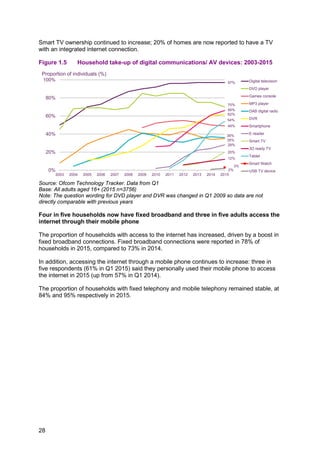
Fifteen per cent of adults did not have household access to the internet in Q1 2015.
The majority of these said they did not intend to get access (12%); a further 1% of
respondents were not sure if they were likely to get access, and 2% said they were
likely to get access in the next 12 months
339
5.2.2 Internet take-up, by platform
Almost eight in ten households now have fixed broadband access at home
Home internet access continues to grow; 85% of adults had access in Q1 2015, a rise of
three percentage points since Q1 2014. In particular, fixed broadband has increased by five
percentage points, standing at 78% in Q1 2015, while mobile broadband (via a dongle or
built-in cellular connection) dropped two percentage points to 6% of UK adults. Overall, total
home broadband access rose from 77% to 80% year on year.
The rate of growth of internet access on a mobile phone, although still an upward trend, has
slowed in the past year, gaining just four percentage points (61% of UK adults in Q1 2015
vs. 57% in Q1 2014).
Figure 5.12 Household internet access: 2005-2015
Source: Ofcom Technology Tracker. Data from Q1 of each year 2005-2013, then wave 1 2014-2015.
Base: All adults aged 16+ (n=3756).
Note 1: ‘Internet on mobile’ is the % of adults who use a mobile phone for any of the following
activities: Instant messaging, downloading apps or programs, email, internet access, downloading
video, video streaming, visiting social networking sites.
Note 2: From Q1 2009 the ‘internet’ figure includes those who access the internet on mobile phones.
QE2: Do you or does anyone in your household have access to the internet/ World Wide Web at
home (via any device, e.g. PC, mobile phone etc)? QE9: Which of these methods does your
household use to connect to the internet at home?
Note 3: Mobile broadband is connecting a device using a USB stick or dongle, or built-in connectivity
in a laptop or netbook or tablet computer with a SIM card
Ninety-five per cent of households with broadband say they use a wireless router
In Q1 2015, 95% of households with a broadband connection used a wireless router. A
wireless router, or WiFi router, enables a household to share its internet connection over a
wireless local area network with devices that have a WiFi adapter or an embedded wireless
module. An alternative to the use of a WiFi router is a wired router or modem (which plugs
into a computer).
Proportion of adults (%)
60 60
64 67
73 75 77 79 80 82 85
31
41
52
58
68 71 74 76 75 77 80
65 65 67
72 72 73 78
20 21
32
39
49
57
61
12 15 17
13
5 8 6
0
20
40
60
80
100
2005 Q1 2006 Q1 2007 Q1 2008 Q1 2009 Q1 2010 Q1 2011 Q1 2012 Q1 2013 Q1 2014 W1 2015 W1
Internet
Total
broadband
Fixed
broadband
Internet on
mobile
Mobile
broadband
340
Figure 5.13 Wireless router take up in broadband homes: 2007-2015
Source: Ofcom Technology Tracker. Data from Q1 2007-2013, wave 1 2014-2015
Base: Wireless router take-up - adults aged 16+ with a broadband connection at home. From 2009
this is based on fixed broadband connections only.
QE28 (QE35): Do you or anyone in your household use a fixed wireless internet connection at home
(Wi-Fi)?
5.2.3 Take-up and use of internet-enabled devices
As seen in Figure 5.14, there are now many different ways in which people access the
internet, depending on availability and device, and users’ awareness that they are online can
vary depending on the device or service being used. For example, going online to browse
the internet requires the user to physically click into a website or browser, but downloading a
book from the internet using an e-reader is done in a less overt way: the user may not be
aware that they are online.
The largest increase in internet-enabled device ownership is for tablet computers
Smartphones have become one of the most widely owned internet-enabled devices by Q1
2015, and are present in two-thirds of households (66%), on a par with laptops at 65%.
However, the largest increase was seen in the ownership of tablet devices with over half
(54%) of households now owning at least one tablet computer, a year-on-year increase of
ten percentage points.
Ownership of smart TVs has also increased; a fifth of households (20%) now claiming
ownership, an increase of nine percentage points since Q1 2014.
Smartwatches are included for the first time in our monitoring. Currently, 3% of households
claim to own a smartwatch. The consumer research was carried out before the Apple Watch
went sale in April 2015, and this may help drive increases in the future. Other watches on
the UK market include those from manufacturers including LG, Motorola and Samsung,
which use a version of Android, and Pebble watches, which launched in 2013 and which use
PebbleOS.
Use within broadband households (%)
34
44
52
66
75
85
89
93 95
0
20
40
60
80
100
Q1 2007 Q1 2008 Q1 2009 Q1 2010 Q1 2011 Q1 2012 Q1 2013 W1 2014 W1 2015
341
Figure 5.14 Ownership of internet-enabled devices
Source: Ofcom Technology Tracker, W1 2015
Base: Adults aged 16+ n = 3756
Note: IP-enabled devices include laptop, games console (Xbox 360, PS3, Wii/Wii U), desktop PC,
smartphone, portable games console (Nintendo DS range, PlayStation Portable/Vita), VOD STB (all
Virgin TV customers, Sky+ HD, BT TV, TalkTalk TV and YouView), e-reader, tablet, netbook, smart
TV, and HDMI device (Roku, Chromecast, Now TV).
*E-reader and smartwatch take-up stated here is per household while elsewhere in the report we
state figures by individual take-up. Smartwatches were not included in the survey prior to 2015.
Internet connectivity is being added to cars and to home control systems, examples of what
is known as ‘the internet of things’. In the car industry, manufacturers are developing
connected car products. These either use smartphones for connectivity (for instance
Google’s Android Auto106 and Apple’s CarPlay107), or built-in 4G connections, like
Vauxhall’s OnStar 4G service, which launched in mid-2015108. There have also been
developments in adding internet connectivity to energy, lighting and security systems.
However, take-up of these ‘smart home’ products, which allow home systems and
appliances to be monitored and controlled remotely via a browser or app, remains low.109
People living in a DE household are more likely to own a games console than a tablet
There are differences in take-up of internet-enabled devices by socio-economic group.
Figure 5.15 shows that those in DE households are more likely to own an internet-enabled
games console than a tablet device (43% and 37% respectively). Two-thirds (66%) of those
in AB households claim to own a tablet, compared to just under four in ten (37%) of those in
DE households.
106
https://www.android.com/auto/
107
https://www.apple.com/uk/ios/carplay/
108
http://www.vauxhall.co.uk/onstar/index.html
109
In December 2014 – January 2015, 4% of online adults said that their family had a ‘smart meter
(e.g. independently controlled central heating)’ while 3% said that their family had ‘Any smart
appliance (e.g. independently controlled fridge, oven, etc.)’ (q1g_2 YouGov Device Connectivity 2015)
66 65
54
47
38 34 28
20 20
8
5 3
0
20
40
60
80
Smart
phone
Laptop Tablet Games
console
VOD
STB
Desktop E-reader* Portable
games
console
Smart
TV
Netbook HDMI
device
Smart
Watch*
Year-on-year difference
+5 +2 +10 +/-0 +/-0 -1 +4 -4 +9 +/-0 +1 N/A
Household take-up (%)
342
Figure 5.15 Take-up of internet-enabled devices, by socio-economic group
Source: Ofcom Technology Tracker, W1 2015
Base: Adults aged 16+, AB n = 828, C1 n = 1120, C2 n = 781, DE n = 1026
Note: Ranked by overall household ownership
Smartphones are the most commonly owned internet-enabled device among those
aged under 55
Smartphones are the most commonly owned internet-enabled device among all age groups
up to the 55+ group. Almost three times as many young people aged 16-24 own a
smartphone compared to the over-55s (90% vs. 32%). The difference in ownership of games
consoles is even more dramatic; 16-24 year olds are more than four times as likely to own
this type of connected device compared to those aged 55+ (75% vs. 17%). Although overall
tablets are the third most popular internet-enabled device, for those aged 55+ they are the
second most popular after laptops (48% own a laptop, 37% own a tablet).
Figure 5.16 Take-up of internet-enabled devices, by age
Source: Ofcom Technology Tracker, W1 2015
Base: 16-24 = 514, 25-34 = 606, 35-54 = 1189, 55+ = 1447
Note: Ranked by overall household ownership
Proportion of adults (%)
72
78
66
44 42
47
38
19
26
13
2 3
71 73
58
50
38
34 32
25
21
9
3 5
63
60
52 50
40
35
25
21
18
7
3 3
56
45
37
43
29
21
14 16 14
3 2 2
0
20
40
60
80
100
Smart
phone
Laptop Tablet Games
Console
VOD
Box
Desktop E-reader Portable
Games
Console
Smart
TV
Netbook USB TV
device
Smart
Watch
AB C1 C2 DE
Proportion of adults (%)
90
73
60
75
37 35
27 28
21
10
1
6
87
68
61
64
37
23
30
26
22
6 4 5
80
76
64 63
46
39
34
29 27
12
3 4
32
48
37
17
30
35
21
6
12
5
1 1
0
20
40
60
80
100
Smart
phone
Laptop Tablet Games
Console
VOD
Box
Desktop E-reader Portable
Games
Console
Smart
TV
Netbook USB TV
device
Smart
Watch
16-24 25-34 35-54 55+
343
Almost two-thirds of those aged 35-54 own a tablet computer
Just over half (54%) of adults claimed to own a tablet device in Q1 2015. However, this
increases to almost two-thirds (64%) of 35-54s. Although over-55s are the age group least
likely to own a tablet, ownership here has increased more than nine-fold in the three years to
Q1 2015 (from 4% to 37%). Tablets are less likely to be owned in C2DE households than in
ABC1 households (44% and 62% respectively) but ownership among C2DEs has increased
faster than among ABC1s since Q1 2012 (growing from 6% to 44% vs. 15% to 62).
Figure 5.17 Tablet ownership, by age and socio-economic group: 2012-2015
Source: Ofcom Technology Tracker. Data from Q1 of each year 2012-2013, then wave 1 2014-2015
Base: All adults aged 16+, 2012=3772, 2013=3750, 2014=3740, 2015=3756
QE1: Does your household have a PC, laptop, netbook or tablet computer?
The average UK household owns four different types of internet-enabled device
On average, households in the UK own four different types of internet-enabled device110
,
with 89% of households having at least one internet-enabled device in their household.
Almost seven in ten (69%) UK households have three or more internet-enabled devices.
110
The sum of unique types of device (10238) divided by the sum of respondents (2673) equates to
3.8 different internet-enabled devices per household. This increases to 4.2 if we exclude respondents
without any connected devices (net figure 2411)
11 14 11
15
4
15
6
24 27 28
33
11
31
16
44
49 51 53
28
51
35
54
60 61 64
37
62
44
0
20
40
60
80
Total 16-24 25-34 35-54 55+ ABC1 C2DE
2012 2013 2014 2015
Household take-up (%)
344
Figure 5.18 Number of different internet-enabled devices per household, Q1 2015
Source: Ofcom research, Q1 2015, Base: Adults aged 16+ n = 2673
Note: IP-enabled devices include laptop, games console (Xbox 360, PS3, Wii/Wii U), desktop PC,
smartphone, smartwatch, portable games console (Nintendo DS range, PlayStation Portable/Vita),
VOD Box (all Virgin TV customers, Sky+ HD, BT Vision, TalkTalk TV and YouView), e-reader, tablet,
netbook, smart TV and HDMI device.
The average UK household is most likely to own a laptop, smartphone, games
console and VoD set-top box
Of the 89% of homes that currently own at least one internet-enabled device, Figure 5.19
shows the likelihood of device ownership as the number of internet-enabled devices
increases in a household. For example, 53% of homes with two different types of internet-
enabled device own a laptop, while 31% of homes with seven different internet-enabled
devices own a smart TV.
Figure 5.19 provides an indication of the most likely order in which consumers adopt
different internet-enabled devices. As the number of different internet-enabled devices
increases, four tiers of device adoption emerge. Laptop computers and smartphones are the
most likely devices to be adopted in an average household of four devices, while smart TVs
are the least likely to be adopted. VOD set-top boxes, games consoles and tablets are the
second tier, with approximately equal likelihood of being adopted (50-60%), while e-readers
and portable games consoles are the third tier most likely to be adopted (18-21%).
10.0 10.0
12.0
14.0
15.0
14.0
12.0
7.0
4.0
2.0
1.0
0.1 0.0
0
25
50
75
100
0
5
10
15
20
None One Two Three Four Five Six Seven Eight Nine Ten ElevenTwelve
n number of different devices
Own n no. of devices
Own at least n no. of devices
Proportion of households(%)
345
Figure 5.19 Device ownership, by number of different internet-enabled devices in
the household
Source: Ofcom research, Q1 2015, Base: Adults aged 16+with at least one IP-enabled device n =
2411
Note: IP-enabled devices include laptop, games console (Xbox 360, PS3, Wii/Wii U), desktop PC,
smartphone, smartwatch, portable games console (Nintendo DS range, PlayStation Portable/Vita),
VOD Box (all Virgin TV customers, Sky+ HD, BT Vision, TalkTalk TV and YouView), e-reader, tablet,
netbook, smart TV and HDMI device.
Smartphones are now the most important device for internet access
Smartphones are considered the most important device for accessing the internet (33% of
internet users in Q1 2015), closely followed by laptops (30%). This is in contrast to figures
from the same period in 2014, when laptops were considered the most important (40% of
internet users) and smartphones by just 22% of internet users.
The most important device varies across age groups; 16-24 year olds and 25-34 year olds
are more likely to claim that their smartphones are most important (60% and 46%
respectively), while laptops (36%) are the most popular choice among over-55s, followed by
desktops (27%) and tablet devices (22%).
There are some differences by other demographics: women are significantly more likely than
men to claim the tablet computer as most important (22% vs. 17%); and those in DE
households are more likely to claim the smartphone as most important, compared to AB
households in particular (41% vs. 25%).
0%
20%
40%
60%
80%
100%
1 2 3 4 5 6 7 8
Number of different internet-enabled devices in household
Laptop
Smartphone
VOD Box
Games console
Tablet
Desktop PC
E-reader
Portable games
console
Smart TV
Netbooks
HDMI
346
Figure 5.20 Most important device for internet access
Source: Ofcom Technology Tracker, W1 2015
Base: All adults aged 16+ who use the internet at home or elsewhere (n = 3095 UK).
QE11(QE40): Which is the most important device you use to connect to the internet, at home or
elsewhere? ‘Other’ responses include: ‘netbook’, ‘games console’, ‘other device’, ‘none’ and ‘don’t
know’.
comScore
The UK Online Measurement Company (UKOM) was formed in 2009 with a mandate from
the advertising industry to establish measurement standards for digital media. In 2011,
comScore was appointed the sole data supplier for UKOM on a three-year contract from
January 2013.
This chapter predominantly draws on three comScore sources:
1. For analysis of laptop and desktop computer internet activity only, we use comScore
Media Metrix (MMX) which employs comScore’s Unified Digital Measurement (UDM)
methodology, explained below.
2. For analysis of mobile internet and app activity only, on Android and iOS smartphones,
iPads and Android tablets, we use comScore Mobile Metrix (MoMX) which also employs
comScore’s Unified Digital Methodology for Android and iOS smartphones and iPads.
Android tablet use is captured on tagged entities.
3. For analysis of internet activity across platforms, we use comScore MMX MultiPlatform
(MMX-MP) which provides unduplicated metrics across laptop and desktop computers,
mobile devices and video.
Finally, mobile phone user behaviours are supplemented by consumer research from
comScore MobiLens (this is not part of the data suite endorsed by UKOM).
Methodology
comScore’s UDM methodology combines panel and census measurement techniques to
obtain digital audience measurement statistics. UDM uses comScore’s global measurement
panel to determine audience reach and demographics. Census-level activity is captured from
publishers’ digital content, such as on websites, videos, and computer and mobile
applications. comScore combines census-level data with those captured from the panel to
help provide a more accurate view of audiences and their consumption habits. This
approach allows comScore to capture more accurate consumption activity from publishers,
33 32 34
60
46
31
10
25 31 37 41
30 31 29
21
25
33
36
32
35 28 25
19 17 22
11
17
22
22
23
19 19 15
14 17 11 4 8 11
27
17 12 13 14
0%
20%
40%
60%
80%
100%
UK
Male
Female
16-24
25-34
35-54
55+
AB
C1
C2
DE
Gender Age group Social group
Other
Desktop
Tablet
Laptop
Smartphone
Internet users (%)
347
and attribute this to audience demographics in a way that is not affected by cookie deletion,
blocking, and rejection.
Metrics
Throughout this report we make reference to a number of metrics as defined below:
Unique audience – the total number of unique persons who visited a website or used an
application at least once in a given month. Persons visiting the same website more than
once in the month are therefore counted only once in this measure.
Active audience – the total number of people who visited any website or used any
application at least once in a given month; i.e. the number of people online and using any
specific platform in a given month, no matter which website or app they used.
Digital audience – the active audience across all digital platforms (laptop/desktop
computers, Android and iOS smartphones, iPads and, for those sites who have tagged in
comScore’s census network, Android tablets).
Active reach – the proportion of the active audience made up by the unique audience of a
website.
Time spent per month – the average time spent browsing a website per unique visitor per
month (excludes time spent watching online video and listening to streamed music, and for
mobile audiences excludes any traffic over a home or public WiFi connection).
Dictionary
Each of the entities reported by comScore is attributed to a level in comScore’s Client
Focused Dictionary. Several entities (including apps) can exist within one service (e.g. BBC
Sport and BBC iPlayer) and comScore’s dictionary defines how these entities are structured
and related to each other. It is client-focused because comScore’s clients define how their
websites appear in reports according to this dictionary. All comScore reports use the same
six-tiered dictionary structure, as explained below:
Property [P] - The highest level of reporting within the dictionary. Properties represent all full
domains (i.e. felmont.com), pages (i.e. sports.felmont.com/tennis), applications or online
services under common ownership or majority ownership for a single legal entity. A property
may also contain any digital media content that is not majority-owned but has been legally
signed over for reporting purposes by the majority owner.
Media Title [M] - A Media Title is an editorially and brand-consistent collection of content in
the digital landscape that provides the marketplace with a view of online user behaviour.
This may represent a domain, a group of domains, online service or application.
Channel [C], SubChannel [S], Group [G] and SubGroup [SG] - Within a Media Title there
may be grouped URLs of editorially consistent content that make up a Channel. For some of
the largest Media Titles, Channels themselves may be broad, and Subchannels, Groups and
Subgroups within the larger Channels may prove useful for categorisation within the
comScore Dictionary.111
111
“Glossary – Key Terms for comScore Dictionary”, comScore.
348
Changes in measurement of cross-platform and mobile audiences
In this report we use comScore MMX Multi-Platform (MMX-MP) to analyse website and app
use across laptop and desktop computers, mobiles and tablets, as well as video use. The
digital audience is an unduplicated unique audience across each of these.
Until December 2014, comScore MMX Multi-Platform drew from the comScore GSMA MMM
product, which was unique to the UK. This product relied on network and server data
provided to comScore by the mobile operators. Demographic splits of these data were
modelled and informed by the output of comScore’s MobiLens survey of mobile users in the
UK.
Since January 2015, comScore has replaced the GSMA MMM product for UKOM mobile
measurement with Mobile Metrix (MoMX), a product used in comScore’s other markets
around the world. In contrast to data from the GSMA MMM product which captured network
traffic across all smartphones and feature phones, Mobile Metrix employs comScore’s
Unified Digital Measurement approach, which draws on both panel data, and data from
tagged online entities. Currently the panel includes users of Android smartphones, Apple
iPhones and iPads, while use of Android tablets is captured on entities through tagging.
The changes in methodology between GSMA MMM and MoMX have several implications.
First, the use of feature phones (i.e. phones that can go online but which are not
smartphones) and non-Android/iOS or smartphone and tablet use, are currently outside the
measurement scope of MoMX. Second, MoMX captures both WiFi and cellular traffic and
offers measurement of both browser and app use. MoMX also captures encrypted web traffic
(i.e. sites that begin ‘https://’,used by many sites, such as Twitter to enhance security). Due
to the way that GSMA MMM data are collected, traffic to sites that use encryption may be
under-reported in the GSMA MMM numbers.
The differences in methodology between GSMA MMM and MoMX mean that comScore
advises that direct comparisons should not be made between mobile and multi-platform data
between 2014 and 2015, as both the total base, and what is measured, differ. For this
reason, in this year’s report we do not reproduce certain charts from previous years which
rely on mobile or multi-platform audience measurement data. We expect that time series
data will be available in future years. Except where explicitly stated, in the figures below
using MoMX, ‘mobile’ relates to both smartphones and tablets and includes iPhones and
iPads (running iOS) and also Android tablets for tagged entities.
For further details on the change in methodology, please see:
http://www.ukom.uk.net/news/from-gsma-mmm-to-mobile-metrix-the-evolution-of-uk-mobile-
media-measurement
Despite these caveats, we consider that a multi-platform assessment of the web entities in
this chapter best reflects consumers’ web and app consumption across devices. We use
single-platform measures where time-trend analysis or specific platform analysis is
appropriate, and for time series data relating to mobile phone use, we draw from MobiLens
data.
349
5.2.4 The internet audience and time spent online
The UK’s total digital audience stood at 47.5 million people in March 2015
The total UK digital audience i.e. the online population active on laptops, desktops or mobile
devices, stood at 47.5 million in March 2015; the total active mobile audience (on mobile
devices) was 36.4 million.
There was little movement in the active audience (the total number of people who visited any
website or used any application at least once in a given month) on a desktop or laptop
between March 2014 (45.3 million) and March 2015 (45.1 million).
Due to the change in comScore’s methodology for measuring mobile audiences, year-on-
year comparisons for active mobile and digital audiences are not available.
Figure 5.21 Active internet audience: March 2015
Source: comScore MMX,UK, home and work panel, March 2015; comScore MMX-MP, March 2015;
comScore MoMX UK, March 2015.
Note: ‘Digital audience’ is the unique audience across desktop/laptops and mobile. ‘Mobile audience’
includes Android smartphones and iOS smartphones and tablets. Only those entities that have been
tagged as part of the census network report Android tablet usage data.
Men spend more time online than women on laptops and desktops
Across all age groups, men spent more time online than women on a laptop or desktop
computer in March 2015. Male users in the 35-44 age group spent the greatest amount of
time online at work and home, at 42 hours 9 minutes (42.2 hours). Among female users,
those aged 45-54 spent the most time online on a laptop or desktop computer, at 37 hours
10 minutes (37.2 hours).
The average amount of time spent online by users on smartphones in March 2015
exceeded that spent browsing on desktops and laptops
On average, the UK digital audience spent 88 hours 54 minutes (88.9 hours) online in March
2015, across desktop and laptop computers as well as smartphones and tablets. The mobile
audience averaged a total of 58 hours 39 minutes (58.6 hours) online on their smartphones
via a browser or app. The average time spent browsing on laptops and desktops in March
47.5
45.1
36.4
0
10
20
30
40
50
Digital audience Laptop and desktop audience Mobile audience
Million
350
2015 was 31 hours 19 minutes (31.3 hours), in line with the figure of 31 hours 24 minutes in
March 2014, representing a fall of 0.3% year on year112
.
Figure 5.22 Average time spent online: March 2015
Source total digital audience: comScore MMX-MP, UK, March 2015, (bases include ages 6+ for
desktops/laptops, 18+ for mobile devices;
Source all smartphones: comScore MoMX, UK, 18+, March 2015.
Source laptops and desktops: comScore MMX, home and work panel, UK, 6+, March 2015;
Note: All smartphones, includes iPhones and Android handsets, browser and application use.
Figure 5.23 Average time online on a laptop/desktop, by age and gender: March
2015
Source: comScore MMX, home and work panel, UK, March 2015
Note: Time spent online is a measure of time spent browsing web pages on laptop and desktop
computers only. It excludes time spent accessing other media such as audio or video content
112
The time spent browsing on smartphones is for smartphone users aged 18 and over. The time
spent on laptops and desktops includes all users aged 6 and over. The average amount of time spent
online through a desktop or laptop by adults aged 18 and over was 35.6 hours.
88.9
58.6
31.3
0
20
40
60
80
100
Total digital audience All smartphones (browser &
app combined)
Laptop and desktops
Hours
37.9
6.5
31.3
41.1 42.2
40.0
32.433.3
6.2
27.5
34.6
36.9 37.2
27.2
0
10
20
30
40
50
Adults (18+) 6-14 15-24 25-34 35-44 45-54 55+
Male
Female
Hours
351
Women spend more time than men going online using smartphones
With the exception of the 45-54 age group, women spent more time online on their
smartphones in March 2015. Adult men spent on average 55 hours 40 minutes (55.7 hours)
online on smartphones, compared to 61 hours 35 minutes (61.6 hours) for women. For both
men and women, the 18-24 age group spent most time online, at 69 hours 56 minutes for
men (69.9 hours), and 76 hours 51 minutes (76.8 hours) for women, while the 55+ age
group spent least time.
Figure 5.24 Average time online on a smartphone, by age and gender: March 2015
Source: comScore MoMX, UK, March 2015. Browser and application access combined. Note:
Includes Android and iOS smartphones
5.2.5 Digital inclusion
Four in five offline homes do not intend to take up the internet
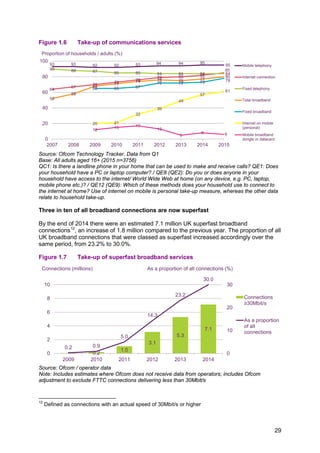
Fifteen per cent of adults (15%) did not have household access to the internet in Q1 2015.
The majority of these claimed that they did not intend to get access (12%); 1% of
respondents were not sure if they were likely to get access, and 2% said they were likely to
get access in the next twelve months.
55.7
69.9
60.2 61.4
51.7
37.8
61.6
76.8 75.6
68.9
43.0 42.6
0
20
40
60
80
Adults (18+) 18-24 25-34 35-44 45-54 55+
Male
Female
Hours
352
Figure 5.25 Internet take-up and intentions: 2008-2015
Source: Ofcom Technology Tracker. Data from Q1 of each year 2008-2013, then wave 1 2014-2015
Base: All adults aged 16+ (5812 in 2008, 6090 in 2009, 9013 in 2010, 3474 in 2011, 3772 in 2012,
3750 in 2013, 3740 in 2014, 3756 in 2015).
QE2/ QE24 – Do you or does anyone in your household have access to the internet / World Wide
Web at home (via any device)? / How likely are you to get internet access at home in the next 12
months?
Almost half of the adults without home broadband did not think they needed it
Ofcom research shows that 44% of adults who did not have a home broadband connection
in Q1 2015 did not think they needed one (Figure 5.26). This was the most frequently-cited
reason given for not having home broadband.
The second most frequently-cited reason for not having home broadband connection was
that the respondent did not want to own a computer (22%), while 21% believed that home
broadband was too expensive, 20% said that they were too old to use the internet, and 17%
did not believe that they had the knowledge or skills to use it. Twelve per cent said they were
likely to get a home broadband connection in the next year. There were no significant
differences for any of these answers when compared with last year.
Figure 5.26 Main reasons for not having a home broadband connection
Source: Ofcom Technology Tracker. Data from Q1 2012-2013, wave 1 2014-2015
Base: All adults without the internet aged 16+ (n=681)
QE31(QE25A): Why are you unlikely to get internet access at home in the next 12 months?
Adults (%)
65
70 73 76 79 80 82 85
6
5
5 4
4 3 2
2
8 3
4 3
2 2 2
121 22
17 17 15 14 14 12
0%
20%
40%
60%
80%
100%
2008 2009 2010 2011 2012 2013 2014 2015
Don't intend to get
Don't know if will
get
Likely to get in
next 12 months
Internet
connection at
home
41
25
19 18 18 17
44
25
18
16 15 15
46
23
15
22
20
13
44
22
17
21 20
12
0
10
20
30
40
50
Don't need it Don’t want a
computer
Don't have
knowledge / skills
Too expensive Too old to use
internet
Likely to get in
next year
2012 2013 2014 2015
Proportion of those without broadband (%)
353
Note: 3% of people without the internet in Q1 2015 did not know what their main reason was or
provided an ‘other’ reason
Over half of non-users do not think there any advantages to their being online
According to Ofcom’s latest Adult Media Use and Attitudes Report,113
14% of UK adults are
not online (for any reason) and are more likely to be aged over 65, and in DE households.
Non-internet users were prompted with seven possible benefits of being online and were
asked to say which of these, if any, would be the main advantages to them. Although just
over half (52%) did not think there were any advantages to them being online, just over a
third (34%) agreed that there would be some benefits, especially in being able to find
information quickly (22%).
Figure 5.27 Perceived advantages of being online, among internet non-users
Source: Ofcom research, fieldwork carried out by Saville Rossiter-Base in October to November 2014
Base: Adult aged 16+ who do not go online at home or elsewhere (281)
IN12 Which, if any, of the following do you think would be the main advantages to you of being
online? Can you think of any other advantages for you personally in being online? (prompted
responses, multi-coded)
113
http://stakeholders.ofcom.org.uk/binaries/research/media-literacy/media-lit-
10years/2015_Adults_media_use_and_attitudes_report.pdf
14
34
2
3
5
6
9
11
22
52
Don't know
ANY OF THESE ADVANTAGES
Finding a job or course to do
Watching TV programmes or films or playing games online
Finding out about and applying for social services or
completing government processes
Being more independent/ less dependent on other people
to do things for me like booking things or ordering things
Getting the best deals and saving money
Staying in touch with people, making free phone/ video
calls, share photos
Finding information quickly (for example about news,
weather, sport, hobbies health etc.)
I don't think there are any advantages to me being online %
354
5.3Online content
5.3.1 Introduction
This section explores the content and services that people access online
• Section 5.3.2 gives an overview of the activities UK consumers use the internet for,
and the most popular websites, by unique audience and time spent.
• Section 5.3.3 looks at the most popular mobile app downloads in March 2015.
• Section 5.3.4 focuses on search engines and their popularity over time and across
platforms.
• Following on from our research in section 1.8, Section 5.3.5 provides further details
on the take-up and use of social networking.
• Section 5.3.6 looks at the reach and audience over time of video sharing websites
such as YouTube and Vimeo, across different platforms.
• Section 5.3.7 looks at video games, including take-up of game distribution and
streaming services.
• Section 5.3.8 looks at online and mobile retail and mobile payments in the UK.
• Section 5.3.9 looks at online news consumption, and concludes by looking at the use
of online video for hyper-local news and information.
• Section 5.3.10 examines trends in digital advertising.
The key findings from this section of the report are:
• Google-owned services (including YouTube) remained the most-visited across
laptop/desktop and mobile devices, with 46 million visitors in March 2015.
Facebook’s sites and apps had the second highest total audience, followed by those
of the BBC.
• The digital audience of YouTube was 41.5 million visitors in March 2015. More
people visited YouTube on an Android or iOS smartphone/tablet (27.1 million)
than on a desktop or laptop (24.9 million). The numbers of people accessing
YouTube on a desktop or laptop computer have fallen for the second consecutive
year.
• Facebook’s digital audience was 40.7 million users across laptops/desktops,
and smartphones and tablets in April 2015, giving it an active reach of 86% of
the digital population. Other social networking services with an active reach of over
40% include Twitter (21.6 million unique visitors and 46% reach), LinkedIn (20.7
million and 44% reach) and Google+ (20.2 million and 43% reach).
• In March 2015 the digital audience spent more time on Facebook-owned
website and apps (51 billion minutes) than on any other. In total, people spent 34
billion minutes on Google’s websites and apps, and around 10 billion minutes on
those of the BBC.
355
• Overall, use of mobile phones to make a purchase was around one in four
(26%) mobile internet users in March 2015, consistent with use in 2014, although
only 6% had used their handset to make a payment at the physical point of sale.
• While TV remained the most popular way for people to get their news (85% of
UK adults) in Q1 2015, four in ten adults (39%) said they got news from a
website or app.
• One in four (26%) internet users said they had used an app or website from a
local newspaper, TV channel or local radio station to access news or content
about where they live or work. A similar proportion (24%) said they had used any
other website or app dedicated to a local area. Eighteen per cent said they had
watched hyper-local video content on via a social networking service such as
Facebook or Twitter.
• UK digital advertising rose by 15% to £7.2bn in 2014 and accounted for 39% of
estimated UK advertising expenditure. Drivers of this growth included increases
in mobile advertising, broadcaster VoD advertising, and national and regional digital
print advertising.
• Mobile display advertising almost doubled on a like-for-like basis between 2013
and 2014, growing by 96%. Overall reported expenditure grew from £424m in 2013
to £769m in 2014.
5.3.2 Overview
Sending and receiving email remains the most common internet activity, after general
browsing
In 2015 claimed use of the internet, for any of the activities asked about, was in line with the
2014 figure. In Q1 2015 general browsing was the most popular internet activity (at 85%),
carried out by 75% of adults in the past week. Sending and receiving email was the second
most popular activity, with almost seven in ten adults (68%) doing this in the past week and
over eight in ten doing it ‘ever’ (83%).
More than half of online UK adults (56%) claimed to use the internet for social networking
sites, and 44% did so on a weekly basis. Almost half of internet users (46%) had used
internet banking in the past week (61% total), and 32% had purchased goods or services
online (62% total). Over half of UK adults (54%) claimed they had watched TV or video
online in Q1 2015, with 37% having done so in the past week, while 37% had watched short
video clips, 23% in the past week.
356
Figure 5.28 Claimed use of the internet for selected activities
Source: Ofcom Technology Tracker, W1 2015
Base: All adults aged 16+ who use the internet at home or elsewhere (n = 3095 UK)
QE5. Which, if any, of these do you use the internet for?
Use of the internet by SMEs
While the focus of this section is on internet use as a whole, we note that businesses, in
particular small and medium-sized enterprises (those with up to 250 employees) use the
internet in a range of ways, which may differ from the way residential consumers may use it.
In October 2014 we published some consumer research on how SMEs in the UK use the
internet. Our research found that almost all SMEs (with fixed internet) said that they used
email (97%), used the internet for web access (89%), and ordered goods and services online
(83%).
Top ten internet applications for SMEs
Source: Ofcom research. Fieldwork April – June 2014QA10a: Which if any of the following internet applications does your
organisation use for business purposes?
Base: All with fixed internet (Total n=1267, 1-4 n=471, 1-9 n=737, 10-49 n=301, 50-249 n=229).
7
11
12
10
16
12
14
21
23
14
25
31
37
44
46
32
68
72
95
6
9
12
15
12
21
19
12
14
24
17
15
17
12
15
30
15
13
2
13
20
24
25
28
33
33
33
37
38
42
46
54
56
61
62
83
85
97
0% 20% 40% 60% 80% 100%
Streaming audio services
Listening to radio
Uploading/ adding content to internet
Trading/auctions
Finding/ downloading info for college
Using local council/ Government websites
Downloading music
Playing games
Watching short video clips
Finding health information
Finding/ downloading info for work
Instant messaging
TV/ Video viewing
Using social networking sites
Banking
Purchasing goods/services
Sending and receiving email
General surfing/browsing
Any
Used in the past week
Use less often
Adults (%)
42
57
59
62
69
72
74
83
89
97
0 10 20 30 40 50 60 70 80 90 100
Taking orders for goods online
Looking for general business advice
Looking for advice on regulation
Paying for goods/services via BACS
Company website
Using HMRC services
Online banking
Ordering goods and services online
Web access
Email
SMEs with fixed internet (%)
357
Just below the ten most commonly cited reasons for using the internet, four in ten (39%)
SMEs said they also used the internet for marketing purposes; over half (52%) of larger
SMES (50-249 employees) said they did this. Among online marketing users, 85% said they
used Facebook, 45% Twitter and 42% LinkedIn.
Overall, 23% of SMEs using a fixed internet service said they were using cloud services,
although this was higher among larger SMEs (35% of businesses with 50-249 employees).
For more details of Ofcom’s work on the provision of broadband services to SMEs, including
more details of the research, please see http://stakeholders.ofcom.org.uk/market-data-
research/other/telecoms-research/smes-research-jun15/
Google’s services remain the most-visited websites and apps across laptop and
desktop, mobile and tablet devices, with 46 million UK visitors in March 2015
To identify those organisations with the largest total online audiences across all of their
services we report against an organisation’s comScore property (the sites and apps owned
by the organisation).
In March 2015, Google’s services were visited by 46 million users in the UK, with Facebook,
and the BBC, in second and third places with 41 and 40 million unique visitors respectively.
Three of the ten most popular comScore internet properties in the UK were organisations
based in the UK, i.e. the BBC, Mail Online/Daily Mail and Sky sites.
The unique audience of the Google Sites comScore Property reflects the significant
audiences for the services that are captured within this, including Google Search and
YouTube, which we look at in more detail in the following sections.
Figure 5.29 Top ten most popular comScore Properties among the digital audience:
March 2015
Source: comScore MMX-MP, UK, March 2015
Notes: All sites listed are at the Property level [P]. Please note MMX Multi-Platform includes
laptop/desktop browsing, laptop/desktop video streams and mobile use. Mobile use includes Android
smartphones and iOS smartphones and tablets. Only those entities that have been tagged as part of
the census network report Android tablet usage data. Google Sites included YouTube.
46
41 40
37 37
33 31
28 28 27
0
10
20
30
40
50
Google Sites Facebook BBC Sites Microsoft
Sites
Amazon
Sites
Yahoo Sites eBay Mail Online /
Daily Mail
Sky Sites Apple Inc.
Unique audience (millions)
358
People spend most time with websites and apps owned by Facebook
In March 2015, UK visitors to Facebook’s services spent 51 billion minutes on them across
desktop, laptop and mobile devices. In contrast, the multiplatform audience spent 34 billion
minutes on Google’s properties.
Although not in the top ten properties by reach in the digital audience, Netflix.com’s position
as eighth in total minutes reflects the fact that users spent on average 7.5 hours each (3.22
billion minutes in total) in March 2015 on the service.
Figure 5.30 Top ten comScore Properties among the digital audience, by time spent
Source: comScore MMX Multi-Platform, UK, March 2015
Note: All sites listed are at the Property level [P]. Time spent online is a measure of time spent on
laptop/desktop webpage browsing and on-network and WiFi mobile browsing and application data. It
excludes time spent accessing audio content.
5.3.3 Mobile apps
Facebook published the three most downloaded apps in March 2015
The most downloaded app across the iOS App Store and Google Play in March 2015 was
WhatsApp Messenger, followed by the Facebook app and the Facebook Messenger app, all
of which are published by Facebook. Of the top ten most downloaded apps downloaded in
March 2015, two were games (Crossy Road and Candy Crush Saga), another two were
video and/or music (YouTube and Spotify), with the remainder relating to messaging and
social networking.
2.85
3.02
3.22
4.90
5.52
7.98
8.01
9.52
34.16
51.04
0 10 20 30 40 50 60
Sky Sites
Amazon Sites
NETFLIX.COM
eBay
Yahoo Sites
Microsoft Sites
Apple Inc.
BBC Sites
Google Sites
Facebook
Total Minutes (billions)
359
Figure 5.31 Most popular app downloads: March 2015
Source: App Annie Index https://www.appannie.com/indexes/all-stores/rank/overall/?month=2015-03-
01&country=GB
5.3.4 Search
Google remains the most popular search engine
Google Search had a digital audience of 39.6 million across all platforms in March 2014
(83% active reach), followed by Microsoft’s Bing search engine (17.3 million; 36% active
reach) and Yahoo Search (14.0 million; 29% active reach). The same ranking is seen for
desktop and laptop audiences and access on mobile devices.
Figure 5.32 Audience of search engines: March 2015
Source: comScore MMX-MP, comScore MMX, comScore MoMX, UK, March 2015
MMX Multi-Platform includes laptop/desktop browsing, laptop/desktop video streams and mobile use.
‘Total mobile’ includes Android smartphones and iOS smartphones and tablets. Only those entities
that have been tagged as part of the census network report Android tablet usage data.
App Company
1 WhatsApp Messenger Facebook
2 Facebook Facebook
3 Facebook Messenger Facebook
4 YouTube Google
5 Crossy Road HIPSTER WHALE
6 Instagram Facebook
7 Skype Microsoft
8 Snapchat Snapchat
9 Spotify Spotify
10 Candy Crush Soda Saga King
App ranking by number of downloads in UK - iOS and Google Play Combined
39.6
17.3
14.0
32.0
13.4
11.7
21.7
6.3
3.7
0
10
20
30
40
50
Google Search [C] Bing [C] Yahoo Search [C]
Digital Audience Desktop/laptop Total Mobile
Unique audience (millions)
360
5.3.5 Social networking
More than seven in ten online adults have a social networking profile
As discussed in section 1.8.2, more than seven in ten adults in the UK who go online (72%)
have a social media profile, an increase from 66% in 2013. This is more likely among
younger adults, with a majority of internet users aged 16-24 (93%), 25-34 (90%), 35-44
(80%) and 45-54 (68%) having a social media profile, compared to half of 55-64s (49%) and
three in ten aged 65+ (28%).
Facebook’s digital audience is almost twice that of Twitter, LinkedIn and Google Plus
Section 1.8 also provides details on the social networking sites and apps that consumers are
most likely to say they use, from Ofcom’s Adults’ Media Use and Attitudes research. In this
section we look in more detail at the total number of measured unique users for different
social networking services in April 2015.
Facebook continues to be the largest social networking service by number of unique visitors.
In April 2015, Facebook had a digital audience of 40.7 million unique visitors in the UK (86%
of the total digital population), almost twice as many as that of Twitter (21.6 million equating
to a 46% active reach), LinkedIn (20.7 million; 44% active reach) and Google+ (20.2 million;
43% active reach). Instagram, owned by Facebook, was visited by three in ten (30%) of the
UK’s digital population in April 2015, while 20% visited Pinterest and 13% visited MySpace.
UK-based Friends Reunited had 0.2 million unique visitors in April 2015.
As we noted in the introduction, defining social networks and social media has become
increasingly complex as services add new features. While arguably less focused on forming
individual online connections, services such as Pinterest focus more on the sharing of
content around communities of interest, but can also be seen as social networks. In section
5.3.6 we discuss online video sharing services such as YouTube. As our consumer research
in section 1.8 shows, some people use social media features, including personal profiles, on
video-centric services like these114
.
We explore the use of social media for communications further in sections 1.7 and 1.8 of this
report.
114
Some group VoIP and messaging services, such as WhatsApp and Snapchat, are also now being
used in a similar way to more established social media services. While not included in the analysis
below, these are discussed in more detail in section 1.8, and in section 4.1.3 of the ‘Telecoms and
networks chapter.
361
Figure 5.33 Digital audience of social networking services: April 2015
Source: comScore MMX-MP, UK, April 2015
Note: Entities cited from comScore MMX Multi-Platform: FACEBOOK.COM [M], TWITTER.COM [P],
LinkedIn [P], Google Plus [C], INSTAGRAM.COM [M], PINTEREST.COM [P], MySpace [P], Friends
Reunited Group [P]. MMX Multi-Platform includes laptop/desktop browsing, laptop/desktop video
streams and mobile use. Mobile use includes Android smartphones and iOS smartphones and
tablets. Only those entities that have been tagged as part of the census network report Android tablet
usage data.
Facebook’s audience on desktop and laptop computers was 1.1 million higher in April
2015 than in the previous year
Facebook remains the largest social network by audience on desktop and laptop computers
in the UK. In April 2015, its unique audience of 30.1 million (up by 1.1 million) reversed a
trend of declining audiences seen since April 2013. In contrast, Twitter’s unique audience on
desktop and laptop computers fell by 1.5 million, reversing audience increases seen each
April since 2012. LinkedIn’s desktop and laptop audience was stable at 8.9 million, gaining
0.2 million unique visitors in the year to April 2015. Desktop and laptop audiences for
MySpace and Friends Reunited continued to decline, to 0.3 million and 0.2 million
respectively.
Figure 5.34 Unique audience of selected social networking websites on desktop and
laptop computers: April 2012 to April 2015
Source: comScore MMX, UK, home and work panel, April 2012 to April 2015.
Note: Entities cited from comScore MMX: FACEBOOK.COM [M], TWITTER.COM [P], LinkedIn [P],
Google Plus (2012-2014), Google + [C] (2015), MySpace [P], Friends Reunited Group [P]
40.7
21.6 20.7 20.2
14.1
9.4
6.1
0.2
0
10
20
30
40
50
Facebook Twitter Linkedin Google+ Instagram Pinterest Myspace Friends
Reunited
Group
Unique audience (millions) and reach as % total digital audience
86% 46% 44% 43% 30% 20% 13% 1%
31.1
9.7
5.4
2.6
0.7
30.0
10.4 9.1
5.1
1.9 0.9
29.0
10.6
8.7 8.4
0.6 0.4
30.1
9.1 8.9 8.6
0.3 0.2
0
10
20
30
40
Facebook Twitter Linkedin Google+ Myspace Friends
Reunited Group
Apr-12 Apr-13 Apr-14 Apr-15
Unique audience (millions)
362
More people accessed Twitter, Instagram and Pinterest on mobile devices than on
desktop and laptops in March 2015
Among the social networking services below, in all cases, the majority of unique visitors
accessed the service via a mobile device (i.e. an Android or iOS smartphone or tablet) in
April 2015. In the case of Twitter, Instagram and Pinterest, the absolute numbers of unique
visitors on mobile devices was higher; 9.1 million desktop and laptop unique visitors on
Twitter, compared to 16.2 million unique visitors on a mobile device). For Instagram and
Pinterest the respective figures were 3.7 million vs. 11.1 million, and 4.7 million vs. 5.9
million.
Overall, the total number of people who accessed Facebook via a desktop or laptop
computer was similar to the numbers who accessed it via a mobile device (smartphone or
tablet). Looking specifically at smartphone use, 22 million people accessed Facebook via an
app on an Android or iOS smartphone, 2.3 million more than those who accessed it via the
browser on these platforms. App rather than browser access was greater for Twitter,
Google+ and Instagram. In contrast, 1.2 million people accessed LinkedIn via an app on a
smartphone, compared to 9.1 million who accessed it via a browser on a smartphone.
Looking at reach of services across devices, nine in ten (89%) active users of Android or iOS
smartphones accessed Facebook on their handsets in April 2015, compared to two-thirds
(67%) of desktop and laptop users. Among users of smartphones, slightly more accessed
Facebook via the app (76% smartphone users) than the browser (75% smartphone users).
Twitter’s active reach on mobile devices (44%) was more than twice that on laptops and
desktops (20%).
Figure 5.35 Unique audience of selected social networking services, across
devices: April 2015
Source: comScore MMX home and work panel, MMX-MP, MoMX UK, April 2015.
Note: Mobile devices include iOS and Android smartphones, iPads. Android tablets included for
tagged entities. Entities cited include FACEBOOK.COM [M], TWITTER.COM [P], Linkedin [P],
Google+ [C], INSTAGRAM.COM [M], PINTEREST.COM [P]. ‘Mobile’ includes Android smartphones
and iOS smartphones and tablets and Android tablets. Only those entities that have been tagged as
part of the census network report Android tablet usage data. ‘Smartphones’ includes iOS and Android
smartphones.
40.7
21.6 20.7 20.2
14.1
9.4
30.1
9.1 8.9 8.6
3.7 4.7
30.5
16.2 15.4
14.2
11.1
5.9
26.0
11.8
9.6 10.3
8.6
4.0
19.7
7.0
9.1
3.4 2.9 2.4
22.0
7.3
1.2
7.6 7.2
2.3
0
10
20
30
40
50
FACEBOOK.COM TWITTER.COM Linkedin Google+ INSTAGRAM.COM PINTEREST.COM
Total Digital Population Desktop & laptop
Mobile (Browser & App Combined) Smartphones (Browser & App Combined)
Smartphones (Browser) Smartphones (App)
Million
363
5.3.6 Online video-sharing services
YouTube’s audience and reach on smartphones and tablets is higher than that on
desktop and laptop computers
In this section we examine take-up and use of online ‘video sharing’ services. These
services, such as YouTube and Vimeo, generally offer a high proportion of user-generated
content, and videos which are generally shorter than traditional films and television
programmes, and include features to share and comment on the videos. We discuss VoD
services which primarily offer long-form TV programmes and films (both broadcaster catch-
up and library VoD including subscription services such as Netflix) in more detail in section
1.5 in the ‘Market in context’ chapter.
YouTube remains the UK’s most popular online video sharing service, with a total digital
audience of 41.5 million in March 2015, giving it an active reach of 87% across the total
digital population. YouTube’s total mobile audience (which includes tablets) of 27.1 million
exceeds the number of people accessing YouTube on desktop and laptop computers by 2.2
million; its active reach across mobile audiences (74%) is 19 percentage points higher than
its audience on desktops and laptops. One reason for this may be that the YouTube app is
generally included on Android handsets as part of the suite of pre-installed applications.
Other video services with large audiences on mobile devices in March 2015 included Vimeo,
whose digital audience (12.2 million compared to its reported desktop/laptop and mobile
audience figures of 2.5 million and 2.7 million respectively), reflects the fact that the digital
audience figure includes the consumption of embedded videos on desktop and laptop
computers. Twitch.TV is a service that allows users to stream and watch video game-play
footage from console and computer games. It had had a total digital audience of 2.1 million
in March 2015, giving it an active reach of 4% among the population as a whole, although
among the male digital audience aged 15-24 its active reach was 18%. We look at the link
between gaming and short-form content in more detail below.
Figure 5.36 Unique audience for selected online video sharing services: March 2015
Source: comScore MMX, UK, home and work panel, comScore MMX-MP, UK and comScore MoMX,
UK. All March 2015.
Note: MMX Multi-Platform includes laptop/desktop browsing, laptop/desktop video streams and
mobile use. Mobile audience includes Android smartphones and iOS smartphones and tablets. Only
those entities that have been tagged as part of the census network report Android tablet usage data.
41.5
12.2
6.3
4.4
2.4 2.1 2.0
24.9
2.5 2.9
0.6 1.0 1.3 1.5
27.1
2.7 3.3
1.6 0.2 1.1 0.3
0
10
20
30
40
50
YOUTUBE.COM [M] Vimeo [P] DAILYMOTION.COM
[P]
VINE.CO [M] MSN Video [S] TWITCH.TV [P] Yahoo Screen [C]
Digital Audience Laptop & desktop audience Mobile Audience
Unique audience (millions) and active reach %
87% 55% 74% 26% 6% 7% 13% 6% 9% 9% 1% 4% 5% 2% 0% 4% 3% 3% 4% 3% 1%
364
Despite not being a dedicated video-sharing service, claimed use of Facebook for
video on mobile exceeds that of all other video sharing sites except YouTube
Between April 2014 and March 2015, YouTube had consistently the highest reported
claimed use for mobile video, giving rise to average monthly audience of 11.7 million people
aged 13 and above. Facebook is also a key source of online video consumption. Overall,
based on survey data between April 2014 and March 2015, an average of 9 million people
used Facebook on their mobile to watch videos.
Facebook has stated publicly that mobile video is one of its major areas of growth; it
reported that its global video views grew from 1 billion per day in September 2014 to 4 billion
per day by April 2015, of which 75% were on mobiles.115
It should be noted that videos on
Facebook and on other platforms may be set to play automatically, and may therefore not be
actively watched by the user, or they may be used as background music.
Figure 5.37 Claimed use of video on mobile phones
Source: comScore MobiLens. All users 13+ Note: MobiLens figures recalled use of a service on an
individual’s main handset, this figure may differ from measured audience figures and includes
consumption on devices other than Android and iPhone mobile handsets.
5.3.7 Video games
Around four in ten online adults had played a game on their mobile or tablet in the
past week
Four in ten online adults (38%) claimed to have played any type of game on a mobile and/or
tablet in the past week, rising to 54% of those aged 16-24. While use of the internet to play
stand-alone online multiplayer games on a desktop and laptop computer (6%) or games
console (6%) is relatively low among online adults in general, around a fifth (19%) of 16-24s
had played an online multiplayer game in the previous week via a computer, and 16% had
done so via a games console.
Women were more likely than men to say that they had played a game on a mobile or tablet
in the previous week (41% and 34% respectively). In contrast, men were more likely than
women to say they had done any of the other activities listed in Figure 5.38.
115
See: http://recode.net/2015/04/22/facebook-users-are-notching-four-billion-video-views-every-day/
0
2
4
6
8
10
12
14
Apr-2014 May-2014 Jun-2014 Jul-2014 Aug-2014 Sep-2014 Oct-2014 Nov-2014 Dec-2014 Jan-2015 Feb-2015 Mar-2015
YouTube Facebook Vine Yahoo Dailymotion Vimeo MSN
Audience (millions)
365
Figure 5.38 Gaming activities carried out in the past week
Source: YouGov, Attitudes Towards Technology 2015, April 2015
Base: Online UK adults 16+ (2147), 16 – 24 (279), 25 – 39 (384), 40 – 54 (554), 55+ (930), Male
(1018), Female (1129)
q4. Have you done any of the following in the past week?
Over two in ten 16-24s had watched footage of other people playing games in the
previous week
The development of services such as Twitch.TV, and the growth of several of the largest
YouTube channels which focus on video-game footage, reflect a broad interest, for some
people, in watching others play video games116
. In June 2015, YouTube announced that it
would launch a website and app dedicated to gaming, called YouTube Gaming,117
which
integrates existing YouTube gaming channels with live streaming and social features.
Overall, across all of the activities below, users aged 16-24 were more likely than the
population as a whole to watch or stream footage of games. Males were more likely than
females to have watched other people play games via a non-gaming specialist video site
(9% and 5%) and to have watched online footage of other people playing games via a
dedicated gaming service (4% and 1%). The proportion of online adults who had taken part
in an e-sport tournament in the previous week was low (1%) but, but 5% of 16-24s said that
they had done this.
116
For example, the YouTube channel with the largest number of subscribers is the video game
channel PewDiePie with 38 million subscribers and 9.5 billion views as at 16 July 2015 Source:
https://www.youtube.com/user/PewDiePie/about
117
http://youtube-global.blogspot.co.uk/2015/06/a-youtube-built-for-gamers.html
% of respondents
38
26
11
7 6 6
54
33
21
17 16
19
46
22
16
10
7 7
37
22
12
6 5 4
25
29
3 2 1 2
34
31
18
10 9 10
41
22
6 4
2 3
0
10
20
30
40
50
60
Play any game on a
mobile phone and or
tablet
Play any game on a
desktop/laptop
computer
Play any game on a
games console
connected to a TV set
Play games which are
more than 10 years old
(‘retrogaming’)
Played a stand-alone
game with other
people via the internet
e.g. multiplayer on a
games console
connected to a TV set
(online multiplayer)
Play a stand-alone
game with other
people via the internet
on a desktop or laptop
computer (online
multiplayer)
Total 16-24 25-39 40-54 55+ Male Female
366
Figure 5.39 Watching and streaming games footage in the past week
Source: YouGov, Attitudes Towards Technology 2015, April 2015
Base: Online UK adults 16+ (2147), 16 – 24 (279), 25 – 39 (384), 40 – 54 (554), 55+ (930), Male
(1018), Female (1129)
q4. Have you done any of the following in the past week?
Platforms such as Steam and Origin enable digital distribution of video game content,
online multiplayer management, and provide social networking facilities
The largest dedicated games platform by for PCs is Valve’s Steam, whose app for desktop
and laptop computers had 3.9 million unique visitors in March 2015, giving 9% active reach
(among males aged 15-24, Steam’s active reach was 28%)118
. Publishers use Steam to
distribute games; however, the platform also facilitates online multiplayer functions, social
networking and digital rights management for games. Another games platform used by UK
consumers is Electronic Arts’ Origin platform, whose audience had grown from 0.8 million
unique visitors in March 2013 to 2.0 million by March 2015. Smaller games distribution
platforms also exist, such as GOG, which focuses on back catalogue and classic/retro
games, and had 62 thousand unique visitors on laptop and desktop computers in March
2015.
While platforms such as Steam use the internet for facilitating digital rights management
(DRM), online multiplayer and software distribution, they rely on the game software being
stored and run on the user’s local device. As an alternative, cloud-based gaming services
allow gamers to play games via a range of connected devices. The internet is used to
stream the game’s graphics to the user, in a similar way that video content is streamed. This
approach has been adopted by Sony for its PlayStation Now service.119
Other providers of
cloud-based gaming services include NVidia, whose Grid service allows gamers to stream
games to its Shield tablets and PCs.
118
comScore MMX, UK home and work panel, Steam (App) [M]
119
This service, in beta in the UK at the time of writing allows users to stream PS3 games to PS4
consoles and other supported devices. https://www.playstation.com/en-gb/explore/playstation-now/
% of respondents
7
3
1 1
22
10
4
5
8
4
2 2
4
1 1
0
2
0 0 0
9
4
2 2
5
1 1 1
0
5
10
15
20
25
Watched other people play
videogames /computer games via
a non-gaming specialist video site
Watched online footage of other
people playing games via a
dedicated gaming service e.g.
Twitch.TV
Streamed or uploaded footage of
myself playing games on a
computer and or console
Taken part or attended (either in
person or online) a video/computer
game tournament (this is
sometimes called ‘e-sports’)
Total 16-24 25-39 40-54 55+ Male Female
367
Figure 5.40 Unique visitors to selected games platforms on desktop and laptop
computers
Source: comScore MMX, UK, home and work panel, April 2013 to March 2015
5.3.8 Online retail and mobile payments
Two-thirds of the UK’s digital audience visited Amazon in March 2015
In March 2015, 32.1 million people visited Amazon on a desktop / laptop or mobile device,
equivalent to two-thirds (68%) of the digital population. This was the largest digital audience
among our comparator online retail services. eBay was visited by six in ten of the digital
population (59% or 28.2 million), the second highest total digital audience, followed by Argos
with 14.1 million (an active reach of 30%) in March 2015. Tesco, the UK’s largest
supermarket,120
was visited by 12.7 million people i.e. 27% of the active digital audience.
The number of people accessing our comparator retailers via desktop and laptops was
generally higher than those accessing these on mobile devices, although in March 2015
more people accessed Argos, Tesco and Asda on mobile devices than on desktops and
laptops.
120
http://www.bbc.co.uk/news/business-32218170
0
1
2
3
4
5
Apr-2013
May-2013
Jun-2013
Jul-2013
Aug-2013
Sep-2013
Oct-2013
Nov-2013
Dec-2013
Jan-2014
Feb-2014
Mar-2014
Apr-2014
May-2014
Jun-2014
Jul-2014
Aug-2014
Sep-2014
Oct-2014
Nov-2014
Dec-2014
Jan-2015
Feb-2015
Mar-2015
Steam (App) [M] Origin (App) [M] GOG.COM [P]
Unique audience (millions)
368
Figure 5.41 Digital audience of selected online retail services: March 2015
Source: comScore MMX Multi-Platform, comScore MMX, comScore MoMX UK, March 2015.
Note: MMX Multi-Platform includes laptop/desktop browsing, laptop/desktop video streams and
mobile use. Mobile use includes Android smartphones and iOS smartphones and tablets. Only those
entities that have been tagged as part of the census network report Android tablet usage data.
comScore dictionary entities used were Amazon [M], eBay Sites [M], Argos [M], TESCO.COM* [M],
Asda [M], MARKSANDSPENCER.COM [M], NEXT.CO.UK [M], ASOS.COM [M], DEBENHAMS.COM
[M], John Lewis [M] * Indicates that the entity has assigned traffic to certain pages in the domain to
other entities
Around a quarter of mobile internet users make a purchase on their phone or use it to
find a store location
Overall, use of mobile phones for retail activities was relatively stable between 2014 and
2015; around one in four mobile internet users (26%) said they used their mobile phone to
purchase goods or services in the month, the same proportion who said that they had used
their mobile phone to find the location of a store.
Figure 5.42 Mobile retail activities conducted by mobile internet users: March 2014
and March 2015
Source: comScore MobiLens, UK, 3 month averages ending March 2014 and March 2015
Base: mobile internet users 13+
1.9
2.4
2.3
2.4
2.9
6.5
8.4
8.5
18.5
21.1
2.6
2.9
3.6
3.4
3.9
4.6
5.7
7.9
19.9
21.6
4.0
4.7
5.3
5.3
6.1
9.8
12.7
14.1
28.2
32.1
0 10 20 30 40
Debenhams
Asos
Next
John Lewis
Marks and Spencer
Asda
Tesco
Argos
eBay Sites
Amazon
Digital Audience Desktops & laptops Mobile Audience
Unique audience (millions)
5
17
19
21
22
25
25
6
18
20
22
23
26
26
0 5 10 15 20 25 30
Mobile payments POS
Found coupons or deals
Checked product availability
Researched product features
Compared product prices
Purchased goods or services
Found store location
Mar-15
Mar-14
Mobile internet users (%)
369
One in four mobile internet users make an electronic payment or money transfer on a
monthly basis
While one in four mobile internet users make mobile payments, far fewer (6%) actually used
their mobile phone to make an in-person payment at a physical point of sale in the month.
Four per cent of mobile internet users made a near-field-communications (NFC) payment.
NFC technology allows users to make a payment by holding their NFC-equipped phone
against a reader that can also be used to read contactless payments cards and tickets.
Making an NFC payment requires the phone to have NFC functionality.
Apple’s Apple Pay mobile payments service, launched in the UK in July 2015, uses NFC,
and allows users of iPhone 6s and Apple Watches to make contactless payments in selected
retailers, as well as allowing the phone to function as a ticket on public transport in London.
Samsung is also understood to be planning to deploy an alternative mobile payments
system in Europe.121
. Mobile operators EE and Vodafone also offer contactless payment
services to their subscribers with compatible handsets. QR codes (a type of two-dimensional
barcode) can be used as an alternative to NFC for mobile payments at the point of sale. In
March 2015, 3% of mobile internet users said they had done this in the month.
In contrast, mobile banking is relatively prevalent; almost four in ten (37%) mobile internet
users accessed their bank account via their mobile phone at least once a month (three-
month average to March 2015), in line with the proportion doing this in 2014 (36%). One in
four (24%) mobile internet users reported making an electronic payment or money transfer
with their mobile phone. These services, such as Barclays Pingit and PayPal, allow users to
use their mobiles to send money or make payments to other individuals or to businesses.
Figure 5.43 Selected mobile payments and financial services activities conducted
by mobile internet users: March 2014 and March 2015
Source: comScore MobiLens, UK, 3 month averages ending March 2014 and March 2015
Base: Mobile internet users 13+
5.3.9 Online news
In this section we look at the take-up and use of online news. The past 12 months have seen
a range of developments, reflecting the increasingly diverse ways in which people can
consume news on connected devices. While stand-alone apps from news organisations and
websites retain significant audiences, social media such as Twitter is a source of news for
many (section 1.8.4). While, historically, news organisations may have used social media to
121
http://www.samsung.com/uk/news/local/samsung-announces-samsung-pay-a-groundbreaking-
mobile-payment-service
3
3
5
15
22
36
3
4
6
18
24
37
0 5 10 15 20 25 30 35 40
Scanned QR/bar code for mobile POS payment
Used NFC-enabled device/sticker for mobile POS
payment
Mobile Payments POS
Credit Cards
Electronic Payments/Money Transfer
Bank Accounts
Mar-15
Mar-14
Mobile internet users (%)
370
host links to content on their websites, social media firms are increasingly seeking to
become destinations in their own right for news. For example, video messaging app
developer Snapchat has launched Discover, a service which integrates editorial content from
third parties including news providers122
and has recruited a Head of News.123
In May 2015, Facebook announced that publishers who sign up to Facebook ‘Instant
Articles’ will be able to upload their content directly to Facebook’s servers in return for a
share of advertising revenues.124
This allows users to access news content more quickly
than if the content is kept on the news organisation’s servers, and keeps audiences within
the Facebook platform, reducing audience loss. At the time of writing, in June 2015, Apple
had also announced a news app, which allows publishers to put their content onto a single
news app that enables users to access news content from multiple providers in one place.125
Googles Play’s ‘Newsstand’ app is another example of an app which allows users to read
content from multiple publishers in one place.
One in four adults in the UK says they use online news ‘nowadays’
Although TV remained the most popular way for people to get their news (85% of UK adults)
in Q1 2015, four in ten adults (39%) said that they got news from a website or app. Use of
online sources for news was higher among 16-24s than among the population as a whole,
and only about one in four (23%) of over-55s said they did this.
Just under one in three (30%) people said they got news from the internet or apps on a
desktop or laptop computer. Overall, 16-24s are as likely to do this as the population as a
whole (29%), but only around a fifth (21%) of over-55s say they do this.
Overall, one in five (20%) said they got news from the internet or apps on a mobile phone,
although this was higher among 16-24s (29%). In contrast, only 6% of those over-55s said
they did this. Differences in online news consumption by age group are likely to reflect lower
smartphone penetration among older demographics (see Figure 5.44) as well as news
consumption preferences.
122
http://blog.snapchat.com/
123
http://www.politico.com/blogs/media/2015/04/peter-hamby-leaving-cnn-for-snapchat-206178.html
124
http://newsroom.fb.com/news/2015/05/instant-articles-a-faster-reading-experience-on-facebook/
125
https://www.apple.com/pr/library/2015/06/08Apple-Announces-News-App-for-iPhone-iPad.html
371
Figure 5.44 News consumption, by platform and age: 2015
Source: Ofcom Technology Tracker, W1 2015
Base: All adults aged 16+ (3756).
QN1: Which of the following do you use for news nowadays? *Any internet or apps; aggregate of all
internet devices
The BBC, the Daily Mail and the Guardian had the largest unique audiences for online
news in March 2015
Differences in business models mean that the metrics used internally by news organisations
are likely to differ. While reach is often used as a measure of performance, audience
engagement metrics may also be used to understand the depth of user engagement with
content. This may be particularly useful for subscription services, given the desire to manage
and reduce churn.126
In this section we draw on comScore figures to look at the audience
size and reach of some selected news providers.
BBC News had a total digital audience of 27.8 million unique visitors in March 2015,
accounting for a reach of 59% across the overall digital population, compared to the Daily
Mail’s 24.5 million total digital audience (which gives it a 52% digital population reach). This
gives a 1.1 million difference between the BBC News mobile audience (19.6 million) and that
of the Daily Mail (18.5 million). With the exception of BBC News, all of the services listed in
Figure 5.45 carry advertising, although the Telegraph and the Sun also operate paywalls on
their websites, while the Guardian charges for content on its app (although not on its
website). The Telegraph’s metered paywall allows users to access a limited number of
articles on its website each month without charge. In contrast, the Sun has operated a ‘hard’
paywall, requiring payment to access content on the website or via the app, although in June
2015 it was announced that it would make more content available free of charge127
.
126
For further details on the range of approaches to the measurement of online news consumption
and supply please refer to an Ofcom report published in November 2014 looking at the ways in which
industry and academics measure the consumption and supply of news online:
http://stakeholders.ofcom.org.uk/binaries/internet/Measuring-online-news.pdf
127
See http://www.pressgazette.co.uk/two-years-after-paywall-move-sun-make-strategy-change-
towards-free-online-content
85%
46%
39%
39%
30%
21%
20%
6%
3%
1%
72%
34%
46%
21%
29%
23%
29%
5%
2%
5%
93%
56%
23%
46%
21%
18%
6%
6%
3%
0%
Television
Newspapers
Any internet or apps*
Radio
Internet or apps on a computer/ laptop/
netbook/ tablet
Word of mouth
Internet or apps on a mobile
Magazines
Interactive TV, TV apps
None of these / Don’t follow news
All UK
16-24
55+
% of adults in UK
372
Figure 5.45 Unique audience and reach of selected news services: March 2015
Source: comScore MMX-MP and MoMX, UK, March 2015.
MMX Multi-Platform includes laptop/desktop browsing, laptop/desktop video streams and mobile use.
Mobile includes Android smartphones and iOS smartphones and tablets. Only those entities that have
been tagged as part of the census network report Android tablet usage data. Entities Note: comScore
dictionary entities used were BBC News [C], DAILYMAIL.CO.UK [M], The Guardian [P],
TELEGRAPH.CO.UK [M], MIRROR.CO.UK [C], INDEPENDENT.CO.UK [P], BUZZFEED.COM [P],
METRO.CO.UK [M], ITV News [M] HUFFINGTONPOST.CO.UK* [C], VICE.COM [M],
THESUN.CO.UK [C].
* Indicates that the entity has assigned traffic to certain pages in the domain to other entities
One in four internet users say they have used a website or an app related to their local
area
In this section we look at apps, websites and videos, containing news or content services
related to a town, village, postcode or other small geographically-defined community.128
These services (sometimes called hyperlocal media) are run by a range of organisations
from established broadcasters, local and regional newspapers and radio stations or ‘digital-
native’ providers. Some of these services are run on a non-commercial basis. Around one in
four internet users said they had ever used either a website or app from a TV channel,
newspaper or radio station dedicated to the local area in which they live or work (26%) or
any other website or app dedicated to their local area (24%).
Around one in five internet users have consumed some form of online video related to or
about their local area. Around one in five said they had watched a regional news programme
on a catch-up service (21%). Eighteen per cent of respondents said they had watched a
video with hyperlocal content on social media, the same proportion who said they had done
this on an online video service such as YouTube or Vimeo. Fourteen per cent of internet
users said they had streamed or uploaded a video they had created which was about or
128
We note that news and information may also be available on national and globally-focused
platforms and services, including social media platforms, ‘vertical’ websites, and apps such as
weather services or listings.
1.4
3.5
4.2
6.4
7.8
10.0
10.3
14.7
12.7
14.1
18.5
19.6
2.1
5.1
5.3
7.7
9.8
12.8
14.4
18.4
19.0
21.0
24.5
27.8
0 5 10 15 20 25 30
THESUN.CO.UK
VICE.COM
HUFFINGTONPOST.CO.UK*
ITV News
METRO.CO.UK
BUZZFEED.COM
INDEPENDENT.CO.UK
MIRROR.CO.UK
TELEGRAPH.CO.UK
The Guardian
DAILYMAIL.CO.UK
BBC News
Total digital auidence
Mobile audience
Unique audience (million) / reach (%)
59%
54%
52%
51%
44%
39%
40%
35%
39%
40%
30%
28%
27%
27%
21%
21%
5%
4%
11%
10%
11%
12%
16%
18%
373
relevant to the area in which they lived or worked. Overall, 37% of respondents said that
they had done at least one of these things.
Figure 5.46 Use of online media relating to local area
Source: YouGov, audiovisual consumption survey 2015, May 2015
Base: Online UK adults 16+ (2114),
q39_rc. We’d now like to ask about ‘hyper-local’ content. This means news or content services
pertaining to a town, village, single postcode or other small, geographically defined community. In
relation to the area where you currently either live or work (or have done in the past) have you…
5.3.10 Internet advertising
Total UK internet advertising rose by 15% in 2014
Total estimated internet advertising spend rose by 15% in 2014 to £7.2bn, the single largest
type of advertising by expenditure, accounting for 39% of total estimated UK advertising
spend in 2014. By way of context, total TV advertising expenditure was £4.9bn (which
includes a digital component) followed by press brands (newspapers and magazines) which
accounted for £3.6bn in total (including digital advertising). One source of growth in internet
advertising expenditure was broadcaster VoD, where expenditure rose by 15% to £145m, as
well as growth in ‘press brands’ digital advertising, which stood at £655m in 2014, exceeding
total radio advertising (£575m).
Within the ‘press brands’ category, digital advertising expenditure on national news brands
rose by 25% to £174m, and regional news brand expenditure also rose 25% to £174m.
Magazine digital advertising grew by 6% to £267m.
14
17
18
18
20
21
24
26
0 10 20 30
Streamed or created and uploaded online a video you have made
which is about (or relevant to) the area in which you live/work
Watched a video about or concerning your local area on any other
website or app
Watched a video with hyperlocal content on a general online video
service (e.g. YouTube, Vimeo)
Watched a video with hyperlocal content on social media (e.g.
Facebook, Twitter)
Watched a video about or concerning your local area on a
website/app of a local newspaper, local radio or other TV broadcaster
Used a catch-up service (e.g. iPlayer, ITV/STV/UTV Player) to watch
a regional news programme about your area
Used any other website or app dedicated to area
Used a website or app from a TV channel, newspaper or radio station
dedicated to area
% respondents
374
Figure 5.47 UK advertising: 2014
Source: AA/Warc Expenditure Report, April 2015
Note: ‘Press brands’ is a consolidation of magazine brands and national and regional news brands.
Total digital advertising spend is double-counted in digital TV spend (broadcaster VOD revenue), and
in ‘press brands’ digital spend.
Display increased its share of digital advertising in 2014
In the following sections we use data from the IAB/PwC Digital Adspend Study 2014 which
draws on data reported by industry to IAB/PwC. Following the conventions of this study, we
are highlighting the published like-for-like comparisons, which include figures from
companies which submitted figures in both 2013 and 2014.
Paid-for search advertising (£3.8bn in 2014) continued to account for the majority (52%) of
digital advertising spend129
, although despite like-for-like growth of 9%, its proportion of total
digital fell from 55% in 2013 to 52% in 2014.
In contrast, display expenditure grew by 26% on a like-for-like basis, reaching £2.3bn,
increasing its share of digital advertising from 29% to 32% in 2014. Banner adverts remained
the single largest type of display (42% display expenditure), while at £509m, content and
native advertising accounted for around a fifth (22%) of display expenditure. Content
advertising includes websites, articles or content areas which are sponsored (for example on
services such as BuzzFeed or news sites such as the Guardian) or are advertisement
features. ‘Native’ advertising includes discovery tools with third-party links involving revenue
shares. Examples of this are the Outbrain system, used by several newspaper groups on
their websites, which adds sponsored links to web pages. The definition also includes in-
feed and in-stream promoted posts, for example on social network feeds.
129
Digital advertising includes desktop/laptop, mobile and tablet advertising
2,961
4,766
655
202
575
1,019
1,835
3,616
4,911
7,194
0 1000 2000 3000 4000 5000 6000 7000
Cinema
Radio
Out of home
Direct Mail
Press brands
TV
Internet
Non-Digital
Digital
Expenditure (£ millions)
375
Figure 5.48 Digital advertising expenditure, by type: 2008-2014
Source: IAB / PwC Digital Adspend Study 2008-2014
Note: ‘Content and native advertising’ was included as a new format for 2014; before this the revenue
would have sat elsewhere within display (e.g. sponsorships).
Digital display video advertising revenue grew by £132m in 2014
Digital video advertising expenditure continued to grow and reached £442m in 2014, of
which £410m (93%) related to pre-and post-roll adverts. These are the video adverts which
are shown before, during and after a user plays a video on a website or app. Social video
advertising grew by £5m to reach £21m in 2014. This includes ‘viral’ video content as well
as videos served in a social environment such as Facebook or Twitter.
Figure 5.49 Digital display video advertising revenue
Source: IAB / PwC Digital Adspend Study 2008-2014
Mobile display advertising almost doubled on a like-for-like basis between 2013 and
2014
Reported total mobile display advertising rose from £424m in 2013 to £769m in 2014, and on
a like-for-like basis, mobile display advertising expenditure grew by 96% between 2013 and
2014. Content and native advertising (including in-feed) accounted for around half (46%) of
mobile display advertising in 2014.
£ millions
697 772 1,050 1,280 1,479 1,825 2,274
1,942 2,097
2,245
2,708
3,087
3,471
3,773
713 658
718
759
818
882
1,047
3,364 3,559
4,097
4,822
5,448
6,258
7,194
0
2000
4000
6000
8000
2008 2009 2010 2011 2012 2013 2014
Other
Classifieds
Paid for search
Display
£ millions
12 28 53
105
178
288
410
12
20
16
21
1
11
12 28
53
118
200
310
442
0
100
200
300
400
500
2008 2009 2010 2011 2012 2013 2014
Video other
Social Video
Pre-post roll
376
Search advertising remained the largest component of total mobile advertising (at 52%),
although the proportion is five percentage points lower than it was in 2013 (57%).
Figure 5.50 Mobile advertising expenditure: 2011-2014
Source: IAB / PwC Digital Adspend Study 2011-2014
£ millions
137
365
581
837153
424
769
19
203
529
1,021
1,625
0
500
1000
1500
2000
2011 2012 2013 2014
Other
Display
Search
377
The Communications Market
2015
6
6 Post
379
Contents
6.1 Key market developments in post 381
6.1.1 Industry metrics 381
6.1.2 Introduction 381
6.1.3 Parcels and online shopping 382
6.2 The postal industry 389
6.2.1 Introduction 389
6.2.2 Addressed letter revenues 389
6.2.3 Addressed letter volumes 390
6.2.4 Addressed letters competition 391
6.2.5 Uses of letter mail 393
6.2.6 Stamp prices 396
6.3 Post and the residential consumer 397
6.3.1 Introduction 397
6.3.2 Sending post 398
6.3.3 Receiving post 402
6.3.4 Awareness and perception of the cost of posting letters 405
6.3.5 Attitudes to post 407
380
6.1Key market developments in post
6.1.1 Industry metrics
Figure 6.1 UK postal services: industry key metrics
Source: Royal Mail Regulatory Financial Statements, Royal Mail Wholesale, Royal Mail Group
Annual Reports, AA/Warc, Nielsen. Note: Royal Mail calendar year volume figures are derived from
Ofcom calculations based on financial year figures in Royal Mail’s Regulatory Statements and
unaudited submissions to Ofcom and are therefore not directly comparable with Royal Mail’s
published accounts. Royal Mail figures relate to the ‘Reported Business’. Previous data are not
comparable. Figures are nominal.
6.1.2 Introduction
This section summarises some analysis of the recent Royal Mail and analysts’ reports on the
UK parcels sector, and presents the findings of research from YouGov into consumers’
preferences for retail and delivery methods. Among the key findings are:
• The parcels market is growing, and is more competitive than the letters sector.
Figures published in Royal Mail’s latest annual report estimate total parcel volume
growth at approximately 4%. By volume, Royal Mail considers that it has a 52%
share. In terms of estimated revenue, Royal Mail considers that it accounts for the
largest share, with 38%. This compares to Royal Mail’s near-99% share of the letters
sector by volume, and 95% share by revenue.
• Only one in ten consumers consider that the operator that delivers their parcel
is an important factor in choosing a retailer. A majority of consumers like to have
notifications and/or tracking in place for their e-retail deliveries, but six in ten are
unwilling to pay an additional fee for these features.
• More than half expect to receive their orders within three days. The majority of
people (57%) expect that a UK retailer will be able to provide goods ordered online
within three days, with a further 31% expecting their order to arrive within six days.
The expectation of delivery time from a retailer based overseas is lower. One-fifth
(19%) of people would expect an overseas retailer to get their orders to them within
six days.
• Forty-five per cent of consumers have not ordered on a specific occasion
because of a concern over delivery. The price of delivery is the most common
issue that prevents ordering. Over half of those (55%) who had had a concern said
that cost was a factor.
UK postal services industry 2010 2011 2012 2013 2014
Addressed letter volumes 15.6bn 14.6bn 13.5bn 12.9bn 12.7bn
Addressed letter revenues £4.1bn £4.1bn £4.2bn £4.2bn £4.3bn
Proportion of access in total mail 44% 49% 54% 56% 56%
Letter volumes delivered by operators other than
Royal Mail
11.3m 8.5m 18.0m 56.1m 158.5m
Direct mail share of total advertising spend 15.9% 14.9% 14.5% 14.1% 13.9%
381
6.1.3 Parcels and online shopping
Although there are a currently a number of different estimates of the size of the parcels
market in the UK, from different analysts, all agree that it is growing, both in volume and
revenue, and that the driver of this is online retail.
The parcels market is growing, and is more competitive than the letters sector
Figures published in Royal Mail’s latest annual report estimate total parcel volume growth at
approximately 4%. The business-to-consumer (B2C) and consumer-originated (C2X) parcel
segments are estimated to be growing at a slightly faster rate – between 4.5% and 5.5%.
The volume of parcels sent from businesses to other businesses, while also increasing, is
doing so more slowly.
As the market grows, operators are adding additional capacity. Over the past two years, UK
Mail, DPD, Parcelforce and Hermes have all invested in new hubs and depots with the
intention of increasing the volume of parcels that they can process and deliver. As well as
these established operators increasing their capacity, online retailer Amazon has created its
own delivery network in selected areas of the UK. Amazon Logistics uses a combination of
workers directly employed by Amazon, alongside partnership with local delivery firms, to
deliver parcels seven days a week in these areas. The variety of operators, the increase in
capacity, and the desire of consumers for free home delivery for fulfilment of their online
shopping, has had the effect of keeping prices relatively low. This competitive intensity was
demonstrated by the market exit of City Link in December 2014.
The greater competitiveness of the parcels market is clear in the market share estimates that
were recently published by Royal Mail.130
By volume, Royal Mail considers that it has a 52%
share. In terms of estimated revenue, Royal Mail considers that it accounts for the largest
share, with 38%. This compares to Royal Mail’s near-99% share of the letters sector by
volume, and 95% share by revenue.
Online retail has continued to grow
In 2014, the Interactive Media in Retail Group (IMRG) put the value of the UK e-commerce
sales at £104bn. This is 14% greater than the value of sales the previous year, and more
than double the 2009 value. However, not all of the increase in sales tracked by IMRG may
result in increased parcel volumes, as items may be fulfilled electronically as well as
physically. Even when items are fulfilled physically, this may be through ‘click and collect’
services, enabling buyers to pick up their purchases from online retailers’ high street shops.
Online retail is accounting for an increasing proportion of total retail sales. Figures from the
Office for National Statistics show that 11.2% of total retail sales were made online in 2014,
compared to 10.4% in the previous year.131
Consumers in the UK are also shopping more on
mobile devices; 40% of online retail sales at the end of 2014 were through mobile devices.132
130
Royal Mail plc, Full year 2014-15 annual results, 21 May 2015
131
Office for National Statistics, Overview of Internet retail sales in 2014, 23 January 2015,
http://www.ons.gov.uk/ons/rel/rsi/retail-sales/december-2014/sty-overview-of-internet-retail-sales-in-
2014.html, [accessed 13 July 2015]
132
Interactive Media in Retail Group, Mobile accounts for 40% of all online retail sales,
http://www.imrg.org/index.php?catalog=1769, [accessed 13 July 2015]
382
Figure 6.2 Value of UK e-commerce sales: 2008-2014
Source: Interactive Media in Retail Group, January 2014
One in ten consumers consider that the operator that delivers their parcel is an
important factor in choosing a retailer
When asked to name the most important factors when choosing a retailer, over half of UK
adults (56%) said that free delivery was an important factor. Around half (49%) considered
that quick and efficient deliveries were important and three in ten that the offer of click-and-
collect services was important.
Just over one in ten (11%) UK adults considered that the provider used for delivery was an
important factor, suggesting that consumers have little preference who provides their
deliveries, as long as it does not add an additional cost to their purchase and it is quick and
efficient.
Figure 6.3 Delivery and fulfilment factors considered to be important when
choosing a retailer
Source: YouGov, Innovations in Retailing, fieldwork March 2015.
Base: All adults 16+, 2114. Q: Which, if any, of the following do you consider to be important factors
when you are choosing a retailer? Please choose all that apply.
43.8
49.8
58.8
68.0
78.2
91.0
104.0
0
20
40
60
80
100
2008 2009 2010 2011 2012 2013 2014
Value (£ billion)
11
26
28
49
56
0% 10% 20% 30% 40% 50% 60%
The provider used for delivery
Offers range of delivery options
Offers click & collect in store
Deliveries are quick and efficient
Offers free delivery
% of respondents stating each factor
383
A majority of consumers like to have notifications and/or tracking in place for their
e-retail deliveries
Over six in ten (63%) of adults said that they liked to have email confirmation at each stage
of delivery when awaiting deliveries from online shopping, and a similar proportion (61%)
said that they liked to be able to track their parcels online. Features that provide more
precise information about when items are likely to be delivered were cited by a significant
majority of respondents. Around four in ten said they wanted greater certainty of the specific
delivery time: 43% said that they would like to receive texts with the exact time of delivery
and 39% said they liked to have one-hour time slots for delivery.
The responses summarised in Figure 6.4 suggest that consumers like to have well planned,
well communicated and flexible deliveries.
Figure 6.4 Features of delivery that consumers like to have in place when
shopping online
Source: YouGov, Innovations in Retailing, fieldwork March 2015.
Base: All adults 16+, 2114. Q: Which, if any, of the following systems do you like to have in place, as
standard, when ordering online (including via your mobile)? Please choose all that apply.
Although consumers like to have flexible and tracked delivery of their online retail
goods, the majority are not prepared to pay more for them
Six in ten adults said that they would not be willing to pay an additional charge for any
upgrade to the features of their online retail deliveries, despite many saying they wanted
additional features to be in place for the fulfilment of their online purchases.
The feature that people were most likely to pay extra for was faster delivery time; 16% said
they would pay extra for this, closely followed by specified delivery time, with 14% saying
that they would pay extra for this.
As seen in Figure 6.4, just over six in ten (61%) of adults said that they like to have tracking
in place on their deliveries, although only 6% were prepared to pay an additional charge for
this. This suggests that recipients’ willingness to pay for extra features in parcel delivery is
low, but this attitude may be affected by the fact that tracking is often already provided as
standard.
24
32
32
39
40
43
61
63
0% 20% 40% 60% 80%
Delivery to alternative collection points
Able to amend delivery details after order
Delivery options which include Sundays
One hour time slots for delivery
Click and collect
Texts with exact time of product delivery
Tracking of parcel/goods in real time
Email confirmation at all stages of delivery
% of respondents stating each feature
384
Figure 6.5 Appetite to pay for enhanced delivery features
Source: YouGov, Innovations in Retailing, fieldwork March 2015.
Base: All adults 16+, 2114. Q: Still thinking of online deliveries, which of the following statements do
you agree with? Please choose all that apply.
The majority of fulfilment items are sent using economy services
Sixty per cent of e-retail items are sent using economy services; this reflects consumers’
preferences for free delivery and their lack of willingness to pay for additional features in
delivery. Although economy services make up the majority of service types used, since 2013
the proportion of e-retail parcels sent through this type of service has fallen by seven
percentage points (pp). This share has been taken primarily by specified-day services, but
the proportion of parcels sent using specified-time services has also increased, although
only by 1pp.
Figure 6.6 Service types used for e-retail fulfilment: 2012-2013
Source: Ofcom analysis of IMRG / Metapack Delivery Index, January 2012-December 2014.
Note: Specified time includes: AM, PM, before 10am, evening and school run. ‘Specified day’ includes
same day, next day and Sunday. Proportions rebased to exclude international.
Delivery to the home is the preferred option for the majority of adults
Almost seven in ten (68%) of adults stated that delivery to the home was their preferred
delivery option. For delivery options away from the home, click and collect was the preferred
60
4
6
14
16
0% 20% 40% 60%
Not prepared to pay to upgrade at all
Change delivery details after order
Real time tracking
Specified delivery time
Faster delivery time
% of respondents that would be prepared to pay for each feature
3% 3% 4%
40%
30%
36%
57%
67%
60%
0%
20%
40%
60%
80%
100%
2012 2013 2014
Economy
Specified day
(including next day)
Specified time
Proportion of parcels (%)
385
method; 14% said that this was their preferred option. This is lower than the proportion who
considered click and collect to be an important factor in choosing a retailer (28%, Figure 6.3)
and lower than the proportion who liked to have click and collect available as a delivery
option when ordering online (40%, Figure 6.4).
Preferences for other delivery methods (including parcel lockers, parcel shops and post
offices) was low; none of these options were the preferred delivery point for more than 2% of
respondents.
Figure 6.7 Preferred delivery location for online shopping
Source: YouGov, Innovations in Retailing, fieldwork March 2015.
Base: All adults 16+, 2114. Q: Now thinking about shopping online (including via your mobile) and the
delivery of your purchases, in general which of the following do you prefer?
More than half of all adults expect to receive their orders within three days
The majority of adults (57%) expect a UK retailer to be able to provide goods ordered online
within three days, and a further 31% expect their orders to arrive within six days. Almost all
(94%) expected their orders to arrive within ten days.
The expectation of delivery time from a retailer based overseas is lower. A fifth (19%) would
expect an overseas retailer to get their orders to them within six days and more than a third
(35%) would expect their order to be delivered within ten days.
0
1
1
2
3
6
6
14
68
0% 20% 40% 60% 80%
Other
Delivery to Post Office
Delivery to parcel shop
Delivery to parcel locker
Delivery to relatives/friends home
Delivery to work
Don’t know
Click and Collect
Home delivery
% of respondents
386
Figure 6.8 Delivery time expectations, UK retailers and overseas retailers
Source: YouGov, Innovations in Retailing, fieldwork March 2015.
Base: All adults 16+, 2114. Q: excluding large goods/furniture, if you were to order a product from a
UK retailer/ overseas retailer (e.g. a book, DVD, dress, phone etc.), how long would you consider an
acceptable time for standard delivery to your chosen address?
Forty-five per cent of consumers have had a concern about delivery that has
prevented them placing an order
Across the UK, about the same proportion of people had experienced a concern about
delivery as had had no concerns (45% vs. 46%). This was the same when comparing across
the UK nations, with the exception of Northern Ireland, where almost one in six (59%) had
not completed an online order due to a delivery concern.
As Figure 6.10 shows, the main concern is with the price of delivery. As some retailers use
delivery providers which charge a surcharge for delivering to Northern Ireland, this may
partly explain why those in Northern Ireland are more likely to have abandoned an order
because of factors related to the delivery process.
Figure 6.9 Whether delivery concerns have ever stopped an order being made
Source: YouGov, Innovations in Retailing, fieldwork March 2015.
Base: All adults 16+, 2114, England, 1771, Wales, 104, Scotland. 178, Northern Ireland, 61. Q: Have
you ever not ordered a product because of concerns over the delivery?
*Note: Base size for Northern Ireland is <100.
57
31
6
0 0 0 1
45
14
35
21
9
4 2
9
0%
20%
40%
60%
1-3 days 4-6 days 7-10 days 11-14 days Up to 3
weeks
Up to 4
weeks
Longer
than a
month
Don’t know
UK retailer Overseas retailer
% of respondents
59
42
46
45
45
25
51
49
46
46
16
7
5
9
9
0 20 40 60 80 100
Northern Ireland*
Scotland
Wales
England
All adults 16+
Yes No Don’t know
% of respondents
387
The price of delivery is the most common issue that prevents consumers from
ordering online
The most common reason consumers gave for not completing an online order, due to issues
with delivery, was the cost of delivery being too high; more than half of those (55%) who had
concerns said that this was a factor. The time taken to deliver was the second most likely
reason, with over half (51%) of those who had abandoned an order because of delivery
issues citing this as a reason.
One-fifth (21%) of those who had not completed an order due to delivery issues said that
they had been put off by a poor experience with a retailer or delivery company. Although not
directly comparable, this is higher than the 3% of online shoppers in the 2013 research who
decided not to complete an online order because they did not want to use the delivery
operator provided by the retailer.133
Figure 6.10 Delivery concerns that have stopped an order being made
Source: YouGov, Innovations in Retailing, fieldwork March 2015.
Base: All adults 16+ who have not ordered a product due to delivery concerns, 954. Q: Why did your
concerns regarding delivery stop you from ordering the product? Please choose all that apply.
133
Research by Kantar Media, published in Ofcom: The Communications Market Report 2013, p.387
8
8
17
21
24
51
55
0 20 40 60
Item was too valuable
Unable to arrange a suitable delivery location
Return charges were too high
Previous poor experience with retailer/deliverer
Was not able to arrange a suitable delivery time
Delivery time was too long
Delivery charges were too high
% of respondents
388
6.2The postal industry
6.2.1 Introduction
This section explores some of the significant developments and trends in the UK postal
sector. It includes information on volumes, revenues, access and end-to-end competition,
and stamp prices. It also gives a brief overview of the applications of letter mail and how mail
fits into some of the wider sectors that may affect the demand for letters.
Key points in this section include:
• Letter revenues grew slightly (by 0.4%) in 2014. Addressed letter revenues
increased by £18.5m to £4.3bn in 2014 (0.4%). Revenue from Royal Mail accounted
for the majority of letter revenues, although the proportion of revenues taken by other
operators, both access and end to end, has risen from 3.6% in 2010 to 4.7% in 2014.
• Letter volumes fell by 1.5% in 2014. Letter volume decline slowed in 2014, falling
by just 1.5%. The volume of mail handled end to end by Royal Mail fell by 3.7% to
5.4 billion items. Access volumes continued to decline, falling by 1.2% to 7.1 billion.
This is the second consecutive year that access volumes have fallen.
• Operators other than Royal Mail delivered 158.5 million items in 2014. Although
this is a large proportional increase, it represents a small part of the total letters
market. For the first year since the postal market in the UK was liberalised, volumes
delivered by competitors to Royal Mail accounted for more than 1% of total letter
volumes. However, in June 2015, Royal Mail’s main end-to-end competitor, Whistl,
announced that it was permanently ceasing its end-to-end operations.
6.2.2 Addressed letter revenues
Letter revenues grew slightly (by 0.4%) in 2014
Addressed letter revenues increased by £18.5m to £4.3bn in 2014, up by just 0.4%.
Revenue from Royal Mail accounted for the majority of letter revenues, although the
proportion of revenues taken by other operators, both access and end to end, rose from
3.6% in 2010 to 4.7% in 2014.
Royal Mail’s addressed letter revenue was broadly stable, with a slight decline of 0.2%, as a
£25m fall in its revenue for retail end-to-end products was largely offset by an increase of
£18m in its access revenue. Over the previous two years, Royal Mail had increased its
revenues at a faster rate, mainly due to price increases, but increases in 2014 have been
more modest.
Letter revenues from operators other than Royal Mail increased in 2014, with a 1.3%
increase in access revenues and a 23.8% increase in revenues from end-to-end operations.
389
Figure 6.11 Addressed letter revenues: 2010-2014
Source: Royal Mail Regulatory Financial Statements, operator returns to Ofcom, Ofcom estimates.
Royal Mail calendar year revenue figures are derived from Ofcom calculations based on financial year
figures in Royal Mail’s Regulatory Statements and unaudited submissions to Ofcom and are therefore
not directly comparable with Royal Mail’s published accounts. Royal Mail figures relate to the
"Reported Business”. *Royal Mail end-to-end is an Ofcom calculation and refers to Royal Mail total
letters revenues excepting access. Royal Mail access revenues are as per its Regulatory Financial
Statements and include a small amount of parcels. The effect of this is that Royal Mail’s access
revenues are slightly overstated and its end-to-end revenues are slightly understated. Prior data are
not comparable. Figures are nominal.
6.2.3 Addressed letter volumes
Letter volumes fell by 1.5% in 2014
Letter volume decline slowed in 2014, falling by just 1.5%. The slower rate of decline may be
partly due to the better economic conditions in the UK during 2014, and may have also been
affected by the volume of election-related items sent during the Scottish referendum and the
European Parliament elections.
The volume of mail handled end to end by Royal Mail fell by 3.7% to 5.4 billion items, while
the number of items delivered by other operators almost tripled to 159 million. Although this
is a large proportional increase, it represents only a small part of the total letters market. But
for the first year since the postal market in the UK was liberalised, volumes delivered by
competitors to Royal Mail accounted for more than 1% of total letter volumes. In 2014,
operators other than Royal Mail carried 1.2% of total letter volumes entirely through their
own networks. However, Royal Mail’s main competitor, Whistl, announced in June 2015 that
it would permanently cease its end-to-end operations. End-to-end competition in the UK is
discussed in more detail in section 6.2.4.
Access volumes continued to decline, falling by 1.2% to 7.1 billion. This is the second
consecutive year that access volumes have fallen.
Between 2010 and 2014, total letter volumes have declined by 18.5% and in 2014 there
were 2.9 billion fewer addressed letter items than in 2010.
4,084 4,059 4,156 4,236 4,255
3,936
3,905 3,993
4,062 4,055
2,856
2,635 2,552 2,568 2,543
1,080
1,270 1,441 1,494 1,512
142 150 157 163 164
6 4 5 11 350
1,000
2,000
3,000
4,000
5,000
2010 2011 2012 2013 2014
Total market
Royal Mail total
Royal Mail end-
to-end*
Royal Mail
access
Access
operators
End-to-end
operators
Revenue (£m)
390
Figure 6.12 Addressed letter volumes: 2010-2014
Source: Royal Mail Regulatory Financial Statements, operator returns to Ofcom, Ofcom estimates.
Royal Mail calendar year volume figures are derived from Ofcom calculations based on financial year
figures in Royal Mail’s Regulatory Statements and unaudited submissions to Ofcom and are therefore
not directly comparable with Royal Mail’s published accounts. Royal Mail figures relate to the
"Reported Business”. *Royal Mail end-to-end is an Ofcom calculation and refers to Royal Mail total
letters volumes excepting access. Royal Mail access volumes are as per its Regulatory Financial
Statements and include a small amount of parcels. The effect of this is that Royal Mail’s access
volumes are slightly overstated and its end-to-end volumes are slightly understated. Prior data are not
comparable.
6.2.4 Addressed letters competition
Within the postal sector, there are two main forms of competition: end to end and access.
Access competition is where the operator collects mail from the customer, sorts it and then
transports it to Royal Mail’s inward mail centres, where it is handed over to Royal Mail for
delivery. Royal Mail is subject to a regulatory condition requiring it to offer access to its
inward mail centres for letters and large letters. This enables other operators to offer letter
postal services to larger business customers without setting up a delivery network. Access
has been the predominant form of competition in the UK since the first access contract was
signed in 2004.
End-to-end competition is where an operator other than Royal Mail undertakes the entire
process of collecting, sorting and delivering mail to the intended recipients.
Access mail volumes declined for the second year in a row
For the second consecutive year, access mail volumes declined, falling by 1.2% to 7.1 billion
items. Last year, the decline in the volume of access mail was at a slower rate than mail
volume decreases overall, so the proportion of access in total mail continued to rise. This
year, however, the rates of decline for access mail and total mail were similar, so the
proportion of access within total mail has remained the same.
The greater rate of decline in access volumes in 2014 is partly due to Whistl’s end-to-end
operations. The majority of Whistl’s delivered volumes came from converting its access
customers to its end-to-end products in the areas in which it was delivering, so as its end-to-
end volumes grew, the volumes being carried through access agreements fell.
15,567
14,598
13,482 12,874 12,681
8,650
7,423
6,236 5,633 5,424
6,906
7,166 7,228 7,185 7,098
11 9 18 56 159
0
6,000
12,000
18,000
2010 2011 2012 2013 2014
Total mail
Royal Mail end-
to-end*
Royal Mail
access
Other operators
end-to-end
letters
Volume (million items)
391
Figure 6.13 Proportion of access in total mail: 2010-2014
Source: Royal Mail Regulatory Financial Statements, Operators’ returns, Ofcom estimates
Operators other than Royal Mail delivered 158.5 million items in 2014
The number of letters delivered entirely through the networks of operators other than Royal
Mail almost tripled in 2014, increasing by 183% to 158.5 million items. For the first time since
the UK letters market was opened to competition, the share of volume accounted for by
other operators was greater than 1%. Other operators’ share by volume in 2014 was 1.2%.
However, it is unlikely that this growth will continue. The majority of the increase in delivered
volumes, as in the previous year, was due to Whistl (formerly TNT Post UK) which began
delivering letters end to end in West London in April 2012. Whistl began to roll out services
more widely, extending its network to deliver to 2 million addresses in London, Manchester
and Liverpool. 134
It announced in June 2015 that it would close down its end-to-end
operations after its investment partner, LDC, announced that it would not fund Whistl’s
further roll-out, citing “ongoing changes in UK postal market dynamics and the complexity of
the regulatory landscape”.135
As well as carrying out end-to-end delivery, Whistl is also an access operator. It had been
converting its access customers to its delivery products, using its end-to-end network to
deliver in the areas where it had rolled this out and using access products to provide a UK-
wide service.
In January 2014, Royal Mail introduced changes to its access pricing and terms. It stated
that these changes were “an important part of Royal Mail’s commercial response to
changing market conditions, including the expansion of direct delivery [end-to-end]
competition”.136
Royal Mail’s price notifications included a 1.2% price difference between its
price plans that included forecasting future volumes and those that did not. An operator
delivering in some areas and using access products to retain UK-wide coverage would not
be able to use price plans that involved forecasting without revealing its expansion plans to
its competitor. The notifications also included changes to the prices for delivering to its
access zones, including substantial cuts in charges in competitive zones.
134
Equivalent to 7.4% of UK households. Post NL, Annual Report 2014, February 2015,
http://www.postnl.nl/en/Images/2014-postnl-annual-report_tcm9-22091.pdf.
135
Post NL, LDC concludes discussion with PostNL on investment in Whistl UK E2E operations, 30
April 2015, http://www.postnl.nl/en/about-postnl/press-news/press-releases/2015/april/ldc-concludes-
discussion-with-postnl-on-investment-in-whistl-uk-e2e-operations.html
136
Royal Mail Group, Ofcom investigation into Access contract changes, 9 April 2014,
http://www.royalmailgroup.com/ofcom-investigation-access-contract-changes
44% 49% 54% 56% 56%
0%
20%
40%
60%
2010 2011 2012 2013 2014
Proportion of access in total mail volume
Year on year growth rate of access volumes
13.1% 3.8% 0.9% -0.6% -1.2%
392
Following Royal Mail’s price notifications; Whistl lodged a complaint with Ofcom and halted
further roll-out of its network. Ofcom is currently conducting a Competition Act investigation
into the proposed changes and is also conducting a review of access pricing terms and
conditions. The withdrawal of Whistl from end-to-end delivery has left Royal Mail without any
competition on a significant scale for the delivery of letters. As a result, Ofcom is undertaking
a fundamental review of the regulation of Royal Mail.
Other smaller-scale end-to-end operators increased their volumes in 2014. CFH Docmail
Ltd, a downstream access, hybrid mail137
and print company, which delivers in Bristol, Bath
and Edinburgh, saw an increase in its delivered volumes for the second year running. City
Cycle Couriers, which offers next-day and same-day services in some postcode areas in
Plymouth, more than tripled its volumes and extended to another postcode area in Plymouth
in July 2015.
Figure 6.14 Other operators’ end-to-end letter volumes: 2010-2014
Source: Ofcom analysis of operators’ returns
6.2.5 Uses of letter mail
Almost half of letter mail is business mail
Business mail, primarily transactional mail such as bills and statements, accounts for 48% of
the letters sector by revenue. Marketing mail, such as addressed direct mail, accounts for
26% of revenue. Social mail, typically sent by consumers to other consumers, makes up 9%
of Royal Mail’s letters revenue. (Figure 6.15)
The contribution that each type of mail makes to the overall letters revenue is relatively
unchanged year on year. The only shifts are a 2pp increase in the share of revenue
accounted for by marketing mail, and a reduction of 1pp each in international and business
mail.
The remainder of this section gives a brief overview of the relationship between the postal
sector and other sectors for which consistent data are available: advertising and publishing.
137
Hybrid mail is mail which is delivered through a combination of electronic and physical means.
Typically, the mail will be created and transmitted electronically, before being printed and delivered
close to the intended destination.
11.3 8.5
18.0 56.1
158.5
0
40
80
120
160
2010 2011 2012 2013 2014
Volume (million items)
393
Figure 6.15 Letter revenue, by type of mail: 2013-14 to 2014-15
Source: Royal Mail plc, full year 2014-15 results, and Royal Mail plc, full year 2013-14 results
Note: relates to Royal Mail revenue and not the total market, so accounts for c.95% of total revenue
Advertisers spent £1.5bn on direct mail advertising in 2014
In 2014, £1.5bn was spent on direct mail advertising; a 2.1% decline on 2013. These figures
represent both spend on post and the production of direct mail. Between 2010 and 2014,
spend on direct mail has fallen by 15.2% in nominal terms.
The proportion of total advertising spend accounted for by direct mail has also fallen each
year. In 2010, direct mail accounted for 15.9% of total advertising spend. By 2014, this had
fallen by 2pp to 13.9%, as internet and mobile advertising take an increasing share of total
advertising.
Figure 6.16 UK direct mail advertising spend and share of total advertising: 2010-
2014
Source: AA/Warc Advertising Expenditure report / Nielsen. Figures are nominal.
The retail sector accounted for 30.8% of direct mail spend in 2014
Spend on direct mail by the retail sector was up by 5% to £449m in 2014, increasing its
share of total spend on direct mail by 2.1pp to 30.8%. The only other sectors that did not
49 48
24 26
5 5
9 9
9 8
4 4
0%
20%
40%
60%
80%
100%
2013-14 2014-15
Other
International
Social
Publishing
Marketing
Business
Proportion of letters revenue generated by each type (%)
1,719 1,648 1,569 1,490 1,459
15.9% 14.9% 14.5% 14.1% 13.9%
0%
6%
12%
18%
0
500
1000
1500
2000
2010 2011 2012 2013 2014
Spend on direct mail Direct mail share of advertising spend
Spend (£m) Share of total advertising spend (%)
394
reduce their year-on-year spend on direct mail in 2014 were the services sector, up 3.3% to
£149m. and Government, which showed a slight increase to £262m.
With the exception of the increase in share for the retail sector, shares by sector have seen
little movement over the past two years.
Figure 6.17 Share of direct mail expenditure, by sector: 2010-2014
Source: AA/Warc Expenditure report / Nielsen
The volume of consumer magazine subscriptions, typically fulfilled by post, fell by
11% year on year
The net average circulation for consumer magazines fell from 5.5 million in 2013 to 4.9
million in 2014, a decline of 11%. Before 2013, circulation volumes appeared to be holding
up, but 2014 is the second consecutive year in which subscription circulation has fallen by
11%.
The share of print circulation accounted for by subscriptions had increased between 2010
and 2012, but has stayed level for the past two years. This suggests that the decline in
subscriptions was slower than overall print decline, but is now in line with the fall in overall
circulation.
Figure 6.18 Magazine subscription circulation: 2010-2014
Source: Mediatel/ABC, 6-monthly net average circulation and subscription sales
Share of spend (%)
31.9% 31.3%
29.3% 28.7%
30.8%
21.2%
20.2% 19.2% 20.1% 19.2%
16.8%
18.4%
17.4% 17.6% 18.0%
0%
10%
20%
30%
40%
2010 2011 2012 2013 2014
Retail
Financial
Government
Industrial
Services
Durables
Consumables
6,437 6,424 6,196
5,515 4,909
13.9% 14.3%
15.1% 14.8% 14.9%
0
5
10
15
0
2,500
5,000
7,500
2010 2011 2012 2013 2014
Subscription circulation Share of total print circulation
Average subscription circulation (thousands) Share of print circulation (%)
395
6.2.6 Stamp prices
Stamp prices increased for the second consecutive year
Stamp prices for letters all went up in April 2015. First Class standard, Second Class
standard and Large Letter all went up by 1p. To send a First Class letter now costs 63p. The
price for a First Class Large Letter went up by 2p to 95p.
Since the significant price increases in April 2012, and unadjusted for inflation, the price for a
First Class stamp has risen by 5%, and sending a Second Class letter is 8% more
expensive.
Figure 6.19 First and Second Class single-piece stamp prices
Source: Royal Mail. Figures are nominal. Prices refer to Royal Mail First and Second Class Standard
and Large Letter list prices for letters up to 100g.
48
52
61
66
75
90 90 93 95
40 42
47
51
58
69 69
73 74
34 36
39 41
46
60 60 62 63
24 27 30 32
36
50 50 53 54
0
20
40
60
80
100
2007 2008 2009 2010 2011 2012 2013 2014 2015
First Class
Large Letter
Second Class
Large Letter
First Class
Second Class
Price (p)
396
6.3Post and the residential consumer
6.3.1 Introduction
This section presents some of the key highlights of our continuous research into consumers’
use of, and attitudes towards, postal services in the UK. The data presented here are
sourced primarily from Ofcom’s Residential Postal Tracker, which has been running since
July 2012.
The research included here covers the 12 months from April 2014 to March 2015
Key points in this section include:
• Older people send the most items of post per month. The average number of
items sent per month increases with age, with those aged 55+ sending an average of
7.9 items per month. This falls to 4.0 items each month among those aged 16-34.
• The number of parcels sent per month is similar across all ages. Adults of all
ages had sent an average of one parcel in the past month, although adults aged 55+
sent fewer parcels, and they were also less likely than other age groups to have sent
a parcel in the past month.
• Consumers are more likely to send personal mail than any other category of
post. The incidence of sending personal mail increases by age, with 63% of 16-34s
and 81% of those aged 55+ sending this type of post.
• Email is the most common replacement for post across all age groups. Almost
eight in ten (77%) 16-34s who are sending less post than two years ago claim to
have replaced post with email. This age group is also more likely to be using a range
of alternative electronic communication methods as a replacement for post; almost
half (47%) are using SMS and over a third are using voice calls on mobile phones
(37%) or social networking (37%), with 16% using instant messaging.
• More than nine in ten adults had received an item of post in the past week.
Those aged 16-34 were more likely to have received no post at all in the past week,
with one in ten (11%) in this age group claiming this, compared to 6% overall. For the
12 months ending Q1 2015, the average number of items received in the past week
was 8.5.
• Almost half of all consumers who had received at least one parcel in the past
week had received all of those parcels from Royal Mail. Forty-eight per cent of all
respondents who had received a parcel said their parcels had been delivered
exclusively by Royal Mail; a further quarter had received parcels from Royal Mail and
at least one other operator.
• Awareness of the correct price of First and Second Class stamps is low but
increases with age. Overall, one in ten (11%) adults were able to state the price of a
First Class stamp correctly when asked, rising to four in ten (13%) of those aged 55+.
Only 4% overall were able to correctly state the price of a Second Class stamp, again
rising to 7% among those aged 55+.
• Younger adults consider themselves more reliant than older adults on post as
a way of communicating. Interestingly, more adults aged 16-34 (62%) and 35-54
(63%) claim to be reliant on post than those aged 55+ (49%). This is in direct
contrast to findings in previous years, when older people had been found to be more
reliant on post.
397
6.3.2 Sending post
Almost eight in ten adults claim to send post at least monthly
The majority of adults (77%) say that they have sent post in the past month, with just over a
third (36%) sending five items or more. The average number of items sent each month is
6.0, but this falls to 4.0 items each month among those aged 16-34, as shown in Figure 6.20.
The younger demographic is less likely to have sent post, with a third (33%) saying that they
had not sent a single item in the past month. The average number of items sent per month
increases with age, with those aged 55+ sending an average of 7.9 items. More than four in
ten (45%) of this demographic had sent at least five items in the past month.
Figure 6.20 Number of items sent per month
Source: Ofcom Residential Postal Tracker, Q2 2014-Q1 2015
Base: All respondents (n = 3557 adults 16+, 996 16-34, 1205 35-54, 1566 55+)
QC1. Approximately how many items of post – including letters, cards and parcels – have you
personally sent in the last month?
The number of parcels sent per month is low
The majority (70%) of adults claimed not to have sent any parcels in the past month. There
were no significant differences in the average number of parcels sent per month across the
age groups.
Items of post sent per month (% of respondents)
23
33
21 18
21
25
20 18
19
17
21
19
23
18
25
26
8 5
9
10
5 3 4 9
1
0%
20%
40%
60%
80%
100%
Adults 16+ 16-34 35-54 55+
Don't know
21+ items
11-20 items
5-10 items
3 or 4 items
1 or 2 items
None
6.0
Mean number of items sent per month
4.0 5.7 7.9
398
Figure 6.21 Number of parcels sent per month
Source: Ofcom Residential Postal Tracker, Q2 2014-Q1 2015
Base: All respondents (n = 3557 adults 16+ 996, 16-34, 1205 35-54, 1356 55+)
QC2. And how many of these items sent in the last month were parcels rather than letters or cards?
Consumers are more likely to send personal mail than any other category of post
Among those adults who had sent an item of post in the past month, personal mail was the
most likely category to have been sent. The incidence of sending personal mail increases by
age, with 63% of 16-34s, and 81% of those aged 55+, having sent this type of post.
People aged 35-54 were the most likely to have sent formal mail, with 57% sending this
category of mail in the past month. The proportion of 16-34 year olds sending formal mail,
such as letters to businesses or organisations such as schools or councils, in the past month
is in line with the overall adult average (54%), while just under half of those aged 55+ had
sent this type of mail. As also shown in Figure 6.22, older consumers were much less likely
than other age groups to have sent a parcel.
Figure 6.22 Categories of mail sent in the past month
Source: Ofcom Residential Postal Tracker, Q2 2014-Q1 2015
Base: All who have personally sent any items of post in the last month (n = 2685 adults 16+, 652 16-
34, 984 35-54, 1085 55+) QC5. Which of these types of mail would you say you have personally sent
in the last month by post? (multicode)
Parcels sent per month (% of respondents)
70 69 66
75
20 21 22
17
5 5 7
43 4 3 31 1 21
0%
20%
40%
60%
80%
100%
Adults 16+ 16-34 35-54 55+
Don't know
21+ parcels
11-20 parcels
5-10 parcels
3 or 4 parcels
1 or 2 parcels
None
1.1
Mean number of parcels sent per month
0.9 1.1 1.1
32
49
81
44
57
64
47
54
63
40
53
70
0 10 20 30 40 50 60 70 80 90
Parcels
Formal mail
Personal mail
16+
16-34
35-54
55+
399
Consumers across all age groups are more likely to send invitations, greetings cards
or postcards than other types of mail
Looking more specifically at the types of mail that people send, Figure 6.23 below shows
that invitations, greetings cards and postcards are the types of mail most commonly sent.
More than half (56%) of all adults had sent these in the past month. This is particularly driven
by the older age groups, with almost seven in ten (68%) of those aged 55+ having used the
post for this purpose in the past month.
Figure 6.23 Types of mail sent in the past month
Source: Ofcom Residential Postal Tracker, Q2 2014-Q1 2015
Base: All who have personally sent any items of post in the last month (n = 2685 adults 16+, 652 16-
34, 948 35-54, 1085 55+) QC5. Which of these types of mail would you say you have personally sent
in the last month by post? (multicode)
More younger adults say they send more post now than they did two years ago –
fewer say they are sending less
One-fifth (22%) of those aged 16-34 said that they were sending more post now than they
did two years ago, with 17% saying that they were sending less. This is the only age group
in which we see this result, and it is possibly due to factors connected to life stage.
Conversely, 26% of those aged 55+ say that the mail they send has decreased, whereas 9%
say that they have sent more post in the past two years.
A possible explanation for this might be that adults in the 16-34 age group are likely to have
sent very little or no mail when they were younger, but as they start interacting with
businesses and institutions for education, accommodation, employment and financial
reasons, the amount of post that they send will increase. This is also a broad cohort,
capturing a range of life stages, including mandatory school attendance and, potentially,
becoming a parent and/or purchasing a property, and these types of activities tend to
stabilise or tail off with age, thereby explaining the decrease. As a result, the drivers for
increased mail use are difficult to determine. Our research also shows that younger people
who are sending more mail now than two years ago are likely to be sending formal letters to
businesses and individuals, rather than any other type of mail.
Proportion of consumers (%)
38
28 30
56
39
22
43
25 26
48 46
24
43
30 29
49
43
25
31 29
35
68
30
18
0
20
40
60
80
Formal letters Payments for
bills
Personal letters Invitations/
greetings cards/
postcards
Larger parcels Smaller parcels
Adults 16+ 16-34 35-54 55+
400
Figure 6.24 Percentage of respondents reporting an increasing or decreasing
amount of post sent in the past two years
Source: Ofcom Residential Postal Tracker, Q2 2014-Q1 2015
Base: All respondents (n = 3557 adults 16+, 996 16-34, 1205 35-54, 1356 55+)
QC10. Compared with two years ago, would you say that the number of items you send through the
post has increased greatly, increased slightly, stayed the same, decreased slightly, decreased
greatly?
Email is the most common replacement for post
Three-quarters (77%) of those aged 16-34 who are sending less post than two years ago
claim to have replaced post with email. This age group are also more likely to be using a
range of alternative electronic communication methods as a replacement for post, with
almost half (47%) using SMS and more than a third using voice calls on mobile phones
(37%) or social networking (37%), and 16% using instant messaging.
Those aged 35-54 are as likely to have replaced post with email as the 16-34s, but their use
of multiple electronic substitutes is lower, and they tend to use landline telephone calls more
than those in the younger age group. Among those aged 55+ who are sending less post
than two years ago, the use of email is significantly lower than for all adults, although it still
accounts for half of substitution (51%) and their use of landline telephones is the highest
across all the age groups.
Figure 6.25 Methods of communication used instead of post
Source: Ofcom Residential Postal Tracker, Q2 2014-Q1 2015
Base: All who say that the number of items sent by post has decreased, compared to two years ago
(n = 812 adults 16+, 164 16-34, 311 35-54, 337 55+) QC13. As your use of post has decreased
compared with two years ago, which, if any, of these other forms of communication are you using
more instead of post? (multicode)
15
22
16
9
23
17
24
26
0
5
10
15
20
25
30
Adults 16+ 16-34 35-54 55+
Increase Decrease
Proportion of consumers (%)
-8pp 5pp -8pp -17pp
Net
increase:
Proportion of consumers (%)
65
29 25 22 19
13
8 11
77
47
37 37
7
12 16
4
75
33 29 28
16 12 11 9
51
16 16
8
27
13
2
18
0
20
40
60
80
100
Email Text
messaging/
SMS
Mobile
phone calls
Social
networking
sites/ apps
Landline
phone calls
In-person/
face-to-face
Instant
Messaging
None in
particular
Adults 16+ 16-34 35-54 55+
401
6.3.3 Receiving post
More than nine in ten adults claimed to have received an item of post in the past week
People in the UK receive more post than they send, as the vast majority of mail in the UK is
sent by businesses. For the 12 months ending Q1 2015, the average number of items
received in the past week was 8.5 (approx. 36.7 per month), while the average number of
items sent per week was 1.4 (6.0 per month) (Figure 6.26).
Older age groups receive more post. Those aged 16-34 were more likely to have received
no post at all in the past week, with one in ten (11%) in this age group claiming this. Almost
three-quarters of those aged 34-54 (72%) and two-thirds (64%) of those aged 55+ had
received at least five items, compared to just half of those aged 16-34.
Figure 6.26 Number of items received per week
Source: Ofcom Residential Postal Tracker, Q2 2014-Q1 2015
Base: All respondents (n = 3557 adults 16+, 996 16-34, 1205 35-54, 1356 55+)
QD1. Approximately how many items of post – including letters, cards and parcels – have you
personally received in the last week?
Those aged 55+ are less likely to have received a parcel in the past week
Overall, two-thirds of adults claimed not to have received a parcel in the past week. This
rises to three-quarters (73%) of those aged 55+. Those aged 35-54 were the most likely to
have received one or two parcels in the past week (27%). In Q1 2015, Ofcom’s Technology
Tracker survey indicated that those aged 55+ are much less likely than all adults to shop
online.138
138
30% of those aged 16-34 and 34% of those aged 35-54 had used their internet connection to buy
goods or services in the past week, compared to 20% of those aged 55+.
6 11 3 5
14
21
9 13
17
18
15
17
39
32
45
38
18 13
21 20
6 5 6 6
0%
20%
40%
60%
80%
100%
Adults 16+ 16-34 35-54 55+
Don't know
21+ items
11-20 items
5-10 items
3 or 4 items
1 or 2 items
None
Items of post received per week (% of respondents)
8.5
Mean number of items received per week
7.1 9.2 8.9
402
Figure 6.27 Number of parcels received per week
Source: Ofcom Residential Postal Tracker, Q2 2014-Q1 2015
Base: All respondents (n = 3557 adults 16+, 996 16-34, 1205 35-54, 1356 55+)
QD2. And how many of these items received in the last week were parcels rather than letters or
cards?
Almost half of those who had received a parcel in the past week claimed to have
received those parcels exclusively from Royal Mail
Of those who had received a parcel in the past week, the most likely company to have
delivered their parcel was Royal Mail; almost half of all respondents received parcels
delivered exclusively by Royal Mail. A further quarter (26%) had received parcels delivered
by Royal Mail and at least one other operator.
Of those who had received parcels from other operators, 12% of consumers reported taking
a delivery from Hermes, 10% from Parcelforce and 7% each from DHL, Interlink/DPD and
Yodel. (Figure 6.28)
Figure 6.28 Proportion of consumers reporting delivery of parcels, by company
Source: Ofcom Residential Postal Tracker, Q4 2014-Q1 2015
Base: All who have received a parcel in the last week (n = 796 adults 16+)
QD17. Thinking of the parcels that you have received in the last week, which of these companies
delivered the parcels? (multicode)
Chart shows companies mentioned by more than 1% of those receiving any parcels in the past week
Number of parcels received per week (% of respondents)
64 62 57
73
23 24 27
18
7 6 10 44 5 4 3
0%
20%
40%
60%
80%
100%
Adults 16+ 16-34 35-54 55+
Don't know
21+ parcels
11-20 parcels
5-10 parcels
3 or 4 parcels
1 or 2 parcels
None
0.9
Mean number of parcels received per week
1.0 1.1 0.7
Company parcels delivered by (% of all who have received a parcel in the past week)
46%
26%
21%
7%
Only Royal
Mail
Royal Mail
and any
other/s
Only other/s
Don't know
72
12 10 7 7 7 6 4 3
0 %
20 %
40 %
60 %
80 %
403
Younger adults were less likely to have received direct mail
Respondents were asked to specify the types of postal items they had received through the
letter box in the past month (rather than the last week, as they had been asked in previous
questions). Transactional mail (including bank statements, credit card bills, invoices etc.)
was the type of mail received most frequently by consumers, across all ages, with more than
eight in ten (83%) claiming to have received it in the past week. This rises to 90% among
those aged 35-54.
More than two-thirds overall also claimed to have received direct mail in the past month. The
age group least likely to have received direct mail in the past month were 16-34s, although
more than half of this group said they had received some.
Overall, four in ten adults had received a parcel in the past month. Those aged 55+ were
the least likely to have received a parcel, with only 30% claiming to have done so, compared
to almost half of those aged 16-34 and 34-54 (46% and 47% respectively).
Figure 6.29 Categories of mail received in the past week
Source: Ofcom Residential Postal Tracker, Q2 2014-Q1 2015
Base: All respondents (n = 3557 adults 16+, 996 16-34, 1205 35-54, 1356 55+)
QD4. Please think about items that are addressed to you personally rather than leaflets or charity
collection envelopes or bags that may come through your letterbox. Which of these types of items
would you say you have personally received through the post in the last month? (multicode)
Most adults had received a bill or statement through the post in the past month
The majority of adults (83%) had received at least one bill, statement or invoice through the
post in the past month – more than any other type of mail. Over half (55%) of adults had
received a standard circular.
People were more likely to have received larger parcels (35%) than smaller parcels (27%),
with subscription magazines the least likely type of mail to have been received by all adults
(17%).
42
68
83
41 44
39
57
76
46
3739
72
90
47 4746
71
83
30
47
0
20
40
60
80
100
Personal mail Direct mail Transactional
mail
Parcels Publications
16+
16-34
35-54
55+
Proportion of consumers receiving each type of mail (%)
404
Figure 6.30 Types of mail received in the past week
Source: Ofcom Residential Postal Tracker, Q2 2014-Q1 2015
Base: All respondents (n = 3557 adults 16+, 996 16-34, 1205 35-54, 1356 55+)
QD4. Please think about items that are addressed to you personally rather than leaflets or charity
collection envelopes or bags that may come through your letterbox. Which of these types of items
would you say you have personally received through the post in the last month? (multicode)
6.3.4 Awareness and perception of the cost of posting letters
Awareness of the correct price of a First Class stamp is low, but increases with age
Much lower than in previous years, just over one in ten (11%) adults were able to correctly
state the price of a First Class stamp, rising to 13% of those aged 55+. Those aged 16-34
were the least likely to know the correct price of a First Class stamp (7%), with about a third
in all age groups saying they didn’t know. The low awareness of the price of stamps may
have to do with the recent annual increase in prices.
Across all the age groups, people were more likely to estimate a price lower than the actual
price than to estimate an incorrect higher price.
Figure 6.31 Awareness of the price of a First Class stamp
Source: Ofcom Residential Postal Tracker, Q2 2013-Q1 2014
Base: All respondents (n = 3557 adults 16+, 996 16-34, 1205 35-54, 1356 55+)
QF1. As far as you know, how much does it currently cost to send a standard letter by First Class
using a stamp? (single code) Note: Our research was conducted before April 2015, when the price of
a First Class stamp increased from 62p to 63p.
Proportion of respondents who have received each type of mail (%)
17
21
27
30
35
38
44
49
55
83
0 20 40 60 80 100
Subscription magazines
Personal letters
Smaller parcels
Invitations/ greetings cards
Larger parcels
Catalogues/ brochures
Addressed direct mail
Letters from organisations you know
Standard circulars
Bills/ invoices/ statements
Proportion of respondents (%)
33 31 35 33
11
7
11 13
22
25
22 20
33 36 32 33
0%
20%
40%
60%
80%
100%
Adults 16+ 16-34 35-54 55+
Don't know
Incorrect price
- over 62p
Correct price -
62p
Incorrect price
- under 62p
405
Few adults are aware of the price of a Second Class stamp
Awareness of the price of a Second Class stamp was also low overall (4%) although the
likelihood of knowing the correct price increased with age; from 2% among 16-34s to 7%
among over-55s.
More than four in ten (45%) adults overall claimed that they didn’t know the price. Of those
who guessed an incorrect price, people were more likely to understate the price than
overstate it.
Figure 6.32 Awareness of the price of a Second Class stamp
Source: Ofcom Residential Postal Tracker, Q2 2014-Q1 2015
Base: All respondents (n = 3557 adults 16+, 996 16-34, 1205 35-54, 1356 55+) QF1. As far as you
know, how much does it currently cost to send a standard letter by second class using a stamp?
(single code) Note: Our research was conducted before April 2015, when the price of a Second Class
stamp increased from 53p to 54p.
Over half of consumers consider a First Class stamp to be good value for money
More consumers consider First Class stamps than Second Class stamps to be good value
for money (57% vs. 49%). The faster delivery time and small price differential between the
two products is likely to be the reason for this difference.
The proportion of consumers who consider First and Second Class stamps to be good value
for money is broadly unchanged year on year. In 2014, 54% agreed that First Class stamps
were good value for money, and 46% agreed that Second Class stamps were good value for
money.
Almost three in ten (27%) consumers said that they thought First Class stamps were poor
value for money, while a higher proportion perceived Second Class stamps to be poor value
for money (34%).
Proportion of respondents (%)
39 36
43 39
4
2
3 7
11
13
9 12
45 49 45 42
0%
20%
40%
60%
80%
100%
Adults 16+ 16-34 35-54 55+
Don't know
Incorrect price
- over 53p
Correct price -
53p
Incorrect price
- under 53p
406
Figure 6.33 Perception of value for money of First and Second Class stamps
Source: Ofcom Residential Postal Tracker, Q2 2014-Q1 2015
Base: All respondents (n = 3557 adults 16+)
QF3/4. It currently costs 60p/50p to send a standard letter First/ Second Class within the UK. How
would you rate the Royal Mail's First/ Second Class service in terms of value for money? (single code)
6.3.5 Attitudes to post
As with their use of post, consumers’ attitudes to post differ by age
The differences in attitude are particularly notable when electronic methods of
communication are considered alongside post; while 73% of 16-34s agreed that “I prefer to
send emails rather than letters whenever possible”, just a third (35%) of those aged 55+
agreed with this statement. Over half (52%) of 16-34s said that they “only use post if there is
no alternative”, and agreement with this statement falls to just over a third (37%) among
over-55s.
Older adults are more likely to agree that they would ‘feel cut off from society’ without being
able to send and receive post (64% for those aged 55+) than those aged 16-34 (38%).
Figure 6.34 Attitudes to post: proportion of consumers agreeing with each
statement
Source: Ofcom Residential Postal Tracker, Q2 2014-Q1 2015
Base: All respondents (n = 3557 adults 16+, 996 16-34, 1205 35-54, 1356 55+)
QH2A-H. Agreement with statements about sending/ receiving post
Proportion of respondents (%)
17 15
40
34
16
16
16
20
11 14
0%
20%
40%
60%
80%
100%
First Class Stamp Second Class Stamp
Don't know
Very poor
Fairly poor
Neither good
nor poor
Fairly good
Very good
57%
Total who agree First or Second Class stamps are good value for money
49%
Adults
16+
16-34 35-54 55+
I prefer to send letters or emails to companies rather than make a
phone call, so that I have a written record
60 65 64 53
I prefer to send emails rather than letters whenever possible 54 73 59 35
I only use post if there is no alternative 44 52 46 37
I send fewer letters by post now due to the cost 29 26 26 35
I would feel cut off from society if I can't send or don't receive post 51 38 47 64
I only send my mail First Class if it needs to get there the next day 53 53 50 56
I trust Second Class post to get there in a reasonable timeframe 61 59 60 65
407
Over half of adults consider themselves reliant on letters and cards as a way of
communicating
Post is still viewed as a key form of communication, with 57% of adults claiming to be reliant
on it. At least half, across all age groups, said that they were either ‘very reliant’ or ‘fairly
reliant’, when asked specifically about letters and cards as a way of communicating, with the
exception of the 16-34s, of whom 49% considered themselves either ‘very reliant’ or ‘fairly
reliant’.
Figure 6.35 Reliance on letters and cards as a way of communicating
Source: Ofcom Residential Postal Tracker, Q3 2014-Q1 2015
Base: All respondents (n = 2354 adults 16+, 675 16-34, 802 35-54, 877 55+)
QE6. How reliant would you say you are on post in terms of letters and cards as a way of
communicating?
Proportion of respondents (%)
22 16 21 28
35
33
39
33
10
11
11 9
21
23
19 21
11 16
9 9
0%
20%
40%
60%
80%
100%
Adults 16+ 16-34 35-54 55+
Don't know
Not at all reliant
Not very reliant
Neither
Fairly reliant
Very reliant
408
The Communications Market
2015
7
7 Glossary and Table of
Figures
409
Glossary
2.5G In mobile telephony, 2.5G protocols extend 2G systems to provide additional features
such as packet-switched connections (GPRS) and higher-speed data communications.
2G Second generation of mobile telephony systems. Uses digital transmission to support
voice, low-speed data communications, and short messaging services.
3.5G Refers to evolutionary upgrades to 3G services, starting in 2005-2006, that provide
significantly enhanced performance. High Speed Downlink Packet Access is expected to
become the most popular 3.5G technology (see HSDPA).
3DTV Three-dimensional television. A television viewing system whereby a 3D effect is
created for the viewer. The 3D image is generated using red and blue colour tints on two
overlaid images intended for left and right eye. Some forms of 3D TV can involve the viewer
wearing glasses (stereoscopic) but more advanced systems do not require glasses (auto-
stereoscopic).
3G LTE See LTE
3G Third generation of mobile systems. Provides high-speed data transmission and supports
multimedia applications such as full-motion video, video-conferencing and internet access,
alongside conventional voice services.
4G The fourth generation of mobile phone mobile communication technology standards,
which provides faster mobile data speeds than the 3G standards that it succeeds.
802.11 see Wireless LANs (WiFi)
Access Allowing other companies operating in the postal market, or other users of postal
services, to use Royal Mail’s facilities for the partial provision of a postal service.
Access network An electronic communications network which connects end-users to a
service provider; running from the end-user’s premises to a local access node and
supporting the provision of access-based services. It is sometimes referred to as the ‘local
loop’ or ‘last mile’.
Active audience – the total number of people who visited any website or used any internet
connected application at least once in a given month.
ADSL Asymmetric digital subscriber line. A digital technology that allows the use of a
standard telephone line to provide high-speed data communications. Allows higher speeds
in one direction (towards the customer) than the other.
ADSL2+ A technology which extends the maximum theoretical downstream data speed of
ADSL from 8Mbit/s to 24Mbit/s/
ADSL Max BT's range of commercial ADSL services.
ADS-RSLs Audio distribution systems restricted service licences. These licences are issued
for broadcast radio services using spectrum outside the 'traditional' broadcast bands (i.e. FM
and AM). Typically offering commentary and other information for attendees within a stadium
or venue on specially-designed radio receivers for sale at the event (as they do not use
standard broadcast frequencies).
Alternative operator Refers to service providers, usually in telecoms, other than the
incumbent (or established) operator/s (see incumbent operator/s).
410
AM Amplitude modulation. Type of modulation produced by varying the strength of a radio
signal. This type of modulation is used by broadcasters in three frequency bands: medium
frequency (MF, also known as medium wave (MW)); low frequency (LF, also known as long
wave (LW)), and high frequency ((HF, also known as short wave (SW)). The term AM is also
used to refer to the medium frequency band (see MF, below).
ARPU Average revenue per user. A measurement used by pay-television or mobile
companies to indicate the average monthly revenue earned from a subscriber.
Asynchronous transfer mode (ATM) A networking technology designed to handle high
data volumes and low-latency content such as real-time voice and video.
ATT Analogue terrestrial television. The television broadcast standard that all television
industries launched with. Most countries in this study are planning to phase out ATT in the
next ten years.
BARB Broadcasters Audience Research Board. The pan-industry body that measures
television viewing.
Bit-rates The rate at which digital information is carried within a specified communication
channel.
BitTorrent A peer-to-peer file sharing protocol which uses ‘trackers’ on websites to index
content and is used by a number of BitTorrent clients to download and upload content.
Blog Short for weblog. A weblog is a journal (or newsletter) that is frequently updated and
intended for general public consumption. Blogs generally represent the personality of the
author or the website.
Bluetooth Wireless standard for short-range radio communications between a variety of
devices such as PCs, headsets, printers, mobile phones, and PDAs.
Broadband A service or connection generally defined as being ‘always on’ and providing a
bandwidth greater than narrowband.
Bulk mail High volumes of mail sent in one posting, typically of the same format and weight
and often sorted to a predetermined level before being handed to the operator
CAGR Compound Annual Growth Rate. The average annual growth rate over a specified
period of time. It is used to indicate the investment yield at the end of a specified period of
time. The mathematical formula used to calculate CAGR = (present value/base value)^(1/#of
years) – 1
Catch-up TV Usually refers to a services that allow consumers to watch or listen to content
on a non-linear basis after the initial broadcast.
Communications Act Communications Act 2003, which came into force in July 2003.
Connected TV A television that is broadband-enabled to allow viewers to access internet
content.
Contention ratio An indication of the number of customers who share the capacity available
in an ISP’s broadband network. Figures of 50:1 for residential broadband connections and
20:1 for business are typical).
CPS Carrier pre-selection. The facility offered to customers which allows them to opt for
certain defined classes of call to be carried by an operator, selected in advance and with
411
whom they have a contract. CPS does not require the customer to dial a routing prefix or use
a dialler box.
DAB Digital audio broadcasting. A set of internationally-accepted standards for the
technology by which terrestrial digital radio multiplex services are broadcast in the UK.
Data packet In networking, the smallest unit of information transmitted as a discrete entity
from one node on the network to another.
DCMS Department for Culture, Media & Sport
Delivery office A facility serving a defined geographical area where postal packets are
prepared for final delivery
Digital audience The active audience across laptop/desktop computers and mobile phones.
Digital Britain The government report, published in June 2009, outlining a “strategic vision
for ensuring that the UK is at the leading edge of the global digital economy”.
Digital switchover The process of switching over the analogue television or radio
broadcasting system to digital.
Direct mail Addressed advertising mail
DMB Digital mobile broadcasting. A variant of the DAB digital radio standard for mobile TV
services, and an alternative to DVB-H (see DVB, below).
Dongle A physical device, attached to a PC's USB port, which adds hardware capabilities.
Downstream access Access to Royal Mail’s postal network at an inward mail centre or at
any point in the postal chain after that.
Downstream The activities of inward sortation and delivery.
DRM Digital rights management. The technology that controls access and use of digital
content.
DSL Digital subscriber line. A family of technologies generally referred to as DSL, or xDSL,
capable of transforming ordinary phone lines (also known as 'twisted copper pairs') into high-
speed digital lines, capable of supporting advanced services such as fast internet access
and video on demand. ADSL, HDSL (high data rate digital subscriber line) and VDSL (very
high data rate digital subscriber line) are all variants of xDSL).
DTR See DVR
DTT Digital terrestrial television. The television technology that carries the Freeview service.
Dual-carrier LTE 4G A 4G LTE mobile service which uses double the bandwidth of standard
LTE services, resulting in a higher data rate.
DVB Digital video broadcasting. A set of internationally-accepted open standards for digital
broadcasting, including standards for distribution by satellite, cable, radio and hand-held
devices (the latter known as DVB-H). The DVB Project develops the standards.
DVB-T2. The latest digital terrestrial transmission technology developed by DVB. The
technology is being used to facilitate the introduction of HDTV on DTT in the UK. DVB-S2
(satellite) and DVB-C2 (cable) are also available.
412
DVD Digital versatile disc. A high-capacity CD-size disc for carrying audio-visual content.
Initially available as read-only, but recordable formats are now available.
DVR Digital video recorder (also known as ‘personal video recorder’ and ‘digital television
recorder). A digital TV set-top box including a hard disk drive which allows the user to
record, pause and rewind live TV.
End-to-end Operators other than Royal Mail that provide a full postal service from collection
to delivery
EPG Electronic programme guide. A programme schedule, typically broadcast alongside
digital television or radio services, to provide information on the content and scheduling of
current and future programmes.
E-reader An electronic, portable device capable of downloading and displaying text such as
digital books or newspapers.
E-retail Distance shopping, using online services to order and pay for goods
EST Electronic sell-through. For the purposes of this report electronic sell-through is audio
visual content that is purchased and a copy permanently kept, ie not rented.
Feature phone A low-end mobile phone that has less computing ability than a smartphone,
but more capability than the most basic handsets.
Fibre-to-the-building A form of fibre-optic communication delivery in which an optical fibre
is run directly onto the customer’s premises.
Fibre-to-the-cabinet Access network consisting of optical fibre extending from the access
node to the street cabinet. The street cabinet is usually located only a few hundred metres
from the subscriber premises. The remaining segment of the access network from the
cabinet to the customer is usually a copper pair but could use another technology, such as
wireless.
Fibre-to-the-home A form of fibre optic communication delivery in which the optical signal
reaches the end user's living or office space.
Fibre-to-the-premises A form of fibre-optic communication delivery in which an optical fibre
is run directly onto the customer’s premises.
First-run acquisitions A ready-made programme bought by a broadcaster from another
rights holder and broadcast for the first time in the UK during the reference year.
First-run originations Programmes commissioned by or for a licensed public service
channel with a view to their first showing on television in the United Kingdom in the reference
year.
FM Frequency modulation. Type of modulation produced by varying the frequency of a radio
carrier in response to the signal to be transmitted. This is the type of modulation used by
broadcasters in part of the VHF (Very High Frequency) band, known as VHF Band 2.
Format The type of programme service broadcast by radio stations. Also, the part of a radio
station’s licence which describes the programme service.
Frame relay A wide area network technology which is used to provide a continuous,
dedicated connection between sites without the need for a leased line.
413
Free-to-air Broadcast content that people can watch or listen to without having to pay a
subscription.
Fulfilment mail Requested goods including tickets, brochures, packets and parcels
GDP Gross Domestic Product.
GPRS General packet radio service, a packet data service provided over 2.5G mobile
networks.
GPS The GPS (global positioning system) is a ‘constellation’ of 24 well-spaced satellites that
orbit the Earth and make it possible for people with ground receivers to pinpoint their
geographic location.
GSM Global standard for mobile telephony, the standard used for 2G mobile systems.
HDTV High-definition television. A technology that provides viewers with better quality, high-
resolution pictures.
Headline connection speed The theoretical maximum data speed that can be achieved by
a given broadband. A number of factors, such as the quality and length of the physical line
from the exchange to the customer, mean that a given customer may not experience this
headline speed in practice.
HSPA Jointly, downlink and uplink mobile broadband technologies are referred to as HSPA
(high speed packet access) services.
Hyper-local website An online news or content services pertaining to a town, village, single
postcode or other small geographically-defined community.
IDTV Integrated digital television set. A television set that includes a digital tuner (as well as
analogue) and therefore does not require an additional set-top box to receive digital
television. IDTVs are most commonly capable of receiving DTT but also digital satellite
(Freesat).
Incumbent operator/s An incumbent operator usually refers to a market’s established
provider/s, in the UK fixed market this is BT and Kingston Communications.
International roaming A service offered by mobile operators that allows customers to use
their phone abroad. The home operator has agreements with foreign operators that allow
customers to make and receive calls, send and pick up text messages, and use some of the
other mobile services (such as access to voicemail or topping-up credit on pre-pay phones).
The exact services available and the charges for their use vary between operators.
Internet A global network of networks, using a common set of standards (e.g. internet
protocol), accessed by users with a computer via a service provider.
Internet-enabled mobile phone A mobile phone which allows its user to access the internet
via in-built access technology such as GPRS or WCDMA.
Internet-enabled TV An umbrella term covering any television set connected to the internet
via a third-party device, such as a set-top box, a games console or a laptop/PC.
Internet property A full domain (i.e. felmont.com), pages (i.e. sports.felmont.com/tennis),
applications or online services under common ownership or majority ownership for a single
legal entity.
414
IP (internet protocol) The packet data protocol used for routing and carrying messages
across the internet and similar networks.
IPTV Internet protocol television. The term used for television and/or video signals that are
delivered to subscribers or viewers using internet protocol (IP), the technology that is also
used to access the internet. Typically used in the context of streamed linear and on-demand
content, but also sometimes for downloaded video clips.
ISDN Integrated services digital networks. A standard developed to cover a range of voice,
data, and image services intended to provide end-to-end, simultaneous handling of voice
and data on a single link and network.
ISP Internet service provider. A company that provides access to the internet.
ITC Independent Television Commission, one of the regulators replaced by Ofcom in 2003
ITV All references to ITV1 should be read as including STV, UTV and Channel Television.
ITV licensees ITV Broadcasting Limited, STV, UTV and Channel Television.
LAN (Local area network) A network for communication between computers covering a
local area, like a home or an office.
Large letter This refers to Royal Mail’s definition Large Letter. A Large Letter is any item
larger than a Letter and up to 353mm in length, 250mm in width and 25mm in thickness, with
a maximum weight of 750g.
L-Band A range of frequencies within which an allocation has been made in much of the
world for broadcasting (1452 to 1492 MHz), generally by satellite, but in Europe for terrestrial
digital sound broadcasting in the range 1452 to 1480 MHz. Some DAB digital radio receivers
can tune to this range.
Leased line A transmission facility which is leased by an end user from a public carrier, and
which is dedicated to that user's traffic.
LLU (local loop unbundling) LLU is the process where the incumbent operators (in the UK
it is BT and Kingston Communications) make their local network (the lines that run from
customers premises to the telephone exchange) available to other communications
providers. The process requires the competitor to deploy its own equipment in the
incumbent’s local exchange and to establish a backhaul connection between this equipment
and its core network.
Local loop The access network connection between the customer's premises and the local
PSTN exchange, usually a loop comprised of two copper wires.
L-RSL See also S-RSLs – Long Term Restricted Service Licences. L-RSLs are a means of
providing a radio service for a non-resident population within a defined establishment such
as hospital patients and staff, students on a campus, or army personnel. They are available
on demand, provided they meet the licensing criteria and that a suitable frequency is
available. Licences are renewable after the initial five-year term.
LTE (Long-term evolution). Part of the development of 4G mobile systems that started with
2G and 3G networks (also see dual-carrier LTE 4G).
Machine to machine (M2M) – wired and wireless technologies that allow systems to
communicate with each other.
Mail centre A facility serving a geographical area used for the sortation of postal packets
415
Micro-blogging short form blogging, where posts are typically small elements of content
such as short sentences, individual images or video links.
MMS Multimedia messaging service. The next generation of mobile messaging services,
adding photos, pictures and audio to text messages.
MNO Mobile network operator, a provider which owns a cellular mobile network.
Mobile broadband Various types of wireless high-speed internet access through a portable
modem, telephone or other device.
Modem sync speed The data rate at which a broadband network negotiates with a modem
and the maximum data rate that a particular broadband service can support.
MP3 (MPEG-1 Audio Layer-3) A standard technology and format for compressing a sound
sequence into a very small file (about one-twelfth the size of the original file) while
preserving the original level of sound quality when it is played.
MP3 player A device that is able to store and play back MP3 files.
MPEG Moving Picture Experts Group. A set of international standards for compression and
transmission of digital audio-visual content. Most digital television services in the UK use
MPEG2, but MPEG4 offers greater efficiency and is likely to be used for new services
including TV over DSL and high-definition TV.
Multichannel In the UK, this refers to the provision or receipt of television services other
than the main five channels (BBC One and Two, ITV1, Channel 4/S4C, Five) plus local
analogue services. ‘Multichannel homes’ comprise all those with digital terrestrial TV,
satellite TV, digital cable or analogue cable, or TV over broadband. Also used as a noun to
refer to a channel only available on digital platforms (or analogue cable).
Multiplex A device that sends multiple signals or streams of information on a carrier at the
same time in the form of a single, complex signal. The separate signals are then recovered
at the receiving end.
MVNO An organisation which provides mobile telephony services to its customers, but does
not have allocation of spectrum or its own wireless network.
MW See MF and AM above.
Narrowband A service or connection providing data speeds up to 128kbit/s, such as via an
analogue telephone line, or via ISD.
Near video on demand (NVoD), a service based on a linear schedule that is regularly
repeated on multiple channels, usually at 15-minute intervals, so that viewers are never
more than 15 minutes away from the start of the next transmission.
Net neutrality The principle that all traffic on the internet should be treated equally,
regardless of content, site or platform.
Next-generation access networks (NGA) New or upgraded access networks that will allow
substantial improvements in broadband speeds. This can be based on a number of
technologies including cable, fixed wireless and mobile. Most often used to refer to networks
using fibre optic technology.
Next-generation core networks (NGN) Internet protocol-based core networks which can
support a variety of existing and new services, typically replacing multiple, single service
legacy networks
416
Non-linear Content that is delivered ‘on demand’ as opposed to linear, broadcast content.
Oftel Office of Telecommunications, whose functions transferred to Ofcom on 29 December
2003.
‘Over-the-top’ video Refers to audio-visual content delivered on the ‘open’ internet rather
than over a managed IPTV architecture.
Pact Producers Alliance for Cinema and Television, the UK trade association for
independent film, television, animation and interactive media companies.
Pay-per-view A service offering single viewings of a specific film, programme or event,
provided to consumers for a one-off fee.
PDA Personal Digital Assistant.
Peak time The period during which: a radio station broadcasts its breakfast show and, on
weekdays only, also its afternoon drive-time show; a television station broadcasts its early-
and mid-evening schedule, typically used by Ofcom to refer to the period between 18:00 and
22:30 each day (including weekends).
Peer-to-peer (P2P) distribution The process of directly transferring information, services or
products between users or devices that operate on the same hierarchical level.
Pipeline Stages involved in the production and distribution process of a good or service from
the initiation of the process to the delivery of the final product. In postal services the pipeline
refers to the stages from collection to delivery of a postal item.
Podcasting A way for digital audio files to be published on the internet, and then
downloaded onto computers and transferred to portable digital audio players.
Postal packets A letter, parcel, packet or other article transmissable by post
PSB Public service broadcasting, or public service broadcaster. The Communications Act in
the UK defines the PSBs as including the BBC, ITV1 (including GMTV1), Channel 4, Five
and S4C.
PSTN Public switched telephone network. The network that manages circuit-switched fixed-
line telephone systems.
Publications Regularly produced publications such as periodicals and magazines
‘Pull’ VOD A video-on-demand system where content is delivered in real time to the
viewers. The approach is usually favoured on platforms that have a high-speed return path,
such as cable or IPTV
‘Push’ VOD A video-on-demand system where content is downloaded to the hard disk of a
set-top box rather than streamed in real time via a wired network. The approach is usually
favoured on platforms that do not have a high-speed return path, such as satellite or
terrestrial.
PVR See DVR
RAJAR Radio Joint Audience Research – the pan-industry body which measures radio
listening.
Registered items A service of conveying postal packets from one place to another by post
which provides for the registration of the packets in connection with their conveyance by post
417
and for the payment of an amount determined by the person providing the service in the
event of the theft or loss or damage to the packets
Repeats All programmes not meeting the definition of first-run origination or first-run
acquisition.
Royal Mail Wholesale A business unit within Royal Mail Group that negotiates with any
postal operator or user who applies for access to Royal Mail Group’s postal network.
RSL Restricted service licence. A radio licence serving a single site (e.g. a hospital or
university campus) or serving a wider area on a temporary basis (e.g. for festivals and
events).
Service bundling (or multi-play) A marketing term describing the packaging together of
different communications services by organisations that traditionally only offered one or two
of those services.
Service provider A provider of electronic communications services to third parties, whether
over its own network or otherwise.
Share (radio) Proportion of total listener hours, expressed as a percentage, attributable to
one station within that station’s total survey area.
Share (TV) Proportion of total TV viewing to a particular channel over a specified time,
expressed as a percentage of total hours of viewing.
SIM (subscriber identity module) A SIM or SIM card is a small flat electronic chip that
identifies a mobile customer and the mobile operator. A mobile phone must have a SIM card
inserted before it can be used.
SIM-only A mobile contract that is sold without a handset.
Simulcasting The broadcasting of a television or radio programme service on more than
one transmission technology (e.g. FM and MW, DAB and FM, analogue and digital terrestrial
television, digital terrestrial and satellite).
Smart glasses
1. A wearable computer that displays information in the wearer’s field of vision and may
support speech interaction. Much of the information is retrieved via a mobile network
internet connection, although this link may require use of a mobile phone connected
wirelessly to the glasses. Typical applications include mapping and directions, phone
call initiation and answering, and taking photographs and videos.
2. A secondary category of smart glasses, designed for use by people with visual
impairments, using sensors to provide higher-contrast display of objects in front of
the wearer.
Smartphone A mobile phone that offers more advanced computing ability and connectivity
than a contemporary basic 'feature phone’.
Smart TV A standalone television set with inbuilt internet functionality.
Smartwatch A wearable computer that provides features in addition to those to be expected
of a watch. Typically they are connected wirelessly to a mobile phone and display incoming
messages, call status and provide some degree of control over the phone, including call
answering and control of audio playback. Other features can include motion sensors,
cameras and GPS.
418
SME Small to medium-sized enterprise. A company with fewer than 250 employees.
SMS Short Messaging Service, usually used to refer to mobile text messaging (see text
message below).
Social networking site (SNS) A website that allows users to join communities and interact
with friends or to others that share common interests.
Socio-economic group (SEG) A social classification, classifying the population into social
grades, usually on the basis of the Market Research Society occupational groupings (MRS,
1991). The groups are defined as follows.
A. Professionals such as doctors, solicitors or dentists, chartered people like
architects; fully qualified people with a large degree of responsibility such as senior
civil servants, senior business executives and high ranking grades within the armed
forces. Retired people, previously grade A, and their widows.
B. People with very senior jobs such as university lecturers, heads of local
government departments, middle management in business organisations, bank
managers, police inspectors, and upper grades in the armed forces.
C1. All others doing non-manual jobs, including nurses, technicians, pharmacists,
salesmen, publicans, clerical workers, police sergeants and middle ranks of the
armed forces.
C2. Skilled manual workers, foremen, manual workers with special qualifications
such as lorry drivers, security officers and lower grades of the armed forces.
D. Semi-skilled and unskilled manual workers, including labourers and those
serving apprenticeships. Machine minders, farm labourers, lab assistants and
postmen.
E. Those on the lowest levels of subsistence including all those dependent upon
the state long-term. Casual workers and those without a regular income.
S-RSLs Short-term restricted service licences (S-RSLs) are issued for temporary local radio
stations which usually serve a very localised coverage area, such as an education campus,
a sports event, or a music or religious festival site. These licences are also used for
temporary trials of community stations, sometimes to gauge interest before applying for a
five-year community licence.
Streaming content Audio or video files sent in compressed form over the internet and
consumed by the user as they arrive. Streaming is different to downloading, where content is
saved on the user’s hard disk before the user accesses it.
Superfast broadband Sometimes known as next-generation broadband, super-fast
broadband delivers headline download speeds of at least 30Mbit/s.
Tablet computer A mobile computer which is included within a single panel with a
touchscreen.
Telecommunications, or 'telecoms' Conveyance over distance of speech, music and other
sounds, visual images or signals by electric, magnetic or electro-magnetic means.
Text message A short text-only communication sent between mobile devices.
Time-shifting The broadcasting of a television service on more than one channel with a
specified delay (typically an hour), to provide more than one opportunity for viewers to watch
419
the service. Alternatively, the recording of programmes by viewers (using DVRs, recordable
DVDs or VCRs) to watch at another time.
Transactional mail Business mail usually sent on a regular scheduled basis, often used in
financial transactions, including statements, invoices and credit card bills
Transmitter A device which amplifies an electrical signal at a frequency to be converted, by
means of an aerial, into an electromagnetic wave (or radio wave). The term is commonly
used to include other, attached devices, which impose a more simple signal onto the
frequency, which is then sent as a radio wave. The term is sometimes also used to include
the cable and aerial system referred to above, and indeed the whole electrical, electronic
and physical system at the site of the transmitter.
TSA Total survey area. The coverage area within which a radio station’s audience is
measured by RAJAR.
TV over DSL/TV over broadband A technology that allows viewers to access TV content –
either in a linear programme schedule, or on demand – using internet protocol via
broadband services, either on a PC or (via a set-top box) on a TV set.
TVWF Television Without Frontiers. A range of provisions designed to achieve coordination
of the legal, regulatory and administrative frameworks of European Union member states
with respect to television broadcasting, adopted by the European Council in 1989 and
amended in 1997. TVWF was replaced by the Audio Visual Media Services (AVMS)
Directive in December 2007.
UKOM UK Online Measurement. A media industry measurement of UK consumers’ online
activity, specified by UKOM Ltd and delivered by comScore.
UKPIL UK Parcels, International and Letters is a division of Royal Mail Group which
comprises parcels, international and media & unaddressed mail services
UMA Unlicensed Mobile Access, a technology that provides roaming between GSM and
802.11 WiFi
UMTS Universal mobile telecommunications system. The 3G mobile technologies most
commonly used in the UK and Europe.
Unaddressed mail Also known as door-to-door and door drops, unaddressed mail is
advertising mail with no specified recipient, usually distributed to all households within a
targeted geographical area
Unbundled A local exchange that has been subject to local loop unbundling (LLU).
Unique audience The number of different people visiting a website or using an application.
Usage caps Monthly limits on the amount of data which broadband users can download,
imposed by some ISPs.
UWB Ultra-wideband A technology developed to transfer large amounts of data wirelessly
over short distances, typically less than ten metres.
VCR Video cassette recorder.
420
VHF Very high frequency The part of the spectrum between 30MHz and 300MHz. FM radio
is broadcast on part of this band (87.6MHz to 107.9MHz) and DAB digital radio is broadcast
on another (Band III: 217.5MHz to 230MHz in the UK, and over a wider range, but shared
with TV services, elsewhere in Europe).
VOD Video-on-demand A service or technology that enables TV viewers to watch
programmes or films whenever they choose to, not restricted by a linear schedule (also see
‘push’ VOD and ‘pull’ VOD.
VoIP Voice over internet protocol. A technology that allows users to send calls using internet
protocol, using either the public internet or private IP networks.
WAP Wireless application protocol.
Web 2.0 A perceived ‘second generation’ of web-based communities and hosted services
such as social networking sites and wikis, which facilitate collaboration and sharing between
users.
Widget Widgets are small chunks of code embedded on desktops, web pages, mobile
phones and TVs to enable content to be distributed.
WiFi hotspot A public location which provides access to the internet using WiFi technology.
WiMAX A wireless MAN (metropolitan area network) technology, based on the 802.16
standard. Available for both fixed and mobile data applications.
Wireless LAN or WiFi (Wireless fidelity) Short-range wireless technologies using any type
of 802.11 standard such as 802.11b or 802.11a. These technologies allow an over-the-air
connection between a wireless client and a base station, or between two wireless clients.
WLR (Wholesale line rental) A regulatory instrument requiring the operator of local access
lines to make this service available to competing providers at a wholesale price.
XHTML (Extensible HTML) A mark-up language for web pages from the W3C. XHTML
combines HTML and XML into a single format (HTML 4.0 and XML 1.0).
421
Table of Figures
Figure 1.1 Unless otherwise stated, figures are from Q1 2015......................................23
Figure 1.2 Communications industry revenue: telecoms, TV, radio, post ......................25
Figure 1.3 Average household spend on communications services ..............................26
Figure 1.4 Digital communications services: availability................................................27
Figure 1.5 Household take-up of digital communications/ AV devices: 2003-2015........28
Figure 1.6 Take-up of communications services ...........................................................29
Figure 1.7 Take-up of superfast broadband services ....................................................29
Figure 1.8 Most important device for connecting to the internet ....................................30
Figure 1.9 Most important device for connecting to the internet: 2013-2015 .................31
Figure 1.10 Most-missed media device, by age ..............................................................32
Figure 1.11 Most-missed media device: 2013-2015........................................................32
Figure 1.12 Approximate number of items sent and received by post .............................33
Figure 1.13 Average time per day spent using communications services: 2014..............34
Figure 1.14 Reported take-up of bundled services..........................................................35
Figure 1.15 Overall satisfaction with communications services.......................................36
Figure 1.16 Average weekly reach of total TV.................................................................39
Figure 1.17 Average minutes of broadcast TV viewing per person per day.....................40
Figure 1.18 Change in average minutes per day of broadcast TV viewing, by age
group, total TV: 2013-2014 ..........................................................................40
Figure 1.19 Average minutes per day of broadcast TV viewing, by age group, total
TV................................................................................................................41
Figure 1.20 Average minutes of viewing per day, total TV: by day part...........................42
Figure 1.21 Average minutes of viewing per day, total TV: by channel group .................42
Figure 1.22 Average minutes of viewing per day, total TV: by activity.............................43
Figure 1.23 Range of viewing by genre across all channels: 2010-2014.........................44
Figure 1.25 Average minutes of viewing by month, total TV: 2010-2014.........................46
Figure 1.26 Average daily minutes of TV screen time, total TV: by activity type..............47
Figure 1.27 Proportion of watching activities, % of total viewing time, by age .................51
Figure 1.28 Selected on-demand and short-form service developments.........................52
Figure 1.29 Use of VoD services in the past 12 months..................................................52
Figure 1.30 Reach of VoD services, by age, gender and socio-economic group.............53
Figure 1.31 Reach of selected VoD services over time...................................................53
Figure 1.32 Subscription-VoD service take-up, by household .........................................54
Figure 1.33 Reasons for using Amazon Prime Instant Video / Netflix..............................55
Figure 1.34 Programmes watched, among subscribers to on-demand services with a
monthly subscription ....................................................................................55
Figure 1.35 Device used to watch catch-up and video on-demand services at least
monthly........................................................................................................56
Figure 1.36 Viewing to short-form video clips..................................................................57
Figure 1.37 Daily minutes of viewing to short online video clips on sites such as
YouTube, and news and social media sites .................................................58
Figure 1.38 Sources ever used when looking for information online, by age...................58
Figure 1.39 Claimed changes in viewing method and content over the past year ...........60
Figure 1.40 Changes in viewing ‘at time of broadcast’ ....................................................61
Figure 1.41 Claimed changes in viewing devices, location and means of viewing,
among those watching less TV at the time of broadcast compared to a
year ago.......................................................................................................61
Figure 1.42 Claimed changes in viewing over the past year, among those watching
PSB programmes less .................................................................................62
Figure 1.43 Smartphone ownership, by age: 2012-2015.................................................65
Figure 1.44 Brand of smartphone owned ........................................................................66
Figure 1.45 Most-missed device, by age.........................................................................67
423
Figure 1.46 Extent to which people say they are ‘hooked’ on their smartphone, by
age ..............................................................................................................68
Figure 1.47 Interval between waking up and looking at smartphone ...............................69
Figure 1.48 Interval between looking at smartphone and preparing to sleep...................69
Figure 1.49 Most important device for connecting to the internet, by age........................70
Figure 1.50 Proportion of time spent on activities on a smartphone in an average
day, by age ..................................................................................................71
Figure 1.51 Number of smartphone apps downloaded....................................................71
Figure 1.52 Top ten types of apps downloaded, by age..................................................72
Figure 1.53 Claimed use of activities on a smartphone...................................................73
Figure 1.54 Making charitable donations by text message, by age .................................73
Figure 1.55 Level of acceptability of mobile phone use in social situations .....................74
Figure 1.56 Age profiles of smartphone users with and without 4G access.....................75
Figure 1.57 Frequency of online use...............................................................................76
Figure 1.58 Type of internet access on a smartphone, by type of mobile network...........77
Figure 1.59 Connected device couldn’t live without.........................................................78
Figure 1.60 Extent to which smartphone owners say they are ‘hooked’ on their
device, 4G users vs. those without 4G access.............................................79
Figure 1.61 Number of apps downloaded to a smartphone.............................................80
Figure 1.62 Communication activities carried out using a smartphone............................81
Figure 1.63 Audio / audio-visual activities carried out using a smartphone......................82
Figure 1.64 Other online activities carried out using a smartphone .................................82
Figure 1.65 Smartphone activities: 4G use compared with previous 3G use...................83
Figure 1.66 Level of agreement with positive statements about online
communications...........................................................................................86
Figure 1.67 Level of agreement with negative statements about online
communications...........................................................................................87
Figure 1.68 Methods of communicating with friends and family, all adults 16+ ...............88
Figure 1.69 Methods of communicating with friends and family (once a week or more
often), by older and younger age groups......................................................89
Figure 1.70 Preferred methods of communicating with friends and family.......................90
Figure 1.71 Preferred methods of communicating with groups of friends and family.......91
Figure 1.72 Preferred method of sending birthday greetings and congratulations...........92
Figure 1.73 Preferred method of communicating with more distant acquaintances.........93
Figure 1.74 Incidence of having a social media profile, by age: 2007-2014.....................97
Figure 1.75 Social media sites used by those with a social media profile: 2013 and
2014.............................................................................................................98
Figure 1.76 Frequency of visiting any social media sites or apps, by age .......................99
Figure 1.77 Frequency of social media or app use: all adults aged 16+ who have
ever used each site....................................................................................100
Figure 1.78 Site and app use among 12-15 year olds...................................................101
Figure 1.79 Site or app most recently added: 12-15 year olds ......................................102
Figure 1.80 Frequency of social media or app use: 12-15 year olds .............................103
Figure 1.81 Type of topics ‘tweeted’ about, all adult account holders compared to
younger and older account holders............................................................104
Figure 1.82 Type of Twitter feeds followed, by all adult account holders, and by
younger and older account holders............................................................105
Figure 1.83 Extent to which people are ‘hooked’ on social media, by age.....................106
Figure 1.84 Level of agreement with statements about social media ............................107
Figure 1.85 Retention and use of music collections, by format......................................111
Figure 1.86 Music formats listened to instead of physical formats.................................112
Figure 1.87 Reasons no longer have / listen to particular music collections..................112
Figure 1.88 Level of agreement with statements about music formats, by age .............113
Figure 1.89 Use of different photo formats....................................................................114
Figure 1.90 Device most often used to take photos ......................................................115
424
Figure 1.91 Number of photos taken in an average week .............................................116
Figure 1.92 Frequency of taking different types of photo...............................................116
Figure 1.93 Frequency of taking selfies, by age............................................................117
Figure 1.94 Agreement with statements about digital photography ...............................118
Figure 1.95 Agreement with statements about digital photography, by age...................118
Figure 1.96 Hours spent online in a typical week, by location: 2005-14 ........................122
Figure 1.97 Weekly internet activities: 2005 vs. 2014 ...................................................123
Figure 1.98 Use of the internet for public/civic activities: 2005 vs. 2014........................124
Figure 1.99 Proportion of adults who have any concerns about media: 2005-14 ..........125
Figure 1.100 Agreement with statement: “As long as the internet provides good
websites it doesn't really matter who owns the websites or how they're
funded”: 2007 vs. 2014 ..............................................................................125
Figure 1.101 Proportion of adults confident of finding the content or information they
want when they go online: 2007 vs. 2014 ..................................................126
Figure 1.102 Opinions on the accuracy of search engine results: 2009-14 .....................127
Figure 1.103 Attitudes to giving out personal details online: 2005 vs. 2014 ....................128
Figure 1.104 Extent of agreement with the statement: “Internet users must be
protected from seeing inappropriate or offensive content”: 2005-14...........128
Figure 1.105 Use of formal judgements before entering personal details........................129
Figure 1.106 Average minutes of television viewing per day, by nation: 2014.................134
Figure 1.107 Smart TV take-up across the UK................................................................135
Figure 1.108 Main media source for UK and world news, by nation: 2014......................136
Figure 1.109 Take-up of smartphones across the UK.....................................................136
Figure 1.110 Take-up of tablet computers ......................................................................137
Figure 1.111 Claimed time spent on the internet in a typical week..................................137
Figure 1.112 Proportion of premises able to receive superfast broadband services........138
Figure 1.113 4G mobile premises coverage, by number of operators .............................139
Figure 1.114 Average weekly reach and listening hours: 2014 .......................................139
Figure 1.115 Ownership of DAB digital radios.................................................................140
Figure 1.116 Approximate number of items of post sent each month (residential) ..........141
Figure 1.117 Approximate number of items of post received in the past week................141
Figure 1.118 Proportion who have switched some post to other communications
methods in the past 12 months ..................................................................142
Figure 2.1 Industry metrics .........................................................................................145
Figure 2.2 Total TV industry revenue, by source: 2014...............................................147
Figure 2.3 Advertising revenue, by share: 2013-2014.................................................148
Figure 2.4 Online TV revenues ...................................................................................149
Figure 2.5 Total cross-platform advertising and sponsorship revenue.........................149
Figure 2.6 Broadcaster percentage share of all display advertising expenditure .........150
Figure 2.7 Take-up of smart TVs among UK TV households ......................................151
Figure 2.8 Smart TV sales and market share..............................................................152
Figure 2.9 Activities undertaken on a connected TV, by age......................................153
Figure 2.10 Reason for using catch-up TV via a connected TV, by age........................153
Figure 2.11 Take-up of DVRs, by platform....................................................................154
Figure 2.12 Take-up of HD-ready TVs and HDTV services...........................................155
Figure 2.13 Take-up and use of 3D-ready TVs .............................................................156
Figure 2.14 Traditional TV viewing vs. time-shifted minutes: all individuals...................157
Figure 2.15 DVR take-up and time-shifted viewing: all individuals and individuals in
DVR homes ...............................................................................................157
Figure 2.16 Proportion of time-shifted viewing, by age: DVR individuals.......................158
Figure 2.17 Proportion of time-shifted viewing, by genre: all individuals........................159
Figure 2.18 Top five programmes in 2014, live vs. time-shifted: all individuals and
DVR individuals .........................................................................................160
Figure 2.19 The top 20 most-watched programmes live (excl. sports): 2014.................161
425
Figure 2.20 Proportion of traditional TV viewing that is co-viewed, by day part: 2007
and 2014....................................................................................................162
Figure 2.21 Proportion of all AV viewing: traditional TV viewing vs. DVR and VoD .......162
Figure 2.22 Total broadcast TV industry revenue, by source ........................................165
Figure 2.23 Total broadcast TV industry revenue, by share..........................................166
Figure 2.24 Total TV industry revenue, by sector..........................................................167
Figure 2.25 TV net advertising revenues, by source: 2009-2014 ..................................168
Figure 2.26 TV net advertising revenue market shares: 2013-2014 ..............................169
Figure 2.27 Breakdown of other commercial TV channel revenue: 2013-2014 ............170
Figure 2.28 Revenue generated by multichannel broadcasters, by genre: 2013-2014..171
Figure 2.29 Spend on network TV programmes: 2013-2014.........................................172
Figure 2.30 Independent producer TV-related revenues...............................................173
Figure 2.31 Relative share of spend on first-run UK-originated content, by genre, in-
house vs. independent producers: 2009 and 2014.....................................174
Figure 2.32 Spend on first-run UK originated output on the five main networks ............175
Figure 2.33 Total and first-run UK-originated hours of output on the PSB channels:
2014...........................................................................................................176
Figure 2.34 Hours of first-run UK-originated output on the five main PSB channels......177
Figure 2.35 Proportion of spend on new commissions vs. returning series: PSB
groups........................................................................................................177
Figure 2.36 First-run UK-originated output by the PSB channels per week: all day
and peak time ............................................................................................178
Figure 2.37 Genre mix on the five main PSB channels: peak time................................179
Figure 2.38 Genre mix on the five main PSB channels: daytime...................................180
Figure 2.39 Genre mix on the BBC portfolio channels: all day ......................................181
Figure 2.40 Total multichannel hours and first-run originations/acquisitions: 2014........182
Figure 2.41 Multichannel content spend in key genres: 2013-2014...............................183
Figure 2.42 Platform take-up: 2001-2014......................................................................187
Figure 2.43 Platform demographics by age, socio-economic group and viewing
minutes......................................................................................................188
Figure 2.44 Average minutes of broadcast television viewing per day, by age: all
homes........................................................................................................189
Figure 2.45 Average 2014 audiences, weekdays/weekends, by day part: all homes ....189
Figure 2.46 Average 2014 weekday audiences, by day part and age: all homes ..........190
Figure 2.47 Average 2014 weekend audiences, by day part and age: all homes..........190
Figure 2.48 Average weekly TV reach in all homes, by channel ...................................191
Figure 2.49 Channel shares in all homes: 1988 to 2014 ...............................................192
Figure 2.50 Main five PSB channels’ audience share, all homes ..................................193
Figure 2.51 Main five PSB channels’ audience shares, by platform ..............................194
Figure 2.52 Channel share, by platform: 2014 ..............................................................195
Figure 2.53 Proportion of total TV viewing hours, by platform signal.............................195
Figure 2.54 Proportion of main five PSB channels’ viewing hours, by platform signal...196
Figure 2.55 Main five PSB, PSB portfolio, and other channels’ shares in
multichannel homes...................................................................................197
Figure 2.56 Broadcaster family shares in multichannel homes......................................198
Figure 2.57 BBC family shares in multichannel homes .................................................199
Figure 2.58 ITV family shares in multichannel homes...................................................200
Figure 2.59 Channel 4 family shares in multichannel homes ........................................201
Figure 2.60 Channel 5 family shares in multichannel homes ........................................202
Figure 2.61 Sky family shares in multichannel homes...................................................202
Figure 2.62 UKTV family shares in multichannel homes ...............................................203
Figure 2.63 Top channels by share, all homes: 2013-2014...........................................204
Figure 2.64 Age and gender profile of the 30 most-viewed channels, all homes: 2014 .205
Figure 2.65 Opinion on the quality of programmes over the past 12 months (% of
adults with a TV) ........................................................................................206
426
Figure 2.66 Top reasons given for programmes getting worse in past 12 months.........207
Figure 2.67 Opinion on the amount of sex, violence and swearing on TV (% of adults
with a TV) ..................................................................................................207
Figure 3.1 UK radio industry: key metrics....................................................................211
Figure 3.2 Radio industry revenue and spending (£m): 2009-2014.............................212
Figure 3.3 Commercial revenue percentage change: 2013-2014................................212
Figure 3.4 BBC radio stations’ expenditure change: 2013-14 to 2014-15....................213
Figure 3.5 Use of streaming services and radio stations among regular music
listeners, by age: 2014...............................................................................214
Figure 3.6 Use of streamed audio services among internet users, by age: Q1 2015...215
Figure 3.7 Methods of paying for music services: 2014...............................................215
Figure 3.8 Proportion of listening time spent with each activity ...................................216
Figure 3.9 Number of tracks streamed online and revenue from subscription
streaming: 2012-2014................................................................................217
Figure 3.10 Number of different songs in the top 100 on each platform: Q4 2014.........218
Figure 3.11 Origin of songs in the top 100 on each platform: Q4 2014..........................218
Figure 3.12 Most popular sources for the discovery of new music: 2014 ......................219
Figure 3.13 Radio sector revenue: 2009-2014..............................................................222
Figure 3.14 UK radio advertising spend and share of display advertising: 2009-2014...222
Figure 3.15 Commercial radio revenue per listener.......................................................223
Figure 3.16 Commercial radio revenue, by source and type .........................................224
Figure 3.17 Proportion of analogue commercial radio licences, by group .....................224
Figure 3.18 Share of all radio listening hours: Q1 2015.................................................225
Figure 3.19 Commercial radio, by weekly audience reach: Q1 2015.............................225
Figure 3.20 BBC radio stations’ spend on radio content: 2014-15.................................226
Figure 3.21 Weekly reach of BBC stations: Q1 2015 ....................................................226
Figure 3.22 Digital audio broadcasting UK radio services: May 2015............................227
Figure 3.23 Analogue UK radio stations broadcasting: May 2015.................................228
Figure 3.24 Average income for community radio stations: 2009 to 2014 .....................228
Figure 3.25 Distribution of total income levels across the community radio sector ........229
Figure 3.26 Community radio income, by source ..........................................................230
Figure 3.27 Average income, by type of community served ..........................................230
Figure 3.28 Average expenditure of community radio stations: 2009 to 2014 ...............231
Figure 3.29 Community radio station expenditure, by type............................................231
Figure 3.30 Average expenditure, by type of community served...................................232
Figure 3.31 Community radio hours and volunteers: 2014............................................232
Figure 3.32 Recorded music retail revenues: 2012-2014..............................................233
Figure 3.33 Distribution of recorded music revenue: 2012-2014 ...................................233
Figure 3.34 Recorded music sales, by volume: 2010-2014...........................................234
Figure 3.35 Reach of radio, by sector ...........................................................................236
Figure 3.36 Share of listening hours, by sector.............................................................236
Figure 3.37 Average hours per listener: 2005 to 2014 ..................................................237
Figure 3.38 Percentage change in time spent listening, by age group: 2010-2014........237
Figure 3.39 Percentage time spent listening, by sector: 2010-2014 ..............................238
Figure 3.40 Average weekly listening, by demographic: year ending Q1 2015..............238
Figure 3.41 Popularity of devices used to listen to radio ...............................................239
Figure 3.42 Location of listening, year ending Q1: 2011-2015 ......................................239
Figure 3.43 Types of content listened to .......................................................................240
Figure 3.44 Importance of a local radio service.............................................................241
Figure 3.45 Reliance on BBC local/local commercial radio stations for local issues
and events .................................................................................................241
Figure 3.46 Importance that local radio station is based locally.....................................242
Figure 3.47 Satisfaction with local radio station ............................................................242
Figure 3.48 Listening to music: 2013-2014 ...................................................................243
Figure 3.49 Sources used for finding out about new music or concerts.........................244
427
Figure 3.50 Digital radio’s share of radio listening: Q1 2015 .........................................244
Figure 3.51 Share of listening hours across analogue and digital platforms..................245
Figure 3.52 Listening to radio via TV, internet and mobile phone..................................245
Figure 3.53 Ownership of DAB sets: Q1 2015 ..............................................................246
Figure 3.54 Take-up of equipment capable of receiving digital radio: Q1 2015 .............247
Figure 3.55 Platform split by sector and station: year ending Q1 2015..........................247
Figure 3.56 Most popular UK digital-only stations: Q1 2015..........................................248
Figure 3.57 Number of analogue and digital radio sets sold..........................................249
Figure 3.58 Likelihood to buy a DAB radio in the next 12 months .................................249
Figure 3.59 Unique audiences of selected music streaming sites .................................250
Figure 3.60 Audio internet use......................................................................................250
Figure 3.61 Mobile device use for radio listening ..........................................................251
Figure 3.62 BBC iPlayer quarterly radio requests .........................................................251
Figure 3.63 Share of listening hours, by nation .............................................................252
Figure 4.1 UK telecoms industry: key statistics ...........................................................255
Figure 4.2 Total 4G subscription numbers ..................................................................257
Figure 4.3 4G outdoor premises coverage, by network...............................................258
Figure 4.4 4G take-up overall, by age, gender and socio-economic group..................259
Figure 4.5 Average 4G and 3G HTTP download, upload and web browsing speeds
overall: Q4 2014 ........................................................................................259
Figure 4.6 Satisfaction levels with 4G compared to 3G, by category...........................260
Figure 4.7 Importance of factors when deciding to take up a 4G plan.........................261
Figure 4.8 Proportion of internet users regularly using VoIP services: 2014-2015.......262
Figure 4.9 Use of VoIP providers: 2014-2015 .............................................................263
Figure 4.10 Devices used to make VoIP calls: 2014-2015 ............................................264
Figure 4.11 Use of voice services on mobile phones: 2015 ..........................................264
Figure 4.12 Network used to connect to VoIP services, by device type: 2015...............265
Figure 4.13 Frequency of VoIP use: 2014-2015............................................................265
Figure 4.14 Advantages of VoIP ...................................................................................266
Figure 4.15 Paying for VoIP services: 2015 ..................................................................267
Figure 4.16 Development of UK maximum available headline fixed broadband and
theoretical mobile data speeds: 2004-2014................................................268
Figure 4.17 Cross-ownership of fixed and mobile broadband: 2010-2015.....................269
Figure 4.18 Cross-ownership of fixed and mobile broadband services, by age, socio-
economic group and housing type .............................................................269
Figure 4.19 Average actual fixed and mobile data speeds: H2 2014.............................271
Figure 4.20 Use of online activities among fixed-only and mobile-only broadband
users..........................................................................................................272
Figure 4.21 Lowest available residential fixed and mobile pricing: 2010-2014 ..............273
Figure 4.22 Residential line rental prices: 2006-2014 ...................................................274
Figure 4.23 Fixed-line call volumes, by type of call .......................................................275
Figure 4.24 Average monthly retail revenue per fixed line.............................................276
Figure 4.25 Split of fixed-only homes, by demographic.................................................277
Figure 4.26 Awareness and use of alternative providers: landline-only customers........278
Figure 4.27 Summary of UK telecoms revenues...........................................................280
Figure 4.28 Outgoing fixed and mobile voice call volumes............................................281
Figure 4.29 Fixed lines and mobile subscriptions..........................................................281
Figure 4.30 Mobile share of voice connections, revenues and volumes........................282
Figure 4.31 Unbundled BT local exchanges and connected premises ..........................283
Figure 4.32 Unbundled fixed lines.................................................................................283
Figure 4.33 Retail fixed voice revenues ........................................................................284
Figure 4.34 Average monthly retail voice revenue per fixed line ...................................285
Figure 4.35 Fixed voice call volumes, by type of call.....................................................285
Figure 4.36 Share of retail fixed voice call volumes ......................................................286
Figure 4.37 Number of fixed lines .................................................................................287
428
Figure 4.38 Retail residential and SME fixed internet revenues ....................................287
Figure 4.39 Retail fixed broadband lines.......................................................................288
Figure 4.40 Premises able to receive NGA and superfast broadband services.............289
Figure 4.41 UK residential broadband lines, by headline speed....................................290
Figure 4.42 Superfast fixed broadband lines.................................................................291
Figure 4.43 Average actual residential fixed broadband download speeds ...................291
Figure 4.44 Retail fixed broadband market shares........................................................292
Figure 4.45 Mobile retail revenue, by service................................................................293
Figure 4.46 Average monthly retail revenue per mobile subscription ............................293
Figure 4.47 Outgoing mobile call minutes, by type of call..............................................294
Figure 4.48 Outgoing SMS and MMS messages ..........................................................295
Figure 4.49 Mobile subscriptions, by connection type ...................................................296
Figure 4.50 Mobile subscriptions, by pre-pay and post-pay ..........................................296
Figure 4.51 Mobile data connections, by type...............................................................297
Figure 4.52 Retail business telecoms revenues, by service ..........................................298
Figure 4.53 Business voice call minutes .......................................................................299
Figure 4.54 Business fixed voice and SME fixed broadband lines ................................299
Figure 4.55 Average monthly retail revenue per business fixed line..............................300
Figure 4.56 Breakdown of business mobile revenues ...................................................300
Figure 4.57 Business mobile voice and dedicated mobile data connections .................301
Figure 4.58 Breakdown of corporate data services’ revenues.......................................302
Figure 4.59 Average household spend on telecoms services........................................304
Figure 4.60 Take-up of key telecoms technologies .......................................................305
Figure 4.61 Cross-ownership of fixed and mobile voice telephony services..................306
Figure 4.62 Comparison of average fixed and mobile voice call prices .........................307
Figure 4.63 Home internet access, by age and socio-economic group .........................307
Figure 4.64 Location of internet access ........................................................................308
Figure 4.65 Household penetration of fixed and dedicated mobile broadband ..............309
Figure 4.66 Use of methods of communication other than traditional voice telephony ..310
Figure 4.67 Real price of a basket of residential fixed voice services............................311
Figure 4.68 Average monthly outbound fixed voice call volumes per person ................311
Figure 4.69 Average revenue per fixed-voice call minute..............................................312
Figure 4.70 Overall satisfaction with residential fixed voice services.............................313
Figure 4.71 Real average monthly price of a residential fixed broadband line...............314
Figure 4.72 Lowest-cost bundled fixed broadband options from major ISPs .................315
Figure 4.73 Average fixed broadband data use per month............................................315
Figure 4.74 Take-up of fixed broadband, by age...........................................................316
Figure 4.75 Satisfaction with aspects of fixed broadband service .................................317
Figure 4.76 Real price of a basket of mobile services ...................................................318
Figure 4.77 Average monthly outbound mobile call minutes, by subscription type ........319
Figure 4.78 Average monthly outbound mobile messages per subscriber, by
subscription type........................................................................................320
Figure 4.79 Satisfaction with aspects of mobile service ................................................320
Figure 4.80 Use of data services on mobile phones, by age and socio-economic
group .........................................................................................................321
Figure 4.81 Use of mobile data services among mobile users ......................................322
Figure 4.82 Location of internet access using a mobile handset ...................................322
Figure 4.83 Location of mobile internet use outside the home ......................................323
Figure 5.1 UK internet and online content market: key statistics .................................327
Figure 5.2 Physical storage formats used in the home................................................331
Figure 5.3 Use of online storage service.....................................................................331
Figure 5.4 Claimed use of selected online storage services........................................332
Figure 5.5 Use of selected online storage services on desktop and laptop
computers..................................................................................................333
Figure 5.6 Types of content stored on online storage services....................................334
429
Figure 5.7 Reasons for using online data storage.......................................................334
Figure 5.8 Concerns about online storage ..................................................................335
Figure 5.9 Importance of keeping content...................................................................336
Figure 5.10 Digital preservation challenges and awareness .........................................337
Figure 5.11 Actions taken to safeguard continued access to content............................338
Figure 5.12 Household internet access: 2005-2015......................................................340
Figure 5.13 Wireless router take up in broadband homes: 2007-2015 ..........................341
Figure 5.14 Ownership of internet-enabled devices ......................................................342
Figure 5.15 Take-up of internet-enabled devices, by socio-economic group.................343
Figure 5.16 Take-up of internet-enabled devices, by age..............................................343
Figure 5.17 Tablet ownership, by age and socio-economic group: 2012-2015..............344
Figure 5.18 Number of different internet-enabled devices per household, Q1 2015......345
Figure 5.19 Device ownership, by number of different internet-enabled devices in the
household ..................................................................................................346
Figure 5.20 Most important device for internet access..................................................347
Figure 5.22 Average time spent online: March 2015.....................................................351
Figure 5.23 Average time online on a laptop/desktop, by age and gender: March
2015...........................................................................................................351
Figure 5.24 Average time online on a smartphone, by age and gender: March 2015....352
Figure 5.25 Internet take-up and intentions: 2008-2015................................................353
Figure 5.26 Main reasons for not having a home broadband connection ......................353
Figure 5.27 Perceived advantages of being online, among internet non-users .............354
Figure 5.28 Claimed use of the internet for selected activities.......................................357
Figure 5.29 Top ten most popular comScore Properties among the digital audience:
March 2015................................................................................................358
Figure 5.30 Top ten comScore Properties among the digital audience, by time spent ..359
Figure 5.31 Most popular app downloads: March 2015.................................................360
Figure 5.32 Audience of search engines: March 2015 ..................................................360
Figure 5.33 Digital audience of social networking services: April 2015..........................362
Figure 5.34 Unique audience of selected social networking websites on desktop and
laptop computers: April 2012 to April 2015.................................................362
Figure 5.35 Unique audience of selected social networking services, across devices:
April 2015 ..................................................................................................363
Figure 5.36 Unique audience for selected online video sharing services: March 2015..364
Figure 5.37 Claimed use of video on mobile phones.....................................................365
Figure 5.38 Gaming activities carried out in the past week ...........................................366
Figure 5.39 Watching and streaming games footage in the past week..........................367
Figure 5.40 Unique visitors to selected games platforms on desktop and laptop
computers..................................................................................................368
Figure 5.41 Digital audience of selected online retail services: March 2015..................369
Figure 5.42 Mobile retail activities conducted by mobile internet users: March 2014
and March 2015.........................................................................................369
Figure 5.43 Selected mobile payments and financial services activities conducted by
mobile internet users: March 2014 and March 2015...................................370
Figure 5.44 News consumption, by platform and age: 2015..........................................372
Figure 5.45 Unique audience and reach of selected news services: March 2015..........373
Figure 5.46 Use of online media relating to local area ..................................................374
Figure 5.47 UK advertising: 2014..................................................................................375
Figure 5.48 Digital advertising expenditure, by type: 2008-2014...................................376
Figure 5.49 Digital display video advertising revenue ...................................................376
Figure 5.50 Mobile advertising expenditure: 2011-2014................................................377
Figure 6.1 UK postal services: industry key metrics....................................................381
Figure 6.2 Value of UK e-commerce sales: 2008-2014...............................................383
Figure 6.3 Delivery and fulfilment factors considered to be important when
choosing a retailer......................................................................................383
430
Figure 6.4 Features of delivery that consumers like to have in place when shopping
online.........................................................................................................384
Figure 6.5 Appetite to pay for enhanced delivery features ..........................................385
Figure 6.6 Service types used for e-retail fulfilment: 2012-2013..................................385
Figure 6.7 Preferred delivery location for online shopping...........................................386
Figure 6.8 Delivery time expectations, UK retailers and overseas retailers .................387
Figure 6.9 Whether delivery concerns have ever stopped an order being made .........387
Figure 6.10 Delivery concerns that have stopped an order being made........................388
Figure 6.11 Addressed letter revenues: 2010-2014 ......................................................390
Figure 6.12 Addressed letter volumes: 2010-2014........................................................391
Figure 6.13 Proportion of access in total mail: 2010-2014.............................................392
Figure 6.14 Other operators’ end-to-end letter volumes: 2010-2014 .............................393
Figure 6.15 Letter revenue, by type of mail: 2013-14 to 2014-15 ..................................394
Figure 6.16 UK direct mail advertising spend and share of total advertising: 2010-
2014...........................................................................................................394
Figure 6.17 Share of direct mail expenditure, by sector: 2010-2014 .............................395
Figure 6.18 Magazine subscription circulation: 2010-2014............................................395
Figure 6.19 First and Second Class single-piece stamp prices .....................................396
Figure 6.20 Number of items sent per month................................................................398
Figure 6.21 Number of parcels sent per month.............................................................399
Figure 6.22 Categories of mail sent in the past month ..................................................399
Figure 6.23 Types of mail sent in the past month..........................................................400
Figure 6.24 Percentage of respondents reporting an increasing or decreasing
amount of post sent in the past two years ..................................................401
Figure 6.25 Methods of communication used instead of post........................................401
Figure 6.26 Number of items received per week...........................................................402
Figure 6.27 Number of parcels received per week........................................................403
Figure 6.28 Proportion of consumers reporting delivery of parcels, by company...........403
Figure 6.29 Categories of mail received in the past week .............................................404
Figure 6.30 Types of mail received in the past week.....................................................405
Figure 6.31 Awareness of the price of a First Class stamp ...........................................405
Figure 6.32 Awareness of the price of a Second Class stamp ......................................406
Figure 6.33 Perception of value for money of First and Second Class stamps..............407
Figure 6.34 Attitudes to post: proportion of consumers agreeing with each statement..407
Figure 6.35 Reliance on letters and cards as a way of communicating .........................408
431

Ofcom communications report 2015

  • 3.
    About this document Thereport contains statistics and analysis of the UK communications sector and is a reference for industry, stakeholders and consumers. It also provides context to the work Ofcom undertakes in furthering the interests of consumers and citizens in the markets we regulate. The report contains data and analysis on broadcast television and radio, fixed and mobile telephony, internet take-up and consumption and post. We publish this report to support Ofcom’s regulatory goal to research markets constantly and to remain at the forefront of technological understanding. It also fulfils the requirements on Ofcom under Section 358 of the Communications Act 2003 to publish an annual factual and statistical report. It also addresses the requirement to undertake and make public our consumer research (as set out in Sections 14 and 15 of the same Act).
  • 4.
    Contents Introduction 1 Key points3 1 The market in context 19 2 Television and audio-visual 143 3 Radio and audio 209 4 Telecoms and networks 253 5 Internet and online content 325 6 Post 379 7 Glossary and Table of Figures 409
  • 5.
    Introduction The UK communicationsmarket is changing rapidly. In recent years, with the roll-out of new technologies and services, increasing numbers of people have gained access to superfast broadband and 4G mobile network services. Today, 83% of UK premises are able to receive a superfast broadband service. Almost one in three fixed broadband lines are now ‘superfast’ (providing speeds of 30Mbit/s or higher), compared to 0.2% in 2009. In the six years to November 2014 average actual fixed broadband speeds increased at an average annual rate of 36% per year, from 3.6Mbit/s in November 2008 to 22.8Mbit/s in November 2014 (although they are still lower in rural areas). Almost eight in ten households (78%) now have a fixed broadband connection. During the past year we have also seen an increase in the availability and take-up of 4G services. As at May 2015, 89.5% of premises had outdoor coverage from at least one 4G mobile network, an increase of 17.7 percentage points since June 2014. During 2014, total UK 4G mobile subscriber numbers increased from 2.7 million to 23.6 million, taking the proportion of total mobile subscriptions that were 4G to 28% at the end of 2014, compared to 3% at the end of 2013. Alongside the roll-out of 4G, take-up of smartphones has continued to increase - they are now the most widely-owned internet-enabled device, alongside laptops. In Q1 2015 smartphones were present in two-thirds of households (66%), on a par with laptops (65%). For the first time, the smartphone has overtaken the laptop as the device internet users say is the most important for connecting to the internet. Thirty-three per cent of internet users say their smartphone is the most important device for getting online, compared to 30% who cite their laptop. This marks a clear shift since 2014, when 23% cited their phone and 40% preferred their laptop. Overall, smartphone users now spend nearly two hours (114 minutes) using the internet on their mobile phone, nearly twice as much time as the average adult spends going online via a PC or laptop (69 minutes). Our research shows that smartphones are used for a range of non-communication based activities, including watching short video clips (42%), streaming television programmes or films (21%); making purchases online (45%), and online banking (44%).Take-up and use of smartphones is explored in detail in the first chapter of this year’s report (page 67). Other areas covered in the first chapter include the decline in watching traditional TV (page 40) and developments in non-traditional viewing (catch-up and subscription services) (page 51), changes in the use of social media (page 95), the prevalence of digital music and photograph collections (page 105), shifts in attitudes to and understanding of the online environment over the past decade (page 115), and a summary of the nations’ communications markets (page 126). The remainder of the report covers television and audio-visual content (page 139), radio and audio content (page 203), telecoms and networks (page 246), internet and online content (page 317), and post (page 372). In each chapter, we set out in detail an analysis of industry and consumer data. To make this report and its resources more useful to stakeholders, we are publishing all of the data and charts in a searchable resource. This can be found at www.ofcom.org.uk/cmruk. Companion reports for each of the UK’s nations are once again published alongside this report; these can be found at www.ofcom.org.uk/cmr. The information set out in this report does not represent any proposal or conclusion by Ofcom in respect of the current or future definition of markets. Nor does it represent any proposal or conclusion about the assessment of significant market power for the purpose of the Communications Act 2003, the Competition Act 1998 or any other relevant legislation. 1
  • 6.
    Methodological note A varietyof data sources were used in compiling this report: Ofcom’s technology tracker survey, its residential consumer postal tracking survey, its business postal tracking survey and its media tracking survey, as well as a range of ad-hoc research. The following is a brief outline of the tracking surveys used, any methodological changes and an explanation of the significance testing. Ofcom Technology Tracker The technology tracker survey is run twice a year. It provides Ofcom with continuous understanding of consumer behaviour in the UK communications markets, helping us to monitor change and assess the degree and success of competition. The data collected is weighted to the profile of UK adults, so the data are representative of adults aged 16+. The weighting profile was updated for the 2015 data to reflect updated Census and NRS data. Ofcom Residential Postal Tracker The residential postal tracker survey is run throughout the course of the year and reported on a quarterly basis. The main objective is to help Ofcom to keep abreast of the UK postal market and to help us to quickly identify and react to any changes in attitudes and behaviour among residential postal consumers. Ofcom Business Postal Tracker The business postal tracker survey is run throughout the course of the year on a sample of 1600 SMEs (businesses with 0-249 employees) and reported annually. The main objective is to help Ofcom to keep abreast of the UK postal market and to help us to quickly identify and react to any changes in attitudes and behaviours among SME postal consumers. Ofcom Media Tracker The media tracker survey is run throughout the course of the year to counter potential seasonality issues, and is reported on an annual basis. The research provides Ofcom with a valuable source of information on consumers’ attitudes, and helps inform Ofcom’s work on broadcasting standards. Significance testing In statistics, a ‘significant’ result is one that is unlikely to have occurred by chance. All of the differences (e.g. year on year) that are commented on in the text of this report will be significantly different to one another. Where percentages are described as being the same or similar, despite there being a difference in number, this is because the difference is not statistically significant. Ofcom conducts all significance testing to a 95% confidence level, which means that we are 95% certain that there has been a ‘real’ change and that the difference has not occurred by chance. Significance is tested using the effective sample size, where available, and the unweighted base, where not. 2
  • 7.
    Key points Key points:the market in context Key market trends • Total UK communications revenues stood at £56.1bn in 2014. Total UK communications revenues generated by telecoms, TV, radio and postal services decreased in 2014, falling by £0.3bn (0.5%) to £56.1bn. This overall decrease in revenues was due to a decline in total telecoms revenue, which fell by £0.8bn (2.0%) to £37.4bn during the year, continuing the trend for the past five years. • Average monthly household spend on communication services has decreased in real terms over the past five years. Although stable compared to 2013, average monthly household spend on communication services has decreased in real terms over the past five years (i.e. adjusted for inflation); from £122.07 in 2009 to £117.71 in 2014, representing a monthly decrease of £4.36, or £52.32 per year. • By May 2015 83% of UK premises were able to receive superfast broadband. Eighty-two per cent of UK premises were able to receive fibre broadband over Openreach and 44% via Virgin Media’s cable broadband service by May 2015. The availability of next-generation access (NGA) networks (calculated by combining Openreach, Kcom and Virgin Media’s network coverage data) increased by 12 percentage points to 90%. However, these are not all capable of providing superfast services; the availability of superfast broadband is 83% of premises. • Three in ten of all broadband connections are now superfast. By the end of 2014 there were an estimated 7.1 million UK superfast broadband connections, an increase of 1.8 million compared to the previous year. The proportion of all UK broadband connections that were classed as superfast increased accordingly over the same period, from 23.2% to 30.0%. • Four in five households now have fixed broadband and three in five adults access the internet through their mobile phone. The proportion of households with access to the internet has increased, driven by a boost in fixed broadband connections. Fixed broadband connections were reported in 78% of households in 2015. In addition, accessing the internet through a mobile phone continues to increase; six in ten respondents (61%) said they personally used their mobile phone to access the internet in 2015 (up from 57% in Q1 2014). • Increase in take-up of tablets and smartphones continues. Take-up of smartphones has continued to increase over the past year, with two-thirds of adults (66%) now owning one. Over half of households (54%) had a tablet computer in early 2015, increasing from 44% in Q1 2014. • Television sets are the most-missed media device among all adults, but the mobile phone is much more important to 16-24 year olds. Among adults as a whole, the TV set is the device people say they would miss the most, cited by close to four in ten (37%). This differs significantly by age; from 17% of 16-24 year olds to 68% of those aged 75+. Those aged 16-24 are much more likely to cite the mobile phone, at 59%, compared to just 2% of those aged 75+. • Almost a quarter of consumers claimed to have sent no items of mail in the past month. Adults in the UK claim to receive an average of 8.5 items of post – including letters, cards and parcels – in an average week. This compares to an 3
  • 8.
    average of approximately6.0 letters, cards or parcels sent in an average month. Almost a quarter of consumers (23%) in 2015 reported having sent no items of mail in the past month, a significant increase compared to 2014 (20%). • Reported use of bundled services remained stable from 2014 to 2015. Just over six in ten consumers (63%) reported that they had bought at least two of their communications services together in a bundle in Q1 2015, the same as the previous year’s figure (60%). Dual-play packages of landline and broadband, and triple-play packages of landline, broadband and TV were the most popular (reported to be taken up by 27% and 25% of households respectively). • Satisfaction levels remain high for telecoms services, although satisfaction with fixed broadband and mobile telephony has decreased. In Q1 2015, around nine in ten adults were satisfied with the service asked about. However, both mobile services and fixed broadband services have seen small but statistically significant falls in satisfaction since 2014, each falling by two percentage points. For mobile this is part of a longer trend, falling from 95% in 2012. Changes in TV viewing habits • In 2014 the average number of minutes of broadcast TV, watched on a TV set, was 220 minutes per person (aged 4 and above) per day; 11 minutes less than in 2013. The fall, of 4.9% year on year, represents the second consecutive year of decline. • The entire year-on-year drop in viewing can be attributed to a decline in viewing of traditional TV (watching programmes at the time of broadcast). Despite an increase in time-shifted viewing (+1 minute) this was not enough to compensate for the 12-minute decline in traditional TV viewing, resulting in an 11- minute decline in broadcast TV viewing overall. • The average proportion of the TV population who watch TV each week fell slightly year on year, from 93.4% to 92.4%. However, in terms of volume, the number of people watching TV each week increased from 53.9 million to 54.1 million viewers between 2013 and 2014. • The decline was seen across all ages, but was more pronounced among the under-45 age groups, with the greatest proportional drop among children aged 4-15 (-12.4%), followed by the 25-34 group (-8.8%) and 35-44s (-8.0%). Viewing among the over-65s fell the least; by 0.3%. • Among children, 16-24 year olds and 35-44 year olds, average daily viewing has fallen every year since 2010, while viewing among other age groups has fluctuated across this period. Since 2012, however, all age groups have had year-on- year declines in daily TV viewing. • TV viewing fell across all channel groups between 2013 and 2014. Viewing to ITV-owned channels fell the most; falling by 5 mins/ day (-3 mins to ITV and -1.8 mins to the ITV portfolio). In total, declines in viewing to ITV channels accounted for over 40% of the total fall in viewing. • BARB data suggest that about half of the decline in viewing may have shifted to 8-28 day catch-up and other (unknown) content on the TV set. Analysis of viewing on the TV set shows that there was a one-minute increase in 8-28 day average daily time-shifted viewing per person (from four minutes to five minutes) and 4
  • 9.
    a three-minute increasein ‘unmatched’ viewing (this includes apps on smart TVs, gaming and subscription video-on-demand services such as Netflix), from 26 to 29 minutes. 1 • A number of other factors may also explain the decline in traditional TV viewing. These include rising employment, a lack of events programming as seen in 2011 and 2012, the weather, increase in take-up of non-broadcast on-demand services and increase in use of other devices to watch AV content. Developments in viewing beyond traditional television • Just under 70% of total time spent watching audio-visual content is to traditional (live) television, with marked differences between age groups. Adults aged 16 to 24 spend 50% of their viewing time watching traditional television. This figure increases with age; over-65s spend 82% of their viewing time watching traditional TV. Viewing to VoD services represented 8% of total viewing among UK adults aged 16+, rising to 13% of viewing time among 16-24s. • Take-up and use of VoD services continues to grow, with almost six in ten adults saying that they have used at least one VoD service in the past 12 months. BBC iPlayer remains the most popular of the VoD services provided by the major broadcasters and platforms, with around three in ten (31%) adults using it in the past year. • ‘Over the top’ (OTT) services, providing content streamed over the internet, are increasing in popularity. Since its launch in the UK in 2012, Netflix has increased its subscriptions to 4.4 million households, while 1.2 million households now have a subscription to Amazon Prime Instant (formerly LoveFilm). The most popular reason cited for using either of these subscription VoD services was to access the back catalogue of movies. • Viewing of short-form video is popular with many age groups. Seventy-two per cent of people claimed to watch short-form video (such as clips and music videos on services such as YouTube), with 32% saying they watched either daily or at least weekly. This is now viewed by many as an important source of information as well as entertainment. Forty-seven per cent of internet users said they had used YouTube as a source when looking for information online, rising to 57% of 16 to 24 year-olds. • Ofcom’s consumer research reported increases in non-traditional viewing; 33% of respondents claimed that they were using free catch-up and VoD services more than they did a year ago. This compared to 7% saying they were doing this less, and resulted in net gains of +26% for watching non-subscription catch-up services such as the BBC iPlayer, ITV Player and All4 (formerly 4oD). • Ofcom’s research also showed that 15% of respondents were using subscription on-demand services such as Netflix and Amazon Prime Instant Video more than they did last year, and that 7% of respondents were doing it less, resulting in a net gain of +8%. • Twenty-six per cent of respondents said that they were using a digital video recorder (DVR) more than in the previous year, and 13% said they were doing 1 This analysis compares Q4 2013 vs Q4 2014 data as unmatched viewing has only been reported by BARB since July 2013 5
  • 10.
    this less. Thisequates to +13% net gain in watching content personally recorded from live television. • Computers and smartphones are more popular than set-top boxes among 16- 24 year olds for accessing on-demand and catch-up services. Thirty-five per cent of the online population claimed to use a set-top box for some form of on- demand or catch-up service at least once a month – the highest for any of our measured devices. In the 16-24 age group, however, respondents were more likely to claim use of a desktop/ laptop computer (57%) or a smartphone (45%) than a set- top box (40%) for viewing on-demand and catch-up services on a monthly basis. A smartphone society • Two-thirds of adults have a smartphone. Ninety-three per cent of UK adults said they had a mobile phone in the first quarter of 2015. Of these, 71% said they had a smartphone; 66% of the adult population. This has increased by 27 percentage points since 2012. • Young people are ten times as likely as older people to say their mobile phone is the device they would miss the most. Three in five (59%) 16-24 year olds named their mobile phone as the device they would miss the most if it were taken away, compared to less than a fifth (17%) who cited a TV set. In comparison, just 6% of those aged 55 and over said they would miss their phone the most, while 57% of this age group said they would most miss the TV set. • For the first time, the smartphone has overtaken the laptop as the device internet users say is the most important for connecting to the internet; in 2015 33% chose their smartphone, and 30% chose their laptop, compared with 23% and 40% respectively in 2014. Furthermore, smartphones are now the most widely- owned internet-enabled device (66%), on a par with laptops (65% of households) • Half of smartphone users say they are ‘hooked’ on their mobile phone. About half of smartphone users (48%) score themselves at 7 or above when asked to describe how hooked they are on their mobile phone on a scale of 1-10, rising to three-fifths (61%) of young people aged 16-24. • Half of young people aged 18-24 check their phones within five minutes of waking and two-fifths check it less than five minutes before going to sleep. Three in ten adults (29%) said they checked their phones within five minutes of waking up, increasing to about half of 18-24 year olds (48%). The first thing people are most likely to access is text messages (35% of adults, 38% of 18-24 year olds). • Despite its multiple uses, the smartphone remains primarily a communications device. Almost three-quarters (72%) of the time spent on a smartphone is on communications activities, including text messages, email, using social networks, instant messages and calls (voice or video). • While emailing is the most popular form of communications undertaken on a smartphone (81% of users), photo and video based forms of communication are used by some smartphone owners. Just over four in ten (42%) smartphone users send photos or videos via text, while18% use their phone for video internet calls. • Smartphones are twice as likely to be used for watching short video clips than for full-length programmes. Although a smartphone can allow users to access any online film or television service, users are twice as likely to use their phones to watch 6
  • 11.
    short-form video clipsthan for streaming television programmes or films (42% vs. 21%). • A substantial proportion of smartphone owners use their phones for transactional activities, including making purchases online (45%) and online banking (44%). • A fifth of smartphone users admit to having used their phones in a cinema or theatre. About three-fifths of smartphone users think it is unacceptable to use a mobile in cinemas or theatres (60%) or in restaurants with others (59%). Despite this, 45% of smartphone users admit to having used their device in a restaurant and a fifth (22%) admit to having used it when in a cinema or theatre. • One in four mobile phone users have donated to charity by text message. A quarter (25%) of mobile phone users have texted a donation to charity. This is more likely to be done by those aged 25-54 (30%) than by older users (15%). With reference to 4G users: • Nearly a third (30%) of UK adults say they now have access to 4G. 4G stands for 4th generation, and relates to the 4th generation mobile communications standard, which allows internet access at higher speeds than previous standards. This equates to 45% of UK smartphone users, an increase of 28 percentage points since 2014. • 4G users show significantly different online behaviour compared to smartphone owners without 4G access. 4G users are more likely to go online more often, be more attached to their smartphones, do more ‘data-heavy’ activities online and do them more often. • 4G users are more likely than smartphone owners without 4G access to use mobile internet outside the home. Fifty-five per cent of smartphone users without 4G say they use WiFi to go online when they are away from home. However, this drops to 47% of 4G users, who are more likely to use their mobile network to go online (87% vs. 69% of those without access). • 4G users are more likely to use their smartphones to access audio-visual content. Fifty-seven per cent of 4G users access audio-visual content on their smartphones compared to 40% of those without 4G access. There is a similar difference when considering audio activities with 47% of 4G users accessing this type of content on their smartphone, compared to 28% of those without 4G access. • Over half of 4G users use their smartphone to make online purchases or use online banking, compared to a third of those without 4G access. 4G users are more likely to use their smartphones for doing online banking (55% vs. 33% of those without 4G) and making online purchases (55% vs. 35%). • More than a quarter of 4G users say they access audio-visual content more often now that they have access to 4G. The activity that 4G users are most likely to say they are doing more of, since they have had access to this network, is viewing /downloading audio-visual content, with 28% saying they do this more. A quarter (24%) also say they make internet calls more, and also do more general web browsing since having access to the 4G network. 7
  • 12.
    Communication with friendsand family • Seven in ten (69%) internet users say that technology has changed the way they communicate and six in ten (59%) say these new communications methods have made life easier. Levels of agreement for all statements are higher among 16-24 year olds and lower among those aged 55+. • A fifth of all online adults agree that they spend too much time online, compared with spending actual time with friends and family. Half of all online adults (51%) agree that being online interrupts face-to-face conversations, and a fifth (20%) agree that they spend too much time online compared with spending actual time with friends and family. 16-24 year olds are almost three times as likely as those aged 55+ to agree they spend too much time online compared with time they spend with their family (32% vs. 11%). • People use a mix of communication methods, both new and old, to make contact with family and friends. Email (85%) and text messaging (84%) are the two most common methods of contact used to communicate with family and friends on a monthly basis. However, meeting face-to-face (80%) and voice calls (75%) are also used by a majority. • Newer online methods of communication are gaining significant levels of reach among online adults. Social media (62%), instant messaging (57%) and VoIP calls/video (34%) are used by many people as part of their communications repertoire with family and friends. Picture messaging services are used by a third of online adults (34%) and a quarter use Twitter (24%). • There are significant generational differences in the use of communications services. The biggest differences between the younger age groups and the older generation are in the use of instant messaging services (77% weekly use among 16- 24s compared to 28% among over-55s) and picture messaging services (39% weekly use among 16-24s compared to 8% among over-55s) • Two-fifths of online adults prefer to use post for sending a birthday or congratulations greeting although a substantial minority prefer to use social media (15%), rising to a quarter (25%) among 16-24 year olds. Social media developments • More than seven in ten adult internet users (72%) have a social media profile, and social media use is correlated to age. A majority of internet users aged 16-24 (93%), 25-34 (90%), 35-44 (80%) and 45-54 (68%) have a social media profile, such as a Facebook or Twitter account. This compares to half of 55-64s (49%) and three in ten aged 65+ (28%). • In addition to having the highest reach, Facebook has the highest frequency of use. A fifth of Facebook users (19%) claim to go on the site more than ten times a day. Over 10% of Snapchat, Twitter and WhatsApp users also claim to use these sites more than ten times a day. • Young adults aged 16-24 have a more extensive breadth of use of social media and are adopting newer sites and services such as Twitter (40%), WhatsApp (37%), YouTube (32%), Instagram (35%), Snapchat (26%), Tumblr (8%) and Vine (4%). However, the majority (97%) of all adults aged 16+ with a social media profile say 8
  • 13.
    they use Facebook,and close to half (48%) of those with a profile say they have one only on Facebook. • There is significant take-up of social networking sites and apps among 12-15 year olds. A significant proportion of teens aged 12-15 have 'ever used' YouTube (81%), Facebook (72%), Instagram (55%), Snapchat (53%) and WhatsApp (48%). When asked which they used the most, Facebook (30%), YouTube (27%), Instagram (17%) and Snapchat (13%) were the most commonly cited. • Snapchat was cited by 19% of website users aged 12-15 as ‘their most recent addition’. Instagram (12%) and Facebook (11%) were cited as recent additions for just over one in ten (12%). • A quarter of adults with a Twitter account use it to air complaints or frustrations. Aside from ‘re-tweeting’, ‘news’ is the topic that people are most likely to ‘tweet’ about, with a third (33%) doing this. This is followed by complaints or frustrations, with almost a quarter (24%) tweeting in this way. Tweeting information on celebrities is most likely to be by 12-15 year old account holders, with 30% doing so, almost four times as many as among all adult account holders (8%). • Twitter users are equally as likely to follow celebrities as they are to follow friends. When asked about the type of Twitter feed that they followed, the most popular type was ‘news’, at 50% of account holders. A similar proportion of people followed ‘friends’ (45%) as followed ‘celebrities’ (44%). • Almost a fifth of adults say they are ‘hooked’ on social media. Overall, one in five online adults (22%) indicated a rating of between 7 and 10 on a 10-point scale (where 1 equated to ‘I’m not at all hooked on social media’ up to 10 ‘I’m completely hooked on social media’). Dependency on social media is correlated to age, with two in five (41%) 16-24 year olds giving a 7-10 ‘hooked on’ rating, falling to 6% among over-55s. • One in five adults (19%) have posted things online they wish they hadn’t. In contrast, almost three-quarters of adults (72%) agreed that they ‘can’t understand why people share personal information with people they don’t know well or at all’, increasing to 82% of those aged 55 and over. Similarly, almost six in ten online adults (57%) disagree about being ‘happy to share information online that a wide audience can see’. Digital music and photo collections • There is heavy use of digital formats for both music and photos, particularly among young people although some people are retaining physical formats. There is no clear preference as to the type of digital music (stored or streamed) or where to store digital photos (cloud, device). With reference to music formats: • Just over half of all adults have ever had a music collection in a digital format, and they are more likely than those with music in physical formats to still listen to it. Fifty-one per cent of adults have ever had a digital music collection, and they are significantly more likely to still listen to it than the 70% who hold their collection in physical formats (96% of those who have music in a digital format still listen to it compared to 84% of those who have music in a physical format). 9
  • 14.
    • Three-quarters ofthose who have stopped listening to their CD collections now listen to music in digital formats. Those who no longer listen to their CD collection are much more likely to listen to music in a digital format (74%) than in an alternative physical format (8%): two-thirds (65%) listen to digital music they have stored on a device, and over a quarter (27%) listen to music through a streaming service. • Half of those with music in digital formats appreciate its portability and perceive it to be better value for money. The portability of digital music formats is valued by many; 50% agree that they like being able to carry their music with them, enabled by the convenience of smartphones or MP3 players. Similarly, 49% agree that these types of music format are more convenient. With reference to photo formats: • 16-24 year olds are more likely than those aged 65 and over to have digital photo collections and older adults are twice as likely to have photo albums. Those aged 16-24 are significantly more likely than those aged 65 and over to have digital photos or videos, stored either on a personal device (75% vs. 39%), in online storage (40% vs. 10%) or shared on photo-sharing sites (29% vs. 5%). In contrast, over-65s are significantly more likely to have framed photos on display (74% vs. 49%) and to have boxes or albums of printed photos (65% vs. 33%). • Young people are six times as likely as older people to mainly use a mobile phone to take photos. Seven in ten (70%) adults say they ‘ever’ use a use a mobile phone to take photos. This is the device most likely to be used to take photos; 60% of UK adults say they use it most often, followed by one in five (22%) who say they mainly use a digital camera. Eighty-nine per cent of 16-24 year olds mainly use a mobile phone, compared to 22% of over-55s. • More than a third of 16-24 year olds take more than ten photos each week and 8% take more than 50. Just over half (53%) of adults take between one and ten photos each week, with almost one in five taking more than this (19%). Younger adults are more likely than older adults to take more photographs each week: 34% of those aged 16-24 say they take more than ten photos each week, with 8% claiming to take more than 50. • Nearly a third of UK adults ever take ‘selfies’. Friends and family are the most popular subjects for photographs, with 83% of UK adults ever taking these kinds of photos and 34% taking them either daily or weekly. Nearly a third (31%) of UK adults ever take ‘selfies’ while over a third (36%) take photos of their pets. • Over three-fifths of younger adults often use social media to share photos, compared to just over a third of older adults. More than two in five adults (44%) agree that ‘I often use social media to share photos with friends and family’, and there are significant age differences; 62% of those aged 16-34 agree compared to only 34% of those aged 35 and older. Media literacy: the past decade • Over the past ten years the time adults spend using the internet has increased substantially, both at home and elsewhere. The estimated number of hours spent online per week has more than doubled since 2005, from around ten to over 20 hours. 10
  • 15.
    • Take-up ofmost online activities has increased since 2005. For example, there has been a noticeable increase in the use of the internet at least weekly for news (25% to 42%), and for banking and paying bills (31% to 42%). • There is less concern about online content than ten years ago, but concerns remain more evident than for other media, and apps are posing a new challenge. The proportion of internet users citing internet-related concerns has decreased from seven in ten (70%) in 2005 to half (51%). However, concerns with apps have increased from 20% in 2013 to 28%, mainly driven by security/fraud or privacy issues (20% from 14%). • Internet users under the age of 65 are more inclined to care about who owns websites, or how they are funded, than they were in 20072 : 35% disagree with the statement ‘As long as the internet provides good websites it doesn't really matter who owns the websites or how they're funded’ compared to 23% in 2007. • A majority of internet users claim confidence in finding information on the internet, and understand how search engines operate. The proportion of internet users who agree that they are confident at finding things online has remained the same since 2007 (91% vs. 92%). Six in ten (60%) adults believe that some websites will be accurate and unbiased, while others won’t be, close to the 2009 figure (54%). • Although overall agreement that internet users must be protected from inappropriate or offensive content is similar to 2005, opinions are stronger than in 2013. Six in ten (60%) internet users strongly believe this, compared to 51% in 2013. • The majority of internet users say they would share personal information online, but there is evidence of added caution in doing this over the ten years of tracking. For example, six in ten (60%) internet users say they would give out their home address online but have concerns about doing so, compared to 46% in 2005. • The majority of internet users are using technical indicators such as padlocks and system messages to measure website safety, and this has increased among over-25s since 2005. Use of these indicators has increased among all internet users; from 43% in 2005 to 55% in 2014. The change has been driven by those aged 25 and over. For example, the figure for adults aged 45-54 has increased by 15 percentage points (from 43% to 58%). Developments in the nations • On average, people in Wales watch the most TV in the UK (251 minutes per day). There has been a decline in TV viewing in Scotland, Wales and Northern Ireland, in line with the rest of the UK. • Across all the devolved nations, there were claimed increases in non- traditional viewing compared to the previous year. This includes catch-up on- demand services e.g. BBC iPlayer, watching content that has been personally recorded e.g. using a DVR, and using subscription on demand e.g. Netflix). 2 It is important to note that there has been a large increase in the number of internet users aged 65+ since 2005 (See 2015 report as per link above). As this question is asked of internet users, the base of the question is more robust in 2014 than it was in 2007. 11
  • 16.
    Increases for allof these non-traditional viewing activities were higher in Scotland and Wales than in the UK overall. In Wales, the increase in using catch-up on- demand services was higher than in the UK. • Smartphone take-up is lower in the nations. Sixty-seven per cent of adults in England have a smartphone, compared to 63% in Wales, Scotland and Northern Ireland. • Household take-up of tablet devices across the UK stands at 54%. It is highest in Wales at 60%, followed by England at 54%, Northern Ireland at 54%, and Scotland at 52%. • 4G coverage is highest in England, covering 92% of premises, and lowest in Wales (62.8%). Almost half of premises in England (46.2%) have coverage from four operators, compared to just 18.3% in Wales. • 4G take-up has increased significantly in all four nations over the past year. By Q1 2015, 30% of UK adults said they were 4G users, with take-up highest in Scotland (34%, up by 15 % points compared to 2014), followed by England at 30% (an increase of 18 % points), Northern Ireland (26%, an increase of 17 % points), and Wales (23%, an increase of 12 % points). • The proportion of premises able to receive superfast broadband services (30Mbit/s or higher) is highest in England (84%), followed by Wales (79%), Northern Ireland (77%), and Scotland (73%). Across the UK and in each of the nations, superfast broadband availability is considerably higher in urban than in rural areas. • People in Scotland listen to radio less than those in other nations of the UK. People in Scotland spend the least amount of time listening to radio (19.9 hours on average per week), while people in Wales spend the most (22.4 hours). • Over a third of adults in Scotland (36%) said they had not sent any post in the past month, the highest across all the nations. This compares to 33% in Northern Ireland, 25% in Wales and 22% in England. 12
  • 17.
    Key points: TVand audio-visual • The UK television industry generated £13.2bn in revenue during 2014, an increase of 3.1% year on year. Pay-TV subscription revenue continues to be the main driver behind the industry’s growth, with a 1.9% increase since 2013 and a compound annual growth of 5.2% over the last five years, to £6bn. • Broadcast-based TV advertising revenue increased by 3.9% overall in 2014 to £3.8bn. The largest proportional increase was among the mutichannels, where ad revenues increased by 7.7% year on year, passing £1bn for the first time. • Online TV revenue in the UK has increased rapidly in the past five years but still represents only a small proportion of total TV revenues. According to data from IHS, revenue from online TV grew by 38% in 2014 to £793m, with income from online TV subscriptions increasing by 53% to £317m, driven by the increasing popularity of services such as Netflix and Amazon Prime Instant Video. • Broadcast TV advertising has held up well as a proportion of total display advertising. According to WARC, total display advertising expenditure stood at £10.6bn in 2014, of which broadcaster display advertising accounted for 43.5%, an increase of 2.5 percentage points over the last five years, despite increased competition from other media such as online advertising. • Spend on content by all UK TV channels in 2014 rose by 9.4% to £6.4bn in nominal terms. Spend on sports content by the commercial multichannels3 exceeded £2bn in 2014, following a 21% annual increase. This was the first full year of the current English Premier League rights deal; this contributed to sports spend making up 62% of multichannel content spend across the eight mainstream genres. • Spend on first-run UK originated programming by the main five PSB channels increased by 5%; from £2,451m in 2013 to £2,585m in 2014, in nominal terms, driven mainly by the Brazil World Cup and the Glasgow Commonwealth Games.4 • Over half (56%) of UK TV homes had a TV connected to the internet, either via a set-top box or a smart TV, at the end of 2014. However, this figure is likely to be higher when other devices such as games consoles are included. • Two-thirds (64%) of TV homes have a digital video recorder (DVR), although in the past year this figure has increased by only 2pp, suggesting that growth in take-up is beginning to slow. Take-up of HDTV services also increased marginally, from 53% in 2014 to 57% in 2015. Just 7% of UK TV homes claim to watch 3DTV. • The average number of minutes of broadcast TV watched on a TV set in 2014 fell for the second consecutive year. On average, people watched 220 minutes of television per day in 2014, 11 minutes/day less than in 2013. TV viewing varies greatly by age, and between 2013 and 2014 it fell by varying degrees among all age groups. The largest decline was among children aged 4-15, with a 17 min/day (- 12.4%) fall, compared to a 1 min/day (-0.3%) decline among viewers aged 65 or over. 3 This includes the commercial PSB portfolio channels. 4 Further information on content spend by the PSBs can be found in Ofcom’s PSB Review where figures are adjusted for inflation; http://stakeholders.ofcom.org.uk/consultations/psb-review-3/ 13
  • 18.
    Key points: radioand audio • Total industry revenue and spending has increased by 3.6% to £1.2bn. Commercial radio revenue has increased by £22m to £483m, and spend by the BBC on radio has increased by £20m to £725m. • National advertising revenue for commercial stations has grown by 17.3% to £483m. The increase in commercial radio revenues has been driven by growth in national advertising revenue; from £207m to £243m. Commercial radio revenue per listener increased by 5.9% to £14.14 in 2014. • Community radio revenue has increased year on year for the first time. Average (mean) income is up by 0.8%, and median income has grown by 6.9% since last year. The average community radio station income is £55,750, while median income is £35,750 (an increase of £2,500 on the year). • The reach of radio remains high. Nine in ten (89.5%) UK adults listen to the radio each week, tuning in for 21.4 hours (an average of 183.4 minutes of listening per day, per listener). This is down by six minutes per week (average) year on year. • Digital’s share of radio listening hours is 39.6%. The rate of increase in digital listening, and the consequential decline in analogue listening, are both accelerating. Between Q1 2011 and Q1 2012 the annual analogue decline was 2.3pp: between Q1 2014 and Q1 2015 it is 3.5pp. Digital listening grew by 2.8 percentage points year on year, to account for 39.6% of all radio listening. • A third of all radio listening is to local radio, and 56.2% of UK adults tune in on a weekly basis. Among local radio listeners, local radio is still regarded as important. Two-thirds (66%) of local radio listeners rate local radio as ‘important’ while 65% believe it is important that local radio services should be based locally. Between 24% and 36% of local radio listeners depend on the bespoke speech content which features in commercial and BBC local radio broadcasts. • Subscription streaming revenue has more than doubled in two years; it has grown from £77m in 2012 to £175m in 2014. Almost 15 billion tracks were streamed through subscription and ad-funded streaming services in 2014. • Among regular music listeners aged 16-24, streaming services are as popular as radio stations. Around two-fifths of regular music listeners aged 16-24 use streaming services to listen to music (39%), similar to the proportion of this age group who listen to music on the radio. • For the first time the proportion of recorded music revenue is distributed equally between physical and digital formats. Total recorded music revenues were £1.03bn in 2014. Of the digital share, one-third is attributed to music streaming, 39% to albums and 27% to singles. 14
  • 19.
    Key points: telecomsand networks • Total telecoms revenues fell by 2.0% to £37.4bn in 2014. This was a £0.8bn fall compared to 2013 and a £3.9bn (9.5%) decline compared to 2009, largely the result of falling wholesale service revenues. The decline in telecoms revenues was partially offset by a £0.8bn increase in fixed internet revenues in 2014. • The proportion of household spend on telecoms services fell to 3.5% in 2014. The average UK household spend on telecoms services (calculated by dividing residential telecoms service revenues by the number of UK households) was £81.30 a month in 2014, £0.11 (0.1%) less than in 2013. • Fixed voice prices continued to increase in real terms in 2014. The price of a basket of residential fixed voice services (including line rental and outgoing voice call volumes, based on average use in 2014) increased by 1.2% to £21.19 during the year, in line with the average increase over the previous five-year period. • Fixed internet revenue growth has accelerated as a result of increased fibre take-up. Non-corporate internet revenues totalled £4.9bn in 2014, a £0.8bn (18.5%) increase compared to 2013, driven by the continuing migration of UK consumers onto superfast services. • Almost one in three fixed broadband lines are now ‘superfast’. The 7.1 million fixed broadband lines providing speeds of 30Mbit/s or higher in the UK today account for 30% of all fixed broadband lines, compared to 0.2% (41k) in 2009. • In the six years to November 2014 average actual fixed broadband speeds have increased at an average annual rate of 36% per year. The average actual fixed broadband download speed in the UK was 22.8Mbit/s in November 2014, up from 3.6Mbit/s in November 2008. • Total 4G subscriptions jumped to 23.6 million in Q4 2014. Data from operators showed that 4G subscriptions made up 28% of total subscriptions in Q4 2014, compared with 3% in Q4 2013. • The total number of mobile data connections5 increased by 13.6%. The total number of UK mobile data connections (including internet on a mobile handset, dedicated mobile broadband and M2M6 connections) increased by 7.5 million connections to 62.6 million in the year to December 2014. • SMS use fell for the second consecutive year. The total volume of outgoing SMS and MMS messages fell by 20 billion messages (15.3%) to 110 billion messages in 2014, due to increasing smartphone take-up and use of internet-based communications methods. 5 Including internet on a mobile handset, dedicated mobile broadband and M2M connections. 6 Machine-to-machine, a connection, often wireless, in which human input is not necessarily required. 15
  • 20.
    Key points: internetand online content • Almost eight in ten households now have fixed broadband access at home. Home internet access continues to grow, with 85% of adults having access in Q1 2015, a rise of three percentage points since Q1 2014. In particular, fixed broadband has increased by five percentage points, standing at 78% in Q1 2015. • Smartphones have become the most widely owned internet-enabled devices, alongside laptops. In Q1 2015 smartphones were present in two-thirds of households (66%), on a par with laptops at 65%. • The largest increase in internet-enabled device ownership is for tablet computers. Over half (54%) of households now own at least one tablet, an increase of ten percentage points since last year. • The average amount of time spent online per user on smartphones exceeds that spent browsing on desktops and laptops. In March 2015 users spent an average of 58 hours 39 minutes browsing or using apps on smartphones, compared to an average of 31 hours 19 minutes on laptops and desktop computers. • Google’s services were the most-visited by the digital audience, with 46 million visitors in March 2015, but people spent more time on Facebook’s properties than Google’s (51 billion minutes compared to 34 billion minutes). • More people visited YouTube on an Android or iOS smartphone/tablet (27.1 million) than on a desktop or laptop (24.9 million) in March 2015. • Overall use of mobile phones to make a purchase was around one in four (26%) mobile internet users in March 2015, consistent with 2014, but only 6% had used their handset to make a payment at physical point of sale. • Over a third (36%) of online adults say that they use an online (cloud) storage service, but four in ten of these say they would not use them to store confidential documents. A quarter of online storage users say they have not thought about taking steps such as leaving instructions with friends or family to ensure that content can be accessed in future. • UK digital advertising rose by 15% to £7.2bn in 2014 and accounted for 39% of estimated UK advertising expenditure. Key drivers of this growth were increases in mobile advertising, broadcaster VoD advertising and national and regional digital print advertising. 16
  • 21.
    Key points: post •Letter revenues grew slightly (by 0.4%) in 2014. Addressed letter revenues increased by £18.5m to £4.3bn in 2014 (0.4%). Revenue from Royal Mail accounted for the majority of letter revenues, although the proportion of revenues taken by other operators, both access and end to end, has risen from 3.6% in 2010 to 4.7% in 2014. • Letter volumes fell by 1.5% in 2014. Letter volume decline slowed in 2014, falling by just 1.5%. The volume of mail handled end to end by Royal Mail fell by 3.7% to 5.4 billion items. Access volumes continued to decline, falling by 1.2% to 7.1 billion. This is the second consecutive year that access volumes have fallen. • Operators other than Royal Mail delivered 158.5 million items in 2014. Although this is a large proportional increase, it represents a small part of the total letters market. For the first year since the postal market in the UK was liberalised, volumes delivered by competitors to Royal Mail accounted for more than 1% of total letter volumes. However, in June 2015, Royal Mail’s main end-to-end competitor, Whistl, announced that it was permanently ceasing its end-to-end operations. • The parcels market is growing, and is more competitive than the letters sector. Figures published in Royal Mail’s latest annual report estimate total parcel volume growth at approximately 4%. By volume, Royal Mail considers that it has a 52% share. In terms of estimated revenue, Royal Mail considers that it accounts for the largest share, with 38%. This compares to Royal Mail’s near-99% share of the letters sector by volume, and 95% share by revenue. • Only one in ten consumers consider that the operator that delivers their parcel is an important factor in choosing a retailer. A majority of consumers like to have notifications and/or tracking in place for their e-retail deliveries, but six in ten are unwilling to pay an additional fee for these features. • More than half expect to receive their orders within three days. The majority of people (57%) expect that a UK retailer will be able to provide goods ordered online within three days, with a further 31% expecting their order to arrive within six days. The expectation of delivery time from a retailer based overseas is lower. One-fifth (19%) of people would expect an overseas retailer to get their orders to them within six days. • Forty-five per cent of consumers have not ordered on a specific occasion because of a concern over delivery. The price of delivery is the most common issue that prevents ordering. Over half of those (55%) who had had a concern said that cost was a factor. • Email is the most common replacement for post across all age groups. Almost eight in ten (77%) 16-34s who are sending less post than two years ago claim to have replaced post with email. This age group is also more likely to be using a range of alternative electronic communication methods as a replacement for post. 17
  • 23.
    The Communications Market 2015 1 1The market in context 19
  • 24.
    Contents 1.1 Introduction andstructure 21 1.2 Fast facts 23 1.3 Key market trends 25 1.4 Changes in TV viewing habits 37 1.5 Developments in viewing beyond traditional television 49 1.6 A smartphone society 63 1.7 Communication with friends and family 85 1.8 Social media developments 95 1.9 Digital music and photograph collections 109 1.10 Media literacy: the past decade 119 1.11 Developments in the nations 131 20
  • 25.
    1.1Introduction and structure 1.1.1Introduction This introductory section of the Communications Market Report 2015 is divided into six sections: • Key market trends (Section 1.3, page 25) This section summarises developments in the UK’s communications sectors during 2014 and 2015. It focuses on service availability, take-up, and industry revenues, as well as covering consumers’ use of devices and household spending on communications services. • Changes in TV viewing habits (Section 1.4 , page 37) This section of the report analyses the decline in broadcast TV viewing on the TV set, as measured by BARB. We begin with an examination of the decline and then move on to consider some of the potential explanatory factors for the decline. • Developments in viewing beyond traditional television (Section 1.5, page 49) In this section, we explore changes in audio-visual content and delivery in recent years, to provide context to the changing viewing habits described in the previous section. • A smartphone society (Section 1.6, page 63) This section explores the popularity and take-up of smartphones and their ever- increasing role in connecting consumers. It also considers those with 4G and those without, and looks at how their mobile phone and internet behaviour differs. • Communication with friends and family (Section 1.7, page 85) This section reports consumer research into how the internet, and being online and connected, has influenced the ways in which people maintain their existing relationships, and build new contacts and friendships. • Social media developments (Section 1.8, page 95) This section looks at use of and attitudes towards social media, drawing on new research and Ofcom’s media literacy surveys. • Digital music and photograph collections (Section 1.9, page 109) This section explores the extent to which consumers are using digital or physical media when listening to music and taking photographs, and their attitudes towards these different formats. • Media literacy: the past decade (Section 1.10, page 119) This section draws on data from Ofcom’s media literacy surveys, conducted since 2005, along with other contextual references, to demonstrate the key developments in the media literacy landscape over the past decade. • Developments in the nations (Section 1.11, page 131) This section sets out a selection of the key facts and figures relating to communications markets across the UK’s nations in 2015, comparing and contrasting each nation and highlighting changes that have taken place in the past year. 21
  • 27.
    1.2Fast facts Figure 1.1Unless otherwise stated, figures are from Q1 2015. Digital TV Proportion of UK homes with digital TV 7 97% Minutes spent watching broadcast TV per day (per person aged 4+, average daily minutes across 2014) 220 (3hrs 40mins) Proportion of TV homes with a DVR 64% Radio Proportion of radio listeners with a DAB radio in their household 49% Proportion of listener hours through a digital platform (DAB, online DTV 40% Minutes spent listening to radio per day (among radio listeners) 183 (3hrs 3mins) (20148 ) Number of local radio stations broadcasting on analogue (excluding community stations) 340 (May 2015) Number of community radio stations currently on air 233 (May 2015) Number of UK-wide radio stations (analogue and DAB) 25 (May 2015) Internet Total household internet take-up 85% Number of fixed broadband connections 23.7 million (end 2014) Proportion of adults with broadband (fixed and mobile) 80% Superfast broadband take-up (% of all connections) 30% Average actual fixed broadband speed 22.8 Mbit/s (Nov 2014) Proportion of homes with a tablet computer 54% Proportion of people who use their mobile phone to access the internet 61% Fixed and mobile telephony Number of residential fixed landlines 25.5 million (end 2014) Number of fixed landlines in the UK, including ISDN channels 33.2 million (end 2014) Proportion of adults who personally own/use a mobile phone 93% Proportion of adults with a smartphone 66% Proportion of adults who live in a mobile-only home9 15% Number of mobile subscriptions (including M2M) 89.9 million (end 2014) Post Addressed letter mail volume in 2014 12.7 billion Approximate no. items received by residential consumers per week 8.5 Approximate no. items sent by residential consumers per month 6.0 7 This figure is drawn from Ofcom’s technology tracker. BARB’s establishment survey measured digital TV take up at 93% of UK homes in Q4 2014 and is set out in the TV section of this report. 8 Average week in 2014 9 A household that solely uses mobile phones to fulfil its voice telephony requirements. 23
  • 29.
    1.3Key market trends 1.3.1UK communications market revenue Total UK communications revenues stood at £56.1bn in 2014 Total UK communications revenues generated by telecoms, TV, radio and postal services decreased in 2014, falling by £0.3bn (0.5%) to £56.1bn. This overall decrease in revenues was due to a decline in total telecoms revenue,10 which fell by £0.8bn (2.0%) to £37.4bn during the year, continuing the trend of the past five years. The UK television industry generated revenue of £13.2bn in 2014, an increase of 3.1% on 2013. Addressed letter mail revenue increased slightly to £4.3bn in 2014 (up by 0.4%). Total UK radio industry revenue increased by 3.6% year on year to reach £1.2bn in 2014, driven by increases in national advertising revenue for commercial stations as well as increased spend by the BBC on its radio services. Figure 1.2 Communications industry revenue: telecoms, TV, radio, post Source: Ofcom/ operators. Note: Includes licence fee allocation for radio and TV; figures are in nominal terms. Post is addressed letter mail. 1.3.2 Household spend on communications services Average monthly household spend on communication services has decreased in real terms over the past five years Although stable compared to 2013, average monthly household spend on communication services has decreased in real terms over the past five years (i.e. adjusted for inflation); from £122.07 in 2009 to £117.71 in 2014, representing a monthly decrease of £4.36, or £52.32 per year. Average monthly household spend on telecoms services remained relatively stable at £81.30 per month in 2014. Within this, average spend on fixed voice and mobile voice and data services both fell during the year, while average fixed internet spend continued to increase, up by £1.84 per month (14.3%) to £14.74 as a result of increasing fixed broadband take-up and consumers switching to superfast broadband services. 10 Comprised of revenues from retail and wholesale fixed and mobile voice and data services. 41.3 40.4 39.9 39.4 38.1 37.4 11.1 11.8 12.4 12.5 12.8 13.2 1.1 1.1 1.2 1.2 1.2 1.2 4.1 4.1 4.1 4.2 4.2 4.3 57.6 57.4 57.5 57.3 56.4 56.1 0 20 40 60 80 2009 2010 2011 2012 2013 2014 Total Post Radio TV Telecoms £billion Annual change 5 year CAGR -0.5% -0.5% 0.4% 0.7% 3.6% 2.1% 3.1% 3.6% -2.0% -2.0% 25
  • 30.
    Household spend ontelevision increased by 33 pence per month, from £30.77 in 2013 to £31.10 a month in 2014, mainly driven by an increase in spend on pay-TV subscriptions. Figure 1.3 Average household spend on communications services Source: Ofcom / operators/ ONS Notes: Adjusted for CPI; historic telecoms figures have been re-stated, so are not comparable to those published in previous reports. Television excludes spend on subscriptions, download-to-own and pay-per-view online TV services. 1.3.3 Availability of communications services By May 2015 83% of UK premises were able to receive superfast broadband By May 2015, 82% of all UK premises (both residential and business) were able to receive fibre broadband over Openreach (a BT Group company) or KCom’s fibre broadband networks, a 13 percentage point increase since June 2014 (Figure 1.4). Over the same period, the availability of Virgin Media’s cable broadband services was unchanged at 44% of premises, and the availability of next-generation access (NGA) networks (calculated by combining Openreach, Kcom and Virgin Media’s NGA network coverage data) increased by 12 percentage points to 90%. However, not all NGA lines are capable of providing superfast broadband services (i.e. with an actual download speed of 30Mbit/s or more), and the availability of these services was lower, at 83% of UK premises. As at May 2015, over 99% of UK premises had outdoor coverage for 2G and 3G mobile services from at least one operator. The outdoor coverage of 4G services, which are currently still being deployed by the UK’s four national mobile network operators (MNOs), was lower, with 89.5% of premises having outdoor coverage from at least one 4G network, an increase of 17.7 percentage points compared to June 201411 . Ninety-nine per cent of the UK was able to receive digital terrestrial TV in 2014, although the figure was marginally lower in Wales (98%) and Scotland (97%). Availability of digital satellite television in the UK in 2014 stood at 98%, the same as in 2013. For radio, the availability of national DAB services increased slightly in 2014, with additional transmitters 11 All 4G coverage comparisons between 2014 and 2015 are indicative only as coverage data for Three was not available in 2014, and 2014 figures are therefore based on three rather than four UK MNOs.’ 25.65 25.31 23.71 22.98 22.52 22.18 50.71 50.01 49.29 48.77 45.98 44.37 10.84 11.18 11.63 12.26 12.90 14.74 29.58 30.41 31.02 30.60 30.77 31.10 122.07 121.68 120.80 119.68 117.52 117.71 4.7% 4.8% 5.1% 5.3% 5.2% 5.1% 0% 1% 2% 3% 4% 5% 6% 0 50 100 150 2009 2010 2011 2012 2013 2014 Post Radio Television Fixed internet Mobile voice & data Fixed voice % of total spend £ per month (2014 prices) 26
  • 31.
    being added tothe BBC’s national DAB multiplex and the Digital One commercial DAB multiplex. The BBC’s DAB broadcasts are now available to 95.4% of UK households, and Digital One is available to 89.8% of UK households. Figure 1.4 Digital communications services: availability Sources: Ofcom and operators: 1. Proportion of premises that have outdoor 2G mobile coverage from at least one operator, May 2015; 2. Proportion of premises that have outdoor 3G mobile coverage from at least one operator, May 2015; 3. Proportion of premises that have outdoor 4G mobile coverage from at least one operator, May 2015 (comparison with 2014 indicative only as Three data was not available in 2014); 4. Proportion of premises connected to an LLU-enabled BT local exchange area, December 2014; 5. Proportion of premises able to receive Virgin Media cable broadband services, May 2015; 6. Proportion of premises able to receive Openreach/Kcom fibre broadband services, May 2015; 7. Proportion of premises able to receive NGA broadband services, May 2015; 8. Proportion of premises able to receive superfast broadband services, May 2015; 9. Relates only to the ability to achieve a necessary line-of-sight path to the satellite and does not include other factors that can affect coverage including: access in multi-dwelling units where is not feasible to install a dedicated household satellite dish and there is no internal wired distribution system for satellite, and the need for planning permission in some locations.10. Estimated proportion of homes that can receive the PSB channels through DTT (3PSB Mux coverage). DTT Frequency Planning Group (Arqiva, BBC, Ofcom); Relates to an assumption that consumers will install, if needed, a good quality terrestrial TV aerial at a height of 10m to achieve reception.11. BBC National DAB network coverage as of end of 2014 12. Digital One coverage Note: Cable, fibre and NGA broadband availability figures have been calculated using a different methodology than in previous years 1.3.4 Take-up of services and devices Increase in take-up of tablets and smartphones continues Figure 1.5 shows take-up of a range of communications and audio-visual devices since 2003. Take-up of smartphones has continued to increase over the past year, with two-thirds of adults (66%) now owning one. Over half of households (54%) had a tablet computer (such as the Apple iPad or Amazon Kindle Fire) in early 2015, increasing from 44% in Q1 2014. Use of e-readers has also seen a significant increase, with 28% of individuals now owning one, compared to 24% in 2014. Six in ten households (62%) owned a digital video recorder (DVR) in early 2015, and this has remained relatively stable since 2014. However, the decline in ownership of DVD players continues, with 70% of households owning one, compared to 75% in 2014. Platform UK 2014 UK 2013 UK change England Scotland Wales N Ireland Fixed line 100% 100% 0pp 100% 100% 100% 100% 2G mobile1 99.7% 99.7% 0pp 99.8% 99.5% 98.9% 98.9% 3G mobile2 99.3% 99.2% 0.1pp 99.6% 97.1% 97.9% 98.6% 4G mobile3 89.5% 71.8% 17.7pp 92.1% 79.7% 62.8% 91.1% LLU ADSL broadband4 95% 95% 0pp 96% 89% 93% 89% Virgin Media cable broadband5 44% 44% 0pp 47% 36% 21% 27% BT Openreach/Kcom fibre broadband6 82% 69% 13pp 82% 75% 83% 92% NGA broadband7 90% 78% 12pp 90% 85% 87% 95% Superfast broadband8 83% - n/a 84% 73% 79% 77% Digital satellite TV9 98% 98% 0pp No data No data No data No data Digital terrestrial TV10 99% 99% 0pp 99% 99% 98% 97% DAB BBC Network11 95.4% 94.0% 1.4pp 96.5% 92.3% 89.2% 85.4% DAB commercial network (Digital One)12 89.8% 89.5% 0.3pp 91.3% 76.4% 64.1% 76.1% 27
  • 32.
    Smart TV ownershipcontinued to increase; 20% of homes are now reported to have a TV with an integrated internet connection. Figure 1.5 Household take-up of digital communications/ AV devices: 2003-2015 Source: Ofcom Technology Tracker. Data from Q1 Base: All adults aged 16+ (2015 n=3756) Note: The question wording for DVD player and DVR was changed in Q1 2009 so data are not directly comparable with previous years Four in five households now have fixed broadband and three in five adults access the internet through their mobile phone The proportion of households with access to the internet has increased, driven by a boost in fixed broadband connections. Fixed broadband connections were reported in 78% of households in 2015, compared to 73% in 2014. In addition, accessing the internet through a mobile phone continues to increase: three in five respondents (61% in Q1 2015) said they personally used their mobile phone to access the internet in 2015 (up from 57% in Q1 2014). The proportion of households with fixed telephony and mobile telephony remained stable, at 84% and 95% respectively in 2015. Proportion of individuals (%) 97% 70% 49% 35% 36% 62% 66% 28% 20% 12% 54% 3% 2%0% 20% 40% 60% 80% 100% 2003 2004 2005 2006 2007 2008 2009 2010 2011 2012 2013 2014 2015 Digital television DVD player Games console MP3 player DAB digital radio DVR Smartphone E-reader Smart TV 3D ready TV Tablet Smart Watch USB TV device 28
  • 33.
    Figure 1.6 Take-upof communications services Source: Ofcom Technology Tracker. Data from Q1 Base: All adults aged 16+ (2015 n=3756) QC1: Is there a landline phone in your home that can be used to make and receive calls? QE1: Does your household have a PC or laptop computer? / QE8 (QE2): Do you or does anyone in your household have access to the internet/ World Wide Web at home (on any device, e.g. PC, laptop, mobile phone etc.)? / QE12 (QE9): Which of these methods does your household use to connect to the internet at home? Use of internet on mobile is personal take-up measure, whereas the other data relate to household take-up. Three in ten of all broadband connections are now superfast By the end of 2014 there were an estimated 7.1 million UK superfast broadband connections12 , an increase of 1.8 million compared to the previous year. The proportion of all UK broadband connections that were classed as superfast increased accordingly over the same period, from 23.2% to 30.0%. Figure 1.7 Take-up of superfast broadband services Source: Ofcom / operator data Note: Includes estimates where Ofcom does not receive data from operators; includes Ofcom adjustment to exclude FTTC connections delivering less than 30Mbit/s 12 Defined as connections with an actual speed of 30Mbit/s or higher Proportion of households / adults (%) 93 93 92 92 93 94 94 95 95 64 67 70 73 76 79 80 82 8590 88 87 85 85 84 84 84 84 52 58 68 71 74 76 75 77 80 65 65 67 72 72 73 78 20 21 32 39 49 57 61 12 15 17 13 5 8 6 0 20 40 60 80 100 2007 2008 2009 2010 2011 2012 2013 2014 2015 Mobile telephony Internet connection Fixed telephony Total broadband Fixed broadband Internet on mobile (personal) Mobile broadband dongle or datacard 0.2 1.0 3.1 5.3 7.1 0.2 0.9 5.0 14.3 23.2 30.0 0 10 20 30 0 2 4 6 8 10 2009 2010 2011 2012 2013 2014 Connections ≥30Mbit/s As a proportion of all connections Connections (millions) As a proportion of all connections (%) 29
  • 34.
    Smartphones overtake laptopsas the most important device to connect to the internet When respondents were asked which was their most important device for connecting to the internet (at home or elsewhere), 33% of internet users mentioned their smartphone, and 30% mentioned their laptop. Among smartphone users this change was more pronounced; 42% cited this as their most important device for connecting to the internet, compared with 26% who cited a laptop. This is a change since 2014, when smartphone users were more likely to cite a laptop than a smartphone. Among tablet users, this device was the most important for connecting to the internet (cited by 38%). Among those who had all the devices (laptop, desktop, tablet and smartphone) in their household, smartphones and tablets were the most popular responses (at 31% and 30% respectively). Figure 1.8 Most important device for connecting to the internet Source: Ofcom Technology Tracker, Q1 2015 Base: Devices used by those who use the internet at home or elsewhere: Tablet (1528), smartphone & tablet (1276), desktop & laptop & smartphone & tablet (389), smartphone (2277), laptop (2214), All internet users (3095 UK). QE11(QE40): Which is the most important device you use to connect to the internet, at home or elsewhere? ‘Other’ includes: ‘netbook’, ‘games console’, ‘other device’, ‘none’ and ‘don’t know’. Figure 1.9 shows how internet users’ perceptions, as to which is their most important connected device, have changed over the past two years. In 2013, 46% of internet users said a laptop was the most important, compared to just 15% who cited the smartphone. Two years later, in 2015, the laptop has dropped by 16 percentage points as the most important connected device, while the smartphone has risen by18 percentage points. 30 40 26 20 18 19 14 9 9 16 8 9 33 31 42 31 37 32 19 18 20 30 35 38 0% 20% 40% 60% 80% 100% All internet users Of those with a laptop Of those with a smartphone Of those with a desktop and laptop in the household, and who personally use a smartphone and tablet Of those with a smartphone and who personally use a tablet Of those who personally use a tablet Laptop Desktop Smartphone Tablet Other Device owners (%) 30
  • 35.
    Figure 1.9 Mostimportant device for connecting to the internet: 2013-2015 Source: Ofcom Technology Tracker, Data from Q1 Base: All adults aged 16+ who use the internet at home or elsewhere QE11(QE40): Which is the most important device you use to connect to the internet, at home or elsewhere? ‘Other’ includes: ‘netbook’, ‘games console’, ‘other device’, ‘none’ and ‘don’t know’. Ranked by 2015 Television sets are the most-missed media device among all adults, but the mobile phone is much more important to 16-24 year olds As part of our media literacy research we asked research participants to indicate which single media device they would miss the most if it were taken away. Among adults as a whole, the TV set is the device people say they would miss the most, cited by close to four in ten (37%). This differs significantly by age; from 17% of 16-24 year olds to 68% of those aged 75+. Those aged 16-24 are much more likely to cite the mobile phone, at 59%, compared to just 2% of those aged 75+. The youngest age group has the highest proportion citing games consoles, at 7%, although this is their fourth preference, behind the mobile phone (59%), TV set (17%), and PC/laptop (11%). One in ten adults said they would miss either radio or books/ magazines/ newspapers (both at 5%). But these figures are at least twice as high for those aged 75+, at 14% and 10% respectively. 15% 46% 8% 28% 3% 23% 40% 15% 20% 2% 33% 30% 19% 14% 3% 0% 20% 40% 60% 80% 100% Smartphone Laptop Tablet Desktop Other 2013 2014 2015 Proportion of internet users (%) 31
  • 36.
    Figure 1.10 Most-missedmedia device, by age Source: Ofcom research, fieldwork carried out by Saville Rossiter-Base Base: All adults aged 16+ (1890 in 2014, 254 aged 16-24, 288 aged 25-34, 327 aged 35-44, 284 aged 45-54, 276 aged 55-64, 221 aged 65-74, 240 aged 75+). A2 – Which one of these things you use almost every day would you miss the most if it got taken away? Figure 1.11 shows how attitudes towards different media devices have changed over the past two years. In 2013, 43% of adults said they would miss the TV most, compared to just 20% who chose the mobile phone, a difference of 23 percentage points. Two years later, in 2015 that difference stands at just five percentage points. Figure 1.11 Most-missed media device: 2013-2015 Source: Ofcom research, fieldwork carried out by Saville Rossiter-Base Base: All adults aged 16+ A2 – Which one of these things you use almost every day would you miss the most if it got taken away? Almost a quarter of consumers claimed to have sent no items of mail in the past month Ofcom’s residential postal tracking survey shows that adults in the UK claim to receive an average of 8.5 items of post – including letters, cards and parcels – in an average week (Figure 1.12). This compares to an average of approximately 6.0 letters, cards or parcels 37% 17% 28% 25% 38% 48% 63% 68% 32% 59% 50% 40% 30% 11% 3% 2% 13% 11% 13% 18% 14% 17% 9% 3% 5% 1% 2% 3% 6% 9% 8% 14% 5% 1% 2% 2% 2% 8% 12% 10%4% 4% 2% 9% 6% 4% 2% 1%2% 7% 2% 0% 20% 40% 60% 80% 100% Games console Tablet Books/magazines/ newspapers Radio PC/laptop computer Mobile phone TV set Proportion of each age group (%) Adults 16+ 16-24 25-34 35-44 45-54 55-64 65-74 75+ 43% 20% 16% 8% 42% 22% 15% 7% 37% 32% 13% 5% 0% 20% 40% 60% 80% 100% TV Mobile phone PC/laptop Radio 2013 2014 2015 Proportion of UK adults (%) 32
  • 37.
    sent in anaverage month; slightly less than the reported average of 6.7 items sent per month in the previous year. The difference between the volume of mail sent and received is due to the fact that the majority of UK mail is sent by businesses to households. Almost a quarter of consumers (23%) in 2015 reported having sent no items of mail in the past month. This appears to be part of a continuing trend; 20% of consumers claimed not to have sent any mail in the past month in 2014 (vs. 18% in 2013), both significantly lower than the figure for 2015. Figure 1.12 Approximate number of items sent and received by post Source: Ofcom Residential Postal Tracker, Q2 2014-Q1 2015 Base: All respondents (n = 3557 adults 16+) QC1. Approximately how many items of post – including letters, cards and parcels – have you personally sent in the last month?/ QD1. Approximately how many items of post – including letters, cards and parcels – have you personally received in the last week? 1.3.5 Time spent on communications services Figure 1.13 shows how much time people spend consuming different types of media in a typical day. On average, UK adults (16+) spend 239 minutes (3 hours, 59 minutes) each day watching broadcast TV13 . Television has the highest consumption level of the communications services measured, although, as the television and audio-visual chapter shows, this has declined, and varies significantly by age. Time spent listening to the radio accounted for 183 minutes (3 hours, 3 minutes) per day in 2014 among radio listeners aged 15 and over, although, as the radio and music chapter shows, this too has been declining and also varies by age; older people listen to considerably more radio than younger people. Using a PC or laptop to access the internet at home and at work is the next most-used communications activity, with a daily average of 65 minutes. However, this does not account 13 Average time spent watching TV for children and adults (individuals aged 4+) is 220 minutes. This is the main demographic used in references to television consumption in this report. 23% 21% 19% 23% 8% 5% 0% 10% 20% 30% None 1 or 2 items 3 or 4 items 5 to 10 items 11 to 20 items 21+ % of consumers Claimed volume of items sent in the past month 6% 14% 17% 39% 18% 6% 0% 10% 20% 30% 40% None 1 or 2 items 3 or 4 items 5 to 10 items 11 to 20 items 21+ % of consumers Claimed volume of items received in the past week Estimated average no. items sent per month: 6.0 Estimated average no. items received per week: 8.5 33
  • 38.
    for the totalamount of time spent online, as consumers are increasingly using devices other than a PC or laptop to access the internet. Adults aged 15+ in the UK spend an average of almost an hour and a half (87 minutes) using their mobile phones each day, with about half of this (43 minutes) spent on activities that require internet access. Forty-four minutes are spent on activities that do not necessarily require an internet connection (e.g. phone calls, listening to stored music, playing games). Among smartphone users this increases to just over 2 hours (126 minutes) on their mobile phone, with again, just over half of this (65 minutes) spent on internet-based activities14 . Figure 1.13 Average time per day spent using communications services: 2014 Source: BARB 2014 / RAJAR 2014 / comScore MMX, Home & work panel 2014 / Ofcom’s Digital Day 2014 Base: BARB: Average minutes per individual aged 16+ in TV households; RAJAR: All radio listeners aged 15+; comScore: individuals online in month on desktop/laptop aged 15+; Digital Day: mobile phone / fixed phone: Total summed relevant activity minutes (weighted) / weighted base / 7, aged 15+ Note: BARB data throughout the rest of the CMR refers to individuals aged 4+ Note: comScore data throughout the rest of the CMR refers to individuals aged 6+ 1.3.6 Purchasing communications services in a bundle Reported use of bundled services remained stable from 2014 to 2015 Just over six in ten consumers (63%) reported that they had bought at least two of their communications services together in a bundle in Q1 2015, the same as the previous year’s figure (60%). Dual-play packages of landline and broadband, and triple-play packages of landline, broadband and TV, were the most popular (reported to be taken up by 27% and 25% of households respectively). 14 Data in this chart are from 2014 to allow comparison across communications services. 2015 data on using the internet via a desktop or laptop and via a smartphone are available in chapter 5, Internet and online content. 239 183 87 65 19 0 50 100 150 200 250 TV Radio Mobile phone Internet on PC/laptop Fixed phone Average minutes per day 34
  • 39.
    Figure 1.14 Reportedtake-up of bundled services Source: Ofcom Technology Tracker. Data from Q1 Base: All adults aged 16+ (2015 n=3756) QG1. Do you receive more than one of these services as part of an overall deal or package from the same supplier? 1.3.7 Satisfaction with communications services Satisfaction levels remain high for telecoms services, although satisfaction with fixed broadband and mobile telephony has decreased Consumer satisfaction remained relatively similar year on year for the communications services shown in Figure 1.15. In Q1 2015, around nine in ten adults were satisfied with the service asked about; 91% were satisfied with their mobile phone service, 89% were satisfied with their fixed-line telephone service, and a similar proportion (86%) with their fixed broadband and mobile broadband services. However, mobile services have seen small but statistically significant fall of two percentage points since 2014. This is part of a longer trend; satisfaction has fallen from 95% in 2012. 9% 12% 19% 17% 20% 22% 24% 27% 27% 28% 27% 3% 5% 7% 12% 16% 17% 16% 19% 21% 23% 25% 7% 5% 5% 4% 4% 3% 3% 2% 2% 2% 2% 3% 2% 2% 2% 4% 3% 5% 5% 6% 9% 8% 6% 7% 8% 6% 29% 29% 40% 39% 46% 50% 53% 57% 60% 63% 63% 0% 10% 20% 30% 40% 50% 60% 70% 2005 2006 2007 2008 2009 2010 2011 2012 2013 2014 2015 Other Mobile and broadband Fixed voice, broadband, mobile and TV Fixed voice, dial-up and TV Fixed voice and TV Fixed voice and dial-up Fixed voice, broadband and TV Fixed voice and broadband Proportion of households 35
  • 40.
    Figure 1.15 Overallsatisfaction with communications services Source: Ofcom Technology Tracker. Data from Q1 Base: All adults aged 16+ Q: Thinking about your home phone/ mobile phone/ fixed broadband internet/ mobile broadband internet service only, please say how satisfied you are with the overall service provided by [main supplier] Note: Shows the proportion of users with each service, includes only those who expressed an opinion. 57%57% 56%56%59% 57% 61%61% 58%60% 60%58% 50% 46% 43% 48% 49%45% 39% 42%40% 33% 42%38% 34% 32% 34% 34% 30% 32% 33% 32% 37% 35% 33% 33% 40% 41% 44% 40% 39% 41% 44% 46% 44% 57% 46% 48% 91% 89% 89% 90% 89% 89% 94% 93% 95% 94% 93% 91% 90% 86% 87% 88% 88% 86% 83% 88% 83% 90% 88% 86% 0% 20% 40% 60% 80% 100% 2010 2011 2012 2013 2014 2015 2010 2011 2012 2013 2014 2015 2010 2011 2012 2013 2014 2015 2010 2011 2012 2013 2014 2015 Very satisfied Satisfied Fixed telephony Mobile telephony Fixed broadband Mobile Broadband Proportion of users of service (%) 36
  • 41.
    1.4Changes in TVviewing habits 1.4.1 Introduction Average daily viewing on the TV set fell by 11 minutes in 2014 compared to 2013. This is the second consecutive year of decline, following a nine-minute decline in 2013 compared to 2012. This section of the report analyses the decline in traditional TV viewing on the TV set, as measured by BARB. We begin with an examination of the decline, and then move on to consider some of the potential explanatory factors. For discussion of audio-visual (AV) viewing on other devices see section 1.5: Developments in viewing beyond traditional television. 1.4.2 Key findings • In 2014 the average number of minutes of broadcast TV, watched on a TV set, was 220 minutes per person (aged 4 and above) per day; 11 minutes less than in 2013. The fall, of 4.9% year on year, represents the second consecutive year of decline. • The entire year-on-year drop in viewing can be attributed to a decline in viewing of traditional TV (watching programmes at the time of broadcast). Despite an increase in time-shifted viewing (+1 minute) this was not enough to compensate for the 12-minute decline in traditional TV viewing, resulting in an 11- minute decline in broadcast TV viewing overall. • The average proportion of the TV population who watch TV each week fell slightly year on year, from 93.4% to 92.4%. However, in terms of volume, the number of people watching TV each week increased from 53.9 million to 54.1 million viewers between 2013 and 2014. • The decline was seen across all ages, but was more pronounced among the under-45 age groups, with the greatest proportional drop among children aged 4-15 (-12.4%), followed by the 25-34 group (-8.8%) and 35-44s (-8.0%). Viewing among the over-65s fell the least; by 0.3%. • Among children, 16-24 year olds and 35-44 year olds, average daily viewing has fallen every year since 2010, while viewing among other age groups has fluctuated across this period. Since 2012, however, all age groups have had year-on- year declines in daily TV viewing. • TV viewing fell across all channel groups between 2013 and 2014. Viewing to ITV-owned channels fell the most; falling by 5 mins/ day (-3 mins to ITV and -1.8 mins to the ITV portfolio). In total, declines in viewing to ITV channels accounted for over 40% of the total fall in viewing. • BARB data suggest that about half of the decline in viewing may have shifted to 8-28 day catch-up and other (unknown) content on the TV set. Analysis of viewing on the TV set shows that there was a one-minute increase in 8-28 day average daily time-shifted viewing per person (from four minutes to five minutes) and a three-minute increase in ‘unmatched’ viewing (this includes apps on smart TVs, 37
  • 42.
    gaming and subscriptionvideo on-demand services such as Netflix), from 26 to 29 minutes. 15 • A number of other factors may also explain the decline in traditional TV viewing. These include rising employment, a lack of high-rating events programming as seen in 2011 and 2012, the weather, increase in take-up of non-broadcast on- demand services and increase in use of other devices to watch AV content. Broadcast TV viewing BARB analysis is based on viewing to scheduled TV programmes such as those listed in TV listings magazines or on electronic programme guides (EPG)on TV sets. ‘Broadcast TV viewing’ refers to TV programmes watched on the TV set live at the time of broadcast (traditional TV viewing), recordings of these programmes or viewing of these programmes through catch-up player services (referred to as time-shifted) up to seven days after they were televised. Traditional TV viewing ‘Traditional TV viewing’ refers to TV programmes watched live at the time of broadcast on the TV set. Time-shifted viewing ‘Time-shifted viewing’ is defined by BARB as viewing of programmes recorded and subsequently played back on a television set within seven days of live broadcast, as well as viewing after pausing or rewinding live TV. Recording devices included in BARB analysis include video cassette recorders (VCR); DVD recorders (which store programmes on writable DVDs); digital video recorders (DVRs) which use a hard disk to store programmes chosen from an electronic programme guide, and combination devices (which use a combination of internal hard disk and removable DVDs to store programmes). Viewing any catch-up TV player services through the television set is also captured if the content has been broadcast live in the last seven days. This includes catch-up player services accessed through apps on smart TVs and games consoles, and any viewing on a laptop or personal computer connected to the television set. Viewing outside the seven-day window, viewing catch-up services on devices that are not connected to the TV set, and video on-demand (VOD) services (such as Amazon Instant Video and Netflix) which have not been scheduled on a television channel, are not reported as time-shifted viewing. BARB Gold Standard The BARB Gold Standard refers to the consolidated data which incorporates traditional TV viewing (live) and time-shift viewing (viewed up to seven days after the initial broadcast). This is the official estimate of television viewing used in this report. It does not include time- shifted viewing between 8 and 28 days after the initial broadcast, or ‘unmatched’ viewing. Unmatched viewing ‘Unmatched viewing’ refers to activities when the TV set is in use but the content cannot be audio-matched or otherwise identified. This would include the TV being used for gaming, viewing DVDs/ box-sets/ archives, subscription video-on-demand (SVOD), time-shifted viewing beyond 28 days, apps on smart TVs and navigation around EPG guides where there is no in-picture linear content. Digital radio stations are excluded (these are reported by RAJAR). Unmatched viewing has been reported by BARB since July 2013. 15 This analysis compares Q4 2013 vs Q4 2014 data as unmatched viewing has only been reported by BARB since July 2013 38
  • 43.
    The average proportionof the TV population who watch TV each week fell slightly year on year, from 93.4% to 92.4% The average proportion of the TV population who watch TV16 each week (average weekly reach) fell slightly year on year, from 93.4% to 92.4% (see green line in Figure 1.16). However, as estimates17 indicate, the UK population has increased, and so too has the number of people watching TV each week. Therefore, expressed as a volume, average weekly reach increased from 53.9 million to 54.1 million viewers between 2013 and 2014. Overall, these findings (combined with the fall in average broadcast TV viewing minutes explained below), suggest that more people are watching TV but for less time. Figure 1.16 Average weekly reach of total TV Source: BARB, individuals 4+, network, total TV. Reach criterion = 15 consecutive minutes of viewing at least once in the average week. Full weeks used. Note: New BARB panel introduced 1 Jan 2010. As a result pre- and post-panel change data must be treated with caution (see dotted line). In 2014 the average number of minutes of broadcast TV, watched on a TV set, was 220 minutes per person (aged 4 and above) per day; 11 minutes less than in 2013 The average number of minutes watched by individuals18 in 2014 was 220 minutes per person/per day (3 hours 40 minutes), 11 minutes per day less than in 2013. The fall, of 4.9% year on year, represents the second consecutive year of decline, following a nine-minute decline between 2012 and 2013. (Figure 1.17) 16 Broadcast TV viewing 17 http://www.ons.gov.uk/ons/rel/pop-estimate/population-estimates-for-uk--england-and-wales-- scotland-and-northern-ireland/mid-2014/mid-year-population-estimates-for-the-uk-2014.html 18 BARB individuals refer to individuals aged 4+ Total TV reach, Individuals 4+ (15 min+) 51.5 52.1 52.3 52.8 53.2 54.0 53.9 53.9 54.1 92.2% 92.6% 92.4% 92.9% 93.1% 94.1% 94.0% 93.4% 92.4% 80% 85% 90% 95% 100% 0 20 40 60 2006 2007 2008 2009 2010 2011 2012 2013 2014 Total TV reach, millions Total TV reach, % TotalTVreach,% TotalTVreach,millions 39
  • 44.
    Figure 1.17 Averageminutes of broadcast TV viewing per person per day Source: BARB, individuals 4+, network, total TV. Average minutes of viewing/day. New BARB panel introduced 1 Jan 2010. As a result pre- and post-panel change data must be treated with caution (see dotted line). Average minutes of broadcast TV viewing per day declined by 11 minutes year on year, although values appear not to equate to 11 minutes in the chart due to rounding. The decline was seen across all ages, but was more pronounced among the under-45 age groups Between 2013 and 2014 average viewing declined across all age groups, with the greatest proportional drop among children aged 4-15 (-12.4%), followed by the 25-34 group (-8.8%) and 35-44s (-8.0%). Viewing among over-65s fell the least, by 0.3%. The decline in average viewing, in terms of actual minutes, was largest among children and 35-44 year-olds (both with a 17 minute/day decline). Those aged 25-34 followed, with a 16 minute/per day decline. There was a below-average fall of 9 minutes a day among 16-24 year olds. (Figure 1.18) Figure 1.18 Change in average minutes per day of broadcast TV viewing, by age group, total TV: 2013-2014 Source: BARB, network, total TV. Average minutes of viewing/ day. Note: Bold text in table indicates an above-average decline. Average minutes per day 216 218 225 225 242 242 241 232 220 0 50 100 150 200 250 300 2006 2007 2008 2009 2010 2011 2012 2013 2014 Audience Change in average minutes of viewing/day: 2013-2014 % change in average minutes of viewing/day: 2013-2014 All individuals aged 4+ 11 minutes -4.9% Children 4-15 17 minutes -12.4% 16-24 9 minutes -6.2% 25-34 16 minutes -8.8% 35-44 17 minutes -8.0% 45-54 11 minutes -4.4% 55-64 10 minutes -3.4% 65+ 1 minute -0.3% 40
  • 45.
    Among children, 16-24year olds and 35-44 year olds, average daily viewing has fallen every year since 2010 Over the 2010-2014 period, average daily viewing fell across all age groups. Children (aged 4-15) had the greatest proportional drop, with average daily viewing falling by 22% (-33 minutes). Those aged 16-24 followed, with an 18% fall in viewing (-30 minutes) while the 25- 34 and 35-44 age groups both fell by 15% (-30 minutes and -35 minutes respectively). The over-65 group has had the smallest decline in viewing since 2010, down by 1% (a decrease of two minutes). Among children, 16-24s and 35-44s, average daily viewing has fallen every year since 2010; viewing among other age groups has fluctuated across this period. Since 2012, however, all age groups have had year-on-year declines in daily TV viewing (Figure 1.19). Analysing the decline by socio-economic group, the decrease between 2013 and 2014 was two percentage points greater among C2DEs than among ABC1s. Viewing fell by 5.5% (-15 mins/day) among people in the C2DE group, compared with a 3.5% drop (-7 mins/day) among ABC1s. Figure 1.19 Average minutes per day of broadcast TV viewing, by age group, total TV Source: BARB, network, total TV. Average minutes of viewing/day New BARB panel introduced 1 Jan 2010. As a result pre- and post-panel change data must be treated with caution (see dotted line). Viewing between 9.30am and midday had the largest proportional decline year on year, at -5.7% The average year-on-year decline in broadcast TV viewing was 4.9% (11 minutes), although the decline varied by time of day. Proportionally, there were above-average falls during the morning and daytime slots (6am-6pm). The largest proportional drop was seen between 9.30am and midday, with viewing falling by 6.6% (1 minute). Likewise, early morning (6am- 9.30am) viewing fell by more than the average rate of decline; by 5.9% (-1 minute), as did viewing from midday to 6pm, at -5.7% (-3 minutes). Although the fall in broadcast TV viewing minutes in peak time (6pm-10.30pm) was proportionately below average, at 4.5%, peak viewing had the greatest fall in total minutes (- 5 min/day). Viewing in the 10.30pm-6am slot also fell by more than the average rate of decline, at -3.5% year on year (-1 min/day). (Figure 1.20) Average minutes per day 216 218 225 225 242 242 241 232 220 132 134 139 137 151 147 142 134 118 155 151 150 154 169 165 157 148 138 200 198 205 204 199 196 196 185 169 216 217 219 217 234 232 227 216 199 243 242 253 255 269 270 269 256 245 263 271 278 279 311 316 314 309 298294 301 315 314 343 345 347 341 340 0 50 100 150 200 250 300 350 2006 2007 2008 2009 2010 2011 2012 2013 2014 Individuals 4+ Children 4-15 16-24 25-34 35-44 45-54 55-64 65+ 41
  • 46.
    Figure 1.20 Averageminutes of viewing per day, total TV: by day part Source: BARB, individuals 4+, network, total TV. Average minutes of viewing/day. Note: New BARB panel introduced 1 Jan 2010. As a result pre- and post-panel change data must be treated with caution (see dotted line). TV viewing fell across all channel groups between 2013 and 2014 TV viewing fell across all channel groups (Figure 1.21) between 2013 and 2014. However, viewing to ITV-owned channels fell the most; falling by 5 min/day (-3 mins to ITV and -1.8 mins to the ITV portfolio). In total, ITV channels accounted for over 40% of the 11-minute-a- day fall in viewing. While it did not have the largest year-on-year proportional drop, there was a notable decline in viewing minutes to the collective group of all other non-PSB broadcaster channels; this represented a further 16.8% (-1.9 minutes) of the total annual fall in 2014. Figure 1.21 Average minutes of viewing per day, total TV: by channel group Source: BARB, individuals 4+, network, Total TV. Average minutes of viewing/day. Note: New BARB panel introduced 1 Jan 2010. As a result pre- and post-panel change data must be treated with caution (see dotted line). Average minutes per day 12.8 13.1 13.7 13.8 15.6 16.2 15.6 15.5 14.6 13.3 13.6 14.6 14.9 16.6 16.8 16.6 16.1 15.0 56.1 56.4 59.2 58.8 63.3 62.4 62.8 60.2 56.8 101.3 102.5 104.3 104.5 110.5 109.9 109.5 105.7 100.9 32.5 32.2 32.8 33.2 36.2 36.6 36.2 34.4 33.2 0 50 100 150 200 250 2006 2007 2008 2009 2010 2011 2012 2013 2014 2230-0600 1800-2230 1200-1800 0930-1200 0600-0930 216 218 225 225 242 242 241 232 220 Average minutes per day 49.1 48.0 48.9 47.1 50.3 50.0 51.3 48.7 47.7 19.0 18.6 17.6 16.8 16.7 16.0 14.7 13.4 13.4 42.4 41.9 41.4 40.1 41.1 38.7 35.9 35.6 32.5 21.1 18.7 16.8 15.3 15.0 14.3 13.4 11.5 10.5 12.4 11.2 11.2 10.9 11.0 10.7 10.1 9.4 8.8 6.3 7.6 8.9 9.7 13.3 14.3 14.9 13.0 12.0 7.5 8.6 10.7 11.9 14.3 17.2 17.9 17.9 16.0 5.5 7.5 9.8 10.7 12.5 13.8 14.3 14.1 13.4 0.3 1.8 2.4 2.9 3.3 3.6 4.3 4.5 4.3 52.4 54.0 56.8 59.8 64.6 63.5 63.9 63.9 61.9 0 50 100 150 200 250 2006 2007 2008 2009 2010 2011 2012 2013 2014 All other channels Channel 5 portfolio channels Channel 4 portfolio channels ITV portfolio channels BBC portfolio channels Channel 5 Channel 4 ITV BBC Two BBC One 216 218 225 225 242 242 241 232 220 42
  • 47.
    The entire year-on-yeardecline in viewing can be attributed to traditional TV viewing19 Figure 1.22 shows a 12-minute fall in traditional TV viewing between 2013 and 2014. Despite an increase in time-shifted viewing (+1 minute) this was not enough to compensate for the decline in traditional TV viewing at the time of broadcast, resulting in an overall 11- minute decline. Almost the whole of this decline took place on the main living room TV set rather than other TV sets in the home, such as in bedrooms or kitchens (9.5 minutes vs. 1.7 minutes). Figure 1.22 Average minutes of viewing per day, total TV: by activity Source: BARB, individuals 4+, network, total TV. Average minutes of viewing/day. Note: New BARB panel introduced 1 Jan 2010. As a result pre- and post-panel change data must be treated with caution (see dotted line). Entertainment, documentaries, film and drama have seen the largest declines in volume of viewing By programme genre, across all channels, the largest year-on-year decline in volume of minutes consumed was seen in entertainment, films and drama: other (non-UK) drama and UK drama, all content types associated with on-demand viewing.20 News content also experienced a decline, and while not associated with on-demand, we have seen a shift to greater use of online services for news. 19 Viewing of programmes live at the time of broadcast 20 For discussion of time-shifted viewing by genre see page 159 in the Television and audio-visual section Average minutes per day 212.2 211.9 215.4 211.7 224.9 219.2 216.4 205.6 193.3 3.7 5.8 9.1 13.2 17.2 22.2 24.2 26.2 27.2 0 50 100 150 200 250 2006 2007 2008 2009 2010 2011 2012 2013 2014 Timeshifted Traditional TV viewing (Live) 216 218 225 225 242 242 241 232 220 43
  • 48.
    Figure 1.23 Rangeof viewing by genre across all channels: 2010-2014 Source: BARB, individuals 4+, network programming based on 4+ area filter, total TV. Total hours of viewing/year. Note: There have been very large increases in total viewing hours to the ‘other: new programme’ genre over the last few years (from 33.1 hours of viewing per person in 2012 to 62.6 hours in 2014). Programmes that may fall in other genres may therefore be coded as ‘other: new programme’ and this should be considered in any genre-based analyses. There are a range of potential factors that may help to explain the recent decline in traditional viewing. The current signs of economic recovery may be a factor in the decline in viewing minutes. As people return to employment or have more disposable income, they may spend more time at work, or engaged in leisure activities outside the home. We explore some of the potential factors in more detail in the following sections. Events programming in recent years may have masked a more gradual decline since 2010 Since 2010-2012, there has been a particular concentration of ‘event’ programming during the summer months – especially during 2012. These events include the World Cup in 2010, a royal wedding in 2011, and in 2012 the UEFA European Championships, the Queen’s Jubilee and the Olympic and Paralympic Games. However, 2013 did not benefit from any such key events and although 2014 was a World Cup year, as a result of England’s early departure from the tournament at group stages, matches during the later stages of the tournament did not attract particularly high ratings. To expand on this, although the top-performing programme in 2014 was the World Cup final, (Germany vs. Argentina), it had only 15 million viewers. In contrast, when England reached the UEFA European Championship quarter-final in 2012, the match against Italy had an average audience of over 20 million21 . In addition, to demonstrate the impact of event programming in previous years, in 2012 the two top-performing programmes were the opening and closing ceremonies of the London Olympic Games, both of which drew in an average audience of over 24 million viewers22 . The lack of significant event programming in 2013 may explain some of the decline in 21 The Euro 2012 match ENG vs ITA had an average audience of 20.3 million viewers. 22 The Olympics 2012 Closing Ceremony had an average audience of 24.5 million and the Olympics 2012 Opening Ceremony had an average audience of 24.2 million. Total hours/individual per year 1,203 1,216 1,219 1,177 1,128 Total hours/individual 158 167 169 176 164 158 158 151 150 138 118 102 136 94 112 134 137 133 121 111 106 107 102 102 96 99 103 92 94 95 90 92 81 84 77 8 21 33 51 63 71 73 72 67 59 72 65 68 65 57 66 62 57 56 51 49 50 51 49 43 0 200 400 600 800 1000 1200 1400 2010 2011 2012 2013 2014 Education Party Political Broadcast Nations & Regions News Weather Religion Arts Music Comedy Current Affairs UK Soaps Drama: Other Children’s Other UK Drama Leisure Interests News Films Sport Documentaries Entertainment 44
  • 49.
    viewing since 2012,but arguably not the most recent decline, between 2013 and 2014, as 2014, with the FIFA World Cup, was also a major sports events year. In addition to events programming, other types of programming may have had an impact on the decline; TV ‘hit programmes’ can substantially affect yearly viewing figures. Figure 1.24 Average minutes of viewing per day, total TV: 2011-2014 Source: BARB, individuals 4+, network, total TV. Average minutes of viewing/day. The weather may explain some of the decline in television viewing As shown in Figure 1.25, television viewing is affected by the season; viewing is lower during spring and summer than during autumn and winter. This chart also demonstrates the effect that event programming had on summer TV viewing in 2011 and 2012, and the knock-on effect of there being no significant high-rating event programming in 2013 and 2014. Analysis of average temperatures shows warmer months through much of 2014; average temperatures in 2014 were higher in eight of the 12 months, compared to 2013. As there is a natural seasonality in television viewing, these trends may have affected leisure activities, including watching television, leading to a decline in viewing in the warmer months. To illustrate this point, the greatest year-on-year difference in mean temperatures was in March 2014 (+4.5C); this month also had the largest month-on-month viewing fall compared with March 2013 (-25 mins/day or -10.3%). Although we note the limitations of weather analysis, as it does not take account of many explanatory factors, the data suggest that the warmer weather may have led to people spending more time engaged in activities other than watching television23 . Likewise, analysis of mean monthly rainfall shows lower levels of rainfall in September 2014 compared to September 2013, one of the months that had an above-average fall in viewing levels (15 mins or -6.7%). These climate-related findings may have influenced leisure activities, including television viewing. 23 BARB has also produced analysis on the influence of the weather on TV viewing minutes: www.barb.co.uk/whats-new/370 Average minutes per person 160 180 200 220 240 260 280 300 320 340 360 1 31 61 91 121 151 181 211 241 271 301 331 361 2011 2012 2013 2014 Royal Wedding Jubilee W/end Olympics Olympics - Closing Wimbledon Euro 2012 Day of year 45
  • 50.
    Figure 1.25 Averageminutes of viewing by month, total TV: 2010-2014 Source: BARB, individuals 4+, network, total TV. Average minutes of viewing/month. Note: i) Bold text in table indicates an above average decline. ii) New BARB panel introduced 1 Jan 2010. As a result pre- and post-panel change data must be treated with caution. BARB data suggest that about half of the decline in viewing may have shifted to 8-28 day catch-up and ‘unknown’ content on the TV set Figure 1.26 shows our indicative analysis of total TV screen time, broken down into average daily viewing minutes for broadcast TV (traditional TV and time-shifted viewing, up to seven days after broadcast) as well as 8-28 day time-shifted viewing minutes and unmatched viewing24 minutes. Taken together, these four components allow us to look at the total number of minutes people spent viewing their TV screen, both to known programmes and to other, unknown content (referred to as ‘unmatched viewing’). Our analysis of these types of viewing behaviour shows that between Q4 2013 and Q4 2014 there was an eight-minute decline in time spent watching broadcast TV, as measured using the BARB Gold Standard25 . However, there was also a one-minute increase in 8-28 day average daily time-shifted viewing per person (from four minutes to five minutes) and a three-minute increase in unmatched viewing (from 26 to 29 minutes). Our indicative analysis therefore suggests that half of the decline can be explained in terms of migration to 8-28 day time-shifted viewing, as well as other activities on the TV set (such as subscription VoD like Netflix, apps on smart TVs and gaming).26 The remaining four-minute decline might have been spent on AV activities on screens other than the TV set, or could be attributed to the factors mentioned above (such as the weather and a lack of events programming). 24 ‘Unmatched viewing’ refers to time when the TV is in use but the content cannot be audio-matched or otherwise identified. This would include the TV being used for gaming, viewing DVDs/ box sets/archives, SVOD, time-shifted viewing beyond 28 days, apps on smart TVs and navigation around EPG guides where there is no in-picture linear content. Digital radio stations are excluded (reported by RAJAR). Unmatched viewing has been reported by BARB since July 2013. 25 The BARB Gold Standard refers to the consolidated data which incorporates traditional TV viewing (live) and time-shifted viewing (viewed up to seven days after the initial broadcast). This is the official estimate of television viewing used in this report. 26 BARB’s ‘unmatched’ viewing (excluded from Gold Standard reporting) includes viewing of games, DVDs/ box sets/archives, subscription VoD, time-shifted viewing beyond 28 days, apps on smart TVs and navigation around EPGs (where there is no in-picture linear broadcast). Average minutes per day 160 180 200 220 240 260 280 300 Jan Feb Mar Apr May Jun Jul Aug Sep Oct Nov Dec 2010 2011 2012 2013 2014 % change: 2013-2014 Jan-Dec -4.9 (-11min) Jan -7.1% (-18min) Feb -4.0% (-10min) Mar -10.3% (-25min) April -7.0% (-16min) May -5.3% (-12min) Jun -3.5% (-7min) Jul -2.0% (-4min) Aug -1.2% (-3min) Sep -6.7% (-15min) Oct -4.4% (-10min) Nov -3.4% (-8min) Dec -3.0% (-7min) 46
  • 51.
    Figure 1.26 Averagedaily minutes of TV screen time, total TV: by activity type Source: BARB, individuals 4+, network, total TV. Average minutes of viewing/day. *Note: Unmatched = TV in use but content cannot be audio-matched or otherwise identified. Includes gaming, viewing to DVDs/ box sets/archives, SVOD, time-shifted viewing beyond 28 days, apps on smart TVs and navigation around EPG guides where there is no in-picture linear content. Digital radio stations are excluded (reported by RAJAR). Unmatched viewing has been reported by BARB since July 2013. At the time of writing, it is not possible to analyse unmatched content further by the type of device used. Dotted line marks difference between BARB gold standard industry data and the 8-28 day time-shifted and unmatched viewing.Chart figures may not add up due to rounding. The rise in take-up of on-demand services, and the increase in use of other devices to watch AV content, are likely to be contributory factors The rise in take-up of on-demand services (such as Amazon Instant Video and Netflix) is likely to be a contributory factor to the decline. Similarly, take-up of smartphones has continued to increase over the past year, with two-thirds of adults (66%) now owning one, and over half of households (54%) owning a tablet computer (such as an iPad or Kindle Fire) (see Figure 1.5). The increase in take-up of smartphones and tablets, and the increasing tendency to use these devices to watch on-demand services and broadcaster catch-up services (such as BBC iPlayer and All4), are likely to have had an impact on TV viewing, as people spend more time on devices other than the TV set. The wide range of online services competing for people’s attention and leisure time (such as gaming and social media) are also potential contributory factors. The next section (1.5) explores these factors in further detail. Average minutes per day 211 201 29 31 4 5 26 29 0 50 100 150 200 250 300 Q4 2013 Q4 2014 Unmatched (TV in use but content cannot be audio- matched)* Time-shifted: viewed 8-28 days after initial broadcast Time-shifted: viewed up to 7 days after initial broadcast Traditional TV Viewing (Live) BARB Gold Standard Total screen time265270 47
  • 53.
    1.5Developments in viewingbeyond traditional television 1.5.1 Introduction As we have seen in the previous section, traditional TV viewing has declined in recent years. Changes in audio-visual content and delivery in recent years mean that we now have access to a large amount of content almost anywhere we choose, both inside and outside the home. The viewing experience is now multi-faceted: viewers can access anything from big-budget drama productions to dedicated live sports broadcasts to video bloggers across a range of screens and in a range of locations. In this section we draw on consumer research and other sources to demonstrate changing audio-visual viewing habits and the drivers behind them. 1.5.2 Key findings • Just under 70% of total time spent watching audio-visual content is to traditional (live) television, with marked differences between age groups. Adults aged 16 to 24 spend 50% of their viewing time watching traditional television. This figure increases with age; over-65s spend 82% of their viewing time watching traditional TV. Viewing to VoD services represented 8% of total viewing among UK adults aged 16+, rising to 13% of viewing time among 16-24s. • Take-up and use of VoD services continues to grow, with almost six in ten adults saying that they have used at least one VoD service in the past 12 months. BBC iPlayer remains the most popular of the VoD services provided by the major broadcasters and platforms, with around three in ten (31%) adults using it in the past year. • ‘Over the top’ (OTT) services, providing content streamed over the internet, are increasing in popularity. Since its launch in the UK in 2012, Netflix has increased its subscriptions to 4.4 million households, while 1.2 million households now have a subscription to Amazon Prime Instant (formerly LoveFilm). The most popular reason cited for using either of these subscription VoD services was to access the back catalogue of movies. • Viewing of short-form video is popular with many age groups. Seventy-two per cent of people claimed to watch short-form video (such as clips and music videos on services such as YouTube), with 32% saying they watched either daily or at least weekly. This is now viewed by many as an important source of information as well as entertainment. Forty-seven per cent of internet users said they had used YouTube as a source when looking for information online, rising to 57% of 16 to 24 year-olds. • Ofcom’s consumer research reported increases in non-traditional viewing; 33% of respondents claimed that they were using free catch-up and VoD services more than they did a year ago. This compared to 7% saying they were doing this less, and resulted in net gains of +26% for watching non-subscription catch-up services such as the BBC iPlayer, ITV Player and All4 (formerly 4oD). • Ofcom’s research also showed that 15% of respondents were using subscription on-demand services such as Netflix and Amazon Prime Instant 49
  • 54.
    Video more thanthey did last year, and that 7% of respondents were doing it less, resulting in a net gain of +8%. • Twenty-six per cent of respondents said that they were using a digital video recorder (DVR) more than in the previous year, and 13% said they were doing this less. This equates to +13% net gain in watching content personally recorded from live television. • Computers and smartphones are more popular than set-top boxes among 16- 24 year olds for accessing on-demand and catch-up services. Thirty-five per cent of the online population claimed to use a set-top box for some form of on- demand or catch-up service at least once a month – the highest for any of our measured devices. In the 16-24 age group, however, respondents were more likely to claim use of a desktop/ laptop computer (57%) or a smartphone (45%) than a set- top box (40%) for viewing on-demand and catch-up services on a monthly basis. 1.5.3 Changes in the viewing landscape Just under 70% of total time spent watching audio-visual content is to traditional (live) television, but with marked differences between age groups A look at our 2014 Digital Day research published in the Communications Market Report 2014 reveals the changing ways in which audiences are accessing audio-visual content (i.e. recorded, catch-up, on-demand services, DVDs and short-form content). The average UK adult spent 4 hours 18 minutes watching these types of content in 2014, but the variation between media sources across age groups is remarkable. Among all UK adults aged 16+, 69% of their total time using audio-visual content was spent watching traditional television on a TV set, while for 16-24 year olds, half of this consumption was traditional television via a TV set. This figure increases with age; over-65s spend 82% of their viewing time watching traditional TV. But although most viewing is still to traditional television, audiences are increasingly using many other forms of video. Recorded and on-demand viewing has gained traction across all age groups. Recording broadcast television was most popular among the 45-54 year old age group (20% of their viewing time, compared to 16% of UK adults aged 16+). This might represent their loyalty to broadcast television, but with busy working lives, and perhaps children to care for, they are likely to be catching up with the traditional television schedule in their leisure time. On-demand viewing represents 8% of total viewing among UK adults aged 16+, rising to 13% of viewing time among 16-24s and then decreasing with age. Where the youngest adult age group differs the most from other groups is in DVD viewing (13% of total viewing time compared to an average of 5% across all UK adults) and watching short video clips (8% compared to an average of 2% across all UK adults). As we will see later, the devices used for viewing activities vary with age, and it may be that laptops, with their DVD functionality, and smartphones, which are more popular among younger age groups, are more suited to these types of viewing activities. 50
  • 55.
    Figure 1.27 Proportionof watching activities, % of total viewing time, by age Source: Ofcom Digital Day 7-day diary 2014 Base: All aged 6-11 (186), 11-15 (173), 16-24 (101), 25-34 (225), 35-44 (348), 45-54 (400), 55-64 (311), 65+ (259). *Average time spent is the total average daily time spent watching media, including simultaneous activity Consumers have taken up a range of AV-capable devices As can be seen in Figure 1.5 (p. 28) over the past five years there have been rapid increases in take-up of some AV-capable devices, and a steady rise in use of others. Perhaps the most striking is the growth in smartphone ownership (up from 26% in 2010 to 66% today) and tablets, which were virtually unheard of in 2010 but are now in over half of UK homes (54%). Over half (56%) of UK TV homes had a TV connected to the internet, either via a set-top box or a smart TV, at the end of 2014. This figure is likely to be higher when other third-party devices such as games consoles or streaming devices (e.g. Now TV or Chromecast) are included. Broadcast platform providers have also been steadily upgrading their set-top box offerings to include recording capability (DVR) as well as internet connectivity. These developments are underpinned by increases in average fixed broadband speeds (see p. 314) and the roll-out of 4G mobile networks (p.257), as well as the continued increase in total broadband take-up, which reached 80% of homes in the first quarter of 2015 (p. 309). The roll-out of VoD services has grown in recent years Since 4OD launched in 2006 as the first on-demand service in the UK, there have been launches of on-demand services by all of the public service broadcasters, and by other broadcasters, TV platform operators, other non-broadcasters, and international content providers. Figure 1.28 shows some of the key developments in the past two years. 69% 50% 61% 67% 69% 80% 82% 16% 16% 18% 17% 20% 13% 12% 5% 7% 6% 7% 4% 3% 3% 3% 6% 6% 3% 2% 2% 5% 13% 7% 5% 4% 2% 2% 2% 8% 2% 1% 1% Adults aged 16+ 16-24 25-34 35-44 45-54 55-64 65+ TV (live – at the time it is broadcast, including red button) Recorded TV (programmes / films stored on PVR) On-demand / catch-up TV or films (free) e.g. BBC iPlayer, 4oD, Sky on demand Download or stream TV or films (paid-for) e.g. Netflix, iTunes, Blinkbox TV or films  on DVD, Blu-ray, VHS video Short video clips on e.g. YouTube, News sites Average time spent* hours:mins 4:37 4:39 4:32 3:52 3:53 4:14 4:18 51
  • 56.
    Figure 1.28 Selectedon-demand and short-form service developments Take-up and use of VoD services continues to grow, with almost six in ten adults saying that they have used at least one VoD service in the past 12 months In the second half of 2014, 57% of all adults accessed at least one on-demand service, up from 27% in the first half of 2010. Figure 1.29 Use of VoD services in the past 12 months Source: Kantar Media - TGI. Base: GB adults aged 15+. H1 2010 n=12226, H2 2010 n=11794, H1 2011 n=12602, H2 2011 n=12915, H1 2012 n=11098, H2 2012 n=12495, H1 2013 n=11853, H2 2013 n=12570, H1 2014 n=11657,H2 2014 n=12849 Use varies by age, with more than two-thirds of all adults under 45 saying that they had used an on-demand service in the past 12 months. 11/13: Netflix available on Virgin Media TiVo STBs 01/13: Sky Go Extra launches 02/14: Amazon rebrands LoveFilm video-on-demand service to Amazon Instant Video 10/14: BBC iPlayer shows made available for 30 days as standard 02/15: Freeview Play announced – PSB backed TV VoD standard 01/15: Netflix launches on TalkTalk TV 09/13: Sony launches 4K ultra HD video download service 03/15: All 4 launches. Offer includes livestream and on demand, trailers and dedicated short-form content. 03/15: Twitter launches Periscope for short- form live video 01/15: Tesco sells blinkbox video to TalkTalk 08/14: Amazon buys game video streaming service Twitch for $970m 11/14: EE TV launches 05/15: Spotify to include short- form video from partners 06/15: BT announces launch of streamed Ultra High definition sports channel in August 2015 02/15:Vodafone announces plans to launch cloud- based TV service later in 2015 Use of VOD services in the past 12 months (%) 27% 27% 33% 43% 45% 38% 41% 51% 56% 57% 0% 10% 20% 30% 40% 50% 60% H1 2010 H2 2010 H1 2011 H2 2011 H1 2012 H2 2012 H1 2013 H2 2013 H1 2014 H2 2014 52
  • 57.
    Figure 1.30 Reachof VoD services, by age, gender and socio-economic group Source: Kantar Media - TGI. Base: GB adults aged 15+. H1 2010 n=12226, H1 2013 n=11853,H1 2014 n=11657, H2 2014 n= 12849. BBC iPlayer remains the most popular of the on-demand services provided by the major broadcasters and platforms The BBC iPlayer remains the most popular of the VoD services provided by the major broadcasters and platforms; 31% of GB adults claim to have used it within the past year. It appears that the majority of homes that have access to the service are now using it. Free services provided by Channel 4 and ITV, as well as those included in Sky subscriptions, have shown very similar take-up over time. Take-up of all these three has consistently been 15%-16% since the second half of 2013, while take-up of Demand 5 has increased steadily since 2010 and reached 10% of GB adults in 2014. Some Sky services are available on other platforms, whereas VoD offerings from Virgin, BT and TalkTalk are only available to each provider’s customers, resulting in lower take-up. Figure 1.31 Reach of selected VoD services over time Source: Kantar Media - TGI Base: GB adults 15+, all devices. Reach refers to use in previous 12 months H1 refers to January – June, H2 refers to July – December 27% 29% 25% 35% 35% 34% 29% 19% 9% 31% 22% 41% 44% 38% 59% 50% 48% 43% 31% 22% 44% 38% 56% 61% 52% 74% 66% 69% 57% 49% 32% 60% 52% 57% 61% 53% 70% 71% 68% 58% 48% 31% 61% 53% 0% 20% 40% 60% 80% 100% Adults 15+ Male Female 15-24 25-34 35-44 45-54 55-64 65+ ABC1 C2DE H1 2010 H1 2013 H1 2014 H2 2014 Proportion watching VoD services in past 12 months (%) 31% 10% 16% 7% 3% 2% 0 5 10 15 20 25 30 35 H12010 H22010 H12011 H22011 H12012 H22012 H12013 H22013 H12014 H22014 BBC iPlayer ITV Player 4oD Demand 5 Sky (all) Virgin (all) BT Vision TalkTalk TV Proportion watching VoD services in past 12 months (%) 53
  • 58.
    ‘Over the top’(OTT) services, providing content streamed over the internet, are increasing in popularity Also popular are the increasing number of ‘over the top’ (OTT) subscription VoD (SVoD) services. OTT services provide content streamed over the internet to any device capable of receiving them, or to a compatible web browser. Figure 1.32 shows take-up of selected subscription VoD services among the UK population according to the BARB Establishment Survey. Since its launch in the UK in 2012, Netflix paid subscriptions have increased to 16% of UK households in Q1 2015. Amazon Prime Instant Video was rebranded in 2014 from LoveFilm, which may explain the apparent drop in reported take-up in 2014. Take-up of a paid subscription service stood at 4% of UK households in 2014. NowTV is a subscription service offered by Sky, which makes some Sky content, including films and sport, available to consumers who do not have a Sky set-top box. Launched in 2012, take up increased every quarter, to reach 523,000 households by Q1 2015. Figure 1.32 Subscription-VoD service take-up, by household Source: BARB Establishment Survey Q1 2014 – Q1 2015 Q: Do you or anyone in your household, subscribe to any of the following…? The most popular reason respondents give for using Amazon Prime or Netflix is to gain access to the back catalogue of films Figure 1.33 below displays the reasons given for using Netflix and Amazon Prime Instant Video. The key drivers appear to relate to access to back catalogues of movies and programmes, as well as new film releases, rather than access to original or exclusive content. The most frequently cited reason, in both cases, is ‘to access a back catalogue of movies’. 2,791 1,217 239 3,174 1,102 282 3,702 1,072 327 3,831 1,025 446 4,372 1,155 523 0 500 1,000 1,500 2,000 2,500 3,000 3,500 4,000 4,500 5,000 Netflix Amazon Prime /LoveFilm Now TV Q1 2014 Q2 2014 Q3 2014 Q4 2014 Q1 2015 Universe (000s) Proportion of all households 10% 12% 14% 14% 16% 4% 4% 4% 4% 4% 1% 1% 1% 1% 2% Subscription-VoD service take-up (HH) 54
  • 59.
    Figure 1.33 Reasonsfor using Amazon Prime Instant Video / Netflix Source: GfK SVoD Tracker, Pilot Wave, Q1 2014 Base: All Amazon Prime Instant Video / Netflix users Figure 1.34 shows the types of content that subscribers said they watched, led by films (75%) and US programmes/series (49%). In addition, 37% said they watched UK programmes/series, while 31% said they watched the original programming from the subscription service itself. Children’s content was watched in 23% of all subscription on- demand households, increasing to 40% among those with children at home. Figure 1.34 Programmes watched, among subscribers to on-demand services with a monthly subscription Source: GfK NOP omnibus, April 2015. Base: All who have subscription to services (402) QH, Which of these types of programmes do you or your family watch through (name/s of on-demand subscription services). Viewing habits now involve a range of services beyond traditional broadcasting 14% 14% 20% 22% 15% 24% 23% 28% 27% 25% 35% 45% 42% 60% 18% 20% 21% 23% 24% 24% 27% 28% 28% 30% 37% 42% 47% 63% 0% 10% 20% 30% 40% 50% 60% 70% To watch content suitable for children To watch exclusive content not available elsewhere To watch a specific programme Cheaper than pay TV subscription To watch original series made by provider To watch something different to content on main TV To watch programmes wanted to see again To watch programmes missed when initially broadcast Cheaper than renting/buying DVDs/Blu-ray discs To watch multiple episodes in a row To watch at a time that suits To access catalogue of new film releases To access back-catalogue of TV programmes To access back-catalogue of films Netflix users Amazon Prime Instant Video users 4% 6% 23% 31% 37% 49% 75% 0% 20% 40% 60% 80% 100% Don't know Other Children's programmes Original programming from the subscription service e.g. 'House of Cards' UK/British programmes/series US/American programmes/series Films Proportion of subscribers (%) 55
  • 60.
    Computers and smartphonesare more popular than set-top boxes among 16-24 year olds for accessing on-demand and catch-up services Figure 1.35 shows the proportion of the UK online population who use any of the various devices now available to access video-on-demand and catch-up services on a monthly basis. A set-top box, such as those supplied by Sky or Virgin, is the most popular method, with 35% of the online population claiming to use one of these for on-demand or catch-up services at least once a month. More men than women claimed to use each device, with the greatest difference being in smart TVs and internet-connected Blu-ray players. For these devices, 19% of men and 12% of women claimed to use them; this equates to 61% more men than women. The only group in which women claimed greater use than men was among the 16-24s who used desktop and laptop computers. Fifty-nine per cent of women aged 16 to 24 claimed to use either of these devices for on-demand or catch-up, compared to 54% of men. The 16 to 24 age group was the only one for whom the set-top box was not the most frequently-cited device. Both men and women in this age group were more likely to claim use of both smartphones and desktop / laptop computers than set-top boxes for viewing on- demand and catch-up services. Figure 1.35 Device used to watch catch-up and video on-demand services at least monthly Source: Decipher MediaBug – Wave 6 Report. Base: UK online population Wave 6 (n=3088), March 2015 VOD / DTO refers to the following services: BBC iPlayer, ITV Player, 4oD, Demand 5, Sky Go, Netflix, Amazon Instant Video, Blinkbox.com, Now TV, Virgin TV Anywhere, Picturebox Films, Viewster, Channel Films, iTunes, Virgin Media Online Movies, Xbox Video, Playstation Video Store, Film 4oD, MUBI, Sainsbury’s Entertainment, UKTV Play, Google Play, Curzon Home Cinema, Wuaki.tv, Sky Store and any other video on demand service accessed through a set-top box. Viewing of short-form video is popular with many age groups Figure 1.36 demonstrates the reach and claimed frequency of viewing short-form video such as clips and music videos on services such as YouTube. The reach of these services is high; overall, 72% of people claim to watch short-form video, and 32% of respondents claim to watch either daily or at least once a week. Young adults have adopted this activity most 35 38 32 42 39 56 42 45 39 44 35 22 20 33 36 31 54 59 51 44 44 28 41 28 17 14 15 19 12 23 16 29 19 23 15 19 14 11 40 20 40 60 ALL M F M F M F M F M F M F ALL M F M F M F M F M F M F ALL M F M F M F M F M F M F NET 16-24 25-34 35-44 45-54 55+ NET 16-24 25-34 35-44 45-54 55+ NET 16-24 25-34 35-44 45-54 55+ Set-Top Box Desktop computer / Laptop computer Smart TV / internet connected Blu-Ray player 21 24 18 51 40 49 38 32 20 17 11 3 2 23 26 20 34 34 39 36 33 24 26 15 13 8 13 15 11 37 26 32 23 21 12 8 5 1 10 20 40 60 ALL M F M F M F M F M F M F ALL M F M F M F M F M F M F ALL M F M F M F M F M F M F NET 16-24 25-34 35-44 45-54 55+ NET 16-24 25-34 35-44 45-54 55+ NET 16-24 25-34 35-44 45-54 55+ Smartphone Tablet Games Console % of online population 56
  • 61.
    widely; over halfof 16-24s (55%) claim to view short-form video either daily or at least once a week, and overall, 84% of this age group claim to have viewed short-form video at least once. These figures drop in successive age groups up to the over-55s; in this group, 16% claim to view daily or weekly, and 58% claim ever to view short-form video. Figure 1.36 Viewing to short-form video clips Source: YouGov Attitudes Towards Technology Survey 2015 Base: All adults aged 16+ (2,147); Age 16-24 (317), 25-39 (522), 40-54 (561), 55+(747) Q20_13 - Thinking of what you do online for your personal use, how often do you do the following? - Watch online or download short video clips such as music videos or comedy clips (such as on YouTube) Our Digital Day research in 2014 revealed that, on average, adults aged 16+ were spending five minutes per day watching short-form content. This is the mean average, including those who reported zero use (i.e. did not watch short clips at all during the research). This figure increases to 25 minutes per day if we exclude those who reported zero use. There was a clear difference between male and female participants; men averaged seven minutes per day compared to three minutes by women. Among adults (including those who reported zero use), those in the 16-24 age group reported the highest use by a considerable margin (21 minutes per day), followed by the 25-34 age group (5 minutes per day). 11% 28% 14% 7% 4% 21% 27% 29% 21% 12% 13% 13% 14% 15% 10% 12% 10% 14% 14% 11% 16% 6% 13% 17% 21% 28% 16% 16% 26% 42% 0% 10% 20% 30% 40% 50% 60% 70% 80% 90% 100% All 16-24 25-39 40-54 55+ Never/would rather not say Less often At least once a month At least once a fortnight At least once a week At least every day 57
  • 62.
    Figure 1.37 Dailyminutes of viewing to short online video clips on sites such as YouTube, and news and social media sites Source: Ofcom Digital Day research, 2014 Short-form is now viewed by many as an important source of information, as well as entertainment In addition to offering entertainment, short-form videos are increasingly being used as information sources. The increase in the use of ‘vlogging’ (using video as the medium for an online blog or diary) in recent years has resulted in some ‘vloggers’ on YouTube now reaching audiences in the millions. In our most recent Adult Media Literacy Survey 47% of internet users said they had used YouTube as an information source when looking for information online, rising to 57% of 16 to 24 year olds. Of the 47%, three in ten (30%) classed it as a very important source of information and 38% classed it as a fairly important source. Figure 1.38 Sources ever used when looking for information online, by age Source: Ofcom Media Literacy Tracker (Fieldwork carried out by Saville Rossiter-Base, Oct-Nov 2014) IN46 Please think about when you want to look for information about something online? Which, if any, of these sources have you ever used to look for information online (prompted responses, multi- coded) Base: Adults aged 16+ who go online at home or elsewhere (1609) 5 7 3 12 33 20 21 5 3 4 1 0 25 29 19 51 74 64 49 14 16 22 8 7 0 10 20 30 40 50 60 70 80 Adults 16+ Male Female 6-11 (primary school) 11-15 (secondary school) Aged 6-15 16-24 25-34 35-44 45-54 55-64 65+ Average daily minutes amongst all respondents Average daily minutes amongst all respondents who do this activity Average daily minutes All internet users 16-24 25-34 35-44 45-54 55-64 65-74 75+ Base 1609 240 277 319 265 228 150 130 Search engines 95% 97% 96% 95% 95% 92% 96% 88% Wikipedia 54% 60% 57% 58% 48% 52% 45% 30% YouTube 47% 57% 54% 55% 43% 34% 32% 12% Online recommendations from friends 40% 46% 41% 49% 35% 32% 26% 26% Websites with user reviews 39% 37% 42% 44% 36% 41% 33% 22% Reviews by critics/ journalists in articles in the wider media 30% 35% 29% 35% 27% 30% 20% 19% Twitter 19% 30% 27% 22% 11% 10% 6% 4% 58
  • 63.
    1.5.4 Consumer researchon changes in viewing habits In order to better understand the decline in traditional TV viewing on the TV set, identified through the BARB analysis (see previous section 1.4 , page 37), Ofcom commissioned omnibus research in April 2015. The research was carried out by GfK NOP among 1,878 UK adults aged 16+. The research asked consumers to identify which audio-visual activities they were doing more or less of, compared to a year ago27 . The purpose of this was to provide a view of changes in behaviour across different features; e.g. screen used (TV vs. other), location of viewing (in home vs. out and about), traditional or non-traditional viewing (e.g. at time of broadcast vs. catch-up, personally recorded, subscription on-demand or pay-per-view), and content viewed (e.g. public service broadcasting, short clips, box sets/series, films). As well as the percentages of respondents who said they did each activity more or less in April 2015 compared to the previous year, we report the ‘net gain’ or ‘net loss’ for an activity. For example, if 20% of respondents said they did an activity more and 5% said they did it less, the net gain would be +15% doing the activity more. Ofcom’s consumer research reported increases in non-traditional viewing; 33% of respondents claimed that they were using free catch-up and VoD services more than they did a year ago Figure 1.39 shows claimed changes in audio-visual and related activities among the UK population. The activities with the biggest net gains (where a higher proportion of respondents said they did the activity more rather than said they did it less) were: watching any catch-up or on-demand TV (+26%), watching TV that they had personally recorded (+13%), using other screens (+13%), using social media e.g. Facebook (+13% ), watching short clips e.g. YouTube, (+10%), watching series or box sets in any way (+10%), watching on-demand services that they had a monthly subscription for (+8%), and watching films in any way (+5%). The activities with the biggest net losses (i.e. where a higher proportion of respondents said they did the activity less than said they did it more) were: watching DVDs (-29%), going to the cinema to watch films (-26%), traditional TV viewing (watching TV programmes as they are broadcast on TV) (-19%), going out and socialising (-8%), using a TV set to watch any content (-7%) and watching BBC, ITV/ STV/ UTV, Channel 4 or Channel Five programmes (- 6%). 27 The research identified respondents’ own views on changes in their viewing and related behaviours. It should be noted that the data are self-reported and a retrospective view. The research does not indicate any magnitude of change. 59
  • 64.
    Figure 1.39 Claimedchanges in viewing method and content over the past year Source: GfK NOP omnibus, April 2015 Base: All adults (1878) QA: For each of the following activities please say if you are doing this more, the same amount or less now compared to a year ago? Decline in viewing ‘at time of broadcast’ was highest among 35-44 year olds and ABC1s The data for viewing traditional versus non-traditional broadcast indicate that those in the 35- 44 and 45-54 age groups were the most likely to claim that they were viewing less television at the time of broadcast than at the same time last year. As we saw previously, (Figure 1.27) these are the same age groups who reported the highest amount of recording live broadcast television to watch later. The subgroups who were least likely to claim to have decreased their viewing at the time of broadcast tended to be older (e.g. over 65), and in the C2DE socio-economic groups. Those aged over 75 actually reported that they felt they were viewing more traditional broadcast compared to a year ago – a net result of +2%. 24% 10% 15% 35% 37% 4% 6% 12% 12% 10% - 18% 9% 7% 7% 13% 28% 12% 14% 9% 21% 16% 23% 12% 9% 8% 2% 3% 17% 19% 20% 12% 6% 15% 33% 26% 9% 8% 14% 22% 14% Going out/socialising Social media Games on computers/phones etc Cinema DVDs International online International satellite Films Series or boxsets Short clips BBC/ITV/C4/Five programmes Pay-per-view Subscription on demand e.g. Netfix Catch-up/on-demand Personally recorded At time of broadcast Out of home In home Via other screens Via TV set Doing less Doing more Screen Location Linear or other Other activities Content types International Viewing methods Content/activities PSB Net change 0 +13 -4 -19 +13 +26 +8 -3 -3 +5 -2 -29 -26 -3 +13 -8 -6 +10 +7 -7 Proportion of UK adults (%) 60
  • 65.
    Figure 1.40 Changesin viewing ‘at time of broadcast’ Source: GfK NOP omnibus, April 2015 Base: All adults 16+ (n=1878), 16-24 (236), 25-34 (318), 35-44 (293), 45-54 (282), 55-64 (244), 65+ (505), 75+ (226), ABC1 (739), C2DE (1,139) Figure 1.41 shows that those who claim to be watching less TV at the time of broadcast now than a year ago were also likely to claim to do the following more: using catch-up (+42%), using other screens (+27%), watching content they had personally recorded (+20%) and using subscription on-demand services (+18%). When asked directly why they watched less TV at the time of broadcast, the top spontaneous reasons given were: ‘No time/ too busy/ doing other things when the programmes are shown live’ (17%); ‘I work on shifts/ work pattern/ I am at work/ working longer hours’ (14%); ‘More convenient/ easier/ can watch programmes when I want to watch them/ at a more suitable time’ (14%) and ‘I record programmes’ (13%). Figure 1.41 Claimed changes in viewing devices, location and means of viewing, among those watching less TV at the time of broadcast compared to a year ago Source: GfK NOP omnibus, April 2015 Base: All adults who claim to watch less TV at the time of broadcast (475) QA: For each of the following activities please say if you are doing this more, the same amount or less now compared to a year ago? -19% -22% -23% -28% -26% -16% -4% -24% -14% +2% -30% -20% -10% 0% 10% Net decrease Net increase All adults 16+ 16-24 25-34 35-44 45-54 55-64 65+ 75+ ABC1 C2DE 12% 8% 11% 18% 18% 28% 11% 39% 9% 26% 53% 38% 12% 17% 38% 14% Pay-per-view Subscription on demand e.g. Netflix Catch-up/on-demand Personally recorded Out of home In home Via other screens Via TV set Doing less Doing more Screen Location Linear other -25 -11 +27 -6 +20 +42 +18 -3 Net change Proportion of UK adults who watch less TV at the time of broadcast (%) 61
  • 66.
    Those watching lessPSB claimed to have increased other activities, e.g. short clips, social media and box sets/series Looking at the claimed changes in viewing of BBC, ITV/ UTV/ STV, Channel 4 and Five programmes shows that the subgroups who were the least likely to have decreased their viewing of programmes on the PSB channels tended to be older (e.g. over 55). Those who were watching less television on the PSB channels now, in comparison to a year ago, also claimed to be doing the following more: using social media (+21%); watching short clips (+13%) and watching series or box sets via any device (+21%) (Figure 1.42) Figure 1.42 Claimed changes in viewing over the past year, among those watching PSB programmes less Source: GfK NOP omnibus, April 2015 Base: All adults who say they are watching less BBC, ITV/ UTV/ STV, Channel 4, Channel Five programmes (334) QA: For each of the following activities please say if you are doing this more, the same amount or less now compared to a year ago? When asked why they had decreased their viewing of programmes on the PSB channels, the top reasons given spontaneously were: ‘More variety of programmes on other channels’ (22%), ‘Quality of programmes (programmes are boring/ not good/ a lot of repeats etc.)’ (21%), ‘I work on shifts/ work pattern/ I am at work/ working longer hours’ (11%) and ‘No time / too busy/ doing other things (when programmes are shown live)’ (11%). The consumer research set out in this section has explored some reasons for the decline in viewing to traditional television. There are other factors which have affected the amount of time consumers now spend with traditional television. For example, social networking and online gaming have both increased in popularity in recent years. For a closer look at consumer habits in these areas, please refer to the section 5.3 in the Internet and online content chapter on page 355. 4431% 13% 21% 42% 52% 9% 10% 23% 19% 17% 20% 34% 21% 11% 9% 1% 4% 24% 30% 30% Going out/socialising Social media Games on computers/phones etc Cinema DVDs International online International satellite Films Series or box sets Short clips Doing less Doing more Other activities Content types International Net change -6 +21 -8 +21 0 +1 -43 -31 -11 +13 Proportion of UK adults who watch PSB programmes less (%) 62
  • 67.
    1.6A smartphone society 1.6.1Section overview Smartphones are now prevalent in everyday life and provide consumers with access to a wide range of activities at their convenience. This section explores the increase in the take- up of this device and its ever-increasing role in connecting consumers. In addition, drawing on new quantitative research28 , we also focus specifically on 4G users. ‘4G’ is the fourth generation of mobile phone technology, following 2G and 3G, and is capable of providing faster connection speeds on mobile devices. Developments in technology, and improvements in availability and affordability have made it easier for people to go online whenever they wish. These enhancements also have the potential to make the online experience more enjoyable for consumers, as internet connection speeds improve, particularly while on the move as the 4G network becomes more widespread. This chapter sets out the extent to which those consumers with access to 4G use their smartphones for more activities, and more frequently, than those who do not have 4G access. 1.6.2 Key findings • Two-thirds of adults have a smartphone. Ninety-three per cent of UK adults said they had a mobile phone in the first quarter of 2015. Of these, 71% said they had a smartphone; 66% of the adult population. This has increased by 27 percentage points since 2012. • Young people are ten times as likely as older people to say their mobile phone is the device they would miss the most. Three in five (59%) 16-24 year olds named their mobile phone as the device they would miss the most if it were taken away, compared to less than a fifth (17%) who cited a TV set. In comparison, just 6% of those aged 55 and over said they would miss their phone the most, while 57% of this age group said they would most miss the TV set. • For the first time, the smartphone has overtaken the laptop as the device internet users say is the most important for connecting to the internet; in 2015 33% chose their smartphone, and 30% chose their laptop, compared with 23% and 40% respectively in 2014. Furthermore, smartphones are now the most widely- owned internet-enabled device (66%), on a par with laptops (65% of households). • Half of smartphone users say they are ‘hooked’ on their mobile phone. About half of smartphone users (48%) score themselves at 7 or above when asked to describe how hooked they are on their mobile phone on a scale of 1-10, rising to three-fifths (61%) of young people aged 16-24. • Half of young people aged 18-24 check their phones within five minutes of waking and two-fifths check it less than five minutes before going to sleep. Three in ten adults (29%) said they checked their phones within five minutes of waking up, increasing to about half of 18-24 year olds (48%). The first thing people are most likely to access is text messages (35% of adults, 38% of 18-24 year olds). • Despite its multiple uses, the smartphone remains primarily a communications device. Almost three-quarters (72%) of the time spent on a smartphone is on 28 The survey was conducted by YouGov in May 2015 using an online sample of 2,290 UK adults. 63
  • 68.
    communications activities, includingtext messages, email, using social networks, instant messages and calls (voice or video). • While emailing is the most popular form of communications undertaken on a smartphone (81% of users), photo and video based forms of communication are used by some smartphone owners. Just over four in ten (42%) smartphone users send photos or videos via text, while18% use their phone for video internet calls. • Smartphones are twice as likely to be used for watching short video clips than for full-length programmes. Although a smartphone can allow users to access any online film or television service, users are twice as likely to use their phones to watch short-form video clips than for streaming television programmes or films (42% vs. 21%). • A substantial proportion of smartphone owners also use their phones for transactional activities, including making purchases online (45%) and online banking (44%). • A fifth of smartphone users admit to having used their phones in a cinema or theatre. About three-fifths of smartphone users think it is unacceptable to use a mobile in cinemas or theatres (60%) or in restaurants with others (59%). Despite this, 45% of smartphone users admit to having used their device in a restaurant and a fifth (22%) admit to having used it when in a cinema or theatre. • One in four mobile phone users have donated to charity by text message. A quarter (25%) of mobile phone users have texted a donation to charity. This is more likely to be done by those aged 25-54 (30%) than by older users (15%). With reference to 4G users: • Nearly a third (30%) of UK adults say they now have access to 4G. 4G stands for 4th generation, and relates to the 4th generation mobile communications standard, which allows internet access at higher speeds than previous standards. This equates to 45% of UK smartphone users, an increase of 28 percentage points since 2014. • 4G users show significantly different online behaviour compared to smartphone owners without 4G access. 4G users are more likely to go online more often, be more attached to their smartphones, do more ‘data-heavy’ activities online and do them more often. • 4G users are more likely than smartphone owners without 4G access to use mobile internet outside the home. Fifty-five per cent of smartphone users without 4G say they use WiFi to go online when they are away from home. However, this drops to 47% of 4G users, who are more likely to use their mobile network to go online (87% vs. 69% of those without access). • 4G users are more likely to use their smartphones to access audio-visual content29 . Fifty-seven per cent of 4G users access audio-visual content on their smartphones compared to 40% of those without 4G access. There is a similar 29 Audio-visual content probed in the survey includes watching streamed or downloading TV programmes or full-length films (e.g. Netflix, BBC iPlayer) and watching streamed or downloading short video clips (e.g. YouTube) 64
  • 69.
    difference when consideringaudio activities with 47% of 4G users accessing this type of content on their smartphone compared to 28% of those without 4G access. • Over half of 4G users use their smartphone to make online purchases or use online banking, compared to a third of those without 4G access. 4G users are more likely to use their smartphones for doing online banking (55% vs. 33% of those without 4G) and making online purchases (55% vs. 35%). • More than a quarter of 4G users say they access audio-visual content more often now that they have access to 4G. The activity that 4G users are most likely to say they are doing more of, since they have had access to this network, is viewing / downloading audio-visual content, with 28% saying they do this more. A quarter (24%) also say they make internet calls more, and also do more general web browsing since having access to the 4G network. 1.6.3 Smartphone take-up A smartphone is a mobile phone with advanced features: it has WiFi connectivity, web- browsing capabilities, a high-resolution touchscreen display and the ability to use apps. The majority use one of the following mobile operating systems: Android, Symbian, iOS, BlackBerry OS and Windows Mobile. Two-thirds of adults have a smartphone According to Ofcom’s Technology Tracker, 93% of UK adults claimed to have a mobile phone in the first quarter of 2015. Of these, 71% said they had a smartphone, which equates to 66% of the adult population. This has increased by 27 percentage points in the past three years. Younger age groups are the most likely to have a smartphone; 90% of 16-24 year olds and 87% of 25-34 year olds claim to have one. Although older people are less likely to have a smartphone, the largest increase in take-up over the past three years has been among those aged 55-64, where it has more than doubled (19% in 2012 to 50% in 2015), and among those older than 65, where it has more than trebled (5% in 2012 to 18% in 2015). Figure 1.43 Smartphone ownership, by age: 2012-2015 Source: Ofcom Technology Tracker. Data from Q1 Base: All adults aged 16+ (2015 n=3756) QD4(QD24B): Do you personally use a smartphone? 39% 66% 60% 43% 19% 5% 51% 77% 73% 60% 32% 8% 61% 88% 84% 72% 39% 14% 66% 90% 87% 80% 50% 18% 0% 20% 40% 60% 80% 100% Adults 16+ 16-24 25-34 35-54 55-64 65+ 2012 2013 2014 2015 Proportion of adults(%) 65
  • 70.
    Half of youngsmartphone users say they have an iPhone When asked which smartphone they had or which they used most often, two-fifths (41%) of smartphone owners said they had an Apple iPhone. Despite the relatively high cost of these handsets, this increases to about half of younger smartphone users (50% of 16-24 year old smartphone owners and 51% of 25-34 year old users) and about a third of older owners (33% of those aged 45-54, 34% of those aged 55+). Samsung handsets, however, have increasing popularity with age: about a quarter (23%) of those aged 16-24 have this type of handset, rising to 34% of those aged 55+. Figure 1.44 Brand of smartphone owned Source: Ofcom research, ‘Connected Devices’, May 2015 Base: All smartphone owners aged 16+ (n=1401) Q7. You said you have a smartphone that you connect to the internet. Which of the following brand of phone do you use? If you use more than one please tell us the one you use most often. Handsets with reach above 5% for adults 16+ shown on the chart 1.6.4 Smartphone: personal importance Young people are ten times as likely as older people to say their mobile phone is the device they would miss the most When asked to indicate which media and communications device they would miss the most if it were taken away, almost two-fifths (37%) of adults indicated a TV set and a third mentioned a mobile phone (32%). However, there are some stark differences by age. Less than a fifth (17%) of 16-24 year olds named a TV set, but over three times as many (59%) said the thing they would miss most was their mobile phone, almost ten times as many as those in the 55+ age group who named this device (6%). 41% 27% 8% 7% 5% 51% 23% 9% 5% 4% 50% 22% 6% 9% 4% 39% 26% 7% 11% 8% 33% 32% 11% 8% 6% 34% 34% 9% 5% 4% 0% 20% 40% 60% 80% Apple iPhone Samsung Nokia Sony HTC 16+ 16-24 25-34 35-44 45-54 55+ Proportion of smartphone owners (%) 66
  • 71.
    Figure 1.45 Most-misseddevice, by age Source: Ofcom Media Literacy Tracker– adults Base: All adults 16+ A2. (SHOWCARD) Which one of the things you use almost every day would you miss the most if it got taken away? (SINGLE CODE) All with 5% or more of adults responding shown Half of smartphone users say they are ‘hooked’ on their mobile phone Respondents were asked to say, on a scale of 1 to 10, how hooked they were on their mobile phone, with 10 representing ‘completely hooked’ and 1 ‘not at all hooked’. Almost half of smartphone users (48%) claim high levels of attachment (7 or higher), which equates to 29% of all adults. This declines with age: three-fifths (61%) of smartphone users aged 16-24 claim they are ‘hooked’ on their mobile, compared to a third (32%) of those aged 55+. Although there are some methodological differences compared to previous surveys, this appears to be part of a continuing trend of increased dependency on the device, at 41% in 2012, and 37% in 201130 . 30 Studies in 2011 and 2012 asked people how ‘addicted’ they were to their mobile phones and found 37% and 41% accordingly scoring 7-10 out of 10. 37% 32% 13% 5% 17% 59% 11% 1% 28% 50% 13% 2% 25% 40% 18% 3% 38% 30% 14% 6% 57% 6% 11% 10% 0% 20% 40% 60% 80% 100% TV set Mobile phone PC/laptop Radio 16+ 16-24 25-34 35-44 45-54 55+ Proportion of adults(%) 67
  • 72.
    Figure 1.46 Extentto which people say they are ‘hooked’ on their smartphone, by age Source: Ofcom research, ‘Connected Devices’, May 2015 Base: All smartphone users aged 16+ (n=1401) Q106. If you had to choose a number between 1 and 10, where 1 represented 'I'm not at all hooked on my mobile phone' and 10 represented 'I'm completely hooked on my mobile phone', which number would you choose for yourself? Half of young people aged 18-24 check their phones within five minutes of waking and two-fifths check it less than five minutes before going to sleep A recent survey commissioned by Deloitte asked smartphone users to estimate how soon after waking they checked their phones, excluding using the alarm clock function. A third of adults (34%) said they checked their phones within five minutes, increasing to about half of 18-24 year olds (49%). The first thing adults are most likely to access is text messages followed by emails (30% and 26% respectively). For young people aged 18-24 it is most likely to be text messages (29%) followed by social networks (26%). Figure 1.48 shows the estimated interval between the last time people check their phone and going to sleep. On average, one in four (27%) adults say they check their phones for the last time around five minutes before going to sleep, increasing to two-fifths of 18-24 year olds (41%). 19% 8% 9% 18% 27% 33% 59% 54% 58% 58% 66% 62% 48% 61% 59% 50% 37% 32% 0% 20% 40% 60% 80% 100% Adults 16+ 16-24 25-34 35-44 45-54 55+ Hooked (7-10) 4-6 Not hooked (1-3) Proportion of smartphone owners (%) 68
  • 73.
    Figure 1.47 Intervalbetween waking up and looking at smartphone Source: Deloitte Global Mobile Consumer Survey, UK edition, May-Jun 2015 Base: Smartphone owners: 18+ (3039), 18-24 (460), 25-34 (677), 35-44 (609), 45-54 (598), 55-64 (390), 65+ (304) Q42 - Typically how long is the interval between you waking up and looking at your phone for the first time (not including turning off your phone's alarm clock)? Figure 1.48 Interval between looking at smartphone and preparing to sleep Source: Deloitte Global Mobile Consumer Survey, UK edition, May-Jun 2015 Base: Smartphone owners: 18+ (3039), 18-24 (460), 25-34 (677), 35-44 (609), 45-54 (598), 55-64 (390), 65+ (304) Q44 - At the end of the day, typically how long is the interval between you looking at your phone for the last time and preparing to sleep (not including setting the phone's alarm clock)? For the first time, the smartphone has overtaken the laptop as the device internet users say is the most important for connecting to the internet Internet users were asked to indicate the most important device they used for going online. Smartphones are now considered the most important device for accessing the internet (33% of internet users) closely followed by laptops (30%). This has changed since 2014, when laptops were considered the most important (40% of internet users) and smartphones were cited by just 22% of internet users. 11% 18% 15% 10% 11% 4% 4% 23% 31% 29% 23% 18% 16% 12% 19% 22% 19% 19% 19% 16% 13% 16% 11% 13% 16% 19% 19% 16% 16% 7% 12% 19% 20% 23% 22% 6% 2% 3% 5% 6% 11% 16% 5% 1% 3% 4% 4% 9% 13% 4% 7% 5% 5% 3% 2% 4% 0% 20% 40% 60% 80% 100% All adults 18+ 18-24 25-34 35-44 45-54 55-64 65+ Don't know Longer than 3 hours Within 2 to 3 hours Within an hour Within 30 minutes Within 15 minutes Within 5 minutes Immediately Proportion of smartphone owners (%) 34% Proportion checking their phone within 5 mins of waking 49% 33% 29% 16%44% 20% 10% 14% 15% 8% 8% 5% 3% 17% 27% 20% 19% 15% 8% 9% 16% 24% 21% 14% 13% 10% 9% 15% 14% 16% 19% 14% 15% 11% 17% 8% 13% 18% 21% 22% 23% 11% 3% 7% 10% 15% 20% 20% 8% 3% 3% 6% 9% 16% 20% 5% 6% 6% 6% 5% 4% 5% 0% 20% 40% 60% 80% 100% All adults 18+ 18-24 25-34 35-44 45-54 55-64 65+ Don't know Longer than 3 hours Within 2 to 3 hours Within an hour Within 30 minutes Within 15 minutes Within 5 minutes Immediately Proportion of smartphone owners (%) 27% Proportion checking their phone within 5 mins of preparing to sleep 41% 27% 23% 12%35% 13% 69
  • 74.
    Young people arealmost three times as likely to say their smartphone is the most important connected device (60%) as to choose a laptop, the next most important device (21%). Among those with smartphones the figures are even higher: over two-fifths (42%) of adult smartphone users say this is their most important connected device, increasing to 65% of 16-24 year-old smartphone users. Figure 1.49 Most important device for connecting to the internet, by age Source: Ofcom Technology Tracker, Q1 2015 Base: All adults aged 16+ who use the internet at home or elsewhere (n = 3095 UK). QE11(QE40): Which is the most important device you use to connect to the internet, at home or elsewhere? ‘Other’ includes: ‘netbook’, ‘games console’, ‘other device’, ‘none’ and ‘don’t know’. 1.6.5 Smartphone activities Despite its multiple uses, the smartphone is primarily a communications device Smartphones are devices with a multitude of functionality, from texting, to playing games, to checking weather forecasts. Ofcom’s Digital Day research in 2014 considered time spent on various activities on a smartphone, and Figure 1.50 shows that, despite the range of functionality, the smartphone is primarily a communications device. Almost three-quarters (72%) of time spent on a smartphone is on communications activities, including text messages, email, using social networks, instant messages and calls (voice or video). There is little variance by age, although older people are more likely than younger people to use their smartphone for reading or for browsing the internet. 33% 60% 46% 31% 10% 30% 21% 25% 33% 36% 19% 11% 17% 22% 22% 14% 4% 8% 11% 27% 0% 20% 40% 60% 80% 100% Adults 16+ 16-24 25-34 35-54 55+ Other Desktop Tablet Laptop Smartphone Proportion of internet users (%) 70
  • 75.
    Figure 1.50 Proportionof time spent on activities on a smartphone in an average day, by age Source: Digital Day 2014 7-day diary Base: All smartphone sessions for adults 16+ = 14659 On average, young people are more likely than older users to have downloaded apps to their smartphone On average, smartphone users who have downloaded apps to their phone have 17 apps. Younger smartphone users with apps have an average of 19, compared to 13.5 for those aged 55+. Men are more likely than women to have a greater number of apps on their phones (19 vs.15.3 for women). Figure 1.51 Number of smartphone apps downloaded Source: Ofcom research, ‘Connected Devices’, May 2015 Base: All with apps on their smartphone (n=1378) Q105a. How many apps have you downloaded on your current phone? An estimate is fine 72% 74% 72% 14% 13% 19% 7% 7% 7% 5% 4% 2% 1% 2% 0% 20% 40% 60% 80% 100% Adults 16+ 16-24 65+ Communications activities Reading / browsing activities Listening activities Games Watching activities Total: 8 mins Offline: 4 mins Online: 4 mins Total: 216 mins Offline: 83 mins Online: 133 mins Total: 81 mins Offline: 40 mins Online: 42 mins Average daily minutes spent on a smartphone 14% 7% 25% 14% 15% 27% 25% 30% 24% 30% 26% 33% 23% 25% 28% 14% 16% 9% 15% 14% 7% 7% 5% 9% 6%2% 2% 1% 2% 2%6% 9% 4% 9% 3% 2% 2% 3% 2% 2% 0% 20% 40% 60% 80% 100% Adults 16+ 16-24 55+ Male Female Don't know Over 50 41-50 31-40 21-30 11-20 6-10 1-5 Proportion of smartphone owners with apps (%) 17.2 Mean number of apps 19.0 13.5 19.0 15.3 71
  • 76.
    Social networking andweather apps are the most common type of app to be downloaded to a smartphone Over three-fifths (62%) of smartphone users have a social networking app and the same number have a weather-related app downloaded to their phone. Younger smartphone users are more likely than older users to have a social networking app; 85% of 16-24 year olds say they have this type of app, compared to 28% of those aged 55+. Unlike all adults, the second most popular types of app for young people are games-related, with 71% having downloaded a games app (these are fourth most popular overall, at 52%). The third most popular type of app among young people is music apps; almost two-thirds (65%) have this kind of app. Music apps are the sixth most popular type of app overall. Figure 1.52 Top ten types of apps downloaded, by age Source: Ofcom Technology Tracker Q1 2015 Base: All with a smartphone (n=1766) QD17 (QD28G). SHOWCARD Do you use any of the following types of apps or applications on your smartphone? (MULTI CODE) Smartphones are twice as likely to be used for watching short video clips than for full- length programmes Using email is the most popular online activity carried out on a smartphone (by 81% of users) followed by general web browsing (77%). Photo and video based forms of communication are used by some smartphone users. Just over four in ten (42%) smartphone users send photos or videos via text, while a fifth (18%) use their phone for video internet calls. Although a smartphone can allow users to access any online film or television service, users are twice as likely to use their phones to watch short-form video clips than to watch streamed television programmes or films (42% vs. 21%31 ). 31 The 21% of smartphone users who use their phones to watch television programmes or films is comparable with the 21% of online adults who say they use their mobile phone to watch catch-up or on-demand services at least once a month, reported in section 1.5.3 of Developments in viewing beyond traditional television. 62% 62% 58% 52% 50% 43% 42% 39% 34% 32% 85% 59% 60% 71% 49% 65% 41% 45% 43% 40% 28% 56% 45% 26% 42% 20% 37% 19% 11% 19% 0% 20% 40% 60% 80% 100% Social networking Weather Maps Games News Music Travel Banking Shopping Sport Adults 16+ 16-24 55+ Proportion of smartphone owners (%) 72
  • 77.
    A substantial proportionof smartphone users also use their phones for transactional activities, including making purchases online (45%) and online banking (44%). Figure 1.53 Claimed use of activities on a smartphone Source: Ofcom research, ‘Connected Devices’, May 2015 Base: Smartphone owners (n=1401) Q36B. And which of the following, if any, do you do on the below device(s)? Smartphone One in four mobile phone users have sent a donation to charity by text message In addition to communication and audio-visual activities, many people are also using their mobile phones for charitable giving. A quarter (25%) of mobile phone users have texted a donation to charity. This is significantly more likely to have been done by 25-54s (30%) than by older users (15%). Figure 1.54 Making charitable donations by text message, by age Source: Ofcom Technology Tracker, Q1 2015 Base: All mobile phone owners (n = 2475). QD11 (QD44). Have you ever sent a donation to charity by a text message from your mobile phone? IF YES - Have you sent a text donation in the last month? (SINGLE CODE) Proportion of smartphone owners (%) 81% 77% 74% 69% 63% 56% 45% 44% 42% 42% 32% 30% 23% 22% 21% 20% 18% 18% 14% 12% 10% 0% 20% 40% 60% 80% 100% Sending/receivingemail Generalwebbrowsing Sending/receivingtext messages Accessingsocial networking Downloadingapps Instantmessaging Makingpurchasesonline Onlinebanking Streamedshortvideo clips Sendingphotos/videoby text UsingTwitter Listeningtostreamed music Using'cloud'storage Downloadingmusic StreamingTV/films Playingonlinegames Videointernetcalls Voiceinternetcalls Uploadingphotos/video Downloadingshortvideo clips DownloadingTV/films 6% 6% 6% 7% 4% 19% 22% 24% 23% 11% 74% 70% 69% 69% 84% 0% 20% 40% 60% 80% 100% Adults 16+ 16-24 25-34 35-54 55+ Never Yes, but not in the last month Yes, in the last month Proportion of mobile phone owners (%) 73
  • 78.
    1.6.6 Smartphone etiquette Afifth of smartphone users admit to having used their phones in a cinema or theatre Although mobile phones seem to be a permanent fixture in people’s daily lives, in some social situations many people feel that using a mobile phone is unacceptable. About three- fifths of smartphone users think it is unacceptable to use a mobile in cinemas or theatres (60%) or in restaurants with others (59%). Despite this, 45% of smartphone users admit to having used their device in a restaurant and a fifth (22%) admit to having used it when in a cinema or theatre. Using a mobile phone on public transport is seen as the most acceptable social situation, with only 5% believing this to be unacceptable. Almost four-fifths (78%) of smartphone users say they have used their mobile in this situation. Figure 1.55 Level of acceptability of mobile phone use in social situations Source: Ofcom research ‘Connected Devices’, May 2015 Base: All smartphone owners aged 16+ (n=1401) Q110. Thinking about the use of mobile connected devices in general, such as smartphones or tablet computers. For each of the following occasions, please indicate if you have personally used a mobile connected device at this time and/or have been with others when they have used a device on this occasion Q111. And for each occasion, could you indicate the extent to which you think using a mobile device at this time is acceptable? 1.6.7 4G: summary of coverage and take-up This section considers in more detail smartphone users who use 4G. ‘4G’ is the fourth generation of mobile phone technology, following 2G and 3G, and is capable of providing faster connection speeds on mobile devices. It is therefore better suited for services which demand more capacity, like video/music streaming or uploading files. As set out in the ‘Telecoms and Networks’ chapter, the mobile market is changing rapidly, with 4G coverage increasing across the UK. All four mobile network providers operate 4G networks; the most widely available 4G service is from EE, which in March 2015 covered 81% of premises outdoors. As at March 2015, Vodafone covered 65% of premises, O2 64% and the recent roll-out from Three covered 53% of premises. The most recent available data showed that in May 2015, 89.5% of UK premises were in a 4G coverage area of at least one operator. 60% 59% 55% 26% 11% 9% 5% 25% 25% 25% 34% 30% 25% 16% 11% 13% 18% 38% 56% 64% 78% 0% 20% 40% 60% 80% 100% In cinemas / theatres In restaurants with others Having meals with others at home Out socialising with friends Watching TV with others Walking along the street Travelling on public transport Don't know Acceptable Neutral Unacceptable Proportion of smartphone owners(%) 22% Amount who have used their device in this situation 45% 42% 68% 75% 67% 78% 74
  • 79.
    For the majorityof this analysis, we define 4G users as those who say they have 4G on their smartphones and who use it to access the internet. The comparative group are those who have a smartphone but who say they do not have access to 4G on this device. Nearly a third (30%) of UK adults say they now have access to 4G According to Ofcom’s Technology Tracker, 66% of the UK population are smartphone users (see Figure 1.43 in ‘A smartphone society’). The Technology Tracker also shows that 30% of UK adults have access to the 4G network, while 45% of smartphone users say they have 4G. Comparing age profiles, 4G users tend to be younger than non-4G smartphone users, and our latest survey shows that 71% of smartphone users with access to the 4G network are aged between 16 and 44, compared to 56% of smartphone users without 4G access. However, not all of those with 4G access use that network, so for the purposes of the remainder of this analysis, and in order to understand whether those who use 4G behave differently to those who do not use it, we will focus on those with access to 4G and who use 4G services (‘4G users’) and on smartphone owners without 4G access. Figure 1.56 Age profiles of smartphone users with and without 4G access Source: Ofcom research, ‘Connected Devices’, May 2015 Base: All smartphone owners aged 16+ (n=1401) Q101: 4G is the fourth generation of mobile phone technology and follows on from 2G and 3G. It should make it much quicker to access the internet on mobile devices. Can you access the 4G network service on any of your devices? 1.6.8 4G: online access 4G users show significantly different online behaviour compared to smartphone owners without 4G access Those who claim to use 4G access the internet (including both fixed and mobile) significantly more often than the average online user, and also more often than smartphone users who do not have access to 4G: just over half of 4G users (55%) go online more than ten times a day, compared to 46% of those without 4G access. 21% 19% 23% 16% 27% 21% 15% 20% 16% 28% 0% 20% 40% 60% 80% 100% Smartphone owners with 4G access Smartphone owners without 4G access 55+ 45-54 35-44 25-34 16-24 Proportion of smartphone owners (%) 75
  • 80.
    Figure 1.57 Frequencyof online use Source: Ofcom research, ‘Connected Devices’, May 2015 Base: Smartphone owners who use 4G (n=641); smartphone owners without 4G access (n=641) Q10. How often do you personally go online nowadays either at home or elsewhere? By this we mean the amount of times you go online to browse the internet or use online apps. 4G users are more likely than smartphone owners without 4G access to use mobile internet outside the home Smartphone users are accessing the internet on their phones through both WiFi and 3G or 4G networks. Around nine in ten (89%) smartphone users use WiFi to connect to the internet when at home, with around one in five (18%) using 3G or 4G. Out of the home half (50%) of smartphone owners use WiFi to connect to the internet and almost four in five (78%) connect via a 3G or 4G network. Looking specifically at 4G users we see that although over three-quarters (77%) say they can access their service when they are at home, there is no significant difference between this group and those without 4G access, in terms of how they go online at home using their smartphone: 19% of 4G users access the internet using mobile internet at home, compared to 18% of smartphone owners without 4G access. However, there are different ways of going online using smartphones when away from the home. Fifty-five per cent of smartphone owners without 4G access use WiFi to go online when not at home, dropping to 47% of 4G users. 4G users are more likely to use their mobile network to access the internet (87% of 4G users vs. 69% of those without 4G access). 55% 43% 5% 0% 46% 43% 10% 1% 0% 20% 40% 60% 80% 100% More than 10 times a day 2-10 times a day At least once a day At least once a week 4G users Smartphone owners without 4G access 76
  • 81.
    Figure 1.58 Typeof internet access on a smartphone, by type of mobile network Source: Ofcom research, ‘Connected Devices’, May 2015 Base: Smartphone users who use 4G (n=641); smartphone users without 4G access (n=641) Q11TT. And thinking specifically about when you use your **smartphone** to access the internet at home, which of these methods do you use? Please select all that apply. Q12_rc_6. And, which of these methods do you use to connect your portable devices to the internet when outside of the home/when you are out and about? - Smartphone 1.6.9 4G: smartphone use Six in ten (62%) 4G users say the one connected device they couldn’t live without is the smartphone As seen earlier, when asked to nominate the one connected device they couldn’t live without, a third of online adults chose the smartphone (32%). This increases to 52% of smartphone users and 62% of 4G users. Although the smartphone is still the most important device for smartphone owners without 4G access, this trend is much more pronounced among 4G users. Proportion of smartphone owners (%) 91% 88% 19% 18% 4G users Smartphone owners without 4G access WiFi Mobile internet 47% 55% 87% 69% Inside the home Outside the home 77
  • 82.
    Figure 1.59 Connecteddevice couldn’t live without Source: Ofcom research, ‘Connected Devices’, May 2015 Base: All online adults aged 16+ (n=2290); smartphone owners who use 4G (n=641); smartphone owners without 4G access (n=641) Q14a. How often would you say you use 4G to access the internet or use online services on any of your mobile device(s)? Q5. Which is the one connected device you would say you couldn’t live without? Ranked by all online adults Almost three in five 4G users say they are ‘hooked’ on their mobile phone, compared to nearly two in five of those without 4G access As noted above, almost half of smartphone owners (48%) say they are hooked on their mobile phone. When we look at how this breaks down between 4G users and those without 4G access, we can see that almost three in five (58%) of 4G users describe themselves as ‘hooked’, compared to just under two in five (38%) of those without 4G access. Considering each end of the scale, 12% of 4G users say they are ‘completely hooked’ on their mobile (a rating of 10), compared to 4% of those without 4G access. Conversely, almost one in ten smartphone owners without 4G access (9%) say they are ‘not at all hooked’ on their mobile phone, compared to 3% of 4G users. 32% 24% 16% 11% 62% 14% 8% 6% 42% 19% 12% 11% 0% 20% 40% 60% 80% 100% Smartphone Laptop Desktop computer Tablet All adults 16+ 4G users Smartphone owners without 4G access Proportion of internet users (%) 78
  • 83.
    Figure 1.60 Extentto which smartphone owners say they are ‘hooked’ on their device, 4G users vs. those without 4G access Source: Ofcom research, ‘Connected Devices’, May 2015 Base: Smartphone owners who use 4G (n=641); smartphone owners without 4G access (n=641) Q106. If you had to choose a number between 1 and 10, where 1 represented 'I'm not at all hooked on my mobile phone' and 10 represented 'I'm completely hooked on my mobile phone', which number would you choose for yourself? 4G users are likely to have more apps downloaded to their smartphone than those without 4G access As seen above, the average smartphone user says they have downloaded 17.2 apps to their phone. This increases to 20.1 for 4G users and decreases to 14.4 for those without 4G access. Thirty-eight per cent of 4G users have more than 20 apps on their phone. This compares to 22% of those without 4G access and 29% of smartphone owners overall. Three-quarters (75%) of those without 4G access on their smartphone have only free apps on their device, compared to two-thirds (66%) of those who use 4G. 10% 28% 32% 34% 58% 38% 0% 20% 40% 60% 80% 100% 4G users Smartphone users without 4G access Hooked (7-10) (4-6) Not hooked (1-3) Proportion of smartphone owners (%) 79
  • 84.
    Figure 1.61 Numberof apps downloaded to a smartphone Source: Ofcom research, ‘Connected Devices’, May 2015 Base: All with apps on their smartphone (n=1378); 4G users with apps (n=636); smartphone owners without 4G access and who have apps on their phone (623) Q105. Which of these type of app have you downloaded on your smartphone? 1.6.10 4G: online activity 4G users are more likely to use their smartphones for sending photos or videos by text and for instant messaging Considering the various online communication activities that can be carried out on a smartphone, Figure 1.62 shows that those who use 4G are more likely to use a smartphone for communicating via email compared to those without 4G access (87% vs. 77%). The greatest differences between 4G users and those without 4G access when considering the use of communications activities on a smartphone are for instant messaging (63% vs. 50%) and sending photos or videos by text (49% vs. 36%). Other significant variations are in using Twitter (38% vs. 28%) and making internet calls (28% vs. 20%). 14% 9% 19% 27% 24% 30% 26% 27% 27% 14% 16% 12% 7% 9% 5%2% 3% 2%6% 10% 3% 2% 2% 2% 0% 20% 40% 60% 80% 100% All those with apps 4G users with apps Those without 4G access who have apps Don't know Over 50 41-50 31-40 21-30 11-20 6-10 1-5 Proportion of smartphone owners (%) 17.2 Mean number of apps downloaded 20.1 14.4 80
  • 85.
    Figure 1.62 Communicationactivities carried out using a smartphone Source: Ofcom research, ‘Connected Devices’, May 2015 Base: Smartphone owners who use 4G (n=641); smartphone owners without 4G access (n=641) Q36B. And which of the following, if any, do you do on the below device(s)? - smartphone. 4G users are more likely to use their smartphones to access audio-visual content For those activities that require a larger amount of data, such as watching or downloading audio-visual content like television programmes or films, or even audio content such as music, those who use 4G are much more likely than those without 4G to do this on their smartphones32 . Fifty-seven per cent of 4G users access audio-visual content on their smartphones compared to 40% of those without 4G access. There is a similar difference when considering audio activities with 47% of 4G users accessing this type of content on their smartphone compared to 28% of those without 4G access. 32 Note: Internet access for these online activities is not necessarily through a 4G connection. Proportion who do each activity on a smartphone (%) 87% 76% 71% 63% 49% 38% 28% 77% 73% 65% 50% 36% 28% 20% 0% 20% 40% 60% 80% 100% Sending / receiving email Sending / receiving text messages Accessing social networking sites Instant messaging Sending photos/video by text Using Twitter Internet calls (NET video or voice-only) 4G users Smartphone owners without 4G access 81
  • 86.
    Figure 1.63 Audio/ audio-visual activities carried out using a smartphone Source: Ofcom research, ‘Connected Devices’, May 2015 Base: Smartphone owners who use 4G (n=641); smartphone owners without 4G access (n=641) Q36B. And which of the following, if any, do you do on the below device(s)? – smartphone Over half of 4G users use their smartphone to make online purchases or use online banking, compared to a third of those without 4G access Figure 1.64 shows the proportion of adults who carry out other types of online activity; again, we see differences in use. For example, 4G users are more likely to use their smartphones for doing online banking (55% vs. 33% of those without 4G) and making online purchases (55% vs. 35%). Figure 1.64 Other online activities carried out using a smartphone Source: Ofcom research, ‘Connected Devices’, May 2015 Base: Smartphone owners who use 4G (n=641); smartphone owners without 4G access (n=641) Q36B. And which of the following, if any, do you do on the below device(s)? - smartphone Proportion who do each activity on a smartphone (%) 57% 47% 40% 28% 0% 20% 40% 60% 80% 100% Audio-visual activities (NET streaming / downloading TV/film/short clips) Audio activities (NET streaming / downloading music/audio) 4G users Smartphone owners without 4G access Proportion who do each activity on a smartphone (%) 81% 70% 66% 55% 55% 51% 30% 23% 73% 58% 56% 33% 35% 37% 18% 18% 0% 20% 40% 60% 80% 100% General web browsing Downloading apps Using online maps Online banking Making purchases online Uploading photos/video content Using cloud storage Playing games online 4G users Smartphone owners without 4G access 82
  • 87.
    More than aquarter of 4G users say they access audio-visual content more often now that they have access to 4G 4G users were asked whether having 4G had influenced their use of each type of online activity. The activity that 4G users are most likely to say they are doing more of since having 4G is streaming/downloading audio-visual content; 28% say they do this more. A quarter (24%) say they make internet calls more and also do more general web browsing since having access to the 4G network. For additional information about activities carried out using 4G, see ‘4G growth accelerates’ in the Telecoms and networks chapter (p. 256). Figure 1.65 Smartphone activities: 4G use compared with previous 3G use Source: Ofcom research, ‘Connected Devices’, May 2015 Base: Smartphone owners who use 4G (n=641) Q36BB. Compared to 3G, do you do more or less of the following activities now that you have access to 4G on your smartphone? Extent to which smartphone owners do the activity more since having access to 4G (%) 28% 24% 24% 23% 20% 19% 19% 18% 17% 16% 16% 16% 15% 14% 14% 10% 0% 10% 20% 30% 40% AVactivities(NET streaming/downloading TV/film/shortclips) Internetcalls(NET video/voice) Generalwebbrowsing Audioactivities(NET streaming/downloading music/audio) Accessingsocial networkingsites Uploadingphotos/videos Using'cloud'storage services UsingTwitter Sendingphotos/videoby text Instantmessaging Makingpurchasesonline Playingonlinegames Onlinebanking Sending/receivingemail Downloadingapps Sending/receivingtext messages 83
  • 89.
    1.7Communication with friendsand family 1.7.1 Introduction The internet has transformed the ways in which many people communicate. The increase in the use of email, social media and instant messaging, combined with the rising take-up of connected portable devices, means there is now much greater choice in how to communicate with others. To explore this topic in detail, Ofcom commissioned an online survey among internet users to investigate how the internet, and being online and connected, has influenced the way in which people maintain their existing relationships, as well as build new contacts and friendships. The survey was conducted by YouGov in May 2015 among an online sample of 2,290 UK adults. 1.7.2 Key findings • Seven in ten (69%) internet users say that technology has changed the way they communicate and six in ten (59%) say these new communications methods have made life easier. Levels of agreement for all statements are higher among 16- 24 year olds and lower among those aged 55+. • A fifth of all online adults agree that they spend too much time online, compared with spending actual time with friends and family, and young people are almost three times more likely than older adults to agree with this. Half of all online adults (51%) agree that being online interrupts face-to-face conversations, and a fifth (20%) agree that they spend too much time online compared with spending actual time with friends and family. 16-24 year olds are almost three times as likely as those aged 55+ to agree they spend too much time online compared with time they spend with their family (32% vs. 11%). • People use a mix of communication methods, both new and old, to make contact with family and friends. Email (85%) and text messaging (84%) are the two most common methods of contact used to communicate with family and friends on a monthly basis. However, meeting face-to-face (80%) and voice calls (75%) are also used by a majority. • Newer online methods of communication are gaining significant levels of reach among online adults. Social media (62%), instant messaging (57%) and VoIP calls/video (34%) are used by many people as part of their communications repertoire with family and friends. Picture messaging services are used by a third of online adults (34%) and a quarter use Twitter (24%). • There are significant generational differences in the use of communications services. The biggest differences between the younger age groups and the older generation are in the use of instant messaging services (77% weekly use among 16- 24s compared to 28% among over-55s) and picture messaging services (39% weekly use among 16-24s compared to 8% among over-55s) • Two-fifths of online adults prefer to use post for sending a birthday or congratulations greeting although a substantial minority prefer to use social media (15%), rising to a quarter (25%) among 16-24 year olds. 85
  • 90.
    1.7.3 Attitudes toonline communications Seven in ten (69%) internet users say that technology has changed the way they communicate, and six in ten (59%) say these new communications methods have made life easier Technology has changed the way we communicate, and for the most part is making life easier. Seven in ten (69%) internet users agree that ‘technology has changed the way I communicate’ and six in ten (59%) agree that ‘new communication methods have made my life easier’. Digital communications are seen to bring benefits. Almost two-thirds (64%) of online adults agree that being online is ‘invaluable for keeping me informed about current issues’, and six in ten (60%) agree that it helps them keep in touch with close family and friends. Just over half (52%) agree that it ‘inspires me to try new things’. Levels of agreement for all statements are higher among 16-24 year olds and lower among those aged 55+. Figure 1.66 Level of agreement with positive statements about online communications Source: Ofcom research, ‘Connected Devices’, May 2015 Base: All online adults aged 16+ (n=2290) Q115. How much do you agree or disagree with the following statements? A fifth of all online adults agree that they spend too much time online, compared with spending actual time with friends and family Despite the benefits seen in Figure 1.66, new communication methods also have some downsides. Half of all online adults (51%) agree that being online interrupts face-to-face conversations, and a fifth (20%) agree that they spend too much time online compared to spending actual time with friends and family. Attitudes differ by age. Those aged 16-24 are the least likely to agree that being online interrupts conversations with family and friends (42% of 16-24s compared to 54% of over- 55s), and are almost three times as likely as those aged 55+ to agree they spend too much time online compared to time spent with friends and family (32% vs. 11%). 69% 64% 60% 59% 52% 20% 21% 24% 28% 26% 7% 11% 13% 9% 19% 4% 4% 2% 4% 4% 0% 20% 40% 60% 80% 100% Technology has changed the way I communicate Being online is invaluable in keeping me up-to-date and informed about current affairs and/or social issues Being online is invaluable in keeping me close to/in touch with friends and family New communications methods have made life easier Being online inspires me to try new things: travel, new restaurants or recipes, new experiences or entertainment Agree Neutral Disagree Don't know 16-24 73% 70% 66% 66% 64% 55+ 64% 54% 52% 39% 53% Agreement by age 86
  • 91.
    Figure 1.67 Levelof agreement with negative statements about online communications Source: Ofcom research, ‘Connected Devices’, May 2015 Base: All online adults aged 16+ (n=2290) Q115 How much do you agree or disagree with the following statements? 1.7.4 Communication methods: close personal networks Newer online methods of communication are gaining significant levels of reach among online adults Figure 1.68 shows that email (85%) and text messaging (84%) are the two most common methods of contact used to communicate with family and friends on a monthly basis. However, meeting face-to-face (80%) and voice calls (75%) are also used by a majority. Newer online methods of communication such as social media (62%) instant messaging (57%) and VoIP calls/video (34%) are also used by many people as part of their communications repertoire. Picture messaging services are used by a third of online adults (34%) and a quarter use Twitter (24%). Postal communications such as sending letters or cards are used by one in three (32%) online adults. A similar pattern, but with overall lower levels for each method, is seen when considering communications on a weekly basis. A survey conducted for Ofcom’s Communications Market Report in 201233 had similar findings. While direct comparisons cannot be made, due to questionnaire changes, broad comparisons highlight the significantly increased reach of newer online communications services such as instant messaging and VoIP services into people’s communication repertoires. The use of email as a method of communicating with family and friends has also increased. In 2012 it was used by just under half of adults (47%) to communicate with family and friends on a weekly basis, and is now used by seven in ten (72%). Newer services such as picture messaging were not recorded in 2012, but have already established a foothold among a third of online adults. Overall, the use of any text-based service is fairly ubiquitous, with 93% of UK online adults claiming to use these on a weekly basis. This indicates an increase on the 2012 findings 33 http://stakeholders.ofcom.org.uk/binaries/research/cmr/cmr12/CMR_UK_2012.pdf 51% 20% 23% 29% 22% 48% 4% 3% 0% 20% 40% 60% 80% 100% Being online interrupts face- to-face conversations with friends and family I spend too much time online compared to time with my friends and family Agree Neutral Disagree Don't know 16-24 42% 32% 55+ 54% 11% Agreement by age 87
  • 92.
    (80%). Voice-based servicesare used weekly by three-quarters (65%) of UK online adults; this is a decrease compared to the 2012 findings (88%). Figure 1.68 Methods of communicating with friends and family, all adults 16+ Source: Ofcom research, ‘Connected Devices’, May 2015 Base: All online adults aged 16+ (n=2290) Q50. Thinking about your personal communications in general, how often do you use the following to communicate with family and friends? Any text-based services: email, text messages, social media, instant messaging, general websites, tweeting, blogs, post Any voice-based services: voice calls, VoIP video/voice There are significant generational differences in the use of communications services Figure 1.69 shows that there are differences in how older and younger generations are communicating on a weekly basis. Generally, older adults aged 55+ do not use the breadth of communications methods available to the same extent as younger adults, with the exception of email (78%) and post (14%). The top four methods of weekly communication for the 55+ age group are email (78%), text messaging (66%), meeting face-to-face (63%) and voice calls (54%). The 16-24s are much more likely to use text messaging (83%), instant messaging (77%) and social media (71%) to communicate with family and friends. Meeting face to face (78%) is also popular. Social media replaces voice calls as the fourth most common (weekly) method for the younger age groups, compared to those aged 55+. The biggest differences between the younger age groups and the older generation are in their use of picture messaging and instant messaging services. 8% 17% 12% 23% 21% 21% 49% 54% 61% 67% 76% 72% 3% 7% 18% 9% 13% 13% 8% 8% 12% 14% 8% 13% 0% 10% 20% 30% 40% 50% 60% 70% 80% 90% 100% Personal blog/blog sites Tweeting Post General websites/forums Picture messaging VOIP - video/voice Instant messaging Social media Voice calls Meeting face to face Text messaging Emails Method used once a week or more often Method used once a month or more often Any text based services: Weekly use 93% Monthly use 95% Any voice based services: Weekly use 65% Monthly use 77% 88
  • 93.
    Figure 1.69 Methodsof communicating with friends and family (once a week or more often), by older and younger age groups Source: Ofcom research, ‘Connected Devices’, May 2015 Base: All online adults aged 16-24 (n=321), 55+ (n=1019) Q50. Thinking about your personal communications in general, how often do you use the following to communicate with family and friends? Despite the proliferation of online communications methods, meeting face-to-face is still the preferred way to communicate with friends and family, regardless of age Figure 1.70 indicates that the preferred way of communicating with family and friends, individually or in groups, is very clearly face-to-face; almost seven in ten adults prefer this method for family (69%) and slightly less for friends (64%). There are no differences across age groups in preferences for face-to-face communication. Social media is notable for its absence as a preferred method of communication with family members and close friends. It is preferred by only 1% of online adults for communicating with family members, and by 3% for communicating with close friends. 14% 2% 10% 17% 9% 12% 8% 78% 54% 39% 28% 63% 66% 7% 13% 21% 22% 26% 26% 39% 62% 62% 71% 77% 78% 83% 0% 10% 20% 30% 40% 50% 60% 70% 80% 90% Post Personal blog/blog sites VOIP - voice General websites/forums Tweeting VOIP - video Picture messaging Emails Voice calls Social media Instant messaging Meeting face to face Text messaging 16-24 55+ 89
  • 94.
    Figure 1.70 Preferredmethods of communicating with friends and family Source: Ofcom research, ‘Connected Devices’, May 2015 Base: All online adults aged 16+ (n=2290) Q52. And which of these methods do you prefer to communicate with? Chart includes data for all responses 5% or over. Social media is becoming more prominent as a method of communicating with groups of friends and family Figure 1.71 shows the preferred method for communicating with groups of family and friends. While meeting face-to-face remains a preference for many (37%), social media is preferred by about one in five (17%) of online adults. This is followed by email (14%), instant messaging (8%) and text messaging (8%). There are some notable age differences. Email is significantly more popular for those aged 55+ (22%) and instant messaging is preferred by a quarter (23%) of 16-24 year olds. 69% 10% 6% 5% 64% 6% 11% 7% 0% 20% 40% 60% 80% Meet face to face Voice calls Text messaging Emails Family members Close friends Proportion of adults (%) 90
  • 95.
    Figure 1.71 Preferredmethods of communicating with groups of friends and family Source: Ofcom research, ‘Connected Devices’, May 2015 Base: All online adults aged 16+ (n=2290) Q52. And which of these methods do you prefer to communicate with …… ? Chart includes data for all responses 5% or over. Two-fifths of online adults prefer to use post for sending a birthday or congratulations greeting Figure 1.72 shows that two-fifths of online adults (38%) prefer to use the postal service to send letters, cards or packets when they wish to send a greeting. A significant proportion prefer to meet face-to-face (20%) and one in seven (15%) use social media. Again, there are some notable age differences. Post is a significantly higher preference for those aged 55+ (51%) and using social media has the highest level of preference for 16-24 year olds (25%). Those aged 16-24 also have a high preference for texting to send greetings (11% vs. 7% for all adults). 37% 17% 14% 8% 8% 0% 10% 20% 30% 40% 50% Meet face to face Social media sites and apps e.g. Facebook Emails Instant Messaging Text messaging Proportion of adults (%) 91
  • 96.
    Figure 1.72 Preferredmethod of sending birthday greetings and congratulations Source: Ofcom research, ‘Connected Devices’, May 2015 Base: All online adults aged 16+ (n=2290) Q52. And which of these methods do you prefer to communicate for …… ? Chart includes data for all responses 5% or over. 1.7.5 Communication methods: more distant contacts Many people prefer methods such as email and text messaging for communicating with people they don’t know well or have never been met in person Figure 1.73 shows that meeting face-to-face loses its dominance as a preferred method when communicating with people not known well. Preferences become spread across email (23%), social networking (22%), meeting face-to-face (17%) and texting (17%). There is, however, a clear preference for emailing people never met in person; 41% preferred this method. 38% 20% 15% 7% 7% 0% 10% 20% 30% 40% 50% Post (Letters, cards or packages) Meet face to face Social media sites and apps e.g. Facebook Text messaging Emails Proportion of adults (%) 92
  • 97.
    Figure 1.73 Preferredmethod of communicating with more distant acquaintances Source: Ofcom research, ‘Connected Devices’, May 2015 Base: All online adults aged 16+ (n=2290) Q52. And which of these methods do you prefer to communicate with …… ? 23% 22% 17% 17% 6% 5% 41% 14% 7% 6% 3% 7% 0% 10% 20% 30% 40% 50% Emails Social media sites and apps e.g. Facebook Meet face to face Text messaging Instant messaging Voice calls Friends don’t know well Never met in person Proportion of adults (%) 93
  • 99.
    1.8Social media developments 1.8.1Introduction Ofcom conducted a survey in May 2015 among internet users to investigate their use of social media and their attitudes towards it. The data are sourced from the same questionnaire that was used in the previous section on personal communication networks. The survey was conducted by YouGov among an online sample of 2,290 UK adults, with an additional sample of 500 teenagers aged 12-15. This section also contains data from Ofcom’s Adults’ Media Use and Attitudes Report 2015 as context to some of the findings34 . 1.8.2 Key findings: • More than seven in ten adult internet users (72%) have a social media profile, and social media use is correlated to age. A majority of internet users aged 16-24 (93%), 25-34 (90%), 35-44 (80%) and 45-54 (68%) have a social media profile, such as a Facebook or Twitter account. This compares to half of 55-64s (49%) and three in ten aged 65+ (28%). • In addition to having the highest reach, Facebook has the highest frequency of use. A fifth of Facebook users (19%) claim to go on the site more than ten times a day. Over 10% of Snapchat, Twitter and WhatsApp users also claim to use these sites more than ten times a day. • Young adults aged 16-24 have a more extensive breadth of use of social media and are adopting newer sites and services such as Twitter (40%), WhatsApp (37%), YouTube (32%), Instagram (35%), Snapchat (26%), Tumblr (8%) and Vine (4%). However, the majority (97%) of all adults aged 16+ with a social media profile say they use Facebook, and close to half (48%) of those with a profile say they have one only on Facebook. • There is significant take-up of social networking sites and apps among 12-15 year olds. A significant proportion of teens aged 12-15 have 'ever used' YouTube (81%), Facebook (72%), Instagram (55%), Snapchat (53%) and WhatsApp (48%). When asked which they used the most, Facebook (30%), YouTube (27%), Instagram (17%) and Snapchat (13%) were the most commonly cited. • Snapchat was cited by 19% of website users aged 12-15 as ‘their most recent addition’. Instagram (12%) and Facebook (11%) were cited as recent additions for just over one in ten (12%). • A quarter of adults with a Twitter account use it to air complaints or frustrations. Aside from ‘re-tweeting’, ‘news’ is the topic that people are most likely to ‘tweet’ about, with a third (33%) doing this. This is followed by complaints or frustrations, with almost a quarter (24%) tweeting in this way. Tweeting information on celebrities is most likely to be by 12-15 year old account holders, with 30% doing so, almost four times as many as among all adult account holders (8%). • Twitter users are equally as likely to follow celebrities as they are to follow friends. When asked about the type of Twitter feed that they followed, the most 34 http://stakeholders.ofcom.org.uk/market-data-research/other/research-publications/adults/media-lit- 10years/ 95
  • 100.
    popular type was‘news’ at 50% of account holders. A similar proportion of people followed ‘friends’ (45%) as followed ‘celebrities’ (44%). • Almost a fifth of adults say they are ‘hooked’ on social media. Overall, one in five online adults (22%) indicated a rating of between 7 and 10 on a 10-point scale (where 1 equated to ‘I’m not at all hooked on social media’ up to 10 ‘I’m completely hooked on social media’). Dependency on social media is correlated to age, with two in five (41%) 16-24 year olds giving a 7-10 ‘hooked on’ rating, falling to 6% among over-55s. • One in five adults (19%) have posted things online they wish they hadn’t. In contrast, almost three-quarters of adults (72%) agreed that they ‘can’t understand why people share personal information with people they don’t know well or at all’, increasing to 82% of those aged 55 and over. Similarly, almost six in ten online adults (57%) disagree about being ‘happy to share information online that a wide audience can see’. 1.8.3 Adult social media use More than seven in ten adult internet users (72%) have a social media profile, and social media use is correlated to age Ofcom’s Adult Media Use and Attitudes Report35 reports that more than seven in ten adults in the UK who go online (72%) have a social media profile, such as a Facebook or Twitter account. (Figure 1.74) Age is a core discriminator, and social media use is correlated to age. A majority of internet users aged 16-24 (93%), 25-34 (90%), 35-44 (80%) and 45-54 (68%) have a social media profile, compared to half of 55-64s (49%) and three in ten over-65s (28%). When looking at changes over time, the proportion of UK adults who have a social media profile has increased dramatically, rising by 50 percentage points (from 22%) since 2007. In terms of recent growth, internet users aged 55-64 are significantly more likely to have a profile in 2014 than they were in 2013 (49% vs. 33%). 35 http://stakeholders.ofcom.org.uk/market-data-research/other/research-publications/adults/media-lit- 10years/ 96
  • 101.
    Figure 1.74 Incidenceof having a social media profile, by age: 2007-2014 Source: Ofcom’s Adult Media Use and Attitudes Report 2015 Base: All adults aged 16+ who go online at home or elsewhere (1609 in 2014) IN24. I’d now like to ask you some questions about social media (description of social media). Do you have a social media profile or account on any sites or apps Facebook continues to be the most popular social media site As shown in Figure 1.75, almost all (97%) adults with a social media profile say they use Facebook. No other site/service is used by a majority of those with a social media profile. Close to half (48%) of those with a profile say they have one only on Facebook. A quarter of those with a social media profile have one on Twitter (26%) or WhatsApp (24%), with lower proportions for YouTube (17%), Instagram (16%), LinkedIn (14%), Google+ (12%) and Snapchat (10%). All other prompted social media sites were used by less than one in ten. There is only one significant change since 2013: adults with a social media profile are more likely to say they use Pinterest (5% vs. 2%). Although not featured in the chart below, there are differences by age. Compared to all adults with a profile, 16-24 year olds are more likely to have a profile on Twitter (40%), WhatsApp (37%), YouTube (32%), Instagram (35%), Snapchat (26%), Tumblr (8%) and Vine (4%). This age group are less likely to have a profile on LinkedIn (8% vs. 14%), whereas 35-44 year olds are more likely (22%). Those aged 55 and over are less likely than all adults using social media to have a profile on Facebook (93%), Twitter (13%), WhatsApp (7%), YouTube (9%), Instagram (3%), LinkedIn (8%) and Snapchat (0%). 2007 2009 2011 2013 2014 22% 54% 27% 12% 7% 8% 3% 44% 77% 65% 40% 30% 11% 7% 59% 90% 81% 58% 48% 24% 19% 66% 92% 82% 73% 59% 33% 21% 72% 93% 90% 80% 68% 49% 28% 0% 20% 40% 60% 80% 100% Adults 16+ 16-24 25-34 35-44 45-54 55-64 65+ 2007 2009 2011 2013 2014 2007 2009 2011 2013 2014 2007 2009 2011 2013 2014 2007 2009 2011 2013 2014 2007 2009 2011 2013 2014 2007 2009 2011 2013 2014 Proportion of online adults (%) 97
  • 102.
    Figure 1.75 Socialmedia sites used by those with a social media profile: 2013 and 2014 Source: Ofcom’s Adult Media Use and Attitudes Report 2015 Base: All adults aged 16+ with a social media profile (1093 in 2014). IN25 – Which sites or apps do you have a page or profile on? Responses of 3% or more shown Arrows show significant changes (99% level) between 2013 and 2014 Two-thirds of adults with a profile use social media more than once a day Ofcom’s Media Literacy data show that close to one in four (23%) say they visit social media sites more than ten times a day, higher than in 2013. Eight in ten (81%) do so at least daily (Figure 1.76) A third of those aged 16-24 (34%) and 25-34 (33%) with a social media profile claim to visit more than ten times a day; this is higher than the average (23%). Those aged 45-54 (11%) and 55+ (8%) are less likely. 43% 96% 28% 20% 22% 12% 12% 16% 7% 2% 5% 6% 48% 97% 26% 24% 17% 16% 14% 12% 9% 5% 4% 4% 0% 20% 40% 60% 80% 100% Facebook only Facebook Twitter Whats App YouTube Instagram LinkedIn Google+ SnapChat Pinterest Flickr MySpace 2013 2014 98
  • 103.
    Figure 1.76 Frequencyof visiting any social media sites or apps, by age Source: Ofcom’s Adult Media Use and Attitudes Report 2015 Base: All with social media profile (1093 in 2014) IN27– How often do you visit any social media sites or apps, using any device? In addition to having the highest reach, Facebook has the highest frequency of use Figure 1.77 shows the frequency of claimed site/app use among users of each of the sites/apps. The chart is ranked by frequency of use. Among Facebook users, a significant majority (80%) claim to use it at least once a day or more often, and one in five (20%) say they use it more than ten times a day. Snapchat (57%), Twitter (56%), WhatsApp (54%) and Instagram (49%) are also used at least daily by a significant proportion of their users. Pinterest, LinkedIn and Flickr are used least frequently. 8% 11% 20% 33% 34% 23% 31% 39% 39% 44% 47% 41% 22% 22% 20% 15% 10% 17% 38% 27% 22% 8% 8% 19% 0% 20% 40% 60% 80% 100% 55+ 45-54 35-44 25-34 16-24 All adults 16+ More than 10 times a day 2-10 times a day Once a day Less often than daily Proportion of all adults with a social media profile (%) 99
  • 104.
    Figure 1.77 Frequencyof social media or app use: all adults aged 16+ who have ever used each site Source: Ofcom research, ‘Connected Devices’, May 2015 Base: All adults who have ever used each site from Q60 (various) Q65. And how often do you use the following ….? Note: Selected on the top ten sites used from the prompted list at Q60 and ranked on ‘at least once a day’ 1.8.4 Teenagers aged 12-15: social media use There is significant take-up of social networking sites and apps among 12-15 year olds The online survey asked about site and app use, using a prompted list. The resulting data show that a significant majority of teens aged 12-15 claim to have ‘ever used’ YouTube (81%) and Facebook (72%). Instagram (55%), Snapchat (53%) and WhatsApp (48%) have also been used by significant proportions of 12-15 year olds. Facebook (30%), YouTube (27%), Instagram (17%) and Snapchat (13%) are used the most. 0% 1% 2% 0 4% 5% 15% 11% 11% 20% 3% 2% 3% 5% 11% 23% 19% 24% 24% 39% 6% 8% 9% 14% 18% 21% 20% 21% 22% 21% 19% 26% 24% 13% 28% 18% 23% 17% 18% 10% 72% 63% 62% 68% 39% 32% 24% 27% 26% 9% 0% 20% 40% 60% 80% 100% Flickr LinkedIn Pinterest MySpace YouTube Instagram WhatsApp Twitter Snapchat Facebook More than 10 times a day 2-10 times a day At least once a day At least once a week Less often than once a week Proportion of current site users (%) 100
  • 105.
    Figure 1.78 Siteand app use among 12-15 year olds Source: Ofcom research, ‘Connected Devices’, May 2015 Base: All respondents aged 12-15 = 515 Q60. Which of the following have you ever used? Select from prompted list. Q61a. Which one do you use the most? Select from prompted list. Snapchat is cited as the most recent addition for one in five online users aged 12-15 As a method of identifying recent trends in site and app use, a question was asked regarding the most recent addition. Among those who claimed to use any of the social networking /communication portals with which they were prompted (see Figure 1.79), Snapchat was cited by 19% of website users aged 12-15 as ‘the most recent addition’. Instagram (12%) and Facebook (11%) were cited as recent additions for just over one in ten (12%) and WhatsApp by just under one in ten (9%). Proportion of online users aged 12-15 (%) 1% 1% 1% 4% 5% 7% 9% 11% 11% 15% 16% 18% 18% 37% 48% 53% 55% 72% 81% 0% 20% 40% 60% 80% 100% Pheed StumbleUpon Delicious LinkedIn Reddit MySpace Viber Flickr Ask.fm Tumblr Kik Vine Pinterest Twitter WhatsApp Snapchat Instagram Facebook YouTube Use the most(>5%): Facebook 30% YouTube 27% Instagram 17% Snapchat 13% 101
  • 106.
    Figure 1.79 Siteor app most recently added: 12-15 year olds Source: Ofcom research, ‘Connected Devices’, May 2015 Base: All website users aged 16+ (n=1179), England (n=1457), Scotland (n=161), Wales (n=90), Northern Ireland (n=71). Q61d. Which one is your most recent addition? Figure 1.80 shows the frequency of using those sites included in the survey. Compared to use by adults, shown previously in Figure 1.77, frequency of using these sites and apps is higher among 12-15 year olds. Snapchat has the highest frequency of use, with a quarter (24%) claiming to use it more than ten times a day. 1% 1% 1% 3% 3% 4% 5% 7% 8% 9% 11% 12% 19% 0% 5% 10% 15% 20% LinkedIn Viber Kik Google+ Tumblr Vine Pinterest Twitter YouTube Whatsapp Facebook Instagram Snapchat Proportion of website users aged 12-15 (%) 102
  • 107.
    Figure 1.80 Frequencyof social media or app use: 12-15 year olds Source: Ofcom research, ‘Connected Devices’, May 2015 Base: All teens aged 12-15 who have ever used each site from Q60 (various) Q65. And how often do you use the following ….? Note: Selected on the top ten sites used from the prompted list at Q60 and ranked ‘at least once a day’ 1.8.5 Twitter use A quarter of adults with a Twitter account use it to air complaints or frustrations Data from the previous sections shows that a quarter of adults (26%) with a social media profile use Twitter. This rises to two-fifths (40%) among younger adults aged 16-24. More than half of Twitter users (56%) use it daily, and one in ten (11%) use it more than ten times a day. Among the 40% of online adults who claim to use Twitter, the majority of them (90%) have created an account. Apart from ‘re-tweeting’ (when a user re-posts content from another Twitter account holder), news is the topic that people are most likely to ‘tweet’ about, with a third (33%) doing this. This is followed by complaints or frustrations, with a quarter (24%) ‘tweeting’ about this. Tweeting is more prevalent among younger adults than older adults on all topics except local information, where the levels are equal at 13%. 1% 13% 6% 9% 14% 24% 16% 15% 19% 7% 4% 11% 15% 21% 23% 24% 32% 29% 31% 16% 11% 17% 19% 24% 18% 22% 21% 29% 23% 26% 9% 31% 21% 16% 22% 16% 19% 15% 14% 50% 62% 35% 35% 30% 23% 14% 11% 12% 12% 0% 20% 40% 60% 80% 100% Pinterest Kik Vine Tumblr Twitter WhatsApp Snapchat Instagram YouTube Facebook More than 10 times a day 2-10 times a day At least once a day At least once a week Less often than once a week Proportion of current site users (%) 103
  • 108.
    Figure 1.81 Typeof topics ‘tweeted’ about, all adult account holders compared to younger and older account holders Source: Ofcom research, ‘Connected Devices’, May 2015 Base: All Twitter account holders 16+ =822, 16-24= 191, 55+=151 Q69a. What do you usually post your tweets about? Please select all that apply Twitter users are equally as likely to follow celebrities as they are to follow friends. When asked about the type of Twitter feeds (other accounts) that they follow, the most common category selected was ‘news’ (50% of Twitter account holders follow news feeds). Friends’ (45%) and celebrities’ (44%) feeds are also commonly followed. Again, the data show that larger proportions of 16-24 year olds follow all Twitter topics, with the exception of local news where their level of interest is similar to that of the over-55s (30% compared to 33%). 37% 33% 24% 21% 18% 15% 10% 8% 6% 24% 52% 40% 34% 38% 28% 13% 11% 13% 7% 21% 31% 35% 22% 12% 8% 13% 7% 1% 4% 24% 0% 20% 40% 60% Re-tweets News Complaints/ frustrations Daily activities Friends Local info Family Celebrities Brands None of these Adults 16+ 16-24 55+ Proportion of Twitter account holders (%) 104
  • 109.
    Figure 1.82 Typeof Twitter feeds followed, by all adult account holders, and by younger and older account holders Source: Ofcom research, ‘Connected Devices’, May 2015 Base: All Twitter account holders 16+ =822, 16-24= 191, 55+=151 Q71. And what types of Twitter feeds do you follow? Please select all that apply 1.8.6 Attitudes towards social media Almost a fifth of adults say they are ‘hooked’ on social media In order to understand the extent to which social media is a part of people’s lives, we asked people to indicate a number on a scale, where 1 equated to ‘I’m not at all hooked on social media’ and 10 equated to ‘I’m completely hooked on social media’. Overall, one in five adults (22%) indicated a rating between 7 and 10. (Figure 1.83) This increases to one in four among those aged 12-15 (40%) and 16-24 (41%) and declines with age thereafter. 50% 45% 44% 33% 21% 18% 16% 12% 9% 55% 61% 56% 30% 26% 25% 24% 20% 6% 47% 29% 18% 33% 19% 5% 11% 12% 13% 0% 20% 40% 60% 80% News Friends Celebrities Local info Family Brands Daily activities Complaints/ frustrations None of these Adults 16+ 16-24 55+ Proportion of Twitter account holders (%) 105
  • 110.
    Figure 1.83 Extentto which people are ‘hooked’ on social media, by age Source: Ofcom research, ‘Connected Devices’, May 2015 Base: All online adults 16+ =2290, 16-24= 321, 25-34= 223, 35-44= 334, 45-54= 393, 55+= 1019 Q91. If you had to choose a number between 1 and 10, where 1 represented 'I'm not at all hooked on social media’ and 10 represented 'I'm completely hooked on social media’, which number would you choose for yourself? One in five (19%) adults have posted things online they wish they hadn’t We asked people in the survey to give their views on a range of statements relating to the role of social media. Responses indicated mixed views as to its value and purpose. Despite social media’s popularity and ever-increasing use, seen in previous charts, there are concerns about privacy. Figure 1.84 shows that almost three-quarters of adults (72%) agree that they ‘can’t understand why people share personal information with people they don’t know well or at all’, increasing to 82% of those aged 55+ (not shown on chart). Similarly, only one in seven adults (16%) agree that they are ‘happy to share information online that a wide audience can see’; this rises to a quarter (23%)of 16-24s. One in five (19%) also agree that they have put things on social media they wish they hadn’t. Agreement levels for this statement are highest among 16-24 year olds (37%) and lowest among those aged 55+ (8%). 47% 21% 25% 36% 55% 70% 31% 37% 39% 33% 28% 24% 22% 41% 35% 31% 17% 6% 0% 20% 40% 60% 80% 100% Adults aged 16+ 16-24 25-34 35-44 45-54 55+ Hooked (7-10) (4-6) Not hooked (1-3) Proportion of internet users (%) 106
  • 111.
    Figure 1.84 Levelof agreement with statements about social media Source: Ofcom research, ‘Connected Devices’, May 2015 Base: All internet users 16+ =2290 Q90 How much do you agree or disagree with the following statements regarding social media? 16% 19% 49% 50% 59% 72% 27% 21% 33% 31% 33% 19% 57% 59% 18% 19% 8% 9% 0% 20% 40% 60% 80% 100% I am happy to share information online that a wide audience can see I have put things on social media I wish I hadn’t Social media creates pressure to stay in the loop/keep in touch Social media creates pressure to be active/get comments/likes People aren’t their real selves on social media I can’t understand why people share personal information with people they don’t know well or at all Agree Neither agree nor disagree Disagree Proportion of internet users (%) 107
  • 113.
    1.9Digital music andphotograph collections 1.9.1 Introduction The increasing use of digital media formats is changing the way in which we use and interact with media. This is particularly evident in the ways in which different groups of consumers engage with listening to music and taking photographs. This section will explore the extent to which consumers are using digital media to engage with these pursuits, and their attitudes towards these different formats. It will also look at how many of those who use digital formats are concerned about storage, and are taking action to back up or preserve their material. 1.9.2 Key findings • There is heavy use of digital formats for both music and photos, particularly among young people, although some people are retaining physical formats. There is no clear preference as to the type of digital music used (stored or streamed) or where to store digital photos (cloud, device, etc). With reference to music formats: • Just over half of all adults have ever had a music collection in a digital format, and they are more likely than those with music in physical formats to still listen to it. Fifty-one per cent of adults have ever had a digital music collection, and they are significantly more likely to still listen to it than the 70% who hold their collection in physical formats (96% of those who have music in a digital format still listen to it compared to 84% of those who have music in a physical format). • Three-quarters of those who have stopped listening to their CD collections now listen to music in digital formats. Those who no longer listen to their CD collection are much more likely to listen to music in a digital format (74%) than in an alternative physical format (8%): two-thirds (65%) listen to digital music they have stored on a device, and over a quarter (27%) listen to music through a streaming service. • Half of those with music in digital formats appreciate its portability and perceive it to be better value for money. The portability of digital music formats is valued by many; 50% agree that they like being able to carry their music with them, enabled by the convenience of smartphones or MP3 players. Similarly, 49% agree that these types of music format are more convenient. With reference to photo formats: • 16-24 year olds are more likely than those aged 65 and over to have digital photo collections and older adults are twice as likely to have photo albums. Those aged 16-24 are significantly more likely than those aged 65 and over to have digital photos or videos, stored either on a personal device (75% vs. 39%), in online storage (40% vs. 10%) or shared on photo-sharing sites (29% vs. 5%). In contrast, those aged 65 and over are significantly more likely to have framed photos on display (74% vs. 49%) and to have boxes or albums of printed photos (65% vs. 33%). • Young people are six times as likely as older people to mainly use a mobile phone to take photos. Seven in ten (70%) adults say they ‘ever’ use a use a mobile 109
  • 114.
    phone to takephotos. This is the device most likely to be used to take photos; 60% of UK adults say they use it most often, followed by one in five (22%) who say they mainly use a digital camera. Eighty-nine per cent of 16-24 year olds mainly use a mobile phone, compared to 22% of over-55s. • More than a third of 16-24 year olds take more than ten photos each week and 8% take more than 50. Just over half (53%) of adults take between one and ten photos each week, with almost one in five taking more than this (19%). Younger adults are more likely than older adults to take more photographs each week: 34% of those aged 16-24 say they take more than ten photos each week with 8% claiming to take more than 50. • Nearly a third of UK adults ever take ‘selfies’. Friends and family are the most popular subjects for photographs, with 83% of UK adults ever taking these kinds of photos and 34% taking them either daily or weekly. Nearly a third (31%) of UK adults ever take selfies while over a third (36%) take photos of their pets. • Over three-fifths of younger adults often use social media to share photos, compared to just over a third of older adults. More than two in five adults (44%) agree that ‘I often use social media to share photos with friends and family’, and there are significant age differences; 62% of those aged 16-34 agree compared to only 34% of those aged 35 and older. 1.9.3 Take-up of digital and physical formats: music Just over half of adults have ever had a music collection in a digital format, and they are more likely than those with music in physical formats to still listen to it Figure 1.85 shows the extent to which people have ever had music collections in a particular format, the likelihood of their still having music in that format, and whether they still listen to that music. Just over half of adults (51%) have ever had music in a digital format and they are significantly more likely to be still listening to it than the 70% who have music in physical formats (96% of those who have music in a digital format still listen to it, compared to 84% of those who have music in a physical format). In particular, just under half of adults (47%) have ever had a personal collection of stored digital music (e.g. stored on a PC, laptop or MP3 player) and the majority of these (96%) continue to have a music collection in this format. Of these, 93% still listen to their music this way. In contrast, almost two-fifths of adults (38%) say they have ever owned vinyl. Of these, two-thirds (67%) still have this collection, but only 36% of those who still have their collection still listen to it in its original format. There are some differences by age: while 54% of those aged 16-24 have ever had music in a physical format, the proportion is highest, at 81%, among those aged 45-54. And while 78% of 16-24 year olds have ever had music in a digital format, this compares to just 14% of over-65s. Broadening the age groups to enable us to look at specific formats36 , 72% of those aged over 35 have ever had a CD collection, compared to 60% of 16-34 year olds. And over-35s are more likely than the younger age group to still have music in that format (94% vs. 80%) and to still be listening to it (86% of over 35s who still have CDs vs. 79% of those under 35). 36 Sample sizes are too small to examine specific formats by smaller age bands 110
  • 115.
    Only 10% ofthose aged 16-34 have ever had a vinyl collection, compared to 51% of over- 35s. However, among those who still have that collection (69% of under-35s and 67% of over-35s), the younger age group are more likely to currently listen to music on vinyl (66% of those who still have their collection, compared to 33% of those aged over 35)37 . Figure 1.85 Retention and use of music collections, by format Source: Kantar Media Omnibus Base: All adults 16+ in the UK who have ever had each format (CDs = 1390, digital music = 895, cassette tapes = 799, vinyl records = 803, on a music streaming service = 387) Base: All adults 16+ in the UK who still own each format (CDs = 1274, digital music = 857, cassette tapes = 455, vinyl records = 555, on a music streaming service = 341) Q1. Have you ever had a personal music collection in any of the following formats, Q2. Which of these collections do you still have, Q3. Which of these collections do you still listen to? Three-quarters of those who have stopped listening to their CD collections now listen to music in digital formats Just under three-quarters (72%) of those who still have physical formats but no longer listen to them say they now listen to collections in a digital format. However, over-55s who no longer listen to their physical music collections are more likely to have stopped listening to music collections in any format (69%) compared to just 6% of those aged 16-34. Those who no longer listen to their CD collection are much more likely to listen to music in a digital format (74%) than any other physical format (8%): two-thirds (65%) listen to digital music they have stored on a device and over a quarter (27%) listen to music through a streaming service. Those who have stopped listening to their vinyl or cassette collections are more likely to still be listening via another physical format: CDs. Seventy-six per cent of those who no longer listen to their vinyl collection still listen to CDs, as do 80% of those who no longer listen to their cassette collections. 37 Note: small sample sizes for the 16-34 age group so figures should be treated with caution and used as an indicative measure only % who have ever had a music collection in a particular format % who still have that music format % who still listen to that music format CDs Stored digital music 68% 90% 84% 47% 96% 93% 39% 38% 21% Cassettes Vinyl Via a streamed service 53% 40% 67% 36% 88% 91% Any physical format 70% 90% 84% Any digital format 51% 96% 96% Guide to reading the chart: E.g. 68% of adults have ever had CDs, of these, 90% still have them, and of these 84% still listen to music this way 111
  • 116.
    Figure 1.86 Musicformats listened to instead of physical formats Source: Kantar Media Omnibus Base: All adults 16+ in the UK who ever owned a personal music collection but no longer listen to it (Vinyl records = 340, cassette tapes = 258, CDs = 207) Q3. Which of these collections do you still listen to? Nearly a third of those who no longer have, or listen to, their music collections say they no longer have the equipment to play them on Those who said they no longer had, or no longer listened to, a music collection in a particular format were prompted for a reason. The most common reason given was that their ‘digital music collection is more flexible’ (30%). A similar number (28%) said they did not have the right equipment, citing a lack of a working CD player, record player or cassette player as the reason for getting rid of, or not listening to, that particular format. Downloading or streaming music is replacing physical formats for some, with nearly one in five (18%) citing this as a reason for them not using older formats. Figure 1.87 Reasons no longer have / listen to particular music collections Source: Kantar Media Omnibus Base: All adults 16+ in the UK who ever owned a personal music collection. Data re-based to exclude those who answer ‘I still own/listen to my music collection’ (N = 569) Q4. If you no longer own or listen to your music collection, can you please tell me? Vinyl Cassette CD Vinyl - 11% 7% Cassette 9% - 3% CD 76% 80% - Stored digital music 51% 53% 65% Streamed music service 17% 18% 27% Any physical format 77% 81% 8% Any digital format 54% 57% 74% Physical music format owned but no longer listened to that way Musicformatstilllistenedto % of those who still own each physical format but no longer listen to it 22% 3% 3% 8% 13% 18% 28% 30% 0% 10% 20% 30% 40% Other reason I sold it to make some extra cash It is too expensive/difficult to buy new music in… The quality is not as good as on digital formats It took up too much space I download music or use online streaming services I don't have a working CD/record/cassette player My digital music collection is more flexible % of those who ever had particular music formats and no longer have / or no longer listen to music that way 112
  • 117.
    1.9.4 Attitudes todigital and physical formats: music Half of those with music in digital formats appreciate its portability and perceive it to be better value for money To gauge attitudes towards different kinds of formats, we asked respondents whether they agreed with a range of statements about digital and physical music formats. The portability of digital music is valued by many of those who have this type of collection, with 50% agreeing that they liked being able to carry their music with them, enabled by the convenience of smartphones or MP3 players. Similarly, 49% agreed that these types of music format are more convenient. Among those with physical collections, many valued the tangible nature of this type of format; a third (33%) agreed that they liked to collect physical copies, increasing to 39% of over-55s with this kind of music. Figure 1.88 Level of agreement with statements about music formats, by age Source: Kantar Media Omnibus Base: All adults in the UK who still own a physical music collection (16+ = 1321, 16-24 = 133, 55+ =620 ) Base: All adults in the UK who still own a digital music collection (16+ = 925, 16-24 = 229, 55+ = 190) Q5. Thinking about different ways of listening to music, which of the following do you agree with? 1.9.5 Take-up of digital and physical formats: photos 16-24 year olds are more likely than those aged 65 and over to have digital photo collections and older adults are twice as likely to have photo albums Eighty-six per cent of adults have photos/videos in some format: 71% have them in a physical format, such as photo albums; 68% have them in digital formats. Framed photos (64%), followed by digital photos stored on a device (63%), are the two most popular ways for adults to store their photos. Those aged 16-24 are significantly more likely than those aged 65 and over to have photos or video in a digital format (82% vs. 42%). In particular, young people are more likely than the older age group to have digital photos or videos stored either on a personal device (75% vs. 39%), in online storage (40% vs. 10%) or shared on photo sharing sites (29% vs. 5%). 33% 19% 14% 10% 50% 49% 41% 27% 22% 15% 11% 7% 58% 55% 49% 32% 39% 22% 13% 11% 30% 34% 27% 20% 0% 20% 40% 60% 80% 100% Iliketocollectphysical copies Iliketohavethe artwork/information/booklet thatcomeswithphysical formats Itiseasiertolenda physicalmusicformattoa friend Analoguesoundqualityis betterthandigital Ilikebeingabletocarry mymusiccollectionaround withme Onlinemusiccollections aremoreconvenient Accessingmusiconline makesiteasiertofind new/accessawiderrange ofmusic Onlinemusiccollections arecheaper/bettervalue formoney 16+ 16-24 55+ % of those who still have physical / digital music formats Agreement with statements about physical formats among those with physical formats Agreement with statements about digital formats among those with digital formats 113
  • 118.
    Those aged 65and over are significantly more likely to have framed photos on display (74% vs. 49%) and to have boxes or albums of printed photos (65% vs. 33%)38 . Figure 1.89 Use of different photo formats Source: Kantar Media Omnibus Base: All adults 16+ in the UK (N = 2100) Q6. Do you have any of the following? Young people are six times as likely as older people to mainly use a mobile phone to take photos Seven in ten (70%) adults say they ‘ever’ use a mobile phone to take photos. As shown in Figure 1.90, this is the device most likely to be used to take photos; 60% of UK adults say they use their phone most often. This is followed by one in five (22%) who say they mainly use a digital camera. There is a stark contrast, however, by the age of those taking the photos; 89% of 16-24 year olds mainly use a mobile phone, compared to 22% of over-55s. The older age group are more likely to say they mainly use a digital camera to take photos (35%). 38 Among those aged 35 and over, 70% have photos on display 64% 63% 54% 30% 16% 16% 11% 14% 49% 75% 33% 40% 8% 29% 9% 12% 74% 39% 65% 10% 16% 5% 7% 15% 0% 20% 40% 60% 80% Framed photos on display Digital photos or videos stored on device Boxes or albums of printed photos Digital photos or videos stored in online storage services Analogue video footage Digital photos or videos on photo sharing sites Photo film not yet developed None of these 16+ 16-24 65+ % of each age group 16+ 16-24 65+ Any photo 86% 88% 85% Any physical format 71% 57% 82% Any digital format 68% 82% 42% 114
  • 119.
    Figure 1.90 Devicemost often used to take photos Source: Kantar Media Omnibus Base: All adults in the UK who ever take photos: 16+ = 1841, 16-24 = 287, 65+ = 262 Q8. And which do you use most often? 1.9.6 Frequency of taking photos More than a third of 16-24 year olds take more than ten photos each week and 8% take more than 50 The average number of photos taken by UK adults in a week is 10.7. Just over half (53%) of adults take between one and ten photos each week, with almost one in five taking more than this (19%). There is considerable variation by age, with younger adults taking more photographs each week than older adults. Thirty-four per cent of those aged 16-24 say they take more than ten photos each week, with 8% claiming to take more than 50. On average, 16-24 year olds take about 18 photos each week, six times as many as those aged 65 and over (3.1). 60% 22% 3% 2% 1% 89% 6% 2% 0% 0% 14% 35% 4% 9% 2% 0% 20% 40% 60% 80% 100% Mobile phone Digital camera Tablet computer Film (analogue) camera Polaroid/instant camera 16+ 16-24 65+ % of each age group 115
  • 120.
    Figure 1.91 Numberof photos taken in an average week Source: Kantar Media Omnibus Base: All UK adults = 2100 (rebased): 16-24 = 296, 25-34 = 3801, 35-44 = 357, 45-54 = 337, 55-64 = 322, 65+ = 406) Q9. On average, how many photos would you say you take a week? Nearly a third of UK adults ever take ‘selfies’ Friends and family are the most popular subjects for photographs, with 83% of UK adults ‘ever’ taking these kinds of photos and 34% taking them either daily or weekly. Special events are the next most popular category, with 81% ever taking these photographs, followed by tourist attractions, taken by 73%. Nearly a third (31%) of UK adults have ever taken ‘selfies’ and more than a third (36%) take photos of their pets. Figure 1.92 Frequency of taking different types of photo Source: Kantar Media Omnibus Base: All adults 16+ in the UK (N = 2100) Q10. When taking photos, how often do you take photos of the following? % of each age group 15% 6% 7% 8% 18% 21% 28% 53% 56% 56% 61% 61% 53% 33% 16% 26% 27% 23% 10% 11% 3%2% 6% 4% 3% 2% 1%1% 2% 1% 1% 1% 0% 20% 40% 60% 80% 100% Adults 16+ 16-24 25-34 35-44 45-54 55-64 65+ More than 100 51-100 11-50 1-10 None 10.7 17.7 15.5 13.3 9.2 6.9 3.1 Average number of photos taken each week % of all UK adults 7% 3% 3% 1% 1% 1% 27% 8% 10% 8% 6% 6% 22% 8% 10% 22% 6% 15% 19% 7% 9% 35% 7% 29% 8% 5% 4% 16% 6% 22% 0% 20% 40% 60% 80% 100% Family and friends Selfies Pets Special events Meals/food Tourist attractions Once a year or less often Once every few months At least once a month At least once a week Every day 93% Total ever taking this type of photo 31% 36% 83% 26% 73% 116
  • 121.
    Two-fifths of 16-24year olds take selfies at least once a week There are differences in age in tendencies to take photos of different subjects. For example, Figure 1.93 shows that among those who ever take photos, 39% of young people take a selfie at least once a week, compared to just 1% of those aged over 45. Figure 1.93 Frequency of taking selfies, by age Source: Kantar Media Omnibus Base: All adults 16+ in the UK who ever take photos (All UK adults = 1784: 16-24 = 298, 25-34 = 291, 35-44 = 270, 45-54 = 287, 55-64 = 252, 65+ = 386) Q10. When taking photos, how often do you take photos of the following? Over three-fifths of younger adults often use social media to share photos, compared to just over a third of older adults Those who have ever used digital devices to take photos (a digital camera, smartphone or tablet) were asked about their attitudes to different features of digital photography. Just over half (54%) stated that they ‘often delete unwanted photos’. This indicates that nearly half (46%) of those who take digital photos do not regularly purge their digital collections. Figure 1.95 shows no variation here by age. The next most agreed-with statement that people using digital photography choose is: ‘I often use social media to share photos with friends and family’. Here there are significant age differences; while 44% of those aged 16+ agree with this statement, this increases to over three-fifths (62%) among those aged 16-34, and is their most popular choice. However, only 34% of those older than this selected this statement, reflecting the younger profile of social media users. Taking back-ups of all digital photos is also a feature that splits the age groups. Among all adults who use digital photography, three in ten (31%) say they do this. This increases to 36% of those aged 16-34 and decreases to 29% of those aged 35 and older. The relatively small proportion who back up digital photos is reflected in other research on online storage habits. For example, YouGov reports39 that photos are the type of content most likely to be stored by people who use online storage (74% of those who use online 39 YouGov, Attitudes Towards Technology 14 April – 17 April 2015 Base: Online UK adults 16+ who use online data storage services (773) % of those who ever take photos 4% 13% 4% 3% 1% 9% 26% 13% 10% 1% 1% 1% 9% 16% 16% 11% 6% 3% 1% 8% 7% 10% 10% 8% 6% 2% 6% 5% 6% 11% 6% 5% 4% 65% 34% 51% 56% 77% 85% 91% 0% 20% 40% 60% 80% 100% All adults 16+ 16-24 25-34 35-44 45-54 55-64 65+ Never Once a year or less often Once every few months At least once a month At least once a week Every day 117
  • 122.
    storage use itfor photos). Similarly, ‘photos I have taken’ was ranked as the most important medium to keep or save (47% ranked it as most important), followed by ‘documents I have created myself’ e.g. CVs, schoolwork (14% ranked this as most important) and personal official documents e.g. health records (7% ranked this as most important). Despite this, 10% have never backed up the data on their PCs/laptops, and the most common approach is to rely on automatic back-ups. More detail on use of, and attitudes towards, online storage can be found in section 5.1.2, ‘Digital storage and digital preservation.’ Figure 1.94 Agreement with statements about digital photography Source: Kantar Media Omnibus Base: All adults 16+ in the UK who ever use digital devices to take photos (N = 1717) Q11. Thinking about the digital photos you take, which of the following applies to you? Figure 1.95 Agreement with statements about digital photography, by age Source: Kantar Media Omnibus Base: All adults 16+ in the UK who ever use digital devices to take photos (16-34 = 587, 35+ = 1130) Q11. Thinking about the digital photos you take, which of the following applies to you? 8% 12% 18% 26% 31% 32% 40% 44% 54% 0% 10% 20% 30% 40% 50% 60% None of these I create online photobooks of my important photos I often edit photos using photo editing apps or software I only print the photos I want to display I save/back up all the photos I take I print important photos I save/back up important photos I use social media to share photos with friends and family I often delete unwanted photos % of adults who ever use digital devices to take photos 10% 11% 17% 29% 29% 34% 38% 34% 54% 5% 12% 20% 21% 36% 28% 44% 62% 54% 0% 20% 40% 60% 80% None of these I create online photobooks of my important photos I often edit photos using photo editing apps or software I only print the photos I want to display I save/back up all the photos I take I print important photos I save/back up important photos I use social media to share photos with friends and family I often delete unwanted photos 16-34 35+ % of those who ever use digital devices to take photos Significantly higher than other group 118
  • 123.
    1.10 Media literacy:the past decade 1.10.1 Introduction This section draws on data from our adults’ media literacy surveys40 conducted since 2005, along with other contextual references, to draw out some of the key observations over the past decade. In particular, it focuses on attitudes to, and understanding of the online environment, rather than consumption and take-up, which are covered in the relevant chapters throughout the report.41 1.10.2 Key findings • Over the past ten years the time adults spend using the internet has increased substantially, both at home and elsewhere. The estimated number of hours spent online per week has more than doubled since 2005, from about ten to over 20 hours. • Take-up of most online activities has increased since 2005. For example, there has been a noticeable increase in the use of the internet at least weekly for news (25% to 42%), and for banking and paying bills (31% to 42%). • There is less concern about online content than ten years ago, but concerns remain more evident than for other media, and apps are posing a new challenge. The proportion of internet users citing internet-related concerns has decreased from seven in ten (70%) in 2005 to half (51%). However, concerns with apps have increased from 20% in 2013 to 28%, mainly driven by security/fraud or privacy issues (20% from 14%). • Internet users under the age of 65 are more inclined to care about who owns websites, or how they are funded, than they were in 200742 : 35% disagree with the statement ‘As long as the internet provides good websites it doesn't really matter who owns the websites or how they're funded’ compared to 23% in 2007. • A majority of internet users claim confidence in finding information on the internet, and understand how search engines operate. The proportion of internet users who agree that they are confident at finding things online has remained the same since 2007 (91% vs. 92%). Six in ten (60%) adults believe that some websites will be accurate and unbiased, while others won’t be, close to the 2009 figure (54%). • Although overall agreement that internet users must be protected from inappropriate or offensive content is similar to 2005, opinions are stronger than in 2013. Six in ten (60%) internet users strongly believe this, compared to 51% in 2013. • The majority of internet users say they would share personal information online, but there is evidence of added caution in doing this over the ten years of tracking. For example, six in ten (60%) internet users say they would give out 40 http://stakeholders.ofcom.org.uk/market-data-research/media-literacy-pubs/ 41 In addition, commentary on long term trends in digital media take-up can be found in the most recent Media Use and Attitudes Report 2015 http://stakeholders.ofcom.org.uk/market-data- research/other/research-publications/adults/media-lit-10years/ 42 It is important to note that there has been a large increase in the number of internet users aged 65+ since 2005 (See 2015 report as per link above). As this question is asked of internet users, the base of the question is more robust in 2014 than it was in 2007. 119
  • 124.
    their home addressonline but have concerns about doing so, compared to 46% in 2005. • The majority of internet users are using technical indicators such as padlocks and system messages to measure website safety, and this has increased among over-25s since 2005. Use of these indicators has increased among all internet users; from 43% in 2005 to 55% in 2014. The change has been driven by those aged 25 and over. For example, the figure for adults aged 45-54 has increased by 15 percentage points (from 43% to 58%). 1.10.3 The media landscape in 2005 In 2005, many of the types of media and technology service that are widespread today: smartphones, VoD catch-up TV services and social media had yet to become established. Every year since 2005, there have been high-profile launches of products or services geared towards internet-based delivery, and all playing a part in the current media and communications landscape: 2006 2007 2008 2009 2010 2011 2012 2013/14 Twitter Blu-ray BT Vision iPlayer iPhone Kindle Virgin Media Android Sky+ HD Spotify Chrome WhatsApp Angry Birds Windows 7 iPad Instagram 3D TV Kinect Google + Raspberry Pi Netflix UK Smart TV 4G YouView Xbox One PS4 Chromecast Source: Ofcom analysis In 2005 television was the dominant medium In 2005 nearly all adults (95%) watched TV regularly, and 44% (52% of those aged 65+) cited it as the media activity they would miss the most, compared to about one in ten for other activities, including listening to music on hi-fi/CD or tape (13%), listening to the radio (12%), using a mobile phone (10%), and using the internet (8%). This was consistent across all age groups except for the youngest (16-24s); for them, the mobile phone was most important, at 28%, compared to 22% for TV. The majority (85%) of adults still had a video cassette recorder (VCR) attached to a TV set, with a lower proportion (80%) owning a DVD player. Just one in ten had a digital video recorder (DVR).These types of device were the prominent methods of time-shifting TV, and were all reliant on planning and manual recording by the user (on-demand was in its infancy). When asked how they found what to watch on TV, half said they used the guide in newspapers, followed by 19% using an electronic programme guide (EPG). Just over half of adults had internet access, with over a third using dial-up. It was used mainly for email and browsing information In 2005 the internet was being used at home by 51% of UK adults, ranging from 21% of 65+ year olds to 70% of 35-44s. Close to two-thirds (64%) of adults with home internet access had broadband, with the remaining 36% still using dial-up; a fifth (19%) used a wireless (WiFi) connection. Outside the home, 36% of adults accessed the internet. The main reason for getting the internet was to access information, cited by 46% of those who already had it, and 43% of those who were planning to get it in the future. Communication was the second highest reason (28% and 20% respectively), while entertainment was cited by just 16% and 13%. This was reflected in the popularity of 120
  • 125.
    activities that peopleused the internet for at least once a week; the highest response was 70% for email, followed by finding information for work/ study (52%), and finding information for leisure time or holidays (34%). The majority of adults regularly used a mobile phone, but they were mainly used for calls and texts Nearly three-quarters (73%) of UK adults said they regularly used a mobile phone in 2005. While this figure was close to universal among 16-24s (92%), it decreased by age, to 33% of those aged 65+. Just 7% and 5% of mobile users said they used their device for the internet and email respectively. The most popular motivation for getting a mobile phone in the first place was reported to be ‘for emergencies’ (56%, rising to 82% among those aged 65+). The landline phone was still a very prominent part of social communication, but the mobile phone was already taking precedence for younger adults When asked about their preferred contact method when arranging to meet, exactly half nominated the landline, compared to 27% text messaging, and 19% a mobile phone call. However, again highlighting the increased importance of the mobile phone among 16-24 year olds, 57% of this age group cited text messaging, and 29% a mobile phone call, compared to 13% for landline. This contrasted with those aged 65+; the landline was cited by 89%, the mobile phone by 5% and text messages by 2%. 1.10.4 Changes since 2005 As well as more people accessing the internet, the time they spend online has more than doubled since 2005 One of the most noticeable changes over the past ten years has been the way in which people access the internet and consume online content, driven by several inter-related factors including evolution in technology, infrastructure, cost/price, attitudes, etc. Alongside this, internet take-up has continued to increase, and these increases have been particularly prevalent among older age groups43 . As shown in Figure 1.96, the claimed weekly hours of internet use among all adults has increased year on year since 2005; from 9 hours 54 minutes to 20 hours 30 minutes on average. Time spent online at home (12 hours 36 minutes) and at work/ place of study (5 hours 30 minutes) have both nearly doubled, from 6 hours 36 minutes and 3 hours respectively; out-of-home use has increased five-fold from half an hour in 2005 to 2 hours and 18 minutes in 2014. The total among 16-24 year olds has increased substantially from 10 hours 24 minutes to 27 hours 36 minutes, while the increase has been much lower among 65+ year olds44 (6 hours 30 minutes to 9 hours). 43 See section 5.2.4, Figure 5.22, ‘The internet audience and time spent online’ 44 Note: the base for online users aged 65+ was fairly low in 2005 (78) so should be treated with some caution 121
  • 126.
    Figure 1.96 Hoursspent online in a typical week, by location: 2005-14 Source: Ofcom research, Adults Media Use and Attitudes Report Base: All adults who go online in any location on any device (1609 in 2014) IN6A/IN6B/IN6C: How many hours in a typical week would you say you go online at <location>? Popular offline activities are increasingly being done online Consumption of news on any online platform has seen a large increase since 2005, from 25% to 42%. Figure 1.97 breaks this down further by age, and demonstrates that it is most prevalent at either end of the age scale; the figures for 16-24 year olds (20% to 42%) and over-55s (17% and 36%) have more than doubled. Banking and paying bills online has also increased since 2005, from 31% to 42% in 2014. As shown in Figure 1.97, the most substantial increase has been among 16-24 year olds, where the weekly figure has doubled from 17% to 34%. For over-55s it has increased from 21% to 32%45 . 45 Note: we don’t break it out further to include 65+ year olds, as the base of internet users was too low in 2005 for this age group. 6.6 8.2 8.4 9.4 10.5 10.9 11.2 12.6 3.0 3.3 3.1 3.8 3.4 4.1 4.0 5.5 0.5 0.6 0.7 0.9 1.2 1.8 1.7 2.3 0 5 10 15 20 25 2005 2007 2009 2010 2011 2012 2013 2014 Elsewhere Work Home Hours spent online on average each week 122
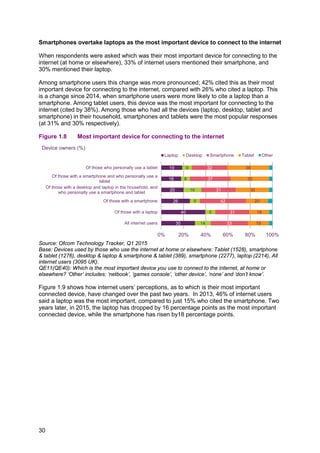
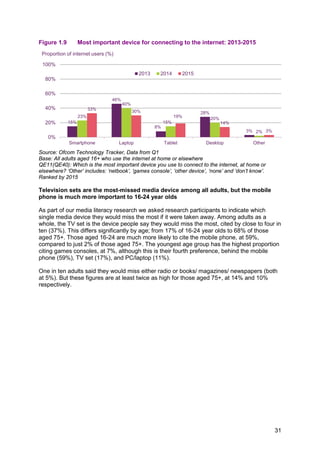
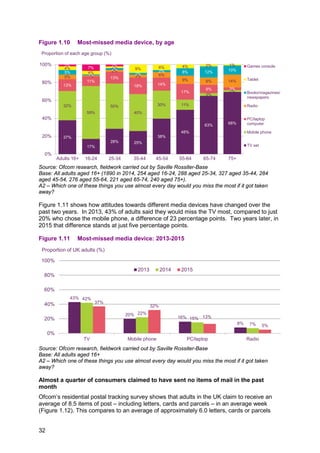
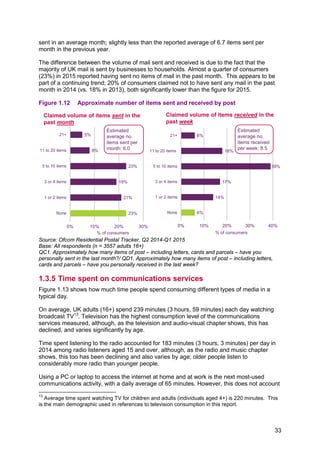
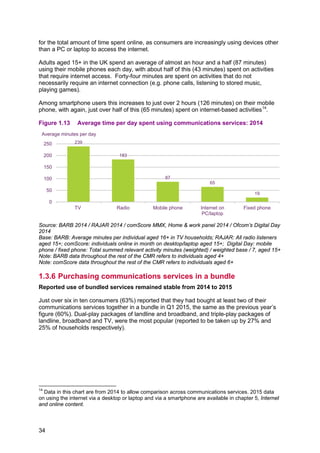
  • 127.
    Figure 1.97 Weeklyinternet activities: 2005 vs. 2014 Source: Ofcom research, Adults Media Use and Attitudes Report Base: All adults who go online in any location on any device (1609 in 2014) IN15L/M: How often do you use the internet to <activity>. Answer – at least once a week Public/civic activities are also increasingly being done online. Two individual activities in this category have been included in the survey since 2005, and both have increased in terms of weekly use: finding out about public services has increased from 12% to 18%, and looking at political or campaigning issues websites from 4% to 11%. However, since this category of activity is generally less likely to be done regularly, it is also useful to assess to what extent it is done at all. As shown in Figure 1.98, both activities have increased substantially: finding out about public services from 49% to 78%, and looking at political or campaigning issues websites from 19% to 44%. In addition to this (not shown in the chart), seven in ten (69%) internet users now say that they complete government processes online. 25% 20% 30% 31% 23% 17% 42% 42% 47% 45% 38% 36% 0% 10% 20% 30% 40% 50% Adults 16+ 16-24 25-34 35-44 45-54 55+ 2005 2014 Looking at news websites or apps 31% 17% 45% 38% 30% 21% 42% 34% 49% 43% 32% 0% 10% 20% 30% 40% 50% Adults 16+ 16-24 25-34 35-44 45-54 55+ Banking and paying bills online Proportion of internet users (%) 123
  • 128.
    Figure 1.98 Useof the internet for public/civic activities: 2005 vs. 2014 Source: Ofcom research, Adults Media Use and Attitudes Report Base: All adults who go online in any location on any device (1609 in 2014) IN15L/M: How often do you use the internet to <activity>. Answer – daily, weekly or less often There is less concern about online content than ten years ago, but concerns remain more prominent than for other media, and apps are posing a new challenge Since 2005 the internet has had the highest levels of stated concern across the types of media measured (including TV, radio, mobile phones and gaming), as shown in Figure 1.99. The most-cited concerns regarding internet content are currently ‘offensive/ illegal content’ (38%) and ‘risk to others/society (28%). The former was also the prime concern in 2005 when 54% cited a concern relating to ‘offensive content’; the latter has increased from 15% in 2013. Despite this, the proportion citing any concerns with online content has decreased since 2005; from seven in ten (70%) to half (51%) of internet users, and the decrease has been particularly substantial among 35-44s (from 80% to 54%). However, the recent surge in app use appears to be accompanied by increased concern about apps. In 2013 we asked app users46 if they had any concerns about apps, and one in five (20%) indicated some form of concern. In 2014 this increased to 28%, primarily driven by issues relating to security/ fraud or privacy (up to 20% from 14% 2013) and offensive content (up to 9% from 4% in 2013). 46 Defined as those who go online on either a smartphone, tablet or smart TV and say they use apps on any of these devices 49% 40% 54% 51% 57% 44% 78% 69% 83% 88% 81% 70% 0% 20% 40% 60% 80% 100% Adults 16+ 16-24 25-34 35-44 45-54 55+ 2005 2014 19% 24% 18% 20% 18% 11% 44% 40% 50% 51% 44% 33% 0% 20% 40% 60% 80% 100% Adults 16+ 16-24 25-34 35-44 45-54 55+ Finding out about public services Looking at political or campaigning issues websites Proportion of internet users (%) 124
  • 129.
    Figure 1.99 Proportionof adults who have any concerns about media: 2005-14 Source: Ofcom research, Adults Media Use and Attitudes Report Base: Adults aged 16+ who use each platform (variable base). IN34/ T5/ R3/ G3/ M3/ IN23 – Can you tell me if you have any concerns about what is on the internet/ TV/ radio. Do you have any concerns about gaming/ mobile phones/ apps? Internet users under the age of 65 are more inclined to care about who owns websites, or how they are funded, than they were in 2007 In 2007 we started gauging the extent to which adults agreed with the statement: ‘As long as the internet provides good websites it doesn't really matter who owns the websites or how they're funded’. As shown in Figure 1.100, more than half agreed (52% either strongly or slightly agreed), a quarter had a neutral view (24% neither/don’t know), and the same proportion (24%) disagreed strongly or slightly. In 2014, when we asked the same question, 36% either strongly or slightly agreed and 35% either strongly or slightly disagreed, with more neutrality evident. Among those aged 55-64, the proportion who said they strongly or slightly disagreed with this statement has almost doubled, from 24% to 42%. Figure 1.100 Agreement with statement: “As long as the internet provides good websites it doesn't really matter who owns the websites or how they're funded”: 2007 vs. 2014 Source: Ofcom research, Adults Media Use and Attitudes Report Base: All who go online at home or elsewhere on any device (1609) IN35F. As long as the internet provides good websites it doesn't really matter who owns the websites or how they're funded? 46% 55% 39% 40% 39% 37% 36% 40% 11% 14% 11% 9% 8% 7% 9% 9% 70% 73% 61% 54% 50% 52% 51% 51% 42% 34% 26% 24% 20% 21% 20% 24% 0% 10% 20% 30% 40% 50% 60% 70% 80% 2005 2007 2009 2010 2011 2012 2013 2014 TV Radio Internet Mobile phones Proportion of adults (%) 16% 23% 20% 29% 29% 24% 18% 14% 17% 9% 0% 20% 40% 60% 80% 100% 2014 2007 Strongly agree Slightly agree Neither/don't know Slightly disagree Strongly disagree % of internet users 125
  • 130.
    A majority ofinternet users claim confidence in finding information on the internet, but the levels have changed little over the years We started to notice signs of confidence in using the internet among a majority of users in 2007. Our research that year showed that about six in ten considered themselves very confident in finding things online (58%), with nine in ten (91%) at all confident (i.e. they were ‘confident’ or ‘fairly confident’). As shown in Figure 1.101 , this figure has remained similar over time and across all ages. Figure 1.101 Proportion of adults confident of finding the content or information they want when they go online: 2007 vs. 2014 Source: Ofcom research, Adults Media Use and Attitudes Report Base: All internet users (1609 in 2014) IN13B: How confident are you that you can find the content or information you want when you go online Opinions about the potential for inaccuracy or bias of search engine results have remained similar over time, with little variation by age Since 2009 we have measured opinions on the potential for inaccuracy or bias in the results that users get from search engines. These results have also changed little over time, as displayed in Figure 1.102; six in ten (60%) search engine users believe that some results will be accurate and unbiased, while others won’t be. This is not significantly different to the 2009 level (54%). In contrast to most of the measurements assessed so far in this section, this is consistent across younger and older demographics (e.g. 56% of 16-24s and 62% of over-65s). 91% 95% 90% 93% 91% 85% 92% 96% 93% 95% 92% 86% 0% 20% 40% 60% 80% 100% Adults 16+ 16-24 25-34 35-44 45-54 55+ 2007 2014 Proportion of internet users (%) 126
  • 131.
    Figure 1.102 Opinionson the accuracy of search engine results: 2009-14 Source: Ofcom research, Adults Media Use and Attitudes Report Base: All online adults aged 16+ who ever use search engines (1516 in 2014). IN45. Which one of these is closest to your opinion about the level of accuracy or bias of the information detailed in the websites that appear in the results pages? The majority of internet users say they would share personal information online, but there is evidence of added caution in doing this over the ten years of tracking Since 2005 we have asked adults if they ever provide different types of personal information online (paying by credit or debit card online, giving home address details, home number, mobile number and personal email address), and if so, whether they do so with or without concerns. The majority of online users say they do provide the information. For example, in 2014 81% of adults said they gave out their home address details online; this has remained virtually unchanged since 2005 (82%). However, the proportion who are happy to give out their information has fallen since 2005 for all of the types of personal information. Thirty-three per cent were happy to give out their home address details in 2005, and this figure is now 21%. Consequently, it appears that more caution has crept in over time, highlighted by the fact that 60% of internet users have concerns about giving out their home address details online, compared to 46% in 2005. As shown in Figure 1.103, steady (but not significant in all cases) increases are spread across all ages, and this trend is mirrored for all other types of personal information we asked about. Despite this, four in ten (43%) of internet users say they only skim-read website terms and conditions / privacy statements. 54% 50% 57% 60% 59% 60% 20% 26% 24% 21% 22% 23% 18% 18% 14% 16% 13% 14% 8% 7% 5% 3% 5% 4% 0% 20% 40% 60% 80% 100% 2009 2010 2011 2012 2013 2014 Don't know I don't really think about whether or not they have accurate or unbiased information, I just use the sites I like the look of I think that if they have been listed by the search engine, these websites will have accurate and unbiased information I think that some websites will be accurate or unbiased and some won't be Proportion of search engine users (%) 127
  • 132.
    Figure 1.103 Attitudesto giving out personal details online: 2005 vs. 2014 Source: Ofcom research, Adults Media Use and Attitudes Report Base: All who use the internet at home (2005) / All who go online at home or elsewhere on any type of device (1609 in 2014) IN38. …I’d like you to say how you would feel about doing this in terms of any security concerns…. Entering your home address details? Answer - Have some security concerns about doing this, but would do it Overall agreement that internet users must be protected from inappropriate or offensive content is similar to 2005, but opinions are stronger than in 2013 Respondents have been asked since 2005 the extent to which they agree that internet users must be protected from seeing inappropriate or offensive content online. As shown in Figure 1.104, this has remained fairly consistent over the years, and overall agreement (82%) has not changed since 2005 (81%). Similarly, six in ten (60%) strongly agree with the statement; again, this is close to the level seen in 2005 (56%), although it is a significant increase on 2013 (51%). Figure 1.104 Extent of agreement with the statement: “Internet users must be protected from seeing inappropriate or offensive content”: 2005-14 Source: Ofcom research, Adults Media Use and Attitudes Report Base: All who go online at home or elsewhere on any type of device (1609 in 2014) IN35E: Internet users must be protected from seeing inappropriate or offensive content 28% 17% 36% 21% 30% 19% 0% 34% 21% 54% 39% 48% 57% 46% 60% 44% 48% 37% 49% 34% 46% 18% 21% 0% 16% 17% 0% 24% 27% 0% 25% 26% 0% 9% 12% 6% 5% 2% 2% 2% 8% 4% 4% 3% 3% 0% 20% 40% 60% 80% 100% 2005 2014 2005 2014 2005 2014 2005 2014 2005 2014 Don’t Know Never do because of concerns Do but have concerns Happy to do this Pay by card Give home address Give home phone number Give mobile phone number Give personal email address Proportion of internet users (%) 3% 4% 4% 3% 4% 4%3% 5% 4% 3% 4% 4% 13% 8% 13% 12% 11% 11% 25% 26% 27% 27% 31% 22% 56% 57% 53% 54% 51% 60% 0% 20% 40% 60% 80% 100% 2005 2007 2009 2011 2013 2014 Strongly agree Slightly agree Neither/don’t Know Slightly disagree Strongly disagree Proportion of internet users (%) 128
  • 133.
    The majority areusing technical indicators such as padlocks and system messages to measure website safety, and this has increased among over-25s since 2005 In 2005 six in ten (59%) internet users said they could block computer viruses with confidence (rising to 67% of 25-34 year olds). A further 9% of internet users said they did it with difficulty, and 17% said they got someone else to do it for them. So in total 86% of internet users said they were adopting security measures when online. Although we no longer measure this type of confidence, a similar proportion (88%) of internet users said in 2014 that they adopt any security measures, ranging from a third (33%) who deleted web-browser cookies to three-quarters (75%) who used anti-virus software. In addition, eight in ten (80%) cite being ‘very’ or ‘fairly’ confident of staying safe online. As a result, or in spite of this, two-thirds (64%) use the same password for most or all websites. In terms of the ways in which people actively evaluate whether it is safe to provide personal details, the use of ‘formal judgements’ (e.g. padlocks or system messages) has increased, from 43% to 55%. Although this has not changed among 16-24 year olds (45% in 2014 vs. 46% in 2005), it is greater among those aged 25 and over. For example, for adults aged 45- 54 it has increased by 19pp (from 39% to 58%), as displayed in Figure 1.105 below. Figure 1.105 Use of formal judgements before entering personal details Source: Ofcom research, Adults Media Use and Attitudes Report Base: All who use the internet at home (2005) / All who go online at home or elsewhere on any type of device (1609 in 2014) IN39…tell me whether you would make a judgement about a website before entering these types of details? 43% 45% 48% 42% 39% 37% 55% 45% 60% 59% 58% 56% 48% 0% 20% 40% 60% 80% Adults 16+ 16-24 25-34 35-44 45-54 55-64 65+ 2005 2014 Proportion of internet users (%) 129
  • 135.
    1.11 Developments inthe nations 1.11.1 Introduction This section sets out a selection of key facts and figures relating to communications markets across the UK’s nations in 2015, comparing and contrasting each nation. It demonstrates that while there are similarities between the nations, there are also important differences in the availability, use and take-up of communications services and devices. The section covers TV, radio, post, telecoms, and internet and online content. Information in this section was compiled using a number of sources including BARB, RAJAR, information provided by operators, and Ofcom research. 1.11.2 Key findings • On average, people in Wales watch the most TV in the UK (251 minutes per day). There has been a decline in TV viewing in Scotland, Wales and Northern Ireland, in line with the rest of the UK. • Across all the devolved nations, there were claimed increases in non- traditional viewing compared to the previous year. This includes catch-up on- demand services e.g. BBC iPlayer, watching content that has been personally recorded e.g. using a DVR, and using subscription on demand e.g. Netflix). Increases for all of these non-traditional viewing activities were higher in Scotland and Wales than in the UK overall. In Wales, the increase in using catch-up on- demand services was higher than in the UK. • Smartphone take-up is lower in the nations. Sixty-seven per cent of adults in England have a smartphone, compared to 63% in Wales, Scotland and Northern Ireland. • Household take-up of tablet devices across the UK stands at 54%. It is highest in Wales at 60%, followed by England at 54%, Northern Ireland at 54%, and Scotland at 52%. • 4G coverage is highest in England, covering 92% of premises, and lowest in Wales (62.8%). Almost half of premises in England (46.2%) have coverage from four operators, compared to just 18.3% in Wales. • 4G take-up has increased significantly in all four nations over the past year. By Q1 2015, 30% of UK adults said they were 4G users, with take-up highest in Scotland (34%, up by 15 % points compared to 2014), followed by England at 30% (an increase of 18 % points), Northern Ireland (26%, an increase of 17 % points), and Wales (23%, an increase of 12 % points). • The proportion of premises able to receive superfast broadband services (30Mbit/s or higher) is highest in England (84%), followed by Wales (79%), Northern Ireland (77%), and Scotland (73%). Across the UK and in each of the nations, superfast broadband availability is considerably higher in urban than in rural areas. • People in Scotland listen to radio less than those in other nations of the UK. People in Scotland spend the least amount of time listening to radio (19.9 hours on average per week), while people in Wales spend the most (22.4 hours). 131
  • 136.
    • Over athird of adults in Scotland (36%) said they had not sent any post in the past month, the highest across all the nations. This compares to 33% in Northern Ireland, 25% in Wales and 22% in England. Nations’ fast facts: wave 1 2015 (%) Unless otherwise stated, figures relate to household take-up UK England Scotland Wales Northern Ireland UKurban UKrural Digital TV take-up 97 97 96 98 97 96 - 98 + Pay-digital TV 59 58 58 -10 671 + +10 63 59 + 55 - Freeview-only TV 30 30 -3 352 +10 24 - -9 28 30 - 35 + Smart TV take-up (among TV homes) 21 +9 21 +9 19 +11 17 +8 15 - +8 20 +8 23 +12 HDTV service (among those with an HDTV) 75 +5 75 +5 75 69 - 75 74 - +4 81 + DAB ownership (among radio listeners)3 43 44 37 47 29 - 42 - 50 + Catch-up TV/ film viewing online/ on-demand (on any device, among those who use the internet) 56 +5 56 +5 62 57 42 - 56 +4 56 +10 Total internet access at home (by any device) 85 +3 86 +4 78 - 86 +6 79 - 85 +3 85 Broadband take-up at home (fixed or broadband) 80 +3 81 +4 73 - 78 +7 72 - 79 +3 82 Use mobile to access internet 61 +4 62 +5 59 59 60 +9 62 + +4 55 - Mobile phone take-up (personal use) 93 93 91 90 91 92 93 Smartphone take-up (personal use) 66 +5 67 +6 63 63 63 +8 67 + +5 59 - 4G service take-up 30 +18 30 +18 34 +15 23 +12 26 +17 n/a n/a Fixed landline take-up 84 85 82 83 84 84 - 90 + Desktop PC take-up 34 37 22 - 26 - 28 - 34 35 Laptop take-up 65 66 55 - 65 +8 55 - 64 67 Tablet computer take-up 54 +10 54 +10 52 +10 60 + +15 54 +9 54 +11 55 +8 E-reader take-up (personal use) 20 +3 20 +3 14 - 19 15 - 19 +3 22 Households taking bundles 63 64 61 67 +8 61 +7 63 67 Fixed telephony availability 100 100 100 100 100 132
  • 137.
    Fixed broadband availability4 99.98100 99.86 100 100 LLU ADSL broadband availability5 95 96 89 93 89 Virgin Media cable broadband availability6 44 47 36 21 27 BT Openreach / Kcom fibre broadband availability7 82 82 75 83 92 NGA broadband availability8 89 90 85 87 95 Superfast broadband availability 83 84 73 79 77 2G mobile availability9 99.7 99.8 99.5 98.9 98.9 3G mobile availability10 99.3 99.6 97.1 97.9 98.6 4G mobile availability11 89.5 92.1 79.7 62.8 91.1 DTT availability12 98.5 98.6 98.7 97.8 97.4 TV consumption (minutes per day) (2014) 220 221 * 239 251 227 Radio consumption (minutes per day) 183 184 171 138 185 Key: + Figure is significantly higher for nation than UK average or significantly higher for nation’s urban/ rural than for nation’s rural/ urban; - Figure is significantly lower for nation than UK average or significantly lower for nation’s urban/ rural than for nation’s rural/ urban; +xx Figures have risen significantly by xx percentage points since W1 2014; +xx Figures have decreased significantly by xx percentage points since W1 2014; Source: Ofcom Technology Tracker Q1 2015, BARB 2014, RAJAR, industry data Base: All adults aged 16+ (n = 3756 UK, 496 Wales, 2264 England, 492 Scotland, 504 Northern Ireland, 1974 England urban, 290 England rural, 246 Scotland urban, 246 Scotland rural, 249 Wales urban, 247 Wales rural, 249 Northern Ireland urban, 255 Northern Ireland rural) 1. This increase may be attributable to an anomalous decline in Wales cable TV as main television set in 2014 - In 2015 cable take-up in Wales increased by 6 pp to 10% over the previous year, returning it to 2013 levels. Market research surveys are subject to sample error and will occasionally report anomalous results. 2. In 2014 the survey data indicated a decline in use of Freeview as a main television service in Scotland. The 2015 measure is similar to the previous measure from 2013. This may suggest that the apparent decrease in 2014 could have been accounted for by sample error. 3. DAB ownership in the nations and UK as reported here is sourced from Ofcom research. The UK CMR uses RAJAR data for DAB ownership 4. Proportion of premises connected to an ADSL-enabled BT local exchange based on BT data, December 2014 5. Proportion of premises connected to an LLU-enabled BT local exchange based on BT data, December 2014 6. Proportion of premises able to receive Virgin Media cable broadband services, May 2015 7. Proportion of premises able to receive BT Openreach/ KCom fibre broadband services, May 2015; under regulatory rules other providers can provide retail fibre broadband services to consumers using these networks. 8. Proportion of premises able to receive NGA broadband services, May 2015 9. Proportion of premises that have outdoor 2G mobile coverage from at least one operator, May 2015 10. Proportion of premises that have outdoor 3G mobile coverage from at least one operator, May 2015 11. Proportion of premises that have outdoor 4G mobile coverage from at least one operator, May 2015 12. Estimated proportion of homes that can receive the PSB channels through DTT (3PSB Mux coverage). Joint TV planning project (Arqiva, BBC, Ofcom). * This figure reflects the average across the English regions with the highest in Border at 250 minutes (4 hours 10 minutes) and lowest in West at 197 minutes (3 hours 17 minutes) respectively. 133
  • 138.
    1.11.3 Television andaudio-visual content On average, people in Wales watch the most TV in the UK (251 minutes per day) On average, people in Wales watch the most traditional TV (live content, viewed at the time of broadcast) in the UK (at 251 minutes per day) while people in England watch the least (221 minutes per day). The biggest decline was in Northern Ireland (-6.1%), followed by Wales (-4.7%), and Scotland (-2.7%). Figure 1.106 Average minutes of television viewing per day, by nation: 2014 Source: BARB, individuals (4+). main five PSB channels = BBC One, BBC Two, ITV, Channel 4 and Channel 5, including HD variants but excluding +1s. *Note: This figure reflects the average across the English regions with the highest in Border (250) and lowest in West (197) respectively. Across all the devolved nations, there were claimed increases in non-traditional viewing compared to the previous year To better understand the decline in traditional TV viewing, Ofcom commissioned omnibus research47 in April 2015. Consumers in each nation were asked how their viewing activities had changed over the previous year. Across all of the devolved nations, there were claimed increases in non-traditional viewing (using catch-up on-demand services e.g. BBC iPlayer, watching content that had been personally recorded e.g. using a DVR, or using subscription on demand e.g. Netflix). Viewers in Wales were the most likely to say that they were watching more catch-up/on- demand services, with 46% claiming they had used them more and only 6% claiming they had used them less, resulting in a net increase of 40%. Northern Ireland and Scotland had similar net increases of 39% and 36% respectively. Claimed viewing of personally recorded content increased over this period, with Northern Ireland seeing a net increase of 32%, Scotland 24%, and Wales up by 18%. In addition, claimed viewing of subscription services increased, with Northern Ireland up by 22% and Scotland and Wales up by 15% and 13% respectively. 47 Source: GfK NOP omnibus, July 2015. Base: All adults 16+, Northern Ireland (110), Scotland (163), Wales (99) 113 117 125 131 113 46 45 49 52 46 62 59 66 68 69 0 50 100 150 200 250 300 UK England* Scotland Wales N. Ireland All other channels PSB portfolio channels Main five PSB channels Averageminutesofviewing,perpersonperday 220 221* (see note) 239 251 227 Average minutes per person per day 134
  • 139.
    Increases for allof these non-traditional viewing activities were higher in Scotland and Wales than in the UK overall. In Wales, the increase in using catch-up on-demand services was higher than in the UK. As we saw in section 1.5.3, over half (56%) of UK TV homes had a TV connected to the internet, either via a set-top box or a smart TV, at the end of 2014, and smart TV take-up has increased across the UK. Take-up is highest in England; 21% of households in England have a smart TV, followed by Scotland at 19%, Wales 17% and Northern Ireland 15%. Figure 1.107 Smart TV take-up across the UK Source: Ofcom Technology Tracker, Q1 2015 Base: All online adults aged 16+ with a TV in the household (n = 3616 UK, 462 Northern Ireland, 2197 England, 472 Scotland, 485 Wales, 230) QH18. Are any of your TV sets ‘smart TVs’? These are new types of TV that are connected to the internet and can stream video directly onto your television screen, without the need for a computer, set-top box or games console. TV remains the most important source for news across the UK Despite the decline in viewing to traditional TV, TV remains the most important source of news for adults across the UK. It is most important in Wales, where 67% of adults said it was their main media source, followed by England (58%), Northern Ireland (56%), and Scotland (52%). Adults in Wales are the least likely to use newspapers. Proportion of homes with a TV (%) 21% 21% 19% 17% 15% 0% 10% 20% 30% 40% UK England Scotland Wales Northern Ireland +9 +8+9 +8+11 Figures above the bars denote change in %pts compared to Q1 2014 135
  • 140.
    Figure 1.108 Mainmedia source for UK and world news, by nation: 2014 Source: Ofcom Media Tracker 2014 Base: All (2,074); England (1,577); Scotland (183); Wales (154); Northern Ireland (160). Significance testing (indicated by a triangle) shows any difference in the main source of news between any nation and all adults. 1.11.4 Internet and online content Smartphone take-up is lower in the nations Smartphone ownership is lower in Scotland, Wales and Northern Ireland than it is in England. It has increased to 66% of adults across the UK (67% in England and 63% in Wales, Scotland and Northern Ireland). Figure 1.109 Take-up of smartphones across the UK Source: Ofcom Technology Tracker, Q1 2015 Base: All online adults aged 16+ (n = 3756 UK, 504 Northern Ireland, 2264 England, 492 Scotland, 496 Wales, 249) QD24B. Do you personally use a smartphone? A smartphone is a phone on which you can easily access emails, download files and applications, as well as view websites and generally surf the internet. Popular brands of Smartphone include BlackBerry, iPhone and Android phones such as the Samsung Galaxy. 58% 58% 52% 67% 56% 12% 12% 14% 6% 12% 10% 10% 8% 7% 14% 9% 9% 10% 12% 4% 5% 5% 7% 6% 5% 3% 0% 7% 6% 0% 20% 40% 60% 80% 100% UK England Scotland Wales Northern Ireland Don't watch/ read/ listen to news Other Website or apps - through phone Website or apps - through computer/ tablet Radio Newspapers 15 15 17 18 9 TOTAL Website or apps Proportion of adults (%) 66% 67% 63% 63% 63% +5 +6 +1 +6 +8 0% 20% 40% 60% 80% 100% UK England Scotland Wales Northern Ireland Nation Figures above the bars denote change in %pts compared to Q1 2014 136
  • 141.
    Household take-up oftablet devices across the UK stands at 54% There has been another large increase in tablet ownership across the UK. More than half of all households now own a tablet, up from 44% in 2014, a rise of ten percentage points. Households in Wales are most likely to own a tablet (60%), up from 45% in 2014, followed by England (54%), Northern Ireland (54%) and Scotland (52%). Figure 1.110 Take-up of tablet computers Source: Ofcom Technology Tracker, Q1 2015 Base: All online adults aged 16+ (n = 3756 UK, 504 Northern Ireland, 2264 England, 492 Scotland, 496 Wales, 249)QE1. Does your household have a PC, laptop, netbook or tablet computer? Internet users in Northern Ireland say they spent significantly more time online in 2014 than they did in the previous year, up from 13.8 to 21.6 hours in a typical week. This is the highest of the four nations, followed by Wales (21.2 hours, an increase from 15.5 hours), England (20.5 hours, up from 17 hours), and Scotland (19.9 hours, up from 16.5 hours). Figure 1.111 Claimed time spent on the internet in a typical week Source: Ofcom research, fieldwork carried out by Saville Rossiter-Base in October to November 2014 Question: IN6A-C – How many hours in a typical week would you say you use the internet at home/ at your workplace or place of education/ anywhere else? (Unprompted responses, single coded) Base: All online adults aged 16+ who use the internet at home or elsewhere (1609 UK, 1022 England, 194 Scotland, 200 Wales, 193 Northern Ireland). Households (%) take-up of tablet computers 54% 54% 52% 60% 54% +10 +10 +10 +15 +9 0% 20% 40% 60% 80% 100% UK England Scotland Wales Northern Ireland Nation Figures above the bars denote change in %pts compared to Q1 2014 Hours per week 15.3 13.0 12.4 13.6 12.6 4.2 4.8 5.7 5.3 5.5 1.6 2.1 2.4 2.7 2.3 21.2 19.9 20.5 21.6 20.5 0 4 8 12 16 20 24 Wales Scotland England Northern Ireland UK At home At workplace/ place of education Anywhere else 137
  • 142.
    1.11.5 Telecoms andnetworks The proportion of premises able to receive superfast broadband services (30Mbit/s or higher) is highest in England (84%), followed by Wales (79%), Northern Ireland (77%), and Scotland (73%). The proportion of premises able to receive superfast broadband services (defined as those with an actual speed of 30Mbit/s or higher) is highest in England (84%), followed by Wales (79%), Northern Ireland (77%), and Scotland (73%). Across the UK and in each of the nations, superfast broadband availability is considerably higher in urban than in rural areas. Broadband take-up (at home) is highest in England at 81%, followed by Wales (78%), Scotland (73%) and Northern Ireland (72%). Total internet access at home (on any device) is highest in Wales and England (both at 86%), followed by Northern Ireland (79%) and Scotland (78%). Figure 1.112 Proportion of premises able to receive superfast broadband services Source: Ofcom / operators, June 2015 data 4G coverage is highest in England, covering 92% of premises, and lowest in Wales (62.8%) Among the UK nations, 4G coverage is highest in England, where it covers 92% of premises, and lowest in Wales (62.8%). Almost half of premises in England (46%) have coverage from four operators, compared to 34% in Scotland and just 18% in Wales. While Northern Ireland has relatively good 4G coverage (at 91%), choice is more limited because mobile operator Three has yet to launch its 4G service there. Proportion of premises (%) 83% 84% 73% 79% 77% 0% 88% 37% 0% 20% 40% 60% 80% 100% UK England Scotland Wales Northern Ireland UK Urban UK Rural 138
  • 143.
    Figure 1.113 4Gmobile premises coverage, by number of operators Source: Ofcom based on operator data, May 2015 data Note: Coverage is based on 100m² pixels covering the UK using an enhanced methodology. Mobile operator Three has yet to launch 4G services in Northern Ireland. 4G take-up has increased significantly in all four nations over the past year. 4G take-up is highest in Scotland 34%, an increase of 15 percentage points since 2014, followed by England at 30% (up by 18 percentage points), Northern Ireland at 26% (up by 17 percentage points), and Wales at 23% (up by 12 percentage points). Northern Ireland had the highest proportion of mobile phone users among the UK nations whose main service was pre-pay in Q1 2015 (43%), ten percentage points higher than the UK average of 33%. Pre-pay take-up is broadly similar in Scotland (34%), Wales (33%), and England (32%). 1.11.6 Radio and audio content People in Scotland listen to radio less than those in other nations of the UK People in Scotland spend the least time (19.9 hours on average per week) listening to radio, while people in Wales spend the most time (22.4 hours) listening to radio. Figure 1.114 Average weekly reach and listening hours: 2014 Source: RAJAR, All adults (15+), year ended Q4 2014. Reach is defined as a percentage of the area’s adult population who listen to a station for at least five minutes in the course of an average week. 12.1 11.0 9.8 20.1 40.610.8 11.2 7.5 14.0 24.1 23.8 28.4 10.3 45.042.5 46.2 34.0 18.3 89.5 92.1 79.7 62.8 91.1 0 20 40 60 80 100 UK England Scotland Wales N Ireland Four Three Two One Proportion of premises (%) Reach Average weekly listening UK TOTALNorthern Ireland WalesScotlandEngland 89.5%88.9%94.5%86.9%89.4% 21.4 hours21.6 hours22.4 hours19.9 hours21.5 hours 139
  • 144.
    People in NorthernIreland listen to the most local radio The share of listening hours to local and nations’ services in Northern Ireland is higher than in any other part of the UK. Local commercial and BBC local and nations’ services together accounted for 55% of total listening hours in 2014. The majority of this listening was to local commercial stations, with a 35% share of total listening hours. This is 5pp above the UK average and higher than in any other nation. Wales has the highest share of listening to BBC network services. BBC network radio stations represented almost half (49%) of all listening hours in Wales in 2014. This was the highest share of listening for this sector compared to the other nations. People in Scotland spend more time with commercial stations than in the other nations. Commercial stations accounted for almost half (48%) of listening hours in Scotland in 2014. This is the highest share for commercial radio across the UK nations. DAB ownership is highest in Wales DAB ownership (among radio listeners) remains below 50% across all four nations of the UK. It is lowest in Northern Ireland (29%) and Scotland (37%), and highest in Wales (47%). Figure 1.115 Ownership of DAB digital radios Source: Ofcom Technology Tracker, Q1 2015 QP9. How many DAB sets do you have in your household? Base: Adults aged 16+ who listen to radio (n = 2934 UK, 406 Wales, 1735 England, 386 Scotland, 407 Northern Ireland, 205) 1.11.7 Post Over a third of adults in Scotland (36%) said they had not sent any post in the past month, the highest across all the nations Adults in Wales send more items of post than those in other UK nations. They claim to send 6.5 items of post per month, on average, compared to 4.5 in Northern Ireland. More than a third of adults in Scotland (36%) had not sent any post in the past month, the highest among the UK nations. Percentage of respondents 43% 29% 44% 37% 47% 0% 10% 20% 30% 40% 50% UK Northern Ireland England Scotland Wales 140
  • 145.
    Figure 1.116 Approximatenumber of items of post sent each month (residential) Source: Ofcom Residential Postal Tracker, Q2 2014-Q1 2015 Base: All respondents (n = 3557 UK, 2123 England, 580 Scotland, 418 Wales, 436 Northern Ireland) QC1. Approximately how many items of post - including letters, cards and parcels - have you personally sent in the last month? Adults in Wales also receive more post than those in other nations of the UK. They claim to receive 8.7 items of post (including letters, cards and parcels) on average every week. This compares to 8.6 in England, 8.0 in Scotland and 5.9 in Northern Ireland. Figure 1.117 Approximate number of items of post received in the past week Source: Ofcom Residential Postal Tracker, Q2 2014-Q1 2015 Base: All respondents (n = 3557 UK, 2123 England, 580 Scotland, 418 Wales, 436 Northern Ireland) QD1. Approximately how many items of post – including letters, cards and parcels – have you personally received in the past week? Businesses in Northern Ireland are most likely to have switched from post to other communications methods Across the UK, 63% of businesses have switched some mail to other communications methods in the past 12 months. The figure is highest in Northern Ireland (70%), followed by England (63%), Wales (62%) and Scotland (59%). 23% 22% 36% 25% 33% 21% 21% 17% 14% 20% 19% 19% 17% 19% 18% 23% 23% 22% 28% 19% 8% 9% 3% 8% 5% 5% 5% 5% 6% 6% 0% 20% 40% 60% 80% 100% UK England Scotland Wales Northern Ireland Don't know 21+ items 11-20 items 5-10 items 3 or 4 items 1 or 2 items None Items of post sent per month (% of respondents) 6.0 Mean number of items sent per month 5.0 6.5 4.56.1 Items of post received per week (% of respondents) 6% 6% 6% 5% 11% 14% 14% 17% 15% 21% 17% 17% 19% 17% 19% 39% 39% 38% 36% 30% 18% 18% 16% 19% 15% 6% 6% 4% 8% 2% 0% 20% 40% 60% 80% 100% UK England Scotland Wales Northern Ireland Don't know 21+ items 11-20 items 5-10 items 3 or 4 items 1 or 2 items None 8.5 Mean number of items received per week 8.0 8.7 5.98.6 141
  • 146.
    Figure 1.118 Proportionwho have switched some post to other communications methods in the past 12 months Source: Ofcom Business Postal Tracker, Q2 2014-Q1 2015 Base: All respondents (n = 1591 UK, 973 England, 217 Scotland, 198 Wales, 203 N Ireland) QF4. Over the last 12 months has your organisation moved some mail to other communications methods? 63% 63% 59% 62% 70% 37% 37% 41% 38% 30% 0% 20% 40% 60% 80% 100% UK England Scotland Wales N Ireland No Yes Proportion of respondents (%) 142
  • 147.
    The Communications Market 2015 2 2Television and audio- visual 143
  • 148.
    Contents 2.1 Key marketdevelopments in TV and audio-visual 145 2.1.1 Industry metrics and summary 145 2.1.2 TV industry revenue up 3.1% in 2014 to £13.2bn 147 2.1.3 Internet-connected TVs on the rise while HD growth slows and 3D falters 151 2.1.4 The majority of TV viewing is of traditional live TV, but this has recently declined 156 2.2 The TV and audio-visual industries 163 2.2.1 Summary 163 2.2.2 Television industry revenue 164 2.2.3 TV revenue among multichannel genres 170 2.2.4 Spend on UK television programmes 171 2.2.5 UK independent sector 172 2.2.6 Spend on first-run UK-originated content by the main five PSB channels 174 2.2.7 Television output on the PSB channels 175 2.2.8 Television output and spend in the multichannel sector 181 2.3 The TV and audio-visual viewer 185 2.3.1 Summary 185 2.3.2 Platform take-up 187 2.3.3 Consumer attitudes towards television 205 144
  • 149.
    2.1Key market developmentsin TV and audio-visual 2.1.1 Industry metrics and summary Figure 2.1 Industry metrics Source: Ofcom/broadcasters/Advertising Association/Warc/BARB/GfK. Note: Expressed in nominal terms. Public funds include DCMS grant to S4C, as well as BBC funding that is allocated to TV (including the proportion of licence fee revenue that goes to S4C). Broadcaster share as a proportion of total display advertising spend excludes direct mail and classified ads and is based on Advertising Association/Warc Expenditure Report. The AA/Warc data are net of discounts, and includes agency commission, but excludes production costs. Spend on originations includes spend on nations and regions programming (not Welsh or Gaelic language programmes but some Irish language). TV viewing based on BARB analysis of viewing to scheduled TV programmes such as those listed in TV listings magazines or on electronic programme guides (EPG) on TV sets. Minutes spent watching TV per day declined by 11 minutes year on year although values appear not to equate to 11 minutes due to rounding. This section examines key developments and trends seen in the UK television market during the past year. However, for detailed analysis of developments in video on demand, and changes in viewing to broadcast TV, please refer to sections 1.5.3 and 1.5.4 in the Market in Context chapter. • The UK television industry generated £13.2bn in revenue during 2014, an increase of 3.1% (£392m) year on year. Pay-TV subscription revenue continued to be one of the main drivers behind the industry’s growth, with a 1.9% increase year on year and a compound annual growth of 5.2% over the last five years. • Broadcast-based TV advertising revenue increased by 3.9% in 2014 to reach £3.8bn. The largest proportional increase was among the multichannels (excluding the PSB portfolio channels) where advertising revenues increased by 7.7% year on year, to reach over £1bn for the first time since Ofcom began reporting. The PSB UK television industry 2009 2010 2011 2012 2013 2014 Total TV industry revenue (£bn) 11.1 11.8 12.4 12.5 12.8 13.2 Proportion of revenue generated by public funds 23% 22% 21% 21% 20% 21% Proportion of revenue generated by advertising 28% 30% 29% 28% 29% 29% Proportion of revenue generated by subscriptions 42% 43% 44% 44% 46% 45% Broadcaster share of total display advertising spend 41% 42% 43% 43% 43% 44% Spend on originated output by 5 main networks (£bn) 2.4 2.5 2.5 2.6 2.5 2.6 Digital TV take-up (% all households) 88% 92% 94% 96% 95% 93% Proportion of DTV homes with pay satellite or cable 53% 56% 51% 51% 52% 51% Minutes spent watching TV per day (per person aged 4+) 225 242 242 241 232 220 Share of the main five channels in all homes 58% 56% 54% 52% 51% 51% Number of channels broadcasting in the UK 490 510 515 529 527 536 145
  • 150.
    portfolio channels alsoexperienced gains in net advertising revenue in 2014, increasing by 2.2% to £653m. • Broadcast TV advertising has held up well as a proportion of all display advertising. According to WARC, total display advertising expenditure (i.e. including all forms of media such as press, online and TV) stood at £10.6bn in 2014, of which broadcaster display advertising accounted for 43.5%, an increase of 2.5 percentage points over the past five years, despite increased competition from online display advertising. • Online TV revenue in the UK has increased rapidly in the past five years but still represents only a small proportion of total TV revenues. According to data from IHS, revenue from online TV grew by 38% in 2014 to £793m, with income from online TV subscriptions increasing by 53% to £317m, driven by the increasing popularity of services such as Netflix and Amazon Prime Instant Video. • Ofcom estimates that the BBC allocated £2.7bn to its television services in 2014, an increase of 5.1% since 2013. This is mainly due to the BBC’s TV coverage of major sporting events in 2014 compared to 2013, most notably the FIFA World Cup in Brazil and the Commonwealth Games in Glasgow. The cost of the licence fee remained unchanged at £145.50. • Over half (56%) of UK TV homes had a TV connected to the internet, either via a set-top box or a smart TV, at the end of 2014. However, this figure is likely to be higher when other third-party devices, which can also be used to connect TVs to the internet, such as games consoles or streaming devices (e.g. Now TV or Chromecast), are included. • Two-thirds (64%) of TV homes now have a digital video recorder (DVR), although in the past year this figure has increased by only two percentage points (from 62% in 2014) suggesting that the penetration of DVRs may be beginning to plateau. • Growth in take-up of HDTV services has slowed, and 3DTV is failing to gain traction. Take-up of HDTV services increased marginally, by four percentage points, from 53% in 2014 to 57% in 2015. Despite 3D services having been available since 2010, less than one in ten (7%) of UK TV homes in 2015 claimed to watch TV content in 3D. • Viewing to traditional live television as it is broadcast fell from 3 hours 45 minutes (225 minutes) per person per day in 2010 to 3 hours 13 minutes (193 minutes) in 2014. Watching programmes previously recorded on devices48 or through catch-up services49 (time-shifted) among all individuals has grown over the same period (from 17 minutes a day to 27 minutes a day), but the main way people watch programmes continues to be at the time of broadcast (88%). 48 These include DVRs such as Sky+, TiVo, Freeview+ and Freesat+, DVD recorders or video cassette recorders, as well through catch-up players, including games consoles and smart TVs. Viewing up to seven days after broadcast is reported by BARB. 49 Broadcaster catch-up services such as BBC iPlayer, ITV on demand, 4OD, Demand 5 etc. Viewing up to seven days after broadcast is reported by BARB. 146
  • 151.
    2.1.2 TV industryrevenue up 3.1% in 2014 to £13.2bn Total TV industry revenues rose by 3.1% (or £393m) in nominal terms to £13.2bn in 2014. Pay-TV subscription revenue continues to be one of the main drivers behind the industry’s growth, with a 1.9% increase year on year and a compound annual growth of 5.2% over the past five years. Ofcom estimates that the BBC spent £2.7bn on its television services in 2014, an increase of 5.1% since 2013. The BBC’s Annual Report and Accounts for 2014/15 indicates that the BBC allocated more income to BBC One in 2014/15 than in the previous financial year, mainly due to the BBC’s TV coverage of major sporting events in 2014 compared to 2013, most notably the FIFA World Cup in Brazil and the Commonwealth Games in Glasgow. Net advertising revenue increased by 3.9% overall in 2014 to £3.8bn, although not all broadcasters experienced an increase in advertising revenue, as outlined in Figure 2.3 Figure 2.2 Total TV industry revenue, by source: 2014 Source: Ofcom/broadcasters. Note: Figures expressed in nominal terms. PSB NAR comprises Channel 3 licensees (including ITV Breakfast, ITV plc, Channel Television, STV and UTV), Channel 4, Channel 5 and S4C. PSB portfolio NAR includes commercial channels owned by the PSBs (ITV2, ITV3, ITV4, E4, More 4, Film 4, 5* and 5USA). ‘Other NAR’ comprises the rest of the multichannel market. Platform operator revenues do not include installation costs, equipment sales or subsidies. BBC TV spending represents the amount of BBC revenue that is allocated to TV, which is estimated by Ofcom based on the BBC’s Annual Report and Accounts 2014/15. Excludes revenue generated via online TV, as outlined in Figure 2.4 Broadcast-based TV advertising revenues increase by almost 4% year on year Following a 2% decline in 2012, total net advertising revenue increased for the second year in a row, rising from £3.7bn in 2013 to £3.8bn overall in 2014 (or 3.9%). The largest proportional increase was among the multichannels (excluding the PSB portfolio channels) where advertising revenues increased 7.7% year on year, to exceed £1bn for the first time since Ofcom began reporting. The PSB portfolio channels also experienced gains in net advertising revenue in 2014, up by 2.2% to £653m. £12,834m £13,227m £131m £110m £74m £57m £14m £6m 12,000 12,100 12,200 12,300 12,400 12,500 12,600 12,700 12,800 12,900 13,000 13,100 13,200 13,300 13,400 13,500 2013 revenue BBC TV spending Subscriber revenue Other NAR PSB NAR PSB portfolio NAR Other 2014 revenue Revenue (£m) +7.7% +5.1% +2.7% +2.2% +0.9% +1.9% +3.1% 147
  • 152.
    Income obtained byadvertising among the commercial PSBs varied by broadcaster. ITV/ STV/ UTV had the largest increase, with advertising revenues increasing by 6.1% to £1.3bn, while Channel 4 and Channel 5 had year-on-year declines of 0.6% and 5.7% respectively. Figure 2.3 Advertising revenue, by share: 2013-2014 Source: Ofcom/broadcasters. Note: TV advertising includes revenues that broadcasters receive from the sale of advertisements on screen (net of agency fees) and excludes video on demand. Totals may not equal the sum of the components due to rounding. ITV1/Channel 3 includes ITV Plc, STV, UTV and Channel Television. Online TV revenue continues to increase steeply but still represents only a small proportion of total TV revenue Ofcom’s calculation of TV revenue includes the traditional revenue sources of subscription fees, advertising revenue and public funding. However, online TV revenue in the UK has increased rapidly in the past five years, from £95m in 2009 to £793m in 2014, according to data from IHS. Although still small relative to the overall TV market in terms of revenue, income from online TV grew by 38% year on year. The subscription model for online audio-visual content access saw continued growth in 2014, as its revenue grew by 53% to reach £317m, driven predominantly by the increased popularity of services such as Netflix and Amazon Prime Instant Video. The subscription model now represents the principal contributor to overall online TV revenues, accounting for 40% of the total. The free-to-view (FTV) business model represents the second largest segment, contributing £240m in 2014. The principal driver of this revenue stream is advertising, and catch-up services such as ITV Player, All 4 and Demand 5 are all funded wholly or in part by this business model. The download-to-own business model (DTO) experienced further growth in 2014, up by 28% year on year to £155m, while pay-per-view increased 42% to £81m in 2014. £m £1,247m £1,323m £485m £483m £303m £285m £968m £1,043m £639m £653m £50m £51m 0 1,000 2,000 3,000 4,000 2013 2014 ITV Breakfast PSB portfolio channels Other multichannels Channel 5 Channel 4/S4C ITV1/STV/UTV £ 3,838m£3,693m 1-year change (%)3.9% 6.1% -5.7% 1.4% -0.6% 2.2% 7.7% 148
  • 153.
    Figure 2.4 OnlineTV revenues Source: IHS. Note: FTV (free to view) refers to services delivering online video free to the consumer. Number of FTV streams includes both ad-supported services and services funded through other means (such as BBC iPlayer). FTV revenues include advertising revenues only. PPV (pay-per-view) refers to a method of renting digital content whereby customers commonly choose content on ‘a la carte’ basis and pay to watch it for a limited period. The category includes all content consumed on an on-demand basis, including traditional PPV (such as live sports) and VoD. DTO (download-to-own) refers to a method of obtaining content that gives the customer ownership over the files they have downloaded, allowing them to use the content as many times as they like. Includes only revenue from long form video content and excludes revenues generated from online usergenerated content. Figure 2.5 compares advertising and sponsorship income obtained via traditional broadcast TV with advertising revenue generated via free-to-view online TV services such as ITV Player and All 4. The chart illustrates that although online TV advertising revenues have grown significantly in the past five years; to £240m in 2014, they still represent only a very small proportion (5.6%) of the total TV advertising and sponsorship market; and the vast majority of TV advertising income is still generated via traditional broadcast television. Figure 2.5 Total cross-platform advertising and sponsorship revenue Source: Ofcom/broadcasters/IHS. All figures are nominal Annual Growth 38% 26% 53% 42% 28%£33m £66m £75m £92m £121m £155m£25m £38m £57m £81m £23m £25m £104m £207m £317m £32m £74m £113m £145m £190m £240m £95m £180m £238m £379m £574m £793m 0 100 200 300 400 500 600 700 800 900 2009 2010 2011 2012 2013 2014 FTV Ad Revenues Subscriptions PPV transactions DTO transactions £m £3,143m £3,491m £3,630m £3,547m £3,693m £3,838m £189m £179m £176m £184m £192m £208m £74m £113m £145m £190m £240m £3,364m £3,745m £3,919m £3,876m £4,075m £4,285m 0 1,000 2,000 3,000 4,000 5,000 2009 2010 2011 2012 2013 2014 FTV Online Ad Revenues All Broadcaster Sponsorship All Broadcaster NAR Annual Growth 5.2% 26.2% 8.2% 3.9% £m 149
  • 154.
    Broadcast TV advertisinghas held up well as a proportion of all display advertising According to WARC, total display advertising expenditure (i.e. including all forms of media such as press, online and TV) stood at £10.6bn in 2014, of which broadcaster display advertising spend accounted for 43.5%. Despite the increase of online advertising, broadcaster advertising revenue as a proportion of all display advertising has proved resilient, increasing by 2.5 percentage points over the past five years. Figure 2.6 Broadcaster percentage share of all display advertising expenditure Source: AA/Warc Expenditure Report. Note: Total display advertising expenditure includes television ads, TV sponsorship, TV VoD, radio, out of home, cinema, national and regional press display, internet and consumer magazines but does not include response advertising such as direct mail or classified ads. Broadcaster display ads include broadcast-based TV advertising, sponsorship and online VoD ad revenue. Figures are nominal. £bn 41.0% 41.6% 42.6% 43.2% 43.1% 43.5% 59.0% 58.4% 57.4% 56.8% 56.9% 56.5% £8.5bn £9.6bn £9.8bn £9.8bn £10.0bn £10.6bn 0 2 4 6 8 10 12 2009 2010 2011 2012 2013 2014 All other display advertising Broadcaster display ad spend 150
  • 155.
    2.1.3 Internet-connected TVson the rise while HD growth slows and 3D falters Smart TV: ‘Smart TV’ refers to a stand-alone television set with inbuilt internet functionality. Users connect to the internet via a broadband router or modem. Smart TVs are produced by consumer electronics manufacturers including Samsung, Sony, Panasonic and LG. The definition does not include television sets connected to the internet via a third-party device such as a set-top box, a games console or a laptop/PC. TV connected via other device: Internet-enabled set-top boxes are third-party devices which enable reception of digital television broadcasts via an existing aerial, satellite dish or cable to a television, in addition to connecting the television set to the internet via a router. Internet-enabled set-top boxes include Virgin TiVo, Sky+, YouView and Freesat receivers. It is also possible to connect television sets to the internet via a third-party device other than a set-top box, such as via a games console, tablet, laptop/PC or Blu-ray/DVD player. Over-the-top content: Over-the-top content refers to video, audio, and other media content delivered over the internet rather than via a service provider’s network. The consumer accesses this content via an internet connection independently of his or her contract with a network operator. Over half (56%) of adults had a connected TV at the end of 2014 Ofcom’s TechnologyTracker indicates that take-up of smart TVs (with in-built internet connectivity) among UK TV homes stood at 21% at the start of 2015, a figure which has almost doubled over the past year (from 12% in 2014). However, the most popular method for connecting a TV to the internet is via a set-top box (such as a Sky+, Virgin TiVo or YouView box). Research from media consultancy 3 Reasons estimates that 56% of UK TV homes had a TV connected to the internet, either via a set-top box or a smart TV, at the end of 2014. However, this figure is likely to be higher when other third-party devices which can also be used to connect TVs to the internet, such as games consoles or streaming devices (e.g. Chromecast) are included. Figure 2.7 Take-up of smart TVs among UK TV households Source: Ofcom Technology Tracker, W1 2015. Base: All adults aged 16+ with a TV in the household (n = 3616). QH15(QH62): Are any of your TV sets 'smart TVs'? 7 12 21 0 5 10 15 20 25 2013 2014 2015 Smart TV ownership % of UK TV homes 151
  • 156.
    Smart TVs haveincreased their market share to 54% of all TV sales Smart TV sales, as a proportion of all TV sales, have almost doubled in the past two years, increasing from 28% in Q1 2013 to 54.2% in Q1 2015. However, the rate of growth has slowed in 2014, with smart TVs as a proportion of all TV sales increasing by only nine percentage points, compared to a 17 percentage point increase in 2013. Sales units peaked at almost 1.2 million in Q4 2014 (the Christmas period), before dropping to around 800,000 in Q1 2015. Figure 2.8 Smart TV sales and market share Source: GfK Connected-TV owners watch audio-visual content from a wide range of sources Figure 2.9 shows the activities most commonly undertaken by adults using the internet connection on their TV set, and shows that connected-TV users are watching audio-visual content from a range of different sources. Around a third (34%) of connected-TV users watch TV programmes or films via a free catch-up service from the public service broadcasters (e.g. BBC iPlayer, ITV Player, All4, or Demand5). This figure rises to 45% among adults aged 35 to 44 years. Other common online activities carried out by connected-TV owners are: watching short video clips (21%), watching free video-on-demand (VoD) content as part of a TV subscription service (e.g. Sky, Virgin Media) and general surfing/browsing (20%). Although the most popular use of the internet on a connected TV is to watch free broadcaster catch-up services, watching content provided via a subscription to an over-the- top VOD service such as Netflix and Amazon Prime Instant is becoming increasingly popular, with 15% of all adults using their connected TV to access these services, rising to around a quarter (23%) among 35 to 44 year olds. 28 29 31 38 45 44.2 48.4 51.3 54.2 0 10 20 30 40 50 60 0 200 400 600 800 1,000 1,200 1,400 Q1 2013 Q2 2013 Q3 2013 Q4 2013 Q1 2014 Q2 2014 Q3 2014 Q4 2014 Q1 2015 Market Share (%) Sales Units (000s) Sales units (000s) % 152
  • 157.
    Figure 2.9 Activitiesundertaken on a connected TV, by age Source: Ofcom Media Tracker 2014. Base: All respondents (2074); 16-24 (297); 25-34 (331); 35-44 (333); 45-54 (333) 55-64 (318); 65+ (462). Only responses >3% labelled. Prompted, multicode. Q7/ Q9C/ Q10C/ Q11C/ Q13 - And which, if any of these devices have been connected to your home broadband service as well as a TV set in the home in the last 12 months to view something on the TV screen? As illustrated in Figure 2.10, the most common reason among connected-TV users for watching free catch-up services is to watch programmes that they missed at the time of broadcast (78%), although around a third (32%) also turn to catch-up services if there is nothing they want to watch on scheduled TV when they want to watch television. Figure 2.10 Reason for using catch-up TV via a connected TV, by age Source: Ofcom Media Tracker. Base: Those using broadcaster catch-up services through connected TV (659); 16-34 (252); 35+ (407). Unprompted, multicode. Showing responses of 5% or more among all adults. Significance testing shows any difference between age groups. Q16 - You said that you use broadcaster catch-up services. What would you say are the reasons that you use the broadcaster? 34 42 42 45 37 30 13 21 29 26 28 27 11 3 20 24 25 30 25 11 5 20 24 23 26 28 12 5 15 22 21 23 17 7 12 13 18 17 18 7 9 11 12 12 11 7 All 16-24 25-34 35-44 45-54 55-64 65+ Online PPV or download to own (e.g. iTunes) Paid VOD content through TV service Online subscription services (e.g. Netflix) Browse online Free VOD content through TV service Clips through websites (e.g. YouTube) Broadcaster catch-up services Any of These44% 54% 51% 56% 60% 36% 17% 78 32 31 13 11 10 7 80 34 30 13 12 10 10 76 31 32 12 10 10 6 0% 20% 40% 60% 80% 100% I missed the programme/ film when it was on TV and I use it to catch up I use it when there is nothing on 'normal' TV that I want to watch I want to watch the programme/ film at a time that suits me Somebody was watching something else on the TV at the time it was on so I used it to catch up Just to pass some time/ relax The programme/ film was recommended to me by someone I know There is a good choice of programmes/ films All Adults (16+) 16-34 35+ % of catch-up TV users 153
  • 158.
    Two-thirds of TVhomes have a DVR, but growth has slowed in the past year Data from Ofcom’s Technology Tracker indicates that around two-thirds (64%) of adults with a television in the household now own a digital video recorder (DVR)50 . However, in the past year this figure has increased by only two percentage points, from 62% in 2014, suggesting that penetration of DVRs may be beginning to slow. Sky+ is the most prevalent DVR among owners of these devices, at 33%, followed by Virgin’s TiVo (or older V+ box) at 13%, and Freeview at 12%. Figure 2.11 Take-up of DVRs, by platform Source: Ofcom Technology Tracker, Q1 2013-2015 Base: All adults aged 16+ with a TV in the household: 2013 (3661), 2014 (3635), 2015 (3616) Q: Does your household have Sky+? Q: Does your (Sky+,Virgin TiVo,YouView etc.) set-top box allow you to record and store TV programmes, and also pause and rewind live TV programmes? There is a similar picture when looking at take-up of high-definition (HD) TVs and HDTV services. Over the past three years penetration of HD-ready TVs has remained almost unchanged; three-quarters (76%) of TV homes owned these devices in 2015. While take-up of HDTV services has increased, from 50% to 57% over the three-year period, growth appears to be slowing, with only a four percentage point increase year on year, from 53% in 2014 to 57% in 2015. 50 This figure differs from the 73.2% for 2014 quoted in Figure 2.15, which is based on BARB data and is the total television viewing audience aged 4+ who have access to a DVR. % of UK homes with a TV 54% 31% 11% 9% 7% 2% 62% 34% 12% 13% 6% 4% 64% 33% 13% 12% 7% 5% 0% 20% 40% 60% 80% 100% Total DVR take- up Sky+ Virgin TiVo or V+ Freeview DVR YouView Broadband TV (BT Vision or TalkTalk TV) 2013 2014 2015 154
  • 159.
    Figure 2.12 Take-upof HD-ready TVs and HDTV services Source: Ofcom Technology Tracker, Q1 2013-2015 Base: All adults aged 16+ with a TV in the household: 2013 (3661), 2014 (3635), 2015 (3616) QH3(QH53): Is the MAIN TV in your household an HDTV set or HD ready? QH4 (QH54) Although you have an HDTV ready set, to actually watch TV channels and programmes that are broadcast in high definition, you need an HD set-top box or a TV with built-in HDTV receiver. For the main TV set, does your household have an HDTV service - from either Sky, Virgin Media, Freesat or Freeview? 3DTV has yet to gain traction Figure 2.13 shows ownership among UK TV homes of televisions capable of receiving broadcasts in 3D, as well as the proportion of TV homes who watch TV programmes or movies in 3D via these devices. 3D services have been available since 2010. However, less than one in ten (7%) UK TV homes in 2015 claimed to watch TV content in 3D, a figure which has risen only slightly since Ofcom began tracking it in 2013 (4%). 3DTV The popularity of 3D in cinema has risen and fallen over the past 10 years, but it reached a peak in 2009 when James Cameron’s Avatar became the highest-grossing film of all time. The following year saw the launch of the UK’s first 3D channel, Sky 3D, and the first 3DTVs went on sale to the public. The BBC joined the 3D trend in 2011, broadcasting the finals of Wimbledon on its HD channel live in 3D. However, the BBC announced that it would halt its development of 3D programming in 2013 and Sky 3D moved to an on-demand-only service in June this year. The disappointing take- up of 3DTV may be due in part to the inconvenience of the viewing experience. Most consumer 3DTVs use active shutter technology to achieve a 3D effect which requires viewers to wear glasses. This may be a drawback at a time when more and more consumers are ‘multi-tasking’ their media and communications activities. % of UK homes with a TV 50% 53% 57% 75% 75% 76% 0% 20% 40% 60% 80% 100% 2013 2014 2015 Have HD ready TV Have HDTV service 155
  • 160.
    Figure 2.13 Take-upand use of 3D-ready TVs Source: Ofcom Technology Tracker, Q1 2013-2015 Base: All adults aged 16+ with a TV in the household: 2013 (3661), 2014 (3635), 2015 (3616) QH4 (QH57). Is the main TV in your household 3D ready? if necessary - By this I mean that the TV can display pictures in 3D from specific channels (such as Sky 3D) or when watching 3D DVDs or Blu-ray discs or when playing 3D video games. / QH5 (QH58). Do you or anyone in your household watch 3D content on your TV - whether from 3D TV channels, 3D DVDs or Blu-ray discs or 3D video games? 2.1.4 The majority of TV viewing is of traditional live TV, but this has recently declined Watching programmes on traditional TV51 has fallen since 2010 In recent years there has been an overall decline in time spent watching any TV on TV sets, and most of this reduction has come from watching traditional TV (programmes and films live at the time of broadcast). Traditional TV is still the preferred way of viewing TV, but it has experienced a 31.6 minute decline per person a day (14%) since its peak in 2010 (Figure 2.14). Use of online video-on-demand services is explored in detail within the Market in Context chapter, while the Changes in TV viewing habits section (also within the Market in Context chapter) takes a detailed look at the second year of decline in traditional TV viewing. The focus of this section is the split between watching traditional TV and deferring watching a programme until later (time-shifted viewing, within seven days of the broadcast)52 . 51 Traditional TV viewing refers to TV programmes watched live at the time of broadcast on the TV set. 52 In BARB analysis, time-shifted viewing refers to viewing of programmes that have been shown on TV up to seven days after broadcast. Recordings through devices such as DVRs (for example Sky+ or TiVo), DVD recorders and VCRs are captured, as well viewing to catch-up players (such as BBC iPlayer) through games consoles, smart TVs, or computers and laptops attached to the TV screen. % of UK homes with a TV 4% 5% 7% 8% 10% 13% 0% 20% 40% 60% 80% 100% 2013 2014 2015 Have 3D ready TV Watch 3D content 156
  • 161.
    Figure 2.14 TraditionalTV viewing vs. time-shifted minutes: all individuals Source: BARB, Network, Some variation in figures due to rounding. New BARB panel introduced 1 Jan 2010. As a result pre- and post-panel change data must be treated with caution (see dotted line). Figure 2.15 shows that among the TV population as a whole, the proportion of total TV viewing time spent watching time-shifted programming has grown incrementally each year, to reach 12% in 2014. Consequently, the proportion of traditional TV viewing has fallen steadily each year, from 93% of viewing in 2010 to 88% in 2014. Among the total viewing population aged 4+ who have access to digital video recorders (DVRs), (73% in 2014, according to BARB) and have the flexibility to create their own library of programmes and films and watch them to fit around their lives, viewing habits have also changed. Time spent watching traditional TV has declined from 86% in 2010 to 83% in 2014 while viewing recorded programmes has grown slightly, from 14% of total viewing in 2010 to 17% in 2014 (Figure 2.15). Figure 2.15 DVR take-up and time-shifted viewing: all individuals and individuals in DVR homes Source: BARB, Network. New BARB panel introduced 1 Jan 2010. As a result pre- and post-panel change data must be treated with caution (see dotted line). 211.9 215.4 211.7 224.9 219.2 216.4 205.6 193.3 5.8 9.1 13.2 17.2 22.2 24.2 26.2 27.2 0 50 100 150 200 250 2007 2008 2009 2010 2011 2012 2013 2014 Time-shift Traditional/live 218 224 225 242 241 240 232 220 Minutes per person/per day Averagemins/day 11% 24% 37% 48% 61% 65% 69% 73% 15% 15% 15% 14% 15% 16% 16% 17% 3% 4% 6% 7% 9% 10% 11% 12% 0% 20% 40% 60% 80% 100% 2007 2008 2009 2010 2011 2012 2013 2014 DVR owners as % of population Time-shifted viewing among DVR individuals Time-shifted viewing among all individuals 157
  • 162.
    The 25-34 agegroup time-shift almost a quarter of their TV viewing There are larger differences when comparing the two types of viewing by age-group. People aged 25-34 with a DVR watched more of their TV programmes and films in time-shifted mode, compared to all other age groups, and to the average for all individuals, while the oldest (65+) age group watched the fewest of their TV programmes this way (Figure 2.16). Differences between the age groups in take-up of recording devices such as DVRs, and use of catch-up services, as well as factors such as employment status and life-stage (working/retired, with young children/grown-up children) all affect the amount of leisure time people have available, including time to watch television, and may explain the contrast in viewing behaviours between the younger and older age groups. However, a constant factor across all age groups is that watching traditional TV makes up the majority of all TV viewing time, and while the proportion of time spent watching programmes other than at the time of broadcast has grown, viewing programmes live (traditional TV viewing) remains the preferred way overall of watching TV programmes and films. Figure 2.16 Proportion of time-shifted viewing, by age: DVR individuals Source: BARB, Network, DVR owners 4+, all TV homes. Note: A new BARB panel was introduced in 2010. As a result, pre- and post-panel change data must be compared with caution. Up to a third of drama viewing is time-shifted There are some pronounced distinctions when looking at the type of genres that are watched live compared to time-shifted. While news and significant events such as sport and national celebrations (which might be seen as more time-sensitive) tend to be watched at the time of broadcast, drama and soaps are time-shifted by up to one-third (Figure 2.17). While the trend for some genres (such as news, sport, current affairs and religious programming) to be viewed live (on traditional TV) has not changed much since 2008, there have been more marked changes in other genres. Drama and soaps were the most time- shifted genres, both in 2008 and in 2014, but viewing of these programmes other than at the time of broadcast has increased substantially. Time-shifting of drama: other (which includes US and other international programmes) increased by 23 percentage points (pp); from 9% 17% 19% 19% 18% 21% 22% 23% 24% 13% 16% 18% 16% 19% 19% 19% 20% 20% 18% 17% 15% 17% 17% 19% 20% 15% 15% 15% 14% 15% 16% 16% 17% 14% 14% 15% 12% 14% 15% 16% 17% 13% 13% 13% 13% 15% 15% 16% 17% 12% 13% 14% 13% 13% 14% 15% 16% 12% 11% 10% 10% 11% 11% 12% 12% 0% 5% 10% 15% 20% 25% 2007 2008 2009 2010 2011 2012 2013 2014 25-34 16-24 35-44 Individuals 45-54 Children 55-64 65+ Proportion of viewing (%) 158
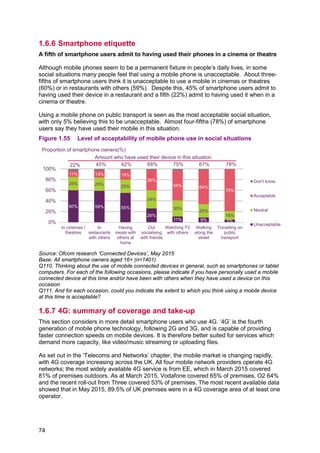
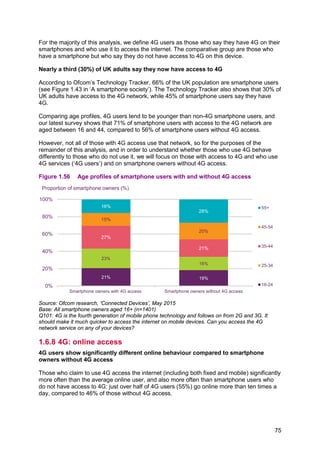
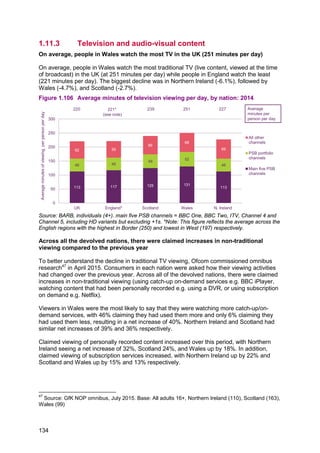
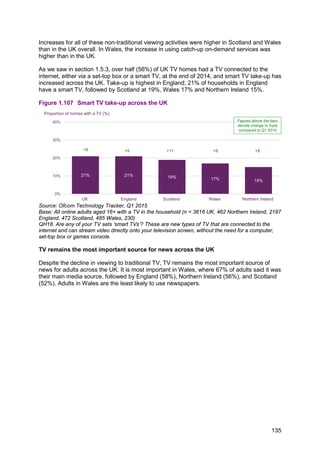
  • 163.
    in 2008 to32% in 2014. Recorded and catch-up viewing of UK soaps grew by 18pp; from 6% to 23%, across the same period, while time-shifted viewing of UK drama programming was up by 15pp from 7% to 22% in 2014. As time-shifting becomes more prevalent generally, most other genres have seen an increased proportion of viewing after the initial time of broadcast. Figure 2.17 Proportion of time-shifted viewing, by genre: all individuals Source: BARB, individuals 4+, Network Plus 2008, Network 2014. Network programming based on 4+ area filter. Ranked on proportion of programme genre watched time-shifted, descending. Genre groupings are based on BARB genre codings, categorised by Ofcom. Sports events featured in four of the top five programmes in 2014 Research from Thinkbox53 looked at how and why viewers choose between watching TV live or on demand (VOD) and why they watch different types of online video. It identified six need-states that drive the different forms of TV viewing. The research found that traditional live TV fulfils each of the need states, but particularly comfort (such as shared family time), indulgence (in personal favourites) and relaxation. It was also found to be a key provider of shared experiences and social connection. VOD was found to satisfy personal need states, specifically indulging and escaping, more than the social needs. These types of factors may influence the kind of programmes which are most watched live. Of the top five most watched programmes overall (live plus time-shifted) in 2014, sports events attracted not only the largest viewing numbers but were almost entirely watched live at the time of broadcast, and were also mainly watched with other people (Figure 2.18). The top five most-watched programmes among those who own a DVR were the same as for the general population overall (albeit with a slightly different ranking), with DVR-owning viewers also tending to watch the World Cup and the Great British Bake-Off final live as opposed to time-shifted. Those who did not watch the Great British Bake-Off final at the time of broadcast chose to watch the concluding episode as soon as possible after transmission. 53 Thinkbox’s Screen Life: TV in Demand research was conducted in 2013 and looked at the six reasons that people watch TV http://www.thinkbox.tv/research/screen-life-tv-in-demand-summary/ 0% 5% 10% 15% 20% 25% 30% 35% Total time-shifted 2008 Pp increase in time-shift 2008-2014 Time-shifted viewing as % of total viewing to genre, 2008 vs 2014 32% 23% 22% 17% 16% 15% 15% 14% 14% 12% 11% 11% 11% 11% 10% 9% 8% 8% 7% 5% 4% 2% 2% 2% 0% 0% 159
  • 164.
    This might beto gratify the need to know the winner or to avoid spoilers from friends and family. Figure 2.18 Top five programmes in 2014, live vs. time-shifted: all individuals and DVR individuals Source: BARB. All individuals. Network programming based on 4+ area filter. Data are based on the top five most-watched programmes overall (live/traditional TV + time-shifted) based on the best single performing episode 000s, with proportion of live vs. time-shifted and co-viewing % added for detail. Figure 2.19 shows the top 20 most-watched programmes viewed live in 2014, excluding sports programming. Not only did these attract substantial audience numbers, they were almost entirely all in peak time. Programmes during the Christmas and New Year season featured highly in the list; the most-watched programme overall was the New Year’s Eve Fireworks. Other popular entertainment shows included Britain’s Got Talent, Strictly Come Dancing, I’m A Celebrity Get Me Out of Here, The X Factor and The Voice UK, and soaps such as Coronation Street and Eastenders. UK-made drama such as Call The Midwife, Sherlock and Downton Abbey also performed well, as did fundraising programmes like Children In Need and Sport Relief. All individuals Rank Programme Channel Date Day Start time Total Average audience 000s % Live % watched on the same day as live % watched up to 7 days after broadcast % of live viewing watched with other people 1 WORLD CUP 2014: GER V ARG BBC One 13/07/2014 Sunday 20:00:09 14,965 96% 4% 0% 68% 2 FIFA WORLD CUP 2014: URUGUAY V ENGLAND ITV 19/06/2014 Thursday 18:59:00 13,875 95% 4% 0% 64% 3 THE GREAT BRITISH BAKE OFF BBC One 08/10/2014 Wednesday 20:00:14 13,510 68% 23% 9% 64% 4 WORLD CUP 2014: BRA V GER BBC One 08/07/2014 Tuesday 21:00:08 13,486 96% 3% 0% 61% 5 WORLD CUP 2014: ENG V ITA BBC One 14/06/2014 Saturday 23:13:28 13,343 96% 2% 2% 67% DVR individuals Rank Programme Channel Date Day Start time Total Average audience 000s % Live % watched on the same day as live % watched up to 7 days after broadcast % of live viewing watched with other people 1 WORLD CUP 2014: GER V ARG BBC One 13/07/2014 Sunday 20:00:09 11,252 95% 5% 0% 72% 2 THE GREAT BRITISH BAKE OFF BBC One 08/10/2014 Wednesday 20:00:14 10,383 60% 30% 10% 64% 3 WORLD CUP 2014: ENG V ITA BBC One 14/06/2014 Saturday 23:13:28 10,318 95% 3% 2% 70% 4 WORLD CUP 2014: BRA V GER BBC One 08/07/2014 Tuesday 21:00:08 10,049 95% 5% 0% 64% 5 FIFA WORLD CUP 2014: URUGUAY V ENGLAND ITV 19/06/2014 Thursday 18:59:00 9,993 94% 6% 0% 66% 160
  • 165.
    The most-watched liveprogrammes in 2014 included Christmas and New Year celebrations as well as peak-time entertainment and UK drama Figure 2.19 The top 20 most-watched programmes live (excl. sports): 2014 Source: BARB. All individuals. Network programming based on 4+ area filter. Programmes with a minimum duration of 10 minutes. Excludes sports programming. Data are based on the top 20 most- watched programmes (best episode) based on live audience in 000s with proportions of time-shifted viewing added for detail. Exploring the shared TV experience a little further, when people who live with other people watch TV, they tend to watch with someone else during the afternoons and evenings, and families still gather to watch TV together in the evening. This has not changed much since 2007, before owning a DVR became mainstream (see Figure 2.20). # Programme Channel Date Day Start time Total live average audience 000s % Live % watched on the same day as live % watched up to 7 days after broadcast 1 NEW YEAR'S EVE FIREWORKS BBC One 31/12/2014 Wednesday 23:59:01 11,426 91% 2% 6% 2 THE GREAT BRITISH BAKE OFF BBC One 08/10/2014 Wednesday 20:00:14 9,176 68% 23% 9% 3 BRITAIN'S GOT TALENT (SERIES 8) ITV 12/04/2014 Saturday 19:59:12 8,936 75% 14% 7% 4 STRICTLY COME DANCING BBC One 20/12/2014 Saturday 18:29:55 8,831 76% 16% 8% 5 QUEEN AND ADAM LAMBERT ROCK BIG BEN LIVE BBC One 31/12/2014 Wednesday 00:10:01 8,792 93% 4% 4% 6 STRICTLY COME DANCING: THE RESULTS BBC One 20/12/2014 Saturday 20:50:10 8,784 76% 12% 12% 7 I'M A CELEBRITY GET ME OUT OF HERE! (SER ITV 16/11/2014 Sunday 21:02:05 8,636 74% 14% 8% 8 CORONATION STREET ITV 20/01/2014 Monday 20:29:00 8,477 80% 12% 6% 9 CALL THE MIDWIFE BBC One 19/01/2014 Sunday 20:00:29 8,250 73% 12% 15% 10 THE EUROVISION SONG CONTEST BBC One 10/05/2014 Saturday 20:00:02 8,034 90% 8% 2% 11 THE X FACTOR RESULTS (SERIES 11) ITV 14/12/2014 Sunday 20:02:35 7,969 81% 13% 3% 12 CHILDREN IN NEED BBC One 14/11/2014 Friday 19:30:03 7,567 89% 9% 3% 13 THE X FACTOR (SERIES 11) ITV 30/08/2014 Saturday 20:04:55 7,277 72% 18% 6% 14 SPORT RELIEF BBC One 21/03/2014 Friday 18:59:00 7,236 90% 7% 3% 15 DOWNTON ABBEY ITV 02/11/2014 Sunday 21:02:42 7,176 70% 10% 16% 16 BRITAIN'S GOT TALENT RESULT (SERIES 8) ITV 26/05/2014 Monday 21:34:10 6,991 82% 11% 6% 17 THE VOICE UK BBC One 08/02/2014 Saturday 19:12:17 6,940 74% 16% 10% 18 EASTENDERS BBC One 21/04/2014 Monday 19:59:23 6,869 76% 16% 9% 19 SIX O'CLOCK NEWS BBC One 14/02/2014 Friday 18:00:06 6,856 97% 3% 0% 20 SHERLOCK BBC One 01/01/2014 Wednesday 20:59:48 6,843 54% 18% 28% 161
  • 166.
    Figure 2.20 Proportionof traditional TV viewing that is co-viewed, by day part: 2007 and 2014 Source: BARB. Individuals in 2+ households, Network. Based on co-viewing during live/traditional broadcast, split by half-hour time bands. Traditional TV viewing accounted for 85% of audio-visual viewing of programmes, but is falling Connectivity continues to spread and more people own a portable device that enables them to watch programmes and films more flexibly, away from the TV screen. Take-up and use of video-on-demand (VoD) services, such as Netflix, NowTV and Amazon Prime Instant Video, have increased. Despite this, traditional live TV viewing continues to be the main way of watching content across all screens. But as the popularity of time-shifted (recorded) viewing and watching VoD has grown, we estimate that its share of all viewing across all devices is beginning to decline (from 92% in the first half of 2010 to 85% in the first half of 2014), whereas recorded content represented 10% of total viewing, and VoD 6% (Figure 2.21). Figure 2.21 Proportion of all AV viewing: traditional TV viewing vs. DVR and VoD Source: 3 Reasons’ estimates (including BARB data). Base: All devices, long-form professional AV content. Live includes simulcast. Excludes physical consumption (e.g. DVDs), and short-form 0% 10% 20% 30% 40% 50% 60% 70% 80% 90% 100% 2007 2014 Peak time Proportion of co-viewed live viewing across the day by half-hour – individuals in 2+ households, Total TV, 2007 and 2014 85% 86% 87% 88% 88% 89% 90% 91% 92% 10% 10% 9% 9% 9% 9% 8% 7% 6% 6% 4% 4% 3% 3% 2% 2% 2% 2% 0% 50% 100% H1 2014 H2 2013 H1 2013 H2 2012 H1 2012 H2 2011 H1 2011 H2 2010 H1 2010 Proportion of viewing minutes across all devices Live Recorded VOD 162
  • 167.
    2.2The TV andaudio-visual industries 2.2.1 Summary This section examines some of the characteristics of the UK’s audio-visual sector in 2014. It focuses on a range of metrics from the broadcast television industry, with key points including: • The UK television industry generated £13.2bn in revenue during 2014, an increase of £392m (3.1%) on 2013. All income streams saw annual increases, with net advertising revenue increasing by the largest absolute figure (£145m) and BBC income allocated to the licence fee increasing by the greatest proportion (5.1%) since 2013. • Pay-TV subscription revenue reached £6.0bn in 2014. Subscription revenue continued to contribute the most to the UK television industry in 2014, accounting for 45.3% of total revenue. • Broadcast-based TV advertising income continued to grow in 2014. There was a 4% (£145m) increase since 2013 in net advertising revenue (NAR), to £3.8bn. All channel groups had annual increases; the commercial multichannels’ NAR was up by 8% (£74m) to exceed £1.0bn for the first time in 2014. • Spend on content by all UK TV channels in 2014 rose by 9.4% to reach £6.4bn in nominal terms. All channel groups increased their content spend in 2014, with the exception of the BBC portfolio channels, which had a 4% year-on-year decrease. The film and sport channels of the multichannel sector saw the greatest annual increase in spend (18%) to total £2.5bn in 2014. • Spend on first-run UK-originated programming (network, and nations and regions) by the main five PSB channels increased by 5%, from £2,451m in 2013 to £2,585m in 2014 in nominal terms. Key factors in this increase were the Brazil World Cup and the Glasgow Commonwealth Games.54 • Total broadcast hours of first-run UK-originated programming on the five main channels increased by 1% in 2014. There was a 2.1% increase in original UK content broadcast during non-peak hours in 2014, to give the greatest number of such hours since 2009. • Entertainment and comedy output continues to displace drama and soaps output on the main five PSB channels during peak hours. The 1,579 hours of entertainment and comedy output broadcast across the main five PSB channels during peak hours in 2014 was higher than at any point since 2009. The corresponding 1,346 hours of drama and soaps output was the lowest figure over the same period. • Spend on sports content by the commercial multichannel broadcasters55 exceeded £2bn in 2014, following a 21% annual increase in nominal terms. This was the first full year of the current English Premier League rights deal, which 54 Further information on content spend by the PSBs can be found in Ofcom’s PSB Review where figures are adjusted for inflation; http://stakeholders.ofcom.org.uk/consultations/psb-review-3/ 55 This includes the commercial PSB portfolio channels. 163
  • 168.
    contributed to sportsspend making up 62% of multichannel content spend across the eight mainstream genres. 2.2.2 Television industry revenue The UK TV industry grew by 3.1% year on year and was worth over £13bn in 2014 The UK television industry generated £13.2bn in revenue during 2014, an increase of £392m (or 3.1%) on 2013 in nominal terms. The market grew as a result of increases across all revenue sources: a 5.1% increase in BBC income allocated to TV, a 3.9% increase in net advertising revenue, a 1.9% increase in subscription revenue and a 0.9% increase in all other revenue. Pay-TV subscription revenue reached £6.0bn in 2014, although the 1.9% year-on-year increase on 2013 was down on the 6.5% annual increase in revenue seen between 2012 and 2013.56 Ofcom estimates that the BBC spent £2.7bn on television services57 in 2014. This is due primarily to the BBC’s TV coverage of major sporting events in 2014, compared to 2013, most notably the FIFA World Cup in Brazil and the Commonwealth Games in Glasgow. Other revenue has seen a 1.8% annual average decline since 2009, in large part due to the new funding agreement for S4C, which has led to most of its funding coming from licence fee revenue rather than from DCMS. Further analysis of other revenue can be found in Figure 2.27. 56 This was the first year in which Sky included NowTV revenue in its subscription revenues. 57 Based on BBC Annual Report 2014/15 and includes the proportion of licence fee revenue that goes to S4C. 164
  • 169.
    Figure 2.22 Totalbroadcast TV industry revenue, by source Source: Ofcom/broadcasters. Note: Figures expressed in nominal terms and replace previous Ofcom revenue data for TV industry, owing to restatements and improvements in methodologies. ‘Subscription revenue’ includes Ofcom’s estimates of Sky UK, Virgin Media, BT TV, TalkTalkTV and Channel 4 subscriber revenue as well as, in previous years, that of Setanta Sports, ESPN and Top Up TV in the UK (Republic of Ireland revenue is excluded). It also excludes revenue generated by broadband and telephony. ‘Other’ includes TV shopping, sponsorship, interactive (including premium- rate telephony services), programme sales and S4C’s grant from the DCMS. Totals may not equal the sum of the components due to rounding. The relative contributions of the four main TV revenue sources remained fairly stable during 2014; the largest annual change was the 0.5 percentage point decrease, to 45.3%, in the share of subscription revenue to overall TV revenue. Subsequently, the BBC income allocated to TV rose by 0.4pp on the year to reach 20.6% of all TV revenue, while NAR reached 29.0% in 2014. The share of all other revenue declined slightly to 5.1% in 2014. 4,655 5,027 5,428 5,518 5,879 5,989 3,143 3,491 3,630 3,547 3,693 3,838 2,555 2,563 2,585 2,671 2,596 2,727 736 712 723 749 667 672 0 1,000 2,000 3,000 4,000 5,000 6,000 7,000 2009 2010 2011 2012 2013 2014 Subscription revenue Net advertising revenue BBC income allocated to TV Other revenue £11,794£11,088 1.9% 3.9% 5.2% 4.1% 0.9% -1.8% £m 1 year 5yr CAGRGrowth to 2014 £12,366 £12,486 3.1% 3.6% 5.1% 1.3% £12,834 Total£13,227 165
  • 170.
    Figure 2.23 Totalbroadcast TV industry revenue, by share Source: Ofcom/broadcasters. Note: Figures expressed in nominal terms and replace previous Ofcom revenue data for TV industry, owing to restatements and improvements in methodologies. ‘Subscription revenue’ includes Ofcom’s estimates of Sky UK, Virgin Media, BT TV, TalkTalkTV and Channel 4 subscriber revenue as well as, in previous years, that of Setanta Sports, ESPN and Top Up TV in the UK (Republic of Ireland revenue is excluded). It also excludes revenue generated by broadband and telephony. ‘Other’ includes TV shopping, sponsorship, interactive (including premium- rate telephony services), programme sales and S4C’s grant from the DCMS. Totals may not equal the sum of the components due to rounding. The TV platform operators and the commercial multichannels have seen an average annual growth in revenue of around 5% each since 2009 Each sector of the TV industry had an increase in revenue in 2014 compared to 2013. Despite having the lowest annual growth percentage of the four sectors shown in Figure 2.24, at 1.9%, subscription revenue from the platform operators has had the greatest average annual increase in revenue since 2009, at 5.2%. The commercial multichannels (including the commercial PSB portfolio channels) had a 4.8% annual increase, to reach revenue of £2,089m, a CAGR (i.e. average annual increase each year) of 4.8% since 2009. The main commercial PSB channels had a 2.4% increase in year-on-year revenue to reach £2,414m in 2014, while the publicly-funded channels had a 5.0% annual increase, to £2,734m. 42.0% 42.6% 43.9% 44.2% 45.8% 45.3% 28.3% 29.6% 29.4% 28.4% 28.8% 29.0% 23.0% 21.7% 20.9% 21.4% 20.2% 20.6% 6.6% 6.0% 5.8% 6.0% 5.2% 5.1% 0% 10% 20% 30% 40% 50% 2009 2010 2011 2012 2013 2014 Subscription revenue Net advertising revenue BBC income allocated to TV Other revenue TV industry revenue shares (%) £11,088m £12,366m£11,794m £12,486m £12,834m £13,227m 166
  • 171.
    Figure 2.24 TotalTV industry revenue, by sector Source: Ofcom/broadcasters. Note: Figures expressed in nominal terms and replace previous Ofcom revenue data for TV industry, owing to restatements and improvements in methodologies. The platform operators are Sky UK, Virgin Media, BT TV and TalkTalkTV as well as, in previous years, Setanta Sports, ESPN and Top Up TV in the UK (Republic of Ireland revenue is excluded).The platform operators figures also contain subscription revenue for Channel 4. Main commercial PSB channels comprise ITV/ITV Breakfast, STV, UTV, Channel Television, Channel 4, Channel 5 and S4C. Commercial multichannels comprise all multichannels including the commercial PSB portfolio channels. Publicly-funded channels comprise BBC One, BBC Two, the BBC portfolio channels and S4C. The commercial revenues of S4C are included with the main commercial PSB channels while their licence fee revenue and DCMS grants come under publicly-funded channels. Totals may not equal the sum of the components due to rounding. Television advertising revenues continued to grow in 2014 TV advertising income increased by 4% (£145m) in 2014 to reach £3.8bn, its highest level in the five-year period since 2009. All three groups of commercial channels had year-on-year increases in advertising revenues; those of the commercial multichannels had the largest proportional growth at 8% (£74m) to exceed £1bn for the first time in 2014. The commercial PSB channels’ revenue grew by 3% (£57m) in 2014; this can be attributed to the Brazil World Cup during the summer. When combined with the advertising revenue of the commercial PSB portfolio channels (up 2% to total £653m in 2014), total advertising revenue generated by the commercial PSB broadcasters combined made up 72.8% of all TV advertising revenue in 2014, the lowest percentage of any year from 2009 to 2014 Revenue (£m) £2,656 £2,665 £2,676 £2,755 £2,603 £2,734 £2,126 £2,354 £2,407 £2,334 £2,359 £2,414 £1,650 £1,747 £1,855 £1,879 £1,994 £2,089 £4,655 £5,027 £5,428 £5,518 £5,879 £5,989 0 2,000 4,000 6,000 8,000 10,000 12,000 14,000 2009 2010 2011 2012 2013 2014 Platform operators Commercial multichannels Main commercial PSB channels Publicly-funded channels 1.9% 2.4% 5.2% 2.6% 4.8% 1 year 5yr CAGR Growth 4.8% £11,794£11,088 £12,366 £12,486 £12,834 3.1% 3.6% 0.6%5.0% £13,227 167
  • 172.
    Figure 2.25 TVnet advertising revenues, by source: 2009-2014 Source: Ofcom/broadcasters. Note: Figures expressed are in nominal terms and replace previous data published by Ofcom. Commercial PSB channels comprise ITV, STV, UTV, Channel Television, ITV Breakfast, Channel 4, Channel 5 and S4C (and their ‘+1’ channels); Commercial PSB portfolio channels include, where relevant, ITV2, ITV3, ITV4, CITV, ITVBe, ITV Encore, ITV Breakfast 2, E4, More 4, Film 4, 4Seven, Five USA and 5* (and their ‘+1’ channels). For previous years closed channels have also been included. Sponsorship revenue not included. Totals may not equal the sum of the components due to rounding. The multichannel sector saw the largest proportional growth in TV advertising market share in 2014 The holders of the Channel 3 licences (ITV/ ITV Breakfast/ STV/ UTV) continued to have the largest market share of the TV advertising market in 2014, increasing to 35.8% from their 2013 share of 35.1%. However, the greatest increase in share was in the multichannel sector in 2014, which rose by nearly one percentage point (pp) to total 27.2% in 2014. In contrast, both Channel 4 and Channel 5 had a reduced share of the TV advertising revenue market in 2014, decreasing by 0.6pp and 0.8pp respectively, while the share of the commercial PSB portfolio channels combined dropped by 0.3pp to 17.0% over the same period. £1,896m £2,140m £2,178m £2,077m £2,085m £2,141m £445m £518m £544m £561m £639m £653m £802m £834m £908m £910m £968m £1,043m£3,143m £3,491m £3,630m £3,547m £3,693m £3,838m 0 1,000 2,000 3,000 4,000 2009 2010 2011 2012 2013 2014 Commercial multichannels Commercial PSB portfolio channels Commercial PSB channels NAR(£m) 3% 1 year 5yr CAGR Growth 2% 4% 4% 8% 5% 2% 8% Combined 168
  • 173.
    Figure 2.26 TVnet advertising revenue market shares: 2013-2014 Source: Ofcom/broadcasters. Note: Totals are expressed in nominal terms. Revenues attributed to ‘+1’ channels are included with those from their main channels. Broadcaster revenue raised from other sources increased by 1% in 2014 Television revenue from sources other than subscription income, advertising revenue and the licence fee increased by 1% in 2014. This increase was driven by the £16m (8%) growth in sponsorship revenues, which totalled £208m in 2014, as well as the 19% year-on-year growth in revenue (£7m) generated by interactive services. Growth in these areas helped to offset decreases elsewhere, such as from TV shopping, which saw a 6% decrease (£10m) to total £146m, largely because there were fewer TV shopping channels broadcasting throughout 2014. An agreement between S4C, the Department for Culture, Media & Sport (DCMS) and the BBC resulted in the financing of S4C being restructured in 2013, and the channel now receives the majority of its funding from the licence fee. As such, S4C’s non-licence fee income decreased by 59% to £8m in 2014. 33.8% 34.5% 1.3% 1.3% 13.1% 12.5% 8.2% 7.4% 17.3% 17.0% 26.2% 27.2% 0% 20% 40% 60% 80% 100% 2013 2014 Commercial multichannels Commercial PSB portfolio channels S4C Channel 5 Channel 4 ITV Breakfast ITV/STV/UTV Proportion of NAR £3,693m £3,838m 169
  • 174.
    Figure 2.27 Breakdownof other commercial TV channel revenue: 2013-2014 Source: Ofcom/broadcasters. Note: Percentage figures in brackets represent year-on-year change for total non-broadcast revenue versus 2014. TV shopping represents aggregate operating margin of products sold via television. A funding agreement which was reached in April 2013 meant that the majority of S4C funding now comes out of the BBC’s licence fee income. Totals may not equal the sum of the components due to rounding. Owing to the nature of these revenue components, annual changes may be a function of a higher number of broadcaster returns being made by the time of writing, rather than material changes in the contributions that these revenue components are making to total industry income. 2.2.3 TV revenue among multichannel genres Revenue generated by the multichannel sector continued to grow in 2014, driven by entertainment and factual channels Across the main eight genres of programming broadcast by the multichannel sector, total revenue increased by 2% year on year to £5,481m in 2014. This overall increase was driven by the growing revenues attributed to entertainment (up 11% to £1,690m) and factual (up 13% to £264m) programming. While sport remained the genre that generated the most TV revenue for the multichannel sector in 2014, total revenue decreased by 2% to £2,285m, following the high of £2,329m generated in 2013. The greatest proportional decreases in revenue came from leisure (down 21% to £40m) and music (down 6% to £117m) programming. Total ‘other’ revenue = £672m (+1%) Sponsorship £208m (+8%) Programme Sales £48m (+8%) Interactive £40m (+19%) PPV £34m (+10%) S4C £8m (-59%) TV Shopping £146m (-6%) Other £189m (-1%) 170
  • 175.
    Figure 2.28 Revenuegenerated by multichannel broadcasters, by genre: 2013-2014 Source: Ofcom/broadcasters. Note: Percentage figures in brackets represent year-on-year change for total revenue compared to 2013. The figures in this chart include all sources of revenue accruing to multichannels and are expressed in nominal terms. This includes those set out in Figure 2.22 plus wholesale subscriber payments from platform operators. 2.2.4 Spend on UK television programmes Broadcasters spent £6.4bn on programmes in 2014 Spend58 on content by all UK TV channels in 2014 was £6.4bn, an increase of 9% year on year in nominal terms. With 2014 being the first full year to reflect the higher Premier League rights payments, following the 2012 TV rights auction, the 18% increase in spend on film and sports channels, to £2.5bn, is the main reason behind the overall increase in spend. With the exception of the BBC portfolio channels (down 4% to £236m), all of the other channels/groups of channels listed in Figure 2.29 saw nominal increases in spend in 2014 when compared to the previous year. Of the PSB channels, BBC One had the greatest annual increase in spend, at 9% (up to £813m), in a year in which it broadcast both the FIFA World Cup and the Glasgow Commonwealth Games, while the other multichannels had a 7% year-on-year increase in spend in 2014 (up to £757m). The PSB channels made up 45% of all programme spend in 2014, while the film and sports channels combined made up 39% of the total. 58 Spend figures here do not represent the entire cost of programme production in the UK as they do not include third-party funding or the full cost of co-productions with overseas broadcasters. Entertainment £1,690m (+11%) Factual £264m (+13%) Kids £190m (+1%) Leisure £40m (-21%)News £129m (+1%) Sport £2,285m (-2%) Movies £766m (-2%) Music £117m (-6%) Total revenue = £5,481m across the eight included genres (+2%) 171
  • 176.
    Figure 2.29 Spendon network TV programmes: 2013-2014 Source: Ofcom/broadcasters. Note: Figures expressed in nominal prices. Figures do not include spend on nations’ and regions’ output. BBC portfolio channels includes BBC Three, BBC Four, BBC News, BBC Parliament, CBBC and CBeebies (but not BBC HD). ‘Other multichannels’ include all genres (excluding sports and films). Programme spend comprises in-house productions, commissions from independents, acquired programmes and repeats (originations and acquisitions). 2.2.5 UK independent sector Independent producers’ TV revenue declined in 2014 following the record high reported in 2013 According to PACT’s annual census of independent production companies in the UK, in 2014 TV revenues within the independent sector decreased by 2.5% to £2.71bn, following nearly a decade of growth.59 This decrease was primarily driven by drops in primary UK commissions (down by 4.9% to £1.59bn) and ‘other’ international income (i.e. primary commissions and co-productions from non-UK broadcasters, as well as revenue from companies’ overseas operations) which was down 8.1% year on year to £0.69bn in 2014. However, it is worth noting that the five-year compound annual growth rate remains positive for each revenue source, as shown in Figure 2.30. 59 A change in sampling from 2013 to 2014 slightly overstates the decline. £2,093m £2,477m £747m £813m £794m £818m £708m £757m£486m £492m£298m £311m £246m £236m £260m £269m £179m £181m 0 1,000 2,000 3,000 4,000 5,000 6,000 7,000 2013 2014 Channel 5 Other PSB portfolio channels BBC portfolio channels BBC Two Channel 4 Other multichannels ITV/ITV Breakfast BBC One Film/Sport channels +9.4% £m 1 yr change £5,811m £6,355m +3% +1% +7% +9% +18% +3% -4% +4% +1% 172
  • 177.
    Figure 2.30 Independentproducer TV-related revenues Source: PACT Independent Production Sector Financial Census and Survey 2015. Note: ‘Other international income’ refers to revenue from companies overseas operations and any primary commissions received from non-UK broadcasters; ‘International sales of UK finished programmes’: sales of first-run UK programming sold as finished product abroad ; ‘UK rights income’: UK secondary sales, publishing, formats, DVD sales etc. The proportion of spend on first-run UK originations by the PSB channels that went to independent producers decreased between 2009 and 2014 Across all genres, 44% of spend on first-run UK-originated content by the PSB channels in 2014 (excluding nations’ and regions’ spend) was spent externally, a slight decrease on the 46% external spend recorded in 2009. Looking at the genres that make up most of the PSB channel spend, independent producers continue to make up the majority of spend for entertainment and comedy (72%) and factual originations (64%), while their share of original drama and soaps spend decreased from 52% in 2009 to 48% in 2014. On the other hand, news and current affairs and sports programming continue to be predominantly in-house commissions, with 24% and 7% of the total first-run UK originated spend figures respectively being by independent producers in 2014. Indeed, due to the cyclical nature of major sporting events, the decrease in the overall proportion of first-run spend that went on external productions in 2014 can be attributed to the big year for sport. Excluding sports spend, 54% of PSB channel spend on first-run UK originations went to independent producers in both 2009 and 2014. £1,395m £1,356m £1,247m £1,539m £1,668m £1,586m £115m £154m £165m £185m £147m £184m £70m £87m £119m £152m £156m £180m £369m £495m £652m £670m £755m £694m £32m £26m £25m £41m £40m £39m £17m £27m £18m £2m £14m £25m £1,999m £2,145m £2,227m £2,588m £2,779m £2,708m 0 500 1,000 1,500 2,000 2,500 3,000 2009 2010 2011 2012 2013 2014 Total Other UK Pre-production Other international income International sales of UK finished programmes UK rights income Primary UK commissions -2.0% 15.7% 4.1% 20.7% 13.5%-8.1% 84.0% 7.4% 9.9%24.8% -2.5% 6.3% 2.6%-4.9% 1 year 5 year CAGR Growth £m 173
  • 178.
    Figure 2.31 Relativeshare of spend on first-run UK-originated content, by genre, in- house vs. independent producers: 2009 and 2014 Source: Ofcom/broadcasters. Note: Figures are expressed in nominal terms. Includes spend by the five main PSB channels and BBC portfolio channels on first-run originated content broadcast all day, and excludes nations’/regions’ output. 2.2.6 Spend on first-run UK-originated content by the main five PSB channels There was a 5% increase in first-run UK-originated content spend by the main five PSB channels on network and nations’ and regions’ programming in 201460 Spend on first-run UK-originated programming by the main five PSB channels (including spend by the nations’ and regions’ channels and ITV Breakfast) increased by 5%, from £2,451m in 2013 to £2,585m in 2014 in nominal terms. Spend on first-run UK originations in peak time also increased year on year, to £1,515m (a 3% increase). After falling in 2013, first-run spend in 2014 was nearly at the same level as in 2012. This fluctuation can be attributed to major sporting events; 2012 had the London Olympics and the European football championships, while 2014 featured the Brazil World Cup and the Glasgow Commonwealth games. Overall, there is a compound annual growth rate of 1% in nominal terms across the five-year period from 2009 to 2014. 60 Further information on content spend across the PSB channels can be found in Ofcom’s PSB Review, in which figures are adjusted for inflation: http://stakeholders.ofcom.org.uk/consultations/psb- review-3/ £47 £41 £91 £88 £292 £304 £569 £516 £26 £420 £20£7 £504 £15£451 £13£482 £414£17 £545 £2,342 £2,521 Total spend on first-run originations (£m) 60% 53% 56% 60% 78% 76% 48% 52% 22% 79% 30% 28% 34% 36% 55% 77% 91% 93% 54% 56% 40% 47% 44% 40% 22% 24% 52% 48% 78% 21% 70% 72% 66% 64% 100% 100% 45% 23% 9% 7% 46% 44% 2009 2014 2009 2014 2009 2014 2009 2014 2009 2014 2009 2014 2009 2014 2009 2014 2009 2014 2009 2014 2009 2014 Arts & Classical Music Childrens News & Current Affairs Drama & Soaps Education Entertainment & Comedy Factual Feature Films Religion & Ethics Sports Grand Total Internal External 174
  • 179.
    Figure 2.32 Spendon first-run UK originated output on the five main networks Source: Ofcom/broadcasters. Note: Figures are expressed in nominal terms. They include ITV Breakfast, spending in the nations and regions on English-language programming (and a small amount of Irish-language programmes) but do not include the BBC’s portfolio channels, BBC Alba or S4C 2.2.7 Television output on the PSB channels PSB output in context There were 87,087 hours of content broadcast by the PSB channels (including programmes for the nations and regions) in 2014, with just over half (43,401 hours) being first-run UK originations, produced either in-house or commissioned from external producers. Looking at the breakdown shown in Figure 2.33, of the 42,238 hours broadcast by the main five PSB channels in 2014, 45% were first-run UK originations. This compares to 40% (13,284 hours) of output on the BBC portfolio channels, while the vast majority of nations’ and regions’ output (94%) was first-run in 2014. £1,357m £1,419m £1,429m £1,502m £1,476m £1,515m £611m £624m £563m £564m £484m £549m £189m £212m £247m £257m £229m £244m £256m £261m £267m £266m £263m £277m £2,413m £2,516m £2,506m £2,588m £2,451m £2,585m 0 1,000 2,000 3,000 2009 2010 2011 2012 2013 2014 Nations & Regions Late night Day time Peak time £m 2% 1% -2% 5% 5yr CAGR 6% 5% 14% 6% 1 year Growth 3% 2% 175
  • 180.
    Figure 2.33 Totaland first-run UK-originated hours of output on the PSB channels: 2014 Source: Ofcom/broadcasters. Note: The first-run figures include in-house productions and external commissions, but not first-run acquisitions. ITV Breakfast is included within the figures for the five main channels. Regional hours exclude Welsh and Gaelic-language programming but include a small proportion of Irish-language programmes. Hours of first-run UK originations remain steady year on year Total broadcast hours of first-run UK-originated programming among the main five PSB channels increased by 314 hours in 2014 to 30,406 hours. The slight decrease in originations broadcast on the nations’ and regions’ channels (down by 0.3%) was offset by the 283-hour increase in non-peak first-run UK originations (a 2.1% increase) and the 64-hour increase in peak-time originations (a 1.0% increase) year on year. Looking at the five-year picture, overall first-run UK originations have decreased by an average of 0.1% a year since 2009, with the same rate of reduction in peak-time hours of originations over the same period; these tend to have larger budgets and larger audiences. Hours of non-peak originations decreased by an average of 1.7% a year between 2009 and 2014, while those of the nations and regions increased by an average of 1.4% a year over the same period. 42,328 19,207 32,833 13,284 11,926 11,199 0% 20% 40% 60% 80% 100% Total Hours Total First-run UK originated hours Programmes for Nations & Regions BBC Portfolio Channels Five Main PSB Channels (network) 87,087 43,690Proportion of hours YOY change (%) 2.4% -0.3% 0.4% -0.2% 0.1% 1.8% Total hours First-run UK originations 176
  • 181.
    Figure 2.34 Hoursof first-run UK-originated output on the five main PSB channels Source: Ofcom/broadcasters. Note: Figures include ITV Breakfast but do not include the BBC’s portfolio channels. Regional hours exclude Welsh and Gaelic-language programming but include a small proportion of Irish-language programmes. All of the PSB groups increased their percentage of spend on new commissions in 2014 Of the commissions from the independent sector made by the PSBs, the majority continued to be on returning series in 2014; 85% of ITV’s spend was on such programming, according to the latest figures from PACT. However, each PSB group had a year-on-year increase in the proportion of spend on new commissions in 2014: Channel 5 by 23pp, to 38% of spend on producers, the BBC and Channel 4/S4C by 12pp, to 46% and 33% of spend respectively, and ITV by 7pp to 15% in 2014. Figure 2.35 Proportion of spend on new commissions vs. returning series: PSB groups Source: PACT Independent Production Sector Financial Census and Survey 2015. Note: Figures include commissions by the PSB portfolio channels. 5,414 5,665 5,696 5,685 5,680 5,744 14,632 13,316 13,338 13,365 13,180 13,463 10,439 11,060 11,647 11,002 11,232 11,199 30,485 30,041 30,681 30,052 30,092 30,406 0 5,000 10,000 15,000 20,000 25,000 30,000 35,000 2009 2010 2011 2012 2013 2014 Nations & Regions Non-peak network Peak-time network Growth 5 yr CAGR -0.1% +1.4% -1.7% -0.1% 1 Year +1.0% -0.3% 2.1% 1.0% hours 35% 29% 27% 34% 34% 46% 10% 21% 19% 24% 8% 15% 19% 27% 35% 34% 21% 33% 43% 18% 41% 22% 15% 38% 65% 71% 73% 66% 66% 54% 90% 79% 81% 76% 92% 85% 81% 73% 65% 66% 79% 67% 57% 82% 59% 78% 85% 62% 0% 20% 40% 60% 80% 100% 2009 2010 2011 2012 2013 2014 2009 2010 2011 2012 2013 2014 2009 2010 2011 2012 2013 2014 2009 2010 2011 2012 2013 2014 New Commission Returning Series % of spend BBC ITV/STV/UTV Channel 4/S4C Channel 5 63 27 47 57 41 52298 303 287 346 402 380374 398 313 388 367 486498 498 437 508 476 474 Estimated primary rights spend (£m) 177
  • 182.
    The average numberof first-run UK-originated hours broadcast per week on the PSB channels reached its highest level since 2009 in 2014 In 2014, the PSB channels broadcast an average of 624 hours of first-run UK-originated content per week, up from 619 hours in 2013, the highest average since the 629 hours per week broadcast in 2009. There were an average of 170 hours of peak-time first-run UK originations broadcast on the PSB channels in 2014, a three-hour decrease from the 173 hours per week average in 2013. Looking at the main five PSB channels, ITV/ITV Breakfast was the only channel to decrease its average hours of first-run UK originations year on year, down by four hours to an average of 94 hours a week in 2014. The BBC portfolio channels combined also saw a slight decrease in average hours of originations, down by one hour to 255 hours in 2014. Channel 5 broadcast an average of 14 hours of first-run UK originated content per week during peak time in 2014; this was its joint-highest average over the 2009-2014 period. BBC One and BBC Two also had five-year high averages in 2014 (at 27 hours and 23 hours per week respectively) while ITV/ ITV Breakfast and Channel 4 were both down by one hour (to 25 hours and 21 hours per week respectively) in 2014. Figure 2.36 First-run UK-originated output by the PSB channels per week: all day and peak time Source: Ofcom/broadcasters. Note: Figures do not include nations’ and regions’ output. BBC portfolio channels include BBC Three, BBC Four, BBC News, BBC Parliament, CBBC and CBeebies There was a 6% increase in entertainment and comedy output during peak hours on the main five PSB channels in 2014 Looking at total programming, more hours of factual programming than of any other genre of programming were broadcast on the main five PSB channels during peak hours in 2014, although there was a 3% decrease (70 hours) to 2,559 hours from the 2013 figure. There was a 6% (88-hour) increase in the number of entertainment and comedy hours broadcast on the main five PSB channels during peak hours since 2013, to total 1,579 hours in 2014. Over the same period, drama and soaps output decreased by 140 hours, to total 1,346 hours in 2014, continuing the decline seen since 2009, as shown in Figure 2.37. 26 26 26 27 26 27 20 22 21 22 22 23 26 26 26 26 26 25 22 22 23 23 22 21 11 12 14 12 12 14 63 64 65 65 63 60 0 50 100 150 200 2009 2010 2011 2012 2013 2014 Hoursperweek BBC portfolio channels Channel 5 Channel 4 ITV/ITV Breakfast BBC Two BBC One 167 173 175 175 173 170 Peak-Time 104 106 105 107 124 128 70 73 66 66 54 57 101 101 101 99 98 94 57 58 59 64 57 57 54 27 35 31 30 33 243 248 253 256 256 255 0 200 400 600 800 2009 2010 2011 2012 2013 2014 Hoursperweek BBC portfolio channels Channel 5 Channel 4 ITV/ITV Breakfast BBC Two BBC One All Day 629 613 619 622 619 624 178
  • 183.
    Figure 2.37 Genremix on the five main PSB channels: peak time Source: Ofcom/broadcasters. Note: Includes five main channels including ITV Breakfast, figures do not include hours of nations’ and regions’ output. Across the main five PSB channels, factual programming continued to be the genre with the most hours of output during daytime in 2014 There were 358 more hours of factual content broadcast on the main five PSB channels during daytime in 2014 than in 2013, a 5% increase. There was also a 246 hour (7%) increase in the number of entertainment and comedy hours broadcast in 2014 compared to the previous year, while current affairs output increased by 5% over the same period, to 695 hours, the largest number of hours of output in the period since 2009. These increases occupy the space in the schedules created by the continuing decline in both children’s programming and drama and soaps output across these channels during the day, as can be seen in Figure 2.38 below. Proportion of total hours 878 879 857 882 923 927 308 328 298 324 333 308 197 190 163 168 142 166 2,656 2,512 2,501 2,446 2,629 2,559 1,746 1,648 1,559 1,543 1,486 1,346 1,144 1,225 1,520 1,469 1,491 1,579 611 675 661 545 533 515 357 483 334 514 359 493 0% 20% 40% 60% 80% 100% 2009 2010 2011 2012 2013 2014 Children's Sport Films Entertainment & Comedy Drama & Soaps Factual Education Religious Arts & Classical Music Current Affairs News 7,954 7,9307,964 8,009 7,961 7,964 179
  • 184.
    Figure 2.38 Genremix on the five main PSB channels: daytime Source: Ofcom/broadcasters. Note: Includes five main channels plus ITV Breakfast. Figures do not include hours of nations’ and regions’ output. Output on the BBC portfolio channels remains dominated by the single-genre channels As four of the six BBC portfolio channels are single-genre (BBC News, BBC Parliament, CBBC and CBeebies), there has been very little movement in the genre mix among these channels since 2009. There was a 15% increase (300 hours) in the number of factual hours broadcast across these channels in 2014, while with a 2% decrease (down by 32 hours to 1,970 hours), entertainment and comedy output declined across the BBC portfolio channels in 2014 following four years of growth. 2,881 2,793 2,679 2,536 2,750 2,632 438 440 549 594 661 695 4,775 5,232 5,777 6,045 7,400 7,758 2,590 2,719 2,375 1,862 1,734 1,367 2,814 2,596 2,627 2,877 3,716 3,962 1,645 1,557 1,721 1,753 1,645 1,415 1,505 1,650 1,488 1,624 1,608 2,029 4,137 4,214 4,204 4,213 1,946 1,668 0% 20% 40% 60% 80% 100% 2009 2010 2011 2012 2013 2014 Children's Sport Films Entertainment & Comedy Drama & Soaps Factual Education Religious Arts & Classical Music Current Affairs News Proportion of total hours 21,74821,65421,597 21,610 21,665 21,680 180
  • 185.
    Figure 2.39 Genremix on the BBC portfolio channels: all day Source: Ofcom/broadcasters. All figures are nominal. Note: BBC portfolio channels include BBC Three, BBC Four, BBC News, BBC Parliament, CBBC and CBeebies. Investment figures are nominal. ‘Other’ includes: education, drama, film, religion and sports 2.2.8 Television output and spend in the multichannel sector First-run originations/acquisitions made up 15% of all hours broadcast on the non- PSB channels in 2014 The multichannel sector consists of all TV channels that broadcast to the UK and are licensed by Ofcom, with the exception of the PSB channels. Of the 1.72 million hours broadcast by these channels in 2014, 15% were first-run originations/acquisitions. Entertainment programming made up 28% of the output across the multichannel sector in 2014, with the large annual increase in both total and first-run output being due to the addition of new channels in 2014 (such as ITVBe and ITV Encore). Music programming was the second biggest genre among these channels, with 17% of all output in 2014. Looking at first-run output, sports and news hours combined made up 57% of all original content across the non-PSB channels in 2014. Twelve per cent of all entertainment output across these channels in 2014 was first-run (58,584 hours). 16,546 16,460 16,555 16,710 16,566 16,517 1,339 1,472 1,421 1,204 1,256 1,323 8,406 8,213 8,178 8,306 8,362 8,409 2,629 2,405 2,648 2,703 1,999 2,229 1,077 1,296 1,151 890 1,277 1,136 1,532 1,768 1,908 1,988 2,002 1,970 1,622 1,588 1,369 1,561 1,243 1,249 0% 20% 40% 60% 80% 100% 2009 2010 2011 2012 2013 2014 Other Entertainment & Comedy Arts & Classical Music Factual Children's Current Affairs News 33,202 Proportion of total hours 32,83333,151 33,230 33,362 32,705 181
  • 186.
    Figure 2.40 Totalmultichannel hours and first-run originations/acquisitions: 2014 Source: Ofcom/broadcasters. Note: Broadcast hours exclude Sky Box Office and ‘barker’ channels, which promote TV content, and replace previous data published by Ofcom. First-run hours include first-run in-house, commissioned and acquired content. Spend on sports programming by the multichannel sector exceeded £2bn in 2014 There was a 21% increase in spend on sports programming across the multichannel sector in 2014, to reach £2,186m in nominal terms. This was predominantly because 2014 was the first full year to reflect the higher Premier League rights payments, following the 2012 TV rights auction. Apart from this increase, spend on news output across this sector increased by 12% to total £89m in 2014, and there was a £52m (7%) increase in spend on entertainment programming, to total £772m. Spend on children’s content across these channels decreased by 11% (£5m) year on year, to total £38m in 2014. Proportion of hours by channel genre (%) 485,639 58,584 208,050 6,453 138,761 1,633 58,139 1,589 127,112 59,020 180,386 85,236 229,738 7,930 298,332 34,075 0% 20% 40% 60% 80% 100% 1 2 Music Movies Sport News Leisure Children's Factual Entertainment Total = 1,726,157 Total (2013 = 1,457,138) Total = 254,520 (Total 2013 = 199,880) 1 year change % Total First Run -8% 52% 17% 1% 5% 5% 20% 7% 16% -4% 2% -41% 6% 17% 77% 153% All Hours First-Run Hours 182
  • 187.
    Figure 2.41 Multichannelcontent spend in key genres: 2013-2014 Source: Ofcom/broadcasters. Note: Spend expressed in nominal terms. Excludes BBC portfolio channels. Multichannel spend on sports rights alone will be over £2bn by 2017 On 10 February 2015, the Premier League announced its latest live TV rights deal for the three seasons from 2016/17, with Sky and BT paying £5,136m combined for 168 matches per year. This followed the announcement that BT would pay £897m for exclusive rights to broadcast live UEFA Champions League and Europa League matches for the three seasons from 2015/16. This means that from August 2016, these two broadcasters will be spending £2,011m a year on the rights to live coverage from these competitions alone. Increases in the amounts paid for TV rights to other sporting events will further increase multichannel spend on sports programming over the next few years. Earlier this year Sky announced that it had purchased exclusive rights to live coverage of the Open Championship golf tournament from 201761 , while BT recently announced an extension to its deal for English Premiership rugby rights from the 2017/18 season, which is reported to be on increased terms.62 61 http://www1.skysports.com/golf/news/12176/9698005/the-open-championship-to-be-broadcast- exclusively-live-on-sky-sports-from-2017 62 http://www.bbc.co.uk/sport/0/rugby-union/31902745 £1,808m £2,186m £721m £772m £285m £292m £77m £81m £80m £89m £43m £38m 0 500 1,000 1,500 2,000 2,500 3,000 3,500 4,000 2013 2014 Leisure Music Children's News Factual Movies Entertainment Sport £m 1 year change % 14% -9% -5% -11% 12% 5% 2% 7% 21% £3,062m £3,503m 183
  • 189.
    2.3The TV andaudio-visual viewer 2.3.1 Summary This section examines the availability and take-up of digital TV platforms and trends in television consumption, including some categories of non-broadcast TV viewing. It also analyses viewers’ attitudes to television. The key points include: • The average number of minutes of broadcast TV watched on a TV set in 2014 fell for the second consecutive year. On average, people watched 220 minutes of broadcast television per day in 2014, 11 minutes per day less than in 2013. TV viewing varies greatly by age, and between 2013 and 2014 fell by varying degrees among all age groups. The largest decline was among children aged 4-15 with a 17 mins/day (-12.4%) fall, compared to a 1 min/day (-0.3%) decline among viewers aged 65+. The ‘Changes in TV viewing habits’ (section 1.4) explores the fall in viewing in further detail. • The proportion of homes with a TV with a multi-channel signal has declined for the second consecutive period, to 92.9% of all homes (compared to 94.7% of all homes in 2013 and 95.5% in 2012). The decline may be attributable to households who watch audio-visual content using an internet connection only, those who do not use a television, and those who use a television set that does not receive any broadcast signal. • The digital terrestrial platform remains the most popular method of viewing television, accounting for the highest proportion (44.3%) of total TV viewing hours. The digital satellite platform followed just 3.9 percentage points behind, accounting for the second largest proportion of total TV viewing hours (40.5%). The proportion of total hours of TV watched on the digital cable platform was 14.6%. • Collectively, the main five PSBs accounted for 54.3% of audience share on the digital terrestrial platform, compared to 51.1% on digital cable and 45.9% on digital satellite. The greater choice of ‘other’ subscription channels in digital cable and satellite homes is likely to explain why their combined share (48.9% and 54.1% respectively) is higher than in digital terrestrial homes (45.7%). • The combined share of the main five PSB channels accounted for over half (51.2%) of all viewing in 2014, up by 0.1 percentage point on the previous year. Taking the main five PSBs and their portfolio channels together, the combined family share was 71.9% in 2014. The share of viewing to all ‘other’ digital channels remained stable at 28.1% in 2014. • Of the top 20 channels ranked by audience share in 2014, 17 were PSB main channel services or PSB-owned. Two Sky-owned channels and one UKTV-owned channel made up the remaining three of the top 20. • About half of adult viewers say that the quality of TV programmes has ‘stayed the same’ over the past 12 months, while three in ten feel they have ‘got worse’ and 16% feel they have improved. Among those who thought programmes had got worse, the top four reasons were ‘more repeats’ (57%), ‘lack of variety’ (43%), ‘general lack of quality’ (32%) and ‘too many reality shows’ (30%). 185
  • 190.
    Broadcast TV viewing BARBanalysis is based on viewing to scheduled TV programmes such as those listed in TV listings magazines or on electronic programme guides (EPG) on TV sets. ‘Broadcast TV viewing’ refers to TV programmes watched on the TV set live at the time of broadcast (traditional TV viewing), or recordings of these programmes or viewing of these programmes through catch-up player services (referred to as time-shifted), up to seven days after they are televised. Traditional TV viewing ‘Traditional TV viewing’ refers to TV programmes watched live at the time of broadcast on the TV set. Time-shifted viewing ‘Time-shifted viewing’ is defined by BARB as viewing of programmes recorded and subsequently played back on a television set within seven days of live broadcast, as well as viewing after pausing or rewinding live TV. Recording devices included in BARB analysis include video cassette recorders (VCR); DVD recorders (which store programmes on writable DVDs); digital video recorders (DVRs) which use a hard disk to store programmes chosen from an electronic programme guide, and combination devices (which use a combination of internal hard disk and removable DVDs to store programmes). Viewing any catch-up TV player services through the television set is also captured if the content has been broadcast live in the past seven days. This includes catch-up player services accessed through apps on smart TVs and games consoles, and any viewing on a laptop or personal computer connected to the television set. Viewing outside the seven-day window, viewing catch-up services on devices that are not connected to the TV set, and video on demand (VoD) services (such as Amazon Prime Instant Video and Netflix) that are not scheduled on a television channel, are not reported as time-shifted viewing. Broadcaster family ‘Broadcaster family’ refers to all channels belonging to a particular channel group. For example, the Channel 5 family includes Channel 5, Channel 5 +1, 5*, 5 USA and Channel 5+24. Digital terrestrial Digital terrestrial is a type of platform signal. It includes all televisions that receive their broadcast TV signal through an aerial. This includes services provided by Freeview, BT Vision and YouView. Digital satellite Digital satellite is a type of platform signal. It includes all televisions that receive their broadcast TV signal through a satellite dish. This includes services provided by Sky and Freesat. Digital cable Digital cable is a type of platform signal. It includes all televisions that receive their broadcast TV signal through a cable network. This includes services provided by Virgin Media. 186
  • 191.
    2.3.2 Platform take-up Take-upof multichannel declined by 1.8 percentage points to 92.9% of all homes in Q4 2014. Figure 2.42 shows the proportion of UK households with a multichannel TV signal and the split by platform. Since completion of digital switchover in October 2012, multichannel is now the only form of broadcast signal available in the UK. Between 2001 and 2012 multichannel take-up increased year on year, but has declined since 2013. Comparing 2014 to 2013, there has been a decline in the proportion of households that receive a multichannel signal, from 94.7% to 92.9%, so 7.1% of UK households now do not have any means of receiving broadcast television on a TV set. The decline may be attributable to households who watch audio-visual content using an internet connection only, households who do not use a television, or households who use a television set that does not receive any broadcast signal. Figure 2.42 Platform take-up: 2001-2014 Source: BARB Establishment Survey. Note: Data points are based on household level data for Q4 of each year. Platform demographics Figure 2.43 shows the age and socio-economic mix of use of TV platforms in 2014, together with average television viewing hours per day by platform. Digital terrestrial only (DTT-only) households had a higher proportion of older viewers (over-65s) than households with digital cable and digital satellite platforms; these had a higher proportion of younger viewers (25- 44s). Digital satellite attracted the highest proportion of AB individuals (27%), followed by digital cable (26%), while DTT-only households had the largest proportion of DE individuals (33%). Across each of the platforms, individuals in DTT-only homes watched the most television (231 minutes/day), probably due to the older demographic skew in DTT-only homes. Individuals in digital cable homes watched the least amount of TV on average (207 minutes/day). TV households (m) 0 2 4 6 8 10 12 14 16 18 20 22 24 26 28 2001 2002 2003 2004 2005 2006 2007 2008 2009 2010 2011 2012 2013 2014 Analogue Terrestrial Only Digital Terrestrial only Analogue cable Digital cable Free to view digital satellite Pay digital satellite Multichannel take-up (% all households)38.5% 39.4% 45.3% 52.9% 61.8% 69.4% 77.3% 84.3% 88.2% 91.5% 94.4% 95.5% 94.7% 92.9% 187
  • 192.
    Figure 2.43 Platformdemographics by age, socio-economic group and viewing minutes Source: Platform profile – Ofcom Technology Tracker 2014. Average minutes – BARB 2014 data The average number of minutes of broadcast TV watched on a TV set in 2014 fell for the second consecutive year, to 220 minutes. According to BARB, the average number of minutes of broadcast television watched per person in the UK has fluctuated over the last 11 years. Viewing in 2014 (220 minutes, or 3 hours 40 minutes per day) was in line with viewing a decade ago, in 2004 (222 minutes, or 3 hours 42 minutes per day). Comparing 2014 to 2013, the data show a decline of 1163 minutes per day among all individuals, continuing the nine-minutes-per-day fall between 2012 and 2013. For a more in-depth discussion of the year-on-year decline in TV viewing minutes see ‘Changes in TV viewing habits’ (Section 1.4). TV viewing varies greatly by age: children watched the least television (118 minutes a day) and adults aged 65 and over watched the most (340 minutes a day). Between 2013 and 2014, viewing among all age groups fell by varying degrees. The largest decline was among children aged 4-15, with a 17 minutes per day (-12.4%) fall, compared to a one minute per day (-0.3%) decline among viewers aged 65 or over. 63 Minutes spent watching TV per day declined by 11 minutes year on year, although values appear in the chart to not equate to 11 minutes due to rounding. 25% 22% 27% 26% 30% 28% 31% 32% 18% 17% 19% 19% 27% 33% 23% 23% 16-24 25-44 45-64 65+ AB C1 C2 DE 15% 12% 17% 15% 37% 31% 41% 39% 31% 29% 31% 32% 18% 27% 11% 14% 0% 20% 40% 60% 80% 100% 220 231 219 207 0 50 100 150 200 250 Average minutes per day% platform profile 188
  • 193.
    Figure 2.44 Averageminutes of broadcast television viewing per day, by age: all homes Source: BARB, Network, individuals 4+. Note: A new BARB panel was introduced in 2010. As a result, pre- and post-panel change data must be compared with caution. TV audiences continue to peak between 9pm and 10pm Figure 2.45 shows the size and distribution of viewing audiences throughout the day on weekdays compared to weekends. The size of the audience tends to be larger at weekends; the exception to this is between 5am to 8am, when the weekday audience is higher. The distribution of audiences throughout the day is broadly similar at weekends and on weekdays. At weekends viewing audiences gradually rise throughout the day, with viewing peaking between 9pm and 10pm. Similarly, weekday viewing increases throughout the day but audiences also spike at breakfast and lunchtime. On weekdays and at the weekend audiences average over 25 million viewers in the 9-10pm slot. Figure 2.45 Average 2014 audiences, weekdays/weekends, by day part: all homes Source: BARB, individuals 4+ Figure 2.46 shows when different age groups are watching TV on a weekday. Throughout the day adults aged 65+ are the largest audience group watching. Their viewing rises during breakfast and lunchtime hours, dipping in between, and peaking at almost 7 million viewers 306 301 294 301 315 314 343 345 347 341 340 268 264 263 271 278 279 311 316 314 309 298 241 242 243 242 253 255 269 270 269 256 245 222 219 216 218 225 225 242 242 241 232 220222 220 216 217 219 217 234 232 227 216 199 211 208 200 198 205 204 199 196 196 185 169 156 157 155 151 150 154 169 165 157 148 138144 135 132 134 139 137 151 147 142 134 118 0 50 100 150 200 250 300 350 2004 2005 2006 2007 2008 2009 2010 2011 2012 2013 2014 Adults 65+ Adults 55-64 Adults 45-54 Individuals Adults 35-44 Adults 25-34 Adults 16-24 Children Average minutes per day 0 4 8 12 16 20 24 28 06:00 - 07:00 09:00 - 10:00 12:00 - 13:00 15:00 - 16:00 18:00 - 19:00 21:00 - 22:00 24:00 - 01:00 03:00 - 04:00 Weekend Weekday Average audience (millions) 189
  • 194.
    between 9pm and10pm. The volume of viewing across all adult age groups increases from 4pm onwards, reaching a peak between 9pm and 10pm. In contrast, children’s viewing climbs at a steeper rate and reaches a peak earlier in the evening, between 7pm and 8pm. Figure 2.46 Average 2014 weekday audiences, by day part and age: all homes Source: BARB, Individuals 4+ At weekends, the 65+ age group are again the largest audience group, watching throughout the day (Figure 2.47). The average number of viewers increases between 6am and 9am (except among 16-24s), levelling off in the late morning and rising at a steeper rate after 5pm, peaking between 9pm and 10pm. Among 16-24 year olds, however, the TV viewing audience rises at a slower and more consistent rate and peaks between 9pm and 10pm at just 1.78 million viewers. Among children, the average number of viewers peaks in the morning between 10am and 11am, and then again in the evening between 7pm and 8pm (2 million viewers). Figure 2.47 Average 2014 weekend audiences, by day part and age: all homes Source: BARB, individuals 4+ 0 1 2 3 4 5 6 7 06:00 - 07:00 09:00 - 10:00 12:00 - 13:00 15:00 - 16:00 18:00 - 19:00 21:00 - 22:00 00:00 - 01:00 03:00 - 04:00 Children Adults 16-24 Adults 25-34 Adults 35-44 Adults 45-54 Adults 55-64 Adults 65+ Average audience (millions) 0 1 2 3 4 5 6 7 06:00 - 07:00 09:00 - 10:00 12:00 - 13:00 15:00 - 16:00 18:00 - 19:00 21:00 - 22:00 00:00 - 01:00 03:00 - 04:00 Children Adults 16-24 Adults 25-34 Adults 35-44 Adults 45-54 Adults 55-64 Adults 65+ Average audience (millions) 190
  • 195.
    The collective reachof other64 channels is greater than each of the main five PSB channels Since 2004, the average weekly reach of all of the main five PSB channels has declined. Channel 4 and ITV’s reach has fallen by the greatest amount (16.9 and 16.6 percentage points respectively), followed by BBC Two, down by 14.6 percentage points. BBC One’s reach fell by less (8.7 percentage points) and, at 73.6% in 2014, it maintains the highest average weekly reach of all the channels. Channel 5 had the smallest decline in reach (7.7 percentage points) of the main five PSB channels. In contrast to the main five PSB channels, the impact of digital switchover and the increased channel choice for consumers has seen the combined average weekly reach to the remaining ‘other’ channels (which include the PSB portfolio channels) rise from 50.2% in 2004 to 86.9% in 2014. Comparing the average weekly reach figures for 2014 against 2013, Channel 4 and ITV’s reach had the greatest decline, both by 2.5 percentage points. BBC One (-1.9 percentage points) and BBC Two (-1.8 percentage points) declined by almost two percentage points each, while Channel 5’s reach remained the most resilient year on year (-1.0pp). For the second consecutive year the average weekly reach of the remaining ‘other’ channels also fell, by 1.3 percentage points. Figure 2.48 Average weekly TV reach in all homes, by channel Source: BARB, individuals 4+. Note: A new BARB panel was introduced in 2010. As a result, pre- and post-panel change data must be compared with caution. Note: Following digital switchover in Wales in 2010 S4C ceased to carry Channel 4 content. S4C is therefore included in the Channel 4 figure in and prior to 2009 but not from 2010 onwards. S4C weekly reach in 2014 was 0.5% (all homes). The main five PSB channels include viewing to their HD channel variants but exclude viewing to their +1 channels. Around half of viewing is to the main five PSB channels Over the past 20 years, the audience shares for each of the main five PSB channels have declined, as the number of ‘other’ channels (i.e. channels excluding the main five PSB channels) has increased. This has particularly affected ITV and BBC One. In 2004 the combined share of the ‘other’ channels overtook all of the individual main five PSB channels. Since then, share of viewing to ‘other’ channels has continued to increase at the expense of the main five PSBs, particularly during digital switchover (DSO) between 2008 and 2012, as 64 Not one of the main five PSB channels 15 minute consecutive weekly reach - full weeks 82.3% 80.3% 78.6% 78.3% 77.8% 77.3% 78.6% 79.0% 77.8% 75.5% 73.6% 62.7% 59.6% 57.0% 57.9% 57.9% 55.9% 55.2% 54.6% 51.8% 49.9% 48.1% 76.8% 73.7% 71.0% 70.0% 69.1% 68.0% 68.0% 66.7% 63.8% 62.7% 60.2% 62.4% 62.5% 60.6% 58.8% 56.7% 54.1% 53.7% 53.3% 50.6% 48.0% 45.5% 43.6% 43.8% 41.8% 39.5% 41.1% 39.6% 40.3% 40.3% 39.0% 36.9% 35.9% 50.2% 56.9% 63.5% 68.8% 74.5% 78.8% 83.4% 87.1% 88.7% 88.2% 86.9% 0% 20% 40% 60% 80% 100% 2004 2005 2006 2007 2008 2009 2010 2011 2012 2013 2014 BBC One BBC Two ITV Channel 4 (incl S4C - 2009) Channel 5 Others 191
  • 196.
    more homes gainedaccess to an increasing number of channels. In 2014 the ‘other’ channels had an audience share of 48.8%. The main five PSB channels have a number of additional portfolio channels that sit alongside their core services. Some of these services have operated since as early as the late 1990s (Film4 and ITV2 launched in 1998, and BBC News in 1999), and other channel launches took place a few years before DSO (ITV3 in 2004, More4 in 2005 and 5* and 5 USA in 2006). These services, along with ‘+1’ channels for the main five PSB channels and the rest of their families of channels, are included in the ‘other’ channel group shown in Figure 2.49 below. Figure 2.55 details the contribution of these portfolio channels since 2004, which has continued to increase to date. The share of viewing to these portfolio channels over the long term has reduced viewing to all ‘other’ non-PSB family channel shares, and has kept the share of ‘other’ channels broadly static in more recent years. Figure 2.49 Channel shares in all homes: 1988 to 2014 Source: BARB, TAM JICTAR and Ofcom estimates, individuals 4+. Notes: a new BARB panel was introduced in 2010, as a result, pre- and post-panel change data must be compared with caution (see dotted line); following digital switchover in Wales in 2010 S4C ceased to carry Channel 4 content, S4C is therefore included in the Channel 4 figure in and prior to 2009 but not from 2010 onwards; S4C share in 2014 was 0.1% (all homes); the main five PSB channels include viewing to their HD channel variants but exclude viewing to their +1 channels. Combined share of the main five PSB channels remained steady year on year for the first time across the analysis period since 2004, at 51.2% in 2014 The combined share of the main five PSB channels accounted for over half (51.2%) of all viewing in 2014 (Figure 2.50). Despite a pattern of continued decline since 2004, when combined audience share stood at 73.8%, between 2013 and 2014 the main five PSBs increased their share by 0.1 percentage points. The increase in the main five PSB channels’ combined viewing share was driven by BBC One and BBC Two; both channels increased their share compared to 2013, by 0.7 and 0.3 percentage points respectively. However, the shares of viewing for ITV, Channel 4 and Channel 5 all declined (by -0.6 percentage points, -0.2 percentage points and -0.1 percentage points respectively). Since 2004, however, the share of each of the main five PSB channels has declined. ITV’s share has decreased the most, from 22.8% to 14.7%, followed by Channel 4 which has almost halved its share from 9.7 to 4.8%. BBC Two’s share fell by -3.9 percentage points Audience share 38% 39% 37% 36% 34% 33% 32% 32% 33% 31% 29% 28% 27% 27% 26% 26% 25% 23% 23% 22% 22% 21% 21% 21% 21% 21% 22% 11% 11% 10% 11% 11% 10% 11% 11% 12% 12% 11% 11% 11% 11% 11% 11.0% 10% 9% 9% 9% 8% 7% 7% 7% 6% 6% 6% 42% 42% 44% 43% 41% 40% 40% 37% 35% 33% 32% 31% 29% 27% 24% 24% 23% 22% 20% 19% 18% 18% 17% 16% 15% 15% 15% 9% 8% 9% 10% 10% 11% 11% 11% 11% 11% 10% 10% 11% 10% 10% 10% 10% 10% 10% 9% 8% 7% 6% 6% 6% 5% 5% 2% 4% 5% 6% 6% 6% 6% 7% 6% 6% 5% 5% 5% 5% 4% 4% 4% 4% 5% 6% 7% 9% 10% 12% 13% 14% 17% 20% 22% 24% 26% 30% 33% 36% 40% 42% 45% 46% 48% 49% 49% 0% 20% 40% 60% 80% 100% 198819891990199119921993199419951996199719981999200020012002200320042005200620072008200920102011201220132014 All other channels Channel 5 Channel 4(incl S4C - 2009) ITV BBC Two BBC One 192
  • 197.
    between 2004 and2014; from 10.0% to 6.1%, and BBC One’s share fell from 24.7% to 21.7% (-3.0 percentage points). Channel 5’s share declined by 2.6 percentage points since 2004; from 6.6% to 4.0%. Figure 2.50 Main five PSB channels’ audience share, all homes Source: BARB, individuals 4+. Note: A new BARB panel was introduced in 2010. As a result, pre- and post-panel change data must be compared with caution. Note: Following digital switchover in Wales in 2010 S4C ceased to carry Channel 4 content. S4C is therefore included in the Channel 4 figure in and prior to 2009 but not from 2010 onwards. S4C 2014 channel share = 0.1%. The main five PSB channels include viewing to their HD channel variants but exclude viewing to their +1 channels. The combined share of the main five PSB channels is highest in digital terrestrial homes Figure 2.51 shows how the main five PSB channels as a group have performed across homes with different television platforms. The total share of the main five PSB channels has remained stronger in digital terrestrial homes than in cable or satellite homes, but the share of the main PSB channels has fallen in all types of homes. Audience share 24.7% 23.3% 22.8% 22.0% 21.8% 20.9% 20.8% 20.7% 21.3% 21.0% 21.7% 10.0% 9.4% 8.8% 8.5% 7.8% 7.5% 6.9% 6.6% 6.1% 5.8% 6.1% 22.8% 21.5% 19.6% 19.2% 18.4% 17.8% 17.0% 16.0% 14.9% 15.3% 14.7% 9.7% 9.7% 9.8% 8.6% 7.5% 6.8% 6.2% 5.9% 5.6% 4.9% 4.8% 6.6% 6.4% 5.7% 5.1% 5.0% 4.9% 4.5% 4.4% 4.2% 4.1% 4.0% 0% 20% 40% 60% 80% 100% 2004 2005 2006 2007 2008 2009 2010 2011 2012 2013 2014 Channel 5 Channel 4 (incl S4C - 2009) ITV BBC Two BBC One 73.8% 70.4% 66.7% 63.5% 60.5% 57.8% 55.4% 53.6% 52.1% 51.1% 51.2% 193
  • 198.
    Figure 2.51 Mainfive PSB channels’ audience shares, by platform Source: BARB, individuals 4+ in platform homes, based on share %. Note: A new BARB panel was introduced in 2010. As a result, pre- and post-panel change data must be compared with caution. Note: Following digital switchover in Wales in 2010 S4C ceased to carry Channel 4 content. S4C is therefore included in the Channel 4 figure in and prior to 2009 but not from 2010 onwards. S4C 2014 channel share = 0.1%. The main five PSB channels include viewing to their HD channel variants but exclude viewing to their +1 channels. Each of the main five PSB channels gained a higher share in digital terrestrial homes, except Channel 4 Figure 2.52 compares the audience share in 2014 for each of the main five PSB channels and the remaining ‘other’ channels in digital terrestrial, digital cable and digital satellite homes. The chart shows that the share of each of the main five PSB channels, except Channel 4, was highest on the digital terrestrial platform. Channel 4 gained a higher audience share on digital cable (5.2% vs. 4.9% on digital terrestrial and 4.3% on digital satellite). Collectively, the main five PSB channels accounted for 54.3% of audience share on the digital terrestrial platform, compared to 51.1% on digital cable and 45.9% on digital satellite. The greater choice of ‘other’ subscription channels in digital cable and satellite homes is likely to explain why their combined share (48.9% and 54.1% respectively) was higher than in digital terrestrial homes (45.7%). 0% 20% 40% 60% 80% 100% Dec 04 Dec 05 Dec 06 Dec 07 Dec 08 Dec 09 Dec 10 Dec 11 Dec 12 Dec 13 Dec 14 Digital terrestrial homes All homes Cable or satellite homes Audience share 194
  • 199.
    Figure 2.52 Channelshare, by platform: 2014 Source: BARB, individuals 4+ in platform homes, based on share %. Note: A new BARB panel was introduced in 2010. As a result, pre- and post-panel change data must be compared with caution. Note: Following digital switchover in Wales in 2010 S4C ceased to carry Channel 4 content. S4C is therefore included in the Channel 4 figure in and prior to 2009 but not from 2010 onwards. S4C 2014 channel share = 0.1%. The main five PSB channels include viewing to their HD channel variants but exclude viewing to their +1 channels. The digital terrestrial platform accounts for the highest proportion of TV viewing hours, but digital satellite is close behind Figure 2.53 shows the split of total viewing hours by platform, as a proportion of total viewing across all television sets. Viewing on each of the platforms remained stable year on year, and the digital terrestrial platform remained the most popular method of consuming television (44.3% of total viewing hours). Just 3.9 percentage points behind, viewing on the digital satellite platform accounted for the second largest proportion of total TV viewing hours (40.5%). The proportion of total hours of TV watched on the digital cable platform was much lower, at 14.6%. Figure 2.53 Proportion of total TV viewing hours, by platform signal Source: BARB, individuals 4+, all homes, total hours. Based on viewing through the reception mode present in home as a proportion of all viewing through all platforms on all TV sets in home. Note: New BARB panel introduced in 2010. As a result, pre- and post-panel change data must be compared with caution. Audience share 21.7% 23.2% 19.3% 21.1% 6.1% 6.5% 5.2% 5.5% 14.7% 15.5% 13.6% 15.2% 4.8% 4.9% 4.3% 5.2% 4.0% 4.2% 3.4% 4.1% 48.8% 45.7% 54.1% 48.9% 0% 20% 40% 60% 80% 100% All homes Digital terrestrial individuals Digital satellite individuals Digital cable individuals Other Channel 5 Channel 4 ITV BBC Two BBC One Share of hours 47.4% 39.3% 32.1% 23.7% 16.6% 8.2% 3.3% 0.6% 0.0% 0.0% 2.2% 1.2% 0.5% 0.3% 0.2% 0.1% 0.0% 0.0% 0.0% 0.0% 10.0% 15.5% 20.9% 27.8% 31.8% 37.7% 42.6% 44.8% 44.3% 44.3% 28.4% 32.6% 35.3% 36.3% 38.7% 40.4% 40.3% 40.9% 40.9% 40.5% 11.9% 11.4% 11.1% 11.8% 12.6% 13.6% 13.7% 13.6% 14.5% 14.6% 0% 20% 40% 60% 80% 100% 2005 2006 2007 2008 2009 2010 2011 2012 2013 2014 Other Platforms Digital cable Digital satellite Digital terrestrial Analogue satellite,Analog ue cable 195
  • 200.
    Over half ofall viewing hours to the main five PSB channels combined are on digital terrestrial sets In 2014, the digital terrestrial platform accounted for more than half of all viewing hours to the main PSB channels. This figure has fallen since 2013 (52.2% in 2013 vs. 50.7% in 2014) as the proportion of viewing hours on the digital satellite platform (+0.7pp) and the digital cable platform (+0.6pp) have grown. Figure 2.54 Proportion of main five PSB channels’ viewing hours, by platform signal Source: BARB, individuals 4+, total hours. Based on viewing through the reception mode present in home as a proportion of all viewing through all platforms through all TV sets in home. Note: New BARB panel introduced in 2010. As a result, pre- and post-panel change data must be compared with caution. The main five PSBs and their portfolio channels together attracted 71.9% of total viewing in multichannel homes The following charts and analysis are based on multichannel homes in order to capture long- term viewing trends spanning the analysis period up to the completion of digital switchover in October 2012 and for 2013 and 2014. 2013 and 2014 data reflect viewing from homes with 100% digital reception. Since 2004 the share of the portfolio channels has increased from 7.6% to 20.7%, offsetting some of the decline in share of viewing to the main five PSB channels. Taking the main five PSBs and their portfolio channels together, their combined family share in multichannel homes has increased from 65.1% in 2004 to 71.9% in 2014. The share of viewing to all ‘other’ digital channels has fallen from 34.9% share to 28.1% share in 2014, although, year on year, the ‘other’ channels have collectively increased their share by 0.5 percentage points. 67.2% 58.6% 50.3% 39.0% 28.4% 14.6% 6.0% 1.1% 0.0% 0.0% 1.4% 0.8% 0.3% 0.1% 0.0% 0.1% 0.0% 0.0% 0.0% 0.0% 8.6% 13.7% 19.3% 27.4% 33.9% 42.0% 49.4% 53.1% 52.2% 50.7% 15.6% 19.5% 22.6% 25.0% 28.3% 31.5% 32.4% 33.1% 33.7% 34.4% 7.2% 7.3% 7.5% 8.5% 9.2% 11.8% 12.2% 12.6% 14.0% 14.6% 0.0% 0.0% 0.0% 0.0% 0.0% 0.0% 0.1% 0.1% 0.2% 0.3% 0% 20% 40% 60% 80% 100% 2005 2006 2007 2008 2009 2010 2011 2012 2013 2014 Other Platforms Digital cable Digital satellite Digital terrestrial Analogue cable and satellite Analogue terrestrial Share of hours 196
  • 201.
    Figure 2.55 Mainfive PSB, PSB portfolio, and other channels’ shares in multichannel homes Source: BARB. 2004-2009: individuals 4+, multichannel network. 2010-2012: Individuals in multichannel homes, Network. 2013+: individuals 4+, Network. Following digital switchover in 2012, from 2013 onwards all homes are multichannel homes. Note: A new BARB panel was introduced in 2010. As a result, pre- and post-panel change data must be compared with caution. The main five PSB channels include viewing to their HD channel variants but exclude viewing to their +1 channels. The BBC channels combined have the largest share of viewing in multichannel homes Driven by the growing contribution of their portfolio channels, all of the PSB broadcasters’ families of channels have increased their overall share of viewing since 2004. The BBC family of channels had the largest share of viewing in 2014, at 33.1%, up from 29.5% in 2004, and from 32.4% in 2013. ITV followed, with over a fifth (22.0%) of viewing share, an increase on 22.0% in 2004 but a decrease since 2013 (23.0%). 57.5% 57.7% 57.5% 56.7% 56.0% 54.8% 53.9% 53.1% 52.0% 51.1% 51.2% 7.6% 9.4% 11.6% 13.9% 15.7% 16.7% 18.6% 20.4% 21.3% 21.4% 20.7% 34.9% 32.9% 30.9% 29.4% 28.3% 28.5% 27.5% 26.5% 26.6% 27.6% 28.1% 0% 20% 40% 60% 80% 100% 2004 2005 2006 2007 2008 2009 2010 2011 2012 2013 2014 Others PSB portfolio channels Main five PSB channels Audience share 197
  • 202.
    Figure 2.56 Broadcasterfamily shares in multichannel homes Source: BARB. 2004-2009: individuals 4+, multichannel network. 2010-2012: individuals 4+ in multichannel homes, network. 2013+: individuals 4+, network. Following digital switchover in 2012, from 2013 onwards all homes are multichannel homes. Note: A new BARB panel was introduced in 2010. As a result, pre- and post-panel change data must be compared with caution. BSkyB took ownership of VMTV in June 2010; Virgin Media TV portfolio shares are included in the BSkyB figure for the whole of 2010. These include Sky Living, Sky Livingit, Sky Living Loves, Challenge TV, including +1 variants. ITV includes all ITV network channels, not just those owned by ITV plc. BBC One remained the most-watched BBC channel in 2014 The overall share of the BBC’s family of channels increased slightly, from 32.4% in 2013 to 33.1% in 2014. BBC One’s share increased from 21.0% in 2013 to 21.7% in 2014 and this channel accounted for the largest share of the BBC’s overall audience. BBC Two also increased its share in 2014; from 5.8% to 6.1%, bouncing back to 2012 levels of viewing. Looking at the 11-year period since 2004, BBC One (+2.1pp), BBC Three (+0.7pp), BBC Four (+0.7pp) and BBC News 24 (+0.5pp) have all increased their share, while BBC Two’s share has decreased (-0.7pp) and the BBC children’s channels have stayed the same (1.3% and 0.5% respectively). 29.5% 29.8% 30.6% 31.2% 31.8% 31.5% 32.5% 33.0% 33.4% 32.4% 33.1% 22.0% 22.4% 22.2% 22.6% 22.7% 22.7% 22.7% 23.1% 22.3% 23.0% 22.0% 8.6% 9.6% 11.2% 11.2% 11.7% 11.5% 11.5% 11.6% 11.6% 11.1% 10.9%5.0% 5.3% 5.1% 5.6% 5.9% 6.0% 5.9% 5.9% 6.0% 6.0% 5.9%10.6% 9.4% 8.7% 7.6% 6.8% 7.4% 8.1% 8.8% 8.3% 8.4% 8.2%4.2% 4.0% 4.0% 3.9% 3.9% 4.0% 4.0% 4.0% 4.3% 4.5% 4.9%3.5% 3.2% 3.0% 2.8% 2.7% 2.7% 2.3% 2.4% 2.4% 2.5% 2.3%2.8% 2.8% 2.6% 2.7% 2.6% 2.6% 0.0% 0.0% 0.0% 0.0% 0.0% 14.0% 13.8% 12.9% 12.8% 12.2% 11.6% 13.1% 11.2% 11.7% 12.1% 12.6% 0% 20% 40% 60% 80% 100% 2004 2005 2006 2007 2008 2009 2010 2011 2012 2013 2014 Other Virgin Media Viacom UKTV BSkyB* Channel 5 Channel 4 ITV BBC Audience share 198
  • 203.
    Figure 2.57 BBCfamily shares in multichannel homes Source: BARB. 2004-2009: individuals 4+, multichannel network. 2010-2012: individuals 4+ in multichannel homes, network. 2013+: individuals 4+, network. Following digital switchover in 2012, from 2013 onwards all homes are multichannel homes. Source: BARB. Note: ‘Other BBC’ includes BBC Parliament, BBC red button channels, BBC Olympics channels in 2012, BBC Choice, BBC HD and BBC Knowledge. The 24 BBC Olympics channels accounted for 0.21% share in 2012. A new BARB panel was introduced in 2010. As a result, pre- and post-panel change data must be compared with caution. HD and SD viewing included. Over a fifth (22.0%) of viewing was to ITV channels in 2014 While ITV’s combined share for its family of channels has increased since 2004, viewing share fell year on year by one percentage point, and individual channel contributions have varied over time. With the exception of ITV Encore and ITVBe which both launched in 201465 , ITV4 was the only ITV channel to increase its share in 2014 (by +0.04 percentage points). ITV’s main channel’s viewing share decreased the most, falling 0.6 percentage points to 15.6%, followed by ITV2 which fell by 0.3 percentage points. 65 ITV Encore launched on 9 June 2014 and is exclusive to Sky’s satellite platform as well as Sky+ HD, Sky Go, Now TV and SkyStore. ITVBe launched on 8 October 2014 and is available free-to-air on all major broadcasting platforms. 19.5% 19.3% 20.0% 19.9% 20.4% 20.0% 20.2% 20.5% 21.3% 21.0% 21.7% 6.7% 6.8% 6.9% 7.1% 7.0% 6.9% 6.6% 6.5% 6.1% 5.8% 6.1% 0.7% 0.9% 1.0% 1.1% 1.2% 1.3% 1.4% 1.5% 1.7% 1.5% 1.4%0.6% 0.6% 0.6% 0.8% 0.8% 0.8% 1.1% 1.2% 1.0% 1.1% 1.0% 1.3% 1.3% 1.2% 1.3% 1.3% 1.3% 1.3% 1.3% 1.2% 1.3% 1.3% 0% 5% 10% 15% 20% 25% 30% 35% 2004 2005 2006 2007 2008 2009 2010 2011 2012 2013 2014 Other BBC CBeebies CBBC BBC News 24 BBC Four BBC Three BBC Two BBC One 32.5% 33.0% 33.4% 32.4% 33.1%29.5% 29.8% 30.6% 31.2% Audience share 31.8% 31.5% 199
  • 204.
    Figure 2.58 ITVfamily shares in multichannel homes Source: BARB. 2004-2009: individuals 4+, multichannel network. 2010-2012: individuals 4+ in multichannel homes, network. 2013+: individuals 4+, network. Following digital switchover in 2012, from 2013 onwards all homes are multichannel homes. Note: ITV, ITV2, ITV3 and ITV4 include their +1 services. HD variants are included with all channels where applicable. ‘Other’ includes (when relevant) ITV Play, ITV News, Men & Motors and Plus. ITV Encore and +1 commenced reporting 09.06.14, ITVBe started reporting 08.10.14 and ITVBe+1 on 19.11.14. 14 Note: A new BARB panel was introduced in 2010. As a result, pre- and post-panel change data must be compared with caution. Channel 4’s family of channels gained a 10.9% share in 2014 The overall share of the Channel 4 family of channels in multichannel homes has increased from 8.6% in 2004 to 10.9% in 2014, peaking in 2008 at 11.7%. Since 2004, the main channel has accounted for the largest share of viewing, although after peaking at 8.2% in 2006 its share has declined each year. In 2014, the flagship channel’s share was 4.8% (5.6% with the inclusion of Channel 4 +1). The total share66 for E4, Film4 and More4 made up most (4.7%) of the remaining 5.3% share of the Channel 4 family. E4 was the only channel in the Channel 4 family to increase its year-on-year share of viewing, up by 0.1 percentage points. Between 2013 and 2014, Channel 4’s main channel’s total share67 declined, while the remaining channels’ stayed the same. This resulted in a 0.2 percentage point fall in the overall share for the Channel 4 suite of channels. 66 including +1 variants 67 Channel 4 and Channel 4 +1 18.8% 18.4% 17.5% 17.6% 17.2% 16.9% 16.6% 16.5% 15.7% 16.2% 15.6% 2.0% 2.4% 2.3% 2.6% 2.4% 2.6% 2.6% 2.7% 2.7% 2.8% 2.4% 1.2% 1.4% 1.4% 1.6% 1.8% 2.2% 2.4% 2.5% 2.6% 2.3% 0.5% 0.6% 1.0% 1.1% 1.0% 1.1% 1.1% 1.1% 1.2% 0% 5% 10% 15% 20% 25% 30% 35% 2004 2005 2006 2007 2008 2009 2010 2011 2012 2013 2014 Other ITV ITVBe ITV Encore CITV ITV4 ITV3 ITV2 ITV 22.0% 22.4% 22.2% 22.6% 22.7% Audience share 22.7% 23.1% 22.3%22.7% 23.0% 22.0% 200
  • 205.
    Figure 2.59 Channel4 family shares in multichannel homes Source: BARB. 2004-2009: individuals 4+, multichannel network. 2010-2012: individuals 4+ in multichannel homes, network. 2013+: individuals 4+, network. Following digital switchover in 2012, from 2013 onwards all homes are multichannel homes. Note: A new BARB panel was introduced in 2010. As a result, pre- and post-panel change data must be compared with caution. E4, More4 and Film 4 respective +1 channel shares are included. 4seven launched 4 July 2012. Note: Following digital switchover in Wales in 2010 S4C ceased to carry Channel 4 content. S4C is therefore included in the Channel 4 figure in and prior to 2009 but not from 2010 onwards. S4C 2014 channel share = 0.1%. HD and SD viewing included. Channel 5 share remains stable at 4.4% Like the other PSB broadcasters, the addition of Channel 5’s digital channels has helped increase its overall share from 5.0% in 2004 to 5.9% in 2014. Nonetheless, the main channel’s share has declined since 2004, from 5.0% to 4.4%, while its year-on-year share has remained stable. Following initial growth between 2006 and 2009, 5*’ and 5 USA’s shares have shown resilience, consistently achieving a 0.5% and a 1.0% share respectively. On 4 February 2014, Channel 5+24 was launched, and in 2014 its share was 0.1%. 7.3% 7.9% 8.2% 7.4% 6.8% 6.4% 6.1% 5.9% 5.6% 5.0% 4.8% 0.8% 0.8% 0.8% 0.9% 0.9% 0.9% 0.8% 1.2% 1.6% 1.9% 1.8% 1.8% 1.8% 1.9% 1.8% 1.8% 1.9% 2.0% 0.5% 0.9% 1.0% 1.0% 1.2% 1.4% 1.5% 1.5% 1.5% 0.6% 0.8% 1.0% 1.2% 1.1% 1.2% 1.2% 1.2% 1.2% 0% 2% 4% 6% 8% 10% 12% 14% 2004 2005 2006 2007 2008 2009 2010 2011 2012 2013 2014 4seven 4Music More4 Total Film4 Total E4 Total Channel 4 +1 Channel4 (incl S4C - 2009) 8.6% 9.6% 11.2% 11.2% 11.5%11.7% Audience share 11.5% 11.6% 11.5% 11.1% 10.9% 201
  • 206.
    Figure 2.60 Channel5 family shares in multichannel homes Source: BARB. 2004-2009: individuals 4+, multichannel network. 2010-2012: individuals 4+ in multichannel homes, network. 2013+: individuals 4+, network. Following digital switchover in 2012, from 2013 onwards all homes are multichannel homes. Note: A new BARB panel was introduced in 2010. As a result, pre- and post-panel change data must be compared with caution. Channel 5+24 launched 4 February 2014. Channels include their +1 service and HD viewing shares. Sky’s viewing share remained stable at 8.2% in multichannel homes in 2014 Sky’s viewing share was 8.2% in multichannel homes in 2014, 0.2 percentage points less than the previous year. Overall, the broadcaster’s share has declined from 10.6% in 2004 to 8.2% in 2014. Figure 2.61 Sky family shares in multichannel homes Source: BARB. 2004-2009: individuals 4+, multichannel network. 2010-2012: individuals 4+ in multichannel homes, network. 2013+: individuals 4+, network. Following digital switchover in 2012, from 2013 onwards all homes are multichannel homes. Note: A new BARB panel was introduced in 2010. As a result, pre- and post-panel change data must be compared with caution. *Sky took ownership of VMTV in June 2010; Virgin Media TV portfolio shares are included in the Sky figure for the whole of 2010 onwards. These include Sky Living, Sky Livingit, Sky Living Loves, Challenge TV, including +1 variants. HD and SD viewing included. Audience share 5.0% 5.3% 4.9% 4.6% 4.7% 4.7% 4.5% 4.4% 4.5% 4.4% 4.4% 0.6% 0.7% 0.8% 0.9% 1.0% 1.0% 1.0% 1.0% 0% 2% 4% 6% 8% 10% 12% 14% 2004 2005 2006 2007 2008 2009 2010 2011 2012 2013 2014 Channel 5+24 5 USA 5* Channel 5 5.3% 5.1% 5.6%5.0% 5.9% 6.0% 5.9%5.9% 5.9% 6.0% 6.0% Audience share 3.7% 3.5% 3.2% 3.2% 2.7% 2.9% 2.7% 2.7% 2.7% 2.7% 2.6% 3.2% 2.5% 2.2% 1.6% 1.4% 1.4% 1.2% 1.2% 1.2% 1.2% 1.3% 2.9% 2.4% 2.7% 2.2% 2.1% 2.4% 2.2% 2.3% 2.2% 2.2% 2.1% 0.6% 0.6% 0.5% 0.5% 0.5% 0.6% 0.6% 0.7% 0.6% 0.7% 0.7% 1.2% 1.6% 1.3% 1.3% 1.2% 0% 2% 4% 6% 8% 10% 12% 14% 2004 2005 2006 2007 2008 2009 2010 2011 2012 2013 2014 Sky Atlantic Former Virgin TV channels* Sky Arts/Real Lives Sky Travel Sky News Sky One/Two/Three (Pick TV) Sky Movies channels Sky Sports channels 10.6% 9.4% 8.7% 7.6% 6.8% 7.4% 8.1% 8.8% 8.3% 8.4% 8.2% 202
  • 207.
    UKTV’s aggregate sharein multichannel homes continues to increase While the performance of Dave, G.O.L.D., Watch and Yesterday are key to the UKTV family maintaining its share, the increase between 2013 and 2014 was driven by Drama. Since its launch in mid-2013, Drama’s share has increased to 0.7%. Dave contributed the largest proportion to the UKTV total share at 1.3%, followed by Yesterday (0.7), G.O.L.D. (0.5%) and Watch (0.5%). The only other channel to increase its share in 2014 was Really, up by 0.1 percentage point. Figure 2.62 UKTV family shares in multichannel homes Source: BARB. 2004-2009: individuals 4+, multichannel network. 2010-2012: individuals 4+ in multichannel homes, network. 2013+: individuals 4+, network. Following digital switchover in 2012, from 2013 onwards all homes are multichannel homes. Note: In 2008 figures, new channel names and shares have been matched to old channels. Dave went live in Oct 2007. Drama launched in July 2013 and is included in ‘Other’ Note: A new BARB panel was introduced in 2010. As a result, pre- and post-panel change data must be compared with caution. HD and SD viewing included. The main five PSB channels remain the top five most-viewed channels The main five PSBs continued to occupy the top five positions for the most-viewed channels, with no change to last year’s order. The main five PSB channels and their families of channels made up 17 of the top 20, with Dave, Sky Sports 1 and Sky 1 comprising the other three. Of the top ten, the top seven channels remained the same. Both E4 and CBeebies climbed the ranking scale (from 9th to 8th and from 11th to 10th respectively) between 2013 and 2014, while BBC Three and Film4 slipped down the rankings (from 8th to 9th and from 10th to 12th respectively). ITV+1 was the only +1 channel variant in the top 20, rising up the ranking from 21st most-viewed channel in 2013 to 20th in 2014. Audience share 1.9% 1.6% 1.4% 1.2% 0.9% 0.7% 0.7% 0.6% 0.6% 0.5% 0.5% 0.0% 0.0% 0.0% 0.0% 0.1% 0.5% 0.5% 0.5% 0.5% 0.5% 0.5% 0.8% 0.6% 0.4% 0.3% 0.3% 0.2% 0.2% 0.1% 0.1% 0.1% 0.1% 0.4% 0.4% 0.6% 0.6% 0.4% 0.4% 0.6% 0.8% 1.0% 0.8% 0.7% 0.3% 0.3% 0.2% 0.2% 0.3% 0.2% 0.1% 0.1% 0.1% 0.1% 0.1% 0.2% 0.2% 0.1% 0.1% 0.1% 0.1% 0.1% 0.1% 0.1% 0.1% 0.1% 0.1% 0.2% 0.5% 0.6% 0.5% 0.4% 0.4% 0.4% 0.4% 0.4% 0.4% 0.2% 0.2% 0.4% 0.7% 1.2% 1.3% 1.2% 1.1% 1.1% 1.3% 1.3% 0.0% 0.0% 0.0% 0.0% 0.3% 0.7%0.2% 0.4% 0.3% 0.2% 0.1% 0.1% 0.1% 0.0% 0.0% 0.0% 0.0% 0% 2% 4% 6% 8% 10% 12% 14% 2004 2005 2006 2007 2008 2009 2010 2011 2012 2013 2014 Other UKTV Really Drama UKTV G2/Dave Alibi Eden Good Food Yesterday Home UKTV Watch UKTV Gold/G.O.L.D 4.2% 4.0% 4.0% 3.9% 3.9% 4.0% 4.0% 4.0% 4.3% 4.5% 4.9% 203
  • 208.
    Figure 2.63 Topchannels by share, all homes: 2013-2014 Source: BARB, individuals 4+. Note: Includes viewing to HD variants but excludes viewing to channels’ +1 services. Figure 2.64 plots the age and gender distribution of the 30 most-viewed channels in 2014. This is calculated relative to the TV population average (which includes children). Of the main five PSB channels, the audiences of BBC One, BBC Two and ITV were skewed slightly older than the average UK TV population, while Channel 5’s audience was in line with the average and Channel 4 skewed slightly younger. ITV2 is the only channel in the ITV family of channels in the top 30 that skews younger than the average TV population. ITV, ITV3 and ITV4 all skew older than the average TV population, while ITV+1’s audience is in line with the average. And while ITV, ITV+1, ITV2 and ITV3 skew towards female, ITV4 skews strongly male, and all four of the Sky channels in the top 30 skew male (Sky Sports News, Sky Sports 1, Sky News and Sky 1). As might be expected, the dedicated children’s channels, CBeebies and CBBC, attract a younger audience than the average viewer. E4, E4+1, BBC Three and Sky 1 also have a younger viewer profile. Share Rank Share Rank Channel 2014 2014 2013 Channel 2014 2014 2013 BBC One 21.7% 1 1 Dave 1.2% 11 12 ITV 14.7% 2 2 Film4 1.2% 12 10 BBC Two 6.1% 3 3 ITV4 1.1% 13 16 Channel 4 4.8% 4 4 BBC News 1.0% 14 15 Channel 5 4.0% 5 5 More4 1.0% 15 14 ITV3 2.1% 6 6 Sky Sports 1 1.0% 16 13 ITV2 1.9% 7 7 Sky 1 1.0% 17 18 E4 1.4% 8 9 BBC4 0.9% 18 19 BBC Three 1.4% 9 8 5 USA 0.9% 19 20 CBeebies 1.3% 10 11 ITV +1 0.8% 20 21 204
  • 209.
    Figure 2.64 Ageand gender profile of the 30 most-viewed channels, all homes: 2014 Source: BARB Note: The profile of a channel is calculated relative to the television population in all homes. Includes viewing to HD variants but excludes viewing to channels’ +1 services 2.3.3 Consumer attitudes towards television About half of adult viewers say that the quality of TV programmes has ‘stayed the same’ over the past 12 months According to Ofcom’s 2014 Media Tracker research68 , about half of adult television viewers felt that the quality of TV programmes had stayed the same, as opposed to getting any worse or better, over the past 12 months. When asked whether TV programmes had improved, stayed the same or got worse in the past 12 months, half (49%) of adult viewers said they had ‘stayed the same’. Three in ten (30%) felt programmes had ‘got worse’, while around half this number (16%) felt programmes had ‘improved’. As shown in Figure 2.65, older adults aged 55-64 and aged 65 and over are more likely than all adults to feel that programmes have ‘got worse’ (40% and 52% vs. 30%), and those in C2DE socio-economic groups are more likely than those in ABC1 socio-economic groups (34% vs. 27%) to feel this. 68 For more information see: http://stakeholders.ofcom.org.uk/binaries/research/tv-research/attitudes- to-media/UK_audience_attitudes_towards_broadcast_media_2014.pdf Younger (% under 45 years old) CBeebies ITV2 % Female More 4 Channel 5 % Male Older (% over 45 years old) BBC1 Sky Sports News Sky Sports 1 ITV4 Dave BBC News Yesterday BBC Four Sky News Film4 Sky 1 E4+1 CBBC BBC2 Pick TV ITV3 5 USA Channel 4+1 ITV E4 Quest BBC Three Channel 4 5* ITV+1 205
  • 210.
    Figure 2.65 Opinionon the quality of programmes over the past 12 months (% of adults with a TV) Source: Ofcom Media Tracker 2014. ‘Don't know’ responses not charted. Q20 - Do you feel that over the past year television programmes have improved, got worse or stayed about the same? Base: All with any TV sets (2,016); 16-24 (285), 25-34 (316); 35-44 (324) 45-54 (325); 55-64 (312); 65+ (454); ABC1 (1,045), C2DE (970). Prompted, single code. Significance testing shows any difference between any age group and all adults and any difference between socio-economic groups. Over half of those who say TV programmes have ‘got worse’ blame repeats Among those who said programmes had got worse, the top four reasons given were ‘more repeats’ (57%), ‘lack of variety’ (43%), ‘general lack of quality’ (32%) and ‘too many reality shows’ (30%). These responses did not vary between younger (16-34) and older (35+) adults who felt that programmes had got worse (0). Among those who thought programmes had improved, the top four reasons given were ‘wider range of programmes’ (50%), ‘improved quality’ (48%), ‘more interesting/ entertaining’ (37%) and ‘more/ better dramas’ (33%). 30 18 18 28 24 40 52 27 34 16 20 21 18 18 13 8 18 14 49 54 57 48 54 45 39 50 49 All 16-24 25-34 35-44 45-65 55-64 65+ ABC1 C2DE Stayed the same Improved Gotworse 206
  • 211.
    Figure 2.66 Topreasons given for programmes getting worse in past 12 months Source: Ofcom Media Tracker 2014. Q22 - In what ways do you think that the television programmes have got worse over the past year? Base: All saying programmes ‘got worse’ over past year (639); 16-34 (114); 35+ (525). Unprompted, multimode. Only top individual responses are charted. Significance testing shows any difference between age groups. Four in ten adult viewers feel there is ‘too much’ violence and swearing on television Figure 2.67 shows that around four in ten adult viewers felt there was ‘too much’ violence (43%) and swearing (40%) on television, while around three in ten (28%) felt there was ‘too much’ sex on television. Adults were most likely to feel there was ‘an acceptable amount’ of sex, violence or swearing on television, and very few felt there was ‘too little’ of each type of content. Figure 2.67 Opinion on the amount of sex, violence and swearing on TV (% of adults with a TV) Source: Ofcom Media Tracker 2014. Q46 - Do you think, in general, that there is too much, too little or an acceptable amount of each of the following on television: a) sex? b) violence? c) swearing? Base: All with any TV sets (2,016). Prompted, single code. 57 43 32 30 12 12 10 9 8 55 47 26 19 6 5 9 6 8 58 42 34 32 14 13 11 9 9 0% 10% 20% 30% 40% 50% 60% 70% 80% More repeats Lack of variety General lack of quality Too many reality shows More bad language More violence More sex More antisocial behaviour Other Adults (16+) 16-34 35+ Base: All those who said programmes had got worse (30% of adults with a TV) 28 43 40 57 47 52 2 3 113 7 6 Sex Violence Swearing Don't know Too little An acceptable amount Too much 207
  • 213.
  • 214.
    Contents 3.1 Key marketdevelopments in radio and audio 211 3.1.1 Industry metrics and summary 211 3.1.2 Commercial radio revenues and BBC radio expenditure has increased 212 3.1.3 Music listening on radio and via online streaming 213 3.2 The radio and audio industry 221 3.2.1 Introduction 221 3.2.2 Radio sector revenue and expenditure 221 3.2.3 Commercial radio revenue in 2014 223 3.2.4 Radio sector market shares in 2014 224 3.2.5 BBC radio services 225 3.2.6 Radio licences 227 3.2.7 Community radio 228 3.2.8 Recorded music revenues 232 3.3 The radio and audio listener 235 3.3.1 Introduction 235 3.3.2 Weekly radio listening in the UK 236 3.3.3 Radio: provider of localness and music 239 3.3.4 Digital radio listening trends 244 3.3.5 Radio set sales 248 3.3.6 Online music streaming services 249 3.3.7 Listening patterns, by nation 251 210
  • 215.
    3.1Key market developmentsin radio and audio 3.1.1 Industry metrics and summary Figure 3.1 UK radio industry: key metrics Source: RAJAR (all adults age 15+), Ofcom calculations based on figures in BBC Annual Report and Accounts 2014-15 note 2c (www.bbc.co.uk/annualreport), AA/Warc, broadcasters. Revenue figures are nominal. DAB take-up - Q1 of the following year. This section explores some of the significant developments and trends in the UK radio market. The key findings are: • Total industry revenue and spending has increased by 3.6%. Commercial radio revenue has increased by £22m to £483m and spend by the BBC on radio has increased by £20m to £725m. • National advertising revenue for commercial stations has grown by 17.3%. The increase in commercial radio revenues has been driven by growth in national advertising revenue: from £207m to £243m. Commercial radio revenue per listener increased by 5.9% to £14.14 in 2014. • Of the BBC services, digital-only stations have had the greatest proportional increase in expenditure. Digital-only services BBC 1Xtra and BBC Radio 5 Live Sports Extra had the largest proportional increases in expenditure (13.3% and 9.6%). BBC Radio 4 had the largest fall in expenditure: 4.1%. • Among regular music listeners aged 16-24, streaming services are as popular as radio stations. Around two-fifths of regular music listeners aged 16-24 use streaming services to listen to music (39%), similar to the proportion of this age group who listen to music on the radio. UK radio industry 2009 2010 2011 2012 2013 2014 Weekly reach of radio (% of population) 89.8% 90.6% 90.8% 89.5% 90.4% 89.5% Average weekly hours per head 19.8 20.1 20.5 22.2 21.5 21.4 BBC share of listening 55.3% 55.2% 54.7% 54.7% 54.6% 53.8% Total industry revenue £1,101m £1,137m £1,164m £1,203m £1,177m £1,220m Commercial revenue £439m £452m £457m £475m £461m £483m BBC expenditure £653m £675m £697m £717m £705m £725m Community radio revenue £9.0m £10.0m £10.5m £10.8m £10.9m £11.5m Radio share of advertising spend 3.5% 3.3% 3.3% 3.3% 3.1% 3.2% DAB digital radio take-up (households) 34.5% 38.2% 42.6% 44.3% 47.9% 49.0% 211
  • 216.
    3.1.2 Commercial radiorevenues and BBC radio expenditure has increased Total industry revenue and spending has increased by 3.6% Commercial radio revenue and spend by the BBC on radio services both increased in 2014. Commercial radio revenue was up by £22m to £483m in 2014, an increase of 4.9%. This reflects growth in the advertising market overall as well as in the UK economy. Similarly, expenditure for BBC radio, which fell in 2013, has increased by £20m, up 2.8% year on year. Figure 3.2 Radio industry revenue and spending (£m): 2009-2014 Source: Source: Broadcasters Note: BBC expenditure figures are estimated by Ofcom based on figures in Note 2c of the BBC Annual Report (www.bbc.co.uk/annualreport); figures in the chart are rounded and are nominal. Community radio revenue is included in the total, but not shown on the chart. National advertising revenue for commercial stations has grown by 17.3% Commercial radio advertising revenue (excluding community radio income) grew by 4.9% in 2014. This follows a year-on-year decline of 4.4% in 2013. While reported revenues for local advertising and sponsorship declined, national advertising grew by 17.3%. Typically, ‘national advertising’ is the income derived from national brands, products and services in respect of advertising broadcast on national and local commercial radio. Figure 3.3 Commercial revenue percentage change: 2013-2014 Source: Ofcom / operator data 2013-2014 653 675 697 717 705 725 439 452 457 475 461 483 1,101 1,137 1,164 1,203 1,177 1,220 0 200 400 600 800 1000 1200 2009 2010 2011 2012 2013 2014 Total commercial BBC expenditure (estimated) £ million 4.9% 17.3% -6.6% -6.2% -10% -5% 0% 5% 10% 15% 20% All commercial radio National advertising Local advertising Sponsorship Percentage change in revenue 212
  • 217.
    Of the BBCservices, digital-only stations have had the greatest proportional increase in expenditure Taken from the BBC Annual Report and Accounts, which provides greater detail on spend by individual BBC radio stations, the data in Figure 3.4 below are indicative rather than directly comparable; see the source note below the chart. Digital-only services BBC 1Xtra and BBC Radio 5 Live Sports Extra had the largest proportional increases in expenditure (13.3% and 9.6%). BBC Radio 4 had the largest fall in expenditure: 4.1%. In absolute terms BBC Radio 4 saw a reduction of £4.2m from the £120.6m spent on it in 2013/2014. The BBC’s local radio services collectively received an increase of £4.2m (0.5%). Radio 1’s 2.8% increase equated to an extra £1.5m for the network. Figure 3.4 BBC radio stations’ expenditure change: 2013-14 to 2014-15 Source: BBC Annual Report 2014-15. Note that these are financial year figures, excluding BBC-wide overheads, and are therefore not directly comparable to those set out in Section 3.2.2. Figures are nominal. 3.1.3 Music listening on radio and via online streaming The number and variety of online music services is growing The last two decades have seen an increase in the availability of music on audio services that are not broadcast, but delivered via the internet. This has largely been driven by the increased accessibility of the internet and internet-connected audio devices (including PCs, internet radios, iPods, WiFi speakers and smartphones). The use of on-demand music streaming services such as Spotify, Deezer, Soundcloud and Google Play Music has also increased. New services, such as Apple’s Music app – which includes an online radio station with human presenters instead of algorithmic selection – and Tidal, relaunched by new owner Jay-Z in May 2015, are also now available. Streaming services typically allow listeners to select and stream individual music songs, albums or playlists for listening, and tend to be either free-to-use services, usually supported by advertising, or subscription services with a monthly fee. 13.3% 9.6% 4.2% 2.8% 1.4% 0.5% -0.6% -0.7% -0.9% -2.8% -4.1% -10% -5% 0% 5% 10% 15% BBC 1Xtra BBC Radio 5 Live Sports Extra BBC 6Music BBC Radio 1 BBC 4 Extra BBC Local/National BBC Radio 5 Live BBC Radio 2 BBC Asian Network BBC Radio 3 BBC Radio 4 Annual % change of BBC radio station expenditure 213
  • 218.
    This section looksat the growth and use of online streaming services for listening to music in the UK, and examines the similarities and differences between the top 100 most-played songs on streaming services and radio stations in the UK. Among regular music listeners aged 16-24, streaming services are as popular as radio stations Research conducted by YouGov shows that around two-fifths of regular music listeners aged 16-24 use streaming services on the internet to listen to music (39%), similar to the proportion of this age group who listen to music on the radio (42%). The proportion of music listeners who use streaming services reduces with age. One-fifth (18%) of those aged 40-54 say they use streaming services to listen to music; this compares to just over one in ten (13%) of those aged 55+. For radio, the opposite is the case. The highest incidence of using the radio to listen to music is among the over-55s (74%), with the lowest among the 16-24s and the 25-39 age groups (both 42%). Figure 3.5 Use of streaming services and radio stations among regular music listeners, by age: 2014 Source: YouGov, New Generations and the Future of Radio 2014, fieldwork August 2014. Base: Regular music listeners (663). Q: Thinking about how you listen to music, which of the following do you use regularly? Please choose all that apply. Free streaming services are more likely to be used than subscription services As Figure 3.5 shows, regular music listeners aged 16-24 are more likely than older music listeners to use streaming services. This pattern is repeated when looking at the use of streaming services by age, among those who use the internet (Figure 3.6). As might be expected, the services that are free at the point of use are the most likely to be used, across all age ranges. Among the 16-24s, a fifth (21%) use free streaming services, compared to just over one in ten (12%) who use a paid subscription service. 39% 28% 18% 13% 42% 42% 63% 74% 0% 20% 40% 60% 80% 16-24 25-39 40-54 55+ Internet streaming services Radio stations Proportion of regular music listeners (%) 214
  • 219.
    Figure 3.6 Useof streamed audio services among internet users, by age: Q1 2015 Source: Ofcom research, Q1 2015 Base: All internet users (2298). Q: Which, if any, of these do you use the internet for? Among those who pay for music services, subscription is the most likely method In addition to subscription streaming services, on-demand and pay-per-use music services are available. Among those who pay for a streaming service, the subscription model is the most likely way to do this; almost half (48%) of those who pay for a streaming service do so through a subscription. Over a third (37%) pay for music on a per-use basis, and just under one in ten (8%) have a paid-for streaming service bundled with an existing contract, such as those offered by mobile phone providers. Figure 3.7 Methods of paying for music services: 2014 Source: YouGov, Audiovisual Consumption 2015, fieldwork May 2014. Base: those who pay for a music service (266) Q. How do you pay for your music, […] service? Those aged 16-24 spend more time with streaming services than with radio Ofcom’s Digital Day research, published in the 2014 edition of this report,69 used a diary survey to determine the amount of time that listeners spent with different sources of audio. 69 Ofcom, The Communications Market Report 2014, August 2014, http://www.ofcom.org.uk/cmr 13 24 16 13 10 7 5 11 21 14 12 9 6 4 6 12 8 6 5 2 3 0 10 20 30 40 50 60 All adults 16-24 25-34 35-44 45-54 55-64 65+ Any service Free services Subscription services Proportion of each age group (%) 48 8 37 11 0 25 50 75 100 Type of payment Subscription Part of a contract Per use Other/don't know Proportion of respondents (%) 215
  • 220.
    This was expressedas a proportion of total listening time, or ‘share of ear’, for each source of audio. For all adults, radio occupied the greatest share of listening time (71%), with streamed online music, whether subscription or free, accounting for 11%. Among the age ranges 25 and over, radio accounted for the greatest share of listening time, but for the 16- 24s, listening to radio had a 24% share of ear. For this younger demographic, streamed online sources accounted for 30% of listening time, as did listening to personally-owned digital music. Figure 3.8 Proportion of listening time spent with each activity Source: Ofcom Digital Day 7-Day Diary, Q1 2014 Base: All listening activity records for adults 16+, (17290), 16-24 (999), 25-34 (2342), 35-44 (4113), 45-54 (4334), 55-64 (3284), 65+ (2218) The number of tracks streamed has grown significantly year on year In 2014 the total number of tracks streamed on ad-funded and subscription services combined was 14.7 billion. Growth in the number of tracks streamed has been rapid in the past two years. The number of tracks streamed in 2014 was almost twice that of the previous year and almost four times as many as in 2012. Revenue from subscription services has also increased, growing by 37% between 2012 and 2013 and by 65% in 2014. Revenue from subscription services is now estimated to be £175m. 71 24 65 74 80 83 86 11 30 14 11 8 5 66 30 4 4 2 2 1 0 20 40 60 80 100 All adults 16-24 25-34 35-44 45-54 55-64 65+ Radio Own digital music Streaming Proportion of listening time (%) 216
  • 221.
    Figure 3.9 Numberof tracks streamed online and revenue from subscription streaming: 2012-2014 Source: Entertainment Retailers’ Association / Official Charts Note: Subscription revenue is a BPI estimate. The number of tracks streamed includes subscription and ad-funded streams and excludes video streams. How similar is the most popular music on streaming services and the most-played music on radio? To gain a better understanding of how the music content that people choose to listen to on streaming services might differ from the music content available on broadcast radio, the remainder of this section investigates the most popular songs on UK radio and streaming services over the last three months of 2014. Using the top 100 radio airplay chart from Radiomonitor, and the top 100 streaming chart from the Official Charts Company, this analysis looks at the level of similarity between the most-played music on radio and the songs that people who use streaming services actively chose to listen to over this period, and on which of the two platforms the most popular songs on radio and streaming services were played first. It should be noted that this analysis is based on the songs that appeared in the top 100 charts for each platform, and does not represent the entirety of the music selection that is available on streaming platforms or is played across radio stations in the UK. Almost one-third of the songs in each chart were shared by the radio airplay and streaming charts Looking at the similarity between the most-played songs on each platform, almost a third (32%) of the songs appeared on both the radio top 100 and the streaming top 100 at some point in Q4 2014. A quarter of the songs made it into the streaming charts only, and were not featured in the radio airplay charts. Some of these were album tracks, which in the past users would have listened to in a physical format as opposed to streaming, and which are not typically played often enough on broadcast radio to feature in the airplay charts. Despite the vast array of music available on streaming services, the amount of duplication between the most popular songs on both the radio and the streaming charts indicates that there is common ground between what is played on broadcast radio and what people are choosing to listen to on streaming services. 3,700 7,471 14,763 £77m £106m £175m £0m £50m £100m £150m £200m 0 5000 10000 15000 20000 2012 2013 2014 Number of tracks streamed Revenue from subscription streaming Number of tracks streamed (million) Revenue from subscription streaming (£m) 97.6% 65.0%Year on year growth: 217
  • 222.
    Figure 3.10 Numberof different songs in the top 100 on each platform: Q4 2014 Source: Ofcom analysis of Radiomonitor and Official Charts Company data, Q4 2014. Twice as many songs featured in the radio airplay top 100 before reaching the streaming top 100 than started in the streaming chart Looking at the songs that are shared between the charts on the two platforms suggests that radio airplay may influence people’s choice of what to listen to on streaming services. Of the 127 songs that were shared between the two charts, 80 of these were played often enough on radio to enter the top 100 chart before they were played enough times to feature in the top 100 streaming chart. Just less than half this number (41) made it into the streaming chart before getting into the radio airplay chart. Only six songs were played enough times on both platforms to enter both charts at the same time. Figure 3.11 Origin of songs in the top 100 on each platform: Q4 2014 Source: Ofcom analysis of Radiomonitor and Official Charts Company data, Q4 2014 170 105 127 402 0 100 200 300 400 Radio only Streaming only Shared songs Number of songs 42% 26% 32% Percentage of different songs on each platform: 170 80 105 41 6 0% 20% 40% 60% 80% 100% Radio only Radio first Streaming only Streaming first Entered both together Number of songs 218
  • 223.
    Radio is apopular source for discovering new music, even for the 16-24s Just over two-thirds (65%) of adults who try to discover new music use radio as a source for finding it. Across all the age ranges (Figure 3.12), more than half use radio to find new music. This is highest among over-55s (at 75%) and lowest among the 16-24s (52%), who are more likely to use word-of-mouth recommendations (61%). Music discovery among 16-24s differs most from the other age groups; 44% of 16-24s use online streaming to find new music, and 38% take recommendations from social media. About one in five adults use streaming sites and the same proportion use social media as a source of new music. Figure 3.12 Most popular sources for the discovery of new music: 2014 Source: YouGov, Music Consumption, 2014, fieldwork August 2014. Base: Those that strive to discover new music, all adults (684), 16-24 (118), 25-39 (198), 40-54 ((185), 55+ (183) Q. How do you typically discover music you have not heard previously? Please choose all that apply. 65 49 21 21 21 20 19 52 61 20 23 44 10 38 60 48 24 27 18 19 18 69 43 20 24 16 23 16 75 49 19 11 15 25 11 0 20 40 60 80 Radio Word of mouth Seeing live music Music TV Online streaming sites Music TV shows Social media All adults 16-24 25-39 40-54 55+ Proportion of respondents (%) 219
  • 225.
    3.2The radio andaudio industry 3.2.1 Introduction In this section we examine the characteristics of the UK radio and audio industries, focusing on commercial and community radio station revenue and BBC expenditure, together with the audience shares of the main players. Key points in this section include: • Commercial radio revenue per listener has increased. Commercial radio revenue per listener now stands at £14.14, an increase of 5.9% year on year. • Growth in commercial revenue has been driven by national advertising. Revenue from advertising national products, brands and services on local and national commercial radio stations has grown from £207m to £243m, up 17.3% over the year. • BBC’s share of all radio listening has fallen slightly. Commercial radio has increased its share of listening, albeit slowly over the past three years, from 41.9% to 42.4% (the year to Q1 2015). The BBC’s share of radio listening has fallen from 54.3% to 53.1% over the same period. • Global and Bauer reach 37 million listeners every week. Commercial radio’s two largest radio groups, Global and Bauer, together reach 37.3 million listeners. Through acquisition and development of its branded radio stations, Bauer has seen its share of the listening market increase from 10.8% (Q1 2011) to 14.0% (Q1 2015). • Community radio revenue has increased year on year for the first time. Average (mean) income is up by 0.8% and median income has grown by 6.9% since last year. The average community radio station income is £55,750, while median income is £35,750 (an increase of £2,500 on the year). 3.2.2 Radio sector revenue and expenditure Total sector revenue increased by £43m to £1.2bn in 2014 BBC radio expenditure and commercial radio revenue both grew in 2014. After a decline in 2013, spend by the BBC on radio increased by £20m to £725m. Commercial revenues grew by £22m to £483m, a 4.9% increase. The growth in commercial radio revenue was driven by gains in national advertising revenue, up by £36m (17.3%). Local advertising revenues fell by £9m (- 6.6%) and sponsorship also declined (by 6.2% to £89m), but these were more than offset by the growth in national advertising. Income from national advertising is the largest single source of revenue for UK commercial radio, at £250m. Local advertising revenue in 2009 stood at £133m (2014: £132m). 221
  • 226.
    Figure 3.13 Radiosector revenue: 2009-2014 Source: Ofcom / operator data / BBC Annual Report 2008-2015 Note: BBC expenditure figures are estimated by Ofcom based on figures in Note 2c of the BBC Annual Report (www.bbc.co.uk/annualreport); figures in the chart are rounded and are nominal. Total includes community radio, but community radio is not shown on the chart. Total commercial includes all sources of revenue - national, local, sponsorship and ‘other’, but ‘other’ is not shown on the chart. Radio advertising revenue returns to growth Figures from the Advertising Association / WARC show that the share of total advertising expenditure accounted for by radio advertising has increased slightly over the year to 3.2%. At £575.4m, this is the highest level of radio advertising spend since 2007 (£598.2m). Please note that the data set out in Figure 3.14, representing advertising expenditure, are sourced from AA/Warc, whereas the advertising revenue data presented in Figure 3.13 are collected by Ofcom and are net of any agency or production fees. Figure 3.14 UK radio advertising spend and share of display advertising: 2009-2014 Source: AA/Warc Advertising Expenditure report. Figures are nominal Commercial radio revenue per listener has grown Commercial radio revenue per listener increased by 5.9% in 2014 to reach £14.14. This is the second highest level in the last five years. Figure 3.15 is calculated by dividing the net revenue of the commercial broadcasters by average weekly reach to commercial radio. Reach to commercial radio fell by 1pp year on year, and, coupled with the increase in Revenue (£m) 1,101 1,137 1,164 1,203 1,177 1,220 653 675 697 717 705 725 439 452 457 475 461 483 206 211 220 222 207 243 133 136 130 139 141 132 90 92 92 98 95 89 0 200 400 600 800 1000 1200 2009 2010 2011 2012 2013 2014 Total BBC expenditure (estimated) Total commercial National commercial Local commercial Commercial sponsorship 505.5 523.0 532.5 552.7 536.8 575.4 3.5% 3.3% 3.3% 3.3% 3.1% 3.2% 0% 1% 2% 3% 4% 0 200 400 600 800 2009 2010 2011 2012 2013 2014 Radio advertising expenditure Share of total advertising expenditure Revenue (£m) Share of total advertising revenue 222
  • 227.
    commercial revenues, thismeans that the rate of increase for revenue per listener is larger than for total commercial revenue. Figure 3.15 Commercial radio revenue per listener Source: Broadcasters and RAJAR, 2010-2014. Figures are nominal. 3.2.3 Commercial radio revenue in 2014 Increasing numbers of radio services are broadcast on DAB. These can be simultaneous broadcasts of existing analogue services (simulcast) or digital-only services, and may be transmitted on a local or national basis. In 2014, the revenue information collected by Ofcom included, for the first time, the revenues generated from all commercial digital broadcast services. The data in Figure 3.16 therefore show the total value of the commercial radio sector in the UK. Previous years’ data have not included all commercial digital services, so the analysis below is not comparable with the data shown in sections 3.1.2 and 3.2.2. In those sections, commercial revenues for 2014 have been presented on the same basis as in previous years, on a like-for-like basis to enable analysis of trends. Ofcom will continue to collect and publish total commercial revenues from all commercial analogue and digital radio services in the coming years. The total revenue gained by the commercial radio sector in the UK in 2014 was £495m Of the £495m total commercial radio revenue, over half (£250m) was from national advertising, and just over a quarter (£133m) was from local advertising. As many of the stations broadcasting on local digital multiplexes are simulcasts of analogue services, segmenting revenue by type shows that the majority (61%) of this revenue is from these simulcast services (£303m). Those stations broadcasting only on analogue accounted for one-third of total revenue, with the remainder (£28m) coming from digital-only broadcasts. £13.74 £13.55 £14.29 £13.35 £14.14 0 5 10 15 2010 2011 2012 2013 2014 £ per listener 223
  • 228.
    Figure 3.16 Commercialradio revenue, by source and type Source: Broadcasters 3.2.4 Radio sector market shares in 2014 There have been no significant radio station acquisitions or changes in ownership in the past 12 months, so the proportion of licences held by the UK’s radio groups remains broadly unchanged. Global Radio and Bauer Radio are still the largest two radio groups, accounting for nearly 40% of all analogue licences held. Together they account for 31.5% of all UK radio listening. Figure 3.17 Proportion of analogue commercial radio licences, by group Source: Ofcom, May 2015 The BBC’s share of all radio listening has fallen slightly Commercial radio has increased its share of listening slowly but steadily over the last three years, from 41.9% to 42.4% (the year to Q1 2015). This is at the expense of a decline in market share for BBC radio, whose share of all radio listening, averaged over 12 months to Q1 2015, was down from 54.3% to 53.1%. 250 133 91 21 164 303 28 495 495 0 100 200 300 400 500 Type of revenue Source of revenue National advertising Local advertising Sponsorship Other Analogue only Simulcast Digital only £ million 6-10 stations in group 21.2% 2-5 stations in group 4.1% Independent 15.8% Global Radio 24.7% Bauer Radio 14.7% UKRD 6.5% UTV 6.2% Celador Radio 6.9% 224
  • 229.
    Figure 3.18 Shareof all radio listening hours: Q1 2015 Source: RAJAR, all adults (15+), twelve months to Q1 2015. Base: National Total Survey Area Global and Bauer reach 37 million listeners every week Commercial radio’s two largest radio groups, Global and Bauer, reached 37.3 million listeners in an average week in Q1 2015. Through acquisition and development of its branded radio stations, Bauer has increased its share of total listening hours (measured quarterly) from 10.8% (Q1 2011) to 14.0% (Q1 2015). Figure 3.19 Commercial radio, by weekly audience reach: Q1 2015 Source: RAJAR, all adults (15+), Q1 2015. Base: National Total Survey Area * Q1 ‘14 and Q1 ’15. UKRD figures include The Local Radio Company. 3.2.5 BBC radio services BBC spend on radio content has fallen by £6.7m BBC spending on radio content (as opposed to radio expenditure overall) has declined by £6.7m (1.39%) in the past year, following a fall of 1.5% in the previous year. Over the period between 2014 and 2015, £200,000 was added to the total of BBC local radio content spend BBC network, 46.0% BBC local/regional, 7.1% Global, 18.2% Bauer, 13.3% Communicorp UK, 2.4 UTV, 3.4% Orion, 0.9% Other, 8.7% Percentage share of listening hours 20,902 16,360 4,636 3,274 1,233 1,077 840 0% 5% 10% 15% 20% 25% 30% 35% 40% 45% 0 5,000 10,000 15,000 20,000 Global Bauer UTV Communicorp Orion UKRD Celador Weeklyreach(thousands) Annual change in reach* Weekly UK audience reach 39.1% 30.6% 8.7% 6.1% 2.3% 2.0% 1.6% -0.7pp +0.7pp +0.1pp +0.1pp +0.1pp 0 +0.3pp 225
  • 230.
    and £300,000 toRadio 1’s content spend. Radio 4 and Radio 2 were cut back by £4.0m and £1.6m respectively. Non-content expenditure, which increased between 2013 and 2014 (see Figure 3.4), includes overheads and transmission costs. Figure 3.20 BBC radio stations’ spend on radio content: 2014-15 Source: BBC Annual Report 2014-15. Year-on-year change shown in red text to the right of the absolute value Digital-only stations 6 Music and 4 Extra were the only BBC network stations to increase their audiences in 2014 Among all BBC radio services available in the UK, most stations lost listeners over the past year. BBC local radio services, taken as a whole, saw listener reach fall by 2.2pp (from 17.6% to 15.4%) while Radio 1’s reach fell below the 20% mark; from 20.3% to 19.4%. Two stations, BBC 6 Music and BBC Radio 4 Extra, increased listenership by 0.3pp and 0.2pp respectively. BBC 6 Music now has more listeners than BBC Radio 3. Figure 3.21 Weekly reach of BBC stations: Q1 2015 Source: RAJAR, all adults (15+), year ending Q1 2015 2.5 3.7 3.9 6.2 6.2 8.0 12.8 14.1 17.3 21.7 38.4 40.5 46.2 49.1 87.8 115.6 0123456789101112131415161718192021222324252627282930313233343536373839404142434445464748495051525354555657585960616263646566676869707172737475767778798081828384858687888990919293949596979899100101102103104105106107108109110111112113114115116117118119120121122123124125126127128129130131132133134135136137138139140141142143144145146147148149150 BBC Radio 5 Live Sports Extra BBC Radio nan Gàidhael BBC 4 Extra BBC 1Xtra BBC Asian Network BBC 6Music BBC Radio Cymru BBC Radio Wales BBC Radio Ulster/BBC Radio Foyle BBC Radio Scotland BBC Radio 3 BBC Radio 1 BBC Radio 2 BBC Radio 5 Live BBC Radio 4 BBC Local Radio Cost (£m) 0.2% -4.4% -0.2% -3.3% 0.7% -5.9% -4.0% -0.6% 5.2% 9.4% 1.3% -6.1% 10.7% -4.9% -2.6% 4.2% 1.1% 1.9% 1.9% 2.6% 3.3% 3.7% 3.8% 10.9% 15.4% 19.4% 20.1% 28.4% 0% 10% 20% 30% BBC Asian Network UK BBC 5 live Sports Extra 1Xtra from the BBC BBC World Service BBC Radio 4 Extra BBC Radio 3 BBC 6 Music BBC Radio 5 live BBC Local/Regional BBC Radio 1 BBC Radio 4 BBC Radio 2 Average weekly listening (% UK adults), and year on year change Year on year percentage point change -0.5 -0.7 -0.9 -2.2 -0.7 -0.1 +0.3 +0.2 0 -0.2 0 0 226
  • 231.
    3.2.6 Radio licences Broadcastinga commercial radio service requires two types of licence from Ofcom: a Broadcasting Act licence and a Wireless Telegraphy Act licence. The Broadcasting Act licence has regard to the content broadcast by the licensee and the area that the service must cover, and the other authorises the use of spectrum. BBC services are licensed by Ofcom under a Wireless Telegraphy Act licence but not a Broadcasting Act licence. In total, 289 analogue local commercial radio licences are on issue; 237 on FM and 52 on AM. Changes in regulation have allowed individual licensed services to share programming between licences, excepting key times such as breakfast and afternoon drive-time slots. This has led to the development of common brands, allowing quasi-networks to emerge, such as Global’s Capital and Heart services. The Kiss FM brand is also able to network all its content across licences in multiple local areas in return for simulcasting the same service UK-wide on DAB. For the services which share the same content between licences serving different areas, these stations are still required to deliver local news stories and other locally-relevant content. Each licence remains separate administratively, and those whose holders do not broadcast on a ‘relevant’ DAB multiplex periodically fall due for re-advertisement. Over the last 12 months, Ofcom has re-advertised local commercial radio licences in Weston-Super- Mare, Portsmouth, Greater London and Wolverhampton. The sector has three national analogue commercial radio stations: Classic FM, and on AM, talkSPORT and Absolute Radio. These stations also broadcast across most of the UK on DAB using the Digital One multiplex, which also carries 11 other services. The process of licensing DAB radio differs from analogue radio, because of the way this type of digital radio is transmitted. A multiplex is licensed by Ofcom, and these multiplexes, (one national and 54 local), can each carry about ten individual programme services. In March 2015, Ofcom licensed a second national (UK-wide) digital multiplex to Sound Digital Limited. This provider proposes to broadcast 15 digital radio stations to much of the UK from March 2016. The number and type of multiplexes, along with the number of services they carry, is set out in Figure 3.22 Figure 3.22 Digital audio broadcasting UK radio services: May 2015 Source: Ofcom, May 2015 Ofcom remains active in awarding and issuing community radio licences. These services are small-scale and operate on a not-for-profit basis, targeting specific communities and delivering ‘social gain’ to the people they serve. The third round of community radio licence awards continues on a region-by-region basis. We have recently awarded licences in the Midlands and in the East of England. Commercial UK-wide BBC UK-wide Local Commercial Total Multiplexes 1 1 54 56 Services 14 11 401* 425* * Includes simulcast services (201 unique services). Excludes BBC local radio services 227
  • 232.
    The BBC Trustissues service licences to its radio stations at the national, regional and local level; these set out the characteristics of the service along with its objectives and the station’s contribution to public value. The station’s performance is measured against the service licence by the BBC Trust. Figure 3.23 Analogue UK radio stations broadcasting: May 2015 Source: Ofcom, May 2015 Note: the conditions of each licence will determine the amount of programming that may be shared between these licensed services. Here we have taken the view that a service providing at least four hours a day of separate programming (even if the same brand has other services) equals one service. * Includes simulcasts 3.2.7 Community radio Community radio revenue has increased year on year for the first time For the first time since 2008, when Ofcom started collecting data from the community radio sector, community radio revenues have increased. While average (mean) income is up by 0.8%, median income has increased by 6.9% since a year ago. The average community radio station income is £55,750, while median income is £35,750, up £2,500 on 2013. Data presented here come from returns submitted by licensees that have been broadcasting for at least one year. These figures therefore represent the totals for 206 stations, not the 227 stations that are currently on air. Figure 3.24 Average income for community radio stations: 2009 to 2014 Source: Ofcom analysis of community broadcasters’ returns Note: The data collection period changed from the financial year to the calendar year as of 2011. Data from previous years have been adjusted to reflect this Type of station AM FM AM/FM total Local commercial 52 237 289 UK-wide commercial 2 1 3 BBC UK-wide networks 1 4 5 BBC local and nations* 35 43 43 Community radio 6 221 227 TOTAL 96 506 567 Income 2009 2010 2011 2012 2013 2014 Average (mean) income £75,500 (-10.2%) £65,750 (-12.9%) £60,250 (-8.3%) £57,000 (-5.4%) £55,500 (-2.7%) £55,750 (+0.8%) Median income £46,750 (-15.0%) £42,500 (-7.14%) £40,500 (-4.8%) £35,250 (-13.1%) £33,250 (-5.6%) £35,750 (+6.9%) 228
  • 233.
    Two-thirds of communitystations reported revenue of £50,000 or less in 2014 Most community radio stations derive income of £50,000 or less, with 66% of stations in this category. In 2014, the proportion of stations receiving revenue in the range £20,000 to £50,000 per annum grew from 26% to 33%. The proportion of stations generating revenue of less than £10,000 has increased by 2pp, while the proportion reporting revenue between £10,000 and £20,000 has fallen by 5pp. This suggests that some of the smaller stations may have increased their revenues, as the time that they have spent on air has increased. Figure 3.25 Distribution of total income levels across the community radio sector Source: Ofcom analysis of community broadcasters’ returns. Figures rounded. Just over a quarter (26%) of community radio income is from on-air advertising Over the year the proportion of income from on-air advertising has fallen from 30% to 26%. During this period the overall average level of income has grown, with donations, grants and ‘other’ income all going up. ‘Other’ income includes revenue from the provision of training, fundraising and events, and merchandising income. Service level agreements (SLAs) are contracts with statutory or voluntary sector organisations for the delivery of social benefit in return for funding; they account for 4% of a station’s typical total income. The proportion of income coming from grants has fallen from 33% in 2011 to 26% in 2014 Between 2011 and 2014 the percentage of income from SLAs has fallen, from 10% to 4%, and the proportion of income from grants has fallen from 33% to 26%. The proportion of income from ‘other’ sources has grown progressively; from 18% in 2011 to 28% in 2014. Proportion of stations (%) 11 13 15 11 11 6 7 3 4 3 6 5 3 1 11 17 21 13 8 5 6 5 2 3 4 3 1 13 23 9 9 8 8 4 7 3 3 7 3 4 1 15 18 12 12 9 6 7 6 2 1 6 2 2 2 0 10 20 30 2011 2012 2013 2014 1 229
  • 234.
    Figure 3.26 Communityradio income, by source Source: Ofcom analysis of community broadcasters’ returns Stations serving religious communities have the highest average income When considered by type of community served, religious community radio stations attract the highest average level of income, with 44% of income coming from donations, although this figure falls short of last year’s average of £71,250. Stations serving minority ethnic groups had an average decline of £7,500 per station, while stations focusing on youth audiences had an average increase of £12,500 over the year. Figure 3.27 Average income, by type of community served Source: Ofcom analysis of community broadcasters’ returns Over the past year community radio has seen a fall in average operating expenditure Average expenditure per station was £53,500 in 2014 (see Figure 3.28), a fall of 2.7%, compared with the average income of £55,750 (Figure 3.24). Similarly median expenditure, which fell by 6.8% to £33,250, is £2,500 per station lower than the median income of Income by source (%) 26 29 30 26 33 29 25 26 10 7 6 4 13 14 13 15 18 20 26 28 0% 20% 40% 60% 80% 100% 2011 2012 2013 2014 Other income Donations SLAs Grants On air advertising and sponsorship 26% 45% 33% 19% 0 27% 16% 26% 21% 30% 42% 27% 15% 12% 9% 6% 44% 28% 18% 24% 28% 100% 21% 49% £55,750 £65,250 £38,000 £60,250 £52,750 £67,000 £63,000 £0 £20,000 £40,000 £60,000 £80,000 £100,000 Sector average (206 stations) Minority ethnic (29) Geographic - town/rural (93) Geographic - urban (29) Military (9) Religious (13) Youth (22) Other Donations SLAs Grants On-air ads 230
  • 235.
    £35,750 in 2013,suggesting that more community radio stations are now generating a surplus. Figure 3.28 Average expenditure of community radio stations: 2009 to 2014 Source: Ofcom analysis of community broadcasters’ returns. Note: The data collection period changed from the financial year to the calendar year as of 2011. Data from previous years have been adjusted to reflect this. Staff costs account for almost half (49%) of community radio expenditure To produce an average of 93 original hours of programming per week, community radio relies on volunteers as well as paid staff. A typical community station engages an average of 87 volunteers across the year. Staff costs, including paid staff and volunteer expenses, account for 49% of expenditure as shown in Figure 1.29. Year on year, there has been little change on the percentages of expenditure by type. Figure 3.29 Community radio station expenditure, by type Source: Ofcom analysis of community broadcasters’ returns Stations serving an urban geographic community have the highest average expenditure Average expenditure varies by the type of community served. Spending on staff remains highest for stations that serve military communities; almost three-quarters (73%) of the £52,750 average expenditure for these stations was accounted for in 2014 by staff costs. There has been a fall in staffing costs for geographic urban stations (58% in 2014, 53% this year). The proportion spent on staff costs by minority ethnic (33%) and geographic town/rural services (39%) remains low compared with the 49% average for all types of community radio station. Expenditure 2009 2010 2011 2012 2013 2014 Average (mean) expenditure £76,500 (-11.4%) £67,000 (-12.3%) £64,250 (-4.1%) £58,000 (-9.7%) £55,000 (-5.0%) £53,500 (-2.7%) Median expenditure £52,250 (5.3%) £43,000 (-17.5%) £41,000 (-4.9%) £35,500 (-15.4%) £35,750 (2.7%) £33,250 (-6.8%) Expenditure by source (%) 47 49 51 49 12 13 13 13 11 12 11 12 9 9 9 11 21 17 15 15 0% 20% 40% 60% 80% 100% 2011 2012 2013 2014 Other Technical Admin and marketing Premises Staff 231
  • 236.
    Figure 3.30 Averageexpenditure, by type of community served Source: Ofcom analysis of community broadcasters’ returns Community stations, on average, broadcast 93 hours of original programming each week In a full 168-hour week, community radio, on average, broadcasts original programming for 55% of this time. It has a focus on volunteering and training, and last year each station engaged, on average, 87 volunteers, and trained 60 volunteers. Figure 3.31 Community radio hours and volunteers: 2014 Source: Ofcom analysis of community broadcasters’ returns 3.2.8 Recorded music revenues The following section looks at trends in recorded music revenues, using information collated by the Entertainment Retailers’ Association. We look at the market for recorded music, as it is a market adjacent to broadcast radio, and illustrates the changing patterns of consumer behaviour as a result of digital distribution techniques. Subscription streaming revenue has more than doubled in two years There has been little change in total recorded music retail revenues since 2012 (down by 1.6% year on year). While the revenue attributed to album sales fell by 7.8% (£61m) between 2013 and 2014, and revenue from singles sales fell by 15.3% (£26m), subscription streaming revenue rose by 65.1% over the same period (£69m). 49% 33% 39% 53% 73% 49% 57% 13% 19% 15% 9% 0 14% 13% 12% 20% 13% 13% 6% 11% 7% 12% 9% 13% 7% 17% 5% 10% 15% 19% 19% 18% 21% 13% £53,500 £62,250 £37,500 £66,500 £52,750 £62,250 £47,750 £0 £20,000 £40,000 £60,000 £80,000 £100,000 Sector average (206 stations) Minority ethnic (29) Geographic - town/rural (93) Geographic - urban (29) Military (9) Religious (13) Youth (22) Other Technical costs Admin and marketing Premises Staff Sector average Total original hours per week 93 Number of volunteers 87 Total volunteer hours per week 209 Number of volunteers trained 60 232
  • 237.
    Figure 3.32 Recordedmusic retail revenues: 2012-2014 Source: Entertainment Retailers’ Association / Official Charts. Figures are nominal. In 2014 physical and digital recorded music earned equal revenue In 2014, for the first time, the digital share of recorded music revenues reached 50% of the £1.03bn total. Of the digital total, 34% is attributed to music streaming, 39% to album sales and 27% to singles sales. Figure 3.33 Distribution of recorded music revenue: 2012-2014 Source: Entertainment Retailers’ Association / Official Charts Total singles and album sales continue to decline Among both album and singles sales, there has been a decline in volume for the digital product. This is most notable among digital singles sales; from 181.6 million in 2013 down to 155.0 million in 2014. This may be partly due to the increase in the number of tracks streamed through online services, with consumers not feeling the need to buy singles to own. 766 774 713 171 168 142 77 106 175 1,013 1,047 1,030 0 500 1000 2012 2013 2014 Total Subscription streaming Singles Albums Revenue (£m) Total recorded music revenues £1.01bn £1.05bn £1.03bn 58% 52% 50% 42% 48% 50% Singles 27% Albums 39% Streaming 34% 0% 20% 40% 60% 80% 100% 2012 2013 2014 Digital format split in 2014 Streaming Albums Singles Digital share Physical share 233
  • 238.
    Figure 3.34 Recordedmusic sales, by volume: 2010-2014 Source: Entertainment Retailers’ Association / Official Charts 103.8 90.9 73.4 64.6 60.2 2.1 1.3 0.8 0.6 0.7 21 26.6 30.5 32.6 29.7 159.7 176.6 187.8 181.6 155 124.8 117.5 103.9 97.2 89.9 161.8 177.9 188.6 182.2 155.7 0 50 100 150 200 2010 2011 2012 2013 2014 2010 2011 2012 2013 2014 Digital Physical Sales volumes (million units) Albums Singles 234
  • 239.
    3.3The radio andaudio listener 3.3.1 Introduction The following section examines how patterns of radio and audio listening have changed in the UK, both in the past year and over the longer term. It uses audience data to analyse listening by sector and by age group, as well as drawing on consumer research. Key points in this section include: • The reach of radio remains high. Nine in ten (89.5%) UK adults listen to the radio each week, tuning in for 21.4 hours (an average of 183.4 minutes of listening per day, per listener). • Younger listeners continue to listen to less radio. Currently, listeners aged 65 or over tune in for 25.5 hours per week (26.2 hours in 2005) whereas listeners aged 15- 24 years tune in for an average of 15 hours per week (20.1 hours in 2005). • Digital’s share of radio listening hours is 39.6%. The rate of increase in digital listening, and the consequential decline in analogue listening, are both accelerating. Between Q1 2011 and Q1 2012 the annual analogue decline was 2.3pp: between Q1 2014 and Q1 2015 it is 3.5pp. Digital listening grew by 2.8 percentage points year on year, to account for 39.6% of all radio listening. • Local radio speech elements are relied upon by many listeners. Between 24% and 36% of local radio listeners say they depend on the bespoke speech content that features in commercial and BBC local broadcasts; 65% believe it is important that local radio services should be based locally. • Two-thirds (66%) of local radio listeners rate local radio as important. Of the sector’s 35.6 million listeners, 66% of those surveyed considered local radio to be either ‘very important’ or ‘fairly important’. • Radio plays a significant role in delivering information about new music and concerts. As a source of knowledge about new music or concerts, radio’s ability to curate this information and deliver it to a relevant audience remains strong, with 42% of respondents aged 16+ choosing radio to obtain this information. Listening figures Listening figures included in this report are sourced from Radio Joint Audience Research (RAJAR), the official body in charge of measuring radio audiences in the UK. RAJAR uses an annual sample of approximately 110,000 respondents aged 15+ and is a diary-based survey. Participants keep a record of their radio listening for one week. Only Ofcom-licensed stations can request to be measured on RAJAR. Over 300 individual stations broadcasting in the UK are currently surveyed. Radio listening on any platform is included in the survey, whether through an analogue receiver, a DAB set, a digital television or through a radio station’s online stream. RAJAR measures listening to individual stations, using a representative sample within the area in which the station is broadcasting. Where we have presented figures for radio as a whole, or for individual sectors, these are the aggregated results for the relevant stations. Further information about RAJAR, and the quarterly results and market trends within the data, can be found on the RAJAR website: http://www.rajar.co.uk/ 235
  • 240.
    3.3.2 Weekly radiolistening in the UK The reach of radio remains high Expressed as a percentage of the UK adult population, the proportion of people who listen to radio has remained stable since 2010. National commercial radio, which has expanded greatly in recent years using the DAB platform, is now listened to by 32% of UK adults, up from 28.5% in 2010. Figure 3.35 Reach of radio, by sector Source: RAJAR, All adults (15+), calendar years 2010-2014, Q1 2015 National radio services have gained listening share at the expense of local services When expressed as a share of all radio listening, BBC radio listening, between 2010 and 2014, has declined by 1.4pp while listening to commercial radio increased by 0.5pp. There was some movement between the sectors that comprise all UK radio broadcasting. BBC network radio has seen an increase at the expense of BBC local radio. A similar pattern can be seen with commercial radio. Figure 3.36 Share of listening hours, by sector Source: RAJAR, All adults (15+), calendar years 2010-2014, Q1 2015 90.6% 90.8% 89.5% 90.4% 89.5% 89.3% 67.1% 67.6% 66.4% 67.1% 65.6% 65.2% 63.7% 64.9% 63.5% 64.9% 63.9% 63.4% 60.6% 61.3% 60.3% 61.1% 59.9% 59.2% 51.5% 52.0% 50.5% 51.4% 50.8% 50.0% 28.5% 30.5% 30.9% 32.5% 31.6% 32.0% 18.4% 18.7% 17.8% 17.8% 16.8% 16.5% 6.3% 6.0% 6.2% 6.2% 7.6% 6.9% 0% 20% 40% 60% 80% 100% 2010 2011 2012 2013 2014 Q1 2015 All radio All BBC All commercial BBC network Local commercial National commercial BBC nations / local Other Percent of population 55.2% 54.7% 54.7% 54.6% 53.8% 54.4% 46.3% 46.0% 46.3% 46.2% 46.0% 46.9% 42.6% 43.0% 42.8% 42.8% 43.1% 42.8% 31.5% 31.2% 30.2% 29.7% 30.1% 28.6% 11.1% 11.8% 12.5% 13.1% 13.0% 14.2% 8.9% 8.7% 8.4% 8.4% 7.8% 7.6% 2.2% 2.3% 2.5% 2.6% 3.1% 2.8% 0% 20% 40% 60% 2010 2011 2012 2013 2014 Q1 2015 All BBC Radio BBC network All commercial Local commercial National commercial BBC nations/local Other Percent of listening hours 236
  • 241.
    Listeners aged 15-34are listening less According to RAJAR, the average listener tunes in to radio for 21.4 hours per week. Over the calendar years 2010 to 2014, this has declined by 42 minutes. The length of time spent listening in a typical week has always varied by the age of the listener (younger listeners tend to listen less than older listeners). Figure 3.37 Average hours per listener: 2005 to 2014 Source: RAJAR, average weekly listening per listener, calendar years 2005-2014 Average listening hours have reduced over recent years Currently, listeners aged 65+ tune in for 25.5 hours per week, whereas listeners aged 15-24 do so for an average of 15 hours per week. The percentage levels of decline in Figure 3.38 relate to the change in average time spent listening by each demographic group. For example, among those aged between 25-34, the decline in time spent listening is -7.8%; this equates to an ‘average hours’ decrease of 90 minutes. A greater decline of 8% can be seen among 15-24s, equating to a 78-minute decrease in the past five years. Figure 3.38 Percentage change in time spent listening, by age group: 2010-2014 Source: RAJAR, all adults 15+. Calendar years 2010 and 2014 average hours difference, by age group 26.2 26.1 25.4 25.2 25.0 25.6 25.8 25.9 25.8 25.5 24.0 23.6 22.9 22.4 22.0 22.1 22.5 22.2 21.5 21.4 20.1 19.7 18.7 17.8 17.2 16.3 17.0 16.3 15.5 15.0 10 15 20 25 30 2005 2006 2007 2008 2009 2010 2011 2012 2013 2014 55-64 45-54 35-44 25-34 65+ All adults 15-24 Average hours listened per week -3.2% -8.0% -7.8% -5.0% -0.8% -5.0% -0.4% -9.0% -7.0% -5.0% -3.0% -1.0% 1.0% 3.0% 15+ 15-24 25-34 35-44 45-54 55-64 65+ Minutes difference: 42min 78min 90min 66min 12min 78min 6min Percentage change in average weekly listening hours 237
  • 242.
    National commercial isthe only sector in which listening increased between 2010 and 2014 Breaking down the overall decline of 3.2% for all radio between the years 2010 and 2014, listening to BBC local and nations’ services declined by 8.3%’ and local commercial radio by 8.1%. To put this into context, between the years in question, local radio retained 91.7% (BBC) and 91.9% (commercial) of its average listening hours in the face of competition for listeners’ time from new media and devices. The sectors still command average listening levels of 16 hours 48 minutes per week and 11 hours 30 minutes per week respectively. Figure 3.39 Percentage time spent listening, by sector: 2010-2014 Source: RAJAR, all adults 15+. Calendar years 2010 and 2014 average hours difference, by sector Time spent listening varies by demographic The profile of radio listening by age, gender and socio-economic group remains broadly unchanged year on year, although there is a suggestion that the rate of decline between each full year is slowing. For certain demographics (adult women and C2DE adults) listening is staying flat, while those aged 45-64 are increasing their time spent listening in a typical week. Figure 3.40 Average weekly listening, by demographic: year ending Q1 2015 Source: RAJAR, all adults (15+), year ending Q1 2015, average weekly listening hours per listener -3.2% -4.9% -3.9% -8.3% -3.7% 1.3% -8.1% -10.0% -5.0% 0.0% 5.0% All radio All BBC BBC network BBC local/nations All commercial National commercial Local commercial Percentage change in average listening hours Minutes difference: 18min 48min 36min 48min 30min 6min 60min (Actual) 14.9 17.7 20.6 23.3 24.5 25.3 22.4 20.3 20.1 22.8 0 5 10 15 20 25 30 15-24 25-34 35-44 45-54 55-64 65-74 Adult Men Adult Women ABC1 Adults C2DE Adults Average listening per week 21.3 hours Weekly listening hours 238
  • 243.
    3.3.3 Radio: providerof localness and music Around the home there has been a shift in the choice of listening devices YouGov research has found that a car radio is the most popular device for radio listening, but there are signs of a shift in the way that radio is listened to around the home, because of the increasing popularity of comparatively new devices. Listening through portable radio sets and fixed devices such as television sets, desktop/laptop computers and hi-fi systems appears to be in decline, while smartphones, WiFi internet radio and tablets are showing significant increases. Figure 3.41 Popularity of devices used to listen to radio Source: YouGov, YouGov SixthSense New Generations and the Future of Radio surveys (3-9 May 2013) and YouGov New Generations and the Future of Radio Survey (29 August 2014-8 September 2014). Base: 863 UK radio listeners aged 16+ (2013) and 868 UK radio listeners aged 16+ (2014). Q15. Which of the following devices do you currently listen to the radio on? Between 2011 and 2015 the share of radio listening on the move has increased Against steady levels of total audience, between 2011 and 2015 there has been a trend for a greater proportion of listening to take place on the move i.e. in a vehicle. Between Q1 2011 and Q2 2015, the share of total listening hours that took place in the home has declined by 3pp to 62%, while the proportion of listening in a vehicle has increased from 20% to 22%. Figure 3.42 Location of listening, year ending Q1: 2011-2015 Source: RAJAR, year ending Q1 2011-2015 all adults 15+ % of respondents 1% 4% 1% 1% 7% 7% 5% 14% 29% 29% 24% 31% 43% 68% 1% 2% 3% 4% 5% 5% 12% 12% 19% 22% 23% 24% 29% 36% 65% 0% 20% 40% 60% 80% Don't know Games console Mobile phone (not smartphone) Other A ‘whole home audio’ system MP3 player (e.g. iPod) Tablet computer WiFi/Internet radio Smartphone Radio as part of hi-fi equipment Desktop or laptop computer Clock radio Television Portable radio set Car radio 2014 2013 65 64 64 63 62 20 20 21 21 22 15 15 15 16 16 0.4 0.4 0.3 0.2 0.2 0 20 40 60 80 100 Q1 2011 Q1 2012 Q1 2013 Q1 2014 Q1 2015 At home Car/van/lorry Work/elsewhere Not stated % share of listening hours 239
  • 244.
    Non-music content hasa value to listeners The music played, whether by quantity and/or breadth of choice, forms the main basis by which many radio stations attract listeners. Music, as a favoured type of content, is a common theme in radio research. However, other forms of content remain well regarded by respondents. As shown below, UK/international news (37%) and local news (30%) are widely listened to. Other speech elements such as weather, sport and travel (transport) news are also widely consumed by listeners. Figure 3.43 Types of content listened to Source: YouGov New Generations and the Future of Radio Survey (29 August 2014-8 September 2014). Base: 868 UK radio listeners aged 16+. Q23. What type of content do you listen to on the radio? Please choose all that apply. Two-thirds (66%) of local radio listeners rate local radio as important A third of all radio listening is to local radio70 . Each week local commercial radio services reach 26.6 million listeners, and BBC local radio services in England reach 6.2 million listeners. These local services feature many, if not all, of the ten types of content set out in Figure 3.43. The majority of listeners regard these local services as important. Sixty-six per cent of a sample of these listeners considered local radio to be either ‘very important’ or ‘fairly important’. While there are some differences in proportion between the ‘very important’ and ‘fairly important’ categories by demographic, the combined ‘importance’ rating for local radio ranges between 72% (aged 65+) and 62% (among those aged 16-24). 70 Local commercial radio licensed services and BBC local radio (England). % of respondents 14% 14% 15% 17% 18% 25% 29% 30% 37% 69% 0% 20% 40% 60% 80% Local affairs Other current affairs programmes Phone-ins Transport news Comedy (incl. comedy quizzes) Sport Weather Local news headlines UK/ international news headlines Music 240
  • 245.
    Figure 3.44 Importanceof a local radio service Source: Ofcom Media Tracker 2014. Base: All who listen to a local radio station (769); 16-24 (105); 25-34 (124); 35-44 (130); 45-54 (136); 55-64 (109); 65+ (165); ABC1 (419); C2DE (349); male (383); female (386). Prompted, single code. Q59 – How important to you is the service that local radio stations provide? Local radio listeners’ reliance on key speech elements ranges from 24% to 36% Local radio is still ‘relied on’ for the key speech elements it provides. As the term ‘rely’ tends to be associated with dependency and/or trust, this term suggests a fairly high threshold. Despite the comprehensive array of information now available over the internet, and the widespread proliferation of devices to access this information, the speech content on local radio is still relied on by between a quarter and a third of local radio listeners. Figure 3.45 Reliance on BBC local/local commercial radio stations for local issues and events Source: Source: Ofcom Media tracker 2014. Base: All who listen to BBC local radio stations (551); All who listen to local commercial radio stations (562). Note: Mean scores. Prompted, single code. Q55/ Q56 - To what extent do you personally rely on BBC local / local commercial radio stations for coverage of the following local issues and events? Six in ten local radio listeners consider it important that local radio stations are based locally Sixty-six per cent of respondents consider local radio to be ‘very’ or ‘fairly’ important (Figure 3.44). It is also important to many listeners that local radio stations are based locally; two- thirds (65%) considered that it was ‘very’ or ‘fairly’ important that a local radio service should 30 27 21 34 32 27 38 27 34 30 30 36 35 41 31 37 42 34 36 36 36 37 20 22 26 22 18 14 14 21 18 18 21 14 17 12 12 13 17 14 16 12 17 11 All 16-24 25-34 35-44 45-54 55-64 65+ ABC1 C2DE Male Female Not important Neither/ don't know Fairly important Very important 28 33 36 25 28 35 30 24 0% 10% 20% 30% 40% Local news Local travel/weather Local emergencies (e.g. snow, floods) Info about local events/the community BBC local radio listeners Local commercial radio listeners 241
  • 246.
    be based locally,while only 13% of local radio listeners responding to this question considered the location of a local radio station to be ‘not important’. The proportion of respondents considering it important that a local radio station is based locally ranged from 57% among 16-24s to over 70% among those aged 55+. Figure 3.46 Importance that local radio station is based locally Source: Ofcom Media Tracker 2014. Base: All who listen to a local radio station (769); 16-24 (105); 25-34 (124); 35-44 (130); 45-54 (136); 55-64 (109); 65+ (165); ABC1 (419); C2DE (349); male (383); female (386). Prompted, single code. Significance testing shows any difference between any age group and all adults and any difference between socio-economic groups and by gender. Q60 – How important is to you that your local radio station is based in your local area? Three-quarters of local radio listeners are satisfied Historically, radio has commanded a position of trust from its listeners. Ranging from 74% to 84% across all key demographics, the average degree of satisfaction overall with local radio is 78%. Figure 3.47 Satisfaction with local radio station Source: Ofcom Media Tracker 2014. Base: All who listen to a local radio station (769); 16-24 (105); 25-34 (124); 35-44 (130); 45-54 (136); 55-64 (109); 65+ (165); ABC1 (419); C2DE (349); male (383); female (386). Prompted, single code. Significance testing shows any difference between any age group and all adults and any difference between socio-economic groups and by gender. Q58 – How satisfied are you with what you hear on your local radio station? 32 21 29 39 26 37 41 30 36 33 31 33 36 32 24 37 36 35 33 32 32 34 22 30 24 22 25 17 12 22 21 21 22 13 13 15 15 12 10 13 15 11 14 13 All 16-24 25-34 35-44 45-54 55-64 65+ ABC1 C2DE Male Female Not important Neither/ don't know Fairly important Very important 78 79 82 77 81 76 75 74 84 76 81 19 21 17 21 16 21 21 23 15 21 18 2 2 2 3 3 3 3 1 3 1 All 16-24 25-34 35-44 45-54 55-64 65+ ABC1 C2DE Male Female Dissatisfied Neither/ don't know Satisfied 242
  • 247.
    Fewer people arelistening to music through radio, hi-fi systems and MP3 players When asked which platforms they listened to music on, 56% said they used radio to listen to music on a regular basis (down 9pp from the previous year). The proportion listening regularly through an MP3 player has also fallen over the period (-11pp) as well as listening through a hi-fi system (down 6pp to 33%). Regular listening through internet streaming services grew by 4pp; from 19% to 23%. Figure 3.48 Listening to music: 2013-2014 Source: YouGov, YouGov SixthSense New Generations and the Future of Radio surveys (3-9 May 2013) and YouGov New Generations and the Future of Radio Survey (29 August 2014 - 8 September 2014). Base: 863 UK radio listeners aged 16+ (2013) and 868 UK radio listeners aged 16+ (2014). Q36. Thinking about how you listen to music, which of the following do you use regularly? Radio plays a significant role in delivering information about new music and concerts As a source of knowledge about new music or concerts, radio’s ability to curate this information and deliver it to a relevant audience remains strong. While 43% of respondents aged 16+ accessed artist/band websites directly for this information, a similar proportion (42%) chose radio. While radio still remains a popular source for finding out about new music or concerts, fewer people said that they used radio for this purpose in 2014 when compared to 2013 when 54% of people used radio to do this. % of respondents 4% 2% 23% 19% 29% 39% 34% 49% 65% 4% 3% 21% 23% 29% 33% 34% 38% 56% 0% 20% 40% 60% 80% Other Online ‘personalised radio’ services TV music channels/programmes Internet streaming services (e.g. Spotify) Personal music installed on a mobile phone/smartphone Personal music via a Hi-Fi system Online video (e.g. YouTube) Personal music installed on an MP3 player Radio stations 2014 2013 243
  • 248.
    Figure 3.49 Sourcesused for finding out about new music or concerts Source: YouGov, YouGov SixthSense New Generations and the Future of Radio surveys (3-9 May 2013) and YouGov New Generations and the Future of Radio Survey (29 August 2014 - 8 September 2014). Base: 863 UK radio listeners aged 16+ (2013) and 868 UK radio listeners aged 16+ (2014). Q38. In terms of how you find out about the new music you buy or concerts you attend, which of the following sources do you regularly use? 3.3.4 Digital radio listening trends Over a quarter of total listening hours are now through DAB sets DAB remains the most popular digital platform, with 2.2pp growth in its share of total listening hours year on year. Digital’s share is now just under 40% (39.6%) up 1.8pp on the quarter. Digital listening via TV remains flat, while radio listening via the internet grew by 0.4pp over the last 12 months. Figure 3.50 Digital radio’s share of radio listening: Q1 2015 Source: RAJAR. Quarterly wave of radio listening. Note: ‘Digital unspecified’ relates to listening to digital-only stations where the survey respondent has not specified the listening platform used. ‘Internet’ is classified as ‘online/apps’ % of respondents 6% 12% 13% 19% 24% 22% 29% 39% 31% 36% 46% 54% 35% 9% 12% 17% 18% 19% 19% 22% 26% 31% 33% 41% 42% 43% 0% 10% 20% 30% 40% 50% 60% Other Reviews in music magazines Email/text alert system/newsfeed Internet streaming services Online reviews on music websites TV music channels/programmes Reviews in newspapers Online video (e.g. YouTube) Online shopping sites (e.g. Amazon) Social networking sites Recommendations from friends/family Radio stations Artist/band websites 2014 2013 20.1 20.4 21.1 22.5 23.9 23.0 23.4 23.7 24.1 24.5 25.2 25.9 4.7 4.8 5.1 5.0 5.3 5.2 5.2 5.0 4.8 5.0 4.7 4.8 2.1 1.9 1.9 1.8 1.5 1.7 1.7 1.6 1.7 1.8 1.8 2.1 4.6 4.2 4.9 5.0 6.0 5.7 5.8 6.4 6.2 6.4 6.1 6.831.5 31.3 33.0 34.3 36.7 35.6 36.1 36.7 36.8 37.7 37.8 39.6 0% 10% 20% 30% 40% 50% Q2 2012 Q3 2012 Q4 2012 Q1 2013 Q2 2013 Q3 2013 Q4 2013 Q1 2014 Q2 2014 Q3 2014 Q4 2014 Q1 2015 Internet Digital unspecified TV DAB Digital radio platforms’ share of all radio hours 244
  • 249.
    The rate ofswitch from analogue to digital listening is increasing Comparing Q1 findings over recent years, the rate of increase in digital listening and the consequential decline in analogue listening is accelerating. Between Q1 2011 and Q1 2012, this annual decline was 2.3%, and between Q1 2014 and Q1 2015 it was 3.5%. During the same period, the share of digital radio listening increased from 26.5% to 39.6%. Figure 3.51 Share of listening hours across analogue and digital platforms Source: RAJAR, all adults (15+), data relates to Q1 results as shown. Note: ‘Unspecified‘ relates to listening where the radio platform was not confirmed by the listener. Radio listening through the internet has doubled in four years Climbing from 10% in 2011 to 22% in 2015, the proportion of people listening to radio over the internet is now greater than listening via a mobile phone, having grown each year since 2011. Listening via a TV set (also 22%) has declined steadily since 2013. Figure 3.52 Listening to radio via TV, internet and mobile phone Source: Source: Ofcom Technology Tracker. Data from Q1 of each year 2012-2013, then wave 1 2014-2015 Base: All adults aged 16+ (n = 6090 UK 2009, 9013 UK 2010, 3474 UK 2011, 3772 UK 2012, 3750 UK 2013, 3740 UK 2014, 3756 UK 2015) QP11. How often, if at all, do you access the radio via – Digital radio via: TV, Internet, DAB radio, mobile phone? *NB 2013-15 measures for internet combine responses across radio listeners and internet users, 2013-15 measures for mobile phone combine responses across radio listeners and mobile phone users DAB set take-up slowed in Q1 2015 As measured by RAJAR, ownership of DAB sets fell short of the 50% mark, as growth in take-up slowed in 2015 (to 1.1pp). In previous years the rate of growth has ranged from 72.7% 67.5% 66.7% 65.4% 63.1% 60.5% 57.8% 54.3% 9.5% 12.5% 9.3% 8.1% 7.7% 5.1% 5.6% 6.2% 17.8% 20.1% 24.0% 26.5% 29.2% 34.3% 36.6% 39.6% 0% 20% 40% 60% 80% 100% Q1 2008 Q1 2009 Q1 2010 Q1 2011 Q1 2012 Q1 2013 Q1 2014 Q1 2015 Digital Unspecified Analogue Proportion of respondents (%) who have listened to radio via digital television, internet or mobile phone 25 25 27 27 27 24 22 15 16 14 16 22 23 24 10 10 10 13 20 21 22 0% 10% 20% 30% 2009 2010 2011 2012 2013 2014 2015 TV Internet Mobile Phone 245
  • 250.
    4.8pp to 1.7pp.The growth in listening to radio via the internet and/or on a mobile phone (see Figure 3.53), together with the numbers of those who were previously inclined to buy a DAB receiver and have now done so, may account for this slow growth. With 22% of all radio listening occurring in a motor vehicle, the take-up of DAB receivers in cars has increased year on year. Today, 65% of new cars have a DAB radio fitted as standard.71 Figure 3.53 Ownership of DAB sets: Q1 2015 Source: RAJAR / Ipsos MORI / RSMB Q1 2008-2015 Tablet take-up continues to rise steeply while smartphone take-up growth continues Take-up of tablets, smartphones and internet access are the three growth areas to consider regarding access to radio programmes. Tablet take-up has risen from 44% to 54% over the last 12 months; smartphone take-up is up by 5pp to 66% and internet access has increased by 3pp to 85%. DAB radio take-up remains fairly flat; up 1pp to 49%. While few current- generation smartphones are fitted with a DAB receiver component, listening is possible through the use of the internet or apps, and some smartphones include an analogue tuner. However, online streaming presents a possible downside for listeners on the move, because consumption may use up their monthly mobile data allowance. 71 Digital Radio UK, ‘5 million cars have digital radio’, 11 June 2015, http://www.getdigitalradio.com/dab-news/view/528 [accessed 8 July 2015] 27.3% 32.1% 34.5% 38.2% 42.6% 44.3% 47.9% 49.0% 0% 15% 30% 45% 60% Q1 2008 Q1 2009 Q1 2010 Q1 2011 Q1 2012 Q1 2013 Q1 2014 Q1 2015 Percentage of adults who claim to own a DAB set / have a DAB set in the home 246
  • 251.
    Figure 3.54 Take-upof equipment capable of receiving digital radio: Q1 2015 Source: Research from: Ofcom, RAJAR Q1 2015 Almost three-quarters of listening to Absolute Radio is via a digital platform As noted in previous years, radio services which broadcast on AM (medium wave) achieve a high proportion of their listening through a digital platform. This is shown in the high digital share for listening to the music service Absolute Radio, and speech-led services BBC Radio 5 Live and talkSPORT (Figure 3.55). Share of listening to BBC local and nations’ radio services through the analogue platform remains high (70%). This is due to a number of unique characteristics, such as a typically older age demographic, whose propensity to listen to DAB is lower, and/or reduced digital coverage in more remote areas. A planned extension of DAB transmission coverage, which is under way, should remedy this. Figure 3.55 Platform split by sector and station: year ending Q1 2015 Source: RAJAR, year ending Q1 2015, adults 15+ +3 0 +1 Share of households Year-on-year increase (pp) 85 97 49 66 54 0% 20% 40% 60% 80% 100% Internet TV DAB radio Smartphone Tablet +5 +10 56% 53% 70% 34% 67% 58% 52% 23% 65% 60% 54% 56% 48% 38% 42% 21% 62% 26% 36% 41% 73% 30% 34% 42% 39% 47% 6% 5% 9% 4% 7% 5% 6% 4% 5% 6% 5% 4% 5% 0% 20% 40% 60% 80% 100% Not Stated Digital Analogue 100% 46% 8% 13% 30% 4% 2% 1% 7% 18% 1% 12% 4% Overall radio sector National commercial BBC networkShare of radio listening 247
  • 252.
    Bauer’s Kisstory hasgained reach and is now listened to by more people than the BBC’s 1Xtra The increasing popularity of Bauer Radio’s Absolute 80s and Kisstory has placed these digital-only services fourth and fifth in terms of their listener numbers. With the exception of Jazz FM, all of the most listened-to digital-only radio stations are provided by the BBC or Bauer. In order to compare this information year on year, the RAJAR audience figures are annualised and show BBC 6 Music having the largest digital-only audience (2.0 million) and BBC 4 extra with 1.8 million listeners. Quarterly-only figures, published in May this year, show BBC 4 Extra with 2.17 million listeners and BBC 6 Music with 2.06 million listeners. Figure 3.56 Most popular UK digital-only stations: Q1 2015 Source: RAJAR, year ending Q1 2015 adults 15+ 3.3.5 Radio set sales DAB sets now account for 36.5% of total radio set sales The total number of radio sets sold fell to 4.4 million in the 12 months to Q1 2015. Of this total, 1.6 million were DAB-enabled and 2.8 million were analogue only. The number of DAB and analogue sets sold both fell year on year. As the rate of decline for DAB sets was lower than the fall in the total number of sets sold, the proportion of DAB sets in total sales increased to 36.5%. The increase in take-up of tablets, smartphones and other connected devices that serve multiple functions is likely to have affected consumers’ desire to buy dedicated devices for receiving radio broadcasts. Average weekly reach year ending Q1 2015 (millions) % change year on year 2.0 1.8 1.4 1.4 1.1 1.0 1.0 0.9 0.9 0.7 0.6 0.5 0.5 0.5 0.2 0.0 0.5 1.0 1.5 2.0 2.5 +11% 0 +22% -22% 0 -23% -21% +9% +21% +10% +13% -12% +57% -12% Bauer BBC Radio group Independent +21% 248
  • 253.
    Figure 3.57 Numberof analogue and digital radio sets sold Source: GfK sales data, 2010-2015 Note: Figures cover GB only, GfK Panelmarket data represent over 90% of the market. Categories of device included are: portable radios, personal media players, car audio systems, home audio systems, clock radios, radio recorders, headphone stereos, tuners and receivers. The proportion of consumers who intend to purchase a DAB radio has fallen further Among listeners who do not own a DAB set, the number of those stating that they are ‘likely to buy’ a DAB radio in the next 12 months has fallen from 17% last year to 14% in Q1 2015. Those who said, when asked, that they were ‘unlikely to buy’ was unchanged at 67%. Figure 3.58 Likelihood to buy a DAB radio in the next 12 months Source: Ofcom Technology Tracker, W1 2015. Base: Those who listen to the radio but have no DAB sets in the home (n=1690). QP6(QP12): How likely is it that your household will get a DAB radio in the next 12 months? 3.3.6 Online music streaming services The most-used music streaming service has a unique audience of 9.6 million According to Ofcom research (Q1 2015), 13% of adults use streaming services. The number of people who accessed Spotify on any device, whether through an app or on its website, was 9.6 million in April 2015. This is a month-on-month growth of 31% in the unique audience to Spotify. In terms of unique audience, Soundcloud is the next largest streaming service, with 6.2 million users in April 2015. Over the past four months radio aggregation service TuneIn has 5.2 5.0 4.0 3.5 3.1 2.8 1.8 1.9 1.9 1.9 1.7 1.6 7.1 6.8 5.9 5.4 4.8 4.4 0 5 10 Year to Q1 2010 Year to Q1 2011 Year to Q1 2012 Year to Q1 2013 Year to Q1 2014 Year to Q1 2015 DAB sets Analogue sets Retail set sales (millions) Digital share of sales: 26.1% 27.2% 31.6% 35.7% 35.7% 36.5% Percentage of respondents who listen to the radio but have no DAB set in the home 14% 67% 19% 0% 20% 40% 60% 80% 100% Likely to buy Unlikely to buy Don't know 249
  • 254.
    had a uniqueaudience of around 2 million. Spotify and Soundcloud are used by a greater number of people than any of the other services shown in Figure 3.59. Figure 3.59 Unique audiences of selected music streaming sites Source: comScore MMX Multiplatform UK, total digital population 15+, April 2015 A third of internet users download music files; a fifth use the internet to listen to radio Among the four categories of audio in Figure 3.60, a third (33%) of those with internet access used the internet to download music files. Accessing radio stations was the second most popular category (20%). Eleven per cent accessed free streamed audio services, and 6% said they had used a subscription-based streamed audio service. Figure 3.60 Audio internet use Source: Ofcom Technology Tracker, W1 2015. Base: Those with access to the internet at home or elsewhere (n= 3095). QE20(QE5A): Which, if any, of these do you use the internet for? A third of radio listeners use the BBC iPlayer app Between 2013 and 2014, use of the BBC iPlayer app increased from 28% to 32%, making it the most popular platform for mobile radio listening. Using a specific radio station’s app, and listening to a station through an internet browser as a platform to access radio, increased over the period to 19% and 18% respectively. 7,089 6,799 7,313 9,570 5,243 5,346 6,329 6,215 2,174 2,140 2,258 1,876 0 2000 4000 6000 8000 10000 12000 Jan-2015 Feb-2015 Mar-2015 Apr-2015 Spotify SOUNDCLOUD.COM TuneIn Audible, Inc. DEEZER.COM LAST.FM MIXCLOUD.COM Grooveshark RADIOPLAYER.CO.UK Unique audience (thousands) 33% 20% 11% 6% 0% 10% 20% 30% 40% Downloading music files Listening to radio Streamed audio services (free) Streamed audio services (subscription based) % of respondents 250
  • 255.
    Figure 3.61 Mobiledevice use for radio listening Source: YouGov, SixthSense New Generations and the Future of Radio surveys (3-9 May 2013) and YouGov New Generations and the Future of Radio Survey (29 August 2014-8 September 2014) . Base: 863 UK radio listeners aged 16+ (2013) and 868 UK radio listeners aged 16+ (2014). Q16. Which of the following do you use to listen to the radio on your mobile device? There were 238 million requests for radio content on iPlayer in Q4 2014 Between Q1 2013 and Q4 2014, the number of iPlayer requests increased from 201 million to 238 million; an increase of 18.4%. As in previous quarters, more requests to listen through iPlayer are for programmes currently on air (simulcast) than for programmes that have already been broadcast. Figure 3.62 BBC iPlayer quarterly radio requests Source: Source: Ofcom calculations based on BBC iStats Note: A change in methodology means that Q1 2013 is not comparable with previous data. 3.3.7 Listening patterns, by nation While radio listening in England remains close to that reported for the UK as a whole, listening patterns in Scotland, Wales and Northern Ireland vary from the UK average. % of respondents 9% 1% 5% 6% 7% 10% 22% 14% 16% 19% 23% 28% 8% 4% 2% 4% 5% 6% 8% 8% 12% 13% 18% 19% 23% 23% 32% 0% 10% 20% 30% 40% Don't know Other WunderRadio app Podcast via internet browser Podcast via app Other radio apps Tunein Radio via internet browser Radioplayer via internet browser Radioplayer app Via the radio tuner on MP3/ smartphone etc. Specific radio station via internet browser Specific radio station app BBC iPlayer Radio via internet browser Tunein Radio app BBC iPlayer Radio app 2014 2013 165 184 185 163 171 163 166 195 36 35 35 37 42 42 39 43201 219 220 200 213 205 205 238 0 50 100 150 200 250 Q1 2013 Q2 2013 Q3 2013 Q4 2013 Q1 2014 Q2 2014 Q3 2014 Q4 2014 On-demand Simulcast Radio requests (millions) 251
  • 256.
    • In Scotland,radio services reached 86.9% of adults, up from last year (85.9%). This is lower than the UK average of 89.5% and the lowest of all the UK nations. On average, adult listeners in Scotland listened to 19.9 hours of radio per week, again lower than the UK average. • In Wales, radio services reached 94.5% of the adult population. This is 5pp above the UK average (89.4%) and represents the largest reach of radio of all the nations. Listeners in Wales also listened to radio the longest, at 22.4 hours per week on average last year. • In Northern Ireland, during an average week in 2014, radio reach remained at 88.9% of adults. This is less than the UK average by 0.5pp, and is similar to England (89.4%). Over the year adults in Northern Ireland, like those in Wales, spent more time listening to radio – 21.6 hours in the case of Northern Ireland (up by 1.8 hours). • In England, the listening pattern has changed little year on year. Reach is 89.4%, while average hours fell back by 42 minutes to 21.5 hours. Figure 3.63 Share of listening hours, by nation Source: RAJAR, All adults (15+), calendar year 2014 89.5%88.9%94.5%86.9%89.4%Reach 21.4 hours21.6 hours22.4 hours19.9 hours21.5 hours Average weekly listening UK TOTALNorthern Ireland WalesScotlandEngland 47% 40% 49% 24% 46% 7% 8% 10% 20% 7% 13% 14% 13% 9% 13% 30% 33% 26% 35% 29% 3% 4% 2% 12% 5% 0% 20% 40% 60% 80% 100% Other Local Commercial UK Commercial BBC Local/Nations BBC Network Listening hours share 252
  • 257.
    The Communications Market 2015 4 4Telecoms and networks 253
  • 258.
    Contents 4.1 Key marketdevelopments in telecoms and networks 255 4.1.1 Industry metrics and summary 255 4.1.2 4G growth accelerates 256 4.1.3 Consumers’ use of voice over IP services 261 4.1.4 Take-up and use of fixed and mobile broadband services 267 4.1.5 Shifting fixed voice tariff structures and landline-only households 273 4.2 The telecoms industry 279 4.2.1 Introduction 279 4.2.2 Market overview 280 4.2.3 Fixed voice services 283 4.2.4 Fixed data services 287 4.2.5 Mobile voice and data services 292 4.2.6 Business markets 297 4.3 The telecoms user 303 4.3.1 Introduction 303 4.3.2 Market overview 304 4.3.3 Fixed voice services 310 4.3.4 Fixed data services 313 4.3.5 Mobile voice and data services 317 254
  • 259.
    4.1Key market developmentsin telecoms and networks 4.1.1 Industry metrics and summary Figure 4.1 UK telecoms industry: key statistics Source: Ofcom / operators Note: CDS refers to corporate data services; connection figures are at year-end. Operator-reported telecoms revenues continued to fall in 2014 Total UK telecoms revenue continued to decline in 2014, falling by £0.8bn (2.0%) to £37.4bn (Figure 4.1). This was mainly due to an 11.5% (£0.8bn) decrease in wholesale revenue (due to cuts in call termination rates) during the year, although fixed access and call revenues and mobile retail revenues also fell over the same period, down by £0.2bn (2.5%) and £0.3bn (2.1%) respectively. Revenue from corporate data services also continued to fall in 2014, by 1.0%, to £2.6bn. Fixed internet increased in 2014, up by £0.6bn (15.0%). Average monthly household spend on telecoms services fell by 11 pence (0.1%) to £81.30 in real terms in 2014. Fixed voice call minutes continued to decline in 2014, falling by 12 billion minutes (12.6%) to 80 billion minutes, while mobile voice call minutes increased by 3 billion minutes (2.0%) to 137 billion minutes over the same period. The total number of outgoing SMS and MMS messages fell again significantly in 2014, down by 20 billion messages (15.3%) to 110 billion messages. The total number of fixed lines decreased by 0.1 million (0.2%) to 33.2 million in 2014, while the total number of mobile subscriptions (including M2M connections) increased by 1.6 million (1.8%) to 89.9 million subscribers during the year. The total number of residential and 2009 2010 2011 2012 2013 2014 Total operator-reported revenue (£bn) 41.3 40.4 39.9 39.4 38.1 37.4 Operator-reported retail revenue (£bn) (excluding CDS) 27.9 27.8 28.0 28.5 28.4 28.5 Operator-reported wholesale revenue (£bn) 10.6 9.9 9.2 8.2 7.0 6.2 Average monthly household telecoms spend (£, 2014 prices) 87.20 86.50 84.63 84.00 81.40 81.30 Fixed access and call revenue (£bn) 9.6 9.3 9.0 8.8 8.7 8.5 Fixed internet revenue (£bn) 3.2 3.3 3.5 3.8 4.2 4.8 Fixed lines (millions) 33.5 33.4 33.3 33.2 33.3 33.2 Fixed broadband connections (millions) 18.4 19.6 20.7 21.8 22.8 23.7 Broadband connections with headline speed ≥30Mbit/s (millions) 0.0 0.2 1.0 3.1 5.3 7.1 Fixed voice call minutes (billions) 128 123 111 103 92 80 Mobile retail revenues (£bn) 15.0 15.1 15.4 15.9 15.6 15.3 Mobile voice call minutes (billions) 127 131 131 132 135 137 SMS & MMS messages sent (billions) 106 129 150 151 129 110 Mobile data volumes (PB) - - - - 283 533 Active mobile subscriptions (millions) (including M2M) 80.6 81.5 82.2 83.2 82.7 83.7 255
  • 260.
    SME fixed broadbandconnections increased by 0.9 million (4.0%) to 23.7 million in 2014, while the number of superfast broadband connections (i.e. connections providing at least 30Mbit/s) rose by 1.8 million (34.5%) to 7.1 million during the year. These data are discussed in greater detail in the second and third sections of this chapter: The Telecoms Industry and The Telecoms User, which look at the telecoms sector from an industry and from a consumer perspective. First we consider four key developments in the telecoms market. These are: • Consumer take-up and use of 4G services. Here we look at the increased take-up of 4G services, demographic splits of users with a 4G service, and the changing usage profiles of 4G users. • Consumers’ use of voice over IP services. Here we look at consumers’ take-up and use of voice over IP (VoIP) services, including how often VoIP is used, what type of calls it is used for, the devices used to make VoIP calls and what VoIP users consider the main advantages and disadvantages of using the service. • Take-up and use of fixed and mobile broadband services. Here we consider why so few UK homes use a mobile broadband service as their sole broadband connection when technological advances suggest that mobile broadband services are a viable alternative to fixed broadband services. • Shifting fixed voice tariff structures and landline-only households. This key market development story looks at recent trends in fixed voice tariffing, and profiles the households who purchase landline services without a fixed broadband connection and who are likely to be paying more as a result of these changes. 4.1.2 4G growth accelerates The number of UK 4G subscribers passed 23.6 million in Q4 2014 During 2014, total 4G mobile subscriber numbers increased from 2.7 million to 23.6 million (Figure 4.2) taking the proportion of total mobile subscriptions (including M2M) that were 4G to 28% in Q4 2014. The period with the largest absolute growth of subscriptions was Q1 2014, when an additional 10.2 million consumers upgraded to a 4G package. The large increase in 4G subscribers in Q1 2014 was mainly due to Three UK releasing 4G in March 2014 so that all packages, including existing 3G packages, became 4G-capable for no extra cost. The rapid overall growth of 4G subscribers is likely to be due to the increasing number of packages that include 4G services, and because all of the main operators (EE, Vodafone, Telefonica and Three) now include 4G connectivity as part of all their contract packages. It is also likely to be because consumers’ pre-4G contracts ended, and they upgraded to 4G packages. In addition, more providers, including giffgaff and Tesco Mobile, are now offering 4G services, and the price differential between 3G and 4G services is narrowing, which may be leading to increased take-up by more price-sensitive consumers. It is important to note that 4G subscription numbers are measured by the number of business and residential consumers on a 4G package, including those who do not have a 4G-capable phone, and including consumers in areas that do not currently have 4G coverage. This means that the number of 4G subscribers is likely to be greater than those who actually make use of a 4G network. 256
  • 261.
    4th Generation (4G) mobilecommunications standard 4G stands for 4th generation, and relates to the 4th generation mobile communications standard, which allows internet access at higher speeds than previous standards. Most premium smartphones can use 4G services while still being compatible with the previous standards, 2G and 3G. The first commercial 4G service was launched in the UK in October 2012 by EE after it secured a licence modification that allowed it to use its existing 1800MHz spectrum for 4G. The auction for 4G spectrum concluded in February 2013, with EE, Telefonica (O2), Vodafone, Three and Niche Spectrum Ventures Ltd (a BT Group subsidiary) being awarded licences. Vodafone and Telefonica launched their 4G services in August 2013, and Three followed with a London-based release in December 2013, followed by national roll-out in March 2014. Figure 4.2 Total 4G subscription numbers Source: Operator data Note: Includes all consumers whose tariff allows them to access 4G mobile services, even those without a 4G-enabled device or in areas where their provider has no 4G coverage. Outdoor 4G premises coverage exceeded 50% for all operators in March 2015 Figure 4.3 shows the 4G premises coverage by operators in the UK in June 2014 and March 2015. EE had the highest coverage in both periods, at 68% and 81% respectively. Three, the last UK MNO to launch 4G services, had the lowest 4G premises coverage in Q1 2015, at 53% (coverage data was not available for Three in June 2014). Both Vodafone and O2 increased their coverage by more than 20 percentage points, to 65% and 66% respectively, between June 2014 and March 2015. The UK’s four MNOs have all targeted 98% 4G population coverage by the end of 2015. This has encouraged coverage expansion schemes, including installations of ‘small cell’ and large mobile masts around the country, which has led to rapidly increasing levels of coverage in the past year. In May 2015, 89.5% of UK premises were in the 4G coverage area of at least one operator72 . This is due to the fact that the operators do not all cover the same geographic 72 Ofcom, based on operator data collected for the Infrastructure Report 2015 1.3 2.7 12.9 15.8 19.1 23.6 1% 3% 15% 19% 23% 28% 0% 5% 10% 15% 20% 25% 30% 0 5 10 15 20 25 Q3 2013 Q4 2013 Q1 2014 Q2 2014 Q3 2014 Q4 2014 4G subscription numbers (millions) 4G subscriptions as % of total 4G subscriptions (millions) % of all subscriptions that are 4G 257
  • 262.
    areas, although thereis an overlap in the more populated areas (42.5% of UK premises were covered by all four operators, in terms of outdoor coverage). Figure 4.3 4G outdoor premises coverage, by network Source: Ofcom mobile broadband performance reports, November 2014 [http://stakeholders.ofcom.org.uk/binaries/research/broadband-research/mbb-nov14.pdf] & April 2015 [http://stakeholders.ofcom.org.uk/binaries/research/broadband- research/april15/Ofcom_MBB_Performance_Report_April_2015.pdf] Note: 4G coverage data were not available for Three in June 2014. Adults in the ABC1 socio-economic group are more likely than those in the C2DE group to use 4G services Overall, 30% of adults had a 4G mobile phone package in Q1 2015. Take-up of 4G mobile services varied by nine percentage points across socio-economic groups, with 34% of ABC1 and 25% of C2DE respondents using a 4G package. Male respondents had a 31% take-up of 4G services, while female take-up was 28%. As can be seen in Figure 4.4, 4G take-up varies by age group. Only 11% of respondents aged 55+ claimed to have a 4G package, compared to 45% of respondents in the 16-24 age group. Forty-two per cent of respondents in the 25-44 age group had a 4G package, 14 percentage points higher than the 28% recorded among those aged 45-54. 37 43 6865 66 81 53 0 25 50 75 100 Vodafone Telefonica (O2) EE Three June 2014 March 2015 4G premises coverage (%) No data 258
  • 263.
    Figure 4.4 4Gtake-up overall, by age, gender and socio-economic group Source: Ofcom Technology Tracker. Data from wave 1, 2015 Base: UK adults 16+, ABC1 (1948) C2DE (1807) male (1832) female (1924) 16-24 (514), 25-44 (1247), 44-54 (1447) and 55+ (1447) QD6 (QD41) Do you have a 4G service? This is a relatively new service that enables faster mobile internet access. Average 4G web browsing speeds were around 30% faster than 3G in Q4 2014 Ofcom’s research into the performance of the retail 3G and 4G networks of the UK’s four national mobile network operators,73 conducted between October and December 2014, shows that the average 4G HTTP download speed (the rate at which data can be transferred from the internet to a user’s device) was 14.7Mbit/s, almost 2.5 times that over 3G (5.9Mbit/s), while the average 4G upload speed was 13.6Mbit/s in Q4 2014, more than eight times that of 3G (1.6Mbit/s). The average web browsing speed (the time that it takes to load a standard web page) was 0.72 seconds in Q4 2014, noticeably faster than 3G’s 1.04 seconds (Figure 4.5). Figure 4.5 Average 4G and 3G HTTP download, upload and web browsing speeds overall: Q4 2014 Source: Ofcom mobile broadband measurement fieldwork October to December 2014 Note: Speeds are the average (mean) of all 4G tests and all 3G tests. 73 http://stakeholders.ofcom.org.uk/binaries/research/broadband- research/april15/Ofcom_MBB_Performance_Report_April_2015.pdf % of respondents 30% 45% 42% 28% 11% 31% 28% 34% 25% 0% 10% 20% 30% 40% 50% Overall 16-24 25-44 45-54 55+ Male Female ABC1 C2DE Gender Socio-economic group Age 14.7 13.6 5.9 1.6 0 5 10 15 20 HTTP download speed HTTP upload speed 4G 3G Average speed (Mbit/s) 0.72 1.04 0.00 0.50 1.00 1.50 Average speed (seconds) HTTP download and upload speeds Web browsing speed 259
  • 264.
    The highest satisfactionlevels reported by respondents upgrading from 3G related to speed, with 72% reporting satisfaction The majority (72%) of respondents who upgraded to a 4G package were very satisfied or satisfied with the speed of their 4G service when compared to 3G; speed on 4G is the factor with the highest satisfaction levels when compared to 3G. Data quality (e.g. video) had the second highest level of satisfaction, with 62% of respondents stating that they were either ‘very satisfied’ or ‘satisfied’; and had the lowest level of dissatisfaction at 4%. Value for money scored lowest, in terms of the proportion of respondents either satisfied or very satisfied, at 52%, followed by reception, at 57%. Fifteen per cent of respondents were either dissatisfied or very dissatisfied with their reception on 4G. There is a higher level of 3G than 4G coverage in the UK, as 3G technology has been available for much longer, so lower levels of satisfaction with 4G reception are not surprising. Figure 4.6 Satisfaction levels with 4G compared to 3G, by category Source: YouGov, 4G Tariffs 22-28 May 2015 Base: Online UK adults 16+ who have upgraded from 3G to 4G (574) q33_1. How satisfied are you with your upgrade to 4G (compared with 3G), in terms of internet speed, quality of reception/coverage, data quality and value for money? Forty-four per cent of respondents said that price was the most important factor when choosing a 4G plan Figure 4.7 shows the rankings that respondents gave to six factors when choosing a 4G contract. The factors were scored 1 to 6, with 1 being the most important and 6 the least. Price was the most important factor overall, being ranked 1 by 44% of respondents. In comparison, contract length was seen as least important, ranked 1 by only 6% of respondents and ranked 5 or 6 by 57%. Unlimited minutes/texts, unlimited data and speed of internet connectivity were similar in rankings, ranked at 1 by 9%, 9% and 10% of respondents respectively. Network coverage was ranked higher; 19% of respondents stated that this was their most important factor. % of respondents 19% 13% 9% 8% 53% 49% 48% 44% 22% 33% 28% 38% 5% 3% 12% 8% 1% 1% 3% 2% 0% 20% 40% 60% 80% 100% Speed Data quality Reception Value for money Very dissatisfied Dissatisfied Neither satisfied nor dissatisfied Satisfied Very satisfied 260
  • 265.
    Figure 4.7 Importanceof factors when deciding to take up a 4G plan Source: YouGov, 4G tariffs 22-28 May 2015 Base: Online UK adults 16+ who do not currently have 4G (388) Q40. Which of these would be most important when deciding which 4G plan to take up? Please put in rank order of 1-6 where 1 = most important and 6 = least important. 4.1.3 Consumers’ use of voice over IP services Almost a quarter of internet users are regular VoIP users Traditional voice calls are carried over the PSTN network, a circuit switched network that allocates a dedicated circuit to each call. Internet protocol (IP) data networks, such as the internet, operate in a different way, splitting data into packets which are then sent individually across the network. Voice over internet protocol (VoIP) technology allows voice and video calls to be delivered over IP networks, rather than the PSTN network. As VoIP calls are routed over the open internet, VoIP providers are isolated from costs relating to running the IP network over which calls are transmitted (these are incurred by the network operator and passed to the end users as part of their access charges). Figure 4.8 shows results from a YouGov survey regarding the proportion of internet users who regularly use VoIP services (such as Skype, WhatsApp and Apple Facetime). It should be noted that these figures will be understated as they exclude those who make VoIP voice calls solely on mobile handsets. YouGov’s survey shows that almost a quarter (23%) of internet users were regular users of VoIP services in March 2015, in line with May 2014. VoIP use was highest among the younger age groups in 2015, with 30% of 16-24 year olds and 28% of 25-39 year olds claiming that they were regular VoIP users compared to 21% of those aged 40-54 and 19% of those aged 55+. Respondents in the ABC1 socio-economic group were more likely than those in the C2DE demographic to be regular users of VoIP (25% vs. 21%)74 . 74 More analysis of consumers’ use of VoIP services for communicating with different groups of people can be found in section 1.7 Communication with friends and family. Figures in that section include those who make VoIP voice calls solely on mobile handsets and are therefore higher than those reported in this section. % of respondents 44% 19% 10% 9% 9% 6% 24% 17% 15% 20% 13% 8% 13% 20% 17% 20% 18% 10% 7% 15% 23% 18% 19% 17% 6% 13% 24% 18% 19% 19% 4% 13% 9% 13% 20% 38% 0% 25% 50% 75% 100% Cheap price Extent of network coverage Speed of internet connectivity Unlimited data Unlimited Minutes/ Texts Not being tied into too long a contract Don't know 6 5 4 3 2 1 Least important Most important 261
  • 266.
    The use ofVoIP to make video calls was more prevalent than its use to make voice calls (although voice-only use will be understated here as it excludes VoIP users who make voice calls only on mobile handsets). Overall, 69% of regular VoIP users said that they only used it to make video calls, while 11% said that they only used it to make voice calls (19% said that they did both). Figure 4.8 Proportion of internet users regularly using VoIP services: 2014-2015 Source: YouGov VoIP 24-31 March 2015 and YouGov VoIP 1-6 May 2014 Base: Online UK adults 16+ 2015 (n = 2110) and 2014 (n = 1048) q1. Which of these, if any, do you use on a regular basis as a method of communication, for either business or personal use? Note: Excludes those who only use VoIP to make voice calls on mobile handsets. Consumer research shows that Skype remains the most frequently used VoIP service The research conducted by YouGov suggests that while Skype remained the provider most frequently used to make VoIP calls in 2015, there was a significant decline in the proportion of VoIP users who said that they used Skype services between 2014 and 2015, down by 13 percentage points to 42% (Figure 4.9). The increasing use of VoIP on mobile handsets was reflected in a nine percentage point increase (to 29%) in the proportion of VoIP users using WhatsApp between 2014 and 2015, while 25% of VoIP users said that they used Apple Facetime to make VoIP calls on an Apple device, such as an iPhone or iPad .75 Use of Viber and Google Hangouts were comparatively low in 2015 (at 4% and 3% of VoIP users respectively), and both were unchanged since 2014. 75 No comparable Facetime data are available for 2014. 4 3 8 4 3 1 5 4 3 2 4 3 4 2 4 2 4 3 3 4 4 6 2 7 5 4 4 3 4 6 3 3 4 6 3 3 14 16 18 20 19 20 7 13 13 14 13 14 14 18 15 17 12 15 21 23 29 30 24 28 16 21 20 19 22 23 20 23 0 23 25 19 21 0 10 20 30 2014 2015 2014 2015 2014 2015 2014 2015 2014 2015 2014 2015 2014 2015 2014 2015 2014 2015 Video calling only Voice & video calling Voice calling only Proportion of internet users (%) All adults 16-24 Male ABC1 C2DEFemale25-39 40-54 55+ 262
  • 267.
    Figure 4.9 Useof VoIP providers: 2014-2015 Source: YouGov VoIP 24-31 March 2015 and YouGov VoIP 1-6 May 2014 Base: Online UK current VoIP users 16+ 2015 (n = 1325), 2014 (n = 834) Q5. And which of these, if any, do you currently use for making phone calls, video calls, instant messaging and/or faxing? Smartphones are now the devices most frequently used to make VoIP calls YouGov’s research found there had been changes in the devices used to make VoIP calls between 2014 and 2015 (Figure 4.10). Fewer VoIP users used laptop and desktop computers to make VoIP calls (down by 14 percentage points to 42%, and by 12 percentage points to 24% respectively) while there were significant increases in the proportions using VoIP on smartphones (61%) and tablet computers (39%). Increasing use of smartphones and tablets to make VoIP calls is likely to be related to increasing take-up of these devices, which both increased significantly over this period (see Link to IWBC) and in 2015, 61% of VoIP users said that they used a smartphone to make VoIP calls, the highest proportion for any device and a 20 percentage point increase compared to 2014. YouGov’s research shows that smartphones were the devices most frequently used to make VoIP calls across both the ABC1 and C2DE socio-economic profiles in 2015, and among all age groups except the over-55s, who were more likely to choose tablets and laptops. Across all adults, the proportion of VoIP users using a tablet to make VoIP calls increased by 11 percentage points to 39% between 2014 and 2015, while the proportion using a dedicated VoIP handset remained low (3%). 55 20 4 3 42 29 25 4 3 0 10 20 30 40 50 60 Skype WhatsApp Apple FaceTime Viber Google Hangouts 2014 2015 Proportion of VoIP users (%) 263
  • 268.
    Figure 4.10 Devicesused to make VoIP calls: 2014-2015 Source: YouGov VoIP 24-31 March 2015 and YouGov VoIP 1-6 May 2014 Base: Online UK VoIP users 16+ 2015 (n = 1008), 2014 (n = 398) q6. On which of the following devices do you use VoIP services, whether for making phone calls, video calls, instant messaging and/or faxing? Most people using VoIP on a smartphone are using it to complement traditional calls Figure 4.11 shows the proportion of respondents who use VoIP on a mobile phone and who said they used VoIP on their mobile as a substitute for traditional voice calls, either all or most of the time. Overall, 12% of those who use VoIP on a mobile said that they ‘mostly’ or ‘only’ used VoIP when making calls on their mobile in 2015; the largest variations in these proportions related to age. Use of VoIP on mobiles was highest among younger consumers; 13% of those aged 16-24 and 14% aged 25-39 claimed to use it always or most of the time, compared to 8% of those aged 40-54 and 9% of those aged 55+. Figure 4.11 Use of voice services on mobile phones: 2015 Source: YouGov VoIP 24-31 March 2015 Base: Online UK adults who use VoIP on their smartphone 16+ (617), 16-24 (118), 25-39 (181), 40-54 (175), 55+ (143), male (258), female (359), ABC1 (343) and C2DE (274) Q7. You’ve stated that you use VoIP on your smartphone and/or feature phone. Thinking specifically about voice calls (i.e. not using video), which of the following best describes your use? Home WiFi is most frequently used to access VoIP services, across all devices The high levels of VoIP use in the home (‘at home’ accounted over half of the locations where VoIP users said that they used VoIP services) are reflected in Figure 4.12 below, 42 55 28 36 2 61 42 39 24 3 0 20 40 60 80 Smartphone Laptop computer Tablet computer Desktop computer Dedicated VoIP handset 2014 2015 Proportion of VoIP users (%) 4 3 7 1 1 4 3 3 4 8 10 7 7 8 7 8 9 7 12 13 14 8 9 12 12 12 11 0 5 10 15 All adults 16-24 25-39 40-54 55+ Male Female ABC1 C2DE Mostly use VoIP Only use VoIP Proportion of respondents using VoIP on a mobile phone (%) 264
  • 269.
    which shows thatin 2015 home WiFi was the network most frequently used to access VoIP services, across all of the devices shown. Ethernet had the highest proportion of mentions for desktop PCs (38%), while the use of public WiFi hotspots was highest among those using VoIP on smartphones (14%), tablet computers (14%) and laptops (8%). Use of either 3G or 4G mobile networks to access VoIP was highest on smartphones, at 38%. Figure 4.12 Network used to connect to VoIP services, by device type: 2015 Source: YouGov VoIP 24-31 March 2015 Base: Online UK adults who use VoIP 16+ (1008) Q8. And how do you connect to VoIP from the device/s you use? The majority of VoIP users make or receive VoIP calls at least once a week YouGov also asked VoIP users how frequently they used VoIP to make calls. In 2015, 13% of users said that they used VoIP on a daily basis, while over half (51%) said that they used it at least once a week (Figure 4.13). Both of these proportions were similar to those recorded in 2014. Figure 4.13 Frequency of VoIP use: 2014-2015 Source: YouGov VoIP 24-31 March 2015 and YouGov VoIP 1-6 May 2014 Base: Online UK adults who use VoIP 16+ 2015 (1008) and 2014 (398) Q15. Which of the following best describes how frequently you use VoIP services? 46 75 73 51 1 11 38 14 8 14 3 22 3 7 116 2 3 2 1 3 2 4 0 20 40 60 80 100 Smartphone Laptop computer Tablet computer Desktop computer Other 4G mobile 3G mobile WiFi hotspots Ethernet Home WiFi Proportion of mentions (%) Proportion of VoIP users (%) 14 13 34 38 10 11 16 12 22 22 3 5 0 20 40 60 80 100 2014 2015 Unsure Less than once a month Once a month Once a fortnight Weekly Daily 265
  • 270.
    Price is seenas the biggest advantage of VoIP calling YouGov’s research asked VoIP users what they considered to be the main advantages of using VoIP over traditional voice telephony (Figure 4.14). Nearly half (44%) of the advantages mentioned were price-related (either ‘it costs less than using my landline/mobile’ or ‘it costs less for long calls’), followed by the ability to make video calls (22%) and to call wherever there was a web connection (12%). Conversely, the main disadvantages of using VoIP were seen as being the inability to make calls if the internet connection was down (28%) or in a power cut (13%), that call quality was not as good as traditional voice calls (20%) and that VoIP calls do not always connect (19%). Figure 4.14 Advantages of VoIP Source: YouGov VoIP 24-31 March 2015 Base: Online UK adults who use VoIP 16+ 2015 (1008) Q22. Which of these, if any, do you feel are advantages of using VoIP over traditional methods of calling? The majority of VoIP users only use free services Given that the availability of cheap or free calls is one of VoIP’s main advantages, it is unsurprising that the majority of VoIP users (79%) said that they do not pay for any of the VoIP services that they use (Figure 4.15). The largest variations in the proportion of VoIP users who said that they paid for any VoIP services were by age, ranging from 7% among those aged 16-24 to 21% among 25-39 year-olds. Men and women were as likely as each other to pay for VoIP services, with 17% of men claiming to do so and 14% of women. 44 22 12 8 7 5 3 Price related Video calling Can call wherever there is a web connection Ability to send files mid-conversation Group calling Call quality is better if the connection is fast enough Other Proportion of mentions (%) 266
  • 271.
    Figure 4.15 Payingfor VoIP services: 2015 Source: YouGov VoIP 24-31 March 2015 Base: Online UK adults who use VoIP 16+ 2015 (1008) Q17. Do you pay for any of the VoIP service/s you use? 4.1.4 Take-up and use of fixed and mobile broadband services New fixed and mobile data networks have resulted in the availability of faster data services The deployment of new technologies has resulted in significant increases in the performance of UK fixed and mobile data networks over the last decade. As shown in Figure 4.16, in 2004 the fastest available residential fixed broadband service offered by a major ISP was a cable service with an advertised downstream speed of ‘up to’ 4Mbit/s, while in 2014 it was an FTTP service (with limited availability) offering ‘up to’ 330Mbit/s. Data provided to Ofcom by Openreach, Virgin Media and Kcom show that ultra- fast cable services (offering ‘up to’ 152Mbit/s) and/or superfast fibre services (offering headline speeds of ‘up to’ 76Mbit/s or higher) were available to 90% of UK premises in May 2015.76 Similarly, over the same period the fastest speeds available over mobile networks (for which we use the theoretical maximum speeds of the technologies deployed, as these are seldom advertised using speed) increased from 0.4Mbit/s (over UMTS 3G) in 2004 to 200Mbit/s (over dual-carrier LTE 4G) in 2014. Looking at the headline and theoretical speeds of fixed and mobile broadband technologies now available in the UK, consumers may consider them to be substitutes for each other. However, despite headline download speeds available on mobile devices now closing the gap on those available on fixed broadband connections, there remains little evidence of UK households giving up their fixed broadband services and instead solely using mobile broadband services. 76 Ofcom analysis of Virgin Media cable broadband availability data and Openreach and Kcom fibre broadband availability data shows that 90% of UK premises could receive cable and/or fibre broadband services by June 2014, and 83% could receive superfast broadband services (i.e. broadband with an actual speed of 30Mbit/s or higher). More information on the availability of these services can be found in the 2015 Nations and Regions Communications Market Reports. 6 8 7 6 8 4 6 5 10 6 13 8 10 10 10 10 10 79 91 73 76 79 79 78 80 77 6 2 6 8 5 4 7 4 8 0 20 40 60 80 100 All adults 16-24 25-39 40-54 55+ Male Female ABC1 C2DE Unsure Don't pay for any Pay for some Pay for all Proportion of VoIP users (%) 267
  • 272.
    In this keymarket development story we consider why the take-up and use of dedicated data-only mobile broadband has remained low (as shown in Figure 4.60, just 6% of UK households used mobile broadband in Q1 2015) and, accordingly, why so few households are mobile-broadband-only, i.e. using mobile broadband services as a substitute for fixed broadband. Mobile broadband is defined as access to a mobile data network via a USB stick or dongle, or built in connectivity in a laptop/netbook/tablet with a SIM, tethering (via mobile phone internet connection on laptop/tablet), and MiFi mobile broadband wireless router (via 3G or 4G mobile network, can be shared between devices). Figure 4.16 Development of UK maximum available headline fixed broadband and theoretical mobile data speeds: 2004-2014 Source Ofcom Note: Mobile figures are the theoretical maximums offered by the deployed technologies. Just 2% of UK homes use a dedicated data-only mobile broadband service as their sole broadband connection As shown in Figure 4.17 below, Ofcom research into cross-ownership of fixed and mobile data services shows that while 84% of UK homes used a fixed broadband or mobile data connection (either a dedicated mobile broadband connection or the data connection on a smartphone) to access the internet in Q1 2015, just 2% of UK homes depended solely on mobile broadband. This was lower than the proportion that only used smartphones to access the internet (4%). In fact, overall take-up of dedicated mobile broadband services is low, with Ofcom research indicating that only around 6% of UK homes used a dedicated mobile data connection (such as a dongle, or a data SIM that may be device-specific) in Q1 2015, down from a peak of 17% in 2011 (see Figure 4.60 for more details). This decline is likely to be related to the growing take-up of smartphones (which more than doubled, from 27% to 66% of adults between Q1 2011 and Q1 2015), as some users of dedicated mobile broadband services bought smartphones and found that they no longer required a separate dedicated mobile broadband data connection. 4 10 24 24 50 50 100 100 160 330 330 0.4 0.4 14 14 14 14 14 42 100 200 200 0 100 200 300 Speed (Mbit/s) Cable ADSL UMTS (3G) FTTP HSPA (3.5G) HSPA+ (3.5G) LTE (4G) Fixed Mobile Fixed Mobile Fixed Mobile Fixed Mobile Fixed Mobile Fixed Mobile Fixed Mobile Fixed Mobile Fixed Mobile Fixed Mobile Fixed Mobile 2004 2005 2006 2007 2008 2009 2010 2011 2012 2013 2014 268
  • 273.
    Figure 4.17 Cross-ownershipof fixed and mobile broadband: 2010-2015 Source: Ofcom Technology Tracker. Data from Q1 of each year 2009-2013, then wave 1 2014-2015 Note: Mobile broadband excludes data use on a smartphone handset; smartphone access-only data are not available prior to 2012 Base: All adults aged 16+ (6090 in 2009, 9013 in 2010, 3474 in 2011, 3772 in 2012, 3750 in 2013, 3740 in 2014, 3756 in 2015) Younger consumers and those living in rented accommodation are more likely to solely use mobile broadband Ofcom research conducted in Q1 2015 suggests that there was some variation by demographic in the proportion of respondents who said that their household solely used dedicated mobile broadband in Q1 2015 (Figure 4.18). Consumers aged 25-34 were more likely than average to say that they solely used dedicated mobile broadband (5% vs. 2% of all adults). Conversely, those aged 65+ were less likely than average to do this (less than 1% of respondents in this age group) as were those who owned their own home, either outright or with a mortgage (1%). The profile of dedicated mobile-broadband only households was similar to that of households who solely used smartphones to access the internet. Figure 4.18 Cross-ownership of fixed and mobile broadband services, by age, socio-economic group and housing type Source: Ofcom Technology Tracker. Data from wave 1 2015 Note: Mobile broadband excludes data use on a smartphone handset Base: All adults aged 16+ (3756), aged 16-24 (514), aged 25-34 (606), aged 35-54 (1189), aged 55-64 (586), aged 65+ (861), ABC1 (1948), C2DE (1807), Own/ mortgage home (2224), Rent home – social (869), Rent home – private (505). 56 58 64 70 68 73 9 9 8 2 4 4 6 7 5 3 4 22 4 4 4 71 74 78 79 81 84 0 20 40 60 80 2010 2011 2012 2013 2014 2015 Smartphone access only Mobile broadband only Fixed & mobile broadband Fixed broadband only Proportion of respondents (%) 73 79 76 80 74 54 82 64 80 57 67 4 4 5 6 4 2 5 3 6 2 3 2 2 5 2 1 2 2 1 3 4 4 5 7 4 2 2 5 1 8 9 84 91 94 93 81 58 92 76 88 70 83 0 20 40 60 80 100 All 16-24 25-34 35-54 55-64 65+ ABC1 C2DE Own/mortgage Rent-social Rent-private Smartphone access only Mobile broadband only Fixed & mobile broadband Fixed broadband only Proportion of respondents (%) 269
  • 274.
    Actual download speedson 4G are now approaching those of fixed broadband connections Ofcom data showing average actual speeds provided over fixed and mobile broadband services in H2 2014 (Figure 4.19) suggest that 4G data services may be a potential alternative to fixed broadband. These are significantly lower than the headline/theoretical maximum speeds shown in Figure 4.16, as fixed broadband headline speeds give an indication of the speeds available to some consumers, and the theoretical maximum mobile speeds are based on laboratory conditions. Average actual speeds reflect network capacity issues and constraints from factors such as network reception (in the case of mobile services) and wiring quality and distance from the exchange/cabinet for ADSL/VDSL-based fixed broadband services. Ofcom’s fixed-line broadband performance work77 shows that in the three years to H2 2014 average actual residential fixed broadband speeds trebled, from 7.6Mbit/s to 22.8Mbit/s, largely as a result of cable network upgrades and the growing availability and take-up of superfast fibre services. Similarly, Ofcom research into average actual mobile broadband speeds78 (conducted in urban areas of the UK) shows that 3G download speeds averaged 5.9Mbit/s in H2 2014, while average 4G speeds were more than twice as fast as those over 3G, at 14.7Mbit/s. The average actual speeds of fixed broadband and 4G are broadly similar, so some consumers may see 4G as a potential alternative. But even though mobile average download speeds (using 4G) are now closer to average fixed broad speeds, a mobile broadband connection may not always perform as well as a fixed broadband connection, even when they have the same connection speed, as other factors (including latency and connection stability) affect the user experience of undertaking online tasks such as streaming video content. 77 http://stakeholders.ofcom.org.uk/market-data-research/other/telecoms-research/broadband- speeds/?a=0 78 http://stakeholders.ofcom.org.uk/market-data-research/other/telecoms-research/broadband- speeds/mobile-bb-april-15/ 270
  • 275.
    Figure 4.19 Averageactual fixed and mobile data speeds: H2 2014 Source Ofcom: UK fixed-line broadband performance, November 2014 (http://stakeholders.ofcom.org.uk/market-data-research/other/telecoms-research/broadband- speeds/broadband-speeds-november2014/) and Measuring mobile broadband performance in the UK (http://stakeholders.ofcom.org.uk/market-data-research/other/telecoms-research/broadband- speeds/mobile-bb-april-15/) Mobile-only broadband users watch less video content online than fixed-only broadband users Figure 4.20 below shows the proportion of fixed-only and mobile-only broadband users (excluding those who depend solely on a smartphone for internet access) who use the internet to undertake a number of online activities. These data are taken from Ofcom consumer research undertaken in Q1 2015; the figures for mobile-only broadband users should be treated as indicative only due to the small sample size. The figures suggest that although there were no statistically significant differences between fixed-only and mobile-only broadband users in levels of use of many of the services shown in the chart, there was notably lower use of some services among mobile-only broadband users. These services were: watching online video content (short video clips, live TV, catch-up TV, free professional TV programmes and purchased video content); use was also lower for streamed radio services. Video streaming needs a stable connection, and Netflix recommends a connection speed of 3Mbit/s for SD quality video, 5Mbit/s for HD and 25Mbit/s for UHD quality.79 This means that streaming (or downloading) video content consumes large volumes of data (approximately 0.7GB per hour for SD content, up to 3GB per hour for HD and 7GB per hour for UHD content), 80 so most of the services that had lower use over mobile broadband connections were those that use more data. However, while the use of some services appears to be lower among mobile-only broadband users, it is not possible to say whether those mobile broadband users who do not undertake these online activities do not wish to (and have subsequently found that a dedicated mobile broadband service better suits their needs), or whether their choice of a mobile broadband service has influenced their usage habits. 79 https://help.netflix.com/en/node/306 80 https://help.netflix.com/en/node/87 22.8 5.9 14.7 0 10 20 30 Fixed broadband 3G mobile 4G mobile Speed (Mbit/s) 271
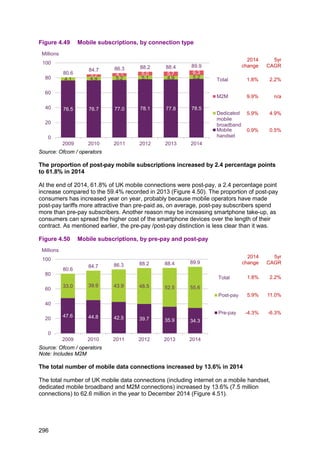
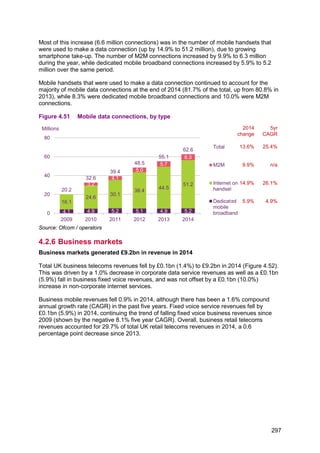
  • 276.
    Figure 4.20 Useof online activities among fixed-only and mobile-only broadband users Source: Ofcom Technology Tracker, wave 1 2015 Base: All adults who only use fixed broadband (2519), all adults who only use mobile broadband (75) Note: *Caution: base between 50 and 100 therefore results are indicative only QE20 (QE5A) Which, if any, of these do you use the internet for? There are few 4G mobile broadband services with large inclusive data allowances Figure 4.21 shows the lowest available prices for residential 3G and 4G dedicated data-only mobile broadband services, standard fixed broadband services, and superfast broadband services that include at least 10GB of data use per month. This shows that both 3G and 4G dedicated data-only mobile broadband services offering the requisite volume of data were cheaper than the equivalent standard and superfast fixed broadband services (for which we include the cost of line rental where this is required) in July 2015. However, 10GB per month is not sufficient for most households. Ofcom’s Infrastructure Report 2014 found that the average data use over a fixed broadband connection was 58GB per month in 2014; the amount of data downloaded (rather than uploaded) was 53GB per month, equivalent to 35 feature films. For next-generation access connections, average monthly data use was even higher, at 91GB over fibre connections and 66GB over cable. 81 As of June 2015, Three and EE were the only UK mobile network operators to offer 4G mobile broadband services with over 10GB of data per month.82 Three offered 15GB of inclusive data for £19.99 per month (plus an upfront charge of £34.99 for the USB modem) and EE offered either 15GB of data per month for £20, 25GB for £30 per month or 50GB per month for £50. Conversely, all of the lowest-priced fixed broadband services shown below included ‘unlimited’ data, meaning that the amount of data consumed would not be an issue for their users (no 4G mobile data services offered ‘unlimited’ data in June 2015). More expensive mobile data pricing is related to the high cost of adding capacity to mobile 81 http://stakeholders.ofcom.org.uk/market-data-research/market-data/infrastructure/infrastructure- 2014/?a=0 82 In June 2015 BT, which is not a mobile network operator, announced the launch of new 4G mobile broadband tariffs, including one offering 20GB of data for £20 per month. 87 66 58 39 38 29 22 21 20 17 14 13 79 59 51 26 24 22 18 8 9 9 7 5 0 20 40 60 80 100 Email Purchasing goods/services Socialnetworkingsites Watchingshortvideo clips Watchingcatch-upTV UsingVoIP UsingTwitter Listeningtoradio WatchingliveTV Watchingfree profressionalTV programmes Usingstreamedaudio services Watchingpurchased videocontent Fixed broadband -only Mobile broadband -only* Proportion of respondents (%) 272
  • 277.
    networks, and noneof the national UK mobile providers is actively pursuing the premises market, instead focusing on mobility. There are therefore a number of reasons why fixed-to-mobile substitution is not occurring to the same extent for data services as it has in voice. First, while mobile data services are beginning to close the gap on fixed broadband services in terms of download speed, there remain technological limitations inherent in current mobile data networks (in particular, capacity issues) that mean that they are not a feasible alternative to fixed broadband in practice. Second, current mobile data tariffing means that it is not financially viable to consume the volumes of data that have become commonplace on fixed broadband connections over a dedicated mobile broadband connection, as the cost would be prohibitive for most households. And finally, the ascendance of the smartphone means that dedicated mobile broadband take-up is low, and it is likely to remain so while consumers continue to embrace these devices. Figure 4.21 Lowest available residential fixed and mobile pricing: 2010-2014 Source: Ofcom / Teligen, data from July of each year Note: Fixed broadband includes line rental where this is required; the price of a 4G service in 2013 related to an 8GB service with an additional 2GB data bolt-on. 4.1.5 Shifting fixed voice tariff structures and landline-only households Residential line rental prices have increased over the last five years A number of line rental increases were announced by the UK’s largest residential landline providers in the second half of 2014, with most of these being higher than the increase in the Consumer Prices Index (CPI), indicating that prices are increasing in real terms. For example, BT, the UK’s largest landline provider, increased the price of its basic residential line rental service by 6.3%, from £15.99 a month to £16.99, and most of the other major residential landline providers (Sky, Virgin Media, TalkTalk and EE) introduced similar increases. As is shown in Figure 4.22, across the major landline providers, the basic fixed line rental fee has risen by an average of over 25% in real terms since 2010. 15 16 15 15 41 15 20 19 16 16 18 31 27 23 23 27 0 10 20 30 40 50 2010 2011 2012 2013 2014 3G (10GB data) 4G (10GB data) Standard fixed broadband (unlimited data) ≥30Mbit/s fixed broadband (unlimited data) Monthly price (£) 273
  • 278.
    Figure 4.22 Residentialline rental prices: 2006-201483 Source: Ofcom / Pure Pricing UK broadband pricing briefings Note: Prices as at December of each year; adjusted for CPI; excludes line rental saver pre-payment tariffs. Falling call volumes have led fixed telecoms providers to reconsider their tariff structures A key reason for basic line rental service price increases is likely to be falling landline call volumes. Fixed-originated call volumes have fallen significantly over the last decade as a result of a number of factors: the increasing use of mobiles, the growing use of data services (first as narrowband dial-up internet users upgraded to broadband services, and then with growing take-up of fixed and mobile data services, which increased use of text-based communications such as email and instant messaging) and the increasing use of traditional mobile messaging over this period (although SMS volumes are now declining). Ofcom analysis (Figure 4.23) shows that outgoing landline call volumes fell by an average of 12.5% a year between 2004 and 2014, including narrowband internet call volumes, and by 7.1% a year when these are excluded. While the migration of dial-up users onto broadband services has resulted in an increase in fixed internet revenues, it has exerted further downward pressure on landline call revenues, as a significant proportion of dial-up narrowband internet use was charged on a per-minute basis, whereas data use over a broadband connection tends not to generate any additional revenue for the provider. Operators recover the costs related to providing fixed-line telephony from a combination of a line rental charge and from charging for calls, but falling call volumes and an increase in the bundling of calls with line rental packages has resulted in a significant erosion of call revenues, causing landline providers to reconsider their tariff structures. 83 While this chart shows the line rental fee, not all of the providers included in the chart offer stand- alone landline services. 0 5 10 15 20 2006 2007 2008 2009 2010 2011 2012 2013 2014 BT Sky Virgin Media /ntl/Telewest TalkTalk EE/Orange £ per month (Dec 2014 prices) 274
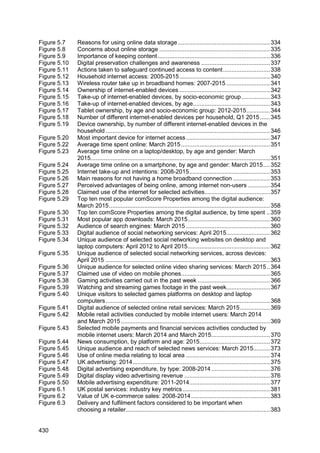
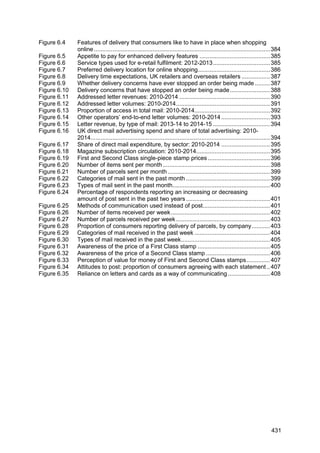
  • 279.
    Figure 4.23 Fixed-linecall volumes, by type of call Source: Ofcom/operator data The rate at which line rental prices have been increasing has accelerated since 2010 Falling call volumes have resulted in operators ‘rebalancing’ their landline tariffs in order to recover the costs related to running a fixed telephony network and, in particular, they have elected to do this by raising line rental prices. The effect of this tariff rebalancing can be seen below in Figure 4.24, which shows that while average out-of-bundle call revenue per fixed line fell by 60% to £6.48 per month between 2004 and 2014, average line rental and bundled call revenue per line increased by 27% to £14.69 per month over the same period, partly reflecting the shift towards the post-pay mobile approach to tariffing, whereby the access fee includes a large bundle of inclusive calls. While average spend on line rental and bundled calls has increased, this has not fully offset the decline in out-of-bundle call revenue, and average monthly revenue per fixed line fell by 23% to £21.17 (in nominal terms) over the period in question. In turn, this has meant that average monthly revenue per fixed line has declined (although providers have been able to supplement their revenues by offering fixed broadband services), so line rental and inclusive calls have become the major part of the bill, accounting for almost 69% of the average monthly bill in 2014 (up from 42% in 2004). It is notable that the rate at which rebalancing is taking place has increased since 2010, reflecting the trend in line rental prices shown in Figure 4.22. 120 112 107 97 92 85 83 75 69 61 54 7 7 7 7 7 7 7 6 6 5 4 16 16 16 15 14 12 12 10 9 8 7 25 29 24 31 28 24 22 20 18 18 15 137 82 44 15 5 2 1 1 1 304 245 199 165 146 130 124 112 103 92 80 0 100 200 300 2004 2005 2006 2007 2008 2009 2010 2011 2012 2013 2014 Narrowband internet calls Other voice calls Calls to mobiles International calls UK geographic calls Billions of minutes 275
  • 280.
    Figure 4.24 Averagemonthly retail revenue per fixed line Source: Ofcom/operator data Note: Excludes VAT. Operators seem to be less focused on acquiring new stand-alone voice customers Falling fixed voice revenues per line have made landline-only fixed voice customers (i.e. those that purchase fixed voice services on a stand-alone basis) less attractive to providers, and many operators appear to be prioritising winning new dual-play bundle customers over stand-alone voice customers, for example, by offering low-priced fixed broadband and/or TV services rather than low fixed voice line rental. Indeed, TalkTalk and Virgin Media have stopped offering stand-alone fixed voice services to new customers, and require new landline customers to take fixed broadband and/or TV services as well. As is shown in Figure 4.25 below, Ofcom research conducted by Kantar suggests that around 10% of adults in the UK were paying for a landline phone but did not have a fixed broadband connection in Q4 2014 (equating to around 2.7 million UK homes).84 Landline- only use was most prevalent among older consumers (44% of landline-only users were aged 75+) and among DE households (over half of landline-only homes fell into this category). It is these consumers who are most likely to have been adversely affected by tariff restructuring and increasing line rental prices, particularly those who make low call volumes or who make large volumes of out-of-bundle calls (possibly due to being on an unsuitable tariff). 84 Separate Ofcom research suggests that 70% of UK homes with a landline purchased it as part of a bundle, in conjunction with other communications services, in Q1 2015. 11.59 11.72 12.15 12.55 12.80 12.48 12.63 13.33 13.93 14.47 14.69 16.03 14.30 13.68 12.72 11.95 11.23 10.68 9.19 8.12 7.26 6.48 27.62 26.02 25.83 25.27 24.75 23.71 23.31 22.52 22.04 21.74 21.17 42.0 45.0 47.0 49.7 51.7 52.6 54.2 59.2 63.2 66.6 69.4 0 20 40 60 80 0 10 20 30 40 50 60 2004 2005 2006 2007 2008 2009 2010 2011 2012 2013 2014 Out-of- bundle calls Line rental & bundled calls Line rental as a % of total spend (right axis) £ per month Per cent 276
  • 281.
    Figure 4.25 Splitof fixed-only homes, by demographic Source: Kantar Media Omnibus. Base: All landline-only customers with sole/joint responsibility for paying the bill (241) Landline-only customers are less likely to have switched or be aware of alternative providers Not only is competition for landline-only customers less fierce than for those taking bundled services, but the research also suggests that most of those purchasing stand-alone voice services have never switched provider, and have comparatively low awareness of alternative telecoms providers. As shown in Figure 4.26 below, over half of landline-only users were BT customers in Q4 2014, twice the proportion of landline users with a fixed broadband connection. Similarly, the awareness of residential fixed telecoms providers other than BT was lower among landline-only customers, suggesting that they are less engaged with the market. This lack of engagement with the market could mean that many landline-only consumers are not getting the best deal available. In particular, they may not take up services offered by providers which are cheaper than BT, or BT’s Home Phone Saver package. This service is available only to fixed voice customers who do not have a fixed broadband service, offering line rental, anytime landline calls and various calling features for £20.99 a month, just £4 per month more than BT’s standard line rental fee. The use of this service is likely to be beneficial to a significant proportion of landline-only users, although take-up is likely to be limited without the engagement of consumers and continued efforts by BT to promote it. 1% 2% 4% 10% 14% 25% 44% 16-24 25-34 35-44 45-54 55-64 65-74 75+ Age 7% 20% 22% 51% AB C1 C2 DE Socio-economic group 53% 14% 33% Under £20k £20k or more Refused to answer Income 18% 82% Working Not working Working status 277
  • 282.
    Figure 4.26 Awarenessand use of alternative providers: landline-only customers Source: Kantar Media Omnibus. Base: All landline customers (with sole/ joint responsibility for paying the bill) (1095); Landline only (241); Landline with fixed broadband (826) Q5A. Which provider do you use for your landline service? Q11. Before today, which of the following companies were you aware it is possible to get a landline service from? 32 54 27 22 8 25 21 17 22 14 10 14 10 9 11 1 2 1 0 20 40 60 80 100 All landline customers Landline only Landline with broadband Don't know Other TalkTalk Virgin Media Sky BT Proportion of respondents (per cent) 94 81 77 75 32 29 16 13 94 86 80 80 33 31 17 14 92 59 51 57 28 18 9 8 0 20 40 60 80 100 BT Sky TalkTalk VirginMedia PostOffice Tesco Co-op JohnLewis All with landline Landline with broadband Landline only Current landline provider Proportion of respondents (per cent) Awareness of fixed voice providers 278
  • 283.
    4.2The telecoms industry 4.2.1Introduction In this section of the report, we examine recent trends in the telecommunications market from the perspective of industry revenues, subscribers and volumes. This section is divided into four sections: • Market overview: top-level findings from the UK telecoms industry • Fixed voice: covers the fixed-line telephony market • Fixed data: covers the fixed broadband market • Mobile voice and data: covers mobile voice telephony, mobile messaging, mobile data, mobile broadband and machine-to-machine communications. • Business markets: covers mobile and fixed voice and broadband business services. The key findings in this section of the report are: • Total telecoms revenues fell by 2.0% to £37.4bn in 2014. This was a £0.8bn fall compared to 2013 and a £3.9bn (9.5%) decline compared to 2009, largely the result of falling wholesale service revenues. The decline in telecoms revenues was partially offset by a £0.8bn increase in fixed internet revenues in 2014. • Fixed-originated voice call volumes fell by 12.6% to 80 billion minutes in 2014. However, total fixed voice revenues declined by just 2.6% during the year, indicating that average fixed voice call prices increased during the year. • Fixed internet revenue growth has accelerated as a result of increased fibre take-up. Non-corporate internet revenues totalled £4.9bn in 2014, a £0.8bn (18.5%) increase compared to 2013, driven by the continued migration of UK consumers onto superfast services. • By May 2015, 90% of UK premises could receive next-generation access broadband services and 83% could receive superfast broadband, while in rural areas availability was lower, at 67% and 37% respectively. • Almost one in three fixed broadband lines are now ‘superfast’. The 7.1 million fixed broadband lines providing speeds of 30Mbit/s or higher in the UK today account for 30% of all fixed broadband lines, compared to 0.2% (41k) in 2009. • In the six years to November 2014 average actual fixed broadband speeds have increased at an average annual rate of 36% per year. The average actual fixed broadband download speed in the UK was 22.8Mbit/s in November 2014, up from 3.6Mbit/s in November 2008. • The total number of mobile data connections85 increased by 13.6%. The total number of UK mobile data connections (including internet on a mobile handset, 85 Including internet on a mobile handset, dedicated mobile broadband and M2M connections. 279
  • 284.
    dedicated mobile broadbandand M2M86 connections) increased by 7.5 million connections to 62.6 million in the year to December 2014. • SMS use fell for the second consecutive year. The total volume of outgoing SMS and MMS messages fell by 20 billion messages (15.3%) to 110 billion messages in 2014, due to increasing smartphone take-up and use of internet-based communications methods. 4.2.2 Market overview Total telecoms revenues fell by 2.0% to £37.4bn in 2014 In total, UK telecoms services generated £37.4bn in revenues in 2014, a £0.8bn (2.0%) fall compared to 2013 and £3.9bn (9.5%) less than in 2009 (Figure 4.27). The largest decline in 2014 was a £0.8bn (11.5%) fall in wholesale revenues, which was largely due to falling mobile call termination revenue, although retail mobile revenues also fell during the year, down by £0.3bn (2.1%) to £15.3bn, mainly as a result of falling mobile data prices and declining use of SMS. Revenue from corporate data services also fell by 1.0% to £2.6bn in 2014. The driver of the increase in retail fixed telecoms revenues was a £0.8bn increase in fixed internet revenues (as a result of increasing superfast broadband take-up) in 2014, which was partially offset by a £0.2bn fall in fixed voice revenues. Figure 4.27 Summary of UK telecoms revenues Source: Ofcom / operators, with the exception of corporate data services, which sourced from IDC. Notes: ‘Corporate data services’ comprises web hosting, Ethernet, IP VPN, digital leased line, corporate VoIP and frame relay/ATM services; wholesale mobile comprises wholesale mobile voice, messaging and data services, mobile voice and SMS termination revenue and wholesale inbound roaming revenue (i.e. - revenue from overseas operators when their subscribers use UK networks). Total voice call volumes fell by 3.9% to 218 billion minutes in 2014 The substitution of voice calls for text-based forms of communication (such as email and instant messaging) continued in 2014, resulting in a decline in total fixed and mobile originated voice call volumes (Figure 4.28). Fixed-originated voice calls fell by 12.6% to 80 billion minutes during the year, an increased rate compared to the 10.6% fall in 2013, while 86 Machine-to-machine, a connection, often wireless, in which human input is not necessarily required. 10.6 9.9 9.2 8.2 7.0 6.2 12.9 12.7 12.5 12.6 12.8 13.3 15.0 15.1 15.4 15.9 15.6 15.3 2.8 2.7 2.8 2.7 2.7 2.6 41.3 40.4 39.9 39.4 38.1 37.4 0 10 20 30 40 50 2009 2010 2011 2012 2013 2014 Total Corporate data services Retail mobile Retail fixed Wholesale services Revenue (£bn) 2014 change 5yr CAGR -2.0% -2.0% -1.0% -1.0% -2.1% 0.3% 3.2% 0.6% -11.5% -10.2% 280
  • 285.
    the 2.0% increasein mobile-originated call volumes in 2014 (to 137 billion minutes) was in line with the growth rate recorded in 2013. Overall, voice call volumes fell by 3.9% to 218 billion minutes in 2014, a higher rate of decline than the 3.1% average annual decline recorded between 2009 and 2014, while the proportion of total voice calls that were mobile- originated increased from 59.5% to 63.1% during the year. Figure 4.28 Outgoing fixed and mobile voice call volumes Source: Ofcom / operators There were almost 90 million UK mobile subscriptions at the end of 2014 At the end of 2014 there were 89.9 million UK mobile subscriptions, including handset subscriptions, dedicated mobile broadband data connections and machine-to-machine (M2M) connections (Figure 4.29). This was an increase of 1.6 million connections (1.8%) compared to the previous year, mainly due to an 0.7 million increase in the number of mobile voice connections and a 0.6 million increase in the number of M2M connections (see section 4.2.5 for more details). Despite rapidly declining fixed voice call volumes, there has been relatively little change in the number of UK fixed lines (including PSTN lines and ISDN channels) over the past few years, and at the end of 2014 there were 33.2 million such lines, a small (0.2%) decline since the end of 2013. Figure 4.29 Fixed lines and mobile subscriptions Source: Ofcom / operators 128 123 111 103 92 80 127 131 131 132 135 137 255 254 242 235 226 218 0 100 200 300 2009 2010 2011 2012 2013 2014 Total Mobile Fixed Billions of minutes 2014 change 5yr CAGR -3.9% -3.1% 2.0% 1.6% -12.6% -8.9% 33.5 33.4 33.3 33.2 33.3 33.2 80.6 84.7 86.3 88.2 88.4 89.9 0 20 40 60 80 100 2009 2010 2011 2012 2013 2014 Fixed lines Mobile subscriptions Millions 2014 change 5yr CAGR -0.2% -0.2% 1.8% 2.2% 281
  • 286.
    Landlines make upless than three in ten UK voice telephony connections The importance of mobile telephony to the UK telecoms market has grown since its launch in the mid-1980s, with mobile services becoming mass-market in the UK in the late 1990s with the launch of pre-pay tariffs. By the end of 2014, mobile connections accounted for 70.2% of UK voice telephony connections, an increase of 0.2 percentage points compared to 2013 (Figure 4.30). While the proportion of traditional voice calls that were mobile-originated increased by 3.7 percentage points (to 63.1%) in 2014, the increase in mobile’s share of voice revenues was much smaller (up just 0.2 percentage points to 64.3%). This was largely due to increasing average fixed voice call charges, as shown in Figure 4.62 later in this report. Figure 4.30 Mobile share of voice connections, revenues and volumes Source: Ofcom/operator data Note: Mobile voice revenues will be overstated as they include revenues from bundled messaging and data services. More than 95% of UK homes are able to receive LLU-based fixed telecoms services Local loop unbundling (LLU) allows an alternative provider to install its own equipment in BT’s local telephone exchanges and then provide services over the copper telephone lines (aka local loops). LLU enables alternative providers to benefit from economies of scale which are not available when reselling wholesale services, and to differentiate their services from those offered by their competitors. Furthermore, consumers who live in areas where LLU is available have a greater choice of fixed telecoms provider and, typically, have access to low-cost fixed telecoms services, in particular bundles including TV and fixed broadband. The rate of LLU deployment is slowing in the UK, and the proportion of premises that were connected to an LLU-enabled local exchange increased by just 0.2 percentage points (to 95.2%) in 2014 (Figure 4.31). Similarly, the proportion of BT local exchanges that had been unbundled increased by just 0.1 percentage points to 56.7% during the year, while continued growth in take-up of LLU-based services increased the proportion of unbundled lines, up by 1.1 percentage points to 28.9%. 69.5 69.6 69.8 70.2 70.0 70.2 60.9 61.8 63.1 64.4 64.1 64.3 49.7 51.6 54.2 56.3 59.5 63.1 0 20 40 60 80 2009 2010 2011 2012 2013 2014 Connections Revenues Call volumes Per cent 2014 pp change 5 year pp change 0.2 0.7 0.2 3.4 3.7 13.4 282
  • 287.
    Figure 4.31 UnbundledBT local exchanges and connected premises Source: Ofcom / BT There were 9.6 million LLU-enabled fixed lines in the UK at the end of 2014 The total number of unbundled lines increased by 0.4 million (3.8%) to 9.6 million during 2014 (Figure 4.32). There are two types of LLU: partial LLU (whereby the incumbent operator continues to provide fixed voice services to the end-user and the LLU operator only provides fixed broadband over the line) and full LLU, where the LLU operator provides both services. Initially, LLU providers in the UK initially concentrated on offering partial LLU, but this changed in the mid-noughties, in particular when Sky and TalkTalk started to provide low-cost bundled dual-play services using full-LLU. As a result, the proportion of LLU lines that are partial LLU has been declining since 2006 (when 80% of LLU connections were partial-LLU), and by the end of 2014 had fallen to 13%. Figure 4.32 Unbundled fixed lines Source: BT 4.2.3 Fixed voice services The rate of decline in fixed voice revenues accelerated in 2014 Total fixed voice call revenues continued to decline in 2014, falling by £0.2bn (2.6%) to £8.5bn during the year (Figure 4.33). This represented an increase in the rate of decline 84.5 89.0 91.9 94.1 95.1 95.2 36.0 41.5 47.2 53.2 56.6 56.7 19.0 22.4 23.9 26.4 27.7 28.9 0 20 40 60 80 100 2009 2010 2011 2012 2013 2014 Proportion of premises connected to unbundled exchanges Proportion of exchanges that have been unbundled Proportion of lines provided using LLU Per cent 0.2 10.7 0.1 20.7 1.1 9.9 2014 pp change 5 year pp change 2.6 4.0 5.2 6.4 7.6 8.43.8 3.5 2.7 2.4 1.7 1.2 6.4 7.5 7.9 8.8 9.2 9.6 0 2 4 6 8 10 2009 2010 2011 2012 2013 2014 Total Partially unbundled Fully unbundled Millions 2014 change 5yr CAGR 3.8% 8.6% -26.2% -20.2% 10.4% 26.7% 283
  • 288.
    compared to the1.4% fall in 2013, and was in line with the average annual fall in the five years to 2014. Following the trend of recent years, the proportion of total fixed voice revenues that were generated by line rental and bundled call services continued to increase in 2014, up by 2.8 percentage points to 69.4% (in 2009, this proportion was just 52.6%). There are three key reasons for this increase: falling fixed call volumes (see Figure 4.35), increasing line rental charges (see section 4.1.5 for more information on fixed tariff rebalancing) and growing take- up of call ‘add-ons’ which offer ‘free’ or discounted calls for an additional monthly fee. Out-of-bundle call revenues fell by 10.7% to £2.6bn during the year, with the largest proportional decline being a 14.9% fall in revenues from calls to mobiles (which was partly due to declining mobile call termination rates which has had a downward effect on the price of these calls). Figure 4.33 Retail fixed voice revenues Source: Ofcom / operators Average revenue per fixed voice connection fell by 2.6% to £21.17 per month in 2014 The trends observed in overall fixed voice service revenues were also evident in the average revenue per fixed line in 2014, which fell by 56 pence per month (2.6%) to £21.17 during the year (Figure 4.34). Again, the main reason for this decline was falling fixed voice call volumes (as shown in Figure 4.36), although there was also a small (0.2%) fall in the total number of fixed lines (see Figure 4.37). The decline in average revenue per line was lower than the 12.6% fall in average fixed voice call volumes per line in 2014 (down from 230 to 201 minutes per month), indicating that fixed voice prices increased during the year. Further information on fixed voice pricing can be found in Figure 4.67 and section 4.1.5 of this report. 5.1 5.1 5.3 5.6 5.8 5.9 1.3 1.2 1.1 1.0 0.9 0.80.5 0.4 0.4 0.3 0.3 0.2 1.6 1.5 1.2 1.0 0.9 0.8 1.2 1.1 1.0 0.9 0.8 0.8 9.6 9.4 9.0 8.8 8.7 8.5 0 2 4 6 8 10 2009 2010 2011 2012 2013 2014 Total Non-geographic calls Calls to mobiles International calls UK geographic calls Line rental & bundled calls Revenue (£bn) 2014 change 5yr CAGR -2.6% -2.6% -2.0% -7.6% -14.9% -13.7% -13.5% -13.7% -13.5% -9.4% 1.5% 3.0% 284
  • 289.
    Figure 4.34 Averagemonthly retail voice revenue per fixed line Source: Ofcom / operators Fixed-originated voice call volumes declined by 12.6% in 2014 The decline in fixed voice call volumes accelerated in 2014, with total outgoing call minutes falling by 11.6 billion minutes (12.6%) to 80.2 billion minutes during the year (Figure 4.35). This decline was greater than both the 10.6% fall recorded in 2013 and the 8.9% annual average in the five years to 2014. Volumes fell for all of the call types outlined below, with declines ranging from an 11.9% fall in calls to UK geographic call minutes to 14.4% falls in calls to mobiles and ‘other’ (NTS voice) calls. As was the case in previous years, calls to UK geographic numbers accounted for the majority (67%) of total fixed call volumes in 2014. Fixed voice call volumes in 2014 fell despite the number of lines remaining relatively static during the year (see Figure 4.37). Some of the drivers contributing to falling fixed voice call use were increasing fixed-to mobile substitution (as shown in Figure 4.28, mobile voice call volumes continued to grow in 2014, as did the proportion of total voice calls that were mobile-originated) and increasing used of text-based forms of communication, such as email and instant messaging, including those services provided by social networking sites. Figure 4.35 Fixed voice call volumes, by type of call Source: Ofcom / operators 2014 change 5yr CAGR -2.6% -2.2% -2.0% -7.3% -14.9% -13.4% -13.6% -13.4% -13.6% -9.1% 1.5% 3.3% 12.48 12.63 13.33 13.93 14.47 14.69 3.16 3.10 2.72 2.48 2.27 1.961.20 1.11 0.95 0.83 0.68 0.59 3.92 3.64 3.07 2.59 2.25 1.91 2.95 2.82 2.44 2.23 2.07 2.02 23.71 23.31 22.52 22.04 21.74 21.17 0 5 10 15 20 25 2009 2010 2011 2012 2013 2014 Total Non-geographic calls Calls to mobiles International calls UK geographic calls Line rental & bundled calls £ per month 85.1 82.8 74.6 69.0 60.9 53.6 6.7 6.7 6.5 5.9 4.9 4.3 12.3 11.8 10.3 9.4 8.4 7.2 23.7 21.7 19.7 18.3 17.6 15.1 127.9 123.0 111.1 102.6 91.7 80.2 0 50 100 150 2009 2010 2011 2012 2013 2014 Total Non-geographic calls Calls to mobiles International calls UK geographic calls Billions of minutes 2014 change 5yr CAGR -12.6% -8.9% -14.4% -8.7% -14.4% -10.3% -12.0% -8.4% -11.9% -8.8% 285
  • 290.
    BT generated 37%of outgoing fixed voice call minutes in 2014 BT remained the largest UK fixed voice provider in terms of voice call volumes in 2014, with a market share of 37%, a decline of 0.2 percentage points compared to 2013, and of over four percentage points compared to 2009 (Figure 4.36). Virgin Media’s market share increased slightly during the year, while the share of other direct operators (i.e. those providing service over their own network infrastructure) grew by 2.3 percentage points to 31%, largely at the expense of other indirect operators (those using another provider’s network to provide services). Other direct operators’ share of call volumes more than doubled in the five years to 2014, largely as a result of increasing use of full LLU. Further details regarding LLU take-up can be found in section 4.2.2 of this report. Figure 4.36 Share of retail fixed voice call volumes Source: Ofcom / operators Note: Excludes non-geographic voice calls. The number of fixed lines continues to be resilient, despite falling call volumes The total number of fixed lines has remained relatively static over the last few years, although fixed-originated voice call volumes have declined significantly (see Figure 4.35 for more details). At the end of 2014 there were 33.2 million UK PSTN lines and ISDN channels, a fall of 0.1 million compared to 2013 (Figure 4.37). In the five years to 2014, a decline in the number of business lines (down by 2.4 million) has been partly offset by a 2.1 million increase in the number of residential connections. As shown in section 4.2.6, the fall in the number of business lines is due to the declining use of ISDN and increasing take-up of VoIP as an alternative to traditional fixed voice calls (VoIP connections are not fully captured here). Conversely, growth in the number of residential lines is the result of increasing fixed broadband take-up (as most UK homes need a fixed voice line in order to be able to receive fixed broadband services) and growth in the number of households. 42 39 38 38 38 37 14 13 12 12 13 13 15 19 23 26 29 31 30 29 27 24 21 18 0 20 40 60 80 100 2009 2010 2011 2012 2013 2014 Other indirect operators Other direct operators Virgin Media BT 2014 pp change 5 year pp change -2.7 -11.5 2.3 16.2 0.6 -0.4 -0.2 -4.3 Market share (per cent) 286
  • 291.
    Figure 4.37 Numberof fixed lines Source: Ofcom / operators 4.2.4 Fixed data services Fixed internet revenue growth has accelerated as a result of increased fibre take-up Non-corporate internet revenues totalled £4.9bn in 2014, a £0.8bn (18.5%) increase compared to 2013 (Figure 4.38). Almost all of this revenue was generated by broadband services, as estimated narrowband revenues were just £1.5m in 2014 (less than half the £3.1m figure for 2013). The main factor behind increasing residential and SME fixed broadband revenues in 2014 was the continued migration of UK consumers onto superfast services, which typically cost between £5 and £10 per month more than standard broadband services. Figure 4.38 Retail residential and SME fixed internet revenues Source: Ofcom / operator data The number of fibre broadband lines increased by 1.3 million in 2014 At the end of 2014 there were 23.7 million residential and SME UK fixed broadband lines, representing a 0.9 million (4.0%) increase since 2013 (Figure 4.39). The total number of non-LLU ADSL lines fell by 7.5% to 6.6 million during the year, while LLU-ADSL remained 23.4 23.8 23.9 24.5 25.0 25.5 10.2 9.7 9.4 8.8 8.3 7.7 33.5 33.4 33.3 33.2 33.3 33.2 0 10 20 30 40 2009 2010 2011 2012 2013 2014 Total Business Residential Millions 2014 change 5yr CAGR -0.2% -0.2% -7.2% -5.3% 2.1% 1.8% 3.2 3.3 3.5 3.8 4.2 4.9 3.2 3.3 3.5 3.8 4.2 4.9 0 1 2 3 4 5 2009 2010 2011 2012 2013 2014 Total Broadband Narrowband £billions 2014 change 5yr CAGR 18.5% 8.8% 18.5% 9.4% -53.4% -55.8% 287
  • 292.
    unchanged at 8.9million.87 The main reason for the decline in non-LLU lines was consumers migrating onto superfast services. The number of fibre-based fixed broadband lines grew by 55.4% during the year, up from 2.3 million to 3.6 million, while the number of cable broadband lines continued to show steady growth, increasing by 0.1 million (3.3%) to 4.5 million. Although these services are generally more expensive than ADSL, for many consumers the higher connection speeds they offer justify this increase in cost. Figure 4.39 Retail fixed broadband lines Source: Ofcom / operator data By May 2015, 90% of UK premises could receive next generation access broadband services, and 83% could receive superfast broadband We are able to estimate the proportion of premises that are served by next generation access (NGA) networks (which are used to deliver superfast broadband services) by combining cable broadband availability data from Virgin Media with fibre broadband availability data from Openreach and Kcom. Combining postcode-level availability data for cable and fibre services gives us a range of availability for NGA broadband services: for example, if cable broadband and fibre broadband services are both available to 50% of premises in a postcode, the availability of NGA services in that postcode will be somewhere between 50% of premises (where cable and fibre services are available to the same premises within the postcode area) to 100% of premises (where there is no overlap in the availability of cable and fibre services). In Figure 4.40 below, we show the mean of the possible range of availability of NGA services, which would be 75% in the example given above. Our analysis indicates that 90% of UK premises were able to receive fixed broadband services over NGA networks by May 2015, a 12 percentage point increase compared to June 2014. In urban areas, 92% of premises were able to receive NGA broadband services in May 2015, compared to 67% in rural areas. Not all NGA broadband connections are capable of providing superfast broadband services (i.e. an actual speed of 30Mbit/s or higher) however, and in particular, the speed achievable over an FTTC connection will depend on the length and quality of the copper connection 87 The number of LLU-ADSL connections shown above is lower than the total number of LLU lines shown in Figure 1.32 as some LLU lines are used to provide fibre broadband services rather than ADSL. 8.1 8.0 8.2 7.7 7.1 6.6 6.4 7.5 7.9 8.7 8.9 8.9 3.8 4.0 4.1 4.3 4.4 4.5 0.1 0.4 1.1 2.3 3.6 18.4 19.6 20.7 21.8 22.8 23.7 0 5 10 15 20 25 2009 2010 2011 2012 2013 2014 Total Others Fibre Cable LLU-ADSL Non-LLU ADSL Millions 2014 change 5yr CAGR 4.0% 5.3% 0.0% -0.3% 55.4% n/a 3.3% 3.4% 0.2% 7.1% -7.5% -4.1% 288
  • 293.
    from the streetcabinet to the user’s premises. In collecting data to inform its work monitoring the UK’s communications market infrastructure in 2015, Ofcom asked providers for postcode-level data regarding the proportion of premises that could receive superfast broadband services. These data suggest that while 90% of UK premises were able to receive NGA broadband services in May 2015, the proportion able to receive a superfast service was seven percentage points lower at 83%. This means that 7% of premises in the UK were in areas where NGA broadband was available, but were unable to receive actual broadband speeds of 30Mbit/s. The proportion of premises that could receive superfast broadband services in urban areas of the UK (88%) was significantly higher than in rural areas (37%). This indicates that the proportion of premises in NGA areas that could not receive an actual fixed broadband download speed of 30Mbit/s was much higher in rural areas (30pp) than in urban areas (4pp). Figure 4.40 Premises able to receive NGA and superfast broadband services Source: Ofcom / Openreach / Virgin Media / Kcom, May 2015 data Higher speed connection take-up continues to increase The proportion of residential broadband lines that were fibre or cable connections with an advertised speed of ‘up to’ 30Mbit/s or higher had reached 32% by November 2014, a nine percentage point increase compared to the previous year (Figure 4.41). This growth is the result of consumer demand for greater bandwidth, as multiple users in the home share bandwidth, using multiple devices to access a growing number of web-based services including video streaming and online games. Both BT and Virgin Media have invested significantly in network upgrades, increasing the speeds that are available to consumers and allowing more homes to access superfast services. In total, connections advertised as ‘up to’ 10Mbit/s or higher accounted for 91% of residential connections in November 2014. The proportion of residential broadband lines with an advertised headline speed of ‘up to’ 8Mbit/s was less than 1% at the end of 2014. Proportion of premises (per cent) 90 92 67 83 88 37 0 20 40 60 80 100 UK UK Urban UK Rural NGA broadband services Superfast broadband services 289
  • 294.
    Figure 4.41 UKresidential broadband lines, by headline speed Source: Ofcom, based on data provided by the UK’s largest ISPs by retail market share (representing over 90% of the total market). Note: The above ‘up to’ 10Mbit/s and less than ‘up to’ 30Mbit/s category includes ADSL2+ lines which are not marketed using a connection speed. Superfast88 lines now make up almost one in three of all broadband lines Superfast broadband services are provided over NGA networks, which use technologies such as fibre-to-the-cabinet (FTTC), fibre-to-the-premises (FTTP) and DOCSIS 3.0 (in the case of cable networks).The number of superfast broadband lines increased by 1.8 million (34.5%) to 7.1 million in 2014, with the proportion of all fixed broadband lines that were classed as being superfast increasing by 6.8 percentage points to 30.0% over the same period (Figure 4.42). The main driver of this increase was consumers migrating to faster packages to support an increasing number of devices in the home (smartphones, tablets, e- readers, games consoles, media players) and also the fast-growing number of services which use broadband (video and music streaming, TV and video download services, voice and video telephony services). 88 The definition of ‘superfast’ is a connection with an actual speed of 30Mbit/s or higher. Around 12% of FTTC connections with a headline speed ≥30Mbit/s do not have an actual speed of 30Mbit/s. 8 4 2 1 1 1 68 54 51 41 31 23 13 12 10 9 24 41 45 53 60 63 66 64 61 59 1 2 5 8 14 20 24 28 32 0 20 40 60 80 100 May-10 Nov-10 May-11 Nov-11 May-12 Nov-12 May-13 Nov-13 May-14 Nov-14 'Up to' 30Mbit/s and higher Over 'up to' 10Mbit/s and less than 'up to' 30Mbit/s 'Up to' and including 8Mbit/s to 10Mbit/s Less than 'up to' 8Mbit/s Per cent 290
  • 295.
    Figure 4.42 Superfastfixed broadband lines Source: Ofcom / operators Notes: Includes estimates where Ofcom does not receive data from operators; includes Ofcom adjustment to exclude FTTC connections delivering less than 30Mbit/s. Average residential broadband speeds increased by almost a third in the year to November 2014 Ofcom research shows that between November 2008 and November 2014 average residential fixed broadband speeds increased from 3.6Mbit/s to 22.8Mbit/s, representing an average annual increase of 36% over the period (Figure 4.43).89 The rate of increase accelerated in 2012 when Virgin Media launched its first double-speed upgrade programme, increasing the speed of its fastest cable service to ‘up to’ 120Mbit/s,90 and BT launched ‘up to’ 80Mbit/s fibre services (previously, only ‘up to’ 40Mbit/s services had been available) 91 . Figure 4.43 Average actual residential fixed broadband download speeds Source: Ofcom, using data provided by SamKnows 89 http://stakeholders.ofcom.org.uk/market-data-research/other/telecoms-research/broadband- speeds/?a=0 90 Virgin Media now offers ‘up to’ 152Mbit/s services. 91 Following a change in advertising rules, these FTTC services are now advertised as being ‘up to’ 76Mb/s and ‘up to’ 38Mb/s respectively. 0.2 1.0 3.1 5.3 7.1 0.2 0.9 5.0 14.3 23.2 30.0 0 10 20 30 0 2 4 6 8 10 2009 2010 2011 2012 2013 2014 Connections ≥30Mbit/s As a proportion of all connections Connections (millions) As a proportion of all connections (%) 3.6 4.1 5.2 6.2 6.8 7.6 9.0 12.0 14.7 17.8 18.7 22.8 0 5 10 15 20 25 Nov-08 Apr-09 May-10 Nov/Dec-10 May-11 Nov-11 May-12 Nov-12 May-13 Nov-13 May-14 Nov-14 Speed (Mbit/s) 291
  • 296.
    BT continued tobe the UK’s largest fixed broadband provider in 2014 BT maintained its position as the UK’s largest provider of residential and SME fixed broadband services in 2014, with its market share up by one percentage point to 32% during the year (Figure 4.44). Sky’s market share grew for the fifth consecutive year, as some of its pay-TV customers moved onto triple-play bundles, including landline and fixed broadband services. Virgin Media’s market share remained stable at 20%, while TalkTalk experienced a drop of one percentage points to 14% in 2014. Figure 4.44 Retail fixed broadband market shares Source: Ofcom / operator data 4.2.5 Mobile voice and data services Falling out-of-bundle messaging and calls led to a decline in retail mobile revenues in 2014 Total retail mobile revenues fell by £0.2bn (1.5%) to £15.3bn in 2014 (Figure 4.45). Mobile access and bundled service revenues increased by £0.5bn (6.5%) to £8.3bn in 2014, due to the increasing number of post-pay connections (see Figure 4.50). This was also the main reason for the decrease in the out-of-bundle call revenues (down by 9.7% to £2.9bn), despite an increase in outgoing mobile call minutes during the year (see Figure 4.47). Falling SMS and MMS volumes (Figure 4.48) resulted in a £0.5bn (28.2%) decrease in out- of-bundle messaging revenues in 2014. 27 28 30 30 31 32 13 15 18 19 21 22 22 22 21 21 20 20 23 20 18 17 16 14 5 4 3 3 3 4 10 10 10 10 9 8 0 20 40 60 80 100 2009 2010 2011 2012 2013 2014 Others EE TalkTalk Group Virgin Media Sky BT Per cent 2014 pp change 5 year pp change -0.6 -1.7 0.3 -1.1 -1.5 -8.4 -0.3 -2.8 1.3 9.4 0.8 4.7 292
  • 297.
    Figure 4.45 Mobileretail revenue, by service Source: Ofcom / operators Average retail revenue per mobile subscription fell by 21 pence per month in 2014 Average monthly retail revenue per mobile subscription fell by 21 pence (1.3%) to £15.38 in 2014 (Figure 4.46). This reflected falling average revenues per user for both post-pay and pre-pay subscriptions in the year; the decline in average revenue per pre-pay user (down 7.1% to £4.98 per month) was greater than that for post-pay subscriptions (down 5.0% to £23.15 per month). Along with falling prices and declining SMS use, a key reason for falling average revenues among pre-pay and post-pay users is the migration of higher-use pre-pay users onto post-pay services during the year (see Figure 4.50 for more details). The ways in which consumers purchase mobile phone tariffs has evolved in parallel with the underlying mechanics of mobile tariffs, blurring the division between pre-pay and post-pay. Historically, pre-pay and post-pay reflected the limitations of different billing platforms and became established as consumer segment descriptors. But as consumer demands have changed and billing platforms have evolved, the clear division between pre- and post-pay no longer exists. Figure 4.46 Average monthly retail revenue per mobile subscription Source: Ofcom / operators Note: Mobile voice revenues include revenues from bundled messaging and data services. 6.1 6.4 6.8 7.3 7.8 8.3 4.7 4.3 3.9 3.7 3.2 2.9 2.7 2.6 2.5 2.4 1.8 1.3 1.6 1.8 2.1 2.5 2.7 2.7 15.0 15.1 15.4 15.9 15.5 15.3 0 5 10 15 20 2009 2010 2011 2012 2013 2014 Total Out-of bundle data Out-of-bundle messaging Out-of-bundle calls Access and bundled services £billions 2014 change 5yr CAGR -1.5% 0.3% 3.1% 11.7% -28.2% -13.4% -9.7% -9.2% 6.5% 6.5% 30.00 28.15 27.50 26.71 24.38 23.15 16.00 15.60 15.74 16.14 15.59 15.38 7.07 6.23 5.91 5.81 5.36 4.98 0 10 20 30 2009 2010 2011 2012 2013 2014 Post-pay Blended Pre-pay £ per month 2014 pp change 5 year pp change -5.0% -5.0% -1.3% -0.8% -7.1% -6.8% 293
  • 298.
    Total outgoing mobilecall minutes increased by 2.0% in 2014 Data provided to Ofcom by the UK’s mobile operators shows that mobile call volumes increased by three billion minutes (2.0%) to 137 billion minutes in 2014 (Figure 4.47). Calls to mobiles continued to account for the majority of outgoing mobile calls during the year (66% of the total, up from 65% in 2013), and the proportion of calls to mobiles that were to mobiles on the same network fell from 46% (41 billion minutes out of a total of 88 billion minutes of mobile-to-mobile calls) to 43% (39 billion minutes out of 91 billion minutes) during the year. Call volumes to UK geographic numbers and to international destinations both decreased during the year, by 0.9% and 12% respectively. Figure 4.47 Outgoing mobile call minutes, by type of call Source: Ofcom / operators SMS use fell for the second consecutive year in 2014 The total volume of outgoing SMS and MMS messages fell by 20 billion messages (15.3%) to 110 billion messages in 2014, a similar drop to that recorded in 2013 (Figure 4.48). The main reason for declining message volumes is increasing smartphone take-up, as more sophisticated handsets enable mobile users to access alternative communication methods, such as email, instant messaging and the messaging services provided by handset makers and social networking sites. More details on consumers’ use of data services on mobile phones can be found in Figure 4.81. 32 32 32 31 32 32 43 46 43 42 41 39 38 38 42 43 47 52 6 6 7 8 8 78 8 8 8 7 7127 131 131 132 135 137 0 50 100 150 2009 2010 2011 2012 2013 2014 Total Other calls International Off-net mobile On-net mobile UK geographic Billions 2014 change 5yr CAGR 2.0% 1.6% 8.2% -2.1% -12.0% 4.6% 9.8% 6.5% -3.1% -1.9% -0.9% 0.2% 294
  • 299.
    Figure 4.48 OutgoingSMS and MMS messages Source: Ofcom / operators The total number of mobile subscriptions increased by 1.6 million in 2014 At the end of 2014 there was a total of 89.9 million active mobile handsets, dedicated mobile data connections (such as mobile broadband dongles and data-only SIMs) and M2M connections, a 1.6 million (1.8%) increase on the previous year (Figure 4.49). M2M M2M stands for ‘machine-to-machine’. The general definition of a M2M connection is a connection, often wireless, in which human input is not necessarily required. Commonly used examples of M2M are in energy metering (where the meter reports energy use back to a central billing database) or a burglar alarm, which may contain a SIM card to enable communication with monitoring offices. Vending machines are another common example, as some may use M2M technology to keep a central computer up-to-date with stock levels. The number of M2M connections had its largest increase in 2014, up by 566,000 (9.9%) to 6.3 million connections, while the number of dedicated mobile broadband connections increased by 292,000 (5.9%) to 5.2 million and the number of mobile handset connections by 702,000 (0.9%) to 78.5 million during the same period. The proportion of both dedicated mobile broadband connections and M2M connections increased in 2014, from 5.6% to 5.8% and from 6.4% to 7.0% respectively. 106 129 150 151 129 110 0 50 100 150 200 2009 2010 2011 2012 2013 2014 Billions 295
  • 300.
    Figure 4.49 Mobilesubscriptions, by connection type Source: Ofcom / operators The proportion of post-pay mobile subscriptions increased by 2.4 percentage points to 61.8% in 2014 At the end of 2014, 61.8% of UK mobile connections were post-pay, a 2.4 percentage point increase compared to the 59.4% recorded in 2013 (Figure 4.50). The proportion of post-pay consumers has increased year on year, probably because mobile operators have made post-pay tariffs more attractive than pre-paid as, on average, post-pay subscribers spend more than pre-pay subscribers. Another reason may be increasing smartphone take-up, as consumers can spread the higher cost of the smartphone devices over the length of their contract. As mentioned earlier, the pre-pay /post-pay distinction is less clear than it was. Figure 4.50 Mobile subscriptions, by pre-pay and post-pay Source: Ofcom / operators Note: Includes M2M The total number of mobile data connections increased by 13.6% in 2014 The total number of UK mobile data connections (including internet on a mobile handset, dedicated mobile broadband and M2M connections) increased by 13.6% (7.5 million connections) to 62.6 million in the year to December 2014 (Figure 4.51). 76.5 76.7 77.0 78.1 77.8 78.5 4.1 4.9 5.2 5.1 4.9 5.23.2 4.1 5.0 5.7 6.380.6 84.7 86.3 88.2 88.4 89.9 0 20 40 60 80 100 2009 2010 2011 2012 2013 2014 Total M2M Dedicated mobile broadband Mobile handset Millions 2014 change 5yr CAGR 1.8% 2.2% 9.9% n/a 5.9% 4.9% 0.9% 0.5% 47.6 44.8 42.5 39.7 35.9 34.3 33.0 39.9 43.9 48.5 52.5 55.6 80.6 84.7 86.3 88.2 88.4 89.9 0 20 40 60 80 100 2009 2010 2011 2012 2013 2014 Total Post-pay Pre-pay Millions 2014 change 5yr CAGR 1.8% 2.2% 5.9% 11.0% -4.3% -6.3% 296
  • 301.
    Most of thisincrease (6.6 million connections) was in the number of mobile handsets that were used to make a data connection (up by 14.9% to 51.2 million), due to growing smartphone take-up. The number of M2M connections increased by 9.9% to 6.3 million during the year, while dedicated mobile broadband connections increased by 5.9% to 5.2 million over the same period. Mobile handsets that were used to make a data connection continued to account for the majority of mobile data connections at the end of 2014 (81.7% of the total, up from 80.8% in 2013), while 8.3% were dedicated mobile broadband connections and 10.0% were M2M connections. Figure 4.51 Mobile data connections, by type Source: Ofcom / operators 4.2.6 Business markets Business markets generated £9.2bn in revenue in 2014 Total UK business telecoms revenues fell by £0.1bn (1.4%) to £9.2bn in 2014 (Figure 4.52). This was driven by a 1.0% decrease in corporate data service revenues as well as a £0.1bn (5.9%) fall in business fixed voice revenues, and was not offset by a £0.1bn (10.0%) increase in non-corporate internet services. Business mobile revenues fell 0.9% in 2014, although there has been a 1.6% compound annual growth rate (CAGR) in the past five years. Fixed voice service revenues fell by £0.1bn (5.9%) in 2014, continuing the trend of falling fixed voice business revenues since 2009 (shown by the negative 8.1% five year CAGR). Overall, business retail telecoms revenues accounted for 29.7% of total UK retail telecoms revenues in 2014, a 0.6 percentage point decrease since 2013. 4.1 4.9 5.2 5.1 4.9 5.2 16.1 24.6 30.1 38.4 44.5 51.23.2 4.1 5.0 5.7 6.3 20.2 32.6 39.4 48.5 55.1 62.6 0 20 40 60 80 2009 2010 2011 2012 2013 2014 Total M2M Internet on handset Dedicated mobile broadband Millions 2014 change 5yr CAGR 13.6% 25.4% 9.9% n/a 14.9% 26.1% 5.9% 4.9% 297
  • 302.
    Figure 4.52 Retailbusiness telecoms revenues, by service Source: Ofcom / operator data, with the exception of corporate data services, sourced from IDC Note: Fixed voice figures exclude revenues from non-geographic voice calls; corporate data services compromises web hosting, Ethernet, IP VPN, digital leased line and frame relay/ATM services. The rise in UK business mobile call minutes was not sufficient to completely offset the fall in business fixed voice minutes in 2014 The proportion of business calls that originated on mobile networks was 57.0% in 2014, representing a 4.3 percentage point increase on 2013. Total business call volumes fell by 1.2 billion minutes (2.8%) in 2014, driven by a fall of 2.5 billion (11.7%) fixed business minutes, although it is important to note that the fixed voice minutes shown here are likely to be understated as they do not fully capture the use of VoIP services. Mobile business minutes increased by 1.2 billion (5.2%) over this period, reversing the fall observed in 2013 (Figure 4.53). Data provided to Ofcom by IDC suggest that UK businesses used 16.8 billion VoIP call minutes in 2014, a 22.4% increase on 2013. This increase was in line with the average year- on-year increase of 26.0% observed since 2009 and suggests that Ofcom operator data are likely to overstate the decline in business fixed voice call minutes. 3.6 3.2 2.9 2.8 2.5 2.4 0.7 0.7 0.7 0.7 0.8 0.9 3.1 3.2 3.3 3.5 3.4 3.4 2.8 2.7 2.8 2.7 2.7 2.6 10.2 9.8 9.6 9.7 9.4 9.2 0 2 4 6 8 10 2009 2010 2011 2012 2013 2014 Total Corporate data services Mobile Non-corporate internet Fixed voice £billions 2014 change 5yr CAGR -1.4% -1.9% -1.0% -1.0% -0.9% 1.6% 10.0% 4.5% -5.9% -8.1% 298
  • 303.
    Figure 4.53 Businessvoice call minutes Source: Ofcom / operator data / IDC for VoIP data only Note: VoIP volumes are not fully captured in the business fixed and mobile voice call minutes chart. It is not possible to sum the totals of both charts to calculate total business call volumes as some VoIP minutes may be included in the business fixed and mobile voice call minutes data. The total number of business fixed lines fell by 0.6 million in 2014 At the end of 2014 there was a total of 7.7 million business fixed lines and ISDN channels, a fall of 0.6 million (7.2%) in 2014, and 2.4 million (23.7%) fewer than there had been at the end of 2009 (Figure 4.54). During the year the fall of ISDN lines was higher than that of PTSN lines, at 8.4% and 6.5% respectively. VoIP connections are not included in the business fixed line figures due to the difficulty of gaining accurate data on the business VoIP market because of its fragmentary nature. This means that it is likely that the total number of business fixed lines is understated. The number of SME broadband lines increased by 0.1 million (3.8%) in 2014. Between 2009 and 2014 SME broadband lines increased by 0.7 million (a 5yr CAGR of 6.5%). Figure 4.54 Business fixed voice and SME fixed broadband lines Source: Ofcom / operator data Note: Mobile voice revenues include revenues from bundled messaging and data services. 29.9 28.6 26.3 24.3 21.2 18.7 29.7 28.5 26.3 24.2 23.6 24.8 59.6 57.1 52.6 48.5 44.7 43.5 0 20 40 60 2009 2010 2011 2012 2013 2014 Fixed Mobile Billions of minutes 5.3 6.6 8.6 11.0 13.8 16.8 0 5 10 15 20 2009 2010 2011 2012 2013 2014 Business fixed and mobile voice call minutes Business VoIP voice call minutes Billions of minutes 6.0 5.9 5.8 5.4 5.1 4.84.2 3.7 3.6 3.4 3.2 2.9 1.8 2.0 2.2 2.4 2.4 2.5 0 1 2 3 4 5 6 2009 2010 2011 2012 2013 2014 PSTN lines ISDN channels SME broadband Millions of connections 2014 change 5yr CAGR -6.5% -4.2% -8.4% -6.9% 3.8% 6.5% 299
  • 304.
    Average monthly retailrevenue per business line fell by 2.3% in 2014 The decline in business monthly retail revenue was due to falls in out-of-bundle UK geographic (5.6%), international (6.6%) and to-mobile calls (13.3%) leading to a 2.3% decrease in overall retail revenues per business fixed line to £24.38 (Figure 4.55). Line rental and bundled calls retail revenue per business fixed line rose by 0.8% in 2014, to £17.73. This continues the trend of rising revenues in this area, observed since 2009 (except for 2012 where the price stayed the same). The proportion of monthly retail business revenue per fixed line that is made up of line rental and bundled calls has risen from 59.6% in 2009 to 72.7% in 2014, a 13.1pp increase. Figure 4.55 Average monthly retail revenue per business fixed line Source: Ofcom / operators Note: Excludes revenues from non-geographic voice calls. Business mobile revenues fell by 0.9% to £3.4bn in 2014 Retail business mobile revenues amounted to £3.4bn in 2014, a 0.9% decline compared to 2013 (Figure 4.56). Revenues from out-of-bundle data and messaging services fell by 4.8% to £1.3bn during the year. This was partly due to increased bundling of data services in the rental fee, and contributed to a rise of 1.5% in voice and bundled services business retail revenues. Figure 4.56 Breakdown of business mobile revenues Source: Ofcom / operators 15.56 15.61 16.98 16.98 17.58 17.73 3.25 2.93 2.64 2.43 2.27 2.141.52 1.32 1.25 1.22 1.13 1.06 5.76 5.47 4.85 4.28 3.98 3.45 26.10 25.33 25.72 24.91 24.96 24.38 0 10 20 30 2009 2010 2011 2012 2013 2014 Total Calls to mobiles International calls UK geographic calls Line rental & bundled calls £ 2014 change 5yr CAGR -2.3% -1.4% -13.3% -9.7% -6.6% -7.0% -5.6% -8.0% 0.8% 2.6% 2.0 2.0 2.0 2.1 2.1 2.1 1.1 1.2 1.3 1.4 1.3 1.3 3.1 3.2 3.3 3.5 3.4 3.4 0 1 2 3 4 2009 2010 2011 2012 2013 2014 Total Out-of-bundle data and messaging Voice and bundled services £billions 2014 change 5yr CAGR -0.9% 1.6% -4.8% 3.2% 1.5% 0.8% 300
  • 305.
    Businesses accounted for13% of all mobile connections at the end of 2014 At the end of 2014 there were 9.7 million business mobile connections (excluding the 6.3 million M2M connections shown in Figure 4.57), equivalent to 13% of all such connections. Businesses accounted for a higher proportion of dedicated data subscriptions than of subscriptions including voice services in 2014, at 16% and 12% respectively. More than half (55%) of the business dedicated data subscriptions were M2M connections in 2014. Figure 4.57 Business mobile voice and dedicated mobile data connections Source: Ofcom / operators Note: Mobile broadband excludes smartphone data use. Falling IP-VPN and digital leased line services were the main drivers of declining corporate data services revenues in 2014 Data provided to Ofcom by IDC show that total UK corporate data services revenue (i.e. spend on services that connect business sites to each other, and web hosting) fell by 1.0% (£26.6m) to £2.6bn in 2014 (Figure 4.58). This decrease was due in part to a small percentage fall in IP-VPN services revenue (2.1%) as this service generates the most revenue of all the corporate data services. It was also partly due to a 21.8% fall in digital leased line services revenue (when Ethernet services revenue was excluded). Although the percentage falls in these two areas were wildly different, the falls in actual monetary terms were similar at £27.4m and £27.9m respectively. Taken together, Ethernet and digital leased line service revenues increased by 0.6% in 2014. Frame/cell services revenues also fell (39.4%), but these are only a small proportion of total business data services revenues. Some growth was seen in web hosting services revenues (0.5%), although not enough to offset the falls in other areas. Revenues from these services are related to connectivity revenues only (i.e. they exclude revenues relating to managed services). 68.7 9.7 0.0 Residential Business M2M 3.3 1.9 6.3 Subscriptions including voice Dedicated data subscriptions Subscriptions (millions) 301
  • 306.
    Figure 4.58 Breakdownof corporate data services’ revenues Source: IDC 0.1 0.1 0.0 0.0 0.0 0.0 0.6 0.6 0.6 0.6 0.6 0.6 0.7 0.7 0.7 0.7 0.7 0.7 1.4 1.4 1.4 1.4 1.3 1.3 2.8 2.7 2.8 2.7 2.7 2.6 0 1 2 3 2009 2010 2011 2012 2013 2014 Total IP-VPN services Ethernet/Digital leased line services Web hosting Frame/cell services £billions 2014 change 5yr CAGR -1.0% -1.0% -2.1% -1.1% 0.6% -0.7% 0.5% 0.9% -39.4% -32.9% 302
  • 307.
    4.3The telecoms user 4.3.1Introduction In this section we look at the major consumer trends in the use of residential telecoms services during the five years to 2014. The analysis in this section is based on a mixture of data provided to Ofcom by telecoms providers as part of its regular data collection programmes, Ofcom consumer research and data obtained from third-party suppliers. The section is split into five main areas: • Market overview: general trends in take-up and spend on fixed and mobile telephony services • Fixed voice services: fixed voice usage trends and customer experience • Fixed broadband services: developments in fixed broadband use and the customer experience • Mobile voice and data services: mobile voice and data usage trends, price of voice services and customer experience, development in mobile broadband services. Key findings The key findings of this section are as follows: • The proportion of household spend on telecoms services fell to 3.5% in 2014. The average UK household spend on telecoms services (calculated by dividing residential telecoms service revenues by the number of UK households) was £81.30 a month in 2014, £0.11 (0.1%) less than in 2013. • Fixed voice prices continued to increase in real terms in 2014. The price of a basket of residential fixed voice services (including line rental and outgoing voice call volumes, based on average use in 2014) increased by 1.2% to £21.19 during the year, in line with the average increase over the previous five-year period. • Four in five UK homes had fixed or dedicated mobile broadband access in Q1 2015. Total household broadband take-up (including both fixed and dedicated mobile broadband) was 80% in Q1 2015, a three percentage point increase on the previous year. • The average monthly price of a fixed broadband line increased by 9.6% in 2014 as consumers migrated to superfast services. The average monthly price of a residential fixed broadband line increased by £1.65 in real terms to £18.86 in 2014. • Average fixed broadband data use increases as more consumers take up superfast services. In June 2014 the average fixed broadband line used 58GB of data per month, up by 93% on the 30GB average measured in June 2013. • The price of a basket of mobile services continued to fall in real terms in 2014. The price of a basket of mobile services (based on average use of UK geographic, on-net mobile, off-net mobile, outgoing international calls, SMS and MMS messages in 2014) fell by six pence per month (0.4%) to £13.96 in real terms in 2014. 303
  • 308.
    4.3.2 Market overview Theproportion of household spend on telecoms services fell to 3.5% in 2014 The average UK household spend on telecoms services (calculated by dividing residential telecoms service revenues by the number of UK households) was £81.30 a month in 2014, £0.11 (0.1%) less than in 2013 (Figure 4.59). This represented 3.5% of the average total household spend in 2014, down from 3.6% in 2013 and 3.8% in 2012. Average household spend on fixed voice services fell by 1.5% to £22.18 in 2014, largely due to falling average monthly outbound fixed voice call volumes per person (Figure 4.68). Similarly, average household spend on mobile voice and data services fell by 3.5% to £44.37 in 2014, mainly as a result of falling average monthly mobile messaging volumes (Figure 4.78). Average household spend on fixed internet services increased by 14.3% to £14.74 in 2014 as a result of increased take-up and migration to superfast broadband services, which are generally more expensive than lower-speed services. Figure 4.59 Average household spend on telecoms services Source: Ofcom / operators / ONS Notes: Includes estimates where Ofcom does not receive data from operators; adjusted to CPI; includes VAT. Take-up of internet on mobile handsets reached 61% in Q1 2015 Take-up of mobile telephony services remained stable at 95%92 in the year to Q1 2015, as did take-up of fixed telephony services, which remained unchanged since 2012 at 84% (Figure 4.60). Eighty-five per cent of homes had an internet connection of any description (including through a mobile handset), up three percentage points since Q1 2014, and 80% of households had a fixed broadband or dedicated data-only mobile broadband connection during the year (also up three percentage points from 77%). The proportion of households with a fixed broadband connection increased by five percentage points in the year to Q1 2015, to 78%. The proportion of adults accessing the internet on a mobile handset increased by four percentage points, to 61%, over the same period. This is probably due to increasing 92 This figure is households who use these services and therefore differs from the 93% of individuals who own or use a smartphone cited in the Fast Facts table on page 25. 25.65 25.31 23.71 22.98 22.52 22.18 50.71 50.01 49.29 48.77 45.98 44.37 10.84 11.18 11.63 12.26 12.90 14.74 87.20 86.50 84.63 84.00 81.40 81.30 3.9% 3.8% 3.8% 3.8% 3.6% 3.5% 0% 1% 2% 3% 4% 0 50 100 2009 2010 2011 2012 2013 2014 Fixed internet Mobile voice & data Fixed voice As a proportion of total household spend £ per month (2014 prices) 304
  • 309.
    smartphone take-up amongUK adults: Ofcom research shows that 66% of UK adults owned a smartphone in Q1 2015 (Figure 1.43). Only 6% of UK households owned a dedicated mobile broadband connection (either as their sole method of accessing the internet or alongside a fixed connection) in Q1 2015, a fall of two percentage points since 2014. Figure 4.60 Take-up of key telecoms technologies Source: Ofcom Technology Tracker. Data from Q1 of each year 2007-2013, then wave 1 2014-2015. Base: All adults aged 16+ (2015 n=3756). QE1: Does your household have a PC or laptop computer? / QE8(QE2): Do you or does anyone in your household have access to the internet/ World Wide Web at home (via any device, e.g. PC, laptop, mobile phone etc.)? / QE12(QE9): Which of these methods does your household use to connect to the internet at home? Use of internet on mobile is personal take-up measure, whereas the other data relate to household take-up. Fifteen per cent of UK homes were mobile-only in Q1 2015 The majority of UK households (80%) used both fixed and mobile telephony services in Q1 2015 (Figure 4.61). There were no significant changes in the proportions of homes that were mobile-only or fixed-only, at 15% and 4% respectively. ‘Mobile-only’ households are defined as those that have at least one mobile phone between the residents; and do not have ‘a landline that can be used to make or receive calls’. Therefore this measure of mobile-only households includes a proportion (c 36% of mobile only homes) who say they have fixed broadband services. Most fixed broadband services require a fixed line. As such, these consumers may have a fixed line but no handset, and have responded on the basis that they cannot make or receive calls using their fixed line. 92 93 94 94 95 95 85 85 84 84 84 84 73 76 79 80 82 85 71 74 76 75 77 80 65 67 72 72 73 78 21 32 39 49 57 61 15 17 13 5 8 60 20 40 60 80 100 2010 2011 2012 2013 2014 2015 Mobile telephony (household) Fixed telephony (household) Internet connection (household) Total broadband (household) Fixed broadband (household) Internet on mobile phone (adults) Dedicated mobile broadband (household) Proportion of households / adults (%) 305
  • 310.
    Figure 4.61 Cross-ownershipof fixed and mobile voice telephony services Source: Ofcom Technology Tracker. Data from Q1 2009-2013, wave 1 2014-2015 Base: All adults aged 16+ QC1: Household phone ownership The average price of a fixed call minute was 45% higher than that of a mobile voice call minute in 2014 The average price of a fixed-originated voice call was 11.7 pence per minute in 2014, 45.0% higher than the 8.1 pence per minute average charge for a mobile voice call minute (Figure 4.62). While the average price of a mobile call minute (including monthly access fee) has decreased by 4.8% (0.4 pence) since 2009, the average price of a fixed voice minute (including line rental) has increased by 45.1% (3.6 pence) over the same period. In 2014, the average price of a fixed voice call minute increased by 1.2 pence per minute (10.9%). The main driver behind this is the increase in fixed telephony prices (as shown in Figure 4.67, the price of a basket of residential fixed voice services increased in real terms in 2014). Also, average fixed voice call volumes per line have fallen and, as a result, a larger proportion of the line rental price is apportioned to each call minute. The average price of a mobile call minute was down 0.1 pence (1.2%) to 8.1 pence per minute. 7 6 5 5 4 4 78 79 79 79 80 80 14 15 15 15 16 15 1 1 1 0 20 40 60 80 100 2010 2011 2012 2013 2014 2015 None Mobile only Fixed and mobile Fixed only Proportion of respondents (per cent) 2014 pp change 5 year pp change 0 -1 -1 1 0 2 0 -3 306
  • 311.
    Figure 4.62 Comparisonof average fixed and mobile voice call prices Source: Ofcom / operators Note: Includes estimates where Ofcom does not receive data from operators; fixed calculation excludes non-geographic voice calls. Eighty-five per cent of UK households had access to the internet in Q1 2015 The proportion of homes which had an internet connection93 was 85% in Q1 2015, a three percentage point increase on Q1 2014 (Figure 4.63). The proportion of homes with an internet connection was 94% among those aged 25-54, 91% for the 16-24 age group, 75% among the 65-74 age group and 40% for the 75+ age group. Ninety-two per cent of consumers in the ABC1 socio-economic group had internet access, compared to 84% in the C2 group and 70% of the DE socio-economic group households. Figure 4.63 Home internet access, by age and socio-economic group Source: Ofcom Technology Tracker. Data from Q1 2013, W1 2014-2015 Base: All adults aged 16+ (n=3756) QE8(QE2): Do you or does anyone in your household have access to the internet/ World Wide Web at home (via any devices, e.g. PC, laptop, mobile phone etc)? 93 Via any device and connection method 8.1 8.1 8.8 9.4 10.6 11.7 8.5 8.1 8.2 8.3 8.2 8.1 0 5 10 15 2009 2010 2011 2012 2013 2014 Fixed Mobile Pence per minute 2014 change 5 year change 1.2 3.6 -0.1 -0.4 80 91 91 90 79 56 31 89 79 65 82 94 92 89 78 67 32 90 80 67 85 91 94 94 82 75 40 92 84 70 0 20 40 60 80 100 UK 16-24 25-34 35-54 55-64 65-74 75+ ABC1 C2 DE 2013 2014 2015 Proportion of adults (per cent) 307
  • 312.
    UK adults areaccessing the internet in increasingly varied places compared to 2010 The proportion of UK adults accessing the internet at home has increased by ten percentage points to 82% in the five years to 2015 (Figure 4.64). There were also increases in the proportion of adults accessing the internet at work (up by ten percentage points to 35%), at someone else’s house (up 21 percentage points to 31%), at a library or educational institution (up two percentage points to 13%), at an internet café (up four percentage points to 6%) and across all other locations (up three percentage points to 4%). These increases are likely to be due to increased smartphone take-up and the increased availability of WiFi hotspots. In total, 86% of all UK adults used the internet in Q1 2015. Figure 4.64 Location of internet access Source: Ofcom Technology Tracker. Data from Q1 2010, wave 1 2015 Base: All adults 16+ QE9(IN6):Do you ever go online anywhere other than in your home at all (via any device, e.g. PC, laptop, mobile phone, etc.)? IF YES: Where is that? Four in five UK homes had fixed or dedicated mobile broadband access in Q1 2015 Total household broadband take-up (including fixed and dedicated mobile broadband) was 80% in Q1 2015, a three percentage point increase to the previous year (Figure 4.65). Almost three-quarters (73%) of homes had a fixed broadband service only (up five percentage points), while 6% of respondents said that they used dedicated mobile broadband only, or both fixed and dedicated mobile broadband, to access the internet at home in Q1 2015. Twenty per cent of households did not have a fixed broadband or a dedicated mobile broadband connection in Q1 2015, down three percentage points since Q1 2014. 1 2 11 10 25 72 4 6 13 31 35 82 0 20 40 60 80 100 All other locations At internet cafe At library or educational institution At someone elses house At work At home 2015 2010 Proportion of adults aged 16+ (per cent) In total, 86% of adults used the internet in Q1 2015 308
  • 313.
    Figure 4.65 Householdpenetration of fixed and dedicated mobile broadband Source: Ofcom Technology Tracker. Data from Q1 of each year 2009-2013, then wave 1 2014-2015 Base: All adults aged 16+ (6090 in 2009, 9013 in 2010, 3474 in 2011, 3772 in 2012, 3750 in 2013, 3740 in 2014, 3756 in 2015) Note: Excludes smartphone only homes. Use of non-traditional communications services increased in the year to Q1 2015 According to Ofcom research, around four in five adults (82%) used traditional mobile messaging services (SMS and MMS) and a similar proportion of respondents (80%) said they used email in Q1 2015 (Figure 4.66). Over half of all adults (55%) used social networking sites in Q1 2015; this has remained relatively stable over the past four years. Significant changes were seen in the use of some non-traditional communication services in the year to Q1 2015. The proportion of adults using VoIP services (voice call only) increased by five percentage points to 40%, as did the proportion of those using mobile instant messaging services (e.g. WhatsApp), to 37%. The proportion of UK adults making video calls (e.g. Facetime) increased by three percentage points to 17% in the year Q1 2015. The drivers behind the increased use of non-traditional communication services are likely to be their lower price (as they run over data channels), their wider choice of platform and service as well as their flexibility compared to traditional voice telephony, and the increasing take-up of smartphones and tablets with easy-to-use apps (e.g. Facetime, WhatsApp and Skype). 56 58 64 70 68 73 9 9 8 2 4 4 6 7 5 3 4 2 29 26 24 25 23 20 0 20 40 60 80 100 2010 2011 2012 2013 2014 2015 None Mobile only Fixed and mobile Fixed only Proportion of respondents (per cent) 71% 74% Total broadband take-up 77%76% 75% 80% 309
  • 314.
    Figure 4.66 Useof methods of communication other than traditional voice telephony Source: Ofcom Technology Tracker. Data from Q1 2012-2013, wave 1 2014-2015 Base: All adults 16+ Note: VoIP data from 2013 are not comparable to those from previous years they have been compiled on a different basis. QD28A Which, if any, of the following activities, other than making and receiving voice calls, do you use your mobile for? QE5A Which, if any, of these do you use the internet for? QE30 Have you or anyone in your household ever used one of these services to make voice calls using the internet at home? (Answers used relate to current use) 4.3.3 Fixed voice services Fixed voice prices continued to increase in real terms in 2014 Figure 4.67 shows how the price of a basket of residential fixed voice services (which includes line rental and outgoing voice call volumes, based on average use in 2014) has changed in real terms (i.e. adjusted for inflation) in the five years to 2014. These figures are calculated using fixed voice revenue and volume data provided to Ofcom by telecoms providers (the revenue data includes an allocation of revenue from bundles that include fixed voice services). The price of the basket has been on an upward trend since 2009, with the basket price having increased by an average of 1.2% per year in real terms in the five years to 2014, the same percentage increase that was recorded in 2014, when the monthly basket cost was £21.19. Over this period, providers have rebalanced their tariffs to better reflect the costs associated with providing fixed telephony services (which mainly relate to physical network infrastructure rather than call provision). (Further information on fixed tariff rebalancing can be found in section 4.1.5 of this report). As a result, the proportion of the total basket price that relates to line rental increased by five percentage points to 79% between 2009 and 2014, although this shift was partly due to the increasing popularity of call ‘add-ons’, and declining average outgoing voice call volumes per residential fixed line (which, excluding non-geographic voice call volumes, fell by 42% to 153 minutes per month during this period). 80 71 52 22 17 4 81 78 54 28 24 8 83 78 53 35 32 14 82 80 55 40 37 17 0 20 40 60 80 100 Mobile messaging Email Social networking sites VoIP (voice call only) Mobile instant messaging Video calls 2012 2013 2014 2015 Proportion of respondents (per cent) 310
  • 315.
    Figure 4.67 Realprice of a basket of residential fixed voice services Source: Ofcom / operators Note: Includes estimates where Ofcom does not receive data from operators; excludes non- geographic voice calls; adjusted for CPI; includes VAT. Average per-capita outgoing fixed call volumes fell by 13.1% in 2014 Increasing use of mobile phones and internet-based alternatives to voice calls, such as email and instant messaging (IM), contributed to an acceleration in the rate of decline in average monthly per-capita fixed voice call volumes in 2014 (Figure 4.68). Average outgoing fixed voice call minutes per person fell by 16 minutes per month (13.1%) to 104 minutes in 2014, an increased rate compared to the 11.2% fall recorded in 2013. There were double- digit annual falls for all of the call types shown below, with the annual fall in 2014 ranging from 12.4% for UK geographic calls to 14.9% for calls to mobile and to non-geographic voice calls, with each of these declines being higher than the average annual falls recorded in the five years to 2014. Figure 4.68 Average monthly outbound fixed voice call volumes per person Source: Ofcom / operators Line rental price increases are driving increasing average fixed voice call charges As shown previously in 0, the average price of an outgoing fixed voice call minute increased by 1.2 pence per minute (10.9%) to 11.7 pence in 2014. During the year, the average price 14.77 14.96 15.25 15.97 16.32 16.67 2.43 2.51 2.40 2.32 2.37 2.290.87 0.80 0.66 0.60 0.54 0.521.85 1.91 1.87 1.74 1.71 1.70 19.92 20.18 20.18 20.63 20.94 21.19 0 5 10 15 20 25 2009 2010 2011 2012 2013 2014 Total Calls to mobiles International calls UK geographic calls Fixed access £ per month (2014 prices) 2014 change 5yr CAGR 1.2% 1.2% -0.1% -1.6% -3.5% -9.7% -3.6% -1.2% 2.2% 2.5% -5.6% 1.3% 0.0% 2.3% 1.5% 1.2% Annual change 114 110 99 91 79 70 9 9 9 8 6 6 17 16 14 12 11 9 32 29 26 24 23 20 172 164 147 135 120 104 0 50 100 150 200 2009 2010 2011 2012 2013 2014 Total Non-geographic voice calls Calls to mobiles Outgoing international calls UK geographic calls Minutes per month 2014 change 5yr CAGR -13.1% -9.6% -14.9% -9.3% -14.9% -10.9% -12.5% -9.1% -12.4% -9.5% 311
  • 316.
    of an internationalcall fell by 2.2% to 5.4 pence per minute, while the average price for calls to mobile phones fell by 0.5% to 10.7 pence per minute (Figure 4.69). In both cases, these falls are likely to partly be due to increased bundling of these call types with line rental services (revenues relating to bundled calls are captured as line rental revenues, which are included in the calculation of the average price of UK geographic calls): falling mobile call termination rates have enabled providers to reduce the price of calls to mobiles, and international call prices have fallen as a result of competition from low-cost VoIP services. The key driver of increasing average fixed voice call charges over the past few years has been increasing average prices for UK geographic calls, which made up two-thirds of total fixed voice call volumes in 2014. The average price of these calls (which is calculated including the line rental fee, as even the most basic line rental services usually include some inclusive calls to landlines) increased by 12.9% to 12.4 pence per minute in 2014 , and by an average of 10.7% a year during the previous five-year period. While these increases are partly due to growing take-up of call bundles and falling call volumes per line (which means that the average price of each call minute includes a larger proportion of the line rental fee), the main driver over recent years has been increasing line rental charges. More information on fixed tariff rebalancing, which has resulted in rapid line rental price increases, can be found in section 4.1.5 of this report. Figure 4.69 Average revenue per fixed-voice call minute Source: Ofcom / operators Consumer satisfaction with fixed voice services remains high Ofcom research indicates that around nine in ten residential fixed voice users were either ‘very’ or ‘fairly’ satisfied with their service in Q1 2015 (Figure 4.70). This was a similar proportion to those recorded in each of the previous five years, with around two-thirds of those who were satisfied saying that they were ‘very’ rather than ‘fairly’ satisfied. 12.9 12.4 11.9 11.0 10.7 10.7 7.5 7.6 8.6 9.5 11.0 12.4 7.3 6.6 5.9 5.6 5.5 5.4 0 5 10 15 2009 2010 2011 2012 2013 2014 Calls to mobiles UK geographic (inc. line rental) International Pence per minute 2014 change 5yr CAGR -0.5% -3.8% 12.9% 10.7% -2.2% -5.7% 312
  • 317.
    Figure 4.70 Overallsatisfaction with residential fixed voice services Source: Ofcom Technology Tracker. Data from Q1 2010-2013, wave 1 2014-2015 Base: All adults aged 16+ with a fixed line phone Note: Includes only those who expressed an opinion. Q: Thinking about your home phone service only, please use this card to say how satisfied you are with the overall service provided by (main supplier)? 4.3.4 Fixed data services The average monthly price of a fixed broadband line increased by 9.6% in 2014 as consumers migrated to superfast services The average monthly price of a residential fixed broadband line (calculated by dividing operator-reported residential fixed broadband revenues by the number of broadband lines) increased by £1.65 in real terms (9.6%), to £18.86 in 2014 (Figure 4.71). This represents the greatest increase in price in the last four years, as increasing numbers of UK consumers migrate onto superfast services (i.e. those providing speeds of 30Mbit/s or higher). Based on data provided by ISPs, Ofcom estimates that the proportion of UK residential broadband lines that were superfast increased from 23.2% in 2013 to 30.0% in 2014 (Figure 4.42). Although prices have risen, Ofcom research also shows that the average actual download speed of a UK residential fixed broadband line also rose significantly. Average speeds increased by 28.1% from 17.8Mbit/s in November 2013 to 22.8Mbit/s in November 2014 (Figure 4.43). 57 57 56 56 59 57 34 32 34 34 30 32 91 89 89 90 89 89 0 20 40 60 80 100 2010 2011 2012 2013 2014 2015 Fairly satisfied Very satisfied Proportion of adults with service (%) 313
  • 318.
    Figure 4.71 Realaverage monthly price of a residential fixed broadband line Source: Ofcom / operator data Note: Includes estimates where Ofcom does not receive data from operators; includes VAT; adjusted for CPI. Excludes cost of line rental. Most ISPs bundle fixed broadband with voice and TV services Figure 4.72 shows the lowest-price residential fixed broadband options offered by the major ISPs in June 2015. Virgin Media is the only major ISP to offer stand-alone fixed broadband services without the need to also take a fixed phone line. It currently offers an ‘up to 50Mbit/s’ service at £28.50 per month with no additional monthly costs. The lowest monthly charge for any broadband service (excluding activation charges and promotional discounts) including fixed phone line rental and VAT, was £21.49 offered by BT for an ‘up to’ 17Mb/s service with a 10GB allowance, closely followed by TalkTalk priced at £21.70 for the same speed of service with an unlimited allowance. £17.04 £16.68 £16.80 £17.08 £17.21 £18.86 0 5 10 15 20 2009 2010 2011 2012 2013 2014 £ per month (2014 prices) -11.0% -2.1% 0.8% 1.6% 0.8% 9.6% Annual change 4.1Mbit/s (April) 6.2Mbit/s (November) 7.6Mbit/s (November) 12Mbit/s (November) 17.8Mbit/s (November) 22.8Mbit/s (November) Average actual speed 314
  • 319.
    Figure 4.72 Lowest-costbundled fixed broadband options from major ISPs Source: Pure Pricing UK Broadband Pricing Briefing, 10 June 2015 Note: All tariffs exclude activation charges and promotional discounts and include VAT; all tariffs are the lowest price available; contract lengths vary; allowances for fixed-line and mobile calls, and availability of TV channels included within packages may differ by operator and option. Prices shown are packages as marketed to customers. Some operators allow users to customise packages to include e.g. anytime calls. *Plusnet ‘broadband only’ offers require a fixed line service from Plusnet or another BT based landline provider. ** Virgin Media does not offer broadband at speeds lower than 30Mbit/s. Average fixed broadband data use increases as more consumers take up superfast services In June 2014 the average fixed broadband line used 58GB of data per month (Figure 4.73). This represents a 93% increase compared to June 2013 and demonstrates an acceleration in the rate of consumption; in the previous two years consumption had increased at an average rate of 33% year on year. This acceleration in use is partly due to the growing popularity of data-heavy video-on-demand services, such as BBC iPlayer, Netflix and Amazon Prime Instant Video, as well as higher broadband speeds which allow more members of a household to go online simultaneously. Figure 4.73 Average fixed broadband data use per month Source: Ofcom Infrastructure Reports 2011 – 2014 Standard broadband only Standard broadband & fixed line Standard broadband, fixed line & pay-TV Broadband ≥30Mbit/s only Broadband ≥30Mbit/s & fixed line Broadband ≥30Mbit/s, fixed line & pay-TV BT - 21.49 24.49 - 24.49 24.49 EE - 26.35 29.35 - 36.35 39.35 Plusnet 12.49* 25.94 - 17.49* 30.94 - Sky - 23.90 33.89 - 26.40 46.40 TalkTalk - 21.70 26.70 - 31.70 36.70 Virgin Media -** -** -** 28.50 34.49 38.99 17 23 30 58 0 10 20 30 40 50 60 70 Mar 2011 Jun 2012 Jun 2013 Jun 2014 Average data use (GB per month) 6.8 Mbit/s (May 2011) 9.0 Mbit/s (May 2012) 14.7 Mbit/s (May 2013) 18.7 Mbit/s (May 2014) GB per month Average actual download speed 315
  • 320.
    Fixed broadband take-upincreased by 8pp among 65-74s and over-75s in the year to Q1 2015 Total fixed broadband take-up was 78% in Q1 2015, up by five percentage points on the previous year (Figure 4.74). Take-up increased significantly in the 65-74 age group and the 75+ age group, in both cases rising by eight percentage points, to 72% and 38% respectively in the year to 2015. However, as in previous years, the younger age groups had the highest take-up. Figure 4.74 Take-up of fixed broadband, by age Source: Ofcom Technology Tracker. Data from Q1 2013, then wave 1 2014-2015 Base: All adults aged 16+ (3750 in 2013, 3740 in 2014, 3756 in 2015) Note: It is likely that the fall in take up among 65-74s in 2013 was due to a sampling error. Satisfaction with fixed broadband speed dropped in the year to Q1 2015 There was a drop in the number of respondents claiming to be ‘very’ rather than ‘fairly’ satisfied with their overall fixed broadband services in the year to Q1 2015: 45%, compared to 49% the previous year. However, the total number of adults who were ‘very’ or ‘fairly’ satisfied with their service was not significantly different from the previous year (Figure 4.75). The proportion of adults who were ‘very’ satisfied with the speed of their fixed broadband service fell by four percentage points, to 43%, in the year to Q1 2015. As a result, the drop in satisfaction with broadband speeds; the total of those claiming to be ‘very’ or ‘fairly’ satisfied, also fell by four percentage points, from 84% in Q1 2014 to 80% in Q1 2015, despite the increase in average actual residential broadband download speeds shown in Figure 4.43. 72 72 73 78 73 75 78 83 76 76 77 80 82 83 81 86 70 74 73 78 62 54 64 72 25 29 30 38 0 20 40 60 80 100 2012 2013 2014 2015 2012 2013 2014 2015 2012 2013 2014 2015 2012 2013 2014 2015 2012 2013 2014 2015 2012 2013 2014 2015 2012 2013 2014 2015 Proportion of households (per cent) All adults 16-24 25-34 35-54 55-64 65-74 75+ 316
  • 321.
    Figure 4.75 Satisfactionwith aspects of fixed broadband service Source: Ofcom Technology Tracker. Data from Q1 2009-2013, then wave 1 2014-2015 Base: All adults aged 16+ with a fixed broadband connection Note: Includes only those who expressed an opinion. Q: Thinking about your fixed broadband internet service, please use this card to say how satisfied you are with your main supplier for... The overall service/ The speed of your service while online (not just the connection) provided by (main provider)? 4.3.5 Mobile voice and data services The price of a basket of mobile services continued to fall in real terms in 2014 The price of a basket of mobile services (which is based on average use of UK geographic, on-net mobile, off-net mobile, outgoing international calls, SMS and MMS messages in 2014) fell by six pence per month (0.4%) to £13.96 in real terms in 2014, indicating that the rate at which prices were falling had slowed compared to previous years (Figure 4.76). The decrease in the price of metered voice calls and messaging (9.8% and 16.4% respectively) in 2014 was offset by a 4.4% increase in the monthly mobile access fee (including bundled voice, messaging and data). The real price of a basket of mobile services has declined each year since 2009, with the price of metered voice calls falling by an annual average rate of 16.1%, and the cost of metered messaging by an annual average rate of 15.8% in the five years to 2014. The reason behind the fall is that post-pay contracts and pre-pay top-ups increasingly include a generous (or ‘unlimited’) allowance of voice minutes and SMS messages. 50 46 43 48 49 45 42 39 39 41 47 43 40 41 44 40 39 41 38 41 41 39 37 38 90 86 87 88 88 86 80 80 80 81 84 80 0 20 40 60 80 100 2010 2011 2012 2013 2014 2015 2010 2011 2012 2013 2014 2015 Fairly satisfied Very satisfied Proportion of adults with fixed broadband (per cent) Overall Speed of service 317
  • 322.
    Figure 4.76 Realprice of a basket of mobile services Source: Ofcom / operators Note: Includes estimates where Ofcom does not receive data from operators; excludes non- geographic voice calls; adjusted for CPI; includes VAT. Average monthly mobile call minutes continued to fall for both pre-pay and post-pay subscriptions in 2014 On average, post-pay customers made 217 minutes of outgoing calls per month in 2014, four times the 54 minutes per month average for pre-pay customers (Figure 4.77). Average monthly outbound mobile call minutes decreased for both pre-pay and post-pay customers, while the total monthly average (including both post-pay and pre-pay) increased by 4 minutes (2.5%) to 147 outbound call minutes in 2014. This was due to the higher proportion of post-pay customers with higher average monthly outbound mobile call minutes. While the rate of decline in average outgoing call minutes was 1.1% (2 minutes per month) for post-pay subscriptions in 2014, pre-pay customers made 1.4% fewer calls (1 minutes per month) than in the previous year. The reason behind the declining trend is likely to be the migration of high-use pre-pay consumers to post-pay subscriptions, which leads to a decline in the average monthly outbound mobile call minutes for both contract types. 9.23 9.30 9.69 10.14 10.16 10.60 4.32 3.63 3.02 2.53 1.99 1.79 3.69 2.94 2.38 2.20 1.87 1.56 17.24 15.86 15.09 14.87 14.02 13.96 0 5 10 15 20 2009 2010 2011 2012 2013 2014 Total Metered messaging Metered voice Rental & bundled services £ per month (2014 prices) 2014 change 5yr CAGR -0.4% -4.1% -16.4% -15.8% -9.8% -16.1% 4.4% 2.8% -17.6% -8.0% -4.9% -1.4% -5.7% -0.4% Annual change 318
  • 323.
    Figure 4.77 Averagemonthly outbound mobile call minutes, by subscription type94 Source: Ofcom / operators Note: Includes estimates where Ofcom does not receive data from operators. Average monthly mobile messages continued to fall in 2014 Average monthly outbound mobile messages decreased for both pre-pay and post-pay customers (Figure 4.78). On average, post-pay customers sent 171 mobile messages (including SMS and MMS) per month in 2014, almost four times higher than the 45 messages per month sent by pre-pay customers. While the rate of decline in the average number of messages sent was 10.2% (19 messages per month) for post-pay subscriptions, pre-pay customers sent 21.1% fewer messages (12 messages per month) than in the previous year. The most likely reason behind the declining average monthly mobile messages is increasing smartphone take-up and use of alternative communication methods, such as email, instant messaging and the messaging services provided by handset makers and social networking sites. 94 Blended average is the total average including both pre-pay and post-pay calls. 252 252 240 228 220 217 139 143 142 142 143 147 65 61 57 57 54 54 0 100 200 300 2009 2010 2011 2012 2013 2014 Pay monthly Blended Pre-pay Minutes per month 2014 change 5yr CAGR -1.1% -13.8% 2.5% 5.2% -1.4% -17.4% 319
  • 324.
    Figure 4.78 Averagemonthly outbound mobile messages per subscriber, by subscription type Source: Ofcom / operators Note: Includes estimates where Ofcom does not receive data from operators. Overall satisfaction with mobile services decreased in the year to Q1 2015 Overall satisfaction levels with mobile services decreased by two percentage points in the year to Q1 2015, when 91% of mobile users said that they were ‘very’ or ‘fairly’ satisfied with their mobile service (Figure 4.79). Satisfaction with accessing the network was lower than overall satisfaction, at 86%, in line with the figure recorded the previous year. Figure 4.79 Satisfaction with aspects of mobile service Source: Ofcom Technology Tracker. Data from Q1 2009-2013, wave 1 2014-2015 Base: All adults aged 16+ with a mobile phone Note: Includes only those who expressed an opinion. Q: Thinking about your mobile phone service, please use this card to say how satisfied you are with your main supplier for... The overall service/ Reception/ accessing network provided by (main provider)? Three in five adults used data services on mobile phones in Q1 2015 Ofcom research shows that 61% of adults claimed to use data services on a mobile phone in Q1 2015, a four percentage point increase on the previous year (Figure 4.80). The highest proportion was among younger age groups; 89% of people aged 16-24 and 85% of people 167 210 235 231 191 171 116 141 163 162 138 117 74 75 80 72 58 45 0 50 100 150 200 250 2009 2010 2011 2012 2013 2014 Pay monthly Blended Pre-pay Messages per month 2014 change 5yr CAGR -10.2% 2.7% -15.5% 0.7% -21.1% -39.0% 61 61 58 60 60 58 57 58 55 52 56 53 33 32 37 35 33 33 30 30 35 36 31 33 94 93 95 94 93 91 87 88 89 88 87 86 0 20 40 60 80 100 2010 2011 2012 2013 2014 2015 2010 2011 2012 2013 2014 2015 Fairly satisfied Very satisfied Proportion of adults with service (per cent) Overall Accessing the network 320
  • 325.
    aged 25-34 useddata services on mobile devices. The proportion of data users was also higher among more affluent socio-economic groups (69% among ABC1). The main driver of increasing internet use on mobile handsets is the growth in smartphone take-up (see Figure 1.43). Figure 4.80 Use of data services on mobile phones, by age and socio-economic group Source: Ofcom Technology Tracker. Data from Q1 2011-2013, wave 1 2014-2015 Base: All adults aged 16+ (2015 n=3756) Note: Internet use includes accessing the internet, downloading and streaming content, connecting using WiFi and using VoIP. QD28A: Which if any, of the following activities, other than making and receiving voice calls, do you use your mobile for? Use of mobile data services continued to increase in the year to Q1 2015 Ofcom research (Figure 4.81) shows that the proportions of mobile users who accessed websites, used email services or social networking, downloaded apps and used instant messaging on their mobile phone all increased in the year to Q1 2015, with the key driver behind these increases being growth in smartphone take-up (see Figure 1.43). Almost three in five mobile users (56%) said that they browsed the internet on their mobile phone in Q1 2015, a four percentage point increase compared to Q1 2014, while half of the mobile users (51%) sent or received email (up by six percentage points) and 43% used social networking (up by four percentage points) over the same period. The proportion of mobile users who downloaded apps or used instant messaging both increased by six percentage points in the year to Q1 2015, while one in four mobile users watched video clips in Q1 2015, in line with the figure recorded the previous year. 39 68 61 42 17 3 46 34 27 49 75 74 56 27 5 56 43 37 57 86 81 66 34 9 66 54 41 61 89 85 75 39 14 69 58 49 0 20 40 60 80 100 Total 16-24 25-34 35-54 55-64 65+ ABC1 C2 DE 2012 2013 2014 2015 Proportion of adults (per cent) 321
  • 326.
    Figure 4.81 Useof mobile data services among mobile users Source: Ofcom Technology Tracker. Data from Q1 2012-2013, wave 1 2014-2015 Base: All mobile users aged 16+ QD9A: Which if any of the following activities, other than making and receiving voice calls, do you use your mobile for? A quarter of mobile data users access the internet on their mobile phone ‘always’ or ‘mainly at home’ Ofcom research shows that 63% of adults said they accessed the internet on their mobile phone equally inside and outside the home, while 27% accessed the internet always or mainly in the home and 9% always or mainly outside the home (Figure 4.82). Figure 4.82 Location of internet access using a mobile handset Source: Ofcom Technology Tracker, W1 2015 Base: All adults aged 16+ who access the internet on their mobile phone QD15(QD28C): Which one of these best describes where you use your mobile phone to access the internet? Three-quarters of adults who accessed mobile internet outside the home used it when travelling The proportion of adults who accessed mobile internet outside the home when travelling increased by six percentage points to 76% in the year to Q1 2015 (Figure 4.83). The second most-mentioned location of mobile internet use outside the home was ‘outdoors’, at 69%, 40 29 23 19 19 47 36 32 29 26 52 45 39 35 34 25 56 51 43 41 40 26 0 10 20 30 40 50 60 Web browsing Emailing Social networking Downloading apps Instant messaging Watching video clips 2012 2013 2014 2015 Proportion of mobile users using service (per cent) 8% 19% 63% 8% 1% Always use in the home Mainly use in the home Use equally inside and outside the home Mainly use outside the home Always use outside the home Proportion of mobile internet users (per cent) 322
  • 327.
    followed by ‘indoorpublic places’, at someone else’s house and at work (at 66%, 60% and 53% respectively). Figure 4.83 Location of mobile internet use outside the home Source: Ofcom Technology Tracker, W1 2015 Base: All adults aged 16+ who use their mobile phone to access the internet outside the home QD16 (QD28F). SHOW CARD In which of these places do you use your mobile phone to access the internet outside of the home? Answers shown were first asked in 2012 survey 76 69 66 60 53 3 70 69 67 55 49 3 0 20 40 60 80 100 When travelling Outdoors Indoor public spaces At someone elses house At work Other Proportion of respondents (%) 2015 2012 323
  • 329.
    The Communications Market 2015 5 5Internet and online content 325
  • 330.
    Contents 5.1 Key marketdevelopments in internet and online content 327 5.1.1 Introduction 327 5.1.2 Digital storage and digital preservation 328 5.1.3 Physical media 330 5.1.4 Take-up and attitudes towards online storage 331 5.1.5 Attitudes and awareness of digital preservation issues 335 5.2 Internet and devices 339 5.2.1 Introduction 339 5.2.2 Internet take-up, by platform 340 5.2.3 Take-up and use of internet-enabled devices 341 5.2.4 The internet audience and time spent online 350 5.2.5 Digital inclusion 352 5.3 Online content 355 5.3.1 Introduction 355 5.3.2 Overview 356 5.3.3 Mobile apps 359 5.3.4 Search 360 5.3.5 Social networking 361 5.3.6 Online video-sharing services 364 5.3.7 Video games 365 5.3.8 Online retail and mobile payments 368 5.3.9 Online news 370 5.3.10 Internet advertising 374 326
  • 331.
    5.1Key market developmentsin internet and online content 5.1.1 Introduction Figure 5.1 UK internet and online content market: key statistics Note: With the exception of internet, and internet on mobile phone, take-up data, all data relate to the calendar year, meaning that 2015 data are currently unavailable. Source: 1 Ofcom consumer research, Q1 (2009-2013), then wave 1 (2014&2015) 2 comScore MMX, UK, annual average from reported monthly values; 3 IAB/PwC Digital Adspend Study 2009-2014 Note: Caution is advised in comparing values before and after February 2011 because of a change in comScore methodology. In this chapter of the Communications Market Report we examine developments in internet and online content. Reflecting the reality of convergence, aspects of some of these developments are also discussed in other sections of this document, in particular those relating to audio-visual content and audio content. We also refer the reader to the relevant sections in the Market in Context chapter (Section 1) which this year looks at social networking, use of smartphones and changes in the way citizens and consumers consume audio-visual content. Convergence can have a range of meanings and manifestations. One type of convergence is the blurring of boundaries between different services. For example, clearly defining the boundaries between messaging, social media and online video may become increasingly challenging as services continue to emerge which include functionality historically seen in discrete websites and apps. Much of the impact to date of the internet for individuals and businesses has been on how they communicate, and the content they consume, as well as how they purchase goods and services remotely, and the focus of our chapter is on these topics. However, the widespread availability and use of smartphones is also starting to broaden the reach of the internet to other everyday physical activities; for example, navigating unfamiliar cities, or paying for purchases in physical stores using a mobile handset rather than cash or a debit/credit card. This chapter is split into three sections: In the first section, key market developments, we examine digital preservation and online storage. As the amount of content that citizens and consumers create and acquire increases over time, and becomes increasingly important to everyday life, key questions arise as to how this content is best stored and preserved to allow it to be accessed over periods of years and even decades. This is a particular challenge, given the rapid pace of technical change and the potential obsolescence of devices, platforms and file formats. UK internet and web-based content market 2009 2010 2011 2012 2013 2014 2015 1Internet take-up (%) 73 75 77 79 80 82 85 1Internet on mobile-phone take-up (%) 20 21 32 39 49 57 61 2Monthly active audience on laptop/desktop computers 38.6m 43.1m 42.2m 43.6m 44.6m 45.1m n/a 2Time spent web browsing per laptop/desktop internet user per month (hours) 29.4 30.9 31.5 34.7 34.2 29.8 n/a 3Digital advertising expenditure (£) 3.6bn 4.1bn 4.8bn 5.4bn 6.3bn 7.2bn n/a 3Mobile advertising revenue (£) 38m 83m 203m 529m 1021m 1625m n/a 327
  • 332.
    The second section(Section 5.2) looks at the internet and the devices used to access it. We explore internet access in detail, including delivery platforms and the devices they use. We examine how access has changed over time, how it differs between different groups in society, and why some groups do not use the internet at all. Finally, the third section (Section 5.3) provides an overview of consumption of online content, in which we examine the most popular online services, websites, apps and internet advertising (a key source of funding for online content). We look at consumer behaviour unique to the internet, such as social networking, online video, online video gaming, online retail, mobile payments and online news. 5.1.2 Digital storage and digital preservation Introduction In this this section, we examine how citizens and consumers use a range of physical media and online storage services to store content they have created or acquired, in particular in the context of long-term storage and use. We examine consumer attitudes to and awareness of, issues they may face in ensuring that the content they create and acquire remains accessible to them in the future. We draw primarily from recent research conducted by YouGov, as well as Ofcom’s media literacy research and comScore. We also refer to other relevant parts of the Communications Market Report, for example, section 1.9, ‘Digital music and photograph collections.’ This section covers four key areas: • A summary of the digital preservation challenge • Take-up of physical media • Take-up and attitudes towards online storage • Attitudes towards, and awareness of, digital preservation issues Digital preservation: the steps consumers can take to access digital content now and in the future Consumers use connected digital devices to consume and create digital content. Digital preservation is about their ability to continue to access and use this content. This includes accessing their historic content now, and continuing to access their current and historic content in the future95 . Creation of digital content by consumers is not new, and many consumers will have historic as well as current content. Ofcom’s 2005 Media Literacy Audit found that 13% UK adults had their own website/ blog and/or edited photos on the computer96 . Many people have therefore been producing digital content for at least ten years, and possibly longer. 95 Throughout this section we refer to ‘digital content’ which includes publications, documents and correspondence, software and games, music, photos and videos which are in digital formats. 96 Source: Ofcom Media Literacy Audit, 2006 http://stakeholders.ofcom.org.uk/binaries/research/media-literacy/media-lit-2010/medialit_audit.pdf 328
  • 333.
    There are risksas well as advantages associated with storing content in digital formats. As increasing amounts of digital content are created, including content with sentimental or historic value that people may wish to access many years into the future, the digital longevity of their content becomes increasingly important. There have been a number of media reports highlighting the loss of such content, for example the BBC’s crowdsourced Domesday project of the 1980s, or the loss of NASA’s data from some of its 1970s missions97 . Reasons why content may become inaccessible over time include: • physical damage or degradation of the media on which the content is stored98 ; • closure or loss of an account at an online cloud-based storage service (or closure of the entire service); • lack of compatible hardware on which to read media; and • lack of logical compatibility, where either an application or a file format cannot be read by current systems. The exact nature of these risks depends on the content being preserved, its file format or the software platform on which it runs, the physical medium on which it is stored, and the device or hardware on which it is accessed. For example, from the mid-1980s to the mid-1990s 3.5” floppy disks were commonly used to distribute software and store digital content created by users. However, these disk drives are uncommon in computers sold in the past decade, and the magnetic coating on the disks that store the data can degrade over time, making them unreadable. Even if these disks are in good condition, the software necessary to read them may not be available. Games consoles can even be more problematic, as they may use proprietary physical media and software formats that are not compatible with newer models. As an alternative to local storage, consumers can use online (cloud-based) storage services99 , and so do not need to maintain local copies on their own physical media. Large cloud-based storage providers may be better placed to keep multiple back-ups of content (which may guard against risks such as fire damaging disks or servers), and this may be more convenient for individuals and small businesses. Being cloud based, they can provide access to stored content via multiple devices. However, the use of these types of services may introduce other risks, such as the closure of online services100 , or security breaches. Digital preservation risks extend beyond physical storage media to platforms and software. The rapid pace of change in mobile platforms may mean that older apps may not be 97 The BBC worked with schools around the UK to produce a crowd-sourced study of life in the UK to celebrate 900 years of the Domesday Book. This was made available on a laserdisc (a type of optical disc able to store video and data) and accessed by BBC Master computers. These became obsolete as new formats and computers were introduced, making it difficult for the content to be accessed. http://www.bbc.co.uk/news/technology-13367398. An earlier example concerns the loss of data from NASA’s 1970s missions to Mars. See: http://www.bloomberg.com/bw/stories/1998-04-19/data- storage-from-digits-to-dust 98 The surface of magnetic-based media as well recordable/rewritable CD/ DVDs may degrade over time. Drive with moving components e.g. hard disks may suffer from mechanical failure, and flash memory-based storage has a limited number of read-write cycles. 99 As well as dedicated cloud-based storage services, consumers also upload content, web email, and social media services as a form of cloud-based storage 100 Some attempts have been made to capture publicly-accessible content originally stored on now- defunct services. The Internet Archive www.archive.org aims to collect and preserve digital content and printed books, including content from now-closed online services and websites such as GeoCities. 329
  • 334.
    compatible with newerhandsets or operating systems, and newer versions of devices such as consoles may not be compatible with older versions.101 Likewise, software may not be updated to run on newer operating systems and platforms. These digital preservation challenges potentially affect all creators and users of digital content, including archives, libraries, businesses, community organisations and individual consumers. 5.1.3 Physical media The most common physical storage media used at home include DVDs, CDs, memory cards, USB drives and storage built into devices Research among online consumers has found that the most common physical storage media overall are DVDs and CDs, with 72% of online adults saying that they have each of these types of storage media at home (the net use figure in Figure 5.2). These are most likely to be used to store content that has been purchased or downloaded (66% of online adults say that they use each storage medium for this purpose), with fewer people saying that they use them to store content they have created or curated (14% for CDs and 11% for DVDs). The physical storage media that people are most likely to use for content they have created or curated themselves are memory cards; 27% of online adults saying they use these, followed by the built-in memory on their device and USB flash drives, both cited by 25% of online adults.102 101 For example, Sony PlayStation 4 consoles are incompatible with games software designed for its predecessor, the PlayStation 3 – see http://www.eurogamer.net/articles/2015-06-19-dont-hold-your- breath-for-ps4-backwards-compatibility Microsoft’s Xbox One also lacked backwards compatibility with its predecessor Xbox360, although in June 2014 Microsoft announced that some backwards compatibility functionality would be added to allow Xbox One consoles to play Xbox 360 games http://www.xbox.com/en-GB/xbox-one/backward-compatibility 102 It is important to note that these figures relate to the use of physical media for generic digital content storage in the home, rather than the use of physical media for particular content such as music. For further details on the use of CDs in music collections, please see section 1.1. 330
  • 335.
    Figure 5.2 Physicalstorage formats used in the home Source: YouGov, Attitudes Towards Technology 2015, April 2015 Base: Online UK adults 16+ (2147) Q31. Which of the following do you have at home? Please choose all that apply. Note: ‘Net use’ refers to use for purchased/ downloaded content and/or created/ curated content. The sum of the people who use a particular physical media for content they have purchased, and the proportion who use it for content they have created/curated, double-counts the proportion who do both, and hence the net-use figure reported above is lower. 5.1.4 Take-up and attitudes towards online storage Online storage services are used by more than a third of online adults Over a third (36%) of adult internet users say that they use an online data storage service such as Dropbox, iCloud or Google Drive for their personal use (Figure 5.3).The 16-24 and 25-39 age groups are more likely to say they use one of these services (42% and 44%) compared to those aged 40-54, and 55+ (32% and 30% respectively). Figure 5.3 Use of online storage service Source: YouGov, Attitudes Towards Technology 2015, April 2015 Base: Online UK adults 16+ (2147), 16 – 24 (279), 25 – 39 (384), 40 – 54 (554), 55+ (930) Q.26 Do you use online data storage services, such as Dropbox, iCloud or Google Drive for your personal needs? % of respondents 1 3 10 14 12 22 23 28 34 30 39 42 46 66 66 2 3 6 3 11 3 8 8 4 16 25 27 25 11 14 0 10 20 30 40 50 60 70 80 90 Data tape format Zip disks Floppy disks Games console cartridges Analogue film/ cinefilm/ photographic negatives Blue-ray discs Audio cassette tapes VHS video cassettes Vinyl Removable hard disk drive USB Flash drive Memory card Built in memory on my device DVDs CDs Content I have purchased/downloaded Content I have created/curated Net use % 37 32 5 3 27 24 54 38 72 72 56 61 16 21 14 % of respondents who answered ‘yes’ when asked if use online data storage services 36 42 44 32 30 0 10 20 30 40 50 Total 16-24 25-39 40-54 55+ 331
  • 336.
    Dropbox and iCloudare the most commonly used online storage services When prompted, respondents most commonly said they used the following online data storage services: Dropbox (45% of those who used a service), iCloud (44%) and Google Drive (29%). People aged 16-24 were less likely than internet users as a whole to say they use iCloud (34% vs. 44%), but more likely to say they used Google Drive (44% vs. 29%). Figure 5.4 Claimed use of selected online storage services Source: YouGov, Attitudes Towards Technology 2015 Base: Online UK adults 16+ who use online data storage services (773), 16 – 24 (126), 25 – 39 (175), 40 – 54 (189), 55+ (283) Q.29 Which of the following online storage services, if any, do you use for your personal needs? The Dropbox app is used by 6 million people each month on desktop and laptop computers Data from comScore on the numbers of desktop and laptop users visiting selected online storage services and applications found that the Dropbox desktop/laptop app remained consistently ahead of other cloud-based storage services in terms of the number of unique users each month, being used by 6 million unique visitors in March 2015.103 Microsoft’s OneDrive service had 1.8 million visitors and iCloud 0.8 million in the same period. Dropbox, Google Drive and iCloud, in line with similar services, offer several tiers of service, including a free basic account, and a paid subscription service offering enhanced functionality (such as more storage space).104 Focusing on very long-term data storage for corporate customers, Amazon offers its Amazon Glacier dedicated ‘off-line’ storage service, 103 The unique audience is the number of unique visitors (persons) who accessed the service in the month via a laptop or desktop. 104 For example, Dropbox’s free basic plan offers 2GB cloud storage, while a £7.99/month subscription allows up to 1TB storage and the ability to remotely wipe data, and a £11 month option for businesses provides unlimited storage. Apple iCloud offers 5GB free storage. Upgrades are priced from £0.79/month for 20GB of storage to £14.99 for 1TB. Prices and options correct at 14/07/15. See https://www.dropbox.com/plans and https://support.apple.com/en-gb/HT201238 % of respondents 45 44 29 21 9 50 34 44 24 3 40 45 27 19 7 49 45 27 25 10 46 47 23 17 14 0 10 20 30 40 50 60 Dropbox iCloud GoogleDrive iTunes CloudDrive Total 16-24 25-39 40-54 55+ 332
  • 337.
    for businesses whichneed to keep large volumes of records for long periods of time (for example, to meet legal requirements) but which do not need instant access to the data.105 Figure 5.5 Use of selected online storage services on desktop and laptop computers Source: comScore MMX, UK, home and work panel, April 2013- March 2015. NB: Google Drive not separately identified in comScore MMX. Entities reported in MMX: Dropbox (App) [M], OneDrive [C], ICLOUD.COM [P], MEGA.CO.NZ [P], Box (App) [M], Copy (App) [M]. Note: Services may include other websites and apps e.g. for mobile uploads, apart from those identified above. Three-quarters of users of online storage services use them to store their photos When asked about what kind of content they were storing on online storage services, three- quarters (74%) of users said they stored photos they had taken. Just under half (44%) said they used the services to store documents they had created themselves. Around a quarter (24%) said they used the services to store music they had purchased, and 6% said they stored films and TV programmes they had purchased. More details on consumers’ use of, and attitudes towards, digital music and photos can be found in section 1.9 of this report. Of the five most commonly-cited content types stored on online storage services, four relate to content created by, or personal to the individual user, rather than purchased content, the exception being purchased music. 105 See: http://aws.amazon.com/glacier/ 0 2 4 6 8 Apr-2013 May-2013 Jun-2013 Jul-2013 Aug-2013 Sep-2013 Oct-2013 Nov-2013 Dec-2013 Jan-2014 Feb-2014 Mar-2014 Apr-2014 May-2014 Jun-2014 Jul-2014 Aug-2014 Sep-2014 Oct-2014 Nov-2014 Dec-2014 Jan-2015 Feb-2015 Mar-2015 Dropbox (App) OneDrive ICLOUD.COM MEGA.CO.NZ Box (App) Copy (App) Unique audience (millions) 333
  • 338.
    Figure 5.6 Typesof content stored on online storage services Source: YouGov, Attitudes Towards Technology 2015, April 2015 Base: Online UK adults 16+ who use online data storage services (773), 16 – 24 (126), 25 – 39 (175), 40 – 54 (189), 55+ (283) Q27. What types of content/media do you use online data storage for? Accessing content from any computer or device is as important as avoiding data loss as a reason for using online storage Almost half (46%) of those who used online data storage said they used it because they did not want to lose any data. The ability to access content from any computer or device was also important; 45% of users said that this was a reason for their use of the service. Around four in ten (39%) claimed to use the services as an additional back-up to their PC/laptop’s hard disk drive. Those aged 25-39 were more likely than the over-55s to say that one of their reasons for using online storage was because they had a lot of data to store. Figure 5.7 Reasons for using online data storage Source: YouGov, Attitudes Towards Technology 2015, April 2015 Base: Online UK adults 16+ who use online data storage services (773), 16-24 (126), 25-39 (175), 40- 54 (189), 55+ (283) q34. Thinking about why you use online storage, which of the following statements, if any, apply to you? % of respondents 74 44 24 22 21 18 17 14 10 9 6 0 20 40 60 80 PhotosIhavetaken DocumentsIhave createdmyself MusicIhave purchased VideosIhavetaken Personalofficial documentswhich relatetomeormy family AppsIhave purchased/ downloaded Emailsandother correspondence withindividuals eBooks/online publicationsIhave purchased/ downloaded MusicIhave created/mixed myself GamesIhave purchased/ downloaded FilmsandTV programmesIhave purchased% of respondents 46 45 39 32 25 23 22 19 18 17 15 45 49 41 29 27 22 23 19 22 20 15 53 46 30 34 25 18 24 17 24 15 12 41 39 43 30 27 25 22 18 15 16 17 45 48 45 33 24 29 21 20 11 19 17 0 10 20 30 40 50 60 Donotwanttolose anydata Canaccessmy contentfromany computer/device Additionalbackup toPC’s/laptop’s harddrive Moreeasilyshare photos,musicand videoclips External/PChard drivescanbe destroyed, damagedorlost Virusescould damagethedata andIcouldlose information There’snotenough memoryinmy computer/devices Thestoragesites areveryreliable Ihavealottostore Mydataisverysafe Thestoragesites areaffordable Total 16-24 25-39 40-54 55+ 334
  • 339.
    Around four inten users of online storage say they would not use these services to store confidential data Issues around security were prominent when users of online storage services were asked about their concerns relating to these services. Forty-four per cent of users said that they ensured that they used strong passwords for their accounts. Around four in ten (37%) said they would not put confidential information or content into online storage, and around three in ten (28%) said that they were worried about their data being hacked. However, fewer respondents said they had cut back on online storage use (6%) or had considered changing their online storage provider due to hacking or privacy fears (3%). Only 1% said that the closure or bankruptcy of an online storage service had prevented them from accessing their content. Not all users of online storage services appear to be concerned by, or have considered, these issues. Fifteen per cent of respondents said that none of the cited issues applied to them, while 11% said they did not know. Figure 5.8 Concerns about online storage Source: YouGov, Attitudes Towards Technology 2015, April 2015 Base: Online UK adults 16+ who use online data storage services (773), 16-24 (126), 25-39 (175), 40- 54 (189), 55+ (283) q36. Now thinking about levels of trust of online storage, which of the following statements, if any, apply to you? 5.1.5 Attitudes and awareness of digital preservation issues It is particularly important to people to keep photos they have taken When users of online storage services were asked to rank types of content by importance of keeping them, over seven in ten (72%) ranked photos they had taken as the first, second or third most important content type. Forty-three per cent assigned the same level of importance to documents they had created themselves, and 35% in relation to personal / official documents that related to themselves or their family. With the exception of ‘music I have created’, the type of content least likely to be ranked highly was purchased content. This might be because this content is easier to replace. Around one in ten (11%) internet users stated that they did not know how to rank their content in order of importance of its preservation. % of respondents 44 37 28 18 6 3 1 1 15 11 46 39 24 13 7 2 3 2 9 13 43 35 29 14 7 5 2 0 15 12 43 35 27 18 4 2 0 1 20 8 44 41 30 24 5 1 1 2 13 12 0 10 20 30 40 50 Iwouldensure passwordsfor accountsarestrong Iwouldnotput confidential information/contentin onlinestorage Iworryaboutprivate databeinghacked Iwouldonlyput confidential information/content oninbuiltmemory/ externalharddrive I’vecutbackon onlinestorageuse becauseof hacking/privacyfears Ihaveconsidered changingmyonline storageprovider becauseof hacking/privacyfears Ihavebeenunableto accesscontentstored previouslydueto closure/bankruptcyof service Other Noneofthese Don’tknow Total 16-24 25-39 40-54 55+ 335
  • 340.
    Figure 5.9 Importanceof keeping content Source: YouGov, Attitudes Towards Technology 2015, April 2015 Base: Online UK adults 16+ who use online data storage services (773), 16-24 (126), 25-39 (175), 40- 54 (189), 55+ (283) q28_6. Thinking about the types of media that you would like to save or keep, which of the following are the most important to you? Please rank them in order, with the most important first,1 being most important and 10 being least important. Just under a fifth of online adults say they have been unable to access their content due to physical media failure or lack of compatible software or hardware Consumers were asked whether or not they had lost access to content due to physical media failure or lack of compatible software or hardware. Overall, just under a fifth (18%) had been unable to access digital content for these reasons. One in ten online adults said they had been unable to access content when they had wanted to, due to lack of compatible software or apps (10%), lack of a device to read the physical format (7%) or due to disc read errors (9%). Those aged 16-24 were more likely than all internet users to say that they had been unable to access digital content due to a lack of compatible software (16%) or because they did not have a compatible drive/card reader (12%). Consumers were also asked about activities that may help to prevent them losing access to their digital content in the future. Thirteen per cent of online adults said that they had used software or hardware tools to convert digital content from one format to another. However, only 8% of online adults said that they considered the longevity of their digital content when deciding how to save and store their content. When asked which of the statements applied to them, over half (52%) of internet users answered that none applied, and a fifth (21%) said that they did not know. % of respondents ranking content type as 1st, 2nd or 3rd most important out of 12 3 5 5 8 8 12 22 25 32 35 43 72 0 20 40 60 80 Other Games I have purchased / downloaded Films and TV programmes I have purchased Music I have created/ mixed myself eBooks / online publications I have purchased / downloaded Apps I have purchased / downloaded Music I have purchased Emails and other correspondence with individuals Videos I have taken Personal official documents which relate to me or my family Documents I have created myself Photos I have taken 336
  • 341.
    Figure 5.10 Digitalpreservation challenges and awareness Source: YouGov, Attitudes Towards Technology 2015, April 2015 Base: Online UK adults 16+ q40. Which of the following statements applies to you? One in four online data storage users say they have not thought about how to safeguard access to their content We also asked consumers about steps they might have taken to ensure continuous access to their content in the future. These steps are especially relevant in the event that the consumer is incapacitated in some way and is therefore unable to access the content. Overall, 14% of users have saved passwords onto a device they use, such as a computer or tablet, while 13% have written their passwords down where someone could find them. This is more common among the 55+ demographic (22%) than the 16-24 and 25-34s (both at 7%). People also share their passwords (8%) or the content with friends or family (7%). Five per cent said they had saved content in an area where it could be accessed without passwords. However, one in four (26%) users of online data storage had not thought about taking steps to safeguard access to their content, and three in ten (29%) said that they had taken none of the listed steps. Around one in ten (9%) said they did not know whether they had taken any of these actions; this response was significantly higher among the 16-24 age group, at one in five (19%). % of respondents 13 10 9 8 7 52 21 16 16 9 10 12 38 25 14 12 10 8 10 49 21 14 8 9 8 7 54 17 10 7 7 8 4 58 21 0 10 20 30 40 50 60 Haveusedsoftwareor hardwaretoolsto convertdigitalcontent fromoneformatto another Unabletoaccessdigital contentasIdidnot havecompatible softwareorapptoopen andusethecontent Unabletoaccessdigital contentasIcouldno longerreadthephysical mediae.g.floppydisc duetodiscreaderrors Whenstoringdigital contentIconsidertheir longtermlongevity whenmakingdecisions astohowIsaveand storethecontent Unabletoaccessdigital contentasmydevice didnothavea drive/card/cartridge capableofreadingthe physicalmediaformat Noneofthese Don'tknow Total 16-24 25-39 40-54 55+ 337
  • 342.
    Figure 5.11 Actionstaken to safeguard continued access to content Source: YouGov, Attitudes Towards Technology 2015, April 2015 Base: Online UK adults 16+ who use online data storage services (773), 16 – 24 (126), 25 – 39 (175), 40 – 54 (189), 55+ (283) Q39. Have you taken any of the following steps to safeguard your data/content? As we have seen throughout this consumer research, the numbers of consumers who said that the options asked about did not apply to them, or who answered ‘don’t know’, are relatively high. The numbers who say they have not considered the issues around digital storage, or who have not taken any action are also quite high. This suggests that retaining access to digital content is not an issue that is at the forefront of consumers’ minds. This may be for a number of reasons, including the relatively small numbers who have been unable to access data, a lack of knowledge about how content may become inaccessible, or that too much time and effort is required to ensure long-term access to content. % of respondents 26 14 13 8 7 5 29 9 27 12 7 9 8 4 26 19 35 10 7 7 8 8 29 8 20 18 14 11 6 4 32 6 21 15 22 7 7 4 29 7 0 10 20 30 40 Itisnot somethingIhave thoughtabout Ihavesavedmy passwordson my PC/laptop/tablet etc. Ihavewrittenmy passwordsdown andtold someonewhere tofindthem Ihavegivenmy passwordstoa friend/family member Ihaveshared thecontentwith afamilymember Ihavesavedthe contentinan areawhereit canbeaccessed without passwords Noneofthese Don’tknow Total 16-24 25-39 40-54 55+ 338
  • 343.
    5.2Internet and devices 5.2.1Introduction As the internet has developed and progressed over the past decade, take-up of internet connections and internet-enabled devices has increased. Internet-enabled devices and the type of internet connection shape how consumers access the range of content, communications and services available on the internet. In this section we consider internet access as a whole, and then examine the popularity of internet-enabled devices. • Section 5.2.2 considers the platforms consumers use to access the internet, both fixed and mobile. • Section 5.2.3 examines take-up and use of internet-enabled devices and how this varies by age and social-economic group. • Section 5.2.4 examines the UK internet audience and the length of time spent online, across devices, by UK internet users. • Section 5.2.5 considers those consumers who are not online, and looks at factors affecting digital inclusion. Key findings • Almost eight in ten households now have fixed broadband access at home. Home internet access continues to grow, with 85% of adults having access in Q1 2015, a rise of three percentage points since Q1 2014. In particular, fixed broadband has increased by five percentage points, standing at 78% in Q1 2015. • Smartphones have become the most widely owned internet-enabled devices, alongside laptops. In Q1 2015 smartphones were present in two-thirds of households (66%), on a par with laptops at 65%. • Tablet ownership has increased by ten percentage points since 2014, the largest increase of all internet-enabled devices, with over half (54%) of households owning at least one tablet. This increases to almost two-thirds (64%) of 35-54s. Although over-55s are the least likely to own a tablet, take-up among this age group has increased nine-fold over the past three years (37% vs. 4%). • The average amount of time spent online per user on smartphones exceeds that spent browsing on desktops and laptops. In March 2015 users spent an average of 58 hours 39 minutes browsing or using apps on smartphones, compared to 31 hours 19 minutes browsing on laptops and desktop computers. • More than three-quarters of offline homes do not intend to take up the internet. Fifteen per cent of adults did not have household access to the internet in Q1 2015. The majority of these said they did not intend to get access (12%); a further 1% of respondents were not sure if they were likely to get access, and 2% said they were likely to get access in the next 12 months 339
  • 344.
    5.2.2 Internet take-up,by platform Almost eight in ten households now have fixed broadband access at home Home internet access continues to grow; 85% of adults had access in Q1 2015, a rise of three percentage points since Q1 2014. In particular, fixed broadband has increased by five percentage points, standing at 78% in Q1 2015, while mobile broadband (via a dongle or built-in cellular connection) dropped two percentage points to 6% of UK adults. Overall, total home broadband access rose from 77% to 80% year on year. The rate of growth of internet access on a mobile phone, although still an upward trend, has slowed in the past year, gaining just four percentage points (61% of UK adults in Q1 2015 vs. 57% in Q1 2014). Figure 5.12 Household internet access: 2005-2015 Source: Ofcom Technology Tracker. Data from Q1 of each year 2005-2013, then wave 1 2014-2015. Base: All adults aged 16+ (n=3756). Note 1: ‘Internet on mobile’ is the % of adults who use a mobile phone for any of the following activities: Instant messaging, downloading apps or programs, email, internet access, downloading video, video streaming, visiting social networking sites. Note 2: From Q1 2009 the ‘internet’ figure includes those who access the internet on mobile phones. QE2: Do you or does anyone in your household have access to the internet/ World Wide Web at home (via any device, e.g. PC, mobile phone etc)? QE9: Which of these methods does your household use to connect to the internet at home? Note 3: Mobile broadband is connecting a device using a USB stick or dongle, or built-in connectivity in a laptop or netbook or tablet computer with a SIM card Ninety-five per cent of households with broadband say they use a wireless router In Q1 2015, 95% of households with a broadband connection used a wireless router. A wireless router, or WiFi router, enables a household to share its internet connection over a wireless local area network with devices that have a WiFi adapter or an embedded wireless module. An alternative to the use of a WiFi router is a wired router or modem (which plugs into a computer). Proportion of adults (%) 60 60 64 67 73 75 77 79 80 82 85 31 41 52 58 68 71 74 76 75 77 80 65 65 67 72 72 73 78 20 21 32 39 49 57 61 12 15 17 13 5 8 6 0 20 40 60 80 100 2005 Q1 2006 Q1 2007 Q1 2008 Q1 2009 Q1 2010 Q1 2011 Q1 2012 Q1 2013 Q1 2014 W1 2015 W1 Internet Total broadband Fixed broadband Internet on mobile Mobile broadband 340
  • 345.
    Figure 5.13 Wirelessrouter take up in broadband homes: 2007-2015 Source: Ofcom Technology Tracker. Data from Q1 2007-2013, wave 1 2014-2015 Base: Wireless router take-up - adults aged 16+ with a broadband connection at home. From 2009 this is based on fixed broadband connections only. QE28 (QE35): Do you or anyone in your household use a fixed wireless internet connection at home (Wi-Fi)? 5.2.3 Take-up and use of internet-enabled devices As seen in Figure 5.14, there are now many different ways in which people access the internet, depending on availability and device, and users’ awareness that they are online can vary depending on the device or service being used. For example, going online to browse the internet requires the user to physically click into a website or browser, but downloading a book from the internet using an e-reader is done in a less overt way: the user may not be aware that they are online. The largest increase in internet-enabled device ownership is for tablet computers Smartphones have become one of the most widely owned internet-enabled devices by Q1 2015, and are present in two-thirds of households (66%), on a par with laptops at 65%. However, the largest increase was seen in the ownership of tablet devices with over half (54%) of households now owning at least one tablet computer, a year-on-year increase of ten percentage points. Ownership of smart TVs has also increased; a fifth of households (20%) now claiming ownership, an increase of nine percentage points since Q1 2014. Smartwatches are included for the first time in our monitoring. Currently, 3% of households claim to own a smartwatch. The consumer research was carried out before the Apple Watch went sale in April 2015, and this may help drive increases in the future. Other watches on the UK market include those from manufacturers including LG, Motorola and Samsung, which use a version of Android, and Pebble watches, which launched in 2013 and which use PebbleOS. Use within broadband households (%) 34 44 52 66 75 85 89 93 95 0 20 40 60 80 100 Q1 2007 Q1 2008 Q1 2009 Q1 2010 Q1 2011 Q1 2012 Q1 2013 W1 2014 W1 2015 341
  • 346.
    Figure 5.14 Ownershipof internet-enabled devices Source: Ofcom Technology Tracker, W1 2015 Base: Adults aged 16+ n = 3756 Note: IP-enabled devices include laptop, games console (Xbox 360, PS3, Wii/Wii U), desktop PC, smartphone, portable games console (Nintendo DS range, PlayStation Portable/Vita), VOD STB (all Virgin TV customers, Sky+ HD, BT TV, TalkTalk TV and YouView), e-reader, tablet, netbook, smart TV, and HDMI device (Roku, Chromecast, Now TV). *E-reader and smartwatch take-up stated here is per household while elsewhere in the report we state figures by individual take-up. Smartwatches were not included in the survey prior to 2015. Internet connectivity is being added to cars and to home control systems, examples of what is known as ‘the internet of things’. In the car industry, manufacturers are developing connected car products. These either use smartphones for connectivity (for instance Google’s Android Auto106 and Apple’s CarPlay107), or built-in 4G connections, like Vauxhall’s OnStar 4G service, which launched in mid-2015108. There have also been developments in adding internet connectivity to energy, lighting and security systems. However, take-up of these ‘smart home’ products, which allow home systems and appliances to be monitored and controlled remotely via a browser or app, remains low.109 People living in a DE household are more likely to own a games console than a tablet There are differences in take-up of internet-enabled devices by socio-economic group. Figure 5.15 shows that those in DE households are more likely to own an internet-enabled games console than a tablet device (43% and 37% respectively). Two-thirds (66%) of those in AB households claim to own a tablet, compared to just under four in ten (37%) of those in DE households. 106 https://www.android.com/auto/ 107 https://www.apple.com/uk/ios/carplay/ 108 http://www.vauxhall.co.uk/onstar/index.html 109 In December 2014 – January 2015, 4% of online adults said that their family had a ‘smart meter (e.g. independently controlled central heating)’ while 3% said that their family had ‘Any smart appliance (e.g. independently controlled fridge, oven, etc.)’ (q1g_2 YouGov Device Connectivity 2015) 66 65 54 47 38 34 28 20 20 8 5 3 0 20 40 60 80 Smart phone Laptop Tablet Games console VOD STB Desktop E-reader* Portable games console Smart TV Netbook HDMI device Smart Watch* Year-on-year difference +5 +2 +10 +/-0 +/-0 -1 +4 -4 +9 +/-0 +1 N/A Household take-up (%) 342
  • 347.
    Figure 5.15 Take-upof internet-enabled devices, by socio-economic group Source: Ofcom Technology Tracker, W1 2015 Base: Adults aged 16+, AB n = 828, C1 n = 1120, C2 n = 781, DE n = 1026 Note: Ranked by overall household ownership Smartphones are the most commonly owned internet-enabled device among those aged under 55 Smartphones are the most commonly owned internet-enabled device among all age groups up to the 55+ group. Almost three times as many young people aged 16-24 own a smartphone compared to the over-55s (90% vs. 32%). The difference in ownership of games consoles is even more dramatic; 16-24 year olds are more than four times as likely to own this type of connected device compared to those aged 55+ (75% vs. 17%). Although overall tablets are the third most popular internet-enabled device, for those aged 55+ they are the second most popular after laptops (48% own a laptop, 37% own a tablet). Figure 5.16 Take-up of internet-enabled devices, by age Source: Ofcom Technology Tracker, W1 2015 Base: 16-24 = 514, 25-34 = 606, 35-54 = 1189, 55+ = 1447 Note: Ranked by overall household ownership Proportion of adults (%) 72 78 66 44 42 47 38 19 26 13 2 3 71 73 58 50 38 34 32 25 21 9 3 5 63 60 52 50 40 35 25 21 18 7 3 3 56 45 37 43 29 21 14 16 14 3 2 2 0 20 40 60 80 100 Smart phone Laptop Tablet Games Console VOD Box Desktop E-reader Portable Games Console Smart TV Netbook USB TV device Smart Watch AB C1 C2 DE Proportion of adults (%) 90 73 60 75 37 35 27 28 21 10 1 6 87 68 61 64 37 23 30 26 22 6 4 5 80 76 64 63 46 39 34 29 27 12 3 4 32 48 37 17 30 35 21 6 12 5 1 1 0 20 40 60 80 100 Smart phone Laptop Tablet Games Console VOD Box Desktop E-reader Portable Games Console Smart TV Netbook USB TV device Smart Watch 16-24 25-34 35-54 55+ 343
  • 348.
    Almost two-thirds ofthose aged 35-54 own a tablet computer Just over half (54%) of adults claimed to own a tablet device in Q1 2015. However, this increases to almost two-thirds (64%) of 35-54s. Although over-55s are the age group least likely to own a tablet, ownership here has increased more than nine-fold in the three years to Q1 2015 (from 4% to 37%). Tablets are less likely to be owned in C2DE households than in ABC1 households (44% and 62% respectively) but ownership among C2DEs has increased faster than among ABC1s since Q1 2012 (growing from 6% to 44% vs. 15% to 62). Figure 5.17 Tablet ownership, by age and socio-economic group: 2012-2015 Source: Ofcom Technology Tracker. Data from Q1 of each year 2012-2013, then wave 1 2014-2015 Base: All adults aged 16+, 2012=3772, 2013=3750, 2014=3740, 2015=3756 QE1: Does your household have a PC, laptop, netbook or tablet computer? The average UK household owns four different types of internet-enabled device On average, households in the UK own four different types of internet-enabled device110 , with 89% of households having at least one internet-enabled device in their household. Almost seven in ten (69%) UK households have three or more internet-enabled devices. 110 The sum of unique types of device (10238) divided by the sum of respondents (2673) equates to 3.8 different internet-enabled devices per household. This increases to 4.2 if we exclude respondents without any connected devices (net figure 2411) 11 14 11 15 4 15 6 24 27 28 33 11 31 16 44 49 51 53 28 51 35 54 60 61 64 37 62 44 0 20 40 60 80 Total 16-24 25-34 35-54 55+ ABC1 C2DE 2012 2013 2014 2015 Household take-up (%) 344
  • 349.
    Figure 5.18 Numberof different internet-enabled devices per household, Q1 2015 Source: Ofcom research, Q1 2015, Base: Adults aged 16+ n = 2673 Note: IP-enabled devices include laptop, games console (Xbox 360, PS3, Wii/Wii U), desktop PC, smartphone, smartwatch, portable games console (Nintendo DS range, PlayStation Portable/Vita), VOD Box (all Virgin TV customers, Sky+ HD, BT Vision, TalkTalk TV and YouView), e-reader, tablet, netbook, smart TV and HDMI device. The average UK household is most likely to own a laptop, smartphone, games console and VoD set-top box Of the 89% of homes that currently own at least one internet-enabled device, Figure 5.19 shows the likelihood of device ownership as the number of internet-enabled devices increases in a household. For example, 53% of homes with two different types of internet- enabled device own a laptop, while 31% of homes with seven different internet-enabled devices own a smart TV. Figure 5.19 provides an indication of the most likely order in which consumers adopt different internet-enabled devices. As the number of different internet-enabled devices increases, four tiers of device adoption emerge. Laptop computers and smartphones are the most likely devices to be adopted in an average household of four devices, while smart TVs are the least likely to be adopted. VOD set-top boxes, games consoles and tablets are the second tier, with approximately equal likelihood of being adopted (50-60%), while e-readers and portable games consoles are the third tier most likely to be adopted (18-21%). 10.0 10.0 12.0 14.0 15.0 14.0 12.0 7.0 4.0 2.0 1.0 0.1 0.0 0 25 50 75 100 0 5 10 15 20 None One Two Three Four Five Six Seven Eight Nine Ten ElevenTwelve n number of different devices Own n no. of devices Own at least n no. of devices Proportion of households(%) 345
  • 350.
    Figure 5.19 Deviceownership, by number of different internet-enabled devices in the household Source: Ofcom research, Q1 2015, Base: Adults aged 16+with at least one IP-enabled device n = 2411 Note: IP-enabled devices include laptop, games console (Xbox 360, PS3, Wii/Wii U), desktop PC, smartphone, smartwatch, portable games console (Nintendo DS range, PlayStation Portable/Vita), VOD Box (all Virgin TV customers, Sky+ HD, BT Vision, TalkTalk TV and YouView), e-reader, tablet, netbook, smart TV and HDMI device. Smartphones are now the most important device for internet access Smartphones are considered the most important device for accessing the internet (33% of internet users in Q1 2015), closely followed by laptops (30%). This is in contrast to figures from the same period in 2014, when laptops were considered the most important (40% of internet users) and smartphones by just 22% of internet users. The most important device varies across age groups; 16-24 year olds and 25-34 year olds are more likely to claim that their smartphones are most important (60% and 46% respectively), while laptops (36%) are the most popular choice among over-55s, followed by desktops (27%) and tablet devices (22%). There are some differences by other demographics: women are significantly more likely than men to claim the tablet computer as most important (22% vs. 17%); and those in DE households are more likely to claim the smartphone as most important, compared to AB households in particular (41% vs. 25%). 0% 20% 40% 60% 80% 100% 1 2 3 4 5 6 7 8 Number of different internet-enabled devices in household Laptop Smartphone VOD Box Games console Tablet Desktop PC E-reader Portable games console Smart TV Netbooks HDMI 346
  • 351.
    Figure 5.20 Mostimportant device for internet access Source: Ofcom Technology Tracker, W1 2015 Base: All adults aged 16+ who use the internet at home or elsewhere (n = 3095 UK). QE11(QE40): Which is the most important device you use to connect to the internet, at home or elsewhere? ‘Other’ responses include: ‘netbook’, ‘games console’, ‘other device’, ‘none’ and ‘don’t know’. comScore The UK Online Measurement Company (UKOM) was formed in 2009 with a mandate from the advertising industry to establish measurement standards for digital media. In 2011, comScore was appointed the sole data supplier for UKOM on a three-year contract from January 2013. This chapter predominantly draws on three comScore sources: 1. For analysis of laptop and desktop computer internet activity only, we use comScore Media Metrix (MMX) which employs comScore’s Unified Digital Measurement (UDM) methodology, explained below. 2. For analysis of mobile internet and app activity only, on Android and iOS smartphones, iPads and Android tablets, we use comScore Mobile Metrix (MoMX) which also employs comScore’s Unified Digital Methodology for Android and iOS smartphones and iPads. Android tablet use is captured on tagged entities. 3. For analysis of internet activity across platforms, we use comScore MMX MultiPlatform (MMX-MP) which provides unduplicated metrics across laptop and desktop computers, mobile devices and video. Finally, mobile phone user behaviours are supplemented by consumer research from comScore MobiLens (this is not part of the data suite endorsed by UKOM). Methodology comScore’s UDM methodology combines panel and census measurement techniques to obtain digital audience measurement statistics. UDM uses comScore’s global measurement panel to determine audience reach and demographics. Census-level activity is captured from publishers’ digital content, such as on websites, videos, and computer and mobile applications. comScore combines census-level data with those captured from the panel to help provide a more accurate view of audiences and their consumption habits. This approach allows comScore to capture more accurate consumption activity from publishers, 33 32 34 60 46 31 10 25 31 37 41 30 31 29 21 25 33 36 32 35 28 25 19 17 22 11 17 22 22 23 19 19 15 14 17 11 4 8 11 27 17 12 13 14 0% 20% 40% 60% 80% 100% UK Male Female 16-24 25-34 35-54 55+ AB C1 C2 DE Gender Age group Social group Other Desktop Tablet Laptop Smartphone Internet users (%) 347
  • 352.
    and attribute thisto audience demographics in a way that is not affected by cookie deletion, blocking, and rejection. Metrics Throughout this report we make reference to a number of metrics as defined below: Unique audience – the total number of unique persons who visited a website or used an application at least once in a given month. Persons visiting the same website more than once in the month are therefore counted only once in this measure. Active audience – the total number of people who visited any website or used any application at least once in a given month; i.e. the number of people online and using any specific platform in a given month, no matter which website or app they used. Digital audience – the active audience across all digital platforms (laptop/desktop computers, Android and iOS smartphones, iPads and, for those sites who have tagged in comScore’s census network, Android tablets). Active reach – the proportion of the active audience made up by the unique audience of a website. Time spent per month – the average time spent browsing a website per unique visitor per month (excludes time spent watching online video and listening to streamed music, and for mobile audiences excludes any traffic over a home or public WiFi connection). Dictionary Each of the entities reported by comScore is attributed to a level in comScore’s Client Focused Dictionary. Several entities (including apps) can exist within one service (e.g. BBC Sport and BBC iPlayer) and comScore’s dictionary defines how these entities are structured and related to each other. It is client-focused because comScore’s clients define how their websites appear in reports according to this dictionary. All comScore reports use the same six-tiered dictionary structure, as explained below: Property [P] - The highest level of reporting within the dictionary. Properties represent all full domains (i.e. felmont.com), pages (i.e. sports.felmont.com/tennis), applications or online services under common ownership or majority ownership for a single legal entity. A property may also contain any digital media content that is not majority-owned but has been legally signed over for reporting purposes by the majority owner. Media Title [M] - A Media Title is an editorially and brand-consistent collection of content in the digital landscape that provides the marketplace with a view of online user behaviour. This may represent a domain, a group of domains, online service or application. Channel [C], SubChannel [S], Group [G] and SubGroup [SG] - Within a Media Title there may be grouped URLs of editorially consistent content that make up a Channel. For some of the largest Media Titles, Channels themselves may be broad, and Subchannels, Groups and Subgroups within the larger Channels may prove useful for categorisation within the comScore Dictionary.111 111 “Glossary – Key Terms for comScore Dictionary”, comScore. 348
  • 353.
    Changes in measurementof cross-platform and mobile audiences In this report we use comScore MMX Multi-Platform (MMX-MP) to analyse website and app use across laptop and desktop computers, mobiles and tablets, as well as video use. The digital audience is an unduplicated unique audience across each of these. Until December 2014, comScore MMX Multi-Platform drew from the comScore GSMA MMM product, which was unique to the UK. This product relied on network and server data provided to comScore by the mobile operators. Demographic splits of these data were modelled and informed by the output of comScore’s MobiLens survey of mobile users in the UK. Since January 2015, comScore has replaced the GSMA MMM product for UKOM mobile measurement with Mobile Metrix (MoMX), a product used in comScore’s other markets around the world. In contrast to data from the GSMA MMM product which captured network traffic across all smartphones and feature phones, Mobile Metrix employs comScore’s Unified Digital Measurement approach, which draws on both panel data, and data from tagged online entities. Currently the panel includes users of Android smartphones, Apple iPhones and iPads, while use of Android tablets is captured on entities through tagging. The changes in methodology between GSMA MMM and MoMX have several implications. First, the use of feature phones (i.e. phones that can go online but which are not smartphones) and non-Android/iOS or smartphone and tablet use, are currently outside the measurement scope of MoMX. Second, MoMX captures both WiFi and cellular traffic and offers measurement of both browser and app use. MoMX also captures encrypted web traffic (i.e. sites that begin ‘https://’,used by many sites, such as Twitter to enhance security). Due to the way that GSMA MMM data are collected, traffic to sites that use encryption may be under-reported in the GSMA MMM numbers. The differences in methodology between GSMA MMM and MoMX mean that comScore advises that direct comparisons should not be made between mobile and multi-platform data between 2014 and 2015, as both the total base, and what is measured, differ. For this reason, in this year’s report we do not reproduce certain charts from previous years which rely on mobile or multi-platform audience measurement data. We expect that time series data will be available in future years. Except where explicitly stated, in the figures below using MoMX, ‘mobile’ relates to both smartphones and tablets and includes iPhones and iPads (running iOS) and also Android tablets for tagged entities. For further details on the change in methodology, please see: http://www.ukom.uk.net/news/from-gsma-mmm-to-mobile-metrix-the-evolution-of-uk-mobile- media-measurement Despite these caveats, we consider that a multi-platform assessment of the web entities in this chapter best reflects consumers’ web and app consumption across devices. We use single-platform measures where time-trend analysis or specific platform analysis is appropriate, and for time series data relating to mobile phone use, we draw from MobiLens data. 349
  • 354.
    5.2.4 The internetaudience and time spent online The UK’s total digital audience stood at 47.5 million people in March 2015 The total UK digital audience i.e. the online population active on laptops, desktops or mobile devices, stood at 47.5 million in March 2015; the total active mobile audience (on mobile devices) was 36.4 million. There was little movement in the active audience (the total number of people who visited any website or used any application at least once in a given month) on a desktop or laptop between March 2014 (45.3 million) and March 2015 (45.1 million). Due to the change in comScore’s methodology for measuring mobile audiences, year-on- year comparisons for active mobile and digital audiences are not available. Figure 5.21 Active internet audience: March 2015 Source: comScore MMX,UK, home and work panel, March 2015; comScore MMX-MP, March 2015; comScore MoMX UK, March 2015. Note: ‘Digital audience’ is the unique audience across desktop/laptops and mobile. ‘Mobile audience’ includes Android smartphones and iOS smartphones and tablets. Only those entities that have been tagged as part of the census network report Android tablet usage data. Men spend more time online than women on laptops and desktops Across all age groups, men spent more time online than women on a laptop or desktop computer in March 2015. Male users in the 35-44 age group spent the greatest amount of time online at work and home, at 42 hours 9 minutes (42.2 hours). Among female users, those aged 45-54 spent the most time online on a laptop or desktop computer, at 37 hours 10 minutes (37.2 hours). The average amount of time spent online by users on smartphones in March 2015 exceeded that spent browsing on desktops and laptops On average, the UK digital audience spent 88 hours 54 minutes (88.9 hours) online in March 2015, across desktop and laptop computers as well as smartphones and tablets. The mobile audience averaged a total of 58 hours 39 minutes (58.6 hours) online on their smartphones via a browser or app. The average time spent browsing on laptops and desktops in March 47.5 45.1 36.4 0 10 20 30 40 50 Digital audience Laptop and desktop audience Mobile audience Million 350
  • 355.
    2015 was 31hours 19 minutes (31.3 hours), in line with the figure of 31 hours 24 minutes in March 2014, representing a fall of 0.3% year on year112 . Figure 5.22 Average time spent online: March 2015 Source total digital audience: comScore MMX-MP, UK, March 2015, (bases include ages 6+ for desktops/laptops, 18+ for mobile devices; Source all smartphones: comScore MoMX, UK, 18+, March 2015. Source laptops and desktops: comScore MMX, home and work panel, UK, 6+, March 2015; Note: All smartphones, includes iPhones and Android handsets, browser and application use. Figure 5.23 Average time online on a laptop/desktop, by age and gender: March 2015 Source: comScore MMX, home and work panel, UK, March 2015 Note: Time spent online is a measure of time spent browsing web pages on laptop and desktop computers only. It excludes time spent accessing other media such as audio or video content 112 The time spent browsing on smartphones is for smartphone users aged 18 and over. The time spent on laptops and desktops includes all users aged 6 and over. The average amount of time spent online through a desktop or laptop by adults aged 18 and over was 35.6 hours. 88.9 58.6 31.3 0 20 40 60 80 100 Total digital audience All smartphones (browser & app combined) Laptop and desktops Hours 37.9 6.5 31.3 41.1 42.2 40.0 32.433.3 6.2 27.5 34.6 36.9 37.2 27.2 0 10 20 30 40 50 Adults (18+) 6-14 15-24 25-34 35-44 45-54 55+ Male Female Hours 351
  • 356.
    Women spend moretime than men going online using smartphones With the exception of the 45-54 age group, women spent more time online on their smartphones in March 2015. Adult men spent on average 55 hours 40 minutes (55.7 hours) online on smartphones, compared to 61 hours 35 minutes (61.6 hours) for women. For both men and women, the 18-24 age group spent most time online, at 69 hours 56 minutes for men (69.9 hours), and 76 hours 51 minutes (76.8 hours) for women, while the 55+ age group spent least time. Figure 5.24 Average time online on a smartphone, by age and gender: March 2015 Source: comScore MoMX, UK, March 2015. Browser and application access combined. Note: Includes Android and iOS smartphones 5.2.5 Digital inclusion Four in five offline homes do not intend to take up the internet Fifteen per cent of adults (15%) did not have household access to the internet in Q1 2015. The majority of these claimed that they did not intend to get access (12%); 1% of respondents were not sure if they were likely to get access, and 2% said they were likely to get access in the next twelve months. 55.7 69.9 60.2 61.4 51.7 37.8 61.6 76.8 75.6 68.9 43.0 42.6 0 20 40 60 80 Adults (18+) 18-24 25-34 35-44 45-54 55+ Male Female Hours 352
  • 357.
    Figure 5.25 Internettake-up and intentions: 2008-2015 Source: Ofcom Technology Tracker. Data from Q1 of each year 2008-2013, then wave 1 2014-2015 Base: All adults aged 16+ (5812 in 2008, 6090 in 2009, 9013 in 2010, 3474 in 2011, 3772 in 2012, 3750 in 2013, 3740 in 2014, 3756 in 2015). QE2/ QE24 – Do you or does anyone in your household have access to the internet / World Wide Web at home (via any device)? / How likely are you to get internet access at home in the next 12 months? Almost half of the adults without home broadband did not think they needed it Ofcom research shows that 44% of adults who did not have a home broadband connection in Q1 2015 did not think they needed one (Figure 5.26). This was the most frequently-cited reason given for not having home broadband. The second most frequently-cited reason for not having home broadband connection was that the respondent did not want to own a computer (22%), while 21% believed that home broadband was too expensive, 20% said that they were too old to use the internet, and 17% did not believe that they had the knowledge or skills to use it. Twelve per cent said they were likely to get a home broadband connection in the next year. There were no significant differences for any of these answers when compared with last year. Figure 5.26 Main reasons for not having a home broadband connection Source: Ofcom Technology Tracker. Data from Q1 2012-2013, wave 1 2014-2015 Base: All adults without the internet aged 16+ (n=681) QE31(QE25A): Why are you unlikely to get internet access at home in the next 12 months? Adults (%) 65 70 73 76 79 80 82 85 6 5 5 4 4 3 2 2 8 3 4 3 2 2 2 121 22 17 17 15 14 14 12 0% 20% 40% 60% 80% 100% 2008 2009 2010 2011 2012 2013 2014 2015 Don't intend to get Don't know if will get Likely to get in next 12 months Internet connection at home 41 25 19 18 18 17 44 25 18 16 15 15 46 23 15 22 20 13 44 22 17 21 20 12 0 10 20 30 40 50 Don't need it Don’t want a computer Don't have knowledge / skills Too expensive Too old to use internet Likely to get in next year 2012 2013 2014 2015 Proportion of those without broadband (%) 353
  • 358.
    Note: 3% ofpeople without the internet in Q1 2015 did not know what their main reason was or provided an ‘other’ reason Over half of non-users do not think there any advantages to their being online According to Ofcom’s latest Adult Media Use and Attitudes Report,113 14% of UK adults are not online (for any reason) and are more likely to be aged over 65, and in DE households. Non-internet users were prompted with seven possible benefits of being online and were asked to say which of these, if any, would be the main advantages to them. Although just over half (52%) did not think there were any advantages to them being online, just over a third (34%) agreed that there would be some benefits, especially in being able to find information quickly (22%). Figure 5.27 Perceived advantages of being online, among internet non-users Source: Ofcom research, fieldwork carried out by Saville Rossiter-Base in October to November 2014 Base: Adult aged 16+ who do not go online at home or elsewhere (281) IN12 Which, if any, of the following do you think would be the main advantages to you of being online? Can you think of any other advantages for you personally in being online? (prompted responses, multi-coded) 113 http://stakeholders.ofcom.org.uk/binaries/research/media-literacy/media-lit- 10years/2015_Adults_media_use_and_attitudes_report.pdf 14 34 2 3 5 6 9 11 22 52 Don't know ANY OF THESE ADVANTAGES Finding a job or course to do Watching TV programmes or films or playing games online Finding out about and applying for social services or completing government processes Being more independent/ less dependent on other people to do things for me like booking things or ordering things Getting the best deals and saving money Staying in touch with people, making free phone/ video calls, share photos Finding information quickly (for example about news, weather, sport, hobbies health etc.) I don't think there are any advantages to me being online % 354
  • 359.
    5.3Online content 5.3.1 Introduction Thissection explores the content and services that people access online • Section 5.3.2 gives an overview of the activities UK consumers use the internet for, and the most popular websites, by unique audience and time spent. • Section 5.3.3 looks at the most popular mobile app downloads in March 2015. • Section 5.3.4 focuses on search engines and their popularity over time and across platforms. • Following on from our research in section 1.8, Section 5.3.5 provides further details on the take-up and use of social networking. • Section 5.3.6 looks at the reach and audience over time of video sharing websites such as YouTube and Vimeo, across different platforms. • Section 5.3.7 looks at video games, including take-up of game distribution and streaming services. • Section 5.3.8 looks at online and mobile retail and mobile payments in the UK. • Section 5.3.9 looks at online news consumption, and concludes by looking at the use of online video for hyper-local news and information. • Section 5.3.10 examines trends in digital advertising. The key findings from this section of the report are: • Google-owned services (including YouTube) remained the most-visited across laptop/desktop and mobile devices, with 46 million visitors in March 2015. Facebook’s sites and apps had the second highest total audience, followed by those of the BBC. • The digital audience of YouTube was 41.5 million visitors in March 2015. More people visited YouTube on an Android or iOS smartphone/tablet (27.1 million) than on a desktop or laptop (24.9 million). The numbers of people accessing YouTube on a desktop or laptop computer have fallen for the second consecutive year. • Facebook’s digital audience was 40.7 million users across laptops/desktops, and smartphones and tablets in April 2015, giving it an active reach of 86% of the digital population. Other social networking services with an active reach of over 40% include Twitter (21.6 million unique visitors and 46% reach), LinkedIn (20.7 million and 44% reach) and Google+ (20.2 million and 43% reach). • In March 2015 the digital audience spent more time on Facebook-owned website and apps (51 billion minutes) than on any other. In total, people spent 34 billion minutes on Google’s websites and apps, and around 10 billion minutes on those of the BBC. 355
  • 360.
    • Overall, useof mobile phones to make a purchase was around one in four (26%) mobile internet users in March 2015, consistent with use in 2014, although only 6% had used their handset to make a payment at the physical point of sale. • While TV remained the most popular way for people to get their news (85% of UK adults) in Q1 2015, four in ten adults (39%) said they got news from a website or app. • One in four (26%) internet users said they had used an app or website from a local newspaper, TV channel or local radio station to access news or content about where they live or work. A similar proportion (24%) said they had used any other website or app dedicated to a local area. Eighteen per cent said they had watched hyper-local video content on via a social networking service such as Facebook or Twitter. • UK digital advertising rose by 15% to £7.2bn in 2014 and accounted for 39% of estimated UK advertising expenditure. Drivers of this growth included increases in mobile advertising, broadcaster VoD advertising, and national and regional digital print advertising. • Mobile display advertising almost doubled on a like-for-like basis between 2013 and 2014, growing by 96%. Overall reported expenditure grew from £424m in 2013 to £769m in 2014. 5.3.2 Overview Sending and receiving email remains the most common internet activity, after general browsing In 2015 claimed use of the internet, for any of the activities asked about, was in line with the 2014 figure. In Q1 2015 general browsing was the most popular internet activity (at 85%), carried out by 75% of adults in the past week. Sending and receiving email was the second most popular activity, with almost seven in ten adults (68%) doing this in the past week and over eight in ten doing it ‘ever’ (83%). More than half of online UK adults (56%) claimed to use the internet for social networking sites, and 44% did so on a weekly basis. Almost half of internet users (46%) had used internet banking in the past week (61% total), and 32% had purchased goods or services online (62% total). Over half of UK adults (54%) claimed they had watched TV or video online in Q1 2015, with 37% having done so in the past week, while 37% had watched short video clips, 23% in the past week. 356
  • 361.
    Figure 5.28 Claimeduse of the internet for selected activities Source: Ofcom Technology Tracker, W1 2015 Base: All adults aged 16+ who use the internet at home or elsewhere (n = 3095 UK) QE5. Which, if any, of these do you use the internet for? Use of the internet by SMEs While the focus of this section is on internet use as a whole, we note that businesses, in particular small and medium-sized enterprises (those with up to 250 employees) use the internet in a range of ways, which may differ from the way residential consumers may use it. In October 2014 we published some consumer research on how SMEs in the UK use the internet. Our research found that almost all SMEs (with fixed internet) said that they used email (97%), used the internet for web access (89%), and ordered goods and services online (83%). Top ten internet applications for SMEs Source: Ofcom research. Fieldwork April – June 2014QA10a: Which if any of the following internet applications does your organisation use for business purposes? Base: All with fixed internet (Total n=1267, 1-4 n=471, 1-9 n=737, 10-49 n=301, 50-249 n=229). 7 11 12 10 16 12 14 21 23 14 25 31 37 44 46 32 68 72 95 6 9 12 15 12 21 19 12 14 24 17 15 17 12 15 30 15 13 2 13 20 24 25 28 33 33 33 37 38 42 46 54 56 61 62 83 85 97 0% 20% 40% 60% 80% 100% Streaming audio services Listening to radio Uploading/ adding content to internet Trading/auctions Finding/ downloading info for college Using local council/ Government websites Downloading music Playing games Watching short video clips Finding health information Finding/ downloading info for work Instant messaging TV/ Video viewing Using social networking sites Banking Purchasing goods/services Sending and receiving email General surfing/browsing Any Used in the past week Use less often Adults (%) 42 57 59 62 69 72 74 83 89 97 0 10 20 30 40 50 60 70 80 90 100 Taking orders for goods online Looking for general business advice Looking for advice on regulation Paying for goods/services via BACS Company website Using HMRC services Online banking Ordering goods and services online Web access Email SMEs with fixed internet (%) 357
  • 362.
    Just below theten most commonly cited reasons for using the internet, four in ten (39%) SMEs said they also used the internet for marketing purposes; over half (52%) of larger SMES (50-249 employees) said they did this. Among online marketing users, 85% said they used Facebook, 45% Twitter and 42% LinkedIn. Overall, 23% of SMEs using a fixed internet service said they were using cloud services, although this was higher among larger SMEs (35% of businesses with 50-249 employees). For more details of Ofcom’s work on the provision of broadband services to SMEs, including more details of the research, please see http://stakeholders.ofcom.org.uk/market-data- research/other/telecoms-research/smes-research-jun15/ Google’s services remain the most-visited websites and apps across laptop and desktop, mobile and tablet devices, with 46 million UK visitors in March 2015 To identify those organisations with the largest total online audiences across all of their services we report against an organisation’s comScore property (the sites and apps owned by the organisation). In March 2015, Google’s services were visited by 46 million users in the UK, with Facebook, and the BBC, in second and third places with 41 and 40 million unique visitors respectively. Three of the ten most popular comScore internet properties in the UK were organisations based in the UK, i.e. the BBC, Mail Online/Daily Mail and Sky sites. The unique audience of the Google Sites comScore Property reflects the significant audiences for the services that are captured within this, including Google Search and YouTube, which we look at in more detail in the following sections. Figure 5.29 Top ten most popular comScore Properties among the digital audience: March 2015 Source: comScore MMX-MP, UK, March 2015 Notes: All sites listed are at the Property level [P]. Please note MMX Multi-Platform includes laptop/desktop browsing, laptop/desktop video streams and mobile use. Mobile use includes Android smartphones and iOS smartphones and tablets. Only those entities that have been tagged as part of the census network report Android tablet usage data. Google Sites included YouTube. 46 41 40 37 37 33 31 28 28 27 0 10 20 30 40 50 Google Sites Facebook BBC Sites Microsoft Sites Amazon Sites Yahoo Sites eBay Mail Online / Daily Mail Sky Sites Apple Inc. Unique audience (millions) 358
  • 363.
    People spend mosttime with websites and apps owned by Facebook In March 2015, UK visitors to Facebook’s services spent 51 billion minutes on them across desktop, laptop and mobile devices. In contrast, the multiplatform audience spent 34 billion minutes on Google’s properties. Although not in the top ten properties by reach in the digital audience, Netflix.com’s position as eighth in total minutes reflects the fact that users spent on average 7.5 hours each (3.22 billion minutes in total) in March 2015 on the service. Figure 5.30 Top ten comScore Properties among the digital audience, by time spent Source: comScore MMX Multi-Platform, UK, March 2015 Note: All sites listed are at the Property level [P]. Time spent online is a measure of time spent on laptop/desktop webpage browsing and on-network and WiFi mobile browsing and application data. It excludes time spent accessing audio content. 5.3.3 Mobile apps Facebook published the three most downloaded apps in March 2015 The most downloaded app across the iOS App Store and Google Play in March 2015 was WhatsApp Messenger, followed by the Facebook app and the Facebook Messenger app, all of which are published by Facebook. Of the top ten most downloaded apps downloaded in March 2015, two were games (Crossy Road and Candy Crush Saga), another two were video and/or music (YouTube and Spotify), with the remainder relating to messaging and social networking. 2.85 3.02 3.22 4.90 5.52 7.98 8.01 9.52 34.16 51.04 0 10 20 30 40 50 60 Sky Sites Amazon Sites NETFLIX.COM eBay Yahoo Sites Microsoft Sites Apple Inc. BBC Sites Google Sites Facebook Total Minutes (billions) 359
  • 364.
    Figure 5.31 Mostpopular app downloads: March 2015 Source: App Annie Index https://www.appannie.com/indexes/all-stores/rank/overall/?month=2015-03- 01&country=GB 5.3.4 Search Google remains the most popular search engine Google Search had a digital audience of 39.6 million across all platforms in March 2014 (83% active reach), followed by Microsoft’s Bing search engine (17.3 million; 36% active reach) and Yahoo Search (14.0 million; 29% active reach). The same ranking is seen for desktop and laptop audiences and access on mobile devices. Figure 5.32 Audience of search engines: March 2015 Source: comScore MMX-MP, comScore MMX, comScore MoMX, UK, March 2015 MMX Multi-Platform includes laptop/desktop browsing, laptop/desktop video streams and mobile use. ‘Total mobile’ includes Android smartphones and iOS smartphones and tablets. Only those entities that have been tagged as part of the census network report Android tablet usage data. App Company 1 WhatsApp Messenger Facebook 2 Facebook Facebook 3 Facebook Messenger Facebook 4 YouTube Google 5 Crossy Road HIPSTER WHALE 6 Instagram Facebook 7 Skype Microsoft 8 Snapchat Snapchat 9 Spotify Spotify 10 Candy Crush Soda Saga King App ranking by number of downloads in UK - iOS and Google Play Combined 39.6 17.3 14.0 32.0 13.4 11.7 21.7 6.3 3.7 0 10 20 30 40 50 Google Search [C] Bing [C] Yahoo Search [C] Digital Audience Desktop/laptop Total Mobile Unique audience (millions) 360
  • 365.
    5.3.5 Social networking Morethan seven in ten online adults have a social networking profile As discussed in section 1.8.2, more than seven in ten adults in the UK who go online (72%) have a social media profile, an increase from 66% in 2013. This is more likely among younger adults, with a majority of internet users aged 16-24 (93%), 25-34 (90%), 35-44 (80%) and 45-54 (68%) having a social media profile, compared to half of 55-64s (49%) and three in ten aged 65+ (28%). Facebook’s digital audience is almost twice that of Twitter, LinkedIn and Google Plus Section 1.8 also provides details on the social networking sites and apps that consumers are most likely to say they use, from Ofcom’s Adults’ Media Use and Attitudes research. In this section we look in more detail at the total number of measured unique users for different social networking services in April 2015. Facebook continues to be the largest social networking service by number of unique visitors. In April 2015, Facebook had a digital audience of 40.7 million unique visitors in the UK (86% of the total digital population), almost twice as many as that of Twitter (21.6 million equating to a 46% active reach), LinkedIn (20.7 million; 44% active reach) and Google+ (20.2 million; 43% active reach). Instagram, owned by Facebook, was visited by three in ten (30%) of the UK’s digital population in April 2015, while 20% visited Pinterest and 13% visited MySpace. UK-based Friends Reunited had 0.2 million unique visitors in April 2015. As we noted in the introduction, defining social networks and social media has become increasingly complex as services add new features. While arguably less focused on forming individual online connections, services such as Pinterest focus more on the sharing of content around communities of interest, but can also be seen as social networks. In section 5.3.6 we discuss online video sharing services such as YouTube. As our consumer research in section 1.8 shows, some people use social media features, including personal profiles, on video-centric services like these114 . We explore the use of social media for communications further in sections 1.7 and 1.8 of this report. 114 Some group VoIP and messaging services, such as WhatsApp and Snapchat, are also now being used in a similar way to more established social media services. While not included in the analysis below, these are discussed in more detail in section 1.8, and in section 4.1.3 of the ‘Telecoms and networks chapter. 361
  • 366.
    Figure 5.33 Digitalaudience of social networking services: April 2015 Source: comScore MMX-MP, UK, April 2015 Note: Entities cited from comScore MMX Multi-Platform: FACEBOOK.COM [M], TWITTER.COM [P], LinkedIn [P], Google Plus [C], INSTAGRAM.COM [M], PINTEREST.COM [P], MySpace [P], Friends Reunited Group [P]. MMX Multi-Platform includes laptop/desktop browsing, laptop/desktop video streams and mobile use. Mobile use includes Android smartphones and iOS smartphones and tablets. Only those entities that have been tagged as part of the census network report Android tablet usage data. Facebook’s audience on desktop and laptop computers was 1.1 million higher in April 2015 than in the previous year Facebook remains the largest social network by audience on desktop and laptop computers in the UK. In April 2015, its unique audience of 30.1 million (up by 1.1 million) reversed a trend of declining audiences seen since April 2013. In contrast, Twitter’s unique audience on desktop and laptop computers fell by 1.5 million, reversing audience increases seen each April since 2012. LinkedIn’s desktop and laptop audience was stable at 8.9 million, gaining 0.2 million unique visitors in the year to April 2015. Desktop and laptop audiences for MySpace and Friends Reunited continued to decline, to 0.3 million and 0.2 million respectively. Figure 5.34 Unique audience of selected social networking websites on desktop and laptop computers: April 2012 to April 2015 Source: comScore MMX, UK, home and work panel, April 2012 to April 2015. Note: Entities cited from comScore MMX: FACEBOOK.COM [M], TWITTER.COM [P], LinkedIn [P], Google Plus (2012-2014), Google + [C] (2015), MySpace [P], Friends Reunited Group [P] 40.7 21.6 20.7 20.2 14.1 9.4 6.1 0.2 0 10 20 30 40 50 Facebook Twitter Linkedin Google+ Instagram Pinterest Myspace Friends Reunited Group Unique audience (millions) and reach as % total digital audience 86% 46% 44% 43% 30% 20% 13% 1% 31.1 9.7 5.4 2.6 0.7 30.0 10.4 9.1 5.1 1.9 0.9 29.0 10.6 8.7 8.4 0.6 0.4 30.1 9.1 8.9 8.6 0.3 0.2 0 10 20 30 40 Facebook Twitter Linkedin Google+ Myspace Friends Reunited Group Apr-12 Apr-13 Apr-14 Apr-15 Unique audience (millions) 362
  • 367.
    More people accessedTwitter, Instagram and Pinterest on mobile devices than on desktop and laptops in March 2015 Among the social networking services below, in all cases, the majority of unique visitors accessed the service via a mobile device (i.e. an Android or iOS smartphone or tablet) in April 2015. In the case of Twitter, Instagram and Pinterest, the absolute numbers of unique visitors on mobile devices was higher; 9.1 million desktop and laptop unique visitors on Twitter, compared to 16.2 million unique visitors on a mobile device). For Instagram and Pinterest the respective figures were 3.7 million vs. 11.1 million, and 4.7 million vs. 5.9 million. Overall, the total number of people who accessed Facebook via a desktop or laptop computer was similar to the numbers who accessed it via a mobile device (smartphone or tablet). Looking specifically at smartphone use, 22 million people accessed Facebook via an app on an Android or iOS smartphone, 2.3 million more than those who accessed it via the browser on these platforms. App rather than browser access was greater for Twitter, Google+ and Instagram. In contrast, 1.2 million people accessed LinkedIn via an app on a smartphone, compared to 9.1 million who accessed it via a browser on a smartphone. Looking at reach of services across devices, nine in ten (89%) active users of Android or iOS smartphones accessed Facebook on their handsets in April 2015, compared to two-thirds (67%) of desktop and laptop users. Among users of smartphones, slightly more accessed Facebook via the app (76% smartphone users) than the browser (75% smartphone users). Twitter’s active reach on mobile devices (44%) was more than twice that on laptops and desktops (20%). Figure 5.35 Unique audience of selected social networking services, across devices: April 2015 Source: comScore MMX home and work panel, MMX-MP, MoMX UK, April 2015. Note: Mobile devices include iOS and Android smartphones, iPads. Android tablets included for tagged entities. Entities cited include FACEBOOK.COM [M], TWITTER.COM [P], Linkedin [P], Google+ [C], INSTAGRAM.COM [M], PINTEREST.COM [P]. ‘Mobile’ includes Android smartphones and iOS smartphones and tablets and Android tablets. Only those entities that have been tagged as part of the census network report Android tablet usage data. ‘Smartphones’ includes iOS and Android smartphones. 40.7 21.6 20.7 20.2 14.1 9.4 30.1 9.1 8.9 8.6 3.7 4.7 30.5 16.2 15.4 14.2 11.1 5.9 26.0 11.8 9.6 10.3 8.6 4.0 19.7 7.0 9.1 3.4 2.9 2.4 22.0 7.3 1.2 7.6 7.2 2.3 0 10 20 30 40 50 FACEBOOK.COM TWITTER.COM Linkedin Google+ INSTAGRAM.COM PINTEREST.COM Total Digital Population Desktop & laptop Mobile (Browser & App Combined) Smartphones (Browser & App Combined) Smartphones (Browser) Smartphones (App) Million 363
  • 368.
    5.3.6 Online video-sharingservices YouTube’s audience and reach on smartphones and tablets is higher than that on desktop and laptop computers In this section we examine take-up and use of online ‘video sharing’ services. These services, such as YouTube and Vimeo, generally offer a high proportion of user-generated content, and videos which are generally shorter than traditional films and television programmes, and include features to share and comment on the videos. We discuss VoD services which primarily offer long-form TV programmes and films (both broadcaster catch- up and library VoD including subscription services such as Netflix) in more detail in section 1.5 in the ‘Market in context’ chapter. YouTube remains the UK’s most popular online video sharing service, with a total digital audience of 41.5 million in March 2015, giving it an active reach of 87% across the total digital population. YouTube’s total mobile audience (which includes tablets) of 27.1 million exceeds the number of people accessing YouTube on desktop and laptop computers by 2.2 million; its active reach across mobile audiences (74%) is 19 percentage points higher than its audience on desktops and laptops. One reason for this may be that the YouTube app is generally included on Android handsets as part of the suite of pre-installed applications. Other video services with large audiences on mobile devices in March 2015 included Vimeo, whose digital audience (12.2 million compared to its reported desktop/laptop and mobile audience figures of 2.5 million and 2.7 million respectively), reflects the fact that the digital audience figure includes the consumption of embedded videos on desktop and laptop computers. Twitch.TV is a service that allows users to stream and watch video game-play footage from console and computer games. It had had a total digital audience of 2.1 million in March 2015, giving it an active reach of 4% among the population as a whole, although among the male digital audience aged 15-24 its active reach was 18%. We look at the link between gaming and short-form content in more detail below. Figure 5.36 Unique audience for selected online video sharing services: March 2015 Source: comScore MMX, UK, home and work panel, comScore MMX-MP, UK and comScore MoMX, UK. All March 2015. Note: MMX Multi-Platform includes laptop/desktop browsing, laptop/desktop video streams and mobile use. Mobile audience includes Android smartphones and iOS smartphones and tablets. Only those entities that have been tagged as part of the census network report Android tablet usage data. 41.5 12.2 6.3 4.4 2.4 2.1 2.0 24.9 2.5 2.9 0.6 1.0 1.3 1.5 27.1 2.7 3.3 1.6 0.2 1.1 0.3 0 10 20 30 40 50 YOUTUBE.COM [M] Vimeo [P] DAILYMOTION.COM [P] VINE.CO [M] MSN Video [S] TWITCH.TV [P] Yahoo Screen [C] Digital Audience Laptop & desktop audience Mobile Audience Unique audience (millions) and active reach % 87% 55% 74% 26% 6% 7% 13% 6% 9% 9% 1% 4% 5% 2% 0% 4% 3% 3% 4% 3% 1% 364
  • 369.
    Despite not beinga dedicated video-sharing service, claimed use of Facebook for video on mobile exceeds that of all other video sharing sites except YouTube Between April 2014 and March 2015, YouTube had consistently the highest reported claimed use for mobile video, giving rise to average monthly audience of 11.7 million people aged 13 and above. Facebook is also a key source of online video consumption. Overall, based on survey data between April 2014 and March 2015, an average of 9 million people used Facebook on their mobile to watch videos. Facebook has stated publicly that mobile video is one of its major areas of growth; it reported that its global video views grew from 1 billion per day in September 2014 to 4 billion per day by April 2015, of which 75% were on mobiles.115 It should be noted that videos on Facebook and on other platforms may be set to play automatically, and may therefore not be actively watched by the user, or they may be used as background music. Figure 5.37 Claimed use of video on mobile phones Source: comScore MobiLens. All users 13+ Note: MobiLens figures recalled use of a service on an individual’s main handset, this figure may differ from measured audience figures and includes consumption on devices other than Android and iPhone mobile handsets. 5.3.7 Video games Around four in ten online adults had played a game on their mobile or tablet in the past week Four in ten online adults (38%) claimed to have played any type of game on a mobile and/or tablet in the past week, rising to 54% of those aged 16-24. While use of the internet to play stand-alone online multiplayer games on a desktop and laptop computer (6%) or games console (6%) is relatively low among online adults in general, around a fifth (19%) of 16-24s had played an online multiplayer game in the previous week via a computer, and 16% had done so via a games console. Women were more likely than men to say that they had played a game on a mobile or tablet in the previous week (41% and 34% respectively). In contrast, men were more likely than women to say they had done any of the other activities listed in Figure 5.38. 115 See: http://recode.net/2015/04/22/facebook-users-are-notching-four-billion-video-views-every-day/ 0 2 4 6 8 10 12 14 Apr-2014 May-2014 Jun-2014 Jul-2014 Aug-2014 Sep-2014 Oct-2014 Nov-2014 Dec-2014 Jan-2015 Feb-2015 Mar-2015 YouTube Facebook Vine Yahoo Dailymotion Vimeo MSN Audience (millions) 365
  • 370.
    Figure 5.38 Gamingactivities carried out in the past week Source: YouGov, Attitudes Towards Technology 2015, April 2015 Base: Online UK adults 16+ (2147), 16 – 24 (279), 25 – 39 (384), 40 – 54 (554), 55+ (930), Male (1018), Female (1129) q4. Have you done any of the following in the past week? Over two in ten 16-24s had watched footage of other people playing games in the previous week The development of services such as Twitch.TV, and the growth of several of the largest YouTube channels which focus on video-game footage, reflect a broad interest, for some people, in watching others play video games116 . In June 2015, YouTube announced that it would launch a website and app dedicated to gaming, called YouTube Gaming,117 which integrates existing YouTube gaming channels with live streaming and social features. Overall, across all of the activities below, users aged 16-24 were more likely than the population as a whole to watch or stream footage of games. Males were more likely than females to have watched other people play games via a non-gaming specialist video site (9% and 5%) and to have watched online footage of other people playing games via a dedicated gaming service (4% and 1%). The proportion of online adults who had taken part in an e-sport tournament in the previous week was low (1%) but, but 5% of 16-24s said that they had done this. 116 For example, the YouTube channel with the largest number of subscribers is the video game channel PewDiePie with 38 million subscribers and 9.5 billion views as at 16 July 2015 Source: https://www.youtube.com/user/PewDiePie/about 117 http://youtube-global.blogspot.co.uk/2015/06/a-youtube-built-for-gamers.html % of respondents 38 26 11 7 6 6 54 33 21 17 16 19 46 22 16 10 7 7 37 22 12 6 5 4 25 29 3 2 1 2 34 31 18 10 9 10 41 22 6 4 2 3 0 10 20 30 40 50 60 Play any game on a mobile phone and or tablet Play any game on a desktop/laptop computer Play any game on a games console connected to a TV set Play games which are more than 10 years old (‘retrogaming’) Played a stand-alone game with other people via the internet e.g. multiplayer on a games console connected to a TV set (online multiplayer) Play a stand-alone game with other people via the internet on a desktop or laptop computer (online multiplayer) Total 16-24 25-39 40-54 55+ Male Female 366
  • 371.
    Figure 5.39 Watchingand streaming games footage in the past week Source: YouGov, Attitudes Towards Technology 2015, April 2015 Base: Online UK adults 16+ (2147), 16 – 24 (279), 25 – 39 (384), 40 – 54 (554), 55+ (930), Male (1018), Female (1129) q4. Have you done any of the following in the past week? Platforms such as Steam and Origin enable digital distribution of video game content, online multiplayer management, and provide social networking facilities The largest dedicated games platform by for PCs is Valve’s Steam, whose app for desktop and laptop computers had 3.9 million unique visitors in March 2015, giving 9% active reach (among males aged 15-24, Steam’s active reach was 28%)118 . Publishers use Steam to distribute games; however, the platform also facilitates online multiplayer functions, social networking and digital rights management for games. Another games platform used by UK consumers is Electronic Arts’ Origin platform, whose audience had grown from 0.8 million unique visitors in March 2013 to 2.0 million by March 2015. Smaller games distribution platforms also exist, such as GOG, which focuses on back catalogue and classic/retro games, and had 62 thousand unique visitors on laptop and desktop computers in March 2015. While platforms such as Steam use the internet for facilitating digital rights management (DRM), online multiplayer and software distribution, they rely on the game software being stored and run on the user’s local device. As an alternative, cloud-based gaming services allow gamers to play games via a range of connected devices. The internet is used to stream the game’s graphics to the user, in a similar way that video content is streamed. This approach has been adopted by Sony for its PlayStation Now service.119 Other providers of cloud-based gaming services include NVidia, whose Grid service allows gamers to stream games to its Shield tablets and PCs. 118 comScore MMX, UK home and work panel, Steam (App) [M] 119 This service, in beta in the UK at the time of writing allows users to stream PS3 games to PS4 consoles and other supported devices. https://www.playstation.com/en-gb/explore/playstation-now/ % of respondents 7 3 1 1 22 10 4 5 8 4 2 2 4 1 1 0 2 0 0 0 9 4 2 2 5 1 1 1 0 5 10 15 20 25 Watched other people play videogames /computer games via a non-gaming specialist video site Watched online footage of other people playing games via a dedicated gaming service e.g. Twitch.TV Streamed or uploaded footage of myself playing games on a computer and or console Taken part or attended (either in person or online) a video/computer game tournament (this is sometimes called ‘e-sports’) Total 16-24 25-39 40-54 55+ Male Female 367
  • 372.
    Figure 5.40 Uniquevisitors to selected games platforms on desktop and laptop computers Source: comScore MMX, UK, home and work panel, April 2013 to March 2015 5.3.8 Online retail and mobile payments Two-thirds of the UK’s digital audience visited Amazon in March 2015 In March 2015, 32.1 million people visited Amazon on a desktop / laptop or mobile device, equivalent to two-thirds (68%) of the digital population. This was the largest digital audience among our comparator online retail services. eBay was visited by six in ten of the digital population (59% or 28.2 million), the second highest total digital audience, followed by Argos with 14.1 million (an active reach of 30%) in March 2015. Tesco, the UK’s largest supermarket,120 was visited by 12.7 million people i.e. 27% of the active digital audience. The number of people accessing our comparator retailers via desktop and laptops was generally higher than those accessing these on mobile devices, although in March 2015 more people accessed Argos, Tesco and Asda on mobile devices than on desktops and laptops. 120 http://www.bbc.co.uk/news/business-32218170 0 1 2 3 4 5 Apr-2013 May-2013 Jun-2013 Jul-2013 Aug-2013 Sep-2013 Oct-2013 Nov-2013 Dec-2013 Jan-2014 Feb-2014 Mar-2014 Apr-2014 May-2014 Jun-2014 Jul-2014 Aug-2014 Sep-2014 Oct-2014 Nov-2014 Dec-2014 Jan-2015 Feb-2015 Mar-2015 Steam (App) [M] Origin (App) [M] GOG.COM [P] Unique audience (millions) 368
  • 373.
    Figure 5.41 Digitalaudience of selected online retail services: March 2015 Source: comScore MMX Multi-Platform, comScore MMX, comScore MoMX UK, March 2015. Note: MMX Multi-Platform includes laptop/desktop browsing, laptop/desktop video streams and mobile use. Mobile use includes Android smartphones and iOS smartphones and tablets. Only those entities that have been tagged as part of the census network report Android tablet usage data. comScore dictionary entities used were Amazon [M], eBay Sites [M], Argos [M], TESCO.COM* [M], Asda [M], MARKSANDSPENCER.COM [M], NEXT.CO.UK [M], ASOS.COM [M], DEBENHAMS.COM [M], John Lewis [M] * Indicates that the entity has assigned traffic to certain pages in the domain to other entities Around a quarter of mobile internet users make a purchase on their phone or use it to find a store location Overall, use of mobile phones for retail activities was relatively stable between 2014 and 2015; around one in four mobile internet users (26%) said they used their mobile phone to purchase goods or services in the month, the same proportion who said that they had used their mobile phone to find the location of a store. Figure 5.42 Mobile retail activities conducted by mobile internet users: March 2014 and March 2015 Source: comScore MobiLens, UK, 3 month averages ending March 2014 and March 2015 Base: mobile internet users 13+ 1.9 2.4 2.3 2.4 2.9 6.5 8.4 8.5 18.5 21.1 2.6 2.9 3.6 3.4 3.9 4.6 5.7 7.9 19.9 21.6 4.0 4.7 5.3 5.3 6.1 9.8 12.7 14.1 28.2 32.1 0 10 20 30 40 Debenhams Asos Next John Lewis Marks and Spencer Asda Tesco Argos eBay Sites Amazon Digital Audience Desktops & laptops Mobile Audience Unique audience (millions) 5 17 19 21 22 25 25 6 18 20 22 23 26 26 0 5 10 15 20 25 30 Mobile payments POS Found coupons or deals Checked product availability Researched product features Compared product prices Purchased goods or services Found store location Mar-15 Mar-14 Mobile internet users (%) 369
  • 374.
    One in fourmobile internet users make an electronic payment or money transfer on a monthly basis While one in four mobile internet users make mobile payments, far fewer (6%) actually used their mobile phone to make an in-person payment at a physical point of sale in the month. Four per cent of mobile internet users made a near-field-communications (NFC) payment. NFC technology allows users to make a payment by holding their NFC-equipped phone against a reader that can also be used to read contactless payments cards and tickets. Making an NFC payment requires the phone to have NFC functionality. Apple’s Apple Pay mobile payments service, launched in the UK in July 2015, uses NFC, and allows users of iPhone 6s and Apple Watches to make contactless payments in selected retailers, as well as allowing the phone to function as a ticket on public transport in London. Samsung is also understood to be planning to deploy an alternative mobile payments system in Europe.121 . Mobile operators EE and Vodafone also offer contactless payment services to their subscribers with compatible handsets. QR codes (a type of two-dimensional barcode) can be used as an alternative to NFC for mobile payments at the point of sale. In March 2015, 3% of mobile internet users said they had done this in the month. In contrast, mobile banking is relatively prevalent; almost four in ten (37%) mobile internet users accessed their bank account via their mobile phone at least once a month (three- month average to March 2015), in line with the proportion doing this in 2014 (36%). One in four (24%) mobile internet users reported making an electronic payment or money transfer with their mobile phone. These services, such as Barclays Pingit and PayPal, allow users to use their mobiles to send money or make payments to other individuals or to businesses. Figure 5.43 Selected mobile payments and financial services activities conducted by mobile internet users: March 2014 and March 2015 Source: comScore MobiLens, UK, 3 month averages ending March 2014 and March 2015 Base: Mobile internet users 13+ 5.3.9 Online news In this section we look at the take-up and use of online news. The past 12 months have seen a range of developments, reflecting the increasingly diverse ways in which people can consume news on connected devices. While stand-alone apps from news organisations and websites retain significant audiences, social media such as Twitter is a source of news for many (section 1.8.4). While, historically, news organisations may have used social media to 121 http://www.samsung.com/uk/news/local/samsung-announces-samsung-pay-a-groundbreaking- mobile-payment-service 3 3 5 15 22 36 3 4 6 18 24 37 0 5 10 15 20 25 30 35 40 Scanned QR/bar code for mobile POS payment Used NFC-enabled device/sticker for mobile POS payment Mobile Payments POS Credit Cards Electronic Payments/Money Transfer Bank Accounts Mar-15 Mar-14 Mobile internet users (%) 370
  • 375.
    host links tocontent on their websites, social media firms are increasingly seeking to become destinations in their own right for news. For example, video messaging app developer Snapchat has launched Discover, a service which integrates editorial content from third parties including news providers122 and has recruited a Head of News.123 In May 2015, Facebook announced that publishers who sign up to Facebook ‘Instant Articles’ will be able to upload their content directly to Facebook’s servers in return for a share of advertising revenues.124 This allows users to access news content more quickly than if the content is kept on the news organisation’s servers, and keeps audiences within the Facebook platform, reducing audience loss. At the time of writing, in June 2015, Apple had also announced a news app, which allows publishers to put their content onto a single news app that enables users to access news content from multiple providers in one place.125 Googles Play’s ‘Newsstand’ app is another example of an app which allows users to read content from multiple publishers in one place. One in four adults in the UK says they use online news ‘nowadays’ Although TV remained the most popular way for people to get their news (85% of UK adults) in Q1 2015, four in ten adults (39%) said that they got news from a website or app. Use of online sources for news was higher among 16-24s than among the population as a whole, and only about one in four (23%) of over-55s said they did this. Just under one in three (30%) people said they got news from the internet or apps on a desktop or laptop computer. Overall, 16-24s are as likely to do this as the population as a whole (29%), but only around a fifth (21%) of over-55s say they do this. Overall, one in five (20%) said they got news from the internet or apps on a mobile phone, although this was higher among 16-24s (29%). In contrast, only 6% of those over-55s said they did this. Differences in online news consumption by age group are likely to reflect lower smartphone penetration among older demographics (see Figure 5.44) as well as news consumption preferences. 122 http://blog.snapchat.com/ 123 http://www.politico.com/blogs/media/2015/04/peter-hamby-leaving-cnn-for-snapchat-206178.html 124 http://newsroom.fb.com/news/2015/05/instant-articles-a-faster-reading-experience-on-facebook/ 125 https://www.apple.com/pr/library/2015/06/08Apple-Announces-News-App-for-iPhone-iPad.html 371
  • 376.
    Figure 5.44 Newsconsumption, by platform and age: 2015 Source: Ofcom Technology Tracker, W1 2015 Base: All adults aged 16+ (3756). QN1: Which of the following do you use for news nowadays? *Any internet or apps; aggregate of all internet devices The BBC, the Daily Mail and the Guardian had the largest unique audiences for online news in March 2015 Differences in business models mean that the metrics used internally by news organisations are likely to differ. While reach is often used as a measure of performance, audience engagement metrics may also be used to understand the depth of user engagement with content. This may be particularly useful for subscription services, given the desire to manage and reduce churn.126 In this section we draw on comScore figures to look at the audience size and reach of some selected news providers. BBC News had a total digital audience of 27.8 million unique visitors in March 2015, accounting for a reach of 59% across the overall digital population, compared to the Daily Mail’s 24.5 million total digital audience (which gives it a 52% digital population reach). This gives a 1.1 million difference between the BBC News mobile audience (19.6 million) and that of the Daily Mail (18.5 million). With the exception of BBC News, all of the services listed in Figure 5.45 carry advertising, although the Telegraph and the Sun also operate paywalls on their websites, while the Guardian charges for content on its app (although not on its website). The Telegraph’s metered paywall allows users to access a limited number of articles on its website each month without charge. In contrast, the Sun has operated a ‘hard’ paywall, requiring payment to access content on the website or via the app, although in June 2015 it was announced that it would make more content available free of charge127 . 126 For further details on the range of approaches to the measurement of online news consumption and supply please refer to an Ofcom report published in November 2014 looking at the ways in which industry and academics measure the consumption and supply of news online: http://stakeholders.ofcom.org.uk/binaries/internet/Measuring-online-news.pdf 127 See http://www.pressgazette.co.uk/two-years-after-paywall-move-sun-make-strategy-change- towards-free-online-content 85% 46% 39% 39% 30% 21% 20% 6% 3% 1% 72% 34% 46% 21% 29% 23% 29% 5% 2% 5% 93% 56% 23% 46% 21% 18% 6% 6% 3% 0% Television Newspapers Any internet or apps* Radio Internet or apps on a computer/ laptop/ netbook/ tablet Word of mouth Internet or apps on a mobile Magazines Interactive TV, TV apps None of these / Don’t follow news All UK 16-24 55+ % of adults in UK 372
  • 377.
    Figure 5.45 Uniqueaudience and reach of selected news services: March 2015 Source: comScore MMX-MP and MoMX, UK, March 2015. MMX Multi-Platform includes laptop/desktop browsing, laptop/desktop video streams and mobile use. Mobile includes Android smartphones and iOS smartphones and tablets. Only those entities that have been tagged as part of the census network report Android tablet usage data. Entities Note: comScore dictionary entities used were BBC News [C], DAILYMAIL.CO.UK [M], The Guardian [P], TELEGRAPH.CO.UK [M], MIRROR.CO.UK [C], INDEPENDENT.CO.UK [P], BUZZFEED.COM [P], METRO.CO.UK [M], ITV News [M] HUFFINGTONPOST.CO.UK* [C], VICE.COM [M], THESUN.CO.UK [C]. * Indicates that the entity has assigned traffic to certain pages in the domain to other entities One in four internet users say they have used a website or an app related to their local area In this section we look at apps, websites and videos, containing news or content services related to a town, village, postcode or other small geographically-defined community.128 These services (sometimes called hyperlocal media) are run by a range of organisations from established broadcasters, local and regional newspapers and radio stations or ‘digital- native’ providers. Some of these services are run on a non-commercial basis. Around one in four internet users said they had ever used either a website or app from a TV channel, newspaper or radio station dedicated to the local area in which they live or work (26%) or any other website or app dedicated to their local area (24%). Around one in five internet users have consumed some form of online video related to or about their local area. Around one in five said they had watched a regional news programme on a catch-up service (21%). Eighteen per cent of respondents said they had watched a video with hyperlocal content on social media, the same proportion who said they had done this on an online video service such as YouTube or Vimeo. Fourteen per cent of internet users said they had streamed or uploaded a video they had created which was about or 128 We note that news and information may also be available on national and globally-focused platforms and services, including social media platforms, ‘vertical’ websites, and apps such as weather services or listings. 1.4 3.5 4.2 6.4 7.8 10.0 10.3 14.7 12.7 14.1 18.5 19.6 2.1 5.1 5.3 7.7 9.8 12.8 14.4 18.4 19.0 21.0 24.5 27.8 0 5 10 15 20 25 30 THESUN.CO.UK VICE.COM HUFFINGTONPOST.CO.UK* ITV News METRO.CO.UK BUZZFEED.COM INDEPENDENT.CO.UK MIRROR.CO.UK TELEGRAPH.CO.UK The Guardian DAILYMAIL.CO.UK BBC News Total digital auidence Mobile audience Unique audience (million) / reach (%) 59% 54% 52% 51% 44% 39% 40% 35% 39% 40% 30% 28% 27% 27% 21% 21% 5% 4% 11% 10% 11% 12% 16% 18% 373
  • 378.
    relevant to thearea in which they lived or worked. Overall, 37% of respondents said that they had done at least one of these things. Figure 5.46 Use of online media relating to local area Source: YouGov, audiovisual consumption survey 2015, May 2015 Base: Online UK adults 16+ (2114), q39_rc. We’d now like to ask about ‘hyper-local’ content. This means news or content services pertaining to a town, village, single postcode or other small, geographically defined community. In relation to the area where you currently either live or work (or have done in the past) have you… 5.3.10 Internet advertising Total UK internet advertising rose by 15% in 2014 Total estimated internet advertising spend rose by 15% in 2014 to £7.2bn, the single largest type of advertising by expenditure, accounting for 39% of total estimated UK advertising spend in 2014. By way of context, total TV advertising expenditure was £4.9bn (which includes a digital component) followed by press brands (newspapers and magazines) which accounted for £3.6bn in total (including digital advertising). One source of growth in internet advertising expenditure was broadcaster VoD, where expenditure rose by 15% to £145m, as well as growth in ‘press brands’ digital advertising, which stood at £655m in 2014, exceeding total radio advertising (£575m). Within the ‘press brands’ category, digital advertising expenditure on national news brands rose by 25% to £174m, and regional news brand expenditure also rose 25% to £174m. Magazine digital advertising grew by 6% to £267m. 14 17 18 18 20 21 24 26 0 10 20 30 Streamed or created and uploaded online a video you have made which is about (or relevant to) the area in which you live/work Watched a video about or concerning your local area on any other website or app Watched a video with hyperlocal content on a general online video service (e.g. YouTube, Vimeo) Watched a video with hyperlocal content on social media (e.g. Facebook, Twitter) Watched a video about or concerning your local area on a website/app of a local newspaper, local radio or other TV broadcaster Used a catch-up service (e.g. iPlayer, ITV/STV/UTV Player) to watch a regional news programme about your area Used any other website or app dedicated to area Used a website or app from a TV channel, newspaper or radio station dedicated to area % respondents 374
  • 379.
    Figure 5.47 UKadvertising: 2014 Source: AA/Warc Expenditure Report, April 2015 Note: ‘Press brands’ is a consolidation of magazine brands and national and regional news brands. Total digital advertising spend is double-counted in digital TV spend (broadcaster VOD revenue), and in ‘press brands’ digital spend. Display increased its share of digital advertising in 2014 In the following sections we use data from the IAB/PwC Digital Adspend Study 2014 which draws on data reported by industry to IAB/PwC. Following the conventions of this study, we are highlighting the published like-for-like comparisons, which include figures from companies which submitted figures in both 2013 and 2014. Paid-for search advertising (£3.8bn in 2014) continued to account for the majority (52%) of digital advertising spend129 , although despite like-for-like growth of 9%, its proportion of total digital fell from 55% in 2013 to 52% in 2014. In contrast, display expenditure grew by 26% on a like-for-like basis, reaching £2.3bn, increasing its share of digital advertising from 29% to 32% in 2014. Banner adverts remained the single largest type of display (42% display expenditure), while at £509m, content and native advertising accounted for around a fifth (22%) of display expenditure. Content advertising includes websites, articles or content areas which are sponsored (for example on services such as BuzzFeed or news sites such as the Guardian) or are advertisement features. ‘Native’ advertising includes discovery tools with third-party links involving revenue shares. Examples of this are the Outbrain system, used by several newspaper groups on their websites, which adds sponsored links to web pages. The definition also includes in- feed and in-stream promoted posts, for example on social network feeds. 129 Digital advertising includes desktop/laptop, mobile and tablet advertising 2,961 4,766 655 202 575 1,019 1,835 3,616 4,911 7,194 0 1000 2000 3000 4000 5000 6000 7000 Cinema Radio Out of home Direct Mail Press brands TV Internet Non-Digital Digital Expenditure (£ millions) 375
  • 380.
    Figure 5.48 Digitaladvertising expenditure, by type: 2008-2014 Source: IAB / PwC Digital Adspend Study 2008-2014 Note: ‘Content and native advertising’ was included as a new format for 2014; before this the revenue would have sat elsewhere within display (e.g. sponsorships). Digital display video advertising revenue grew by £132m in 2014 Digital video advertising expenditure continued to grow and reached £442m in 2014, of which £410m (93%) related to pre-and post-roll adverts. These are the video adverts which are shown before, during and after a user plays a video on a website or app. Social video advertising grew by £5m to reach £21m in 2014. This includes ‘viral’ video content as well as videos served in a social environment such as Facebook or Twitter. Figure 5.49 Digital display video advertising revenue Source: IAB / PwC Digital Adspend Study 2008-2014 Mobile display advertising almost doubled on a like-for-like basis between 2013 and 2014 Reported total mobile display advertising rose from £424m in 2013 to £769m in 2014, and on a like-for-like basis, mobile display advertising expenditure grew by 96% between 2013 and 2014. Content and native advertising (including in-feed) accounted for around half (46%) of mobile display advertising in 2014. £ millions 697 772 1,050 1,280 1,479 1,825 2,274 1,942 2,097 2,245 2,708 3,087 3,471 3,773 713 658 718 759 818 882 1,047 3,364 3,559 4,097 4,822 5,448 6,258 7,194 0 2000 4000 6000 8000 2008 2009 2010 2011 2012 2013 2014 Other Classifieds Paid for search Display £ millions 12 28 53 105 178 288 410 12 20 16 21 1 11 12 28 53 118 200 310 442 0 100 200 300 400 500 2008 2009 2010 2011 2012 2013 2014 Video other Social Video Pre-post roll 376
  • 381.
    Search advertising remainedthe largest component of total mobile advertising (at 52%), although the proportion is five percentage points lower than it was in 2013 (57%). Figure 5.50 Mobile advertising expenditure: 2011-2014 Source: IAB / PwC Digital Adspend Study 2011-2014 £ millions 137 365 581 837153 424 769 19 203 529 1,021 1,625 0 500 1000 1500 2000 2011 2012 2013 2014 Other Display Search 377
  • 383.
  • 384.
    Contents 6.1 Key marketdevelopments in post 381 6.1.1 Industry metrics 381 6.1.2 Introduction 381 6.1.3 Parcels and online shopping 382 6.2 The postal industry 389 6.2.1 Introduction 389 6.2.2 Addressed letter revenues 389 6.2.3 Addressed letter volumes 390 6.2.4 Addressed letters competition 391 6.2.5 Uses of letter mail 393 6.2.6 Stamp prices 396 6.3 Post and the residential consumer 397 6.3.1 Introduction 397 6.3.2 Sending post 398 6.3.3 Receiving post 402 6.3.4 Awareness and perception of the cost of posting letters 405 6.3.5 Attitudes to post 407 380
  • 385.
    6.1Key market developmentsin post 6.1.1 Industry metrics Figure 6.1 UK postal services: industry key metrics Source: Royal Mail Regulatory Financial Statements, Royal Mail Wholesale, Royal Mail Group Annual Reports, AA/Warc, Nielsen. Note: Royal Mail calendar year volume figures are derived from Ofcom calculations based on financial year figures in Royal Mail’s Regulatory Statements and unaudited submissions to Ofcom and are therefore not directly comparable with Royal Mail’s published accounts. Royal Mail figures relate to the ‘Reported Business’. Previous data are not comparable. Figures are nominal. 6.1.2 Introduction This section summarises some analysis of the recent Royal Mail and analysts’ reports on the UK parcels sector, and presents the findings of research from YouGov into consumers’ preferences for retail and delivery methods. Among the key findings are: • The parcels market is growing, and is more competitive than the letters sector. Figures published in Royal Mail’s latest annual report estimate total parcel volume growth at approximately 4%. By volume, Royal Mail considers that it has a 52% share. In terms of estimated revenue, Royal Mail considers that it accounts for the largest share, with 38%. This compares to Royal Mail’s near-99% share of the letters sector by volume, and 95% share by revenue. • Only one in ten consumers consider that the operator that delivers their parcel is an important factor in choosing a retailer. A majority of consumers like to have notifications and/or tracking in place for their e-retail deliveries, but six in ten are unwilling to pay an additional fee for these features. • More than half expect to receive their orders within three days. The majority of people (57%) expect that a UK retailer will be able to provide goods ordered online within three days, with a further 31% expecting their order to arrive within six days. The expectation of delivery time from a retailer based overseas is lower. One-fifth (19%) of people would expect an overseas retailer to get their orders to them within six days. • Forty-five per cent of consumers have not ordered on a specific occasion because of a concern over delivery. The price of delivery is the most common issue that prevents ordering. Over half of those (55%) who had had a concern said that cost was a factor. UK postal services industry 2010 2011 2012 2013 2014 Addressed letter volumes 15.6bn 14.6bn 13.5bn 12.9bn 12.7bn Addressed letter revenues £4.1bn £4.1bn £4.2bn £4.2bn £4.3bn Proportion of access in total mail 44% 49% 54% 56% 56% Letter volumes delivered by operators other than Royal Mail 11.3m 8.5m 18.0m 56.1m 158.5m Direct mail share of total advertising spend 15.9% 14.9% 14.5% 14.1% 13.9% 381
  • 386.
    6.1.3 Parcels andonline shopping Although there are a currently a number of different estimates of the size of the parcels market in the UK, from different analysts, all agree that it is growing, both in volume and revenue, and that the driver of this is online retail. The parcels market is growing, and is more competitive than the letters sector Figures published in Royal Mail’s latest annual report estimate total parcel volume growth at approximately 4%. The business-to-consumer (B2C) and consumer-originated (C2X) parcel segments are estimated to be growing at a slightly faster rate – between 4.5% and 5.5%. The volume of parcels sent from businesses to other businesses, while also increasing, is doing so more slowly. As the market grows, operators are adding additional capacity. Over the past two years, UK Mail, DPD, Parcelforce and Hermes have all invested in new hubs and depots with the intention of increasing the volume of parcels that they can process and deliver. As well as these established operators increasing their capacity, online retailer Amazon has created its own delivery network in selected areas of the UK. Amazon Logistics uses a combination of workers directly employed by Amazon, alongside partnership with local delivery firms, to deliver parcels seven days a week in these areas. The variety of operators, the increase in capacity, and the desire of consumers for free home delivery for fulfilment of their online shopping, has had the effect of keeping prices relatively low. This competitive intensity was demonstrated by the market exit of City Link in December 2014. The greater competitiveness of the parcels market is clear in the market share estimates that were recently published by Royal Mail.130 By volume, Royal Mail considers that it has a 52% share. In terms of estimated revenue, Royal Mail considers that it accounts for the largest share, with 38%. This compares to Royal Mail’s near-99% share of the letters sector by volume, and 95% share by revenue. Online retail has continued to grow In 2014, the Interactive Media in Retail Group (IMRG) put the value of the UK e-commerce sales at £104bn. This is 14% greater than the value of sales the previous year, and more than double the 2009 value. However, not all of the increase in sales tracked by IMRG may result in increased parcel volumes, as items may be fulfilled electronically as well as physically. Even when items are fulfilled physically, this may be through ‘click and collect’ services, enabling buyers to pick up their purchases from online retailers’ high street shops. Online retail is accounting for an increasing proportion of total retail sales. Figures from the Office for National Statistics show that 11.2% of total retail sales were made online in 2014, compared to 10.4% in the previous year.131 Consumers in the UK are also shopping more on mobile devices; 40% of online retail sales at the end of 2014 were through mobile devices.132 130 Royal Mail plc, Full year 2014-15 annual results, 21 May 2015 131 Office for National Statistics, Overview of Internet retail sales in 2014, 23 January 2015, http://www.ons.gov.uk/ons/rel/rsi/retail-sales/december-2014/sty-overview-of-internet-retail-sales-in- 2014.html, [accessed 13 July 2015] 132 Interactive Media in Retail Group, Mobile accounts for 40% of all online retail sales, http://www.imrg.org/index.php?catalog=1769, [accessed 13 July 2015] 382
  • 387.
    Figure 6.2 Valueof UK e-commerce sales: 2008-2014 Source: Interactive Media in Retail Group, January 2014 One in ten consumers consider that the operator that delivers their parcel is an important factor in choosing a retailer When asked to name the most important factors when choosing a retailer, over half of UK adults (56%) said that free delivery was an important factor. Around half (49%) considered that quick and efficient deliveries were important and three in ten that the offer of click-and- collect services was important. Just over one in ten (11%) UK adults considered that the provider used for delivery was an important factor, suggesting that consumers have little preference who provides their deliveries, as long as it does not add an additional cost to their purchase and it is quick and efficient. Figure 6.3 Delivery and fulfilment factors considered to be important when choosing a retailer Source: YouGov, Innovations in Retailing, fieldwork March 2015. Base: All adults 16+, 2114. Q: Which, if any, of the following do you consider to be important factors when you are choosing a retailer? Please choose all that apply. 43.8 49.8 58.8 68.0 78.2 91.0 104.0 0 20 40 60 80 100 2008 2009 2010 2011 2012 2013 2014 Value (£ billion) 11 26 28 49 56 0% 10% 20% 30% 40% 50% 60% The provider used for delivery Offers range of delivery options Offers click & collect in store Deliveries are quick and efficient Offers free delivery % of respondents stating each factor 383
  • 388.
    A majority ofconsumers like to have notifications and/or tracking in place for their e-retail deliveries Over six in ten (63%) of adults said that they liked to have email confirmation at each stage of delivery when awaiting deliveries from online shopping, and a similar proportion (61%) said that they liked to be able to track their parcels online. Features that provide more precise information about when items are likely to be delivered were cited by a significant majority of respondents. Around four in ten said they wanted greater certainty of the specific delivery time: 43% said that they would like to receive texts with the exact time of delivery and 39% said they liked to have one-hour time slots for delivery. The responses summarised in Figure 6.4 suggest that consumers like to have well planned, well communicated and flexible deliveries. Figure 6.4 Features of delivery that consumers like to have in place when shopping online Source: YouGov, Innovations in Retailing, fieldwork March 2015. Base: All adults 16+, 2114. Q: Which, if any, of the following systems do you like to have in place, as standard, when ordering online (including via your mobile)? Please choose all that apply. Although consumers like to have flexible and tracked delivery of their online retail goods, the majority are not prepared to pay more for them Six in ten adults said that they would not be willing to pay an additional charge for any upgrade to the features of their online retail deliveries, despite many saying they wanted additional features to be in place for the fulfilment of their online purchases. The feature that people were most likely to pay extra for was faster delivery time; 16% said they would pay extra for this, closely followed by specified delivery time, with 14% saying that they would pay extra for this. As seen in Figure 6.4, just over six in ten (61%) of adults said that they like to have tracking in place on their deliveries, although only 6% were prepared to pay an additional charge for this. This suggests that recipients’ willingness to pay for extra features in parcel delivery is low, but this attitude may be affected by the fact that tracking is often already provided as standard. 24 32 32 39 40 43 61 63 0% 20% 40% 60% 80% Delivery to alternative collection points Able to amend delivery details after order Delivery options which include Sundays One hour time slots for delivery Click and collect Texts with exact time of product delivery Tracking of parcel/goods in real time Email confirmation at all stages of delivery % of respondents stating each feature 384
  • 389.
    Figure 6.5 Appetiteto pay for enhanced delivery features Source: YouGov, Innovations in Retailing, fieldwork March 2015. Base: All adults 16+, 2114. Q: Still thinking of online deliveries, which of the following statements do you agree with? Please choose all that apply. The majority of fulfilment items are sent using economy services Sixty per cent of e-retail items are sent using economy services; this reflects consumers’ preferences for free delivery and their lack of willingness to pay for additional features in delivery. Although economy services make up the majority of service types used, since 2013 the proportion of e-retail parcels sent through this type of service has fallen by seven percentage points (pp). This share has been taken primarily by specified-day services, but the proportion of parcels sent using specified-time services has also increased, although only by 1pp. Figure 6.6 Service types used for e-retail fulfilment: 2012-2013 Source: Ofcom analysis of IMRG / Metapack Delivery Index, January 2012-December 2014. Note: Specified time includes: AM, PM, before 10am, evening and school run. ‘Specified day’ includes same day, next day and Sunday. Proportions rebased to exclude international. Delivery to the home is the preferred option for the majority of adults Almost seven in ten (68%) of adults stated that delivery to the home was their preferred delivery option. For delivery options away from the home, click and collect was the preferred 60 4 6 14 16 0% 20% 40% 60% Not prepared to pay to upgrade at all Change delivery details after order Real time tracking Specified delivery time Faster delivery time % of respondents that would be prepared to pay for each feature 3% 3% 4% 40% 30% 36% 57% 67% 60% 0% 20% 40% 60% 80% 100% 2012 2013 2014 Economy Specified day (including next day) Specified time Proportion of parcels (%) 385
  • 390.
    method; 14% saidthat this was their preferred option. This is lower than the proportion who considered click and collect to be an important factor in choosing a retailer (28%, Figure 6.3) and lower than the proportion who liked to have click and collect available as a delivery option when ordering online (40%, Figure 6.4). Preferences for other delivery methods (including parcel lockers, parcel shops and post offices) was low; none of these options were the preferred delivery point for more than 2% of respondents. Figure 6.7 Preferred delivery location for online shopping Source: YouGov, Innovations in Retailing, fieldwork March 2015. Base: All adults 16+, 2114. Q: Now thinking about shopping online (including via your mobile) and the delivery of your purchases, in general which of the following do you prefer? More than half of all adults expect to receive their orders within three days The majority of adults (57%) expect a UK retailer to be able to provide goods ordered online within three days, and a further 31% expect their orders to arrive within six days. Almost all (94%) expected their orders to arrive within ten days. The expectation of delivery time from a retailer based overseas is lower. A fifth (19%) would expect an overseas retailer to get their orders to them within six days and more than a third (35%) would expect their order to be delivered within ten days. 0 1 1 2 3 6 6 14 68 0% 20% 40% 60% 80% Other Delivery to Post Office Delivery to parcel shop Delivery to parcel locker Delivery to relatives/friends home Delivery to work Don’t know Click and Collect Home delivery % of respondents 386
  • 391.
    Figure 6.8 Deliverytime expectations, UK retailers and overseas retailers Source: YouGov, Innovations in Retailing, fieldwork March 2015. Base: All adults 16+, 2114. Q: excluding large goods/furniture, if you were to order a product from a UK retailer/ overseas retailer (e.g. a book, DVD, dress, phone etc.), how long would you consider an acceptable time for standard delivery to your chosen address? Forty-five per cent of consumers have had a concern about delivery that has prevented them placing an order Across the UK, about the same proportion of people had experienced a concern about delivery as had had no concerns (45% vs. 46%). This was the same when comparing across the UK nations, with the exception of Northern Ireland, where almost one in six (59%) had not completed an online order due to a delivery concern. As Figure 6.10 shows, the main concern is with the price of delivery. As some retailers use delivery providers which charge a surcharge for delivering to Northern Ireland, this may partly explain why those in Northern Ireland are more likely to have abandoned an order because of factors related to the delivery process. Figure 6.9 Whether delivery concerns have ever stopped an order being made Source: YouGov, Innovations in Retailing, fieldwork March 2015. Base: All adults 16+, 2114, England, 1771, Wales, 104, Scotland. 178, Northern Ireland, 61. Q: Have you ever not ordered a product because of concerns over the delivery? *Note: Base size for Northern Ireland is <100. 57 31 6 0 0 0 1 45 14 35 21 9 4 2 9 0% 20% 40% 60% 1-3 days 4-6 days 7-10 days 11-14 days Up to 3 weeks Up to 4 weeks Longer than a month Don’t know UK retailer Overseas retailer % of respondents 59 42 46 45 45 25 51 49 46 46 16 7 5 9 9 0 20 40 60 80 100 Northern Ireland* Scotland Wales England All adults 16+ Yes No Don’t know % of respondents 387
  • 392.
    The price ofdelivery is the most common issue that prevents consumers from ordering online The most common reason consumers gave for not completing an online order, due to issues with delivery, was the cost of delivery being too high; more than half of those (55%) who had concerns said that this was a factor. The time taken to deliver was the second most likely reason, with over half (51%) of those who had abandoned an order because of delivery issues citing this as a reason. One-fifth (21%) of those who had not completed an order due to delivery issues said that they had been put off by a poor experience with a retailer or delivery company. Although not directly comparable, this is higher than the 3% of online shoppers in the 2013 research who decided not to complete an online order because they did not want to use the delivery operator provided by the retailer.133 Figure 6.10 Delivery concerns that have stopped an order being made Source: YouGov, Innovations in Retailing, fieldwork March 2015. Base: All adults 16+ who have not ordered a product due to delivery concerns, 954. Q: Why did your concerns regarding delivery stop you from ordering the product? Please choose all that apply. 133 Research by Kantar Media, published in Ofcom: The Communications Market Report 2013, p.387 8 8 17 21 24 51 55 0 20 40 60 Item was too valuable Unable to arrange a suitable delivery location Return charges were too high Previous poor experience with retailer/deliverer Was not able to arrange a suitable delivery time Delivery time was too long Delivery charges were too high % of respondents 388
  • 393.
    6.2The postal industry 6.2.1Introduction This section explores some of the significant developments and trends in the UK postal sector. It includes information on volumes, revenues, access and end-to-end competition, and stamp prices. It also gives a brief overview of the applications of letter mail and how mail fits into some of the wider sectors that may affect the demand for letters. Key points in this section include: • Letter revenues grew slightly (by 0.4%) in 2014. Addressed letter revenues increased by £18.5m to £4.3bn in 2014 (0.4%). Revenue from Royal Mail accounted for the majority of letter revenues, although the proportion of revenues taken by other operators, both access and end to end, has risen from 3.6% in 2010 to 4.7% in 2014. • Letter volumes fell by 1.5% in 2014. Letter volume decline slowed in 2014, falling by just 1.5%. The volume of mail handled end to end by Royal Mail fell by 3.7% to 5.4 billion items. Access volumes continued to decline, falling by 1.2% to 7.1 billion. This is the second consecutive year that access volumes have fallen. • Operators other than Royal Mail delivered 158.5 million items in 2014. Although this is a large proportional increase, it represents a small part of the total letters market. For the first year since the postal market in the UK was liberalised, volumes delivered by competitors to Royal Mail accounted for more than 1% of total letter volumes. However, in June 2015, Royal Mail’s main end-to-end competitor, Whistl, announced that it was permanently ceasing its end-to-end operations. 6.2.2 Addressed letter revenues Letter revenues grew slightly (by 0.4%) in 2014 Addressed letter revenues increased by £18.5m to £4.3bn in 2014, up by just 0.4%. Revenue from Royal Mail accounted for the majority of letter revenues, although the proportion of revenues taken by other operators, both access and end to end, rose from 3.6% in 2010 to 4.7% in 2014. Royal Mail’s addressed letter revenue was broadly stable, with a slight decline of 0.2%, as a £25m fall in its revenue for retail end-to-end products was largely offset by an increase of £18m in its access revenue. Over the previous two years, Royal Mail had increased its revenues at a faster rate, mainly due to price increases, but increases in 2014 have been more modest. Letter revenues from operators other than Royal Mail increased in 2014, with a 1.3% increase in access revenues and a 23.8% increase in revenues from end-to-end operations. 389
  • 394.
    Figure 6.11 Addressedletter revenues: 2010-2014 Source: Royal Mail Regulatory Financial Statements, operator returns to Ofcom, Ofcom estimates. Royal Mail calendar year revenue figures are derived from Ofcom calculations based on financial year figures in Royal Mail’s Regulatory Statements and unaudited submissions to Ofcom and are therefore not directly comparable with Royal Mail’s published accounts. Royal Mail figures relate to the "Reported Business”. *Royal Mail end-to-end is an Ofcom calculation and refers to Royal Mail total letters revenues excepting access. Royal Mail access revenues are as per its Regulatory Financial Statements and include a small amount of parcels. The effect of this is that Royal Mail’s access revenues are slightly overstated and its end-to-end revenues are slightly understated. Prior data are not comparable. Figures are nominal. 6.2.3 Addressed letter volumes Letter volumes fell by 1.5% in 2014 Letter volume decline slowed in 2014, falling by just 1.5%. The slower rate of decline may be partly due to the better economic conditions in the UK during 2014, and may have also been affected by the volume of election-related items sent during the Scottish referendum and the European Parliament elections. The volume of mail handled end to end by Royal Mail fell by 3.7% to 5.4 billion items, while the number of items delivered by other operators almost tripled to 159 million. Although this is a large proportional increase, it represents only a small part of the total letters market. But for the first year since the postal market in the UK was liberalised, volumes delivered by competitors to Royal Mail accounted for more than 1% of total letter volumes. In 2014, operators other than Royal Mail carried 1.2% of total letter volumes entirely through their own networks. However, Royal Mail’s main competitor, Whistl, announced in June 2015 that it would permanently cease its end-to-end operations. End-to-end competition in the UK is discussed in more detail in section 6.2.4. Access volumes continued to decline, falling by 1.2% to 7.1 billion. This is the second consecutive year that access volumes have fallen. Between 2010 and 2014, total letter volumes have declined by 18.5% and in 2014 there were 2.9 billion fewer addressed letter items than in 2010. 4,084 4,059 4,156 4,236 4,255 3,936 3,905 3,993 4,062 4,055 2,856 2,635 2,552 2,568 2,543 1,080 1,270 1,441 1,494 1,512 142 150 157 163 164 6 4 5 11 350 1,000 2,000 3,000 4,000 5,000 2010 2011 2012 2013 2014 Total market Royal Mail total Royal Mail end- to-end* Royal Mail access Access operators End-to-end operators Revenue (£m) 390
  • 395.
    Figure 6.12 Addressedletter volumes: 2010-2014 Source: Royal Mail Regulatory Financial Statements, operator returns to Ofcom, Ofcom estimates. Royal Mail calendar year volume figures are derived from Ofcom calculations based on financial year figures in Royal Mail’s Regulatory Statements and unaudited submissions to Ofcom and are therefore not directly comparable with Royal Mail’s published accounts. Royal Mail figures relate to the "Reported Business”. *Royal Mail end-to-end is an Ofcom calculation and refers to Royal Mail total letters volumes excepting access. Royal Mail access volumes are as per its Regulatory Financial Statements and include a small amount of parcels. The effect of this is that Royal Mail’s access volumes are slightly overstated and its end-to-end volumes are slightly understated. Prior data are not comparable. 6.2.4 Addressed letters competition Within the postal sector, there are two main forms of competition: end to end and access. Access competition is where the operator collects mail from the customer, sorts it and then transports it to Royal Mail’s inward mail centres, where it is handed over to Royal Mail for delivery. Royal Mail is subject to a regulatory condition requiring it to offer access to its inward mail centres for letters and large letters. This enables other operators to offer letter postal services to larger business customers without setting up a delivery network. Access has been the predominant form of competition in the UK since the first access contract was signed in 2004. End-to-end competition is where an operator other than Royal Mail undertakes the entire process of collecting, sorting and delivering mail to the intended recipients. Access mail volumes declined for the second year in a row For the second consecutive year, access mail volumes declined, falling by 1.2% to 7.1 billion items. Last year, the decline in the volume of access mail was at a slower rate than mail volume decreases overall, so the proportion of access in total mail continued to rise. This year, however, the rates of decline for access mail and total mail were similar, so the proportion of access within total mail has remained the same. The greater rate of decline in access volumes in 2014 is partly due to Whistl’s end-to-end operations. The majority of Whistl’s delivered volumes came from converting its access customers to its end-to-end products in the areas in which it was delivering, so as its end-to- end volumes grew, the volumes being carried through access agreements fell. 15,567 14,598 13,482 12,874 12,681 8,650 7,423 6,236 5,633 5,424 6,906 7,166 7,228 7,185 7,098 11 9 18 56 159 0 6,000 12,000 18,000 2010 2011 2012 2013 2014 Total mail Royal Mail end- to-end* Royal Mail access Other operators end-to-end letters Volume (million items) 391
  • 396.
    Figure 6.13 Proportionof access in total mail: 2010-2014 Source: Royal Mail Regulatory Financial Statements, Operators’ returns, Ofcom estimates Operators other than Royal Mail delivered 158.5 million items in 2014 The number of letters delivered entirely through the networks of operators other than Royal Mail almost tripled in 2014, increasing by 183% to 158.5 million items. For the first time since the UK letters market was opened to competition, the share of volume accounted for by other operators was greater than 1%. Other operators’ share by volume in 2014 was 1.2%. However, it is unlikely that this growth will continue. The majority of the increase in delivered volumes, as in the previous year, was due to Whistl (formerly TNT Post UK) which began delivering letters end to end in West London in April 2012. Whistl began to roll out services more widely, extending its network to deliver to 2 million addresses in London, Manchester and Liverpool. 134 It announced in June 2015 that it would close down its end-to-end operations after its investment partner, LDC, announced that it would not fund Whistl’s further roll-out, citing “ongoing changes in UK postal market dynamics and the complexity of the regulatory landscape”.135 As well as carrying out end-to-end delivery, Whistl is also an access operator. It had been converting its access customers to its delivery products, using its end-to-end network to deliver in the areas where it had rolled this out and using access products to provide a UK- wide service. In January 2014, Royal Mail introduced changes to its access pricing and terms. It stated that these changes were “an important part of Royal Mail’s commercial response to changing market conditions, including the expansion of direct delivery [end-to-end] competition”.136 Royal Mail’s price notifications included a 1.2% price difference between its price plans that included forecasting future volumes and those that did not. An operator delivering in some areas and using access products to retain UK-wide coverage would not be able to use price plans that involved forecasting without revealing its expansion plans to its competitor. The notifications also included changes to the prices for delivering to its access zones, including substantial cuts in charges in competitive zones. 134 Equivalent to 7.4% of UK households. Post NL, Annual Report 2014, February 2015, http://www.postnl.nl/en/Images/2014-postnl-annual-report_tcm9-22091.pdf. 135 Post NL, LDC concludes discussion with PostNL on investment in Whistl UK E2E operations, 30 April 2015, http://www.postnl.nl/en/about-postnl/press-news/press-releases/2015/april/ldc-concludes- discussion-with-postnl-on-investment-in-whistl-uk-e2e-operations.html 136 Royal Mail Group, Ofcom investigation into Access contract changes, 9 April 2014, http://www.royalmailgroup.com/ofcom-investigation-access-contract-changes 44% 49% 54% 56% 56% 0% 20% 40% 60% 2010 2011 2012 2013 2014 Proportion of access in total mail volume Year on year growth rate of access volumes 13.1% 3.8% 0.9% -0.6% -1.2% 392
  • 397.
    Following Royal Mail’sprice notifications; Whistl lodged a complaint with Ofcom and halted further roll-out of its network. Ofcom is currently conducting a Competition Act investigation into the proposed changes and is also conducting a review of access pricing terms and conditions. The withdrawal of Whistl from end-to-end delivery has left Royal Mail without any competition on a significant scale for the delivery of letters. As a result, Ofcom is undertaking a fundamental review of the regulation of Royal Mail. Other smaller-scale end-to-end operators increased their volumes in 2014. CFH Docmail Ltd, a downstream access, hybrid mail137 and print company, which delivers in Bristol, Bath and Edinburgh, saw an increase in its delivered volumes for the second year running. City Cycle Couriers, which offers next-day and same-day services in some postcode areas in Plymouth, more than tripled its volumes and extended to another postcode area in Plymouth in July 2015. Figure 6.14 Other operators’ end-to-end letter volumes: 2010-2014 Source: Ofcom analysis of operators’ returns 6.2.5 Uses of letter mail Almost half of letter mail is business mail Business mail, primarily transactional mail such as bills and statements, accounts for 48% of the letters sector by revenue. Marketing mail, such as addressed direct mail, accounts for 26% of revenue. Social mail, typically sent by consumers to other consumers, makes up 9% of Royal Mail’s letters revenue. (Figure 6.15) The contribution that each type of mail makes to the overall letters revenue is relatively unchanged year on year. The only shifts are a 2pp increase in the share of revenue accounted for by marketing mail, and a reduction of 1pp each in international and business mail. The remainder of this section gives a brief overview of the relationship between the postal sector and other sectors for which consistent data are available: advertising and publishing. 137 Hybrid mail is mail which is delivered through a combination of electronic and physical means. Typically, the mail will be created and transmitted electronically, before being printed and delivered close to the intended destination. 11.3 8.5 18.0 56.1 158.5 0 40 80 120 160 2010 2011 2012 2013 2014 Volume (million items) 393
  • 398.
    Figure 6.15 Letterrevenue, by type of mail: 2013-14 to 2014-15 Source: Royal Mail plc, full year 2014-15 results, and Royal Mail plc, full year 2013-14 results Note: relates to Royal Mail revenue and not the total market, so accounts for c.95% of total revenue Advertisers spent £1.5bn on direct mail advertising in 2014 In 2014, £1.5bn was spent on direct mail advertising; a 2.1% decline on 2013. These figures represent both spend on post and the production of direct mail. Between 2010 and 2014, spend on direct mail has fallen by 15.2% in nominal terms. The proportion of total advertising spend accounted for by direct mail has also fallen each year. In 2010, direct mail accounted for 15.9% of total advertising spend. By 2014, this had fallen by 2pp to 13.9%, as internet and mobile advertising take an increasing share of total advertising. Figure 6.16 UK direct mail advertising spend and share of total advertising: 2010- 2014 Source: AA/Warc Advertising Expenditure report / Nielsen. Figures are nominal. The retail sector accounted for 30.8% of direct mail spend in 2014 Spend on direct mail by the retail sector was up by 5% to £449m in 2014, increasing its share of total spend on direct mail by 2.1pp to 30.8%. The only other sectors that did not 49 48 24 26 5 5 9 9 9 8 4 4 0% 20% 40% 60% 80% 100% 2013-14 2014-15 Other International Social Publishing Marketing Business Proportion of letters revenue generated by each type (%) 1,719 1,648 1,569 1,490 1,459 15.9% 14.9% 14.5% 14.1% 13.9% 0% 6% 12% 18% 0 500 1000 1500 2000 2010 2011 2012 2013 2014 Spend on direct mail Direct mail share of advertising spend Spend (£m) Share of total advertising spend (%) 394
  • 399.
    reduce their year-on-yearspend on direct mail in 2014 were the services sector, up 3.3% to £149m. and Government, which showed a slight increase to £262m. With the exception of the increase in share for the retail sector, shares by sector have seen little movement over the past two years. Figure 6.17 Share of direct mail expenditure, by sector: 2010-2014 Source: AA/Warc Expenditure report / Nielsen The volume of consumer magazine subscriptions, typically fulfilled by post, fell by 11% year on year The net average circulation for consumer magazines fell from 5.5 million in 2013 to 4.9 million in 2014, a decline of 11%. Before 2013, circulation volumes appeared to be holding up, but 2014 is the second consecutive year in which subscription circulation has fallen by 11%. The share of print circulation accounted for by subscriptions had increased between 2010 and 2012, but has stayed level for the past two years. This suggests that the decline in subscriptions was slower than overall print decline, but is now in line with the fall in overall circulation. Figure 6.18 Magazine subscription circulation: 2010-2014 Source: Mediatel/ABC, 6-monthly net average circulation and subscription sales Share of spend (%) 31.9% 31.3% 29.3% 28.7% 30.8% 21.2% 20.2% 19.2% 20.1% 19.2% 16.8% 18.4% 17.4% 17.6% 18.0% 0% 10% 20% 30% 40% 2010 2011 2012 2013 2014 Retail Financial Government Industrial Services Durables Consumables 6,437 6,424 6,196 5,515 4,909 13.9% 14.3% 15.1% 14.8% 14.9% 0 5 10 15 0 2,500 5,000 7,500 2010 2011 2012 2013 2014 Subscription circulation Share of total print circulation Average subscription circulation (thousands) Share of print circulation (%) 395
  • 400.
    6.2.6 Stamp prices Stampprices increased for the second consecutive year Stamp prices for letters all went up in April 2015. First Class standard, Second Class standard and Large Letter all went up by 1p. To send a First Class letter now costs 63p. The price for a First Class Large Letter went up by 2p to 95p. Since the significant price increases in April 2012, and unadjusted for inflation, the price for a First Class stamp has risen by 5%, and sending a Second Class letter is 8% more expensive. Figure 6.19 First and Second Class single-piece stamp prices Source: Royal Mail. Figures are nominal. Prices refer to Royal Mail First and Second Class Standard and Large Letter list prices for letters up to 100g. 48 52 61 66 75 90 90 93 95 40 42 47 51 58 69 69 73 74 34 36 39 41 46 60 60 62 63 24 27 30 32 36 50 50 53 54 0 20 40 60 80 100 2007 2008 2009 2010 2011 2012 2013 2014 2015 First Class Large Letter Second Class Large Letter First Class Second Class Price (p) 396
  • 401.
    6.3Post and theresidential consumer 6.3.1 Introduction This section presents some of the key highlights of our continuous research into consumers’ use of, and attitudes towards, postal services in the UK. The data presented here are sourced primarily from Ofcom’s Residential Postal Tracker, which has been running since July 2012. The research included here covers the 12 months from April 2014 to March 2015 Key points in this section include: • Older people send the most items of post per month. The average number of items sent per month increases with age, with those aged 55+ sending an average of 7.9 items per month. This falls to 4.0 items each month among those aged 16-34. • The number of parcels sent per month is similar across all ages. Adults of all ages had sent an average of one parcel in the past month, although adults aged 55+ sent fewer parcels, and they were also less likely than other age groups to have sent a parcel in the past month. • Consumers are more likely to send personal mail than any other category of post. The incidence of sending personal mail increases by age, with 63% of 16-34s and 81% of those aged 55+ sending this type of post. • Email is the most common replacement for post across all age groups. Almost eight in ten (77%) 16-34s who are sending less post than two years ago claim to have replaced post with email. This age group is also more likely to be using a range of alternative electronic communication methods as a replacement for post; almost half (47%) are using SMS and over a third are using voice calls on mobile phones (37%) or social networking (37%), with 16% using instant messaging. • More than nine in ten adults had received an item of post in the past week. Those aged 16-34 were more likely to have received no post at all in the past week, with one in ten (11%) in this age group claiming this, compared to 6% overall. For the 12 months ending Q1 2015, the average number of items received in the past week was 8.5. • Almost half of all consumers who had received at least one parcel in the past week had received all of those parcels from Royal Mail. Forty-eight per cent of all respondents who had received a parcel said their parcels had been delivered exclusively by Royal Mail; a further quarter had received parcels from Royal Mail and at least one other operator. • Awareness of the correct price of First and Second Class stamps is low but increases with age. Overall, one in ten (11%) adults were able to state the price of a First Class stamp correctly when asked, rising to four in ten (13%) of those aged 55+. Only 4% overall were able to correctly state the price of a Second Class stamp, again rising to 7% among those aged 55+. • Younger adults consider themselves more reliant than older adults on post as a way of communicating. Interestingly, more adults aged 16-34 (62%) and 35-54 (63%) claim to be reliant on post than those aged 55+ (49%). This is in direct contrast to findings in previous years, when older people had been found to be more reliant on post. 397
  • 402.
    6.3.2 Sending post Almosteight in ten adults claim to send post at least monthly The majority of adults (77%) say that they have sent post in the past month, with just over a third (36%) sending five items or more. The average number of items sent each month is 6.0, but this falls to 4.0 items each month among those aged 16-34, as shown in Figure 6.20. The younger demographic is less likely to have sent post, with a third (33%) saying that they had not sent a single item in the past month. The average number of items sent per month increases with age, with those aged 55+ sending an average of 7.9 items. More than four in ten (45%) of this demographic had sent at least five items in the past month. Figure 6.20 Number of items sent per month Source: Ofcom Residential Postal Tracker, Q2 2014-Q1 2015 Base: All respondents (n = 3557 adults 16+, 996 16-34, 1205 35-54, 1566 55+) QC1. Approximately how many items of post – including letters, cards and parcels – have you personally sent in the last month? The number of parcels sent per month is low The majority (70%) of adults claimed not to have sent any parcels in the past month. There were no significant differences in the average number of parcels sent per month across the age groups. Items of post sent per month (% of respondents) 23 33 21 18 21 25 20 18 19 17 21 19 23 18 25 26 8 5 9 10 5 3 4 9 1 0% 20% 40% 60% 80% 100% Adults 16+ 16-34 35-54 55+ Don't know 21+ items 11-20 items 5-10 items 3 or 4 items 1 or 2 items None 6.0 Mean number of items sent per month 4.0 5.7 7.9 398
  • 403.
    Figure 6.21 Numberof parcels sent per month Source: Ofcom Residential Postal Tracker, Q2 2014-Q1 2015 Base: All respondents (n = 3557 adults 16+ 996, 16-34, 1205 35-54, 1356 55+) QC2. And how many of these items sent in the last month were parcels rather than letters or cards? Consumers are more likely to send personal mail than any other category of post Among those adults who had sent an item of post in the past month, personal mail was the most likely category to have been sent. The incidence of sending personal mail increases by age, with 63% of 16-34s, and 81% of those aged 55+, having sent this type of post. People aged 35-54 were the most likely to have sent formal mail, with 57% sending this category of mail in the past month. The proportion of 16-34 year olds sending formal mail, such as letters to businesses or organisations such as schools or councils, in the past month is in line with the overall adult average (54%), while just under half of those aged 55+ had sent this type of mail. As also shown in Figure 6.22, older consumers were much less likely than other age groups to have sent a parcel. Figure 6.22 Categories of mail sent in the past month Source: Ofcom Residential Postal Tracker, Q2 2014-Q1 2015 Base: All who have personally sent any items of post in the last month (n = 2685 adults 16+, 652 16- 34, 984 35-54, 1085 55+) QC5. Which of these types of mail would you say you have personally sent in the last month by post? (multicode) Parcels sent per month (% of respondents) 70 69 66 75 20 21 22 17 5 5 7 43 4 3 31 1 21 0% 20% 40% 60% 80% 100% Adults 16+ 16-34 35-54 55+ Don't know 21+ parcels 11-20 parcels 5-10 parcels 3 or 4 parcels 1 or 2 parcels None 1.1 Mean number of parcels sent per month 0.9 1.1 1.1 32 49 81 44 57 64 47 54 63 40 53 70 0 10 20 30 40 50 60 70 80 90 Parcels Formal mail Personal mail 16+ 16-34 35-54 55+ 399
  • 404.
    Consumers across allage groups are more likely to send invitations, greetings cards or postcards than other types of mail Looking more specifically at the types of mail that people send, Figure 6.23 below shows that invitations, greetings cards and postcards are the types of mail most commonly sent. More than half (56%) of all adults had sent these in the past month. This is particularly driven by the older age groups, with almost seven in ten (68%) of those aged 55+ having used the post for this purpose in the past month. Figure 6.23 Types of mail sent in the past month Source: Ofcom Residential Postal Tracker, Q2 2014-Q1 2015 Base: All who have personally sent any items of post in the last month (n = 2685 adults 16+, 652 16- 34, 948 35-54, 1085 55+) QC5. Which of these types of mail would you say you have personally sent in the last month by post? (multicode) More younger adults say they send more post now than they did two years ago – fewer say they are sending less One-fifth (22%) of those aged 16-34 said that they were sending more post now than they did two years ago, with 17% saying that they were sending less. This is the only age group in which we see this result, and it is possibly due to factors connected to life stage. Conversely, 26% of those aged 55+ say that the mail they send has decreased, whereas 9% say that they have sent more post in the past two years. A possible explanation for this might be that adults in the 16-34 age group are likely to have sent very little or no mail when they were younger, but as they start interacting with businesses and institutions for education, accommodation, employment and financial reasons, the amount of post that they send will increase. This is also a broad cohort, capturing a range of life stages, including mandatory school attendance and, potentially, becoming a parent and/or purchasing a property, and these types of activities tend to stabilise or tail off with age, thereby explaining the decrease. As a result, the drivers for increased mail use are difficult to determine. Our research also shows that younger people who are sending more mail now than two years ago are likely to be sending formal letters to businesses and individuals, rather than any other type of mail. Proportion of consumers (%) 38 28 30 56 39 22 43 25 26 48 46 24 43 30 29 49 43 25 31 29 35 68 30 18 0 20 40 60 80 Formal letters Payments for bills Personal letters Invitations/ greetings cards/ postcards Larger parcels Smaller parcels Adults 16+ 16-34 35-54 55+ 400
  • 405.
    Figure 6.24 Percentageof respondents reporting an increasing or decreasing amount of post sent in the past two years Source: Ofcom Residential Postal Tracker, Q2 2014-Q1 2015 Base: All respondents (n = 3557 adults 16+, 996 16-34, 1205 35-54, 1356 55+) QC10. Compared with two years ago, would you say that the number of items you send through the post has increased greatly, increased slightly, stayed the same, decreased slightly, decreased greatly? Email is the most common replacement for post Three-quarters (77%) of those aged 16-34 who are sending less post than two years ago claim to have replaced post with email. This age group are also more likely to be using a range of alternative electronic communication methods as a replacement for post, with almost half (47%) using SMS and more than a third using voice calls on mobile phones (37%) or social networking (37%), and 16% using instant messaging. Those aged 35-54 are as likely to have replaced post with email as the 16-34s, but their use of multiple electronic substitutes is lower, and they tend to use landline telephone calls more than those in the younger age group. Among those aged 55+ who are sending less post than two years ago, the use of email is significantly lower than for all adults, although it still accounts for half of substitution (51%) and their use of landline telephones is the highest across all the age groups. Figure 6.25 Methods of communication used instead of post Source: Ofcom Residential Postal Tracker, Q2 2014-Q1 2015 Base: All who say that the number of items sent by post has decreased, compared to two years ago (n = 812 adults 16+, 164 16-34, 311 35-54, 337 55+) QC13. As your use of post has decreased compared with two years ago, which, if any, of these other forms of communication are you using more instead of post? (multicode) 15 22 16 9 23 17 24 26 0 5 10 15 20 25 30 Adults 16+ 16-34 35-54 55+ Increase Decrease Proportion of consumers (%) -8pp 5pp -8pp -17pp Net increase: Proportion of consumers (%) 65 29 25 22 19 13 8 11 77 47 37 37 7 12 16 4 75 33 29 28 16 12 11 9 51 16 16 8 27 13 2 18 0 20 40 60 80 100 Email Text messaging/ SMS Mobile phone calls Social networking sites/ apps Landline phone calls In-person/ face-to-face Instant Messaging None in particular Adults 16+ 16-34 35-54 55+ 401
  • 406.
    6.3.3 Receiving post Morethan nine in ten adults claimed to have received an item of post in the past week People in the UK receive more post than they send, as the vast majority of mail in the UK is sent by businesses. For the 12 months ending Q1 2015, the average number of items received in the past week was 8.5 (approx. 36.7 per month), while the average number of items sent per week was 1.4 (6.0 per month) (Figure 6.26). Older age groups receive more post. Those aged 16-34 were more likely to have received no post at all in the past week, with one in ten (11%) in this age group claiming this. Almost three-quarters of those aged 34-54 (72%) and two-thirds (64%) of those aged 55+ had received at least five items, compared to just half of those aged 16-34. Figure 6.26 Number of items received per week Source: Ofcom Residential Postal Tracker, Q2 2014-Q1 2015 Base: All respondents (n = 3557 adults 16+, 996 16-34, 1205 35-54, 1356 55+) QD1. Approximately how many items of post – including letters, cards and parcels – have you personally received in the last week? Those aged 55+ are less likely to have received a parcel in the past week Overall, two-thirds of adults claimed not to have received a parcel in the past week. This rises to three-quarters (73%) of those aged 55+. Those aged 35-54 were the most likely to have received one or two parcels in the past week (27%). In Q1 2015, Ofcom’s Technology Tracker survey indicated that those aged 55+ are much less likely than all adults to shop online.138 138 30% of those aged 16-34 and 34% of those aged 35-54 had used their internet connection to buy goods or services in the past week, compared to 20% of those aged 55+. 6 11 3 5 14 21 9 13 17 18 15 17 39 32 45 38 18 13 21 20 6 5 6 6 0% 20% 40% 60% 80% 100% Adults 16+ 16-34 35-54 55+ Don't know 21+ items 11-20 items 5-10 items 3 or 4 items 1 or 2 items None Items of post received per week (% of respondents) 8.5 Mean number of items received per week 7.1 9.2 8.9 402
  • 407.
    Figure 6.27 Numberof parcels received per week Source: Ofcom Residential Postal Tracker, Q2 2014-Q1 2015 Base: All respondents (n = 3557 adults 16+, 996 16-34, 1205 35-54, 1356 55+) QD2. And how many of these items received in the last week were parcels rather than letters or cards? Almost half of those who had received a parcel in the past week claimed to have received those parcels exclusively from Royal Mail Of those who had received a parcel in the past week, the most likely company to have delivered their parcel was Royal Mail; almost half of all respondents received parcels delivered exclusively by Royal Mail. A further quarter (26%) had received parcels delivered by Royal Mail and at least one other operator. Of those who had received parcels from other operators, 12% of consumers reported taking a delivery from Hermes, 10% from Parcelforce and 7% each from DHL, Interlink/DPD and Yodel. (Figure 6.28) Figure 6.28 Proportion of consumers reporting delivery of parcels, by company Source: Ofcom Residential Postal Tracker, Q4 2014-Q1 2015 Base: All who have received a parcel in the last week (n = 796 adults 16+) QD17. Thinking of the parcels that you have received in the last week, which of these companies delivered the parcels? (multicode) Chart shows companies mentioned by more than 1% of those receiving any parcels in the past week Number of parcels received per week (% of respondents) 64 62 57 73 23 24 27 18 7 6 10 44 5 4 3 0% 20% 40% 60% 80% 100% Adults 16+ 16-34 35-54 55+ Don't know 21+ parcels 11-20 parcels 5-10 parcels 3 or 4 parcels 1 or 2 parcels None 0.9 Mean number of parcels received per week 1.0 1.1 0.7 Company parcels delivered by (% of all who have received a parcel in the past week) 46% 26% 21% 7% Only Royal Mail Royal Mail and any other/s Only other/s Don't know 72 12 10 7 7 7 6 4 3 0 % 20 % 40 % 60 % 80 % 403
  • 408.
    Younger adults wereless likely to have received direct mail Respondents were asked to specify the types of postal items they had received through the letter box in the past month (rather than the last week, as they had been asked in previous questions). Transactional mail (including bank statements, credit card bills, invoices etc.) was the type of mail received most frequently by consumers, across all ages, with more than eight in ten (83%) claiming to have received it in the past week. This rises to 90% among those aged 35-54. More than two-thirds overall also claimed to have received direct mail in the past month. The age group least likely to have received direct mail in the past month were 16-34s, although more than half of this group said they had received some. Overall, four in ten adults had received a parcel in the past month. Those aged 55+ were the least likely to have received a parcel, with only 30% claiming to have done so, compared to almost half of those aged 16-34 and 34-54 (46% and 47% respectively). Figure 6.29 Categories of mail received in the past week Source: Ofcom Residential Postal Tracker, Q2 2014-Q1 2015 Base: All respondents (n = 3557 adults 16+, 996 16-34, 1205 35-54, 1356 55+) QD4. Please think about items that are addressed to you personally rather than leaflets or charity collection envelopes or bags that may come through your letterbox. Which of these types of items would you say you have personally received through the post in the last month? (multicode) Most adults had received a bill or statement through the post in the past month The majority of adults (83%) had received at least one bill, statement or invoice through the post in the past month – more than any other type of mail. Over half (55%) of adults had received a standard circular. People were more likely to have received larger parcels (35%) than smaller parcels (27%), with subscription magazines the least likely type of mail to have been received by all adults (17%). 42 68 83 41 44 39 57 76 46 3739 72 90 47 4746 71 83 30 47 0 20 40 60 80 100 Personal mail Direct mail Transactional mail Parcels Publications 16+ 16-34 35-54 55+ Proportion of consumers receiving each type of mail (%) 404
  • 409.
    Figure 6.30 Typesof mail received in the past week Source: Ofcom Residential Postal Tracker, Q2 2014-Q1 2015 Base: All respondents (n = 3557 adults 16+, 996 16-34, 1205 35-54, 1356 55+) QD4. Please think about items that are addressed to you personally rather than leaflets or charity collection envelopes or bags that may come through your letterbox. Which of these types of items would you say you have personally received through the post in the last month? (multicode) 6.3.4 Awareness and perception of the cost of posting letters Awareness of the correct price of a First Class stamp is low, but increases with age Much lower than in previous years, just over one in ten (11%) adults were able to correctly state the price of a First Class stamp, rising to 13% of those aged 55+. Those aged 16-34 were the least likely to know the correct price of a First Class stamp (7%), with about a third in all age groups saying they didn’t know. The low awareness of the price of stamps may have to do with the recent annual increase in prices. Across all the age groups, people were more likely to estimate a price lower than the actual price than to estimate an incorrect higher price. Figure 6.31 Awareness of the price of a First Class stamp Source: Ofcom Residential Postal Tracker, Q2 2013-Q1 2014 Base: All respondents (n = 3557 adults 16+, 996 16-34, 1205 35-54, 1356 55+) QF1. As far as you know, how much does it currently cost to send a standard letter by First Class using a stamp? (single code) Note: Our research was conducted before April 2015, when the price of a First Class stamp increased from 62p to 63p. Proportion of respondents who have received each type of mail (%) 17 21 27 30 35 38 44 49 55 83 0 20 40 60 80 100 Subscription magazines Personal letters Smaller parcels Invitations/ greetings cards Larger parcels Catalogues/ brochures Addressed direct mail Letters from organisations you know Standard circulars Bills/ invoices/ statements Proportion of respondents (%) 33 31 35 33 11 7 11 13 22 25 22 20 33 36 32 33 0% 20% 40% 60% 80% 100% Adults 16+ 16-34 35-54 55+ Don't know Incorrect price - over 62p Correct price - 62p Incorrect price - under 62p 405
  • 410.
    Few adults areaware of the price of a Second Class stamp Awareness of the price of a Second Class stamp was also low overall (4%) although the likelihood of knowing the correct price increased with age; from 2% among 16-34s to 7% among over-55s. More than four in ten (45%) adults overall claimed that they didn’t know the price. Of those who guessed an incorrect price, people were more likely to understate the price than overstate it. Figure 6.32 Awareness of the price of a Second Class stamp Source: Ofcom Residential Postal Tracker, Q2 2014-Q1 2015 Base: All respondents (n = 3557 adults 16+, 996 16-34, 1205 35-54, 1356 55+) QF1. As far as you know, how much does it currently cost to send a standard letter by second class using a stamp? (single code) Note: Our research was conducted before April 2015, when the price of a Second Class stamp increased from 53p to 54p. Over half of consumers consider a First Class stamp to be good value for money More consumers consider First Class stamps than Second Class stamps to be good value for money (57% vs. 49%). The faster delivery time and small price differential between the two products is likely to be the reason for this difference. The proportion of consumers who consider First and Second Class stamps to be good value for money is broadly unchanged year on year. In 2014, 54% agreed that First Class stamps were good value for money, and 46% agreed that Second Class stamps were good value for money. Almost three in ten (27%) consumers said that they thought First Class stamps were poor value for money, while a higher proportion perceived Second Class stamps to be poor value for money (34%). Proportion of respondents (%) 39 36 43 39 4 2 3 7 11 13 9 12 45 49 45 42 0% 20% 40% 60% 80% 100% Adults 16+ 16-34 35-54 55+ Don't know Incorrect price - over 53p Correct price - 53p Incorrect price - under 53p 406
  • 411.
    Figure 6.33 Perceptionof value for money of First and Second Class stamps Source: Ofcom Residential Postal Tracker, Q2 2014-Q1 2015 Base: All respondents (n = 3557 adults 16+) QF3/4. It currently costs 60p/50p to send a standard letter First/ Second Class within the UK. How would you rate the Royal Mail's First/ Second Class service in terms of value for money? (single code) 6.3.5 Attitudes to post As with their use of post, consumers’ attitudes to post differ by age The differences in attitude are particularly notable when electronic methods of communication are considered alongside post; while 73% of 16-34s agreed that “I prefer to send emails rather than letters whenever possible”, just a third (35%) of those aged 55+ agreed with this statement. Over half (52%) of 16-34s said that they “only use post if there is no alternative”, and agreement with this statement falls to just over a third (37%) among over-55s. Older adults are more likely to agree that they would ‘feel cut off from society’ without being able to send and receive post (64% for those aged 55+) than those aged 16-34 (38%). Figure 6.34 Attitudes to post: proportion of consumers agreeing with each statement Source: Ofcom Residential Postal Tracker, Q2 2014-Q1 2015 Base: All respondents (n = 3557 adults 16+, 996 16-34, 1205 35-54, 1356 55+) QH2A-H. Agreement with statements about sending/ receiving post Proportion of respondents (%) 17 15 40 34 16 16 16 20 11 14 0% 20% 40% 60% 80% 100% First Class Stamp Second Class Stamp Don't know Very poor Fairly poor Neither good nor poor Fairly good Very good 57% Total who agree First or Second Class stamps are good value for money 49% Adults 16+ 16-34 35-54 55+ I prefer to send letters or emails to companies rather than make a phone call, so that I have a written record 60 65 64 53 I prefer to send emails rather than letters whenever possible 54 73 59 35 I only use post if there is no alternative 44 52 46 37 I send fewer letters by post now due to the cost 29 26 26 35 I would feel cut off from society if I can't send or don't receive post 51 38 47 64 I only send my mail First Class if it needs to get there the next day 53 53 50 56 I trust Second Class post to get there in a reasonable timeframe 61 59 60 65 407
  • 412.
    Over half ofadults consider themselves reliant on letters and cards as a way of communicating Post is still viewed as a key form of communication, with 57% of adults claiming to be reliant on it. At least half, across all age groups, said that they were either ‘very reliant’ or ‘fairly reliant’, when asked specifically about letters and cards as a way of communicating, with the exception of the 16-34s, of whom 49% considered themselves either ‘very reliant’ or ‘fairly reliant’. Figure 6.35 Reliance on letters and cards as a way of communicating Source: Ofcom Residential Postal Tracker, Q3 2014-Q1 2015 Base: All respondents (n = 2354 adults 16+, 675 16-34, 802 35-54, 877 55+) QE6. How reliant would you say you are on post in terms of letters and cards as a way of communicating? Proportion of respondents (%) 22 16 21 28 35 33 39 33 10 11 11 9 21 23 19 21 11 16 9 9 0% 20% 40% 60% 80% 100% Adults 16+ 16-34 35-54 55+ Don't know Not at all reliant Not very reliant Neither Fairly reliant Very reliant 408
  • 413.
    The Communications Market 2015 7 7Glossary and Table of Figures 409
  • 414.
    Glossary 2.5G In mobiletelephony, 2.5G protocols extend 2G systems to provide additional features such as packet-switched connections (GPRS) and higher-speed data communications. 2G Second generation of mobile telephony systems. Uses digital transmission to support voice, low-speed data communications, and short messaging services. 3.5G Refers to evolutionary upgrades to 3G services, starting in 2005-2006, that provide significantly enhanced performance. High Speed Downlink Packet Access is expected to become the most popular 3.5G technology (see HSDPA). 3DTV Three-dimensional television. A television viewing system whereby a 3D effect is created for the viewer. The 3D image is generated using red and blue colour tints on two overlaid images intended for left and right eye. Some forms of 3D TV can involve the viewer wearing glasses (stereoscopic) but more advanced systems do not require glasses (auto- stereoscopic). 3G LTE See LTE 3G Third generation of mobile systems. Provides high-speed data transmission and supports multimedia applications such as full-motion video, video-conferencing and internet access, alongside conventional voice services. 4G The fourth generation of mobile phone mobile communication technology standards, which provides faster mobile data speeds than the 3G standards that it succeeds. 802.11 see Wireless LANs (WiFi) Access Allowing other companies operating in the postal market, or other users of postal services, to use Royal Mail’s facilities for the partial provision of a postal service. Access network An electronic communications network which connects end-users to a service provider; running from the end-user’s premises to a local access node and supporting the provision of access-based services. It is sometimes referred to as the ‘local loop’ or ‘last mile’. Active audience – the total number of people who visited any website or used any internet connected application at least once in a given month. ADSL Asymmetric digital subscriber line. A digital technology that allows the use of a standard telephone line to provide high-speed data communications. Allows higher speeds in one direction (towards the customer) than the other. ADSL2+ A technology which extends the maximum theoretical downstream data speed of ADSL from 8Mbit/s to 24Mbit/s/ ADSL Max BT's range of commercial ADSL services. ADS-RSLs Audio distribution systems restricted service licences. These licences are issued for broadcast radio services using spectrum outside the 'traditional' broadcast bands (i.e. FM and AM). Typically offering commentary and other information for attendees within a stadium or venue on specially-designed radio receivers for sale at the event (as they do not use standard broadcast frequencies). Alternative operator Refers to service providers, usually in telecoms, other than the incumbent (or established) operator/s (see incumbent operator/s). 410
  • 415.
    AM Amplitude modulation.Type of modulation produced by varying the strength of a radio signal. This type of modulation is used by broadcasters in three frequency bands: medium frequency (MF, also known as medium wave (MW)); low frequency (LF, also known as long wave (LW)), and high frequency ((HF, also known as short wave (SW)). The term AM is also used to refer to the medium frequency band (see MF, below). ARPU Average revenue per user. A measurement used by pay-television or mobile companies to indicate the average monthly revenue earned from a subscriber. Asynchronous transfer mode (ATM) A networking technology designed to handle high data volumes and low-latency content such as real-time voice and video. ATT Analogue terrestrial television. The television broadcast standard that all television industries launched with. Most countries in this study are planning to phase out ATT in the next ten years. BARB Broadcasters Audience Research Board. The pan-industry body that measures television viewing. Bit-rates The rate at which digital information is carried within a specified communication channel. BitTorrent A peer-to-peer file sharing protocol which uses ‘trackers’ on websites to index content and is used by a number of BitTorrent clients to download and upload content. Blog Short for weblog. A weblog is a journal (or newsletter) that is frequently updated and intended for general public consumption. Blogs generally represent the personality of the author or the website. Bluetooth Wireless standard for short-range radio communications between a variety of devices such as PCs, headsets, printers, mobile phones, and PDAs. Broadband A service or connection generally defined as being ‘always on’ and providing a bandwidth greater than narrowband. Bulk mail High volumes of mail sent in one posting, typically of the same format and weight and often sorted to a predetermined level before being handed to the operator CAGR Compound Annual Growth Rate. The average annual growth rate over a specified period of time. It is used to indicate the investment yield at the end of a specified period of time. The mathematical formula used to calculate CAGR = (present value/base value)^(1/#of years) – 1 Catch-up TV Usually refers to a services that allow consumers to watch or listen to content on a non-linear basis after the initial broadcast. Communications Act Communications Act 2003, which came into force in July 2003. Connected TV A television that is broadband-enabled to allow viewers to access internet content. Contention ratio An indication of the number of customers who share the capacity available in an ISP’s broadband network. Figures of 50:1 for residential broadband connections and 20:1 for business are typical). CPS Carrier pre-selection. The facility offered to customers which allows them to opt for certain defined classes of call to be carried by an operator, selected in advance and with 411
  • 416.
    whom they havea contract. CPS does not require the customer to dial a routing prefix or use a dialler box. DAB Digital audio broadcasting. A set of internationally-accepted standards for the technology by which terrestrial digital radio multiplex services are broadcast in the UK. Data packet In networking, the smallest unit of information transmitted as a discrete entity from one node on the network to another. DCMS Department for Culture, Media & Sport Delivery office A facility serving a defined geographical area where postal packets are prepared for final delivery Digital audience The active audience across laptop/desktop computers and mobile phones. Digital Britain The government report, published in June 2009, outlining a “strategic vision for ensuring that the UK is at the leading edge of the global digital economy”. Digital switchover The process of switching over the analogue television or radio broadcasting system to digital. Direct mail Addressed advertising mail DMB Digital mobile broadcasting. A variant of the DAB digital radio standard for mobile TV services, and an alternative to DVB-H (see DVB, below). Dongle A physical device, attached to a PC's USB port, which adds hardware capabilities. Downstream access Access to Royal Mail’s postal network at an inward mail centre or at any point in the postal chain after that. Downstream The activities of inward sortation and delivery. DRM Digital rights management. The technology that controls access and use of digital content. DSL Digital subscriber line. A family of technologies generally referred to as DSL, or xDSL, capable of transforming ordinary phone lines (also known as 'twisted copper pairs') into high- speed digital lines, capable of supporting advanced services such as fast internet access and video on demand. ADSL, HDSL (high data rate digital subscriber line) and VDSL (very high data rate digital subscriber line) are all variants of xDSL). DTR See DVR DTT Digital terrestrial television. The television technology that carries the Freeview service. Dual-carrier LTE 4G A 4G LTE mobile service which uses double the bandwidth of standard LTE services, resulting in a higher data rate. DVB Digital video broadcasting. A set of internationally-accepted open standards for digital broadcasting, including standards for distribution by satellite, cable, radio and hand-held devices (the latter known as DVB-H). The DVB Project develops the standards. DVB-T2. The latest digital terrestrial transmission technology developed by DVB. The technology is being used to facilitate the introduction of HDTV on DTT in the UK. DVB-S2 (satellite) and DVB-C2 (cable) are also available. 412
  • 417.
    DVD Digital versatiledisc. A high-capacity CD-size disc for carrying audio-visual content. Initially available as read-only, but recordable formats are now available. DVR Digital video recorder (also known as ‘personal video recorder’ and ‘digital television recorder). A digital TV set-top box including a hard disk drive which allows the user to record, pause and rewind live TV. End-to-end Operators other than Royal Mail that provide a full postal service from collection to delivery EPG Electronic programme guide. A programme schedule, typically broadcast alongside digital television or radio services, to provide information on the content and scheduling of current and future programmes. E-reader An electronic, portable device capable of downloading and displaying text such as digital books or newspapers. E-retail Distance shopping, using online services to order and pay for goods EST Electronic sell-through. For the purposes of this report electronic sell-through is audio visual content that is purchased and a copy permanently kept, ie not rented. Feature phone A low-end mobile phone that has less computing ability than a smartphone, but more capability than the most basic handsets. Fibre-to-the-building A form of fibre-optic communication delivery in which an optical fibre is run directly onto the customer’s premises. Fibre-to-the-cabinet Access network consisting of optical fibre extending from the access node to the street cabinet. The street cabinet is usually located only a few hundred metres from the subscriber premises. The remaining segment of the access network from the cabinet to the customer is usually a copper pair but could use another technology, such as wireless. Fibre-to-the-home A form of fibre optic communication delivery in which the optical signal reaches the end user's living or office space. Fibre-to-the-premises A form of fibre-optic communication delivery in which an optical fibre is run directly onto the customer’s premises. First-run acquisitions A ready-made programme bought by a broadcaster from another rights holder and broadcast for the first time in the UK during the reference year. First-run originations Programmes commissioned by or for a licensed public service channel with a view to their first showing on television in the United Kingdom in the reference year. FM Frequency modulation. Type of modulation produced by varying the frequency of a radio carrier in response to the signal to be transmitted. This is the type of modulation used by broadcasters in part of the VHF (Very High Frequency) band, known as VHF Band 2. Format The type of programme service broadcast by radio stations. Also, the part of a radio station’s licence which describes the programme service. Frame relay A wide area network technology which is used to provide a continuous, dedicated connection between sites without the need for a leased line. 413
  • 418.
    Free-to-air Broadcast contentthat people can watch or listen to without having to pay a subscription. Fulfilment mail Requested goods including tickets, brochures, packets and parcels GDP Gross Domestic Product. GPRS General packet radio service, a packet data service provided over 2.5G mobile networks. GPS The GPS (global positioning system) is a ‘constellation’ of 24 well-spaced satellites that orbit the Earth and make it possible for people with ground receivers to pinpoint their geographic location. GSM Global standard for mobile telephony, the standard used for 2G mobile systems. HDTV High-definition television. A technology that provides viewers with better quality, high- resolution pictures. Headline connection speed The theoretical maximum data speed that can be achieved by a given broadband. A number of factors, such as the quality and length of the physical line from the exchange to the customer, mean that a given customer may not experience this headline speed in practice. HSPA Jointly, downlink and uplink mobile broadband technologies are referred to as HSPA (high speed packet access) services. Hyper-local website An online news or content services pertaining to a town, village, single postcode or other small geographically-defined community. IDTV Integrated digital television set. A television set that includes a digital tuner (as well as analogue) and therefore does not require an additional set-top box to receive digital television. IDTVs are most commonly capable of receiving DTT but also digital satellite (Freesat). Incumbent operator/s An incumbent operator usually refers to a market’s established provider/s, in the UK fixed market this is BT and Kingston Communications. International roaming A service offered by mobile operators that allows customers to use their phone abroad. The home operator has agreements with foreign operators that allow customers to make and receive calls, send and pick up text messages, and use some of the other mobile services (such as access to voicemail or topping-up credit on pre-pay phones). The exact services available and the charges for their use vary between operators. Internet A global network of networks, using a common set of standards (e.g. internet protocol), accessed by users with a computer via a service provider. Internet-enabled mobile phone A mobile phone which allows its user to access the internet via in-built access technology such as GPRS or WCDMA. Internet-enabled TV An umbrella term covering any television set connected to the internet via a third-party device, such as a set-top box, a games console or a laptop/PC. Internet property A full domain (i.e. felmont.com), pages (i.e. sports.felmont.com/tennis), applications or online services under common ownership or majority ownership for a single legal entity. 414
  • 419.
    IP (internet protocol)The packet data protocol used for routing and carrying messages across the internet and similar networks. IPTV Internet protocol television. The term used for television and/or video signals that are delivered to subscribers or viewers using internet protocol (IP), the technology that is also used to access the internet. Typically used in the context of streamed linear and on-demand content, but also sometimes for downloaded video clips. ISDN Integrated services digital networks. A standard developed to cover a range of voice, data, and image services intended to provide end-to-end, simultaneous handling of voice and data on a single link and network. ISP Internet service provider. A company that provides access to the internet. ITC Independent Television Commission, one of the regulators replaced by Ofcom in 2003 ITV All references to ITV1 should be read as including STV, UTV and Channel Television. ITV licensees ITV Broadcasting Limited, STV, UTV and Channel Television. LAN (Local area network) A network for communication between computers covering a local area, like a home or an office. Large letter This refers to Royal Mail’s definition Large Letter. A Large Letter is any item larger than a Letter and up to 353mm in length, 250mm in width and 25mm in thickness, with a maximum weight of 750g. L-Band A range of frequencies within which an allocation has been made in much of the world for broadcasting (1452 to 1492 MHz), generally by satellite, but in Europe for terrestrial digital sound broadcasting in the range 1452 to 1480 MHz. Some DAB digital radio receivers can tune to this range. Leased line A transmission facility which is leased by an end user from a public carrier, and which is dedicated to that user's traffic. LLU (local loop unbundling) LLU is the process where the incumbent operators (in the UK it is BT and Kingston Communications) make their local network (the lines that run from customers premises to the telephone exchange) available to other communications providers. The process requires the competitor to deploy its own equipment in the incumbent’s local exchange and to establish a backhaul connection between this equipment and its core network. Local loop The access network connection between the customer's premises and the local PSTN exchange, usually a loop comprised of two copper wires. L-RSL See also S-RSLs – Long Term Restricted Service Licences. L-RSLs are a means of providing a radio service for a non-resident population within a defined establishment such as hospital patients and staff, students on a campus, or army personnel. They are available on demand, provided they meet the licensing criteria and that a suitable frequency is available. Licences are renewable after the initial five-year term. LTE (Long-term evolution). Part of the development of 4G mobile systems that started with 2G and 3G networks (also see dual-carrier LTE 4G). Machine to machine (M2M) – wired and wireless technologies that allow systems to communicate with each other. Mail centre A facility serving a geographical area used for the sortation of postal packets 415
  • 420.
    Micro-blogging short formblogging, where posts are typically small elements of content such as short sentences, individual images or video links. MMS Multimedia messaging service. The next generation of mobile messaging services, adding photos, pictures and audio to text messages. MNO Mobile network operator, a provider which owns a cellular mobile network. Mobile broadband Various types of wireless high-speed internet access through a portable modem, telephone or other device. Modem sync speed The data rate at which a broadband network negotiates with a modem and the maximum data rate that a particular broadband service can support. MP3 (MPEG-1 Audio Layer-3) A standard technology and format for compressing a sound sequence into a very small file (about one-twelfth the size of the original file) while preserving the original level of sound quality when it is played. MP3 player A device that is able to store and play back MP3 files. MPEG Moving Picture Experts Group. A set of international standards for compression and transmission of digital audio-visual content. Most digital television services in the UK use MPEG2, but MPEG4 offers greater efficiency and is likely to be used for new services including TV over DSL and high-definition TV. Multichannel In the UK, this refers to the provision or receipt of television services other than the main five channels (BBC One and Two, ITV1, Channel 4/S4C, Five) plus local analogue services. ‘Multichannel homes’ comprise all those with digital terrestrial TV, satellite TV, digital cable or analogue cable, or TV over broadband. Also used as a noun to refer to a channel only available on digital platforms (or analogue cable). Multiplex A device that sends multiple signals or streams of information on a carrier at the same time in the form of a single, complex signal. The separate signals are then recovered at the receiving end. MVNO An organisation which provides mobile telephony services to its customers, but does not have allocation of spectrum or its own wireless network. MW See MF and AM above. Narrowband A service or connection providing data speeds up to 128kbit/s, such as via an analogue telephone line, or via ISD. Near video on demand (NVoD), a service based on a linear schedule that is regularly repeated on multiple channels, usually at 15-minute intervals, so that viewers are never more than 15 minutes away from the start of the next transmission. Net neutrality The principle that all traffic on the internet should be treated equally, regardless of content, site or platform. Next-generation access networks (NGA) New or upgraded access networks that will allow substantial improvements in broadband speeds. This can be based on a number of technologies including cable, fixed wireless and mobile. Most often used to refer to networks using fibre optic technology. Next-generation core networks (NGN) Internet protocol-based core networks which can support a variety of existing and new services, typically replacing multiple, single service legacy networks 416
  • 421.
    Non-linear Content thatis delivered ‘on demand’ as opposed to linear, broadcast content. Oftel Office of Telecommunications, whose functions transferred to Ofcom on 29 December 2003. ‘Over-the-top’ video Refers to audio-visual content delivered on the ‘open’ internet rather than over a managed IPTV architecture. Pact Producers Alliance for Cinema and Television, the UK trade association for independent film, television, animation and interactive media companies. Pay-per-view A service offering single viewings of a specific film, programme or event, provided to consumers for a one-off fee. PDA Personal Digital Assistant. Peak time The period during which: a radio station broadcasts its breakfast show and, on weekdays only, also its afternoon drive-time show; a television station broadcasts its early- and mid-evening schedule, typically used by Ofcom to refer to the period between 18:00 and 22:30 each day (including weekends). Peer-to-peer (P2P) distribution The process of directly transferring information, services or products between users or devices that operate on the same hierarchical level. Pipeline Stages involved in the production and distribution process of a good or service from the initiation of the process to the delivery of the final product. In postal services the pipeline refers to the stages from collection to delivery of a postal item. Podcasting A way for digital audio files to be published on the internet, and then downloaded onto computers and transferred to portable digital audio players. Postal packets A letter, parcel, packet or other article transmissable by post PSB Public service broadcasting, or public service broadcaster. The Communications Act in the UK defines the PSBs as including the BBC, ITV1 (including GMTV1), Channel 4, Five and S4C. PSTN Public switched telephone network. The network that manages circuit-switched fixed- line telephone systems. Publications Regularly produced publications such as periodicals and magazines ‘Pull’ VOD A video-on-demand system where content is delivered in real time to the viewers. The approach is usually favoured on platforms that have a high-speed return path, such as cable or IPTV ‘Push’ VOD A video-on-demand system where content is downloaded to the hard disk of a set-top box rather than streamed in real time via a wired network. The approach is usually favoured on platforms that do not have a high-speed return path, such as satellite or terrestrial. PVR See DVR RAJAR Radio Joint Audience Research – the pan-industry body which measures radio listening. Registered items A service of conveying postal packets from one place to another by post which provides for the registration of the packets in connection with their conveyance by post 417
  • 422.
    and for thepayment of an amount determined by the person providing the service in the event of the theft or loss or damage to the packets Repeats All programmes not meeting the definition of first-run origination or first-run acquisition. Royal Mail Wholesale A business unit within Royal Mail Group that negotiates with any postal operator or user who applies for access to Royal Mail Group’s postal network. RSL Restricted service licence. A radio licence serving a single site (e.g. a hospital or university campus) or serving a wider area on a temporary basis (e.g. for festivals and events). Service bundling (or multi-play) A marketing term describing the packaging together of different communications services by organisations that traditionally only offered one or two of those services. Service provider A provider of electronic communications services to third parties, whether over its own network or otherwise. Share (radio) Proportion of total listener hours, expressed as a percentage, attributable to one station within that station’s total survey area. Share (TV) Proportion of total TV viewing to a particular channel over a specified time, expressed as a percentage of total hours of viewing. SIM (subscriber identity module) A SIM or SIM card is a small flat electronic chip that identifies a mobile customer and the mobile operator. A mobile phone must have a SIM card inserted before it can be used. SIM-only A mobile contract that is sold without a handset. Simulcasting The broadcasting of a television or radio programme service on more than one transmission technology (e.g. FM and MW, DAB and FM, analogue and digital terrestrial television, digital terrestrial and satellite). Smart glasses 1. A wearable computer that displays information in the wearer’s field of vision and may support speech interaction. Much of the information is retrieved via a mobile network internet connection, although this link may require use of a mobile phone connected wirelessly to the glasses. Typical applications include mapping and directions, phone call initiation and answering, and taking photographs and videos. 2. A secondary category of smart glasses, designed for use by people with visual impairments, using sensors to provide higher-contrast display of objects in front of the wearer. Smartphone A mobile phone that offers more advanced computing ability and connectivity than a contemporary basic 'feature phone’. Smart TV A standalone television set with inbuilt internet functionality. Smartwatch A wearable computer that provides features in addition to those to be expected of a watch. Typically they are connected wirelessly to a mobile phone and display incoming messages, call status and provide some degree of control over the phone, including call answering and control of audio playback. Other features can include motion sensors, cameras and GPS. 418
  • 423.
    SME Small tomedium-sized enterprise. A company with fewer than 250 employees. SMS Short Messaging Service, usually used to refer to mobile text messaging (see text message below). Social networking site (SNS) A website that allows users to join communities and interact with friends or to others that share common interests. Socio-economic group (SEG) A social classification, classifying the population into social grades, usually on the basis of the Market Research Society occupational groupings (MRS, 1991). The groups are defined as follows. A. Professionals such as doctors, solicitors or dentists, chartered people like architects; fully qualified people with a large degree of responsibility such as senior civil servants, senior business executives and high ranking grades within the armed forces. Retired people, previously grade A, and their widows. B. People with very senior jobs such as university lecturers, heads of local government departments, middle management in business organisations, bank managers, police inspectors, and upper grades in the armed forces. C1. All others doing non-manual jobs, including nurses, technicians, pharmacists, salesmen, publicans, clerical workers, police sergeants and middle ranks of the armed forces. C2. Skilled manual workers, foremen, manual workers with special qualifications such as lorry drivers, security officers and lower grades of the armed forces. D. Semi-skilled and unskilled manual workers, including labourers and those serving apprenticeships. Machine minders, farm labourers, lab assistants and postmen. E. Those on the lowest levels of subsistence including all those dependent upon the state long-term. Casual workers and those without a regular income. S-RSLs Short-term restricted service licences (S-RSLs) are issued for temporary local radio stations which usually serve a very localised coverage area, such as an education campus, a sports event, or a music or religious festival site. These licences are also used for temporary trials of community stations, sometimes to gauge interest before applying for a five-year community licence. Streaming content Audio or video files sent in compressed form over the internet and consumed by the user as they arrive. Streaming is different to downloading, where content is saved on the user’s hard disk before the user accesses it. Superfast broadband Sometimes known as next-generation broadband, super-fast broadband delivers headline download speeds of at least 30Mbit/s. Tablet computer A mobile computer which is included within a single panel with a touchscreen. Telecommunications, or 'telecoms' Conveyance over distance of speech, music and other sounds, visual images or signals by electric, magnetic or electro-magnetic means. Text message A short text-only communication sent between mobile devices. Time-shifting The broadcasting of a television service on more than one channel with a specified delay (typically an hour), to provide more than one opportunity for viewers to watch 419
  • 424.
    the service. Alternatively,the recording of programmes by viewers (using DVRs, recordable DVDs or VCRs) to watch at another time. Transactional mail Business mail usually sent on a regular scheduled basis, often used in financial transactions, including statements, invoices and credit card bills Transmitter A device which amplifies an electrical signal at a frequency to be converted, by means of an aerial, into an electromagnetic wave (or radio wave). The term is commonly used to include other, attached devices, which impose a more simple signal onto the frequency, which is then sent as a radio wave. The term is sometimes also used to include the cable and aerial system referred to above, and indeed the whole electrical, electronic and physical system at the site of the transmitter. TSA Total survey area. The coverage area within which a radio station’s audience is measured by RAJAR. TV over DSL/TV over broadband A technology that allows viewers to access TV content – either in a linear programme schedule, or on demand – using internet protocol via broadband services, either on a PC or (via a set-top box) on a TV set. TVWF Television Without Frontiers. A range of provisions designed to achieve coordination of the legal, regulatory and administrative frameworks of European Union member states with respect to television broadcasting, adopted by the European Council in 1989 and amended in 1997. TVWF was replaced by the Audio Visual Media Services (AVMS) Directive in December 2007. UKOM UK Online Measurement. A media industry measurement of UK consumers’ online activity, specified by UKOM Ltd and delivered by comScore. UKPIL UK Parcels, International and Letters is a division of Royal Mail Group which comprises parcels, international and media & unaddressed mail services UMA Unlicensed Mobile Access, a technology that provides roaming between GSM and 802.11 WiFi UMTS Universal mobile telecommunications system. The 3G mobile technologies most commonly used in the UK and Europe. Unaddressed mail Also known as door-to-door and door drops, unaddressed mail is advertising mail with no specified recipient, usually distributed to all households within a targeted geographical area Unbundled A local exchange that has been subject to local loop unbundling (LLU). Unique audience The number of different people visiting a website or using an application. Usage caps Monthly limits on the amount of data which broadband users can download, imposed by some ISPs. UWB Ultra-wideband A technology developed to transfer large amounts of data wirelessly over short distances, typically less than ten metres. VCR Video cassette recorder. 420
  • 425.
    VHF Very highfrequency The part of the spectrum between 30MHz and 300MHz. FM radio is broadcast on part of this band (87.6MHz to 107.9MHz) and DAB digital radio is broadcast on another (Band III: 217.5MHz to 230MHz in the UK, and over a wider range, but shared with TV services, elsewhere in Europe). VOD Video-on-demand A service or technology that enables TV viewers to watch programmes or films whenever they choose to, not restricted by a linear schedule (also see ‘push’ VOD and ‘pull’ VOD. VoIP Voice over internet protocol. A technology that allows users to send calls using internet protocol, using either the public internet or private IP networks. WAP Wireless application protocol. Web 2.0 A perceived ‘second generation’ of web-based communities and hosted services such as social networking sites and wikis, which facilitate collaboration and sharing between users. Widget Widgets are small chunks of code embedded on desktops, web pages, mobile phones and TVs to enable content to be distributed. WiFi hotspot A public location which provides access to the internet using WiFi technology. WiMAX A wireless MAN (metropolitan area network) technology, based on the 802.16 standard. Available for both fixed and mobile data applications. Wireless LAN or WiFi (Wireless fidelity) Short-range wireless technologies using any type of 802.11 standard such as 802.11b or 802.11a. These technologies allow an over-the-air connection between a wireless client and a base station, or between two wireless clients. WLR (Wholesale line rental) A regulatory instrument requiring the operator of local access lines to make this service available to competing providers at a wholesale price. XHTML (Extensible HTML) A mark-up language for web pages from the W3C. XHTML combines HTML and XML into a single format (HTML 4.0 and XML 1.0). 421
  • 427.
    Table of Figures Figure1.1 Unless otherwise stated, figures are from Q1 2015......................................23 Figure 1.2 Communications industry revenue: telecoms, TV, radio, post ......................25 Figure 1.3 Average household spend on communications services ..............................26 Figure 1.4 Digital communications services: availability................................................27 Figure 1.5 Household take-up of digital communications/ AV devices: 2003-2015........28 Figure 1.6 Take-up of communications services ...........................................................29 Figure 1.7 Take-up of superfast broadband services ....................................................29 Figure 1.8 Most important device for connecting to the internet ....................................30 Figure 1.9 Most important device for connecting to the internet: 2013-2015 .................31 Figure 1.10 Most-missed media device, by age ..............................................................32 Figure 1.11 Most-missed media device: 2013-2015........................................................32 Figure 1.12 Approximate number of items sent and received by post .............................33 Figure 1.13 Average time per day spent using communications services: 2014..............34 Figure 1.14 Reported take-up of bundled services..........................................................35 Figure 1.15 Overall satisfaction with communications services.......................................36 Figure 1.16 Average weekly reach of total TV.................................................................39 Figure 1.17 Average minutes of broadcast TV viewing per person per day.....................40 Figure 1.18 Change in average minutes per day of broadcast TV viewing, by age group, total TV: 2013-2014 ..........................................................................40 Figure 1.19 Average minutes per day of broadcast TV viewing, by age group, total TV................................................................................................................41 Figure 1.20 Average minutes of viewing per day, total TV: by day part...........................42 Figure 1.21 Average minutes of viewing per day, total TV: by channel group .................42 Figure 1.22 Average minutes of viewing per day, total TV: by activity.............................43 Figure 1.23 Range of viewing by genre across all channels: 2010-2014.........................44 Figure 1.25 Average minutes of viewing by month, total TV: 2010-2014.........................46 Figure 1.26 Average daily minutes of TV screen time, total TV: by activity type..............47 Figure 1.27 Proportion of watching activities, % of total viewing time, by age .................51 Figure 1.28 Selected on-demand and short-form service developments.........................52 Figure 1.29 Use of VoD services in the past 12 months..................................................52 Figure 1.30 Reach of VoD services, by age, gender and socio-economic group.............53 Figure 1.31 Reach of selected VoD services over time...................................................53 Figure 1.32 Subscription-VoD service take-up, by household .........................................54 Figure 1.33 Reasons for using Amazon Prime Instant Video / Netflix..............................55 Figure 1.34 Programmes watched, among subscribers to on-demand services with a monthly subscription ....................................................................................55 Figure 1.35 Device used to watch catch-up and video on-demand services at least monthly........................................................................................................56 Figure 1.36 Viewing to short-form video clips..................................................................57 Figure 1.37 Daily minutes of viewing to short online video clips on sites such as YouTube, and news and social media sites .................................................58 Figure 1.38 Sources ever used when looking for information online, by age...................58 Figure 1.39 Claimed changes in viewing method and content over the past year ...........60 Figure 1.40 Changes in viewing ‘at time of broadcast’ ....................................................61 Figure 1.41 Claimed changes in viewing devices, location and means of viewing, among those watching less TV at the time of broadcast compared to a year ago.......................................................................................................61 Figure 1.42 Claimed changes in viewing over the past year, among those watching PSB programmes less .................................................................................62 Figure 1.43 Smartphone ownership, by age: 2012-2015.................................................65 Figure 1.44 Brand of smartphone owned ........................................................................66 Figure 1.45 Most-missed device, by age.........................................................................67 423
  • 428.
    Figure 1.46 Extentto which people say they are ‘hooked’ on their smartphone, by age ..............................................................................................................68 Figure 1.47 Interval between waking up and looking at smartphone ...............................69 Figure 1.48 Interval between looking at smartphone and preparing to sleep...................69 Figure 1.49 Most important device for connecting to the internet, by age........................70 Figure 1.50 Proportion of time spent on activities on a smartphone in an average day, by age ..................................................................................................71 Figure 1.51 Number of smartphone apps downloaded....................................................71 Figure 1.52 Top ten types of apps downloaded, by age..................................................72 Figure 1.53 Claimed use of activities on a smartphone...................................................73 Figure 1.54 Making charitable donations by text message, by age .................................73 Figure 1.55 Level of acceptability of mobile phone use in social situations .....................74 Figure 1.56 Age profiles of smartphone users with and without 4G access.....................75 Figure 1.57 Frequency of online use...............................................................................76 Figure 1.58 Type of internet access on a smartphone, by type of mobile network...........77 Figure 1.59 Connected device couldn’t live without.........................................................78 Figure 1.60 Extent to which smartphone owners say they are ‘hooked’ on their device, 4G users vs. those without 4G access.............................................79 Figure 1.61 Number of apps downloaded to a smartphone.............................................80 Figure 1.62 Communication activities carried out using a smartphone............................81 Figure 1.63 Audio / audio-visual activities carried out using a smartphone......................82 Figure 1.64 Other online activities carried out using a smartphone .................................82 Figure 1.65 Smartphone activities: 4G use compared with previous 3G use...................83 Figure 1.66 Level of agreement with positive statements about online communications...........................................................................................86 Figure 1.67 Level of agreement with negative statements about online communications...........................................................................................87 Figure 1.68 Methods of communicating with friends and family, all adults 16+ ...............88 Figure 1.69 Methods of communicating with friends and family (once a week or more often), by older and younger age groups......................................................89 Figure 1.70 Preferred methods of communicating with friends and family.......................90 Figure 1.71 Preferred methods of communicating with groups of friends and family.......91 Figure 1.72 Preferred method of sending birthday greetings and congratulations...........92 Figure 1.73 Preferred method of communicating with more distant acquaintances.........93 Figure 1.74 Incidence of having a social media profile, by age: 2007-2014.....................97 Figure 1.75 Social media sites used by those with a social media profile: 2013 and 2014.............................................................................................................98 Figure 1.76 Frequency of visiting any social media sites or apps, by age .......................99 Figure 1.77 Frequency of social media or app use: all adults aged 16+ who have ever used each site....................................................................................100 Figure 1.78 Site and app use among 12-15 year olds...................................................101 Figure 1.79 Site or app most recently added: 12-15 year olds ......................................102 Figure 1.80 Frequency of social media or app use: 12-15 year olds .............................103 Figure 1.81 Type of topics ‘tweeted’ about, all adult account holders compared to younger and older account holders............................................................104 Figure 1.82 Type of Twitter feeds followed, by all adult account holders, and by younger and older account holders............................................................105 Figure 1.83 Extent to which people are ‘hooked’ on social media, by age.....................106 Figure 1.84 Level of agreement with statements about social media ............................107 Figure 1.85 Retention and use of music collections, by format......................................111 Figure 1.86 Music formats listened to instead of physical formats.................................112 Figure 1.87 Reasons no longer have / listen to particular music collections..................112 Figure 1.88 Level of agreement with statements about music formats, by age .............113 Figure 1.89 Use of different photo formats....................................................................114 Figure 1.90 Device most often used to take photos ......................................................115 424
  • 429.
    Figure 1.91 Numberof photos taken in an average week .............................................116 Figure 1.92 Frequency of taking different types of photo...............................................116 Figure 1.93 Frequency of taking selfies, by age............................................................117 Figure 1.94 Agreement with statements about digital photography ...............................118 Figure 1.95 Agreement with statements about digital photography, by age...................118 Figure 1.96 Hours spent online in a typical week, by location: 2005-14 ........................122 Figure 1.97 Weekly internet activities: 2005 vs. 2014 ...................................................123 Figure 1.98 Use of the internet for public/civic activities: 2005 vs. 2014........................124 Figure 1.99 Proportion of adults who have any concerns about media: 2005-14 ..........125 Figure 1.100 Agreement with statement: “As long as the internet provides good websites it doesn't really matter who owns the websites or how they're funded”: 2007 vs. 2014 ..............................................................................125 Figure 1.101 Proportion of adults confident of finding the content or information they want when they go online: 2007 vs. 2014 ..................................................126 Figure 1.102 Opinions on the accuracy of search engine results: 2009-14 .....................127 Figure 1.103 Attitudes to giving out personal details online: 2005 vs. 2014 ....................128 Figure 1.104 Extent of agreement with the statement: “Internet users must be protected from seeing inappropriate or offensive content”: 2005-14...........128 Figure 1.105 Use of formal judgements before entering personal details........................129 Figure 1.106 Average minutes of television viewing per day, by nation: 2014.................134 Figure 1.107 Smart TV take-up across the UK................................................................135 Figure 1.108 Main media source for UK and world news, by nation: 2014......................136 Figure 1.109 Take-up of smartphones across the UK.....................................................136 Figure 1.110 Take-up of tablet computers ......................................................................137 Figure 1.111 Claimed time spent on the internet in a typical week..................................137 Figure 1.112 Proportion of premises able to receive superfast broadband services........138 Figure 1.113 4G mobile premises coverage, by number of operators .............................139 Figure 1.114 Average weekly reach and listening hours: 2014 .......................................139 Figure 1.115 Ownership of DAB digital radios.................................................................140 Figure 1.116 Approximate number of items of post sent each month (residential) ..........141 Figure 1.117 Approximate number of items of post received in the past week................141 Figure 1.118 Proportion who have switched some post to other communications methods in the past 12 months ..................................................................142 Figure 2.1 Industry metrics .........................................................................................145 Figure 2.2 Total TV industry revenue, by source: 2014...............................................147 Figure 2.3 Advertising revenue, by share: 2013-2014.................................................148 Figure 2.4 Online TV revenues ...................................................................................149 Figure 2.5 Total cross-platform advertising and sponsorship revenue.........................149 Figure 2.6 Broadcaster percentage share of all display advertising expenditure .........150 Figure 2.7 Take-up of smart TVs among UK TV households ......................................151 Figure 2.8 Smart TV sales and market share..............................................................152 Figure 2.9 Activities undertaken on a connected TV, by age......................................153 Figure 2.10 Reason for using catch-up TV via a connected TV, by age........................153 Figure 2.11 Take-up of DVRs, by platform....................................................................154 Figure 2.12 Take-up of HD-ready TVs and HDTV services...........................................155 Figure 2.13 Take-up and use of 3D-ready TVs .............................................................156 Figure 2.14 Traditional TV viewing vs. time-shifted minutes: all individuals...................157 Figure 2.15 DVR take-up and time-shifted viewing: all individuals and individuals in DVR homes ...............................................................................................157 Figure 2.16 Proportion of time-shifted viewing, by age: DVR individuals.......................158 Figure 2.17 Proportion of time-shifted viewing, by genre: all individuals........................159 Figure 2.18 Top five programmes in 2014, live vs. time-shifted: all individuals and DVR individuals .........................................................................................160 Figure 2.19 The top 20 most-watched programmes live (excl. sports): 2014.................161 425
  • 430.
    Figure 2.20 Proportionof traditional TV viewing that is co-viewed, by day part: 2007 and 2014....................................................................................................162 Figure 2.21 Proportion of all AV viewing: traditional TV viewing vs. DVR and VoD .......162 Figure 2.22 Total broadcast TV industry revenue, by source ........................................165 Figure 2.23 Total broadcast TV industry revenue, by share..........................................166 Figure 2.24 Total TV industry revenue, by sector..........................................................167 Figure 2.25 TV net advertising revenues, by source: 2009-2014 ..................................168 Figure 2.26 TV net advertising revenue market shares: 2013-2014 ..............................169 Figure 2.27 Breakdown of other commercial TV channel revenue: 2013-2014 ............170 Figure 2.28 Revenue generated by multichannel broadcasters, by genre: 2013-2014..171 Figure 2.29 Spend on network TV programmes: 2013-2014.........................................172 Figure 2.30 Independent producer TV-related revenues...............................................173 Figure 2.31 Relative share of spend on first-run UK-originated content, by genre, in- house vs. independent producers: 2009 and 2014.....................................174 Figure 2.32 Spend on first-run UK originated output on the five main networks ............175 Figure 2.33 Total and first-run UK-originated hours of output on the PSB channels: 2014...........................................................................................................176 Figure 2.34 Hours of first-run UK-originated output on the five main PSB channels......177 Figure 2.35 Proportion of spend on new commissions vs. returning series: PSB groups........................................................................................................177 Figure 2.36 First-run UK-originated output by the PSB channels per week: all day and peak time ............................................................................................178 Figure 2.37 Genre mix on the five main PSB channels: peak time................................179 Figure 2.38 Genre mix on the five main PSB channels: daytime...................................180 Figure 2.39 Genre mix on the BBC portfolio channels: all day ......................................181 Figure 2.40 Total multichannel hours and first-run originations/acquisitions: 2014........182 Figure 2.41 Multichannel content spend in key genres: 2013-2014...............................183 Figure 2.42 Platform take-up: 2001-2014......................................................................187 Figure 2.43 Platform demographics by age, socio-economic group and viewing minutes......................................................................................................188 Figure 2.44 Average minutes of broadcast television viewing per day, by age: all homes........................................................................................................189 Figure 2.45 Average 2014 audiences, weekdays/weekends, by day part: all homes ....189 Figure 2.46 Average 2014 weekday audiences, by day part and age: all homes ..........190 Figure 2.47 Average 2014 weekend audiences, by day part and age: all homes..........190 Figure 2.48 Average weekly TV reach in all homes, by channel ...................................191 Figure 2.49 Channel shares in all homes: 1988 to 2014 ...............................................192 Figure 2.50 Main five PSB channels’ audience share, all homes ..................................193 Figure 2.51 Main five PSB channels’ audience shares, by platform ..............................194 Figure 2.52 Channel share, by platform: 2014 ..............................................................195 Figure 2.53 Proportion of total TV viewing hours, by platform signal.............................195 Figure 2.54 Proportion of main five PSB channels’ viewing hours, by platform signal...196 Figure 2.55 Main five PSB, PSB portfolio, and other channels’ shares in multichannel homes...................................................................................197 Figure 2.56 Broadcaster family shares in multichannel homes......................................198 Figure 2.57 BBC family shares in multichannel homes .................................................199 Figure 2.58 ITV family shares in multichannel homes...................................................200 Figure 2.59 Channel 4 family shares in multichannel homes ........................................201 Figure 2.60 Channel 5 family shares in multichannel homes ........................................202 Figure 2.61 Sky family shares in multichannel homes...................................................202 Figure 2.62 UKTV family shares in multichannel homes ...............................................203 Figure 2.63 Top channels by share, all homes: 2013-2014...........................................204 Figure 2.64 Age and gender profile of the 30 most-viewed channels, all homes: 2014 .205 Figure 2.65 Opinion on the quality of programmes over the past 12 months (% of adults with a TV) ........................................................................................206 426
  • 431.
    Figure 2.66 Topreasons given for programmes getting worse in past 12 months.........207 Figure 2.67 Opinion on the amount of sex, violence and swearing on TV (% of adults with a TV) ..................................................................................................207 Figure 3.1 UK radio industry: key metrics....................................................................211 Figure 3.2 Radio industry revenue and spending (£m): 2009-2014.............................212 Figure 3.3 Commercial revenue percentage change: 2013-2014................................212 Figure 3.4 BBC radio stations’ expenditure change: 2013-14 to 2014-15....................213 Figure 3.5 Use of streaming services and radio stations among regular music listeners, by age: 2014...............................................................................214 Figure 3.6 Use of streamed audio services among internet users, by age: Q1 2015...215 Figure 3.7 Methods of paying for music services: 2014...............................................215 Figure 3.8 Proportion of listening time spent with each activity ...................................216 Figure 3.9 Number of tracks streamed online and revenue from subscription streaming: 2012-2014................................................................................217 Figure 3.10 Number of different songs in the top 100 on each platform: Q4 2014.........218 Figure 3.11 Origin of songs in the top 100 on each platform: Q4 2014..........................218 Figure 3.12 Most popular sources for the discovery of new music: 2014 ......................219 Figure 3.13 Radio sector revenue: 2009-2014..............................................................222 Figure 3.14 UK radio advertising spend and share of display advertising: 2009-2014...222 Figure 3.15 Commercial radio revenue per listener.......................................................223 Figure 3.16 Commercial radio revenue, by source and type .........................................224 Figure 3.17 Proportion of analogue commercial radio licences, by group .....................224 Figure 3.18 Share of all radio listening hours: Q1 2015.................................................225 Figure 3.19 Commercial radio, by weekly audience reach: Q1 2015.............................225 Figure 3.20 BBC radio stations’ spend on radio content: 2014-15.................................226 Figure 3.21 Weekly reach of BBC stations: Q1 2015 ....................................................226 Figure 3.22 Digital audio broadcasting UK radio services: May 2015............................227 Figure 3.23 Analogue UK radio stations broadcasting: May 2015.................................228 Figure 3.24 Average income for community radio stations: 2009 to 2014 .....................228 Figure 3.25 Distribution of total income levels across the community radio sector ........229 Figure 3.26 Community radio income, by source ..........................................................230 Figure 3.27 Average income, by type of community served ..........................................230 Figure 3.28 Average expenditure of community radio stations: 2009 to 2014 ...............231 Figure 3.29 Community radio station expenditure, by type............................................231 Figure 3.30 Average expenditure, by type of community served...................................232 Figure 3.31 Community radio hours and volunteers: 2014............................................232 Figure 3.32 Recorded music retail revenues: 2012-2014..............................................233 Figure 3.33 Distribution of recorded music revenue: 2012-2014 ...................................233 Figure 3.34 Recorded music sales, by volume: 2010-2014...........................................234 Figure 3.35 Reach of radio, by sector ...........................................................................236 Figure 3.36 Share of listening hours, by sector.............................................................236 Figure 3.37 Average hours per listener: 2005 to 2014 ..................................................237 Figure 3.38 Percentage change in time spent listening, by age group: 2010-2014........237 Figure 3.39 Percentage time spent listening, by sector: 2010-2014 ..............................238 Figure 3.40 Average weekly listening, by demographic: year ending Q1 2015..............238 Figure 3.41 Popularity of devices used to listen to radio ...............................................239 Figure 3.42 Location of listening, year ending Q1: 2011-2015 ......................................239 Figure 3.43 Types of content listened to .......................................................................240 Figure 3.44 Importance of a local radio service.............................................................241 Figure 3.45 Reliance on BBC local/local commercial radio stations for local issues and events .................................................................................................241 Figure 3.46 Importance that local radio station is based locally.....................................242 Figure 3.47 Satisfaction with local radio station ............................................................242 Figure 3.48 Listening to music: 2013-2014 ...................................................................243 Figure 3.49 Sources used for finding out about new music or concerts.........................244 427
  • 432.
    Figure 3.50 Digitalradio’s share of radio listening: Q1 2015 .........................................244 Figure 3.51 Share of listening hours across analogue and digital platforms..................245 Figure 3.52 Listening to radio via TV, internet and mobile phone..................................245 Figure 3.53 Ownership of DAB sets: Q1 2015 ..............................................................246 Figure 3.54 Take-up of equipment capable of receiving digital radio: Q1 2015 .............247 Figure 3.55 Platform split by sector and station: year ending Q1 2015..........................247 Figure 3.56 Most popular UK digital-only stations: Q1 2015..........................................248 Figure 3.57 Number of analogue and digital radio sets sold..........................................249 Figure 3.58 Likelihood to buy a DAB radio in the next 12 months .................................249 Figure 3.59 Unique audiences of selected music streaming sites .................................250 Figure 3.60 Audio internet use......................................................................................250 Figure 3.61 Mobile device use for radio listening ..........................................................251 Figure 3.62 BBC iPlayer quarterly radio requests .........................................................251 Figure 3.63 Share of listening hours, by nation .............................................................252 Figure 4.1 UK telecoms industry: key statistics ...........................................................255 Figure 4.2 Total 4G subscription numbers ..................................................................257 Figure 4.3 4G outdoor premises coverage, by network...............................................258 Figure 4.4 4G take-up overall, by age, gender and socio-economic group..................259 Figure 4.5 Average 4G and 3G HTTP download, upload and web browsing speeds overall: Q4 2014 ........................................................................................259 Figure 4.6 Satisfaction levels with 4G compared to 3G, by category...........................260 Figure 4.7 Importance of factors when deciding to take up a 4G plan.........................261 Figure 4.8 Proportion of internet users regularly using VoIP services: 2014-2015.......262 Figure 4.9 Use of VoIP providers: 2014-2015 .............................................................263 Figure 4.10 Devices used to make VoIP calls: 2014-2015 ............................................264 Figure 4.11 Use of voice services on mobile phones: 2015 ..........................................264 Figure 4.12 Network used to connect to VoIP services, by device type: 2015...............265 Figure 4.13 Frequency of VoIP use: 2014-2015............................................................265 Figure 4.14 Advantages of VoIP ...................................................................................266 Figure 4.15 Paying for VoIP services: 2015 ..................................................................267 Figure 4.16 Development of UK maximum available headline fixed broadband and theoretical mobile data speeds: 2004-2014................................................268 Figure 4.17 Cross-ownership of fixed and mobile broadband: 2010-2015.....................269 Figure 4.18 Cross-ownership of fixed and mobile broadband services, by age, socio- economic group and housing type .............................................................269 Figure 4.19 Average actual fixed and mobile data speeds: H2 2014.............................271 Figure 4.20 Use of online activities among fixed-only and mobile-only broadband users..........................................................................................................272 Figure 4.21 Lowest available residential fixed and mobile pricing: 2010-2014 ..............273 Figure 4.22 Residential line rental prices: 2006-2014 ...................................................274 Figure 4.23 Fixed-line call volumes, by type of call .......................................................275 Figure 4.24 Average monthly retail revenue per fixed line.............................................276 Figure 4.25 Split of fixed-only homes, by demographic.................................................277 Figure 4.26 Awareness and use of alternative providers: landline-only customers........278 Figure 4.27 Summary of UK telecoms revenues...........................................................280 Figure 4.28 Outgoing fixed and mobile voice call volumes............................................281 Figure 4.29 Fixed lines and mobile subscriptions..........................................................281 Figure 4.30 Mobile share of voice connections, revenues and volumes........................282 Figure 4.31 Unbundled BT local exchanges and connected premises ..........................283 Figure 4.32 Unbundled fixed lines.................................................................................283 Figure 4.33 Retail fixed voice revenues ........................................................................284 Figure 4.34 Average monthly retail voice revenue per fixed line ...................................285 Figure 4.35 Fixed voice call volumes, by type of call.....................................................285 Figure 4.36 Share of retail fixed voice call volumes ......................................................286 Figure 4.37 Number of fixed lines .................................................................................287 428
  • 433.
    Figure 4.38 Retailresidential and SME fixed internet revenues ....................................287 Figure 4.39 Retail fixed broadband lines.......................................................................288 Figure 4.40 Premises able to receive NGA and superfast broadband services.............289 Figure 4.41 UK residential broadband lines, by headline speed....................................290 Figure 4.42 Superfast fixed broadband lines.................................................................291 Figure 4.43 Average actual residential fixed broadband download speeds ...................291 Figure 4.44 Retail fixed broadband market shares........................................................292 Figure 4.45 Mobile retail revenue, by service................................................................293 Figure 4.46 Average monthly retail revenue per mobile subscription ............................293 Figure 4.47 Outgoing mobile call minutes, by type of call..............................................294 Figure 4.48 Outgoing SMS and MMS messages ..........................................................295 Figure 4.49 Mobile subscriptions, by connection type ...................................................296 Figure 4.50 Mobile subscriptions, by pre-pay and post-pay ..........................................296 Figure 4.51 Mobile data connections, by type...............................................................297 Figure 4.52 Retail business telecoms revenues, by service ..........................................298 Figure 4.53 Business voice call minutes .......................................................................299 Figure 4.54 Business fixed voice and SME fixed broadband lines ................................299 Figure 4.55 Average monthly retail revenue per business fixed line..............................300 Figure 4.56 Breakdown of business mobile revenues ...................................................300 Figure 4.57 Business mobile voice and dedicated mobile data connections .................301 Figure 4.58 Breakdown of corporate data services’ revenues.......................................302 Figure 4.59 Average household spend on telecoms services........................................304 Figure 4.60 Take-up of key telecoms technologies .......................................................305 Figure 4.61 Cross-ownership of fixed and mobile voice telephony services..................306 Figure 4.62 Comparison of average fixed and mobile voice call prices .........................307 Figure 4.63 Home internet access, by age and socio-economic group .........................307 Figure 4.64 Location of internet access ........................................................................308 Figure 4.65 Household penetration of fixed and dedicated mobile broadband ..............309 Figure 4.66 Use of methods of communication other than traditional voice telephony ..310 Figure 4.67 Real price of a basket of residential fixed voice services............................311 Figure 4.68 Average monthly outbound fixed voice call volumes per person ................311 Figure 4.69 Average revenue per fixed-voice call minute..............................................312 Figure 4.70 Overall satisfaction with residential fixed voice services.............................313 Figure 4.71 Real average monthly price of a residential fixed broadband line...............314 Figure 4.72 Lowest-cost bundled fixed broadband options from major ISPs .................315 Figure 4.73 Average fixed broadband data use per month............................................315 Figure 4.74 Take-up of fixed broadband, by age...........................................................316 Figure 4.75 Satisfaction with aspects of fixed broadband service .................................317 Figure 4.76 Real price of a basket of mobile services ...................................................318 Figure 4.77 Average monthly outbound mobile call minutes, by subscription type ........319 Figure 4.78 Average monthly outbound mobile messages per subscriber, by subscription type........................................................................................320 Figure 4.79 Satisfaction with aspects of mobile service ................................................320 Figure 4.80 Use of data services on mobile phones, by age and socio-economic group .........................................................................................................321 Figure 4.81 Use of mobile data services among mobile users ......................................322 Figure 4.82 Location of internet access using a mobile handset ...................................322 Figure 4.83 Location of mobile internet use outside the home ......................................323 Figure 5.1 UK internet and online content market: key statistics .................................327 Figure 5.2 Physical storage formats used in the home................................................331 Figure 5.3 Use of online storage service.....................................................................331 Figure 5.4 Claimed use of selected online storage services........................................332 Figure 5.5 Use of selected online storage services on desktop and laptop computers..................................................................................................333 Figure 5.6 Types of content stored on online storage services....................................334 429
  • 434.
    Figure 5.7 Reasonsfor using online data storage.......................................................334 Figure 5.8 Concerns about online storage ..................................................................335 Figure 5.9 Importance of keeping content...................................................................336 Figure 5.10 Digital preservation challenges and awareness .........................................337 Figure 5.11 Actions taken to safeguard continued access to content............................338 Figure 5.12 Household internet access: 2005-2015......................................................340 Figure 5.13 Wireless router take up in broadband homes: 2007-2015 ..........................341 Figure 5.14 Ownership of internet-enabled devices ......................................................342 Figure 5.15 Take-up of internet-enabled devices, by socio-economic group.................343 Figure 5.16 Take-up of internet-enabled devices, by age..............................................343 Figure 5.17 Tablet ownership, by age and socio-economic group: 2012-2015..............344 Figure 5.18 Number of different internet-enabled devices per household, Q1 2015......345 Figure 5.19 Device ownership, by number of different internet-enabled devices in the household ..................................................................................................346 Figure 5.20 Most important device for internet access..................................................347 Figure 5.22 Average time spent online: March 2015.....................................................351 Figure 5.23 Average time online on a laptop/desktop, by age and gender: March 2015...........................................................................................................351 Figure 5.24 Average time online on a smartphone, by age and gender: March 2015....352 Figure 5.25 Internet take-up and intentions: 2008-2015................................................353 Figure 5.26 Main reasons for not having a home broadband connection ......................353 Figure 5.27 Perceived advantages of being online, among internet non-users .............354 Figure 5.28 Claimed use of the internet for selected activities.......................................357 Figure 5.29 Top ten most popular comScore Properties among the digital audience: March 2015................................................................................................358 Figure 5.30 Top ten comScore Properties among the digital audience, by time spent ..359 Figure 5.31 Most popular app downloads: March 2015.................................................360 Figure 5.32 Audience of search engines: March 2015 ..................................................360 Figure 5.33 Digital audience of social networking services: April 2015..........................362 Figure 5.34 Unique audience of selected social networking websites on desktop and laptop computers: April 2012 to April 2015.................................................362 Figure 5.35 Unique audience of selected social networking services, across devices: April 2015 ..................................................................................................363 Figure 5.36 Unique audience for selected online video sharing services: March 2015..364 Figure 5.37 Claimed use of video on mobile phones.....................................................365 Figure 5.38 Gaming activities carried out in the past week ...........................................366 Figure 5.39 Watching and streaming games footage in the past week..........................367 Figure 5.40 Unique visitors to selected games platforms on desktop and laptop computers..................................................................................................368 Figure 5.41 Digital audience of selected online retail services: March 2015..................369 Figure 5.42 Mobile retail activities conducted by mobile internet users: March 2014 and March 2015.........................................................................................369 Figure 5.43 Selected mobile payments and financial services activities conducted by mobile internet users: March 2014 and March 2015...................................370 Figure 5.44 News consumption, by platform and age: 2015..........................................372 Figure 5.45 Unique audience and reach of selected news services: March 2015..........373 Figure 5.46 Use of online media relating to local area ..................................................374 Figure 5.47 UK advertising: 2014..................................................................................375 Figure 5.48 Digital advertising expenditure, by type: 2008-2014...................................376 Figure 5.49 Digital display video advertising revenue ...................................................376 Figure 5.50 Mobile advertising expenditure: 2011-2014................................................377 Figure 6.1 UK postal services: industry key metrics....................................................381 Figure 6.2 Value of UK e-commerce sales: 2008-2014...............................................383 Figure 6.3 Delivery and fulfilment factors considered to be important when choosing a retailer......................................................................................383 430
  • 435.
    Figure 6.4 Featuresof delivery that consumers like to have in place when shopping online.........................................................................................................384 Figure 6.5 Appetite to pay for enhanced delivery features ..........................................385 Figure 6.6 Service types used for e-retail fulfilment: 2012-2013..................................385 Figure 6.7 Preferred delivery location for online shopping...........................................386 Figure 6.8 Delivery time expectations, UK retailers and overseas retailers .................387 Figure 6.9 Whether delivery concerns have ever stopped an order being made .........387 Figure 6.10 Delivery concerns that have stopped an order being made........................388 Figure 6.11 Addressed letter revenues: 2010-2014 ......................................................390 Figure 6.12 Addressed letter volumes: 2010-2014........................................................391 Figure 6.13 Proportion of access in total mail: 2010-2014.............................................392 Figure 6.14 Other operators’ end-to-end letter volumes: 2010-2014 .............................393 Figure 6.15 Letter revenue, by type of mail: 2013-14 to 2014-15 ..................................394 Figure 6.16 UK direct mail advertising spend and share of total advertising: 2010- 2014...........................................................................................................394 Figure 6.17 Share of direct mail expenditure, by sector: 2010-2014 .............................395 Figure 6.18 Magazine subscription circulation: 2010-2014............................................395 Figure 6.19 First and Second Class single-piece stamp prices .....................................396 Figure 6.20 Number of items sent per month................................................................398 Figure 6.21 Number of parcels sent per month.............................................................399 Figure 6.22 Categories of mail sent in the past month ..................................................399 Figure 6.23 Types of mail sent in the past month..........................................................400 Figure 6.24 Percentage of respondents reporting an increasing or decreasing amount of post sent in the past two years ..................................................401 Figure 6.25 Methods of communication used instead of post........................................401 Figure 6.26 Number of items received per week...........................................................402 Figure 6.27 Number of parcels received per week........................................................403 Figure 6.28 Proportion of consumers reporting delivery of parcels, by company...........403 Figure 6.29 Categories of mail received in the past week .............................................404 Figure 6.30 Types of mail received in the past week.....................................................405 Figure 6.31 Awareness of the price of a First Class stamp ...........................................405 Figure 6.32 Awareness of the price of a Second Class stamp ......................................406 Figure 6.33 Perception of value for money of First and Second Class stamps..............407 Figure 6.34 Attitudes to post: proportion of consumers agreeing with each statement..407 Figure 6.35 Reliance on letters and cards as a way of communicating .........................408 431