Cloud for Dummies	

March 2014 – alessandro.greco@easycloud.it
Acronyms	

CRM – Customer Relationships Management	

CSB – Cloud Service Broker	

CSP – Cloud Service Provider	

ERP – Enterprise Resourse Planning	

IaaS – Infrastructure as a Service	

IP-PBX – IP based Private Branch Exchange	

ISV – Independent SotwareVendor	

NIST – National Institute of Standards and Technology 	


(http://www.nist.gov)	

PaaS – Platform as a Service	

SaaS – Software as a Service
Cloud is a Strategy	

ü  Cloud is not a technology	

ü  Organizations are using the Cloud to develop and deploy
applications to support the business and open up new innovative
opportunities and new revenue streams	

ü  Companies:	

ü  are asking for what types of cloud computing models are best
suited to solve their business problems	

ü  are using the Cloud to make the business faster and to build new
business models	


Understanding the essentials of
Cloud Computing
There are several Cloud definitions provided by NIST, Gartner
and Technology Vendors.	


“Cloud computing is a model for enabling ubiquitous, convenient, on-demand network
access to a shared pool of configurable computing resources (e.g., networks, servers,
storage, applications, and services) that can be rapidly provisioned and released with
minimal management effort or service provider interaction.This cloud model is
composed of five essential characteristics, three service models, and four deployment
models “ NIST definition - http://csrc.nist.gov/publications/nistpubs/800-145/SP800-145.pdf	


Cloud definition
On-demand self-service. A consumer can unilaterally provision computing capabilities,
such as server time and network storage, as needed automatically without requiring human
interaction with service providers. 	


Broad network access. Capabilities are available over the network and accessed through
standard mechanisms that promote use by heterogeneous thin or thick client platforms (e.g.,
mobile phones, tablets, laptops, and workstations). 	


Resource pooling. The provider’s computing resources are pooled to serve multiple
consumers using a multi-tenant model, with different physical and virtual resources
dynamically assigned and reassigned according to consumer demand. 	


Rapid elasticity. Capabilities can be elastically provisioned and released, in some cases
automatically, to scale rapidly outward and inward commensurate with demand.	


Measured service. Cloud systems automatically control and optimize resource use by
leveraging a metering capability at some level of abstraction appropriate to the type of
service (e.g., storage, processing, bandwidth, and active user accounts).	


Cloud characteristics
Software as a Service (SaaS). The capability provided to the consumer is to use the
provider’s applications running on a cloud infrastructure.The applications are accessible from
various client devices through either a thin client interface, such as a web browser (e.g., web-
based email), or a program interface. 	


Platform as a Service (PaaS).The capability provided to the consumer is to deploy onto
the cloud infrastructure consumer-created or acquired applications created using
programming languages, libraries, services, and tools supported by the provider.	


Infrastructure as a Service (IaaS). The capability provided to the consumer is to
provision processing, storage, networks, and other fundamental computing resources where
the consumer is able to deploy and run arbitrary software, which can include operating
systems and applications. 	


Cloud service models
Private cloud. The cloud infrastructure is provisioned for exclusive use by a single
organization comprising multiple consumers (e.g., business units). It may be owned, managed,
and operated by the organization, a third party, or some combination of them, and it may
exist on or off premises. 	


Community cloud. The cloud infrastructure is provisioned for exclusive use by a specific
community of consumers from organizations that have shared concerns (e.g., mission,
security requirements, policy, and compliance considerations). It may be owned, managed,
and operated by one or more of the organizations in the community, a third party, or some
combination of them, and it may exist on or off premises. 	


Public cloud. The cloud infrastructure is provisioned for open use by the general public. It
may be owned, managed, and operated by a business, academic, or government organization,
or some combination of them. It exists on the premises of the cloud provider. 	


Hybrid cloud. The cloud infrastructure is a composition of two or more distinct cloud
infrastructures (private, community, or public) that remain unique entities, but are bound
together by standardized or proprietary technology that enables data and application
portability. 	


Cloud deployment models	

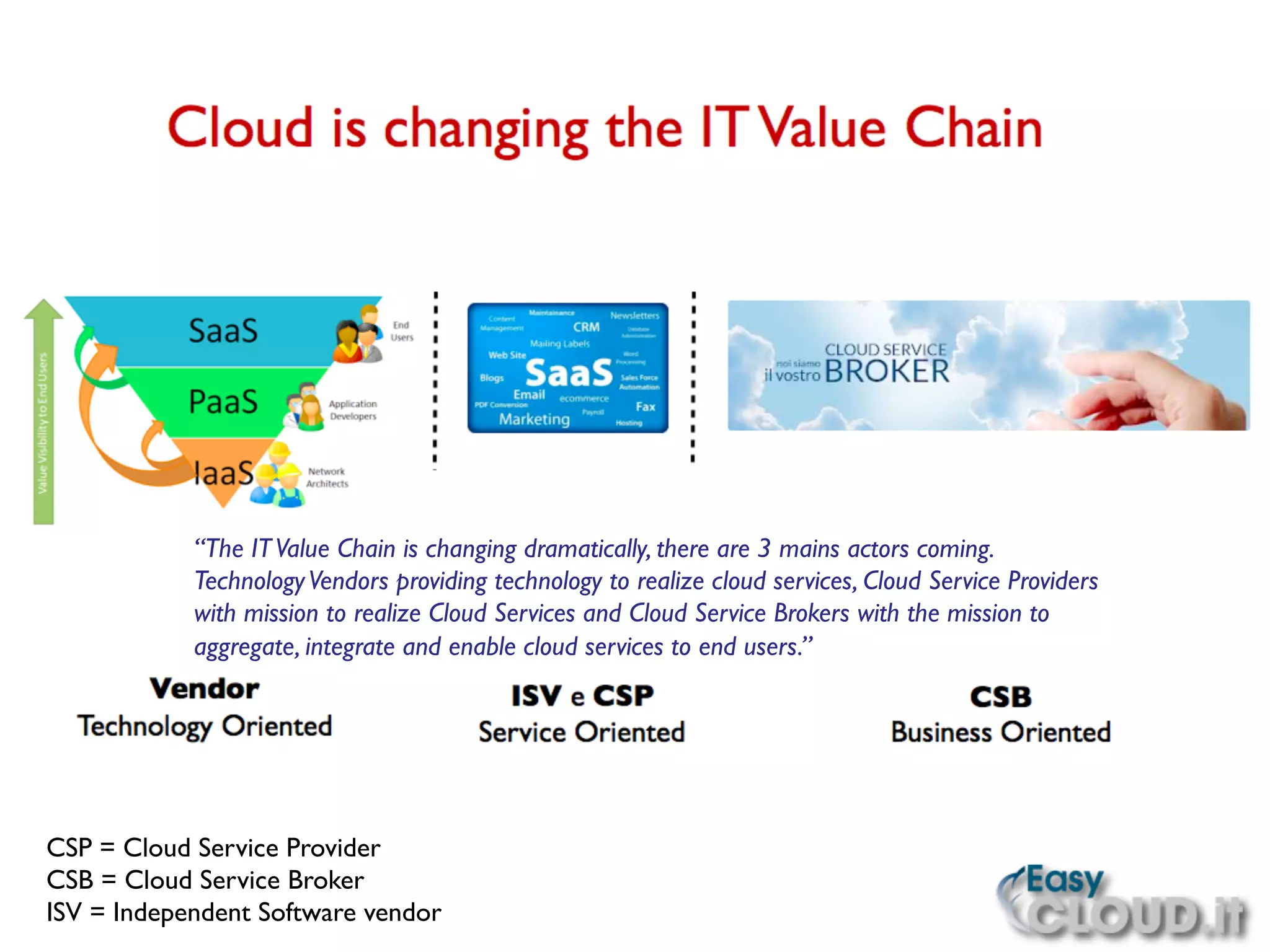
CSP = Cloud Service Provider	

CSB = Cloud Service Broker	

ISV = Independent Software vendor	

“The ITValue Chain is changing dramatically, there are 3 mains actors coming.
TechnologyVendors providing technology to realize cloud services, Cloud Service Providers
with mission to realize Cloud Services and Cloud Service Brokers with the mission to
aggregate, integrate and enable cloud services to end users.”


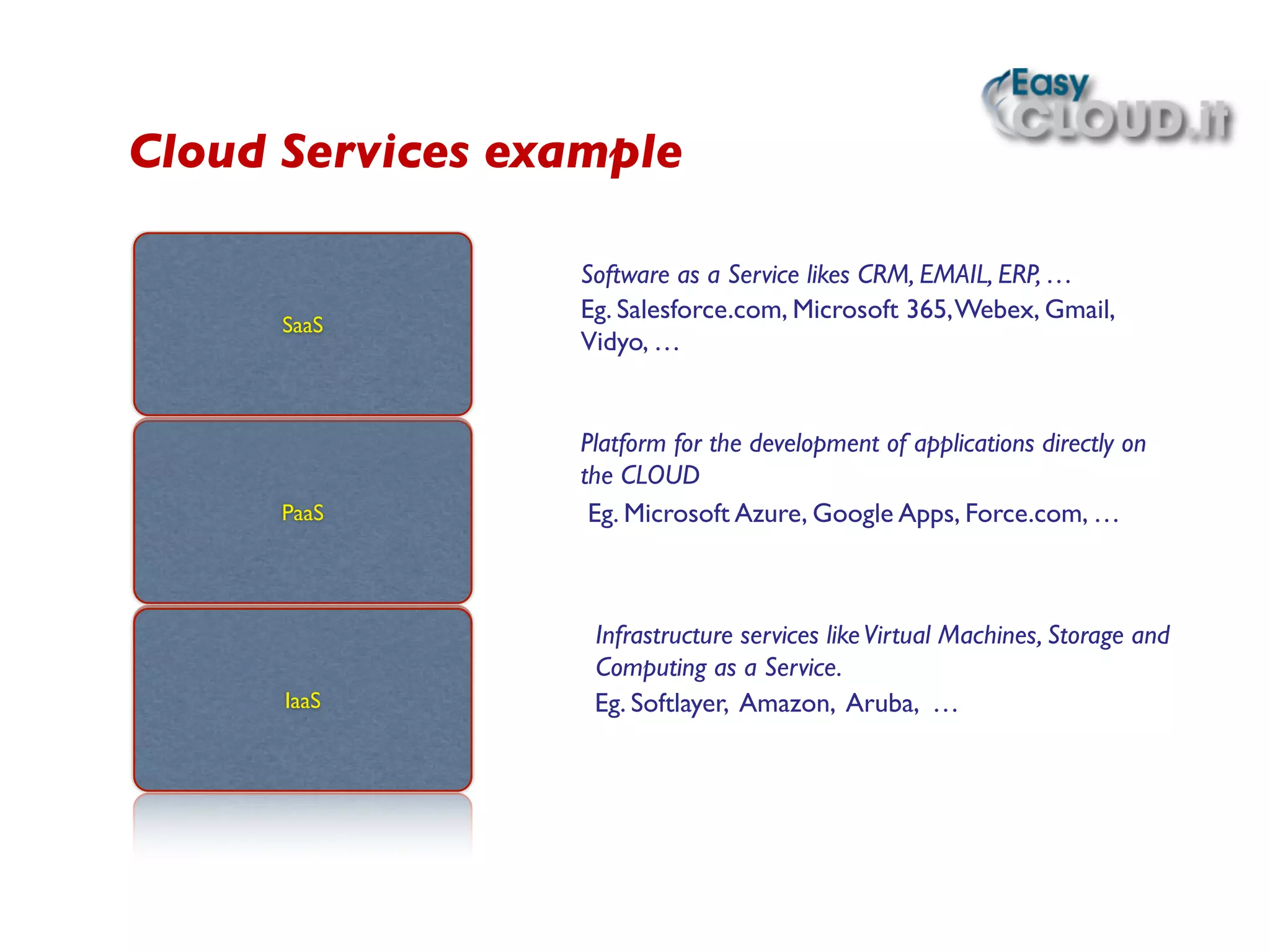
Cloud Services example	

Eg. Salesforce.com, Microsoft 365,Webex, Gmail,
Vidyo, …	

Eg. Microsoft Azure, Google Apps, Force.com, …	

Eg. Softlayer, Amazon, Aruba, …	

Software as a Service likes CRM, EMAIL, ERP, …	

Platform for the development of applications directly on
the CLOUD	

Infrastructure services likeVirtual Machines, Storage and
Computing as a Service.	

PaaS
IaaS
SaaS
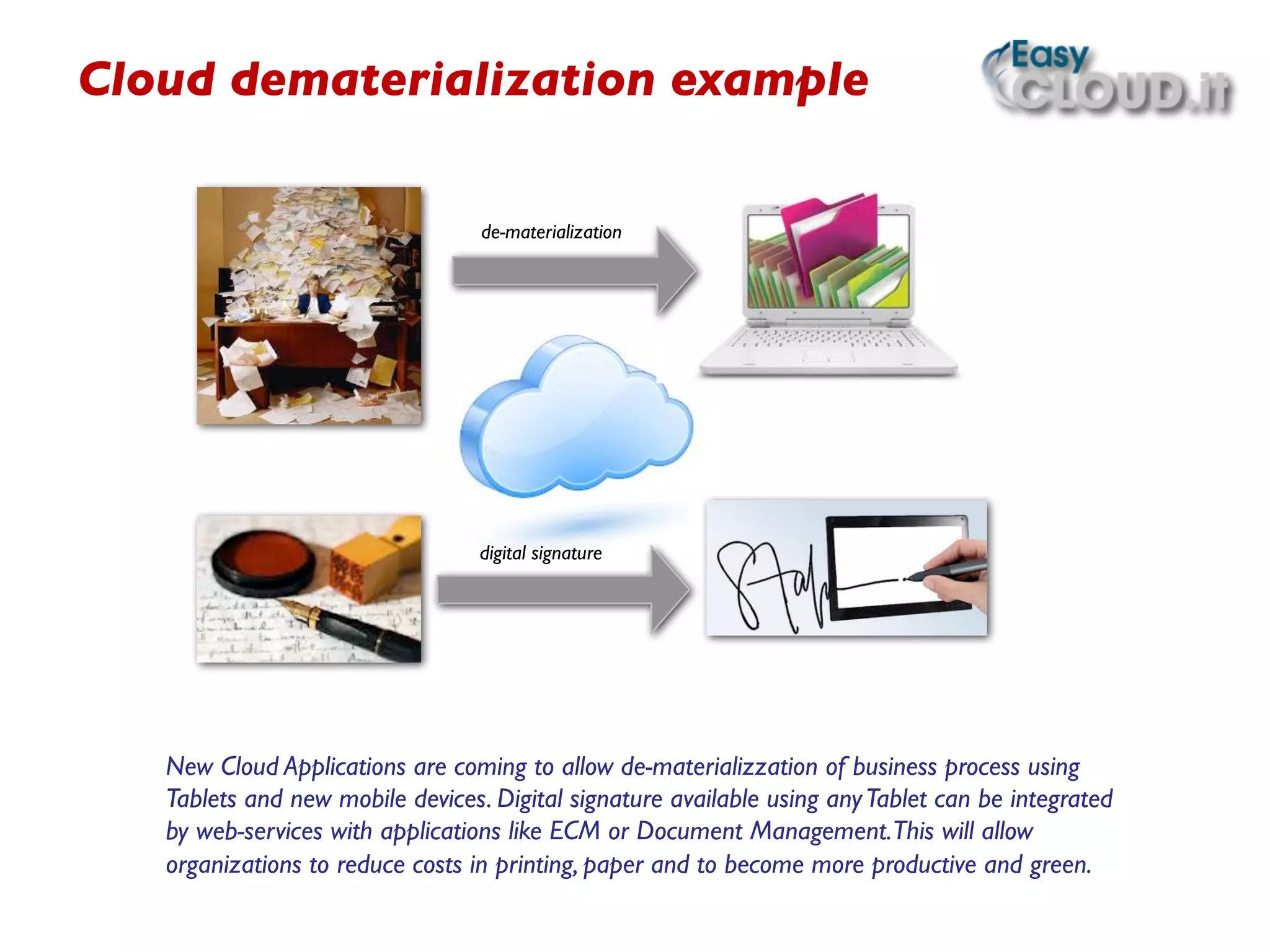
Cloud dematerialization example	

New Cloud Applications are coming to allow de-materializzation of business process using
Tablets and new mobile devices. Digital signature available using anyTablet can be integrated
by web-services with applications like ECM or Document Management.This will allow
organizations to reduce costs in printing, paper and to become more productive and green.	

de-materialization
digital signature
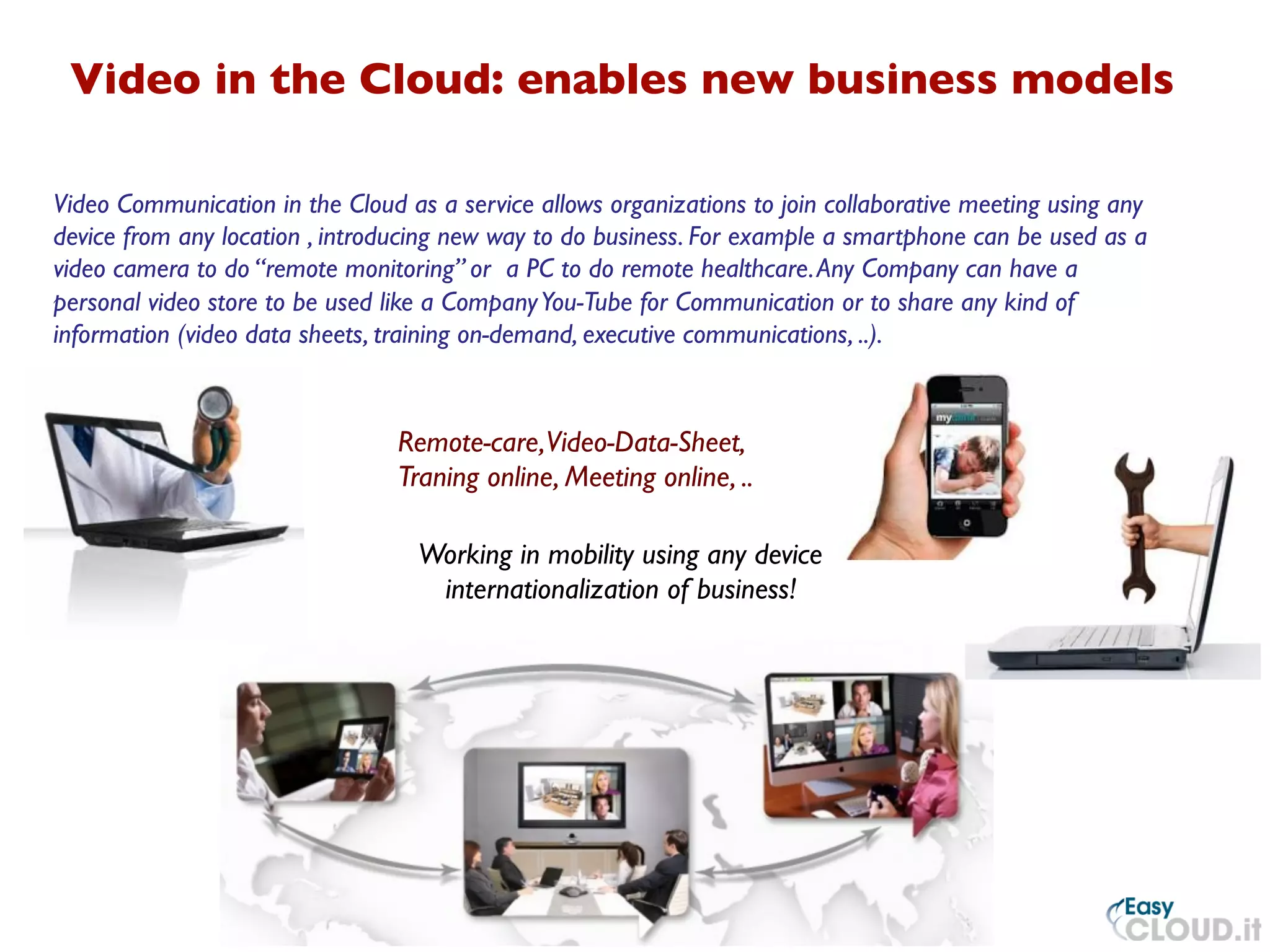
Video in the Cloud: enables new business models	

Working in mobility using any device	

internationalization of business!	

Remote-care,Video-Data-Sheet, 	

Traning online, Meeting online, ..	


Video Communication in the Cloud as a service allows organizations to join collaborative meeting using any
device from any location , introducing new way to do business. For example a smartphone can be used as a
video camera to do “remote monitoring” or a PC to do remote healthcare.Any Company can have a
personal video store to be used like a CompanyYou-Tube for Communication or to share any kind of
information (video data sheets, training on-demand, executive communications, ..).
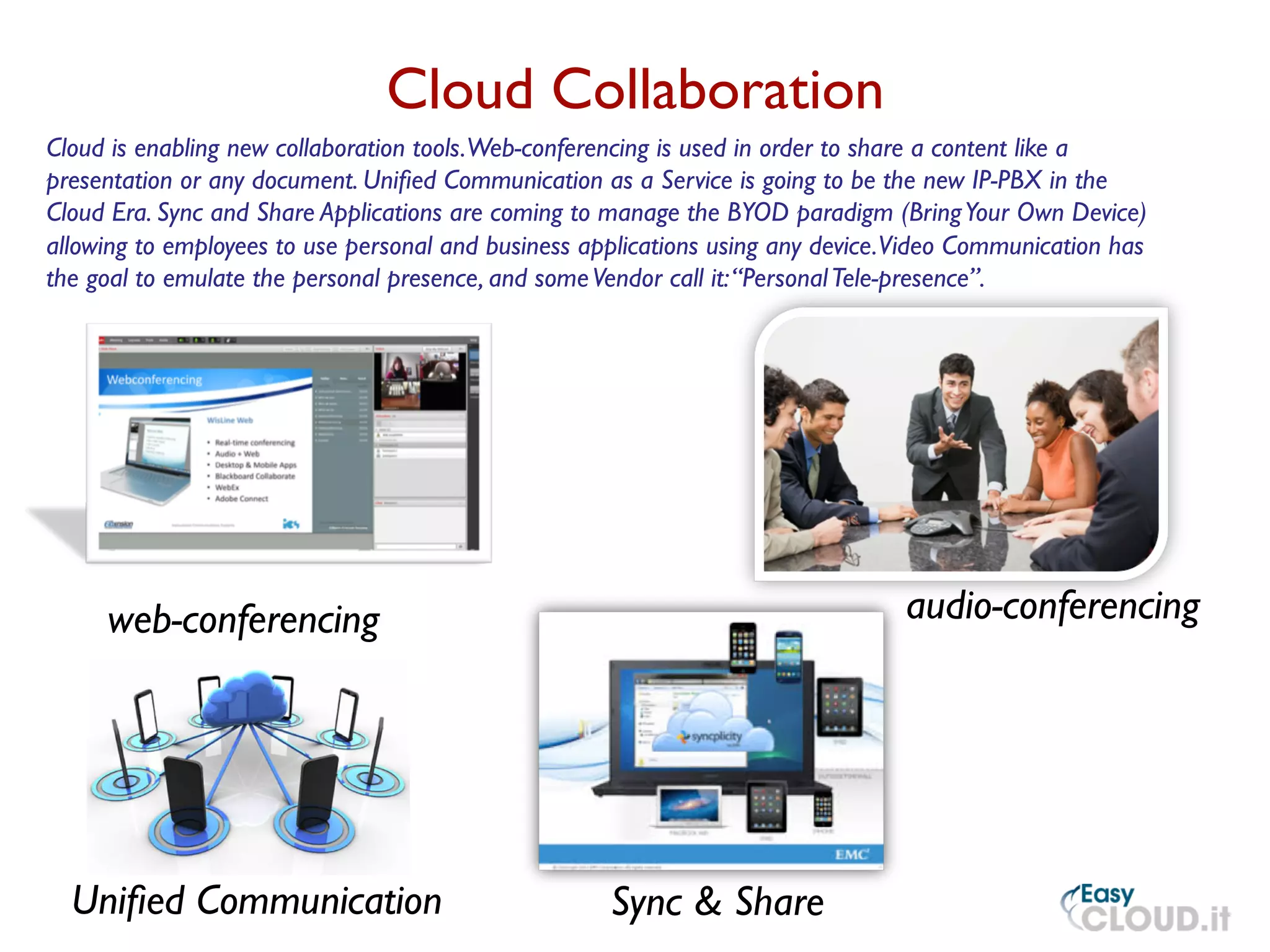
Cloud Collaboration
	

web-conferencing	

 audio-conferencing	

Sync  Share	

Unified Communication	

Cloud is enabling new collaboration tools.Web-conferencing is used in order to share a content like a
presentation or any document. Unified Communication as a Service is going to be the new IP-PBX in the
Cloud Era. Sync and Share Applications are coming to manage the BYOD paradigm (BringYour Own Device)
allowing to employees to use personal and business applications using any device.Video Communication has
the goal to emulate the personal presence, and someVendor call it:“PersonalTele-presence”.
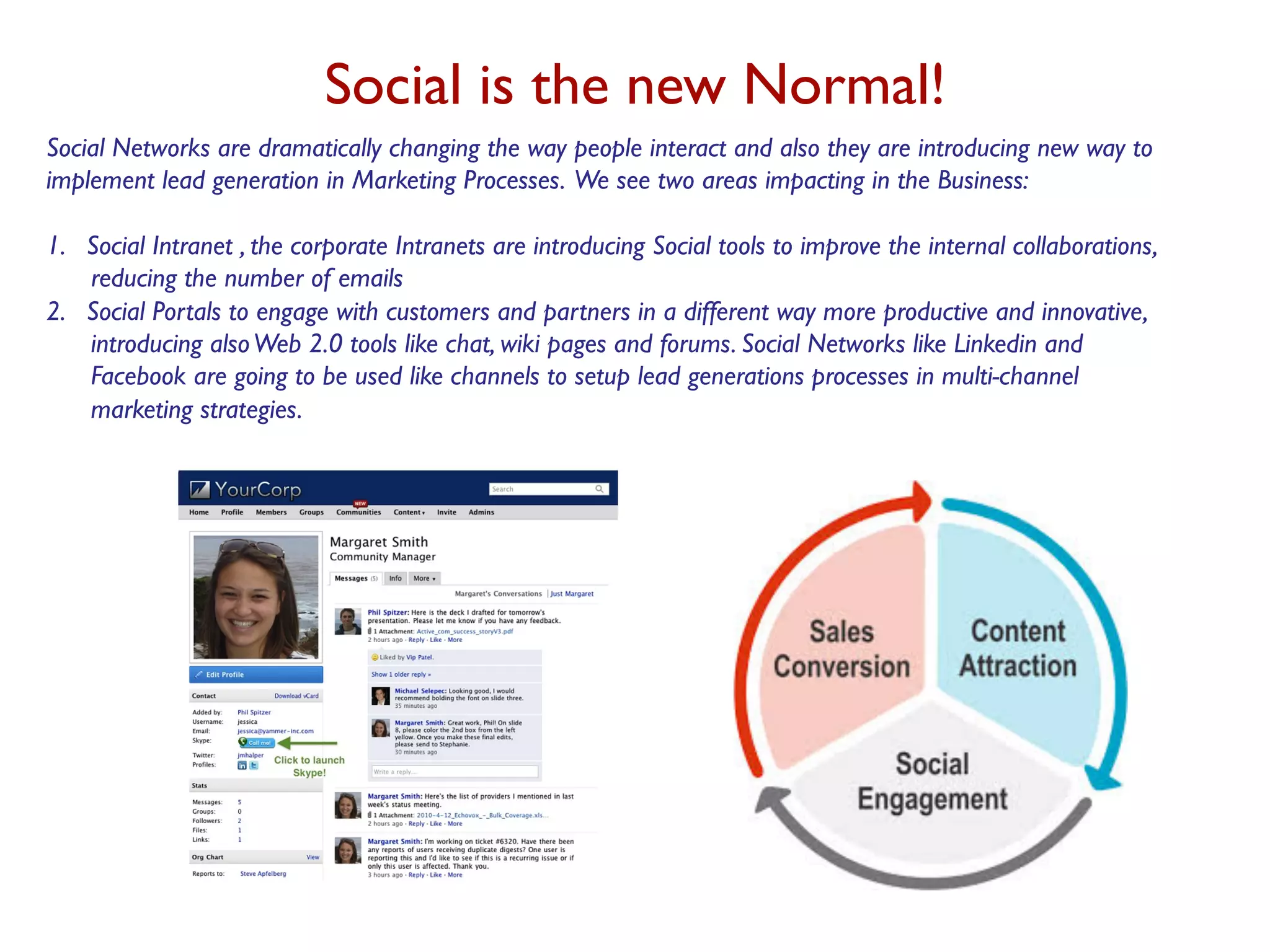
Social is the new Normal!	

Social Networks are dramatically changing the way people interact and also they are introducing new way to
implement lead generation in Marketing Processes. We see two areas impacting in the Business:	


1.  Social Intranet , the corporate Intranets are introducing Social tools to improve the internal collaborations,
reducing the number of emails	

2.  Social Portals to engage with customers and partners in a different way more productive and innovative,
introducing alsoWeb 2.0 tools like chat, wiki pages and forums. Social Networks like Linkedin and
Facebook are going to be used like channels to setup lead generations processes in multi-channel
marketing strategies.


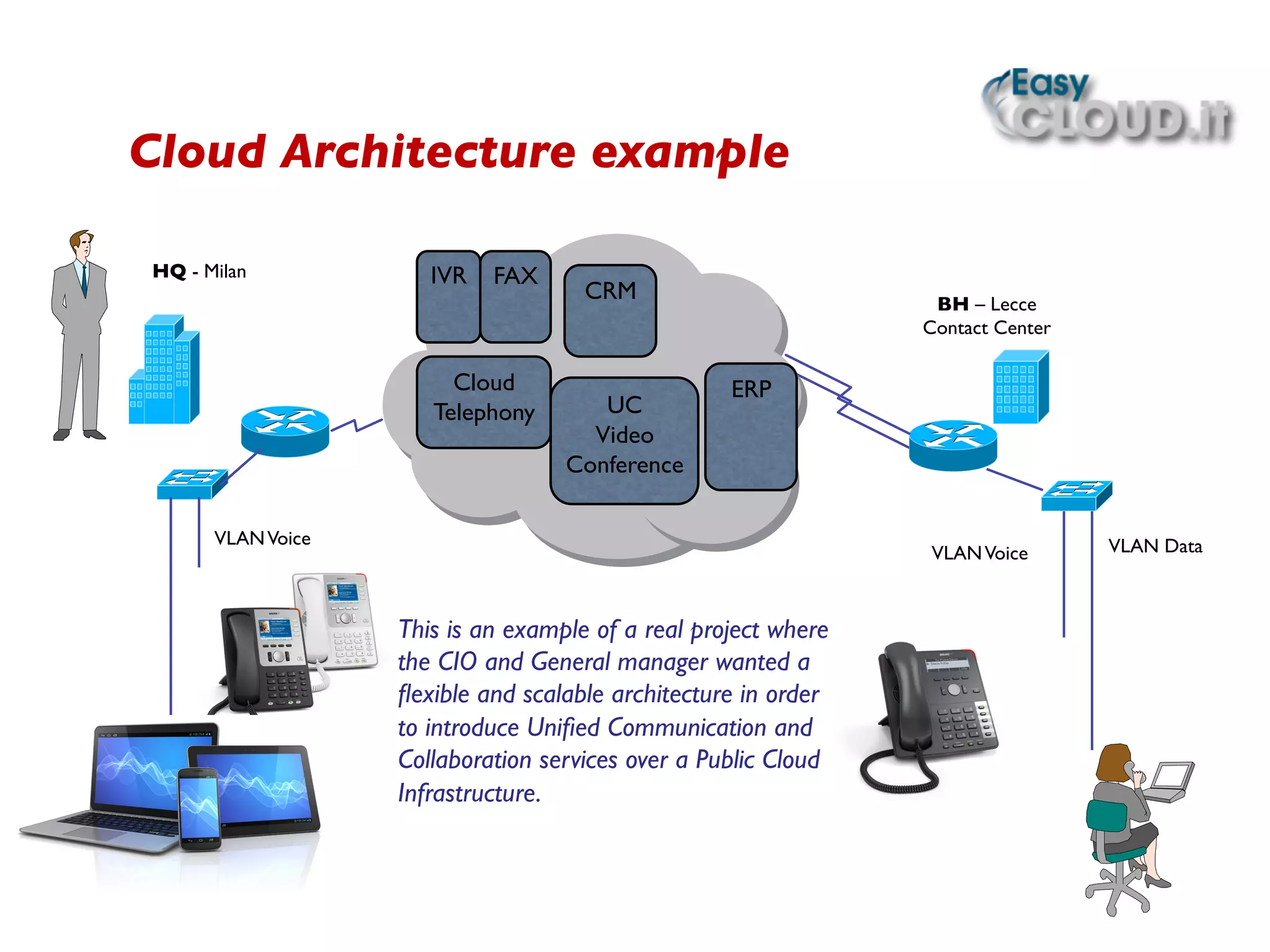
HQ - Milan	

BH – Lecce	

Contact Center	

VLANVoice	

VLANVoice	

 VLAN Data	

Cloud	

Telephony	

CRM	

IVR	


ERP	

UC	

Video	

Conference	

FAX	


Cloud Architecture example	

This is an example of a real project where
the CIO and General manager wanted a
flexible and scalable architecture in order
to introduce Unified Communication and
Collaboration services over a Public Cloud
Infrastructure.
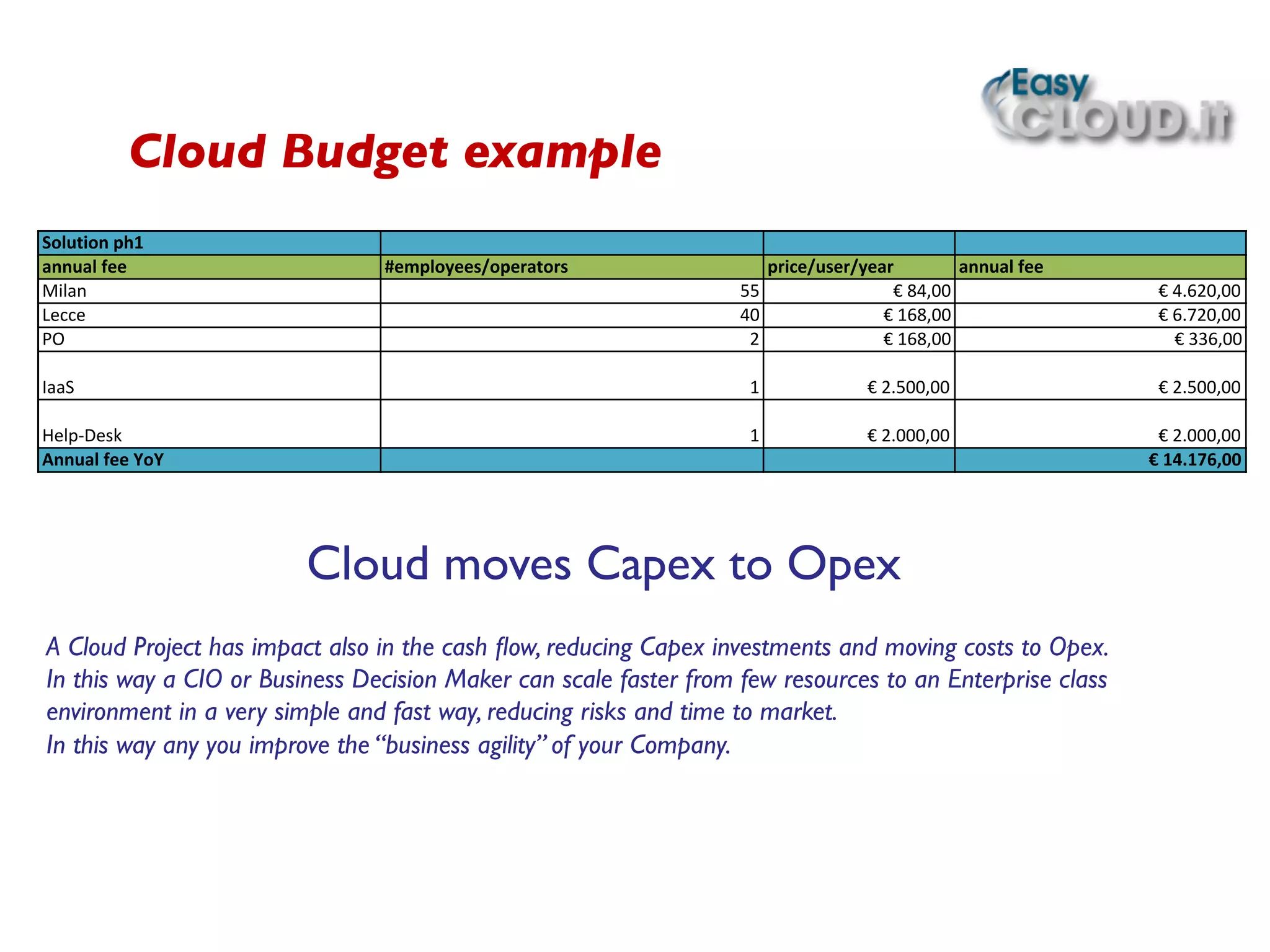
Cloud Budget example	

Solution(ph1
annual(fee #employees/operators price/user/year annual(fee
Milan 55 €(84,00 €(4.620,00
Lecce 40 €(168,00 €(6.720,00
PO 2 €(168,00 €(336,00
IaaS 1 €(2.500,00 €(2.500,00
HelpDesk 1 €(2.000,00 €(2.000,00
Annual(fee(YoY €(14.176,00
Cloud moves Capex to Opex	

A Cloud Project has impact also in the cash flow, reducing Capex investments and moving costs to Opex. 	

In this way a CIO or Business Decision Maker can scale faster from few resources to an Enterprise class
environment in a very simple and fast way, reducing risks and time to market.	

In this way any you improve the “business agility” of your Company.
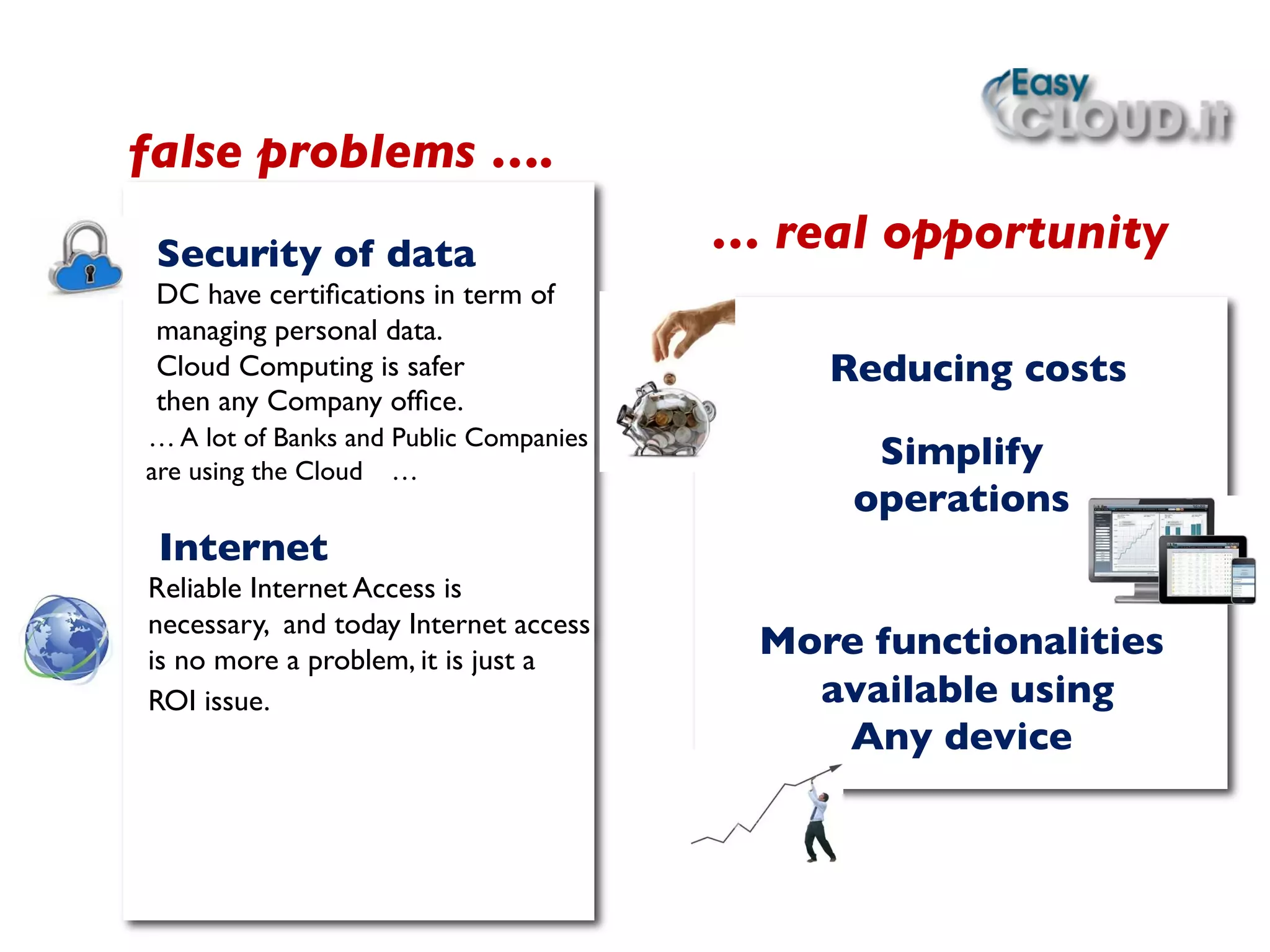
Security of data	

DC have certifications in term of 	

managing personal data. 	

Cloud Computing is safer	

then any Company office. 	


… A lot of Banks and Public Companies 	

are using the Cloud 	

…	


Internet	

Reliable Internet Access is 	

necessary, and today Internet access 	

is no more a problem, it is just a 	

ROI issue.	


false problems ….	

… real opportunity	


Reducing costs	


Simplify 	

operations	


More functionalities	

available using 	

Any device
Assessment for free	

ü  Exisisting IT architecture	

ü  Business priorities	

ü  Cloud Road Map: IT business plan	


Test 	

 of Cloud service in your environment,Technical support	


Deployment 	


Cloud Services activation: tecnology, partners,professional services	


Easycloud.it approach
Via Cavour, 2 	

22074 Lomazzo (CO) 	

Italy	

info 02 3671.4024	

info@easycloud.it	


www.easycloud.it 	

alessandro.greco@easycloud.it	

About.me: http://about.me/www.algreco.org

Cloud for dummies easycloud

  • 1.
    Cloud for Dummies March2014 – alessandro.greco@easycloud.it
  • 2.
    Acronyms CRM – CustomerRelationships Management CSB – Cloud Service Broker CSP – Cloud Service Provider ERP – Enterprise Resourse Planning IaaS – Infrastructure as a Service IP-PBX – IP based Private Branch Exchange ISV – Independent SotwareVendor NIST – National Institute of Standards and Technology (http://www.nist.gov) PaaS – Platform as a Service SaaS – Software as a Service
  • 3.
    Cloud is aStrategy ü  Cloud is not a technology ü  Organizations are using the Cloud to develop and deploy applications to support the business and open up new innovative opportunities and new revenue streams ü  Companies: ü  are asking for what types of cloud computing models are best suited to solve their business problems ü  are using the Cloud to make the business faster and to build new business models     Understanding the essentials of Cloud Computing
  • 4.
    There are severalCloud definitions provided by NIST, Gartner and Technology Vendors. “Cloud computing is a model for enabling ubiquitous, convenient, on-demand network access to a shared pool of configurable computing resources (e.g., networks, servers, storage, applications, and services) that can be rapidly provisioned and released with minimal management effort or service provider interaction.This cloud model is composed of five essential characteristics, three service models, and four deployment models “ NIST definition - http://csrc.nist.gov/publications/nistpubs/800-145/SP800-145.pdf     Cloud definition
  • 5.
    On-demand self-service. Aconsumer can unilaterally provision computing capabilities, such as server time and network storage, as needed automatically without requiring human interaction with service providers. Broad network access. Capabilities are available over the network and accessed through standard mechanisms that promote use by heterogeneous thin or thick client platforms (e.g., mobile phones, tablets, laptops, and workstations). Resource pooling. The provider’s computing resources are pooled to serve multiple consumers using a multi-tenant model, with different physical and virtual resources dynamically assigned and reassigned according to consumer demand. Rapid elasticity. Capabilities can be elastically provisioned and released, in some cases automatically, to scale rapidly outward and inward commensurate with demand. Measured service. Cloud systems automatically control and optimize resource use by leveraging a metering capability at some level of abstraction appropriate to the type of service (e.g., storage, processing, bandwidth, and active user accounts).     Cloud characteristics
  • 6.
    Software as aService (SaaS). The capability provided to the consumer is to use the provider’s applications running on a cloud infrastructure.The applications are accessible from various client devices through either a thin client interface, such as a web browser (e.g., web- based email), or a program interface. Platform as a Service (PaaS).The capability provided to the consumer is to deploy onto the cloud infrastructure consumer-created or acquired applications created using programming languages, libraries, services, and tools supported by the provider. Infrastructure as a Service (IaaS). The capability provided to the consumer is to provision processing, storage, networks, and other fundamental computing resources where the consumer is able to deploy and run arbitrary software, which can include operating systems and applications.     Cloud service models
  • 7.
    Private cloud. Thecloud infrastructure is provisioned for exclusive use by a single organization comprising multiple consumers (e.g., business units). It may be owned, managed, and operated by the organization, a third party, or some combination of them, and it may exist on or off premises. Community cloud. The cloud infrastructure is provisioned for exclusive use by a specific community of consumers from organizations that have shared concerns (e.g., mission, security requirements, policy, and compliance considerations). It may be owned, managed, and operated by one or more of the organizations in the community, a third party, or some combination of them, and it may exist on or off premises. Public cloud. The cloud infrastructure is provisioned for open use by the general public. It may be owned, managed, and operated by a business, academic, or government organization, or some combination of them. It exists on the premises of the cloud provider. Hybrid cloud. The cloud infrastructure is a composition of two or more distinct cloud infrastructures (private, community, or public) that remain unique entities, but are bound together by standardized or proprietary technology that enables data and application portability.     Cloud deployment models CSP = Cloud Service Provider CSB = Cloud Service Broker ISV = Independent Software vendor “The ITValue Chain is changing dramatically, there are 3 mains actors coming. TechnologyVendors providing technology to realize cloud services, Cloud Service Providers with mission to realize Cloud Services and Cloud Service Brokers with the mission to aggregate, integrate and enable cloud services to end users.”
  • 8.
        Cloud Servicesexample Eg. Salesforce.com, Microsoft 365,Webex, Gmail, Vidyo, … Eg. Microsoft Azure, Google Apps, Force.com, … Eg. Softlayer, Amazon, Aruba, … Software as a Service likes CRM, EMAIL, ERP, … Platform for the development of applications directly on the CLOUD Infrastructure services likeVirtual Machines, Storage and Computing as a Service. PaaS IaaS SaaS
  • 9.
    Cloud dematerialization example NewCloud Applications are coming to allow de-materializzation of business process using Tablets and new mobile devices. Digital signature available using anyTablet can be integrated by web-services with applications like ECM or Document Management.This will allow organizations to reduce costs in printing, paper and to become more productive and green. de-materialization digital signature
  • 10.
    Video in theCloud: enables new business models Working in mobility using any device internationalization of business! Remote-care,Video-Data-Sheet, Traning online, Meeting online, .. Video Communication in the Cloud as a service allows organizations to join collaborative meeting using any device from any location , introducing new way to do business. For example a smartphone can be used as a video camera to do “remote monitoring” or a PC to do remote healthcare.Any Company can have a personal video store to be used like a CompanyYou-Tube for Communication or to share any kind of information (video data sheets, training on-demand, executive communications, ..).
  • 11.
    Cloud Collaboration web-conferencing audio-conferencing Sync Share Unified Communication Cloud is enabling new collaboration tools.Web-conferencing is used in order to share a content like a presentation or any document. Unified Communication as a Service is going to be the new IP-PBX in the Cloud Era. Sync and Share Applications are coming to manage the BYOD paradigm (BringYour Own Device) allowing to employees to use personal and business applications using any device.Video Communication has the goal to emulate the personal presence, and someVendor call it:“PersonalTele-presence”.
  • 12.
    Social is thenew Normal! Social Networks are dramatically changing the way people interact and also they are introducing new way to implement lead generation in Marketing Processes. We see two areas impacting in the Business: 1.  Social Intranet , the corporate Intranets are introducing Social tools to improve the internal collaborations, reducing the number of emails 2.  Social Portals to engage with customers and partners in a different way more productive and innovative, introducing alsoWeb 2.0 tools like chat, wiki pages and forums. Social Networks like Linkedin and Facebook are going to be used like channels to setup lead generations processes in multi-channel marketing strategies.
  • 13.
        HQ - Milan BH– Lecce Contact Center VLANVoice VLANVoice VLAN Data Cloud Telephony CRM IVR ERP UC Video Conference FAX Cloud Architecture example This is an example of a real project where the CIO and General manager wanted a flexible and scalable architecture in order to introduce Unified Communication and Collaboration services over a Public Cloud Infrastructure.
  • 14.
    Cloud Budget example Solution(ph1 annual(fee#employees/operators price/user/year annual(fee Milan 55 €(84,00 €(4.620,00 Lecce 40 €(168,00 €(6.720,00 PO 2 €(168,00 €(336,00 IaaS 1 €(2.500,00 €(2.500,00 HelpDesk 1 €(2.000,00 €(2.000,00 Annual(fee(YoY €(14.176,00 Cloud moves Capex to Opex A Cloud Project has impact also in the cash flow, reducing Capex investments and moving costs to Opex. In this way a CIO or Business Decision Maker can scale faster from few resources to an Enterprise class environment in a very simple and fast way, reducing risks and time to market. In this way any you improve the “business agility” of your Company.
  • 15.
    Security of data DChave certifications in term of managing personal data. Cloud Computing is safer then any Company office. … A lot of Banks and Public Companies are using the Cloud … Internet Reliable Internet Access is necessary, and today Internet access is no more a problem, it is just a ROI issue.     false problems …. … real opportunity Reducing costs Simplify operations More functionalities available using Any device
  • 17.
    Assessment for free ü Exisisting IT architecture ü  Business priorities ü  Cloud Road Map: IT business plan Test of Cloud service in your environment,Technical support Deployment Cloud Services activation: tecnology, partners,professional services     Easycloud.it approach
  • 18.
    Via Cavour, 2 22074 Lomazzo (CO) Italy info 02 3671.4024 info@easycloud.it www.easycloud.it alessandro.greco@easycloud.it About.me: http://about.me/www.algreco.org