DEMAND
ANALYSIS
BUSINESS ECONOMICS
INDEX
1. WHAT IS DEMAND?
2. TYPES OF DEMAND
3. FACTORS AFFECTING DEMAND
4. LAW OF DEMAND
5. EXCEPTIONS TO LAW OF DEMAND
What is Demand?
The term demand refers to the quantity of a goods and services
that consumers are willing and able to purchase at various prices
during a given period of time. It is to be noted that demand, in
economics is something more than desire to purchase, though
desire is one element of it.
Thus effective demand depends on:
✓ Desire,
✓ means to purchase (ability to pay) and
✓ willingness to use those means for that purchase.
Demand Function
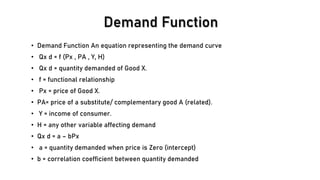
• Demand Function An equation representing the demand curve
• Qx d = f (Px , PA , Y, H)
• Qx d = quantity demanded of Good X.
• f = functional relationship
• Px = price of Good X.
• PA= price of a substitute/ complementary good A (related).
• Y = income of consumer.
• H = any other variable affecting demand
• Qx d = a – bPx
• a = quantity demanded when price is Zero (intercept)
• b = correlation coefficient between quantity demanded
Types of Demand
1. Demand for Consumer
Goods
2. Demand for producers
goods
3. Demand for durable goods
4. Demand for perishable
goods
5. Autonomous Goods
6. Individual Demand
7. Derived Demand
Types of Demand
8. Market Demand
9. Company Demand
10. Industry Demand
11. Short Run Demand
12. Long Run Demand
13. Joint Demand
14. Composite Demand
Determinants of Demand
A. Price
B. Income
C. Price of substitute goods
D. Price of complimentary goods
E. Size of population
F. Climate and weather
G. Advertisement
H. Taste, Habits and Preferences
I. Expectation about Future
Prices
Law of Demand
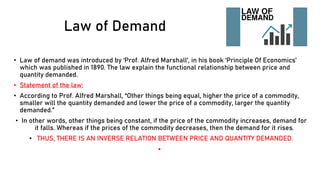
• Law of demand was introduced by ‘Prof. Alfred Marshall’, in his book ‘Principle Of Economics’
which was published in 1890. The law explain the functional relationship between price and
quantity demanded.
• Statement of the law:
• According to Prof. Alfred Marshall, “Other things being equal, higher the price of a commodity,
smaller will the quantity demanded and lower the price of a commodity, larger the quantity
demanded.”
• In other words, other things being constant, if the price of the commodity increases, demand for
it falls. Whereas if the prices of the commodity decreases, then the demand for it rises.
• THUS, THERE IS AN INVERSE RELATION BETWEEN PRICE AND QUANTITY DEMANDED.
•
Assumption to Law of Demand
✓Constant income
✓No change in tastes, fashion and habits
✓Government policies remain same
✓ Price of related goods remains unchanged
✓No future expectations
✓No change in weather and population
Exceptions of Law of Demand
▪ Giffens Goods
▪ Snob Appeal Or Veblen Effect
▪ Speculative Demand
▪ Highly Essential Goods
Giffens Goods
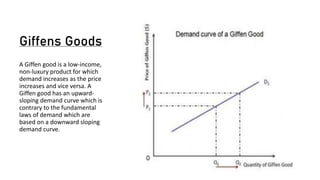
A Giffen good is a low-income,
non-luxury product for which
demand increases as the price
increases and vice versa. A
Giffen good has an upward-
sloping demand curve which is
contrary to the fundamental
laws of demand which are
based on a downward sloping
demand curve.
Snob Appeal
Or Veblen
Effect
A Veblen good is a type of
luxury good for which the
demand increases as the price
increases, in apparent
contradiction of the law of
demand, resulting in an
upward-sloping demand curve.
Speculative
Demand
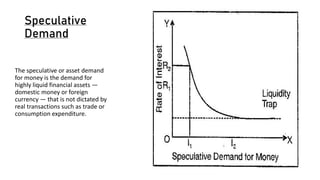
The speculative or asset demand
for money is the demand for
highly liquid financial assets —
domestic money or foreign
currency — that is not dictated by
real transactions such as trade or
consumption expenditure.
Highly
Essential
Goods
Essential goods means the goods
that concern the life of many
people and are in high demand,
as well as a supporting factor of
public welfare, such as rice, sugar,
cooking oil, butter, beef, chicken,
chicken egg, milk, corn, soy and
iodized salt.
Thank You!
BY,
Sailee Waghmare
Ritika Ramugade
Tejashree Kalan
Aditya Sawant
Suraj Yadav

DEMAND ANALYSIS .pdf

  • 1.
  • 2.
    INDEX 1. WHAT ISDEMAND? 2. TYPES OF DEMAND 3. FACTORS AFFECTING DEMAND 4. LAW OF DEMAND 5. EXCEPTIONS TO LAW OF DEMAND
  • 3.
    What is Demand? Theterm demand refers to the quantity of a goods and services that consumers are willing and able to purchase at various prices during a given period of time. It is to be noted that demand, in economics is something more than desire to purchase, though desire is one element of it. Thus effective demand depends on: ✓ Desire, ✓ means to purchase (ability to pay) and ✓ willingness to use those means for that purchase.
  • 4.
    Demand Function • DemandFunction An equation representing the demand curve • Qx d = f (Px , PA , Y, H) • Qx d = quantity demanded of Good X. • f = functional relationship • Px = price of Good X. • PA= price of a substitute/ complementary good A (related). • Y = income of consumer. • H = any other variable affecting demand • Qx d = a – bPx • a = quantity demanded when price is Zero (intercept) • b = correlation coefficient between quantity demanded
  • 5.
    Types of Demand 1.Demand for Consumer Goods 2. Demand for producers goods 3. Demand for durable goods 4. Demand for perishable goods 5. Autonomous Goods 6. Individual Demand 7. Derived Demand
  • 6.
    Types of Demand 8.Market Demand 9. Company Demand 10. Industry Demand 11. Short Run Demand 12. Long Run Demand 13. Joint Demand 14. Composite Demand
  • 7.
    Determinants of Demand A.Price B. Income C. Price of substitute goods D. Price of complimentary goods E. Size of population F. Climate and weather G. Advertisement H. Taste, Habits and Preferences I. Expectation about Future Prices
  • 8.
    Law of Demand •Law of demand was introduced by ‘Prof. Alfred Marshall’, in his book ‘Principle Of Economics’ which was published in 1890. The law explain the functional relationship between price and quantity demanded. • Statement of the law: • According to Prof. Alfred Marshall, “Other things being equal, higher the price of a commodity, smaller will the quantity demanded and lower the price of a commodity, larger the quantity demanded.” • In other words, other things being constant, if the price of the commodity increases, demand for it falls. Whereas if the prices of the commodity decreases, then the demand for it rises. • THUS, THERE IS AN INVERSE RELATION BETWEEN PRICE AND QUANTITY DEMANDED. •
  • 9.
    Assumption to Lawof Demand ✓Constant income ✓No change in tastes, fashion and habits ✓Government policies remain same ✓ Price of related goods remains unchanged ✓No future expectations ✓No change in weather and population
  • 10.
    Exceptions of Lawof Demand ▪ Giffens Goods ▪ Snob Appeal Or Veblen Effect ▪ Speculative Demand ▪ Highly Essential Goods
  • 11.
    Giffens Goods A Giffengood is a low-income, non-luxury product for which demand increases as the price increases and vice versa. A Giffen good has an upward- sloping demand curve which is contrary to the fundamental laws of demand which are based on a downward sloping demand curve.
  • 12.
    Snob Appeal Or Veblen Effect AVeblen good is a type of luxury good for which the demand increases as the price increases, in apparent contradiction of the law of demand, resulting in an upward-sloping demand curve.
  • 13.
    Speculative Demand The speculative orasset demand for money is the demand for highly liquid financial assets — domestic money or foreign currency — that is not dictated by real transactions such as trade or consumption expenditure.
  • 14.
    Highly Essential Goods Essential goods meansthe goods that concern the life of many people and are in high demand, as well as a supporting factor of public welfare, such as rice, sugar, cooking oil, butter, beef, chicken, chicken egg, milk, corn, soy and iodized salt.
  • 15.
    Thank You! BY, Sailee Waghmare RitikaRamugade Tejashree Kalan Aditya Sawant Suraj Yadav