Finding a focus for ongoing teacher
learning in mathematics: Six key
principles
Peter Sullivan
6 principles
Overview
• Some stories
• Six principles
6 principles
A story from a Grade 3 lesson I taught
at Bathurst Island
6 principles
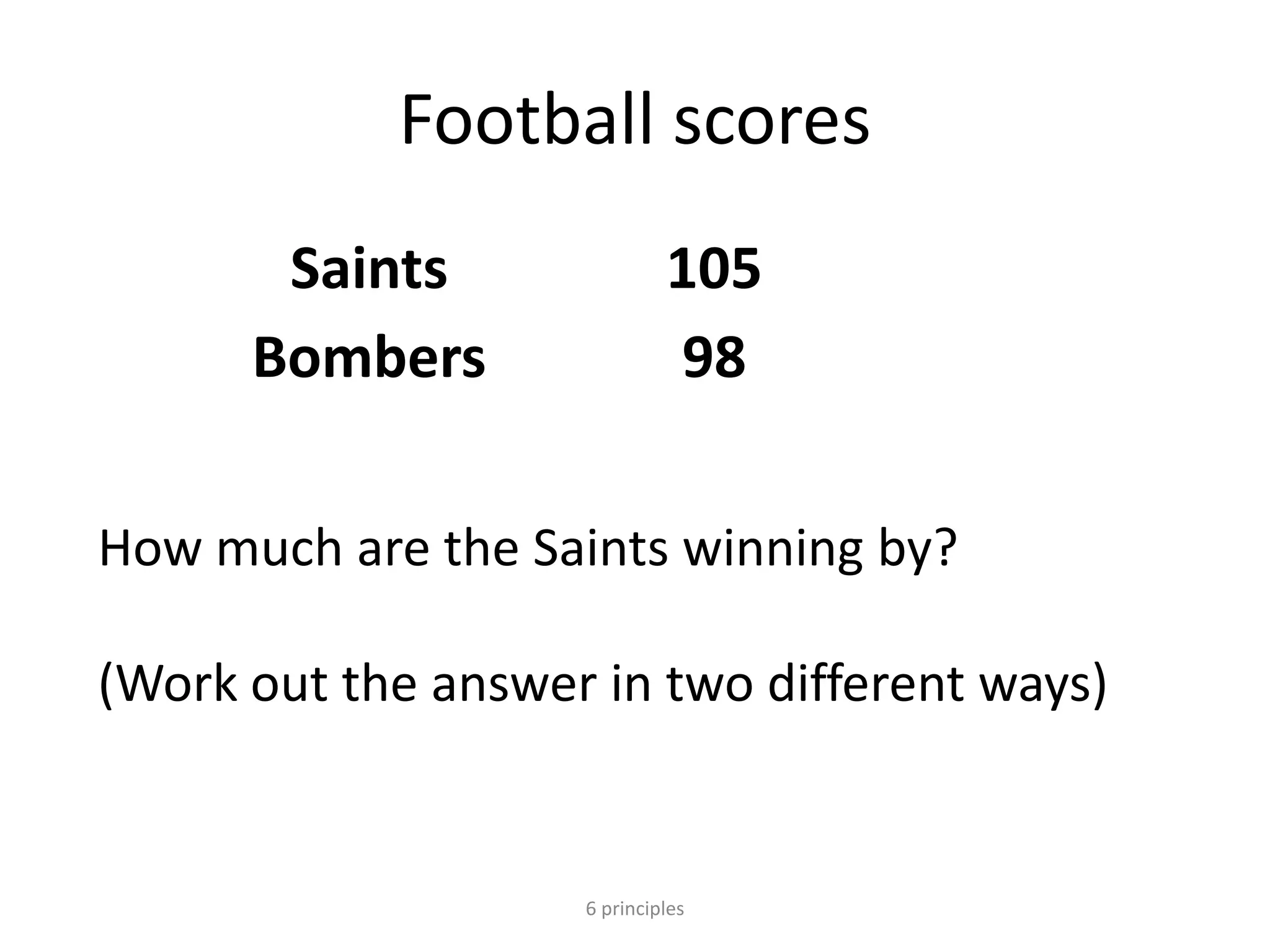
Football scores
Saints 105
Bombers 98
6 principles
How much are the Saints winning by?
(Work out the answer in two different ways)
Football scores
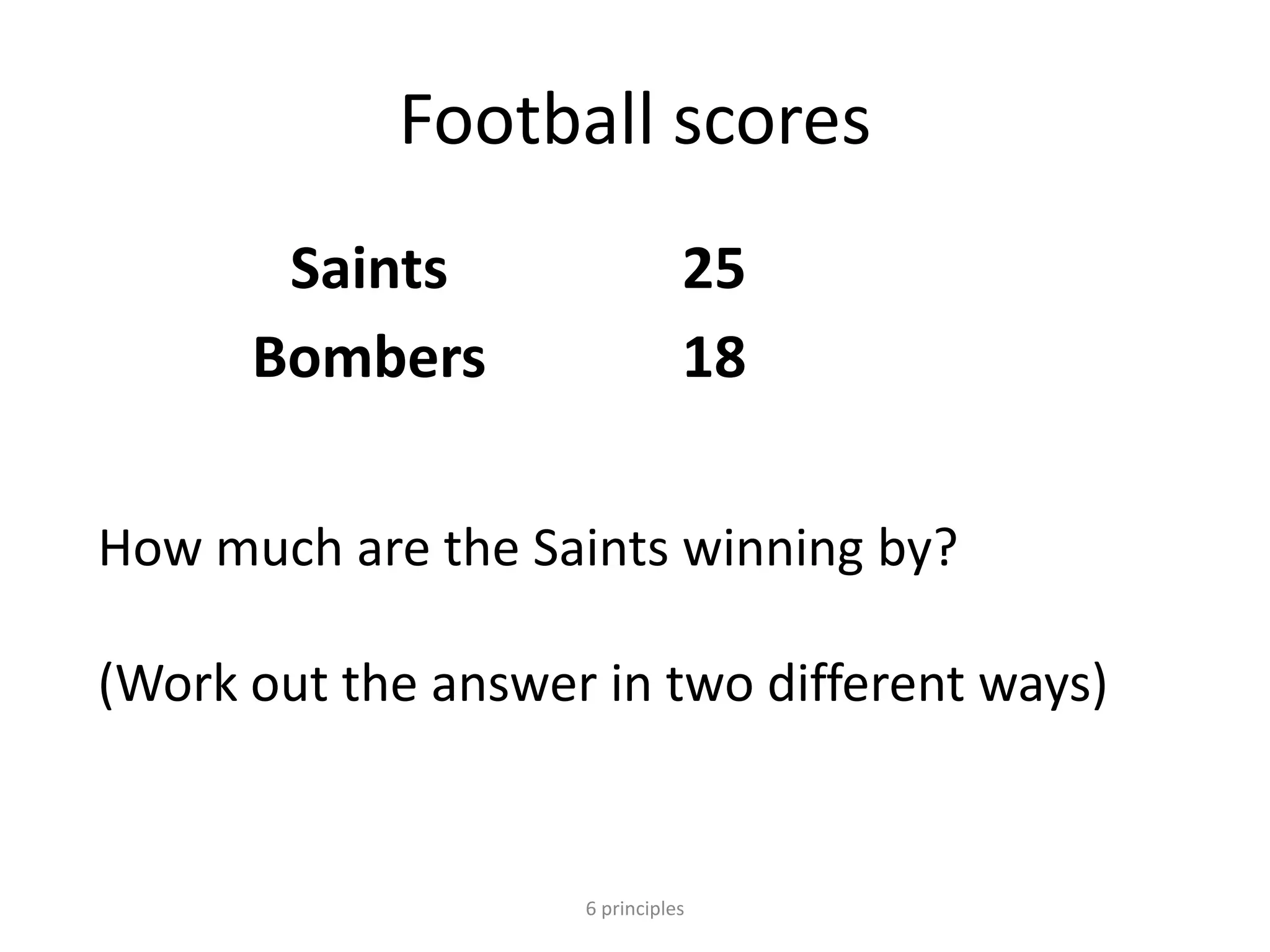
Saints 25
Bombers 18
6 principles
How much are the Saints winning by?
(Work out the answer in two different ways)
From a grade 3 lesson in the
Kimberleys
6 principles
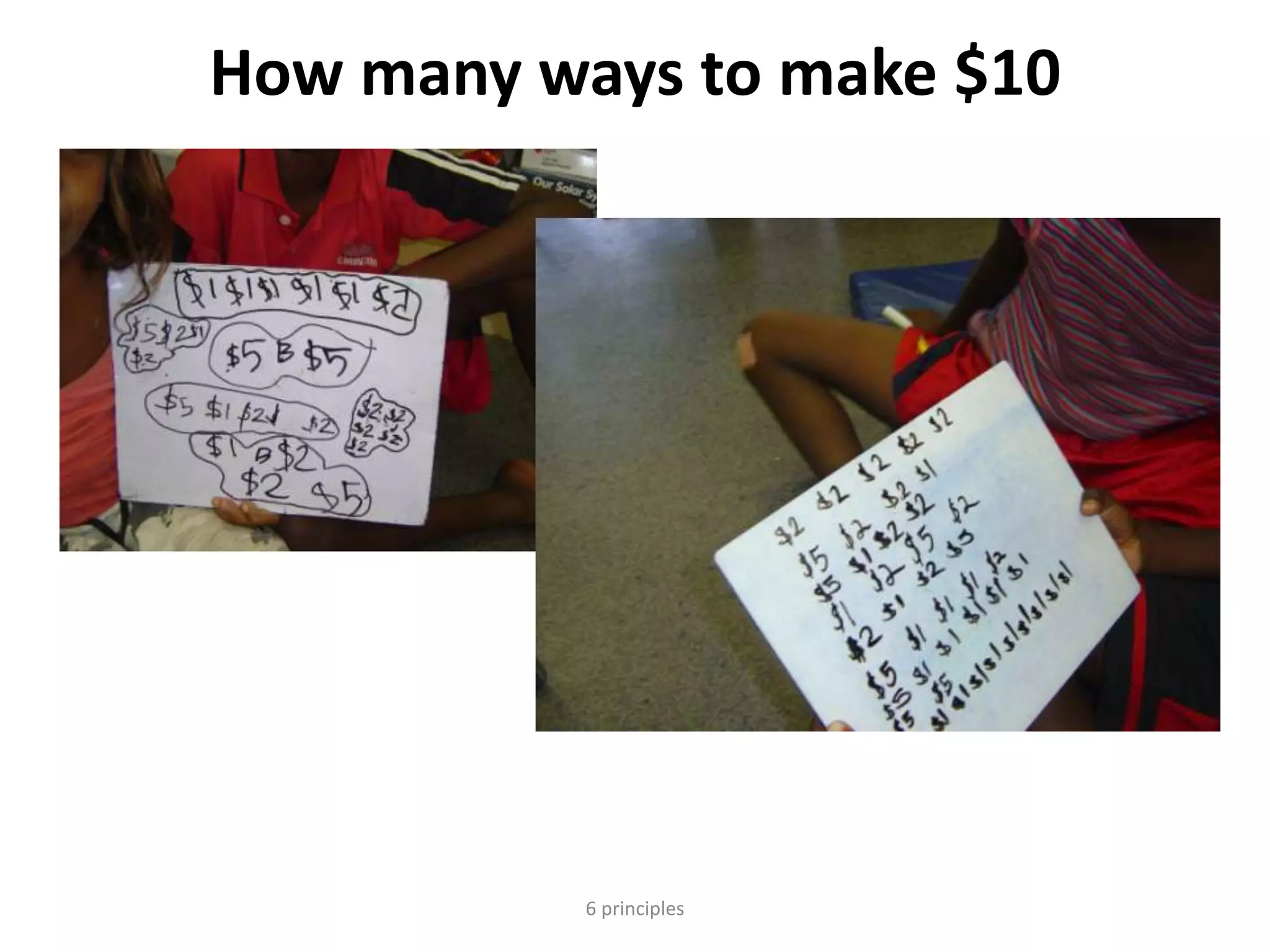
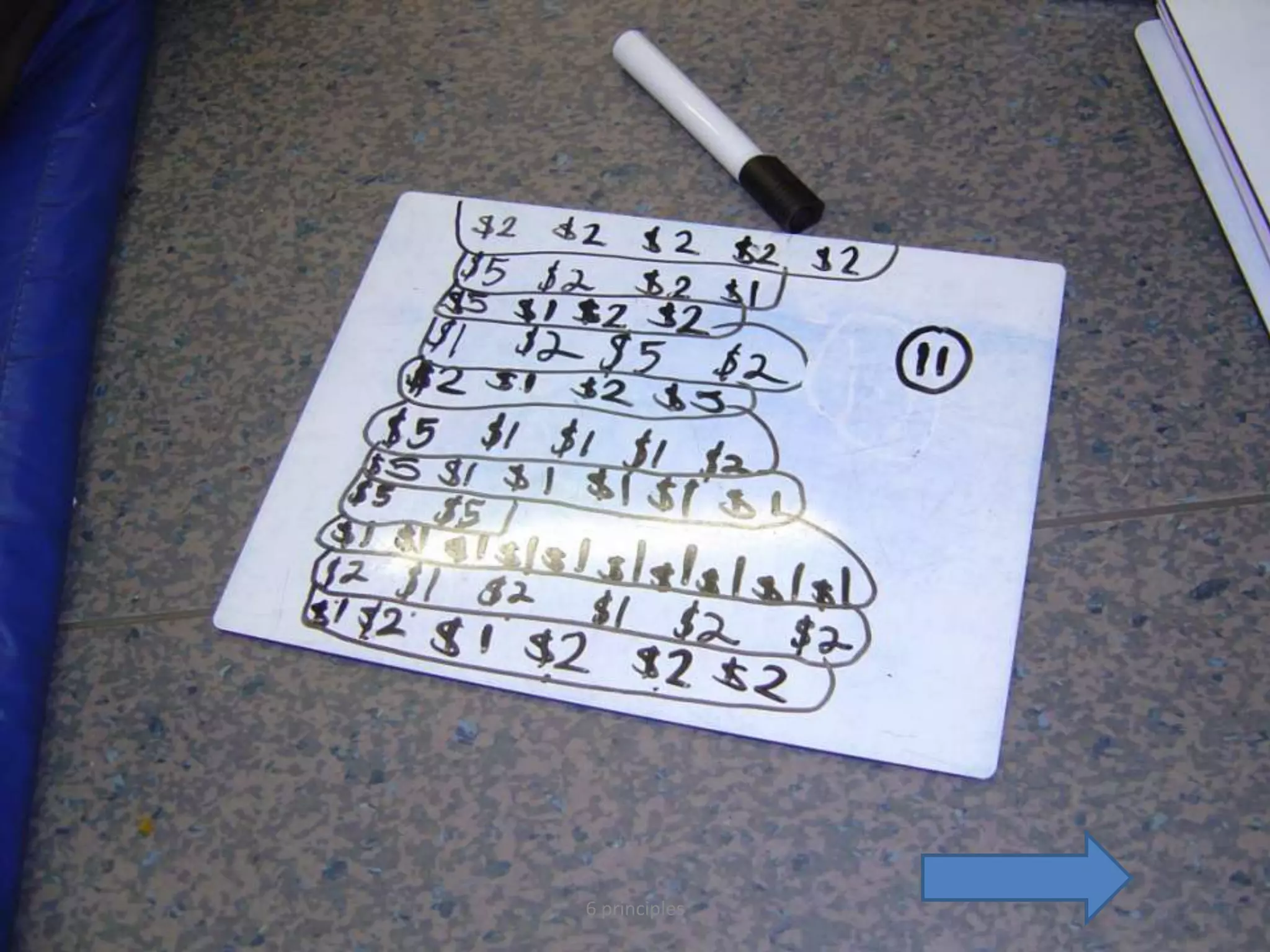
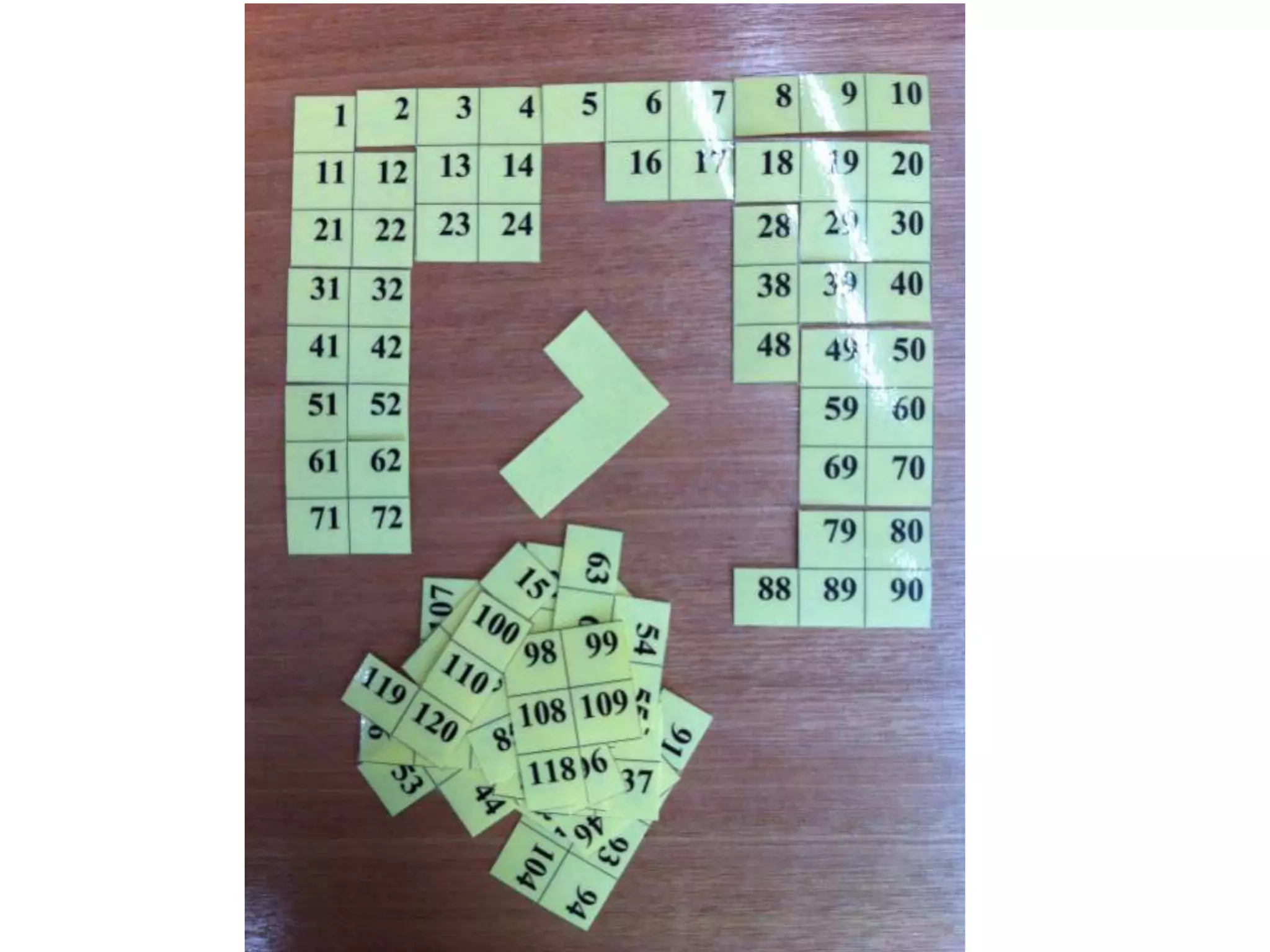
How many ways to make $10
6 principles
6 principles
A suggestion as part of a geometry
unit written for MiTK
6 principles
• Have pile of cubes. Ask the students to:
– Build something using 15 cubes. Describe what
you have built.
– Build something which is 3 cubes high and 3 cubes
wide made with 15 cubes. Describe what you have
built.
– Something like “make a tower of 3 cubes, put a
yellow cube to the left, and blue cube to the
north, …”
• Repeat, adapting to the level of success of the
students.
6 principles
A lesson I plan to teach to a year 8 class
next Tuesday at CMS (Alice Springs)
6 principles
ONE HECTARE PARK
• A conservation park is to be enclosed by a
fence that has exactly 6 internal right angles.
What might the park look like?
• The total area of the park is 1 hectare. What
might be the perimeter of the park? (give two
different answers)
6 principles
What are the common characteristics
of those tasks?
6 principles
Six principles as the basis of
sustainable improvement
6 principles
What is the point of these six key
principles ?
• We can all do these things better (although you
will find many of them affirming of your current
practice)
• Much advice is complex and hard to prioritise
• The principles can provide a focus to
collaborative discussions on improving teaching
• The principles can be the focus of observations
if you have the opportunity to be observed
teaching
6 principles
Improving teaching by thinking about
pedagogy
• The following principles are a synthesis of:
– Good, Grouws, and Ebmeier
– Productive pedagogies
– Principles of learning and teaching
– Hattie
– Clarke and Clarke
– Anthony and Walshaw
6 principles
Key principle 1:
• Identify important ideas that underpin
the concepts you are seeking to teach,
and communicate to students that these
are the goals of your teaching, including
explaining how you hope they will learn
6 principles
Feedback - better when they know …
• Where am I going?
–“Your task is to …, in this way”
• How am I going?
–“the first part is what I was hoping to see,
but the second is not”
• Where to next?
–“knowing this will help you with …”
6 principles
In terms of learning intentions, we
know
• It is much more difficult to describe the
purpose of lessons than we think
• The learning intention should
– not restrict
– nor lower the ceiling
– but provide focus to the students
– and the teacher
6 principles
In terms of the subtraction lesson
• There are many ways to find the difference
between two numbers
6 principles
In this lesson, I need you to
• show how you get your answers
• keep trying even if it is difficult (it is meant to
be)
• explain your thinking
• listen to other students
6 principles
6 principles
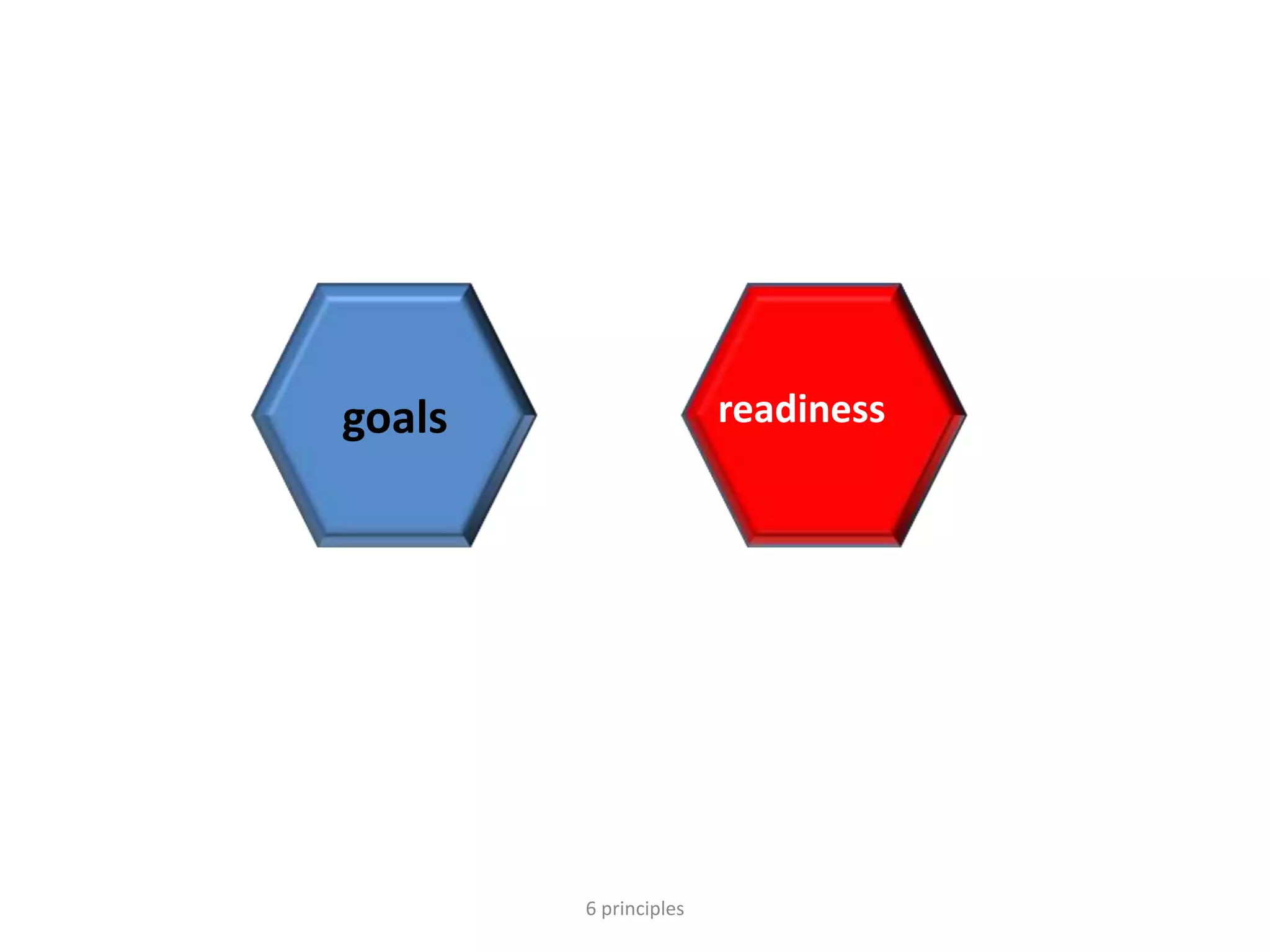
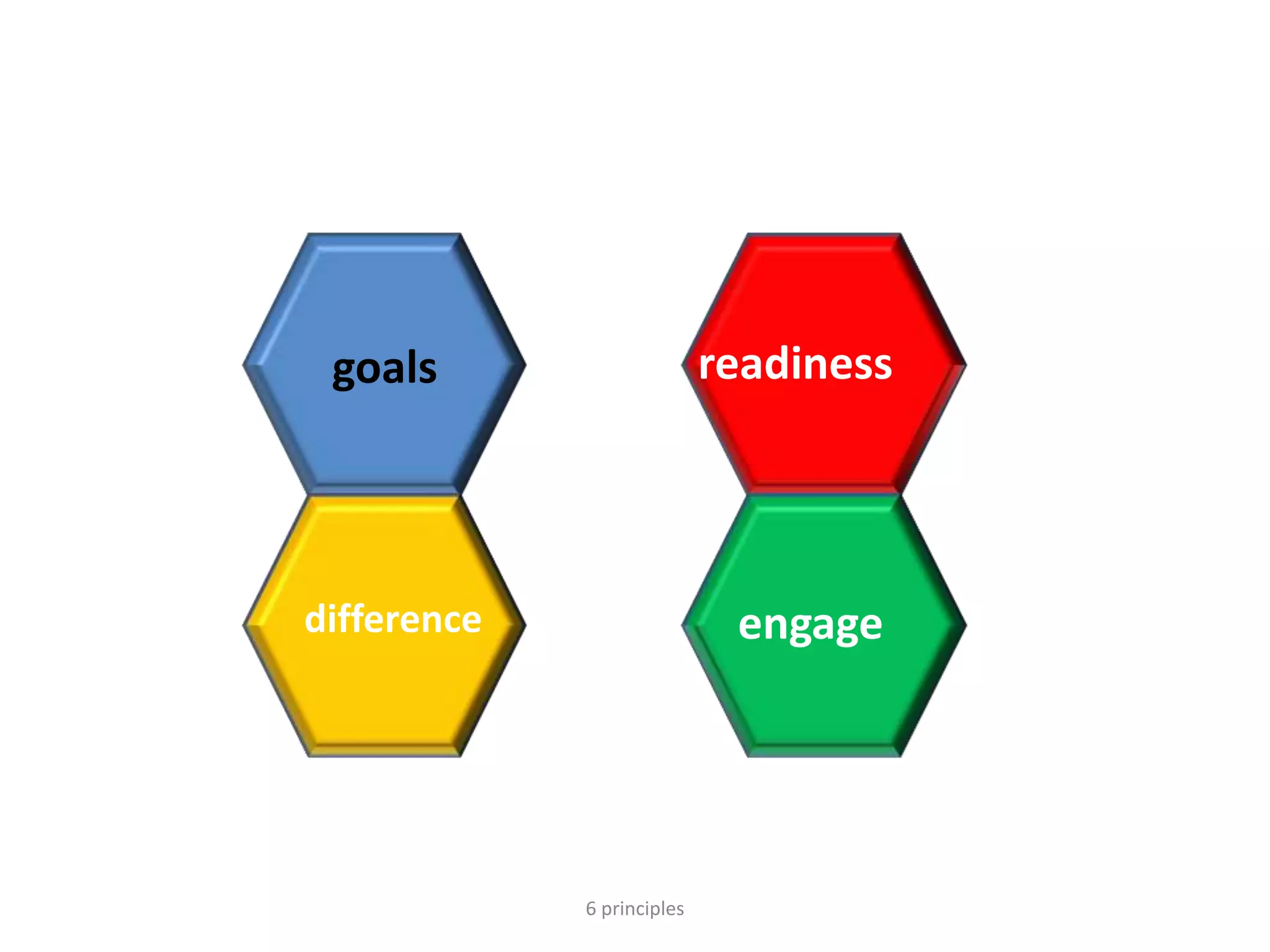
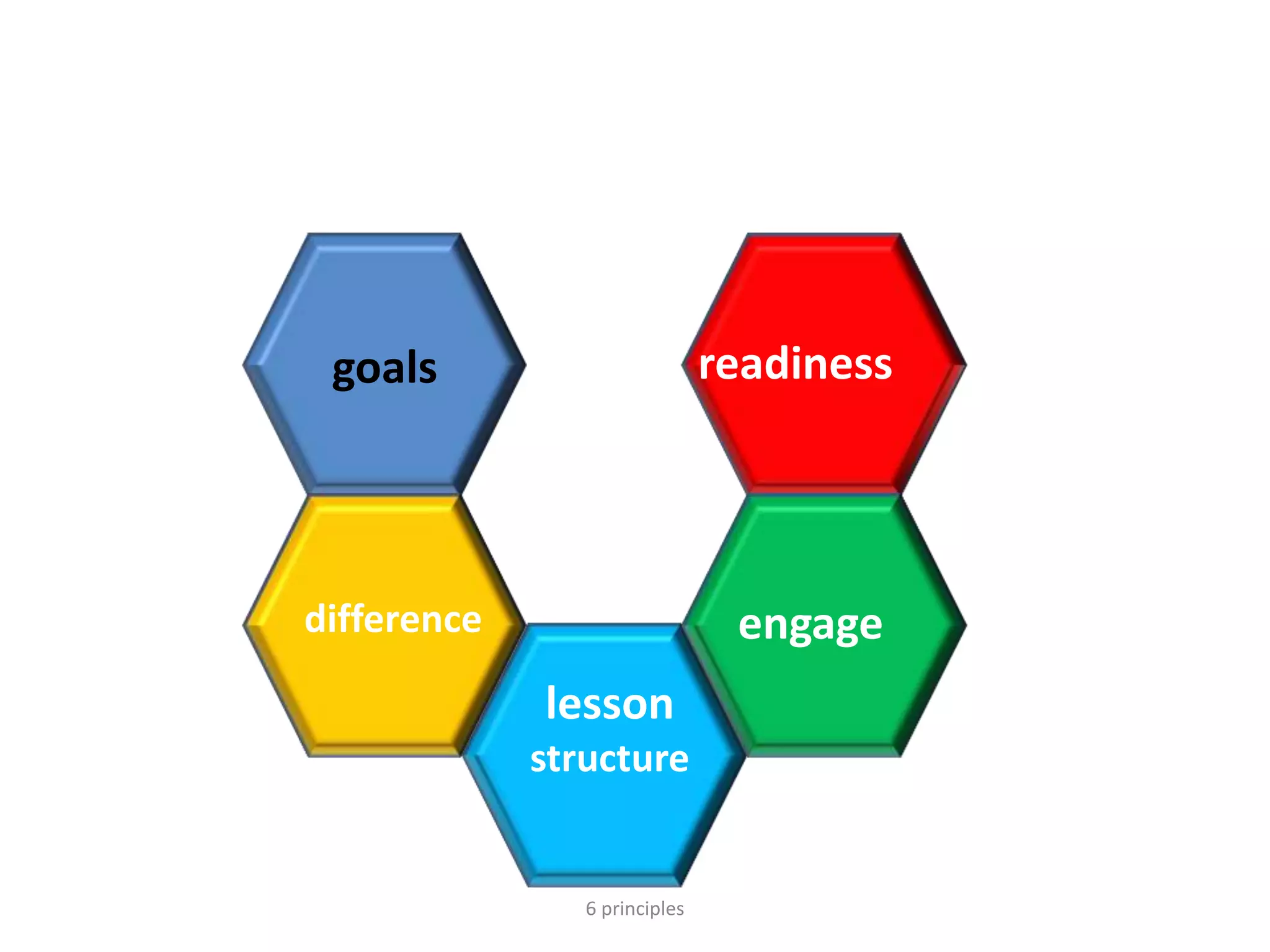
goals
Key principle 2:
• Build on what the students know, both
mathematically and experientially, including
creating and connecting students with stories
that both contextualise and establish a
rationale for the learning
6 principles
Part 1: Using data
6 principles
• It is more important to know what the
students know than what they do not
• Learning mathematics is not a hierarchy of
sequential steps on a ladder, but a network of
interconnected ideas
• Students can work on tasks that are beyond
what they know
– Students at GP 2 can work on GP 4 tasks
6 principles
Part 2: Connecting with “story”
6 principles
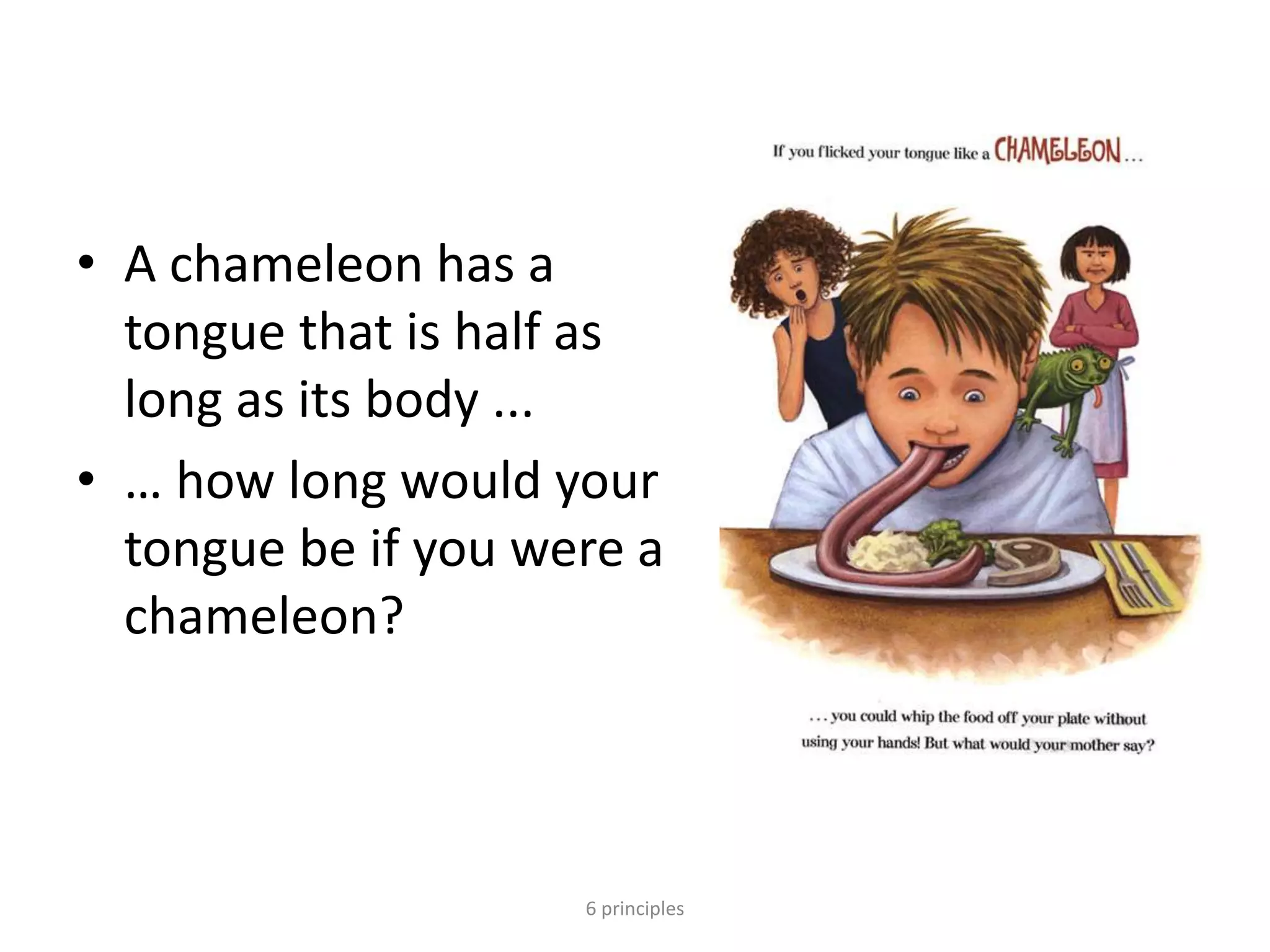
• A chameleon has a
tongue that is half as
long as its body ...
• … how long would your
tongue be if you were a
chameleon?
6 principles
Part 3: Creating experience
6 principles
6 principles
6 principles
goals readiness
Key Principle 3
• Engage students by utilising a variety of rich
and challenging tasks, that allow students
opportunities to make decisions, and which
use a variety of forms of representation
6 principles
6 principles
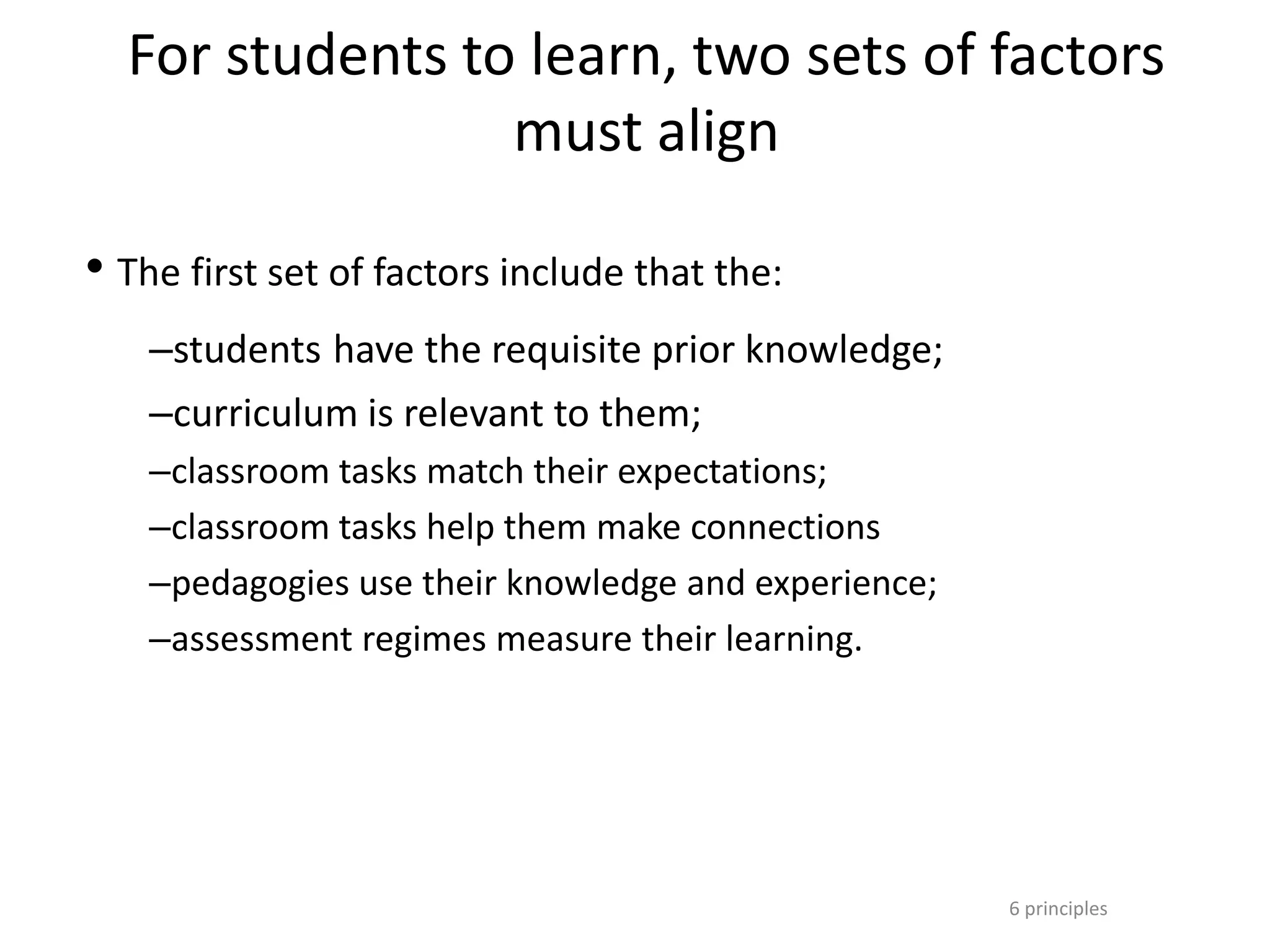
For students to learn, two sets of factors
must align
• The first set of factors include that the:
–students have the requisite prior knowledge;
–curriculum is relevant to them;
–classroom tasks match their expectations;
–classroom tasks help them make connections
–pedagogies use their knowledge and experience;
–assessment regimes measure their learning.
6 principles
The second set of factors relates to
• whether the students
–are motivated to learn
–see participation in schooling as creating
opportunities
–are willing to persist
–connect effort and success
Why challenge?
• Learning will be more robust if students connect
ideas together for themselves, and determine
their own strategies for solving problems, rather
than following instructions they have been given.
• Both connecting ideas together and formulating
their own strategies is more complex than other
approaches and is therefore more challenging.
• It is potentially productive if students are willing
to take up such challenges.
6 principles
6 principles
This connects to “mindsets”
• Dweck (2000) categorized students’
approaches in terms of whether they
hold either growth mindset or fixed
mindset
6 principles
Students with growth mindset:
• Believe they can get smarter by trying hard
• Such students
– tend to have a resilient response to failure;
– remain focused on mastering skills and knowledge
even when challenged;
– do not see failure as an indictment on themselves;
and
– believe that effort leads to success.
6 principles
Students with fixed mindset:
• Believe they are as smart as they will even get
• Such students
– seek success but mainly on tasks with which they
are familiar;
– avoid or give up quickly on challenging tasks;
– derive their perception of ability from their
capacity to attract recognition.
Teachers can change mindsets
• This connects to
– the things we affirm (effort, persistence, co-
operation, learning from others, flexible thinking)
– the way we affirm
• You did not give up even though you were stuck
• You tried something different
• You tried to find more than one answer
– the types of tasks we pose
6 principles
Getting started
“zone of confusion”
“four before me”
•representing what the task is asking in a different
way such as drawing a cartoon or a diagram, rewriting
the question …
•choosing a different approach to the task, which
includes rereading the question, making a guess at
the answer, working backwards …
•asking a peer for a hint on how to get started
•looking at the recent pages in the workbook or
textbook for examples.
6 principles
Key Principle 3
• Engage students by utilising a variety of rich
and challenging tasks, that allow students
opportunities to make decisions, and which
use a variety of forms of representation
6 principles
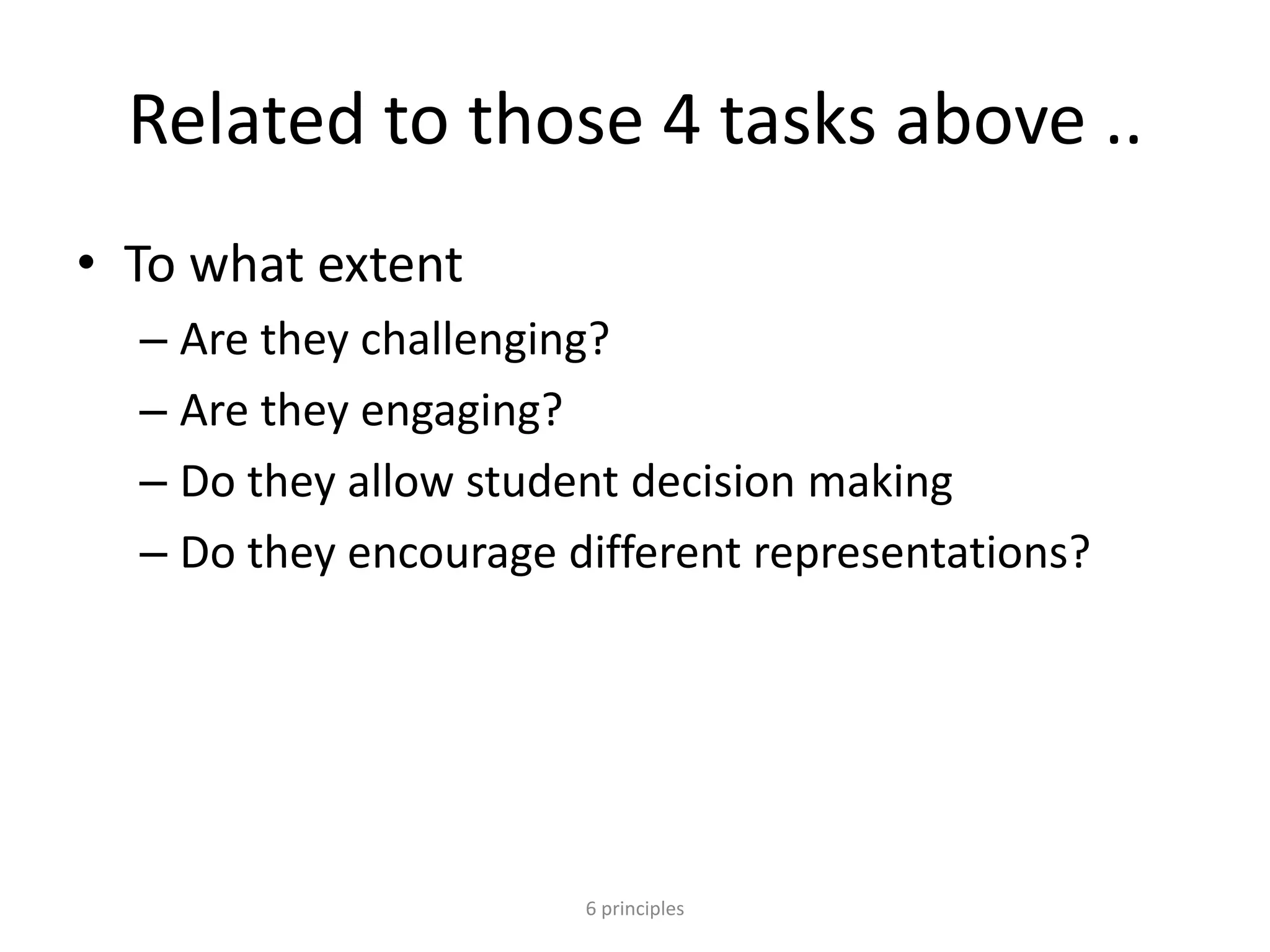
Related to those 4 tasks above ..
• To what extent
– Are they challenging?
– Are they engaging?
– Do they allow student decision making
– Do they encourage different representations?
6 principles
6 principles
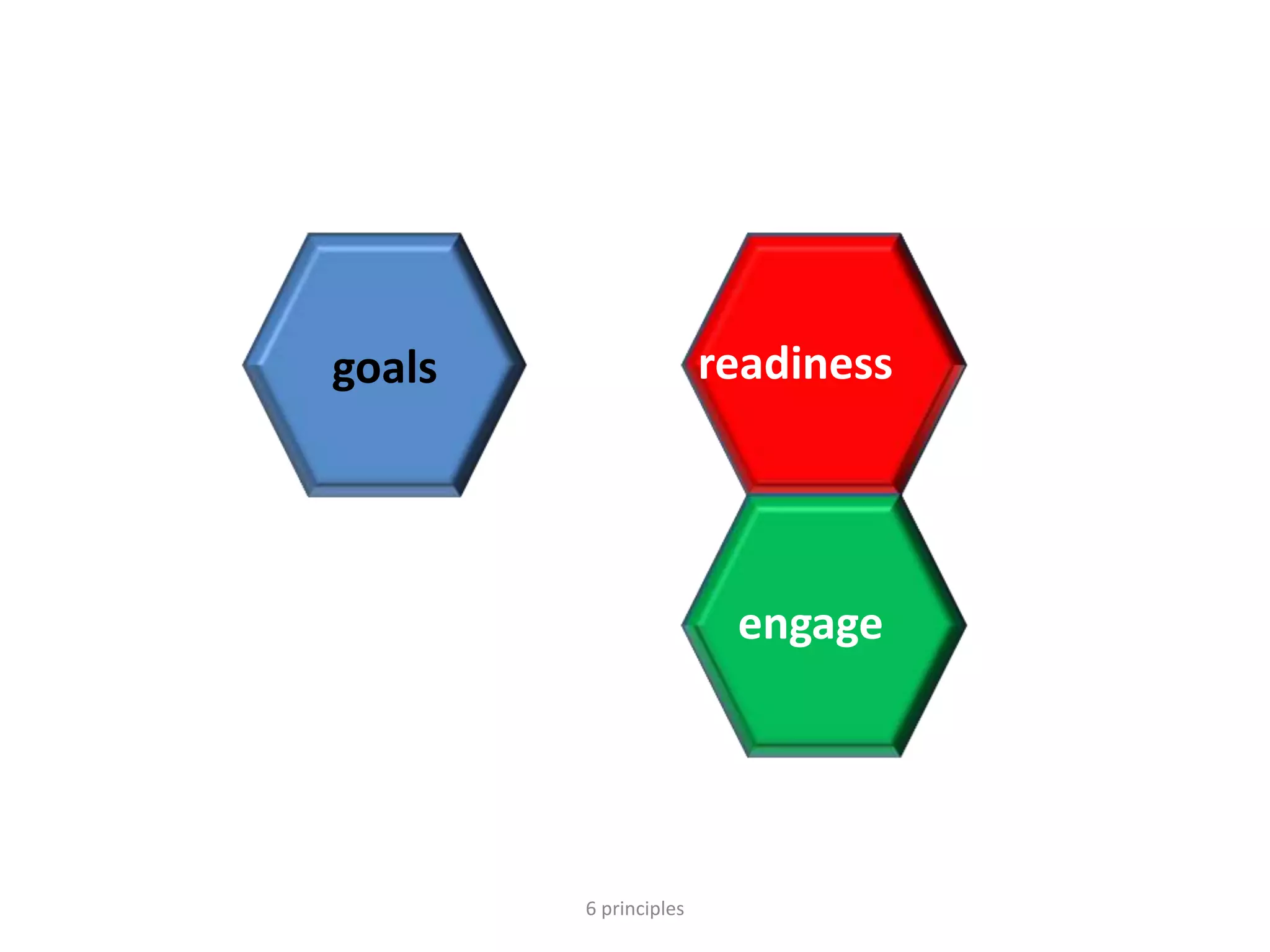
goals readiness
engage
Key Principle 4:
• Interact with students while they engage in the
experiences, and specifically planning to
support students who need it, and challenge
those who are ready
6 principles
Enabling prompt
6 principles
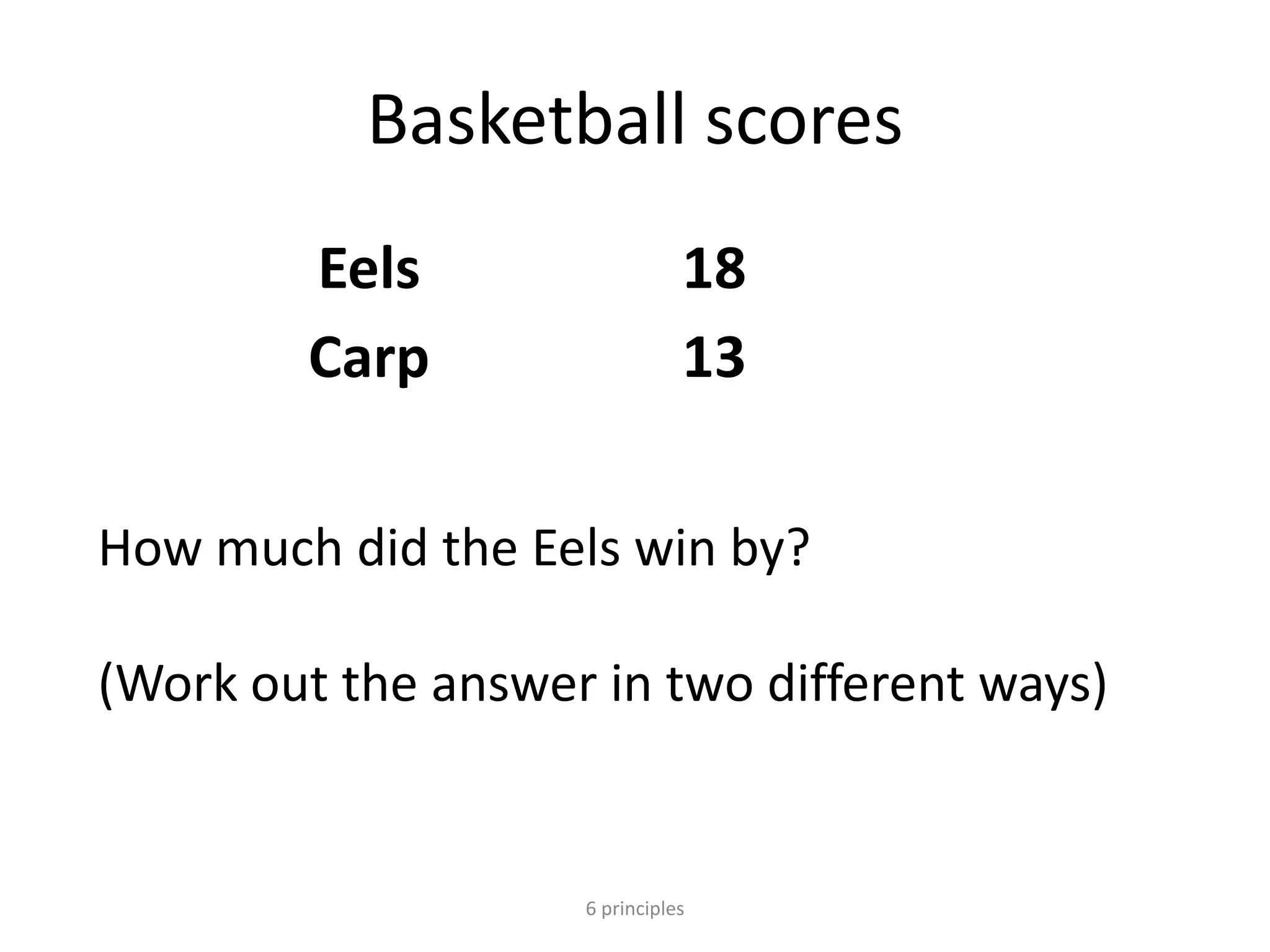
Basketball scores
Eels 18
Carp 13
6 principles
How much did the Eels win by?
(Work out the answer in two different ways)
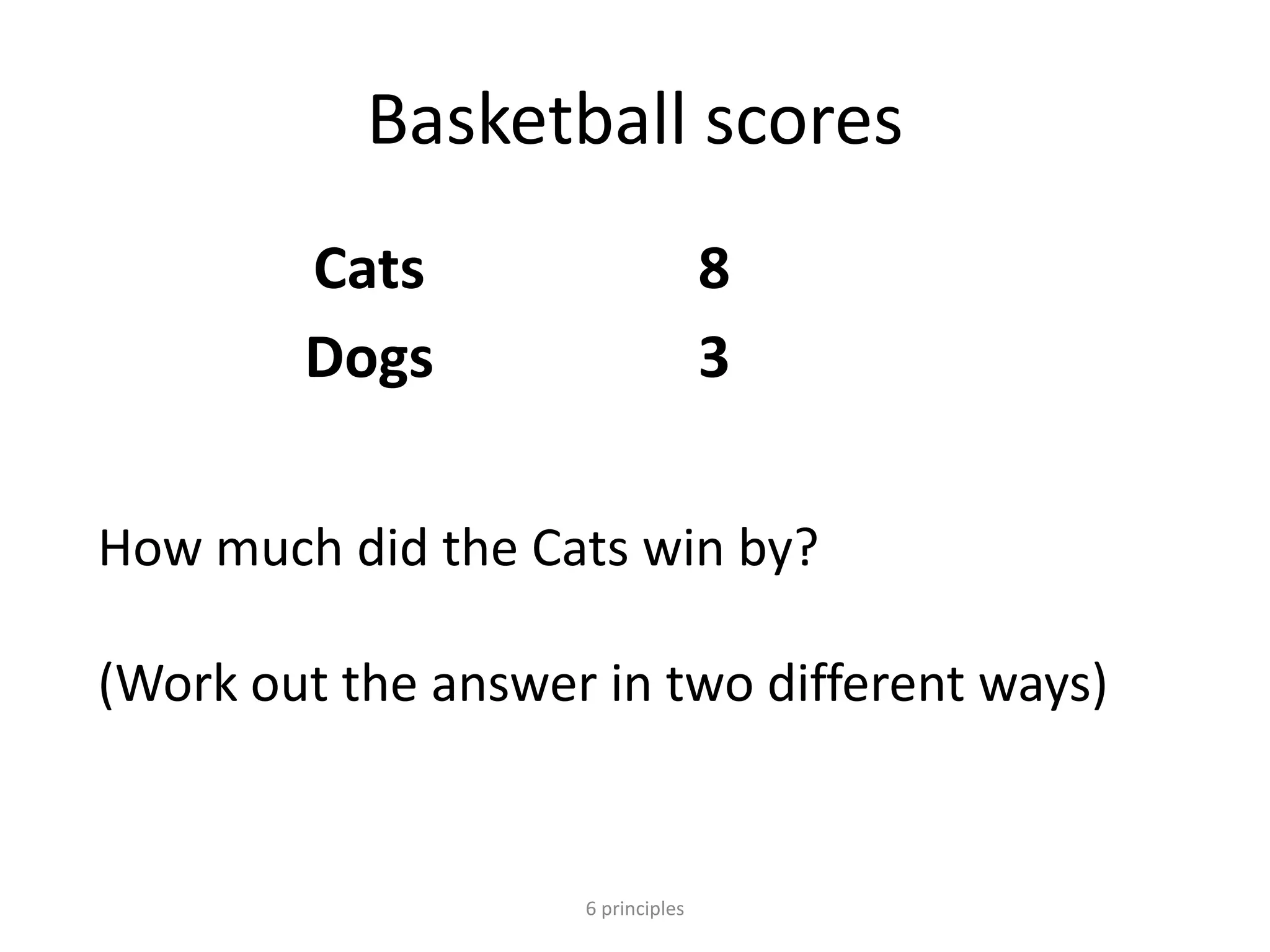
Basketball scores
Cats 8
Dogs 3
6 principles
How much did the Cats win by?
(Work out the answer in two different ways)
Extending prompt
6 principles
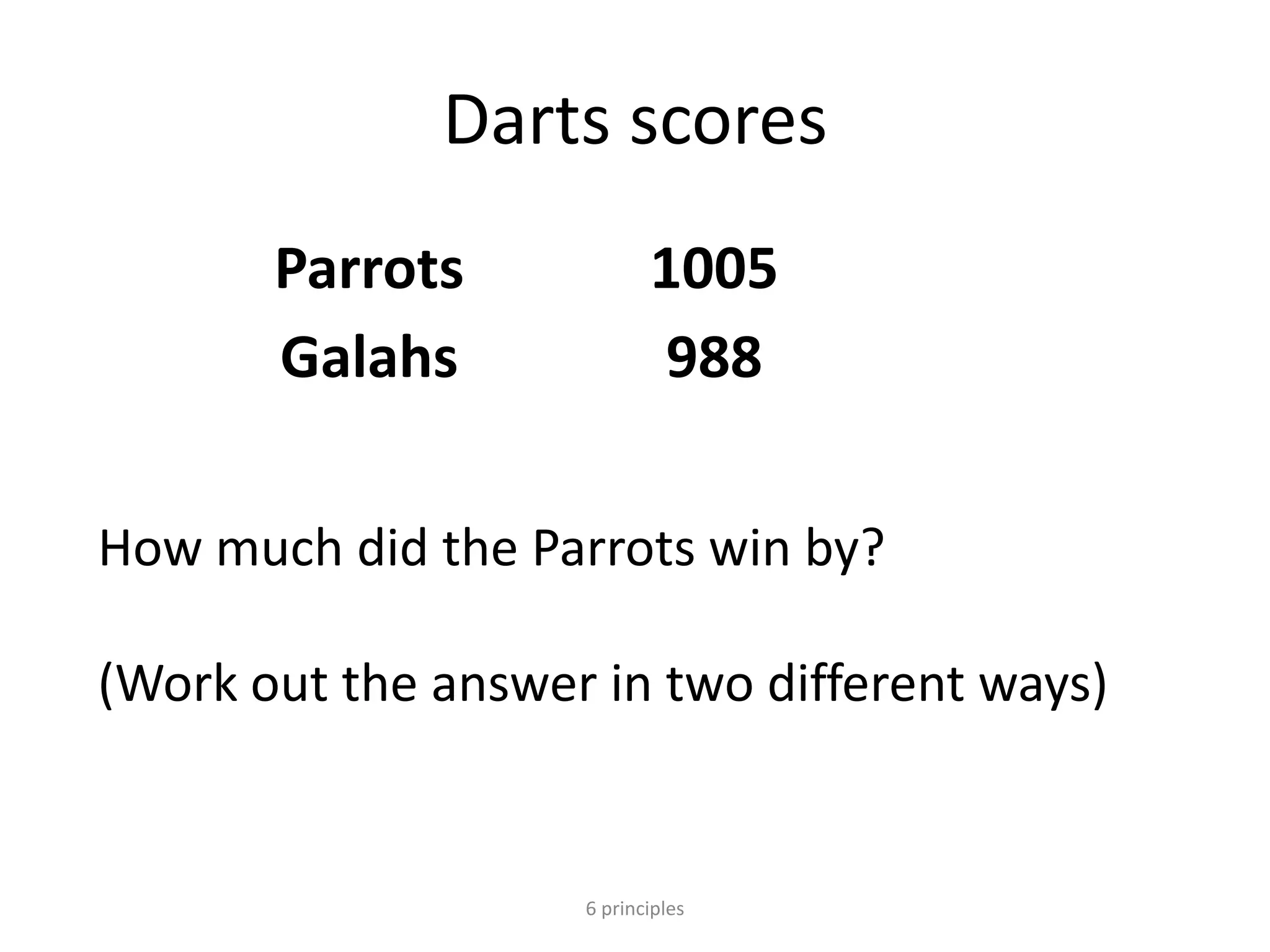
Darts scores
Parrots 1005
Galahs 988
6 principles
How much did the Parrots win by?
(Work out the answer in two different ways)
6 principles
goals readiness
engagedifference
Key Principle 5:
• Adopt pedagogies that foster communication, mutual
responsibilities, and encourage students to work in
small groups, and using reporting to the class by
students as a learning opportunity
6 principles
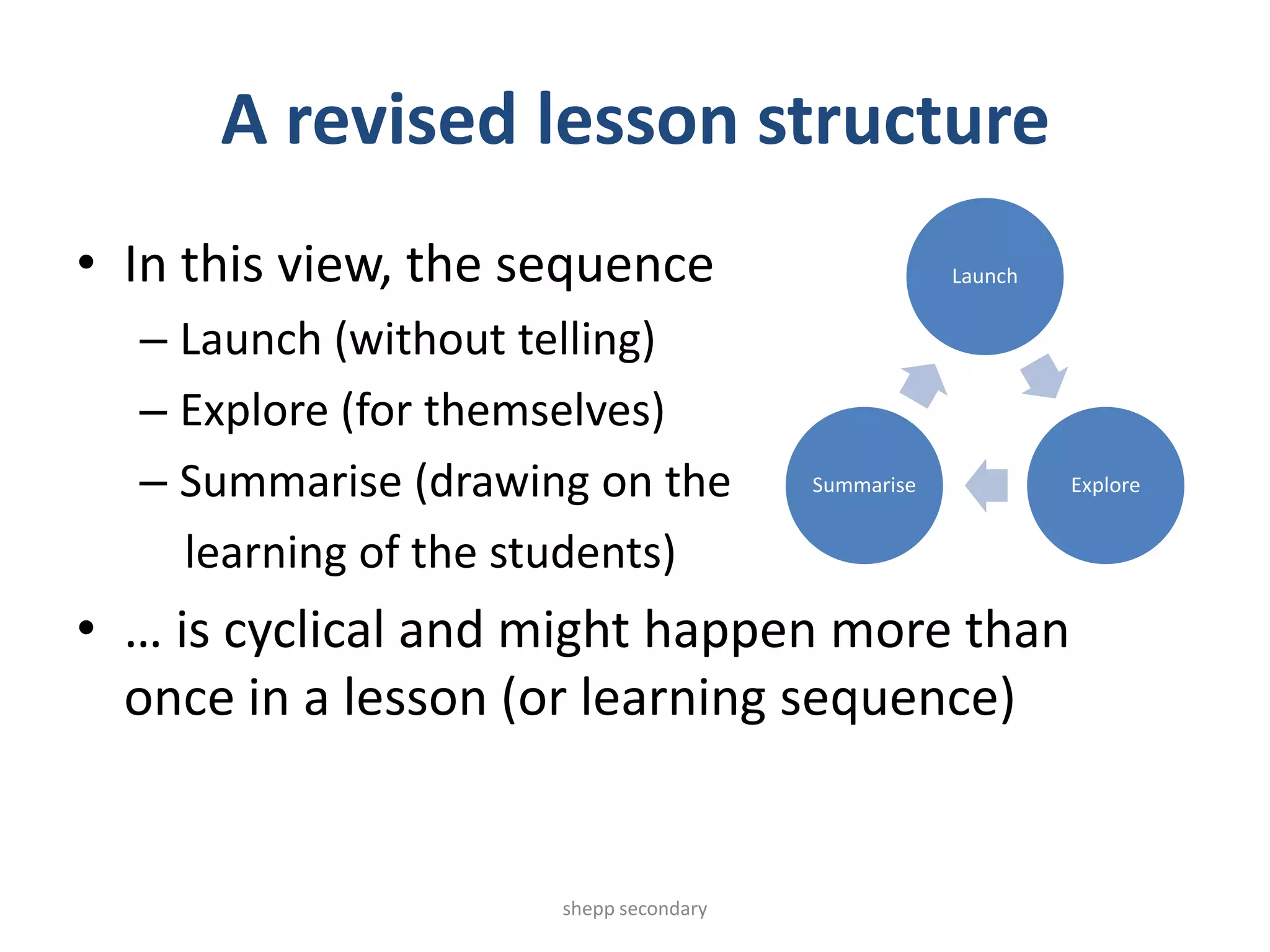
A revised lesson structure
• In this view, the sequence
– Launch (without telling)
– Explore (for themselves)
– Summarise (drawing on the
learning of the students)
• … is cyclical and might happen more than
once in a lesson (or learning sequence)
shepp secondary
Launch
ExploreSummarise
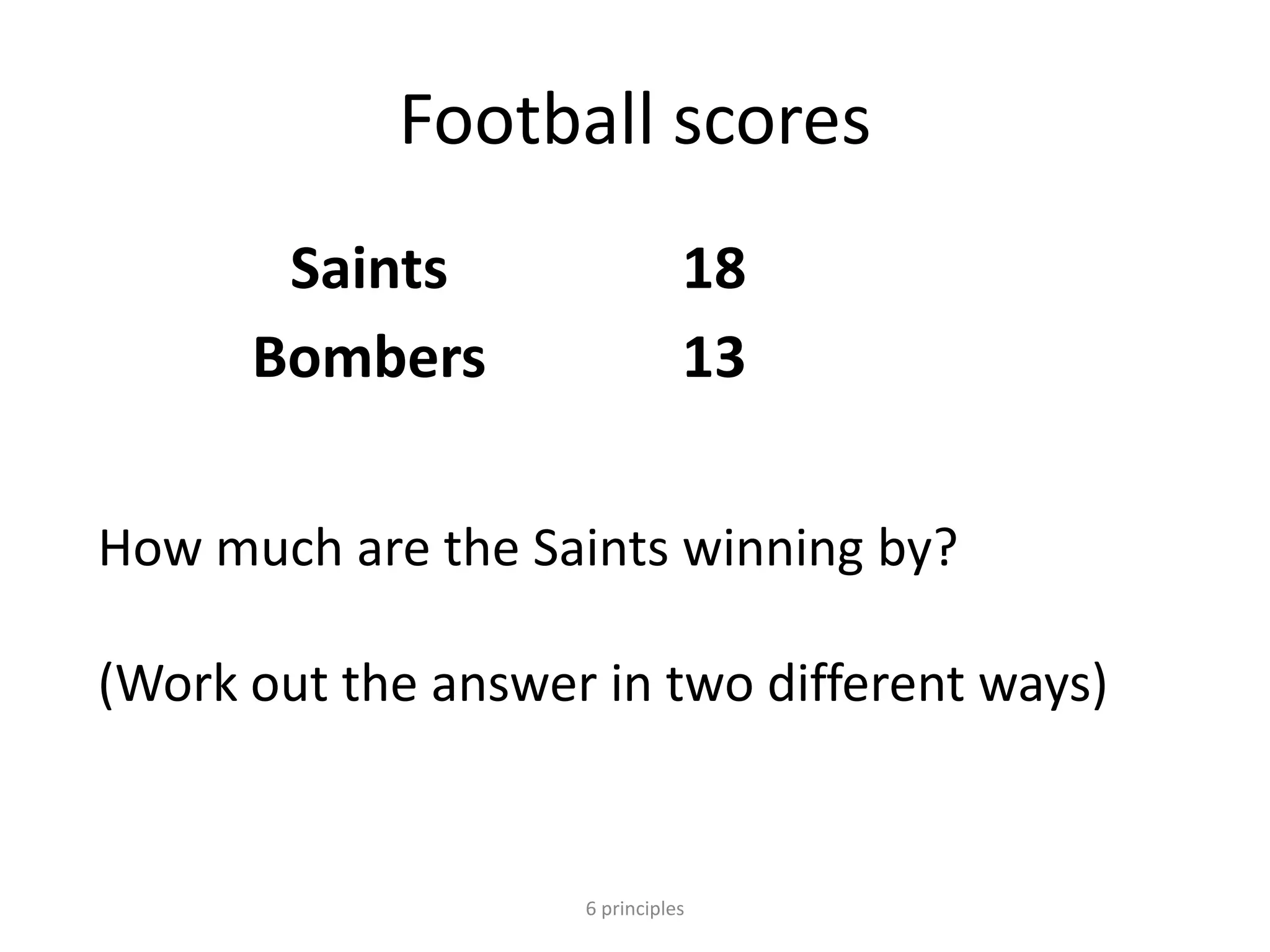
Football scores
Saints 18
Bombers 13
6 principles
How much are the Saints winning by?
(Work out the answer in two different ways)
6 principles
goals
lesson
structure
readiness
engagedifference
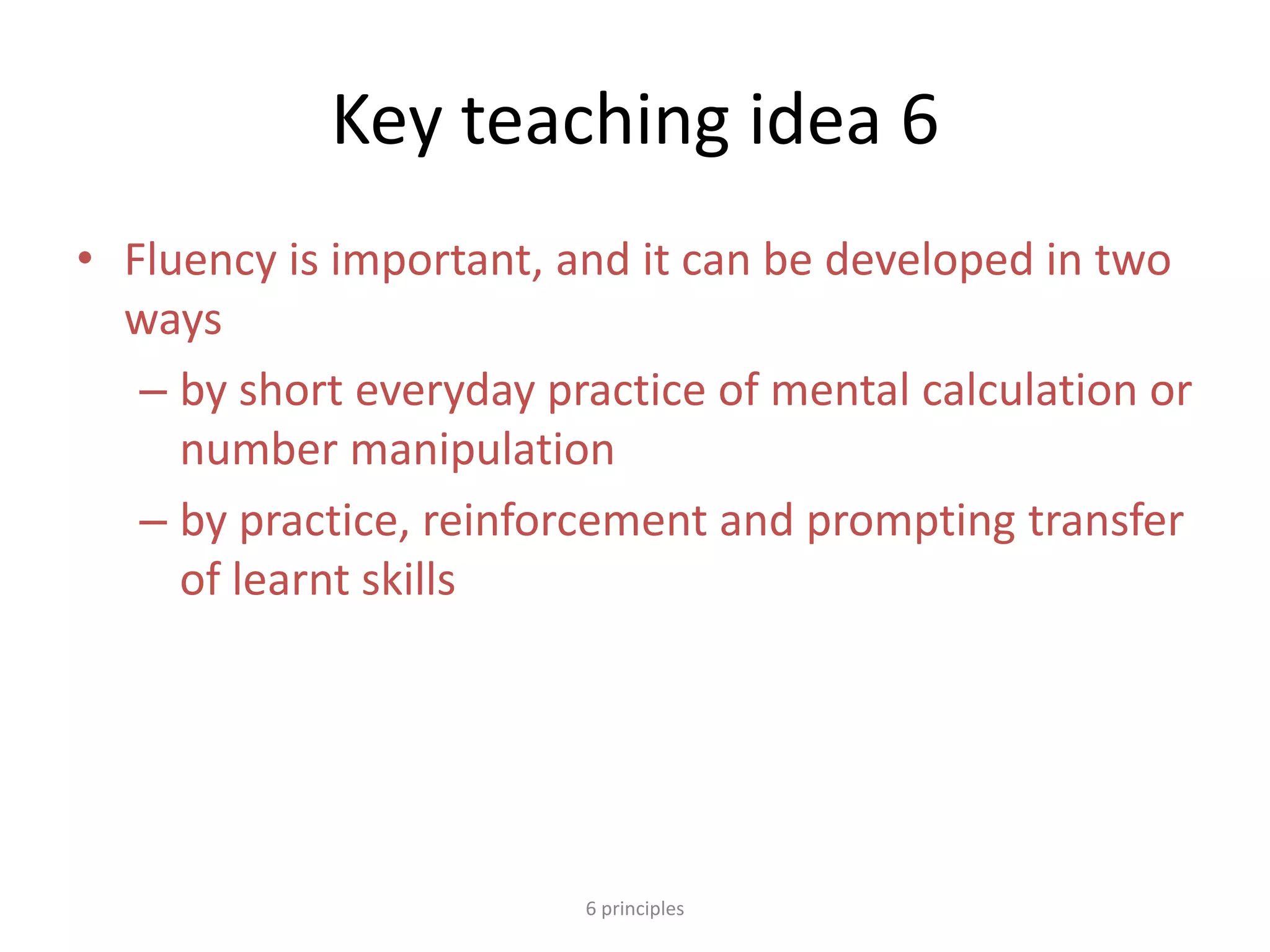
Key teaching idea 6
• Fluency is important, and it can be developed in two
ways
– by short everyday practice of mental calculation or
number manipulation
– by practice, reinforcement and prompting transfer
of learnt skills
6 principles
One aspect is transfer
6 principles
Another aspect is fluency
6 principles

Six principles of effective teaching of mathematics

  • 1.
    Finding a focusfor ongoing teacher learning in mathematics: Six key principles Peter Sullivan 6 principles
  • 2.
    Overview • Some stories •Six principles 6 principles
  • 3.
    A story froma Grade 3 lesson I taught at Bathurst Island 6 principles
  • 4.
    Football scores Saints 105 Bombers98 6 principles How much are the Saints winning by? (Work out the answer in two different ways)
  • 5.
    Football scores Saints 25 Bombers18 6 principles How much are the Saints winning by? (Work out the answer in two different ways)
  • 6.
    From a grade3 lesson in the Kimberleys 6 principles
  • 7.
    How many waysto make $10 6 principles
  • 8.
  • 9.
    A suggestion aspart of a geometry unit written for MiTK 6 principles
  • 10.
    • Have pileof cubes. Ask the students to: – Build something using 15 cubes. Describe what you have built. – Build something which is 3 cubes high and 3 cubes wide made with 15 cubes. Describe what you have built. – Something like “make a tower of 3 cubes, put a yellow cube to the left, and blue cube to the north, …” • Repeat, adapting to the level of success of the students. 6 principles
  • 11.
    A lesson Iplan to teach to a year 8 class next Tuesday at CMS (Alice Springs) 6 principles
  • 12.
    ONE HECTARE PARK •A conservation park is to be enclosed by a fence that has exactly 6 internal right angles. What might the park look like? • The total area of the park is 1 hectare. What might be the perimeter of the park? (give two different answers) 6 principles
  • 13.
    What are thecommon characteristics of those tasks? 6 principles
  • 14.
    Six principles asthe basis of sustainable improvement 6 principles
  • 15.
    What is thepoint of these six key principles ? • We can all do these things better (although you will find many of them affirming of your current practice) • Much advice is complex and hard to prioritise • The principles can provide a focus to collaborative discussions on improving teaching • The principles can be the focus of observations if you have the opportunity to be observed teaching 6 principles
  • 16.
    Improving teaching bythinking about pedagogy • The following principles are a synthesis of: – Good, Grouws, and Ebmeier – Productive pedagogies – Principles of learning and teaching – Hattie – Clarke and Clarke – Anthony and Walshaw 6 principles
  • 17.
    Key principle 1: •Identify important ideas that underpin the concepts you are seeking to teach, and communicate to students that these are the goals of your teaching, including explaining how you hope they will learn 6 principles
  • 18.
    Feedback - betterwhen they know … • Where am I going? –“Your task is to …, in this way” • How am I going? –“the first part is what I was hoping to see, but the second is not” • Where to next? –“knowing this will help you with …” 6 principles
  • 19.
    In terms oflearning intentions, we know • It is much more difficult to describe the purpose of lessons than we think • The learning intention should – not restrict – nor lower the ceiling – but provide focus to the students – and the teacher 6 principles
  • 20.
    In terms ofthe subtraction lesson • There are many ways to find the difference between two numbers 6 principles
  • 21.
    In this lesson,I need you to • show how you get your answers • keep trying even if it is difficult (it is meant to be) • explain your thinking • listen to other students 6 principles
  • 22.
  • 23.
    Key principle 2: •Build on what the students know, both mathematically and experientially, including creating and connecting students with stories that both contextualise and establish a rationale for the learning 6 principles
  • 24.
    Part 1: Usingdata 6 principles
  • 25.
    • It ismore important to know what the students know than what they do not • Learning mathematics is not a hierarchy of sequential steps on a ladder, but a network of interconnected ideas • Students can work on tasks that are beyond what they know – Students at GP 2 can work on GP 4 tasks 6 principles
  • 26.
    Part 2: Connectingwith “story” 6 principles
  • 27.
    • A chameleonhas a tongue that is half as long as its body ... • … how long would your tongue be if you were a chameleon? 6 principles
  • 28.
    Part 3: Creatingexperience 6 principles
  • 29.
  • 30.
  • 31.
    Key Principle 3 •Engage students by utilising a variety of rich and challenging tasks, that allow students opportunities to make decisions, and which use a variety of forms of representation 6 principles
  • 32.
    6 principles For studentsto learn, two sets of factors must align • The first set of factors include that the: –students have the requisite prior knowledge; –curriculum is relevant to them; –classroom tasks match their expectations; –classroom tasks help them make connections –pedagogies use their knowledge and experience; –assessment regimes measure their learning.
  • 33.
    6 principles The secondset of factors relates to • whether the students –are motivated to learn –see participation in schooling as creating opportunities –are willing to persist –connect effort and success
  • 34.
    Why challenge? • Learningwill be more robust if students connect ideas together for themselves, and determine their own strategies for solving problems, rather than following instructions they have been given. • Both connecting ideas together and formulating their own strategies is more complex than other approaches and is therefore more challenging. • It is potentially productive if students are willing to take up such challenges. 6 principles
  • 35.
    6 principles This connectsto “mindsets” • Dweck (2000) categorized students’ approaches in terms of whether they hold either growth mindset or fixed mindset
  • 36.
    6 principles Students withgrowth mindset: • Believe they can get smarter by trying hard • Such students – tend to have a resilient response to failure; – remain focused on mastering skills and knowledge even when challenged; – do not see failure as an indictment on themselves; and – believe that effort leads to success.
  • 37.
    6 principles Students withfixed mindset: • Believe they are as smart as they will even get • Such students – seek success but mainly on tasks with which they are familiar; – avoid or give up quickly on challenging tasks; – derive their perception of ability from their capacity to attract recognition.
  • 38.
    Teachers can changemindsets • This connects to – the things we affirm (effort, persistence, co- operation, learning from others, flexible thinking) – the way we affirm • You did not give up even though you were stuck • You tried something different • You tried to find more than one answer – the types of tasks we pose 6 principles
  • 39.
    Getting started “zone ofconfusion” “four before me” •representing what the task is asking in a different way such as drawing a cartoon or a diagram, rewriting the question … •choosing a different approach to the task, which includes rereading the question, making a guess at the answer, working backwards … •asking a peer for a hint on how to get started •looking at the recent pages in the workbook or textbook for examples. 6 principles
  • 40.
    Key Principle 3 •Engage students by utilising a variety of rich and challenging tasks, that allow students opportunities to make decisions, and which use a variety of forms of representation 6 principles
  • 41.
    Related to those4 tasks above .. • To what extent – Are they challenging? – Are they engaging? – Do they allow student decision making – Do they encourage different representations? 6 principles
  • 42.
  • 43.
    Key Principle 4: •Interact with students while they engage in the experiences, and specifically planning to support students who need it, and challenge those who are ready 6 principles
  • 44.
  • 45.
    Basketball scores Eels 18 Carp13 6 principles How much did the Eels win by? (Work out the answer in two different ways)
  • 46.
    Basketball scores Cats 8 Dogs3 6 principles How much did the Cats win by? (Work out the answer in two different ways)
  • 47.
  • 48.
    Darts scores Parrots 1005 Galahs988 6 principles How much did the Parrots win by? (Work out the answer in two different ways)
  • 49.
  • 50.
    Key Principle 5: •Adopt pedagogies that foster communication, mutual responsibilities, and encourage students to work in small groups, and using reporting to the class by students as a learning opportunity 6 principles
  • 51.
    A revised lessonstructure • In this view, the sequence – Launch (without telling) – Explore (for themselves) – Summarise (drawing on the learning of the students) • … is cyclical and might happen more than once in a lesson (or learning sequence) shepp secondary Launch ExploreSummarise
  • 52.
    Football scores Saints 18 Bombers13 6 principles How much are the Saints winning by? (Work out the answer in two different ways)
  • 53.
  • 54.
    Key teaching idea6 • Fluency is important, and it can be developed in two ways – by short everyday practice of mental calculation or number manipulation – by practice, reinforcement and prompting transfer of learnt skills 6 principles
  • 55.
    One aspect istransfer 6 principles
  • 56.
    Another aspect isfluency 6 principles