


The Mentor’s Guide on  Handling Teenage Leaders By Ms. Zara Jane Juan
Profile  of  Learners
0-7 yrs old General Characteristics: -  Imitating those around them Absorbs everything & blend themselves in the environment Move & play
1-3 yrs old  Imitative play; mimicking actions 3-5 yrs old Transformative play  (real objects into fantasy) 5-7 yrs old  Imaginative play (how something will look like & plan how will it become)
7-14 yrs old General Characteristics: - picture thinking - They love storytelling from adults
9-11 yrs old Notices that she /he is different from the rest A lot physical & psychological changes 12-14 yrs old Interested in cause & effect relationships Beginning of logical thinking
15-20 yrs old General Characteristics: - upsurge of sexual drives Aggressive impulses Acting out tendencies Become capable of abstract reasoning (hypothetical situation) Focus of interaction from family to peer
Summary 12-14 yrs old > Concern:  Body Image 15-17 yrs old > Concern:  Establishing  peer group  identity 18-20 yrs old > Concern:  Vocational  & Romantic  identity
Diagnosis of Adolescents Source:  Adolescent Disorders  by  Dr. Larry Kerns & Dr. Geri Fox
Development: Male adolescents must be understood differently from female, so must older be perceived differently from younger adolescents. Studies of normal adolescents find them generally well-adjusted & interacting well with parents, teachers & friends.  However most adolescents will have occasional periods of mood changes, confusion & rebellion Source:  Adolescent Disorders by Dr. Larry Kerns & Dr. Geri Fox
Physical Growth  Hormonal changes -muscular & skeletal development Psychological adaptation to these physical changes constitutes one of the chief tasks of adolescents Source:  Adolescent Disorders by Dr. Larry Kerns & Dr. Geri Fox
Drives  upsurge of sexual drives  –  initially directed toward the discharge of sexual tension & the achievement of genital satisfaction This must be gradually recognized, understood & accepted as an integral part of the  framework of a loving & intimate relationship aggressive impulses –  harness & direct these aggressive energies in constructive manifestations e.g. assertiveness, persistence, striving, & healthy competitiveness Source:  Adolescent Disorders by Dr. Larry Kerns & Dr. Geri Fox
Acting Out  (“to act out”) -to deal with tension, frustration, conflict, or anxiety by behaving in a way that affords temporary relief. -express hidden feelings or conflicts behaviorally rather than verbally may lead to impulsive behavior e.g. Concern over sexual issues by promiscuity; Concern over separation by running away; Concern over aggressive issues by disordered conduct or anti-social behavior Source:  Adolescent Disorders by Dr. Larry Kerns & Dr. Geri Fox
Cognitive Development -advances from concrete operational thinking to formal operational thinking -capable of abstract reasoning -freed from the limitations of considering only empirical events -becomes possible to consider hypothetical situations Source:  Adolescent Disorders by Dr. Larry Kerns & Dr. Geri Fox
Developmental Task The focus of attention shifts from parents & family to the peer group There is an emphasis on building peer relationships that are – it is hoped – cooperative, reciprocal, supportive, & enhancing self-esteem But there is also increasing pressure from peers, pressure that may be exerted in anti-social rather than socializing & integrating directions The adolescents may be less accessible to parents & to anyone viewed w/ parental authority Source:  Adolescent Disorders by Dr. Larry Kerns & Dr. Geri Fox
Back to  Innocence Workshop Sensitivity  Exercise 1
TEAM BUILDING Spiky & Curve
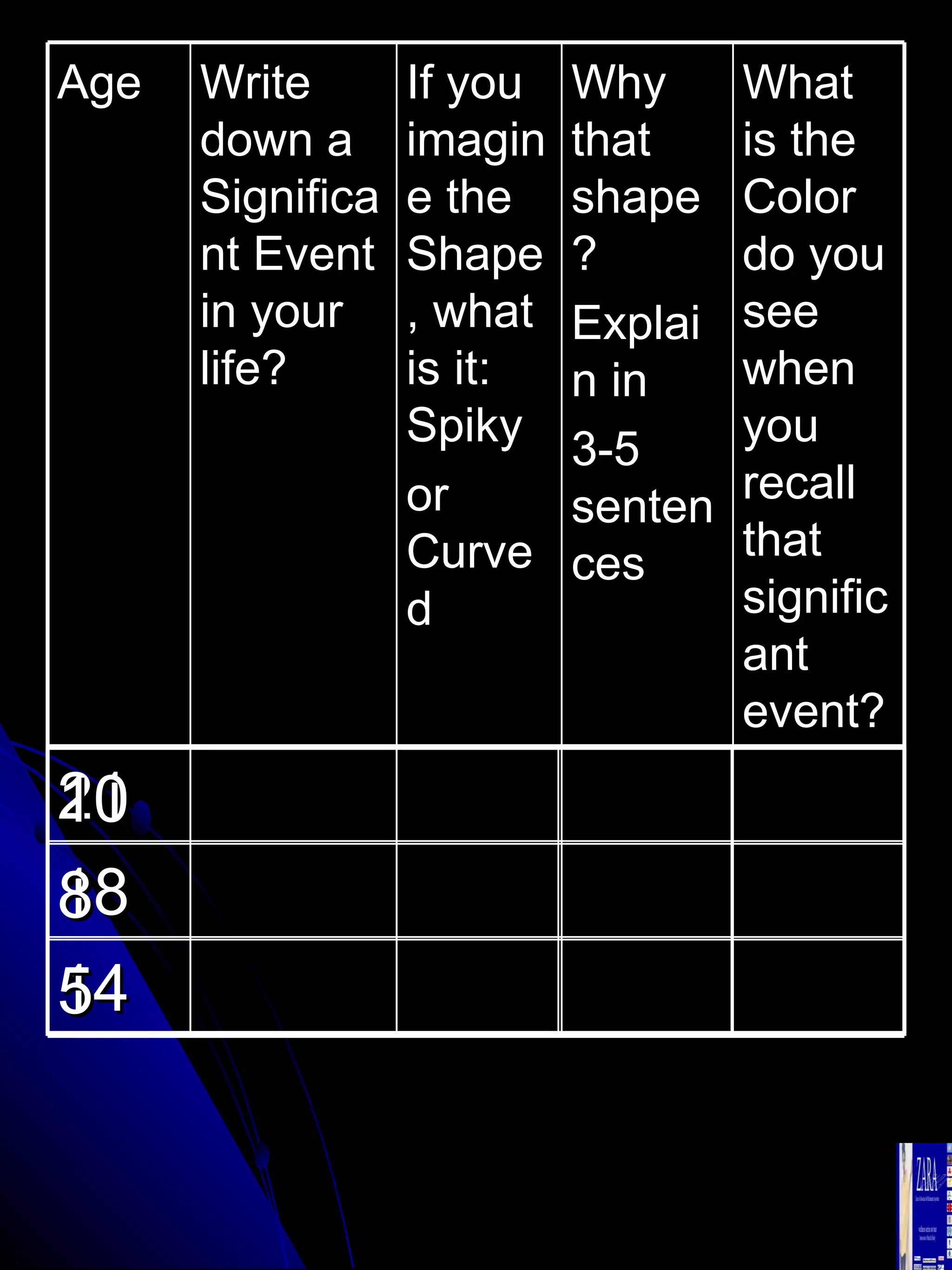
Age Write down a Significant Event in your life? If you imagine the Shape, what is it: Spiky  or Curved Why that shape? Explain in  3-5 sentences What is the Color do you see when you recall that significant event? 21 18 14 10 8 5
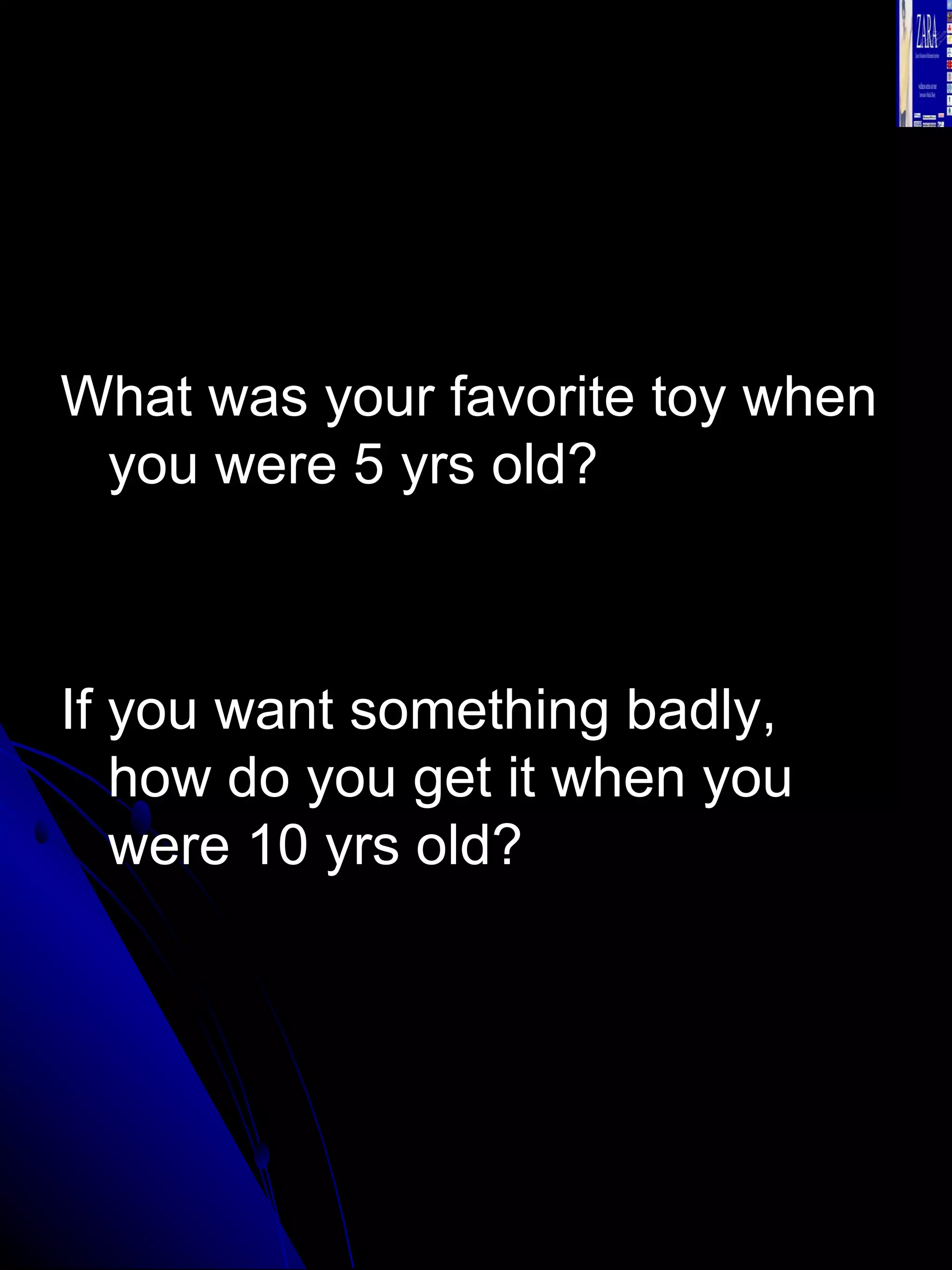
What was your favorite toy when you were 5 yrs old? If you want something badly, how do you get it when you were 10 yrs old?
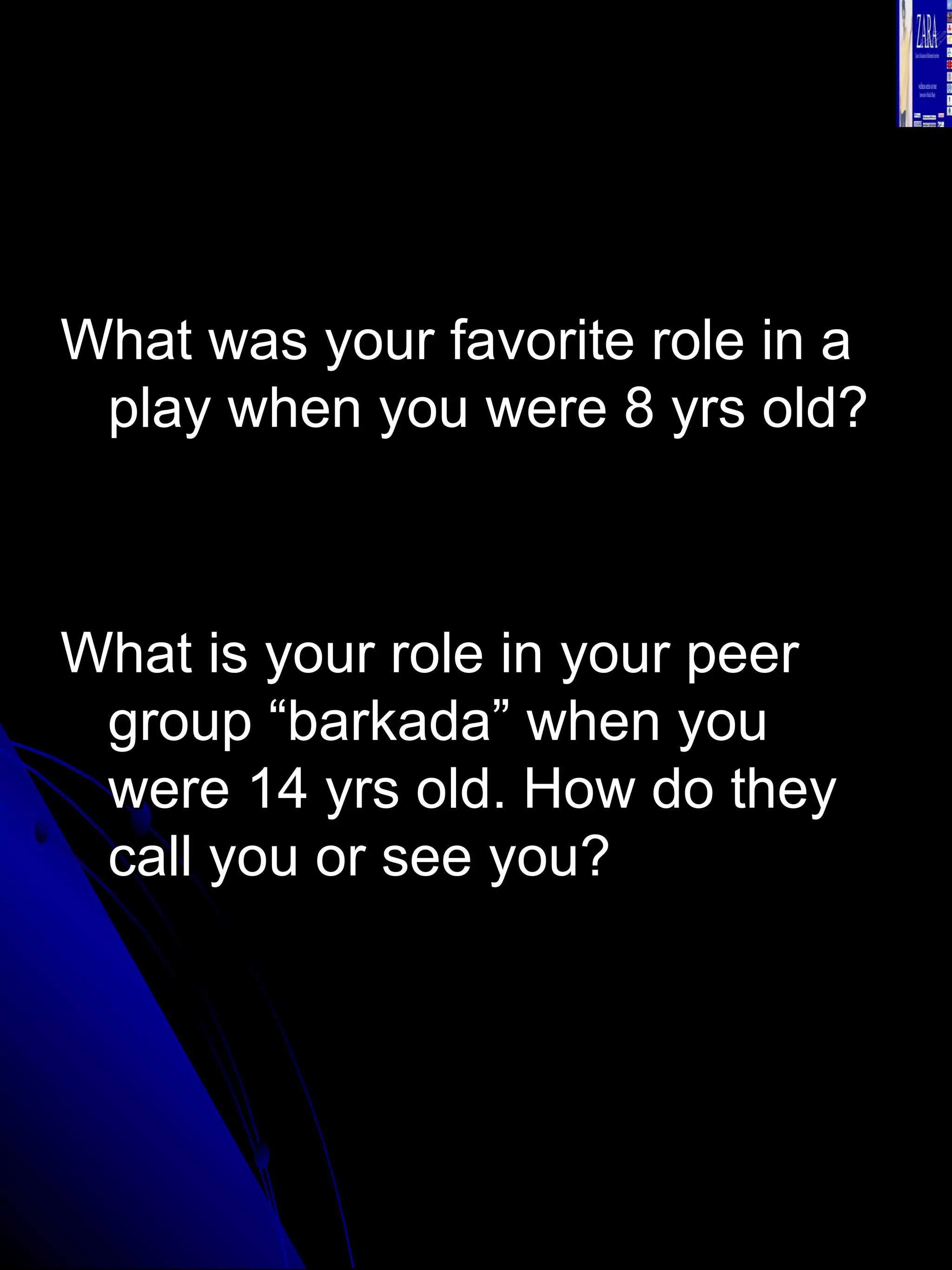
What was your favorite role in a play when you were 8 yrs old? What is your role in your peer group “barkada” when you were 14 yrs old. How do they call you or see you?
What was your initial reaction when you were reprimanded by your elders when you were 18 yrs old? What was your secret wish when you were 21 yrs old?
Break
WHAT IS MEANT BY LEADERSHIP?  Source:  Addison, Linda  ERIC Clearinghouse on Handicapped and  Gifted Children Reston VA.
Leadership is the ability to influence the activities of an individual or group toward the achievement of a goal.  The definition has evolved from the idea of  a leader being a born leader  or simply "one who leads"  to a more complex view of how a person exerts influence.  Source:  Addison, Linda  ERIC Clearinghouse on Handicapped and  Gifted Children Reston VA.
leaders can be influential as: task-oriented leaders  or  relationship-oriented leaders. Source:  Addison, Linda  ERIC Clearinghouse on Handicapped and  Gifted Children Reston VA.
task-oriented leaders  excels at establishing  well-defined patterns of organization, channels of communication, and ways of getting tasks accomplished  Source:  Addison, Linda  ERIC Clearinghouse on Handicapped and  Gifted Children Reston VA.
The relationship-oriented leader, leads by maintaining personal relationships between members of the group by opening up communication, providing emotional support and using facilitating behaviors.  Source:  Addison, Linda  ERIC Clearinghouse on Handicapped and  Gifted Children Reston VA.
Both task-oriented and relationship-oriented leaders are necessary for effective group functioning  Source:  Addison, Linda  ERIC Clearinghouse on Handicapped and  Gifted Children Reston VA.
Another helpful way to identify and nurture leadership is that of  the active  versus  the  reflective leader.  Source:  Addison, Linda  ERIC Clearinghouse on Handicapped and  Gifted Children Reston VA.
The active leader exerts influence over the group through the force of his or her personality.  Source:  Addison, Linda  ERIC Clearinghouse on Handicapped and  Gifted Children Reston VA.
The reflective leader, on the other hand, is influential through the force of his or her ideas  Source:  Addison, Linda  ERIC Clearinghouse on Handicapped and  Gifted Children Reston VA.
HOW CAN TEACHERS IDENTIFY THE LEADERSHIP ABILITIES OF GIFTED AND TALENTED STUDENTS?  Source:  Addison, Linda  ERIC Clearinghouse on Handicapped and  Gifted Children Reston VA.
--Nomination and/or rating by peers, teachers, self, or community group members --Observation of simulation activities  --Biographical information on past leadership experiences  --Interviews  --Personality tests  --Leadership styles instruments Source:  Addison, Linda  ERIC Clearinghouse on Handicapped and  Gifted Children Reston VA.
Ten Ways to Identify a  Promising Person   Source:  Addison, Linda  ERIC Clearinghouse on Handicapped and  Gifted Children Reston VA.
to distinguish between the skill of performance and the skill of leading the performance   Source:  Addison, Linda  ERIC Clearinghouse on Handicapped and  Gifted Children Reston VA.
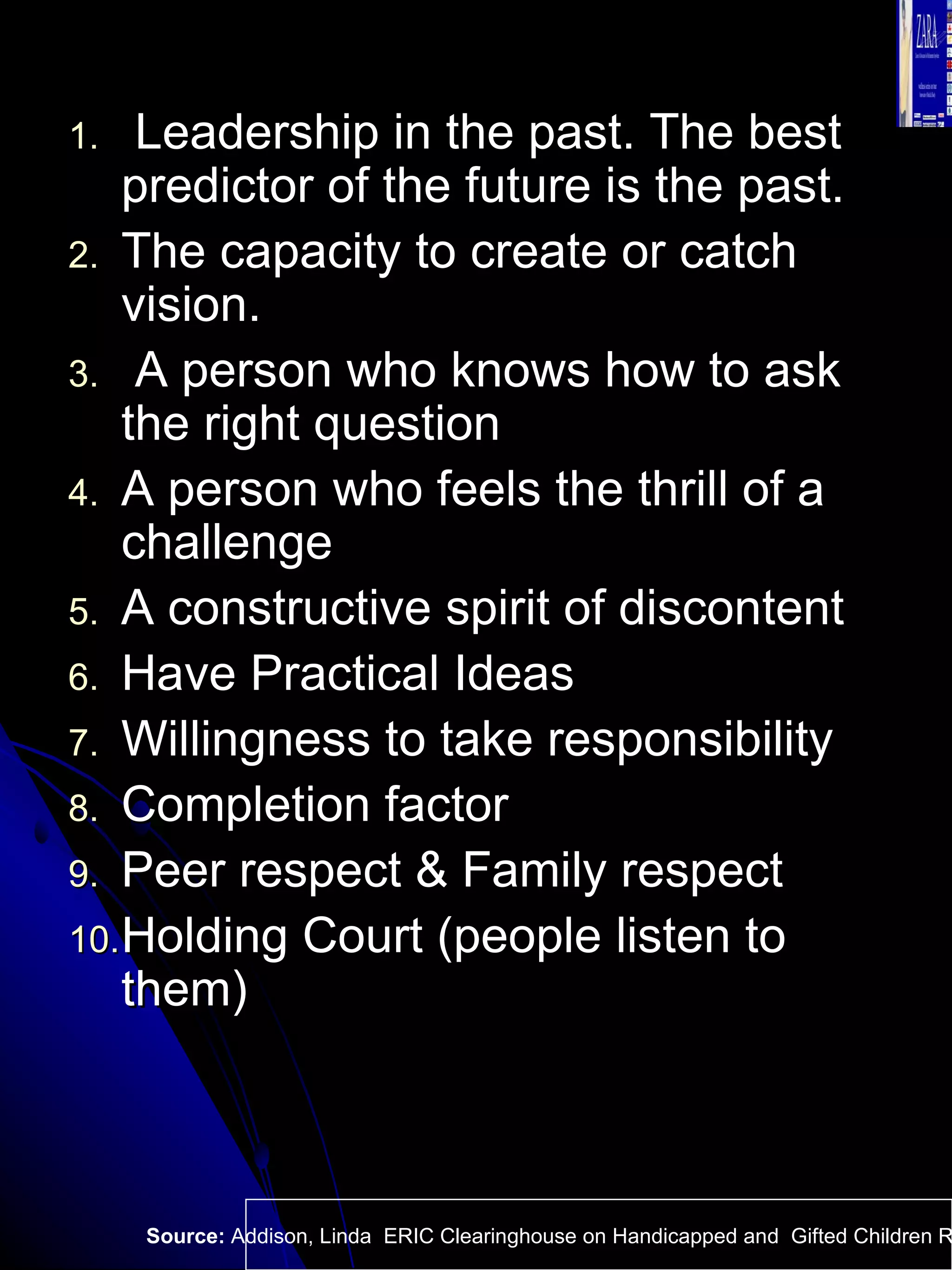
Leadership in the past. The best predictor of the future is the past.  The capacity to create or catch vision.  A person who knows how to ask the right question A person who feels the thrill of a challenge A constructive spirit of discontent Have Practical Ideas  Willingness to take responsibility Completion factor Peer respect & Family respect Holding Court (people listen to them) Source:  Addison, Linda  ERIC Clearinghouse on Handicapped and  Gifted Children Reston VA.
Points to Consider:   Source:  Addison, Linda  ERIC Clearinghouse on Handicapped and  Gifted Children Reston VA.
It's not enough for people to have leadership potential; they must have character and the right setting in which to grow.   Source:  Addison, Linda  ERIC Clearinghouse on Handicapped and  Gifted Children Reston VA.
What will this person do  to be liked?  It's nice to be liked, but as a leader it cannot be the controlling factor.  The cause must be the  prime motivator.  Source:  Addison, Linda  ERIC Clearinghouse on Handicapped and  Gifted Children Reston VA.
Does this person have a destructive weakness?  There are only two things I need to know about myself  as a leader:  my constructive strength and any destructive weakness   Source:  Addison, Linda  ERIC Clearinghouse on Handicapped and  Gifted Children Reston VA.
A destructive weakness may, for example, be an obsession.  An obsession controls us;  we don't control it.  It only grows worse over time.  Source:  Addison, Linda  ERIC Clearinghouse on Handicapped and  Gifted Children Reston VA.
Can I provide this person the environment to succeed?  An environment that threatens our sense of security or well-being splits our concentration from the cause.  Young leaders need an environment in which they can concentrate on leading.  Source:  Addison, Linda  ERIC Clearinghouse on Handicapped and  Gifted Children Reston VA.
Dimensions of  Sustaining Leadership Source:  Addison, Linda  ERIC Clearinghouse on Handicapped and  Gifted Children Reston VA.
Partnership and voice  Vision and values  Knowledge and daring  Confidence and persistence  Personal qualities (passion, humor, and empathy strength of character, general maturity, patience, wisdom, common sense, trustworthiness, reliability, creativity, sensitivity)   Source:  Addison, Linda  ERIC Clearinghouse on Handicapped and  Gifted Children Reston VA.
Individual Clubs Work Plan When July 29 July 22 July 15 July 8 July 01 June 24 June17 Who What Activity Where -Venue Why - purpose How -strategy
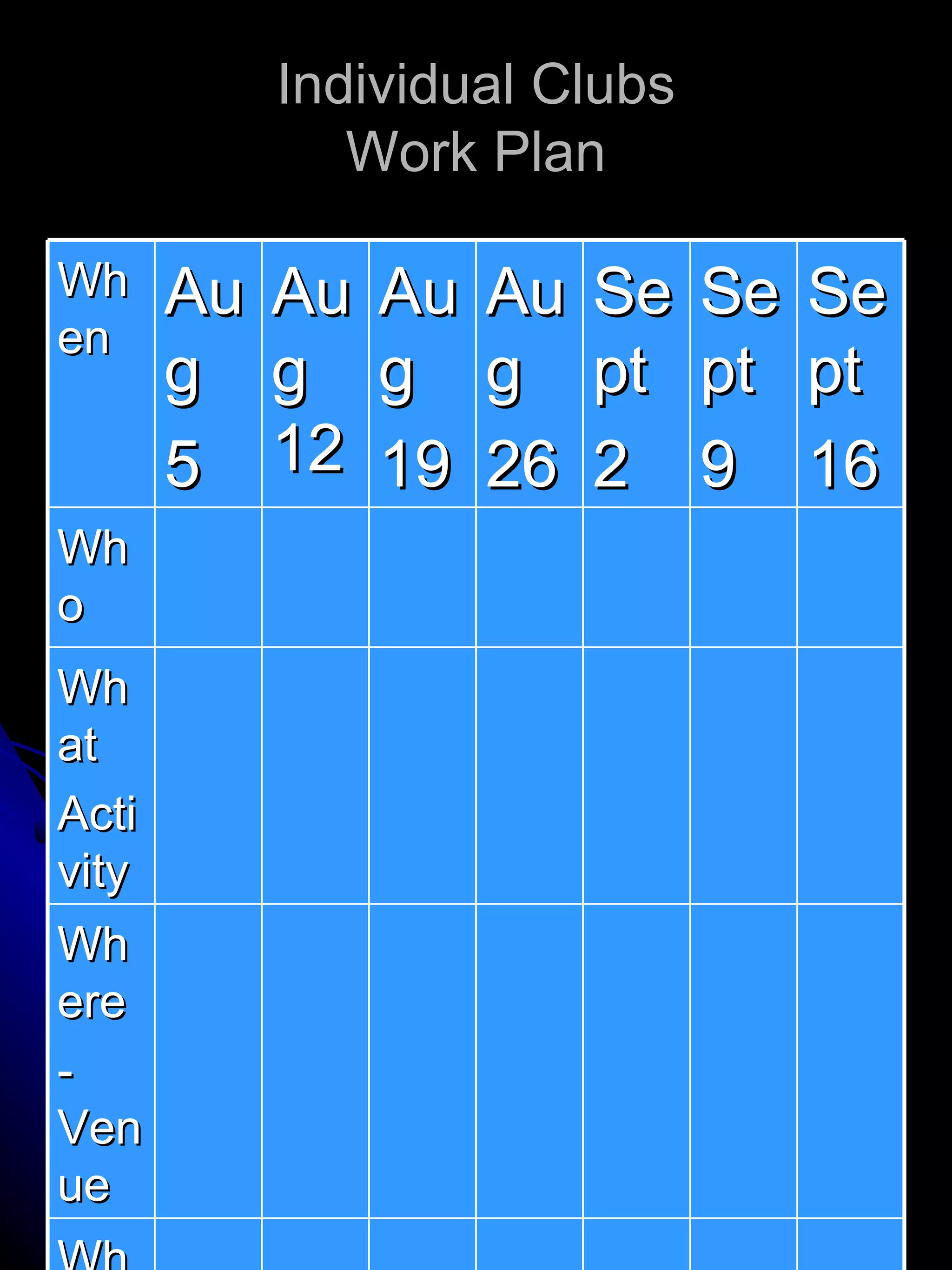
Individual Clubs Work Plan When Aug 5 Aug 12 Aug 19 Aug 26 Sept 2 Sept 9 Sept 16 Who What Activity Where -Venue Why - purpose How -strategy
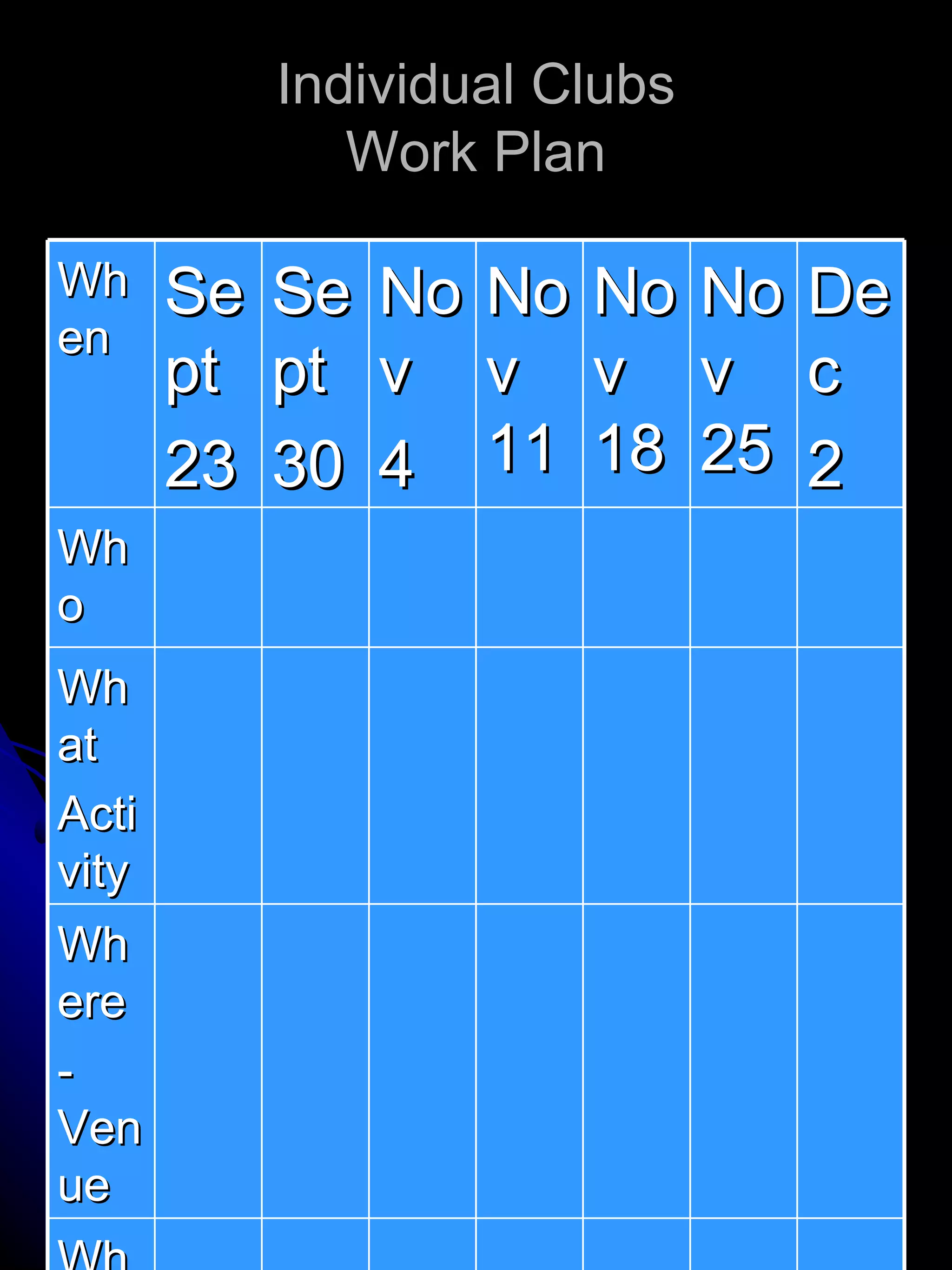
Individual Clubs Work Plan When Sept 23 Sept 30 Nov 4 Nov 11 Nov 18 Nov 25 Dec 2 Who What Activity Where -Venue Why - purpose How -strategy
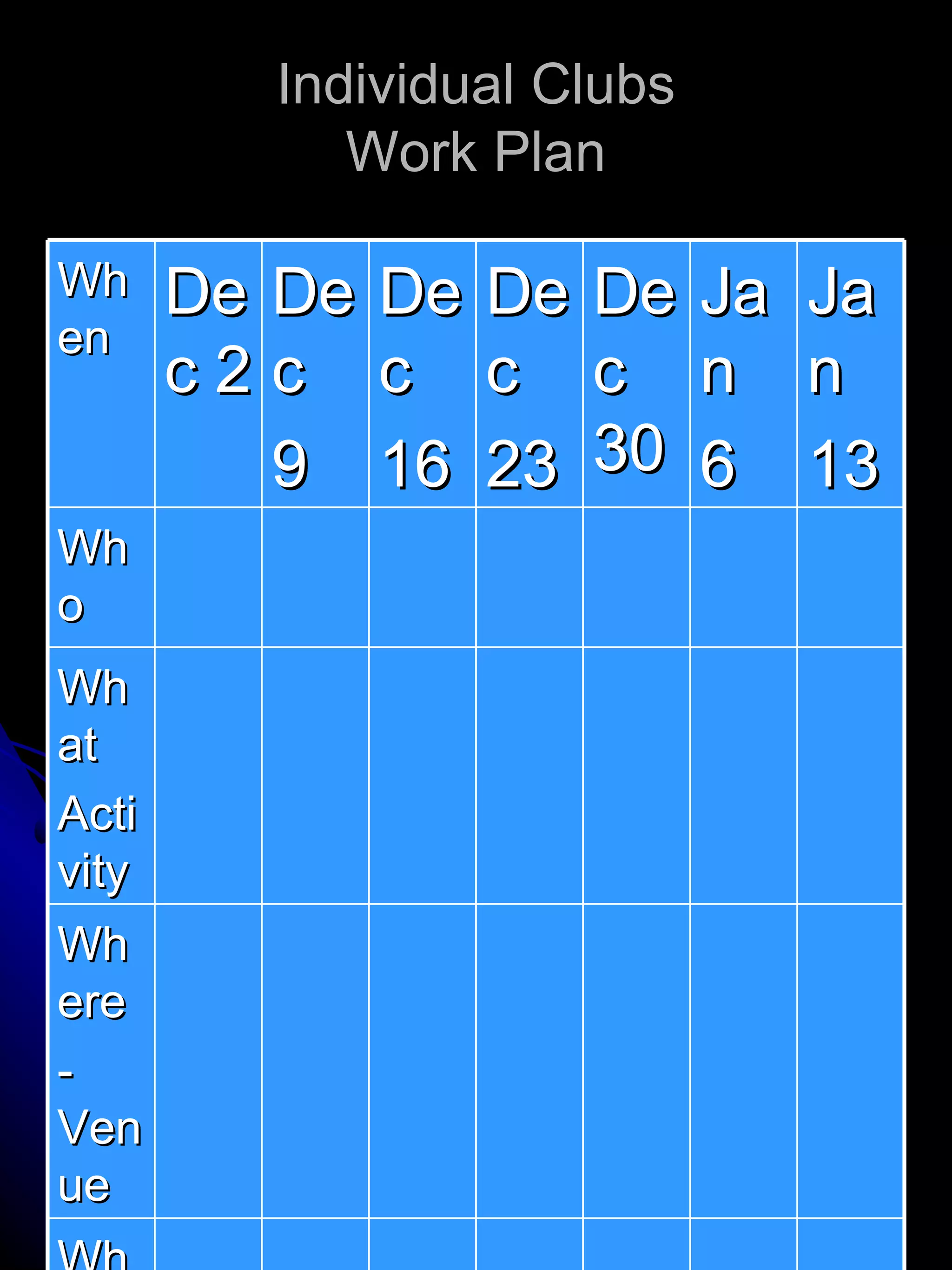
Individual Clubs Work Plan When Dec 2 Dec 9 Dec 16 Dec 23 Dec 30 Jan 6 Jan 13 Who What Activity Where -Venue Why - purpose How -strategy
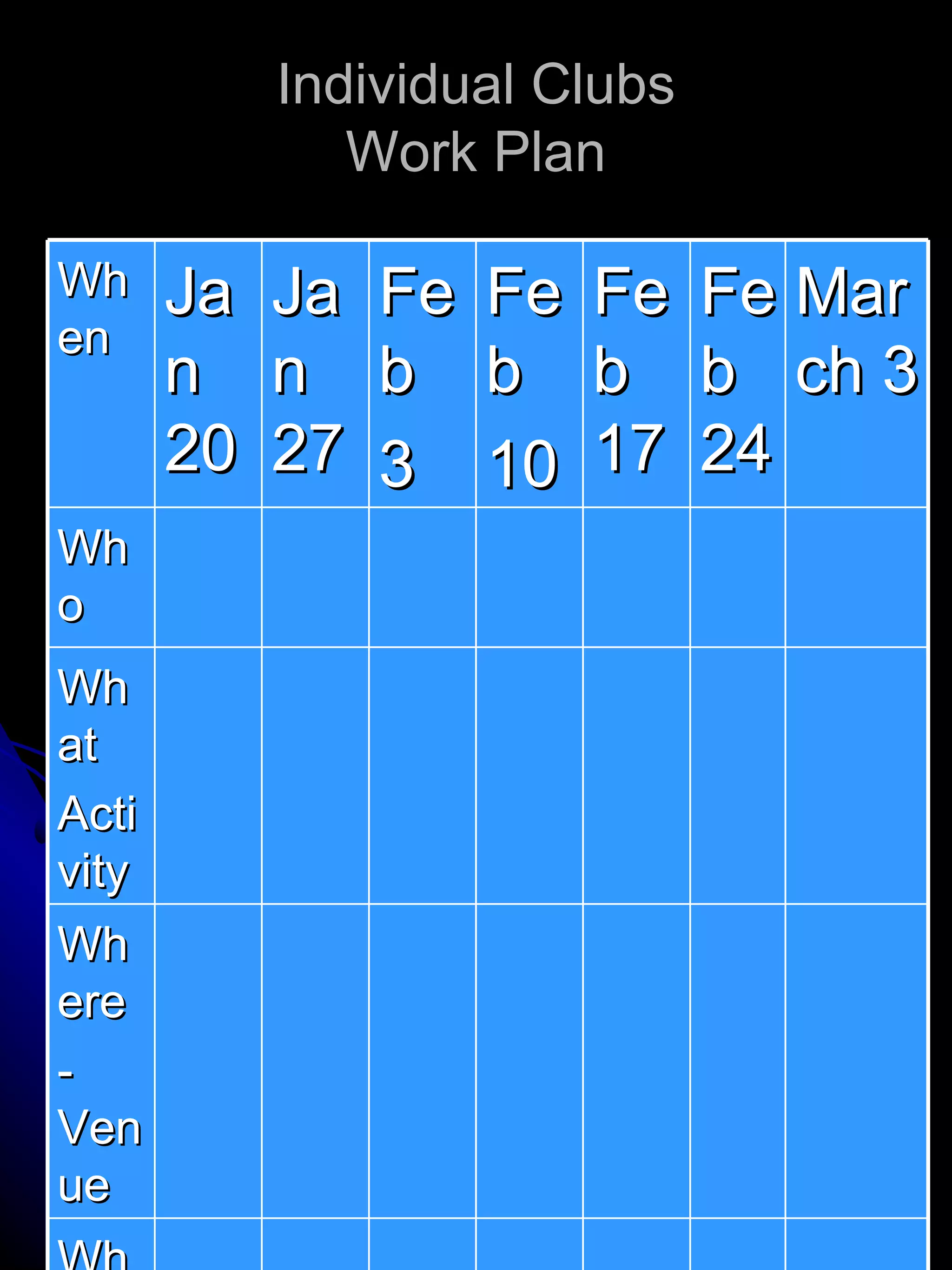
Individual Clubs Work Plan When Jan 20 Jan 27 Feb 3 Feb 10 Feb 17 Feb 24 March 3 Who What Activity Where -Venue Why - purpose How -strategy
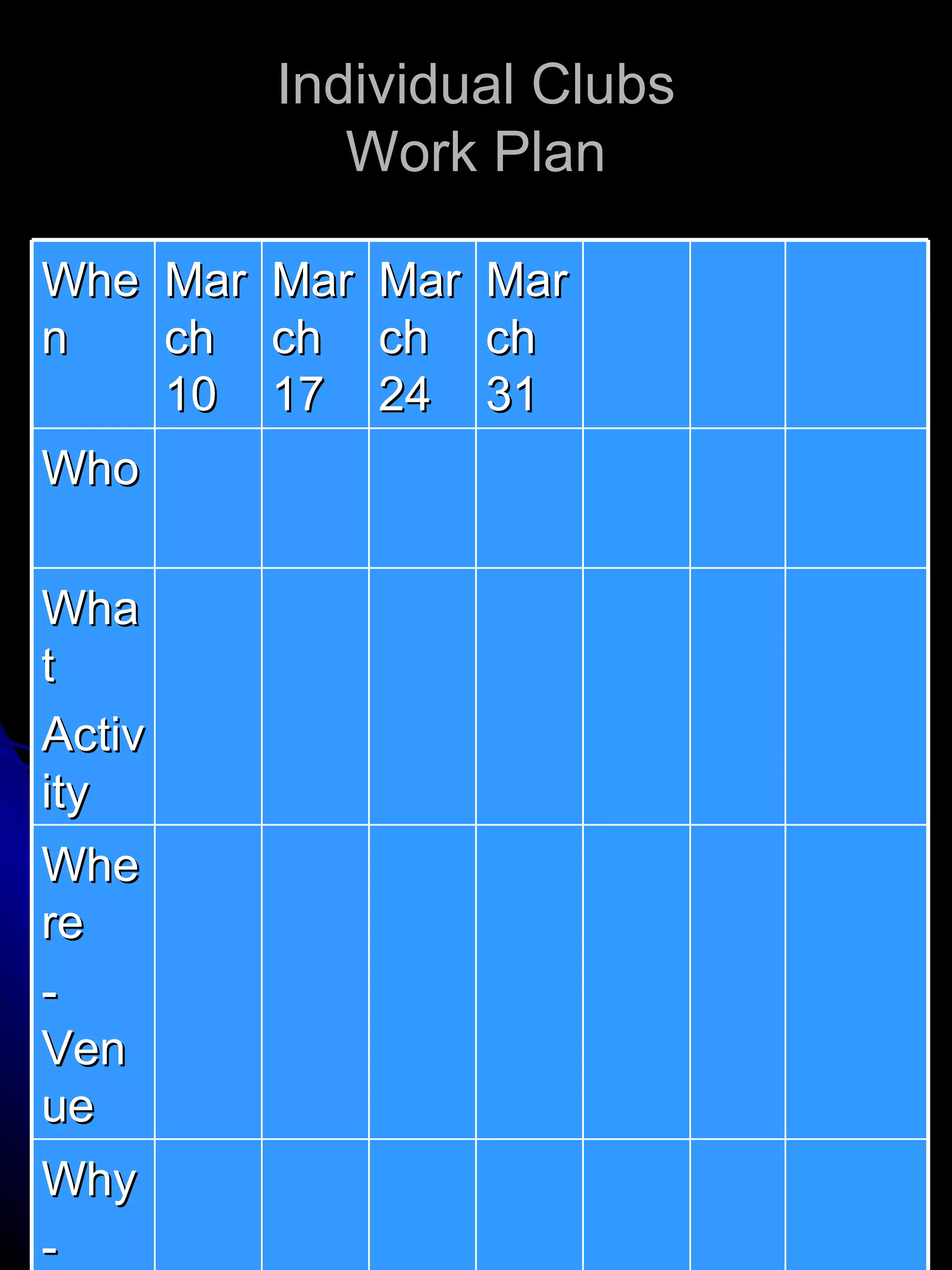
Individual Clubs Work Plan When March 10 March 17 March 24 March 31 Who What Activity Where -Venue Why - purpose How -strategy
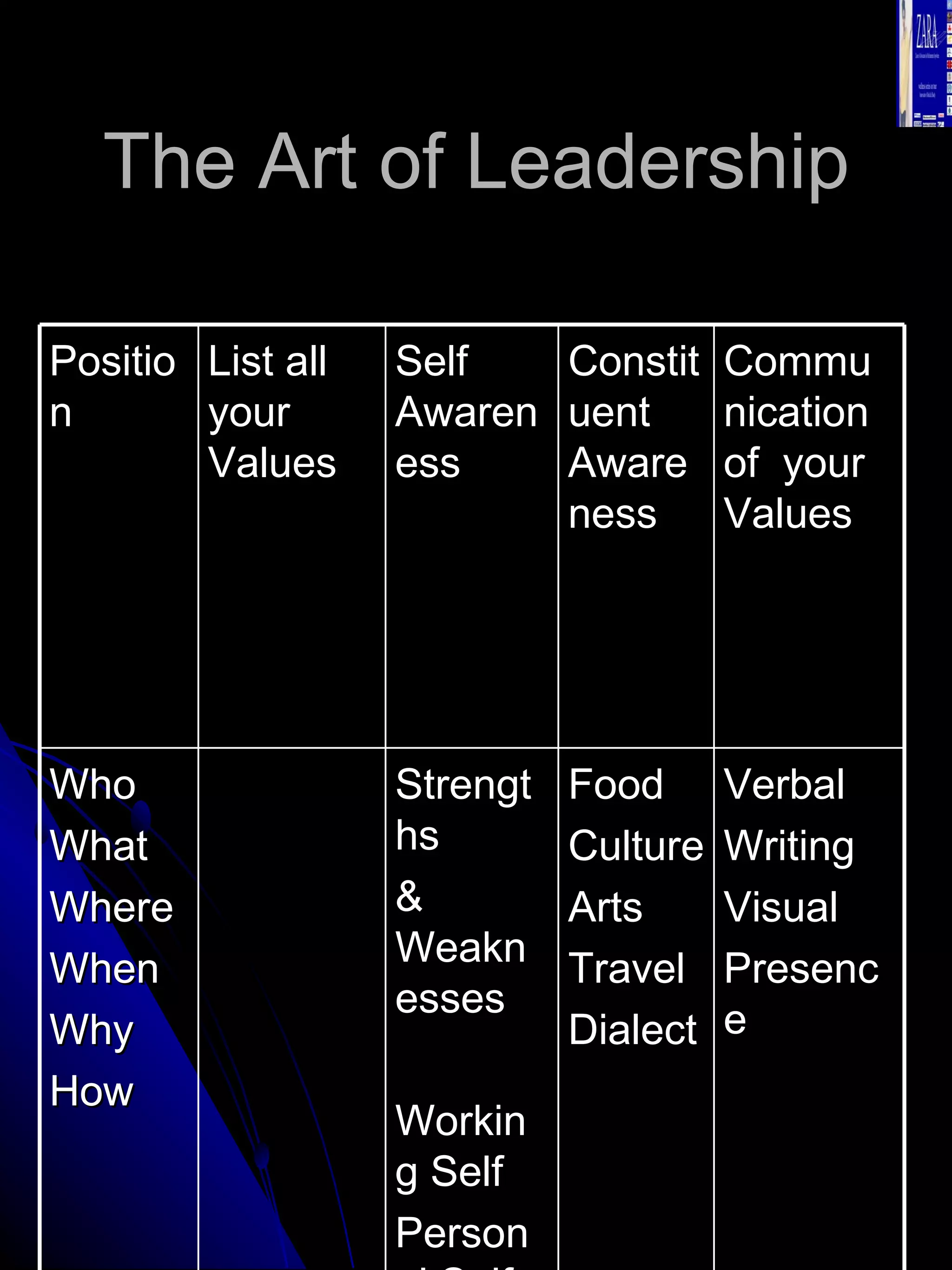
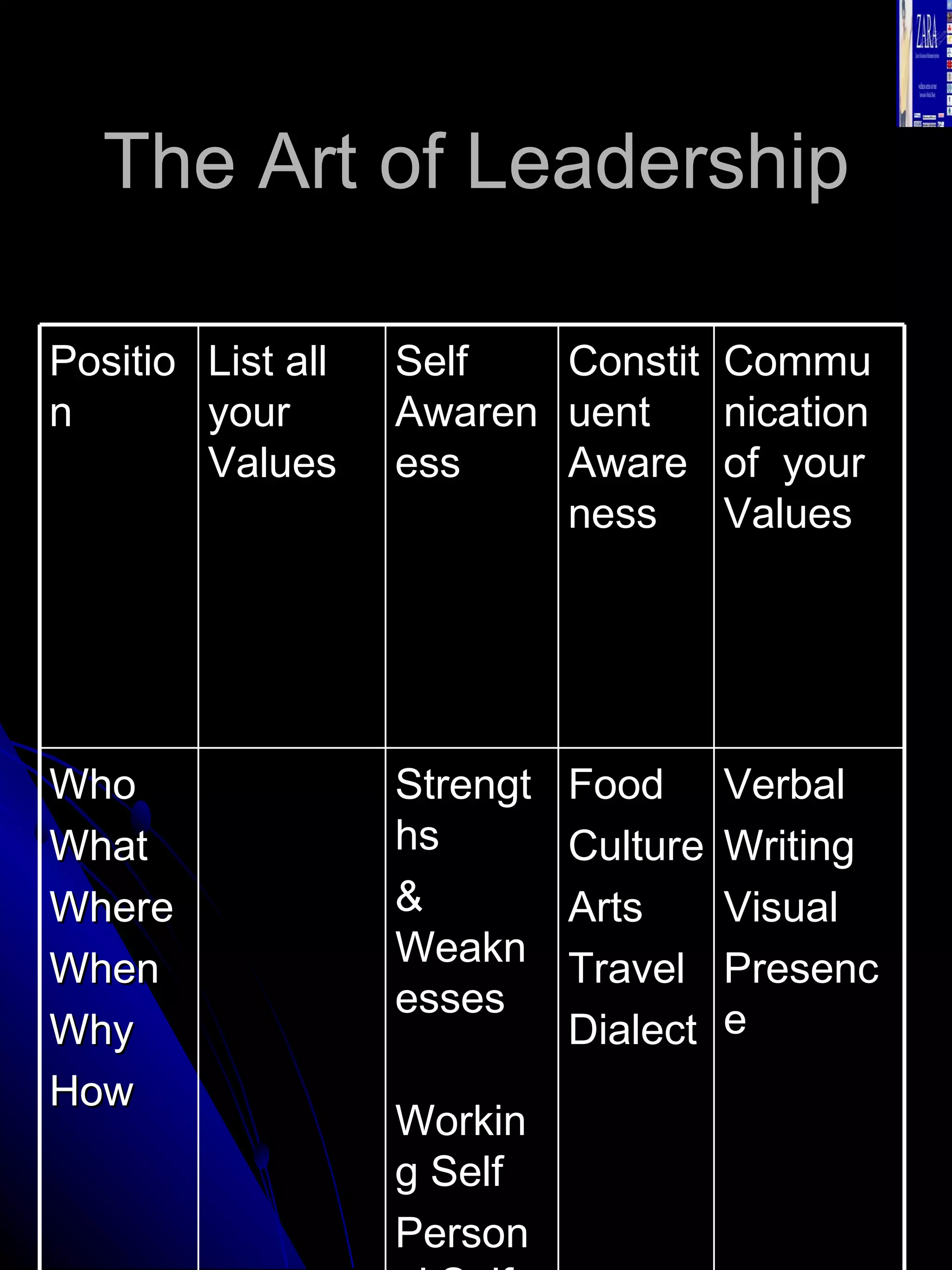
The Art of Leadership Position List all your Values Self Awareness Constituent Awareness Communication of  your Values Who What Where When Why How Strengths & Weaknesses Working Self Personal Self Food Culture Arts Travel Dialect Verbal Writing Visual  Presence
Application Workshop
The Art of Leadership Position List all your Values Self Awareness Constituent Awareness Communication of  your Values Who What Where When Why How Strengths & Weaknesses Working Self Personal Self Food Culture Arts Travel Dialect Verbal Writing Visual  Presence
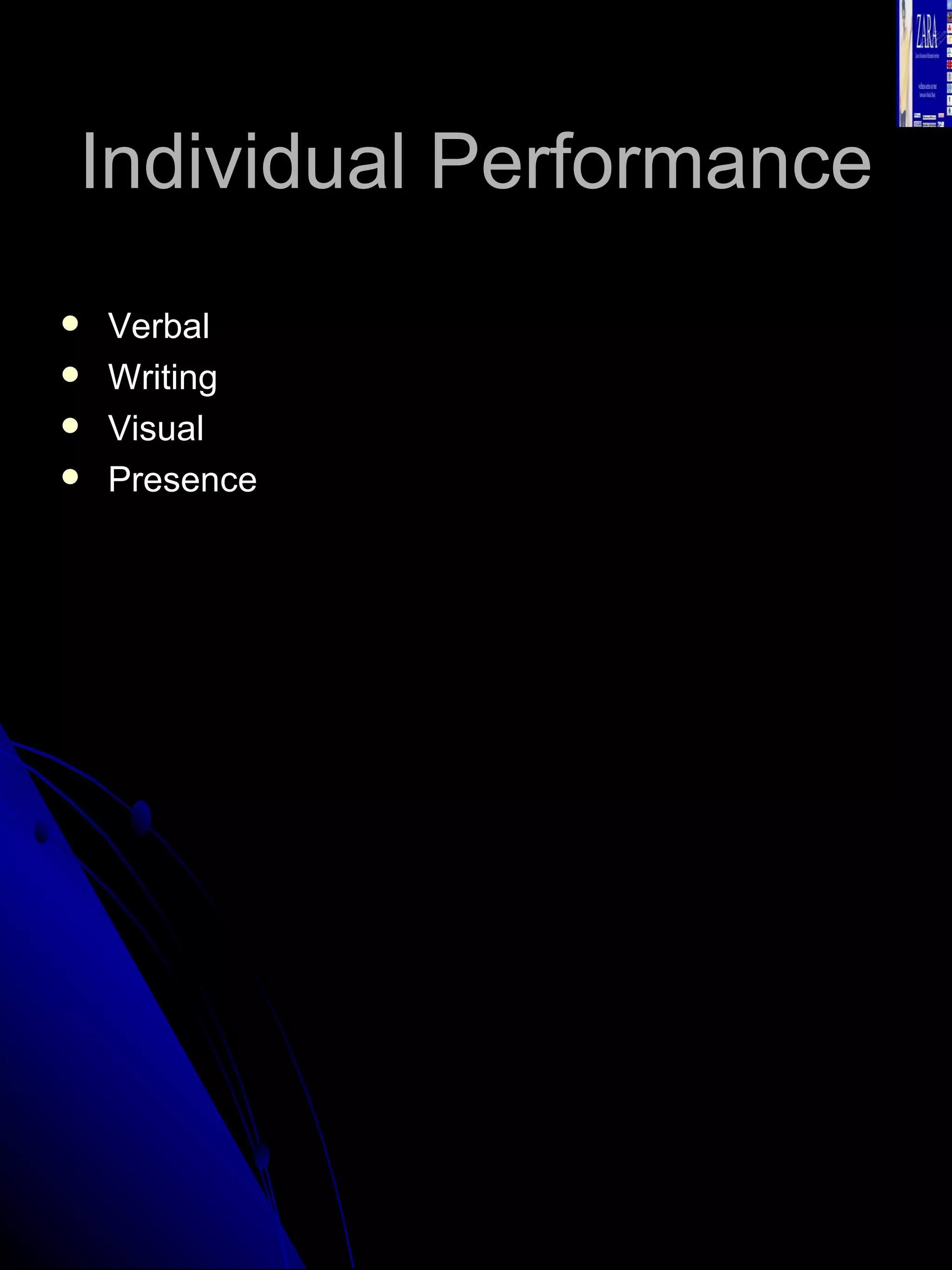
Individual Performance Verbal Writing Visual  Presence
Types of Leadership &   Fundamental Techniques in Handling People
The  Catholic  Leadership
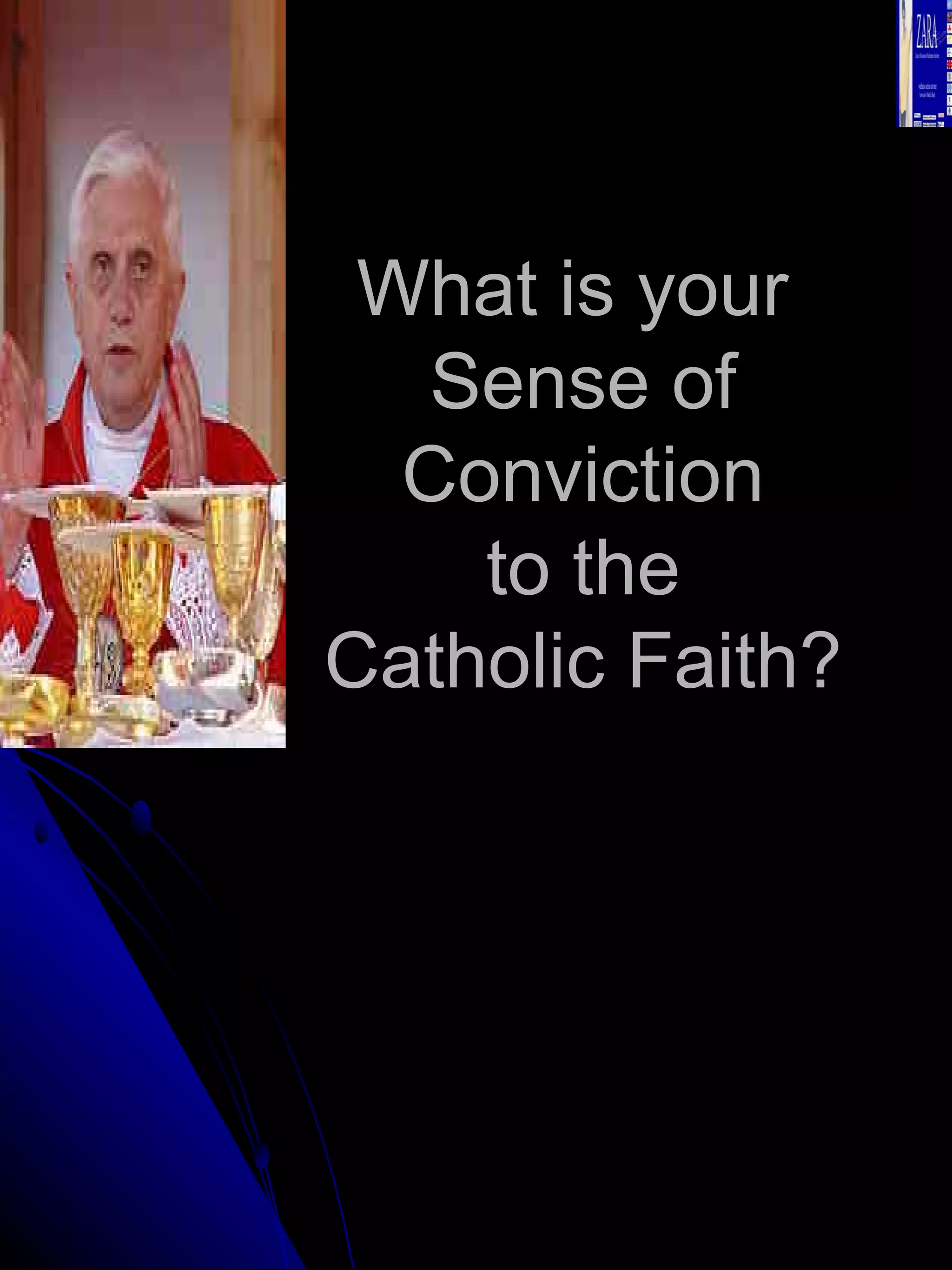
What is your  Sense of Conviction to the Catholic Faith?
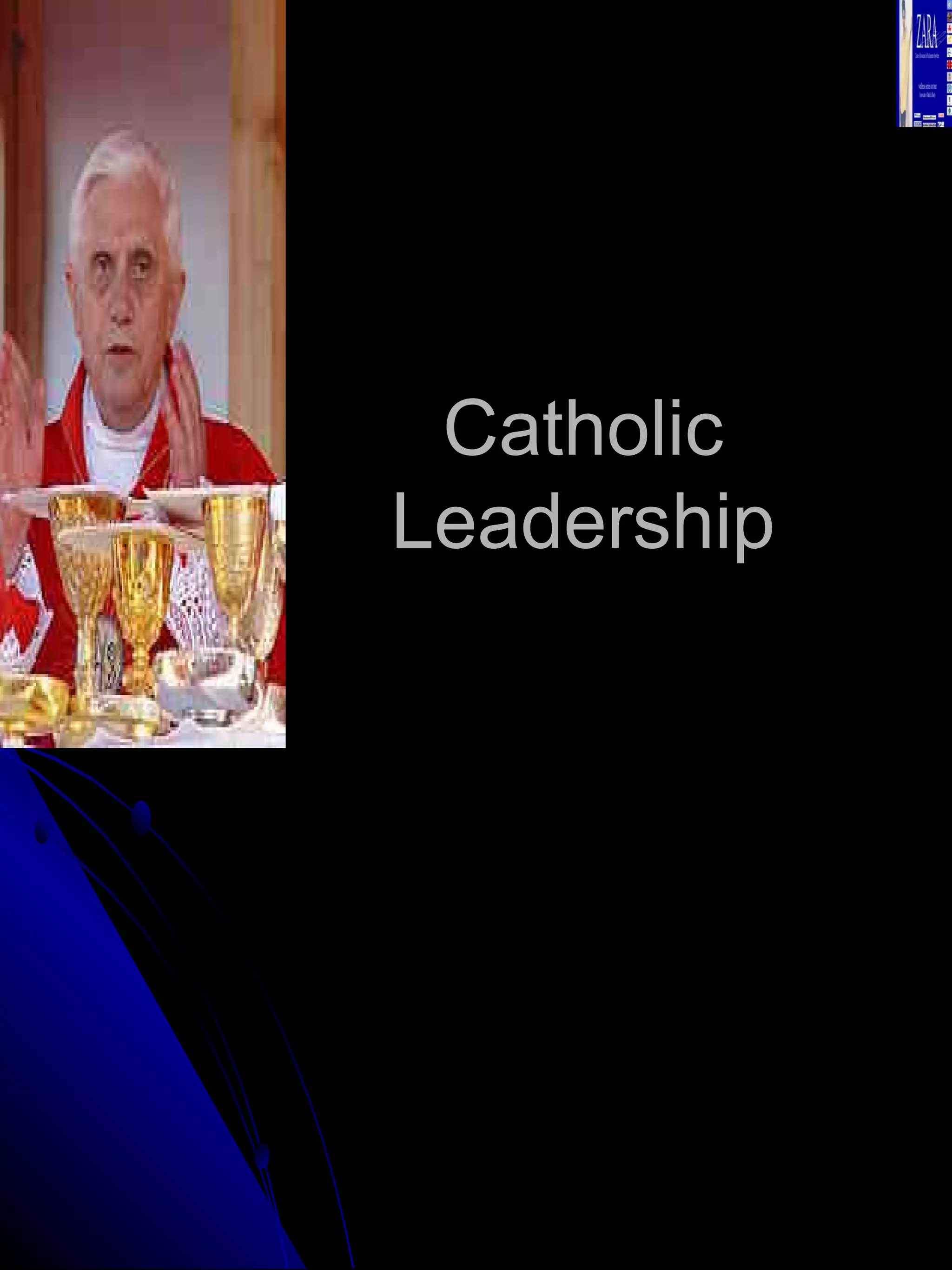
Catholic Leadership
Term 1 – focus on SELF “ Good leadership is truthful and trustworthy. Leaders can act more confidently if they have a strong sense of their own inner truths and are resolute in upholding positions that may be unpopular but congruent with the leader’s values.”   (Kevin Treston) their own faith experience/spirituality  their knowledge and understanding of their faith  their own values 
Term 2 – focus on CONTEXT. “ This is the vision which shapes the daily life of a Catholic school as a community in which faith is expressed and shared through every aspect of its activity.” How their personal vision impacts on their present school  How they would want their personal vision to impact on any future leadership role in a school  The distinctive vision/mission of a Catholic school  Evaluating the Catholic nature of a school
Term 3 – focus on TASK. “ …  be clear that providing leadership and management for a Catholic school is totally compatible with the ‘standards agenda. The requirement to improve the quality of educational provision and pupil achievement needs to be understood and interpreted within the setting of an ethos rooted in the Catholic Church and Gospel values.”
Spiritual Needs: Faith Hope Love
Material Needs: Sex Money Power
How do we reconcile  Material Needs &  Spiritual Needs?
John Paul II  stated “[Opus Dei] has as its aim the sanctification of one’s life, while remaining within the world at one’s place of work and profession: to live the Gospel in the world, while living immersed in the world, but in order to transform it, and to redeem it with one’s personal love for Christ.
John Paul II   "All the  faithful , whatever their condition or state, are called by the Lord, each in his own way, to that perfect holiness whereby the Father Himself is perfect (Mt 5:48)." "It belongs to the laity to seek the kingdom of God by engaging in the affairs of the world and directing them according to God's will."
Achieving Perfection  is  Working for Holiness
To reconcile Faith to achieve Power Hope to Achieve Wealth / Money Love to Achieve Physical Satisfaction
Breathing Exercise Meditation Prayer
Announcement: pls. be my TV guest  as the  pride of your province” in : fCAT @ GNN  G-Sat Asia cable tv show shown Asia pls. e-mail your  Bio Data to [email_address] or add me via facebook
Thank you! The Mentor’s Guide on  Handling Teenage Leaders By Ms. Zara Jane Juan

The Mentor's Guide in Handling Teenage Leaders and Ways to Handle Bullying by Amb Juan

  • 1.
    The Mentor’s Guideon Handling Teenage Leaders By Ms. Zara Jane Juan
  • 2.
    Profile of Learners
  • 3.
    0-7 yrs oldGeneral Characteristics: - Imitating those around them Absorbs everything & blend themselves in the environment Move & play
  • 4.
    1-3 yrs old Imitative play; mimicking actions 3-5 yrs old Transformative play (real objects into fantasy) 5-7 yrs old Imaginative play (how something will look like & plan how will it become)
  • 5.
    7-14 yrs oldGeneral Characteristics: - picture thinking - They love storytelling from adults
  • 6.
    9-11 yrs oldNotices that she /he is different from the rest A lot physical & psychological changes 12-14 yrs old Interested in cause & effect relationships Beginning of logical thinking
  • 7.
    15-20 yrs oldGeneral Characteristics: - upsurge of sexual drives Aggressive impulses Acting out tendencies Become capable of abstract reasoning (hypothetical situation) Focus of interaction from family to peer
  • 8.
    Summary 12-14 yrsold > Concern: Body Image 15-17 yrs old > Concern: Establishing peer group identity 18-20 yrs old > Concern: Vocational & Romantic identity
  • 9.
    Diagnosis of AdolescentsSource: Adolescent Disorders by Dr. Larry Kerns & Dr. Geri Fox
  • 10.
    Development: Male adolescentsmust be understood differently from female, so must older be perceived differently from younger adolescents. Studies of normal adolescents find them generally well-adjusted & interacting well with parents, teachers & friends. However most adolescents will have occasional periods of mood changes, confusion & rebellion Source: Adolescent Disorders by Dr. Larry Kerns & Dr. Geri Fox
  • 11.
    Physical Growth Hormonal changes -muscular & skeletal development Psychological adaptation to these physical changes constitutes one of the chief tasks of adolescents Source: Adolescent Disorders by Dr. Larry Kerns & Dr. Geri Fox
  • 12.
    Drives upsurgeof sexual drives – initially directed toward the discharge of sexual tension & the achievement of genital satisfaction This must be gradually recognized, understood & accepted as an integral part of the framework of a loving & intimate relationship aggressive impulses – harness & direct these aggressive energies in constructive manifestations e.g. assertiveness, persistence, striving, & healthy competitiveness Source: Adolescent Disorders by Dr. Larry Kerns & Dr. Geri Fox
  • 13.
    Acting Out (“to act out”) -to deal with tension, frustration, conflict, or anxiety by behaving in a way that affords temporary relief. -express hidden feelings or conflicts behaviorally rather than verbally may lead to impulsive behavior e.g. Concern over sexual issues by promiscuity; Concern over separation by running away; Concern over aggressive issues by disordered conduct or anti-social behavior Source: Adolescent Disorders by Dr. Larry Kerns & Dr. Geri Fox
  • 14.
    Cognitive Development -advancesfrom concrete operational thinking to formal operational thinking -capable of abstract reasoning -freed from the limitations of considering only empirical events -becomes possible to consider hypothetical situations Source: Adolescent Disorders by Dr. Larry Kerns & Dr. Geri Fox
  • 15.
    Developmental Task Thefocus of attention shifts from parents & family to the peer group There is an emphasis on building peer relationships that are – it is hoped – cooperative, reciprocal, supportive, & enhancing self-esteem But there is also increasing pressure from peers, pressure that may be exerted in anti-social rather than socializing & integrating directions The adolescents may be less accessible to parents & to anyone viewed w/ parental authority Source: Adolescent Disorders by Dr. Larry Kerns & Dr. Geri Fox
  • 16.
    Back to Innocence Workshop Sensitivity Exercise 1
  • 17.
  • 18.
    Age Write downa Significant Event in your life? If you imagine the Shape, what is it: Spiky or Curved Why that shape? Explain in 3-5 sentences What is the Color do you see when you recall that significant event? 21 18 14 10 8 5
  • 19.
    What was yourfavorite toy when you were 5 yrs old? If you want something badly, how do you get it when you were 10 yrs old?
  • 20.
    What was yourfavorite role in a play when you were 8 yrs old? What is your role in your peer group “barkada” when you were 14 yrs old. How do they call you or see you?
  • 21.
    What was yourinitial reaction when you were reprimanded by your elders when you were 18 yrs old? What was your secret wish when you were 21 yrs old?
  • 22.
  • 23.
    WHAT IS MEANTBY LEADERSHIP? Source: Addison, Linda ERIC Clearinghouse on Handicapped and Gifted Children Reston VA.
  • 24.
    Leadership is theability to influence the activities of an individual or group toward the achievement of a goal. The definition has evolved from the idea of a leader being a born leader or simply "one who leads" to a more complex view of how a person exerts influence. Source: Addison, Linda ERIC Clearinghouse on Handicapped and Gifted Children Reston VA.
  • 25.
    leaders can beinfluential as: task-oriented leaders or relationship-oriented leaders. Source: Addison, Linda ERIC Clearinghouse on Handicapped and Gifted Children Reston VA.
  • 26.
    task-oriented leaders excels at establishing well-defined patterns of organization, channels of communication, and ways of getting tasks accomplished Source: Addison, Linda ERIC Clearinghouse on Handicapped and Gifted Children Reston VA.
  • 27.
    The relationship-oriented leader,leads by maintaining personal relationships between members of the group by opening up communication, providing emotional support and using facilitating behaviors. Source: Addison, Linda ERIC Clearinghouse on Handicapped and Gifted Children Reston VA.
  • 28.
    Both task-oriented andrelationship-oriented leaders are necessary for effective group functioning Source: Addison, Linda ERIC Clearinghouse on Handicapped and Gifted Children Reston VA.
  • 29.
    Another helpful wayto identify and nurture leadership is that of the active versus the reflective leader. Source: Addison, Linda ERIC Clearinghouse on Handicapped and Gifted Children Reston VA.
  • 30.
    The active leaderexerts influence over the group through the force of his or her personality. Source: Addison, Linda ERIC Clearinghouse on Handicapped and Gifted Children Reston VA.
  • 31.
    The reflective leader,on the other hand, is influential through the force of his or her ideas Source: Addison, Linda ERIC Clearinghouse on Handicapped and Gifted Children Reston VA.
  • 32.
    HOW CAN TEACHERSIDENTIFY THE LEADERSHIP ABILITIES OF GIFTED AND TALENTED STUDENTS? Source: Addison, Linda ERIC Clearinghouse on Handicapped and Gifted Children Reston VA.
  • 33.
    --Nomination and/or ratingby peers, teachers, self, or community group members --Observation of simulation activities --Biographical information on past leadership experiences --Interviews --Personality tests --Leadership styles instruments Source: Addison, Linda ERIC Clearinghouse on Handicapped and Gifted Children Reston VA.
  • 34.
    Ten Ways toIdentify a Promising Person Source: Addison, Linda ERIC Clearinghouse on Handicapped and Gifted Children Reston VA.
  • 35.
    to distinguish betweenthe skill of performance and the skill of leading the performance Source: Addison, Linda ERIC Clearinghouse on Handicapped and Gifted Children Reston VA.
  • 36.
    Leadership in thepast. The best predictor of the future is the past. The capacity to create or catch vision. A person who knows how to ask the right question A person who feels the thrill of a challenge A constructive spirit of discontent Have Practical Ideas Willingness to take responsibility Completion factor Peer respect & Family respect Holding Court (people listen to them) Source: Addison, Linda ERIC Clearinghouse on Handicapped and Gifted Children Reston VA.
  • 37.
    Points to Consider: Source: Addison, Linda ERIC Clearinghouse on Handicapped and Gifted Children Reston VA.
  • 38.
    It's not enoughfor people to have leadership potential; they must have character and the right setting in which to grow. Source: Addison, Linda ERIC Clearinghouse on Handicapped and Gifted Children Reston VA.
  • 39.
    What will thisperson do to be liked? It's nice to be liked, but as a leader it cannot be the controlling factor. The cause must be the prime motivator. Source: Addison, Linda ERIC Clearinghouse on Handicapped and Gifted Children Reston VA.
  • 40.
    Does this personhave a destructive weakness? There are only two things I need to know about myself as a leader: my constructive strength and any destructive weakness Source: Addison, Linda ERIC Clearinghouse on Handicapped and Gifted Children Reston VA.
  • 41.
    A destructive weaknessmay, for example, be an obsession. An obsession controls us; we don't control it. It only grows worse over time. Source: Addison, Linda ERIC Clearinghouse on Handicapped and Gifted Children Reston VA.
  • 42.
    Can I providethis person the environment to succeed? An environment that threatens our sense of security or well-being splits our concentration from the cause. Young leaders need an environment in which they can concentrate on leading. Source: Addison, Linda ERIC Clearinghouse on Handicapped and Gifted Children Reston VA.
  • 43.
    Dimensions of Sustaining Leadership Source: Addison, Linda ERIC Clearinghouse on Handicapped and Gifted Children Reston VA.
  • 44.
    Partnership and voice Vision and values Knowledge and daring Confidence and persistence Personal qualities (passion, humor, and empathy strength of character, general maturity, patience, wisdom, common sense, trustworthiness, reliability, creativity, sensitivity) Source: Addison, Linda ERIC Clearinghouse on Handicapped and Gifted Children Reston VA.
  • 45.
    Individual Clubs WorkPlan When July 29 July 22 July 15 July 8 July 01 June 24 June17 Who What Activity Where -Venue Why - purpose How -strategy
  • 46.
    Individual Clubs WorkPlan When Aug 5 Aug 12 Aug 19 Aug 26 Sept 2 Sept 9 Sept 16 Who What Activity Where -Venue Why - purpose How -strategy
  • 47.
    Individual Clubs WorkPlan When Sept 23 Sept 30 Nov 4 Nov 11 Nov 18 Nov 25 Dec 2 Who What Activity Where -Venue Why - purpose How -strategy
  • 48.
    Individual Clubs WorkPlan When Dec 2 Dec 9 Dec 16 Dec 23 Dec 30 Jan 6 Jan 13 Who What Activity Where -Venue Why - purpose How -strategy
  • 49.
    Individual Clubs WorkPlan When Jan 20 Jan 27 Feb 3 Feb 10 Feb 17 Feb 24 March 3 Who What Activity Where -Venue Why - purpose How -strategy
  • 50.
    Individual Clubs WorkPlan When March 10 March 17 March 24 March 31 Who What Activity Where -Venue Why - purpose How -strategy
  • 51.
    The Art ofLeadership Position List all your Values Self Awareness Constituent Awareness Communication of your Values Who What Where When Why How Strengths & Weaknesses Working Self Personal Self Food Culture Arts Travel Dialect Verbal Writing Visual Presence
  • 52.
  • 53.
    The Art ofLeadership Position List all your Values Self Awareness Constituent Awareness Communication of your Values Who What Where When Why How Strengths & Weaknesses Working Self Personal Self Food Culture Arts Travel Dialect Verbal Writing Visual Presence
  • 54.
    Individual Performance VerbalWriting Visual Presence
  • 55.
    Types of Leadership& Fundamental Techniques in Handling People
  • 56.
    The Catholic Leadership
  • 57.
    What is your Sense of Conviction to the Catholic Faith?
  • 58.
  • 59.
    Term 1 –focus on SELF “ Good leadership is truthful and trustworthy. Leaders can act more confidently if they have a strong sense of their own inner truths and are resolute in upholding positions that may be unpopular but congruent with the leader’s values.” (Kevin Treston) their own faith experience/spirituality their knowledge and understanding of their faith their own values 
  • 60.
    Term 2 –focus on CONTEXT. “ This is the vision which shapes the daily life of a Catholic school as a community in which faith is expressed and shared through every aspect of its activity.” How their personal vision impacts on their present school How they would want their personal vision to impact on any future leadership role in a school The distinctive vision/mission of a Catholic school Evaluating the Catholic nature of a school
  • 61.
    Term 3 –focus on TASK. “ … be clear that providing leadership and management for a Catholic school is totally compatible with the ‘standards agenda. The requirement to improve the quality of educational provision and pupil achievement needs to be understood and interpreted within the setting of an ethos rooted in the Catholic Church and Gospel values.”
  • 62.
  • 63.
  • 64.
    How do wereconcile Material Needs & Spiritual Needs?
  • 65.
    John Paul II stated “[Opus Dei] has as its aim the sanctification of one’s life, while remaining within the world at one’s place of work and profession: to live the Gospel in the world, while living immersed in the world, but in order to transform it, and to redeem it with one’s personal love for Christ.
  • 66.
    John Paul II "All the faithful , whatever their condition or state, are called by the Lord, each in his own way, to that perfect holiness whereby the Father Himself is perfect (Mt 5:48)." "It belongs to the laity to seek the kingdom of God by engaging in the affairs of the world and directing them according to God's will."
  • 67.
    Achieving Perfection is Working for Holiness
  • 68.
    To reconcile Faithto achieve Power Hope to Achieve Wealth / Money Love to Achieve Physical Satisfaction
  • 69.
  • 70.
    Announcement: pls. bemy TV guest as the pride of your province” in : fCAT @ GNN G-Sat Asia cable tv show shown Asia pls. e-mail your Bio Data to [email_address] or add me via facebook
  • 71.
    Thank you! TheMentor’s Guide on Handling Teenage Leaders By Ms. Zara Jane Juan