ETHICAL ISSUES IN BIOMEDICAL
RESEARCH
By Vishwanath Gouda
M Pharmacy -1
Department of Pharmacy Practice
ETHICS?
Trials Tuskegee Syphilis Study-involvement of black
males
(1932-1972)
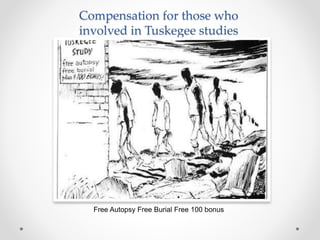
Compensation for those who
involved in Tuskegee studies
Free Autopsy Free Burial Free 100 bonus
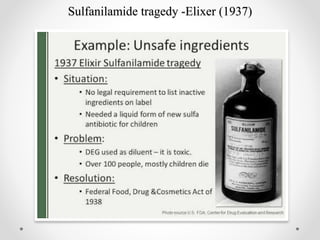
Sulfanilamide tragedy -Elixer (1937)
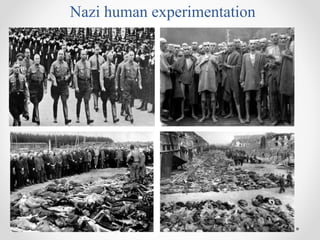
Nazi human experimentation
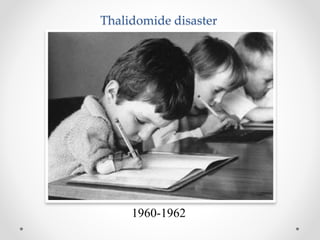
Thalidomide disaster
1960-1962
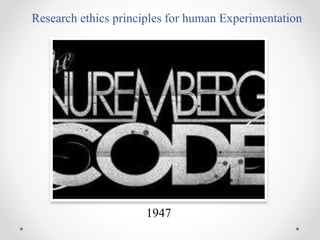
Research ethics principles for human Experimentation
1947
Milestone in the History of Biomedical Research
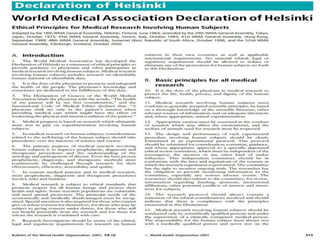
in 1964 june in Helsinki, Finland
Declaration of Helsinki
• The Declaration of Geneva of the World Medical Association
binds the physician with the words, ‘‘The health of my patient
will be my first consideration,’’ and the International Code of
Medical Ethics declares that, ‘‘A physician shall act only in the
patient’s interest when providing medical care which might
have the effect of weakening the physical and mental condition
of the patient.’’
THE NUREMBERG CODE
 The voluntary consent of the human subject is absolutely
essential.
 The experiment should be such as to yield fruitful results for
the good of society
 The experiment should be so designed and based on the results
of animal experimentation
 The experiment should be so conducted as to avoid all
unnecessary physical and mental suffering and injury.
 No experiment should be conducted, where there is an a priori
reason to believe that death or disabling injury will occur,
 The degree of risk to be taken should never exceed
 Proper preparations should be made and adequate facilities
provided to protect the experimental subject
 The experiment should be conducted only by scientifically
qualified persons.
 During the course of the experiment, the human subject should
be at liberty to bring the experiment to an end
 During the course of the experiment, the scientist in charge
must be prepared to terminate the experiment at any stage
STATEMENT OF GENERAL PRINCIPLES
 Principles of essentiality
 Principles of voluntariness, informed consent and community
agreement
 Principles of non-exploitation
 Principles of privacy and confidentiality
 Principles of precaution and risk minimisation
 Principles of professional competence
 Principles of accountability and transparency
 Principles of the maximisation of the public interest and of
distributive justice
 Principles of institutional arrangements
 Principles of public domain
 Principles of totality of responsibility
 Principles of compliance
IN RESEARCH USING HUMAN SUBJECTS
Several categories of persons maybe involved:
 Normal healthy adults, including the investigator, and
elderly persons
 Sick adults, including the acutely and terminally ill
 People living in highly controlled situations, such as,
prisoners, soldiers, and students
 Children, both healthy and ill
 Mentally incompetent persons, whether adults or children
Right to refusal or withdrawal of treatment
• “The patient has the right to refuse or withdraw from
treatment to the extent permitted by law and to be informed of
the medical consequences of his action.”- Patient’s Bill of
Rights
• A patient may refuse or withdraw from medical treatment
because their religious convictions prohibit them from doing
so (e.g., a patient who is a member of a particular religious
sect may refuse to undergo blood transfusions)
Are there ethical issues in social science
or behavioral research?
 Most common methodology used involves interviewing people
and asking questions
o “We would just like to ask some questions…”
o “We would just like to observe…”
o “We would just like to share your life…”
o Focus Group discussion (FGDs), Survey
 Does not involve invasive procedures
Ethical Issues in Social Science &
Behavioral Research
• Privacy
• Confidentiality
• Linking behavior with medical procedure
References :
1. "Trials of War Criminals before the Nuremberg Military Tribunals under
Control Council Law No. 10", Vol. 2, pp. 181-182. Washington, D.C.:
U.S. Government Printing Office, 1949.
2. ETHICAL GUIDELINES FOR BIOMEDICAL RESEARCH ON
HUMAN PARTICIPANTS, ICMR , Statement of General Principles on
Ethical Considerations involving Human Participants
3. World Medical Association Declaration of Helsinki, Ethical
Principles for Medical Research Involving Human Subjects,
Adopted by the 18th WMA General Assembly, Helsinki, Finland,
June 1964; amended by the 29th WMA General Assembly, Tokyo,
Japan, October 1975; 35th WMA General Assembly, Venice, Italy,
October 1983; 41st WMA General Assembly, Hong Kong,
September 1989; 48th WMA General Assembly, Somerset West,
Republic of South Africa, October 1996, and the 52nd WMA
General Assembly, Edinburgh, Scotland, October 2000
THANK YOU

ETHICAL ISSUES IN BIOMEDICAL RESEARCH

  • 1.
    ETHICAL ISSUES INBIOMEDICAL RESEARCH By Vishwanath Gouda M Pharmacy -1 Department of Pharmacy Practice
  • 2.
  • 3.
    Trials Tuskegee SyphilisStudy-involvement of black males (1932-1972)
  • 4.
    Compensation for thosewho involved in Tuskegee studies Free Autopsy Free Burial Free 100 bonus
  • 5.
  • 6.
  • 7.
  • 8.
    Research ethics principlesfor human Experimentation 1947
  • 9.
    Milestone in theHistory of Biomedical Research in 1964 june in Helsinki, Finland
  • 11.
    Declaration of Helsinki •The Declaration of Geneva of the World Medical Association binds the physician with the words, ‘‘The health of my patient will be my first consideration,’’ and the International Code of Medical Ethics declares that, ‘‘A physician shall act only in the patient’s interest when providing medical care which might have the effect of weakening the physical and mental condition of the patient.’’
  • 12.
    THE NUREMBERG CODE The voluntary consent of the human subject is absolutely essential.  The experiment should be such as to yield fruitful results for the good of society  The experiment should be so designed and based on the results of animal experimentation  The experiment should be so conducted as to avoid all unnecessary physical and mental suffering and injury.  No experiment should be conducted, where there is an a priori reason to believe that death or disabling injury will occur,
  • 13.
     The degreeof risk to be taken should never exceed  Proper preparations should be made and adequate facilities provided to protect the experimental subject  The experiment should be conducted only by scientifically qualified persons.  During the course of the experiment, the human subject should be at liberty to bring the experiment to an end  During the course of the experiment, the scientist in charge must be prepared to terminate the experiment at any stage
  • 14.
    STATEMENT OF GENERALPRINCIPLES  Principles of essentiality  Principles of voluntariness, informed consent and community agreement  Principles of non-exploitation  Principles of privacy and confidentiality  Principles of precaution and risk minimisation  Principles of professional competence  Principles of accountability and transparency
  • 15.
     Principles ofthe maximisation of the public interest and of distributive justice  Principles of institutional arrangements  Principles of public domain  Principles of totality of responsibility  Principles of compliance
  • 18.
    IN RESEARCH USINGHUMAN SUBJECTS Several categories of persons maybe involved:  Normal healthy adults, including the investigator, and elderly persons  Sick adults, including the acutely and terminally ill  People living in highly controlled situations, such as, prisoners, soldiers, and students  Children, both healthy and ill  Mentally incompetent persons, whether adults or children
  • 19.
    Right to refusalor withdrawal of treatment • “The patient has the right to refuse or withdraw from treatment to the extent permitted by law and to be informed of the medical consequences of his action.”- Patient’s Bill of Rights • A patient may refuse or withdraw from medical treatment because their religious convictions prohibit them from doing so (e.g., a patient who is a member of a particular religious sect may refuse to undergo blood transfusions)
  • 20.
    Are there ethicalissues in social science or behavioral research?  Most common methodology used involves interviewing people and asking questions o “We would just like to ask some questions…” o “We would just like to observe…” o “We would just like to share your life…” o Focus Group discussion (FGDs), Survey  Does not involve invasive procedures
  • 21.
    Ethical Issues inSocial Science & Behavioral Research • Privacy • Confidentiality • Linking behavior with medical procedure
  • 22.
    References : 1. "Trialsof War Criminals before the Nuremberg Military Tribunals under Control Council Law No. 10", Vol. 2, pp. 181-182. Washington, D.C.: U.S. Government Printing Office, 1949. 2. ETHICAL GUIDELINES FOR BIOMEDICAL RESEARCH ON HUMAN PARTICIPANTS, ICMR , Statement of General Principles on Ethical Considerations involving Human Participants 3. World Medical Association Declaration of Helsinki, Ethical Principles for Medical Research Involving Human Subjects, Adopted by the 18th WMA General Assembly, Helsinki, Finland, June 1964; amended by the 29th WMA General Assembly, Tokyo, Japan, October 1975; 35th WMA General Assembly, Venice, Italy, October 1983; 41st WMA General Assembly, Hong Kong, September 1989; 48th WMA General Assembly, Somerset West, Republic of South Africa, October 1996, and the 52nd WMA General Assembly, Edinburgh, Scotland, October 2000
  • 23.