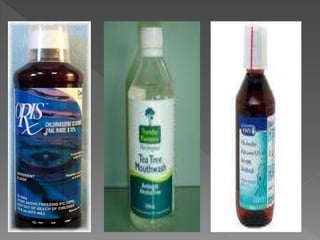
 INTRODUCTION
 HISTORY
 CROSS- INFECTION
 BACTERIAL AND VIRAL THREAT
 STERLIZATION AND DISINFECTION
definition, principles, methods
 INFECTION CONTROL
 OPERATING ROOM PROCEDURE
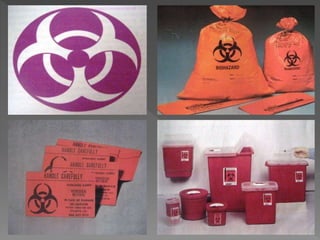
 WASTE DISPOSAL
 NEWER ADVANCEMENTS
 CONCLUSION
“were we but able to explain;
the fiefdom of the microbes,
why one man is his serf,
another is his lord,
when all are his domain”
Anonymous
 BIBLE, RIG VEDA, QURAAN
 2700 BC- Chinese medicine; infection control
 800 BC- 400 AD : Sushrutha and charka
Samhitha
 MID 19TH CENTURY- an era of advancement
 1832- WILLIAM HENRY ;heat sterilization
by boiling water
 1839- DAVIES; iodine for wound dressing
 1843- LE FERNE; introduced chlorine water
for disinfection
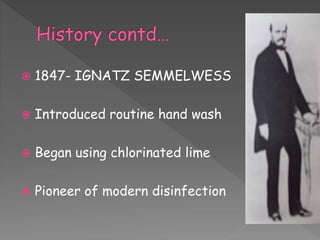
 1847- IGNATZ SEMMELWESS
 Introduced routine hand wash
 Began using chlorinated lime
 Pioneer of modern disinfection
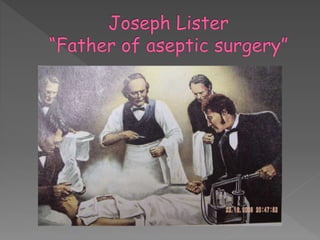
 1867- JOSEPH LISTER
 Introduced British surgery to hand
washing
 Introduced phenol as anti microbial agent
for wound dressing
 1883- American Surgical Associates
approved Listerian technique
 Beginning of a new era of infection control
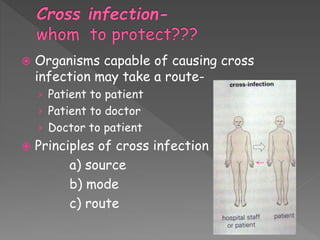
 Organisms capable of causing cross
infection may take a route-
› Patient to patient
› Patient to doctor
› Doctor to patient
 Principles of cross infection
a) source
b) mode
c) route
 People with overt infection
 People in prodromal stage
 People who are healthy
› Convalescent carriers
› Asymptomatic carriers
 Key point - Convalescent carriers can be
identified by past history but asymptomatic
carriers cant.
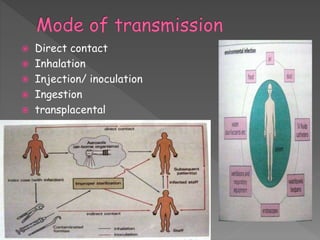
 Direct contact
 Inhalation
 Injection/ inoculation
 Ingestion
 transplacental
 Direct contact of tissue with various
secretions of body, blood may act as
direct mode of transmission
 Rare – least common mode of transmission
 May occur due to improper practice by the
doctor
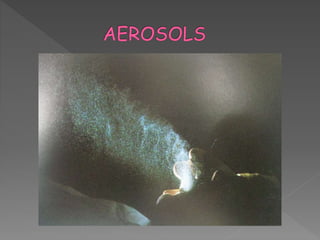
 Droplet infectionair-borne infection
 Infective organisms –infectious aerosols
 Size of aerosols dose matter
 Droplets > 100um – SPATTER
 Droplets < 100um – DROPLET NUCLEI
 Droplet nuclei consist of dried salivary or
serum secretions and organisms
 VIRUS : Cytomegalo, influenza, rhino,adeno
 BACTERIA: streptococcus pyogens
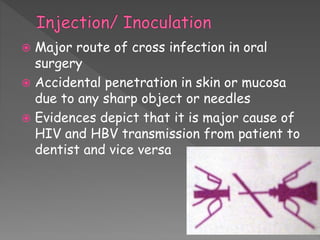
 Major route of cross infection in oral
surgery
 Accidental penetration in skin or mucosa
due to any sharp object or needles
 Evidences depict that it is major cause of
HIV and HBV transmission from patient to
dentist and vice versa
 Ingestion (diarrhoeal diseases)
 Trasplacental
>T O R C H
>Congenital syphilis
>HIV acquired diseases
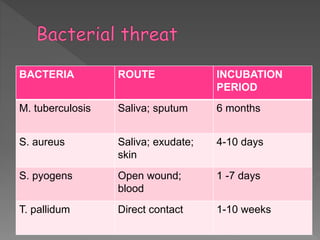
BACTERIA ROUTE INCUBATION
PERIOD
M. tuberculosis Saliva; sputum 6 months
S. aureus Saliva; exudate;
skin
4-10 days
S. pyogens Open wound;
blood
1 -7 days
T. pallidum Direct contact 1-10 weeks
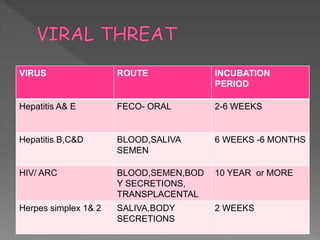
VIRUS ROUTE INCUBATION
PERIOD
Hepatitis A& E FECO- ORAL 2-6 WEEKS
Hepatitis B,C&D BLOOD,SALIVA
SEMEN
6 WEEKS -6 MONTHS
HIV/ ARC BLOOD,SEMEN,BOD
Y SECRETIONS,
TRANSPLACENTAL
10 YEAR or MORE
Herpes simplex 1& 2 SALIVA,BODY
SECRETIONS
2 WEEKS
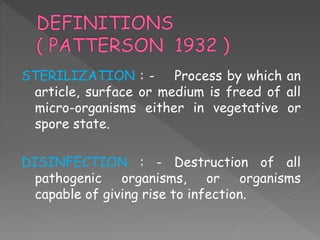
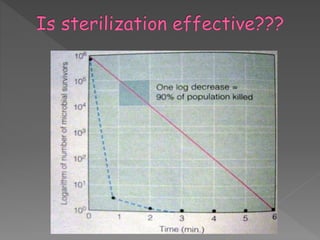
STERILIZATION : - Process by which an
article, surface or medium is freed of all
micro-organisms either in vegetative or
spore state.
DISINFECTION : - Destruction of all
pathogenic organisms, or organisms
capable of giving rise to infection.
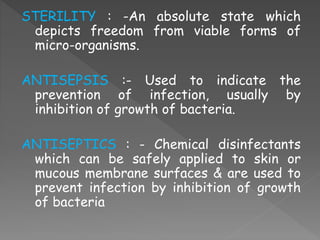
STERILITY : -An absolute state which
depicts freedom from viable forms of
micro-organisms.
ANTISEPSIS :- Used to indicate the
prevention of infection, usually by
inhibition of growth of bacteria.
ANTISEPTICS : - Chemical disinfectants
which can be safely applied to skin or
mucous membrane surfaces & are used to
prevent infection by inhibition of growth
of bacteria
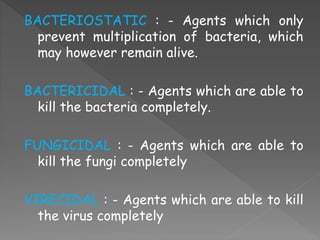
BACTERIOSTATIC : - Agents which only
prevent multiplication of bacteria, which
may however remain alive.
BACTERICIDAL : - Agents which are able to
kill the bacteria completely.
FUNGICIDAL : - Agents which are able to
kill the fungi completely
VIRECIDAL : - Agents which are able to kill
the virus completely
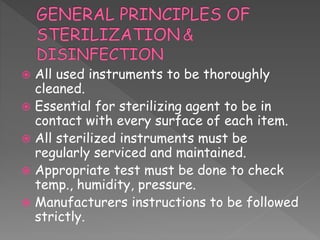
 All used instruments to be thoroughly
cleaned.
 Essential for sterilizing agent to be in
contact with every surface of each item.
 All sterilized instruments must be
regularly serviced and maintained.
 Appropriate test must be done to check
temp., humidity, pressure.
 Manufacturers instructions to be followed
strictly.
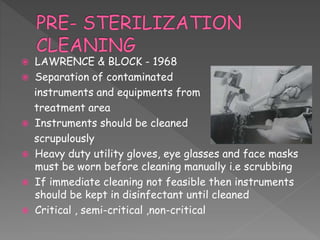
 LAWRENCE & BLOCK - 1968
 Separation of contaminated
instruments and equipments from
treatment area
 Instruments should be cleaned
scrupulously
 Heavy duty utility gloves, eye glasses and face masks
must be worn before cleaning manually i.e scrubbing
 If immediate cleaning not feasible then instruments
should be kept in disinfectant until cleaned
 Critical , semi-critical ,non-critical
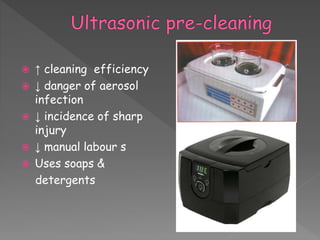
 ↑ cleaning efficiency
 ↓ danger of aerosol
infection
 ↓ incidence of sharp
injury
 ↓ manual labour s
 Uses soaps &
detergents
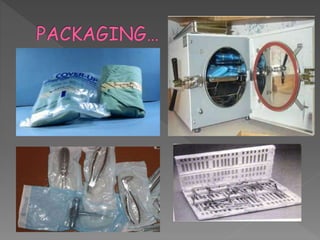
 An open tray system sealed with see
through sterilization bag .
 Perforated trays with fitted corners
wrapped with sterilization paper
 Individual packaging in commercially
available sterilization bags
 Disposable items should be stored in
covered plastics or containers
 Physical methods
 Chemical methods
 Gaseous methods
 Sunlight
 Drying
 Dry heat (flaming, hot air, incineration)
 Moist heat
> below 100˚C
> at 100˚C
> more than 100˚C
 Filtration
 Radiation
 Sonic and ultra sonic
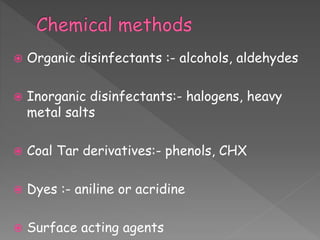
 Organic disinfectants :- alcohols, aldehydes
 Inorganic disinfectants:- halogens, heavy
metal salts
 Coal Tar derivatives:- phenols, CHX
 Dyes :- aniline or acridine
 Surface acting agents
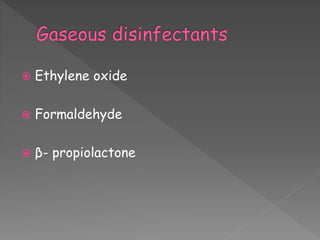
 Ethylene oxide
 Formaldehyde
 β- propiolactone
 Appreciable bactericidal and germicidal.
 Spontaneous sterilization due to combined
effect of UV rays & heat
 SEMPLE & GRIEG :- Killing of typhoid
bacilli exposed to sun.
 Bacteria suspended in water readily killed
when exposed to sunlight.
 Efficient method of purifying water in
river and sea.
 4/5th of weight of bacterial cell consists
of water.
 Moisture is essential for their growth.
 Drying has deleterious effects on
bacteria.
 Unreliable method
 Spores are unaffected by drying.
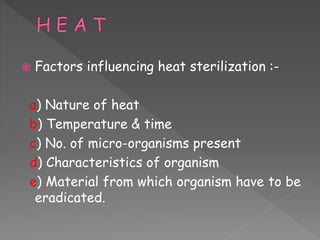
 Factors influencing heat sterilization :-
a) Nature of heat
b) Temperature & time
c) No. of micro-organisms present
d) Characteristics of organism
e) Material from which organism have to be
eradicated.
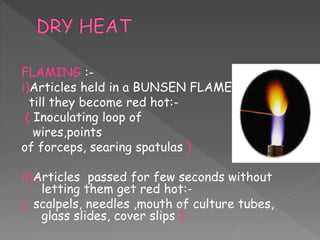
FLAMING :-
i)Articles held in a BUNSEN FLAME
till they become red hot:-
( Inoculating loop of
wires,points
of forceps, searing spatulas )
ii)Articles passed for few seconds without
letting them get red hot:-
( scalpels, needles ,mouth of culture tubes,
glass slides, cover slips )
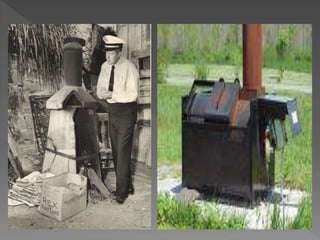
 Excellent method for destroying used
materials and disposal of waste.
 Contaminated material is sterilized and
burned in bulk at temp of 870-980˚c
 Articles sterilized:-
i) all surgical dressings
i i) used disposable syringes
iii) contaminated lab materials
iv) animal carcass
v) beddings and pathological materials
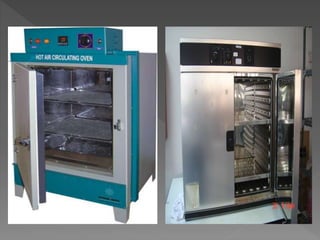
 Luise Pasteur – 1876
 Contains compartments which distributes
heat uniformly
 Usually heated by electricity with heating
elements in wall of the chamber
 Fitted with fan for even distribution of
air
 Load should be arranged in a manner to
allow free circulation of air in between
instruments
 Proper operation of HAO to be done
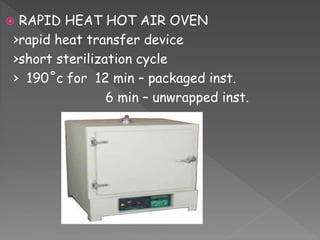
 RAPID HEAT HOT AIR OVEN
>rapid heat transfer device
>short sterilization cycle
> 190˚c for 12 min – packaged inst.
6 min – unwrapped inst.
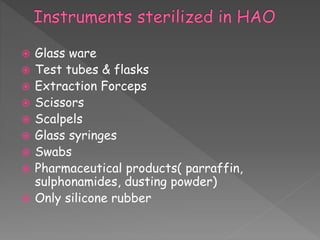
 Glass ware
 Test tubes & flasks
 Extraction Forceps
 Scissors
 Scalpels
 Glass syringes
 Swabs
 Pharmaceutical products( parraffin,
sulphonamides, dusting powder)
 Only silicone rubber
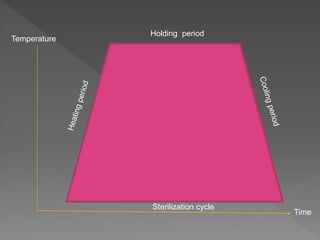
Holding period
Sterilization cycle
Time
Temperature
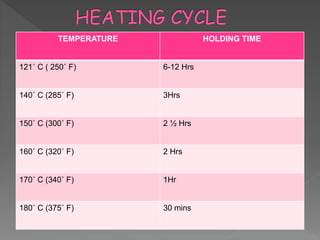
TEMPERATURE HOLDING TIME
121˚ C ( 250˚ F) 6-12 Hrs
140˚ C (285˚ F) 3Hrs
150˚ C (300˚ F) 2 ½ Hrs
160˚ C (320˚ F) 2 Hrs
170˚ C (340˚ F) 1Hr
180˚ C (375˚ F) 30 mins
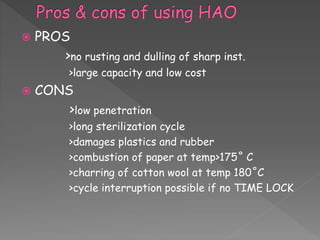
 PROS
>no rusting and dulling of sharp inst.
>large capacity and low cost
 CONS
>low penetration
>long sterilization cycle
>damages plastics and rubber
>combustion of paper at temp>175˚ C
>charring of cotton wool at temp 180˚C
>cycle interruption possible if no TIME LOCK
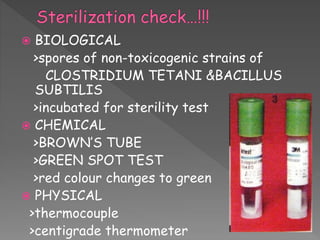
 BIOLOGICAL
>spores of non-toxicogenic strains of
CLOSTRIDIUM TETANI &BACILLUS
SUBTILIS
>incubated for sterility test
 CHEMICAL
>BROWN’S TUBE
>GREEN SPOT TEST
>red colour changes to green
 PHYSICAL
>thermocouple
>centigrade thermometer
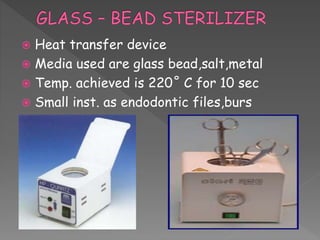
 Heat transfer device
 Media used are glass bead,salt,metal
 Temp. achieved is 220˚ C for 10 sec
 Small inst. as endodontic files,burs
 TEMPERATURE < 100˚ C
 TEMPERATURE AT 100˚ C
 TEMPERATURE > 100˚ C
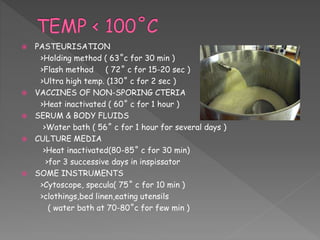
 PASTEURISATION
>Holding method ( 63˚c for 30 min )
>Flash method ( 72˚ c for 15-20 sec )
>Ultra high temp. (130˚ c for 2 sec )
 VACCINES OF NON-SPORING CTERIA
>Heat inactivated ( 60˚ c for 1 hour )
 SERUM & BODY FLUIDS
>Water bath ( 56˚ c for 1 hour for several days )
 CULTURE MEDIA
>Heat inactivated(80-85˚ c for 30 min)
>for 3 successive days in inspissator
 SOME INSTRUMENTS
>Cytoscope, specula( 75˚ c for 10 min )
>clothings,bed linen,eating utensils
( water bath at 70-80˚c for few min )
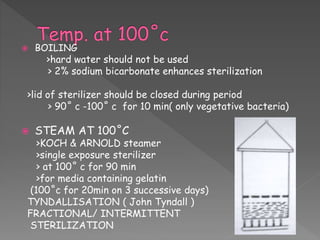
 BOILING
>hard water should not be used
> 2% sodium bicarbonate enhances sterilization
>lid of sterilizer should be closed during period
> 90˚ c -100˚ c for 10 min( only vegetative bacteria)
 STEAM AT 100˚C
>KOCH & ARNOLD steamer
>single exposure sterilizer
> at 100˚ c for 90 min
>for media containing gelatin
(100˚c for 20min on 3 successive days)
TYNDALLISATION ( John Tyndall )
FRACTIONAL/ INTERMITTENT
STERILIZATION
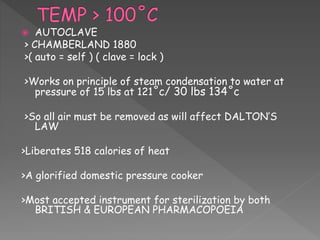
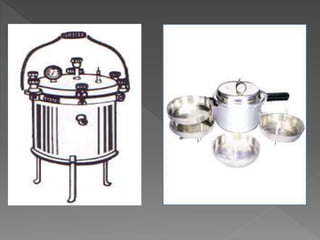
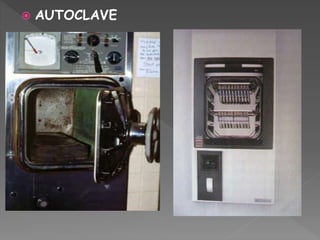
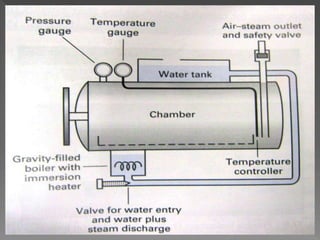
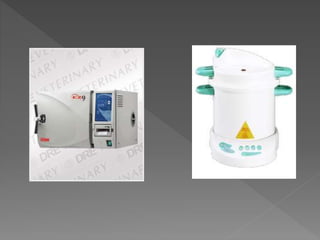
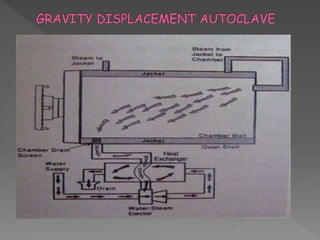
 AUTOCLAVE
> CHAMBERLAND 1880
>( auto = self ) ( clave = lock )
>Works on principle of steam condensation to water at
pressure of 15 lbs at 121˚c/ 30 lbs 134˚c
>So all air must be removed as will affect DALTON’S
LAW
>Liberates 518 calories of heat
>A glorified domestic pressure cooker
>Most accepted instrument for sterilization by both
BRITISH & EUROPEAN PHARMACOPOEIA
 AUTOCLAVE
 Surgical instruments
 Surgical dressings
 Liquids bearing high temp.
 Culture media(except those with gelatin)
 Rubber articles ( tubing , washer ,caps)
 Discarded media with growth
 Metallic syringes
 Waste disposal
 PROS
>most efficient and reliable
>simple to operate
>most dental inst. can be sterilized
>flexibility of packaging & loading
>inexpensive
 CONS
>non-stainless metals may get rusted
>Insufficient method of discharge of air
>load that retains moisture increases sterilization cycle
>non-provision for drying of load inside the autoclave
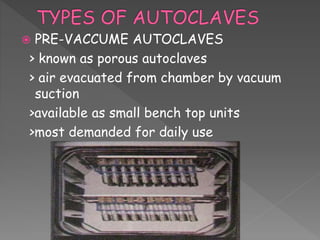
 PRE-VACCUME AUTOCLAVES
> known as porous autoclaves
> air evacuated from chamber by vacuum
suction
>available as small bench top units
>most demanded for daily use
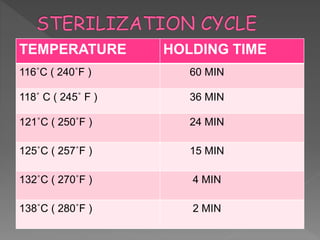
TEMPERATURE HOLDING TIME
116˚C ( 240˚F ) 60 MIN
118˚ C ( 245˚ F ) 36 MIN
121˚C ( 250˚F ) 24 MIN
125˚C ( 257˚F ) 15 MIN
132˚C ( 270˚F ) 4 MIN
138˚C ( 280˚F ) 2 MIN
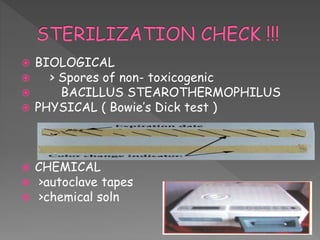
 BIOLOGICAL
 > Spores of non- toxicogenic
 BACILLUS STEAROTHERMOPHILUS
 PHYSICAL ( Bowie’s Dick test )
 CHEMICAL
 >autoclave tapes
 >chemical soln
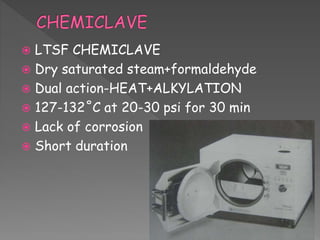
 LTSF CHEMICLAVE
 Dry saturated steam+formaldehyde
 Dual action-HEAT+ALKYLATION
 127-132˚C at 20-30 psi for 30 min
 Lack of corrosion
 Short duration
 Method for heat – labile liquids
 Useful for antibiotic solutions, culture
sensitive media, sera & carbohydrates
used in culture media( sugar & gelatin)
 Useful to separate organisms & study
them
 Bacteria free filtrates and
bacteriophages can be obtained
 Filter disc containg organisms can again be
cultured
 Serratia marcenses for sterilization check
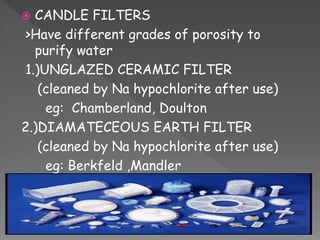
 CANDLE FILTERS
>Have different grades of porosity to
purify water
1.)UNGLAZED CERAMIC FILTER
(cleaned by Na hypochlorite after use)
eg: Chamberland, Doulton
2.)DIAMATECEOUS EARTH FILTER
(cleaned by Na hypochlorite after use)
eg: Berkfeld ,Mandler
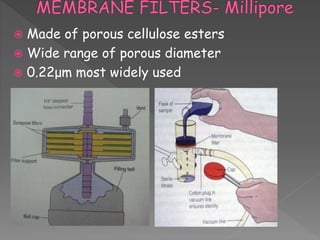
 Made of porous cellulose esters
 Wide range of porous diameter
 0.22μm most widely used
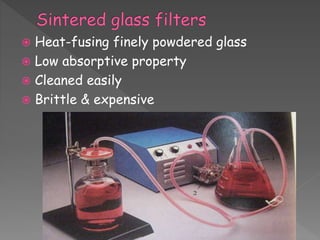
 Heat-fusing finely powdered glass
 Low absorptive property
 Cleaned easily
 Brittle & expensive
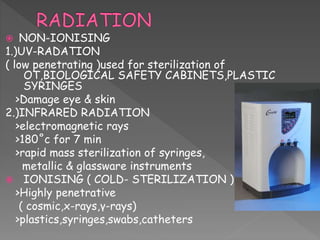
 NON-IONISING
1.)UV-RADATION
( low penetrating )used for sterilization of
OT,BIOLOGICAL SAFETY CABINETS,PLASTIC
SYRINGES
>Damage eye & skin
2.)INFRARED RADIATION
>electromagnetic rays
>180˚c for 7 min
>rapid mass sterilization of syringes,
metallic & glassware instruments
 IONISING ( COLD- STERILIZATION )
>Highly penetrative
( cosmic,x-rays,γ-rays)
>plastics,syringes,swabs,catheters
 Must have wide spectrum of activity
 Be active in presence of organic matter
 Be active in both acid & alkaline medium
 Speedy and high penetrating power
 Be stable and compatible with other
chemicals
 Should not corrode metals
 Should not be toxic, irritaing,sensitizing
 Be safe and easy to use
 Be cheap and easily available
 Protein coagulation
 Disruption of cell membrane
 Removal of free sulfhydryl group
 Substrate competition
 Fixation of cell membrane
 Oxydation
 Concentration of substance
 Time of action
 pH of medium
 Temperature
 Nature of organism
 Presence of extraneous material
 SPAULDING 1939- (60-70%) for 10 min
 Bactericidal and fungicidal
 Ethyl alcohol ( volatile & inflammable)
 Isopropyl alcohol is preferred
(clinical thermometer & other inst.)
 Methyl alcohol( cabinets,incubators)
 Corrosive to carbon steel,reacts with
rubber,hardens and swells plastic
 Dissolves cement holding inst.
 FORMALDEHYDE ( HCHO )
>Batericidal,fungicidal,sporicidal
>active against amino group of protien
USED TO STERILIZE
1. 10-40% to Preserve anatomic specimens
2. 3 % to Destroy spores of ANTHRAX in hair & wool
3. 10 % to Sterilize metallic inst. &heat sensitive
catheters,books,clothes,furnitures
DISADVANTAGES
1. Contact of 18-30 hours is necessary
2. Toxic up to an extent
3. Irritant to eyes and tooth
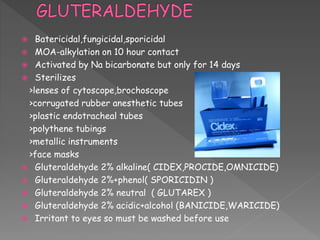
 Batericidal,fungicidal,sporicidal
 MOA-alkylation on 10 hour contact
 Activated by Na bicarbonate but only for 14 days
 Sterilizes
>lenses of cytoscope,brochoscope
>corrugated rubber anesthetic tubes
>plastic endotracheal tubes
>polythene tubings
>metallic instruments
>face masks
 Gluteraldehyde 2% alkaline( CIDEX,PROCIDE,OMNICIDE)
 Gluteraldehyde 2%+phenol( SPORICIDIN )
 Gluteraldehyde 2% neutral ( GLUTAREX )
 Gluteraldehyde 2% acidic+alcohol (BANICIDE,WARICIDE)
 Irritant to eyes so must be washed before use
 HALOGENS
A. IODINE :-
>(aqueous &alcoholic solutions)
>bactericidal,vericidal,sporicidal
>POVIDONE-IODINE (most common skin
disinfectant)
>Strong iodine 19% wt/vol of iodine
>weak iodine 2% wt/vol of iodine
>medium 12% wt/vol of iodine (BETADINE )
>Hand wash,skin prepration,sterilization of surgical
inst.
>IODOFORM(non-ionic,surface active)
>more active than iodine
>white-head warnish in DRY SOCKET,BONY DEFECTS
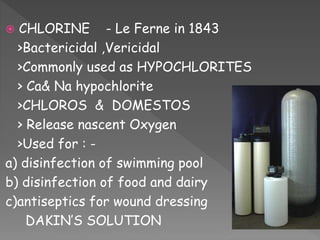
 CHLORINE - Le Ferne in 1843
>Bactericidal ,Vericidal
>Commonly used as HYPOCHLORITES
> Ca& Na hypochlorite
>CHLOROS & DOMESTOS
> Release nascent Oxygen
>Used for : -
a) disinfection of swimming pool
b) disinfection of food and dairy
c)antiseptics for wound dressing
DAKIN’S SOLUTION
 Salts of silver, copper, mercury
 Protein coagulant& sulfhydryl inhibittor
 Mercuric chloride is strong fungicide
 1% silver nitrate-DRY SOCKET
( reduces pain & induces granulation)
 PHENOL
>( LISTER-1865-carbolic acid )
>Cell membrane damage,bactericidal
>lysol &cresol more active at 3-10%
>not inactivated by organic matter
>chlorophenol&chloroxylophenol less toxic
>hexachlorophene potent but toxic
>Dettol( CHOLOROXYLENOL ) is potent & 100%
disinfectants
 CHLORHEXIDINE( bisguanide)
>against gm +ve and gm _ve,but not spore&fungi
>0.5% CHX+ 70% ALCOHOL( hibitane Skin disinfectant)
>CHX+ CETRIMIDE( cetavalon , savlon)
>4% CHX +DETERGENT(hibiscrub)
>0.2% SOLN or 1% GEL ( mouthwash)
 Potent skin and wound disinfectants bactericidal
 Impair DNA and destroy reproductive capacity
 Bacteriostatic & low bactericidal action
 ANILINE DYES
>brilliant green,malachite green,crystal violet
>more active for gm +ve than gm_ve
>selective agent in lowenstein jensen media no activity
agaist M.tuberculae
>inhibited by organic matter like pus
 ACRIDINE DYES
>Mainly against gm +ve
>slow release when impregnated in gauze
>proflavine,acryflavin,euflavin,aminacrine
 Alter energy relationship at interface and
reduce surface tension,damage cell
membrane.
 Wetting agents,detergents,emulsifiers
 Cationic(cetavelon,benzalkonium Cl )
 Anionic ( soaps )
saturated fatty acid-gm_ve
unsaturated fatty acid- gm+ve
 Amphoteric( TEGO )
both gm+ve and gm_ve
 ETHYLENE OXIDE
>colourless,highly
penetrative,inflammable,explosive
>sweet etherel smell &boiling point 10.7˚c
>alkylation of protein & affects DNA,RNA
>Unsuitable for fumigation as explosive
>irritant gas
>mixed with CO2 & N to reduce conc. Upto
10% so that less explosive
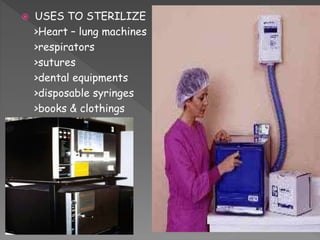
 USES TO STERILIZE
>Heart – lung machines
>respirators
>sutures
>dental equipments
>disposable syringes
>books & clothings
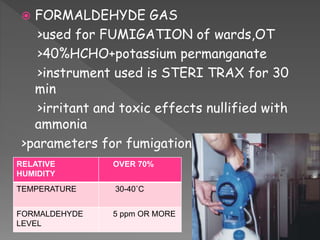
 FORMALDEHYDE GAS
>used for FUMIGATION of wards,OT
>40%HCHO+potassium permanganate
>instrument used is STERI TRAX for 30
min
>irritant and toxic effects nullified with
ammonia
>parameters for fumigation:
RELATIVE
HUMIDITY
OVER 70%
TEMPERATURE 30-40˚C
FORMALDEHYDE
LEVEL
5 ppm OR MORE
 HIV and hepatitis patients cannot be refused dental
or OMFS treatment.
 Universal barrier techniques are mandatory.
 Instruments must be both cleaned and sterilized
between patients.
 Environmental disinfection must be performed
 Infectious waste disposal must follow specific
guidelines.
 Training records in infection control must be kept
for each employee.
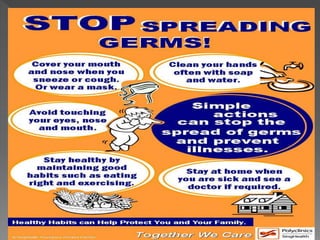
 Strictly followed code of hygiene will
greatly reduce cross infection
 Keep hands away from eyes, nose, mouth
and hair and avoid touching sores and
abrasions.
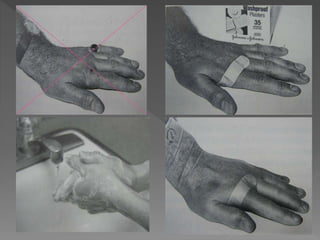
 Cover cuts and bruises on fingers with
dressings because they serve as easy
portals for pathogen.
 Personal hygiene of all the members
directly or indirectly in contact with
patient should be scrupulous.
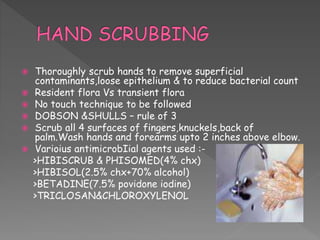
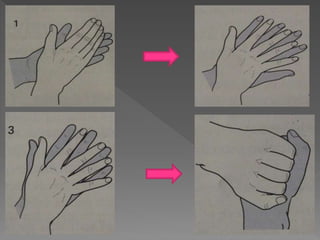
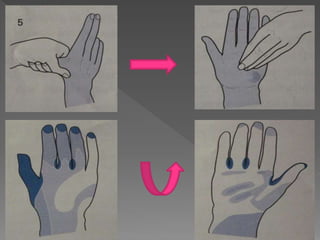
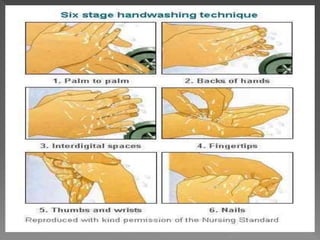
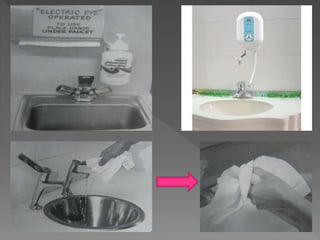
 Thoroughly scrub hands to remove superficial
contaminants,loose epithelium & to reduce bacterial count
 Resident flora Vs transient flora
 No touch technique to be followed
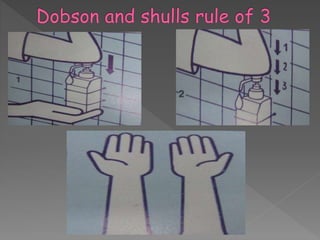
 DOBSON &SHULLS – rule of 3
 Scrub all 4 surfaces of fingers,knuckels,back of
palm.Wash hands and forearms upto 2 inches above elbow.
 Varioius antimicrobIial agents used :-
>HIBISCRUB & PHISOMED(4% chx)
>HIBISOL(2.5% chx+70% alcohol)
>BETADINE(7.5% povidone iodine)
>TRICLOSAN&CHLOROXYLENOL
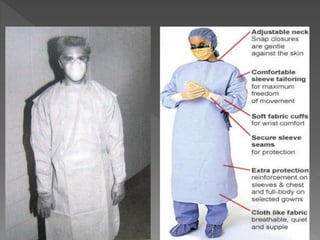
 Freshly laundried uniform to be worn daily
to protect from body fluids and aerosols
 High neck,long sleeved,knee length
overgarments to be worn
 Grossly contaminated dressing should be
dealt separately
 Clinic clothing should be worn in clinic
premises only
 Waterproof vinyl apron should be worn
when working in instrument cleaning area.
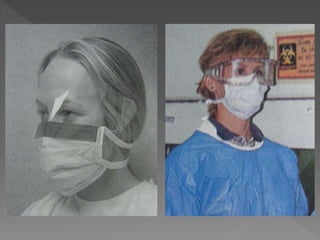
 To be compulsorily worn to protect from
aerosols and debris.
 Not to be touched with gloves once worn
 Preferably wear eye shield with side
protection.
 Filtration capacity of aerosols depends on
material used for face masks.
 Mask should have 95% filtration efficiency
for particles 3-5 μm in diameter
 Glass fibre and polypropylene masks are
superior to paper masks.
 Life span of mask is 30-60 mins.
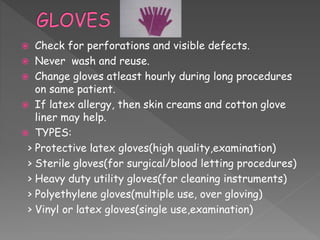
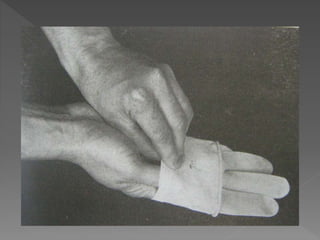
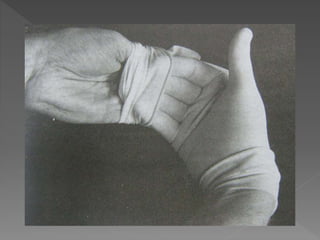
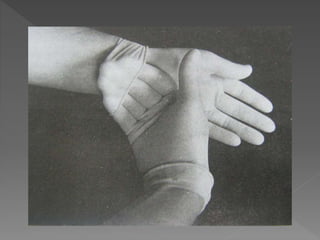
 Check for perforations and visible defects.
 Never wash and reuse.
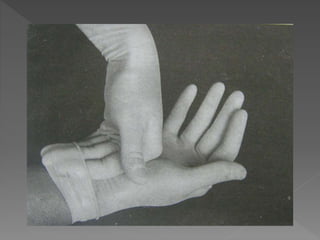
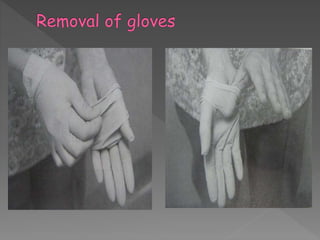
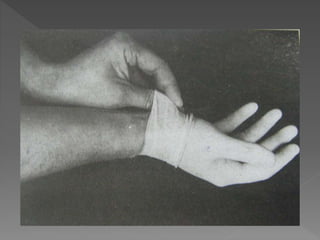
 Change gloves atleast hourly during long procedures
on same patient.
 If latex allergy, then skin creams and cotton glove
liner may help.
 TYPES:
> Protective latex gloves(high quality,examination)
> Sterile gloves(for surgical/blood letting procedures)
> Heavy duty utility gloves(for cleaning instruments)
> Polyethylene gloves(multiple use, over gloving)
> Vinyl or latex gloves(single use,examination)
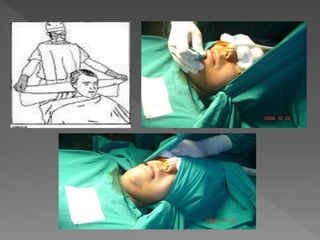
 Depends on type of surgery & anesthesia
 Purpose is to isolate surgical area from
other part of body & from non-sterile
operating room
 Pts head covered with double layer
drapes,enabels easy tiling of head
 Additional drapes are used to complete
isolation and secured with towel clips
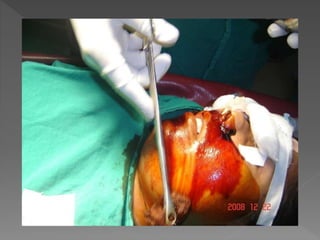
 To reduce pts own flora as well as
resistant bacteria acquired from hospital
 Extra-oral procedure is accompanied by
pre-surgical scrub,shaving of area
 Cirum-oral preparation precedes intraoral
preparation
 Iodophor ,cetrimide,betadine(extra-oral)
 Iodine,2% CHX ( intra-oral )
 Scrub begins at centre then to periphery
moving concentrically
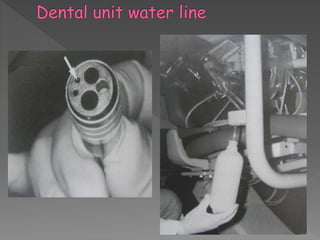
 Water supply from municipal corp.
 Bacteria tend to form BIOFILM
 Water entering DUWL has 0-100 CFU/ml
but till it exits from instrument 10,000
CFU/ml
 All DUWL to be flushed for 2 min before
treatment and 20-30 sec in b/w each pt
 Should never be used as irrigant in procedure
involving mucosal breach and bone exposure
 Use filters,biocides,chemicals ( CI,Clo2 )
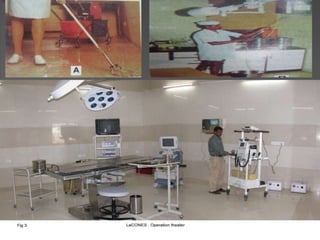
 Its merely a clean area,NOT STERILE
 Clear demarcation b/w contaminated and clear
zone
 Ceiling,floors,wall regularly disinfected
 No eating or smoking permitted
 Carpets not used to minimize dust
 Flooring to be disinfectant resistant vinyl
 Centrally controlled ventilation
 Special venting to scavenge noxious vapour
 Remove street clothes and acquire barrier
technique
“ Let the wastes
of the SICK
Not contaminate the…
Lives of the HEALTHY “
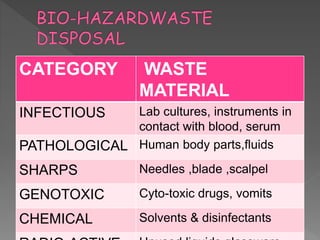
CATEGORY WASTE
MATERIAL
INFECTIOUS Lab cultures, instruments in
contact with blood, serum
PATHOLOGICAL Human body parts,fluids
SHARPS Needles ,blade ,scalpel
GENOTOXIC Cyto-toxic drugs, vomits
CHEMICAL Solvents & disinfectants
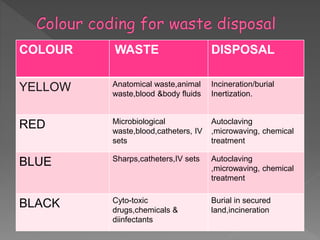
COLOUR WASTE DISPOSAL
YELLOW Anatomical waste,animal
waste,blood &body fluids
Incineration/burial
Inertization.
RED Microbiological
waste,blood,catheters, IV
sets
Autoclaving
,microwaving, chemical
treatment
BLUE Sharps,catheters,IV sets Autoclaving
,microwaving, chemical
treatment
BLACK Cyto-toxic
drugs,chemicals &
diinfectants
Burial in secured
land,incineration
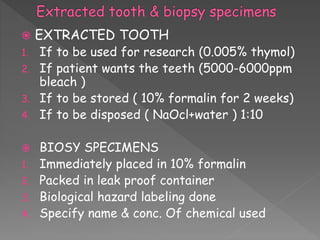
 EXTRACTED TOOTH
1. If to be used for research (0.005% thymol)
2. If patient wants the teeth (5000-6000ppm
bleach )
3. If to be stored ( 10% formalin for 2 weeks)
4. If to be disposed ( NaOcl+water ) 1:10
 BIOSY SPECIMENS
1. Immediately placed in 10% formalin
2. Packed in leak proof container
3. Biological hazard labeling done
4. Specify name & conc. Of chemical used
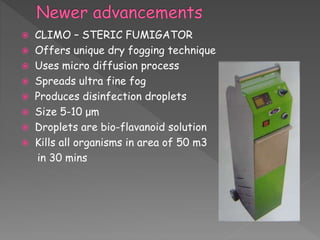
 CLIMO – STERIC FUMIGATOR
 Offers unique dry fogging technique
 Uses micro diffusion process
 Spreads ultra fine fog
 Produces disinfection droplets
 Size 5-10 μm
 Droplets are bio-flavanoid solution
 Kills all organisms in area of 50 m3
in 30 mins
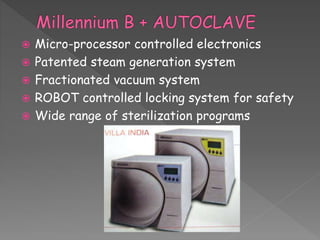
 Micro-processor controlled electronics
 Patented steam generation system
 Fractionated vacuum system
 ROBOT controlled locking system for safety
 Wide range of sterilization programs
Conclusion…
 Ananthnarayan & panicker
 Laxman samaranayake
 Nisengard &Newman
 Bailey & scott
 Peterson
 Archer
 Medical Micro-PLAYFAIR
 Medical Micro-PRESSCOTT
 Tortora & Shimeld
 Sherries microbiology
 Melnick & Jawetz
 Donald & connie
STERILIZATION & DISINFECTION.pptx

STERILIZATION & DISINFECTION.pptx

  • 2.
     INTRODUCTION  HISTORY CROSS- INFECTION  BACTERIAL AND VIRAL THREAT  STERLIZATION AND DISINFECTION definition, principles, methods  INFECTION CONTROL  OPERATING ROOM PROCEDURE  WASTE DISPOSAL  NEWER ADVANCEMENTS  CONCLUSION
  • 3.
    “were we butable to explain; the fiefdom of the microbes, why one man is his serf, another is his lord, when all are his domain” Anonymous
  • 4.
     BIBLE, RIGVEDA, QURAAN  2700 BC- Chinese medicine; infection control  800 BC- 400 AD : Sushrutha and charka Samhitha  MID 19TH CENTURY- an era of advancement  1832- WILLIAM HENRY ;heat sterilization by boiling water  1839- DAVIES; iodine for wound dressing  1843- LE FERNE; introduced chlorine water for disinfection
  • 5.
     1847- IGNATZSEMMELWESS  Introduced routine hand wash  Began using chlorinated lime  Pioneer of modern disinfection
  • 6.
     1867- JOSEPHLISTER  Introduced British surgery to hand washing  Introduced phenol as anti microbial agent for wound dressing  1883- American Surgical Associates approved Listerian technique  Beginning of a new era of infection control
  • 8.
     Organisms capableof causing cross infection may take a route- › Patient to patient › Patient to doctor › Doctor to patient  Principles of cross infection a) source b) mode c) route
  • 9.
     People withovert infection  People in prodromal stage  People who are healthy › Convalescent carriers › Asymptomatic carriers  Key point - Convalescent carriers can be identified by past history but asymptomatic carriers cant.
  • 10.
     Direct contact Inhalation  Injection/ inoculation  Ingestion  transplacental
  • 11.
     Direct contactof tissue with various secretions of body, blood may act as direct mode of transmission  Rare – least common mode of transmission  May occur due to improper practice by the doctor
  • 12.
     Droplet infectionair-borneinfection  Infective organisms –infectious aerosols  Size of aerosols dose matter  Droplets > 100um – SPATTER  Droplets < 100um – DROPLET NUCLEI  Droplet nuclei consist of dried salivary or serum secretions and organisms  VIRUS : Cytomegalo, influenza, rhino,adeno  BACTERIA: streptococcus pyogens
  • 14.
     Major routeof cross infection in oral surgery  Accidental penetration in skin or mucosa due to any sharp object or needles  Evidences depict that it is major cause of HIV and HBV transmission from patient to dentist and vice versa
  • 15.
     Ingestion (diarrhoealdiseases)  Trasplacental >T O R C H >Congenital syphilis >HIV acquired diseases
  • 16.
    BACTERIA ROUTE INCUBATION PERIOD M.tuberculosis Saliva; sputum 6 months S. aureus Saliva; exudate; skin 4-10 days S. pyogens Open wound; blood 1 -7 days T. pallidum Direct contact 1-10 weeks
  • 17.
    VIRUS ROUTE INCUBATION PERIOD HepatitisA& E FECO- ORAL 2-6 WEEKS Hepatitis B,C&D BLOOD,SALIVA SEMEN 6 WEEKS -6 MONTHS HIV/ ARC BLOOD,SEMEN,BOD Y SECRETIONS, TRANSPLACENTAL 10 YEAR or MORE Herpes simplex 1& 2 SALIVA,BODY SECRETIONS 2 WEEKS
  • 18.
    STERILIZATION : -Process by which an article, surface or medium is freed of all micro-organisms either in vegetative or spore state. DISINFECTION : - Destruction of all pathogenic organisms, or organisms capable of giving rise to infection.
  • 19.
    STERILITY : -Anabsolute state which depicts freedom from viable forms of micro-organisms. ANTISEPSIS :- Used to indicate the prevention of infection, usually by inhibition of growth of bacteria. ANTISEPTICS : - Chemical disinfectants which can be safely applied to skin or mucous membrane surfaces & are used to prevent infection by inhibition of growth of bacteria
  • 20.
    BACTERIOSTATIC : -Agents which only prevent multiplication of bacteria, which may however remain alive. BACTERICIDAL : - Agents which are able to kill the bacteria completely. FUNGICIDAL : - Agents which are able to kill the fungi completely VIRECIDAL : - Agents which are able to kill the virus completely
  • 22.
     All usedinstruments to be thoroughly cleaned.  Essential for sterilizing agent to be in contact with every surface of each item.  All sterilized instruments must be regularly serviced and maintained.  Appropriate test must be done to check temp., humidity, pressure.  Manufacturers instructions to be followed strictly.
  • 23.
     LAWRENCE &BLOCK - 1968  Separation of contaminated instruments and equipments from treatment area  Instruments should be cleaned scrupulously  Heavy duty utility gloves, eye glasses and face masks must be worn before cleaning manually i.e scrubbing  If immediate cleaning not feasible then instruments should be kept in disinfectant until cleaned  Critical , semi-critical ,non-critical
  • 24.
     ↑ cleaningefficiency  ↓ danger of aerosol infection  ↓ incidence of sharp injury  ↓ manual labour s  Uses soaps & detergents
  • 25.
     An opentray system sealed with see through sterilization bag .  Perforated trays with fitted corners wrapped with sterilization paper  Individual packaging in commercially available sterilization bags  Disposable items should be stored in covered plastics or containers
  • 27.
     Physical methods Chemical methods  Gaseous methods
  • 28.
     Sunlight  Drying Dry heat (flaming, hot air, incineration)  Moist heat > below 100˚C > at 100˚C > more than 100˚C  Filtration  Radiation  Sonic and ultra sonic
  • 29.
     Organic disinfectants:- alcohols, aldehydes  Inorganic disinfectants:- halogens, heavy metal salts  Coal Tar derivatives:- phenols, CHX  Dyes :- aniline or acridine  Surface acting agents
  • 30.
     Ethylene oxide Formaldehyde  β- propiolactone
  • 31.
     Appreciable bactericidaland germicidal.  Spontaneous sterilization due to combined effect of UV rays & heat  SEMPLE & GRIEG :- Killing of typhoid bacilli exposed to sun.  Bacteria suspended in water readily killed when exposed to sunlight.  Efficient method of purifying water in river and sea.
  • 32.
     4/5th ofweight of bacterial cell consists of water.  Moisture is essential for their growth.  Drying has deleterious effects on bacteria.  Unreliable method  Spores are unaffected by drying.
  • 33.
     Factors influencingheat sterilization :- a) Nature of heat b) Temperature & time c) No. of micro-organisms present d) Characteristics of organism e) Material from which organism have to be eradicated.
  • 34.
    FLAMING :- i)Articles heldin a BUNSEN FLAME till they become red hot:- ( Inoculating loop of wires,points of forceps, searing spatulas ) ii)Articles passed for few seconds without letting them get red hot:- ( scalpels, needles ,mouth of culture tubes, glass slides, cover slips )
  • 35.
     Excellent methodfor destroying used materials and disposal of waste.  Contaminated material is sterilized and burned in bulk at temp of 870-980˚c  Articles sterilized:- i) all surgical dressings i i) used disposable syringes iii) contaminated lab materials iv) animal carcass v) beddings and pathological materials
  • 37.
     Luise Pasteur– 1876  Contains compartments which distributes heat uniformly  Usually heated by electricity with heating elements in wall of the chamber  Fitted with fan for even distribution of air  Load should be arranged in a manner to allow free circulation of air in between instruments  Proper operation of HAO to be done
  • 39.
     RAPID HEATHOT AIR OVEN >rapid heat transfer device >short sterilization cycle > 190˚c for 12 min – packaged inst. 6 min – unwrapped inst.
  • 40.
     Glass ware Test tubes & flasks  Extraction Forceps  Scissors  Scalpels  Glass syringes  Swabs  Pharmaceutical products( parraffin, sulphonamides, dusting powder)  Only silicone rubber
  • 41.
  • 42.
    TEMPERATURE HOLDING TIME 121˚C ( 250˚ F) 6-12 Hrs 140˚ C (285˚ F) 3Hrs 150˚ C (300˚ F) 2 ½ Hrs 160˚ C (320˚ F) 2 Hrs 170˚ C (340˚ F) 1Hr 180˚ C (375˚ F) 30 mins
  • 43.
     PROS >no rustingand dulling of sharp inst. >large capacity and low cost  CONS >low penetration >long sterilization cycle >damages plastics and rubber >combustion of paper at temp>175˚ C >charring of cotton wool at temp 180˚C >cycle interruption possible if no TIME LOCK
  • 44.
     BIOLOGICAL >spores ofnon-toxicogenic strains of CLOSTRIDIUM TETANI &BACILLUS SUBTILIS >incubated for sterility test  CHEMICAL >BROWN’S TUBE >GREEN SPOT TEST >red colour changes to green  PHYSICAL >thermocouple >centigrade thermometer
  • 45.
     Heat transferdevice  Media used are glass bead,salt,metal  Temp. achieved is 220˚ C for 10 sec  Small inst. as endodontic files,burs
  • 46.
     TEMPERATURE <100˚ C  TEMPERATURE AT 100˚ C  TEMPERATURE > 100˚ C
  • 47.
     PASTEURISATION >Holding method( 63˚c for 30 min ) >Flash method ( 72˚ c for 15-20 sec ) >Ultra high temp. (130˚ c for 2 sec )  VACCINES OF NON-SPORING CTERIA >Heat inactivated ( 60˚ c for 1 hour )  SERUM & BODY FLUIDS >Water bath ( 56˚ c for 1 hour for several days )  CULTURE MEDIA >Heat inactivated(80-85˚ c for 30 min) >for 3 successive days in inspissator  SOME INSTRUMENTS >Cytoscope, specula( 75˚ c for 10 min ) >clothings,bed linen,eating utensils ( water bath at 70-80˚c for few min )
  • 48.
     BOILING >hard watershould not be used > 2% sodium bicarbonate enhances sterilization >lid of sterilizer should be closed during period > 90˚ c -100˚ c for 10 min( only vegetative bacteria)  STEAM AT 100˚C >KOCH & ARNOLD steamer >single exposure sterilizer > at 100˚ c for 90 min >for media containing gelatin (100˚c for 20min on 3 successive days) TYNDALLISATION ( John Tyndall ) FRACTIONAL/ INTERMITTENT STERILIZATION
  • 49.
     AUTOCLAVE > CHAMBERLAND1880 >( auto = self ) ( clave = lock ) >Works on principle of steam condensation to water at pressure of 15 lbs at 121˚c/ 30 lbs 134˚c >So all air must be removed as will affect DALTON’S LAW >Liberates 518 calories of heat >A glorified domestic pressure cooker >Most accepted instrument for sterilization by both BRITISH & EUROPEAN PHARMACOPOEIA
  • 51.
  • 53.
     Surgical instruments Surgical dressings  Liquids bearing high temp.  Culture media(except those with gelatin)  Rubber articles ( tubing , washer ,caps)  Discarded media with growth  Metallic syringes  Waste disposal
  • 54.
     PROS >most efficientand reliable >simple to operate >most dental inst. can be sterilized >flexibility of packaging & loading >inexpensive  CONS >non-stainless metals may get rusted >Insufficient method of discharge of air >load that retains moisture increases sterilization cycle >non-provision for drying of load inside the autoclave
  • 55.
     PRE-VACCUME AUTOCLAVES >known as porous autoclaves > air evacuated from chamber by vacuum suction >available as small bench top units >most demanded for daily use
  • 58.
    TEMPERATURE HOLDING TIME 116˚C( 240˚F ) 60 MIN 118˚ C ( 245˚ F ) 36 MIN 121˚C ( 250˚F ) 24 MIN 125˚C ( 257˚F ) 15 MIN 132˚C ( 270˚F ) 4 MIN 138˚C ( 280˚F ) 2 MIN
  • 59.
     BIOLOGICAL  >Spores of non- toxicogenic  BACILLUS STEAROTHERMOPHILUS  PHYSICAL ( Bowie’s Dick test )  CHEMICAL  >autoclave tapes  >chemical soln
  • 60.
     LTSF CHEMICLAVE Dry saturated steam+formaldehyde  Dual action-HEAT+ALKYLATION  127-132˚C at 20-30 psi for 30 min  Lack of corrosion  Short duration
  • 61.
     Method forheat – labile liquids  Useful for antibiotic solutions, culture sensitive media, sera & carbohydrates used in culture media( sugar & gelatin)  Useful to separate organisms & study them  Bacteria free filtrates and bacteriophages can be obtained  Filter disc containg organisms can again be cultured  Serratia marcenses for sterilization check
  • 62.
     CANDLE FILTERS >Havedifferent grades of porosity to purify water 1.)UNGLAZED CERAMIC FILTER (cleaned by Na hypochlorite after use) eg: Chamberland, Doulton 2.)DIAMATECEOUS EARTH FILTER (cleaned by Na hypochlorite after use) eg: Berkfeld ,Mandler
  • 63.
     Made ofporous cellulose esters  Wide range of porous diameter  0.22μm most widely used
  • 64.
     Heat-fusing finelypowdered glass  Low absorptive property  Cleaned easily  Brittle & expensive
  • 65.
     NON-IONISING 1.)UV-RADATION ( lowpenetrating )used for sterilization of OT,BIOLOGICAL SAFETY CABINETS,PLASTIC SYRINGES >Damage eye & skin 2.)INFRARED RADIATION >electromagnetic rays >180˚c for 7 min >rapid mass sterilization of syringes, metallic & glassware instruments  IONISING ( COLD- STERILIZATION ) >Highly penetrative ( cosmic,x-rays,γ-rays) >plastics,syringes,swabs,catheters
  • 66.
     Must havewide spectrum of activity  Be active in presence of organic matter  Be active in both acid & alkaline medium  Speedy and high penetrating power  Be stable and compatible with other chemicals  Should not corrode metals  Should not be toxic, irritaing,sensitizing  Be safe and easy to use  Be cheap and easily available
  • 67.
     Protein coagulation Disruption of cell membrane  Removal of free sulfhydryl group  Substrate competition  Fixation of cell membrane  Oxydation
  • 68.
     Concentration ofsubstance  Time of action  pH of medium  Temperature  Nature of organism  Presence of extraneous material
  • 69.
     SPAULDING 1939-(60-70%) for 10 min  Bactericidal and fungicidal  Ethyl alcohol ( volatile & inflammable)  Isopropyl alcohol is preferred (clinical thermometer & other inst.)  Methyl alcohol( cabinets,incubators)  Corrosive to carbon steel,reacts with rubber,hardens and swells plastic  Dissolves cement holding inst.
  • 70.
     FORMALDEHYDE (HCHO ) >Batericidal,fungicidal,sporicidal >active against amino group of protien USED TO STERILIZE 1. 10-40% to Preserve anatomic specimens 2. 3 % to Destroy spores of ANTHRAX in hair & wool 3. 10 % to Sterilize metallic inst. &heat sensitive catheters,books,clothes,furnitures DISADVANTAGES 1. Contact of 18-30 hours is necessary 2. Toxic up to an extent 3. Irritant to eyes and tooth
  • 71.
     Batericidal,fungicidal,sporicidal  MOA-alkylationon 10 hour contact  Activated by Na bicarbonate but only for 14 days  Sterilizes >lenses of cytoscope,brochoscope >corrugated rubber anesthetic tubes >plastic endotracheal tubes >polythene tubings >metallic instruments >face masks  Gluteraldehyde 2% alkaline( CIDEX,PROCIDE,OMNICIDE)  Gluteraldehyde 2%+phenol( SPORICIDIN )  Gluteraldehyde 2% neutral ( GLUTAREX )  Gluteraldehyde 2% acidic+alcohol (BANICIDE,WARICIDE)  Irritant to eyes so must be washed before use
  • 72.
     HALOGENS A. IODINE:- >(aqueous &alcoholic solutions) >bactericidal,vericidal,sporicidal >POVIDONE-IODINE (most common skin disinfectant) >Strong iodine 19% wt/vol of iodine >weak iodine 2% wt/vol of iodine >medium 12% wt/vol of iodine (BETADINE ) >Hand wash,skin prepration,sterilization of surgical inst. >IODOFORM(non-ionic,surface active) >more active than iodine >white-head warnish in DRY SOCKET,BONY DEFECTS
  • 73.
     CHLORINE -Le Ferne in 1843 >Bactericidal ,Vericidal >Commonly used as HYPOCHLORITES > Ca& Na hypochlorite >CHLOROS & DOMESTOS > Release nascent Oxygen >Used for : - a) disinfection of swimming pool b) disinfection of food and dairy c)antiseptics for wound dressing DAKIN’S SOLUTION
  • 74.
     Salts ofsilver, copper, mercury  Protein coagulant& sulfhydryl inhibittor  Mercuric chloride is strong fungicide  1% silver nitrate-DRY SOCKET ( reduces pain & induces granulation)
  • 75.
     PHENOL >( LISTER-1865-carbolicacid ) >Cell membrane damage,bactericidal >lysol &cresol more active at 3-10% >not inactivated by organic matter >chlorophenol&chloroxylophenol less toxic >hexachlorophene potent but toxic >Dettol( CHOLOROXYLENOL ) is potent & 100% disinfectants  CHLORHEXIDINE( bisguanide) >against gm +ve and gm _ve,but not spore&fungi >0.5% CHX+ 70% ALCOHOL( hibitane Skin disinfectant) >CHX+ CETRIMIDE( cetavalon , savlon) >4% CHX +DETERGENT(hibiscrub) >0.2% SOLN or 1% GEL ( mouthwash)
  • 77.
     Potent skinand wound disinfectants bactericidal  Impair DNA and destroy reproductive capacity  Bacteriostatic & low bactericidal action  ANILINE DYES >brilliant green,malachite green,crystal violet >more active for gm +ve than gm_ve >selective agent in lowenstein jensen media no activity agaist M.tuberculae >inhibited by organic matter like pus  ACRIDINE DYES >Mainly against gm +ve >slow release when impregnated in gauze >proflavine,acryflavin,euflavin,aminacrine
  • 78.
     Alter energyrelationship at interface and reduce surface tension,damage cell membrane.  Wetting agents,detergents,emulsifiers  Cationic(cetavelon,benzalkonium Cl )  Anionic ( soaps ) saturated fatty acid-gm_ve unsaturated fatty acid- gm+ve  Amphoteric( TEGO ) both gm+ve and gm_ve
  • 79.
     ETHYLENE OXIDE >colourless,highly penetrative,inflammable,explosive >sweetetherel smell &boiling point 10.7˚c >alkylation of protein & affects DNA,RNA >Unsuitable for fumigation as explosive >irritant gas >mixed with CO2 & N to reduce conc. Upto 10% so that less explosive
  • 80.
     USES TOSTERILIZE >Heart – lung machines >respirators >sutures >dental equipments >disposable syringes >books & clothings
  • 81.
     FORMALDEHYDE GAS >usedfor FUMIGATION of wards,OT >40%HCHO+potassium permanganate >instrument used is STERI TRAX for 30 min >irritant and toxic effects nullified with ammonia >parameters for fumigation: RELATIVE HUMIDITY OVER 70% TEMPERATURE 30-40˚C FORMALDEHYDE LEVEL 5 ppm OR MORE
  • 82.
     HIV andhepatitis patients cannot be refused dental or OMFS treatment.  Universal barrier techniques are mandatory.  Instruments must be both cleaned and sterilized between patients.  Environmental disinfection must be performed  Infectious waste disposal must follow specific guidelines.  Training records in infection control must be kept for each employee.
  • 84.
     Strictly followedcode of hygiene will greatly reduce cross infection  Keep hands away from eyes, nose, mouth and hair and avoid touching sores and abrasions.  Cover cuts and bruises on fingers with dressings because they serve as easy portals for pathogen.  Personal hygiene of all the members directly or indirectly in contact with patient should be scrupulous.
  • 85.
     Thoroughly scrubhands to remove superficial contaminants,loose epithelium & to reduce bacterial count  Resident flora Vs transient flora  No touch technique to be followed  DOBSON &SHULLS – rule of 3  Scrub all 4 surfaces of fingers,knuckels,back of palm.Wash hands and forearms upto 2 inches above elbow.  Varioius antimicrobIial agents used :- >HIBISCRUB & PHISOMED(4% chx) >HIBISOL(2.5% chx+70% alcohol) >BETADINE(7.5% povidone iodine) >TRICLOSAN&CHLOROXYLENOL
  • 92.
     Freshly laundrieduniform to be worn daily to protect from body fluids and aerosols  High neck,long sleeved,knee length overgarments to be worn  Grossly contaminated dressing should be dealt separately  Clinic clothing should be worn in clinic premises only  Waterproof vinyl apron should be worn when working in instrument cleaning area.
  • 94.
     To becompulsorily worn to protect from aerosols and debris.  Not to be touched with gloves once worn  Preferably wear eye shield with side protection.  Filtration capacity of aerosols depends on material used for face masks.  Mask should have 95% filtration efficiency for particles 3-5 μm in diameter  Glass fibre and polypropylene masks are superior to paper masks.  Life span of mask is 30-60 mins.
  • 96.
     Check forperforations and visible defects.  Never wash and reuse.  Change gloves atleast hourly during long procedures on same patient.  If latex allergy, then skin creams and cotton glove liner may help.  TYPES: > Protective latex gloves(high quality,examination) > Sterile gloves(for surgical/blood letting procedures) > Heavy duty utility gloves(for cleaning instruments) > Polyethylene gloves(multiple use, over gloving) > Vinyl or latex gloves(single use,examination)
  • 103.
     Depends ontype of surgery & anesthesia  Purpose is to isolate surgical area from other part of body & from non-sterile operating room  Pts head covered with double layer drapes,enabels easy tiling of head  Additional drapes are used to complete isolation and secured with towel clips
  • 105.
     To reducepts own flora as well as resistant bacteria acquired from hospital  Extra-oral procedure is accompanied by pre-surgical scrub,shaving of area  Cirum-oral preparation precedes intraoral preparation  Iodophor ,cetrimide,betadine(extra-oral)  Iodine,2% CHX ( intra-oral )  Scrub begins at centre then to periphery moving concentrically
  • 107.
     Water supplyfrom municipal corp.  Bacteria tend to form BIOFILM  Water entering DUWL has 0-100 CFU/ml but till it exits from instrument 10,000 CFU/ml  All DUWL to be flushed for 2 min before treatment and 20-30 sec in b/w each pt  Should never be used as irrigant in procedure involving mucosal breach and bone exposure  Use filters,biocides,chemicals ( CI,Clo2 )
  • 109.
     Its merelya clean area,NOT STERILE  Clear demarcation b/w contaminated and clear zone  Ceiling,floors,wall regularly disinfected  No eating or smoking permitted  Carpets not used to minimize dust  Flooring to be disinfectant resistant vinyl  Centrally controlled ventilation  Special venting to scavenge noxious vapour  Remove street clothes and acquire barrier technique
  • 111.
    “ Let thewastes of the SICK Not contaminate the… Lives of the HEALTHY “
  • 112.
    CATEGORY WASTE MATERIAL INFECTIOUS Labcultures, instruments in contact with blood, serum PATHOLOGICAL Human body parts,fluids SHARPS Needles ,blade ,scalpel GENOTOXIC Cyto-toxic drugs, vomits CHEMICAL Solvents & disinfectants
  • 114.
    COLOUR WASTE DISPOSAL YELLOWAnatomical waste,animal waste,blood &body fluids Incineration/burial Inertization. RED Microbiological waste,blood,catheters, IV sets Autoclaving ,microwaving, chemical treatment BLUE Sharps,catheters,IV sets Autoclaving ,microwaving, chemical treatment BLACK Cyto-toxic drugs,chemicals & diinfectants Burial in secured land,incineration
  • 115.
     EXTRACTED TOOTH 1.If to be used for research (0.005% thymol) 2. If patient wants the teeth (5000-6000ppm bleach ) 3. If to be stored ( 10% formalin for 2 weeks) 4. If to be disposed ( NaOcl+water ) 1:10  BIOSY SPECIMENS 1. Immediately placed in 10% formalin 2. Packed in leak proof container 3. Biological hazard labeling done 4. Specify name & conc. Of chemical used
  • 116.
     CLIMO –STERIC FUMIGATOR  Offers unique dry fogging technique  Uses micro diffusion process  Spreads ultra fine fog  Produces disinfection droplets  Size 5-10 μm  Droplets are bio-flavanoid solution  Kills all organisms in area of 50 m3 in 30 mins
  • 117.
     Micro-processor controlledelectronics  Patented steam generation system  Fractionated vacuum system  ROBOT controlled locking system for safety  Wide range of sterilization programs
  • 118.
  • 119.
     Ananthnarayan &panicker  Laxman samaranayake  Nisengard &Newman  Bailey & scott  Peterson  Archer  Medical Micro-PLAYFAIR  Medical Micro-PRESSCOTT  Tortora & Shimeld  Sherries microbiology  Melnick & Jawetz  Donald & connie