Why not a real-time modeling system for
education over the UK?
“All models are wrong,
but some are useful.”
Instead of just teaching them meteorology,
the students would learn how environmental
prediction models work and the extent to which
they could be trusted.
Instead of just teaching them meteorology,
the students would learn how environmental
prediction models work and the extent to which
they could be trusted.
Goal: Transform EART30551.
The Evolution of
EART30551 Meteorology
eLearning Tools and Career Preparation
Prof. David Schultz
School of Earth, Atmospheric and Environmental Sciences
Jonathan Fairman, Stuart Anderson, Douglas Lowe,
Elsa Lee, Ryo Seo-Zindy, Gordon McFiggans
2010:
Five tests 60%
Literature review 30%
Forecast contest 10%
Teaching focused on basic
meteorology concepts
2010:
Five tests 60%
Literature review 30%
Forecast contest 10%
Teaching focused on basic
meteorology concepts
Funded and developed by eLearning
2010 left me unsatisfied.
Lectures designed for non-science majors
Quality of essays was disappointing
Students didn’t see benefit of contest
Weekly weather discussions linked forecast
contest and lecture content, but not well.
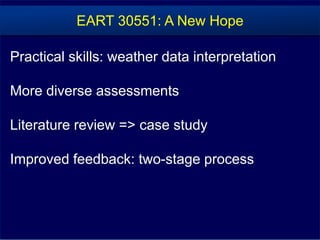
EART 30551: A New Hope
Practical skills: weather data interpretation
More diverse assessments
Literature review => case study
Improved feedback: two-stage process
EART 30551: A New Hope
Practical skills: weather data interpretation
More diverse assessments
Literature review => case study
Improved feedback: two-stage process
N Emphasis on environmental prediction N
EART 30551: A New Hope
Practical skills: weather data interpretation
More diverse assessments
Literature review => case study
Improved feedback: two-stage process
N Emphasis on environmental prediction N
We needed access to computer forecasts.
1. To develop critical thinking and higher order conceptual
reasoning and analytical skills
2. To promote mastery of a discipline
3. To broaden intellectual and cultural interests
4. To prepare graduates for professional and vocational
work
5. To challenge and equip students to confront personal
values and make ethical judgements
6. To prepare graduates for citizenship and leadership in
diverse, global environments
7. To develop advanced skills of written and verbal
communication
8. To promote equality and diversity.
A better fit with the Manchester Matrix
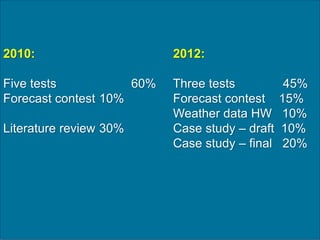
2010:
Five tests 60%
Forecast contest 10%
Literature review 30%
2012:
Three tests 45%
Forecast contest 15%
Weather data HW 10%
Case study – draft 10%
Case study – final 20%
How Did He Do It?
Why not a real-time modeling system for
education over the UK?
Funded by HEA GEES Subject Centre and
Faculty eLearning Team at Manchester
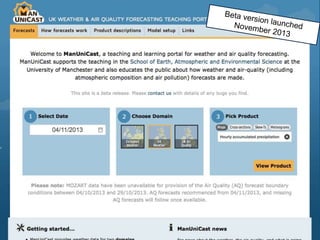
Educational web site developed within the
School of Earth, Atmospheric and Environmental
Sciences
WRF-ARW
Europe and
N Atlantic
20-km horizontal grid spacing
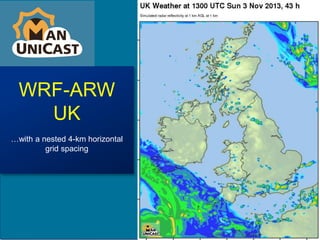
WRF-ARW
UK
…with a nested 4-km horizontal
grid spacing
WRF-Chem
UK
12-km horizontal grid spacing
North–South
cross section
Skew-T–logp
Cranfield
Meteogram
Chilbolton Observatory
Locations of
Skew-T–logp
diagrams
and meteograms
Educational Uses of
ManUniCast
Illustrate lecture concepts
Weather discussions
Meteorological case studies
Forecast contest
Homework assignment:
Verify model output against
observations
Educational Uses of
ManUniCast
Illustrate lecture concepts
Homework assignment:
Verify model output against
observations
Weather discussions
Meteorological case studies
Forecast contest
Future Developments for
ManUniCast
Educational description of how
forecasting is done (aimed at
students and general public)
Exercises for classroom use
New quantities added (e.g.,
simulated satellite imagery)
78-h forecast
Ability to overlay rivers, railways,
and roadways
ManUniCast
iPhone and iPad App
Funded by
Learning Through Research and
Teaching Excellence Award
Coming July 2014
Build Your Own Earth:
A Climate and Paleoclimate Tool for Teaching and Research
Prof. David M. Schultz
Centre for Atmospheric Science
School of Earth and Environmental Sciences
University of Manchester
Where do these predictions come from?
Climate models.
Where do these predictions come from?
Climate models.
Do students get access to these?
No.
Goals:
Expose students to climate models
and climate-model output
See how changes in the Earth system
lead to changes in Earth’s climate
The Vision
buildyourownearth.com
Built in collaboration with
Jonathan Fairman
Centre for Atmospheric Science
Stuart Anderson and Sharon Gardner
EPS eLearning Team
buildyourownearth.com
How is BYOE used for teaching?
What do the students think?
Four iterations of the assignment.
June 2015: Two cohorts of MOOC students
(19 multiple choice)
Autumn 2015: Planet Earth students
(26 mostly multiple choice)
Autumn 2016: Planet Earth students
(variety of 26 questions, too tedious and long)
Autumn 2017: Planet Earth students
(variety of 20 questions)
“The BYOE made you think for yourself and explain your
reasoning, showing innovation and meaning the answers were
not just on the internet. .... This was a very good assignment
because it made people think for themselves and make their
own hypotheses and assumptions. Plus, the last question is
really what I want to be asked at University. I want to write
innovatively and not just the right answer in a textbook.”
What students in the MOOC think
“This is the first time in over 50 years that I’ve even looked
at Earth Science. I’m literally “blown away” by the power
of the simulation for gaining an understanding of how the
earth works now and in the past. I’m hooked!”
What students in Planet Earth think
“Already knew quite a lot about climate from A-level but the
BYOE assignment was good at applying my knowledge
and thinking beyond what I had been taught.”
“Helped me understand the processes on Earth better
because some research had to be done.”
“The assignment put interacting elements of the climate
into better context for me.”
Teaching and research opportunities
- courses
- dissertations
- summer student projects
- research projects
David.Schultz@manchester.ac.uk

Atmospheric Modeller

  • 1.
    Why not areal-time modeling system for education over the UK? “All models are wrong, but some are useful.”
  • 2.
    Instead of justteaching them meteorology, the students would learn how environmental prediction models work and the extent to which they could be trusted.
  • 3.
    Instead of justteaching them meteorology, the students would learn how environmental prediction models work and the extent to which they could be trusted. Goal: Transform EART30551.
  • 4.
    The Evolution of EART30551Meteorology eLearning Tools and Career Preparation Prof. David Schultz School of Earth, Atmospheric and Environmental Sciences Jonathan Fairman, Stuart Anderson, Douglas Lowe, Elsa Lee, Ryo Seo-Zindy, Gordon McFiggans
  • 5.
    2010: Five tests 60% Literaturereview 30% Forecast contest 10% Teaching focused on basic meteorology concepts
  • 6.
    2010: Five tests 60% Literaturereview 30% Forecast contest 10% Teaching focused on basic meteorology concepts Funded and developed by eLearning
  • 7.
    2010 left meunsatisfied. Lectures designed for non-science majors Quality of essays was disappointing Students didn’t see benefit of contest Weekly weather discussions linked forecast contest and lecture content, but not well.
  • 8.
    EART 30551: ANew Hope Practical skills: weather data interpretation More diverse assessments Literature review => case study Improved feedback: two-stage process
  • 9.
    EART 30551: ANew Hope Practical skills: weather data interpretation More diverse assessments Literature review => case study Improved feedback: two-stage process N Emphasis on environmental prediction N
  • 10.
    EART 30551: ANew Hope Practical skills: weather data interpretation More diverse assessments Literature review => case study Improved feedback: two-stage process N Emphasis on environmental prediction N We needed access to computer forecasts.
  • 11.
    1. To developcritical thinking and higher order conceptual reasoning and analytical skills 2. To promote mastery of a discipline 3. To broaden intellectual and cultural interests 4. To prepare graduates for professional and vocational work 5. To challenge and equip students to confront personal values and make ethical judgements 6. To prepare graduates for citizenship and leadership in diverse, global environments 7. To develop advanced skills of written and verbal communication 8. To promote equality and diversity. A better fit with the Manchester Matrix
  • 12.
    2010: Five tests 60% Forecastcontest 10% Literature review 30% 2012: Three tests 45% Forecast contest 15% Weather data HW 10% Case study – draft 10% Case study – final 20%
  • 13.
    How Did HeDo It?
  • 14.
    Why not areal-time modeling system for education over the UK?
  • 15.
    Funded by HEAGEES Subject Centre and Faculty eLearning Team at Manchester
  • 17.
    Educational web sitedeveloped within the School of Earth, Atmospheric and Environmental Sciences
  • 18.
    WRF-ARW Europe and N Atlantic 20-kmhorizontal grid spacing
  • 19.
    WRF-ARW UK …with a nested4-km horizontal grid spacing
  • 20.
  • 21.
  • 22.
  • 23.
  • 24.
  • 25.
    Educational Uses of ManUniCast Illustratelecture concepts Weather discussions Meteorological case studies Forecast contest Homework assignment: Verify model output against observations
  • 26.
    Educational Uses of ManUniCast Illustratelecture concepts Homework assignment: Verify model output against observations Weather discussions Meteorological case studies Forecast contest
  • 27.
    Future Developments for ManUniCast Educationaldescription of how forecasting is done (aimed at students and general public) Exercises for classroom use New quantities added (e.g., simulated satellite imagery) 78-h forecast Ability to overlay rivers, railways, and roadways
  • 28.
    ManUniCast iPhone and iPadApp Funded by Learning Through Research and Teaching Excellence Award Coming July 2014
  • 30.
    Build Your OwnEarth: A Climate and Paleoclimate Tool for Teaching and Research Prof. David M. Schultz Centre for Atmospheric Science School of Earth and Environmental Sciences University of Manchester
  • 32.
    Where do thesepredictions come from? Climate models.
  • 33.
    Where do thesepredictions come from? Climate models. Do students get access to these? No.
  • 34.
    Goals: Expose students toclimate models and climate-model output See how changes in the Earth system lead to changes in Earth’s climate
  • 35.
  • 46.
    buildyourownearth.com Built in collaborationwith Jonathan Fairman Centre for Atmospheric Science Stuart Anderson and Sharon Gardner EPS eLearning Team
  • 47.
  • 53.
    How is BYOEused for teaching? What do the students think?
  • 55.
    Four iterations ofthe assignment. June 2015: Two cohorts of MOOC students (19 multiple choice) Autumn 2015: Planet Earth students (26 mostly multiple choice) Autumn 2016: Planet Earth students (variety of 26 questions, too tedious and long) Autumn 2017: Planet Earth students (variety of 20 questions)
  • 57.
    “The BYOE madeyou think for yourself and explain your reasoning, showing innovation and meaning the answers were not just on the internet. .... This was a very good assignment because it made people think for themselves and make their own hypotheses and assumptions. Plus, the last question is really what I want to be asked at University. I want to write innovatively and not just the right answer in a textbook.”
  • 59.
    What students inthe MOOC think “This is the first time in over 50 years that I’ve even looked at Earth Science. I’m literally “blown away” by the power of the simulation for gaining an understanding of how the earth works now and in the past. I’m hooked!”
  • 61.
    What students inPlanet Earth think “Already knew quite a lot about climate from A-level but the BYOE assignment was good at applying my knowledge and thinking beyond what I had been taught.” “Helped me understand the processes on Earth better because some research had to be done.” “The assignment put interacting elements of the climate into better context for me.”
  • 63.
    Teaching and researchopportunities - courses - dissertations - summer student projects - research projects David.Schultz@manchester.ac.uk