Digital
Storytelling
Eric Unger
Digital Storytelling
 Definition-relatively new term which
describes the new practice of ordinary
people who use digital tools to tell their
'story‘. This form o form of media may be
presented through full-motion video with
sound, animation, stills, audio only, or any
of the other forms of non-physical media.
Digital Storytelling
 There are many different definitions of “Digital Storytelling,”
but in general, they all revolve around the idea of
combining the art of telling stories with a variety of digital
multimedia, such as images, audio, and video. Just about
all digital stories bring together some mixture of digital
graphics, text, recorded audio narration, video and music
to present information on a specific topic. As is the case
with traditional storytelling, digital stories revolve around a
chosen theme and often contain a particular viewpoint.
The stories are typically just a few minutes long and have a
variety of uses, including the telling of personal tales, the
recounting of historical events, or as a means to inform or
instruct on a particular topic. (B. Robin)
Why Digital Storytelling In
Education?
 Digital Storytelling is a useful way to
incorporate curriculum into instruction. This
is even ever more important with the new
Common Core. The educational goals for
teachers using digital storytelling are to
generate interest, attention and
motivation for students of the "digital
generation" in classrooms. Student
engagement is key and Digital Storytelling
can aid in that with todays students.
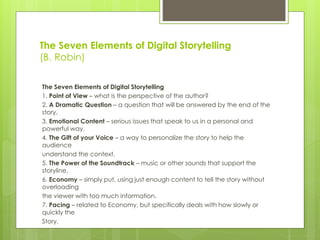
The Seven Elements of Digital Storytelling
(B. Robin)
The Seven Elements of Digital Storytelling
1. Point of View – what is the perspective of the author?
2. A Dramatic Question – a question that will be answered by the end of the
story.
3. Emotional Content – serious issues that speak to us in a personal and
powerful way.
4. The Gift of your Voice – a way to personalize the story to help the
audience
understand the context.
5. The Power of the Soundtrack – music or other sounds that support the
storyline.
6. Economy – simply put, using just enough content to tell the story without
overloading
the viewer with too much information.
7. Pacing – related to Economy, but specifically deals with how slowly or
quickly the
Story.
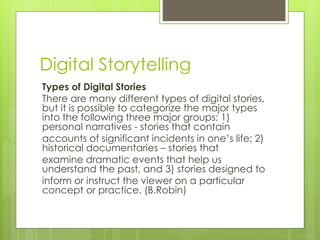
Digital Storytelling
Types of Digital Stories
There are many different types of digital stories,
but it is possible to categorize the major types
into the following three major groups: 1)
personal narratives - stories that contain
accounts of significant incidents in one’s life; 2)
historical documentaries – stories that
examine dramatic events that help us
understand the past, and 3) stories designed to
inform or instruct the viewer on a particular
concept or practice. (B.Robin)
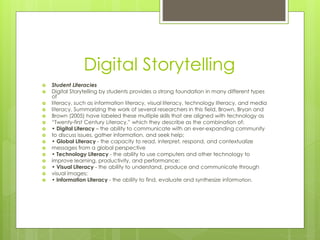
Digital Storytelling
 Student Literacies
 Digital Storytelling by students provides a strong foundation in many different types
of
 literacy, such as information literacy, visual literacy, technology literacy, and media
 literacy. Summarizing the work of several researchers in this field, Brown, Bryan and
 Brown (2005) have labeled these multiple skills that are aligned with technology as
 “Twenty-first Century Literacy,” which they describe as the combination of:
 • Digital Literacy – the ability to communicate with an ever-expanding community
 to discuss issues, gather information, and seek help;
 • Global Literacy - the capacity to read, interpret, respond, and contextualize
 messages from a global perspective
 • Technology Literacy - the ability to use computers and other technology to
 improve learning, productivity, and performance;
 • Visual Literacy - the ability to understand, produce and communicate through
 visual images;
 • Information Literacy - the ability to find, evaluate and synthesize information.
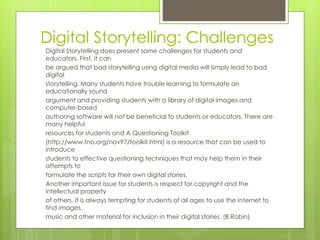
Digital Storytelling: Challenges
Digital Storytelling does present some challenges for students and
educators. First, it can
be argued that bad storytelling using digital media will simply lead to bad
digital
storytelling. Many students have trouble learning to formulate an
educationally sound
argument and providing students with a library of digital images and
computer-based
authoring software will not be beneficial to students or educators. There are
many helpful
resources for students and A Questioning Toolkit
(http://www.fno.org/nov97/toolkit.html) is a resource that can be used to
introduce
students to effective questioning techniques that may help them in their
attempts to
formulate the scripts for their own digital stories.
Another important issue for students is respect for copyright and the
intellectual property
of others. It is always tempting for students of all ages to use the Internet to
find images,
music and other material for inclusion in their digital stories. (B.Robin)
References
 B.Robin The Educational Uses of Digital
Storytelling, retrieved 2015
http://digitalliteracyintheclassroom.pbwor
ks.com/f/Educ-Uses-DS.pdf

Digital storytelling

  • 1.
  • 2.
    Digital Storytelling  Definition-relativelynew term which describes the new practice of ordinary people who use digital tools to tell their 'story‘. This form o form of media may be presented through full-motion video with sound, animation, stills, audio only, or any of the other forms of non-physical media.
  • 3.
    Digital Storytelling  Thereare many different definitions of “Digital Storytelling,” but in general, they all revolve around the idea of combining the art of telling stories with a variety of digital multimedia, such as images, audio, and video. Just about all digital stories bring together some mixture of digital graphics, text, recorded audio narration, video and music to present information on a specific topic. As is the case with traditional storytelling, digital stories revolve around a chosen theme and often contain a particular viewpoint. The stories are typically just a few minutes long and have a variety of uses, including the telling of personal tales, the recounting of historical events, or as a means to inform or instruct on a particular topic. (B. Robin)
  • 4.
    Why Digital StorytellingIn Education?  Digital Storytelling is a useful way to incorporate curriculum into instruction. This is even ever more important with the new Common Core. The educational goals for teachers using digital storytelling are to generate interest, attention and motivation for students of the "digital generation" in classrooms. Student engagement is key and Digital Storytelling can aid in that with todays students.
  • 5.
    The Seven Elementsof Digital Storytelling (B. Robin) The Seven Elements of Digital Storytelling 1. Point of View – what is the perspective of the author? 2. A Dramatic Question – a question that will be answered by the end of the story. 3. Emotional Content – serious issues that speak to us in a personal and powerful way. 4. The Gift of your Voice – a way to personalize the story to help the audience understand the context. 5. The Power of the Soundtrack – music or other sounds that support the storyline. 6. Economy – simply put, using just enough content to tell the story without overloading the viewer with too much information. 7. Pacing – related to Economy, but specifically deals with how slowly or quickly the Story.
  • 6.
    Digital Storytelling Types ofDigital Stories There are many different types of digital stories, but it is possible to categorize the major types into the following three major groups: 1) personal narratives - stories that contain accounts of significant incidents in one’s life; 2) historical documentaries – stories that examine dramatic events that help us understand the past, and 3) stories designed to inform or instruct the viewer on a particular concept or practice. (B.Robin)
  • 7.
    Digital Storytelling  StudentLiteracies  Digital Storytelling by students provides a strong foundation in many different types of  literacy, such as information literacy, visual literacy, technology literacy, and media  literacy. Summarizing the work of several researchers in this field, Brown, Bryan and  Brown (2005) have labeled these multiple skills that are aligned with technology as  “Twenty-first Century Literacy,” which they describe as the combination of:  • Digital Literacy – the ability to communicate with an ever-expanding community  to discuss issues, gather information, and seek help;  • Global Literacy - the capacity to read, interpret, respond, and contextualize  messages from a global perspective  • Technology Literacy - the ability to use computers and other technology to  improve learning, productivity, and performance;  • Visual Literacy - the ability to understand, produce and communicate through  visual images;  • Information Literacy - the ability to find, evaluate and synthesize information.
  • 8.
    Digital Storytelling: Challenges DigitalStorytelling does present some challenges for students and educators. First, it can be argued that bad storytelling using digital media will simply lead to bad digital storytelling. Many students have trouble learning to formulate an educationally sound argument and providing students with a library of digital images and computer-based authoring software will not be beneficial to students or educators. There are many helpful resources for students and A Questioning Toolkit (http://www.fno.org/nov97/toolkit.html) is a resource that can be used to introduce students to effective questioning techniques that may help them in their attempts to formulate the scripts for their own digital stories. Another important issue for students is respect for copyright and the intellectual property of others. It is always tempting for students of all ages to use the Internet to find images, music and other material for inclusion in their digital stories. (B.Robin)
  • 9.
    References  B.Robin TheEducational Uses of Digital Storytelling, retrieved 2015 http://digitalliteracyintheclassroom.pbwor ks.com/f/Educ-Uses-DS.pdf