Acute Kidney Injury (AKI)
Undergraduate nurse education
Year Three
Reviewed Autumn 2020
Objectives
Understand Acute Kidney Injury and its relevance to patient care.
Brief revision of the Anatomy and physiology of the kidneys
Establish the aetiology, risk factors and staging of AKI
Understand the investigations and tests that will aid diagnosis
Recognise the role of the MDT in AKI
Understand your role in the early recognition and management of AKI
Acute Kidney Injury Year Three
What is Acute Kidney Injury (AKI)?
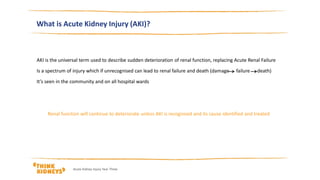
AKI is the universal term used to describe sudden deterioration of renal function, replacing Acute Renal Failure
Is a spectrum of injury which if unrecognised can lead to renal failure and death (damage failure death)
It’s seen in the community and on all hospital wards
Renal function will continue to deteriorate unless AKI is recognised and its cause identified and treated
Acute Kidney Injury Year Three
Identifying AKI
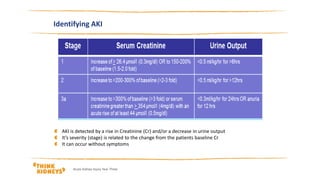
AKI is detected by a rise in Creatinine (Cr) and/or a decrease in urine output
It’s severity (stage) is related to the change from the patients baseline Cr
It can occur without symptoms
Acute Kidney Injury Year Three
Months Post Admission
%Survival
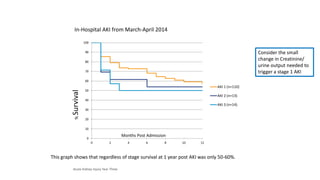
In-Hospital AKI from March-April 2014
0
10
20
30
40
50
60
70
80
90
100
0 2 4 6 8 10 12
AKI 1 (n=110)
AKI 2 (n=13)
AKI 3 (n=14)
This graph shows that regardless of stage survival at 1 year post AKI was only 50-60%.
Consider the small
change in Creatinine/
urine output needed to
trigger a stage 1 AKI
Acute Kidney Injury Year Three
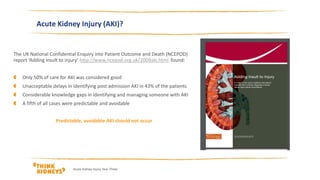
The UK National Confidential Enquiry into Patient Outcome and Death (NCEPOD)
report ‘Adding insult to injury’ http://www.ncepod.org.uk/2009aki.html found:
Only 50% of care for AKI was considered good
Unacceptable delays in identifying post admission AKI in 43% of the patients
Considerable knowledge gaps in identifying and managing someone with AKI
A fifth of all cases were predictable and avoidable
Predictable, avoidable AKI should not occur
Acute Kidney Injury Year Three
Acute Kidney Injury (AKI)?
Acute Kidney Injury Year Three
Anatomy and Physiology
recap
What do the Kidneys do?
1. remove waste products and drugs from the body
2. regulate the water content of the body
3. regulate electrolytes in the blood
4. regulate acid-base balance
5. release hormones that regulate blood pressure
6. produce an active form of vitamin D that promotes strong, healthy bones
7. control the production of red blood cells
Acute Kidney Injury Year Three
Adequate renal blood flow and oxygenation
To be healthy, rather than damaged or inflamed by disease processes
To drain urine freely through a functioning urinary tract
To function kidneys need…
Acute Kidney Injury Year Three
Who is at risk and how is it
caused?
chronic kidney disease
heart failure
liver disease
diabetes
history of acute kidney injury
oliguria (urine output less than 0.5 ml/kg/hour)
Hypovolaemia
Sepsis
deteriorating early warning scores
(NICE Guideline NG148, 2019)
Acute Kidney Injury Year Three
Risk factors
Drugs can also affect kidney function, these
include:
NSAIDs,
angiotensin-converting enzyme [ACE]
inhibitors,
angiotensin II receptor antagonists [ARBs] and
diuretics within the past week, especially if
hypovolaemic
use of iodinated contrast agents
symptoms or history of urological obstruction, or
conditions that may lead to obstruction
Age 65 years or over
Are any of your patients at risk??
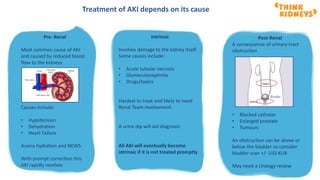
Pre- Renal
Most common cause of AKI
and caused by reduced blood
flow to the kidneys
Causes include:
• Hypotension
• Dehydration
• Heart Failure
Assess hydration and NEWS
With prompt correction this
AKI rapidly resolves
Intrinsic
Involves damage to the kidney itself.
Some causes include:
• Acute tubular necrosis
• Glomerulonephritis
• Drugs/toxins
Hardest to treat and likely to need
Renal Team involvement
A urine dip will aid diagnosis
All AKI will eventually become
intrinsic if it is not treated promptly
Post-Renal
A consequence of urinary tract
obstruction
• Blocked catheter
• Enlarged prostate
• Tumours
An obstruction can be above or
below the bladder so consider
bladder scan +/- USS KUB
May need a Urology review
Treatment of AKI depends on its cause
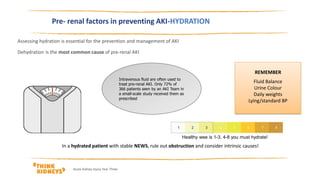
Pre- renal factors in preventing AKI-HYDRATION
Assessing hydration is essential for the prevention and management of AKI
Dehydration is the most common cause of pre-renal AKI
REMEMBER
Fluid Balance
Urine Colour
Daily weights
Lying/standard BP
Intravenous fluid are often used to
treat pre-renal AKI. Only 72% of
366 patients seen by an AKI Team in
a small-scale study received them as
prescribed
Healthy wee is 1-3, 4-8 you must hydrate!
In a hydrated patient with stable NEWS, rule out obstruction and consider intrinsic causes!
Acute Kidney Injury Year Three
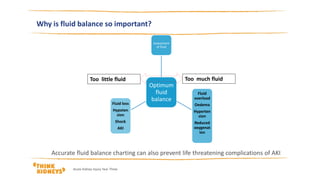
Why is fluid balance so important?
Accurate fluid balance charting can also prevent life threatening complications of AKI
Optimum
fluid
balance
Assessment
of fluid
Fluid
overload
Oedema
Hyperten
sion
Reduced
oxygenat
ion
Fluid loss
Hypoten
sion
Shock
AKI
Too much fluidToo little fluid
Acute Kidney Injury Year Three
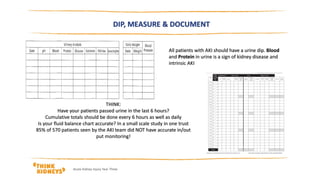
DIP, MEASURE & DOCUMENT
All patients with AKI should have a urine dip. Blood
and Protein in urine is a sign of kidney disease and
intrinsic AKI
THINK:
Have your patients passed urine in the last 6 hours?
Cumulative totals should be done every 6 hours as well as daily
Is your fluid balance chart accurate? In a small scale study in one trust
85% of 570 patients seen by the AKI team did NOT have accurate in/out
put monitoring!
Acute Kidney Injury Year Three
What is an expected urine output of a patient?
Expected urine output is 0.5mls/kg/hr. If less than this, escalate!
Chris Boateng is a 65 year old lady who has come in for a knee replacement. She weighs 90kg. How muchurine
should she pass in an hour?
• In the last 6 hours Chris has passed 300 mls of Urine. Is this a concern?
• Chris was kept in overnight due to complications. Her fluid balance has a total of 800mls of urine passed since
admission. What do you do?
Acute Kidney Injury Year Three
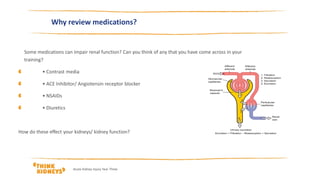
Why review medications?
Some medications can impair renal function? Can you think of any that you have come across in your
training?
• Contrast media
• ACE Inhibitor/ Angiotensin receptor blocker
• NSAIDs
• Diuretics
How do these effect your kidneys/ kidney function?
Acute Kidney Injury Year Three
Why review medications?
Some medications are excreted via the kidneys and have the potential to accumulate during AKI
Do you know any drugs that can accumulate in AKI?
What side effects can these cause?
How can you reduce the risk of accumulation?
All patients with AKI must have a medication and pharmacist review
Acute Kidney Injury Year Three
Plan of management for a
patient with AKI
Confirming AKI and identifying potential cause
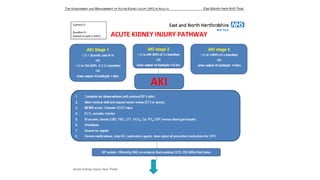
In response to the findings of the NCEPOD (2009) report NICE reviewed and published updated AKI Guidelines in
2019 (NG 148). Trusts have used these to develop their own AKI Policies and bundles.
You are told that your patient has an AKI/ you notice that they have a reduced urine output. What do you do next?
Does your Trust have an AKI policy or bundle?
Reflect on what these recommend and why
Acute Kidney Injury Year Three
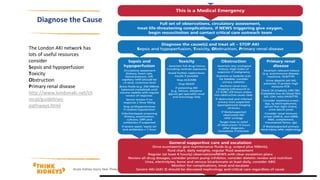
The London AKI network has
lots of useful resources
consider
Sepsis and hypoperfusion
Toxicity
Obstruction
Primary renal disease
http://www.londonaki.net/cli
nical/guidelines-
pathways.html
Diagnose the Cause
Acute Kidney Injury Year Three
Case study
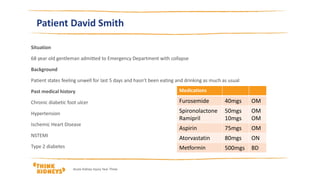
Patient David Smith
Situation
68 year old gentleman admitted to Emergency Department with collapse
Background
Patient states feeling unwell for last 5 days and hasn’t been eating and drinking as much as usual
Past medical history
Chronic diabetic foot ulcer
Hypertension
Ischemic Heart Disease
NSTEMI
Type 2 diabetes
Acute Kidney Injury Year Three
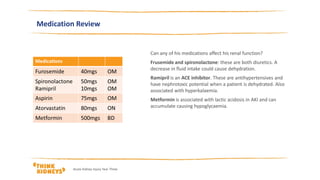
Medications
Furosemide 40mgs OM
Spironolactone
Ramipril
50mgs
10mgs
OM
OM
Aspirin 75mgs OM
Atorvastatin 80mgs ON
Metformin 500mgs BD
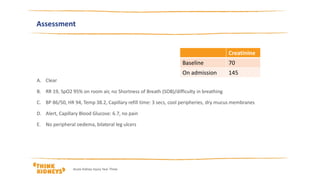
Assessment
A. Clear
B. RR 19, SpO2 95% on room air, no Shortness of Breath (SOB)/difficulty in breathing
C. BP 86/50, HR 94, Temp 38.2, Capillary refill time: 3 secs, cool peripheries, dry mucus membranes
D. Alert, Capillary Blood Glucose: 6.7, no pain
E. No peripheral oedema, bilateral leg ulcers
Creatinine
Baseline 70
On admission 145
Acute Kidney Injury Year Three
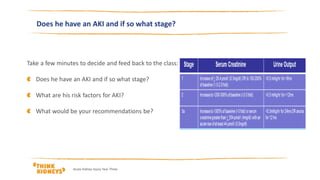
Does he have an AKI and if so what stage?
Take a few minutes to decide and feed back to the class:
Does he have an AKI and if so what stage?
What are his risk factors for AKI?
What would be your recommendations be?
Acute Kidney Injury Year Three
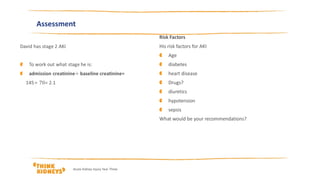
Assessment
Risk Factors
His risk factors for AKI
Age
diabetes
heart disease
Drugs?
diuretics
hypotension
sepsis
What would be your recommendations?
Acute Kidney Injury Year Three
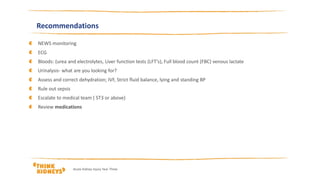
Recommendations
NEWS monitoring
ECG
Bloods: (urea and electrolytes, Liver function tests (LFT’s), Full blood count (FBC) venous lactate
Urinalysis- what are you looking for?
Assess and correct dehydration; IVF, Strict fluid balance, lying and standing BP
Rule out sepsis
Escalate to medical team ( ST3 or above)
Review medications
Acute Kidney Injury Year Three
David reports that he has been passing urine but that it has been less frequently than normal and its
appearance is much darker
What could this mean?
How can we measure David’s urine output?
Does he need a catheter?
If he weighs 85kgs
What should his urine output be in mls/hr?
Urine output
Acute Kidney Injury Year Three
Medication Review
Can any of his medications affect his renal function?
Frusemide and spironolactone: these are both diuretics. A
decrease in fluid intake could cause dehydration.
Ramipril is an ACE inhibitor. These are antihypertensives and
have nephrotoxic potential when a patient is dehydrated. Also
associated with hyperkalaemia.
Metformin is associated with lactic acidosis in AKI and can
accumulate causing hypoglycaemia.
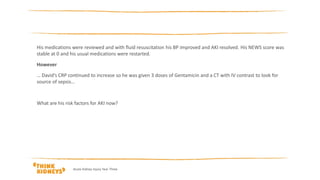
His medications were reviewed and with fluid resuscitation his BP improved and AKI resolved. His NEWS score was
stable at 0 and his usual medications were restarted.
However
… David’s CRP continued to increase so he was given 3 doses of Gentamicin and a CT with IV contrast to look for
source of sepsis…
What are his risk factors for AKI now?
Acute Kidney Injury Year Three
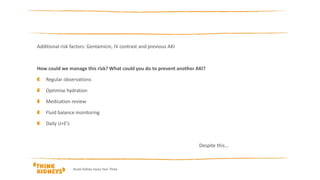
Additional risk factors: Gentamicin, IV contrast and previous AKI
How could we manage this risk? What could you do to prevent another AKI?
Regular observations
Optimise hydration
Medication review
Fluid balance monitoring
Daily U+E’s
Despite this…
Acute Kidney Injury Year Three
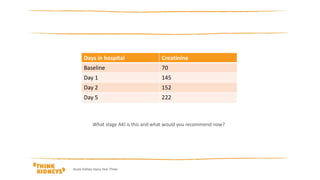
What stage AKI is this and what would you recommend now?
Days in hospital Creatinine
Baseline 70
Day 1 145
Day 2 152
Day 5 222
Acute Kidney Injury Year Three
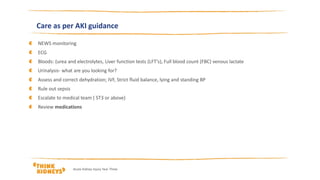
Care as per AKI guidance
NEWS monitoring
ECG
Bloods: (urea and electrolytes, Liver function tests (LFT’s), Full blood count (FBC) venous lactate
Urinalysis- what are you looking for?
Assess and correct dehydration; IVF, Strict fluid balance, lying and standing BP
Rule out sepsis
Escalate to medical team ( ST3 or above)
Review medications
Acute Kidney Injury Year Three
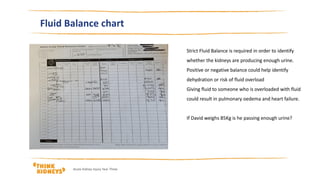
Fluid Balance chart
Strict Fluid Balance is required in order to identify
whether the kidneys are producing enough urine.
Positive or negative balance could help identify
dehydration or risk of fluid overload
Giving fluid to someone who is overloaded with fluid
could result in pulmonary oedema and heart failure.
If David weighs 85Kg is he passing enough urine?
Acute Kidney Injury Year Three
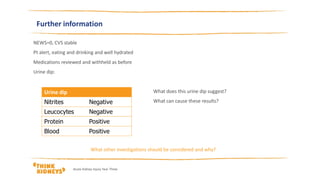
NEWS=0, CVS stable
Pt alert, eating and drinking and well hydrated
Medications reviewed and withheld as before
Urine dip:
What does this urine dip suggest?
What can cause these results?
What other investigations should be considered and why?
Further information
Acute Kidney Injury Year Three
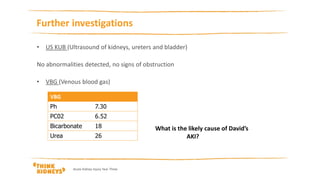
Further investigations
• US KUB (Ultrasound of kidneys, ureters and bladder)
No abnormalities detected, no signs of obstruction
• VBG (Venous blood gas)
What is the likely cause of David’s
AKI?
Outcome
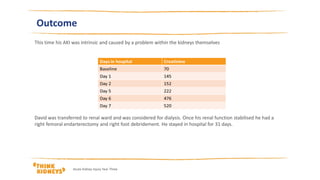
This time his AKI was intrinsic and caused by a problem within the kidneys themselves
David was transferred to renal ward and was considered for dialysis. Once his renal function stabilised he had a
right femoral endarterectomy and right foot debridement. He stayed in hospital for 31 days.
Acute Kidney Injury Year Three
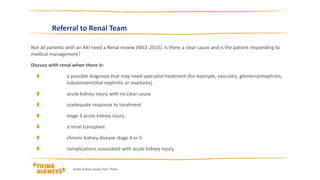
Referral to Renal Team
Not all patients with an AKI need a Renal review (NICE 2013). Is there a clear cause and is the patient responding to
medical management?
Discuss with renal when there is:
a possible diagnosis that may need specialist treatment (for example, vasculitis, glomerulonephritis,
tubulointerstitial nephritis or myeloma)
acute kidney injury with no clear cause
inadequate response to treatment
stage 3 acute kidney injury
a renal transplant
chronic kidney disease stage 4 or 5
complications associated with acute kidney injury
Acute Kidney Injury Year Three
Indications for Renal Replacement Therapy
A patient may require renal replacement therapy in the form of Haemodialysis or Haemofiltration if
the patient does not respond to medical management for:
hyperkalaemia
metabolic acidosis
symptoms or complications of uraemia (for example, pericarditis or encephalopathy)
fluid overload
pulmonary oedema.
Acute Kidney Injury Year Three
Any questions?
Acute Kidney Injury Year Three

Undergraduate nurses year three FINAL reviewed October 2020

  • 1.
    Acute Kidney Injury(AKI) Undergraduate nurse education Year Three Reviewed Autumn 2020
  • 2.
    Objectives Understand Acute KidneyInjury and its relevance to patient care. Brief revision of the Anatomy and physiology of the kidneys Establish the aetiology, risk factors and staging of AKI Understand the investigations and tests that will aid diagnosis Recognise the role of the MDT in AKI Understand your role in the early recognition and management of AKI Acute Kidney Injury Year Three
  • 3.
    What is AcuteKidney Injury (AKI)? AKI is the universal term used to describe sudden deterioration of renal function, replacing Acute Renal Failure Is a spectrum of injury which if unrecognised can lead to renal failure and death (damage failure death) It’s seen in the community and on all hospital wards Renal function will continue to deteriorate unless AKI is recognised and its cause identified and treated Acute Kidney Injury Year Three
  • 4.
    Identifying AKI AKI isdetected by a rise in Creatinine (Cr) and/or a decrease in urine output It’s severity (stage) is related to the change from the patients baseline Cr It can occur without symptoms Acute Kidney Injury Year Three
  • 5.
    Months Post Admission %Survival In-HospitalAKI from March-April 2014 0 10 20 30 40 50 60 70 80 90 100 0 2 4 6 8 10 12 AKI 1 (n=110) AKI 2 (n=13) AKI 3 (n=14) This graph shows that regardless of stage survival at 1 year post AKI was only 50-60%. Consider the small change in Creatinine/ urine output needed to trigger a stage 1 AKI Acute Kidney Injury Year Three
  • 6.
    The UK NationalConfidential Enquiry into Patient Outcome and Death (NCEPOD) report ‘Adding insult to injury’ http://www.ncepod.org.uk/2009aki.html found: Only 50% of care for AKI was considered good Unacceptable delays in identifying post admission AKI in 43% of the patients Considerable knowledge gaps in identifying and managing someone with AKI A fifth of all cases were predictable and avoidable Predictable, avoidable AKI should not occur Acute Kidney Injury Year Three Acute Kidney Injury (AKI)?
  • 7.
  • 8.
    Acute Kidney InjuryYear Three Anatomy and Physiology recap
  • 9.
    What do theKidneys do? 1. remove waste products and drugs from the body 2. regulate the water content of the body 3. regulate electrolytes in the blood 4. regulate acid-base balance 5. release hormones that regulate blood pressure 6. produce an active form of vitamin D that promotes strong, healthy bones 7. control the production of red blood cells Acute Kidney Injury Year Three
  • 10.
    Adequate renal bloodflow and oxygenation To be healthy, rather than damaged or inflamed by disease processes To drain urine freely through a functioning urinary tract To function kidneys need… Acute Kidney Injury Year Three
  • 11.
    Acute Kidney InjuryYear Three Who is at risk and how is it caused?
  • 12.
    chronic kidney disease heartfailure liver disease diabetes history of acute kidney injury oliguria (urine output less than 0.5 ml/kg/hour) Hypovolaemia Sepsis deteriorating early warning scores (NICE Guideline NG148, 2019) Acute Kidney Injury Year Three Risk factors Drugs can also affect kidney function, these include: NSAIDs, angiotensin-converting enzyme [ACE] inhibitors, angiotensin II receptor antagonists [ARBs] and diuretics within the past week, especially if hypovolaemic use of iodinated contrast agents symptoms or history of urological obstruction, or conditions that may lead to obstruction Age 65 years or over Are any of your patients at risk??
  • 13.
    Pre- Renal Most commoncause of AKI and caused by reduced blood flow to the kidneys Causes include: • Hypotension • Dehydration • Heart Failure Assess hydration and NEWS With prompt correction this AKI rapidly resolves Intrinsic Involves damage to the kidney itself. Some causes include: • Acute tubular necrosis • Glomerulonephritis • Drugs/toxins Hardest to treat and likely to need Renal Team involvement A urine dip will aid diagnosis All AKI will eventually become intrinsic if it is not treated promptly Post-Renal A consequence of urinary tract obstruction • Blocked catheter • Enlarged prostate • Tumours An obstruction can be above or below the bladder so consider bladder scan +/- USS KUB May need a Urology review Treatment of AKI depends on its cause
  • 14.
    Pre- renal factorsin preventing AKI-HYDRATION Assessing hydration is essential for the prevention and management of AKI Dehydration is the most common cause of pre-renal AKI REMEMBER Fluid Balance Urine Colour Daily weights Lying/standard BP Intravenous fluid are often used to treat pre-renal AKI. Only 72% of 366 patients seen by an AKI Team in a small-scale study received them as prescribed Healthy wee is 1-3, 4-8 you must hydrate! In a hydrated patient with stable NEWS, rule out obstruction and consider intrinsic causes! Acute Kidney Injury Year Three
  • 15.
    Why is fluidbalance so important? Accurate fluid balance charting can also prevent life threatening complications of AKI Optimum fluid balance Assessment of fluid Fluid overload Oedema Hyperten sion Reduced oxygenat ion Fluid loss Hypoten sion Shock AKI Too much fluidToo little fluid Acute Kidney Injury Year Three
  • 16.
    DIP, MEASURE &DOCUMENT All patients with AKI should have a urine dip. Blood and Protein in urine is a sign of kidney disease and intrinsic AKI THINK: Have your patients passed urine in the last 6 hours? Cumulative totals should be done every 6 hours as well as daily Is your fluid balance chart accurate? In a small scale study in one trust 85% of 570 patients seen by the AKI team did NOT have accurate in/out put monitoring! Acute Kidney Injury Year Three
  • 17.
    What is anexpected urine output of a patient? Expected urine output is 0.5mls/kg/hr. If less than this, escalate! Chris Boateng is a 65 year old lady who has come in for a knee replacement. She weighs 90kg. How muchurine should she pass in an hour? • In the last 6 hours Chris has passed 300 mls of Urine. Is this a concern? • Chris was kept in overnight due to complications. Her fluid balance has a total of 800mls of urine passed since admission. What do you do? Acute Kidney Injury Year Three
  • 18.
    Why review medications? Somemedications can impair renal function? Can you think of any that you have come across in your training? • Contrast media • ACE Inhibitor/ Angiotensin receptor blocker • NSAIDs • Diuretics How do these effect your kidneys/ kidney function? Acute Kidney Injury Year Three
  • 19.
    Why review medications? Somemedications are excreted via the kidneys and have the potential to accumulate during AKI Do you know any drugs that can accumulate in AKI? What side effects can these cause? How can you reduce the risk of accumulation? All patients with AKI must have a medication and pharmacist review Acute Kidney Injury Year Three
  • 20.
    Acute Kidney InjuryYear Three Plan of management for a patient with AKI
  • 21.
    Confirming AKI andidentifying potential cause In response to the findings of the NCEPOD (2009) report NICE reviewed and published updated AKI Guidelines in 2019 (NG 148). Trusts have used these to develop their own AKI Policies and bundles. You are told that your patient has an AKI/ you notice that they have a reduced urine output. What do you do next? Does your Trust have an AKI policy or bundle? Reflect on what these recommend and why Acute Kidney Injury Year Three
  • 22.
    Acute Kidney InjuryYear Three The London AKI network has lots of useful resources consider Sepsis and hypoperfusion Toxicity Obstruction Primary renal disease http://www.londonaki.net/cli nical/guidelines- pathways.html Diagnose the Cause
  • 23.
  • 24.
  • 25.
    Acute Kidney InjuryYear Three Case study
  • 26.
    Patient David Smith Situation 68year old gentleman admitted to Emergency Department with collapse Background Patient states feeling unwell for last 5 days and hasn’t been eating and drinking as much as usual Past medical history Chronic diabetic foot ulcer Hypertension Ischemic Heart Disease NSTEMI Type 2 diabetes Acute Kidney Injury Year Three Medications Furosemide 40mgs OM Spironolactone Ramipril 50mgs 10mgs OM OM Aspirin 75mgs OM Atorvastatin 80mgs ON Metformin 500mgs BD
  • 27.
    Assessment A. Clear B. RR19, SpO2 95% on room air, no Shortness of Breath (SOB)/difficulty in breathing C. BP 86/50, HR 94, Temp 38.2, Capillary refill time: 3 secs, cool peripheries, dry mucus membranes D. Alert, Capillary Blood Glucose: 6.7, no pain E. No peripheral oedema, bilateral leg ulcers Creatinine Baseline 70 On admission 145 Acute Kidney Injury Year Three
  • 28.
    Does he havean AKI and if so what stage? Take a few minutes to decide and feed back to the class: Does he have an AKI and if so what stage? What are his risk factors for AKI? What would be your recommendations be? Acute Kidney Injury Year Three
  • 29.
    Assessment Risk Factors His riskfactors for AKI Age diabetes heart disease Drugs? diuretics hypotension sepsis What would be your recommendations? Acute Kidney Injury Year Three
  • 30.
    Recommendations NEWS monitoring ECG Bloods: (ureaand electrolytes, Liver function tests (LFT’s), Full blood count (FBC) venous lactate Urinalysis- what are you looking for? Assess and correct dehydration; IVF, Strict fluid balance, lying and standing BP Rule out sepsis Escalate to medical team ( ST3 or above) Review medications Acute Kidney Injury Year Three
  • 31.
    David reports thathe has been passing urine but that it has been less frequently than normal and its appearance is much darker What could this mean? How can we measure David’s urine output? Does he need a catheter? If he weighs 85kgs What should his urine output be in mls/hr? Urine output Acute Kidney Injury Year Three
  • 32.
    Acute Kidney InjuryYear Three Medication Review Can any of his medications affect his renal function? Frusemide and spironolactone: these are both diuretics. A decrease in fluid intake could cause dehydration. Ramipril is an ACE inhibitor. These are antihypertensives and have nephrotoxic potential when a patient is dehydrated. Also associated with hyperkalaemia. Metformin is associated with lactic acidosis in AKI and can accumulate causing hypoglycaemia.
  • 33.
    His medications werereviewed and with fluid resuscitation his BP improved and AKI resolved. His NEWS score was stable at 0 and his usual medications were restarted. However … David’s CRP continued to increase so he was given 3 doses of Gentamicin and a CT with IV contrast to look for source of sepsis… What are his risk factors for AKI now? Acute Kidney Injury Year Three
  • 34.
    Additional risk factors:Gentamicin, IV contrast and previous AKI How could we manage this risk? What could you do to prevent another AKI? Regular observations Optimise hydration Medication review Fluid balance monitoring Daily U+E’s Despite this… Acute Kidney Injury Year Three
  • 35.
    What stage AKIis this and what would you recommend now? Days in hospital Creatinine Baseline 70 Day 1 145 Day 2 152 Day 5 222 Acute Kidney Injury Year Three
  • 36.
    Care as perAKI guidance NEWS monitoring ECG Bloods: (urea and electrolytes, Liver function tests (LFT’s), Full blood count (FBC) venous lactate Urinalysis- what are you looking for? Assess and correct dehydration; IVF, Strict fluid balance, lying and standing BP Rule out sepsis Escalate to medical team ( ST3 or above) Review medications Acute Kidney Injury Year Three
  • 37.
    Fluid Balance chart StrictFluid Balance is required in order to identify whether the kidneys are producing enough urine. Positive or negative balance could help identify dehydration or risk of fluid overload Giving fluid to someone who is overloaded with fluid could result in pulmonary oedema and heart failure. If David weighs 85Kg is he passing enough urine? Acute Kidney Injury Year Three
  • 38.
    NEWS=0, CVS stable Ptalert, eating and drinking and well hydrated Medications reviewed and withheld as before Urine dip: What does this urine dip suggest? What can cause these results? What other investigations should be considered and why? Further information Acute Kidney Injury Year Three
  • 39.
    Acute Kidney InjuryYear Three Further investigations • US KUB (Ultrasound of kidneys, ureters and bladder) No abnormalities detected, no signs of obstruction • VBG (Venous blood gas) What is the likely cause of David’s AKI?
  • 40.
    Outcome This time hisAKI was intrinsic and caused by a problem within the kidneys themselves David was transferred to renal ward and was considered for dialysis. Once his renal function stabilised he had a right femoral endarterectomy and right foot debridement. He stayed in hospital for 31 days. Acute Kidney Injury Year Three
  • 41.
    Referral to RenalTeam Not all patients with an AKI need a Renal review (NICE 2013). Is there a clear cause and is the patient responding to medical management? Discuss with renal when there is: a possible diagnosis that may need specialist treatment (for example, vasculitis, glomerulonephritis, tubulointerstitial nephritis or myeloma) acute kidney injury with no clear cause inadequate response to treatment stage 3 acute kidney injury a renal transplant chronic kidney disease stage 4 or 5 complications associated with acute kidney injury Acute Kidney Injury Year Three
  • 42.
    Indications for RenalReplacement Therapy A patient may require renal replacement therapy in the form of Haemodialysis or Haemofiltration if the patient does not respond to medical management for: hyperkalaemia metabolic acidosis symptoms or complications of uraemia (for example, pericarditis or encephalopathy) fluid overload pulmonary oedema. Acute Kidney Injury Year Three
  • 43.
    Any questions? Acute KidneyInjury Year Three