Paul J. Turek MD, FACS, FRSMPaul J. Turek MD, FACS, FRSM
Director, The Turek ClinicDirector, The Turek Clinic
Beverly Hills and San Francisco, CABeverly Hills and San Francisco, CA
Reproductive GeneticsReproductive Genetics
andand the Aging Malethe Aging Male
At the conclusion of this presentation,At the conclusion of this presentation,
participants should be able to:participants should be able to:
Learning ObjectivesLearning Objectives
• Delineate 2 genetic abnormalities in sperm that are
associated with advanced paternal age (APA).
• Explain APA associations with miscarriages, preterm
birth and fetal death.
• Enumerate two adult diseases of offspring that occur
with increased frequency in APA.
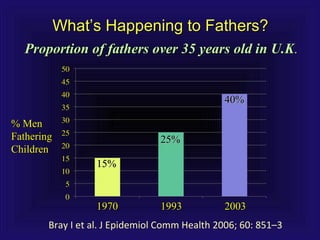
What’s Happening to Fathers?What’s Happening to Fathers?
% Men% Men
FatheringFathering
ChildrenChildren
19701970 19931993 20032003
15%15%
25%25%
40%40%
Proportion of fathers over 35 years old in U.KProportion of fathers over 35 years old in U.K..
Bray I et al. J Epidemiol Comm Health 2006; 60: 851–3
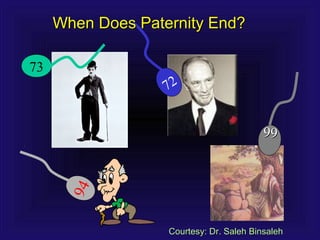
73
94 72
9999
When Does Paternity End?When Does Paternity End?
Courtesy: Dr. Saleh BinsalehCourtesy: Dr. Saleh Binsaleh
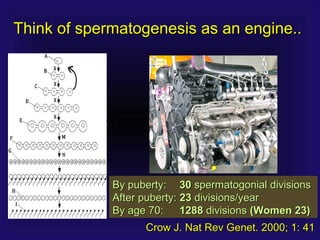
Think of spermatogenesis as an engine..Think of spermatogenesis as an engine..
By puberty:By puberty: 3030 spermatogonial divisionsspermatogonial divisions
After puberty:After puberty: 2323 divisions/yeardivisions/year
By age 70:By age 70: 12881288 divisionsdivisions (Women 23)(Women 23)
Crow J. Nat Rev Genet. 2000; 1: 41Crow J. Nat Rev Genet. 2000; 1: 41
What happens when engines get old?What happens when engines get old?
They donThey don’t run as smoothly, or at all.’t run as smoothly, or at all.
What is the Relationship?What is the Relationship?
Genetic errorsGenetic errors
InfertilityInfertility
Genetic errorsGenetic errors
AgingAging??
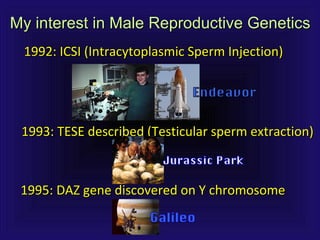
My interest in Male Reproductive GeneticsMy interest in Male Reproductive Genetics
1992: ICSI (Intracytoplasmic Sperm Injection)1992: ICSI (Intracytoplasmic Sperm Injection)
1993: TESE described (Testicular sperm extraction)1993: TESE described (Testicular sperm extraction)
1995: DAZ gene discovered on Y chromosome1995: DAZ gene discovered on Y chromosome
My interest in Male Reproductive GeneticsMy interest in Male Reproductive Genetics
Response: Get Some Help!Response: Get Some Help!
• Hire Renee Reijo Pera PhDHire Renee Reijo Pera PhD
• Recruited to 5 UCSF DeptsRecruited to 5 UCSF Depts
• The rest is historyThe rest is history
Turek et al. UCNA. 2002; 29:767-92Turek et al. UCNA. 2002; 29:767-92
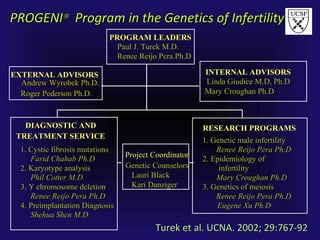
PROGENIPROGENI®®
Program in the Genetics of InfertilityProgram in the Genetics of Infertility
PROGRAM LEADERSPROGRAM LEADERS
Paul J. Turek M.D.Paul J. Turek M.D.
Renee Reijo Pera Ph.DRenee Reijo Pera Ph.D
EXTERNAL ADVISORSEXTERNAL ADVISORS
Andrew Wyrobek Ph.D.Andrew Wyrobek Ph.D.
INTERNAL ADVISORSINTERNAL ADVISORS
Linda Giudice M.D, Ph.DLinda Giudice M.D, Ph.D
Mary Croughan Ph.DMary Croughan Ph.D
DIAGNOSTIC ANDDIAGNOSTIC AND
TREATMENT SERVICETREATMENT SERVICE
1. Cystic fibrosis mutations1. Cystic fibrosis mutations
Farid Chahab Ph.DFarid Chahab Ph.D
2. Karyotype analysis2. Karyotype analysis
Phil Cotter M.DPhil Cotter M.D
3. Y chromosome deletion3. Y chromosome deletion
Renee Reijo Pera Ph.DRenee Reijo Pera Ph.D
4. Preimplantation Diagnosis4. Preimplantation Diagnosis
Shehua Shen M.DShehua Shen M.D
RESEARCH PROGRAMSRESEARCH PROGRAMS
1. Genetic male infertility1. Genetic male infertility
Renee Reijo Pera Ph.DRenee Reijo Pera Ph.D
2. Epidemiology of2. Epidemiology of
infertilityinfertility
Mary Croughan Ph.DMary Croughan Ph.D
3. Genetics of meiosis3. Genetics of meiosis
Renee Reijo Pera Ph.DRenee Reijo Pera Ph.D
Project CoordinatorProject Coordinator
Genetic CounselorsGenetic Counselors
Lauri BlackLauri Black
Kari DanzigerKari Danziger
Eugene Xu Ph.DEugene Xu Ph.D
Roger Pederson Ph.D.Roger Pederson Ph.D.
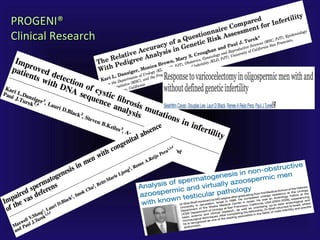
PROGENI®PROGENI®
Clinical ResearchClinical Research
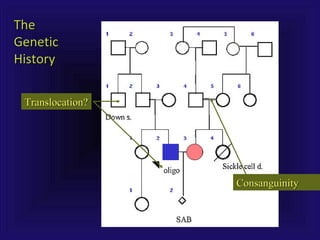
TheThe
GeneticGenetic
HistoryHistory
ConsanguinityConsanguinity
Translocation?Translocation?
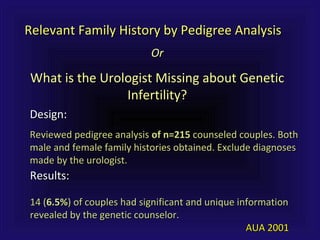
Relevant Family History by Pedigree AnalysisRelevant Family History by Pedigree Analysis
OrOr
What is the Urologist Missing about GeneticWhat is the Urologist Missing about Genetic
Infertility?Infertility?
Design:Design:
Reviewed pedigree analysisReviewed pedigree analysis of n=215of n=215 counseled couples. Bothcounseled couples. Both
male and female family histories obtained. Exclude diagnosesmale and female family histories obtained. Exclude diagnoses
made by the urologist.made by the urologist.
Results:Results:
14 (14 (6.5%6.5%) of couples had significant and unique information) of couples had significant and unique information
revealed by the genetic counselor.revealed by the genetic counselor.
AUA 2001AUA 2001
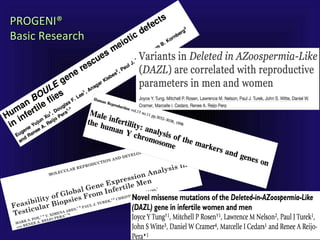
PROGENI®PROGENI®
Basic ResearchBasic Research
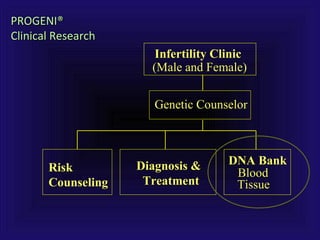
Infertility ClinicInfertility Clinic
(Male and Female)(Male and Female)
Diagnosis &Diagnosis &
TreatmentTreatment
DNA BankDNA Bank
TissueTissue
Genetic CounselorGenetic Counselor
BloodBloodRiskRisk
CounselingCounseling
PROGENI®PROGENI®
Clinical ResearchClinical Research
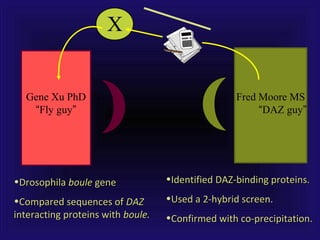
X
Gene Xu PhD
“Fly guy”
Fred Moore MS
“DAZ guy”
•Identified DAZ-binding proteins.Identified DAZ-binding proteins.
•Used a 2-hybrid screen.Used a 2-hybrid screen.
•Confirmed with co-precipitation.Confirmed with co-precipitation.
•DrosophilaDrosophila bouleboule genegene
•Compared sequences ofCompared sequences of DAZDAZ
interacting proteins withinteracting proteins with boule.boule.
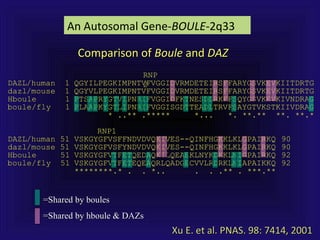
DAZLDAZL/human 1/human 1 QGYILPEGKIMPNTVFVGGIDVRMDETEIRSFFARYGSVKEVKIITDRTGQGYILPEGKIMPNTVFVGGIDVRMDETEIRSFFARYGSVKEVKIITDRTG
dazldazl/mouse 1/mouse 1 QGYVLPEGKIMPNTVFVGGIDVRMDETEIRSFFARYGSVKEVKIITDRTGQGYVLPEGKIMPNTVFVGGIDVRMDETEIRSFFARYGSVKEVKIITDRTG
HbouleHboule 11 PTSAPRYGTVIPNRIFVGGIDFKTNESDLRKFFSQYGSVKEVKIVNDRAGPTSAPRYGTVIPNRIFVGGIDFKTNESDLRKFFSQYGSVKEVKIVNDRAG
boule/fly 1boule/fly 1 PLAAPKYGTLIPNRIFVGGISGDTTEADLTRVFSAYGTVKSTKIIVDRAGPLAAPKYGTLIPNRIFVGGISGDTTEADLTRVFSAYGTVKSTKIIVDRAG
* ..** .***** *... *. **.** **. **.** ..** .***** *... *. **.** **. **.*
RNP1RNP1
DAZLDAZL/human 51/human 51 VSKGYGFVSFFNDVDVQKIVES--QINFHGKKLKLGPAIRKQVSKGYGFVSFFNDVDVQKIVES--QINFHGKKLKLGPAIRKQ 9090
dazldazl/mouse 51/mouse 51 VSKGYGFVSFYNDVDVQKIVES--QINFHGKKLKLGPAIRKQVSKGYGFVSFYNDVDVQKIVES--QINFHGKKLKLGPAIRKQ 9090
HbouleHboule 5151 VSKGYGFVTFETQEDAQKILQEAEKLNYKDKKLNIGPAIRKQVSKGYGFVTFETQEDAQKILQEAEKLNYKDKKLNIGPAIRKQ 9292
boule/fly 51boule/fly 51 VSKGYGFVTFETEQEAQRLQADGECVVLRDRKLNIAPAIKKQVSKGYGFVTFETEQEAQRLQADGECVVLRDRKLNIAPAIKKQ 9292
********.* . . *.. . . .** . ***.**********.* . . *.. . . .** . ***.**
=Shared by boules=Shared by boules
=Shared by hboule & DAZs=Shared by hboule & DAZs
RNPRNP
22
Comparison ofComparison of BouleBoule andand DAZDAZ
An Autosomal Gene-BOULE-2q33
Xu E. et al. PNAS. 98: 7414, 2001Xu E. et al. PNAS. 98: 7414, 2001
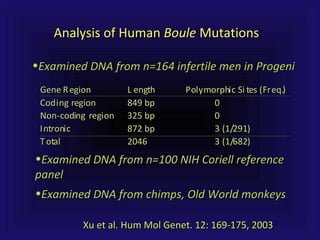
Analysis of HumanAnalysis of Human BouleBoule MutationsMutations
•Examined DNA from n=164 infertile men in ProgeniExamined DNA from n=164 infertile men in Progeni
GeneGene RR eegiongion LL engengtthh PPoollyymmorphorphiicc SiSi ttees (s (FrFreq.eq.))
CodCodiingng rreegiongion 849849 bpbp 00
NonNon--codcodiingng rregegiionon 325325 bpbp 00
IInnttronroniicc 872872 bpbp 33 (1(1//291291))
TT ototalal 20462046 33 (1(1//682682))
•Examined DNA from n=100 NIH Coriell referenceExamined DNA from n=100 NIH Coriell reference
panelpanel
Xu et al. Hum Mol Genet. 12: 169-175, 2003Xu et al. Hum Mol Genet. 12: 169-175, 2003
•Examined DNA from chimps, Old World monkeysExamined DNA from chimps, Old World monkeys
Xu et al. Hum Mol Genet. 12: 169-175, 2003Xu et al. Hum Mol Genet. 12: 169-175, 2003
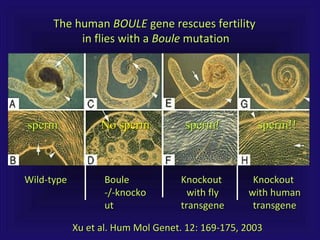
The humanThe human BOULEBOULE gene rescues fertilitygene rescues fertility
in flies with ain flies with a BouleBoule mutationmutation
Wild-typeWild-type BouleBoule
-/-knocko-/-knocko
utut
KnockoutKnockout
with flywith fly
transgenetransgene
KnockoutKnockout
with humanwith human
transgenetransgene
spermsperm No spermNo sperm sperm!sperm! sperm!!sperm!!
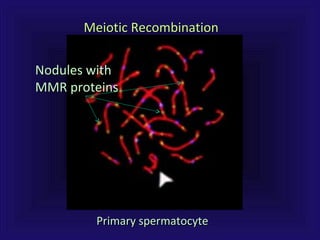
Primary spermatocytePrimary spermatocyte
Nodules withNodules with
MMR proteinsMMR proteins
Meiotic RecombinationMeiotic Recombination
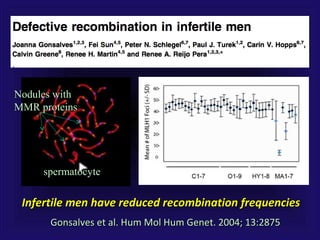
Gonsalves et al. Hum Mol Hum Genet. 2004; 13:2875Gonsalves et al. Hum Mol Hum Genet. 2004; 13:2875
Infertile men have reduced recombination frequenciesInfertile men have reduced recombination frequencies
spermatocytespermatocyte
Nodules withNodules with
MMR proteinsMMR proteins
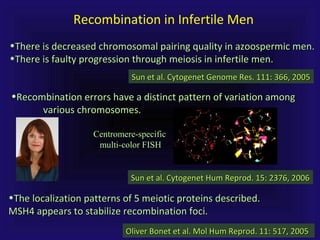
•There is decreased chromosomal pairing quality in azoospermic men.There is decreased chromosomal pairing quality in azoospermic men.
•There is faulty progression through meiosis in infertile men.There is faulty progression through meiosis in infertile men.
Sun et al. Cytogenet Genome Res. 111: 366, 2005Sun et al. Cytogenet Genome Res. 111: 366, 2005
•Recombination errors have a distinct pattern of variation amongRecombination errors have a distinct pattern of variation among
various chromosomes.various chromosomes.
Centromere-specificCentromere-specific
multi-color FISHmulti-color FISH
Sun et al. Cytogenet Hum Reprod. 15: 2376, 2006Sun et al. Cytogenet Hum Reprod. 15: 2376, 2006
•The localization patterns of 5 meiotic proteins described.The localization patterns of 5 meiotic proteins described.
MSH4 appears to stabilize recombination foci.MSH4 appears to stabilize recombination foci.
Oliver Bonet et al. Mol Hum Reprod. 11: 517, 2005Oliver Bonet et al. Mol Hum Reprod. 11: 517, 2005
Recombination in Infertile Men
What Does This Mean?What Does This Mean?
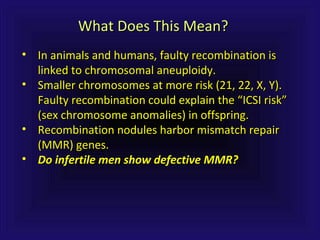
• In animals and humans, faulty recombination isIn animals and humans, faulty recombination is
linked to chromosomal aneuploidy.linked to chromosomal aneuploidy.
• Smaller chromosomes at more risk (21, 22, X, Y).Smaller chromosomes at more risk (21, 22, X, Y).
Faulty recombination could explain the “ICSI risk”Faulty recombination could explain the “ICSI risk”
(sex chromosome anomalies) in offspring.(sex chromosome anomalies) in offspring.
• Recombination nodules harbor mismatch repairRecombination nodules harbor mismatch repair
(MMR) genes.(MMR) genes.
• Do infertile men show defective MMR?Do infertile men show defective MMR?
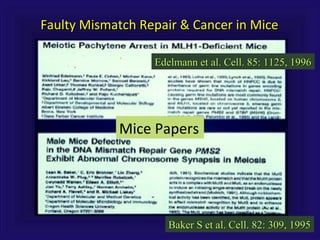
Faulty Mismatch Repair & Cancer in MiceFaulty Mismatch Repair & Cancer in Mice
Mice Papers
Baker S et al. Cell. 82: 309, 1995Baker S et al. Cell. 82: 309, 1995
Edelmann et al. Cell. 85: 1125, 1996Edelmann et al. Cell. 85: 1125, 1996
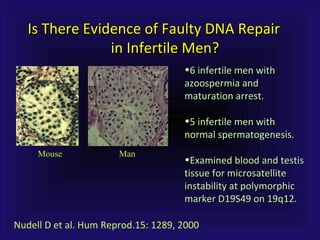
Is There Evidence of Faulty DNA RepairIs There Evidence of Faulty DNA Repair
in Infertile Men?in Infertile Men?
MouseMouse ManMan
•6 infertile men with6 infertile men with
azoospermia andazoospermia and
maturation arrest.maturation arrest.
•5 infertile men with5 infertile men with
normal spermatogenesis.normal spermatogenesis.
•Examined blood and testisExamined blood and testis
tissue for microsatellitetissue for microsatellite
instability at polymorphicinstability at polymorphic
marker D19S49 on 19q12.marker D19S49 on 19q12.
Nudell D et al. Hum Reprod.15: 1289, 2000.
0
10
20
30
40
%CloneswithPointMutations%CloneswithPointMutations
EARLY ARRESTEARLY ARREST LATELATE
ARRESTARREST
NORMALNORMAL
22 1919 3131 55 3434 100100 500500 600600434366 1111 1717
Infertile PatientsInfertile Patients
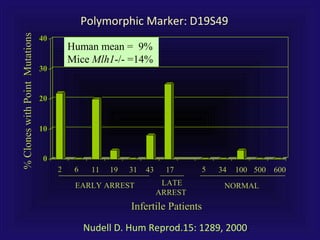
Nudell D. Hum Reprod.15: 1289, 2000.
Polymorphic Marker: D19S49
Human mean = 9%
Mice Mlh1-/- =14%
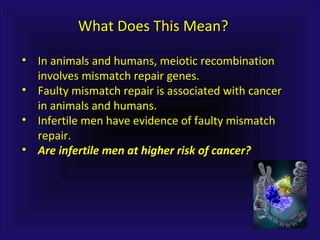
What Does This Mean?What Does This Mean?
• In animals and humans, meiotic recombinationIn animals and humans, meiotic recombination
involves mismatch repair genes.involves mismatch repair genes.
• Faulty mismatch repair is associated with cancerFaulty mismatch repair is associated with cancer
in animals and humans.in animals and humans.
• Infertile men have evidence of faulty mismatchInfertile men have evidence of faulty mismatch
repair.repair.
• Are infertile men at higher risk of cancer?Are infertile men at higher risk of cancer?
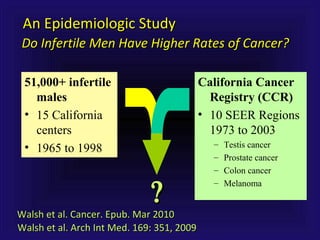
An Epidemiologic StudyAn Epidemiologic Study
Do Infertile Men Have Higher Rates of Cancer?Do Infertile Men Have Higher Rates of Cancer?
51,000+ infertile
males
• 15 California
centers
• 1965 to 1998
California Cancer
Registry (CCR)
• 10 SEER Regions
1973 to 2003
– Testis cancer
– Prostate cancer
– Colon cancer
– Melanoma
??
Walsh et al. Arch Int Med. 169: 351, 2009Walsh et al. Arch Int Med. 169: 351, 2009
Walsh et al. Cancer. Epub. Mar 2010Walsh et al. Cancer. Epub. Mar 2010
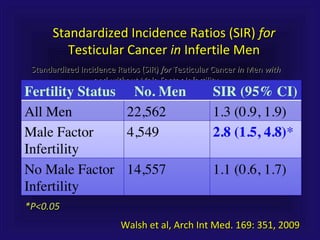
Standardized Incidence Ratios (SIR)Standardized Incidence Ratios (SIR) forfor Testicular CancerTesticular Cancer inin MenMen withwith
andand withoutwithout Male Factor InfertilityMale Factor Infertility
*P<0.05*P<0.05
Standardized Incidence Ratios (SIR)Standardized Incidence Ratios (SIR) forfor
Testicular CancerTesticular Cancer inin Infertile MenInfertile Men
Walsh et al, Arch Int Med. 169: 351, 2009Walsh et al, Arch Int Med. 169: 351, 2009
Walsh et al. Cancer. 116: 2140-7, 2010Walsh et al. Cancer. 116: 2140-7, 2010
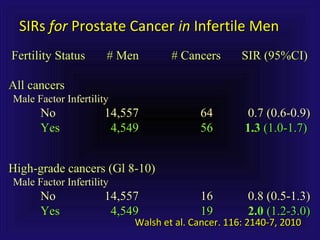
SIRsSIRs forfor Prostate CancerProstate Cancer inin Infertile MenInfertile Men
Fertility Status # MenFertility Status # Men # Cancers# Cancers SIR (95%CI)SIR (95%CI)
All cancersAll cancers
Male Factor InfertilityMale Factor Infertility
NoNo 14,55714,557 6464 0.7 (0.6-0.9)0.7 (0.6-0.9)
YesYes 4,5494,549 5656 1.1.33 (1.0-1.7)(1.0-1.7)
High-grade cancers (Gl 8-10)High-grade cancers (Gl 8-10)
Male Factor InfertilityMale Factor Infertility
NoNo 14,55714,557 1616 0.8 (0.5-1.3)0.8 (0.5-1.3)
YesYes 4,5494,549 1919 2.2.00 (1.2-3.0)(1.2-3.0)
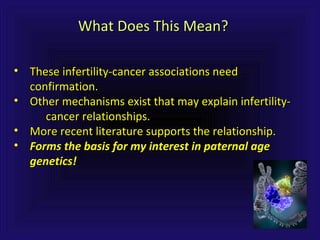
What Does This Mean?What Does This Mean?
• These infertility-cancer associations needThese infertility-cancer associations need
confirmation.confirmation.
• Other mechanisms exist that may explain infertility-Other mechanisms exist that may explain infertility-
cancer relationships.cancer relationships.
• More recent literature supports the relationship.More recent literature supports the relationship.
• Forms the basis for my interest in paternal ageForms the basis for my interest in paternal age
genetics!genetics!
What is the RelationshipWhat is the Relationship??
Genetic errorsGenetic errors
InfertilityInfertility
Genetic errorsGenetic errors
AgingAging??
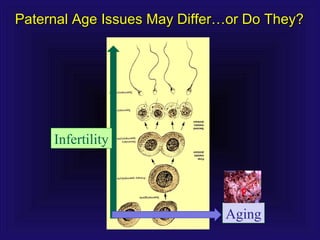
Paternal Age Issues May Differ…or Do They?Paternal Age Issues May Differ…or Do They?
Infertility
Aging
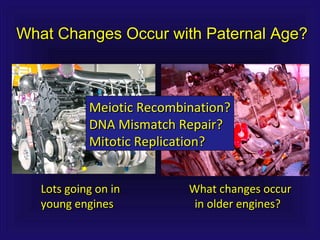
What Changes Occur with Paternal Age?What Changes Occur with Paternal Age?
Lots going on inLots going on in
young enginesyoung engines
What changes occurWhat changes occur
in older engines?in older engines?
Meiotic Recombination?Meiotic Recombination?
DNA Mismatch Repair?DNA Mismatch Repair?
Mitotic Replication?Mitotic Replication?
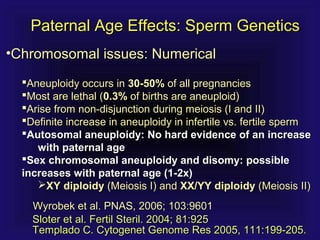
Paternal Age Effects: Sperm GeneticsPaternal Age Effects: Sperm Genetics
•Chromosomal issues: NumericalChromosomal issues: Numerical
Aneuploidy occurs inAneuploidy occurs in 30-50%30-50% of all pregnanciesof all pregnancies
Most are lethal (Most are lethal (0.3%0.3% of births are aneuploid)of births are aneuploid)
Arise from non-disjunction during meiosis (I and II)Arise from non-disjunction during meiosis (I and II)
Definite increase in aneuploidy in infertile vs. fertile spermDefinite increase in aneuploidy in infertile vs. fertile sperm
Autosomal aneuploidy: No hard evidence of an increaseAutosomal aneuploidy: No hard evidence of an increase
with paternal agewith paternal age
Sex chromosomal aneuploidy and disomy: possibleSex chromosomal aneuploidy and disomy: possible
increases with paternal age (1-2x)increases with paternal age (1-2x)
XY diploidyXY diploidy (Meiosis I) and(Meiosis I) and XX/YY diploidyXX/YY diploidy (Meiosis II)(Meiosis II)
Templado C. Cytogenet Genome Res 2005, 111:199-205.Templado C. Cytogenet Genome Res 2005, 111:199-205.
Sloter et al. Fertil Steril. 2004; 81:925Sloter et al. Fertil Steril. 2004; 81:925
Wyrobek et al. PNAS, 2006; 103:9601Wyrobek et al. PNAS, 2006; 103:9601
Paternal Age Effects: Sperm GeneticsPaternal Age Effects: Sperm Genetics
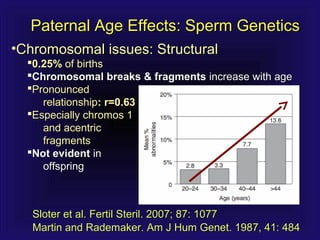
•Chromosomal issues: StructuralChromosomal issues: Structural
0.25%0.25% of birthsof births
Chromosomal breaks & fragmentsChromosomal breaks & fragments increase with ageincrease with age
PronouncedPronounced
relationshiprelationship: r=0.63: r=0.63
Especially chromos 1Especially chromos 1
and acentricand acentric
fragmentsfragments
Not evidentNot evident inin
offspringoffspring
Sloter et al. Fertil Steril. 2007; 87: 1077Sloter et al. Fertil Steril. 2007; 87: 1077
Martin and Rademaker. Am J Hum Genet. 1987, 41: 484Martin and Rademaker. Am J Hum Genet. 1987, 41: 484
Paternal Age Effects: Sperm GeneticsPaternal Age Effects: Sperm Genetics
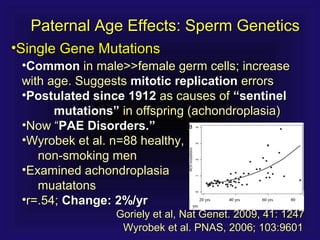
•Single Gene MutationsSingle Gene Mutations
•CommonCommon in male>>female germ cells; increasein male>>female germ cells; increase
with age. Suggestswith age. Suggests mitoticmitotic replicationreplication errorserrors
•Postulated since 1912Postulated since 1912 as causes ofas causes of “sentinel“sentinel
mutations”mutations” in offspring (achondroplasia)in offspring (achondroplasia)
•Now “Now “PAE Disorders.PAE Disorders.””
•Wyrobek et al. n=88 healthy,Wyrobek et al. n=88 healthy,
non-smoking mennon-smoking men
•Examined achondroplasiaExamined achondroplasia
muatatonsmuatatons
•r=.54;r=.54; Change: 2%/yrChange: 2%/yr
Goriely et al, Nat Genet. 2009, 41: 1247Goriely et al, Nat Genet. 2009, 41: 1247
Wyrobek et al. PNAS, 2006; 103:9601Wyrobek et al. PNAS, 2006; 103:9601
20 yrs20 yrs 40 yrs40 yrs 60 yrs60 yrs 8080
yrsyrs
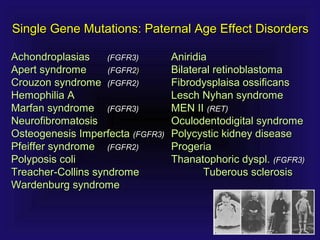
AchondroplasiasAchondroplasias (FGFR3)(FGFR3) AniridiaAniridia
Apert syndromeApert syndrome (FGFR2(FGFR2)) Bilateral retinoblastomaBilateral retinoblastoma
Crouzon syndromeCrouzon syndrome (FGFR2)(FGFR2) Fibrodysplaisa ossificansFibrodysplaisa ossificans
Hemophilia AHemophilia A Lesch Nyhan syndromeLesch Nyhan syndrome
Marfan syndromeMarfan syndrome (FGFR3)(FGFR3) MEN IIMEN II (RET)(RET)
NeurofibromatosisNeurofibromatosis Oculodentodigital syndromeOculodentodigital syndrome
Osteogenesis ImperfectaOsteogenesis Imperfecta (FGFR3)(FGFR3) Polycystic kidney diseasePolycystic kidney disease
Pfeiffer syndromePfeiffer syndrome (FGFR2)(FGFR2) ProgeriaProgeria
Polyposis coliPolyposis coli Thanatophoric dyspl.Thanatophoric dyspl. (FGFR3)(FGFR3)
Treacher-Collins syndromeTreacher-Collins syndrome Tuberous sclerosisTuberous sclerosis
Wardenburg syndromeWardenburg syndrome
Single Gene Mutations: Paternal Age Effect DisordersSingle Gene Mutations: Paternal Age Effect Disorders
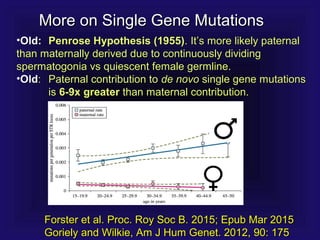
More on Single Gene MutationsMore on Single Gene Mutations
•Old:Old: Penrose Hypothesis (1955)Penrose Hypothesis (1955). It’s more likely paternal. It’s more likely paternal
than maternally derived due to continuously dividingthan maternally derived due to continuously dividing
spermatogonia vs quiescent female germline.spermatogonia vs quiescent female germline.
•OldOld:: Paternal contribution toPaternal contribution to de novode novo single gene mutationssingle gene mutations
isis 6-9x greater6-9x greater than maternal contribution.than maternal contribution.
Forster et al. Proc. Roy Soc B. 2015; Epub Mar 2015Forster et al. Proc. Roy Soc B. 2015; Epub Mar 2015
Goriely and Wilkie, Am J Hum Genet. 2012, 90: 175Goriely and Wilkie, Am J Hum Genet. 2012, 90: 175
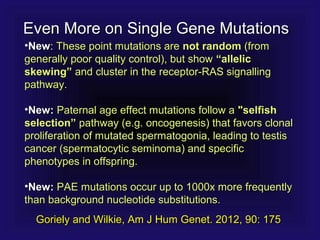
•NewNew:: These point mutations areThese point mutations are not randomnot random (from(from
generally poor quality control), but showgenerally poor quality control), but show “allelic“allelic
skewing”skewing” and cluster in the receptor-RAS signallingand cluster in the receptor-RAS signalling
pathway.pathway.
•New:New: Paternal age effect mutations follow aPaternal age effect mutations follow a "selfish"selfish
selection”selection” pathway (e.g. oncogenesis) that favors clonalpathway (e.g. oncogenesis) that favors clonal
proliferation of mutated spermatogonia, leading to testisproliferation of mutated spermatogonia, leading to testis
cancer (spermatocytic seminoma) and specificcancer (spermatocytic seminoma) and specific
phenotypes in offspring.phenotypes in offspring.
•New:New: PAE mutations occur up to 1000x more frequentlyPAE mutations occur up to 1000x more frequently
than background nucleotide substitutions.than background nucleotide substitutions.
Even More on Single Gene MutationsEven More on Single Gene Mutations
Goriely and Wilkie, Am J Hum Genet. 2012, 90: 175Goriely and Wilkie, Am J Hum Genet. 2012, 90: 175
PAE Mutations: A Quality ControlPAE Mutations: A Quality Control “Issue”“Issue”
Goriely and Wilkie, Am J Hum Genet. 2012, 90: 175Goriely and Wilkie, Am J Hum Genet. 2012, 90: 175
Goriely et al, Nat Genet. 2009, 41: 1247Goriely et al, Nat Genet. 2009, 41: 1247
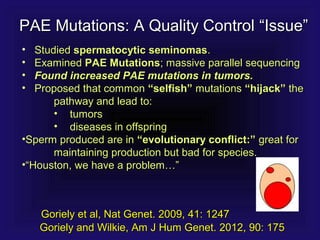
• StudiedStudied spermatocytic seminomasspermatocytic seminomas..
• ExaminedExamined PAE MutationsPAE Mutations; massive parallel sequencing; massive parallel sequencing
• Found increased PAE mutations in tumors.Found increased PAE mutations in tumors.
• Proposed that commonProposed that common “selfish”“selfish” mutationsmutations “hijack”“hijack” thethe
pathway and lead to:pathway and lead to:
• tumorstumors
• diseases in offspringdiseases in offspring
•Sperm produced are inSperm produced are in “evolutionary conflict:”“evolutionary conflict:” great forgreat for
maintaining production but bad for species.maintaining production but bad for species.
•““Houston, we have a problem…”Houston, we have a problem…”
Wyrobek et al. PNAS, 2006; 103:9601Wyrobek et al. PNAS, 2006; 103:9601
Paternal Age Effects: Sperm GeneticsPaternal Age Effects: Sperm Genetics
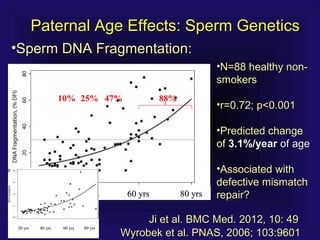
•Sperm DNA Fragmentation:Sperm DNA Fragmentation:
Ji et al. BMC Med. 2012, 10: 49Ji et al. BMC Med. 2012, 10: 49
•N=88 healthy non-N=88 healthy non-
smokerssmokers
•r=0.72; p<0.001r=0.72; p<0.001
•Predicted changePredicted change
ofof 3.1%/year3.1%/year of ageof age
•Associated withAssociated with
defective mismatchdefective mismatch
repair?repair?20 yrs20 yrs 40 yrs40 yrs 60 yrs60 yrs 80 yrs80 yrs
10% 25% 47% 88%
20 yrs 40 yrs 60 yrs20 yrs 40 yrs 60 yrs 80 yrs80 yrs
Jenkins et al. PLOS Genet.2014, 10: e1004458Jenkins et al. PLOS Genet.2014, 10: e1004458
Paternal Age Effects: Sperm EpigeneticsPaternal Age Effects: Sperm Epigenetics
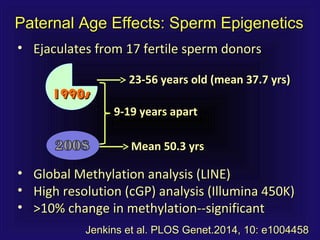
• Ejaculates from 17 fertile sperm donorsEjaculates from 17 fertile sperm donors
1990s1990s
9-19 years apart9-19 years apart
23-56 years old (mean 37.7 yrs)23-56 years old (mean 37.7 yrs)
Mean 50.3 yrsMean 50.3 yrs
• Global Methylation analysis (LINE)Global Methylation analysis (LINE)
• High resolution (cGP) analysis (Illumina 450K)High resolution (cGP) analysis (Illumina 450K)
• >10% change in methylation--significant>10% change in methylation--significant
Jenkins et al. PLOS Genet.2014, 10: e1004458Jenkins et al. PLOS Genet.2014, 10: e1004458
Paternal Age Effects: Sperm EpigeneticsPaternal Age Effects: Sperm Epigenetics
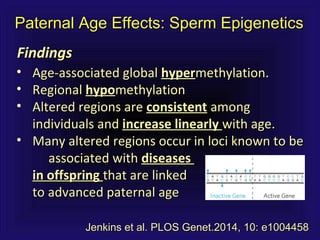
• Age-associated globalAge-associated global hyperhypermethylation.methylation.
• RegionalRegional hypohypomethylationmethylation
• Altered regions areAltered regions are consistentconsistent amongamong
individuals andindividuals and increase linearlyincrease linearly with age.with age.
• Many altered regions occur in loci known to beMany altered regions occur in loci known to be
associated withassociated with diseasesdiseases
in offspringin offspring that are linkedthat are linked
to advanced paternal ageto advanced paternal age
FindingsFindings
Jenkins et al. PLOS Genet.2014, 10: e1004458Jenkins et al. PLOS Genet.2014, 10: e1004458
Paternal Age Effects: Sperm EpigeneticsPaternal Age Effects: Sperm Epigenetics
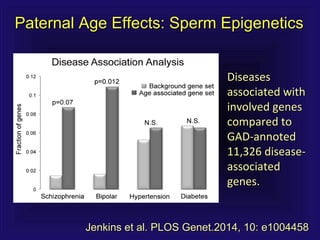
DiseasesDiseases
associated withassociated with
involved genesinvolved genes
compared tocompared to
GAD-annotedGAD-annoted
11,326 disease-11,326 disease-
associatedassociated
genes.genes.
MutationsMutations andand Methylation ChangesMethylation Changes
• They are independent events.They are independent events.
• Methylation changes are a consequence of mutationsMethylation changes are a consequence of mutations
• Methylation changes influence mutational eventsMethylation changes influence mutational events
Are they related? 3 possibilities:Are they related? 3 possibilities:
Milekic et al. Nat Mol Psych.2014, 1-7Milekic et al. Nat Mol Psych.2014, 1-7
What Does This Mean?What Does This Mean?
• Rapidly dividing spermatogonia are likely theRapidly dividing spermatogonia are likely the
source of DNA replication errors as men age.source of DNA replication errors as men age.
• Single gene mutations are the consequence ofSingle gene mutations are the consequence of
these errors (unlike aneuploidy in women).these errors (unlike aneuploidy in women).
• Point mutations are rare, dominant and lead toPoint mutations are rare, dominant and lead to
significant disease in offspring.significant disease in offspring.
• Epigenetic changes to sperm genome also showEpigenetic changes to sperm genome also show
correlations to disease in offspring.correlations to disease in offspring.
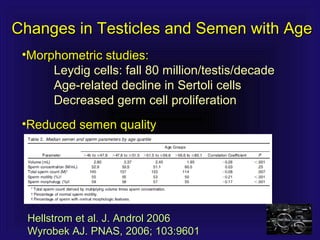
Changes in Testicles and Semen with AgeChanges in Testicles and Semen with Age
•Morphometric studies:Morphometric studies:
Leydig cells: fall 80 million/testis/decadeLeydig cells: fall 80 million/testis/decade
Age-related decline in Sertoli cellsAge-related decline in Sertoli cells
Decreased germ cell proliferationDecreased germ cell proliferation
•Reduced semen qualityReduced semen quality
Hellstrom et al. J. Androl 2006Hellstrom et al. J. Androl 2006
Wyrobek AJ. PNAS, 2006; 103:9601Wyrobek AJ. PNAS, 2006; 103:9601
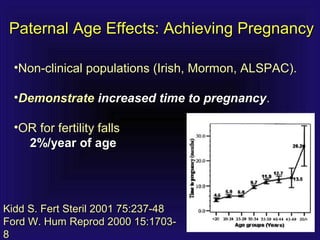
Paternal Age Effects: Achieving PregnancyPaternal Age Effects: Achieving Pregnancy
•Non-clinical populations (Irish, Mormon, ALSPAC).Non-clinical populations (Irish, Mormon, ALSPAC).
•DemonstrateDemonstrate increased time to pregnancyincreased time to pregnancy..
•OR for fertility fallsOR for fertility falls
2%/year of age2%/year of age
Kidd S. Fert Steril 2001 75:237-48Kidd S. Fert Steril 2001 75:237-48
Ford W. Hum Reprod 2000 15:1703-Ford W. Hum Reprod 2000 15:1703-
88
Paternal Age Effects: Achieving PregnancyPaternal Age Effects: Achieving Pregnancy
ConfoundersConfounders
Female ageFemale age
Erectile and sexual dysfunctionErectile and sexual dysfunction
Coital frequencyCoital frequency
Comorbid conditionsComorbid conditions
Kidd S. Fert Steril 2001 75:237-48Kidd S. Fert Steril 2001 75:237-48
Ford W. Hum Reprod 2000 15:1703-8Ford W. Hum Reprod 2000 15:1703-8
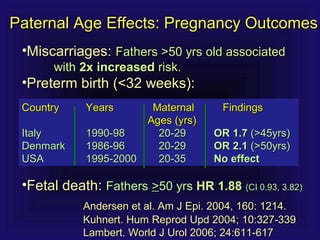
Paternal Age Effects: Pregnancy OutcomesPaternal Age Effects: Pregnancy Outcomes
•Miscarriages:Miscarriages: Fathers >50 yrs old associatedFathers >50 yrs old associated
withwith 2x increased2x increased risk.risk.
•Preterm birth (<32 weeks):Preterm birth (<32 weeks):
•Fetal death:Fetal death: FathersFathers >>50 yrs50 yrs HR 1.88HR 1.88 (CI 0.93, 3.82)(CI 0.93, 3.82)
Lambert. World J Urol 2006; 24:611-617Lambert. World J Urol 2006; 24:611-617
Kuhnert. Hum Reprod Upd 2004; 10:327-339Kuhnert. Hum Reprod Upd 2004; 10:327-339
CountryCountry YearsYears MaternalMaternal FindingsFindings
Ages (yrs)Ages (yrs)
ItalyItaly 1990-981990-98 20-2920-29 OR 1.7OR 1.7 (>45yrs)(>45yrs)
DenmarkDenmark 1986-961986-96 20-2920-29 OR 2.1OR 2.1 (>50yrs)(>50yrs)
USAUSA 1995-20001995-2000 20-3520-35 No effectNo effect
Andersen et al. Am J Epi. 2004, 160: 1214.Andersen et al. Am J Epi. 2004, 160: 1214.
Paternal Age Effects: OffspringPaternal Age Effects: Offspring
•Congenital illness/birth defectsCongenital illness/birth defects
•DiseasesDiseases
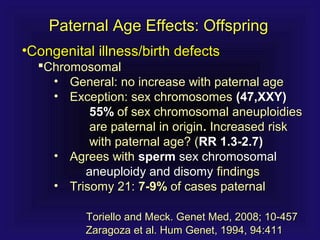
Paternal Age Effects: OffspringPaternal Age Effects: Offspring
•Congenital illness/birth defectsCongenital illness/birth defects
ChromosomalChromosomal
• General: no increase with paternal ageGeneral: no increase with paternal age
• Exception: sex chromosomesException: sex chromosomes (47,XXY)(47,XXY)
55%55% of sex chromosomal aneuploidiesof sex chromosomal aneuploidies
are paternal in originare paternal in origin.. Increased riskIncreased risk
with paternal age? (with paternal age? (RR 1.3-2.7)RR 1.3-2.7)
• Agrees withAgrees with spermsperm sex chromosomalsex chromosomal
aneuploidy and disomyaneuploidy and disomy findingsfindings
• Trisomy 21:Trisomy 21: 7-9%7-9% of cases paternalof cases paternal
Toriello and Meck. Genet Med, 2008; 10-457Toriello and Meck. Genet Med, 2008; 10-457
Zaragoza et al. Hum Genet, 1994, 94:411Zaragoza et al. Hum Genet, 1994, 94:411
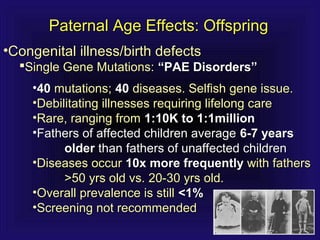
Paternal Age Effects: OffspringPaternal Age Effects: Offspring
•Congenital illness/birth defectsCongenital illness/birth defects
Single Gene Mutations:Single Gene Mutations: “PAE Disorders”“PAE Disorders”
•4040 mutations;mutations; 4040 diseases. Selfish gene issue.diseases. Selfish gene issue.
•Debilitating illnesses requiring lifelong careDebilitating illnesses requiring lifelong care
•Rare, ranging fromRare, ranging from 1:10K to 1:1million1:10K to 1:1million
•Fathers of affected children averageFathers of affected children average 6-7 years6-7 years
olderolder than fathers of unaffected childrenthan fathers of unaffected children
•Diseases occurDiseases occur 10x more frequently10x more frequently with fatherswith fathers
>50 yrs old vs. 20-30 yrs old.>50 yrs old vs. 20-30 yrs old.
•Overall prevalence is stillOverall prevalence is still <1%<1%
•Screening not recommendedScreening not recommended
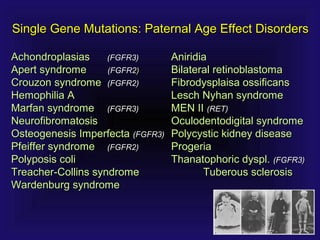
AchondroplasiasAchondroplasias (FGFR3)(FGFR3) AniridiaAniridia
Apert syndromeApert syndrome (FGFR2(FGFR2)) Bilateral retinoblastomaBilateral retinoblastoma
Crouzon syndromeCrouzon syndrome (FGFR2)(FGFR2) Fibrodysplaisa ossificansFibrodysplaisa ossificans
Hemophilia AHemophilia A Lesch Nyhan syndromeLesch Nyhan syndrome
Marfan syndromeMarfan syndrome (FGFR3)(FGFR3) MEN IIMEN II (RET)(RET)
NeurofibromatosisNeurofibromatosis Oculodentodigital syndromeOculodentodigital syndrome
Osteogenesis ImperfectaOsteogenesis Imperfecta (FGFR3)(FGFR3) Polycystic kidney diseasePolycystic kidney disease
Pfeiffer syndromePfeiffer syndrome (FGFR2)(FGFR2) ProgeriaProgeria
Polyposis coliPolyposis coli Thanatophoric dyspl.Thanatophoric dyspl. (FGFR3)(FGFR3)
Treacher-Collins syndromeTreacher-Collins syndrome Tuberous sclerosisTuberous sclerosis
Wardenburg syndromeWardenburg syndrome
Single Gene Mutations: Paternal Age Effect DisordersSingle Gene Mutations: Paternal Age Effect Disorders
Paternal Age Effects: OffspringPaternal Age Effects: Offspring
•Congenital illness/Congenital illness/birth defectsbirth defects
•DiseasesDiseases
Paternal Age Effects: OffspringPaternal Age Effects: Offspring
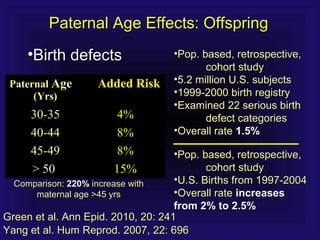
•Birth defectsBirth defects
Paternal Age
(Yrs)
Added Risk
30-35 4%
40-44 8%
45-49 8%
> 50 15%
Yang et al. Hum Reprod. 2007, 22: 696Yang et al. Hum Reprod. 2007, 22: 696
•Pop. based, retrospective,Pop. based, retrospective,
cohort studycohort study
•5.2 million U.S. subjects5.2 million U.S. subjects
•1999-2000 birth registry1999-2000 birth registry
•Examined 22 serious birthExamined 22 serious birth
defect categoriesdefect categories
•Overall rateOverall rate 1.5%1.5%
Comparison:Comparison: 220%220% increase withincrease with
maternal age >45 yrsmaternal age >45 yrs
Green et al. Ann Epid. 2010, 20: 241Green et al. Ann Epid. 2010, 20: 241
•Pop. based, retrospective,Pop. based, retrospective,
cohort studycohort study
•U.S. Births from 1997-2004U.S. Births from 1997-2004
•Overall rateOverall rate increasesincreases
from 2% to 2.5%from 2% to 2.5%
Paternal Age Effects: OffspringPaternal Age Effects: Offspring
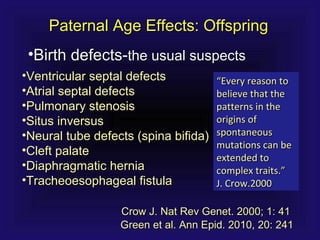
•Birth defects-Birth defects-the usual suspectsthe usual suspects
Green et al. Ann Epid. 2010, 20: 241Green et al. Ann Epid. 2010, 20: 241
•Ventricular septal defectsVentricular septal defects
•Atrial septal defectsAtrial septal defects
•Pulmonary stenosisPulmonary stenosis
•Situs inversusSitus inversus
•Neural tube defects (spina bifida)Neural tube defects (spina bifida)
•Cleft palateCleft palate
•Diaphragmatic herniaDiaphragmatic hernia
•Tracheoesophageal fistulaTracheoesophageal fistula
““Every reason toEvery reason to
believe that thebelieve that the
patterns in thepatterns in the
origins oforigins of
spontaneousspontaneous
mutations can bemutations can be
extended toextended to
complex traits.”complex traits.”
J. Crow.2000J. Crow.2000
Crow J. Nat Rev Genet. 2000; 1: 41Crow J. Nat Rev Genet. 2000; 1: 41
Paternal Age Effects: OffspringPaternal Age Effects: Offspring
•Congenital illness/birth defectsCongenital illness/birth defects
•DiseasesDiseases
Paternal Age Effects: OffspringPaternal Age Effects: Offspring
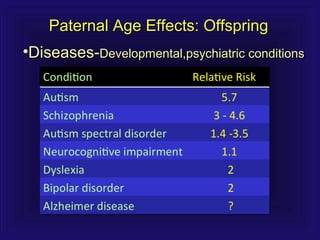
•Diseases-Diseases-Developmental,psychiatric conditionsDevelopmental,psychiatric conditions
Paternal Age Effects: OffspringPaternal Age Effects: Offspring
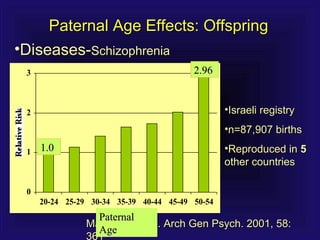
•Diseases-Diseases-SchizophreniaSchizophrenia
Malaspina et al. Arch Gen Psych. 2001, 58:Malaspina et al. Arch Gen Psych. 2001, 58:
361
0
1
2
3
20-24 25-29 30-34 35-39 40-44 45-49 50-54
PaternalPaternal
AgeAge
1.01.0
2.962.96
•Israeli registryIsraeli registry
•n=87,907 birthsn=87,907 births
•Reproduced inReproduced in 55
other countriesother countries
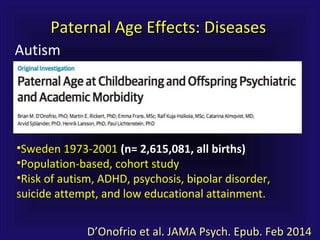
Paternal Age Effects: DiseasesPaternal Age Effects: Diseases
Autism
DD’’Onofrio et al. JAMA Psych. Epub. Feb 2014Onofrio et al. JAMA Psych. Epub. Feb 2014
•Sweden 1973-2001Sweden 1973-2001 (n= 2,615,081, all births)(n= 2,615,081, all births)
•Population-based, cohort studyPopulation-based, cohort study
•RiskRisk of autism, ADHD, psychosis, bipolar disorder,
suicide attempt, and low educational attainment.
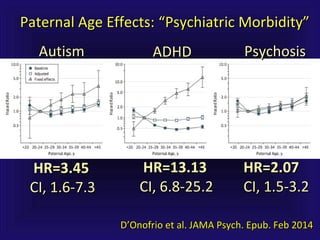
Paternal Age Effects:Paternal Age Effects: “Psychiatric Morbidity”“Psychiatric Morbidity”
DD’’Onofrio et al. JAMA Psych. Epub. Feb 2014Onofrio et al. JAMA Psych. Epub. Feb 2014
AutismAutism ADHDADHD PsychosisPsychosis
HR=3.45HR=3.45
CI, 1.6-7.3CI, 1.6-7.3
HR=13.13HR=13.13
CI, 6.8-25.2CI, 6.8-25.2
HR=2.07HR=2.07
CI, 1.5-3.2CI, 1.5-3.2
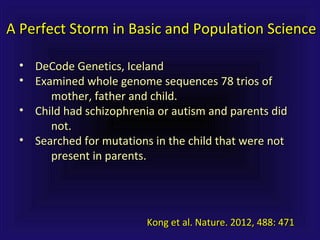
A Perfect Storm in Basic and Population ScienceA Perfect Storm in Basic and Population Science
• DeCode Genetics, IcelandDeCode Genetics, Iceland
• Examined whole genome sequences 78 trios ofExamined whole genome sequences 78 trios of
mother, father and child.mother, father and child.
• Child had schizophrenia or autism and parents didChild had schizophrenia or autism and parents did
not.not.
• Searched for mutations in the child that were notSearched for mutations in the child that were not
present in parents.present in parents.
Kong et al. Nature. 2012, 488: 471Kong et al. Nature. 2012, 488: 471
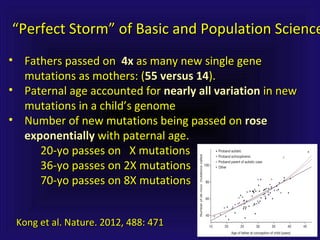
““Perfect Storm” of Basic and Population SciencePerfect Storm” of Basic and Population Science
• Fathers passed onFathers passed on 4x4x as many new single geneas many new single gene
mutations as mothers: (mutations as mothers: (55 versus 1455 versus 14).).
• Paternal age accounted forPaternal age accounted for nearly all variationnearly all variation in newin new
mutations in a child’s genomemutations in a child’s genome
• Number of new mutations being passed onNumber of new mutations being passed on roserose
exponentiallyexponentially with paternal age.with paternal age.
20-yo passes on X mutations20-yo passes on X mutations
36-yo passes on 2X mutations36-yo passes on 2X mutations
70-yo passes on 8X mutations70-yo passes on 8X mutations
Kong et al. Nature. 2012, 488: 471Kong et al. Nature. 2012, 488: 471
“…“…as a man ages, the number of de novo mutations inas a man ages, the number of de novo mutations in
his sperm increases, and the chance that a child wouldhis sperm increases, and the chance that a child would
carry a deleterious mutation…that could lead to autismcarry a deleterious mutation…that could lead to autism
or schizophrenia increases proportionally.or schizophrenia increases proportionally.
Given that fully half of new mutations inGiven that fully half of new mutations in
offspring are neurodevelopmental in nature:offspring are neurodevelopmental in nature:
““Perfect Storm” of Basic and Population SciencePerfect Storm” of Basic and Population Science
Kong et al. Nature. 2012, 488: 471Kong et al. Nature. 2012, 488: 471
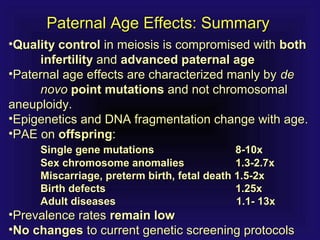
Paternal Age Effects: SummaryPaternal Age Effects: Summary
•Quality controlQuality control in meiosis is compromised within meiosis is compromised with bothboth
infertilityinfertility andand advanced paternal ageadvanced paternal age
•Paternal age effects are characterized manly byPaternal age effects are characterized manly by dede
novonovo point mutationspoint mutations and not chromosomaland not chromosomal
aneuploidy.aneuploidy.
•Epigenetics and DNA fragmentation change with age.Epigenetics and DNA fragmentation change with age.
•PAE onPAE on offspringoffspring::
Single gene mutationsSingle gene mutations 8-10x8-10x
Sex chromosome anomaliesSex chromosome anomalies 1.3-2.7x1.3-2.7x
Miscarriage, preterm birth, fetal death 1.5-2xMiscarriage, preterm birth, fetal death 1.5-2x
Birth defectsBirth defects 1.25x1.25x
Adult diseasesAdult diseases 1.1- 13x1.1- 13x
•Prevalence ratesPrevalence rates remain lowremain low
•No changesNo changes to current genetic screening protocolsto current genetic screening protocols
Thanks to:Thanks to:
The UCSF GroupThe UCSF Group
David Nudell MDDavid Nudell MD
Uche Ezeh MDUche Ezeh MD
Shai Shefi MDShai Shefi MD
Jeff Simko MDJeff Simko MD
Tom Walsh MD, MATom Walsh MD, MA
James Smith MD, MPHJames Smith MD, MPH
Alan Shindel MDAlan Shindel MD
Mary Croughan PhDMary Croughan PhD
Liza Jalalian BSLiza Jalalian BS
Mike Abeyta BSMike Abeyta BS
Gina Davis MS, GCSGina Davis MS, GCS
Lance Armstrong FoundationLance Armstrong Foundation
California Urology FoundationCalifornia Urology Foundation
NIH K-12 MRHRNIH K-12 MRHR
The Reijo Pera LaboratoryThe Reijo Pera Laboratory
Amander Clark PhDAmander Clark PhD
Dana Kostiner MDDana Kostiner MD
Joanna Gonsalves PhDJoanna Gonsalves PhD
Fred Moore PhDFred Moore PhD
Mark Fox PhDMark Fox PhD
Nina Kossack MSNina Kossack MS
Ximena Ares PhDXimena Ares PhD
Renee Reijo Pera PhDRenee Reijo Pera PhD
CollaboratorsCollaborators
Fei Sun PhDFei Sun PhD
Renee Martin PhDRenee Martin PhD

Reproductive Genetics and the Aging Male

  • 1.
    Paul J. TurekMD, FACS, FRSMPaul J. Turek MD, FACS, FRSM Director, The Turek ClinicDirector, The Turek Clinic Beverly Hills and San Francisco, CABeverly Hills and San Francisco, CA Reproductive GeneticsReproductive Genetics andand the Aging Malethe Aging Male
  • 2.
    At the conclusionof this presentation,At the conclusion of this presentation, participants should be able to:participants should be able to: Learning ObjectivesLearning Objectives • Delineate 2 genetic abnormalities in sperm that are associated with advanced paternal age (APA). • Explain APA associations with miscarriages, preterm birth and fetal death. • Enumerate two adult diseases of offspring that occur with increased frequency in APA.
  • 3.
    What’s Happening toFathers?What’s Happening to Fathers? % Men% Men FatheringFathering ChildrenChildren 19701970 19931993 20032003 15%15% 25%25% 40%40% Proportion of fathers over 35 years old in U.KProportion of fathers over 35 years old in U.K.. Bray I et al. J Epidemiol Comm Health 2006; 60: 851–3
  • 4.
    73 94 72 9999 When DoesPaternity End?When Does Paternity End? Courtesy: Dr. Saleh BinsalehCourtesy: Dr. Saleh Binsaleh
  • 5.
    Think of spermatogenesisas an engine..Think of spermatogenesis as an engine.. By puberty:By puberty: 3030 spermatogonial divisionsspermatogonial divisions After puberty:After puberty: 2323 divisions/yeardivisions/year By age 70:By age 70: 12881288 divisionsdivisions (Women 23)(Women 23) Crow J. Nat Rev Genet. 2000; 1: 41Crow J. Nat Rev Genet. 2000; 1: 41
  • 6.
    What happens whenengines get old?What happens when engines get old? They donThey don’t run as smoothly, or at all.’t run as smoothly, or at all.
  • 7.
    What is theRelationship?What is the Relationship? Genetic errorsGenetic errors InfertilityInfertility Genetic errorsGenetic errors AgingAging??
  • 8.
    My interest inMale Reproductive GeneticsMy interest in Male Reproductive Genetics 1992: ICSI (Intracytoplasmic Sperm Injection)1992: ICSI (Intracytoplasmic Sperm Injection) 1993: TESE described (Testicular sperm extraction)1993: TESE described (Testicular sperm extraction) 1995: DAZ gene discovered on Y chromosome1995: DAZ gene discovered on Y chromosome
  • 9.
    My interest inMale Reproductive GeneticsMy interest in Male Reproductive Genetics Response: Get Some Help!Response: Get Some Help! • Hire Renee Reijo Pera PhDHire Renee Reijo Pera PhD • Recruited to 5 UCSF DeptsRecruited to 5 UCSF Depts • The rest is historyThe rest is history
  • 10.
    Turek et al.UCNA. 2002; 29:767-92Turek et al. UCNA. 2002; 29:767-92 PROGENIPROGENI®® Program in the Genetics of InfertilityProgram in the Genetics of Infertility PROGRAM LEADERSPROGRAM LEADERS Paul J. Turek M.D.Paul J. Turek M.D. Renee Reijo Pera Ph.DRenee Reijo Pera Ph.D EXTERNAL ADVISORSEXTERNAL ADVISORS Andrew Wyrobek Ph.D.Andrew Wyrobek Ph.D. INTERNAL ADVISORSINTERNAL ADVISORS Linda Giudice M.D, Ph.DLinda Giudice M.D, Ph.D Mary Croughan Ph.DMary Croughan Ph.D DIAGNOSTIC ANDDIAGNOSTIC AND TREATMENT SERVICETREATMENT SERVICE 1. Cystic fibrosis mutations1. Cystic fibrosis mutations Farid Chahab Ph.DFarid Chahab Ph.D 2. Karyotype analysis2. Karyotype analysis Phil Cotter M.DPhil Cotter M.D 3. Y chromosome deletion3. Y chromosome deletion Renee Reijo Pera Ph.DRenee Reijo Pera Ph.D 4. Preimplantation Diagnosis4. Preimplantation Diagnosis Shehua Shen M.DShehua Shen M.D RESEARCH PROGRAMSRESEARCH PROGRAMS 1. Genetic male infertility1. Genetic male infertility Renee Reijo Pera Ph.DRenee Reijo Pera Ph.D 2. Epidemiology of2. Epidemiology of infertilityinfertility Mary Croughan Ph.DMary Croughan Ph.D 3. Genetics of meiosis3. Genetics of meiosis Renee Reijo Pera Ph.DRenee Reijo Pera Ph.D Project CoordinatorProject Coordinator Genetic CounselorsGenetic Counselors Lauri BlackLauri Black Kari DanzigerKari Danziger Eugene Xu Ph.DEugene Xu Ph.D Roger Pederson Ph.D.Roger Pederson Ph.D.
  • 11.
  • 12.
  • 13.
    Relevant Family Historyby Pedigree AnalysisRelevant Family History by Pedigree Analysis OrOr What is the Urologist Missing about GeneticWhat is the Urologist Missing about Genetic Infertility?Infertility? Design:Design: Reviewed pedigree analysisReviewed pedigree analysis of n=215of n=215 counseled couples. Bothcounseled couples. Both male and female family histories obtained. Exclude diagnosesmale and female family histories obtained. Exclude diagnoses made by the urologist.made by the urologist. Results:Results: 14 (14 (6.5%6.5%) of couples had significant and unique information) of couples had significant and unique information revealed by the genetic counselor.revealed by the genetic counselor. AUA 2001AUA 2001
  • 14.
  • 15.
    Infertility ClinicInfertility Clinic (Maleand Female)(Male and Female) Diagnosis &Diagnosis & TreatmentTreatment DNA BankDNA Bank TissueTissue Genetic CounselorGenetic Counselor BloodBloodRiskRisk CounselingCounseling PROGENI®PROGENI® Clinical ResearchClinical Research
  • 16.
    X Gene Xu PhD “Flyguy” Fred Moore MS “DAZ guy” •Identified DAZ-binding proteins.Identified DAZ-binding proteins. •Used a 2-hybrid screen.Used a 2-hybrid screen. •Confirmed with co-precipitation.Confirmed with co-precipitation. •DrosophilaDrosophila bouleboule genegene •Compared sequences ofCompared sequences of DAZDAZ interacting proteins withinteracting proteins with boule.boule.
  • 17.
    DAZLDAZL/human 1/human 1QGYILPEGKIMPNTVFVGGIDVRMDETEIRSFFARYGSVKEVKIITDRTGQGYILPEGKIMPNTVFVGGIDVRMDETEIRSFFARYGSVKEVKIITDRTG dazldazl/mouse 1/mouse 1 QGYVLPEGKIMPNTVFVGGIDVRMDETEIRSFFARYGSVKEVKIITDRTGQGYVLPEGKIMPNTVFVGGIDVRMDETEIRSFFARYGSVKEVKIITDRTG HbouleHboule 11 PTSAPRYGTVIPNRIFVGGIDFKTNESDLRKFFSQYGSVKEVKIVNDRAGPTSAPRYGTVIPNRIFVGGIDFKTNESDLRKFFSQYGSVKEVKIVNDRAG boule/fly 1boule/fly 1 PLAAPKYGTLIPNRIFVGGISGDTTEADLTRVFSAYGTVKSTKIIVDRAGPLAAPKYGTLIPNRIFVGGISGDTTEADLTRVFSAYGTVKSTKIIVDRAG * ..** .***** *... *. **.** **. **.** ..** .***** *... *. **.** **. **.* RNP1RNP1 DAZLDAZL/human 51/human 51 VSKGYGFVSFFNDVDVQKIVES--QINFHGKKLKLGPAIRKQVSKGYGFVSFFNDVDVQKIVES--QINFHGKKLKLGPAIRKQ 9090 dazldazl/mouse 51/mouse 51 VSKGYGFVSFYNDVDVQKIVES--QINFHGKKLKLGPAIRKQVSKGYGFVSFYNDVDVQKIVES--QINFHGKKLKLGPAIRKQ 9090 HbouleHboule 5151 VSKGYGFVTFETQEDAQKILQEAEKLNYKDKKLNIGPAIRKQVSKGYGFVTFETQEDAQKILQEAEKLNYKDKKLNIGPAIRKQ 9292 boule/fly 51boule/fly 51 VSKGYGFVTFETEQEAQRLQADGECVVLRDRKLNIAPAIKKQVSKGYGFVTFETEQEAQRLQADGECVVLRDRKLNIAPAIKKQ 9292 ********.* . . *.. . . .** . ***.**********.* . . *.. . . .** . ***.** =Shared by boules=Shared by boules =Shared by hboule & DAZs=Shared by hboule & DAZs RNPRNP 22 Comparison ofComparison of BouleBoule andand DAZDAZ An Autosomal Gene-BOULE-2q33 Xu E. et al. PNAS. 98: 7414, 2001Xu E. et al. PNAS. 98: 7414, 2001
  • 18.
    Analysis of HumanAnalysisof Human BouleBoule MutationsMutations •Examined DNA from n=164 infertile men in ProgeniExamined DNA from n=164 infertile men in Progeni GeneGene RR eegiongion LL engengtthh PPoollyymmorphorphiicc SiSi ttees (s (FrFreq.eq.)) CodCodiingng rreegiongion 849849 bpbp 00 NonNon--codcodiingng rregegiionon 325325 bpbp 00 IInnttronroniicc 872872 bpbp 33 (1(1//291291)) TT ototalal 20462046 33 (1(1//682682)) •Examined DNA from n=100 NIH Coriell referenceExamined DNA from n=100 NIH Coriell reference panelpanel Xu et al. Hum Mol Genet. 12: 169-175, 2003Xu et al. Hum Mol Genet. 12: 169-175, 2003 •Examined DNA from chimps, Old World monkeysExamined DNA from chimps, Old World monkeys
  • 19.
    Xu et al.Hum Mol Genet. 12: 169-175, 2003Xu et al. Hum Mol Genet. 12: 169-175, 2003 The humanThe human BOULEBOULE gene rescues fertilitygene rescues fertility in flies with ain flies with a BouleBoule mutationmutation Wild-typeWild-type BouleBoule -/-knocko-/-knocko utut KnockoutKnockout with flywith fly transgenetransgene KnockoutKnockout with humanwith human transgenetransgene spermsperm No spermNo sperm sperm!sperm! sperm!!sperm!!
  • 20.
    Primary spermatocytePrimary spermatocyte NoduleswithNodules with MMR proteinsMMR proteins Meiotic RecombinationMeiotic Recombination
  • 21.
    Gonsalves et al.Hum Mol Hum Genet. 2004; 13:2875Gonsalves et al. Hum Mol Hum Genet. 2004; 13:2875 Infertile men have reduced recombination frequenciesInfertile men have reduced recombination frequencies spermatocytespermatocyte Nodules withNodules with MMR proteinsMMR proteins
  • 22.
    •There is decreasedchromosomal pairing quality in azoospermic men.There is decreased chromosomal pairing quality in azoospermic men. •There is faulty progression through meiosis in infertile men.There is faulty progression through meiosis in infertile men. Sun et al. Cytogenet Genome Res. 111: 366, 2005Sun et al. Cytogenet Genome Res. 111: 366, 2005 •Recombination errors have a distinct pattern of variation amongRecombination errors have a distinct pattern of variation among various chromosomes.various chromosomes. Centromere-specificCentromere-specific multi-color FISHmulti-color FISH Sun et al. Cytogenet Hum Reprod. 15: 2376, 2006Sun et al. Cytogenet Hum Reprod. 15: 2376, 2006 •The localization patterns of 5 meiotic proteins described.The localization patterns of 5 meiotic proteins described. MSH4 appears to stabilize recombination foci.MSH4 appears to stabilize recombination foci. Oliver Bonet et al. Mol Hum Reprod. 11: 517, 2005Oliver Bonet et al. Mol Hum Reprod. 11: 517, 2005 Recombination in Infertile Men
  • 23.
    What Does ThisMean?What Does This Mean? • In animals and humans, faulty recombination isIn animals and humans, faulty recombination is linked to chromosomal aneuploidy.linked to chromosomal aneuploidy. • Smaller chromosomes at more risk (21, 22, X, Y).Smaller chromosomes at more risk (21, 22, X, Y). Faulty recombination could explain the “ICSI risk”Faulty recombination could explain the “ICSI risk” (sex chromosome anomalies) in offspring.(sex chromosome anomalies) in offspring. • Recombination nodules harbor mismatch repairRecombination nodules harbor mismatch repair (MMR) genes.(MMR) genes. • Do infertile men show defective MMR?Do infertile men show defective MMR?
  • 24.
    Faulty Mismatch Repair& Cancer in MiceFaulty Mismatch Repair & Cancer in Mice Mice Papers Baker S et al. Cell. 82: 309, 1995Baker S et al. Cell. 82: 309, 1995 Edelmann et al. Cell. 85: 1125, 1996Edelmann et al. Cell. 85: 1125, 1996
  • 25.
    Is There Evidenceof Faulty DNA RepairIs There Evidence of Faulty DNA Repair in Infertile Men?in Infertile Men? MouseMouse ManMan •6 infertile men with6 infertile men with azoospermia andazoospermia and maturation arrest.maturation arrest. •5 infertile men with5 infertile men with normal spermatogenesis.normal spermatogenesis. •Examined blood and testisExamined blood and testis tissue for microsatellitetissue for microsatellite instability at polymorphicinstability at polymorphic marker D19S49 on 19q12.marker D19S49 on 19q12. Nudell D et al. Hum Reprod.15: 1289, 2000.
  • 26.
    0 10 20 30 40 %CloneswithPointMutations%CloneswithPointMutations EARLY ARRESTEARLY ARRESTLATELATE ARRESTARREST NORMALNORMAL 22 1919 3131 55 3434 100100 500500 600600434366 1111 1717 Infertile PatientsInfertile Patients Nudell D. Hum Reprod.15: 1289, 2000. Polymorphic Marker: D19S49 Human mean = 9% Mice Mlh1-/- =14%
  • 27.
    What Does ThisMean?What Does This Mean? • In animals and humans, meiotic recombinationIn animals and humans, meiotic recombination involves mismatch repair genes.involves mismatch repair genes. • Faulty mismatch repair is associated with cancerFaulty mismatch repair is associated with cancer in animals and humans.in animals and humans. • Infertile men have evidence of faulty mismatchInfertile men have evidence of faulty mismatch repair.repair. • Are infertile men at higher risk of cancer?Are infertile men at higher risk of cancer?
  • 28.
    An Epidemiologic StudyAnEpidemiologic Study Do Infertile Men Have Higher Rates of Cancer?Do Infertile Men Have Higher Rates of Cancer? 51,000+ infertile males • 15 California centers • 1965 to 1998 California Cancer Registry (CCR) • 10 SEER Regions 1973 to 2003 – Testis cancer – Prostate cancer – Colon cancer – Melanoma ?? Walsh et al. Arch Int Med. 169: 351, 2009Walsh et al. Arch Int Med. 169: 351, 2009 Walsh et al. Cancer. Epub. Mar 2010Walsh et al. Cancer. Epub. Mar 2010
  • 29.
    Standardized Incidence Ratios(SIR)Standardized Incidence Ratios (SIR) forfor Testicular CancerTesticular Cancer inin MenMen withwith andand withoutwithout Male Factor InfertilityMale Factor Infertility *P<0.05*P<0.05 Standardized Incidence Ratios (SIR)Standardized Incidence Ratios (SIR) forfor Testicular CancerTesticular Cancer inin Infertile MenInfertile Men Walsh et al, Arch Int Med. 169: 351, 2009Walsh et al, Arch Int Med. 169: 351, 2009
  • 30.
    Walsh et al.Cancer. 116: 2140-7, 2010Walsh et al. Cancer. 116: 2140-7, 2010 SIRsSIRs forfor Prostate CancerProstate Cancer inin Infertile MenInfertile Men Fertility Status # MenFertility Status # Men # Cancers# Cancers SIR (95%CI)SIR (95%CI) All cancersAll cancers Male Factor InfertilityMale Factor Infertility NoNo 14,55714,557 6464 0.7 (0.6-0.9)0.7 (0.6-0.9) YesYes 4,5494,549 5656 1.1.33 (1.0-1.7)(1.0-1.7) High-grade cancers (Gl 8-10)High-grade cancers (Gl 8-10) Male Factor InfertilityMale Factor Infertility NoNo 14,55714,557 1616 0.8 (0.5-1.3)0.8 (0.5-1.3) YesYes 4,5494,549 1919 2.2.00 (1.2-3.0)(1.2-3.0)
  • 31.
    What Does ThisMean?What Does This Mean? • These infertility-cancer associations needThese infertility-cancer associations need confirmation.confirmation. • Other mechanisms exist that may explain infertility-Other mechanisms exist that may explain infertility- cancer relationships.cancer relationships. • More recent literature supports the relationship.More recent literature supports the relationship. • Forms the basis for my interest in paternal ageForms the basis for my interest in paternal age genetics!genetics!
  • 32.
    What is theRelationshipWhat is the Relationship?? Genetic errorsGenetic errors InfertilityInfertility Genetic errorsGenetic errors AgingAging??
  • 33.
    Paternal Age IssuesMay Differ…or Do They?Paternal Age Issues May Differ…or Do They? Infertility Aging
  • 34.
    What Changes Occurwith Paternal Age?What Changes Occur with Paternal Age? Lots going on inLots going on in young enginesyoung engines What changes occurWhat changes occur in older engines?in older engines? Meiotic Recombination?Meiotic Recombination? DNA Mismatch Repair?DNA Mismatch Repair? Mitotic Replication?Mitotic Replication?
  • 35.
    Paternal Age Effects:Sperm GeneticsPaternal Age Effects: Sperm Genetics •Chromosomal issues: NumericalChromosomal issues: Numerical Aneuploidy occurs inAneuploidy occurs in 30-50%30-50% of all pregnanciesof all pregnancies Most are lethal (Most are lethal (0.3%0.3% of births are aneuploid)of births are aneuploid) Arise from non-disjunction during meiosis (I and II)Arise from non-disjunction during meiosis (I and II) Definite increase in aneuploidy in infertile vs. fertile spermDefinite increase in aneuploidy in infertile vs. fertile sperm Autosomal aneuploidy: No hard evidence of an increaseAutosomal aneuploidy: No hard evidence of an increase with paternal agewith paternal age Sex chromosomal aneuploidy and disomy: possibleSex chromosomal aneuploidy and disomy: possible increases with paternal age (1-2x)increases with paternal age (1-2x) XY diploidyXY diploidy (Meiosis I) and(Meiosis I) and XX/YY diploidyXX/YY diploidy (Meiosis II)(Meiosis II) Templado C. Cytogenet Genome Res 2005, 111:199-205.Templado C. Cytogenet Genome Res 2005, 111:199-205. Sloter et al. Fertil Steril. 2004; 81:925Sloter et al. Fertil Steril. 2004; 81:925 Wyrobek et al. PNAS, 2006; 103:9601Wyrobek et al. PNAS, 2006; 103:9601
  • 36.
    Paternal Age Effects:Sperm GeneticsPaternal Age Effects: Sperm Genetics •Chromosomal issues: StructuralChromosomal issues: Structural 0.25%0.25% of birthsof births Chromosomal breaks & fragmentsChromosomal breaks & fragments increase with ageincrease with age PronouncedPronounced relationshiprelationship: r=0.63: r=0.63 Especially chromos 1Especially chromos 1 and acentricand acentric fragmentsfragments Not evidentNot evident inin offspringoffspring Sloter et al. Fertil Steril. 2007; 87: 1077Sloter et al. Fertil Steril. 2007; 87: 1077 Martin and Rademaker. Am J Hum Genet. 1987, 41: 484Martin and Rademaker. Am J Hum Genet. 1987, 41: 484
  • 37.
    Paternal Age Effects:Sperm GeneticsPaternal Age Effects: Sperm Genetics •Single Gene MutationsSingle Gene Mutations •CommonCommon in male>>female germ cells; increasein male>>female germ cells; increase with age. Suggestswith age. Suggests mitoticmitotic replicationreplication errorserrors •Postulated since 1912Postulated since 1912 as causes ofas causes of “sentinel“sentinel mutations”mutations” in offspring (achondroplasia)in offspring (achondroplasia) •Now “Now “PAE Disorders.PAE Disorders.”” •Wyrobek et al. n=88 healthy,Wyrobek et al. n=88 healthy, non-smoking mennon-smoking men •Examined achondroplasiaExamined achondroplasia muatatonsmuatatons •r=.54;r=.54; Change: 2%/yrChange: 2%/yr Goriely et al, Nat Genet. 2009, 41: 1247Goriely et al, Nat Genet. 2009, 41: 1247 Wyrobek et al. PNAS, 2006; 103:9601Wyrobek et al. PNAS, 2006; 103:9601 20 yrs20 yrs 40 yrs40 yrs 60 yrs60 yrs 8080 yrsyrs
  • 38.
    AchondroplasiasAchondroplasias (FGFR3)(FGFR3) AniridiaAniridia ApertsyndromeApert syndrome (FGFR2(FGFR2)) Bilateral retinoblastomaBilateral retinoblastoma Crouzon syndromeCrouzon syndrome (FGFR2)(FGFR2) Fibrodysplaisa ossificansFibrodysplaisa ossificans Hemophilia AHemophilia A Lesch Nyhan syndromeLesch Nyhan syndrome Marfan syndromeMarfan syndrome (FGFR3)(FGFR3) MEN IIMEN II (RET)(RET) NeurofibromatosisNeurofibromatosis Oculodentodigital syndromeOculodentodigital syndrome Osteogenesis ImperfectaOsteogenesis Imperfecta (FGFR3)(FGFR3) Polycystic kidney diseasePolycystic kidney disease Pfeiffer syndromePfeiffer syndrome (FGFR2)(FGFR2) ProgeriaProgeria Polyposis coliPolyposis coli Thanatophoric dyspl.Thanatophoric dyspl. (FGFR3)(FGFR3) Treacher-Collins syndromeTreacher-Collins syndrome Tuberous sclerosisTuberous sclerosis Wardenburg syndromeWardenburg syndrome Single Gene Mutations: Paternal Age Effect DisordersSingle Gene Mutations: Paternal Age Effect Disorders
  • 39.
    More on SingleGene MutationsMore on Single Gene Mutations •Old:Old: Penrose Hypothesis (1955)Penrose Hypothesis (1955). It’s more likely paternal. It’s more likely paternal than maternally derived due to continuously dividingthan maternally derived due to continuously dividing spermatogonia vs quiescent female germline.spermatogonia vs quiescent female germline. •OldOld:: Paternal contribution toPaternal contribution to de novode novo single gene mutationssingle gene mutations isis 6-9x greater6-9x greater than maternal contribution.than maternal contribution. Forster et al. Proc. Roy Soc B. 2015; Epub Mar 2015Forster et al. Proc. Roy Soc B. 2015; Epub Mar 2015 Goriely and Wilkie, Am J Hum Genet. 2012, 90: 175Goriely and Wilkie, Am J Hum Genet. 2012, 90: 175
  • 40.
    •NewNew:: These pointmutations areThese point mutations are not randomnot random (from(from generally poor quality control), but showgenerally poor quality control), but show “allelic“allelic skewing”skewing” and cluster in the receptor-RAS signallingand cluster in the receptor-RAS signalling pathway.pathway. •New:New: Paternal age effect mutations follow aPaternal age effect mutations follow a "selfish"selfish selection”selection” pathway (e.g. oncogenesis) that favors clonalpathway (e.g. oncogenesis) that favors clonal proliferation of mutated spermatogonia, leading to testisproliferation of mutated spermatogonia, leading to testis cancer (spermatocytic seminoma) and specificcancer (spermatocytic seminoma) and specific phenotypes in offspring.phenotypes in offspring. •New:New: PAE mutations occur up to 1000x more frequentlyPAE mutations occur up to 1000x more frequently than background nucleotide substitutions.than background nucleotide substitutions. Even More on Single Gene MutationsEven More on Single Gene Mutations Goriely and Wilkie, Am J Hum Genet. 2012, 90: 175Goriely and Wilkie, Am J Hum Genet. 2012, 90: 175
  • 41.
    PAE Mutations: AQuality ControlPAE Mutations: A Quality Control “Issue”“Issue” Goriely and Wilkie, Am J Hum Genet. 2012, 90: 175Goriely and Wilkie, Am J Hum Genet. 2012, 90: 175 Goriely et al, Nat Genet. 2009, 41: 1247Goriely et al, Nat Genet. 2009, 41: 1247 • StudiedStudied spermatocytic seminomasspermatocytic seminomas.. • ExaminedExamined PAE MutationsPAE Mutations; massive parallel sequencing; massive parallel sequencing • Found increased PAE mutations in tumors.Found increased PAE mutations in tumors. • Proposed that commonProposed that common “selfish”“selfish” mutationsmutations “hijack”“hijack” thethe pathway and lead to:pathway and lead to: • tumorstumors • diseases in offspringdiseases in offspring •Sperm produced are inSperm produced are in “evolutionary conflict:”“evolutionary conflict:” great forgreat for maintaining production but bad for species.maintaining production but bad for species. •““Houston, we have a problem…”Houston, we have a problem…”
  • 42.
    Wyrobek et al.PNAS, 2006; 103:9601Wyrobek et al. PNAS, 2006; 103:9601 Paternal Age Effects: Sperm GeneticsPaternal Age Effects: Sperm Genetics •Sperm DNA Fragmentation:Sperm DNA Fragmentation: Ji et al. BMC Med. 2012, 10: 49Ji et al. BMC Med. 2012, 10: 49 •N=88 healthy non-N=88 healthy non- smokerssmokers •r=0.72; p<0.001r=0.72; p<0.001 •Predicted changePredicted change ofof 3.1%/year3.1%/year of ageof age •Associated withAssociated with defective mismatchdefective mismatch repair?repair?20 yrs20 yrs 40 yrs40 yrs 60 yrs60 yrs 80 yrs80 yrs 10% 25% 47% 88% 20 yrs 40 yrs 60 yrs20 yrs 40 yrs 60 yrs 80 yrs80 yrs
  • 43.
    Jenkins et al.PLOS Genet.2014, 10: e1004458Jenkins et al. PLOS Genet.2014, 10: e1004458 Paternal Age Effects: Sperm EpigeneticsPaternal Age Effects: Sperm Epigenetics • Ejaculates from 17 fertile sperm donorsEjaculates from 17 fertile sperm donors 1990s1990s 9-19 years apart9-19 years apart 23-56 years old (mean 37.7 yrs)23-56 years old (mean 37.7 yrs) Mean 50.3 yrsMean 50.3 yrs • Global Methylation analysis (LINE)Global Methylation analysis (LINE) • High resolution (cGP) analysis (Illumina 450K)High resolution (cGP) analysis (Illumina 450K) • >10% change in methylation--significant>10% change in methylation--significant
  • 44.
    Jenkins et al.PLOS Genet.2014, 10: e1004458Jenkins et al. PLOS Genet.2014, 10: e1004458 Paternal Age Effects: Sperm EpigeneticsPaternal Age Effects: Sperm Epigenetics • Age-associated globalAge-associated global hyperhypermethylation.methylation. • RegionalRegional hypohypomethylationmethylation • Altered regions areAltered regions are consistentconsistent amongamong individuals andindividuals and increase linearlyincrease linearly with age.with age. • Many altered regions occur in loci known to beMany altered regions occur in loci known to be associated withassociated with diseasesdiseases in offspringin offspring that are linkedthat are linked to advanced paternal ageto advanced paternal age FindingsFindings
  • 45.
    Jenkins et al.PLOS Genet.2014, 10: e1004458Jenkins et al. PLOS Genet.2014, 10: e1004458 Paternal Age Effects: Sperm EpigeneticsPaternal Age Effects: Sperm Epigenetics DiseasesDiseases associated withassociated with involved genesinvolved genes compared tocompared to GAD-annotedGAD-annoted 11,326 disease-11,326 disease- associatedassociated genes.genes.
  • 46.
    MutationsMutations andand MethylationChangesMethylation Changes • They are independent events.They are independent events. • Methylation changes are a consequence of mutationsMethylation changes are a consequence of mutations • Methylation changes influence mutational eventsMethylation changes influence mutational events Are they related? 3 possibilities:Are they related? 3 possibilities: Milekic et al. Nat Mol Psych.2014, 1-7Milekic et al. Nat Mol Psych.2014, 1-7
  • 47.
    What Does ThisMean?What Does This Mean? • Rapidly dividing spermatogonia are likely theRapidly dividing spermatogonia are likely the source of DNA replication errors as men age.source of DNA replication errors as men age. • Single gene mutations are the consequence ofSingle gene mutations are the consequence of these errors (unlike aneuploidy in women).these errors (unlike aneuploidy in women). • Point mutations are rare, dominant and lead toPoint mutations are rare, dominant and lead to significant disease in offspring.significant disease in offspring. • Epigenetic changes to sperm genome also showEpigenetic changes to sperm genome also show correlations to disease in offspring.correlations to disease in offspring.
  • 48.
    Changes in Testiclesand Semen with AgeChanges in Testicles and Semen with Age •Morphometric studies:Morphometric studies: Leydig cells: fall 80 million/testis/decadeLeydig cells: fall 80 million/testis/decade Age-related decline in Sertoli cellsAge-related decline in Sertoli cells Decreased germ cell proliferationDecreased germ cell proliferation •Reduced semen qualityReduced semen quality Hellstrom et al. J. Androl 2006Hellstrom et al. J. Androl 2006 Wyrobek AJ. PNAS, 2006; 103:9601Wyrobek AJ. PNAS, 2006; 103:9601
  • 49.
    Paternal Age Effects:Achieving PregnancyPaternal Age Effects: Achieving Pregnancy •Non-clinical populations (Irish, Mormon, ALSPAC).Non-clinical populations (Irish, Mormon, ALSPAC). •DemonstrateDemonstrate increased time to pregnancyincreased time to pregnancy.. •OR for fertility fallsOR for fertility falls 2%/year of age2%/year of age Kidd S. Fert Steril 2001 75:237-48Kidd S. Fert Steril 2001 75:237-48 Ford W. Hum Reprod 2000 15:1703-Ford W. Hum Reprod 2000 15:1703- 88
  • 50.
    Paternal Age Effects:Achieving PregnancyPaternal Age Effects: Achieving Pregnancy ConfoundersConfounders Female ageFemale age Erectile and sexual dysfunctionErectile and sexual dysfunction Coital frequencyCoital frequency Comorbid conditionsComorbid conditions Kidd S. Fert Steril 2001 75:237-48Kidd S. Fert Steril 2001 75:237-48 Ford W. Hum Reprod 2000 15:1703-8Ford W. Hum Reprod 2000 15:1703-8
  • 51.
    Paternal Age Effects:Pregnancy OutcomesPaternal Age Effects: Pregnancy Outcomes •Miscarriages:Miscarriages: Fathers >50 yrs old associatedFathers >50 yrs old associated withwith 2x increased2x increased risk.risk. •Preterm birth (<32 weeks):Preterm birth (<32 weeks): •Fetal death:Fetal death: FathersFathers >>50 yrs50 yrs HR 1.88HR 1.88 (CI 0.93, 3.82)(CI 0.93, 3.82) Lambert. World J Urol 2006; 24:611-617Lambert. World J Urol 2006; 24:611-617 Kuhnert. Hum Reprod Upd 2004; 10:327-339Kuhnert. Hum Reprod Upd 2004; 10:327-339 CountryCountry YearsYears MaternalMaternal FindingsFindings Ages (yrs)Ages (yrs) ItalyItaly 1990-981990-98 20-2920-29 OR 1.7OR 1.7 (>45yrs)(>45yrs) DenmarkDenmark 1986-961986-96 20-2920-29 OR 2.1OR 2.1 (>50yrs)(>50yrs) USAUSA 1995-20001995-2000 20-3520-35 No effectNo effect Andersen et al. Am J Epi. 2004, 160: 1214.Andersen et al. Am J Epi. 2004, 160: 1214.
  • 52.
    Paternal Age Effects:OffspringPaternal Age Effects: Offspring •Congenital illness/birth defectsCongenital illness/birth defects •DiseasesDiseases
  • 53.
    Paternal Age Effects:OffspringPaternal Age Effects: Offspring •Congenital illness/birth defectsCongenital illness/birth defects ChromosomalChromosomal • General: no increase with paternal ageGeneral: no increase with paternal age • Exception: sex chromosomesException: sex chromosomes (47,XXY)(47,XXY) 55%55% of sex chromosomal aneuploidiesof sex chromosomal aneuploidies are paternal in originare paternal in origin.. Increased riskIncreased risk with paternal age? (with paternal age? (RR 1.3-2.7)RR 1.3-2.7) • Agrees withAgrees with spermsperm sex chromosomalsex chromosomal aneuploidy and disomyaneuploidy and disomy findingsfindings • Trisomy 21:Trisomy 21: 7-9%7-9% of cases paternalof cases paternal Toriello and Meck. Genet Med, 2008; 10-457Toriello and Meck. Genet Med, 2008; 10-457 Zaragoza et al. Hum Genet, 1994, 94:411Zaragoza et al. Hum Genet, 1994, 94:411
  • 54.
    Paternal Age Effects:OffspringPaternal Age Effects: Offspring •Congenital illness/birth defectsCongenital illness/birth defects Single Gene Mutations:Single Gene Mutations: “PAE Disorders”“PAE Disorders” •4040 mutations;mutations; 4040 diseases. Selfish gene issue.diseases. Selfish gene issue. •Debilitating illnesses requiring lifelong careDebilitating illnesses requiring lifelong care •Rare, ranging fromRare, ranging from 1:10K to 1:1million1:10K to 1:1million •Fathers of affected children averageFathers of affected children average 6-7 years6-7 years olderolder than fathers of unaffected childrenthan fathers of unaffected children •Diseases occurDiseases occur 10x more frequently10x more frequently with fatherswith fathers >50 yrs old vs. 20-30 yrs old.>50 yrs old vs. 20-30 yrs old. •Overall prevalence is stillOverall prevalence is still <1%<1% •Screening not recommendedScreening not recommended
  • 55.
    AchondroplasiasAchondroplasias (FGFR3)(FGFR3) AniridiaAniridia ApertsyndromeApert syndrome (FGFR2(FGFR2)) Bilateral retinoblastomaBilateral retinoblastoma Crouzon syndromeCrouzon syndrome (FGFR2)(FGFR2) Fibrodysplaisa ossificansFibrodysplaisa ossificans Hemophilia AHemophilia A Lesch Nyhan syndromeLesch Nyhan syndrome Marfan syndromeMarfan syndrome (FGFR3)(FGFR3) MEN IIMEN II (RET)(RET) NeurofibromatosisNeurofibromatosis Oculodentodigital syndromeOculodentodigital syndrome Osteogenesis ImperfectaOsteogenesis Imperfecta (FGFR3)(FGFR3) Polycystic kidney diseasePolycystic kidney disease Pfeiffer syndromePfeiffer syndrome (FGFR2)(FGFR2) ProgeriaProgeria Polyposis coliPolyposis coli Thanatophoric dyspl.Thanatophoric dyspl. (FGFR3)(FGFR3) Treacher-Collins syndromeTreacher-Collins syndrome Tuberous sclerosisTuberous sclerosis Wardenburg syndromeWardenburg syndrome Single Gene Mutations: Paternal Age Effect DisordersSingle Gene Mutations: Paternal Age Effect Disorders
  • 56.
    Paternal Age Effects:OffspringPaternal Age Effects: Offspring •Congenital illness/Congenital illness/birth defectsbirth defects •DiseasesDiseases
  • 57.
    Paternal Age Effects:OffspringPaternal Age Effects: Offspring •Birth defectsBirth defects Paternal Age (Yrs) Added Risk 30-35 4% 40-44 8% 45-49 8% > 50 15% Yang et al. Hum Reprod. 2007, 22: 696Yang et al. Hum Reprod. 2007, 22: 696 •Pop. based, retrospective,Pop. based, retrospective, cohort studycohort study •5.2 million U.S. subjects5.2 million U.S. subjects •1999-2000 birth registry1999-2000 birth registry •Examined 22 serious birthExamined 22 serious birth defect categoriesdefect categories •Overall rateOverall rate 1.5%1.5% Comparison:Comparison: 220%220% increase withincrease with maternal age >45 yrsmaternal age >45 yrs Green et al. Ann Epid. 2010, 20: 241Green et al. Ann Epid. 2010, 20: 241 •Pop. based, retrospective,Pop. based, retrospective, cohort studycohort study •U.S. Births from 1997-2004U.S. Births from 1997-2004 •Overall rateOverall rate increasesincreases from 2% to 2.5%from 2% to 2.5%
  • 58.
    Paternal Age Effects:OffspringPaternal Age Effects: Offspring •Birth defects-Birth defects-the usual suspectsthe usual suspects Green et al. Ann Epid. 2010, 20: 241Green et al. Ann Epid. 2010, 20: 241 •Ventricular septal defectsVentricular septal defects •Atrial septal defectsAtrial septal defects •Pulmonary stenosisPulmonary stenosis •Situs inversusSitus inversus •Neural tube defects (spina bifida)Neural tube defects (spina bifida) •Cleft palateCleft palate •Diaphragmatic herniaDiaphragmatic hernia •Tracheoesophageal fistulaTracheoesophageal fistula ““Every reason toEvery reason to believe that thebelieve that the patterns in thepatterns in the origins oforigins of spontaneousspontaneous mutations can bemutations can be extended toextended to complex traits.”complex traits.” J. Crow.2000J. Crow.2000 Crow J. Nat Rev Genet. 2000; 1: 41Crow J. Nat Rev Genet. 2000; 1: 41
  • 59.
    Paternal Age Effects:OffspringPaternal Age Effects: Offspring •Congenital illness/birth defectsCongenital illness/birth defects •DiseasesDiseases
  • 60.
    Paternal Age Effects:OffspringPaternal Age Effects: Offspring •Diseases-Diseases-Developmental,psychiatric conditionsDevelopmental,psychiatric conditions
  • 61.
    Paternal Age Effects:OffspringPaternal Age Effects: Offspring •Diseases-Diseases-SchizophreniaSchizophrenia Malaspina et al. Arch Gen Psych. 2001, 58:Malaspina et al. Arch Gen Psych. 2001, 58: 361 0 1 2 3 20-24 25-29 30-34 35-39 40-44 45-49 50-54 PaternalPaternal AgeAge 1.01.0 2.962.96 •Israeli registryIsraeli registry •n=87,907 birthsn=87,907 births •Reproduced inReproduced in 55 other countriesother countries
  • 62.
    Paternal Age Effects:DiseasesPaternal Age Effects: Diseases Autism DD’’Onofrio et al. JAMA Psych. Epub. Feb 2014Onofrio et al. JAMA Psych. Epub. Feb 2014 •Sweden 1973-2001Sweden 1973-2001 (n= 2,615,081, all births)(n= 2,615,081, all births) •Population-based, cohort studyPopulation-based, cohort study •RiskRisk of autism, ADHD, psychosis, bipolar disorder, suicide attempt, and low educational attainment.
  • 63.
    Paternal Age Effects:PaternalAge Effects: “Psychiatric Morbidity”“Psychiatric Morbidity” DD’’Onofrio et al. JAMA Psych. Epub. Feb 2014Onofrio et al. JAMA Psych. Epub. Feb 2014 AutismAutism ADHDADHD PsychosisPsychosis HR=3.45HR=3.45 CI, 1.6-7.3CI, 1.6-7.3 HR=13.13HR=13.13 CI, 6.8-25.2CI, 6.8-25.2 HR=2.07HR=2.07 CI, 1.5-3.2CI, 1.5-3.2
  • 64.
    A Perfect Stormin Basic and Population ScienceA Perfect Storm in Basic and Population Science • DeCode Genetics, IcelandDeCode Genetics, Iceland • Examined whole genome sequences 78 trios ofExamined whole genome sequences 78 trios of mother, father and child.mother, father and child. • Child had schizophrenia or autism and parents didChild had schizophrenia or autism and parents did not.not. • Searched for mutations in the child that were notSearched for mutations in the child that were not present in parents.present in parents. Kong et al. Nature. 2012, 488: 471Kong et al. Nature. 2012, 488: 471
  • 65.
    ““Perfect Storm” ofBasic and Population SciencePerfect Storm” of Basic and Population Science • Fathers passed onFathers passed on 4x4x as many new single geneas many new single gene mutations as mothers: (mutations as mothers: (55 versus 1455 versus 14).). • Paternal age accounted forPaternal age accounted for nearly all variationnearly all variation in newin new mutations in a child’s genomemutations in a child’s genome • Number of new mutations being passed onNumber of new mutations being passed on roserose exponentiallyexponentially with paternal age.with paternal age. 20-yo passes on X mutations20-yo passes on X mutations 36-yo passes on 2X mutations36-yo passes on 2X mutations 70-yo passes on 8X mutations70-yo passes on 8X mutations Kong et al. Nature. 2012, 488: 471Kong et al. Nature. 2012, 488: 471
  • 66.
    “…“…as a manages, the number of de novo mutations inas a man ages, the number of de novo mutations in his sperm increases, and the chance that a child wouldhis sperm increases, and the chance that a child would carry a deleterious mutation…that could lead to autismcarry a deleterious mutation…that could lead to autism or schizophrenia increases proportionally.or schizophrenia increases proportionally. Given that fully half of new mutations inGiven that fully half of new mutations in offspring are neurodevelopmental in nature:offspring are neurodevelopmental in nature: ““Perfect Storm” of Basic and Population SciencePerfect Storm” of Basic and Population Science Kong et al. Nature. 2012, 488: 471Kong et al. Nature. 2012, 488: 471
  • 67.
    Paternal Age Effects:SummaryPaternal Age Effects: Summary •Quality controlQuality control in meiosis is compromised within meiosis is compromised with bothboth infertilityinfertility andand advanced paternal ageadvanced paternal age •Paternal age effects are characterized manly byPaternal age effects are characterized manly by dede novonovo point mutationspoint mutations and not chromosomaland not chromosomal aneuploidy.aneuploidy. •Epigenetics and DNA fragmentation change with age.Epigenetics and DNA fragmentation change with age. •PAE onPAE on offspringoffspring:: Single gene mutationsSingle gene mutations 8-10x8-10x Sex chromosome anomaliesSex chromosome anomalies 1.3-2.7x1.3-2.7x Miscarriage, preterm birth, fetal death 1.5-2xMiscarriage, preterm birth, fetal death 1.5-2x Birth defectsBirth defects 1.25x1.25x Adult diseasesAdult diseases 1.1- 13x1.1- 13x •Prevalence ratesPrevalence rates remain lowremain low •No changesNo changes to current genetic screening protocolsto current genetic screening protocols
  • 68.
    Thanks to:Thanks to: TheUCSF GroupThe UCSF Group David Nudell MDDavid Nudell MD Uche Ezeh MDUche Ezeh MD Shai Shefi MDShai Shefi MD Jeff Simko MDJeff Simko MD Tom Walsh MD, MATom Walsh MD, MA James Smith MD, MPHJames Smith MD, MPH Alan Shindel MDAlan Shindel MD Mary Croughan PhDMary Croughan PhD Liza Jalalian BSLiza Jalalian BS Mike Abeyta BSMike Abeyta BS Gina Davis MS, GCSGina Davis MS, GCS Lance Armstrong FoundationLance Armstrong Foundation California Urology FoundationCalifornia Urology Foundation NIH K-12 MRHRNIH K-12 MRHR The Reijo Pera LaboratoryThe Reijo Pera Laboratory Amander Clark PhDAmander Clark PhD Dana Kostiner MDDana Kostiner MD Joanna Gonsalves PhDJoanna Gonsalves PhD Fred Moore PhDFred Moore PhD Mark Fox PhDMark Fox PhD Nina Kossack MSNina Kossack MS Ximena Ares PhDXimena Ares PhD Renee Reijo Pera PhDRenee Reijo Pera PhD CollaboratorsCollaborators Fei Sun PhDFei Sun PhD Renee Martin PhDRenee Martin PhD