Surafel Mekonnen
Safety Nets Team of Ministry of Labour and Social
Affairs (MoLSA), Ethiopia
Transfer Workshop, 2 to 4 April 2019
Arusha, Tanzania
The Improved Nutrition through integrated
Basic Social Services and Social Cash Transfer (IN
SCT) Impact Evaluation - Qualitative and
Productive Results
Contents:
•Background to the IN SCT
•Objectives and Design of the Impact Evaluation
•Qualitative Results
•Productive Results
•Quantitative Highlights
•Key Takeaways
Introduction to the IN-SCT in the framework of
the Productive Safety Net Programme (PSNP)
 4 years pilot intervention in SNNP and Oromia regions funded by
UNICEF and Irish Aid (2014-2018)
 Implemented as additional layer of services in the framework of the
PSNP in its 4th
phase
 The RPSNP as the second largest Safety Net Programme in Africa
Main IN SCT Objectives:
– Reduction of poverty and under nutrition of food insecure
households part of the PSNP
– Increased access to basic social services with focus on MNCH
and Nutrition by fostering co-responsibilities for two client
groups of the PNSP: Permanent Direct Support (PDS) and
Temporary Direct Support (TDS) clients
– TDS clients are pregnant and breastfeeding women and
caretakers of malnourished children temporarily exempted from
the PSNP Pubic Work component
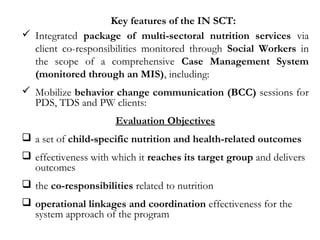
Key features of the IN SCT:
 Integrated package of multi-sectoral nutrition services via
client co-responsibilities monitored through Social Workers in
the scope of a comprehensive Case Management System
(monitored through an MIS), including:
 Mobilize behavior change communication (BCC) sessions for
PDS, TDS and PW clients:
Evaluation Objectives
 a set of child-specific nutrition and health-related outcomes
 effectiveness with which it reaches its target group and delivers
outcomes
 the co-responsibilities related to nutrition
 operational linkages and coordination effectiveness for the
system approach of the program
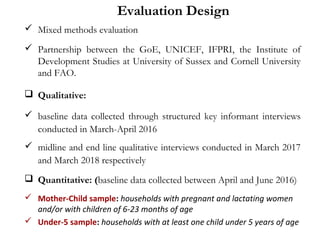
Evaluation Design
 Mixed methods evaluation
 Partnership between the GoE, UNICEF, IFPRI, the Institute of
Development Studies at University of Sussex and Cornell University
and FAO.
 Qualitative:
 baseline data collected through structured key informant interviews
conducted in March-April 2016
 midline and end line qualitative interviews conducted in March 2017
and March 2018 respectively
 Quantitative: (baseline data collected between April and June 2016)
 Mother-Child sample: households with pregnant and lactating women
and/or with children of 6-23 months of age
 Under-5 sample: households with at least one child under 5 years of age
Qualitative Results: Multi-Sectoral
Collaboration
 Multi-sectoral collaboration in PSNP woredas is facing challenges
(SW&HEW).
 Multi-sectoral collaboration in IN-SCT woredas is working well.
“The co-responsibilities that are implemented well in our Woreda are ANC and
PNC visits, vaccinating children and sending children to school.” [HEW, SNNP]
 Implementation of TDS in PSNP woredas is mixed.
“The transition of pregnant women into TDS is going well.” [HEW-1, SNNP]
“The transition for caregivers of malnourished children into TDS is not going
well.
 Implementation of TDS in IN-SCT woredas is much more effective.
“The transition for pregnant women into TDS is going well. ”
When women feel they are pregnant, they come to us. We confirm their
pregnancy. When they reach the 4th months of their pregnancy, we write a
transfer letter to the DA and the DA will immediately transfer them into TDS.”
[HEW-3, SNNP]
 Child nutrition
 “There is positive change because of education from the HEW ,cooking
demonstrations and nutrition club” [PDS, SNNP].
 Malnourished children
 “Currently, there are 12 moderately malnourished children under 5. Only one
of these is from a PSNP household while 11 are non-PSNP.” [HEW, SNNP]
 Implementation of BCC in IN-SCT Woredas is relatively well implemented.
 “I conducted 6 BCC sessions last year and 2 sessions this year for PSNP clients.
Other sessions were done jointly with the DA.” [HEW, Oromia].
Qualitative Results: Co-responsibilities and BCC
 Education and Health
o “IN-SCT had a positive impact because we are constantly checking and followingup
on school attendance, it is one of the most important jobs we do.” [SCT, SNNP]
o “Positive change in immunisation of children is due to improved awareness among
women through the BCC sessions, vaccination campaigns and follow up on
co-responsibilities.” [PSNP, Oromia]
 Gender
 Innovations in programme design benefit women more than men (e.g. transition
of pregnant women from Public Works to TDS).
 Women’s empowerment has increased. (“Women have developed a sense of
power in controlling resources and making decisions.” [HEW, Oromia])
 Female-headed households were deliberately targeted.
Qualitative Results: Education and Health
 Increase the number of Social Workers
“One Social Worker covering two kebeles with a motor-cycle,
or one Social Worker per kebele without a motor-cycle.” [PSNP, SNNP]
 Strengthen collaboration and reporting between HEWs and SWs
 Strengthen cross-sectoral collaboration, by strengthening the steering
committee at woreda level and ensuring there are monthly meetings
 Integrate child protection in the case management system of IN-SCT, and
build the capacity of Social Workers for case management
 Regular training and refresher training for HEWs, DAs and Social Workers
on rules regarding the transition from PW into TDS for PLW
 Improved data management and sharing regarding PDS and TDS clients
 Complete the development and pre-testing of the MIS before it is rolled out
Qualitative Results: Recommendations
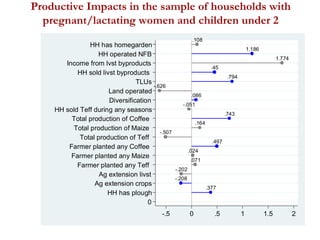
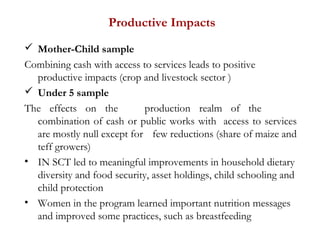
Productive Impacts in the sample of households with
pregnant/lactating women and children under 2
-.202
.071
.024
-.507
.164
-.051
-.626
1.774
.108
.377
-.208
.497
.743
.086
.794
.45
1.186
0
HH has plough
Ag extension crops
Ag extension livst
Farmer planted any Teff
Farmer planted any Maize
Farmer planted any Coffee
Total production of Teff
Total production of Maize
Total production of Coffee
HH sold Teff during any seasons
Diversification
Land operated
TLUs
HH sold livst byproducts
Income from lvst byproducts
HH operated NFB
HH has homegarden
-.5 0 .5 1 1.5 2
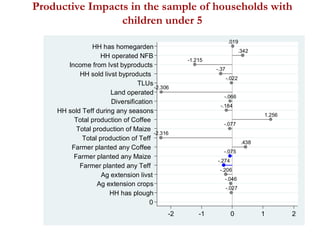
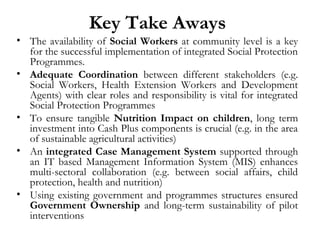
Productive Impacts in the sample of households with
children under 5
-.027
-.046
-.206
.438
-2.316
-.077
1.256
-.184
-.066
-2.306
-.022
-.37
-1.215
.342
.019
-.274
-.075
0
HH has plough
Ag extension crops
Ag extension livst
Farmer planted any Teff
Farmer planted any Maize
Farmer planted any Coffee
Total production of Teff
Total production of Maize
Total production of Coffee
HH sold Teff during any seasons
Diversification
Land operated
TLUs
HH sold livst byproducts
Income from lvst byproducts
HH operated NFB
HH has homegarden
-2 -1 0 1 2
Productive Impacts
 Mother-Child sample
Combining cash with access to services leads to positive
productive impacts (crop and livestock sector )
 Under 5 sample
The effects on the production realm of the
combination of cash or public works with access to services
are mostly null except for few reductions (share of maize and
teff growers)
• IN SCT led to meaningful improvements in household dietary
diversity and food security, asset holdings, child schooling and
child protection
• Women in the program learned important nutrition messages
and improved some practices, such as breastfeeding
Key Take Aways
• The availability of Social Workers at community level is a key
for the successful implementation of integrated Social Protection
Programmes.
• Adequate Coordination between different stakeholders (e.g.
Social Workers, Health Extension Workers and Development
Agents) with clear roles and responsibility is vital for integrated
Social Protection Programmes
• To ensure tangible Nutrition Impact on children, long term
investment into Cash Plus components is crucial (e.g. in the area
of sustainable agricultural activities)
• An integrated Case Management System supported through
an IT based Management Information System (MIS) enhances
multi-sectoral collaboration (e.g. between social affairs, child
protection, health and nutrition)
• Using existing government and programmes structures ensured
Government Ownership and long-term sustainability of pilot
interventions
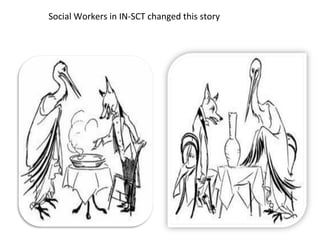
Social Workers in IN-SCT changed this story
Thank you for your attention!

Improved Nutrition through Integrated Basic Social Services & Social Cash Transfer Impact Evaluation

  • 1.
    Surafel Mekonnen Safety NetsTeam of Ministry of Labour and Social Affairs (MoLSA), Ethiopia Transfer Workshop, 2 to 4 April 2019 Arusha, Tanzania The Improved Nutrition through integrated Basic Social Services and Social Cash Transfer (IN SCT) Impact Evaluation - Qualitative and Productive Results
  • 2.
    Contents: •Background to theIN SCT •Objectives and Design of the Impact Evaluation •Qualitative Results •Productive Results •Quantitative Highlights •Key Takeaways
  • 3.
    Introduction to theIN-SCT in the framework of the Productive Safety Net Programme (PSNP)  4 years pilot intervention in SNNP and Oromia regions funded by UNICEF and Irish Aid (2014-2018)  Implemented as additional layer of services in the framework of the PSNP in its 4th phase  The RPSNP as the second largest Safety Net Programme in Africa Main IN SCT Objectives: – Reduction of poverty and under nutrition of food insecure households part of the PSNP – Increased access to basic social services with focus on MNCH and Nutrition by fostering co-responsibilities for two client groups of the PNSP: Permanent Direct Support (PDS) and Temporary Direct Support (TDS) clients – TDS clients are pregnant and breastfeeding women and caretakers of malnourished children temporarily exempted from the PSNP Pubic Work component
  • 4.
    Key features ofthe IN SCT:  Integrated package of multi-sectoral nutrition services via client co-responsibilities monitored through Social Workers in the scope of a comprehensive Case Management System (monitored through an MIS), including:  Mobilize behavior change communication (BCC) sessions for PDS, TDS and PW clients: Evaluation Objectives  a set of child-specific nutrition and health-related outcomes  effectiveness with which it reaches its target group and delivers outcomes  the co-responsibilities related to nutrition  operational linkages and coordination effectiveness for the system approach of the program
  • 5.
    Evaluation Design  Mixedmethods evaluation  Partnership between the GoE, UNICEF, IFPRI, the Institute of Development Studies at University of Sussex and Cornell University and FAO.  Qualitative:  baseline data collected through structured key informant interviews conducted in March-April 2016  midline and end line qualitative interviews conducted in March 2017 and March 2018 respectively  Quantitative: (baseline data collected between April and June 2016)  Mother-Child sample: households with pregnant and lactating women and/or with children of 6-23 months of age  Under-5 sample: households with at least one child under 5 years of age
  • 6.
    Qualitative Results: Multi-Sectoral Collaboration Multi-sectoral collaboration in PSNP woredas is facing challenges (SW&HEW).  Multi-sectoral collaboration in IN-SCT woredas is working well. “The co-responsibilities that are implemented well in our Woreda are ANC and PNC visits, vaccinating children and sending children to school.” [HEW, SNNP]  Implementation of TDS in PSNP woredas is mixed. “The transition of pregnant women into TDS is going well.” [HEW-1, SNNP] “The transition for caregivers of malnourished children into TDS is not going well.  Implementation of TDS in IN-SCT woredas is much more effective. “The transition for pregnant women into TDS is going well. ” When women feel they are pregnant, they come to us. We confirm their pregnancy. When they reach the 4th months of their pregnancy, we write a transfer letter to the DA and the DA will immediately transfer them into TDS.” [HEW-3, SNNP]
  • 7.
     Child nutrition “There is positive change because of education from the HEW ,cooking demonstrations and nutrition club” [PDS, SNNP].  Malnourished children  “Currently, there are 12 moderately malnourished children under 5. Only one of these is from a PSNP household while 11 are non-PSNP.” [HEW, SNNP]  Implementation of BCC in IN-SCT Woredas is relatively well implemented.  “I conducted 6 BCC sessions last year and 2 sessions this year for PSNP clients. Other sessions were done jointly with the DA.” [HEW, Oromia]. Qualitative Results: Co-responsibilities and BCC
  • 8.
     Education andHealth o “IN-SCT had a positive impact because we are constantly checking and followingup on school attendance, it is one of the most important jobs we do.” [SCT, SNNP] o “Positive change in immunisation of children is due to improved awareness among women through the BCC sessions, vaccination campaigns and follow up on co-responsibilities.” [PSNP, Oromia]  Gender  Innovations in programme design benefit women more than men (e.g. transition of pregnant women from Public Works to TDS).  Women’s empowerment has increased. (“Women have developed a sense of power in controlling resources and making decisions.” [HEW, Oromia])  Female-headed households were deliberately targeted. Qualitative Results: Education and Health
  • 9.
     Increase thenumber of Social Workers “One Social Worker covering two kebeles with a motor-cycle, or one Social Worker per kebele without a motor-cycle.” [PSNP, SNNP]  Strengthen collaboration and reporting between HEWs and SWs  Strengthen cross-sectoral collaboration, by strengthening the steering committee at woreda level and ensuring there are monthly meetings  Integrate child protection in the case management system of IN-SCT, and build the capacity of Social Workers for case management  Regular training and refresher training for HEWs, DAs and Social Workers on rules regarding the transition from PW into TDS for PLW  Improved data management and sharing regarding PDS and TDS clients  Complete the development and pre-testing of the MIS before it is rolled out Qualitative Results: Recommendations
  • 10.
    Productive Impacts inthe sample of households with pregnant/lactating women and children under 2 -.202 .071 .024 -.507 .164 -.051 -.626 1.774 .108 .377 -.208 .497 .743 .086 .794 .45 1.186 0 HH has plough Ag extension crops Ag extension livst Farmer planted any Teff Farmer planted any Maize Farmer planted any Coffee Total production of Teff Total production of Maize Total production of Coffee HH sold Teff during any seasons Diversification Land operated TLUs HH sold livst byproducts Income from lvst byproducts HH operated NFB HH has homegarden -.5 0 .5 1 1.5 2
  • 11.
    Productive Impacts inthe sample of households with children under 5 -.027 -.046 -.206 .438 -2.316 -.077 1.256 -.184 -.066 -2.306 -.022 -.37 -1.215 .342 .019 -.274 -.075 0 HH has plough Ag extension crops Ag extension livst Farmer planted any Teff Farmer planted any Maize Farmer planted any Coffee Total production of Teff Total production of Maize Total production of Coffee HH sold Teff during any seasons Diversification Land operated TLUs HH sold livst byproducts Income from lvst byproducts HH operated NFB HH has homegarden -2 -1 0 1 2
  • 12.
    Productive Impacts  Mother-Childsample Combining cash with access to services leads to positive productive impacts (crop and livestock sector )  Under 5 sample The effects on the production realm of the combination of cash or public works with access to services are mostly null except for few reductions (share of maize and teff growers) • IN SCT led to meaningful improvements in household dietary diversity and food security, asset holdings, child schooling and child protection • Women in the program learned important nutrition messages and improved some practices, such as breastfeeding
  • 13.
    Key Take Aways •The availability of Social Workers at community level is a key for the successful implementation of integrated Social Protection Programmes. • Adequate Coordination between different stakeholders (e.g. Social Workers, Health Extension Workers and Development Agents) with clear roles and responsibility is vital for integrated Social Protection Programmes • To ensure tangible Nutrition Impact on children, long term investment into Cash Plus components is crucial (e.g. in the area of sustainable agricultural activities) • An integrated Case Management System supported through an IT based Management Information System (MIS) enhances multi-sectoral collaboration (e.g. between social affairs, child protection, health and nutrition) • Using existing government and programmes structures ensured Government Ownership and long-term sustainability of pilot interventions
  • 14.
    Social Workers inIN-SCT changed this story
  • 15.
    Thank you foryour attention!

Editor's Notes

  • #11 Each line represents the percentage change brought about by the program relative to average outcome at baseline in the whole sample. Blue lines represent statistically significant impacts. Grey lines represent statistically insignificant impacts i.e. lack of impact. SNNP1 The combination of cash+services leads to: - increases in the share of sorghum, coffee and chat growers and in the harvested amounts of coffee. - an increase in the number of grown crops. No effects on the share of teff sellers. - the area of operated land is unaffected. - an increase in herd size. - increases in the share of those engaged in the sale of livestock byproducts. - no impacts in the sale revenues from livestock byproducts. - increases in the share of NFB owners.
  • #12 Each line represents the percentage change brought about by the program relative to average outcome at baseline in the whole sample. Blue lines represent statistically significant impacts. Grey lines represent statistically insignificant impacts i.e. lack of impact. SNNP2 The combination of cash or public works with services leads to - A reduction in the share of those growing teff, wheat, maize but no impacts on quantities. No changes in operated land. - has no effects on the share of teff sellers. - seems to have no impacts on crop diversification. - does not have any impacts on livestock ownings. - has no impacts on the share of sellers of livestock byproducts and on related revenues. - has no impacts on the share of HHs engaged in NFB.