WELCOME
TO
OUR PRESENTATION
SUBMITTED TO:
MD. MEHEDI HASSAN
ASSISTANT PROFESSOR
DEPARTMENT OF MARKETING
UNIVERSITY OF BARISAL
SUBMITTED BY:
GROUP-SUMMIT
SL NO Name of Group Members ID No.
1 RABIUL KHAN 14 MKT 004
2 TANU KIRTTANIA 14 MKT 038
3 MST. ROKSANA KHATUN 14 MKT 053
4 DOLON ROY 14 MKT 056
5 MITHUN SARDAR 14 MKT 059
6 MALIHAAKHTER 14 MKT 065
7 UMMEY SUMAIYA POROMA 14 MKT 069
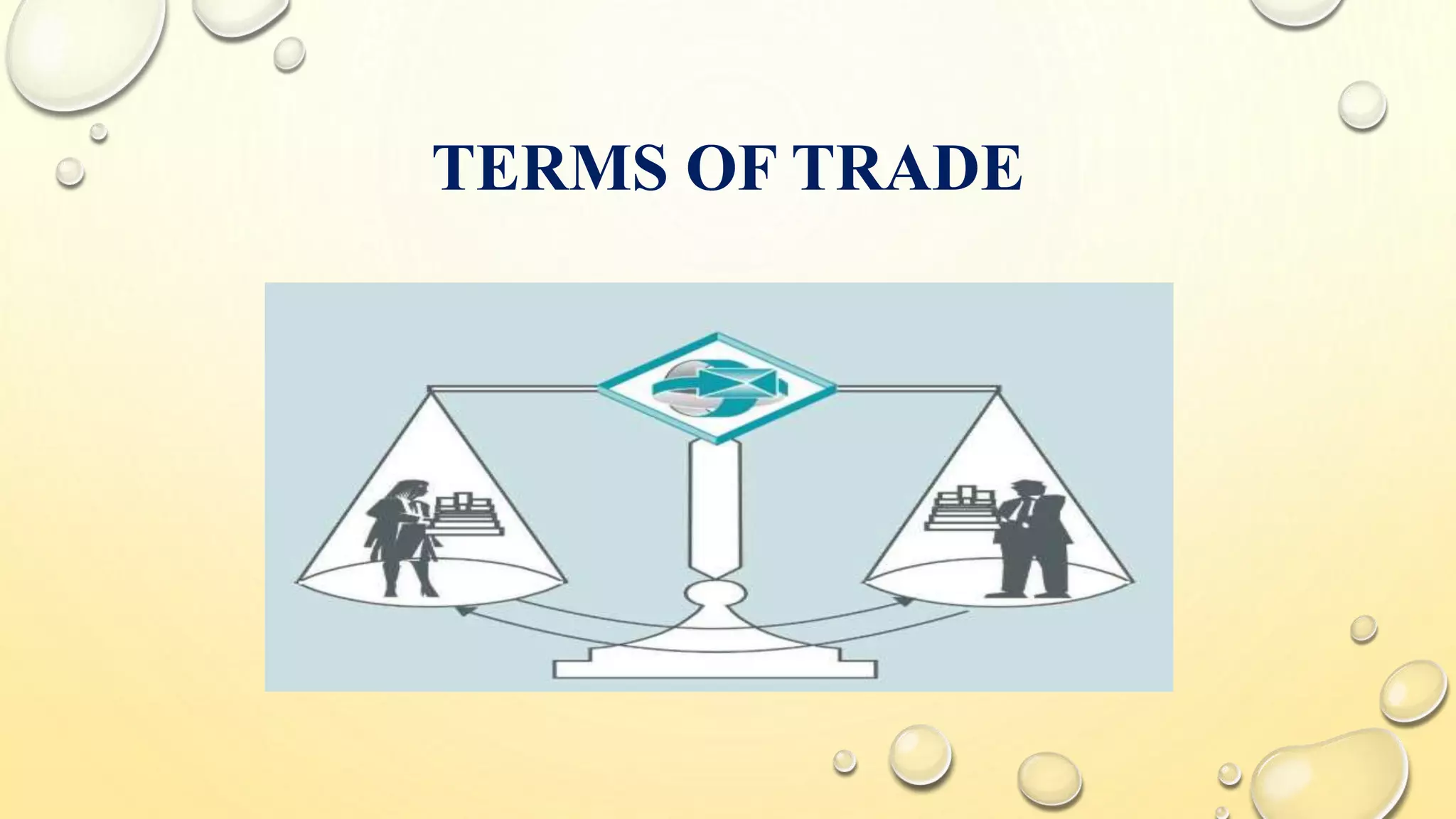
TERMS OF TRADE
TERMS OF TRADE
• Terms of trade (TOT) is a measure of how much imports an economy can get for a unit of
exported goods.
• Since, economies typically export and import many goods, measuring the TOT requires
defining price indices for exported and imported goods and comparing the two. A rise in
the prices of exported goods in international markets would increase the TOT, while a rise
in the prices of imported goods would decrease it.
• A country’s terms of trade measures a country’s export prices in relation to its import
prices, and is expressed as:
(Index of export price/ index of import price)×100
HISTORY
The term (barter) terms of trade was first coined by the US American economist Frank William
Trussing in his 1927 book “International Trade”. However, an earlier version of the concept can
be traced back to the English economist Robert Torrens and his book “The Budget: On
Commercial and Colonial Policy” published in 1844, as well as to John Stuart Mill's essay “ Of
the Laws of Interchange between Nations” and “the Distribution of Gains of Commerce among
the Countries of the Commercial World” published in the same year, though allegedly already
written in 1829/30.
BREAKING DOWN ‘TERMS OF TRADE’
• Terms of trade, when used to help determine how
healthy a country’s economy is, can lead analysts to
draw the wrong conclusions.
• It is essential for analysts to know why exports
increase, in relation to imports, specifically because
terms of trade are impacted by the changes that
occur in the prices of exports and imports.
• Terms of trade measurements are often recorded in
an index so that economic monitoring can be
performed.
MITHUN SARDAR
14 MKT 059
TYPES OF TERMS OF TRADE
• Main types of terms of trade, according to
jacob viner and meier are follows:
1) Net barter or commodity terms of trade.
2) Gross barter terms of trade.
3) Income terms of trade.
4) Single factorial terms of trade.
5) Double factorial terms of trade.
6) Real costs terms of trade.
7) Utility terms of trade.
NET BARTER OR COMMODITY TERMS
OF TRADE
 Commodity terms of trade are expressed in a formula as -
TC=PX/pm
(Here, TC= commodity terms of trade; PX= index of export prices; pm= index of
import prices).
 Commodity terms of trade in different time period can be measured by the
following formula:
Px1/pm1 : pxo/pmo
(Here, px1= index of export prices in the current year, pm1=index of import price
in the current year; pxo=index of export price in the base; pmo=index of import
prices in the base year).
NET BARTER OR COMMODITY TERMS
OF TRADE
CRITICISM:
The principle of commodity terms of trade has been criticized
on the following grounds:
The principle of commodity terms of trade is based on export
and import prices indices. It does not take into consideration
the changes in composition of the foreign trade and quality of
the goods. The concept examines short-terms changes only. It
throws no light on long-term changes.
MALIHAAKHTER
14 MKT 065
GROSS BARTER TERMS OF TRADE
• Gross commodity terms of trade are expressed in a formula as under:
TQ= qm/qx
(Here, TQ= gross barter terms of trade; qm=quality of imports; QX= quantity of
exports.)
• Gross barter or commodity terms of trade in different time periods can be
measured as follows:
Qm1/QX1 : qmo/qxo
(Here, qm1= index of quantity imported in the current year; qx1=index of quantity
exported in the current year; qmo=index of quantity imported in the base year; qxo=
index of quantity exported in the base year.)
GROSS BARTER TERMS OF TRADE
CRITICISM:
Gross commodity terms of trade are criticized as under:
 According to Tausig, gross commodity terms of trade include unilateral
transactions, like donation, gifts, etc. In balance of payments, but it is
not proper because it does not represent the natural flow of trade.
 Gross commodity terms of trade do not provide any clue of payment of
capital and its effect.
 Like net commodity terms of trade, gross commodity terms of trade
also do not attach any importance to changes in the quality of goods.
INCOME TERMS OF TRADE
The income terms of trade is the ratio of index of the prices of exports and index
of prices of imports.
Ty= tcqx=pxqx/pm (tc=px/pm)
(Here, ty=income terms of trade; tc= commodity terms of trade; px= index of
prices of exports; qx=index of quantity exported ; pm=index of prices imports.)
Income terms of trade are also called capacity to import. It is so because, in the
long-run, the value of total export of a country is equal to the value of its total
imports.
Pxqx= pmqm (pxqx/pm =qm) [qm= quantity of imports]
INCOME TERMS OF TRADE
CRITICISM:
Main criticism of income terms of trade is as follows;
 Concept of income terms of trade does not throw any
light on the profits and losses of international trade.
 Concept of income terms of trade is a narrow concept.
Index of income terms of trade relates to the capacity of
imports as being dependent only on exports.
MST. ROKSANA KHATUN
14 MKT 053
SINGLE FACTORIAL TERMS OF TRADE
Factorial terms of trade depend upon the productive efficiency of the factors of
production. The single factorial terms of trade, commodity terms of trade are
multiplied by the index of export productivity.
Ts= tc x fx= px/pm x fx (tc= px/pm)
CRITICISM:
According to critics, the greatest shortcoming of single factorial terms of trade is
that it does not take into consideration potential domestic cost of production of input
industries of importing country.
TWO FACTORIAL TERMS OF TRADE
 Double factorial terms of trade takes into account the productivity of the factors
of production in the country’s exports as well as the productivity of the foreign
factors of production used in country’s imports.
Td= tc x fx/fm = px/pm x fx/fm (td= px/pm)
(Here, td=double factorial terms of trade; tc= commodity terms of trade; px= index
of prices of exports; fx=index of productivity of export goods industries; pm=index
of prices of imports; fm= index of productivity of import goods industries.)
TWO FACTORIAL TERMS OF TRADE
CRITICISM:
• Main criticism of the concept of double factorial terms
are as under:
I. It is very difficult to estimate the index of double
factorials terms of trade of a country, because to do so it
is necessary to measure the productivity of import goods
produced in the country.
II. It is not possible to measure gains of international
trade by this concept, because no importance is given to
the utility of the goods exported and imported.
REAL COST TERMS OF TRADE
• Import and export goods are compared according to their utility. Real cost of both
import and export is worked out. Real cost terms of trade is calculated by multiplying
the single factorial terms of trade with the index of the amount of disutility per unit of
productive resource used in producing exports.
Tr= ts x rx = px/pm x fxx rx
(Here, TR= real cost terms of trade; ts= single factorial terms of trade; px=index of export
prices; pm=index of import prices; fx=index of productivity of export goods industries;
rx= sacrifice of utility inherent in export.)
CRITICISM:
• Main defect of real cost terms of trade is that it is concerned only with the quantity of
foreign goods obtained with the real costs inherent in exports.
UTILITY TERMS OF TRADE
• Utility terms of trade is the index of relative utility of import and domestic
commodities foregone to produce exports.
Tu= tr x u = px/pm x fx x rx x u
(Here, tu=utility terms of trade; tr=real cost terms of trade; px=index of export prices;
• Pm=index of import prices; fx=export productivity; rx= utility foregone to exports.)
CRITICISM:
• it is an unrealistic concept. Utility and disutility cannot be measured precisely. Both
concepts are subjective. This concept has no practical significance.
TANU KIRTTANIA
14 MKT 038
FACTORS INFLUENCING TERMS OF TRADE
1. Reciprocal demand:
(i) Elasticity of demand:
The following effect on terms of trade:
(a) Elasticity of demand of export goods: the demand of
exports of a country is less elastic then terms of
trade will be in its favour.
(b) Elasticity of demand of import goods: terms of
trade will be favourable to a country whose demand for
imports is more elastic. On the other hand, if the
demand for imports is less elastic, terms of trade will be
unfavourable.
.
FACTORS INFLUENCING TERMS OF TRADE
(ii) Elasticity of supply:
Elasticity of supply has the following effect on terms of trade:
(a) The supply of export is less elastic terms of trade will be unfavourable and if more
elastic the same will be favourable. (b) Supply of imports is less elastic, terms of trade will
be favourable and if supply of import is more elastic, terms of trade will be unfavourable
2. Size of demand:
With the increase in demand for the exports of a country, prices of export will increase as
against the prices of imports and hence, terms of trade become favourable. If demand for
imports increase, their prices will also increase as against the prices of export and so the
term of trade become unfavorable.
SIGNIFICANCE OF TERMS OF TRADE
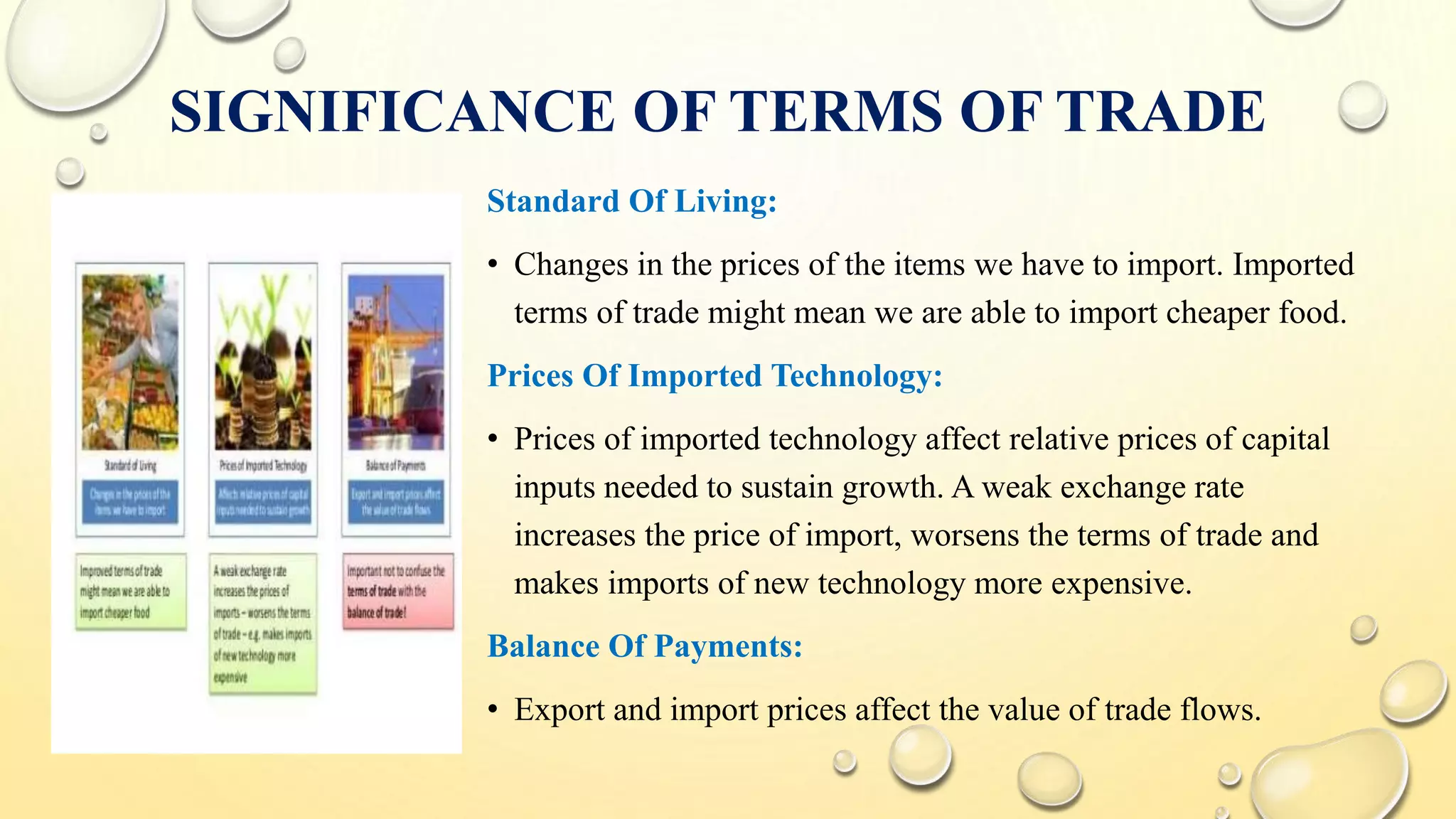
Standard Of Living:
• Changes in the prices of the items we have to import. Imported
terms of trade might mean we are able to import cheaper food.
Prices Of Imported Technology:
• Prices of imported technology affect relative prices of capital
inputs needed to sustain growth. A weak exchange rate
increases the price of import, worsens the terms of trade and
makes imports of new technology more expensive.
Balance Of Payments:
• Export and import prices affect the value of trade flows.
DOLON ROY
14 MKT 056
TERMS OF TRADE TRENDS AND ECONOMIC
GROWTH
 The most common view is that the terms of trade has a positive impact
on economic growth.
 An increase in export prices relative to import prices allows a larger
volume of imports to be purchased with a given volume of exports.
 The implied increase in the real purchasing power of domestic
production is equivalent to a transfer of income from the rest of the
world and can have large impacts on consumption, savings and
investment.
 The terms of trade can also be thought of as a rate of return on
investment and therefore a secular improvement in the terms of trade
leads to an increase in investment and hence economic growth.
TERMS OF TRADE TRENDS AND ECONOMIC
GROWTH
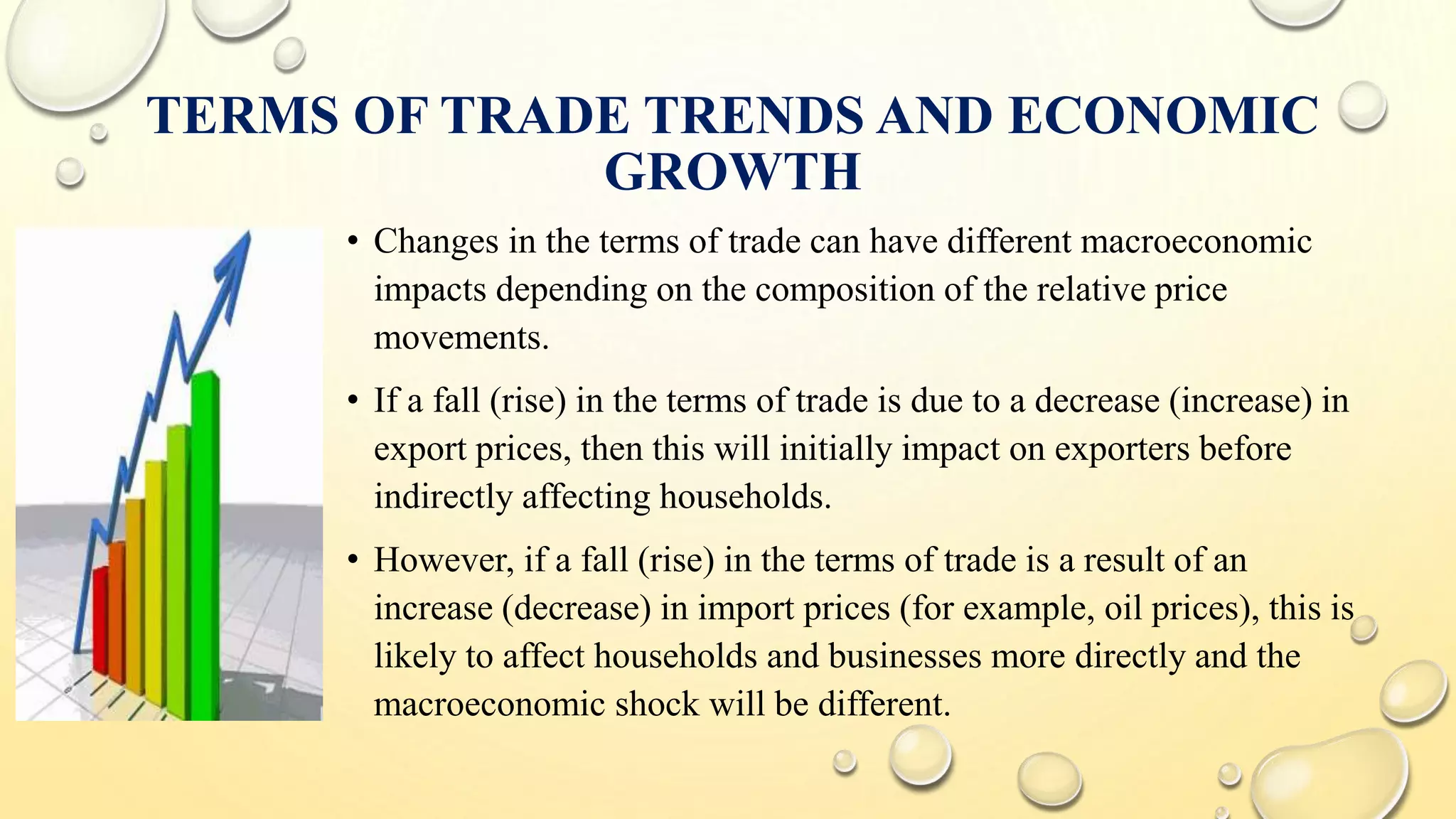
• Changes in the terms of trade can have different macroeconomic
impacts depending on the composition of the relative price
movements.
• If a fall (rise) in the terms of trade is due to a decrease (increase) in
export prices, then this will initially impact on exporters before
indirectly affecting households.
• However, if a fall (rise) in the terms of trade is a result of an
increase (decrease) in import prices (for example, oil prices), this is
likely to affect households and businesses more directly and the
macroeconomic shock will be different.
TERMS OF TRADE OF BANGLADESH
• Terms of trade in bangladesh increased to 86.05 index points in
2015 from 85.89 index points in 2014. Terms of trade in
bangladesh averaged 91.51 index points from 1986 until 2015,
reaching an all time high of 104.70 index points in 1988 and a
record low of 80.01 index points in 2003.
LIMITATIONS
 Terms of trade should not be used as synonymous with
social welfare, or even pareto economic welfare.
 Terms of trade calculations do not tell us about the
volume of the countries' exports, only relative changes
between countries.
 This may not necessarily mean an improved standard of
living for the country.
 Terms of trade calculations can get very complex.
RABIUL KHAN
14 MKT 004
Q. WHY EXCHANGE RATE VARIES?
• There are many fundamental factors such as those
discussed below that determine exchange rates.
1. Differentials in Inflation
2. Differentials in Interest Rates
3. Current-Account Deficits
4. Public Debt
5. Terms of Trade
6. Political Stability and Economic Performance
Q: WHY DOLLAR IS STANDARD OF
INTERNATIONAL TRANSACTION?
The power of the U. S. Dollar depends on its use as a global currency. It is backed by the
power of america's economy. Here are three reasons behind the power of the dollar.
 The Dollar Is a Global Currency
 The Dollar Is the New Gold Standard
 The Dollar Has Always Recovered from Prior Declines
Terms of-trade
Terms of-trade

Terms of-trade

  • 1.
  • 2.
    SUBMITTED TO: MD. MEHEDIHASSAN ASSISTANT PROFESSOR DEPARTMENT OF MARKETING UNIVERSITY OF BARISAL
  • 3.
  • 4.
    SL NO Nameof Group Members ID No. 1 RABIUL KHAN 14 MKT 004 2 TANU KIRTTANIA 14 MKT 038 3 MST. ROKSANA KHATUN 14 MKT 053 4 DOLON ROY 14 MKT 056 5 MITHUN SARDAR 14 MKT 059 6 MALIHAAKHTER 14 MKT 065 7 UMMEY SUMAIYA POROMA 14 MKT 069
  • 5.
  • 6.
    TERMS OF TRADE •Terms of trade (TOT) is a measure of how much imports an economy can get for a unit of exported goods. • Since, economies typically export and import many goods, measuring the TOT requires defining price indices for exported and imported goods and comparing the two. A rise in the prices of exported goods in international markets would increase the TOT, while a rise in the prices of imported goods would decrease it. • A country’s terms of trade measures a country’s export prices in relation to its import prices, and is expressed as: (Index of export price/ index of import price)×100
  • 7.
    HISTORY The term (barter)terms of trade was first coined by the US American economist Frank William Trussing in his 1927 book “International Trade”. However, an earlier version of the concept can be traced back to the English economist Robert Torrens and his book “The Budget: On Commercial and Colonial Policy” published in 1844, as well as to John Stuart Mill's essay “ Of the Laws of Interchange between Nations” and “the Distribution of Gains of Commerce among the Countries of the Commercial World” published in the same year, though allegedly already written in 1829/30.
  • 8.
    BREAKING DOWN ‘TERMSOF TRADE’ • Terms of trade, when used to help determine how healthy a country’s economy is, can lead analysts to draw the wrong conclusions. • It is essential for analysts to know why exports increase, in relation to imports, specifically because terms of trade are impacted by the changes that occur in the prices of exports and imports. • Terms of trade measurements are often recorded in an index so that economic monitoring can be performed.
  • 9.
  • 10.
    TYPES OF TERMSOF TRADE • Main types of terms of trade, according to jacob viner and meier are follows: 1) Net barter or commodity terms of trade. 2) Gross barter terms of trade. 3) Income terms of trade. 4) Single factorial terms of trade. 5) Double factorial terms of trade. 6) Real costs terms of trade. 7) Utility terms of trade.
  • 11.
    NET BARTER ORCOMMODITY TERMS OF TRADE  Commodity terms of trade are expressed in a formula as - TC=PX/pm (Here, TC= commodity terms of trade; PX= index of export prices; pm= index of import prices).  Commodity terms of trade in different time period can be measured by the following formula: Px1/pm1 : pxo/pmo (Here, px1= index of export prices in the current year, pm1=index of import price in the current year; pxo=index of export price in the base; pmo=index of import prices in the base year).
  • 12.
    NET BARTER ORCOMMODITY TERMS OF TRADE CRITICISM: The principle of commodity terms of trade has been criticized on the following grounds: The principle of commodity terms of trade is based on export and import prices indices. It does not take into consideration the changes in composition of the foreign trade and quality of the goods. The concept examines short-terms changes only. It throws no light on long-term changes.
  • 13.
  • 14.
    GROSS BARTER TERMSOF TRADE • Gross commodity terms of trade are expressed in a formula as under: TQ= qm/qx (Here, TQ= gross barter terms of trade; qm=quality of imports; QX= quantity of exports.) • Gross barter or commodity terms of trade in different time periods can be measured as follows: Qm1/QX1 : qmo/qxo (Here, qm1= index of quantity imported in the current year; qx1=index of quantity exported in the current year; qmo=index of quantity imported in the base year; qxo= index of quantity exported in the base year.)
  • 15.
    GROSS BARTER TERMSOF TRADE CRITICISM: Gross commodity terms of trade are criticized as under:  According to Tausig, gross commodity terms of trade include unilateral transactions, like donation, gifts, etc. In balance of payments, but it is not proper because it does not represent the natural flow of trade.  Gross commodity terms of trade do not provide any clue of payment of capital and its effect.  Like net commodity terms of trade, gross commodity terms of trade also do not attach any importance to changes in the quality of goods.
  • 16.
    INCOME TERMS OFTRADE The income terms of trade is the ratio of index of the prices of exports and index of prices of imports. Ty= tcqx=pxqx/pm (tc=px/pm) (Here, ty=income terms of trade; tc= commodity terms of trade; px= index of prices of exports; qx=index of quantity exported ; pm=index of prices imports.) Income terms of trade are also called capacity to import. It is so because, in the long-run, the value of total export of a country is equal to the value of its total imports. Pxqx= pmqm (pxqx/pm =qm) [qm= quantity of imports]
  • 17.
    INCOME TERMS OFTRADE CRITICISM: Main criticism of income terms of trade is as follows;  Concept of income terms of trade does not throw any light on the profits and losses of international trade.  Concept of income terms of trade is a narrow concept. Index of income terms of trade relates to the capacity of imports as being dependent only on exports.
  • 18.
  • 19.
    SINGLE FACTORIAL TERMSOF TRADE Factorial terms of trade depend upon the productive efficiency of the factors of production. The single factorial terms of trade, commodity terms of trade are multiplied by the index of export productivity. Ts= tc x fx= px/pm x fx (tc= px/pm) CRITICISM: According to critics, the greatest shortcoming of single factorial terms of trade is that it does not take into consideration potential domestic cost of production of input industries of importing country.
  • 20.
    TWO FACTORIAL TERMSOF TRADE  Double factorial terms of trade takes into account the productivity of the factors of production in the country’s exports as well as the productivity of the foreign factors of production used in country’s imports. Td= tc x fx/fm = px/pm x fx/fm (td= px/pm) (Here, td=double factorial terms of trade; tc= commodity terms of trade; px= index of prices of exports; fx=index of productivity of export goods industries; pm=index of prices of imports; fm= index of productivity of import goods industries.)
  • 21.
    TWO FACTORIAL TERMSOF TRADE CRITICISM: • Main criticism of the concept of double factorial terms are as under: I. It is very difficult to estimate the index of double factorials terms of trade of a country, because to do so it is necessary to measure the productivity of import goods produced in the country. II. It is not possible to measure gains of international trade by this concept, because no importance is given to the utility of the goods exported and imported.
  • 22.
    REAL COST TERMSOF TRADE • Import and export goods are compared according to their utility. Real cost of both import and export is worked out. Real cost terms of trade is calculated by multiplying the single factorial terms of trade with the index of the amount of disutility per unit of productive resource used in producing exports. Tr= ts x rx = px/pm x fxx rx (Here, TR= real cost terms of trade; ts= single factorial terms of trade; px=index of export prices; pm=index of import prices; fx=index of productivity of export goods industries; rx= sacrifice of utility inherent in export.) CRITICISM: • Main defect of real cost terms of trade is that it is concerned only with the quantity of foreign goods obtained with the real costs inherent in exports.
  • 23.
    UTILITY TERMS OFTRADE • Utility terms of trade is the index of relative utility of import and domestic commodities foregone to produce exports. Tu= tr x u = px/pm x fx x rx x u (Here, tu=utility terms of trade; tr=real cost terms of trade; px=index of export prices; • Pm=index of import prices; fx=export productivity; rx= utility foregone to exports.) CRITICISM: • it is an unrealistic concept. Utility and disutility cannot be measured precisely. Both concepts are subjective. This concept has no practical significance.
  • 24.
  • 25.
    FACTORS INFLUENCING TERMSOF TRADE 1. Reciprocal demand: (i) Elasticity of demand: The following effect on terms of trade: (a) Elasticity of demand of export goods: the demand of exports of a country is less elastic then terms of trade will be in its favour. (b) Elasticity of demand of import goods: terms of trade will be favourable to a country whose demand for imports is more elastic. On the other hand, if the demand for imports is less elastic, terms of trade will be unfavourable. .
  • 26.
    FACTORS INFLUENCING TERMSOF TRADE (ii) Elasticity of supply: Elasticity of supply has the following effect on terms of trade: (a) The supply of export is less elastic terms of trade will be unfavourable and if more elastic the same will be favourable. (b) Supply of imports is less elastic, terms of trade will be favourable and if supply of import is more elastic, terms of trade will be unfavourable 2. Size of demand: With the increase in demand for the exports of a country, prices of export will increase as against the prices of imports and hence, terms of trade become favourable. If demand for imports increase, their prices will also increase as against the prices of export and so the term of trade become unfavorable.
  • 27.
    SIGNIFICANCE OF TERMSOF TRADE Standard Of Living: • Changes in the prices of the items we have to import. Imported terms of trade might mean we are able to import cheaper food. Prices Of Imported Technology: • Prices of imported technology affect relative prices of capital inputs needed to sustain growth. A weak exchange rate increases the price of import, worsens the terms of trade and makes imports of new technology more expensive. Balance Of Payments: • Export and import prices affect the value of trade flows.
  • 28.
  • 29.
    TERMS OF TRADETRENDS AND ECONOMIC GROWTH  The most common view is that the terms of trade has a positive impact on economic growth.  An increase in export prices relative to import prices allows a larger volume of imports to be purchased with a given volume of exports.  The implied increase in the real purchasing power of domestic production is equivalent to a transfer of income from the rest of the world and can have large impacts on consumption, savings and investment.  The terms of trade can also be thought of as a rate of return on investment and therefore a secular improvement in the terms of trade leads to an increase in investment and hence economic growth.
  • 30.
    TERMS OF TRADETRENDS AND ECONOMIC GROWTH • Changes in the terms of trade can have different macroeconomic impacts depending on the composition of the relative price movements. • If a fall (rise) in the terms of trade is due to a decrease (increase) in export prices, then this will initially impact on exporters before indirectly affecting households. • However, if a fall (rise) in the terms of trade is a result of an increase (decrease) in import prices (for example, oil prices), this is likely to affect households and businesses more directly and the macroeconomic shock will be different.
  • 31.
    TERMS OF TRADEOF BANGLADESH • Terms of trade in bangladesh increased to 86.05 index points in 2015 from 85.89 index points in 2014. Terms of trade in bangladesh averaged 91.51 index points from 1986 until 2015, reaching an all time high of 104.70 index points in 1988 and a record low of 80.01 index points in 2003.
  • 32.
    LIMITATIONS  Terms oftrade should not be used as synonymous with social welfare, or even pareto economic welfare.  Terms of trade calculations do not tell us about the volume of the countries' exports, only relative changes between countries.  This may not necessarily mean an improved standard of living for the country.  Terms of trade calculations can get very complex.
  • 33.
  • 34.
    Q. WHY EXCHANGERATE VARIES? • There are many fundamental factors such as those discussed below that determine exchange rates. 1. Differentials in Inflation 2. Differentials in Interest Rates 3. Current-Account Deficits 4. Public Debt 5. Terms of Trade 6. Political Stability and Economic Performance
  • 35.
    Q: WHY DOLLARIS STANDARD OF INTERNATIONAL TRANSACTION? The power of the U. S. Dollar depends on its use as a global currency. It is backed by the power of america's economy. Here are three reasons behind the power of the dollar.  The Dollar Is a Global Currency  The Dollar Is the New Gold Standard  The Dollar Has Always Recovered from Prior Declines