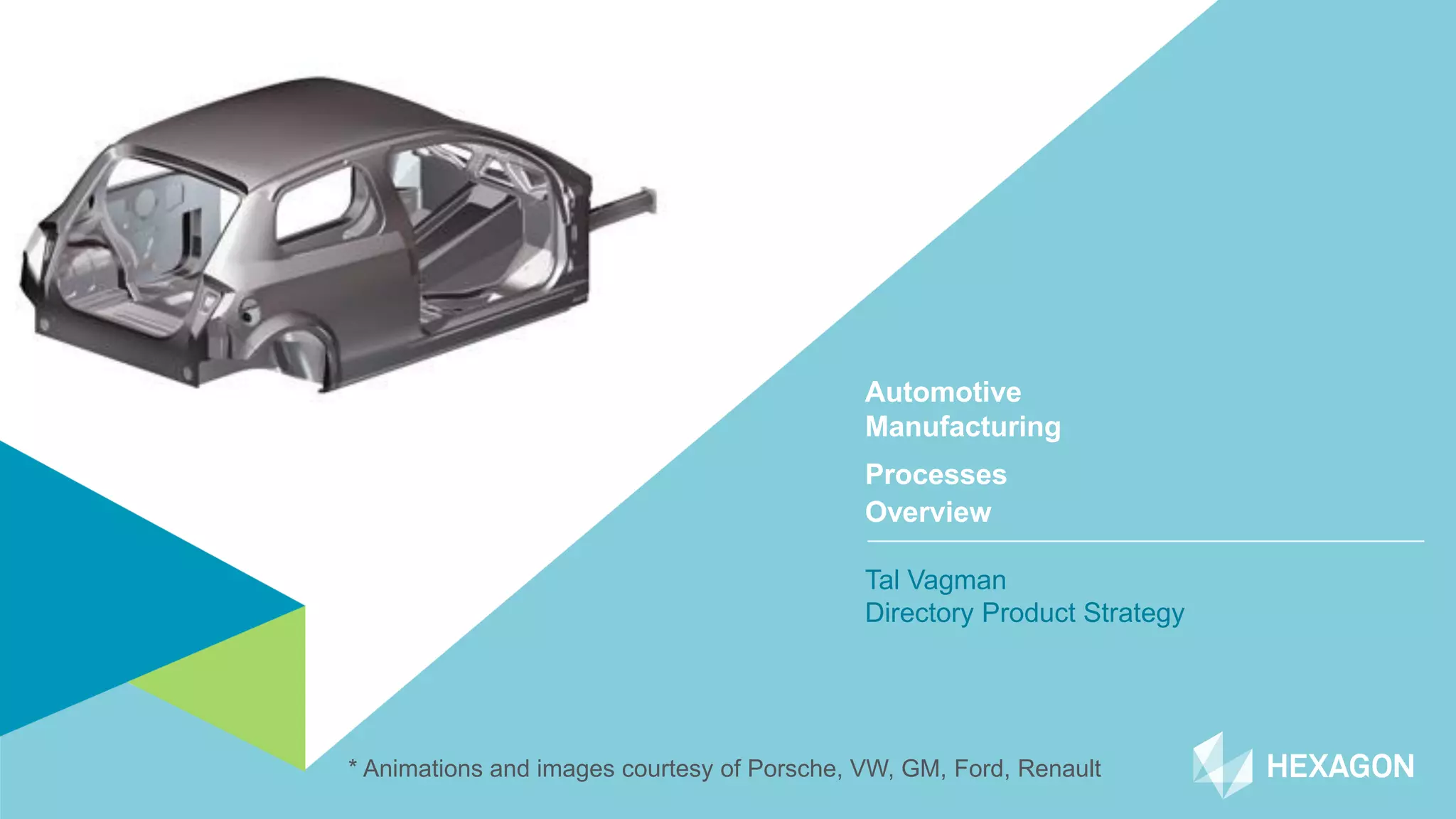
Automotive
Manufacturing
Processes
Overview
Tal Vagman
Directory Product Strategy
* Animations and images courtesy of Porsche, VW, GM, Ford, Renault
Confidential2
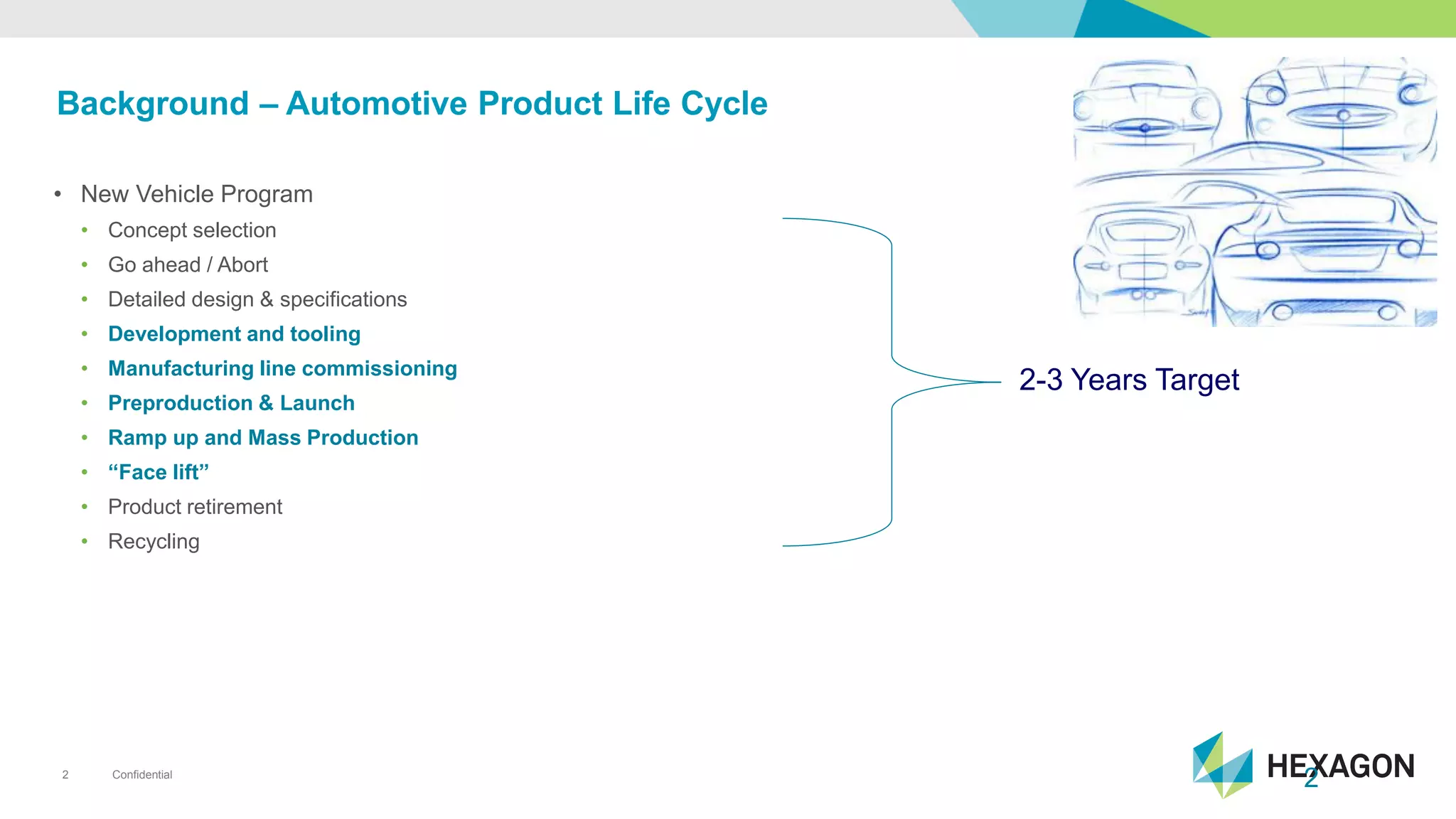
Background – Automotive Product Life Cycle
• New Vehicle Program
• Concept selection
• Go ahead / Abort
• Detailed design & specifications
• Development and tooling
• Manufacturing line commissioning
• Preproduction & Launch
• Ramp up and Mass Production
• “Face lift”
• Product retirement
• Recycling
2
2-3 Years Target
Confidential3
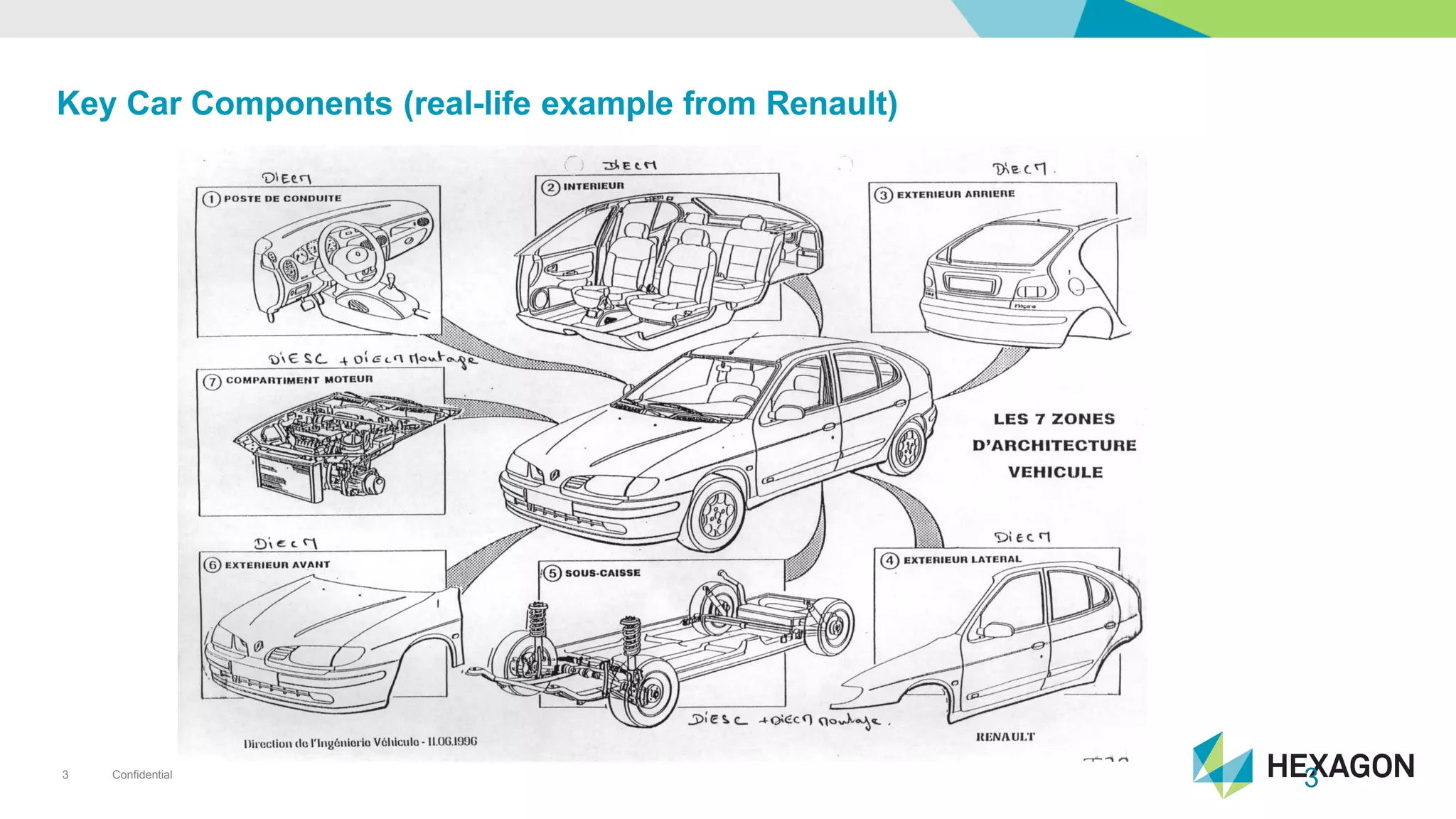
Key Car Components (real-life example from Renault)
3
Confidential4
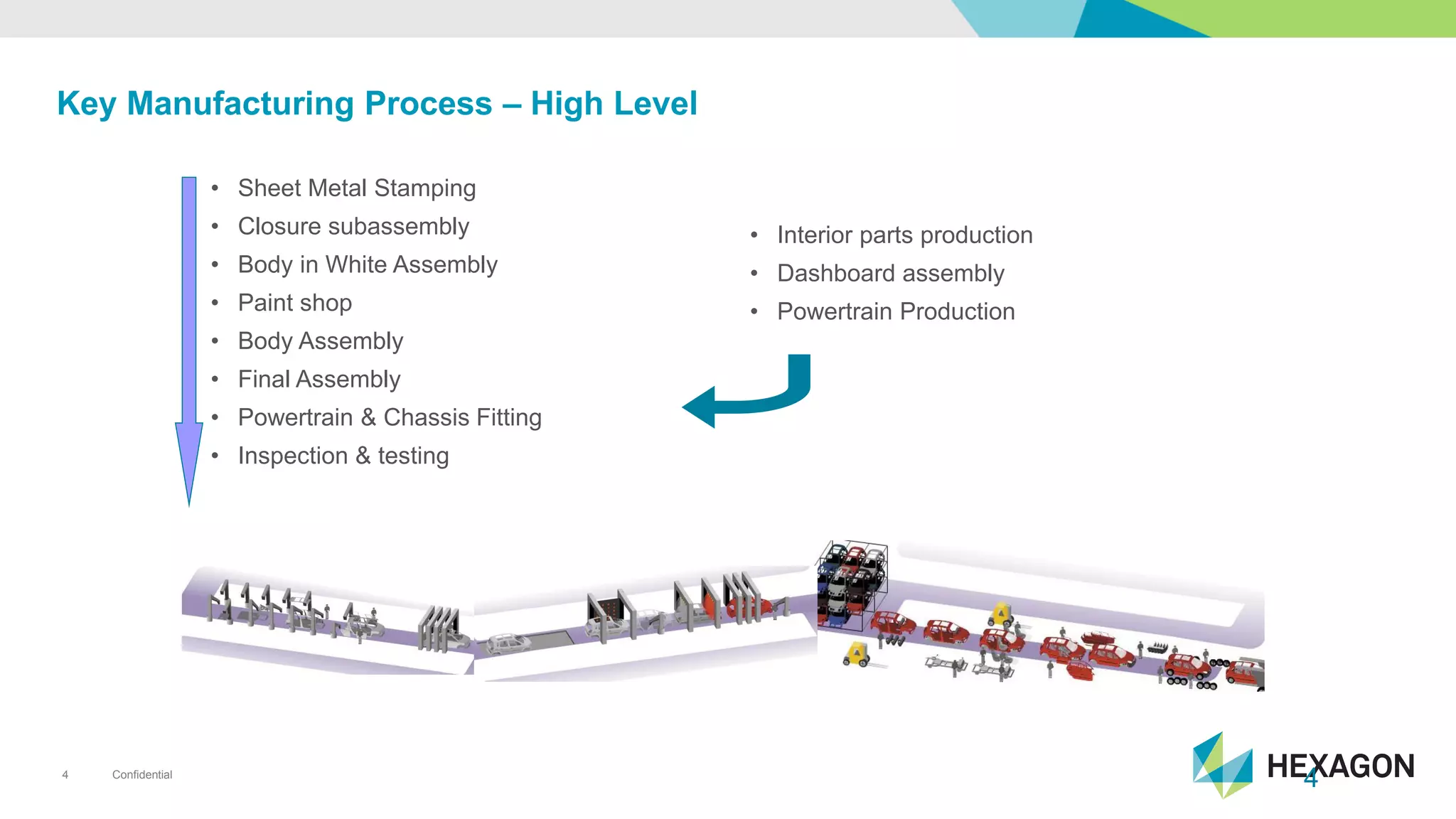
Key Manufacturing Process – High Level
• Sheet Metal Stamping
• Closure subassembly
• Body in White Assembly
• Paint shop
• Body Assembly
• Final Assembly
• Powertrain & Chassis Fitting
• Inspection & testing
4
• Interior parts production
• Dashboard assembly
• Powertrain Production
Confidential5
Stamping
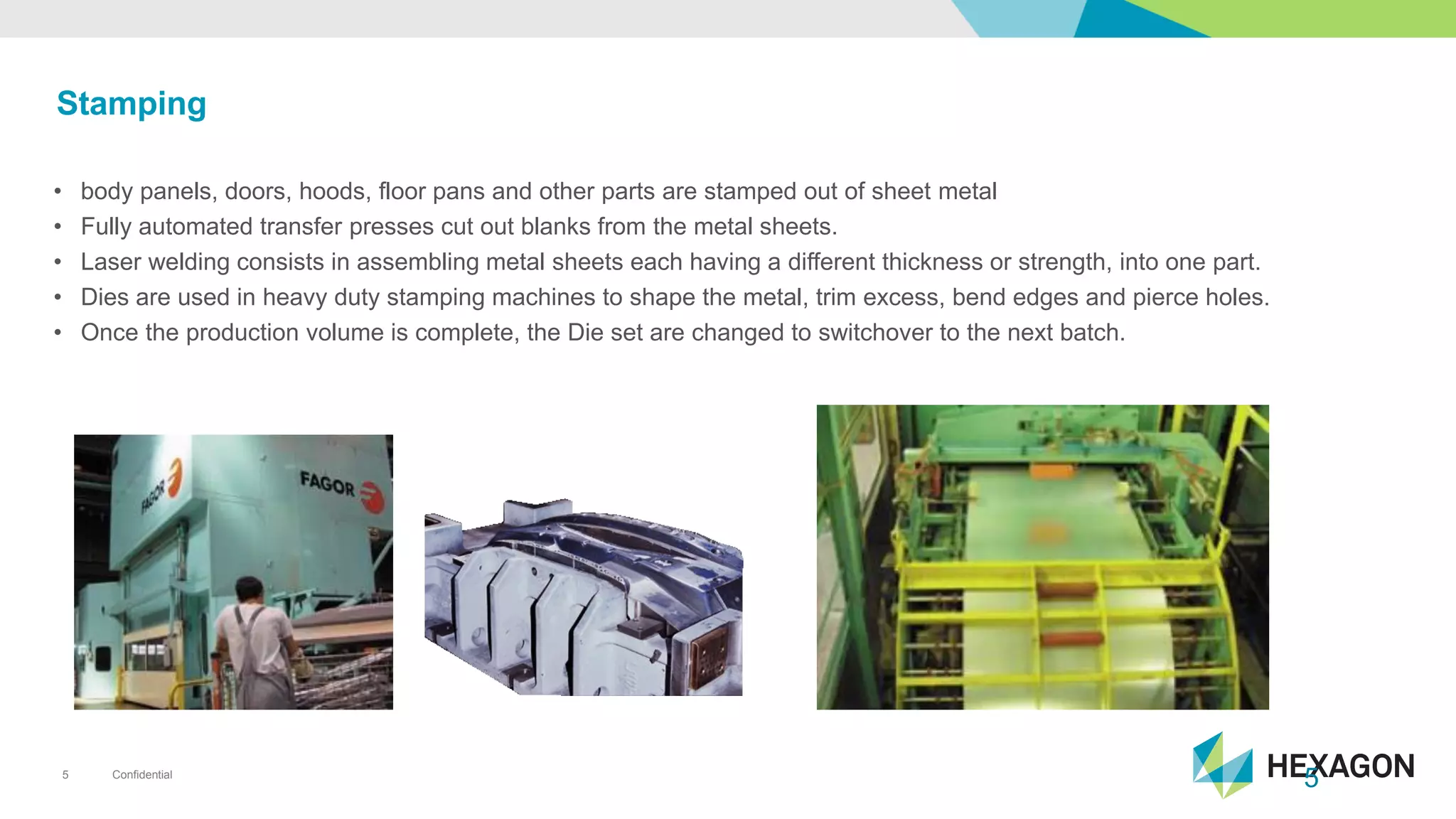
• body panels, doors, hoods, floor pans and other parts are stamped out of sheet metal
• Fully automated transfer presses cut out blanks from the metal sheets.
• Laser welding consists in assembling metal sheets each having a different thickness or strength, into one part.
• Dies are used in heavy duty stamping machines to shape the metal, trim excess, bend edges and pierce holes.
• Once the production volume is complete, the Die set are changed to switchover to the next batch.
5
Confidential6
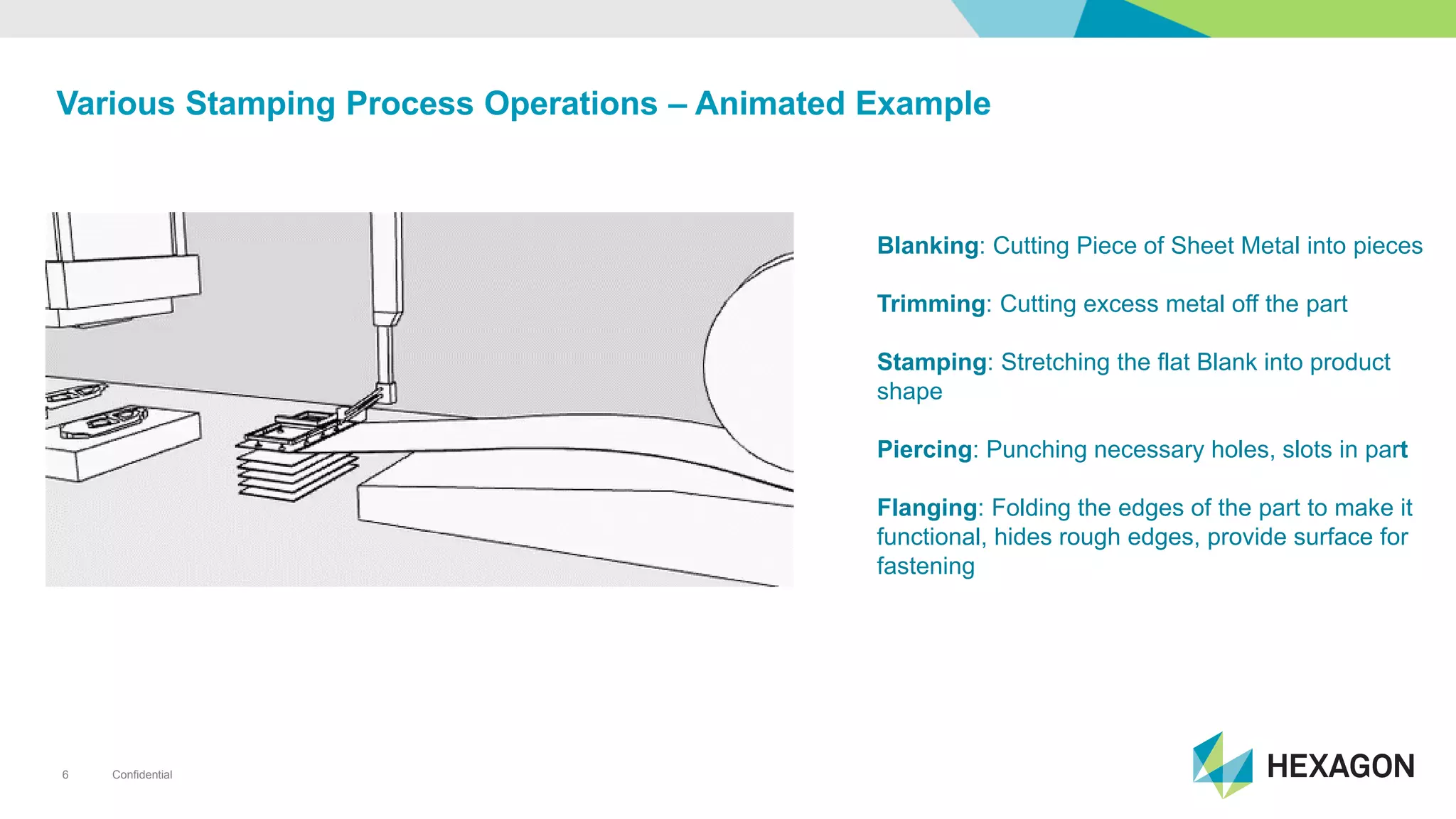
Various Stamping Process Operations – Animated Example
Blanking: Cutting Piece of Sheet Metal into pieces
Trimming: Cutting excess metal off the part
Stamping: Stretching the flat Blank into product
shape
Piercing: Punching necessary holes, slots in part
Flanging: Folding the edges of the part to make it
functional, hides rough edges, provide surface for
fastening
Confidential7
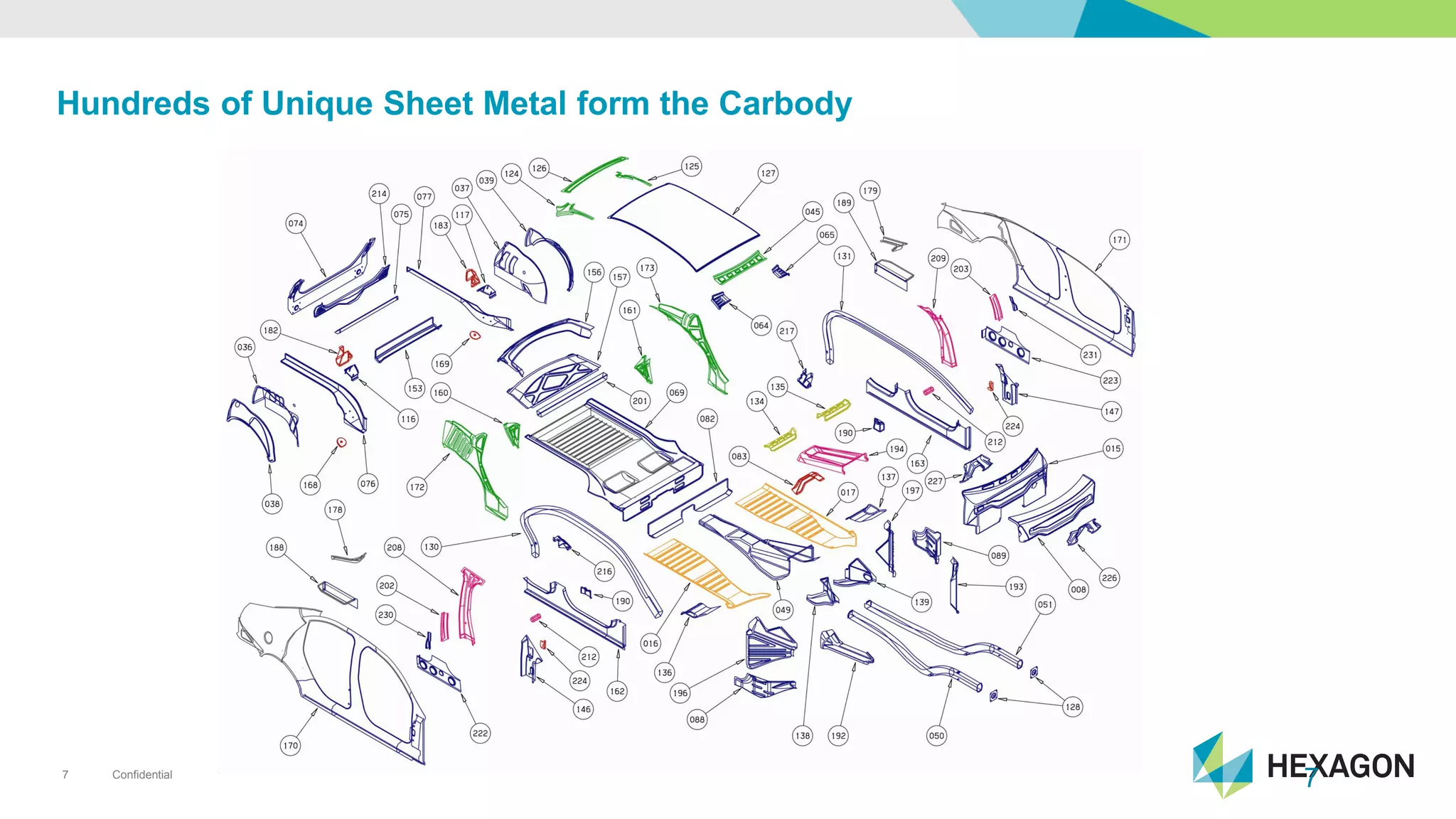
Hundreds of Unique Sheet Metal form the Carbody
7
Confidential8
Body Shop & Assembly Lines
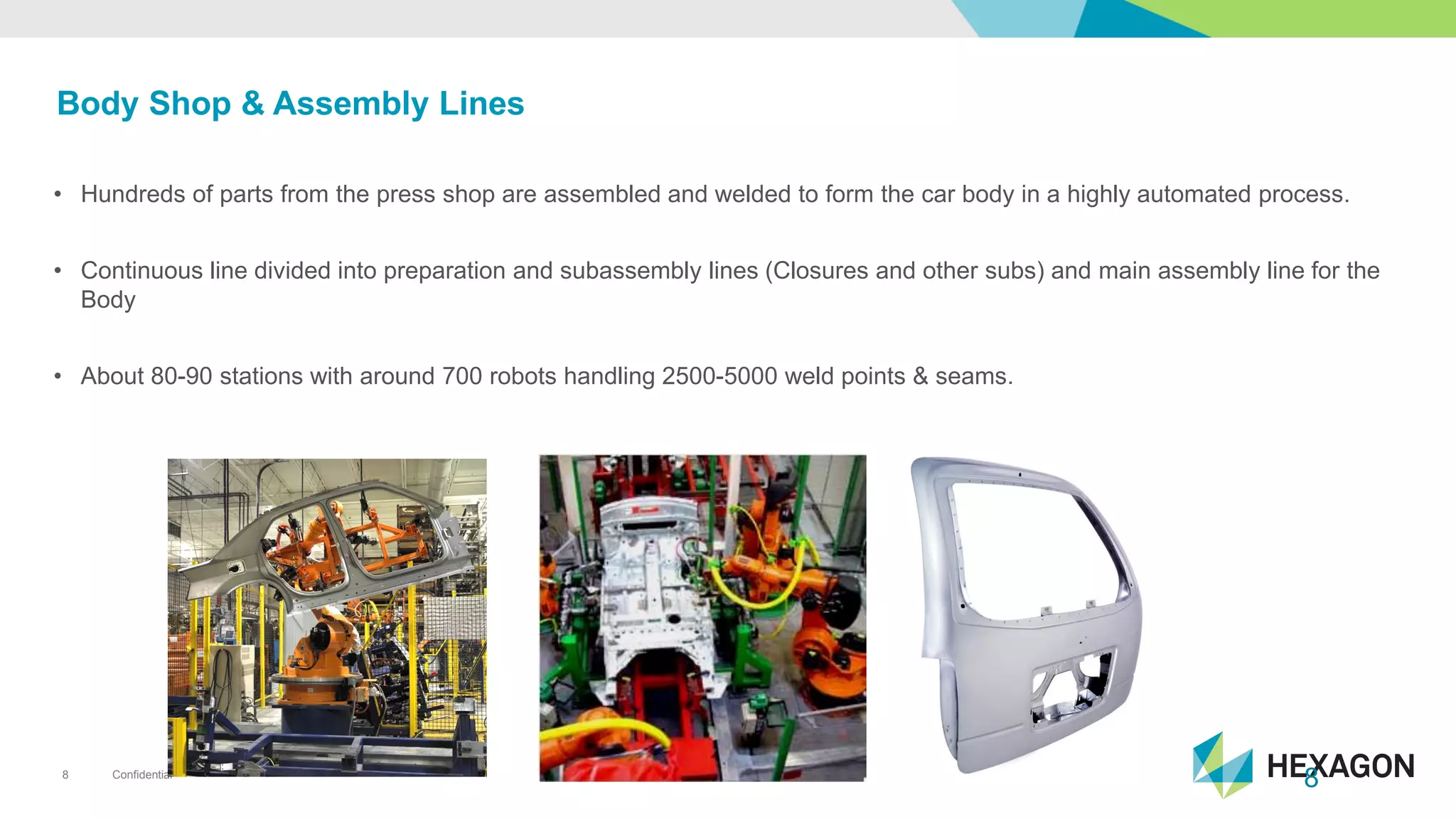
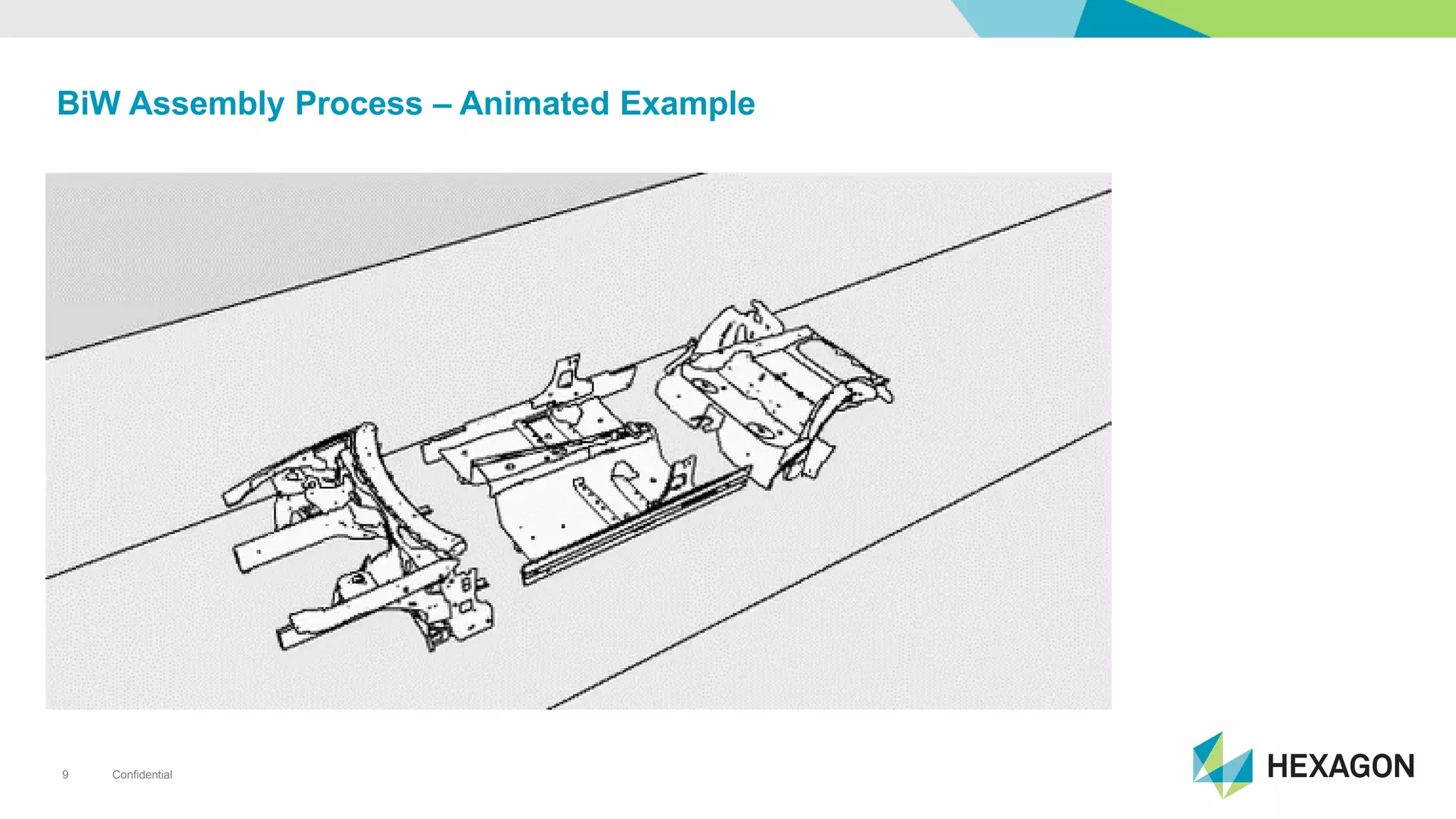
• Hundreds of parts from the press shop are assembled and welded to form the car body in a highly automated process.
• Continuous line divided into preparation and subassembly lines (Closures and other subs) and main assembly line for the
Body
• About 80-90 stations with around 700 robots handling 2500-5000 weld points & seams.
8
Confidential9
BiW Assembly Process – Animated Example
Confidential10
Paint Shop
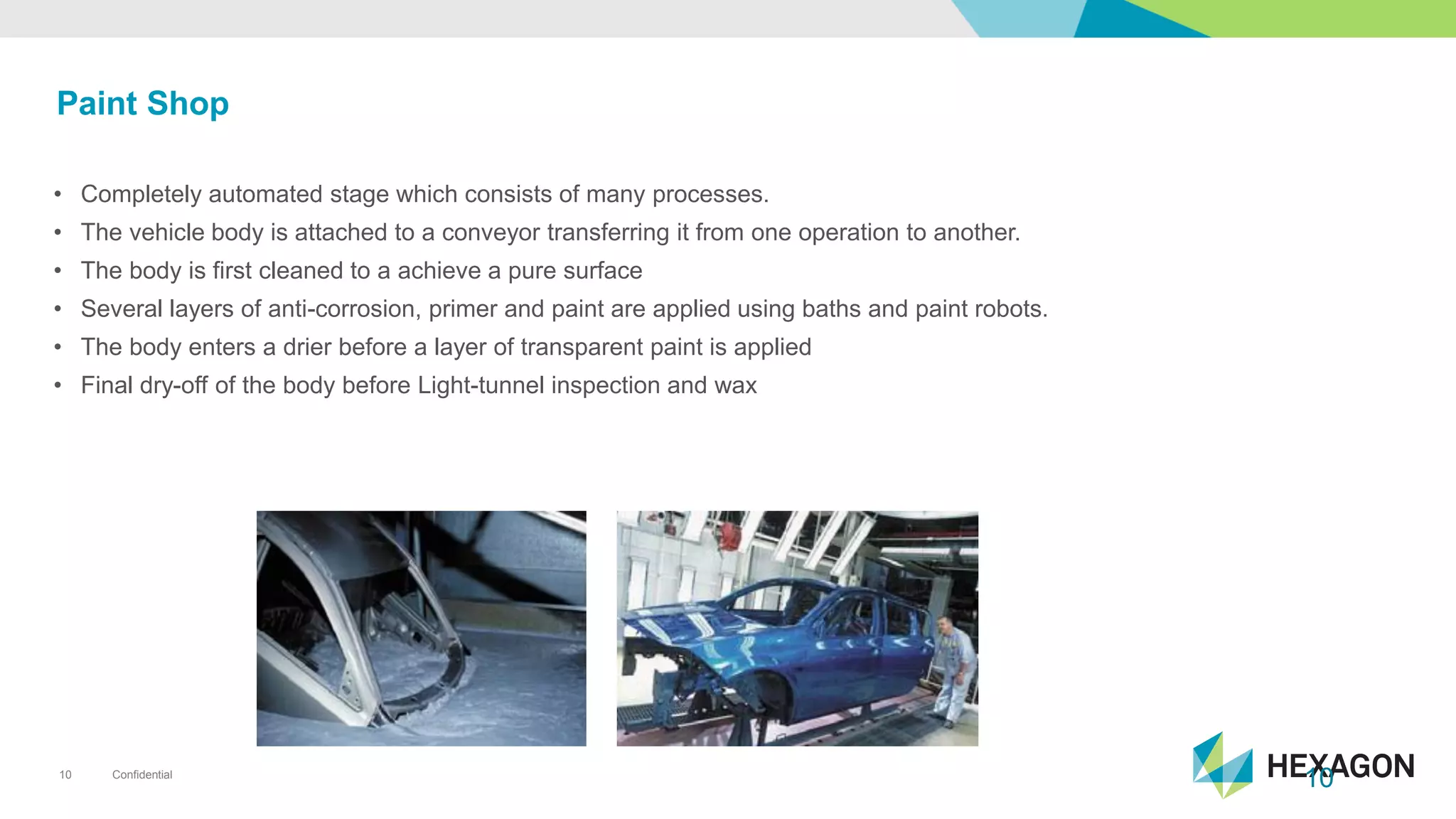
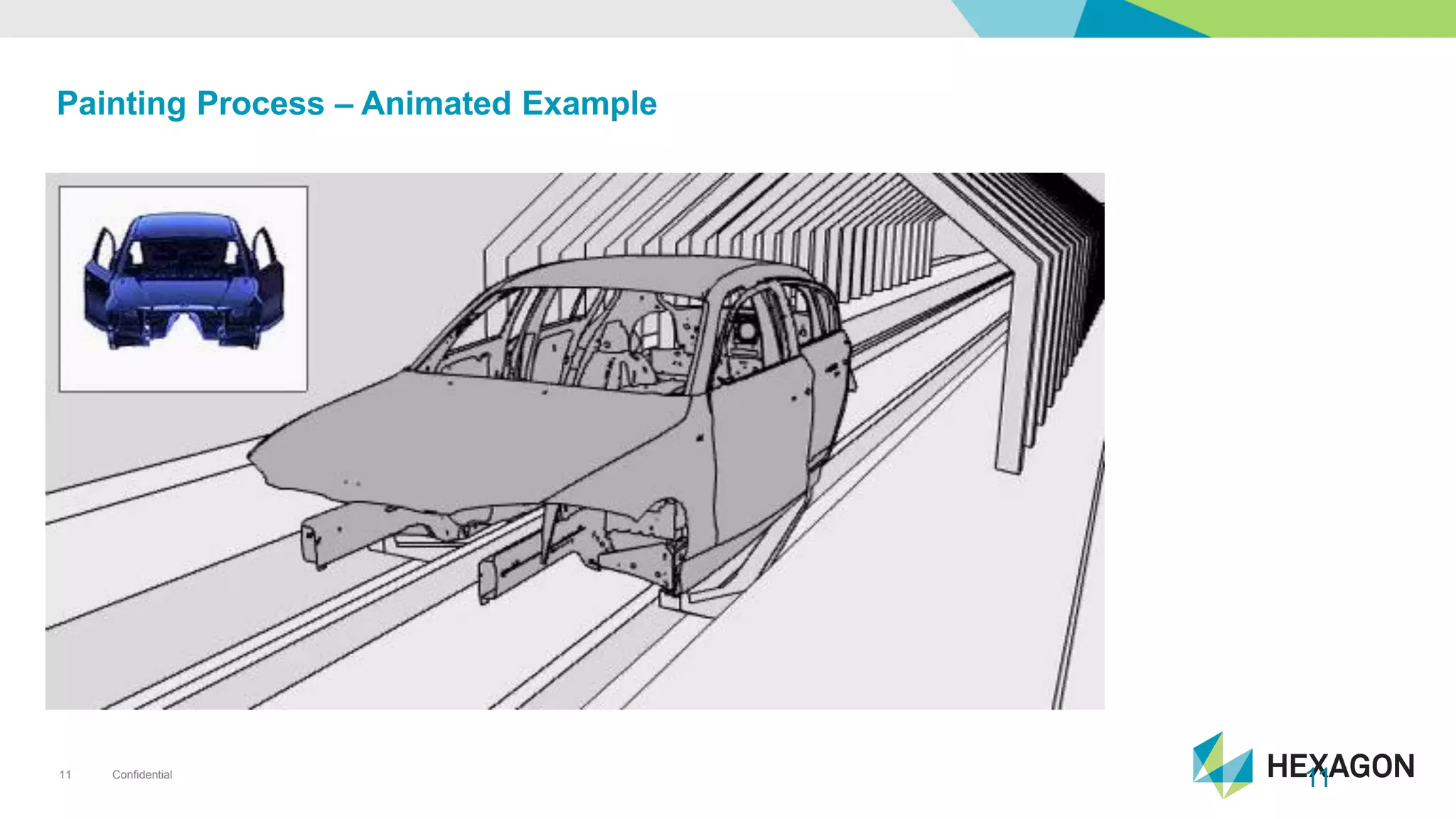
• Completely automated stage which consists of many processes.
• The vehicle body is attached to a conveyor transferring it from one operation to another.
• The body is first cleaned to a achieve a pure surface
• Several layers of anti-corrosion, primer and paint are applied using baths and paint robots.
• The body enters a drier before a layer of transparent paint is applied
• Final dry-off of the body before Light-tunnel inspection and wax
10
Confidential11
Painting Process – Animated Example
11
Confidential12
Powertrain & Chassis
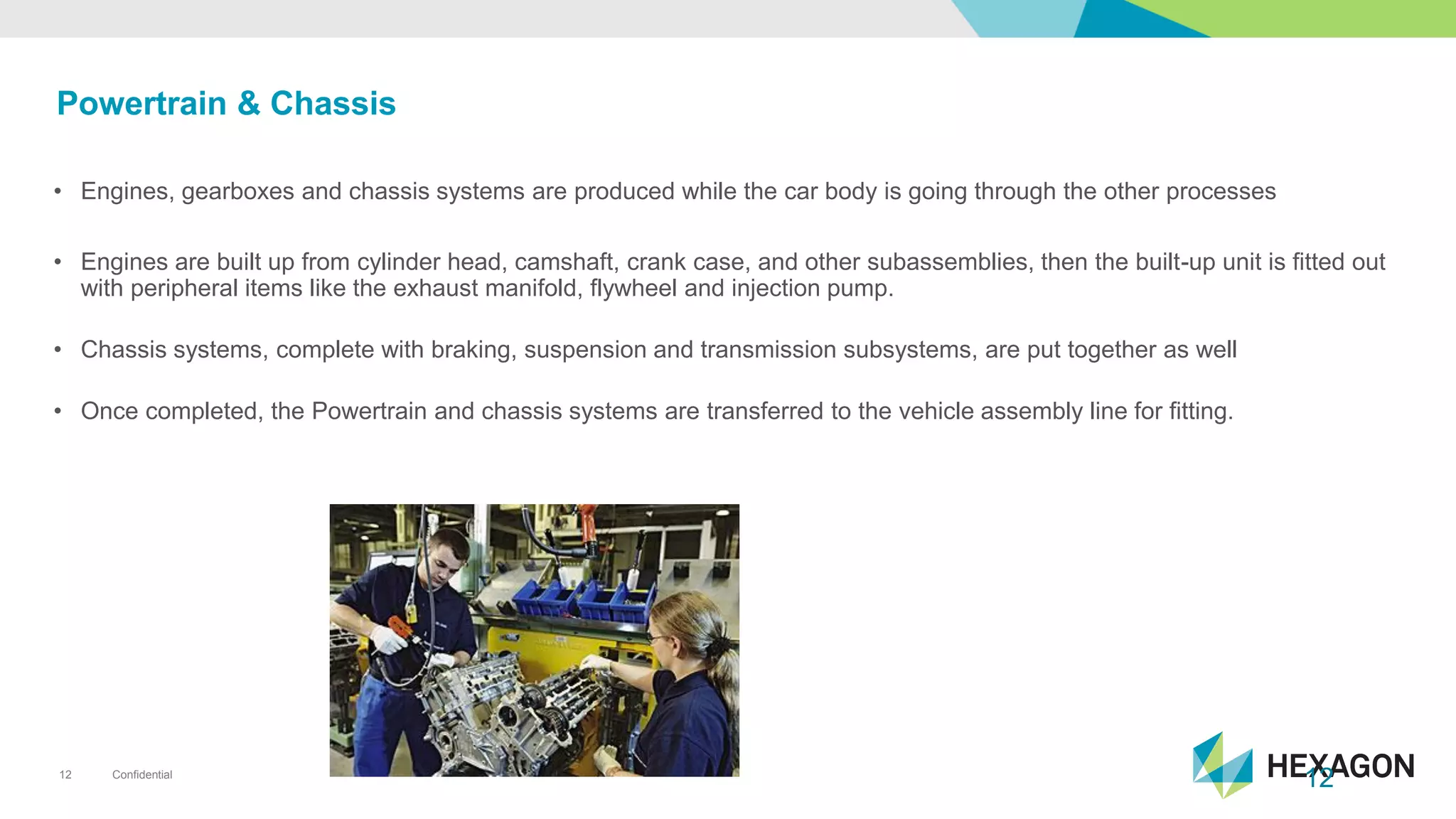
• Engines, gearboxes and chassis systems are produced while the car body is going through the other processes
• Engines are built up from cylinder head, camshaft, crank case, and other subassemblies, then the built-up unit is fitted out
with peripheral items like the exhaust manifold, flywheel and injection pump.
• Chassis systems, complete with braking, suspension and transmission subsystems, are put together as well
• Once completed, the Powertrain and chassis systems are transferred to the vehicle assembly line for fitting.
12
Confidential13
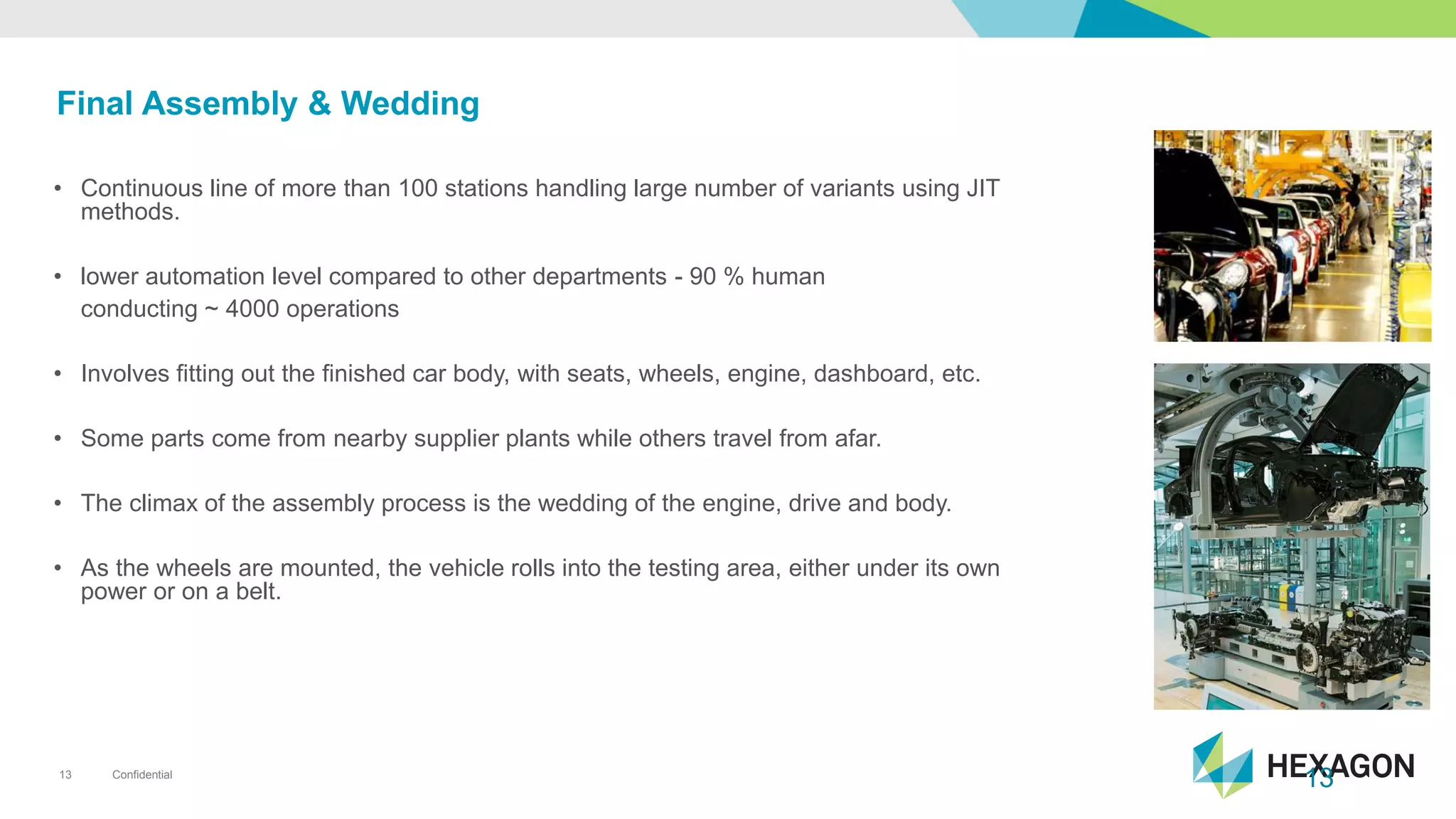
Final Assembly & Wedding
• Continuous line of more than 100 stations handling large number of variants using JIT
methods.
• lower automation level compared to other departments - 90 % human
conducting ~ 4000 operations
• Involves fitting out the finished car body, with seats, wheels, engine, dashboard, etc.
• Some parts come from nearby supplier plants while others travel from afar.
• The climax of the assembly process is the wedding of the engine, drive and body.
• As the wheels are mounted, the vehicle rolls into the testing area, either under its own
power or on a belt.
13
Confidential14
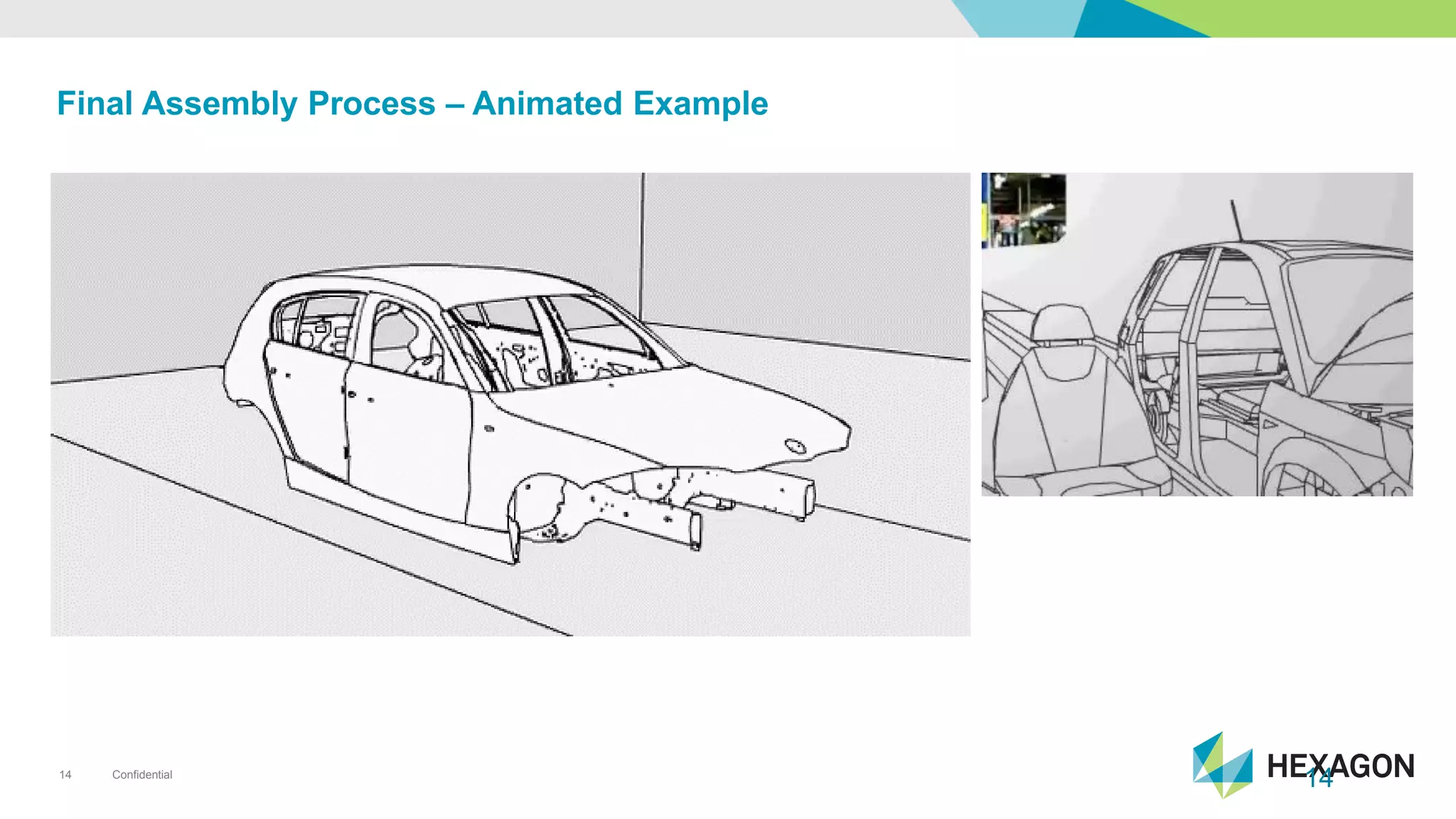
Final Assembly Process – Animated Example
14
Confidential15
Automotive Challenges and need for Quality Inspection and Process Control
• Sheet Metal parts are mostly flimsy free form objects
• A Car is assembled of thousands of parts which have strict dimensional requirements
• Deviations and deformations stack up quickly and cause assembly problems
• Production dimensional stability is hard to maintain with various production, materials, supplier ongoing changes
• Shortening Launch and time full production takes an increasing priority for successful New Model Launches
 Inline Dimensional control and automated quality solutions provide both critical 3D data collection and analysis tools to
address these issues throughout the automotive life cycle.
Confidential16
16

Automotive Manufacturing Process Overview

  • 1.
    Automotive Manufacturing Processes Overview Tal Vagman Directory ProductStrategy * Animations and images courtesy of Porsche, VW, GM, Ford, Renault
  • 2.
    Confidential2 Background – AutomotiveProduct Life Cycle • New Vehicle Program • Concept selection • Go ahead / Abort • Detailed design & specifications • Development and tooling • Manufacturing line commissioning • Preproduction & Launch • Ramp up and Mass Production • “Face lift” • Product retirement • Recycling 2 2-3 Years Target
  • 3.
    Confidential3 Key Car Components(real-life example from Renault) 3
  • 4.
    Confidential4 Key Manufacturing Process– High Level • Sheet Metal Stamping • Closure subassembly • Body in White Assembly • Paint shop • Body Assembly • Final Assembly • Powertrain & Chassis Fitting • Inspection & testing 4 • Interior parts production • Dashboard assembly • Powertrain Production
  • 5.
    Confidential5 Stamping • body panels,doors, hoods, floor pans and other parts are stamped out of sheet metal • Fully automated transfer presses cut out blanks from the metal sheets. • Laser welding consists in assembling metal sheets each having a different thickness or strength, into one part. • Dies are used in heavy duty stamping machines to shape the metal, trim excess, bend edges and pierce holes. • Once the production volume is complete, the Die set are changed to switchover to the next batch. 5
  • 6.
    Confidential6 Various Stamping ProcessOperations – Animated Example Blanking: Cutting Piece of Sheet Metal into pieces Trimming: Cutting excess metal off the part Stamping: Stretching the flat Blank into product shape Piercing: Punching necessary holes, slots in part Flanging: Folding the edges of the part to make it functional, hides rough edges, provide surface for fastening
  • 7.
    Confidential7 Hundreds of UniqueSheet Metal form the Carbody 7
  • 8.
    Confidential8 Body Shop &Assembly Lines • Hundreds of parts from the press shop are assembled and welded to form the car body in a highly automated process. • Continuous line divided into preparation and subassembly lines (Closures and other subs) and main assembly line for the Body • About 80-90 stations with around 700 robots handling 2500-5000 weld points & seams. 8
  • 9.
  • 10.
    Confidential10 Paint Shop • Completelyautomated stage which consists of many processes. • The vehicle body is attached to a conveyor transferring it from one operation to another. • The body is first cleaned to a achieve a pure surface • Several layers of anti-corrosion, primer and paint are applied using baths and paint robots. • The body enters a drier before a layer of transparent paint is applied • Final dry-off of the body before Light-tunnel inspection and wax 10
  • 11.
  • 12.
    Confidential12 Powertrain & Chassis •Engines, gearboxes and chassis systems are produced while the car body is going through the other processes • Engines are built up from cylinder head, camshaft, crank case, and other subassemblies, then the built-up unit is fitted out with peripheral items like the exhaust manifold, flywheel and injection pump. • Chassis systems, complete with braking, suspension and transmission subsystems, are put together as well • Once completed, the Powertrain and chassis systems are transferred to the vehicle assembly line for fitting. 12
  • 13.
    Confidential13 Final Assembly &Wedding • Continuous line of more than 100 stations handling large number of variants using JIT methods. • lower automation level compared to other departments - 90 % human conducting ~ 4000 operations • Involves fitting out the finished car body, with seats, wheels, engine, dashboard, etc. • Some parts come from nearby supplier plants while others travel from afar. • The climax of the assembly process is the wedding of the engine, drive and body. • As the wheels are mounted, the vehicle rolls into the testing area, either under its own power or on a belt. 13
  • 14.
  • 15.
    Confidential15 Automotive Challenges andneed for Quality Inspection and Process Control • Sheet Metal parts are mostly flimsy free form objects • A Car is assembled of thousands of parts which have strict dimensional requirements • Deviations and deformations stack up quickly and cause assembly problems • Production dimensional stability is hard to maintain with various production, materials, supplier ongoing changes • Shortening Launch and time full production takes an increasing priority for successful New Model Launches  Inline Dimensional control and automated quality solutions provide both critical 3D data collection and analysis tools to address these issues throughout the automotive life cycle.
  • 16.