CORPORATE SOCIAL AND
ENVIRONMENTAL
RESPONSIBILITY (CSER)
Module 2, part 1 by Turku University of Applied Sciences
2
Part 1
• CSER Management framework
Learning objectives and outcomes of part 1:
• ability to participate in creating a CSER management
framework and strategy for an organization.
3
What is CSER?
Corporate Social and Environmental Responsibility is the responsibility of an organization for the
impacts of its decisions and activities on society and the environment, through transparent and ethical
behaviour that:
• Contributes to sustainable development, including the health and welfare of society
• Takes into account the expectations of stakeholders
• Is in compliance with applicable law and consistent with international norms of behaviour
• Is integrated throughout the organization and practiced in all its relationships
(Source: ISO 26000:2010)
4
….continues
• In many sources, Corporate Social and Environmental Responsibility CSER, is nowadays
shortened to CSR without separately showing letter E for environment. However,
Corporate Social Responsibility today includes the aspect of environment as well.
• “CSR is the responsibility of enterprises for their impact on society” (European
Commission)
• Companies can become socially responsible by:
• integrating social, environmental, ethical, consumer, and human rights concerns into
their business strategy and operations
• following the law
5
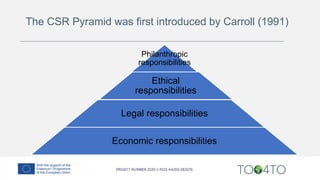
Philanthropic
responsibilities
Ethical
responsibilities
Legal responsibilities
Economic responsibilities
The CSR Pyramid was first introduced by Carroll (1991)
The four categories of CSR
• Lately, the environmental aspect has become a very important
part of corporate social responsibility.
• Corporate social responsibility is traditionally broken into four
categories: environmental, philanthropic, ethical, and economic
responsibility.
(Source: Harvard Business School)
7
Ethical responsibility
• Is concerned with ensuring that an organization is operating in a
fair and ethical manner.
• Organizations that embrace ethical responsibility aim to achieve
fair treatment of all stakeholders, including leadership, investors,
employees, suppliers, and customers.
• Firms can embrace ethical responsibility in different ways.
(Source: Harvard Business School)
8
An example
• A business might set its own, higher minimum wage than the
one mandated by the state. A business might require that
products, ingredients, materials, or components be sourced
according to free trade standards. In this regard, many firms
have processes to ensure that they are not purchasing
products resulting from slavery or child labor.
9
Philanthropic responsibility
• Refers to a businesses aim to actively make the world and
society a better place.
• Organizations driven by philanthropic responsibility often
dedicate a portion of their earnings to charities. While many
firms donate to charities and nonprofits that align with their
guiding missions, others donate to worthy causes that don’t
directly relate to their business. Others go so far as to create
their own charitable trust or organization to give back.
(Source: Harvard Business School)
10
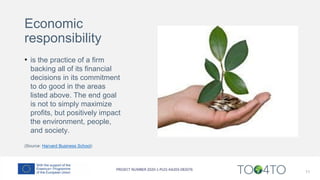
Economic
responsibility
• is the practice of a firm
backing all of its financial
decisions in its commitment
to do good in the areas
listed above. The end goal
is not to simply maximize
profits, but positively impact
the environment, people,
and society.
(Source: Harvard Business School)
11
Environmental
responsibility
• Environmental responsibility
refers to the belief that
organizations should behave in
as an environmentally friendly
way as possible. It’s one of the
most common forms of corporate
social responsibility.
• Some companies use the term
“environmental stewardship” to
refer to such initiatives.
(Source: Harvard Business School)
12
How to take care of the environment?
• Companies that want to take care of their environmental responsibility can do so in several
ways:
• Reducing pollution, greenhouse gas emissions, the use of single-use plastics, water consumption, and
general waste
• Increasing reliance on renewable energy, sustainable resources, and recycled or partially recycled
materials
• Offsetting negative environmental impact; for example, by planting trees, funding research, and donating
to related causes (Source: Harvard Business School)
• Companies normally establish and adopt an environmental management system (e.g. based on
standard ISO 14001) to manage their activities related to environmental responsibility. Environmental
management system is part of company’s management system and touches all employees of the
company.
13
What is Responsible Business Conduct?
• Responsible Business Conduct (RBC) is an alternative term to
CSR introduced by the OECD in close cooperation with
business, trade unions and non-governmental organizations.
• The OECD has defined RBC as "making a positive contribution
to economic, environmental and social progress with a view to
achieving sustainable development and avoiding and
addressing adverse impacts related to an enterprise's direct
and indirect operations, products or services".
14
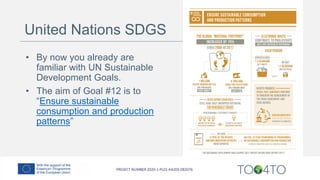
• By now you already are
familiar with UN Sustainable
Development Goals.
• The aim of Goal #12 is to
“Ensure sustainable
consumption and production
patterns”
United Nations SDGS
• Is the world largest corporate sustainability initiative. They support
companies to:
• Do business responsibly by aligning their strategies and operations with Ten
Principles on human rights, labour, environment and anti-corruption
• Take strategic actions to advance broader societal goals, such as the UN
Sustainable Development Goals, with an emphasis on collaboration and innovation.
• Read more about Global Compact
United Nations Global Compact
Key European documents for CSR/RBC policy
• A renewed EU strategy 2011-14 for corporate social responsibility
• Action plan on human rights and democracy (2015-2019)
• Communication on the next steps for a sustainable European Future
• Reflection paper: towards a sustainable Europe by 2030
• Directive 2014/95/EU on non-financial reporting
• United Nations global compact
• United Nations guiding principles on business and human Rights
• UN 2030 agenda for sustainable development
• ISO 26000 guidance standard on social responsibility
• OECD guidelines for multinational enterprises
• OECD due diligence guidance for responsible business conduct
17
ISO 26000 Guidance on Social Responsibility
• ISO26000: 2010 helps to clarify what social responsibility is.
• It guides organizations in building a CSR management
framework and, in addition, helps organizations to translate
principles into effective actions. It also shares best practices
relating to social responsibility, globally.
• It is aimed at all types of organizations regardless of their
activity, size or location.
18
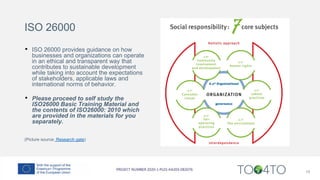
ISO 26000
• ISO 26000 provides guidance on how
businesses and organizations can operate
in an ethical and transparent way that
contributes to sustainable development
while taking into account the expectations
of stakeholders, applicable laws and
international norms of behavior.
• Please proceed to self study the
ISO26000 Basic Training Material and
the contents of ISO26000: 2010 which
are provided in the materials for you
separately.
(Picture source: Research gate)
19
CSR Performance Ladder
• The CSR Performance Ladder is a certifiable management system
standard for Corporate Social Responsibility (CSR).
• The certification process helps organizations focus on their most
significant sustainability issues, manage them effectively, and
document their CSR performance through third party certification.
• The CSR Performance Ladder standard is based on internationally
recognized sustainability standards Global Reporting Initiative (GRI),
AA 1000 SES and ISO 26000 as well as management system
standards ISO 9001, ISO 14001, ISO 45001 and ISO 22001.
20
CSR Performance Ladder Certification
The standard covers the following CSR issues:
• Organisational governance
• Working conditions and human rights
• Environment, raw materials, energy and emissions
• Fair operating practice and consumer issues
• Community involvement and development
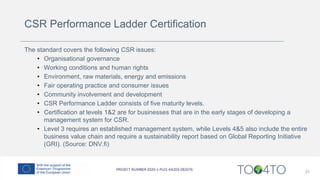
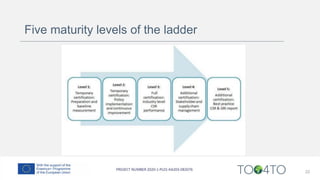
• CSR Performance Ladder consists of five maturity levels.
• Certification at levels 1&2 are for businesses that are in the early stages of developing a
management system for CSR.
• Level 3 requires an established management system, while Levels 4&5 also include the entire
business value chain and require a sustainability report based on Global Reporting Initiative
(GRI). (Source: DNV.fi)
21
Five maturity levels of the ladder
22
CSR Performance Ladder Certification, examples
• For example DNV (Det Norske Veritas) is a global well known certification
body, that can issue a CSR performance ladder certificate to a business
or other organization
• DNV about ladder
• DNV issued a CSR performance ladder certification to a Finnish company
Mäkinen late 2021:
• Mäkinen and CSR an example
• Cruise Industry News
23
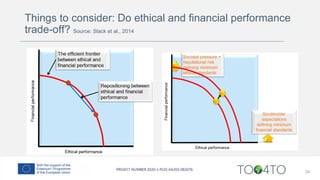
Things to consider: Do ethical and financial performance
trade-off? Source: Slack et al., 2014
24
CSER and business operations decisions (Slack et al.,2014)
• Most operations decisions have a CSR dimension, e.g.:
• Product/service design – customer safety, recyclability of materials, energy consumption
• Network design - employment implications and environmental impact of location
• Layout of facilities – staff safety, disabled customer access
• Process technology - staff safety, waste and product disposal, noise pollution, fumes and
emissions
• Job design - -workplace stress, unsocial working hours
• Capacity planning and control - employment policies
• Inventory planning and control – price manipulation
25
Some environmental considerations of operations
management decisions (Slack et al., 2014)
• Product/service design – Recyclability of materials, energy consumption, waste
material generation
• Network design – Environmental impact of location, development of suppliers in
environmental practice, reducing transport-related energy
• Layout of facilities – Energy efficiency
• Process technology –Waste and product disposal, noise pollution, fume and
emission pollution energy efficiency
• Job design – Transportation of staff to/from work, development in environmental
education
• Planning and control (incl. MRP, JIT and project planning and control) – material
utilization and wastage, environmental impact of management, transport pollution
of frequent JIT supply
26
…continues
• Capacity planning and control – Over-production of waste due to poor
planning, local impact of extended operation hours
• Inventory planning and control – Energy management of replenishment
transportation, obsolescence and wastage
• Supply chain planning and control – Minimizing energy consumption in
distribution, recyclability of transportation consumables
• Quality planning and control and TQM – Scrap and wastage of materials,
waste in energy consumption
• Failure prevention and recovery – Environmental impact of process
failures, recovery to minimize impact of failures
27
A reflection questions to ponder:
1. Think how you would introduce the pyramid of CSR to a
young summer trainee that has just joined your company and
is not familiar with the concept of CSER.
2. Introduce ideas of how you would translate ISO 26000
principles into effective actions in the company you work (or a
company you use as an example)
28
Thank You
29

TOO4TO Module 2 / Corporate Social and Environmental Responsibility: Part 1

  • 2.
    CORPORATE SOCIAL AND ENVIRONMENTAL RESPONSIBILITY(CSER) Module 2, part 1 by Turku University of Applied Sciences 2
  • 3.
    Part 1 • CSERManagement framework Learning objectives and outcomes of part 1: • ability to participate in creating a CSER management framework and strategy for an organization. 3
  • 4.
    What is CSER? CorporateSocial and Environmental Responsibility is the responsibility of an organization for the impacts of its decisions and activities on society and the environment, through transparent and ethical behaviour that: • Contributes to sustainable development, including the health and welfare of society • Takes into account the expectations of stakeholders • Is in compliance with applicable law and consistent with international norms of behaviour • Is integrated throughout the organization and practiced in all its relationships (Source: ISO 26000:2010) 4
  • 5.
    ….continues • In manysources, Corporate Social and Environmental Responsibility CSER, is nowadays shortened to CSR without separately showing letter E for environment. However, Corporate Social Responsibility today includes the aspect of environment as well. • “CSR is the responsibility of enterprises for their impact on society” (European Commission) • Companies can become socially responsible by: • integrating social, environmental, ethical, consumer, and human rights concerns into their business strategy and operations • following the law 5
  • 6.
  • 7.
    The four categoriesof CSR • Lately, the environmental aspect has become a very important part of corporate social responsibility. • Corporate social responsibility is traditionally broken into four categories: environmental, philanthropic, ethical, and economic responsibility. (Source: Harvard Business School) 7
  • 8.
    Ethical responsibility • Isconcerned with ensuring that an organization is operating in a fair and ethical manner. • Organizations that embrace ethical responsibility aim to achieve fair treatment of all stakeholders, including leadership, investors, employees, suppliers, and customers. • Firms can embrace ethical responsibility in different ways. (Source: Harvard Business School) 8
  • 9.
    An example • Abusiness might set its own, higher minimum wage than the one mandated by the state. A business might require that products, ingredients, materials, or components be sourced according to free trade standards. In this regard, many firms have processes to ensure that they are not purchasing products resulting from slavery or child labor. 9
  • 10.
    Philanthropic responsibility • Refersto a businesses aim to actively make the world and society a better place. • Organizations driven by philanthropic responsibility often dedicate a portion of their earnings to charities. While many firms donate to charities and nonprofits that align with their guiding missions, others donate to worthy causes that don’t directly relate to their business. Others go so far as to create their own charitable trust or organization to give back. (Source: Harvard Business School) 10
  • 11.
    Economic responsibility • is thepractice of a firm backing all of its financial decisions in its commitment to do good in the areas listed above. The end goal is not to simply maximize profits, but positively impact the environment, people, and society. (Source: Harvard Business School) 11
  • 12.
    Environmental responsibility • Environmental responsibility refersto the belief that organizations should behave in as an environmentally friendly way as possible. It’s one of the most common forms of corporate social responsibility. • Some companies use the term “environmental stewardship” to refer to such initiatives. (Source: Harvard Business School) 12
  • 13.
    How to takecare of the environment? • Companies that want to take care of their environmental responsibility can do so in several ways: • Reducing pollution, greenhouse gas emissions, the use of single-use plastics, water consumption, and general waste • Increasing reliance on renewable energy, sustainable resources, and recycled or partially recycled materials • Offsetting negative environmental impact; for example, by planting trees, funding research, and donating to related causes (Source: Harvard Business School) • Companies normally establish and adopt an environmental management system (e.g. based on standard ISO 14001) to manage their activities related to environmental responsibility. Environmental management system is part of company’s management system and touches all employees of the company. 13
  • 14.
    What is ResponsibleBusiness Conduct? • Responsible Business Conduct (RBC) is an alternative term to CSR introduced by the OECD in close cooperation with business, trade unions and non-governmental organizations. • The OECD has defined RBC as "making a positive contribution to economic, environmental and social progress with a view to achieving sustainable development and avoiding and addressing adverse impacts related to an enterprise's direct and indirect operations, products or services". 14
  • 15.
    • By nowyou already are familiar with UN Sustainable Development Goals. • The aim of Goal #12 is to “Ensure sustainable consumption and production patterns” United Nations SDGS
  • 16.
    • Is theworld largest corporate sustainability initiative. They support companies to: • Do business responsibly by aligning their strategies and operations with Ten Principles on human rights, labour, environment and anti-corruption • Take strategic actions to advance broader societal goals, such as the UN Sustainable Development Goals, with an emphasis on collaboration and innovation. • Read more about Global Compact United Nations Global Compact
  • 17.
    Key European documentsfor CSR/RBC policy • A renewed EU strategy 2011-14 for corporate social responsibility • Action plan on human rights and democracy (2015-2019) • Communication on the next steps for a sustainable European Future • Reflection paper: towards a sustainable Europe by 2030 • Directive 2014/95/EU on non-financial reporting • United Nations global compact • United Nations guiding principles on business and human Rights • UN 2030 agenda for sustainable development • ISO 26000 guidance standard on social responsibility • OECD guidelines for multinational enterprises • OECD due diligence guidance for responsible business conduct 17
  • 18.
    ISO 26000 Guidanceon Social Responsibility • ISO26000: 2010 helps to clarify what social responsibility is. • It guides organizations in building a CSR management framework and, in addition, helps organizations to translate principles into effective actions. It also shares best practices relating to social responsibility, globally. • It is aimed at all types of organizations regardless of their activity, size or location. 18
  • 19.
    ISO 26000 • ISO26000 provides guidance on how businesses and organizations can operate in an ethical and transparent way that contributes to sustainable development while taking into account the expectations of stakeholders, applicable laws and international norms of behavior. • Please proceed to self study the ISO26000 Basic Training Material and the contents of ISO26000: 2010 which are provided in the materials for you separately. (Picture source: Research gate) 19
  • 20.
    CSR Performance Ladder •The CSR Performance Ladder is a certifiable management system standard for Corporate Social Responsibility (CSR). • The certification process helps organizations focus on their most significant sustainability issues, manage them effectively, and document their CSR performance through third party certification. • The CSR Performance Ladder standard is based on internationally recognized sustainability standards Global Reporting Initiative (GRI), AA 1000 SES and ISO 26000 as well as management system standards ISO 9001, ISO 14001, ISO 45001 and ISO 22001. 20
  • 21.
    CSR Performance LadderCertification The standard covers the following CSR issues: • Organisational governance • Working conditions and human rights • Environment, raw materials, energy and emissions • Fair operating practice and consumer issues • Community involvement and development • CSR Performance Ladder consists of five maturity levels. • Certification at levels 1&2 are for businesses that are in the early stages of developing a management system for CSR. • Level 3 requires an established management system, while Levels 4&5 also include the entire business value chain and require a sustainability report based on Global Reporting Initiative (GRI). (Source: DNV.fi) 21
  • 22.
    Five maturity levelsof the ladder 22
  • 23.
    CSR Performance LadderCertification, examples • For example DNV (Det Norske Veritas) is a global well known certification body, that can issue a CSR performance ladder certificate to a business or other organization • DNV about ladder • DNV issued a CSR performance ladder certification to a Finnish company Mäkinen late 2021: • Mäkinen and CSR an example • Cruise Industry News 23
  • 24.
    Things to consider:Do ethical and financial performance trade-off? Source: Slack et al., 2014 24
  • 25.
    CSER and businessoperations decisions (Slack et al.,2014) • Most operations decisions have a CSR dimension, e.g.: • Product/service design – customer safety, recyclability of materials, energy consumption • Network design - employment implications and environmental impact of location • Layout of facilities – staff safety, disabled customer access • Process technology - staff safety, waste and product disposal, noise pollution, fumes and emissions • Job design - -workplace stress, unsocial working hours • Capacity planning and control - employment policies • Inventory planning and control – price manipulation 25
  • 26.
    Some environmental considerationsof operations management decisions (Slack et al., 2014) • Product/service design – Recyclability of materials, energy consumption, waste material generation • Network design – Environmental impact of location, development of suppliers in environmental practice, reducing transport-related energy • Layout of facilities – Energy efficiency • Process technology –Waste and product disposal, noise pollution, fume and emission pollution energy efficiency • Job design – Transportation of staff to/from work, development in environmental education • Planning and control (incl. MRP, JIT and project planning and control) – material utilization and wastage, environmental impact of management, transport pollution of frequent JIT supply 26
  • 27.
    …continues • Capacity planningand control – Over-production of waste due to poor planning, local impact of extended operation hours • Inventory planning and control – Energy management of replenishment transportation, obsolescence and wastage • Supply chain planning and control – Minimizing energy consumption in distribution, recyclability of transportation consumables • Quality planning and control and TQM – Scrap and wastage of materials, waste in energy consumption • Failure prevention and recovery – Environmental impact of process failures, recovery to minimize impact of failures 27
  • 28.
    A reflection questionsto ponder: 1. Think how you would introduce the pyramid of CSR to a young summer trainee that has just joined your company and is not familiar with the concept of CSER. 2. Introduce ideas of how you would translate ISO 26000 principles into effective actions in the company you work (or a company you use as an example) 28
  • 29.