Monetary Policy and Research Department, Bank of Finland
Performance of Simple Interest Rate
Rules Subject to Fiscal Policy
Nigel McClung
| For internal use | BOF/FIN-FSA-CONFIDENTIAL
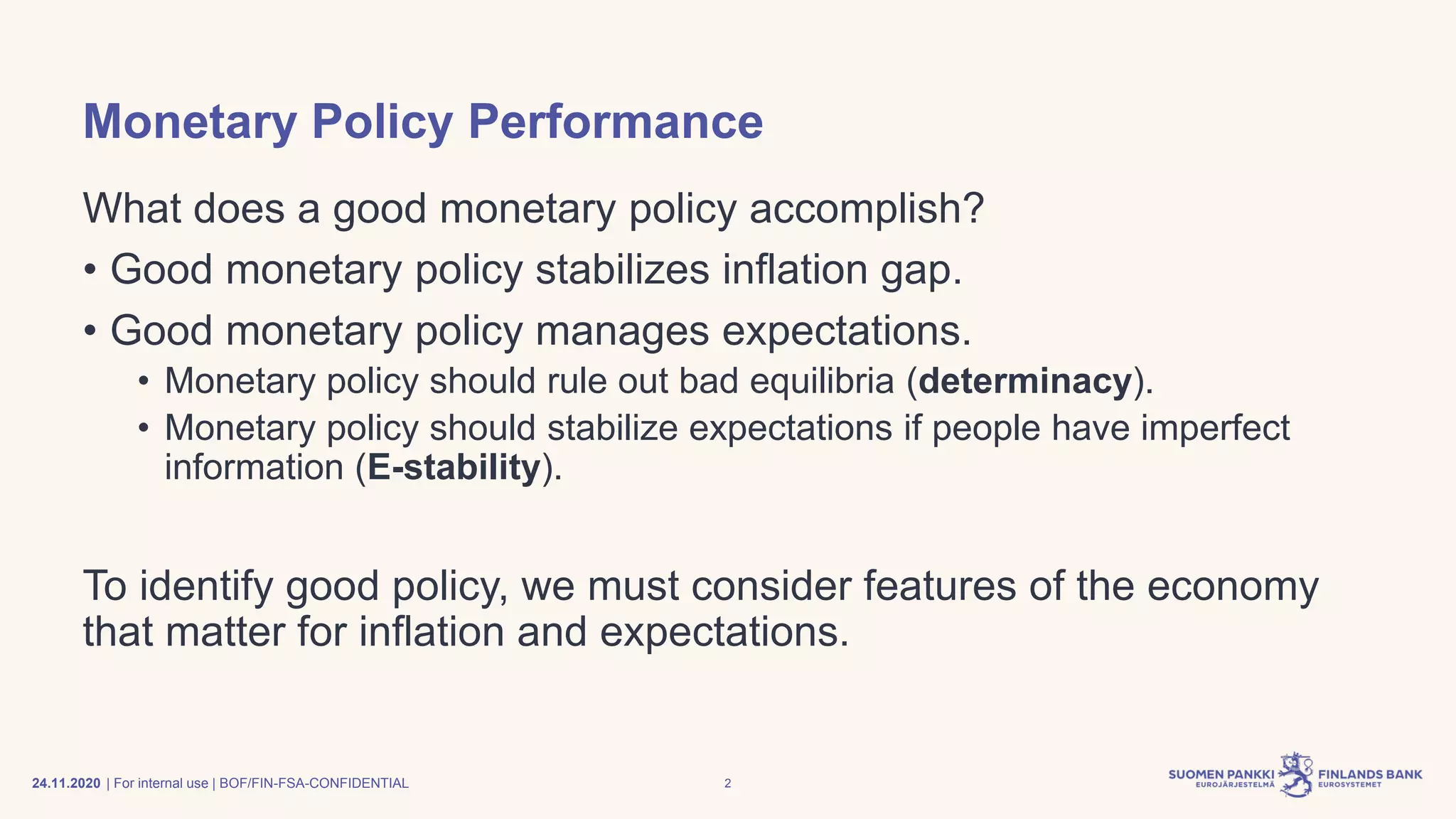
Monetary Policy Performance
What does a good monetary policy accomplish?
• Good monetary policy stabilizes inflation gap.
• Good monetary policy manages expectations.
• Monetary policy should rule out bad equilibria (determinacy).
• Monetary policy should stabilize expectations if people have imperfect
information (E-stability).
To identify good policy, we must consider features of the economy
that matter for inflation and expectations.
24.11.2020 2
| For internal use | BOF/FIN-FSA-CONFIDENTIAL
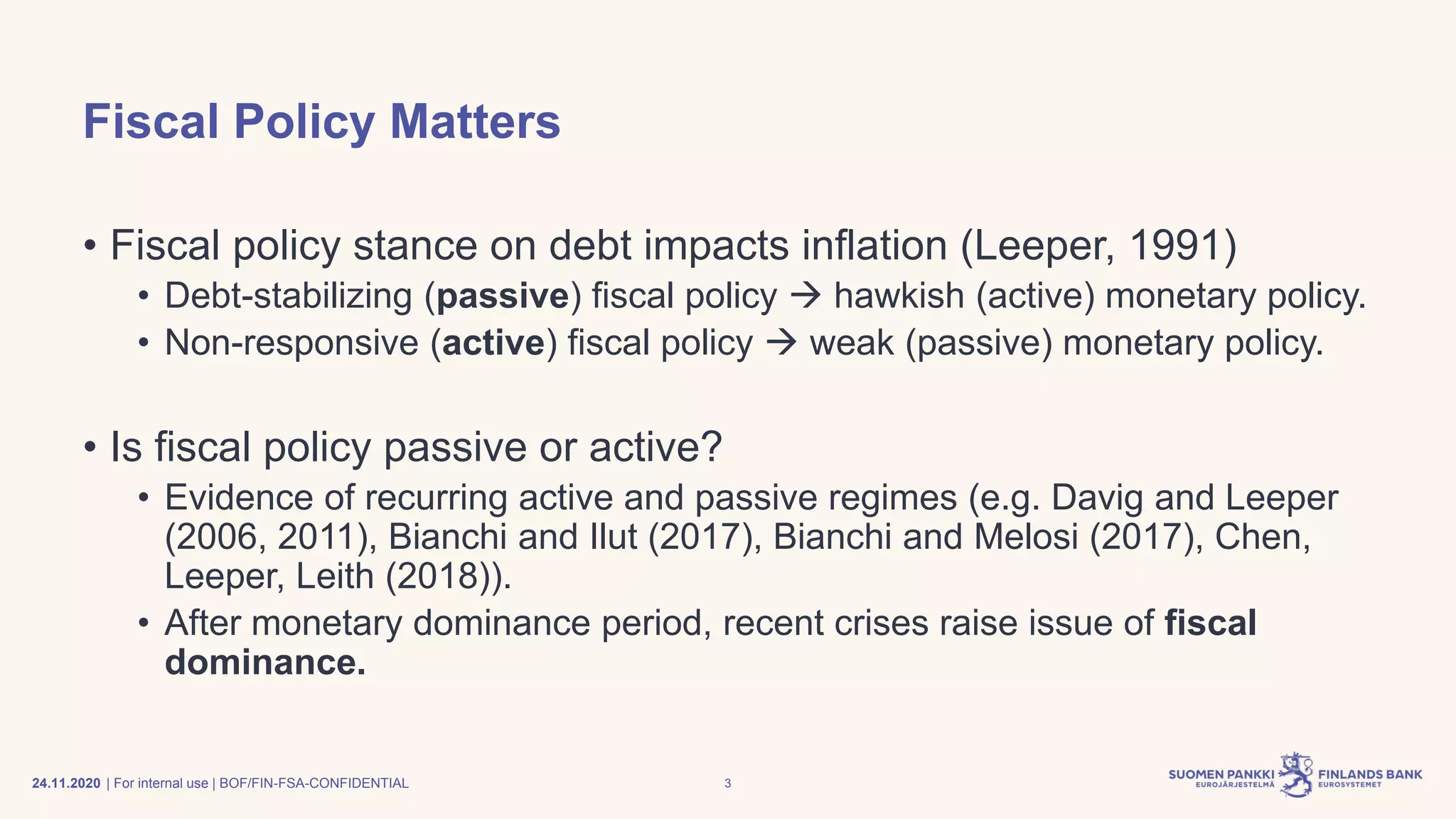
Fiscal Policy Matters
• Fiscal policy stance on debt impacts inflation (Leeper, 1991)
• Debt-stabilizing (passive) fiscal policy → hawkish (active) monetary policy.
• Non-responsive (active) fiscal policy → weak (passive) monetary policy.
• Is fiscal policy passive or active?
• Evidence of recurring active and passive regimes (e.g. Davig and Leeper
(2006, 2011), Bianchi and Ilut (2017), Bianchi and Melosi (2017), Chen,
Leeper, Leith (2018)).
• After monetary dominance period, recent crises raise issue of fiscal
dominance.
24.11.2020 3
| For internal use | BOF/FIN-FSA-CONFIDENTIAL
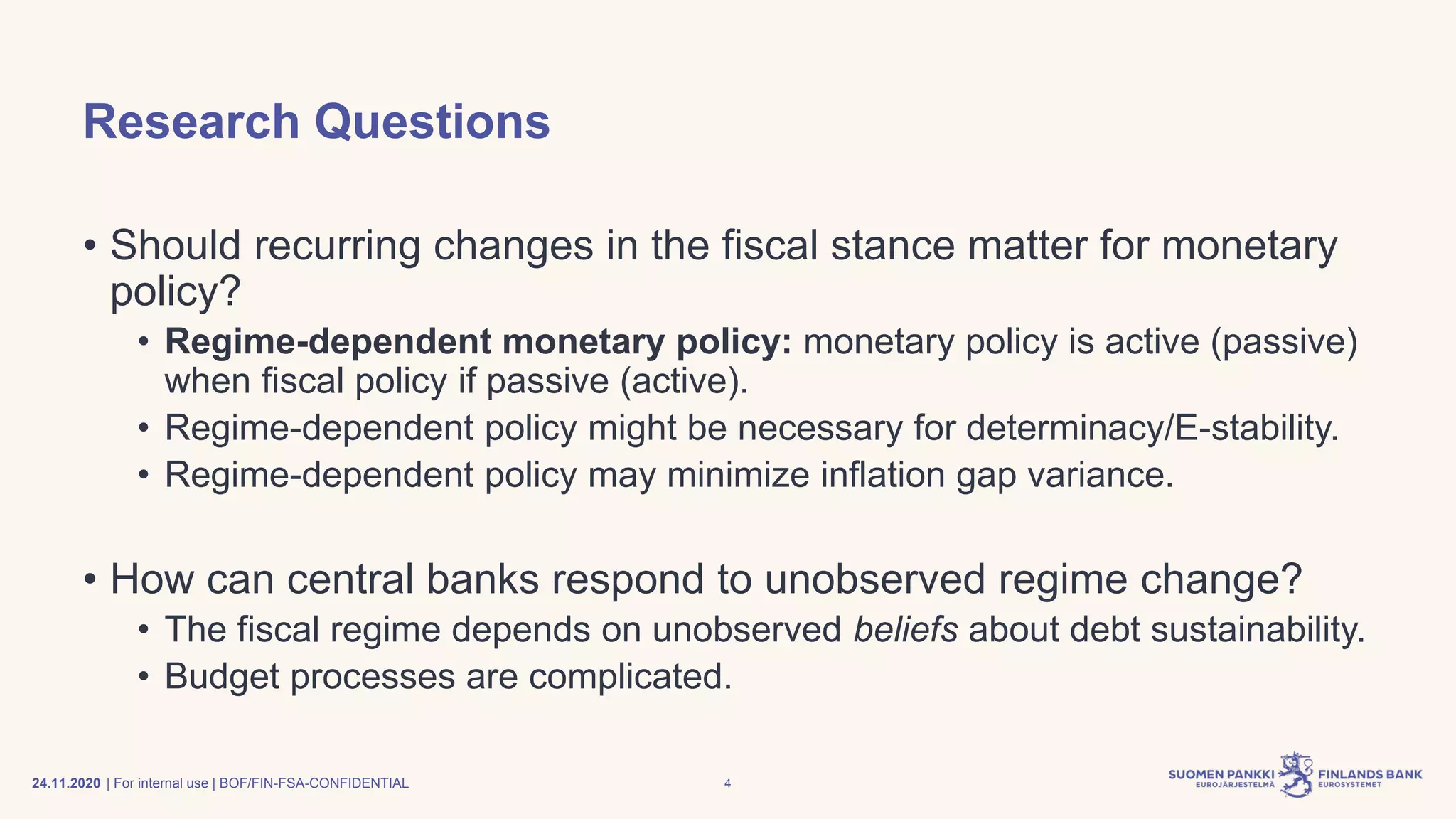
Research Questions
• Should recurring changes in the fiscal stance matter for monetary
policy?
• Regime-dependent monetary policy: monetary policy is active (passive)
when fiscal policy if passive (active).
• Regime-dependent policy might be necessary for determinacy/E-stability.
• Regime-dependent policy may minimize inflation gap variance.
• How can central banks respond to unobserved regime change?
• The fiscal regime depends on unobserved beliefs about debt sustainability.
• Budget processes are complicated.
24.11.2020 4
| For internal use | BOF/FIN-FSA-CONFIDENTIAL
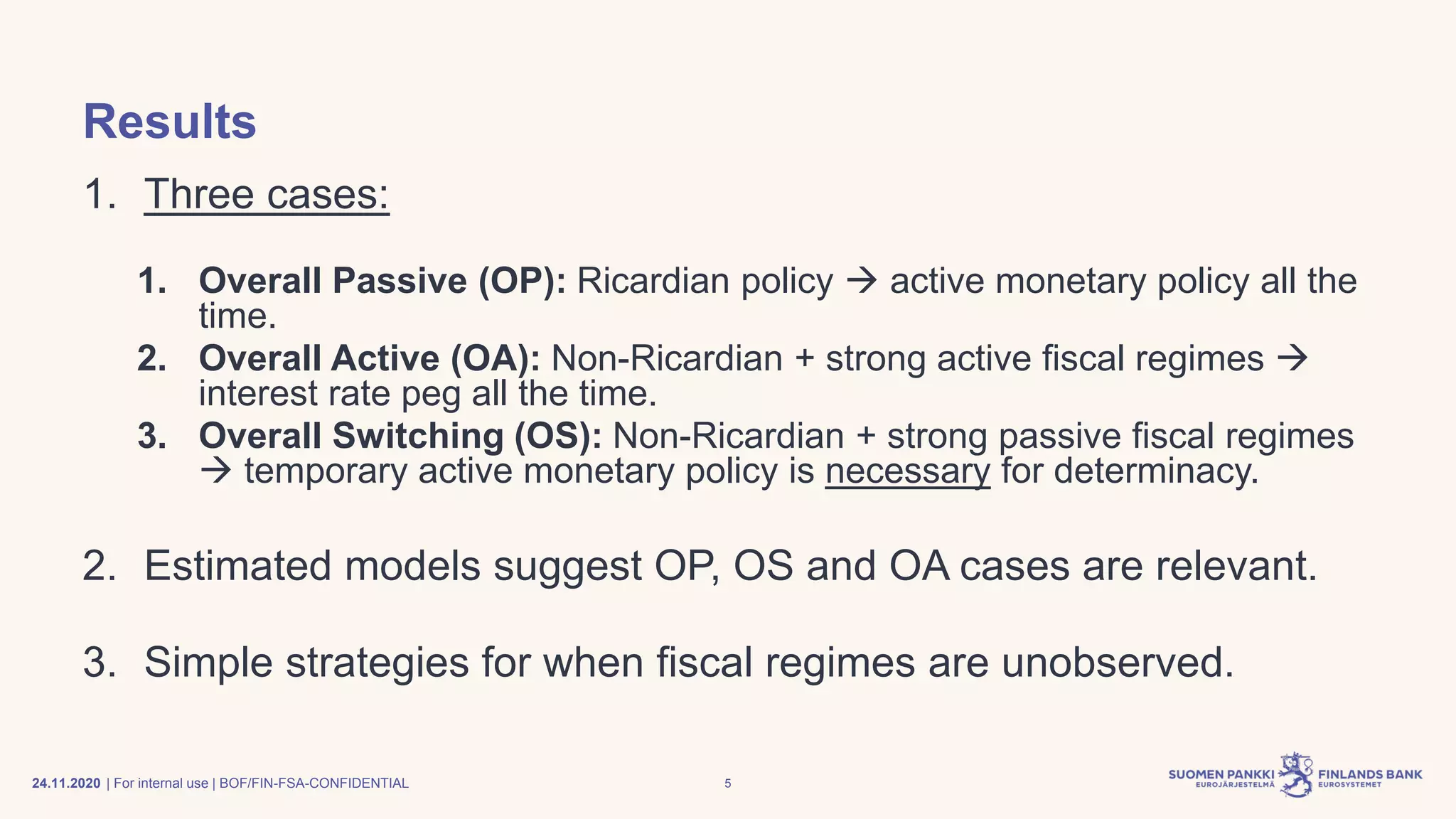
Results
1. Three cases:
1. Overall Passive (OP): Ricardian policy → active monetary policy all the
time.
2. Overall Active (OA): Non-Ricardian + strong active fiscal regimes →
interest rate peg all the time.
3. Overall Switching (OS): Non-Ricardian + strong passive fiscal regimes
→ temporary active monetary policy is necessary for determinacy.
2. Estimated models suggest OP, OS and OA cases are relevant.
3. Simple strategies for when fiscal regimes are unobserved.
24.11.2020 5
| For internal use | BOF/FIN-FSA-CONFIDENTIAL
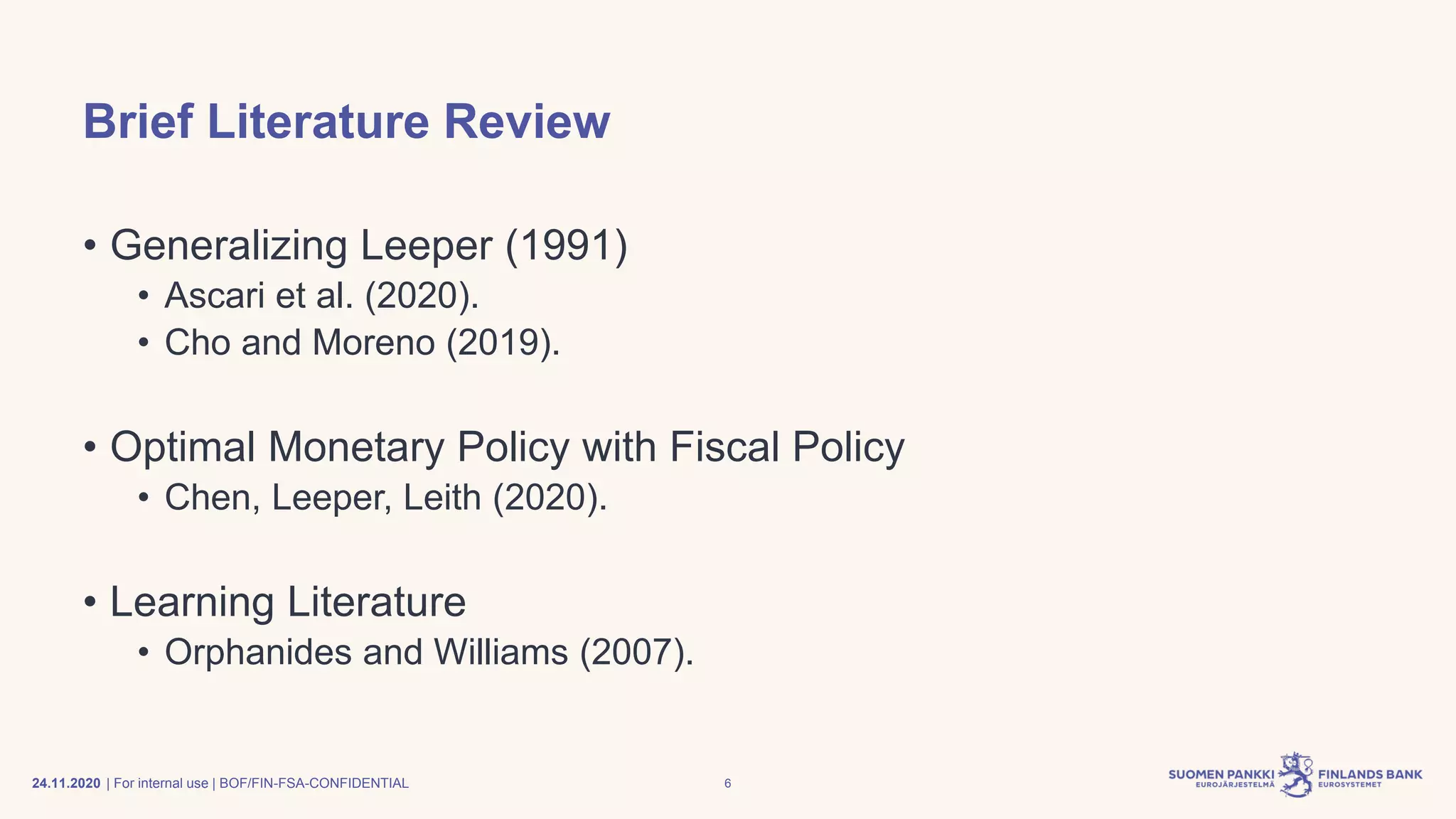
Brief Literature Review
• Generalizing Leeper (1991)
• Ascari et al. (2020).
• Cho and Moreno (2019).
• Optimal Monetary Policy with Fiscal Policy
• Chen, Leeper, Leith (2020).
• Learning Literature
• Orphanides and Williams (2007).
24.11.2020 6
| For internal use | BOF/FIN-FSA-CONFIDENTIAL
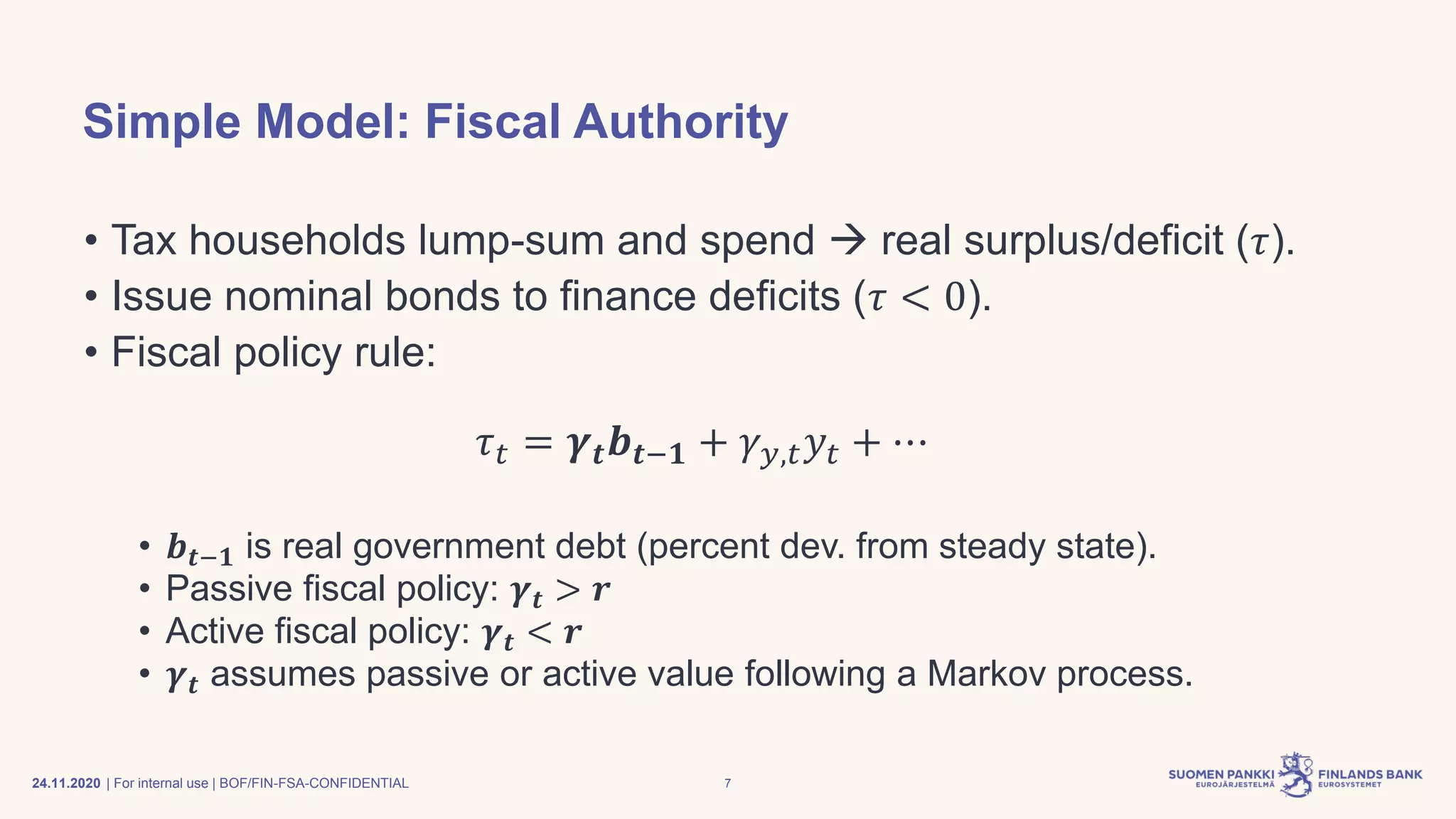
Simple Model: Fiscal Authority
• Tax households lump-sum and spend → real surplus/deficit (𝜏).
• Issue nominal bonds to finance deficits (𝜏 < 0).
• Fiscal policy rule:
𝜏 𝑡 = 𝜸 𝒕 𝒃 𝒕−𝟏 + 𝛾 𝑦,𝑡 𝑦𝑡 + ⋯
• 𝒃 𝒕−𝟏 is real government debt (percent dev. from steady state).
• Passive fiscal policy: 𝜸 𝒕 > 𝒓
• Active fiscal policy: 𝜸 𝒕 < 𝒓
• 𝜸 𝒕 assumes passive or active value following a Markov process.
24.11.2020 7
| For internal use | BOF/FIN-FSA-CONFIDENTIAL
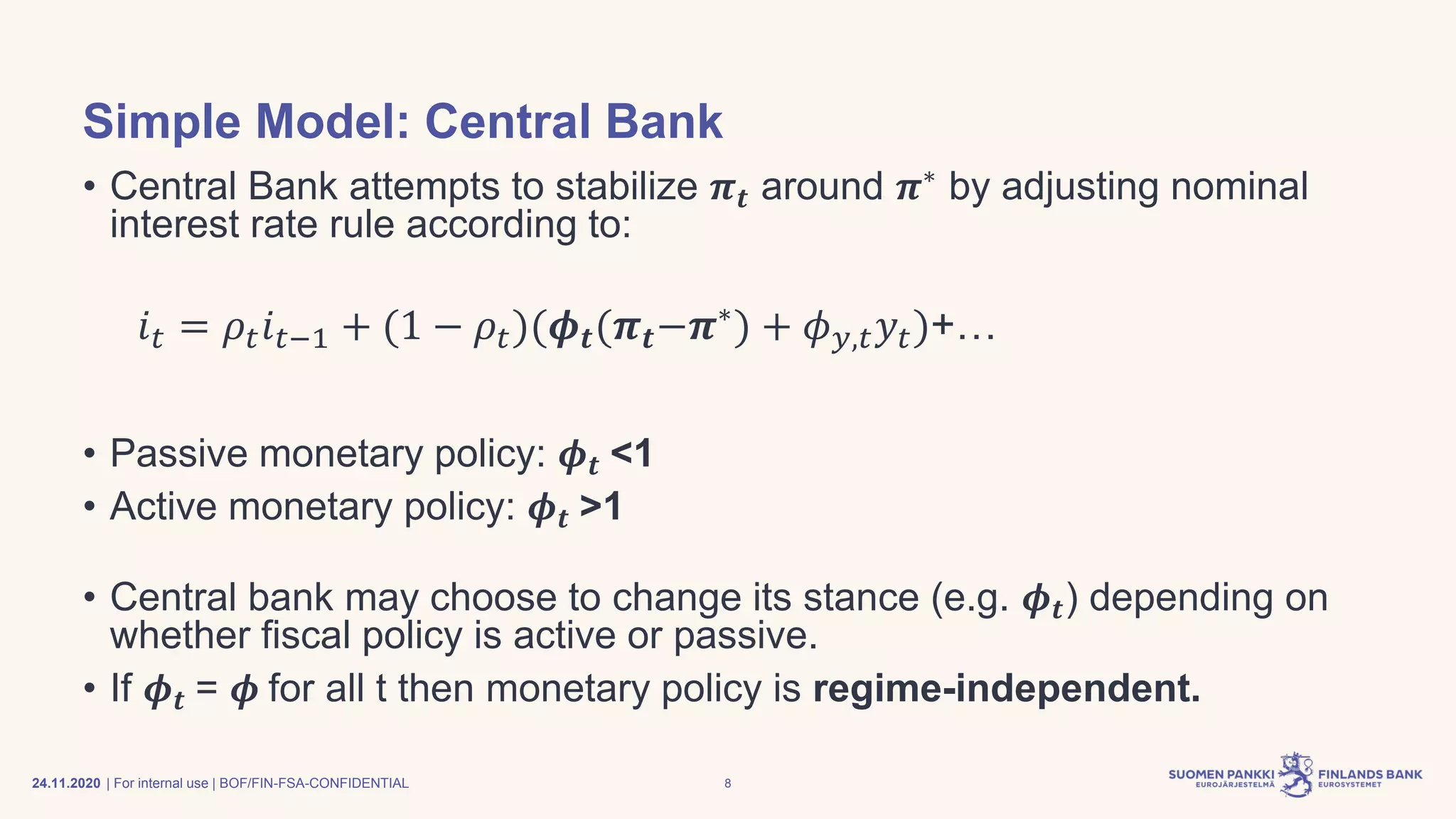
Simple Model: Central Bank
• Central Bank attempts to stabilize 𝝅 𝒕 around 𝝅∗
by adjusting nominal
interest rate rule according to:
𝑖 𝑡 = 𝜌𝑡 𝑖 𝑡−1 + (1 − 𝜌𝑡)(𝝓 𝒕(𝝅 𝒕−𝝅∗
) + 𝜙 𝑦,𝑡 𝑦𝑡)+…
• Passive monetary policy: 𝝓 𝒕 <1
• Active monetary policy: 𝝓 𝒕 >1
• Central bank may choose to change its stance (e.g. 𝝓 𝒕) depending on
whether fiscal policy is active or passive.
• If 𝝓 𝒕 = 𝝓 for all t then monetary policy is regime-independent.
24.11.2020 8
| For internal use | BOF/FIN-FSA-CONFIDENTIAL
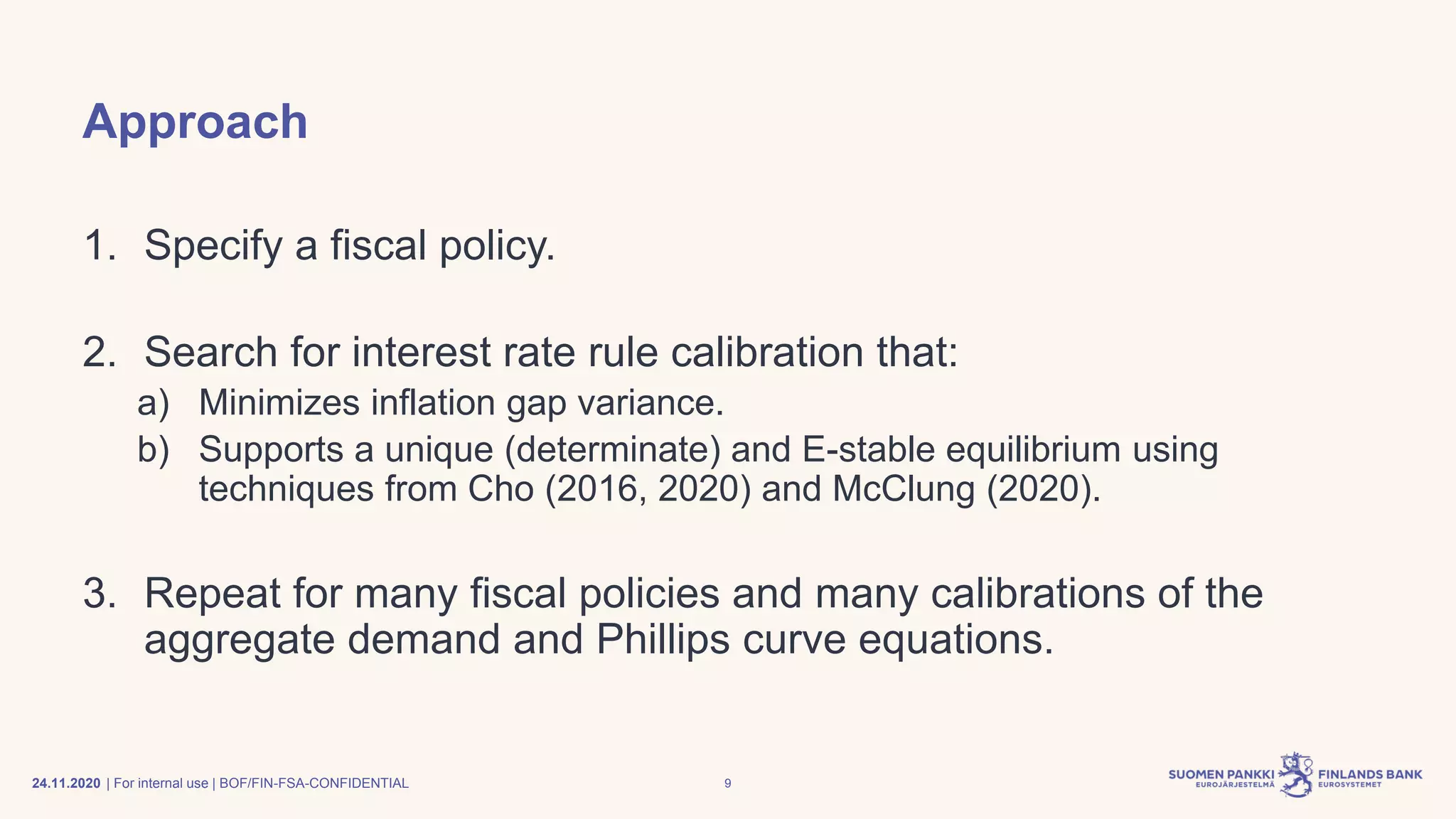
Approach
1. Specify a fiscal policy.
2. Search for interest rate rule calibration that:
a) Minimizes inflation gap variance.
b) Supports a unique (determinate) and E-stable equilibrium using
techniques from Cho (2016, 2020) and McClung (2020).
3. Repeat for many fiscal policies and many calibrations of the
aggregate demand and Phillips curve equations.
24.11.2020 9
| For internal use | BOF/FIN-FSA-CONFIDENTIAL
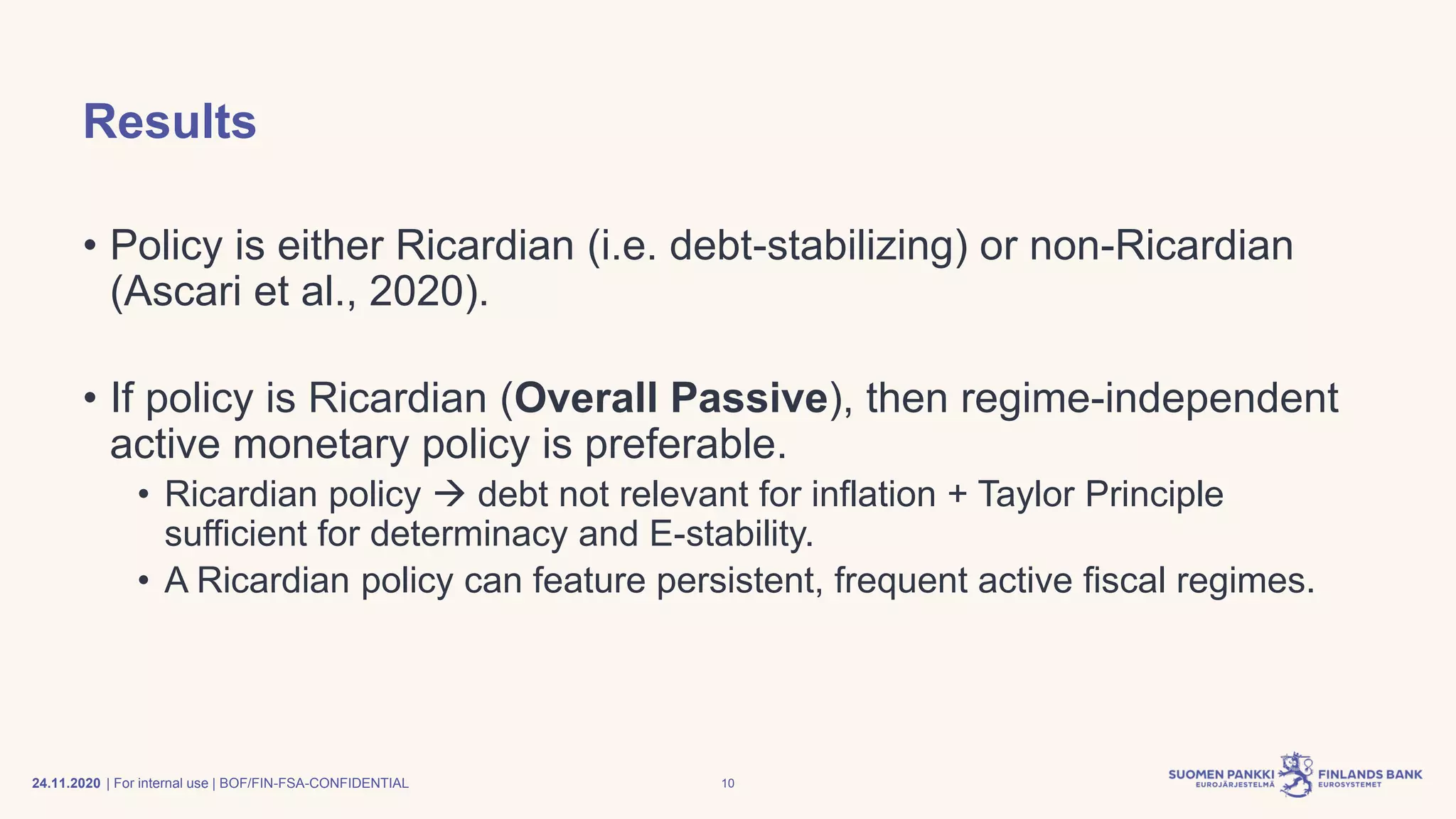
Results
• Policy is either Ricardian (i.e. debt-stabilizing) or non-Ricardian
(Ascari et al., 2020).
• If policy is Ricardian (Overall Passive), then regime-independent
active monetary policy is preferable.
• Ricardian policy → debt not relevant for inflation + Taylor Principle
sufficient for determinacy and E-stability.
• A Ricardian policy can feature persistent, frequent active fiscal regimes.
24.11.2020 10
| For internal use | BOF/FIN-FSA-CONFIDENTIAL
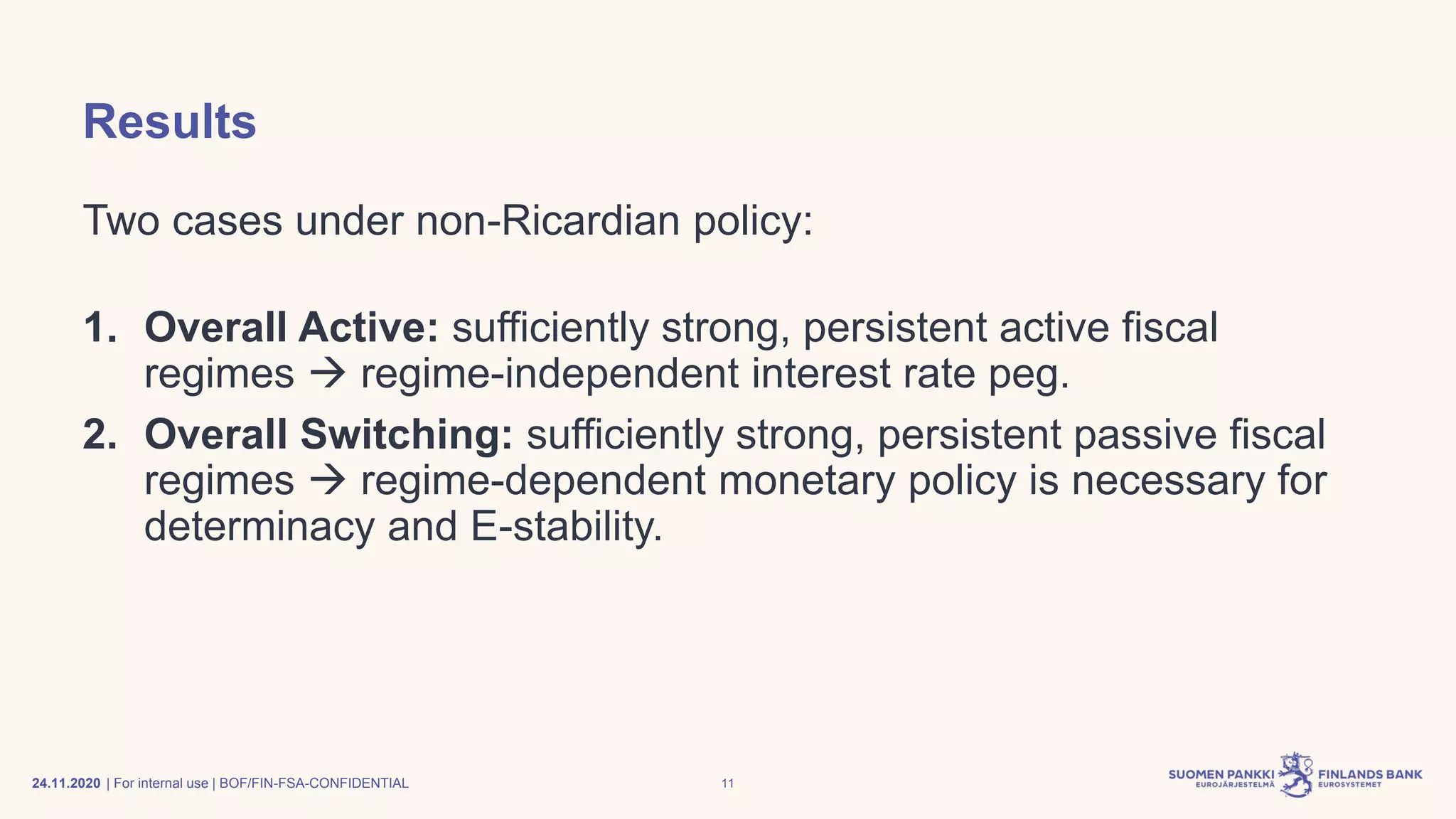
Results
Two cases under non-Ricardian policy:
1. Overall Active: sufficiently strong, persistent active fiscal
regimes → regime-independent interest rate peg.
2. Overall Switching: sufficiently strong, persistent passive fiscal
regimes → regime-dependent monetary policy is necessary for
determinacy and E-stability.
24.11.2020 11
| For internal use | BOF/FIN-FSA-CONFIDENTIAL
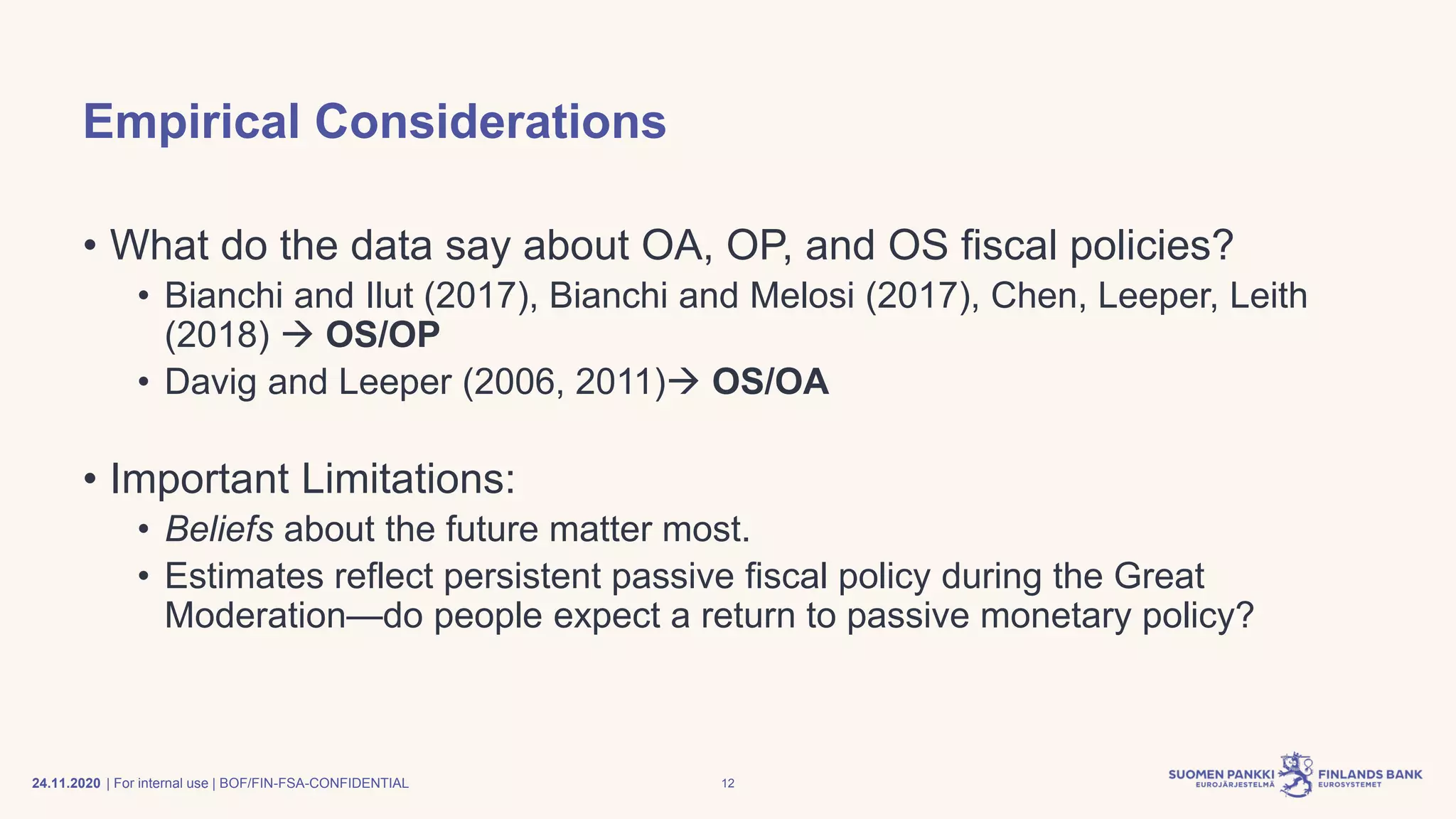
Empirical Considerations
• What do the data say about OA, OP, and OS fiscal policies?
• Bianchi and Ilut (2017), Bianchi and Melosi (2017), Chen, Leeper, Leith
(2018) → OS/OP
• Davig and Leeper (2006, 2011)→ OS/OA
• Important Limitations:
• Beliefs about the future matter most.
• Estimates reflect persistent passive fiscal policy during the Great
Moderation—do people expect a return to passive monetary policy?
24.11.2020 12
| For internal use | BOF/FIN-FSA-CONFIDENTIAL
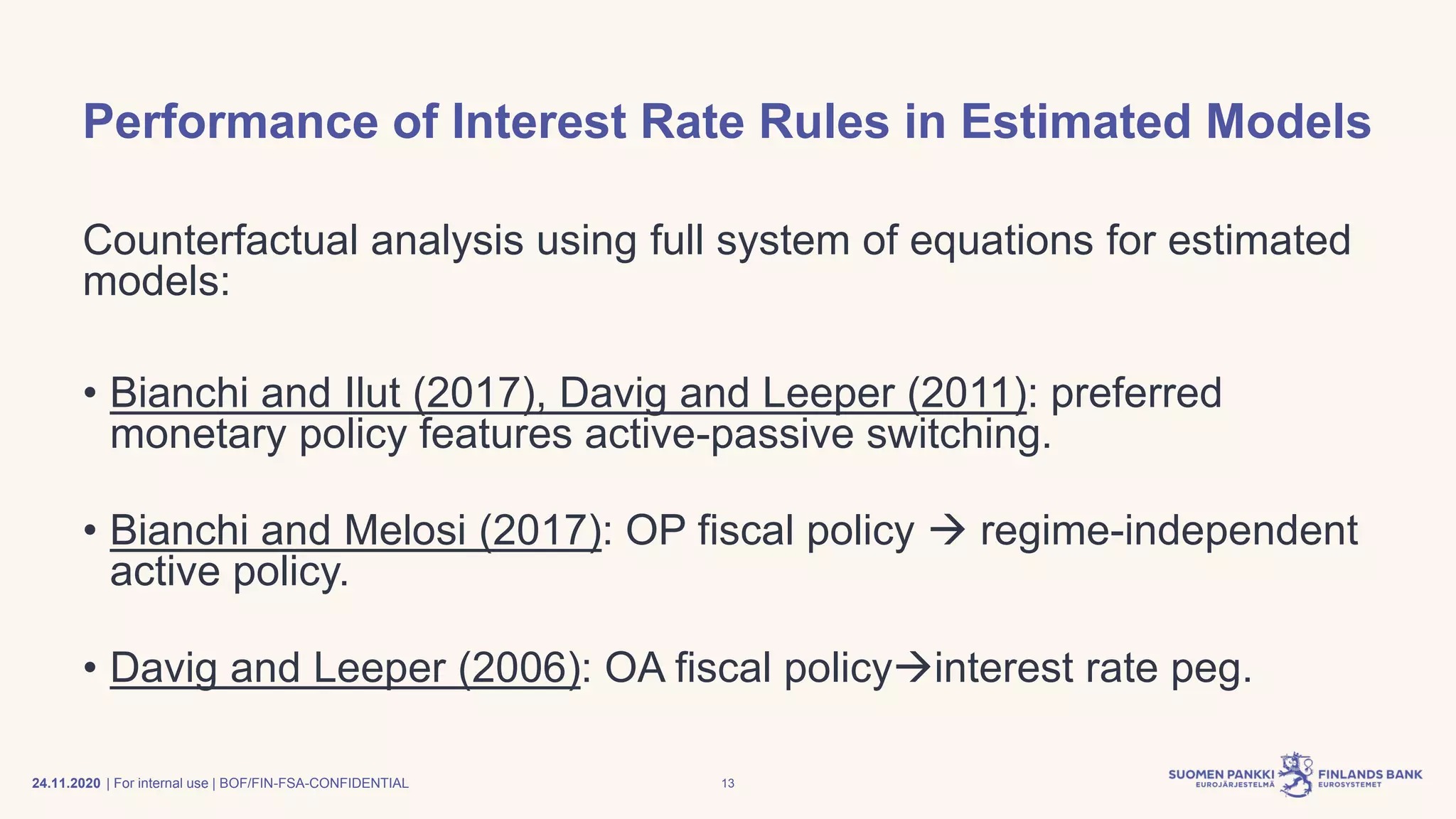
Performance of Interest Rate Rules in Estimated Models
Counterfactual analysis using full system of equations for estimated
models:
• Bianchi and Ilut (2017), Davig and Leeper (2011): preferred
monetary policy features active-passive switching.
• Bianchi and Melosi (2017): OP fiscal policy → regime-independent
active policy.
• Davig and Leeper (2006): OA fiscal policy→interest rate peg.
24.11.2020 13
| For internal use | BOF/FIN-FSA-CONFIDENTIAL
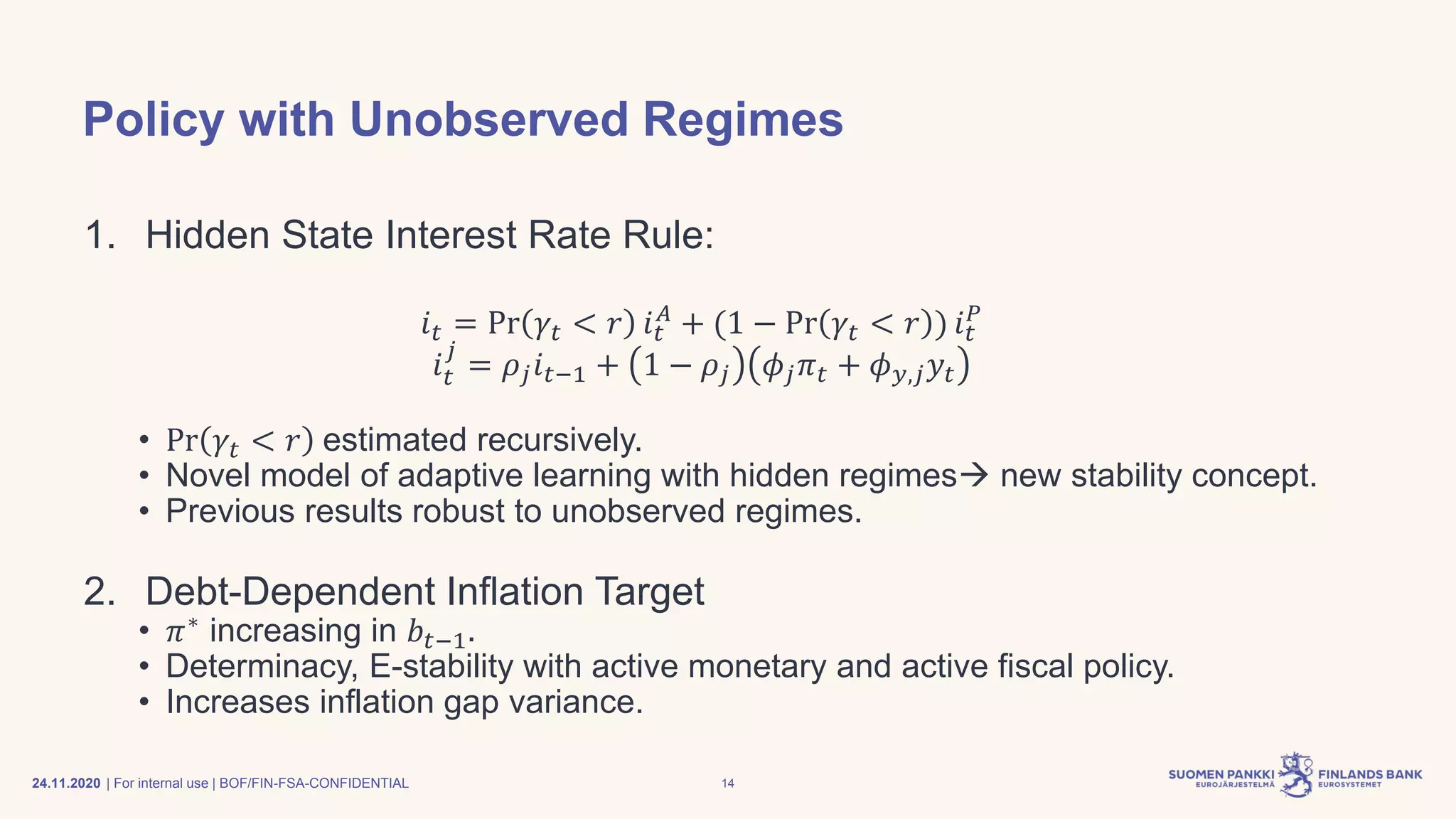
Policy with Unobserved Regimes
1. Hidden State Interest Rate Rule:
𝑖 𝑡 = Pr 𝛾𝑡 < 𝑟 𝑖 𝑡
𝐴
+ (1 − Pr 𝛾𝑡 < 𝑟 ) 𝑖 𝑡
𝑃
𝑖 𝑡
𝑗
= 𝜌𝑗 𝑖 𝑡−1 + 1 − 𝜌𝑗 𝜙𝑗 𝜋 𝑡 + 𝜙 𝑦,𝑗 𝑦𝑡
• Pr 𝛾𝑡 < 𝑟 estimated recursively.
• Novel model of adaptive learning with hidden regimes→ new stability concept.
• Previous results robust to unobserved regimes.
2. Debt-Dependent Inflation Target
• 𝜋∗
increasing in 𝑏𝑡−1.
• Determinacy, E-stability with active monetary and active fiscal policy.
• Increases inflation gap variance.
24.11.2020 14
| For internal use | BOF/FIN-FSA-CONFIDENTIAL
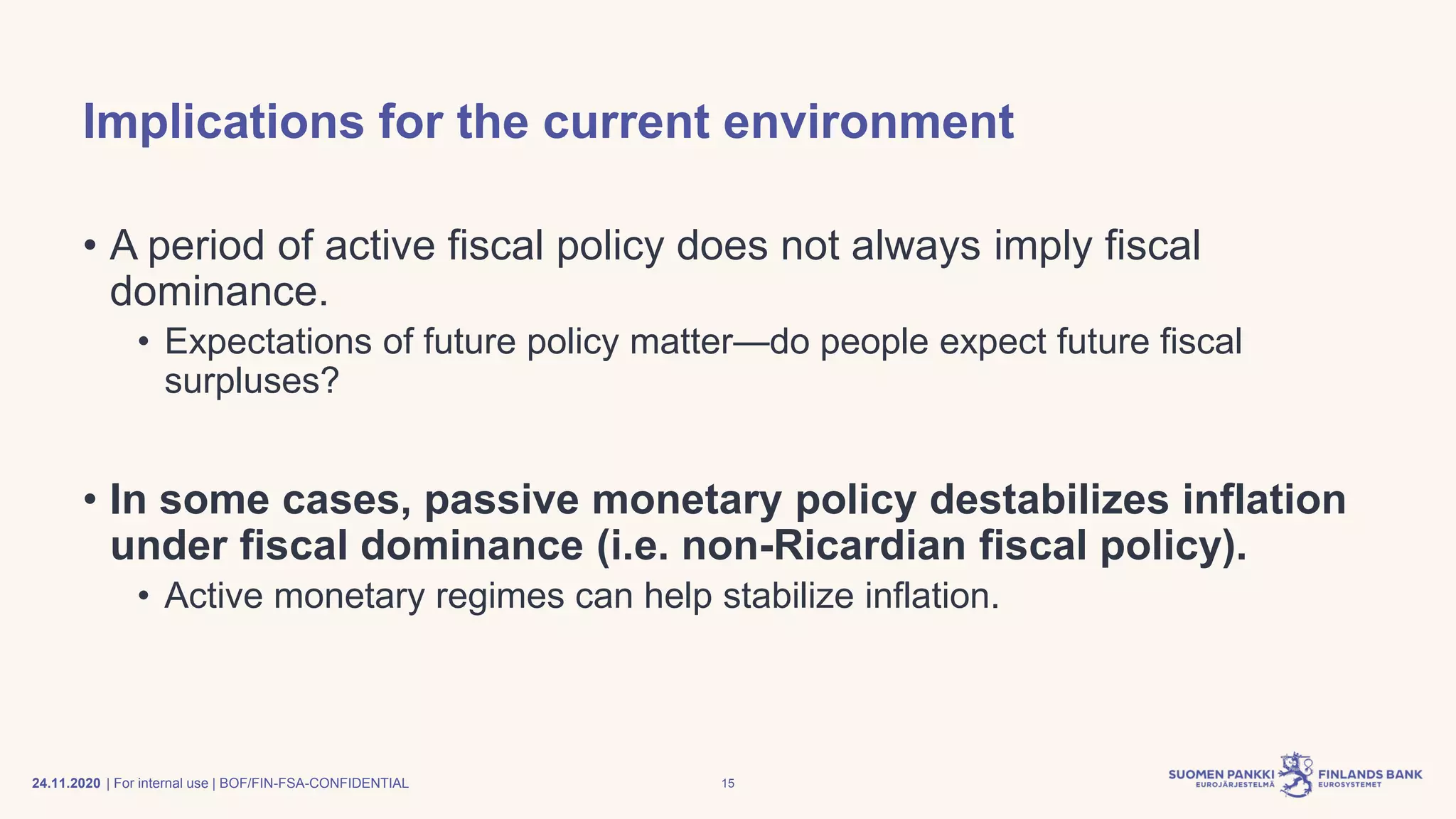
Implications for the current environment
• A period of active fiscal policy does not always imply fiscal
dominance.
• Expectations of future policy matter—do people expect future fiscal
surpluses?
• In some cases, passive monetary policy destabilizes inflation
under fiscal dominance (i.e. non-Ricardian fiscal policy).
• Active monetary regimes can help stabilize inflation.
24.11.2020 15
| For internal use | BOF/FIN-FSA-CONFIDENTIAL
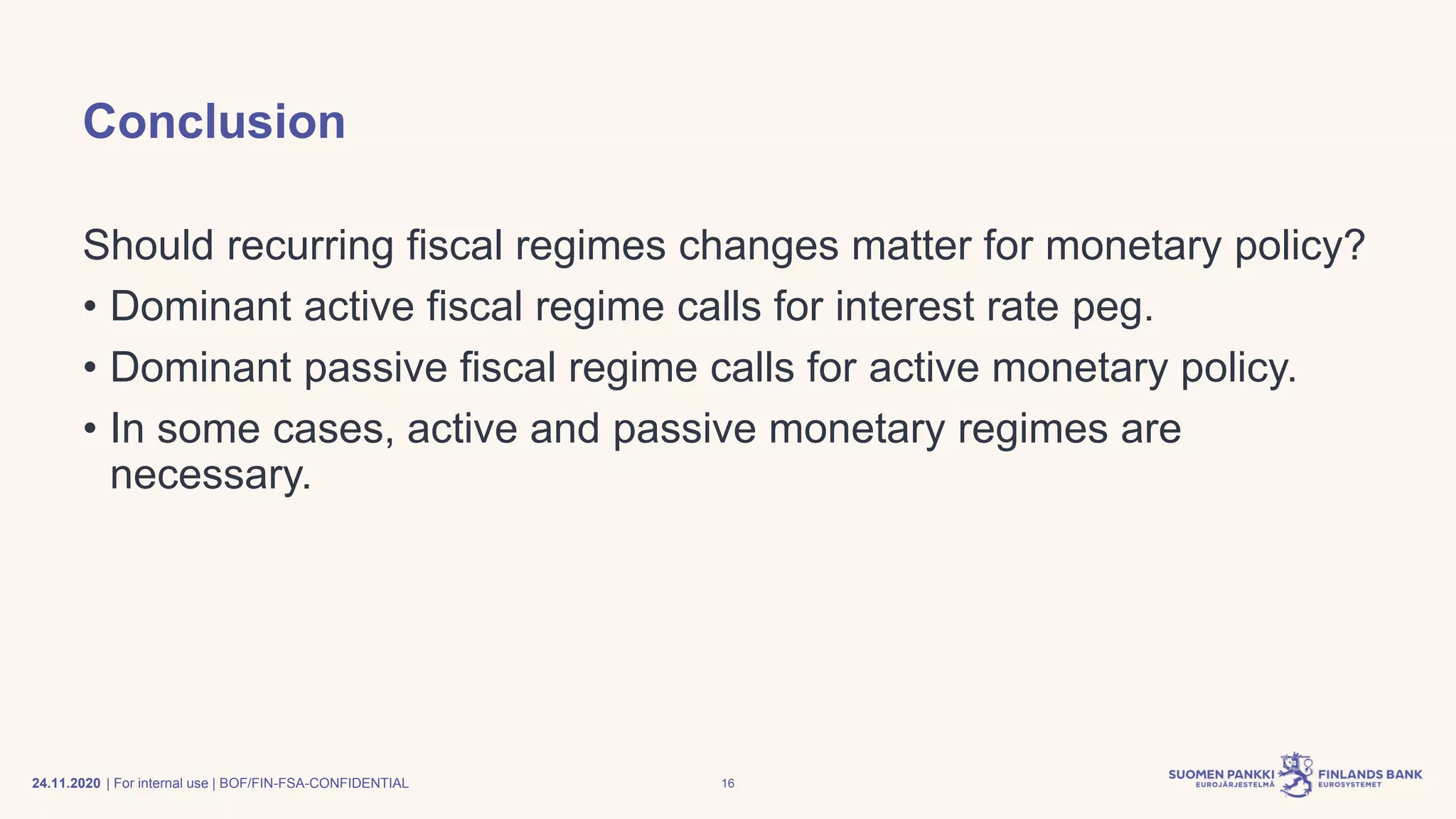
Conclusion
Should recurring fiscal regimes changes matter for monetary policy?
• Dominant active fiscal regime calls for interest rate peg.
• Dominant passive fiscal regime calls for active monetary policy.
• In some cases, active and passive monetary regimes are
necessary.
24.11.2020 16

Performance of Simple Interest Rate Rules Subject to Fiscal Policy

  • 1.
    Monetary Policy andResearch Department, Bank of Finland Performance of Simple Interest Rate Rules Subject to Fiscal Policy Nigel McClung
  • 2.
    | For internaluse | BOF/FIN-FSA-CONFIDENTIAL Monetary Policy Performance What does a good monetary policy accomplish? • Good monetary policy stabilizes inflation gap. • Good monetary policy manages expectations. • Monetary policy should rule out bad equilibria (determinacy). • Monetary policy should stabilize expectations if people have imperfect information (E-stability). To identify good policy, we must consider features of the economy that matter for inflation and expectations. 24.11.2020 2
  • 3.
    | For internaluse | BOF/FIN-FSA-CONFIDENTIAL Fiscal Policy Matters • Fiscal policy stance on debt impacts inflation (Leeper, 1991) • Debt-stabilizing (passive) fiscal policy → hawkish (active) monetary policy. • Non-responsive (active) fiscal policy → weak (passive) monetary policy. • Is fiscal policy passive or active? • Evidence of recurring active and passive regimes (e.g. Davig and Leeper (2006, 2011), Bianchi and Ilut (2017), Bianchi and Melosi (2017), Chen, Leeper, Leith (2018)). • After monetary dominance period, recent crises raise issue of fiscal dominance. 24.11.2020 3
  • 4.
    | For internaluse | BOF/FIN-FSA-CONFIDENTIAL Research Questions • Should recurring changes in the fiscal stance matter for monetary policy? • Regime-dependent monetary policy: monetary policy is active (passive) when fiscal policy if passive (active). • Regime-dependent policy might be necessary for determinacy/E-stability. • Regime-dependent policy may minimize inflation gap variance. • How can central banks respond to unobserved regime change? • The fiscal regime depends on unobserved beliefs about debt sustainability. • Budget processes are complicated. 24.11.2020 4
  • 5.
    | For internaluse | BOF/FIN-FSA-CONFIDENTIAL Results 1. Three cases: 1. Overall Passive (OP): Ricardian policy → active monetary policy all the time. 2. Overall Active (OA): Non-Ricardian + strong active fiscal regimes → interest rate peg all the time. 3. Overall Switching (OS): Non-Ricardian + strong passive fiscal regimes → temporary active monetary policy is necessary for determinacy. 2. Estimated models suggest OP, OS and OA cases are relevant. 3. Simple strategies for when fiscal regimes are unobserved. 24.11.2020 5
  • 6.
    | For internaluse | BOF/FIN-FSA-CONFIDENTIAL Brief Literature Review • Generalizing Leeper (1991) • Ascari et al. (2020). • Cho and Moreno (2019). • Optimal Monetary Policy with Fiscal Policy • Chen, Leeper, Leith (2020). • Learning Literature • Orphanides and Williams (2007). 24.11.2020 6
  • 7.
    | For internaluse | BOF/FIN-FSA-CONFIDENTIAL Simple Model: Fiscal Authority • Tax households lump-sum and spend → real surplus/deficit (𝜏). • Issue nominal bonds to finance deficits (𝜏 < 0). • Fiscal policy rule: 𝜏 𝑡 = 𝜸 𝒕 𝒃 𝒕−𝟏 + 𝛾 𝑦,𝑡 𝑦𝑡 + ⋯ • 𝒃 𝒕−𝟏 is real government debt (percent dev. from steady state). • Passive fiscal policy: 𝜸 𝒕 > 𝒓 • Active fiscal policy: 𝜸 𝒕 < 𝒓 • 𝜸 𝒕 assumes passive or active value following a Markov process. 24.11.2020 7
  • 8.
    | For internaluse | BOF/FIN-FSA-CONFIDENTIAL Simple Model: Central Bank • Central Bank attempts to stabilize 𝝅 𝒕 around 𝝅∗ by adjusting nominal interest rate rule according to: 𝑖 𝑡 = 𝜌𝑡 𝑖 𝑡−1 + (1 − 𝜌𝑡)(𝝓 𝒕(𝝅 𝒕−𝝅∗ ) + 𝜙 𝑦,𝑡 𝑦𝑡)+… • Passive monetary policy: 𝝓 𝒕 <1 • Active monetary policy: 𝝓 𝒕 >1 • Central bank may choose to change its stance (e.g. 𝝓 𝒕) depending on whether fiscal policy is active or passive. • If 𝝓 𝒕 = 𝝓 for all t then monetary policy is regime-independent. 24.11.2020 8
  • 9.
    | For internaluse | BOF/FIN-FSA-CONFIDENTIAL Approach 1. Specify a fiscal policy. 2. Search for interest rate rule calibration that: a) Minimizes inflation gap variance. b) Supports a unique (determinate) and E-stable equilibrium using techniques from Cho (2016, 2020) and McClung (2020). 3. Repeat for many fiscal policies and many calibrations of the aggregate demand and Phillips curve equations. 24.11.2020 9
  • 10.
    | For internaluse | BOF/FIN-FSA-CONFIDENTIAL Results • Policy is either Ricardian (i.e. debt-stabilizing) or non-Ricardian (Ascari et al., 2020). • If policy is Ricardian (Overall Passive), then regime-independent active monetary policy is preferable. • Ricardian policy → debt not relevant for inflation + Taylor Principle sufficient for determinacy and E-stability. • A Ricardian policy can feature persistent, frequent active fiscal regimes. 24.11.2020 10
  • 11.
    | For internaluse | BOF/FIN-FSA-CONFIDENTIAL Results Two cases under non-Ricardian policy: 1. Overall Active: sufficiently strong, persistent active fiscal regimes → regime-independent interest rate peg. 2. Overall Switching: sufficiently strong, persistent passive fiscal regimes → regime-dependent monetary policy is necessary for determinacy and E-stability. 24.11.2020 11
  • 12.
    | For internaluse | BOF/FIN-FSA-CONFIDENTIAL Empirical Considerations • What do the data say about OA, OP, and OS fiscal policies? • Bianchi and Ilut (2017), Bianchi and Melosi (2017), Chen, Leeper, Leith (2018) → OS/OP • Davig and Leeper (2006, 2011)→ OS/OA • Important Limitations: • Beliefs about the future matter most. • Estimates reflect persistent passive fiscal policy during the Great Moderation—do people expect a return to passive monetary policy? 24.11.2020 12
  • 13.
    | For internaluse | BOF/FIN-FSA-CONFIDENTIAL Performance of Interest Rate Rules in Estimated Models Counterfactual analysis using full system of equations for estimated models: • Bianchi and Ilut (2017), Davig and Leeper (2011): preferred monetary policy features active-passive switching. • Bianchi and Melosi (2017): OP fiscal policy → regime-independent active policy. • Davig and Leeper (2006): OA fiscal policy→interest rate peg. 24.11.2020 13
  • 14.
    | For internaluse | BOF/FIN-FSA-CONFIDENTIAL Policy with Unobserved Regimes 1. Hidden State Interest Rate Rule: 𝑖 𝑡 = Pr 𝛾𝑡 < 𝑟 𝑖 𝑡 𝐴 + (1 − Pr 𝛾𝑡 < 𝑟 ) 𝑖 𝑡 𝑃 𝑖 𝑡 𝑗 = 𝜌𝑗 𝑖 𝑡−1 + 1 − 𝜌𝑗 𝜙𝑗 𝜋 𝑡 + 𝜙 𝑦,𝑗 𝑦𝑡 • Pr 𝛾𝑡 < 𝑟 estimated recursively. • Novel model of adaptive learning with hidden regimes→ new stability concept. • Previous results robust to unobserved regimes. 2. Debt-Dependent Inflation Target • 𝜋∗ increasing in 𝑏𝑡−1. • Determinacy, E-stability with active monetary and active fiscal policy. • Increases inflation gap variance. 24.11.2020 14
  • 15.
    | For internaluse | BOF/FIN-FSA-CONFIDENTIAL Implications for the current environment • A period of active fiscal policy does not always imply fiscal dominance. • Expectations of future policy matter—do people expect future fiscal surpluses? • In some cases, passive monetary policy destabilizes inflation under fiscal dominance (i.e. non-Ricardian fiscal policy). • Active monetary regimes can help stabilize inflation. 24.11.2020 15
  • 16.
    | For internaluse | BOF/FIN-FSA-CONFIDENTIAL Conclusion Should recurring fiscal regimes changes matter for monetary policy? • Dominant active fiscal regime calls for interest rate peg. • Dominant passive fiscal regime calls for active monetary policy. • In some cases, active and passive monetary regimes are necessary. 24.11.2020 16