By :
Shreyas MG
SMVITM Udupi
30 April 2018 1
 USGBC – U.S Green Building Council.
 It was co-founded by Mike Italiano,
David and Rick in 1993.
 It is a Non-Profit Organization and council’s vision is
that all buildings should achieve sustainability.
 To realize the vision, USGBC developed LEED rating
system.
30 April 2018 2
 LEED – Leadership in Energy and Environmental
Design.
 It was started by USGBC in 2000.
 It is one of the most popular green
building certification programs used
worldwide.
 Green Building: It is of creating structures that are
environment friendly and resource-efficient
throughout building up to maintenance.
30 April 2018 3
 LEED Certification provides independent, third-
party verification for home or commercial buildings
which aimed to achieve high performance in five
key areas respecting to human and environmental
health.
 LEED Certification is a globally recognized symbol
of sustainability achievement.
30 April 2018 4
The levels correspond to the number of point’s accrued
in five main credit categories;
 Sustainable site development.
 Water conservation.
 Energy efficiency.
 Materials and Resources.
 Indoor environmental quality.
30 April 2018 5
 It encourages strategies that minimizes the
impact on environment.
 Good Location.
 GoodTransportation facility.
 Material Selection.
 These are the key factors to earn credit in
sustainable site.
30 April 2018 6
 Construction of Buildings with less cost: The
materials used to construct the structure with
recycled materials which is less cost.
 It reduces waste.
 It attracts the investors and employees with
attractive eco-friendly structure.
30 April 2018 7
 A project that includes rainwater harvesting,
municipally supplied water, greywater use or
other reused sources is eligible to earn credit
inWater Savings.
 The Water Conservation category comprises
two major components: indoor water usage
and outdoor water usage.
 Indoor water usage includes home appliances
such as cooling, washing machine etc.
 The indoor water use reduction projections
based on occupant’s usage.
30 April 2018 8
 Since 3% of earth’s water is fresh water, it protects
drinking water resources.
 It Minimizes water pollution and health risks.
 It reduces the need for water supply.
 Effluent plants with waste water.
30 April 2018 9
 The EF category recognizes that the reduction of
fossil fuel use and reduction in electrical use.
 Energy efficiency in a green building starts with a
focuses on reduces overall energy needs, cooling,
natural ventilation, max. daylight exposure etc.
 The building should be usage of Minimum energy
consumption.
30 April 2018 10
 It increase building resale value.
 It reduces fossil fuel use and carbon dioxide
gas emissions.
 It saves money on energy bills.
 Energy efficient buildings can reduce energy
up to 25-40%.
30 April 2018 11
 Materials used in construction are recyclable
building materials including aggregates, recycled
plastic etc.
 Materials used in construction should be low
maintenance and operation cost.
 Materials used in construction should be easy to
recycle.
 These are the key factors to earn credit in material
and resources .
30 April 2018 12
 The EQ category includes such as ventilation
and thermal control, natural lighting quality,
indoor lighting quality for a building to earn
credit in EQ category.
 Green buildings with good indoor environments
also improve the building’s value, and reduce
maintenance for building owners.
 This category addresses the environmental
factors such as air quality, maximum daylight
that influence the people learn, work and live.
30 April 2018 13
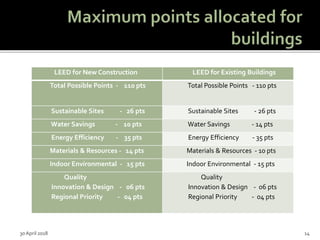
LEED for New Construction LEED for Existing Buildings
Total Possible Points - 110 pts Total Possible Points - 110 pts
Sustainable Sites - 26 pts Sustainable Sites - 26 pts
Water Savings - 10 pts Water Savings - 14 pts
Energy Efficiency - 35 pts Energy Efficiency - 35 pts
Materials & Resources - 14 pts Materials & Resources - 10 pts
Indoor Environmental - 15 pts Indoor Environmental - 15 pts
Quality
Innovation & Design - 06 pts
Regional Priority - 04 pts
Quality
Innovation & Design - 06 pts
Regional Priority - 04 pts
30 April 2018 14
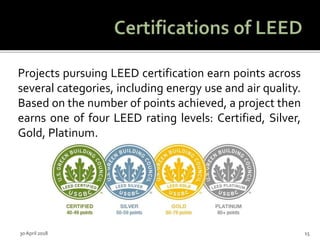
Projects pursuing LEED certification earn points across
several categories, including energy use and air quality.
Based on the number of points achieved, a project then
earns one of four LEED rating levels: Certified, Silver,
Gold, Platinum.
30 April 2018 15
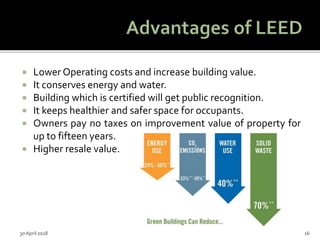
 Lower Operating costs and increase building value.
 It conserves energy and water.
 Building which is certified will get public recognition.
 It keeps healthier and safer space for occupants.
 Owners pay no taxes on improvement value of property for
up to fifteen years.
 Higher resale value.
30 April 2018 16
30 April 2018 17
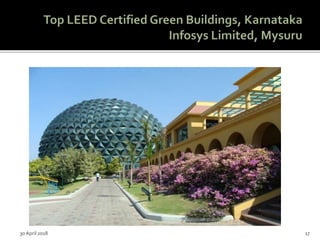
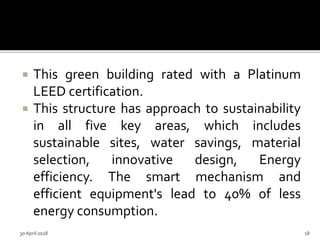
 This green building rated with a Platinum
LEED certification.
 This structure has approach to sustainability
in all five key areas, which includes
sustainable sites, water savings, material
selection, innovative design, Energy
efficiency. The smart mechanism and
efficient equipment's lead to 40% of less
energy consumption.
30 April 2018 18
30 April 2018 19
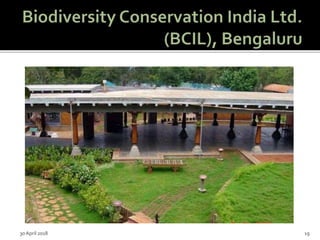
 The Building was established with an aim of
creating eco-friendly to environment.
 It is the second largest LEED certified
building in Karnataka.
 LEED certified with Platinum rating.
 Main feature: Grey water is purified and
directed to gardens, toilets and for washing
cars.
30 April 2018 20
 LEED brings valuable environmental savings and
outcomes while also saving money through energy,
water, and waste reduction over the life of the building.
 State and local governments across the country are
adopting LEED for public-owned and public-funded
buildings.
 Federal agencies, including the departments of
defence, Agriculture, Energy have LEED initiatives.
LEED projects are in 165 different countries- among
these Canada, Brazil and India.
30 April 2018 21
 Devarshi, Dr.Ramesh D, “Role of Green Buildings in Sustainable
Construction” International Journal of Civil Engineering e-ISSN: 2278-
1684, p-ISSN: 2320-334X,Volume 12, Issue 2Ver.2 (March-April 2015).
 Ankush A.Patil, Shruti, “Sustainable Construction: Green Building
Concept” International Journal of Innovative and Emerging Research in
Engineering e-ISSN: 2394-3343, p-ISSN: 2394-5494, Volume 2, Issue2,
2014.
 Avinash Shivajirao, “Green Buildings” International Journal e-ISSN: 0976-
7916.
 Hemant Kumar and Vaishali Sahu, “Performance and Rating of
Residential Green buildings” an International Journal (CiVEJ) Vol.2, No.2,
June 2015.
 Prof. Abdul Salam, “Sustainable Green Smart Buildings: Future Energy
Survivor” ISESCO Journal of Science and technologyVol.12, No.21, 2015.
30 April 2018 22
30 April 2018 23

Leed building certification

  • 1.
    By : Shreyas MG SMVITMUdupi 30 April 2018 1
  • 2.
     USGBC –U.S Green Building Council.  It was co-founded by Mike Italiano, David and Rick in 1993.  It is a Non-Profit Organization and council’s vision is that all buildings should achieve sustainability.  To realize the vision, USGBC developed LEED rating system. 30 April 2018 2
  • 3.
     LEED –Leadership in Energy and Environmental Design.  It was started by USGBC in 2000.  It is one of the most popular green building certification programs used worldwide.  Green Building: It is of creating structures that are environment friendly and resource-efficient throughout building up to maintenance. 30 April 2018 3
  • 4.
     LEED Certificationprovides independent, third- party verification for home or commercial buildings which aimed to achieve high performance in five key areas respecting to human and environmental health.  LEED Certification is a globally recognized symbol of sustainability achievement. 30 April 2018 4
  • 5.
    The levels correspondto the number of point’s accrued in five main credit categories;  Sustainable site development.  Water conservation.  Energy efficiency.  Materials and Resources.  Indoor environmental quality. 30 April 2018 5
  • 6.
     It encouragesstrategies that minimizes the impact on environment.  Good Location.  GoodTransportation facility.  Material Selection.  These are the key factors to earn credit in sustainable site. 30 April 2018 6
  • 7.
     Construction ofBuildings with less cost: The materials used to construct the structure with recycled materials which is less cost.  It reduces waste.  It attracts the investors and employees with attractive eco-friendly structure. 30 April 2018 7
  • 8.
     A projectthat includes rainwater harvesting, municipally supplied water, greywater use or other reused sources is eligible to earn credit inWater Savings.  The Water Conservation category comprises two major components: indoor water usage and outdoor water usage.  Indoor water usage includes home appliances such as cooling, washing machine etc.  The indoor water use reduction projections based on occupant’s usage. 30 April 2018 8
  • 9.
     Since 3%of earth’s water is fresh water, it protects drinking water resources.  It Minimizes water pollution and health risks.  It reduces the need for water supply.  Effluent plants with waste water. 30 April 2018 9
  • 10.
     The EFcategory recognizes that the reduction of fossil fuel use and reduction in electrical use.  Energy efficiency in a green building starts with a focuses on reduces overall energy needs, cooling, natural ventilation, max. daylight exposure etc.  The building should be usage of Minimum energy consumption. 30 April 2018 10
  • 11.
     It increasebuilding resale value.  It reduces fossil fuel use and carbon dioxide gas emissions.  It saves money on energy bills.  Energy efficient buildings can reduce energy up to 25-40%. 30 April 2018 11
  • 12.
     Materials usedin construction are recyclable building materials including aggregates, recycled plastic etc.  Materials used in construction should be low maintenance and operation cost.  Materials used in construction should be easy to recycle.  These are the key factors to earn credit in material and resources . 30 April 2018 12
  • 13.
     The EQcategory includes such as ventilation and thermal control, natural lighting quality, indoor lighting quality for a building to earn credit in EQ category.  Green buildings with good indoor environments also improve the building’s value, and reduce maintenance for building owners.  This category addresses the environmental factors such as air quality, maximum daylight that influence the people learn, work and live. 30 April 2018 13
  • 14.
    LEED for NewConstruction LEED for Existing Buildings Total Possible Points - 110 pts Total Possible Points - 110 pts Sustainable Sites - 26 pts Sustainable Sites - 26 pts Water Savings - 10 pts Water Savings - 14 pts Energy Efficiency - 35 pts Energy Efficiency - 35 pts Materials & Resources - 14 pts Materials & Resources - 10 pts Indoor Environmental - 15 pts Indoor Environmental - 15 pts Quality Innovation & Design - 06 pts Regional Priority - 04 pts Quality Innovation & Design - 06 pts Regional Priority - 04 pts 30 April 2018 14
  • 15.
    Projects pursuing LEEDcertification earn points across several categories, including energy use and air quality. Based on the number of points achieved, a project then earns one of four LEED rating levels: Certified, Silver, Gold, Platinum. 30 April 2018 15
  • 16.
     Lower Operatingcosts and increase building value.  It conserves energy and water.  Building which is certified will get public recognition.  It keeps healthier and safer space for occupants.  Owners pay no taxes on improvement value of property for up to fifteen years.  Higher resale value. 30 April 2018 16
  • 17.
  • 18.
     This greenbuilding rated with a Platinum LEED certification.  This structure has approach to sustainability in all five key areas, which includes sustainable sites, water savings, material selection, innovative design, Energy efficiency. The smart mechanism and efficient equipment's lead to 40% of less energy consumption. 30 April 2018 18
  • 19.
  • 20.
     The Buildingwas established with an aim of creating eco-friendly to environment.  It is the second largest LEED certified building in Karnataka.  LEED certified with Platinum rating.  Main feature: Grey water is purified and directed to gardens, toilets and for washing cars. 30 April 2018 20
  • 21.
     LEED bringsvaluable environmental savings and outcomes while also saving money through energy, water, and waste reduction over the life of the building.  State and local governments across the country are adopting LEED for public-owned and public-funded buildings.  Federal agencies, including the departments of defence, Agriculture, Energy have LEED initiatives. LEED projects are in 165 different countries- among these Canada, Brazil and India. 30 April 2018 21
  • 22.
     Devarshi, Dr.RameshD, “Role of Green Buildings in Sustainable Construction” International Journal of Civil Engineering e-ISSN: 2278- 1684, p-ISSN: 2320-334X,Volume 12, Issue 2Ver.2 (March-April 2015).  Ankush A.Patil, Shruti, “Sustainable Construction: Green Building Concept” International Journal of Innovative and Emerging Research in Engineering e-ISSN: 2394-3343, p-ISSN: 2394-5494, Volume 2, Issue2, 2014.  Avinash Shivajirao, “Green Buildings” International Journal e-ISSN: 0976- 7916.  Hemant Kumar and Vaishali Sahu, “Performance and Rating of Residential Green buildings” an International Journal (CiVEJ) Vol.2, No.2, June 2015.  Prof. Abdul Salam, “Sustainable Green Smart Buildings: Future Energy Survivor” ISESCO Journal of Science and technologyVol.12, No.21, 2015. 30 April 2018 22
  • 23.