DATA REPRESENTATION
Based on CBSE curriculum
Class 11
By-
Neha Tyagi
PGT CS
KV 5 Jaipur II Shift, Jaipur Region
Neha Tyagi, KV 5 Jaipur II Shift
Introduction
Neha Tyagi, KV5 Jaipur II Shift
– As we know that computer system stores any data in binary form thats
why we use to add the word DIGITAL with all the work related to computer.
The data stored in computer is knows as Digital Data.
– In this chapter we will see various techeniques to represent data in a
computer system.
– Human beings have adopted Decimal Number System in their day to day
life. In the same manner, computer system has adopted Binary Number
System, Octal Number System and Hexadecimal Number System which
are combinely known as Digital Number System.
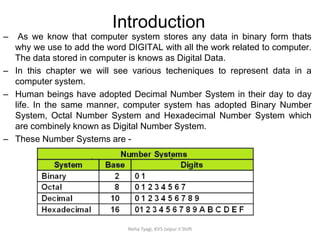
– These Number Systems are -
Decimal number system
Neha Tyagi, KV5 Jaipur II Shift
– Decimal system is consists of 10 digits which are as under
• 0,1,2,3,4,5,6,7,8,9
– Base of this system is 10 and it is to be shown as-
• (1249)10
– This techenique is based on positional value where the weightage of a digit
is as per its position. For ex- in number 526, the value of 5 is 500, value of
2 is 20 and value of 6 is 6. (it is as per the method of hundreds , tens and
ones).
We can write above given example as-
– 526 = 5 X 10² + 2 X 101 + 6 X 100
– 25.32 = 2 X 101 + 5 X 100 + 3 X 10⁻¹ + 2 X 10⁻²
– The left most digit is called MSD (Most Significant Digit ).
– The right most digit is called LSD (Least Significant Digit ).
Binary Number System
Neha Tyagi, KV5 Jaipur II Shift
– Binary system consists of 2 digits 0,1 known as bit.
– Base of this system is 2 and it is to be shown as
(1001010101)2
– In Digital systems, use of decimal system is immpossible
therefore use of binary system for a computer system is
meaningful. Use of circuit to maintain two voltage level is very
easy.
– See the examples of binary number method-
– 1010 = 1 X 23 + 0 X 22 + 1 X 21 + 0 X 20
– 10.11 = 1 X 21 + 0 X 20 + 1 X 2-1 + 1 X 2-2
– The left most digit is called MSB (Most Significant Bit ).
– The right most digit is called LSB (Least Significant Bit ).
Octal Number System
Neha Tyagi, KV5 Jaipur II Shift
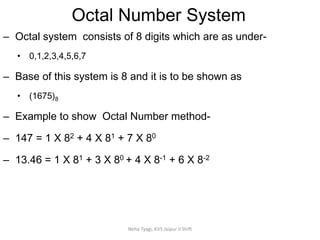
– Octal system consists of 8 digits which are as under-
• 0,1,2,3,4,5,6,7
– Base of this system is 8 and it is to be shown as
• (1675)8
– Example to show Octal Number method-
– 147 = 1 X 82 + 4 X 81 + 7 X 80
– 13.46 = 1 X 81 + 3 X 80 + 4 X 8-1 + 6 X 8-2
Hexadecimal Number System
Neha Tyagi, KV5 Jaipur II Shift
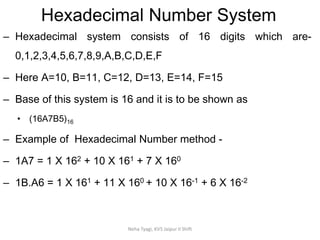
– Hexadecimal system consists of 16 digits which are-
0,1,2,3,4,5,6,7,8,9,A,B,C,D,E,F
– Here A=10, B=11, C=12, D=13, E=14, F=15
– Base of this system is 16 and it is to be shown as
• (16A7B5)16
– Example of Hexadecimal Number method -
– 1A7 = 1 X 162 + 10 X 161 + 7 X 160
– 1B.A6 = 1 X 161 + 11 X 160 + 10 X 16-1 + 6 X 16-2
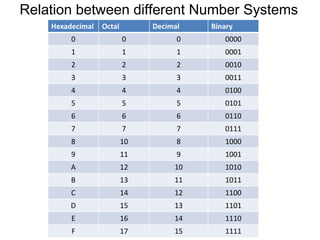
Relation between different Number Systems
Neha Tyagi, KV5 Jaipur II Shift
Hexadecimal Octal Decimal Binary
0 0 0 0000
1 1 1 0001
2 2 2 0010
3 3 3 0011
4 4 4 0100
5 5 5 0101
6 6 6 0110
7 7 7 0111
8 10 8 1000
9 11 9 1001
A 12 10 1010
B 13 11 1011
C 14 12 1100
D 15 13 1101
E 16 14 1110
F 17 15 1111
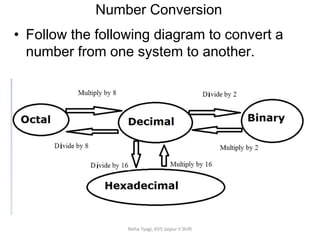
Number Conversion
Neha Tyagi, KV5 Jaipur II Shift
• Follow the following diagram to convert a
number from one system to another.
Decimal to Binary
Neha Tyagi, KV5 Jaipur II Shift
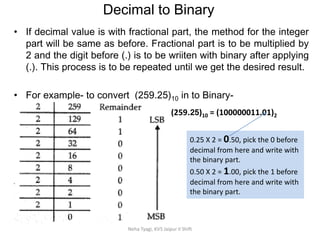
• For this, decimal value is to be divided by 2 and remainder is to
be arrange in order. Quotient is again to be divide by 2 and
remainder is to be again kept in order. This process is to be
repeated until quotient become zero. Remainder is then to keep
in reverse order which results in binary of the given number
.(remainder should be either 0 or 1 only).
For ex- to calculate binary of 259-
(259)10 = (100000011)2
There is one more method for this.
Decimal to Binary
Neha Tyagi, KV5 Jaipur II Shift
You need to develop a table of 2n
Now, to convert (200)10 to binary-
Solution-
In 2n table, the biggest value lower to 200 is 128
128 = 10000000
200 – 128=72, 64 (lower to 72)= 1000000
72 – 64 =8 = 1000
total 200 = 11001000
Therefore (200)10 = (11001000)2
Decimal to Binary
Neha Tyagi, KV5 Jaipur II Shift
• If decimal value is with fractional part, the method for the integer
part will be same as before. Fractional part is to be multiplied by
2 and the digit before (.) is to be wriiten with binary after applying
(.). This process is to be repeated until we get the desired result.
• For example- to convert (259.25)10 in to Binary-
(259.25)10 = (100000011.01)2
0.25 X 2 = 0.50, pick the 0 before
decimal from here and write with
the binary part.
0.50 X 2 = 1.00, pick the 1 before
decimal from here and write with
the binary part.
Binary to Decimal
Neha Tyagi, KV5 Jaipur II Shift
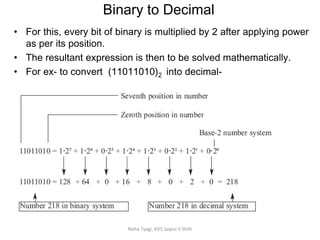
• For this, every bit of binary is multiplied by 2 after applying power
as per its position.
• The resultant expression is then to be solved mathematically.
• For ex- to convert (11011010)2 into decimal-
Binary to Decimal
Neha Tyagi, KV5 Jaipur II Shift
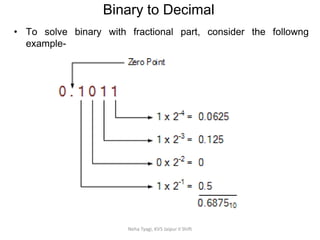
• To solve binary with fractional part, consider the followng
example-
Decimal to Octal
Neha Tyagi, KV5 Jaipur II Shift
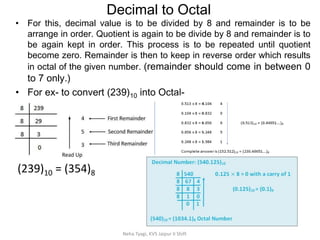
• For this, decimal value is to be divided by 8 and remainder is to be
arrange in order. Quotient is again to be divide by 8 and remainder is to
be again kept in order. This process is to be repeated until quotient
become zero. Remainder is then to keep in reverse order which results
in octal of the given number. (remainder should come in between 0
to 7 only.)
• For ex- to convert (239)10 into Octal-
(239)10 = (354)8
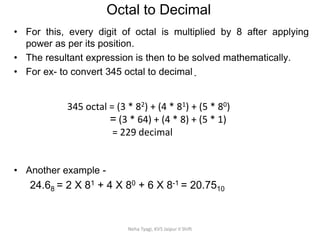
Octal to Decimal
Neha Tyagi, KV5 Jaipur II Shift
• For this, every digit of octal is multiplied by 8 after applying
power as per its position.
• The resultant expression is then to be solved mathematically.
• For ex- to convert 345 octal to decimal -
• Another example -
24.68 = 2 X 81 + 4 X 80 + 6 X 8-1 = 20.7510
345 octal = (3 * 82) + (4 * 81) + (5 * 80)
= (3 * 64) + (4 * 8) + (5 * 1)
= 229 decimal
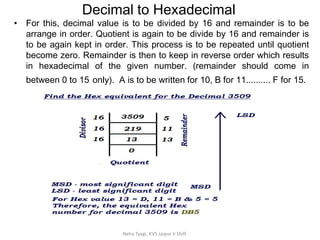
Decimal to Hexadecimal
Neha Tyagi, KV5 Jaipur II Shift
• For this, decimal value is to be divided by 16 and remainder is to be
arrange in order. Quotient is again to be divide by 16 and remainder is
to be again kept in order. This process is to be repeated until quotient
become zero. Remainder is then to keep in reverse order which results
in hexadecimal of the given number. (remainder should come in
between 0 to 15 only). A is to be written for 10, B for 11.......... F for 15.
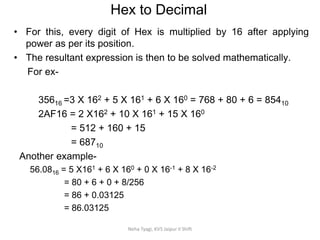
Hex to Decimal
Neha Tyagi, KV5 Jaipur II Shift
• For this, every digit of Hex is multiplied by 16 after applying
power as per its position.
• The resultant expression is then to be solved mathematically.
For ex-
35616 =3 X 162 + 5 X 161 + 6 X 160 = 768 + 80 + 6 = 85410
2AF16 = 2 X162 + 10 X 161 + 15 X 160
= 512 + 160 + 15
= 68710
Another example-
56.0816 = 5 X161 + 6 X 160 + 0 X 16-1 + 8 X 16-2
= 80 + 6 + 0 + 8/256
= 86 + 0.03125
= 86.03125
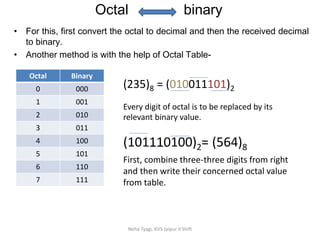
Octal binary
Neha Tyagi, KV5 Jaipur II Shift
• For this, first convert the octal to decimal and then the received decimal
to binary.
• Another method is with the help of Octal Table-
Octal Binary
0 000
1 001
2 010
3 011
4 100
5 101
6 110
7 111
(235)8 = (010011101)2
Every digit of octal is to be replaced by its
relevant binary value.
(101110100)2= (564)8
First, combine three-three digits from right
and then write their concerned octal value
from table.
Hex binary
Neha Tyagi, KV5 Jaipur II Shift
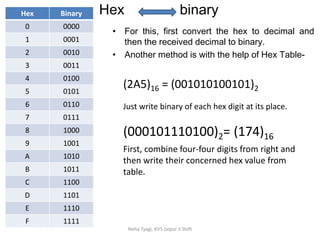
• For this, first convert the hex to decimal and
then the received decimal to binary.
• Another method is with the help of Hex Table-
Hex Binary
0 0000
1 0001
2 0010
3 0011
4 0100
5 0101
6 0110
7 0111
8 1000
9 1001
A 1010
B 1011
C 1100
D 1101
E 1110
F 1111
(2A5)16 = (001010100101)2
Just write binary of each hex digit at its place.
(000101110100)2= (174)16
First, combine four-four digits from right and
then write their concerned hex value from
table.
Octal Hex
Neha Tyagi, KV5 Jaipur II Shift
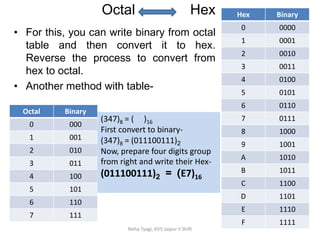
• For this, you can write binary from octal
table and then convert it to hex.
Reverse the process to convert from
hex to octal.
• Another method with table-
Octal Binary
0 000
1 001
2 010
3 011
4 100
5 101
6 110
7 111
Hex Binary
0 0000
1 0001
2 0010
3 0011
4 0100
5 0101
6 0110
7 0111
8 1000
9 1001
A 1010
B 1011
C 1100
D 1101
E 1110
F 1111
(347)8 = ( )16
First convert to binary-
(347)8 = (011100111)2
Now, prepare four digits group
from right and write their Hex-
(011100111)2 = (E7)16
Binary - Unsigned Integers
Neha Tyagi, KV5 Jaipur II Shift
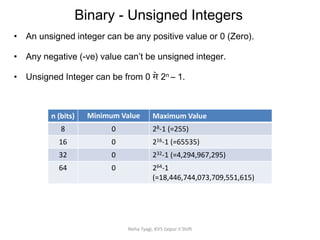
• An unsigned integer can be any positive value or 0 (Zero).
• Any negative (-ve) value can’t be unsigned integer.
• Unsigned Integer can be from 0 से 2n – 1.
n (bits) Minimum Value Maximum Value
8 0 28-1 (=255)
16 0 216-1 (=65535)
32 0 232-1 (=4,294,967,295)
64 0 264-1
(=18,446,744,073,709,551,615)
Binary Addition
Neha Tyagi, KV5 Jaipur II Shift
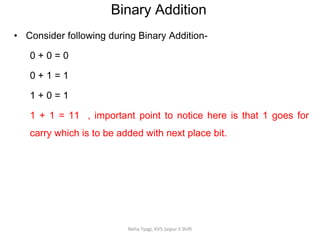
• Consider following during Binary Addition-
0 + 0 = 0
0 + 1 = 1
1 + 0 = 1
1 + 1 = 11 , important point to notice here is that 1 goes for
carry which is to be added with next place bit.
ASCII Code
Neha Tyagi, KV5 Jaipur II Shift
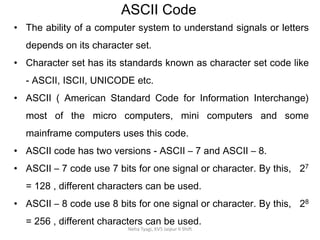
• The ability of a computer system to understand signals or letters
depends on its character set.
• Character set has its standards known as character set code like
- ASCII, ISCII, UNICODE etc.
• ASCII ( American Standard Code for Information Interchange)
most of the micro computers, mini computers and some
mainframe computers uses this code.
• ASCII code has two versions - ASCII – 7 and ASCII – 8.
• ASCII – 7 code use 7 bits for one signal or character. By this, 27
= 128 , different characters can be used.
• ASCII – 8 code use 8 bits for one signal or character. By this, 28
= 256 , different characters can be used.
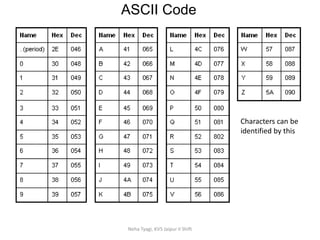
ASCII Code
Neha Tyagi, KV5 Jaipur II Shift
Characters can be
identified by this
ISCII Code
Neha Tyagi, KV5 Jaipur II Shift
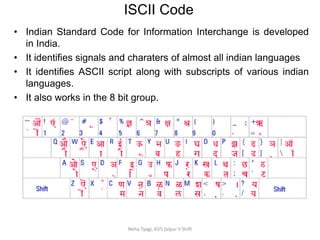
• Indian Standard Code for Information Interchange is developed
in India.
• It identifies signals and charaters of almost all indian languages
• It identifies ASCII script along with subscripts of various indian
languages.
• It also works in the 8 bit group.
Unicode
Neha Tyagi, KV5 Jaipur II Shift
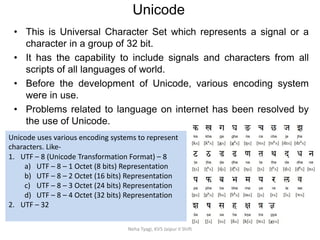
• This is Universal Character Set which represents a signal or a
character in a group of 32 bit.
• It has the capability to include signals and characters from all
scripts of all languages of world.
• Before the development of Unicode, various encoding system
were in use.
• Problems related to language on internet has been resolved by
the use of Unicode.
Unicode uses various encoding systems to represent
characters. Like-
1. UTF – 8 (Unicode Transformation Format) – 8
a) UTF – 8 – 1 Octet (8 bits) Representation
b) UTF – 8 – 2 Octet (16 bits) Representation
c) UTF – 8 – 3 Octet (24 bits) Representation
d) UTF – 8 – 4 Octet (32 bits) Representation
2. UTF – 32
Thank you
Please follow us on our blog-
Neha Tyagi, KV 5 Jaipur II Shift
www.pythontrends.wordpress.com

Data representation notes class 11

  • 1.
    DATA REPRESENTATION Based onCBSE curriculum Class 11 By- Neha Tyagi PGT CS KV 5 Jaipur II Shift, Jaipur Region Neha Tyagi, KV 5 Jaipur II Shift
  • 2.
    Introduction Neha Tyagi, KV5Jaipur II Shift – As we know that computer system stores any data in binary form thats why we use to add the word DIGITAL with all the work related to computer. The data stored in computer is knows as Digital Data. – In this chapter we will see various techeniques to represent data in a computer system. – Human beings have adopted Decimal Number System in their day to day life. In the same manner, computer system has adopted Binary Number System, Octal Number System and Hexadecimal Number System which are combinely known as Digital Number System. – These Number Systems are -
  • 3.
    Decimal number system NehaTyagi, KV5 Jaipur II Shift – Decimal system is consists of 10 digits which are as under • 0,1,2,3,4,5,6,7,8,9 – Base of this system is 10 and it is to be shown as- • (1249)10 – This techenique is based on positional value where the weightage of a digit is as per its position. For ex- in number 526, the value of 5 is 500, value of 2 is 20 and value of 6 is 6. (it is as per the method of hundreds , tens and ones). We can write above given example as- – 526 = 5 X 10² + 2 X 101 + 6 X 100 – 25.32 = 2 X 101 + 5 X 100 + 3 X 10⁻¹ + 2 X 10⁻² – The left most digit is called MSD (Most Significant Digit ). – The right most digit is called LSD (Least Significant Digit ).
  • 4.
    Binary Number System NehaTyagi, KV5 Jaipur II Shift – Binary system consists of 2 digits 0,1 known as bit. – Base of this system is 2 and it is to be shown as (1001010101)2 – In Digital systems, use of decimal system is immpossible therefore use of binary system for a computer system is meaningful. Use of circuit to maintain two voltage level is very easy. – See the examples of binary number method- – 1010 = 1 X 23 + 0 X 22 + 1 X 21 + 0 X 20 – 10.11 = 1 X 21 + 0 X 20 + 1 X 2-1 + 1 X 2-2 – The left most digit is called MSB (Most Significant Bit ). – The right most digit is called LSB (Least Significant Bit ).
  • 5.
    Octal Number System NehaTyagi, KV5 Jaipur II Shift – Octal system consists of 8 digits which are as under- • 0,1,2,3,4,5,6,7 – Base of this system is 8 and it is to be shown as • (1675)8 – Example to show Octal Number method- – 147 = 1 X 82 + 4 X 81 + 7 X 80 – 13.46 = 1 X 81 + 3 X 80 + 4 X 8-1 + 6 X 8-2
  • 6.
    Hexadecimal Number System NehaTyagi, KV5 Jaipur II Shift – Hexadecimal system consists of 16 digits which are- 0,1,2,3,4,5,6,7,8,9,A,B,C,D,E,F – Here A=10, B=11, C=12, D=13, E=14, F=15 – Base of this system is 16 and it is to be shown as • (16A7B5)16 – Example of Hexadecimal Number method - – 1A7 = 1 X 162 + 10 X 161 + 7 X 160 – 1B.A6 = 1 X 161 + 11 X 160 + 10 X 16-1 + 6 X 16-2
  • 7.
    Relation between differentNumber Systems Neha Tyagi, KV5 Jaipur II Shift Hexadecimal Octal Decimal Binary 0 0 0 0000 1 1 1 0001 2 2 2 0010 3 3 3 0011 4 4 4 0100 5 5 5 0101 6 6 6 0110 7 7 7 0111 8 10 8 1000 9 11 9 1001 A 12 10 1010 B 13 11 1011 C 14 12 1100 D 15 13 1101 E 16 14 1110 F 17 15 1111
  • 8.
    Number Conversion Neha Tyagi,KV5 Jaipur II Shift • Follow the following diagram to convert a number from one system to another.
  • 9.
    Decimal to Binary NehaTyagi, KV5 Jaipur II Shift • For this, decimal value is to be divided by 2 and remainder is to be arrange in order. Quotient is again to be divide by 2 and remainder is to be again kept in order. This process is to be repeated until quotient become zero. Remainder is then to keep in reverse order which results in binary of the given number .(remainder should be either 0 or 1 only). For ex- to calculate binary of 259- (259)10 = (100000011)2 There is one more method for this.
  • 10.
    Decimal to Binary NehaTyagi, KV5 Jaipur II Shift You need to develop a table of 2n Now, to convert (200)10 to binary- Solution- In 2n table, the biggest value lower to 200 is 128 128 = 10000000 200 – 128=72, 64 (lower to 72)= 1000000 72 – 64 =8 = 1000 total 200 = 11001000 Therefore (200)10 = (11001000)2
  • 11.
    Decimal to Binary NehaTyagi, KV5 Jaipur II Shift • If decimal value is with fractional part, the method for the integer part will be same as before. Fractional part is to be multiplied by 2 and the digit before (.) is to be wriiten with binary after applying (.). This process is to be repeated until we get the desired result. • For example- to convert (259.25)10 in to Binary- (259.25)10 = (100000011.01)2 0.25 X 2 = 0.50, pick the 0 before decimal from here and write with the binary part. 0.50 X 2 = 1.00, pick the 1 before decimal from here and write with the binary part.
  • 12.
    Binary to Decimal NehaTyagi, KV5 Jaipur II Shift • For this, every bit of binary is multiplied by 2 after applying power as per its position. • The resultant expression is then to be solved mathematically. • For ex- to convert (11011010)2 into decimal-
  • 13.
    Binary to Decimal NehaTyagi, KV5 Jaipur II Shift • To solve binary with fractional part, consider the followng example-
  • 14.
    Decimal to Octal NehaTyagi, KV5 Jaipur II Shift • For this, decimal value is to be divided by 8 and remainder is to be arrange in order. Quotient is again to be divide by 8 and remainder is to be again kept in order. This process is to be repeated until quotient become zero. Remainder is then to keep in reverse order which results in octal of the given number. (remainder should come in between 0 to 7 only.) • For ex- to convert (239)10 into Octal- (239)10 = (354)8
  • 15.
    Octal to Decimal NehaTyagi, KV5 Jaipur II Shift • For this, every digit of octal is multiplied by 8 after applying power as per its position. • The resultant expression is then to be solved mathematically. • For ex- to convert 345 octal to decimal - • Another example - 24.68 = 2 X 81 + 4 X 80 + 6 X 8-1 = 20.7510 345 octal = (3 * 82) + (4 * 81) + (5 * 80) = (3 * 64) + (4 * 8) + (5 * 1) = 229 decimal
  • 16.
    Decimal to Hexadecimal NehaTyagi, KV5 Jaipur II Shift • For this, decimal value is to be divided by 16 and remainder is to be arrange in order. Quotient is again to be divide by 16 and remainder is to be again kept in order. This process is to be repeated until quotient become zero. Remainder is then to keep in reverse order which results in hexadecimal of the given number. (remainder should come in between 0 to 15 only). A is to be written for 10, B for 11.......... F for 15.
  • 17.
    Hex to Decimal NehaTyagi, KV5 Jaipur II Shift • For this, every digit of Hex is multiplied by 16 after applying power as per its position. • The resultant expression is then to be solved mathematically. For ex- 35616 =3 X 162 + 5 X 161 + 6 X 160 = 768 + 80 + 6 = 85410 2AF16 = 2 X162 + 10 X 161 + 15 X 160 = 512 + 160 + 15 = 68710 Another example- 56.0816 = 5 X161 + 6 X 160 + 0 X 16-1 + 8 X 16-2 = 80 + 6 + 0 + 8/256 = 86 + 0.03125 = 86.03125
  • 18.
    Octal binary Neha Tyagi,KV5 Jaipur II Shift • For this, first convert the octal to decimal and then the received decimal to binary. • Another method is with the help of Octal Table- Octal Binary 0 000 1 001 2 010 3 011 4 100 5 101 6 110 7 111 (235)8 = (010011101)2 Every digit of octal is to be replaced by its relevant binary value. (101110100)2= (564)8 First, combine three-three digits from right and then write their concerned octal value from table.
  • 19.
    Hex binary Neha Tyagi,KV5 Jaipur II Shift • For this, first convert the hex to decimal and then the received decimal to binary. • Another method is with the help of Hex Table- Hex Binary 0 0000 1 0001 2 0010 3 0011 4 0100 5 0101 6 0110 7 0111 8 1000 9 1001 A 1010 B 1011 C 1100 D 1101 E 1110 F 1111 (2A5)16 = (001010100101)2 Just write binary of each hex digit at its place. (000101110100)2= (174)16 First, combine four-four digits from right and then write their concerned hex value from table.
  • 20.
    Octal Hex Neha Tyagi,KV5 Jaipur II Shift • For this, you can write binary from octal table and then convert it to hex. Reverse the process to convert from hex to octal. • Another method with table- Octal Binary 0 000 1 001 2 010 3 011 4 100 5 101 6 110 7 111 Hex Binary 0 0000 1 0001 2 0010 3 0011 4 0100 5 0101 6 0110 7 0111 8 1000 9 1001 A 1010 B 1011 C 1100 D 1101 E 1110 F 1111 (347)8 = ( )16 First convert to binary- (347)8 = (011100111)2 Now, prepare four digits group from right and write their Hex- (011100111)2 = (E7)16
  • 21.
    Binary - UnsignedIntegers Neha Tyagi, KV5 Jaipur II Shift • An unsigned integer can be any positive value or 0 (Zero). • Any negative (-ve) value can’t be unsigned integer. • Unsigned Integer can be from 0 से 2n – 1. n (bits) Minimum Value Maximum Value 8 0 28-1 (=255) 16 0 216-1 (=65535) 32 0 232-1 (=4,294,967,295) 64 0 264-1 (=18,446,744,073,709,551,615)
  • 22.
    Binary Addition Neha Tyagi,KV5 Jaipur II Shift • Consider following during Binary Addition- 0 + 0 = 0 0 + 1 = 1 1 + 0 = 1 1 + 1 = 11 , important point to notice here is that 1 goes for carry which is to be added with next place bit.
  • 23.
    ASCII Code Neha Tyagi,KV5 Jaipur II Shift • The ability of a computer system to understand signals or letters depends on its character set. • Character set has its standards known as character set code like - ASCII, ISCII, UNICODE etc. • ASCII ( American Standard Code for Information Interchange) most of the micro computers, mini computers and some mainframe computers uses this code. • ASCII code has two versions - ASCII – 7 and ASCII – 8. • ASCII – 7 code use 7 bits for one signal or character. By this, 27 = 128 , different characters can be used. • ASCII – 8 code use 8 bits for one signal or character. By this, 28 = 256 , different characters can be used.
  • 24.
    ASCII Code Neha Tyagi,KV5 Jaipur II Shift Characters can be identified by this
  • 25.
    ISCII Code Neha Tyagi,KV5 Jaipur II Shift • Indian Standard Code for Information Interchange is developed in India. • It identifies signals and charaters of almost all indian languages • It identifies ASCII script along with subscripts of various indian languages. • It also works in the 8 bit group.
  • 26.
    Unicode Neha Tyagi, KV5Jaipur II Shift • This is Universal Character Set which represents a signal or a character in a group of 32 bit. • It has the capability to include signals and characters from all scripts of all languages of world. • Before the development of Unicode, various encoding system were in use. • Problems related to language on internet has been resolved by the use of Unicode. Unicode uses various encoding systems to represent characters. Like- 1. UTF – 8 (Unicode Transformation Format) – 8 a) UTF – 8 – 1 Octet (8 bits) Representation b) UTF – 8 – 2 Octet (16 bits) Representation c) UTF – 8 – 3 Octet (24 bits) Representation d) UTF – 8 – 4 Octet (32 bits) Representation 2. UTF – 32
  • 27.
    Thank you Please followus on our blog- Neha Tyagi, KV 5 Jaipur II Shift www.pythontrends.wordpress.com