The Blue Donkey
by Suniti Namjoshi
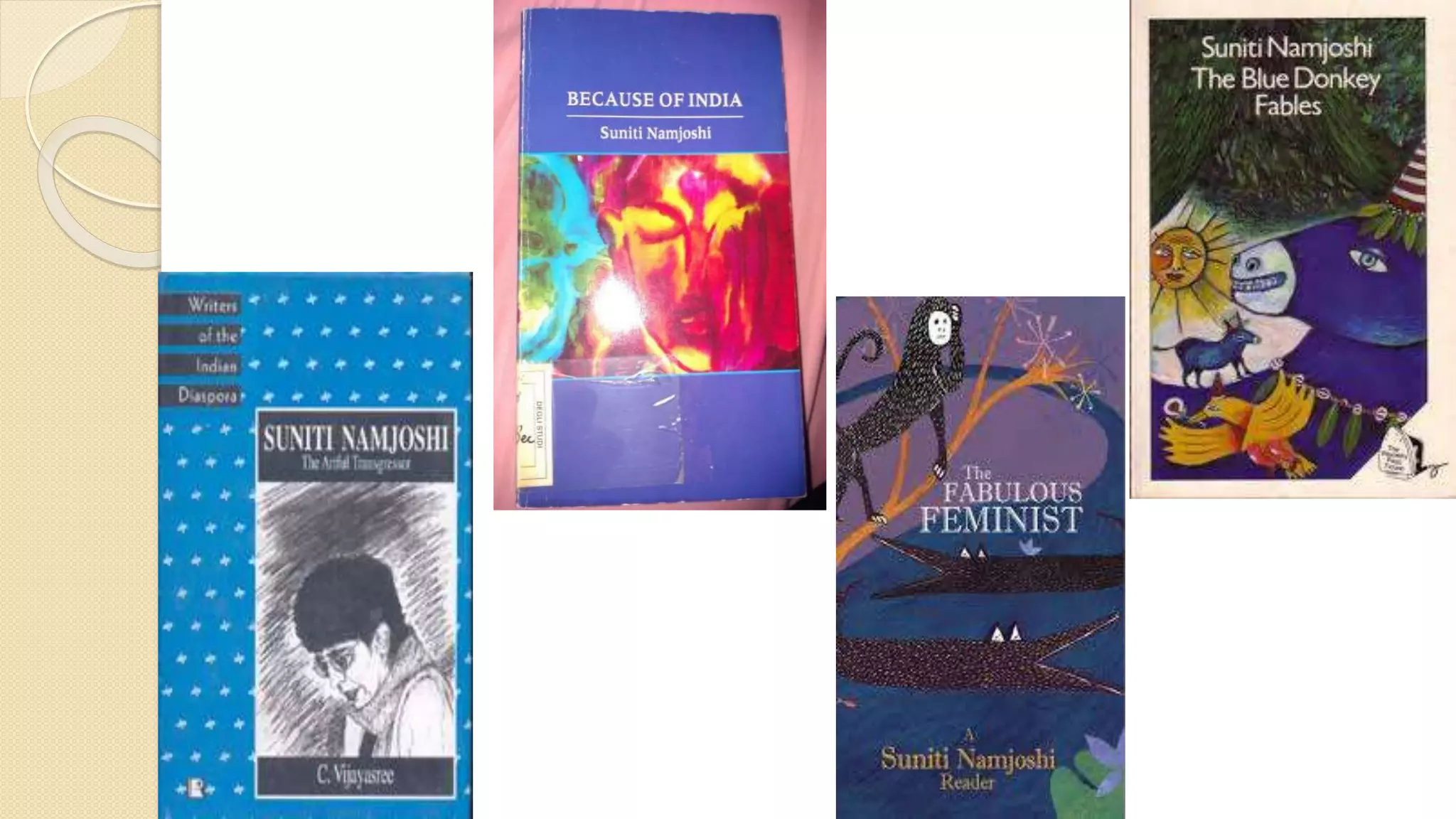
Suniti Namjoshi
 Born in Mumbai, India in 1941
 A poet and fabulist, her best know work is,
perhaps, Tales of the Blue Donkey (1986).
 An important writer in contemporary Indian
literature in English. She has several books of
verse and fable to her credit.
 Now lives in the UK where she works as a
full-time writer. Her poetry, fables, articles and
reviews have been featured in various
anthologies and journals in India, Canada, the
US, Australia and Britain. A deep engagement
with issues of gender, sexual orientation,
cultural identity and human rights infuses her
work.
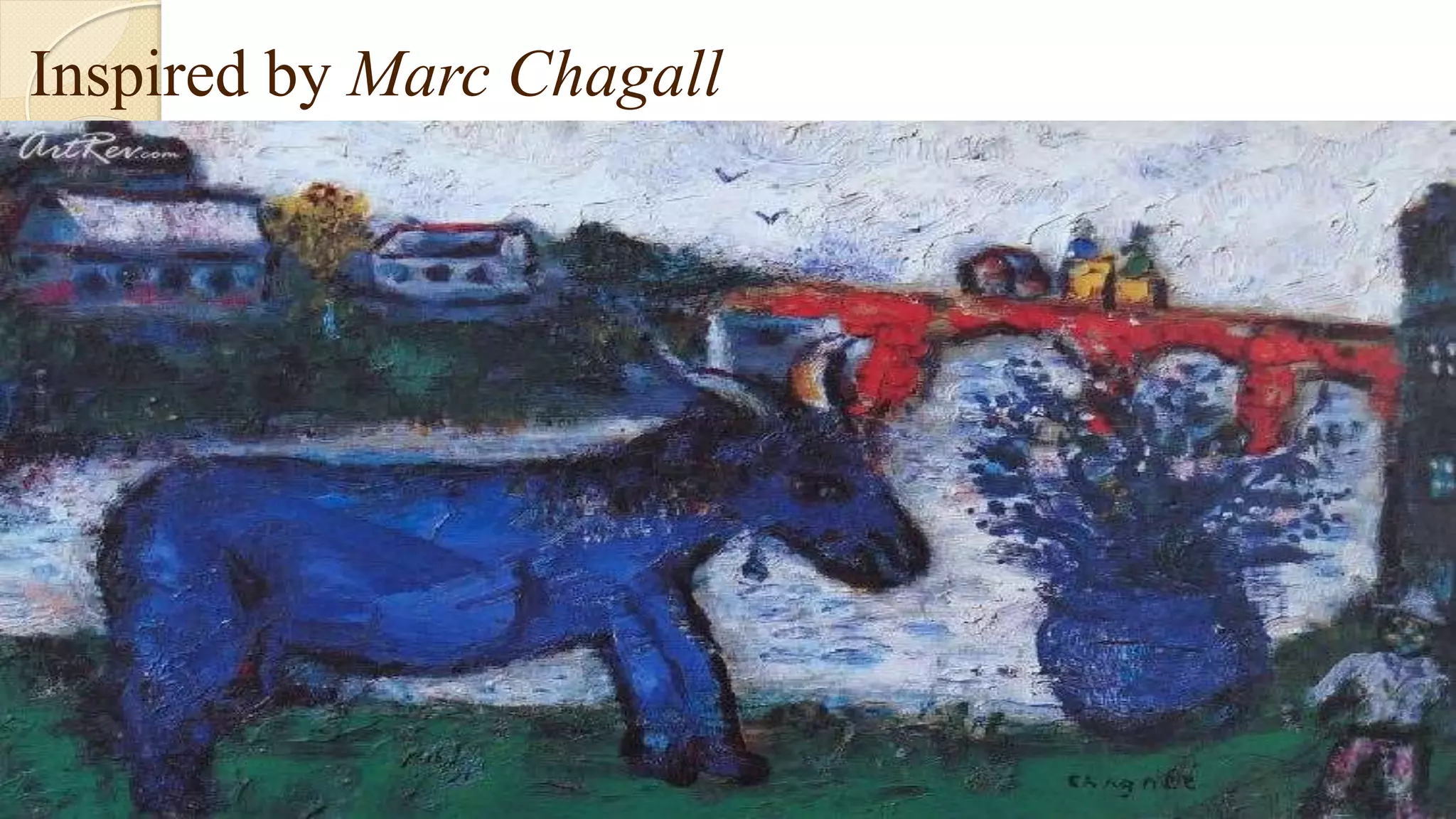
Inspired by Marc Chagall
Marc Chagall’s Paintings in
an art book
Once Upon a time a blue donkey
lived by a red bridge.
The councilors of the town was not satisfied by the blueness of the
donkey. They wanted the donkey to become the purest and
silkiest white. The matter soon turned into a political issue. One
party said that the donkey do not and will never change color.
Another said that the donkey is required to be a nondescript grey.
OR
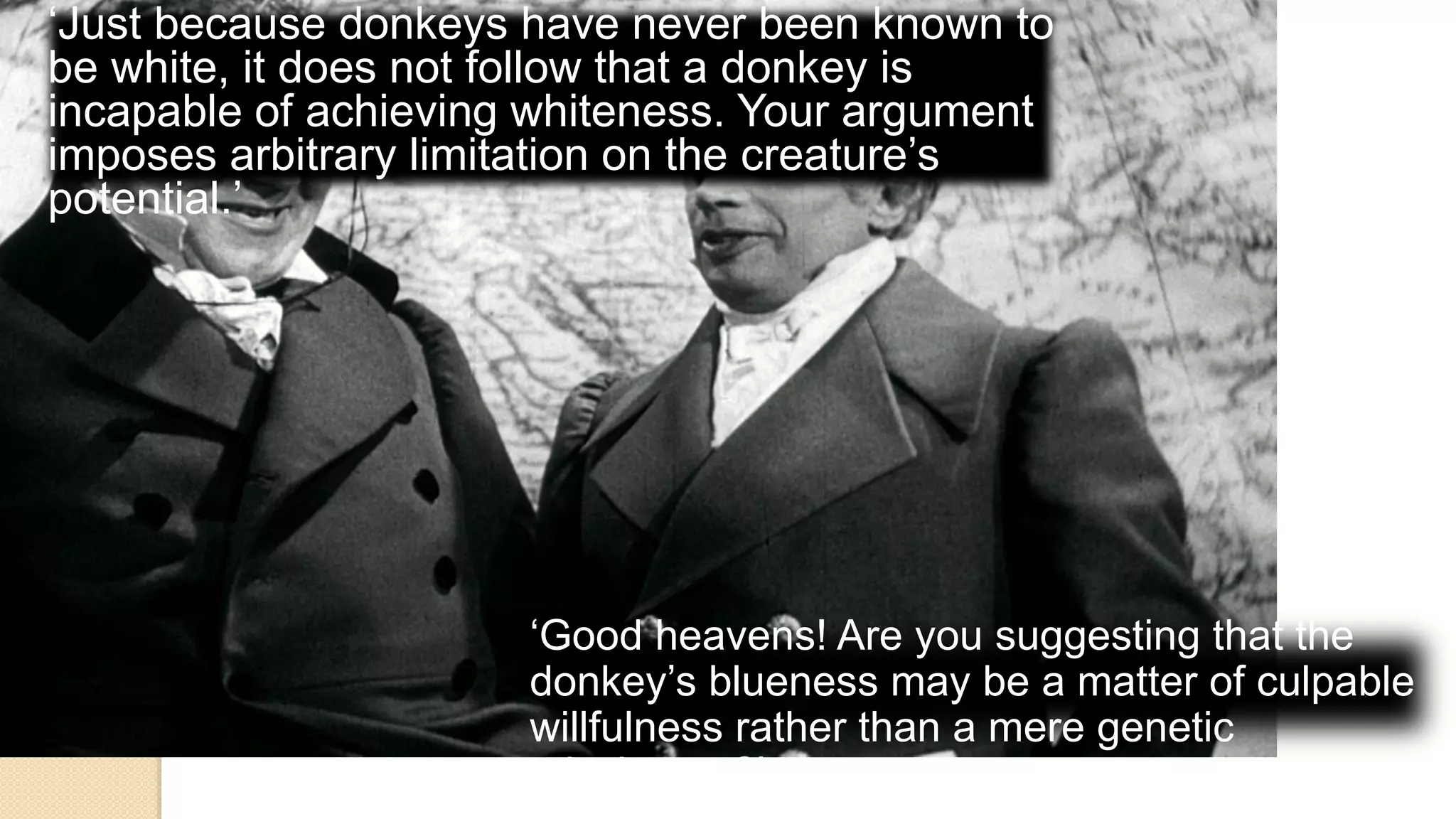
‘Just because donkeys have never been known to
be white, it does not follow that a donkey is
incapable of achieving whiteness. Your argument
imposes arbitrary limitation on the creature’s
potential.’
‘Good heavens! Are you suggesting that the
donkey’s blueness may be a matter of culpable
willfulness rather than a mere genetic
mischance?’
So they all approached the donkey, who happened to
be munching a bright pink carrot.
O Donkey we’d like you
to turn inoffensive grey
or else move on
Can’t and won’t
I ‘m a perfectly
good donkey. What
exactly is the
matter with you?
Look again
Your blueness troubles us.
It clashes with our bridge,
as does the pinkness of
your carrots. Oh what shall
we do? We cannot agree
among ourselves.
1
2
3
4
 They looked and argued and after a while most of
them got used to the blueness of the donkey and
didn’t notice it anymore. But a few remained
strongly that blueness was inherent, and a few
protested that it was essentially intentional. The
last occasionally brought her a bunch of blue
flowers which she put in a vase.
APOTHEOSIS
In the middle of her years the Blue Donkey acquires a
certain fame. The townsfolk grew quite proud of her.
She attracted tourist. Blue Donkey bars and bistro
sprouted, and there was a brisk trade in T-shirts and
Blue Donkey Toys. She herself was installed in a stable
and in order to see her it became necessary to by
tickets.
At first the Blue Donkey enjoyed the attention, then she
grew bored, and then she took to questioning the tourists.
But the tourist would just say that they admire her so much
and his fame reached all over the world. And she felt
pleased.
 Soon she began to look scruffy. They shut down the stable
and begged her to grow her fur quickly. Then they
discovered that her fur turned into a beautiful grey. They
were horrified.
But what
about us?
What can we
possibly tell
the tourists?
I am retiring
Tell them the
truth. Tell them
that I have
become a legend.
But will it
work?
Of course, Truth
is dazzling.
1
2
3
4
5
THE END
LITERARY
ANALYSIS
Blue Donkey Fables
 The character, The Blue Donkey, is already a feminist sense as it was depicted
as a female by “She”.
 The Blue Donkey can be considered as a variation on the trickster figure but
Blue Donkey does not play tricks on people, rather she maneuvers them into a
logical feedback loop.
 The first example of this, in the first of the Blue Donkey Stories, is rather crude.
A blue donkey lives by a red bridge. The local councilors decide this is inartistic
and demand the donkey change color, although there is a division between
those who want to demand the donkey change to the purest white, and those
who demand reasonableness, and that the donkey become grey. Buried here is
a sly dig that if one compromises, one can lose sight of the unreasonableness of
the original demand. But the donkey refuses anyway.
Blue Donkey Fables
 Her refusal to engage in the debate leads them to argue around her,
which is what they were doing anyway. The blue donkey’s resistance
is philosophical judo, forcing the prejudiced to argue with themselves.
 Then as the Blue Donkey tales expand, the donkey becomes The
Blue Donkey. She becomes such a crowd pleaser that in order to get
some peace she retires, only to find there are rumors she has died.
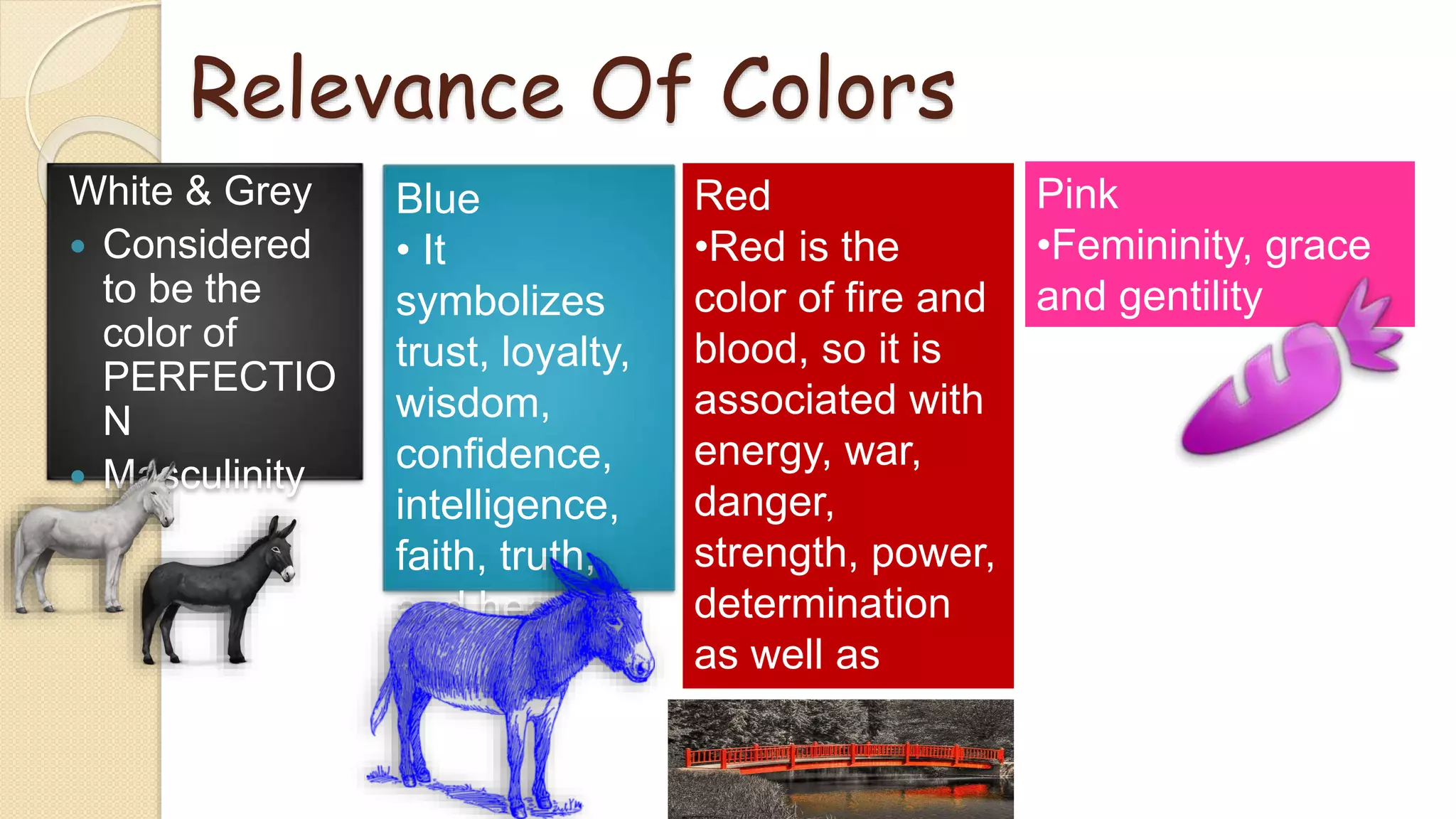
Relevance Of Colors
White & Grey
 Considered
to be the
color of
PERFECTIO
N
 Masculinity
Blue
• It
symbolizes
trust, loyalty,
wisdom,
confidence,
intelligence,
faith, truth,
and heaven.
Red
•Red is the
color of fire and
blood, so it is
associated with
energy, war,
danger,
strength, power,
determination
as well as
passion, desire,
and love.
Pink
•Femininity, grace
and gentility
Namjoshi’s Pattern in The Blue Donkey
Pattern A :
challenging
hegemony
 the Donkey is
confronted by a
challenge to
her identity,
 the Donkey
argues or does
not
Pattern B: The
narratology of prejudice
and Pattern C: the
trickster
• the Donkey is
confronted by
unexpected support
• the Donkey discovers
this support to be based
on “orientalism”
• the Donkey finds a
solution which forces
the supporter and
ourselves to consider
the nature of the
support we offer.
Pattern D:
• Blue Donkey is patronized
by the hegemony.
• Blue Donkey tricks the
hegemony into agreeing
with her in order to gain
the “sexiness” that
association with the outsider
can gift.
• Blue Donkey shows us how
to make the hegemony look
ridiculous when it
substitutes cultural
appropriation for genuine
Pañcatantra
 Namjoshi builds her feminist and resistance strategies within the
narrative patterns of traditional Indian/Hindu story telling.
 The Hindu tradition has a number of allegorical sequences, the
most widely known of which is the Pañcatantra.
 This is a collection of stories arranged in five groups, each one of
which is intended to illustrate the application of one major rule of
wisdom.
 In these parables animals and birds act as cartoon figures which
highlight the outstanding characteristics to be examined.
 All of the Pañcatantra parables are set within a frame narrative of
stories devised for the teaching of a king’s children by the scholar
Visnu Sarma. Sarma classified his lessons under five headings;
Mitrabheda (Estrangement of Friends), Mitrasamprapti (Winning
of Friends), Kakolukiyam (Of Crows and Owls), Labdhapranasa
(Loss of Gains) and Apariksitakaraka (Rash Deeds).
Pañcatantra
 There is rarely an external narrator, except that all
these stories figure as “stories the Blue Donkey told”
and we already know that she has decided to
become legend. Like the stories told in the
Pancatranta there is the sense that they might well
be “true” within the borders of the tale.
 As the tales develop, the Blue Donkey is herself
increasingly figured as sage, and many of the
stories become dialogue between her and
audience.
Blue Donkey Fables
 Pranik, a literary critique argues that “The plasticity of the legend or myth which makes
for the lovely interplay of the imagination has encouraged the dominance of fantasy in
the Indian narrative mould…The author fantasizes, so does the reader, so that fantasy
becomes an interface that the reader’s imagination shares with the author. The reader
is allowed to be as creative as the author… “
 Fantasization is thus a privileged enterprise in the Indian narrative.
 Namjoshi’s work construct new feminist and resistance narratologies, but these are
clearly sited within the Indian traditions of fantasation .
 Namjoshi’s tales construct is of recognition of wrongness, recognition of self and
resistance
References
 Suniti Namjoshi, Tales of the Blue Donkey (London:
Women’s Press, 1986)
 Dwivedi, N. A., Studies in Contemporary Verse: A
Collection of Critical Essays on Female Poets,
Allahabad:
 Prakash Book Depot, 1984. Paniker, K. Ayyappa,
Indian Narratology, Indira Ghandi National Centre
for the Arts (no date provided).
 Namjoshi_Mendlesohn.pdf

The blue donkey

  • 1.
    The Blue Donkey bySuniti Namjoshi
  • 2.
    Suniti Namjoshi  Bornin Mumbai, India in 1941  A poet and fabulist, her best know work is, perhaps, Tales of the Blue Donkey (1986).  An important writer in contemporary Indian literature in English. She has several books of verse and fable to her credit.  Now lives in the UK where she works as a full-time writer. Her poetry, fables, articles and reviews have been featured in various anthologies and journals in India, Canada, the US, Australia and Britain. A deep engagement with issues of gender, sexual orientation, cultural identity and human rights infuses her work.
  • 4.
  • 5.
  • 6.
    Once Upon atime a blue donkey lived by a red bridge.
  • 7.
    The councilors ofthe town was not satisfied by the blueness of the donkey. They wanted the donkey to become the purest and silkiest white. The matter soon turned into a political issue. One party said that the donkey do not and will never change color. Another said that the donkey is required to be a nondescript grey. OR
  • 8.
    ‘Just because donkeyshave never been known to be white, it does not follow that a donkey is incapable of achieving whiteness. Your argument imposes arbitrary limitation on the creature’s potential.’ ‘Good heavens! Are you suggesting that the donkey’s blueness may be a matter of culpable willfulness rather than a mere genetic mischance?’
  • 9.
    So they allapproached the donkey, who happened to be munching a bright pink carrot.
  • 10.
    O Donkey we’dlike you to turn inoffensive grey or else move on Can’t and won’t I ‘m a perfectly good donkey. What exactly is the matter with you? Look again Your blueness troubles us. It clashes with our bridge, as does the pinkness of your carrots. Oh what shall we do? We cannot agree among ourselves. 1 2 3 4
  • 11.
     They lookedand argued and after a while most of them got used to the blueness of the donkey and didn’t notice it anymore. But a few remained strongly that blueness was inherent, and a few protested that it was essentially intentional. The last occasionally brought her a bunch of blue flowers which she put in a vase.
  • 12.
  • 13.
    In the middleof her years the Blue Donkey acquires a certain fame. The townsfolk grew quite proud of her. She attracted tourist. Blue Donkey bars and bistro sprouted, and there was a brisk trade in T-shirts and Blue Donkey Toys. She herself was installed in a stable and in order to see her it became necessary to by tickets.
  • 14.
    At first theBlue Donkey enjoyed the attention, then she grew bored, and then she took to questioning the tourists. But the tourist would just say that they admire her so much and his fame reached all over the world. And she felt pleased.
  • 15.
     Soon shebegan to look scruffy. They shut down the stable and begged her to grow her fur quickly. Then they discovered that her fur turned into a beautiful grey. They were horrified.
  • 16.
    But what about us? Whatcan we possibly tell the tourists? I am retiring Tell them the truth. Tell them that I have become a legend. But will it work? Of course, Truth is dazzling. 1 2 3 4 5
  • 17.
  • 18.
  • 19.
    Blue Donkey Fables The character, The Blue Donkey, is already a feminist sense as it was depicted as a female by “She”.  The Blue Donkey can be considered as a variation on the trickster figure but Blue Donkey does not play tricks on people, rather she maneuvers them into a logical feedback loop.  The first example of this, in the first of the Blue Donkey Stories, is rather crude. A blue donkey lives by a red bridge. The local councilors decide this is inartistic and demand the donkey change color, although there is a division between those who want to demand the donkey change to the purest white, and those who demand reasonableness, and that the donkey become grey. Buried here is a sly dig that if one compromises, one can lose sight of the unreasonableness of the original demand. But the donkey refuses anyway.
  • 20.
    Blue Donkey Fables Her refusal to engage in the debate leads them to argue around her, which is what they were doing anyway. The blue donkey’s resistance is philosophical judo, forcing the prejudiced to argue with themselves.  Then as the Blue Donkey tales expand, the donkey becomes The Blue Donkey. She becomes such a crowd pleaser that in order to get some peace she retires, only to find there are rumors she has died.
  • 21.
    Relevance Of Colors White& Grey  Considered to be the color of PERFECTIO N  Masculinity Blue • It symbolizes trust, loyalty, wisdom, confidence, intelligence, faith, truth, and heaven. Red •Red is the color of fire and blood, so it is associated with energy, war, danger, strength, power, determination as well as passion, desire, and love. Pink •Femininity, grace and gentility
  • 22.
    Namjoshi’s Pattern inThe Blue Donkey Pattern A : challenging hegemony  the Donkey is confronted by a challenge to her identity,  the Donkey argues or does not Pattern B: The narratology of prejudice and Pattern C: the trickster • the Donkey is confronted by unexpected support • the Donkey discovers this support to be based on “orientalism” • the Donkey finds a solution which forces the supporter and ourselves to consider the nature of the support we offer. Pattern D: • Blue Donkey is patronized by the hegemony. • Blue Donkey tricks the hegemony into agreeing with her in order to gain the “sexiness” that association with the outsider can gift. • Blue Donkey shows us how to make the hegemony look ridiculous when it substitutes cultural appropriation for genuine
  • 23.
    Pañcatantra  Namjoshi buildsher feminist and resistance strategies within the narrative patterns of traditional Indian/Hindu story telling.  The Hindu tradition has a number of allegorical sequences, the most widely known of which is the Pañcatantra.  This is a collection of stories arranged in five groups, each one of which is intended to illustrate the application of one major rule of wisdom.  In these parables animals and birds act as cartoon figures which highlight the outstanding characteristics to be examined.  All of the Pañcatantra parables are set within a frame narrative of stories devised for the teaching of a king’s children by the scholar Visnu Sarma. Sarma classified his lessons under five headings; Mitrabheda (Estrangement of Friends), Mitrasamprapti (Winning of Friends), Kakolukiyam (Of Crows and Owls), Labdhapranasa (Loss of Gains) and Apariksitakaraka (Rash Deeds).
  • 24.
    Pañcatantra  There israrely an external narrator, except that all these stories figure as “stories the Blue Donkey told” and we already know that she has decided to become legend. Like the stories told in the Pancatranta there is the sense that they might well be “true” within the borders of the tale.  As the tales develop, the Blue Donkey is herself increasingly figured as sage, and many of the stories become dialogue between her and audience.
  • 25.
    Blue Donkey Fables Pranik, a literary critique argues that “The plasticity of the legend or myth which makes for the lovely interplay of the imagination has encouraged the dominance of fantasy in the Indian narrative mould…The author fantasizes, so does the reader, so that fantasy becomes an interface that the reader’s imagination shares with the author. The reader is allowed to be as creative as the author… “  Fantasization is thus a privileged enterprise in the Indian narrative.  Namjoshi’s work construct new feminist and resistance narratologies, but these are clearly sited within the Indian traditions of fantasation .  Namjoshi’s tales construct is of recognition of wrongness, recognition of self and resistance
  • 26.
    References  Suniti Namjoshi,Tales of the Blue Donkey (London: Women’s Press, 1986)  Dwivedi, N. A., Studies in Contemporary Verse: A Collection of Critical Essays on Female Poets, Allahabad:  Prakash Book Depot, 1984. Paniker, K. Ayyappa, Indian Narratology, Indira Ghandi National Centre for the Arts (no date provided).  Namjoshi_Mendlesohn.pdf