UMBERTOBOCCIONI
Brief Biographical Details:
Umberto Boccioni was one of the most conspicuous, influenced
artists amongst the Italian Futurists and the art movement that
emerged in the years of the pre-First World War.
He was a significant individual, who developed the movement’s
theories but introduced the visual innovations that lead to the
dynamic, cubist-like style that became association to the group.
At first, Boccioni emerged as a painter, and then later on he
produced some significant futuristic sculptures.
Born: 19th October 1882 in Reggio Calabria, Italy.
Died: 17th August 1916 in Sorte, Italy
Umberto Boccioni was known for his artwork in the following art
movements of Futurism, Cubism and Neo-impressionism.
Furthermore, Boccioni was influenced by the artwork of Paul
Cezanne, Auguste Rodin, Georges Braque, Alexander Archipenko
and his friend Giacomo Bella.
The City Rises (1910)
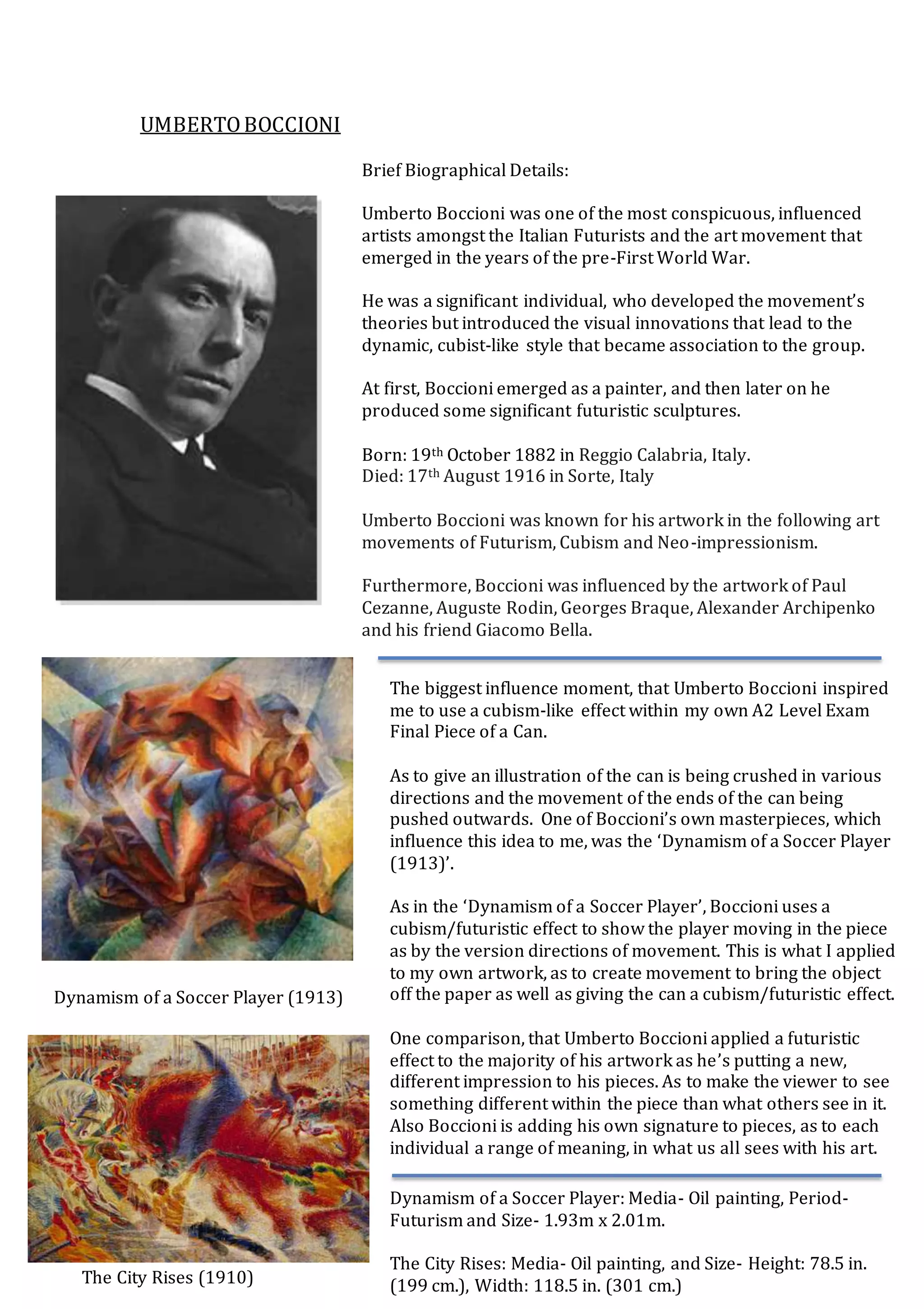
Dynamism of a Soccer Player (1913)
Dynamism of a Soccer Player: Media- Oil painting, Period-
Futurism and Size- 1.93m x 2.01m.
The City Rises: Media- Oil painting, and Size- Height: 78.5 in.
(199 cm.), Width: 118.5 in. (301 cm.)
The biggest influence moment, that Umberto Boccioni inspired
me to use a cubism-like effect within my own A2 Level Exam
Final Piece of a Can.
As to give an illustration of the can is being crushed in various
directions and the movement of the ends of the can being
pushed outwards. One of Boccioni’s own masterpieces, which
influence this idea to me, was the ‘Dynamism of a Soccer Player
(1913)’.
As in the ‘Dynamism of a Soccer Player’, Boccioni uses a
cubism/futuristic effect to show the player moving in the piece
as by the version directions of movement. This is what I applied
to my own artwork, as to create movement to bring the object
off the paper as well as giving the can a cubism/futuristic effect.
One comparison, that Umberto Boccioni applied a futuristic
effect to the majority of his artwork as he’s putting a new,
different impression to his pieces. As to make the viewer to see
something different within the piece than what others see in it.
Also Boccioni is adding his own signature to pieces, as to each
individual a range of meaning, in what us all sees with his art.

Umberto Boccioni

  • 1.
    UMBERTOBOCCIONI Brief Biographical Details: UmbertoBoccioni was one of the most conspicuous, influenced artists amongst the Italian Futurists and the art movement that emerged in the years of the pre-First World War. He was a significant individual, who developed the movement’s theories but introduced the visual innovations that lead to the dynamic, cubist-like style that became association to the group. At first, Boccioni emerged as a painter, and then later on he produced some significant futuristic sculptures. Born: 19th October 1882 in Reggio Calabria, Italy. Died: 17th August 1916 in Sorte, Italy Umberto Boccioni was known for his artwork in the following art movements of Futurism, Cubism and Neo-impressionism. Furthermore, Boccioni was influenced by the artwork of Paul Cezanne, Auguste Rodin, Georges Braque, Alexander Archipenko and his friend Giacomo Bella. The City Rises (1910) Dynamism of a Soccer Player (1913) Dynamism of a Soccer Player: Media- Oil painting, Period- Futurism and Size- 1.93m x 2.01m. The City Rises: Media- Oil painting, and Size- Height: 78.5 in. (199 cm.), Width: 118.5 in. (301 cm.) The biggest influence moment, that Umberto Boccioni inspired me to use a cubism-like effect within my own A2 Level Exam Final Piece of a Can. As to give an illustration of the can is being crushed in various directions and the movement of the ends of the can being pushed outwards. One of Boccioni’s own masterpieces, which influence this idea to me, was the ‘Dynamism of a Soccer Player (1913)’. As in the ‘Dynamism of a Soccer Player’, Boccioni uses a cubism/futuristic effect to show the player moving in the piece as by the version directions of movement. This is what I applied to my own artwork, as to create movement to bring the object off the paper as well as giving the can a cubism/futuristic effect. One comparison, that Umberto Boccioni applied a futuristic effect to the majority of his artwork as he’s putting a new, different impression to his pieces. As to make the viewer to see something different within the piece than what others see in it. Also Boccioni is adding his own signature to pieces, as to each individual a range of meaning, in what us all sees with his art.