Aboriginal Australian Art
SHANNON LEWIS
Aboriginal Australian Art was created by the natives of Australia. It is
part of their culture and history however when new settlers came to
the country 200 years ago they just saw it as primitive art. It is still
seen like that today. This is because Western Europeans were
accustomed to believing that non-Europeans, or some of them,
being primitive or different from their selves.
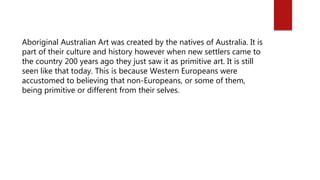
A guwwag night bird on a wild
plum tree, with possum
Yirrkala
Noth-eastern Arnhem Land
This drawing is made up of many different
marks. Each surface has its own mark that is
used throughout the piece. For instance, the
background/base of this drawing is made up
of (what looks like) diamond like marks.
There is also a use of borders and bands in
the drawing to frame and section off parts
of the story (makes me think of ancient
Egyptian art), and in these borders they used
directional marks that are repeated over and
over across the whole piece. Goes to show
that they were considering the composition
as a whole to make it aesthetically pleasing.
The marks used in the piece is mainly small
straight lines and dots.
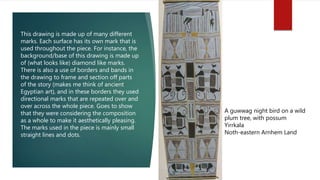
The Mythic Kangaroo
Nadulmi
Oenpelli, Western Arnhem Land
This piece uses a larger range of mark making
compared to the last, but at the same time is
no where as busy.
This one includes cross hatching on the hind of
the Kangaroo, using different densities on
certain parts. However they do not mix
together: a line would separate the different
marks used. This could possibly represent tonal
change?
It also uses marks to create shapes. For
instance, how there would be dots creating
circles.
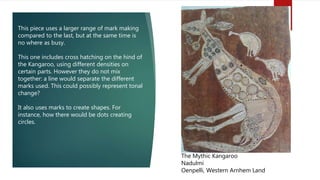
Spearing Fish
Oenpelli, Western Arnhem Land
This Drawing suggests telling a story – To
inform others either what happened or how to
do something?
The marks used in this one separates species
and also the breed. For instance the human
just uses directional lines across its body, that
slightly suggests form. Whereas the two fish
use different marks such as cross hatching and
much more decorative – Is this because fish
have more patterns compared to a human?.
However I have also noticed that the two fish
are different to each other slightly, could this
suggest different gender? Or breed?
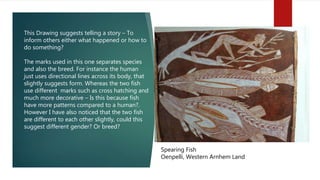
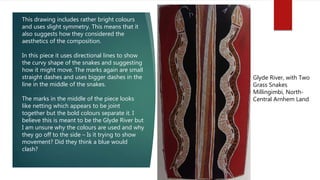
Glyde River, with Two
Grass Snakes
Millingimbi, North-
Central Arnhem Land
This drawing includes rather bright colours
and uses slight symmetry. This means that it
also suggests how they considered the
aesthetics of the composition.
In this piece it uses directional lines to show
the curvy shape of the snakes and suggesting
how it might move. The marks again are small
straight dashes and uses bigger dashes in the
line in the middle of the snakes.
The marks in the middle of the piece looks
like netting which appears to be joint
together but the bold colours separate it. I
believe this is meant to be the Glyde River but
I am unsure why the colours are used and why
they go off to the side – Is it trying to show
movement? Did they think a blue would
clash?
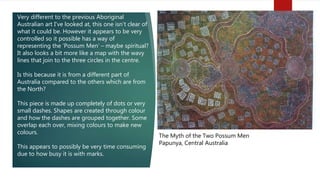
The Myth of the Two Possum Men
Papunya, Central Australia
Very different to the previous Aboriginal
Australian art I’ve looked at, this one isn’t clear of
what it could be. However it appears to be very
controlled so it possible has a way of
representing the ‘Possum Men’ – maybe spiritual?
It also looks a bit more like a map with the wavy
lines that join to the three circles in the centre.
Is this because it is from a different part of
Australia compared to the others which are from
the North?
This piece is made up completely of dots or very
small dashes. Shapes are created through colour
and how the dashes are grouped together. Some
overlap each over, mixing colours to make new
colours.
This appears to possibly be very time consuming
due to how busy it is with marks.
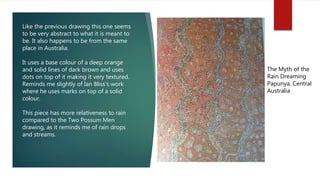
The Myth of the
Rain Dreaming
Papunya, Central
Australia
Like the previous drawing this one seems
to be very abstract to what it is meant to
be. It also happens to be from the same
place in Australia.
It uses a base colour of a deep orange
and solid lines of dark brown and uses
dots on top of it making it very textured.
Reminds me slightly of Ian Bliss’s work
where he uses marks on top of a solid
colour.
This piece has more relativeness to rain
compared to the Two Possum Men
drawing, as it reminds me of rain drops
and streams.
Aboriginal Australian Art by Ronald M Berndt & Catherine H Berndt with John E Stanton
Overall looking and analysing the Aboriginal Australian Art has
benefitted me as I how have more ideas to how I can do mark
making in my pieces. For instance building up textures with dots,
sectioning areas to have their own marks like ‘The Mythic
Kangaroo’, associating certain marks for certain things to separate
and show differences between objects, and possibly using borders
(I’m not too sure how yet).

Aboriginal australian art

  • 1.
  • 2.
    Aboriginal Australian Artwas created by the natives of Australia. It is part of their culture and history however when new settlers came to the country 200 years ago they just saw it as primitive art. It is still seen like that today. This is because Western Europeans were accustomed to believing that non-Europeans, or some of them, being primitive or different from their selves.
  • 3.
    A guwwag nightbird on a wild plum tree, with possum Yirrkala Noth-eastern Arnhem Land This drawing is made up of many different marks. Each surface has its own mark that is used throughout the piece. For instance, the background/base of this drawing is made up of (what looks like) diamond like marks. There is also a use of borders and bands in the drawing to frame and section off parts of the story (makes me think of ancient Egyptian art), and in these borders they used directional marks that are repeated over and over across the whole piece. Goes to show that they were considering the composition as a whole to make it aesthetically pleasing. The marks used in the piece is mainly small straight lines and dots.
  • 4.
    The Mythic Kangaroo Nadulmi Oenpelli,Western Arnhem Land This piece uses a larger range of mark making compared to the last, but at the same time is no where as busy. This one includes cross hatching on the hind of the Kangaroo, using different densities on certain parts. However they do not mix together: a line would separate the different marks used. This could possibly represent tonal change? It also uses marks to create shapes. For instance, how there would be dots creating circles.
  • 5.
    Spearing Fish Oenpelli, WesternArnhem Land This Drawing suggests telling a story – To inform others either what happened or how to do something? The marks used in this one separates species and also the breed. For instance the human just uses directional lines across its body, that slightly suggests form. Whereas the two fish use different marks such as cross hatching and much more decorative – Is this because fish have more patterns compared to a human?. However I have also noticed that the two fish are different to each other slightly, could this suggest different gender? Or breed?
  • 6.
    Glyde River, withTwo Grass Snakes Millingimbi, North- Central Arnhem Land This drawing includes rather bright colours and uses slight symmetry. This means that it also suggests how they considered the aesthetics of the composition. In this piece it uses directional lines to show the curvy shape of the snakes and suggesting how it might move. The marks again are small straight dashes and uses bigger dashes in the line in the middle of the snakes. The marks in the middle of the piece looks like netting which appears to be joint together but the bold colours separate it. I believe this is meant to be the Glyde River but I am unsure why the colours are used and why they go off to the side – Is it trying to show movement? Did they think a blue would clash?
  • 7.
    The Myth ofthe Two Possum Men Papunya, Central Australia Very different to the previous Aboriginal Australian art I’ve looked at, this one isn’t clear of what it could be. However it appears to be very controlled so it possible has a way of representing the ‘Possum Men’ – maybe spiritual? It also looks a bit more like a map with the wavy lines that join to the three circles in the centre. Is this because it is from a different part of Australia compared to the others which are from the North? This piece is made up completely of dots or very small dashes. Shapes are created through colour and how the dashes are grouped together. Some overlap each over, mixing colours to make new colours. This appears to possibly be very time consuming due to how busy it is with marks.
  • 8.
    The Myth ofthe Rain Dreaming Papunya, Central Australia Like the previous drawing this one seems to be very abstract to what it is meant to be. It also happens to be from the same place in Australia. It uses a base colour of a deep orange and solid lines of dark brown and uses dots on top of it making it very textured. Reminds me slightly of Ian Bliss’s work where he uses marks on top of a solid colour. This piece has more relativeness to rain compared to the Two Possum Men drawing, as it reminds me of rain drops and streams.
  • 9.
    Aboriginal Australian Artby Ronald M Berndt & Catherine H Berndt with John E Stanton Overall looking and analysing the Aboriginal Australian Art has benefitted me as I how have more ideas to how I can do mark making in my pieces. For instance building up textures with dots, sectioning areas to have their own marks like ‘The Mythic Kangaroo’, associating certain marks for certain things to separate and show differences between objects, and possibly using borders (I’m not too sure how yet).