INTRODUCTION
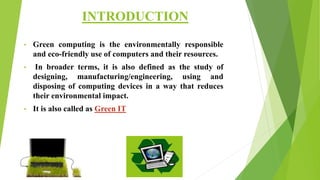
• Green computing is the environmentally responsible
and eco-friendly use of computers and their resources.
• In broader terms, it is also defined as the study of
designing, manufacturing/engineering, using and
disposing of computing devices in a way that reduces
their environmental impact.
• It is also called as Green IT
HISTORY
 Green computing was Originated in 1992 at the U.S
Environmental Protection Agency that launched
Energy Star program.
 Shortly after that the term “Green Computing” was
coined.
WHY IS GREEN COMPUTING
REQUIRED?
 Impact of Electricity to the Environment
 Uses lot of electricity
 Impact of Toxic waste to the Environment
WAYS FOR GREEN COMPUTING
 Turn off monitor
 Turn off hard disks
 System Standby / Sleep
 Hibernate
METHODS TO IMPLEMENT GREEN
COMPUTING
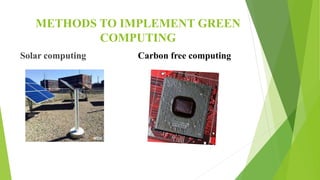
Solar computing Carbon free computing
METHODS CONTD…
1. SOLAR COMPUTING
 Computers working
with the help of solar
technology are called
solar computing
2. CARBONFREE COMPUTING
 Carbon free computing is a set
of programs and products
designed to help individuals
and organizations reduce their
impact on the environment
REGULATIONS AND INDUSTRY
INITIATIVES
 The organization of economic co-operation and development (OECD)
has published a survey of over 90 government and industry initiatives
on green computing.
 The report concludes that initiatives tend to concentrate on the green
computing themselves rather than actual implementation to tackle
global warming and environmental degradation.
 In general, only 20% of initiatives have measurable targets, with
government programs tending to include targets more frequently than
business associations.
 Many governmental agencies have continued to implement standards and
regulations that encourage green computing.
 The energy star program was revised in October 2006 to include stricter
efficiency requirements for computer equipment, along with a tiered
ranking system for approved products.
INDUSTRIES
 CLIMATE SAVERS COMPUTING INITIATIVES (CSCI) is an effort
to reduce the electric power consumption Of PCs In active and inactive
states.
 The GREEN ELECTRONICS COUNCIL offers THE ELECTRONIC
PRODUCT ENVIRONMENTAL ASSESSMENT TOOL (EPEAT) to
assist in the purchase of “greener” computing systems.
 GREEN COMM CHALLENGE is an organization that promotes the
development of energy conservation technology and practices in the
field of information and communications technology.
BENEFITS
 Improve the savings
 Eco-friendly and environment friendly
SOME ADVICES
 When you must print, do it double sided.
 Edit on screen, not on paper
 Save to disk instead on printing on paper
!! THANK YOU !!

GREEN COMPUTING PPT.pptx

  • 2.
    INTRODUCTION • Green computingis the environmentally responsible and eco-friendly use of computers and their resources. • In broader terms, it is also defined as the study of designing, manufacturing/engineering, using and disposing of computing devices in a way that reduces their environmental impact. • It is also called as Green IT
  • 3.
    HISTORY  Green computingwas Originated in 1992 at the U.S Environmental Protection Agency that launched Energy Star program.  Shortly after that the term “Green Computing” was coined.
  • 4.
    WHY IS GREENCOMPUTING REQUIRED?  Impact of Electricity to the Environment  Uses lot of electricity  Impact of Toxic waste to the Environment
  • 5.
    WAYS FOR GREENCOMPUTING  Turn off monitor  Turn off hard disks  System Standby / Sleep  Hibernate
  • 6.
    METHODS TO IMPLEMENTGREEN COMPUTING Solar computing Carbon free computing
  • 7.
    METHODS CONTD… 1. SOLARCOMPUTING  Computers working with the help of solar technology are called solar computing 2. CARBONFREE COMPUTING  Carbon free computing is a set of programs and products designed to help individuals and organizations reduce their impact on the environment
  • 8.
    REGULATIONS AND INDUSTRY INITIATIVES The organization of economic co-operation and development (OECD) has published a survey of over 90 government and industry initiatives on green computing.  The report concludes that initiatives tend to concentrate on the green computing themselves rather than actual implementation to tackle global warming and environmental degradation.  In general, only 20% of initiatives have measurable targets, with government programs tending to include targets more frequently than business associations.
  • 9.
     Many governmentalagencies have continued to implement standards and regulations that encourage green computing.  The energy star program was revised in October 2006 to include stricter efficiency requirements for computer equipment, along with a tiered ranking system for approved products.
  • 10.
    INDUSTRIES  CLIMATE SAVERSCOMPUTING INITIATIVES (CSCI) is an effort to reduce the electric power consumption Of PCs In active and inactive states.  The GREEN ELECTRONICS COUNCIL offers THE ELECTRONIC PRODUCT ENVIRONMENTAL ASSESSMENT TOOL (EPEAT) to assist in the purchase of “greener” computing systems.  GREEN COMM CHALLENGE is an organization that promotes the development of energy conservation technology and practices in the field of information and communications technology.
  • 11.
    BENEFITS  Improve thesavings  Eco-friendly and environment friendly
  • 12.
    SOME ADVICES  Whenyou must print, do it double sided.  Edit on screen, not on paper  Save to disk instead on printing on paper
  • 13.