Effective Time Management:
Tips and Tricks
ANUSH MKRTCHYAN
Targets of the master class
• What is time management and why is it
important?
• 15 time management tips
• Work prioritization methods and models
• State of Flow
• Time management apps and tools
Introductions
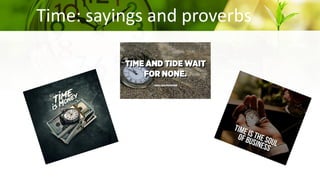
Time: sayings and proverbs
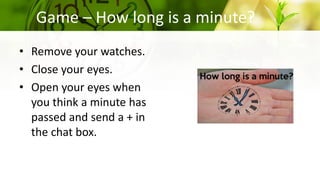
Game – How long is a minute?
• Remove your watches.
• Close your eyes.
• Open your eyes when
you think a minute has
passed and send a + in
the chat box.
This means…
• Each of us experiences time differently.
• Some perceive 60 seconds as longer than it is, others
as shorter.
• Having the knowledge of your own perception can
lead you to better estimate how much time an
activity or project might take.
What is time management?
• Why is it that some
people achieve so much
more with their time
than others?
• Good time management
What is time management?
No matter how organized we are,
there are always only 24 hours in a
day.
Time doesn't change.
All we can actually manage is
ourselves and what we do with the
time that we have.
What is time management?
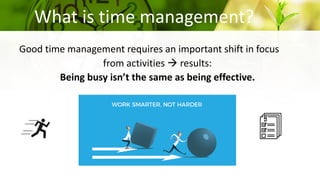
Good time management requires an important shift in focus
from activities  results:
Being busy isn’t the same as being effective.
Time Management skills help you to:
• Organize better.
• Take charge of your time, personal, and professional
life.
• Not miss deadlines.
• Reduce stress and anxiety.
• Focus more, procrastinate less.
• Improve your performance and efficiency.
15 TIME MANAGEMENT TIPS
Tip 1: Track your time
• Know exactly how you spend your time.
• How much of your time is spent on
unproductive thoughts, conversations,
and activities.
• Determine the time of day when you are
most productive.
Tip 2: Minimize distractions
• As per HBR, an average employee gets
interrupted 50 to 60 times a day. About
80% of these interruptions are
unnecessary.
• As a result of this, they are not able to
achieve the ‘Flow’ state.
Tip 2: Minimize distractions
• Block online distractions.
• Turn off push notifications.
• Check messages, social media,
emails in clusters instead of replying
to them randomly.
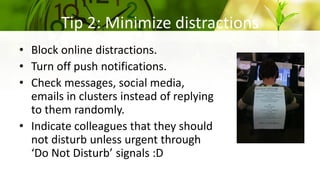
• Indicate colleagues that they should
not disturb unless urgent through
‘Do Not Disturb’ signals :D
Tip 3: Avoid multitasking
• Prioritize tasks according to the level of
importance.
• Minimize external distractions.
• Say no to additional tasks that you are
asked to do but you have no time.
Tip 4: Create a daily task list
Preparing a to-do list helps you to:
• prioritize your tasks;
• distinguish between the important and
unimportant tasks;
• keep track of the work yet to be done;
• allocate time;
• get work done efficiently.
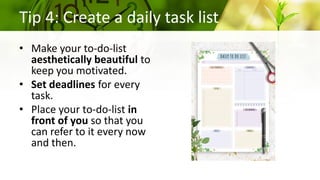
• Make your to-do-list
aesthetically beautiful to
keep you motivated.
• Set deadlines for every
task.
• Place your to-do-list in
front of you so that you
can refer to it every now
and then.
Tip 4: Create a daily task list
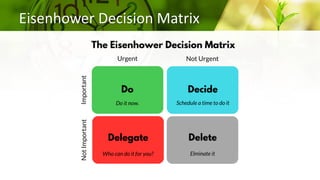
Tip 5: Prioritize your tasks
Prioritization methods:
• Eat That Frog
• Eisenhower Decision Matrix
• 80/20 Rule – Pareto Principle
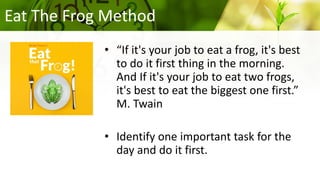
Eat The Frog Method
• “If it's your job to eat a frog, it's best
to do it first thing in the morning.
And If it's your job to eat two frogs,
it's best to eat the biggest one first.”
M. Twain
• Identify one important task for the
day and do it first.
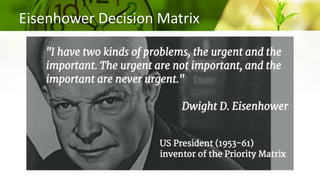
Eisenhower Decision Matrix
Follow the 80/20 rule
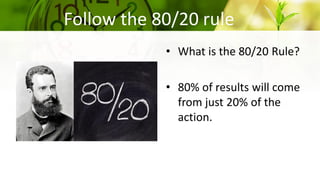
• What is the 80/20 Rule?
• 80% of results will come
from just 20% of the
action.
Follow the 80/20 rule
Pareto principle, or the 80/20 rule:
• 20% of the sales reps generate 80% of total sales.
• 20% of customers account for 80% of total profits.
• 20% of the most reported software bugs cause 80% of
software crashes.
• Ladies, how many shoes do you own, and how often do
you grab the same 20%?
• You spend 80% of your time with the same 20% of your
friends and family members, don’t you?
Follow the 80/20 rule
• So, what 20% of your work drives 80%
of your outcomes?
• Use Pareto to help you determine what
is of vital importance.
• Delegate the rest, or simply let it go.
Tip 6: Schedule your breaks
Scheduling breaks during work
hours helps you to:
• stay focused,
• get unique ideas,
• make better decisions,
• prevent burnout.
Tip 6: Schedule your breaks
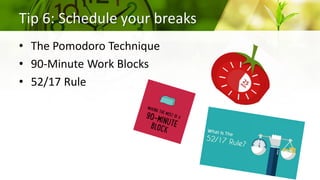
• The Pomodoro Technique
• 90-Minute Work Blocks
• 52/17 Rule
The Pomodoro Technique
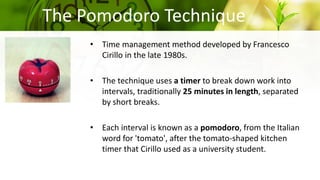
• Time management method developed by Francesco
Cirillo in the late 1980s.
• The technique uses a timer to break down work into
intervals, traditionally 25 minutes in length, separated
by short breaks.
• Each interval is known as a pomodoro, from the Italian
word for 'tomato', after the tomato-shaped kitchen
timer that Cirillo used as a university student.
The Pomodoro Technique
• Step 1 – Pick a task
• Step 2 – Set a 25-minute timer
• Step 3 – Work on your task until the
time is up
• Step 4 – Take a 5-minute break
• Step 5 – Every 4 pomodoros, take a
longer break (15-30 minutes)
Ninety Minute Work Blocks
• If you need more time for work at a stretch,
you can plan the work session for 90
minutes.
• Science has proven that our brain can last
for 90 minutes at optimal levels, after
which it needs a roughly 20 minute break.
• This pattern of 90 minutes on, 20 minutes
off is based on something called the “Basic
Rest-Activity Cycle”.
52/17 Rule
• You work 52 minutes without
distractions and take a short 17-
minute break.
• This rule will keep you concentrated
on the tasks while rewarding you
with the 17-minute break to rewire
your brain.
• This too helps you to focus and do
work in shorter spans of time.
Tip 7: Don’t wait for inspiration to start working
Tip 8: Organize your desk, task list, inbox
Disorganization can cost you your valuable time
and effort.
• Clean your desks and keep only those items
that are important for the routine use.
• Use labels to label your shelves, baskets,
drawers.
• Organize your desktop by putting items into
folders.
• Organize your emails by deleting unwanted old
emails, unsubscribing newsletters that you
don’t read.
Tip 9: Skip ahead when you feel stuck
• Feel Stuck?
• No matter how much you strive, you are
not able to work on it at that time. This
acts as an obstacle in the workflow and
tends to slow you down.
• In such cases, it is always better to skip
the task for sometime and shift on a
relatively easy task if possible.
Tip 10: Communicate your workload with your team
• Communicate the plan of the day to your
team.
• Your team members will have an
understanding of the tasks that you would
be working on for the day and the time at
which you would be available.
• This would enable your team members to
adjust their schedule accordingly and know
when they can approach you if needed.
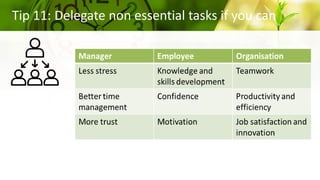
Tip 11: Delegate non essential tasks if you can
Tip 12: Check your email once/twice a day
• As per McKinsey, an average professional
spends 28% of the work day reading and
answering emails.
• Make it a practice of checking your inbox
once/twice during the day at a time that suits
you.
• Make sure you communicate this to your
team members so that they are able to reach
out to you in case of an emergency.
Tip 13: Make another to-do list for tomorrow
• You can be a little proactive and prepare
a to-do-list in advance if you want extra
time for important work tomorrow.
• Make sure that towards the end of your
workday, you prepare a to-do list for
tomorrow.
Tip 14: Seek a mentor for more guidance
Mentors can:
• help you set targets,
• assign accountability,
• guide you on ways in which work can
be done more efficiently.
Tip 15: Find your ‘Flow’ state
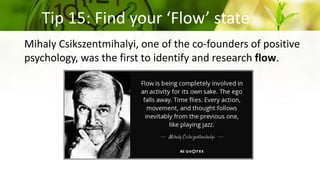
Mihaly Csikszentmihalyi, one of the co-founders of positive
psychology, was the first to identify and research flow.
Tip 15: Find your ‘Flow’ state
The flow state can be achieved by:
• Undertaking projects that you would be keen to
work on.
• Selecting an important task that proves better
for your career eventually.
• Ensuring that the work is challenging but is not
very tough.
• Doing work at a time when you can work with
concentration and at your best.
• Getting rid of distractions.
Any other tips?
TIME MANAGEMENT APPS AND TOOLS
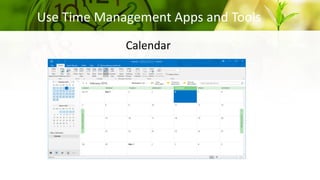
Use Time Management Apps and Tools
Calendar
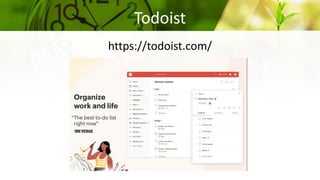
Todoist
https://todoist.com/
Focus Booster App
https://www.focusboosterapp.com/
Remember the milk
https://www.rememberthemilk.com/
Trello
https://trello.com/en
Final thoughts
Let’s play!
Go to quizizz.com and use the code
Thank you for your time!
QUESTIONS?
Anush Mkrtchyan
Language and Communication Trainer
anush_mkrtchyan@yahoo.com
References:
• Eat the Frog. If it's your job to eat a frog, it's best to do it first thing in the morning, Retrieved from:
https://todoist.com/productivity-methods/eat-the-frog
• Eisenhower's Urgent/Important Principle, Retrieved from:
https://www.mindtools.com/pages/article/newHTE_91.htm
• Kruse, K. (2016). The 80/20 Rule And How It Can Change Your Life. Forbes. Retrieved from:
https://www.forbes.com/sites/kevinkruse/2016/03/07/80-20-rule/?sh=7b1d47993814
• Pradeepa, H. 25 Time Management Tips For Success At Work, Retrieved from:
https://quickbooks.intuit.com/global/resources/reports/time-management-tips/
• Rempton, J. (2018), Manipulate Time With These Powerful 20 Time Management Tips, Forbes.
Retrieved from: https://www.forbes.com/sites/johnrampton/2018/05/01/manipulate-time-with-
these-powerful-20-time-management-tips/?sh=5b4d37c057ab
• Ward, S. (2021), 11 Time Management Tips That Work, Retrieved from:
https://www.thebalancesmb.com/time-management-tips-2947336
• What Is Time Management? Working Smarter to Enhance Productivity, Retrieved from:
https://www.mindtools.com/pages/article/newHTE_00.htm
• Ye, L. 16 Time Management Apps That Will Make You More Productive, Retrieved from:
https://blog.hubspot.com/sales/time-management-apps

Time management

  • 1.
    Effective Time Management: Tipsand Tricks ANUSH MKRTCHYAN
  • 2.
    Targets of themaster class • What is time management and why is it important? • 15 time management tips • Work prioritization methods and models • State of Flow • Time management apps and tools
  • 3.
  • 4.
  • 5.
    Game – Howlong is a minute? • Remove your watches. • Close your eyes. • Open your eyes when you think a minute has passed and send a + in the chat box.
  • 6.
    This means… • Eachof us experiences time differently. • Some perceive 60 seconds as longer than it is, others as shorter. • Having the knowledge of your own perception can lead you to better estimate how much time an activity or project might take.
  • 7.
    What is timemanagement? • Why is it that some people achieve so much more with their time than others? • Good time management
  • 8.
    What is timemanagement? No matter how organized we are, there are always only 24 hours in a day. Time doesn't change. All we can actually manage is ourselves and what we do with the time that we have.
  • 9.
    What is timemanagement? Good time management requires an important shift in focus from activities  results: Being busy isn’t the same as being effective.
  • 10.
    Time Management skillshelp you to: • Organize better. • Take charge of your time, personal, and professional life. • Not miss deadlines. • Reduce stress and anxiety. • Focus more, procrastinate less. • Improve your performance and efficiency.
  • 11.
  • 12.
    Tip 1: Trackyour time • Know exactly how you spend your time. • How much of your time is spent on unproductive thoughts, conversations, and activities. • Determine the time of day when you are most productive.
  • 13.
    Tip 2: Minimizedistractions • As per HBR, an average employee gets interrupted 50 to 60 times a day. About 80% of these interruptions are unnecessary. • As a result of this, they are not able to achieve the ‘Flow’ state.
  • 14.
    Tip 2: Minimizedistractions • Block online distractions. • Turn off push notifications. • Check messages, social media, emails in clusters instead of replying to them randomly. • Indicate colleagues that they should not disturb unless urgent through ‘Do Not Disturb’ signals :D
  • 15.
    Tip 3: Avoidmultitasking • Prioritize tasks according to the level of importance. • Minimize external distractions. • Say no to additional tasks that you are asked to do but you have no time.
  • 16.
    Tip 4: Createa daily task list Preparing a to-do list helps you to: • prioritize your tasks; • distinguish between the important and unimportant tasks; • keep track of the work yet to be done; • allocate time; • get work done efficiently.
  • 17.
    • Make yourto-do-list aesthetically beautiful to keep you motivated. • Set deadlines for every task. • Place your to-do-list in front of you so that you can refer to it every now and then. Tip 4: Create a daily task list
  • 18.
    Tip 5: Prioritizeyour tasks Prioritization methods: • Eat That Frog • Eisenhower Decision Matrix • 80/20 Rule – Pareto Principle
  • 19.
    Eat The FrogMethod • “If it's your job to eat a frog, it's best to do it first thing in the morning. And If it's your job to eat two frogs, it's best to eat the biggest one first.” M. Twain • Identify one important task for the day and do it first.
  • 20.
  • 21.
  • 22.
    Follow the 80/20rule • What is the 80/20 Rule? • 80% of results will come from just 20% of the action.
  • 23.
    Follow the 80/20rule Pareto principle, or the 80/20 rule: • 20% of the sales reps generate 80% of total sales. • 20% of customers account for 80% of total profits. • 20% of the most reported software bugs cause 80% of software crashes. • Ladies, how many shoes do you own, and how often do you grab the same 20%? • You spend 80% of your time with the same 20% of your friends and family members, don’t you?
  • 24.
    Follow the 80/20rule • So, what 20% of your work drives 80% of your outcomes? • Use Pareto to help you determine what is of vital importance. • Delegate the rest, or simply let it go.
  • 25.
    Tip 6: Scheduleyour breaks Scheduling breaks during work hours helps you to: • stay focused, • get unique ideas, • make better decisions, • prevent burnout.
  • 26.
    Tip 6: Scheduleyour breaks • The Pomodoro Technique • 90-Minute Work Blocks • 52/17 Rule
  • 27.
    The Pomodoro Technique •Time management method developed by Francesco Cirillo in the late 1980s. • The technique uses a timer to break down work into intervals, traditionally 25 minutes in length, separated by short breaks. • Each interval is known as a pomodoro, from the Italian word for 'tomato', after the tomato-shaped kitchen timer that Cirillo used as a university student.
  • 28.
    The Pomodoro Technique •Step 1 – Pick a task • Step 2 – Set a 25-minute timer • Step 3 – Work on your task until the time is up • Step 4 – Take a 5-minute break • Step 5 – Every 4 pomodoros, take a longer break (15-30 minutes)
  • 29.
    Ninety Minute WorkBlocks • If you need more time for work at a stretch, you can plan the work session for 90 minutes. • Science has proven that our brain can last for 90 minutes at optimal levels, after which it needs a roughly 20 minute break. • This pattern of 90 minutes on, 20 minutes off is based on something called the “Basic Rest-Activity Cycle”.
  • 30.
    52/17 Rule • Youwork 52 minutes without distractions and take a short 17- minute break. • This rule will keep you concentrated on the tasks while rewarding you with the 17-minute break to rewire your brain. • This too helps you to focus and do work in shorter spans of time.
  • 31.
    Tip 7: Don’twait for inspiration to start working
  • 32.
    Tip 8: Organizeyour desk, task list, inbox Disorganization can cost you your valuable time and effort. • Clean your desks and keep only those items that are important for the routine use. • Use labels to label your shelves, baskets, drawers. • Organize your desktop by putting items into folders. • Organize your emails by deleting unwanted old emails, unsubscribing newsletters that you don’t read.
  • 33.
    Tip 9: Skipahead when you feel stuck • Feel Stuck? • No matter how much you strive, you are not able to work on it at that time. This acts as an obstacle in the workflow and tends to slow you down. • In such cases, it is always better to skip the task for sometime and shift on a relatively easy task if possible.
  • 34.
    Tip 10: Communicateyour workload with your team • Communicate the plan of the day to your team. • Your team members will have an understanding of the tasks that you would be working on for the day and the time at which you would be available. • This would enable your team members to adjust their schedule accordingly and know when they can approach you if needed.
  • 35.
    Tip 11: Delegatenon essential tasks if you can
  • 36.
    Tip 12: Checkyour email once/twice a day • As per McKinsey, an average professional spends 28% of the work day reading and answering emails. • Make it a practice of checking your inbox once/twice during the day at a time that suits you. • Make sure you communicate this to your team members so that they are able to reach out to you in case of an emergency.
  • 37.
    Tip 13: Makeanother to-do list for tomorrow • You can be a little proactive and prepare a to-do-list in advance if you want extra time for important work tomorrow. • Make sure that towards the end of your workday, you prepare a to-do list for tomorrow.
  • 38.
    Tip 14: Seeka mentor for more guidance Mentors can: • help you set targets, • assign accountability, • guide you on ways in which work can be done more efficiently.
  • 39.
    Tip 15: Findyour ‘Flow’ state Mihaly Csikszentmihalyi, one of the co-founders of positive psychology, was the first to identify and research flow.
  • 40.
    Tip 15: Findyour ‘Flow’ state The flow state can be achieved by: • Undertaking projects that you would be keen to work on. • Selecting an important task that proves better for your career eventually. • Ensuring that the work is challenging but is not very tough. • Doing work at a time when you can work with concentration and at your best. • Getting rid of distractions.
  • 41.
  • 42.
  • 43.
    Use Time ManagementApps and Tools Calendar
  • 44.
  • 45.
  • 46.
  • 47.
  • 48.
    Final thoughts Let’s play! Goto quizizz.com and use the code
  • 49.
    Thank you foryour time!
  • 50.
    QUESTIONS? Anush Mkrtchyan Language andCommunication Trainer anush_mkrtchyan@yahoo.com
  • 51.
    References: • Eat theFrog. If it's your job to eat a frog, it's best to do it first thing in the morning, Retrieved from: https://todoist.com/productivity-methods/eat-the-frog • Eisenhower's Urgent/Important Principle, Retrieved from: https://www.mindtools.com/pages/article/newHTE_91.htm • Kruse, K. (2016). The 80/20 Rule And How It Can Change Your Life. Forbes. Retrieved from: https://www.forbes.com/sites/kevinkruse/2016/03/07/80-20-rule/?sh=7b1d47993814 • Pradeepa, H. 25 Time Management Tips For Success At Work, Retrieved from: https://quickbooks.intuit.com/global/resources/reports/time-management-tips/ • Rempton, J. (2018), Manipulate Time With These Powerful 20 Time Management Tips, Forbes. Retrieved from: https://www.forbes.com/sites/johnrampton/2018/05/01/manipulate-time-with- these-powerful-20-time-management-tips/?sh=5b4d37c057ab • Ward, S. (2021), 11 Time Management Tips That Work, Retrieved from: https://www.thebalancesmb.com/time-management-tips-2947336 • What Is Time Management? Working Smarter to Enhance Productivity, Retrieved from: https://www.mindtools.com/pages/article/newHTE_00.htm • Ye, L. 16 Time Management Apps That Will Make You More Productive, Retrieved from: https://blog.hubspot.com/sales/time-management-apps