Economic Crisis Policy
Analytics Based on
Artificial Intelligence
Loukis, E., Maragoudakis, M., Kyriakou, N.
Introduction
 An important trend in the area of digital government is the exploitation of ICT for supporting public
policy making leading to the gradual development of ‘policy analytics’
 it can be defined as the exploitation of existing data of government agencies, possibly in
 using advanced quantitative analysis techniques,
 in order to support various stages of public policy making for the complex problems that modern
societies face
 This promising area of policy analytics is still in its infancy,
 and the potential of the large quantities of the data that government possesses for supporting and
enhancing policy making has been exploited only to a limited extent
 So it is necessary to conduct extensive research in this direction.
 Another important trend in the area of digital government is the increasing exploitation of artificial
intelligence (AI) techniques by government agencies.
 AI can be defined as a group of technologies that enable computers to become more intelligent,
 by learning from their environment, gaining knowledge from it, and using this knowledge for taking
intelligent action or proposing decisions
Introduction
 There are several technologies in this group that provide such learning capabilities, with the most important of them being
definitely the Machine Learning (ML) ones.
 They enable exploiting past historic data for a number of cases/units:
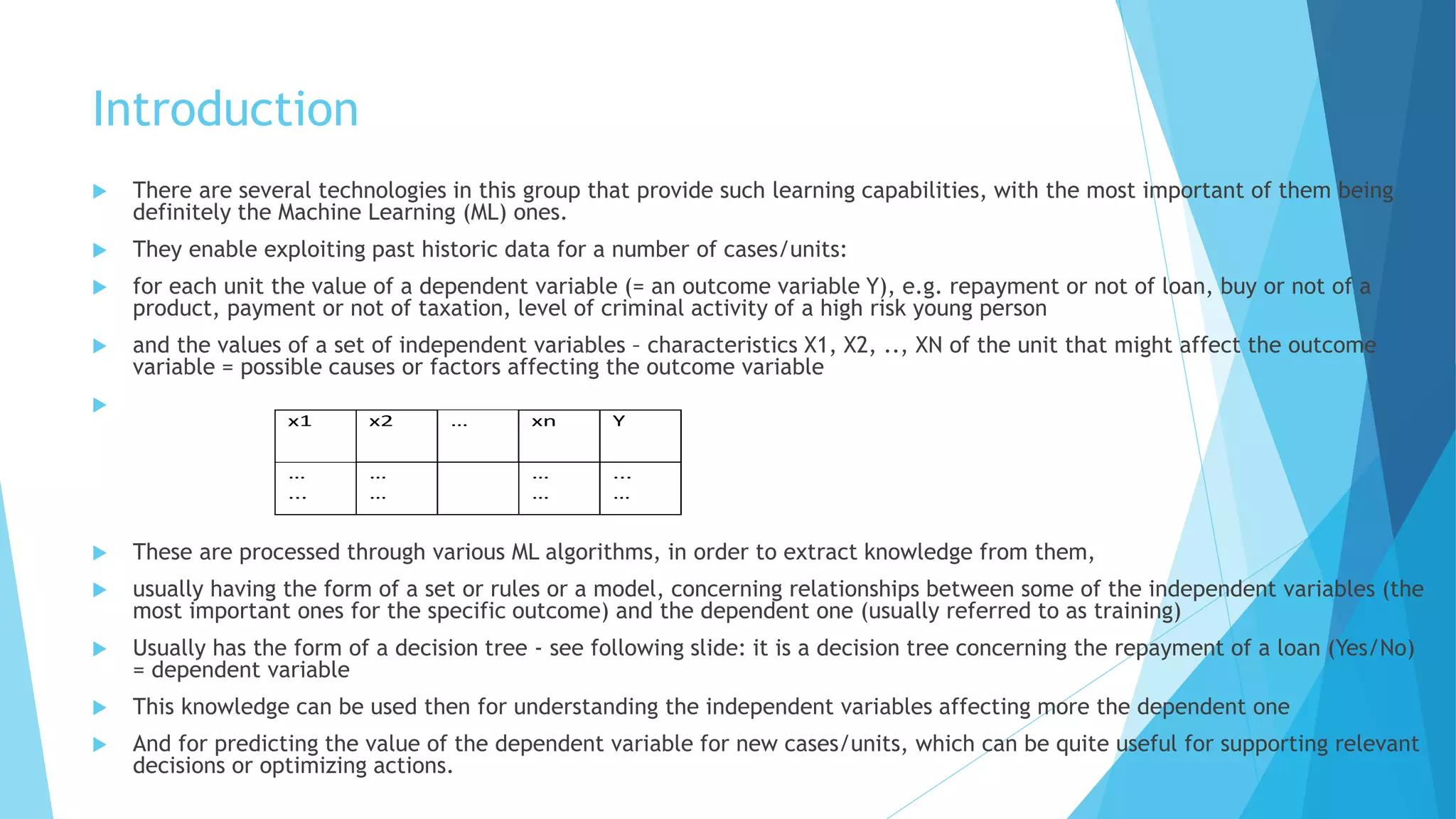
 for each unit the value of a dependent variable (= an outcome variable Y), e.g. repayment or not of loan, buy or not of a
product, payment or not of taxation, level of criminal activity of a high risk young person
 and the values of a set of independent variables – characteristics X1, X2, .., XN of the unit that might affect the outcome
variable = possible causes or factors affecting the outcome variable

 These are processed through various ML algorithms, in order to extract knowledge from them,
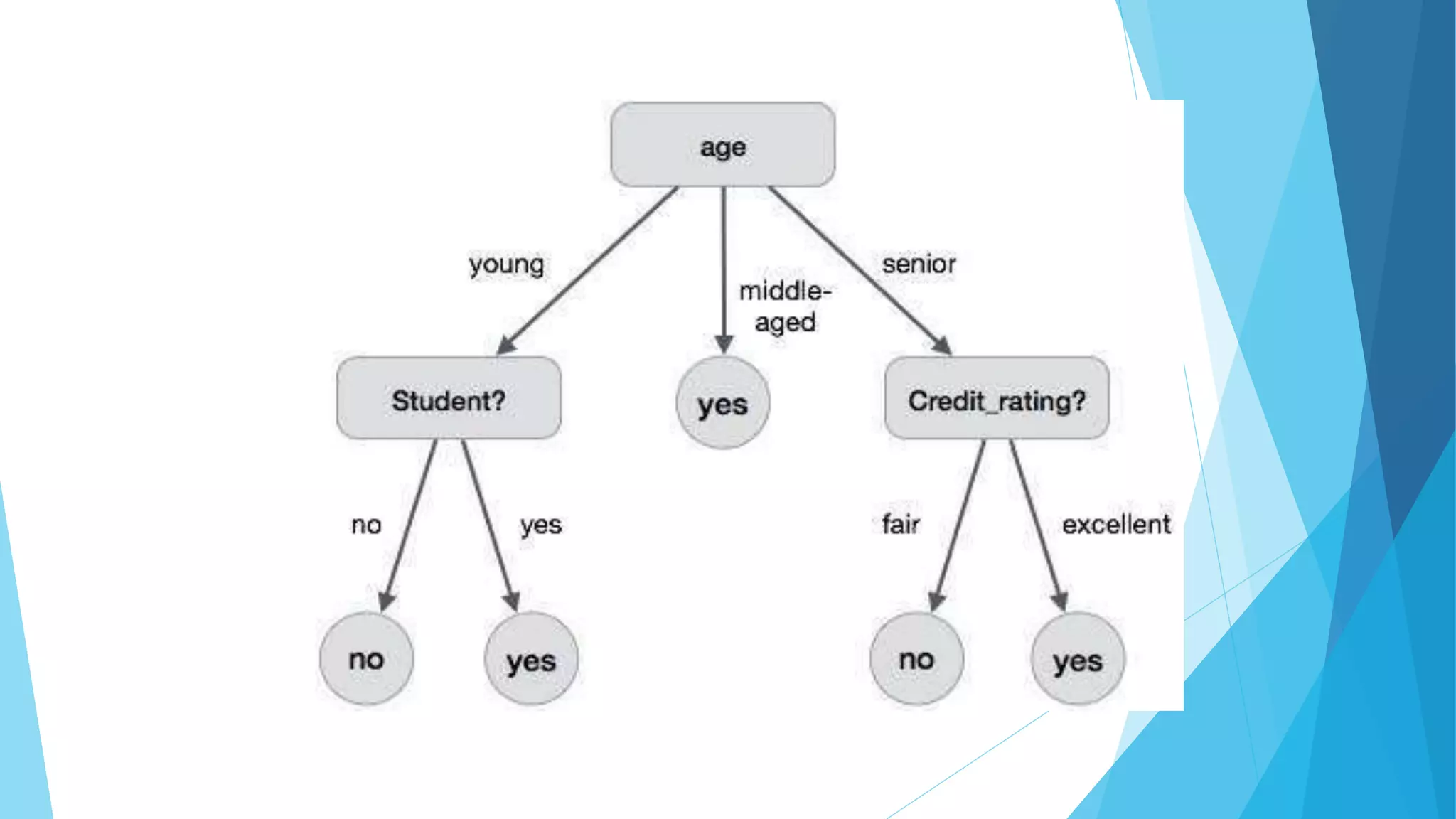
 usually having the form of a set or rules or a model, concerning relationships between some of the independent variables (the
most important ones for the specific outcome) and the dependent one (usually referred to as training)
 Usually has the form of a decision tree - see following slide: it is a decision tree concerning the repayment of a loan (Yes/No)
= dependent variable
 This knowledge can be used then for understanding the independent variables affecting more the dependent one
 And for predicting the value of the dependent variable for new cases/units, which can be quite useful for supporting relevant
decisions or optimizing actions.
x1 x2 … xn Y
…
...
…
…
…
…
...
…
Introduction
 AI has started being used in a variety of public sector thematic domains for various purposes,
 for instance in education, for the prediction of applicants for teacher positions who will be more effective
and successful, in order to support making the optimal recruitment decisions
 in social policy, for the prediction of higher risk youth concerning criminal activity, in order to target
prevention interventions;
 in restaurant hygiene inspections, for using the social media on-line reviews in order to discriminate severe
offenders from the restaurants with no regulation violations, in order to optimize inspections
 in immigration management, for an initial classification of applications as approved, denied, or gray area,
in order to support officers responsible for making decisions for them
 in healthcare, for diseases’ diagnosis and treatment planning
 in public security, for predictive police patrolling, in order to use more effectively scarce human resources,
 and for the automated analysis and classification of crime reports
 However, the exploitation of AI in the public sector so far was mainly for the automation, support and
enhancement of daily operational tasks,
 and only to a very limited extent for the support and enhancement of higher-level functions, and especially
policy making
Introduction
 Our research makes a contribution towards the advancement of these two important and promising
digital government trends: policy analytics and AI exploitation.
 It proposes a policy analytics methodology, which exploits existing data of taxation authorities,
statistical agencies, and also of private sector business information and consulting firms,
 in order to support policy making concerning one of the most serious problems that governments
often face,
 the economic crises - recessions, leading to contractions of economic activity, which repeatedly
occur with varying intensities in market economies, being an inevitable trait of them
 Our methodology enables identifying characteristics of a firm as well as its external environment
 that affect (positively or negatively) its resilience to economic crisis with respect to sales revenue
(the degree of sales revenue reduction due to economic crisis).
 For this purpose we are using a ‘big data oriented’ AI technique: feature selection (FS),
 which enables filtering from a large number of potential independent variables (contained in
available high-dimensionality big datasets)
 the ones that actually affect a dependent variable of interest;
 in particular, we are using the Boruta ‘all-relevant’ variables identification FS algorithm
Economic Crises - Recessions
 One of the most serious problems of market-based economies are the fluctuations of economic activity that
repeatedly appear,
 which cause many problems to the economy and the society in general,
 so they have to be addressed by government through appropriate policies,
 aiming on one hand at reducing their intensities and durations,
 and on the other hand at reducing their negative consequences on firms and citizens
 Economic crises can be defined as significant reductions of economic activity, which can be due to the
‘business cycles’ (i.e., the fluctuations that economic activity usually exhibits in market-based economies),
 or caused by various kinds of events in the society or economy (such as the oil crisis in the early 1970, or
banking crises)
 The economic crises have negative short-term as well as medium- and long-term consequences for the
economy and the society.
 The short-term consequences usually are reductions of the demand for most goods and services, resulting
in serious decrease of firms’ sales, production and profits,
 leading to reductions in personnel employment (increasing unemployment) and materials’ procurement
(propagating the crisis towards the suppliers, etc.).
Economic Crises - Recessions
 Furthermore, during economic crises firms usually reduce capital investment in production equipment, ICT,
buildings, etc.,
 and also in product, service and process innovations,
 which reduce the degree of renewal and improvement of their equipment, products, services and operation,
as well as the exploitation of emerging new technologies,
 and this has serious medium- and long-term consequences on their efficiency and competitiveness.
 However, it should be noted that the above negative consequences of the economic crises are not the same
for all firms
 the more efficient and effective firms, which offer higher value-for-money products and services,
 and have higher capacity to make the required adaptations of them, as well their internal operations,
 are more resilient to the crisis, and have less negative consequences on their sales revenue, and therefore on
their employment, procurement, as well as their capital investment and innovation,
 than the less efficient and effective ones.
 Therefore, it is important and highly useful to develop policy analytics methodologies for identifying
characteristics of the firm, as well as its external environment, that affect positively or negatively its
resilience to economic crisis.
Economic Crises - Recessions
 This provides substantial support for designing effective and focused policies for reducing the negative
consequences of economic crises on firms.
 It allows identifying on one hand characteristics of firms exhibiting higher resilience to the crisis, such as
specific practices, resources, capabilities, etc.,
 and therefore learning from them, as to which practices, resources, capabilities, etc. increase resilience to
economic crisis, in order to design public policies for promoting and facilitating them;
 and on the other hand characteristics of firms exhibiting lower resilience to the economic crisis (and
therefore more negative consequences),
 in order to design public policies for assisting and supporting them (e.g., through financial support of
innovation activities, relevant laws and regulations).
Artificial Intelligence – Feature Selection
 Feature Selection (FS) algorithms constitutes an important class of ‘big data oriented’ AI algorithms,
 which aim at determining from a large number of features - potential independent variables - the ones that
actually affect a dependent variable of interest
 They can be divided into two main categories:
 i) the ‘minimal – optimal’ ones, which determine a small - minimal set of features affecting the dependent
variable, which can provide optimal prediction accuracy for it (most traditional FS algorithms belong to this
category);
 ii) the ‘all-relevant’ ones, which determine all the features that affect the dependent variable, not only the
non-redundant ones, as it happens in ‘minimal – optimal’ FS algorithms (there is a smaller number of novell
algorithms belonging to this category)
 Therefore if there are a number of features that affect the dependent variable, which are to some extent
redundant (i.e. there is some degree of association among them),
 the ‘minimal-optimal’ FS algorithms will select only some of them (a minimal subset), which have low levels
of redundancy (association) among them;
 however, they will not select some other features, which affect the dependent variable, but have high levels
of association with the selected ones, as the latter features do not increase further the prediction accuracy
of the dependent variable,
Artificial Intelligence – Feature Selection
 Feature Selection (FS) algorithms constitutes an important class of ‘big data oriented’ AI algorithms,
 which aim at determining from a large number of features - potential independent variables - the ones that
actually affect a dependent variable of interest
 They can be divided into two main categories:
 i) the ‘minimal – optimal’ ones, which determine a small - minimal set of features affecting the dependent
variable, which can provide optimal prediction accuracy for it (most traditional FS algorithms belong to this
category);
 ii) the ‘all-relevant’ ones, which determine all the features that affect the dependent variable, not only the
non-redundant ones, as it happens in ‘minimal – optimal’ FS algorithms (there is a smaller number of novell
algorithms belonging to this category)
 Therefore if there are a number of features that affect the dependent variable, which are to some extent
redundant (i.e. there is some degree of association – correlation among them),
 the ‘minimal-optimal’ FS algorithms will select only some of them (a minimal subset), which have low levels
of redundancy (association) among them;
 however, they will not select some other features, which affect the dependent variable, but have high levels
of association with the selected ones, as the latter features do not increase further the prediction accuracy
of the dependent variable,
Artificial Intelligence – Feature Selection
 On the contrary the ‘all-relevant’ FS algorithms will select all the features affecting the dependent variable,
regardless of possible associations among them.
 Since the objective of our research is the to extract from available datasets as much knowledge and insight
as possible
 concerning characteristics of a firm as well as its external environment that affect the degree of sales
revenue reduction due to economic crisis
 we are using an ‘all-relevant’ FS algorithm.
 In particular, we are using the Boruta ‘all-relevant’ variables identification algorithm
Proposed Methodology
 The proposed economic crisis policy analytics methodology aims to identify characteristics of the firm and its
external environment that affect its resilience to economic crisis,
 with respect to the most important negative aspect/consequence of economic crisis: the reduction of firms’
sales revenue.
 Therefore the dependent variable of our methodology is the degree of firm’s sales revenue reduction due to
the crisis.
 Our methodology exploits existing data from two main sources:
 I) from taxation authorities: data about firms’ sales revenue before and during the economic crisis, from
which sales revenue reduction due to crisis can be calculated;
 II) from statistical agencies, and also from private sector business information and consulting firms: data
concerning various characteristics of firms (concerning strategic directions, resources, capabilities, practices,
etc.) and their external environment (concerning the intensity of competition, the degree of dynamism,
etc.).
 These data undergo two stages of processing:
 An initial selection of potential independent variables (characteristics of firm as well as its external
environment) from the numerous variables that might be available in the large government and private
sector datasets we are using, based on theoretical foundations from previous management science research.
Proposed Methodology
 One of them is definitely the classical ‘Leavitt’s Diamond’ framework, which defines four main elements of a
firm, which should be strongly interconnected
 a) task (= the strategies as well as the administrative and production processes of the firm);
 b) people (= the skills of firm’s human resources of the firm)
 c) technology (= the technologies used for implementing the above processes)
 and d) structure (= the organization of the firm in departments, and the communication and coordination
patterns them).
 Also, highly useful can be theoretical foundations developed in previous research concerning firm’s resources
as well as capabilities
 both ordinary and dynamic ones
 With respect to the selection of external environment characteristics useful can be foundations from
previous research concerning ‘generalized competition’ (such as Porter’s Five Forces Framework)
 and environmental dynamism.
 Then follows the processing of the selected variables through the abovementioned Boruta AI FS algorithm in
order to identify ‘all-relevant’ ones (i.e. all the variables that actually affect the degree of sales revenue
reduction due to the crisis).

Application
 An application of the economic crisis policy analytics methodology described in the previous section has been
made
 for the identification of characteristics of Greek firms as well as their external environment that affect the
degree of their sales revenue reduction due to the long and intensive economic crisis that Greece
experiences since 2009.
 For this purpose, we have used existing Greek firm’s data for the period 2009-2014 from three sources:
 i) the Ministry of Finance – Taxation Authorities;
 ii) the Hellenic Statistical Authority;
 and iii) the ICAP S.A., a well-known business information and consulting firm.
 In particular, we have used data from these sources for 363 Greek firms; 40.2% of them were manufacturing
ones, 9.4% constructions, and 50.4% services ones; 52.6% of them were small, 36.1% medium and 11.3% large
ones.
 Our dependent variable was the percentage of sales revenue reduction due to the economic crisis in the
period 2009 – 2014, which was discretized by the Ministry of Finance (in order to avoid providing too detailed
data about this critical topic) into a variable with 13 possible discrete values (SALREV_RED):
 increase by more than 100%; increase by 80-100%; increase by 60-80%; increase by 40-60%; increase by 20-
40%; increase by 1-20%; unchanged sales; decrease by 1-20%; decrease by 20-40%; decrease by 40-60%;
decrease by 60-80%; decrease by 80-100%; decrease by more than 100%.
Application
 We selected the 64 independent variables from all the above categories
 Strategic orientations
 Human Resources
 Technology (concerning the use of various ICTs)
 Structure (use of organic structural forms, such as teamwork, job rotation)
 Ordinary Capabilities (ICT – related capabilities)
 Dynamic Capabilities (concerning knowledge absorptive capacity)
 External Environment (concerning competition and environmental dynamism)
Results
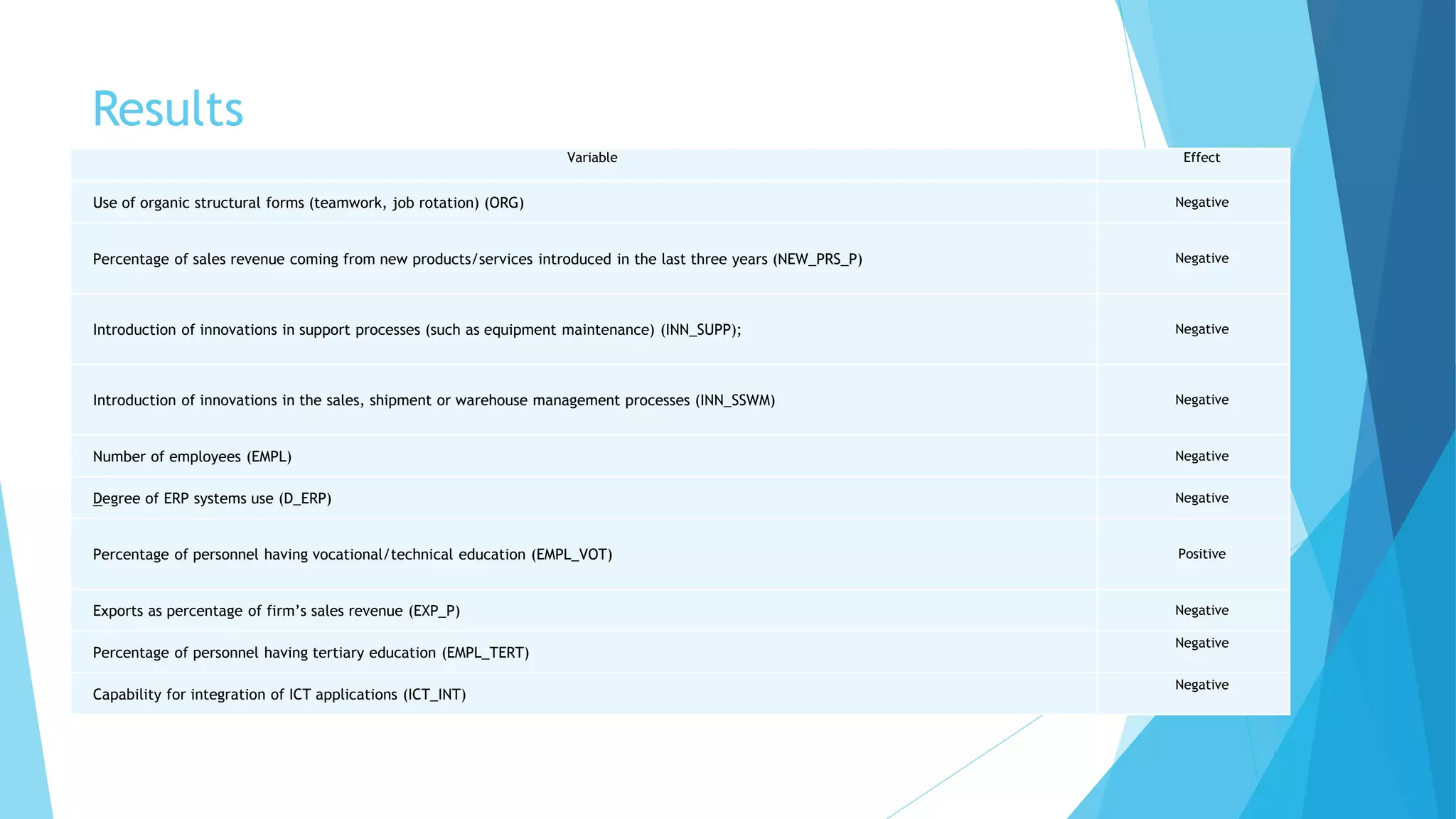
Variable Effect
Use of organic structural forms (teamwork, job rotation) (ORG) Negative
Percentage of sales revenue coming from new products/services introduced in the last three years (NEW_PRS_P) Negative
Introduction of innovations in support processes (such as equipment maintenance) (INN_SUPP); Negative
Introduction of innovations in the sales, shipment or warehouse management processes (INN_SSWM) Negative
Number of employees (EMPL) Negative
Degree of ERP systems use (D_ERP) Negative
Percentage of personnel having vocational/technical education (EMPL_VOT) Positive
Exports as percentage of firm’s sales revenue (EXP_P) Negative
Percentage of personnel having tertiary education (EMPL_TERT)
Negative
Capability for integration of ICT applications (ICT_INT)
Negative
Conclusions
 We have presented a policy analytics methodology,
 which exploits existing public and private sector data,
 based on an advanced big data oriented AI FS algorithm,
 in order to support policy making concerning one of the most serious problems that governments repeatedly
face: the economic crises.
 It allows identifying firms’ characteristics that affect their resilience to economic crisis.
 Furthermore, a first application of it has been presented, which provides a first validation of the usefulness
of this methodology, and leads to interesting conclusions and insights.
 Our research has interesting implications for research and practice.
 With respect to research, it creates new knowledge in two emerging, highly important for the society, but
minimally researched, digital government research domains: policy analytics and government AI exploitation
 With respect to practice, it provides support to government agencies for designing policies for reducing the
negative impact on firms of one of the most important problems of our market economies: the economic
crises
Conclusions
 In general, it provides an approach for combining and exploiting multiple sources of public and private sector
data
 in order to understand the characteristics of firms exhibiting various positive behaviors/evolutions (e.g.
export, expansion to other countries, adoption of new technologies, etc.)
 or negative ones (e.g. reduction of personnel employment, disinvestment, etc.),
 which will be useful for the design of relevant public policies
 However, further application of our methodology is required in various national contexts, at both national
and sectoral level, using a wider range of potential independent variables,
 and based on the experience gained improvements of the methodology.

Electronic Open and Collaborative Governance - An Introduction

  • 1.
    Economic Crisis Policy AnalyticsBased on Artificial Intelligence Loukis, E., Maragoudakis, M., Kyriakou, N.
  • 2.
    Introduction  An importanttrend in the area of digital government is the exploitation of ICT for supporting public policy making leading to the gradual development of ‘policy analytics’  it can be defined as the exploitation of existing data of government agencies, possibly in  using advanced quantitative analysis techniques,  in order to support various stages of public policy making for the complex problems that modern societies face  This promising area of policy analytics is still in its infancy,  and the potential of the large quantities of the data that government possesses for supporting and enhancing policy making has been exploited only to a limited extent  So it is necessary to conduct extensive research in this direction.  Another important trend in the area of digital government is the increasing exploitation of artificial intelligence (AI) techniques by government agencies.  AI can be defined as a group of technologies that enable computers to become more intelligent,  by learning from their environment, gaining knowledge from it, and using this knowledge for taking intelligent action or proposing decisions
  • 3.
    Introduction  There areseveral technologies in this group that provide such learning capabilities, with the most important of them being definitely the Machine Learning (ML) ones.  They enable exploiting past historic data for a number of cases/units:  for each unit the value of a dependent variable (= an outcome variable Y), e.g. repayment or not of loan, buy or not of a product, payment or not of taxation, level of criminal activity of a high risk young person  and the values of a set of independent variables – characteristics X1, X2, .., XN of the unit that might affect the outcome variable = possible causes or factors affecting the outcome variable   These are processed through various ML algorithms, in order to extract knowledge from them,  usually having the form of a set or rules or a model, concerning relationships between some of the independent variables (the most important ones for the specific outcome) and the dependent one (usually referred to as training)  Usually has the form of a decision tree - see following slide: it is a decision tree concerning the repayment of a loan (Yes/No) = dependent variable  This knowledge can be used then for understanding the independent variables affecting more the dependent one  And for predicting the value of the dependent variable for new cases/units, which can be quite useful for supporting relevant decisions or optimizing actions. x1 x2 … xn Y … ... … … … … ... …
  • 5.
    Introduction  AI hasstarted being used in a variety of public sector thematic domains for various purposes,  for instance in education, for the prediction of applicants for teacher positions who will be more effective and successful, in order to support making the optimal recruitment decisions  in social policy, for the prediction of higher risk youth concerning criminal activity, in order to target prevention interventions;  in restaurant hygiene inspections, for using the social media on-line reviews in order to discriminate severe offenders from the restaurants with no regulation violations, in order to optimize inspections  in immigration management, for an initial classification of applications as approved, denied, or gray area, in order to support officers responsible for making decisions for them  in healthcare, for diseases’ diagnosis and treatment planning  in public security, for predictive police patrolling, in order to use more effectively scarce human resources,  and for the automated analysis and classification of crime reports  However, the exploitation of AI in the public sector so far was mainly for the automation, support and enhancement of daily operational tasks,  and only to a very limited extent for the support and enhancement of higher-level functions, and especially policy making
  • 6.
    Introduction  Our researchmakes a contribution towards the advancement of these two important and promising digital government trends: policy analytics and AI exploitation.  It proposes a policy analytics methodology, which exploits existing data of taxation authorities, statistical agencies, and also of private sector business information and consulting firms,  in order to support policy making concerning one of the most serious problems that governments often face,  the economic crises - recessions, leading to contractions of economic activity, which repeatedly occur with varying intensities in market economies, being an inevitable trait of them  Our methodology enables identifying characteristics of a firm as well as its external environment  that affect (positively or negatively) its resilience to economic crisis with respect to sales revenue (the degree of sales revenue reduction due to economic crisis).  For this purpose we are using a ‘big data oriented’ AI technique: feature selection (FS),  which enables filtering from a large number of potential independent variables (contained in available high-dimensionality big datasets)  the ones that actually affect a dependent variable of interest;  in particular, we are using the Boruta ‘all-relevant’ variables identification FS algorithm
  • 7.
    Economic Crises -Recessions  One of the most serious problems of market-based economies are the fluctuations of economic activity that repeatedly appear,  which cause many problems to the economy and the society in general,  so they have to be addressed by government through appropriate policies,  aiming on one hand at reducing their intensities and durations,  and on the other hand at reducing their negative consequences on firms and citizens  Economic crises can be defined as significant reductions of economic activity, which can be due to the ‘business cycles’ (i.e., the fluctuations that economic activity usually exhibits in market-based economies),  or caused by various kinds of events in the society or economy (such as the oil crisis in the early 1970, or banking crises)  The economic crises have negative short-term as well as medium- and long-term consequences for the economy and the society.  The short-term consequences usually are reductions of the demand for most goods and services, resulting in serious decrease of firms’ sales, production and profits,  leading to reductions in personnel employment (increasing unemployment) and materials’ procurement (propagating the crisis towards the suppliers, etc.).
  • 8.
    Economic Crises -Recessions  Furthermore, during economic crises firms usually reduce capital investment in production equipment, ICT, buildings, etc.,  and also in product, service and process innovations,  which reduce the degree of renewal and improvement of their equipment, products, services and operation, as well as the exploitation of emerging new technologies,  and this has serious medium- and long-term consequences on their efficiency and competitiveness.  However, it should be noted that the above negative consequences of the economic crises are not the same for all firms  the more efficient and effective firms, which offer higher value-for-money products and services,  and have higher capacity to make the required adaptations of them, as well their internal operations,  are more resilient to the crisis, and have less negative consequences on their sales revenue, and therefore on their employment, procurement, as well as their capital investment and innovation,  than the less efficient and effective ones.  Therefore, it is important and highly useful to develop policy analytics methodologies for identifying characteristics of the firm, as well as its external environment, that affect positively or negatively its resilience to economic crisis.
  • 9.
    Economic Crises -Recessions  This provides substantial support for designing effective and focused policies for reducing the negative consequences of economic crises on firms.  It allows identifying on one hand characteristics of firms exhibiting higher resilience to the crisis, such as specific practices, resources, capabilities, etc.,  and therefore learning from them, as to which practices, resources, capabilities, etc. increase resilience to economic crisis, in order to design public policies for promoting and facilitating them;  and on the other hand characteristics of firms exhibiting lower resilience to the economic crisis (and therefore more negative consequences),  in order to design public policies for assisting and supporting them (e.g., through financial support of innovation activities, relevant laws and regulations).
  • 10.
    Artificial Intelligence –Feature Selection  Feature Selection (FS) algorithms constitutes an important class of ‘big data oriented’ AI algorithms,  which aim at determining from a large number of features - potential independent variables - the ones that actually affect a dependent variable of interest  They can be divided into two main categories:  i) the ‘minimal – optimal’ ones, which determine a small - minimal set of features affecting the dependent variable, which can provide optimal prediction accuracy for it (most traditional FS algorithms belong to this category);  ii) the ‘all-relevant’ ones, which determine all the features that affect the dependent variable, not only the non-redundant ones, as it happens in ‘minimal – optimal’ FS algorithms (there is a smaller number of novell algorithms belonging to this category)  Therefore if there are a number of features that affect the dependent variable, which are to some extent redundant (i.e. there is some degree of association among them),  the ‘minimal-optimal’ FS algorithms will select only some of them (a minimal subset), which have low levels of redundancy (association) among them;  however, they will not select some other features, which affect the dependent variable, but have high levels of association with the selected ones, as the latter features do not increase further the prediction accuracy of the dependent variable,
  • 11.
    Artificial Intelligence –Feature Selection  Feature Selection (FS) algorithms constitutes an important class of ‘big data oriented’ AI algorithms,  which aim at determining from a large number of features - potential independent variables - the ones that actually affect a dependent variable of interest  They can be divided into two main categories:  i) the ‘minimal – optimal’ ones, which determine a small - minimal set of features affecting the dependent variable, which can provide optimal prediction accuracy for it (most traditional FS algorithms belong to this category);  ii) the ‘all-relevant’ ones, which determine all the features that affect the dependent variable, not only the non-redundant ones, as it happens in ‘minimal – optimal’ FS algorithms (there is a smaller number of novell algorithms belonging to this category)  Therefore if there are a number of features that affect the dependent variable, which are to some extent redundant (i.e. there is some degree of association – correlation among them),  the ‘minimal-optimal’ FS algorithms will select only some of them (a minimal subset), which have low levels of redundancy (association) among them;  however, they will not select some other features, which affect the dependent variable, but have high levels of association with the selected ones, as the latter features do not increase further the prediction accuracy of the dependent variable,
  • 12.
    Artificial Intelligence –Feature Selection  On the contrary the ‘all-relevant’ FS algorithms will select all the features affecting the dependent variable, regardless of possible associations among them.  Since the objective of our research is the to extract from available datasets as much knowledge and insight as possible  concerning characteristics of a firm as well as its external environment that affect the degree of sales revenue reduction due to economic crisis  we are using an ‘all-relevant’ FS algorithm.  In particular, we are using the Boruta ‘all-relevant’ variables identification algorithm
  • 13.
    Proposed Methodology  Theproposed economic crisis policy analytics methodology aims to identify characteristics of the firm and its external environment that affect its resilience to economic crisis,  with respect to the most important negative aspect/consequence of economic crisis: the reduction of firms’ sales revenue.  Therefore the dependent variable of our methodology is the degree of firm’s sales revenue reduction due to the crisis.  Our methodology exploits existing data from two main sources:  I) from taxation authorities: data about firms’ sales revenue before and during the economic crisis, from which sales revenue reduction due to crisis can be calculated;  II) from statistical agencies, and also from private sector business information and consulting firms: data concerning various characteristics of firms (concerning strategic directions, resources, capabilities, practices, etc.) and their external environment (concerning the intensity of competition, the degree of dynamism, etc.).  These data undergo two stages of processing:  An initial selection of potential independent variables (characteristics of firm as well as its external environment) from the numerous variables that might be available in the large government and private sector datasets we are using, based on theoretical foundations from previous management science research.
  • 14.
    Proposed Methodology  Oneof them is definitely the classical ‘Leavitt’s Diamond’ framework, which defines four main elements of a firm, which should be strongly interconnected  a) task (= the strategies as well as the administrative and production processes of the firm);  b) people (= the skills of firm’s human resources of the firm)  c) technology (= the technologies used for implementing the above processes)  and d) structure (= the organization of the firm in departments, and the communication and coordination patterns them).  Also, highly useful can be theoretical foundations developed in previous research concerning firm’s resources as well as capabilities  both ordinary and dynamic ones  With respect to the selection of external environment characteristics useful can be foundations from previous research concerning ‘generalized competition’ (such as Porter’s Five Forces Framework)  and environmental dynamism.  Then follows the processing of the selected variables through the abovementioned Boruta AI FS algorithm in order to identify ‘all-relevant’ ones (i.e. all the variables that actually affect the degree of sales revenue reduction due to the crisis). 
  • 15.
    Application  An applicationof the economic crisis policy analytics methodology described in the previous section has been made  for the identification of characteristics of Greek firms as well as their external environment that affect the degree of their sales revenue reduction due to the long and intensive economic crisis that Greece experiences since 2009.  For this purpose, we have used existing Greek firm’s data for the period 2009-2014 from three sources:  i) the Ministry of Finance – Taxation Authorities;  ii) the Hellenic Statistical Authority;  and iii) the ICAP S.A., a well-known business information and consulting firm.  In particular, we have used data from these sources for 363 Greek firms; 40.2% of them were manufacturing ones, 9.4% constructions, and 50.4% services ones; 52.6% of them were small, 36.1% medium and 11.3% large ones.  Our dependent variable was the percentage of sales revenue reduction due to the economic crisis in the period 2009 – 2014, which was discretized by the Ministry of Finance (in order to avoid providing too detailed data about this critical topic) into a variable with 13 possible discrete values (SALREV_RED):  increase by more than 100%; increase by 80-100%; increase by 60-80%; increase by 40-60%; increase by 20- 40%; increase by 1-20%; unchanged sales; decrease by 1-20%; decrease by 20-40%; decrease by 40-60%; decrease by 60-80%; decrease by 80-100%; decrease by more than 100%.
  • 16.
    Application  We selectedthe 64 independent variables from all the above categories  Strategic orientations  Human Resources  Technology (concerning the use of various ICTs)  Structure (use of organic structural forms, such as teamwork, job rotation)  Ordinary Capabilities (ICT – related capabilities)  Dynamic Capabilities (concerning knowledge absorptive capacity)  External Environment (concerning competition and environmental dynamism)
  • 17.
    Results Variable Effect Use oforganic structural forms (teamwork, job rotation) (ORG) Negative Percentage of sales revenue coming from new products/services introduced in the last three years (NEW_PRS_P) Negative Introduction of innovations in support processes (such as equipment maintenance) (INN_SUPP); Negative Introduction of innovations in the sales, shipment or warehouse management processes (INN_SSWM) Negative Number of employees (EMPL) Negative Degree of ERP systems use (D_ERP) Negative Percentage of personnel having vocational/technical education (EMPL_VOT) Positive Exports as percentage of firm’s sales revenue (EXP_P) Negative Percentage of personnel having tertiary education (EMPL_TERT) Negative Capability for integration of ICT applications (ICT_INT) Negative
  • 18.
    Conclusions  We havepresented a policy analytics methodology,  which exploits existing public and private sector data,  based on an advanced big data oriented AI FS algorithm,  in order to support policy making concerning one of the most serious problems that governments repeatedly face: the economic crises.  It allows identifying firms’ characteristics that affect their resilience to economic crisis.  Furthermore, a first application of it has been presented, which provides a first validation of the usefulness of this methodology, and leads to interesting conclusions and insights.  Our research has interesting implications for research and practice.  With respect to research, it creates new knowledge in two emerging, highly important for the society, but minimally researched, digital government research domains: policy analytics and government AI exploitation  With respect to practice, it provides support to government agencies for designing policies for reducing the negative impact on firms of one of the most important problems of our market economies: the economic crises
  • 19.
    Conclusions  In general,it provides an approach for combining and exploiting multiple sources of public and private sector data  in order to understand the characteristics of firms exhibiting various positive behaviors/evolutions (e.g. export, expansion to other countries, adoption of new technologies, etc.)  or negative ones (e.g. reduction of personnel employment, disinvestment, etc.),  which will be useful for the design of relevant public policies  However, further application of our methodology is required in various national contexts, at both national and sectoral level, using a wider range of potential independent variables,  and based on the experience gained improvements of the methodology.