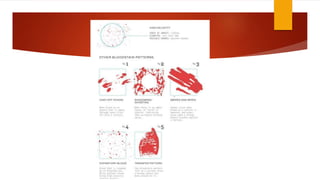
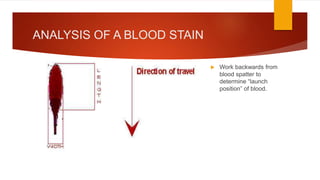
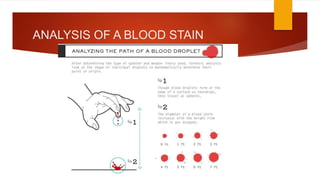
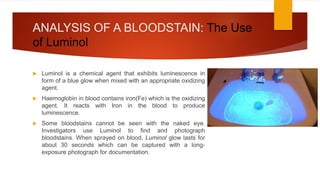
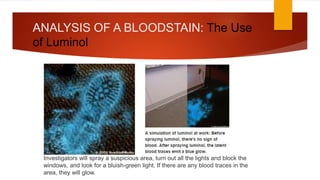
This document provides an overview of bloodstain pattern analysis (BPA). It discusses the components of blood and types of bloodstains, including passive, transfer, and active stains. The process of analyzing bloodstains, including determining the angle and velocity of impact, is explained. Benefits of BPA include reconstructing crime events and corroborating evidence, while limitations include not determining personal details of the perpetrator. A case study examines how BPA helped solve the Kathua gang rape case in India. Emerging technologies like luminol testing, microscopy, DNA analysis, and artificial intelligence can further improve BPA.





















![Presentation_(2)[1].pptx_20250924_112433_0000.pptx](https://cdn.slidesharecdn.com/ss_thumbnails/presentation21-250930161119-93f53032-thumbnail.jpg?width=640&height=640&fit=bounds)
![Presentation_(2)[1].pptx_20250924_112433_0000.pptx](https://cdn.slidesharecdn.com/ss_thumbnails/presentation21-250930161119-194c9291-thumbnail.jpg?width=640&height=640&fit=bounds)


