IDES 2105 Computer Applications
Week 2
Machine Hardware
–Heuristic
–Algotithms
–Basic Hardware
Week 1
Human Computers
–Genetic Algorithms
–Social Algotithms
Week 3
Machine Software
–Internet
–W3 Standards
–Online Marketing
Week 5
Graphics & Media
–Utah Teapot
–Mesh & Solids
–Robots & Automation
Week 4
Frameworks
–Innovator’s Dilemma
–Strategy Paradox
–Knowledge Funnel
Week 6
Artificial Intelligence
–Supercomputers
–Cognitive Pathways
–Machine Learning
IDES 2105 Computer Applications
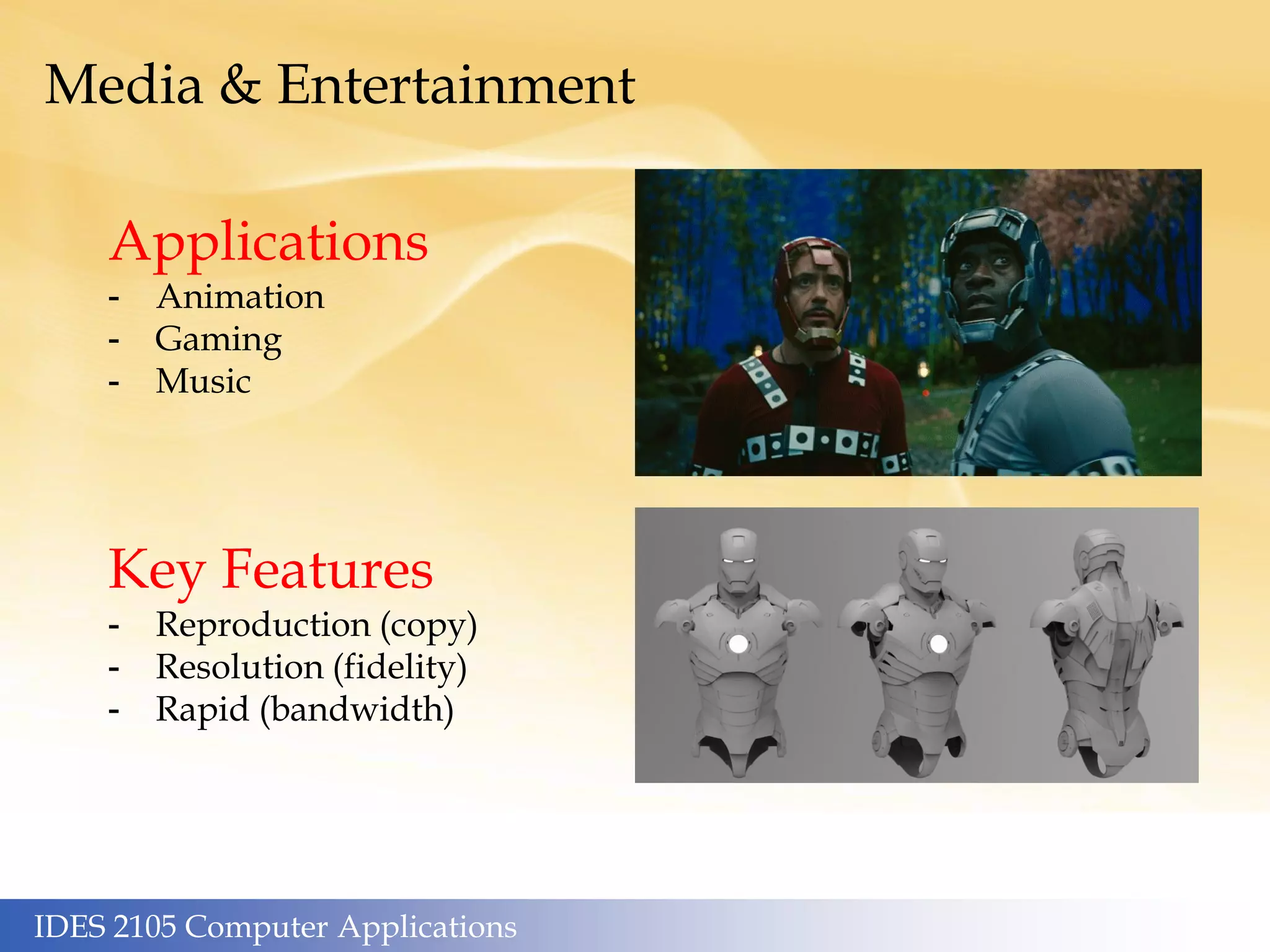
Media & Entertainment
Applications
- Animation
- Gaming
- Music
Key Features
- Reproduction (copy)
- Resolution (fidelity)
- Rapid (bandwidth)
IDES 2105 Computer Applications
Media & Entertainment
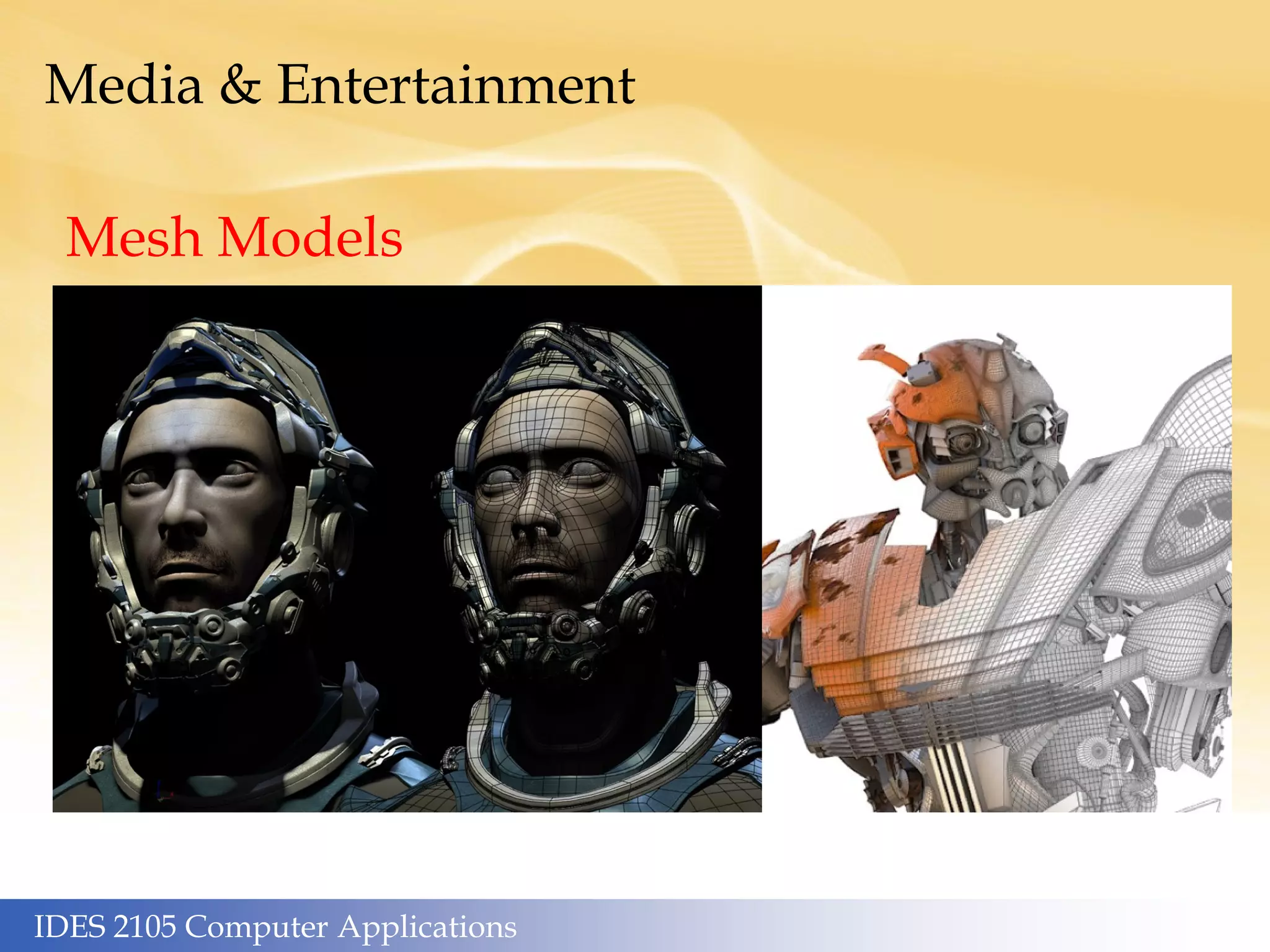
Mesh Models
IDES 2105 Computer Applications
Media & Entertainment
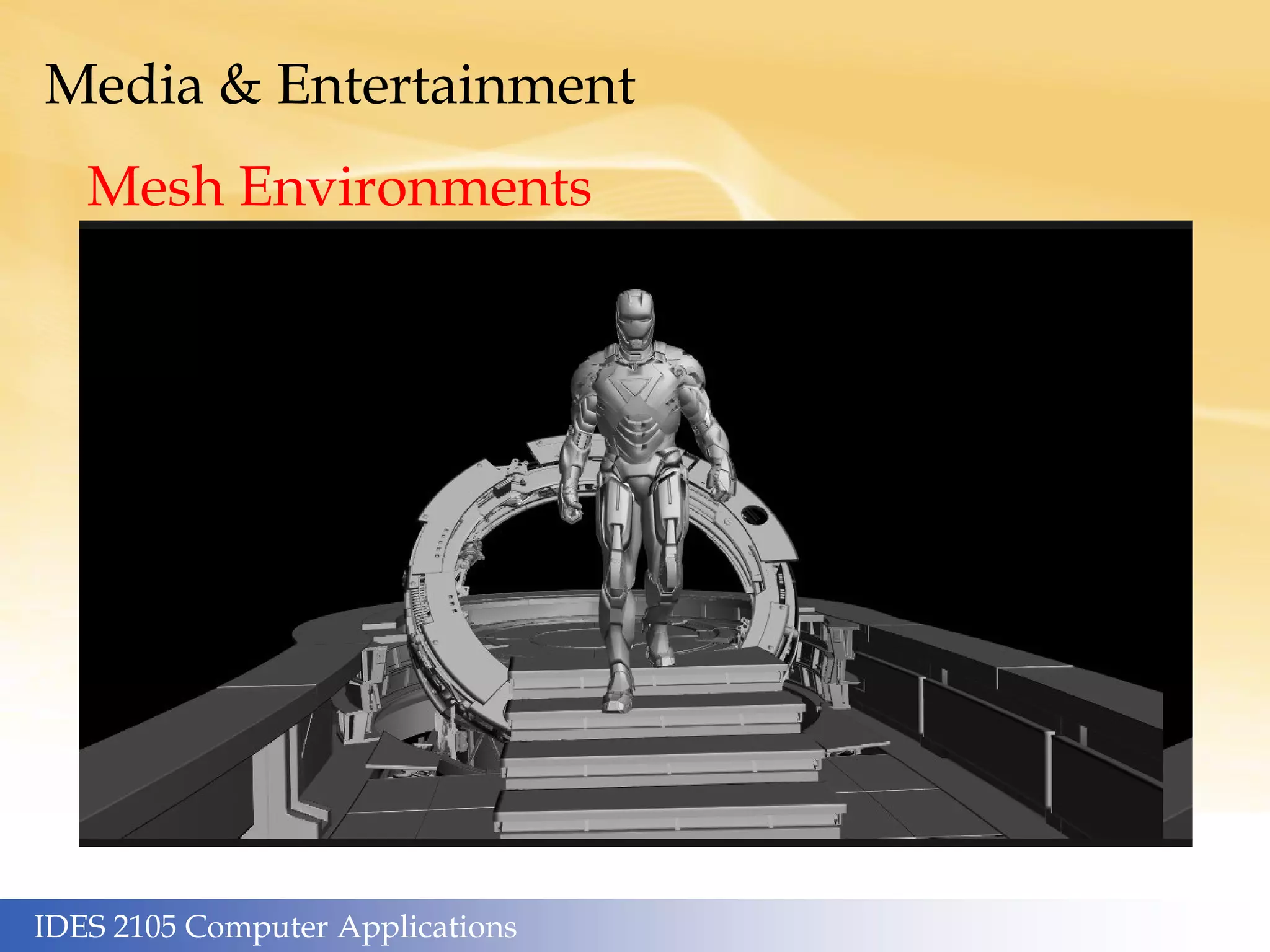
Mesh Environments
IDES 2105 Computer Applications
Media & Entertainment
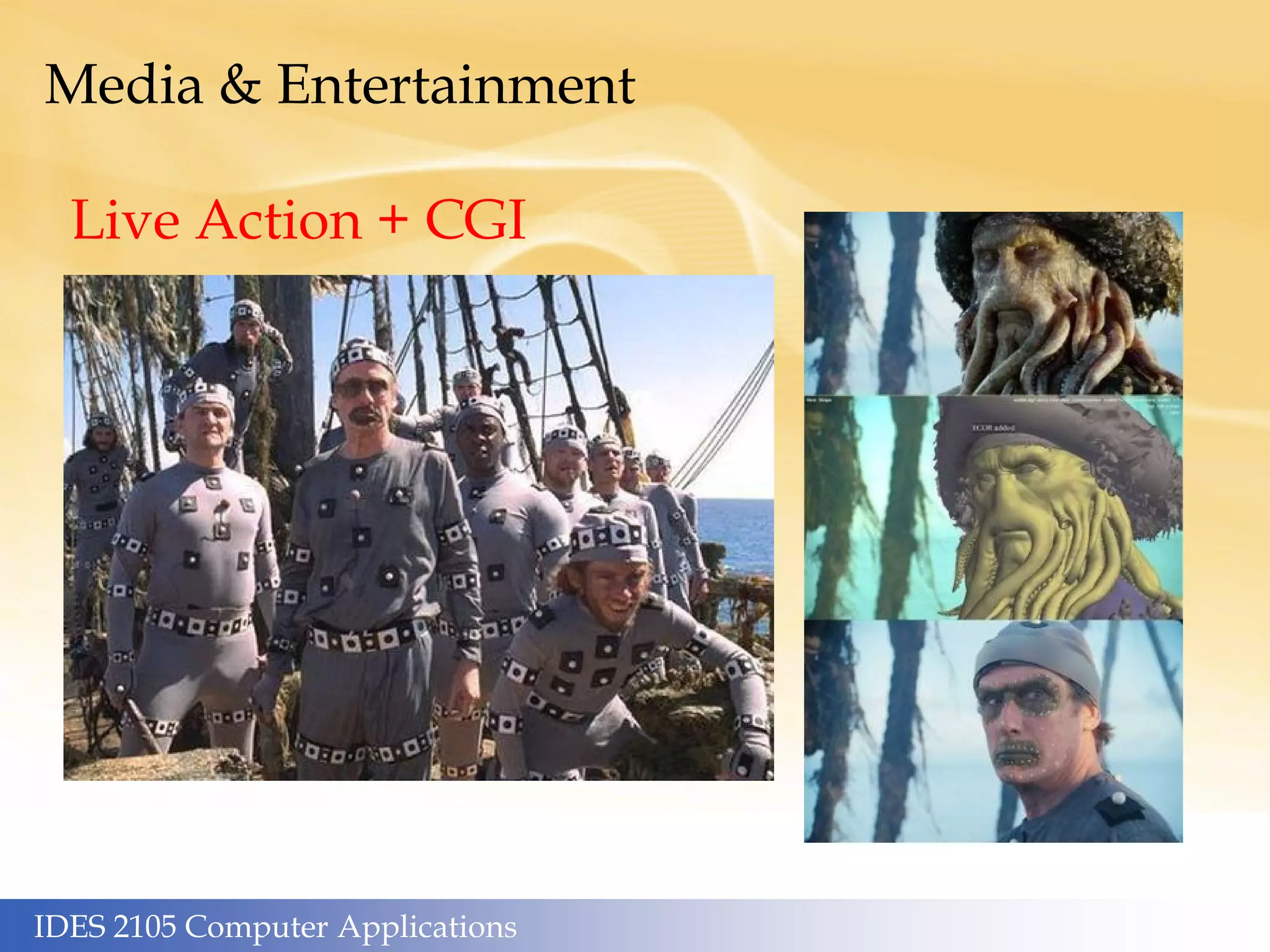
Live Action + CGI
IDES 2105 Computer Applications
Media & Entertainment
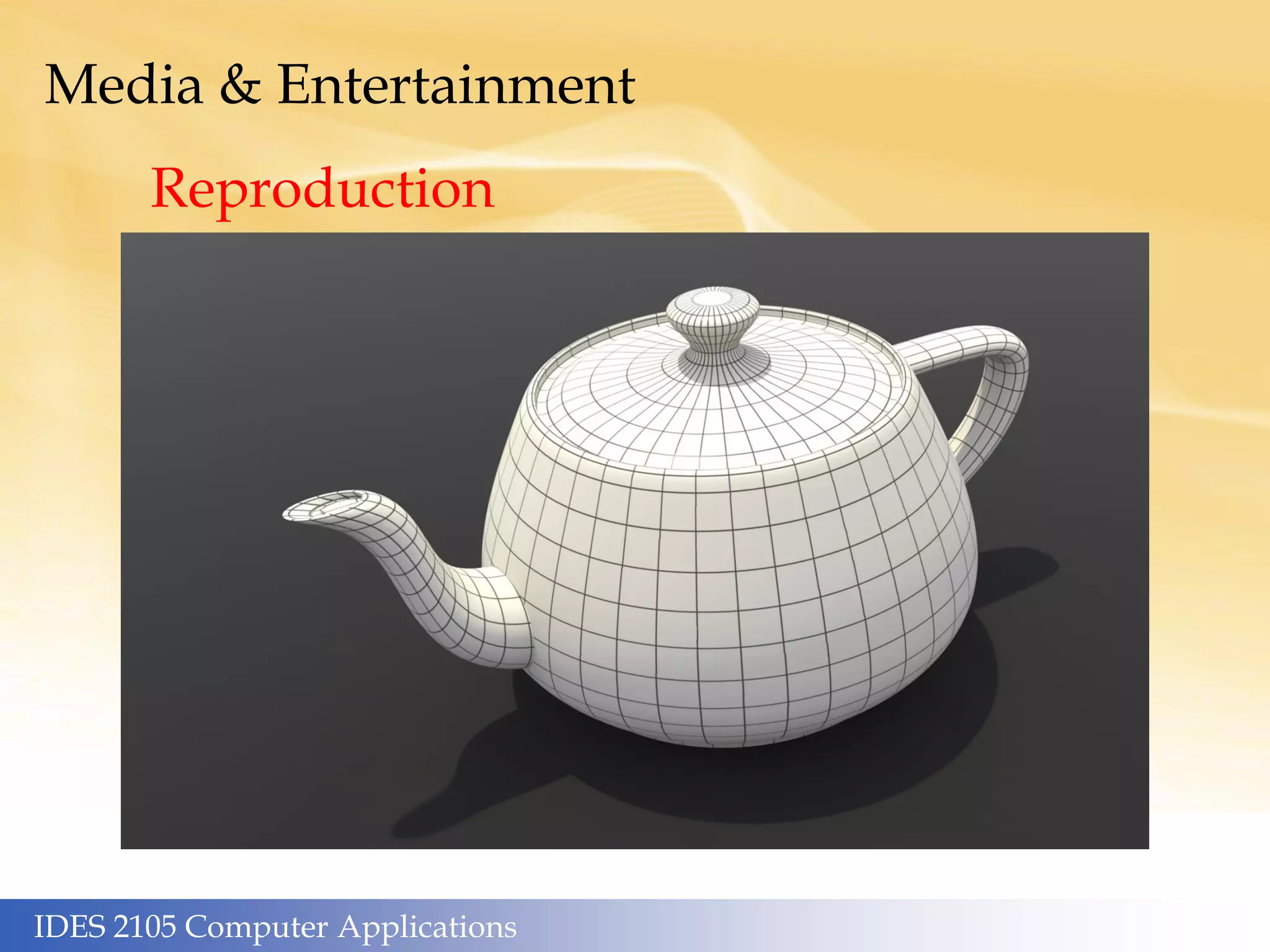
Reproduction
IDES 2105 Computer Applications
Artificial Intelligence
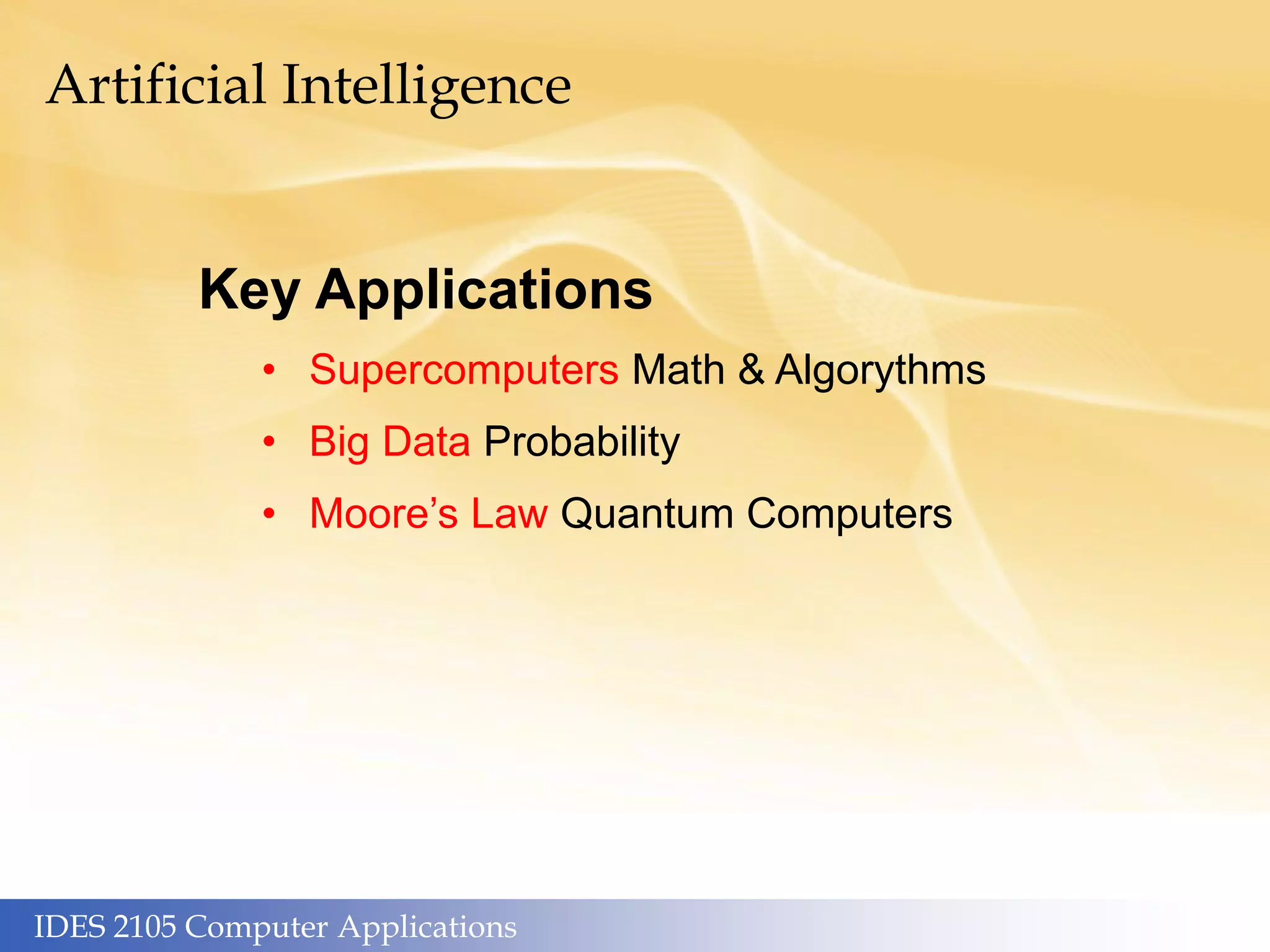
Key Applications
• Supercomputers Math & Algorythms
• Big Data Probability
• Moore’s Law Quantum Computers
IDES 2105 Computer Applications
Artificial Intelligence
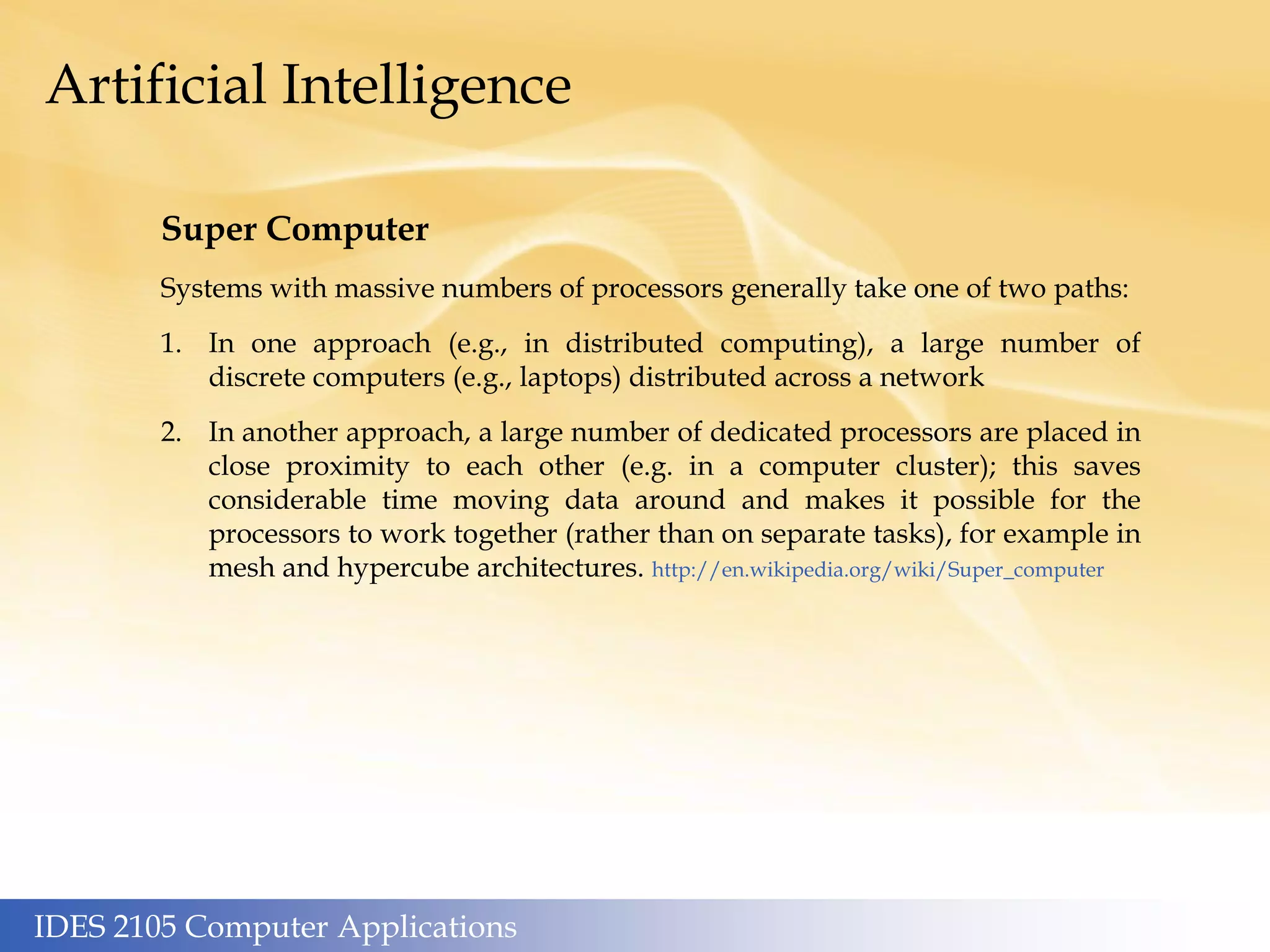
Super Computer
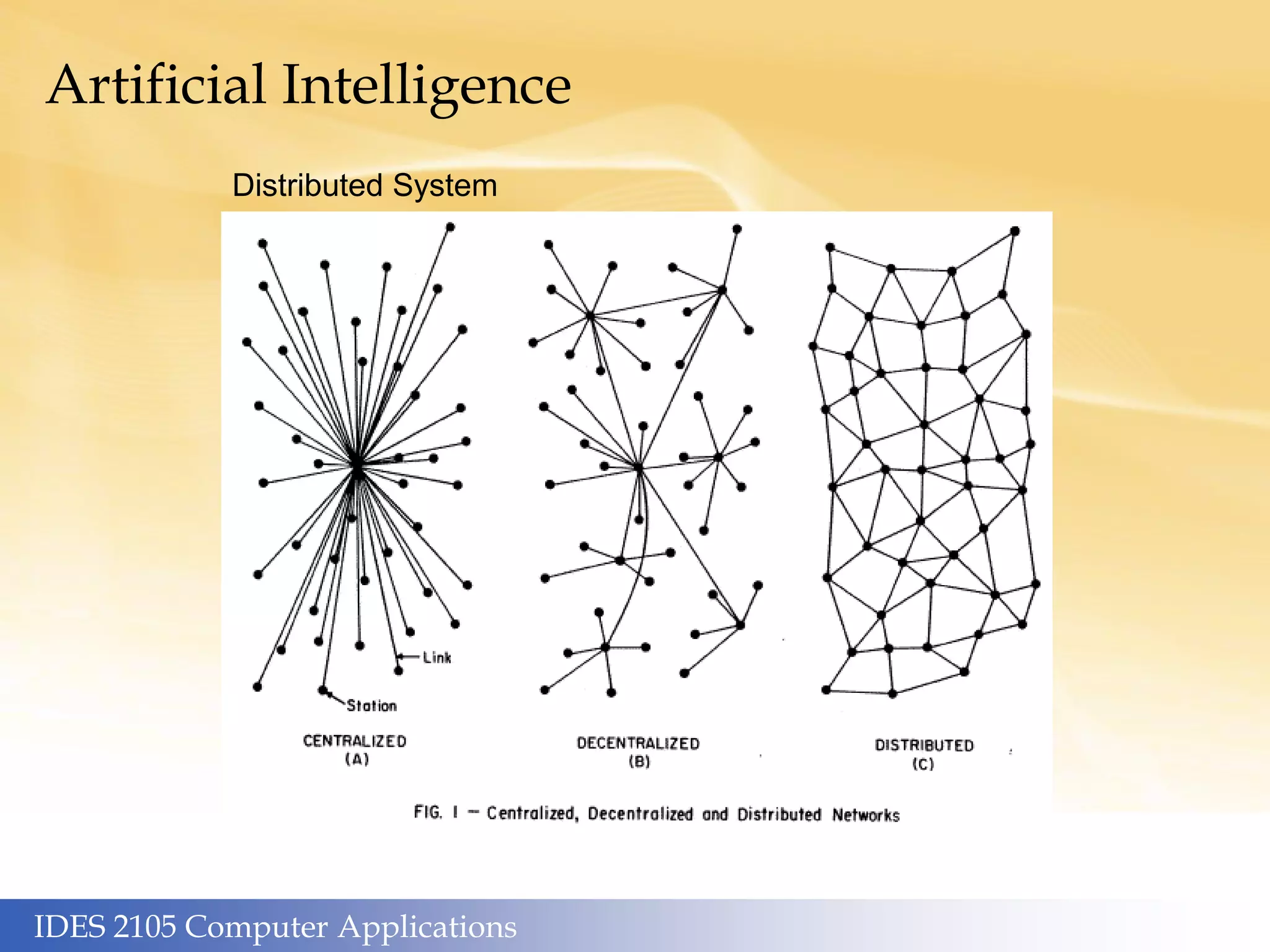
Systems with massive numbers of processors generally take one of two paths:
1. In one approach (e.g., in distributed computing), a large number of
discrete computers (e.g., laptops) distributed across a network
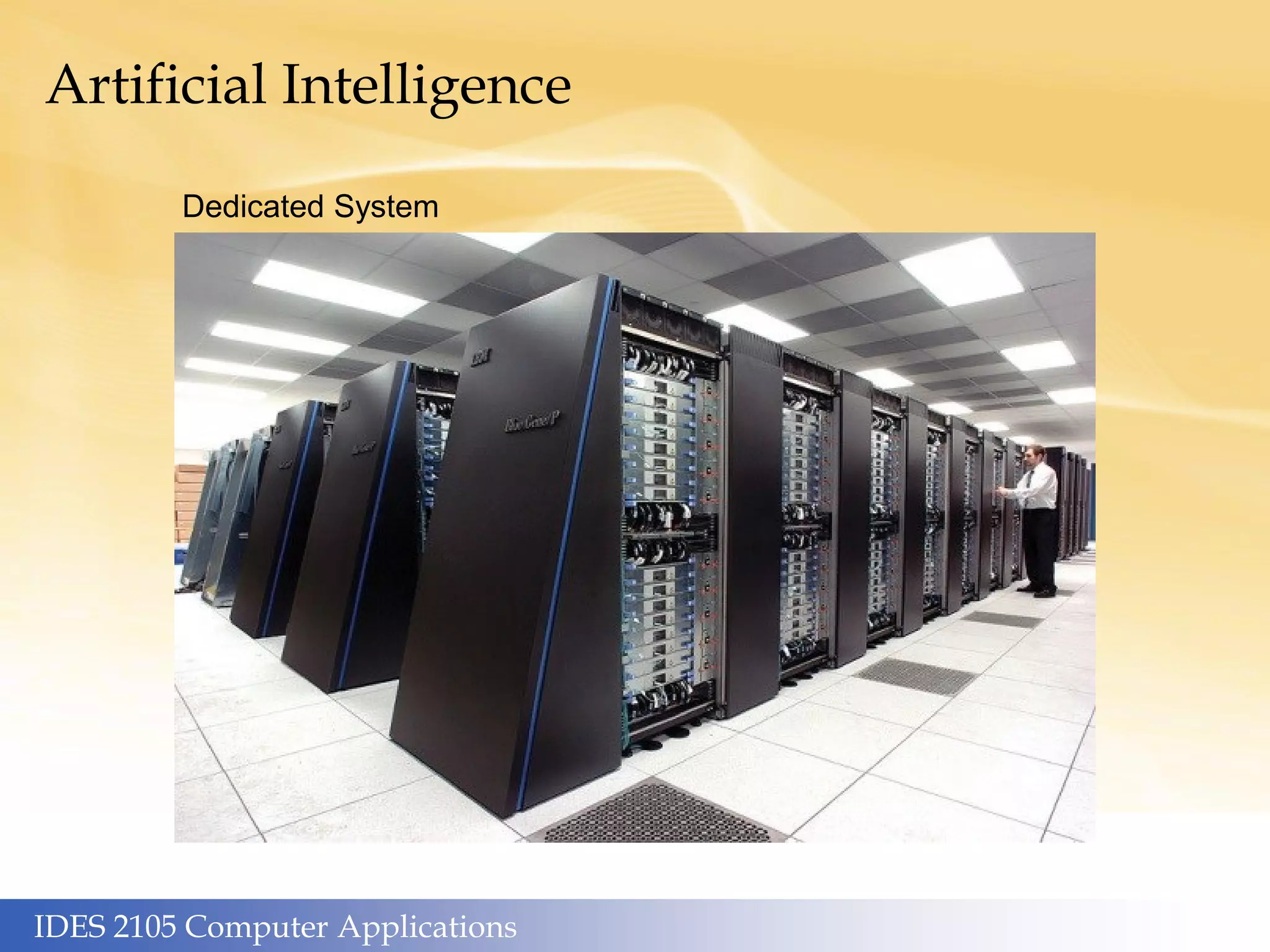
2. In another approach, a large number of dedicated processors are placed in
close proximity to each other (e.g. in a computer cluster); this saves
considerable time moving data around and makes it possible for the
processors to work together (rather than on separate tasks), for example in
mesh and hypercube architectures. http://en.wikipedia.org/wiki/Super_computer
IDES 2105 Computer Applications
Artificial Intelligence
Dedicated System
IDES 2105 Computer Applications
Artificial Intelligence
Distributed System
IDES 2105 Computer Applications
Artificial Intelligence
Moore’s Law
• Moore's law is the observation that, over the history of
computing hardware, the number of transistors on integrated
circuits doubles approximately every two years.
• Although this trend has continued for more than half a
century, Moore's law should be considered an observation or
conjecture and not a physical or natural law. Sources in 2005
expected it to continue until at least 2015
http://en.wikipedia.org/wiki/Super_computer
IDES 2105 Computer Applications
Artificial Intelligence
Nanotechnology
National Nanotechnology Initiative, defines nanotechnology as the
manipulation of matter with at least one dimension sized from 1 to 100
nanometers. This definition reflects the fact that quantum mechanical effects are
important at this quantum-realm scale, and so the definition shifted from a
particular technological goal to a research category inclusive of all types of
research and technologies that deal with the special properties of matter that
occur below the given size threshold http://en.wikipedia.org/wiki/Nanotechnology
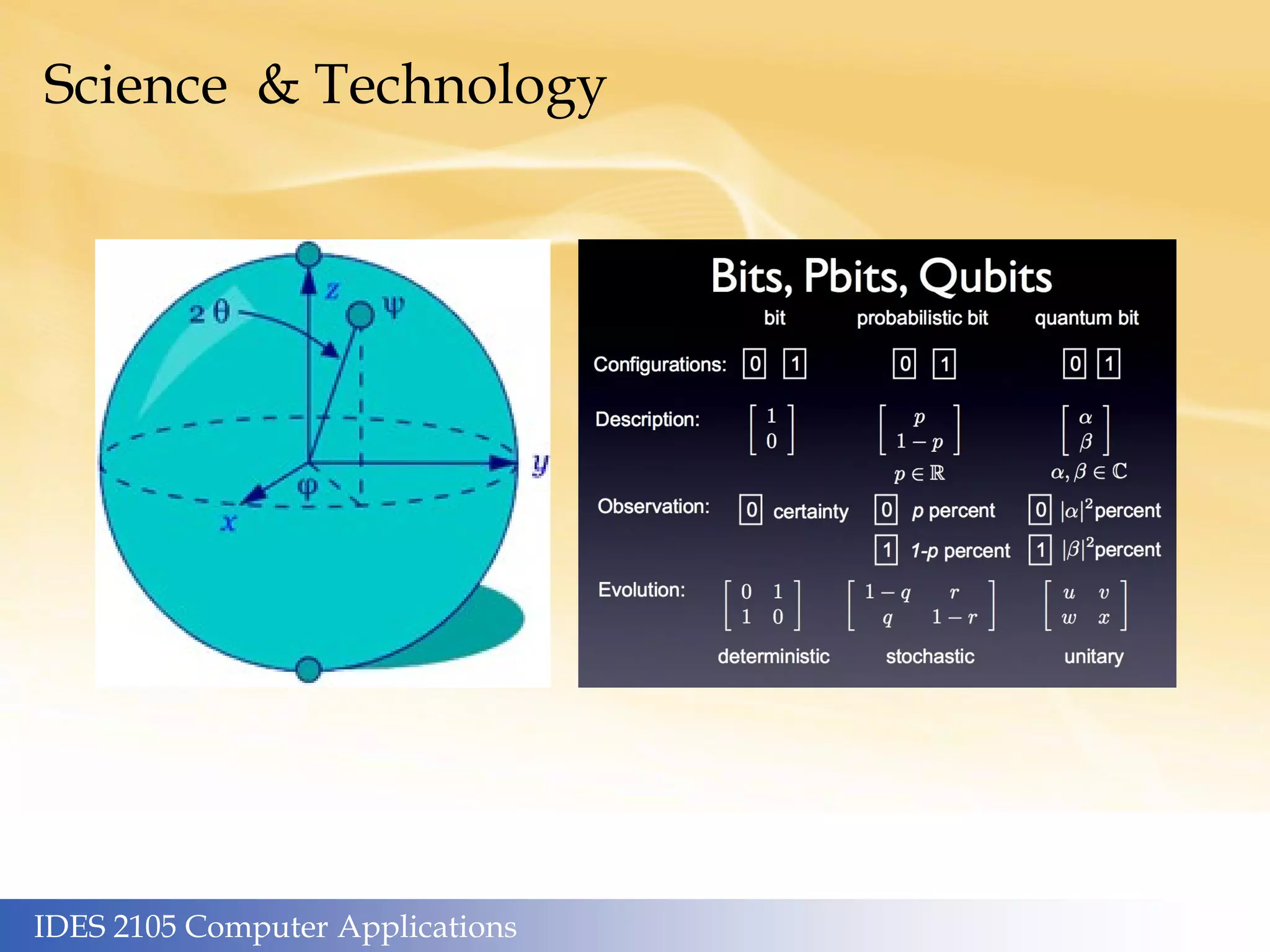
Quantum Computing
is a computation device that makes direct use of quantum-mechanical
phenomena, such as superposition and entanglement, to perform operations.
Whereas digital computers require data to be encoded into binary digits (bits),
each of which is always in one of two definite states (0 or 1), quantum
computation uses qubits (quantum bits), which can be in superposition's of
states http://en.wikipedia.org/wiki/Quantum_computing
IDES 2105 Computer Applications
Science & Technology

Artificial Intelligence

  • 1.
    IDES 2105 ComputerApplications Week 2 Machine Hardware –Heuristic –Algotithms –Basic Hardware Week 1 Human Computers –Genetic Algorithms –Social Algotithms Week 3 Machine Software –Internet –W3 Standards –Online Marketing Week 5 Graphics & Media –Utah Teapot –Mesh & Solids –Robots & Automation Week 4 Frameworks –Innovator’s Dilemma –Strategy Paradox –Knowledge Funnel Week 6 Artificial Intelligence –Supercomputers –Cognitive Pathways –Machine Learning
  • 2.
    IDES 2105 ComputerApplications Media & Entertainment Applications - Animation - Gaming - Music Key Features - Reproduction (copy) - Resolution (fidelity) - Rapid (bandwidth)
  • 3.
    IDES 2105 ComputerApplications Media & Entertainment Mesh Models
  • 4.
    IDES 2105 ComputerApplications Media & Entertainment Mesh Environments
  • 5.
    IDES 2105 ComputerApplications Media & Entertainment Live Action + CGI
  • 6.
    IDES 2105 ComputerApplications Media & Entertainment Reproduction
  • 7.
    IDES 2105 ComputerApplications Artificial Intelligence Key Applications • Supercomputers Math & Algorythms • Big Data Probability • Moore’s Law Quantum Computers
  • 8.
    IDES 2105 ComputerApplications Artificial Intelligence Super Computer Systems with massive numbers of processors generally take one of two paths: 1. In one approach (e.g., in distributed computing), a large number of discrete computers (e.g., laptops) distributed across a network 2. In another approach, a large number of dedicated processors are placed in close proximity to each other (e.g. in a computer cluster); this saves considerable time moving data around and makes it possible for the processors to work together (rather than on separate tasks), for example in mesh and hypercube architectures. http://en.wikipedia.org/wiki/Super_computer
  • 9.
    IDES 2105 ComputerApplications Artificial Intelligence Dedicated System
  • 10.
    IDES 2105 ComputerApplications Artificial Intelligence Distributed System
  • 11.
    IDES 2105 ComputerApplications Artificial Intelligence Moore’s Law • Moore's law is the observation that, over the history of computing hardware, the number of transistors on integrated circuits doubles approximately every two years. • Although this trend has continued for more than half a century, Moore's law should be considered an observation or conjecture and not a physical or natural law. Sources in 2005 expected it to continue until at least 2015 http://en.wikipedia.org/wiki/Super_computer
  • 12.
    IDES 2105 ComputerApplications Artificial Intelligence Nanotechnology National Nanotechnology Initiative, defines nanotechnology as the manipulation of matter with at least one dimension sized from 1 to 100 nanometers. This definition reflects the fact that quantum mechanical effects are important at this quantum-realm scale, and so the definition shifted from a particular technological goal to a research category inclusive of all types of research and technologies that deal with the special properties of matter that occur below the given size threshold http://en.wikipedia.org/wiki/Nanotechnology Quantum Computing is a computation device that makes direct use of quantum-mechanical phenomena, such as superposition and entanglement, to perform operations. Whereas digital computers require data to be encoded into binary digits (bits), each of which is always in one of two definite states (0 or 1), quantum computation uses qubits (quantum bits), which can be in superposition's of states http://en.wikipedia.org/wiki/Quantum_computing
  • 13.
    IDES 2105 ComputerApplications Science & Technology