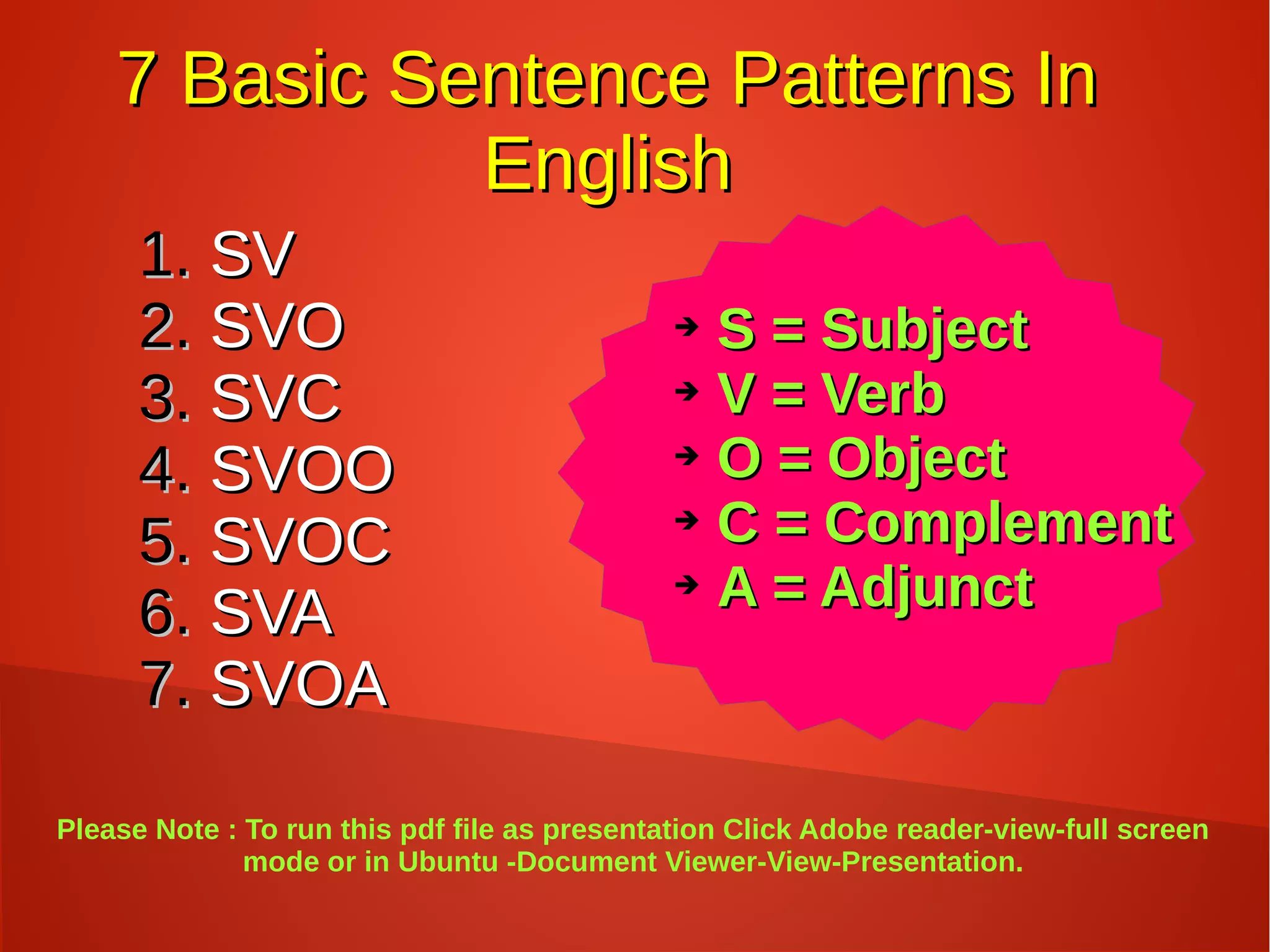
7 Basic Sentence Patterns In7 Basic Sentence Patterns In
EnglishEnglish
1.1. SVSV
2.2. SVOSVO
3.3. SVCSVC
4.4. SVOOSVOO
5.5. SVOCSVOC
6.6. SVASVA
7.7. SVOASVOA
➔
S = SubjectS = Subject
➔
V = VerbV = Verb
➔
O = ObjectO = Object
➔
C = ComplementC = Complement
➔
A = AdjunctA = Adjunct
Please Note : To run this pdf file as presentation Click Adobe reader-view-full screen
mode or in Ubuntu -Document Viewer-View-Presentation.
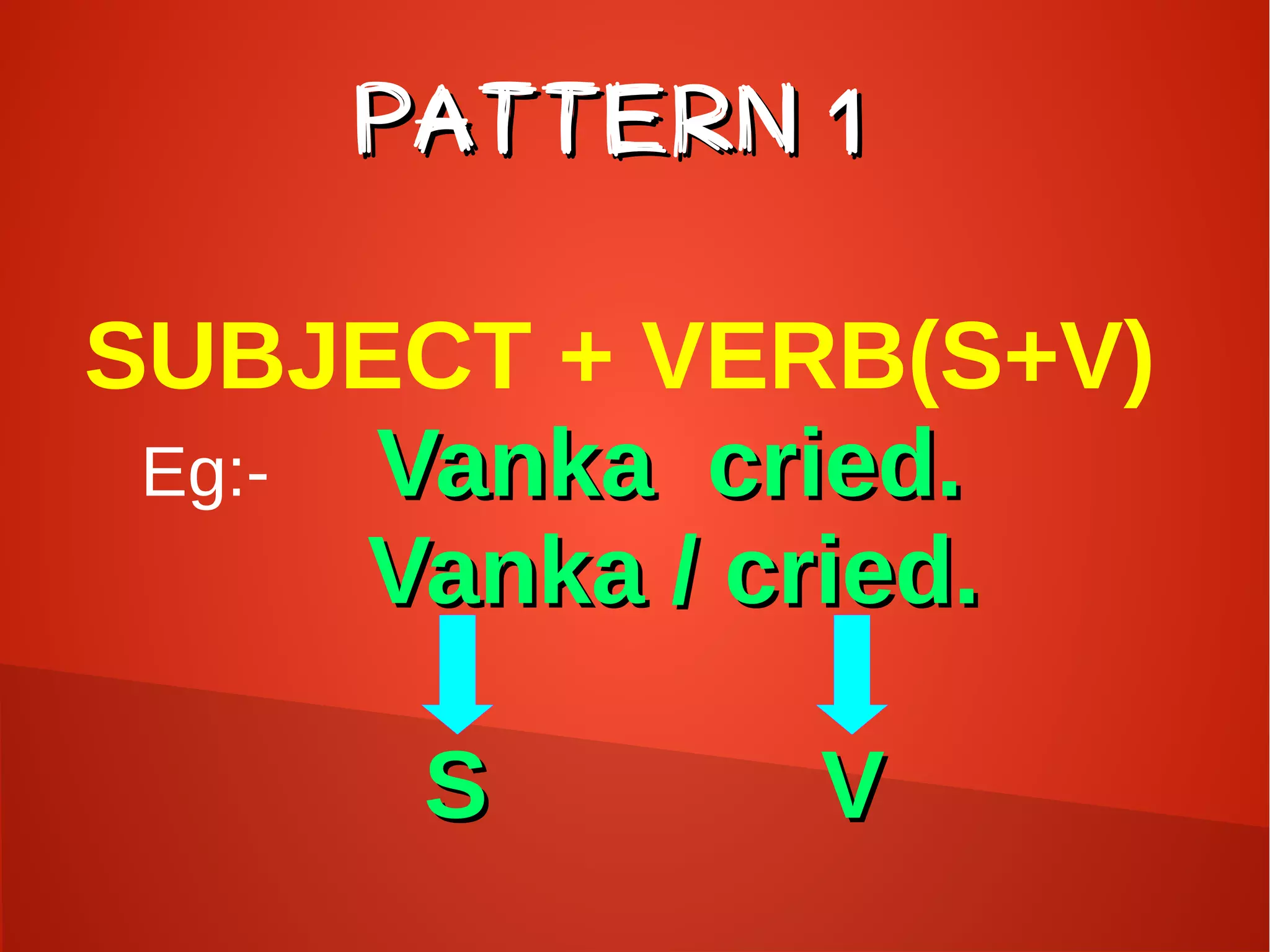
PATTERN 1PATTERN 1
SUBJECT + VERB(S+V)
Eg:- Vanka cried.Vanka cried.
Vanka / cried.Vanka / cried.
SS VV
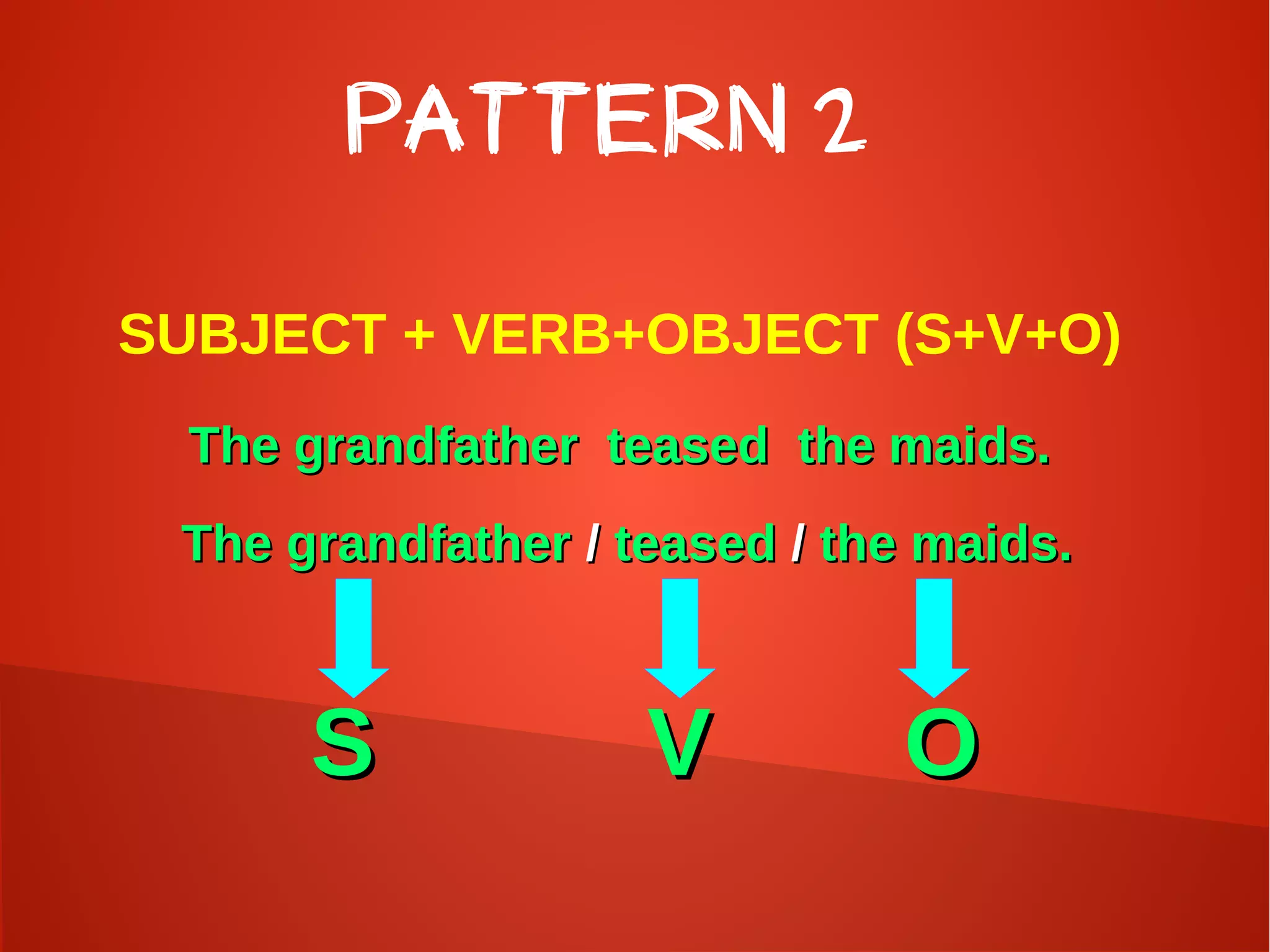
PATTERN 2
SUBJECT + VERB+OBJECT (S+V+O)
The grandfather teased the maids.The grandfather teased the maids.
The grandfatherThe grandfather // teasedteased // the maids.the maids.
SS VV OO
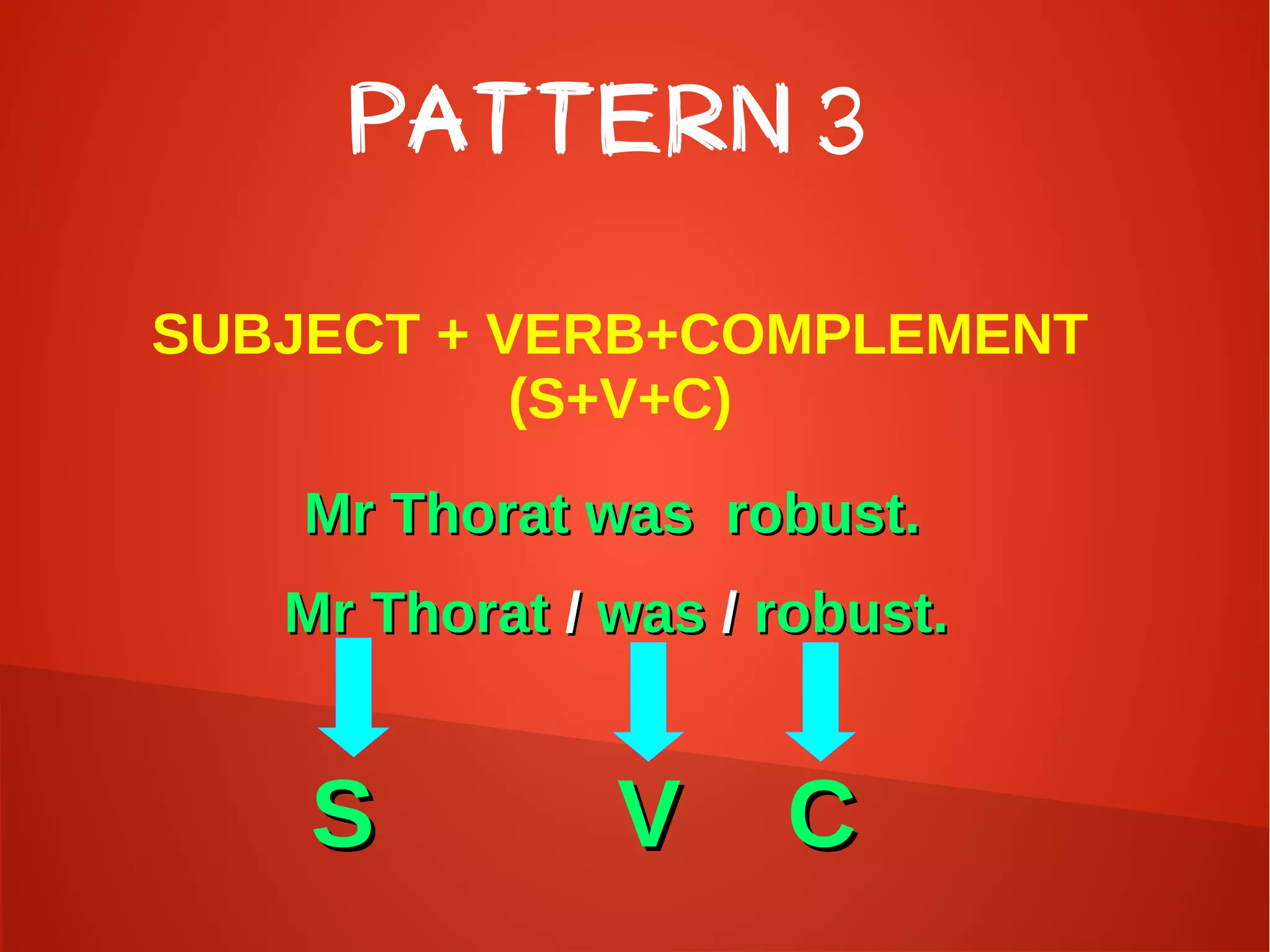
PATTERN 3
SUBJECT + VERB+COMPLEMENT
(S+V+C)
Mr Thorat was robust.Mr Thorat was robust.
Mr ThoratMr Thorat // waswas // robust.robust.
SS VV CC
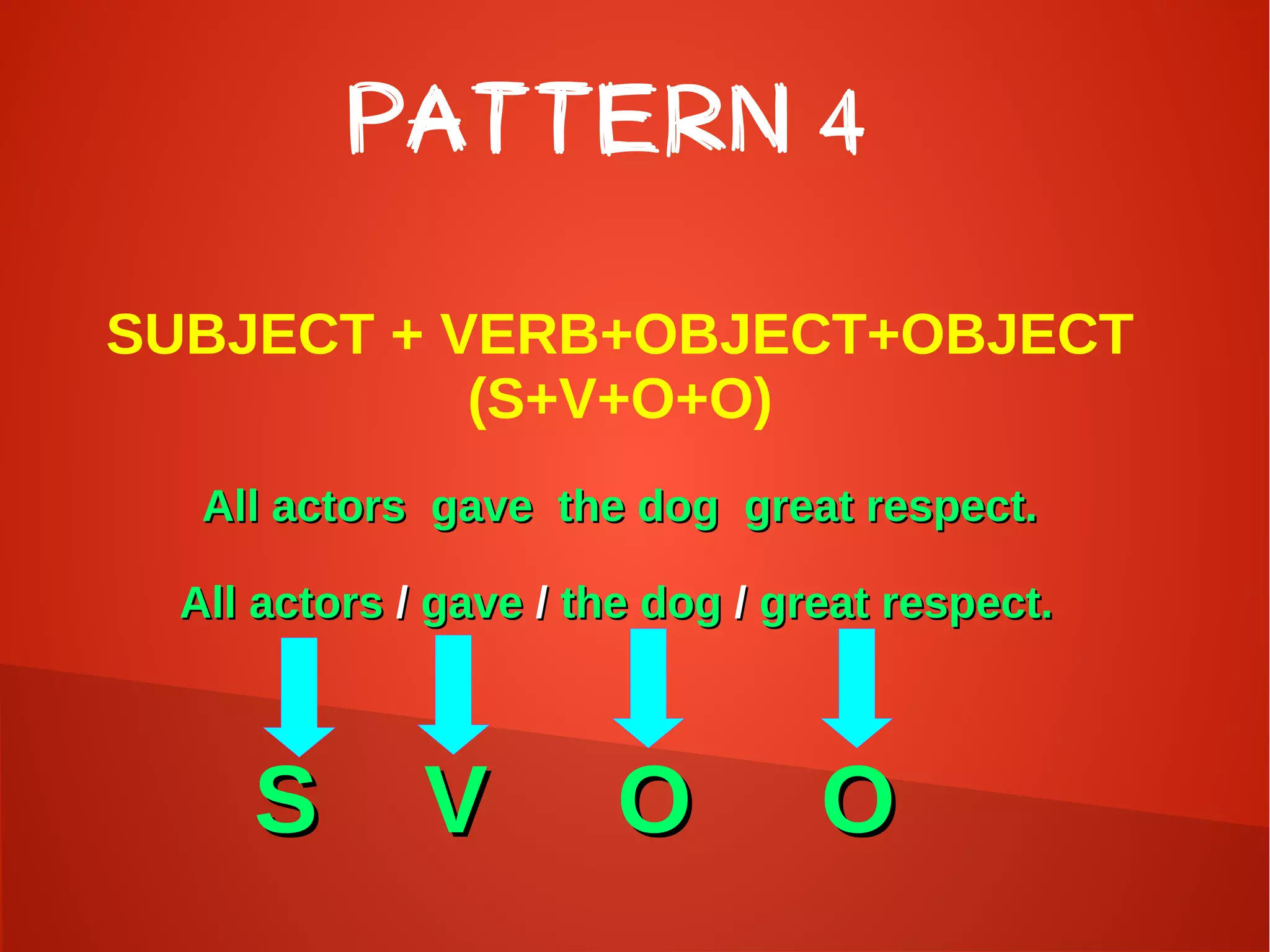
PATTERN 4
SUBJECT + VERB+OBJECT+OBJECT
(S+V+O+O)
All actors gave the dog great respect.All actors gave the dog great respect.
All actorsAll actors // gavegave // the dogthe dog // great respect.great respect.
SS VV OO OO
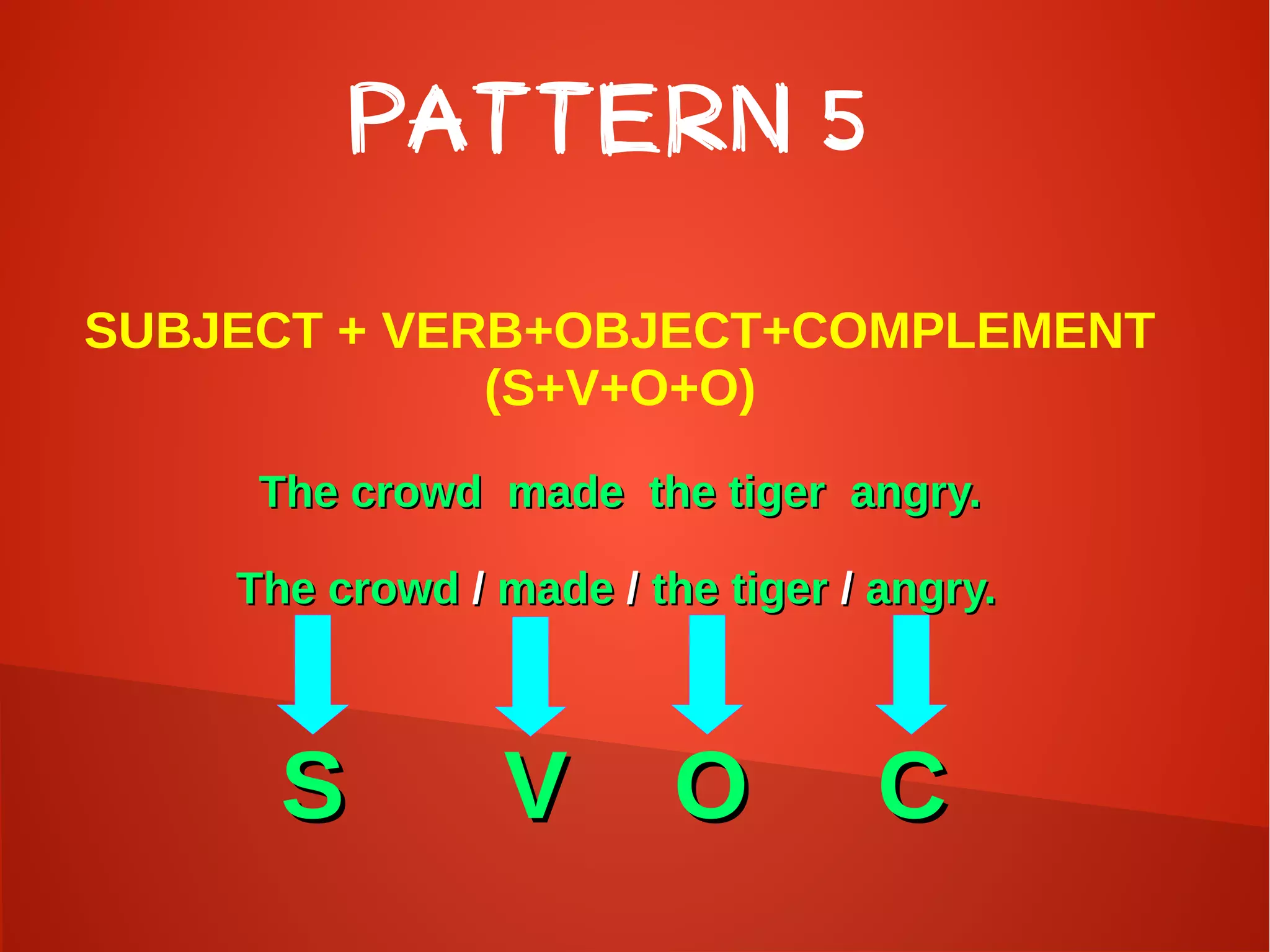
PATTERN 5
SUBJECT + VERB+OBJECT+COMPLEMENT
(S+V+O+O)
The crowd made the tiger angry.The crowd made the tiger angry.
The crowdThe crowd // mademade // the tigerthe tiger // angry.angry.
SS VV OO CC
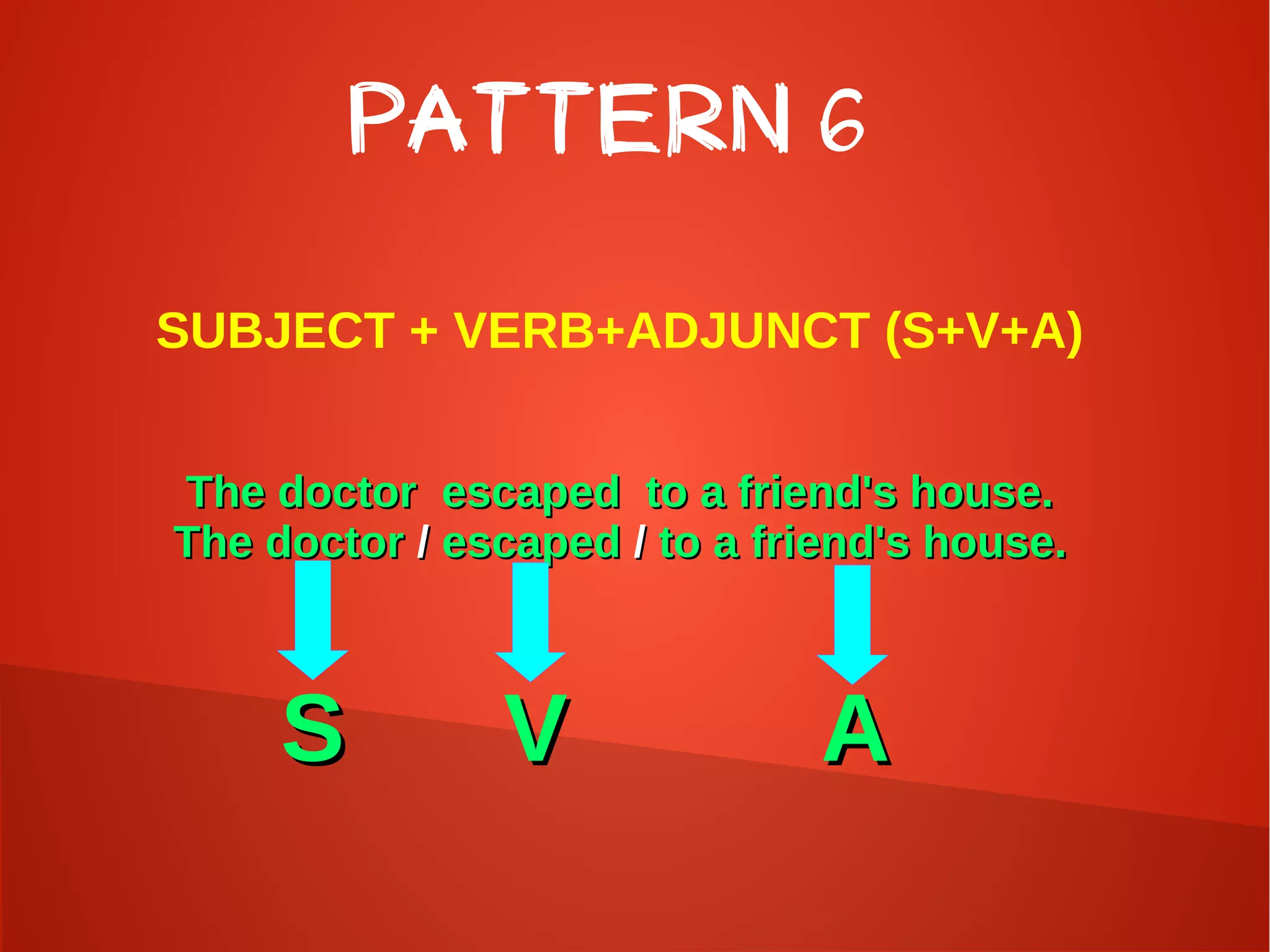
PATTERN 6
SUBJECT + VERB+ADJUNCT (S+V+A)
The doctor escaped to a friend's house.The doctor escaped to a friend's house.
The doctorThe doctor // escapedescaped // to a friend's house.to a friend's house.
SS VV AA
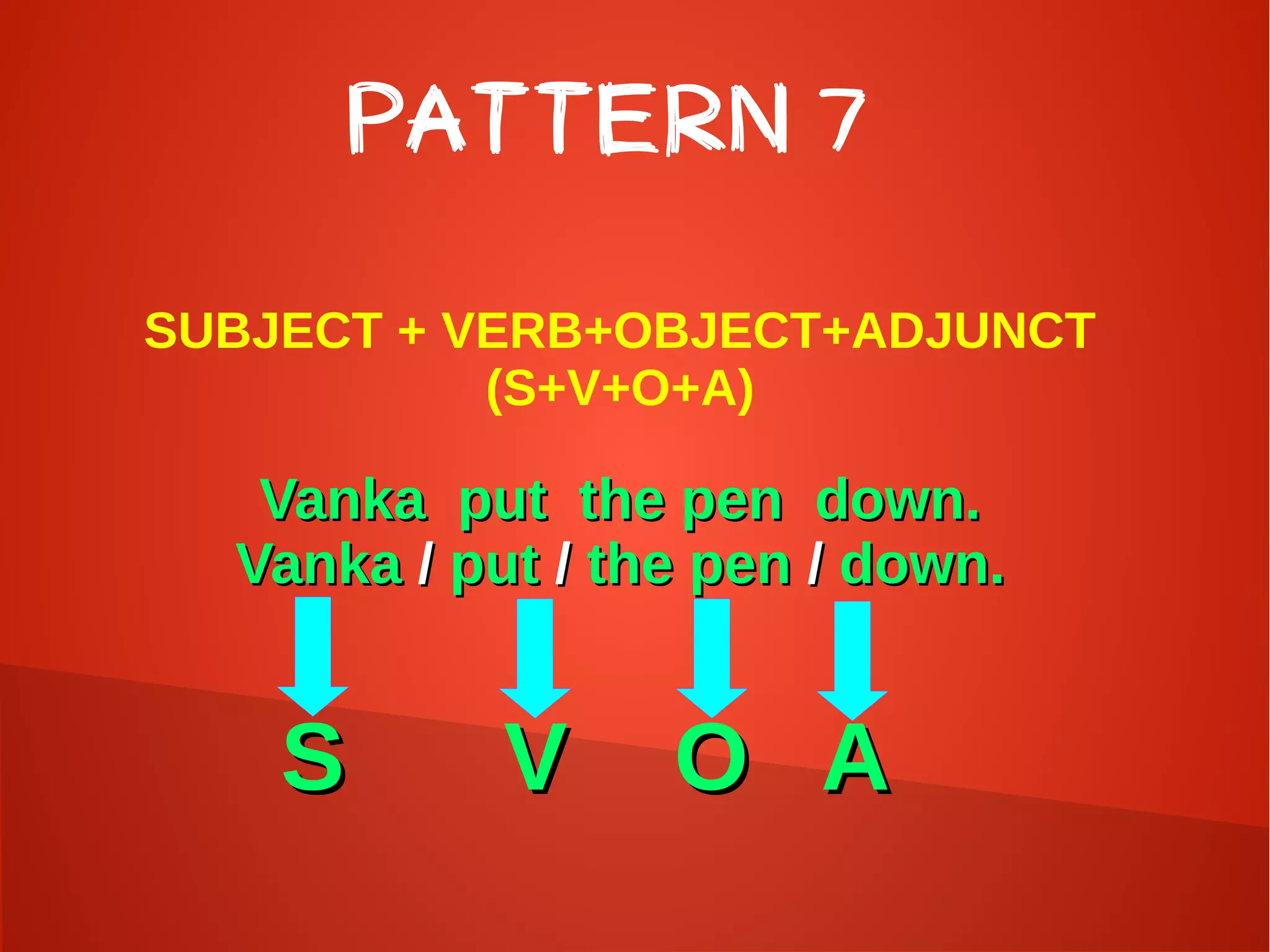
PATTERN 7
SUBJECT + VERB+OBJECT+ADJUNCT
(S+V+O+A)
Vanka put the pen down.Vanka put the pen down.
VankaVanka // putput // the penthe pen // down.down.
SS V OV O AA
SUBJECTSUBJECT
TheThe subjectsubject of a sentence is theof a sentence is the
person, place, thing, or ideaperson, place, thing, or idea thatthat
isis doingdoing something orsomething or beingbeing
something.something.
Eg:- Vanka is writing a letter.
(Who is writing the letter? = Vanka)
The ringmaster was also a South Indian.
(Who also was a south Indian? = The ring
master)
SUBJECTSUBJECT
All the subjects in the following passage areAll the subjects in the following passage are
underlined.underlined.
OnceOnce the tigerthe tiger had calmed down,had calmed down, wewe
managed to take the few shotsmanaged to take the few shots wewe needed.needed.
ThisThis should have been the end of the story.should have been the end of the story.
But, whenBut, when wewe returned to Calcutta andreturned to Calcutta and
looked at the scenes with the tiger,looked at the scenes with the tiger, wewe
realised thatrealised that the camerathe camera had failed to workhad failed to work
properly.properly.
VERBVERB
A verb is a kind of word that tellsA verb is a kind of word that tells
about an action or a state.about an action or a state.
Eg:-HeEg:-He openedopened the door of the cage.the door of the cage.
(What did he do? / What was his action?(What did he do? / What was his action?
= opened)= opened)
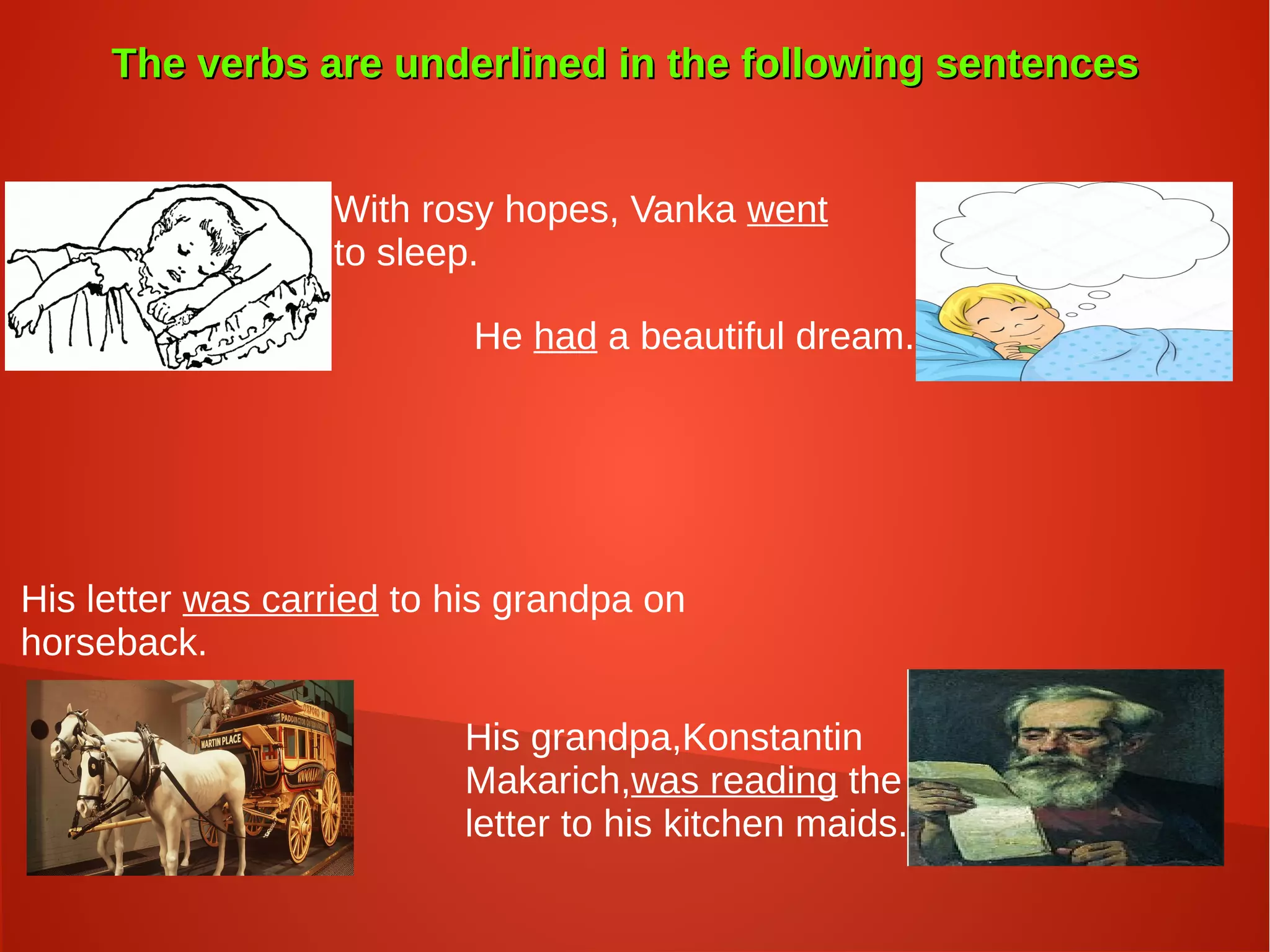
The verbs are underlined in the following sentencesThe verbs are underlined in the following sentences
With rosy hopes, Vanka went
to sleep.
He had a beautiful dream.
His letter was carried to his grandpa on
horseback.
His grandpa,Konstantin
Makarich,was reading the
letter to his kitchen maids.
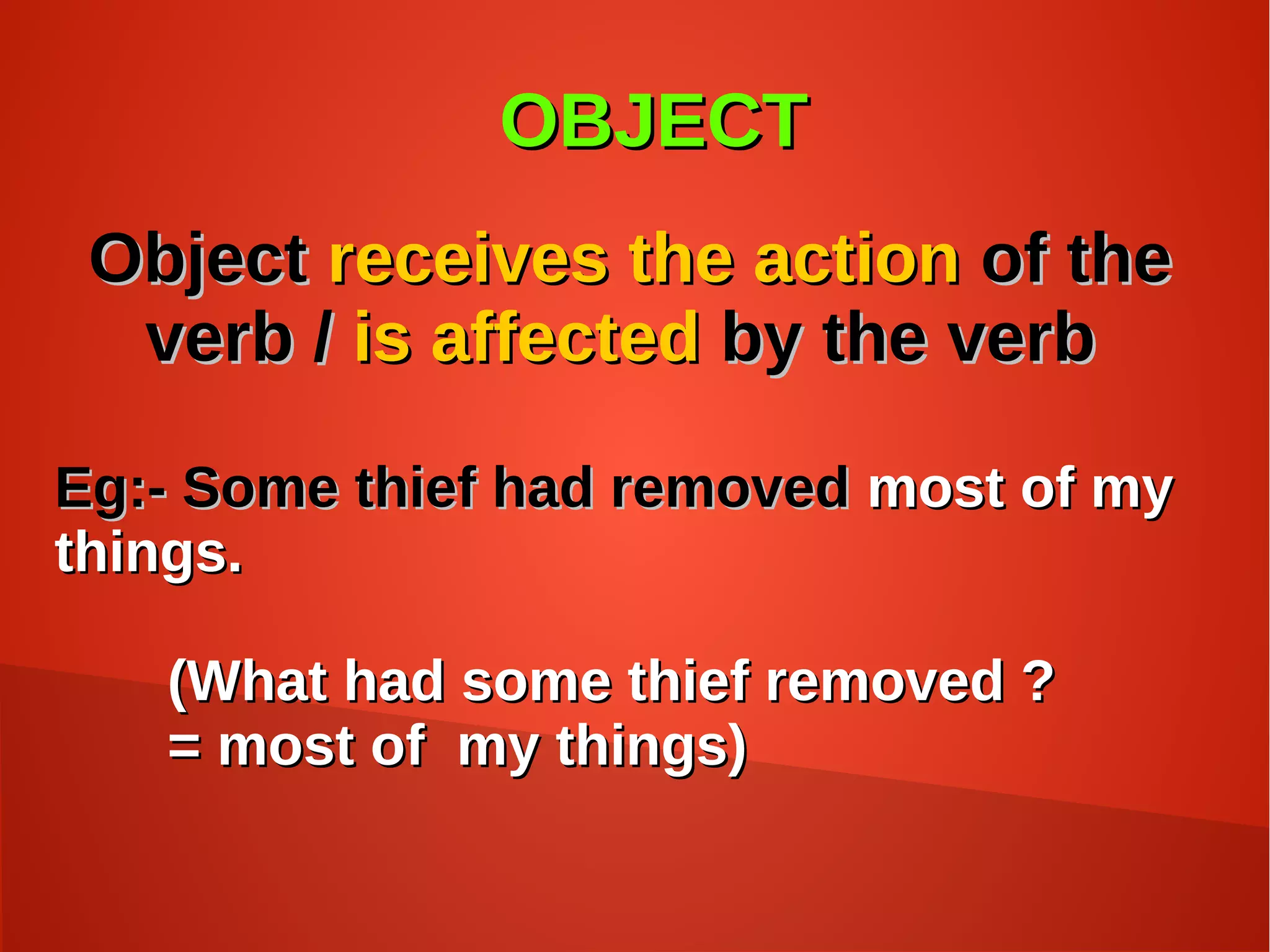
OBJECTOBJECT
ObjectObject receives the actionreceives the action of theof the
verb /verb / is affectedis affected by the verbby the verb
Eg:- Some thief had removedEg:- Some thief had removed most of mymost of my
things.things.
(What had some thief removed ?(What had some thief removed ?
= most of my things)= most of my things)
OBJECTOBJECT
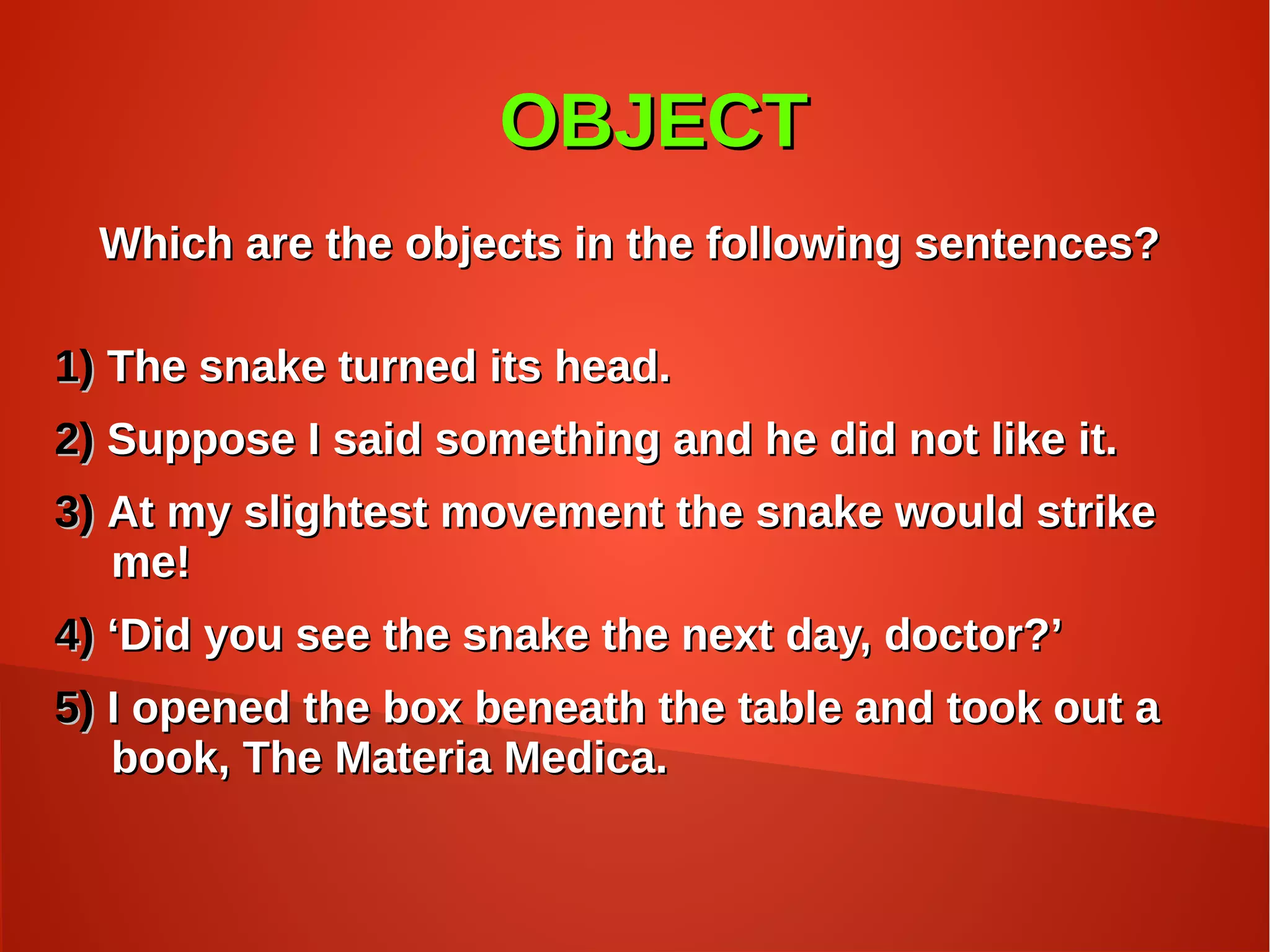
Which are the objects in the following sentences?Which are the objects in the following sentences?
1)1) The snake turned its head.The snake turned its head.
2)2) Suppose I said something and he did not like it.Suppose I said something and he did not like it.
3)3) At my slightest movement the snake would strikeAt my slightest movement the snake would strike
me!me!
4)4) ‘‘Did you see the snake the next day, doctor?’Did you see the snake the next day, doctor?’
5)5) I opened the box beneath the table and took out aI opened the box beneath the table and took out a
book, The Materia Medica.book, The Materia Medica.
OBJECTOBJECT
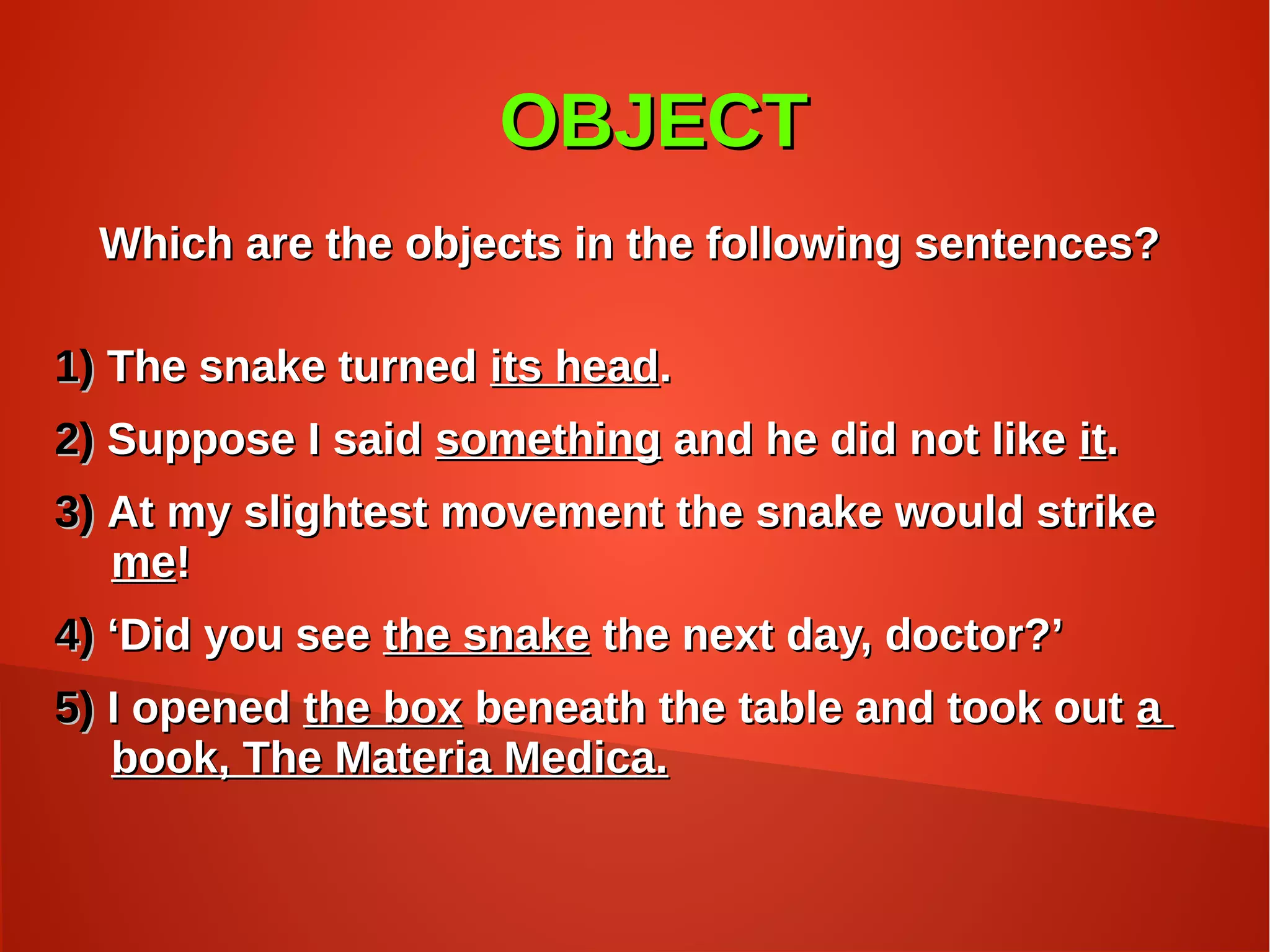
Which are the objects in the following sentences?Which are the objects in the following sentences?
1)1) The snake turnedThe snake turned its headits head..
2)2) Suppose I saidSuppose I said somethingsomething and he did not likeand he did not like itit..
3)3) At my slightest movement the snake would strikeAt my slightest movement the snake would strike
meme!!
4)4) ‘‘Did you seeDid you see the snakethe snake the next day, doctor?’the next day, doctor?’
5)5) I openedI opened the boxthe box beneath the table and took outbeneath the table and took out aa
book, The Materia Medica.book, The Materia Medica.
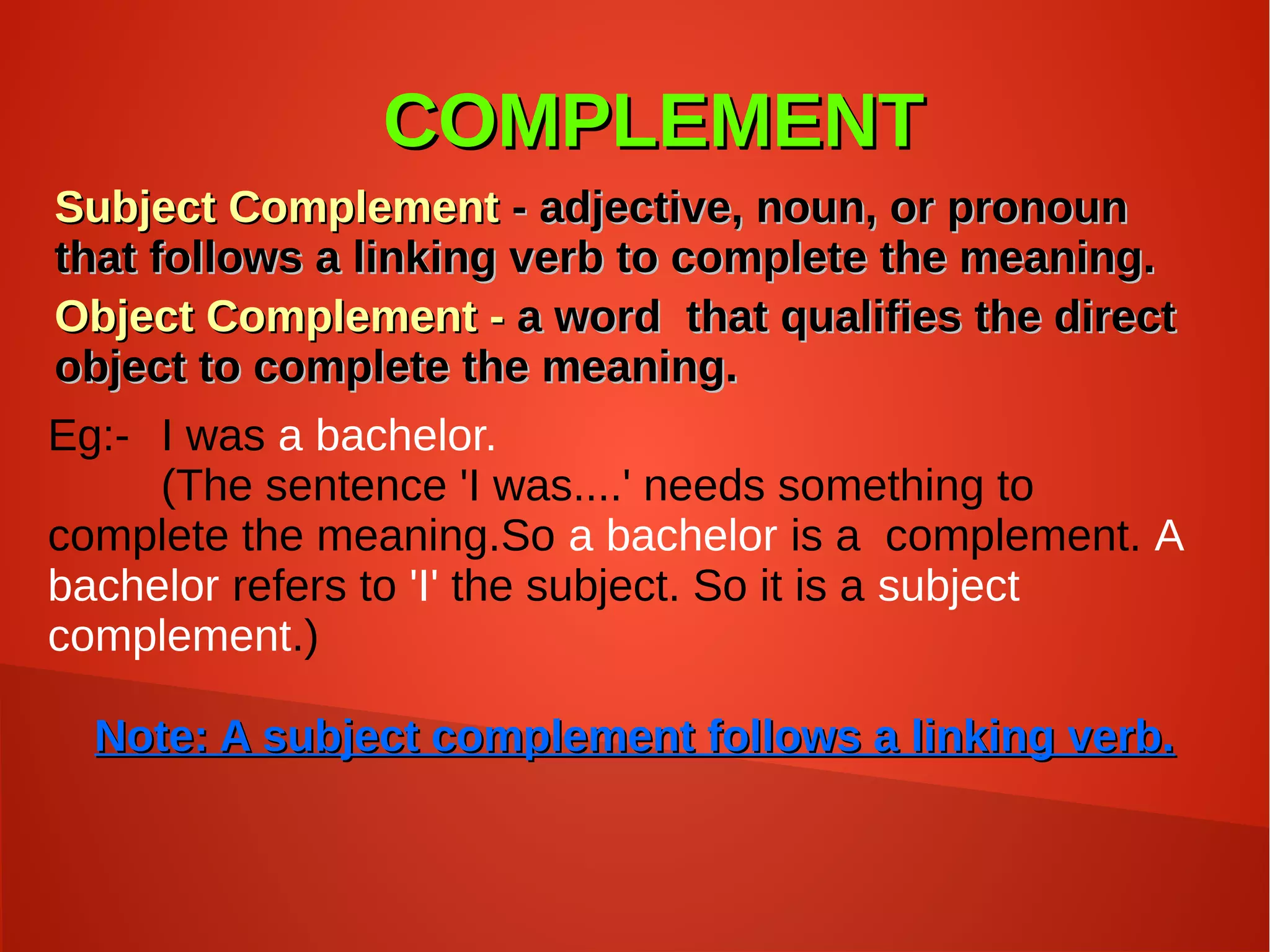
COMPLEMENTCOMPLEMENT
Subject ComplementSubject Complement - adjective, noun, or pronoun- adjective, noun, or pronoun
that follows a linking verb to complete the meaning.that follows a linking verb to complete the meaning.
Object Complement -Object Complement - a word that qualifies the directa word that qualifies the direct
object to complete the meaning.object to complete the meaning.
Eg:- I was a bachelor.
(The sentence 'I was....' needs something to
complete the meaning.So a bachelor is a complement. A
bachelor refers to 'I' the subject. So it is a subject
complement.)
Note: A subject complement follows a linking verb.Note: A subject complement follows a linking verb.
COMPLEMENT contd.....COMPLEMENT contd.....
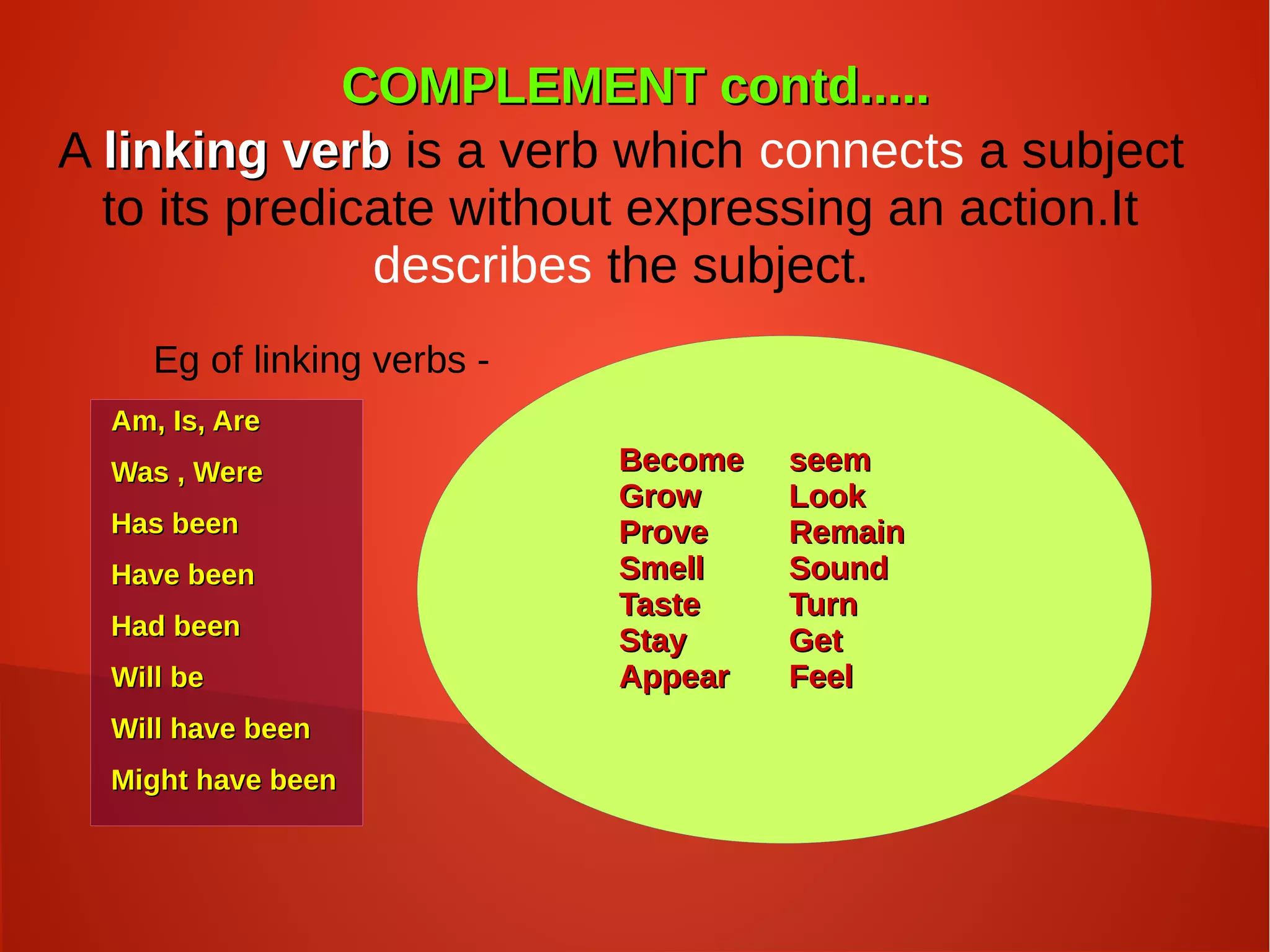
A linking verblinking verb is a verb which connects a subject
to its predicate without expressing an action.It
describes the subject.
Am, Is, AreAm, Is, Are
Was , WereWas , Were
Has beenHas been
Have beenHave been
Had beenHad been
Will beWill be
Will have beenWill have been
Might have beenMight have been
BecomeBecome seemseem
GrowGrow LookLook
ProveProve RemainRemain
SmellSmell SoundSound
TasteTaste TurnTurn
StayStay GetGet
AppearAppear FeelFeel
Eg of linking verbs -
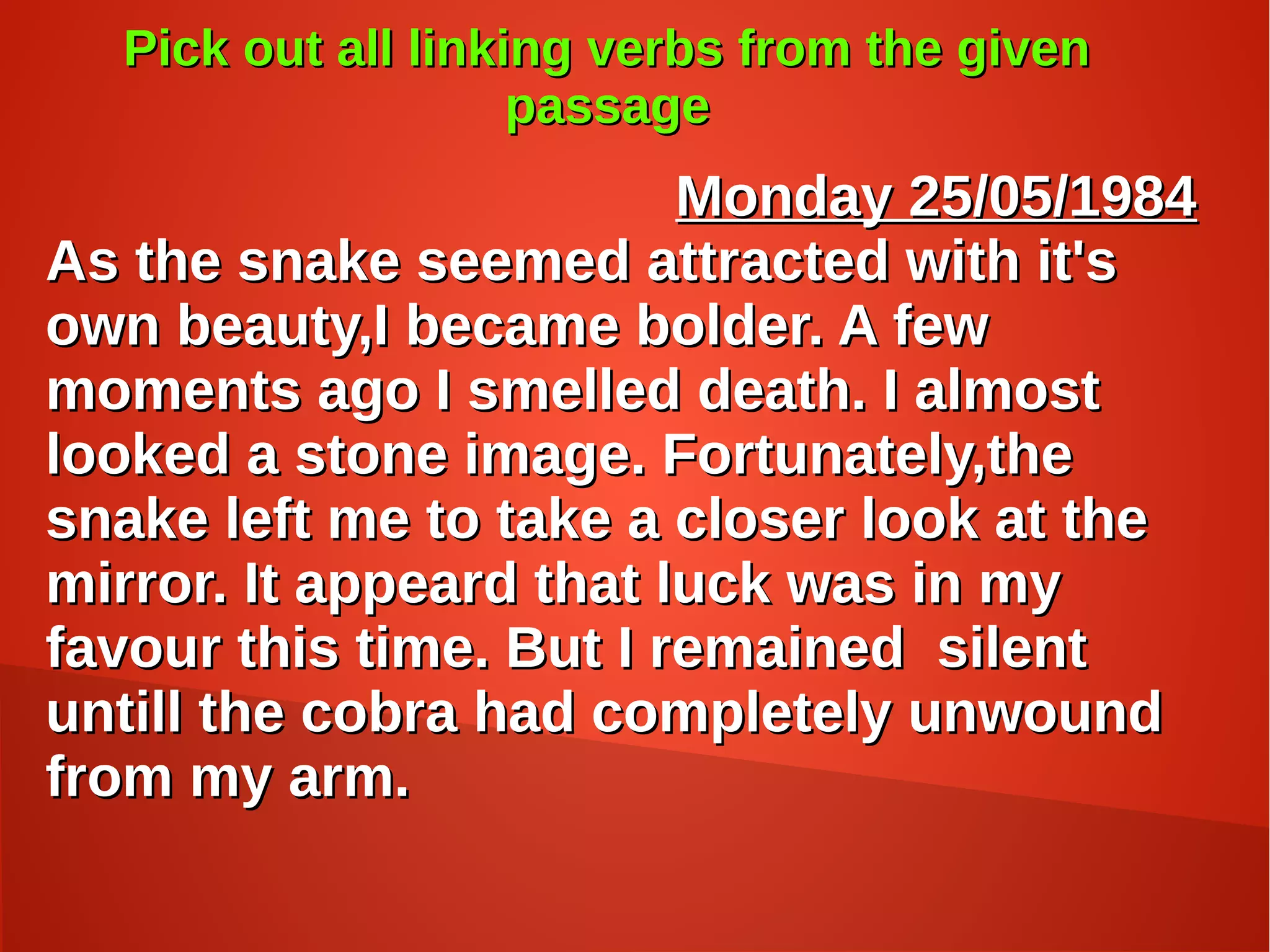
Pick out all linking verbs from the givenPick out all linking verbs from the given
passagepassage
Monday 25/05/1984Monday 25/05/1984
As the snake seemed attracted with it'sAs the snake seemed attracted with it's
own beauty,I became bolder. A fewown beauty,I became bolder. A few
moments ago I smelled death. I almostmoments ago I smelled death. I almost
looked a stone image. Fortunately,thelooked a stone image. Fortunately,the
snake left me to take a closer look at thesnake left me to take a closer look at the
mirror. It appeard that luck was in mymirror. It appeard that luck was in my
favour this time. But I remained silentfavour this time. But I remained silent
untill the cobra had completely unwounduntill the cobra had completely unwound
from my arm.from my arm.
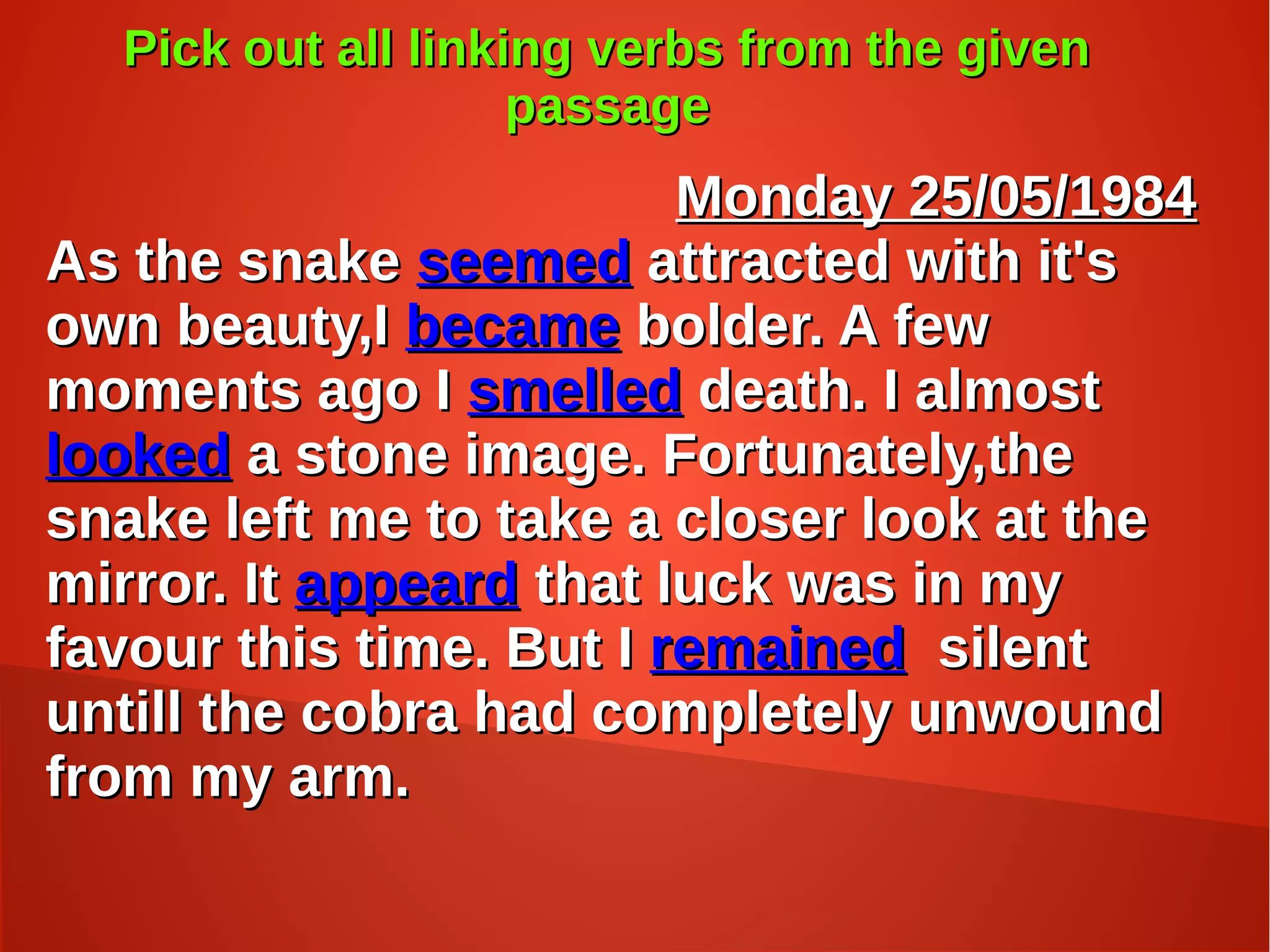
Pick out all linking verbs from the givenPick out all linking verbs from the given
passagepassage
Monday 25/05/1984Monday 25/05/1984
As the snakeAs the snake seemedseemed attracted with it'sattracted with it's
own beauty,Iown beauty,I becamebecame bolder. A fewbolder. A few
moments ago Imoments ago I smelledsmelled death. I almostdeath. I almost
lookedlooked a stone image. Fortunately,thea stone image. Fortunately,the
snake left me to take a closer look at thesnake left me to take a closer look at the
mirror. Itmirror. It appeardappeard that luck was in mythat luck was in my
favour this time. But Ifavour this time. But I remainedremained silentsilent
untill the cobra had completely unwounduntill the cobra had completely unwound
from my arm.from my arm.
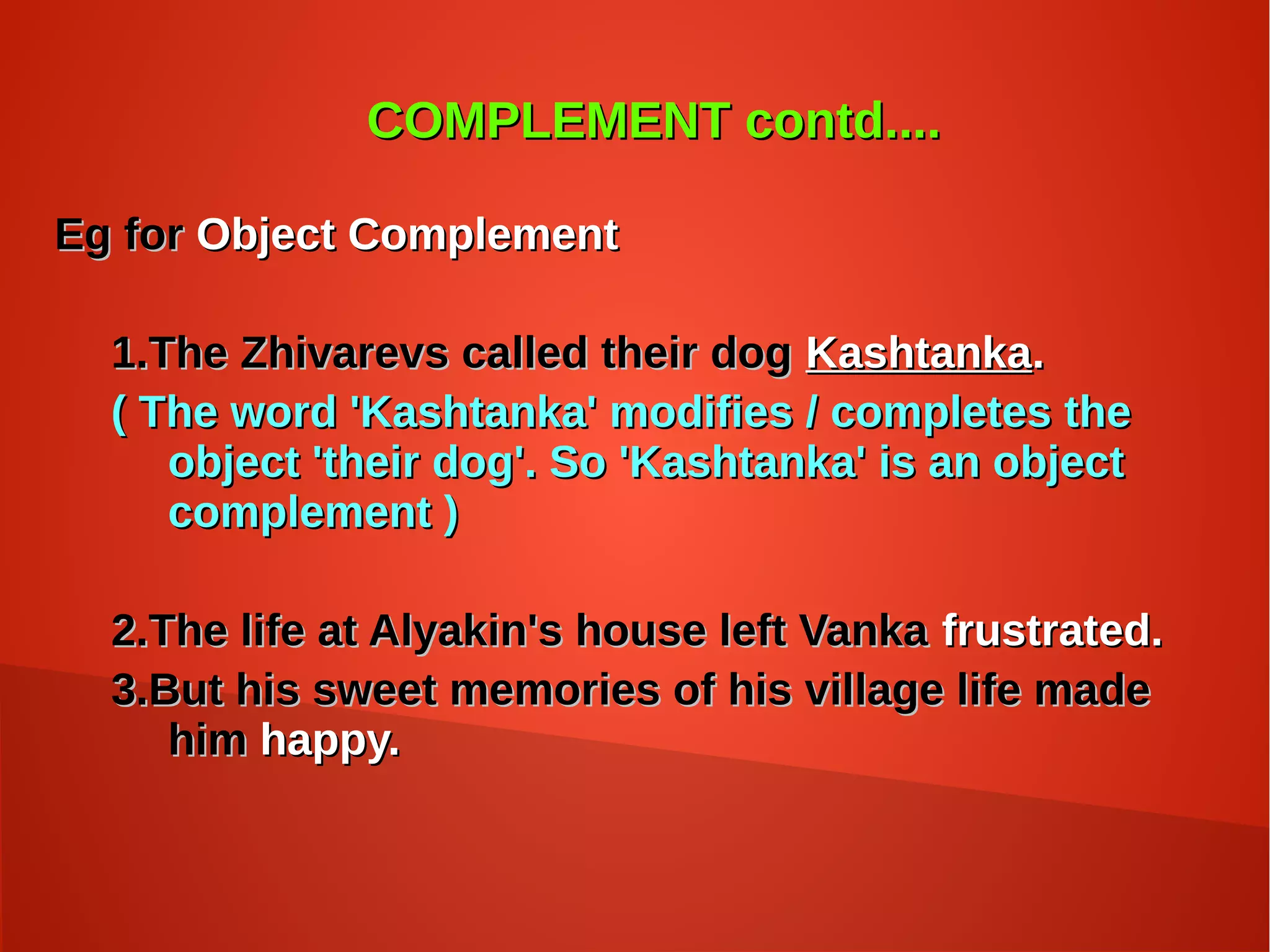
COMPLEMENT contd....COMPLEMENT contd....
Eg forEg for Object ComplementObject Complement
1.The Zhivarevs called their dog1.The Zhivarevs called their dog KashtankaKashtanka..
( The word 'Kashtanka' modifies / completes the( The word 'Kashtanka' modifies / completes the
object 'their dog'. So 'Kashtanka' is an objectobject 'their dog'. So 'Kashtanka' is an object
complement )complement )
2.The life at Alyakin's house left Vanka2.The life at Alyakin's house left Vanka frustrated.frustrated.
3.But his sweet memories of his village life made3.But his sweet memories of his village life made
himhim happy.happy.
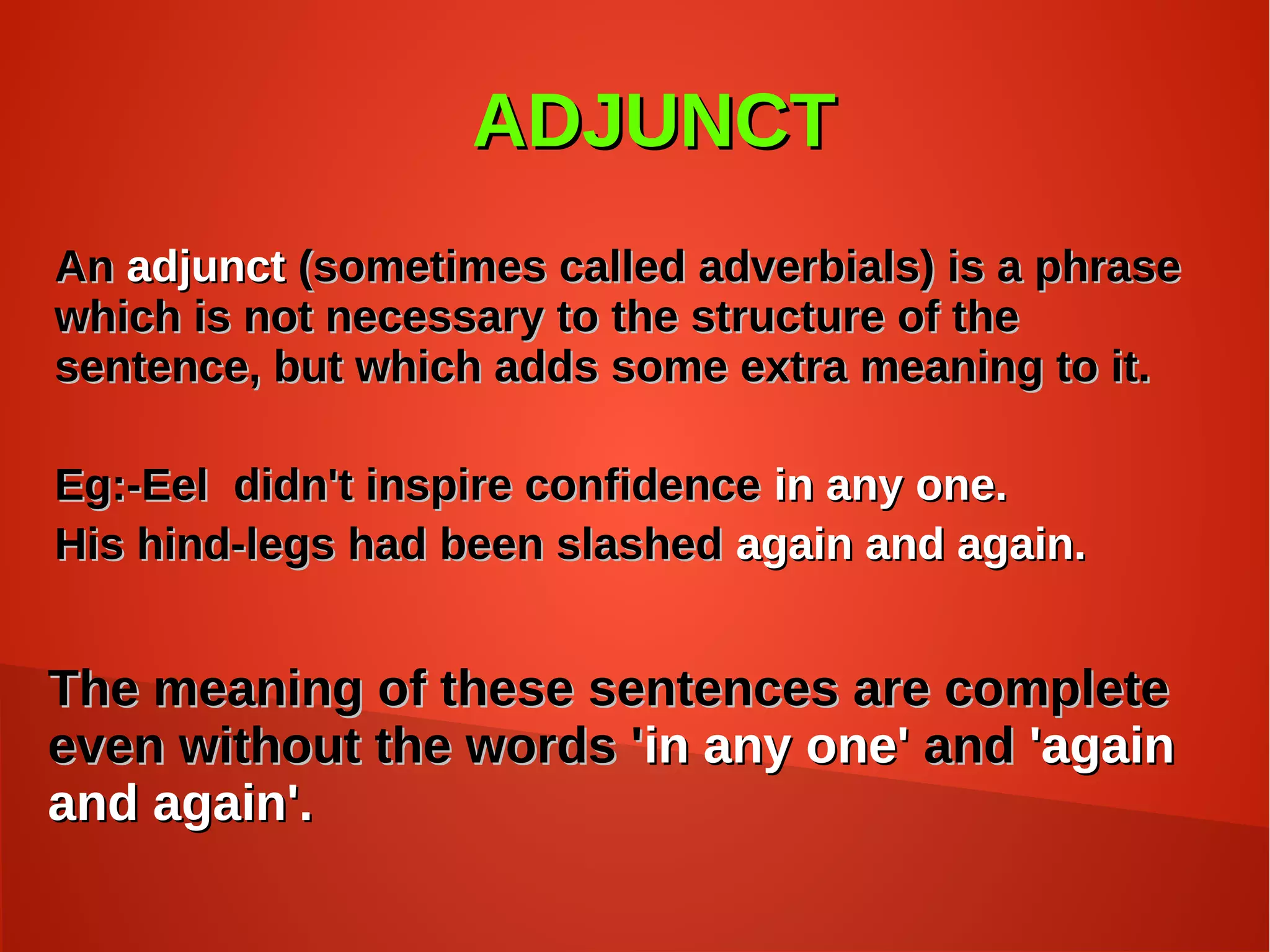
ADJUNCTADJUNCT
AnAn adjunctadjunct (sometimes called adverbials) is a phrase(sometimes called adverbials) is a phrase
which is not necessary to the structure of thewhich is not necessary to the structure of the
sentence, but which adds some extra meaning to it.sentence, but which adds some extra meaning to it.
Eg:-Eel didn't inspire confidenceEg:-Eel didn't inspire confidence in any one.in any one.
His hind-legs had been slashedHis hind-legs had been slashed again and again.again and again.
The meaning of these sentences are completeThe meaning of these sentences are complete
even without the words 'even without the words 'in any one'in any one' andand 'again'again
and again'.and again'.
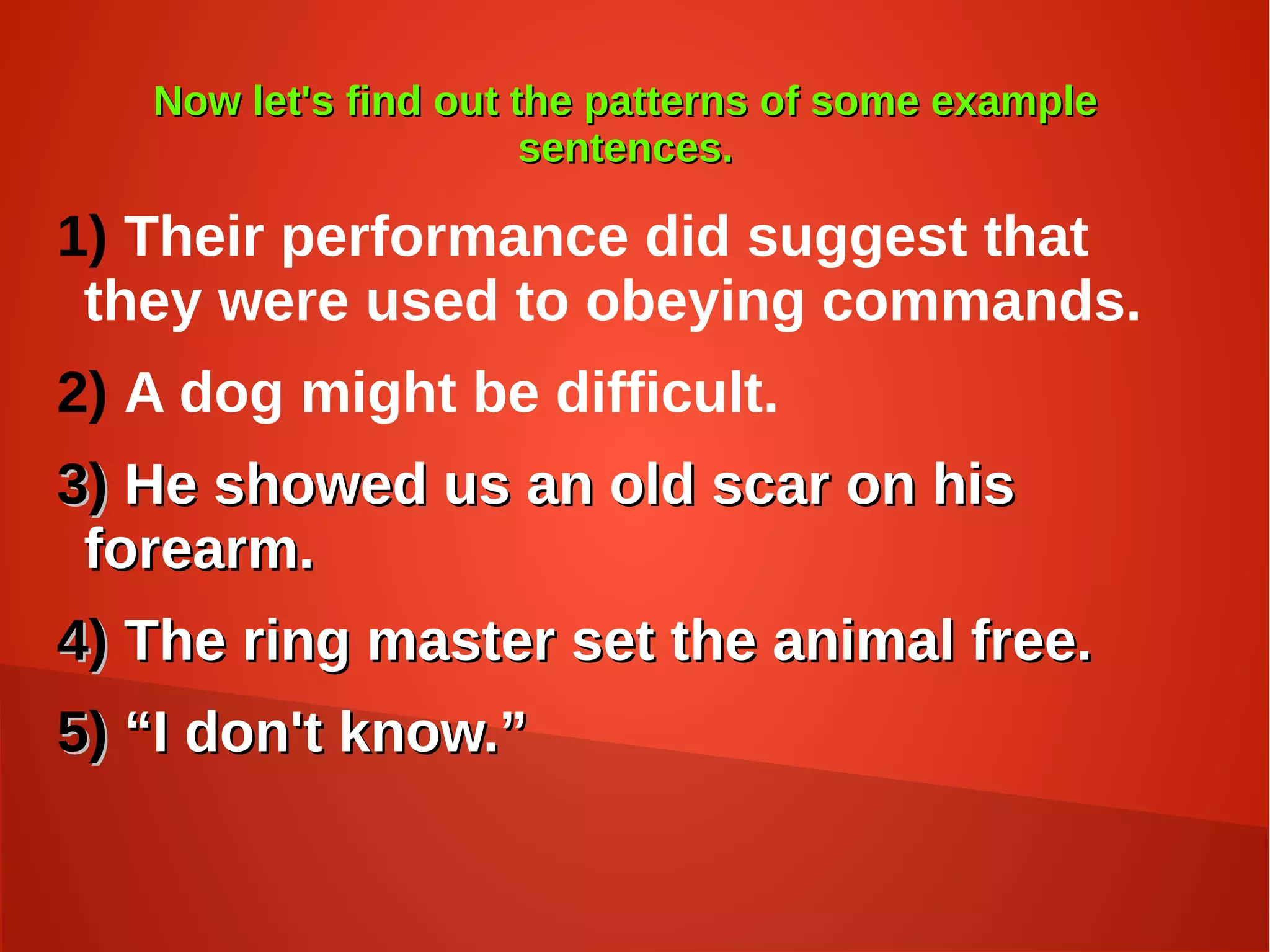
Now let's find out the patterns of some exampleNow let's find out the patterns of some example
sentences.sentences.
1) Their performance did suggest that
they were used to obeying commands.
2) A dog might be difficult.
3)3) He showed us an old scar on hisHe showed us an old scar on his
forearm.forearm.
4)4) The ring master set the animal free.The ring master set the animal free.
5)5) ““I don't know.”I don't know.”
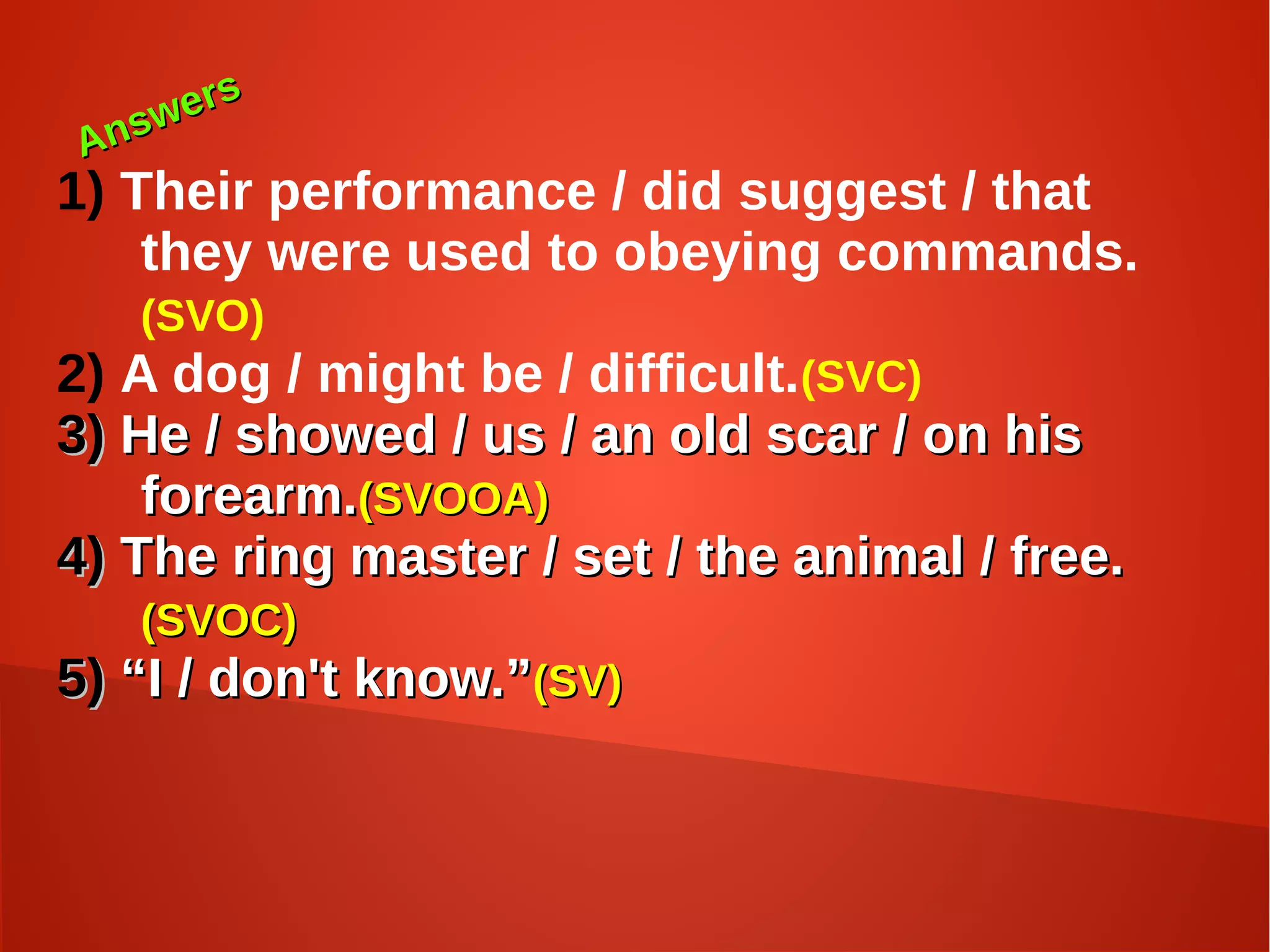
Answers
Answers
1) Their performance / did suggest / that
they were used to obeying commands.
(SVO)
2) A dog / might be / difficult.(SVC)
3)3) He / showed / us / an old scar / on hisHe / showed / us / an old scar / on his
forearm.forearm.(SVOOA)(SVOOA)
4)4) The ring master / set / the animal / free.The ring master / set / the animal / free.
(SVOC)(SVOC)
5)5) ““I / don't know.”I / don't know.”(SV)(SV)
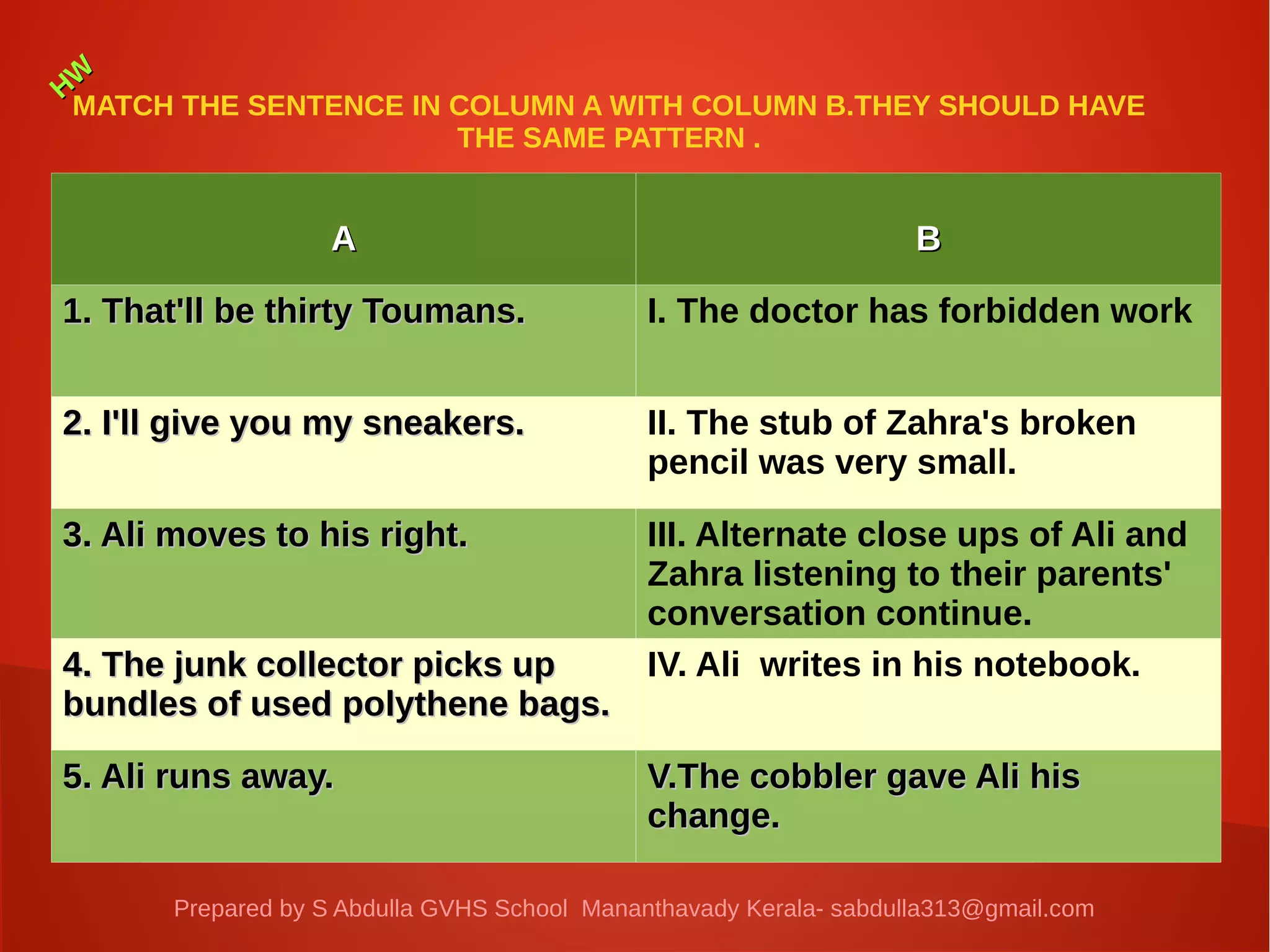
MATCH THE SENTENCE IN COLUMN A WITH COLUMN B.THEY SHOULD HAVE
THE SAME PATTERN .
AA BB
1. That'll be thirty Toumans.1. That'll be thirty Toumans. I. The doctor has forbidden work
2. I'll give you my sneakers.2. I'll give you my sneakers. II. The stub of Zahra's broken
pencil was very small.
3. Ali moves to his right.3. Ali moves to his right. III. Alternate close ups of Ali and
Zahra listening to their parents'
conversation continue.
4. The junk collector picks up4. The junk collector picks up
bundles of used polythene bags.bundles of used polythene bags.
IV. Ali writes in his notebook.
5. Ali runs away.5. Ali runs away. V.The cobbler gave Ali hisV.The cobbler gave Ali his
change.change.
Prepared by S Abdulla GVHS School Mananthavady Kerala- sabdulla313@gmail.com
HWHW

Sentence patterns

  • 1.
    7 Basic SentencePatterns In7 Basic Sentence Patterns In EnglishEnglish 1.1. SVSV 2.2. SVOSVO 3.3. SVCSVC 4.4. SVOOSVOO 5.5. SVOCSVOC 6.6. SVASVA 7.7. SVOASVOA ➔ S = SubjectS = Subject ➔ V = VerbV = Verb ➔ O = ObjectO = Object ➔ C = ComplementC = Complement ➔ A = AdjunctA = Adjunct Please Note : To run this pdf file as presentation Click Adobe reader-view-full screen mode or in Ubuntu -Document Viewer-View-Presentation.
  • 2.
    PATTERN 1PATTERN 1 SUBJECT+ VERB(S+V) Eg:- Vanka cried.Vanka cried. Vanka / cried.Vanka / cried. SS VV
  • 3.
    PATTERN 2 SUBJECT +VERB+OBJECT (S+V+O) The grandfather teased the maids.The grandfather teased the maids. The grandfatherThe grandfather // teasedteased // the maids.the maids. SS VV OO
  • 4.
    PATTERN 3 SUBJECT +VERB+COMPLEMENT (S+V+C) Mr Thorat was robust.Mr Thorat was robust. Mr ThoratMr Thorat // waswas // robust.robust. SS VV CC
  • 5.
    PATTERN 4 SUBJECT +VERB+OBJECT+OBJECT (S+V+O+O) All actors gave the dog great respect.All actors gave the dog great respect. All actorsAll actors // gavegave // the dogthe dog // great respect.great respect. SS VV OO OO
  • 6.
    PATTERN 5 SUBJECT +VERB+OBJECT+COMPLEMENT (S+V+O+O) The crowd made the tiger angry.The crowd made the tiger angry. The crowdThe crowd // mademade // the tigerthe tiger // angry.angry. SS VV OO CC
  • 7.
    PATTERN 6 SUBJECT +VERB+ADJUNCT (S+V+A) The doctor escaped to a friend's house.The doctor escaped to a friend's house. The doctorThe doctor // escapedescaped // to a friend's house.to a friend's house. SS VV AA
  • 8.
    PATTERN 7 SUBJECT +VERB+OBJECT+ADJUNCT (S+V+O+A) Vanka put the pen down.Vanka put the pen down. VankaVanka // putput // the penthe pen // down.down. SS V OV O AA
  • 9.
    SUBJECTSUBJECT TheThe subjectsubject ofa sentence is theof a sentence is the person, place, thing, or ideaperson, place, thing, or idea thatthat isis doingdoing something orsomething or beingbeing something.something. Eg:- Vanka is writing a letter. (Who is writing the letter? = Vanka) The ringmaster was also a South Indian. (Who also was a south Indian? = The ring master)
  • 10.
    SUBJECTSUBJECT All the subjectsin the following passage areAll the subjects in the following passage are underlined.underlined. OnceOnce the tigerthe tiger had calmed down,had calmed down, wewe managed to take the few shotsmanaged to take the few shots wewe needed.needed. ThisThis should have been the end of the story.should have been the end of the story. But, whenBut, when wewe returned to Calcutta andreturned to Calcutta and looked at the scenes with the tiger,looked at the scenes with the tiger, wewe realised thatrealised that the camerathe camera had failed to workhad failed to work properly.properly.
  • 11.
    VERBVERB A verb isa kind of word that tellsA verb is a kind of word that tells about an action or a state.about an action or a state. Eg:-HeEg:-He openedopened the door of the cage.the door of the cage. (What did he do? / What was his action?(What did he do? / What was his action? = opened)= opened)
  • 12.
    The verbs areunderlined in the following sentencesThe verbs are underlined in the following sentences With rosy hopes, Vanka went to sleep. He had a beautiful dream. His letter was carried to his grandpa on horseback. His grandpa,Konstantin Makarich,was reading the letter to his kitchen maids.
  • 13.
    OBJECTOBJECT ObjectObject receives theactionreceives the action of theof the verb /verb / is affectedis affected by the verbby the verb Eg:- Some thief had removedEg:- Some thief had removed most of mymost of my things.things. (What had some thief removed ?(What had some thief removed ? = most of my things)= most of my things)
  • 14.
    OBJECTOBJECT Which are theobjects in the following sentences?Which are the objects in the following sentences? 1)1) The snake turned its head.The snake turned its head. 2)2) Suppose I said something and he did not like it.Suppose I said something and he did not like it. 3)3) At my slightest movement the snake would strikeAt my slightest movement the snake would strike me!me! 4)4) ‘‘Did you see the snake the next day, doctor?’Did you see the snake the next day, doctor?’ 5)5) I opened the box beneath the table and took out aI opened the box beneath the table and took out a book, The Materia Medica.book, The Materia Medica.
  • 15.
    OBJECTOBJECT Which are theobjects in the following sentences?Which are the objects in the following sentences? 1)1) The snake turnedThe snake turned its headits head.. 2)2) Suppose I saidSuppose I said somethingsomething and he did not likeand he did not like itit.. 3)3) At my slightest movement the snake would strikeAt my slightest movement the snake would strike meme!! 4)4) ‘‘Did you seeDid you see the snakethe snake the next day, doctor?’the next day, doctor?’ 5)5) I openedI opened the boxthe box beneath the table and took outbeneath the table and took out aa book, The Materia Medica.book, The Materia Medica.
  • 16.
    COMPLEMENTCOMPLEMENT Subject ComplementSubject Complement- adjective, noun, or pronoun- adjective, noun, or pronoun that follows a linking verb to complete the meaning.that follows a linking verb to complete the meaning. Object Complement -Object Complement - a word that qualifies the directa word that qualifies the direct object to complete the meaning.object to complete the meaning. Eg:- I was a bachelor. (The sentence 'I was....' needs something to complete the meaning.So a bachelor is a complement. A bachelor refers to 'I' the subject. So it is a subject complement.) Note: A subject complement follows a linking verb.Note: A subject complement follows a linking verb.
  • 17.
    COMPLEMENT contd.....COMPLEMENT contd..... Alinking verblinking verb is a verb which connects a subject to its predicate without expressing an action.It describes the subject. Am, Is, AreAm, Is, Are Was , WereWas , Were Has beenHas been Have beenHave been Had beenHad been Will beWill be Will have beenWill have been Might have beenMight have been BecomeBecome seemseem GrowGrow LookLook ProveProve RemainRemain SmellSmell SoundSound TasteTaste TurnTurn StayStay GetGet AppearAppear FeelFeel Eg of linking verbs -
  • 18.
    Pick out alllinking verbs from the givenPick out all linking verbs from the given passagepassage Monday 25/05/1984Monday 25/05/1984 As the snake seemed attracted with it'sAs the snake seemed attracted with it's own beauty,I became bolder. A fewown beauty,I became bolder. A few moments ago I smelled death. I almostmoments ago I smelled death. I almost looked a stone image. Fortunately,thelooked a stone image. Fortunately,the snake left me to take a closer look at thesnake left me to take a closer look at the mirror. It appeard that luck was in mymirror. It appeard that luck was in my favour this time. But I remained silentfavour this time. But I remained silent untill the cobra had completely unwounduntill the cobra had completely unwound from my arm.from my arm.
  • 19.
    Pick out alllinking verbs from the givenPick out all linking verbs from the given passagepassage Monday 25/05/1984Monday 25/05/1984 As the snakeAs the snake seemedseemed attracted with it'sattracted with it's own beauty,Iown beauty,I becamebecame bolder. A fewbolder. A few moments ago Imoments ago I smelledsmelled death. I almostdeath. I almost lookedlooked a stone image. Fortunately,thea stone image. Fortunately,the snake left me to take a closer look at thesnake left me to take a closer look at the mirror. Itmirror. It appeardappeard that luck was in mythat luck was in my favour this time. But Ifavour this time. But I remainedremained silentsilent untill the cobra had completely unwounduntill the cobra had completely unwound from my arm.from my arm.
  • 20.
    COMPLEMENT contd....COMPLEMENT contd.... EgforEg for Object ComplementObject Complement 1.The Zhivarevs called their dog1.The Zhivarevs called their dog KashtankaKashtanka.. ( The word 'Kashtanka' modifies / completes the( The word 'Kashtanka' modifies / completes the object 'their dog'. So 'Kashtanka' is an objectobject 'their dog'. So 'Kashtanka' is an object complement )complement ) 2.The life at Alyakin's house left Vanka2.The life at Alyakin's house left Vanka frustrated.frustrated. 3.But his sweet memories of his village life made3.But his sweet memories of his village life made himhim happy.happy.
  • 21.
    ADJUNCTADJUNCT AnAn adjunctadjunct (sometimescalled adverbials) is a phrase(sometimes called adverbials) is a phrase which is not necessary to the structure of thewhich is not necessary to the structure of the sentence, but which adds some extra meaning to it.sentence, but which adds some extra meaning to it. Eg:-Eel didn't inspire confidenceEg:-Eel didn't inspire confidence in any one.in any one. His hind-legs had been slashedHis hind-legs had been slashed again and again.again and again. The meaning of these sentences are completeThe meaning of these sentences are complete even without the words 'even without the words 'in any one'in any one' andand 'again'again and again'.and again'.
  • 22.
    Now let's findout the patterns of some exampleNow let's find out the patterns of some example sentences.sentences. 1) Their performance did suggest that they were used to obeying commands. 2) A dog might be difficult. 3)3) He showed us an old scar on hisHe showed us an old scar on his forearm.forearm. 4)4) The ring master set the animal free.The ring master set the animal free. 5)5) ““I don't know.”I don't know.”
  • 23.
    Answers Answers 1) Their performance/ did suggest / that they were used to obeying commands. (SVO) 2) A dog / might be / difficult.(SVC) 3)3) He / showed / us / an old scar / on hisHe / showed / us / an old scar / on his forearm.forearm.(SVOOA)(SVOOA) 4)4) The ring master / set / the animal / free.The ring master / set / the animal / free. (SVOC)(SVOC) 5)5) ““I / don't know.”I / don't know.”(SV)(SV)
  • 24.
    MATCH THE SENTENCEIN COLUMN A WITH COLUMN B.THEY SHOULD HAVE THE SAME PATTERN . AA BB 1. That'll be thirty Toumans.1. That'll be thirty Toumans. I. The doctor has forbidden work 2. I'll give you my sneakers.2. I'll give you my sneakers. II. The stub of Zahra's broken pencil was very small. 3. Ali moves to his right.3. Ali moves to his right. III. Alternate close ups of Ali and Zahra listening to their parents' conversation continue. 4. The junk collector picks up4. The junk collector picks up bundles of used polythene bags.bundles of used polythene bags. IV. Ali writes in his notebook. 5. Ali runs away.5. Ali runs away. V.The cobbler gave Ali hisV.The cobbler gave Ali his change.change. Prepared by S Abdulla GVHS School Mananthavady Kerala- sabdulla313@gmail.com HWHW