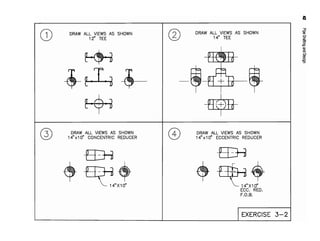
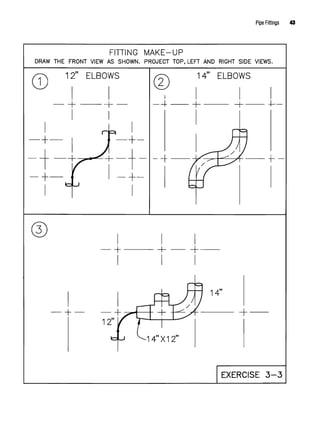
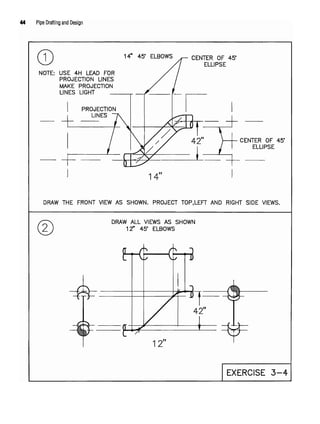
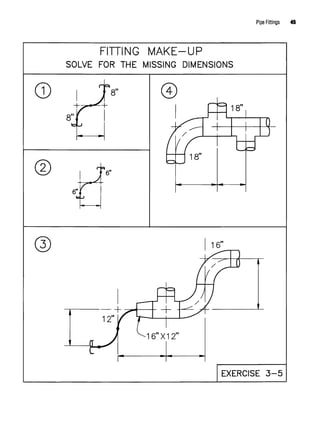
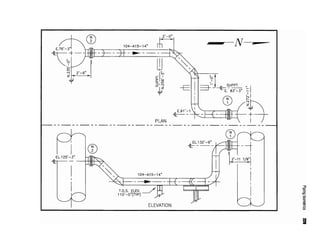
PIPE DRAFTING
AND DESIGN
This page intentionally left blank
PIPE DRAFTING
AND DESIGN
Second Edition
Roy A. Parisher • Robert A. Rhea
Gulf Professional Publishing
an imprint of Butterworth-Heinemann
Boston, Oxford, Auckland, Johannesburg, Melbourne, New Delhi
Gulf Professional Publishing is an imprint of Butterworth-Heinemann.
Copyright © 2002 by Butterworth-Heinemann
-^ A member of the Reed Elsevier group
All rights reserved.
No part of this publication may be reproduced, stored in a retrieval system, or transmitted in any
form or by any means, electronic, mechanical, photocopying, recording, or otherwise, without
the prior written permission of the publisher.
6S Recognizing the importance of preserving what has been written, Butterworth-Heinemann prints
its books on acid-free paper whenever possible.
Tj1
Butterworth-Heinemann supports the efforts of American Forests and the Global
AT" R£
Leaf program in its campaign for the betterment of trees, forests, and our
inn environment.
Library of Congress Cataloging-in-Publication Data
Parisher, Roy A.
Pipe drafting and design / Roy A. Parisher, Robert A. Rhea-2nd
ed.
p. cm.
Includes index.
ISBN 0-7506-7439-3 (alk. paper)
1. Piping—Drawing—Handbooks, manuals, etc. 2. Piping—Design and construction—
Handbooks, manuals, etc. I. Rhea, Robert A. II. Title.
TJ930 .P32 2001
621.8'672—dc21
2001023633
British Library Cataloguing-in-Publication Data
A catalogue record for this book is available from the British Library.
The publisher offers special discounts on bulk orders of this book.
For information, please contact:
Manager of Special Sales
Butterworth-Heinemann
225 Wildwood Avenue
Woburn, MA 01801-2041
Tel: 781-904-2500
Fax: 781-904-2620
For information on all Gulf Professional Publishing publications available, contact our World
Wide Web home page at: http://www.gulfpp.com
1 0 9 8 7 6 5 4 3 2 1
Printed in the United States of America
iv
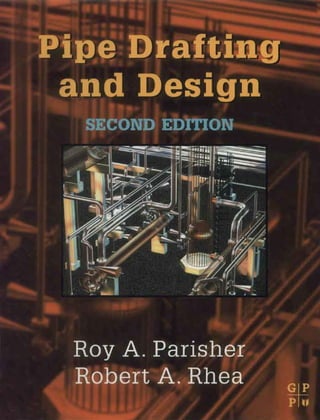
About the Cover
The 3D wire frame model on the cover is a detailed view of the piping
model used in this text and shown in the window on the back cover. This
model was created with PRO-PIPE™ and rendered in 3D Studio®.
vi
For my parents, Archie and Joyce:
Your love and support are endless.
I could never say "Thank you" enough for what you have given me. Roy
To Mary:
Thank you for your help and support. Robert
v
Contents
Acknowledgments ix Cast Iron Fittings 38
Plastic Fittings 38
Preface x Review Quiz 39
. . A A1 . A1 . Exercise Information40
About the Authors xi -,, . ~ ~ . c . ,,
Chapter 3 Drawing Exercises 41
Chapter 1 ^
Chanter 4
Overview of Pipe Drafting and Design 1 „ .
Types of Projects! Flange Basics 48
Employers ofPipe Drafters andDesigners 1 Ratmg Flan
Ses 48
Engineering and Construction Companies 1 Flange Facings 48
Operating Companies 2 Flan
Se T
yPes 50
Architectural Engineering Companies 2 ° s
Construction Companies 2 Gaskets 57
Fabrication Companies 2 Review
°-uiz 61
Preparation for Piping Drafting 2 Exercise
^formation 63
Technical Skills 3 Cha
Pter 4Drawin
gExercises 65
Personal Skills 3 „, . _
_ . ^ . . Chapters
Creation ofPipe Drawings 3 _T , fn
Valves 69
Chapter 2 What Is a Valve? 69
Steel Pipe 4 Common Valve Types 70
History of Pipe 4 Valve Operators 81
Piping Materials 4 Review Quiz 82
Manufacturing Methods 4 Chapter 5 Drawing Exercises 86
Sizing of Pipe 5
Wall Thickness 6 Chapter 6
Methods of Joining Pipe 6 Mechanical Equipment 90
Cast Iron Pipe 8 Types of Equipment 90
Plastic Pipe 10 Equipment in Use 100
Drawing Pipe 10 Equipment Terminology 101
Review Quiz 12 Vendor Data Drawings 103
Drawing Equipment 103
Chapter 3 Review Quiz 108
Pipe Fittings 13 Chapter 6 Drawing Exercises 110
90° Elbows 13
45° Elbows 19 Chapter 7
Weld Tee22 Flow Diagrams and Instrumentation 111
The Stub-In 26 Uses of Flow Diagrams 111
Coupling 27 Type of Flow Diagrams 111
Reducers 28 Flow Diagram Instruments 114
Weld Cap 31 Piping Symbols 117
Use of Fittings 31 Flow Plan Arrangement 117
Screwed and Socket-Weld Fittings 33 Review Quiz 118
Pipe Nipples 33 Exercise Information 119
Flanged Fittings 37 Chapter 7 Drawing Exercises 120
vii
Chapter 8 Control Valve Manifolds 204
Codes and Specifications 123 Utility Stations 206
Codes 123 Meter Runs 206
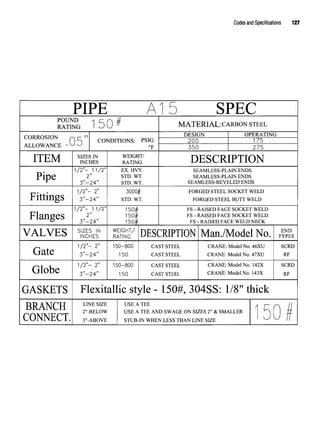
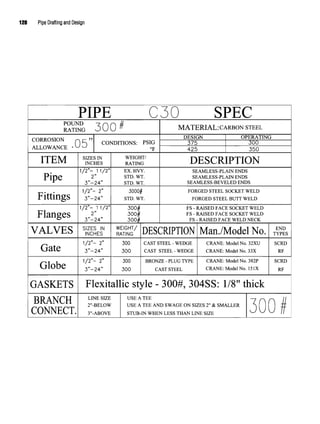
Specifications 123 Sewer and Underground Piping Systems 207
Specification Classes 125 Review Quiz 209
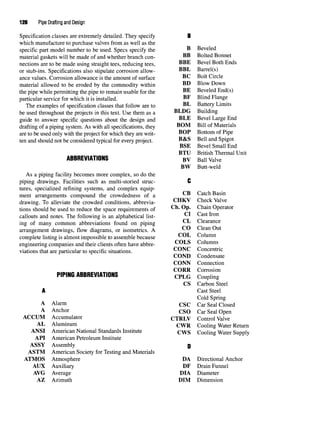
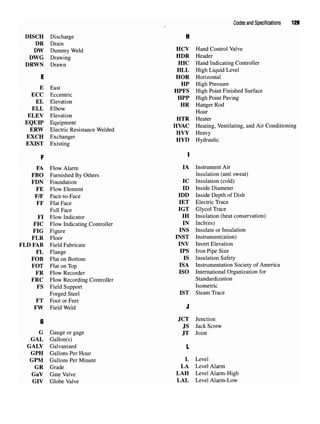
Abbreviations 126
Piping Abbreviations 126 Chapter 13
Review Quiz 132 Pi
Pin
8 Isometrics 210
What Is an Isometric? 210
Chapter 9 Drawing Piping Isometrics 216
Equipment Layout 133 Isometric Dimensions, Notes, and Callouts 218
Plant Coordinate Systems 133 Isometric Offsets 219
Site Plans 136 Review Quiz 226
Unit Plot Plan 136 Drawing Exercises 227
Equipment Location Drawing 136
Foundation Location Drawing 136 Chapter 14
Piping Drawing Index 141 Customizing AutoCAD 231
Review Quiz 142 Creating Command Aliases 231
Using AutoLisp 232
Chapter 10 Review Quiz 236
Piping Arrangement Drawings, Sections, and
Elevations 143 Chapter 15
Arrangement Drawings 143 Three-dimensional Modeling of Piping
Responsibilities of the Piping Designer 143 Systems 237
Information Sources for Piping Arrangement Drawings 143 Advantages of 3D Modeling 237
Layout Procedures 144 Checking for Interferences 237
Piping Arrangement Drawing Layout 144 Generating Drawings Automatically from a Model 241
Dimensioning 186 Generating Isometric Drawings Automatically 241
Piping Sections and Elevations: What Are They? 187 Computer-Aided Engineering of Models 241
Detail Drawings 188 Choosing a Modeling Software Package 241
Review Quiz 192 Building a 3D Model Using AutoPlant 242
Exercises: Plans, Elevations, and Sections 193
Appendix A
Chapter 11 Dimensional Data 256
Standard Piping Details 194
Pipe Rack Spacing 194 Appendix B
Drawing Pipe intheRack 194 Review of
Lettering 292
Pipe Flexibility 195 . ,. „
™ t u *c 1n-7 Appendix C
Planning forHeat Expansion 197 A , . . A „ _ . _ „ .
„. . u ino Alphabet of Lines 294
Pipe Anchors 198 r
Pipe Insulation Shoes 198 Appendix D
Pipe Guides 198 Review of Math 295
Field Supports 199
Dummy Supports 200 Appendix E
Hanger Rods 200 Use of the Calculator 296
Spring Hangers 201
Pick-up Pipe Supports 201 Appendix F
Review Quiz 202 Architect's Scale 299
Chapter 12 Glossary 300
Piping Systems 203
Plant Utilities 203 Index 308
viii
Acknowledgments
Dr. Stanley Ebner: Support Roger Parisher: Southwest
Stephan Miller: 3D project model Fastners, Hodell-Natco, Inc.
Linda Ferrell: Rebis Alan Human: Flexitallic, Inc.
Joe Martinez: Technical Editing. Gene Eckert: ECAD, Inc., Pro-PIPE
R. B. Herrscher: Nisseki Chemical 3D model, Chapter 15
Texas, Inc. Anthony W. Horn: Chapter 15
The material, applications, and routines presented in this book have been
included for their instructional value. They have been tested for accuracy, but
are not guaranteed for any particular purpose. The publisher and authors do
not offer any representations or warranties, nor do they accept any liabilities
with respect to the material, applications, or routines.
Trademarks
AutoCAD® is registered in the U.S. Patent and Trademark office by Autodesk,
Inc.
AutoLISP® is registered in the U.S. Patent and Trademark office by Autodesk,
Inc.
ACAD.MNU Version 2000
Copyright © 1986, 1987, 1988, 1989, 1990, 1991, 1992, 1994, 1996, 1997,
1998 by Autodesk, Inc.
Autodesk provides this program "as is" and with all fault. Autodesk spe-
cifically disclaims any implied warranty of merchantability or fitness for a
particular use. Autodesk , Inc. does not warrant that the operation of the pro-
gram will be uninterrupted or error free.
AutoPLANT is registered in the U.S. Patent and Trademark office by
Rebis, Inc.
ix
Preface
This book provides students with the basic skills they will need to prepare
a wide range of piping drawings. It presents a step-by-step approach to the
basic fundamentals students will need to begin a successful career in indus-
trial drafting and design. Chapter One gives a quick overview of the many
opportunities in drafting and design for those who master the basic skills pre-
sented in the following chapters. Then each chapter builds on the preceding
one. It is necessary therefore to master the concepts in a given chapter before
going on to the next one. Each chapter concludes with exercises and ques-
tions designed to help students review and practice the concepts presented in
that chapter.
X
About the Authors
Roy A. Parisher is a professor in the engineering design graphics depart-
ment at San Jacinto College in Pasadena, Texas, where he has taught for over
20 years.
Robert A. Rhea is a former associate professor of engineering technology
at the University of Houston Downtown, Houston, Texas.
VI
This page intentionally left blank
Overview ofPipe
Draftingand
Design
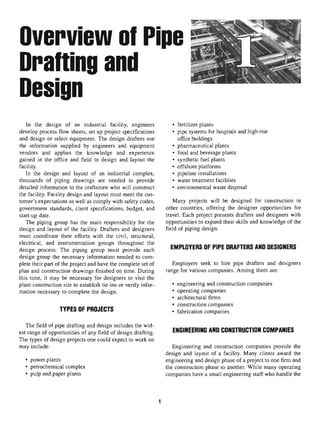
In the design of an industrial facility, engineers • fertilizer plants
develop process flow sheets, set up project specifications • pipe systems for hospitals and high-rise
and design or select equipment. The design drafters use office buildings
the information supplied by engineers and equipment • pharmaceutical plants
vendors and applies the knowledge and experience • food and beverage plants
gained in the office and field to design and layout the • synthetic fuel plants
facility. • offshore platforms
In the design and layout of an industrial complex, • pipeline installations
thousands of piping drawings are needed to provide • water treatment facilities
detailed information to the craftsmen who will construct • environmental waste disposal
the facility. Facility design and layout must meet the cus-
tomer's expectations as well as comply with safety codes, Many projects will be designed for construction in
government standards, client specifications, budget, and other countries, offering the designer opportunities for
start-up date. travel. Each project presents drafters and designers with
The piping group has the main responsibility for the opportunities to expand their skills and knowledge of the
design and layout of the facility. Drafters and designers field of piping design,
must coordinate their efforts with the civil, structural,
electrical, and instrumentation groups throughout the nRAFTFRQ AAII1 nFQIHNFRS
design process The piping group must provide each EMPLOYERS OFPIPE DRAFTERS ANDDESIGNERS
design group the necessary information needed to com-
plete their part of the project and have the complete set of Employers seek to hire pipe drafters and designers
plan and construction drawings finished on time. During range for various companies. Among them are:
this time, it may be necessary for designers to visit the
plant construction site to establish tie-ins or verify infor- • engineering and construction companies
mation necessary to complete the design. • operating companies
• architecturalfirms
Tvpcc HF PRn IFPT<5 * construction companies
ITrta ur rifUJtb I d . fabrication companies
est range of opportunities of any field of design drafting. ENGINEERING ANDCONSTRUCTION COMPANIES
The types of design projects one could expect to work on
may include: Engineering and construction companies provide the
design and layout of a facility. Many clients award the
• power plants engineering and design phase of a project to one firm and
• petrochemical complex the construction phase to another. While many operating
• pulp and paper plants companies have a small engineering staff who handle the
1
2 Pipe Drafting and Design
day-to-day needs of changing and updating drawings, • purchasing
such as adding a pump or other small equipment, they do • material control
not have the manpower to design and engineer a grass- • material take-off
roots plant or major add-on. Total plant design and con- • estimating
struction may require hundreds of workers and may entail • pipe stress and pipe supports
years in the design and construction of the plant. • CAD support
• project management
OPERATING COMPANIES
CONSTRUCTIONCOMPANIES
Operating companies are the clients who engage in the
day-to-day operation of a facility and who seek out the
services of engineering and construction firms when Man
y firms
specialize only in the construction of
expanding existing facilities or constructing a new Plants
- Here the
PiPin
g designer may actually help over-
project. Many operating companies keep a small engi- see the
construction of the facility while working under
neering staff in the home office or at the plant job site. the
supervision of a construction superintendent. The
Designers are exposed to the day-to-day operations of the designer is often called upon to make small design
facility and follow the construction of small projects. This changes resulting from mistakes discovered during the
situation may require that the designer have a broad range construction phase or as customers dictate changes. At
of knowledge and skills, as he or she often may be asked the
completion of the project, drawings are updated to
to design and lay out the complete project. The design reflect me man
y changes made during construction,
may prepare foundation, steel, and piping drawings as These
drawings are called or referred to as "as-built"
needed, and may even do some electrical and instrumen- drawings,
tation design when required.
FABRICATION COMPANIES
ARCHITECTURAL ENGINEERING COMPANIES
Fabrication companies fabricate and ship much of the
Pipe drafters and designers employed by architectural PiPm
g necessary for the construction of the plant to the
engineering companies apply their skills to commercial Job site
- Man
Y fabrication drawings called piping spool
and high-rise buildings. These may include multi-story drawings must be prepared. These drawings give detailed
office buildings, hospitals, condominiums, shopping dimensions from which welders can fabricate the pipe,
malls, or other similar structures. In addition to the indus- The drafter who
prepares these drawings will not be
trial piping components such as those found in a typical required to have an extensive background in plant layout,
boiler room, supplementary piping systems must be however, the position provides the drafter with valuable
designed for plumbing, HVAC, and drainage systems that experience in materials and material science,
are also required in these structures.
Pipe drafters and designers must therefore be able to PREPARATION FORPIPING DRAFTING
develop drawings such as:
• piping flow sheets Students must have a good background in basic draft-
• plot plans ing before pursuing a job in the field of pipe drafting and
• equipment location drawings design. Students should have good manual drafting skills
• piping arrangement drawings related to line quality and freehand lettering. At the same
• piping isometric drawings time, students must acquire the necessary background to
use the latest software tools such as AutoCAD and PRO-
Learning the "language" of piping prepares employees PIPE, which allows them to be more productive. As stu-
for advancement to other departments within the engi- dents advance, they will use a variety of sophisticated
neering firms. These departments include not only the software packages, ranging from basic CAD software to
drafting and design departments but also: 3D solid modeling.
Overview of Pipe Drafting and Design 3
TECHNICAL SKILLS and guidelines, and use an H or F lead for other line work
and lettering needs. Line thickness also has an important
The drafter must become familiar with the uses of fit- role on
P1
?1
^ drawings. A .7mm or wider lead holder is
tings, flanges, valves, and equipment. This will require commonly used on major elements of the drawing such as
time and effort to master the recognition of symbol shapes P1
?6 and
lettering. Background components such as
as well as research to find the dimensions needed to draw equipment, foundations, support structures, and dimen-
these items to scale. Often beginning drafters start out sion lines are
typically drawn with a .5mm lead,
making corrections to existing drawings. This is where One cannot stress enou
Sh the
importance of quality
they acquire the skills and knowledge of piping that will line work and
lettering. Manual drawings are constantly
allow them toadvance tothe position ofpiping designer. slid in and out of the flle drawers and run throu
gh blue
-
Drafters who have held field positions as pipe fitters Print
machines. This requires that lettering and line work
or welders find this real world experience valuable. be neat and of
g°od
<luallt
y to maint
am clarity ofdimen-
Many times this experience allows them to advance at a sions and callouts.
faster pace.
CAD Software Tools
PERSONAL SKILLS There are many djfferent CAD software tools on the
market today. Many engineering companies require
Students should not neglect their speaking, writing, their designers to know and use several different CAD
and math skills. Every company appraises future employ- software tools. Engineering companies must be pre-
ees during the interview process, not only for technical pared to accommodate the client's preference of CAD
skills, but also for the personal skills needed to interact programs. In today's marketplace, the pipe drafter and
with theengineering team. This interaction is a must for designer should learn how to use AutoCAD and
the team in order to complete the job with a minimal MicroStation. These two CAD programs are widely
amount of mistakes. Honesty, reliability, dedication to used by engineering firms in the United States and
improving skills, and a positive attitude contribute much throughout the world
to the successful career of the designer. Youwill be a As with CAD programs> there ^e several piping soft-
member of a design team. You may work with people ware programs on the market today. Engineering firms
from countries all over the world. Getting along with fel- must be reSpOnsive to the needs and preferences of their
low workers has much to do with successful yearly eval- dients Software developers steadily develop, revise, and
nations andcompensation for your efforts. refme programs to meet the demands of engineeringand
design firms. As with any business each software devel-
CREATION OFPIPE DRAWINGS oper tries to incorporate the special features and amenities
into their software package that will attract potential
Manual Drafting users. Often clients will dictate that all bid packagessub-
mitted for a project shall be completed using a particular
Manual drafters use a variety of triangles, plastic tern- piping software program. Most piping software packages
plates (circle and ellipse), and scales to layout piping provide the end user with the ability to develop three
drawings. While electric erasers are not necessary, they dimensional computer models of the completed facility,
make the job of erasing much easier and faster. Pencils Software packages such as AutoPLANT, PDS, and
and leads come in a wide range of sizes and shapes. PDMS, among others, have the intelligence to create
Drafters usually use a 4H lead to draw projection lines either 2D or 3D drawings.
Steel Pipe
HISTORY OF PIPE
Long ago someone decided carrying water from the
nearby stream back to his or her dwelling was time-
consuming and laborious. Ingenuity gave birth to inven-
tion and the pipe was born. Using the natural resources
available, early humans probably fashioned the first pipe
from bamboo. Needing to move larger amounts of water,
they later hollowed out logs. Egyptian and Aztec civiliza-
tions made pipe from clay. The first metallic pipes were
made by the Greeks and Romans from lead and bronze.
The use of iron as a material to manufacture pipe came
about with the invention of gun powder. Gun powder, of
course, is not used to make the iron, but gun powder
necessitated the invention of stronger gun barrels. Iron
pipes soon followed. Eventually exotic metals were
developed, and pipe became the highly specialized prod-
uct it is today.
PIPING MATERIALS
Applied in a general sense, pipe is a term used to des-
ignate a hollow, tubular body used to transport any com-
modity possessing flow characteristics such as those
found in liquids, gases, vapors, liquefied solids, and fine
powders.
A comprehensive list of the materials used to manu-
facture pipe would be quite lengthy. Some of the materi-
als include concrete, glass, lead, brass, copper, plastic,
aluminum, cast iron, carbon steel, and steel alloys. With
such a broad range of materials available, selecting one to
fit a particular need can be confusing. A thorough under-
standing of the pipe's intended use is essential. Each
material has limitations that may make it inappropriate
for a given application. Throughout this text we will base
our discussion on carbon steel pipe, the most common
material used in the piping industry.
MANUFACTURING METHODS
Carbon steel pipe can be manufactured using several
different techniques, each of which produces a pipe
with certain characteristics. These characteristics include
strength, wall thickness, corrosion resistance, and tem-
perature and pressure limitations. For example, pipes
having the same wall thickness but manufacturedby dif-
ferent methods may vary in strength and pressure limits.
The manufacturing methods we will mention include
seamless, butt-welded, and spiral-welded pipe.
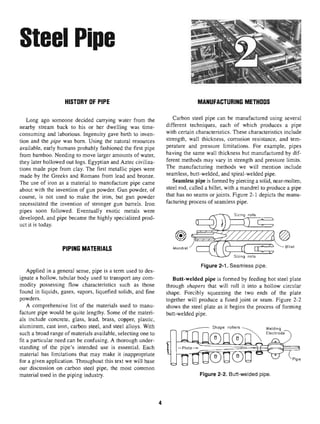
Seamless pipe is formed by piercing a solid,near-molten,
steel rod, called a billet, with a mandrel to produce a pipe
that has no seams or joints. Figure 2-1 depicts the manu-
facturing process of seamless pipe.
Figure 2-1. Seamless pipe.
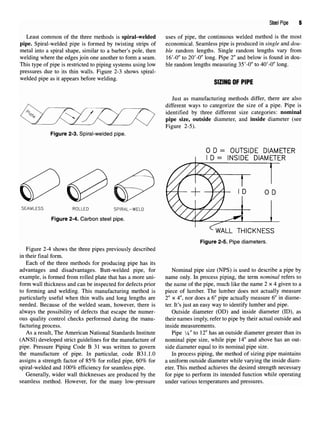
Butt-welded pipe is formed by feeding hot steel plate
through shapers that will roll it into a hollow circular
shape. Forcibly squeezing the two ends of the plate
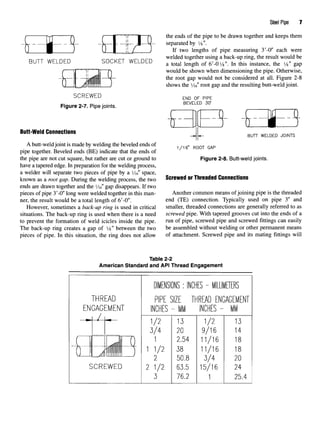
together will produce a fused joint or seam. Figure 2-2
shows the steel plate as it begins the process of forming
butt-welded pipe.
Figure 2-2. Butt-welded pipe.
Least common of the three methods is spiral-welded
pipe. Spiral-welded pipe is formed by twisting strips of
metal into a spiral shape, similar to a barber's pole, then
welding where the edges join one another to form a seam.
This type of pipe is restricted to piping systems usinglow
pressures due to its thin walls. Figure 2-3 shows spiral-
welded pipe as it appears before welding.
Figure 2-3. Spiral-welded pipe.
Figure 2-4. Carbon steel pipe.
Figure 2-4 shows the three pipes previously described
in their final form.
Each of the three methods for producing pipe has its
advantages and disadvantages. Butt-welded pipe, for
example, is formed from rolled plate that has a more uni-
form wall thickness and can be inspected for defects prior
to forming and welding. This manufacturing method is
particularly useful when thin walls and long lengths are
needed. Because of the welded seam, however, there is
always the possibility of defects that escape the numer-
ous quality control checks performed during the manu-
facturing process.
As a result, The American National Standards Institute
(ANSI) developed strict guidelines for the manufactureof
pipe. Pressure Piping Code B 31 was written to govern
the manufacture of pipe. In particular, code B31.1.0
assigns a strength factor of 85% for rolled pipe, 60% for
spiral-welded and 100% efficiency for seamless pipe.
Generally, wider wall thicknesses are produced by the
seamless method. However, for the many low-pressure
Steel Pipe 5
uses of pipe, the continuous welded method is the most
economical. Seamless pipe is produced in single and dou-
ble random lengths. Single random lengths vary from
16'-0" to 20'-0" long. Pipe 2" and below is found in dou-
ble random lengths measuring 35'-0" to 40'-0" long.
SIZING OFPIPE
Just as manufacturing methods differ, there are also
different ways to categorize the size of a pipe. Pipe is
identified by three different size categories: nominal
pipe size, outside diameter, and inside diameter (see
Figure 2-5).
Figure 2-5. Pipe diameters.
Nominal pipe size (NFS) is used to describe a pipe by
name only. In process piping, the term nominal refers to
the name of the pipe, much like the name 2 x 4 given to a
piece of lumber. The lumber does not actually measure
2" x 4", nor does a 6" pipe actually measure 6" in diame-
ter. It's just an easy way to identify lumber and pipe.
Outside diameter (OD) and inside diameter (ID), as
their names imply,refer to pipe by their actual outside and
inside measurements.
Pipe i/g" to 12"has an outside diameter greater than its
nominal pipe size, while pipe 14" and above has an out-
side diameter equal to its nominal pipe size.
In process piping, the method of sizing pipe maintains
a uniform outside diameter while varying the inside diam-
eter. This method achieves the desired strength necessary
for pipe to perform its intended function while operating
under various temperatures and pressures.
6 Pipe Drafting and Design
WALL THICKNESS
Wall thickness is a term used to describe the thickness
of the metal used to make a pipe. Wall thickness is also
commonly referred to as a pipe's weight. Originally man-
ufactured in weights known as standard, extra strong, and
double extra strong, pipe has since increased in complex-
ity with the development of new chemical processes.
Commodities with ever-changing corrosive properties,
high temperatures, and extreme pressures have necessi-
tated the development of numerous additional selections
of wall thicknesses for pipe. Now called schedules, these
additional wall thicknesses allow a pipe to be selected to
meet the exact requirements needed for safe operation.
An example of this variance in wall thickness is shown in
Figure 2-6.
Figure 2-6. Pipe thickness.
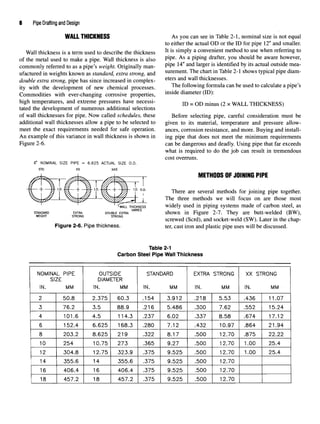
As you can see in Table 2-1, nominal size is not equal
to either the actual OD or the ID for pipe 12" and smaller.
It is simply a convenient method to use when referring to
pipe. As a piping drafter, you should be aware however,
pipe 14" and larger is identified by its actual outside mea-
surement. The chart in Table 2-1 shows typical pipe diam-
eters and wall thicknesses.
The following formula can be used to calculate a pipe's
inside diameter (ID):
ID = OD minus (2 x WALL THICKNESS)
Before selecting pipe, careful consideration must be
given to its material, temperature and pressure allow-
ances, corrosion resistance, and more. Buying and install-
ing pipe that does not meet the minimum requirements
can be dangerous and deadly. Using pipe that far exceeds
what is required to do the job can result in tremendous
cost overruns.
METHODS OF JOINING PIPE
There are several methods for joining pipe together.
The three methods we will focus on are those most
widely used in piping systems made of carbon steel, as
shown in Figure 2-7. They are butt-welded (BW),
screwed (Scrd), and socket-weld (SW). Later in the chap-
ter, cast iron and plastic pipe uses will be discussed.
Table 2-1
Carbon Steel Pipe Wall Thickness
NOMINAL PIPE
SIZE
IN. MM
2
3
4
6
8
10
12
14
16
18
50.8
76.2
101
152
203
254
304
355
406
457
OUTSIDE
DIAMETER
IN. MM
2.3
3.5
6 4.5
4 6.6
2 8.6
10.
8 12.
6 14
.4 16
.2 18
75 60.3
88.9
114
25 168
25 219
75 273
75 323
355
406
457
STANDARD
IN. MM
.15
.21
3 .23
3 .28
.32
.36
9 .37
.6 .37
.4 .37
.2 .37
4 3.91
6 5.48
7 6.02
0 7.12
2 8.17
5 9.27
5 9.52
5 9.52
5 9.52
5 9.52
EXTRA STRON
IN. MM
2 .21
6 .30
.33
.43
.50
.50
!5 .50
!5 .50
!5 .50
>5 .50
8 5.53
0 7.62
7 8.5E
2 10.£
0 12J
0 12.:
0 12.:
0 12.:
o 12.:
o 12.:
G XX STRONG
IN. MM
> .43
.55
I .67
7 .86
'0 .87
r
o 1.0
7
0 1.0
'0
7
0
7
Q
6 11.0:
2 15.2^
4 17.12
4 21.9^
5 22.2;
0 25.4
0 25.4
Figure 2-7. Pipe joints.
Butt-Weld Connections
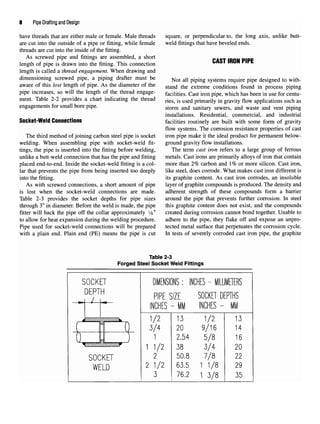
A butt-weld joint is made by welding the beveled ends oi
pipe together. Beveled ends (BE) indicate that the ends oi
the pipe are not cut square, but rather are cut or ground tc
have a tapered edge. In preparation for the welding process,
a welder will separate two pieces of pipe by a Vie" space,
known as a root gap. During the welding process, the twc
ends are drawn together and the V^' gap disappears. If twc
pieces of pipe 3'-0" long were welded together in this man-
ner, the result would be a total length of 6'-0".
However, sometimes a back-up ring is used in critical
situations. The back-up ring is used when there is a need
to prevent the formation of weld icicles inside the pipe.
The back-up ring creates a gap of Vs" between the two
pieces of pipe. In this situation, the ring does not allow
Steel Pipe 7
the ends of the pipe to be drawn together and keeps them
separated by y%".
If two lengths of pipe measuring 3'-0" each were
welded together using a back-up ring, the result would be
a total length of 6'-01
/8". In this instance, the >/s" gap
would be shown when dimensioning the pipe. Otherwise,
the root gap would not be considered at all. Figure 2-8
shows the Vie" root gap and the resulting butt-weld joint.
Figure 2-8. Butt-weldjoints.
Screwed or Threaded Connections
Another common means of joining pipe is the threaded
end (TE) connection. Typically used on pipe 3" and
smaller, threaded connections are generally referred to as
screwed pipe. With tapered grooves cut into the ends of a
run of pipe, screwed pipe and screwed fittings can easily
be assembled without welding or other permanent means
of attachment. Screwed pipe and its mating fittings will
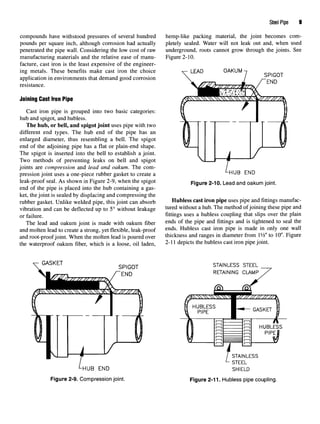
Table 2-2
American Standard and API Thread Engagement
8 Pipe Drafting andDesign
have threads that are either male or female. Male threads square, or perpendicular to, the long axis, unlike butt-
are cut into the outside of a pipe or fitting, while female weld fittings that have beveled ends,
threads are cut into the inside of the fitting.
As screwed pipe and fittings are assembled, a short PACT lonu DIDE
length of pipe is drawn into the fitting. This connection WHO! inUli rirc
length is called a thread engagement. When drawing and
dimensioning screwed pipe, a piping drafter must be Not all piping systems require pipe designed to with-
aware of this lost length of pipe. As the diameter of the stand me extreme conditions found in process piping
pipe increases, so will the length of the thread engage- faciiities< Cast iron pipe, which has been in use for centu-
ment. Table 2-2 provides a chart indicating the thread ^is used pTimariy ingravityflowapplications suchas
engagements for small bore pipe. storm and sanitary sewers, and waste and vent piping
installations. Residential, commercial, and industrial
Socket-Weld Connections facilities routinely are built with some form of gravity
flow systems. The corrosion resistance properties of cast
The third method of joining carbon steel pipe is socket iron pipe make it the ideal product for permanent below-
welding. When assembling pipe with socket-weld fit- ground gravity flow installations.
tings, the pipe is inserted into the fitting before welding, The term cast iron refers to a large group of ferrous
unlike a butt-weld connection that has the pipe and fitting metals. Cast irons are primarily alloys of iron that contain
placed end-to-end. Inside the socket-weld fitting is a col- more than 2% carbon and 1% or more silicon. Cast iron,
lar that prevents the pipe from being inserted too deeply like steel, does corrode. What makes cast iron different is
into the fitting. its graphite content. As cast iron corrodes, an insoluble
As with screwed connections, a short amount of pipe layer of graphite compounds is produced. The density and
is lost when the socket-weld connections are made. adherent strength of these compounds form a barrier
Table 2-3 provides the socket depths for pipe sizes around the pipe that prevents further corrosion. In steel
through 3" in diameter. Before the weld is made, the pipe this graphite content does not exist, and the compounds
fitter will back the pipe off the collar approximately i/8" created during corrosion cannot bond together. Unable to
to allow for heat expansion during the welding procedure. adhere to the pipe, they flake off and expose an unpro-
Pipe used for socket-weld connections will be prepared tected metal surface that perpetuates the corrosion cycle,
with a plain end. Plain end (PE) means the pipe is cut In tests of severely corroded cast iron pipe, the graphite
Table 2-3
Forged Steel Socket Weld Fittings
compounds have withstood pressures of several hundred
pounds per square inch, although corrosion had actually
penetrated the pipe wall. Considering the low cost of raw
manufacturing materials and the relative ease of manu-
facture, cast iron is the least expensive of the engineer-
ing metals. These benefits make cast iron the choice
application in environments that demand good corrosion
resistance.
Joining Cast Iron Pipe
Cast iron pipe is grouped into two basic categories:
hub and spigot, and hubless.
The hub, or bell, and spigot joint uses pipe with two
different end types. The hub end of the pipe has an
enlarged diameter, thus resembling a bell. The spigot
end of the adjoining pipe has a flat or plain-end shape.
The spigot is inserted into the bell to establish a joint.
Two methods of preventing leaks on bell and spigot
joints are compression and lead and oakum. The com-
pression joint uses a one-piece rubber gasket to create a
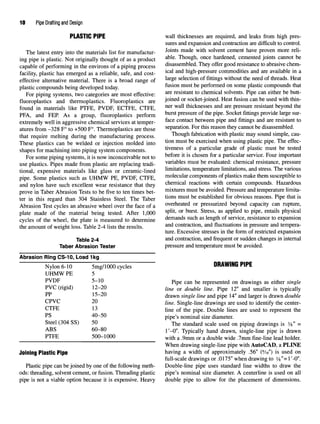
leak-proof seal. As shown in Figure 2-9, when the spigot
end of the pipe is placed into the hub containing a gas-
ket, the joint is sealed by displacing and compressing the
rubber gasket. Unlike welded pipe, this joint can absorb
vibration and can be deflected up to 5° without leakage
or failure.
The lead and oakum joint is made with oakum fiber
and molten lead to create a strong, yet flexible, leak-proof
and root-proof joint. When the molten lead is poured over
the waterproof oakum fiber, which is a loose, oil laden,
Figure 2-9. Compression joint.
Steel Pipe 9
hemp-like packing material, the joint becomes com-
pletely sealed. Water will not leak out and, when used
underground, roots cannot grow through the joints. See
Figure 2-10.
Figure 2-10. Lead and oakumjoint.
Hubless cast iron pipe uses pipe and fittings manufac-
tured without a hub. The method of joining these pipe and
fittings uses a hubless coupling that slips over the plain
ends of the pipe and fittings and is tightened to seal the
ends. Hubless cast iron pipe is made in only one wall
thickness and ranges in diameter from IVi" to 10". Figure
2-11 depicts the hubless cast iron pipe joint.
Figure 2-11. Hubless pipe coupling.
10 Pipe Drafting and Design
PLASTIC PIPE
The latest entry into the materials list for manufactur-
ing pipe is plastic. Not originally thought of as a product
capable of performing in the environs of a piping process
facility, plastic has emerged as a reliable, safe, and cost-
effective alternative material. There is a broad range of
plastic compounds being developed today.
For piping systems, two categories are most effective:
fluoroplastics and thermoplastics. Fluoroplastics are
found in materials like PTFE, PVDF, ECTFE, CTFE,
PFA, and FEP. As a group, fluoroplastics perform
extremely well in aggressive chemical services at temper-
atures from -328 F° to +500 F°. Thermoplastics are those
that require melting during the manufacturing process.
These plastics can be welded or injection molded into
shapes for machining into piping system components.
For some piping systems, it is now inconceivable not to
use plastics. Pipes made from plastic are replacing tradi-
tional, expensive materials like glass or ceramic-lined
pipe. Some plastics such as UHMW PE, PVDF, CTFE,
and nylon have such excellent wear resistance that they
prove in Taber Abrasion Tests to be five to ten times bet-
ter in this regard than 304 Stainless Steel. The Taber
Abrasion Test cycles an abrasive wheel over the face of a
plate made of the material being tested. After 1,000
cycles of the wheel, the plate is measured to determine
the amount of weight loss. Table 2-4 lists the results.
Table 2-4
Taber Abrasion Tester
Abrasion Ring CS-10, L<
Nylon 6-10
UHMW PE
PVDF
PVC (rigid)
PP
CPVC
CTFE
PS
Steel (304 SS)
ABS
PTFE
>ad 1 kg
5mg/1000 cycles
5
5-10
12-20
15-20
20
13
40-50
50
60-80
500-1000
Joining Plastic Pipe
Plastic pipe can be joined by one of the following meth-
ods: threading, solvent cement, or fusion. Threading plastic
pipe is not a viable option because it is expensive. Heavy
wall thicknesses are required, and leaks from high pres-
sures and expansion and contraction are difficult to control.
Joints made with solvent cement have proven more reli-
able. Though, once hardened, cemented joints cannot be
disassembled. They offer good resistance to abrasive chem-
ical and high-pressure commodities and are available in a
large selection of fittings without the need of threads. Heat
fusion must be performed on some plastic compounds that
are resistant to chemical solvents. Pipe can either be butt-
joined or socket-joined. Heat fusion can be used with thin-
ner wall thicknesses and are pressure resistant beyond the
burst pressure of the pipe. Socket fittings provide large sur-
face contact between pipe and fittings and are resistant to
separation. For this reason they cannot be disassembled.
Though fabrication with plastic may sound simple, cau-
tion must be exercised when using plastic pipe. The effec-
tiveness of a particular grade of plastic must be tested
before it is chosen for a particular service. Four important
variables must be evaluated: chemical resistance, pressure
limitations, temperature limitations, and stress. The various
molecular components of plastics make them susceptible to
chemical reactions with certain compounds. Hazardous
mixtures must be avoided. Pressure and temperature limita-
tions must be established for obvious reasons. Pipe that is
overheated or pressurized beyond capacity can rupture,
split, or burst. Stress, as applied to pipe, entails physical
demands such as length of service, resistance to expansion
and contraction, and fluctuations in pressure and tempera-
ture. Excessive stresses in the form of restricted expansion
and contraction, and frequent or sudden changes in internal
pressure and temperature must be avoided.
DRAWING PIPE
Pipe can be represented on drawings as either single
line or double line. Pipe 12" and smaller is typically
drawn single line and pipe 14"and larger is drawn double
line. Single-line drawings are used to identify the center-
line of the pipe. Double lines are used to represent the
pipe's nominal size diameter.
The standard scale used on piping drawings is 3
/g" =
l'-0". Typically hand drawn, single-line pipe is drawn
with a .9mm or a double wide .7mm fine-line lead holder.
When drawing single-line pipe with AutoCAD, a PLINE
having a width of approximately .56" (9
/i6") is used on
full-scale drawings or .0175" when drawing to 3
/g"= l'-0".
Double-line pipe uses standard line widths to draw the
pipe's nominal size diameter. A centerline is used on all
double pipe to allow for the placement of dimensions.
Steel Pipe 11
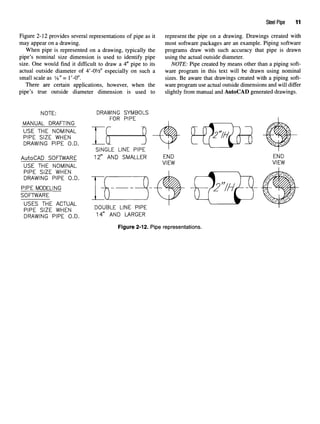
Figure 2-12 provides several representations of pipe as it represent the pipe on a drawing. Drawings created with
may appear on a drawing. most software packages are an example. Piping software
When pipe is represented on a drawing, typically the programs draw with such accuracy that pipe is drawn
pipe's nominal size dimension is used to identify pipe using the actual outside diameter.
size. One would find it difficult to draw a 4" pipe to its NOTE: Pipe created by means other than a piping soft-
actual outside diameter of 4'-01
/2" especially on such a ware program in this text will be drawn using nominal
small scale as 3
/g" = l'-0". sizes. Be aware that drawings created with a piping soft-
There are certain applications, however, when the ware program use actual outside dimensions and will differ
pipe's true outside diameter dimension is used to slightly from manual and AutoCAD generated drawings.
Figure 2-12. Pipe representations.
NOTE:
MANUAL DRAFTING
USE THE NOMINAL
PIPE SIZE WHEN
DRAWING PIPE O.D.
AutoCAD SOFTWARE
USE THE NOMINAL
PIPE SIZE WHEN
DRAWING PIPE O.D.
PIPE MODELING
SOFTWARE
USES THE ACTUAL
PIPE SIZE WHEN
DRAWING PIPE O.D.
12 Pipe Drafting and Design
CHAPTER 2 REVIEW QUIZ
1. Name three methods of manufacturingcarbon steel pipe.
2. Name the three most commonly used end preparations for joining pipe.
3. What is meant by the term nominal size pipel
4. Which diameter of pipe varies as the wall thickness changes?
5. What is the most common material used in the manufacture of pipe?
6. When drawing pipe, which pipe sizes are drawn single line and which sizes are drawn double line?
7. How long is the gap between two lengths of pipe when a back-up ring separates them?
8. What is the name for the amount of pipe "lost" when screwed connections are used?
9. What is the standard drawing scale used on piping drawings?
10.Name three-methods for joining carbon steel and plastic pipe.
Pipe Fittings
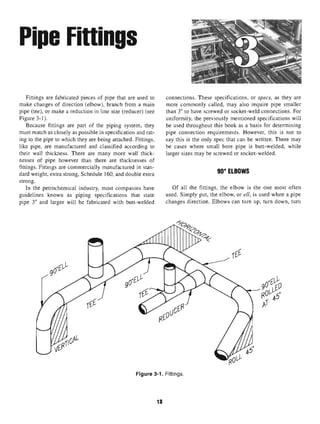
Fittings are fabricated pieces of pipe that are used to connections. These specifications, or specs, as they are
make changes of direction (elbow), branch from a main more commonly called, may also require pipe smaller
pipe (tee), or make a reduction in line size (reducer) (see than 3" to have screwed or socket-weld connections. For
Figure 3-1). uniformity, the previously mentioned specifications will
Because fittings are part of the piping system, they be used throughout this book as a basis for determining
must match as closely as possible in specification and rat- pipe connection requirements. However, this is not to
ing to the pipe to which they are being attached. Fittings, say this is the only spec that can be written. There may
like pipe, are manufactured and classified according to be cases where small bore pipe is butt-welded, while
their wall thickness. There are many more wall thick- larger sizes may be screwed or socket-welded,
nesses of pipe however than there are thicknesses of
fittings. Fittings are commercially manufactured in stan- oniuc
dard weight, extra strong, Schedule 160, and double extra tLBUWo
strong.
In the petrochemical industry, most companies have Of all the fittings, the elbow is the one most often
guidelines known as piping specifications that state used. Simply put, the elbow, or ell, is used when a pipe
pipe 3" and larger will be fabricated with butt-welded changes direction. Elbows can turn up, turn down, turn
Figure 3-1. Fittings.
13
14 Pipe Drafting and Design
left, right, or any angle in between (see Figure 3-1).
Ninety degree ells can be classified as one of the
following:
• long-radius ell • short-radius ell
• reducing ell • mitered ell
Of these four types, the long-radius elbow shown in
Figure 3-2, is the one used most often.
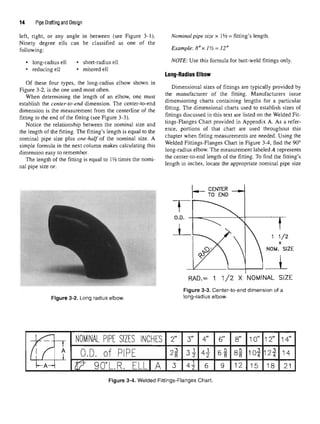
When determining the length of an elbow, one must
establish the center-to-end dimension. The center-to-end
dimension is the measurement from the centerline of the
fitting to the end of the fitting (see Figure 3-3).
Notice the relationship between the nominal size and
the length of the fitting. The fitting's length is equal to the
nominal pipe size plus one-half of the nominal size. A
simple formula in the next column makes calculating this
dimension easy to remember.
The length of the fitting is equal to P/2 times the nomi-
nal pipe size or:
Figure 3-2. Long radius elbow.
Nominal pipe size x 1V2 = fitting's length.
Example: 8"xl1
/2 =12"
NOTE: Use this formula for butt-weld fittings only.
Long-Radius Elbow
Dimensional sizes of fittings are typically provided by
the manufacturer of the fitting. Manufacturers issue
dimensioning charts containing lengths for a particular
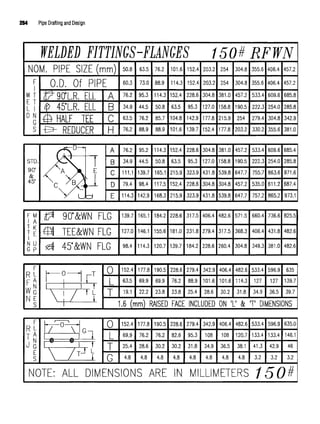
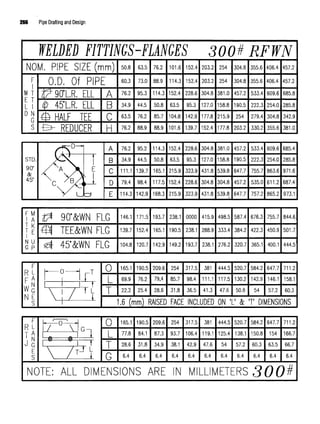
fitting. The dimensional charts used to establish sizes of
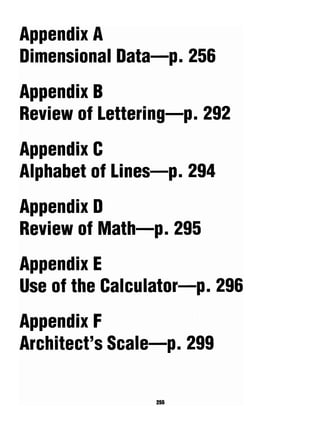
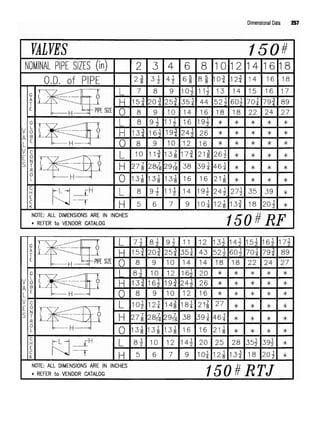
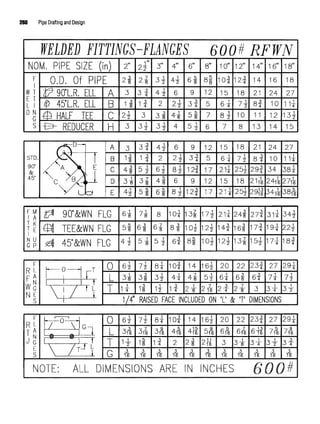
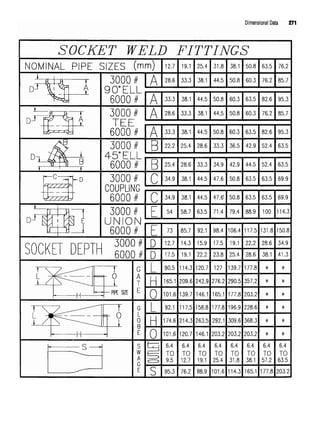
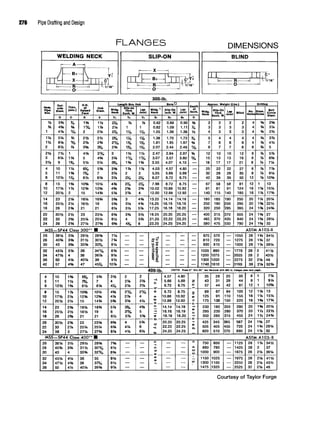
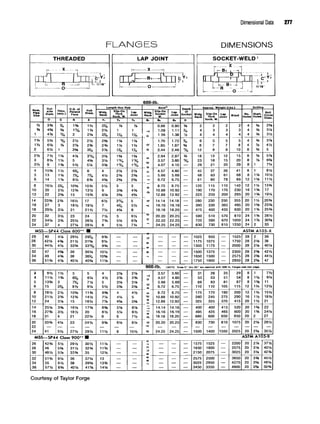
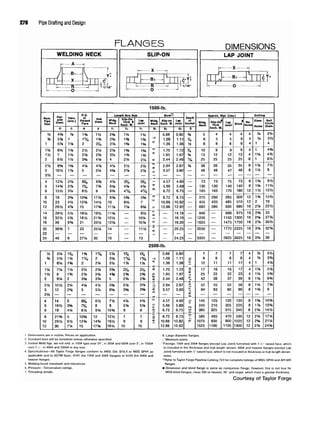
fittings discussed in this text are listed on the Welded Fit-
tings-Flanges Chart provided in Appendix A. As a refer-
ence, portions of that chart are used throughout this
chapter when fitting measurements are needed. Using the
Welded Fittings-Flanges Chart in Figure 3-4, find the 90°
long-radius elbow. The measurement labeled A represents
the center-to-end length of the fitting. To find the fitting's
length in inches, locate the appropriate nominal pipe size
Figure 3-3. Center-to-end dimension of a
long-radius elbow.
Figure 3-4. Welded Fittings-Flanges Chart.
Pipe Fittings 15
in the row labeled Nominal Pipe Sizes. Follow across the shows how the elbow might appear if it were welded to a
chart to find the desired pipe size. Below that size, in the piece of pipe. Remember, in the single-line symbol only
row labeled A, is the center-to-end dimension of the 90° the centerline of the elbow is drawn. The double-line
long-radius elbow. symbol requires that one-half of the pipe OD should be
The center-to-end dimension (A) will be used as the added and subtracted respectively from the elbow's
radius for the elbow's centerline. centerline.
Drafting Symbols for the Long-Radius Elbow Drawing the Long-Radius Elbow
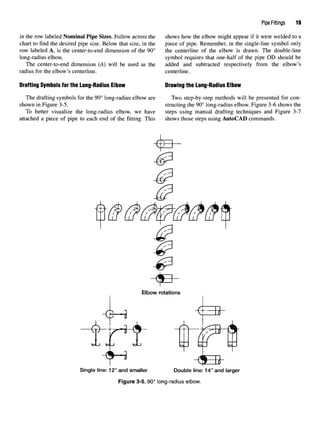
The drafting symbols for the 90° long-radius elbow are Two step-by-step methods will be presented for con-
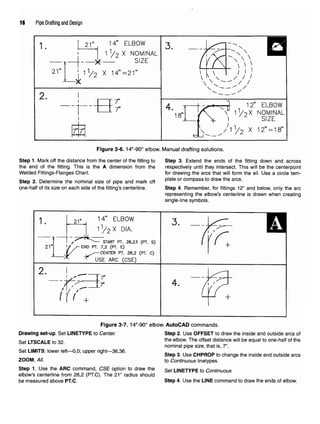
shown in Figure 3-5. structing the 90° long-radius elbow. Figure 3-6 shows the
To better visualize the long-radius elbow, we have steps using manual drafting techniques and Figure 3-7
attached a piece of pipe to each end of the fitting. This shows those steps using AutoCAD commands.
Figure 3-5. 90° long-radius elbow.
16 Pipe Drafting andDes
Figure 3-6.14"-90° elbow. Manual drafting solutions.
Step 1. Mark off the distance from the center of the fitting to Step 3. Extend the ends of the fitting down and across
the end of the fitting. This is the A dimension from the respectively until they intersect. This will be the centerpoint
Welded Fittings-Flanges Chart. for drawing the arcs that will form the ell. Use a circle tern-
Step 2. Determine the nominal size of pipe and mark off plate or com
Passto draw the arcs
'
one-half of its size on each side of the fitting's centerline. Step 4. Remember, for fittings 12" and below, only the arc
representing the elbow's centerline is drawn when creating
single-line symbols.
Figure 3-7. 14"-90° elbow. AutoCAD commands.
Drawing set-up. Set LINETYPE to Center. Step 2. Use OFFSET to draw the inside and outside arcs of
o i TO^AI c oo tne
©'bow. Theoffset distance will beequal to one-half of the
o6t LI oUALt tO jc.. . . . . , , . _.„
nominal pipe size, that is, 7 .
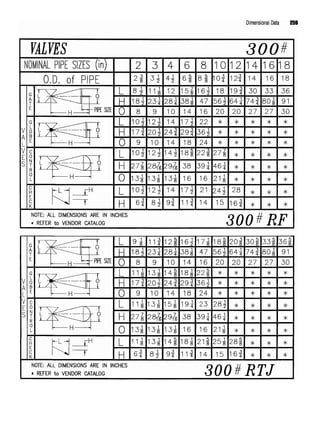
Set LIMITS: lower left—0,0; upper right—36,36. _4 ... -„__,*.,. . .. . . . . . . .
' ' ^ a
Step 3. UseCHPROP to change the inside andoutside arcs
ZOOM, All. to Continuous linetypes.
Step 1. Use the ARC command, CSE option to draw the get LINETYPE to Continuous.
elbow's centerline from 28,2 (PTC). The 21" radius should
be measured above PT.C. Step 4. Use the LINE command to draw the ends of elbow.
NOTE: The step-by-step instructional procedures
presented using computer-aided drafting techniques
presume each student has a comprehensive knowledge
of basic AutoCAD commands. These self-instructional
steps provide a simple method to create each fitting.
They are not intended to restrict the student to any par-
ticular commands. Each student is encouraged to exper-
iment with new commands that may achieve the same
result.
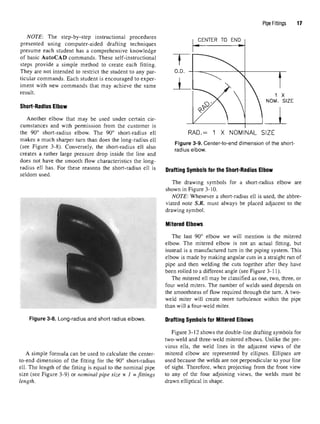
Short-Radius Elbow
Another elbow that may be used under certain cir-
cumstances and with permission from the customer is
the 90° short-radius elbow. The 90° short-radius ell
makes a much sharper turn than does the long-radius ell
(see Figure 3-8). Conversely, the short-radius ell also
creates a rather large pressure drop inside the line and
does not have the smooth flow characteristics the long-
radius ell has. For these reasons the short-radius ell is
seldom used.
Figure 3-8. Long-radius and short radius elbows.
A simple formula can be used to calculate the center-
to-end dimension of the fitting for the 90° short-radius
ell. The length of the fitting is equal to the nominal pipe
size (see Figure 3-9) or nominal pipe size x 1 = fittings
length.
Pipe Fittings 11
Figure 3-9. Center-to-end dimension of the short-
radius elbow.
Drafting Symbols for the Short-Radius Elbow
The drawing symbols for a short-radius elbow are
shown in Figure 3-10.
NOTE: Whenever a short-radius ell is used, the abbre-
viated note S.R. must always be placed adjacent to the
drawing symbol.
Mitered Elbows
The last 90° elbow we will mention is the mitered
elbow. The mitered elbow is not an actual fitting, but
instead is a manufactured turn in the piping system. This
elbow is made by making angular cuts in a straight run of
pipe and then welding the cuts together after they have
been rolled to a different angle (see Figure 3-11).
The mitered ell may be classified as one, two, three, or
four weld miters. The number of welds used depends on
the smoothness of flow required through the turn. A two-
weld miter will create more turbulence within the pipe
than will a four-weld miter.
Drafting Symbols for MiteredElbows
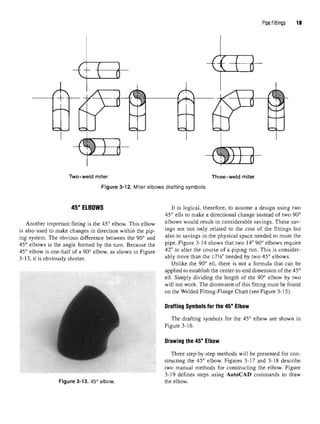
Figure 3-12 shows the double-line drafting symbols for
two-weld and three-weld mitered elbows. Unlike the pre-
vious ells, the weld lines in the adjacent views of the
mitered elbow are represented by ellipses. Ellipses are
used because the welds are not perpendicular to your line
of sight. Therefore, when projecting from the front view
to any of the four adjoining views, the welds must be
drawn elliptical in shape.
18 Pipe Drafting and Design
Figure 3-10. Short-radius elbow symbols
Figure 3-11. Mitered elbows.
Pipe Fittings 19
Figure 3-12. Miter elbows drafting symbols.
45° ELBOWS It is logical, therefore, to assume a design using two
45° ells to make a directional change instead of two 90°
Another important fitting is the 45°elbow. This elbow elbows would result in
considerable savings. These sav-
is also used tomake changes indirection within the pip- m
§s are not onl
y related to the cost of the flttin
Ss but
ing system. Theobvious difference between the 90° and also to savin
§s in the
Ph
ysic
al space needed to route the
45° elbows is theangle formed bytheturn. Because the P1
?6
- Fi
§ure 3
'14 shows that two 14
"90
°elbows re(
luire
45° elbow is one-half ofa 90° elbow, as shown inFigure 42
"to alter the course of a
PiPin
g run
- This is
consider-
3-13 it is obviously shorter ab
^v more man me
171
// needed by two45° elbows.
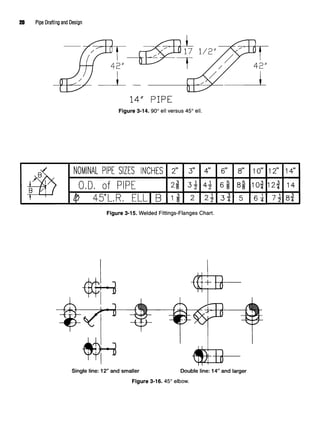
Unlike the 90° ell,there is not a formula that can be
applied to establish the center-to-end dimension of the 45°
ell. Simply dividing the length of the 90° elbow by two
will not work. The dimension of this fitting must be found
on the Welded Fitting-Flange Chart (see Figure 3-15).
Drafting Symbols for the 45° Elbow
The drafting symbols for the 45° elbow are shown in
Figure 3-16.
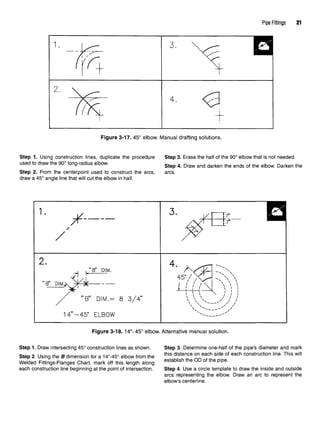
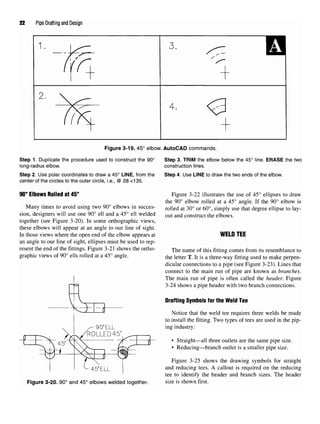
Drawing the 45° Elbow
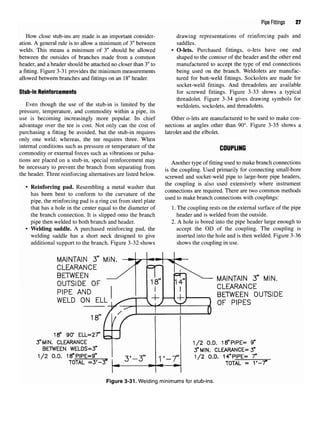
Three step-by-step methods will be presented for con-
structing the 45° elbow. Figures 3-17 and 3-18 describe
two manual methods for constructing the elbow. Figure
3-19 defines steps using AutoCAD commands to draw
Figure 3-13. 45° elbow. the elbow.
20 Pipe Drafting and Design
Figure 3-14. 90° ell versus 45° ell.
Figure 3-15. Welded Fittings-Flanges Chart.
Figure 3-16. 45° elbow.
Pipe Fittings 21
Figure 3-17. 45° elbow. Manual drafting solutions.
Step 1. Using construction lines, duplicate the procedure Step 3. Erase the half of the 90° elbow that is not needed,
used todraw the90° long-radius elbow. step 4 Dfaw and darken the ends Qf the e|bow Darken the
Step 2. From the centerpoint used to construct the arcs, arcs,
draw a 45° angle line that will cut the elbow in half.
Figure 3-18. 14"-45° elbow. Alternative manual solution.
Step 1. Draw intersecting 45° construction lines as shown. Step 3. Determine one-half of the pipe's diameter and mark
Step 2. Using the B dimension fora 14"-45° elbow from the this
^stan
^e
°n
n
each
h
side of each con
struction
line. This will
Welded Fittings-Flanges Chart, mark off this length along estabhsh the OD of tne
P'Pe
-
each construction line beginning at the point of intersection. Step 4. Use a circle template to draw the inside and outside
arcs representing the elbow. Draw an arc to represent the
elbow's centerline.
22 Pipe Drafting and Design
Figure 3-19. 45° elbow. AutoCAD commands.
Step 1. Duplicate the procedure used to construct the 90° Step 3. TRIM the elbow below the 45° line. ERASE the two
long-radius elbow. construction lines.
Step 2. Use polar coordinates to draw a 45° LINE, from the Step 4. Use LINE to draw the two ends of the elbow.
center of the circles to the outer circle, i.e., @ 28 <135.
90° Elbows Rolled at 45°
Many times to avoid using two 90° elbows in succes-
sion, designers will use one 90° ell and a 45° ell welded
together (see Figure 3-20). In some orthographic views,
these elbows will appear at an angle to our line of sight.
In those views where the open end of the elbow appears at
an angle to our line of sight, ellipses must be used to rep-
resent the end of the fittings. Figure 3-21 shows the ortho-
graphic views of 90° ells rolled at a 45° angle.
Figure 3-20. 90° and 45° elbows welded together.
Figure 3-22 illustrates the use of 45° ellipses to draw
the 90° elbow rolled at a 45° angle. If the 90° elbow is
rolled at 30° or 60°, simply use that degree ellipse to lay-
out and construct the elbows.
WELD TEE
The name of this fitting comes from its resemblance to
the letter T. It is a three-way fitting used to make perpen-
dicular connections to a pipe (see Figure 3-23). Lines that
connect to the main run of pipe are known as branches.
The main run of pipe is often called the header. Figure
3-24 shows a pipe header with two branch connections.
Drafting Symbols for the Weld Tee
Notice that the weld tee requires three welds be made
to install the fitting. Two types of tees are used in the pip-
ing industry:
• Straight—all three outlets are the same pipe size.
• Reducing—branch outlet is a smaller pipe size.
Figure 3-25 shows the drawing symbols for straight
and reducing tees. A callout is required on the reducing
tee to identify the header and branch sizes. The header
size is shown first.
Pipe Fittings 23
Figure 3-21. Orthographic views of 90° rolled at a 45° angle.
Figure 3-22. Constructing the 90° elbow rolled at 45°.
24 Pipe Drafting and Design
Figure 3-23. Weld tee.
Figure 3-24. Header and branch connections.
Figure 3-25. Weld tee symbols.
Pipe Fittings 25
Figure 3-26. Welded Fittings-Flanges Chart.
Figure 3-27.14" butt-welded straight tee. Manual drafting solutions.
Step 1. Using the 11" C dimension found on the chart, draw Step 3. From the center of the tee, draw a perpendicular line,
a centerline 22" long (11" x 2 = 22"). either up or down, depending on the direction of the branch,
Step 2. Measure 7" (one-half theheader pipe size) oneither the length of C
side of the centerline to draw the sides of the tee. Step 4. Measure 7" (one-half the branch pipe size) on either
side of the perpendicular line to draw the branch of the tee.
Draw and darken the sides and weld lines of the tee.
Figure 3-28.10" butt-welded straight tee. AutoCAD commands.
Drawing set-up. Set LINETYPE to Continuous. Step 2. From the MIDpoint, draw a PLINE QVz" long, up, to
Set LIMITS: lower left-0,0; upper right-36,36. f
°rm the branch
'
Step 3. Using OSNAR ENDpoint, place a DONUT at each end of
ZOOM, All. the fitting |f drawing fu||sca|e) the donut is 0.0" IDand 1.75"OD.
Step 1. Draw a PLINE, with awidth of .56" f/W') forfull scale or Whendrawin
9to%
"=1
'-°"scale
'thedonut is
°-°"IDand
-05
"OQ
.0175" for %" = 1 '-0" scale, 17" long, to the right, from 12,12. Step 4. Add break symbols. ZOOM, Extents.
26 Pipe Drafting and Design
Drawing the Weld Tee THE STUB-IN
Prior to drawing the weld tee, two dimensions must be
found. These dimensions are required to determine the Another method of making a branch connection is
center-to-end length of the header and the length of the called a stub-in. The stub-in is most commonly used as
branch end. If a straight tee is being used, the C dimen- an alternative to the reducing tee. The stub-in is not an
sion found on the Welded Fittings-Flanges Chart in actual fitting but rather a description of how the branch
Figure 3-26 must be added twice to find the total length connection is created. A hole is bored into the header
of the fitting. On a straight tee, the C dimension is also pipe, either the size of the OD or ID of the branch, and
used as the length of the branch end. If a reducing tee is the branch is then stubbed into it. The two pipes are fitted
being drawn, the M dimension must be substituted as together and then welded. Although the branch connec-
the length of the branch end. The M dimension is found tion can be the same pipe size or smaller as the header,
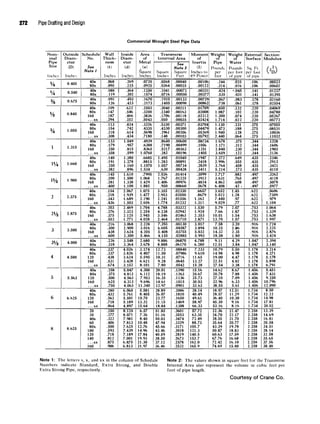
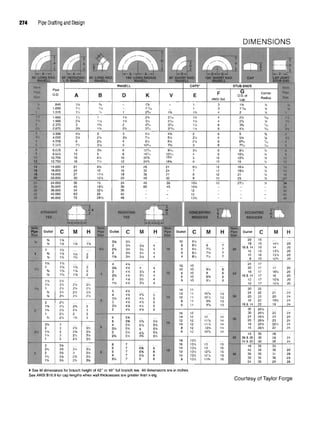
on the Taylor Forge Seamless Welding Fittings Chart in it cannot be larger. Figure 3-29 depicts the attachment
Appendix A. Figures 3-27 and 3-28 provide the manual of a stub-in. Figure 3-30 provides the single-line and
and AutoCAD steps for drawing the tee. double-line drawing symbols for a stub-in.
Figure 3-29. Stub-in connections.
Figure 3-30. Stub-in symbols.
Pipe Fittings 27
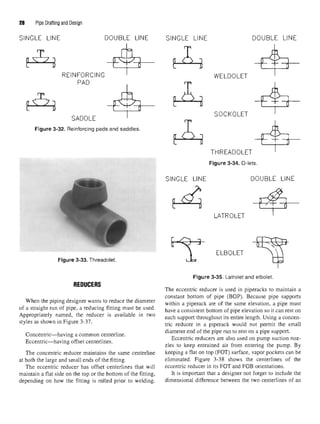
How close stub-ins are made is an important consider- drawing representations of reinforcing pads and
ation. A general rule is to allow a minimum of 3" between saddles.
welds. This means a minimum of 3" should be allowed • O-lets. Purchased fittings, o-lets have one end
between the outsides of branches made from a common shaped to the contour of the header and the other end
header, and a header should be attached no closer than 3"to manufactured to accept the type of end connections
a fitting. Figure 3-31 provides the minimum measurements being used on the branch. Weldolets are manufac-
allowed between branches and fittings on an 18"header. tured for butt-weld fittings. Sockolets are made for
socket-weld fittings. And threadolets are available
Stub-in Reinforcements for screwed fittings. Figure 3-33 shows a typical
threadolet. Figure 3-34 gives drawing symbols for
Even though the use of the stub-in is limited by the weldolets, sockolets, and threadolets.
pressure, temperature, and commodity within a pipe, its
use is becoming increasingly more popular. Its chief Other o-lets are manufactured to be used to make con-
advantage over the tee is cost. Not only can the cost of nections at angles other than 90°. Figure 3-35 shows a
purchasing a fitting be avoided, but the stub-in requires latrolet and the elbolet.
only one weld; whereas, the tee requires three. When
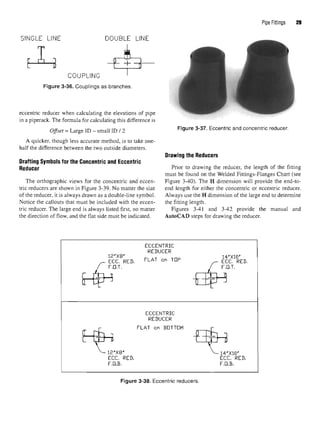
internal conditions such as pressure or temperature of the COUPLING
commodity or external forces such as vibrations or pulsa-
tions are placed on a stub-in, special reinforcement mav A *u * cr^- j. i u u
r
, , , J
Another type offittingused to make branch connections
be necessary to prevent the branch from separating from • ., r TT , • •, f .. „ u
, , , * F
. _ . , . ,. ,7 is the coupling. Used primarily for connecting small-bore
the header. Three remforcmg alternat.ves arelisted below. scr£wed and socket_weld pipe to large.bore pipe headers,
• Reinforcing pad. Resembling a metal washer that the coupling is also used extensivel
y where
instrument
, 0 , Qr, K . . f . ., . f ,, connections are required. There are two common methods
has been bent to conform to the curvature of the M
•_Q t, • f , • - .f . T , . used to make branch connections with couplings:
pipe, the reinforcing pad is a ring cut from steel plate F 6
that has a hole in the center equal to the diameter of 1. The coupling rests on the external surface of the pipe
the branch connection. It is slipped onto the branch header and is welded from the outside.
pipe then welded to both branch and header. 2. A hole is bored into the pipe header large enough to
• Welding saddle. A purchased reinforcing pad, the accept the OD of the coupling. The coupling is
welding saddle has a short neck designed to give inserted into the hole and is then welded. Figure 3-36
additional support to the branch. Figure 3-32 shows shows the coupling in use.
Figure 3-31. Welding minimums for stub-ins.
28 Pipe Drafting and Design
Figure 3-32. Reinforcing pads and saddles.
Figure 3-33. Threadolet.
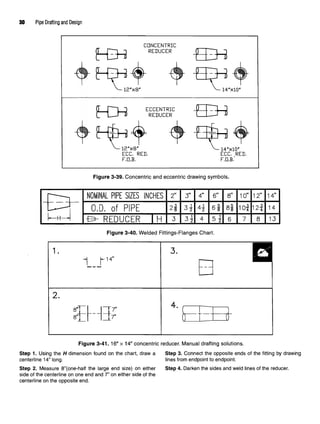
REDUCERS
When the piping designer wants to reduce the diameter
of a straight run of pipe, a reducing fitting must be used.
Appropriately named, the reducer is available in two
styles as shown in Figure 3-37.
Concentric—having a common centerline.
Eccentric—having offset centerlines.
The concentric reducer maintains the same centerline
at both the large and small ends of the fitting.
The eccentric reducer has offset centerlines that will
maintain a flat side on the top or the bottom of the fitting,
depending on how the fitting is rolled prior to welding.
Figure 3-35. Latrolet and elbolet.
The eccentric reducer is used in piperacks to maintain a
constant bottom of pipe (BOP). Because pipe supports
within a piperack are of the same elevation, a pipe must
have a consistent bottom of pipe elevation so it can rest on
each support throughout its entire length. Using a concen-
tric reducer in a piperack would not permit the small
diameter end of the pipe run to rest on a pipe support.
Eccentric reducers are also used on pump suction noz-
zles to keep entrained air from entering the pump. By
keeping a flat on top (FOT) surface, vapor pockets can be
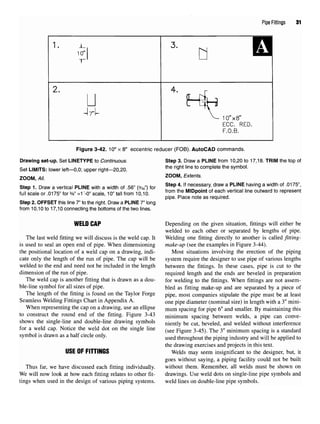
eliminated. Figure 3-38 shows the centerlines of the
eccentric reducer in its FOT and FOB orientations.
It is important that a designer not forget to include the
dimensional difference between the two centerlines of an
Pipe Fittings 29
Figure 3-36. Couplings asbranches.
eccentric reducer when calculating the elevations of pipe
in a piperack. The formula for calculating this differenceis
Offset =Large ID - small ID / 2
A quicker, though less accurate method, is to take one-
half the difference between the two outside diameters.
Drafting Symbolsfor the Concentric and Eccentric
Reducer
The orthographic views for the concentric and eccen-
tric reducers are shown in Figure 3-39. No matter the size
of the reducer, it is always drawn as a double-line symbol.
Notice the callouts that must be included with the eccen-
tric reducer. The large end is always listed first, no matter
the direction of flow, and the flat side must be indicated.
Figure 3-37. Eccentric and concentric reducer.
Drawing the Reducers
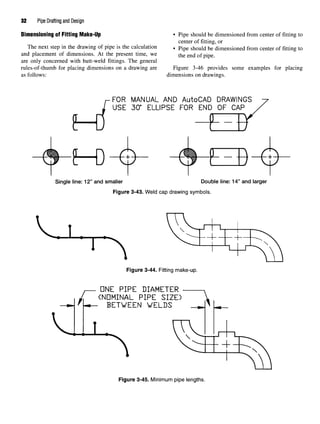
Prior to drawing the reducer, the length of the fitting
must be found on the Welded Fittings-Flanges Chart (see
Figure 3-40). The H dimension will provide the end-to-
end length for either the concentric or eccentric reducer.
Always use the H dimension of the large end to determine
the fitting length.
Figures 3-41 and 3-42 provide the manual and
AutoCAD steps for drawing the reducer.
Figure 3-38. Eccentric reducers.
30 Pipe Drafting and Design
Figure 3-39. Concentric and eccentric drawing symbols.
Figure 3-40. Welded Fittings-Flanges Chart.
Figure 3-41.16" x 14" concentric reducer. Manual drafting solutions.
Step 1. Using the H dimension found on the chart, draw a Step 3. Connect the opposite ends of the fitting by drawing
centerline 14" long. lines from endpoint to endpoint.
Step 2. Measure 8"(one-half the large end size) on either Step 4. Darken the sides and weld lines of the reducer,
side of the centerline on one end and 7" on either side of the
centerline on the opposite end.
Pipe Fittings 31
Figure 3-42.10" x 8" eccentric reducer (FOB). AutoCAD commands.
Drawing set-up. Set LINETYPE to Continuous. Step 3. Draw a PLINE from 10,20 to 17,18. TRIM the top of
Set LIMITS: lower left-0,0; upper right-20,20. the ri
9ht line to com
Plete the symboL
ZOOM, All. ZOOM, Extents.
Step 1. Draw a vertical PLINE with a width of .56" (9/16") for fte
P4
' » necessary draw a PLINE having a width of .0175"
full scale or .0175" for %" =1 '-0" scale, 10"tall from 10,10. from
** MID
P°mt of
each vertical line outward to represent
pipe. Place note as required.
Step 2. OFFSET this line 7" to the right. Draw a PLINE 7" long
from 10,10 to 17,10 connecting the bottoms of the two lines.
WELD CAP Depending on the given situation, fittings will either be
welded to each other or separated by lengths of pipe.
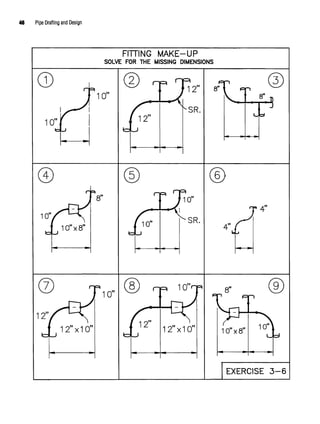
The last weld fitting we will discuss is the weld cap. It Welding one fitting directly to another is called fitting-
is used to seal an open end of pipe. When dimensioning make-up (see the examples in Figure 3-44).
the positional location of a weld cap on a drawing, indi- Most situations involving the erection of the piping
cate only the length of the run of pipe. The cap will be system require the designer to use pipe of various lengths
welded to the end and need not be included in the length between the fittings. In these cases, pipe is cut to the
dimension of the run of pipe. required length and the ends are beveled in preparation
The weld cap is another fitting that is drawn as a dou- for welding to the fittings. When fittings are not assem-
ble-line symbol for all sizes of pipe. bled as fitting make-up and are separated by a piece of
The length of the fitting is found on the Taylor Forge pipe? most companies stipulate the pipe must be at least
Seamless Welding Fittings Chart in Appendix A. one pipe diameter (nominal size) in length with a 3"mini-
When representing the cap on a drawing, use an ellipse mum spacing for pipe 6"and smaller. By maintaining this
to construct the round end of the fitting. Figure 3-43 minimum spacing between welds, a pipe can conve-
shows the single-line and double-line drawing symbols niently be cut> beveied, and welded without interference
for a weld cap. Notice theweld doton thesingle line (see Rgure 3.45) The y minimum spacing is a standard
symbol isdrawn as ahalf circle only. used throughout the piping industry and win be applied to
the drawing exercises and projects in this text.
USE OFFITTINGS Welds may seem insignificant to the designer, but,it
goes without saying, a piping facility could not be built
Thus far,we have discussed each fitting individually. without them. Remember, all welds must be shown on
We will now look at how each fitting relates to other fit- drawings. Use weld dots on single-line pipe symbols and
tings when used in the design of various piping systems. weld lines on double-line pipe symbols.
32 Pipe Drafting and Design
Dimensioning OfFitting Make-Up • Pipe should be dimensioned from center of fitting to
center of fitting, or
The next step in the drawing of pipe is thecalculation . Pipe should be dimensioned from center of fitting to
and placement of dimensions. At the present time, we the end of pipe
are only concerned with butt-weld fittings. The general
rules-of-thumb for placing dimensions on a drawing are Figure 3-46 provides some examples for placing
as follows: dimensions on drawings.
Figure 3-43. Weld cap drawing symbols.
Figure 3-44. Fitting make-up.
Figure 3-45. Minimumpipe lengths.
Pipe Fittings 33
SCREWED AND SOCKET-WELD FITTINGS
Screwed and socket-weld fittings perform the same
basic functions as butt-weld fittings. There are, however,
a few differences that must be examined. Screwed and
socket-weld fittings are normally reserved for installa-
tions using fittings 3" and smaller. Screwed and socket-
weld fittings are also available in cast iron, malleable
iron, or forged steel. Cast iron and malleable iron fittings
are typically used on low pressure and temperature lines
such as air, water, or condensate.
Lines containing high pressure and temperature
commodities, which are subject to movement and
vibration, require fittings made of forged steel. Forged
steel screwed and socket-weld fittings are manufac-
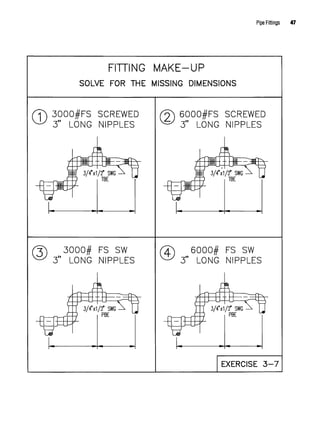
tured in two pressure classes—3000# and 6000#.
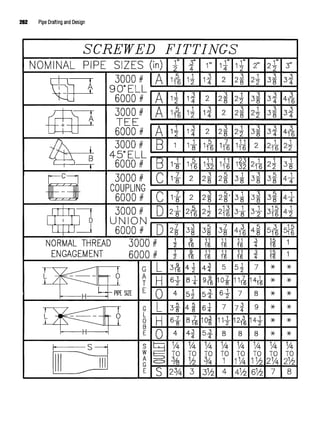
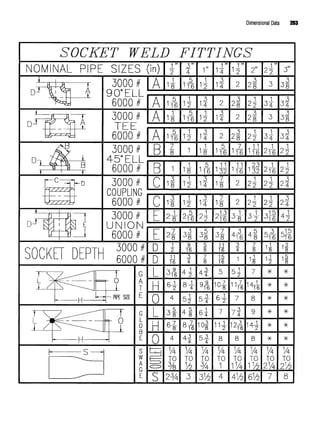
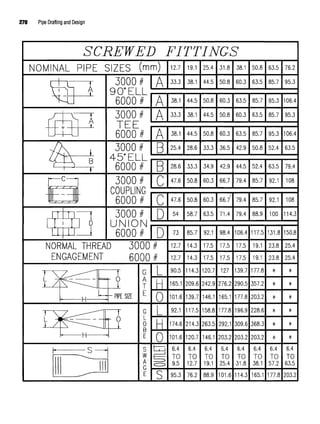
Dimensional charts for screwed and socket-weld fit-
tings are provided in Appendix A. These dimensioning
charts supply measurements for 3000# and 6000# fit-
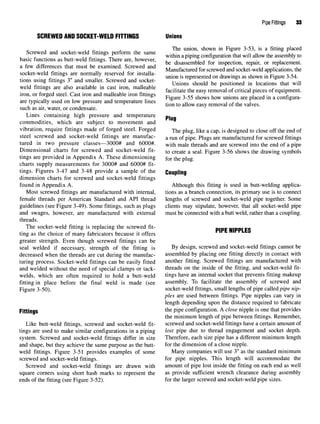
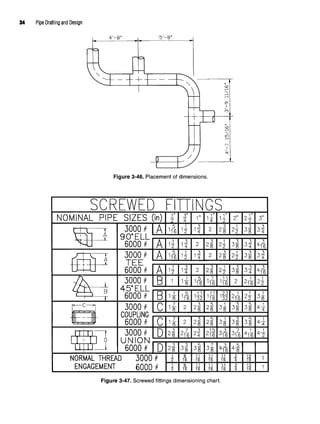
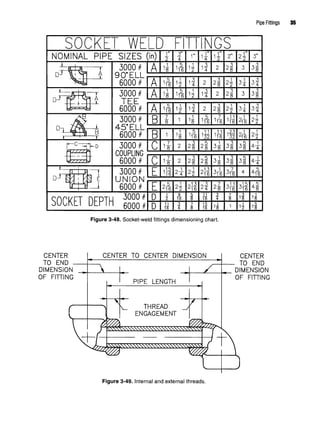
tings. Figures 3-47 and 3-48 provide a sample of the
dimension charts for screwed and socket-weld fittings
found in Appendix A.
Most screwed fittings are manufactured with internal,
female threads per American Standard and API thread
guidelines (see Figure 3-49). Some fittings, such as plugs
and swages, however, are manufactured with external
threads.
The socket-weld fitting is replacing the screwed fit-
ting as the choice of many fabricators because it offers
greater strength. Even though screwed fittings can be
seal welded if necessary, strength of the fitting is
decreased when the threads are cut during the manufac-
turing process. Socket-weld fittings can be easily fitted
and welded without the need of special clamps or tack-
welds, which are often required to hold a butt-weld
fitting in place before the final weld is made (see
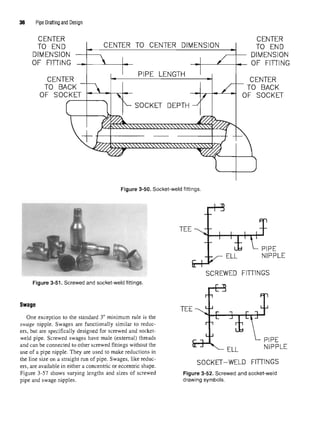
Figure 3-50).
Like butt-weld fittings, screwed and socket-weld fit-
tings are used to make similar configurations in a piping
system. Screwed and socket-weld fittings differ in size
and shape, but they achieve the same purpose as the butt-
weld fittings. Figure 3-51 provides examples of some
screwed and socket-weld fittings.
Screwed and socket-weld fittings are drawn with
square corners using short hash marks to represent the
ends of the fitting (see Figure 3-52).
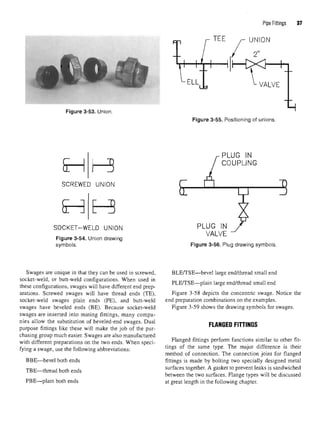
Unions
The union, shown in Figure 3-53, is a fitting placed
within a piping configurationthat will allow the assembly to
be disassembled for inspection, repair, or replacement.
Manufactured for screwed and socket-weld applications, the
union is represented on drawings as shown in Figure 3-54.
Unions should be positioned in locations that will
facilitate the easy removal of critical pieces of equipment.
Figure 3-55 shows how unions are placed in a configura-
tion to allow easy removal of the valves.
Plug
The plug, like a cap, is designed to close off the end of
a run of pipe. Plugs are manufactured for screwed fittings
with male threads and are screwed into the end of a pipe
to create a seal. Figure 3-56 shows the drawing symbols
for the plug.
Coupling
Although this fitting is used in butt-welding applica-
tions as a branch connection, its primary use is to connect
lengths of screwed and socket-weld pipe together. Some
clients may stipulate, however, that all socket-weld pipe
must be connected with a butt weld, rather than a coupling.
PIPE NIPPLES
By design, screwed and socket-weld fittings cannot be
assembled by placing one fitting directly in contact with
another fitting. Screwed fittings are manufactured with
threads on the inside of the fitting, and socket-weld fit-
tings have an internal socket that prevents fitting makeup
assembly. To facilitate the assembly of screwed and
socket-weld fittings, small lengths of pipe called pipe nip-
ples are used between fittings. Pipe nipples can vary in
length depending upon the distance required to fabricate
the pipe configuration.A close nipple is one that provides
the minimum length of pipe between fittings. Remember,
screwed and socket-weld fittings have a certain amount of
lost pipe due to thread engagement and socket depth.
Therefore, each size pipe has a different minimum length
for the dimension of a close nipple.
Many companies will use 3" as the standard minimum
for pipe nipples. This length will accommodate the
amount of pipe lost inside the fitting on each end as well
as provide sufficient wrench clearance during assembly
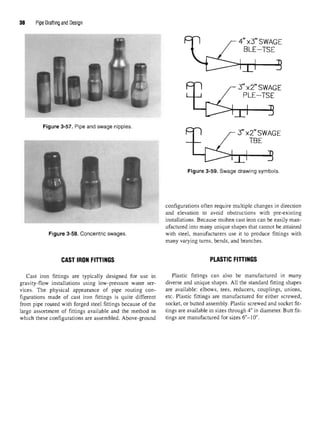
for the larger screwed and socket-weld pipe sizes.
34 Pipe Drafting and Design
Figure 3-46. Placement of dimensions.
Figure 3-47. Screwed fittings dimensioning chart.
Pipe Fittings 35
Figure 3-48. Socket-weld fittings dimensioning chart.
Figure 3-49. Internal and external threads.
36 Pipe Drafting and Design
Figure 3-50. Socket-weld fittings.
Figure 3-51. Screwed and socket-weld fittings.
Swage
One exception to the standard 3" minimum rule is the
swage nipple. Swages are functionally similar to reduc-
ers, but are specifically designed for screwed and socket-
weld pipe. Screwed swages have male (external) threads
and can be connected to other screwed fittings without the
use of a pipe nipple. They are used to make reductions in
the line size on a straight run of pipe. Swages, like reduc-
ers, are available in either a concentric or eccentric shape.
Figure 3-57 shows varying lengths and sizes of screwed
pipe and swage nipples.
Figure 3-52. Screwed and socket-weld
drawing symbols.
Pipe Fittings 37
Figure 3-53. Union
Figure 3-54. Union drawing
symbols.
Swages are unique in that they can be used in screwed,
socket-weld, or butt-weld configurations. When used in
these configurations, swages will have different end prep-
arations. Screwed swages will have thread ends (TE),
socket-weld swages plain ends (PE), and butt-weld
swages have beveled ends (BE). Because socket-weld
swages are inserted into mating fittings, many compa-
nies allow the substitution of beveled-end swages. Dual
purpose fittings like these will make the job of the pur-
chasing group much easier. Swages are also manufactured
with different preparations on the two ends. When speci-
fying a swage, use the following abbreviations:
BBE—bevel both ends
TBE—thread both ends
PBE—plain both ends
Figure 3-55. Positioning of unions.
Figure 3-56. Plug drawing symbols.
BLE/TSE—bevel large end/thread small end
PLE/TSE—plain large end/thread small end
Figure 3-58 depicts the concentric swage. Notice the
end preparation combinations on the examples.
Figure 3-59 shows the drawing symbols for swages.
FLANGED FITTINGS
Flanged fittings perform functions similar to other fit-
tings of the same type. The major difference is their
method of connection. The connection joint for flanged
fittings is made by bolting two specially designed metal
surfaces together. A gasket to prevent leaks is sandwiched
between the two surfaces. Flange types will be discussed
at great length in the following chapter.
38 Pipe Drafting and Design
Figure 3-57. Pipe and swage nipples.
Figure 3-58. Concentricswages.
CAST IRON FITTINGS
Cast iron fittings are typically designed for use in
gravity-flow installations using low-pressure water ser-
vices. The physical appearance of pipe routing con-
figurations made of cast iron fittings is quite different
from pipe routed with forged steel fittings because of the
large assortment of fittings available and the method in
which these configurations are assembled. Above-ground
Figure 3-59. Swage drawing symbols.
configurations often require multiple changes in direction
and elevation to avoid obstructions with pre-existing
installations. Because molten cast iron can be easily man-
ufactured into many unique shapes that cannot be attained
with steel, manufacturers use it to produce fittings with
many varying turns, bends, and branches.
PLASTIC FITTINGS
Plastic fittings can also be manufactured in many
diverse and unique shapes. All the standard fitting shapes
are available: elbows, tees, reducers, couplings, unions,
etc. Plastic fittings are manufactured for either screwed,
socket, or butted assembly. Plastic screwed and socket fit-
tings are available in sizes through 4" in diameter. Butt fit-
tings are manufactured for sizes 6"-10".
Pipe Fittings 39
CHAPTER 3 REVIEW QUIZ
1. Typically, pipe smaller than 3" in diameter is manufactured as having or
end connections.
2. What is the most common fitting used?
3. What are the four classifications of elbows?
4. What is the formula for calculating the center-to-end dimension for LR and SR elbows?
LR=
SR=
5. Describe a mitered elbow.
6. When configuring tee connections, what is the main run of pipe called?
7. Name the two types of tees.
8. What are some alternate methods to a tee fitting when fabricating branch connections?
9. Which fitting is used to make a reduction in the line size of a run of pipe?
10. Name the two types of reducers.
11. Define fitting make-up.
12. What are the two pressure classifications for screwed and socket-weld fittings?
13. What type of fittings must be bolted together?
14.What is the typical installation service for cast iron pipe?
15.Name the three types of plastic fitting end types manufactured.
40 Pipe Drafting and Design
EXERCISE INFORMATION • Place a base point on one end of each fitting using
MIDpoint, ENDpoint, or CENter OSNAP options.
Thefittingsdepicted inFigure 3-60 will be used tocomplete . jn the "Block Definition" dialog box check the
the exercises in Chapters 3,4, 5, and 10.Tocomplete the exer- Create iconfrom block geometry radio button,
cises, drawthe symbolsbelow usingthe followingguidelines. • SAVE the file as "ELBOWS.dwg".
• Start from scratch and draw all symbols full scale.
• Draw symbols with a PLINE having a width of .56" After the
symbols have been created and the drawing
(y]6") for single line symbols and a 0"width for double saved
' start the
exercise drawing and use AutoCAD
line fittings. Symbols requiring a full circular shape must Design Center to open the file ELBOWS.dwg. Insert the
be drawnwiththe PLINE command ARC option. These required symbols into the appropriate locations.
arcs can only be drawnwith a 359° circumference. NOTE: The pipe break symbol is created with ellipses.
• Create weld dots with a 1.75" diameter DONUT. The ma
Jor axis of each
ellipse is equal to one-half ofthe
• Block each symbol individually using the block P1
?6
'8 OD
- TRIM or
BREAK an ellipse to create the
name indicated. (DO NOT include text with the elliptical arc on the pipe break as necessary.
blocked symbol.)
Figure 3-60. AutoCAD drawing symbols and File names.
Pipe Fittings 43
44 Pipe Drafting and Design
Pipe Fittings 45
46 Pipe Drafting andDesign
Pipe Fittings 47
Flange Basics
The flange is a ring-shaped device designed to be used
as an alternative to welding or threading various piping
system components used throughout the piping system.
Flanged connections are used as an alternative to welding
because they can be easily disassembled for shipping,
routine inspection, maintenance, or replacement. Flanged
connections are preferred over threaded connections
because threading large bore pipe is not an economical or
reliable operation. The flange is an important component
of any piping system.
Flanges are primarily used where a connecting or dis-
mantling joint is needed. These joints may include join-
ing pipe to fittings, valves, equipment, or any other
integral component within the piping system.
To erect the piping system, every piece of mechanical
equipment is manufactured with at least one outlet called
a nozzle. The nozzle is the point where, via the flange, the
piping system is connected to the equipment. From this
flange, the piping system is begun. Figure 4-1 shows how
a nozzle and flange are used to connect the piping system
to a piece of equipment.
Figure 4-1. Nozzle and flange.
RATING FLANGES
Rating, as applied to flanges, may best be defined as
the maximum pressure allowed by the pressure piping
code for the specific temperature at which the flange will
be operating. Flanges and nozzles are sized according to
pressure ratings established by the American National
Standards Institute (ANSI). These pressure ratings,
sometimes called pound ratings, are divided into seven
categories for forged steel flanges. They are 150#, 300#,
400#, 600#, 900#, 1500#, and 2500#. Cast iron flanges
have pound ratings of 25#, 125#, 250#, and 800#.
Pound ratings, when combined with the temperature of
the commodity within the pipe, are used to select the
appropriate size, rating, and type of flange. This pressure/
temperature relationship will allow any given flange to be
used in a number of different applications. For example, a
150# forged steel flange is rated to perform at 150# PSIG
at 500°F. If the temperature were decreased to 100°F, this
same flange could be used for 275# PSIG. However,
if the temperature were increased to 750°F, the flange
could only be used for 100# PSIG. As you can see, the
pressure/temperature relationship is important. When
temperature decreases the allowable pressure increases,
and vice versa. Pound ratings are also used to establish
the outside diameter and thickness of a flange. Typically
as pound ratings increase, so will the flange's diameter
and thickness.
FLANGE FACINGS
The mating surface of a flange, nozzle, or valve is
called the face. The face is usually machined to create a
smooth surface. This smooth surface will help assure a
leak-proof seal when two flanges are bolted together with
a gasket sandwiched between.
Although numerous types of flange faces are pro-
duced, we will focus only on the following three:
• flat face
• raised face
• ring-type joint
Flat face
As the name implies, flanges with flat faces are those
that have a flat, level connecting surface (see Figure 4-2).
Forged steel flanges with a flat face flange are commonly
48
Flange Basics 49
Figure 4-2. Flat face.
found in 150# and 300# ratings. Their principal use is to
make connections with 125# and 250# cast iron flanges,
respectively. Attaching steel pipe to the cast iron flanges
found on some valves and mechanical equipment always
presents a problem because of the brittle nature of cast
iron. Using a flat face flange will assure full surface con-
tact, thereby reducing the possibility of cracking the
softer cast iron. Figure 4-3 shows a sectional view of a
flange with a flat face.
Raised Face
The most common face type in use, the raised face is
available in all seven of the aforementioned pound rat-
ings. Appropriately named, this flange face has a promi-
nent raised surface. With shallow grooves etched into the
raised surface, this flange face assures a positive grip with
the gasket. Flanges rated 150# and 300# have a Me" raised
face, while flanges 400# and above have a 1
A" raised face
(see Figure 4-4). It is important to note most dimension-
ing charts, including the ones provided in this text,
include the Yi6r
raised face thickness in the length dimen-
sions for 150# and 300# flanges. However, the 1
A" raised
face thickness is not always included in the length dimen-
sions for 400# and higher pound ratings. To assure
accurate dimensioning, always determine if the dimen-
sioning chart being used includes the 1
A" raised face
thickness for the larger pound rating flanges. The 1
A"
raised face thickness must be added to the dimensioning
chart measurement to obtain the overall flange length if
the dimensioning chart indicates it has not been added.
Figure 4-5 includes a sectional view of a weld neck flange
having a raised face.
Figure 4-3. Welding neck flange with flat face.
Figure 4-4. Raised face.
Ring-Type Joint
Also known simply as ring joint, the ring-type joint
does not use a gasket to form a seal between connecting
flanges. Instead a round metallic ring is used that rests in
a deep groove cut into the flange face (see Figure 4-6).
The donut-shaped ring can be oval or octagonal in design.
As the bolts are tightened, the metal ring is compressed,
creating a tight seal.
Although it is the most expensive, the ring-type joint is
considered to be the most efficient flange used in process
piping systems. The ring and groove design actually uses
internal pressures to enhance the sealing capacity of the
connecting flanges. The superiority of this seal can have
its disadvantages, however. When dismantling ring joint
connections, the flanges must be forcibly separated to
release the ring from the groove. In crowded installations,
this could cause major problems. Because of this, the ring
50 Pipe Drafting and Design
Figure 4-5. Weld neck flange with raised face
FLANGE TYPES
Flanges have been designed and developed to be used
in a myriad of applications. Each one has its own special
characteristics, and should be carefully selected to meet
specific function requirements. The following flanges
will be discussed in this chapter:
• weld neck
• threaded
• socket weld
• slip-on
• lap-joint
Figure 4-6. Ring-type joint. * re ucm
§
• blind
• orifice
NOTE: A photograph and short description accompa-
joint flange is relegated to applications where space for nies each flange as well as symbols to depict the flange as
maintenance and replacement are adequate. it would appear on a drawing. The manual and AutoCAD
Although available for all pound ratings, flanges with techniques for creating the drawing symbols are shown
ring-type joint faces are normally used in piping systems for the weld neck flange only. The drawing symbols for
rated 400# and higher. See Figure 4-7 for the sectional the remaining flanges can be created in a similar fashion
view of a flange with a ring-type joint face. with only a few minor alterations.
Weld Neck Flange
The weld neck flange shown in Figure 4-8 is occasion-
ally referred to as the "high-hub" flange. It is designed to
reduce high-stress concentrations at the base of the flange
by transferring stress to the adjoining pipe. Although
expensive, the weld neck flange is the best-designed butt
weld flange available because of its inherent structural
value and ease of assembly.
Known for its strength and resistance to dishing, the
weld neck flange is manufactured with a long tapered
hub. The tapered hub is created by the gradual increase
in metal thickness from the weld joint to the flange
facing. The symmetrical taper transition is extremely ben-
eficial under conditions of repeated bending caused by
line expansion, contraction, or other external forces. See
Figure 4-9, for weld neck flange drawing symbols.
Weld neck flanges are normally used in severe service
applications involving high pressures, high temperatures,
or sub-zero conditions.
Weld neck flanges are bored to match the ID of the
adjoining pipe. In other words, the thinner the wall of
the pipe, the larger the bore (hole) through the flange. The
thicker the wall of the pipe, the smaller the bore. Because
of these matching IDs, there is no restriction to the flow.
Turbulence and erosion are therefore eliminated.
Drawing the Weld Neck Flange
Prior to constructing the manual and AutoCAD
symbols, certain dimensional information must be pro-
vided. These dimensions can be found on the welded
Flange Basics 51
fittings-flanges dimensioning chart shown in Figure 4-10.
The figure in this chart represents the raised face weld
neck flange.
Notice the three dimensions: O, T, and L. The O
dimension represents the flange's OD. The T defines the
flange's face thickness and the L provides the flange's
length or length-thru-hub dimension. These three dimen-
sions are required to construct the drawing symbols of
each flange.
To find the numerical values for these dimensions,
locate the appropriate pound rating section, that is, 150#,
300#, etc. Find the proper size pipe in the Nominal Pipe
Size column. Follow across the chart to determine the O,
T, and L dimensions. For our demonstration, we will be
using a 14"-300# raised face weld neck (RFWN) flange.
You should find the O, T, and L measurements for this
flange to be 23", 2 i/8", and 5 y8" respectively.
Figure 4-8. Weld neck flange.
Figure 4-9. Weld neck flange drawing symbols.
52 Pipe Drafting and Design
Two step-by-step methods will be presented for con- significant disadvantages, however, are the requirements
structing the weld neck flange. Figure 4-11 demonstrates of two fillet welds, one internal and one external, to pro-
steps using manual drafting techniques. Figure 4-12 pre- vide sufficient strength and prevent leakage, as well as a
sents the steps using AutoCAD commands. life span about one-third that of the weld neck flange.
They are preferred over welding neck flanges by many
Slip-On Flange users because of their lower initial cost. However, the
total cost after installation is not much less than the
The slip-on flange shown in Figure 4-13 has a low hub welding neck because of the additional welding involved,
that allows the pipe to be inserted into the flange prior See the Taylor Forge Seamless Fittings Dimensioning
to welding. Shorter in length than a weld neck flange, Chart in Appendix A for dimensions of the slip-on flange,
the slip-on flange is used in areas where short tie-ins are The drawing symbols for the slip-on flange are shown in
necessary or space limitations necessitate its use.Two Figure 4-14.
Figure 4-10. Welded fittings-flanges dimensioning chart.
Figure 4-11. Manual drafting solutions for a 14"-300# RFWN flange.
Step 1. Draw a vertical construction line approximately 30" Step 4. Draw 30° lines to represent the flange hub. Connect
tall. (This will represent the flange face.) To the right, draw a the face thickness with short horizontal lines. Darken the
parallel line 21
/s" away. Draw another parallel line 55
/s" away flange as required. A short piece of pipe can be added if nec-
from the first. essary.
Step 2. Bisect the three lines with a centerline. Step 5. When constructing single-line symbols, the flange
Step 3. On the flange face measure 11W (one-half of the ™" be
^presented as a T shape. The flange face is typically
23" flange OD) above and below the centerline On theright drawn as a Sin
9le lme the thlckness of a double Wlde
-7mm
end oftheflange, measure 7"(one-half ofthe14" pipe OD) lead
*^ dot wi
" be
Placed
™ the
*nd
°f
<he
m
flan
9eat the
above and below thecenterline. Pointwhere the
P'Pe IS attached
<see F|
9ure 4
'9
)'
Flange Basics 53
Figure 4-12.14"-300# RFWN flange. AutoCAD commands.
Drawing set-up Step 3. OFFSET the centerline 7" (one-half of the 14" pipe
Set LINETYPE to Continuous OD) above and below the pipe's centerline. CHANGE the
Set LIMITS: lower left corner—(0,0) linetype of these two lines to Continuous.
upper right corner—(10,30) step4 From the rjght end Qf the f|ange> draw 3Qo nnes toward
ZOOM, All the flange face to represent the flange hub. TRIM as required.
Step 1. Draw a vertical LINE 23"tall from 2,4. (This line will ER
*SE cons
'r
^o
:
n
'ines
' Wh
^ C
?n
5"ctir
!?,s]n
9«e-line
represent the flange's face). s
Vmbols
' use PLINEs havin
9aWldth of
'56
<9/16
>fu!l scale or
.0175" when drawing to %" = 1'-0" scale to draw the face
Step 2. Use OFFSET to draw the flange face thickness 21
/8" thickness and hub length. Use a DONUT with a fullscale
toward the right. Close the top and bottom ends. OFFSET inside diameter of 0.000" and an outside diameter of 1.75" as
the flange face line 5%" to the right. (This will establish the a symbol for the weld dot. Weld dots drawn to %" = 1 '-0"
length-thru-hub distance.) From the MIDpoint of the flange scale will have an outside diameter of .05".
face, draw the flange's centerline to the right.
Figure 4-13. Slip-on flange.
Lap-joint Flange
The lap-joint flange in Figure 4-15 is primarily used on
carbon or low alloy steel piping systems. Attachment of
the lap-joint flange to the piping system requires a lap-
joint stub end. The lap-joint flange and stub end assembly
are used mainly in piping systems that necessitate frequent
dismantling for inspection or routine maintenance. It is
also used in the erection of large diameter or hard-to-
adjust piping configurations because of its quick bolt hole
alignment. Figure 4-16 depicts the drawing symbols for
the lap-joint flange.
Threaded Flange
The threaded flange depicted in Figure 4-17 similar to
the slip-on flange, but the bore is threaded. Its principal
value is that it can be assembled without welding. This
feature makes the threaded flange well-suited to extreme
pressure services that operate at normal atmospheric tem-
peratures and in highly explosive areas where welding
may create a hazard.
Threaded flanges are not suited, however, for condi-
tions involving temperatures or bending stresses of any
significance, particularly when cyclic conditions exist,
which may cause leakage through the threads. After just a
relatively few cycles of expansion and contraction or
movement caused by stress, the threaded flange no longer
performs adequately.
54 Pipe Drafting and Design
Figure 4-14. Slip-on flange drawing symbols.
for use on small diameter W through 4") high-pressure
piping systems. Like socket weld fittings, pipe is inserted
into the socket then welded. An internal weld is often
employed for added strength. By grinding the internal
weld smooth, turbulence and flow restriction are kept to a
minimum. The single-line drawing symbol for the socket-
weld flange is shown in Figure 4-20.
Reducing Flange
Like the reducer fitting, the reducing flange in Figure
4-21 is used to make a reduction in the diameter of
the pipe. A reducing flange is most frequently used in
Figure 4-15. Lap-joint flange. installations with limited space. Crowded situations may
necessitate the use of the reducing flange because it has a
A seal weld is sometimes applied around the threaded shorter overa11 len
§th when
compared to a weld neck
joint to reduce the possibility of leakage. This technique, flan
§e and
reducer-fitting configuration. Be advised how-
however, cannot be considered as entirely satisfactory nor ever
> the flow
should travel from the smaller size to the
is it always possible. Figure 4-18 represents the single- lar
§er
- If the flow were
reversed, severe turbulence could
line threaded flange drawing symbol. develop.
Callouts are placed on drawings to describe the reduc-
Socket Weld Flange m
§ flange in the same manner as those used on the
reducer fitting: large end first, small end second. One
The socket weld flange shown in Figure 4-19 is also additional note is needed, however. The pound rating and
similar to the slip-on flange. It was originally developed flange type is included in the callout.
Figure 4-16. Lap-joint flange drawing symbols.
Flange Basics 55
Figure 4-17. Threadedflange.
Figure 4-20. Single-linesocket-weld drawing symbol.
Figure 4-18. Single-line threadedflange drawing
symbol.
Figure 4-21. Reducing flange.
Figure 4-19. Socket weldflange.
The reducing flange maintains all the dimensional
characteristics of the larger end size. One exception how-
ever is the internal bore. The internal bore is manufac-
tured to match that of the smaller pipe size. Figure 4-22
shows a 12" x 6"-300# raised face slip-on flange. Notice
the use of abbreviations to keep the size of the callout to a
minimum.
Reducing flanges are manufactured as weld neck, slip-
on, or threaded flange types.
Figure 4-22. Reducing flange drawingsymbol with
callout.
Blind Flange
The blindflange depicted in Figure 4-23 serves a func-
tion similar to that of a plug or cap. It is used to terminate
the end of a piping system. The blind flange is basically a
flange that does not have a hub or a bored center. Blind
flanges have the face thickness of a flange, a matching
56 Pipe Drafting and Design
face type, and similar bolting pattern. Blind flanges can recorded is known as a meter run. Figure 4-26 shows the
also be used to seal a nozzle opening on a pressure vessel. orifice flange union assembly installed in a meter run.
Because it is bolted, the blind flange provides easy access The orifice plate, which is not typically furnished with
to the interior of a vessel or pipe, unlike a cap that is the orifice union assembly package, looks similar to a
welded. Figure 4-24 represents the drawing symbol for large ring washer with a handle attached. When fully
the blind flange. assembled, the orifice plate is sandwiched between the
orifice flanges. Valve taps are inserted into pressure holes
Orifice Flanoe mat a
^ow
f°r me
attachment of field monitoring equip-
ment so accurate measurements can be recorded.
_ , ,. , , .„ ._. Orifice flanges can be either weld neck, slip-on, or
Of the flanges discussed, the orifice flange (Figure ^, , , ,™ ,, , , iU , , .,- „
A nf. . , , , „ r c . threaded. The weld neck and threaded orifice flanges are
4-25) is the only one that actually performs a function. f . , . orkru, ,, , .. TT
^, ' . - , . _ _ . , ,, manufactured in 300# andlarger pound ratings. However,
The function of the orifice flange is to measure the rate of ., v •*- f • i -i ui ™n.u • j
, , , . . the slip-on orifice flange is only available as a 300# raised
the flow of the commodity through the piping system. ,. „ . , J
.
^ .~ „ . , , , faceflange.Thesingle-line anddouble-line drawing sym-
Onfice flanges are easy to recognize because they have a u , ^ T. .^ ^ , • ^- A ^
, , , . „ , , , / c ?, ,• ! bols fortheorificeflangeareshown in Figure 4-27.
hole drilled through the face of the flange perpendicular
to the pipe. They also have an additional set of bolts
calledjack screws. These screws are used to help separate
the flanges so inspection and/or replacement of the orifice
plate can be performed. The orifice flange is a single
component of the orifice flange union assembly. The ori-
fice flange union is composed of two orifice flanges, an
orifice plate, bolts, nuts, jack screws, and two gaskets.
The orifice flange union is used to measure, or meter,
the amount of pressure drop through the orifice plate. The
length of pipe within the piping system where orifice
flanges are installed and where these measurements are
Figure 4-25. Orifice flange.
Figure 4-23. Blind flange.
Single line: 12" and smaller Double line: 14" and larger Flgure 4.26- Orifice flange union assembly. Courtesy of
Figure 4-24.Blind flange drawing symbols. Nisseki Chemical Texas Inc., Bayport, Texas.
Flange Basics 57
Figure 4-27. Orifice flange drawing symbols.
BOLTS Formula: 360° / # of holes = angular location
To complete any flanged assembly, two additional Example: 360°/8 (holes) = 45°
items are required: bolts and gaskets. Bolts obviously
hold mating flanges, nozzles, or valves together. The Using this formula shows holes on an eight-hole flange
pressure rating of a flange will determine the size, spac- to be spaced 45° apart. By straddling the centerline, holes
ing, and number of bolts required. As the nominal pipe will be positioned 221
/2° on each side of the centerline
size and pressure ratings change so will the diameter, (see Figure 4-28).
spacing, and number of bolts. Bolts are available in two types, machine or stud.
Flanges are designed to match the bolt circle and bolt Machine bolts have a "head" on one end and threads on
hole dimensions of other flanges that are of the same the other. Stud bolts have threads throughout their entire
diameter and pressure rating. Bolt hole arrangements may length and require the use of two nuts. Stud bolts are the
seem inconsequential, but, when one considers the fact most commonly used type and are available in two
that components of a piping system may be fabricated in grades, A-193-B7 and A-193-B16. B7 grade bolts are
one country then shipped to another country for assembly, used for temperatures to 1,000°F. B16 bolts are used
bolt alignments become increasingly important. It is criti- when temperatures exceed 1,000°F (see Figure 4-29).
cal that drawings convey the exact orientation of flanges to
the fabricator. Otherwise, bolt holes may not align prop-
erly. ANSI standards require all flanges straddle either the
horizontal, vertical, or north-south centerlines of pipe and uAoKtlo
equipment, unless otherwise noted on a drawing.
To assure that bolt holes on flanges, nozzles, or valves The primary purpose of any flanged assembly is to
align properly, holes are equally spaced around the connect piping systems in such a manner as to produce a
flange. One column on the Taylor Forge Forged Steel leak-free environment. Hazardous and combustible mate-
Flanges Dimensioning Chart found in Appendix A indi- rials and extreme pressures and temperatures require the
cates the number and diameter of the bolt holes on utmost in safety precaution. Creating a leak-proof seal
flanges. Notice bolts are found in quantities of four, that between two connecting metal surfaces in an industrial
is, 4, 8, 12, 16, etc. The following formula makes bolt setting is almost impossible. Therefore, gaskets perform a
hole location and alignment quick and simple. vital function in plant safety.
58 Pipe Drafting and Design
Figure 4-28. Bolt hole spacing.
Using a gasket material softer than two adjoining A gasket's thickness must be accounted for when
flanges is an excellent way to eliminate the possibility of dimensioning the piping system. The typical gasket has a
a fluid escape. Gaskets can be made of materials such as thickness of V%" (3.175mm). At every occurrence of a
asbestos, rubber, neoprene, Teflon, lead, or copper. When flange bolting to a nozzle, two flanges joining one
bolts are tightened and flange faces are drawn together, another, two valves joining one another, or a flange con-
the gasket material will conform to any imperfections in necting to a valve, a gasket thickness must be added to the
the flange faces to create a uniform seal. length of the pipe components. Figures 4-34 and 4-35
Figure 4-30 demonstrates the three types of gaskets show that a flat-ring gasket does occupy space. Though
that can be found in piping systems. They are full face, it's only V%" thick, a gasket cannot be ignored,
flat ring, and metal ring. Full face gaskets (Figure 4-31) Figure 4-36 depicts the gap between ring-type joint
are used on flat face flanges. Flat ring gaskets (Figure flanges. The ring-type joint section of the Welded
4-32) are used on raised face flanges. Metal rings Fittings-Flanges Dimensioning Chart, gives the gap mea-
(Figure 4-33) are used on ring-type joint flanges. surement as the G dimension. This dimension will vary
Figure 4-29. Stud and machine bolts. Figure 4-30. Gaskets. Courtesy of Flexitallic, Inc.
Flange Basics 59
Figure 4-31. Full face gaskets.
Figure 4-34. Flat ring gasket and flange. Courtesy of
Flexitallic, Inc.
Figure 4-32. Flat ring gaskets. Courtesy of Flexitallic, Inc
Figure 4-35. Flat ring gaskets between flanges. Courtesy
of Flexitallic, Inc.
Figure 4-33. Metal rings for ring-type joint flanges.
Courtesy of Flexitallic, Inc. Figure 4-36. Ring-type joint gap spacing.
60 Pipe Drafting and Design
depending on the size and pound rating of the flange. This dimensioning of the piping configuration. Tick marks are
is an important consideration to keep in mind when drawn approximately 1
A" long and are placed on piping
dimensioning piping runs that have ring-type joint drawings near the location where a gasket or ring is to be
connections. installed. Figure 4-37 depicts two tick marks, one on each
For each instance of a gasket or ring, gap spacing end of a valve, that have been included in the total dimen-
must be reflected in the dimensions shown on a piping sion between the faces of the two flanges. The lOVfc"
drawing. Tick marks are used to indicate each location dimension would be the sum total of one valve and two
where a gasket or ring gap has been included in the gaskets.
Figure 4-37. Dimensioning gaskets.
Flange Basics 61
CHAPTER 4 REVIEW QUIZ
1. Name the seven forged steel flange pound ratings.
2. Name the four pressure classes for cast iron flanges.
3. What are the three flange facings discussed in this chapter?
4. What is the thickness of the raised face on a 600# raised-face flange?
5. Briefly describe five types of flanges depicted in this chapter.
6. Give O, T, and L dimensions of the following flanges.
SIZE/RATING O T L
4"—150#R.F.W.N.
6"—300# R.F.W.N.
10"—400#R.F.W.N. :
16"—600# R.F.W.N.
8"—600# R
.
F
.
W
.
N
.
62 Pipe Drafting and Design
7. What is the purpose of an orifice flange union?
8. Name the two types of bolts used to assemble flanges.
9. According to ANSI standards, which centerlines should flanges straddle on pipe and equipment?
10.List four materials used to manufacture gaskets.
Flange Basics 63
EXERCISE INFORMATION • Create weld dots with a 1.75" diameter DONUT.
• Block each symbol individually using the block
The fittings depicted in Figure 4-38 will be used to name
indicated. (DO NOT include text with the
complete the exercises in Chapters 4, 5, and 10. To com- blocked symbol.)
plete the exercises draw the symbols below using the fol- * Place a base point on one end of each fitting using
lowing guidelines. MIDpoint, ENDpoint, or CENter OSNAP options.
• In the "Block Definition" dialog box check the Cre-
• Start from scratch and draw all symbols full scale. ate iconfrom block geometry radio button.
• Draw symbols with a PLINE having a width of .56" • SAVE the file as "FLANGES.dwg".
(9
/i6") for single line symbols and a 0" width for dou-
ble line fittings. Symbols requiring a full circular After the symbols have been created and the drawing
shape must be drawn with the PLINE command saved, start the exercise drawing and use AutoCAD
ARC option. These arcs can only be drawn with a Design Center to open the file FLANGES.dwg. Insert the
359° circumference. required symbols into the appropriate locations.
64 Pipe Drafting and Design
Figure 4-38. AutoCAD flange drawing and filenames.
66 Pipe Drafting and Design
Flange Basics 67
Valves
WHAT IS A VALVE?*
A valve is a product rarely noticed by the average
person, yet it plays an important role in the quality of
our lives. Each time you turn on a water faucet, use
your dishwasher, turn on a gas range, or step on the
accelerator in your car you operate a valve. Without
modern valve systems there would be no fresh, pure
water in your home, no modern appliances, and no gas-
oline waiting at the corner service station.
One of the most widely observed, but least recognized,
type of valve is the fire hydrant. Fire hydrants are con-
nected to municipal water supply systems. They are spe-
cialized in that they are underground valves that can be
opened and closed from an above-ground location when
needed in emergency situations.
By definition, a valve is a device that controls the flow
of a fluid. But today's valves can control not only the
flow, but also the rate, the volume, the pressure, and the
direction of a fluid within a pipe. Valves are not limited to
fluids. They can control liquids, gases, vapors, slurries, or
dry materials. Valves can turn on or off, regulate, modu-
late, or isolate. They can range in size from a fraction of
an inch to as large as 30 feet in diameter and can vary in
complexity from a simple brass valve, available at the
local hardware store, to a precision-designed, highly
sophisticated coolant system control valve made of exotic
metal alloy used in a nuclear reactor. Valves also can con-
trol the flow of all types of commodities. From the thin-
nest gas to highly corrosive chemicals, from superheated
steam to toxic gases, from abrasive slurries to radioactive
materials, valves can be designed to service them all.
They can handle temperatures from the cryogenic region
to molten metal exceeding 1500°F, and valves can contain
pressures ranging from severe vacuum to 20,000 pounds
per square inch.
The valve is one of the most basic and indispensable
components of our modern technological society. As long Figure5-1. Gate valve.Courtesy of Jenkins Bros.
*"What is a Valve?" Courtesy of VMA (Valve Manufacturers Association).
69
70 Pipe Drafting and Design
as industries continue to devise new reasons to control flow. Gate valves control the commodity flowing through
gases, liquids, and even solids, valve design will continue the pipe with a flat, vertical wedge, or gate, that slides up
to meet the demand. or down as the valve's handwheel is turned. As the hand-
wheel is rotated, the wedge will slide through the valve
rrtMMflN WAIMf TYPFQ b
°dy tO bl
°ck
°rrelease the flow
-
bummura VHLVC i irco Designed to be either fully opened or closed, the gate
valve should not be operated in a partially opened/closed
Valves are manufactured in numerous sizes, body position. A partially opened gate valve will hasten erosion
styles, and pound ratings to meet a wide variety of appli- caused by the commodity within the pipe and will ruin the
cation needs. Valves are also manufactured with varying valve seat in a short period of time. Turbulence from the
types of end preparations that allow them to be readily commodity will also cause the wedge to vibrate creating a
mated to flanges or pipe of the same size and rating. "chattering" noise when the valve is partially opened.
Valve end preparations can be screwed, socket-weld, bev- Figure 5-1 depicts the external and internal views of a
eled, or flanged. Flanged valves are manufactured to have typical gate valve.
either raised, flat, or ring-type joint faces. As with pipe, fittings, and flanges, valves are repre-
sented by symbols on piping drawings. These symbols are
Gate Valves developed in such a manner as to describe the valve's
body style, end type, and handwheel orientation. Symbol
The gate valve is the most frequently used valve in pip- sizes are established from dimensions provided in manu-
ing systems. It is a general service valve that is used pri- facturers' catalogs or data sheets. Three dimensions are
marily for on-off, non-throttling applications. When fully crucial when drawing a valve symbol: face-to-face, hand-
opened, the gate valve creates minimal obstruction to the wheel height, and handwheel diameter (see Figure 5-2).
Figure 5-2. Flangedvalve dimensioningchart.
Valves 71
The length of a valve is represented on most dimen- located the proper distance from the end of the stem and
sioning charts as the face-to-face dimension. The face-to- also to determine when interference problems may occur,
face dimension is a length that is standard among valve Another important dimension is the diameter of the
manufacturers and defines the length of a valve from one flanged faces on flanged valves. When representing
end to the other. Also important is the height and diameter flanged valves, the diameter of the valve's flanges must
of a valve's handwheel. These measurements are neces- be drawn to match the size and pound rating of the flange
sary to establish operational clearances and worker acces- or nozzle to which it is being bolted. Because most valve
sibility around the valve. Of particular importance is the dimensioning charts do not provide this information, a
valve's open handwheel height. This dimension defines drafter must refer to the flange dimensioning chart to find
the maximum height of the valve when it is in the full- the proper flange OD measurements,
open position. The open handwheel height is measured Valve symbols vary from company to company and cli-
from the centerline of the valve body to the tip of the ent to client. It is therefore imperative that a drafter be
valve stem. familiar with the symbols being used on a project before
The valve stem is a threaded rod that connects the work begins on drawings associated with that new
valve's wedge or gate to the handwheel. Valve stems fall project. The symbols shown in this text are typical of
into one of two categories: rising or nonrising. A rising those found on many piping drawings. They should not be
stem is one in which the stem raises and lowers as the considered standard for all applications, however. The
handwheel is rotated. The handwheel remains in a sta- symbols shown in Figure 5-3 represent screwed, socket-
tionary position as the stem passes through it. On valves weld, and flanged gate valves. Notice also the two meth-
having a nonrising stem, the handwheel is attached to the ods of representing handwheels.
end of the stem and moves up and down with the stem as
the valve is opened or closed. Drawingthe Gate Valve
The length of a rising stem must be determined before
the handwheel is represented on a drawing. When the Figures 5-4 and 5-5 represent the step-by-step proce-
valve is fully opened the stem is at its highest point. The dures to draw a 10"-300# RFWN gate valve symbol using
maximum distance the stem will extend above the hand- manual and AutoCAD methods of construction, respec-
wheel is approximately equal to the nominal size of the lively. Symbols depicting other valve styles can be devel-
pipe. Knowing the length of the stem allows a piping oped using similar construction methods but with minor
designer to draw the valve symbol with the handwheel changes or alterations.
Figure 5-3. Gate valve drawing symbols.
72 Pipe Drafting and Design
Figure 5-4. Gate valve. Manual drafting solutions.
Step 1. Using the appropriate vendor's catalog, determine Step 4. From the intersection of the diagonal lines, draw a
the overall dimensions of a 10"-300# RFWN gate valve, that centerline parallel to the ends of the valve the length of the
is, face-to-face (18"), handwheel height (57") and diameter handwheel height (57").
(20"), and flange diameter (17%*). step 5 p|ace fl pojnt Qn ,ne center|jne 1(y, down from the
Step 2. Lightly draw a rectangle having the width of the face- end. Draw a line perpendicular to the centerline (10" is equal
to-face (18") dimension and the height of the flange diameter to the nominal pipe size).
(17y2") Drawtwo |ines1%" (flange face thickness) inside the step 6 Measure Qne.ha|f (1(r) Qf ^nandwheel-s diameter
two vertical lines. (2cr) Qn ejther sjde Qf the handwnee| centerline. Draw adou-
Step 3. Draw diagonal lines across the corners of the inside ble width line to represent the thickness of the handwheel.
lines. Erase thehorizontal lines of the inside lines. Darken B ?> TQ ^ ^e handwhee| ^presentation, draw a
the lines representing the valve sbody. |jne from each end Qf ^nandwnee| to the intersectjng diag.
onal lines of the valve body.
Globe Valves within the valve. The design of the globe valve body
forces the flow of the commodity to change direction
Globe valves are used primarily in situations where within the valve itself. This change in direction creates
throttling of the commodity is required. By simply rotat- substantial pressure drop and turbulence. The globe valve
ing the handwheel, the rate at which the commodity flows is therefore not recommended when flow resistance and
through the valve can be adjusted to any desired level. pressure drop are to be avoided. Figure 5-6 depicts the
Having the valve seat parallel to the line of flow is an internal view of a globe valve.
important feature of the globe valve. This feature makes Drawing symbols of the globe valve are similar to
the globe valve efficient when throttling commodities as those of the gate valve. Measurements used to draw the
well as yielding minimal disc and seat erosion. This con- valve are found on manufacturers' dimensioning charts,
figuration, however, creates a large amount of resistance One noticeable difference is the use of a darkened circle
Valves 73
Figure 5-5. Gate valve. AutoCAD drawing commands.
Drawing set-up Step 4. Set LINETYPE to Center. From the intersection of
Set LINETYPE to Continuous the diagonal lines, draw a vertical LINE the length of the
Set LIMITS: lower left corner - (0,0) handwheel, height (@0,57").
upper right corner - (20,20) ZOOM Extents
ZOOM, All
- , . „ , . . . . . . . , . . . . Step 5. Place a POINT 10" to the left (one-half of the hand-
Step 1. Using the appropriate vendors catalog, determine . ,, .. , , , ._„ . , .. . ,.. . ,
,. *j. . . /!„ „;:_.. m-iA/M * i * u * - « whees diameter) and 10" down from the end (distance equal
the dimensions of a 10"-300# RFWN gate valve, that is, face- . .. . , . . . > . .. . . . ,, . ,.
* * /..o» u ,4 u . u • u*/c-7»N ,j,j- * /«/w ^ to the pipes nominal size) of the handwheels centerlme
to-face (18"), handwheel height (57")and diameter (20"), and f& „ " * '
flange diameter (171
/2"). (U
"1U
' U )-
0 * 0 ^ *• , ,t^ u • u , *u «*u «, ste
P 6
- Set
LINETYPE to Continuous. Draw a PLINE,
Step 2.Draw aver ical ^E havmg the length ofthe flange ^thjck perpendicu|ar to the handwheel's centerline,
diameter (@0,17y2"). OFFSET the vertical line a distance 2Q,, tQ the rj M ^20^0^ to represent the valve's hand-
equal to the face-to-face distance (18"). From each end of wnee|
the valve, OFFSET the flange face thickness (1 %") inward.
Step 7. From each end of the handwheel, draw a LINE to the
Step 3. Using OSNAP ENDpoint, draw diagonal LINES from intersecting diagonal lines of the valve's body,
the ends of the vertical lines to create the valve body.
positioned at the intersection of the diagonal lines in the event a pipe is making a 90° turn, the angle valve is used to
valve's body. One other difference, though not quite as eliminate the need for a 90° elbow and additional fittings,
noticeable, is the use of a nonrising stem on globe valves. Angle valves as well as globe valves are typically
Drawing symbols for globe valves are shown in Figure 5- installed so a commodity will flow in an upward direction
7. through the valve body. This upward flow direction will
keep pressure under the disc seat. Pressure from below
Angle Valves the seat promotes easier operation and reduces the erosive
action on the seat and disc. For high temperature com-
The angle valve, like the globe valve, is used for throt- modities however, such as superheated steam, the flow
tling. As shown in Figure 5-8,the flow entering the valve direction is reversed. When the valve is closed, tempera-
and the flow leaving the valve form a 90° angle. In the ture on the lower side of the disc is significantly higher
74 Pipe Drafting and Design
Figure 5-6. Globe valve. Courtesy of VELAN
than that on the upper side. Because the valve's stem is on
the upper side of the disc, it will be cooler. This tempera-
ture differential causes the valve stem to contract, lifting
the disc off the seat. This lifting action will result in the
seat and disc faces being scored. To avoid this problem,
valve manufacturers recommend installing globe and
angle valves so high temperature commodities flow into
the valve from the upper side. This flow direction will
keep pressure above the disc, forcing it into the seat and
creating a tighter seal. Figure 5-9 depicts the drawing
symbols for the angle valve.
Check Valves
Check valves differ significantly from gate and globe
valves. Check valves are designed to prevent backflow.
Backflow simply means flow that has reversed itself
within a pipe and begins to flow backwards. There are
many designs of check valves, but the two most common
types are the swing check and the lift check. Check valves
do not use handwheels to control the flow of a commodity
but instead use gravity and the pressure of the commodity
to operate the valve (see Figure 5-10).
The swing check valve is installed as a companion
valve to the gate valve. As the name implies, this valve
has a swinging gate that is hinged at the top and opens
as a commodity flows through the valve. When the
valve disc is in the open position, a clear flow path is cre-
ated through the valve. This clear path creates minimal
Figure 5-7. Globe valve drawing symbols.
turbulence and pressure drop within the valve. Pressure
must always be under the disc for the valve to function
properly. When flow reverses, the pressure and weight of
the commodity against the disc will force the disc against
the seat, stopping all backflow. Check valves are often
regarded as safety or precautionary equipment.
The lift check valve is often installed with the globe
valve. Figure 5-10 shows the lift check valve has a body
style similar to the globe valve. As flow enters the valve,
the disc is lifted up off the seat to allow flow to pass. As
with the globe valve, there is significant turbulence and
pressure drop.
There are two types of lift check valves: horizontal and
vertical. Both of these valves use either a disc or ball and
the force of gravity to close the valve in the event of
reverse flow. The horizontal lift check valve has a seat that
lies parallel to the flow. The result is an 5-type body style
that mandates the valve be installed in the horizontal posi-
tion only and have flow that enters from below the seat.
Flow entering the valve raises the disc or ball off the seat
permitting the commodity to pass through the valve body.
The vertical lift check valve is designed to work auto-
matically on flow that is traveling in an upward direction
only. Similar to the horizontal lift check, vertical lift
check valves use a disc or ball that raises off the seat
when a commodity flows upward through the valve.
When flow stops, gravity will reseat the disc or ball pre-
venting backflow. This check valve requires the outlet end
of the valve to always be installed in the up position.
Valves 7!
Figure 5-8. Angle valve. Courtesy of Jenkins Bros
Figure 5-9. Angle valve drawing symbols.
Some manufacturers refer to lift check valves that employ control flow. Used in many hydrocarbon process applica-
the use of a ball as a ball check valve. Figure 5-11 depicts tions, ball valves are capable of throttling gases and
drawing symbols used to represent the check valve. vapors and are especially useful for low flow situations.
Notice the top and front views are identical and both sym- These valves are quick opening and provide a very tight
bols indicate the direction of flow. closure on hard to hold fluids (see Figure 5-12).
Ball valves do not use a handwheel but instead use a
Ball Valves wrench to control the flow. A 90° turn of the wrench
opens or closes the valve. This simple design yields a
The ball valve is an inexpensive alternative to other nonsticking operation that produces minimal pressure
valves. Ball valves use a metal ball with a hole bored drop when the valve is in its full-open position. Drawing
through the center, sandwiched between two seats to symbols for the ball valve are shown in Figure 5-13.
76 Pipe Drafting and Design
Figure 5-10. Swing and lift check valves. Courtesy of Crane Co.
Figure 5-11. Check valve drawing symbols.
Figure 5-12. Ball valve. Courtesy of Jenkins Bros.
Valves 77
Figure 5-13. Ball valve drawing symbols.
Unlike other valves, the plug valve uses either a hand- to become perpendicular to the direction of flow and acts
wheel or wrench to operate the valve. Plug valves provide as a dam to reduce or stop the flow. When the wrench is
a tight seal against hard to hold commodities and requires rotated back to the original position, the wafer aligns itself
a minimum amount of space for installation. Unlike the with the direction of flow and allows the commodity to
ball valve, the plug valve uses a tapered wedge rather than pass through the valve (see Figure 5-16).
a ball to create a seal. This wedge, or plug, has an elon- Butterfly valves have minimal turbulence and pressure
gated opening, which when placed in the open position, drop. They are good for on-off and throttling service and
allows the commodity to pass through the valve. The plug perform well when controlling large flow amounts of liq-
is the only movable part of the valve and its tapered shape uids and gases. However, these valves do not normally
assures positive seating (see Figure 5-14). create a tight seal and must be used in low-pressure situa-
Plug valves are designed with etched grooves along the tions or where some leakage is permissible. Drawing
tapered plug to permit a lubricant to seal and lubricate the symbols for the butterfly valve are shown in Figure 5-17.
internal surfaces as well as to provide a hydraulic jacking
force to lift the plug within the body, thus permitting easy
operation. The clear and open passageway through the
valve body provides little opportunity for scale or sedi-
ment to collect. In fact, the plug seats so well that as the
plug is rotated, foreign debris is wiped from the plug's
external surfaces. These valves, however, do require con-
stant lubrication to maintain a tight seal between plug and
body. Figure 5-15 depicts drawing symbols used to repre-
sent the plug valve.
Butterfly Valve
The butterfly valve has a unique body style unlike the
other valves we have discussed. The butterfly uses a circu-
lar plate or wafer operated by a wrench to control flow. A
90° turn of the wrench moves the wafer from a fully open
position to a fully closed position. The wafer remains in
the stream of flow and rotates around a shaft connected to
the wrench. As the valve is being closed, the wafer rotates Figure 5-14. Plug valve. Courtesy of Stockham Valves.
78 Pipe Drafting and Design
Figure 5-15. Plug valve drawing symbols.
Figure 5-16. Butterfly valve. Courtesy of Crane Co.
Figure 5-17. Butterfly valve drawing symbols.
Relief Valves pressures reach unsafe levels. These valves can be
adjusted and regulated to pop off-when internal pressures
Relief valves have a purpose quite different from the exceed predetermined settings. Once internal pressures
previous valves. They are designed to release excessive return to operational levels, the relief valve closes. Figure
pressure that builds up in equipment and piping systems. 5-18 shows the internal mechanism of a relief valve.
To prevent major damage to equipment, and more impor- Another valve that performs the same basic function as
tantly, injury to workers, relief valves can release elevated the relief valve is the pressure safety valve. Although sim-
pressures before they become extreme. Relief valves use ilar in design and appearance, the two valves operate
a steel spring as a means to automatically open when differently. Relief valves are used in piping systems that
Valves 79
Figure 5-18. Relief valve. Courtesy of Farris Safety-Relief Valves.
service liquid commodities and are designed to open pro- common valve body style used as a control valve is the
portionally, that is, as pressure from the commodity globe valve. Although many other body styles are used,
increases so does the opening of the valve. The higher the the globe valve provides the most effective means to regu-
pressure, the greater the opening. The pressure safety late and control flow. Control valves use signals received
valve, however, is used with higher pressure commodities from instruments positioned throughout the piping system
such as steam and gas. Pressure safety valves are to automatically make adjustments that regulate the corn-
designed to open completely when internal pressures modity within the pipe. Though control valves can per-
exceed the setting for which the internal spring has been form many functions, they are typically used to control
set. As with the relief valve, once internal pressures return the flow of a commodity within a pipe or to limit its pres-
to operational levels the valve will close itself. Figure sure. Figure 5-20 shows the drawing symbols for a con-
s'19 provides drawing symbols used to represent the trol valve,
relief valve and pressure safety valve. Control valves must be arranged within a run of pipe so
that they can be easily operated. To achieve this, control
Control Valves valve manifolds are configured. Control valve manifolds
make control valves readily accessible to plant workers.
The control valve is an automated valve that can Control valve manifolds are discussed in greater detail in
make precise adjustments to regulate and monitor any Chapter 12: Piping Systems. Figure 5-21 shows atypical
commodity flowing through a piping system. The most control valve manifold.
80 Pipe Drafting and Design
Figure 5-19. Relief valve and pressure safety valve drawing symbols.
Figure 5-20. Control valve.
Figure 5-21. Control valve manifold.
Valves 81
VALVE OPERATORS linear or quarter-turn movements. Electric actuators have
motor drives that operate valves requiring multiple turn
A valve operator is a mechanism that causes a valve to movements.
perform its function. Operators can be manual or auto- Automatic actuators are often provided on control
matic. Manual operators employ levers, gears, or wheels valves that rec
luire frec
luent
throttling or those found m
to facilitate movement within a valve. In situations where remote and
^accessible locations within a piping facility,
the standard handwheel is insufficient to operate the Another common application for automatic actuators is on
valve, gears are commonly used to enhance a hand- contro1 valves of lar
£e
diameter pipe. These valves are
wheel's effectiveness. Bevel, spur, andworm gears supply often so lar
§e that a worker sim
^ cannot
Provide the
the handwheel with a greater mechanical advantage to torc
lue re(
luired to
°Perate the valve
- Als0
' m an effort to
open, close, or throttle the commodity within the pipe. Protect
workers, control valves located in extremely toxic
If a valve is installed at a height that is out of a or hostile environments are outfitted with automatic actua-
worker's reach, a chain operator is often used. The chain tors
- Additionally, in emergency situations, valves that
operator is a sprocket-like attachment bolted to a valve's must be
immediately shut down areoperated automatically,
handwheel. A looped chain is passed through the sprocket
and is hung down to a height that is accessible by a
worker. This allows a worker to operate the valve without
the aid of a ladder or moveable scaffold. Figure 5-22
shows a typical chain operator.
Actuators
Automatic operators known as actuators use an exter-
nal power supply to provide the necessary force required
to operate valves. Automatic actuators use hydraulic,
pneumatic, or electrical power as their source for operat-
ing valves. Hydraulic and pneumatic actuators use fluid
or air pressure, respectively, to operate valves needing Figure 5-22. Chain operator. Courtesy of Duraval.
82 Pipe Drafting and Design
CHAPTER 5 REVIEW QUIZ
1. What is a valve?
2. Name four end preparations for manufacturedvalves.
3. What is the primary application for gate valves?
4. What phrase describes a valve's length measurement?
5. What can be used to approximate the distance a stem will rise above a handwheel?
6. Globe valves are used for what service situation?
7. When using angle valves, which direction must flow be traveling when it enters the valve?
8. What is the purpose of a check valve?
9. Which valve prevents excessive pressure on gas and vapor service line?
10.What type of device is used to operate valves installed in remote locations of a piping facility?
Valves 83
EXERCISE INFORMATION • Place a base point on one end of each fitting
using MIDpoint, ENDpoint, or CENter OSNAP
The fittings depicted in Figure 5-23a and b will be used options.
to complete the exercises in Chapters 5 and 10.To . In ^ «Bhck Definition» dialog box check the Cre.
complete the exercises draw the symbols below using the ^iconfrom block geometry radio button,
following guidelines.
• Start from scratch anddraw allsymbols full scale. ' SAVE the flle as
"V^VES.dwg."
• Draw symbols with 0.00" line width (NOT A PLINE). After me symbols have been created and the drawing
• Block each symbol individually using the block saved, start the exercise drawing and use AutoCAD
name indicated. (DO NOT include text with the Design Center to open the file VALVES.dwg. Insert the
blocked symbol.) required symbols into the appropriate locations.
84 Pipe Drafting and Design
Figure 5-23a. AutoCAD drawing symbols and file names (continued on nextpac,
Valves 85
Figure 5-23b. (Continued).
Mechanical
Equipment
TYPES OF EQUIPMENT
Although components such as pipe, fittings, flanges,
and valves, which are used to transport various commodi-
ties from one location in a piping facility to another, are
important and impossible to do without, they play a
minor role in the actual manufacturingof a salable prod-
uct. Other components of a piping facility actually per-
form the tasks for which the facility is being built. These
items are known collectively as mechanical equipment.
Mechanical equipment is used to start, stop, heat, cool,
liquefy, vaporize, transfer, store, mix, or separate the
commodity flowing through the piping system. The dis-
cussion in this chapter will concentrate on the pieces of
equipment that are used in a majority of all piping facili-
ties.
Vessels
Horizontal Vessels/Accumulators
The horizontal vessel, similar to the one shown in Fig-
ure 6-1, is a cylindrical-shaped storage tank whose long
axis is parallel to the horizon. It is used primarily as a
receiving and collecting container for liquids and, there-
Figure 6-1. Horizontal vessel. Courtesy of Nisseki
Chemical Texas, Inc., Bayport, Texas.
9
fore, has no internal moving parts. Support saddles are
welded on the underside of the vessel to prevent it from
rolling off its concrete foundations. A nozzle on the top
of the vessel allows liquids to enter and fill the vessel. A
nozzle on the bottom allows the liquids to be drawn out.
Smaller nozzles can be used for venting and instrumenta-
tion attachment. Instruments are needed to measure the
level of the commodity within the vessel. A large diame-
ter nozzle, typically 18" ID, called a manway, provides an
entrance for a worker into the vessel for internal inspec-
tion and maintenance. Figure 6-2 shows the plan and ele-
vation views of a horizontal vessel.
Vertical Vessels/Fractionation Columns
The vertical vessel is a cylindrical vessel whose long
axis is perpendicular to the horizon (see Figure 6-3).
Easily the most visible piece of equipment, some verti-
cal vessels can exceed 200 feet in height. Fractionation
columns have internal plates called trays that aid in the
separation and collection of the various molecular com-
pounds of a feed stock. The process of breaking down a
feed stock into its molecular compounds is called frac-
tional distillation. After further refinement and process-
ing, these compounds will become by-products such as
diesel, gasoline, kerosene, and many others. A detailed
explanation of the fractional distillation process will be
presented after the remaining pieces of equipment have
been discussed. See Figure 6-4 for the plan and eleva-
tion views of a vertical vessel.
Ladders, Cages, and Platforms
Many vessels and other pieces of equipment are built
to such great heights they become accessible only by
ladders. Ladders allow workers to access the higher ele-
vations of equipment for routine inspection and mainte-
nance. Ladders are made of steel bar and plate, and are
welded or bolted to the exterior of a vessel.
Cages are designed to enclose a ladder and prevent a
worker from falling away should he lose his grip on the
Mechanical Equipment 91
Figure 6-2. Plan and elevationviews of a horizontalvessel.
rungs. Made of steel plate, cages provide the worker with
a sense of security when scaling tall vertical structures.
Platforms are like small elevated walkways around the
outside of a vessel or between equipment and structures.
Usually 3'-0" wide, they have a floor made of steel grat-
ing or plate. With 3' tall handrails, workers can safely
operate, inspect, and maintain a vessel. Platforms are
spaced so ladders will not have a vertical run of more
than 30'-0", but are not spaced closer than 8'-0" to pro-
vide adequate headroom clearance. A typical vertical
ladder and cage are shown in Figure 6-5. Platform walk-
ways are also depicted spanning between storage tanks in
Figure 6-5.
Pumps
Pumps, similar to the one shown in Figure 6-6, are
mechanical devices used to move fluids under pressure
from one location to another. Pumps accelerate the speed
at which a commodity travels within a pipe, thereby
increasing its rate of flow. Pumps used in piping facilities
will be one of the following classifications: centrifugal,
reciprocating, or rotary.
Centrifugal pumps
The centrifugal force created by the high speed impel-
Figure 6-3. Vertical vessel. Courtesy of Nisseki Chemical lers of a
centrifugal pump creates a smooth nonpulsating
Texas, Inc., Bayport,Texas. rate
of flow. With a fast spinning impeller creating a low
92 Pipe Drafting and Design
Figure 6-4. Vertical vessel.
Mechanical Equipment 93
pressure center point, any commodity entering the pump
will naturally seek the center of the impeller only to be
spun out at a high rate of speed. The efficient operation of
the centrifugal pump makes it the standard of most piping
facilities.
Reciprocating pumps
The reciprocating pump uses internal parts, similar to a
piston or plunger, that alternately move back and forth to
create pressure. With each stroke of the piston, pressure is
increased forcing the commodity out of the pump. The
reciprocating pump is installed in piping systems where
extremely high pressures are required.
Rotary pump
The rotary pump is similar to the reciprocating pump
in that it is a positive displacement type. Rotary pumps
use mechanical devices such as pistons, gears, or screws
to discharge a commodity at a smooth, continuous rate of
flow. It performs without creating the extreme pressure
surges often associated with the reciprocating pump.
Figure 6-7 depicts the plan and elevation views of a
typical pump. Notice the nozzles are represented in detail.
A pipe drafter's chief concern is the location, size, and
rating of these nozzles. The type of pump is secondary.
Figure 6-5. Ladder, cage, and platforms. Courtesy of
Nisseki Chemical Texas, Inc., Bayport, Texas.
Figure 6-6. Pump.Courtesy of Nisseki ChemicalTexas,
Inc., Bayport, Texas. Figure 6-7. Pump plan and elevationviews.
94 Pipe Drafting and Design
Nozzle arrangements
To effectively locate a pump within a piping facility,
one must consider the suction and discharge nozzles. The
suction nozzle is where the commodity enters the pump.
The discharge nozzle is where the commodity exits the
pump. The positioning of the nozzles on the pump is
called pump nozzle arrangement. Depending upon the
type, pumps typically are available in five different nozzle
arrangements. The chart in Table 6-1 shows the arrange-
ments of pump nozzles.
To achieve maximum efficiency, most pumps are
installed with the shortest possible suction line.
Table 6-1
Pump Nozzle Arrangements
Pump Drivers
All pumps require a starting device to function. These
devices are known as drivers. The driver is connected to
the pump via a rotating shaft. The shaft turns the impel-
lers, gears, screws, or pistons to initiate the pumping
action. An electric motor is the most commonly used
driver. As an alternative to electricity and as a back-up to
the electric motor, a steam turbine is often employed. The
steam turbine can operate during power outages or when
a motor is being repaired or replaced. Steam turbines are
also chosen over electric motors for use in areas where
explosive gases may be present. The electric current
required to power the motor is a possible source to ignite
flammable gases. The turbine, driven by steam, obviously
reduces the possibility of an explosion. Figure 6-8 shows
an electric motor driver.
A diesel engine is used during times of emergency.
When piping systems are shut down, diesel engines
provide power to operate firewater systems and other
essential services. Limited to outdoor service only, diesel
engines can be used when conditions render electric
motors and steam turbines useless. Figure 6-9 shows a
typical diesel engine driver.
Compressors
The compressor is similar to the pump, but it is
designed to move air, gases, or vapors rather than liquids.
The compressor is used to increase the rate at which a
Figure 6-8. Electric motor. Courtesy of Nisseki Chemical
Texas, Inc., Bayport, Texas.
Figure 6-9. Diesel engine. Courtesy of Nisseki Chemical
Texas, Inc., Bayport, Texas.
Mechanical Equipment 95
gaseous commodity flows from one location to another. different temperature. An exchanger most people are
Gases, unlike liquids, are elastic and must be compressed familiar with is the common household water heater. Cold
in order to control their flow characteristics. Like pumps, water flows around a heated element to warm the water. A
compressors are manufactured in centrifugal, reciprocat- number of exchanger types are available; they include the
ing, and rotary configurations. shell and tube, double pipe, reboiler, and air fan.
Exchangers Shell an(j tube exchanger
Another common piece of mechanical equipment is the The shell and tube exchanger performs its task bycir-
exchanger. Its purpose in a piping facility is to transfer culating a hot liquid around tubes which contain a cooler
heat from one commodity to another. Whether the objec- liquid. The hot liquid circulates in an enclosed area called
tive is to heat a liquid to a desired temperature or cool a the shell. Tubes containing the cooler liquid are looped
product for final storage, the exchanger can accomplish through the shell. Hot liquid in the shell warms the cooler
both. Exchangers do not mix commodities together, but liquid in the tubes, while the cooler liquid in the tubes
rather transfer heat through contact with a surface of a cools the warm liquid in the shell. Figure 6-10 provides a
Figure 6-10. Internal view of a shell and tube exchanger.
96 Pipe Drafting and Design
look into the shell and tube exchanger. Contact between includes two double pipe exchangers stacked atop one
the cool and hot liquids will naturally exchange heat from another. The upper is shown without protective insulation,
the hotter to the colder. Figure 6-11 shows the plan and the lower one with insulation.
elevation views of a shell and tube exchanger. To prevent the two pipes of the exchanger from
coming in contact with one another, thin metal plates
Double pipe exchanger called fins are welded to the outside of the smaller
Also known as the G-Fin or hairpin exchanger, double pipe. Figure 6-13 shows an end view of the double pipe
pipe exchangers are manufactured with a single, small exchanger. These fins also aid in the transfer of heat
diameter pipe inserted into a larger diameter pipe. The from one commodity to the other. Figure 6-14 provides
two pipes contain commodities of different temperatures the plan and elevation views of the double pipe
similar to the shell and tube exchanger. Figure 6-12 exchanger.
Figure 6-11. Shell and tube exchangerplan and elevationviews.
Figure 6-12. Double pipe exchanger. Courtesy of
Nisseki Chemical Texas, Inc., Bayport, Texas. Figure 6-13. End view of a doublepipe exchanger.
Mechanical Equipment 97
ELEVATION
Figure 6-14. Double pipe exchanger.
Figure 6-15. Internal views of a kettle-type reboiler.
98 Pipe Drafting and Design
Reboiler tower called theflash zone. Figure 6-16 depicts the loca-
tion and use of a reboiler. As we will see later, the flash
The reboiler, as thename implies, is used to replenish zone is crucial to the
donation process. Figure 6-17
the temperature of a commodity. Twotypes of reboilers shows the
Plan and ele
™tion views of a kettle-type
are used; the kettle-type and thermosyphon. A kettle-type reboiler.
reboiler is similar in design to the shell and tube
exchanger. The thermosyphon reboiler is attached directly
to the bottom of a fractionating tower. Figure 6-15 repre- Air fans are large fan-type coolers placed above or
sents the internal features of a kettle-type reboiler. below a pipe rack that draw air across pipes to cool them.
Reboilers are used to keep fluids, which are circulating Air fans operate on the same principle as an automobile's
through a tower, at their boiling point. The process com- radiator, only on a larger scale. Air fans can be as large as
modity enters the reboiler from the tower in a liquid state, 20'-0" wide and 30'-0" long. If linked together, air fans
is heated by either super heated steam or another hot liq- can span up to 100 feet or more, running the entire length
uid, and is returned in a vaporous state to an area in the of a pipe rack.
Figure 6-16. Reboiler.
Figure 6-17. Plan and elevation views of a kettle-type reboiler.
Mechanical Equipment 99
Cooling Towers
After circulating through equipment such as exchang-
ers and condensers, cooling water will have accumulated
substantial heat gain. Without dissipating the heat gain,
cooling water will lose its cooling effectiveness. A cool-
ing tower is a mechanical device that will lower the tem-
perature of cooling water. Cooling towers are uniquely
designed to dissipate heat gain by evaporating specific
amounts of aerated water that has been circulated through
an air-induced tower. Although there is a significant
amount of drift (the amount of water lost during the aerat-
ing and evaporation sequence) cooling towers are
extremely efficient and are widely used. Older cooling
towers are easily recognizable because they are con-
structed of wood and have horizontal slats resembling
louvers with water cascading down the walls. Figure 6-18
represents a typical cooling tower.
Heaters/Boilers
Heaters, or furnaces as they are also known, are used
to raise the temperature of a feed stock to the point
where it can be used in a process facility. Some feeds,
like crude oil, must be heated to approximately 700°F
before it can be piped into a fractionation column. Lin-
ing the interior walls of a heater are pipes that travel in a
continuous S or U pattern. Burners, fueled with oil or gas,
are used to generate the extreme temperatures required in
a heater.
Heaters can be of the vertical or horizontal type. Verti-
cal heaters are often circular in shape and have internal
Figure 6-18. Cooling tower. Courtesy of Nisseki Chemica
Texas, Inc., Bayport, Texas.
piping traveling in a vertical direction. Horizontal or box
heaters are rectangular in shape and have pipes routed in
the horizontal plane. Both the S and U pattern heaters
have similar characteristics that include brick-lined heat-
ing chambers, flaming burners, and baffled venting stacks
(see Figure 6-19).
Boilers use the same principle as a heater. They are
used primarily to generate super heated steam or stripping
steam. Constructed similar to a heater, boilers can raise
the temperature of water or condensate to 1,000°F or
more.
Storage tanks
From the name, it's not too difficult to guess what this
piece of equipment is used for. Storage tanks are used in
several phases of the refining process. They can be used
to store crude oil prior to its use in the facility, as holding
tanks for a partially refined product awaiting further pro-
cessing, or to collect a finished product prior to its deliv-
ery or pick-up by a customer.
Figure 6-19. Vertical heater. Courtesy of Nisseki
Chemical Texas, Inc., Bayport, Texas.
100 Pipe Drafting and Design
Usually placed within a common area of a facility
known as a tank farm, storage tanks come in various
shapes and sizes. Some are shaped similar to horizontal
vessels and some are spherical, like a ball. The majority
of storage tanks, however, are huge, ground-supported
vessels, as much as 200 feet in diameter and up to 60 feet
tall. Spherical tanks are used primarily for storing lique-
fied petroleum gases like butane, methane, or propane.
The larger tanks, used for storing liquid product, will have
either a conical, elliptical, open, or a floating roof. Float-
ing roofs raise and lower to automatically adjust to the
level of the commodity in the tank. Floating roofs help
reduce evaporation and prevent the buildup of dangerous
gases that often occur with flammable liquids.
As a preventative measure, dikes are erected to contain
major leaks or spills. Should a storage tank rupture or suf-
fer severe damage, a dike would prevent major contami-
nation to surrounding areas. Dikes can be earthen dams or
concrete walls built around a storage tank at a height that
would contain the entire contents of the storage tank
should a spill occur. Figure 6-20 depicts typical storage
tanks and surrounding concrete dike.
EQUIPMENT IN USE
Now that we have discussed the major pieces of equip-
ment, let's look at how they are integrated and function in
a typical piping facility. The description to follow will be
an abbreviated sequence of steps necessary to transform
raw crude oil into its various by-product components.
Figure 6-20. Storage tanks. Courtesy of Nisseki
Chemical Texas, Inc., Bayport, Texas.
Crude oil is the most common supply product used in
petrochemical facilities. Known asfeed, crude oil is made
up of molecules formed by thousands of different hydro-
gen and carbon atom combinations. Because the mole-
cules are different, each crude oil molecule will boil at a
different temperature. But, because they are compara-
tively similar in molecular structure, groups of molecules
often boil within a narrow range of each other. These
groups are calledfractions. The process that will separate
these fractions into their various groups so they may be
collected for further processing is called fractional distil-
lation. Shown in Figure 6-21 is a simplified flow diagram
of a crude oil fractionating column. As we look at the
fractional distillation process, notice how each piece of
equipment plays an important role.
From the storage tank facility, crude oil feed is pumped
to a heater. Once inside the heater, the feed is circulated
through the pipes and heated to a temperature of approxi-
mately 700°F. The boiling feed is then piped to the flash
zone of the fractionating column. The flash zone is the
position in the fractionating column where the incoming
feed separates into vapor and liquid states.
Inside the column, the heated crude oil molecules will
begin to group together according to their weights. The
natural tendency of lighter weight molecules to rise
causes the light fractions, those with a low-temperature
boiling point, to vaporize and rise to the top of the col-
umn. Heavy fractions, the heavier molecules with a high-
temperature boiling point, remain in a liquid state and set-
tle to the bottom of the column. The horizontal trays in
the column, spaced 18"to 24" apart, act as a filter to sepa-
rate the rising vapors and falling liquids into individual
fractions. As vapors rise through the column, they begin
to cool and condense. Condensing fractions collect on the
trays and are drawn off through a nozzle. The liquid frac-
tion, now a by-product of the feed, is routed to other areas
of the facility for additional refinement and processing. If
an excess of liquid collects on the tray, it will overflow
and fall down to a lower section of the column. There it is
once again heated to the point of vaporization. The vapors
will begin to rise and start the process over again.
Figure 6-22 shows an enlarged view of a fractionating
column and the by-products extracted for its crude oil
feed. In the typical fractional distillation process, heavy
by-products such as asphalt and tar come off the bottom
of the column as residue. As temperatures begin to
decrease, heavy oil products, which include fuel and
lubricating oils, are extracted. At higher elevations in the
column, light oil products such as diesel fuel and kero-
sene are removed. Above the kerosene, heavy naphtha,
Mechanical Equipment 101
Figure 6-21. Flow diagram for fractionaldistillation process.
used in making motor gasoline, and light naphtha, used to • Base plate. A flat, metal ring welded to the bottom
make aviation gasoline, are collected for further process- of a vessel's supporting skirt that rests on a concrete
ing. The light naphtha is a prime example of how further foundation. Holes around the perimeter of the metal
processing can yield additional products. ring make it possible to position it over anchor bolts
When the light naphtha vapors are removed from the and secure {i to the
foundation.
top of the column, they are sent through exchangers to be . Skirt. A cylinder shaped support for a vertical vessel,
condensed. As the liquid naphtha is condensed, it is piped One end is welded to the base plate allowing it to
to an accumulator for collection. In the accumulator, the rest on the foundation and the other end is welded to
liquid naphtha settles to the bottom and is pumped away the bottom head of a vertical vessel,
for additional processing to later become aviation gaso-
line (av gas). The naphtha vapors left in the accumulator ' Head
- The end enclosures of a vessel. They canbe
rise to the top and are removed by a compressor to be fur- either
semi-elliptical, spherical, or dished,
ther processed into liquefied petroleum gases (LPG) such • Shell. The cylindrical walls of a vessel,
as butane, methane, and propane. . ^^^Qpening An lgw JD hole 2,_6»aboye ^
foundation that allows workers entrance for inspec-
EQUIPMENT TERMINOLOGY tion and maintenance
• Skirt vents. Equally spaced holes approximately 3"
The following list identifies items generally associated to 4" in diameter bored near the top of the vessel
with mechanical equipment and vessels: skirt that allow toxic and explosive gases to escape.
102 Pipe Drafting and Design
Figure 6-22. Crude oil products.
• Skirt fireproofing. Generally brick or gunite, fire- introduced or removed from a vessel or piece of
proofing is applied around the interior and exterior equipment.
walls ofa vessel skirt. It is necessary toprevent dam- . Nozde orientation. Theangular arrangement of noz-
age to vessel skirt in case a fire occurs. zles around the perimeter of a vessel's shell.
• Nozzle. The tie-in connection between the vessel or • Nozzle projection. Used to establish the distance
equipment and the piping system. Nozzles are from the vessel's centerline to the nozzle's face of
provided in locations where a commodity is either flange.
Mechanical Equipment 103
• Reinforcing pad.A plate contoured to the shape of a process unit, boiler room, or production facility. Although
vessel shell. It is positioned around nozzles and pro- duplicate pieces of equipment are found within the same
vides additional strength in the areas where metal facility, every piping facility has equipment installations
was removed from the shell. unique unto itself. Therefore equipment must be specifi-
• Manholes. Similar to large nozzles that allow work- cally developed for each situation.
ers entry points into a vessel. They generally are 18" Once specific performance requirements for equip-
ID and are accessible by ladders and platforms. ment have been established by engineering, process, and
When not in use, the manhole is sealed with a blind other design groups, purchase orders are placed with
flange, companies called vendors who specialize in manufactur-
• Manhole hinge. A hinge that creates a pivot point in
S sucn
equipment. While equipment such as pumps and
allowing the blind flange attached to the manhole to compressors are considered to be somewhat "standard"
be easily removed for worker entrance. and are readily available, other equipment such as vessels
0 7 A • * IT j u i u u • and exchangers must be custom-made for a specific appli-
• Seal pan.A tray installed below the bottom tray in a ,_, , ., . . , .
vessel to prevent liquids from bypassing the trays. catlon
" Vendors
Provide
engineering and construction
companies data drawings that show exact measurements,
• Trays. Flat metal plates spaced approximately 18" to locations, pound ratings, and sizes of the newly manufac-
24" apart inside a vertical vessel. They can be bolted tured item Engineering companies then use the informa-
or welded tothe vessel shell Trays are perforated to don found Qn the§e vendor data drawi as a reference
allow rising vapors and falling liquids to pass . ^ ,, r ,
„, , . ;, , . , ,. , . &
, . „ , so pipe connecting to the piece of equipment can be
through with theaid of a valving mechanism called a , . , , , . , . . ,7 , , j
designed and drawn with precision. Vendor data drawings
also provide designers the necessary information required
• Weir. A dam-like plate welded on a tray that allows a to build foundations, locate supports, and calculate inter-
fractionated by-product to collect and be extracted ferences wimout having the actual piece of equipment
b
yanozzle
' available to measure.
• Downcomers. Openings adjacent to a tray that allow
liquids flowing over a weir plate to fall to the tray
below and begin the fractional process over DRAW|HG EQ|J|pMENT
• Insulation rings. Continuous circular rings welded to
the exterior of a vertical vessel that support a vessel's Vendor data drawings are valuable sources of informa-
insulation. They are typically spaced on 12'-0" tion when the need to represent equipment on a piping
centers. drawing arises. Although piping drawings do not require
• Saddles. U-shaped supports welded on horizontal the duplication of all the information shown on equip-
vessels and exchangers. Saddles are bolted to con- ment data drawings, they do require representation of
crete foundations and create a cradle-like support in overall equipment lengths and heights, and nozzle sizes,
which the vessel can rest. locations, orientations, and pound ratings. The drawings
• Lifting lugs. Donut-shaped rings welded to the ves- shown in the
Figures 6-23and 6-24are typical represen-
sel's shell or head that allow the vessel to be raised tations of vendor data drawings for a shell and tube
and positioned during installation. exchanger and horizontal vessel.
Piping drawings created by hand can be tedious and
time-consuming. The step-by-step process shown in
VENDOR DATA DRAWINGS Figure 6-25 can be used as a guide to develop the various
components of a horizontal vessel. The measurements
used to draw the plan and elevation views of the vessel are
With a myriad of piping facilities in operation, one taken from the vendor data drawing shown in Figure
should not expect specialized piping equipment to be an 6-24. This vessel will be equipped with a 2:1 semi-
item stored in a warehouse or found on a shelf like parts elliptical head. Drawing a vessel's shell is not difficult,
for an automobile. Each piece of equipment has certain but development of the 2:1 semi-elliptical head requires
criteria that must be met before it can become part of a the step-by-step procedure shown in Figure6-26.
Figure 6-23. Shell and tube exchanger vendor data drawing.
Figure 6-24. Horizontal vessel vendor data drawing.
106 Pipe Drafting and Design
Drawing the Horizontal Vessel
Figure 6-25. Steps for drawing the plan and elevationviews of a horizontalvessel.
Step 1. Determine the vessel's diameter and length as projection length (2'-8"), nozzle size (10"), pound rating
provided by the vendor drawing. Using the measurements (300#), and the distance the nozzle measures from the
from Figure 6-24, the vessel's ID is 4'-0" and its length from tangent line (12").
tangent line totangent line is15'-0". step 5 From thQ |eft t£mgent |in6j draw fl para||e| jjne 12* tQ
Step 2. Draw a horizontal centerline equal to the vessel's the right to establish the centerline of nozzle N2. From the
length. centerline of the vessel, draw a parallel line 2'-8" below, to
Step 3. Draw vertical construction lines on each endof the e
k
sta
^f ^e fac
* of the
nozzle. Using dimensions found on
centerline. Along the right vertical line, measure one-half of the
™0#flan
9«j^dimensioning chart in.Appendix A, draw the
the vessel's ID (2'-0") above andbelow the centerline. The ™fi* usm
9 tne flan
9es OD
<171/2
> and face thlckness
total height should be equal to the vessel's ID (4'-0"). From ' 8
''
these two points draw horizontal lines to the left end of the Step 6. Use the drawing procedure shown in Figure 6-26 to
vessel. draw the 2:1 semi-elliptical heads.
Step 4. From measurements provided on the vendor draw-
ing, determine the following values for nozzle N2: nozzle
Mechanical Equipment 107
Drawing the 2:1 Semi-elliptical Head
Figure 6-26. Steps for drawing a 2:1 Semi-elliptical head.
Step 1. Draw parallel lines to establish the vessel's diameter. Step 4. Construct Arc 1 by drawing an arc having its center
Locate the vessel's center by drawing a centerline. at the intersection of the 30° line and the tangent line. The
Step 2. Draw a horizontal line connecting the two ends of the radius of
this arc is measured from the point of intersection
vessel. This line will represent the vessel's tangent line. Draw to the end of the vessel. Arc 2 is constructed in a similar
a line above and parallel to the tangent line that is a distance manner. Arc 3 is drawn from the intersection of the two 30°
equal to the IDD dimension. Use the following formula to lines to the point where the arc crosses the 30° line.
establish the IDD dimension. * > * - « * * u ^ ,- „ , * *u
Step 5. Construct a weld line by drawing a line parallel to the
IDD = vessel diameter x.25 tangent |jne 2» to 3* be|ow Trjm the arcs as necessary.
Locate Points 1 and 2 by extending a line from the end of the Erase all construction lines.
vessel to intersect the IDD line.
Step 3. Establish Point 3 by drawing 30° lines from Points 1 Ste
P 6
- Darken the
remaining arcs and erase the tangent
and 2 that will intersect on the vessel's centerline. ''ne
-
108 Pipe Drafting and Design
CHAPTER 6 REVIEW QUIZ
1. Define equipment.
2. What is an accumulator?
3. Explain fractional distillation.
4. What is a by-product?
5. What does a pump do?
6. What are the five pump nozzle configurations?
7. Name three types of pump drivers.
Mechanical Equipment 109
8. What does a compressor do?
9. Describe the function of an exchanger.
10. How does a cooling tower perform its function?
11. What items are typically found on a tank farm?
12.Name some of the common by-products derived from crude oil feed stock?
13. What internal device is used as a separator and collector of molecules in a fractionation column?
14. Which directions do light and heavy molecules travel within a fractionation column?
15. Where is the dimensional data used to draw piping equipment found?
110 Pipe Drafting and Design
EXERCISES: DRAWING EQUIPMENT
Chapter Six Drawing Exercises
Exercise 6-1. Draw the plan and elevation views of the Exercise 6-2. Draw the plan and elevation views ofth<
shell and tube exchanger as shown in Figure 6-23 to 3
/8" = horizontal vessel as shown in Figure 6-24 to y8" = 1 '-10
I'-O" scale. scale.
FlOW
Diagrams and
Instrumentation
Flow diagrams describe in a schematic drawing format
the flow of fluids and gases through a unit or an entire
plant. By using symbols to represent various pieces of
equipment, the flow diagram provides the piping designer
with an overall view of the operation of a facility.
The flow diagram used in this chapter is representative
of the types used by many companies in the piping indus-
try. While actual symbols may vary slightly from one
company to the next, the "look and feel" of flow dia-
grams is the same throughout the piping industry.
Students must become familiar with the piping, equip-
ment, instrumentation symbols and abbreviations used on
flow diagrams, in order to be able to "read" and interpret
them.
One of the most difficult concepts for students to com-
prehend is the absence of scale in the preparation of flow
diagrams. The flow diagram should be laid out in a very
simplistic and logical order and be read from left to right.
It guides the drafter and designer in the same manner a
road map guides a traveler.
USES OF FLOW DIAGRAMS
The flow diagram is used by the piping group to
develop and lay out the plot plan. When developing the
plot plan, the arrangement of the equipment in the facility
reflects, in part, the logical sequence of flow depicted on
the flow diagram. However, many other factors such as
code requirements, client standards and preferences,
worker safety, and cost also influence the positioning of
equipment.
Once the plot plan is finalized, the piping designer
routes the pipe between two vessels as indicated by the
flow diagram using piping specifications and accepted
design practices. The flow diagram is usually "yellowed
out" as each line is completed and incorporated into the
design.
111
TYPE OF FLOW DIAGRAMS
Process engineers are responsible for developing flow
diagrams. In many large engineering firms, an entire
department is dedicated to the development of flow dia-
grams. Today almost all flow diagrams are laid out with
CAD, using third-party piping packages such as Pro-
Flow or individually developed company packages.
Process Flow Diagram
The process flow diagram is the first flow diagram
developed by the flow diagram department. It includes
the following:
1. major equipment
2. main piping
3. direction of flow
4. operating pressure and temperature
5. major instrumentation
The process flow diagram will denote the following:
• Conditions to be used for the design of various
pieces of equipment (fractionation columns, pumps,
heaters, etc.) required for facility operation.
• Operating and design conditions under which a par-
ticular unit or piece of equipment will normally
operate. Design conditions establish the limits that
equipment used in the facility can withstand. Design
pressure is calculated to be at least 10% above the
maximum operating pressure or 25# greater (which-
ever is largest). The design temperature will be at
least the maximum operating temperature, but
should be at least 25 degrees above the normal oper-
ating temperature.
• Composition of the commodities used in the process
sequence as they enter and leave the unit.
112 Pipe Drafting and Design
Figure 7-1 shows a sample process flow diagram. connections, etc., are to be made on each pipe throughout
the facility.
Mechanical FlOW Diagram Figure 7-2 shows a sample of the mechanical flow
diagram.
From the process flow diagram, the mechanical group
develops themechanical flow diagram. The mechanical flow TU^ „..,.. e, „.
,. ., , , , i , , , The Utility Flow Diagram
diagram provides much more detailed data than the process
flow diagram. Many companies refer to the mechanical flow The utility flow diagram shows the piping9 valves> and
diagram as the "P & ID" (process and instrument diagram). instrumentation for the basic plant utilities. Utilities are
Often referred to as the bible of the design process, this services that are essential to the proper function of the
drawing provides thepipe drafter with thedesign criteria for plant These utilities correspond to some of the same util-
the unit. Mechanicalflowdiagrams include the following: ities used in atypical house5 such as watei. gas? and sewer
1. pipe line numbers and direction of flow drains.
2. pipe specifications andline sizes Some of the
common plant utilities are:
3. all equipment
4 an valves * steam
• condensate
5. all instrumentation with controlling devices • fuel oil • utility air
The mechanical flow diagram defines the exact * instrument air • cooling water
sequence in which all equipment, valves, instrumentation, • drainage systems • flare system
Figure 7-1 shows a sample of the process flow diagram.
Figure 7-2 shows a sample of the mechanical flow diagram.
114 Pipe Drafting and Design
The flow diagram is a dynamic document. It may be revised Figure 7-4 illustrates a combination of the symbols and
and updated during the project to reflect the client's changes or abbreviations used to represent an instrument's function
modifications imposed by governmental regulations. on flow diagrams. The first letter in the symbol indicates
Figure 7-3 shows a sample utility flow diagram. the instrument group, and the second and/or third letters
indicate the instrument type.
ci nui niAPDARfl IUCTDIIMEUTC To indicate a
change or to control the flow, level, pres-
FLOW DIAGRAM INSTRUMENTS sure? Qr temperature9 an instrument must first sense a
change in the variable. Once a change has been detected,
Instruments function by sensing changes in the vari- the instrument then transmits this information via
ables they monitor. The four basic instrument groups are: mechanical, electronic, or pneumatic means to a control
Flow (F) panel where it can be observed and recorded. At the same
Level (L) time, the instrument may activate other devices to affect
Pressure (P) ancj change process conditions in the facility. Some
Temperature (T) instruments are read in the plant at the instrument's actual
The types of instruments used to sense, control and location. Others are displayed on a control panel located
monitor these variables are: in an operator's control room.
Controller (C)
Indicator (I) Instrument Types
Gauge (G)
Alarm (A) Gauges. Gauges are instruments that measure the liq-
Recorder (R) uid level inside a vessel or the temperature and/or pres-
By learning these nine terms, students will be able to sure in the piping system. Level, temperature, or pressure
understand most of the instrument symbols found on a gauges are locally mounted to enable plant operators to
mechanical flow diagram. obtain a visual reading.
Figure 7-3 shows a sample of the utility flow diagram.
Flow Diagrams and Instrumentation 115
Figure 7-4 Flow diagram instrument symbols.
116 Pipe Drafting and Design
Figure 7-5. Flow diagram and abbreviations.
Flow Diagrams and Instrumentation 117
Controllers. Devices used to maintain a specified liq- symbols have some resemblance to the actual pieces of
uid level, temperature, pressure, or flow inside a vessel or equipment in the field,
piping system. They activate the control valve that regu-
lates the level, temperature, pressure, andflowin andout _,nill m Ail ADDAuncMcuT
of the vessel PLOW PLAN
ARRANGEMENT
Alarms. Signals via lights or horns that indicate the
liquid level, temperature, or pressure inside a vessel is too The flow
Plan should be
arranged in a logical order of
high ortoo low orthat there isnofloworreverse flow. flow
- The mam flow throu
gh the umt should be obvious
Indicators. Devices used to indicate the liquid level, b
y even a bnef
examination of the flow plan. Use the
temperature, pressure or flow rate inside a piping system. following checklist as an aid when developing a flow
Recorders. Devices used to record the liquid level, diagram,
temperature, pressure, and flow rate inside a vessel or
piping system throughout acertain shift or period oftime. ' Avoid crossin
glines where
Possible
"
These same instruments maybefound incombination ' S
Pacee
1ui
Pment
™thesketch to avoid
overcrowding,
such as Level Recording Controller. Here theinstrument * Use notes with s
ymbolswhere necessar
yfor clarit
y-
not only records the liquid level butalso sends a signal to ' Use arrows to show flow directlon
-
a control valve tocontrol theliquid level inside thevessel. * Show e
<lui
Pment numbers when
*is
necessary to
identify equipment.
• Show control systems on the sketch. The control
PIPINP QYMRfll Q
ririNti oi WOULD scheme is frequently the most important part of a
flow plan sketch.
Figure 7-5 shows some flow diagram piping symbols. • Show important valves, orifice flanges, and control
Notice all valves, no matter the pipe size and pound rat- valves.
ing, are drawn the same size. Generally, nozzles and • Show flow directions through exchangers with
reducers are not shown on the mechanical flow diagram. arrows.
The flow diagram in Figure 7-2 shows reducers in order • Do not run lines diagonally across the drawing,
to aid the students in visualizing and understanding the • Label feed lines entering the unit from the field
flow diagram and its relationship to the actual piping where the line enters the unit. Label product lines
arrangement drawing. Symbols used on flow diagrams leaving the unit by name,
represent the actual piece of equipment. Typically these • Do not draw lines any closer together than necessary.
118 Pipe Drafting and Design
CHAPTER 7 REVIEW QUIZ
1. List five items shown on the process flow diagram.
2. List five items shown on the mechanical flow diagram.
3. List the four basic instrument groups.
4. List the five instrument functions.
5. What type of instrument is used to maintain a certain liquid level?
6. Identify the following instrument abbreviations:
a. LG
b. FA
c. TI
d. PC
e. TRC
f. LC
g. PSV
h. HCV
i. LAH
j. LAL
7. Identify the following flow diagram abbreviations:
a. DF
b. SC
c. CSO
d. LC
e. NO
Flow Diagramsand Instrumentation 119
EXERCISE INFORMATION Exercises 1,2, and3
Use the instructions accompanying Figure 7-6 to create Recreate the flow diagrams as shown. Using the
the flow diagram symbols with AutoCAD as shown. Use symbols in Figure 7-6 where applicable. Symbols repre-
the BASE command to place the base point as indicated. senting other pieces of equipment can be developed on an
BLOCK each object using the exact symbol name pro- as-needed basis. Although equipment is not drawn to
vided. OOPS the symbol to redisplay. SAVE the drawing scale, it should be proportional to the other symbols used
as FLOSYMBL. in the drawing.
FLOW SHEET SYMBOLS
TO DRAW FLOW SHEET SYMBOLS SET GRID TO .125 AND SNAP TO .0625
THE .125 GRID SHOWN BELOW HAS BEEN ENLARGED FOR BETTER VISUALIZATIION.
DRAW AND BLOCK EACH SYMBOL. BASE POINT ( '& ) &
SYMBOL NAME [NAME] HAVE BEEN INCLUDED FOR PROPER IDENTIFICATION.
Figure 7-6. Flow diagram exercise symbols.
EXERCISE 7-1
EXERCISE 7-2
EXERCISE 7-3
Codes and
Specifications
As anyone who has ever played a game can tell you,
there are specific rules that must be followed if the game
is to be played correctly. The same holds true for building
a piping facility. Just as the rules of a game establish the
basic guidelines for play, codes and specifications estab-
lish guidelines for piping facilities to ensure everything
from quality construction to worker safety.
Codes are a broad-based set of guidelines that govern
the total scope of a project. Codes originate from a num-
ber of sources. Some sources are governmental agencies
such as OSHA or the EPA and some are organizations
such as ANSI (American National Standards Institute)
that developed the Petroleum Refinery Piping Code
B31.3 that governs operational procedures for refinery
piping.
Specifications, on the other hand, are developed as a
specific set of guidelines for design, fabrication, and con-
struction of a piping facility. Written to maintain consis-
tency and uniformity throughout all phases of a project,
specs are very detailed. Codes can be as broad as state-
ments indicating that all facilities must be built in accor-
dance with ANSI standards, while specs are so detailed
they can include instructions to a painter indicating
which pipe to paint red.
As we look at codes and specs, remember that they
have been developed through years of trial and error.
When something purchased didn't fit, something built
broke, or something boiled blew up, someone made a
note of the mistake, remembered it the next time a similar
situation occurred, and made it an operational procedure.
The operational procedure evolved into a piping code.
CODES
Though you may not be familiar with codes specific to
piping facilities, you are familiar with an ordinary structure
to which codes also apply: the typical house. Codes have
been written concerning door sizes, window sizes, lumber
sizes, electrical requirements, etc. As an example, the min-
imum width of a front entry door is 3'-0". Windows in
sleeping rooms must have a net area of 5.7 sq. ft. with a
minimum opening height of 2'-0" and width of 1 '-8".
Codes for piping facilities have been implemented in a
similar fashion. Regulations have been established for
pressure and temperature limits, material composition
and stresses, worker safety, emergency evacuation proce-
dures, and many more. Table 8-1 provides a partial listing
of the codes written for piping facilities.
Table 8-1
Piping FacilityCodes
Code Designations
ANSI B31.1
ANSI B31.3
ANSI B31.5
ASME
Titles
Power Piping
Petroleum Refinery Piping
Refrigeration Piping
Boiler and Pressure Vessels
SPECIFICATIONS
As previously mentioned, specifications stipulate spe-
cific details for design, fabrication, and construction.
Specifications are used by many groups to achieve a com-
mon goal. Engineers, designers, and drafters must use
specs to establish sizes, pound ratings, and dimensions of
pipe and equipment. Stress calculations are made from
information provided in the specs to ensure columns,
beams, and supports will withstand the loads and forces
placed on them. Purchasing personnel need specs to
ensure proper materials and equipment are bought. Weld-
ers and fabricators use specs to erect structures, supports,
and route the proper size pipe. Specs also provide work-
ers installing instrumentation controls proper temperature
and pressure settings.
Specs for a house might include the drawing scale to
which the construction drawings were created. They may
require the use of a particular grade of lumber or specify
the thickness of insulation to be installed in the attic.
Specs inform someone which color of carpet to buy or
from what manufacturerto order the water heater.
123
124 Pipe Drafting andDesign
When applied to a piping facility, specs become quite 6.5 Flow arrows will indicate flow direction of each line,
lengthy. Comprising volumes of printed material, specs Line numbers shall be assigned to each pipe line. A
often seem never-ending. Two sample sections from a typical line number is shown in Figure 8-1.
typical specification document are provided below. 7.0 Clearances and Accessibility
7.1 Roadways
7.1.1 Minimum headroom clearance over secondary road-
6.0 Drawings and Design Procedures ways is lO'-O".
6.1 Piping arrangement drawings are plan views that 7.1.2 Minimum width of secondary roadways is lO'-O"
show pipe in sufficient detail to indicate pipe routing, excluding 3'-0"shoulders.
anchors, guides, supports, intersections, and provisions 7.2 Walkways
for expansion. 7.2.1 Maintain a minimum headroom clearance of 7'-0".
,n n. . , . , „ , 7.2.2 Maintain a minimum horizontal clearance of 2'-6".
6.2 Piping arrangement drawing dimensions shall be 7 7 pi tf
shown in feet and inches. Inches shall be used when _ ^ A/r. . , ~ . ,,u . ~, ,-„
.. _„ _. . .„ , 7.3.1 Minimum platform width is 2-6 .
dimensions are less than 1 -0 . Dimensions will be „ , , „ . , , . . , , , , , .f
7.3.2 Minimum headroom clearance above platforms is
shown to the nearest Me . 7'_0"
6.3 Intersecting coordinates will be used to position all 7.3.3 Platforms shall be placed 2'-6" below the centerline
buildings, pipe supports, and equipment. Equipment of manways.
shall include vessels, pumps, exchangers, boilers, heat- 7.3.4 Maximum vertical distance between platforms (lad-
ers, and cooling towers. der length) is 30'-0".
11 1 TV u n u j - • j r j- „. * u 7.3.5 Minimum clearance around any platform obstruc-
6.3.1 Pipe shall be dimensioned from coordinates to show , J r
location. Elevations shall be used to indicate height ~ ,-, ^ ^ - j r - i - u 0/ ™ ^ ^
7.3.6 Cages are not required for ladders 8-0 long or less
measurements. t ® , ,r.. _... , , , , . ,
or ladders that end 20-0 or less above the high point
6.4 Standard piping symbols shall be used throughout. of paving.
Piping drawings shall be drawn to a y8" = l'-0" scale. 7.3.7 Platforms shall be provided for manways which
Detail drawings shall be larger as necessary. Pipe 12" have a centerline 15'-0" or higher above high point of
and smaller shall be drawn single line. Pipe 14" and paving.
larger shall be drawn double line. In congested areas An example of how specifications are applied to piping
double line drawings may be used for clarity. drawings is represented in Figure 8-2.
Figure 8-1. Line number.
Codes and Specifications 125
Figure 8-2. Applicationof specifications.
SPECIFICATION CLASSES
As extensive as specifications are, they should not be
considered all encompassing. Specifications are divided
into classes developed especially for particular services.
Classes are categorized by the commodity within the
pipe. They take into account whether the commodity is a
gas or liquid, as well as design and operating tempera-
tures, pressures, and corrosiveness. Figure 8-3 provides
an index of classes. It includes the class designation,
flange type and ratings, material, and service commodity
type.
Specification classes use service parameters to estab-
lish flange pound ratings, pipe wall thickness, pressure
and temperature limits, as well as the type of connections
to be used, that is, screwed, socket-weld, butt-weld, etc. Figure 8-3. Index of specification classes.
126 Pipe Drafting and Design
Specification classes are extremely detailed. They specify B
which manufacture to purchase valves from as well as the
specific part model number to be used. Specs specify the B Beveled
material gaskets will be made of and whether branch con- BB Bolted Bonnet
nections are to be made using straight tees, reducing tees, BBE Bevel Both Ends
or stub-ins. Specifications also stipulate corrosion allow- BBL Barrel(s)
ance values. Corrosion allowance is the amount of surface "^ °°^ Circle
material allowed to be eroded by the commodity within BD Blow Down
the pipe while permitting the pipe to remain usable for the "^ Beveled End(s)
particular service for which it is installed. "* Blind Flange
The examples of specification classes that follow are to "L Battery Limits
be used throughout the projects in this text. Use them as a BLDG Building
guide to answer specific questions about the design and BLE Bevel Large End
drafting of a piping system. As with all specifications, they BOM Bill of Materials
are to be used only with the project for which they are writ- BOP Bottom of Pipe
ten and should not be considered typical for every project. B&S Bell and Spigot
BSE Bevel Small End
BTU British Thermal Unit
ABBREVIATIONS BV Ball Valve
BW Butt-weld
As a piping facility becomes more complex, so do the
piping drawings. Facilities such as multi-storied struc- C
tures, specialized refining systems, and complex equip-
ment arrangements compound the crowdedness of a Catch Basin
drawing. To alleviate the crowded conditions, abbrevia- CHKV Check Valve
tions should be used to reduce the space requirements of ^"* ^P' Chain Operator
callouts andnotes. Thefollowing is an alphabetical list- ^ ^ast Iron
ing of many common abbreviations found on piping ^ clearance
arrangement drawings, flow diagrams, or isometrics. A ^^ clean Out
complete listing is almost impossible to assemble because COL Column
engineering companies and their clients often have abbre- COLS Columns
viations that are particular to specific situations. COJNC Concentric
COND Condensate
CONN Connection
CORK Corrosion
PIPING ABBREVIATIONS CPLG Coupling
CS Carbon Steel
A Cast Steel
Cold Spring
A Alarm
CSC CarSeal Closed
A Anchor cso CarSeal Open
ACCUM Accumulator CTRLV Control Valve
AL Aluminum CWR Cooling Water Return
ANSI American National Standards Institute CWS Cooling Water Supply
API American Petroleum Institute
ASSY Assembly Q
ASTM American Society for Testing and Materials
ATMOS Atmosphere DA Directional Anchor
AUX Auxiliary DF Drain Funnel
AVG Average DIA Diameter
AZ Azimuth DIM Dimension
Codes andSpecifications 127
128 Pipe Drafting and Design
Codes andSpecifications 129
DISCH Discharge H
DR Drain
DW Dummy Weld HCV
Hand Control Valve
DWG Drawing HDR
Header
DRWN Drawn HIC Hand Indicating Controller
HLL High Liquid Level
E HOR Horizontal
HP High Pressure
T™ !^aSt
• HPFS High Point Finished Surface
ECC Eccentric TTT»T» u- u n • * n •
HPP High Point Paving
EL Elevation „„ „ ° „ ,
HR Hanger Rod
ELL Elbow TT
_,_. __7 _ . Hour
ELEV Elevation TTTTJ TT «.
FOTTTP F HTR Heater
un«7 c?U1
fm
T • . «r u j HVAC Heating, Ventilating, andAirConditioning
ERW Electric Resistance Welded TT*™/ u
T7vr-Ti c u HVY Heay
y
EXCH Exchanger TTVJ u A r
EXIST Existing HYD HydraU
'1C
F '
FA Flow Alarm IA Instrument Air
FBO Furnished By Others Insulation (anti sweat)
FDN Foundation 1C Insulation (cold)
FE Flow Element ID Inside Diameter
F/F Face-to-Face H)D Inside Depth of Dish
FF Flat Face IET Electric Trace
Full Face IGT Glycol Trace
FI Flow Indicator IH Insulation (heat conservation)
FIC Flow Indicating Controller IN Inch(es)
FIG Figure INS Insulate or Insulation
FLR Floor INST Instrument(ation)
FLDFAB Field Fabricate INV Invert Elevation
FL Flange IPS Iron Pipe Size
FOB Flat on Bottom IS Insulation Safety
FOT Flat on Top ISA Instrumentation Society of America
FR Flow Recorder ISO International Organization for
FRC Flow Recording Controller Standardization
FS Field Support Isometric
Forged Steel 1ST Steam Trace
FT Foot or Feet
FW Field Weld J
Q JCT Junction
JS Jack Screw
G Gauge or gage JT Joint
GAL Gallon(s)
GALV Galvanized L
GPH Gallons Per Hour
GPM Gallons Per Minute L Level
GR Grade LA Level Alarm
GaV Gate Valve LAH Level Alarm-High
GIV Globe Valve LA.L Level Alarm-Low
130 Pipe Drafting and Design
LBS Pounds NPT National Pipe Thread
LC Level Controller NTS Not to Scale
Lock Closed
LG Level Gauge 0
Level Glass
LI Level Indicator OAL
Overall Length
LIC Level Indicating Controller OD
Outside Diameter
LLL LowLiquid Level OH
Open Hearth
LN Line OPP
Opposite
LO Lock Open OS&Y Outside Screw and Yoke
LP Low Pressure OVHD Overhead
LPG Liquefied Petroleum Gas ows Oil
Y Water Sewer
LPT Low Point
LR Level Recorder "
Long Radius
T nr* T i r> j- ^ * n p
A Pipe Anchor
LRC Level Recording Controller „r
¥ o T i o V u Pressure Alarm
LS Level Switch _ _ _ _
PC Pressure Controller
ly. PCV Pressure Control Valve
PdRC Pressure Differential Recording Controller
mm millimeter PE
PlainEnd
M Meter p
^ Point of Intersection
M&F Male and Female Pressure Indicator
MATL Material PIC Pressure Indicating Controller
MAX Maximum P&ID Piping and Instrument Diagram
MECH Mechanical PLE
Plain LargeEnd
MFG Manufacturing PO
Pump Out
MFR Manufacturer POE
Plain One End
MI Malleable Iron POS
Positive
MIN Minimum pp
Personnel Protection
Minute PR
Pressure Recorder
MISC Miscellaneous PRC
Pressure Recording Controller
MK Piece Mark PS
Pipe Support
MW Manway PSE
Plain SmallEnd
Miter weld P
^I Pounds per Square Inch
PSIA Pounds per Square Inch absolute
H PSIG Pounds per Square Inch Gage
PSV Pressure Safety Valve
N North PT Point
NC Normally Closed
NEC National Electric Code Q
NEG Negative
NIP Nipple QTY
Quantity
NLL Normal Liquid Level QUAD Quadrant
NO Normally Open Quadruple
Number
NOM Nominal R
NOZZ Nozzle „ „ J.
XTTJC. XT • i TV o- R Radius
NFS Nominal Pipe Size ^T-^TA n • j
xTT»om X T * « •*• o *• TT j REC'D Received
NPSH Net Positive Suction Head ^^^ _ ,
RED Reducer
Codes andSpecifications 131
REF Reference THRD Thread
REINF Reinforce TI Temperature Indicator
REQ'D Required TIC Temperature Indicating Controller
REV Reverse TLE Thread Large End
Revision TOC Top of Concrete
RF Raised Face TOG Top of Grout
RJ Ring Type Joint TOL Threadolet
RPM Rotations Per Minute TOS Top of Steel
RS Rising Stem TR Temperature Recorder
RTJ Ring Type Joint TRC Temperature Recording Controller
TSE Thread Small End
S T/T Tangent to Tangent
TW Temperature Well
s South
Thermowell
SC Sample Connection TYP Typical
SCH Schedule
SCRD Screwed y
SECT Section
SH(SHT) Sheet UA Utility Air
SMLS Seamless US Utility Station
SO Slip On
Steam Out V
SOL Sockolet
SP SetPoint VA Valve
SP GR Specific Gravity Vent to
Atmosphere
SPEC Specification VB
Vortex Breaker
SQ Square vc
Vitrified Clay
SR Short Radius VERT
Vertical
STD Standard VF
Vent to Flare
STL Steel VOL
Volume
STM Steam vs
Vent toStack
SUCT Suction
SUPT Support W
SW Socket-weld
SWG Swage w/ with
SWP Standard Working Pressure W West
SYS System WB
Welded Bonnet
WE Weld End
T WLD Weld
WN Weld Neck
T Steam Trap WOG Water, Oil, Gas
TA Temperature Alarm WOL Weldolet
Tan Tangent WT Weight
TBE Thread Both Ends
TC Temperature Controller X
TCV Temperature Control Valve
TE Threaded End XH Extra Heavy
TEMP Temperature XS Extra Strong
T&C Thread and Coupled XXH Double Extra Heavy
T&G Tongue and Groove XXS Double Extra Strong
132 Pipe Drafting and Design
CHAPTER 8 REVIEW QUIZ
1. Explain the difference between codes and specifications.
Using information found in the sample piping specifications, answer the following questions.
2. Dimensions are provided on drawings to the nearest of an inch.
3. Piping drawings are drawn to which scale?
4. What is the minimum headroom clearance of a secondary roadway?
5. What is the minimum headroom clearance over a walkway?
6. What is the minimum horizontal clearance of a walkway?
7. What is the minimum width of a platform?
8. What is maximum vertical distance between platforms?
9.Cages are not required on ladders feet long or less.
10. What is the purpose of specification classes?
Equipment Layout
PLANT COORDINATE SYSTEMS
Plot plans, foundation location drawings, and equip-
ment location drawings are developed using the plant
coordinate system. Universally recognized throughout the
piping industry,the plant coordinate system uses intersect-
ing grid lines, similar to the Cartesian coordinate system,
to locate buildings, structures, foundations, equipment,
and piping configurations. These intersecting grid lines,
which originate from a designated control point, are drawn
parallel to the north/south and east/west axes.
The control point, more commonly known as a bench
mark, is a permanent marker erected in a remote area of
the piping facility. It is often located so it will not be acci-
dentally damaged or destroyed. The control point is used
as the origin from which the intersecting north/south and
east/west lines are labeled as coordinates using numerical
values. The control point, therefore, becomes the primary
reference point for the entire facility. By defining the con-
trol point as O'-O", O'-O" and using a north arrow to estab-
lish orientation, the numerical values assigned to the
coordinates allow for exact positioning of all facility com-
ponents. Coordinates indicate the measurement from the
control point to the particular structure, foundation, or
piece of equipment that the coordinate locates.
North arrows are typically pointed up or to the right on
a drawing and help create directional bearing in the facil-
ity. Lines above, or north of, the O'-O", O'-O" control point
are assigned north coordinates and are labeled to indicate
their distance from the control point, for example, N. 5'-0".
Lines to the right of O'-O", O'-O" are assigned east coordi-
nates, for example, E. 5'-0". Coordinates to the south and
west of the control point will have S. or W. prefixes,
respectively. See Figure 9-1 for an example of the plant
coordinate system.
The format used to identify plant coordinates will vary
with each design project. Some projects use feet and inch
designations while others may use decimals of a foot or
millimeters. No matter the format, all coordinates are
preceded by the letters N, S, E, or W. The project in this
text will use feet and inches with the metric equivalent
shown beneath. Location dimensions used on piping
arrangement drawings are placed to reference a known
coordinate, usually the center line of a column, founda-
tion, or piece of equipment.
A control point is also used to establish the elevation of
the piping facility. Elevation is the vertical distance an
object measures above sea level, such as the height of a
mountain. Piping facilities use elevations to designate the
height an object measures from grade. Grade is a piping
term that is synonymous with ground. Rather than using
numbers based on the actual height above sea level, most
facilities use an arbitrary elevation of lOO'-O" as a matter
of convenience. Facilities located within high-rise struc-
tures may use elevations based on the height of the vari-
ous floors within the structure. In all petro-chemical
facilities, pipes are installed both above grade and below
grade. The use of lOO'-O" as a point of reference prevents
the use of negative numbers when dimensioning lines
below grade.
Few actual dimensions are provided on piping section
or elevation drawings. However, numerous callouts are
placed on drawings to convey elevation information to the
reader. Some of the callouts and corresponding terms are
shown below.
See Figure 9-2 for examples of the plant elevation
system.
Piping Terminology
grade elevation
high point of paving
center line elevation
top of concrete
top of steel
bottom of pipe
face of flange
top of platform
Piping Callout
GRADE EL.IOO'-O"
H.P. PAVING lOO'-O"
IEL. i02'-o"
T.O.C. EL.101 '-0"
T.O.S. EL. 112'-0"
B.O.P.EL. 112'-0"
F.O.F. EL. 105'-0"
TO. PLAT. EL. 137'-6"
133
Figure 9-1. Plant coordinate system.
Figure 9-2. Plant elevation system.
136 Pipe Drafting and Design
The repeated use of coordinates and elevations makes drawn to one of the following scales: 1"= 10', 1"= 20', or
it imperative that correct numbers be used to calculate 1" = 30'.
accurate dimensions. To avoid inadvertent mixing of Unit plot plans show the location of all the buildings,
coordinate and elevation values, follow this simple guide- equipment, pipe racks, and other items of importance in
line: Use only coordinates to calculate horizontal dimen- the unit. True north and plant north are also shown. The
sions and use only elevations to calculate vertical purpose of this drawing is not to show detail, but rather,
dimensions. By adding or subtracting coordinates, hori- the arrangement of various components to be erected in
zontal distances between supports, foundations, and the unit.
equipment can be determined. Knowing when to add and The piping group is typically responsible for the devel-
when to subtract can be confusing, however. The basic opment of the unit plot plan. Unit plot plans are devel-
rule to remember when calculating horizontal distances oped using the mechanical flow diagram, client
is: Subtract like coordinates and add unlike coordinates. specifications, codes, and input from the client's engi-
This basic rule is illustrated in Figure 9-3. neers, and the plant manager who will ultimately oversee
Calculating vertical dimensions is somewhat easier. the operation of the facility. Figure 9-5 shows an example
Simply subtract the lower elevation from the higher eleva- of a unit plot plan,
tion to determine the distance between the two.However,
you must be certain that elevations of the same type are cnmnMciiT i nnATinu nnAunun
used. For example, always use two centerline elevations, EQUIPMENT LOCATION DRAWING
not one centerline and one bottom of pipe. It is best to con-
vert B.O.P. elevation callouts to centerline elevations before In order to arrange and adequately space equipment,
subtracting. This is accomplished by adding one half the the piping group will use the approved plot plan to assign
actual OD of the pipe to the B.O.P. elevation. Also be coordinates to mechanical equipment, pipe supports, and
aware that lines installed below grade are labeled using control rooms. Keep in mind there will be plant operators
invert elevations. Invert elevations identify the inside bot- and maintenance personnel in the facility 24 hours a day.
torn of pipe elevation, that is, the distance from the bottom Adequate arrangement and spacing of components within
inside of the pipe to the ground above it. Figure 9-4 illus- the facility depend on a number of factors, including pip-
trates the use of elevations to calculate vertical dimensions. ing codes, space availability, worker accessibility as well
as client preferences. All pieces of mechanical equipment
QITP PI ANQ to
^e
installed within the facility are positioned using two
intersecting coordinate lines, one north/south and one
east/west. These intersecting coordinates define the pre-
The civil/topographic drafting department of a com- cise position of the equipment by locating the centerline
pany prepares the site plans for the piping facility. Site of its foundation. When locating equipment such as
plans are overhead views drawn to show the overall facil- exchangers and reboilers that have a foundational support
ity site and adjacent areas that mayinclude roadways, on each end? at least one of the equipment's supporting
railways, harbors, ship channels, and aircraft landing foundations must be located with coordinates. By using
zones. Drawings of this size do not show significant me plant coordinate system, it is impossible for any other
detail. Detailed areas of the facility are usually denoted component in the facility to have the same pair of inter-
by rectangular outlines with notes or titles describing the secting coordinates. Figure 9-6 shows an example of an
area's purpose. Mechanical equipment within the facility equipment location drawing
is typically too small to be represented on a site plan. |
Therefore the complete facility is usually divided into cmiMnATinu nrATIOU nDAUfiur I
smaller areas called units. Each unit can then be drawn FOUNDATION LOCATION DRAWING
separately on drawings called unit plot plans.
The structural drafting department uses information
provided on the equipment location drawing to show the
UNIT PI ilT PIAN
um i FLU i TLHII position of foundationsfor equipment, structural support,
and control buildings. On foundation location drawings,
Unit plot plans are generally defined by imaginary foundations that are to be built above grade are drawn as
lines called battery limits. Battery limits are used to estab- solid lines and spread footings.The portion of the founda-
lish a unit's boundaries. The unit plot plan is usually tion that lies below grade is shown as hidden lines.
Figure 9-3. Coordinates.
Figure 9-4. Elevations.
Figure 9-5. Unit plot plan.
Figure 9-6. Equipment location drawing.
Equipment Layout 141
PIPING DRAWING INDEX possible. These drawing areas are given a drawing num-
ber for easy identification and then assigned to various
The piping drawing index is developed from the plot designers on the project. During the design phase, it is
plan. This drawing divides the plot plan into smaller crucial that designers interface with those working on
drawing areas, using match lines. Match lines are lines adjacent drawing areas. The position, size, and pound rat-
drawn and labeled that allow the smaller drawing areas to ing of lines entering or leaving an area and continuing
be pieced together to form the larger plot plan, similar to into an adjacent area must be properly noted and located
a puzzle. Larger areas are divided in such a way as to on all related drawings. Figure 9-7 shows an example of
keep related pieces of equipment on the same drawing if the piping drawing index.
Figure 9-7. Piping drawing index.
142 Pipe Drafting and Design
CHAPTER 9 REVIEW QUIZ
1. Define plant coordinate system.
2. Name the three units of measurement by which coordinates can be labeled.
3. What is the typical arbitrary value for the elevation of grade?
4. Define the following terms.
H.P. Paving
T.O.C. EL.
T.O.S. EL.
B.O.P. EL.
F.O.R EL.
5. Use only coordinates to determine dimensions.
6. Use only elevations to determine dimensions.
7. Define battery limits.
8. Name three factors that influence the arrangement and spacing of equipment.
9. How are above-grade foundations represented on a foundation location drawing?
10. What is a match line?
Piping
Arrangement
Drawings, Sections,
andElevations
ARRANGEMENT DRAWINGS
The arrangement drawing is the most significant draw-
ing developed by a piping designer. This plan view draw-
ing is a major source of information used in the
fabrication and erection of the piping facility. Informa-
tion on the arrangement drawing aids in the development
of the piping model and isometric drawings.
The piping arrangement drawing evolves from the
foundation location and equipment location drawings. It
shows all mechanical equipment and vessels in the unit
and the pipes connecting them, including manholes, lad-
ders, platforms, and davits. It identifies all structural sup-
ports such as pipe racks, equipment structures, columns,
braces and any flreproofing they may have. Once loca-
tions for foundations and equipment have been estab-
lished, piping configurations are added to the drawing
with the aid of symbols that represent fittings, flanges,
and valves.
Written information placed on the arrangement draw-
ing includes equipment coordinates, identification num-
bers, elevation callouts, line numbers, flow arrows, and
dimensions establishing pipe locations. Instrumentation
symbols are included to indicate type, position, and ori-
entation for accessibility by plant personnel. Ladders and
platforms are also shown on equipment and structures
that have them. A nozzle schedule is included that con-
tains detailed information about all piping and instrument
connections for every piece of equipment. Information
such as nozzle number, size and pound rating, orienta-
tion, elevation, and projection is also included. With so
much required information on a drawing, it is easy to
understand why the piping arrangement drawing must be
neat, accurate, and legible.
RESPONSIBILITIES OF THE PIPING DESIGNER
Only after many years of experience does the drafter
become a piping designer. The time invested in learning
company specifications, layout procedures, and equip-
ment requirements makes the designer a valuable
employee.
As the arrangement drawing is being developed, a pip-
ing designer should consider the following:
How can the drawing be simplified? How will con-
struction, repairs, and routine maintenance be performed
in this unit? Has enough room been provided for access
between equipment? Foremost on a designer's mind
should be the safety and protection of plant operators and
maintenance personnel.
INFORMATION SOURCES FOR PIPING
ARRANGEMENT DRAWINGS
A piping designer must assemble the various reference
drawings and documents needed to lay out the piping
arrangement drawing. These may include:
143
144 Pipe Drafting and Design
• mechanical flow diagram
• plot plan
• foundation or equipment location plan
• piping index drawing
• equipment (vendor) drawings and foundation draw-
ings
• piping specifications
• pipe line list
• list of special requirements, if any, for the project
LAYOUT PROCEDURES
To develop a piping arrangement drawing, the designer
must be familiar with company and client job specifica-
tions and requirements of the current project. Many differ-
ent layout and design techniques can be used depending
on client requirements, company policy, budget limita-
tions, manpower, and available computer software.
Piping arrangement drawings are quite complex and
congested. Therefore a systematic layout procedure is
recommended to ensure all necessary items are included.
The following are the recommended procedures for lay-
out of piping arrangement drawings.
1. Define proposed area outline or drawing match lines.
2. Fill in drawing number and title block information.
3. Place a north arrow in upper right-hand corner of
the drawing.
4. Locate foundations for buildings, pipe rack col-
umns, and mechanical equipment from the coordi-
nates used to develop the foundation location
drawing and dimensions provided on the equip-
ment foundation drawing.
5. Draw equipment foundations.
6. Lay out equipment.
NOTE :
• Show only enough detail on equipment outlines to
provide a generalized description.
• Represent equipment centerlines, outlines, and foun-
dations with thin dark lines.
• Show all piping and instrumentation connections
(nozzles, couplings, etc.) on equipment.
7. Prepare a study drawing of each individual piping
configuration in the facility. This procedure will
allow the designer to explore all requirements nec-
essary for design, operation, and maintenance prior
to the final layout.
8. Lay out the piping system as shown on the study
drawing. Include instrumentation connections on
the piping configuration. Note that every piping
facility has different process, mechanical, and instru-
mentation requirements. It would be extremely diffi-
cult to establish set rules and procedures for
methods of piping development. Each line on the
layout is, in itself, a special design problem and
must be dealt with accordingly.
9. Add platforms, ladders and cages, pipe guides,
anchors, supports, and hangers as required.
10.Include line numbers, codes, specs, specialty item
numbers, and callouts.
11. Place locating dimensions for piping.
12.Label coordinates for equipment, pipe supports,
etc., if required for job.
13. Add instrument balloons and callouts.
14. Include nozzle schedules and notes as required.
15. Complete drawing. Add match line, area limit, and
battery limit callouts, reference details, and section
or elevation cutting plane symbols.
16. Print/plot the completed drawing and check your
work.
17.Correct any mistakes you find before releasing the
drawing to your instructor or supervisor.
PIPING ARRANGEMENT DRAWING LAYOUT
This section provides a detailed explanation of the pro-
cedures to lay out the piping arrangement drawing shown
in Figure 10-1. These procedures will simulate those
undertaken on any design project by an actual engineer-
ing company. To simplify the layout procedures and con-
solidate the reference drawings and related information, a
copy of the mechanical flow diagram, foundation draw-
ing, equipment foundation drawings, equipment vendor
drawings, and the piping specification tables is provided
in this chapter.
The following procedures present both manual and
AutoCAD methods for developing piping arrangement
drawings. Note that manual drawings should be drawn to
yg" = l'-0" scale and CAD drawings are drawn full size
and plotted to y8" = I'-O" (.03125") scale.
Procedure 1-3: Drawing setup. Locating area and unit
boundaries, title block, and north arrow
References Drawing: Foundation location plan and
company drawing standards
Manual. On a "C" size (18" x 24") sheet of trac-
ing vellum, lightly lay out drawing borders mea-
suring Vz" inward from the edges of the vellum,
Figure 10-1. Piping arrangement drawing—single line.
Figure 10-2. Piping arrangement drawing—double line.
Piping Arrangement Drawings, Sections, and Elevations 147
including title block if required. Find the center of the
drawing area by drawing diagonal lines from the opposite
corners of the borders. The intersection of the two diago-
nal lines will form the center of the drawing area. Deter-
mine the width and depth of the unit's boundaries by
subtracting the smaller match line coordinates from the
larger match line coordinates for both the north/south and
east/west match lines respectively. Divide the width and
depth measurements equally on each side of the drawing's
centerpoint. Lightly layout the unit's match lines with con-
struction lines using the 3
/g" = l'-0" scale. These lines will
be widened and darkened at the completion of the project.
AutoCAD. Set the UNITS command to
Architectural and the 'smallest fraction' setting
to 'sixteenths'. Set LIMITS as follows: lower
left (-5'-0", -5'-0") and upper right (60'-0", 50'-0").
ZOOM, ALL. Set GRID to I'-O" and SNAP to 6".
Resize these valuable drawing aids as needed throughout
the project. Set the LTSCALE command to 32.
Create the following layers with corresponding colors
and line types.
Layer name Color Line type
Border Blue Continuous
Matchline White Phantom
Centerlines Yellow Center
Foundations Cyan Continuous
Steel Cyan Continuous
Equipment Green Continuous
Pipe Yellow Continuous
Instruments Red Continuous
Text Green Continuous
Dimensions Magenta Continuous
Make 'Matchline' the current working layer. Set
COLOR and LINETYPE to 'Bylayer'. Figure 10-3 will
be used as a reference to lay out the unit boundary
matchlines from the O'-O", O'-O" origin. Using the PLINE
command with a line width of 1",draw the unit matchlines.
Procedure 4: Lay out centerlines for pipe rack and
equipment foundations
Reference drawing: Equipment location plan
Manual. Lay out the pipe rack and equipment
foundation centerlines by measuring from the N.
O'-O" and W. O'-O"(lower left) corner. Do not
measure from the sides of the drawing borders. If your
border is incorrect, your centerlines will be located in the
wrong place. Use a .5mm lead. This will keep the center-
lines thin and dark.
AutoCAD. Make 'Centerline' the current work-
ing layer. Use the OFFSET command to draw
lines parallel to the north and west match lines to
represent the intersecting coordinates of the pipe rack and
equipment centerlines. EXPLODE each new line. Use
CHPROP to change these lines to the 'Centerlines' layer.
TRIM or BREAK these lines to create short intersec-
tions representing the equipment centerlines.
Once the equipment centerlines are located your draw-
ing should appear as shown in Figure 10-4.
Procedure 5: Drawing pipe rack and equipment
foundations
Reference drawing: Equipment location foundation
drawing (see Figure 10-5) and foundation drawing for
individual pieces of equipment (see Figures 10-6 through
10-11).
Manual. Use the coordinates shown on the
equipment foundation drawing and the dimen-
sions provided on the foundation drawing for
each individual piece of equipment to locate the equip-
ment foundations. Foundations located below mechanical
equipment should be drawn with hidden lines. Add pipe
rack and miscellaneous pipe support foundations using
dimensions.
AutoCAD. Make 'Foundations' the current
working layer. Use the LINE command to draw
equipment, pipe rack, and pipe support founda-
tions from coordinates and dimensions shown on the
equipment foundation drawings. Use CHPROP to change
the linetype of the foundations located below the mechani-
cal equipment from 'continuous' lines to 'hidden' lines.
Your drawing should appear as shown in Figure 10-5
when Procedure 5 is completed.
Procedure 6: Equipment layout
Reference drawings: Equipment vendor drawings
Use dimensions provided on the equipment vendor
drawings to lay out the equipment as represented in
Figure 10-12. The equipment vendor drawings are shown
in Figures 10-13 through 10-18.
Manual. All mechanical equipment is drawn
with dark, thin lines. Use a .5mm lead. Size and
location dimensions for ladder and platform
details are supplied with vendor drawings V-101 and
V-102.
AutoCAD. Make 'Equipment' the current
working layer. Represent all mechanical equip-
ment with the LINE command. Ladder and
Figure 10-3. Unit matchlines.
Figure 10-4. Equipment centerlines.
Figure 10-5. Equipment foundation location drawing.
Figure 10-6. V-101 vertical vessel foundation drawing.
Figure 10-7. V-102 horizontal vessel foundation drawing.
Figure 10-8. E-101 kettle reboiler foundation drawing.
Figure 10-9. E-102 heat exchanger foundation drawing.
Figure 10-10. P-101A and 101B pump foundation drawing.
Figure 10-11. Pipe rack and pipe supports MPS-1 and MPS-2.
Figure 10-12. Equipment location drawing.
Figure 10-13. V-101 vertical vessel.
Figure 10-14. V-101 vertical vessel.
Figure 10-15. V-102 horizontalvessel.
Figure 10-16. E-101 Kettle reboiler.
Figure 10-17. E-102 heat exchanger.
Figure 10-18. P-101A and 101B pumps.
164 Pipe Drafting and Design
platform dimensions are supplied with vendor drawings
V-101andV-102.
Procedures 7 and 8: Configuration of piping systems
Reference drawings: Mechanical flow diagram, equip-
ment vendor drawings, and piping specifications
In procedures 7 and 8, each line will be described rela-
tive to the commodity flow direction. That is, the descrip-
tion of the pipe will correspond to the direction of the
flow of the commodity within the pipe. Although the
written description of the pipe does not include exact
dimensions required for layout, dimensions for fittings,
flanges, valves, and equipment can be found on dimen-
sioning charts and vendor drawings. These dimensions
will be needed to place the pipe on the arrangement draw-
ing in its proper location and orientation. The 3-D mod-
eled views of each line are shown in the upper right
corner. This view will be especially beneficial when rep-
resenting the lines on the arrangement drawing.
Manual. Represent pipe using nominal size
dimensions with a ,7mm lead. For lines 14"
and larger, pipe centerlines are drawn with a
.5 mm lead.
AutoCAD. Make 'Pipe' the current working
layer. Use the LINE command to draw all lines
14"and larger as double-line pipes having actual
OD dimensions. Centerlines for double-line pipes are
drawn with LINETYPE set to 'Center'. Draw any single
line pipe with the PLINE command having a width of
.56". The fitting, flange, and valve symbols created in the
previous chapters can be inserted into their appropriate
locations.
Routing
Configurations for lines 01-1-C30-8" through 01-16-
C30-2".
As shown in Figure 10-19, line 01-1-C30-8" enters
Unit 01 at the west end of the pipe rack. 14'-0" from the
west match line, two elbows welded together turn the line
down and north to drop out of the rack at centerline eleva-
tion 110'-45
/i6". The line travels north before it turns up
and into vessel V-101 at nozzle N3. A 300# gate valve is
located fitting make-up below nozzle N3. Its handwheel
is oriented toward the west.
Figure 10-20 shows the plan and elevation views of
depropanizer, V-101, and kettle reboiler, E-101, with its
associated piping, lines 01-2-C30-10" and 01-3-C30-12".
Line 01-2-C30-10" starts at nozzle Nl on V-101. Begin
at nozzle Nl with a flange and an elbow that are welded
together. The elbow is welded onto the flange so that it
points toward the north. A straight run of pipe travels
north and another elbow turns west once the north run
aligns with nozzle C of E-101. After a short run of pipe,
an elbow turns up and a flange connects to nozzle C.
Line 01-3-C30-12" connects to E-101 at nozzle D.
Begin with a flange and short vertical length of pipe. An
elbow is attached that turns south. Another short run of
pipe travels south and has an elbow that turns west and
connects to V-101 at nozzle N2.
Notice in Figure 10-21 that nozzle N5 of line 01-4-
C30-10" is oriented on vessel V-101 at a 45° angle.
Coming out of the nozzle fitting make-up at centerline
elevation 141'-0", the line turns down. A long, vertical
drop brings the line to centerline elevation 110'-53
/8",
where it turns east. When the pipe aligns with the center-
line of E-102, it turns north. As the line travels north, it
rests on a steel support then turns down into nozzle C of
E-102. Lines that drop down the side of a vertical vessel
typically are supported and guided by pipe supports and
guides attached to the side of a vessel. Figure 10-22
shows a typical pipe support.
Line 01-5-C30-8" transports condensed vapor from
E-102 to the overhead accumulator V-102 by attaching to
nozzle D on the bottom on E-102 and traveling to Nl on
V-102. This 300# line drops out of nozzle D fitting make-
up and turns east 2'-!". After a vertical run of pipe, an
elbow turns the configuration south to rest on steel at ele-
vation IIO'-O". The pipe continues south to align with
nozzle Nl of V-102. Once aligned with nozzle Nl, an
elbow turns east before turning up into Nl fitting make-
up (see Figure 10-23).
Lines 01-6-C30-10" and 01-7-C30-6" and 4" are suc-
tion and discharge lines for pumps P-101A and P-101B.
Line 01-6-C30-10", the suction line, is a 10"configuration
that connects to nozzle N2 which drops out of the bottom
of V-102. An elbow turns south after a vertical drop to
centerline elevation 108'-9". After a short southerly run,
the line tees east and west to align with the centerline of
pumps P-101A and P-101B. Once the east and west
branches align with the centerline of the two pumps, an
elbow turns down into a vertical run. Within each of these
vertical drops is a gate valve that has been installed so that
the handwheel is rotated 45° to the southwest. Attaching
fitting make-up to the valve is an elbow that turns south.
A 10"x 8" eccentric reducer is installed with the flat side
on top, (FOT), before the line connects to the pump suc-
tion nozzle (see Figure 10-24).
Line 01-7-C30-6" and 4" shown in Figures 10-25 and
10-26, is a long line that connects to the discharge nozzles
of pumps P-101A and P-101B and travels to nozzle N4 on
Figure 10-19. Line 01-1-C30-8".
Figure 10-20. Lines 01-2-C30-10" and 01-3-C30-12".
Figure 10-21. Line 01-4-C30-10".
168 Pipe Drafting and Design
to centerline elevation IW-21
A". Once at this height, an
elbow turns south, travels 6'-8" and drops down into a
control station. This control station is similar in size and
appearance to the one used in line 01-7-C30-6". The con-
trol station runs in an east to west direction and lies 2'-0"
to the north of the centerline of the pipe rack. The hand-
wheels of the block valves point south. Use the dimen-
sions in Figure 10-27 to represent the control station on
your drawing.
The west end of the control station rises to centerline
elevation 110'-21
/4", turns south and runs below the pipe
rack. The line then rises up through the rack, turns east,
and travels offsite to product storage.
As shown in Figures 10-28 and 10-29, lines 01-10-
A15-6" IH and 01-11-A15-6" IH are heating medium
return and supply lines for E-101, respectively. Line 01-
10-A15-6" IH, the return line, is a simple line dropping
out of E-101 at nozzle A. It turns west, then up, fitting
»-• An «« -r • i • * make-up into a block valve. The line continues vertically
Figure 10-22. Typical pipe support. ,. , . . , « , , „ , . ,
to centerline elevation 110-65
/i6, where it turns south to
vessel V-101. Rising vertically outofthepump discharge enter the
P1
?6rack
"Once below the rack
'the line turns U
P
nozzle theline increases toa 6"diameter. Acheck valve a
§ain and connects to an 8 header via a stul>in
-
precedes a block valve before the two lines turn toward Line
01-11-A15-6MH is the supply line for E-101. It
each other. Equidistant from thetwo pumps, the line tees comes from the heatin
gmedium
^PP^header in the
P1
?6
to create another vertical run. At a centerline elevation of rack
"After
Bopping out of the rack, an elbow turns north
110'-3y16" an elbow turns south, travels 3'-2', turns up into a meter run
- Precise
Positioning of theorifice flange
2'-0", and tees again turning east and west. A 6" x 4" assembly must be established at this time. Because there
eccentric reducer (FOB) is welded to each end of the tee. is
adequate upstream clearance to locate the assembly, we
Now within the pipe rack, the branch traveling east wil1
determine its position based upon required down-
becomes line 01-8-C30-6" and continues down the pipe stream
measurements. Using the guideline of 6 pipe
rack to the battery limit diameters downstream, a minimum straight-run pipedis-
The branch traveling west is a continuation of line tance of 3
'-°" (6 pipe diameters x 6" pipe size = 36")is
01-7-C30-6". After a run of pipe M'-lOVtf' long from the required to the first weld. To locate the center of the ori-
center of the tee, an elbow turns down 2'-0" out of the flce flan
ge assembly, add 3'-0" plus 9", the center-to-end
rack, and heads north. This north run is a long run of pipe dimension of a 6" elbow, which totals 3'-9". This 3'-9"
having an orifice flange assembly positioned in a specific total dimension establishes the position of the orifice
location. Long runs of pipe with an orifice flange assem- flange assembly from the center of the elbow on the
bly are known as a meter run. Meter runs are discussed in downstream side.
greater detail in Chapter 12, Piping Systems. The orifice From the end of the meter run, the line drops down into
flange assembly is located 2'-11" from the downstream a control station. The control station runs north and south
end and 7'-0" from the upstream end.Line 01-7-C30-6" and lies on the west side of E-101. Out of the north end of
then turns down into a control valve manifold, also dis- the control station, the line rolls 45° to the northeast and
cussed in Chapter 12, Piping Systems. The control valve drops into nozzle B of E-101.
manifold, also known as a "control station" or "control This layout conforms to the basic rule of piping for
set," turns the line north to align with the centerline of exchangers: hot stream in the top, cold stream out the bot-
V-101. The line rises up the side of V-101 and attaches to torn. As the hot oil goes through the tube bundle of the
nozzle N4. The plan and elevation views of the control kettle reboiler, it loses its heat and begins to cool. Line
station are shown in Figure 10-26. 01-10-A15-6"-IH picks up this stream at nozzle A of
Line 01-9-C30-4" begins by dropping out of the bot- E-101 and pipes it back to the pipe rack to be returned,
torn of E-101 at nozzle E. The line turns east before rising via the heat medium return header, to a fired heater for
Figure 10-23. Line 01-5-C30-8".
Figure 10-24. Lines 01-6-C30-10".
Figure 10-25. Line 01-7-C30-6".
Figure 10-26. Line 01-7-C30-4".
Figure 10-27. Line 01-9-C30-4".
Figure 10-28. Line 01-10-A15-6" IH.
Figure 10-29. Line 01-11-A15-6" IH.
176 Pipe Drafting and Design
reheating. Both lines 01-10-A15-6" IH and 01-11-A15-6" down 9'-07
/i6" and turns west, then up into a block valve
IH are 6" lines that branch from an 8" header. To deter- aligned with nozzle B. See Figures 10-32 and 10-33 for
mine the type of branch connection to be made, we must plan and elevation views of lines 01-14-A15-6" and 01-
follow piping specification A15. A15 mandates a stub-in 15-A15-6".
must be used to make the branch connection on these Line 01-16-C30-2" is a short drain line dropping out of
lines. Notice these are liquid lines. The typical procedure the bottom of V-102. This 2" line is attached to nozzle N3
for branching lines with a liquid commodity is to branch and drops straight below the nozzle into a drain funnel. A
off of the bottom of the rack headers. If these lines con- block valve is located at centerline elevation 104'-6". Its
tained steam, we would rise off the top of the header pipe handwheel is oriented to the east (see Figure 10-34).
to avoid getting condensate in the line. The level gauges and level controllers depicted in
As shown in Figure 10-30, line 01-12-C30-4" rises fit- Figures 10-35 and 10-36 are mounted on a bridle attached
ting make-up off the top of V-102 from nozzle N4 with an to vessels E-101 and V-102 respectively. The level gauge
elbow turning west. Another elbow turning down routes and level controller are installed so an operator can easily
the pipe through a control station. The control station is monitor and control the normal liquid level of each ves-
parallel to the centerline of V-102, traveling north/south. sel The normai liquid ievel of V-102, the overhead accu-
See Figure 10-27 for the measurements required to lay muiator, is typically the centerline of the vessel. The
out thecontrol station. The south endto thecontrol sta- normal liquid levd of E_101 the kettle reboiler? is usually
tion rises to a centerline elevation of 110'-2W and turns one.half the weir height. The weir is a vertical plate
south. Adummy support is required tosupport this south inside the kettle reboiler that serves as a dam to keep the
run from a horizontal strut in thepipe rack. Forfurther mbe bundle submerged under liquid As the liquid level
explanation ofdummy support refer toChapter 11. From increaseS5 the excess liquid will flow over the weir and be
the dummy support 01-12-C30-4" turns up, then south drawn Qut ^ h nozzle£ which {s ^ 01_9_C30_4"
again anddrops into the 8 fuel gas line inthepipe rack. Procedure 9.Platform, ladder,and cage iayouts
Line 01-13-A-15-6 , shown in Figure 10-31, is D f , . w , ,
fc
n , ' r Reference drawing: Vendor drawings
designed to transport waste gases from V-102 to the off- „„ iU . , A . ^AT» r *• *u
. „ , T . «, ^ * ^ ^» • «- , <• Whether using manual or AutoCAD applications, the
site flare stack. Line 01-13-A-15-6 rises off the top of . , , . ,. . f ., , ... , ,,
. __ T , , _T _ . , , size and location dimensions tor the platforms, ladders,
V-102. It begins at nozzle N5 with a gate valve and a , ,,. , , ,, ,. ., ,
^mr ™A7^ i A» -,™_u • , j ^// -, rr^ , an
d cages are established from dimensions provided on
PSV. PSV-2 has a 4"-300# inlet and a 6"-150# outlet. . A A • f w im c- m £ A m ™
-ru r»cw . .u .1.1- *u u -.A A the vendor drawings for V-101. Figures 10-37 and 10-38
The PSV routes the outlet line south, where it drops down ., t ~. . _,T . _ . . ... , _ .
. u . , .. HA^A^T^CU • * i * * TU provide an enlarged view of V-101 describing platforms 1
to be supported on the 110-0 TOShorizontal strut. The , „ . , T T 1 . . - t f - i
,. ^ tU . , IT • * *u ^ -c^ o/'n and 2, respectively. Use dimensions provided in these fig-
Ime truns south again and rolls into the top of the 8 flare , , , /. , i , , , T -, /T,
, , ^ /ICQ i * 4.u ^ T-i- off a u j *u ures to place the platforms, ladders, and cages on V-101
header at a 45 angle to theeast. The8 flare header then . . . r
. e
, ff .. . ., „ . , in your piping arrangement drawing,
travels offsite to the flare stack. J v
* & & &
Lines 01-14-A15-6" and 01-15-A15-6" are cooling Procedures 10-15: Placement of line numbers, call-
water return and supply lines, respectively. They are used outs
> coordinates, and dimensions
to circulate the cooling water between E-102 and the Reference drawing: Flow diagram, pipe line list, job
offsite cooling tower. Line 01-14-A15-6" is the cooling specifications
water return line. This pipe will circulate the cooling Key information about a piping facility is not always
water that has been heated in E-101 back to the depicted graphically. Some information must be commu-
cooling tower to reduce its temperature. 01-14-A15-6" nicated in written form. Certain components of a drawing
rises off the top of E-102 at nozzle B with a gate valve such as dimensions, coordinates, elevations, line num-
whose handwheel is oriented to the west. After a short bers, fitting and equipment callouts, and design and fabri-
vertical run out of the valve, the line turns east then south cation notes can only be represented as written
fitting make-up. The line travels below the pipe rack and information. The arrangement of information and refer-
turns up into the cooling water return header. ence notes on an arrangement drawing usually requires
Line 01-15-A15-6" is the cooling water supply line. It preplanning and proper placement to achieve a good
routes water that has been cooled in the cooling tower sense of balance on the drawing. This information must
back to E-102. This line drops out of the bottom of the be arranged logically and in a clear legible manner,
cooling water supply line in the pipe rack and turns north. Therefore, interferences among reference notes, dimen-
When the pipe aligns with nozzle A of E-102, it drops sioning, and object line work must be kept to a minimum.
Figure 10-30. Line 01-12-C30-4".
Figure 10-31. Line 01-13-A15-6".
Figure 10-32. Line 01-14-A15-6".
Figure 10-33. Line 01-15-A15-6".
Figure 10-34. Line 01-16-C30-2".
Figure 10-35. Briddle attachments for E-101.
Figure 10-36. Briddle attachments for V-102.
Figure 10-37. Platform No. 1.
Figure 10-38. Platform No. 2.
186 Pipe Drafting and Design
The following items must be included on piping NOTE: For clarity and neatness, group similar
arrangement drawings: callouts together in one common location where pos-
sible (see Chapter 11, Figure 11-2).
• Completed title block information. • Identification for any miscellaneous items. Locate
• North arrow. Place the north arrow in the upper right and describe as required.
corner of the drawing. It should point up or toward ASa general rule, drawing notes and callouts are drawn
the right. .125" tall. When the drawing is created full scale, as with
• Coordinates for match lines, area limits, battery lim- AutoCAD, text height should be a minimum of 4" tall,
its, equipment, and structural support foundations, When plotted to 3
/8" = 1 '-0" scale, the result would be text
all pump suction and discharge nozzles. .125" tall. All notes should be read from the bottom of the
• Labels for angular degrees of orientation (30°, 45°, drawing. Information such as coordinates for match lines,
etc.) to indicate orientation of all vertical vessel area limits, battery limits, line numbers, equipment call-
nozzles, outs, coordinates, and elevations should be labeled paral-
• Tag numbers (Nl, N2, N3, etc.) for all nozzles on lei to the item to which they apply. This may result in
equipment that corresponds to the vessel outline notes being read from the bottom or the right side of the
drawings, equipment vendor drawings, and nozzle drawing.
schedule.
• Show Equipment item numbers andtitle information. ...«.,-. ~
DIMENSIONING
NOTE: To avoid congestion on drawing, extend
centerlines away from equipment and provide equip- Developing drawings with a high degree of dimen-
ment description and coordinates in an open area of sional accuracy is of primary importance. Good dimen-
the drawing. sional arrangement and placement enhances a drawing's
T , , „ „ . ,. .. . _ „ . . _ . effectiveness. Clear, concise, well-placed dimensions not
• Labels forallpipelines with thefollowinginformation: , „ ^ n iU , ^ . , . , ,.f
, r
° only reflect a well-thought-out drawing, they simplify
Line number . . ,. , . . . , ,. , ,
„, ,. . communication, which minimizes checking and reduces
Flow direction . . .
, . , , , , . , drawing revisions.
Insulation symbol and thickness
Steam, heat, or electrical tracing if required . . _
• A reference note somewhere within the area limits of Dim
ensionmg Guidelines
the piping plan drawing to indicate the finished grade „„ , . ,. . , . .u
, . , . - . , . When placing dimensions on a drawing, either manu-
or high point of paving elevation. n -*u A T ^ A T * i *u f n • -A r
, 7,. r &
. , , . , „ ally °r wim
AutoCAD, apply thefollowing guidelines to
• Label forallinstrumentationperthemechanical flow . . ., f., r .. , , . ^
^ maximize the use of the limited space on a drawing. Gen-
diagram. All instrumentation should be accounted , , . • • . , , - • i j
6
. eral dimensioning guidelines include:
for one time in either the plan view or section view.
Use ¥2" diameter instrument bubble. • Avoid duplication of information. Do not repeat
• Label for the top of platform (TOP) elevation on dimensions or notes in each view of a piece of equip-
plan drawing. ment.
• Reference notes to describe the following: • Dimensions on plan drawings are to be placed within
Piping specialty items the drawing's limits, i.e., match lines, drawing limits,
Reducers and reducing tees area limits, battery limits, etc.
Out of spec flanges • Dimension lines should be in a continuous string.
Any nonstandard item not covered in piping spec Avoid staggered or offset dimensions.
Vessel davits • Group dimensions outside of a detailed area, where
Chain operators for valve handwheels possible. Avoid crossing elements of the drawing
Pipe guides, supports, anchors, hangers with dimension or extension lines.
• Cutting plane callouts that identify the name and • Avoid placing dimensions between coordinates,
direction of the section or elevation to be drawn. • Place dimensions for horizontal lengths on a plan
• Labels for lines running through a pipe rack to spec- drawing. Dimensions for vertical lengths should be
ify the commodities they contain. shown on sections or elevations.
Piping Arrangement Drawings, Sections, and Elevations 187
• Dimension all piping from centerline to centerline, PIPING SECTIONS ANDELEVATIONS:
centerline to face of flange, or face of flange to face WHAT ARETHEY?
of flange; do not dimension to welds.
• When required, include gasket thickness in dimen- . , , , . , ,
T ,. , , . , . n As previously mentioned, plan view drawings, such as
sions. Indicate gasket location relative to flange ,, f . * j • - ^ u - * i
. , , , fc
the piping arrangement drawing, provide horizontal
extension lines with gasket symbol. ,. . ° , . ° U1. , f .,.„., .,,, , , .,
& J
dimensions that establish a facility s width and depth
• Provide spacing dimensions for lines in a pipe rack. measurements. An occasionai note Or callout is the only
Do not place a continuous string of dimensions reference to height measurements found on plan draw-
across a pipe rack if pipe rack column coordinates ings TQ supply more detailed information on height mea.
P ' surements, drawings called sections and elevations are
• Indicate TOS or BOP elevation of lines in the pipe developed. Height is the most important dimension on
ra
section and elevation drawings. Although these two terms
• Dimensioning should beminimal. Provide only those have come to have synonymous meanings they are con-
dimensions, coordinates, and elevations required to ceptually different.
draw and check piping isometrics or spools. Avoid The word eievation has a literal meaning of "height
referral to other drawings such as vessel drawings, above sea level" Both sections and elevations provide
vendor drawings, plot plan, etc. height measurements from an object to the ground
• Show all angular offsets. Indicate degree of offset (grade). The primary difference is that elevation drawings
and plane direction (horizontal or vertical). provide a view of the exterior features of a facility, while
section drawings represent interior components of a facil-
Procedure 16: Checking your work ity that may not be visible from an exterior viewpoint.
Reference drawing: All available information and Comparing this to the features of a house, an elevation
drawings represents what the house looks like from the street, while
Now that the drawing is complete, it must be reviewed a section might show how the furniture in a room is
carefully. A blueprint or plotted copy of the drawing will arranged, what type of wallpaper is on the walls, how
be required. If the drawing was created manually on vel- many pictures are hanging on the walls, or how much
lum, mylar, or other reproducible medium, a blueprint attic space is provided above the ceiling,
must be obtained. If the drawing was developed on a com-
puter, a copy of the drawing must be plotted. Although Elevation Types
the drawing will be thoroughly checked by your instructor
or supervisor for completeness and correctness, a drafter Section and elevation drawings are the standard on
should always review the drawing to check for any errors, which vertical measurements for foundations, platforms,
deletions, or inaccuracies. It may be necessary to system- steel supports, nozzles, and centerlines for equipment and
atically review the layout procedure in one's mind to pipe are shown. As mentioned in Chapter 9, Coordinates
duplicate the sequences used to develop the drawing. and Elevations, the ground, or grade, is often given an
Equipment location and size should be verified. Fitting arbitrary value called a datum elevation. Since the use of
and flange dimensions must be confirmed and valve the exact height above sea level dimension is not practi-
handwheel orientations must be reviewed. It is also the cal, a datum elevation of lOO'-O" is typically used. All
drafter's responsibility to assure the drawing was devel- height dimensions are measured from this 100'-0" setting
oped in accordance to any and all client or company spec- and are assigned elevation names to describe their type
ifications and governing federal regulations. and location. Elevation names for items above grade can
Procedure 17: Drawing release appear in various forms, such as centerline (<L), top of
Once you have checked and corrected your drawing, it steel (TOS), top of concrete (TOC), bottom of pipe
is customary to indicate the "Completed Date" in the (BOP), or face of flange (EOF or F/F). Elevation names
drawing title block. Some companies may also require for items below grade are referred to as invert (INV) ele-
that a drafter initial the drawing as an affirmation this is vations. The obvious need for the drawing of sections and
his or her work. Run a new blueprint or plot a new copy elevations is to show piping tie-ins to equipment, calcu-
of the drawing to provide to your instructor or supervisor. late lengths for vertical piping runs, check for interfer-
The drafter may also elect to make an additional copy of ences, make sure lines are properly supported, verify
the drawing to use as future reference. worker and operator access clearances, and establish
188 Pipe Drafting and Design
sufficient overhead clearance required for equipment
installation, maintenance, or removal.
Where to Begin?
Sections and elevations come from the piping arrange-
ment drawing. Once buildings, equipment, and structural
support foundations have been established and pipe, fit-
tings, valves, and instrumentation have been represented
on the plan view drawing, some indication of what to
draw is needed. The cutting plane callout is such an indi-
cator. The cutting plane callout resembles a large letter L
with an arrowhead on one end. The direction the arrow-
head points indicates the direction from which the facility
is being viewed. This point of view is the direction from
which the section or elevation view is drawn. See Figure
10-39 for the use of cutting plane callouts. Notice the
callout is labeled to make referencing between the plan
and section or elevation views possible.
Depending on the direction from which the facility is
viewed, only one horizontal dimension, either width or
depth, is required to locate equipment, foundations, pipe
racks, etc. on an elevation drawing. This is unlike plan
view drawings that require two intersecting coordinates to
locate items. Coordinates for match lines, area limits, and
battery limits taken from the piping arrangement drawing
are used to establish boundaries on the right and left sides
of section and elevation drawings. With only one locating
coordinate, equipment can be positioned from the right
or left drawing boundaries. It is recommended that all
Figure 10-39. Cutting plane callouts.
locating measurements be made from either the right
boundary or left boundary to avoid misplacement of
equipment and other components. Figure 10-40 shows
how alignment of the plan and elevation views can make
coordinate location quicker by projecting width measure-
ments from the plan view down into the elevation view.
Vendor drawings are used to establish sizes of equip-
ment. Nozzle schedules and dimensioning charts provide
location, size, and pound ratings for equipment nozzles
and their mating flanges. Pipe routings, fitting rotations,
and handwheel orientations on the arrangement drawings
are interpreted and rendered accordingly on the elevation.
Although fitting, flange, and valve symbols are the same
for plans, sections, and elevations, the rotation and orien-
tation of the symbols will vary. Representation of an
elbow that turns down on a piping arrangement drawing
will be drawn differently when viewed from above than
when viewed from the side as in an elevation drawing.
DETAIL DRAWINGS
Although a simple note or callout can be sufficient in
conveying information to a reader, an actual drawing rep-
resentation will provide much more detailed information.
One case in point is the TOS callout. Known to mean top
of steel, this note, and others like it, is the only way of rep-
resenting height on a plan view drawing. But on a section
or elevation drawing, the actual structural steel member
can be drawn to provide a graphical representation to the
reader. By rendering, height measurements become easily
recognizable. Headroom clearances, pipe support spacing,
and possible interferences become self-evident. Figure
10-41 shows a typical elevation of the piping facility.
The following guidelines should be used when placing
callouts on section or elevation drawings;
• Provide top of steel (TOS) elevations of all pipe sup-
ports.
• Include centerline elevations of exchangers and hori-
zontal vessels.
• Specify top of concrete (TOC) or grout elevations for
all equipment foundations.
• Provide centerline elevations of horizontal nozzles
on equipment, including piping and instrumentation
nozzle connections.
• Label face of flange elevations for nozzles attached
to the top or bottom of vertical vessels, exchangers,
and suction and discharge nozzles on pumps, tur-
bines, and compressors.
Figure 10-40. Projection of coordinates.
Figure 10-41. Elevation view.
Piping Arrangement Drawings, Sections, and Elevations 191
• Indicate high point of finished grade (datum • Dimension from lines running at one elevation to
elevation). lines running at a different elevation within pipe
• Mark top of grating or plate on platforms. racks or other areas.
• Include bottom of pipe (BOP) elevation for pipelines • Dimension to the center of a valve, except with small
on shoes. bore screwed or socket-weld valves.
• Provide centerline elevation of relief valves. • Dimension piping from electrical cable trays, con-
duit, or instrument tray runs.
The following list contains some DONTS relating to • Dimension internal equipment piping to external
the dimensioning of plan, elevation, or section drawings. piping.
• Dimension piping from outlines of buildings, struc-
DO NOT tures, or equipment.
• Dimension "fitting make-up" installations.
• Dimension from underground lines to aboveground • Dimension the lengths of standard piping compo-
lines. nents such as elbows, tees, reducers, etc.
192 Pipe Drafting and Design
CHAPTER 10 REVIEW QUIZ
1. What is a piping arrangement drawing?
2. What is a nozzle schedule?
3. Name five reference drawings or documents needed by a piping designer to lay out the piping arrangement drawing.
4. What is the typical scale used to create manual piping drawings?
5. What is the typical scale used to create CAD piping drawings?
6. Which drawing is used as a reference drawing when locating centerlines for pipe racks and equipment foundations?
7. What is the standard height of text used on piping drawings?
8. Explain the difference between section and elevation views.
9. Define datum elevation.
10. What is the most important measurement shown on section or elevation drawings?
Piping Arrangement Drawings, Sections, and Elevations 193
EXERCISES: PLANS, ELEVATIONS, AND SECTIONS
Chapter 10 Drawing Exercises
Exercise 10-1. Using the layout procedures discussed
in this chapter, develop the piping arrangement drawing
of Unit-01 as shown in Figure 10-1.
Exercise 10-2. Render the elevation view of Unit-01 as
shown in Figure 10-41.
Standard Piping
Details
Any project having the complexity of a piping facility
will undoubtedly have many components that are used
repeatedly throughout the facility. In an attempt to reduce
the volume of drawings produced, many companies have
initiated the use of standard piping details. The standard
piping detail is a drawing that depicts an item or items
that are used with such frequency and having such con-
sistency in their installation procedure that a single draw-
ing can be created and duplicated for use to represent
their installation in almost every situation. Situations in
which standard piping details are most likely to be used
are for the support, anchoring, guiding, and spacing of
pipe. This chapter discusses the methods and devices
used in these applications.
PIPE RACK SPACING
Arrangement and positioning are important factors in
the layout of a piping facility. Space is limited. Area and
boundary limits force conservation of space. Arranging
equipment throughout the unit in an orderly and sequen-
tial fashion is a necessity. Therefore, proper spacing and
arrangement of pipe in the pipe rack requires special
attention. A pipe rack has a defined width; therefore,
working within the allotted space makes spacing crucial.
Not only must pipe be arranged to take up a minimum
amount of space, but allowances should be made for any
pipe that might be added in the future.
Line spacing dimensions are based on a clearance of
1" between the outside diameter of the largest flange and
the outside diameter of the adjacent pipe. The minimum
spacing between any two lines is 4". If either of the lines
is insulated, the thickness of the insulation must be
added. When lines are placed adjacent to a wall, column,
building, or other structure, a minimum clearance of
2'-0" is required from the outside diameter of a flange.
Pipes having orifice flanges also require a minimum
clearance of 2'-0" on either side of the pipe. Figure 11-1
shows the requirements for establishing the minimum
clearances for line spacing.
The line spacing chart shown in Table 11-1 provides
the minimum clearances for pipe withoutinsulation.
DRAWING PIPE IN THE RACK
When representing pipe in a pipe rack, the careful
arrangement and organization of names, dimensions, and
line numbers will make the drawing easier to read. Figure
11-2 shows a pipe rack that has been well organized.
Notice how the alignment of notes, dimensions, and other
callouts makes the drawing easy to read.
The following guidelines will help you organize your
drawing:
1. Keep flow arrows the same size and aligned.
2. Line numbers should be left justified when possible.
3. Pipe commodity should be identified on utility lines
only.
4.Line spacing dimensions should align across the
pipe rack from one pipe support column to the other.
This allows coordinates for each pipe to be calcu-
lated since each pipe support column is positioned
using a coordinate.
BUILDING, WALL, COLUMN, OR STRUCTURE
Figure 11-1. Line spacingclearancerequirements.
194
Standard Piping Details 195
Table 11-1
Line spacing chart.
PIPE FLEXIBILITY w
^ resu
^ in
its
interference with an adjacent pipe, line
spacing will have to be increased. If the normal expan-
sion of a pipe will not result in interference, line spacing
A major concern when arranging pipe in a rack is the will not be affected. Remember, space in the rack is lim-
amount of expansion and, to an extent, contraction that ited. Over spacing must be avoided. Figure 11-3 pro-
occurs when a cold pipe is heated to its normal operat- vides two illustrations where additional line spacing
ing temperature. Because the dimensions provided in the may be required.
line spacing chart do not account for expansion of a pipe The interference occurring at point 1 is a result of lin-
during the start-up of a unit, consideration must be given ear expansion. Lines 103 and 104 have similar spacing in
to the amount of expansion a pipe will undergo as its the rack. Both pipes drop out of the rack and rest on a
temperature begins to rise. If the expansion of a pipe support beam before attaching to a piece of equipment.
196 Pipe Drafting and Design
Figure 11-2. Pipe rack drawingorganization.
Using the spacing dimension provided in the line spac- 1. Increase the spacing between the two pipes if the
ing chart, these lines need 8" for adequate clearance. ends of the pipe where they attach to the pieces of
Additional calculations indicate line 103 is expanding equipment allow it. If this is not possible, use the
2" to the south and line 104 is expanding 2" to the next alternative.
north. By adding one-half the OD of line 103 (2V4") 2.Cold spring lines 103 and 104 1". Cold spring is an
and one-half the OD of line 104 (21
/4") and the 2" of installation technique that requires the length of the
expansion for each pipe, it is obvious an interference pipe that is expanding to be cut short by a distance
will result. To avoid this interference, two alternatives equal to one-half of the length of expansion. In this
are feasible: case 1"for each line.
Figure 11-3. Pipeexpansion.
Standard Piping Details 197
When trying to solve the interference problem occur- the deflection of each loop be calculated to avoid inter-
ring at point 2, a similar approach can be taken. Either ference.
add 1", the amount of expansion, to the line spacing Lines resting on T-supports must be designed carefully
dimension or cold spring line 101W to the west and add as well. If a line is positioned too close to the end of a
¥2" to the line spacing dimension. support, expansion may push the pipe off the support (see
Figure 11-6). Situations like this may require a cold
PLANNING FORHEAT EXPANSION spring or alonger r-™P/)0».
When multiple lines resting adjacent to one another
turn in the same direction, attention must be given to the
Heat expansion can be quite significant on long runs of fact that one line can grow while the other does not In
pipe, especially those in a pipe rack. To absorb the expan- Figure ±1-7 assume lines 105 and 106 are both expanding
sion of pipe in a rack, pipe loops are often incorporated. at the same rate an(j in the same direction. As they both
Figure 11-4 shows a pipe loop as a U-shaped routing of grow? adequate line spacing will be maintained. But what
the line designed to contain the expansion of the pipe. if iine 106 was a cold line and did not grow at the same
Loops are typically located near the midpoint of a long rate as line 105? Expansion from line 105 would cause
run of pipe. Expansion will cause the two ends of the pipe interference with 106. To avoid this, the line spacing
to grow toward one another resulting in the distortion of dimensions X and Y in Figure 11-7, must be calculated to
the loop as shown in Figure 11-5. reflect the conditions of one line being hot and the other
When multiple loops are placed at the same location, cold. Calculations using the hot/cold scenario will guar-
as shown in Figure 11-4, adequate line spacing requires antee adequate spacing at all times.
Figure 11-6. Pipe expansionon T-supports.
Figure 11-4. Piping loop.Courtesy Nisseki Chemical
Texas Inc., Bayport, Texas
Figure 11-5. Pipe loopdistortion. Figure 11-7. Hot and cold linespacing.
198 Pipe Drafting and Design
PIPE ANCHORS
Expansion is not the only force that can alter the align-
ment of a pipe. Vibration, commodity turbulence, and
other external forces, such as wind, cause a pipe to move.
Often restriction of a pipe's movement becomes necessary.
To prevent movement or to control the direction of move-
ment pipe anchors are often used. Two types of pipe
anchors exist: fixed and directional. Fixed anchors are used
in locations where all movement of a line must be pre-
vented. The most common way to anchor a pipe is to weld
the pipe directly to a support or structural member. If the
pipe to be anchored is insulated, the pipe shoe is welded to
the structural support. Shoes will be discussed later.
Directional anchors are used to force movement to
occur in one direction while preventing it from occurring
in the opposite direction. Directional anchors are often
used to direct a pipe's movement away from buildings,
structures, or pieces of equipment. Figure 11-8 depicts the
anchoring of uninsulated pipe.
PIPE INSULATION SHOES
Pipe is often insulated to prevent heat loss or to ensure
worker safety. Anchoring lines with insulation requires
special preparation. Resting insulated pipe directly on
structural support damages the insulation. To protect insu-
lation on pipes 3" and larger pipe shoes are welded to the
pipe at the location where it rests on a support.
Attached to the pipe prior to the insulation being
installed, shoes are approximately 6" long and are made
from 3" tall structural T-shapes or 6" wide flanges that
have been cut into two pieces (see Figure 11-9). The pipe
Figure 11-8. Pipe anchors.
can then be elevated off the support without damage
occurring to the insulation. Pipe smaller than 3" typically
has insulation thin enough to be cut away from the pipe at
the point where the insulation would rest on a support.
Therefore no shoes are required.
PIPE GUIDES
When total restriction of pipe movement is not
required, pipe guides are used. Pipe guides confine move-
ment along the pipe's lineal axis. Used primarily to
maintain proper line spacing in a pipe rack, pipe guides
prevent lateral or sideway movement. Unlike the pipe
anchor, which is welded to the pipe and structural sup-
port, the guide allows pipe to slide lengthwise between
two angle shapes (see Figure 11-10). When a pipe is sup-
ported on shoes, the angle shapes are positioned on either
side of the shoe (see Figure 11-11).
Figure 11-10. Pipe guides.
Figure 11-11. Pipe guides with shoe
Figure 11-12. Field support. Courtesy Nisseki Chemical Figure 11-13. Base support. Courtesy Nisseki Chemical
Texas, Inc., Bayport, Texas. Texas, Inc., Bayport, Texas.
Standard Piping Details 199
FIELD SUPPORTS
Once a pipe drops out of the rack, support must be pro-
vided to relieve weight stresses that heavy piping systems
can place on nozzles, weld joints, and other critical
points. Nozzles and welded joints are not designed to
carry heavy loads. Extreme loads placed on a nozzle
could result in the nozzle being pulled off the vessel or
piece of equipment. Lateral forces applied to weld joints
could have the same result. Field supports are designed to
support pipe routed down to grade or anywhere structural
support is not provided. Figure 11-12 shows a field sup-
port being used to carry the load that would otherwise be
placed directly on a stub-in branch connection.
The base support is a type of field support that rests on
the ground, platform, or other stationary surface and is
used to support control stations and other pipes routed no
more than 2'-0" above grade level. As seen in Figure
11-13, some base supports are dummy welded to the bot-
tom surface of an elbow to provide support. Others are
200 Pipe Drafting and Design
attached by bolting. Although similar in function, base of the pipe's axis thereby allowing it to extend across a
supports differ in size, attachment methods, adjustability, horizontal structural support (see Figure 11-15).
and load capacity.
When the distance from pipe to grade makes the base HANGER RODS
support inappropriate, a support fabricated from angle
iron or structural channel is used. These supports are gen- Hanger rods are the standard supporting device used
erally bolted or welded to structural steel or concrete col- when a pipe, or pipes, must be supported from above,
umns. They are typically less than 2'-6" in length and, Hanger rods are suspended from overhead lines or struc-
with a load capacity of 500 pounds, are used only on pipe tural supports. Two major styles of hanger rods are used.
12" and smaller (see Figure 11-14). One
*s
designed to support a single pipe and one intended
to support multiple lines. Used on lines up to 24" in
diameter, and having a load capacity of 4,800 pounds, the
RUMMY QIIPPflRTQ
uummi ourrumo single pipe hanger uses a rod and clevis to provide sup-
port (see Figure 11-16). The multiple line hanger is often
The dummy support or dummy leg as it is also known called a trapeze. It uses a length of steel angle suspended
is used to support pipe that would not otherwise be sup- by two rods at the ends (see Figure 11-17). The trapeze
ported due to its short length or change in direction. The can vary from 3'-0" to lO'-O" long from center to center of
dummy leg is a piece of open pipe welded to the outside the rods with the shorter length carrying a maximum load
of an elbow. The piece of open pipe acts as a continuation of up to 4,900 pounds.
Figure 11-15. Dummy suppor
Figure 11-16. Rod and clevis.
Figure 11-17. Trapeze.
SPRING HANGERS
Lines having significant growth, due to expansion, pre-
vent the use of a stiff support such as a hanger rod or tra-
peze. These lines require the use of spring hangers. Spring
hangers allow expanding pipes room to grow without
placing stress on the supporting rod (see Figure 11-18).
Figure 11-18. Spring hanger. Courtesy Nisseki
Chemical Texas, Inc., Bayport, Texas.
Standard Piping Details 201
PICK-UP PIPE SUPPORTS
In most piping facilities, structural column spacing in
the pipe rack is 25'-0". For large diameter pipe, span-
ning this distance poses no problem. Smaller diameter
pipes, however, don't have the strength necessary to
span this distance and will sag between supports. These
sags or pockets can become so severe they can prevent
commodity flow. Pick-ups are designed to use the larger
pipes to support the smaller pipes. Using a length of
steel angle attached to the larger diameter pipe with
U-bolts allows the small diameter pipes to be supported
at their weakest point (see Figure 11-19). Pick-ups can
span up to lO'-O" and carry a load of 1,200 pounds.
The various guides, supports, and anchors discussed
in this chapter play a significant role in the overall
design of a piping facility. Each one requires special
analysis and calculations to be properly installed. Most
companies have strict guidelines governing the use of
these items. Only designers with years of experience
should make decisions on when and where to use these
devices.
Figure 11-19. Pick-ups.
202 Pipe Drafting and Design
CHAPTER 11 REVIEW QUIZ
1. Why is line spacing critical?
2. What is the minimum spacing between lines?
3. Define cold spring.
4. What is a pipe loopl
5. Name two types of pipe anchors.
6. What is a pipe shoe}
1. Explain the difference between a pipe anchor and a pipe guide.
8. What is the function of a dummy legl
9. Name two types of hanger rods.
10.What arepick-up supports designed to prevent?
Piping Systems
Within every piping facility there are specific piping Boiler Water
systems that perform specialized functions. These sys- Boiler water i§ ^ piping system ^ deliyers feed
terns vary in their importance to theoverall operation of watgr to ^ steam generating equipment in a facility,
the facility and canrange from vital toperipheral. These Steam is generated by boilerS5 heaters? even nuclear reac.
systems canbe complex indesign orsimple infunction. ^and i§ used ifl a wide yariety Qf piping facm^
The systems described in this chapter are examples of
those commonly found in many piping facilities. Emeraencv Water
Designed specifically for worker safety, emergency
PLANT UTILITIES water systems include eye wash and emergency shower
stations. Emergency shower stations are provided in all
Every piping facility is designed for a definite purpose. areas where maintenance and operational personnel are
Most commonly that purpose is to produce a product that subject to hazardous leaks or spills. Eye wash stations are
can be sold for profit. In order to achieve the intended also provided for situations where physical injury may be
purpose of the facility, certain components are incorpo- caused by chemical sprays or hazardous fumes,
rated into its design. Plant utilities are among these. By
design they are not the profit-producing product. How- Steam andCondensate
ever, plant utilities provide services that are essential to
the efficient operation of the facility. Utilities include sys- Steam has a number of uses in various piping facilities,
terns such as water, steam, condensate, fuel oil and gas, Made by on-site equipment, steam is relatively inexpen-
flares, and air. sive. Many utility companies use steam as their source for
powering huge generators to produce electricity. Multi-
Water Systems storied buildings use steam to heat a building's occupied
areas during winter months. Cargo ships use steam as
Often taken forgranted, water systems play animpor- their primary source of power In petrochemical facilities,
tant part in apiping facility's successful operation. Water steam is used to power the steam turbines used as drivers
systems can include cooling water, boiler water, plant on pumps and compressors.
water, utility water, and emergency water. In petrochemical facilities, super-heated steam is also
used as stripping steam. Stripping steam is used in frac-
IfOOIing mater donation columns to enhance the effectiveness of the
Cooling water flows through a closed piping system fractionation process. In situations where heat tracing is
that circulates water through various pieces of equip- required, steam is used to maintain constant temperatures
ment. Exchangers and condensers require chilled water to and prevent commodities with slow flow characteristics
reduce the temperature of the process commodity. As from freezing. During shutdowns, steam is used as a
water circulates through the shell of an exchanger, heat is means of cleaning parts and equipment,
transferred from the process commodity to the cooling Condensate is the visible evidence of steam condens-
water. To maintain its effectiveness, the cooling water is ing. In its purest form, steam is invisible. Only when
piped to a cooling tower where the heated water is aer- steam cools and becomes heavy with water vapor is it
ated to reduce its heat gain. After the heat has been visible. Condensate is undesirable in certain situations so
removed from the cooling water, the chilled water travels it must be removed from steam lines. When moved under
back to the exchanger and repeats the process. extreme pressure, condensate can be damaging to
203
204 Pipe Drafting and Design
equipment such as turbine impellers. Condensate is sepa-
rated from the steam by traps. Steam traps are placed at
pocketed low points and at the dead ends of steam head-
ers to collect condensate. Condensate is then piped back
to fired equipment where it is converted back into steam.
Fuel Oil and Fuel Gas
These commodities are used as fuel for heat sources
such as fired heaters and boilers.
Flare Systems
The most noticeable piece of equipment in use, espe-
cially after dark, the flare is where waste gases and vapors
are burned. Flare systems collect gases created during
start-ups and those released from pressure safety valves
and routes them to the flare stack to be burned. Flare
stacks are typically located up-wind of process units and
are placed a minimum distance of 200' from the closest
piece of process equipment, storage tanks, or cooling
towers. Figure 12-1 depicts a typical flare stack.
Figure 12-1. Flare stack. Courtesy Nisseki Chemical
Texas, Inc., Bayport, Texas.
Air Systems
Another plant utility that is essential to the operation o
the facility is its air system. There are two types of ai
systems: utility air and instrument air.
Utility air
Utility air is compressed air piped throughoutthe facil
ity to power pneumatic tools and equipment. Impac
wrenches, grinders, and other pneumatic tools are com
monly used during normal plant operations. During time
of a shut-down, scheduled maintenance and repair
require workers to loosen nuts and bolts that have no
been removed for quite some time. Power driven tools ar<
the only efficient means of timely maintenance.
instrument air
Instrument air is also a compressed air system, but witl
a much different task. Instrument air is used to operate al
pneumatic monitoring and controlling instruments inth<
piping facility. Pneumatic instruments such as contro
valves, recorders, and indicators require an uninterruptec
feed of air to provide continual monitoring and opera
tional control. Routed through small bore pipe and tub
ing, the compressed air in an instrument air system ha
been dried and purified to remove all moisture and an}
airborne particles to prevent damage to the instruments.
CONTROL VALVE MANIFOLDS
Control of the commodity traveling through pipe am
equipment and accessibility to the controlling apparatu;
are two major concerns in any piping facility. The contro
valve manifold addresses both of these concerns. The con
trol valve manifold is a series of valves, fittings, and piping
placed at grade or platform level that uses an automati<
valve to control and monitor the flow of a commodity
through a piping system. The photograph in Figure 12-^
depicts a typical control valve manifold arrangement.
Notice the valves used in Figure 12-2. Four differen
types of valves are used in the typical control valve mani
fold. The valve in the center of the configuration isth<
control valve. It has a globe valve or similar body typ<
and uses a pneumatic or hydraulic actuator to automati
cally regulate the commodity's rate of flow. The valves t(
the right and left of the control valve are called bloci
valves. Block valves are gate valves that are used to blocl
the flow of the commodity through the control valve dur
ing times of repair or replacement.
When the block valves are closed, the commodity can
be controlled manually by the bypass valve. The bypass
valve is either a globe, plug, or ball valve located on the
bypass line found above the control valve. The bypass
valve is normally closed but is opened when the block
valves are closed and flow must be regulated manually.
The fourth valve type is the drain valve. It is the small
valve shown below the left reducer. The drain valve is
opened after the block valves have been closed and before
the bolts have been loosened on the flanges that sandwich
the control valve. The drain allow the commodity trapped
below the two block valves to be captured and disposed of
without a spill occurring.
Control valve manifolds can have various configura-
tions depending on the placement of the block valves.
Care must be taken to orient the handwheels away from
equipment, aisleways, and other obstructions. Figure 12-3
depicts the graphical representation of the control valve
manifold shown in Figure 12-2.
Figure 12-2. Control valve manifold. Courtesy Nisseki
Chemical Texas, Inc., Bayport, Texas.
Piping Systems 205
When drawing the plan view of a control valve mani-
fold on a piping arrangement drawing, minimal informa-
tion is provided. Figure 12-4 shows the plan view of a
typical control valve manifold. Notice only the overall
length and the centerline elevation is provided. An instru-
ment bubble is shown to aid in the identification of the
control valve. Handwheel orientation of the block valves
must be shown so representation can be made on isometric
drawings. If, for clearance purposes, handwheels of the
block valves are oriented with an offset angle, the angle of
offset must be shown on the arrangement drawing.
Figure 12-3. Control valve manifold drawing.
Figure 12-4. Control valve manifolds on arrangemen
drawings.
206 Pipe Drafting and Design
UTILITY STATIONS
Organization is essential to quality design. Organizing
a piping facility with maintenance in mind is crucial to
efficient plant operation. Small independent maintenance
centers called utility stations are located throughout a pip-
ing facility. Utility stations provide maintenance and
operational personnel with centralized locations to find
water, air, steam, and occasionally nitrogen. Utility sta-
tions are placed throughout a facility in such a manner to
allow a utility hose 50'-0" long to cover designated areas.
A typical utility station is shown in Figure 12-5.
Water and steam are typically found only at utility sta-
tions located at grade level. These utilities are necessary
for equipment that must be washed or steamed clean.
Utility air is a service required at all stations in areas
where pneumatic power tools are used. Manways are
Figure 12-5. Utility station. Courtesy Nisseki Chemical
Texas, Inc., Bayport, Texas.
located at the higher elevations of vertical vessels. Utility
stations must be positioned so utility hoses can easily
reach them. Nitrogen may be required in specific areas
where instrument lines must be purged during times of
maintenance or repair.
Figure 12-6 represents a typical utility station as it may
appear on piping arrangement drawings.
METER RUNS
Developing a piping system that incorporates smooth
and consistent flow characteristics is imperative in any
piping facility. The ability to measure the rate of flow of a
commodity is necessary at various stages throughout a
facility. Rate of flow is simply a measurement of the
amount of commodity flowing through a pipe in a speci-
fied amount of time. The most common way to achieve
this is through a section of pipe referred to as a meter run.
A meter run is the name given to a straight run of pipe
that uses a set of orifice flanges to measure the rate of
flow.
You may recall, orifice flanges have valve taps that
allow monitoring equipment to be attached to record the
differential pressure of a commodity traveling through an
orifice plate (see Figure 12-7).
The critical part of a meter run is the orifice plate. The
orifice plate is a thin, flat, circular piece of metal with a
handle attached. The orifice plate is sandwiched between
two orifice flanges. A typical orifice plate is shown in
Figure 12-6. Utility station drawing.
Piping Systems 207
which the orifice flanges are installed. Review the client's
specifications for the project you are working on to verify
the correct upstream and downstream diameters.
SEWER AND UNDERGROUND PIPING SYSTEMS
Though they are not readily visible, extensive piping
systems can exist below grade. Some piping systems by
their very nature must be run underground. Others are
placed there as a matter of convenience. Although they
both are placed below grade, there is a difference between
underground sewer and piping systems. The main differ-
ence is that sewer systems are gravity flow and have an
origin that is open to atmosphere, while underground pip-
ing systems are closed systems that have a defined and
constant pressure.
Sewer Systems
Underground sewer systems are designed for a number
of commodities. They may include sanitary and raw sew-
age lines, storm and firewater drains, or process waste
run-off and oily water sewers. Storm and firewater drain
Figure 12-7. Orifice flanges with valve taps. Courtesy
Nisseki Chemical Texas, Inc., Bayport, Texas.
Figure 12-8. A small diameter hole is bored through the
center of the plate approximately 75% of the diameter of
the pipe. By inserting monitoring equipment into the
valve taps, the rate of flow of the commodity can be
measured.
To receive the most accurate reading possible, turbu-
lence within the pipe must be kept to a minimum. Turbu-
lence is created by obstructions from items such as
fittings and valves. A smooth, consistent flow is created
by providing a sufficient amount of straight pipe before
and after the orifice flanges. These upstream and down-
stream pipe distances are established by using specific
lengths of pipe based on the diameter of the pipe. A rule-
of-thumb formula to calculate these lengths is shown in
Figure 12-9.
To use the formula shown in Figure 12-9, simply mul-
tiply the upstream and downstream diameters times the
nominal pipe size. The following is an example to calcu-
late the upstream and downstream pipe lengths for a 6"
pipe meter run.
Upstream distance = 30 (diameters) x 6" = 180" = 15'-0"
Downstream distance = 6 (diameters) x 6" = 36" = 3'-0"
Again, the formula above is a rule-of-thumb guide. Spe-
cific values for upstream and downstream diameters vary
depending upon the configuration of the piping system in
Figure 12-8. Orifice plate.
Figure 12-9. Meter run lengthcalculations.
208 Pipe Drafting and Design
lines are often run separately for those systems that will flowing through piping systems that lie below grade have
carry raw sewage and corrosive chemical wastes. Oily minimal corrosive properties or have special corrosion
water sewers collect oily waste and residue from com- allowances established for the pipes through which they
pressors, pumps, and other equipment. Each commodity flow. However, the corrosion of external metal surfaces
requires special treatment and therefore must be routed to below ground is also a matter of concern. When an
different treatment facilities. Because they are gravity exposed metal surface lies in moist or salt-laden soil, gal-
flow, these systems are generally fabricated using no pipe vanic corrosion begins to occur. Any of a number of fac-
smaller than 4" in diameter. tors may cause a small amount of electrical current to
flow through the soil and the pipe. Where the current dis-
Underground Piping Systems charges into the soil, metal is removed from the surface of
the pipe and corrosion occurs. For these underground
Many lines are placed below the ground that are not metal surfaces, cathodic protection systems are used,
related to sewer systems. These lines may be cooling Cathodic protection employs the use of positively charged
water lines, firewater systems, product supply lines, and electrodes that neutralize the corrosive effects of nega-
others. To prevent frequent line replacement, commodities tively charged particles in the earth.
Piping Systems 209
CHAPTER 12 REVIEW QUIZ
1. What are plant utilities?
2. Name five water systems that can be found in a piping facility.
3. Define super-heated steam.
4. What is a steam trap?
5. What is the minimum distance a flare stack can be installed next to other pieces of equipment?
6. Explain the difference between utility air and instrument air.
7. What is the function of a control valve manifold?
8. List the four types of valves used in a control valve manifold.
9. What is a utility station?
10.What is a meter run?
Piping Isometrics
WHAT IS AN ISOMETRIC?
An isometric is a type of three-dimensional drawing
known as a pictorial. Isometrics, or isos as they are com-
monly called, are developed using the three primary
dimensions of an object: height, width, and depth. Unlike
orthographic drawings that represent the height, width,
and depth dimensions in separate views (see Figure 13-1),
the isometric combines the three dimensions of the object
into a single view to provide a pictorial representation
(see Figure 13-2). To include the height, width, and depth
dimensions in a single view, an isometric must be drawn
on axes that measure 30° from the horizontal plane as
shown in Figure 13-2.
Figure 13-1. Orthographic views.
Figure 13-2. Isometric view.
Similar to the front, top, and right side views in Figure
13-1, piping plans, sections, and elevations offer limited
visualization of an object, especially when piping compo-
nents like fittings, flanges, or valves are incorporated.
However, by combining the height, width, and depth
dimensions found on plan, section, or elevation views, a
single pictorial view can result in a drawing that provides
greater clarity of the piping configuration. A comparison
of Figure 13-3 with Figure 13-4 shows that a piping iso-
metric with piping symbols is obviously clearer and eas-
ier to understand than an orthographic view.
The piping isometric is an important drawing that
serves several purposes. It is the primary source for mate-
rial take-off of each pipe configuration in the facility.
210
Piping Isometrics 211
Figure 13-3. Piping orthographic views.
Material take-off is the process by which each individual
component that makes up a pipe configuration is tabu-
lated for purchase or procurement. This means all piping
components (elbows, flanges, nuts, bolts, washers, gas-
kets, etc.) must be accounted for so that purchases of
those items can be made. Isometrics are also used by
many companies as fabrication drawings. Once drawn
and properly dimensioned, isometrics are provided to fab-
ricators who will build each piping configuration. After
configurations are fabricated, isometrics serve as an aid to
the construction and erection of the facility by providing
workers with the locations of tie-ins, connections, and
routings.
Most engineering and construction companies draw a
piping isometric of every piping configuration to be
installed in the facility. Piping isometrics are typically
drawn single lines no matter the pipe's size, with each
pipe line drawn on a separate sheet of vellum having an
isometric grid background. Isometrics are also drawn as a
schematic, which means they are not drawn to scale. Iso-
metric symbols for fittings, flanges, and valves represent
all sizes of pipe. No attempt is made to represent a pipe's
actual size or pound rating graphically. This information
is conveyed through the use of callouts and notes placed
on the drawing. Although piping isometrics are not drawn
to scale, drafters should make every effort to draw them
proportionally. Drawing an iso proportionally simply
means drawing a 10'-0" run of pipe twice as long as a
5'-0" length of pipe.
Figure 13-4. Piping isometricview.
To be successful in drawing isometrics, the pipe drafter
must be able to interpret the information conveyed by the
drawing symbols for fittings, flanges, or valves used on
piping arrangement, section, and elevation drawings and
transfer that information to the isometric. Notice in Fig-
ures 13-3 and 13-4 that the elbow symbols differ in the
orthographic views and in the isometric view. Piping
drawing symbols used on plan, section, or elevation views
dictate whether a pipe turns left, right, up, or down. When
a pipe on a piping orthographic drawing makes a change
in direction, that change must also be reflected on the iso-
metric. The point at which the pipe changes direction is
referred to as the turning point (TP). To correctly draw
the isometric representation of a pipe shown on a plan,
section, or elevation view, the pipe drafter must be
knowledgeable in the use of piping symbols used for
orthographic views and the corresponding symbols used
for isometric views.
To make piping isometrics look uniform, most com-
panies use the grid units on the isometric vellum to
establish sizes for fitting, flange, and valve symbols.
Remember piping isometrics are not drawn to any par-
ticular scale. No matter what size or pound rating fit-
tings may be, they are all shown the same size. Figure
13-5 shows the size and shape of manually drawn iso-
metric symbols for fittings, flanges, and valves relative
to the isometric grid. These symbols are typical of
industry applications and should be used as a guide
when drawing piping isometrics.
212 Pipe Drafting and Design
Figure 13-5. Isometric piping symbols.
Piping Isometrics 213
Figure 13-6. Creating isometric piping symbols using AutoCAD.
STEP 1. Drawing setup. Set the SNAP Style to Isometric. STEP 3. Use the ROTATE command to revolveeach sym-
Set the vertical spacing to .125". Set SNAP TO .0625." bol -30° about its base point.
STEP 2. Draw the desired symbols. Use the BASE com- STEP 4. WBLOCK each symbol using the name associ-
mand to place a base point in the location designated in ated with each symbol in Figure 13-7.
Figure 13-7.
Isometric symbols drawn with AutoCAD can be orientation of the north arrow on the piping arrangement
developed so that a single orientation of the symbol drawing and the north arrow on the piping isometric,
can be used in any of the isometric axes. Isometric Figure 13-8 illustrates the relationship between the piping
symbols can be drawn, rotated, and WBLOCKed for arrangement drawing north arrow and the north arrow on
repeated use in any drawing at any isometric angle. the isometric.
Initially symbols for fittings, flanges, or valves are Knowing that a piping arrangement drawing is a plan
drawn on the north/south isometric axis, but, before view drawing, a pipe can be determined to be turning
they can be used in the other isometric axes, they must north, south, east, or west when oriented relative to the
be rotated -30° about a base point placed on the center drawing's north arrow. So, if a pipe that has been travel-
of the symbol. Use the step-by-step procedures illus- ing north turns down and then east on the arrangement
trated in Figure 13-6 to create isometric piping sym- drawing, it should also be shown to travel north, turn
bols using AutoCAD commands. Figure 13-7 shows down, and then east on the isometric drawing (see Figure
the size of the symbols relative to the isometric grid in 13-9).
AutoCAD. Most companies prefer to draw piping isometrics
Notice that in Figures 13-1 and 13-2 the height, width, with the north arrow pointing up and to the right. An
and depth dimensions in the orthographic views are alternate position is to draw the north arrow pointing up
assigned to the isometric view using point A as a point of and to the left. This is done, however, only in excep-
reference. On piping isometrics, establishing a point of tional cases to improve drawing clarity. Figure 13-10
reference becomes even more imperative. The complexity uses the configuration from the previous figure to dem-
of piping configurations requires a point of reference to onstrate how drawing an isometric with the north arrow
establish orientation between the orthographic and iso- pointing up and to the left will affect the isometric rep-
metric views. The north arrow is used as this point of ref- resentation. It is never appropriate to show the north
erence. Accurate isometric layout is based on the arrow pointing down.
214 Pipe Drafting and Design
Figure 13-7. AutoCADisometric piping symbols.
Piping Isometrics 215
Figure 13-7. Continued.
216 Pipe Drafting and Design
Figure 13-8. Orthographic and isometric north arrows
Figure 13-9. Isometric configuration.
Figure 13-10. Alternate north arrow direction.
DRAWING PIPING ISOMETRICS
As an isometric for a particular line is developed, con-
stant reference to the piping arrangement, section, or ele-
vation drawings is essential. Drawing symbols, callouts,
coordinates, and elevations provide detailed information
of the pipe's configuration and routing through the unit.
By using this information and the isometric symbols that
correspond to the various orthographic drawing symbols
the pipe drafter can render an isometric describing the
pipe's routing. Remember, the isometric must provide a
detailed description of the pipe's routing from beginning
to end. However, this does not apply to a pipe in a pipe-
rack. Piping isometrics are generally drawn to represent
the configurationup to and including the first fitting in the
piperack. Use the procedure that follows to render a pip-
ing isometric for line 01-2-C30-10".
As shown in Figure 13-11, line 01-2-C30-10" is
attached to vessel V-101 at nozzle Nl and nozzle C of
vessel E-101. The line begins at nozzle Nl with a flange
and elbow welded together, fitting make-up. The elbow is
oriented toward the north according to the north arrow. If
line 01-2-C30-10" turns north on the arrangement draw-
ing, it must also be shown turning north on the iso. To
determine the distance a pipe travels in the north direc-
tion, or any other horizontal plane, one must establish the
length using two coordinates. If there were a need to
determine the distance a pipe travels in a vertical plane, a
drafter would need one of the following: elevation call-
outs (found on the plan view drawing) or an elevation
drawing that graphically depicts the amount of vertical
change. Remember, horizontal dimensions are calculated
using coordinates and vertical dimensions are calculated
using elevations. Also, recall elevation changes can be
shown on the piping arrangement drawing in the form of
callouts, but the elevation callouts must be adequate
enough to determine the length of the pipe traveling in the
vertical plane.
After the north run, an elbow turns west and line 01-2-
C30-10" travels below vessel E-101. Notice the elbow is
also shown turning west on the iso. When the pipe aligns
with the centerline of E-101, another elbow turns the line
up and into nozzle C. Isometric drawing symbols for 90°
and 45° elbows are typically shown with square corners,
as opposed to the round corners found on arrangement
drawings. However, it is not unusualfor some companies
and some CAD software packages to draw elbow sym-
bols with round corners. When a pipe is connected to a
piece of equipment, nozzles are shown double line. Other
details about the equipment are shown in Figure 13-11.
Figure 13-11. Line 01-2-C30-10".
218 Pipe Drafting and Design
They include intersecting coordinates for the center of the
equipment, nozzle elevation, and nozzle number.
ISOMETRIC DIMENSIONS,NOTES, AND CALLOUTS
Isometric Dimensions
Length dimensions and informational notes or callouts
are used on isometrics to define the pipe's exact routing
through a facility. Placement of dimensions on the draw-
ing establishes precise lengths between fittings, valves,
equipment connections, etc. Information such as coordi-
nates, elevations, nozzle projection, pipe size, and pound
rating are used to calculate lengths of a run of pipe. As
with orthographic views, dimensions are placed on iso-
metrics that indicate center-to-center, center-to-face, and
face-to-face measurements. Figure 13-12 provides dimen-
sions for line 01-2-C30-10" using information found on
the plan and elevation views shown in Figure 13-11 and
the equipment vendor drawings found in Chapter 6,
Mechanical Equipment.
Figure 13-12. Line 01-2-C30-10" dimensions.
Placing dimensions on a piping isometric with
AutoCAD requires the use of the Aligned and Oblique
options within the DIMENSION command. Figure 13-13
provides two alternatives for placing dimensions on pip-
ing isometrics. Dimensions should be aligned with the
routed pipe and obliqued as shown in Figure 13-14.
Figure 13-13. Dimensioning alternatives.
Figure 13-14. Aligned and obliqued dimensions.
Isometric Notesand Callouts
Dimensions cannot provide all the information
required to properly describe a piping isometric. Notes
and callouts placed on the drawing provide significant
information that may impact the purchase, fabrication,
and erection of the configuration. Notes are used to
denote pipe size and pound rating of fittings, flanges, and
valves. Notes also specify insulation type and thickness,
locations for pipe guides, anchors, or supports, as well as
offset angles. Callouts stipulate instrumentation locations
and size, specification breaks, and fabrication details.
Any information that is pertinent to a particular pipe must
be conveyed on the isometric.
Piping Isometrics 219
Whether dimensioning or placing notes on an iso, all ISOMETRIC OFFSETS
written information should remain on one of the isometric
axes and inclined to the right. This task becomes a little isometric offsets are formed when a pipe turns at any
more difficult when drawing with AutoCAD. To achieve angle omer man a 9Qo angle Angular offsets can be cre.
the proper obliquing androtation angles required onCAD ated by rolling a 9Qo elbow at any angle or replacing 90°
generated isometrics, create thetext style outlined inthe dbows with 450 dbows The result would be pipes mat no
following procedures. longer travel north, south, east, west, up, or down. Instead
H
Step 1. Use the STYLE command to create twodif- jmes wouid run northwest, northeast, southeast, or south-
ferent text styles. Use thestyle names ISOTEXT-1 west Th could also shmt rd Qr downward Several
and ISOTEXT-2 for easy reference. , f • „ • «• ,. u • *r 1 a 1 *
J
examples of isometnc offsets are shown in Figure 13-16.
Step 2. When creating ISOTEXT-1, set the obliquing angle to Dimension lines and callouts are included as a reference.
+30°. For ISOTEXT-2 set the obliquing angle to -30°. To establish proper visual orientation, the indication of
Step 3. Depending upon the ISOPLANE being used, set the horizontal (HOR) or vertical (VERT) angles are included
rotation angle in the DTEXT command to the appropriate on all isometric offsets. Forty five degree elbows must
setting as representedin Figure 13-15. always be labeled on an iso for material take-off purposes.
ISOMETRIC DIMENSIONS
AND TEXT CALLOUTS
SET UP TWO TEXT STYLES
FOR ISOMETRIC DIMENSIONS
AND CALLOUTS.
ISOTEXT-1 SET OBLIQUING
ANGLE 30'
ISOTEXT-2 SET OBLIQUING
ANGLE -30s
NOTE: AS YOU ENTER THE
TEXT YOU WILL NEED TO
ADJUST THE ROTATION ANGLE
AS SHOWN.
Figure 13-15. Isometric text.
220 Pipe Drafting and Design
Figure 13-16. Isometric offsets.
Figure 13-16 represents only three of the many offsets
that can be created using 90° and 45° elbows. Example A
of Figure 13-16 begins with a line traveling north. A 90°
elbow is rolled downward and toward the east at a 45°
angle. A 45° elbow is required to return the angular offset
to a due easterly direction. This example is labeled as a
vertical offset because a change in elevation occurs when
the 90° elbow is turned downward. Example C is also a
vertical offset, but notice, there is no change in the geo-
graphic direction the pipe travels. Here, two 45° elbows
are used to angle the pipe upward while continuing in a
northerly direction. Both elbows are 45°, thus, the inclu-
sion of the abbreviation TYP, meaning "typical." Exam-
ple B demonstrates how horizontal offsets are created. As
with example C, two 45° elbows are used, but rather than
turning the elbows upward, they are laid on their side and
do not change elevation.
Dimensioning Offsets
With isometric offsets changing a pipe's routing from
one plane to another or from one geographic direction to
another, coordinates and elevations no longer provide all
the dimensions necessary to describe a pipe's total length.
However, the use of 90° and 45° elbows to form the off-
sets results in a problem that can be easily solved with
simple mathematical formulas. The 90° and 45° elbows
form right triangles. By using Pythagorean's Theorem
that states that the sum of the squares of the two sides is
equal to the square of the triangle's hypotenuse, this prob-
^y r /•}
lem can be solved. Simply stated, A + B = C . Figure
13-17 identifies the sides and angles of a right triangle
and their resulting solution formulas.
Figure 13-17. Pythagorean's theorem formulas.
These formulas can be used to solve for the length of
an unknown side when the other two sides are known.
They work no matter the degree value of angle X. Some
angles seem to be used repeatedly in pipe drafting. The
chart in Figure 13-18 can significantly reduce the amount
of time spent on calculating unknown sides of right trian-
gles. Use the appropriate decimal value when X is one of
the provided angles.
As mentioned previously, 90° elbows can be rolled to
form any degree of angular offset. To fabricate such a roll,
a pipe fitter should be provided with the lengths of the
three sides of the triangle and the degree value of angle X.
Solving for an unknown value of X requires some addi-
tional trigonometric formulas. Use the formulas provided
in Figure 13-19 to solve for the unknown value of angle
X. Notice that, relative to X, side A is identified as the
side adjacent (SA), side B is identified as the side oppo-
site (SO), and side C is identified as the hypotenuse
(HYP).
Piping Isometrics 221
Figure 13-18. Decimal equivalents of common angles.
Figure 13-19. Formulasfor solving angle X.
222 Pipe Drafting and Design
Multiple Angle Offsets
Elbows are not the only piping components installed in
angular positions. Nozzles are placed on vessels in loca-
tions where interferences are least likely to occur. As a
result, nozzles oriented at angles of 10°, 20°, 35°, etc., are
not uncommon. When offset or rolled elbows are added,
complex math problems often result. Multiple angle con-
figurations, such as the one in Figure 13-20, require addi-
tional calculations to determine dimensions for its length
of pipe.
We have already seen how unknown lengths can be
solved using right triangle formulas. The key to solving
the unknown length dimension in Figure 13-20 is the
incorporation of right triangles. Remember, drawing space
is limited. Excessive notes, callouts, and dimensions
are not practical. As with dimensions, the right triangles
are positioned so their lengths establish center-to-center
measurements: center-of-vessel, to center-of-elbow, to
centerline-of-vessel. The length of the unknown dimen-
sion can only be solved by using the limited information
available in Figure 13-20. Figure 13-21 demonstrates the
way to position three right triangles to solve for the
unknown dimension.
Figure 13-20. Multiple angle offsets.
Numbering the triangles will aid in the discussion of
solving for the sides of each triangle. The unknown
dimension is equivalent to the hypotenuse of triangle 3.
Begin by determining the known values for each of the
triangles from the information provided in Figure 13-20.
Figure 13-22 shows the known values of triangles 1, 2,
and 3 placed in their appropriate locations.
The X angle for triangle 1 is shown to be 20°. The
6'-11 1/8" dimension is a total of the nozzle projection for
nozzle Nl, gasket, 150# flange, and 14" elbow. On trian-
gle 2, the 2'-6" measurement is determined by subtracting
the two west coordinates. The 5'-!" dimension is estab-
lished by adding ¥t of the OD of the 14"pipe to the 5'-0"
dimension. There are no known dimensions for triangle 3.
Remember a minimum of two values must be known in
order to solve the missing lengths or angle of a triangle.
By determining the side adjacent (SA) and side opposite
(SO) of triangle 3, Pythagorean's theorem can be applied
to find the hypotenuse, the unknown dimension.
Figure 13-21. Locating right triangles.
Figure 13-22. Known values for triangles 1, 2, and 3.
Using the available formulas, the missing lengths of
triangles 1 and 2 must be solved before the sides of trian-
gle 3 can be determined. Notice that by subtracting the
SA of triangle 2 from the SA of triangle 1, the SO of tri-
angle 3 can be determined. Also, adding the SO of trian-
gle 1 to the SO of triangle 2 (2'-6") will yield the SA of
triangle 3. The results of these calculations are shown in
Figure 13-23. The length of the unknown dimension is
5'-1Me". Angle X of triangle 3 is also an important value
to be determined. This angle establishes the rotation angle
for the 90° elbows. In the fabrication shop, the vessel is
not available to measure the 5'-0" dimension. Knowing
this horizontal angle is the only way the elbows can be
correctly installed.
Rolling Offsets
The culmination of the isometric offset is the rolling
offset. The rolling offset is a compound offset formed by
replacing the two 90° elbows in Figure 13-20 with two
45° elbows. The result is an offset that changes elevation
and direction simultaneously. Figure 13-24 shows the
plan and elevation views of a rolling offset.
Because of its complexity, adequate dimensions cannot
be placed on the orthographic views that fully describe
the rolling offset. An isometric is the best place for repre-
senting and dimensioning the rolling offset. Rather than a
horizontal or vertical triangle, the rolling offset requires
an isometric box for proper dimensioning. Figure 13-25
shows construction of this box and its accompanying
dimensions.
Combining elevational and directional changes com-
pounds the difficulty in representing the rolling offset on
an isometric drawing. Visualizing directional changes on
the plan view and elevation view simultaneously requires
practice and patience. To aid in this visualization process,
some helpful notes have been added to the plan and eleva-
tion views of the rolling offset shown in Figure 13-26. In
the plan view, a box has been drawn through the centers
of the two 45° elbows that form the rolling offset. Its cor-
ners have been labeled northeast, northwest, southwest,
and southeast. The notes in the elevation view identify
upper and lower planes. Remember the plan view shows
north, south, east, west orientation and the elevation view
depicts vertical changes in elevation.
The plan view in Figure 13-26 shows that the pipe
enters the box from the southwest corner and travels to
the northeast corner where it ends with a flange. Looking
at the elevation view, we can see the pipe beginning on
the upper plane and dropping down to the lower plane. By
Piping Isometrics 223
Figure 13-23. Solutionsfor triangles 1, 2, and 3.
Figure 13-24. Plan and elevationviews of a rolling
offset.
combining the information from these two views, we
know that the pipe begins in the upper southwest corner
and travels down to the lower northeast corner. The result-
ing isometric representation is shown in Figure 13-27.
224 Pipe Drafting and Design
Figure 13-25. Rolling offset box.
Figure 13-26.Visualizationaids for rolling offsets.
Dimensioning Rolling Offsets
Figure 13-25 identifies the six measurements required
to dimension a rolling offset. There are four length
dimensions and two angular dimensions. When a rolling
offset is part of a configuration similar to that shown in
Figure 13-28, the lengths of the sides of triangle 3 are
applied to the dimensions of the isometric box (see Figure
13-25). Notice the SA of triangle 3 in Figure 13-28 is
equal to the RUN of the box, the ROLL of the box is
equal to the SO of triangle 3, and angle X of triangle 3 is
the same as the horizontal angle (HOR°).
Figure 13-27. Isometric of rolling offset.
Figure 13-28. Rolling offset with right triangles.
The RISE is determined by subtracting the lower plane
elevation from the upper plane elevation. Rolling offsets are
typically fabricated using 45° elbows; therefore, the vertical
angle will be 45°. Notice the dimension labeled TRAVEL
in Figure 13-25. It establishes the true length of the pipe
from the upper plane to lower plane across the box. This
length is the most difficult to calculate. The values used to
determine its length depend on how the pipe enters and exits
the isometric box. Figure 13-29 shows the two examples of
the ways pipes enter and exit the isometric box.
In example A, the pipe enters and exits the isometric
box in the vertical plane. Example B shows the pipe to
enter and exit the box in the horizontal plane. When a
pipe enters and exits in the vertical direction, a 45° angle
is formed between the TRAVEL and a dashed line drawn
diagonally across the bottom of the box (hypotenuse of
Piping Isometrics 225
triangle 3). When a pipe enters and exits in the horizontal box is equal to the RUN of the box. Once the SA and SO
direction, a 45° angle is formed between the TRAVEL lengths of the 45° right triangle are known, Pythagorean's
and the RUN of the box. Depending on the type, vertical theorem can be used to easily solve the TRAVEL dimen-
or horizontal, two different 45° right triangles will be sion of the pipe. Since 45° is a commonly used angle,
formed. The TRAVEL of the pipe becomes the hypote- Figure 13-18 can also be used.
nuse for either triangle. When solving a right triangle The chart in Figure 13-30 converts inches into deci-
whose angle is 45°, the SA and SO will always be equal. mals. Multiplication and division of fractions is simpli-
As you can see in example A, the length of the dashed fied using decimal equivalents. This chart is extremely
line is equal to the RISE of the box, and in example B, helpful when performing mathematical calculations on a
the dashed line drawn diagonally across the end of the calculator that is limited to decimal input only.
Figure 13-29. Vertical and horizontal pipes relative to the isometric box.
Figure 13-30. Inch to decimal conversion chart.
226 Pipe Drafting and Design
CHAPTER 13 REVIEW QUIZ
1. What is an isometric?
2. Which three dimensions found in orthographic views are required when drawing an isometric?
3. What is material take-off?
4. T F Pipe 14"and above is drawn double line on an isometric.
5. T F Multiple pipes are drawn on a single sheet of isometric grid vellum.
6. T F All isometrics are drawn to scale to show exact size and pound rating.
7. T F Lengths of pipe should be drawn proportionally on an isometric.
8. T F Symbols should be drawn different sizes to reflect a change in pipe size.
9. What is the preferred direction to draw the north arrow on an isometric?
10.What are placed on isometrics to define the pipe's exact routing through a facility?
11. How are isometric offsets formed?
12.To establish proper visual orientation, the indication of or angles
are included on all isometric offsets.
13. State Pythagorean's theorem.
14.What are the names of the three sides of a right triangle?
15. Name the six dimensions required on a rolling offset box.
Piping Isometrics 227
DRAWING EXERCISES
Draw an isometric for each of the following exercises. Show all dimensions, coordinates, equipment callouts, line
numbers, and related information is required. North arrow direction will be assigned.
228 Pipe Drafting and Design
230 Pipe Drafting and Design
Solve for the missing dimensions on each of the rolling offset dimensioning boxes shown below. Show all dimensions
in feet/inches, rounded to the nearest i/ie".
Customizing
AutoCAD
Efficiency can be described as the quantity and quality procedures provide a detailed explanation on howcom-
at which a desired result is attained. Productivity, like- mand aliases can be added to this list,
wise, measures the amount of return compared to the NOTE: Significant differences may occur in different
amount of effort. For anyone to be efficient and produc- versions of AutoCAD. Consult your AutoCAD User's
tive careful attention must be paid to the techniques and Guide for modifications to your particular version of the
procedures they use to perform their tasks. The inclusion software.
of AutoCAD into the design process has made designers Before adding to the existing command aliases list be
and drafters more efficient at performing their tasks. aware of the following guidelines:
Some simple modifications to AutoCAD techniques also
can be made to enhance the efficiency and productivity of • Some companies and institutions may already have
AutoCAD users. specific aliases in use. Notify your supervisor or
There is little doubt that computer software programs instructor of any changes made to the ACAD.pgp
such as AutoCAD have increased the work capacity of file.
designers, drafters, and engineers. Simple keyboard com- • Aliases use memory. Be prudent with the number of
mands and mouse strokes are used to perform procedures command names invoked, especially on low mem-
that once took many hours to perform by hand. But why ory capacity systems.
stop there? If several keyboard commands were compiled • Changes made to the ACAD.pgp file will be auto-
into one single command, even greater efficiency can be matically loaded into each new drawing that is
realized. This chapter will provide the reader with quick started or existing drawing that is opened,
and simple techniques to realize such efficiency. • Aliases are not restricted to one or two letter names.
But more than two or three letters defeats the pur-
pose of creating an alias.
CREATING COMMAND ALIASES • Aliases cannot perform more than one command
statement.
AutoCAD provides a number of methods to input
user commands. Screen menus, pull-down menus and ste
P 1
•Be
9in the
ACAD.pgp file modification bylocating the
. ,, . . ., f ., ., , r™ . , subdirectory or folder in which it is stored. In the more recent
toolbars are just three of those methods. The most tra- . < • * / • » A « • * • « ^ • *u 01 mn/^n-r u ^i-
,. . , ;, , . , , , , , „ . versions of AutoCAD it is found in the SUPPORT sub-direc-
ditional method is through the keyboard. By typing a tory For examp|ej in AutoCAD 2000i the ACAD.pgp file is
command name the user is able to initiate that com- found in the ACAD2000iSUPPORT sub-directory.
mand. A command alias is a short, quick keyboard
. ., . . . , . , ., . ,... , , NOTE: ACAD2000i is used as an example. If you are
input that is created to replace the traditional and more . ,.„„ , r . _ . ^ r
, ™™-,,
. , , . , , A * /-iAr»u using a different release of AutoCAD, replace 20(X)i
widely recognized command name. AutoCAD has sev- . to
. r
, / : . , i j • i A i r -4.- with your current version,
eral of these already in place. A couple of pre-existing J
. „ , ,
aliases that youmaybefamiliar with areL forLINE , Us
? ™"d
°WS
^^'° '"8P
"
and C for CIRCLE. AutoCAD provides an easy Acad2000iSupportsubd.rectory.
method to shorten the keyboard input required to per- Step 2. Use a text editor such as Microsoft Notepad to load
form any command. th
® ACAD.pgp file.
Command aliases are created and saved in a predeter- step 3. Use the scroll bar to move to the beginning of the
mined section within the ACAD.pgp file. The following Command alias format: section of the ACAD.pgp file.
231
232 Pipe Drafting and Design
Step 4. Position the new alias in its correct alphabetical posi- the scope of the functions they can perform. Further custom-
tion. Place a line space below the existing alias to allow the izations such as those described below can make the experi-
addition ofthe new alias. enced AutoCAD user even more efficient and productive.
NOTE: Aliases are not required to be in alphabetical
order to work properly; however, alphabetizing allows for nciyp Aiirni ion
quick and easy verification of duplicate names. Do not Uomu AUI ULIor
use duplicate names.
AutoLISP is a form of the LISP programming
Step 5. Keyinthe new command alias followed by a comma. language used by programmers to develop unique user
Tab one time then type in the command name preceded by commands to be used within AutoCAD. These com-
an asterisk (*). Seetheexamples that follow. mands5 Qr romines? can rjfflge from the simple tQ quite
Type: complex. They are intended to combine existing
E *ERASE AutoCAD functions to form one "super command."
# AutoLISP is used to create commands needed by every-
' day users who have specific tasks to perform that
EXX, *EXPLODE ('EXP' is an alternative, but typing a AutoCAD doesn't perform in its "out of the box" state.
second X takes less time for inexperi- Thdr tasks can be fl si lified b combining sev-
enced typists than searching for the P i A * ^ATV r •
on the kevboard } e
AutoCAD functions into one, easy to use, routine.
When these commands or routines are initialized and
F, FILLET used wjmjn a drawing they will make an operator more
WARNING: In AutoCAD2000i many commonly used efficient a
"d
Productive
- With AutoCAD R14 came a
commands have aliases already created. Do not replace an new visual
programming environment for AutoLISP
existing command's alias with a new one unless you are the users, Visual LISP. Former users of AutoLISP will
only operator using your computer. Other operators will be quickly see the improved productivity and ease of use
familiar with the default aliases and your modifications will be Visual LISP provides. Among its many enhancements,
confusing to them. Visual LISP has a color-coded syntax source checker that
Step 6. SAVEihe modified file as the same name. quickly identifies typographical errors. There are also a
Steo 7 EXIT the text editor comprehensive set of debugging tools that can search for
extra or missing parentheses. Though LISP routines can
Step 8. Load AutoCAD. Open any drawing file andtry your fee lex and difficuk tQ . lement m can d
new alias key commands. . r
, . , . .
increase your drawing productivity.
The list of aliases that follow are common AutoCAD of the two routines we will create, the first is relatively
commands. Some may already exist on your version of simple and will increase your drawing speed when using
AutoCAD. Feel free to add to this list or change the alias keyboard commands. It is divided into two sections. The
command as your situation dictates. first section is an alternative to the commands aliases pre-
viously discussed. The second section is a quick method
CO = COPY of inserting flow diagram symbols into a drawing. The
DT = DTST
ui - 1^101 second LISP routine is much more complex. By incorpo-
DT = DTEXT rating expressions specific to AutoLISP you will create a
ED = DDEDIT routine that can be used to quickly draw a horizontal ves-
LI = LIST sel and its two head enclosures.
MOD = DDMODIFY One of the drawbacks to the alias commands is that
O = OFFSET they will not perform multiple command statements.
RG = REGEN AutoLISP overcomes this. A multiple command state-
RO = ROTATE ment that you may be familiar with is the CHANGE
STR = STRETCH command. CHANGE, when invoked from the keyboard,
TR = TRIM requires the operator to select an object, specify whether
you wish to change Properties or Changepoint, then stip-
Creating command aliases helps reduce the time required ulate the type of change to be performed (i.e. Color/Elev/
to input commands at the keyboard. But aliases are limited in Layer/Ltype/ltScale/Lweight/Thickness) prior to the final
Customizing AutoCAD 233
effect being realized. Aliases do not allow multiple (defun c:LE ()
parameters to be invoked during the command sequence. (command "LINE" "END")) [draws a LINE seeking
A word of caution here, AutoLISP routines override alias the 'From point:' as an ENDpoini]
commands. If they both have a common name the (defun c:LM ()
AutoLISP routine will be invoked. (command "LINE" "MID")) [draws a LINE seeking
The following step-by-step procedure will explain how the
'From
Point:
' as a
MDpoint}
to create yourfirstLISP routine. (defun c:RED ()
(command "COLOR" "RED")) [sets the new
Step 1. Use a text editor to begin a new file. COLOR value to RED]
NOTE: To better organize files, all new .Isp files you ere- (defun c:WHITE ()
ate should be kept in the same subdirectory as those already (command "COLOR" "WHITE")) [sets the new
existing within AutoCAD. On most versions of AutoCAD COLOR value to WHITE]
.Isp files are kept in the SUPPORT subdirectory. (defun c:BLUE ()
_ ..__ . ..., , . , , ^ (command "COLOR" "BLUE")) [sets the new
The LISP routine we will be develop uses defun state- _^T _„ 7 _r ,.„
. ^ r • f T^n. T^TTVT *• ^ £. COLOR value to BLUE]
ments. Dejun is an acronym for DEfine FUNction. Defun
statements are keyboard inputs that allow an operator to Step 3. S/WEthe file as PIPELISP.Isp.
use short command names to describe longer AutoCAD _. . -.,.-.. . . ...
m , ., .^ Step 4. EX/rthe text editor,
command sequences. The letter name used to identify
your defun statement is the command name that will be Y
°u wil1
probably want to test your LISP routine at this
typed at the keyboard as a replacement for the longer time
- Unlike the ACAD.pgp file, LISP routines must be
AutoCAD command and parameter options. Typing in loaded each time they are to be used in a drawing. Once
the one or two letter command name saves considerable loaded into a drawing, LISP routines become part of that
time when compared to conventional command sequences. drawing during the time it is the current drawing file. If
you end the drawing and open it at a later time the LISP
Step 2. Type the following statements just asthey appear. It .. . u , , , T TCD .• , i A .nt
• / * *u * i- - i - i -j- x XL. routine must be reloaded. LISP routines can be loaded at
is important that you have a good understanding of the , , , , . , , , , , • ,
AutoCAD command you're are wanting to initialize so that the
keyboard using the following command,
no parameter is overlooked. Anynew commands youwant to g< AutoCAD command Qm
develop can be created in the same manner as the ones th f ll ' •
shown below. To help you understand the command being e
° Wl
9-
developed, a short explanation is provided in the brackets Command:(load "PIPELISP")
following each statement. Do not include the explanation in press ENTER
the routine you are developing. Remember, type the state-
ment just as they are shown. Including all opening, closing, The second part of your LISP routine will incorporate
and double parentheses. the flow diagram symbols created in Chapter 1'. As an
NOTE: New versions of AutoCAD have functions that alternative to the AutoCAD Design Center this routine
make these commands seem obsolete. Users of older ver- wil1ex
Pedite the
insertion of symbols that have been pre-
sions however mayfind these commands useful. They are viousl
ymserted mto a
Cawing asblocks. Addthe follow-
intended as samples only. in
g de
^n
statements to the end of your PIPELISP
routine.
(defun c:ZE ()
(command "ZOOM" "EXTENTS")) {performs the Step 1. Open the PIPELISP.Isp file using the text editor.
ZOOM command with the EXTENTS option. Keep a step 2. Use the scroll bar to move to the end of the file.
single line space between each 'defun' statement} step 3 Add ^ fo||owing defun statements to the end of
(defun c:ZP () your P|PEL|SP routine,
(command "ZOOM" "PREVIOUS")) {performs the
ZOOM command with the PREVIOUS option} (defun c:PUMP ()
(defun c:LIT () (command "INSERT" "PUMP")) [Keep a single
(command "LINE" "INT")) [draws a LINE seeking line space between each 'defun' statement.]
the 'From point:' as a point of INTersection. LIT was (defun c:EXH ()
chosen as the defun name because LI is the command (command "INSERT" "EXH"))
alias for the LIST command.} (defun c:HOR ()
234 Pipe Drafting and Design
(command "INSERT" "HOR")) Obviously any name can be given to the defun state-
(defun c:VERT () ments to describe the command you want to perform.
(command "INSERT" "VER")) Printing a copy of your routine, once it is complete, may
(defun c:GATE () be necessary to prevent the duplication of names on new
(command "INSERT" "GV")) statements you may add later. This printed copy we also
(defun c:GLOBE () help you remember the new command names you will be
(command "INSERT" "GBV")) using when inserting the symbols or performing com-
(defun c:CONTROL () mands.
(command "INSERT" "CV")) As mentioned previously the second LISP routine is
(defun c:CHECK () much more complex than the first. More than just defun
(command "INSERT" "CKV")) statements, it is written using programming expressions
(defun c:PSV () specific to AutoLISP that will automatically create a hor-
(command "INSERT" "PSV")) izontal vessel and its two head enclosures, including weld
(defun c:ORIFICE () lines. The routine is written in such a manner that the end
(command "INSERT" "OF")) user is allowed to select points within an AutoCAD draw-
(defun ciREDUCER () ing that will specify the vessel's location, length, diame-
(command "INSERT" "RED")) ter, and orientation. Once the user has specified the
(defun c:BUBBLE () required values the routine will calculate and draw the
(command "INSERT" "IB")) vessel,
(defun c:NOZZLE () Follow the steps as indicated below to create the vessel
(command "INSERT" "NOZ")) using AutoLISP language,
(defun c:FLOWARO() st 1 y ^ dj b . f.}
(command "INSERT" "FA")) H y
(defun c'CONTBOX () ^te
P ^- Type the following statements just as they appear.
(command "INSERT" "CB")) Include allopening, closing, and double parentheses,
(princ "Your LISP routine has been loaded!") (defun c: Vessel ()
Step 4. SAVEVne modified file as the same name. (setq s (getpoint "Select starting point on vessel cen-
Step 5. EXIT the text editor. terline:n"))
. , , , , • ^,, -, (se
tq a (getangle s "Select second point to establish
Any symbol that was created in Chapter 7 can be , . . , ,,NN
jj i rror, • ^ r /ror, -n VCSSCl OnentatlOIKVIl ))
added to your LISP routine Before your LISP will prop- . , , , . « « , . ,,. ,
, . . ., . . u i * * (setq 1(getdist Select two points to establish vessel
erly insert the appropriate symbol a fewmore steps must , , e r
u i . A length.
be completed. m ,. ^ , ^ .,. ,. . „.
(Tangent to tangent distance). nSpecify first point. ))
Step 1.Make certain allflow diagram symbols have been ( d ( dist ^ Sdect two ^ to establish
created on the drawing FLOSYMBL and blocked using the , ,. 4
specified names. vessel diameter.
nSpecify first point."))(setq b (+ api))
Step 2. Begin or open the drawing into which the flow dia- / , / -y.
gram symbols are to be inserted. ^ ^
(setq c (/ d 2))
!!e
J?ov;,D
U
,Se th
! INSERT
,C0mmand to insert drawing
(setq e (polar sal))
FLOSYMBL into the current drawing. ] ,
;
; .^
(setq f (/ pi 2))
Step 4. ERASE drawing FLOSYMBL out of the current draw- (seta e (* c 0 7320508))
ing. (Inserting and erasing FLOSYMBL will cause the blocks r*
of that drawing tobecome nested within the current drawing.) ^setqh
^po ar e
^a
*>c
^
(setq hi (polar s (- a f) c))
Step 5. Load your LISP routine if it is notalready loaded. / . • / i / /% ^
(setq j (polar e (+ a f) g))
Command: (load "PIPELISP") (setq j 1 (polar s (- a f) g))
Press ENTER (Command n "PLINE" h "W" "0" "" "A" "CE" j
"A" "-60" "CE"
Step 6. Type in the desired symbol name at the command
prompt. Pick the insertion point as needed, establish the (setq k (polar e b (* c 1.2679492))) "A" "-60"
appropriate X/Y scale factors, androtation angle. (setq k (polar e (- a f) c)) "L"
Customizing AutoCAD 235
(setq k (polar k b 1)) "A" "CE"j 1 "A" "-60" "CE" Command: vessel
(setq k (polar s a (*c 1.2679492))) "A" "-60" Press ENTER
(setq k (polar s (+ a f) c)) "L" _ 0 „ ^ 4 iu
' ^ P ®-
Respond to tne
specified command prompts by
(setq k (polar k a 1)) ) selecting the desired points. The horizontal vessel will be
(setq m (polar e (- a f) c)) created accordingly,
(setq p (polar s (+ a f) c))
(Command "LINE" hm""n"LINE" hip"") AutoLISP has been enhanced with Visual LISP
(Command n "REGEN")) (VLISP} to increase
Productivit
y- Visual LISP im
Ple
-
ments an integrated development environment (IDE) that
Step 3. SAVE the file as vessel.lsp in the SUPPORT sub- incorporates several development tools to make the
directory. AutoLISP programmer's job easier. Among the tools are
Step 4. EXIT the text editor. color-coded syntax checker, a compiler and debugger.
Step 5. Open or begin an AutoCAD drawing. VLISP represents the next generation of LISP for
~* ^ , ., Au i ,o^ • * „ * ,_ . «.« AutoCAD. When the VLISP command is invoked the
Step 6. Load the LISP routine as follows. Atthe AutoCAD ,7. .T ,„„ . . ,. , , TT iU ^^^^
command prompt type thefollowing: Vlsual LISP console 1S
^played. Use the OPEN com-
mand to display an existing AutoLISP routine. At this
Command: (load"vessel") time the loaded file can be evaluated for accuracy and
Press ENTER. precision. Several debugging features can detect and pin-
Step 7. AutoCAD will return tothe Commandprompt. At the Point an
Y errors in the
routine. Refer to your AutoCAD
Command prompt type: documentation for additional information.
236 Pipe Drafting and Design
CHAPTER 14 REVIEW QUIZ
1. Define alias.
2. In what file are command aliases stored? In which subdirectory is the file stored?
3. What is AutoLISP?
4. What is the purpose of a defun statement?
5. In which subdirectory are .Isp files stored?
Three-
Dimensional
Modelingof
Piping Systems
One advancement in piping software that has produced any direction and quickly visualize and understand the
a wealth of design and construction possibilities is 3D geometry of its construction. Refer to the model of the
computer modeling. Though not new, this technology is skid package shown in Figures 15-1 through 15-3.
now available to most PC-based CAD users. Previously, Furthermore, to increase clarity, computer software
3D computer modeling could be performed only on makes it possible to zoom in close to a selected area of
expensive mainframe or super-mini computers having the model that may be crowded and confusing. If neces-
large amounts of available memory. Continuous improve- sary, the pipe, equipment or structure that lies between
ments in PC hardware and the availability of CAD soft- the viewer and area of concern can be "clipped" or
ware have made 3DE modeling the preferred method of removed by the modeling software. This makes it possi-
producing piping drawings. Some of the available 3D pipe ble to see inside the 3D model and study its hidden fea-
modeling software packages are Rebis/AutoPLANT, tures.
CADWORKS, PASCE, Caesar, PDS,and PDMS. A Once a 3D model has been developed a virtual tour or
common question being asked at many companies is "walkthrough" can be created. Walkthroughs hasten cli-
whether the benefits of 3D computer modeling of piping ent approval and are used as training videos by plant per-
systems actually outweigh the additional effort required sonnel responsible for safely maintaining and operating
to produce them. The consensus of the engineering com- the facility. The improved visualization capabilities alone
munity seems to be "yes" because an increasing number make modeling a piping facility a worthwhile endeavor,
of engineering firms are pursuing this method of work The ability to forecast potential design or construction
and a growing lists of clients are demanding it. problems during the modeling phase can result in tremen-
dous time and cost savings as opposed to discovering and
ADVANTAGES OF 3D MODELING solving the problem later at thejob site
'
One of the advantages of a 3D model over conven- CHECKING FORINTERFERENCES
tional drawings is an improved ability to show clearly
what occurs during the design phase of a piping facility. Another valuable benefit of 3D computer modeling is
Chemical plants, refineries and other types of piping the ability to perform interference detection. Building
facilities are very complex. Frequently vast numbers, models of complex projects is not something new to pip-
sizes and types of pipe, equipment, and other components ing designers. For years plastic models have been built
must be assembled to complete a project. Even seasoned that can takes hundreds of hours to construct and may
piping designers find it difficult to clearly understand the cost thousands of dollars to produce. One of the main
scope of the project from orthographic views alone. By reasons these models are built is to verify the fit of all the
using a 3D model, designers can view the facility from components in the facility. During the design phase it is
237
Figure 15-1. Model of a piping assembly mounted on a skid. (Model courtesy of Gene Eckert, ECAD, Inc.)
Figure 15-2. Skid model, Plan view.
Figure 15-3. Skid model, Elevation view.
Three-Dimensional Modeling of Piping Systems 241
easy to overlook minor details in something so complex dimensions to the drawings, send them to checkers and
as a piping facility. Only by building a physical model can finally release them for construction,
the designers verify that there are no interferences A designer can instruct the software to generate plans,
between components (i.e., a pipe passing through a steel sections, or elevations in several different drawing for-
support, a beam hitting a piece of equipment, etc.). If a mats including single-line, double-line and 3D views with
design team can detect problems such as these before all hidden lines removed.
construction begins, savings in building costs can be Solid modeling is different from wire frame modeling
enormous. Each problem area redesigned in the field adds because a solid model can display objects with the hid-
substantially to the cost of completing the project. den surfaces removed. On a wire frame, all surfaces are
Piping software that can run clash checking on a 3D visible. Using this solid modeling capability 3D soft-
model makes interference detection possible. Interference ware can automatically create projected views of solids
detection software works by checking the surface of each with all the hidden lines removed (seeFigure15-5
component in an assembly against other components. through 15-7). This capability gives the user a powerful
Usually a system is separated into categories such as pip- tool for displaying piping drawings,
ing, structure, and equipment. This is easy to do because a
3D model is typically developed making use of the soft-
ware's layering capability. Piping software will automati- GENERATING ISOMETRIC DRAWINGS
cally place piping components (fittings, flanges, valves), AUTOMATICALLY
steel supports, and mechanical equipment on their respec-
tive layers. It can even segregate piping components
according to pound rating (150, 300, etc.), specification,
or material and place them on individual layers. Interfer- 3D
modeling software can generate isometric drawings
ence checking is performed by checking one layer against of
Pi?6
configurations automatically. The isometrics are
another to confirm that no two items are occupying the created from the 3D model and with a few manual touch-
exact same space within the facility. Figure 15-4 shows an U
PS and
additions, are ready for construction issue. Some
interference between a pipe and a structural support. As software packages even have the ability to create isomet-
the interference detection program is initiated, certain rics complete with dimensions (see Figure 15-8).
software programs will locate the first clash and change A
Sain
' b
y investing some time and effort in modeling
the color of the two elements that are interfering to a dif- the
facility from the start, the designer can reap large
ferent color. The software will relocate the area of the returns at the end of the project,
model in question to the center of the display and allow
the user to zoom in for a closer look. When multiple inter- COMPUTER-AIDED ENGINEERINGOF MODELS
ferences are detected, with the press of a key the software
will proceed to the next problem area, allowing the user to
view each area in question in this manner. Some of the Another com
P*er
task that can be accomplished using
more sophisticated software packages allow the user to 3D models is that of stress anal
ysis
calculations onpipe
"fly" around the problem area in real time, viewing it and e
qui
Pment
-The
PiP™g s
ystem and its su
PPorts can be
from anydirection or angle. Theability of computer soft- anal
yzed both staticall
y and d
ynamicall
y- Features
ware to help prevent costly construction errors is another include checkin
§ for seismic moveme
f > fl
™ induced
reason why 3D modeling is so valuable. vibrations, wind loading and wave loads. By building a
3D model, a designer can use its geometry for other engi-
neering design analysis programs.
GENERATING DRAWINGS AUTOMATICALLY
FROM A MODEL CHOOSING A MODELING SOFTWARE PACKAGE
Once a 3D model has been built, the geometry of the As with any product in the marketplace, each manufac-
piping assembly is clear and unambiguous. The designer ture wants to make their product as attractive and appel-
can then use piping software to instruct AutoCAD to ing to potential customers as possible. Software is no
automatically generate drawings that view the model different. Software developers use the most advanced pro-
from any direction. The designer can then add notes and gramming languages available to implement all the latest
242 Pipe Drafting and Design
Figure 15-4. Interference detection between a pipe and structural support.
"bells and whistles" into their 3D modeling package to and Isometrics. Rebis also provides several toolbars spe-
make it attractive. Different developers write software for cific to each design application (see Figure 15-9).
different CAD platforms. Some write for more than one.
Selecting the right software involves more than choosing
the one with the best looking sales brochure. To provide a BUILDING A 3D MODEL USING AUTOPLANT
benchmark for determining what features a quality 3D
piping software package should include we will explore „„ , , ,
f ., , f . f .* r » u - / A * r » T ATVTT" When a new drawing is initialized the dialog box
some of the base features of the Rebis/AutoPLANT &
r .
~ shown in Figure 15-10 is displayed. Detailed information
specific to the creation of the 3D model is input into the
RebisAlltoPLANT appropriate fields. Information such as Configuration
Units and the location of the modeled area are determined
Rebis/AutoPLANT uses AutoCAD as its support by providing X, Y, and Z coordinates. Also requested are
platform. Users of AutoCAD will find it easy to use. the length and width of the proposed model.
When loaded, AutoPLANT adds a new item to the pull- The next step is to establish the location of the
down menu list, Rebis. Within the Rebis menu are com- mechanical equipment that will be arranged in the mod-
ponents specific to each design application. Design eled area. Using dimensions provided on vendor data
applications can include Piping, Equipment, Multi-Steel, drawings, measurement parameters are specified for the
Figure 15-5. Plan view of a 3D model. (Courtesy of Rebis, Inc.)
244 Pipe Drafting and Design
Figure 15-6. 3D model, perspective view. (Courtesy of Rebis, Inc.)
various pieces of mechanical equipment used in the Ladders and platforms are added using the dialog
design. The dialog boxes that follow are specific to cen- boxes shown in Figures 15-18 through 15-20. Information
trifugal pumps, horizontal heat exchangers, and horizon- supplied on vendor drawings can be used to establish
tal and vertical vessels (see Figures 15-11 through 15-14). length, width, orientation, and position of all ladders and
Once the values for each parameter in the dialog box platforms required on the vessels.
have been supplied, the user is then prompted to specify After all the required mechanical equipment compo-
the equipment's location point, elevation, and orientation nents have been located, the pipe components are added
angle. Each piece of equipment can be systematically through a Drawing Preferences dialog box (see Figure
placed within the model, one-by-one, in a similar manner. 15-21). Within this dialog box all pertinent information
After a piece of equipment is located, additional com- specific to a particular pipe configuration is designated,
ponents such as nozzles, ladders, and platforms are Information critical to the accurate modeling of the pipe
added. The dialog boxes shown in Figures 15-15 and is provided. Information such as specification, nominal
15-16 are used to place suction and discharge on pumps. pipe size, line number, and insulation thickness. Depend-
Figure 15-17 is a representation of the dialog box used to ing on client and/or company design standards,
position and orient radial nozzles on horizontal and verti- additional information is also specified. This informa-
cal vessels. tion is used to establish the drawing's appearance. Such
Three-Dimensional Modeling of Piping Systems 245
Figure 15-7. Close-up detail of a 3D model. (Courtesy of Rebis, Inc.)
information includes pipe color, layer assignment, draw- are just a few of the many available for inserting piping
ing mode (i.e., single-line, double-line, or 3D) and components.
surface resolution. Other features within AutoPLANT include automatic
Subsequent to establishing specifications and line isometrics, bills of material and, with an add-on package,
size, fittings, flanges, and valves are then added to animated walkthroughs. Developers of other 3D model-
equipment nozzles. AutoPLANT's compatibility ing software packages have included features similar to
checking feature prevents accidental misalignment of those found in AutoPLANT. Though some differences
dissimilar specification components. Development of may be apparent, most 3D pipe modeling software pack-
each pipe configuration involves little more than ages have many features typical of those found in
selecting the desired component then determining its AutoPLANT. Choosing the right 3D modeling software
connection point and orientation. Use of the Auto package then becomes a matter of client, company or user
Routing feature allows for quick and accurate compo- preference. Figure 15-23 represents a 3D wire frame
nent placement. The toolbars shown in Figure 15-22 model of Unit 01, which was developed in Chapter 10.
Figure 15-8. Isometric drawing created with AutolSO, from Rebis. (Courtesy Rebis, Inc.)
Three-Dimensional Modeling of Piping Systems 247
Figure 15-9. Rebis menu pull-down and application toolbars.
Figure 15-10. Model setup.
248 Pipe Drafting and Design
Figure 15-11. Centrifugal pump.
Figure 15-12. Horizontal heat exchanger.
Three-Dimensional Modeling of Piping Systems 249
Figure 15-13. Horizontal vessel.
Figure 15-14. Vertical vessel.
250 Pipe Drafting and Design
Figure 15-15. Pump suction nozzles.
Figure 15-16. Pump discharge nozzles.
Three-Dimensional Modeling of Piping Systems 251
Figure 15-17. Radial straight nozzle on equipment.
Figure 15-18. Ladder on vertical vessel.
252 Pipe Drafting and Design
Figure 15-19. Circular platform on vertical vessel.
Figure 15-20. Rectangular platform on horizontal vessel.
Three-Dimensional Modeling of Piping Systems 253
Figure 15-21. Drawing preferences.
Figure 15-22. Flanges, bends, valves and various other toolbars.
Figure 15-23.3-D model of Unit 01.
Appendix A
Dimensional Data—p. 256
Appendix B
Review of Lettering—p. 292
Appendix C
Alphabet of Lines—p. 294
Appendix D
Review of Math—p. 295
Appendix E
Use of the Calculator—p. 296
Appendix F
Architect's Scale—p. 299
255
256 Pipe Drafting and Design Appendix A—Dimensional Data
Dimensional Data 257
258 Pipe Drafting and Design
Dimensional Data 259
260 Pipe Drafting andDesign
Dimensional Data 261
262 Pipe Drafting and Design
Dimensional Data 263
264 Pipe Drafting and Design
Dimensional Data 265
266 Pipe Drafting and Design
Dimensional Data 267
268 Pipe Drafting and Design
Dimensional Data 269
270 Pipe Drafting and Design
Dimensional Data 271
272 Pipe Drafting and Design
Commercial Wrought Steel Pipe Data
Nom-
inal
Pipe
Size
Inches
%
'
/
4
%
V2
3
/4
1
l!
/4
1%
2
2%
3
3%
4
5
6
8
Outside
Diam-
eter
(
D
)
Inches
0.405
0
.
5
4
0
0.675
0.840
1.050
1.315
1.660
1.900
2.375
2.875
3.500
4
.
0
0
0
4.500
5.563
6.625
8.625
Schedule
No.
See
Note 1
40s
80x
40s
80x
40s
80x
40s
80x
160
. . .XX
40s
80x
160
. . .XX
40s
80x
160
. . .XX
40s
80x
160
. . .XX
40s
80x
160
. . .XX
40s
80x
160
. . .XX
40s
80x
160
. . .XX
40s
80x
160
. . .XX
40s
80x
40s
80x
120
160
. . .XX
40s
80x
120
160
. . .XX
40s
80x
120
160
. . .XX
20
30
40s
60
80x
100
120
140
. . .XX
160
Wall
Thick-
ness
(t)
Inches
.068
.095
.088
.119
.091
.126
.109
.147
.187
.294
.113
.154
.218
.308
.133
.179
.250
.358
.140
.191
.250
.382
.145
.200
.281
.400
.154
.218
.343
.436
.203
.276
.375
.552
.216
.300
.438
.600
.226
.318
.237
.337
.438
.531
.674
.258
.375
.500
.625
.750
.280
.432
.562
.718
.864
.250
.277
.322
.406
.500
.593
.718
.812
.875
.906
Inside
Diam-
eter
(d)
Inches
.269
.215
.364
.302
.493
.423
.622
.546
.466
.252
.824
.742
.614
.434
1.049
.957
.815
.599
1.380
1.278
1.160
.896
1.610
1.500
1.338
1.100
2.067
1.939
1.689
1.503
2.469
2.323
2.125
1.771
3.068
2
.
9
0
0
2.624
2
.
3
0
0
3.548
3.364
4.026
3.826
3.624
3.438
3.152
5
.
0
4
7
4.813
4.563
4.313
4.063
6.065
5.761
5.501
5.189
4
.
8
9
7
8.125
8.071
7.981
7.813
7.625
7.439
7.189
7.001
6
.
8
7
5
6.813
Area
of
Metal
v(a)
Square
Inches
.
0
7
2
0
.
0
9
2
5
.1250
.1574
.1670
.2173
.2503
.3200
.3836
.5043
.3326
.
4
3
3
5
.5698
.7180
.
4
9
3
9
.6388
.8365
1 .
0
7
6
0
.
6
6
8
5
.8815
.1070
.534
.
7
9
9
5
.068
.429
.885
.075
.477
2.190
2.656
1.704
2.254
2.945
4.028
2.228
3.016
4.205
5
.
4
6
6
2.680
3.678
3.174
4.407
5.595
6.621
8.101
4
.
3
0
0
6.112
7.953
9.696
11.340
5.581
8.405
10.70
13.32
15.64
6.57
7.26
8.40
10.48
12.76
14.96
17.84
19.93
21.30
21.97
Transverse
Internal Area
Square
Inches
.0568
.0364
.1041
.0716
.1910
.1405
.
3
0
4
0
.2340
.1706
.050
.5330
.
4
3
3
0
.2961
.148
.
8
6
4
0
.7190
.5217
.282
1.495
1.283
1.057
.630
2.036
1.767
1.406
.950
3.355
2.953
2.241
1.774
4.788
4.238
3.546
2.464
7.393
6.605
5.408
4.155
9.886
8.888
12.73
11.50
10.31
9.28
7.80
20.01
18.19
16.35
14.61
12.97
28.89
26.07
23.77
21.15
18.84
51.85
51.16
50.03
47.94
45.66
43.46
40.59
38.50
37.12
36.46
See
Note 2
Square
Feet
.
0
0
0
4
0
.
0
0
0
2
5
.
0
0
0
7
2
.
0
0
0
5
0
.00133
.
0
0
0
9
8
.00211
.00163
.00118
.00035
.00371
.
0
0
3
0
0
.
0
0
2
0
6
.00103
.
0
0
6
0
0
.
0
0
4
9
9
.00362
.00196
.01040
.00891
.
0
0
7
3
4
.
0
0
4
3
8
.01414
.01225
.
0
0
9
7
6
.
0
0
6
6
0
.02330
.02050
.01556
.01232
.03322
.02942
.
0
2
4
6
3
.01710
.05130
.
0
4
5
8
7
.03755
.
0
2
8
8
5
.
0
6
8
7
0
.06170
.
0
8
8
4
0
.
0
7
9
8
6
.0716
.
0
6
4
5
.0542
.1390
.1263
.1136
.1015
.0901
.
2
0
0
6
.1810
.1650
.1469
.1308
.3601
.3553
.3474
.3329
.3171
.3018
.2819
.2673
.
2
5
7
8
.2532
Moment
of
Inertia
(
D
Inches to
4th Power
.00106
.00122
.
0
0
3
3
1
.00377
.
0
0
7
2
9
.00862
.01709
.
0
2
0
0
8
.02212
.02424
.
0
3
7
0
4
.
0
4
4
7
9
.
0
5
2
6
9
.05792
.08734
.1056
.1251
.1405
.1947
.2418
.2839
.3411
.
3
0
9
9
.3912
.
4
8
2
4
.5678
.6657
.
8
6
7
9
1.162
1.311
1.530
1.924
2.353
2.871
3.017
3.894
5.032
5
.
9
9
3
4.788
6.280
7.233
9.610
11.65
13.27
15.28
15.16
20.67
25.73
30.03
33.63
28.14
4
0
.
4
9
49.61
58.97
66.33
57.72
63.35
72.49
88.73
105.7
121.3
140.5
153.7
162.0
165.9
Weight
of
Pipe
Pounds
per
foot
.244
.314
.424
.535
.567
.738
.850
1.087
1.300
1.714
1.130
1.473
1.940
2.440
1.678
2.171
2.840
3.659
2.272
2.996
3.764
5.214
2.717
3.631
4.862
6.408
3.652
5.022
7
.
4
4
0
9.029
5.79
7.66
10.01
13.70
7.58
10.25
14.32
18.58
9.11
12.51
10.79
14.98
19.00
22.51
27.54
14.62
2
0
.
7
8
27.10
32.96
38.55
18.97
28.57
36.40
45.30
53.16
22.36
24.70
28.55
35.64
43.39
50.87
60.63
6
7
.
7
6
72.42
7
4
.
6
9
Weight
of
Water
Pounds
per foot
of pipe
.025
.016
'
.
0
4
5
.031
.083
.061
.132
.102
.074
.022
.231
.188
.128
.064
.375
.312
.230
.122
.649
.555
.458
.273
.882
.765
.608
.42 4
1.45
1.28
.
9
7
.77
2.07
1.87
1.54
1.07
3.20
2.8-6
2.35
1.80
4.29
3.84
5.50
4.98
4.47
4.02
3.38
8
.
6
7
7.88
7.09
6.33
5.61
12.51
11.29
10.30
9.16
8.16
22.47
22.17
21.70
20.77
19.78
18.83
17.59
16.68
16.10
15.80
External
Surface
Sq. Ft.
per foot
of pipe
.106
.106
.141
.141
.178
.178
.220
.220
.220
.220
.275
.275
.275
.275
.344
.344
.344
.344
.435
.435
.435
.435
.497
.497
.497
.497
.622
.622
.622
.622
.753
.753
.753
.753
.916
.916
.916
.916
1.047
1.047
.178
.178
.178
.178
.178
.456
.456
.456
.456
.456
.734
.734
1.734
1.734
1.734
2.258
2.258
2.258
2.258
2.258
2.258
2.258
2.258
2.258
2.258
Section
Modulus
(
4
)
.00523
.
0
0
6
0
2
.01227
.01395
.02160
.02554
.
0
4
0
6
9
.
0
4
7
8
0
.05267
.05772
.07055
.08531
.10036
.11032
.1328
.1606
.1903
.2136
.2346
.2913
.3421
.4110
.3262
.4118
.5078
.5977
.
5
6
0
6
.
7
3
0
9
.979
1.104
1.064
1.339
1.638
1.997
1.724
2.225
2.876
3.424
2.394
3.140
3.214
4.271
5.178
5.898
6.791
5.451
7.431
9.250
10.796
12.090
8.50
12.22
14.98
17.81
20.02
13.39
14.69
16.81
20.58
24.51
28.14
32.58
35.65
37.56
38.48
Note 1: The letters s, x, and xx in the column of Schedule Note 2: The values shown in square feet for the Transverse
Numbers indicate Standard, Extra Strong, and Double Internal Area also represent the volume in cubic feet per
Extra Strong Pipe, respectively. foot of pipe length.
Courtesy of Crane Co.
Dimensional Data 273
Nom-
inal
r>: »_ .,
A Ipfi
Size
Inches
10
12
14
1 C.
ib
1 O
18
^t
20
24
Outside
Diam-
eter
(D)
Inches
10.750
12.75
14.00
16.00
18.00
20.00
24.00
Schedule
No.
See
Notel
20
30
40s
60x
80
100
120
140
160
20
30
. .s
40
. .X
60
80
100
120
140
160
10
20
30s
40
. .X
60
80
100
120
140
160
10
20
30s
40x
60
80
100
120
140
160
10
20
. .s
30
. .X
40
60
80
100
120
140
160
10
20s
30x
40
60
80
100
120
140
160
10
20s
. .X
30
40
60
80
100
120
140
160
Wall
Thick-
ness
(t)
1nches
.250
.307
.365
.500
.593
.718
.843
1.000
1.125
.250
.330
.375
.406
.500
.562
.687
.843
1.000
1.125
1.312
.250
.312
.375
.438
.500
.593
.750
.937
1.093
1.250
1.406
.250
.312
.375
.500
.656
.843
1.031
1.218
1.438
1.593
.250
.312
.375
.438
.500
.562
.750
.937
1.156
1.375
1.562
1.781
.250
.375
.500
.593
.812
1.031
1.281
1.500
1.750
1.968
.250
.375
.500
.562
.687
.968
1.218
1.531
1.812
2.062
2.343
Inside
Diam-
eter
(d)
Inches
10.250
10.136
10.020
9.750
9.564
9.314
9.064
8.750
. 8.500
12.250
12.090
12.000
11.938
11.750
11.626
11.376
11.064
10.750
10.500
10.126
13.500
13.376
13.250
13.124
13.000
12.814
12.500
12.126
11.814
11.500
11.188
15.500
15.376
15.250
15.000
14.688
14.314
13.938
13.564
13.124
12.814
17.500
17.376
17.250
17.124
17.000
16.876
16.500
16.126
15.688
15.250
14.876
14.438
19.500
19.250
19.000
18.814
18.376
17.938
17.438
17.000
16.500
16.064
23.500
23.250
23.000
22.876
22.626
22.064
21.564
20.938
20.376
19.876
19.314
Area
of
 ff n+ _|
Metal
(a)
Square
Inches
8.24
10.07
11.90
16.10
18.92
22.63
26.24
30.63
34.02
9.82
12.87
14.58
15.77
19.24
21.52
26.03
31.53
36.91
41.08
47.14
10.80
13.42
16.05
18.66
21.21
24.98
31.22
38.45
44.32
50.07
55.63
12.37
15.38
18.41
24.35
31.62
40.14
48.48
56.56
65.78
72.10
13.94
17.34
20.76
24.17
27.49
30.79
40.64
50.23
61.17
71.81
80.66
90.75
15.51
23.12
30.63
36.15
48.95
61.44
75.33
87.18
100.33
111.49
18.65
27.83
36.91
41.39
50.31
70.04
87.17
108.07
126.31
142.11
159.41
Transverse
Internal Area
Square
Inches
82.52
80.69
78.86
74.66
71.84
68.13
64.53
60.13
56.75
117.86
114.80
113.10
111.93
108.43
106.16
101.64
96.14
90.76
86.59
80.53
143.14
140.52
137.88
135.28
132.73
128.96
122.72
115.49
109.62
103.87
98.31
188.69
185.69
182.65
176.72
169.44
160.92
152.58
144.50
135.28
128.96
240.53
237.13
233.71
230.30
226.98
223.68
213.83
204.24
193.30
182.66
173.80
163.72
298.65
290.04
283.53
278.00
265.21
252.72
238.83
226.98
213.82
202.67
433.74
424.56
415.48
411.00
402.07
382.35
365.22
344.32
326.08
310.28
292.98
See
Note 2
Square
Feet
.5731
.5603
.5475
.5185
.4989
.4732
.4481
.4176
.3941
.8185
.7972
.7854
.7773
.7528
.7372
.7058
.6677
.6303
.6013
.5592
.9940
.9758
.9575
.9394
.9217
.8956
.8522
.8020
.7612
.7213
.6827
1.3103
1.2895
1.2684
1.2272
1.1766
1.1175
1.0596
1.0035
.9394
.8956
1.6703
1.6467
1.6230
1.5990
1.5763
1.5533
1.4849
1.4183
1.3423
1.2684
1.2070
1.1369
2.0740
2.0142
1.9690
1.9305
1.8417
1.7550
1.6585
1.5762
1.4849
1.4074
3.0121
2.9483
2.8853
2.8542
2.7921
2.6552
2.5362
2.3911
2.2645
2.1547
2.0346
Moment
of
Inertia
(D
Inches to
4thPower
113.7
137.4
160.7
212.0
244.8
286.1
324.2
367.8
399.3
191.8
248.4
279.3
300.3
361.5
400.4
475.1
561.6
641.6
700.5
781.1
255.3
314.4
372.8
429.1
483.8
562.3
687.3
824.4
929.6
1027.0
1117.0
383.7
473.2
562.1
731.9
932.4
1155.8
1364.5
1555.8
1760.3
1893.5
549.1
678.2
806.7
930.3
1053.2
1171.5
1514.7
1833.0
2180.0
2498.1
2749.0
3020.0
756.4
1113.0
1457.0
1703.0
2257.0
2772.0
3315.2
3754.0
4216.0
4585.5
1315.4
1942.0
2549.5
2843.0
3421.3
4652.8
5672.0
6849.9
7825.0
8625.0
9455.9
Weight
of
P.
ipe
Pounds
per
foot
28.04
34.24
40.48
54.74
64.33
76.93
89.20
104.13
115.65
33.38
43.77
49.56
53.53
65.42
73.16
88.51
107.20
125.49
133.68
160.27
36.71
45.68
54.57
63.37
72.09
84.91
106.13
130.73
150.67
170.22
189.12
42.05
52.36
62.58
82.77
107.50
136.46
164.83
192.29
223.64
245.11
47.39
59.03
70.59
82.06
92.45
104.75
138.17
170.75
207.96
244.14
274.23
308.51
52.73
78.60
104.13
122.91
166.40
208.87
256.10
296.37
341.10
379.01
63.41
94.62
125.49
140.80
171.17
238.11
296.36
367.40
429.39
483.13
541.94
Weight
of
r 4.
Water
Pounds
per foot
of pipe
35.76
34.96
34.20
32.35
31.13
29.53
27.96
26.06
24.59
51.07
49.74
49.00
48.50
46.92
46.00
44.04
41.66
39.33
37.52
34.89
62.03
60.89
59.75
58.64
57.46
55.86
53.18
50.04
47.45
45.01
42.60
81.74
80.50
79.12
76.58
73.42
69.73
66.12
62.62
58.64
55.83
104.21
102.77
101.18
99.84
98.27
96.93
92.57
88.50
83.76
79.07
75.32
70.88
129.42
125.67
122.87
120.46
114.92
109.51
103.39
98.35
92.66
87.74
187.95
183.95
179.87
178.09
174.23
165.52
158.26
149.06
141.17
134.45
126.84
External
Surface
Sq. Ft.
per foot
of pipe
2.814
2.814
2.814
2.814
2.814
2.814
2.814
2.814
2.814
3.338
3.338
3.338
3.338
3.338
3.338
3.338
3.338
3.338
3.338
3.338
3.665
3.665
3.665
3.665
3.665
3.665
3.665
3.665
3.665
3.665
3.665
4.189
4.189
4.189
4.189
4.189
4.189
4.189
4.189
4.189
4.189
4.712
4.712
4.712
4.712
4.712
4.712
4.712
4.712
4.712
4.712
4.712
4.712
5.236
5.236
5.236
5.236
5.236
5.236
5.236
5.236
5.236
5.236
6.283
6.283
6.283
6.283
6.283
6.283
6.283
6.283
6.283
6.283
6.283
Section
Modulus
(4)
21.15
25.57
29.90
39.43
45.54
53.22
60.32
68.43
74.29
30.2
39.0
43.8
47.1
56.7
62.8
74.6
88.1
100.7
109.9
122.6
36.6
45.0
53.2
61.3
69.1
80.3
98.2
117.8
132.8
146.8
159.6
48.0
59.2
70.3
91.5
116.6
144.5
170.5
194.5
220.0
236.7
61.1
75.5
89.6
103.4
117.0
130.1
168.3
203.8
242.3
277.6
305.5
335.6
75.6
111.3
145.7
170.4
225.7
277.1
331.5
375.5
421.7
458.5
109.6
161.9
212.5
237.0
285.1
387.7
472.8
570.8
652.1
718.9
787.9
Courtesy of Crane Co.
274 Pipe Drafting and Design
* See M dimensions for branch height of 42" or 48" full branch tee. All dimensions are in inches.
See ANSI B16.9 forcaplengths when wall thicknesses aregreater than x-stg. _ , _ , _
Courtesy of Taylor Forge
Dimensional Data 275
FLANGES DIMENSIONS
Courtesy of Taylor Forge
276 Pipe Drafting andDesign
FLANGES DIMENSIONS
Dimensional Data 277
Courtesy of Taylor Forge
278 Pipe Drafting and Design
1. Dimensions are in inches. Prices on application. 8. Large diameter flanges.
2. Standard bore will be furnished unless otherwise specified. c Minimum bores.
3. Socket Weld figs, are not mfd. in 150# type over 24", in 300# and 600# over 3", in 1500# "Facings: 150# and 300# flanges (except Lap Joint) furnished with 1-'/«" raised face,which
over 2'v2", in 400# and 2500# in any size. is included in the thickness and hub length shown, 400# and heavier flanges (except Lap
4. Specifications—All Taylor Forge flanges conform to ANSI Std. B16.5 or MSS SP44 as Joint) furnished with %" raised face, which is not included in thickness or hub length dimen-
applicable and to ASTM Spec. A181 (for 150# and 300# flanges) or A105 (for 400# and sions.
heavier flanges. "Refer to Taylor Forge Pipeline Catalog 723 for complete listings of MSS-SP44 and API 605
5. Welding bevel standards and tolerances. flanges.
6. Pressure—Temperature ratings. • Dimension and blind flange is same as companion flange, however, this is not true for
7. Threading details. MSSblind flanges, class 300 or heavier, 26" and larger, which have a greater thickness.
Courtesy of Taylor Forge
Dimensional Data 279
D I A P H R A G M A N D P I S T O N A C T U A T O R S
DIAPHRAGM ACTUATORS
Type 657 direct acting diaphragm actuator.
Courtesy of Fisher Controls
280 Pipe Drafting and Design
VALVE TRIM 750°F and pressure drops up to 150 psi. For very high
pressure drops or high temperature conditions, a hard sur-
The term "trim" refers to the internal parts of a valve facing alloy such as Stellite can be used on the wearing
body assembly which come in contact with the controlled parts of the valve plug, seat rings, guide bushings and
fluid. Type 316 stainless steel is Fisher's standard trim guide posts. Other alloys such as Monel, Hastelloy "B",
material. It is satisfactory for most applications and is Durimet 20 or 440C stainless steel may be selected to
generally recommended for fluid temperatures up to combat individual corrosion and erosion problems.
Courtesy of Fisher Controls
Dimensional Data 281
Courtesy of Fisher Controls
282 Pipe Drafting and Design
ACTUATORS Design "BFC" 12
„ ™ o Design "D" 12
^e
^ I Design "DA" 13
^470 4 Design "DB" &"DBQ" 13
T^e472 4 Design "DBA" &"DBAQ" 13
*yP
' <- Design "E" 14
I™*™  Design "EA" 15
TyPe5B
BODIES
5
^n"GS" 15
BODI£b
Design "HS" 16
Design "A" Single Port 6 and 7 Design "K" & "KB" 17
Design "A" Double Port 8 and 9 Design "Y" (Iron) 17
Design "AA" 10 Design "Y" (Steel) 18
Design "AC" 10 and 11 Design "YY" (Iron) 18
Design "B" 11 Design "YY" (Steel) 19
Design "BA" 12 Design "Z" 19
Design "BF" 12 Design "ZLA" 19
PROCEDURE
To obtain the overall dimensions of a control Example:
valve, add the "D" and "G" body dimensions to the Given: 6" Type 657-A, 150 Ib. RF flanged, double port
"E" dimension of the actuator. Dimensions for valve steel body with top and bottom guided valve plug,
jodies with a 5" boss head are so indicated and these From the table below, note that a Size 50 or 60 Type
dimensions should be combined with one of the fol- 657 actuator is normally supplied with a 6" valve. Dimen-
lowing actuators: Size 80 and 87, Types 657 and sion "E" from Page 3 is 28-7
/i6". From Page 8, we see that
667; Sizes 80, 86, 100 and 130, Type 470; Sizes 80 "G" is 13-s/i6" and "D" is 14-'Vi6". Thus, E + G + D = 28-
and 100,Types 472 and 473.Similarly, dimensions 7i6"+ 13-s/i6"+ 14-i5/i6" = 56-u/i6".
for valve bodies that can be furnished with a 11
A" NOTE: When using a valve plug requiring a top guide
boss head are so indicated and these dimensions but not a bottom guide, such as Micro-Form valve plug,
should be combined with the dimensions of the Type use dimension "D" under top and bottom guided and
513 or the Type 470, Size 23, actuators. dimension "G" under skirt guided.
. . . STANDARD CONSTRUCTIONS . . .
SERIES 657 AND 667 DIAPHRAGM ACTUATORS
*Design "GS," "B," and "BA" bodies only. Courtesy of Fisher Controls
Courtesy of Fisher Controls
Dimensional Data 283
ACTUATOR DIMENSIONS
TYPE 657 DIAPHRAGM ACTUATOR TYPE 667 DIAPHRAGM ACTUATOR
284 Pipe Drafting and Design
DESIGN "A" DOUBLE PORT IRON BODIES
PLAIN BONNET
DESIGN "A" DOUBLE PORT STEEL BODIES
Courtesy of Fisher Controls
Dimensional Data 285
DESIGN "A" SINGLE PORT IRON BODIES
DESIGN "A" SINGLE PORT STEEL BODIES
ABOTEVMTIOMS USED ABOVE ISCRO-SCREWED ENDS. RF-RAISED FACE, RTJ-MNO Tr« JOINT
FLANOE SPECIFICATION NCFCRENCE: I5O-3OO-4OO-40O La USAS BWS
* MMENSIONALLY THE SAME AS 600 LB. RF
+ OIMENSIONACLY THE SAME AS 6OO UB. RTJ
Courtesy of Penberthy
288 Pipe Drafting and Design
LINEAR CONVERSION
Fractions of an Inch
To Decimals of an Inch and to Millimeters
Courtesy of Crane Co.
Dimensional Data 289
LINEAR CONVERSION
Inches to Millimeters
(1 inch = 25.4 millimeters)
In.
0
1
2
3
4
5
6
7
8
9
10
11
12
13
14
15
16
17
18
19
20
21
22
23
24
25
26
27
28
29
30
31
32
33
34
35
36
37
38
39
40
41
42
43
44
45
46
47
48
49
50
0
0.0
25.4
50.8
76.2
101.6
127.0
152.4
177.8
203.2
228.6
254.0
279.4
304.8
330.2
355.6
381.0
406.4
431.8
457.2
482.6
508.0
533.4
558.8
584.2
609.6
635.0
660.4
685.8
711.2
736.6
762.0
787.4
812.8
S38.2
863.6
889.0
914.4
939.8
965.2
990.6
1016.0
1041.4
1066.8
1092.2
1117.6
1143.0
1168.4
1193.8
1219.2
1244.6
1270.0
Vie
1.6
27.0
52.4
77.8
103.2
128.6
154.0
179.4
204.8
230.2
255.6
281.0
306.4
331.8
357.2
382.6
408.0
433.4
458.8
484.2
509.6
535.0
560.4
585.8
611.2
636.6
662.0
687.4
712.8
738.2
763.6
789.0
814.4
839.8
865.2
890.6
916.0
941.4
966.8
992.2
1017.6
1043.0
1068.4
1093.8
1119.2
1144.6
1170.0
1195.4
1220.8
1246.2
1271.6
%
3.2
28.6
54.0
79.4
104.8
130.2
155.6
181.0
206.4
231.8
257.2
282.6
308.0
333.4
358.8
384.2
409.6
435.0
460.4
485.8
511.2
536.6
562.0
587.4
612.8
638.2
663.6
689.0
714.4
739.8
765.2
790.6
816.0
841.4
866.8
892.2
917.6
943.0
968.4
993.8
1019.2
1044.6
1070.0
1095.4
1120.8
1146.2
1171.6
1197.0
1222.4
1247.8
1273.2
Vie
4.8
30.2
55.6
81.0
106.4
131.8
157.2
182.6
208.0
233.4
258.8
284.2
309.6
335.0
360.4
385.8
411.2
436.6
462.0
487.4
512.8
538.2
563.6
589.0
614.4
639.8
665.2
690.6
716.0
714.4
766.8
792.2
817.6
843.0
868.4
893.8
919.2
944.6
970.0
995.4
1020.8
1046.2
1071.6
1097.0
1122.4
1147.8
1173.2
1198.6
1224.0
1249.4
1274.8
%
6.4
31.8
57.2
82.6
108.0
133.4
158.8
184.2
209.6
235.0
260.4
285.8
311.2
336.6
362.0
387.4
412.8
438.2
463.6
489.0
514.4
539.8
565.2
590.6
616.0
641.4
666.8
692.2
717.6
743.0
768.4
793.8
819.2
844.6
870.0
895.4
920.8
946.2
971.6
997.0
1022.4
1047.8
1073.2
1098.6
1124.0
1149.4
1174.8
1200.2
1225.6
1251.0
1276.4
Vl6
7.9
33.3
58.7
84.1
109.5
134.9
160.3
185.7
211.1
236.5
261.9
287.3
312.7
338.1
363.5
388.9
414.3
439.7
465.1
490.5
515.9
541.3
566.7
592.1
617.5
642.9
668.3
693.7
719.1
744.5
769.9
795.3
820.7
846.1
871.5
896.9
922.3
947.7
973.1
998.5
1023.9
1049.3
1074.7
1100.1
1125.5
1150.9
1176.3
1201.7
1227.1
1252.5
1277.9
%
9.5
34.9
60.3
85.7
111.1
136.5
161.9
187.3
212.7
238.1
263.5
288.9
314.3
339.7
365.1
390.5
415.9
441.3
466.7
492.1
517.5
542.9
568.3
593.7
619.1
644.5
669.9
695.3
720.7
746.1
771.5
796.9
822.3
847.7
873.1
898.5
923.9
949.3
974.7
1000.1
1025.5
1050.9
1076.3
1101.7
1127.1
1152.5
1177.9
1203.3
1228.7
1254.1
1279.5
Vie
11.1
36.5
61.9
87.3
112.7
138.1
163.5
188.9
214.3
239.7
265.1
290.5
315.9
341.3
366.7
392.1
417.5
442.9
468.3
493.7
519.1
544.5
569.9
595.3
620.7
646.1
671.5
696.9
722.3
747.7
773.1
798.5
823.9
849.3
874.7
900.1
925.5
950.9
976.3
1001.7
1027.1
1052.5
1077.9
1103.3
1128.7
1154.1
1179.5
1204.9
1230.3
1255.7
1281.1
%
•12.7
38.1
63.5
88.9
114.3
139.7
165.1
190.5
215.9
241.3
266.7
292.1
317.5
342.9
368.3
393.7
419.1
444.5
469.9
495.3
520.7
546.1
571.5
596.9
622.3
647.7
673.1
698.5
723.9
749.3
774.7
800.1
825.5
850.9
876.3
901.7
927.1
952.5
977.9
1003.3
1028.7
1054.1
1079.5
U04.9
1130.3
1155.7
1181.1
1206.5
1231.9
1257.3
1282.7
*A«
14.3
39.7
65.1
90.5
115.9
141.3
166.7
192.1
217.5
242.9
268.3
293.7
319.1
344.5
369.9
395.3
420.7
446.1
471.5
496.9
522.3
547.7
573.1
598.5
623.9
649.3
674.7
700.1
725.5
750.9
776.3
801.7
827.1
852.5
877.9
903.3
928.7
954.1
979.5
1004.9
1030.3
1055.7
1081.1
1106.5
1131.9
1157.3
1182.7
1208.1
1233.5
1258.9
1284.3
%
15.9
41.3
66.7
92.1
117.5
142.9
168.3
193.7
219.1
244.5
269.9
295.3
320.7
346.1
371.5
396.9
422.3
447.7
473.1
498.5
523.9
549.3
574.7
600.1
625.5
650.9
676.3
701.7
727.1
752.5
777.9
803.3
828.7
854.1
879.5
904.9
930.3
955.7
981.1
1006.5
1031.9
1057.3
1082.7
1108.1
1133.5
1158.9
1184.3
1209.7
1235.1
1260.5
1285.9
»V4e
17.5
42.9
68.3
93.7
119.1
144.5
169.9
195.3
220.7
246.1
271.5
296.9
322.3
347.7
373.1
398.5
423.9
449.3
474.7
500.1
525.5
550.9
576.3
601.7
627.1
652.5
677.9
703.3
728.7
754.1
779.5
804.9
830.3
855.7
881.1
906.5
931.9
957.3
982.7
1008.1
1033.5
1058.9
1084.3
1109.7
1135.1
1160.5
1185.9
1211.3
1236.7
262.1
1287.5
3
/4
19.1
44.5
69.9
95.3
120.7
146.1
171.5
196.9
222.3
247.7
273.1
298.5
323.9
349.3
374.7
400.1
425.5
450.9
476.3
501.7
527.1
552.5
577.9
603.3
628.7
654.1
679.5
704.9
730.3
755.7
781.1
806.5
831.9
857.3
882.7
908.1
933.5
958.9
984.3
1009.7
1035.1
1060.5
1085.9
1111.3
1136.7
1162.1
1187.5
1212.9
1238.3
1263.7
1289.1
13
/ie
20.6
46.0
71.4
96.8
122.2
147.6
173.0
198.4
223.8
249.2
274.6
300.0
325.4
350.8
376.2
401.6
427.0
452.4
477.8
503.2
528.6
554.0
579.4
604.8
630.2
655.6
681.0
706.4
731.8
757.2
782.6
808.0
833.4
858.8
884.2
909.6
935.0
960.4
985.8
1011.2
1036.6
1062.0
1087.4
1112.8
1138.2
163.6
189.0
214.4
1239.8
265.2
290.6
%
22.2
47.6
73.0
98.4
123.8
149.2
174.6
200.0
225.4
250.8
276.2
301.6
327.0
352.4
377.8
403.2
428.6
454.0
479.4
504.8
530.2
555.6
581.0
606.4
631.8
657.2
682.6
708.0
733.4
758.8
784.2
809.6
835.0
860.4
885.8
911.2
936.6
962.0
987.4
1012.8
1038.2
1063.6
1089.0
1114.4
1139.8
1165.2
1190.6
1216.0
1241.4
266.8
1292.2
"Vie
23.8
49.2
74.6
100.0
125.4
150.8
176.2
201.6
227.0
252.4
277.8
303.2
328.6
354.0
379.4
404.8
430.2
455.6
481.0
506.4
531.8
557.2
582.6
608.0
633.4
658.8
684.2
709.6
735.0
760.4
785.8
811.2
836.6
862.0
887.4
912.8
938.2
963.6
989.0
1014.4
1039.8
1065.2
1090.6
1116.0
1141.4
1166.8
1192.2
1217.6
1243.0
1268.4
1293.8
Courtesy of Crane Co.
290 Pipe Drafting and Design
LINEAR CONVERSION
Decimals of an Inch to Millimeters
(0.10 inch = 2.54 millimeters)
Inches
0.00
.10
.20
.30
.40
.50
.60
.70
.80
.90
0.00
0.00
2.54
5.08
7.62
10.16
12.70
15.24
17.78
20.32
22.86
.01
0.25
2.79
5.33
7.87
10.41
12.95
15.49
18.03
20.57
23.11
.02
0.51
3.05
5.59
8.13
10.67
13.21
15.75
18.29
20.83
23.37
.03
0.76
3.30
5.84
8.38
10.92
13.46
16.00
18.54
21.08
23.62
.04
1.02
3.56
6.10
8.64
11.18
13.72
16.26
18.80
21.34
23.88
.05
1.27
3.81
6.35
8.89
11.43
13.97
16.51
19.05
21.59
24.13
.06
1.52
4.06
6.60
9.14
11.68
14.22
16.76
19.30
21.84
24.38
.07
1.78
4.32
6.86
9.40
11.94
14.48
17.02
19.56
22.10
24.64
.08
2.03
4.57
7.11
9.65
12.19
14.73
17.27
19.81
22.35
24.89
.09
2.29
4.83
7.37
9.91
12.45
14.99
17.53
20.07
22.61
25.15
Inches
0.00
.10
.20
.30
.40
.50
.60
.70
.80
.90
Millimeters to Inches
(1 millimeter = 0.03937 inch)
Millimeters
0
10
20
30
40
50
60
70
80
90
100
110
120
130
140
150
160
170
180
190
200
210
220
230
240
250
260
270
280
290
300
310
320
330
340
350
360
370
380
390
0
0.00
0.39
0.79
1.18
1.57
1.97
2.36
2.76
3.15
3.54
3.94
4.33
4.72
5.12
5.51
5.91
6.30
6.69
7.09
7.48
7.87
8.27
8.66
9.%
9.45
9.84
10.24
10.63
11.02
11.42
11.81
12.20
12.60
12.99
13.39
13.78
14.17
14.57
14.96
15.35
1
0.039
0.43
0.83
1.22
1.61
2.01
2.40
2.80
3.19
3.58
3.98
4.37
4.76
5.16
5.55
5.94
6.34
6.73
7.13
7.52
7.91
8.31
8.70
9.09
9.49
9.88
10.28
10.67
11.06
11.46
11.85
12.24
12.64
13.03
13.43
13.82
14.21
14.61
15.00
15.39
2
0.079
0.47
0.87
1.26
1.65
2.05
2.44
2.83
3.23
3.62
4.02
4.41
4.80
5.20
5.59
5.98
6.38
6.77
7.17
7.56
7.95
8.35
8.74
9.13
9.53
9.92
10.31
10.71
11.10
11.50
11.89
12.28
12.68
13.07
13.46
13.86
14.25
14.65
15.04
15.43
3
0.118
0.51
0.91
1.30
1.69
2.09
2.48
2.87
3.27
3.66
4.06
4.45
4.84
5.24
5.63
6.02
6.42
6.81
7.20
7.60
7.99
8.39
8.78
9.17
9.57
9.%
10.35
10.75
11.14
11.54
11.93
12.32
12.72
13.11
13.50
13.90
14.29
14.69
15.08
15.47
4
0.157
0.55
0.94
1.34
1.73
2.13
2.52
2.91
3.31
3.70
4.09
4.49
4.88
5.28
5.67
6.%
6.46
6.85
7.24
7.64
8.03
8.43
8.82
9.21
9.61
10.00
10.39
10.79
11.18
11.57
11.97
12.36
12.76
13.15
13.54
13.94
14.33
14.72
15.12
15.51
5
0.197
0.59
0.98
1.38
1.77
2.17
2.56
2.95
3.35
3.74
4.13
4.53
4.92
5.31
5.71
6.10
6.50
6.89
7.28
7.68
8.07
8.46
8.86
9.25
9.65
10.04
10.43
10.83
11.22
11.61
12.01
12.40
12.80
13.19
13.58
13.98
14.37
14.76
15.16
15.55
6
0.236
0.63
1.02
1.42
1.81
2.20
2.60
2.99
3.39
3.78
4.17
4.57
4.%
5.35
5.75
6.14
6.54
6.93
7.32
7.72
8.11
8.50
8.90
9.29
9.69
10.08
10.47
10.87
11.26
11.65
12.05
12.44
12.83
13.23
13.62
14.02
14.41
14.80
15.20
15.59
7
0.276
0.67
1.06
1.46
1.85
2.24
2.64
3.03
3.43
3.82
4.21
4.61
5.00
5.39
5.79
6.18
6.57
6.97
7.36
7.76
8.15
8.54
8.94
9.33
9.72
10.12
10.51
10.91
11.30
11.69
12.09
12.48
12.87
13.27
13.66
14.06
14.45
14.84
15.24
15.63
8
0.315
0.71
1.10
1.50
1.89
2.28
2.68
3.07
3.46
3.86
4.25
4.65
5.04
5.43
5.83
6.22
6.61
7.01
7.40
7.80
8.19
8.58
8.98
9.37
9.76
10.16
10.55
10.94
11.34
11.73
12.13
12.52
12.91
13.31
13.70
14.09
14.49
14.88
15.28
15.67
9
0.354
0.75
1.14
1.54
1.93
2.32
2.72
3.11
3.50
3.90
4.29
4.69
5.08
5.47
5.87
6.26
6.65
7.05
7.44
7.83
8.23
8.62
9.02
9.41
9.80
10.20
10.59
10.98
11.38
11.77
12.17
12.56
12.95
13.35
13.74
14.13
14.53
14.92
15.31
15.71
Millimeters
0
10
20
30
40
50
60
70
80
90
100
110
120
130
140
150
160
170
180
190
200
210
220
230
240
250
260
270
280
290
300
310
320
330
340
350
360
370
380
390
._ , _ _ (continued onnext page)
Courtesy of Crane Co.
Dimensional Data 291
LINEAR CONVERSION
Millimeters to inches—cont.
Millimeters
400
410
420
430
440
450
460
470
480
490
500
510
520
530
540
550
560
570
580
590
600
610
620
630
640
650
660
670
680
6.90
700
710
720
730
740
750
760
770
780
790
800
810
820
830
840
850
860
870
880
890
900
910
920
930
940
950
960
970
980
990
1000
0
15.75
16.14
16.54
16.93
17.32
17.72
18.11
18.50
18.90
19.29
19.69
20.08
20.47
20.87
21.26
21.65
22.05
22.44
22.83
23.23
23.62
24.02
24.41
24.80
25.20
25.59
25.98
26.38
26.77
27.17
27.56
27.95
28.35
28.74
29.13
29.53
29.92
30.31
30.71
31.10
31.50
31.89
32.28
32.68
33.07
33.46
33.86
34.25
34.65
35.04
35.43
35.83
36.22
36.61
37.01
37.40
37.80
38.19
38.58
38.98
39.37
1
15.79
16.18
16.57
16.97
17.36
17.76
18.15
18.54
18.94
19.33
19.72
20.12
20.51
20.91
21.30
21.69
22.09
22.48
22.87
23.27
23.66
24.06
24.45
24.84
25.24
25.63
26.02
26.42
26.81
27.20
27.60
27.99
28.39
28.78
29.17
29.57
29.%
30.35
30.75
31.14
31.54
31.93
32.32
32.72
33.11
33.50
33.90
34.29
34.68
35.08
35.47
35.87
36.26
36.65
37.05
37.44
37.83
38.23
38.62
39.02
39.41
2
15.83
16.22
16.61
17.01
17.40
17.80
18.19
18.58
18.98
19.37
19.76
20.16
20.55
20.94
21.34
21.73
22.13
22.52
22.91
23.31
23.70
24.09
24.49
24,88
25.28
25.67
26.06
26.46
26.85
27.24
27.64
28.03
28.43
28.82
29.21
29.61
30.00
30.39
30.79
31.18
31.57
31.97
32.36
32.76
33.15
33.54
33.94
34.33
34.72
35.12
35.51
35.91
36.30
36.69
37.09
37.48
37.87
38.27
38.66
39.06
39.45
3
15.87
16.26
16.65
17.05
17.44
17.83
18.23
18.62
19.02
19.41
19.80
20.20
20.59
20.98
21.38
21.77
22.17
22.56
22.95
23.35
23.74
24.13
24.53
24.92
25.31
25.71
26.10
26.50
26.89
27.28
27.68
28.07
28.46
28.86
29.25
29.65
30.04
30.43
30.83
31.22
31.61
32.01
32.40
32.80
33.19
33.58
33.98
34.37
34.76
35.16
35.55
35.94
36.34
36.73
37.13
37.52
37.91
38.31
38.70
39.09
39.49
4
15.91
16.30
16.69
17.09
17.48
17.87
18.27
18.66
19.06
19.45
19.84
20.24
20.63
21.02
21.42
21.81
22.20
22.60
22.99
23.39
23.78
24.17
24.57
24.%
25.35
25.75
26.14
26.54
26.93
27.32
27.72
28.11
28.50
28.90
29.29
29.68
30.08
30.47
30.87
31.26
31.65
32.05
32.44
32.83
33.23
33.62
34.02
34.41
34.80
35.20
35.59
35.98
36.38
36.77
37.17
37.56
37.95
38.35
38.74
39.13
39.53
5
15.94
16.34
16.73
17.13
17.52
17.91
18.31
18.70
19.09
19.49
19.88
20.28
20.67
21.06
21.46
21.85
22.24
22.64
23.03
23.43
23.82
24.21
24.61
25.00
25.39
25.79
26.18
26.57
26.97
27.36
27.76
28.15
28.54
28.94
29.33
29.72
30.12
30.51
30.91
31.30
31.69
32.09
32.48
32.87
33.27
33.66
34.06
34.45
34.84
35.24
35.63
36.02
36.42
36.81
37.20
37.60
37.99
38.39
38.78
39.17
39.57
6
15.98
16.38
16.77
17.17
17.56
17.95
18.35
18.74
19.13
19.53
19.92
20.31
20.71
21.10
21.50
21.89
22.28
22.68
23.07
23.46
23.86
24.25
24.65
25.04
25.43
25.83
26.22
26.61
27.01
27.40
27.80
28.19
28.58
28.98
29.37
29.76
30.16
30.55
30.94
31.34
31.73
32.13
32.52
32.91
33.31
33.70
34.09
34.49
34.88
35.28
35.67
36.06
36.46
36.85
37.24
37.64
38.03
38.43
38.82
39.21
39.61
7
16.02
16.42
16.81
17.20
17.60
17.99
18.39
18.78
19.17
19.57
19.%
20.35
20.75
21.14
21.54
21.93
22.32
22.72
23.11
23.50
23.90
24.29
24.68
25.08
25.47
25.87
26.26
26.65
27.05
27.44
27.83
28.23
28.62
29.02
29.41
29.80
30.20
30.59
30.98
31.38
31.77
32.17
32.56
32.95
33.35
33.74
34.13
34.53
34.92
35.31
35.71
36.10
36.50
36.89
37.28
37.68
38.07
38.46
38.86
39.25
39.65
8
16.06
16.46
16.85
17.24
17.64
18.03
18.43
18.82
19.21
19.61
20.00
20.39
20.79
21.18
21.58
21.97
22.36
22.76
23.15
23.54
23.94
24.33
24.72
25.12
25.51
25.91
26.30
26.69
27.09
27.48
27.87
28.27
28.66
29.06
29.45
29.84
30.24
30.63
31.02
31.42
31.81
32.20
32.60
32.99
33.39
33.78
34.17
34.57
34.%
35.35
35.75
36.14
36.54
36.93
37.32
37.72
38.11
38.50
38.90
39.29
39.68
9
16.10
16.50
16.89
17.28
17.68
18.07
18.46
18.86
19.25
19.65
20.04
20.43
20.83
21.22
21.61
22.01
22.40
22.80
23.19
23.58
23.98
24.37
24.76
25.16
25.55
25.94
26.34
26.73
27.13
27.52
27.91
28.31
28.70
29.09
29.49
29.88
30.28
30.67
31.06
31.46
31.85
32.24
32.64
33.03
33.43
33.82
34.21
34.61
35.00
35.39
35.79
36.18
36.57
36.97
37.36
37.76
38.15
38.54
38.94
39.33
39.72
Millimeters
400
410
420
430
440
450
460
470
480
490
500
510
520
530
540
550
560
570
580
590
600
610
620
630
640
650
660
670
680
690
700
710
720
730
740
750
760
770
780
790
800
810
820
830
840
850
860
870
880
890
900
910
920
930
940
950
960
970
980
990
1000
Courtesy of Crane Co.
292 Pipe Drafting and Design Appendix B—Review of Lettering
Review of Lettering 293
294 Pipe Drafting and Design Appendix C—Alphabet of Lines
ALPHABET of LINES
OBJECT LINE - SINGLE LINE PIPE
OBJECT LINE - DOUBLE LINE PIPE
AND EQUIPMENT
HIDDEN LINE
CENTER LINE
-<IB ^»_
DIMENSION LINE
MATCH LINE
Appendix D—Reviewof Math 295
ADDITION and SUBTRACTION of FRACTIONS
296 Pipe Drafting and Design Appendix E—Use of the Calculator
CONVERSION FROM FEET & INCHES
TO DECIMALS OF A FOOT
( USING A CALCULATOR )
Use of the Calculator 297
CONVERSION FROM DECIMALS OE A FOOT
TO FEET & INCHES
( USING A CALCULATOR )
298 Pipe Drafting and Design
CONVERSION FROM DEGREES & SECONDS
TO DECIMALS
( USING A CALCULATOR )
Appendix F—Architect's Scale 299
Glossary
A Battery limit. Lines placed on a drawing to identify the
perimeter limits of a unit.
Accumulator. Temporary storage tank for liquids and Bent One section of a
Piperack containing twovertical
vapors columns and one or more horizontal connecting
A ••
Actuator. A hydraulic or pneumatic apparatus that will memDers.
operate a valve by remote control. Beveled end. Any piping component having a tapered
Air, compressed. Any air with pressure greater than end used in butt-welding.
atmospheric pressure Billet. Near-molten, steel bar from which seamless pipe
• 17 j
Air, instrument. Compressed air free of contaminants 1S Iormea
-
that is used to operate pneumatic control devices. Bil1 of
materials. A detailed listing of components
Air, plant. Compressed air used to drive pneumatic hand required to fabricate a run of pipe.
toojs Blind flange. A flanged plate-like device used to termi-
Air cooler. Large fan-type coolers placed above orbelow nate the end of a
™n of
P1
?6
'valve
'or vessel
opening.
a pipe rack, which draws air across the pipes in the Slowdown. Commodity discharged from a relief valve.
pipe rack to cool them. Boilen Vessel used to convert water mto
super-heated
Alarm. Signals, via lights or horn, used to indicate steam.
whether the liquid level, temperature, or pressure Box heater. Vessel used to raise the temperature of a feed
inside a vessel is too high or too lowor whether there before il be
§ms
factional distillation. See vertical
is no flow or reverse flow. heater.
Anchor. Stationary support designed to restrict the move- Branch. A connecting tie-in of the same or smaller pipe
ment of a pipe caused by vibration, turbulance, expan- slze-
sion, or other external forces. Briddle. A screwed or socket-weld piping configuration
Anchor bolts. Bolts that have been positioned in con- containing instruments that measure the liquid level in
crete prior to curring. Used to secure equipment, build- horizontal or vertical vessels.
ings, tanks, or other items to a concrete foundation. Bubble ca
Ps
- Sma11
valve-like controls on a tray in a
Area limit. Boundary identifying the extents of the unit fractionating column that allow rising vapors to pass
being drawn. through.
Butt-weld. Weld made when two beveled ends are butted
together and welded.
B Bypass valve. Valve connecting the upstream and down-
stream sides of a control set that allows the control
Back-up ring. A i/8" thick, washer-like, ring placed valve to be removed for repair or replacement.
between two pieces of pipe to prevent the build-up of By-product. Liquid fraction of raw crude.
weld icicles inside the pipe during the welding process.
Ball valve. Valve having a ball with a hole through it that -
allows straight-through flow. A 90° turn of the wrench
opens/closes the valves.
Base plate. Flat, metal plate welded to a vessel or other Cage. Metal enclosure surrounding a ladder providing
piece of equipment allowing it to be secured to a con- worker safety.
crete foundation via anchor bolts. Cap. Butt-weld fitting used to close the end of a pipe run.
300
Glossary 301
Carbon steel. Chief manufacturing material of pipe and Cooling water. Water used in any cooling process that
fittings used in industrial piping applications. will lower the temperature of a commodity.
Catalyst. Compound used to induce a chemical reaction. Coordinates. Intersecting north-south and east-west lines
Centrifugal. "Center-fleeing" action caused by a spin- used to position foundations, equipment, supports,
ning impeller. buildings, etc., on a drawing.
Charge. The initial feed used in a fractional distillation Corrosion. The dissolving of surface material by chemi-
process. cal reaction.
Check valve. Valve used to prevent backflow. Corrosion allowance. The amount of surface material
Chemical plant. Facility that converts semi-refined prod- allowed to be eroded by the commodity within a pipe
ucts into usable consumer products. while
permitting the pipe to remain usable for the par-
Codes. A collection of regulations and procedures for ticular service for which k was
installed.
design, construction, and operation of a facility. Coupling. Fitting used to join two lengths of screwed
Coefficient of expansion. The numerical factor of expan- P1
?6
together. Also used as a branch connection on
sion/contraction of a substance based on a change in P1
?6 or a nozzle
connection on equipment.
temperature Crude oil. The natural state of unrefined oil product. Pri-
Column. See fractionation column. Also, a vertical steel mar
y source of
fractionatedhydrocarbon by-products.
or concrete member that supports structures, piperacks,
buildings, etc. p
Companion flange. Mating flange of the same size and
pound rating as the nozzle, valve, or fitting to which it ^ .. ^ ,., , . , ,. . , . ,
t &
Davit. Crane-like device made of steel pipe or structural
steel that allows replacement parts, tools, and small
Compressor. Mechanical device used tocompress gases machinary to be raised and lowered from the tops of
orva
P°rs
- vertical vessels.
Concentric. Reducer or swage having a common center- Diametei. inside. The circumference measured around
e
' the interior wall of a pipe.
Condensate. The liquid that has been removed from a gas Diameter, nominal. The name given to a particular size
orva
P°r
- of pipe.
Condenser. Mechanical apparatus that cools a gas or Diameter, outside. The circumference measured around
vapor tothe point ofcondensing. the outer wall of apipe
Conduit. Protective covering around electrical wires and Dike> Typically an earthen damor wall surrounding tanks
cables. creating a containment area in case of accidental dis-
Control building. Building from which monitoring and charge or rupture.
operation of remotely installed instruments are made. Discharge. Outgoing flow, typically with increased pres-
Control panel. A cabinet or desk-type housing contain- sure as in the case of pumps or compressors.
ing monitoring instruments. Distillation. The process of extracting and separating
Control station. A U-shaped series of valves and fittings molecular compounds from a supply product.
that allows for the monitoring, control, and regulation Double extra strong. Catagory of thick-walled pipe.
of flow or pressure through a piping system. Double line. Drawings used to represent piping systems
Control valve. Typically having a globe valve body, this 14"in diameter and larger.
valve provides a method to automatically and remotely Double pipe exchanger. Exchanger having a small diam-
control the fluid flow and pressure through a pipe. eter pipe inserted into a large diameter pipe.
Controller. A device used to maintain a specified liquid Double random length. Length of manufactured pipe,
level, temperature, or flow inside a vessel or piping typically 35' to 40' long.
system. Downcomer. Opening adjacent to a tray that allows over-
Cooler. Mechanical apparatus used to reduce the temper- flowing liquids to fall to the tray below and begin
ature of a liquid commodity. refractionation.
Cooling tower. A mechanical device that dissipates heat Drain. Typically an underground piping system that
by evaporation of water sprayed into a forced-air transfers water runoff or waste materials to a process-
tower, ing facility for disposal or treatment. See O.W.S.
302 Pipe Drafting and Design
Drain funnel. Often a reducer fitting placed at the open- Flange. Ring-shaped device that is welded or screwed on
ing of a drainage pipe that aids in the collection of dis- the end of a pipe that permits the pipe to be attached to
posable materials. other similiarly prepared piping components.
Drift. The amount of water lost during the aeration and Flare stack. Vertical column that uses an open flame to
evaporation sequence in a cooling tower. burn waste gases.
Dummy leg. A length of pipe or structural steel welded to Flash zone. The position in a fractionation column where
the outside of a pipe that provides support for the line. the incoming feed separates into vapor and liquid
states.
g Flat face. Flange facing that has no raised surfaces.
Floating roof. The type of storage tank roof that is sus-
,-, * • n j u - & <. * r pended by the commodity being stored. The floating
Eccentric. Reducer or swage having offset center-lines. r
•; . r . •
,-,,, T-,.... A. i u • j- t- f • prevents the collection of harmful gases and vapors in
Elbow. Fitting used to make changes in direction of pipe F
& F
,. tanks that store flammable liquids.
Elbow^ long radius. Ninety degree elbow having a radius Flow
diagram. Schematic drawing depicting the equip-
equal to one and one-half times the pipe's nominal ment
' P1
?1
^'and
instrumentation of a piping facility.
sjze Flow displacement meter. Instrument installed within a
Elbow^ short radius. Ninety degree elbow having a piping configuration that measures the flow rate of the
radius equal to the pipe's nominal size. commodity within the pipe.
Electric traced. Electric leads coiled around a pipe to Flow
element. Set of orifice flanges used with test equip-
maintain a desired temperature. ment mat
measures rates.
Elevation. Sectional view of a facility showing vertical Flow indicator. A local or board mounted instrumentthat
height dimensions. registers flow rates.
Extra strong. Pipe and fittings having measurements Flow meter. A device used to indicate or record the
equivalent to schedule 80. amount of commodity flowing through a pipe.
Flow rate. The amount of flow passing a given point in a
- pipe for a predetermined amount of time, for example,
gph, gpm.
Flow ratio recording controller. A combination of con-
Face. The mating surface offlangedfittings or valves. ^yalye and recorder ^records the flow wkhin a
Face-to-face. Measurement from the mating surface on pipe then controls ^ flow as required
one end of aflangedvalve to the mating surface on the plow ^
^ Instrument that makes a permanent
other end. , r-,-,
^ , m . . . , „ . , - i i • , ^ • 1 1 - record of flow measurement.
Feed. The initial fluid material used in the fractional dis- _,. .. . ,, . , , , ,
.„ . Flow recording controller. A control valve that records
tillation process. m i. i
T, , , . . , , , • _, , , , ., i measurements of flow through a pipe.
Feed, boiler. Water piped through a boiler to produce _ _ . ^ , -. , , - , - , , -
Foundation. Grade-level concrete support for buildings,
steam. . , ,
IT i «u ,1 T + i *u ^ * • * • f-4. equipment, and structural members.
Female thread. Internal thread grooves cutinto pipes, fit- M r
, Foundation location plan. Plan drawing depicting the
Field pipeVrun of pipe configured, cut, and pieced coordinate location of buildings, equipment, and struc-
together atthetime ofinstallation. tural concrete su
PP°rts
'
Filter. Basket-type strainer used to collect solid waste and Fraction. By-products of a feed supply.
contaminants circulating through the piping system. Fractional distillation. The chemical process of separat-
Fin-fan Seeaircooler m
§ a
^eed su
pply mto
its various molecular compo-
Fired heater. Mechanical device used to elevate circulat- nents (by-products).
ing liquids to extreme temperatures. Fractionation column. A vertical vessel having internal
Fire proofing. Generally brick, concrete, or gunite, plates, called trays, which aid in the separation and col-
applied around vessel skirts or structural columns to lection of the various molecular compounds of a feed
prevent damage in case of fire. stock (fractional distillation).
Fitting. Generic name for components used to make Fuel oil. Combustible material used as a heat source for
turns, branches, or reductions in a run of pipe. fired equipment in a process facility.
Glossary 303
G I
G-fin. A U-shaped exchanger having a pipe within a pipe. Impeller. Rotating device in a pump that forces the
Also known as a "hair pin" or "double pipe" incoming commodity to be expelled at a greater
exchanger. pressure.
Gas. The physical state of matter having the ability to dif- Indicator. A device used to indicate the liquid level, tern-
fuse readily and distribute uniformly throughout the perature, pressure or flow rate inside a piping system,
container to which it is confined. Instrument. One of many monitoring devices that can
Gasket. Any of a wide variety of materials placed sense, measure, transmit, or control.
between mating surfaces to prevent leaks. Instrument air. Piping system containing clean air used
Gate valve. Valve designed for on or off control of a to
operate instrumentation throughout a piping facility,
commodity flowing through a pipe. Instrumentation. The use of monitoring instruments to
Gauge. Instruments that measure the liquid level inside a perform duties not permissible by human workers,
vessel or the temperature and/or pressure in a piping Insulation. Exterior covering on pipe or equipment that
system. maintains a constant temperature. Also protection for
Globe valve. Valve designed to allow for the throttling of workers from high temperature surfaces.
commodities flowing through a pipe. Insulation rings. Continuous circular rings welded to the
Grade. The true or predetermined elevation of the exterior of a vertical vessel that support a vessel's insu-
ground-supported surface of a piping facility. lation
- Typically spaced on 12'-0" centers.
Grade beam. Structural member used to support grating
or other flooring material at ground (grade) level. K
Gravity flow system. Piping system constructed of
sloped pipes that uses gravity as a means of moving the .r . ^ , _. . . ,
,.. • . , Knockout drum. Piping equipment used to separate
commodity inside. _ ,. ., r
° n r r
~ . . . , , _ gases from liquids.
Grout. A concrete mixture poured on the tops of equip-
ment foundations to provided final leveling.
Guide. Type of pipe support that permits longitudinal but L
not lateral movement.
Ladder. Climbing apparatus that allows access to piping
•I components at extreme elevations.
Level Alarm. Instrument that detects high or low liquid
levels within a vessel and alerts plant operators with an
Hand rail. Protective railing around platforms. Typically audible or visual signal.
3'-0" tall. Level gauge (glass). A vertical transparent tube con-
Hanger. Pipe support used on horizontal pipes that will nected to the external surface of a vessel that allows
suspend the pipe from a stationary object from above. visual inspection of internal liquid levels.
Head. The end enclosure of a vessel. Level indicating controller. Instrument that indicates the
Header. The main run of pipe from which branches are liquid level of a vessel and can control the liquid level
connected. by transmitting signals to a control valve.
Headroom. Vertical measurement that provides overhead Level recorder. Makes a permanent record of liquid level
clearances. in a vessel.
Heater. Piping equipment that uses a combustible mate- Level recording controller. Instrument that records the
rial to increase the temperature of a commodity. liquid level of a vessel and can control the liquid level
Heat exchanger. Piping equipment used to transfer heat by transmitting signals to a control valve.
from one fluid source to another without the two fluids Lifting lugs. Donut-shaped rings welded to the vessel's
mixing together. shell or head that allow the vessel to be raised and
Hydrocarbon. Any solid, liquid, or gaseous compound positioned during installation.
whose molecular structure is made exclusively of Line. Generic name given to reference a completed pip-
hydrogen and carbon molecules. ing configuration.
304 Pipe Drafting and Design
Liquid. The physical state of matter possessing flow O-lets. Any of several fittings used to make branchcon-
characteristics and minimal compressibility. nections for welded, screwed, or socket-weld pipe.
Operator. Device used to activate valving.
•fl Orifice flange. Flange with a hole drilled into the flange
face perpendicular to the pipe that permits testing
»* „ ,, . ^ , , i equipment to be inserted.
Malleable iron. Cast iron that has been heat-treated to ^ .« « • ™ • r -r- n -c i
., , Orifice flange union. Pair of orifice flanges, orifice plate,
improve its tensile strength. , , . , ° .
A, j i A , - * j u ^ J 4 • i* bolts, nuts, jackscrews, and gaskets. Primary compo-
Mandrel. A long, pointed shaft used to pierce molten ' J
° J r
. ,, M1 . . f , nents of a meter run.
steel billets to form seamless pipe.
Manhole. Similar to large nozzles that allow workers Orifice
Plate
* Metal
Plate with a hole of
Predetermined
entry points into a vessel. Generally 18" ID. size
sandwiched between orifice flanges.
Manhole hinge. A hinge that creates a pivot point allow- °-w
-s
- (oil
y water sewer
) An
underground piping sys-
ing the blind flange attached to the manhole to be eas- tern used to collect and transfer contaminated dis-
ily removed for worker entrance. charge to a treatment facility.
Manifold. A main pipeway having numerous branch con-
nections, p
Manway. See manhole.
Match line. Lines used to divide the plot plan into small
drawing areas. P&ID. Piping and instrumentation diagram.
Material takeoff. The gathering of descriptions, quanti- Pedestal. See foundation,
ties, and prices for various components of the piping Pipe guide. See guide,
system, that is, pipe, flanges, fittings, valves, bolts, pjpe hanger. See hanger,
gaskets, etc. pjpe rack. Structural framework consisting of a series of
Meter run. A clear run of pipe having a set of orifice vertical coiumns connected with horizontal members,
flanges that is used to measure flow rate through the Major thoroughfare for pipes traveling in a process
PiPe
- facility.
Pipe support. Structural member that carries the weight
N of a piping configuration.
Piping. Generic term used to describe pipes, fittings,
M u*u / ^ i i f u i u A * f A flanges, and valves in a facility.
Naphtha. Colorless flammable by-product of crude fc J
petroleum used inthe manufacture ofgasoline. Pi
Pin
§ drawin
§ index
' Created from the
Plot
Plan
' the
Nipple. Ashort length ofpipe used toconnect screwed or index uses match lines to divide the
™™% facilit
y
socket-weld fittings to one another. into sma11 drawm
§ areas
" These areas are assi
Sned
Nozzle. Theconnecting point of thepiping configuration drawin
Snumbers and
debuted to drafters/designers
to the vessel or equipment. Nozzles are provided in or crea lon
'
locations where a commodity is either introduced or Plain end
' An
? P1
?1
^ component having square ends
removed from a vessel or piece of equipment. used for
socket-weld connections.
Nozzle arrangement. The positioning of nozzles on a Platform. An elevated walkway around a vessel or other
piece of piping equipment. P1
?1
^ equipment.
Nozzle orientation. Plan drawing depicting the location Plot
Plan
- A master
drawing showing the locations of
of nozzles around the perimeter of a vessel using angu- a11
buildings, structures, and equipment in a piping
-F * 1 *•*•
lar measurements from 0°. racuity.
Plug. Screwed fitting having external threads that termi-
nates a pipingconfiguration.
" Plug valve. A particular valve having a rectangular
shaped hole through a tapered plug. Uses one-quarter
Octagon. An eight-sided concrete foundation placed turn of a handle to align the hole with the valve port,
below vertical vessels that distributes the vessel's load Pressure alarm. Instrument designed to signal dramatic
over a broader area. changes in internal pressure.
Glossary 305
Pressure controller. A control valve that regulates inter- Reinforcing pad. A plate contoured to the shape of a ves-
nal pressure of a pipe or vessel after receiving a signal sel shell. It is positioned around nozzles to provide
from a transmitter. additional strength in the areas where metal was
Pressure differential recording controller. Controls the removed from the shell.
pressure differential between two pipes or vessels by Restriction orifice. Standard orifice union assembly
means of a control valve. including spectacle blind used to create smooth flow.
Pressure indicator. Dial instrument that indicates inter- Ring-type joint. Flange face that uses a steel ring rather
nal pressure of a pipe or vessel. than flat or full ring gasket.
Pressure indicating controller. Control valve with an Root gap. The i/i6" space between two butt-weld fittings
indicating transmitter that controls internal pressure on prior to welding.
a pipe or vessel. Rotary pump. Displacement-type pump using pistons,
Pressure recorder. A recording instrument that makes a gears, or screws to discharge a commodity.
permanent record of internal pressures within a pipe or Run. Generic name for any length of pipe.
vessel. Rung. Horizontal member of a ladder.
Pressure recording controller. Instrument similiar to a
pressure recorder and having the capability to transmit o
a signal to a control valve.
Pressure safety valve. An automatic pressure-relieving
device actuated byexcessive internal pressure ofapipe Saddle
'U
-sha
Ped structural su
PPort welded to honzontal
, vessels and exchangers. Saddles are bolted to concrete
«„ . * r>- • • ,. u • a, foundations and create a craddle-like support in which
Process equipment. Piping equipment having the capa- ^
,.r. ,. ., , . , , f . , ,.. ., the vessel can rest.
bility to alter the chemical makeup of the commodity it « , , , „ , - „ , . ,
Schedule. Wall thickness of pipe.
D T v / f u - i j - A ± f -A A Seal pan. Installed below the bottom tray in a vessel to
Pump. Mechanical device used to move fluids under v
,. ., „ , . . J
f , t, prevent liquids from bypassing the trays,
pressure from onelocation to another. _ r
, j*. / , • , ,•
n TI. *. * • £ • f u • Seamless. Pipe manufactured without any resulting
Purge. The act of removing foreign matter from the inter- ,, j •
, ,, r • i welded connection,
nal surfaces of a pipe or vessel. ~. u ** u • i u ^ • j u
r r
Shape roller. Mechanical apparatus that sizes and shapes
rolled plate to form pipe.
p Shell. The cylindrical walls of a vessel.
Shell and tube. Type of heat exchanger having tube bun-
dles contained within an outer vessel shell.
Raised face. Type of flange facing used with flat ring Shoe. Structural member welded to the bottom side of a
gaskets. 150# and 300# raised face flanges have a Vi6" pipe having insulation. Designed to prevent the insula-
raised face, and 400# and above flanges have a 1
A" tion from being crushed when the pipe rests on a steel
raised face. support.
Rebar. Short form of reinforcing bar. A metal rod used in Skelp. Plate that has been rolled and shaped into the form
the reinforcement of concrete. of a pipe.
Reciprocating pump. Piping equipment with parts simi- Skirt. A cylinder-shaped support for a vertical vessel.
lar to a piston or plunger that moves back and forth to One end is welded to the base plate allowing it to rest
create pressure. on the foundation, and the other end is welded to the
Recorder. A device used to record the liquid level, tern- bottom head of a vertical vessel.
perature, pressure or flow rate inside a vessel or piping Skirt access opening. An 18" ID hole 2'-16" above the
system throughout a specified period of time. foundation that allows workers entrance for inspection
Reducer. A pipe fitting with one end larger than the other and maintainence.
that allows reductions in the diameter of a run of pipe. Skirt fireproofing. Brick or granite material applied to
Refinery. Process facility that breaks crude petroleum the interior and occasionally exterior surfaces of a ves-
down into usable byproducts such as butane, propane, sel skirt to prevent damage in the event of a fire.
fuel oil, and lubricants. Skirt vents. Equally spaced holes approximately 3" to 4"
Reflux. A liquid product returned to a fractionation col- in diameter bored near the top of the vessel skirt that
umn that aids in the fractionation process. allow toxic and explosive gases to escape.
306 Pipe Drafting and Design
Sleeper. Near grade-level structural support used to sup- Temperature controller. A control valve that regulates
port horizontal piping runs. internal temperature of a pipe or vessel after receiving
Slip-on flange. Flange with a low hub that allows pipe to a signal from a transmitter.
be inserted prior to welding. Temperature control valve. Valve using fluctuations in
Slotted anchor. Saddle or other support having elongated temperature to make adjustments in commodity flow.
bolt holes that allows for movement due to heat Temperature element. Thermocouple that allows porta-
expansion. ble test equipment to be inserted to measure the tem-
Specifications. Guidelines established by governmental perature of the commodity within a pipe or vessel.
agencies, standards associations, and vendors, for plant Temperature indicator. Instrument that indicates tern-
design and construction. perature of the commodity in a pipe or vessel (ther-
Spectacle blind. A figure 8-shaped plate placed within an mometer).
orifice flange assembly. One end has a hole through Temperature recorder. A recording instrument thatmakes a
which flow can pass to create smooth flow for accurate permanent record of temperature within a pipe or vessel.
instrument readings. Temperature recording controller. Instrument that pro-
Spiral weld. Type of pipe formed by twisting metal plate vides simultaneous recording and regulation of the
in spiral shapes then welding. temperature within a pipe or vessel by sending a signal
Spool. Type of isometric or orthographic drawing con- to a control valve and recorder.
taining dimensions and callouts for fabrication. Temperature well (Thermowell). Inserted into a cou-
Spring hanger. Pipe hanger using a coil spring to absorb Plin
§to
protect the temperature instrument bulb.
movement within a pipe. Thermal expansion. Growth of pipe due to the applica-
Steam. The vapor phase of water. tion of heat.
Steam, dry. Steam that is devoid of suspended water Threaded end. Any piping component having internal or
particles, external threads.
Steam, saturated. Steam that exceeds boiling point tern- Threads, external. Pipe component having screw threads
perature for anequivalent pressure. cut into
*e exterior surface (male threads).
Steam traced. Tubing coiled around a pipe containing Threads, internal. Pipe component having screw threads
steam tohelp maintain adesired temperature. cut into the interior surface
(female
threads).
Steam turbine. Pump or generator driver using high Tower. Vertical vessel or column.
pressure steam to power the turbine's impeller. Tower
' coolin
g- Equipment that dissipates heat gain in
Stem. Threaded shaft within a valve that raises and low- coolin
gwater b
? evaporating specific amounts of water
ers thevalve wedge ordisc byrotating thehandwheel. mat has been aerated
-
Stub-in. Branch connection made on a run of pipe with- Transmitter. Instrument that sends signals to indicating,
out the use of a fitting. controlling, or recording devices.
Suction. The inlet or incoming side of a pump or Trapeze. Pipe hanger consisting of two vertical rods con-
com essor nected with a horizontal support member.
Tray. Flat metal plates spaced approximately 30" apart
Swage. Typically a screwed orsocket-weld type of fitting inside & ^^ v&^ ^ ^ ^ ^fractionation of
used to make a reduction in thediameter of the size of cmde petroleum into by.products.
P1
?6
- lube bundle. Removable section of an exchanger con-
taining internal tubes.
j lube sheet. Vertical plate separating the shell side from
the channel end of an exchanger.
Turbulence. Uneven flow produced by directional changes
Tank. Storage vessel used for the collection of process or obstructions within the pipe
materials.
Tank farm. Area within a process facility where several
storage tanks reside. "
Tee. Three-way fitting used to make branch connections
on a run of pipe. Union. A three-piece fitting placed within a screwed or
Temperature alarm. Instrument designed to signal dra- socket-weld configuration that permits quick disassem-
matic changes in internal temperature. bly of the configuration.
Glossary 307
Utility. One of many plant services required for the effi- piping component that a supplier or manufacturer
cient operation of the facility, for example, air, water, delivers to the piping facility.
steam, sewer, and flares. Vertical heater. Device used to raise the temperature of a
Utility air. Compressed air used to drive pneumatic tools, commodity to the point at which it can be used in a
clean equipment, and perform other maintenance process system.
services. Vessel. Generic term used to describe any closed con-
tainer housing liquid, vapor, or gaseous commodity.
V
w
Valve. Device used to control the flow of a commodity
through a pipe.
Vapor. The gaseous state of any substance that is liquid or
solid under ordinary circumstances. Wed
8e
- Sealin
S component of a gate valve.
Vapor lock. Trapped air or vapor in a pipe that prevents Weir
- Dam-like plate welded on a tray that allows a frac-
the flow of a commodity through the pipe. tionated by-product to collect and be extracted by a
Vendor. A third-party supplier of parts, equipment, or nozzle.
other components of the piping facility. Welding ring. See back-up ring.
Vendor drawing. A drawing or rendering that depicts Weld neck flange. Flange with a tapered neck for butt-
descriptive information pertaining to the equipment or welding to other bevel-end piping components.
Index
A operating, 111
Control valve manifold, 79, 204-205
Abbreviations, 126, 129-131 drawing of, 205
Accumulator, (see Horizontal vessel) Cooling tower, 99
Actuator, 81 Corrosion allowance, 126
Aliases, 231 Coupling, 9, 27, 33, 38
Anchors Cutting plane, 144,186,188
directional, 198
fixed, 198 Q
Arrangement drawings, 143-146
dimensioning, 186 Datum elevation5 187?m
layout procedures, 144 Defun 233
As-built drawings, 2 Dike JOQ
AutoLISP, 232-235 Downcomer, 103
Double random length, 5
B Drift, 99
Dummy leg (see Field support)
Back-up ring, 7
Base plate, 101 p
Battery limits, 186,188
Bell andspigot, 9 Elbow
Bench mark, 133 OQO 13
Beveled end, 7-8 center-to-end, 14
Boiler (see Heater) dmwing ^ 15_16
Bolts
'49
'57
drawing symbols, 15
Branch
'22
longradius,14
Butt-welded pipe, 4-5 ^^ n_19
rolled at 45°,22-23
C short radius, 17-18
45°, 19
Cage, 90-91 drawing of, 19-21
Cast iron, 4, 7-8 drawing symbols, 20
Cathodic protection, 208 Ell (see Elbow)
Center-to-end, 14-15, 19, 26 Elevation
Chain operator, 81 abbreviations, 133
Codes callouts, 133
piping, 123 examples of, 135,138
Cold spring, 196-197 invert, 136
Compressor, 94-95, 101,103 types, 187
Condensate, 203-204 Equipment location drawing, 136,140
Conditions Exchanger
design, 111 air fan, 98
308
Index 309
defined, 95 process, 111
double pipe, 96 example, 112
hairpin, 96 utility, 112
reboiler, 98 example, 114
shell and tube, 95 uses, 111
Foundation location drawing, 150
p Fraction, 100
Fractional distillation, 90, 100
Feed (also feed stock), 99-100 Frationation column (see Vertical vessel)
Field supports
base, 199 G
dummy, 200
pick-up, 201 Gaskets, 57
Fins, 96 Materials, 58
Fittings Thickness, 60
buttweld, 13 Types, 58
cast iron, 38 Grade, 133
flanged, 37
plastic, 38 II
screwed, 33
socketweld, 33
r,.... , ~! Hanger rods, 200
Fitting make-up, 31 , ' . ~n~
,. . . «- rod and clevis, 200
dimensioning, 32 ' .
Flange spnng ha
"g
n
er
'201
blind, 55 tr
f^' 20
°
U u- CT Head, 101
bolting, 57 _ ' . „ . . , in-
, f. , ,0 2:1 semi elliptical, 107
defined, 48 F
,, . ,,0 Header, 22
face type, 48 TT
, . /<Q Heater, 99
lap joint, 53 TT .rt_
i -u -u u u ci Heat expansion, 197
length-thru-hub, 51 TT . F
, ,rt/>
.^ -,- Horizontal vessel, 90
orifice, 56 .
, .. A0 drawing of, 106,160
pound ratings, 48 to
raised face, 49
face thickness, 49 I
reducing, 54
ring-type joint, 49 Inside diameter (ID), 5
slip-on, 52 Instrumentation
socketweld, 54 groups, 114
threaded, 53 types, 114
types of, 50 alarms, 117
weld neck, 51 controllers, 117
drawing of, 51-53 gauges, 114
drawing symbols, 51 indicators, 117
Flash zone, 98, 100 recorders, 117
Flow diagrams symbols, 115-116
abbreviations, 116 Isometrics (isos), 210
symbols found on, 115-116 dimensioning, 218
types, 111 drawing of, 216
mechanical, 112 notes/callouts, 218-219
example, 113 offsets, 219
310 Pipe Drafting and Design
dimensioning, 220 Orifice flange union, 56
multiple angles, 222 Orifice plate, 206-207
rolling, 223 Outside diameter (OD), 5
dimensioning of, 224-225
symbols, 212,214-215 p
turning point, 211
Insulation ring, 103
Insulation shoe, 198 P & ID, 112
Pipe
calculating inside diameter, 6
* drawing of, 10
flexibility, 195
Jack screws, 56 joining5 6
history, 4
K manufacturingmethods, 4
plastic, 10
Kettle reboiler, 161 schedule, 6
sizing, 5
thickness, 6
L weight, 6
Pipe anchor, 198
Ladder, 90 Pipe guide, 198
Lead and oakum, 9 Pipe loop, 197
Lifting lugs, 103 Pipe nipple, 33
Line number, 124 Pipe shoe, 198
Line spacing chart, 194-195 Pipe spools, 2
Piperack,
|y| drawing of, 194
spacing, 194-195
Machine bolts, 57 plain end
'8
Manhole 103 Plant coordinate system, 133
hinge 103 Plant elevation system, 133
Manway',90 Platform, 91
Material take-off, 210 plu
g' 33
Mechanical equipment, 90 Pocket, 201
Meter run, 56, 206 Pound ratin
§s
'48
location of, 207 pum
P
centrifugal, 91
defined, 91
" drivers, 94
,, . , . . . . nozzle arrangements,94
Nominal pipe size, 5 . ° _.
North arrow, 133 reciprocating, 93
Nozzle, 48, 102 rotary
' 93
orientation, 102
projection, 102 R
Q Reducer
types, 28
O-lets, 27 drawing of, 30-31
Operators, 81 drawing symbols, 29-30
Index 311
Reinforcing pad, 103 U
Rolling offsets, 223
dimensioning of, 224-225 Underground piping system, 208
Root gap,7 Union, 33
Unit plot plan, 136
Utilities,
air systems, 204
fuel oil/gas, 204
Saddles, 103 flare systems, 204
Sections, 187 water systems, 203
Seal pan,103 Utility station, 206
Seal weld, 54
Seamless pipe, 4 ..
Sewer systems, 207-208
ShaperS
'4
Valve
Shell, 101 VaWe
e- i A i *u c angle, 73-74
Single random length, 5 , „ '
o-* i 100 ball, 75
Site plan, 138 ,. , __ .
eu- , in block,204
Skirt, 101 '
i n i butterfly, 77
access opening, 101 J
' _
r- f i no bypass, 205
fireproofing, 102 ^ J4_J5
vents, 101
c -c s control, 79
Specifications , _
, 10C defined, 69
classes, 125 '
,,,,, drain, 205
Plpmg
' 123
face to face 71
sample of,124, 127-128 ^ ^ ^ f '
c • i ij c §ate
> 70-71
Spiral weld, 5 5
' .
c! j j • • j * -i m/i drawing of, 71-73
Standard piping detail, 194 5
'
c* * ™,i globe, 72-73
Steam trap, 204 &
Storage tank, 99-100 plug
' '' f t ^ Q _0
c. . . . nn ono pressure safety, 78-79
Snppmg steam, 99,203 ^ ?g_79
Stub-in, 26
, u i i/: stem, 71
drawing symbols, 26 T 7 .
. f + 0-7 Vendor
reinforcements, 27 , < - , , « < • •
,,. . . ~~ defined, 103
welding mimmums, 27 . ' „ . 1 _ _
c. j u u c-7 drawings, 104-105
Stud bolts, 57 ,
c Q/; Vessel
Swage, 36 , . t _ _
horizontal, 90
vertical, 90
T
W
Tabor abrasion test, 10
Tank farm, 100 Weir, 103
Tee, 22 Weld cap,31
Thread end, 7 drawing symbols, 32
Thread engagement, 8 Weld tee,22
Three-dimensional modeling, 237 drawing of, 26
Tick marks (gaskets), 60 drawing symbols, 24
Tray, 90, 103 Welding saddle, 27

Pipe drafting and Design.pdf

  • 2.
  • 3.
  • 4.
    PIPE DRAFTING AND DESIGN SecondEdition Roy A. Parisher • Robert A. Rhea Gulf Professional Publishing an imprint of Butterworth-Heinemann Boston, Oxford, Auckland, Johannesburg, Melbourne, New Delhi
  • 5.
    Gulf Professional Publishingis an imprint of Butterworth-Heinemann. Copyright © 2002 by Butterworth-Heinemann -^ A member of the Reed Elsevier group All rights reserved. No part of this publication may be reproduced, stored in a retrieval system, or transmitted in any form or by any means, electronic, mechanical, photocopying, recording, or otherwise, without the prior written permission of the publisher. 6S Recognizing the importance of preserving what has been written, Butterworth-Heinemann prints its books on acid-free paper whenever possible. Tj1 Butterworth-Heinemann supports the efforts of American Forests and the Global AT" R£ Leaf program in its campaign for the betterment of trees, forests, and our inn environment. Library of Congress Cataloging-in-Publication Data Parisher, Roy A. Pipe drafting and design / Roy A. Parisher, Robert A. Rhea-2nd ed. p. cm. Includes index. ISBN 0-7506-7439-3 (alk. paper) 1. Piping—Drawing—Handbooks, manuals, etc. 2. Piping—Design and construction— Handbooks, manuals, etc. I. Rhea, Robert A. II. Title. TJ930 .P32 2001 621.8'672—dc21 2001023633 British Library Cataloguing-in-Publication Data A catalogue record for this book is available from the British Library. The publisher offers special discounts on bulk orders of this book. For information, please contact: Manager of Special Sales Butterworth-Heinemann 225 Wildwood Avenue Woburn, MA 01801-2041 Tel: 781-904-2500 Fax: 781-904-2620 For information on all Gulf Professional Publishing publications available, contact our World Wide Web home page at: http://www.gulfpp.com 1 0 9 8 7 6 5 4 3 2 1 Printed in the United States of America iv
  • 6.
    About the Cover The3D wire frame model on the cover is a detailed view of the piping model used in this text and shown in the window on the back cover. This model was created with PRO-PIPE™ and rendered in 3D Studio®. vi
  • 7.
    For my parents,Archie and Joyce: Your love and support are endless. I could never say "Thank you" enough for what you have given me. Roy To Mary: Thank you for your help and support. Robert v
  • 8.
    Contents Acknowledgments ix CastIron Fittings 38 Plastic Fittings 38 Preface x Review Quiz 39 . . A A1 . A1 . Exercise Information40 About the Authors xi -,, . ~ ~ . c . ,, Chapter 3 Drawing Exercises 41 Chapter 1 ^ Chanter 4 Overview of Pipe Drafting and Design 1 „ . Types of Projects! Flange Basics 48 Employers ofPipe Drafters andDesigners 1 Ratmg Flan Ses 48 Engineering and Construction Companies 1 Flange Facings 48 Operating Companies 2 Flan Se T yPes 50 Architectural Engineering Companies 2 ° s Construction Companies 2 Gaskets 57 Fabrication Companies 2 Review °-uiz 61 Preparation for Piping Drafting 2 Exercise ^formation 63 Technical Skills 3 Cha Pter 4Drawin gExercises 65 Personal Skills 3 „, . _ _ . ^ . . Chapters Creation ofPipe Drawings 3 _T , fn Valves 69 Chapter 2 What Is a Valve? 69 Steel Pipe 4 Common Valve Types 70 History of Pipe 4 Valve Operators 81 Piping Materials 4 Review Quiz 82 Manufacturing Methods 4 Chapter 5 Drawing Exercises 86 Sizing of Pipe 5 Wall Thickness 6 Chapter 6 Methods of Joining Pipe 6 Mechanical Equipment 90 Cast Iron Pipe 8 Types of Equipment 90 Plastic Pipe 10 Equipment in Use 100 Drawing Pipe 10 Equipment Terminology 101 Review Quiz 12 Vendor Data Drawings 103 Drawing Equipment 103 Chapter 3 Review Quiz 108 Pipe Fittings 13 Chapter 6 Drawing Exercises 110 90° Elbows 13 45° Elbows 19 Chapter 7 Weld Tee22 Flow Diagrams and Instrumentation 111 The Stub-In 26 Uses of Flow Diagrams 111 Coupling 27 Type of Flow Diagrams 111 Reducers 28 Flow Diagram Instruments 114 Weld Cap 31 Piping Symbols 117 Use of Fittings 31 Flow Plan Arrangement 117 Screwed and Socket-Weld Fittings 33 Review Quiz 118 Pipe Nipples 33 Exercise Information 119 Flanged Fittings 37 Chapter 7 Drawing Exercises 120 vii
  • 9.
    Chapter 8 ControlValve Manifolds 204 Codes and Specifications 123 Utility Stations 206 Codes 123 Meter Runs 206 Specifications 123 Sewer and Underground Piping Systems 207 Specification Classes 125 Review Quiz 209 Abbreviations 126 Piping Abbreviations 126 Chapter 13 Review Quiz 132 Pi Pin 8 Isometrics 210 What Is an Isometric? 210 Chapter 9 Drawing Piping Isometrics 216 Equipment Layout 133 Isometric Dimensions, Notes, and Callouts 218 Plant Coordinate Systems 133 Isometric Offsets 219 Site Plans 136 Review Quiz 226 Unit Plot Plan 136 Drawing Exercises 227 Equipment Location Drawing 136 Foundation Location Drawing 136 Chapter 14 Piping Drawing Index 141 Customizing AutoCAD 231 Review Quiz 142 Creating Command Aliases 231 Using AutoLisp 232 Chapter 10 Review Quiz 236 Piping Arrangement Drawings, Sections, and Elevations 143 Chapter 15 Arrangement Drawings 143 Three-dimensional Modeling of Piping Responsibilities of the Piping Designer 143 Systems 237 Information Sources for Piping Arrangement Drawings 143 Advantages of 3D Modeling 237 Layout Procedures 144 Checking for Interferences 237 Piping Arrangement Drawing Layout 144 Generating Drawings Automatically from a Model 241 Dimensioning 186 Generating Isometric Drawings Automatically 241 Piping Sections and Elevations: What Are They? 187 Computer-Aided Engineering of Models 241 Detail Drawings 188 Choosing a Modeling Software Package 241 Review Quiz 192 Building a 3D Model Using AutoPlant 242 Exercises: Plans, Elevations, and Sections 193 Appendix A Chapter 11 Dimensional Data 256 Standard Piping Details 194 Pipe Rack Spacing 194 Appendix B Drawing Pipe intheRack 194 Review of Lettering 292 Pipe Flexibility 195 . ,. „ ™ t u *c 1n-7 Appendix C Planning forHeat Expansion 197 A , . . A „ _ . _ „ . „. . u ino Alphabet of Lines 294 Pipe Anchors 198 r Pipe Insulation Shoes 198 Appendix D Pipe Guides 198 Review of Math 295 Field Supports 199 Dummy Supports 200 Appendix E Hanger Rods 200 Use of the Calculator 296 Spring Hangers 201 Pick-up Pipe Supports 201 Appendix F Review Quiz 202 Architect's Scale 299 Chapter 12 Glossary 300 Piping Systems 203 Plant Utilities 203 Index 308 viii
  • 10.
    Acknowledgments Dr. Stanley Ebner:Support Roger Parisher: Southwest Stephan Miller: 3D project model Fastners, Hodell-Natco, Inc. Linda Ferrell: Rebis Alan Human: Flexitallic, Inc. Joe Martinez: Technical Editing. Gene Eckert: ECAD, Inc., Pro-PIPE R. B. Herrscher: Nisseki Chemical 3D model, Chapter 15 Texas, Inc. Anthony W. Horn: Chapter 15 The material, applications, and routines presented in this book have been included for their instructional value. They have been tested for accuracy, but are not guaranteed for any particular purpose. The publisher and authors do not offer any representations or warranties, nor do they accept any liabilities with respect to the material, applications, or routines. Trademarks AutoCAD® is registered in the U.S. Patent and Trademark office by Autodesk, Inc. AutoLISP® is registered in the U.S. Patent and Trademark office by Autodesk, Inc. ACAD.MNU Version 2000 Copyright © 1986, 1987, 1988, 1989, 1990, 1991, 1992, 1994, 1996, 1997, 1998 by Autodesk, Inc. Autodesk provides this program "as is" and with all fault. Autodesk spe- cifically disclaims any implied warranty of merchantability or fitness for a particular use. Autodesk , Inc. does not warrant that the operation of the pro- gram will be uninterrupted or error free. AutoPLANT is registered in the U.S. Patent and Trademark office by Rebis, Inc. ix
  • 11.
    Preface This book providesstudents with the basic skills they will need to prepare a wide range of piping drawings. It presents a step-by-step approach to the basic fundamentals students will need to begin a successful career in indus- trial drafting and design. Chapter One gives a quick overview of the many opportunities in drafting and design for those who master the basic skills pre- sented in the following chapters. Then each chapter builds on the preceding one. It is necessary therefore to master the concepts in a given chapter before going on to the next one. Each chapter concludes with exercises and ques- tions designed to help students review and practice the concepts presented in that chapter. X
  • 12.
    About the Authors RoyA. Parisher is a professor in the engineering design graphics depart- ment at San Jacinto College in Pasadena, Texas, where he has taught for over 20 years. Robert A. Rhea is a former associate professor of engineering technology at the University of Houston Downtown, Houston, Texas. VI
  • 13.
  • 14.
    Overview ofPipe Draftingand Design In thedesign of an industrial facility, engineers • fertilizer plants develop process flow sheets, set up project specifications • pipe systems for hospitals and high-rise and design or select equipment. The design drafters use office buildings the information supplied by engineers and equipment • pharmaceutical plants vendors and applies the knowledge and experience • food and beverage plants gained in the office and field to design and layout the • synthetic fuel plants facility. • offshore platforms In the design and layout of an industrial complex, • pipeline installations thousands of piping drawings are needed to provide • water treatment facilities detailed information to the craftsmen who will construct • environmental waste disposal the facility. Facility design and layout must meet the cus- tomer's expectations as well as comply with safety codes, Many projects will be designed for construction in government standards, client specifications, budget, and other countries, offering the designer opportunities for start-up date. travel. Each project presents drafters and designers with The piping group has the main responsibility for the opportunities to expand their skills and knowledge of the design and layout of the facility. Drafters and designers field of piping design, must coordinate their efforts with the civil, structural, electrical, and instrumentation groups throughout the nRAFTFRQ AAII1 nFQIHNFRS design process The piping group must provide each EMPLOYERS OFPIPE DRAFTERS ANDDESIGNERS design group the necessary information needed to com- plete their part of the project and have the complete set of Employers seek to hire pipe drafters and designers plan and construction drawings finished on time. During range for various companies. Among them are: this time, it may be necessary for designers to visit the plant construction site to establish tie-ins or verify infor- • engineering and construction companies mation necessary to complete the design. • operating companies • architecturalfirms Tvpcc HF PRn IFPT<5 * construction companies ITrta ur rifUJtb I d . fabrication companies est range of opportunities of any field of design drafting. ENGINEERING ANDCONSTRUCTION COMPANIES The types of design projects one could expect to work on may include: Engineering and construction companies provide the design and layout of a facility. Many clients award the • power plants engineering and design phase of a project to one firm and • petrochemical complex the construction phase to another. While many operating • pulp and paper plants companies have a small engineering staff who handle the 1
  • 15.
    2 Pipe Draftingand Design day-to-day needs of changing and updating drawings, • purchasing such as adding a pump or other small equipment, they do • material control not have the manpower to design and engineer a grass- • material take-off roots plant or major add-on. Total plant design and con- • estimating struction may require hundreds of workers and may entail • pipe stress and pipe supports years in the design and construction of the plant. • CAD support • project management OPERATING COMPANIES CONSTRUCTIONCOMPANIES Operating companies are the clients who engage in the day-to-day operation of a facility and who seek out the services of engineering and construction firms when Man y firms specialize only in the construction of expanding existing facilities or constructing a new Plants - Here the PiPin g designer may actually help over- project. Many operating companies keep a small engi- see the construction of the facility while working under neering staff in the home office or at the plant job site. the supervision of a construction superintendent. The Designers are exposed to the day-to-day operations of the designer is often called upon to make small design facility and follow the construction of small projects. This changes resulting from mistakes discovered during the situation may require that the designer have a broad range construction phase or as customers dictate changes. At of knowledge and skills, as he or she often may be asked the completion of the project, drawings are updated to to design and lay out the complete project. The design reflect me man y changes made during construction, may prepare foundation, steel, and piping drawings as These drawings are called or referred to as "as-built" needed, and may even do some electrical and instrumen- drawings, tation design when required. FABRICATION COMPANIES ARCHITECTURAL ENGINEERING COMPANIES Fabrication companies fabricate and ship much of the Pipe drafters and designers employed by architectural PiPm g necessary for the construction of the plant to the engineering companies apply their skills to commercial Job site - Man Y fabrication drawings called piping spool and high-rise buildings. These may include multi-story drawings must be prepared. These drawings give detailed office buildings, hospitals, condominiums, shopping dimensions from which welders can fabricate the pipe, malls, or other similar structures. In addition to the indus- The drafter who prepares these drawings will not be trial piping components such as those found in a typical required to have an extensive background in plant layout, boiler room, supplementary piping systems must be however, the position provides the drafter with valuable designed for plumbing, HVAC, and drainage systems that experience in materials and material science, are also required in these structures. Pipe drafters and designers must therefore be able to PREPARATION FORPIPING DRAFTING develop drawings such as: • piping flow sheets Students must have a good background in basic draft- • plot plans ing before pursuing a job in the field of pipe drafting and • equipment location drawings design. Students should have good manual drafting skills • piping arrangement drawings related to line quality and freehand lettering. At the same • piping isometric drawings time, students must acquire the necessary background to use the latest software tools such as AutoCAD and PRO- Learning the "language" of piping prepares employees PIPE, which allows them to be more productive. As stu- for advancement to other departments within the engi- dents advance, they will use a variety of sophisticated neering firms. These departments include not only the software packages, ranging from basic CAD software to drafting and design departments but also: 3D solid modeling.
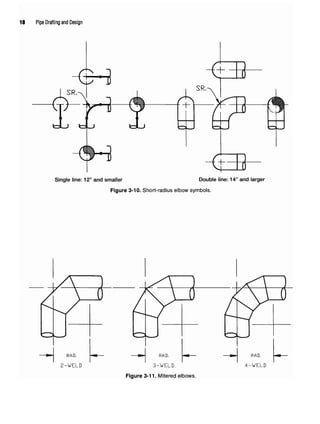
  • 16.
    Overview of PipeDrafting and Design 3 TECHNICAL SKILLS and guidelines, and use an H or F lead for other line work and lettering needs. Line thickness also has an important The drafter must become familiar with the uses of fit- role on P1 ?1 ^ drawings. A .7mm or wider lead holder is tings, flanges, valves, and equipment. This will require commonly used on major elements of the drawing such as time and effort to master the recognition of symbol shapes P1 ?6 and lettering. Background components such as as well as research to find the dimensions needed to draw equipment, foundations, support structures, and dimen- these items to scale. Often beginning drafters start out sion lines are typically drawn with a .5mm lead, making corrections to existing drawings. This is where One cannot stress enou Sh the importance of quality they acquire the skills and knowledge of piping that will line work and lettering. Manual drawings are constantly allow them toadvance tothe position ofpiping designer. slid in and out of the flle drawers and run throu gh blue - Drafters who have held field positions as pipe fitters Print machines. This requires that lettering and line work or welders find this real world experience valuable. be neat and of g°od <luallt y to maint am clarity ofdimen- Many times this experience allows them to advance at a sions and callouts. faster pace. CAD Software Tools PERSONAL SKILLS There are many djfferent CAD software tools on the market today. Many engineering companies require Students should not neglect their speaking, writing, their designers to know and use several different CAD and math skills. Every company appraises future employ- software tools. Engineering companies must be pre- ees during the interview process, not only for technical pared to accommodate the client's preference of CAD skills, but also for the personal skills needed to interact programs. In today's marketplace, the pipe drafter and with theengineering team. This interaction is a must for designer should learn how to use AutoCAD and the team in order to complete the job with a minimal MicroStation. These two CAD programs are widely amount of mistakes. Honesty, reliability, dedication to used by engineering firms in the United States and improving skills, and a positive attitude contribute much throughout the world to the successful career of the designer. Youwill be a As with CAD programs> there ^e several piping soft- member of a design team. You may work with people ware programs on the market today. Engineering firms from countries all over the world. Getting along with fel- must be reSpOnsive to the needs and preferences of their low workers has much to do with successful yearly eval- dients Software developers steadily develop, revise, and nations andcompensation for your efforts. refme programs to meet the demands of engineeringand design firms. As with any business each software devel- CREATION OFPIPE DRAWINGS oper tries to incorporate the special features and amenities into their software package that will attract potential Manual Drafting users. Often clients will dictate that all bid packagessub- mitted for a project shall be completed using a particular Manual drafters use a variety of triangles, plastic tern- piping software program. Most piping software packages plates (circle and ellipse), and scales to layout piping provide the end user with the ability to develop three drawings. While electric erasers are not necessary, they dimensional computer models of the completed facility, make the job of erasing much easier and faster. Pencils Software packages such as AutoPLANT, PDS, and and leads come in a wide range of sizes and shapes. PDMS, among others, have the intelligence to create Drafters usually use a 4H lead to draw projection lines either 2D or 3D drawings.
  • 17.
    Steel Pipe HISTORY OFPIPE Long ago someone decided carrying water from the nearby stream back to his or her dwelling was time- consuming and laborious. Ingenuity gave birth to inven- tion and the pipe was born. Using the natural resources available, early humans probably fashioned the first pipe from bamboo. Needing to move larger amounts of water, they later hollowed out logs. Egyptian and Aztec civiliza- tions made pipe from clay. The first metallic pipes were made by the Greeks and Romans from lead and bronze. The use of iron as a material to manufacture pipe came about with the invention of gun powder. Gun powder, of course, is not used to make the iron, but gun powder necessitated the invention of stronger gun barrels. Iron pipes soon followed. Eventually exotic metals were developed, and pipe became the highly specialized prod- uct it is today. PIPING MATERIALS Applied in a general sense, pipe is a term used to des- ignate a hollow, tubular body used to transport any com- modity possessing flow characteristics such as those found in liquids, gases, vapors, liquefied solids, and fine powders. A comprehensive list of the materials used to manu- facture pipe would be quite lengthy. Some of the materi- als include concrete, glass, lead, brass, copper, plastic, aluminum, cast iron, carbon steel, and steel alloys. With such a broad range of materials available, selecting one to fit a particular need can be confusing. A thorough under- standing of the pipe's intended use is essential. Each material has limitations that may make it inappropriate for a given application. Throughout this text we will base our discussion on carbon steel pipe, the most common material used in the piping industry. MANUFACTURING METHODS Carbon steel pipe can be manufactured using several different techniques, each of which produces a pipe with certain characteristics. These characteristics include strength, wall thickness, corrosion resistance, and tem- perature and pressure limitations. For example, pipes having the same wall thickness but manufacturedby dif- ferent methods may vary in strength and pressure limits. The manufacturing methods we will mention include seamless, butt-welded, and spiral-welded pipe. Seamless pipe is formed by piercing a solid,near-molten, steel rod, called a billet, with a mandrel to produce a pipe that has no seams or joints. Figure 2-1 depicts the manu- facturing process of seamless pipe. Figure 2-1. Seamless pipe. Butt-welded pipe is formed by feeding hot steel plate through shapers that will roll it into a hollow circular shape. Forcibly squeezing the two ends of the plate together will produce a fused joint or seam. Figure 2-2 shows the steel plate as it begins the process of forming butt-welded pipe. Figure 2-2. Butt-welded pipe.
  • 18.
    Least common ofthe three methods is spiral-welded pipe. Spiral-welded pipe is formed by twisting strips of metal into a spiral shape, similar to a barber's pole, then welding where the edges join one another to form a seam. This type of pipe is restricted to piping systems usinglow pressures due to its thin walls. Figure 2-3 shows spiral- welded pipe as it appears before welding. Figure 2-3. Spiral-welded pipe. Figure 2-4. Carbon steel pipe. Figure 2-4 shows the three pipes previously described in their final form. Each of the three methods for producing pipe has its advantages and disadvantages. Butt-welded pipe, for example, is formed from rolled plate that has a more uni- form wall thickness and can be inspected for defects prior to forming and welding. This manufacturing method is particularly useful when thin walls and long lengths are needed. Because of the welded seam, however, there is always the possibility of defects that escape the numer- ous quality control checks performed during the manu- facturing process. As a result, The American National Standards Institute (ANSI) developed strict guidelines for the manufactureof pipe. Pressure Piping Code B 31 was written to govern the manufacture of pipe. In particular, code B31.1.0 assigns a strength factor of 85% for rolled pipe, 60% for spiral-welded and 100% efficiency for seamless pipe. Generally, wider wall thicknesses are produced by the seamless method. However, for the many low-pressure Steel Pipe 5 uses of pipe, the continuous welded method is the most economical. Seamless pipe is produced in single and dou- ble random lengths. Single random lengths vary from 16'-0" to 20'-0" long. Pipe 2" and below is found in dou- ble random lengths measuring 35'-0" to 40'-0" long. SIZING OFPIPE Just as manufacturing methods differ, there are also different ways to categorize the size of a pipe. Pipe is identified by three different size categories: nominal pipe size, outside diameter, and inside diameter (see Figure 2-5). Figure 2-5. Pipe diameters. Nominal pipe size (NFS) is used to describe a pipe by name only. In process piping, the term nominal refers to the name of the pipe, much like the name 2 x 4 given to a piece of lumber. The lumber does not actually measure 2" x 4", nor does a 6" pipe actually measure 6" in diame- ter. It's just an easy way to identify lumber and pipe. Outside diameter (OD) and inside diameter (ID), as their names imply,refer to pipe by their actual outside and inside measurements. Pipe i/g" to 12"has an outside diameter greater than its nominal pipe size, while pipe 14" and above has an out- side diameter equal to its nominal pipe size. In process piping, the method of sizing pipe maintains a uniform outside diameter while varying the inside diam- eter. This method achieves the desired strength necessary for pipe to perform its intended function while operating under various temperatures and pressures.
  • 19.
    6 Pipe Draftingand Design WALL THICKNESS Wall thickness is a term used to describe the thickness of the metal used to make a pipe. Wall thickness is also commonly referred to as a pipe's weight. Originally man- ufactured in weights known as standard, extra strong, and double extra strong, pipe has since increased in complex- ity with the development of new chemical processes. Commodities with ever-changing corrosive properties, high temperatures, and extreme pressures have necessi- tated the development of numerous additional selections of wall thicknesses for pipe. Now called schedules, these additional wall thicknesses allow a pipe to be selected to meet the exact requirements needed for safe operation. An example of this variance in wall thickness is shown in Figure 2-6. Figure 2-6. Pipe thickness. As you can see in Table 2-1, nominal size is not equal to either the actual OD or the ID for pipe 12" and smaller. It is simply a convenient method to use when referring to pipe. As a piping drafter, you should be aware however, pipe 14" and larger is identified by its actual outside mea- surement. The chart in Table 2-1 shows typical pipe diam- eters and wall thicknesses. The following formula can be used to calculate a pipe's inside diameter (ID): ID = OD minus (2 x WALL THICKNESS) Before selecting pipe, careful consideration must be given to its material, temperature and pressure allow- ances, corrosion resistance, and more. Buying and install- ing pipe that does not meet the minimum requirements can be dangerous and deadly. Using pipe that far exceeds what is required to do the job can result in tremendous cost overruns. METHODS OF JOINING PIPE There are several methods for joining pipe together. The three methods we will focus on are those most widely used in piping systems made of carbon steel, as shown in Figure 2-7. They are butt-welded (BW), screwed (Scrd), and socket-weld (SW). Later in the chap- ter, cast iron and plastic pipe uses will be discussed. Table 2-1 Carbon Steel Pipe Wall Thickness NOMINAL PIPE SIZE IN. MM 2 3 4 6 8 10 12 14 16 18 50.8 76.2 101 152 203 254 304 355 406 457 OUTSIDE DIAMETER IN. MM 2.3 3.5 6 4.5 4 6.6 2 8.6 10. 8 12. 6 14 .4 16 .2 18 75 60.3 88.9 114 25 168 25 219 75 273 75 323 355 406 457 STANDARD IN. MM .15 .21 3 .23 3 .28 .32 .36 9 .37 .6 .37 .4 .37 .2 .37 4 3.91 6 5.48 7 6.02 0 7.12 2 8.17 5 9.27 5 9.52 5 9.52 5 9.52 5 9.52 EXTRA STRON IN. MM 2 .21 6 .30 .33 .43 .50 .50 !5 .50 !5 .50 !5 .50 >5 .50 8 5.53 0 7.62 7 8.5E 2 10.£ 0 12J 0 12.: 0 12.: 0 12.: o 12.: o 12.: G XX STRONG IN. MM > .43 .55 I .67 7 .86 '0 .87 r o 1.0 7 0 1.0 '0 7 0 7 Q 6 11.0: 2 15.2^ 4 17.12 4 21.9^ 5 22.2; 0 25.4 0 25.4
  • 20.
    Figure 2-7. Pipejoints. Butt-Weld Connections A butt-weld joint is made by welding the beveled ends oi pipe together. Beveled ends (BE) indicate that the ends oi the pipe are not cut square, but rather are cut or ground tc have a tapered edge. In preparation for the welding process, a welder will separate two pieces of pipe by a Vie" space, known as a root gap. During the welding process, the twc ends are drawn together and the V^' gap disappears. If twc pieces of pipe 3'-0" long were welded together in this man- ner, the result would be a total length of 6'-0". However, sometimes a back-up ring is used in critical situations. The back-up ring is used when there is a need to prevent the formation of weld icicles inside the pipe. The back-up ring creates a gap of Vs" between the two pieces of pipe. In this situation, the ring does not allow Steel Pipe 7 the ends of the pipe to be drawn together and keeps them separated by y%". If two lengths of pipe measuring 3'-0" each were welded together using a back-up ring, the result would be a total length of 6'-01 /8". In this instance, the >/s" gap would be shown when dimensioning the pipe. Otherwise, the root gap would not be considered at all. Figure 2-8 shows the Vie" root gap and the resulting butt-weld joint. Figure 2-8. Butt-weldjoints. Screwed or Threaded Connections Another common means of joining pipe is the threaded end (TE) connection. Typically used on pipe 3" and smaller, threaded connections are generally referred to as screwed pipe. With tapered grooves cut into the ends of a run of pipe, screwed pipe and screwed fittings can easily be assembled without welding or other permanent means of attachment. Screwed pipe and its mating fittings will Table 2-2 American Standard and API Thread Engagement
  • 21.
    8 Pipe DraftingandDesign have threads that are either male or female. Male threads square, or perpendicular to, the long axis, unlike butt- are cut into the outside of a pipe or fitting, while female weld fittings that have beveled ends, threads are cut into the inside of the fitting. As screwed pipe and fittings are assembled, a short PACT lonu DIDE length of pipe is drawn into the fitting. This connection WHO! inUli rirc length is called a thread engagement. When drawing and dimensioning screwed pipe, a piping drafter must be Not all piping systems require pipe designed to with- aware of this lost length of pipe. As the diameter of the stand me extreme conditions found in process piping pipe increases, so will the length of the thread engage- faciiities< Cast iron pipe, which has been in use for centu- ment. Table 2-2 provides a chart indicating the thread ^is used pTimariy ingravityflowapplications suchas engagements for small bore pipe. storm and sanitary sewers, and waste and vent piping installations. Residential, commercial, and industrial Socket-Weld Connections facilities routinely are built with some form of gravity flow systems. The corrosion resistance properties of cast The third method of joining carbon steel pipe is socket iron pipe make it the ideal product for permanent below- welding. When assembling pipe with socket-weld fit- ground gravity flow installations. tings, the pipe is inserted into the fitting before welding, The term cast iron refers to a large group of ferrous unlike a butt-weld connection that has the pipe and fitting metals. Cast irons are primarily alloys of iron that contain placed end-to-end. Inside the socket-weld fitting is a col- more than 2% carbon and 1% or more silicon. Cast iron, lar that prevents the pipe from being inserted too deeply like steel, does corrode. What makes cast iron different is into the fitting. its graphite content. As cast iron corrodes, an insoluble As with screwed connections, a short amount of pipe layer of graphite compounds is produced. The density and is lost when the socket-weld connections are made. adherent strength of these compounds form a barrier Table 2-3 provides the socket depths for pipe sizes around the pipe that prevents further corrosion. In steel through 3" in diameter. Before the weld is made, the pipe this graphite content does not exist, and the compounds fitter will back the pipe off the collar approximately i/8" created during corrosion cannot bond together. Unable to to allow for heat expansion during the welding procedure. adhere to the pipe, they flake off and expose an unpro- Pipe used for socket-weld connections will be prepared tected metal surface that perpetuates the corrosion cycle, with a plain end. Plain end (PE) means the pipe is cut In tests of severely corroded cast iron pipe, the graphite Table 2-3 Forged Steel Socket Weld Fittings
  • 22.
    compounds have withstoodpressures of several hundred pounds per square inch, although corrosion had actually penetrated the pipe wall. Considering the low cost of raw manufacturing materials and the relative ease of manu- facture, cast iron is the least expensive of the engineer- ing metals. These benefits make cast iron the choice application in environments that demand good corrosion resistance. Joining Cast Iron Pipe Cast iron pipe is grouped into two basic categories: hub and spigot, and hubless. The hub, or bell, and spigot joint uses pipe with two different end types. The hub end of the pipe has an enlarged diameter, thus resembling a bell. The spigot end of the adjoining pipe has a flat or plain-end shape. The spigot is inserted into the bell to establish a joint. Two methods of preventing leaks on bell and spigot joints are compression and lead and oakum. The com- pression joint uses a one-piece rubber gasket to create a leak-proof seal. As shown in Figure 2-9, when the spigot end of the pipe is placed into the hub containing a gas- ket, the joint is sealed by displacing and compressing the rubber gasket. Unlike welded pipe, this joint can absorb vibration and can be deflected up to 5° without leakage or failure. The lead and oakum joint is made with oakum fiber and molten lead to create a strong, yet flexible, leak-proof and root-proof joint. When the molten lead is poured over the waterproof oakum fiber, which is a loose, oil laden, Figure 2-9. Compression joint. Steel Pipe 9 hemp-like packing material, the joint becomes com- pletely sealed. Water will not leak out and, when used underground, roots cannot grow through the joints. See Figure 2-10. Figure 2-10. Lead and oakumjoint. Hubless cast iron pipe uses pipe and fittings manufac- tured without a hub. The method of joining these pipe and fittings uses a hubless coupling that slips over the plain ends of the pipe and fittings and is tightened to seal the ends. Hubless cast iron pipe is made in only one wall thickness and ranges in diameter from IVi" to 10". Figure 2-11 depicts the hubless cast iron pipe joint. Figure 2-11. Hubless pipe coupling.
  • 23.
    10 Pipe Draftingand Design PLASTIC PIPE The latest entry into the materials list for manufactur- ing pipe is plastic. Not originally thought of as a product capable of performing in the environs of a piping process facility, plastic has emerged as a reliable, safe, and cost- effective alternative material. There is a broad range of plastic compounds being developed today. For piping systems, two categories are most effective: fluoroplastics and thermoplastics. Fluoroplastics are found in materials like PTFE, PVDF, ECTFE, CTFE, PFA, and FEP. As a group, fluoroplastics perform extremely well in aggressive chemical services at temper- atures from -328 F° to +500 F°. Thermoplastics are those that require melting during the manufacturing process. These plastics can be welded or injection molded into shapes for machining into piping system components. For some piping systems, it is now inconceivable not to use plastics. Pipes made from plastic are replacing tradi- tional, expensive materials like glass or ceramic-lined pipe. Some plastics such as UHMW PE, PVDF, CTFE, and nylon have such excellent wear resistance that they prove in Taber Abrasion Tests to be five to ten times bet- ter in this regard than 304 Stainless Steel. The Taber Abrasion Test cycles an abrasive wheel over the face of a plate made of the material being tested. After 1,000 cycles of the wheel, the plate is measured to determine the amount of weight loss. Table 2-4 lists the results. Table 2-4 Taber Abrasion Tester Abrasion Ring CS-10, L< Nylon 6-10 UHMW PE PVDF PVC (rigid) PP CPVC CTFE PS Steel (304 SS) ABS PTFE >ad 1 kg 5mg/1000 cycles 5 5-10 12-20 15-20 20 13 40-50 50 60-80 500-1000 Joining Plastic Pipe Plastic pipe can be joined by one of the following meth- ods: threading, solvent cement, or fusion. Threading plastic pipe is not a viable option because it is expensive. Heavy wall thicknesses are required, and leaks from high pres- sures and expansion and contraction are difficult to control. Joints made with solvent cement have proven more reli- able. Though, once hardened, cemented joints cannot be disassembled. They offer good resistance to abrasive chem- ical and high-pressure commodities and are available in a large selection of fittings without the need of threads. Heat fusion must be performed on some plastic compounds that are resistant to chemical solvents. Pipe can either be butt- joined or socket-joined. Heat fusion can be used with thin- ner wall thicknesses and are pressure resistant beyond the burst pressure of the pipe. Socket fittings provide large sur- face contact between pipe and fittings and are resistant to separation. For this reason they cannot be disassembled. Though fabrication with plastic may sound simple, cau- tion must be exercised when using plastic pipe. The effec- tiveness of a particular grade of plastic must be tested before it is chosen for a particular service. Four important variables must be evaluated: chemical resistance, pressure limitations, temperature limitations, and stress. The various molecular components of plastics make them susceptible to chemical reactions with certain compounds. Hazardous mixtures must be avoided. Pressure and temperature limita- tions must be established for obvious reasons. Pipe that is overheated or pressurized beyond capacity can rupture, split, or burst. Stress, as applied to pipe, entails physical demands such as length of service, resistance to expansion and contraction, and fluctuations in pressure and tempera- ture. Excessive stresses in the form of restricted expansion and contraction, and frequent or sudden changes in internal pressure and temperature must be avoided. DRAWING PIPE Pipe can be represented on drawings as either single line or double line. Pipe 12" and smaller is typically drawn single line and pipe 14"and larger is drawn double line. Single-line drawings are used to identify the center- line of the pipe. Double lines are used to represent the pipe's nominal size diameter. The standard scale used on piping drawings is 3 /g" = l'-0". Typically hand drawn, single-line pipe is drawn with a .9mm or a double wide .7mm fine-line lead holder. When drawing single-line pipe with AutoCAD, a PLINE having a width of approximately .56" (9 /i6") is used on full-scale drawings or .0175" when drawing to 3 /g"= l'-0". Double-line pipe uses standard line widths to draw the pipe's nominal size diameter. A centerline is used on all double pipe to allow for the placement of dimensions.
  • 24.
    Steel Pipe 11 Figure2-12 provides several representations of pipe as it represent the pipe on a drawing. Drawings created with may appear on a drawing. most software packages are an example. Piping software When pipe is represented on a drawing, typically the programs draw with such accuracy that pipe is drawn pipe's nominal size dimension is used to identify pipe using the actual outside diameter. size. One would find it difficult to draw a 4" pipe to its NOTE: Pipe created by means other than a piping soft- actual outside diameter of 4'-01 /2" especially on such a ware program in this text will be drawn using nominal small scale as 3 /g" = l'-0". sizes. Be aware that drawings created with a piping soft- There are certain applications, however, when the ware program use actual outside dimensions and will differ pipe's true outside diameter dimension is used to slightly from manual and AutoCAD generated drawings. Figure 2-12. Pipe representations. NOTE: MANUAL DRAFTING USE THE NOMINAL PIPE SIZE WHEN DRAWING PIPE O.D. AutoCAD SOFTWARE USE THE NOMINAL PIPE SIZE WHEN DRAWING PIPE O.D. PIPE MODELING SOFTWARE USES THE ACTUAL PIPE SIZE WHEN DRAWING PIPE O.D.
  • 25.
    12 Pipe Draftingand Design CHAPTER 2 REVIEW QUIZ 1. Name three methods of manufacturingcarbon steel pipe. 2. Name the three most commonly used end preparations for joining pipe. 3. What is meant by the term nominal size pipel 4. Which diameter of pipe varies as the wall thickness changes? 5. What is the most common material used in the manufacture of pipe? 6. When drawing pipe, which pipe sizes are drawn single line and which sizes are drawn double line? 7. How long is the gap between two lengths of pipe when a back-up ring separates them? 8. What is the name for the amount of pipe "lost" when screwed connections are used? 9. What is the standard drawing scale used on piping drawings? 10.Name three-methods for joining carbon steel and plastic pipe.
  • 26.
    Pipe Fittings Fittings arefabricated pieces of pipe that are used to connections. These specifications, or specs, as they are make changes of direction (elbow), branch from a main more commonly called, may also require pipe smaller pipe (tee), or make a reduction in line size (reducer) (see than 3" to have screwed or socket-weld connections. For Figure 3-1). uniformity, the previously mentioned specifications will Because fittings are part of the piping system, they be used throughout this book as a basis for determining must match as closely as possible in specification and rat- pipe connection requirements. However, this is not to ing to the pipe to which they are being attached. Fittings, say this is the only spec that can be written. There may like pipe, are manufactured and classified according to be cases where small bore pipe is butt-welded, while their wall thickness. There are many more wall thick- larger sizes may be screwed or socket-welded, nesses of pipe however than there are thicknesses of fittings. Fittings are commercially manufactured in stan- oniuc dard weight, extra strong, Schedule 160, and double extra tLBUWo strong. In the petrochemical industry, most companies have Of all the fittings, the elbow is the one most often guidelines known as piping specifications that state used. Simply put, the elbow, or ell, is used when a pipe pipe 3" and larger will be fabricated with butt-welded changes direction. Elbows can turn up, turn down, turn Figure 3-1. Fittings. 13
  • 27.
    14 Pipe Draftingand Design left, right, or any angle in between (see Figure 3-1). Ninety degree ells can be classified as one of the following: • long-radius ell • short-radius ell • reducing ell • mitered ell Of these four types, the long-radius elbow shown in Figure 3-2, is the one used most often. When determining the length of an elbow, one must establish the center-to-end dimension. The center-to-end dimension is the measurement from the centerline of the fitting to the end of the fitting (see Figure 3-3). Notice the relationship between the nominal size and the length of the fitting. The fitting's length is equal to the nominal pipe size plus one-half of the nominal size. A simple formula in the next column makes calculating this dimension easy to remember. The length of the fitting is equal to P/2 times the nomi- nal pipe size or: Figure 3-2. Long radius elbow. Nominal pipe size x 1V2 = fitting's length. Example: 8"xl1 /2 =12" NOTE: Use this formula for butt-weld fittings only. Long-Radius Elbow Dimensional sizes of fittings are typically provided by the manufacturer of the fitting. Manufacturers issue dimensioning charts containing lengths for a particular fitting. The dimensional charts used to establish sizes of fittings discussed in this text are listed on the Welded Fit- tings-Flanges Chart provided in Appendix A. As a refer- ence, portions of that chart are used throughout this chapter when fitting measurements are needed. Using the Welded Fittings-Flanges Chart in Figure 3-4, find the 90° long-radius elbow. The measurement labeled A represents the center-to-end length of the fitting. To find the fitting's length in inches, locate the appropriate nominal pipe size Figure 3-3. Center-to-end dimension of a long-radius elbow. Figure 3-4. Welded Fittings-Flanges Chart.
  • 28.
    Pipe Fittings 15 inthe row labeled Nominal Pipe Sizes. Follow across the shows how the elbow might appear if it were welded to a chart to find the desired pipe size. Below that size, in the piece of pipe. Remember, in the single-line symbol only row labeled A, is the center-to-end dimension of the 90° the centerline of the elbow is drawn. The double-line long-radius elbow. symbol requires that one-half of the pipe OD should be The center-to-end dimension (A) will be used as the added and subtracted respectively from the elbow's radius for the elbow's centerline. centerline. Drafting Symbols for the Long-Radius Elbow Drawing the Long-Radius Elbow The drafting symbols for the 90° long-radius elbow are Two step-by-step methods will be presented for con- shown in Figure 3-5. structing the 90° long-radius elbow. Figure 3-6 shows the To better visualize the long-radius elbow, we have steps using manual drafting techniques and Figure 3-7 attached a piece of pipe to each end of the fitting. This shows those steps using AutoCAD commands. Figure 3-5. 90° long-radius elbow.
  • 29.
    16 Pipe DraftingandDes Figure 3-6.14"-90° elbow. Manual drafting solutions. Step 1. Mark off the distance from the center of the fitting to Step 3. Extend the ends of the fitting down and across the end of the fitting. This is the A dimension from the respectively until they intersect. This will be the centerpoint Welded Fittings-Flanges Chart. for drawing the arcs that will form the ell. Use a circle tern- Step 2. Determine the nominal size of pipe and mark off plate or com Passto draw the arcs ' one-half of its size on each side of the fitting's centerline. Step 4. Remember, for fittings 12" and below, only the arc representing the elbow's centerline is drawn when creating single-line symbols. Figure 3-7. 14"-90° elbow. AutoCAD commands. Drawing set-up. Set LINETYPE to Center. Step 2. Use OFFSET to draw the inside and outside arcs of o i TO^AI c oo tne ©'bow. Theoffset distance will beequal to one-half of the o6t LI oUALt tO jc.. . . . . , , . _.„ nominal pipe size, that is, 7 . Set LIMITS: lower left—0,0; upper right—36,36. _4 ... -„__,*.,. . .. . . . . . . . ' ' ^ a Step 3. UseCHPROP to change the inside andoutside arcs ZOOM, All. to Continuous linetypes. Step 1. Use the ARC command, CSE option to draw the get LINETYPE to Continuous. elbow's centerline from 28,2 (PTC). The 21" radius should be measured above PT.C. Step 4. Use the LINE command to draw the ends of elbow.
  • 30.
    NOTE: The step-by-stepinstructional procedures presented using computer-aided drafting techniques presume each student has a comprehensive knowledge of basic AutoCAD commands. These self-instructional steps provide a simple method to create each fitting. They are not intended to restrict the student to any par- ticular commands. Each student is encouraged to exper- iment with new commands that may achieve the same result. Short-Radius Elbow Another elbow that may be used under certain cir- cumstances and with permission from the customer is the 90° short-radius elbow. The 90° short-radius ell makes a much sharper turn than does the long-radius ell (see Figure 3-8). Conversely, the short-radius ell also creates a rather large pressure drop inside the line and does not have the smooth flow characteristics the long- radius ell has. For these reasons the short-radius ell is seldom used. Figure 3-8. Long-radius and short radius elbows. A simple formula can be used to calculate the center- to-end dimension of the fitting for the 90° short-radius ell. The length of the fitting is equal to the nominal pipe size (see Figure 3-9) or nominal pipe size x 1 = fittings length. Pipe Fittings 11 Figure 3-9. Center-to-end dimension of the short- radius elbow. Drafting Symbols for the Short-Radius Elbow The drawing symbols for a short-radius elbow are shown in Figure 3-10. NOTE: Whenever a short-radius ell is used, the abbre- viated note S.R. must always be placed adjacent to the drawing symbol. Mitered Elbows The last 90° elbow we will mention is the mitered elbow. The mitered elbow is not an actual fitting, but instead is a manufactured turn in the piping system. This elbow is made by making angular cuts in a straight run of pipe and then welding the cuts together after they have been rolled to a different angle (see Figure 3-11). The mitered ell may be classified as one, two, three, or four weld miters. The number of welds used depends on the smoothness of flow required through the turn. A two- weld miter will create more turbulence within the pipe than will a four-weld miter. Drafting Symbols for MiteredElbows Figure 3-12 shows the double-line drafting symbols for two-weld and three-weld mitered elbows. Unlike the pre- vious ells, the weld lines in the adjacent views of the mitered elbow are represented by ellipses. Ellipses are used because the welds are not perpendicular to your line of sight. Therefore, when projecting from the front view to any of the four adjoining views, the welds must be drawn elliptical in shape.
  • 31.
    18 Pipe Draftingand Design Figure 3-10. Short-radius elbow symbols Figure 3-11. Mitered elbows.
  • 32.
    Pipe Fittings 19 Figure3-12. Miter elbows drafting symbols. 45° ELBOWS It is logical, therefore, to assume a design using two 45° ells to make a directional change instead of two 90° Another important fitting is the 45°elbow. This elbow elbows would result in considerable savings. These sav- is also used tomake changes indirection within the pip- m §s are not onl y related to the cost of the flttin Ss but ing system. Theobvious difference between the 90° and also to savin §s in the Ph ysic al space needed to route the 45° elbows is theangle formed bytheturn. Because the P1 ?6 - Fi §ure 3 '14 shows that two 14 "90 °elbows re( luire 45° elbow is one-half ofa 90° elbow, as shown inFigure 42 "to alter the course of a PiPin g run - This is consider- 3-13 it is obviously shorter ab ^v more man me 171 // needed by two45° elbows. Unlike the 90° ell,there is not a formula that can be applied to establish the center-to-end dimension of the 45° ell. Simply dividing the length of the 90° elbow by two will not work. The dimension of this fitting must be found on the Welded Fitting-Flange Chart (see Figure 3-15). Drafting Symbols for the 45° Elbow The drafting symbols for the 45° elbow are shown in Figure 3-16. Drawing the 45° Elbow Three step-by-step methods will be presented for con- structing the 45° elbow. Figures 3-17 and 3-18 describe two manual methods for constructing the elbow. Figure 3-19 defines steps using AutoCAD commands to draw Figure 3-13. 45° elbow. the elbow.
  • 33.
    20 Pipe Draftingand Design Figure 3-14. 90° ell versus 45° ell. Figure 3-15. Welded Fittings-Flanges Chart. Figure 3-16. 45° elbow.
  • 34.
    Pipe Fittings 21 Figure3-17. 45° elbow. Manual drafting solutions. Step 1. Using construction lines, duplicate the procedure Step 3. Erase the half of the 90° elbow that is not needed, used todraw the90° long-radius elbow. step 4 Dfaw and darken the ends Qf the e|bow Darken the Step 2. From the centerpoint used to construct the arcs, arcs, draw a 45° angle line that will cut the elbow in half. Figure 3-18. 14"-45° elbow. Alternative manual solution. Step 1. Draw intersecting 45° construction lines as shown. Step 3. Determine one-half of the pipe's diameter and mark Step 2. Using the B dimension fora 14"-45° elbow from the this ^stan ^e °n n each h side of each con struction line. This will Welded Fittings-Flanges Chart, mark off this length along estabhsh the OD of tne P'Pe - each construction line beginning at the point of intersection. Step 4. Use a circle template to draw the inside and outside arcs representing the elbow. Draw an arc to represent the elbow's centerline.
  • 35.
    22 Pipe Draftingand Design Figure 3-19. 45° elbow. AutoCAD commands. Step 1. Duplicate the procedure used to construct the 90° Step 3. TRIM the elbow below the 45° line. ERASE the two long-radius elbow. construction lines. Step 2. Use polar coordinates to draw a 45° LINE, from the Step 4. Use LINE to draw the two ends of the elbow. center of the circles to the outer circle, i.e., @ 28 <135. 90° Elbows Rolled at 45° Many times to avoid using two 90° elbows in succes- sion, designers will use one 90° ell and a 45° ell welded together (see Figure 3-20). In some orthographic views, these elbows will appear at an angle to our line of sight. In those views where the open end of the elbow appears at an angle to our line of sight, ellipses must be used to rep- resent the end of the fittings. Figure 3-21 shows the ortho- graphic views of 90° ells rolled at a 45° angle. Figure 3-20. 90° and 45° elbows welded together. Figure 3-22 illustrates the use of 45° ellipses to draw the 90° elbow rolled at a 45° angle. If the 90° elbow is rolled at 30° or 60°, simply use that degree ellipse to lay- out and construct the elbows. WELD TEE The name of this fitting comes from its resemblance to the letter T. It is a three-way fitting used to make perpen- dicular connections to a pipe (see Figure 3-23). Lines that connect to the main run of pipe are known as branches. The main run of pipe is often called the header. Figure 3-24 shows a pipe header with two branch connections. Drafting Symbols for the Weld Tee Notice that the weld tee requires three welds be made to install the fitting. Two types of tees are used in the pip- ing industry: • Straight—all three outlets are the same pipe size. • Reducing—branch outlet is a smaller pipe size. Figure 3-25 shows the drawing symbols for straight and reducing tees. A callout is required on the reducing tee to identify the header and branch sizes. The header size is shown first.
  • 36.
    Pipe Fittings 23 Figure3-21. Orthographic views of 90° rolled at a 45° angle. Figure 3-22. Constructing the 90° elbow rolled at 45°.
  • 37.
    24 Pipe Draftingand Design Figure 3-23. Weld tee. Figure 3-24. Header and branch connections. Figure 3-25. Weld tee symbols.
  • 38.
    Pipe Fittings 25 Figure3-26. Welded Fittings-Flanges Chart. Figure 3-27.14" butt-welded straight tee. Manual drafting solutions. Step 1. Using the 11" C dimension found on the chart, draw Step 3. From the center of the tee, draw a perpendicular line, a centerline 22" long (11" x 2 = 22"). either up or down, depending on the direction of the branch, Step 2. Measure 7" (one-half theheader pipe size) oneither the length of C side of the centerline to draw the sides of the tee. Step 4. Measure 7" (one-half the branch pipe size) on either side of the perpendicular line to draw the branch of the tee. Draw and darken the sides and weld lines of the tee. Figure 3-28.10" butt-welded straight tee. AutoCAD commands. Drawing set-up. Set LINETYPE to Continuous. Step 2. From the MIDpoint, draw a PLINE QVz" long, up, to Set LIMITS: lower left-0,0; upper right-36,36. f °rm the branch ' Step 3. Using OSNAR ENDpoint, place a DONUT at each end of ZOOM, All. the fitting |f drawing fu||sca|e) the donut is 0.0" IDand 1.75"OD. Step 1. Draw a PLINE, with awidth of .56" f/W') forfull scale or Whendrawin 9to% "=1 '-°"scale 'thedonut is °-°"IDand -05 "OQ .0175" for %" = 1 '-0" scale, 17" long, to the right, from 12,12. Step 4. Add break symbols. ZOOM, Extents.
  • 39.
    26 Pipe Draftingand Design Drawing the Weld Tee THE STUB-IN Prior to drawing the weld tee, two dimensions must be found. These dimensions are required to determine the Another method of making a branch connection is center-to-end length of the header and the length of the called a stub-in. The stub-in is most commonly used as branch end. If a straight tee is being used, the C dimen- an alternative to the reducing tee. The stub-in is not an sion found on the Welded Fittings-Flanges Chart in actual fitting but rather a description of how the branch Figure 3-26 must be added twice to find the total length connection is created. A hole is bored into the header of the fitting. On a straight tee, the C dimension is also pipe, either the size of the OD or ID of the branch, and used as the length of the branch end. If a reducing tee is the branch is then stubbed into it. The two pipes are fitted being drawn, the M dimension must be substituted as together and then welded. Although the branch connec- the length of the branch end. The M dimension is found tion can be the same pipe size or smaller as the header, on the Taylor Forge Seamless Welding Fittings Chart in it cannot be larger. Figure 3-29 depicts the attachment Appendix A. Figures 3-27 and 3-28 provide the manual of a stub-in. Figure 3-30 provides the single-line and and AutoCAD steps for drawing the tee. double-line drawing symbols for a stub-in. Figure 3-29. Stub-in connections. Figure 3-30. Stub-in symbols.
  • 40.
    Pipe Fittings 27 Howclose stub-ins are made is an important consider- drawing representations of reinforcing pads and ation. A general rule is to allow a minimum of 3" between saddles. welds. This means a minimum of 3" should be allowed • O-lets. Purchased fittings, o-lets have one end between the outsides of branches made from a common shaped to the contour of the header and the other end header, and a header should be attached no closer than 3"to manufactured to accept the type of end connections a fitting. Figure 3-31 provides the minimum measurements being used on the branch. Weldolets are manufac- allowed between branches and fittings on an 18"header. tured for butt-weld fittings. Sockolets are made for socket-weld fittings. And threadolets are available Stub-in Reinforcements for screwed fittings. Figure 3-33 shows a typical threadolet. Figure 3-34 gives drawing symbols for Even though the use of the stub-in is limited by the weldolets, sockolets, and threadolets. pressure, temperature, and commodity within a pipe, its use is becoming increasingly more popular. Its chief Other o-lets are manufactured to be used to make con- advantage over the tee is cost. Not only can the cost of nections at angles other than 90°. Figure 3-35 shows a purchasing a fitting be avoided, but the stub-in requires latrolet and the elbolet. only one weld; whereas, the tee requires three. When internal conditions such as pressure or temperature of the COUPLING commodity or external forces such as vibrations or pulsa- tions are placed on a stub-in, special reinforcement mav A *u * cr^- j. i u u r , , , J Another type offittingused to make branch connections be necessary to prevent the branch from separating from • ., r TT , • •, f .. „ u , , , * F . _ . , . ,. ,7 is the coupling. Used primarily for connecting small-bore the header. Three remforcmg alternat.ves arelisted below. scr£wed and socket_weld pipe to large.bore pipe headers, • Reinforcing pad. Resembling a metal washer that the coupling is also used extensivel y where instrument , 0 , Qr, K . . f . ., . f ,, connections are required. There are two common methods has been bent to conform to the curvature of the M •_Q t, • f , • - .f . T , . used to make branch connections with couplings: pipe, the reinforcing pad is a ring cut from steel plate F 6 that has a hole in the center equal to the diameter of 1. The coupling rests on the external surface of the pipe the branch connection. It is slipped onto the branch header and is welded from the outside. pipe then welded to both branch and header. 2. A hole is bored into the pipe header large enough to • Welding saddle. A purchased reinforcing pad, the accept the OD of the coupling. The coupling is welding saddle has a short neck designed to give inserted into the hole and is then welded. Figure 3-36 additional support to the branch. Figure 3-32 shows shows the coupling in use. Figure 3-31. Welding minimums for stub-ins.
  • 41.
    28 Pipe Draftingand Design Figure 3-32. Reinforcing pads and saddles. Figure 3-33. Threadolet. REDUCERS When the piping designer wants to reduce the diameter of a straight run of pipe, a reducing fitting must be used. Appropriately named, the reducer is available in two styles as shown in Figure 3-37. Concentric—having a common centerline. Eccentric—having offset centerlines. The concentric reducer maintains the same centerline at both the large and small ends of the fitting. The eccentric reducer has offset centerlines that will maintain a flat side on the top or the bottom of the fitting, depending on how the fitting is rolled prior to welding. Figure 3-35. Latrolet and elbolet. The eccentric reducer is used in piperacks to maintain a constant bottom of pipe (BOP). Because pipe supports within a piperack are of the same elevation, a pipe must have a consistent bottom of pipe elevation so it can rest on each support throughout its entire length. Using a concen- tric reducer in a piperack would not permit the small diameter end of the pipe run to rest on a pipe support. Eccentric reducers are also used on pump suction noz- zles to keep entrained air from entering the pump. By keeping a flat on top (FOT) surface, vapor pockets can be eliminated. Figure 3-38 shows the centerlines of the eccentric reducer in its FOT and FOB orientations. It is important that a designer not forget to include the dimensional difference between the two centerlines of an
  • 42.
    Pipe Fittings 29 Figure3-36. Couplings asbranches. eccentric reducer when calculating the elevations of pipe in a piperack. The formula for calculating this differenceis Offset =Large ID - small ID / 2 A quicker, though less accurate method, is to take one- half the difference between the two outside diameters. Drafting Symbolsfor the Concentric and Eccentric Reducer The orthographic views for the concentric and eccen- tric reducers are shown in Figure 3-39. No matter the size of the reducer, it is always drawn as a double-line symbol. Notice the callouts that must be included with the eccen- tric reducer. The large end is always listed first, no matter the direction of flow, and the flat side must be indicated. Figure 3-37. Eccentric and concentric reducer. Drawing the Reducers Prior to drawing the reducer, the length of the fitting must be found on the Welded Fittings-Flanges Chart (see Figure 3-40). The H dimension will provide the end-to- end length for either the concentric or eccentric reducer. Always use the H dimension of the large end to determine the fitting length. Figures 3-41 and 3-42 provide the manual and AutoCAD steps for drawing the reducer. Figure 3-38. Eccentric reducers.
  • 43.
    30 Pipe Draftingand Design Figure 3-39. Concentric and eccentric drawing symbols. Figure 3-40. Welded Fittings-Flanges Chart. Figure 3-41.16" x 14" concentric reducer. Manual drafting solutions. Step 1. Using the H dimension found on the chart, draw a Step 3. Connect the opposite ends of the fitting by drawing centerline 14" long. lines from endpoint to endpoint. Step 2. Measure 8"(one-half the large end size) on either Step 4. Darken the sides and weld lines of the reducer, side of the centerline on one end and 7" on either side of the centerline on the opposite end.
  • 44.
    Pipe Fittings 31 Figure3-42.10" x 8" eccentric reducer (FOB). AutoCAD commands. Drawing set-up. Set LINETYPE to Continuous. Step 3. Draw a PLINE from 10,20 to 17,18. TRIM the top of Set LIMITS: lower left-0,0; upper right-20,20. the ri 9ht line to com Plete the symboL ZOOM, All. ZOOM, Extents. Step 1. Draw a vertical PLINE with a width of .56" (9/16") for fte P4 ' » necessary draw a PLINE having a width of .0175" full scale or .0175" for %" =1 '-0" scale, 10"tall from 10,10. from ** MID P°mt of each vertical line outward to represent pipe. Place note as required. Step 2. OFFSET this line 7" to the right. Draw a PLINE 7" long from 10,10 to 17,10 connecting the bottoms of the two lines. WELD CAP Depending on the given situation, fittings will either be welded to each other or separated by lengths of pipe. The last weld fitting we will discuss is the weld cap. It Welding one fitting directly to another is called fitting- is used to seal an open end of pipe. When dimensioning make-up (see the examples in Figure 3-44). the positional location of a weld cap on a drawing, indi- Most situations involving the erection of the piping cate only the length of the run of pipe. The cap will be system require the designer to use pipe of various lengths welded to the end and need not be included in the length between the fittings. In these cases, pipe is cut to the dimension of the run of pipe. required length and the ends are beveled in preparation The weld cap is another fitting that is drawn as a dou- for welding to the fittings. When fittings are not assem- ble-line symbol for all sizes of pipe. bled as fitting make-up and are separated by a piece of The length of the fitting is found on the Taylor Forge pipe? most companies stipulate the pipe must be at least Seamless Welding Fittings Chart in Appendix A. one pipe diameter (nominal size) in length with a 3"mini- When representing the cap on a drawing, use an ellipse mum spacing for pipe 6"and smaller. By maintaining this to construct the round end of the fitting. Figure 3-43 minimum spacing between welds, a pipe can conve- shows the single-line and double-line drawing symbols niently be cut> beveied, and welded without interference for a weld cap. Notice theweld doton thesingle line (see Rgure 3.45) The y minimum spacing is a standard symbol isdrawn as ahalf circle only. used throughout the piping industry and win be applied to the drawing exercises and projects in this text. USE OFFITTINGS Welds may seem insignificant to the designer, but,it goes without saying, a piping facility could not be built Thus far,we have discussed each fitting individually. without them. Remember, all welds must be shown on We will now look at how each fitting relates to other fit- drawings. Use weld dots on single-line pipe symbols and tings when used in the design of various piping systems. weld lines on double-line pipe symbols.
  • 45.
    32 Pipe Draftingand Design Dimensioning OfFitting Make-Up • Pipe should be dimensioned from center of fitting to center of fitting, or The next step in the drawing of pipe is thecalculation . Pipe should be dimensioned from center of fitting to and placement of dimensions. At the present time, we the end of pipe are only concerned with butt-weld fittings. The general rules-of-thumb for placing dimensions on a drawing are Figure 3-46 provides some examples for placing as follows: dimensions on drawings. Figure 3-43. Weld cap drawing symbols. Figure 3-44. Fitting make-up. Figure 3-45. Minimumpipe lengths.
  • 46.
    Pipe Fittings 33 SCREWEDAND SOCKET-WELD FITTINGS Screwed and socket-weld fittings perform the same basic functions as butt-weld fittings. There are, however, a few differences that must be examined. Screwed and socket-weld fittings are normally reserved for installa- tions using fittings 3" and smaller. Screwed and socket- weld fittings are also available in cast iron, malleable iron, or forged steel. Cast iron and malleable iron fittings are typically used on low pressure and temperature lines such as air, water, or condensate. Lines containing high pressure and temperature commodities, which are subject to movement and vibration, require fittings made of forged steel. Forged steel screwed and socket-weld fittings are manufac- tured in two pressure classes—3000# and 6000#. Dimensional charts for screwed and socket-weld fit- tings are provided in Appendix A. These dimensioning charts supply measurements for 3000# and 6000# fit- tings. Figures 3-47 and 3-48 provide a sample of the dimension charts for screwed and socket-weld fittings found in Appendix A. Most screwed fittings are manufactured with internal, female threads per American Standard and API thread guidelines (see Figure 3-49). Some fittings, such as plugs and swages, however, are manufactured with external threads. The socket-weld fitting is replacing the screwed fit- ting as the choice of many fabricators because it offers greater strength. Even though screwed fittings can be seal welded if necessary, strength of the fitting is decreased when the threads are cut during the manufac- turing process. Socket-weld fittings can be easily fitted and welded without the need of special clamps or tack- welds, which are often required to hold a butt-weld fitting in place before the final weld is made (see Figure 3-50). Like butt-weld fittings, screwed and socket-weld fit- tings are used to make similar configurations in a piping system. Screwed and socket-weld fittings differ in size and shape, but they achieve the same purpose as the butt- weld fittings. Figure 3-51 provides examples of some screwed and socket-weld fittings. Screwed and socket-weld fittings are drawn with square corners using short hash marks to represent the ends of the fitting (see Figure 3-52). Unions The union, shown in Figure 3-53, is a fitting placed within a piping configurationthat will allow the assembly to be disassembled for inspection, repair, or replacement. Manufactured for screwed and socket-weld applications, the union is represented on drawings as shown in Figure 3-54. Unions should be positioned in locations that will facilitate the easy removal of critical pieces of equipment. Figure 3-55 shows how unions are placed in a configura- tion to allow easy removal of the valves. Plug The plug, like a cap, is designed to close off the end of a run of pipe. Plugs are manufactured for screwed fittings with male threads and are screwed into the end of a pipe to create a seal. Figure 3-56 shows the drawing symbols for the plug. Coupling Although this fitting is used in butt-welding applica- tions as a branch connection, its primary use is to connect lengths of screwed and socket-weld pipe together. Some clients may stipulate, however, that all socket-weld pipe must be connected with a butt weld, rather than a coupling. PIPE NIPPLES By design, screwed and socket-weld fittings cannot be assembled by placing one fitting directly in contact with another fitting. Screwed fittings are manufactured with threads on the inside of the fitting, and socket-weld fit- tings have an internal socket that prevents fitting makeup assembly. To facilitate the assembly of screwed and socket-weld fittings, small lengths of pipe called pipe nip- ples are used between fittings. Pipe nipples can vary in length depending upon the distance required to fabricate the pipe configuration.A close nipple is one that provides the minimum length of pipe between fittings. Remember, screwed and socket-weld fittings have a certain amount of lost pipe due to thread engagement and socket depth. Therefore, each size pipe has a different minimum length for the dimension of a close nipple. Many companies will use 3" as the standard minimum for pipe nipples. This length will accommodate the amount of pipe lost inside the fitting on each end as well as provide sufficient wrench clearance during assembly for the larger screwed and socket-weld pipe sizes.
  • 47.
    34 Pipe Draftingand Design Figure 3-46. Placement of dimensions. Figure 3-47. Screwed fittings dimensioning chart.
  • 48.
    Pipe Fittings 35 Figure3-48. Socket-weld fittings dimensioning chart. Figure 3-49. Internal and external threads.
  • 49.
    36 Pipe Draftingand Design Figure 3-50. Socket-weld fittings. Figure 3-51. Screwed and socket-weld fittings. Swage One exception to the standard 3" minimum rule is the swage nipple. Swages are functionally similar to reduc- ers, but are specifically designed for screwed and socket- weld pipe. Screwed swages have male (external) threads and can be connected to other screwed fittings without the use of a pipe nipple. They are used to make reductions in the line size on a straight run of pipe. Swages, like reduc- ers, are available in either a concentric or eccentric shape. Figure 3-57 shows varying lengths and sizes of screwed pipe and swage nipples. Figure 3-52. Screwed and socket-weld drawing symbols.
  • 50.
    Pipe Fittings 37 Figure3-53. Union Figure 3-54. Union drawing symbols. Swages are unique in that they can be used in screwed, socket-weld, or butt-weld configurations. When used in these configurations, swages will have different end prep- arations. Screwed swages will have thread ends (TE), socket-weld swages plain ends (PE), and butt-weld swages have beveled ends (BE). Because socket-weld swages are inserted into mating fittings, many compa- nies allow the substitution of beveled-end swages. Dual purpose fittings like these will make the job of the pur- chasing group much easier. Swages are also manufactured with different preparations on the two ends. When speci- fying a swage, use the following abbreviations: BBE—bevel both ends TBE—thread both ends PBE—plain both ends Figure 3-55. Positioning of unions. Figure 3-56. Plug drawing symbols. BLE/TSE—bevel large end/thread small end PLE/TSE—plain large end/thread small end Figure 3-58 depicts the concentric swage. Notice the end preparation combinations on the examples. Figure 3-59 shows the drawing symbols for swages. FLANGED FITTINGS Flanged fittings perform functions similar to other fit- tings of the same type. The major difference is their method of connection. The connection joint for flanged fittings is made by bolting two specially designed metal surfaces together. A gasket to prevent leaks is sandwiched between the two surfaces. Flange types will be discussed at great length in the following chapter.
  • 51.
    38 Pipe Draftingand Design Figure 3-57. Pipe and swage nipples. Figure 3-58. Concentricswages. CAST IRON FITTINGS Cast iron fittings are typically designed for use in gravity-flow installations using low-pressure water ser- vices. The physical appearance of pipe routing con- figurations made of cast iron fittings is quite different from pipe routed with forged steel fittings because of the large assortment of fittings available and the method in which these configurations are assembled. Above-ground Figure 3-59. Swage drawing symbols. configurations often require multiple changes in direction and elevation to avoid obstructions with pre-existing installations. Because molten cast iron can be easily man- ufactured into many unique shapes that cannot be attained with steel, manufacturers use it to produce fittings with many varying turns, bends, and branches. PLASTIC FITTINGS Plastic fittings can also be manufactured in many diverse and unique shapes. All the standard fitting shapes are available: elbows, tees, reducers, couplings, unions, etc. Plastic fittings are manufactured for either screwed, socket, or butted assembly. Plastic screwed and socket fit- tings are available in sizes through 4" in diameter. Butt fit- tings are manufactured for sizes 6"-10".
  • 52.
    Pipe Fittings 39 CHAPTER3 REVIEW QUIZ 1. Typically, pipe smaller than 3" in diameter is manufactured as having or end connections. 2. What is the most common fitting used? 3. What are the four classifications of elbows? 4. What is the formula for calculating the center-to-end dimension for LR and SR elbows? LR= SR= 5. Describe a mitered elbow. 6. When configuring tee connections, what is the main run of pipe called? 7. Name the two types of tees. 8. What are some alternate methods to a tee fitting when fabricating branch connections? 9. Which fitting is used to make a reduction in the line size of a run of pipe? 10. Name the two types of reducers. 11. Define fitting make-up. 12. What are the two pressure classifications for screwed and socket-weld fittings? 13. What type of fittings must be bolted together? 14.What is the typical installation service for cast iron pipe? 15.Name the three types of plastic fitting end types manufactured.
  • 53.
    40 Pipe Draftingand Design EXERCISE INFORMATION • Place a base point on one end of each fitting using MIDpoint, ENDpoint, or CENter OSNAP options. Thefittingsdepicted inFigure 3-60 will be used tocomplete . jn the "Block Definition" dialog box check the the exercises in Chapters 3,4, 5, and 10.Tocomplete the exer- Create iconfrom block geometry radio button, cises, drawthe symbolsbelow usingthe followingguidelines. • SAVE the file as "ELBOWS.dwg". • Start from scratch and draw all symbols full scale. • Draw symbols with a PLINE having a width of .56" After the symbols have been created and the drawing (y]6") for single line symbols and a 0"width for double saved ' start the exercise drawing and use AutoCAD line fittings. Symbols requiring a full circular shape must Design Center to open the file ELBOWS.dwg. Insert the be drawnwiththe PLINE command ARC option. These required symbols into the appropriate locations. arcs can only be drawnwith a 359° circumference. NOTE: The pipe break symbol is created with ellipses. • Create weld dots with a 1.75" diameter DONUT. The ma Jor axis of each ellipse is equal to one-half ofthe • Block each symbol individually using the block P1 ?6 '8 OD - TRIM or BREAK an ellipse to create the name indicated. (DO NOT include text with the elliptical arc on the pipe break as necessary. blocked symbol.) Figure 3-60. AutoCAD drawing symbols and File names.
  • 56.
  • 57.
    44 Pipe Draftingand Design
  • 58.
  • 59.
  • 60.
  • 61.
    Flange Basics The flangeis a ring-shaped device designed to be used as an alternative to welding or threading various piping system components used throughout the piping system. Flanged connections are used as an alternative to welding because they can be easily disassembled for shipping, routine inspection, maintenance, or replacement. Flanged connections are preferred over threaded connections because threading large bore pipe is not an economical or reliable operation. The flange is an important component of any piping system. Flanges are primarily used where a connecting or dis- mantling joint is needed. These joints may include join- ing pipe to fittings, valves, equipment, or any other integral component within the piping system. To erect the piping system, every piece of mechanical equipment is manufactured with at least one outlet called a nozzle. The nozzle is the point where, via the flange, the piping system is connected to the equipment. From this flange, the piping system is begun. Figure 4-1 shows how a nozzle and flange are used to connect the piping system to a piece of equipment. Figure 4-1. Nozzle and flange. RATING FLANGES Rating, as applied to flanges, may best be defined as the maximum pressure allowed by the pressure piping code for the specific temperature at which the flange will be operating. Flanges and nozzles are sized according to pressure ratings established by the American National Standards Institute (ANSI). These pressure ratings, sometimes called pound ratings, are divided into seven categories for forged steel flanges. They are 150#, 300#, 400#, 600#, 900#, 1500#, and 2500#. Cast iron flanges have pound ratings of 25#, 125#, 250#, and 800#. Pound ratings, when combined with the temperature of the commodity within the pipe, are used to select the appropriate size, rating, and type of flange. This pressure/ temperature relationship will allow any given flange to be used in a number of different applications. For example, a 150# forged steel flange is rated to perform at 150# PSIG at 500°F. If the temperature were decreased to 100°F, this same flange could be used for 275# PSIG. However, if the temperature were increased to 750°F, the flange could only be used for 100# PSIG. As you can see, the pressure/temperature relationship is important. When temperature decreases the allowable pressure increases, and vice versa. Pound ratings are also used to establish the outside diameter and thickness of a flange. Typically as pound ratings increase, so will the flange's diameter and thickness. FLANGE FACINGS The mating surface of a flange, nozzle, or valve is called the face. The face is usually machined to create a smooth surface. This smooth surface will help assure a leak-proof seal when two flanges are bolted together with a gasket sandwiched between. Although numerous types of flange faces are pro- duced, we will focus only on the following three: • flat face • raised face • ring-type joint Flat face As the name implies, flanges with flat faces are those that have a flat, level connecting surface (see Figure 4-2). Forged steel flanges with a flat face flange are commonly 48
  • 62.
    Flange Basics 49 Figure4-2. Flat face. found in 150# and 300# ratings. Their principal use is to make connections with 125# and 250# cast iron flanges, respectively. Attaching steel pipe to the cast iron flanges found on some valves and mechanical equipment always presents a problem because of the brittle nature of cast iron. Using a flat face flange will assure full surface con- tact, thereby reducing the possibility of cracking the softer cast iron. Figure 4-3 shows a sectional view of a flange with a flat face. Raised Face The most common face type in use, the raised face is available in all seven of the aforementioned pound rat- ings. Appropriately named, this flange face has a promi- nent raised surface. With shallow grooves etched into the raised surface, this flange face assures a positive grip with the gasket. Flanges rated 150# and 300# have a Me" raised face, while flanges 400# and above have a 1 A" raised face (see Figure 4-4). It is important to note most dimension- ing charts, including the ones provided in this text, include the Yi6r raised face thickness in the length dimen- sions for 150# and 300# flanges. However, the 1 A" raised face thickness is not always included in the length dimen- sions for 400# and higher pound ratings. To assure accurate dimensioning, always determine if the dimen- sioning chart being used includes the 1 A" raised face thickness for the larger pound rating flanges. The 1 A" raised face thickness must be added to the dimensioning chart measurement to obtain the overall flange length if the dimensioning chart indicates it has not been added. Figure 4-5 includes a sectional view of a weld neck flange having a raised face. Figure 4-3. Welding neck flange with flat face. Figure 4-4. Raised face. Ring-Type Joint Also known simply as ring joint, the ring-type joint does not use a gasket to form a seal between connecting flanges. Instead a round metallic ring is used that rests in a deep groove cut into the flange face (see Figure 4-6). The donut-shaped ring can be oval or octagonal in design. As the bolts are tightened, the metal ring is compressed, creating a tight seal. Although it is the most expensive, the ring-type joint is considered to be the most efficient flange used in process piping systems. The ring and groove design actually uses internal pressures to enhance the sealing capacity of the connecting flanges. The superiority of this seal can have its disadvantages, however. When dismantling ring joint connections, the flanges must be forcibly separated to release the ring from the groove. In crowded installations, this could cause major problems. Because of this, the ring
  • 63.
    50 Pipe Draftingand Design Figure 4-5. Weld neck flange with raised face FLANGE TYPES Flanges have been designed and developed to be used in a myriad of applications. Each one has its own special characteristics, and should be carefully selected to meet specific function requirements. The following flanges will be discussed in this chapter: • weld neck • threaded • socket weld • slip-on • lap-joint Figure 4-6. Ring-type joint. * re ucm § • blind • orifice NOTE: A photograph and short description accompa- joint flange is relegated to applications where space for nies each flange as well as symbols to depict the flange as maintenance and replacement are adequate. it would appear on a drawing. The manual and AutoCAD Although available for all pound ratings, flanges with techniques for creating the drawing symbols are shown ring-type joint faces are normally used in piping systems for the weld neck flange only. The drawing symbols for rated 400# and higher. See Figure 4-7 for the sectional the remaining flanges can be created in a similar fashion view of a flange with a ring-type joint face. with only a few minor alterations.
  • 64.
    Weld Neck Flange Theweld neck flange shown in Figure 4-8 is occasion- ally referred to as the "high-hub" flange. It is designed to reduce high-stress concentrations at the base of the flange by transferring stress to the adjoining pipe. Although expensive, the weld neck flange is the best-designed butt weld flange available because of its inherent structural value and ease of assembly. Known for its strength and resistance to dishing, the weld neck flange is manufactured with a long tapered hub. The tapered hub is created by the gradual increase in metal thickness from the weld joint to the flange facing. The symmetrical taper transition is extremely ben- eficial under conditions of repeated bending caused by line expansion, contraction, or other external forces. See Figure 4-9, for weld neck flange drawing symbols. Weld neck flanges are normally used in severe service applications involving high pressures, high temperatures, or sub-zero conditions. Weld neck flanges are bored to match the ID of the adjoining pipe. In other words, the thinner the wall of the pipe, the larger the bore (hole) through the flange. The thicker the wall of the pipe, the smaller the bore. Because of these matching IDs, there is no restriction to the flow. Turbulence and erosion are therefore eliminated. Drawing the Weld Neck Flange Prior to constructing the manual and AutoCAD symbols, certain dimensional information must be pro- vided. These dimensions can be found on the welded Flange Basics 51 fittings-flanges dimensioning chart shown in Figure 4-10. The figure in this chart represents the raised face weld neck flange. Notice the three dimensions: O, T, and L. The O dimension represents the flange's OD. The T defines the flange's face thickness and the L provides the flange's length or length-thru-hub dimension. These three dimen- sions are required to construct the drawing symbols of each flange. To find the numerical values for these dimensions, locate the appropriate pound rating section, that is, 150#, 300#, etc. Find the proper size pipe in the Nominal Pipe Size column. Follow across the chart to determine the O, T, and L dimensions. For our demonstration, we will be using a 14"-300# raised face weld neck (RFWN) flange. You should find the O, T, and L measurements for this flange to be 23", 2 i/8", and 5 y8" respectively. Figure 4-8. Weld neck flange. Figure 4-9. Weld neck flange drawing symbols.
  • 65.
    52 Pipe Draftingand Design Two step-by-step methods will be presented for con- significant disadvantages, however, are the requirements structing the weld neck flange. Figure 4-11 demonstrates of two fillet welds, one internal and one external, to pro- steps using manual drafting techniques. Figure 4-12 pre- vide sufficient strength and prevent leakage, as well as a sents the steps using AutoCAD commands. life span about one-third that of the weld neck flange. They are preferred over welding neck flanges by many Slip-On Flange users because of their lower initial cost. However, the total cost after installation is not much less than the The slip-on flange shown in Figure 4-13 has a low hub welding neck because of the additional welding involved, that allows the pipe to be inserted into the flange prior See the Taylor Forge Seamless Fittings Dimensioning to welding. Shorter in length than a weld neck flange, Chart in Appendix A for dimensions of the slip-on flange, the slip-on flange is used in areas where short tie-ins are The drawing symbols for the slip-on flange are shown in necessary or space limitations necessitate its use.Two Figure 4-14. Figure 4-10. Welded fittings-flanges dimensioning chart. Figure 4-11. Manual drafting solutions for a 14"-300# RFWN flange. Step 1. Draw a vertical construction line approximately 30" Step 4. Draw 30° lines to represent the flange hub. Connect tall. (This will represent the flange face.) To the right, draw a the face thickness with short horizontal lines. Darken the parallel line 21 /s" away. Draw another parallel line 55 /s" away flange as required. A short piece of pipe can be added if nec- from the first. essary. Step 2. Bisect the three lines with a centerline. Step 5. When constructing single-line symbols, the flange Step 3. On the flange face measure 11W (one-half of the ™" be ^presented as a T shape. The flange face is typically 23" flange OD) above and below the centerline On theright drawn as a Sin 9le lme the thlckness of a double Wlde -7mm end oftheflange, measure 7"(one-half ofthe14" pipe OD) lead *^ dot wi " be Placed ™ the *nd °f <he m flan 9eat the above and below thecenterline. Pointwhere the P'Pe IS attached <see F| 9ure 4 '9 )'
  • 66.
    Flange Basics 53 Figure4-12.14"-300# RFWN flange. AutoCAD commands. Drawing set-up Step 3. OFFSET the centerline 7" (one-half of the 14" pipe Set LINETYPE to Continuous OD) above and below the pipe's centerline. CHANGE the Set LIMITS: lower left corner—(0,0) linetype of these two lines to Continuous. upper right corner—(10,30) step4 From the rjght end Qf the f|ange> draw 3Qo nnes toward ZOOM, All the flange face to represent the flange hub. TRIM as required. Step 1. Draw a vertical LINE 23"tall from 2,4. (This line will ER *SE cons 'r ^o : n 'ines ' Wh ^ C ?n 5"ctir !?,s]n 9«e-line represent the flange's face). s Vmbols ' use PLINEs havin 9aWldth of '56 <9/16 >fu!l scale or .0175" when drawing to %" = 1'-0" scale to draw the face Step 2. Use OFFSET to draw the flange face thickness 21 /8" thickness and hub length. Use a DONUT with a fullscale toward the right. Close the top and bottom ends. OFFSET inside diameter of 0.000" and an outside diameter of 1.75" as the flange face line 5%" to the right. (This will establish the a symbol for the weld dot. Weld dots drawn to %" = 1 '-0" length-thru-hub distance.) From the MIDpoint of the flange scale will have an outside diameter of .05". face, draw the flange's centerline to the right. Figure 4-13. Slip-on flange. Lap-joint Flange The lap-joint flange in Figure 4-15 is primarily used on carbon or low alloy steel piping systems. Attachment of the lap-joint flange to the piping system requires a lap- joint stub end. The lap-joint flange and stub end assembly are used mainly in piping systems that necessitate frequent dismantling for inspection or routine maintenance. It is also used in the erection of large diameter or hard-to- adjust piping configurations because of its quick bolt hole alignment. Figure 4-16 depicts the drawing symbols for the lap-joint flange. Threaded Flange The threaded flange depicted in Figure 4-17 similar to the slip-on flange, but the bore is threaded. Its principal value is that it can be assembled without welding. This feature makes the threaded flange well-suited to extreme pressure services that operate at normal atmospheric tem- peratures and in highly explosive areas where welding may create a hazard. Threaded flanges are not suited, however, for condi- tions involving temperatures or bending stresses of any significance, particularly when cyclic conditions exist, which may cause leakage through the threads. After just a relatively few cycles of expansion and contraction or movement caused by stress, the threaded flange no longer performs adequately.
  • 67.
    54 Pipe Draftingand Design Figure 4-14. Slip-on flange drawing symbols. for use on small diameter W through 4") high-pressure piping systems. Like socket weld fittings, pipe is inserted into the socket then welded. An internal weld is often employed for added strength. By grinding the internal weld smooth, turbulence and flow restriction are kept to a minimum. The single-line drawing symbol for the socket- weld flange is shown in Figure 4-20. Reducing Flange Like the reducer fitting, the reducing flange in Figure 4-21 is used to make a reduction in the diameter of the pipe. A reducing flange is most frequently used in Figure 4-15. Lap-joint flange. installations with limited space. Crowded situations may necessitate the use of the reducing flange because it has a A seal weld is sometimes applied around the threaded shorter overa11 len §th when compared to a weld neck joint to reduce the possibility of leakage. This technique, flan §e and reducer-fitting configuration. Be advised how- however, cannot be considered as entirely satisfactory nor ever > the flow should travel from the smaller size to the is it always possible. Figure 4-18 represents the single- lar §er - If the flow were reversed, severe turbulence could line threaded flange drawing symbol. develop. Callouts are placed on drawings to describe the reduc- Socket Weld Flange m § flange in the same manner as those used on the reducer fitting: large end first, small end second. One The socket weld flange shown in Figure 4-19 is also additional note is needed, however. The pound rating and similar to the slip-on flange. It was originally developed flange type is included in the callout. Figure 4-16. Lap-joint flange drawing symbols.
  • 68.
    Flange Basics 55 Figure4-17. Threadedflange. Figure 4-20. Single-linesocket-weld drawing symbol. Figure 4-18. Single-line threadedflange drawing symbol. Figure 4-21. Reducing flange. Figure 4-19. Socket weldflange. The reducing flange maintains all the dimensional characteristics of the larger end size. One exception how- ever is the internal bore. The internal bore is manufac- tured to match that of the smaller pipe size. Figure 4-22 shows a 12" x 6"-300# raised face slip-on flange. Notice the use of abbreviations to keep the size of the callout to a minimum. Reducing flanges are manufactured as weld neck, slip- on, or threaded flange types. Figure 4-22. Reducing flange drawingsymbol with callout. Blind Flange The blindflange depicted in Figure 4-23 serves a func- tion similar to that of a plug or cap. It is used to terminate the end of a piping system. The blind flange is basically a flange that does not have a hub or a bored center. Blind flanges have the face thickness of a flange, a matching
  • 69.
    56 Pipe Draftingand Design face type, and similar bolting pattern. Blind flanges can recorded is known as a meter run. Figure 4-26 shows the also be used to seal a nozzle opening on a pressure vessel. orifice flange union assembly installed in a meter run. Because it is bolted, the blind flange provides easy access The orifice plate, which is not typically furnished with to the interior of a vessel or pipe, unlike a cap that is the orifice union assembly package, looks similar to a welded. Figure 4-24 represents the drawing symbol for large ring washer with a handle attached. When fully the blind flange. assembled, the orifice plate is sandwiched between the orifice flanges. Valve taps are inserted into pressure holes Orifice Flanoe mat a ^ow f°r me attachment of field monitoring equip- ment so accurate measurements can be recorded. _ , ,. , , .„ ._. Orifice flanges can be either weld neck, slip-on, or Of the flanges discussed, the orifice flange (Figure ^, , , ,™ ,, , , iU , , .,- „ A nf. . , , , „ r c . threaded. The weld neck and threaded orifice flanges are 4-25) is the only one that actually performs a function. f . , . orkru, ,, , .. TT ^, ' . - , . _ _ . , ,, manufactured in 300# andlarger pound ratings. However, The function of the orifice flange is to measure the rate of ., v •*- f • i -i ui ™n.u • j , , , . . the slip-on orifice flange is only available as a 300# raised the flow of the commodity through the piping system. ,. „ . , J . ^ .~ „ . , , , faceflange.Thesingle-line anddouble-line drawing sym- Onfice flanges are easy to recognize because they have a u , ^ T. .^ ^ , • ^- A ^ , , , . „ , , , / c ?, ,• ! bols fortheorificeflangeareshown in Figure 4-27. hole drilled through the face of the flange perpendicular to the pipe. They also have an additional set of bolts calledjack screws. These screws are used to help separate the flanges so inspection and/or replacement of the orifice plate can be performed. The orifice flange is a single component of the orifice flange union assembly. The ori- fice flange union is composed of two orifice flanges, an orifice plate, bolts, nuts, jack screws, and two gaskets. The orifice flange union is used to measure, or meter, the amount of pressure drop through the orifice plate. The length of pipe within the piping system where orifice flanges are installed and where these measurements are Figure 4-25. Orifice flange. Figure 4-23. Blind flange. Single line: 12" and smaller Double line: 14" and larger Flgure 4.26- Orifice flange union assembly. Courtesy of Figure 4-24.Blind flange drawing symbols. Nisseki Chemical Texas Inc., Bayport, Texas.
  • 70.
    Flange Basics 57 Figure4-27. Orifice flange drawing symbols. BOLTS Formula: 360° / # of holes = angular location To complete any flanged assembly, two additional Example: 360°/8 (holes) = 45° items are required: bolts and gaskets. Bolts obviously hold mating flanges, nozzles, or valves together. The Using this formula shows holes on an eight-hole flange pressure rating of a flange will determine the size, spac- to be spaced 45° apart. By straddling the centerline, holes ing, and number of bolts required. As the nominal pipe will be positioned 221 /2° on each side of the centerline size and pressure ratings change so will the diameter, (see Figure 4-28). spacing, and number of bolts. Bolts are available in two types, machine or stud. Flanges are designed to match the bolt circle and bolt Machine bolts have a "head" on one end and threads on hole dimensions of other flanges that are of the same the other. Stud bolts have threads throughout their entire diameter and pressure rating. Bolt hole arrangements may length and require the use of two nuts. Stud bolts are the seem inconsequential, but, when one considers the fact most commonly used type and are available in two that components of a piping system may be fabricated in grades, A-193-B7 and A-193-B16. B7 grade bolts are one country then shipped to another country for assembly, used for temperatures to 1,000°F. B16 bolts are used bolt alignments become increasingly important. It is criti- when temperatures exceed 1,000°F (see Figure 4-29). cal that drawings convey the exact orientation of flanges to the fabricator. Otherwise, bolt holes may not align prop- erly. ANSI standards require all flanges straddle either the horizontal, vertical, or north-south centerlines of pipe and uAoKtlo equipment, unless otherwise noted on a drawing. To assure that bolt holes on flanges, nozzles, or valves The primary purpose of any flanged assembly is to align properly, holes are equally spaced around the connect piping systems in such a manner as to produce a flange. One column on the Taylor Forge Forged Steel leak-free environment. Hazardous and combustible mate- Flanges Dimensioning Chart found in Appendix A indi- rials and extreme pressures and temperatures require the cates the number and diameter of the bolt holes on utmost in safety precaution. Creating a leak-proof seal flanges. Notice bolts are found in quantities of four, that between two connecting metal surfaces in an industrial is, 4, 8, 12, 16, etc. The following formula makes bolt setting is almost impossible. Therefore, gaskets perform a hole location and alignment quick and simple. vital function in plant safety.
  • 71.
    58 Pipe Draftingand Design Figure 4-28. Bolt hole spacing. Using a gasket material softer than two adjoining A gasket's thickness must be accounted for when flanges is an excellent way to eliminate the possibility of dimensioning the piping system. The typical gasket has a a fluid escape. Gaskets can be made of materials such as thickness of V%" (3.175mm). At every occurrence of a asbestos, rubber, neoprene, Teflon, lead, or copper. When flange bolting to a nozzle, two flanges joining one bolts are tightened and flange faces are drawn together, another, two valves joining one another, or a flange con- the gasket material will conform to any imperfections in necting to a valve, a gasket thickness must be added to the the flange faces to create a uniform seal. length of the pipe components. Figures 4-34 and 4-35 Figure 4-30 demonstrates the three types of gaskets show that a flat-ring gasket does occupy space. Though that can be found in piping systems. They are full face, it's only V%" thick, a gasket cannot be ignored, flat ring, and metal ring. Full face gaskets (Figure 4-31) Figure 4-36 depicts the gap between ring-type joint are used on flat face flanges. Flat ring gaskets (Figure flanges. The ring-type joint section of the Welded 4-32) are used on raised face flanges. Metal rings Fittings-Flanges Dimensioning Chart, gives the gap mea- (Figure 4-33) are used on ring-type joint flanges. surement as the G dimension. This dimension will vary Figure 4-29. Stud and machine bolts. Figure 4-30. Gaskets. Courtesy of Flexitallic, Inc.
  • 72.
    Flange Basics 59 Figure4-31. Full face gaskets. Figure 4-34. Flat ring gasket and flange. Courtesy of Flexitallic, Inc. Figure 4-32. Flat ring gaskets. Courtesy of Flexitallic, Inc Figure 4-35. Flat ring gaskets between flanges. Courtesy of Flexitallic, Inc. Figure 4-33. Metal rings for ring-type joint flanges. Courtesy of Flexitallic, Inc. Figure 4-36. Ring-type joint gap spacing.
  • 73.
    60 Pipe Draftingand Design depending on the size and pound rating of the flange. This dimensioning of the piping configuration. Tick marks are is an important consideration to keep in mind when drawn approximately 1 A" long and are placed on piping dimensioning piping runs that have ring-type joint drawings near the location where a gasket or ring is to be connections. installed. Figure 4-37 depicts two tick marks, one on each For each instance of a gasket or ring, gap spacing end of a valve, that have been included in the total dimen- must be reflected in the dimensions shown on a piping sion between the faces of the two flanges. The lOVfc" drawing. Tick marks are used to indicate each location dimension would be the sum total of one valve and two where a gasket or ring gap has been included in the gaskets. Figure 4-37. Dimensioning gaskets.
  • 74.
    Flange Basics 61 CHAPTER4 REVIEW QUIZ 1. Name the seven forged steel flange pound ratings. 2. Name the four pressure classes for cast iron flanges. 3. What are the three flange facings discussed in this chapter? 4. What is the thickness of the raised face on a 600# raised-face flange? 5. Briefly describe five types of flanges depicted in this chapter. 6. Give O, T, and L dimensions of the following flanges. SIZE/RATING O T L 4"—150#R.F.W.N. 6"—300# R.F.W.N. 10"—400#R.F.W.N. : 16"—600# R.F.W.N. 8"—600# R . F . W . N .
  • 75.
    62 Pipe Draftingand Design 7. What is the purpose of an orifice flange union? 8. Name the two types of bolts used to assemble flanges. 9. According to ANSI standards, which centerlines should flanges straddle on pipe and equipment? 10.List four materials used to manufacture gaskets.
  • 76.
    Flange Basics 63 EXERCISEINFORMATION • Create weld dots with a 1.75" diameter DONUT. • Block each symbol individually using the block The fittings depicted in Figure 4-38 will be used to name indicated. (DO NOT include text with the complete the exercises in Chapters 4, 5, and 10. To com- blocked symbol.) plete the exercises draw the symbols below using the fol- * Place a base point on one end of each fitting using lowing guidelines. MIDpoint, ENDpoint, or CENter OSNAP options. • In the "Block Definition" dialog box check the Cre- • Start from scratch and draw all symbols full scale. ate iconfrom block geometry radio button. • Draw symbols with a PLINE having a width of .56" • SAVE the file as "FLANGES.dwg". (9 /i6") for single line symbols and a 0" width for dou- ble line fittings. Symbols requiring a full circular After the symbols have been created and the drawing shape must be drawn with the PLINE command saved, start the exercise drawing and use AutoCAD ARC option. These arcs can only be drawn with a Design Center to open the file FLANGES.dwg. Insert the 359° circumference. required symbols into the appropriate locations.
  • 77.
    64 Pipe Draftingand Design Figure 4-38. AutoCAD flange drawing and filenames.
  • 79.
    66 Pipe Draftingand Design
  • 80.
  • 82.
    Valves WHAT IS AVALVE?* A valve is a product rarely noticed by the average person, yet it plays an important role in the quality of our lives. Each time you turn on a water faucet, use your dishwasher, turn on a gas range, or step on the accelerator in your car you operate a valve. Without modern valve systems there would be no fresh, pure water in your home, no modern appliances, and no gas- oline waiting at the corner service station. One of the most widely observed, but least recognized, type of valve is the fire hydrant. Fire hydrants are con- nected to municipal water supply systems. They are spe- cialized in that they are underground valves that can be opened and closed from an above-ground location when needed in emergency situations. By definition, a valve is a device that controls the flow of a fluid. But today's valves can control not only the flow, but also the rate, the volume, the pressure, and the direction of a fluid within a pipe. Valves are not limited to fluids. They can control liquids, gases, vapors, slurries, or dry materials. Valves can turn on or off, regulate, modu- late, or isolate. They can range in size from a fraction of an inch to as large as 30 feet in diameter and can vary in complexity from a simple brass valve, available at the local hardware store, to a precision-designed, highly sophisticated coolant system control valve made of exotic metal alloy used in a nuclear reactor. Valves also can con- trol the flow of all types of commodities. From the thin- nest gas to highly corrosive chemicals, from superheated steam to toxic gases, from abrasive slurries to radioactive materials, valves can be designed to service them all. They can handle temperatures from the cryogenic region to molten metal exceeding 1500°F, and valves can contain pressures ranging from severe vacuum to 20,000 pounds per square inch. The valve is one of the most basic and indispensable components of our modern technological society. As long Figure5-1. Gate valve.Courtesy of Jenkins Bros. *"What is a Valve?" Courtesy of VMA (Valve Manufacturers Association). 69
  • 83.
    70 Pipe Draftingand Design as industries continue to devise new reasons to control flow. Gate valves control the commodity flowing through gases, liquids, and even solids, valve design will continue the pipe with a flat, vertical wedge, or gate, that slides up to meet the demand. or down as the valve's handwheel is turned. As the hand- wheel is rotated, the wedge will slide through the valve rrtMMflN WAIMf TYPFQ b °dy tO bl °ck °rrelease the flow - bummura VHLVC i irco Designed to be either fully opened or closed, the gate valve should not be operated in a partially opened/closed Valves are manufactured in numerous sizes, body position. A partially opened gate valve will hasten erosion styles, and pound ratings to meet a wide variety of appli- caused by the commodity within the pipe and will ruin the cation needs. Valves are also manufactured with varying valve seat in a short period of time. Turbulence from the types of end preparations that allow them to be readily commodity will also cause the wedge to vibrate creating a mated to flanges or pipe of the same size and rating. "chattering" noise when the valve is partially opened. Valve end preparations can be screwed, socket-weld, bev- Figure 5-1 depicts the external and internal views of a eled, or flanged. Flanged valves are manufactured to have typical gate valve. either raised, flat, or ring-type joint faces. As with pipe, fittings, and flanges, valves are repre- sented by symbols on piping drawings. These symbols are Gate Valves developed in such a manner as to describe the valve's body style, end type, and handwheel orientation. Symbol The gate valve is the most frequently used valve in pip- sizes are established from dimensions provided in manu- ing systems. It is a general service valve that is used pri- facturers' catalogs or data sheets. Three dimensions are marily for on-off, non-throttling applications. When fully crucial when drawing a valve symbol: face-to-face, hand- opened, the gate valve creates minimal obstruction to the wheel height, and handwheel diameter (see Figure 5-2). Figure 5-2. Flangedvalve dimensioningchart.
  • 84.
    Valves 71 The lengthof a valve is represented on most dimen- located the proper distance from the end of the stem and sioning charts as the face-to-face dimension. The face-to- also to determine when interference problems may occur, face dimension is a length that is standard among valve Another important dimension is the diameter of the manufacturers and defines the length of a valve from one flanged faces on flanged valves. When representing end to the other. Also important is the height and diameter flanged valves, the diameter of the valve's flanges must of a valve's handwheel. These measurements are neces- be drawn to match the size and pound rating of the flange sary to establish operational clearances and worker acces- or nozzle to which it is being bolted. Because most valve sibility around the valve. Of particular importance is the dimensioning charts do not provide this information, a valve's open handwheel height. This dimension defines drafter must refer to the flange dimensioning chart to find the maximum height of the valve when it is in the full- the proper flange OD measurements, open position. The open handwheel height is measured Valve symbols vary from company to company and cli- from the centerline of the valve body to the tip of the ent to client. It is therefore imperative that a drafter be valve stem. familiar with the symbols being used on a project before The valve stem is a threaded rod that connects the work begins on drawings associated with that new valve's wedge or gate to the handwheel. Valve stems fall project. The symbols shown in this text are typical of into one of two categories: rising or nonrising. A rising those found on many piping drawings. They should not be stem is one in which the stem raises and lowers as the considered standard for all applications, however. The handwheel is rotated. The handwheel remains in a sta- symbols shown in Figure 5-3 represent screwed, socket- tionary position as the stem passes through it. On valves weld, and flanged gate valves. Notice also the two meth- having a nonrising stem, the handwheel is attached to the ods of representing handwheels. end of the stem and moves up and down with the stem as the valve is opened or closed. Drawingthe Gate Valve The length of a rising stem must be determined before the handwheel is represented on a drawing. When the Figures 5-4 and 5-5 represent the step-by-step proce- valve is fully opened the stem is at its highest point. The dures to draw a 10"-300# RFWN gate valve symbol using maximum distance the stem will extend above the hand- manual and AutoCAD methods of construction, respec- wheel is approximately equal to the nominal size of the lively. Symbols depicting other valve styles can be devel- pipe. Knowing the length of the stem allows a piping oped using similar construction methods but with minor designer to draw the valve symbol with the handwheel changes or alterations. Figure 5-3. Gate valve drawing symbols.
  • 85.
    72 Pipe Draftingand Design Figure 5-4. Gate valve. Manual drafting solutions. Step 1. Using the appropriate vendor's catalog, determine Step 4. From the intersection of the diagonal lines, draw a the overall dimensions of a 10"-300# RFWN gate valve, that centerline parallel to the ends of the valve the length of the is, face-to-face (18"), handwheel height (57") and diameter handwheel height (57"). (20"), and flange diameter (17%*). step 5 p|ace fl pojnt Qn ,ne center|jne 1(y, down from the Step 2. Lightly draw a rectangle having the width of the face- end. Draw a line perpendicular to the centerline (10" is equal to-face (18") dimension and the height of the flange diameter to the nominal pipe size). (17y2") Drawtwo |ines1%" (flange face thickness) inside the step 6 Measure Qne.ha|f (1(r) Qf ^nandwheel-s diameter two vertical lines. (2cr) Qn ejther sjde Qf the handwnee| centerline. Draw adou- Step 3. Draw diagonal lines across the corners of the inside ble width line to represent the thickness of the handwheel. lines. Erase thehorizontal lines of the inside lines. Darken B ?> TQ ^ ^e handwhee| ^presentation, draw a the lines representing the valve sbody. |jne from each end Qf ^nandwnee| to the intersectjng diag. onal lines of the valve body. Globe Valves within the valve. The design of the globe valve body forces the flow of the commodity to change direction Globe valves are used primarily in situations where within the valve itself. This change in direction creates throttling of the commodity is required. By simply rotat- substantial pressure drop and turbulence. The globe valve ing the handwheel, the rate at which the commodity flows is therefore not recommended when flow resistance and through the valve can be adjusted to any desired level. pressure drop are to be avoided. Figure 5-6 depicts the Having the valve seat parallel to the line of flow is an internal view of a globe valve. important feature of the globe valve. This feature makes Drawing symbols of the globe valve are similar to the globe valve efficient when throttling commodities as those of the gate valve. Measurements used to draw the well as yielding minimal disc and seat erosion. This con- valve are found on manufacturers' dimensioning charts, figuration, however, creates a large amount of resistance One noticeable difference is the use of a darkened circle
  • 86.
    Valves 73 Figure 5-5.Gate valve. AutoCAD drawing commands. Drawing set-up Step 4. Set LINETYPE to Center. From the intersection of Set LINETYPE to Continuous the diagonal lines, draw a vertical LINE the length of the Set LIMITS: lower left corner - (0,0) handwheel, height (@0,57"). upper right corner - (20,20) ZOOM Extents ZOOM, All - , . „ , . . . . . . . , . . . . Step 5. Place a POINT 10" to the left (one-half of the hand- Step 1. Using the appropriate vendors catalog, determine . ,, .. , , , ._„ . , .. . ,.. . , ,. *j. . . /!„ „;:_.. m-iA/M * i * u * - « whees diameter) and 10" down from the end (distance equal the dimensions of a 10"-300# RFWN gate valve, that is, face- . .. . , . . . > . .. . . . ,, . ,. * * /..o» u ,4 u . u • u*/c-7»N ,j,j- * /«/w ^ to the pipes nominal size) of the handwheels centerlme to-face (18"), handwheel height (57")and diameter (20"), and f& „ " * ' flange diameter (171 /2"). (U "1U ' U )- 0 * 0 ^ *• , ,t^ u • u , *u «*u «, ste P 6 - Set LINETYPE to Continuous. Draw a PLINE, Step 2.Draw aver ical ^E havmg the length ofthe flange ^thjck perpendicu|ar to the handwheel's centerline, diameter (@0,17y2"). OFFSET the vertical line a distance 2Q,, tQ the rj M ^20^0^ to represent the valve's hand- equal to the face-to-face distance (18"). From each end of wnee| the valve, OFFSET the flange face thickness (1 %") inward. Step 7. From each end of the handwheel, draw a LINE to the Step 3. Using OSNAP ENDpoint, draw diagonal LINES from intersecting diagonal lines of the valve's body, the ends of the vertical lines to create the valve body. positioned at the intersection of the diagonal lines in the event a pipe is making a 90° turn, the angle valve is used to valve's body. One other difference, though not quite as eliminate the need for a 90° elbow and additional fittings, noticeable, is the use of a nonrising stem on globe valves. Angle valves as well as globe valves are typically Drawing symbols for globe valves are shown in Figure 5- installed so a commodity will flow in an upward direction 7. through the valve body. This upward flow direction will keep pressure under the disc seat. Pressure from below Angle Valves the seat promotes easier operation and reduces the erosive action on the seat and disc. For high temperature com- The angle valve, like the globe valve, is used for throt- modities however, such as superheated steam, the flow tling. As shown in Figure 5-8,the flow entering the valve direction is reversed. When the valve is closed, tempera- and the flow leaving the valve form a 90° angle. In the ture on the lower side of the disc is significantly higher
  • 87.
    74 Pipe Draftingand Design Figure 5-6. Globe valve. Courtesy of VELAN than that on the upper side. Because the valve's stem is on the upper side of the disc, it will be cooler. This tempera- ture differential causes the valve stem to contract, lifting the disc off the seat. This lifting action will result in the seat and disc faces being scored. To avoid this problem, valve manufacturers recommend installing globe and angle valves so high temperature commodities flow into the valve from the upper side. This flow direction will keep pressure above the disc, forcing it into the seat and creating a tighter seal. Figure 5-9 depicts the drawing symbols for the angle valve. Check Valves Check valves differ significantly from gate and globe valves. Check valves are designed to prevent backflow. Backflow simply means flow that has reversed itself within a pipe and begins to flow backwards. There are many designs of check valves, but the two most common types are the swing check and the lift check. Check valves do not use handwheels to control the flow of a commodity but instead use gravity and the pressure of the commodity to operate the valve (see Figure 5-10). The swing check valve is installed as a companion valve to the gate valve. As the name implies, this valve has a swinging gate that is hinged at the top and opens as a commodity flows through the valve. When the valve disc is in the open position, a clear flow path is cre- ated through the valve. This clear path creates minimal Figure 5-7. Globe valve drawing symbols. turbulence and pressure drop within the valve. Pressure must always be under the disc for the valve to function properly. When flow reverses, the pressure and weight of the commodity against the disc will force the disc against the seat, stopping all backflow. Check valves are often regarded as safety or precautionary equipment. The lift check valve is often installed with the globe valve. Figure 5-10 shows the lift check valve has a body style similar to the globe valve. As flow enters the valve, the disc is lifted up off the seat to allow flow to pass. As with the globe valve, there is significant turbulence and pressure drop. There are two types of lift check valves: horizontal and vertical. Both of these valves use either a disc or ball and the force of gravity to close the valve in the event of reverse flow. The horizontal lift check valve has a seat that lies parallel to the flow. The result is an 5-type body style that mandates the valve be installed in the horizontal posi- tion only and have flow that enters from below the seat. Flow entering the valve raises the disc or ball off the seat permitting the commodity to pass through the valve body. The vertical lift check valve is designed to work auto- matically on flow that is traveling in an upward direction only. Similar to the horizontal lift check, vertical lift check valves use a disc or ball that raises off the seat when a commodity flows upward through the valve. When flow stops, gravity will reseat the disc or ball pre- venting backflow. This check valve requires the outlet end of the valve to always be installed in the up position.
  • 88.
    Valves 7! Figure 5-8.Angle valve. Courtesy of Jenkins Bros Figure 5-9. Angle valve drawing symbols. Some manufacturers refer to lift check valves that employ control flow. Used in many hydrocarbon process applica- the use of a ball as a ball check valve. Figure 5-11 depicts tions, ball valves are capable of throttling gases and drawing symbols used to represent the check valve. vapors and are especially useful for low flow situations. Notice the top and front views are identical and both sym- These valves are quick opening and provide a very tight bols indicate the direction of flow. closure on hard to hold fluids (see Figure 5-12). Ball valves do not use a handwheel but instead use a Ball Valves wrench to control the flow. A 90° turn of the wrench opens or closes the valve. This simple design yields a The ball valve is an inexpensive alternative to other nonsticking operation that produces minimal pressure valves. Ball valves use a metal ball with a hole bored drop when the valve is in its full-open position. Drawing through the center, sandwiched between two seats to symbols for the ball valve are shown in Figure 5-13.
  • 89.
    76 Pipe Draftingand Design Figure 5-10. Swing and lift check valves. Courtesy of Crane Co. Figure 5-11. Check valve drawing symbols. Figure 5-12. Ball valve. Courtesy of Jenkins Bros.
  • 90.
    Valves 77 Figure 5-13.Ball valve drawing symbols. Unlike other valves, the plug valve uses either a hand- to become perpendicular to the direction of flow and acts wheel or wrench to operate the valve. Plug valves provide as a dam to reduce or stop the flow. When the wrench is a tight seal against hard to hold commodities and requires rotated back to the original position, the wafer aligns itself a minimum amount of space for installation. Unlike the with the direction of flow and allows the commodity to ball valve, the plug valve uses a tapered wedge rather than pass through the valve (see Figure 5-16). a ball to create a seal. This wedge, or plug, has an elon- Butterfly valves have minimal turbulence and pressure gated opening, which when placed in the open position, drop. They are good for on-off and throttling service and allows the commodity to pass through the valve. The plug perform well when controlling large flow amounts of liq- is the only movable part of the valve and its tapered shape uids and gases. However, these valves do not normally assures positive seating (see Figure 5-14). create a tight seal and must be used in low-pressure situa- Plug valves are designed with etched grooves along the tions or where some leakage is permissible. Drawing tapered plug to permit a lubricant to seal and lubricate the symbols for the butterfly valve are shown in Figure 5-17. internal surfaces as well as to provide a hydraulic jacking force to lift the plug within the body, thus permitting easy operation. The clear and open passageway through the valve body provides little opportunity for scale or sedi- ment to collect. In fact, the plug seats so well that as the plug is rotated, foreign debris is wiped from the plug's external surfaces. These valves, however, do require con- stant lubrication to maintain a tight seal between plug and body. Figure 5-15 depicts drawing symbols used to repre- sent the plug valve. Butterfly Valve The butterfly valve has a unique body style unlike the other valves we have discussed. The butterfly uses a circu- lar plate or wafer operated by a wrench to control flow. A 90° turn of the wrench moves the wafer from a fully open position to a fully closed position. The wafer remains in the stream of flow and rotates around a shaft connected to the wrench. As the valve is being closed, the wafer rotates Figure 5-14. Plug valve. Courtesy of Stockham Valves.
  • 91.
    78 Pipe Draftingand Design Figure 5-15. Plug valve drawing symbols. Figure 5-16. Butterfly valve. Courtesy of Crane Co. Figure 5-17. Butterfly valve drawing symbols. Relief Valves pressures reach unsafe levels. These valves can be adjusted and regulated to pop off-when internal pressures Relief valves have a purpose quite different from the exceed predetermined settings. Once internal pressures previous valves. They are designed to release excessive return to operational levels, the relief valve closes. Figure pressure that builds up in equipment and piping systems. 5-18 shows the internal mechanism of a relief valve. To prevent major damage to equipment, and more impor- Another valve that performs the same basic function as tantly, injury to workers, relief valves can release elevated the relief valve is the pressure safety valve. Although sim- pressures before they become extreme. Relief valves use ilar in design and appearance, the two valves operate a steel spring as a means to automatically open when differently. Relief valves are used in piping systems that
  • 92.
    Valves 79 Figure 5-18.Relief valve. Courtesy of Farris Safety-Relief Valves. service liquid commodities and are designed to open pro- common valve body style used as a control valve is the portionally, that is, as pressure from the commodity globe valve. Although many other body styles are used, increases so does the opening of the valve. The higher the the globe valve provides the most effective means to regu- pressure, the greater the opening. The pressure safety late and control flow. Control valves use signals received valve, however, is used with higher pressure commodities from instruments positioned throughout the piping system such as steam and gas. Pressure safety valves are to automatically make adjustments that regulate the corn- designed to open completely when internal pressures modity within the pipe. Though control valves can per- exceed the setting for which the internal spring has been form many functions, they are typically used to control set. As with the relief valve, once internal pressures return the flow of a commodity within a pipe or to limit its pres- to operational levels the valve will close itself. Figure sure. Figure 5-20 shows the drawing symbols for a con- s'19 provides drawing symbols used to represent the trol valve, relief valve and pressure safety valve. Control valves must be arranged within a run of pipe so that they can be easily operated. To achieve this, control Control Valves valve manifolds are configured. Control valve manifolds make control valves readily accessible to plant workers. The control valve is an automated valve that can Control valve manifolds are discussed in greater detail in make precise adjustments to regulate and monitor any Chapter 12: Piping Systems. Figure 5-21 shows atypical commodity flowing through a piping system. The most control valve manifold.
  • 93.
    80 Pipe Draftingand Design Figure 5-19. Relief valve and pressure safety valve drawing symbols. Figure 5-20. Control valve. Figure 5-21. Control valve manifold.
  • 94.
    Valves 81 VALVE OPERATORSlinear or quarter-turn movements. Electric actuators have motor drives that operate valves requiring multiple turn A valve operator is a mechanism that causes a valve to movements. perform its function. Operators can be manual or auto- Automatic actuators are often provided on control matic. Manual operators employ levers, gears, or wheels valves that rec luire frec luent throttling or those found m to facilitate movement within a valve. In situations where remote and ^accessible locations within a piping facility, the standard handwheel is insufficient to operate the Another common application for automatic actuators is on valve, gears are commonly used to enhance a hand- contro1 valves of lar £e diameter pipe. These valves are wheel's effectiveness. Bevel, spur, andworm gears supply often so lar §e that a worker sim ^ cannot Provide the the handwheel with a greater mechanical advantage to torc lue re( luired to °Perate the valve - Als0 ' m an effort to open, close, or throttle the commodity within the pipe. Protect workers, control valves located in extremely toxic If a valve is installed at a height that is out of a or hostile environments are outfitted with automatic actua- worker's reach, a chain operator is often used. The chain tors - Additionally, in emergency situations, valves that operator is a sprocket-like attachment bolted to a valve's must be immediately shut down areoperated automatically, handwheel. A looped chain is passed through the sprocket and is hung down to a height that is accessible by a worker. This allows a worker to operate the valve without the aid of a ladder or moveable scaffold. Figure 5-22 shows a typical chain operator. Actuators Automatic operators known as actuators use an exter- nal power supply to provide the necessary force required to operate valves. Automatic actuators use hydraulic, pneumatic, or electrical power as their source for operat- ing valves. Hydraulic and pneumatic actuators use fluid or air pressure, respectively, to operate valves needing Figure 5-22. Chain operator. Courtesy of Duraval.
  • 95.
    82 Pipe Draftingand Design CHAPTER 5 REVIEW QUIZ 1. What is a valve? 2. Name four end preparations for manufacturedvalves. 3. What is the primary application for gate valves? 4. What phrase describes a valve's length measurement? 5. What can be used to approximate the distance a stem will rise above a handwheel? 6. Globe valves are used for what service situation? 7. When using angle valves, which direction must flow be traveling when it enters the valve? 8. What is the purpose of a check valve? 9. Which valve prevents excessive pressure on gas and vapor service line? 10.What type of device is used to operate valves installed in remote locations of a piping facility?
  • 96.
    Valves 83 EXERCISE INFORMATION• Place a base point on one end of each fitting using MIDpoint, ENDpoint, or CENter OSNAP The fittings depicted in Figure 5-23a and b will be used options. to complete the exercises in Chapters 5 and 10.To . In ^ «Bhck Definition» dialog box check the Cre. complete the exercises draw the symbols below using the ^iconfrom block geometry radio button, following guidelines. • Start from scratch anddraw allsymbols full scale. ' SAVE the flle as "V^VES.dwg." • Draw symbols with 0.00" line width (NOT A PLINE). After me symbols have been created and the drawing • Block each symbol individually using the block saved, start the exercise drawing and use AutoCAD name indicated. (DO NOT include text with the Design Center to open the file VALVES.dwg. Insert the blocked symbol.) required symbols into the appropriate locations.
  • 97.
    84 Pipe Draftingand Design Figure 5-23a. AutoCAD drawing symbols and file names (continued on nextpac,
  • 98.
  • 103.
    Mechanical Equipment TYPES OF EQUIPMENT Althoughcomponents such as pipe, fittings, flanges, and valves, which are used to transport various commodi- ties from one location in a piping facility to another, are important and impossible to do without, they play a minor role in the actual manufacturingof a salable prod- uct. Other components of a piping facility actually per- form the tasks for which the facility is being built. These items are known collectively as mechanical equipment. Mechanical equipment is used to start, stop, heat, cool, liquefy, vaporize, transfer, store, mix, or separate the commodity flowing through the piping system. The dis- cussion in this chapter will concentrate on the pieces of equipment that are used in a majority of all piping facili- ties. Vessels Horizontal Vessels/Accumulators The horizontal vessel, similar to the one shown in Fig- ure 6-1, is a cylindrical-shaped storage tank whose long axis is parallel to the horizon. It is used primarily as a receiving and collecting container for liquids and, there- Figure 6-1. Horizontal vessel. Courtesy of Nisseki Chemical Texas, Inc., Bayport, Texas. 9 fore, has no internal moving parts. Support saddles are welded on the underside of the vessel to prevent it from rolling off its concrete foundations. A nozzle on the top of the vessel allows liquids to enter and fill the vessel. A nozzle on the bottom allows the liquids to be drawn out. Smaller nozzles can be used for venting and instrumenta- tion attachment. Instruments are needed to measure the level of the commodity within the vessel. A large diame- ter nozzle, typically 18" ID, called a manway, provides an entrance for a worker into the vessel for internal inspec- tion and maintenance. Figure 6-2 shows the plan and ele- vation views of a horizontal vessel. Vertical Vessels/Fractionation Columns The vertical vessel is a cylindrical vessel whose long axis is perpendicular to the horizon (see Figure 6-3). Easily the most visible piece of equipment, some verti- cal vessels can exceed 200 feet in height. Fractionation columns have internal plates called trays that aid in the separation and collection of the various molecular com- pounds of a feed stock. The process of breaking down a feed stock into its molecular compounds is called frac- tional distillation. After further refinement and process- ing, these compounds will become by-products such as diesel, gasoline, kerosene, and many others. A detailed explanation of the fractional distillation process will be presented after the remaining pieces of equipment have been discussed. See Figure 6-4 for the plan and eleva- tion views of a vertical vessel. Ladders, Cages, and Platforms Many vessels and other pieces of equipment are built to such great heights they become accessible only by ladders. Ladders allow workers to access the higher ele- vations of equipment for routine inspection and mainte- nance. Ladders are made of steel bar and plate, and are welded or bolted to the exterior of a vessel. Cages are designed to enclose a ladder and prevent a worker from falling away should he lose his grip on the
  • 104.
    Mechanical Equipment 91 Figure6-2. Plan and elevationviews of a horizontalvessel. rungs. Made of steel plate, cages provide the worker with a sense of security when scaling tall vertical structures. Platforms are like small elevated walkways around the outside of a vessel or between equipment and structures. Usually 3'-0" wide, they have a floor made of steel grat- ing or plate. With 3' tall handrails, workers can safely operate, inspect, and maintain a vessel. Platforms are spaced so ladders will not have a vertical run of more than 30'-0", but are not spaced closer than 8'-0" to pro- vide adequate headroom clearance. A typical vertical ladder and cage are shown in Figure 6-5. Platform walk- ways are also depicted spanning between storage tanks in Figure 6-5. Pumps Pumps, similar to the one shown in Figure 6-6, are mechanical devices used to move fluids under pressure from one location to another. Pumps accelerate the speed at which a commodity travels within a pipe, thereby increasing its rate of flow. Pumps used in piping facilities will be one of the following classifications: centrifugal, reciprocating, or rotary. Centrifugal pumps The centrifugal force created by the high speed impel- Figure 6-3. Vertical vessel. Courtesy of Nisseki Chemical lers of a centrifugal pump creates a smooth nonpulsating Texas, Inc., Bayport,Texas. rate of flow. With a fast spinning impeller creating a low
  • 105.
    92 Pipe Draftingand Design Figure 6-4. Vertical vessel.
  • 106.
    Mechanical Equipment 93 pressurecenter point, any commodity entering the pump will naturally seek the center of the impeller only to be spun out at a high rate of speed. The efficient operation of the centrifugal pump makes it the standard of most piping facilities. Reciprocating pumps The reciprocating pump uses internal parts, similar to a piston or plunger, that alternately move back and forth to create pressure. With each stroke of the piston, pressure is increased forcing the commodity out of the pump. The reciprocating pump is installed in piping systems where extremely high pressures are required. Rotary pump The rotary pump is similar to the reciprocating pump in that it is a positive displacement type. Rotary pumps use mechanical devices such as pistons, gears, or screws to discharge a commodity at a smooth, continuous rate of flow. It performs without creating the extreme pressure surges often associated with the reciprocating pump. Figure 6-7 depicts the plan and elevation views of a typical pump. Notice the nozzles are represented in detail. A pipe drafter's chief concern is the location, size, and rating of these nozzles. The type of pump is secondary. Figure 6-5. Ladder, cage, and platforms. Courtesy of Nisseki Chemical Texas, Inc., Bayport, Texas. Figure 6-6. Pump.Courtesy of Nisseki ChemicalTexas, Inc., Bayport, Texas. Figure 6-7. Pump plan and elevationviews.
  • 107.
    94 Pipe Draftingand Design Nozzle arrangements To effectively locate a pump within a piping facility, one must consider the suction and discharge nozzles. The suction nozzle is where the commodity enters the pump. The discharge nozzle is where the commodity exits the pump. The positioning of the nozzles on the pump is called pump nozzle arrangement. Depending upon the type, pumps typically are available in five different nozzle arrangements. The chart in Table 6-1 shows the arrange- ments of pump nozzles. To achieve maximum efficiency, most pumps are installed with the shortest possible suction line. Table 6-1 Pump Nozzle Arrangements Pump Drivers All pumps require a starting device to function. These devices are known as drivers. The driver is connected to the pump via a rotating shaft. The shaft turns the impel- lers, gears, screws, or pistons to initiate the pumping action. An electric motor is the most commonly used driver. As an alternative to electricity and as a back-up to the electric motor, a steam turbine is often employed. The steam turbine can operate during power outages or when a motor is being repaired or replaced. Steam turbines are also chosen over electric motors for use in areas where explosive gases may be present. The electric current required to power the motor is a possible source to ignite flammable gases. The turbine, driven by steam, obviously reduces the possibility of an explosion. Figure 6-8 shows an electric motor driver. A diesel engine is used during times of emergency. When piping systems are shut down, diesel engines provide power to operate firewater systems and other essential services. Limited to outdoor service only, diesel engines can be used when conditions render electric motors and steam turbines useless. Figure 6-9 shows a typical diesel engine driver. Compressors The compressor is similar to the pump, but it is designed to move air, gases, or vapors rather than liquids. The compressor is used to increase the rate at which a Figure 6-8. Electric motor. Courtesy of Nisseki Chemical Texas, Inc., Bayport, Texas. Figure 6-9. Diesel engine. Courtesy of Nisseki Chemical Texas, Inc., Bayport, Texas.
  • 108.
    Mechanical Equipment 95 gaseouscommodity flows from one location to another. different temperature. An exchanger most people are Gases, unlike liquids, are elastic and must be compressed familiar with is the common household water heater. Cold in order to control their flow characteristics. Like pumps, water flows around a heated element to warm the water. A compressors are manufactured in centrifugal, reciprocat- number of exchanger types are available; they include the ing, and rotary configurations. shell and tube, double pipe, reboiler, and air fan. Exchangers Shell an(j tube exchanger Another common piece of mechanical equipment is the The shell and tube exchanger performs its task bycir- exchanger. Its purpose in a piping facility is to transfer culating a hot liquid around tubes which contain a cooler heat from one commodity to another. Whether the objec- liquid. The hot liquid circulates in an enclosed area called tive is to heat a liquid to a desired temperature or cool a the shell. Tubes containing the cooler liquid are looped product for final storage, the exchanger can accomplish through the shell. Hot liquid in the shell warms the cooler both. Exchangers do not mix commodities together, but liquid in the tubes, while the cooler liquid in the tubes rather transfer heat through contact with a surface of a cools the warm liquid in the shell. Figure 6-10 provides a Figure 6-10. Internal view of a shell and tube exchanger.
  • 109.
    96 Pipe Draftingand Design look into the shell and tube exchanger. Contact between includes two double pipe exchangers stacked atop one the cool and hot liquids will naturally exchange heat from another. The upper is shown without protective insulation, the hotter to the colder. Figure 6-11 shows the plan and the lower one with insulation. elevation views of a shell and tube exchanger. To prevent the two pipes of the exchanger from coming in contact with one another, thin metal plates Double pipe exchanger called fins are welded to the outside of the smaller Also known as the G-Fin or hairpin exchanger, double pipe. Figure 6-13 shows an end view of the double pipe pipe exchangers are manufactured with a single, small exchanger. These fins also aid in the transfer of heat diameter pipe inserted into a larger diameter pipe. The from one commodity to the other. Figure 6-14 provides two pipes contain commodities of different temperatures the plan and elevation views of the double pipe similar to the shell and tube exchanger. Figure 6-12 exchanger. Figure 6-11. Shell and tube exchangerplan and elevationviews. Figure 6-12. Double pipe exchanger. Courtesy of Nisseki Chemical Texas, Inc., Bayport, Texas. Figure 6-13. End view of a doublepipe exchanger.
  • 110.
    Mechanical Equipment 97 ELEVATION Figure6-14. Double pipe exchanger. Figure 6-15. Internal views of a kettle-type reboiler.
  • 111.
    98 Pipe Draftingand Design Reboiler tower called theflash zone. Figure 6-16 depicts the loca- tion and use of a reboiler. As we will see later, the flash The reboiler, as thename implies, is used to replenish zone is crucial to the donation process. Figure 6-17 the temperature of a commodity. Twotypes of reboilers shows the Plan and ele ™tion views of a kettle-type are used; the kettle-type and thermosyphon. A kettle-type reboiler. reboiler is similar in design to the shell and tube exchanger. The thermosyphon reboiler is attached directly to the bottom of a fractionating tower. Figure 6-15 repre- Air fans are large fan-type coolers placed above or sents the internal features of a kettle-type reboiler. below a pipe rack that draw air across pipes to cool them. Reboilers are used to keep fluids, which are circulating Air fans operate on the same principle as an automobile's through a tower, at their boiling point. The process com- radiator, only on a larger scale. Air fans can be as large as modity enters the reboiler from the tower in a liquid state, 20'-0" wide and 30'-0" long. If linked together, air fans is heated by either super heated steam or another hot liq- can span up to 100 feet or more, running the entire length uid, and is returned in a vaporous state to an area in the of a pipe rack. Figure 6-16. Reboiler. Figure 6-17. Plan and elevation views of a kettle-type reboiler.
  • 112.
    Mechanical Equipment 99 CoolingTowers After circulating through equipment such as exchang- ers and condensers, cooling water will have accumulated substantial heat gain. Without dissipating the heat gain, cooling water will lose its cooling effectiveness. A cool- ing tower is a mechanical device that will lower the tem- perature of cooling water. Cooling towers are uniquely designed to dissipate heat gain by evaporating specific amounts of aerated water that has been circulated through an air-induced tower. Although there is a significant amount of drift (the amount of water lost during the aerat- ing and evaporation sequence) cooling towers are extremely efficient and are widely used. Older cooling towers are easily recognizable because they are con- structed of wood and have horizontal slats resembling louvers with water cascading down the walls. Figure 6-18 represents a typical cooling tower. Heaters/Boilers Heaters, or furnaces as they are also known, are used to raise the temperature of a feed stock to the point where it can be used in a process facility. Some feeds, like crude oil, must be heated to approximately 700°F before it can be piped into a fractionation column. Lin- ing the interior walls of a heater are pipes that travel in a continuous S or U pattern. Burners, fueled with oil or gas, are used to generate the extreme temperatures required in a heater. Heaters can be of the vertical or horizontal type. Verti- cal heaters are often circular in shape and have internal Figure 6-18. Cooling tower. Courtesy of Nisseki Chemica Texas, Inc., Bayport, Texas. piping traveling in a vertical direction. Horizontal or box heaters are rectangular in shape and have pipes routed in the horizontal plane. Both the S and U pattern heaters have similar characteristics that include brick-lined heat- ing chambers, flaming burners, and baffled venting stacks (see Figure 6-19). Boilers use the same principle as a heater. They are used primarily to generate super heated steam or stripping steam. Constructed similar to a heater, boilers can raise the temperature of water or condensate to 1,000°F or more. Storage tanks From the name, it's not too difficult to guess what this piece of equipment is used for. Storage tanks are used in several phases of the refining process. They can be used to store crude oil prior to its use in the facility, as holding tanks for a partially refined product awaiting further pro- cessing, or to collect a finished product prior to its deliv- ery or pick-up by a customer. Figure 6-19. Vertical heater. Courtesy of Nisseki Chemical Texas, Inc., Bayport, Texas.
  • 113.
    100 Pipe Draftingand Design Usually placed within a common area of a facility known as a tank farm, storage tanks come in various shapes and sizes. Some are shaped similar to horizontal vessels and some are spherical, like a ball. The majority of storage tanks, however, are huge, ground-supported vessels, as much as 200 feet in diameter and up to 60 feet tall. Spherical tanks are used primarily for storing lique- fied petroleum gases like butane, methane, or propane. The larger tanks, used for storing liquid product, will have either a conical, elliptical, open, or a floating roof. Float- ing roofs raise and lower to automatically adjust to the level of the commodity in the tank. Floating roofs help reduce evaporation and prevent the buildup of dangerous gases that often occur with flammable liquids. As a preventative measure, dikes are erected to contain major leaks or spills. Should a storage tank rupture or suf- fer severe damage, a dike would prevent major contami- nation to surrounding areas. Dikes can be earthen dams or concrete walls built around a storage tank at a height that would contain the entire contents of the storage tank should a spill occur. Figure 6-20 depicts typical storage tanks and surrounding concrete dike. EQUIPMENT IN USE Now that we have discussed the major pieces of equip- ment, let's look at how they are integrated and function in a typical piping facility. The description to follow will be an abbreviated sequence of steps necessary to transform raw crude oil into its various by-product components. Figure 6-20. Storage tanks. Courtesy of Nisseki Chemical Texas, Inc., Bayport, Texas. Crude oil is the most common supply product used in petrochemical facilities. Known asfeed, crude oil is made up of molecules formed by thousands of different hydro- gen and carbon atom combinations. Because the mole- cules are different, each crude oil molecule will boil at a different temperature. But, because they are compara- tively similar in molecular structure, groups of molecules often boil within a narrow range of each other. These groups are calledfractions. The process that will separate these fractions into their various groups so they may be collected for further processing is called fractional distil- lation. Shown in Figure 6-21 is a simplified flow diagram of a crude oil fractionating column. As we look at the fractional distillation process, notice how each piece of equipment plays an important role. From the storage tank facility, crude oil feed is pumped to a heater. Once inside the heater, the feed is circulated through the pipes and heated to a temperature of approxi- mately 700°F. The boiling feed is then piped to the flash zone of the fractionating column. The flash zone is the position in the fractionating column where the incoming feed separates into vapor and liquid states. Inside the column, the heated crude oil molecules will begin to group together according to their weights. The natural tendency of lighter weight molecules to rise causes the light fractions, those with a low-temperature boiling point, to vaporize and rise to the top of the col- umn. Heavy fractions, the heavier molecules with a high- temperature boiling point, remain in a liquid state and set- tle to the bottom of the column. The horizontal trays in the column, spaced 18"to 24" apart, act as a filter to sepa- rate the rising vapors and falling liquids into individual fractions. As vapors rise through the column, they begin to cool and condense. Condensing fractions collect on the trays and are drawn off through a nozzle. The liquid frac- tion, now a by-product of the feed, is routed to other areas of the facility for additional refinement and processing. If an excess of liquid collects on the tray, it will overflow and fall down to a lower section of the column. There it is once again heated to the point of vaporization. The vapors will begin to rise and start the process over again. Figure 6-22 shows an enlarged view of a fractionating column and the by-products extracted for its crude oil feed. In the typical fractional distillation process, heavy by-products such as asphalt and tar come off the bottom of the column as residue. As temperatures begin to decrease, heavy oil products, which include fuel and lubricating oils, are extracted. At higher elevations in the column, light oil products such as diesel fuel and kero- sene are removed. Above the kerosene, heavy naphtha,
  • 114.
    Mechanical Equipment 101 Figure6-21. Flow diagram for fractionaldistillation process. used in making motor gasoline, and light naphtha, used to • Base plate. A flat, metal ring welded to the bottom make aviation gasoline, are collected for further process- of a vessel's supporting skirt that rests on a concrete ing. The light naphtha is a prime example of how further foundation. Holes around the perimeter of the metal processing can yield additional products. ring make it possible to position it over anchor bolts When the light naphtha vapors are removed from the and secure {i to the foundation. top of the column, they are sent through exchangers to be . Skirt. A cylinder shaped support for a vertical vessel, condensed. As the liquid naphtha is condensed, it is piped One end is welded to the base plate allowing it to to an accumulator for collection. In the accumulator, the rest on the foundation and the other end is welded to liquid naphtha settles to the bottom and is pumped away the bottom head of a vertical vessel, for additional processing to later become aviation gaso- line (av gas). The naphtha vapors left in the accumulator ' Head - The end enclosures of a vessel. They canbe rise to the top and are removed by a compressor to be fur- either semi-elliptical, spherical, or dished, ther processed into liquefied petroleum gases (LPG) such • Shell. The cylindrical walls of a vessel, as butane, methane, and propane. . ^^^Qpening An lgw JD hole 2,_6»aboye ^ foundation that allows workers entrance for inspec- EQUIPMENT TERMINOLOGY tion and maintenance • Skirt vents. Equally spaced holes approximately 3" The following list identifies items generally associated to 4" in diameter bored near the top of the vessel with mechanical equipment and vessels: skirt that allow toxic and explosive gases to escape.
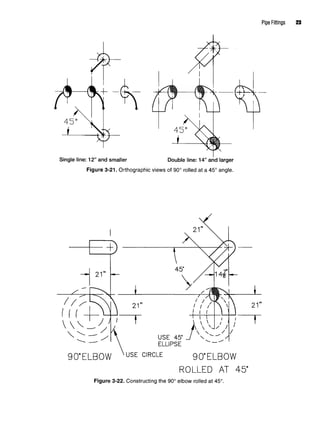
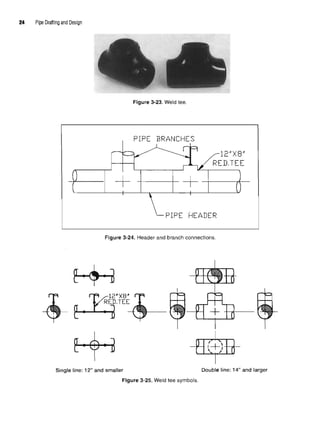
  • 115.
    102 Pipe Draftingand Design Figure 6-22. Crude oil products. • Skirt fireproofing. Generally brick or gunite, fire- introduced or removed from a vessel or piece of proofing is applied around the interior and exterior equipment. walls ofa vessel skirt. It is necessary toprevent dam- . Nozde orientation. Theangular arrangement of noz- age to vessel skirt in case a fire occurs. zles around the perimeter of a vessel's shell. • Nozzle. The tie-in connection between the vessel or • Nozzle projection. Used to establish the distance equipment and the piping system. Nozzles are from the vessel's centerline to the nozzle's face of provided in locations where a commodity is either flange.
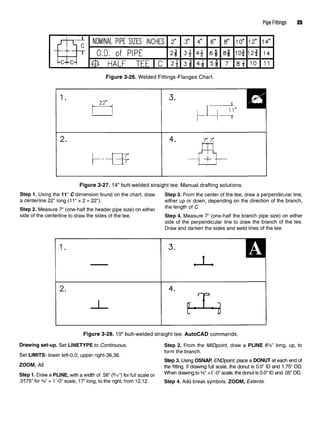
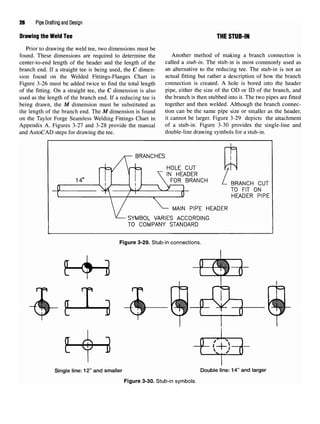
  • 116.
    Mechanical Equipment 103 •Reinforcing pad.A plate contoured to the shape of a process unit, boiler room, or production facility. Although vessel shell. It is positioned around nozzles and pro- duplicate pieces of equipment are found within the same vides additional strength in the areas where metal facility, every piping facility has equipment installations was removed from the shell. unique unto itself. Therefore equipment must be specifi- • Manholes. Similar to large nozzles that allow work- cally developed for each situation. ers entry points into a vessel. They generally are 18" Once specific performance requirements for equip- ID and are accessible by ladders and platforms. ment have been established by engineering, process, and When not in use, the manhole is sealed with a blind other design groups, purchase orders are placed with flange, companies called vendors who specialize in manufactur- • Manhole hinge. A hinge that creates a pivot point in S sucn equipment. While equipment such as pumps and allowing the blind flange attached to the manhole to compressors are considered to be somewhat "standard" be easily removed for worker entrance. and are readily available, other equipment such as vessels 0 7 A • * IT j u i u u • and exchangers must be custom-made for a specific appli- • Seal pan.A tray installed below the bottom tray in a ,_, , ., . . , . vessel to prevent liquids from bypassing the trays. catlon " Vendors Provide engineering and construction companies data drawings that show exact measurements, • Trays. Flat metal plates spaced approximately 18" to locations, pound ratings, and sizes of the newly manufac- 24" apart inside a vertical vessel. They can be bolted tured item Engineering companies then use the informa- or welded tothe vessel shell Trays are perforated to don found Qn the§e vendor data drawi as a reference allow rising vapors and falling liquids to pass . ^ ,, r , „, , . ;, , . , ,. , . & , . „ , so pipe connecting to the piece of equipment can be through with theaid of a valving mechanism called a , . , , , . , . . ,7 , , j designed and drawn with precision. Vendor data drawings also provide designers the necessary information required • Weir. A dam-like plate welded on a tray that allows a to build foundations, locate supports, and calculate inter- fractionated by-product to collect and be extracted ferences wimout having the actual piece of equipment b yanozzle ' available to measure. • Downcomers. Openings adjacent to a tray that allow liquids flowing over a weir plate to fall to the tray below and begin the fractional process over DRAW|HG EQ|J|pMENT • Insulation rings. Continuous circular rings welded to the exterior of a vertical vessel that support a vessel's Vendor data drawings are valuable sources of informa- insulation. They are typically spaced on 12'-0" tion when the need to represent equipment on a piping centers. drawing arises. Although piping drawings do not require • Saddles. U-shaped supports welded on horizontal the duplication of all the information shown on equip- vessels and exchangers. Saddles are bolted to con- ment data drawings, they do require representation of crete foundations and create a cradle-like support in overall equipment lengths and heights, and nozzle sizes, which the vessel can rest. locations, orientations, and pound ratings. The drawings • Lifting lugs. Donut-shaped rings welded to the ves- shown in the Figures 6-23and 6-24are typical represen- sel's shell or head that allow the vessel to be raised tations of vendor data drawings for a shell and tube and positioned during installation. exchanger and horizontal vessel. Piping drawings created by hand can be tedious and time-consuming. The step-by-step process shown in VENDOR DATA DRAWINGS Figure 6-25 can be used as a guide to develop the various components of a horizontal vessel. The measurements used to draw the plan and elevation views of the vessel are With a myriad of piping facilities in operation, one taken from the vendor data drawing shown in Figure should not expect specialized piping equipment to be an 6-24. This vessel will be equipped with a 2:1 semi- item stored in a warehouse or found on a shelf like parts elliptical head. Drawing a vessel's shell is not difficult, for an automobile. Each piece of equipment has certain but development of the 2:1 semi-elliptical head requires criteria that must be met before it can become part of a the step-by-step procedure shown in Figure6-26.
  • 117.
    Figure 6-23. Shelland tube exchanger vendor data drawing.
  • 118.
    Figure 6-24. Horizontalvessel vendor data drawing.
  • 119.
    106 Pipe Draftingand Design Drawing the Horizontal Vessel Figure 6-25. Steps for drawing the plan and elevationviews of a horizontalvessel. Step 1. Determine the vessel's diameter and length as projection length (2'-8"), nozzle size (10"), pound rating provided by the vendor drawing. Using the measurements (300#), and the distance the nozzle measures from the from Figure 6-24, the vessel's ID is 4'-0" and its length from tangent line (12"). tangent line totangent line is15'-0". step 5 From thQ |eft t£mgent |in6j draw fl para||e| jjne 12* tQ Step 2. Draw a horizontal centerline equal to the vessel's the right to establish the centerline of nozzle N2. From the length. centerline of the vessel, draw a parallel line 2'-8" below, to Step 3. Draw vertical construction lines on each endof the e k sta ^f ^e fac * of the nozzle. Using dimensions found on centerline. Along the right vertical line, measure one-half of the ™0#flan 9«j^dimensioning chart in.Appendix A, draw the the vessel's ID (2'-0") above andbelow the centerline. The ™fi* usm 9 tne flan 9es OD <171/2 > and face thlckness total height should be equal to the vessel's ID (4'-0"). From ' 8 '' these two points draw horizontal lines to the left end of the Step 6. Use the drawing procedure shown in Figure 6-26 to vessel. draw the 2:1 semi-elliptical heads. Step 4. From measurements provided on the vendor draw- ing, determine the following values for nozzle N2: nozzle
  • 120.
    Mechanical Equipment 107 Drawingthe 2:1 Semi-elliptical Head Figure 6-26. Steps for drawing a 2:1 Semi-elliptical head. Step 1. Draw parallel lines to establish the vessel's diameter. Step 4. Construct Arc 1 by drawing an arc having its center Locate the vessel's center by drawing a centerline. at the intersection of the 30° line and the tangent line. The Step 2. Draw a horizontal line connecting the two ends of the radius of this arc is measured from the point of intersection vessel. This line will represent the vessel's tangent line. Draw to the end of the vessel. Arc 2 is constructed in a similar a line above and parallel to the tangent line that is a distance manner. Arc 3 is drawn from the intersection of the two 30° equal to the IDD dimension. Use the following formula to lines to the point where the arc crosses the 30° line. establish the IDD dimension. * > * - « * * u ^ ,- „ , * *u Step 5. Construct a weld line by drawing a line parallel to the IDD = vessel diameter x.25 tangent |jne 2» to 3* be|ow Trjm the arcs as necessary. Locate Points 1 and 2 by extending a line from the end of the Erase all construction lines. vessel to intersect the IDD line. Step 3. Establish Point 3 by drawing 30° lines from Points 1 Ste P 6 - Darken the remaining arcs and erase the tangent and 2 that will intersect on the vessel's centerline. ''ne -
  • 121.
    108 Pipe Draftingand Design CHAPTER 6 REVIEW QUIZ 1. Define equipment. 2. What is an accumulator? 3. Explain fractional distillation. 4. What is a by-product? 5. What does a pump do? 6. What are the five pump nozzle configurations? 7. Name three types of pump drivers.
  • 122.
    Mechanical Equipment 109 8.What does a compressor do? 9. Describe the function of an exchanger. 10. How does a cooling tower perform its function? 11. What items are typically found on a tank farm? 12.Name some of the common by-products derived from crude oil feed stock? 13. What internal device is used as a separator and collector of molecules in a fractionation column? 14. Which directions do light and heavy molecules travel within a fractionation column? 15. Where is the dimensional data used to draw piping equipment found?
  • 123.
    110 Pipe Draftingand Design EXERCISES: DRAWING EQUIPMENT Chapter Six Drawing Exercises Exercise 6-1. Draw the plan and elevation views of the Exercise 6-2. Draw the plan and elevation views ofth< shell and tube exchanger as shown in Figure 6-23 to 3 /8" = horizontal vessel as shown in Figure 6-24 to y8" = 1 '-10 I'-O" scale. scale.
  • 124.
    FlOW Diagrams and Instrumentation Flow diagramsdescribe in a schematic drawing format the flow of fluids and gases through a unit or an entire plant. By using symbols to represent various pieces of equipment, the flow diagram provides the piping designer with an overall view of the operation of a facility. The flow diagram used in this chapter is representative of the types used by many companies in the piping indus- try. While actual symbols may vary slightly from one company to the next, the "look and feel" of flow dia- grams is the same throughout the piping industry. Students must become familiar with the piping, equip- ment, instrumentation symbols and abbreviations used on flow diagrams, in order to be able to "read" and interpret them. One of the most difficult concepts for students to com- prehend is the absence of scale in the preparation of flow diagrams. The flow diagram should be laid out in a very simplistic and logical order and be read from left to right. It guides the drafter and designer in the same manner a road map guides a traveler. USES OF FLOW DIAGRAMS The flow diagram is used by the piping group to develop and lay out the plot plan. When developing the plot plan, the arrangement of the equipment in the facility reflects, in part, the logical sequence of flow depicted on the flow diagram. However, many other factors such as code requirements, client standards and preferences, worker safety, and cost also influence the positioning of equipment. Once the plot plan is finalized, the piping designer routes the pipe between two vessels as indicated by the flow diagram using piping specifications and accepted design practices. The flow diagram is usually "yellowed out" as each line is completed and incorporated into the design. 111 TYPE OF FLOW DIAGRAMS Process engineers are responsible for developing flow diagrams. In many large engineering firms, an entire department is dedicated to the development of flow dia- grams. Today almost all flow diagrams are laid out with CAD, using third-party piping packages such as Pro- Flow or individually developed company packages. Process Flow Diagram The process flow diagram is the first flow diagram developed by the flow diagram department. It includes the following: 1. major equipment 2. main piping 3. direction of flow 4. operating pressure and temperature 5. major instrumentation The process flow diagram will denote the following: • Conditions to be used for the design of various pieces of equipment (fractionation columns, pumps, heaters, etc.) required for facility operation. • Operating and design conditions under which a par- ticular unit or piece of equipment will normally operate. Design conditions establish the limits that equipment used in the facility can withstand. Design pressure is calculated to be at least 10% above the maximum operating pressure or 25# greater (which- ever is largest). The design temperature will be at least the maximum operating temperature, but should be at least 25 degrees above the normal oper- ating temperature. • Composition of the commodities used in the process sequence as they enter and leave the unit.
  • 125.
    112 Pipe Draftingand Design Figure 7-1 shows a sample process flow diagram. connections, etc., are to be made on each pipe throughout the facility. Mechanical FlOW Diagram Figure 7-2 shows a sample of the mechanical flow diagram. From the process flow diagram, the mechanical group develops themechanical flow diagram. The mechanical flow TU^ „..,.. e, „. ,. ., , , , i , , , The Utility Flow Diagram diagram provides much more detailed data than the process flow diagram. Many companies refer to the mechanical flow The utility flow diagram shows the piping9 valves> and diagram as the "P & ID" (process and instrument diagram). instrumentation for the basic plant utilities. Utilities are Often referred to as the bible of the design process, this services that are essential to the proper function of the drawing provides thepipe drafter with thedesign criteria for plant These utilities correspond to some of the same util- the unit. Mechanicalflowdiagrams include the following: ities used in atypical house5 such as watei. gas? and sewer 1. pipe line numbers and direction of flow drains. 2. pipe specifications andline sizes Some of the common plant utilities are: 3. all equipment 4 an valves * steam • condensate 5. all instrumentation with controlling devices • fuel oil • utility air The mechanical flow diagram defines the exact * instrument air • cooling water sequence in which all equipment, valves, instrumentation, • drainage systems • flare system Figure 7-1 shows a sample of the process flow diagram.
  • 126.
    Figure 7-2 showsa sample of the mechanical flow diagram.
  • 127.
    114 Pipe Draftingand Design The flow diagram is a dynamic document. It may be revised Figure 7-4 illustrates a combination of the symbols and and updated during the project to reflect the client's changes or abbreviations used to represent an instrument's function modifications imposed by governmental regulations. on flow diagrams. The first letter in the symbol indicates Figure 7-3 shows a sample utility flow diagram. the instrument group, and the second and/or third letters indicate the instrument type. ci nui niAPDARfl IUCTDIIMEUTC To indicate a change or to control the flow, level, pres- FLOW DIAGRAM INSTRUMENTS sure? Qr temperature9 an instrument must first sense a change in the variable. Once a change has been detected, Instruments function by sensing changes in the vari- the instrument then transmits this information via ables they monitor. The four basic instrument groups are: mechanical, electronic, or pneumatic means to a control Flow (F) panel where it can be observed and recorded. At the same Level (L) time, the instrument may activate other devices to affect Pressure (P) ancj change process conditions in the facility. Some Temperature (T) instruments are read in the plant at the instrument's actual The types of instruments used to sense, control and location. Others are displayed on a control panel located monitor these variables are: in an operator's control room. Controller (C) Indicator (I) Instrument Types Gauge (G) Alarm (A) Gauges. Gauges are instruments that measure the liq- Recorder (R) uid level inside a vessel or the temperature and/or pres- By learning these nine terms, students will be able to sure in the piping system. Level, temperature, or pressure understand most of the instrument symbols found on a gauges are locally mounted to enable plant operators to mechanical flow diagram. obtain a visual reading. Figure 7-3 shows a sample of the utility flow diagram.
  • 128.
    Flow Diagrams andInstrumentation 115 Figure 7-4 Flow diagram instrument symbols.
  • 129.
    116 Pipe Draftingand Design Figure 7-5. Flow diagram and abbreviations.
  • 130.
    Flow Diagrams andInstrumentation 117 Controllers. Devices used to maintain a specified liq- symbols have some resemblance to the actual pieces of uid level, temperature, pressure, or flow inside a vessel or equipment in the field, piping system. They activate the control valve that regu- lates the level, temperature, pressure, andflowin andout _,nill m Ail ADDAuncMcuT of the vessel PLOW PLAN ARRANGEMENT Alarms. Signals via lights or horns that indicate the liquid level, temperature, or pressure inside a vessel is too The flow Plan should be arranged in a logical order of high ortoo low orthat there isnofloworreverse flow. flow - The mam flow throu gh the umt should be obvious Indicators. Devices used to indicate the liquid level, b y even a bnef examination of the flow plan. Use the temperature, pressure or flow rate inside a piping system. following checklist as an aid when developing a flow Recorders. Devices used to record the liquid level, diagram, temperature, pressure, and flow rate inside a vessel or piping system throughout acertain shift or period oftime. ' Avoid crossin glines where Possible " These same instruments maybefound incombination ' S Pacee 1ui Pment ™thesketch to avoid overcrowding, such as Level Recording Controller. Here theinstrument * Use notes with s ymbolswhere necessar yfor clarit y- not only records the liquid level butalso sends a signal to ' Use arrows to show flow directlon - a control valve tocontrol theliquid level inside thevessel. * Show e <lui Pment numbers when *is necessary to identify equipment. • Show control systems on the sketch. The control PIPINP QYMRfll Q ririNti oi WOULD scheme is frequently the most important part of a flow plan sketch. Figure 7-5 shows some flow diagram piping symbols. • Show important valves, orifice flanges, and control Notice all valves, no matter the pipe size and pound rat- valves. ing, are drawn the same size. Generally, nozzles and • Show flow directions through exchangers with reducers are not shown on the mechanical flow diagram. arrows. The flow diagram in Figure 7-2 shows reducers in order • Do not run lines diagonally across the drawing, to aid the students in visualizing and understanding the • Label feed lines entering the unit from the field flow diagram and its relationship to the actual piping where the line enters the unit. Label product lines arrangement drawing. Symbols used on flow diagrams leaving the unit by name, represent the actual piece of equipment. Typically these • Do not draw lines any closer together than necessary.
  • 131.
    118 Pipe Draftingand Design CHAPTER 7 REVIEW QUIZ 1. List five items shown on the process flow diagram. 2. List five items shown on the mechanical flow diagram. 3. List the four basic instrument groups. 4. List the five instrument functions. 5. What type of instrument is used to maintain a certain liquid level? 6. Identify the following instrument abbreviations: a. LG b. FA c. TI d. PC e. TRC f. LC g. PSV h. HCV i. LAH j. LAL 7. Identify the following flow diagram abbreviations: a. DF b. SC c. CSO d. LC e. NO
  • 132.
    Flow Diagramsand Instrumentation119 EXERCISE INFORMATION Exercises 1,2, and3 Use the instructions accompanying Figure 7-6 to create Recreate the flow diagrams as shown. Using the the flow diagram symbols with AutoCAD as shown. Use symbols in Figure 7-6 where applicable. Symbols repre- the BASE command to place the base point as indicated. senting other pieces of equipment can be developed on an BLOCK each object using the exact symbol name pro- as-needed basis. Although equipment is not drawn to vided. OOPS the symbol to redisplay. SAVE the drawing scale, it should be proportional to the other symbols used as FLOSYMBL. in the drawing. FLOW SHEET SYMBOLS TO DRAW FLOW SHEET SYMBOLS SET GRID TO .125 AND SNAP TO .0625 THE .125 GRID SHOWN BELOW HAS BEEN ENLARGED FOR BETTER VISUALIZATIION. DRAW AND BLOCK EACH SYMBOL. BASE POINT ( '& ) & SYMBOL NAME [NAME] HAVE BEEN INCLUDED FOR PROPER IDENTIFICATION. Figure 7-6. Flow diagram exercise symbols.
  • 133.
  • 134.
  • 135.
  • 136.
    Codes and Specifications As anyonewho has ever played a game can tell you, there are specific rules that must be followed if the game is to be played correctly. The same holds true for building a piping facility. Just as the rules of a game establish the basic guidelines for play, codes and specifications estab- lish guidelines for piping facilities to ensure everything from quality construction to worker safety. Codes are a broad-based set of guidelines that govern the total scope of a project. Codes originate from a num- ber of sources. Some sources are governmental agencies such as OSHA or the EPA and some are organizations such as ANSI (American National Standards Institute) that developed the Petroleum Refinery Piping Code B31.3 that governs operational procedures for refinery piping. Specifications, on the other hand, are developed as a specific set of guidelines for design, fabrication, and con- struction of a piping facility. Written to maintain consis- tency and uniformity throughout all phases of a project, specs are very detailed. Codes can be as broad as state- ments indicating that all facilities must be built in accor- dance with ANSI standards, while specs are so detailed they can include instructions to a painter indicating which pipe to paint red. As we look at codes and specs, remember that they have been developed through years of trial and error. When something purchased didn't fit, something built broke, or something boiled blew up, someone made a note of the mistake, remembered it the next time a similar situation occurred, and made it an operational procedure. The operational procedure evolved into a piping code. CODES Though you may not be familiar with codes specific to piping facilities, you are familiar with an ordinary structure to which codes also apply: the typical house. Codes have been written concerning door sizes, window sizes, lumber sizes, electrical requirements, etc. As an example, the min- imum width of a front entry door is 3'-0". Windows in sleeping rooms must have a net area of 5.7 sq. ft. with a minimum opening height of 2'-0" and width of 1 '-8". Codes for piping facilities have been implemented in a similar fashion. Regulations have been established for pressure and temperature limits, material composition and stresses, worker safety, emergency evacuation proce- dures, and many more. Table 8-1 provides a partial listing of the codes written for piping facilities. Table 8-1 Piping FacilityCodes Code Designations ANSI B31.1 ANSI B31.3 ANSI B31.5 ASME Titles Power Piping Petroleum Refinery Piping Refrigeration Piping Boiler and Pressure Vessels SPECIFICATIONS As previously mentioned, specifications stipulate spe- cific details for design, fabrication, and construction. Specifications are used by many groups to achieve a com- mon goal. Engineers, designers, and drafters must use specs to establish sizes, pound ratings, and dimensions of pipe and equipment. Stress calculations are made from information provided in the specs to ensure columns, beams, and supports will withstand the loads and forces placed on them. Purchasing personnel need specs to ensure proper materials and equipment are bought. Weld- ers and fabricators use specs to erect structures, supports, and route the proper size pipe. Specs also provide work- ers installing instrumentation controls proper temperature and pressure settings. Specs for a house might include the drawing scale to which the construction drawings were created. They may require the use of a particular grade of lumber or specify the thickness of insulation to be installed in the attic. Specs inform someone which color of carpet to buy or from what manufacturerto order the water heater. 123
  • 137.
    124 Pipe DraftingandDesign When applied to a piping facility, specs become quite 6.5 Flow arrows will indicate flow direction of each line, lengthy. Comprising volumes of printed material, specs Line numbers shall be assigned to each pipe line. A often seem never-ending. Two sample sections from a typical line number is shown in Figure 8-1. typical specification document are provided below. 7.0 Clearances and Accessibility 7.1 Roadways 7.1.1 Minimum headroom clearance over secondary road- 6.0 Drawings and Design Procedures ways is lO'-O". 6.1 Piping arrangement drawings are plan views that 7.1.2 Minimum width of secondary roadways is lO'-O" show pipe in sufficient detail to indicate pipe routing, excluding 3'-0"shoulders. anchors, guides, supports, intersections, and provisions 7.2 Walkways for expansion. 7.2.1 Maintain a minimum headroom clearance of 7'-0". ,n n. . , . , „ , 7.2.2 Maintain a minimum horizontal clearance of 2'-6". 6.2 Piping arrangement drawing dimensions shall be 7 7 pi tf shown in feet and inches. Inches shall be used when _ ^ A/r. . , ~ . ,,u . ~, ,-„ .. _„ _. . .„ , 7.3.1 Minimum platform width is 2-6 . dimensions are less than 1 -0 . Dimensions will be „ , , „ . , , . . , , , , , .f 7.3.2 Minimum headroom clearance above platforms is shown to the nearest Me . 7'_0" 6.3 Intersecting coordinates will be used to position all 7.3.3 Platforms shall be placed 2'-6" below the centerline buildings, pipe supports, and equipment. Equipment of manways. shall include vessels, pumps, exchangers, boilers, heat- 7.3.4 Maximum vertical distance between platforms (lad- ers, and cooling towers. der length) is 30'-0". 11 1 TV u n u j - • j r j- „. * u 7.3.5 Minimum clearance around any platform obstruc- 6.3.1 Pipe shall be dimensioned from coordinates to show , J r location. Elevations shall be used to indicate height ~ ,-, ^ ^ - j r - i - u 0/ ™ ^ ^ 7.3.6 Cages are not required for ladders 8-0 long or less measurements. t ® , ,r.. _... , , , , . , or ladders that end 20-0 or less above the high point 6.4 Standard piping symbols shall be used throughout. of paving. Piping drawings shall be drawn to a y8" = l'-0" scale. 7.3.7 Platforms shall be provided for manways which Detail drawings shall be larger as necessary. Pipe 12" have a centerline 15'-0" or higher above high point of and smaller shall be drawn single line. Pipe 14" and paving. larger shall be drawn double line. In congested areas An example of how specifications are applied to piping double line drawings may be used for clarity. drawings is represented in Figure 8-2. Figure 8-1. Line number.
  • 138.
    Codes and Specifications125 Figure 8-2. Applicationof specifications. SPECIFICATION CLASSES As extensive as specifications are, they should not be considered all encompassing. Specifications are divided into classes developed especially for particular services. Classes are categorized by the commodity within the pipe. They take into account whether the commodity is a gas or liquid, as well as design and operating tempera- tures, pressures, and corrosiveness. Figure 8-3 provides an index of classes. It includes the class designation, flange type and ratings, material, and service commodity type. Specification classes use service parameters to estab- lish flange pound ratings, pipe wall thickness, pressure and temperature limits, as well as the type of connections to be used, that is, screwed, socket-weld, butt-weld, etc. Figure 8-3. Index of specification classes.
  • 139.
    126 Pipe Draftingand Design Specification classes are extremely detailed. They specify B which manufacture to purchase valves from as well as the specific part model number to be used. Specs specify the B Beveled material gaskets will be made of and whether branch con- BB Bolted Bonnet nections are to be made using straight tees, reducing tees, BBE Bevel Both Ends or stub-ins. Specifications also stipulate corrosion allow- BBL Barrel(s) ance values. Corrosion allowance is the amount of surface "^ °°^ Circle material allowed to be eroded by the commodity within BD Blow Down the pipe while permitting the pipe to remain usable for the "^ Beveled End(s) particular service for which it is installed. "* Blind Flange The examples of specification classes that follow are to "L Battery Limits be used throughout the projects in this text. Use them as a BLDG Building guide to answer specific questions about the design and BLE Bevel Large End drafting of a piping system. As with all specifications, they BOM Bill of Materials are to be used only with the project for which they are writ- BOP Bottom of Pipe ten and should not be considered typical for every project. B&S Bell and Spigot BSE Bevel Small End BTU British Thermal Unit ABBREVIATIONS BV Ball Valve BW Butt-weld As a piping facility becomes more complex, so do the piping drawings. Facilities such as multi-storied struc- C tures, specialized refining systems, and complex equip- ment arrangements compound the crowdedness of a Catch Basin drawing. To alleviate the crowded conditions, abbrevia- CHKV Check Valve tions should be used to reduce the space requirements of ^"* ^P' Chain Operator callouts andnotes. Thefollowing is an alphabetical list- ^ ^ast Iron ing of many common abbreviations found on piping ^ clearance arrangement drawings, flow diagrams, or isometrics. A ^^ clean Out complete listing is almost impossible to assemble because COL Column engineering companies and their clients often have abbre- COLS Columns viations that are particular to specific situations. COJNC Concentric COND Condensate CONN Connection CORK Corrosion PIPING ABBREVIATIONS CPLG Coupling CS Carbon Steel A Cast Steel Cold Spring A Alarm CSC CarSeal Closed A Anchor cso CarSeal Open ACCUM Accumulator CTRLV Control Valve AL Aluminum CWR Cooling Water Return ANSI American National Standards Institute CWS Cooling Water Supply API American Petroleum Institute ASSY Assembly Q ASTM American Society for Testing and Materials ATMOS Atmosphere DA Directional Anchor AUX Auxiliary DF Drain Funnel AVG Average DIA Diameter AZ Azimuth DIM Dimension
  • 140.
  • 141.
  • 142.
    Codes andSpecifications 129 DISCHDischarge H DR Drain DW Dummy Weld HCV Hand Control Valve DWG Drawing HDR Header DRWN Drawn HIC Hand Indicating Controller HLL High Liquid Level E HOR Horizontal HP High Pressure T™ !^aSt • HPFS High Point Finished Surface ECC Eccentric TTT»T» u- u n • * n • HPP High Point Paving EL Elevation „„ „ ° „ , HR Hanger Rod ELL Elbow TT _,_. __7 _ . Hour ELEV Elevation TTTTJ TT «. FOTTTP F HTR Heater un«7 c?U1 fm T • . «r u j HVAC Heating, Ventilating, andAirConditioning ERW Electric Resistance Welded TT*™/ u T7vr-Ti c u HVY Heay y EXCH Exchanger TTVJ u A r EXIST Existing HYD HydraU '1C F ' FA Flow Alarm IA Instrument Air FBO Furnished By Others Insulation (anti sweat) FDN Foundation 1C Insulation (cold) FE Flow Element ID Inside Diameter F/F Face-to-Face H)D Inside Depth of Dish FF Flat Face IET Electric Trace Full Face IGT Glycol Trace FI Flow Indicator IH Insulation (heat conservation) FIC Flow Indicating Controller IN Inch(es) FIG Figure INS Insulate or Insulation FLR Floor INST Instrument(ation) FLDFAB Field Fabricate INV Invert Elevation FL Flange IPS Iron Pipe Size FOB Flat on Bottom IS Insulation Safety FOT Flat on Top ISA Instrumentation Society of America FR Flow Recorder ISO International Organization for FRC Flow Recording Controller Standardization FS Field Support Isometric Forged Steel 1ST Steam Trace FT Foot or Feet FW Field Weld J Q JCT Junction JS Jack Screw G Gauge or gage JT Joint GAL Gallon(s) GALV Galvanized L GPH Gallons Per Hour GPM Gallons Per Minute L Level GR Grade LA Level Alarm GaV Gate Valve LAH Level Alarm-High GIV Globe Valve LA.L Level Alarm-Low
  • 143.
    130 Pipe Draftingand Design LBS Pounds NPT National Pipe Thread LC Level Controller NTS Not to Scale Lock Closed LG Level Gauge 0 Level Glass LI Level Indicator OAL Overall Length LIC Level Indicating Controller OD Outside Diameter LLL LowLiquid Level OH Open Hearth LN Line OPP Opposite LO Lock Open OS&Y Outside Screw and Yoke LP Low Pressure OVHD Overhead LPG Liquefied Petroleum Gas ows Oil Y Water Sewer LPT Low Point LR Level Recorder " Long Radius T nr* T i r> j- ^ * n p A Pipe Anchor LRC Level Recording Controller „r ¥ o T i o V u Pressure Alarm LS Level Switch _ _ _ _ PC Pressure Controller ly. PCV Pressure Control Valve PdRC Pressure Differential Recording Controller mm millimeter PE PlainEnd M Meter p ^ Point of Intersection M&F Male and Female Pressure Indicator MATL Material PIC Pressure Indicating Controller MAX Maximum P&ID Piping and Instrument Diagram MECH Mechanical PLE Plain LargeEnd MFG Manufacturing PO Pump Out MFR Manufacturer POE Plain One End MI Malleable Iron POS Positive MIN Minimum pp Personnel Protection Minute PR Pressure Recorder MISC Miscellaneous PRC Pressure Recording Controller MK Piece Mark PS Pipe Support MW Manway PSE Plain SmallEnd Miter weld P ^I Pounds per Square Inch PSIA Pounds per Square Inch absolute H PSIG Pounds per Square Inch Gage PSV Pressure Safety Valve N North PT Point NC Normally Closed NEC National Electric Code Q NEG Negative NIP Nipple QTY Quantity NLL Normal Liquid Level QUAD Quadrant NO Normally Open Quadruple Number NOM Nominal R NOZZ Nozzle „ „ J. XTTJC. XT • i TV o- R Radius NFS Nominal Pipe Size ^T-^TA n • j xTT»om X T * « •*• o *• TT j REC'D Received NPSH Net Positive Suction Head ^^^ _ , RED Reducer
  • 144.
    Codes andSpecifications 131 REFReference THRD Thread REINF Reinforce TI Temperature Indicator REQ'D Required TIC Temperature Indicating Controller REV Reverse TLE Thread Large End Revision TOC Top of Concrete RF Raised Face TOG Top of Grout RJ Ring Type Joint TOL Threadolet RPM Rotations Per Minute TOS Top of Steel RS Rising Stem TR Temperature Recorder RTJ Ring Type Joint TRC Temperature Recording Controller TSE Thread Small End S T/T Tangent to Tangent TW Temperature Well s South Thermowell SC Sample Connection TYP Typical SCH Schedule SCRD Screwed y SECT Section SH(SHT) Sheet UA Utility Air SMLS Seamless US Utility Station SO Slip On Steam Out V SOL Sockolet SP SetPoint VA Valve SP GR Specific Gravity Vent to Atmosphere SPEC Specification VB Vortex Breaker SQ Square vc Vitrified Clay SR Short Radius VERT Vertical STD Standard VF Vent to Flare STL Steel VOL Volume STM Steam vs Vent toStack SUCT Suction SUPT Support W SW Socket-weld SWG Swage w/ with SWP Standard Working Pressure W West SYS System WB Welded Bonnet WE Weld End T WLD Weld WN Weld Neck T Steam Trap WOG Water, Oil, Gas TA Temperature Alarm WOL Weldolet Tan Tangent WT Weight TBE Thread Both Ends TC Temperature Controller X TCV Temperature Control Valve TE Threaded End XH Extra Heavy TEMP Temperature XS Extra Strong T&C Thread and Coupled XXH Double Extra Heavy T&G Tongue and Groove XXS Double Extra Strong
  • 145.
    132 Pipe Draftingand Design CHAPTER 8 REVIEW QUIZ 1. Explain the difference between codes and specifications. Using information found in the sample piping specifications, answer the following questions. 2. Dimensions are provided on drawings to the nearest of an inch. 3. Piping drawings are drawn to which scale? 4. What is the minimum headroom clearance of a secondary roadway? 5. What is the minimum headroom clearance over a walkway? 6. What is the minimum horizontal clearance of a walkway? 7. What is the minimum width of a platform? 8. What is maximum vertical distance between platforms? 9.Cages are not required on ladders feet long or less. 10. What is the purpose of specification classes?
  • 146.
    Equipment Layout PLANT COORDINATESYSTEMS Plot plans, foundation location drawings, and equip- ment location drawings are developed using the plant coordinate system. Universally recognized throughout the piping industry,the plant coordinate system uses intersect- ing grid lines, similar to the Cartesian coordinate system, to locate buildings, structures, foundations, equipment, and piping configurations. These intersecting grid lines, which originate from a designated control point, are drawn parallel to the north/south and east/west axes. The control point, more commonly known as a bench mark, is a permanent marker erected in a remote area of the piping facility. It is often located so it will not be acci- dentally damaged or destroyed. The control point is used as the origin from which the intersecting north/south and east/west lines are labeled as coordinates using numerical values. The control point, therefore, becomes the primary reference point for the entire facility. By defining the con- trol point as O'-O", O'-O" and using a north arrow to estab- lish orientation, the numerical values assigned to the coordinates allow for exact positioning of all facility com- ponents. Coordinates indicate the measurement from the control point to the particular structure, foundation, or piece of equipment that the coordinate locates. North arrows are typically pointed up or to the right on a drawing and help create directional bearing in the facil- ity. Lines above, or north of, the O'-O", O'-O" control point are assigned north coordinates and are labeled to indicate their distance from the control point, for example, N. 5'-0". Lines to the right of O'-O", O'-O" are assigned east coordi- nates, for example, E. 5'-0". Coordinates to the south and west of the control point will have S. or W. prefixes, respectively. See Figure 9-1 for an example of the plant coordinate system. The format used to identify plant coordinates will vary with each design project. Some projects use feet and inch designations while others may use decimals of a foot or millimeters. No matter the format, all coordinates are preceded by the letters N, S, E, or W. The project in this text will use feet and inches with the metric equivalent shown beneath. Location dimensions used on piping arrangement drawings are placed to reference a known coordinate, usually the center line of a column, founda- tion, or piece of equipment. A control point is also used to establish the elevation of the piping facility. Elevation is the vertical distance an object measures above sea level, such as the height of a mountain. Piping facilities use elevations to designate the height an object measures from grade. Grade is a piping term that is synonymous with ground. Rather than using numbers based on the actual height above sea level, most facilities use an arbitrary elevation of lOO'-O" as a matter of convenience. Facilities located within high-rise struc- tures may use elevations based on the height of the vari- ous floors within the structure. In all petro-chemical facilities, pipes are installed both above grade and below grade. The use of lOO'-O" as a point of reference prevents the use of negative numbers when dimensioning lines below grade. Few actual dimensions are provided on piping section or elevation drawings. However, numerous callouts are placed on drawings to convey elevation information to the reader. Some of the callouts and corresponding terms are shown below. See Figure 9-2 for examples of the plant elevation system. Piping Terminology grade elevation high point of paving center line elevation top of concrete top of steel bottom of pipe face of flange top of platform Piping Callout GRADE EL.IOO'-O" H.P. PAVING lOO'-O" IEL. i02'-o" T.O.C. EL.101 '-0" T.O.S. EL. 112'-0" B.O.P.EL. 112'-0" F.O.F. EL. 105'-0" TO. PLAT. EL. 137'-6" 133
  • 147.
    Figure 9-1. Plantcoordinate system.
  • 148.
    Figure 9-2. Plantelevation system.
  • 149.
    136 Pipe Draftingand Design The repeated use of coordinates and elevations makes drawn to one of the following scales: 1"= 10', 1"= 20', or it imperative that correct numbers be used to calculate 1" = 30'. accurate dimensions. To avoid inadvertent mixing of Unit plot plans show the location of all the buildings, coordinate and elevation values, follow this simple guide- equipment, pipe racks, and other items of importance in line: Use only coordinates to calculate horizontal dimen- the unit. True north and plant north are also shown. The sions and use only elevations to calculate vertical purpose of this drawing is not to show detail, but rather, dimensions. By adding or subtracting coordinates, hori- the arrangement of various components to be erected in zontal distances between supports, foundations, and the unit. equipment can be determined. Knowing when to add and The piping group is typically responsible for the devel- when to subtract can be confusing, however. The basic opment of the unit plot plan. Unit plot plans are devel- rule to remember when calculating horizontal distances oped using the mechanical flow diagram, client is: Subtract like coordinates and add unlike coordinates. specifications, codes, and input from the client's engi- This basic rule is illustrated in Figure 9-3. neers, and the plant manager who will ultimately oversee Calculating vertical dimensions is somewhat easier. the operation of the facility. Figure 9-5 shows an example Simply subtract the lower elevation from the higher eleva- of a unit plot plan, tion to determine the distance between the two.However, you must be certain that elevations of the same type are cnmnMciiT i nnATinu nnAunun used. For example, always use two centerline elevations, EQUIPMENT LOCATION DRAWING not one centerline and one bottom of pipe. It is best to con- vert B.O.P. elevation callouts to centerline elevations before In order to arrange and adequately space equipment, subtracting. This is accomplished by adding one half the the piping group will use the approved plot plan to assign actual OD of the pipe to the B.O.P. elevation. Also be coordinates to mechanical equipment, pipe supports, and aware that lines installed below grade are labeled using control rooms. Keep in mind there will be plant operators invert elevations. Invert elevations identify the inside bot- and maintenance personnel in the facility 24 hours a day. torn of pipe elevation, that is, the distance from the bottom Adequate arrangement and spacing of components within inside of the pipe to the ground above it. Figure 9-4 illus- the facility depend on a number of factors, including pip- trates the use of elevations to calculate vertical dimensions. ing codes, space availability, worker accessibility as well as client preferences. All pieces of mechanical equipment QITP PI ANQ to ^e installed within the facility are positioned using two intersecting coordinate lines, one north/south and one east/west. These intersecting coordinates define the pre- The civil/topographic drafting department of a com- cise position of the equipment by locating the centerline pany prepares the site plans for the piping facility. Site of its foundation. When locating equipment such as plans are overhead views drawn to show the overall facil- exchangers and reboilers that have a foundational support ity site and adjacent areas that mayinclude roadways, on each end? at least one of the equipment's supporting railways, harbors, ship channels, and aircraft landing foundations must be located with coordinates. By using zones. Drawings of this size do not show significant me plant coordinate system, it is impossible for any other detail. Detailed areas of the facility are usually denoted component in the facility to have the same pair of inter- by rectangular outlines with notes or titles describing the secting coordinates. Figure 9-6 shows an example of an area's purpose. Mechanical equipment within the facility equipment location drawing is typically too small to be represented on a site plan. | Therefore the complete facility is usually divided into cmiMnATinu nrATIOU nDAUfiur I smaller areas called units. Each unit can then be drawn FOUNDATION LOCATION DRAWING separately on drawings called unit plot plans. The structural drafting department uses information provided on the equipment location drawing to show the UNIT PI ilT PIAN um i FLU i TLHII position of foundationsfor equipment, structural support, and control buildings. On foundation location drawings, Unit plot plans are generally defined by imaginary foundations that are to be built above grade are drawn as lines called battery limits. Battery limits are used to estab- solid lines and spread footings.The portion of the founda- lish a unit's boundaries. The unit plot plan is usually tion that lies below grade is shown as hidden lines.
  • 150.
  • 151.
  • 152.
    Figure 9-5. Unitplot plan.
  • 153.
    Figure 9-6. Equipmentlocation drawing.
  • 154.
    Equipment Layout 141 PIPINGDRAWING INDEX possible. These drawing areas are given a drawing num- ber for easy identification and then assigned to various The piping drawing index is developed from the plot designers on the project. During the design phase, it is plan. This drawing divides the plot plan into smaller crucial that designers interface with those working on drawing areas, using match lines. Match lines are lines adjacent drawing areas. The position, size, and pound rat- drawn and labeled that allow the smaller drawing areas to ing of lines entering or leaving an area and continuing be pieced together to form the larger plot plan, similar to into an adjacent area must be properly noted and located a puzzle. Larger areas are divided in such a way as to on all related drawings. Figure 9-7 shows an example of keep related pieces of equipment on the same drawing if the piping drawing index. Figure 9-7. Piping drawing index.
  • 155.
    142 Pipe Draftingand Design CHAPTER 9 REVIEW QUIZ 1. Define plant coordinate system. 2. Name the three units of measurement by which coordinates can be labeled. 3. What is the typical arbitrary value for the elevation of grade? 4. Define the following terms. H.P. Paving T.O.C. EL. T.O.S. EL. B.O.P. EL. F.O.R EL. 5. Use only coordinates to determine dimensions. 6. Use only elevations to determine dimensions. 7. Define battery limits. 8. Name three factors that influence the arrangement and spacing of equipment. 9. How are above-grade foundations represented on a foundation location drawing? 10. What is a match line?
  • 156.
    Piping Arrangement Drawings, Sections, andElevations ARRANGEMENT DRAWINGS Thearrangement drawing is the most significant draw- ing developed by a piping designer. This plan view draw- ing is a major source of information used in the fabrication and erection of the piping facility. Informa- tion on the arrangement drawing aids in the development of the piping model and isometric drawings. The piping arrangement drawing evolves from the foundation location and equipment location drawings. It shows all mechanical equipment and vessels in the unit and the pipes connecting them, including manholes, lad- ders, platforms, and davits. It identifies all structural sup- ports such as pipe racks, equipment structures, columns, braces and any flreproofing they may have. Once loca- tions for foundations and equipment have been estab- lished, piping configurations are added to the drawing with the aid of symbols that represent fittings, flanges, and valves. Written information placed on the arrangement draw- ing includes equipment coordinates, identification num- bers, elevation callouts, line numbers, flow arrows, and dimensions establishing pipe locations. Instrumentation symbols are included to indicate type, position, and ori- entation for accessibility by plant personnel. Ladders and platforms are also shown on equipment and structures that have them. A nozzle schedule is included that con- tains detailed information about all piping and instrument connections for every piece of equipment. Information such as nozzle number, size and pound rating, orienta- tion, elevation, and projection is also included. With so much required information on a drawing, it is easy to understand why the piping arrangement drawing must be neat, accurate, and legible. RESPONSIBILITIES OF THE PIPING DESIGNER Only after many years of experience does the drafter become a piping designer. The time invested in learning company specifications, layout procedures, and equip- ment requirements makes the designer a valuable employee. As the arrangement drawing is being developed, a pip- ing designer should consider the following: How can the drawing be simplified? How will con- struction, repairs, and routine maintenance be performed in this unit? Has enough room been provided for access between equipment? Foremost on a designer's mind should be the safety and protection of plant operators and maintenance personnel. INFORMATION SOURCES FOR PIPING ARRANGEMENT DRAWINGS A piping designer must assemble the various reference drawings and documents needed to lay out the piping arrangement drawing. These may include: 143
  • 157.
    144 Pipe Draftingand Design • mechanical flow diagram • plot plan • foundation or equipment location plan • piping index drawing • equipment (vendor) drawings and foundation draw- ings • piping specifications • pipe line list • list of special requirements, if any, for the project LAYOUT PROCEDURES To develop a piping arrangement drawing, the designer must be familiar with company and client job specifica- tions and requirements of the current project. Many differ- ent layout and design techniques can be used depending on client requirements, company policy, budget limita- tions, manpower, and available computer software. Piping arrangement drawings are quite complex and congested. Therefore a systematic layout procedure is recommended to ensure all necessary items are included. The following are the recommended procedures for lay- out of piping arrangement drawings. 1. Define proposed area outline or drawing match lines. 2. Fill in drawing number and title block information. 3. Place a north arrow in upper right-hand corner of the drawing. 4. Locate foundations for buildings, pipe rack col- umns, and mechanical equipment from the coordi- nates used to develop the foundation location drawing and dimensions provided on the equip- ment foundation drawing. 5. Draw equipment foundations. 6. Lay out equipment. NOTE : • Show only enough detail on equipment outlines to provide a generalized description. • Represent equipment centerlines, outlines, and foun- dations with thin dark lines. • Show all piping and instrumentation connections (nozzles, couplings, etc.) on equipment. 7. Prepare a study drawing of each individual piping configuration in the facility. This procedure will allow the designer to explore all requirements nec- essary for design, operation, and maintenance prior to the final layout. 8. Lay out the piping system as shown on the study drawing. Include instrumentation connections on the piping configuration. Note that every piping facility has different process, mechanical, and instru- mentation requirements. It would be extremely diffi- cult to establish set rules and procedures for methods of piping development. Each line on the layout is, in itself, a special design problem and must be dealt with accordingly. 9. Add platforms, ladders and cages, pipe guides, anchors, supports, and hangers as required. 10.Include line numbers, codes, specs, specialty item numbers, and callouts. 11. Place locating dimensions for piping. 12.Label coordinates for equipment, pipe supports, etc., if required for job. 13. Add instrument balloons and callouts. 14. Include nozzle schedules and notes as required. 15. Complete drawing. Add match line, area limit, and battery limit callouts, reference details, and section or elevation cutting plane symbols. 16. Print/plot the completed drawing and check your work. 17.Correct any mistakes you find before releasing the drawing to your instructor or supervisor. PIPING ARRANGEMENT DRAWING LAYOUT This section provides a detailed explanation of the pro- cedures to lay out the piping arrangement drawing shown in Figure 10-1. These procedures will simulate those undertaken on any design project by an actual engineer- ing company. To simplify the layout procedures and con- solidate the reference drawings and related information, a copy of the mechanical flow diagram, foundation draw- ing, equipment foundation drawings, equipment vendor drawings, and the piping specification tables is provided in this chapter. The following procedures present both manual and AutoCAD methods for developing piping arrangement drawings. Note that manual drawings should be drawn to yg" = l'-0" scale and CAD drawings are drawn full size and plotted to y8" = I'-O" (.03125") scale. Procedure 1-3: Drawing setup. Locating area and unit boundaries, title block, and north arrow References Drawing: Foundation location plan and company drawing standards Manual. On a "C" size (18" x 24") sheet of trac- ing vellum, lightly lay out drawing borders mea- suring Vz" inward from the edges of the vellum,
  • 158.
    Figure 10-1. Pipingarrangement drawing—single line.
  • 159.
    Figure 10-2. Pipingarrangement drawing—double line.
  • 160.
    Piping Arrangement Drawings,Sections, and Elevations 147 including title block if required. Find the center of the drawing area by drawing diagonal lines from the opposite corners of the borders. The intersection of the two diago- nal lines will form the center of the drawing area. Deter- mine the width and depth of the unit's boundaries by subtracting the smaller match line coordinates from the larger match line coordinates for both the north/south and east/west match lines respectively. Divide the width and depth measurements equally on each side of the drawing's centerpoint. Lightly layout the unit's match lines with con- struction lines using the 3 /g" = l'-0" scale. These lines will be widened and darkened at the completion of the project. AutoCAD. Set the UNITS command to Architectural and the 'smallest fraction' setting to 'sixteenths'. Set LIMITS as follows: lower left (-5'-0", -5'-0") and upper right (60'-0", 50'-0"). ZOOM, ALL. Set GRID to I'-O" and SNAP to 6". Resize these valuable drawing aids as needed throughout the project. Set the LTSCALE command to 32. Create the following layers with corresponding colors and line types. Layer name Color Line type Border Blue Continuous Matchline White Phantom Centerlines Yellow Center Foundations Cyan Continuous Steel Cyan Continuous Equipment Green Continuous Pipe Yellow Continuous Instruments Red Continuous Text Green Continuous Dimensions Magenta Continuous Make 'Matchline' the current working layer. Set COLOR and LINETYPE to 'Bylayer'. Figure 10-3 will be used as a reference to lay out the unit boundary matchlines from the O'-O", O'-O" origin. Using the PLINE command with a line width of 1",draw the unit matchlines. Procedure 4: Lay out centerlines for pipe rack and equipment foundations Reference drawing: Equipment location plan Manual. Lay out the pipe rack and equipment foundation centerlines by measuring from the N. O'-O" and W. O'-O"(lower left) corner. Do not measure from the sides of the drawing borders. If your border is incorrect, your centerlines will be located in the wrong place. Use a .5mm lead. This will keep the center- lines thin and dark. AutoCAD. Make 'Centerline' the current work- ing layer. Use the OFFSET command to draw lines parallel to the north and west match lines to represent the intersecting coordinates of the pipe rack and equipment centerlines. EXPLODE each new line. Use CHPROP to change these lines to the 'Centerlines' layer. TRIM or BREAK these lines to create short intersec- tions representing the equipment centerlines. Once the equipment centerlines are located your draw- ing should appear as shown in Figure 10-4. Procedure 5: Drawing pipe rack and equipment foundations Reference drawing: Equipment location foundation drawing (see Figure 10-5) and foundation drawing for individual pieces of equipment (see Figures 10-6 through 10-11). Manual. Use the coordinates shown on the equipment foundation drawing and the dimen- sions provided on the foundation drawing for each individual piece of equipment to locate the equip- ment foundations. Foundations located below mechanical equipment should be drawn with hidden lines. Add pipe rack and miscellaneous pipe support foundations using dimensions. AutoCAD. Make 'Foundations' the current working layer. Use the LINE command to draw equipment, pipe rack, and pipe support founda- tions from coordinates and dimensions shown on the equipment foundation drawings. Use CHPROP to change the linetype of the foundations located below the mechani- cal equipment from 'continuous' lines to 'hidden' lines. Your drawing should appear as shown in Figure 10-5 when Procedure 5 is completed. Procedure 6: Equipment layout Reference drawings: Equipment vendor drawings Use dimensions provided on the equipment vendor drawings to lay out the equipment as represented in Figure 10-12. The equipment vendor drawings are shown in Figures 10-13 through 10-18. Manual. All mechanical equipment is drawn with dark, thin lines. Use a .5mm lead. Size and location dimensions for ladder and platform details are supplied with vendor drawings V-101 and V-102. AutoCAD. Make 'Equipment' the current working layer. Represent all mechanical equip- ment with the LINE command. Ladder and
  • 161.
    Figure 10-3. Unitmatchlines.
  • 162.
  • 163.
    Figure 10-5. Equipmentfoundation location drawing.
  • 164.
    Figure 10-6. V-101vertical vessel foundation drawing.
  • 165.
    Figure 10-7. V-102horizontal vessel foundation drawing.
  • 166.
    Figure 10-8. E-101kettle reboiler foundation drawing.
  • 167.
    Figure 10-9. E-102heat exchanger foundation drawing.
  • 168.
    Figure 10-10. P-101Aand 101B pump foundation drawing.
  • 169.
    Figure 10-11. Piperack and pipe supports MPS-1 and MPS-2.
  • 170.
    Figure 10-12. Equipmentlocation drawing.
  • 171.
    Figure 10-13. V-101vertical vessel.
  • 172.
    Figure 10-14. V-101vertical vessel.
  • 173.
    Figure 10-15. V-102horizontalvessel.
  • 174.
    Figure 10-16. E-101Kettle reboiler.
  • 175.
    Figure 10-17. E-102heat exchanger.
  • 176.
    Figure 10-18. P-101Aand 101B pumps.
  • 177.
    164 Pipe Draftingand Design platform dimensions are supplied with vendor drawings V-101andV-102. Procedures 7 and 8: Configuration of piping systems Reference drawings: Mechanical flow diagram, equip- ment vendor drawings, and piping specifications In procedures 7 and 8, each line will be described rela- tive to the commodity flow direction. That is, the descrip- tion of the pipe will correspond to the direction of the flow of the commodity within the pipe. Although the written description of the pipe does not include exact dimensions required for layout, dimensions for fittings, flanges, valves, and equipment can be found on dimen- sioning charts and vendor drawings. These dimensions will be needed to place the pipe on the arrangement draw- ing in its proper location and orientation. The 3-D mod- eled views of each line are shown in the upper right corner. This view will be especially beneficial when rep- resenting the lines on the arrangement drawing. Manual. Represent pipe using nominal size dimensions with a ,7mm lead. For lines 14" and larger, pipe centerlines are drawn with a .5 mm lead. AutoCAD. Make 'Pipe' the current working layer. Use the LINE command to draw all lines 14"and larger as double-line pipes having actual OD dimensions. Centerlines for double-line pipes are drawn with LINETYPE set to 'Center'. Draw any single line pipe with the PLINE command having a width of .56". The fitting, flange, and valve symbols created in the previous chapters can be inserted into their appropriate locations. Routing Configurations for lines 01-1-C30-8" through 01-16- C30-2". As shown in Figure 10-19, line 01-1-C30-8" enters Unit 01 at the west end of the pipe rack. 14'-0" from the west match line, two elbows welded together turn the line down and north to drop out of the rack at centerline eleva- tion 110'-45 /i6". The line travels north before it turns up and into vessel V-101 at nozzle N3. A 300# gate valve is located fitting make-up below nozzle N3. Its handwheel is oriented toward the west. Figure 10-20 shows the plan and elevation views of depropanizer, V-101, and kettle reboiler, E-101, with its associated piping, lines 01-2-C30-10" and 01-3-C30-12". Line 01-2-C30-10" starts at nozzle Nl on V-101. Begin at nozzle Nl with a flange and an elbow that are welded together. The elbow is welded onto the flange so that it points toward the north. A straight run of pipe travels north and another elbow turns west once the north run aligns with nozzle C of E-101. After a short run of pipe, an elbow turns up and a flange connects to nozzle C. Line 01-3-C30-12" connects to E-101 at nozzle D. Begin with a flange and short vertical length of pipe. An elbow is attached that turns south. Another short run of pipe travels south and has an elbow that turns west and connects to V-101 at nozzle N2. Notice in Figure 10-21 that nozzle N5 of line 01-4- C30-10" is oriented on vessel V-101 at a 45° angle. Coming out of the nozzle fitting make-up at centerline elevation 141'-0", the line turns down. A long, vertical drop brings the line to centerline elevation 110'-53 /8", where it turns east. When the pipe aligns with the center- line of E-102, it turns north. As the line travels north, it rests on a steel support then turns down into nozzle C of E-102. Lines that drop down the side of a vertical vessel typically are supported and guided by pipe supports and guides attached to the side of a vessel. Figure 10-22 shows a typical pipe support. Line 01-5-C30-8" transports condensed vapor from E-102 to the overhead accumulator V-102 by attaching to nozzle D on the bottom on E-102 and traveling to Nl on V-102. This 300# line drops out of nozzle D fitting make- up and turns east 2'-!". After a vertical run of pipe, an elbow turns the configuration south to rest on steel at ele- vation IIO'-O". The pipe continues south to align with nozzle Nl of V-102. Once aligned with nozzle Nl, an elbow turns east before turning up into Nl fitting make- up (see Figure 10-23). Lines 01-6-C30-10" and 01-7-C30-6" and 4" are suc- tion and discharge lines for pumps P-101A and P-101B. Line 01-6-C30-10", the suction line, is a 10"configuration that connects to nozzle N2 which drops out of the bottom of V-102. An elbow turns south after a vertical drop to centerline elevation 108'-9". After a short southerly run, the line tees east and west to align with the centerline of pumps P-101A and P-101B. Once the east and west branches align with the centerline of the two pumps, an elbow turns down into a vertical run. Within each of these vertical drops is a gate valve that has been installed so that the handwheel is rotated 45° to the southwest. Attaching fitting make-up to the valve is an elbow that turns south. A 10"x 8" eccentric reducer is installed with the flat side on top, (FOT), before the line connects to the pump suc- tion nozzle (see Figure 10-24). Line 01-7-C30-6" and 4" shown in Figures 10-25 and 10-26, is a long line that connects to the discharge nozzles of pumps P-101A and P-101B and travels to nozzle N4 on
  • 178.
    Figure 10-19. Line01-1-C30-8".
  • 179.
    Figure 10-20. Lines01-2-C30-10" and 01-3-C30-12".
  • 180.
    Figure 10-21. Line01-4-C30-10".
  • 181.
    168 Pipe Draftingand Design to centerline elevation IW-21 A". Once at this height, an elbow turns south, travels 6'-8" and drops down into a control station. This control station is similar in size and appearance to the one used in line 01-7-C30-6". The con- trol station runs in an east to west direction and lies 2'-0" to the north of the centerline of the pipe rack. The hand- wheels of the block valves point south. Use the dimen- sions in Figure 10-27 to represent the control station on your drawing. The west end of the control station rises to centerline elevation 110'-21 /4", turns south and runs below the pipe rack. The line then rises up through the rack, turns east, and travels offsite to product storage. As shown in Figures 10-28 and 10-29, lines 01-10- A15-6" IH and 01-11-A15-6" IH are heating medium return and supply lines for E-101, respectively. Line 01- 10-A15-6" IH, the return line, is a simple line dropping out of E-101 at nozzle A. It turns west, then up, fitting »-• An «« -r • i • * make-up into a block valve. The line continues vertically Figure 10-22. Typical pipe support. ,. , . . , « , , „ , . , to centerline elevation 110-65 /i6, where it turns south to vessel V-101. Rising vertically outofthepump discharge enter the P1 ?6rack "Once below the rack 'the line turns U P nozzle theline increases toa 6"diameter. Acheck valve a §ain and connects to an 8 header via a stul>in - precedes a block valve before the two lines turn toward Line 01-11-A15-6MH is the supply line for E-101. It each other. Equidistant from thetwo pumps, the line tees comes from the heatin gmedium ^PP^header in the P1 ?6 to create another vertical run. At a centerline elevation of rack "After Bopping out of the rack, an elbow turns north 110'-3y16" an elbow turns south, travels 3'-2', turns up into a meter run - Precise Positioning of theorifice flange 2'-0", and tees again turning east and west. A 6" x 4" assembly must be established at this time. Because there eccentric reducer (FOB) is welded to each end of the tee. is adequate upstream clearance to locate the assembly, we Now within the pipe rack, the branch traveling east wil1 determine its position based upon required down- becomes line 01-8-C30-6" and continues down the pipe stream measurements. Using the guideline of 6 pipe rack to the battery limit diameters downstream, a minimum straight-run pipedis- The branch traveling west is a continuation of line tance of 3 '-°" (6 pipe diameters x 6" pipe size = 36")is 01-7-C30-6". After a run of pipe M'-lOVtf' long from the required to the first weld. To locate the center of the ori- center of the tee, an elbow turns down 2'-0" out of the flce flan ge assembly, add 3'-0" plus 9", the center-to-end rack, and heads north. This north run is a long run of pipe dimension of a 6" elbow, which totals 3'-9". This 3'-9" having an orifice flange assembly positioned in a specific total dimension establishes the position of the orifice location. Long runs of pipe with an orifice flange assem- flange assembly from the center of the elbow on the bly are known as a meter run. Meter runs are discussed in downstream side. greater detail in Chapter 12, Piping Systems. The orifice From the end of the meter run, the line drops down into flange assembly is located 2'-11" from the downstream a control station. The control station runs north and south end and 7'-0" from the upstream end.Line 01-7-C30-6" and lies on the west side of E-101. Out of the north end of then turns down into a control valve manifold, also dis- the control station, the line rolls 45° to the northeast and cussed in Chapter 12, Piping Systems. The control valve drops into nozzle B of E-101. manifold, also known as a "control station" or "control This layout conforms to the basic rule of piping for set," turns the line north to align with the centerline of exchangers: hot stream in the top, cold stream out the bot- V-101. The line rises up the side of V-101 and attaches to torn. As the hot oil goes through the tube bundle of the nozzle N4. The plan and elevation views of the control kettle reboiler, it loses its heat and begins to cool. Line station are shown in Figure 10-26. 01-10-A15-6"-IH picks up this stream at nozzle A of Line 01-9-C30-4" begins by dropping out of the bot- E-101 and pipes it back to the pipe rack to be returned, torn of E-101 at nozzle E. The line turns east before rising via the heat medium return header, to a fired heater for
  • 182.
    Figure 10-23. Line01-5-C30-8".
  • 183.
    Figure 10-24. Lines01-6-C30-10".
  • 184.
    Figure 10-25. Line01-7-C30-6".
  • 185.
    Figure 10-26. Line01-7-C30-4".
  • 186.
    Figure 10-27. Line01-9-C30-4".
  • 187.
    Figure 10-28. Line01-10-A15-6" IH.
  • 188.
    Figure 10-29. Line01-11-A15-6" IH.
  • 189.
    176 Pipe Draftingand Design reheating. Both lines 01-10-A15-6" IH and 01-11-A15-6" down 9'-07 /i6" and turns west, then up into a block valve IH are 6" lines that branch from an 8" header. To deter- aligned with nozzle B. See Figures 10-32 and 10-33 for mine the type of branch connection to be made, we must plan and elevation views of lines 01-14-A15-6" and 01- follow piping specification A15. A15 mandates a stub-in 15-A15-6". must be used to make the branch connection on these Line 01-16-C30-2" is a short drain line dropping out of lines. Notice these are liquid lines. The typical procedure the bottom of V-102. This 2" line is attached to nozzle N3 for branching lines with a liquid commodity is to branch and drops straight below the nozzle into a drain funnel. A off of the bottom of the rack headers. If these lines con- block valve is located at centerline elevation 104'-6". Its tained steam, we would rise off the top of the header pipe handwheel is oriented to the east (see Figure 10-34). to avoid getting condensate in the line. The level gauges and level controllers depicted in As shown in Figure 10-30, line 01-12-C30-4" rises fit- Figures 10-35 and 10-36 are mounted on a bridle attached ting make-up off the top of V-102 from nozzle N4 with an to vessels E-101 and V-102 respectively. The level gauge elbow turning west. Another elbow turning down routes and level controller are installed so an operator can easily the pipe through a control station. The control station is monitor and control the normal liquid level of each ves- parallel to the centerline of V-102, traveling north/south. sel The normai liquid ievel of V-102, the overhead accu- See Figure 10-27 for the measurements required to lay muiator, is typically the centerline of the vessel. The out thecontrol station. The south endto thecontrol sta- normal liquid levd of E_101 the kettle reboiler? is usually tion rises to a centerline elevation of 110'-2W and turns one.half the weir height. The weir is a vertical plate south. Adummy support is required tosupport this south inside the kettle reboiler that serves as a dam to keep the run from a horizontal strut in thepipe rack. Forfurther mbe bundle submerged under liquid As the liquid level explanation ofdummy support refer toChapter 11. From increaseS5 the excess liquid will flow over the weir and be the dummy support 01-12-C30-4" turns up, then south drawn Qut ^ h nozzle£ which {s ^ 01_9_C30_4" again anddrops into the 8 fuel gas line inthepipe rack. Procedure 9.Platform, ladder,and cage iayouts Line 01-13-A-15-6 , shown in Figure 10-31, is D f , . w , , fc n , ' r Reference drawing: Vendor drawings designed to transport waste gases from V-102 to the off- „„ iU . , A . ^AT» r *• *u . „ , T . «, ^ * ^ ^» • «- , <• Whether using manual or AutoCAD applications, the site flare stack. Line 01-13-A-15-6 rises off the top of . , , . ,. . f ., , ... , ,, . __ T , , _T _ . , , size and location dimensions tor the platforms, ladders, V-102. It begins at nozzle N5 with a gate valve and a , ,,. , , ,, ,. ., , ^mr ™A7^ i A» -,™_u • , j ^// -, rr^ , an d cages are established from dimensions provided on PSV. PSV-2 has a 4"-300# inlet and a 6"-150# outlet. . A A • f w im c- m £ A m ™ -ru r»cw . .u .1.1- *u u -.A A the vendor drawings for V-101. Figures 10-37 and 10-38 The PSV routes the outlet line south, where it drops down ., t ~. . _,T . _ . . ... , _ . . u . , .. HA^A^T^CU • * i * * TU provide an enlarged view of V-101 describing platforms 1 to be supported on the 110-0 TOShorizontal strut. The , „ . , T T 1 . . - t f - i ,. ^ tU . , IT • * *u ^ -c^ o/'n and 2, respectively. Use dimensions provided in these fig- Ime truns south again and rolls into the top of the 8 flare , , , /. , i , , , T -, /T, , , ^ /ICQ i * 4.u ^ T-i- off a u j *u ures to place the platforms, ladders, and cages on V-101 header at a 45 angle to theeast. The8 flare header then . . . r . e , ff .. . ., „ . , in your piping arrangement drawing, travels offsite to the flare stack. J v * & & & Lines 01-14-A15-6" and 01-15-A15-6" are cooling Procedures 10-15: Placement of line numbers, call- water return and supply lines, respectively. They are used outs > coordinates, and dimensions to circulate the cooling water between E-102 and the Reference drawing: Flow diagram, pipe line list, job offsite cooling tower. Line 01-14-A15-6" is the cooling specifications water return line. This pipe will circulate the cooling Key information about a piping facility is not always water that has been heated in E-101 back to the depicted graphically. Some information must be commu- cooling tower to reduce its temperature. 01-14-A15-6" nicated in written form. Certain components of a drawing rises off the top of E-102 at nozzle B with a gate valve such as dimensions, coordinates, elevations, line num- whose handwheel is oriented to the west. After a short bers, fitting and equipment callouts, and design and fabri- vertical run out of the valve, the line turns east then south cation notes can only be represented as written fitting make-up. The line travels below the pipe rack and information. The arrangement of information and refer- turns up into the cooling water return header. ence notes on an arrangement drawing usually requires Line 01-15-A15-6" is the cooling water supply line. It preplanning and proper placement to achieve a good routes water that has been cooled in the cooling tower sense of balance on the drawing. This information must back to E-102. This line drops out of the bottom of the be arranged logically and in a clear legible manner, cooling water supply line in the pipe rack and turns north. Therefore, interferences among reference notes, dimen- When the pipe aligns with nozzle A of E-102, it drops sioning, and object line work must be kept to a minimum.
  • 190.
    Figure 10-30. Line01-12-C30-4".
  • 191.
    Figure 10-31. Line01-13-A15-6".
  • 192.
    Figure 10-32. Line01-14-A15-6".
  • 193.
    Figure 10-33. Line01-15-A15-6".
  • 194.
    Figure 10-34. Line01-16-C30-2".
  • 195.
    Figure 10-35. Briddleattachments for E-101.
  • 196.
    Figure 10-36. Briddleattachments for V-102.
  • 197.
  • 198.
  • 199.
    186 Pipe Draftingand Design The following items must be included on piping NOTE: For clarity and neatness, group similar arrangement drawings: callouts together in one common location where pos- sible (see Chapter 11, Figure 11-2). • Completed title block information. • Identification for any miscellaneous items. Locate • North arrow. Place the north arrow in the upper right and describe as required. corner of the drawing. It should point up or toward ASa general rule, drawing notes and callouts are drawn the right. .125" tall. When the drawing is created full scale, as with • Coordinates for match lines, area limits, battery lim- AutoCAD, text height should be a minimum of 4" tall, its, equipment, and structural support foundations, When plotted to 3 /8" = 1 '-0" scale, the result would be text all pump suction and discharge nozzles. .125" tall. All notes should be read from the bottom of the • Labels for angular degrees of orientation (30°, 45°, drawing. Information such as coordinates for match lines, etc.) to indicate orientation of all vertical vessel area limits, battery limits, line numbers, equipment call- nozzles, outs, coordinates, and elevations should be labeled paral- • Tag numbers (Nl, N2, N3, etc.) for all nozzles on lei to the item to which they apply. This may result in equipment that corresponds to the vessel outline notes being read from the bottom or the right side of the drawings, equipment vendor drawings, and nozzle drawing. schedule. • Show Equipment item numbers andtitle information. ...«.,-. ~ DIMENSIONING NOTE: To avoid congestion on drawing, extend centerlines away from equipment and provide equip- Developing drawings with a high degree of dimen- ment description and coordinates in an open area of sional accuracy is of primary importance. Good dimen- the drawing. sional arrangement and placement enhances a drawing's T , , „ „ . ,. .. . _ „ . . _ . effectiveness. Clear, concise, well-placed dimensions not • Labels forallpipelines with thefollowinginformation: , „ ^ n iU , ^ . , . , ,.f , r ° only reflect a well-thought-out drawing, they simplify Line number . . ,. , . . . , ,. , , „, ,. . communication, which minimizes checking and reduces Flow direction . . . , . , , , , . , drawing revisions. Insulation symbol and thickness Steam, heat, or electrical tracing if required . . _ • A reference note somewhere within the area limits of Dim ensionmg Guidelines the piping plan drawing to indicate the finished grade „„ , . ,. . , . .u , . , . - . , . When placing dimensions on a drawing, either manu- or high point of paving elevation. n -*u A T ^ A T * i *u f n • -A r , 7,. r & . , , . , „ ally °r wim AutoCAD, apply thefollowing guidelines to • Label forallinstrumentationperthemechanical flow . . ., f., r .. , , . ^ ^ maximize the use of the limited space on a drawing. Gen- diagram. All instrumentation should be accounted , , . • • . , , - • i j 6 . eral dimensioning guidelines include: for one time in either the plan view or section view. Use ¥2" diameter instrument bubble. • Avoid duplication of information. Do not repeat • Label for the top of platform (TOP) elevation on dimensions or notes in each view of a piece of equip- plan drawing. ment. • Reference notes to describe the following: • Dimensions on plan drawings are to be placed within Piping specialty items the drawing's limits, i.e., match lines, drawing limits, Reducers and reducing tees area limits, battery limits, etc. Out of spec flanges • Dimension lines should be in a continuous string. Any nonstandard item not covered in piping spec Avoid staggered or offset dimensions. Vessel davits • Group dimensions outside of a detailed area, where Chain operators for valve handwheels possible. Avoid crossing elements of the drawing Pipe guides, supports, anchors, hangers with dimension or extension lines. • Cutting plane callouts that identify the name and • Avoid placing dimensions between coordinates, direction of the section or elevation to be drawn. • Place dimensions for horizontal lengths on a plan • Labels for lines running through a pipe rack to spec- drawing. Dimensions for vertical lengths should be ify the commodities they contain. shown on sections or elevations.
  • 200.
    Piping Arrangement Drawings,Sections, and Elevations 187 • Dimension all piping from centerline to centerline, PIPING SECTIONS ANDELEVATIONS: centerline to face of flange, or face of flange to face WHAT ARETHEY? of flange; do not dimension to welds. • When required, include gasket thickness in dimen- . , , , . , , T ,. , , . , . n As previously mentioned, plan view drawings, such as sions. Indicate gasket location relative to flange ,, f . * j • - ^ u - * i . , , , fc the piping arrangement drawing, provide horizontal extension lines with gasket symbol. ,. . ° , . ° U1. , f .,.„., .,,, , , ., & J dimensions that establish a facility s width and depth • Provide spacing dimensions for lines in a pipe rack. measurements. An occasionai note Or callout is the only Do not place a continuous string of dimensions reference to height measurements found on plan draw- across a pipe rack if pipe rack column coordinates ings TQ supply more detailed information on height mea. P ' surements, drawings called sections and elevations are • Indicate TOS or BOP elevation of lines in the pipe developed. Height is the most important dimension on ra section and elevation drawings. Although these two terms • Dimensioning should beminimal. Provide only those have come to have synonymous meanings they are con- dimensions, coordinates, and elevations required to ceptually different. draw and check piping isometrics or spools. Avoid The word eievation has a literal meaning of "height referral to other drawings such as vessel drawings, above sea level" Both sections and elevations provide vendor drawings, plot plan, etc. height measurements from an object to the ground • Show all angular offsets. Indicate degree of offset (grade). The primary difference is that elevation drawings and plane direction (horizontal or vertical). provide a view of the exterior features of a facility, while section drawings represent interior components of a facil- Procedure 16: Checking your work ity that may not be visible from an exterior viewpoint. Reference drawing: All available information and Comparing this to the features of a house, an elevation drawings represents what the house looks like from the street, while Now that the drawing is complete, it must be reviewed a section might show how the furniture in a room is carefully. A blueprint or plotted copy of the drawing will arranged, what type of wallpaper is on the walls, how be required. If the drawing was created manually on vel- many pictures are hanging on the walls, or how much lum, mylar, or other reproducible medium, a blueprint attic space is provided above the ceiling, must be obtained. If the drawing was developed on a com- puter, a copy of the drawing must be plotted. Although Elevation Types the drawing will be thoroughly checked by your instructor or supervisor for completeness and correctness, a drafter Section and elevation drawings are the standard on should always review the drawing to check for any errors, which vertical measurements for foundations, platforms, deletions, or inaccuracies. It may be necessary to system- steel supports, nozzles, and centerlines for equipment and atically review the layout procedure in one's mind to pipe are shown. As mentioned in Chapter 9, Coordinates duplicate the sequences used to develop the drawing. and Elevations, the ground, or grade, is often given an Equipment location and size should be verified. Fitting arbitrary value called a datum elevation. Since the use of and flange dimensions must be confirmed and valve the exact height above sea level dimension is not practi- handwheel orientations must be reviewed. It is also the cal, a datum elevation of lOO'-O" is typically used. All drafter's responsibility to assure the drawing was devel- height dimensions are measured from this 100'-0" setting oped in accordance to any and all client or company spec- and are assigned elevation names to describe their type ifications and governing federal regulations. and location. Elevation names for items above grade can Procedure 17: Drawing release appear in various forms, such as centerline (<L), top of Once you have checked and corrected your drawing, it steel (TOS), top of concrete (TOC), bottom of pipe is customary to indicate the "Completed Date" in the (BOP), or face of flange (EOF or F/F). Elevation names drawing title block. Some companies may also require for items below grade are referred to as invert (INV) ele- that a drafter initial the drawing as an affirmation this is vations. The obvious need for the drawing of sections and his or her work. Run a new blueprint or plot a new copy elevations is to show piping tie-ins to equipment, calcu- of the drawing to provide to your instructor or supervisor. late lengths for vertical piping runs, check for interfer- The drafter may also elect to make an additional copy of ences, make sure lines are properly supported, verify the drawing to use as future reference. worker and operator access clearances, and establish
  • 201.
    188 Pipe Draftingand Design sufficient overhead clearance required for equipment installation, maintenance, or removal. Where to Begin? Sections and elevations come from the piping arrange- ment drawing. Once buildings, equipment, and structural support foundations have been established and pipe, fit- tings, valves, and instrumentation have been represented on the plan view drawing, some indication of what to draw is needed. The cutting plane callout is such an indi- cator. The cutting plane callout resembles a large letter L with an arrowhead on one end. The direction the arrow- head points indicates the direction from which the facility is being viewed. This point of view is the direction from which the section or elevation view is drawn. See Figure 10-39 for the use of cutting plane callouts. Notice the callout is labeled to make referencing between the plan and section or elevation views possible. Depending on the direction from which the facility is viewed, only one horizontal dimension, either width or depth, is required to locate equipment, foundations, pipe racks, etc. on an elevation drawing. This is unlike plan view drawings that require two intersecting coordinates to locate items. Coordinates for match lines, area limits, and battery limits taken from the piping arrangement drawing are used to establish boundaries on the right and left sides of section and elevation drawings. With only one locating coordinate, equipment can be positioned from the right or left drawing boundaries. It is recommended that all Figure 10-39. Cutting plane callouts. locating measurements be made from either the right boundary or left boundary to avoid misplacement of equipment and other components. Figure 10-40 shows how alignment of the plan and elevation views can make coordinate location quicker by projecting width measure- ments from the plan view down into the elevation view. Vendor drawings are used to establish sizes of equip- ment. Nozzle schedules and dimensioning charts provide location, size, and pound ratings for equipment nozzles and their mating flanges. Pipe routings, fitting rotations, and handwheel orientations on the arrangement drawings are interpreted and rendered accordingly on the elevation. Although fitting, flange, and valve symbols are the same for plans, sections, and elevations, the rotation and orien- tation of the symbols will vary. Representation of an elbow that turns down on a piping arrangement drawing will be drawn differently when viewed from above than when viewed from the side as in an elevation drawing. DETAIL DRAWINGS Although a simple note or callout can be sufficient in conveying information to a reader, an actual drawing rep- resentation will provide much more detailed information. One case in point is the TOS callout. Known to mean top of steel, this note, and others like it, is the only way of rep- resenting height on a plan view drawing. But on a section or elevation drawing, the actual structural steel member can be drawn to provide a graphical representation to the reader. By rendering, height measurements become easily recognizable. Headroom clearances, pipe support spacing, and possible interferences become self-evident. Figure 10-41 shows a typical elevation of the piping facility. The following guidelines should be used when placing callouts on section or elevation drawings; • Provide top of steel (TOS) elevations of all pipe sup- ports. • Include centerline elevations of exchangers and hori- zontal vessels. • Specify top of concrete (TOC) or grout elevations for all equipment foundations. • Provide centerline elevations of horizontal nozzles on equipment, including piping and instrumentation nozzle connections. • Label face of flange elevations for nozzles attached to the top or bottom of vertical vessels, exchangers, and suction and discharge nozzles on pumps, tur- bines, and compressors.
  • 202.
    Figure 10-40. Projectionof coordinates.
  • 203.
  • 204.
    Piping Arrangement Drawings,Sections, and Elevations 191 • Indicate high point of finished grade (datum • Dimension from lines running at one elevation to elevation). lines running at a different elevation within pipe • Mark top of grating or plate on platforms. racks or other areas. • Include bottom of pipe (BOP) elevation for pipelines • Dimension to the center of a valve, except with small on shoes. bore screwed or socket-weld valves. • Provide centerline elevation of relief valves. • Dimension piping from electrical cable trays, con- duit, or instrument tray runs. The following list contains some DONTS relating to • Dimension internal equipment piping to external the dimensioning of plan, elevation, or section drawings. piping. • Dimension piping from outlines of buildings, struc- DO NOT tures, or equipment. • Dimension "fitting make-up" installations. • Dimension from underground lines to aboveground • Dimension the lengths of standard piping compo- lines. nents such as elbows, tees, reducers, etc.
  • 205.
    192 Pipe Draftingand Design CHAPTER 10 REVIEW QUIZ 1. What is a piping arrangement drawing? 2. What is a nozzle schedule? 3. Name five reference drawings or documents needed by a piping designer to lay out the piping arrangement drawing. 4. What is the typical scale used to create manual piping drawings? 5. What is the typical scale used to create CAD piping drawings? 6. Which drawing is used as a reference drawing when locating centerlines for pipe racks and equipment foundations? 7. What is the standard height of text used on piping drawings? 8. Explain the difference between section and elevation views. 9. Define datum elevation. 10. What is the most important measurement shown on section or elevation drawings?
  • 206.
    Piping Arrangement Drawings,Sections, and Elevations 193 EXERCISES: PLANS, ELEVATIONS, AND SECTIONS Chapter 10 Drawing Exercises Exercise 10-1. Using the layout procedures discussed in this chapter, develop the piping arrangement drawing of Unit-01 as shown in Figure 10-1. Exercise 10-2. Render the elevation view of Unit-01 as shown in Figure 10-41.
  • 207.
    Standard Piping Details Any projecthaving the complexity of a piping facility will undoubtedly have many components that are used repeatedly throughout the facility. In an attempt to reduce the volume of drawings produced, many companies have initiated the use of standard piping details. The standard piping detail is a drawing that depicts an item or items that are used with such frequency and having such con- sistency in their installation procedure that a single draw- ing can be created and duplicated for use to represent their installation in almost every situation. Situations in which standard piping details are most likely to be used are for the support, anchoring, guiding, and spacing of pipe. This chapter discusses the methods and devices used in these applications. PIPE RACK SPACING Arrangement and positioning are important factors in the layout of a piping facility. Space is limited. Area and boundary limits force conservation of space. Arranging equipment throughout the unit in an orderly and sequen- tial fashion is a necessity. Therefore, proper spacing and arrangement of pipe in the pipe rack requires special attention. A pipe rack has a defined width; therefore, working within the allotted space makes spacing crucial. Not only must pipe be arranged to take up a minimum amount of space, but allowances should be made for any pipe that might be added in the future. Line spacing dimensions are based on a clearance of 1" between the outside diameter of the largest flange and the outside diameter of the adjacent pipe. The minimum spacing between any two lines is 4". If either of the lines is insulated, the thickness of the insulation must be added. When lines are placed adjacent to a wall, column, building, or other structure, a minimum clearance of 2'-0" is required from the outside diameter of a flange. Pipes having orifice flanges also require a minimum clearance of 2'-0" on either side of the pipe. Figure 11-1 shows the requirements for establishing the minimum clearances for line spacing. The line spacing chart shown in Table 11-1 provides the minimum clearances for pipe withoutinsulation. DRAWING PIPE IN THE RACK When representing pipe in a pipe rack, the careful arrangement and organization of names, dimensions, and line numbers will make the drawing easier to read. Figure 11-2 shows a pipe rack that has been well organized. Notice how the alignment of notes, dimensions, and other callouts makes the drawing easy to read. The following guidelines will help you organize your drawing: 1. Keep flow arrows the same size and aligned. 2. Line numbers should be left justified when possible. 3. Pipe commodity should be identified on utility lines only. 4.Line spacing dimensions should align across the pipe rack from one pipe support column to the other. This allows coordinates for each pipe to be calcu- lated since each pipe support column is positioned using a coordinate. BUILDING, WALL, COLUMN, OR STRUCTURE Figure 11-1. Line spacingclearancerequirements. 194
  • 208.
    Standard Piping Details195 Table 11-1 Line spacing chart. PIPE FLEXIBILITY w ^ resu ^ in its interference with an adjacent pipe, line spacing will have to be increased. If the normal expan- sion of a pipe will not result in interference, line spacing A major concern when arranging pipe in a rack is the will not be affected. Remember, space in the rack is lim- amount of expansion and, to an extent, contraction that ited. Over spacing must be avoided. Figure 11-3 pro- occurs when a cold pipe is heated to its normal operat- vides two illustrations where additional line spacing ing temperature. Because the dimensions provided in the may be required. line spacing chart do not account for expansion of a pipe The interference occurring at point 1 is a result of lin- during the start-up of a unit, consideration must be given ear expansion. Lines 103 and 104 have similar spacing in to the amount of expansion a pipe will undergo as its the rack. Both pipes drop out of the rack and rest on a temperature begins to rise. If the expansion of a pipe support beam before attaching to a piece of equipment.
  • 209.
    196 Pipe Draftingand Design Figure 11-2. Pipe rack drawingorganization. Using the spacing dimension provided in the line spac- 1. Increase the spacing between the two pipes if the ing chart, these lines need 8" for adequate clearance. ends of the pipe where they attach to the pieces of Additional calculations indicate line 103 is expanding equipment allow it. If this is not possible, use the 2" to the south and line 104 is expanding 2" to the next alternative. north. By adding one-half the OD of line 103 (2V4") 2.Cold spring lines 103 and 104 1". Cold spring is an and one-half the OD of line 104 (21 /4") and the 2" of installation technique that requires the length of the expansion for each pipe, it is obvious an interference pipe that is expanding to be cut short by a distance will result. To avoid this interference, two alternatives equal to one-half of the length of expansion. In this are feasible: case 1"for each line. Figure 11-3. Pipeexpansion.
  • 210.
    Standard Piping Details197 When trying to solve the interference problem occur- the deflection of each loop be calculated to avoid inter- ring at point 2, a similar approach can be taken. Either ference. add 1", the amount of expansion, to the line spacing Lines resting on T-supports must be designed carefully dimension or cold spring line 101W to the west and add as well. If a line is positioned too close to the end of a ¥2" to the line spacing dimension. support, expansion may push the pipe off the support (see Figure 11-6). Situations like this may require a cold PLANNING FORHEAT EXPANSION spring or alonger r-™P/)0». When multiple lines resting adjacent to one another turn in the same direction, attention must be given to the Heat expansion can be quite significant on long runs of fact that one line can grow while the other does not In pipe, especially those in a pipe rack. To absorb the expan- Figure ±1-7 assume lines 105 and 106 are both expanding sion of pipe in a rack, pipe loops are often incorporated. at the same rate an(j in the same direction. As they both Figure 11-4 shows a pipe loop as a U-shaped routing of grow? adequate line spacing will be maintained. But what the line designed to contain the expansion of the pipe. if iine 106 was a cold line and did not grow at the same Loops are typically located near the midpoint of a long rate as line 105? Expansion from line 105 would cause run of pipe. Expansion will cause the two ends of the pipe interference with 106. To avoid this, the line spacing to grow toward one another resulting in the distortion of dimensions X and Y in Figure 11-7, must be calculated to the loop as shown in Figure 11-5. reflect the conditions of one line being hot and the other When multiple loops are placed at the same location, cold. Calculations using the hot/cold scenario will guar- as shown in Figure 11-4, adequate line spacing requires antee adequate spacing at all times. Figure 11-6. Pipe expansionon T-supports. Figure 11-4. Piping loop.Courtesy Nisseki Chemical Texas Inc., Bayport, Texas Figure 11-5. Pipe loopdistortion. Figure 11-7. Hot and cold linespacing.
  • 211.
    198 Pipe Draftingand Design PIPE ANCHORS Expansion is not the only force that can alter the align- ment of a pipe. Vibration, commodity turbulence, and other external forces, such as wind, cause a pipe to move. Often restriction of a pipe's movement becomes necessary. To prevent movement or to control the direction of move- ment pipe anchors are often used. Two types of pipe anchors exist: fixed and directional. Fixed anchors are used in locations where all movement of a line must be pre- vented. The most common way to anchor a pipe is to weld the pipe directly to a support or structural member. If the pipe to be anchored is insulated, the pipe shoe is welded to the structural support. Shoes will be discussed later. Directional anchors are used to force movement to occur in one direction while preventing it from occurring in the opposite direction. Directional anchors are often used to direct a pipe's movement away from buildings, structures, or pieces of equipment. Figure 11-8 depicts the anchoring of uninsulated pipe. PIPE INSULATION SHOES Pipe is often insulated to prevent heat loss or to ensure worker safety. Anchoring lines with insulation requires special preparation. Resting insulated pipe directly on structural support damages the insulation. To protect insu- lation on pipes 3" and larger pipe shoes are welded to the pipe at the location where it rests on a support. Attached to the pipe prior to the insulation being installed, shoes are approximately 6" long and are made from 3" tall structural T-shapes or 6" wide flanges that have been cut into two pieces (see Figure 11-9). The pipe Figure 11-8. Pipe anchors. can then be elevated off the support without damage occurring to the insulation. Pipe smaller than 3" typically has insulation thin enough to be cut away from the pipe at the point where the insulation would rest on a support. Therefore no shoes are required. PIPE GUIDES When total restriction of pipe movement is not required, pipe guides are used. Pipe guides confine move- ment along the pipe's lineal axis. Used primarily to maintain proper line spacing in a pipe rack, pipe guides prevent lateral or sideway movement. Unlike the pipe anchor, which is welded to the pipe and structural sup- port, the guide allows pipe to slide lengthwise between two angle shapes (see Figure 11-10). When a pipe is sup- ported on shoes, the angle shapes are positioned on either side of the shoe (see Figure 11-11). Figure 11-10. Pipe guides.
  • 212.
    Figure 11-11. Pipeguides with shoe Figure 11-12. Field support. Courtesy Nisseki Chemical Figure 11-13. Base support. Courtesy Nisseki Chemical Texas, Inc., Bayport, Texas. Texas, Inc., Bayport, Texas. Standard Piping Details 199 FIELD SUPPORTS Once a pipe drops out of the rack, support must be pro- vided to relieve weight stresses that heavy piping systems can place on nozzles, weld joints, and other critical points. Nozzles and welded joints are not designed to carry heavy loads. Extreme loads placed on a nozzle could result in the nozzle being pulled off the vessel or piece of equipment. Lateral forces applied to weld joints could have the same result. Field supports are designed to support pipe routed down to grade or anywhere structural support is not provided. Figure 11-12 shows a field sup- port being used to carry the load that would otherwise be placed directly on a stub-in branch connection. The base support is a type of field support that rests on the ground, platform, or other stationary surface and is used to support control stations and other pipes routed no more than 2'-0" above grade level. As seen in Figure 11-13, some base supports are dummy welded to the bot- tom surface of an elbow to provide support. Others are
  • 213.
    200 Pipe Draftingand Design attached by bolting. Although similar in function, base of the pipe's axis thereby allowing it to extend across a supports differ in size, attachment methods, adjustability, horizontal structural support (see Figure 11-15). and load capacity. When the distance from pipe to grade makes the base HANGER RODS support inappropriate, a support fabricated from angle iron or structural channel is used. These supports are gen- Hanger rods are the standard supporting device used erally bolted or welded to structural steel or concrete col- when a pipe, or pipes, must be supported from above, umns. They are typically less than 2'-6" in length and, Hanger rods are suspended from overhead lines or struc- with a load capacity of 500 pounds, are used only on pipe tural supports. Two major styles of hanger rods are used. 12" and smaller (see Figure 11-14). One *s designed to support a single pipe and one intended to support multiple lines. Used on lines up to 24" in diameter, and having a load capacity of 4,800 pounds, the RUMMY QIIPPflRTQ uummi ourrumo single pipe hanger uses a rod and clevis to provide sup- port (see Figure 11-16). The multiple line hanger is often The dummy support or dummy leg as it is also known called a trapeze. It uses a length of steel angle suspended is used to support pipe that would not otherwise be sup- by two rods at the ends (see Figure 11-17). The trapeze ported due to its short length or change in direction. The can vary from 3'-0" to lO'-O" long from center to center of dummy leg is a piece of open pipe welded to the outside the rods with the shorter length carrying a maximum load of an elbow. The piece of open pipe acts as a continuation of up to 4,900 pounds. Figure 11-15. Dummy suppor Figure 11-16. Rod and clevis. Figure 11-17. Trapeze.
  • 214.
    SPRING HANGERS Lines havingsignificant growth, due to expansion, pre- vent the use of a stiff support such as a hanger rod or tra- peze. These lines require the use of spring hangers. Spring hangers allow expanding pipes room to grow without placing stress on the supporting rod (see Figure 11-18). Figure 11-18. Spring hanger. Courtesy Nisseki Chemical Texas, Inc., Bayport, Texas. Standard Piping Details 201 PICK-UP PIPE SUPPORTS In most piping facilities, structural column spacing in the pipe rack is 25'-0". For large diameter pipe, span- ning this distance poses no problem. Smaller diameter pipes, however, don't have the strength necessary to span this distance and will sag between supports. These sags or pockets can become so severe they can prevent commodity flow. Pick-ups are designed to use the larger pipes to support the smaller pipes. Using a length of steel angle attached to the larger diameter pipe with U-bolts allows the small diameter pipes to be supported at their weakest point (see Figure 11-19). Pick-ups can span up to lO'-O" and carry a load of 1,200 pounds. The various guides, supports, and anchors discussed in this chapter play a significant role in the overall design of a piping facility. Each one requires special analysis and calculations to be properly installed. Most companies have strict guidelines governing the use of these items. Only designers with years of experience should make decisions on when and where to use these devices. Figure 11-19. Pick-ups.
  • 215.
    202 Pipe Draftingand Design CHAPTER 11 REVIEW QUIZ 1. Why is line spacing critical? 2. What is the minimum spacing between lines? 3. Define cold spring. 4. What is a pipe loopl 5. Name two types of pipe anchors. 6. What is a pipe shoe} 1. Explain the difference between a pipe anchor and a pipe guide. 8. What is the function of a dummy legl 9. Name two types of hanger rods. 10.What arepick-up supports designed to prevent?
  • 216.
    Piping Systems Within everypiping facility there are specific piping Boiler Water systems that perform specialized functions. These sys- Boiler water i§ ^ piping system ^ deliyers feed terns vary in their importance to theoverall operation of watgr to ^ steam generating equipment in a facility, the facility and canrange from vital toperipheral. These Steam is generated by boilerS5 heaters? even nuclear reac. systems canbe complex indesign orsimple infunction. ^and i§ used ifl a wide yariety Qf piping facm^ The systems described in this chapter are examples of those commonly found in many piping facilities. Emeraencv Water Designed specifically for worker safety, emergency PLANT UTILITIES water systems include eye wash and emergency shower stations. Emergency shower stations are provided in all Every piping facility is designed for a definite purpose. areas where maintenance and operational personnel are Most commonly that purpose is to produce a product that subject to hazardous leaks or spills. Eye wash stations are can be sold for profit. In order to achieve the intended also provided for situations where physical injury may be purpose of the facility, certain components are incorpo- caused by chemical sprays or hazardous fumes, rated into its design. Plant utilities are among these. By design they are not the profit-producing product. How- Steam andCondensate ever, plant utilities provide services that are essential to the efficient operation of the facility. Utilities include sys- Steam has a number of uses in various piping facilities, terns such as water, steam, condensate, fuel oil and gas, Made by on-site equipment, steam is relatively inexpen- flares, and air. sive. Many utility companies use steam as their source for powering huge generators to produce electricity. Multi- Water Systems storied buildings use steam to heat a building's occupied areas during winter months. Cargo ships use steam as Often taken forgranted, water systems play animpor- their primary source of power In petrochemical facilities, tant part in apiping facility's successful operation. Water steam is used to power the steam turbines used as drivers systems can include cooling water, boiler water, plant on pumps and compressors. water, utility water, and emergency water. In petrochemical facilities, super-heated steam is also used as stripping steam. Stripping steam is used in frac- IfOOIing mater donation columns to enhance the effectiveness of the Cooling water flows through a closed piping system fractionation process. In situations where heat tracing is that circulates water through various pieces of equip- required, steam is used to maintain constant temperatures ment. Exchangers and condensers require chilled water to and prevent commodities with slow flow characteristics reduce the temperature of the process commodity. As from freezing. During shutdowns, steam is used as a water circulates through the shell of an exchanger, heat is means of cleaning parts and equipment, transferred from the process commodity to the cooling Condensate is the visible evidence of steam condens- water. To maintain its effectiveness, the cooling water is ing. In its purest form, steam is invisible. Only when piped to a cooling tower where the heated water is aer- steam cools and becomes heavy with water vapor is it ated to reduce its heat gain. After the heat has been visible. Condensate is undesirable in certain situations so removed from the cooling water, the chilled water travels it must be removed from steam lines. When moved under back to the exchanger and repeats the process. extreme pressure, condensate can be damaging to 203
  • 217.
    204 Pipe Draftingand Design equipment such as turbine impellers. Condensate is sepa- rated from the steam by traps. Steam traps are placed at pocketed low points and at the dead ends of steam head- ers to collect condensate. Condensate is then piped back to fired equipment where it is converted back into steam. Fuel Oil and Fuel Gas These commodities are used as fuel for heat sources such as fired heaters and boilers. Flare Systems The most noticeable piece of equipment in use, espe- cially after dark, the flare is where waste gases and vapors are burned. Flare systems collect gases created during start-ups and those released from pressure safety valves and routes them to the flare stack to be burned. Flare stacks are typically located up-wind of process units and are placed a minimum distance of 200' from the closest piece of process equipment, storage tanks, or cooling towers. Figure 12-1 depicts a typical flare stack. Figure 12-1. Flare stack. Courtesy Nisseki Chemical Texas, Inc., Bayport, Texas. Air Systems Another plant utility that is essential to the operation o the facility is its air system. There are two types of ai systems: utility air and instrument air. Utility air Utility air is compressed air piped throughoutthe facil ity to power pneumatic tools and equipment. Impac wrenches, grinders, and other pneumatic tools are com monly used during normal plant operations. During time of a shut-down, scheduled maintenance and repair require workers to loosen nuts and bolts that have no been removed for quite some time. Power driven tools ar< the only efficient means of timely maintenance. instrument air Instrument air is also a compressed air system, but witl a much different task. Instrument air is used to operate al pneumatic monitoring and controlling instruments inth< piping facility. Pneumatic instruments such as contro valves, recorders, and indicators require an uninterruptec feed of air to provide continual monitoring and opera tional control. Routed through small bore pipe and tub ing, the compressed air in an instrument air system ha been dried and purified to remove all moisture and an} airborne particles to prevent damage to the instruments. CONTROL VALVE MANIFOLDS Control of the commodity traveling through pipe am equipment and accessibility to the controlling apparatu; are two major concerns in any piping facility. The contro valve manifold addresses both of these concerns. The con trol valve manifold is a series of valves, fittings, and piping placed at grade or platform level that uses an automati< valve to control and monitor the flow of a commodity through a piping system. The photograph in Figure 12-^ depicts a typical control valve manifold arrangement. Notice the valves used in Figure 12-2. Four differen types of valves are used in the typical control valve mani fold. The valve in the center of the configuration isth< control valve. It has a globe valve or similar body typ< and uses a pneumatic or hydraulic actuator to automati cally regulate the commodity's rate of flow. The valves t( the right and left of the control valve are called bloci valves. Block valves are gate valves that are used to blocl the flow of the commodity through the control valve dur ing times of repair or replacement.
  • 218.
    When the blockvalves are closed, the commodity can be controlled manually by the bypass valve. The bypass valve is either a globe, plug, or ball valve located on the bypass line found above the control valve. The bypass valve is normally closed but is opened when the block valves are closed and flow must be regulated manually. The fourth valve type is the drain valve. It is the small valve shown below the left reducer. The drain valve is opened after the block valves have been closed and before the bolts have been loosened on the flanges that sandwich the control valve. The drain allow the commodity trapped below the two block valves to be captured and disposed of without a spill occurring. Control valve manifolds can have various configura- tions depending on the placement of the block valves. Care must be taken to orient the handwheels away from equipment, aisleways, and other obstructions. Figure 12-3 depicts the graphical representation of the control valve manifold shown in Figure 12-2. Figure 12-2. Control valve manifold. Courtesy Nisseki Chemical Texas, Inc., Bayport, Texas. Piping Systems 205 When drawing the plan view of a control valve mani- fold on a piping arrangement drawing, minimal informa- tion is provided. Figure 12-4 shows the plan view of a typical control valve manifold. Notice only the overall length and the centerline elevation is provided. An instru- ment bubble is shown to aid in the identification of the control valve. Handwheel orientation of the block valves must be shown so representation can be made on isometric drawings. If, for clearance purposes, handwheels of the block valves are oriented with an offset angle, the angle of offset must be shown on the arrangement drawing. Figure 12-3. Control valve manifold drawing. Figure 12-4. Control valve manifolds on arrangemen drawings.
  • 219.
    206 Pipe Draftingand Design UTILITY STATIONS Organization is essential to quality design. Organizing a piping facility with maintenance in mind is crucial to efficient plant operation. Small independent maintenance centers called utility stations are located throughout a pip- ing facility. Utility stations provide maintenance and operational personnel with centralized locations to find water, air, steam, and occasionally nitrogen. Utility sta- tions are placed throughout a facility in such a manner to allow a utility hose 50'-0" long to cover designated areas. A typical utility station is shown in Figure 12-5. Water and steam are typically found only at utility sta- tions located at grade level. These utilities are necessary for equipment that must be washed or steamed clean. Utility air is a service required at all stations in areas where pneumatic power tools are used. Manways are Figure 12-5. Utility station. Courtesy Nisseki Chemical Texas, Inc., Bayport, Texas. located at the higher elevations of vertical vessels. Utility stations must be positioned so utility hoses can easily reach them. Nitrogen may be required in specific areas where instrument lines must be purged during times of maintenance or repair. Figure 12-6 represents a typical utility station as it may appear on piping arrangement drawings. METER RUNS Developing a piping system that incorporates smooth and consistent flow characteristics is imperative in any piping facility. The ability to measure the rate of flow of a commodity is necessary at various stages throughout a facility. Rate of flow is simply a measurement of the amount of commodity flowing through a pipe in a speci- fied amount of time. The most common way to achieve this is through a section of pipe referred to as a meter run. A meter run is the name given to a straight run of pipe that uses a set of orifice flanges to measure the rate of flow. You may recall, orifice flanges have valve taps that allow monitoring equipment to be attached to record the differential pressure of a commodity traveling through an orifice plate (see Figure 12-7). The critical part of a meter run is the orifice plate. The orifice plate is a thin, flat, circular piece of metal with a handle attached. The orifice plate is sandwiched between two orifice flanges. A typical orifice plate is shown in Figure 12-6. Utility station drawing.
  • 220.
    Piping Systems 207 whichthe orifice flanges are installed. Review the client's specifications for the project you are working on to verify the correct upstream and downstream diameters. SEWER AND UNDERGROUND PIPING SYSTEMS Though they are not readily visible, extensive piping systems can exist below grade. Some piping systems by their very nature must be run underground. Others are placed there as a matter of convenience. Although they both are placed below grade, there is a difference between underground sewer and piping systems. The main differ- ence is that sewer systems are gravity flow and have an origin that is open to atmosphere, while underground pip- ing systems are closed systems that have a defined and constant pressure. Sewer Systems Underground sewer systems are designed for a number of commodities. They may include sanitary and raw sew- age lines, storm and firewater drains, or process waste run-off and oily water sewers. Storm and firewater drain Figure 12-7. Orifice flanges with valve taps. Courtesy Nisseki Chemical Texas, Inc., Bayport, Texas. Figure 12-8. A small diameter hole is bored through the center of the plate approximately 75% of the diameter of the pipe. By inserting monitoring equipment into the valve taps, the rate of flow of the commodity can be measured. To receive the most accurate reading possible, turbu- lence within the pipe must be kept to a minimum. Turbu- lence is created by obstructions from items such as fittings and valves. A smooth, consistent flow is created by providing a sufficient amount of straight pipe before and after the orifice flanges. These upstream and down- stream pipe distances are established by using specific lengths of pipe based on the diameter of the pipe. A rule- of-thumb formula to calculate these lengths is shown in Figure 12-9. To use the formula shown in Figure 12-9, simply mul- tiply the upstream and downstream diameters times the nominal pipe size. The following is an example to calcu- late the upstream and downstream pipe lengths for a 6" pipe meter run. Upstream distance = 30 (diameters) x 6" = 180" = 15'-0" Downstream distance = 6 (diameters) x 6" = 36" = 3'-0" Again, the formula above is a rule-of-thumb guide. Spe- cific values for upstream and downstream diameters vary depending upon the configuration of the piping system in Figure 12-8. Orifice plate. Figure 12-9. Meter run lengthcalculations.
  • 221.
    208 Pipe Draftingand Design lines are often run separately for those systems that will flowing through piping systems that lie below grade have carry raw sewage and corrosive chemical wastes. Oily minimal corrosive properties or have special corrosion water sewers collect oily waste and residue from com- allowances established for the pipes through which they pressors, pumps, and other equipment. Each commodity flow. However, the corrosion of external metal surfaces requires special treatment and therefore must be routed to below ground is also a matter of concern. When an different treatment facilities. Because they are gravity exposed metal surface lies in moist or salt-laden soil, gal- flow, these systems are generally fabricated using no pipe vanic corrosion begins to occur. Any of a number of fac- smaller than 4" in diameter. tors may cause a small amount of electrical current to flow through the soil and the pipe. Where the current dis- Underground Piping Systems charges into the soil, metal is removed from the surface of the pipe and corrosion occurs. For these underground Many lines are placed below the ground that are not metal surfaces, cathodic protection systems are used, related to sewer systems. These lines may be cooling Cathodic protection employs the use of positively charged water lines, firewater systems, product supply lines, and electrodes that neutralize the corrosive effects of nega- others. To prevent frequent line replacement, commodities tively charged particles in the earth.
  • 222.
    Piping Systems 209 CHAPTER12 REVIEW QUIZ 1. What are plant utilities? 2. Name five water systems that can be found in a piping facility. 3. Define super-heated steam. 4. What is a steam trap? 5. What is the minimum distance a flare stack can be installed next to other pieces of equipment? 6. Explain the difference between utility air and instrument air. 7. What is the function of a control valve manifold? 8. List the four types of valves used in a control valve manifold. 9. What is a utility station? 10.What is a meter run?
  • 223.
    Piping Isometrics WHAT ISAN ISOMETRIC? An isometric is a type of three-dimensional drawing known as a pictorial. Isometrics, or isos as they are com- monly called, are developed using the three primary dimensions of an object: height, width, and depth. Unlike orthographic drawings that represent the height, width, and depth dimensions in separate views (see Figure 13-1), the isometric combines the three dimensions of the object into a single view to provide a pictorial representation (see Figure 13-2). To include the height, width, and depth dimensions in a single view, an isometric must be drawn on axes that measure 30° from the horizontal plane as shown in Figure 13-2. Figure 13-1. Orthographic views. Figure 13-2. Isometric view. Similar to the front, top, and right side views in Figure 13-1, piping plans, sections, and elevations offer limited visualization of an object, especially when piping compo- nents like fittings, flanges, or valves are incorporated. However, by combining the height, width, and depth dimensions found on plan, section, or elevation views, a single pictorial view can result in a drawing that provides greater clarity of the piping configuration. A comparison of Figure 13-3 with Figure 13-4 shows that a piping iso- metric with piping symbols is obviously clearer and eas- ier to understand than an orthographic view. The piping isometric is an important drawing that serves several purposes. It is the primary source for mate- rial take-off of each pipe configuration in the facility. 210
  • 224.
    Piping Isometrics 211 Figure13-3. Piping orthographic views. Material take-off is the process by which each individual component that makes up a pipe configuration is tabu- lated for purchase or procurement. This means all piping components (elbows, flanges, nuts, bolts, washers, gas- kets, etc.) must be accounted for so that purchases of those items can be made. Isometrics are also used by many companies as fabrication drawings. Once drawn and properly dimensioned, isometrics are provided to fab- ricators who will build each piping configuration. After configurations are fabricated, isometrics serve as an aid to the construction and erection of the facility by providing workers with the locations of tie-ins, connections, and routings. Most engineering and construction companies draw a piping isometric of every piping configuration to be installed in the facility. Piping isometrics are typically drawn single lines no matter the pipe's size, with each pipe line drawn on a separate sheet of vellum having an isometric grid background. Isometrics are also drawn as a schematic, which means they are not drawn to scale. Iso- metric symbols for fittings, flanges, and valves represent all sizes of pipe. No attempt is made to represent a pipe's actual size or pound rating graphically. This information is conveyed through the use of callouts and notes placed on the drawing. Although piping isometrics are not drawn to scale, drafters should make every effort to draw them proportionally. Drawing an iso proportionally simply means drawing a 10'-0" run of pipe twice as long as a 5'-0" length of pipe. Figure 13-4. Piping isometricview. To be successful in drawing isometrics, the pipe drafter must be able to interpret the information conveyed by the drawing symbols for fittings, flanges, or valves used on piping arrangement, section, and elevation drawings and transfer that information to the isometric. Notice in Fig- ures 13-3 and 13-4 that the elbow symbols differ in the orthographic views and in the isometric view. Piping drawing symbols used on plan, section, or elevation views dictate whether a pipe turns left, right, up, or down. When a pipe on a piping orthographic drawing makes a change in direction, that change must also be reflected on the iso- metric. The point at which the pipe changes direction is referred to as the turning point (TP). To correctly draw the isometric representation of a pipe shown on a plan, section, or elevation view, the pipe drafter must be knowledgeable in the use of piping symbols used for orthographic views and the corresponding symbols used for isometric views. To make piping isometrics look uniform, most com- panies use the grid units on the isometric vellum to establish sizes for fitting, flange, and valve symbols. Remember piping isometrics are not drawn to any par- ticular scale. No matter what size or pound rating fit- tings may be, they are all shown the same size. Figure 13-5 shows the size and shape of manually drawn iso- metric symbols for fittings, flanges, and valves relative to the isometric grid. These symbols are typical of industry applications and should be used as a guide when drawing piping isometrics.
  • 225.
    212 Pipe Draftingand Design Figure 13-5. Isometric piping symbols.
  • 226.
    Piping Isometrics 213 Figure13-6. Creating isometric piping symbols using AutoCAD. STEP 1. Drawing setup. Set the SNAP Style to Isometric. STEP 3. Use the ROTATE command to revolveeach sym- Set the vertical spacing to .125". Set SNAP TO .0625." bol -30° about its base point. STEP 2. Draw the desired symbols. Use the BASE com- STEP 4. WBLOCK each symbol using the name associ- mand to place a base point in the location designated in ated with each symbol in Figure 13-7. Figure 13-7. Isometric symbols drawn with AutoCAD can be orientation of the north arrow on the piping arrangement developed so that a single orientation of the symbol drawing and the north arrow on the piping isometric, can be used in any of the isometric axes. Isometric Figure 13-8 illustrates the relationship between the piping symbols can be drawn, rotated, and WBLOCKed for arrangement drawing north arrow and the north arrow on repeated use in any drawing at any isometric angle. the isometric. Initially symbols for fittings, flanges, or valves are Knowing that a piping arrangement drawing is a plan drawn on the north/south isometric axis, but, before view drawing, a pipe can be determined to be turning they can be used in the other isometric axes, they must north, south, east, or west when oriented relative to the be rotated -30° about a base point placed on the center drawing's north arrow. So, if a pipe that has been travel- of the symbol. Use the step-by-step procedures illus- ing north turns down and then east on the arrangement trated in Figure 13-6 to create isometric piping sym- drawing, it should also be shown to travel north, turn bols using AutoCAD commands. Figure 13-7 shows down, and then east on the isometric drawing (see Figure the size of the symbols relative to the isometric grid in 13-9). AutoCAD. Most companies prefer to draw piping isometrics Notice that in Figures 13-1 and 13-2 the height, width, with the north arrow pointing up and to the right. An and depth dimensions in the orthographic views are alternate position is to draw the north arrow pointing up assigned to the isometric view using point A as a point of and to the left. This is done, however, only in excep- reference. On piping isometrics, establishing a point of tional cases to improve drawing clarity. Figure 13-10 reference becomes even more imperative. The complexity uses the configuration from the previous figure to dem- of piping configurations requires a point of reference to onstrate how drawing an isometric with the north arrow establish orientation between the orthographic and iso- pointing up and to the left will affect the isometric rep- metric views. The north arrow is used as this point of ref- resentation. It is never appropriate to show the north erence. Accurate isometric layout is based on the arrow pointing down.
  • 227.
    214 Pipe Draftingand Design Figure 13-7. AutoCADisometric piping symbols.
  • 228.
  • 229.
    216 Pipe Draftingand Design Figure 13-8. Orthographic and isometric north arrows Figure 13-9. Isometric configuration. Figure 13-10. Alternate north arrow direction. DRAWING PIPING ISOMETRICS As an isometric for a particular line is developed, con- stant reference to the piping arrangement, section, or ele- vation drawings is essential. Drawing symbols, callouts, coordinates, and elevations provide detailed information of the pipe's configuration and routing through the unit. By using this information and the isometric symbols that correspond to the various orthographic drawing symbols the pipe drafter can render an isometric describing the pipe's routing. Remember, the isometric must provide a detailed description of the pipe's routing from beginning to end. However, this does not apply to a pipe in a pipe- rack. Piping isometrics are generally drawn to represent the configurationup to and including the first fitting in the piperack. Use the procedure that follows to render a pip- ing isometric for line 01-2-C30-10". As shown in Figure 13-11, line 01-2-C30-10" is attached to vessel V-101 at nozzle Nl and nozzle C of vessel E-101. The line begins at nozzle Nl with a flange and elbow welded together, fitting make-up. The elbow is oriented toward the north according to the north arrow. If line 01-2-C30-10" turns north on the arrangement draw- ing, it must also be shown turning north on the iso. To determine the distance a pipe travels in the north direc- tion, or any other horizontal plane, one must establish the length using two coordinates. If there were a need to determine the distance a pipe travels in a vertical plane, a drafter would need one of the following: elevation call- outs (found on the plan view drawing) or an elevation drawing that graphically depicts the amount of vertical change. Remember, horizontal dimensions are calculated using coordinates and vertical dimensions are calculated using elevations. Also, recall elevation changes can be shown on the piping arrangement drawing in the form of callouts, but the elevation callouts must be adequate enough to determine the length of the pipe traveling in the vertical plane. After the north run, an elbow turns west and line 01-2- C30-10" travels below vessel E-101. Notice the elbow is also shown turning west on the iso. When the pipe aligns with the centerline of E-101, another elbow turns the line up and into nozzle C. Isometric drawing symbols for 90° and 45° elbows are typically shown with square corners, as opposed to the round corners found on arrangement drawings. However, it is not unusualfor some companies and some CAD software packages to draw elbow sym- bols with round corners. When a pipe is connected to a piece of equipment, nozzles are shown double line. Other details about the equipment are shown in Figure 13-11.
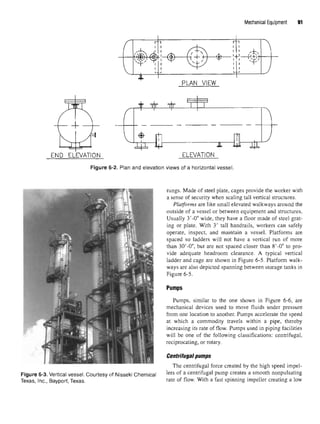
  • 230.
    Figure 13-11. Line01-2-C30-10".
  • 231.
    218 Pipe Draftingand Design They include intersecting coordinates for the center of the equipment, nozzle elevation, and nozzle number. ISOMETRIC DIMENSIONS,NOTES, AND CALLOUTS Isometric Dimensions Length dimensions and informational notes or callouts are used on isometrics to define the pipe's exact routing through a facility. Placement of dimensions on the draw- ing establishes precise lengths between fittings, valves, equipment connections, etc. Information such as coordi- nates, elevations, nozzle projection, pipe size, and pound rating are used to calculate lengths of a run of pipe. As with orthographic views, dimensions are placed on iso- metrics that indicate center-to-center, center-to-face, and face-to-face measurements. Figure 13-12 provides dimen- sions for line 01-2-C30-10" using information found on the plan and elevation views shown in Figure 13-11 and the equipment vendor drawings found in Chapter 6, Mechanical Equipment. Figure 13-12. Line 01-2-C30-10" dimensions. Placing dimensions on a piping isometric with AutoCAD requires the use of the Aligned and Oblique options within the DIMENSION command. Figure 13-13 provides two alternatives for placing dimensions on pip- ing isometrics. Dimensions should be aligned with the routed pipe and obliqued as shown in Figure 13-14. Figure 13-13. Dimensioning alternatives. Figure 13-14. Aligned and obliqued dimensions. Isometric Notesand Callouts Dimensions cannot provide all the information required to properly describe a piping isometric. Notes and callouts placed on the drawing provide significant information that may impact the purchase, fabrication, and erection of the configuration. Notes are used to denote pipe size and pound rating of fittings, flanges, and valves. Notes also specify insulation type and thickness, locations for pipe guides, anchors, or supports, as well as offset angles. Callouts stipulate instrumentation locations and size, specification breaks, and fabrication details. Any information that is pertinent to a particular pipe must be conveyed on the isometric.
  • 232.
    Piping Isometrics 219 Whetherdimensioning or placing notes on an iso, all ISOMETRIC OFFSETS written information should remain on one of the isometric axes and inclined to the right. This task becomes a little isometric offsets are formed when a pipe turns at any more difficult when drawing with AutoCAD. To achieve angle omer man a 9Qo angle Angular offsets can be cre. the proper obliquing androtation angles required onCAD ated by rolling a 9Qo elbow at any angle or replacing 90° generated isometrics, create thetext style outlined inthe dbows with 450 dbows The result would be pipes mat no following procedures. longer travel north, south, east, west, up, or down. Instead H Step 1. Use the STYLE command to create twodif- jmes wouid run northwest, northeast, southeast, or south- ferent text styles. Use thestyle names ISOTEXT-1 west Th could also shmt rd Qr downward Several and ISOTEXT-2 for easy reference. , f • „ • «• ,. u • *r 1 a 1 * J examples of isometnc offsets are shown in Figure 13-16. Step 2. When creating ISOTEXT-1, set the obliquing angle to Dimension lines and callouts are included as a reference. +30°. For ISOTEXT-2 set the obliquing angle to -30°. To establish proper visual orientation, the indication of Step 3. Depending upon the ISOPLANE being used, set the horizontal (HOR) or vertical (VERT) angles are included rotation angle in the DTEXT command to the appropriate on all isometric offsets. Forty five degree elbows must setting as representedin Figure 13-15. always be labeled on an iso for material take-off purposes. ISOMETRIC DIMENSIONS AND TEXT CALLOUTS SET UP TWO TEXT STYLES FOR ISOMETRIC DIMENSIONS AND CALLOUTS. ISOTEXT-1 SET OBLIQUING ANGLE 30' ISOTEXT-2 SET OBLIQUING ANGLE -30s NOTE: AS YOU ENTER THE TEXT YOU WILL NEED TO ADJUST THE ROTATION ANGLE AS SHOWN. Figure 13-15. Isometric text.
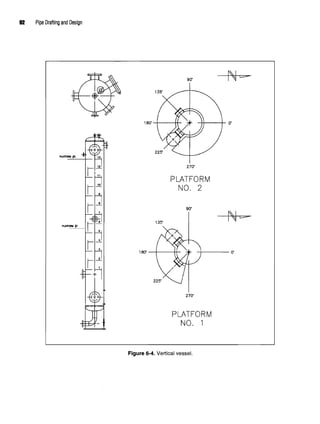
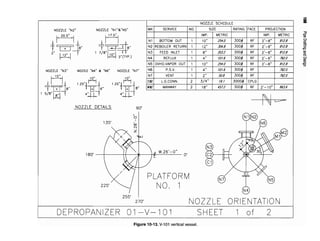
  • 233.
    220 Pipe Draftingand Design Figure 13-16. Isometric offsets. Figure 13-16 represents only three of the many offsets that can be created using 90° and 45° elbows. Example A of Figure 13-16 begins with a line traveling north. A 90° elbow is rolled downward and toward the east at a 45° angle. A 45° elbow is required to return the angular offset to a due easterly direction. This example is labeled as a vertical offset because a change in elevation occurs when the 90° elbow is turned downward. Example C is also a vertical offset, but notice, there is no change in the geo- graphic direction the pipe travels. Here, two 45° elbows are used to angle the pipe upward while continuing in a northerly direction. Both elbows are 45°, thus, the inclu- sion of the abbreviation TYP, meaning "typical." Exam- ple B demonstrates how horizontal offsets are created. As with example C, two 45° elbows are used, but rather than turning the elbows upward, they are laid on their side and do not change elevation. Dimensioning Offsets With isometric offsets changing a pipe's routing from one plane to another or from one geographic direction to another, coordinates and elevations no longer provide all the dimensions necessary to describe a pipe's total length. However, the use of 90° and 45° elbows to form the off- sets results in a problem that can be easily solved with simple mathematical formulas. The 90° and 45° elbows form right triangles. By using Pythagorean's Theorem that states that the sum of the squares of the two sides is equal to the square of the triangle's hypotenuse, this prob- ^y r /•} lem can be solved. Simply stated, A + B = C . Figure 13-17 identifies the sides and angles of a right triangle and their resulting solution formulas. Figure 13-17. Pythagorean's theorem formulas. These formulas can be used to solve for the length of an unknown side when the other two sides are known. They work no matter the degree value of angle X. Some angles seem to be used repeatedly in pipe drafting. The chart in Figure 13-18 can significantly reduce the amount of time spent on calculating unknown sides of right trian- gles. Use the appropriate decimal value when X is one of the provided angles. As mentioned previously, 90° elbows can be rolled to form any degree of angular offset. To fabricate such a roll, a pipe fitter should be provided with the lengths of the three sides of the triangle and the degree value of angle X. Solving for an unknown value of X requires some addi- tional trigonometric formulas. Use the formulas provided in Figure 13-19 to solve for the unknown value of angle X. Notice that, relative to X, side A is identified as the side adjacent (SA), side B is identified as the side oppo- site (SO), and side C is identified as the hypotenuse (HYP).
  • 234.
    Piping Isometrics 221 Figure13-18. Decimal equivalents of common angles. Figure 13-19. Formulasfor solving angle X.
  • 235.
    222 Pipe Draftingand Design Multiple Angle Offsets Elbows are not the only piping components installed in angular positions. Nozzles are placed on vessels in loca- tions where interferences are least likely to occur. As a result, nozzles oriented at angles of 10°, 20°, 35°, etc., are not uncommon. When offset or rolled elbows are added, complex math problems often result. Multiple angle con- figurations, such as the one in Figure 13-20, require addi- tional calculations to determine dimensions for its length of pipe. We have already seen how unknown lengths can be solved using right triangle formulas. The key to solving the unknown length dimension in Figure 13-20 is the incorporation of right triangles. Remember, drawing space is limited. Excessive notes, callouts, and dimensions are not practical. As with dimensions, the right triangles are positioned so their lengths establish center-to-center measurements: center-of-vessel, to center-of-elbow, to centerline-of-vessel. The length of the unknown dimen- sion can only be solved by using the limited information available in Figure 13-20. Figure 13-21 demonstrates the way to position three right triangles to solve for the unknown dimension. Figure 13-20. Multiple angle offsets. Numbering the triangles will aid in the discussion of solving for the sides of each triangle. The unknown dimension is equivalent to the hypotenuse of triangle 3. Begin by determining the known values for each of the triangles from the information provided in Figure 13-20. Figure 13-22 shows the known values of triangles 1, 2, and 3 placed in their appropriate locations. The X angle for triangle 1 is shown to be 20°. The 6'-11 1/8" dimension is a total of the nozzle projection for nozzle Nl, gasket, 150# flange, and 14" elbow. On trian- gle 2, the 2'-6" measurement is determined by subtracting the two west coordinates. The 5'-!" dimension is estab- lished by adding ¥t of the OD of the 14"pipe to the 5'-0" dimension. There are no known dimensions for triangle 3. Remember a minimum of two values must be known in order to solve the missing lengths or angle of a triangle. By determining the side adjacent (SA) and side opposite (SO) of triangle 3, Pythagorean's theorem can be applied to find the hypotenuse, the unknown dimension. Figure 13-21. Locating right triangles. Figure 13-22. Known values for triangles 1, 2, and 3.
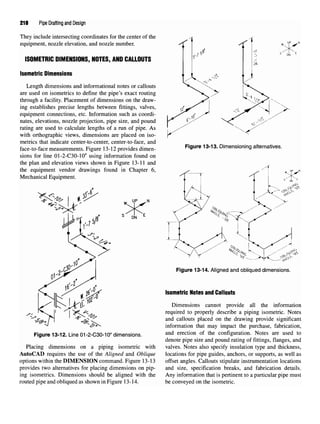
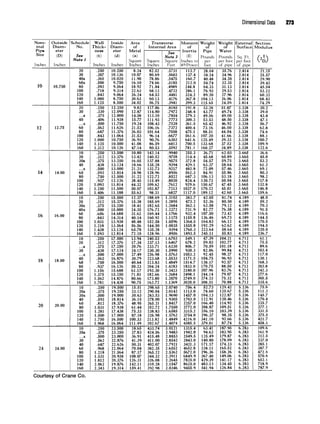
  • 236.
    Using the availableformulas, the missing lengths of triangles 1 and 2 must be solved before the sides of trian- gle 3 can be determined. Notice that by subtracting the SA of triangle 2 from the SA of triangle 1, the SO of tri- angle 3 can be determined. Also, adding the SO of trian- gle 1 to the SO of triangle 2 (2'-6") will yield the SA of triangle 3. The results of these calculations are shown in Figure 13-23. The length of the unknown dimension is 5'-1Me". Angle X of triangle 3 is also an important value to be determined. This angle establishes the rotation angle for the 90° elbows. In the fabrication shop, the vessel is not available to measure the 5'-0" dimension. Knowing this horizontal angle is the only way the elbows can be correctly installed. Rolling Offsets The culmination of the isometric offset is the rolling offset. The rolling offset is a compound offset formed by replacing the two 90° elbows in Figure 13-20 with two 45° elbows. The result is an offset that changes elevation and direction simultaneously. Figure 13-24 shows the plan and elevation views of a rolling offset. Because of its complexity, adequate dimensions cannot be placed on the orthographic views that fully describe the rolling offset. An isometric is the best place for repre- senting and dimensioning the rolling offset. Rather than a horizontal or vertical triangle, the rolling offset requires an isometric box for proper dimensioning. Figure 13-25 shows construction of this box and its accompanying dimensions. Combining elevational and directional changes com- pounds the difficulty in representing the rolling offset on an isometric drawing. Visualizing directional changes on the plan view and elevation view simultaneously requires practice and patience. To aid in this visualization process, some helpful notes have been added to the plan and eleva- tion views of the rolling offset shown in Figure 13-26. In the plan view, a box has been drawn through the centers of the two 45° elbows that form the rolling offset. Its cor- ners have been labeled northeast, northwest, southwest, and southeast. The notes in the elevation view identify upper and lower planes. Remember the plan view shows north, south, east, west orientation and the elevation view depicts vertical changes in elevation. The plan view in Figure 13-26 shows that the pipe enters the box from the southwest corner and travels to the northeast corner where it ends with a flange. Looking at the elevation view, we can see the pipe beginning on the upper plane and dropping down to the lower plane. By Piping Isometrics 223 Figure 13-23. Solutionsfor triangles 1, 2, and 3. Figure 13-24. Plan and elevationviews of a rolling offset. combining the information from these two views, we know that the pipe begins in the upper southwest corner and travels down to the lower northeast corner. The result- ing isometric representation is shown in Figure 13-27.
  • 237.
    224 Pipe Draftingand Design Figure 13-25. Rolling offset box. Figure 13-26.Visualizationaids for rolling offsets. Dimensioning Rolling Offsets Figure 13-25 identifies the six measurements required to dimension a rolling offset. There are four length dimensions and two angular dimensions. When a rolling offset is part of a configuration similar to that shown in Figure 13-28, the lengths of the sides of triangle 3 are applied to the dimensions of the isometric box (see Figure 13-25). Notice the SA of triangle 3 in Figure 13-28 is equal to the RUN of the box, the ROLL of the box is equal to the SO of triangle 3, and angle X of triangle 3 is the same as the horizontal angle (HOR°). Figure 13-27. Isometric of rolling offset. Figure 13-28. Rolling offset with right triangles. The RISE is determined by subtracting the lower plane elevation from the upper plane elevation. Rolling offsets are typically fabricated using 45° elbows; therefore, the vertical angle will be 45°. Notice the dimension labeled TRAVEL in Figure 13-25. It establishes the true length of the pipe from the upper plane to lower plane across the box. This length is the most difficult to calculate. The values used to determine its length depend on how the pipe enters and exits the isometric box. Figure 13-29 shows the two examples of the ways pipes enter and exit the isometric box. In example A, the pipe enters and exits the isometric box in the vertical plane. Example B shows the pipe to enter and exit the box in the horizontal plane. When a pipe enters and exits in the vertical direction, a 45° angle is formed between the TRAVEL and a dashed line drawn diagonally across the bottom of the box (hypotenuse of
  • 238.
    Piping Isometrics 225 triangle3). When a pipe enters and exits in the horizontal box is equal to the RUN of the box. Once the SA and SO direction, a 45° angle is formed between the TRAVEL lengths of the 45° right triangle are known, Pythagorean's and the RUN of the box. Depending on the type, vertical theorem can be used to easily solve the TRAVEL dimen- or horizontal, two different 45° right triangles will be sion of the pipe. Since 45° is a commonly used angle, formed. The TRAVEL of the pipe becomes the hypote- Figure 13-18 can also be used. nuse for either triangle. When solving a right triangle The chart in Figure 13-30 converts inches into deci- whose angle is 45°, the SA and SO will always be equal. mals. Multiplication and division of fractions is simpli- As you can see in example A, the length of the dashed fied using decimal equivalents. This chart is extremely line is equal to the RISE of the box, and in example B, helpful when performing mathematical calculations on a the dashed line drawn diagonally across the end of the calculator that is limited to decimal input only. Figure 13-29. Vertical and horizontal pipes relative to the isometric box. Figure 13-30. Inch to decimal conversion chart.
  • 239.
    226 Pipe Draftingand Design CHAPTER 13 REVIEW QUIZ 1. What is an isometric? 2. Which three dimensions found in orthographic views are required when drawing an isometric? 3. What is material take-off? 4. T F Pipe 14"and above is drawn double line on an isometric. 5. T F Multiple pipes are drawn on a single sheet of isometric grid vellum. 6. T F All isometrics are drawn to scale to show exact size and pound rating. 7. T F Lengths of pipe should be drawn proportionally on an isometric. 8. T F Symbols should be drawn different sizes to reflect a change in pipe size. 9. What is the preferred direction to draw the north arrow on an isometric? 10.What are placed on isometrics to define the pipe's exact routing through a facility? 11. How are isometric offsets formed? 12.To establish proper visual orientation, the indication of or angles are included on all isometric offsets. 13. State Pythagorean's theorem. 14.What are the names of the three sides of a right triangle? 15. Name the six dimensions required on a rolling offset box.
  • 240.
    Piping Isometrics 227 DRAWINGEXERCISES Draw an isometric for each of the following exercises. Show all dimensions, coordinates, equipment callouts, line numbers, and related information is required. North arrow direction will be assigned.
  • 241.
  • 243.
    230 Pipe Draftingand Design Solve for the missing dimensions on each of the rolling offset dimensioning boxes shown below. Show all dimensions in feet/inches, rounded to the nearest i/ie".
  • 244.
    Customizing AutoCAD Efficiency can bedescribed as the quantity and quality procedures provide a detailed explanation on howcom- at which a desired result is attained. Productivity, like- mand aliases can be added to this list, wise, measures the amount of return compared to the NOTE: Significant differences may occur in different amount of effort. For anyone to be efficient and produc- versions of AutoCAD. Consult your AutoCAD User's tive careful attention must be paid to the techniques and Guide for modifications to your particular version of the procedures they use to perform their tasks. The inclusion software. of AutoCAD into the design process has made designers Before adding to the existing command aliases list be and drafters more efficient at performing their tasks. aware of the following guidelines: Some simple modifications to AutoCAD techniques also can be made to enhance the efficiency and productivity of • Some companies and institutions may already have AutoCAD users. specific aliases in use. Notify your supervisor or There is little doubt that computer software programs instructor of any changes made to the ACAD.pgp such as AutoCAD have increased the work capacity of file. designers, drafters, and engineers. Simple keyboard com- • Aliases use memory. Be prudent with the number of mands and mouse strokes are used to perform procedures command names invoked, especially on low mem- that once took many hours to perform by hand. But why ory capacity systems. stop there? If several keyboard commands were compiled • Changes made to the ACAD.pgp file will be auto- into one single command, even greater efficiency can be matically loaded into each new drawing that is realized. This chapter will provide the reader with quick started or existing drawing that is opened, and simple techniques to realize such efficiency. • Aliases are not restricted to one or two letter names. But more than two or three letters defeats the pur- pose of creating an alias. CREATING COMMAND ALIASES • Aliases cannot perform more than one command statement. AutoCAD provides a number of methods to input user commands. Screen menus, pull-down menus and ste P 1 •Be 9in the ACAD.pgp file modification bylocating the . ,, . . ., f ., ., , r™ . , subdirectory or folder in which it is stored. In the more recent toolbars are just three of those methods. The most tra- . < • * / • » A « • * • « ^ • *u 01 mn/^n-r u ^i- ,. . , ;, , . , , , , , „ . versions of AutoCAD it is found in the SUPPORT sub-direc- ditional method is through the keyboard. By typing a tory For examp|ej in AutoCAD 2000i the ACAD.pgp file is command name the user is able to initiate that com- found in the ACAD2000iSUPPORT sub-directory. mand. A command alias is a short, quick keyboard . ., . . . , . , ., . ,... , , NOTE: ACAD2000i is used as an example. If you are input that is created to replace the traditional and more . ,.„„ , r . _ . ^ r , ™™-,, . , , . , , A * /-iAr»u using a different release of AutoCAD, replace 20(X)i widely recognized command name. AutoCAD has sev- . to . r , / : . , i j • i A i r -4.- with your current version, eral of these already in place. A couple of pre-existing J . „ , , aliases that youmaybefamiliar with areL forLINE , Us ? ™"d °WS ^^'° '"8P " and C for CIRCLE. AutoCAD provides an easy Acad2000iSupportsubd.rectory. method to shorten the keyboard input required to per- Step 2. Use a text editor such as Microsoft Notepad to load form any command. th ® ACAD.pgp file. Command aliases are created and saved in a predeter- step 3. Use the scroll bar to move to the beginning of the mined section within the ACAD.pgp file. The following Command alias format: section of the ACAD.pgp file. 231
  • 245.
    232 Pipe Draftingand Design Step 4. Position the new alias in its correct alphabetical posi- the scope of the functions they can perform. Further custom- tion. Place a line space below the existing alias to allow the izations such as those described below can make the experi- addition ofthe new alias. enced AutoCAD user even more efficient and productive. NOTE: Aliases are not required to be in alphabetical order to work properly; however, alphabetizing allows for nciyp Aiirni ion quick and easy verification of duplicate names. Do not Uomu AUI ULIor use duplicate names. AutoLISP is a form of the LISP programming Step 5. Keyinthe new command alias followed by a comma. language used by programmers to develop unique user Tab one time then type in the command name preceded by commands to be used within AutoCAD. These com- an asterisk (*). Seetheexamples that follow. mands5 Qr romines? can rjfflge from the simple tQ quite Type: complex. They are intended to combine existing E *ERASE AutoCAD functions to form one "super command." # AutoLISP is used to create commands needed by every- ' day users who have specific tasks to perform that EXX, *EXPLODE ('EXP' is an alternative, but typing a AutoCAD doesn't perform in its "out of the box" state. second X takes less time for inexperi- Thdr tasks can be fl si lified b combining sev- enced typists than searching for the P i A * ^ATV r • on the kevboard } e AutoCAD functions into one, easy to use, routine. When these commands or routines are initialized and F, FILLET used wjmjn a drawing they will make an operator more WARNING: In AutoCAD2000i many commonly used efficient a "d Productive - With AutoCAD R14 came a commands have aliases already created. Do not replace an new visual programming environment for AutoLISP existing command's alias with a new one unless you are the users, Visual LISP. Former users of AutoLISP will only operator using your computer. Other operators will be quickly see the improved productivity and ease of use familiar with the default aliases and your modifications will be Visual LISP provides. Among its many enhancements, confusing to them. Visual LISP has a color-coded syntax source checker that Step 6. SAVEihe modified file as the same name. quickly identifies typographical errors. There are also a Steo 7 EXIT the text editor comprehensive set of debugging tools that can search for extra or missing parentheses. Though LISP routines can Step 8. Load AutoCAD. Open any drawing file andtry your fee lex and difficuk tQ . lement m can d new alias key commands. . r , . , . . increase your drawing productivity. The list of aliases that follow are common AutoCAD of the two routines we will create, the first is relatively commands. Some may already exist on your version of simple and will increase your drawing speed when using AutoCAD. Feel free to add to this list or change the alias keyboard commands. It is divided into two sections. The command as your situation dictates. first section is an alternative to the commands aliases pre- viously discussed. The second section is a quick method CO = COPY of inserting flow diagram symbols into a drawing. The DT = DTST ui - 1^101 second LISP routine is much more complex. By incorpo- DT = DTEXT rating expressions specific to AutoLISP you will create a ED = DDEDIT routine that can be used to quickly draw a horizontal ves- LI = LIST sel and its two head enclosures. MOD = DDMODIFY One of the drawbacks to the alias commands is that O = OFFSET they will not perform multiple command statements. RG = REGEN AutoLISP overcomes this. A multiple command state- RO = ROTATE ment that you may be familiar with is the CHANGE STR = STRETCH command. CHANGE, when invoked from the keyboard, TR = TRIM requires the operator to select an object, specify whether you wish to change Properties or Changepoint, then stip- Creating command aliases helps reduce the time required ulate the type of change to be performed (i.e. Color/Elev/ to input commands at the keyboard. But aliases are limited in Layer/Ltype/ltScale/Lweight/Thickness) prior to the final
  • 246.
    Customizing AutoCAD 233 effectbeing realized. Aliases do not allow multiple (defun c:LE () parameters to be invoked during the command sequence. (command "LINE" "END")) [draws a LINE seeking A word of caution here, AutoLISP routines override alias the 'From point:' as an ENDpoini] commands. If they both have a common name the (defun c:LM () AutoLISP routine will be invoked. (command "LINE" "MID")) [draws a LINE seeking The following step-by-step procedure will explain how the 'From Point: ' as a MDpoint} to create yourfirstLISP routine. (defun c:RED () (command "COLOR" "RED")) [sets the new Step 1. Use a text editor to begin a new file. COLOR value to RED] NOTE: To better organize files, all new .Isp files you ere- (defun c:WHITE () ate should be kept in the same subdirectory as those already (command "COLOR" "WHITE")) [sets the new existing within AutoCAD. On most versions of AutoCAD COLOR value to WHITE] .Isp files are kept in the SUPPORT subdirectory. (defun c:BLUE () _ ..__ . ..., , . , , ^ (command "COLOR" "BLUE")) [sets the new The LISP routine we will be develop uses defun state- _^T _„ 7 _r ,.„ . ^ r • f T^n. T^TTVT *• ^ £. COLOR value to BLUE] ments. Dejun is an acronym for DEfine FUNction. Defun statements are keyboard inputs that allow an operator to Step 3. S/WEthe file as PIPELISP.Isp. use short command names to describe longer AutoCAD _. . -.,.-.. . . ... m , ., .^ Step 4. EX/rthe text editor, command sequences. The letter name used to identify your defun statement is the command name that will be Y °u wil1 probably want to test your LISP routine at this typed at the keyboard as a replacement for the longer time - Unlike the ACAD.pgp file, LISP routines must be AutoCAD command and parameter options. Typing in loaded each time they are to be used in a drawing. Once the one or two letter command name saves considerable loaded into a drawing, LISP routines become part of that time when compared to conventional command sequences. drawing during the time it is the current drawing file. If you end the drawing and open it at a later time the LISP Step 2. Type the following statements just asthey appear. It .. . u , , , T TCD .• , i A .nt • / * *u * i- - i - i -j- x XL. routine must be reloaded. LISP routines can be loaded at is important that you have a good understanding of the , , , , . , , , , , • , AutoCAD command you're are wanting to initialize so that the keyboard using the following command, no parameter is overlooked. Anynew commands youwant to g< AutoCAD command Qm develop can be created in the same manner as the ones th f ll ' • shown below. To help you understand the command being e ° Wl 9- developed, a short explanation is provided in the brackets Command:(load "PIPELISP") following each statement. Do not include the explanation in press ENTER the routine you are developing. Remember, type the state- ment just as they are shown. Including all opening, closing, The second part of your LISP routine will incorporate and double parentheses. the flow diagram symbols created in Chapter 1'. As an NOTE: New versions of AutoCAD have functions that alternative to the AutoCAD Design Center this routine make these commands seem obsolete. Users of older ver- wil1ex Pedite the insertion of symbols that have been pre- sions however mayfind these commands useful. They are viousl ymserted mto a Cawing asblocks. Addthe follow- intended as samples only. in g de ^n statements to the end of your PIPELISP routine. (defun c:ZE () (command "ZOOM" "EXTENTS")) {performs the Step 1. Open the PIPELISP.Isp file using the text editor. ZOOM command with the EXTENTS option. Keep a step 2. Use the scroll bar to move to the end of the file. single line space between each 'defun' statement} step 3 Add ^ fo||owing defun statements to the end of (defun c:ZP () your P|PEL|SP routine, (command "ZOOM" "PREVIOUS")) {performs the ZOOM command with the PREVIOUS option} (defun c:PUMP () (defun c:LIT () (command "INSERT" "PUMP")) [Keep a single (command "LINE" "INT")) [draws a LINE seeking line space between each 'defun' statement.] the 'From point:' as a point of INTersection. LIT was (defun c:EXH () chosen as the defun name because LI is the command (command "INSERT" "EXH")) alias for the LIST command.} (defun c:HOR ()
  • 247.
    234 Pipe Draftingand Design (command "INSERT" "HOR")) Obviously any name can be given to the defun state- (defun c:VERT () ments to describe the command you want to perform. (command "INSERT" "VER")) Printing a copy of your routine, once it is complete, may (defun c:GATE () be necessary to prevent the duplication of names on new (command "INSERT" "GV")) statements you may add later. This printed copy we also (defun c:GLOBE () help you remember the new command names you will be (command "INSERT" "GBV")) using when inserting the symbols or performing com- (defun c:CONTROL () mands. (command "INSERT" "CV")) As mentioned previously the second LISP routine is (defun c:CHECK () much more complex than the first. More than just defun (command "INSERT" "CKV")) statements, it is written using programming expressions (defun c:PSV () specific to AutoLISP that will automatically create a hor- (command "INSERT" "PSV")) izontal vessel and its two head enclosures, including weld (defun c:ORIFICE () lines. The routine is written in such a manner that the end (command "INSERT" "OF")) user is allowed to select points within an AutoCAD draw- (defun ciREDUCER () ing that will specify the vessel's location, length, diame- (command "INSERT" "RED")) ter, and orientation. Once the user has specified the (defun c:BUBBLE () required values the routine will calculate and draw the (command "INSERT" "IB")) vessel, (defun c:NOZZLE () Follow the steps as indicated below to create the vessel (command "INSERT" "NOZ")) using AutoLISP language, (defun c:FLOWARO() st 1 y ^ dj b . f.} (command "INSERT" "FA")) H y (defun c'CONTBOX () ^te P ^- Type the following statements just as they appear. (command "INSERT" "CB")) Include allopening, closing, and double parentheses, (princ "Your LISP routine has been loaded!") (defun c: Vessel () Step 4. SAVEVne modified file as the same name. (setq s (getpoint "Select starting point on vessel cen- Step 5. EXIT the text editor. terline:n")) . , , , , • ^,, -, (se tq a (getangle s "Select second point to establish Any symbol that was created in Chapter 7 can be , . . , ,,NN jj i rror, • ^ r /ror, -n VCSSCl OnentatlOIKVIl )) added to your LISP routine Before your LISP will prop- . , , , . « « , . ,,. , , . . ., . . u i * * (setq 1(getdist Select two points to establish vessel erly insert the appropriate symbol a fewmore steps must , , e r u i . A length. be completed. m ,. ^ , ^ .,. ,. . „. (Tangent to tangent distance). nSpecify first point. )) Step 1.Make certain allflow diagram symbols have been ( d ( dist ^ Sdect two ^ to establish created on the drawing FLOSYMBL and blocked using the , ,. 4 specified names. vessel diameter. nSpecify first point."))(setq b (+ api)) Step 2. Begin or open the drawing into which the flow dia- / , / -y. gram symbols are to be inserted. ^ ^ (setq c (/ d 2)) !!e J?ov;,D U ,Se th ! INSERT ,C0mmand to insert drawing (setq e (polar sal)) FLOSYMBL into the current drawing. ] , ; ; .^ (setq f (/ pi 2)) Step 4. ERASE drawing FLOSYMBL out of the current draw- (seta e (* c 0 7320508)) ing. (Inserting and erasing FLOSYMBL will cause the blocks r* of that drawing tobecome nested within the current drawing.) ^setqh ^po ar e ^a *>c ^ (setq hi (polar s (- a f) c)) Step 5. Load your LISP routine if it is notalready loaded. / . • / i / /% ^ (setq j (polar e (+ a f) g)) Command: (load "PIPELISP") (setq j 1 (polar s (- a f) g)) Press ENTER (Command n "PLINE" h "W" "0" "" "A" "CE" j "A" "-60" "CE" Step 6. Type in the desired symbol name at the command prompt. Pick the insertion point as needed, establish the (setq k (polar e b (* c 1.2679492))) "A" "-60" appropriate X/Y scale factors, androtation angle. (setq k (polar e (- a f) c)) "L"
  • 248.
    Customizing AutoCAD 235 (setqk (polar k b 1)) "A" "CE"j 1 "A" "-60" "CE" Command: vessel (setq k (polar s a (*c 1.2679492))) "A" "-60" Press ENTER (setq k (polar s (+ a f) c)) "L" _ 0 „ ^ 4 iu ' ^ P ®- Respond to tne specified command prompts by (setq k (polar k a 1)) ) selecting the desired points. The horizontal vessel will be (setq m (polar e (- a f) c)) created accordingly, (setq p (polar s (+ a f) c)) (Command "LINE" hm""n"LINE" hip"") AutoLISP has been enhanced with Visual LISP (Command n "REGEN")) (VLISP} to increase Productivit y- Visual LISP im Ple - ments an integrated development environment (IDE) that Step 3. SAVE the file as vessel.lsp in the SUPPORT sub- incorporates several development tools to make the directory. AutoLISP programmer's job easier. Among the tools are Step 4. EXIT the text editor. color-coded syntax checker, a compiler and debugger. Step 5. Open or begin an AutoCAD drawing. VLISP represents the next generation of LISP for ~* ^ , ., Au i ,o^ • * „ * ,_ . «.« AutoCAD. When the VLISP command is invoked the Step 6. Load the LISP routine as follows. Atthe AutoCAD ,7. .T ,„„ . . ,. , , TT iU ^^^^ command prompt type thefollowing: Vlsual LISP console 1S ^played. Use the OPEN com- mand to display an existing AutoLISP routine. At this Command: (load"vessel") time the loaded file can be evaluated for accuracy and Press ENTER. precision. Several debugging features can detect and pin- Step 7. AutoCAD will return tothe Commandprompt. At the Point an Y errors in the routine. Refer to your AutoCAD Command prompt type: documentation for additional information.
  • 249.
    236 Pipe Draftingand Design CHAPTER 14 REVIEW QUIZ 1. Define alias. 2. In what file are command aliases stored? In which subdirectory is the file stored? 3. What is AutoLISP? 4. What is the purpose of a defun statement? 5. In which subdirectory are .Isp files stored?
  • 250.
    Three- Dimensional Modelingof Piping Systems One advancementin piping software that has produced any direction and quickly visualize and understand the a wealth of design and construction possibilities is 3D geometry of its construction. Refer to the model of the computer modeling. Though not new, this technology is skid package shown in Figures 15-1 through 15-3. now available to most PC-based CAD users. Previously, Furthermore, to increase clarity, computer software 3D computer modeling could be performed only on makes it possible to zoom in close to a selected area of expensive mainframe or super-mini computers having the model that may be crowded and confusing. If neces- large amounts of available memory. Continuous improve- sary, the pipe, equipment or structure that lies between ments in PC hardware and the availability of CAD soft- the viewer and area of concern can be "clipped" or ware have made 3DE modeling the preferred method of removed by the modeling software. This makes it possi- producing piping drawings. Some of the available 3D pipe ble to see inside the 3D model and study its hidden fea- modeling software packages are Rebis/AutoPLANT, tures. CADWORKS, PASCE, Caesar, PDS,and PDMS. A Once a 3D model has been developed a virtual tour or common question being asked at many companies is "walkthrough" can be created. Walkthroughs hasten cli- whether the benefits of 3D computer modeling of piping ent approval and are used as training videos by plant per- systems actually outweigh the additional effort required sonnel responsible for safely maintaining and operating to produce them. The consensus of the engineering com- the facility. The improved visualization capabilities alone munity seems to be "yes" because an increasing number make modeling a piping facility a worthwhile endeavor, of engineering firms are pursuing this method of work The ability to forecast potential design or construction and a growing lists of clients are demanding it. problems during the modeling phase can result in tremen- dous time and cost savings as opposed to discovering and ADVANTAGES OF 3D MODELING solving the problem later at thejob site ' One of the advantages of a 3D model over conven- CHECKING FORINTERFERENCES tional drawings is an improved ability to show clearly what occurs during the design phase of a piping facility. Another valuable benefit of 3D computer modeling is Chemical plants, refineries and other types of piping the ability to perform interference detection. Building facilities are very complex. Frequently vast numbers, models of complex projects is not something new to pip- sizes and types of pipe, equipment, and other components ing designers. For years plastic models have been built must be assembled to complete a project. Even seasoned that can takes hundreds of hours to construct and may piping designers find it difficult to clearly understand the cost thousands of dollars to produce. One of the main scope of the project from orthographic views alone. By reasons these models are built is to verify the fit of all the using a 3D model, designers can view the facility from components in the facility. During the design phase it is 237
  • 251.
    Figure 15-1. Modelof a piping assembly mounted on a skid. (Model courtesy of Gene Eckert, ECAD, Inc.)
  • 252.
    Figure 15-2. Skidmodel, Plan view.
  • 253.
    Figure 15-3. Skidmodel, Elevation view.
  • 254.
    Three-Dimensional Modeling ofPiping Systems 241 easy to overlook minor details in something so complex dimensions to the drawings, send them to checkers and as a piping facility. Only by building a physical model can finally release them for construction, the designers verify that there are no interferences A designer can instruct the software to generate plans, between components (i.e., a pipe passing through a steel sections, or elevations in several different drawing for- support, a beam hitting a piece of equipment, etc.). If a mats including single-line, double-line and 3D views with design team can detect problems such as these before all hidden lines removed. construction begins, savings in building costs can be Solid modeling is different from wire frame modeling enormous. Each problem area redesigned in the field adds because a solid model can display objects with the hid- substantially to the cost of completing the project. den surfaces removed. On a wire frame, all surfaces are Piping software that can run clash checking on a 3D visible. Using this solid modeling capability 3D soft- model makes interference detection possible. Interference ware can automatically create projected views of solids detection software works by checking the surface of each with all the hidden lines removed (seeFigure15-5 component in an assembly against other components. through 15-7). This capability gives the user a powerful Usually a system is separated into categories such as pip- tool for displaying piping drawings, ing, structure, and equipment. This is easy to do because a 3D model is typically developed making use of the soft- ware's layering capability. Piping software will automati- GENERATING ISOMETRIC DRAWINGS cally place piping components (fittings, flanges, valves), AUTOMATICALLY steel supports, and mechanical equipment on their respec- tive layers. It can even segregate piping components according to pound rating (150, 300, etc.), specification, or material and place them on individual layers. Interfer- 3D modeling software can generate isometric drawings ence checking is performed by checking one layer against of Pi?6 configurations automatically. The isometrics are another to confirm that no two items are occupying the created from the 3D model and with a few manual touch- exact same space within the facility. Figure 15-4 shows an U PS and additions, are ready for construction issue. Some interference between a pipe and a structural support. As software packages even have the ability to create isomet- the interference detection program is initiated, certain rics complete with dimensions (see Figure 15-8). software programs will locate the first clash and change A Sain ' b y investing some time and effort in modeling the color of the two elements that are interfering to a dif- the facility from the start, the designer can reap large ferent color. The software will relocate the area of the returns at the end of the project, model in question to the center of the display and allow the user to zoom in for a closer look. When multiple inter- COMPUTER-AIDED ENGINEERINGOF MODELS ferences are detected, with the press of a key the software will proceed to the next problem area, allowing the user to view each area in question in this manner. Some of the Another com P*er task that can be accomplished using more sophisticated software packages allow the user to 3D models is that of stress anal ysis calculations onpipe "fly" around the problem area in real time, viewing it and e qui Pment -The PiP™g s ystem and its su PPorts can be from anydirection or angle. Theability of computer soft- anal yzed both staticall y and d ynamicall y- Features ware to help prevent costly construction errors is another include checkin § for seismic moveme f > fl ™ induced reason why 3D modeling is so valuable. vibrations, wind loading and wave loads. By building a 3D model, a designer can use its geometry for other engi- neering design analysis programs. GENERATING DRAWINGS AUTOMATICALLY FROM A MODEL CHOOSING A MODELING SOFTWARE PACKAGE Once a 3D model has been built, the geometry of the As with any product in the marketplace, each manufac- piping assembly is clear and unambiguous. The designer ture wants to make their product as attractive and appel- can then use piping software to instruct AutoCAD to ing to potential customers as possible. Software is no automatically generate drawings that view the model different. Software developers use the most advanced pro- from any direction. The designer can then add notes and gramming languages available to implement all the latest
  • 255.
    242 Pipe Draftingand Design Figure 15-4. Interference detection between a pipe and structural support. "bells and whistles" into their 3D modeling package to and Isometrics. Rebis also provides several toolbars spe- make it attractive. Different developers write software for cific to each design application (see Figure 15-9). different CAD platforms. Some write for more than one. Selecting the right software involves more than choosing the one with the best looking sales brochure. To provide a BUILDING A 3D MODEL USING AUTOPLANT benchmark for determining what features a quality 3D piping software package should include we will explore „„ , , , f ., , f . f .* r » u - / A * r » T ATVTT" When a new drawing is initialized the dialog box some of the base features of the Rebis/AutoPLANT & r . ~ shown in Figure 15-10 is displayed. Detailed information specific to the creation of the 3D model is input into the RebisAlltoPLANT appropriate fields. Information such as Configuration Units and the location of the modeled area are determined Rebis/AutoPLANT uses AutoCAD as its support by providing X, Y, and Z coordinates. Also requested are platform. Users of AutoCAD will find it easy to use. the length and width of the proposed model. When loaded, AutoPLANT adds a new item to the pull- The next step is to establish the location of the down menu list, Rebis. Within the Rebis menu are com- mechanical equipment that will be arranged in the mod- ponents specific to each design application. Design eled area. Using dimensions provided on vendor data applications can include Piping, Equipment, Multi-Steel, drawings, measurement parameters are specified for the
  • 256.
    Figure 15-5. Planview of a 3D model. (Courtesy of Rebis, Inc.)
  • 257.
    244 Pipe Draftingand Design Figure 15-6. 3D model, perspective view. (Courtesy of Rebis, Inc.) various pieces of mechanical equipment used in the Ladders and platforms are added using the dialog design. The dialog boxes that follow are specific to cen- boxes shown in Figures 15-18 through 15-20. Information trifugal pumps, horizontal heat exchangers, and horizon- supplied on vendor drawings can be used to establish tal and vertical vessels (see Figures 15-11 through 15-14). length, width, orientation, and position of all ladders and Once the values for each parameter in the dialog box platforms required on the vessels. have been supplied, the user is then prompted to specify After all the required mechanical equipment compo- the equipment's location point, elevation, and orientation nents have been located, the pipe components are added angle. Each piece of equipment can be systematically through a Drawing Preferences dialog box (see Figure placed within the model, one-by-one, in a similar manner. 15-21). Within this dialog box all pertinent information After a piece of equipment is located, additional com- specific to a particular pipe configuration is designated, ponents such as nozzles, ladders, and platforms are Information critical to the accurate modeling of the pipe added. The dialog boxes shown in Figures 15-15 and is provided. Information such as specification, nominal 15-16 are used to place suction and discharge on pumps. pipe size, line number, and insulation thickness. Depend- Figure 15-17 is a representation of the dialog box used to ing on client and/or company design standards, position and orient radial nozzles on horizontal and verti- additional information is also specified. This informa- cal vessels. tion is used to establish the drawing's appearance. Such
  • 258.
    Three-Dimensional Modeling ofPiping Systems 245 Figure 15-7. Close-up detail of a 3D model. (Courtesy of Rebis, Inc.) information includes pipe color, layer assignment, draw- are just a few of the many available for inserting piping ing mode (i.e., single-line, double-line, or 3D) and components. surface resolution. Other features within AutoPLANT include automatic Subsequent to establishing specifications and line isometrics, bills of material and, with an add-on package, size, fittings, flanges, and valves are then added to animated walkthroughs. Developers of other 3D model- equipment nozzles. AutoPLANT's compatibility ing software packages have included features similar to checking feature prevents accidental misalignment of those found in AutoPLANT. Though some differences dissimilar specification components. Development of may be apparent, most 3D pipe modeling software pack- each pipe configuration involves little more than ages have many features typical of those found in selecting the desired component then determining its AutoPLANT. Choosing the right 3D modeling software connection point and orientation. Use of the Auto package then becomes a matter of client, company or user Routing feature allows for quick and accurate compo- preference. Figure 15-23 represents a 3D wire frame nent placement. The toolbars shown in Figure 15-22 model of Unit 01, which was developed in Chapter 10.
  • 259.
    Figure 15-8. Isometricdrawing created with AutolSO, from Rebis. (Courtesy Rebis, Inc.)
  • 260.
    Three-Dimensional Modeling ofPiping Systems 247 Figure 15-9. Rebis menu pull-down and application toolbars. Figure 15-10. Model setup.
  • 261.
    248 Pipe Draftingand Design Figure 15-11. Centrifugal pump. Figure 15-12. Horizontal heat exchanger.
  • 262.
    Three-Dimensional Modeling ofPiping Systems 249 Figure 15-13. Horizontal vessel. Figure 15-14. Vertical vessel.
  • 263.
    250 Pipe Draftingand Design Figure 15-15. Pump suction nozzles. Figure 15-16. Pump discharge nozzles.
  • 264.
    Three-Dimensional Modeling ofPiping Systems 251 Figure 15-17. Radial straight nozzle on equipment. Figure 15-18. Ladder on vertical vessel.
  • 265.
    252 Pipe Draftingand Design Figure 15-19. Circular platform on vertical vessel. Figure 15-20. Rectangular platform on horizontal vessel.
  • 266.
    Three-Dimensional Modeling ofPiping Systems 253 Figure 15-21. Drawing preferences. Figure 15-22. Flanges, bends, valves and various other toolbars.
  • 267.
  • 268.
    Appendix A Dimensional Data—p.256 Appendix B Review of Lettering—p. 292 Appendix C Alphabet of Lines—p. 294 Appendix D Review of Math—p. 295 Appendix E Use of the Calculator—p. 296 Appendix F Architect's Scale—p. 299 255
  • 269.
    256 Pipe Draftingand Design Appendix A—Dimensional Data
  • 270.
  • 271.
  • 272.
  • 273.
  • 274.
  • 275.
  • 276.
  • 277.
  • 278.
  • 279.
  • 280.
  • 281.
  • 282.
  • 283.
  • 284.
  • 285.
    272 Pipe Draftingand Design Commercial Wrought Steel Pipe Data Nom- inal Pipe Size Inches % ' / 4 % V2 3 /4 1 l! /4 1% 2 2% 3 3% 4 5 6 8 Outside Diam- eter ( D ) Inches 0.405 0 . 5 4 0 0.675 0.840 1.050 1.315 1.660 1.900 2.375 2.875 3.500 4 . 0 0 0 4.500 5.563 6.625 8.625 Schedule No. See Note 1 40s 80x 40s 80x 40s 80x 40s 80x 160 . . .XX 40s 80x 160 . . .XX 40s 80x 160 . . .XX 40s 80x 160 . . .XX 40s 80x 160 . . .XX 40s 80x 160 . . .XX 40s 80x 160 . . .XX 40s 80x 160 . . .XX 40s 80x 40s 80x 120 160 . . .XX 40s 80x 120 160 . . .XX 40s 80x 120 160 . . .XX 20 30 40s 60 80x 100 120 140 . . .XX 160 Wall Thick- ness (t) Inches .068 .095 .088 .119 .091 .126 .109 .147 .187 .294 .113 .154 .218 .308 .133 .179 .250 .358 .140 .191 .250 .382 .145 .200 .281 .400 .154 .218 .343 .436 .203 .276 .375 .552 .216 .300 .438 .600 .226 .318 .237 .337 .438 .531 .674 .258 .375 .500 .625 .750 .280 .432 .562 .718 .864 .250 .277 .322 .406 .500 .593 .718 .812 .875 .906 Inside Diam- eter (d) Inches .269 .215 .364 .302 .493 .423 .622 .546 .466 .252 .824 .742 .614 .434 1.049 .957 .815 .599 1.380 1.278 1.160 .896 1.610 1.500 1.338 1.100 2.067 1.939 1.689 1.503 2.469 2.323 2.125 1.771 3.068 2 . 9 0 0 2.624 2 . 3 0 0 3.548 3.364 4.026 3.826 3.624 3.438 3.152 5 . 0 4 7 4.813 4.563 4.313 4.063 6.065 5.761 5.501 5.189 4 . 8 9 7 8.125 8.071 7.981 7.813 7.625 7.439 7.189 7.001 6 . 8 7 5 6.813 Area of Metal v(a) Square Inches . 0 7 2 0 . 0 9 2 5 .1250 .1574 .1670 .2173 .2503 .3200 .3836 .5043 .3326 . 4 3 3 5 .5698 .7180 . 4 9 3 9 .6388 .8365 1 . 0 7 6 0 . 6 6 8 5 .8815 .1070 .534 . 7 9 9 5 .068 .429 .885 .075 .477 2.190 2.656 1.704 2.254 2.945 4.028 2.228 3.016 4.205 5 . 4 6 6 2.680 3.678 3.174 4.407 5.595 6.621 8.101 4 . 3 0 0 6.112 7.953 9.696 11.340 5.581 8.405 10.70 13.32 15.64 6.57 7.26 8.40 10.48 12.76 14.96 17.84 19.93 21.30 21.97 Transverse Internal Area Square Inches .0568 .0364 .1041 .0716 .1910 .1405 . 3 0 4 0 .2340 .1706 .050 .5330 . 4 3 3 0 .2961 .148 . 8 6 4 0 .7190 .5217 .282 1.495 1.283 1.057 .630 2.036 1.767 1.406 .950 3.355 2.953 2.241 1.774 4.788 4.238 3.546 2.464 7.393 6.605 5.408 4.155 9.886 8.888 12.73 11.50 10.31 9.28 7.80 20.01 18.19 16.35 14.61 12.97 28.89 26.07 23.77 21.15 18.84 51.85 51.16 50.03 47.94 45.66 43.46 40.59 38.50 37.12 36.46 See Note 2 Square Feet . 0 0 0 4 0 . 0 0 0 2 5 . 0 0 0 7 2 . 0 0 0 5 0 .00133 . 0 0 0 9 8 .00211 .00163 .00118 .00035 .00371 . 0 0 3 0 0 . 0 0 2 0 6 .00103 . 0 0 6 0 0 . 0 0 4 9 9 .00362 .00196 .01040 .00891 . 0 0 7 3 4 . 0 0 4 3 8 .01414 .01225 . 0 0 9 7 6 . 0 0 6 6 0 .02330 .02050 .01556 .01232 .03322 .02942 . 0 2 4 6 3 .01710 .05130 . 0 4 5 8 7 .03755 . 0 2 8 8 5 . 0 6 8 7 0 .06170 . 0 8 8 4 0 . 0 7 9 8 6 .0716 . 0 6 4 5 .0542 .1390 .1263 .1136 .1015 .0901 . 2 0 0 6 .1810 .1650 .1469 .1308 .3601 .3553 .3474 .3329 .3171 .3018 .2819 .2673 . 2 5 7 8 .2532 Moment of Inertia ( D Inches to 4th Power .00106 .00122 . 0 0 3 3 1 .00377 . 0 0 7 2 9 .00862 .01709 . 0 2 0 0 8 .02212 .02424 . 0 3 7 0 4 . 0 4 4 7 9 . 0 5 2 6 9 .05792 .08734 .1056 .1251 .1405 .1947 .2418 .2839 .3411 . 3 0 9 9 .3912 . 4 8 2 4 .5678 .6657 . 8 6 7 9 1.162 1.311 1.530 1.924 2.353 2.871 3.017 3.894 5.032 5 . 9 9 3 4.788 6.280 7.233 9.610 11.65 13.27 15.28 15.16 20.67 25.73 30.03 33.63 28.14 4 0 . 4 9 49.61 58.97 66.33 57.72 63.35 72.49 88.73 105.7 121.3 140.5 153.7 162.0 165.9 Weight of Pipe Pounds per foot .244 .314 .424 .535 .567 .738 .850 1.087 1.300 1.714 1.130 1.473 1.940 2.440 1.678 2.171 2.840 3.659 2.272 2.996 3.764 5.214 2.717 3.631 4.862 6.408 3.652 5.022 7 . 4 4 0 9.029 5.79 7.66 10.01 13.70 7.58 10.25 14.32 18.58 9.11 12.51 10.79 14.98 19.00 22.51 27.54 14.62 2 0 . 7 8 27.10 32.96 38.55 18.97 28.57 36.40 45.30 53.16 22.36 24.70 28.55 35.64 43.39 50.87 60.63 6 7 . 7 6 72.42 7 4 . 6 9 Weight of Water Pounds per foot of pipe .025 .016 ' . 0 4 5 .031 .083 .061 .132 .102 .074 .022 .231 .188 .128 .064 .375 .312 .230 .122 .649 .555 .458 .273 .882 .765 .608 .42 4 1.45 1.28 . 9 7 .77 2.07 1.87 1.54 1.07 3.20 2.8-6 2.35 1.80 4.29 3.84 5.50 4.98 4.47 4.02 3.38 8 . 6 7 7.88 7.09 6.33 5.61 12.51 11.29 10.30 9.16 8.16 22.47 22.17 21.70 20.77 19.78 18.83 17.59 16.68 16.10 15.80 External Surface Sq. Ft. per foot of pipe .106 .106 .141 .141 .178 .178 .220 .220 .220 .220 .275 .275 .275 .275 .344 .344 .344 .344 .435 .435 .435 .435 .497 .497 .497 .497 .622 .622 .622 .622 .753 .753 .753 .753 .916 .916 .916 .916 1.047 1.047 .178 .178 .178 .178 .178 .456 .456 .456 .456 .456 .734 .734 1.734 1.734 1.734 2.258 2.258 2.258 2.258 2.258 2.258 2.258 2.258 2.258 2.258 Section Modulus ( 4 ) .00523 . 0 0 6 0 2 .01227 .01395 .02160 .02554 . 0 4 0 6 9 . 0 4 7 8 0 .05267 .05772 .07055 .08531 .10036 .11032 .1328 .1606 .1903 .2136 .2346 .2913 .3421 .4110 .3262 .4118 .5078 .5977 . 5 6 0 6 . 7 3 0 9 .979 1.104 1.064 1.339 1.638 1.997 1.724 2.225 2.876 3.424 2.394 3.140 3.214 4.271 5.178 5.898 6.791 5.451 7.431 9.250 10.796 12.090 8.50 12.22 14.98 17.81 20.02 13.39 14.69 16.81 20.58 24.51 28.14 32.58 35.65 37.56 38.48 Note 1: The letters s, x, and xx in the column of Schedule Note 2: The values shown in square feet for the Transverse Numbers indicate Standard, Extra Strong, and Double Internal Area also represent the volume in cubic feet per Extra Strong Pipe, respectively. foot of pipe length. Courtesy of Crane Co.
  • 286.
    Dimensional Data 273 Nom- inal r>:»_ ., A Ipfi Size Inches 10 12 14 1 C. ib 1 O 18 ^t 20 24 Outside Diam- eter (D) Inches 10.750 12.75 14.00 16.00 18.00 20.00 24.00 Schedule No. See Notel 20 30 40s 60x 80 100 120 140 160 20 30 . .s 40 . .X 60 80 100 120 140 160 10 20 30s 40 . .X 60 80 100 120 140 160 10 20 30s 40x 60 80 100 120 140 160 10 20 . .s 30 . .X 40 60 80 100 120 140 160 10 20s 30x 40 60 80 100 120 140 160 10 20s . .X 30 40 60 80 100 120 140 160 Wall Thick- ness (t) 1nches .250 .307 .365 .500 .593 .718 .843 1.000 1.125 .250 .330 .375 .406 .500 .562 .687 .843 1.000 1.125 1.312 .250 .312 .375 .438 .500 .593 .750 .937 1.093 1.250 1.406 .250 .312 .375 .500 .656 .843 1.031 1.218 1.438 1.593 .250 .312 .375 .438 .500 .562 .750 .937 1.156 1.375 1.562 1.781 .250 .375 .500 .593 .812 1.031 1.281 1.500 1.750 1.968 .250 .375 .500 .562 .687 .968 1.218 1.531 1.812 2.062 2.343 Inside Diam- eter (d) Inches 10.250 10.136 10.020 9.750 9.564 9.314 9.064 8.750 . 8.500 12.250 12.090 12.000 11.938 11.750 11.626 11.376 11.064 10.750 10.500 10.126 13.500 13.376 13.250 13.124 13.000 12.814 12.500 12.126 11.814 11.500 11.188 15.500 15.376 15.250 15.000 14.688 14.314 13.938 13.564 13.124 12.814 17.500 17.376 17.250 17.124 17.000 16.876 16.500 16.126 15.688 15.250 14.876 14.438 19.500 19.250 19.000 18.814 18.376 17.938 17.438 17.000 16.500 16.064 23.500 23.250 23.000 22.876 22.626 22.064 21.564 20.938 20.376 19.876 19.314 Area of ff n+ _| Metal (a) Square Inches 8.24 10.07 11.90 16.10 18.92 22.63 26.24 30.63 34.02 9.82 12.87 14.58 15.77 19.24 21.52 26.03 31.53 36.91 41.08 47.14 10.80 13.42 16.05 18.66 21.21 24.98 31.22 38.45 44.32 50.07 55.63 12.37 15.38 18.41 24.35 31.62 40.14 48.48 56.56 65.78 72.10 13.94 17.34 20.76 24.17 27.49 30.79 40.64 50.23 61.17 71.81 80.66 90.75 15.51 23.12 30.63 36.15 48.95 61.44 75.33 87.18 100.33 111.49 18.65 27.83 36.91 41.39 50.31 70.04 87.17 108.07 126.31 142.11 159.41 Transverse Internal Area Square Inches 82.52 80.69 78.86 74.66 71.84 68.13 64.53 60.13 56.75 117.86 114.80 113.10 111.93 108.43 106.16 101.64 96.14 90.76 86.59 80.53 143.14 140.52 137.88 135.28 132.73 128.96 122.72 115.49 109.62 103.87 98.31 188.69 185.69 182.65 176.72 169.44 160.92 152.58 144.50 135.28 128.96 240.53 237.13 233.71 230.30 226.98 223.68 213.83 204.24 193.30 182.66 173.80 163.72 298.65 290.04 283.53 278.00 265.21 252.72 238.83 226.98 213.82 202.67 433.74 424.56 415.48 411.00 402.07 382.35 365.22 344.32 326.08 310.28 292.98 See Note 2 Square Feet .5731 .5603 .5475 .5185 .4989 .4732 .4481 .4176 .3941 .8185 .7972 .7854 .7773 .7528 .7372 .7058 .6677 .6303 .6013 .5592 .9940 .9758 .9575 .9394 .9217 .8956 .8522 .8020 .7612 .7213 .6827 1.3103 1.2895 1.2684 1.2272 1.1766 1.1175 1.0596 1.0035 .9394 .8956 1.6703 1.6467 1.6230 1.5990 1.5763 1.5533 1.4849 1.4183 1.3423 1.2684 1.2070 1.1369 2.0740 2.0142 1.9690 1.9305 1.8417 1.7550 1.6585 1.5762 1.4849 1.4074 3.0121 2.9483 2.8853 2.8542 2.7921 2.6552 2.5362 2.3911 2.2645 2.1547 2.0346 Moment of Inertia (D Inches to 4thPower 113.7 137.4 160.7 212.0 244.8 286.1 324.2 367.8 399.3 191.8 248.4 279.3 300.3 361.5 400.4 475.1 561.6 641.6 700.5 781.1 255.3 314.4 372.8 429.1 483.8 562.3 687.3 824.4 929.6 1027.0 1117.0 383.7 473.2 562.1 731.9 932.4 1155.8 1364.5 1555.8 1760.3 1893.5 549.1 678.2 806.7 930.3 1053.2 1171.5 1514.7 1833.0 2180.0 2498.1 2749.0 3020.0 756.4 1113.0 1457.0 1703.0 2257.0 2772.0 3315.2 3754.0 4216.0 4585.5 1315.4 1942.0 2549.5 2843.0 3421.3 4652.8 5672.0 6849.9 7825.0 8625.0 9455.9 Weight of P. ipe Pounds per foot 28.04 34.24 40.48 54.74 64.33 76.93 89.20 104.13 115.65 33.38 43.77 49.56 53.53 65.42 73.16 88.51 107.20 125.49 133.68 160.27 36.71 45.68 54.57 63.37 72.09 84.91 106.13 130.73 150.67 170.22 189.12 42.05 52.36 62.58 82.77 107.50 136.46 164.83 192.29 223.64 245.11 47.39 59.03 70.59 82.06 92.45 104.75 138.17 170.75 207.96 244.14 274.23 308.51 52.73 78.60 104.13 122.91 166.40 208.87 256.10 296.37 341.10 379.01 63.41 94.62 125.49 140.80 171.17 238.11 296.36 367.40 429.39 483.13 541.94 Weight of r 4. Water Pounds per foot of pipe 35.76 34.96 34.20 32.35 31.13 29.53 27.96 26.06 24.59 51.07 49.74 49.00 48.50 46.92 46.00 44.04 41.66 39.33 37.52 34.89 62.03 60.89 59.75 58.64 57.46 55.86 53.18 50.04 47.45 45.01 42.60 81.74 80.50 79.12 76.58 73.42 69.73 66.12 62.62 58.64 55.83 104.21 102.77 101.18 99.84 98.27 96.93 92.57 88.50 83.76 79.07 75.32 70.88 129.42 125.67 122.87 120.46 114.92 109.51 103.39 98.35 92.66 87.74 187.95 183.95 179.87 178.09 174.23 165.52 158.26 149.06 141.17 134.45 126.84 External Surface Sq. Ft. per foot of pipe 2.814 2.814 2.814 2.814 2.814 2.814 2.814 2.814 2.814 3.338 3.338 3.338 3.338 3.338 3.338 3.338 3.338 3.338 3.338 3.338 3.665 3.665 3.665 3.665 3.665 3.665 3.665 3.665 3.665 3.665 3.665 4.189 4.189 4.189 4.189 4.189 4.189 4.189 4.189 4.189 4.189 4.712 4.712 4.712 4.712 4.712 4.712 4.712 4.712 4.712 4.712 4.712 4.712 5.236 5.236 5.236 5.236 5.236 5.236 5.236 5.236 5.236 5.236 6.283 6.283 6.283 6.283 6.283 6.283 6.283 6.283 6.283 6.283 6.283 Section Modulus (4) 21.15 25.57 29.90 39.43 45.54 53.22 60.32 68.43 74.29 30.2 39.0 43.8 47.1 56.7 62.8 74.6 88.1 100.7 109.9 122.6 36.6 45.0 53.2 61.3 69.1 80.3 98.2 117.8 132.8 146.8 159.6 48.0 59.2 70.3 91.5 116.6 144.5 170.5 194.5 220.0 236.7 61.1 75.5 89.6 103.4 117.0 130.1 168.3 203.8 242.3 277.6 305.5 335.6 75.6 111.3 145.7 170.4 225.7 277.1 331.5 375.5 421.7 458.5 109.6 161.9 212.5 237.0 285.1 387.7 472.8 570.8 652.1 718.9 787.9 Courtesy of Crane Co.
  • 287.
    274 Pipe Draftingand Design * See M dimensions for branch height of 42" or 48" full branch tee. All dimensions are in inches. See ANSI B16.9 forcaplengths when wall thicknesses aregreater than x-stg. _ , _ , _ Courtesy of Taylor Forge
  • 288.
    Dimensional Data 275 FLANGESDIMENSIONS Courtesy of Taylor Forge
  • 289.
    276 Pipe DraftingandDesign FLANGES DIMENSIONS
  • 290.
  • 291.
    278 Pipe Draftingand Design 1. Dimensions are in inches. Prices on application. 8. Large diameter flanges. 2. Standard bore will be furnished unless otherwise specified. c Minimum bores. 3. Socket Weld figs, are not mfd. in 150# type over 24", in 300# and 600# over 3", in 1500# "Facings: 150# and 300# flanges (except Lap Joint) furnished with 1-'/«" raised face,which over 2'v2", in 400# and 2500# in any size. is included in the thickness and hub length shown, 400# and heavier flanges (except Lap 4. Specifications—All Taylor Forge flanges conform to ANSI Std. B16.5 or MSS SP44 as Joint) furnished with %" raised face, which is not included in thickness or hub length dimen- applicable and to ASTM Spec. A181 (for 150# and 300# flanges) or A105 (for 400# and sions. heavier flanges. "Refer to Taylor Forge Pipeline Catalog 723 for complete listings of MSS-SP44 and API 605 5. Welding bevel standards and tolerances. flanges. 6. Pressure—Temperature ratings. • Dimension and blind flange is same as companion flange, however, this is not true for 7. Threading details. MSSblind flanges, class 300 or heavier, 26" and larger, which have a greater thickness. Courtesy of Taylor Forge
  • 292.
    Dimensional Data 279 DI A P H R A G M A N D P I S T O N A C T U A T O R S DIAPHRAGM ACTUATORS Type 657 direct acting diaphragm actuator. Courtesy of Fisher Controls
  • 293.
    280 Pipe Draftingand Design VALVE TRIM 750°F and pressure drops up to 150 psi. For very high pressure drops or high temperature conditions, a hard sur- The term "trim" refers to the internal parts of a valve facing alloy such as Stellite can be used on the wearing body assembly which come in contact with the controlled parts of the valve plug, seat rings, guide bushings and fluid. Type 316 stainless steel is Fisher's standard trim guide posts. Other alloys such as Monel, Hastelloy "B", material. It is satisfactory for most applications and is Durimet 20 or 440C stainless steel may be selected to generally recommended for fluid temperatures up to combat individual corrosion and erosion problems. Courtesy of Fisher Controls
  • 294.
  • 295.
    282 Pipe Draftingand Design ACTUATORS Design "BFC" 12 „ ™ o Design "D" 12 ^e ^ I Design "DA" 13 ^470 4 Design "DB" &"DBQ" 13 T^e472 4 Design "DBA" &"DBAQ" 13 *yP ' <- Design "E" 14 I™*™ Design "EA" 15 TyPe5B BODIES 5 ^n"GS" 15 BODI£b Design "HS" 16 Design "A" Single Port 6 and 7 Design "K" & "KB" 17 Design "A" Double Port 8 and 9 Design "Y" (Iron) 17 Design "AA" 10 Design "Y" (Steel) 18 Design "AC" 10 and 11 Design "YY" (Iron) 18 Design "B" 11 Design "YY" (Steel) 19 Design "BA" 12 Design "Z" 19 Design "BF" 12 Design "ZLA" 19 PROCEDURE To obtain the overall dimensions of a control Example: valve, add the "D" and "G" body dimensions to the Given: 6" Type 657-A, 150 Ib. RF flanged, double port "E" dimension of the actuator. Dimensions for valve steel body with top and bottom guided valve plug, jodies with a 5" boss head are so indicated and these From the table below, note that a Size 50 or 60 Type dimensions should be combined with one of the fol- 657 actuator is normally supplied with a 6" valve. Dimen- lowing actuators: Size 80 and 87, Types 657 and sion "E" from Page 3 is 28-7 /i6". From Page 8, we see that 667; Sizes 80, 86, 100 and 130, Type 470; Sizes 80 "G" is 13-s/i6" and "D" is 14-'Vi6". Thus, E + G + D = 28- and 100,Types 472 and 473.Similarly, dimensions 7i6"+ 13-s/i6"+ 14-i5/i6" = 56-u/i6". for valve bodies that can be furnished with a 11 A" NOTE: When using a valve plug requiring a top guide boss head are so indicated and these dimensions but not a bottom guide, such as Micro-Form valve plug, should be combined with the dimensions of the Type use dimension "D" under top and bottom guided and 513 or the Type 470, Size 23, actuators. dimension "G" under skirt guided. . . . STANDARD CONSTRUCTIONS . . . SERIES 657 AND 667 DIAPHRAGM ACTUATORS *Design "GS," "B," and "BA" bodies only. Courtesy of Fisher Controls
  • 296.
    Courtesy of FisherControls Dimensional Data 283 ACTUATOR DIMENSIONS TYPE 657 DIAPHRAGM ACTUATOR TYPE 667 DIAPHRAGM ACTUATOR
  • 297.
    284 Pipe Draftingand Design DESIGN "A" DOUBLE PORT IRON BODIES PLAIN BONNET DESIGN "A" DOUBLE PORT STEEL BODIES Courtesy of Fisher Controls
  • 298.
    Dimensional Data 285 DESIGN"A" SINGLE PORT IRON BODIES DESIGN "A" SINGLE PORT STEEL BODIES ABOTEVMTIOMS USED ABOVE ISCRO-SCREWED ENDS. RF-RAISED FACE, RTJ-MNO Tr« JOINT FLANOE SPECIFICATION NCFCRENCE: I5O-3OO-4OO-40O La USAS BWS * MMENSIONALLY THE SAME AS 600 LB. RF + OIMENSIONACLY THE SAME AS 6OO UB. RTJ
  • 299.
  • 300.
  • 301.
    288 Pipe Draftingand Design LINEAR CONVERSION Fractions of an Inch To Decimals of an Inch and to Millimeters Courtesy of Crane Co.
  • 302.
    Dimensional Data 289 LINEARCONVERSION Inches to Millimeters (1 inch = 25.4 millimeters) In. 0 1 2 3 4 5 6 7 8 9 10 11 12 13 14 15 16 17 18 19 20 21 22 23 24 25 26 27 28 29 30 31 32 33 34 35 36 37 38 39 40 41 42 43 44 45 46 47 48 49 50 0 0.0 25.4 50.8 76.2 101.6 127.0 152.4 177.8 203.2 228.6 254.0 279.4 304.8 330.2 355.6 381.0 406.4 431.8 457.2 482.6 508.0 533.4 558.8 584.2 609.6 635.0 660.4 685.8 711.2 736.6 762.0 787.4 812.8 S38.2 863.6 889.0 914.4 939.8 965.2 990.6 1016.0 1041.4 1066.8 1092.2 1117.6 1143.0 1168.4 1193.8 1219.2 1244.6 1270.0 Vie 1.6 27.0 52.4 77.8 103.2 128.6 154.0 179.4 204.8 230.2 255.6 281.0 306.4 331.8 357.2 382.6 408.0 433.4 458.8 484.2 509.6 535.0 560.4 585.8 611.2 636.6 662.0 687.4 712.8 738.2 763.6 789.0 814.4 839.8 865.2 890.6 916.0 941.4 966.8 992.2 1017.6 1043.0 1068.4 1093.8 1119.2 1144.6 1170.0 1195.4 1220.8 1246.2 1271.6 % 3.2 28.6 54.0 79.4 104.8 130.2 155.6 181.0 206.4 231.8 257.2 282.6 308.0 333.4 358.8 384.2 409.6 435.0 460.4 485.8 511.2 536.6 562.0 587.4 612.8 638.2 663.6 689.0 714.4 739.8 765.2 790.6 816.0 841.4 866.8 892.2 917.6 943.0 968.4 993.8 1019.2 1044.6 1070.0 1095.4 1120.8 1146.2 1171.6 1197.0 1222.4 1247.8 1273.2 Vie 4.8 30.2 55.6 81.0 106.4 131.8 157.2 182.6 208.0 233.4 258.8 284.2 309.6 335.0 360.4 385.8 411.2 436.6 462.0 487.4 512.8 538.2 563.6 589.0 614.4 639.8 665.2 690.6 716.0 714.4 766.8 792.2 817.6 843.0 868.4 893.8 919.2 944.6 970.0 995.4 1020.8 1046.2 1071.6 1097.0 1122.4 1147.8 1173.2 1198.6 1224.0 1249.4 1274.8 % 6.4 31.8 57.2 82.6 108.0 133.4 158.8 184.2 209.6 235.0 260.4 285.8 311.2 336.6 362.0 387.4 412.8 438.2 463.6 489.0 514.4 539.8 565.2 590.6 616.0 641.4 666.8 692.2 717.6 743.0 768.4 793.8 819.2 844.6 870.0 895.4 920.8 946.2 971.6 997.0 1022.4 1047.8 1073.2 1098.6 1124.0 1149.4 1174.8 1200.2 1225.6 1251.0 1276.4 Vl6 7.9 33.3 58.7 84.1 109.5 134.9 160.3 185.7 211.1 236.5 261.9 287.3 312.7 338.1 363.5 388.9 414.3 439.7 465.1 490.5 515.9 541.3 566.7 592.1 617.5 642.9 668.3 693.7 719.1 744.5 769.9 795.3 820.7 846.1 871.5 896.9 922.3 947.7 973.1 998.5 1023.9 1049.3 1074.7 1100.1 1125.5 1150.9 1176.3 1201.7 1227.1 1252.5 1277.9 % 9.5 34.9 60.3 85.7 111.1 136.5 161.9 187.3 212.7 238.1 263.5 288.9 314.3 339.7 365.1 390.5 415.9 441.3 466.7 492.1 517.5 542.9 568.3 593.7 619.1 644.5 669.9 695.3 720.7 746.1 771.5 796.9 822.3 847.7 873.1 898.5 923.9 949.3 974.7 1000.1 1025.5 1050.9 1076.3 1101.7 1127.1 1152.5 1177.9 1203.3 1228.7 1254.1 1279.5 Vie 11.1 36.5 61.9 87.3 112.7 138.1 163.5 188.9 214.3 239.7 265.1 290.5 315.9 341.3 366.7 392.1 417.5 442.9 468.3 493.7 519.1 544.5 569.9 595.3 620.7 646.1 671.5 696.9 722.3 747.7 773.1 798.5 823.9 849.3 874.7 900.1 925.5 950.9 976.3 1001.7 1027.1 1052.5 1077.9 1103.3 1128.7 1154.1 1179.5 1204.9 1230.3 1255.7 1281.1 % •12.7 38.1 63.5 88.9 114.3 139.7 165.1 190.5 215.9 241.3 266.7 292.1 317.5 342.9 368.3 393.7 419.1 444.5 469.9 495.3 520.7 546.1 571.5 596.9 622.3 647.7 673.1 698.5 723.9 749.3 774.7 800.1 825.5 850.9 876.3 901.7 927.1 952.5 977.9 1003.3 1028.7 1054.1 1079.5 U04.9 1130.3 1155.7 1181.1 1206.5 1231.9 1257.3 1282.7 *A« 14.3 39.7 65.1 90.5 115.9 141.3 166.7 192.1 217.5 242.9 268.3 293.7 319.1 344.5 369.9 395.3 420.7 446.1 471.5 496.9 522.3 547.7 573.1 598.5 623.9 649.3 674.7 700.1 725.5 750.9 776.3 801.7 827.1 852.5 877.9 903.3 928.7 954.1 979.5 1004.9 1030.3 1055.7 1081.1 1106.5 1131.9 1157.3 1182.7 1208.1 1233.5 1258.9 1284.3 % 15.9 41.3 66.7 92.1 117.5 142.9 168.3 193.7 219.1 244.5 269.9 295.3 320.7 346.1 371.5 396.9 422.3 447.7 473.1 498.5 523.9 549.3 574.7 600.1 625.5 650.9 676.3 701.7 727.1 752.5 777.9 803.3 828.7 854.1 879.5 904.9 930.3 955.7 981.1 1006.5 1031.9 1057.3 1082.7 1108.1 1133.5 1158.9 1184.3 1209.7 1235.1 1260.5 1285.9 »V4e 17.5 42.9 68.3 93.7 119.1 144.5 169.9 195.3 220.7 246.1 271.5 296.9 322.3 347.7 373.1 398.5 423.9 449.3 474.7 500.1 525.5 550.9 576.3 601.7 627.1 652.5 677.9 703.3 728.7 754.1 779.5 804.9 830.3 855.7 881.1 906.5 931.9 957.3 982.7 1008.1 1033.5 1058.9 1084.3 1109.7 1135.1 1160.5 1185.9 1211.3 1236.7 262.1 1287.5 3 /4 19.1 44.5 69.9 95.3 120.7 146.1 171.5 196.9 222.3 247.7 273.1 298.5 323.9 349.3 374.7 400.1 425.5 450.9 476.3 501.7 527.1 552.5 577.9 603.3 628.7 654.1 679.5 704.9 730.3 755.7 781.1 806.5 831.9 857.3 882.7 908.1 933.5 958.9 984.3 1009.7 1035.1 1060.5 1085.9 1111.3 1136.7 1162.1 1187.5 1212.9 1238.3 1263.7 1289.1 13 /ie 20.6 46.0 71.4 96.8 122.2 147.6 173.0 198.4 223.8 249.2 274.6 300.0 325.4 350.8 376.2 401.6 427.0 452.4 477.8 503.2 528.6 554.0 579.4 604.8 630.2 655.6 681.0 706.4 731.8 757.2 782.6 808.0 833.4 858.8 884.2 909.6 935.0 960.4 985.8 1011.2 1036.6 1062.0 1087.4 1112.8 1138.2 163.6 189.0 214.4 1239.8 265.2 290.6 % 22.2 47.6 73.0 98.4 123.8 149.2 174.6 200.0 225.4 250.8 276.2 301.6 327.0 352.4 377.8 403.2 428.6 454.0 479.4 504.8 530.2 555.6 581.0 606.4 631.8 657.2 682.6 708.0 733.4 758.8 784.2 809.6 835.0 860.4 885.8 911.2 936.6 962.0 987.4 1012.8 1038.2 1063.6 1089.0 1114.4 1139.8 1165.2 1190.6 1216.0 1241.4 266.8 1292.2 "Vie 23.8 49.2 74.6 100.0 125.4 150.8 176.2 201.6 227.0 252.4 277.8 303.2 328.6 354.0 379.4 404.8 430.2 455.6 481.0 506.4 531.8 557.2 582.6 608.0 633.4 658.8 684.2 709.6 735.0 760.4 785.8 811.2 836.6 862.0 887.4 912.8 938.2 963.6 989.0 1014.4 1039.8 1065.2 1090.6 1116.0 1141.4 1166.8 1192.2 1217.6 1243.0 1268.4 1293.8 Courtesy of Crane Co.
  • 303.
    290 Pipe Draftingand Design LINEAR CONVERSION Decimals of an Inch to Millimeters (0.10 inch = 2.54 millimeters) Inches 0.00 .10 .20 .30 .40 .50 .60 .70 .80 .90 0.00 0.00 2.54 5.08 7.62 10.16 12.70 15.24 17.78 20.32 22.86 .01 0.25 2.79 5.33 7.87 10.41 12.95 15.49 18.03 20.57 23.11 .02 0.51 3.05 5.59 8.13 10.67 13.21 15.75 18.29 20.83 23.37 .03 0.76 3.30 5.84 8.38 10.92 13.46 16.00 18.54 21.08 23.62 .04 1.02 3.56 6.10 8.64 11.18 13.72 16.26 18.80 21.34 23.88 .05 1.27 3.81 6.35 8.89 11.43 13.97 16.51 19.05 21.59 24.13 .06 1.52 4.06 6.60 9.14 11.68 14.22 16.76 19.30 21.84 24.38 .07 1.78 4.32 6.86 9.40 11.94 14.48 17.02 19.56 22.10 24.64 .08 2.03 4.57 7.11 9.65 12.19 14.73 17.27 19.81 22.35 24.89 .09 2.29 4.83 7.37 9.91 12.45 14.99 17.53 20.07 22.61 25.15 Inches 0.00 .10 .20 .30 .40 .50 .60 .70 .80 .90 Millimeters to Inches (1 millimeter = 0.03937 inch) Millimeters 0 10 20 30 40 50 60 70 80 90 100 110 120 130 140 150 160 170 180 190 200 210 220 230 240 250 260 270 280 290 300 310 320 330 340 350 360 370 380 390 0 0.00 0.39 0.79 1.18 1.57 1.97 2.36 2.76 3.15 3.54 3.94 4.33 4.72 5.12 5.51 5.91 6.30 6.69 7.09 7.48 7.87 8.27 8.66 9.% 9.45 9.84 10.24 10.63 11.02 11.42 11.81 12.20 12.60 12.99 13.39 13.78 14.17 14.57 14.96 15.35 1 0.039 0.43 0.83 1.22 1.61 2.01 2.40 2.80 3.19 3.58 3.98 4.37 4.76 5.16 5.55 5.94 6.34 6.73 7.13 7.52 7.91 8.31 8.70 9.09 9.49 9.88 10.28 10.67 11.06 11.46 11.85 12.24 12.64 13.03 13.43 13.82 14.21 14.61 15.00 15.39 2 0.079 0.47 0.87 1.26 1.65 2.05 2.44 2.83 3.23 3.62 4.02 4.41 4.80 5.20 5.59 5.98 6.38 6.77 7.17 7.56 7.95 8.35 8.74 9.13 9.53 9.92 10.31 10.71 11.10 11.50 11.89 12.28 12.68 13.07 13.46 13.86 14.25 14.65 15.04 15.43 3 0.118 0.51 0.91 1.30 1.69 2.09 2.48 2.87 3.27 3.66 4.06 4.45 4.84 5.24 5.63 6.02 6.42 6.81 7.20 7.60 7.99 8.39 8.78 9.17 9.57 9.% 10.35 10.75 11.14 11.54 11.93 12.32 12.72 13.11 13.50 13.90 14.29 14.69 15.08 15.47 4 0.157 0.55 0.94 1.34 1.73 2.13 2.52 2.91 3.31 3.70 4.09 4.49 4.88 5.28 5.67 6.% 6.46 6.85 7.24 7.64 8.03 8.43 8.82 9.21 9.61 10.00 10.39 10.79 11.18 11.57 11.97 12.36 12.76 13.15 13.54 13.94 14.33 14.72 15.12 15.51 5 0.197 0.59 0.98 1.38 1.77 2.17 2.56 2.95 3.35 3.74 4.13 4.53 4.92 5.31 5.71 6.10 6.50 6.89 7.28 7.68 8.07 8.46 8.86 9.25 9.65 10.04 10.43 10.83 11.22 11.61 12.01 12.40 12.80 13.19 13.58 13.98 14.37 14.76 15.16 15.55 6 0.236 0.63 1.02 1.42 1.81 2.20 2.60 2.99 3.39 3.78 4.17 4.57 4.% 5.35 5.75 6.14 6.54 6.93 7.32 7.72 8.11 8.50 8.90 9.29 9.69 10.08 10.47 10.87 11.26 11.65 12.05 12.44 12.83 13.23 13.62 14.02 14.41 14.80 15.20 15.59 7 0.276 0.67 1.06 1.46 1.85 2.24 2.64 3.03 3.43 3.82 4.21 4.61 5.00 5.39 5.79 6.18 6.57 6.97 7.36 7.76 8.15 8.54 8.94 9.33 9.72 10.12 10.51 10.91 11.30 11.69 12.09 12.48 12.87 13.27 13.66 14.06 14.45 14.84 15.24 15.63 8 0.315 0.71 1.10 1.50 1.89 2.28 2.68 3.07 3.46 3.86 4.25 4.65 5.04 5.43 5.83 6.22 6.61 7.01 7.40 7.80 8.19 8.58 8.98 9.37 9.76 10.16 10.55 10.94 11.34 11.73 12.13 12.52 12.91 13.31 13.70 14.09 14.49 14.88 15.28 15.67 9 0.354 0.75 1.14 1.54 1.93 2.32 2.72 3.11 3.50 3.90 4.29 4.69 5.08 5.47 5.87 6.26 6.65 7.05 7.44 7.83 8.23 8.62 9.02 9.41 9.80 10.20 10.59 10.98 11.38 11.77 12.17 12.56 12.95 13.35 13.74 14.13 14.53 14.92 15.31 15.71 Millimeters 0 10 20 30 40 50 60 70 80 90 100 110 120 130 140 150 160 170 180 190 200 210 220 230 240 250 260 270 280 290 300 310 320 330 340 350 360 370 380 390 ._ , _ _ (continued onnext page) Courtesy of Crane Co.
  • 304.
    Dimensional Data 291 LINEARCONVERSION Millimeters to inches—cont. Millimeters 400 410 420 430 440 450 460 470 480 490 500 510 520 530 540 550 560 570 580 590 600 610 620 630 640 650 660 670 680 6.90 700 710 720 730 740 750 760 770 780 790 800 810 820 830 840 850 860 870 880 890 900 910 920 930 940 950 960 970 980 990 1000 0 15.75 16.14 16.54 16.93 17.32 17.72 18.11 18.50 18.90 19.29 19.69 20.08 20.47 20.87 21.26 21.65 22.05 22.44 22.83 23.23 23.62 24.02 24.41 24.80 25.20 25.59 25.98 26.38 26.77 27.17 27.56 27.95 28.35 28.74 29.13 29.53 29.92 30.31 30.71 31.10 31.50 31.89 32.28 32.68 33.07 33.46 33.86 34.25 34.65 35.04 35.43 35.83 36.22 36.61 37.01 37.40 37.80 38.19 38.58 38.98 39.37 1 15.79 16.18 16.57 16.97 17.36 17.76 18.15 18.54 18.94 19.33 19.72 20.12 20.51 20.91 21.30 21.69 22.09 22.48 22.87 23.27 23.66 24.06 24.45 24.84 25.24 25.63 26.02 26.42 26.81 27.20 27.60 27.99 28.39 28.78 29.17 29.57 29.% 30.35 30.75 31.14 31.54 31.93 32.32 32.72 33.11 33.50 33.90 34.29 34.68 35.08 35.47 35.87 36.26 36.65 37.05 37.44 37.83 38.23 38.62 39.02 39.41 2 15.83 16.22 16.61 17.01 17.40 17.80 18.19 18.58 18.98 19.37 19.76 20.16 20.55 20.94 21.34 21.73 22.13 22.52 22.91 23.31 23.70 24.09 24.49 24,88 25.28 25.67 26.06 26.46 26.85 27.24 27.64 28.03 28.43 28.82 29.21 29.61 30.00 30.39 30.79 31.18 31.57 31.97 32.36 32.76 33.15 33.54 33.94 34.33 34.72 35.12 35.51 35.91 36.30 36.69 37.09 37.48 37.87 38.27 38.66 39.06 39.45 3 15.87 16.26 16.65 17.05 17.44 17.83 18.23 18.62 19.02 19.41 19.80 20.20 20.59 20.98 21.38 21.77 22.17 22.56 22.95 23.35 23.74 24.13 24.53 24.92 25.31 25.71 26.10 26.50 26.89 27.28 27.68 28.07 28.46 28.86 29.25 29.65 30.04 30.43 30.83 31.22 31.61 32.01 32.40 32.80 33.19 33.58 33.98 34.37 34.76 35.16 35.55 35.94 36.34 36.73 37.13 37.52 37.91 38.31 38.70 39.09 39.49 4 15.91 16.30 16.69 17.09 17.48 17.87 18.27 18.66 19.06 19.45 19.84 20.24 20.63 21.02 21.42 21.81 22.20 22.60 22.99 23.39 23.78 24.17 24.57 24.% 25.35 25.75 26.14 26.54 26.93 27.32 27.72 28.11 28.50 28.90 29.29 29.68 30.08 30.47 30.87 31.26 31.65 32.05 32.44 32.83 33.23 33.62 34.02 34.41 34.80 35.20 35.59 35.98 36.38 36.77 37.17 37.56 37.95 38.35 38.74 39.13 39.53 5 15.94 16.34 16.73 17.13 17.52 17.91 18.31 18.70 19.09 19.49 19.88 20.28 20.67 21.06 21.46 21.85 22.24 22.64 23.03 23.43 23.82 24.21 24.61 25.00 25.39 25.79 26.18 26.57 26.97 27.36 27.76 28.15 28.54 28.94 29.33 29.72 30.12 30.51 30.91 31.30 31.69 32.09 32.48 32.87 33.27 33.66 34.06 34.45 34.84 35.24 35.63 36.02 36.42 36.81 37.20 37.60 37.99 38.39 38.78 39.17 39.57 6 15.98 16.38 16.77 17.17 17.56 17.95 18.35 18.74 19.13 19.53 19.92 20.31 20.71 21.10 21.50 21.89 22.28 22.68 23.07 23.46 23.86 24.25 24.65 25.04 25.43 25.83 26.22 26.61 27.01 27.40 27.80 28.19 28.58 28.98 29.37 29.76 30.16 30.55 30.94 31.34 31.73 32.13 32.52 32.91 33.31 33.70 34.09 34.49 34.88 35.28 35.67 36.06 36.46 36.85 37.24 37.64 38.03 38.43 38.82 39.21 39.61 7 16.02 16.42 16.81 17.20 17.60 17.99 18.39 18.78 19.17 19.57 19.% 20.35 20.75 21.14 21.54 21.93 22.32 22.72 23.11 23.50 23.90 24.29 24.68 25.08 25.47 25.87 26.26 26.65 27.05 27.44 27.83 28.23 28.62 29.02 29.41 29.80 30.20 30.59 30.98 31.38 31.77 32.17 32.56 32.95 33.35 33.74 34.13 34.53 34.92 35.31 35.71 36.10 36.50 36.89 37.28 37.68 38.07 38.46 38.86 39.25 39.65 8 16.06 16.46 16.85 17.24 17.64 18.03 18.43 18.82 19.21 19.61 20.00 20.39 20.79 21.18 21.58 21.97 22.36 22.76 23.15 23.54 23.94 24.33 24.72 25.12 25.51 25.91 26.30 26.69 27.09 27.48 27.87 28.27 28.66 29.06 29.45 29.84 30.24 30.63 31.02 31.42 31.81 32.20 32.60 32.99 33.39 33.78 34.17 34.57 34.% 35.35 35.75 36.14 36.54 36.93 37.32 37.72 38.11 38.50 38.90 39.29 39.68 9 16.10 16.50 16.89 17.28 17.68 18.07 18.46 18.86 19.25 19.65 20.04 20.43 20.83 21.22 21.61 22.01 22.40 22.80 23.19 23.58 23.98 24.37 24.76 25.16 25.55 25.94 26.34 26.73 27.13 27.52 27.91 28.31 28.70 29.09 29.49 29.88 30.28 30.67 31.06 31.46 31.85 32.24 32.64 33.03 33.43 33.82 34.21 34.61 35.00 35.39 35.79 36.18 36.57 36.97 37.36 37.76 38.15 38.54 38.94 39.33 39.72 Millimeters 400 410 420 430 440 450 460 470 480 490 500 510 520 530 540 550 560 570 580 590 600 610 620 630 640 650 660 670 680 690 700 710 720 730 740 750 760 770 780 790 800 810 820 830 840 850 860 870 880 890 900 910 920 930 940 950 960 970 980 990 1000 Courtesy of Crane Co.
  • 305.
    292 Pipe Draftingand Design Appendix B—Review of Lettering
  • 306.
  • 307.
    294 Pipe Draftingand Design Appendix C—Alphabet of Lines ALPHABET of LINES OBJECT LINE - SINGLE LINE PIPE OBJECT LINE - DOUBLE LINE PIPE AND EQUIPMENT HIDDEN LINE CENTER LINE -<IB ^»_ DIMENSION LINE MATCH LINE
  • 308.
    Appendix D—Reviewof Math295 ADDITION and SUBTRACTION of FRACTIONS
  • 309.
    296 Pipe Draftingand Design Appendix E—Use of the Calculator CONVERSION FROM FEET & INCHES TO DECIMALS OF A FOOT ( USING A CALCULATOR )
  • 310.
    Use of theCalculator 297 CONVERSION FROM DECIMALS OE A FOOT TO FEET & INCHES ( USING A CALCULATOR )
  • 311.
    298 Pipe Draftingand Design CONVERSION FROM DEGREES & SECONDS TO DECIMALS ( USING A CALCULATOR )
  • 312.
  • 313.
    Glossary A Battery limit.Lines placed on a drawing to identify the perimeter limits of a unit. Accumulator. Temporary storage tank for liquids and Bent One section of a Piperack containing twovertical vapors columns and one or more horizontal connecting A •• Actuator. A hydraulic or pneumatic apparatus that will memDers. operate a valve by remote control. Beveled end. Any piping component having a tapered Air, compressed. Any air with pressure greater than end used in butt-welding. atmospheric pressure Billet. Near-molten, steel bar from which seamless pipe • 17 j Air, instrument. Compressed air free of contaminants 1S Iormea - that is used to operate pneumatic control devices. Bil1 of materials. A detailed listing of components Air, plant. Compressed air used to drive pneumatic hand required to fabricate a run of pipe. toojs Blind flange. A flanged plate-like device used to termi- Air cooler. Large fan-type coolers placed above orbelow nate the end of a ™n of P1 ?6 'valve 'or vessel opening. a pipe rack, which draws air across the pipes in the Slowdown. Commodity discharged from a relief valve. pipe rack to cool them. Boilen Vessel used to convert water mto super-heated Alarm. Signals, via lights or horn, used to indicate steam. whether the liquid level, temperature, or pressure Box heater. Vessel used to raise the temperature of a feed inside a vessel is too high or too lowor whether there before il be §ms factional distillation. See vertical is no flow or reverse flow. heater. Anchor. Stationary support designed to restrict the move- Branch. A connecting tie-in of the same or smaller pipe ment of a pipe caused by vibration, turbulance, expan- slze- sion, or other external forces. Briddle. A screwed or socket-weld piping configuration Anchor bolts. Bolts that have been positioned in con- containing instruments that measure the liquid level in crete prior to curring. Used to secure equipment, build- horizontal or vertical vessels. ings, tanks, or other items to a concrete foundation. Bubble ca Ps - Sma11 valve-like controls on a tray in a Area limit. Boundary identifying the extents of the unit fractionating column that allow rising vapors to pass being drawn. through. Butt-weld. Weld made when two beveled ends are butted together and welded. B Bypass valve. Valve connecting the upstream and down- stream sides of a control set that allows the control Back-up ring. A i/8" thick, washer-like, ring placed valve to be removed for repair or replacement. between two pieces of pipe to prevent the build-up of By-product. Liquid fraction of raw crude. weld icicles inside the pipe during the welding process. Ball valve. Valve having a ball with a hole through it that - allows straight-through flow. A 90° turn of the wrench opens/closes the valves. Base plate. Flat, metal plate welded to a vessel or other Cage. Metal enclosure surrounding a ladder providing piece of equipment allowing it to be secured to a con- worker safety. crete foundation via anchor bolts. Cap. Butt-weld fitting used to close the end of a pipe run. 300
  • 314.
    Glossary 301 Carbon steel.Chief manufacturing material of pipe and Cooling water. Water used in any cooling process that fittings used in industrial piping applications. will lower the temperature of a commodity. Catalyst. Compound used to induce a chemical reaction. Coordinates. Intersecting north-south and east-west lines Centrifugal. "Center-fleeing" action caused by a spin- used to position foundations, equipment, supports, ning impeller. buildings, etc., on a drawing. Charge. The initial feed used in a fractional distillation Corrosion. The dissolving of surface material by chemi- process. cal reaction. Check valve. Valve used to prevent backflow. Corrosion allowance. The amount of surface material Chemical plant. Facility that converts semi-refined prod- allowed to be eroded by the commodity within a pipe ucts into usable consumer products. while permitting the pipe to remain usable for the par- Codes. A collection of regulations and procedures for ticular service for which k was installed. design, construction, and operation of a facility. Coupling. Fitting used to join two lengths of screwed Coefficient of expansion. The numerical factor of expan- P1 ?6 together. Also used as a branch connection on sion/contraction of a substance based on a change in P1 ?6 or a nozzle connection on equipment. temperature Crude oil. The natural state of unrefined oil product. Pri- Column. See fractionation column. Also, a vertical steel mar y source of fractionatedhydrocarbon by-products. or concrete member that supports structures, piperacks, buildings, etc. p Companion flange. Mating flange of the same size and pound rating as the nozzle, valve, or fitting to which it ^ .. ^ ,., , . , ,. . , . , t & Davit. Crane-like device made of steel pipe or structural steel that allows replacement parts, tools, and small Compressor. Mechanical device used tocompress gases machinary to be raised and lowered from the tops of orva P°rs - vertical vessels. Concentric. Reducer or swage having a common center- Diametei. inside. The circumference measured around e ' the interior wall of a pipe. Condensate. The liquid that has been removed from a gas Diameter, nominal. The name given to a particular size orva P°r - of pipe. Condenser. Mechanical apparatus that cools a gas or Diameter, outside. The circumference measured around vapor tothe point ofcondensing. the outer wall of apipe Conduit. Protective covering around electrical wires and Dike> Typically an earthen damor wall surrounding tanks cables. creating a containment area in case of accidental dis- Control building. Building from which monitoring and charge or rupture. operation of remotely installed instruments are made. Discharge. Outgoing flow, typically with increased pres- Control panel. A cabinet or desk-type housing contain- sure as in the case of pumps or compressors. ing monitoring instruments. Distillation. The process of extracting and separating Control station. A U-shaped series of valves and fittings molecular compounds from a supply product. that allows for the monitoring, control, and regulation Double extra strong. Catagory of thick-walled pipe. of flow or pressure through a piping system. Double line. Drawings used to represent piping systems Control valve. Typically having a globe valve body, this 14"in diameter and larger. valve provides a method to automatically and remotely Double pipe exchanger. Exchanger having a small diam- control the fluid flow and pressure through a pipe. eter pipe inserted into a large diameter pipe. Controller. A device used to maintain a specified liquid Double random length. Length of manufactured pipe, level, temperature, or flow inside a vessel or piping typically 35' to 40' long. system. Downcomer. Opening adjacent to a tray that allows over- Cooler. Mechanical apparatus used to reduce the temper- flowing liquids to fall to the tray below and begin ature of a liquid commodity. refractionation. Cooling tower. A mechanical device that dissipates heat Drain. Typically an underground piping system that by evaporation of water sprayed into a forced-air transfers water runoff or waste materials to a process- tower, ing facility for disposal or treatment. See O.W.S.
  • 315.
    302 Pipe Draftingand Design Drain funnel. Often a reducer fitting placed at the open- Flange. Ring-shaped device that is welded or screwed on ing of a drainage pipe that aids in the collection of dis- the end of a pipe that permits the pipe to be attached to posable materials. other similiarly prepared piping components. Drift. The amount of water lost during the aeration and Flare stack. Vertical column that uses an open flame to evaporation sequence in a cooling tower. burn waste gases. Dummy leg. A length of pipe or structural steel welded to Flash zone. The position in a fractionation column where the outside of a pipe that provides support for the line. the incoming feed separates into vapor and liquid states. g Flat face. Flange facing that has no raised surfaces. Floating roof. The type of storage tank roof that is sus- ,-, * • n j u - & <. * r pended by the commodity being stored. The floating Eccentric. Reducer or swage having offset center-lines. r •; . r . • ,-,,, T-,.... A. i u • j- t- f • prevents the collection of harmful gases and vapors in Elbow. Fitting used to make changes in direction of pipe F & F ,. tanks that store flammable liquids. Elbow^ long radius. Ninety degree elbow having a radius Flow diagram. Schematic drawing depicting the equip- equal to one and one-half times the pipe's nominal ment ' P1 ?1 ^'and instrumentation of a piping facility. sjze Flow displacement meter. Instrument installed within a Elbow^ short radius. Ninety degree elbow having a piping configuration that measures the flow rate of the radius equal to the pipe's nominal size. commodity within the pipe. Electric traced. Electric leads coiled around a pipe to Flow element. Set of orifice flanges used with test equip- maintain a desired temperature. ment mat measures rates. Elevation. Sectional view of a facility showing vertical Flow indicator. A local or board mounted instrumentthat height dimensions. registers flow rates. Extra strong. Pipe and fittings having measurements Flow meter. A device used to indicate or record the equivalent to schedule 80. amount of commodity flowing through a pipe. Flow rate. The amount of flow passing a given point in a - pipe for a predetermined amount of time, for example, gph, gpm. Flow ratio recording controller. A combination of con- Face. The mating surface offlangedfittings or valves. ^yalye and recorder ^records the flow wkhin a Face-to-face. Measurement from the mating surface on pipe then controls ^ flow as required one end of aflangedvalve to the mating surface on the plow ^ ^ Instrument that makes a permanent other end. , r-,-, ^ , m . . . , „ . , - i i • , ^ • 1 1 - record of flow measurement. Feed. The initial fluid material used in the fractional dis- _,. .. . ,, . , , , , .„ . Flow recording controller. A control valve that records tillation process. m i. i T, , , . . , , , • _, , , , ., i measurements of flow through a pipe. Feed, boiler. Water piped through a boiler to produce _ _ . ^ , -. , , - , - , , - Foundation. Grade-level concrete support for buildings, steam. . , , IT i «u ,1 T + i *u ^ * • * • f-4. equipment, and structural members. Female thread. Internal thread grooves cutinto pipes, fit- M r , Foundation location plan. Plan drawing depicting the Field pipeVrun of pipe configured, cut, and pieced coordinate location of buildings, equipment, and struc- together atthetime ofinstallation. tural concrete su PP°rts ' Filter. Basket-type strainer used to collect solid waste and Fraction. By-products of a feed supply. contaminants circulating through the piping system. Fractional distillation. The chemical process of separat- Fin-fan Seeaircooler m § a ^eed su pply mto its various molecular compo- Fired heater. Mechanical device used to elevate circulat- nents (by-products). ing liquids to extreme temperatures. Fractionation column. A vertical vessel having internal Fire proofing. Generally brick, concrete, or gunite, plates, called trays, which aid in the separation and col- applied around vessel skirts or structural columns to lection of the various molecular compounds of a feed prevent damage in case of fire. stock (fractional distillation). Fitting. Generic name for components used to make Fuel oil. Combustible material used as a heat source for turns, branches, or reductions in a run of pipe. fired equipment in a process facility.
  • 316.
    Glossary 303 G I G-fin.A U-shaped exchanger having a pipe within a pipe. Impeller. Rotating device in a pump that forces the Also known as a "hair pin" or "double pipe" incoming commodity to be expelled at a greater exchanger. pressure. Gas. The physical state of matter having the ability to dif- Indicator. A device used to indicate the liquid level, tern- fuse readily and distribute uniformly throughout the perature, pressure or flow rate inside a piping system, container to which it is confined. Instrument. One of many monitoring devices that can Gasket. Any of a wide variety of materials placed sense, measure, transmit, or control. between mating surfaces to prevent leaks. Instrument air. Piping system containing clean air used Gate valve. Valve designed for on or off control of a to operate instrumentation throughout a piping facility, commodity flowing through a pipe. Instrumentation. The use of monitoring instruments to Gauge. Instruments that measure the liquid level inside a perform duties not permissible by human workers, vessel or the temperature and/or pressure in a piping Insulation. Exterior covering on pipe or equipment that system. maintains a constant temperature. Also protection for Globe valve. Valve designed to allow for the throttling of workers from high temperature surfaces. commodities flowing through a pipe. Insulation rings. Continuous circular rings welded to the Grade. The true or predetermined elevation of the exterior of a vertical vessel that support a vessel's insu- ground-supported surface of a piping facility. lation - Typically spaced on 12'-0" centers. Grade beam. Structural member used to support grating or other flooring material at ground (grade) level. K Gravity flow system. Piping system constructed of sloped pipes that uses gravity as a means of moving the .r . ^ , _. . . , ,.. • . , Knockout drum. Piping equipment used to separate commodity inside. _ ,. ., r ° n r r ~ . . . , , _ gases from liquids. Grout. A concrete mixture poured on the tops of equip- ment foundations to provided final leveling. Guide. Type of pipe support that permits longitudinal but L not lateral movement. Ladder. Climbing apparatus that allows access to piping •I components at extreme elevations. Level Alarm. Instrument that detects high or low liquid levels within a vessel and alerts plant operators with an Hand rail. Protective railing around platforms. Typically audible or visual signal. 3'-0" tall. Level gauge (glass). A vertical transparent tube con- Hanger. Pipe support used on horizontal pipes that will nected to the external surface of a vessel that allows suspend the pipe from a stationary object from above. visual inspection of internal liquid levels. Head. The end enclosure of a vessel. Level indicating controller. Instrument that indicates the Header. The main run of pipe from which branches are liquid level of a vessel and can control the liquid level connected. by transmitting signals to a control valve. Headroom. Vertical measurement that provides overhead Level recorder. Makes a permanent record of liquid level clearances. in a vessel. Heater. Piping equipment that uses a combustible mate- Level recording controller. Instrument that records the rial to increase the temperature of a commodity. liquid level of a vessel and can control the liquid level Heat exchanger. Piping equipment used to transfer heat by transmitting signals to a control valve. from one fluid source to another without the two fluids Lifting lugs. Donut-shaped rings welded to the vessel's mixing together. shell or head that allow the vessel to be raised and Hydrocarbon. Any solid, liquid, or gaseous compound positioned during installation. whose molecular structure is made exclusively of Line. Generic name given to reference a completed pip- hydrogen and carbon molecules. ing configuration.
  • 317.
    304 Pipe Draftingand Design Liquid. The physical state of matter possessing flow O-lets. Any of several fittings used to make branchcon- characteristics and minimal compressibility. nections for welded, screwed, or socket-weld pipe. Operator. Device used to activate valving. •fl Orifice flange. Flange with a hole drilled into the flange face perpendicular to the pipe that permits testing »* „ ,, . ^ , , i equipment to be inserted. Malleable iron. Cast iron that has been heat-treated to ^ .« « • ™ • r -r- n -c i ., , Orifice flange union. Pair of orifice flanges, orifice plate, improve its tensile strength. , , . , ° . A, j i A , - * j u ^ J 4 • i* bolts, nuts, jackscrews, and gaskets. Primary compo- Mandrel. A long, pointed shaft used to pierce molten ' J ° J r . ,, M1 . . f , nents of a meter run. steel billets to form seamless pipe. Manhole. Similar to large nozzles that allow workers Orifice Plate * Metal Plate with a hole of Predetermined entry points into a vessel. Generally 18" ID. size sandwiched between orifice flanges. Manhole hinge. A hinge that creates a pivot point allow- °-w -s - (oil y water sewer ) An underground piping sys- ing the blind flange attached to the manhole to be eas- tern used to collect and transfer contaminated dis- ily removed for worker entrance. charge to a treatment facility. Manifold. A main pipeway having numerous branch con- nections, p Manway. See manhole. Match line. Lines used to divide the plot plan into small drawing areas. P&ID. Piping and instrumentation diagram. Material takeoff. The gathering of descriptions, quanti- Pedestal. See foundation, ties, and prices for various components of the piping Pipe guide. See guide, system, that is, pipe, flanges, fittings, valves, bolts, pjpe hanger. See hanger, gaskets, etc. pjpe rack. Structural framework consisting of a series of Meter run. A clear run of pipe having a set of orifice vertical coiumns connected with horizontal members, flanges that is used to measure flow rate through the Major thoroughfare for pipes traveling in a process PiPe - facility. Pipe support. Structural member that carries the weight N of a piping configuration. Piping. Generic term used to describe pipes, fittings, M u*u / ^ i i f u i u A * f A flanges, and valves in a facility. Naphtha. Colorless flammable by-product of crude fc J petroleum used inthe manufacture ofgasoline. Pi Pin § drawin § index ' Created from the Plot Plan ' the Nipple. Ashort length ofpipe used toconnect screwed or index uses match lines to divide the ™™% facilit y socket-weld fittings to one another. into sma11 drawm § areas " These areas are assi Sned Nozzle. Theconnecting point of thepiping configuration drawin Snumbers and debuted to drafters/designers to the vessel or equipment. Nozzles are provided in or crea lon ' locations where a commodity is either introduced or Plain end ' An ? P1 ?1 ^ component having square ends removed from a vessel or piece of equipment. used for socket-weld connections. Nozzle arrangement. The positioning of nozzles on a Platform. An elevated walkway around a vessel or other piece of piping equipment. P1 ?1 ^ equipment. Nozzle orientation. Plan drawing depicting the location Plot Plan - A master drawing showing the locations of of nozzles around the perimeter of a vessel using angu- a11 buildings, structures, and equipment in a piping -F * 1 *•*• lar measurements from 0°. racuity. Plug. Screwed fitting having external threads that termi- nates a pipingconfiguration. " Plug valve. A particular valve having a rectangular shaped hole through a tapered plug. Uses one-quarter Octagon. An eight-sided concrete foundation placed turn of a handle to align the hole with the valve port, below vertical vessels that distributes the vessel's load Pressure alarm. Instrument designed to signal dramatic over a broader area. changes in internal pressure.
  • 318.
    Glossary 305 Pressure controller.A control valve that regulates inter- Reinforcing pad. A plate contoured to the shape of a ves- nal pressure of a pipe or vessel after receiving a signal sel shell. It is positioned around nozzles to provide from a transmitter. additional strength in the areas where metal was Pressure differential recording controller. Controls the removed from the shell. pressure differential between two pipes or vessels by Restriction orifice. Standard orifice union assembly means of a control valve. including spectacle blind used to create smooth flow. Pressure indicator. Dial instrument that indicates inter- Ring-type joint. Flange face that uses a steel ring rather nal pressure of a pipe or vessel. than flat or full ring gasket. Pressure indicating controller. Control valve with an Root gap. The i/i6" space between two butt-weld fittings indicating transmitter that controls internal pressure on prior to welding. a pipe or vessel. Rotary pump. Displacement-type pump using pistons, Pressure recorder. A recording instrument that makes a gears, or screws to discharge a commodity. permanent record of internal pressures within a pipe or Run. Generic name for any length of pipe. vessel. Rung. Horizontal member of a ladder. Pressure recording controller. Instrument similiar to a pressure recorder and having the capability to transmit o a signal to a control valve. Pressure safety valve. An automatic pressure-relieving device actuated byexcessive internal pressure ofapipe Saddle 'U -sha Ped structural su PPort welded to honzontal , vessels and exchangers. Saddles are bolted to concrete «„ . * r>- • • ,. u • a, foundations and create a craddle-like support in which Process equipment. Piping equipment having the capa- ^ ,.r. ,. ., , . , , f . , ,.. ., the vessel can rest. bility to alter the chemical makeup of the commodity it « , , , „ , - „ , . , Schedule. Wall thickness of pipe. D T v / f u - i j - A ± f -A A Seal pan. Installed below the bottom tray in a vessel to Pump. Mechanical device used to move fluids under v ,. ., „ , . . J f , t, prevent liquids from bypassing the trays, pressure from onelocation to another. _ r , j*. / , • , ,• n TI. *. * • £ • f u • Seamless. Pipe manufactured without any resulting Purge. The act of removing foreign matter from the inter- ,, j • , ,, r • i welded connection, nal surfaces of a pipe or vessel. ~. u ** u • i u ^ • j u r r Shape roller. Mechanical apparatus that sizes and shapes rolled plate to form pipe. p Shell. The cylindrical walls of a vessel. Shell and tube. Type of heat exchanger having tube bun- dles contained within an outer vessel shell. Raised face. Type of flange facing used with flat ring Shoe. Structural member welded to the bottom side of a gaskets. 150# and 300# raised face flanges have a Vi6" pipe having insulation. Designed to prevent the insula- raised face, and 400# and above flanges have a 1 A" tion from being crushed when the pipe rests on a steel raised face. support. Rebar. Short form of reinforcing bar. A metal rod used in Skelp. Plate that has been rolled and shaped into the form the reinforcement of concrete. of a pipe. Reciprocating pump. Piping equipment with parts simi- Skirt. A cylinder-shaped support for a vertical vessel. lar to a piston or plunger that moves back and forth to One end is welded to the base plate allowing it to rest create pressure. on the foundation, and the other end is welded to the Recorder. A device used to record the liquid level, tern- bottom head of a vertical vessel. perature, pressure or flow rate inside a vessel or piping Skirt access opening. An 18" ID hole 2'-16" above the system throughout a specified period of time. foundation that allows workers entrance for inspection Reducer. A pipe fitting with one end larger than the other and maintainence. that allows reductions in the diameter of a run of pipe. Skirt fireproofing. Brick or granite material applied to Refinery. Process facility that breaks crude petroleum the interior and occasionally exterior surfaces of a ves- down into usable byproducts such as butane, propane, sel skirt to prevent damage in the event of a fire. fuel oil, and lubricants. Skirt vents. Equally spaced holes approximately 3" to 4" Reflux. A liquid product returned to a fractionation col- in diameter bored near the top of the vessel skirt that umn that aids in the fractionation process. allow toxic and explosive gases to escape.
  • 319.
    306 Pipe Draftingand Design Sleeper. Near grade-level structural support used to sup- Temperature controller. A control valve that regulates port horizontal piping runs. internal temperature of a pipe or vessel after receiving Slip-on flange. Flange with a low hub that allows pipe to a signal from a transmitter. be inserted prior to welding. Temperature control valve. Valve using fluctuations in Slotted anchor. Saddle or other support having elongated temperature to make adjustments in commodity flow. bolt holes that allows for movement due to heat Temperature element. Thermocouple that allows porta- expansion. ble test equipment to be inserted to measure the tem- Specifications. Guidelines established by governmental perature of the commodity within a pipe or vessel. agencies, standards associations, and vendors, for plant Temperature indicator. Instrument that indicates tern- design and construction. perature of the commodity in a pipe or vessel (ther- Spectacle blind. A figure 8-shaped plate placed within an mometer). orifice flange assembly. One end has a hole through Temperature recorder. A recording instrument thatmakes a which flow can pass to create smooth flow for accurate permanent record of temperature within a pipe or vessel. instrument readings. Temperature recording controller. Instrument that pro- Spiral weld. Type of pipe formed by twisting metal plate vides simultaneous recording and regulation of the in spiral shapes then welding. temperature within a pipe or vessel by sending a signal Spool. Type of isometric or orthographic drawing con- to a control valve and recorder. taining dimensions and callouts for fabrication. Temperature well (Thermowell). Inserted into a cou- Spring hanger. Pipe hanger using a coil spring to absorb Plin §to protect the temperature instrument bulb. movement within a pipe. Thermal expansion. Growth of pipe due to the applica- Steam. The vapor phase of water. tion of heat. Steam, dry. Steam that is devoid of suspended water Threaded end. Any piping component having internal or particles, external threads. Steam, saturated. Steam that exceeds boiling point tern- Threads, external. Pipe component having screw threads perature for anequivalent pressure. cut into *e exterior surface (male threads). Steam traced. Tubing coiled around a pipe containing Threads, internal. Pipe component having screw threads steam tohelp maintain adesired temperature. cut into the interior surface (female threads). Steam turbine. Pump or generator driver using high Tower. Vertical vessel or column. pressure steam to power the turbine's impeller. Tower ' coolin g- Equipment that dissipates heat gain in Stem. Threaded shaft within a valve that raises and low- coolin gwater b ? evaporating specific amounts of water ers thevalve wedge ordisc byrotating thehandwheel. mat has been aerated - Stub-in. Branch connection made on a run of pipe with- Transmitter. Instrument that sends signals to indicating, out the use of a fitting. controlling, or recording devices. Suction. The inlet or incoming side of a pump or Trapeze. Pipe hanger consisting of two vertical rods con- com essor nected with a horizontal support member. Tray. Flat metal plates spaced approximately 30" apart Swage. Typically a screwed orsocket-weld type of fitting inside & ^^ v&^ ^ ^ ^ ^fractionation of used to make a reduction in thediameter of the size of cmde petroleum into by.products. P1 ?6 - lube bundle. Removable section of an exchanger con- taining internal tubes. j lube sheet. Vertical plate separating the shell side from the channel end of an exchanger. Turbulence. Uneven flow produced by directional changes Tank. Storage vessel used for the collection of process or obstructions within the pipe materials. Tank farm. Area within a process facility where several storage tanks reside. " Tee. Three-way fitting used to make branch connections on a run of pipe. Union. A three-piece fitting placed within a screwed or Temperature alarm. Instrument designed to signal dra- socket-weld configuration that permits quick disassem- matic changes in internal temperature. bly of the configuration.
  • 320.
    Glossary 307 Utility. Oneof many plant services required for the effi- piping component that a supplier or manufacturer cient operation of the facility, for example, air, water, delivers to the piping facility. steam, sewer, and flares. Vertical heater. Device used to raise the temperature of a Utility air. Compressed air used to drive pneumatic tools, commodity to the point at which it can be used in a clean equipment, and perform other maintenance process system. services. Vessel. Generic term used to describe any closed con- tainer housing liquid, vapor, or gaseous commodity. V w Valve. Device used to control the flow of a commodity through a pipe. Vapor. The gaseous state of any substance that is liquid or solid under ordinary circumstances. Wed 8e - Sealin S component of a gate valve. Vapor lock. Trapped air or vapor in a pipe that prevents Weir - Dam-like plate welded on a tray that allows a frac- the flow of a commodity through the pipe. tionated by-product to collect and be extracted by a Vendor. A third-party supplier of parts, equipment, or nozzle. other components of the piping facility. Welding ring. See back-up ring. Vendor drawing. A drawing or rendering that depicts Weld neck flange. Flange with a tapered neck for butt- descriptive information pertaining to the equipment or welding to other bevel-end piping components.
  • 321.
    Index A operating, 111 Controlvalve manifold, 79, 204-205 Abbreviations, 126, 129-131 drawing of, 205 Accumulator, (see Horizontal vessel) Cooling tower, 99 Actuator, 81 Corrosion allowance, 126 Aliases, 231 Coupling, 9, 27, 33, 38 Anchors Cutting plane, 144,186,188 directional, 198 fixed, 198 Q Arrangement drawings, 143-146 dimensioning, 186 Datum elevation5 187?m layout procedures, 144 Defun 233 As-built drawings, 2 Dike JOQ AutoLISP, 232-235 Downcomer, 103 Double random length, 5 B Drift, 99 Dummy leg (see Field support) Back-up ring, 7 Base plate, 101 p Battery limits, 186,188 Bell andspigot, 9 Elbow Bench mark, 133 OQO 13 Beveled end, 7-8 center-to-end, 14 Boiler (see Heater) dmwing ^ 15_16 Bolts '49 '57 drawing symbols, 15 Branch '22 longradius,14 Butt-welded pipe, 4-5 ^^ n_19 rolled at 45°,22-23 C short radius, 17-18 45°, 19 Cage, 90-91 drawing of, 19-21 Cast iron, 4, 7-8 drawing symbols, 20 Cathodic protection, 208 Ell (see Elbow) Center-to-end, 14-15, 19, 26 Elevation Chain operator, 81 abbreviations, 133 Codes callouts, 133 piping, 123 examples of, 135,138 Cold spring, 196-197 invert, 136 Compressor, 94-95, 101,103 types, 187 Condensate, 203-204 Equipment location drawing, 136,140 Conditions Exchanger design, 111 air fan, 98 308
  • 322.
    Index 309 defined, 95process, 111 double pipe, 96 example, 112 hairpin, 96 utility, 112 reboiler, 98 example, 114 shell and tube, 95 uses, 111 Foundation location drawing, 150 p Fraction, 100 Fractional distillation, 90, 100 Feed (also feed stock), 99-100 Frationation column (see Vertical vessel) Field supports base, 199 G dummy, 200 pick-up, 201 Gaskets, 57 Fins, 96 Materials, 58 Fittings Thickness, 60 buttweld, 13 Types, 58 cast iron, 38 Grade, 133 flanged, 37 plastic, 38 II screwed, 33 socketweld, 33 r,.... , ~! Hanger rods, 200 Fitting make-up, 31 , ' . ~n~ ,. . . «- rod and clevis, 200 dimensioning, 32 ' . Flange spnng ha "g n er '201 blind, 55 tr f^' 20 ° U u- CT Head, 101 bolting, 57 _ ' . „ . . , in- , f. , ,0 2:1 semi elliptical, 107 defined, 48 F ,, . ,,0 Header, 22 face type, 48 TT , . /<Q Heater, 99 lap joint, 53 TT .rt_ i -u -u u u ci Heat expansion, 197 length-thru-hub, 51 TT . F , ,rt/> .^ -,- Horizontal vessel, 90 orifice, 56 . , .. A0 drawing of, 106,160 pound ratings, 48 to raised face, 49 face thickness, 49 I reducing, 54 ring-type joint, 49 Inside diameter (ID), 5 slip-on, 52 Instrumentation socketweld, 54 groups, 114 threaded, 53 types, 114 types of, 50 alarms, 117 weld neck, 51 controllers, 117 drawing of, 51-53 gauges, 114 drawing symbols, 51 indicators, 117 Flash zone, 98, 100 recorders, 117 Flow diagrams symbols, 115-116 abbreviations, 116 Isometrics (isos), 210 symbols found on, 115-116 dimensioning, 218 types, 111 drawing of, 216 mechanical, 112 notes/callouts, 218-219 example, 113 offsets, 219
  • 323.
    310 Pipe Draftingand Design dimensioning, 220 Orifice flange union, 56 multiple angles, 222 Orifice plate, 206-207 rolling, 223 Outside diameter (OD), 5 dimensioning of, 224-225 symbols, 212,214-215 p turning point, 211 Insulation ring, 103 Insulation shoe, 198 P & ID, 112 Pipe calculating inside diameter, 6 * drawing of, 10 flexibility, 195 Jack screws, 56 joining5 6 history, 4 K manufacturingmethods, 4 plastic, 10 Kettle reboiler, 161 schedule, 6 sizing, 5 thickness, 6 L weight, 6 Pipe anchor, 198 Ladder, 90 Pipe guide, 198 Lead and oakum, 9 Pipe loop, 197 Lifting lugs, 103 Pipe nipple, 33 Line number, 124 Pipe shoe, 198 Line spacing chart, 194-195 Pipe spools, 2 Piperack, |y| drawing of, 194 spacing, 194-195 Machine bolts, 57 plain end '8 Manhole 103 Plant coordinate system, 133 hinge 103 Plant elevation system, 133 Manway',90 Platform, 91 Material take-off, 210 plu g' 33 Mechanical equipment, 90 Pocket, 201 Meter run, 56, 206 Pound ratin §s '48 location of, 207 pum P centrifugal, 91 defined, 91 " drivers, 94 ,, . , . . . . nozzle arrangements,94 Nominal pipe size, 5 . ° _. North arrow, 133 reciprocating, 93 Nozzle, 48, 102 rotary ' 93 orientation, 102 projection, 102 R Q Reducer types, 28 O-lets, 27 drawing of, 30-31 Operators, 81 drawing symbols, 29-30
  • 324.
    Index 311 Reinforcing pad,103 U Rolling offsets, 223 dimensioning of, 224-225 Underground piping system, 208 Root gap,7 Union, 33 Unit plot plan, 136 Utilities, air systems, 204 fuel oil/gas, 204 Saddles, 103 flare systems, 204 Sections, 187 water systems, 203 Seal pan,103 Utility station, 206 Seal weld, 54 Seamless pipe, 4 .. Sewer systems, 207-208 ShaperS '4 Valve Shell, 101 VaWe e- i A i *u c angle, 73-74 Single random length, 5 , „ ' o-* i 100 ball, 75 Site plan, 138 ,. , __ . eu- , in block,204 Skirt, 101 ' i n i butterfly, 77 access opening, 101 J ' _ r- f i no bypass, 205 fireproofing, 102 ^ J4_J5 vents, 101 c -c s control, 79 Specifications , _ , 10C defined, 69 classes, 125 ' ,,,,, drain, 205 Plpmg ' 123 face to face 71 sample of,124, 127-128 ^ ^ ^ f ' c • i ij c §ate > 70-71 Spiral weld, 5 5 ' . c! j j • • j * -i m/i drawing of, 71-73 Standard piping detail, 194 5 ' c* * ™,i globe, 72-73 Steam trap, 204 & Storage tank, 99-100 plug ' '' f t ^ Q _0 c. . . . nn ono pressure safety, 78-79 Snppmg steam, 99,203 ^ ?g_79 Stub-in, 26 , u i i/: stem, 71 drawing symbols, 26 T 7 . . f + 0-7 Vendor reinforcements, 27 , < - , , « < • • ,,. . . ~~ defined, 103 welding mimmums, 27 . ' „ . 1 _ _ c. j u u c-7 drawings, 104-105 Stud bolts, 57 , c Q/; Vessel Swage, 36 , . t _ _ horizontal, 90 vertical, 90 T W Tabor abrasion test, 10 Tank farm, 100 Weir, 103 Tee, 22 Weld cap,31 Thread end, 7 drawing symbols, 32 Thread engagement, 8 Weld tee,22 Three-dimensional modeling, 237 drawing of, 26 Tick marks (gaskets), 60 drawing symbols, 24 Tray, 90, 103 Welding saddle, 27