1
Training Report
In
Control Equipment Engineering
Under the guidance of
Submitted by:
2
Mr. Dinesh Dubey
Ronak Jain
(Sr. Engg C.E.E.)
Submitted to:
HRDC, BHEL Bhopal
Bharat Heavy Electricals Limited
Bhopal
CERTIFICATE
3
This is certified that Mr. Ronak Jain, student of Sardar
Vallabhbhai National Institute of Technology, Surat has
taken practical vocational training in Control Equipment
Engineering at BHEL, Bhopal from 25.05.15 to 20.06.15.
During the course of training, his interest & behavior
was found to be satisfactory & dedicated to work.
Best wishes for his future
Date: 20.06.2015
Place: Bhopal
Mr. Dinesh Dubey
(Sr. Engg C.E.E.)
Declaration
4
I ,Ronak Jain ,student of Sardar Vallabhbhai
National Institute of Technology hereby
declare that I have successfully completed
industrial training in Control Equipment
Engineering.
The information incorporated in this report in
true and original to the best of my
knowledge.
5
Table of Contents
About BHEL
Page 6
Operations
Page 6
6
Main Manufacturing Facilities
Page 7
Products and Services
Page 8
Rail Transport in India
Page 10
Locomotives
Page 10
EMU
Page 10
Types
Page 10
7
Locomotives
Page 11
Steam Locomotives
Page 11
Electronic Power for Locomotives
Page 12
AC Locomotives with DC drive
Page 13
Diode
Page 14
Thyristor
Page 15
DC Locomotive with DC drive
Page 17
Dynamic Breaking
Page 19
8
AC Motor
Page 19
AC Locomotive with AC drive
Page 21
IGBT
Page 22
Diesel Locomotives
Page 23
Diesel-Electric Types
Page 25
EMU
Page 26
Car Types
Page 26
9
MEMU
Page 27
DEMU
Page 27
10
About BHEL
Bharat Heavy Electricals Limited (BHEL), owned by
Government of India, is a power plant equipment
manufacturer and operates as
an engineering and manufacturing company based
in New Delhi, India. Established in 1964, BHEL is India's
largest engineering and manufacturing company of its
kind. The company has been earning profits
continuously since 1971-72 and paying dividends
uninterruptedly since 1976-77
Operations:
11
It is engaged in the design, engineering, manufacturing,
construction, testing, commissioning and servicing of a
wide range of products, systems and services for the
core sectors of the economy, viz. Power, Transmission,
Industry, Transportation, Renewable energy, Oil & Gas
and Defence.
It has a network of 17 manufacturing units, 2 repair
units, 4 regional offices, 8 service centres, 8 overseas
offices, 15 regional centres, 7 joint ventures, and
infrastructure allowing it to execute more than 150
projects at sites across India and abroad. The company
has established the capability to deliver 20,000 MW p.a.
of power equipment to address the growing demand
for power generation equipment.
BHEL has retained its market leadership position during
2013-14 with 72% market share in the Power Sector. An
improved focus on project execution enabled BHEL
record its highest ever commissioning/synchronization
of 13,452 MW of power plants in domestic and
international markets in 2013-14, marking a 30%
12
increase over 2012-13. The company has added more
than 1,24,000 MW to the country's installed power
generating capacity so far.
It also has been exporting its power and industry
segment products and services for over 40 years. BHEL's
global references are spread across over 76 countries
across all the six continents of the world. The cumulative
overseas installed capacity of BHEL manufactured power
plants exceeds 9,000 MW across 21 countries. Their
physical exports range from turnkey projects to after
sales services.
Main manufacturing facilities
 Centralized Stamping Unit & Fabrication Plant (CSU &
FP), Jagdishpur
 Insulator Plant (IP), Jagdishpur
 Electronics Division (EDN), Bangalore
 Industrial Systems Group (ISG), Bangalore
 Electro-Porcelains Division (EPD), Bangalore
13
 Heavy Electrical Plant (HEP), Bhopal
 Industrial Valves Plant (IVP), Goindwal
 Heavy Electrical Equipment Plant
(HEEP), Ranipur (Haridwar)
 Central Foundry Forge Plant (CFFP), Ranipur
(Haridwar)
 Heavy Power Equipment Plant (HPEP), Hyderabad
 Transformer Plant (TP), Jhansi
 Boiler Auxiliaries Plant (BAP), Ranipet
 Component Fabrication Plant (CFP), Rudrapur
 High Pressure Boiler Plant (HPBP), Tiruchirappalli
 Seamless Steel Tube Plant (SSTP), Tiruchirappalli
 Power Plant Piping Unit (PPPU), Thirumayam
 Heavy Plates & Vessels Plant (HPVP), Visakhapatnam
The company is also setting up a new Greenfield Power
Equipment Fabrication Plant (GPEFP)
at Bhandara, Maharashtra, the foundation stone for
which was laid on 14 May 2013. Further, BHEL is
planning to enter solar manufacturing in a big scale, as
14
it has announced its plans for a 600 MW Solar Module
Factory.[5]
Products and services[edit]
 Thermal power Plants [6]
 Nuclear power Plants
 Gas based power Plants
 Hydro power Plants
 DG power Plants
 Boilers (steam generator)
 Boiler Auxiliaries
 Gas generator
 Hydro generator
 Steam turbine
 Gas turbine
 Hydro turbine
 Transformer
 Switchgear
 Oil field equipment
15
 Boiler drum
 Piping System
 Soot Blowers
 Valves
 Seamless Steel Tubes
 Condenser s and Heat exchangers
 Pumps
 Desalination and Water treatment plants
 Automation and Control systems
 Power electronics
 Transmission system control
 Semiconductor devices
 Solar photo voltaics
 Software system solutions
 Bus ducts
 Insulators
 Control panels
 Capacitors
 Bushings
 Electrical machines
16
 DC, AC heavy duty Motors
 Compressors
 Control gears
 Traction motors
 Research and development products
Rail Transport in India
Locomotives: A locomotive or engine is a rail
transport vehicle that provides the motive power for
17
a train. A locomotive has no payload capacity of its own,
and its sole purpose is to move the train along the
tracks.
Electric Multiple Unit (EMU) : An electric
multiple unit or EMU is a multiple unit train consisting
of self-propelled carriages, using electricity as the
motive power. An EMU requires no separate locomotive,
as electric traction motors are incorporated within one
or a number of the carriages.
Types of Locomotives:
 Steam Traction
 Diesel Traction
 DC Electric Traction
 AC Electric Traction
18
Types of EMU
 MEMU
 DEMU
LOCOMOTIVES
Steam Locomotive: A steam locomotive is a railway
locomotive that produces its pulling power through
a steam engine. These locomotives are fueled by
burning combustible material—usually coal, wood, or
oil—to produce steam in a boiler. The steam moves
reciprocating pistons which are mechanically connected
to the locomotive's main wheels (Drivers).
19
Both fuel and water supplies are carried with the
locomotive, either on the locomotive itself or in wagons
(tenders) pulled behind. The first steam locomotive was
made by Richard Trevithick on the 21st of Feb 1804, two
years after the railway locomotive he made in 1802 or
the road locomotive he made in 1801.
20
ELECTRONIC POWER FOR LOCOMOTIVES
AC and DC Differences
To understand the principles of modern traction power
control systems, it is worth a look at the basics of DC
and AC circuitry. DC is direct current - it travels in one
direction only along a conductor. AC is alternating
current - so called because it changes direction, flowing
first one way along the conductor, then the other. It
does this very rapidly. The number of times it changes
direction per second is called the frequency and is
measured in Hertz (Hz). It used to be called cycles per
second, in case you've read of this in historical papers.
21
In a diagrammatic representation, the two types of
current appear as shown in the diagram above.
From a transmission point of view, AC is better than DC
because it can be distributed at high voltages over a
small size conductor wire, whereas DC needs a large,
heavy wire or, on many DC railways, an extra rail. DC
also needs more frequent feeder substations than AC -
the ratio for a railway averages at about 8 to 1. It varies
widely from one application to another but this gives a
rough idea.
Over the hundred years or so since the introduction of
electric traction on railways, the rule has generally been
that AC is used for longer distances and main lines and
DC for shorter, suburban or metro lines. DC gets up to
3000 volts, while AC uses 15,000 - 50,000 volts.
Until recently, DC motors have been the preferred type
for railways because their characteristics were just right
for the job. They were easy to control too. For this
22
reason, even trains powered from AC supplies were
usually equipped with DC motors.
AC Locomotives with DC Drives
23
24
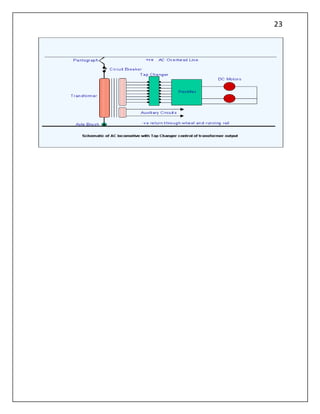
This diagram (above) shows a simplified schematic for a
25 kV AC electric locomotive used in the UK from the
late 1960s. The 25 kV AC is collected by the
pantograph and passed to the transformer.
The transformer is needed to step down the voltage to
a level which can be managed by the traction motors.
The level of current applied to the motors is controlled
by a "tap changer", which switches in more sections of
the transformer to increase the voltage passing through
to the motors. It works in the same way as
the resistance controllers used in DC traction, where the
resistance contactors are controlled by a camshaft
operating under the driver's commands.
Before being passed to the motors, the AC has to be
changed to DC by passing it through a rectifier. For the
last 30 years, rectifiers have used diodes and their
derivatives, the continuing development of which has
led to the present, state-of-the-art AC traction systems.
25
Diode
A diode is a device with no moving parts, known as a
semi-conductor, which allows current to flow through it
in one direction only. It will block any current which
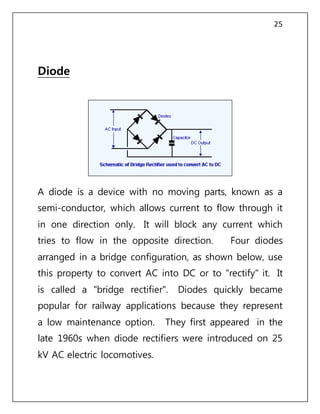
tries to flow in the opposite direction. Four diodes
arranged in a bridge configuration, as shown below, use
this property to convert AC into DC or to "rectify" it. It
is called a "bridge rectifier". Diodes quickly became
popular for railway applications because they represent
a low maintenance option. They first appeared in the
late 1960s when diode rectifiers were introduced on 25
kV AC electric locomotives.
26
Thyristor
The thyristor is a development of the diode. It acts like
a diode in that it allows current to flow in only one
direction but differs from the diode in that it will only
permit the current to flow after it has been switched on
or "gated". Once it has been gated and the current is
flowing, the only way it can be turned off is to send
27
current in the opposite direction. This cancels the
original gating command. It's simple to achieve on an
AC locomotive because the current switches its direction
during each cycle. With this development, controllable
rectifiers became possible and tap changers quickly
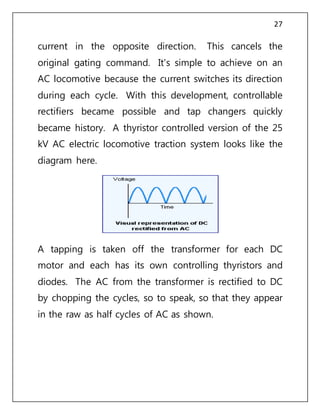
became history. A thyristor controlled version of the 25
kV AC electric locomotive traction system looks like the
diagram here.
A tapping is taken off the transformer for each DC
motor and each has its own controlling thyristors and
diodes. The AC from the transformer is rectified to DC
by chopping the cycles, so to speak, so that they appear
in the raw as half cycles of AC as shown.
28
In reality, a smoothing circuit is added to remove most
of the "ripple" and provide a more constant power flow
as shown in the diagram. Meanwhile, the power level for
the motor is controlled by varying the point in each
rectified cycle at which the thyristors are fired. The later
in the cycle the thyristor is gated, the lower the current
available to the motor. As the gating is advanced, so
the amount of current increases until the thyristors are
"on" for the full cycle. This form of control is known as
"phase angle control".
SEPEX
In more recent thyristor control systems, the motors
themselves are wired differently from the old standard
DC arrangement. The armatures and fields are no
29
longer wired in series, they are wired separately -
separate excitement, or SEPEX. Each field has its own
thyristor, which is used to control the individual fields
more precisely.
Since the motors are separately excited, the acceleration
sequence is carried out in two stages. In the first stage,
the armature is fed current by its thyristors until it
reaches the full voltage. This might give about 25% of
the locomotive's full speed. In the second stage, the
field thyristors are used to weaken the field current,
forcing the motor to speed up to compensate. This
technique is known as field weakening and was already
used in pre-electronic applications.
A big advantage of SEPEX is that wheel slip can be
detected and corrected quickly, instead of the traditional
method of either letting the wheels spin until the driver
noticed or using a wheel slip relay to switch off the
circuit and then restart it.
DC Locomotive with DC Drive
30
The traditional resistance control of DC motors wastes
current because it is drawn from the line (overhead or
third rail) and only some is used to accelerate the train
to 20-25 mph when, at last, full voltage is applied. The
remainder is consumed in the resistances. Immediately
thyristors were shown to work for AC traction, everyone
began looking for a way to use them on DC systems.
The problem was how to switch the thyristor off once it
had been fired, in other words, how to get the reverse
voltage to operate on an essentially one-way DC circuit.
It is done by adding a "resonant circuit" using an
inductor and a capacitor to force current to flow in the
31
opposite direction to normal. This has the effect of
switching off the thyristor, or "commutating" it. It is
shown as part of the complete DC thyristor control
circuit diagram. It has its own thyristor to switch it on
when required.
Two other features of the DC thyristor circuit are the
"freewheel diode" and the "line filter". The freewheel
diode keeps current circulating through the motor while
the thyristor is off, using the motor's own electro
magnetic inductance. Without the diode circuit, the
current build up for the motor would be slower.
Thyristor control can create a lot of electrical
interference - with all that chopping, it's bound to. The
"line filter" comprises a capacitor and an inductor and,
as its name suggests, it is used to prevent interference
from the train's power circuit getting into the supply
system.
32
The thyristor in DC traction applications controls the
current applied to the motor by chopping it into
segments, small ones at the beginning of the
acceleration process, gradually enlarging as speed
increases. This chopping of the circuit gave rise to the
nickname "chopper control". It is visually represented
by the diagram below, where the "ON" time of the
thyristor is regulated to control the average voltage in
the motor circuit. If the "ON" time is increased, so
does the average voltage and the motor speeds up.
The system began to appear on UK EMUs during the
1980s.
33
Dynamic Braking
Trains equipped with thyristor control can readily use
dynamic braking, where the motors become generators
and feed the resulting current into an on-board
resistance (rheostatic braking) or back into the supply
system (regenerative braking). The circuits are
reconfigured, usually by a "motor/brake switch"
operated by a command from the driver, to allow the
thyristors to control the current flow as the motors slow
down. An advantage of the thyristor control circuitry is
its ability to choose either regenerative or rheostatic
braking simply by automatically detecting the state of
receptivity of the line. So, when the regenerated
voltage across the supply connection filter circuit
reaches a preset upper limit, a thyristor fires to divert
the current to the on-board resistor.
The GTO Thyristor
By the late 1980s, the thyristor had been developed to a
stage where it could be turned off by a control circuit as
34
well as turned on by one. This was the "gate turn off"
or GTO thyristor. This meant that the thyristor
commutating circuit could be eliminated for DC fed
power circuits, a saving on several electronic devices for
each circuit. Now thyristors could be turned on and off
virtually at will and now a single thyristor could be used
to control a DC motor.
It is at this point that the conventional DC motor
reached its ultimate state in the railway traction
industry. Most systems now being built use AC motors.
AC Motors
There are two types of AC motor, synchronous and
asynchronous. The synchronous motor has its field
coils mounted on the drive shaft and the armature coils
in the housing, the inverse of normal practice. The
synchronous motor has been used in electric traction -
the most well-known application being by the French in
their TGV Atlantique train. This used a 25 kV AC supply,
rectified to DC and then inverted back to AC for supply
35
to the motor. It was designed before the GTO thyristor
had been sufficiently developed for railway use and it
used simple thyristors. The advantage for the
synchronous motor in this application is that the motor
produces the reverse voltages needed to turn off the
thyristors. It was a good solution is its day but it was
quickly overtaken by the second type of AC motor - the
asynchronous motor - when GTO thyristors became
available.
The Asynchronous Motor
The asynchronous motor, also called the induction
motor, is an AC motor which comprises a rotor and a
stator like the DC motor, but the AC motor does not
need current to flow through the armature. The current
36
flowing in the field coils forces the rotor to turn.
However, it does have to have a three phase supply, i.e.
one where AC has three conductors, each conducting at
a point one third into the normal cycle period, as
visually represented in the diagram.
The two big advantages of the 3-phase design are that,
one, the motor has no brushes, since there is no
electrical connection between the armature and the
fields and, two, the armature can be made of steel
laminations, instead of the large number of windings
required in other motors. These features make it more
robust and cheaper to build than a commutator motor.
AC Locomotive with AC Drive
Modern electronics has given us the AC drive. It has
only become available with modern electronics because
the speed of a 3-phase AC motor is determined by the
frequency of its supply but, at the same time, the power
has to be varied. The frequency used to be difficult to
control and that is why, until the advent of modern
37
electronics, AC motors were almost exclusively used in
constant speed applications and were therefore
unsuitable for railway operation. A modern railway 3-
phase traction motor is controlled by feeding in three
AC currents which interact to cause the machine to turn.
The three phases are most easily provided by an
inverter which supplies the three variable voltage,
variable frequency (VVVF) motor inputs. The variations
of the voltage and frequency are controlled
electronically.
The AC motor can be used by either an AC or DC
traction supply system. In the case of AC supply
38
(diagram), the line voltage (say 25kV single phase) is fed
into a transformer and a secondary winding is taken off
for the rectifier which produces a DC output of say 1500
- 2000 volts depending on the application. This is then
passed to the inverter which provides the controlled
three phases to the traction motors. The connection
between the rectifier and the inverter is called the DC
link. This usually also supplies an output for the train's
auxiliary circuits.
All the thyristors are GTOs, including those in the
rectifier, since they are now used to provide a more
efficient output than is possible with the older
thyristors. In addition, all the facilities of DC motor
control are available, including dynamic braking, but are
provided more efficiently and with less moving parts.
Applied to a DC traction supply, the 3-phase set-up is
even more simple, since it doesn't need a transformer or
a rectifier. The DC line voltage is applied to the
inverter, which provides the 3-phase motor control.
39
Control of these systems is complex but it is all carried
out by microprocessors. The control of the voltage
pulses and the frequency has to be matched with the
motor speed. The changes which occur during this
process produce a set of characteristic buzzing noises
which sound like the "gear changing" of a road vehicle
and which can clearly be heard when riding on the
motor car of an AC driven EMU.
IGBT
Having got AC drive using GTO thyristors universally
accepted (well, almost) as the modern traction system to
have, power electronics engineers have produced a new
development. This is the IGBT or Insulated Gate Bipolar
Transistor. The transistor was the forerunner of modern
electronics, (remember transistor radios?) and it could
be turned on or off like a thyristor but it doesn't need
the high currents of the thyristor turn off. However it
was, until very recently, only capable of handling very
small currents measured in thousanths of amps. Now,
40
the modern device, in the form of the IGBT, can handle
thousands of amps and it has appeared in traction
applications. A lower current version was first used
instead of thyristors in auxiliary supply inverters in the
early 1990s but a higher rated version has now entered
service in the most recent AC traction drives. Its
principle benefit is that it can switch a lot faster (three
to four times faster) than GTOs. This reduces the
current required and therefore the heat generated,
giving smaller and lighter units. The faster switching also
reduces the complex "gearing" of GTOs and makes for a
much smoother and more even sounding acceleration
buzz from under the train. With IGBTs, "gear changing"
has gone.
Diesel Locomotives
The modern diesel locomotive is a self contained
version of the electric locomotive. Like the electric
locomotive, it has electric drive, in the form of traction
41
motors driving the axles and controlled with electronic
controls. It also has many of the same auxiliary systems
for cooling, lighting, heating, braking and hotel power
(if required) for the train. It can operate over the same
routes (usually) and can be operated by the same
drivers. It differs principally in that it carries its own
generating station around with it, instead of being
connected to a remote generating station through
overhead wires or a third rail. The generating station
consists of a large diesel engine coupled to an
alternator producing the necessary electricity. A fuel
tank is also essential. It is interesting to note that the
modern diesel locomotive produces about 35% of the
power of a electric locomotive of similar weight.
42
Parts of a Diesel-Electric Locomotive
Diesel Engine
This is the main power source for the locomotive. It
comprises a large cylinder block, with the cylinders
arranged in a straight line or in a V (see more here).
The engine rotates the drive shaft at up to 1,000 rpm
and this drives the various items needed to power the
locomotive. As the transmission is electric, the engine is
used as the power source for the electricity generator or
alternator, as it is called nowadays.
Main Alternator
The diesel engine drives the main alternator which
provides the power to move the train. The alternator
43
generates AC electricity which is used to provide power
for the traction motors mounted on the trucks (bogies).
In older locomotives, the alternator was a DC machine,
called a generator. It produced direct current which was
used to provide power for DC traction motors. Many of
these machines are still in regular use. The next
development was the replacement of the generator by
the alternator but still using DC traction motors. The
AC output is rectified to give the DC required for the
motors.
Auxiliary Alternator
Locomotives used to operate passenger trains are
equipped with an auxiliary alternator. This provides AC
power for lighting, heating, air conditioning, dining
facilities etc. on the train. The output is transmitted
along the train through an auxiliary power line. In the
US, it is known as "head end power" or "hotel power".
In the UK, air conditioned passenger coaches get what
44
is called electric train supply (ETS) from the auxiliary
alternator.
Rectifiers/Inverters
The output from the main alternator is AC but it can be
used in a locomotive with either DC or AC traction
motors. DC motors were the traditional type used for
many years but, in the last 10 years, AC motors have
become standard for new locomotives. They are
cheaper to build and cost less to maintain and, with
electronic management can be very finely controlled.
To convert the AC output from the main alternator to
DC, rectifiers are required. If the motors are DC, the
output from the rectifiers is used directly. If the motors
are AC, the DC output from the rectifiers is converted to
3-phase AC for the traction motors.
45
Diesel-Electric Types
Diesel-electric locomotives come in three varieties,
according to the period in which they were designed.
These three are:
DC-DC (DC generator supplying DC traction motors);
AC-DC (AC alternator output rectified to supply DC
motors) and
AC-DC-AC (AC alternator output rectified to DC and
then inverted to 3-phase AC for the traction motors).
The DC - DC type has a generator supplying the DC
traction motors through a resistance control system, the
AC - DC type has an alternator producing AC current
which is rectified to DC and then supplied to the DC
traction motors and, finally, the most modern has the
AC alternator output being rectified to DC and then
converted to AC (3-phase) so that it can power the 3-
phase AC traction motors. Although this last system
might seem the most complex, the gains from using AC
46
motors far outweigh the apparent complexity of the
system.
EMU
Car Types
The cars that form a complete EMU set can usually be
separated by function into four types: power car, motor
car, driving car, and trailer car. Each car can have more
47
than one function, such as a motor-driving car or
power-driving car.
 A power car carries the necessary equipment to draw
power from the electrified infrastructure, such
as pickup shoes for third rail
systems and pantographs for over head systems, and
transformers.
 Motor cars carry the traction motors to move the
train, and are often combined with the power car to
avoid high-voltage inter-car connections.
 Driving cars are similar to a cab car, containing a
driver's cab for controlling the train. An EMU will
usually have two driving cars at its outer ends.
 Trailer cars are any cars that carry little or no traction
or power related equipment, and are similar
to passenger cars in a locomotive-hauled train. On
third rail systems the outer vehicles usually carry the
pick up shoes, with the motor vehicles receiving the
current via intra-unit connections.
48
MEMU
The Mainline Electric Multiple Unit or MEMU is
a commuter rail system in India operated by the Indian
Railway for semi-urban and rural areas. The system uses
Mainline Electrical Multiple Units (MEMU) operating
on Alternating Current (AC) drawn from over-head
cables through the catenary system.
DEMU
In a diesel-electric multiple unit (DEMU) a diesel
engine drives an electrical generator or
an alternator which produces electrical energy. The
generated current is then fed to electric traction
motors on the wheels or bogies in the same way as a
conventional diesel electric locomotive.
In modern DEMUs, such as the Bombardier Voyager
family, each car is entirely self-contained and has its
own engine, generator and electric motors.
49

bhel

  • 1.
    1 Training Report In Control EquipmentEngineering Under the guidance of Submitted by:
  • 2.
    2 Mr. Dinesh Dubey RonakJain (Sr. Engg C.E.E.) Submitted to: HRDC, BHEL Bhopal Bharat Heavy Electricals Limited Bhopal CERTIFICATE
  • 3.
    3 This is certifiedthat Mr. Ronak Jain, student of Sardar Vallabhbhai National Institute of Technology, Surat has taken practical vocational training in Control Equipment Engineering at BHEL, Bhopal from 25.05.15 to 20.06.15. During the course of training, his interest & behavior was found to be satisfactory & dedicated to work. Best wishes for his future Date: 20.06.2015 Place: Bhopal Mr. Dinesh Dubey (Sr. Engg C.E.E.) Declaration
  • 4.
    4 I ,Ronak Jain,student of Sardar Vallabhbhai National Institute of Technology hereby declare that I have successfully completed industrial training in Control Equipment Engineering. The information incorporated in this report in true and original to the best of my knowledge.
  • 5.
    5 Table of Contents AboutBHEL Page 6 Operations Page 6
  • 6.
    6 Main Manufacturing Facilities Page7 Products and Services Page 8 Rail Transport in India Page 10 Locomotives Page 10 EMU Page 10 Types Page 10
  • 7.
    7 Locomotives Page 11 Steam Locomotives Page11 Electronic Power for Locomotives Page 12 AC Locomotives with DC drive Page 13 Diode Page 14 Thyristor Page 15 DC Locomotive with DC drive Page 17 Dynamic Breaking Page 19
  • 8.
    8 AC Motor Page 19 ACLocomotive with AC drive Page 21 IGBT Page 22 Diesel Locomotives Page 23 Diesel-Electric Types Page 25 EMU Page 26 Car Types Page 26
  • 9.
  • 10.
    10 About BHEL Bharat HeavyElectricals Limited (BHEL), owned by Government of India, is a power plant equipment manufacturer and operates as an engineering and manufacturing company based in New Delhi, India. Established in 1964, BHEL is India's largest engineering and manufacturing company of its kind. The company has been earning profits continuously since 1971-72 and paying dividends uninterruptedly since 1976-77 Operations:
  • 11.
    11 It is engagedin the design, engineering, manufacturing, construction, testing, commissioning and servicing of a wide range of products, systems and services for the core sectors of the economy, viz. Power, Transmission, Industry, Transportation, Renewable energy, Oil & Gas and Defence. It has a network of 17 manufacturing units, 2 repair units, 4 regional offices, 8 service centres, 8 overseas offices, 15 regional centres, 7 joint ventures, and infrastructure allowing it to execute more than 150 projects at sites across India and abroad. The company has established the capability to deliver 20,000 MW p.a. of power equipment to address the growing demand for power generation equipment. BHEL has retained its market leadership position during 2013-14 with 72% market share in the Power Sector. An improved focus on project execution enabled BHEL record its highest ever commissioning/synchronization of 13,452 MW of power plants in domestic and international markets in 2013-14, marking a 30%
  • 12.
    12 increase over 2012-13.The company has added more than 1,24,000 MW to the country's installed power generating capacity so far. It also has been exporting its power and industry segment products and services for over 40 years. BHEL's global references are spread across over 76 countries across all the six continents of the world. The cumulative overseas installed capacity of BHEL manufactured power plants exceeds 9,000 MW across 21 countries. Their physical exports range from turnkey projects to after sales services. Main manufacturing facilities  Centralized Stamping Unit & Fabrication Plant (CSU & FP), Jagdishpur  Insulator Plant (IP), Jagdishpur  Electronics Division (EDN), Bangalore  Industrial Systems Group (ISG), Bangalore  Electro-Porcelains Division (EPD), Bangalore
  • 13.
    13  Heavy ElectricalPlant (HEP), Bhopal  Industrial Valves Plant (IVP), Goindwal  Heavy Electrical Equipment Plant (HEEP), Ranipur (Haridwar)  Central Foundry Forge Plant (CFFP), Ranipur (Haridwar)  Heavy Power Equipment Plant (HPEP), Hyderabad  Transformer Plant (TP), Jhansi  Boiler Auxiliaries Plant (BAP), Ranipet  Component Fabrication Plant (CFP), Rudrapur  High Pressure Boiler Plant (HPBP), Tiruchirappalli  Seamless Steel Tube Plant (SSTP), Tiruchirappalli  Power Plant Piping Unit (PPPU), Thirumayam  Heavy Plates & Vessels Plant (HPVP), Visakhapatnam The company is also setting up a new Greenfield Power Equipment Fabrication Plant (GPEFP) at Bhandara, Maharashtra, the foundation stone for which was laid on 14 May 2013. Further, BHEL is planning to enter solar manufacturing in a big scale, as
  • 14.
    14 it has announcedits plans for a 600 MW Solar Module Factory.[5] Products and services[edit]  Thermal power Plants [6]  Nuclear power Plants  Gas based power Plants  Hydro power Plants  DG power Plants  Boilers (steam generator)  Boiler Auxiliaries  Gas generator  Hydro generator  Steam turbine  Gas turbine  Hydro turbine  Transformer  Switchgear  Oil field equipment
  • 15.
    15  Boiler drum Piping System  Soot Blowers  Valves  Seamless Steel Tubes  Condenser s and Heat exchangers  Pumps  Desalination and Water treatment plants  Automation and Control systems  Power electronics  Transmission system control  Semiconductor devices  Solar photo voltaics  Software system solutions  Bus ducts  Insulators  Control panels  Capacitors  Bushings  Electrical machines
  • 16.
    16  DC, ACheavy duty Motors  Compressors  Control gears  Traction motors  Research and development products Rail Transport in India Locomotives: A locomotive or engine is a rail transport vehicle that provides the motive power for
  • 17.
    17 a train. Alocomotive has no payload capacity of its own, and its sole purpose is to move the train along the tracks. Electric Multiple Unit (EMU) : An electric multiple unit or EMU is a multiple unit train consisting of self-propelled carriages, using electricity as the motive power. An EMU requires no separate locomotive, as electric traction motors are incorporated within one or a number of the carriages. Types of Locomotives:  Steam Traction  Diesel Traction  DC Electric Traction  AC Electric Traction
  • 18.
    18 Types of EMU MEMU  DEMU LOCOMOTIVES Steam Locomotive: A steam locomotive is a railway locomotive that produces its pulling power through a steam engine. These locomotives are fueled by burning combustible material—usually coal, wood, or oil—to produce steam in a boiler. The steam moves reciprocating pistons which are mechanically connected to the locomotive's main wheels (Drivers).
  • 19.
    19 Both fuel andwater supplies are carried with the locomotive, either on the locomotive itself or in wagons (tenders) pulled behind. The first steam locomotive was made by Richard Trevithick on the 21st of Feb 1804, two years after the railway locomotive he made in 1802 or the road locomotive he made in 1801.
  • 20.
    20 ELECTRONIC POWER FORLOCOMOTIVES AC and DC Differences To understand the principles of modern traction power control systems, it is worth a look at the basics of DC and AC circuitry. DC is direct current - it travels in one direction only along a conductor. AC is alternating current - so called because it changes direction, flowing first one way along the conductor, then the other. It does this very rapidly. The number of times it changes direction per second is called the frequency and is measured in Hertz (Hz). It used to be called cycles per second, in case you've read of this in historical papers.
  • 21.
    21 In a diagrammaticrepresentation, the two types of current appear as shown in the diagram above. From a transmission point of view, AC is better than DC because it can be distributed at high voltages over a small size conductor wire, whereas DC needs a large, heavy wire or, on many DC railways, an extra rail. DC also needs more frequent feeder substations than AC - the ratio for a railway averages at about 8 to 1. It varies widely from one application to another but this gives a rough idea. Over the hundred years or so since the introduction of electric traction on railways, the rule has generally been that AC is used for longer distances and main lines and DC for shorter, suburban or metro lines. DC gets up to 3000 volts, while AC uses 15,000 - 50,000 volts. Until recently, DC motors have been the preferred type for railways because their characteristics were just right for the job. They were easy to control too. For this
  • 22.
    22 reason, even trainspowered from AC supplies were usually equipped with DC motors. AC Locomotives with DC Drives
  • 23.
  • 24.
    24 This diagram (above)shows a simplified schematic for a 25 kV AC electric locomotive used in the UK from the late 1960s. The 25 kV AC is collected by the pantograph and passed to the transformer. The transformer is needed to step down the voltage to a level which can be managed by the traction motors. The level of current applied to the motors is controlled by a "tap changer", which switches in more sections of the transformer to increase the voltage passing through to the motors. It works in the same way as the resistance controllers used in DC traction, where the resistance contactors are controlled by a camshaft operating under the driver's commands. Before being passed to the motors, the AC has to be changed to DC by passing it through a rectifier. For the last 30 years, rectifiers have used diodes and their derivatives, the continuing development of which has led to the present, state-of-the-art AC traction systems.
  • 25.
    25 Diode A diode isa device with no moving parts, known as a semi-conductor, which allows current to flow through it in one direction only. It will block any current which tries to flow in the opposite direction. Four diodes arranged in a bridge configuration, as shown below, use this property to convert AC into DC or to "rectify" it. It is called a "bridge rectifier". Diodes quickly became popular for railway applications because they represent a low maintenance option. They first appeared in the late 1960s when diode rectifiers were introduced on 25 kV AC electric locomotives.
  • 26.
    26 Thyristor The thyristor isa development of the diode. It acts like a diode in that it allows current to flow in only one direction but differs from the diode in that it will only permit the current to flow after it has been switched on or "gated". Once it has been gated and the current is flowing, the only way it can be turned off is to send
  • 27.
    27 current in theopposite direction. This cancels the original gating command. It's simple to achieve on an AC locomotive because the current switches its direction during each cycle. With this development, controllable rectifiers became possible and tap changers quickly became history. A thyristor controlled version of the 25 kV AC electric locomotive traction system looks like the diagram here. A tapping is taken off the transformer for each DC motor and each has its own controlling thyristors and diodes. The AC from the transformer is rectified to DC by chopping the cycles, so to speak, so that they appear in the raw as half cycles of AC as shown.
  • 28.
    28 In reality, asmoothing circuit is added to remove most of the "ripple" and provide a more constant power flow as shown in the diagram. Meanwhile, the power level for the motor is controlled by varying the point in each rectified cycle at which the thyristors are fired. The later in the cycle the thyristor is gated, the lower the current available to the motor. As the gating is advanced, so the amount of current increases until the thyristors are "on" for the full cycle. This form of control is known as "phase angle control". SEPEX In more recent thyristor control systems, the motors themselves are wired differently from the old standard DC arrangement. The armatures and fields are no
  • 29.
    29 longer wired inseries, they are wired separately - separate excitement, or SEPEX. Each field has its own thyristor, which is used to control the individual fields more precisely. Since the motors are separately excited, the acceleration sequence is carried out in two stages. In the first stage, the armature is fed current by its thyristors until it reaches the full voltage. This might give about 25% of the locomotive's full speed. In the second stage, the field thyristors are used to weaken the field current, forcing the motor to speed up to compensate. This technique is known as field weakening and was already used in pre-electronic applications. A big advantage of SEPEX is that wheel slip can be detected and corrected quickly, instead of the traditional method of either letting the wheels spin until the driver noticed or using a wheel slip relay to switch off the circuit and then restart it. DC Locomotive with DC Drive
  • 30.
    30 The traditional resistancecontrol of DC motors wastes current because it is drawn from the line (overhead or third rail) and only some is used to accelerate the train to 20-25 mph when, at last, full voltage is applied. The remainder is consumed in the resistances. Immediately thyristors were shown to work for AC traction, everyone began looking for a way to use them on DC systems. The problem was how to switch the thyristor off once it had been fired, in other words, how to get the reverse voltage to operate on an essentially one-way DC circuit. It is done by adding a "resonant circuit" using an inductor and a capacitor to force current to flow in the
  • 31.
    31 opposite direction tonormal. This has the effect of switching off the thyristor, or "commutating" it. It is shown as part of the complete DC thyristor control circuit diagram. It has its own thyristor to switch it on when required. Two other features of the DC thyristor circuit are the "freewheel diode" and the "line filter". The freewheel diode keeps current circulating through the motor while the thyristor is off, using the motor's own electro magnetic inductance. Without the diode circuit, the current build up for the motor would be slower. Thyristor control can create a lot of electrical interference - with all that chopping, it's bound to. The "line filter" comprises a capacitor and an inductor and, as its name suggests, it is used to prevent interference from the train's power circuit getting into the supply system.
  • 32.
    32 The thyristor inDC traction applications controls the current applied to the motor by chopping it into segments, small ones at the beginning of the acceleration process, gradually enlarging as speed increases. This chopping of the circuit gave rise to the nickname "chopper control". It is visually represented by the diagram below, where the "ON" time of the thyristor is regulated to control the average voltage in the motor circuit. If the "ON" time is increased, so does the average voltage and the motor speeds up. The system began to appear on UK EMUs during the 1980s.
  • 33.
    33 Dynamic Braking Trains equippedwith thyristor control can readily use dynamic braking, where the motors become generators and feed the resulting current into an on-board resistance (rheostatic braking) or back into the supply system (regenerative braking). The circuits are reconfigured, usually by a "motor/brake switch" operated by a command from the driver, to allow the thyristors to control the current flow as the motors slow down. An advantage of the thyristor control circuitry is its ability to choose either regenerative or rheostatic braking simply by automatically detecting the state of receptivity of the line. So, when the regenerated voltage across the supply connection filter circuit reaches a preset upper limit, a thyristor fires to divert the current to the on-board resistor. The GTO Thyristor By the late 1980s, the thyristor had been developed to a stage where it could be turned off by a control circuit as
  • 34.
    34 well as turnedon by one. This was the "gate turn off" or GTO thyristor. This meant that the thyristor commutating circuit could be eliminated for DC fed power circuits, a saving on several electronic devices for each circuit. Now thyristors could be turned on and off virtually at will and now a single thyristor could be used to control a DC motor. It is at this point that the conventional DC motor reached its ultimate state in the railway traction industry. Most systems now being built use AC motors. AC Motors There are two types of AC motor, synchronous and asynchronous. The synchronous motor has its field coils mounted on the drive shaft and the armature coils in the housing, the inverse of normal practice. The synchronous motor has been used in electric traction - the most well-known application being by the French in their TGV Atlantique train. This used a 25 kV AC supply, rectified to DC and then inverted back to AC for supply
  • 35.
    35 to the motor.It was designed before the GTO thyristor had been sufficiently developed for railway use and it used simple thyristors. The advantage for the synchronous motor in this application is that the motor produces the reverse voltages needed to turn off the thyristors. It was a good solution is its day but it was quickly overtaken by the second type of AC motor - the asynchronous motor - when GTO thyristors became available. The Asynchronous Motor The asynchronous motor, also called the induction motor, is an AC motor which comprises a rotor and a stator like the DC motor, but the AC motor does not need current to flow through the armature. The current
  • 36.
    36 flowing in thefield coils forces the rotor to turn. However, it does have to have a three phase supply, i.e. one where AC has three conductors, each conducting at a point one third into the normal cycle period, as visually represented in the diagram. The two big advantages of the 3-phase design are that, one, the motor has no brushes, since there is no electrical connection between the armature and the fields and, two, the armature can be made of steel laminations, instead of the large number of windings required in other motors. These features make it more robust and cheaper to build than a commutator motor. AC Locomotive with AC Drive Modern electronics has given us the AC drive. It has only become available with modern electronics because the speed of a 3-phase AC motor is determined by the frequency of its supply but, at the same time, the power has to be varied. The frequency used to be difficult to control and that is why, until the advent of modern
  • 37.
    37 electronics, AC motorswere almost exclusively used in constant speed applications and were therefore unsuitable for railway operation. A modern railway 3- phase traction motor is controlled by feeding in three AC currents which interact to cause the machine to turn. The three phases are most easily provided by an inverter which supplies the three variable voltage, variable frequency (VVVF) motor inputs. The variations of the voltage and frequency are controlled electronically. The AC motor can be used by either an AC or DC traction supply system. In the case of AC supply
  • 38.
    38 (diagram), the linevoltage (say 25kV single phase) is fed into a transformer and a secondary winding is taken off for the rectifier which produces a DC output of say 1500 - 2000 volts depending on the application. This is then passed to the inverter which provides the controlled three phases to the traction motors. The connection between the rectifier and the inverter is called the DC link. This usually also supplies an output for the train's auxiliary circuits. All the thyristors are GTOs, including those in the rectifier, since they are now used to provide a more efficient output than is possible with the older thyristors. In addition, all the facilities of DC motor control are available, including dynamic braking, but are provided more efficiently and with less moving parts. Applied to a DC traction supply, the 3-phase set-up is even more simple, since it doesn't need a transformer or a rectifier. The DC line voltage is applied to the inverter, which provides the 3-phase motor control.
  • 39.
    39 Control of thesesystems is complex but it is all carried out by microprocessors. The control of the voltage pulses and the frequency has to be matched with the motor speed. The changes which occur during this process produce a set of characteristic buzzing noises which sound like the "gear changing" of a road vehicle and which can clearly be heard when riding on the motor car of an AC driven EMU. IGBT Having got AC drive using GTO thyristors universally accepted (well, almost) as the modern traction system to have, power electronics engineers have produced a new development. This is the IGBT or Insulated Gate Bipolar Transistor. The transistor was the forerunner of modern electronics, (remember transistor radios?) and it could be turned on or off like a thyristor but it doesn't need the high currents of the thyristor turn off. However it was, until very recently, only capable of handling very small currents measured in thousanths of amps. Now,
  • 40.
    40 the modern device,in the form of the IGBT, can handle thousands of amps and it has appeared in traction applications. A lower current version was first used instead of thyristors in auxiliary supply inverters in the early 1990s but a higher rated version has now entered service in the most recent AC traction drives. Its principle benefit is that it can switch a lot faster (three to four times faster) than GTOs. This reduces the current required and therefore the heat generated, giving smaller and lighter units. The faster switching also reduces the complex "gearing" of GTOs and makes for a much smoother and more even sounding acceleration buzz from under the train. With IGBTs, "gear changing" has gone. Diesel Locomotives The modern diesel locomotive is a self contained version of the electric locomotive. Like the electric locomotive, it has electric drive, in the form of traction
  • 41.
    41 motors driving theaxles and controlled with electronic controls. It also has many of the same auxiliary systems for cooling, lighting, heating, braking and hotel power (if required) for the train. It can operate over the same routes (usually) and can be operated by the same drivers. It differs principally in that it carries its own generating station around with it, instead of being connected to a remote generating station through overhead wires or a third rail. The generating station consists of a large diesel engine coupled to an alternator producing the necessary electricity. A fuel tank is also essential. It is interesting to note that the modern diesel locomotive produces about 35% of the power of a electric locomotive of similar weight.
  • 42.
    42 Parts of aDiesel-Electric Locomotive Diesel Engine This is the main power source for the locomotive. It comprises a large cylinder block, with the cylinders arranged in a straight line or in a V (see more here). The engine rotates the drive shaft at up to 1,000 rpm and this drives the various items needed to power the locomotive. As the transmission is electric, the engine is used as the power source for the electricity generator or alternator, as it is called nowadays. Main Alternator The diesel engine drives the main alternator which provides the power to move the train. The alternator
  • 43.
    43 generates AC electricitywhich is used to provide power for the traction motors mounted on the trucks (bogies). In older locomotives, the alternator was a DC machine, called a generator. It produced direct current which was used to provide power for DC traction motors. Many of these machines are still in regular use. The next development was the replacement of the generator by the alternator but still using DC traction motors. The AC output is rectified to give the DC required for the motors. Auxiliary Alternator Locomotives used to operate passenger trains are equipped with an auxiliary alternator. This provides AC power for lighting, heating, air conditioning, dining facilities etc. on the train. The output is transmitted along the train through an auxiliary power line. In the US, it is known as "head end power" or "hotel power". In the UK, air conditioned passenger coaches get what
  • 44.
    44 is called electrictrain supply (ETS) from the auxiliary alternator. Rectifiers/Inverters The output from the main alternator is AC but it can be used in a locomotive with either DC or AC traction motors. DC motors were the traditional type used for many years but, in the last 10 years, AC motors have become standard for new locomotives. They are cheaper to build and cost less to maintain and, with electronic management can be very finely controlled. To convert the AC output from the main alternator to DC, rectifiers are required. If the motors are DC, the output from the rectifiers is used directly. If the motors are AC, the DC output from the rectifiers is converted to 3-phase AC for the traction motors.
  • 45.
    45 Diesel-Electric Types Diesel-electric locomotivescome in three varieties, according to the period in which they were designed. These three are: DC-DC (DC generator supplying DC traction motors); AC-DC (AC alternator output rectified to supply DC motors) and AC-DC-AC (AC alternator output rectified to DC and then inverted to 3-phase AC for the traction motors). The DC - DC type has a generator supplying the DC traction motors through a resistance control system, the AC - DC type has an alternator producing AC current which is rectified to DC and then supplied to the DC traction motors and, finally, the most modern has the AC alternator output being rectified to DC and then converted to AC (3-phase) so that it can power the 3- phase AC traction motors. Although this last system might seem the most complex, the gains from using AC
  • 46.
    46 motors far outweighthe apparent complexity of the system. EMU Car Types The cars that form a complete EMU set can usually be separated by function into four types: power car, motor car, driving car, and trailer car. Each car can have more
  • 47.
    47 than one function,such as a motor-driving car or power-driving car.  A power car carries the necessary equipment to draw power from the electrified infrastructure, such as pickup shoes for third rail systems and pantographs for over head systems, and transformers.  Motor cars carry the traction motors to move the train, and are often combined with the power car to avoid high-voltage inter-car connections.  Driving cars are similar to a cab car, containing a driver's cab for controlling the train. An EMU will usually have two driving cars at its outer ends.  Trailer cars are any cars that carry little or no traction or power related equipment, and are similar to passenger cars in a locomotive-hauled train. On third rail systems the outer vehicles usually carry the pick up shoes, with the motor vehicles receiving the current via intra-unit connections.
  • 48.
    48 MEMU The Mainline ElectricMultiple Unit or MEMU is a commuter rail system in India operated by the Indian Railway for semi-urban and rural areas. The system uses Mainline Electrical Multiple Units (MEMU) operating on Alternating Current (AC) drawn from over-head cables through the catenary system. DEMU In a diesel-electric multiple unit (DEMU) a diesel engine drives an electrical generator or an alternator which produces electrical energy. The generated current is then fed to electric traction motors on the wheels or bogies in the same way as a conventional diesel electric locomotive. In modern DEMUs, such as the Bombardier Voyager family, each car is entirely self-contained and has its own engine, generator and electric motors.
  • 49.