
1Compiled by KSSubbaRaj
BANKING DOMAINBANKING DOMAIN
2
 Domain is type of Environment.
 Domain knowledge is that valid knowledge used to refer
to an area of human Endeavour, an autonomous computer
activity, or other specialized discipline. Domain
knowledge is important, because it usually must be
learned from software users in the domain (as domain
specialists/experts), rather than from software developers.
Expert’s domain knowledge (frequently informal and ill
structured) is transformed in computer programs and
active data.
What is Domain?
3
 An establishment authorized by a government to accept
deposits, pay interest, clear checks, make loans, act as an
intermediary in financial transactions, and provide other
financial services to its customers.
 A financial institution that is licensed to deal with money
and its substitutes by accepting time and demand
deposits, making loans, and investing in securities. The
bank generates profits from the difference in the interest
rates charged and paid.
 A corporation empowered to deal with cash, domestic and
foreign, and to receive the deposits of money and to loan
those monies to third-parties.
What is Banking?
4
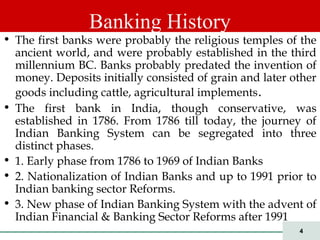
• The first banks were probably the religious temples of the
ancient world, and were probably established in the third
millennium BC. Banks probably predated the invention of
money. Deposits initially consisted of grain and later other
goods including cattle, agricultural implements.
• The first bank in India, though conservative, was
established in 1786. From 1786 till today, the journey of
Indian Banking System can be segregated into three
distinct phases.
• 1. Early phase from 1786 to 1969 of Indian Banks
• 2. Nationalization of Indian Banks and up to 1991 prior to
Indian banking sector Reforms.
• 3. New phase of Indian Banking System with the advent of
Indian Financial & Banking Sector Reforms after 1991
Banking History
5
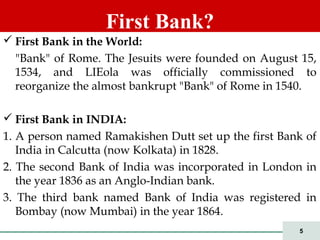
 First Bank in the World:
"Bank" of Rome. The Jesuits were founded on August 15,
1534, and LIEola was officially commissioned to
reorganize the almost bankrupt "Bank" of Rome in 1540.
 First Bank in INDIA:
1. A person named Ramakishen Dutt set up the first Bank of
India in Calcutta (now Kolkata) in 1828.
2. The second Bank of India was incorporated in London in
the year 1836 as an Anglo-Indian bank.
3. The third bank named Bank of India was registered in
Bombay (now Mumbai) in the year 1864.
First Bank?
6
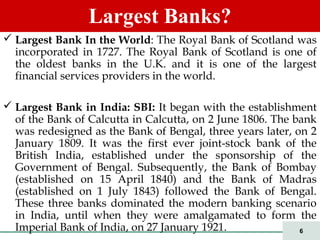
 Largest Bank In the World: The Royal Bank of Scotland was
incorporated in 1727. The Royal Bank of Scotland is one of
the oldest banks in the U.K. and it is one of the largest
financial services providers in the world.
 Largest Bank in India: SBI: It began with the establishment
of the Bank of Calcutta in Calcutta, on 2 June 1806. The bank
was redesigned as the Bank of Bengal, three years later, on 2
January 1809. It was the first ever joint-stock bank of the
British India, established under the sponsorship of the
Government of Bengal. Subsequently, the Bank of Bombay
(established on 15 April 1840) and the Bank of Madras
(established on 1 July 1843) followed the Bank of Bengal.
These three banks dominated the modern banking scenario
in India, until when they were amalgamated to form the
Imperial Bank of India, on 27 January 1921.
Largest Banks?
7
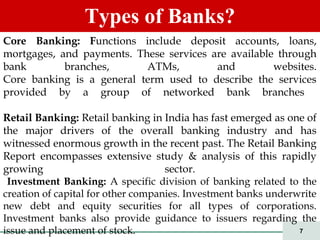
Types of Banks?
Core Banking: Functions include deposit accounts, loans,
mortgages, and payments. These services are available through
bank branches, ATMs, and websites.
Core banking is a general term used to describe the services
provided by a group of networked bank branches
Retail Banking: Retail banking in India has fast emerged as one of
the major drivers of the overall banking industry and has
witnessed enormous growth in the recent past. The Retail Banking
Report encompasses extensive study & analysis of this rapidly
growing sector.
Investment Banking: A specific division of banking related to the
creation of capital for other companies. Investment banks underwrite
new debt and equity securities for all types of corporations.
Investment banks also provide guidance to issuers regarding the
issue and placement of stock.
8
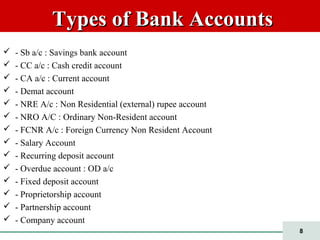
Types of Bank AccountsTypes of Bank Accounts
 - Sb a/c : Savings bank account
 - CC a/c : Cash credit account
 - CA a/c : Current account
 - Demat account
 - NRE A/c : Non Residential (external) rupee account
 - NRO A/C : Ordinary Non-Resident account
 - FCNR A/c : Foreign Currency Non Resident Account
 - Salary Account
 - Recurring deposit account
 - Overdue account : OD a/c
 - Fixed deposit account
 - Proprietorship account
 - Partnership account
 - Company account
9
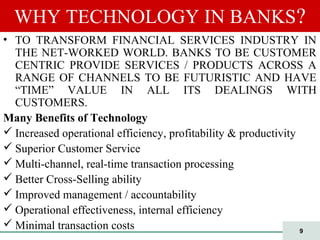
WHY TECHNOLOGY IN BANKS?
• TO TRANSFORM FINANCIAL SERVICES INDUSTRY IN
THE NET-WORKED WORLD. BANKS TO BE CUSTOMER
CENTRIC PROVIDE SERVICES / PRODUCTS ACROSS A
RANGE OF CHANNELS TO BE FUTURISTIC AND HAVE
“TIME” VALUE IN ALL ITS DEALINGS WITH
CUSTOMERS.
Many Benefits of Technology
 Increased operational efficiency, profitability & productivity
 Superior Customer Service
 Multi-channel, real-time transaction processing
 Better Cross-Selling ability
 Improved management / accountability
 Operational effectiveness, internal efficiency
 Minimal transaction costs
10
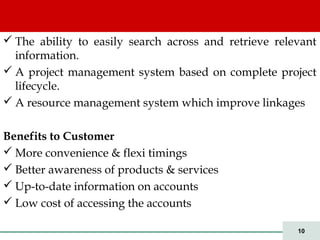
 The ability to easily search across and retrieve relevant
information.
 A project management system based on complete project
lifecycle.
 A resource management system which improve linkages
Benefits to Customer
 More convenience & flexi timings
 Better awareness of products & services
 Up-to-date information on accounts
 Low cost of accessing the accounts
11
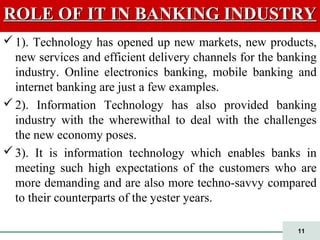
ROLE OF IT IN BANKING INDUSTRYROLE OF IT IN BANKING INDUSTRY
1). Technology has opened up new markets, new products,
new services and efficient delivery channels for the banking
industry. Online electronics banking, mobile banking and
internet banking are just a few examples.
2). Information Technology has also provided banking
industry with the wherewithal to deal with the challenges
the new economy poses.
3). It is information technology which enables banks in
meeting such high expectations of the customers who are
more demanding and are also more techno-savvy compared
to their counterparts of the yester years.
12
 IT has been providing solutions to banks to take care of
their accounting and back office requirements. This has,
however, now given way to large scale usage in services
aimed at the customer of the banks. IT also facilitates the
introduction of new delivery channels--in the form of
Automated Teller Machines, Net Banking, Mobile Banking
and the like.
The IT revolution has set the stage for unprecedented
increase in financial activity across the globe. The progress
of technology and the development of world wide networks
have significantly reduced the cost of global funds transfer.
13
Internet Banking (E-Banking)Internet Banking (E-Banking)
Internet banking (or E-banking) or Online Banking means any
user with a personal computer and a browser can get connected to
his bank -s website to perform any of the virtual banking functions.
In internet banking system the bank has a centralized database that
is web-enabled. All the services that the bank has permitted on the
internet are displayed in menu.
Any service can be selected and further interaction is dictated by
the nature of service. The traditional branch model of bank is now
giving place to an alternative delivery channels with ATM
network. Once the branch offices of bank are interconnected
through terrestrial or satellite links, there would be no physical
identity for any branch. It would a borderless entity permitting
anytime, anywhere and anyhow banking.
14
ObjectivesObjectives
• E-Banking is one of the fastest developing trends in Indian
Banking and it is poised to take the banking sector a notch
higher. It divided into
• Automatic Teller Machines(ATMs)
• Tele Banking
• Internet Banking
• Mobile Banking or M-Banking or SMS Banking
• Electronic Funds Transfer
• Electronic Clearing System
• Online Banking
• Plastic Money
15
Automated Teller MachineAutomated Teller Machine
• First ATM in the World: Automated Teller Machine or
Automated Banking Machine (ABM):World's first ATM,
invented by John Shepherd-Barron, was installed by Barclay's
Bank in North London on June 27, 1967.
• First ATM in India: HSBC (1987) was the first bank to
introduce the ATM concept in India.
• An Automated Teller Machine (ATM), commonly called
a cash point and a hole in the wall in UK English after the
trademark of the same name, is a computerized
telecommunications device that provides the clients of a
financial institution with access to financial transactions in a
public space without the need for a cashier, human clerk or
bank teller. ATMs are known by various other names
including automatic banking machine, cash machine
16
Telephone bankingTelephone banking
Telephone banking is a service provided by a financial
institution, which allows its customers to perform transactions over
the telephone. Most telephone banking services use an automated
phone answering system with phone keypad response or voice
recognition capability. To guarantee security, the customer must
first authenticate through a numeric or verbal password or through
security questions asked by a live representative.
Telephone banking is Two Kinds:
1. Public Enquiry: General Information about banking services can
be obtained by customers and non customers. Example Call
Centers
2. Private Enquiry: This relates to account specific information and
can be accessed only by the account holder. Example CID, PIN.
17
Mobile Banking or SMS BankingMobile Banking or SMS Banking
• Mobile banking (also known as M-Banking, mbanking, SMS
Banking) is a term used for performing balance checks, account
transactions, payments, credit applications and other banking
transactions through a mobile device such as a mobile phone or
Personal Digital Assistant (PDA).
• The earliest mobile banking services were offered over SMS. With the
introduction of the first primitive smart phones with WAP support
enabling the use of the mobile web in 1999, the first European banks
started to offer mobile banking on this platform to their customers.
• Mobile banking has until recently (2010) most often been performed
via SMS or the Mobile Web. Apple's initial success with iPhone and
the rapid growth of phones based on Google's Android (operating
system) have led to increasing use of special client programs, called
apps, downloaded to the mobile device.
18
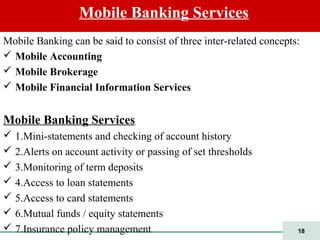
Mobile Banking can be said to consist of three inter-related concepts:
 Mobile Accounting
 Mobile Brokerage
 Mobile Financial Information Services
Mobile Banking Services
 1.Mini-statements and checking of account history
 2.Alerts on account activity or passing of set thresholds
 3.Monitoring of term deposits
 4.Access to loan statements
 5.Access to card statements
 6.Mutual funds / equity statements
 7.Insurance policy management
Mobile Banking Services
19
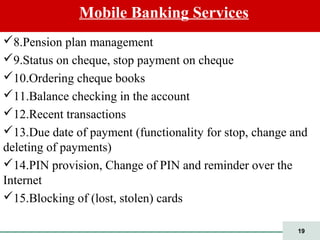
8.Pension plan management
9.Status on cheque, stop payment on cheque
10.Ordering cheque books
11.Balance checking in the account
12.Recent transactions
13.Due date of payment (functionality for stop, change and
deleting of payments)
14.PIN provision, Change of PIN and reminder over the
Internet
15.Blocking of (lost, stolen) cards
Mobile Banking Services
20
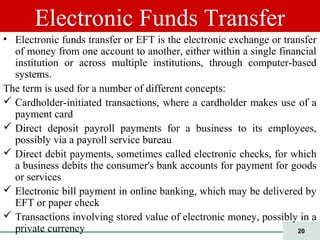
Electronic Funds Transfer
• Electronic funds transfer or EFT is the electronic exchange or transfer
of money from one account to another, either within a single financial
institution or across multiple institutions, through computer-based
systems.
The term is used for a number of different concepts:
 Cardholder-initiated transactions, where a cardholder makes use of a
payment card
 Direct deposit payroll payments for a business to its employees,
possibly via a payroll service bureau
 Direct debit payments, sometimes called electronic checks, for which
a business debits the consumer's bank accounts for payment for goods
or services
 Electronic bill payment in online banking, which may be delivered by
EFT or paper check
 Transactions involving stored value of electronic money, possibly in a
private currency
21
Electronic Clearing ServiceElectronic Clearing Service
It is a mode of electronic funds transfer from one bank account to
another bank account using the services of a Clearing House. This is
normally for bulk transfers from one account to many accounts or vice
versa. This can be used both for making payments like distribution of
dividend, interest, salary, pension, etc., by institutions or for collection of
amounts for purposes such as payments to utility companies like
telephone, electricity, or charges such as house tax, water tax, etc., or for
loan installments of financial institutions/banks or regular investments of
persons.
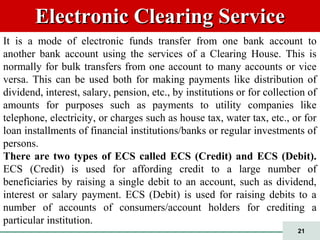
There are two types of ECS called ECS (Credit) and ECS (Debit).
ECS (Credit) is used for affording credit to a large number of
beneficiaries by raising a single debit to an account, such as dividend,
interest or salary payment. ECS (Debit) is used for raising debits to a
number of accounts of consumers/account holders for crediting a
particular institution.
22
Plastic MoneyPlastic Money
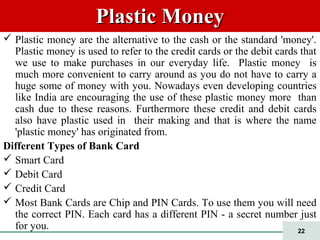
 Plastic money are the alternative to the cash or the standard 'money'.
Plastic money is used to refer to the credit cards or the debit cards that
we use to make purchases in our everyday life. Plastic money is
much more convenient to carry around as you do not have to carry a
huge some of money with you. Nowadays even developing countries
like India are encouraging the use of these plastic money more than
cash due to these reasons. Furthermore these credit and debit cards
also have plastic used in their making and that is where the name
'plastic money' has originated from.
Different Types of Bank Card
 Smart Card
 Debit Card
 Credit Card
 Most Bank Cards are Chip and PIN Cards. To use them you will need
the correct PIN. Each card has a different PIN - a secret number just
for you.
23
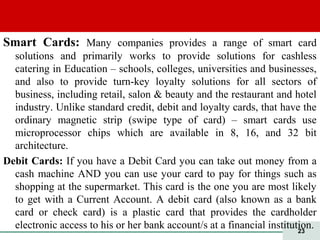
Smart Cards: Many companies provides a range of smart card
solutions and primarily works to provide solutions for cashless
catering in Education – schools, colleges, universities and businesses,
and also to provide turn-key loyalty solutions for all sectors of
business, including retail, salon & beauty and the restaurant and hotel
industry. Unlike standard credit, debit and loyalty cards, that have the
ordinary magnetic strip (swipe type of card) – smart cards use
microprocessor chips which are available in 8, 16, and 32 bit
architecture.
Debit Cards: If you have a Debit Card you can take out money from a
cash machine AND you can use your card to pay for things such as
shopping at the supermarket. This card is the one you are most likely
to get with a Current Account. A debit card (also known as a bank
card or check card) is a plastic card that provides the cardholder
electronic access to his or her bank account/s at a financial institution.
24
Credit Cards: Credit Cards A Credit Card is a Bank Card with which
you can pay for items from shops and, at the end of the month, you
will be sent a bill. A credit card is a small plastic card issued to users
as a system of payment. It allows its holder to buy goods and services
based on the holder's promise to pay for these goods and services.
25
THANK YOU
THANK YOU
QATraininghub.co
QATraininghub.co
mm
j.,aj.,

QA Online Training in Hyderabad - 040 65862627, +91 8977262627

  • 1.
    1Compiled by KSSubbaRaj BANKINGDOMAINBANKING DOMAIN
  • 2.
    2  Domain istype of Environment.  Domain knowledge is that valid knowledge used to refer to an area of human Endeavour, an autonomous computer activity, or other specialized discipline. Domain knowledge is important, because it usually must be learned from software users in the domain (as domain specialists/experts), rather than from software developers. Expert’s domain knowledge (frequently informal and ill structured) is transformed in computer programs and active data. What is Domain?
  • 3.
    3  An establishmentauthorized by a government to accept deposits, pay interest, clear checks, make loans, act as an intermediary in financial transactions, and provide other financial services to its customers.  A financial institution that is licensed to deal with money and its substitutes by accepting time and demand deposits, making loans, and investing in securities. The bank generates profits from the difference in the interest rates charged and paid.  A corporation empowered to deal with cash, domestic and foreign, and to receive the deposits of money and to loan those monies to third-parties. What is Banking?
  • 4.
    4 • The firstbanks were probably the religious temples of the ancient world, and were probably established in the third millennium BC. Banks probably predated the invention of money. Deposits initially consisted of grain and later other goods including cattle, agricultural implements. • The first bank in India, though conservative, was established in 1786. From 1786 till today, the journey of Indian Banking System can be segregated into three distinct phases. • 1. Early phase from 1786 to 1969 of Indian Banks • 2. Nationalization of Indian Banks and up to 1991 prior to Indian banking sector Reforms. • 3. New phase of Indian Banking System with the advent of Indian Financial & Banking Sector Reforms after 1991 Banking History
  • 5.
    5  First Bankin the World: "Bank" of Rome. The Jesuits were founded on August 15, 1534, and LIEola was officially commissioned to reorganize the almost bankrupt "Bank" of Rome in 1540.  First Bank in INDIA: 1. A person named Ramakishen Dutt set up the first Bank of India in Calcutta (now Kolkata) in 1828. 2. The second Bank of India was incorporated in London in the year 1836 as an Anglo-Indian bank. 3. The third bank named Bank of India was registered in Bombay (now Mumbai) in the year 1864. First Bank?
  • 6.
    6  Largest BankIn the World: The Royal Bank of Scotland was incorporated in 1727. The Royal Bank of Scotland is one of the oldest banks in the U.K. and it is one of the largest financial services providers in the world.  Largest Bank in India: SBI: It began with the establishment of the Bank of Calcutta in Calcutta, on 2 June 1806. The bank was redesigned as the Bank of Bengal, three years later, on 2 January 1809. It was the first ever joint-stock bank of the British India, established under the sponsorship of the Government of Bengal. Subsequently, the Bank of Bombay (established on 15 April 1840) and the Bank of Madras (established on 1 July 1843) followed the Bank of Bengal. These three banks dominated the modern banking scenario in India, until when they were amalgamated to form the Imperial Bank of India, on 27 January 1921. Largest Banks?
  • 7.
    7 Types of Banks? CoreBanking: Functions include deposit accounts, loans, mortgages, and payments. These services are available through bank branches, ATMs, and websites. Core banking is a general term used to describe the services provided by a group of networked bank branches Retail Banking: Retail banking in India has fast emerged as one of the major drivers of the overall banking industry and has witnessed enormous growth in the recent past. The Retail Banking Report encompasses extensive study & analysis of this rapidly growing sector. Investment Banking: A specific division of banking related to the creation of capital for other companies. Investment banks underwrite new debt and equity securities for all types of corporations. Investment banks also provide guidance to issuers regarding the issue and placement of stock.
  • 8.
    8 Types of BankAccountsTypes of Bank Accounts  - Sb a/c : Savings bank account  - CC a/c : Cash credit account  - CA a/c : Current account  - Demat account  - NRE A/c : Non Residential (external) rupee account  - NRO A/C : Ordinary Non-Resident account  - FCNR A/c : Foreign Currency Non Resident Account  - Salary Account  - Recurring deposit account  - Overdue account : OD a/c  - Fixed deposit account  - Proprietorship account  - Partnership account  - Company account
  • 9.
    9 WHY TECHNOLOGY INBANKS? • TO TRANSFORM FINANCIAL SERVICES INDUSTRY IN THE NET-WORKED WORLD. BANKS TO BE CUSTOMER CENTRIC PROVIDE SERVICES / PRODUCTS ACROSS A RANGE OF CHANNELS TO BE FUTURISTIC AND HAVE “TIME” VALUE IN ALL ITS DEALINGS WITH CUSTOMERS. Many Benefits of Technology  Increased operational efficiency, profitability & productivity  Superior Customer Service  Multi-channel, real-time transaction processing  Better Cross-Selling ability  Improved management / accountability  Operational effectiveness, internal efficiency  Minimal transaction costs
  • 10.
    10  The abilityto easily search across and retrieve relevant information.  A project management system based on complete project lifecycle.  A resource management system which improve linkages Benefits to Customer  More convenience & flexi timings  Better awareness of products & services  Up-to-date information on accounts  Low cost of accessing the accounts
  • 11.
    11 ROLE OF ITIN BANKING INDUSTRYROLE OF IT IN BANKING INDUSTRY 1). Technology has opened up new markets, new products, new services and efficient delivery channels for the banking industry. Online electronics banking, mobile banking and internet banking are just a few examples. 2). Information Technology has also provided banking industry with the wherewithal to deal with the challenges the new economy poses. 3). It is information technology which enables banks in meeting such high expectations of the customers who are more demanding and are also more techno-savvy compared to their counterparts of the yester years.
  • 12.
    12  IT hasbeen providing solutions to banks to take care of their accounting and back office requirements. This has, however, now given way to large scale usage in services aimed at the customer of the banks. IT also facilitates the introduction of new delivery channels--in the form of Automated Teller Machines, Net Banking, Mobile Banking and the like. The IT revolution has set the stage for unprecedented increase in financial activity across the globe. The progress of technology and the development of world wide networks have significantly reduced the cost of global funds transfer.
  • 13.
    13 Internet Banking (E-Banking)InternetBanking (E-Banking) Internet banking (or E-banking) or Online Banking means any user with a personal computer and a browser can get connected to his bank -s website to perform any of the virtual banking functions. In internet banking system the bank has a centralized database that is web-enabled. All the services that the bank has permitted on the internet are displayed in menu. Any service can be selected and further interaction is dictated by the nature of service. The traditional branch model of bank is now giving place to an alternative delivery channels with ATM network. Once the branch offices of bank are interconnected through terrestrial or satellite links, there would be no physical identity for any branch. It would a borderless entity permitting anytime, anywhere and anyhow banking.
  • 14.
    14 ObjectivesObjectives • E-Banking isone of the fastest developing trends in Indian Banking and it is poised to take the banking sector a notch higher. It divided into • Automatic Teller Machines(ATMs) • Tele Banking • Internet Banking • Mobile Banking or M-Banking or SMS Banking • Electronic Funds Transfer • Electronic Clearing System • Online Banking • Plastic Money
  • 15.
    15 Automated Teller MachineAutomatedTeller Machine • First ATM in the World: Automated Teller Machine or Automated Banking Machine (ABM):World's first ATM, invented by John Shepherd-Barron, was installed by Barclay's Bank in North London on June 27, 1967. • First ATM in India: HSBC (1987) was the first bank to introduce the ATM concept in India. • An Automated Teller Machine (ATM), commonly called a cash point and a hole in the wall in UK English after the trademark of the same name, is a computerized telecommunications device that provides the clients of a financial institution with access to financial transactions in a public space without the need for a cashier, human clerk or bank teller. ATMs are known by various other names including automatic banking machine, cash machine
  • 16.
    16 Telephone bankingTelephone banking Telephonebanking is a service provided by a financial institution, which allows its customers to perform transactions over the telephone. Most telephone banking services use an automated phone answering system with phone keypad response or voice recognition capability. To guarantee security, the customer must first authenticate through a numeric or verbal password or through security questions asked by a live representative. Telephone banking is Two Kinds: 1. Public Enquiry: General Information about banking services can be obtained by customers and non customers. Example Call Centers 2. Private Enquiry: This relates to account specific information and can be accessed only by the account holder. Example CID, PIN.
  • 17.
    17 Mobile Banking orSMS BankingMobile Banking or SMS Banking • Mobile banking (also known as M-Banking, mbanking, SMS Banking) is a term used for performing balance checks, account transactions, payments, credit applications and other banking transactions through a mobile device such as a mobile phone or Personal Digital Assistant (PDA). • The earliest mobile banking services were offered over SMS. With the introduction of the first primitive smart phones with WAP support enabling the use of the mobile web in 1999, the first European banks started to offer mobile banking on this platform to their customers. • Mobile banking has until recently (2010) most often been performed via SMS or the Mobile Web. Apple's initial success with iPhone and the rapid growth of phones based on Google's Android (operating system) have led to increasing use of special client programs, called apps, downloaded to the mobile device.
  • 18.
    18 Mobile Banking canbe said to consist of three inter-related concepts:  Mobile Accounting  Mobile Brokerage  Mobile Financial Information Services Mobile Banking Services  1.Mini-statements and checking of account history  2.Alerts on account activity or passing of set thresholds  3.Monitoring of term deposits  4.Access to loan statements  5.Access to card statements  6.Mutual funds / equity statements  7.Insurance policy management Mobile Banking Services
  • 19.
    19 8.Pension plan management 9.Statuson cheque, stop payment on cheque 10.Ordering cheque books 11.Balance checking in the account 12.Recent transactions 13.Due date of payment (functionality for stop, change and deleting of payments) 14.PIN provision, Change of PIN and reminder over the Internet 15.Blocking of (lost, stolen) cards Mobile Banking Services
  • 20.
    20 Electronic Funds Transfer •Electronic funds transfer or EFT is the electronic exchange or transfer of money from one account to another, either within a single financial institution or across multiple institutions, through computer-based systems. The term is used for a number of different concepts:  Cardholder-initiated transactions, where a cardholder makes use of a payment card  Direct deposit payroll payments for a business to its employees, possibly via a payroll service bureau  Direct debit payments, sometimes called electronic checks, for which a business debits the consumer's bank accounts for payment for goods or services  Electronic bill payment in online banking, which may be delivered by EFT or paper check  Transactions involving stored value of electronic money, possibly in a private currency
  • 21.
    21 Electronic Clearing ServiceElectronicClearing Service It is a mode of electronic funds transfer from one bank account to another bank account using the services of a Clearing House. This is normally for bulk transfers from one account to many accounts or vice versa. This can be used both for making payments like distribution of dividend, interest, salary, pension, etc., by institutions or for collection of amounts for purposes such as payments to utility companies like telephone, electricity, or charges such as house tax, water tax, etc., or for loan installments of financial institutions/banks or regular investments of persons. There are two types of ECS called ECS (Credit) and ECS (Debit). ECS (Credit) is used for affording credit to a large number of beneficiaries by raising a single debit to an account, such as dividend, interest or salary payment. ECS (Debit) is used for raising debits to a number of accounts of consumers/account holders for crediting a particular institution.
  • 22.
    22 Plastic MoneyPlastic Money Plastic money are the alternative to the cash or the standard 'money'. Plastic money is used to refer to the credit cards or the debit cards that we use to make purchases in our everyday life. Plastic money is much more convenient to carry around as you do not have to carry a huge some of money with you. Nowadays even developing countries like India are encouraging the use of these plastic money more than cash due to these reasons. Furthermore these credit and debit cards also have plastic used in their making and that is where the name 'plastic money' has originated from. Different Types of Bank Card  Smart Card  Debit Card  Credit Card  Most Bank Cards are Chip and PIN Cards. To use them you will need the correct PIN. Each card has a different PIN - a secret number just for you.
  • 23.
    23 Smart Cards: Manycompanies provides a range of smart card solutions and primarily works to provide solutions for cashless catering in Education – schools, colleges, universities and businesses, and also to provide turn-key loyalty solutions for all sectors of business, including retail, salon & beauty and the restaurant and hotel industry. Unlike standard credit, debit and loyalty cards, that have the ordinary magnetic strip (swipe type of card) – smart cards use microprocessor chips which are available in 8, 16, and 32 bit architecture. Debit Cards: If you have a Debit Card you can take out money from a cash machine AND you can use your card to pay for things such as shopping at the supermarket. This card is the one you are most likely to get with a Current Account. A debit card (also known as a bank card or check card) is a plastic card that provides the cardholder electronic access to his or her bank account/s at a financial institution.
  • 24.
    24 Credit Cards: CreditCards A Credit Card is a Bank Card with which you can pay for items from shops and, at the end of the month, you will be sent a bill. A credit card is a small plastic card issued to users as a system of payment. It allows its holder to buy goods and services based on the holder's promise to pay for these goods and services.
  • 25.