
APACHE
MESOS
APACHE - MESOS
• WHAT IS IT ?
• COMPONENTS
• HOW IT WORKS
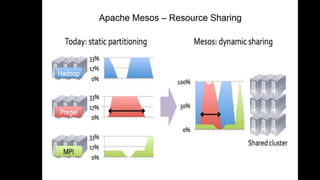
• RESOURCE SHARING
• ARCHITECTURE
• INTENSIONS
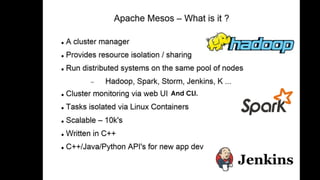
And CLI.
 Apache Mesos is a centralised fault-tolerant cluster manager. It’s designed for distributed
computing environments to provide resource isolation and management across a cluster of
slave nodes.
In some ways, Mesos provides the opposite to virtualization:
 Virtualization splits a single physical resource into multiple virtual resources
 Mesos joins multiple physical resources into a single virtual resource
 It schedules CPU and memory resources across the cluster in the same way the Linux Kernel
schedules local resources.
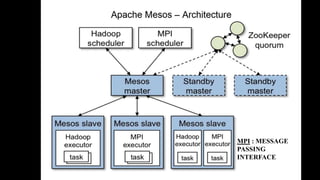
A Mesos cluster is made up of four major components:
 ZooKeepers
 Mesos masters
 Mesos slaves
 Frameworks
ZooKeeper :
 Apache ZooKeeper is a centralised configuration manager, used by
distributed applications such as Mesos to coordinate activity across a
cluster.
 Mesos uses ZooKeeper to elect a leading master and for slaves to join
the cluster.
Mesos masters:
 A Mesos master is a Mesos instance in control of the cluster.
 A cluster will typically have multiple Mesos masters to provide fault-
tolerance, with one instance elected the leading master.
Mesos slaves:
 A Mesos slave is a Mesos instance which offers resources to the cluster.
 They are the ‘worker’ instances – tasks are allocated to the slaves by
the Mesos master.
Frameworks:
 On its own, Mesos only provides the basic “kernel” layer of your
cluster. It lets other applications request resources in the cluster to
perform tasks, but does nothing itself.
 Frameworks bridge the gap between the Mesos layer and your
applications. They are higher level abstractions which simplify the
process of launching tasks on the cluster.
Others:
There are a few other frameworks:
 Aurora – service scheduler
 Hadoop – data processing
 Jenkins – Jenkins slave manager
 Spark – data processing
 Torque – resource manager
You can also write your own framework, using Java, Python or
C++.
MPI : MESSAGE
PASSING
INTERFACE
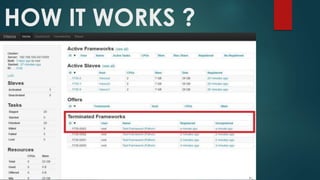
HOW IT WORKS ?
Why Do we need
MESOS..?
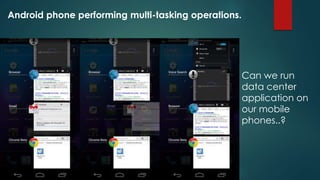
Android phone performing multi-tasking operations.
Can we run
data center
application on
our mobile
phones..?
What is DATA CENTER?
 A large group of networked computer
servers typically used by organizations for
the remote storage, processing, or
distribution of large amounts of data.
APACHE MESOS - INTENSIONS
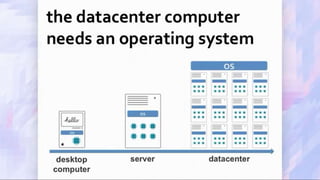
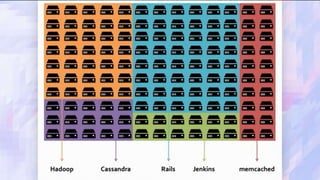
 AVOID MULTIPLE SPECIALISED CLUSTERS.
 PROGRAM FOR THE DATA CENTER.
 OFFERS THE ABILITY OF MULTIPLE TENANCY WHICH OFFERS:
• Lower Hardware/Maintenance costs.
• Higher utilization and Scalability.
• Higher fault tolerance.
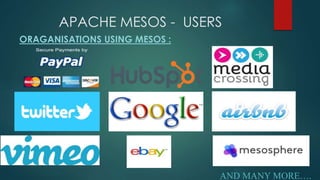
APACHE MESOS - USERS
ORAGANISATIONS USING MESOS :
AND MANY MORE….
© 2012-2014 The Apache Software Foundation
Thank You!
mesos.apache.org
mesos.apache.org/blog
@ApacheMesos

Apache Mesos

  • 1.
  • 2.
    APACHE - MESOS •WHAT IS IT ? • COMPONENTS • HOW IT WORKS • RESOURCE SHARING • ARCHITECTURE • INTENSIONS
  • 3.
  • 5.
     Apache Mesosis a centralised fault-tolerant cluster manager. It’s designed for distributed computing environments to provide resource isolation and management across a cluster of slave nodes. In some ways, Mesos provides the opposite to virtualization:  Virtualization splits a single physical resource into multiple virtual resources  Mesos joins multiple physical resources into a single virtual resource  It schedules CPU and memory resources across the cluster in the same way the Linux Kernel schedules local resources. A Mesos cluster is made up of four major components:  ZooKeepers  Mesos masters  Mesos slaves  Frameworks
  • 6.
    ZooKeeper :  ApacheZooKeeper is a centralised configuration manager, used by distributed applications such as Mesos to coordinate activity across a cluster.  Mesos uses ZooKeeper to elect a leading master and for slaves to join the cluster. Mesos masters:  A Mesos master is a Mesos instance in control of the cluster.  A cluster will typically have multiple Mesos masters to provide fault- tolerance, with one instance elected the leading master.
  • 7.
    Mesos slaves:  AMesos slave is a Mesos instance which offers resources to the cluster.  They are the ‘worker’ instances – tasks are allocated to the slaves by the Mesos master. Frameworks:  On its own, Mesos only provides the basic “kernel” layer of your cluster. It lets other applications request resources in the cluster to perform tasks, but does nothing itself.  Frameworks bridge the gap between the Mesos layer and your applications. They are higher level abstractions which simplify the process of launching tasks on the cluster.
  • 8.
    Others: There are afew other frameworks:  Aurora – service scheduler  Hadoop – data processing  Jenkins – Jenkins slave manager  Spark – data processing  Torque – resource manager You can also write your own framework, using Java, Python or C++.
  • 10.
  • 11.
  • 13.
    Why Do weneed MESOS..?
  • 14.
    Android phone performingmulti-tasking operations. Can we run data center application on our mobile phones..?
  • 15.
    What is DATACENTER?  A large group of networked computer servers typically used by organizations for the remote storage, processing, or distribution of large amounts of data.
  • 19.
    APACHE MESOS -INTENSIONS  AVOID MULTIPLE SPECIALISED CLUSTERS.  PROGRAM FOR THE DATA CENTER.  OFFERS THE ABILITY OF MULTIPLE TENANCY WHICH OFFERS: • Lower Hardware/Maintenance costs. • Higher utilization and Scalability. • Higher fault tolerance.
  • 20.
    APACHE MESOS -USERS ORAGANISATIONS USING MESOS : AND MANY MORE….
  • 21.
    © 2012-2014 TheApache Software Foundation
  • 22.