DESIGN OF SHAFT
IMSEC GHAZIABADIMSEC GHAZIABAD
PULKIT PATHAKPULKIT PATHAK
44thth
YEARYEAR
SHAFT INTRODUCTIONSHAFT INTRODUCTION
THE TERM SHAFT USUALLY REFERS TO A ROTATING MACHINE ELEMENTTHE TERM SHAFT USUALLY REFERS TO A ROTATING MACHINE ELEMENT
CIRCULAR IN CROSS SECTION WHICH SUPPORTS TRANSMISSIONCIRCULAR IN CROSS SECTION WHICH SUPPORTS TRANSMISSION
ELEMENTS LIKE GEARS,PULLEYS ETCELEMENTS LIKE GEARS,PULLEYS ETC
DIFFERENCE BETWEEN AXLE AND SHAFTDIFFERENCE BETWEEN AXLE AND SHAFT
Ideally speaking Axles are meant forIdeally speaking Axles are meant for
balancing/transferring Bendingbalancing/transferring Bending
moment and Shafts are meant formoment and Shafts are meant for
Balancing/transferring Torque.Balancing/transferring Torque.
The shafts may be designed
on the basis of -
Strength
Stiffness
Cases of designing of shafts, on the basis of
Strength
(a) Shafts subjected to Twisting
Moment only.
(b) Shafts subjected to Bending
Moment only.
(c) Shafts subjected to Combined
Twisting and Bending Moment only.
SHAFTS SUBJECTED TO
TWISTING MOMENT
ONLY
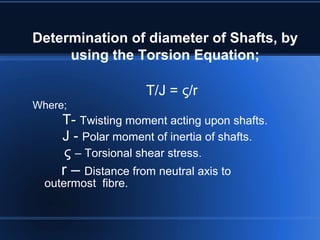
Determination of diameter of Shafts, by
using the Torsion Equation;
T/J = ς/r
Where;
T- Twisting moment acting upon shafts.
J - Polar moment of inertia of shafts.
ς – Torsional shear stress.
r – Distance from neutral axis to
outermost fibre.
For round solid Shafts,Polar Moment
of inertia,
J = π/32*d^4
Now Torsion equation is written as,
T / [π/32*d^4] = ς / (d/2)
Thus;
T = π/16* ς * d^3
For hollow Shafts, Polar Moment of inertia ,
J = π/32 [ (D^4) – (d^4) ]
Where ,
D and d – outside and inside diameter,
Therefore, torsion equation;
T / π/32[ D^4 – d^4 ] = ς / (D/2)
Thus;
T = π/16* ς * D^3 * (1 – k^4).
SHAFTS SUBJECTED TO
BENDING MOMENT ONLY
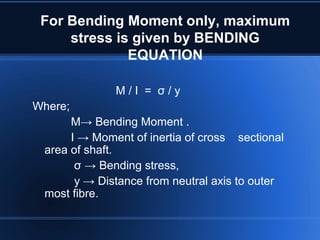
For Bending Moment only, maximum
stress is given by BENDING
EQUATION
M / I = σ / y
Where;
M→ Bending Moment .
I → Moment of inertia of cross sectional
area of shaft.
σ → Bending stress,
y → Distance from neutral axis to outer
most fibre.
For round solid shafts, moment of
inertia,
I = π/64* d^4
Therefore Bending equation is;
M / [π/64 * d^4 ] = σ/ (d/2)
Thus;
M = π/32* σ * d^4
For hollow Shafts, Moment of Inertia,
I = π / 64 [D^4 – d^4]
Putting the value, in Bending equation;
We have;
M / [π/64 { D^4 (1- k^4) }] = σ / (D/2)
Thus;
M = π/32* σ *D^3*(1 – k^4)
k → D/d
SHAFTS SUBJECTED TO
COMBINED TWISTING AND
BENDING MOMENT
In this case, the shafts must be designed on the basis of
two moments simultaneously. Various theories have been
suggested to account for the elastic failure of the materials
when they are subjected to various types of combined
stresses. Two theories are as follows -
1.Maximum Shear Stress Theory or Guest’s
theory
2.Maximum Normal Stress Theory or Rankine’s
theory
According to maximum Shear Stress
theory, maximum shear stress in shaft;
ςmax = (σ² + 4 ς ²)^0.5
Putting- ς = 16T/πd ³ and σ = 32M/ πd ³
In equation, on solving we get,
π/16* ςmax *d³ = [ M ² + T ² ]^0.5
The expression [ M + T ]^0.5 is known as
equivalent twisting moment
Represented by Te
Now according to Maximum normal shear
stress, the maximum normal stress in the
shaft;
σmax = 0.5* σ + 0.5[σ ² + 4ς² ]^0.5
Again put the values of σ, ς in above equation
We get,
σmax* d³ * π/32 = ½ [ M +{ M² + T² }½ ]
The expression ½ [ M +{ M² + T² }½ ] is known as
equivalent bending moment
Represented by Me
REFERENCESREFERENCES
V B BHANDARIV B BHANDARI
INTERNETINTERNET
THANK YOU

DESIGN OF SHAFT

  • 1.
    DESIGN OF SHAFT IMSECGHAZIABADIMSEC GHAZIABAD PULKIT PATHAKPULKIT PATHAK 44thth YEARYEAR
  • 2.
    SHAFT INTRODUCTIONSHAFT INTRODUCTION THETERM SHAFT USUALLY REFERS TO A ROTATING MACHINE ELEMENTTHE TERM SHAFT USUALLY REFERS TO A ROTATING MACHINE ELEMENT CIRCULAR IN CROSS SECTION WHICH SUPPORTS TRANSMISSIONCIRCULAR IN CROSS SECTION WHICH SUPPORTS TRANSMISSION ELEMENTS LIKE GEARS,PULLEYS ETCELEMENTS LIKE GEARS,PULLEYS ETC
  • 3.
    DIFFERENCE BETWEEN AXLEAND SHAFTDIFFERENCE BETWEEN AXLE AND SHAFT Ideally speaking Axles are meant forIdeally speaking Axles are meant for balancing/transferring Bendingbalancing/transferring Bending moment and Shafts are meant formoment and Shafts are meant for Balancing/transferring Torque.Balancing/transferring Torque.
  • 4.
    The shafts maybe designed on the basis of - Strength Stiffness
  • 5.
    Cases of designingof shafts, on the basis of Strength (a) Shafts subjected to Twisting Moment only. (b) Shafts subjected to Bending Moment only. (c) Shafts subjected to Combined Twisting and Bending Moment only.
  • 6.
  • 7.
    Determination of diameterof Shafts, by using the Torsion Equation; T/J = ς/r Where; T- Twisting moment acting upon shafts. J - Polar moment of inertia of shafts. ς – Torsional shear stress. r – Distance from neutral axis to outermost fibre.
  • 8.
    For round solidShafts,Polar Moment of inertia, J = π/32*d^4 Now Torsion equation is written as, T / [π/32*d^4] = ς / (d/2) Thus; T = π/16* ς * d^3
  • 9.
    For hollow Shafts,Polar Moment of inertia , J = π/32 [ (D^4) – (d^4) ] Where , D and d – outside and inside diameter, Therefore, torsion equation; T / π/32[ D^4 – d^4 ] = ς / (D/2) Thus; T = π/16* ς * D^3 * (1 – k^4).
  • 10.
  • 11.
    For Bending Momentonly, maximum stress is given by BENDING EQUATION M / I = σ / y Where; M→ Bending Moment . I → Moment of inertia of cross sectional area of shaft. σ → Bending stress, y → Distance from neutral axis to outer most fibre.
  • 12.
    For round solidshafts, moment of inertia, I = π/64* d^4 Therefore Bending equation is; M / [π/64 * d^4 ] = σ/ (d/2) Thus; M = π/32* σ * d^4
  • 13.
    For hollow Shafts,Moment of Inertia, I = π / 64 [D^4 – d^4] Putting the value, in Bending equation; We have; M / [π/64 { D^4 (1- k^4) }] = σ / (D/2) Thus; M = π/32* σ *D^3*(1 – k^4) k → D/d
  • 14.
    SHAFTS SUBJECTED TO COMBINEDTWISTING AND BENDING MOMENT
  • 15.
    In this case,the shafts must be designed on the basis of two moments simultaneously. Various theories have been suggested to account for the elastic failure of the materials when they are subjected to various types of combined stresses. Two theories are as follows - 1.Maximum Shear Stress Theory or Guest’s theory 2.Maximum Normal Stress Theory or Rankine’s theory
  • 16.
    According to maximumShear Stress theory, maximum shear stress in shaft; ςmax = (σ² + 4 ς ²)^0.5 Putting- ς = 16T/πd ³ and σ = 32M/ πd ³ In equation, on solving we get, π/16* ςmax *d³ = [ M ² + T ² ]^0.5 The expression [ M + T ]^0.5 is known as equivalent twisting moment Represented by Te
  • 17.
    Now according toMaximum normal shear stress, the maximum normal stress in the shaft; σmax = 0.5* σ + 0.5[σ ² + 4ς² ]^0.5 Again put the values of σ, ς in above equation We get, σmax* d³ * π/32 = ½ [ M +{ M² + T² }½ ] The expression ½ [ M +{ M² + T² }½ ] is known as equivalent bending moment Represented by Me
  • 18.
    REFERENCESREFERENCES V B BHANDARIVB BHANDARI INTERNETINTERNET
  • 19.