ACADEMIC LIBRARIES
AND
THEIR FUNCTIONS
Dr.M.Prabakaran
WHY DO WE READ?
Reading helps to develop vital language skills
Opens up acquisition of new words
It helps to enhances social skills
To know what’s happening around us
To understand the subject matter
To increase power of judgment
To understand human life/mind
To experience/experiment new things
Library: Meaning & Definition
The term “library” is derived from the
Latin word “liber”, which means ‘a
book’
Library is a place where the information
is collected, processed, stored, and
made them available to the users for an
effective use.
• In Advanced Learners English
dictionary, library refers to a collection
of book gathered for study, research,
reference and recreation.
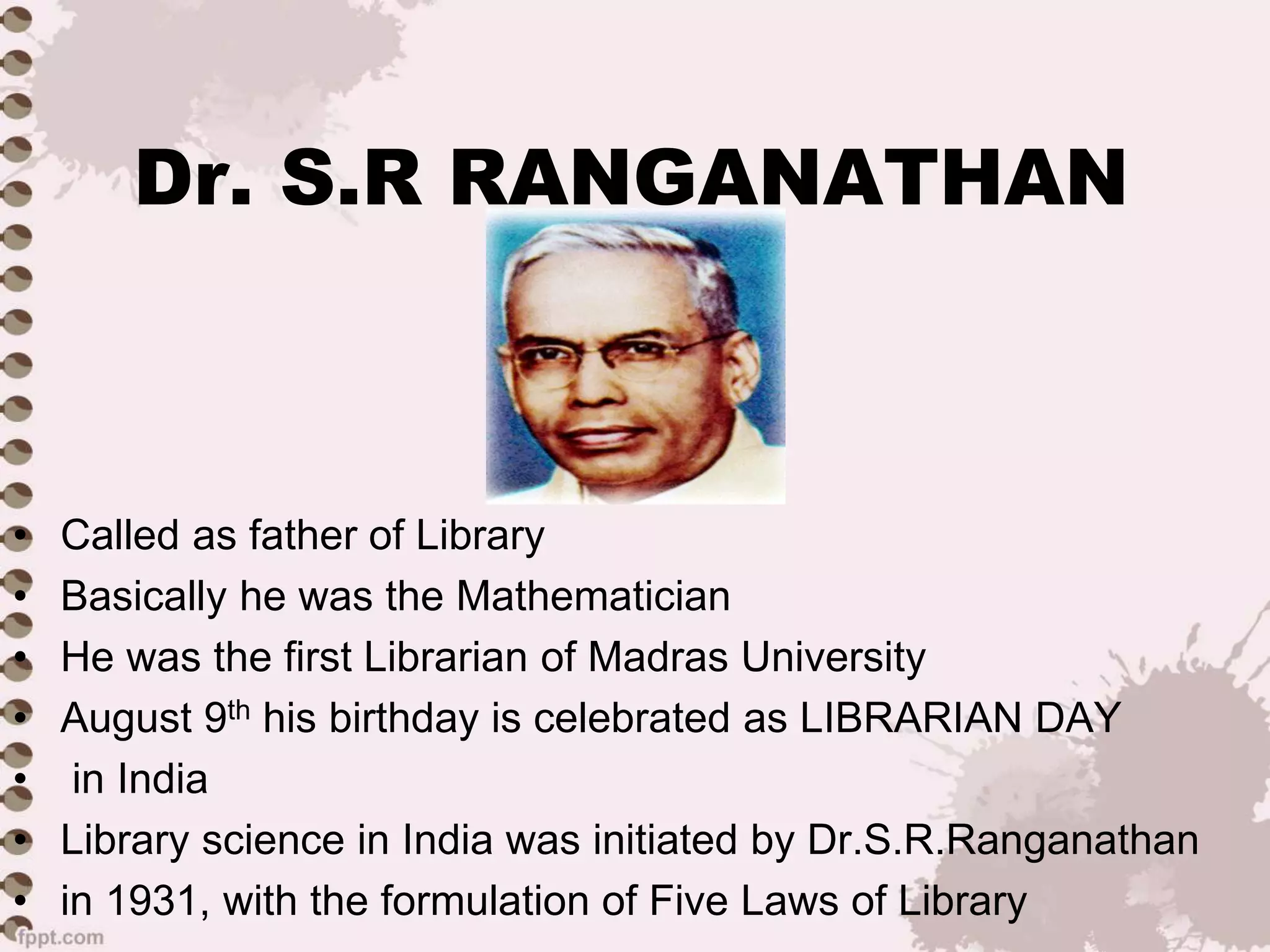
Dr. S.R RANGANATHAN
• Called as father of Library
• Basically he was the Mathematician
• He was the first Librarian of Madras University
• August 9th his birthday is celebrated as LIBRARIAN DAY
• in India
• Library science in India was initiated by Dr.S.R.Ranganathan
• in 1931, with the formulation of Five Laws of Library
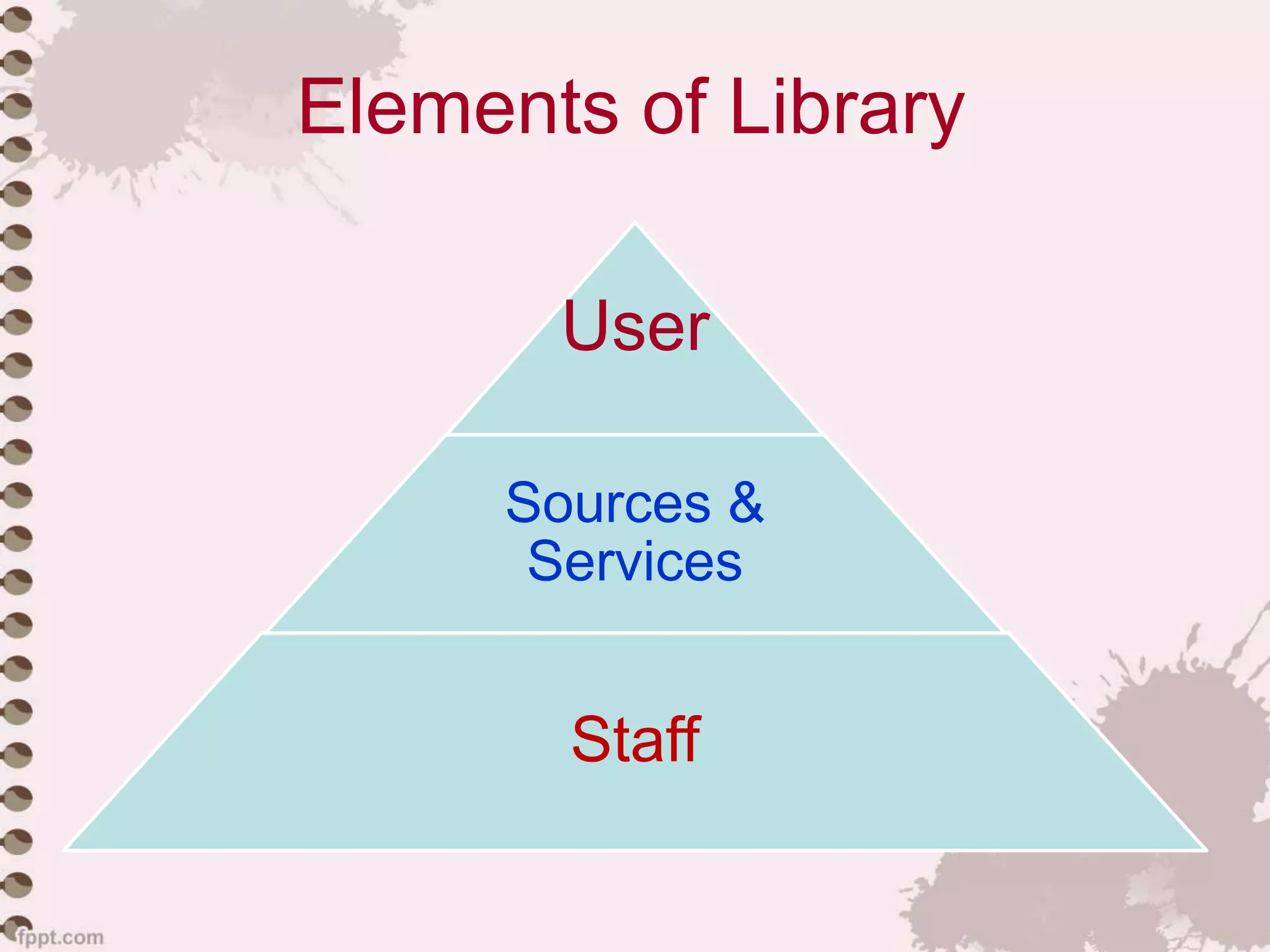
Elements of Library
User
Sources &
Services
Staff
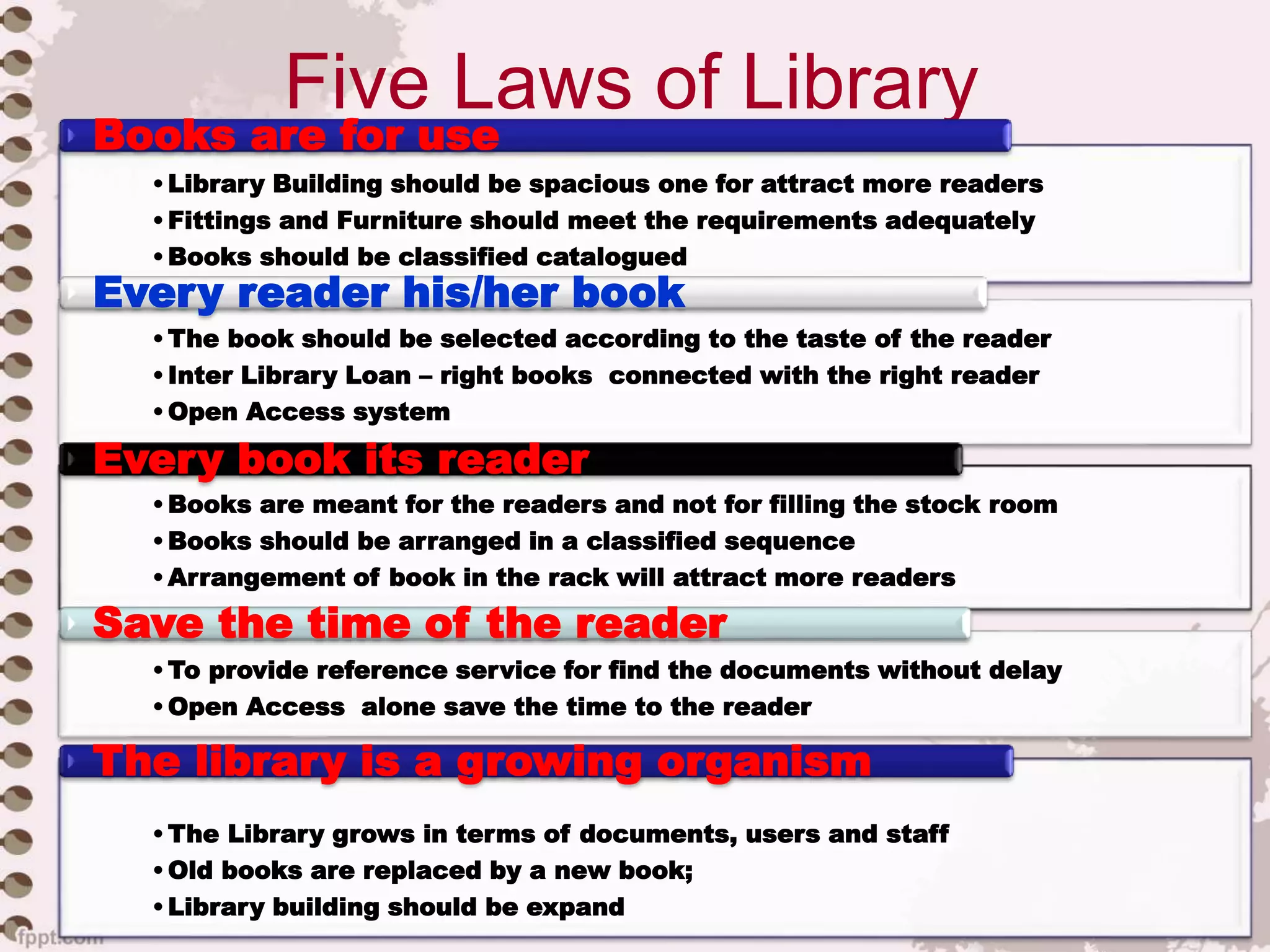
Five Laws of Library
•Library Building should be spacious one for attract more readers
•Fittings and Furniture should meet the requirements adequately
•Books should be classified catalogued
• Damaged books should be repaired immediately
Books are for use
•The book should be selected according to the taste of the reader
•Inter Library Loan – right books connected with the right reader
•Open Access system
Every reader his/her book
•Books are meant for the readers and not for filling the stock room
•Books should be arranged in a classified sequence
•Arrangement of book in the rack will attract more readers
Every book its reader
•To provide reference service for find the documents without delay
•Open Access alone save the time to the reader
Save the time of the reader
•The Library grows in terms of documents, users and staff
•Old books are replaced by a new book;
•Library building should be expand
The library is a growing organism
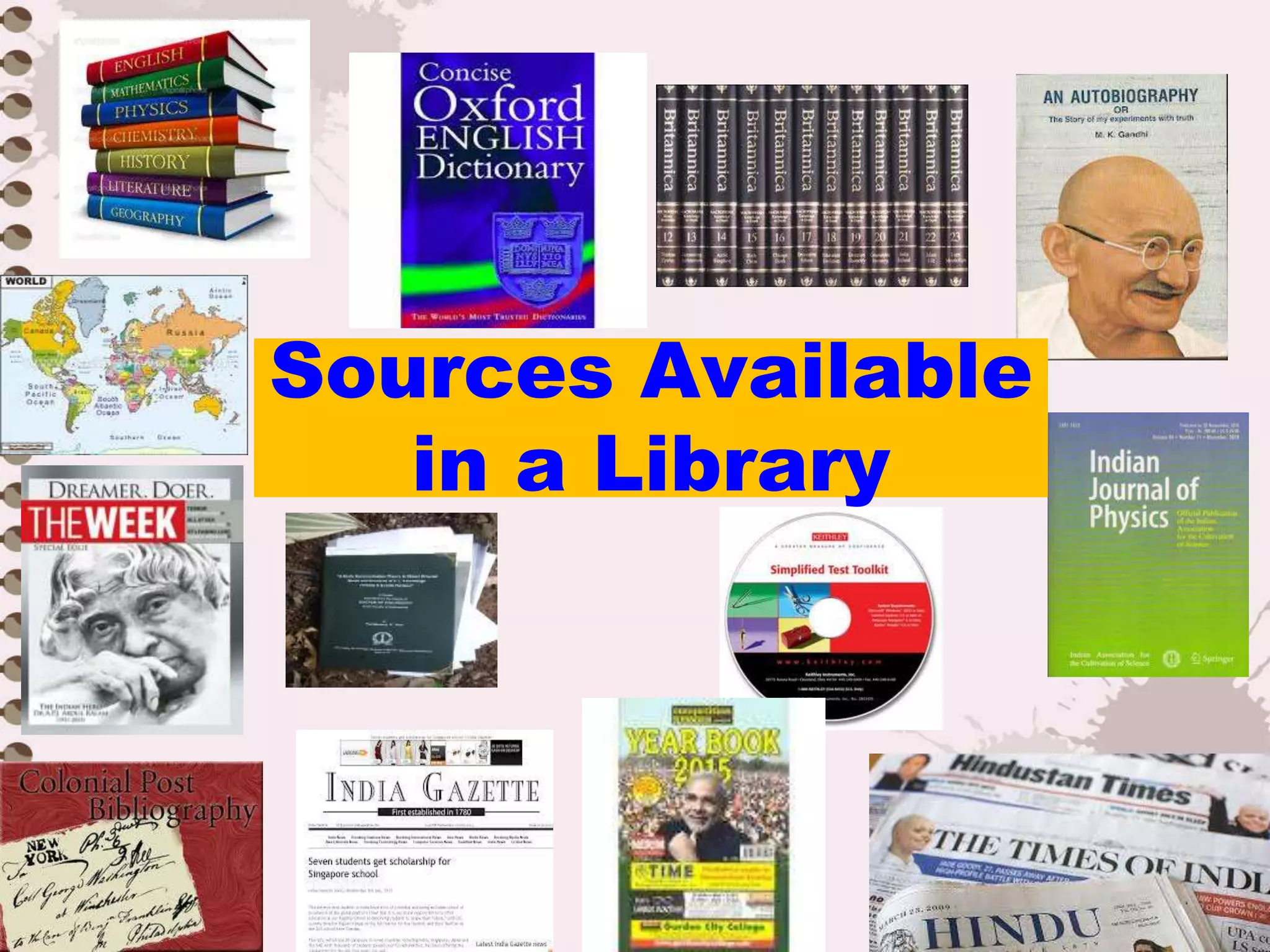
Sources Available
in a Library
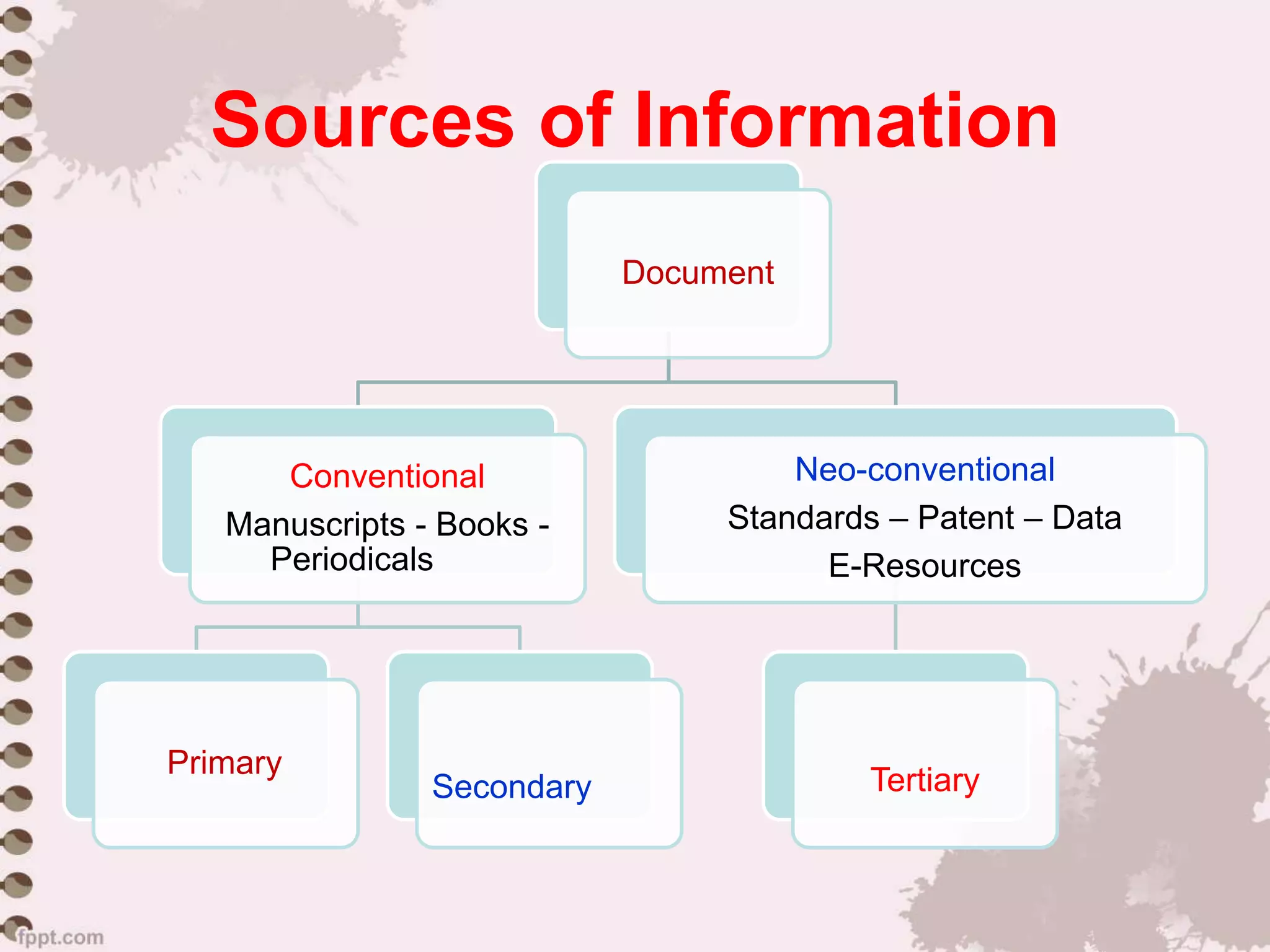
Sources of Information
Document
Conventional
Manuscripts - Books -
Periodicals
Primary
Secondary
Neo-conventional
Standards – Patent – Data
E-Resources
Tertiary
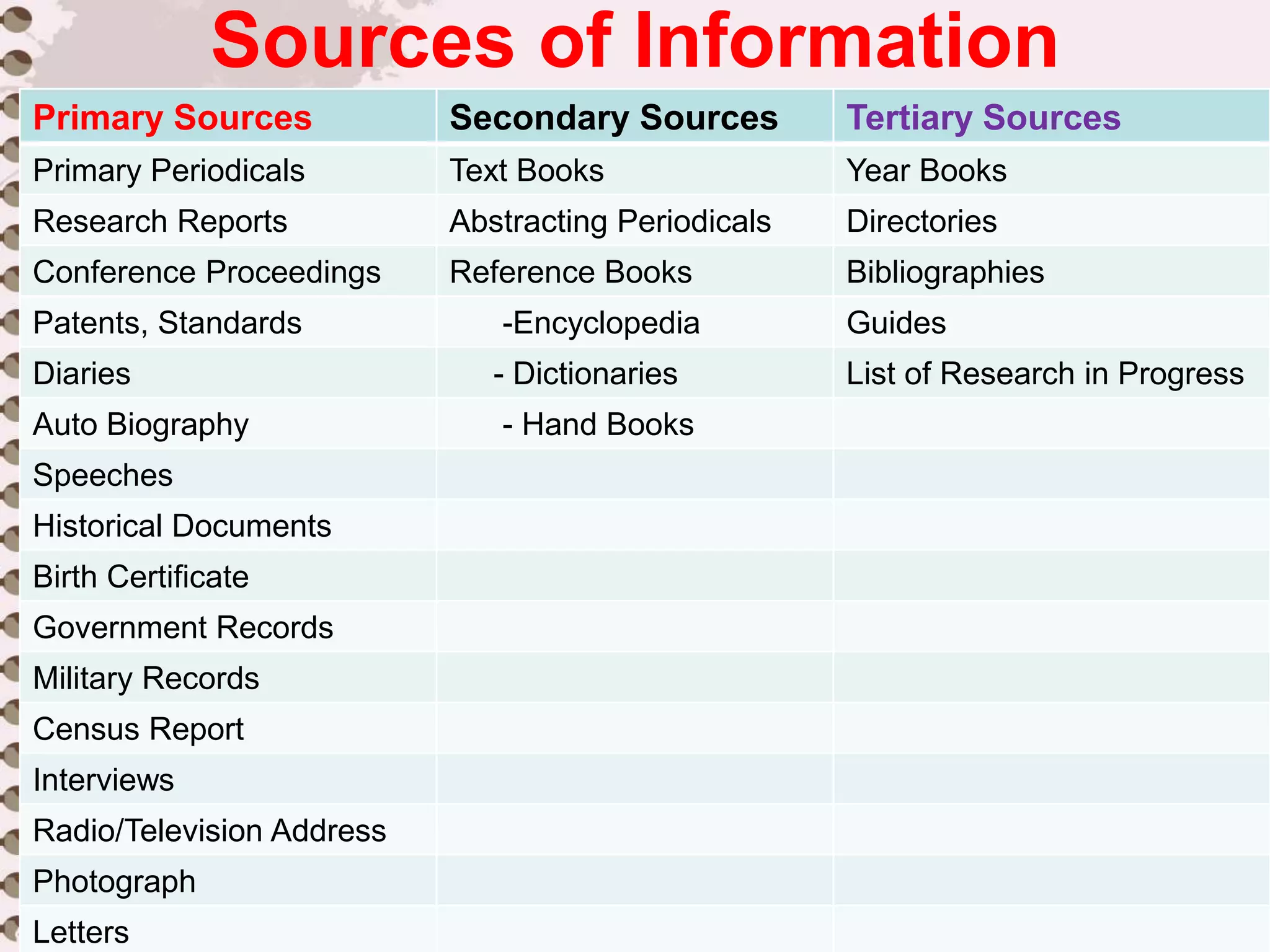
Sources of Information
Primary Sources Secondary Sources Tertiary Sources
Primary Periodicals Text Books Year Books
Research Reports Abstracting Periodicals Directories
Conference Proceedings Reference Books Bibliographies
Patents, Standards -Encyclopedia Guides
Diaries - Dictionaries List of Research in Progress
Auto Biography - Hand Books
Speeches
Historical Documents
Birth Certificate
Government Records
Military Records
Census Report
Interviews
Radio/Television Address
Photograph
Letters
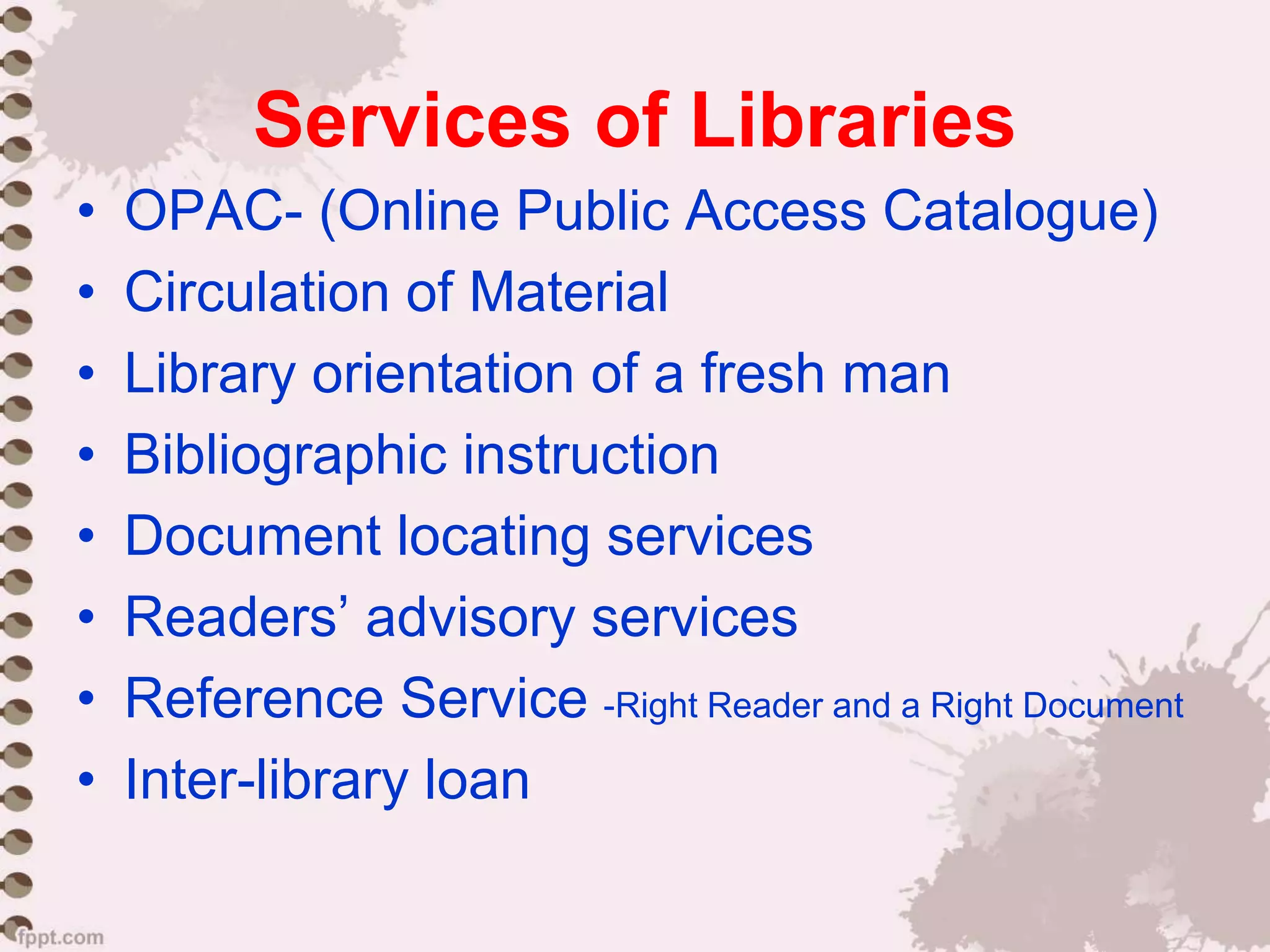
Services of Libraries
• OPAC- (Online Public Access Catalogue)
• Circulation of Material
• Library orientation of a fresh man
• Bibliographic instruction
• Document locating services
• Readers’ advisory services
• Reference Service -Right Reader and a Right Document
• Inter-library loan
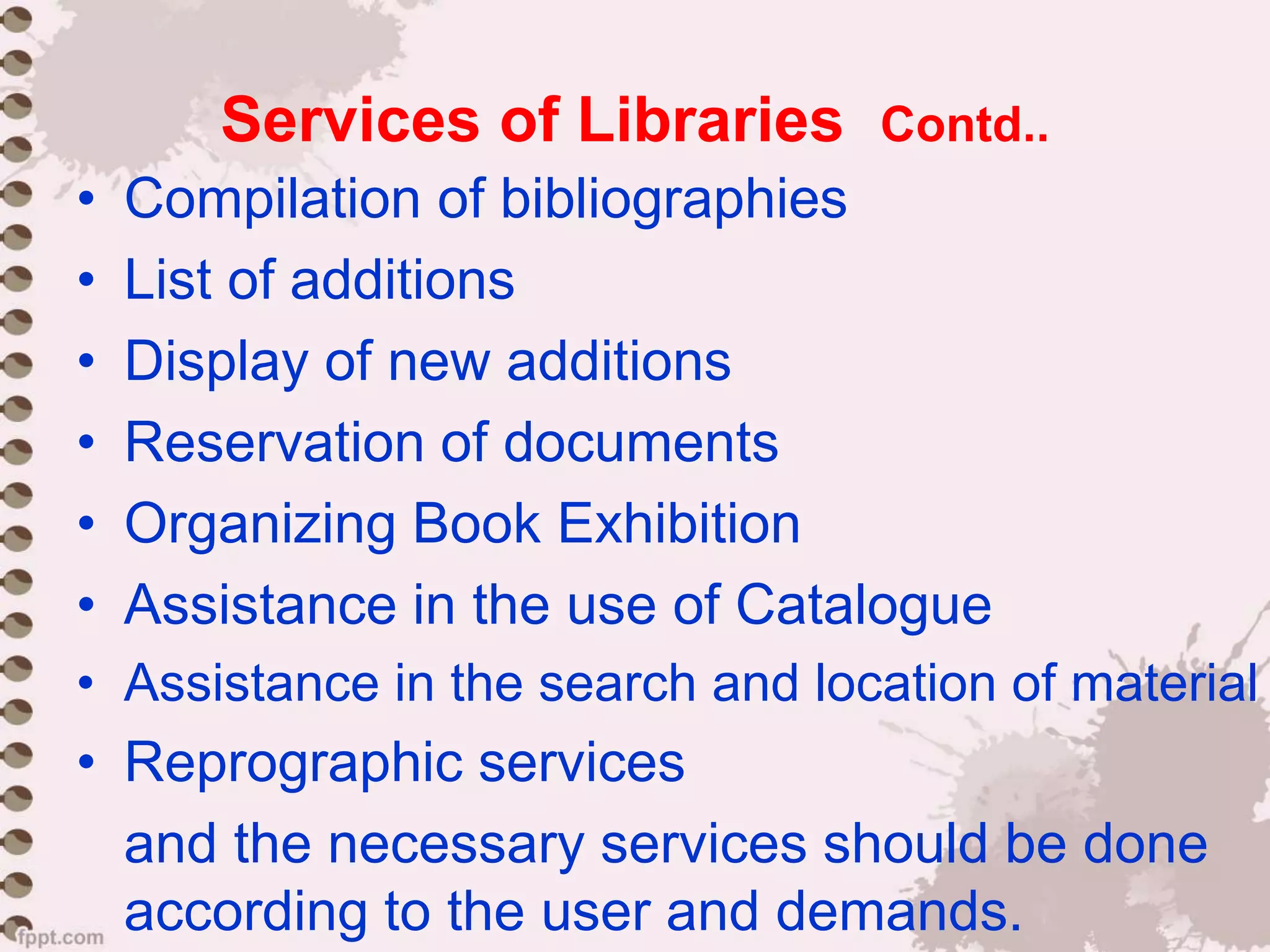
Services of Libraries Contd..
• Compilation of bibliographies
• List of additions
• Display of new additions
• Reservation of documents
• Organizing Book Exhibition
• Assistance in the use of Catalogue
• Assistance in the search and location of material
• Reprographic services
and the necessary services should be done
according to the user and demands.
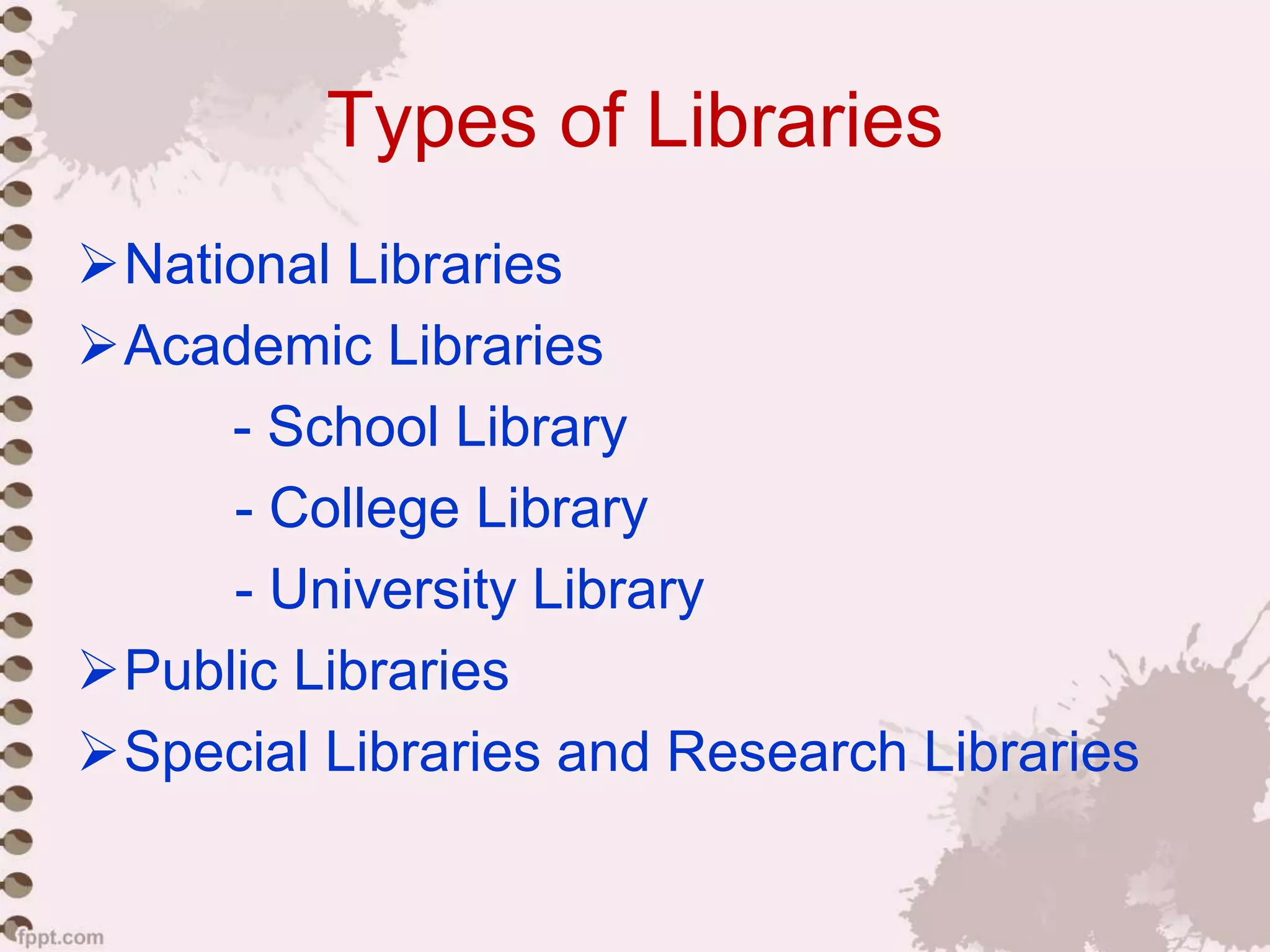
Types of Libraries
National Libraries
Academic Libraries
- School Library
- College Library
- University Library
Public Libraries
Special Libraries and Research Libraries
National Library
It is a library maintained by the government
It is serving the nation as a whole
The books available in such libraries are for
reference only
These are usually copyright libraries
The function is to collect and preserve for
posterity, the books, periodicals, newspapers,
and other documents published in the country
National Library: Objectives
To provide leadership among the nation’s
libraries
To serve as a permanent depository for all
publications issued in the country
To provide bibliographical services
To serve as a co-ordinating centre for co-
operative activities
To provide service to government
National Library: Functions
 To acquire and maintain documents about the
country or its people or activities, published outside
the country
 To collect and preserve select manuscripts and such
other archival records of national relevance and
importance
 To collect and preserve specialised materials–books
for the blind dramatic, compositions, engravings,
medals, music compositions, etc.
 To serve as a central and comprehensive collection
of national output acquired through legal deposits,
gifts or exchange
National Library: Functions

contd..
 To disseminate catalogues in printed. Microforms, and
machine readable forms
 To provide compilation of retrospective or current
bibliographies on various subjects in anticipation on
request
 To provide index to currently published journals
literature appearing in research or scholarly
periodicals
 To prepare abstracts of current literature on subjects
of national interest
 To prepare national bibliographies of books,
periodicals and other non-print materials
ACADEMIC LIBRARIES
School Libraries
College Libraries
University Libraries
School Libraries
Primary
Middle
Secondary
Higher Secondary
Objectives-Primary and Middle
School Libraries
To Foster book mindedness
To strengthen learning skills through kits
To create a love for books and other
learning resources
To inculcate the habit of reading in a slow
but deliberate process
Collections-Primary and Middle
 Picture books depicting acts and deeds of awards and adventure
patriotism, service to fellow persons and other similar themes
 Biographies of great Men and Women
 Books of travel and humour
 Folk tales , Stories from the Panchatantra, Arabian Nights, etc.
 Stories of animal and birds books
 Popular Games and Sports Books
 Cultural heritage Books
 Reference books – Children’s Encyclopaedia , Illustrated
Dictionaries , etc.
 Children’s Magazines- Children’s World , Tinkle, etc.
 Audio visual Aids – Motion films , Animated films , Video
cassettes
 Models , Charts , Maps , Globes , Picture , Photographs , Toys ,
etc.
Services-Primary and middle
Reference service to the users at request
Story hours
Display of Press and other Clippings
Film shows
Video shows both for Entertainment and
teaming on various themes
Books displays and exhibitions on important
occasions
Objectives –Secondary Schools
Libraries
To inculcate the habit of using the school
library – Course requirements, General
knowledge and recreation
To develop learning skills for collecting
information on any topic consulting reference
books and other reading materials
To provide opportunities to students to visit
other academic, Special and Pubic Libraries
Collection-Secondary School
Libraries
Text Books – Both prescribed and others
on all subjects
Relatively more advanced books
General Books – Popular Science,
Biographies of Great Persons,
Geographical Explorations, Sports and
Games, etc.
College Libraries-Uers
UG Students
PG Students
Research Scholars
Teachers
Administrative Staff
College Libraries-Collections
Text Books
Reference Books – Encyclopaedia, Subject
and Language Dictionaries, Hand Books,
Manual, Bibliographical Sources,
Geographical Sources etc.
Light Reading material – Humour Books, Art
Books, Fictions etc.
Journals and Magazines
Audio-visual material – Films, Pictures, Audio
Cassettes, Video Cassettes,
E-Resources etc.
College Libraries-Obejectives
To accomplished the objectives of
institutions
To increase the usage of resources and
users satisfaction
To make the users aware of collections
To enrich the collections based on the
needs
College Libraries-Services
Lending Service
Reference Service
Current Awareness Service
Abstracting and Indexing Service
Reprographic Service
Audio-Visual Service
Exhibition and Special Display
Assistance in the use of Library
University Libraries-Functions
Collection Development
Collection Maintenance
Stock Verification
Providing a variety of services
University Library-Services
 Lending
 Reference
 CAS
 SDI
 Alerting Service
 News Paper Clippings
 Bibliographic Service
 Reprographic Service
 Translation Service
 Document Delivery Service
 User Education
 User Oriented Seminar, Workshops
Public Libraries-Definition
A Public Library which being the local
Gateway to Knowledge, provides a basic
condition for life long learning,
independent decision making and cultural
development of the individual and social
groups.
The local centre of information, making all
kinds of knowledge and information
readily and freely available to its users.
Public Libraries-Functions
Creating and Strengthening reading skills
and habits in children from an early age
Supporting both Individual and Self-
conducted education
Providing opportunities for personal
creative development
Stimulating the imagination and creativity
of children and young people
Promoting awareness of Cultural heritage,
Appreciation of the arts, Scientific
achievements and innovation
Public Libraries-Functions
 Providing access to cultural expressions of all
performing arts;
 Fostering inter-cultural dialogue and favoring
cultural diversity;
 Supporting the Oral tradition;
 Ensuring access for citizens to all sorts of
community information;
 Providing adequate information services to local
enterprises, associations and interest groups;
 Facilitating the development of information and
computer literacy skills.
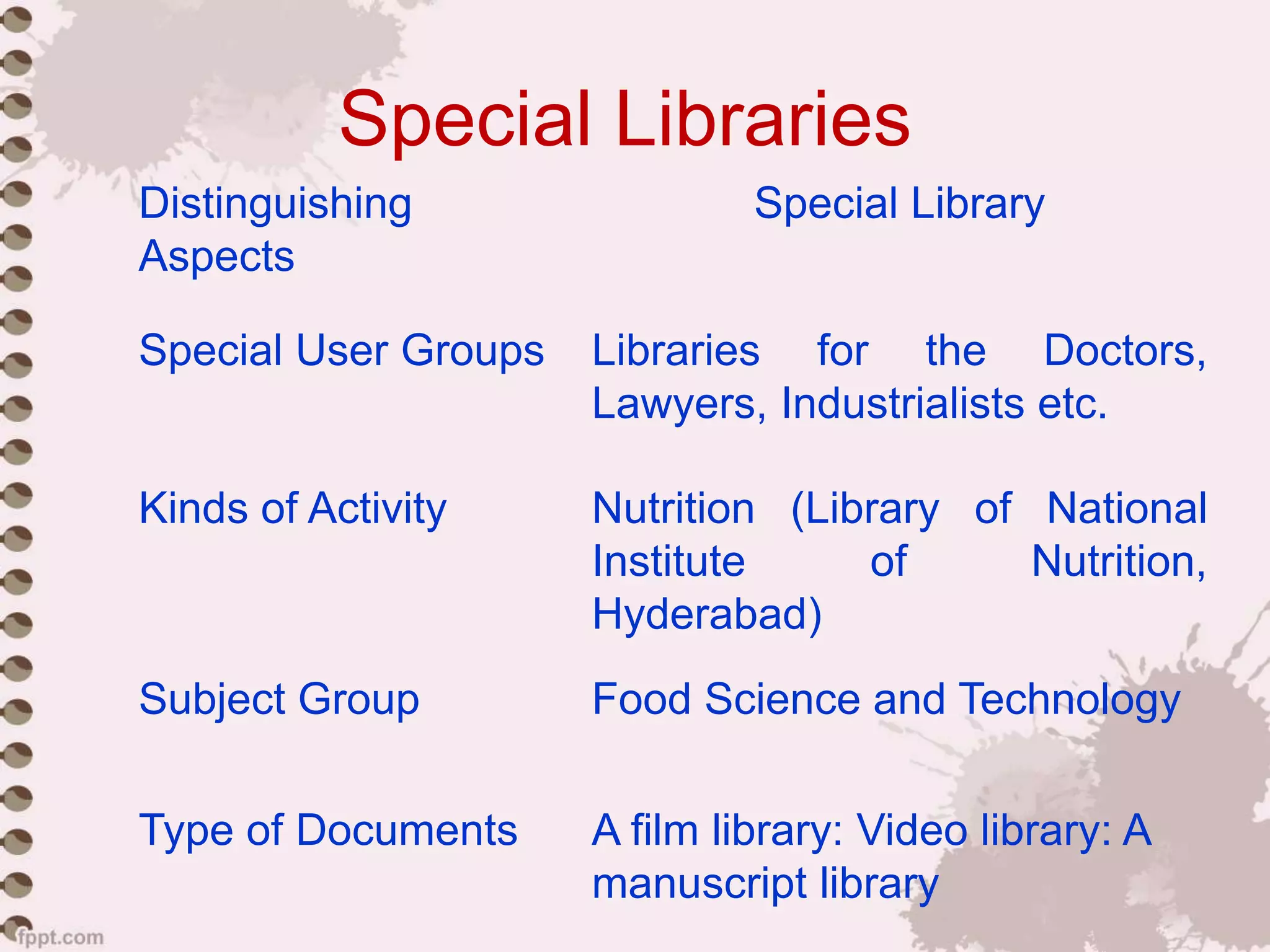
Special Libraries
Distinguishing
Aspects
Special Library
Special User Groups Libraries for the Doctors,
Lawyers, Industrialists etc.
Kinds of Activity Nutrition (Library of National
Institute of Nutrition,
Hyderabad)
Subject Group Food Science and Technology
Type of Documents A film library: Video library: A
manuscript library
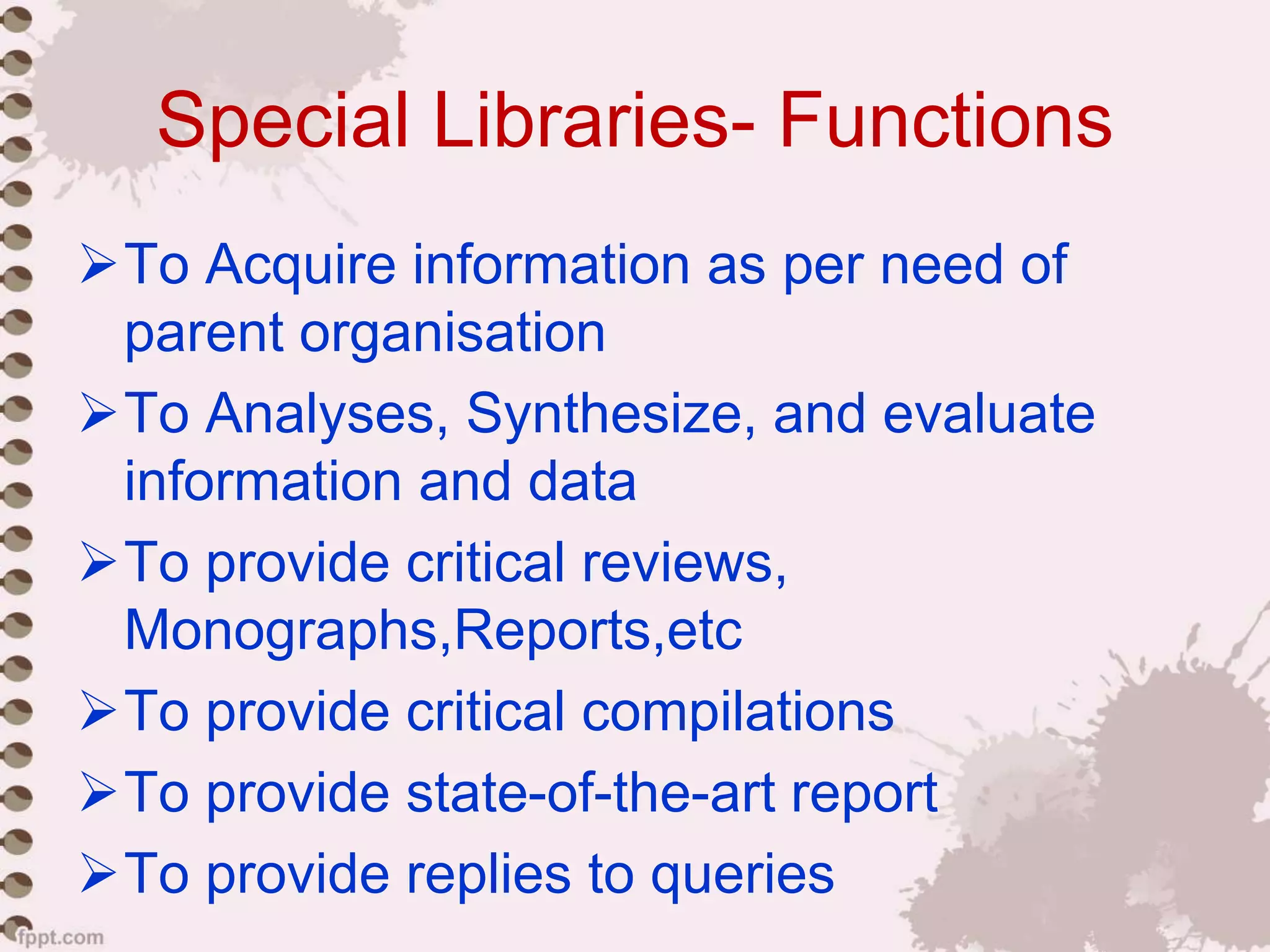
Special Libraries- Functions
To Acquire information as per need of
parent organisation
To Analyses, Synthesize, and evaluate
information and data
To provide critical reviews,
Monographs,Reports,etc
To provide critical compilations
To provide state-of-the-art report
To provide replies to queries
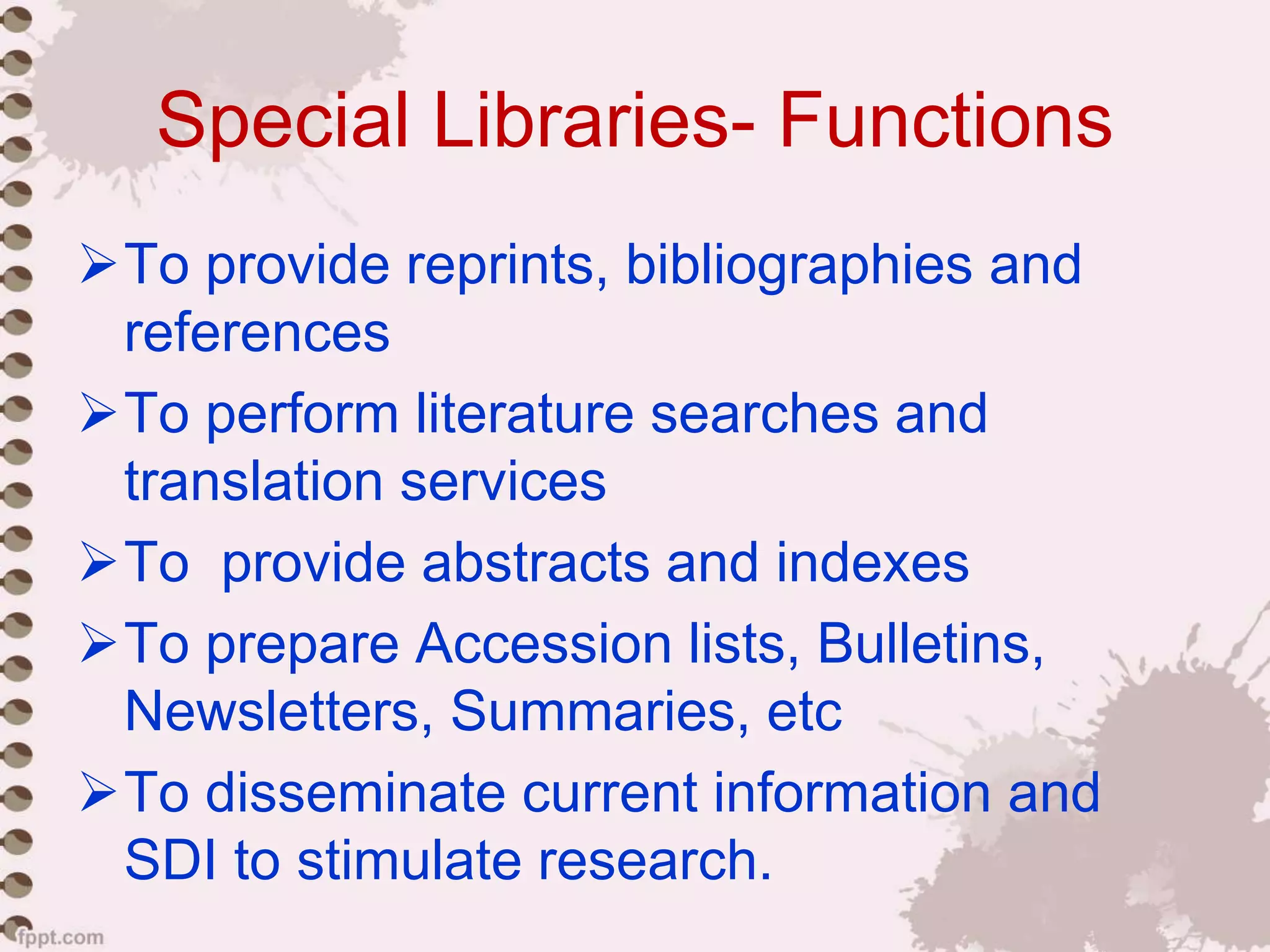
Special Libraries- Functions
To provide reprints, bibliographies and
references
To perform literature searches and
translation services
To provide abstracts and indexes
To prepare Accession lists, Bulletins,
Newsletters, Summaries, etc
To disseminate current information and
SDI to stimulate research.
Thank You
Read Today, Lead Tomorrow

Academic library and their functions

  • 1.
  • 2.
    WHY DO WEREAD? Reading helps to develop vital language skills Opens up acquisition of new words It helps to enhances social skills To know what’s happening around us To understand the subject matter To increase power of judgment To understand human life/mind To experience/experiment new things
  • 3.
    Library: Meaning &Definition The term “library” is derived from the Latin word “liber”, which means ‘a book’ Library is a place where the information is collected, processed, stored, and made them available to the users for an effective use. • In Advanced Learners English dictionary, library refers to a collection of book gathered for study, research, reference and recreation.
  • 4.
    Dr. S.R RANGANATHAN •Called as father of Library • Basically he was the Mathematician • He was the first Librarian of Madras University • August 9th his birthday is celebrated as LIBRARIAN DAY • in India • Library science in India was initiated by Dr.S.R.Ranganathan • in 1931, with the formulation of Five Laws of Library
  • 5.
  • 6.
    Five Laws ofLibrary •Library Building should be spacious one for attract more readers •Fittings and Furniture should meet the requirements adequately •Books should be classified catalogued • Damaged books should be repaired immediately Books are for use •The book should be selected according to the taste of the reader •Inter Library Loan – right books connected with the right reader •Open Access system Every reader his/her book •Books are meant for the readers and not for filling the stock room •Books should be arranged in a classified sequence •Arrangement of book in the rack will attract more readers Every book its reader •To provide reference service for find the documents without delay •Open Access alone save the time to the reader Save the time of the reader •The Library grows in terms of documents, users and staff •Old books are replaced by a new book; •Library building should be expand The library is a growing organism
  • 7.
  • 8.
    Sources of Information Document Conventional Manuscripts- Books - Periodicals Primary Secondary Neo-conventional Standards – Patent – Data E-Resources Tertiary
  • 9.
    Sources of Information PrimarySources Secondary Sources Tertiary Sources Primary Periodicals Text Books Year Books Research Reports Abstracting Periodicals Directories Conference Proceedings Reference Books Bibliographies Patents, Standards -Encyclopedia Guides Diaries - Dictionaries List of Research in Progress Auto Biography - Hand Books Speeches Historical Documents Birth Certificate Government Records Military Records Census Report Interviews Radio/Television Address Photograph Letters
  • 10.
    Services of Libraries •OPAC- (Online Public Access Catalogue) • Circulation of Material • Library orientation of a fresh man • Bibliographic instruction • Document locating services • Readers’ advisory services • Reference Service -Right Reader and a Right Document • Inter-library loan
  • 11.
    Services of LibrariesContd.. • Compilation of bibliographies • List of additions • Display of new additions • Reservation of documents • Organizing Book Exhibition • Assistance in the use of Catalogue • Assistance in the search and location of material • Reprographic services and the necessary services should be done according to the user and demands.
  • 12.
    Types of Libraries NationalLibraries Academic Libraries - School Library - College Library - University Library Public Libraries Special Libraries and Research Libraries
  • 13.
    National Library It isa library maintained by the government It is serving the nation as a whole The books available in such libraries are for reference only These are usually copyright libraries The function is to collect and preserve for posterity, the books, periodicals, newspapers, and other documents published in the country
  • 14.
    National Library: Objectives Toprovide leadership among the nation’s libraries To serve as a permanent depository for all publications issued in the country To provide bibliographical services To serve as a co-ordinating centre for co- operative activities To provide service to government
  • 15.
    National Library: Functions To acquire and maintain documents about the country or its people or activities, published outside the country  To collect and preserve select manuscripts and such other archival records of national relevance and importance  To collect and preserve specialised materials–books for the blind dramatic, compositions, engravings, medals, music compositions, etc.  To serve as a central and comprehensive collection of national output acquired through legal deposits, gifts or exchange
  • 16.
    National Library: Functions  contd.. To disseminate catalogues in printed. Microforms, and machine readable forms  To provide compilation of retrospective or current bibliographies on various subjects in anticipation on request  To provide index to currently published journals literature appearing in research or scholarly periodicals  To prepare abstracts of current literature on subjects of national interest  To prepare national bibliographies of books, periodicals and other non-print materials
  • 17.
    ACADEMIC LIBRARIES School Libraries CollegeLibraries University Libraries
  • 18.
  • 19.
    Objectives-Primary and Middle SchoolLibraries To Foster book mindedness To strengthen learning skills through kits To create a love for books and other learning resources To inculcate the habit of reading in a slow but deliberate process
  • 20.
    Collections-Primary and Middle Picture books depicting acts and deeds of awards and adventure patriotism, service to fellow persons and other similar themes  Biographies of great Men and Women  Books of travel and humour  Folk tales , Stories from the Panchatantra, Arabian Nights, etc.  Stories of animal and birds books  Popular Games and Sports Books  Cultural heritage Books  Reference books – Children’s Encyclopaedia , Illustrated Dictionaries , etc.  Children’s Magazines- Children’s World , Tinkle, etc.  Audio visual Aids – Motion films , Animated films , Video cassettes  Models , Charts , Maps , Globes , Picture , Photographs , Toys , etc.
  • 21.
    Services-Primary and middle Referenceservice to the users at request Story hours Display of Press and other Clippings Film shows Video shows both for Entertainment and teaming on various themes Books displays and exhibitions on important occasions
  • 22.
    Objectives –Secondary Schools Libraries Toinculcate the habit of using the school library – Course requirements, General knowledge and recreation To develop learning skills for collecting information on any topic consulting reference books and other reading materials To provide opportunities to students to visit other academic, Special and Pubic Libraries
  • 23.
    Collection-Secondary School Libraries Text Books– Both prescribed and others on all subjects Relatively more advanced books General Books – Popular Science, Biographies of Great Persons, Geographical Explorations, Sports and Games, etc.
  • 24.
    College Libraries-Uers UG Students PGStudents Research Scholars Teachers Administrative Staff
  • 25.
    College Libraries-Collections Text Books ReferenceBooks – Encyclopaedia, Subject and Language Dictionaries, Hand Books, Manual, Bibliographical Sources, Geographical Sources etc. Light Reading material – Humour Books, Art Books, Fictions etc. Journals and Magazines Audio-visual material – Films, Pictures, Audio Cassettes, Video Cassettes, E-Resources etc.
  • 26.
    College Libraries-Obejectives To accomplishedthe objectives of institutions To increase the usage of resources and users satisfaction To make the users aware of collections To enrich the collections based on the needs
  • 27.
    College Libraries-Services Lending Service ReferenceService Current Awareness Service Abstracting and Indexing Service Reprographic Service Audio-Visual Service Exhibition and Special Display Assistance in the use of Library
  • 28.
    University Libraries-Functions Collection Development CollectionMaintenance Stock Verification Providing a variety of services
  • 29.
    University Library-Services  Lending Reference  CAS  SDI  Alerting Service  News Paper Clippings  Bibliographic Service  Reprographic Service  Translation Service  Document Delivery Service  User Education  User Oriented Seminar, Workshops
  • 30.
    Public Libraries-Definition A PublicLibrary which being the local Gateway to Knowledge, provides a basic condition for life long learning, independent decision making and cultural development of the individual and social groups. The local centre of information, making all kinds of knowledge and information readily and freely available to its users.
  • 31.
    Public Libraries-Functions Creating andStrengthening reading skills and habits in children from an early age Supporting both Individual and Self- conducted education Providing opportunities for personal creative development Stimulating the imagination and creativity of children and young people Promoting awareness of Cultural heritage, Appreciation of the arts, Scientific achievements and innovation
  • 32.
    Public Libraries-Functions  Providingaccess to cultural expressions of all performing arts;  Fostering inter-cultural dialogue and favoring cultural diversity;  Supporting the Oral tradition;  Ensuring access for citizens to all sorts of community information;  Providing adequate information services to local enterprises, associations and interest groups;  Facilitating the development of information and computer literacy skills.
  • 33.
    Special Libraries Distinguishing Aspects Special Library SpecialUser Groups Libraries for the Doctors, Lawyers, Industrialists etc. Kinds of Activity Nutrition (Library of National Institute of Nutrition, Hyderabad) Subject Group Food Science and Technology Type of Documents A film library: Video library: A manuscript library
  • 34.
    Special Libraries- Functions ToAcquire information as per need of parent organisation To Analyses, Synthesize, and evaluate information and data To provide critical reviews, Monographs,Reports,etc To provide critical compilations To provide state-of-the-art report To provide replies to queries
  • 35.
    Special Libraries- Functions Toprovide reprints, bibliographies and references To perform literature searches and translation services To provide abstracts and indexes To prepare Accession lists, Bulletins, Newsletters, Summaries, etc To disseminate current information and SDI to stimulate research.
  • 36.
    Thank You Read Today,Lead Tomorrow