How to simplify the
complexity of surplus
earnings
Wednesday 1 July
Policy in Practice
webinar
Housekeeping
www.policyinpractice.co.uk
● Audio check
● Please ask questions
● Poll and a survey
● Aim to finish by 11:30 with optional 15 mins extra
● Slides and recording will automatically follow
● We’re live tweeting via @policy_practice with hashtag #HelpfulPolicy
Today’s speakers
www.policyinpractice.co.uk
Janet Harkin
Head of
Marketing
Policy in Practice
@jharkin
Zoe Charlesworth
Head of Policy
Policy in Practice
@ZoeCharleswort1
Duncan Hatfield
Policy and
Operations Analyst
Policy in Practice
@drh000
Sue McCarron
Ask Us Wirral
Service Manager
Citizens Advice
Wirral
@WirralCAN
Peter Carter
Business Account
Manager
Policy in Practice
@petersgc_
www.policyinpractice.co.uk
Give the best support
you can to help people
on their way
policy
software
analytics
Agenda
www.policyinpractice.co.uk/software
● A simple guide to the SEISS, Universal Credit and surplus earnings rules
● Worked examples illustrating the challenge, and what to look out for
● How Wirral Citizens Advice helps people with fluctuating income
● Questions and answers
● Stay on for 15 mins for a Benefit and Budgeting Calculator demo (optional)
666
Poll: What do your clients find most
difficult about irregular income?
www.policyinpractice.co.uk
777
Over to Zoe
www.policyinpractice.co.uk
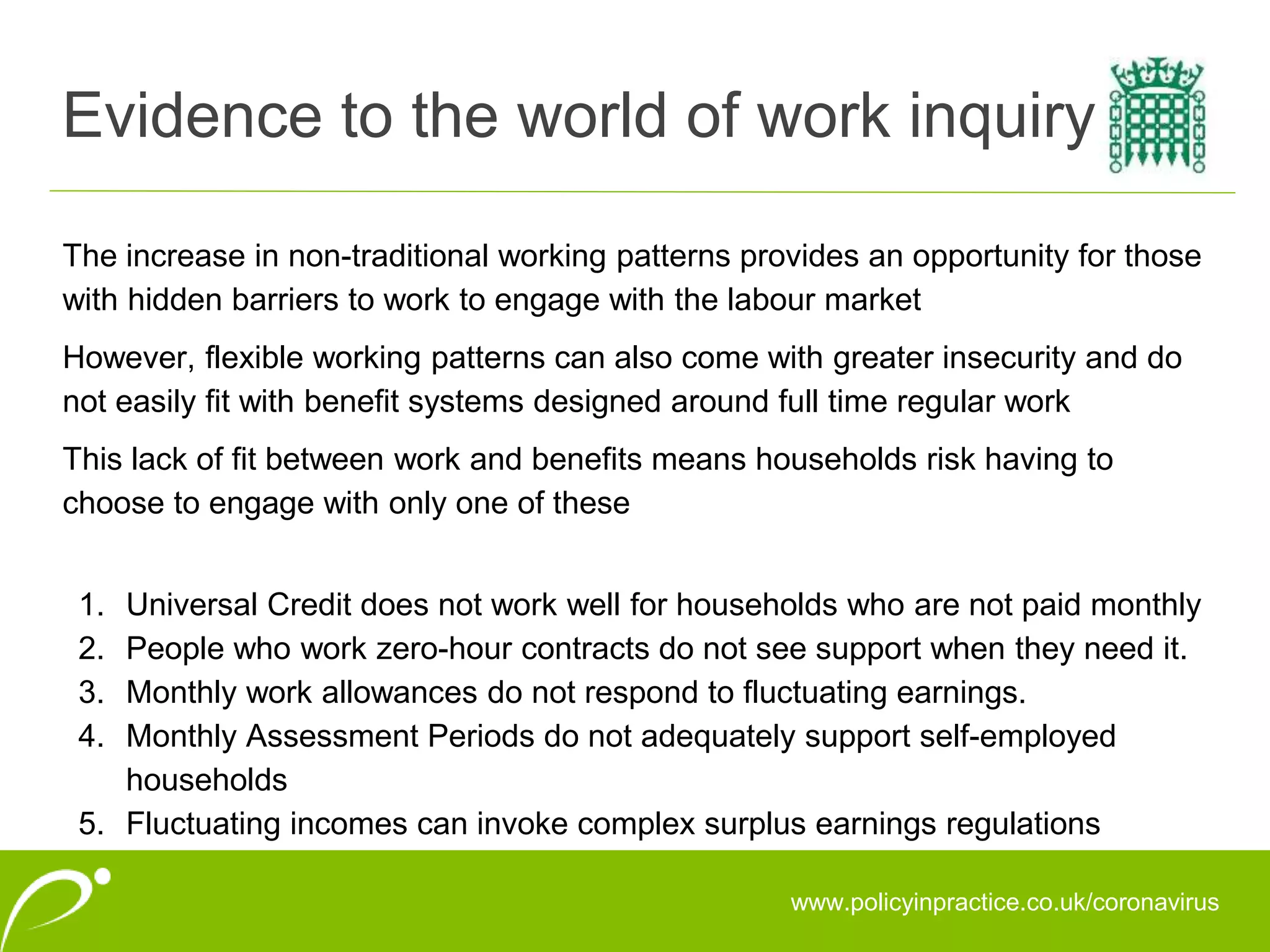
Evidence to the world of work inquiry
www.policyinpractice.co.uk/coronavirus
The increase in non-traditional working patterns provides an opportunity for those
with hidden barriers to work to engage with the labour market
However, flexible working patterns can also come with greater insecurity and do
not easily fit with benefit systems designed around full time regular work
This lack of fit between work and benefits means households risk having to
choose to engage with only one of these
1. Universal Credit does not work well for households who are not paid monthly
2. People who work zero-hour contracts do not see support when they need it.
3. Monthly work allowances do not respond to fluctuating earnings.
4. Monthly Assessment Periods do not adequately support self-employed
households
5. Fluctuating incomes can invoke complex surplus earnings regulations
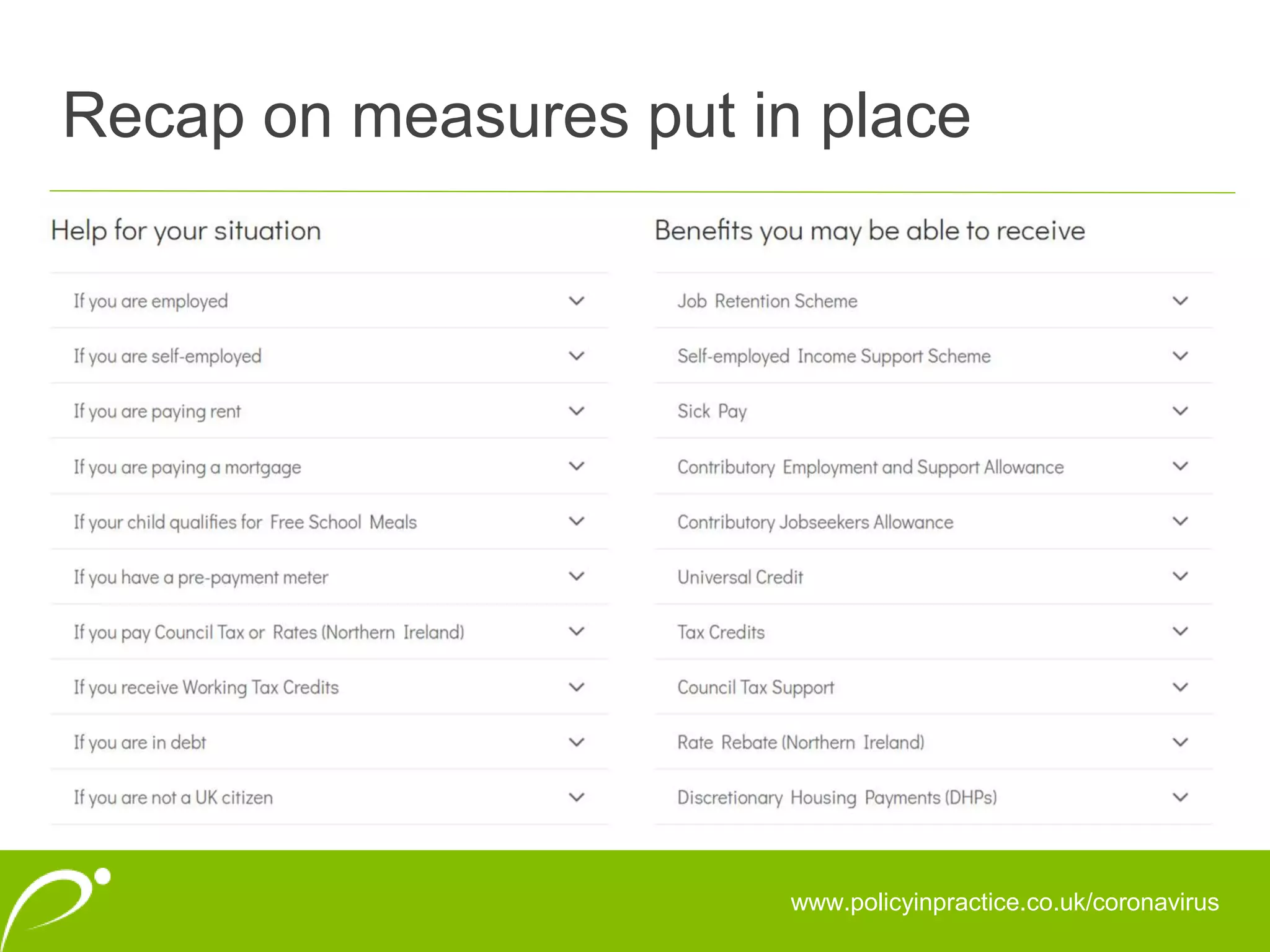
Recap on measures put in place
www.policyinpractice.co.uk/coronavirus
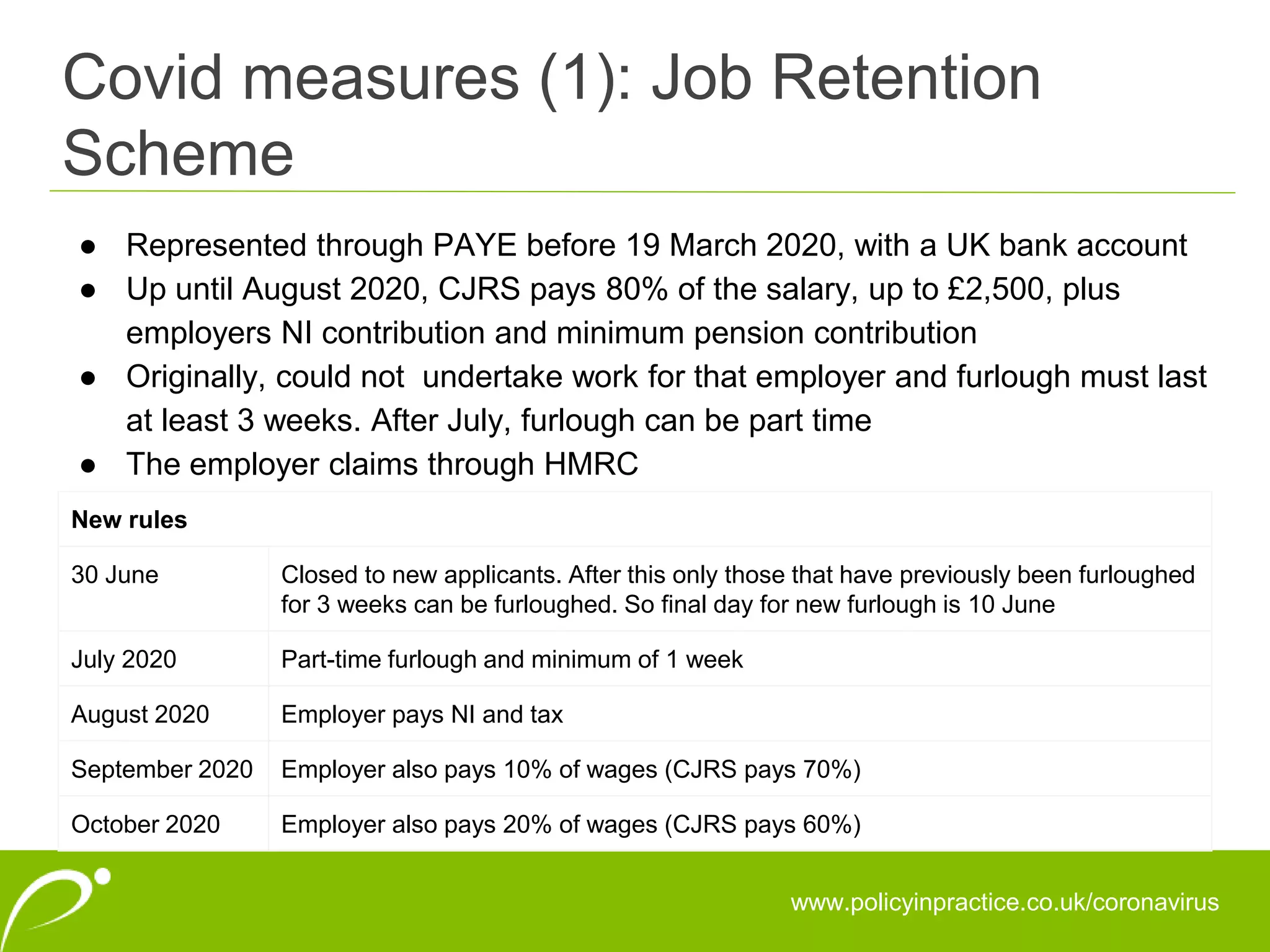
Covid measures (1): Job Retention
Scheme
www.policyinpractice.co.uk/coronavirus
● Represented through PAYE before 19 March 2020, with a UK bank account
● Up until August 2020, CJRS pays 80% of the salary, up to £2,500, plus
employers NI contribution and minimum pension contribution
● Originally, could not undertake work for that employer and furlough must last
at least 3 weeks. After July, furlough can be part time
● The employer claims through HMRC
New rules
30 June Closed to new applicants. After this only those that have previously been furloughed
for 3 weeks can be furloughed. So final day for new furlough is 10 June
July 2020 Part-time furlough and minimum of 1 week
August 2020 Employer pays NI and tax
September 2020 Employer also pays 10% of wages (CJRS pays 70%)
October 2020 Employer also pays 20% of wages (CJRS pays 60%)
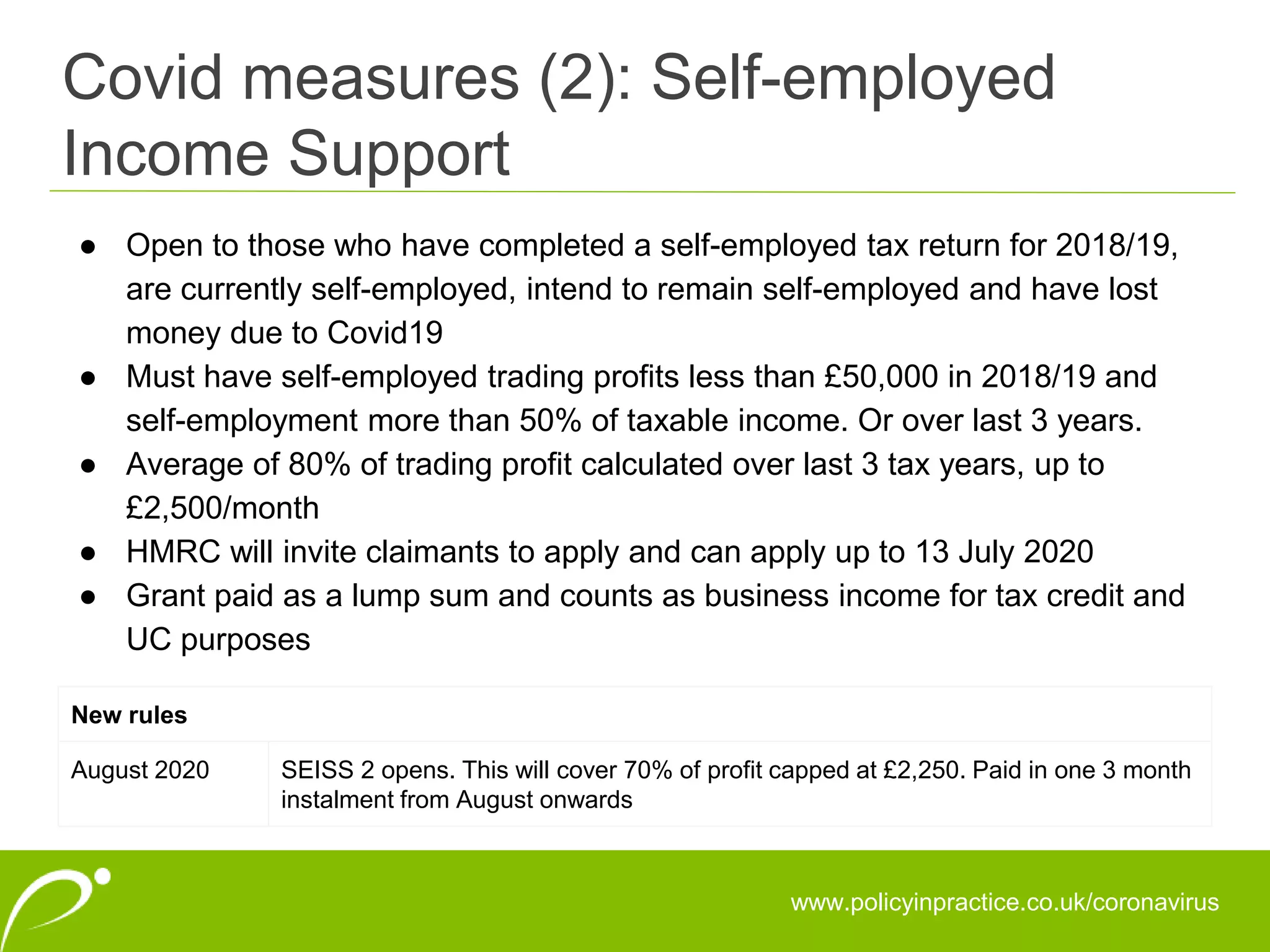
Covid measures (2): Self-employed
Income Support
www.policyinpractice.co.uk/coronavirus
● Open to those who have completed a self-employed tax return for 2018/19,
are currently self-employed, intend to remain self-employed and have lost
money due to Covid19
● Must have self-employed trading profits less than £50,000 in 2018/19 and
self-employment more than 50% of taxable income. Or over last 3 years.
● Average of 80% of trading profit calculated over last 3 tax years, up to
£2,500/month
● HMRC will invite claimants to apply and can apply up to 13 July 2020
● Grant paid as a lump sum and counts as business income for tax credit and
UC purposes
New rules
August 2020 SEISS 2 opens. This will cover 70% of profit capped at £2,250. Paid in one 3 month
instalment from August onwards
Surplus earnings
www.policyinpractice.co.uk/coronavirus
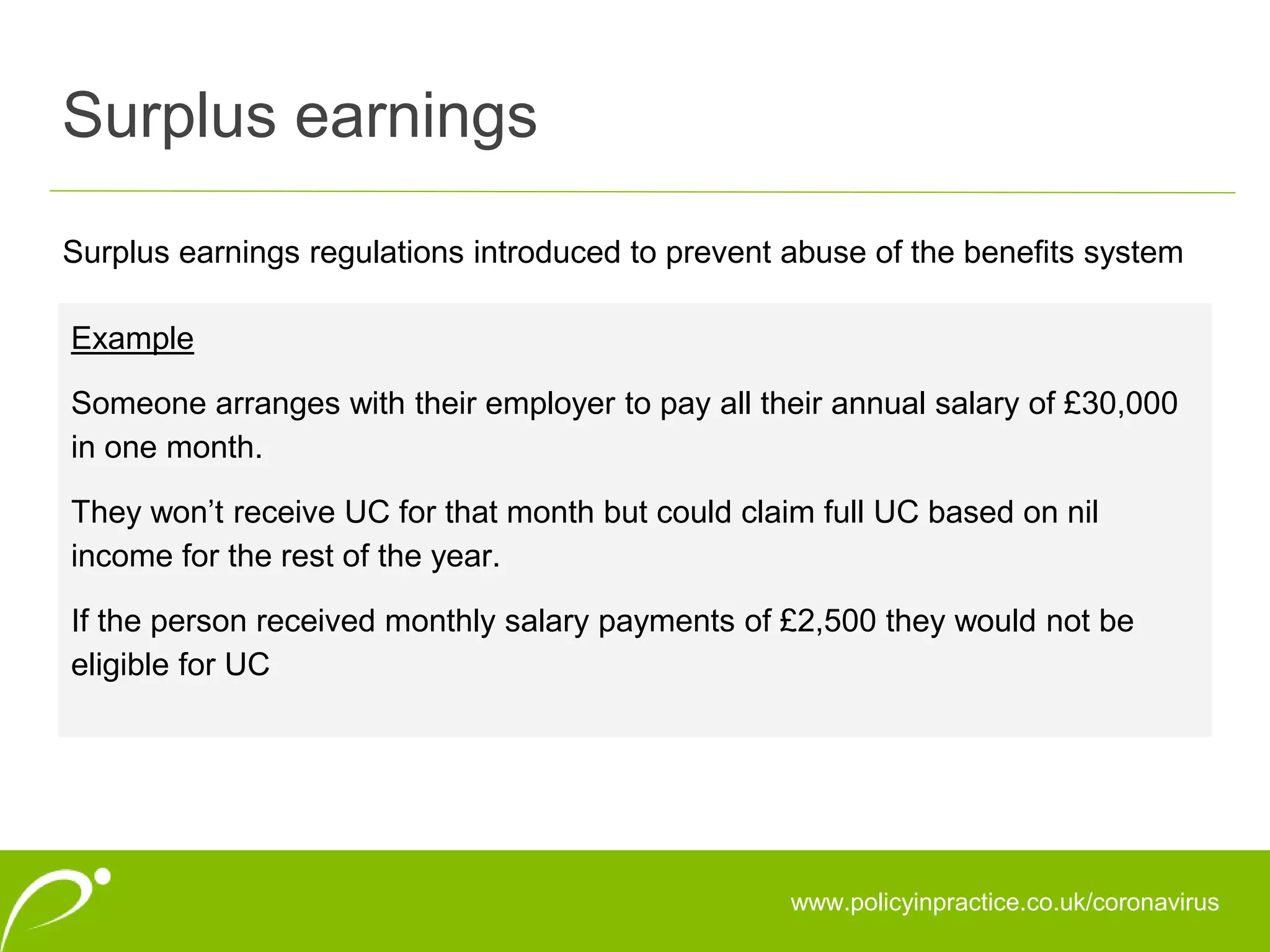
Surplus earnings regulations introduced to prevent abuse of the benefits system
Example
Someone arranges with their employer to pay all their annual salary of £30,000
in one month.
They won’t receive UC for that month but could claim full UC based on nil
income for the rest of the year.
If the person received monthly salary payments of £2,500 they would not be
eligible for UC
Surplus earnings
www.policyinpractice.co.uk/coronavirus
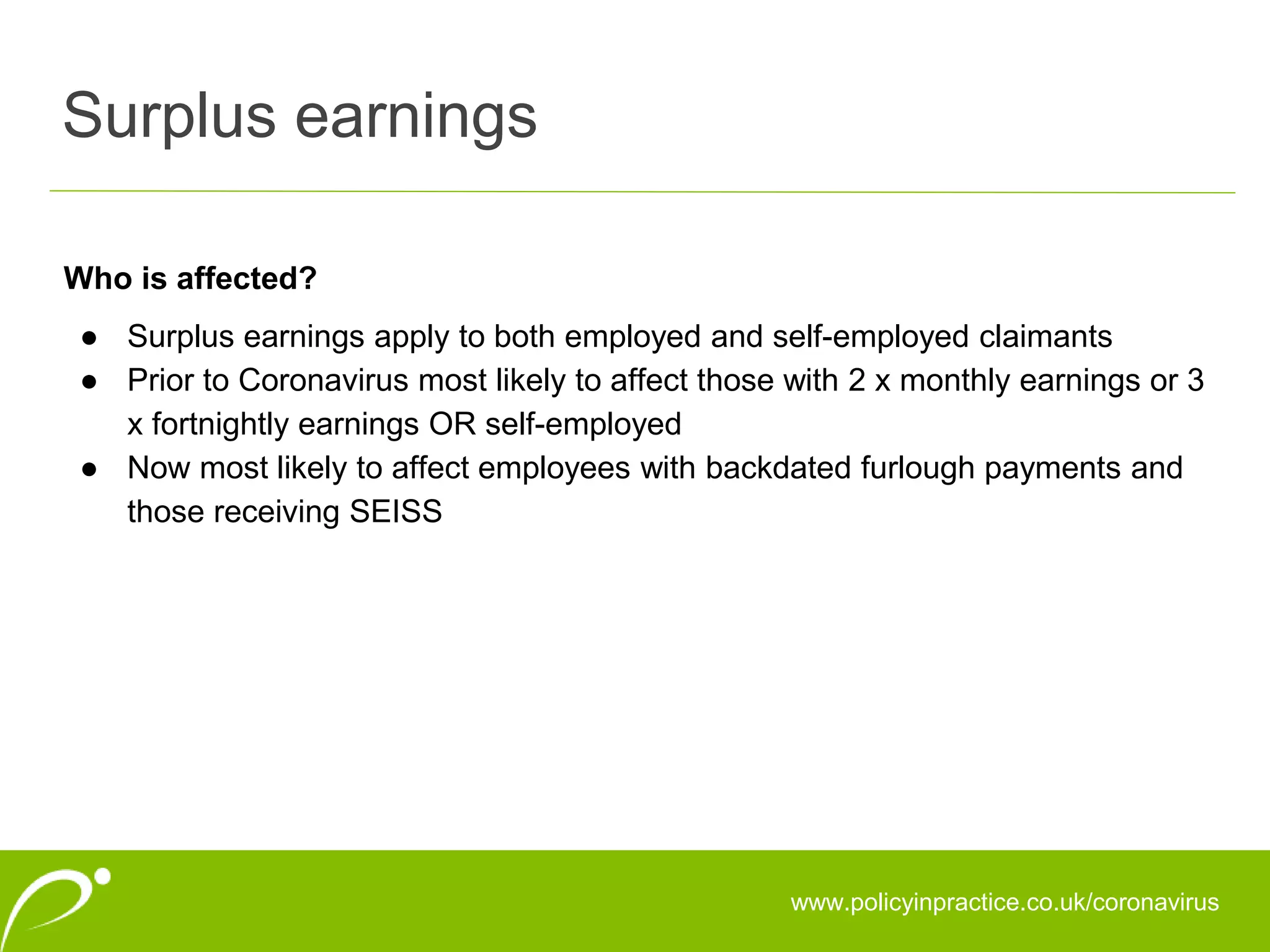
Who is affected?
● Surplus earnings apply to both employed and self-employed claimants
● Prior to Coronavirus most likely to affect those with 2 x monthly earnings or 3
x fortnightly earnings OR self-employed
● Now most likely to affect employees with backdated furlough payments and
those receiving SEISS
Surplus earnings
www.policyinpractice.co.uk/coronavirus
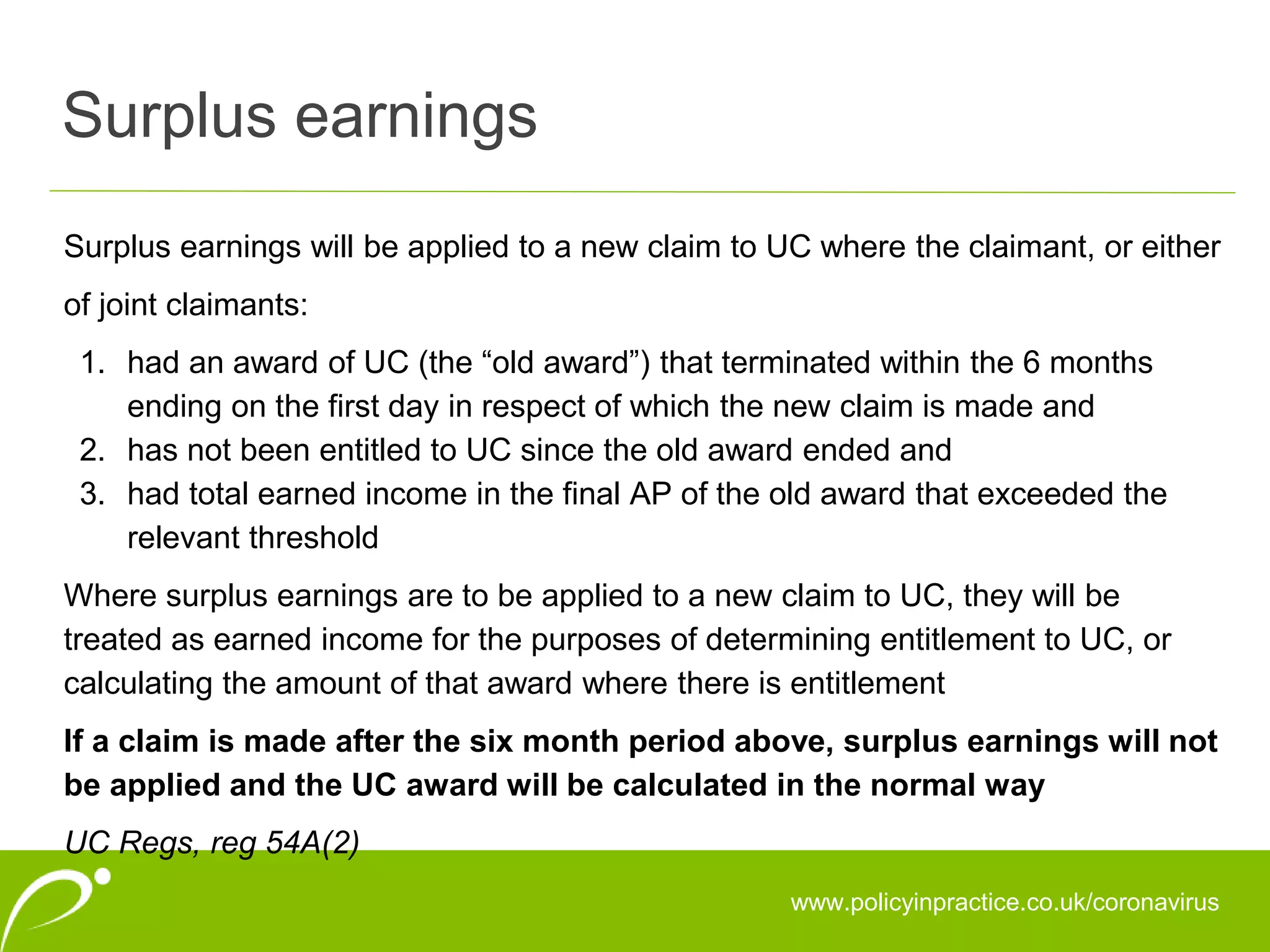
Surplus earnings will be applied to a new claim to UC where the claimant, or either
of joint claimants:
1. had an award of UC (the “old award”) that terminated within the 6 months
ending on the first day in respect of which the new claim is made and
2. has not been entitled to UC since the old award ended and
3. had total earned income in the final AP of the old award that exceeded the
relevant threshold
Where surplus earnings are to be applied to a new claim to UC, they will be
treated as earned income for the purposes of determining entitlement to UC, or
calculating the amount of that award where there is entitlement
If a claim is made after the six month period above, surplus earnings will not
be applied and the UC award will be calculated in the normal way
UC Regs, reg 54A(2)
Surplus earnings
www.policyinpractice.co.uk/coronavirus
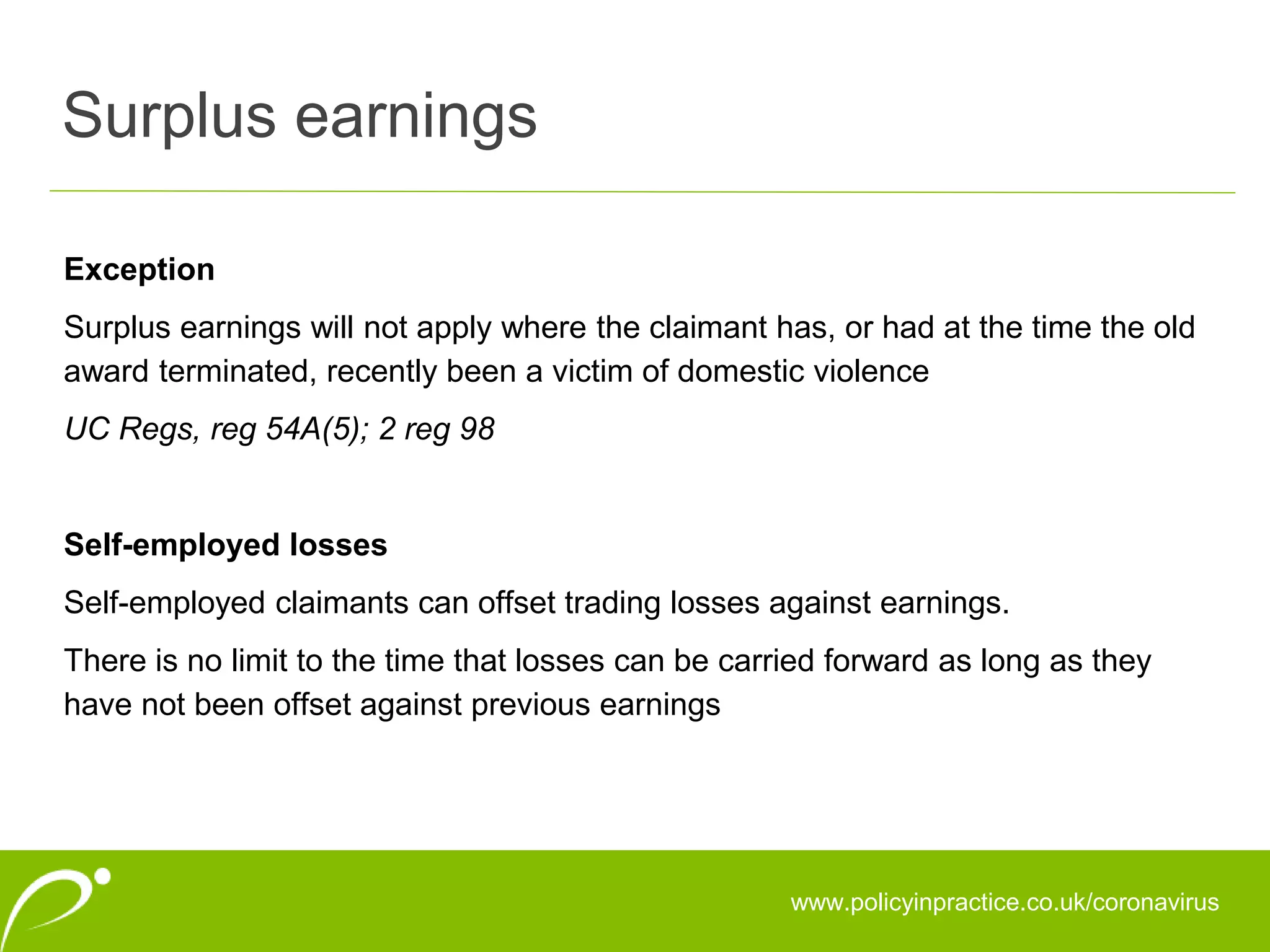
Exception
Surplus earnings will not apply where the claimant has, or had at the time the old
award terminated, recently been a victim of domestic violence
UC Regs, reg 54A(5); 2 reg 98
Self-employed losses
Self-employed claimants can offset trading losses against earnings.
There is no limit to the time that losses can be carried forward as long as they
have not been offset against previous earnings
Surplus earnings
www.policyinpractice.co.uk/coronavirus
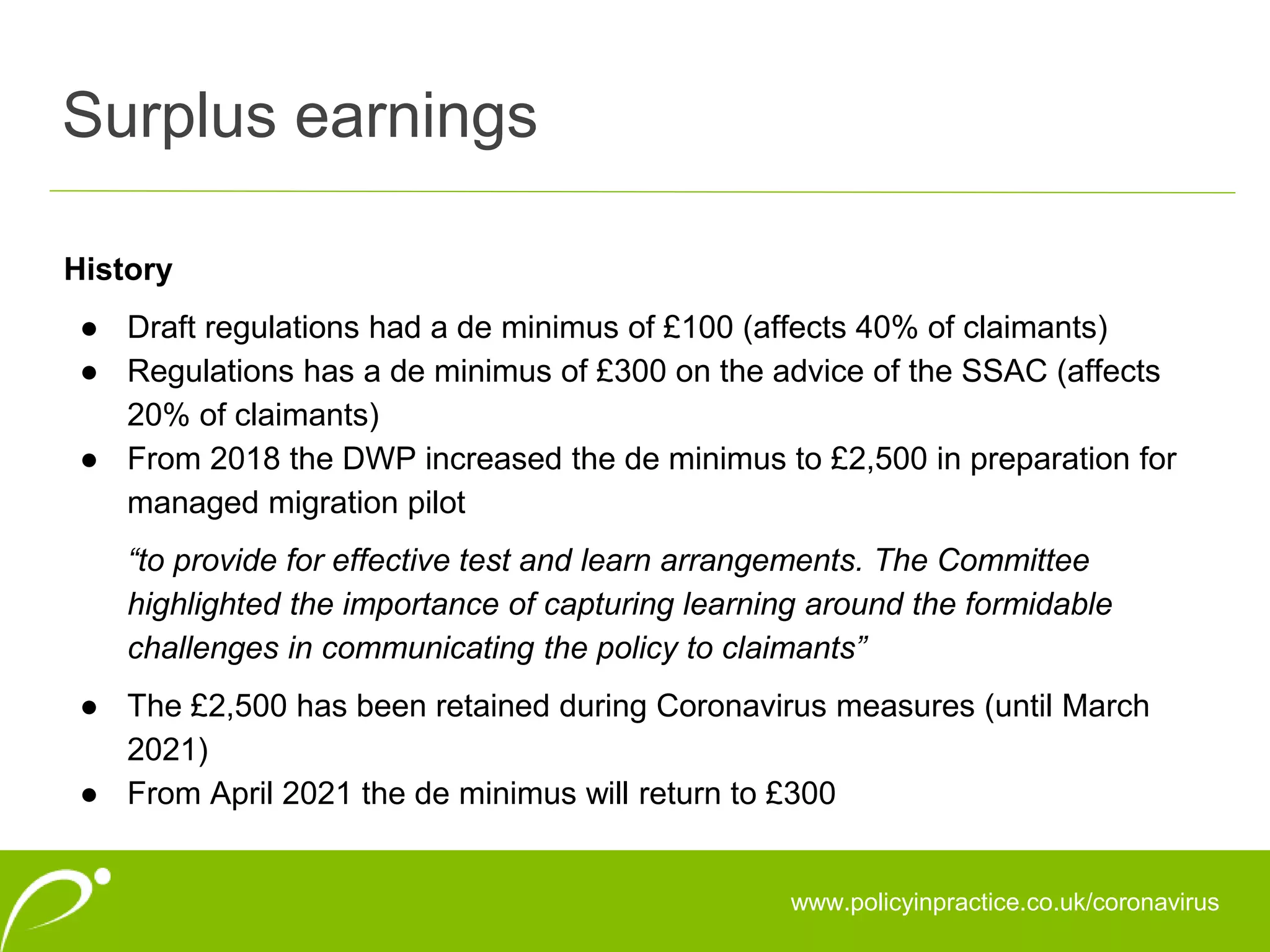
History
● Draft regulations had a de minimus of £100 (affects 40% of claimants)
● Regulations has a de minimus of £300 on the advice of the SSAC (affects
20% of claimants)
● From 2018 the DWP increased the de minimus to £2,500 in preparation for
managed migration pilot
“to provide for effective test and learn arrangements. The Committee
highlighted the importance of capturing learning around the formidable
challenges in communicating the policy to claimants”
● The £2,500 has been retained during Coronavirus measures (until March
2021)
● From April 2021 the de minimus will return to £300
Surplus earnings: example
www.policyinpractice.co.uk/coronavirus
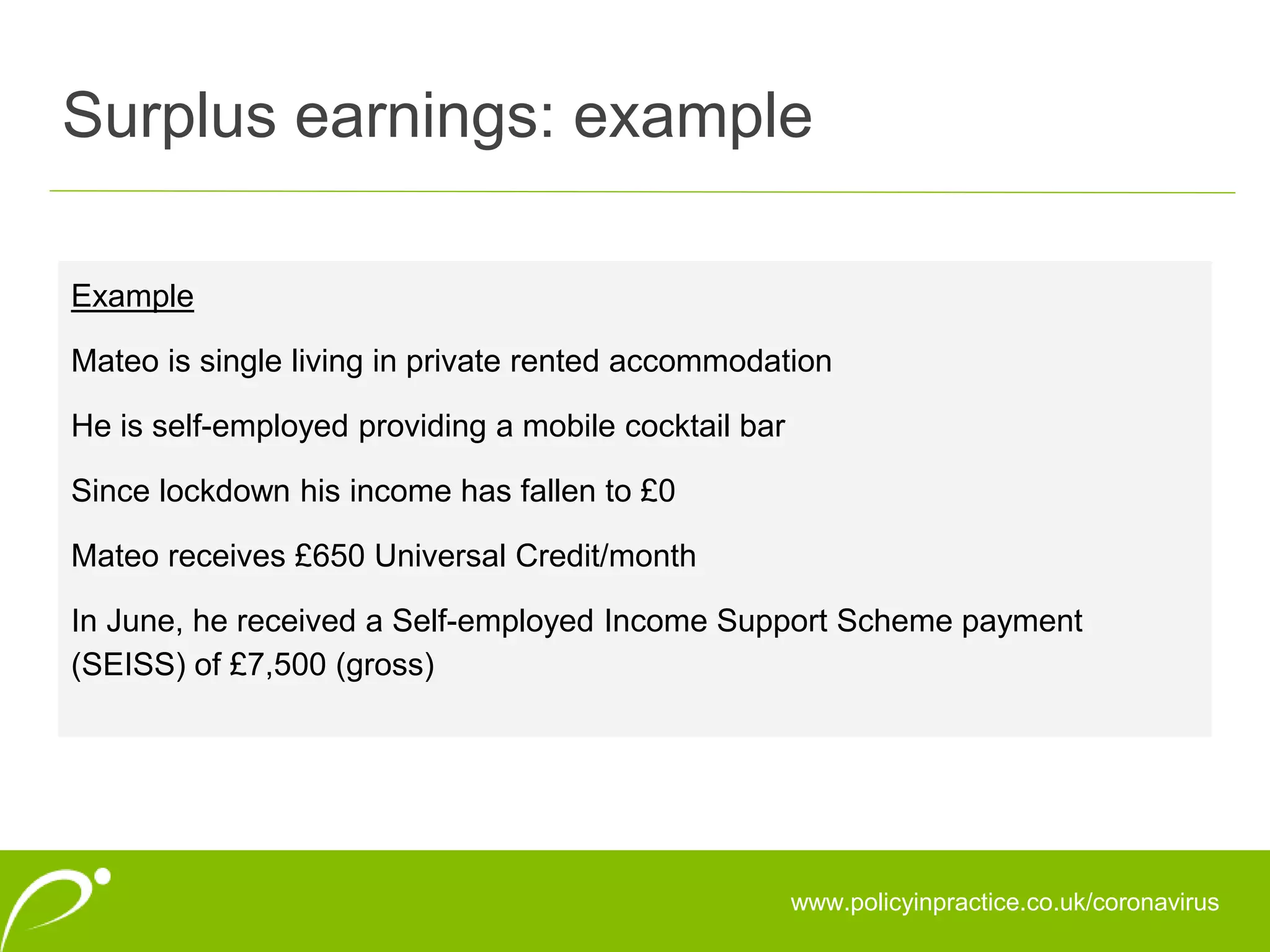
Example
Mateo is single living in private rented accommodation
He is self-employed providing a mobile cocktail bar
Since lockdown his income has fallen to £0
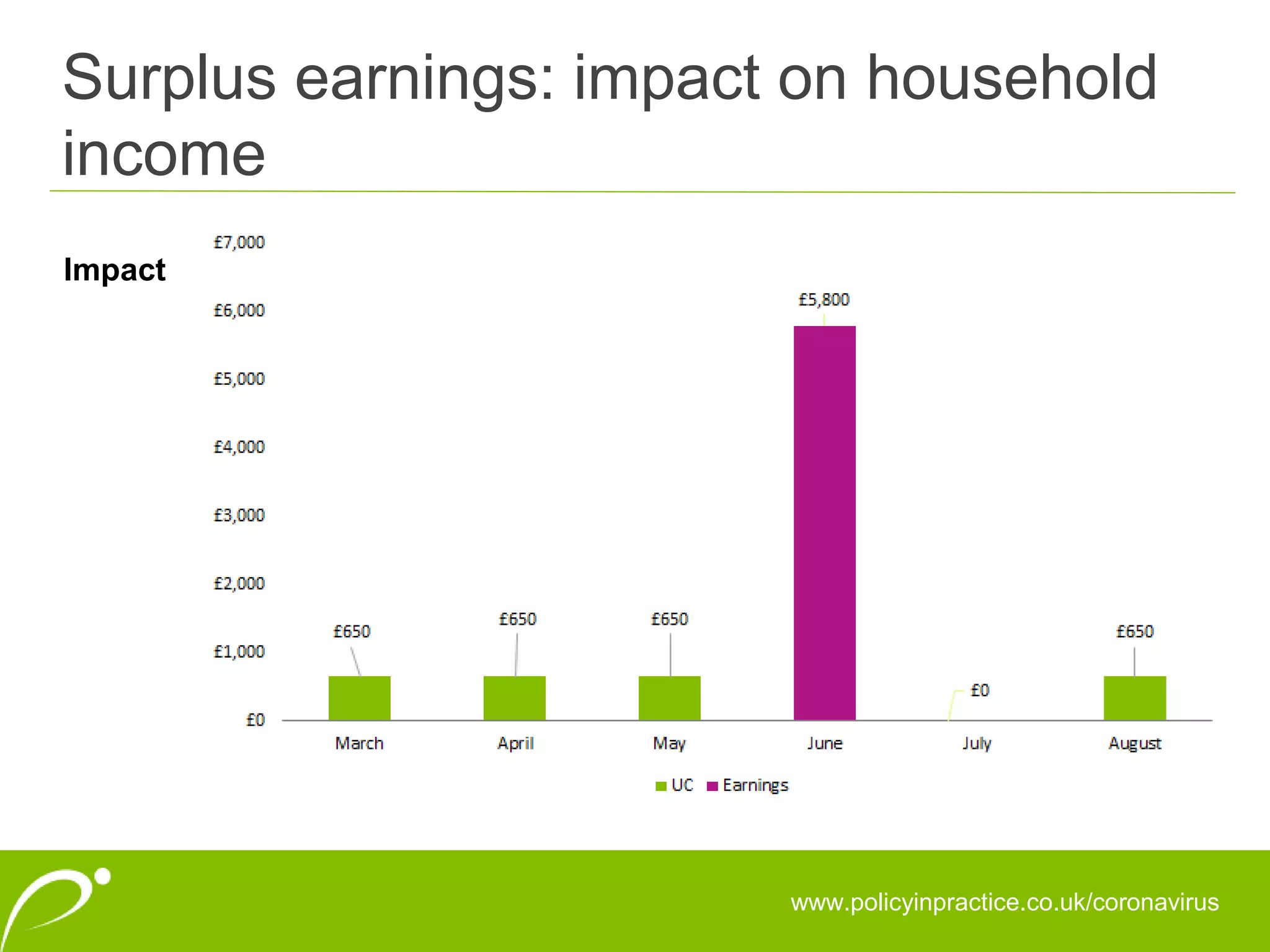
Mateo receives £650 Universal Credit/month
In June, he received a Self-employed Income Support Scheme payment
(SEISS) of £7,500 (gross)
Surplus earnings: example
www.policyinpractice.co.uk/coronavirus
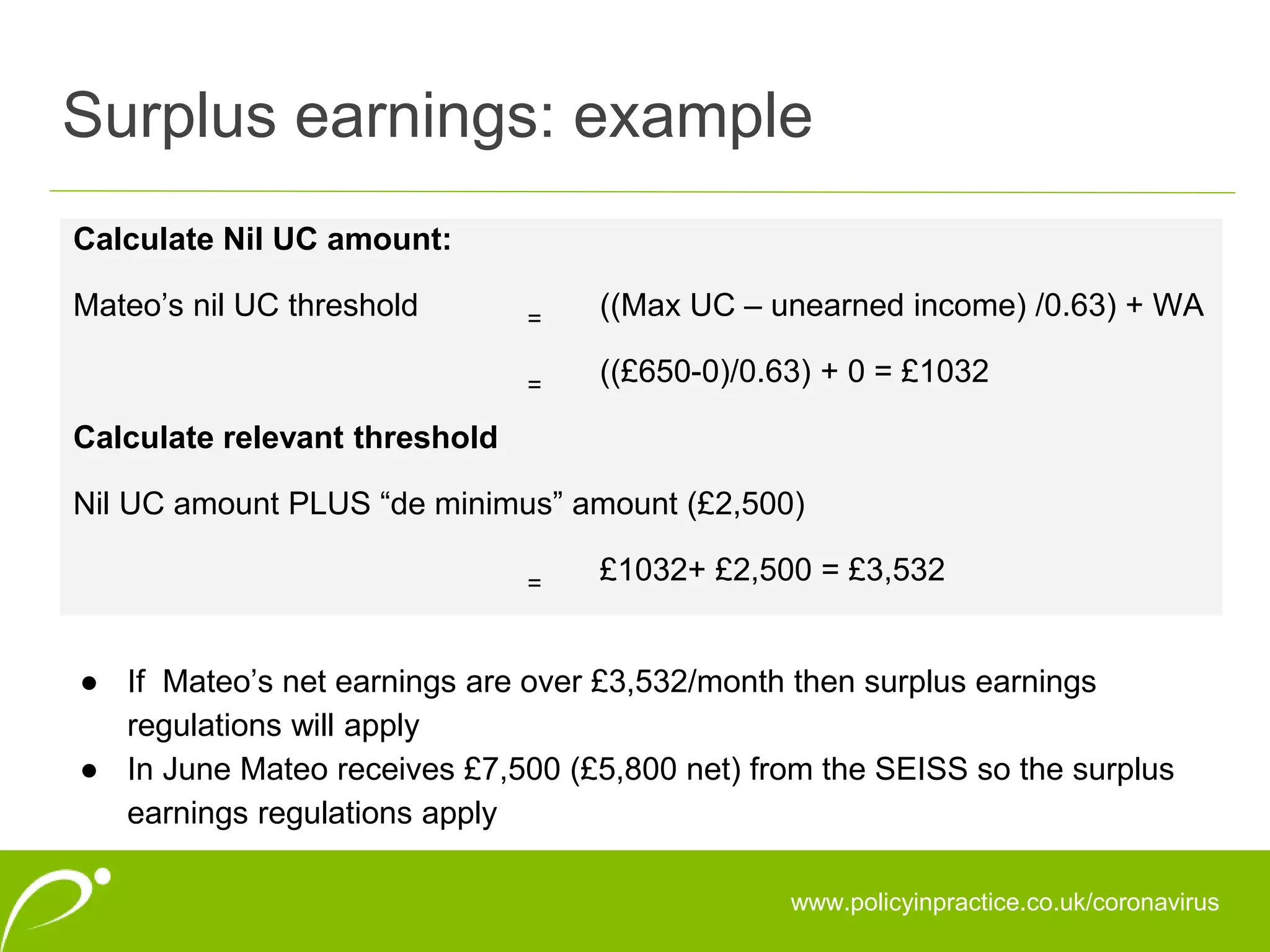
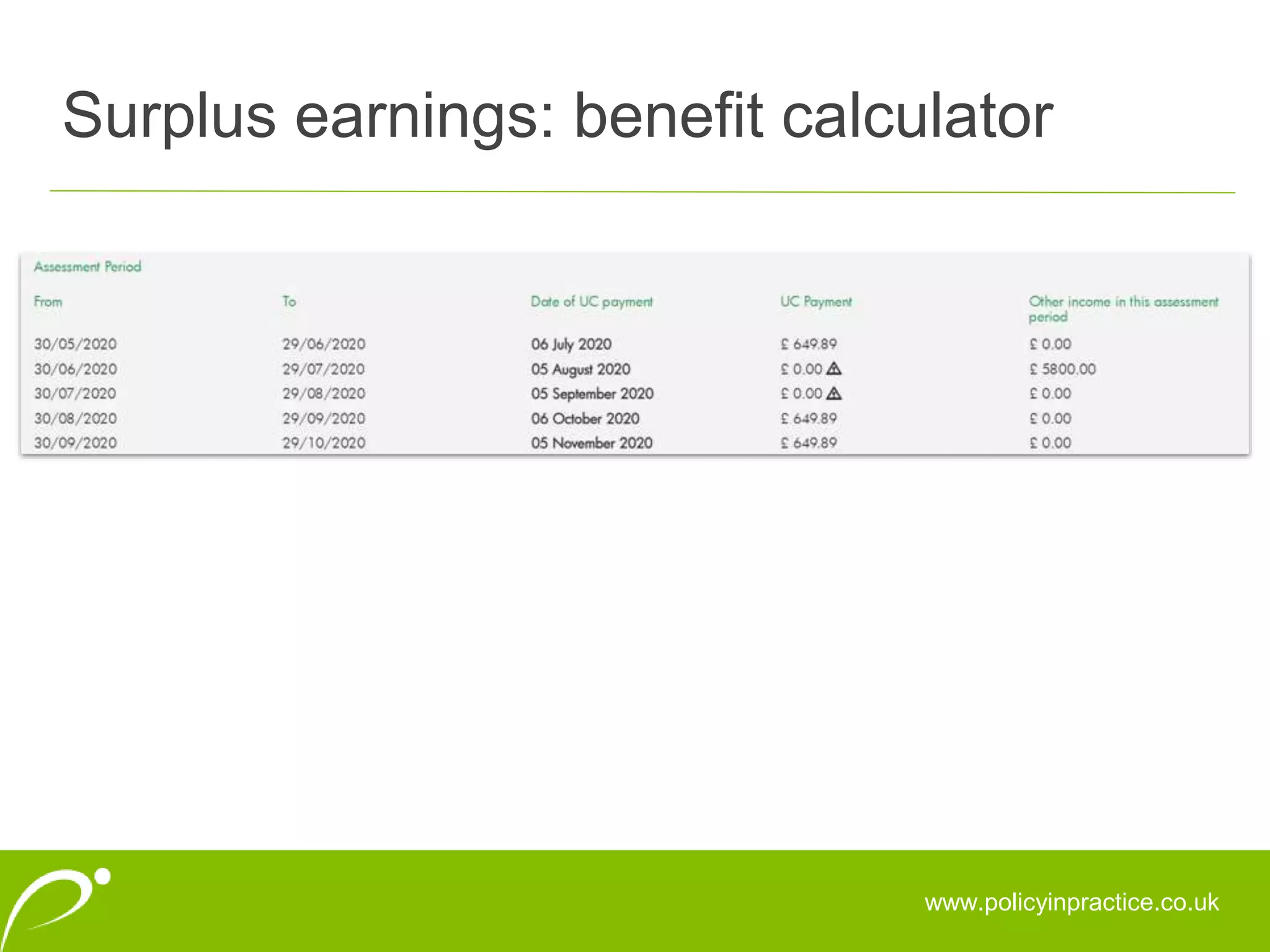
Calculate Nil UC amount:
Mateo’s nil UC threshold = ((Max UC – unearned income) /0.63) + WA
= ((£650-0)/0.63) + 0 = £1032
Calculate relevant threshold
Nil UC amount PLUS “de minimus” amount (£2,500)
= £1032+ £2,500 = £3,532
● If Mateo’s net earnings are over £3,532/month then surplus earnings
regulations will apply
● In June Mateo receives £7,500 (£5,800 net) from the SEISS so the surplus
earnings regulations apply
Surplus earnings: example
www.policyinpractice.co.uk/coronavirus
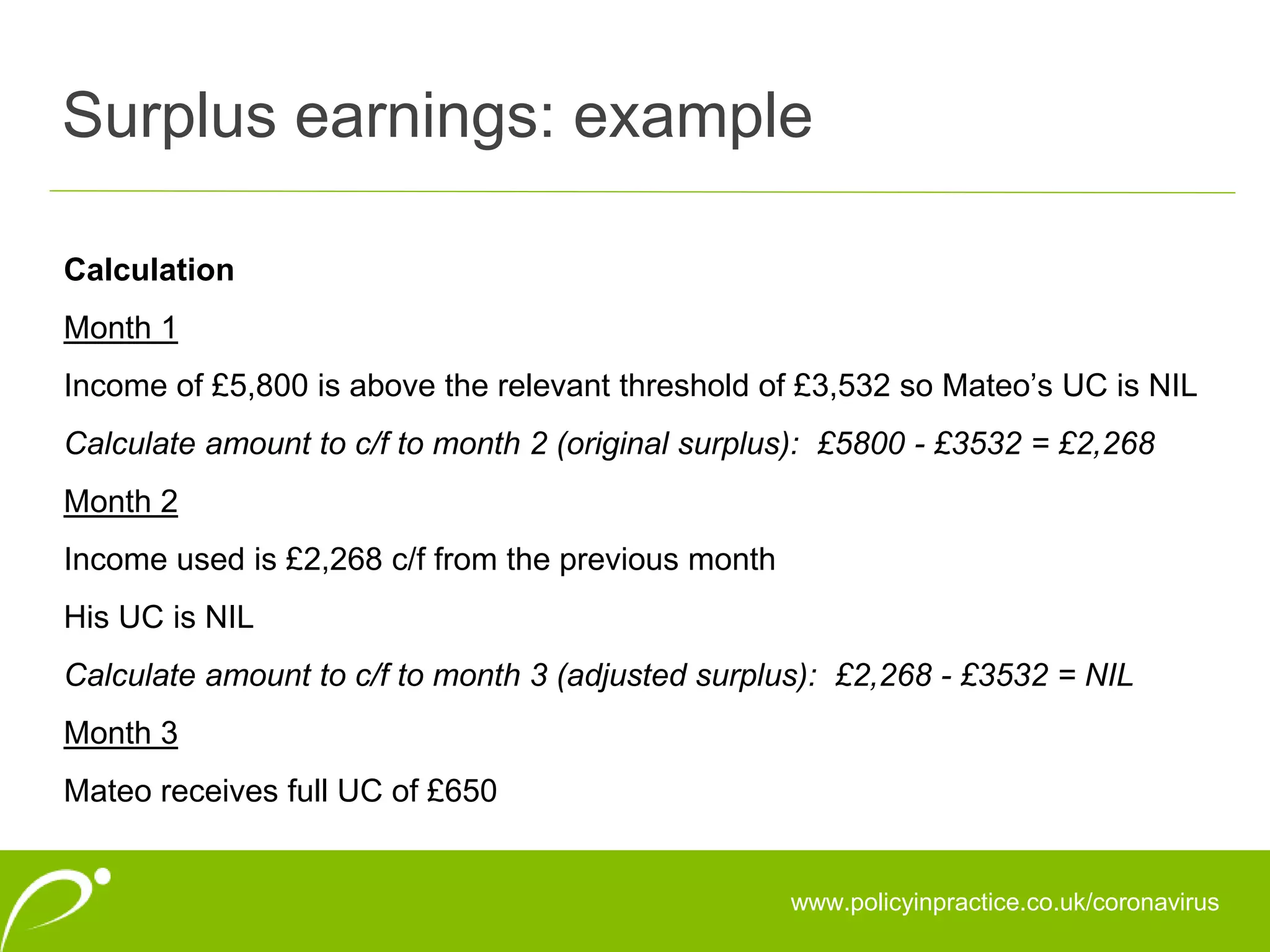
Calculation
Month 1
Income of £5,800 is above the relevant threshold of £3,532 so Mateo’s UC is NIL
Calculate amount to c/f to month 2 (original surplus): £5800 - £3532 = £2,268
Month 2
Income used is £2,268 c/f from the previous month
His UC is NIL
Calculate amount to c/f to month 3 (adjusted surplus): £2,268 - £3532 = NIL
Month 3
Mateo receives full UC of £650
Surplus earnings: impact on household
income
www.policyinpractice.co.uk/coronavirus
Impact
Surplus earnings: impact of SEISS
www.policyinpractice.co.uk
Impact
From March to August Mateo receives £8,400
Without the grant he would have received £3,900 (6 payments of UC)
So, the grant is worth £4,500 (not £7,500 gross / £5,800 net)
There are implications for advisors due to complexity
There are implications for the claimant in order to budget
Surplus earnings: complications
www.policyinpractice.co.uk
● Combined surplus earnings of joint claimants if they form a new partnership.
● If the claimant moves from a joint claim to a single claim 50% of surplus is
taken into the single claim
● Minimum Income Floor applies after calculation of surplus earnings
● Before May 2020: the claimant had to reclaim each month. However,
reclaiming if income goes up could increase the surplus. The general rule for
clients was to reclaim if earnings reduce in order to “use up” the
surplus earnings but not reclaim if earnings increase
● From May 2020: special arrangements under Coronavirus. The DWP will
presume that the claimant has reclaimed each month (for up to 5 months) and
automatically reinstate UC if appropriate. This is discretionary and there is
some confusion about how this will work
www.policyinpractice.co.uk
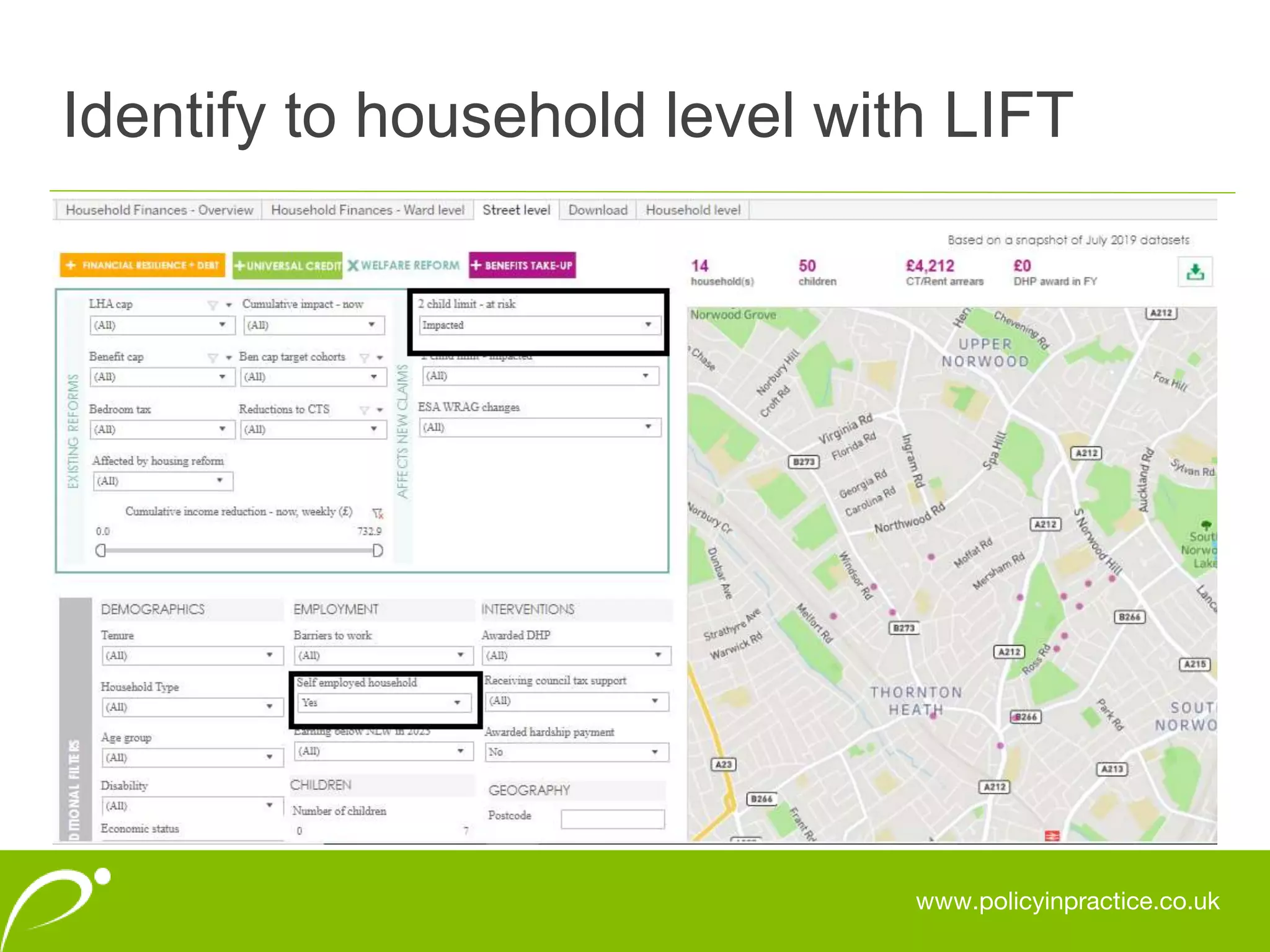
Identify to household level with LIFT
Surplus earnings: benefit calculator
www.policyinpractice.co.uk
252525
Over to Duncan
Worked example live in the Benefit
and Budgeting Calculator
www.policyinpractice.co.uk
262626
Over to Sue McCarron, Citizens
Advice Wirral
www.policyinpractice.co.uk
Please introduce yourself and Citizens
Advice Wirral
What three main issues are your
clients facing with fluctuating income?
Can you give us a case study showing
how you helped a client deal with the
issue?
303030
Questions and answers
www.policyinpractice.co.uk
● Blog post: How do the surplus earnings rules work in practice?
● For up to date information on the welfare support available see
www.policyinpractice.co.uk/your-income-and-coronavirus-covid-19/
● Follow up email with webinar recording and slides, with links
● Short survey to follow
● Next webinar:
○ How data analytics helps councils look to recovery on Wed 6 August
at 10:30
Practical tools that can help
www.policyinpractice.co.uk/events
323232
Would you like to stay for a 15 minute
demo of how the Benefit and
Budgeting Calculator helps you give
more support?
www.policyinpractice.co.uk
333333
Thank you
Zoe Charlesworth, Policy in Practice
Duncan Hatfield, Policy in Practice
Peter Carter, Policy in Practice
Sue McCarron, Citizens Advice Wirral
hello@policyinpractice.co.uk
0330 088 9242
www.policyinpractice.co.uk
343434
Over to Peter for a quick look at the
software
www.policyinpractice.co.uk
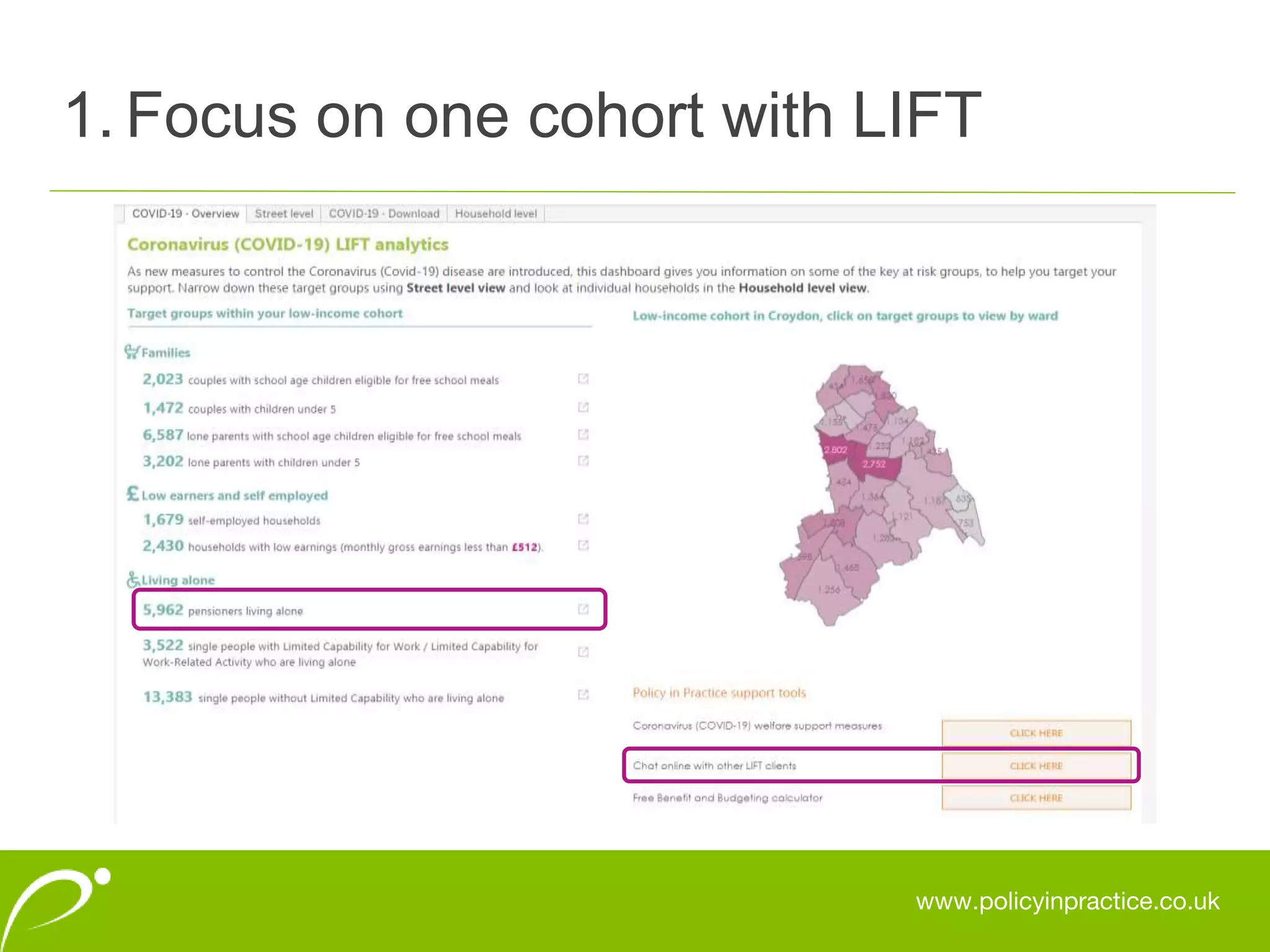
1. Focus on one cohort with LIFT
www.policyinpractice.co.uk
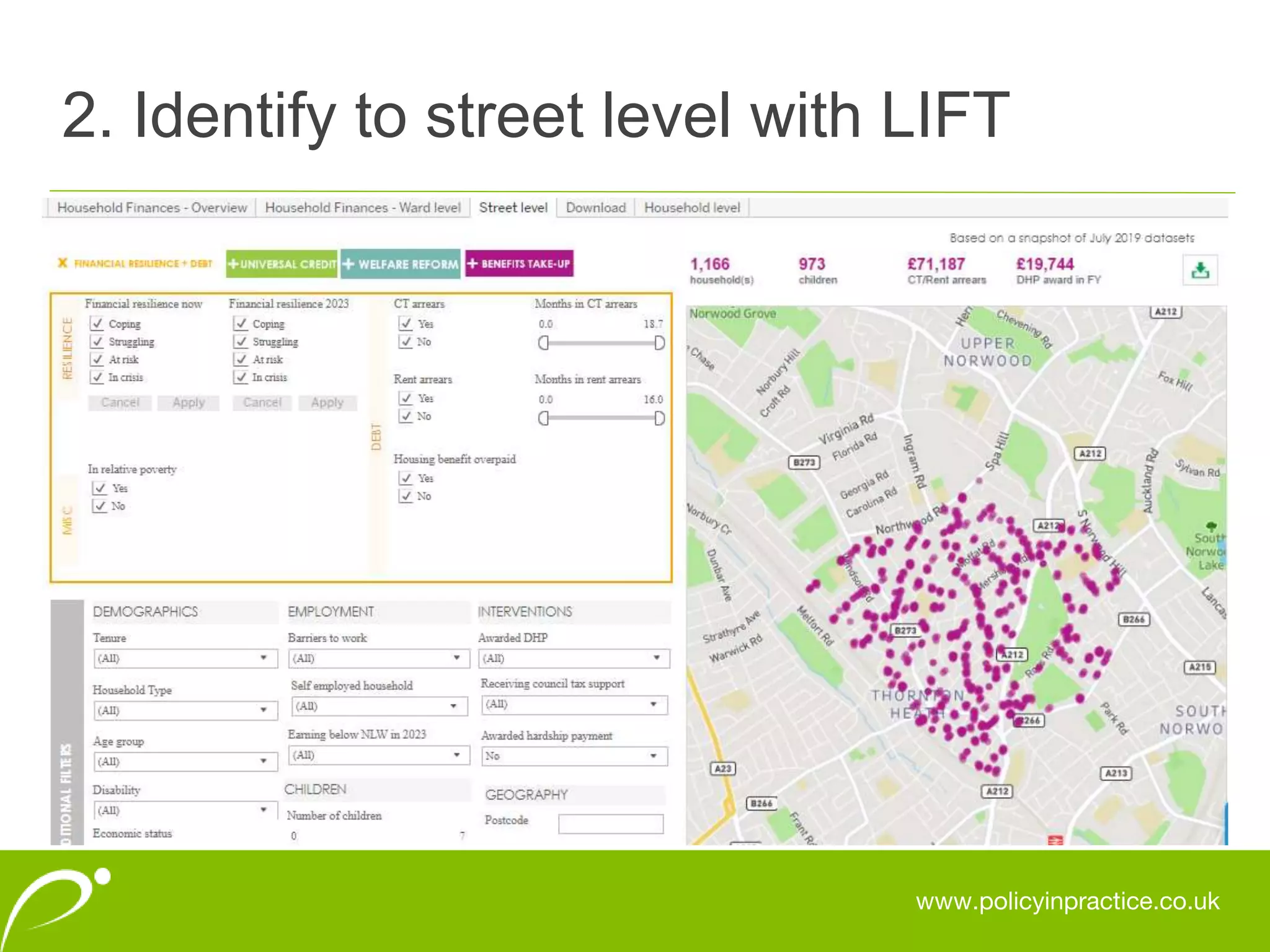
2. Identify to street level with LIFT
www.policyinpractice.co.uk
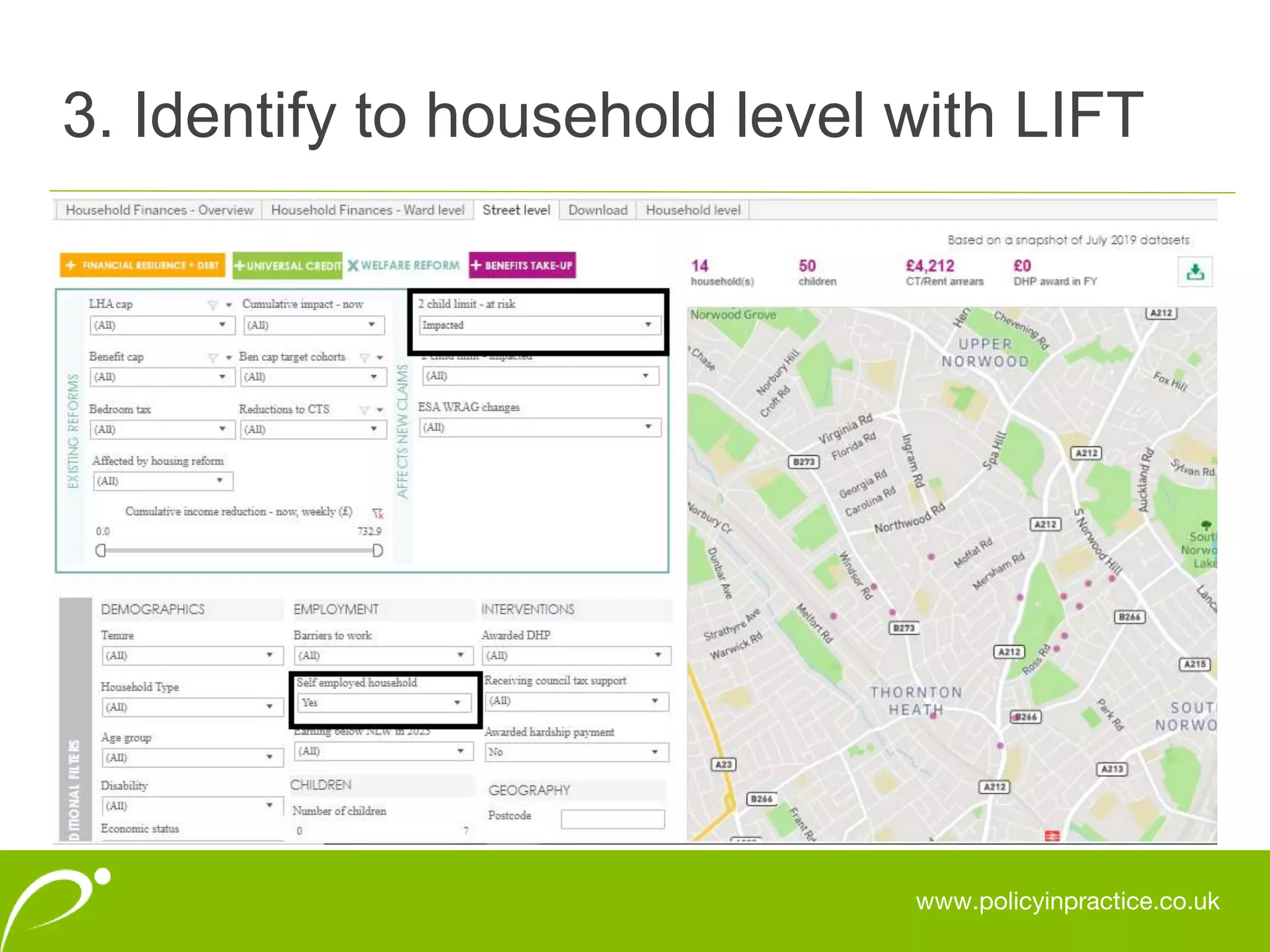
3. Identify to household level with LIFT
www.policyinpractice.co.uk
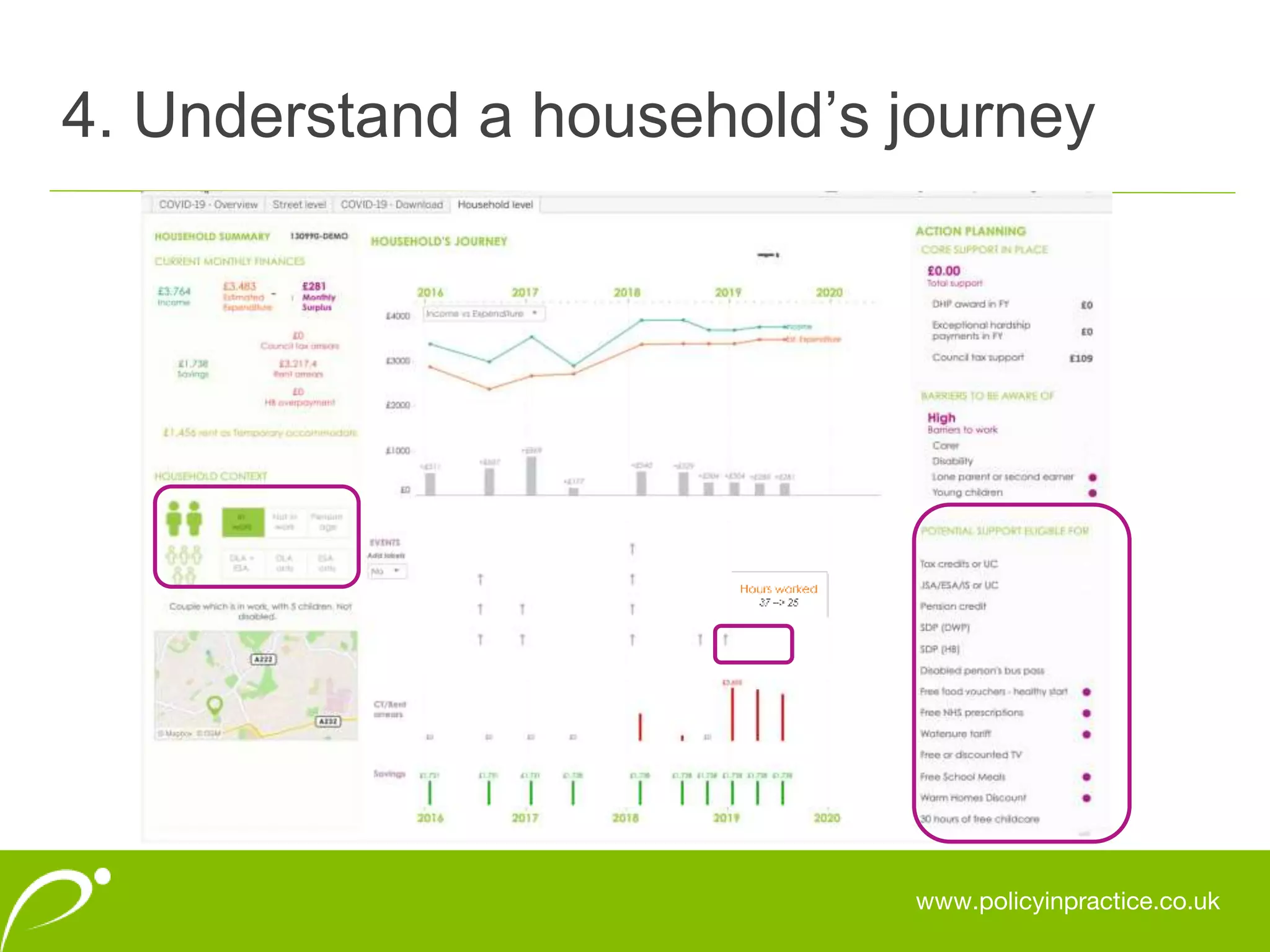
4. Understand a household’s journey
www.policyinpractice.co.uk
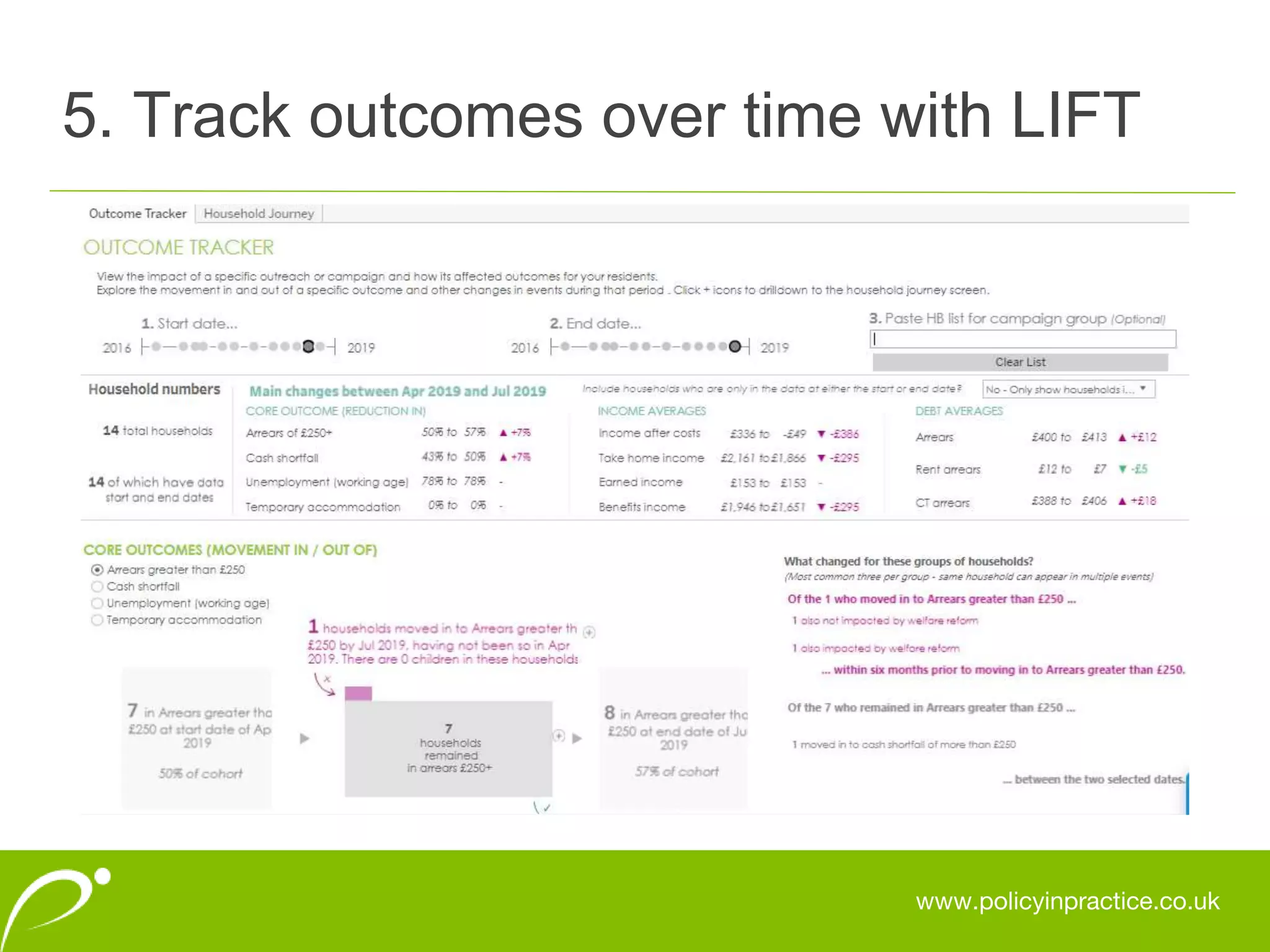
5. Track outcomes over time with LIFT
404040
Thank you
hello@policyinpractice.co.uk
0330 088 9242
www.policyinpractice.co.uk

How to simplify the complexity of surplus earnings

  • 1.
    How to simplifythe complexity of surplus earnings Wednesday 1 July Policy in Practice webinar
  • 2.
    Housekeeping www.policyinpractice.co.uk ● Audio check ●Please ask questions ● Poll and a survey ● Aim to finish by 11:30 with optional 15 mins extra ● Slides and recording will automatically follow ● We’re live tweeting via @policy_practice with hashtag #HelpfulPolicy
  • 3.
    Today’s speakers www.policyinpractice.co.uk Janet Harkin Headof Marketing Policy in Practice @jharkin Zoe Charlesworth Head of Policy Policy in Practice @ZoeCharleswort1 Duncan Hatfield Policy and Operations Analyst Policy in Practice @drh000 Sue McCarron Ask Us Wirral Service Manager Citizens Advice Wirral @WirralCAN Peter Carter Business Account Manager Policy in Practice @petersgc_
  • 4.
    www.policyinpractice.co.uk Give the bestsupport you can to help people on their way policy software analytics
  • 5.
    Agenda www.policyinpractice.co.uk/software ● A simpleguide to the SEISS, Universal Credit and surplus earnings rules ● Worked examples illustrating the challenge, and what to look out for ● How Wirral Citizens Advice helps people with fluctuating income ● Questions and answers ● Stay on for 15 mins for a Benefit and Budgeting Calculator demo (optional)
  • 6.
    666 Poll: What doyour clients find most difficult about irregular income? www.policyinpractice.co.uk
  • 7.
  • 8.
    Evidence to theworld of work inquiry www.policyinpractice.co.uk/coronavirus The increase in non-traditional working patterns provides an opportunity for those with hidden barriers to work to engage with the labour market However, flexible working patterns can also come with greater insecurity and do not easily fit with benefit systems designed around full time regular work This lack of fit between work and benefits means households risk having to choose to engage with only one of these 1. Universal Credit does not work well for households who are not paid monthly 2. People who work zero-hour contracts do not see support when they need it. 3. Monthly work allowances do not respond to fluctuating earnings. 4. Monthly Assessment Periods do not adequately support self-employed households 5. Fluctuating incomes can invoke complex surplus earnings regulations
  • 9.
    Recap on measuresput in place www.policyinpractice.co.uk/coronavirus
  • 10.
    Covid measures (1):Job Retention Scheme www.policyinpractice.co.uk/coronavirus ● Represented through PAYE before 19 March 2020, with a UK bank account ● Up until August 2020, CJRS pays 80% of the salary, up to £2,500, plus employers NI contribution and minimum pension contribution ● Originally, could not undertake work for that employer and furlough must last at least 3 weeks. After July, furlough can be part time ● The employer claims through HMRC New rules 30 June Closed to new applicants. After this only those that have previously been furloughed for 3 weeks can be furloughed. So final day for new furlough is 10 June July 2020 Part-time furlough and minimum of 1 week August 2020 Employer pays NI and tax September 2020 Employer also pays 10% of wages (CJRS pays 70%) October 2020 Employer also pays 20% of wages (CJRS pays 60%)
  • 11.
    Covid measures (2):Self-employed Income Support www.policyinpractice.co.uk/coronavirus ● Open to those who have completed a self-employed tax return for 2018/19, are currently self-employed, intend to remain self-employed and have lost money due to Covid19 ● Must have self-employed trading profits less than £50,000 in 2018/19 and self-employment more than 50% of taxable income. Or over last 3 years. ● Average of 80% of trading profit calculated over last 3 tax years, up to £2,500/month ● HMRC will invite claimants to apply and can apply up to 13 July 2020 ● Grant paid as a lump sum and counts as business income for tax credit and UC purposes New rules August 2020 SEISS 2 opens. This will cover 70% of profit capped at £2,250. Paid in one 3 month instalment from August onwards
  • 12.
    Surplus earnings www.policyinpractice.co.uk/coronavirus Surplus earningsregulations introduced to prevent abuse of the benefits system Example Someone arranges with their employer to pay all their annual salary of £30,000 in one month. They won’t receive UC for that month but could claim full UC based on nil income for the rest of the year. If the person received monthly salary payments of £2,500 they would not be eligible for UC
  • 13.
    Surplus earnings www.policyinpractice.co.uk/coronavirus Who isaffected? ● Surplus earnings apply to both employed and self-employed claimants ● Prior to Coronavirus most likely to affect those with 2 x monthly earnings or 3 x fortnightly earnings OR self-employed ● Now most likely to affect employees with backdated furlough payments and those receiving SEISS
  • 14.
    Surplus earnings www.policyinpractice.co.uk/coronavirus Surplus earningswill be applied to a new claim to UC where the claimant, or either of joint claimants: 1. had an award of UC (the “old award”) that terminated within the 6 months ending on the first day in respect of which the new claim is made and 2. has not been entitled to UC since the old award ended and 3. had total earned income in the final AP of the old award that exceeded the relevant threshold Where surplus earnings are to be applied to a new claim to UC, they will be treated as earned income for the purposes of determining entitlement to UC, or calculating the amount of that award where there is entitlement If a claim is made after the six month period above, surplus earnings will not be applied and the UC award will be calculated in the normal way UC Regs, reg 54A(2)
  • 15.
    Surplus earnings www.policyinpractice.co.uk/coronavirus Exception Surplus earningswill not apply where the claimant has, or had at the time the old award terminated, recently been a victim of domestic violence UC Regs, reg 54A(5); 2 reg 98 Self-employed losses Self-employed claimants can offset trading losses against earnings. There is no limit to the time that losses can be carried forward as long as they have not been offset against previous earnings
  • 16.
    Surplus earnings www.policyinpractice.co.uk/coronavirus History ● Draftregulations had a de minimus of £100 (affects 40% of claimants) ● Regulations has a de minimus of £300 on the advice of the SSAC (affects 20% of claimants) ● From 2018 the DWP increased the de minimus to £2,500 in preparation for managed migration pilot “to provide for effective test and learn arrangements. The Committee highlighted the importance of capturing learning around the formidable challenges in communicating the policy to claimants” ● The £2,500 has been retained during Coronavirus measures (until March 2021) ● From April 2021 the de minimus will return to £300
  • 17.
    Surplus earnings: example www.policyinpractice.co.uk/coronavirus Example Mateois single living in private rented accommodation He is self-employed providing a mobile cocktail bar Since lockdown his income has fallen to £0 Mateo receives £650 Universal Credit/month In June, he received a Self-employed Income Support Scheme payment (SEISS) of £7,500 (gross)
  • 18.
    Surplus earnings: example www.policyinpractice.co.uk/coronavirus CalculateNil UC amount: Mateo’s nil UC threshold = ((Max UC – unearned income) /0.63) + WA = ((£650-0)/0.63) + 0 = £1032 Calculate relevant threshold Nil UC amount PLUS “de minimus” amount (£2,500) = £1032+ £2,500 = £3,532 ● If Mateo’s net earnings are over £3,532/month then surplus earnings regulations will apply ● In June Mateo receives £7,500 (£5,800 net) from the SEISS so the surplus earnings regulations apply
  • 19.
    Surplus earnings: example www.policyinpractice.co.uk/coronavirus Calculation Month1 Income of £5,800 is above the relevant threshold of £3,532 so Mateo’s UC is NIL Calculate amount to c/f to month 2 (original surplus): £5800 - £3532 = £2,268 Month 2 Income used is £2,268 c/f from the previous month His UC is NIL Calculate amount to c/f to month 3 (adjusted surplus): £2,268 - £3532 = NIL Month 3 Mateo receives full UC of £650
  • 20.
    Surplus earnings: impacton household income www.policyinpractice.co.uk/coronavirus Impact
  • 21.
    Surplus earnings: impactof SEISS www.policyinpractice.co.uk Impact From March to August Mateo receives £8,400 Without the grant he would have received £3,900 (6 payments of UC) So, the grant is worth £4,500 (not £7,500 gross / £5,800 net) There are implications for advisors due to complexity There are implications for the claimant in order to budget
  • 22.
    Surplus earnings: complications www.policyinpractice.co.uk ●Combined surplus earnings of joint claimants if they form a new partnership. ● If the claimant moves from a joint claim to a single claim 50% of surplus is taken into the single claim ● Minimum Income Floor applies after calculation of surplus earnings ● Before May 2020: the claimant had to reclaim each month. However, reclaiming if income goes up could increase the surplus. The general rule for clients was to reclaim if earnings reduce in order to “use up” the surplus earnings but not reclaim if earnings increase ● From May 2020: special arrangements under Coronavirus. The DWP will presume that the claimant has reclaimed each month (for up to 5 months) and automatically reinstate UC if appropriate. This is discretionary and there is some confusion about how this will work
  • 23.
  • 24.
    Surplus earnings: benefitcalculator www.policyinpractice.co.uk
  • 25.
    252525 Over to Duncan Workedexample live in the Benefit and Budgeting Calculator www.policyinpractice.co.uk
  • 26.
    262626 Over to SueMcCarron, Citizens Advice Wirral www.policyinpractice.co.uk
  • 27.
    Please introduce yourselfand Citizens Advice Wirral
  • 28.
    What three mainissues are your clients facing with fluctuating income?
  • 29.
    Can you giveus a case study showing how you helped a client deal with the issue?
  • 30.
  • 31.
    ● Blog post:How do the surplus earnings rules work in practice? ● For up to date information on the welfare support available see www.policyinpractice.co.uk/your-income-and-coronavirus-covid-19/ ● Follow up email with webinar recording and slides, with links ● Short survey to follow ● Next webinar: ○ How data analytics helps councils look to recovery on Wed 6 August at 10:30 Practical tools that can help www.policyinpractice.co.uk/events
  • 32.
    323232 Would you liketo stay for a 15 minute demo of how the Benefit and Budgeting Calculator helps you give more support? www.policyinpractice.co.uk
  • 33.
    333333 Thank you Zoe Charlesworth,Policy in Practice Duncan Hatfield, Policy in Practice Peter Carter, Policy in Practice Sue McCarron, Citizens Advice Wirral hello@policyinpractice.co.uk 0330 088 9242 www.policyinpractice.co.uk
  • 34.
    343434 Over to Peterfor a quick look at the software www.policyinpractice.co.uk
  • 35.
  • 36.
  • 37.
  • 38.
  • 39.
  • 40.

Editor's Notes

  • #37 Employment-
  • #38 Particular cohorts we would want call
  • #39 And the action we would take
  • #40 Key points: Tracking v important and powerful for orgs See impact of supports given Shows you the churn