Introducing
Spring Cloud Gateway
and API Hub
for VMware Tanzu
Alexey Nesterov and
Gareth Clay
Disclaimer
The following is intended to outline the general direction of VMware's offerings. Itis intended for information
purposes only and may not be incorporated into any contract. Any information regarding pre-release of
VMwareofferings, futureupdates or other planned modifications is subject to ongoing evaluation by VMware
and is subjectto change. This information is provided without warranty or any kind, express or implied, and is
not a commitment to deliver any material, code, or functionality, and should not be relied upon in making
purchasing decisions regarding VMware's offerings. Thesepurchasing decisions should only be based on features
currently available. The development, release, and timing of any features or functionality described for
VMware's offerings in this presentation remain at the sole discretion of VMware. VMwarehas no obligation to
update forward looking information in this presentation.
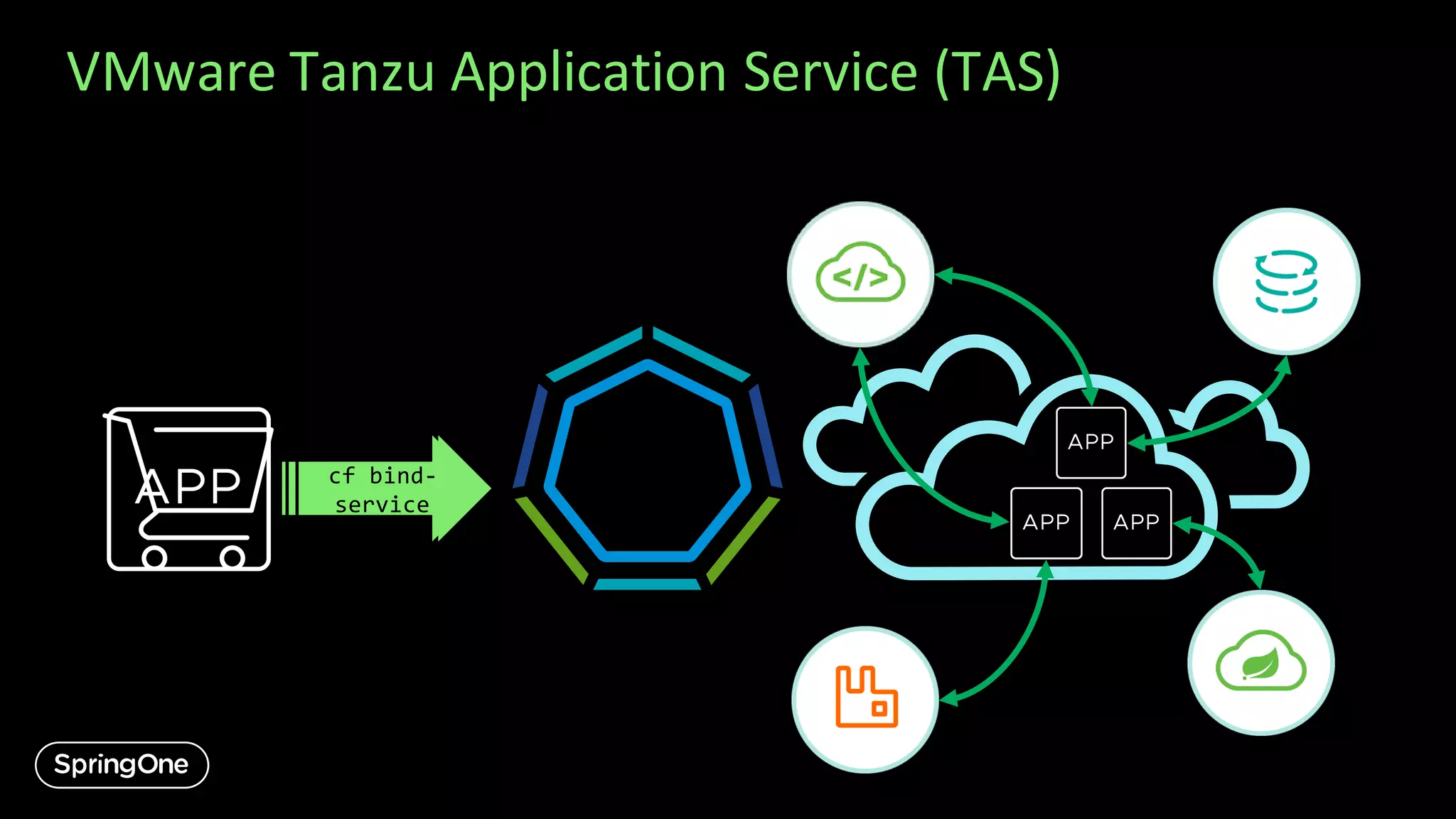
VMware Tanzu Application Service (TAS)
cf push
cf create-
service
cf bind-
service
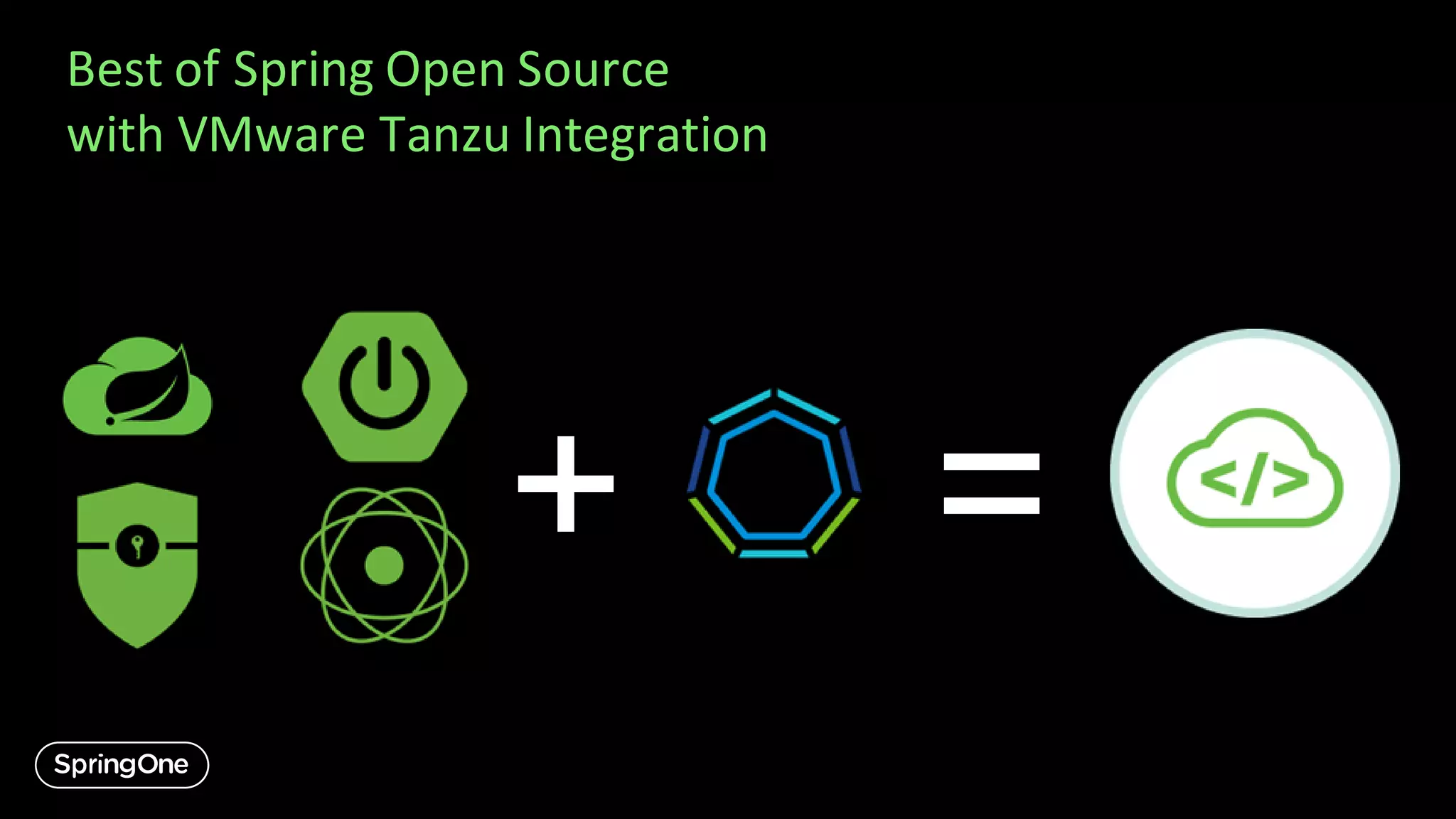
Best of Spring Open Source
with VMware Tanzu Integration
+ =
Getting started with
Spring Cloud Gateway
✏️ 🔐
✋😱 🤔👍
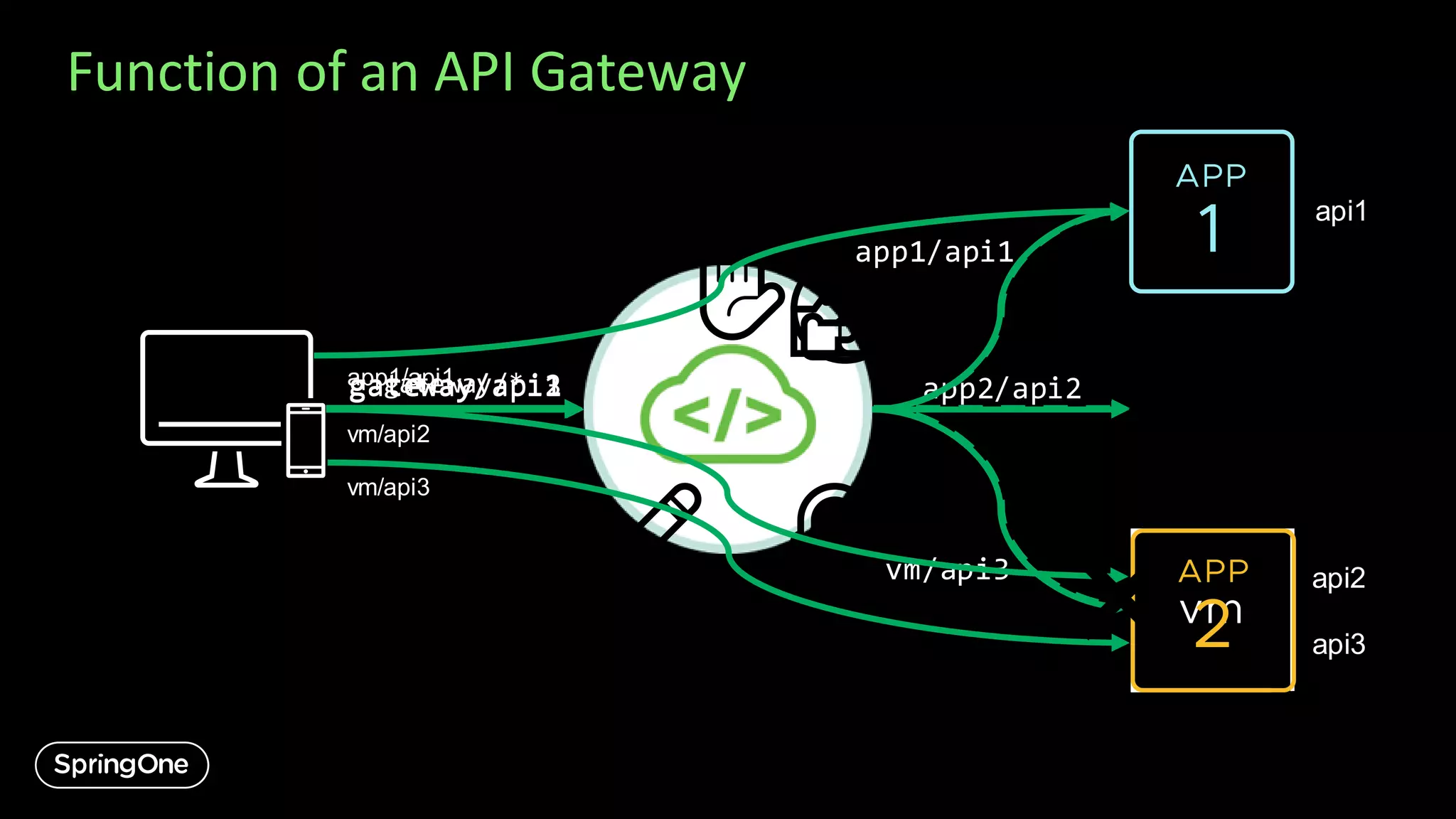
vm/api3
app2/api2
app1/api1
gateway/api3gateway/api2gateway/api1gateway/*app1/api1
vm/api2
vm/api3
❌
Function of an API Gateway
api1
api2
api3
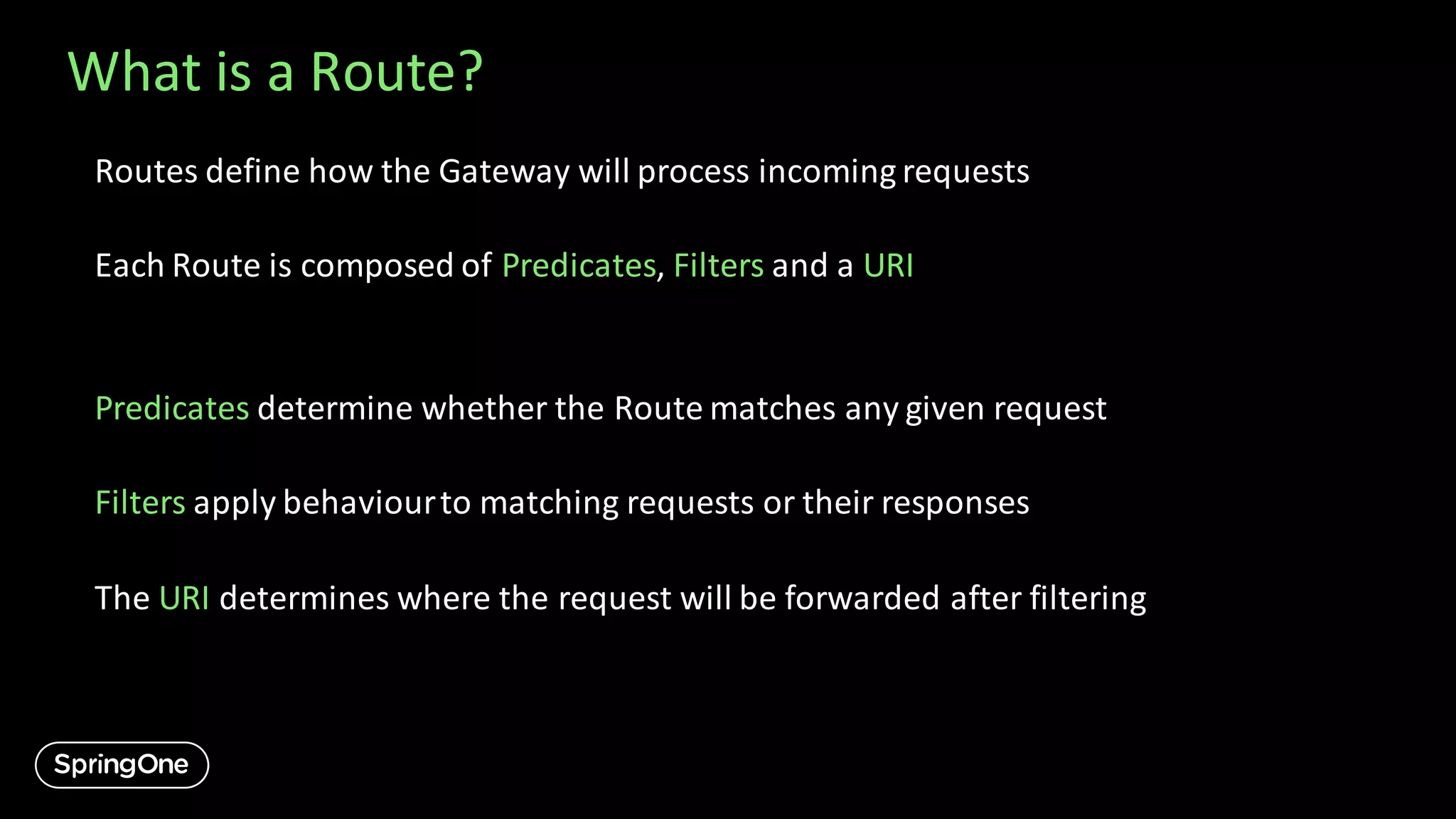
What is a Route?
Routes define how the Gateway will process incoming requests
Each Route is composed of Predicates, Filters and a URI
Predicates determine whether the Route matches any given request
Filters apply behaviourto matching requests or their responses
The URI determines where the request will be forwarded after filtering
Let’s Create a Gateway
-c '{
"routes": [{
"predicates": [
"Path=/a/**",
"Method=GET,POST"
],
"filters": [
"StripPrefix=1"
],
"uri": "http://example.com"
}]
}'
"path": "/a/**",
"method": "GET,POST",
"uri": "http://example.com"
}]
}'
cf create-service p.gateway standard my-gateway
Service Bindings
Exposing a route to an app running on Tanzu applicationplatform is simpler:
cf bind-service my-app my-gateway -c '{
"routes": [{
"path": "/a/**",
"method": “GET,POST"
}]
}'
To remove routes:
cf unbind-service my-app my-gateway
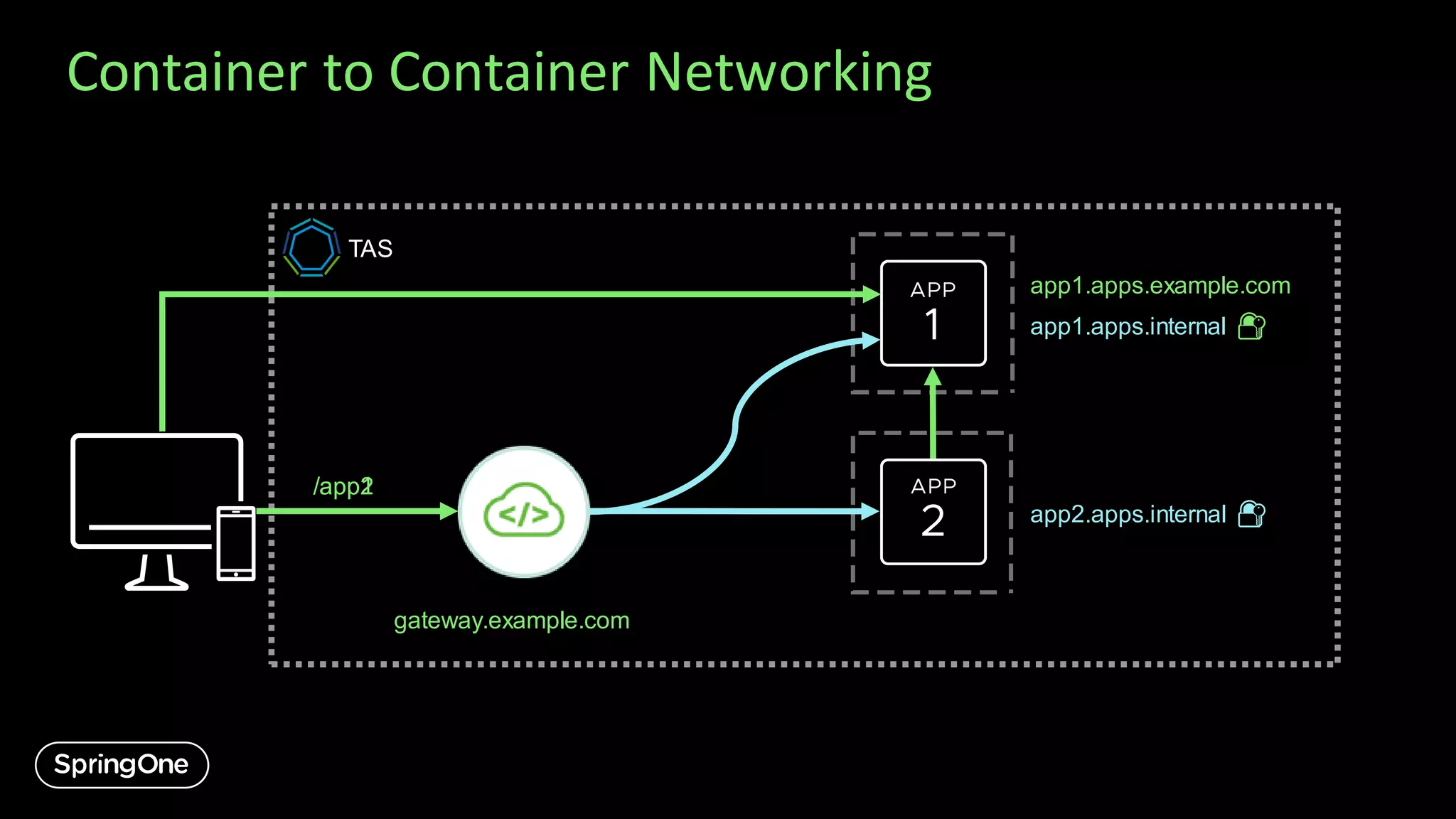
Container to Container Networking
app1.apps.example.com
app1.apps.internal 🔐
app2.apps.internal 🔐
/app1/app2
gateway.example.com
TAS
Updating Routes
To update routes that were created at Gateway creation time, use:
cf update-service my-gateway -c '{"routes": [...]}'
Binding and unbindingis one way to modify routes to on-platform apps after the
Gateway has been created.
Another way is to use Gateway’s bound-appsactuatorAPI
curl -X PUT https://<gateway uri>/actuator/bound-apps/<app id>/routes
-d "@./updated-route-config.json"
-H "Authorization: $(cf oauth-token)"
-H "Content-Type: application/json"
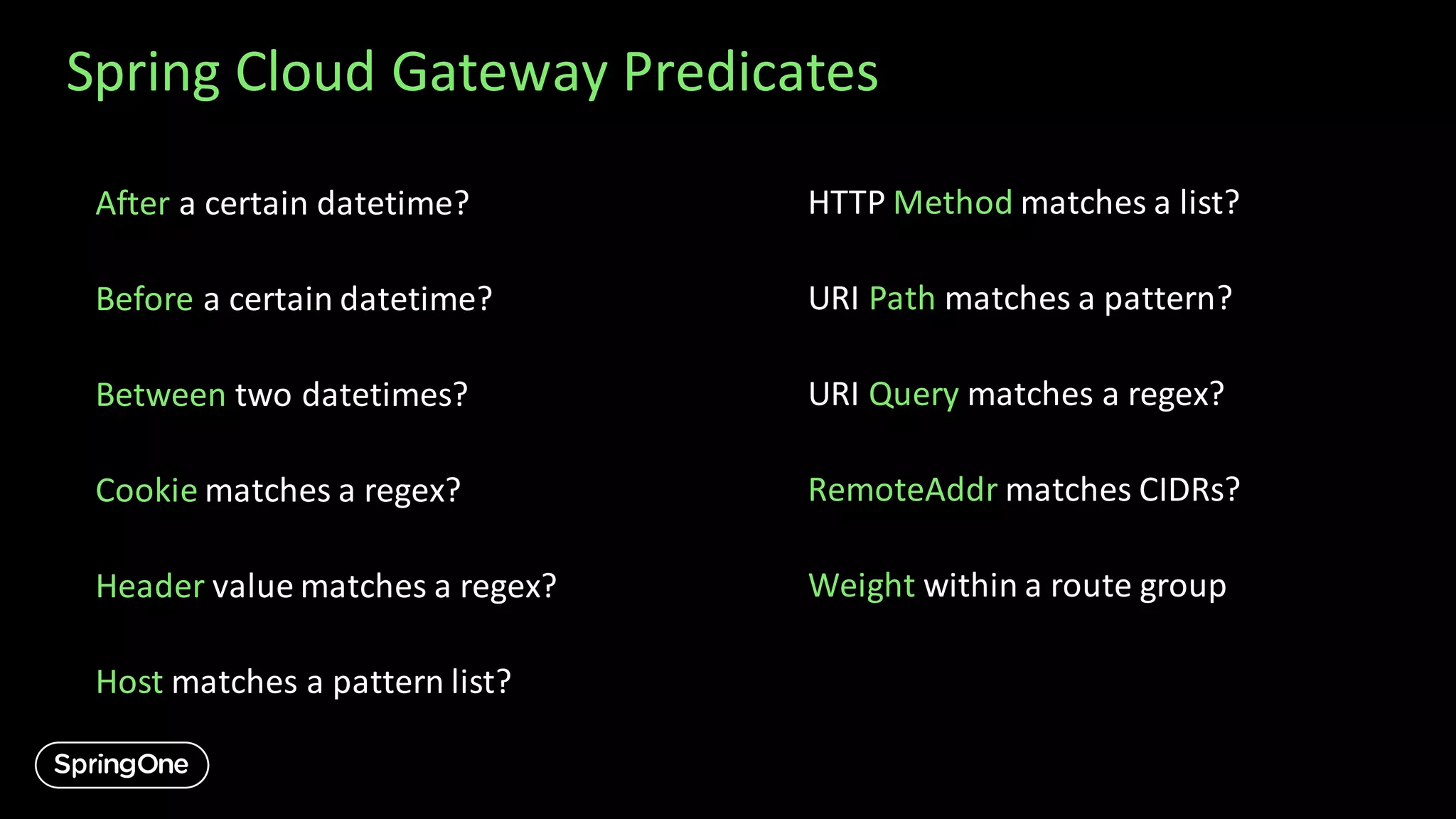
Spring Cloud Gateway Predicates
After a certain datetime?
Before a certain datetime?
Between two datetimes?
Cookie matches a regex?
Header value matches a regex?
Host matches a pattern list?
HTTP Method matches a list?
URI Path matches a pattern?
URI Query matches a regex?
RemoteAddr matches CIDRs?
Weight within a route group
Filters
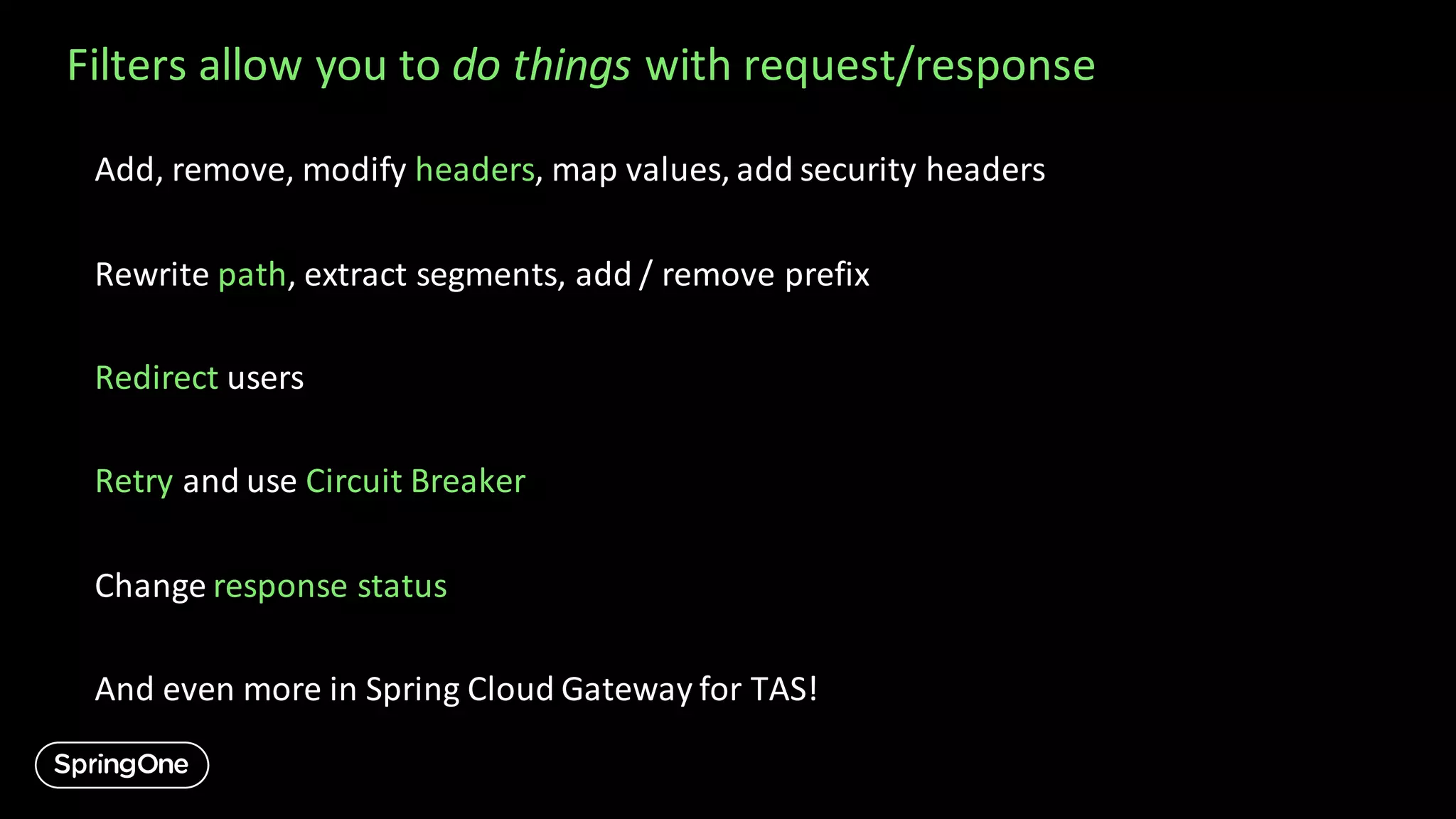
Filters allow you to do things with request/response
Add, remove, modify headers, map values, add security headers
Rewrite path, extract segments, add / remove prefix
Redirect users
Retry and use Circuit Breaker
Change response status
And even more in Spring Cloud Gateway for TAS!
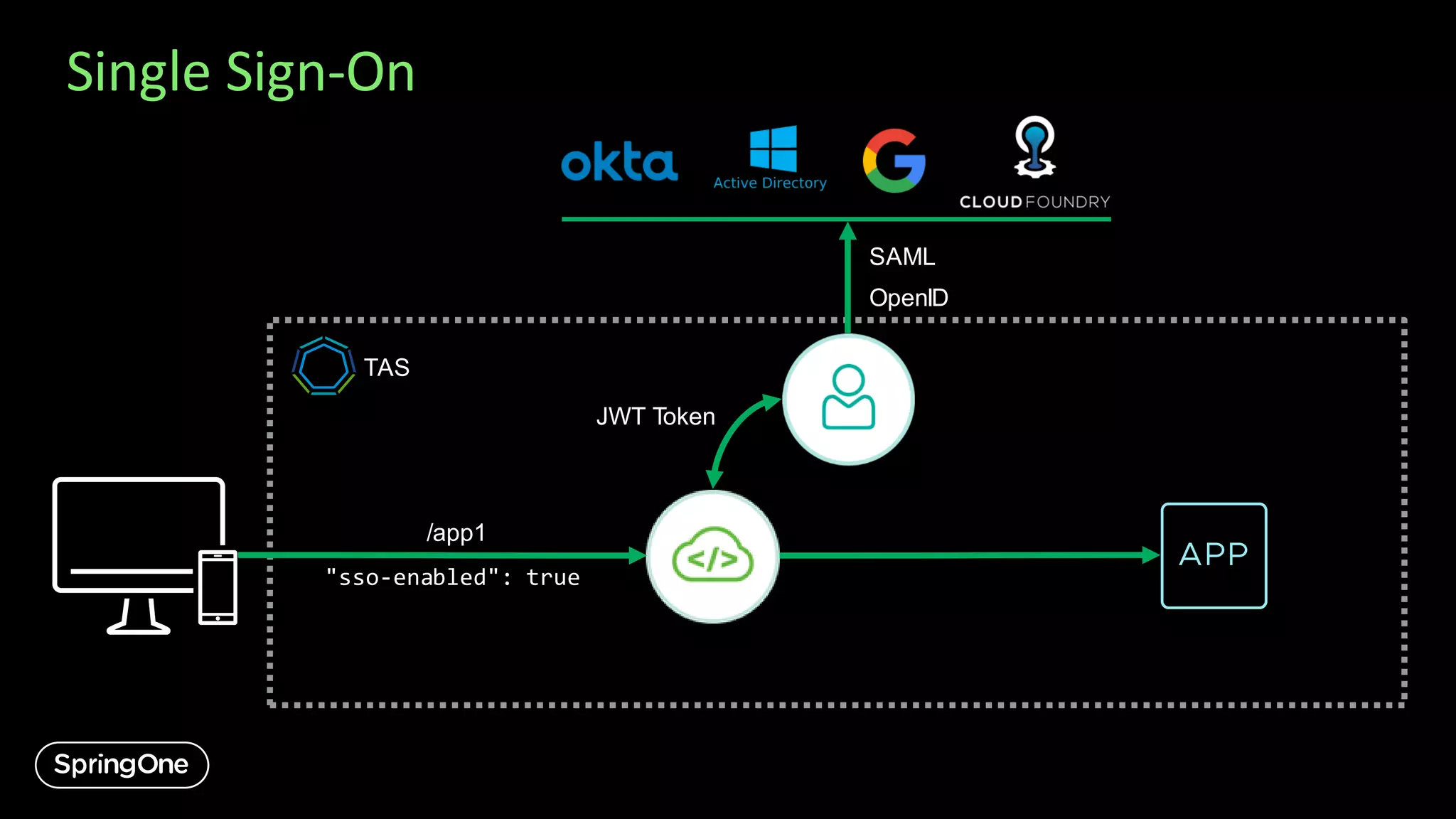
Single Sign-On
/app1
"sso-enabled": true
SAML
OpenID
JWT Token
TAS
Single Sign-On
/app1
"sso-enabled": true,
"scopes": [ "accounts.view" ],
"roles": [ "Auditor" ]
SAML
OpenID
JWT Token
"scope": [ "openid" ],
"roles": [ "Support" ]
TAS
❌
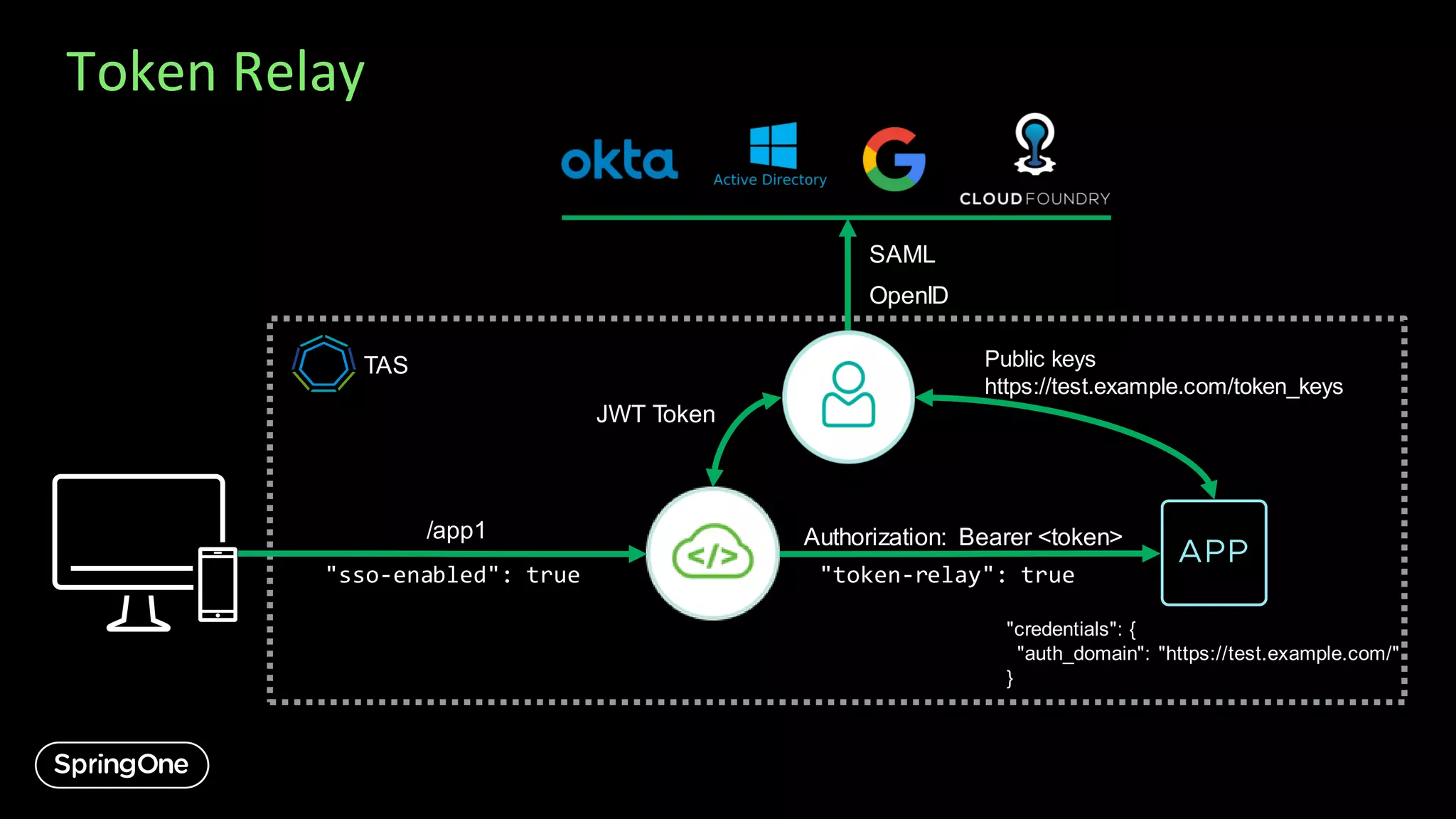
Token Relay
/app1
"sso-enabled": true
SAML
OpenID
JWT Token
TAS
"token-relay": true
Authorization: Bearer <token>
"credentials": {
"auth_domain": "https://test.example.com/"
}
Public keys
https://test.example.com/token_keys
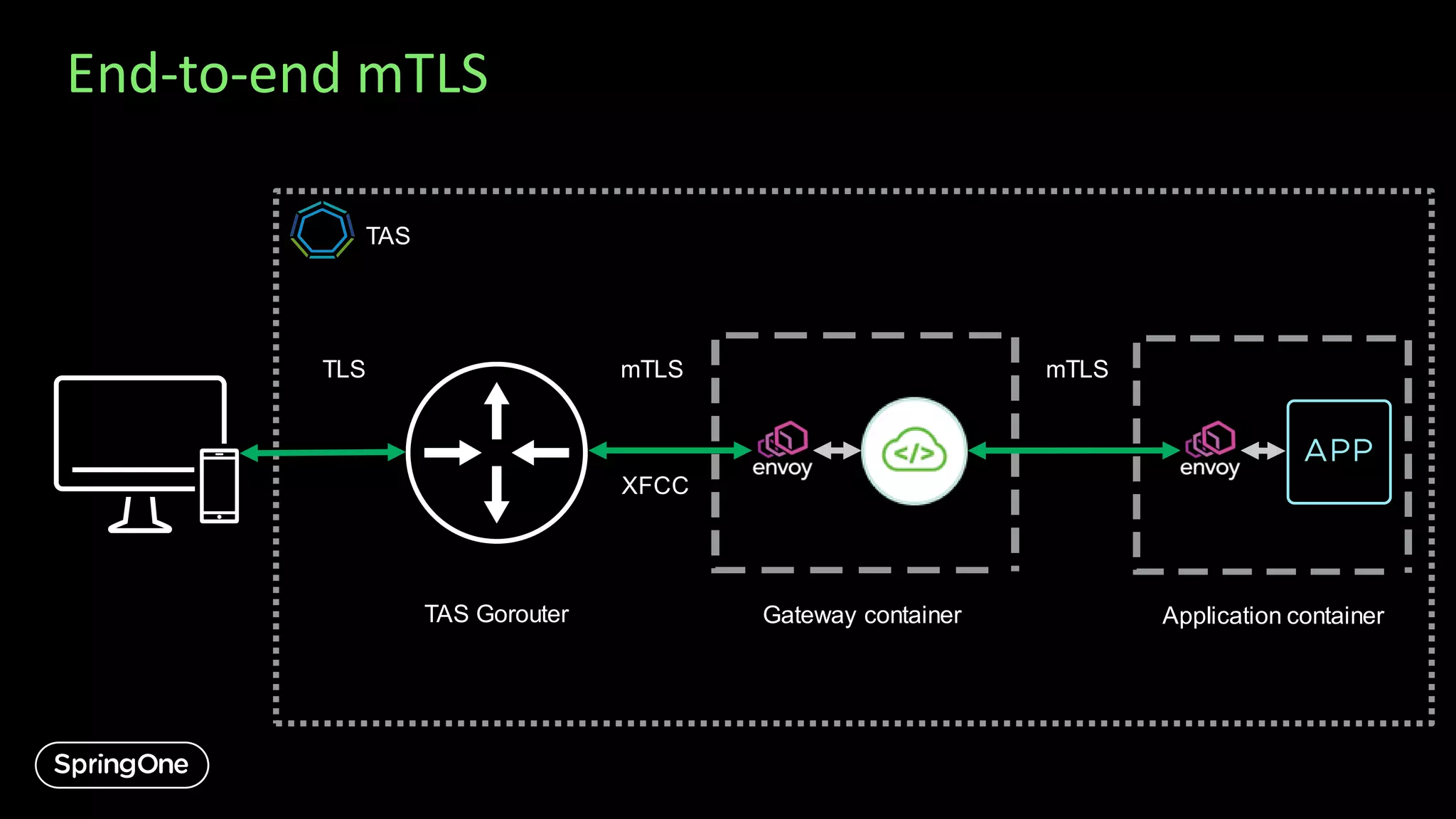
End-to-end mTLS
🤝
TLS
TAS Gorouter
🤝
mTLS
Gateway container Application container
🤝
mTLS
TAS
XFCC
Client Certificate validation
cf bind-service my-app my-gateway -c '{ "routes": [{
...,
"filters":["ClientCertificateHeader=*.example.com,sha-1:aa:bb:00:99"]
}] }'
This filter checks:
• the client certificate presented in inbound requests for chain of trust (always)
• (optionally) certificate Common Name value
• (optionally) SHA-1 or SHA-256 fingerprint
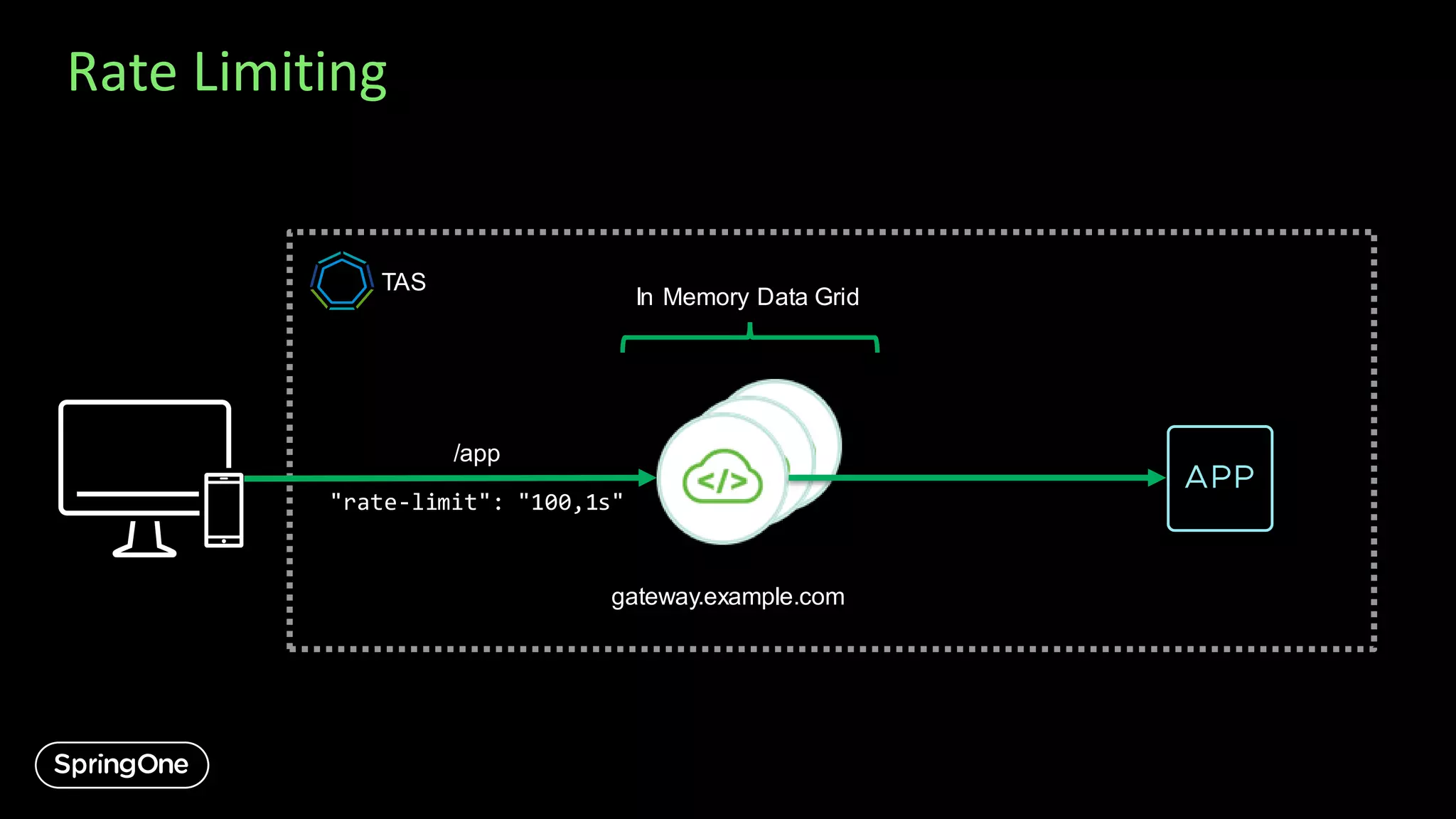
Rate Limiting
/app
TAS
"rate-limit": "100,1s"
gateway.example.com
In Memory Data Grid
Rate Limiting
cf bind-service my-app my-gateway -c '{
"routes": [ {
...,
"rate-limit": “100,1s"
} ]
}'
Prevents APIs from becoming overloadedby requests
Easily specify the maximum number of requests per time interval per route
Other Features
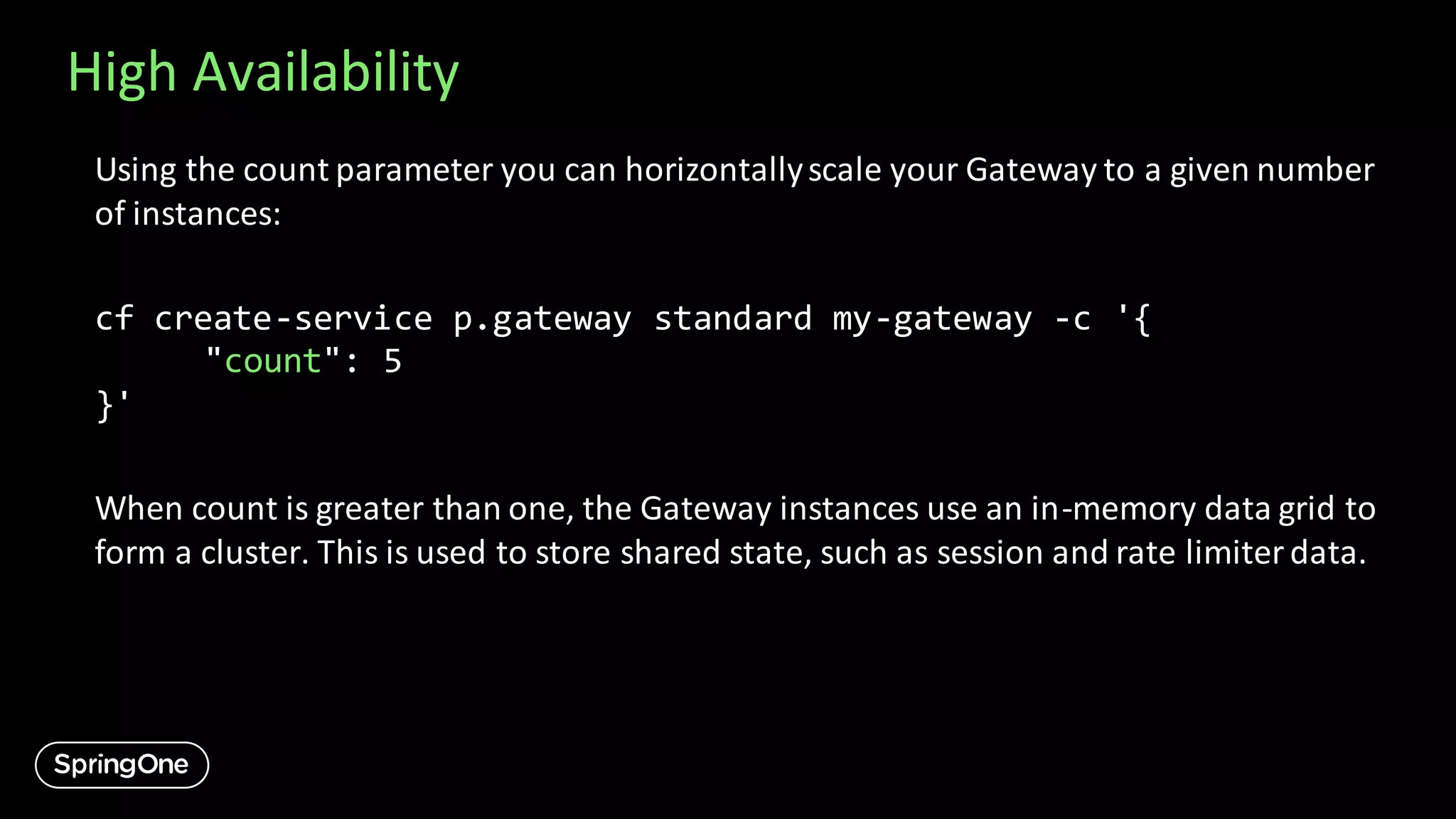
High Availability
Using the count parameter you can horizontallyscale your Gateway to a given number
of instances:
cf create-service p.gateway standard my-gateway -c '{
"count": 5
}'
When count is greater than one, the Gateway instances use an in-memory data grid to
form a cluster. This is used to store shared state, such as session and rate limiterdata.
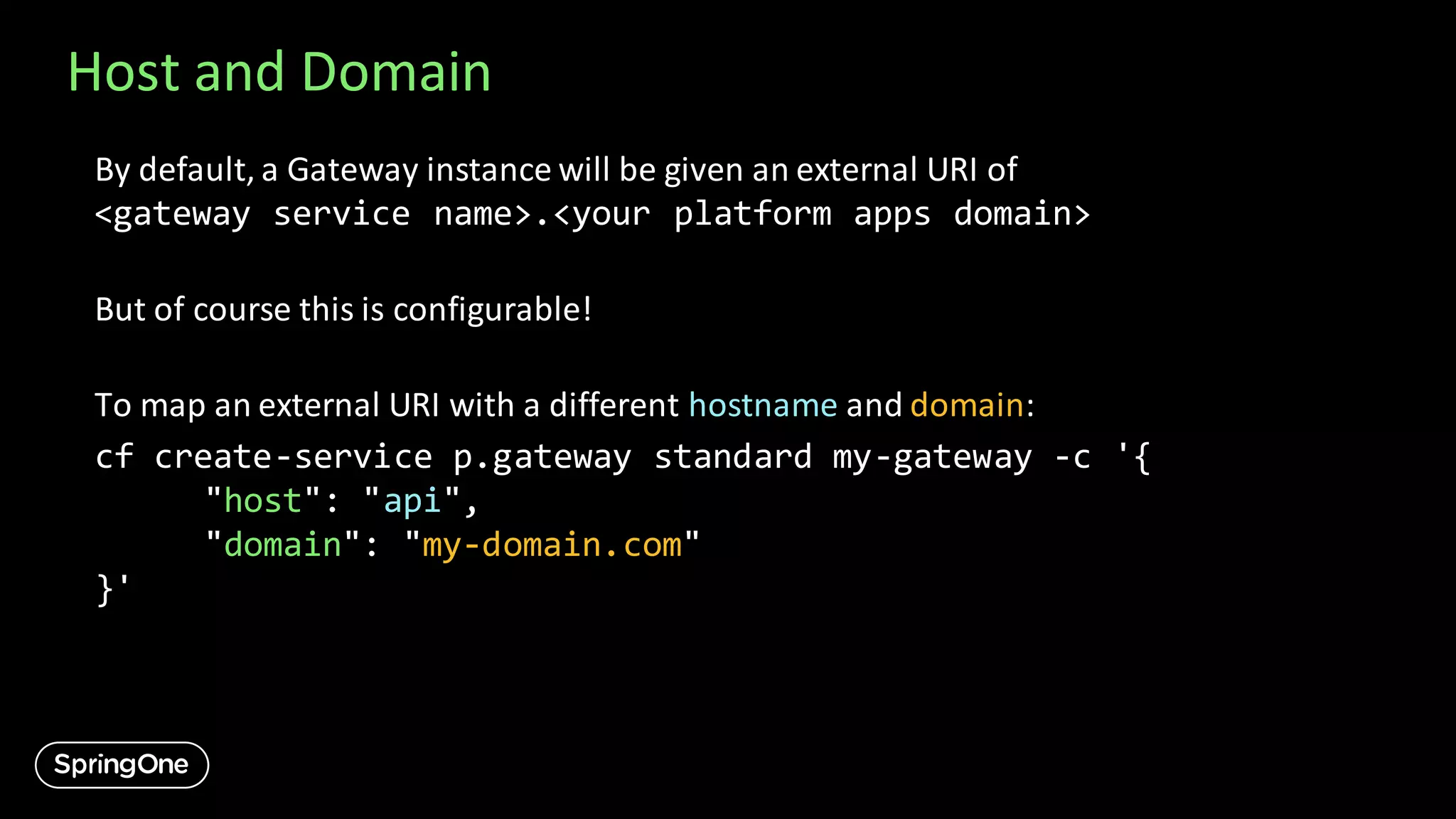
Host and Domain
By default, a Gateway instance will be given an external URI of
<gateway service name>.<your platform apps domain>
But of course this is configurable!
To map an external URI with a different hostname and domain:
cf create-service p.gateway standard my-gateway -c '{
"host": "api",
"domain": "my-domain.com"
}'
Cross Origin Resource Sharing (CORS) Configuration
Gateway can be configured to handleCORS requests:
cf create-service p.gateway standard my-gateway -c '{
"cors": {
"allowed-origins": [ "https://example.com" ],
"allowed-methods": [ "GET", "POST" ],
"allowed-headers": [ "X-Custom-Header" ],
"allow-credentials": true,
"max-age": 300,
"exposed-headers": [ "X-Custom-Header" ]
}
}'
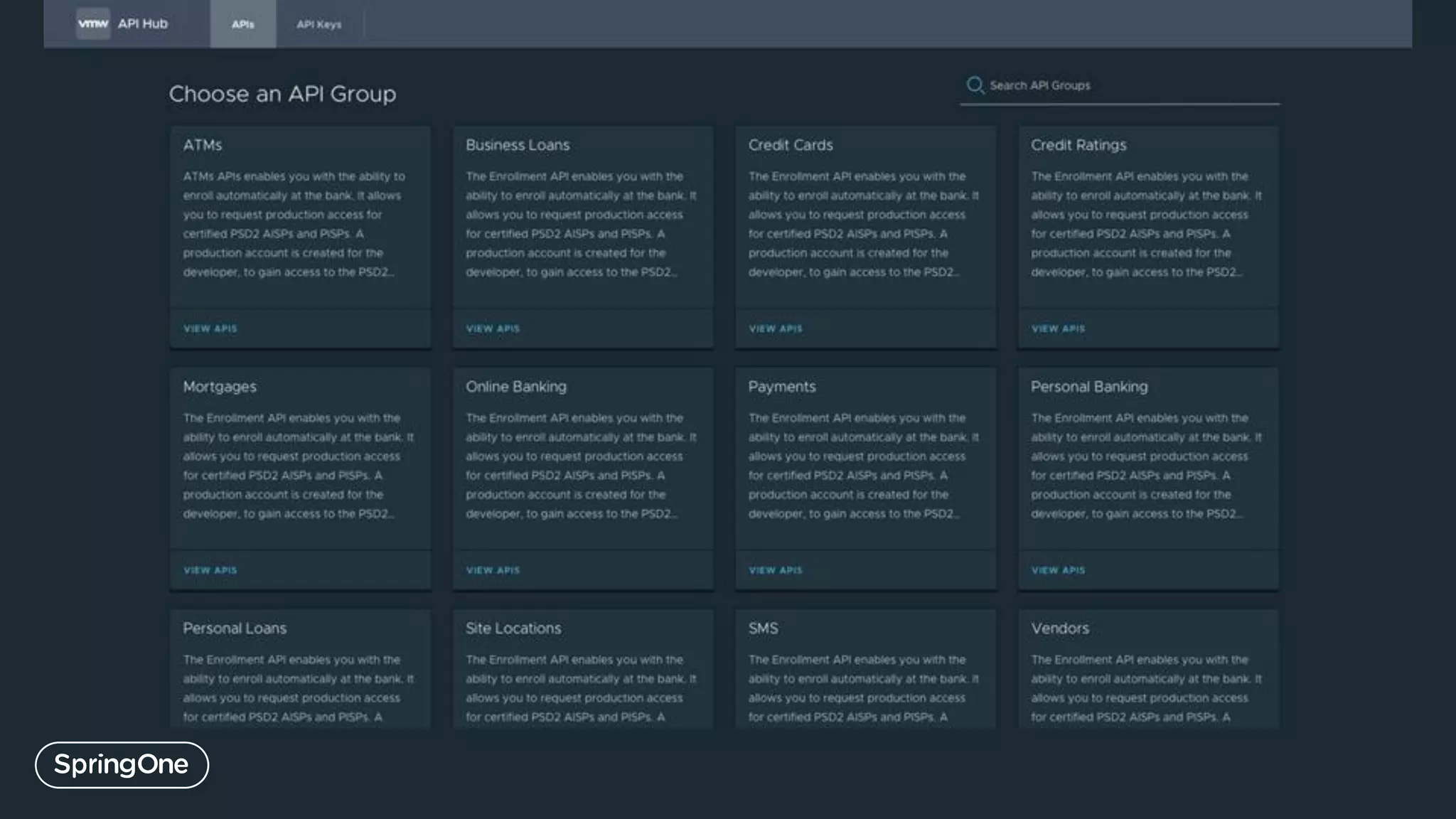
API Hub
(if only there was some way to see all these APIs together…
🤔)
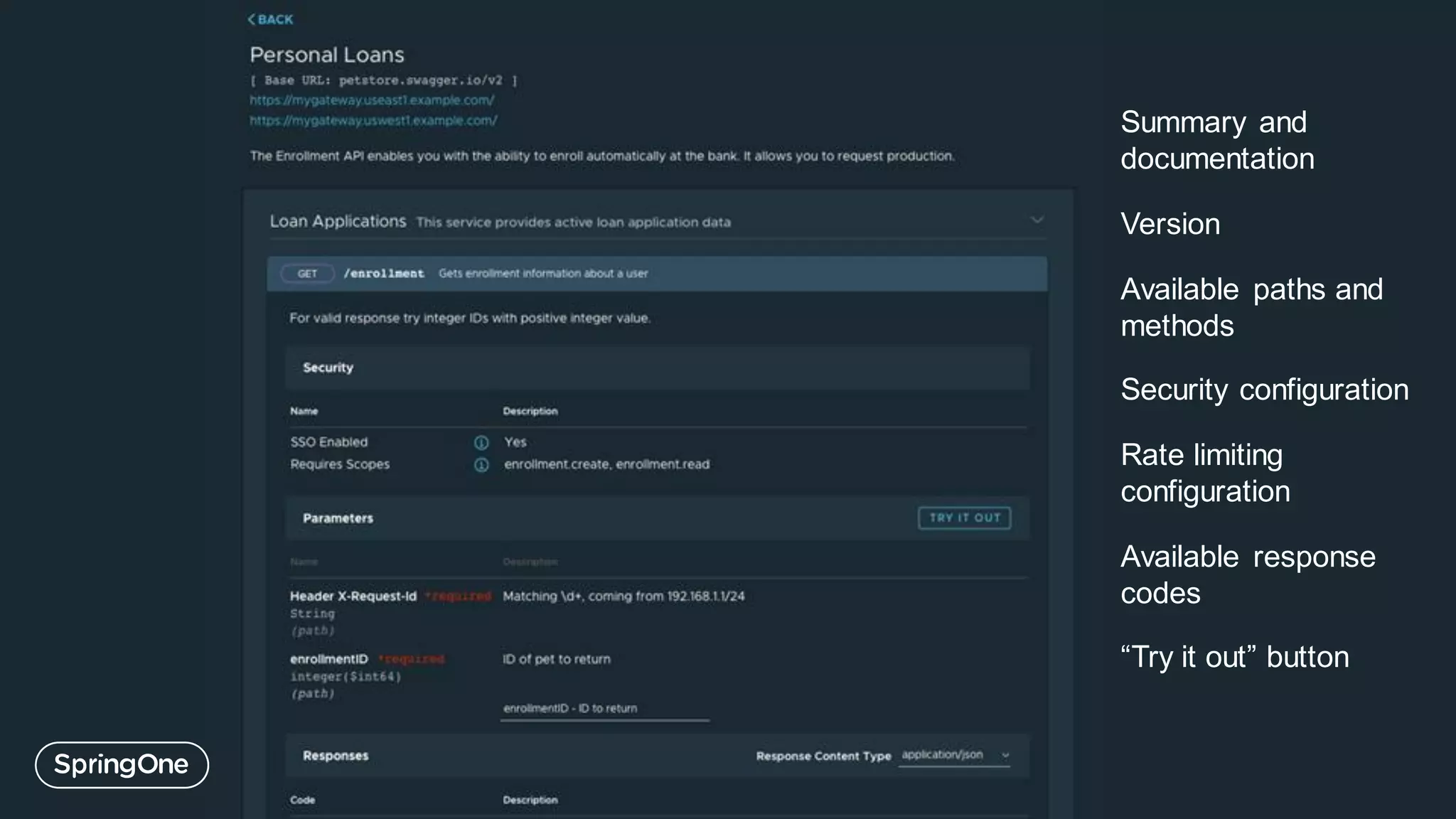
Summary and
documentation
Version
Available paths and
methods
Security configuration
Rate limiting
configuration
Available response
codes
“Try it out” button
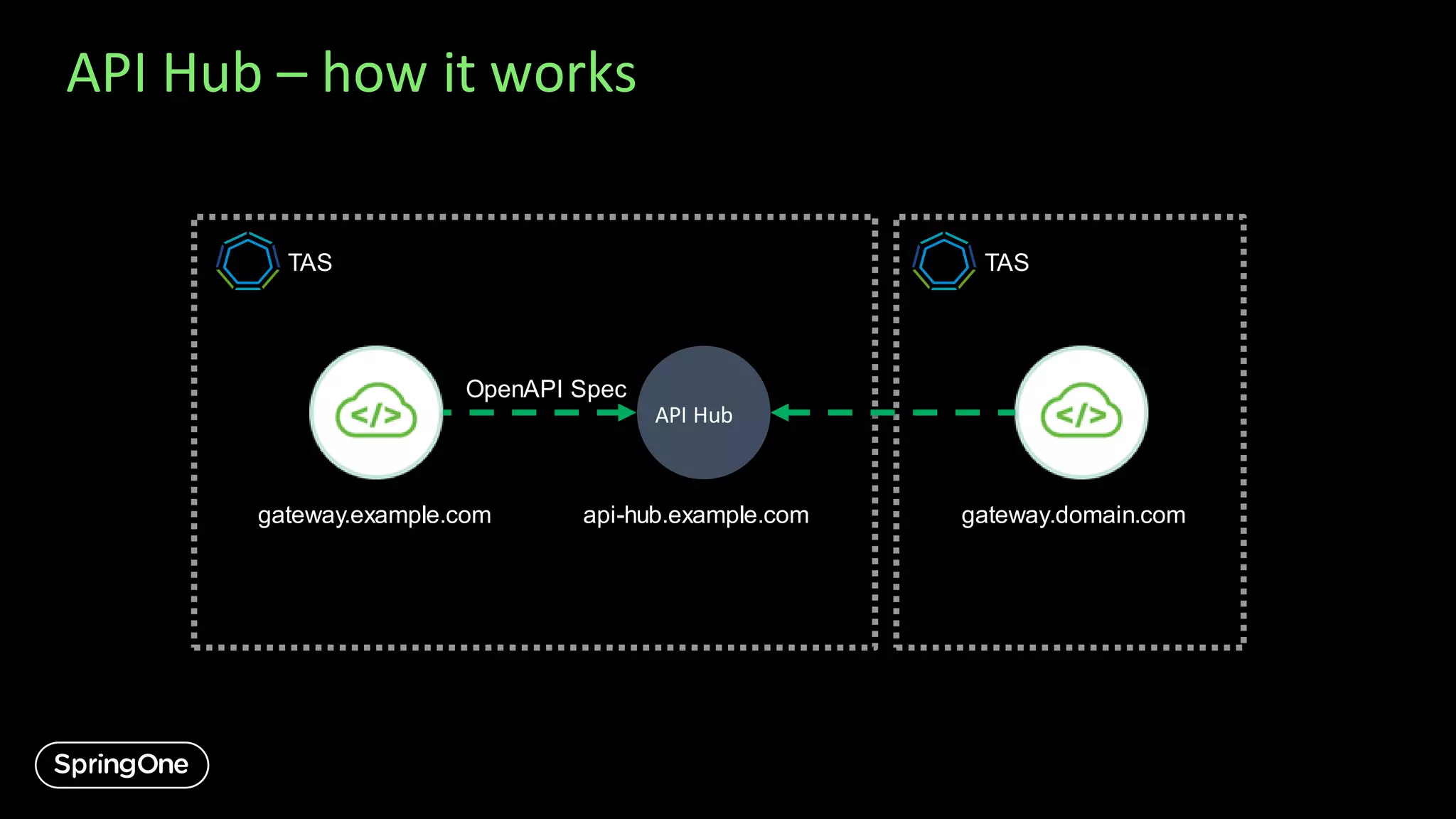
API Hub – how it works
gateway.example.com
TAS
api-hub.example.com gateway.domain.com
TAS
OpenAPI Spec
API Hub
Gateway and API Hub Demo
What’s Next for Gateway?
❤️

Introducing Spring Cloud Gateway and API Hub for VMware Tanzu

  • 1.
    Introducing Spring Cloud Gateway andAPI Hub for VMware Tanzu Alexey Nesterov and Gareth Clay
  • 2.
    Disclaimer The following isintended to outline the general direction of VMware's offerings. Itis intended for information purposes only and may not be incorporated into any contract. Any information regarding pre-release of VMwareofferings, futureupdates or other planned modifications is subject to ongoing evaluation by VMware and is subjectto change. This information is provided without warranty or any kind, express or implied, and is not a commitment to deliver any material, code, or functionality, and should not be relied upon in making purchasing decisions regarding VMware's offerings. Thesepurchasing decisions should only be based on features currently available. The development, release, and timing of any features or functionality described for VMware's offerings in this presentation remain at the sole discretion of VMware. VMwarehas no obligation to update forward looking information in this presentation.
  • 3.
    VMware Tanzu ApplicationService (TAS) cf push cf create- service cf bind- service
  • 4.
    Best of SpringOpen Source with VMware Tanzu Integration + =
  • 5.
  • 6.
  • 7.
    What is aRoute? Routes define how the Gateway will process incoming requests Each Route is composed of Predicates, Filters and a URI Predicates determine whether the Route matches any given request Filters apply behaviourto matching requests or their responses The URI determines where the request will be forwarded after filtering
  • 8.
    Let’s Create aGateway -c '{ "routes": [{ "predicates": [ "Path=/a/**", "Method=GET,POST" ], "filters": [ "StripPrefix=1" ], "uri": "http://example.com" }] }' "path": "/a/**", "method": "GET,POST", "uri": "http://example.com" }] }' cf create-service p.gateway standard my-gateway
  • 9.
    Service Bindings Exposing aroute to an app running on Tanzu applicationplatform is simpler: cf bind-service my-app my-gateway -c '{ "routes": [{ "path": "/a/**", "method": “GET,POST" }] }' To remove routes: cf unbind-service my-app my-gateway
  • 10.
    Container to ContainerNetworking app1.apps.example.com app1.apps.internal 🔐 app2.apps.internal 🔐 /app1/app2 gateway.example.com TAS
  • 11.
    Updating Routes To updateroutes that were created at Gateway creation time, use: cf update-service my-gateway -c '{"routes": [...]}' Binding and unbindingis one way to modify routes to on-platform apps after the Gateway has been created. Another way is to use Gateway’s bound-appsactuatorAPI curl -X PUT https://<gateway uri>/actuator/bound-apps/<app id>/routes -d "@./updated-route-config.json" -H "Authorization: $(cf oauth-token)" -H "Content-Type: application/json"
  • 12.
    Spring Cloud GatewayPredicates After a certain datetime? Before a certain datetime? Between two datetimes? Cookie matches a regex? Header value matches a regex? Host matches a pattern list? HTTP Method matches a list? URI Path matches a pattern? URI Query matches a regex? RemoteAddr matches CIDRs? Weight within a route group
  • 13.
  • 14.
    Filters allow youto do things with request/response Add, remove, modify headers, map values, add security headers Rewrite path, extract segments, add / remove prefix Redirect users Retry and use Circuit Breaker Change response status And even more in Spring Cloud Gateway for TAS!
  • 15.
  • 16.
    Single Sign-On /app1 "sso-enabled": true, "scopes":[ "accounts.view" ], "roles": [ "Auditor" ] SAML OpenID JWT Token "scope": [ "openid" ], "roles": [ "Support" ] TAS ❌
  • 17.
    Token Relay /app1 "sso-enabled": true SAML OpenID JWTToken TAS "token-relay": true Authorization: Bearer <token> "credentials": { "auth_domain": "https://test.example.com/" } Public keys https://test.example.com/token_keys
  • 18.
    End-to-end mTLS 🤝 TLS TAS Gorouter 🤝 mTLS Gatewaycontainer Application container 🤝 mTLS TAS XFCC
  • 19.
    Client Certificate validation cfbind-service my-app my-gateway -c '{ "routes": [{ ..., "filters":["ClientCertificateHeader=*.example.com,sha-1:aa:bb:00:99"] }] }' This filter checks: • the client certificate presented in inbound requests for chain of trust (always) • (optionally) certificate Common Name value • (optionally) SHA-1 or SHA-256 fingerprint
  • 20.
  • 21.
    Rate Limiting cf bind-servicemy-app my-gateway -c '{ "routes": [ { ..., "rate-limit": “100,1s" } ] }' Prevents APIs from becoming overloadedby requests Easily specify the maximum number of requests per time interval per route
  • 22.
  • 23.
    High Availability Using thecount parameter you can horizontallyscale your Gateway to a given number of instances: cf create-service p.gateway standard my-gateway -c '{ "count": 5 }' When count is greater than one, the Gateway instances use an in-memory data grid to form a cluster. This is used to store shared state, such as session and rate limiterdata.
  • 24.
    Host and Domain Bydefault, a Gateway instance will be given an external URI of <gateway service name>.<your platform apps domain> But of course this is configurable! To map an external URI with a different hostname and domain: cf create-service p.gateway standard my-gateway -c '{ "host": "api", "domain": "my-domain.com" }'
  • 25.
    Cross Origin ResourceSharing (CORS) Configuration Gateway can be configured to handleCORS requests: cf create-service p.gateway standard my-gateway -c '{ "cors": { "allowed-origins": [ "https://example.com" ], "allowed-methods": [ "GET", "POST" ], "allowed-headers": [ "X-Custom-Header" ], "allow-credentials": true, "max-age": 300, "exposed-headers": [ "X-Custom-Header" ] } }'
  • 26.
    API Hub (if onlythere was some way to see all these APIs together… 🤔)
  • 28.
    Summary and documentation Version Available pathsand methods Security configuration Rate limiting configuration Available response codes “Try it out” button
  • 29.
    API Hub –how it works gateway.example.com TAS api-hub.example.com gateway.domain.com TAS OpenAPI Spec API Hub
  • 31.
  • 32.
  • 34.