Mentoring Trainees in Research
The PhD/non-MD Perspective
Peder Larson
Associate Professor
@pezlarson
Mentoring Trainees in Research2
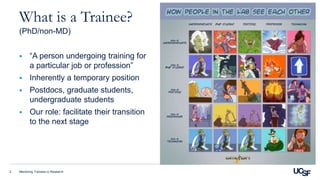
What is a Trainee?
(PhD/non-MD)
 “A person undergoing training for
a particular job or profession”
 Inherently a temporary position
 Postdocs, graduate students,
undergraduate students
 Our role: facilitate their transition
to the next stage
Mentoring Trainees in Research3
What is Mentoring in Research?
 Education: theoretical principles
 Research training: technical/lab skills, data analysis
skills, project development, collaborative research,
project management
 Communication Skills: abstracts, papers, grants,
talks, how to use Zoom
 Career Development: options awareness, CV,
networking, references
Mentoring Trainees in Research4
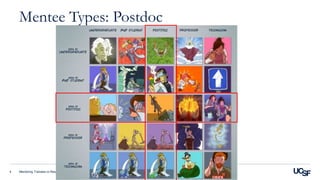
Mentee Types: Postdoc
Mentoring Trainees in Research5
Mentoring Postdocs
 Goal: Progression from more to less supervised research
 Education
- Typically informal, can provide support by connecting with experts, attending
conferences
 Research
- PhD gives them foundation for cutting-edge research
- Support continued development of skills, but with progression to independent
research with increased ownership
- Develop collaborative research skills (critical for modern biomedical research)
through working across teams and providing them opportunities to managing
teamwork
Mentoring Trainees in Research6
Mentoring Postdocs
 Goal: Progression from more to less supervised research
 Selecting a Research Project
- Usually hired to support an ongoing, funded project
- Give substantial responsibility in project: successful postdocs will rise to the
challenge
- Provide opportunity to develop their own ideas: this is what they need to succeed
in independent research position
- Should be able to manage multiple projects at once
- My philosophy: start with 75-100% on ongoing lab project, and then transition to
increased independent work (can be based on rate of success in projects and
securing fellowships)
Mentoring Trainees in Research7
Mentoring Postdocs
 Goal: Progression from more to less supervised research
 Communication
- Should be proficient in paper writing and have some oral presentation skills
- Become more active in grant writing, especially their own (e.g. postdoctoral
fellowships, investigator status for more senior postdocs)
- Provide them with opportunities to present their work at meetings, conferences,
etc.
 Career Development
- Most postdocs are interested in academia
- Make them aware of different options in academia
- Help them navigate the academic job market
- Provide access to networks
Mentoring Trainees in Research8
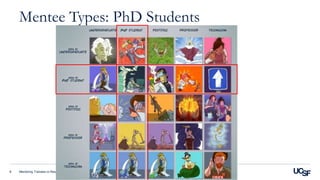
Mentee Types: PhD Students
Mentoring Trainees in Research9
Mentoring PhD Students
 Goal: Develop skills to do cutting-edge research, Broad literacy with
specialized expertise
 Education
- Formal coursework for ~2 years
- Learning from experts (other grad students, postdocs, researchers)
 Research
- Critical time to develop research skills, starting with technical/lab and analysis,
and building up independence
- Provide necessary them the necessary resources and infrastructure to succeed
- Access to collaborators and learn how to do team-based research, but with
caution not to overwhelm
Mentoring Trainees in Research10
Mentoring PhD Students
 Goal: Develop skills to do cutting-edge research, Broad literacy with
specialized expertise
 Selecting a Research Project
- They have 3-5 years committed to research, which provides great opportunity to
explore bigger new ideas or directions
- Focus on a single project/idea
- Initial scope of project should be well-defined
- Qualifying Exam is a wonderful opportunity to flush out project ideas, and have
them scrutinized by your peers
Mentoring Trainees in Research11
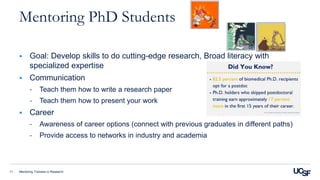
Mentoring PhD Students
 Goal: Develop skills to do cutting-edge research, Broad literacy with
specialized expertise
 Communication
- Teach them how to write a research paper
- Teach them how to present your work
 Career
- Awareness of career options (connect with previous graduates in different paths)
- Provide access to networks in industry and academia
Mentoring Trainees in Research12
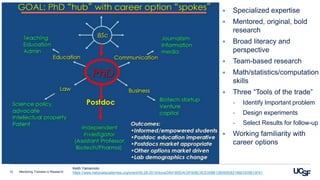
 Specialized expertise
 Mentored, original, bold
research
 Broad literacy and
perspective
 Team-based research
 Math/statistics/computation
skills
 Three “Tools of the trade”
- Identify Important problem
- Design experiments
- Select Results for follow-up
 Working familiarity with
career options
Keith Yamamoto
https://www.nationalacademies.org/event/05-28-2015/docs/D641B5DAC0F83BC9CE059B13B560EB2196EDD5B10F61
Mentoring Trainees in Research13
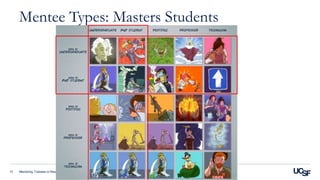
Mentee Types: Masters Students
Mentoring Trainees in Research14
Mentoring Masters (MSBI)
Students
 Goal: Develop more specialized skills (biomedical imaging)
 Education
- Formal coursework for 9 months
- Embedded learning in research
 Research
- Often getting first exposure to research
- Develop technical/lab and analysis skills
- Create thesis relatively quickly
Mentoring Trainees in Research15
Mentoring Masters (MSBI)
Students
 Goal: Develop more specialized skills (biomedical imaging)
 Selecting a Research Project
- Time is short! 3 unit research elective in spring to develop project idea and
establish some foundation, then 2-3 months in summer full time to complete.
Think carefully about the scope
- Best to have strong supervision from you or other lab member
- Many students will stay beyond the thesis which can extend the scope and results
of the project
Mentoring Trainees in Research16
Mentoring Masters (MSBI)
Students
 Goal: Develop more specialized skills (biomedical imaging)
 Communication
- Present thesis project
- Contribute to abstract or paper
 Career
- Academics: support PhD application
- Professional school: support MD application
- Industry: Networking (we should promote our graduates since they can offer
unique skills to companies with imaging components)
Mentoring Trainees in Research17
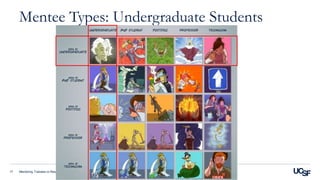
Mentee Types: Undergraduate Students
Mentoring Trainees in Research18
Mentoring Undergraduate
Students
 Goal: Provide exposure to research
 Education
- Embedded learning in research. Often requires extra effort since coursework has
not yet provided sufficient preparation
 Research
- Often getting first exposure to research
- Develop a technical, lab or analysis skill with a well-defined and clearly
supervised task
Mentoring Trainees in Research19
Mentoring Undergraduate
Students
 Goal: Provide exposure to research
 Selecting a Research Project
- I have not been very successful in choosing undergrad projects
- Skill set for many advanced imaging research is not yet developed, and it is hard
to develop on the side as an undergrad
- Ideas: directly apply skills learning in courses (e.g. machine learning, filter design,
software) in a well-defined research task
Mentoring Trainees in Research20
Mentoring Undergraduate
Students
 Goal: Provide exposure to research
 Communication
- Help them to learn to read scientific papers
- Look for opportunity for them to present their work(e.g. summer research
symposium)
 Career
- Academics: support PhD application
- Professional school: support MD application
- Industry: Networking
Mentoring Trainees in Research21
Generalizable Skills for Trainees
 What is Research? How to identify and/or approach a new
problem. We offer this skill to trainees
- Assess state-of-the-art
- Acquire knowledge
- Propose and scrutinize possible solutions
 Hard skills
- Software (establish GitHub presence)
- Engineering (fabrication, testing)
- Wet Lab skills
Mentoring Trainees in Research22
Tools for Mentors
 Individual Development plans (IDPs) https://career.ucsf.edu/IDP
- written list of goals mapped to a timeline, and includes goal setting for research
projects, skills development, and career planning
 Meetings
- Regular opportunities for research and mentoring updates
- Annual/Semi-annual review of overall progress
 UCSF Office of Career and Professional Development
 Bioengineering Graduate program – Head Graduate advisors
 MSBI – Program Directors
Mentoring Trainees in Research23
Happy Mentoring!

Mentoring trainees in research

  • 1.
    Mentoring Trainees inResearch The PhD/non-MD Perspective Peder Larson Associate Professor @pezlarson
  • 2.
    Mentoring Trainees inResearch2 What is a Trainee? (PhD/non-MD)  “A person undergoing training for a particular job or profession”  Inherently a temporary position  Postdocs, graduate students, undergraduate students  Our role: facilitate their transition to the next stage
  • 3.
    Mentoring Trainees inResearch3 What is Mentoring in Research?  Education: theoretical principles  Research training: technical/lab skills, data analysis skills, project development, collaborative research, project management  Communication Skills: abstracts, papers, grants, talks, how to use Zoom  Career Development: options awareness, CV, networking, references
  • 4.
    Mentoring Trainees inResearch4 Mentee Types: Postdoc
  • 5.
    Mentoring Trainees inResearch5 Mentoring Postdocs  Goal: Progression from more to less supervised research  Education - Typically informal, can provide support by connecting with experts, attending conferences  Research - PhD gives them foundation for cutting-edge research - Support continued development of skills, but with progression to independent research with increased ownership - Develop collaborative research skills (critical for modern biomedical research) through working across teams and providing them opportunities to managing teamwork
  • 6.
    Mentoring Trainees inResearch6 Mentoring Postdocs  Goal: Progression from more to less supervised research  Selecting a Research Project - Usually hired to support an ongoing, funded project - Give substantial responsibility in project: successful postdocs will rise to the challenge - Provide opportunity to develop their own ideas: this is what they need to succeed in independent research position - Should be able to manage multiple projects at once - My philosophy: start with 75-100% on ongoing lab project, and then transition to increased independent work (can be based on rate of success in projects and securing fellowships)
  • 7.
    Mentoring Trainees inResearch7 Mentoring Postdocs  Goal: Progression from more to less supervised research  Communication - Should be proficient in paper writing and have some oral presentation skills - Become more active in grant writing, especially their own (e.g. postdoctoral fellowships, investigator status for more senior postdocs) - Provide them with opportunities to present their work at meetings, conferences, etc.  Career Development - Most postdocs are interested in academia - Make them aware of different options in academia - Help them navigate the academic job market - Provide access to networks
  • 8.
    Mentoring Trainees inResearch8 Mentee Types: PhD Students
  • 9.
    Mentoring Trainees inResearch9 Mentoring PhD Students  Goal: Develop skills to do cutting-edge research, Broad literacy with specialized expertise  Education - Formal coursework for ~2 years - Learning from experts (other grad students, postdocs, researchers)  Research - Critical time to develop research skills, starting with technical/lab and analysis, and building up independence - Provide necessary them the necessary resources and infrastructure to succeed - Access to collaborators and learn how to do team-based research, but with caution not to overwhelm
  • 10.
    Mentoring Trainees inResearch10 Mentoring PhD Students  Goal: Develop skills to do cutting-edge research, Broad literacy with specialized expertise  Selecting a Research Project - They have 3-5 years committed to research, which provides great opportunity to explore bigger new ideas or directions - Focus on a single project/idea - Initial scope of project should be well-defined - Qualifying Exam is a wonderful opportunity to flush out project ideas, and have them scrutinized by your peers
  • 11.
    Mentoring Trainees inResearch11 Mentoring PhD Students  Goal: Develop skills to do cutting-edge research, Broad literacy with specialized expertise  Communication - Teach them how to write a research paper - Teach them how to present your work  Career - Awareness of career options (connect with previous graduates in different paths) - Provide access to networks in industry and academia
  • 12.
    Mentoring Trainees inResearch12  Specialized expertise  Mentored, original, bold research  Broad literacy and perspective  Team-based research  Math/statistics/computation skills  Three “Tools of the trade” - Identify Important problem - Design experiments - Select Results for follow-up  Working familiarity with career options Keith Yamamoto https://www.nationalacademies.org/event/05-28-2015/docs/D641B5DAC0F83BC9CE059B13B560EB2196EDD5B10F61
  • 13.
    Mentoring Trainees inResearch13 Mentee Types: Masters Students
  • 14.
    Mentoring Trainees inResearch14 Mentoring Masters (MSBI) Students  Goal: Develop more specialized skills (biomedical imaging)  Education - Formal coursework for 9 months - Embedded learning in research  Research - Often getting first exposure to research - Develop technical/lab and analysis skills - Create thesis relatively quickly
  • 15.
    Mentoring Trainees inResearch15 Mentoring Masters (MSBI) Students  Goal: Develop more specialized skills (biomedical imaging)  Selecting a Research Project - Time is short! 3 unit research elective in spring to develop project idea and establish some foundation, then 2-3 months in summer full time to complete. Think carefully about the scope - Best to have strong supervision from you or other lab member - Many students will stay beyond the thesis which can extend the scope and results of the project
  • 16.
    Mentoring Trainees inResearch16 Mentoring Masters (MSBI) Students  Goal: Develop more specialized skills (biomedical imaging)  Communication - Present thesis project - Contribute to abstract or paper  Career - Academics: support PhD application - Professional school: support MD application - Industry: Networking (we should promote our graduates since they can offer unique skills to companies with imaging components)
  • 17.
    Mentoring Trainees inResearch17 Mentee Types: Undergraduate Students
  • 18.
    Mentoring Trainees inResearch18 Mentoring Undergraduate Students  Goal: Provide exposure to research  Education - Embedded learning in research. Often requires extra effort since coursework has not yet provided sufficient preparation  Research - Often getting first exposure to research - Develop a technical, lab or analysis skill with a well-defined and clearly supervised task
  • 19.
    Mentoring Trainees inResearch19 Mentoring Undergraduate Students  Goal: Provide exposure to research  Selecting a Research Project - I have not been very successful in choosing undergrad projects - Skill set for many advanced imaging research is not yet developed, and it is hard to develop on the side as an undergrad - Ideas: directly apply skills learning in courses (e.g. machine learning, filter design, software) in a well-defined research task
  • 20.
    Mentoring Trainees inResearch20 Mentoring Undergraduate Students  Goal: Provide exposure to research  Communication - Help them to learn to read scientific papers - Look for opportunity for them to present their work(e.g. summer research symposium)  Career - Academics: support PhD application - Professional school: support MD application - Industry: Networking
  • 21.
    Mentoring Trainees inResearch21 Generalizable Skills for Trainees  What is Research? How to identify and/or approach a new problem. We offer this skill to trainees - Assess state-of-the-art - Acquire knowledge - Propose and scrutinize possible solutions  Hard skills - Software (establish GitHub presence) - Engineering (fabrication, testing) - Wet Lab skills
  • 22.
    Mentoring Trainees inResearch22 Tools for Mentors  Individual Development plans (IDPs) https://career.ucsf.edu/IDP - written list of goals mapped to a timeline, and includes goal setting for research projects, skills development, and career planning  Meetings - Regular opportunities for research and mentoring updates - Annual/Semi-annual review of overall progress  UCSF Office of Career and Professional Development  Bioengineering Graduate program – Head Graduate advisors  MSBI – Program Directors
  • 23.
    Mentoring Trainees inResearch23 Happy Mentoring!